EP3789346B1 - Lithium based ion conductive powder, ion conductive molded article, and electricity storage device - Google Patents
Lithium based ion conductive powder, ion conductive molded article, and electricity storage device Download PDFInfo
- Publication number
- EP3789346B1 EP3789346B1 EP19796324.2A EP19796324A EP3789346B1 EP 3789346 B1 EP3789346 B1 EP 3789346B1 EP 19796324 A EP19796324 A EP 19796324A EP 3789346 B1 EP3789346 B1 EP 3789346B1
- Authority
- EP
- European Patent Office
- Prior art keywords
- ion
- lithium
- powder
- solid electrolyte
- ion conductive
- Prior art date
- Legal status (The legal status is an assumption and is not a legal conclusion. Google has not performed a legal analysis and makes no representation as to the accuracy of the status listed.)
- Active
Links
Images

Classifications
-
- C—CHEMISTRY; METALLURGY
- C01—INORGANIC CHEMISTRY
- C01G—COMPOUNDS CONTAINING METALS NOT COVERED BY SUBCLASSES C01D OR C01F
- C01G25/00—Compounds of zirconium
-
- H—ELECTRICITY
- H01—ELECTRIC ELEMENTS
- H01G—CAPACITORS; CAPACITORS, RECTIFIERS, DETECTORS, SWITCHING DEVICES, LIGHT-SENSITIVE OR TEMPERATURE-SENSITIVE DEVICES OF THE ELECTROLYTIC TYPE
- H01G11/00—Hybrid capacitors, i.e. capacitors having different positive and negative electrodes; Electric double-layer [EDL] capacitors; Processes for the manufacture thereof or of parts thereof
- H01G11/04—Hybrid capacitors
- H01G11/06—Hybrid capacitors with one of the electrodes allowing ions to be reversibly doped thereinto, e.g. lithium ion capacitors [LIC]
-
- C—CHEMISTRY; METALLURGY
- C01—INORGANIC CHEMISTRY
- C01G—COMPOUNDS CONTAINING METALS NOT COVERED BY SUBCLASSES C01D OR C01F
- C01G25/00—Compounds of zirconium
- C01G25/006—Compounds containing zirconium, with or without oxygen or hydrogen, and containing two or more other elements
-
- C—CHEMISTRY; METALLURGY
- C04—CEMENTS; CONCRETE; ARTIFICIAL STONE; CERAMICS; REFRACTORIES
- C04B—LIME, MAGNESIA; SLAG; CEMENTS; COMPOSITIONS THEREOF, e.g. MORTARS, CONCRETE OR LIKE BUILDING MATERIALS; ARTIFICIAL STONE; CERAMICS; REFRACTORIES; TREATMENT OF NATURAL STONE
- C04B35/00—Shaped ceramic products characterised by their composition; Ceramics compositions; Processing powders of inorganic compounds preparatory to the manufacturing of ceramic products
- C04B35/01—Shaped ceramic products characterised by their composition; Ceramics compositions; Processing powders of inorganic compounds preparatory to the manufacturing of ceramic products based on oxide ceramics
- C04B35/48—Shaped ceramic products characterised by their composition; Ceramics compositions; Processing powders of inorganic compounds preparatory to the manufacturing of ceramic products based on oxide ceramics based on zirconium or hafnium oxides, zirconates, zircon or hafnates
- C04B35/486—Fine ceramics
-
- C—CHEMISTRY; METALLURGY
- C04—CEMENTS; CONCRETE; ARTIFICIAL STONE; CERAMICS; REFRACTORIES
- C04B—LIME, MAGNESIA; SLAG; CEMENTS; COMPOSITIONS THEREOF, e.g. MORTARS, CONCRETE OR LIKE BUILDING MATERIALS; ARTIFICIAL STONE; CERAMICS; REFRACTORIES; TREATMENT OF NATURAL STONE
- C04B35/00—Shaped ceramic products characterised by their composition; Ceramics compositions; Processing powders of inorganic compounds preparatory to the manufacturing of ceramic products
- C04B35/622—Forming processes; Processing powders of inorganic compounds preparatory to the manufacturing of ceramic products
- C04B35/626—Preparing or treating the powders individually or as batches ; preparing or treating macroscopic reinforcing agents for ceramic products, e.g. fibres; mechanical aspects section B
- C04B35/62605—Treating the starting powders individually or as mixtures
- C04B35/6261—Milling
-
- C—CHEMISTRY; METALLURGY
- C04—CEMENTS; CONCRETE; ARTIFICIAL STONE; CERAMICS; REFRACTORIES
- C04B—LIME, MAGNESIA; SLAG; CEMENTS; COMPOSITIONS THEREOF, e.g. MORTARS, CONCRETE OR LIKE BUILDING MATERIALS; ARTIFICIAL STONE; CERAMICS; REFRACTORIES; TREATMENT OF NATURAL STONE
- C04B35/00—Shaped ceramic products characterised by their composition; Ceramics compositions; Processing powders of inorganic compounds preparatory to the manufacturing of ceramic products
- C04B35/622—Forming processes; Processing powders of inorganic compounds preparatory to the manufacturing of ceramic products
- C04B35/626—Preparing or treating the powders individually or as batches ; preparing or treating macroscopic reinforcing agents for ceramic products, e.g. fibres; mechanical aspects section B
- C04B35/62605—Treating the starting powders individually or as mixtures
- C04B35/6261—Milling
- C04B35/6262—Milling of calcined, sintered clinker or ceramics
-
- C—CHEMISTRY; METALLURGY
- C04—CEMENTS; CONCRETE; ARTIFICIAL STONE; CERAMICS; REFRACTORIES
- C04B—LIME, MAGNESIA; SLAG; CEMENTS; COMPOSITIONS THEREOF, e.g. MORTARS, CONCRETE OR LIKE BUILDING MATERIALS; ARTIFICIAL STONE; CERAMICS; REFRACTORIES; TREATMENT OF NATURAL STONE
- C04B35/00—Shaped ceramic products characterised by their composition; Ceramics compositions; Processing powders of inorganic compounds preparatory to the manufacturing of ceramic products
- C04B35/622—Forming processes; Processing powders of inorganic compounds preparatory to the manufacturing of ceramic products
- C04B35/626—Preparing or treating the powders individually or as batches ; preparing or treating macroscopic reinforcing agents for ceramic products, e.g. fibres; mechanical aspects section B
- C04B35/62605—Treating the starting powders individually or as mixtures
- C04B35/62645—Thermal treatment of powders or mixtures thereof other than sintering
-
- C—CHEMISTRY; METALLURGY
- C04—CEMENTS; CONCRETE; ARTIFICIAL STONE; CERAMICS; REFRACTORIES
- C04B—LIME, MAGNESIA; SLAG; CEMENTS; COMPOSITIONS THEREOF, e.g. MORTARS, CONCRETE OR LIKE BUILDING MATERIALS; ARTIFICIAL STONE; CERAMICS; REFRACTORIES; TREATMENT OF NATURAL STONE
- C04B35/00—Shaped ceramic products characterised by their composition; Ceramics compositions; Processing powders of inorganic compounds preparatory to the manufacturing of ceramic products
- C04B35/622—Forming processes; Processing powders of inorganic compounds preparatory to the manufacturing of ceramic products
- C04B35/64—Burning or sintering processes
-
- H—ELECTRICITY
- H01—ELECTRIC ELEMENTS
- H01B—CABLES; CONDUCTORS; INSULATORS; SELECTION OF MATERIALS FOR THEIR CONDUCTIVE, INSULATING OR DIELECTRIC PROPERTIES
- H01B1/00—Conductors or conductive bodies characterised by the conductive materials; Selection of materials as conductors
- H01B1/06—Conductors or conductive bodies characterised by the conductive materials; Selection of materials as conductors mainly consisting of other non-metallic substances
-
- H—ELECTRICITY
- H01—ELECTRIC ELEMENTS
- H01B—CABLES; CONDUCTORS; INSULATORS; SELECTION OF MATERIALS FOR THEIR CONDUCTIVE, INSULATING OR DIELECTRIC PROPERTIES
- H01B1/00—Conductors or conductive bodies characterised by the conductive materials; Selection of materials as conductors
- H01B1/06—Conductors or conductive bodies characterised by the conductive materials; Selection of materials as conductors mainly consisting of other non-metallic substances
- H01B1/08—Conductors or conductive bodies characterised by the conductive materials; Selection of materials as conductors mainly consisting of other non-metallic substances oxides
-
- H—ELECTRICITY
- H01—ELECTRIC ELEMENTS
- H01G—CAPACITORS; CAPACITORS, RECTIFIERS, DETECTORS, SWITCHING DEVICES, LIGHT-SENSITIVE OR TEMPERATURE-SENSITIVE DEVICES OF THE ELECTROLYTIC TYPE
- H01G11/00—Hybrid capacitors, i.e. capacitors having different positive and negative electrodes; Electric double-layer [EDL] capacitors; Processes for the manufacture thereof or of parts thereof
- H01G11/54—Electrolytes
- H01G11/56—Solid electrolytes, e.g. gels; Additives therein
-
- H—ELECTRICITY
- H01—ELECTRIC ELEMENTS
- H01M—PROCESSES OR MEANS, e.g. BATTERIES, FOR THE DIRECT CONVERSION OF CHEMICAL ENERGY INTO ELECTRICAL ENERGY
- H01M10/00—Secondary cells; Manufacture thereof
- H01M10/05—Accumulators with non-aqueous electrolyte
- H01M10/052—Li-accumulators
-
- H—ELECTRICITY
- H01—ELECTRIC ELEMENTS
- H01M—PROCESSES OR MEANS, e.g. BATTERIES, FOR THE DIRECT CONVERSION OF CHEMICAL ENERGY INTO ELECTRICAL ENERGY
- H01M10/00—Secondary cells; Manufacture thereof
- H01M10/05—Accumulators with non-aqueous electrolyte
- H01M10/056—Accumulators with non-aqueous electrolyte characterised by the materials used as electrolytes, e.g. mixed inorganic/organic electrolytes
- H01M10/0561—Accumulators with non-aqueous electrolyte characterised by the materials used as electrolytes, e.g. mixed inorganic/organic electrolytes the electrolyte being constituted of inorganic materials only
- H01M10/0562—Solid materials
-
- H—ELECTRICITY
- H01—ELECTRIC ELEMENTS
- H01M—PROCESSES OR MEANS, e.g. BATTERIES, FOR THE DIRECT CONVERSION OF CHEMICAL ENERGY INTO ELECTRICAL ENERGY
- H01M4/00—Electrodes
- H01M4/02—Electrodes composed of, or comprising, active material
- H01M4/13—Electrodes for accumulators with non-aqueous electrolyte, e.g. for lithium-accumulators; Processes of manufacture thereof
-
- H—ELECTRICITY
- H01—ELECTRIC ELEMENTS
- H01M—PROCESSES OR MEANS, e.g. BATTERIES, FOR THE DIRECT CONVERSION OF CHEMICAL ENERGY INTO ELECTRICAL ENERGY
- H01M4/00—Electrodes
- H01M4/02—Electrodes composed of, or comprising, active material
- H01M4/62—Selection of inactive substances as ingredients for active masses, e.g. binders, fillers
-
- C—CHEMISTRY; METALLURGY
- C01—INORGANIC CHEMISTRY
- C01P—INDEXING SCHEME RELATING TO STRUCTURAL AND PHYSICAL ASPECTS OF SOLID INORGANIC COMPOUNDS
- C01P2004/00—Particle morphology
- C01P2004/60—Particles characterised by their size
- C01P2004/61—Micrometer sized, i.e. from 1-100 micrometer
-
- C—CHEMISTRY; METALLURGY
- C01—INORGANIC CHEMISTRY
- C01P—INDEXING SCHEME RELATING TO STRUCTURAL AND PHYSICAL ASPECTS OF SOLID INORGANIC COMPOUNDS
- C01P2004/00—Particle morphology
- C01P2004/60—Particles characterised by their size
- C01P2004/62—Submicrometer sized, i.e. from 0.1-1 micrometer
-
- C—CHEMISTRY; METALLURGY
- C04—CEMENTS; CONCRETE; ARTIFICIAL STONE; CERAMICS; REFRACTORIES
- C04B—LIME, MAGNESIA; SLAG; CEMENTS; COMPOSITIONS THEREOF, e.g. MORTARS, CONCRETE OR LIKE BUILDING MATERIALS; ARTIFICIAL STONE; CERAMICS; REFRACTORIES; TREATMENT OF NATURAL STONE
- C04B2235/00—Aspects relating to ceramic starting mixtures or sintered ceramic products
- C04B2235/02—Composition of constituents of the starting material or of secondary phases of the final product
- C04B2235/30—Constituents and secondary phases not being of a fibrous nature
- C04B2235/32—Metal oxides, mixed metal oxides, or oxide-forming salts thereof, e.g. carbonates, nitrates, (oxy)hydroxides, chlorides
- C04B2235/3201—Alkali metal oxides or oxide-forming salts thereof
- C04B2235/3203—Lithium oxide or oxide-forming salts thereof
-
- C—CHEMISTRY; METALLURGY
- C04—CEMENTS; CONCRETE; ARTIFICIAL STONE; CERAMICS; REFRACTORIES
- C04B—LIME, MAGNESIA; SLAG; CEMENTS; COMPOSITIONS THEREOF, e.g. MORTARS, CONCRETE OR LIKE BUILDING MATERIALS; ARTIFICIAL STONE; CERAMICS; REFRACTORIES; TREATMENT OF NATURAL STONE
- C04B2235/00—Aspects relating to ceramic starting mixtures or sintered ceramic products
- C04B2235/02—Composition of constituents of the starting material or of secondary phases of the final product
- C04B2235/30—Constituents and secondary phases not being of a fibrous nature
- C04B2235/32—Metal oxides, mixed metal oxides, or oxide-forming salts thereof, e.g. carbonates, nitrates, (oxy)hydroxides, chlorides
- C04B2235/3205—Alkaline earth oxides or oxide forming salts thereof, e.g. beryllium oxide
- C04B2235/3206—Magnesium oxides or oxide-forming salts thereof
-
- C—CHEMISTRY; METALLURGY
- C04—CEMENTS; CONCRETE; ARTIFICIAL STONE; CERAMICS; REFRACTORIES
- C04B—LIME, MAGNESIA; SLAG; CEMENTS; COMPOSITIONS THEREOF, e.g. MORTARS, CONCRETE OR LIKE BUILDING MATERIALS; ARTIFICIAL STONE; CERAMICS; REFRACTORIES; TREATMENT OF NATURAL STONE
- C04B2235/00—Aspects relating to ceramic starting mixtures or sintered ceramic products
- C04B2235/02—Composition of constituents of the starting material or of secondary phases of the final product
- C04B2235/30—Constituents and secondary phases not being of a fibrous nature
- C04B2235/32—Metal oxides, mixed metal oxides, or oxide-forming salts thereof, e.g. carbonates, nitrates, (oxy)hydroxides, chlorides
- C04B2235/3205—Alkaline earth oxides or oxide forming salts thereof, e.g. beryllium oxide
- C04B2235/3213—Strontium oxides or oxide-forming salts thereof
-
- C—CHEMISTRY; METALLURGY
- C04—CEMENTS; CONCRETE; ARTIFICIAL STONE; CERAMICS; REFRACTORIES
- C04B—LIME, MAGNESIA; SLAG; CEMENTS; COMPOSITIONS THEREOF, e.g. MORTARS, CONCRETE OR LIKE BUILDING MATERIALS; ARTIFICIAL STONE; CERAMICS; REFRACTORIES; TREATMENT OF NATURAL STONE
- C04B2235/00—Aspects relating to ceramic starting mixtures or sintered ceramic products
- C04B2235/02—Composition of constituents of the starting material or of secondary phases of the final product
- C04B2235/30—Constituents and secondary phases not being of a fibrous nature
- C04B2235/32—Metal oxides, mixed metal oxides, or oxide-forming salts thereof, e.g. carbonates, nitrates, (oxy)hydroxides, chlorides
- C04B2235/3224—Rare earth oxide or oxide forming salts thereof, e.g. scandium oxide
- C04B2235/3227—Lanthanum oxide or oxide-forming salts thereof
-
- C—CHEMISTRY; METALLURGY
- C04—CEMENTS; CONCRETE; ARTIFICIAL STONE; CERAMICS; REFRACTORIES
- C04B—LIME, MAGNESIA; SLAG; CEMENTS; COMPOSITIONS THEREOF, e.g. MORTARS, CONCRETE OR LIKE BUILDING MATERIALS; ARTIFICIAL STONE; CERAMICS; REFRACTORIES; TREATMENT OF NATURAL STONE
- C04B2235/00—Aspects relating to ceramic starting mixtures or sintered ceramic products
- C04B2235/02—Composition of constituents of the starting material or of secondary phases of the final product
- C04B2235/30—Constituents and secondary phases not being of a fibrous nature
- C04B2235/44—Metal salt constituents or additives chosen for the nature of the anions, e.g. hydrides or acetylacetonate
- C04B2235/442—Carbonates
-
- C—CHEMISTRY; METALLURGY
- C04—CEMENTS; CONCRETE; ARTIFICIAL STONE; CERAMICS; REFRACTORIES
- C04B—LIME, MAGNESIA; SLAG; CEMENTS; COMPOSITIONS THEREOF, e.g. MORTARS, CONCRETE OR LIKE BUILDING MATERIALS; ARTIFICIAL STONE; CERAMICS; REFRACTORIES; TREATMENT OF NATURAL STONE
- C04B2235/00—Aspects relating to ceramic starting mixtures or sintered ceramic products
- C04B2235/60—Aspects relating to the preparation, properties or mechanical treatment of green bodies or pre-forms
- C04B2235/604—Pressing at temperatures other than sintering temperatures
-
- C—CHEMISTRY; METALLURGY
- C04—CEMENTS; CONCRETE; ARTIFICIAL STONE; CERAMICS; REFRACTORIES
- C04B—LIME, MAGNESIA; SLAG; CEMENTS; COMPOSITIONS THEREOF, e.g. MORTARS, CONCRETE OR LIKE BUILDING MATERIALS; ARTIFICIAL STONE; CERAMICS; REFRACTORIES; TREATMENT OF NATURAL STONE
- C04B2235/00—Aspects relating to ceramic starting mixtures or sintered ceramic products
- C04B2235/65—Aspects relating to heat treatments of ceramic bodies such as green ceramics or pre-sintered ceramics, e.g. burning, sintering or melting processes
- C04B2235/656—Aspects relating to heat treatments of ceramic bodies such as green ceramics or pre-sintered ceramics, e.g. burning, sintering or melting processes characterised by specific heating conditions during heat treatment
- C04B2235/6567—Treatment time
-
- C—CHEMISTRY; METALLURGY
- C04—CEMENTS; CONCRETE; ARTIFICIAL STONE; CERAMICS; REFRACTORIES
- C04B—LIME, MAGNESIA; SLAG; CEMENTS; COMPOSITIONS THEREOF, e.g. MORTARS, CONCRETE OR LIKE BUILDING MATERIALS; ARTIFICIAL STONE; CERAMICS; REFRACTORIES; TREATMENT OF NATURAL STONE
- C04B2235/00—Aspects relating to ceramic starting mixtures or sintered ceramic products
- C04B2235/65—Aspects relating to heat treatments of ceramic bodies such as green ceramics or pre-sintered ceramics, e.g. burning, sintering or melting processes
- C04B2235/658—Atmosphere during thermal treatment
-
- C—CHEMISTRY; METALLURGY
- C04—CEMENTS; CONCRETE; ARTIFICIAL STONE; CERAMICS; REFRACTORIES
- C04B—LIME, MAGNESIA; SLAG; CEMENTS; COMPOSITIONS THEREOF, e.g. MORTARS, CONCRETE OR LIKE BUILDING MATERIALS; ARTIFICIAL STONE; CERAMICS; REFRACTORIES; TREATMENT OF NATURAL STONE
- C04B2235/00—Aspects relating to ceramic starting mixtures or sintered ceramic products
- C04B2235/65—Aspects relating to heat treatments of ceramic bodies such as green ceramics or pre-sintered ceramics, e.g. burning, sintering or melting processes
- C04B2235/658—Atmosphere during thermal treatment
- C04B2235/6587—Influencing the atmosphere by vaporising a solid material, e.g. by using a burying of sacrificial powder
-
- C—CHEMISTRY; METALLURGY
- C04—CEMENTS; CONCRETE; ARTIFICIAL STONE; CERAMICS; REFRACTORIES
- C04B—LIME, MAGNESIA; SLAG; CEMENTS; COMPOSITIONS THEREOF, e.g. MORTARS, CONCRETE OR LIKE BUILDING MATERIALS; ARTIFICIAL STONE; CERAMICS; REFRACTORIES; TREATMENT OF NATURAL STONE
- C04B2235/00—Aspects relating to ceramic starting mixtures or sintered ceramic products
- C04B2235/70—Aspects relating to sintered or melt-casted ceramic products
- C04B2235/74—Physical characteristics
- C04B2235/76—Crystal structural characteristics, e.g. symmetry
- C04B2235/762—Cubic symmetry, e.g. beta-SiC
- C04B2235/764—Garnet structure A3B2(CO4)3
-
- H—ELECTRICITY
- H01—ELECTRIC ELEMENTS
- H01G—CAPACITORS; CAPACITORS, RECTIFIERS, DETECTORS, SWITCHING DEVICES, LIGHT-SENSITIVE OR TEMPERATURE-SENSITIVE DEVICES OF THE ELECTROLYTIC TYPE
- H01G11/00—Hybrid capacitors, i.e. capacitors having different positive and negative electrodes; Electric double-layer [EDL] capacitors; Processes for the manufacture thereof or of parts thereof
- H01G11/22—Electrodes
- H01G11/30—Electrodes characterised by their material
- H01G11/32—Carbon-based
- H01G11/38—Carbon pastes or blends; Binders or additives therein
-
- H—ELECTRICITY
- H01—ELECTRIC ELEMENTS
- H01M—PROCESSES OR MEANS, e.g. BATTERIES, FOR THE DIRECT CONVERSION OF CHEMICAL ENERGY INTO ELECTRICAL ENERGY
- H01M10/00—Secondary cells; Manufacture thereof
- H01M10/05—Accumulators with non-aqueous electrolyte
- H01M10/052—Li-accumulators
- H01M10/0525—Rocking-chair batteries, i.e. batteries with lithium insertion or intercalation in both electrodes; Lithium-ion batteries
-
- H—ELECTRICITY
- H01—ELECTRIC ELEMENTS
- H01M—PROCESSES OR MEANS, e.g. BATTERIES, FOR THE DIRECT CONVERSION OF CHEMICAL ENERGY INTO ELECTRICAL ENERGY
- H01M2300/00—Electrolytes
- H01M2300/0017—Non-aqueous electrolytes
- H01M2300/0065—Solid electrolytes
- H01M2300/0068—Solid electrolytes inorganic
-
- H—ELECTRICITY
- H01—ELECTRIC ELEMENTS
- H01M—PROCESSES OR MEANS, e.g. BATTERIES, FOR THE DIRECT CONVERSION OF CHEMICAL ENERGY INTO ELECTRICAL ENERGY
- H01M2300/00—Electrolytes
- H01M2300/0017—Non-aqueous electrolytes
- H01M2300/0065—Solid electrolytes
- H01M2300/0068—Solid electrolytes inorganic
- H01M2300/008—Halides
-
- Y—GENERAL TAGGING OF NEW TECHNOLOGICAL DEVELOPMENTS; GENERAL TAGGING OF CROSS-SECTIONAL TECHNOLOGIES SPANNING OVER SEVERAL SECTIONS OF THE IPC; TECHNICAL SUBJECTS COVERED BY FORMER USPC CROSS-REFERENCE ART COLLECTIONS [XRACs] AND DIGESTS
- Y02—TECHNOLOGIES OR APPLICATIONS FOR MITIGATION OR ADAPTATION AGAINST CLIMATE CHANGE
- Y02E—REDUCTION OF GREENHOUSE GAS [GHG] EMISSIONS, RELATED TO ENERGY GENERATION, TRANSMISSION OR DISTRIBUTION
- Y02E60/00—Enabling technologies; Technologies with a potential or indirect contribution to GHG emissions mitigation
- Y02E60/10—Energy storage using batteries
-
- Y—GENERAL TAGGING OF NEW TECHNOLOGICAL DEVELOPMENTS; GENERAL TAGGING OF CROSS-SECTIONAL TECHNOLOGIES SPANNING OVER SEVERAL SECTIONS OF THE IPC; TECHNICAL SUBJECTS COVERED BY FORMER USPC CROSS-REFERENCE ART COLLECTIONS [XRACs] AND DIGESTS
- Y02—TECHNOLOGIES OR APPLICATIONS FOR MITIGATION OR ADAPTATION AGAINST CLIMATE CHANGE
- Y02T—CLIMATE CHANGE MITIGATION TECHNOLOGIES RELATED TO TRANSPORTATION
- Y02T10/00—Road transport of goods or passengers
- Y02T10/60—Other road transportation technologies with climate change mitigation effect
- Y02T10/70—Energy storage systems for electromobility, e.g. batteries
Definitions
- the technique disclosed in the present specification relates to an ion conductive powder.
- the complete-solid battery includes a solid electrolyte layer and an electrode, and the layer and the electrode contain a lithium-ion-conductive solid electrolyte.
- a solid electrolyte is composed of, for example, an ion conductor containing at least Li, Zr, La, and O and having a garnet-type structure or garnet-like structure.
- a lithium carbonate (Li 2 CO 3 ) layer of very low lithium ion conductivity is formed around the surface of a sintered body of such a solid electrolyte by reaction of the solid electrolyte with water and carbon dioxide contained in air.
- Patent Document 1 Japanese Patent Application Laid-Open (kokai) No. 2017-199539
- WO 2017/123836 A1 describes lithium nickelatebased positive electrode active substance particles represented by formula Li 1+a Ni 1-b-c Co b M c O 2 wherein M is at least one element selected from the group consisting of Mn, Al, B, Mg, Ti, Sn, Zn and Zr; a coating compound Y comprising at least one element selected from the group consisting of Al, Mg, Zr, Ti and Si; and a coating compound Z comprising an Li element, in which the content of lithium hydroxide LiOH in the positive electrode active substance particles is not more than 0.40% by weight, a content of lithium carbonate Li 2 CO 3 in the positive electrode active substance particles is not more than 0.65% by weight, and a weight ratio of the content of lithium carbonate to the content of lithium hydroxide is not less than 1.
- JP 2016-160160 A describes an oxide sintered body containing LiLaZrO and having a garnet type crystal structure applicable to a solid electrolyte for a lithium ion battery.
- the oxide sintered body mainly contains oxide in which M (at least one element selected from Al, Nb and Ta) is solidsolved in a mother material represented by LiLaZrO and having a cubic system garnet type crystal structure.
- the oxide sintered body has a pore volume ratio of 0.5% or less.
- An atomic ratio of M to La is 0 ⁇ M/La ⁇ 0.15, an atomic ratio of Li to La is 2 ⁇ Li/La ⁇ 2.5 and an atomic ratio of Zr to La is 0.6 ⁇ Zr/La ⁇ 0.7.
- JP 2014-172812 A discloses a lithium ion conductive oxide comprising a firing step of firing a mixed material comprising a complex oxide having a pyrochlore structure including lanthanum and zirconium and a lithium compound.
- EP 3 041 071 A1 discloses a lithium transition metal composite particle which includes a lithium transition metal oxide particle, a metal-doped layer formed by doping the lithium transition metal oxide particle, and LiF formed on the lithium transition metal oxide particle including the metal-doped layer.
- KR 2014 0099956 A discloses a lithium transition metal oxide powder for use in rechargeable batteries, wherein a surface of a primary particle is coated with a first inner layer and a second outer layer.
- the second outer layer comprises a fluorine-containing polymer
- the first inner layer comprises a reaction product of the surface of the primary particle and the fluorine-containing polymer.
- the present inventors have conducted extensive studies on the preparation of, for example, a solid electrolyte layer not by sintering or vapor deposition but by press molding of an ion conductive powder containing a lithium-ion-conductive solid electrolyte for the purpose of, for example, production of large-size batteries or simplification of a production process.
- An important consideration is that the amount of lithium carbonate, which has very low lithium ion conductivity, is reduced in a molded product (compact) formed by press molding of an ion conductive powder.
- the lithium ion conductivity cannot be sufficiently improved through only taking into account lithium carbonate present on the surface of the compact as in the case of the aforementioned conventional technique, which is problematic.
- Such a problem is not limited to an ion conductive powder or a compact thereof used in a solid electrolyte layer or an electrode of a complete-solid lithium ion secondary battery, but is common with any ion conductive powder containing a lithium-ion-conductive solid electrolyte and a compact of the powder.
- the technique disclosed in the present specification can be implemented in various modes; for example, an ion conductive powder, an ion conductive compact formed from the ion conductive powder, an electricity storage device containing the ion conductive powder, and a production method therefor, as set forth with the appended claims.
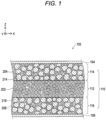
- FIG. 1 is an explanatory view schematically showing a cross section of a complete-solid lithium ion secondary battery (hereinafter will be referred to as "complete-solid battery") 102 according to the present embodiment.
- FIG. 1 shows mutually orthogonal X-axis, Y-axis, and Z-axis for specifying respective directions.
- the positive Z-axis direction is called the “upward direction”
- the negative Z-axis direction is called the "downward direction.”
- the complete-solid battery 102 includes a battery body 110, a cathode-side collector member 154 disposed on one side (upper side) of the battery body 110, and an anode-side collector member 156 disposed on the other side (lower side) of the battery body 110.
- Each of the cathode-side collector member 154 and the anode-side collector member 156 is an electrically conductive member having an approximately flat-plate shape, and is formed of, for example, an electrically conductive metal material selected from among stainless steel, Ni (nickel), Ti (titanium), Fe (iron), Cu (copper), Al (aluminum), and alloys of these, or a carbon material.
- the cathode-side collector member 154 and the anode-side collector member 156 may be collectively referred to as "collector members.”
- the battery body 110 is a lithium ion secondary battery body in which all battery elements are formed of a solid.
- all battery elements are formed of a solid refers to the case where the skeletons of all battery elements are formed of a solid, but does not exclude the case where, for example, any of the skeletons is impregnated with a liquid.
- the battery body 110 includes a cathode 114, an anode 116, and a solid electrolyte layer 112 disposed between the cathode 114 and the anode 116.
- the cathode 114 and the anode 116 may be collectively referred to as "electrodes.”
- the battery body 110 corresponds to an electricity storage device claimed in CLAIMS.
- the solid electrolyte layer 112 is a member having an approximately flat-plate shape, and contains an ion conductive powder 202 containing a lithium-ion-conductive solid electrolyte. More specifically, the solid electrolyte layer 112 is a molded product (compact) formed by press molding of the ion conductive powder 202 containing a lithium-ion-conductive solid electrolyte. The structure of the ion conductive powder 202 contained in the solid electrolyte layer 112 will be described in detail below.
- the cathode 114 is a member having an approximately flat-plate shape and contains a cathode active material 214.
- the cathode active material 214 is, for example, S (sulfur), TiS 2 , LiCoO 2 , LiMn 2 O 4 , or LiFePO 4 .
- the cathode 114 contains, as a lithium-ion-conducting aid, an ion conductive powder 204 containing a lithium-ion-conductive solid electrolyte.
- the cathode 114 may further contain an electron-conducting aid (e.g., electrically conductive carbon, Ni (nickel), Pt (platinum), or Ag (silver)).
- the anode 116 is a member having an approximately flat-plate shape and contains an anode active material 216.
- the anode active material 216 is, for example, Li metal, Li-Al alloy, Li 4 Ti 5 O 12 , carbon, Si (silicon), or SiO.
- the anode 116 contains, as a lithium-ion-conducting aid, an ion conductive powder 206 containing a lithium-ion-conductive solid electrolyte.
- the cathode 116 may further contain an electron-conducting aid (e.g., electrically conductive carbon, Ni, Pt, or Ag).
- the ion conductive powder 204 contained in the cathode 114 and the ion conductive powder 206 contained in the anode 116 have the same structure as that of the ion conductive powder 202 contained in the solid electrolyte layer 112. Thus, description of the powders 204 and 206 is omitted.
- the ion conductive powder 202 contained in the solid electrolyte layer 112 contains a lithium-ion-conductive solid electrolyte.
- the lithium-ion-conductive solid electrolyte used in the present embodiment is an ion conductor containing at least Li, Zr, La, and O and having a garnet-type structure or a garnet-like structure (hereinafter the ion conductor will be referred to as the "LLZ lithium ion conductor").
- Examples of the ion conductor include Li 7 La 3 Zr 2 O 12 (hereinafter will be referred to as "LLZ”) and a product prepared by substitution of LLZ with elemental Mg (magnesium) and Sr (strontium) (hereinafter the product will be referred to as "LLZ-MgSr").
- LLZ Li 7 La 3 Zr 2 O 12
- LLZ-MgSr a product prepared by substitution of LLZ with elemental Mg (magnesium) and Sr (strontium)
- Such an ion conductor exhibits stability to lithium metal and has relatively high lithium ion conductivity, and thus is suitable as a lithium-ion-conductive solid electrolyte contained in the ion conductive powder 202.
- a preferred embodiment of the LLZ lithium ion conductor will be described below.
- the ion conductive powder 202 may further contain at least one of a lithium halide and a complex hydride.
- the aforementioned ion conductor having a garnet-type structure or a garnet-like structure is relatively hard in the form of powder.
- a lithium halide or a complex hydride exhibits relatively low lithium ion conductivity, but is relatively soft in the form of powder.
- the close contact between particles is readily enhanced through pressing of the powder.
- the ion conductive powder 202 contains at least one of a lithium halide and a complex hydride in addition to the aforementioned ion conductor having a garnet-type structure or a garnet-like structure, the close contact between particles can be enhanced through press molding of the powder alone, without firing or vapor deposition, and the resultant molded product (compact) exhibits high lithium ion conductivity.
- the lithium halide to be incorporated into the ion conductive powder 202 may be one or more species of, for example, LiCl, LiBr, and LiI.
- the complex hydride to be incorporated into the ion conductive powder 202 may be one or more species of, for example, LiBH 4 , LiNH 2 , LiBH 4 ⁇ 3KI, LiBH 4 ⁇ PI 2 , LiBH 4 ⁇ P 2 S 5 , Li 2 AlH 6 , Li(NH 2 ) 2 I, 3LiBH 4 ⁇ LiI, Li 2 NH, LiGd(BH 4 ) 3 Cl, Li 2 (BH 4 )(NH 2 ), and Li 4 (BH 4 )(NH 2 ) 3 .
- the ion conductive powder 202 preferably contains an ion conductor containing at least Li, Zr, La, and O and having a garnet-type structure or a garnet-like structure (e.g., LLZ or LLZ-MgSr) in an amount of 30 vol% (% by volume) or more.
- the ion conductive powder 202 preferably contains a lithium-ion-conductive material (e.g., LLZ, a lithium halide, or a complex hydride) in an amount of 90 vol% or more.
- the ion conductive powder 202 may contain lithium carbonate (Li 2 CO 3 ).
- lithium carbonate may be generated by reaction of the lithium-ion-conductive solid electrolyte contained in the ion conductive powder 202 with water and carbon dioxide contained in air. Since lithium carbonate has extremely low lithium ion conductivity (i.e., about ⁇ 1/100,000 of that of the lithium-ion-conductive solid electrolyte), the amount of lithium carbonate present in ion conductive powder 202 is preferably small.
- the amount of lithium carbonate contained in 1 g of the lithium-ion-conductive solid electrolyte is less than 3 mg.
- the amount of lithium carbonate contained in 1 g of the lithium-ion-conductive solid electrolyte is more preferably less than 2 mg, still more preferably less than 1 mg.
- the amount of lithium carbonate contained in the ion conductive powder 202 can be calculated on the basis of the amount of CO 2 determined through TPD-MS (temperature programmed desorption mass spectrometry) at 500°C or higher.
- the calculation of the amount of lithium carbonate on the basis of the amount of CO 2 determined at 500°C or higher can eliminate, for example, the influence of the amount of CO 2 derived from another material (e.g., binder) contained in the ion conductive powder 202.
- the TPD-MS apparatus is placed in an environment with a low dew point (-50°C or lower), and the measurement target (ion conductive powder 202) is treated in the environment.
- the amount of lithium carbonate contained in 1 g of the lithium-ion-conductive solid electrolyte is very small (i.e., less than 3 mg) in the ion conductive powder 202 of the present embodiment as described above, an increase in resistance at particle interfaces (which is caused by the presence of lithium carbonate) can be reduced in a molded product (compact) formed by press molding of the ion conductive powder 202, and the lithium ion conductivity of the compact can be sufficiently improved.
- the amount of lithium carbonate is determined through TPD-MS, the TPD-MS apparatus is placed in an environment with a low dew point, and the measurement target is treated in the environment.
- an excessive increase in the amount of lithium carbonate can be prevented during determination of the amount of lithium carbonate contained in the ion conductive powder 202, and the amount of lithium carbonate contained in 1 g of the lithium-ion-conductive solid electrolyte can be accurately determined.
- a relatively small particle size of the ion conductive powder 202 leads to a relatively large specific surface area, resulting in a tendency of the amount of lithium carbonate to increase during determination of the amount.
- the measurement target is the ion conductive powder 202 having a relatively small particle size
- an excessive increase in the amount of lithium carbonate can be prevented during determination of the amount, and the amount of lithium carbonate contained in 1 g of the lithium-ion-conductive solid electrolyte can be accurately determined.
- the ion conductive powder 202 encounters difficulty in determining the amount of lithium carbonate contained therein by XRD or SEM.
- the amount of lithium carbonate contained in the ion conductive powder 202 can be determined through TPD-MS.
- the powder of the lithium-ion-conductive solid electrolyte contained in the aforementioned ion conductive powder 202 has a mean particle size of preferably 0.1 ⁇ m or more, more preferably 0.5 ⁇ m or more.
- a mean particle size of 0.1 ⁇ m or more an excessive decrease in the mean particle size of the powder of the lithium-ion-conductive solid electrolyte can be prevented, resulting in prevention of an excessive increase in the area of the interface between particles (due to an excessive decrease in the particle size of the powder) and thus prevention of an increase in interface resistance.
- the powder of the lithium-ion-conductive solid electrolyte has a mean particle size of 0.5 ⁇ m or more, an excessive decrease in the mean particle size of the powder of the lithium-ion-conductive solid electrolyte can be effectively prevented, resulting in effective prevention of an excessive increase in the area of the interface between particles (due to an excessive decrease in the particle size of the powder) and thus effective prevention of an increase in interface resistance.
- the powder of the lithium-ion-conductive solid electrolyte has a mean particle size of more preferably 5 ⁇ m or more, still more preferably 10 ⁇ m or more.
- the powder of the lithium-ion-conductive solid electrolyte has a mean particle size of preferably 150 ⁇ m or less, still more preferably 100 ⁇ m or less.
- the powder of the lithium-ion-conductive solid electrolyte contained in the aforementioned ion conductive powder 202 may have a mean particle size of 10 ⁇ m or less.
- the amount of lithium carbonate relative to that of the lithium-ion-conductive solid electrolyte tends to increase.
- the amount of lithium carbonate can be reduced, and thus the lithium ion conductivity of a molded product (compact) formed by press molding of the ion conductive powder can be sufficiently improved.
- the solid electrolyte layer 112 is formed. Specifically, there is provided the ion conductive powder 202 which contains a lithium-ion-conductive solid electrolyte and which has been stored in a non-air-exposed environment (e.g., a glove box) for preventing it from being exposed to air. Even if the ion conductive powder 202 has been exposed to air, the powder can be used so long as the amount of lithium carbonate contained in 1 g of the lithium-ion-conductive solid electrolyte is less than 3 mg as calculated on the basis of the amount of CO 2 determined through TPD-MS at 500°C or higher.
- the cathode 114 and the anode 116 are formed. Specifically, a powder of the cathode active material 214, the ion conductive powder 204, and an optional electron-conducting aid powder are mixed in predetermined proportions, and the resultant powder mixture is pulverized and then subjected to molding, to thereby form the cathode 114. Separately, a powder of the anode active material 216, the ion conductive powder 206, and an optional electron-conducting aid powder are mixed, and the resultant powder mixture is pulverized and then subjected to molding, to thereby form the anode 116.
- the cathode-side collector member 154, the cathode 114, the solid electrolyte layer 112, the anode 116, and the anode-side collector member 156 are stacked in this order, and then integrated together by pressing.
- the complete-solid battery 102 having the aforementioned structure is produced through the above-described process.
- the ion conductive powder of the present embodiment contains an LLZ lithium ion conductor (lithium ion conductor containing at least Li, La, Zr, and O and having a garnet-type structure or a garnet-like structure).
- the LLZ lithium ion conductor preferably contains at least one element selected from the group consisting of Mg, Al, Si, Ca (calcium), Ti, V (vanadium), Ga (gallium), Sr, Y (yttrium), Nb (niobium), Sn (tin), Sb (antimony), Ba (barium), Hf (hafnium), Ta (tantalum), W (tungsten), Bi (bismuth), and lanthanoids.
- the LLZ lithium ion conductor having such a composition exhibits good lithium ion conductivity.
- the LLZ lithium ion conductor contains at least one of Mg and element A (wherein A represents at least one element selected from the group consisting of Ca, Sr, and Ba), wherein these elements satisfy the following mole ratio conditions (1) to (3).
- Mg and element A are present in relatively large amounts in the earth and inexpensive.
- the LLZ lithium ion conductor is expected to be reliably supplied and produced at low cost. 1.33 ⁇ Li / La + A ⁇ 3 ; 0 ⁇ Mg / La + A ⁇ 0.5 ; and 0 ⁇ A / La + A ⁇ 0.67 .
- the LLZ lithium ion conductor contains both Mg and element A, wherein these elements satisfy the following mole ratio conditions (1') to (3'): 2.0 ⁇ Li / La + A ⁇ 2.7 ; 0.01 ⁇ Mg / La + A ⁇ 0.14 ; and 0.04 ⁇ A / La + A ⁇ 0.17 .
- the LLZ lithium ion conductor preferably satisfies any of the following (a) to (c), more preferably (c), still more preferably (d).
- the LLZ lithium ion conductor When the LLZ lithium ion conductor satisfies the aforementioned (a); i.e., when the LLZ lithium ion conductor contains Li, La, Zr, and Mg so as to satisfy the aforementioned mole ratio conditions: (1) and (2), the LLZ lithium ion conductor exhibits good lithium ion conductivity. Although the mechanism therefor has not clearly been elucidated, a conceivable reason is as follows. In the case where, for example, the LLZ lithium ion conductor contains Mg, the ionic radius of Li is almost equivalent to that of Mg, and thus Mg is readily placed in Li sites where Li is originally present in the LLZ crystal phases.
- lithium ion conductivity may be improved.
- the mole ratio of Li to the sum of La and element A is smaller than 1.33 or greater than 3
- a metal oxide other than the lithium ion conductor having a garnet-type or garnet-like crystal structure is readily formed.
- An increase in the metal oxide content leads to a relative decrease in the amount of the lithium ion conductor having a garnet-type or garnet-like crystal structure.
- the metal oxide Since the metal oxide has low lithium ion conductivity, the lithium ion conductivity of the LLZ lithium ion conductor is reduced.
- An increase in the Mg content of the LLZ lithium ion conductor leads to placement of Mg in Li sites and provision of pores at some Li sites, resulting in an improvement in lithium ion conductivity.
- an Mg-containing metal oxide When the mole ratio of Mg to the sum of La and element A is in excess of 0.5, an Mg-containing metal oxide is readily formed.
- An increase in the Mg-containing metal oxide content leads to a relative decrease in the amount of the lithium ion conductor having a garnet-type or garnet-like crystal structure.
- the Mg-containing metal oxide has low lithium ion conductivity.
- the mole ratio of Mg to the sum of La and element A is in excess of 0.5, the lithium ion conductivity of the LLZ lithium ion conductor is reduced.
- the LLZ lithium ion conductor When the LLZ lithium ion conductor satisfies the aforementioned (b); i.e., when the LLZ lithium ion conductor contains Li, La, Zr, and element A so as to satisfy the mole ratio conditions (1) and (3), the LLZ lithium ion conductor exhibits good lithium ion conductivity. Although the mechanism therefor has not clearly been elucidated, a conceivable reason is as follows. In the case where, for example, the LLZ lithium ion conductor contains element A, the ionic radius of La is almost equivalent to that of element A, and thus element A is readily placed in La sites where La is originally present in the LLZ crystal phases.
- the crystal lattice deforms, and free Li ions increase due to the difference in amount of electric charge between La and element A, thereby conceivably improving lithium ion conductivity.
- the mole ratio of Li to the sum of La and element A is smaller than 1.33 or greater than 3
- a metal oxide other than the lithium ion conductor having a garnet-type or garnet-like crystal structure is readily formed.
- An increase in the metal oxide content leads to a relative decrease in the amount of the lithium ion conductor having a garnet-type or garnet-like crystal structure. Since the metal oxide has low lithium ion conductivity, the lithium ion conductivity of the LLZ lithium ion conductor is reduced.
- An increase in the element A content of the LLZ lithium ion conductor leads to placement of element A in La sites. As a result, the lattice deformation increases, and free Li ions increase due to the difference in amount of electric charge between La and element A, thereby improving lithium ion conductivity.
- an element A-containing metal oxide is readily formed.
- An increase in the element A-containing metal oxide content leads to a relative decrease in the amount of the lithium ion conductor having a garnet-type or garnet-like crystal structure. Since the element A-containing metal oxide has low lithium ion conductivity, the lithium ion conductivity of the LLZ lithium ion conductor is reduced.
- the aforementioned element A is at least one element selected from the group consisting of Ca, Sr, and Ba.
- Ca, Sr, and Ba are group 2 elements defined in the relevant periodic table, and readily form divalent cations. These elements have almost the same ionic radius. Since the ionic radius of each of Ca, Sr, and Ba is almost the same as that of La, La elements present in the La sites of the LLZ lithium ion conductor are readily substituted with Ca, Sr, or Ba.
- Sr is preferred, since the LLZ lithium ion conductor containing Sr can be readily formed through sintering, to thereby achieve high lithium ion conductivity.
- the ion conductor When the LLZ lithium ion conductor satisfies the aforementioned (c); i.e., when the LLZ lithium ion conductor contains Li, La, Zr, Mg, and element A so as to satisfy the mole ratio conditions (1) to (3), the ion conductor can be readily formed through sintering, to thereby achieve further improved lithium ion conductivity.
- the LLZ lithium ion conductor satisfies the aforementioned (d); i.e., when the LLZ lithium ion conductor contains Li, La, Zr, Mg, and element A so as to satisfy the mole ratio conditions (1') to (3'), the lithium ion conductivity is further improved.
- the mechanism therefor has not clearly been elucidated, a conceivable reason is as follows.
- the LLZ lithium ion conductor when, for example, Li in Li sites is substituted by Mg, and La in La sites is substituted by element A, pores are provided at some Li sites, and free Li ions increase. As a result, the lithium ion conductivity may be further improved.
- the LLZ lithium ion conductor contains Li, La, Zr, Mg, and Sr so as to satisfy the aforementioned conditions (1) to (3) (in particular (1') to (3')), since, in this case, the resultant lithium ion conductor has high lithium ion conductivity and high relative density.
- the LLZ lithium ion conductor preferably contains Zr so as to satisfy the following mole ratio condition (4).
- Zr is contained under the condition (4), a lithium ion conductor having a garnet-type or garnet-like crystal structure can be readily produced. 0.33 ⁇ Zr / La + A ⁇ 1
- Ion conductive powders 202, 204, and 206 contained in the respective layers (solid electrolyte layer 112, cathode 114, and anode 116) of a complete-solid battery 102 were evaluated for lithium ion conductivity.
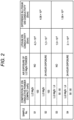
- FIGs. 2 and 3 are tables showing the results of performance evaluation.
- samples S1 to S4 i.e., molded products (compacts) of ion conductive powder were used for the performance evaluation. These samples have difference in compositions of ion conductive powder compacts. More specifically, samples S1 and S2 were compacts prepared from LLZ-MgSr as a lithium-ion-conductive solid electrolyte. Meanwhile, samples S3 and S4 were compacts prepared from an ion conductive powder containing LLZ-MgSr (lithium-ion-conductive solid electrolyte) and LiI (lithium halide) in volume proportions of 50:50.
- LLZ-MgSr lithium-ion-conductive solid electrolyte
- LiI lithium halide
- samples S1 and S3 were prepared from non-air-exposed LLZ-MgSr. Meanwhile, samples S2 and S4 were prepared from LLZ-MgSr exposed to air for 24 hours.
- the samples used for the performance evaluation were prepared as follows. A method for evaluation of the samples will be described below.
- Li 2 CO 3 , MgO, La(OH) 3 , SrCO 3 , and ZrO 2 were weighed so as to achieve a composition of Li 6.95 Mg 0.15 La 2.75 Sr 0.25 Zr 2.0 O 12 (LLZ-MgSr).
- Li 2 CO 3 was further added so that the amount of elemental Li was in excess by about 15 mol%.
- These raw materials were added to a nylon pot together with zirconia balls, and the resultant mixture was pulverized by means of a ball mill in an organic solvent for 15 hours. Thereafter, the resultant slurry was dried and then calcined on an MgO plate at 1,100°C for 10 hours.
- a binder was added to the calcined powder, and the mixture was subjected to pulverization by means of a ball mill in an organic solvent for 15 hours. Thereafter, the resultant slurry was dried, and the dried material was added to a mold having a diameter of 12 mm. The material was press-molded so as to have a thickness of about 1.5 mm, and then the molded product was pressed at an isostatic pressure of 1.5 t/cm 2 by means of a cold isostatic pressing (CIP) machine, to thereby form a compact. The compact was covered with a calcination powder having the same composition as that of the compact and fired in a reducing atmosphere at 1,100°C for four hours, to thereby yield a sintered body.
- CIP cold isostatic pressing
- the sintered body was found to have a lithium ion conductivity of 1.0 ⁇ 10 -3 S/cm.
- the sintered body was pulverized in a glove box with an argon atmosphere, to thereby prepare a powder of LLZ-MgSr used for samples S1 and S3 (hereinafter the powder may be referred to as "non-air-exposed powder").
- the powder of LLZ-MgSr was found to have a mean particle size of 73 ⁇ m.
- the powder prepared by pulverization of the sintered body was exposed to air for 24 hours, to thereby prepare a powder of LLZ-MgSr used for samples S2 and S4 (hereinafter the powder may be referred to as "air-exposed powder").
- the amount of lithium carbonate was calculated in each of the non-air-exposed powder of LLZ-MgSr and the air-exposed powder of LLZ-MgSr. Specifically, gas having a molecular weight of 44 (CO 2 ) detected through TPD-MS (temperature programmed desorption mass spectrometry) at 500°C or higher (e.g., 600°C to 900°C) was assumed to be derived from lithium carbonate, and the amount of lithium carbonate contained in each powder sample was calculated by use of a calibration curve of a standard sample of lithium carbonate. The quantitative determination was performed on the basis of the peak area. As shown in FIG.
- the amount of lithium carbonate contained in 1 g of the sample was 0.49 mg (non-air-exposed powder) or 3.38 mg (air-exposed powder).
- the amount of lithium carbonate contained in the non-air-exposed powder was about 1/10 that of lithium carbonate contained in the air-exposed powder
- the non-air-exposed powder of LLZ-MgSr (for sample S1) or the air-exposed powder of LLZ-MgSr (for sample S2) was added to a mold having a diameter of 10 mm, and the powder was press-molded at a pressure of 360 MPa, to thereby form a molded product (compact).
- the compact was fixed with a force corresponding to 50 MPa by means of a pressing jig, and the lithium ion conductivity of the compact was determined at room temperature.
- the non-air-exposed powder of LLZ-MgSr and LiI powder (for sample S3) or the air-exposed powder of LLZ-MgSr and LiI powder (for sample S4) were mixed in volume proportions of 50:50 (total: 2 g), and the mixture was pulverized by means of a planetary ball mill including a zirconia pot (45 cc) and balls having a diameter of 4 mm (96.5 g) at 200 rpm for three hours, to thereby prepare a powder mixture.
- the powder mixture was added to a mold having a diameter of 10 mm, and the powder mixture was press-molded at a pressure of 360 MPa, to thereby form a molded product (compact).
- the compact was fixed with a force corresponding to 50 MPa by means of a pressing jig, and the lithium ion conductivity of the compact was determined at room temperature.
- sample S1 prepared from the non-air-exposed powder of LLZ-MgSr exhibited a lithium ion conductivity of 4.2 ⁇ 10 -6 S/cm.
- sample S2 prepared from the air-exposed powder of LLZ-MgSr exhibited a lithium ion conductivity of 1.2 ⁇ 10 -7 S/cm.
- sample S1 prepared from the non-air-exposed powder of LLZ-MgSr exhibited a lithium ion conductivity higher by 4.08 ⁇ 10 -6 S/cm than that of sample 2.
- the effect of improving lithium ion conductivity by using the ion conductive powder in which the amount of lithium carbonate contained in 1 g of the lithium-ion-conductive solid electrolyte is less than 3 mg is more remarkable in the case where the lithium-ion-conductive solid electrolyte is used in combination with the lithium halide.
- the configuration of the complete-solid battery 102 is a mere example, and may be modified into various forms.
- the ion conductive powder containing the lithium-ion-conductive solid electrolyte is contained in all of the solid electrolyte layer 112, the cathode 114, and the anode 116.
- the ion conductive powder may be contained in at least one of the solid electrolyte layer 112, the cathode 114, and the anode 116.
- the technique disclosed in the present specification is not limited to the solid electrolyte layer or electrode forming the complete-solid battery 102, but can also be applied to a solid electrolyte layer or electrode forming another electricity storage device (e.g., a lithiumair battery, a lithium flow battery, or a solid capacitor).
- a solid electrolyte layer or electrode forming another electricity storage device e.g., a lithiumair battery, a lithium flow battery, or a solid capacitor.
- 102 complete-solid lithium ion secondary battery; 110: battery body; 112: solid electrolyte layer; 114: cathode; 116: anode; 154: cathode-side collector member; 156: anode-side collector member; 202: ion conductive powder; 204: ion conductive powder; 206: ion conductive powder; 214: cathode active material; and 216: anode active material
Landscapes
- Chemical & Material Sciences (AREA)
- Engineering & Computer Science (AREA)
- Manufacturing & Machinery (AREA)
- Chemical Kinetics & Catalysis (AREA)
- Electrochemistry (AREA)
- Ceramic Engineering (AREA)
- Inorganic Chemistry (AREA)
- Organic Chemistry (AREA)
- Materials Engineering (AREA)
- General Chemical & Material Sciences (AREA)
- Power Engineering (AREA)
- Structural Engineering (AREA)
- Physics & Mathematics (AREA)
- Condensed Matter Physics & Semiconductors (AREA)
- General Physics & Mathematics (AREA)
- Microelectronics & Electronic Packaging (AREA)
- Composite Materials (AREA)
- Thermal Sciences (AREA)
- Conductive Materials (AREA)
- Secondary Cells (AREA)
- Inorganic Compounds Of Heavy Metals (AREA)
- Electric Double-Layer Capacitors Or The Like (AREA)
- Battery Electrode And Active Subsutance (AREA)
- Manufacture Of Macromolecular Shaped Articles (AREA)
- Treatments Of Macromolecular Shaped Articles (AREA)
Description
- The technique disclosed in the present specification relates to an ion conductive powder.
- In recent years, an increasing demand has arisen for high-performance electricity storage devices in association with, for example, the prevalence of electronic apparatuses (e.g., personal computers and cellular phones) and electric-powered automobiles, and the growing use of natural energy such as sunlight or wind power. In particular, expectations are placed on the utilization of a complete-solid lithium ion secondary battery in which all battery elements are formed of a solid (hereinafter the battery may be referred to as a "complete-solid battery"). The complete-solid battery is free from, for example, leakage of an organic electrolytic solution or flashing, and thus is safer than a conventional lithium ion secondary battery containing an organic electrolytic solution prepared by dissolution of a lithium salt in an organic solvent. Since the complete-solid battery can be provided with a simple casing, the battery achieves an increase in energy density per unit mass or unit volume.
- The complete-solid battery includes a solid electrolyte layer and an electrode, and the layer and the electrode contain a lithium-ion-conductive solid electrolyte. Such a solid electrolyte is composed of, for example, an ion conductor containing at least Li, Zr, La, and O and having a garnet-type structure or garnet-like structure. As has been known, a lithium carbonate (Li2CO3) layer of very low lithium ion conductivity is formed around the surface of a sintered body of such a solid electrolyte by reaction of the solid electrolyte with water and carbon dioxide contained in air. Meanwhile, there has been disclosed a technique for improving the lithium ion conductivity of, for example, a solid electrolyte layer by thinning of a lithium carbonate layer through polishing of the surface of a sintered body of such a solid electrolyte (see, for example, Patent Document 1).
- Patent Document 1:
Japanese Patent Application Laid-Open (kokai) No. 2017-199539 -
WO 2017/123836 A1 describes lithium nickelatebased positive electrode active substance particles represented by formula Li1+aNi1-b-cCobMcO2 wherein M is at least one element selected from the group consisting of Mn, Al, B, Mg, Ti, Sn, Zn and Zr; a coating compound Y comprising at least one element selected from the group consisting of Al, Mg, Zr, Ti and Si; and a coating compound Z comprising an Li element, in which the content of lithium hydroxide LiOH in the positive electrode active substance particles is not more than 0.40% by weight, a content of lithium carbonate Li2CO3 in the positive electrode active substance particles is not more than 0.65% by weight, and a weight ratio of the content of lithium carbonate to the content of lithium hydroxide is not less than 1. -
JP 2016-160160 A -
JP 2014-172812 A -
EP 3 041 071 A1 discloses a lithium transition metal composite particle which includes a lithium transition metal oxide particle, a metal-doped layer formed by doping the lithium transition metal oxide particle, and LiF formed on the lithium transition metal oxide particle including the metal-doped layer. -
KR 2014 0099956 A - Licht Stuart et al. "Electronic Supplementary Information to "Chemical Mechanism of the High Solubility Pathway for the Carbon Dioxide Free Production of Iron" Chem. Commun. 47:3081-3083 (2011) discloses a method for manufacturing iron using Solar Thermal Electrochemical Photoprocessing (STEP).
- The present inventors have conducted extensive studies on the preparation of, for example, a solid electrolyte layer not by sintering or vapor deposition but by press molding of an ion conductive powder containing a lithium-ion-conductive solid electrolyte for the purpose of, for example, production of large-size batteries or simplification of a production process. An important consideration is that the amount of lithium carbonate, which has very low lithium ion conductivity, is reduced in a molded product (compact) formed by press molding of an ion conductive powder. However, the lithium ion conductivity cannot be sufficiently improved through only taking into account lithium carbonate present on the surface of the compact as in the case of the aforementioned conventional technique, which is problematic.
- Such a problem is not limited to an ion conductive powder or a compact thereof used in a solid electrolyte layer or an electrode of a complete-solid lithium ion secondary battery, but is common with any ion conductive powder containing a lithium-ion-conductive solid electrolyte and a compact of the powder.
- The present specification discloses a technique capable of solving the aforementioned problems, as set forth with the appended claims.
- The technique disclosed in the present specification can be implemented in, for example, the following modes.
- (1) The present specification discloses an ion conductive powder according to
claim 1 comprising a lithium-ion-conductive solid electrolyte which is an ion conductor containing at least Li, Zr, La, and O and having a garnet-type structure or a garnet-like structure, wherein the amount of Li2CO3 contained in 1 g of the lithium-ion-conductive solid electrolyte is less than 3 mg as calculated on the basis of the amount of CO2 determined through TPD-MS (temperature programmed desorption mass spectrometry) at 500°C or higher. The present inventors have conducted extensive studies, and as a result have newly found that when the amount of lithium carbonate contained in 1 g of the lithium-ion-conductive solid electrolyte is less than 3 mg in the ion conductive powder, the lithium ion conductivity of a molded product (compact) formed by press molding of the ion conductive powder can be sufficiently improved. Although the amount of lithium carbonate is difficult to determine through XRD or SEM in the ion conductive powder, the amount of lithium carbonate can be determined through TPD-MS in the ion conductive powder. - (2) In the ion conductive powder, the ion conductor may contain at least one element selected from the group consisting of Mg, Al, Si, Ca, Ti, V, Ga, Sr, Y, Nb, Sn, Sb, Ba, Hf, Ta, W, Bi, and lanthanoids. The ion conductive powder can achieve a more effective improvement in lithium ion conductivity.
- (3) In the ion conductive powder, the ion conductor contains at least one of Mg and element A (wherein A represents at least one element selected from the group consisting of Ca, Sr, and Ba), and the elements contained in the ion conductor satisfy the following mole ratio conditions (1) to (3):


- (4) The ion conductive powder may further comprise at least one of a lithium halide and a complex hydride. The ion conductive powder comprises at least one of a lithium halide and a complex hydride, each of which exhibits relatively low ion conductivity but is likely to enhance close contact between particles because the particles are relatively soft, in addition to the aforementioned ion conductor containing at least Li, Zr, La, and O and having a garnet-type structure or a garnet-like structure, the ion conductor exhibiting relatively high ion conductivity but being less likely to enhance close contact between particles because the particles are relatively hard. Thus, when a molded product (compact) is formed by press molding of the ion conductive powder, the lithium ion conductivity of the compact can be more effectively improved.
- (5) In the ion conductive powder, the powder of the lithium-ion-conductive solid electrolyte may have a mean particle size of 0.1 µm or more. The ion conductive powder can prevent an excessive decrease in the mean particle size of the powder of the lithium-ion-conductive solid electrolyte, thereby preventing an excessive increase in the area of the interface between particles (due to an excessive decrease in the particle size of the powder) and thus preventing an increase in interface resistance.
- (6) In the ion conductive powder, the powder of the lithium-ion-conductive solid electrolyte may have a mean particle size of 0.5 µm or more. The ion conductive powder can effectively prevent an excessive decrease in the mean particle size of the powder of the lithium-ion-conductive solid electrolyte, resulting in effective prevention of an excessive increase in the area of the interface between particles (due to an excessive decrease in the particle size of the powder) and thus effective prevention of an increase in interface resistance.
- (7) In the ion conductive powder, the powder of the lithium-ion-conductive solid electrolyte may have a mean particle size of 10 µm or less. Since the ion conductive powder has a relatively small mean particle size, the amount of lithium carbonate relative to that of the lithium-ion-conductive solid electrolyte tends to increase. However, the lithium carbonate content of the ion conductive powder can be reduced. Thus, the lithium ion conductivity of a molded product (compact) formed by press molding of the ion conductive powder can be sufficiently improved.
- (8) The present specification also discloses an ion conductive compact according to claim 7 formed from the ion conductive powder described above. The ion conductive compact can exhibit sufficiently improved lithium ion conductivity.
- (9) The present specification also discloses an electricity storage device according to claim 8 comprising a solid electrolyte layer, a cathode, and an anode, wherein at least one of the solid electrolyte layer, the cathode, and the anode contains the ion conductive powder described above. According to the electricity storage device, the lithium ion conductivity of at least one of the solid electrolyte layer, the cathode, and the anode can be sufficiently improved. Thus, the electric performance of the electricity storage device can be sufficiently improved.
- The technique disclosed in the present specification can be implemented in various modes; for example, an ion conductive powder, an ion conductive compact formed from the ion conductive powder, an electricity storage device containing the ion conductive powder, and a production method therefor, as set forth with the appended claims.
-
-
FIG. 1 is an explanatory view schematically showing a cross section of a complete-solid lithium ionsecondary battery 102 according to the present embodiment. -
FIG. 2 is a table showing the results of performance evaluation. -
FIG. 3 is a table showing the results of performance evaluation. -
FIG. 1 is an explanatory view schematically showing a cross section of a complete-solid lithium ion secondary battery (hereinafter will be referred to as "complete-solid battery") 102 according to the present embodiment.FIG. 1 shows mutually orthogonal X-axis, Y-axis, and Z-axis for specifying respective directions. In the present specification, for the sake of convenience, the positive Z-axis direction is called the "upward direction," and the negative Z-axis direction is called the "downward direction." - The complete-
solid battery 102 includes abattery body 110, a cathode-side collector member 154 disposed on one side (upper side) of thebattery body 110, and an anode-side collector member 156 disposed on the other side (lower side) of thebattery body 110. Each of the cathode-side collector member 154 and the anode-side collector member 156 is an electrically conductive member having an approximately flat-plate shape, and is formed of, for example, an electrically conductive metal material selected from among stainless steel, Ni (nickel), Ti (titanium), Fe (iron), Cu (copper), Al (aluminum), and alloys of these, or a carbon material. In the following description, the cathode-side collector member 154 and the anode-side collector member 156 may be collectively referred to as "collector members." - The
battery body 110 is a lithium ion secondary battery body in which all battery elements are formed of a solid. As used herein, the phrase "all battery elements are formed of a solid" refers to the case where the skeletons of all battery elements are formed of a solid, but does not exclude the case where, for example, any of the skeletons is impregnated with a liquid. Thebattery body 110 includes acathode 114, ananode 116, and asolid electrolyte layer 112 disposed between thecathode 114 and theanode 116. In the following description, thecathode 114 and theanode 116 may be collectively referred to as "electrodes." Thebattery body 110 corresponds to an electricity storage device claimed in CLAIMS. - The
solid electrolyte layer 112 is a member having an approximately flat-plate shape, and contains an ionconductive powder 202 containing a lithium-ion-conductive solid electrolyte. More specifically, thesolid electrolyte layer 112 is a molded product (compact) formed by press molding of the ionconductive powder 202 containing a lithium-ion-conductive solid electrolyte. The structure of the ionconductive powder 202 contained in thesolid electrolyte layer 112 will be described in detail below. - The
cathode 114 is a member having an approximately flat-plate shape and contains a cathodeactive material 214. The cathodeactive material 214 is, for example, S (sulfur), TiS2, LiCoO2, LiMn2O4, or LiFePO4. Thecathode 114 contains, as a lithium-ion-conducting aid, an ionconductive powder 204 containing a lithium-ion-conductive solid electrolyte. Thecathode 114 may further contain an electron-conducting aid (e.g., electrically conductive carbon, Ni (nickel), Pt (platinum), or Ag (silver)). - The
anode 116 is a member having an approximately flat-plate shape and contains an anodeactive material 216. The anodeactive material 216 is, for example, Li metal, Li-Al alloy, Li4Ti5O12, carbon, Si (silicon), or SiO. Theanode 116 contains, as a lithium-ion-conducting aid, an ionconductive powder 206 containing a lithium-ion-conductive solid electrolyte. Thecathode 116 may further contain an electron-conducting aid (e.g., electrically conductive carbon, Ni, Pt, or Ag). - Next will be described the structure of the ion
conductive powder 202 contained in thesolid electrolyte layer 112. The ionconductive powder 204 contained in thecathode 114 and the ionconductive powder 206 contained in theanode 116 have the same structure as that of the ionconductive powder 202 contained in thesolid electrolyte layer 112. Thus, description of thepowders - In the present embodiment, the ion
conductive powder 202 contained in thesolid electrolyte layer 112 contains a lithium-ion-conductive solid electrolyte. The lithium-ion-conductive solid electrolyte used in the present embodiment is an ion conductor containing at least Li, Zr, La, and O and having a garnet-type structure or a garnet-like structure (hereinafter the ion conductor will be referred to as the "LLZ lithium ion conductor"). Examples of the ion conductor include Li7La3Zr2O12 (hereinafter will be referred to as "LLZ") and a product prepared by substitution of LLZ with elemental Mg (magnesium) and Sr (strontium) (hereinafter the product will be referred to as "LLZ-MgSr"). Such an ion conductor exhibits stability to lithium metal and has relatively high lithium ion conductivity, and thus is suitable as a lithium-ion-conductive solid electrolyte contained in the ionconductive powder 202. A preferred embodiment of the LLZ lithium ion conductor will be described below. - The ion
conductive powder 202 may further contain at least one of a lithium halide and a complex hydride. The aforementioned ion conductor having a garnet-type structure or a garnet-like structure is relatively hard in the form of powder. Thus, in a molded product (compact) formed by press molding of the powder, the degree of contact between particles is low, and lithium ion conductivity is relatively low. Meanwhile, a lithium halide or a complex hydride exhibits relatively low lithium ion conductivity, but is relatively soft in the form of powder. Thus, the close contact between particles is readily enhanced through pressing of the powder. Therefore, when the ionconductive powder 202 contains at least one of a lithium halide and a complex hydride in addition to the aforementioned ion conductor having a garnet-type structure or a garnet-like structure, the close contact between particles can be enhanced through press molding of the powder alone, without firing or vapor deposition, and the resultant molded product (compact) exhibits high lithium ion conductivity. - The lithium halide to be incorporated into the ion
conductive powder 202 may be one or more species of, for example, LiCl, LiBr, and LiI. The complex hydride to be incorporated into the ionconductive powder 202 may be one or more species of, for example, LiBH4, LiNH2, LiBH4·3KI, LiBH4·PI2, LiBH4·P2S5, Li2AlH6, Li(NH2)2I, 3LiBH4·LiI, Li2NH, LiGd(BH4)3Cl, Li2(BH4)(NH2), and Li4(BH4)(NH2)3. - The ion
conductive powder 202 preferably contains an ion conductor containing at least Li, Zr, La, and O and having a garnet-type structure or a garnet-like structure (e.g., LLZ or LLZ-MgSr) in an amount of 30 vol% (% by volume) or more. The ionconductive powder 202 preferably contains a lithium-ion-conductive material (e.g., LLZ, a lithium halide, or a complex hydride) in an amount of 90 vol% or more. - In some cases, the ion
conductive powder 202 may contain lithium carbonate (Li2CO3). Specifically, lithium carbonate may be generated by reaction of the lithium-ion-conductive solid electrolyte contained in the ionconductive powder 202 with water and carbon dioxide contained in air. Since lithium carbonate has extremely low lithium ion conductivity (i.e., about ≤1/100,000 of that of the lithium-ion-conductive solid electrolyte), the amount of lithium carbonate present in ionconductive powder 202 is preferably small. - In the ion
conductive powder 202 of the present embodiment, the amount of lithium carbonate contained in 1 g of the lithium-ion-conductive solid electrolyte is less than 3 mg. The amount of lithium carbonate contained in 1 g of the lithium-ion-conductive solid electrolyte is more preferably less than 2 mg, still more preferably less than 1 mg. The amount of lithium carbonate contained in the ionconductive powder 202 can be calculated on the basis of the amount of CO2 determined through TPD-MS (temperature programmed desorption mass spectrometry) at 500°C or higher. The calculation of the amount of lithium carbonate on the basis of the amount of CO2 determined at 500°C or higher can eliminate, for example, the influence of the amount of CO2 derived from another material (e.g., binder) contained in the ionconductive powder 202. For the determination through TPD-MS, the TPD-MS apparatus is placed in an environment with a low dew point (-50°C or lower), and the measurement target (ion conductive powder 202) is treated in the environment. - Since the amount of lithium carbonate contained in 1 g of the lithium-ion-conductive solid electrolyte is very small (i.e., less than 3 mg) in the ion
conductive powder 202 of the present embodiment as described above, an increase in resistance at particle interfaces (which is caused by the presence of lithium carbonate) can be reduced in a molded product (compact) formed by press molding of the ionconductive powder 202, and the lithium ion conductivity of the compact can be sufficiently improved. As described above, when the amount of lithium carbonate is determined through TPD-MS, the TPD-MS apparatus is placed in an environment with a low dew point, and the measurement target is treated in the environment. Thus, an excessive increase in the amount of lithium carbonate can be prevented during determination of the amount of lithium carbonate contained in the ionconductive powder 202, and the amount of lithium carbonate contained in 1 g of the lithium-ion-conductive solid electrolyte can be accurately determined. In general, a relatively small particle size of the ionconductive powder 202 leads to a relatively large specific surface area, resulting in a tendency of the amount of lithium carbonate to increase during determination of the amount. According to the aforementioned determination method, even when the measurement target is the ionconductive powder 202 having a relatively small particle size, an excessive increase in the amount of lithium carbonate can be prevented during determination of the amount, and the amount of lithium carbonate contained in 1 g of the lithium-ion-conductive solid electrolyte can be accurately determined. - Unlike the case of a bulky product (e.g., a sintered body), the ion
conductive powder 202 encounters difficulty in determining the amount of lithium carbonate contained therein by XRD or SEM. However, in the present embodiment, the amount of lithium carbonate contained in the ionconductive powder 202 can be determined through TPD-MS. - The powder of the lithium-ion-conductive solid electrolyte contained in the aforementioned ion
conductive powder 202 has a mean particle size of preferably 0.1 µm or more, more preferably 0.5 µm or more. When the powder of the lithium-ion-conductive solid electrolyte has a mean particle size of 0.1 µm or more, an excessive decrease in the mean particle size of the powder of the lithium-ion-conductive solid electrolyte can be prevented, resulting in prevention of an excessive increase in the area of the interface between particles (due to an excessive decrease in the particle size of the powder) and thus prevention of an increase in interface resistance. When the powder of the lithium-ion-conductive solid electrolyte has a mean particle size of 0.5 µm or more, an excessive decrease in the mean particle size of the powder of the lithium-ion-conductive solid electrolyte can be effectively prevented, resulting in effective prevention of an excessive increase in the area of the interface between particles (due to an excessive decrease in the particle size of the powder) and thus effective prevention of an increase in interface resistance. The powder of the lithium-ion-conductive solid electrolyte has a mean particle size of more preferably 5 µm or more, still more preferably 10 µm or more. The powder of the lithium-ion-conductive solid electrolyte has a mean particle size of preferably 150 µm or less, still more preferably 100 µm or less. - The powder of the lithium-ion-conductive solid electrolyte contained in the aforementioned ion
conductive powder 202 may have a mean particle size of 10 µm or less. In such a case where the mean particle size is relatively small, the amount of lithium carbonate relative to that of the lithium-ion-conductive solid electrolyte tends to increase. However, according to the ion conductive powder of the present embodiment, the amount of lithium carbonate can be reduced, and thus the lithium ion conductivity of a molded product (compact) formed by press molding of the ion conductive powder can be sufficiently improved. - Next will be described an exemplary production method for the complete-
solid battery 102 of the present embodiment. Firstly, thesolid electrolyte layer 112 is formed. Specifically, there is provided the ionconductive powder 202 which contains a lithium-ion-conductive solid electrolyte and which has been stored in a non-air-exposed environment (e.g., a glove box) for preventing it from being exposed to air. Even if the ionconductive powder 202 has been exposed to air, the powder can be used so long as the amount of lithium carbonate contained in 1 g of the lithium-ion-conductive solid electrolyte is less than 3 mg as calculated on the basis of the amount of CO2 determined through TPD-MS at 500°C or higher. Thesolid electrolyte layer 112, which is a molded product (compact) of the ionconductive powder 202, is formed by press molding of the ionconductive powder 202 at a predetermined pressure. - Subsequently, the
cathode 114 and theanode 116 are formed. Specifically, a powder of the cathodeactive material 214, the ionconductive powder 204, and an optional electron-conducting aid powder are mixed in predetermined proportions, and the resultant powder mixture is pulverized and then subjected to molding, to thereby form thecathode 114. Separately, a powder of the anodeactive material 216, the ionconductive powder 206, and an optional electron-conducting aid powder are mixed, and the resultant powder mixture is pulverized and then subjected to molding, to thereby form theanode 116. - Thereafter, the cathode-
side collector member 154, thecathode 114, thesolid electrolyte layer 112, theanode 116, and the anode-side collector member 156 are stacked in this order, and then integrated together by pressing. The complete-solid battery 102 having the aforementioned structure is produced through the above-described process. - As described above, the ion conductive powder of the present embodiment contains an LLZ lithium ion conductor (lithium ion conductor containing at least Li, La, Zr, and O and having a garnet-type structure or a garnet-like structure). The LLZ lithium ion conductor preferably contains at least one element selected from the group consisting of Mg, Al, Si, Ca (calcium), Ti, V (vanadium), Ga (gallium), Sr, Y (yttrium), Nb (niobium), Sn (tin), Sb (antimony), Ba (barium), Hf (hafnium), Ta (tantalum), W (tungsten), Bi (bismuth), and lanthanoids. The LLZ lithium ion conductor having such a composition exhibits good lithium ion conductivity.
- Preferably, the LLZ lithium ion conductor contains at least one of Mg and element A (wherein A represents at least one element selected from the group consisting of Ca, Sr, and Ba), wherein these elements satisfy the following mole ratio conditions (1) to (3). Mg and element A are present in relatively large amounts in the earth and inexpensive. Thus, when Mg and/or element A is used as a substitution element for the LLZ lithium ion conductor, the LLZ lithium ion conductor is expected to be reliably supplied and produced at low cost.


- More preferably, the LLZ lithium ion conductor contains both Mg and element A, wherein these elements satisfy the following mole ratio conditions (1') to (3'):



- In other words, the LLZ lithium ion conductor preferably satisfies any of the following (a) to (c), more preferably (c), still more preferably (d).
- (a) The LLZ lithium ion conductor contains Mg, wherein the amounts of the elements satisfy the mole ratio conditions: 1.33≤Li/La≤3 and 0≤Mg/La≤0.5.
- (b) The LLZ lithium ion conductor contains element A, wherein the amounts of the elements satisfy the mole ratio conditions: 1.33≤Li/(La + A)≤3 and 0≤A/(La + A)≤0.67.
- (c) The LLZ lithium ion conductor contains Mg and element A, wherein the amounts of the elements satisfy the mole ratio conditions: 1.33≤Li/(La + A)≤3, 0≤Mg/(La + A)≤0.5, and 0≤A/(La + A)≤0.67.
- (d) The LLZ lithium ion conductor contains Mg and element A, wherein the amounts of the elements satisfy the mole ratio conditions: 2.0≤Li/(La + A)≤2.7, 0.01≤Mg/ (La + A)≤0.14, and 0.04≤A/(La + A)≤0.17.
- When the LLZ lithium ion conductor satisfies the aforementioned (a); i.e., when the LLZ lithium ion conductor contains Li, La, Zr, and Mg so as to satisfy the aforementioned mole ratio conditions: (1) and (2), the LLZ lithium ion conductor exhibits good lithium ion conductivity. Although the mechanism therefor has not clearly been elucidated, a conceivable reason is as follows. In the case where, for example, the LLZ lithium ion conductor contains Mg, the ionic radius of Li is almost equivalent to that of Mg, and thus Mg is readily placed in Li sites where Li is originally present in the LLZ crystal phases. When Mg replaces Li, pores are provided at some Li sites in the crystal structure, due to the difference in amount of electric charge between Li and Mg, thereby conceivably enhancing the mobility of Li ions. As a result, lithium ion conductivity may be improved. In the LLZ lithium ion conductor, when the mole ratio of Li to the sum of La and element A is smaller than 1.33 or greater than 3, a metal oxide other than the lithium ion conductor having a garnet-type or garnet-like crystal structure is readily formed. An increase in the metal oxide content leads to a relative decrease in the amount of the lithium ion conductor having a garnet-type or garnet-like crystal structure. Since the metal oxide has low lithium ion conductivity, the lithium ion conductivity of the LLZ lithium ion conductor is reduced. An increase in the Mg content of the LLZ lithium ion conductor leads to placement of Mg in Li sites and provision of pores at some Li sites, resulting in an improvement in lithium ion conductivity. When the mole ratio of Mg to the sum of La and element A is in excess of 0.5, an Mg-containing metal oxide is readily formed. An increase in the Mg-containing metal oxide content leads to a relative decrease in the amount of the lithium ion conductor having a garnet-type or garnet-like crystal structure. The Mg-containing metal oxide has low lithium ion conductivity. Thus, when the mole ratio of Mg to the sum of La and element A is in excess of 0.5, the lithium ion conductivity of the LLZ lithium ion conductor is reduced.
- When the LLZ lithium ion conductor satisfies the aforementioned (b); i.e., when the LLZ lithium ion conductor contains Li, La, Zr, and element A so as to satisfy the mole ratio conditions (1) and (3), the LLZ lithium ion conductor exhibits good lithium ion conductivity. Although the mechanism therefor has not clearly been elucidated, a conceivable reason is as follows. In the case where, for example, the LLZ lithium ion conductor contains element A, the ionic radius of La is almost equivalent to that of element A, and thus element A is readily placed in La sites where La is originally present in the LLZ crystal phases. When element A replaces La, the crystal lattice deforms, and free Li ions increase due to the difference in amount of electric charge between La and element A, thereby conceivably improving lithium ion conductivity. In the LLZ lithium ion conductor, when the mole ratio of Li to the sum of La and element A is smaller than 1.33 or greater than 3, a metal oxide other than the lithium ion conductor having a garnet-type or garnet-like crystal structure is readily formed. An increase in the metal oxide content leads to a relative decrease in the amount of the lithium ion conductor having a garnet-type or garnet-like crystal structure. Since the metal oxide has low lithium ion conductivity, the lithium ion conductivity of the LLZ lithium ion conductor is reduced. An increase in the element A content of the LLZ lithium ion conductor leads to placement of element A in La sites. As a result, the lattice deformation increases, and free Li ions increase due to the difference in amount of electric charge between La and element A, thereby improving lithium ion conductivity. When the mole ratio of element A to the sum of La and element A is in excess of 0.67, an element A-containing metal oxide is readily formed. An increase in the element A-containing metal oxide content leads to a relative decrease in the amount of the lithium ion conductor having a garnet-type or garnet-like crystal structure. Since the element A-containing metal oxide has low lithium ion conductivity, the lithium ion conductivity of the LLZ lithium ion conductor is reduced.
- The aforementioned element A is at least one element selected from the group consisting of Ca, Sr, and Ba. Ca, Sr, and Ba are group 2 elements defined in the relevant periodic table, and readily form divalent cations. These elements have almost the same ionic radius. Since the ionic radius of each of Ca, Sr, and Ba is almost the same as that of La, La elements present in the La sites of the LLZ lithium ion conductor are readily substituted with Ca, Sr, or Ba. Among these elements A, Sr is preferred, since the LLZ lithium ion conductor containing Sr can be readily formed through sintering, to thereby achieve high lithium ion conductivity.
- When the LLZ lithium ion conductor satisfies the aforementioned (c); i.e., when the LLZ lithium ion conductor contains Li, La, Zr, Mg, and element A so as to satisfy the mole ratio conditions (1) to (3), the ion conductor can be readily formed through sintering, to thereby achieve further improved lithium ion conductivity. When the LLZ lithium ion conductor satisfies the aforementioned (d); i.e., when the LLZ lithium ion conductor contains Li, La, Zr, Mg, and element A so as to satisfy the mole ratio conditions (1') to (3'), the lithium ion conductivity is further improved. Although the mechanism therefor has not clearly been elucidated, a conceivable reason is as follows. In the LLZ lithium ion conductor, when, for example, Li in Li sites is substituted by Mg, and La in La sites is substituted by element A, pores are provided at some Li sites, and free Li ions increase. As a result, the lithium ion conductivity may be further improved. More preferably, the LLZ lithium ion conductor contains Li, La, Zr, Mg, and Sr so as to satisfy the aforementioned conditions (1) to (3) (in particular (1') to (3')), since, in this case, the resultant lithium ion conductor has high lithium ion conductivity and high relative density.
- In any of the aforementioned conditions (a) to (d), the LLZ lithium ion conductor preferably contains Zr so as to satisfy the following mole ratio condition (4). When Zr is contained under the condition (4), a lithium ion conductor having a garnet-type or garnet-like crystal structure can be readily produced.

- Ion
conductive powders solid electrolyte layer 112,cathode 114, and anode 116) of a complete-solid battery 102 were evaluated for lithium ion conductivity.FIGs. 2 and3 are tables showing the results of performance evaluation. - As shown in
FIG. 2 , four samples (S1 to S4); i.e., molded products (compacts) of ion conductive powder were used for the performance evaluation. These samples have difference in compositions of ion conductive powder compacts. More specifically, samples S1 and S2 were compacts prepared from LLZ-MgSr as a lithium-ion-conductive solid electrolyte. Meanwhile, samples S3 and S4 were compacts prepared from an ion conductive powder containing LLZ-MgSr (lithium-ion-conductive solid electrolyte) and LiI (lithium halide) in volume proportions of 50:50. - These samples are different from one another in terms of air exposure time of LLZ-MgSr powder as a lithium-ion-conductive solid electrolyte. More specifically, samples S1 and S3 were prepared from non-air-exposed LLZ-MgSr. Meanwhile, samples S2 and S4 were prepared from LLZ-MgSr exposed to air for 24 hours.
- The samples used for the performance evaluation were prepared as follows. A method for evaluation of the samples will be described below.
- Li2CO3, MgO, La(OH)3, SrCO3, and ZrO2 were weighed so as to achieve a composition of Li6.95Mg0.15La2.75Sr0.25Zr2.0O12 (LLZ-MgSr). In consideration of volatilization of Li during firing, Li2CO3 was further added so that the amount of elemental Li was in excess by about 15 mol%. These raw materials were added to a nylon pot together with zirconia balls, and the resultant mixture was pulverized by means of a ball mill in an organic solvent for 15 hours. Thereafter, the resultant slurry was dried and then calcined on an MgO plate at 1,100°C for 10 hours. A binder was added to the calcined powder, and the mixture was subjected to pulverization by means of a ball mill in an organic solvent for 15 hours. Thereafter, the resultant slurry was dried, and the dried material was added to a mold having a diameter of 12 mm. The material was press-molded so as to have a thickness of about 1.5 mm, and then the molded product was pressed at an isostatic pressure of 1.5 t/cm2 by means of a cold isostatic pressing (CIP) machine, to thereby form a compact. The compact was covered with a calcination powder having the same composition as that of the compact and fired in a reducing atmosphere at 1,100°C for four hours, to thereby yield a sintered body. The sintered body was found to have a lithium ion conductivity of 1.0 × 10⁻³ S/cm. The sintered body was pulverized in a glove box with an argon atmosphere, to thereby prepare a powder of LLZ-MgSr used for samples S1 and S3 (hereinafter the powder may be referred to as "non-air-exposed powder"). The powder of LLZ-MgSr was found to have a mean particle size of 73 µm. Separately, the powder prepared by pulverization of the sintered body was exposed to air for 24 hours, to thereby prepare a powder of LLZ-MgSr used for samples S2 and S4 (hereinafter the powder may be referred to as "air-exposed powder").
- The amount of lithium carbonate was calculated in each of the non-air-exposed powder of LLZ-MgSr and the air-exposed powder of LLZ-MgSr. Specifically, gas having a molecular weight of 44 (CO2) detected through TPD-MS (temperature programmed desorption mass spectrometry) at 500°C or higher (e.g., 600°C to 900°C) was assumed to be derived from lithium carbonate, and the amount of lithium carbonate contained in each powder sample was calculated by use of a calibration curve of a standard sample of lithium carbonate. The quantitative determination was performed on the basis of the peak area. As shown in
FIG. 3 , the amount of lithium carbonate contained in 1 g of the sample was 0.49 mg (non-air-exposed powder) or 3.38 mg (air-exposed powder). Thus, the amount of lithium carbonate contained in the non-air-exposed powder was about 1/10 that of lithium carbonate contained in the air-exposed powder - The non-air-exposed powder of LLZ-MgSr (for sample S1) or the air-exposed powder of LLZ-MgSr (for sample S2) was added to a mold having a diameter of 10 mm, and the powder was press-molded at a pressure of 360 MPa, to thereby form a molded product (compact). The compact was fixed with a force corresponding to 50 MPa by means of a pressing jig, and the lithium ion conductivity of the compact was determined at room temperature.
- The non-air-exposed powder of LLZ-MgSr and LiI powder (for sample S3) or the air-exposed powder of LLZ-MgSr and LiI powder (for sample S4) were mixed in volume proportions of 50:50 (total: 2 g), and the mixture was pulverized by means of a planetary ball mill including a zirconia pot (45 cc) and balls having a diameter of 4 mm (96.5 g) at 200 rpm for three hours, to thereby prepare a powder mixture. The powder mixture was added to a mold having a diameter of 10 mm, and the powder mixture was press-molded at a pressure of 360 MPa, to thereby form a molded product (compact). The compact was fixed with a force corresponding to 50 MPa by means of a pressing jig, and the lithium ion conductivity of the compact was determined at room temperature.
- As shown in
FIG. 2 , sample S1 prepared from the non-air-exposed powder of LLZ-MgSr exhibited a lithium ion conductivity of 4.2 × 10⁻⁶ S/cm. In contrast, sample S2 prepared from the air-exposed powder of LLZ-MgSr exhibited a lithium ion conductivity of 1.2 × 10⁻⁷ S/cm. Thus, sample S1 prepared from the non-air-exposed powder of LLZ-MgSr exhibited a lithium ion conductivity higher by 4.08 × 10⁻⁶ S/cm than that of sample 2. - As shown in
FIG. 2 , sample S3 prepared from the powder mixture of the non-air-exposed powder of LLZ-MgSr and LiI powder exhibited a lithium ion conductivity of 1.9 × 10⁻⁵ S/cm. In contrast, sample S4 prepared from the powder mixture of the air-exposed powder of LLZ-MgSr and LiI powder exhibited a lithium ion conductivity of 3.01 × 10⁻⁶ S/cm. Thus, sample S3 prepared from the non-air-exposed powder of LLZ-MgSr exhibited a lithium ion conductivity higher by 1.59 × 10⁻⁵ S/cm than that of sample 4. - These results indicated that when the ion conductive powder in which the amount of lithium carbonate contained in 1 g of the lithium-ion-conductive solid electrolyte is less than 3 mg (0.49 mg) is used (see sample S1 or S3), the close contact between particles can be enhanced through press molding of the powder alone, without firing or vapor deposition, and the resultant compact exhibits high lithium ion conductivity.
- The difference in lithium ion conductivity (1.59 × 10⁻⁵ S/cm) between samples S3 and S4, which were prepared from the mixture of the powder of lithium-ion-conductive solid electrolyte (LLZ-MgSr) and the powder of lithium halide (LiI), was greater than the difference in lithium ion conductivity (4.08 × 10⁻⁶ S/cm) between samples S1 and S2, which were prepared from only the powder of lithium-ion-conductive solid electrolyte (LLZ-MgSr). Thus, the effect of improving lithium ion conductivity by using the ion conductive powder in which the amount of lithium carbonate contained in 1 g of the lithium-ion-conductive solid electrolyte is less than 3 mg is more remarkable in the case where the lithium-ion-conductive solid electrolyte is used in combination with the lithium halide.
- The technique disclosed in the present specification is not limited to the aforementioned embodiment, but may be modified into various other forms without departing from the gist thereof. For example, the technique may be modified as described below.
- In the aforementioned embodiment, the configuration of the complete-
solid battery 102 is a mere example, and may be modified into various forms. For example, in the aforementioned embodiment, the ion conductive powder containing the lithium-ion-conductive solid electrolyte is contained in all of thesolid electrolyte layer 112, thecathode 114, and theanode 116. However, the ion conductive powder may be contained in at least one of thesolid electrolyte layer 112, thecathode 114, and theanode 116. - The technique disclosed in the present specification is not limited to the solid electrolyte layer or electrode forming the complete-
solid battery 102, but can also be applied to a solid electrolyte layer or electrode forming another electricity storage device (e.g., a lithiumair battery, a lithium flow battery, or a solid capacitor). - 102: complete-solid lithium ion secondary battery; 110: battery body; 112: solid electrolyte layer; 114: cathode; 116: anode; 154: cathode-side collector member; 156: anode-side collector member; 202: ion conductive powder; 204: ion conductive powder; 206: ion conductive powder; 214: cathode active material; and 216: anode active material
Claims (8)
- An ion conductive powder (202, 204, 206) comprising a lithium-ion-conductive solid electrolyte which is an ion conductor containing at least Li, Zr, La, and O and having a garnet-type structure or a garnet-like structure, wherein the amount of Li2CO3 contained in 1 g of the lithium-ion-conductive solid electrolyte is less than 3 mg as calculated on the basis of the amount of CO2 determined through temperature programmed desorption mass spectrometry (TPD-MS) at 500°C or higher, wherein the ion conductor contains at least one of Mg and element A (wherein A represents at least one element selected from the group consisting of Ca, Sr, and Ba), and the elements contained in the ion conductor satisfy the following mole ratio conditions (1) to (3):



- An ion conductive powder (202, 204, 206) according to claim 1, wherein the ion conductor contains at least one element selected from the group consisting of Mg, Al, Si, Ca, Ti, V, Ga, Sr, Y, Nb, Sn, Sb, Ba, Hf, Ta, W, Bi, and lanthanoids.
- An ion conductive powder (202, 204, 206) according to any one of claims 1 to 2, which further contains at least one of a lithium halide and a complex hydride.
- An ion conductive powder (202, 204, 206) according to any one of claims 1 to 3, wherein the powder of the lithium-ion-conductive solid electrolyte has a mean particle size of 0.1 µm or more.
- An ion conductive powder (202, 204, 206) according to any one of claims 1 to 3, wherein the powder of the lithium-ion-conductive solid electrolyte has a mean particle size of 0.5 µm or more.
- An ion conductive powder (202, 204, 206) according to any one of claims 1 to 5, wherein the powder of the lithium-ion-conductive solid electrolyte has a mean particle size of 10 µm or less.
- An ion conductive compact (202) formed from an ion conductive powder (202, 204, 206) as recited in any one of claims 1 to 6.
- An electricity storage device (110) comprising a solid electrolyte layer (112), a cathode (114), and an anode (116), wherein at least one of the solid electrolyte layer (112), the cathode (114), and the anode (116) contains an ion conductive powder (202, 204, 206) as recited in any one of claims 1 to 6.
Applications Claiming Priority (2)
| Application Number | Priority Date | Filing Date | Title |
|---|---|---|---|
| JP2018087999 | 2018-05-01 | ||
| PCT/JP2019/017561 WO2019212026A1 (en) | 2018-05-01 | 2019-04-25 | Ion conductive powder, ion conductive molded article, and electricity storage device |
Publications (3)
| Publication Number | Publication Date |
|---|---|
| EP3789346A1 EP3789346A1 (en) | 2021-03-10 |
| EP3789346A4 EP3789346A4 (en) | 2022-11-09 |
| EP3789346B1 true EP3789346B1 (en) | 2025-06-11 |
Family
ID=68386473
Family Applications (1)
| Application Number | Title | Priority Date | Filing Date |
|---|---|---|---|
| EP19796324.2A Active EP3789346B1 (en) | 2018-05-01 | 2019-04-25 | Lithium based ion conductive powder, ion conductive molded article, and electricity storage device |
Country Status (6)
| Country | Link |
|---|---|
| US (1) | US20210020985A1 (en) |
| EP (1) | EP3789346B1 (en) |
| JP (1) | JP6735425B2 (en) |
| KR (1) | KR102444767B1 (en) |
| CN (1) | CN112041272B (en) |
| WO (1) | WO2019212026A1 (en) |
Families Citing this family (10)
| Publication number | Priority date | Publication date | Assignee | Title |
|---|---|---|---|---|
| WO2019212007A1 (en) | 2018-05-02 | 2019-11-07 | 日本特殊陶業株式会社 | Ionic conductor and electricity storage device |
| JP7384088B2 (en) * | 2019-12-10 | 2023-11-21 | トヨタ自動車株式会社 | Garnet type solid electrolyte separator and its manufacturing method |
| US11848156B2 (en) * | 2020-11-25 | 2023-12-19 | Samsung Electronics Co., Ltd. | Electronic device comprising a dielectric material and methods for the manufacture thereof |
| CN116635331A (en) * | 2020-12-24 | 2023-08-22 | 新日本电工株式会社 | Lithium-ion conductive oxide material and all-solid-state lithium secondary battery |
| JPWO2022219847A1 (en) * | 2021-04-15 | 2022-10-20 | ||
| CN113991171B (en) * | 2021-10-22 | 2023-03-24 | 浙江大学 | Garnet type multi-element composite solid electrolyte and preparation method and application thereof |
| JP7819217B2 (en) * | 2022-02-02 | 2026-02-24 | 日本特殊陶業株式会社 | Lithium ion conductor, sheet and power storage device |
| KR20250029169A (en) * | 2022-08-03 | 2025-03-04 | 니혼도꾸슈도교 가부시키가이샤 | Oxides, electrolyte compositions and capacitor devices |
| CN116102951A (en) * | 2022-12-26 | 2023-05-12 | 苏州微介面材料科技有限公司 | Antistatic nonflammable water-based epoxy coating |
| KR20250124340A (en) | 2023-02-10 | 2025-08-19 | 니혼도꾸슈도교 가부시키가이샤 | Ionic conductors, composites, sheets, electrodes, separators and capacitor devices |
Family Cites Families (23)
| Publication number | Priority date | Publication date | Assignee | Title |
|---|---|---|---|---|
| JP2833880B2 (en) * | 1991-07-03 | 1998-12-09 | 前澤化成工業株式会社 | Storage basin |
| KR20140099956A (en) * | 2009-11-05 | 2014-08-13 | 유미코르 | Double-shell core lithium nickel manganese cobalt oxides |
| JP5177315B2 (en) * | 2011-08-11 | 2013-04-03 | トヨタ自動車株式会社 | Sulfide-based solid battery |
| CN104159869B (en) * | 2012-03-02 | 2016-09-21 | 日本碍子株式会社 | Solid electrolyte ceramic material and manufacturing method thereof |
| JP6200169B2 (en) * | 2013-03-12 | 2017-09-20 | 一般財団法人ファインセラミックスセンター | Method for producing lithium ion conductive oxide |
| JP6166584B2 (en) * | 2013-05-10 | 2017-07-19 | 日本碍子株式会社 | Lithium ion conductive solid electrolyte and composite and battery using the same |
| EP3041071B1 (en) * | 2013-08-29 | 2018-10-03 | LG Chem, Ltd. | Lithium transition metal composite particles, method for preparing same, and positive active materials comprising same |
| KR102272556B1 (en) * | 2013-09-02 | 2021-07-02 | 미츠비시 가스 가가쿠 가부시키가이샤 | Solid-state battery |
| US10403931B2 (en) * | 2013-10-07 | 2019-09-03 | Quantumscape Corporation | Garnet materials for Li secondary batteries and methods of making and using garnet materials |
| JP2015204215A (en) * | 2014-04-15 | 2015-11-16 | 住友金属鉱山株式会社 | Lithium ion-conducting solid electrolyte, manufacturing method thereof, and all-solid battery |
| JP6277079B2 (en) * | 2014-07-31 | 2018-02-07 | 日本碍子株式会社 | All solid lithium battery |
| JP6632240B2 (en) * | 2014-08-12 | 2020-01-22 | 日本特殊陶業株式会社 | Lithium ion conductive ceramic material and lithium battery |
| JP6399657B2 (en) * | 2015-03-04 | 2018-10-03 | 国立研究開発法人物質・材料研究機構 | Oxide sintered body, manufacturing method thereof, solid electrolyte using the same, and lithium ion battery using the same |
| JP6672848B2 (en) * | 2015-03-10 | 2020-03-25 | Tdk株式会社 | Lithium ion conductive oxide ceramic material having garnet type or garnet type similar crystal structure |
| JP2016171068A (en) * | 2015-03-10 | 2016-09-23 | Tdk株式会社 | Garnet-type lithium ion conductive oxide |
| KR102158060B1 (en) * | 2015-08-21 | 2020-09-21 | 내셔날 인스티튜트 오브 어드밴스드 인더스트리얼 사이언스 앤드 테크놀로지 | Proton conductive complex oxide and fuel cell using it as electrolyte |
| JP6735083B2 (en) * | 2015-11-10 | 2020-08-05 | 日本特殊陶業株式会社 | Ion conductor and lithium battery |
| US10615414B2 (en) * | 2016-01-15 | 2020-04-07 | Toda Kogyo Corp. | Lithium nickelate-based positive electrode active substance particles and process for producing the same, and non-aqueous electrolyte secondary battery |
| US20190177238A1 (en) * | 2016-03-28 | 2019-06-13 | The Regents Of The University Of Michigan | Thin film ceramics and cermets processed using nanopowders of controlled compositions |
| JP2017199539A (en) | 2016-04-27 | 2017-11-02 | 日本特殊陶業株式会社 | Solid electrolyte structure, lithium battery, and manufacturing method of solid electrolyte structure |
| JP6620770B2 (en) * | 2016-05-27 | 2019-12-18 | トヨタ自動車株式会社 | Oxide electrolyte sintered body and method for producing the oxide electrolyte sintered body |
| WO2018013517A1 (en) * | 2016-07-11 | 2018-01-18 | The Regents Of The University Of Michigan | Ceramic garnet based ionically conducting material |
| US10903484B2 (en) * | 2016-10-26 | 2021-01-26 | The Regents Of The University Of Michigan | Metal infiltrated electrodes for solid state batteries |
-
2019
- 2019-04-25 KR KR1020207031453A patent/KR102444767B1/en active Active
- 2019-04-25 JP JP2019551718A patent/JP6735425B2/en active Active
- 2019-04-25 CN CN201980028794.3A patent/CN112041272B/en active Active
- 2019-04-25 US US17/043,211 patent/US20210020985A1/en not_active Abandoned
- 2019-04-25 EP EP19796324.2A patent/EP3789346B1/en active Active
- 2019-04-25 WO PCT/JP2019/017561 patent/WO2019212026A1/en not_active Ceased
Also Published As
| Publication number | Publication date |
|---|---|
| US20210020985A1 (en) | 2021-01-21 |
| WO2019212026A1 (en) | 2019-11-07 |
| JP6735425B2 (en) | 2020-08-05 |
| EP3789346A4 (en) | 2022-11-09 |
| KR102444767B1 (en) | 2022-09-19 |
| CN112041272A (en) | 2020-12-04 |
| JPWO2019212026A1 (en) | 2020-05-28 |
| EP3789346A1 (en) | 2021-03-10 |
| CN112041272B (en) | 2023-02-28 |
| KR20200139214A (en) | 2020-12-11 |
Similar Documents
| Publication | Publication Date | Title |
|---|---|---|
| EP3789346B1 (en) | Lithium based ion conductive powder, ion conductive molded article, and electricity storage device | |
| US12087905B2 (en) | Ionic conductor and electricity storage device | |
| US12300780B2 (en) | Electrode for power storage device, and power storage device | |
| WO2014186634A2 (en) | Solid state catholyte or electrolyte for battery using liampbsc (m = si, ge, and/or sn) | |
| US20210020983A1 (en) | Ionic conductor and lithium battery | |
| US11011776B2 (en) | Lithium-ion-conductive ceramic material, lithium-ion-conductive ceramic sintered body, and lithium battery | |
| KR101909727B1 (en) | Solid electrolyte, method for manufacturing the same, and all solid state rechargeable lithium battery including the same | |
| EP3618162A1 (en) | Lithium ion-conductive ceramic material, lithium ion-conductive ceramic body, and lithium battery | |
| US12283656B2 (en) | Ion conductor, power storage device, and method for manufacturing ion conductor | |
| JP6701393B2 (en) | Solid electrolyte and method for producing solid electrolyte | |
| KR20170011859A (en) | Solid electrolyte, method for manufacturing the same, and all solid state rechargeable lithium battery including the same | |
| KR20250022958A (en) | Anode-free Lithium Secondary Battery, Lithium Metal Secondary Battery Using Amorphous Alloy Power Or Metal Glass Powder Sintered Body And Manufacturing Method For The Same | |
| EP4657537A1 (en) | Electrode for all-solid-state secondary batteries, and all-solid-state secondary battery | |
| KR20150129953A (en) | Solid electrolyte, method for manufacturing the same, and all solid state rechargeable lithium battery including the same | |
| US20250336980A1 (en) | Solid-state battery | |
| Akbaş | Search for New Cathode Compositions for Mildly Acidic Zn-MnO2 Batteries | |
| EP4715972A1 (en) | Solid-state battery |
Legal Events
| Date | Code | Title | Description |
|---|---|---|---|
| STAA | Information on the status of an ep patent application or granted ep patent |
Free format text: STATUS: THE INTERNATIONAL PUBLICATION HAS BEEN MADE |
|
| PUAI | Public reference made under article 153(3) epc to a published international application that has entered the european phase |
Free format text: ORIGINAL CODE: 0009012 |
|
| STAA | Information on the status of an ep patent application or granted ep patent |
Free format text: STATUS: REQUEST FOR EXAMINATION WAS MADE |
|
| 17P | Request for examination filed |
Effective date: 20201001 |
|
| AK | Designated contracting states |
Kind code of ref document: A1 Designated state(s): AL AT BE BG CH CY CZ DE DK EE ES FI FR GB GR HR HU IE IS IT LI LT LU LV MC MK MT NL NO PL PT RO RS SE SI SK SM TR |
|
| AX | Request for extension of the european patent |
Extension state: BA ME |
|
| DAV | Request for validation of the european patent (deleted) | ||
| DAX | Request for extension of the european patent (deleted) | ||
| RIC1 | Information provided on ipc code assigned before grant |
Ipc: H01M 10/0525 20100101ALI20220622BHEP Ipc: H01G 11/38 20130101ALI20220622BHEP Ipc: H01G 11/06 20130101ALI20220622BHEP Ipc: C04B 35/64 20060101ALI20220622BHEP Ipc: C04B 35/626 20060101ALI20220622BHEP Ipc: C04B 35/486 20060101ALI20220622BHEP Ipc: H01M 12/08 20060101ALI20220622BHEP Ipc: H01M 12/06 20060101ALI20220622BHEP Ipc: H01M 10/0562 20100101ALI20220622BHEP Ipc: H01M 10/052 20100101ALI20220622BHEP Ipc: H01M 4/62 20060101ALI20220622BHEP Ipc: H01M 4/13 20100101ALI20220622BHEP Ipc: H01G 11/56 20130101ALI20220622BHEP Ipc: H01B 1/08 20060101ALI20220622BHEP Ipc: H01B 1/06 20060101ALI20220622BHEP Ipc: C01G 25/00 20060101AFI20220622BHEP |
|
| A4 | Supplementary search report drawn up and despatched |
Effective date: 20221012 |
|
| RIC1 | Information provided on ipc code assigned before grant |
Ipc: H01M 10/0525 20100101ALI20221006BHEP Ipc: H01G 11/38 20130101ALI20221006BHEP Ipc: H01G 11/06 20130101ALI20221006BHEP Ipc: C04B 35/64 20060101ALI20221006BHEP Ipc: C04B 35/626 20060101ALI20221006BHEP Ipc: C04B 35/486 20060101ALI20221006BHEP Ipc: H01M 12/08 20060101ALI20221006BHEP Ipc: H01M 12/06 20060101ALI20221006BHEP Ipc: H01M 10/0562 20100101ALI20221006BHEP Ipc: H01M 10/052 20100101ALI20221006BHEP Ipc: H01M 4/62 20060101ALI20221006BHEP Ipc: H01M 4/13 20100101ALI20221006BHEP Ipc: H01G 11/56 20130101ALI20221006BHEP Ipc: H01B 1/08 20060101ALI20221006BHEP Ipc: H01B 1/06 20060101ALI20221006BHEP Ipc: C01G 25/00 20060101AFI20221006BHEP |
|
| RAP3 | Party data changed (applicant data changed or rights of an application transferred) |
Owner name: NITERRA CO., LTD. |
|
| GRAP | Despatch of communication of intention to grant a patent |
Free format text: ORIGINAL CODE: EPIDOSNIGR1 |
|
| STAA | Information on the status of an ep patent application or granted ep patent |
Free format text: STATUS: GRANT OF PATENT IS INTENDED |
|
| INTG | Intention to grant announced |
Effective date: 20250116 |
|
| GRAS | Grant fee paid |
Free format text: ORIGINAL CODE: EPIDOSNIGR3 |
|
| GRAA | (expected) grant |
Free format text: ORIGINAL CODE: 0009210 |
|
| STAA | Information on the status of an ep patent application or granted ep patent |
Free format text: STATUS: THE PATENT HAS BEEN GRANTED |
|
| AK | Designated contracting states |
Kind code of ref document: B1 Designated state(s): AL AT BE BG CH CY CZ DE DK EE ES FI FR GB GR HR HU IE IS IT LI LT LU LV MC MK MT NL NO PL PT RO RS SE SI SK SM TR |
|
| REG | Reference to a national code |
Ref country code: GB Ref legal event code: FG4D |
|
| REG | Reference to a national code |
Ref country code: CH Ref legal event code: EP |
|
| REG | Reference to a national code |
Ref country code: DE Ref legal event code: R096 Ref document number: 602019071061 Country of ref document: DE |
|
| REG | Reference to a national code |
Ref country code: IE Ref legal event code: FG4D |
|
| PG25 | Lapsed in a contracting state [announced via postgrant information from national office to epo] |
Ref country code: FI Free format text: LAPSE BECAUSE OF FAILURE TO SUBMIT A TRANSLATION OF THE DESCRIPTION OR TO PAY THE FEE WITHIN THE PRESCRIBED TIME-LIMIT Effective date: 20250611 Ref country code: ES Free format text: LAPSE BECAUSE OF FAILURE TO SUBMIT A TRANSLATION OF THE DESCRIPTION OR TO PAY THE FEE WITHIN THE PRESCRIBED TIME-LIMIT Effective date: 20250611 |
|
| REG | Reference to a national code |
Ref country code: LT Ref legal event code: MG9D |
|
| PG25 | Lapsed in a contracting state [announced via postgrant information from national office to epo] |
Ref country code: NO Free format text: LAPSE BECAUSE OF FAILURE TO SUBMIT A TRANSLATION OF THE DESCRIPTION OR TO PAY THE FEE WITHIN THE PRESCRIBED TIME-LIMIT Effective date: 20250911 Ref country code: GR Free format text: LAPSE BECAUSE OF FAILURE TO SUBMIT A TRANSLATION OF THE DESCRIPTION OR TO PAY THE FEE WITHIN THE PRESCRIBED TIME-LIMIT Effective date: 20250912 |
|
| REG | Reference to a national code |
Ref country code: NL Ref legal event code: MP Effective date: 20250611 |
|
| PG25 | Lapsed in a contracting state [announced via postgrant information from national office to epo] |
Ref country code: BG Free format text: LAPSE BECAUSE OF FAILURE TO SUBMIT A TRANSLATION OF THE DESCRIPTION OR TO PAY THE FEE WITHIN THE PRESCRIBED TIME-LIMIT Effective date: 20250611 |
|
| PG25 | Lapsed in a contracting state [announced via postgrant information from national office to epo] |
Ref country code: HR Free format text: LAPSE BECAUSE OF FAILURE TO SUBMIT A TRANSLATION OF THE DESCRIPTION OR TO PAY THE FEE WITHIN THE PRESCRIBED TIME-LIMIT Effective date: 20250611 |
|
| PG25 | Lapsed in a contracting state [announced via postgrant information from national office to epo] |
Ref country code: RS Free format text: LAPSE BECAUSE OF FAILURE TO SUBMIT A TRANSLATION OF THE DESCRIPTION OR TO PAY THE FEE WITHIN THE PRESCRIBED TIME-LIMIT Effective date: 20250911 |
|
| PG25 | Lapsed in a contracting state [announced via postgrant information from national office to epo] |
Ref country code: LV Free format text: LAPSE BECAUSE OF FAILURE TO SUBMIT A TRANSLATION OF THE DESCRIPTION OR TO PAY THE FEE WITHIN THE PRESCRIBED TIME-LIMIT Effective date: 20250611 |
|
| PG25 | Lapsed in a contracting state [announced via postgrant information from national office to epo] |
Ref country code: NL Free format text: LAPSE BECAUSE OF FAILURE TO SUBMIT A TRANSLATION OF THE DESCRIPTION OR TO PAY THE FEE WITHIN THE PRESCRIBED TIME-LIMIT Effective date: 20250611 |
|
| PG25 | Lapsed in a contracting state [announced via postgrant information from national office to epo] |
Ref country code: PT Free format text: LAPSE BECAUSE OF FAILURE TO SUBMIT A TRANSLATION OF THE DESCRIPTION OR TO PAY THE FEE WITHIN THE PRESCRIBED TIME-LIMIT Effective date: 20251013 |
|
| REG | Reference to a national code |
Ref country code: AT Ref legal event code: MK05 Ref document number: 1802231 Country of ref document: AT Kind code of ref document: T Effective date: 20250611 |
|
| PG25 | Lapsed in a contracting state [announced via postgrant information from national office to epo] |
Ref country code: IS Free format text: LAPSE BECAUSE OF FAILURE TO SUBMIT A TRANSLATION OF THE DESCRIPTION OR TO PAY THE FEE WITHIN THE PRESCRIBED TIME-LIMIT Effective date: 20251011 |
|
| PG25 | Lapsed in a contracting state [announced via postgrant information from national office to epo] |
Ref country code: AT Free format text: LAPSE BECAUSE OF FAILURE TO SUBMIT A TRANSLATION OF THE DESCRIPTION OR TO PAY THE FEE WITHIN THE PRESCRIBED TIME-LIMIT Effective date: 20250611 Ref country code: SM Free format text: LAPSE BECAUSE OF FAILURE TO SUBMIT A TRANSLATION OF THE DESCRIPTION OR TO PAY THE FEE WITHIN THE PRESCRIBED TIME-LIMIT Effective date: 20250611 |
|
| PG25 | Lapsed in a contracting state [announced via postgrant information from national office to epo] |
Ref country code: CZ Free format text: LAPSE BECAUSE OF FAILURE TO SUBMIT A TRANSLATION OF THE DESCRIPTION OR TO PAY THE FEE WITHIN THE PRESCRIBED TIME-LIMIT Effective date: 20250611 |
|
| PG25 | Lapsed in a contracting state [announced via postgrant information from national office to epo] |
Ref country code: PL Free format text: LAPSE BECAUSE OF FAILURE TO SUBMIT A TRANSLATION OF THE DESCRIPTION OR TO PAY THE FEE WITHIN THE PRESCRIBED TIME-LIMIT Effective date: 20250611 |
|
| PG25 | Lapsed in a contracting state [announced via postgrant information from national office to epo] |
Ref country code: EE Free format text: LAPSE BECAUSE OF FAILURE TO SUBMIT A TRANSLATION OF THE DESCRIPTION OR TO PAY THE FEE WITHIN THE PRESCRIBED TIME-LIMIT Effective date: 20250611 |
|
| PG25 | Lapsed in a contracting state [announced via postgrant information from national office to epo] |
Ref country code: SK Free format text: LAPSE BECAUSE OF FAILURE TO SUBMIT A TRANSLATION OF THE DESCRIPTION OR TO PAY THE FEE WITHIN THE PRESCRIBED TIME-LIMIT Effective date: 20250611 Ref country code: RO Free format text: LAPSE BECAUSE OF FAILURE TO SUBMIT A TRANSLATION OF THE DESCRIPTION OR TO PAY THE FEE WITHIN THE PRESCRIBED TIME-LIMIT Effective date: 20250611 |
|
| REG | Reference to a national code |
Ref country code: DE Ref legal event code: R097 Ref document number: 602019071061 Country of ref document: DE |
|
| PG25 | Lapsed in a contracting state [announced via postgrant information from national office to epo] |
Ref country code: DK Free format text: LAPSE BECAUSE OF FAILURE TO SUBMIT A TRANSLATION OF THE DESCRIPTION OR TO PAY THE FEE WITHIN THE PRESCRIBED TIME-LIMIT Effective date: 20250611 |
|
| PGFP | Annual fee paid to national office [announced via postgrant information from national office to epo] |
Ref country code: IT Payment date: 20260320 Year of fee payment: 8 |
|
| PLBE | No opposition filed within time limit |
Free format text: ORIGINAL CODE: 0009261 |
|
| STAA | Information on the status of an ep patent application or granted ep patent |
Free format text: STATUS: NO OPPOSITION FILED WITHIN TIME LIMIT |
|
| PGFP | Annual fee paid to national office [announced via postgrant information from national office to epo] |
Ref country code: FR Payment date: 20260309 Year of fee payment: 8 |
|
| REG | Reference to a national code |
Ref country code: CH Ref legal event code: L10 Free format text: ST27 STATUS EVENT CODE: U-0-0-L10-L00 (AS PROVIDED BY THE NATIONAL OFFICE) Effective date: 20260423 |