EP3789229B1 - Vehicular display device - Google Patents
Vehicular display device Download PDFInfo
- Publication number
- EP3789229B1 EP3789229B1 EP20193340.5A EP20193340A EP3789229B1 EP 3789229 B1 EP3789229 B1 EP 3789229B1 EP 20193340 A EP20193340 A EP 20193340A EP 3789229 B1 EP3789229 B1 EP 3789229B1
- Authority
- EP
- European Patent Office
- Prior art keywords
- light
- hologram
- display
- vehicle
- angle
- Prior art date
- Legal status (The legal status is an assumption and is not a legal conclusion. Google has not performed a legal analysis and makes no representation as to the accuracy of the status listed.)
- Active
Links
Images



Classifications
-
- G—PHYSICS
- G02—OPTICS
- G02B—OPTICAL ELEMENTS, SYSTEMS OR APPARATUS
- G02B27/00—Optical systems or apparatus not provided for by any of the groups G02B1/00 - G02B26/00, G02B30/00
- G02B27/01—Head-up displays
- G02B27/0101—Head-up displays characterised by optical features
- G02B27/0103—Head-up displays characterised by optical features comprising holographic elements
-
- B—PERFORMING OPERATIONS; TRANSPORTING
- B60—VEHICLES IN GENERAL
- B60K—ARRANGEMENT OR MOUNTING OF PROPULSION UNITS OR OF TRANSMISSIONS IN VEHICLES; ARRANGEMENT OR MOUNTING OF PLURAL DIVERSE PRIME-MOVERS IN VEHICLES; AUXILIARY DRIVES FOR VEHICLES; INSTRUMENTATION OR DASHBOARDS FOR VEHICLES; ARRANGEMENTS IN CONNECTION WITH COOLING, AIR INTAKE, GAS EXHAUST OR FUEL SUPPLY OF PROPULSION UNITS IN VEHICLES
- B60K35/00—Instruments specially adapted for vehicles; Arrangement of instruments in or on vehicles
- B60K35/20—Output arrangements, i.e. from vehicle to user, associated with vehicle functions or specially adapted therefor
- B60K35/21—Output arrangements, i.e. from vehicle to user, associated with vehicle functions or specially adapted therefor using visual output, e.g. blinking lights or matrix displays
- B60K35/22—Display screens
-
- B—PERFORMING OPERATIONS; TRANSPORTING
- B60—VEHICLES IN GENERAL
- B60K—ARRANGEMENT OR MOUNTING OF PROPULSION UNITS OR OF TRANSMISSIONS IN VEHICLES; ARRANGEMENT OR MOUNTING OF PLURAL DIVERSE PRIME-MOVERS IN VEHICLES; AUXILIARY DRIVES FOR VEHICLES; INSTRUMENTATION OR DASHBOARDS FOR VEHICLES; ARRANGEMENTS IN CONNECTION WITH COOLING, AIR INTAKE, GAS EXHAUST OR FUEL SUPPLY OF PROPULSION UNITS IN VEHICLES
- B60K35/00—Instruments specially adapted for vehicles; Arrangement of instruments in or on vehicles
- B60K35/50—Instruments characterised by their means of attachment to or integration in the vehicle
- B60K35/53—Movable instruments, e.g. slidable
-
- B—PERFORMING OPERATIONS; TRANSPORTING
- B60—VEHICLES IN GENERAL
- B60K—ARRANGEMENT OR MOUNTING OF PROPULSION UNITS OR OF TRANSMISSIONS IN VEHICLES; ARRANGEMENT OR MOUNTING OF PLURAL DIVERSE PRIME-MOVERS IN VEHICLES; AUXILIARY DRIVES FOR VEHICLES; INSTRUMENTATION OR DASHBOARDS FOR VEHICLES; ARRANGEMENTS IN CONNECTION WITH COOLING, AIR INTAKE, GAS EXHAUST OR FUEL SUPPLY OF PROPULSION UNITS IN VEHICLES
- B60K35/00—Instruments specially adapted for vehicles; Arrangement of instruments in or on vehicles
- B60K35/60—Instruments characterised by their location or relative disposition in or on vehicles
-
- B—PERFORMING OPERATIONS; TRANSPORTING
- B60—VEHICLES IN GENERAL
- B60R—VEHICLES, VEHICLE FITTINGS, OR VEHICLE PARTS, NOT OTHERWISE PROVIDED FOR
- B60R1/00—Optical viewing arrangements; Real-time viewing arrangements for drivers or passengers using optical image capturing systems, e.g. cameras or video systems specially adapted for use in or on vehicles
-
- G—PHYSICS
- G02—OPTICS
- G02B—OPTICAL ELEMENTS, SYSTEMS OR APPARATUS
- G02B27/00—Optical systems or apparatus not provided for by any of the groups G02B1/00 - G02B26/00, G02B30/00
- G02B27/01—Head-up displays
- G02B27/0101—Head-up displays characterised by optical features
-
- G—PHYSICS
- G02—OPTICS
- G02B—OPTICAL ELEMENTS, SYSTEMS OR APPARATUS
- G02B5/00—Optical elements other than lenses
- G02B5/32—Holograms used as optical elements
-
- B—PERFORMING OPERATIONS; TRANSPORTING
- B60—VEHICLES IN GENERAL
- B60K—ARRANGEMENT OR MOUNTING OF PROPULSION UNITS OR OF TRANSMISSIONS IN VEHICLES; ARRANGEMENT OR MOUNTING OF PLURAL DIVERSE PRIME-MOVERS IN VEHICLES; AUXILIARY DRIVES FOR VEHICLES; INSTRUMENTATION OR DASHBOARDS FOR VEHICLES; ARRANGEMENTS IN CONNECTION WITH COOLING, AIR INTAKE, GAS EXHAUST OR FUEL SUPPLY OF PROPULSION UNITS IN VEHICLES
- B60K2360/00—Indexing scheme associated with groups B60K35/00 or B60K37/00 relating to details of instruments or dashboards
- B60K2360/20—Optical features of instruments
- B60K2360/23—Optical features of instruments using reflectors
-
- B—PERFORMING OPERATIONS; TRANSPORTING
- B60—VEHICLES IN GENERAL
- B60K—ARRANGEMENT OR MOUNTING OF PROPULSION UNITS OR OF TRANSMISSIONS IN VEHICLES; ARRANGEMENT OR MOUNTING OF PLURAL DIVERSE PRIME-MOVERS IN VEHICLES; AUXILIARY DRIVES FOR VEHICLES; INSTRUMENTATION OR DASHBOARDS FOR VEHICLES; ARRANGEMENTS IN CONNECTION WITH COOLING, AIR INTAKE, GAS EXHAUST OR FUEL SUPPLY OF PROPULSION UNITS IN VEHICLES
- B60K2360/00—Indexing scheme associated with groups B60K35/00 or B60K37/00 relating to details of instruments or dashboards
- B60K2360/20—Optical features of instruments
- B60K2360/29—Holographic features
-
- B—PERFORMING OPERATIONS; TRANSPORTING
- B60—VEHICLES IN GENERAL
- B60K—ARRANGEMENT OR MOUNTING OF PROPULSION UNITS OR OF TRANSMISSIONS IN VEHICLES; ARRANGEMENT OR MOUNTING OF PLURAL DIVERSE PRIME-MOVERS IN VEHICLES; AUXILIARY DRIVES FOR VEHICLES; INSTRUMENTATION OR DASHBOARDS FOR VEHICLES; ARRANGEMENTS IN CONNECTION WITH COOLING, AIR INTAKE, GAS EXHAUST OR FUEL SUPPLY OF PROPULSION UNITS IN VEHICLES
- B60K2360/00—Indexing scheme associated with groups B60K35/00 or B60K37/00 relating to details of instruments or dashboards
- B60K2360/20—Optical features of instruments
- B60K2360/33—Illumination features
- B60K2360/334—Projection means
-
- B—PERFORMING OPERATIONS; TRANSPORTING
- B60—VEHICLES IN GENERAL
- B60K—ARRANGEMENT OR MOUNTING OF PROPULSION UNITS OR OF TRANSMISSIONS IN VEHICLES; ARRANGEMENT OR MOUNTING OF PLURAL DIVERSE PRIME-MOVERS IN VEHICLES; AUXILIARY DRIVES FOR VEHICLES; INSTRUMENTATION OR DASHBOARDS FOR VEHICLES; ARRANGEMENTS IN CONNECTION WITH COOLING, AIR INTAKE, GAS EXHAUST OR FUEL SUPPLY OF PROPULSION UNITS IN VEHICLES
- B60K2360/00—Indexing scheme associated with groups B60K35/00 or B60K37/00 relating to details of instruments or dashboards
- B60K2360/77—Instrument locations other than the dashboard
- B60K2360/785—Instrument locations other than the dashboard on or in relation to the windshield or windows
-
- G—PHYSICS
- G02—OPTICS
- G02B—OPTICAL ELEMENTS, SYSTEMS OR APPARATUS
- G02B27/00—Optical systems or apparatus not provided for by any of the groups G02B1/00 - G02B26/00, G02B30/00
- G02B27/01—Head-up displays
- G02B27/0101—Head-up displays characterised by optical features
- G02B2027/0118—Head-up displays characterised by optical features comprising devices for improving the contrast of the display / brillance control visibility
-
- G—PHYSICS
- G02—OPTICS
- G02B—OPTICAL ELEMENTS, SYSTEMS OR APPARATUS
- G02B27/00—Optical systems or apparatus not provided for by any of the groups G02B1/00 - G02B26/00, G02B30/00
- G02B27/01—Head-up displays
- G02B27/0101—Head-up displays characterised by optical features
- G02B2027/0118—Head-up displays characterised by optical features comprising devices for improving the contrast of the display / brillance control visibility
- G02B2027/012—Head-up displays characterised by optical features comprising devices for improving the contrast of the display / brillance control visibility comprising devices for attenuating parasitic image effects
Definitions
- the present invention relates to a vehicular display device.
- Japanese Patent Application Laid-open No. H11-91401 describes a vehicular holographic display device including an information display source that generates information to be displayed as light, and a combiner that is arranged in a dark color concealing part provided on a periphery edge part of a windshield glass of a vehicle, diffracts light toward an observer, and displays the light as a virtual image.
- the US Patent Application No. 2013/182302 A1 discloses a display device including a light source configured to emit light, a projection optical system configured to project image light generated from the light; a transmissive hologram including a first surface which the image light enters from the projection optical system; and an interface configured to cause Fresnel reflection of the image light deflected by the hologram.
- the hologram includes a first interference fringe recorded by object light and reference light which are incident on the first surface by means of two-light flux interference.
- the image light incident on the first surface is deflected by the first interference fringe toward the interface.
- the interface reflects the image light toward the first surface.
- the Japanese Patent Application No. HO-5278498 A discloses a head-up display apparatus comprising a display light emitting device for emitting display light and reflects the display light from the display light emitting means with a hologram combiner in a width vehicle direction towards the driver's eye.
- the present invention aims to provide a vehicular display device that can improve the visibility of a display image.
- a vehicular display device includes a reflection-type hologram disposed inside a windshield of a vehicle; and a projection device that projects display light toward the hologram, wherein the hologram outputs the display light, projected from the projection device, as diffracted light that travels toward an eye range of the vehicle, and the projection device is disposed such that the display light reflected off the windshield travels in a direction different from a direction toward the eye range in a vehicle width direction.
- the hologram has a property that allows an output angle of the diffracted light from the hologram to be smaller than an incident angle of the display light on the hologram, when viewed from a vehicle height direction.
- the projection device is located close to a center of the vehicle, with respect to the hologram, in a vehicle width direction.
- a vehicular display device will now be described in detail with reference to the diagrams. It should be noted that the embodiment is not intended to limit the present invention.
- the components in the following embodiment include what could be easily conceived of by the skilled person or what are substantially the same.
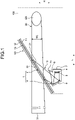
- FIG. 1 is a schematic diagram that illustrates the configuration of the vehicular display device according to the embodiment.
- FIG. 2 is a plan view that illustrates the layout of the vehicular display device according to the embodiment.
- FIG. 3 is a plan view of a display image displayed by the vehicular display device according to the embodiment.
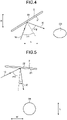
- FIG. 4 is a sectional view explaining diffraction of light caused by a hologram of the embodiment.
- FIG. 5 is another sectional view explaining diffraction of light caused by the hologram of the embodiment.
- FIG. 6 is a plan view that illustrates the optical path of light reflected off a windshield.
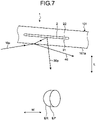
- FIG. 7 is a sectional view explaining light reflected off the windshield.
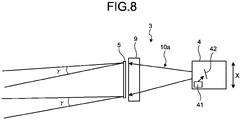
- FIG. 8 is a diagram that illustrates the configuration of a projection device according to the embodiment.
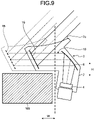
- FIG. 9 is a diagram explaining a manner to avoid interference between the projection device and other parts.
- a vehicular display device 1 of the present embodiment is mounted on a vehicle 100 such as an automobile.
- the vehicular display device 1 has a hologram 2 and a projection device 3.
- the hologram 2 is disposed inside a windshield 101 of the vehicle 100.
- the windshield 101 is a laminated glass and has an inner glass 11, an outer glass 12, and an intermediate film 13.
- the intermediate film 13 and the hologram 2 are sealed between the inner glass 11 and the outer glass 12.
- the intermediate film 13 is made of a synthetic resin such as polymer.
- the hologram 2 may be integrally formed with the intermediate film 13 or may be inserted into the intermediate film 13, for example.
- the hologram 2 is a transparent film processed to have desired diffraction characteristics.
- the hologram 2 of the present embodiment is a reflection-type hologram.
- the hologram 2 has a first surface 21 and a second surface 22.
- the hologram 2 diffracts light incident on the first surface 21 and outputs the diffracted light from the first surface 21.
- the hologram 2 of the embodiment controls the direction of output of the diffracted light in a vehicle height direction H and in a vehicle width direction W.
- FIG. 4 illustrates diffraction characteristics of the hologram 2 in the vehicle height direction H.
- FIG. 4 illustrates the incident angle and the output angle when viewed from the vehicle width direction W.
- the hologram 2 outputs diffracted light 30 from the first surface 21.
- the hologram 2 is designed such that the output angle of the diffracted light 30 is a second angle ⁇ 2 when viewed from the vehicle width direction W.
- the second angle ⁇ 2 is determined such that the diffracted light 30 is directed to an eye range ER.
- the eye range ER is a region assumed as the position of eyes of a driver in the vehicle 100.
- the first angle ⁇ 1 and the second angle ⁇ 2 differ depending on positions along a height direction H.
- the hologram 2 is designed to condense the diffracted light 30 toward the eye range ER.
- the hologram 2 allows the light to pass therethrough. That is, the hologram 2 selectively reflects the light, which is incident at the first angle ⁇ 1, toward the eye range ER. Furthermore, the hologram 2 allows light incident on the second surface 22 to pass through toward the eye range ER.
- FIG. 5 illustrates a diffraction characteristics of the hologram 2 in the vehicle width direction W.
- FIG. 5 illustrates the incident angle and the output angle of light when viewed from the vehicle height direction H.
- Light incident on the first surface 21 at a third angle ⁇ 3 is output by the hologram 2 from the first surface 21 as the diffracted light 30.
- the hologram 2 is designed such that the output angle of the diffracted light 30 is a fourth angle ⁇ 4 when viewed from the vehicle height direction H.
- the fourth angle ⁇ 4 is designed to direct the diffracted light 30 toward the eye range ER.
- the fourth angle ⁇ 4 is, for example, smaller than the third angle ⁇ 3.
- the hologram 2 is designed to output the diffracted light 30 that travels along a vehicle front-back direction L.
- the hologram 2 of the embodiment has the third angle ⁇ 3 and the fourth angle ⁇ 4 varying depending on the position along the vehicle width direction W. If the incident angle on the first surface 21 is not the third angle ⁇ 3, the hologram 2 allows the light to pass therethrough. In other words, if the incident angle of light on the first surface 21 is different from the third angle ⁇ 3 when viewed from the vehicle height direction H, the hologram 2 allows the light to pass therethrough.
- the hologram 2 selectively reflects light entering at the third angle ⁇ 3, toward the eye range ER.
- the hologram 2 of the embodiment outputs such light that enters at the first angle ⁇ 1 when viewed from the vehicle width direction W and enters at the third angle ⁇ 3 when viewed from the vehicle height direction H, as the diffracted light 30.
- the diffracted light 30 is such light that goes out at the second angle ⁇ 2 when viewed from the vehicle width direction W and goes out at the fourth angle ⁇ 4 when viewed from the vehicle height direction H.
- a projection device 3 has a casing 7, an image display device 4, a regulation unit 5, a mirror 6, and a cover 8.
- the casing 7 is disposed inside a dashboard of the vehicle 100, for example.
- the casing 7 has an opening 7a and is fixed to the vehicle 100 with the opening 7a facing upward.
- the dashboard has an aperture 102.
- the casing 7 is placed with the opening 7a and the aperture 102 facing each other.
- the image display device 4, the regulation unit 5, and the mirror 6 are received inside the casing 7.
- the cover 8 closes the opening 7a of the casing 7.
- the cover 8 is a transparent member and allows display light 10 to pass therethrough.
- the image display device 4 is a device that outputs display light.
- the image display device 4 of the present embodiment is a laser scanner.
- the regulation unit 5 is an optical member to limit the diffusion angle of the display light 10.
- the mirror 6 is a reflecting device that reflects the display light 10, which is output from the image display device 4 via the regulation unit 5, toward the hologram 2.
- the mirror 6 of the present embodiment is a magnifying mirror.
- the shape of the reflecting surface of the mirror 6 is a free-form surface.
- the mirror 6 magnifies the display light 10 and reflects the magnified light toward the hologram 2. That is, the projection device 3 projects the display light 10 having a limited diffusion angle toward the first surface 21 of the hologram 2.
- the projection device 3 of the present embodiment is located closer to a center of the vehicle CL relative to the hologram 2, in the vehicle width direction W.
- the display light 10 output from the projection device 3 therefore travels in a direction away from the center of the vehicle CL along the vehicle width direction W, as illustrated in FIG. 3 .
- the hologram 2 outputs the display light 10, which is incident from the mirror 6, as the diffracted light 30 directed to the eye range ER.
- the diffracted light 30 causes a display image 31 to be visually recognized.
- the diffracted light 30 allows the user to visually recognize the display image 31 as a virtual image.
- the display image 31 is an image formed in front of the vehicular display device 1 in a vehicle front-rear direction L from the hologram 2.
- the hologram 2 of the present embodiment has diffraction characteristics of condensing the diffracted light 30 in the eye range ER.
- the width WL of the diffracted light 30 directed to the eye range ER becomes narrower from the hologram 2 toward the eye range ER.
- the width WL is the width of the diffracted light 30 in a vehicle height direction H.
- the hologram 2 may be configured such that the width of the diffracted light 30 in a vehicle width direction W becomes narrower toward the eye range ER.
- the hologram 2 of the present embodiment can magnify the display image 31 and allow a user to visually recognize the magnified image.
- the vehicular display device 1 of the embodiment is configured such that light reflected off the windshield 101 travels in a direction different from the direction toward the eye range ER, as described below.
- FIG. 6 and FIG. 7 illustrate an eye point EP in the eye range ER.
- diffracted light 30p is the diffracted light 30 output from the hologram 2 toward the eye point EP.
- a display light 10p is the display light 10 corresponding to the diffracted light 30p. As illustrated in FIG. 7 , the display light 10p enters the hologram 2 and is output therefrom as the diffracted light 30p.
- a part of the display light 10p is reflected off a surface 101a, of the windshield 101, facing the cabin, and turns into reflected light 40.
- the projection device 3 of the embodiment is disposed at a location that allows the reflected light 40 to travel in a direction different from the direction toward the eye point EP in the vehicle width direction W.
- the projection device 3 is arranged such that the display light 10p enters the windshield 101 at an incident angle that allows the reflected light 40 to stray from the eye point EP. With the reflected light 40 traveling avoiding the eye point EP, ghosts of lights are reduced.
- the projection device 3 is arranged such that the reflected light 40 can pass areas not overlapping any eye points EP in the eye range ER.
- the projection device 3 of the embodiment is arranged such that the display light 10 reflected off the windshield 101 travels in a direction different from the direction toward the eye range ER in the vehicle width direction W.
- the vehicular display device 1 of the embodiment With the vehicular display device 1 of the embodiment, the visibility of the display image 31 is therefore improved.
- the regulation unit 5 of the embodiment limits the diffusion angle of the display light 10 to stop the reflected light 40 from traveling toward the eye range ER.
- light output from the image display device 4 enters the regulation unit 5 through a field lens 9.
- the image display device 4 includes a light source 41 to emit laser beams and a movable mirror 42 to reflect the laser beams.
- the image display device 4 vibrates the mirror 42 to run the laser beam in an image width direction X and an image height direction Y for scanning.
- the image width direction X is a direction corresponding to the width of the display image 31 viewed from the eye range ER
- the image height direction Y is a direction corresponding to the height of the display image 31 viewed from the eye range ER.
- the image height direction Y is a direction perpendicular to the page.
- a display light 10a output from the image display device 4 enters the field lens 9.
- the field lens 9 aligns the direction of travel of the light. More specifically, the field lens 9 forms the display light 10a from the image display device 4 into a substantially parallel light and outputs the light toward the regulation unit 5.
- the regulation unit 5 of the embodiment is a microlens array having a plurality of lenses. The lenses diffuse the display light 10 from the field lens 9. The display light 10 diffused by the regulation unit 5 is reflected by the mirror 6 toward the hologram 2.
- the regulation unit 5 of the embodiment is a screen and diffuses the display light 10 to make the display image 31 visually recognizable from any positions in the eye range ER.
- the upper limit ⁇ of the diffusion angle is determined to stop the reflected light 40 from traveling toward the eye range ER.
- An increase in the upper limit ⁇ of angle increases a diffusion angle ⁇ (see FIG. 6 ) of the reflected light 40.
- the regulation unit 5 sets an upper limit ⁇ of angle, which limits the diffusion angle of the display light 10 and stops the reflected light 40 from traveling toward the eye range ER.
- the value of the upper limit ⁇ of angle may vary depending on the position in the image width direction X.
- FIG. 9 illustrates the projection device 3 viewed from the back of the vehicle.
- the projection device 3 may be provided with a second mirror 15.
- the mirror 6 reflects the display light 10 output from the image display device 4 toward the vehicle width direction W.
- the second mirror 15 is placed in the optical path of the display light 10 reflected by the mirror 6.
- the second mirror 15 reflects the display light 10 toward the hologram 2.
- the second mirror 15 is, for example, a flat mirror.
- the vehicular display device 1 of the present embodiment has the reflection-type hologram 2 and the projection device 3.
- the hologram 2 is disposed inside the windshield 101 of the vehicle 100.
- the projection device 3 projects the display light 10 toward the hologram 2.
- the hologram 2 outputs the display light 10 from the projection device 3, as the diffracted light 30 that travels toward the eye range ER of the vehicle 100.
- the projection device 3 is arranged such that the display light 10 reflected off the windshield 101 travels in a direction different from the direction toward the eye range ER in the vehicle width direction W.
- the projection device 3 is disposed in a manner that increases the incident angle of the display light 10 on the windshield 101, to stop the reflected display light 10 from traveling toward the eye range ER.
- the vehicular display device 1 of the embodiment can control the reflected light 40 not to travel toward the eye range ER and therefore improve the visibility of the display image 31.
- the hologram 2 of the embodiment has a property that allows the output angle of the diffracted light 30 from the hologram 2 to be smaller than the incident angle of the display light 10 on the hologram 2, when viewed from the vehicle height direction H.
- the hologram 2 is configured to have the fourth angle ⁇ 4 smaller than the third angle ⁇ 3. With these diffraction characteristics, the hologram 2 is capable of directing the diffracted light 30 toward the eye range ER.
- the projection device 3 of the embodiment is located close to the center of the vehicle CL, with respect to the hologram 2, in the vehicle width direction W.
- the display light 10 projected from the projection device 3 therefore travels in a direction away from the center of the vehicle CL along the vehicle width direction W.
- the reflected light 40 reflected off the windshield 101 therefore travels in a direction away from the center of the vehicle CL along the vehicle width direction W.
- the reflected light 40 that travels toward the side of the vehicle 100 is not likely to be visually recognized by the passengers on board the vehicle 100.
- the layout of the projection device 3 is not limited to the example layout of the embodiment.
- the projection device 3 may be placed away from the center of the vehicle CL with respect to the hologram 2.
- the display light 10 projected from the projection device 3 travels toward the center of the vehicle CL along the vehicle width direction W.
- the projection device 3 is arranged such that the display light 10 reflected off the windshield 101 travels in a direction different from the direction toward the eye range ER in the vehicle width direction W.
- the regulation unit 5 of the projection device 3 of the embodiment does not necessarily have the function to limit the diffusion angle of the display light 10 under the upper limit ⁇ of angle.
- the regulation unit 5 may have no necessity of limiting the diffusion angle of the display light 10, with the intention of directing the reflected light 40 in a direction different from the direction toward the eye range ER. In this case, the regulation unit 5 does not need to limit the diffusion angle of the display light 10 under the upper limit ⁇ of angle.
- the image display device 4 is not limited to a laser scanner.
- the image display device 4 may be a liquid crystal display that generates the display light 10 using, for example, a thin-film transistor liquid-crystal display (TFT-LCD).
- TFT-LCD thin-film transistor liquid-crystal display
- a vehicular display device has a projection device arranged such that display light, reflected off the windshield, travels in a direction different from the direction toward the eye range in the vehicle width direction.
- the vehicular display device is effective in improving the visibility of a display image by controlling the light reflected off the windshield not to travel toward the eye range.
Landscapes
- Engineering & Computer Science (AREA)
- Physics & Mathematics (AREA)
- Mechanical Engineering (AREA)
- Chemical & Material Sciences (AREA)
- Combustion & Propulsion (AREA)
- Transportation (AREA)
- General Physics & Mathematics (AREA)
- Optics & Photonics (AREA)
- Multimedia (AREA)
- Instrument Panels (AREA)
- Diffracting Gratings Or Hologram Optical Elements (AREA)
- Holo Graphy (AREA)
Description
- The present invention relates to a vehicular display device.
- In the related art, there is a display device using a hologram.
Japanese Patent Application Laid-open No. H11-91401 - In disposing a hologram inside the windshield, reflection of display light on the surface of the windshield should be taken care of. For this issue, directing the reflected light in a direction different from the direction toward the eye range is effective in improving the visibility of the display image. The
US Patent Application No. 2013/182302 A1 discloses a display device including a light source configured to emit light, a projection optical system configured to project image light generated from the light; a transmissive hologram including a first surface which the image light enters from the projection optical system; and an interface configured to cause Fresnel reflection of the image light deflected by the hologram. The hologram includes a first interference fringe recorded by object light and reference light which are incident on the first surface by means of two-light flux interference. The image light incident on the first surface is deflected by the first interference fringe toward the interface. The interface reflects the image light toward the first surface. TheJapanese Patent Application No. HO-5278498 - The present invention aims to provide a vehicular display device that can improve the visibility of a display image.
- A vehicular display device according to one aspect of the present invention includes a reflection-type hologram disposed inside a windshield of a vehicle; and a projection device that projects display light toward the hologram, wherein the hologram outputs the display light, projected from the projection device, as diffracted light that travels toward an eye range of the vehicle, and the projection device is disposed such that the display light reflected off the windshield travels in a direction different from a direction toward the eye range in a vehicle width direction.
- According to another aspect of the present invention, in the vehicular display device, it is preferable that the hologram has a property that allows an output angle of the diffracted light from the hologram to be smaller than an incident angle of the display light on the hologram, when viewed from a vehicle height direction.
- According to still another aspect of the present invention, in the vehicular display device, it is preferable that the projection device is located close to a center of the vehicle, with respect to the hologram, in a vehicle width direction.
- The above and other objects, features, advantages and technical and industrial significance of this invention will be better understood by reading the following detailed description of presently preferred embodiments of the invention, when considered in connection with the accompanying drawings.
-
-
FIG. 1 is a schematic configuration diagram of a vehicular display device according to an embodiment; -
FIG. 2 is a plan view that illustrates the layout of the vehicular display device according to the embodiment; -
FIG. 3 is a plan view of a display image displayed by the vehicular display device according to the embodiment; -
FIG. 4 is a sectional view explaining diffraction of light caused by a hologram of the embodiment; -
FIG. 5 is another sectional view explaining diffraction of light caused by the hologram of the embodiment; -
FIG. 6 is a plan view that illustrates the optical path of light reflected off a windshield; -
FIG. 7 is a sectional view explaining light reflected off the windshield; -
FIG. 8 is a drawing that illustrates the configuration of a projection device according to the embodiment; andFIG. 9 is a diagram explaining a manner to avoid interference between the projection device and other parts. - A vehicular display device according to the present invention will now be described in detail with reference to the diagrams. It should be noted that the embodiment is not intended to limit the present invention. The components in the following embodiment include what could be easily conceived of by the skilled person or what are substantially the same.
- An embodiment will now be described with reference to
FIG. 1 to FIG. 9 . The embodiment relates to a vehicular display device.FIG. 1 is a schematic diagram that illustrates the configuration of the vehicular display device according to the embodiment.FIG. 2 is a plan view that illustrates the layout of the vehicular display device according to the embodiment.FIG. 3 is a plan view of a display image displayed by the vehicular display device according to the embodiment.FIG. 4 is a sectional view explaining diffraction of light caused by a hologram of the embodiment.FIG. 5 is another sectional view explaining diffraction of light caused by the hologram of the embodiment.FIG. 6 is a plan view that illustrates the optical path of light reflected off a windshield.FIG. 7 is a sectional view explaining light reflected off the windshield.FIG. 8 is a diagram that illustrates the configuration of a projection device according to the embodiment.FIG. 9 is a diagram explaining a manner to avoid interference between the projection device and other parts. - As illustrated in
FIG. 1 andFIG. 2 , avehicular display device 1 of the present embodiment is mounted on avehicle 100 such as an automobile. Thevehicular display device 1 has ahologram 2 and aprojection device 3. Thehologram 2 is disposed inside awindshield 101 of thevehicle 100. Thewindshield 101 is a laminated glass and has aninner glass 11, anouter glass 12, and anintermediate film 13. Theintermediate film 13 and thehologram 2 are sealed between theinner glass 11 and theouter glass 12. Theintermediate film 13 is made of a synthetic resin such as polymer. Thehologram 2 may be integrally formed with theintermediate film 13 or may be inserted into theintermediate film 13, for example. - The
hologram 2 is a transparent film processed to have desired diffraction characteristics. Thehologram 2 of the present embodiment is a reflection-type hologram. Thehologram 2 has afirst surface 21 and asecond surface 22. Thehologram 2 diffracts light incident on thefirst surface 21 and outputs the diffracted light from thefirst surface 21. As described below, thehologram 2 of the embodiment controls the direction of output of the diffracted light in a vehicle height direction H and in a vehicle width direction W. -
FIG. 4 illustrates diffraction characteristics of thehologram 2 in the vehicle height direction H.FIG. 4 illustrates the incident angle and the output angle when viewed from the vehicle width direction W. When light is incident on thefirst surface 21 at a first angle θ1, thehologram 2 outputs diffractedlight 30 from thefirst surface 21. Thehologram 2 is designed such that the output angle of thediffracted light 30 is a second angle θ2 when viewed from the vehicle width direction W. The second angle θ2 is determined such that thediffracted light 30 is directed to an eye range ER. The eye range ER is a region assumed as the position of eyes of a driver in thevehicle 100. - In the
hologram 2 of the present embodiment, the first angle θ1 and the second angle θ2 differ depending on positions along a height direction H. As fill be described below, thehologram 2 is designed to condense thediffracted light 30 toward the eye range ER. When the incident angle of light on thefirst surface 21 is different from the first angle θ1 when viewed from the vehicle width direction W, thehologram 2 allows the light to pass therethrough. That is, thehologram 2 selectively reflects the light, which is incident at the first angle θ1, toward the eye range ER. Furthermore, thehologram 2 allows light incident on thesecond surface 22 to pass through toward the eye range ER. -
FIG. 5 illustrates a diffraction characteristics of thehologram 2 in the vehicle width direction W.FIG. 5 illustrates the incident angle and the output angle of light when viewed from the vehicle height direction H. Light incident on thefirst surface 21 at a third angle θ3 is output by thehologram 2 from thefirst surface 21 as the diffractedlight 30. Thehologram 2 is designed such that the output angle of the diffractedlight 30 is a fourth angle θ4 when viewed from the vehicle height direction H. The fourth angle θ4 is designed to direct the diffracted light 30 toward the eye range ER. The fourth angle θ4 is, for example, smaller than the third angle θ3. Thehologram 2 is designed to output the diffracted light 30 that travels along a vehicle front-back direction L. - The
hologram 2 of the embodiment has the third angle θ3 and the fourth angle θ4 varying depending on the position along the vehicle width direction W. If the incident angle on thefirst surface 21 is not the third angle θ3, thehologram 2 allows the light to pass therethrough. In other words, if the incident angle of light on thefirst surface 21 is different from the third angle θ3 when viewed from the vehicle height direction H, thehologram 2 allows the light to pass therethrough. Thehologram 2 selectively reflects light entering at the third angle θ3, toward the eye range ER. - In this manner, the
hologram 2 of the embodiment outputs such light that enters at the first angle θ1 when viewed from the vehicle width direction W and enters at the third angle θ3 when viewed from the vehicle height direction H, as the diffractedlight 30. The diffractedlight 30 is such light that goes out at the second angle θ2 when viewed from the vehicle width direction W and goes out at the fourth angle θ4 when viewed from the vehicle height direction H. - As illustrated in
FIG. 1 , aprojection device 3 has acasing 7, animage display device 4, aregulation unit 5, amirror 6, and acover 8. Thecasing 7 is disposed inside a dashboard of thevehicle 100, for example. Thecasing 7 has anopening 7a and is fixed to thevehicle 100 with theopening 7a facing upward. As illustrated inFIG. 2 , the dashboard has anaperture 102. Thecasing 7 is placed with theopening 7a and theaperture 102 facing each other. Theimage display device 4, theregulation unit 5, and themirror 6 are received inside thecasing 7. Thecover 8 closes theopening 7a of thecasing 7. Thecover 8 is a transparent member and allows display light 10 to pass therethrough. - The
image display device 4 is a device that outputs display light. Theimage display device 4 of the present embodiment is a laser scanner. Theregulation unit 5 is an optical member to limit the diffusion angle of thedisplay light 10. Themirror 6 is a reflecting device that reflects thedisplay light 10, which is output from theimage display device 4 via theregulation unit 5, toward thehologram 2. Themirror 6 of the present embodiment is a magnifying mirror. The shape of the reflecting surface of themirror 6 is a free-form surface. Themirror 6 magnifies thedisplay light 10 and reflects the magnified light toward thehologram 2. That is, theprojection device 3 projects thedisplay light 10 having a limited diffusion angle toward thefirst surface 21 of thehologram 2. - As illustrated in
FIG. 2 , theprojection device 3 of the present embodiment is located closer to a center of the vehicle CL relative to thehologram 2, in the vehicle width direction W. Thedisplay light 10 output from theprojection device 3 therefore travels in a direction away from the center of the vehicle CL along the vehicle width direction W, as illustrated inFIG. 3 . - As illustrated in
FIG. 1 andFIG. 3 , thehologram 2 outputs thedisplay light 10, which is incident from themirror 6, as the diffracted light 30 directed to the eye range ER. When a user views thehologram 2 from the eye range ER, the diffracted light 30 causes adisplay image 31 to be visually recognized. The diffractedlight 30 allows the user to visually recognize thedisplay image 31 as a virtual image. Thedisplay image 31 is an image formed in front of thevehicular display device 1 in a vehicle front-rear direction L from thehologram 2. - The
hologram 2 of the present embodiment has diffraction characteristics of condensing the diffracted light 30 in the eye range ER. For example, as illustrated inFIG. 1 , the width WL of the diffracted light 30 directed to the eye range ER becomes narrower from thehologram 2 toward the eye range ER. The width WL is the width of the diffracted light 30 in a vehicle height direction H. Note that thehologram 2 may be configured such that the width of the diffracted light 30 in a vehicle width direction W becomes narrower toward the eye range ER. Thehologram 2 of the present embodiment can magnify thedisplay image 31 and allow a user to visually recognize the magnified image. - The
vehicular display device 1 of the embodiment is configured such that light reflected off thewindshield 101 travels in a direction different from the direction toward the eye range ER, as described below.FIG. 6 andFIG. 7 illustrate an eye point EP in the eye range ER. InFIG. 6 andFIG. 7 , diffracted light 30p is the diffracted light 30 output from thehologram 2 toward the eye point EP. Adisplay light 10p is thedisplay light 10 corresponding to the diffracted light 30p. As illustrated inFIG. 7 , the display light 10p enters thehologram 2 and is output therefrom as the diffracted light 30p. - As illustrated in
FIG. 7 , a part of the display light 10p is reflected off asurface 101a, of thewindshield 101, facing the cabin, and turns into reflectedlight 40. Theprojection device 3 of the embodiment is disposed at a location that allows the reflected light 40 to travel in a direction different from the direction toward the eye point EP in the vehicle width direction W. In other words, theprojection device 3 is arranged such that the display light 10p enters thewindshield 101 at an incident angle that allows the reflected light 40 to stray from the eye point EP. With the reflected light 40 traveling avoiding the eye point EP, ghosts of lights are reduced. Theprojection device 3 is arranged such that the reflected light 40 can pass areas not overlapping any eye points EP in the eye range ER. - In other words, the
projection device 3 of the embodiment is arranged such that thedisplay light 10 reflected off thewindshield 101 travels in a direction different from the direction toward the eye range ER in the vehicle width direction W. With thevehicular display device 1 of the embodiment, the visibility of thedisplay image 31 is therefore improved. - As described below, the
regulation unit 5 of the embodiment limits the diffusion angle of thedisplay light 10 to stop the reflected light 40 from traveling toward the eye range ER. As described inFIG. 8 , light output from theimage display device 4 enters theregulation unit 5 through a field lens 9. Theimage display device 4 includes alight source 41 to emit laser beams and amovable mirror 42 to reflect the laser beams. Theimage display device 4 vibrates themirror 42 to run the laser beam in an image width direction X and an image height direction Y for scanning. The image width direction X is a direction corresponding to the width of thedisplay image 31 viewed from the eye range ER, and the image height direction Y is a direction corresponding to the height of thedisplay image 31 viewed from the eye range ER. InFIG. 8 , the image height direction Y is a direction perpendicular to the page. Adisplay light 10a output from theimage display device 4 enters the field lens 9. - The field lens 9 aligns the direction of travel of the light. More specifically, the field lens 9 forms the
display light 10a from theimage display device 4 into a substantially parallel light and outputs the light toward theregulation unit 5. Theregulation unit 5 of the embodiment is a microlens array having a plurality of lenses. The lenses diffuse the display light 10 from the field lens 9. Thedisplay light 10 diffused by theregulation unit 5 is reflected by themirror 6 toward thehologram 2. Theregulation unit 5 of the embodiment is a screen and diffuses thedisplay light 10 to make thedisplay image 31 visually recognizable from any positions in the eye range ER. - The upper limit γ of the diffusion angle is determined to stop the reflected light 40 from traveling toward the eye range ER. An increase in the upper limit γ of angle increases a diffusion angle β (see
FIG. 6 ) of the reflectedlight 40. Theregulation unit 5 sets an upper limit γ of angle, which limits the diffusion angle of thedisplay light 10 and stops the reflected light 40 from traveling toward the eye range ER. The value of the upper limit γ of angle may vary depending on the position in the image width direction X. - If insufficient space is only available for the
projection device 3 on thevehicle 100, theprojection device 3 may be configured as described with reference toFIG. 9. FIG. 9 illustrates theprojection device 3 viewed from the back of the vehicle. In adjusting the position of thecasing 7 in the vehicle width direction W, it is necessary to avoid aninstallation space 103 for other parts. For this issue, theprojection device 3 may be provided with asecond mirror 15. Themirror 6 reflects thedisplay light 10 output from theimage display device 4 toward the vehicle width direction W. Thesecond mirror 15 is placed in the optical path of thedisplay light 10 reflected by themirror 6. Thesecond mirror 15 reflects thedisplay light 10 toward thehologram 2. Thesecond mirror 15 is, for example, a flat mirror. The above configuration is effective in easily adjusting the incident angle of thedisplay light 10 on thehologram 2 and thewindshield 101, to a desired angle. - As described above, the
vehicular display device 1 of the present embodiment has the reflection-type hologram 2 and theprojection device 3. Thehologram 2 is disposed inside thewindshield 101 of thevehicle 100. Theprojection device 3 projects thedisplay light 10 toward thehologram 2. Thehologram 2 outputs the display light 10 from theprojection device 3, as the diffracted light 30 that travels toward the eye range ER of thevehicle 100. - The
projection device 3 is arranged such that thedisplay light 10 reflected off thewindshield 101 travels in a direction different from the direction toward the eye range ER in the vehicle width direction W. For example, theprojection device 3 is disposed in a manner that increases the incident angle of thedisplay light 10 on thewindshield 101, to stop the reflected display light 10 from traveling toward the eye range ER. Thevehicular display device 1 of the embodiment can control the reflected light 40 not to travel toward the eye range ER and therefore improve the visibility of thedisplay image 31. - The
hologram 2 of the embodiment has a property that allows the output angle of the diffracted light 30 from thehologram 2 to be smaller than the incident angle of thedisplay light 10 on thehologram 2, when viewed from the vehicle height direction H. As described with reference toFIG. 5 , thehologram 2 is configured to have the fourth angle θ4 smaller than the third angle θ3. With these diffraction characteristics, thehologram 2 is capable of directing the diffracted light 30 toward the eye range ER. - The
projection device 3 of the embodiment is located close to the center of the vehicle CL, with respect to thehologram 2, in the vehicle width direction W. Thedisplay light 10 projected from theprojection device 3 therefore travels in a direction away from the center of the vehicle CL along the vehicle width direction W. The reflected light 40 reflected off thewindshield 101 therefore travels in a direction away from the center of the vehicle CL along the vehicle width direction W. The reflected light 40 that travels toward the side of thevehicle 100 is not likely to be visually recognized by the passengers on board thevehicle 100. - The layout of the
projection device 3 is not limited to the example layout of the embodiment. For example, theprojection device 3 may be placed away from the center of the vehicle CL with respect to thehologram 2. In this layout, thedisplay light 10 projected from theprojection device 3 travels toward the center of the vehicle CL along the vehicle width direction W. Theprojection device 3 is arranged such that thedisplay light 10 reflected off thewindshield 101 travels in a direction different from the direction toward the eye range ER in the vehicle width direction W. - The
regulation unit 5 of theprojection device 3 of the embodiment does not necessarily have the function to limit the diffusion angle of thedisplay light 10 under the upper limit γ of angle. For example, theregulation unit 5 may have no necessity of limiting the diffusion angle of thedisplay light 10, with the intention of directing the reflected light 40 in a direction different from the direction toward the eye range ER. In this case, theregulation unit 5 does not need to limit the diffusion angle of thedisplay light 10 under the upper limit γ of angle. - The
image display device 4 is not limited to a laser scanner. For example, theimage display device 4 may be a liquid crystal display that generates thedisplay light 10 using, for example, a thin-film transistor liquid-crystal display (TFT-LCD). - The technologies described in the above embodiment and the modification are allowed to be implemented in combination.
- A vehicular display device according to the present embodiment has a projection device arranged such that display light, reflected off the windshield, travels in a direction different from the direction toward the eye range in the vehicle width direction. The vehicular display device according to the present embodiment is effective in improving the visibility of a display image by controlling the light reflected off the windshield not to travel toward the eye range.
Claims (3)
- A vehicular display device (1), comprising:a reflection-type hologram (2) disposed inside a windshield (101) of a vehicle (100); anda projection device (3) that projects display light (10) toward the hologram (2), whereinthe hologram (2) outputs the display light (10), projected from the projection device (3), as diffracted light (30) that travels toward an eye range (ER) of the vehicle (100), and characterized in that:the projection device (3) is disposed such that the reflected light (40), which is part of the display light (10) reflected off the windshield (101), travels in a direction different from a direction toward the eye range (ER) in a vehicle width direction (W).
- The vehicular display device (1) according to claim 1, wherein
the hologram (2) has a property that allows an output angle (θ3) of the diffracted light (30) from the hologram (2) to be smaller than an incident angle (θ4) of the display light (10) on the hologram (2), when viewed from a vehicle height direction (H). - The vehicular display device (1) according to claim 1 or 2, wherein
the projection device (3) is located close to a center (CL) of the vehicle (100), with respect to the hologram (2), in a vehicle width direction (W).
Applications Claiming Priority (1)
| Application Number | Priority Date | Filing Date | Title |
|---|---|---|---|
| JP2019161916A JP7143264B2 (en) | 2019-09-05 | 2019-09-05 | vehicle display |
Publications (2)
| Publication Number | Publication Date |
|---|---|
| EP3789229A1 EP3789229A1 (en) | 2021-03-10 |
| EP3789229B1 true EP3789229B1 (en) | 2022-04-06 |
Family
ID=72290893
Family Applications (1)
| Application Number | Title | Priority Date | Filing Date |
|---|---|---|---|
| EP20193340.5A Active EP3789229B1 (en) | 2019-09-05 | 2020-08-28 | Vehicular display device |
Country Status (4)
| Country | Link |
|---|---|
| US (1) | US11467402B2 (en) |
| EP (1) | EP3789229B1 (en) |
| JP (1) | JP7143264B2 (en) |
| CN (1) | CN112444995B (en) |
Families Citing this family (2)
| Publication number | Priority date | Publication date | Assignee | Title |
|---|---|---|---|---|
| CN114407653B (en) * | 2022-01-21 | 2023-09-19 | 广东汇天航空航天科技有限公司 | Intelligent automobile screen display control method, device and system and intelligent automobile |
| DE102022131497B3 (en) * | 2022-11-29 | 2023-09-28 | Bayerische Motoren Werke Aktiengesellschaft | Transparent reflective lens for use with a reflective display system for double image suppression |
Citations (1)
| Publication number | Priority date | Publication date | Assignee | Title |
|---|---|---|---|---|
| JPH05278498A (en) * | 1992-03-30 | 1993-10-26 | Ricoh Co Ltd | Head up display device |
Family Cites Families (18)
| Publication number | Priority date | Publication date | Assignee | Title |
|---|---|---|---|---|
| DE3532120A1 (en) * | 1985-09-10 | 1987-03-19 | Ver Glaswerke Gmbh | WINDSHIELD WITH A REFLECTIVE DEVICE FOR MIRRORING OPTICAL SIGNALS INTO THE FIELD OF THE DRIVER |
| US4961625A (en) * | 1987-09-18 | 1990-10-09 | Flight Dynamics, Inc. | Automobile head-up display system with reflective aspheric surface |
| JP2751436B2 (en) * | 1989-07-17 | 1998-05-18 | 日産自動車株式会社 | Display device for vehicles |
| US6534152B2 (en) * | 1989-09-28 | 2003-03-18 | Ppg Industries Ohio, Inc. | Windshield for head-up display system |
| EP0479059B1 (en) | 1990-09-20 | 1996-04-24 | Yazaki Corporation | A headup display apparatus |
| JP2982824B2 (en) * | 1990-09-20 | 1999-11-29 | 富士通株式会社 | Head-up display device |
| GB9116108D0 (en) * | 1991-07-25 | 1991-11-06 | Pilkington Perkin Elmer Ltd | Improvements in or relating to displays |
| US5859714A (en) * | 1993-11-16 | 1999-01-12 | Asahi Glass Company, Ltd. | Head-up display, a combiner used for the head-up display and a method of designing the head-up display |
| JPH0950227A (en) * | 1995-08-08 | 1997-02-18 | Denso Corp | Hologram display device |
| JPH1191401A (en) | 1997-09-18 | 1999-04-06 | Asahi Glass Co Ltd | Holographic display for vehicles |
| US6906836B2 (en) * | 2002-10-04 | 2005-06-14 | William Parker | Full color holographic image combiner system |
| CN102656501B (en) * | 2009-12-14 | 2014-07-02 | 松下电器产业株式会社 | Transmissive display device |
| CN102791510B (en) | 2010-03-10 | 2015-07-08 | V&I株式会社 | Vehicle HUD device using multiple lenses |
| US9285588B2 (en) * | 2010-10-01 | 2016-03-15 | Panasonic Intellectual Property Management Co., Ltd. | See-through display device and vehicle having see-through display device mounted thereon |
| JP6267558B2 (en) * | 2014-03-25 | 2018-01-24 | 株式会社デンソーテン | Vehicle apparatus and vehicle control method |
| US9740004B2 (en) * | 2014-06-05 | 2017-08-22 | Making Virtual Solid—California LLC. | Pupil-expanded biocular volumetric display |
| US10866414B2 (en) | 2015-07-15 | 2020-12-15 | Apple Inc. | System with holographic head-up display |
| CA2976543C (en) * | 2016-08-23 | 2026-02-10 | Vijyat Bhalla | System and method for augmented reality head up display for vehicles |
-
2019
- 2019-09-05 JP JP2019161916A patent/JP7143264B2/en active Active
-
2020
- 2020-08-28 EP EP20193340.5A patent/EP3789229B1/en active Active
- 2020-09-02 US US17/010,781 patent/US11467402B2/en active Active
- 2020-09-03 CN CN202010915299.9A patent/CN112444995B/en active Active
Patent Citations (1)
| Publication number | Priority date | Publication date | Assignee | Title |
|---|---|---|---|---|
| JPH05278498A (en) * | 1992-03-30 | 1993-10-26 | Ricoh Co Ltd | Head up display device |
Also Published As
| Publication number | Publication date |
|---|---|
| CN112444995B (en) | 2022-11-01 |
| CN112444995A (en) | 2021-03-05 |
| JP7143264B2 (en) | 2022-09-28 |
| JP2021039301A (en) | 2021-03-11 |
| US11467402B2 (en) | 2022-10-11 |
| US20210072540A1 (en) | 2021-03-11 |
| EP3789229A1 (en) | 2021-03-10 |
Similar Documents
| Publication | Publication Date | Title |
|---|---|---|
| US10859826B2 (en) | Head-up display device | |
| EP3185061B1 (en) | Projection device and head-up display device | |
| JP7117066B2 (en) | Vehicle information display device and vehicle information display system | |
| KR20080050669A (en) | Car Head Up Display Device | |
| JP6414131B2 (en) | Projection device and head-up display device | |
| JP2017015776A (en) | Screen device and head-up display device | |
| JP2015152718A (en) | Head-up display device | |
| US12055711B2 (en) | Virtual image display device | |
| JP2022137325A (en) | Display device for vehicle | |
| EP3677947A1 (en) | Headup display device | |
| EP3789229B1 (en) | Vehicular display device | |
| US11520143B2 (en) | Display device for vehicle | |
| US11448880B2 (en) | Virtual image display device shifting light of an image to create a virtual image | |
| JP7584828B2 (en) | A multiple viewing angle monitor system capable of magnified diffraction reflection | |
| EP3451045B1 (en) | Display device | |
| JP2019028137A (en) | Display apparatus for vehicle | |
| JP2018180291A (en) | Vehicle display device | |
| JP2018030424A (en) | Vehicle display device | |
| JP6598701B2 (en) | In-vehicle display device | |
| JP7147373B2 (en) | vehicle display | |
| US11428934B2 (en) | Vehicle display device | |
| JP2017097115A (en) | Screen device and head-up display device | |
| US11993147B2 (en) | Head-up display apparatus | |
| JP7359152B2 (en) | heads up display device | |
| WO2024142704A1 (en) | Vehicular display device |
Legal Events
| Date | Code | Title | Description |
|---|---|---|---|
| PUAI | Public reference made under article 153(3) epc to a published international application that has entered the european phase |
Free format text: ORIGINAL CODE: 0009012 |
|
| STAA | Information on the status of an ep patent application or granted ep patent |
Free format text: STATUS: REQUEST FOR EXAMINATION WAS MADE |
|
| 17P | Request for examination filed |
Effective date: 20200828 |
|
| AK | Designated contracting states |
Kind code of ref document: A1 Designated state(s): AL AT BE BG CH CY CZ DE DK EE ES FI FR GB GR HR HU IE IS IT LI LT LU LV MC MK MT NL NO PL PT RO RS SE SI SK SM TR |
|
| AX | Request for extension of the european patent |
Extension state: BA ME |
|
| GRAP | Despatch of communication of intention to grant a patent |
Free format text: ORIGINAL CODE: EPIDOSNIGR1 |
|
| STAA | Information on the status of an ep patent application or granted ep patent |
Free format text: STATUS: GRANT OF PATENT IS INTENDED |
|
| INTG | Intention to grant announced |
Effective date: 20220124 |
|
| RIN1 | Information on inventor provided before grant (corrected) |
Inventor name: FURUYA, YOSHIYUKI Inventor name: AOKI, KUNIMITSU Inventor name: OGISU, TAKUMA |
|
| GRAS | Grant fee paid |
Free format text: ORIGINAL CODE: EPIDOSNIGR3 |
|
| GRAA | (expected) grant |
Free format text: ORIGINAL CODE: 0009210 |
|
| STAA | Information on the status of an ep patent application or granted ep patent |
Free format text: STATUS: THE PATENT HAS BEEN GRANTED |
|
| AK | Designated contracting states |
Kind code of ref document: B1 Designated state(s): AL AT BE BG CH CY CZ DE DK EE ES FI FR GB GR HR HU IE IS IT LI LT LU LV MC MK MT NL NO PL PT RO RS SE SI SK SM TR |
|
| REG | Reference to a national code |
Ref country code: GB Ref legal event code: FG4D |
|
| REG | Reference to a national code |
Ref country code: CH Ref legal event code: EP |
|
| REG | Reference to a national code |
Ref country code: AT Ref legal event code: REF Ref document number: 1481025 Country of ref document: AT Kind code of ref document: T Effective date: 20220415 |
|
| REG | Reference to a national code |
Ref country code: IE Ref legal event code: FG4D |
|
| REG | Reference to a national code |
Ref country code: DE Ref legal event code: R096 Ref document number: 602020002549 Country of ref document: DE |
|
| REG | Reference to a national code |
Ref country code: LT Ref legal event code: MG9D |
|
| REG | Reference to a national code |
Ref country code: NL Ref legal event code: MP Effective date: 20220406 |
|
| REG | Reference to a national code |
Ref country code: AT Ref legal event code: MK05 Ref document number: 1481025 Country of ref document: AT Kind code of ref document: T Effective date: 20220406 |
|
| PG25 | Lapsed in a contracting state [announced via postgrant information from national office to epo] |
Ref country code: NL Free format text: LAPSE BECAUSE OF FAILURE TO SUBMIT A TRANSLATION OF THE DESCRIPTION OR TO PAY THE FEE WITHIN THE PRESCRIBED TIME-LIMIT Effective date: 20220406 |
|
| PG25 | Lapsed in a contracting state [announced via postgrant information from national office to epo] |
Ref country code: SE Free format text: LAPSE BECAUSE OF FAILURE TO SUBMIT A TRANSLATION OF THE DESCRIPTION OR TO PAY THE FEE WITHIN THE PRESCRIBED TIME-LIMIT Effective date: 20220406 Ref country code: PT Free format text: LAPSE BECAUSE OF FAILURE TO SUBMIT A TRANSLATION OF THE DESCRIPTION OR TO PAY THE FEE WITHIN THE PRESCRIBED TIME-LIMIT Effective date: 20220808 Ref country code: NO Free format text: LAPSE BECAUSE OF FAILURE TO SUBMIT A TRANSLATION OF THE DESCRIPTION OR TO PAY THE FEE WITHIN THE PRESCRIBED TIME-LIMIT Effective date: 20220706 Ref country code: LT Free format text: LAPSE BECAUSE OF FAILURE TO SUBMIT A TRANSLATION OF THE DESCRIPTION OR TO PAY THE FEE WITHIN THE PRESCRIBED TIME-LIMIT Effective date: 20220406 Ref country code: HR Free format text: LAPSE BECAUSE OF FAILURE TO SUBMIT A TRANSLATION OF THE DESCRIPTION OR TO PAY THE FEE WITHIN THE PRESCRIBED TIME-LIMIT Effective date: 20220406 Ref country code: GR Free format text: LAPSE BECAUSE OF FAILURE TO SUBMIT A TRANSLATION OF THE DESCRIPTION OR TO PAY THE FEE WITHIN THE PRESCRIBED TIME-LIMIT Effective date: 20220707 Ref country code: FI Free format text: LAPSE BECAUSE OF FAILURE TO SUBMIT A TRANSLATION OF THE DESCRIPTION OR TO PAY THE FEE WITHIN THE PRESCRIBED TIME-LIMIT Effective date: 20220406 Ref country code: ES Free format text: LAPSE BECAUSE OF FAILURE TO SUBMIT A TRANSLATION OF THE DESCRIPTION OR TO PAY THE FEE WITHIN THE PRESCRIBED TIME-LIMIT Effective date: 20220406 Ref country code: BG Free format text: LAPSE BECAUSE OF FAILURE TO SUBMIT A TRANSLATION OF THE DESCRIPTION OR TO PAY THE FEE WITHIN THE PRESCRIBED TIME-LIMIT Effective date: 20220706 Ref country code: AT Free format text: LAPSE BECAUSE OF FAILURE TO SUBMIT A TRANSLATION OF THE DESCRIPTION OR TO PAY THE FEE WITHIN THE PRESCRIBED TIME-LIMIT Effective date: 20220406 |
|
| PG25 | Lapsed in a contracting state [announced via postgrant information from national office to epo] |
Ref country code: RS Free format text: LAPSE BECAUSE OF FAILURE TO SUBMIT A TRANSLATION OF THE DESCRIPTION OR TO PAY THE FEE WITHIN THE PRESCRIBED TIME-LIMIT Effective date: 20220406 Ref country code: PL Free format text: LAPSE BECAUSE OF FAILURE TO SUBMIT A TRANSLATION OF THE DESCRIPTION OR TO PAY THE FEE WITHIN THE PRESCRIBED TIME-LIMIT Effective date: 20220406 Ref country code: LV Free format text: LAPSE BECAUSE OF FAILURE TO SUBMIT A TRANSLATION OF THE DESCRIPTION OR TO PAY THE FEE WITHIN THE PRESCRIBED TIME-LIMIT Effective date: 20220406 Ref country code: IS Free format text: LAPSE BECAUSE OF FAILURE TO SUBMIT A TRANSLATION OF THE DESCRIPTION OR TO PAY THE FEE WITHIN THE PRESCRIBED TIME-LIMIT Effective date: 20220806 |
|
| REG | Reference to a national code |
Ref country code: DE Ref legal event code: R097 Ref document number: 602020002549 Country of ref document: DE |
|
| PG25 | Lapsed in a contracting state [announced via postgrant information from national office to epo] |
Ref country code: SM Free format text: LAPSE BECAUSE OF FAILURE TO SUBMIT A TRANSLATION OF THE DESCRIPTION OR TO PAY THE FEE WITHIN THE PRESCRIBED TIME-LIMIT Effective date: 20220406 Ref country code: SK Free format text: LAPSE BECAUSE OF FAILURE TO SUBMIT A TRANSLATION OF THE DESCRIPTION OR TO PAY THE FEE WITHIN THE PRESCRIBED TIME-LIMIT Effective date: 20220406 Ref country code: RO Free format text: LAPSE BECAUSE OF FAILURE TO SUBMIT A TRANSLATION OF THE DESCRIPTION OR TO PAY THE FEE WITHIN THE PRESCRIBED TIME-LIMIT Effective date: 20220406 Ref country code: EE Free format text: LAPSE BECAUSE OF FAILURE TO SUBMIT A TRANSLATION OF THE DESCRIPTION OR TO PAY THE FEE WITHIN THE PRESCRIBED TIME-LIMIT Effective date: 20220406 Ref country code: DK Free format text: LAPSE BECAUSE OF FAILURE TO SUBMIT A TRANSLATION OF THE DESCRIPTION OR TO PAY THE FEE WITHIN THE PRESCRIBED TIME-LIMIT Effective date: 20220406 Ref country code: CZ Free format text: LAPSE BECAUSE OF FAILURE TO SUBMIT A TRANSLATION OF THE DESCRIPTION OR TO PAY THE FEE WITHIN THE PRESCRIBED TIME-LIMIT Effective date: 20220406 |
|
| PLBE | No opposition filed within time limit |
Free format text: ORIGINAL CODE: 0009261 |
|
| STAA | Information on the status of an ep patent application or granted ep patent |
Free format text: STATUS: NO OPPOSITION FILED WITHIN TIME LIMIT |
|
| 26N | No opposition filed |
Effective date: 20230110 |
|
| PG25 | Lapsed in a contracting state [announced via postgrant information from national office to epo] |
Ref country code: MC Free format text: LAPSE BECAUSE OF FAILURE TO SUBMIT A TRANSLATION OF THE DESCRIPTION OR TO PAY THE FEE WITHIN THE PRESCRIBED TIME-LIMIT Effective date: 20220406 Ref country code: AL Free format text: LAPSE BECAUSE OF FAILURE TO SUBMIT A TRANSLATION OF THE DESCRIPTION OR TO PAY THE FEE WITHIN THE PRESCRIBED TIME-LIMIT Effective date: 20220406 |
|
| PG25 | Lapsed in a contracting state [announced via postgrant information from national office to epo] |
Ref country code: LU Free format text: LAPSE BECAUSE OF NON-PAYMENT OF DUE FEES Effective date: 20220828 |
|
| REG | Reference to a national code |
Ref country code: BE Ref legal event code: MM Effective date: 20220831 |
|
| PG25 | Lapsed in a contracting state [announced via postgrant information from national office to epo] |
Ref country code: SI Free format text: LAPSE BECAUSE OF FAILURE TO SUBMIT A TRANSLATION OF THE DESCRIPTION OR TO PAY THE FEE WITHIN THE PRESCRIBED TIME-LIMIT Effective date: 20220406 |
|
| PG25 | Lapsed in a contracting state [announced via postgrant information from national office to epo] |
Ref country code: IE Free format text: LAPSE BECAUSE OF NON-PAYMENT OF DUE FEES Effective date: 20220828 Ref country code: FR Free format text: LAPSE BECAUSE OF NON-PAYMENT OF DUE FEES Effective date: 20220831 |
|
| PG25 | Lapsed in a contracting state [announced via postgrant information from national office to epo] |
Ref country code: BE Free format text: LAPSE BECAUSE OF NON-PAYMENT OF DUE FEES Effective date: 20220831 |
|
| PG25 | Lapsed in a contracting state [announced via postgrant information from national office to epo] |
Ref country code: IT Free format text: LAPSE BECAUSE OF FAILURE TO SUBMIT A TRANSLATION OF THE DESCRIPTION OR TO PAY THE FEE WITHIN THE PRESCRIBED TIME-LIMIT Effective date: 20220406 |
|
| REG | Reference to a national code |
Ref country code: CH Ref legal event code: PL |
|
| PG25 | Lapsed in a contracting state [announced via postgrant information from national office to epo] |
Ref country code: CY Free format text: LAPSE BECAUSE OF FAILURE TO SUBMIT A TRANSLATION OF THE DESCRIPTION OR TO PAY THE FEE WITHIN THE PRESCRIBED TIME-LIMIT Effective date: 20220406 Ref country code: CH Free format text: LAPSE BECAUSE OF NON-PAYMENT OF DUE FEES Effective date: 20230831 |
|
| PG25 | Lapsed in a contracting state [announced via postgrant information from national office to epo] |
Ref country code: MK Free format text: LAPSE BECAUSE OF FAILURE TO SUBMIT A TRANSLATION OF THE DESCRIPTION OR TO PAY THE FEE WITHIN THE PRESCRIBED TIME-LIMIT Effective date: 20220406 Ref country code: HU Free format text: LAPSE BECAUSE OF FAILURE TO SUBMIT A TRANSLATION OF THE DESCRIPTION OR TO PAY THE FEE WITHIN THE PRESCRIBED TIME-LIMIT; INVALID AB INITIO Effective date: 20200828 |
|
| PG25 | Lapsed in a contracting state [announced via postgrant information from national office to epo] |
Ref country code: MT Free format text: LAPSE BECAUSE OF FAILURE TO SUBMIT A TRANSLATION OF THE DESCRIPTION OR TO PAY THE FEE WITHIN THE PRESCRIBED TIME-LIMIT Effective date: 20220406 |
|
| PG25 | Lapsed in a contracting state [announced via postgrant information from national office to epo] |
Ref country code: BG Free format text: LAPSE BECAUSE OF FAILURE TO SUBMIT A TRANSLATION OF THE DESCRIPTION OR TO PAY THE FEE WITHIN THE PRESCRIBED TIME-LIMIT Effective date: 20220406 |
|
| PG25 | Lapsed in a contracting state [announced via postgrant information from national office to epo] |
Ref country code: BG Free format text: LAPSE BECAUSE OF FAILURE TO SUBMIT A TRANSLATION OF THE DESCRIPTION OR TO PAY THE FEE WITHIN THE PRESCRIBED TIME-LIMIT Effective date: 20220406 |
|
| GBPC | Gb: european patent ceased through non-payment of renewal fee |
Effective date: 20240828 |
|
| PG25 | Lapsed in a contracting state [announced via postgrant information from national office to epo] |
Ref country code: GB Free format text: LAPSE BECAUSE OF NON-PAYMENT OF DUE FEES Effective date: 20240828 |
|
| PGFP | Annual fee paid to national office [announced via postgrant information from national office to epo] |
Ref country code: DE Payment date: 20250702 Year of fee payment: 6 |
|
| PG25 | Lapsed in a contracting state [announced via postgrant information from national office to epo] |
Ref country code: TR Free format text: LAPSE BECAUSE OF FAILURE TO SUBMIT A TRANSLATION OF THE DESCRIPTION OR TO PAY THE FEE WITHIN THE PRESCRIBED TIME-LIMIT Effective date: 20220406 |