EP3788325B1 - System of providing a solids level monitor - Google Patents
System of providing a solids level monitor Download PDFInfo
- Publication number
- EP3788325B1 EP3788325B1 EP19796230.1A EP19796230A EP3788325B1 EP 3788325 B1 EP3788325 B1 EP 3788325B1 EP 19796230 A EP19796230 A EP 19796230A EP 3788325 B1 EP3788325 B1 EP 3788325B1
- Authority
- EP
- European Patent Office
- Prior art keywords
- consumable
- container
- label
- sensing
- level
- Prior art date
- Legal status (The legal status is an assumption and is not a legal conclusion. Google has not performed a legal analysis and makes no representation as to the accuracy of the status listed.)
- Active
Links
Images




Classifications
-
- G—PHYSICS
- G01—MEASURING; TESTING
- G01F—MEASURING VOLUME, VOLUME FLOW, MASS FLOW OR LIQUID LEVEL; METERING BY VOLUME
- G01F11/00—Apparatus requiring external operation adapted at each repeated and identical operation to measure and separate a predetermined volume of fluid or fluent solid material from a supply or container, without regard to weight, and to deliver it
- G01F11/10—Apparatus requiring external operation adapted at each repeated and identical operation to measure and separate a predetermined volume of fluid or fluent solid material from a supply or container, without regard to weight, and to deliver it with measuring chambers moved during operation
- G01F11/12—Apparatus requiring external operation adapted at each repeated and identical operation to measure and separate a predetermined volume of fluid or fluent solid material from a supply or container, without regard to weight, and to deliver it with measuring chambers moved during operation of the valve type, i.e. the separating being effected by fluid-tight or powder-tight movements
- G01F11/20—Apparatus requiring external operation adapted at each repeated and identical operation to measure and separate a predetermined volume of fluid or fluent solid material from a supply or container, without regard to weight, and to deliver it with measuring chambers moved during operation of the valve type, i.e. the separating being effected by fluid-tight or powder-tight movements wherein the measuring chamber rotates or oscillates
- G01F11/24—Apparatus requiring external operation adapted at each repeated and identical operation to measure and separate a predetermined volume of fluid or fluent solid material from a supply or container, without regard to weight, and to deliver it with measuring chambers moved during operation of the valve type, i.e. the separating being effected by fluid-tight or powder-tight movements wherein the measuring chamber rotates or oscillates for fluent solid material
-
- G—PHYSICS
- G01—MEASURING; TESTING
- G01F—MEASURING VOLUME, VOLUME FLOW, MASS FLOW OR LIQUID LEVEL; METERING BY VOLUME
- G01F15/00—Details of, or accessories for, apparatus of groups G01F1/00 - G01F13/00 insofar as such details or appliances are not adapted to particular types of such apparatus
- G01F15/06—Indicating or recording devices
- G01F15/061—Indicating or recording devices for remote indication
-
- G—PHYSICS
- G01—MEASURING; TESTING
- G01F—MEASURING VOLUME, VOLUME FLOW, MASS FLOW OR LIQUID LEVEL; METERING BY VOLUME
- G01F23/00—Indicating or measuring liquid level or level of fluent solid material, e.g. indicating in terms of volume or indicating by means of an alarm
- G01F23/22—Indicating or measuring liquid level or level of fluent solid material, e.g. indicating in terms of volume or indicating by means of an alarm by measuring physical variables, other than linear dimensions, pressure or weight, dependent on the level to be measured, e.g. by difference of heat transfer of steam or water
-
- G—PHYSICS
- G01—MEASURING; TESTING
- G01F—MEASURING VOLUME, VOLUME FLOW, MASS FLOW OR LIQUID LEVEL; METERING BY VOLUME
- G01F23/00—Indicating or measuring liquid level or level of fluent solid material, e.g. indicating in terms of volume or indicating by means of an alarm
- G01F23/14—Indicating or measuring liquid level or level of fluent solid material, e.g. indicating in terms of volume or indicating by means of an alarm by measurement of pressure
- G01F23/18—Indicating, recording or alarm devices actuated electrically
-
- G—PHYSICS
- G01—MEASURING; TESTING
- G01F—MEASURING VOLUME, VOLUME FLOW, MASS FLOW OR LIQUID LEVEL; METERING BY VOLUME
- G01F23/00—Indicating or measuring liquid level or level of fluent solid material, e.g. indicating in terms of volume or indicating by means of an alarm
- G01F23/22—Indicating or measuring liquid level or level of fluent solid material, e.g. indicating in terms of volume or indicating by means of an alarm by measuring physical variables, other than linear dimensions, pressure or weight, dependent on the level to be measured, e.g. by difference of heat transfer of steam or water
- G01F23/24—Indicating or measuring liquid level or level of fluent solid material, e.g. indicating in terms of volume or indicating by means of an alarm by measuring physical variables, other than linear dimensions, pressure or weight, dependent on the level to be measured, e.g. by difference of heat transfer of steam or water by measuring variations of resistance of resistors due to contact with conductor fluid
-
- G—PHYSICS
- G01—MEASURING; TESTING
- G01F—MEASURING VOLUME, VOLUME FLOW, MASS FLOW OR LIQUID LEVEL; METERING BY VOLUME
- G01F23/00—Indicating or measuring liquid level or level of fluent solid material, e.g. indicating in terms of volume or indicating by means of an alarm
- G01F23/22—Indicating or measuring liquid level or level of fluent solid material, e.g. indicating in terms of volume or indicating by means of an alarm by measuring physical variables, other than linear dimensions, pressure or weight, dependent on the level to be measured, e.g. by difference of heat transfer of steam or water
- G01F23/26—Indicating or measuring liquid level or level of fluent solid material, e.g. indicating in terms of volume or indicating by means of an alarm by measuring physical variables, other than linear dimensions, pressure or weight, dependent on the level to be measured, e.g. by difference of heat transfer of steam or water by measuring variations of capacity or inductance of capacitors or inductors arising from the presence of liquid or fluent solid material in the electric or electromagnetic fields
-
- G—PHYSICS
- G01—MEASURING; TESTING
- G01F—MEASURING VOLUME, VOLUME FLOW, MASS FLOW OR LIQUID LEVEL; METERING BY VOLUME
- G01F23/00—Indicating or measuring liquid level or level of fluent solid material, e.g. indicating in terms of volume or indicating by means of an alarm
- G01F23/22—Indicating or measuring liquid level or level of fluent solid material, e.g. indicating in terms of volume or indicating by means of an alarm by measuring physical variables, other than linear dimensions, pressure or weight, dependent on the level to be measured, e.g. by difference of heat transfer of steam or water
- G01F23/26—Indicating or measuring liquid level or level of fluent solid material, e.g. indicating in terms of volume or indicating by means of an alarm by measuring physical variables, other than linear dimensions, pressure or weight, dependent on the level to be measured, e.g. by difference of heat transfer of steam or water by measuring variations of capacity or inductance of capacitors or inductors arising from the presence of liquid or fluent solid material in the electric or electromagnetic fields
- G01F23/263—Indicating or measuring liquid level or level of fluent solid material, e.g. indicating in terms of volume or indicating by means of an alarm by measuring physical variables, other than linear dimensions, pressure or weight, dependent on the level to be measured, e.g. by difference of heat transfer of steam or water by measuring variations of capacity or inductance of capacitors or inductors arising from the presence of liquid or fluent solid material in the electric or electromagnetic fields by measuring variations in capacitance of capacitors
-
- G—PHYSICS
- G01—MEASURING; TESTING
- G01F—MEASURING VOLUME, VOLUME FLOW, MASS FLOW OR LIQUID LEVEL; METERING BY VOLUME
- G01F23/00—Indicating or measuring liquid level or level of fluent solid material, e.g. indicating in terms of volume or indicating by means of an alarm
- G01F23/22—Indicating or measuring liquid level or level of fluent solid material, e.g. indicating in terms of volume or indicating by means of an alarm by measuring physical variables, other than linear dimensions, pressure or weight, dependent on the level to be measured, e.g. by difference of heat transfer of steam or water
- G01F23/28—Indicating or measuring liquid level or level of fluent solid material, e.g. indicating in terms of volume or indicating by means of an alarm by measuring physical variables, other than linear dimensions, pressure or weight, dependent on the level to be measured, e.g. by difference of heat transfer of steam or water by measuring the variations of parameters of electromagnetic or acoustic waves applied directly to the liquid or fluent solid material
- G01F23/284—Electromagnetic waves
- G01F23/292—Light, e.g. infrared or ultraviolet
-
- G—PHYSICS
- G01—MEASURING; TESTING
- G01F—MEASURING VOLUME, VOLUME FLOW, MASS FLOW OR LIQUID LEVEL; METERING BY VOLUME
- G01F23/00—Indicating or measuring liquid level or level of fluent solid material, e.g. indicating in terms of volume or indicating by means of an alarm
- G01F23/22—Indicating or measuring liquid level or level of fluent solid material, e.g. indicating in terms of volume or indicating by means of an alarm by measuring physical variables, other than linear dimensions, pressure or weight, dependent on the level to be measured, e.g. by difference of heat transfer of steam or water
- G01F23/28—Indicating or measuring liquid level or level of fluent solid material, e.g. indicating in terms of volume or indicating by means of an alarm by measuring physical variables, other than linear dimensions, pressure or weight, dependent on the level to be measured, e.g. by difference of heat transfer of steam or water by measuring the variations of parameters of electromagnetic or acoustic waves applied directly to the liquid or fluent solid material
- G01F23/284—Electromagnetic waves
- G01F23/292—Light, e.g. infrared or ultraviolet
- G01F23/2921—Light, e.g. infrared or ultraviolet for discrete levels
-
- G—PHYSICS
- G01—MEASURING; TESTING
- G01F—MEASURING VOLUME, VOLUME FLOW, MASS FLOW OR LIQUID LEVEL; METERING BY VOLUME
- G01F23/00—Indicating or measuring liquid level or level of fluent solid material, e.g. indicating in terms of volume or indicating by means of an alarm
- G01F23/22—Indicating or measuring liquid level or level of fluent solid material, e.g. indicating in terms of volume or indicating by means of an alarm by measuring physical variables, other than linear dimensions, pressure or weight, dependent on the level to be measured, e.g. by difference of heat transfer of steam or water
- G01F23/28—Indicating or measuring liquid level or level of fluent solid material, e.g. indicating in terms of volume or indicating by means of an alarm by measuring physical variables, other than linear dimensions, pressure or weight, dependent on the level to be measured, e.g. by difference of heat transfer of steam or water by measuring the variations of parameters of electromagnetic or acoustic waves applied directly to the liquid or fluent solid material
- G01F23/296—Acoustic waves
Definitions
- the disclosure relates generally to sensing, and, more particularly, to a system of monitoring solids levels in a container and indicating a need for replenishment.
- solids may be carried within containers, and may be dispensed over extended time periods in discreet quantities from such containers, such as in servings or doses.
- the solids placed ultimately placed within the container may be tracked, in bulk, prior to delivery to or purchase by the ultimate consumer.
- bulk tracking may be performed on farmed goods as they are farmed, and as they are shipped for distribution; warehoused solids may be tracked by production date, such as by UPC code or the like, and/or such as by warehoused pallet, and so on; once the goods reach a sales center, such as a grocery store, they may be tracked, such as by UPC code or the like, from an inventory perspective; but, once the solids reach the consumer and are placed into a container, such as for consumption, or consumed from a purchased container, there are no longer readily available tracking methodologies at present.
- EP 3 244 175 Al discloses a level sensor system including a level sensor label configured to be associated with a container containing a material whose level is to be sensed.
- US 2017/278059 Al is directed to an inventory management device to monitor a volume of a material in a container and including a capacitive level sensor.
- EP 2 282 184 Al is directed to a device for monitoring the consumable levels in a storage container.
- EP 0 952 432 Al is directed to a device for the determination of an amount of material in a plastic container including a plurality of light sensors
- US 5 711 354 A relates to a digital level sensor assembly for bulk chemical refill delivery systems including a control unit.
- the embodiments are and include a system providing a consumable level monitor for association with a solid content-filled consumable.
- the embodiments include a sensing module embedded in a label associated with the consumable suitable to sense the consumable level; a visual indicator suitable to receive the consumable level from the sensing module, and for communicating the consumable level to a user; and a dispensing base for accommodating the consumable, wherein the sensing module is embedded in a label associated with the consumable and comprises a plurality of sensors at various volume levels of the content-filled consumable, and the plurality of sensors includes a light sensor, and wherein the visual indicator is provided in the dispensing base.
- the visual indicator may be a color changing indicator.
- the dispenser may comprise one of a crank, a spout, or a spigot.
- first, second, third, etc. may be used herein to describe various elements, components, regions, layers and/or sections, these elements, components, regions, layers and/or sections should not be limited by these terms. These terms may be only used to distinguish one element, component, region, layer or section from another element, component, region, layer or section. Terms such as “first,” “second,” and other numerical terms when used herein do not imply a sequence or order unless clearly indicated by the context. Thus, a first element, component, region, layer or section discussed below could be termed a second element, component, region, layer or section without departing from the teachings of the exemplary embodiments.
- modules, systems and methods of use are disclosed herein that may provide networked access to a plurality of types of digital content, including but not limited to video, image, text, audio, metadata, algorithms, interactive and document content, and which track, deliver, manipulate, transform and report the accessed content.
- Described embodiments of these modules, systems and methods are intended to be exemplary and not limiting. As such, it is contemplated that the herein described systems and methods may be adapted and may be extended to provide enhancements and/or additions to the exemplary modules, systems and methods described. The disclosure is thus intended to include all such extensions.
- a computer program product in accordance with one embodiment comprises a tangible computer usable medium (e.g., standard RAM, an optical disc, a USB drive, or the like) having computer-readable program code embodied therein, wherein the computer-readable program code is adapted to be executed by a processor (which may work in connection with an operating system) to implement one or more functions and methods as described below.
- a processor which may work in connection with an operating system
- program code may be implemented in any desired language, and may be implemented as machine code, assembly code, byte code, interpretable source code or the like (e.g., via C, C++, C#, Java, Actionscript, Objective-C, Javascript, CSS, XML, etc.).
- Examples not according to the claimed invention may include a solids level monitoring apparatus, system, and method, as well as an auto replenishment apparatus, system, and method for solids typically within a container, for which monitoring of the level of those solids has not historically occurred.
- Examples not according to the claimed invention may include a stand-alone base that is distinct from the one or more containers, and which may include one or more printed circuit boards, firmware, network communication capabilities, user interfaces and indicators, provided power, and/or a dispenser for dispensing solids from a container associated with the base.
- the examples of the base may be associated with one or more types of containers, such as may be formed of plastic, cardboard, or glass, and may extend upward into contact, in part or in whole, with one or more aspects of the container placed into the base, such that the container is brought into contact with aspects of the base in order that the functionality discussed herein may be provided.
- the container may have associated there with one or more aspects, such as electronic labels, to provide the functionality herein, either discretely or in conjunction with the encompassing and electronic aspects of the base, as described throughout.
- cloud based storage and communication with one or more of the bases may be included in examples not according to the claimed invention.
- one or more smartphone apps for communication with the one or more bases and/or the cloud based communication site; and an analytics dashboard, which may be app and/or web-based, such as may be used by a consumer or seller of the solids.
- a "solids level” monitored in the disclosed apparatuses, systems and methods is indicative of the amount of solids consumed from or remaining in a container associated with aspects of the embodiments;
- a "dose” is an amount of solid dispensed for a given purpose, such as to be eaten or for medicinal purposes;
- an “auto replenishment” is that which may occur when the level in a container reaches a point at which a reorder is required.
- the container may be a container 100 in which the solids 102 were purchased in the example of Figure 1 , although other containers may be employed as discussed throughout.
- the container may include one or more active or passive capabilities for sensing 104 of the contents of the container, and/or sensing of doses dispensed from the container.
- the container may be a cereal box and hence the contents may be cereal, and additionally the active or passive sensing aspect may be one or more smart labels placed upon the cereal box.
- the sensing employed herein is embodied by photo conductive material sensors, which may be printed around at least a portion of the label of the container. Thereby, as portions of the label are uncovered, i.e., as the amount of solids within the container decreases, the photo conductive material senses the additional light that now hits the photo conductive label sensor. Thereby, the level of solids is sensed as indicated by the light received by the photo conductive label.
- sensing methodologies such as, but not limited to, infrared, ultrasound, proximity sensing, derivative sensing, weight sensing, sound sensing, or resistance/conductance sensing, by way of non-limiting example.
- one or more of the foregoing sensing methodologies may vary in the uniformity of the sensing output, such as in accordance with the type of bulk solid 102 item placed within the container. Therefore, adjustments may be necessary in the type of sensing used, and/or in the processing of the sensor output, in order to properly sense different types of bulk items.
- the sensor output may be active or passive, as discussed. In either case, the output of the sensor must be provided to a processing system 110. This may be done by any of a variety of methods.
- a highly simplistic processor may be included on the container in association with the sensor.
- the processor may include some wireless communication capabilities, such as RF, infrared, blue tooth, Wi-Fi, or the like, or communication with the processing chip may occur based on an active external interrogation of the processing chip.
- the one or more processors may be off-container, and hence may form part of a system that actively interrogates the container to obtain the requisite sensing output, as is also discussed further hereinbelow with respect to Figure 2 .
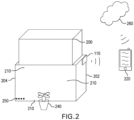
- Figure 2 illustrates an embodiment in which either a container 200 is placed into a dispensing base unit 202, or the bulk solids 204 to be sensed are dispensed into a container physically associated with a dispensing unit.
- the cereal dispensing unit may include a container, or may encompass a container placed therein, in whole or in part.
- the sensing capabilities 210 may be provided on a container placed into the dispensing unit. Additionally and alternatively, the sensing may be provided in association with the container of the dispensing unit, or in association with the dispensing unit itself, such as wherein the sides of the dispensing unit rise a substantial amount up to encompass a container placed therein and allow association of sensing capabilities placed within the dispensing unit with a container placed therein. Likewise, the processing discussed above with respect to Figure 1 and/or the external communications discussed above with respect to Figure 1 may be provided in the dispenser unit of Figure 2 .
- the sensed information may be wired or wirelessly communicated to one or more information processing systems, such as telephonic or desktop applications, suitable to convey information regarding the need to replenish or the state of dispensing of the solids associated with the container.
- This communication may occur directly with a proximate device 220, or may occur remotely, such as via the internet, cloud communications, the cellular network, or the like.
- the dispensing base may include a dispenser 240, such as a crank, spout with spigot, or the like, for the dispensing of the solids from the container received into the base.
- the dispenser base and the dispenser may be, by way of non-limiting example, plastic in composition, and/or may be substantially injection molded, such as with one or more actuation elements, such as a handle, switch, button, or the like.
- the base may include one or more indicator LEDs 250 to indicate dosage and auto replenishment; one or more network communication capable modules, such as for communicating with a smart phone, local area network, cellular network, or the like; one or more power modules to provide power to the base modules, and which may include batteries that may be permanent/semipermanent (i.e., rechargeable) or replaceable; and or other optional elements, such as one or more audio alarms to support or replace the LED indicators of correct dosage or auto replenishment.
- one or more indicator LEDs 250 to indicate dosage and auto replenishment
- one or more network communication capable modules such as for communicating with a smart phone, local area network, cellular network, or the like
- power modules to provide power to the base modules, and which may include batteries that may be permanent/semipermanent (i.e., rechargeable) or replaceable
- other optional elements such as one or more audio alarms to support or replace the LED indicators of correct dosage or auto replenishment.
- firmware may sense the solids level based on the intercommunication of the sensing and the processing, and may use this information to indicate dosing or auto replenishment.
- dosing, and/or auto replenishment may be information provided remotely from cloud-based algorithms, such as to the firmware of the base.
- a cloud-based backend 260 may store and serve received data to and from the aforementioned app, and to or from one or more web-based or app-based dashboards. Some or all of the additional processing discussed throughout may be performed at the cloud based backend, such as alerts or email confirmations in the circumstances of auto replenishment, such as instead of drawing on the limited resources of the dispensing base's firmware or processors.
- the durable 606 may then have slots 608 connectively associated with power 610 and the input-output of one or more analog to digital convertors 612 associated with a microprocessor 614, such as to identify the different resistance values of the resistive trace 604 associated with a consumable placed within the slot 608.
- the resistive sensing identifies which consumable was used.
- the disclosed embodiment may identify which consumable is in which slot.
- the variations in resistance of the resistive trace may be provided by any known methods, such as variations in the shape, length, thickness, or type, such as the polymer composition, of the trace used.
Landscapes
- Physics & Mathematics (AREA)
- Fluid Mechanics (AREA)
- General Physics & Mathematics (AREA)
- Electromagnetism (AREA)
- Thermal Sciences (AREA)
- Engineering & Computer Science (AREA)
- Power Engineering (AREA)
- Acoustics & Sound (AREA)
- Details Of Rigid Or Semi-Rigid Containers (AREA)
Description
- The disclosure relates generally to sensing, and, more particularly, to a system of monitoring solids levels in a container and indicating a need for replenishment.
- It is well understood that various types of solids may be carried within containers, and may be dispensed over extended time periods in discreet quantities from such containers, such as in servings or doses. In general, the solids placed ultimately placed within the container may be tracked, in bulk, prior to delivery to or purchase by the ultimate consumer. For example, bulk tracking may be performed on farmed goods as they are farmed, and as they are shipped for distribution; warehoused solids may be tracked by production date, such as by UPC code or the like, and/or such as by warehoused pallet, and so on; once the goods reach a sales center, such as a grocery store, they may be tracked, such as by UPC code or the like, from an inventory perspective; but, once the solids reach the consumer and are placed into a container, such as for consumption, or consumed from a purchased container, there are no longer readily available tracking methodologies at present.
- Thus, in embodiments such as the aforementioned, it is often the case that the only way for a user/consumer to monitor how much remains in the container is to periodically shake, lift, or otherwise manipulate the container to allow for a qualified guess by the user as to how much remains therein. Further, there is historically no methodology whereby proper dosing for use of the solid in a container may be readily assessed. Yet further, there is presently no mechanism whereby a seller of a solid can assess a consumer's need for additional solids.
- For instance,
EP 3 244 175 Al discloses a level sensor system including a level sensor label configured to be associated with a container containing a material whose level is to be sensed. Furthermore,US 2017/278059 Al is directed to an inventory management device to monitor a volume of a material in a container and including a capacitive level sensor. Furthermore,EP 2 282 184 AlEP 0 952 432 Al is directed to a device for the determination of an amount of material in a plastic container including a plurality of light sensors, andUS 5 711 354 A relates to a digital level sensor assembly for bulk chemical refill delivery systems including a control unit. - Therefore, the need exists for a system of monitoring solid levels within a container, of dosing a solid within a container, and of automatically indicating (herein referred to as "autoreplenishment"), such as to at least one of a consumer and a seller, when the need for additional solid and/or a container thereof occurs.
- The embodiments are and include a system providing a consumable level monitor for association with a solid content-filled consumable. The embodiments include a sensing module embedded in a label associated with the consumable suitable to sense the consumable level; a visual indicator suitable to receive the consumable level from the sensing module, and for communicating the consumable level to a user; and a dispensing base for accommodating the consumable, wherein the sensing module is embedded in a label associated with the consumable and comprises a plurality of sensors at various volume levels of the content-filled consumable, and the plurality of sensors includes a light sensor, and wherein the visual indicator is provided in the dispensing base.
- The visual indicator may be a color changing indicator.
- The sensing module may be a passive sensing module. Alternatively, the sensing module may be an active sensing module.
- Preferably, the sensing module is provided on an outside aspect of the label. The label may further comprise an electronic communication module. The communication module may comprise a processor.
- The plurality of sensors may comprise a plurality of photo conductive material sensors.
- The plurality of sensors may comprise photoresistors.
- Preferably, the label is networked.
- The plurality of sensors may vary with the uniformity of the contents.
- Preferably, a dispensing base is provided for electrical association with the label.
- Preferably, the sensing module is, in part, in the dispensing base, and, in part, in the label.
- Preferably, the dispensing base includes a dispenser in physical communication with the solid content and capable of dispensing the content from the consumable to modify the content level.
- The dispenser may comprise one of a crank, a spout, or a spigot.
- Preferably, a power module is provided for powering at least the sensing module.
- Preferably, the communication to the user comprises a display over at least one network.
- Preferably, the sensing module comprises firmware for converting signals associated with the content level.
- The disclosure is illustrated by way of example and not limitation in the accompanying drawings, in which like references indicate similar elements, and in which:
-
FIG. 1 illustrates an exemplary container that includes a solids sensing system; -
FIG. 2 illustrates an exemplary dispensing base and solids container in a solids sensing system; -
FIG. 3 illustrates aspects of the embodiments; -
FIG. 4 illustrates aspects of the embodiments; -
FIG. 5 illustrates aspects of the embodiments; -
FIG. 6 illustrates aspects of the embodiments; and -
FIG. 7 illustrates an exemplary cloud-based solids sensing system. - The figures and descriptions provided herein may have been simplified to illustrate aspects that are relevant for a clear understanding of the herein described devices, systems, and methods, while eliminating, for the purpose of clarity, other aspects that may be found in typical similar devices, systems, and methods. Those of ordinary skill may recognize that other elements and/or operations may be desirable and/or necessary to implement the devices, systems, and methods described herein. But because such elements and operations are well known in the art, and because they do not facilitate a better understanding of the present disclosure, a discussion of such elements and operations may not be provided herein. However, the present disclosure is deemed to inherently include all such elements, variations, and modifications to the described aspects that would be known to those of ordinary skill in the art.
- The terminology used herein is for the purpose of describing particular example embodiments only and is not intended to be limiting. As used herein, the singular forms "a", "an" and "the" may be intended to include the plural forms as well, unless the context clearly indicates otherwise. The terms "comprises," "comprising," "including," and "having," are inclusive and therefore specify the presence of stated features, integers, steps, operations, elements, and/or components, but do not preclude the presence or addition of one or more other features, integers, steps, operations, elements, components, and/or groups thereof. The method steps, processes, and operations described herein are not to be construed as necessarily requiring their performance in the particular order discussed or illustrated, unless specifically identified as an order of performance. It is also to be understood that additional or alternative steps may be employed.
- When an element or layer is referred to as being "on", "engaged to", "connected to" or "coupled to" another element or layer, it may be directly on, engaged, connected or coupled to the other element or layer, or intervening elements or layers may be present. In contrast, when an element is referred to as being "directly on," "directly engaged to", "directly connected to" or "directly coupled to" another element or layer, there may be no intervening elements or layers present. Other words used to describe the relationship between elements should be interpreted in a like fashion (e.g., "between" versus "directly between," "adjacent" versus "directly adjacent," etc.). As used herein, the term "and/or" includes any and all combinations of one or more of the associated listed items.
- Although the terms first, second, third, etc., may be used herein to describe various elements, components, regions, layers and/or sections, these elements, components, regions, layers and/or sections should not be limited by these terms. These terms may be only used to distinguish one element, component, region, layer or section from another element, component, region, layer or section. Terms such as "first," "second," and other numerical terms when used herein do not imply a sequence or order unless clearly indicated by the context. Thus, a first element, component, region, layer or section discussed below could be termed a second element, component, region, layer or section without departing from the teachings of the exemplary embodiments.
- Processor-implemented modules, systems and methods of use are disclosed herein that may provide networked access to a plurality of types of digital content, including but not limited to video, image, text, audio, metadata, algorithms, interactive and document content, and which track, deliver, manipulate, transform and report the accessed content. Described embodiments of these modules, systems and methods are intended to be exemplary and not limiting. As such, it is contemplated that the herein described systems and methods may be adapted and may be extended to provide enhancements and/or additions to the exemplary modules, systems and methods described. The disclosure is thus intended to include all such extensions.
- Furthermore, it will be understood that the term "module" as used herein does not limit the functionality to particular physical modules, but may include any number of tangibly-embodied software and/or hardware components having a transformative effect on at least a portion of a system. In general, a computer program product in accordance with one embodiment comprises a tangible computer usable medium (e.g., standard RAM, an optical disc, a USB drive, or the like) having computer-readable program code embodied therein, wherein the computer-readable program code is adapted to be executed by a processor (which may work in connection with an operating system) to implement one or more functions and methods as described below. In this regard, the program code may be implemented in any desired language, and may be implemented as machine code, assembly code, byte code, interpretable source code or the like (e.g., via C, C++, C#, Java, Actionscript, Objective-C, Javascript, CSS, XML, etc.).
- Examples not according to the claimed invention may include a solids level monitoring apparatus, system, and method, as well as an auto replenishment apparatus, system, and method for solids typically within a container, for which monitoring of the level of those solids has not historically occurred. Examples not according to the claimed invention may include a stand-alone base that is distinct from the one or more containers, and which may include one or more printed circuit boards, firmware, network communication capabilities, user interfaces and indicators, provided power, and/or a dispenser for dispensing solids from a container associated with the base. The examples of the base may be associated with one or more types of containers, such as may be formed of plastic, cardboard, or glass, and may extend upward into contact, in part or in whole, with one or more aspects of the container placed into the base, such that the container is brought into contact with aspects of the base in order that the functionality discussed herein may be provided. Of note, the container may have associated there with one or more aspects, such as electronic labels, to provide the functionality herein, either discretely or in conjunction with the encompassing and electronic aspects of the base, as described throughout.
- Further, included in examples not according to the claimed invention may be: cloud based storage and communication with one or more of the bases; one or more smartphone apps for communication with the one or more bases and/or the cloud based communication site; and an analytics dashboard, which may be app and/or web-based, such as may be used by a consumer or seller of the solids. As used herein, a "solids level" monitored in the disclosed apparatuses, systems and methods is indicative of the amount of solids consumed from or remaining in a container associated with aspects of the embodiments; a "dose" is an amount of solid dispensed for a given purpose, such as to be eaten or for medicinal purposes; and an "auto replenishment" is that which may occur when the level in a container reaches a point at which a reorder is required.
- In accordance with the foregoing, the embodiments provide the tracking of solids upon use of the solids from a container. This tracking may allow for reordering of the solids in a container, tracking of individual doses of the solids upon use, tracking of the unused portions of a solid after dosing, and/or bulk tracking of the solids, by way of non-limiting example.
- As illustrated in
Figure 1 , tracking of the solids may be performed while the solids reside in a container. The container may be acontainer 100 in which thesolids 102 were purchased in the example ofFigure 1 , although other containers may be employed as discussed throughout. The container may include one or more active or passive capabilities for sensing 104 of the contents of the container, and/or sensing of doses dispensed from the container. By way of non-limiting example, the container may be a cereal box and hence the contents may be cereal, and additionally the active or passive sensing aspect may be one or more smart labels placed upon the cereal box. - The sensing employed herein is embodied by photo conductive material sensors, which may be printed around at least a portion of the label of the container. Thereby, as portions of the label are uncovered, i.e., as the amount of solids within the container decreases, the photo conductive material senses the additional light that now hits the photo conductive label sensor. Thereby, the level of solids is sensed as indicated by the light received by the photo conductive label.
- Of course, other types of light sensing may be employed as well. According to further embodiments, which are not part of the present inventive concept, a variety of other sensing methodologies may be employed, such as, but not limited to, infrared, ultrasound, proximity sensing, derivative sensing, weight sensing, sound sensing, or resistance/conductance sensing, by way of non-limiting example. Needless to say, one or more of the foregoing sensing methodologies may vary in the uniformity of the sensing output, such as in accordance with the type of bulk solid 102 item placed within the container. Therefore, adjustments may be necessary in the type of sensing used, and/or in the processing of the sensor output, in order to properly sense different types of bulk items.
- In accordance with the foregoing, the sensor output may be active or passive, as discussed. In either case, the output of the sensor must be provided to a
processing system 110. This may be done by any of a variety of methods. For example, a highly simplistic processor may be included on the container in association with the sensor. In such cases, the processor may include some wireless communication capabilities, such as RF, infrared, blue tooth, Wi-Fi, or the like, or communication with the processing chip may occur based on an active external interrogation of the processing chip. Alternatively, the one or more processors may be off-container, and hence may form part of a system that actively interrogates the container to obtain the requisite sensing output, as is also discussed further hereinbelow with respect toFigure 2 . -
Figure 2 illustrates an embodiment in which either acontainer 200 is placed into a dispensingbase unit 202, or thebulk solids 204 to be sensed are dispensed into a container physically associated with a dispensing unit. As such, the cereal dispensing unit may include a container, or may encompass a container placed therein, in whole or in part. - In the embodiment of
Figure 2 , and as discussed above with respect toFigure 1 , thesensing capabilities 210 may be provided on a container placed into the dispensing unit. Additionally and alternatively, the sensing may be provided in association with the container of the dispensing unit, or in association with the dispensing unit itself, such as wherein the sides of the dispensing unit rise a substantial amount up to encompass a container placed therein and allow association of sensing capabilities placed within the dispensing unit with a container placed therein. Likewise, the processing discussed above with respect toFigure 1 and/or the external communications discussed above with respect toFigure 1 may be provided in the dispenser unit ofFigure 2 . As is the case with the embodiments ofFigures 1 and2 , after processing the sensed information may be wired or wirelessly communicated to one or more information processing systems, such as telephonic or desktop applications, suitable to convey information regarding the need to replenish or the state of dispensing of the solids associated with the container. This communication may occur directly with aproximate device 220, or may occur remotely, such as via the internet, cloud communications, the cellular network, or the like. - The dispensing base may include a
dispenser 240, such as a crank, spout with spigot, or the like, for the dispensing of the solids from the container received into the base. The dispenser base and the dispenser may be, by way of non-limiting example, plastic in composition, and/or may be substantially injection molded, such as with one or more actuation elements, such as a handle, switch, button, or the like. - The base may include one or
more indicator LEDs 250 to indicate dosage and auto replenishment; one or more network communication capable modules, such as for communicating with a smart phone, local area network, cellular network, or the like; one or more power modules to provide power to the base modules, and which may include batteries that may be permanent/semipermanent (i.e., rechargeable) or replaceable; and or other optional elements, such as one or more audio alarms to support or replace the LED indicators of correct dosage or auto replenishment. - Further included may be firmware and software to provide the functionality discussed throughout. For example, firmware may sense the solids level based on the intercommunication of the sensing and the processing, and may use this information to indicate dosing or auto replenishment. Likewise, dosing, and/or auto replenishment, may be information provided remotely from cloud-based algorithms, such as to the firmware of the base.
- As referenced, the disclosed communication capabilities may include communication with one or
more smartphone apps 220 having user information associated therewith, and which may receive user feedback regarding levels, dosing, auto replenishments, and so on. Such a smart phone app may communicate with the base via, for example, WiFi, Bluetooth, BLE, or cellular communication methodologies, and further, the firmware of the base may be suitable to batch information and data and/or otherwise piggyback to a smart phone having resident thereon the referenced app. - Further, a cloud-based
backend 260 may store and serve received data to and from the aforementioned app, and to or from one or more web-based or app-based dashboards. Some or all of the additional processing discussed throughout may be performed at the cloud based backend, such as alerts or email confirmations in the circumstances of auto replenishment, such as instead of drawing on the limited resources of the dispensing base's firmware or processors. - As used herein, the disclosed system may include two aspects, as discussed throughout. More particularly, the first aspect may be a "consumable", such as the food container discussed above with respect to
Figures 1 and2 , which may include a disposable good comprised of a package which includes therein a solid or liquid for consumption by user. The consumable may be rigid or flexible, and may be or include, by way of non-limiting example, a bottle, cartridge, bag, jar, such as with a closure, a disposable dispenser, a box, such as may be formed of cardboard, or the like. - Also included within the system may be a durable aspect such as the
aforementioned dispensing unit 240, by way of example, such as may be physically and/or communicatively associated with a consumable. The durable may, as referenced above, also include communication capabilities to back-end 260, as discussed above. Unlike the consumable, the durable aspect may have a usable life that spans the exhaustion of a plurality of consumables, such as over a predetermined time period, such as over the course of a month, a year, or the like. - As discussed throughout, the automatic reordering envisioned herein may reflect a need to reorder not only a consumable, but additionally a durable aspect of the disclosed system. By way of non-limiting example, durable and consumable pairs may include: razors and razor blades; a soap dispenser and a soap or shampoo bottle; a hand soap dispenser and a refill soap bag; a cereal box and a turning crank cereal dispenser; a printer and an ink cartridge; a disposable detergent bottle and an ergonomic spicket dispenser; a spice rack and a spice bottle; a centrifuge and a vial of bodily fluid; and a coffee machine and coffee, tea, or other beverage pods.
- In prior efforts, the smart label of a consumable has been read by a durable with which the consumable is paired solely in order to identify the consumable. That is, a consumable may typically be associated with and RFID or NFC Tag, a Q.R. code, a barcode, a UPC code, or the like, which, when read by a paired durable, serves merely to identify the consumable. In contrast, the proposed embodiments may, embed semi-smart and smart labels on or in the consumables such that a wealth of information beyond identification may be sensed or otherwise conveyed to and by the paired durable, such as exclusively and only upon pairing of the consumable with the durable. That is, the durable may include a plurality of conventional electronics designed to sense/read the detailed consumable information provided by the semi-smart label of the consumable. Accordingly, the disclosed embodiments may provide functionality beyond mere identification, and may provide significant cost advantages over RFID, NFC, or optical reading methods previously provided for the consumable and durable pair.
- Such functionality may be provided, such as only upon pairing of the consumable with the durable, by any of a variety of methods that will be understood to the skilled artisan in light of the discussion herein. For example, discussed throughout are capacitive proximity sensing, light sensing (such as using photo resistive sensors), and conductivity or resistivity sensing (wherein electrically unconnected portions of the system are subsequently connected to indicate a content level) to provide content identification for consumable items.
- By way of non-limiting example,
Figure 3A illustrates the use of photo resistance to provide content sensing. In the embodiment illustrated, a photoresistive element 301 for use on a photoresistive label, such as that illustrated inFigure 3B , is comprised of an anode and cathodeconnective points 301a, 302b. Aphotoresistive label 302 may include effectivephotoresistive elements 301 to provide a sensing circuit, such as may be formed of aconductive trace 304 communicatively associated with a photoresistive trace 306. As will be understood,conductive trace 304 may be silver based, and the photo resistive trace may be a printed zinc oxide based ink, by way of non-limiting example. The anode and cathode provided by the connectively associated traces provide a sensing circuit 308 which, upon variations in the level of product that blocks the photoresistive trace 306, indicates a level of the contents associated with the photoresistive label 302. - Additionally, and alternatively,
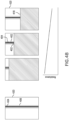
Figure 4A illustrates the use of a commoditized series ofindividual photo resistors 402, which also may be comprised of a photoresistive film 404, such as cadmium sulfide, provided between electrical contacts, wherein a series ofsuch photo resistors 402 may be placed along aconductive strip 406 to provide similar functionality to the photo resistive printed label ofFigure 3B .Figures 4A and4B illustrate, schematically, and graphically, variations in content level that may be sentenced based on the progressive exposure of photo resistors. Of note, the illustrated photo resistors may comprise a strip of individual photo resistors, as discussed with respect toFigure 4A , or may comprise a printed trace photo resistive label, such as is discussed with respect toFigure 4B . - In the illustration of
Figures 4 , as theproduct content level 418 drops, more photo resistive sensors are exposed and the resistance of the circuit drops. This is also graphically illustrated in correspondence to the change in level sensing by the resistance graph shown inFigures 4A and4B . In such embodiments, level sensing occurs at discrete levels correspondent to the presence of each individual photo resistor along the strip inFigure 4A , or improved and substantially continuous resolution may be achieved by using the photo resistors strip ofFigure 4B . - More particularly,
Figure 4B illustrates, schematically and graphically, the level sentencing with the use of a photo resistive printedtrace 404. As shown in the illustration ofFigure 4B , the photo resistive strip may be printed to cover the full height of the container/consumable 420. As the content level within thecontainer 420 drops, the exposure locations along the strip increase and the resistance accordingly drops in a manner akin to that discussed above with respect toFigures 4A and3B . However, in contrast toFigure 4A , the embodiment ofFigure 4B provides continuous level sensing and a linear drop in resistance, as is illustrated graphically, in correspondence with the change in container levels. Moreover, the resistance of the overall circuit may be modified by changing the thickness of the ink layer and or the width of the print of the photoresistive strip 404. Thereby, the range and/or resolution of the photo resistive sensing circuit may be modified or calibrated for different contents that may reside within thecontainer 420. - It will be appreciated that the foregoing embodiments may also work for liquids having a certain opacity, as well as for bulk solids sensing discussed throughout. That is, provided herein is an inexpensive method to continuously detect change in product level by sensing a change in resistance for solids or liquids.
- It will be understood that the durable discussed throughout may be generic or proprietary. That is, a proprietary durable may be operable only with a particular brand of consumables, and hence other brands of the same type of consumable will not operate with the proprietary durable. Modification of the aspects discussed herein, such as customization in aspects of a printed photo resistive label, may make it difficult to genericize a proprietary durable. Thereby, a proprietary durable may enhance brand loyalty for certain categories of consumables.
- More particularly,
Figure 5 illustrates the association of a durable 502 and consumable 504, such as for a proprietary durable. As illustrated, both asensing circuit 506 andmotherboard 508 may be provided in the durable, but may not be connected to one another. The printed traces 510, such as photo resistive label traces, on the consumable 504 may connect thesensing circuit 506 and themotherboard 508 within the durable 502 only when the consumable 504 is placed within the durable. Thereafter, level sensing of the product within the consumable 504 may be performed as discussed throughout, such as based on the resistance of the consumable as sensed by the sensor and motherboard of the durable. As referenced above, the durable may thus be generic, or may include proprietary modifications, such as to the sensing circuit, the motherboard, the communication protocols between the sensing circuit on the motherboard, the type, size or makeup of the conductive traces, the printing label printing methods, and so on. -
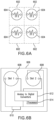
Figures 6A and 6B illustrate a resistance-based product identification that may be provided in accordance with the embodiments. Eachconsumable label 602 may be printed with aresistive trace 604, such as a polymer resistive material. The value of the resistive trace may be unique for each product identification, as shown. - The durable 606 may then have
slots 608 connectively associated withpower 610 and the input-output of one or more analog todigital convertors 612 associated with amicroprocessor 614, such as to identify the different resistance values of theresistive trace 604 associated with a consumable placed within theslot 608. Thereby, if multiple consumable items may be used in a single durable, the resistive sensing identifies which consumable was used. If multiple consumables may be simultaneously placed within the durable at multiple slots at the same time, the disclosed embodiment may identify which consumable is in which slot. It will be appreciated that the variations in resistance of the resistive trace may be provided by any known methods, such as variations in the shape, length, thickness, or type, such as the polymer composition, of the trace used. - In relation to the proprietary or non-proprietary nature of the durables as discussed above, the aforementioned dashboard may be associated with one or more sellers or brands of the referenced solids. In such circumstances, an analytics dashboard may be available to the brand for user and use data indicative of certain geography use, global use, use at times of the day, use by demographic area, or the like. This and additional information provided at the dashboard may allow for a brand to target or otherwise send special offers, discount codes, or the like to particular users, such as high-volume users.
- Dose size may be set up using the app or a web-based application, such as in small, medium, and large, increments, and those increments may be particularly associated, such as by a manufacturer's specifications. Alternatively, dosing may be hard coded into the firmware, such as for a given container size typically received by the base. Needless to say, dosing sizes may serve as portion control for solids that are eaten.
- Moreover, the firmware, such as absent intercommunication with the cloud or in association with cloud communication, may indicate and/or otherwise trigger an autoreplenishment event. This auto replenishment may be automatic or semi-automatic--a semi-automatic autoreplenishment event may show a confirmation dialogue or other alert to the user, such as in the app, which may allow for the user to cancel or confirm the order; or, the auto replenishment order may be fully automated. An autoreplenishment event may be communicated to the referenced cloud backend, such as subject to an additional confirmation, such as by an app alert or an email, to the ordering consumer. Further, such an auto replenishment event may contribute to the data that may be provided to a brand, such as on the brand dashboard. Data associated with an autoreplenishment may include date, time, location, and/or user ID of the app associated with the auto replenishment, percent level for replenishment (which may be automatic as an autoreplenishment threshold, or which may be set by the user), product SKU, or the like.
- Functionality for the cloud may include storage of level updates, dosage events, and auto replenishment events, by way of example. Further, cloud functionality may include user activity data, interactivity, reset capability, and the like. Decisions, such as the reaching of thresholds for discounts, may optionally occur in the cloud, and the brand dashboard may be enabled to approve such discounts to send, such as for receipt by the consumer app, discount codes and/or other targeted advertising to select consumers. Select consumers may be particular consumers meeting certain data thresholds, classes of consumers, app profile information, or the like.
- Auto replenishment events available in the dashboard may be provided in list, mapped, or threshold formats, by way of non-limiting example. Accessing an auto replenishment event may open a particular consumer profile, and may make available to the dashboard all data associated with that profile. Such data, which may be in a map form as referenced above, may include latitude, longitude, location, distance from nearest seller of the brand, use date, use time, percent solids level, machine used with, and/or the like. Also included in the brand dashboard data may be typical frequency of use, recent frequency of use, time since last use, and so on.
- In accordance with the foregoing, the user app may additionally include various aspects. For example, the smart phone at may be enabled to discover and pair with the firmware of the dispensing base, such as when the base is activated or on, as mentioned above. The smart phone app may display autoreplenishment requests or confirmation, such as in a user dialogue format. Further, the smart phone app may display a current solids level, and the frequency of updates for the solids level. Also indicated may be proper dosing for that solid and the ability for the user to request dosing.
- The app may additionally include the capability to receive discounts and targeted advertising, such as from the brand dashboard. These may be in the form of a push notification or a user dialogue that provides an app alert to accept and/or apply the discount code, such as wherein the discount code may be saved for the next order or applied to a current order. Of course, the app may include the ability to change any one or more of the foregoing settings or any additional settings, such as autoreplenishment settings, such as wherein the level percentage threshold may be varied for an autoreplenishment indication. The foregoing may be available from a drop-down or similar menu, a pop-up window, or via any known user interaction, by way of example.
- The dashboard referenced herein may additionally include particular aspects. For example, the dashboard may include autoreplenishment event data, particular user information, location-based information, and the like. Further, the dashboard may integrate third-party data, such as weather data, to allow for data fusion between sensed data and publicly available data sources, such as in order to optimize sales.
- The dashboard may also include one or more search capabilities. That is, a dashboard user may search for particular data across one or more users, such as "frequent users", "fading users" (i.e., a list of users whose frequency of use has fallen relative to long-term usage), certain geographic searches, usage associated with certain events (such as snowstorms), and the like. Responsive to the search, and otherwise available from within the dashboard, may be a consumer data display. That is, dashboard events, such as autoreplenishment events, may include drill down capabilities to obtain more detail on particular consumers. The drill down may include basic information, such as delivery address or locale, and more particular information, such as dosing events or solids levels over time.
- The dashboard requirements may additionally include an ability to design marketing campaigns and/or discount codes. For example, discount codes may be provided based on the meeting of certain thresholds by certain data of consumers. Thereby, the discount codes may be automatically generated upon the trigger event for one or more consumers, or may be "hard entered" by a person controlling the dashboard. Moreover, the foregoing aspects may overlap, such as wherein discount codes are readily executed, such as responsive to a single click, to all consumers that have been returned responsive to an entered search within the dashboard.
- Additional functional requirements may include those of the cloud based backend. The cloud based backend may store data, including autoreplenishment events, dosing events, and solids level events, by way of example, and may be suitable to serve that data back to the smart phone app and/or to the dashboard as needed. Further, certain of the decision-making algorithms discussed herein throughout may also reside at the cloud based backend, such as rather than residing in a smart phone app or in association with the dashboard.
-
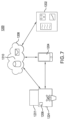
Figure 7 illustrates asystem 1200 in which thedashboard 1202 and/orsmartphone app 1204 housing the code to implement the method(s) discussed herein throughout may be included. As shown, acontainer 1201 having associated there withsensors 1206 is inserted into asmart dispensing base 1224. The illustrated dispensing base is then suitable to communicate with a smartphone app to exchange the information discussed throughout. The smartphone app may then communicate with thecloud 1208, although it should be noted that the smart dispenser may additionally or alternatively communicate directly with thecloud 1208, such as via a Wi-Fi network. The cloud basedbackend 1210 may then communicate with thesmartphone app 1204 and with thebrand dashboard 1202, as discussed herein throughout. - In the foregoing Detailed Description, it can be seen that various features are grouped together in a single embodiment for the purpose of streamlining the disclosure. This method of disclosure is not to be interpreted as reflecting an intention that the embodiments require more features than are expressly recited herein.
Claims (12)
- A consumable level monitoring system (1200) for association with a solid content-filled consumable (100, 200, 504, 1201), comprising:a sensing module (104, 210, 406, 506, 604, 1206) suitable to sense the consumable level (418), wherein the sensing module (104, 210, 406, 506, 604, 1206) comprising a plurality of sensors (104, 301, 402) at various volume levels of the content-filled consumable (100, 200, 504, 1201), and the plurality of sensors (104, 301, 402) comprise light sensors; andcharacterized in that the system (1200) further comprises:a visual indicator (250) suitable to receive the consumable level (418) from the sensing module (104, 210, 406, 506, 1206), and for communicating the consumable level (418) to a user, anda dispensing base (202, 1224) for accommodating the consumable (100, 200, 504, 1201)wherein the sensing module (104, 210, 406, 506, 1206) is embedded in a label (602) associated with the consumable (100, 200, 504, 1201), andwherein the visual indicator (250) is provided in the dispensing base (202, 1224).
- The system of claim 1, wherein the visual indicator (250) is a color changing indicator.
- The system of claim 1, wherein the sensing module (104, 210, 406, 506, 1206) is on an outside aspect of the label (602).
- The system of claim 3, wherein the label (602) further comprises an electronic communication module.
- The system of claim 4, wherein the communication module comprises a processor (110, 614).
- The system of claim 1, wherein the plurality of sensors comprise a plurality of photo conductive material sensors (402).
- The system of claim 1, wherein the plurality of sensors comprise photoresistors (301).
- The system of claim 1, wherein the label (602) is networked.
- The system of claim 1, wherein the dispensing base (202, 1224) is electrically associated with the label (602).
- The system of claim 9, wherein the sensing module (104, 210, 406, 506, 1206) is, in part, in the dispensing base (202, 1224), and, in part, in the label (602).
- The system of claim 9, wherein the dispensing base (202, 1224) includes a dispenser (240) in physical communication with the solid content (102, 204) and capable of dispensing the content from the consumable (100, 200, 504, 1201) to modify the content level (418).
- The system of claim 1, further comprising a power module (610) for powering at least the sensing module (104, 210, 406, 506, 1206).
Applications Claiming Priority (2)
| Application Number | Priority Date | Filing Date | Title |
|---|---|---|---|
| US201862666605P | 2018-05-03 | 2018-05-03 | |
| PCT/US2019/030658 WO2019213564A1 (en) | 2018-05-03 | 2019-05-03 | Apparatus, system, and method of providing a solids level monitor |
Publications (3)
| Publication Number | Publication Date |
|---|---|
| EP3788325A1 EP3788325A1 (en) | 2021-03-10 |
| EP3788325A4 EP3788325A4 (en) | 2022-01-05 |
| EP3788325B1 true EP3788325B1 (en) | 2025-07-02 |
Family
ID=68386745
Family Applications (1)
| Application Number | Title | Priority Date | Filing Date |
|---|---|---|---|
| EP19796230.1A Active EP3788325B1 (en) | 2018-05-03 | 2019-05-03 | System of providing a solids level monitor |
Country Status (4)
| Country | Link |
|---|---|
| US (4) | US20210072067A1 (en) |
| EP (1) | EP3788325B1 (en) |
| CN (2) | CN112243490A (en) |
| WO (1) | WO2019213564A1 (en) |
Families Citing this family (4)
| Publication number | Priority date | Publication date | Assignee | Title |
|---|---|---|---|---|
| CN112789487A (en) * | 2018-08-31 | 2021-05-11 | 耐普罗公司 | Apparatus, system, and method for providing content sample level monitoring |
| US12299525B2 (en) * | 2020-12-02 | 2025-05-13 | Nypro Inc. | Apparatus, system, and method for providing a smart container |
| CN117396904A (en) * | 2021-02-26 | 2024-01-12 | 耐普罗公司 | Devices, systems and methods for automatically replenishing consumables containers |
| US11897754B2 (en) * | 2021-03-26 | 2024-02-13 | Henkel Ag & Co. Kgaa | Dispensing system with liquid level sensing and level-based actions |
Citations (3)
| Publication number | Priority date | Publication date | Assignee | Title |
|---|---|---|---|---|
| US5711354A (en) * | 1993-04-28 | 1998-01-27 | Advanced Delivery & Chemical Systems, Inc. | Level control systems for high purity chemical delivery systems |
| EP0952432A1 (en) * | 1998-04-27 | 1999-10-27 | Bossard AG | Method and device for detection of the contents of a container |
| EP2282184A1 (en) * | 2009-07-21 | 2011-02-09 | Siemens Schweiz AG | Device and method for monitoring the fill state of a removable item in a storage container |
Family Cites Families (148)
| Publication number | Priority date | Publication date | Assignee | Title |
|---|---|---|---|---|
| US1078214A (en) | 1912-04-08 | 1913-11-11 | William C Coleston | Water-cooler. |
| GB200167A (en) | 1922-04-03 | 1923-07-03 | William Gordon Adam | Improvements in and relating to chemical reduction of organic compounds |
| US3553471A (en) * | 1968-09-03 | 1971-01-05 | George Pesce | Ambient-light-operated bin-level control system having transparent photocell housing |
| CA1247625A (en) | 1977-07-22 | 1988-12-28 | Howard Johnston | Trifluoromethyl pyridinyloxyphenoxy propanoic acids and propanols and derivatives thereof and methods of herbicidal use |
| US4296472A (en) | 1979-10-01 | 1981-10-20 | Rockwell International Corporation | Non-intrusive fluid measuring system |
| IE50975B1 (en) | 1981-06-06 | 1986-08-20 | Noel Fairbrother | Beverage dispensing machine |
| US4991635A (en) | 1988-09-30 | 1991-02-12 | Liqui-Box Corporation | Decap dispensing system for water cooler bottles |
| US4874023A (en) | 1988-09-30 | 1989-10-17 | Liqui-Box Corporation | Decap dispensing system for water cooler bottles |
| US5005407A (en) | 1988-10-11 | 1991-04-09 | Level Electronics, Inc. | Fluid level sensing system |
| US5368197A (en) | 1990-06-21 | 1994-11-29 | Sutera; Carl M. | Self-filling bottled-water cooler conversion kit |
| US5213597A (en) | 1992-01-03 | 1993-05-25 | Campbell Gary J | Filtration system for bottled water dispenser with check valve |
| US5277337A (en) * | 1992-03-16 | 1994-01-11 | Bunn-O-Matic Corporation | Hopper agitator |
| US5425404A (en) | 1993-04-20 | 1995-06-20 | Minnesota Mining And Manufacturing Company | Gravity feed fluid dispensing system |
| US5544770A (en) | 1993-05-07 | 1996-08-13 | Travisano; Frank P. | Tamper evident seal and system |
| US5383574A (en) | 1993-07-19 | 1995-01-24 | Microbar Sytems, Inc. | System and method for dispensing liquid from storage containers |
| US5641006A (en) | 1995-07-13 | 1997-06-24 | Chiron Diagnostics Corporation | Liquid supply apparatus and method of operation |
| JPH09174039A (en) | 1995-12-28 | 1997-07-08 | Mitsubishi Electric Corp | Drinking water production equipment |
| US6010210A (en) | 1997-06-04 | 2000-01-04 | Hewlett-Packard Company | Ink container having a multiple function chassis |
| US6095370A (en) | 1997-12-18 | 2000-08-01 | Americlean Systems, Inc. | Encapsulated liquid dispensing device and method |
| GB2338558A (en) * | 1998-06-17 | 1999-12-22 | Isoworth Uk Ltd | Drink dispenser, concentrate detector and concentrate container |
| US7175054B2 (en) | 1998-12-23 | 2007-02-13 | S.I.P. Technologies, Llc | Method and apparatus for disinfecting a refrigerated water cooler reservoir |
| US6431670B1 (en) | 2000-02-14 | 2002-08-13 | Hewlett-Packard Company | Ink level sensing method and apparatus |
| JP2002039838A (en) * | 2000-07-28 | 2002-02-06 | Yazaki Corp | Powder level sensor |
| JP4458644B2 (en) | 2000-08-21 | 2010-04-28 | サーパス工業株式会社 | Connecting device |
| US20020161652A1 (en) | 2001-01-31 | 2002-10-31 | Paullin Andrew Rhodes | System and method for inventory monitoring and control of household consumable items |
| US7798373B1 (en) | 2001-03-26 | 2010-09-21 | Food Equipment Technologies Company, Inc. | Airpot beverage dispenser and method |
| US6741180B2 (en) | 2001-03-26 | 2004-05-25 | Food Equipment Technologies Company, Inc. | Beverage dispensing URN with electronic display |
| ITBO20010414A1 (en) | 2001-06-29 | 2002-12-29 | Cosmetal Sistemi Di Refrigeraz | UNIT FOR THE DISPENSING OF LIQUID FOOD PRODUCTS |
| WO2003023332A1 (en) | 2001-09-04 | 2003-03-20 | Alubo Co., Ltd. | Capacitance coupled sensor and substance detecting method using capacitance-coupled sensor |
| US6527145B1 (en) | 2001-09-26 | 2003-03-04 | Jules G. Bennett, Jr. | Beverage dispenser |
| GB2383845B (en) * | 2002-01-04 | 2004-03-03 | Bespak Plc | Improvements in or relating to level indicators |
| US6554382B1 (en) | 2002-03-19 | 2003-04-29 | Hewlett-Packard Development Company, L.P. | Ink container electrical resistance ink level sensing mechanism and method for determining ink level information |
| JP2003309660A (en) | 2002-04-15 | 2003-10-31 | Sharp Corp | Consumables ordering device, consumables ordering method, consumables ordering program, computer-readable recording medium recording consumables ordering program, consumables ordering device, consumables ordering method, consumables ordering program, and consumables ordering program Computer readable recording medium |
| US8014789B2 (en) | 2002-06-11 | 2011-09-06 | Intelligent Technologies International, Inc. | Monitoring using cellular phones |
| US7475026B2 (en) | 2002-12-06 | 2009-01-06 | Dell Products L.P. | Method for information handling system consumables automated ordering |
| PL204266B1 (en) | 2003-02-07 | 2009-12-31 | Elektroniczny Zak & Lstrok Ad | Method and electronic system designed for detecting conductive or dielectric environment featuring permittivity better than air |
| US7000468B2 (en) | 2003-04-04 | 2006-02-21 | Bunn-O-Matic Corporation | Electronic level gauge |
| CN100558626C (en) | 2003-05-06 | 2009-11-11 | 嘉士伯酿酒有限公司 | Method and apparatus for dispensing beverages |
| US6931984B2 (en) | 2003-06-26 | 2005-08-23 | Food Equipment Technologies Company, Inc. | Feature disablement controlled brewer |
| BRPI0414340B1 (en) | 2003-09-12 | 2015-09-29 | Henry Ii Macler | Fluid Dispensing System |
| US6921003B2 (en) | 2003-09-26 | 2005-07-26 | Charles Y. Yu | Water bottle cap |
| US7034689B2 (en) | 2004-01-28 | 2006-04-25 | Bertrand Teplitxky | Secure product packaging system |
| US7258005B2 (en) | 2004-02-06 | 2007-08-21 | David Scott Nyce | Isolated capacitive fluid level sensor |
| JP4621244B2 (en) | 2004-03-19 | 2011-01-26 | アービトロン インコーポレイテッド | Publication usage data generation apparatus, publication usage data collection system, publication usage data generation method, and publication usage data collection method |
| US7107838B2 (en) * | 2004-04-19 | 2006-09-19 | Fook Tin Technologies Ltd. | Apparatus and methods for monitoring water consumption and filter usage |
| US7161165B2 (en) * | 2004-07-07 | 2007-01-09 | Opti Sensor Systems, Llc | Optical transducer for continuously determining liquid level |
| US20060033630A1 (en) * | 2004-08-13 | 2006-02-16 | Lyall Lucian H Iii | Automated level indicator for liquids container |
| US20080036615A1 (en) * | 2004-08-13 | 2008-02-14 | Lyall Lucian H Iii | Automated level indicator for liquids container |
| EP1825233A4 (en) | 2004-10-14 | 2012-01-11 | Bunn O Matic Corp | LIQUID LEVEL DETECTION DEVICE FOR BEVERAGE DISPENSER |
| US7240550B2 (en) | 2004-12-07 | 2007-07-10 | Vega Grieshaber Kg | Method and apparatus for material indentification by means of gravitational field analysis |
| US7392953B2 (en) | 2005-03-10 | 2008-07-01 | Mil. Digital Labeling, Inc. | Programmable digital labels |
| US7654421B2 (en) | 2005-08-30 | 2010-02-02 | Johnsondiversey, Inc. | Automatically configurable chemical dosing apparatus for cleaning equipment |
| GB0522552D0 (en) | 2005-11-04 | 2005-12-14 | Univ Salford The | Handling device |
| DE102005057558B4 (en) | 2005-11-30 | 2012-02-02 | Sie Sensorik Industrie-Elektronik Gmbh | Sensor for non-contact detection of the level of a liquid and adherent medium of high conductivity, in particular blood, through a non-metallic container wall of a container and method thereof |
| DE102006043915A1 (en) | 2006-09-19 | 2008-03-27 | BSH Bosch und Siemens Hausgeräte GmbH | Water-conducting household appliance with a detergent dosing system and cartridge therefor |
| DE102006043913A1 (en) | 2006-09-19 | 2008-03-27 | BSH Bosch und Siemens Hausgeräte GmbH | Cartridge for a water-conducting household appliance with a detergent dosing system |
| DE102006043973A1 (en) | 2006-09-19 | 2008-03-27 | BSH Bosch und Siemens Hausgeräte GmbH | Water-conducting household appliance with detergent dosing system |
| DE102006043976A1 (en) | 2006-09-19 | 2008-03-27 | BSH Bosch und Siemens Hausgeräte GmbH | Cartridge and water-conducting household appliance with a detergent dosing system for a cartridge |
| DE502007004100D1 (en) | 2006-12-27 | 2010-07-22 | Jura Elektroapparate Ag | METHOD FOR DISPENSING MILK PORTIONS IN BEVERAGE PREPARATION MACHINES |
| ES2340083T3 (en) | 2007-01-24 | 2010-05-28 | Nestec S.A. | IDENTIFICATION OF CAPSULES CONTAINING INGREDIENTS FOR BEVERAGES. |
| US8177096B2 (en) | 2007-03-27 | 2012-05-15 | International Packaging Innovations, Llc | Bag cooler employing a multi-spike adapter and converter |
| US7661307B1 (en) | 2007-05-04 | 2010-02-16 | Milone Christopher J | Low manufacturing cost printed ink liquid level sensors |
| US8464584B2 (en) | 2007-10-19 | 2013-06-18 | Food Equipment Technologies Company, Inc. | Beverage dispenser with level measuring apparatus and display |
| US20090187357A1 (en) | 2008-01-18 | 2009-07-23 | Computime, Ltd. | Liquid Level Determination by Capacitive Sensing |
| US8159660B2 (en) | 2008-04-04 | 2012-04-17 | Leddartech Inc. | Optical level measurement device and method |
| US20090294469A1 (en) * | 2008-05-30 | 2009-12-03 | Ecolab Inc. | Mass-Based Powder Dispensing |
| KR20100009743A (en) * | 2008-07-21 | 2010-01-29 | 박진용 | Device for measuring interface of sludge |
| EP2180299A1 (en) | 2008-10-23 | 2010-04-28 | Whirlpool Corporation | Lid based amount sensor |
| US8469050B2 (en) | 2008-11-07 | 2013-06-25 | Abbott Medical Optics Inc. | Capacitive fluid level sensing |
| US8418550B2 (en) | 2008-12-23 | 2013-04-16 | Little Giant Pump Company | Method and apparatus for capacitive sensing the top level of a material in a vessel |
| US8387455B1 (en) | 2009-03-26 | 2013-03-05 | Food Equipment Technologies Company, Inc. | Beverage dispenser with capacitive level sensor and display and method |
| CN102421697B (en) | 2009-05-06 | 2013-08-21 | 迪瓦西公司 | Material dispensing system and method with capacitance sensor assembly |
| US20120098526A1 (en) | 2009-07-03 | 2012-04-26 | Nestec S.A. | Method for identifying capsules in a beverage producing device with magnetically-responsive identifier |
| CN102472656B (en) | 2009-07-08 | 2017-04-26 | 皇家飞利浦电子股份有限公司 | Device and method for managing the volume of liquid in a container |
| US8844766B2 (en) | 2009-07-14 | 2014-09-30 | Sterilogy, Llc | Dispenser assembly for dispensing disinfectant fluid and data collection and monitoring system for monitoring and reporting dispensing events |
| SG181704A1 (en) | 2009-12-16 | 2012-07-30 | Intelligent Coffee Company Llc | Pump and appliances containing a pump |
| US8453878B2 (en) | 2010-01-05 | 2013-06-04 | Keith Palmquist | Liquid level measuring device |
| KR101821904B1 (en) | 2010-04-08 | 2018-01-24 | 액세스 비지니스 그룹 인터내셔날 엘엘씨 | Point of sale inductive systems and methods |
| EP2563195A2 (en) * | 2010-04-27 | 2013-03-06 | Nestec S.A. | Beverage machine with integrated ultrasonic transceiver |
| US20110265562A1 (en) | 2010-04-30 | 2011-11-03 | Wing Chung Li | Non-contact liquid level sensing system for household electric appliances |
| DE102010025118A1 (en) | 2010-06-25 | 2011-12-29 | Siemens Healthcare Diagnostics Products Gmbh | Non-contact level measurement of liquids |
| US8534497B2 (en) | 2010-09-20 | 2013-09-17 | Prince Castle, LLC | Dispensing method and apparatus utilizing a sensor to determine a time that a dispensing valve is open |
| JP5710215B2 (en) | 2010-11-05 | 2015-04-30 | 矢崎エナジーシステム株式会社 | Water server management system for water server |
| US9699835B2 (en) | 2010-11-17 | 2017-07-04 | Goji Limited | Machine readable element and optical indicium for authenticating an item before processing |
| US20120138824A1 (en) * | 2010-12-03 | 2012-06-07 | Fang Wen | Continuous liquid level sensor having multiple light sources and light receiving devices |
| US9052227B1 (en) | 2010-12-13 | 2015-06-09 | Food Equipment Technologies Company, Inc. | Fluid container with discrete modularized multiple sensing system and method |
| EP2663843A1 (en) | 2011-01-10 | 2013-11-20 | Strauss Water Ltd | Device for measuring fluid level in a container |
| JP5711598B2 (en) | 2011-01-24 | 2015-05-07 | 矢崎総業株式会社 | Liquid level detector |
| US8966973B1 (en) | 2011-02-15 | 2015-03-03 | Christopher J. Milone | Low cost capacitive liquid level sensor |
| CA2828408C (en) | 2011-03-14 | 2019-10-22 | Nestec S.A. | Automatic beverage machine |
| JP2012223860A (en) | 2011-04-20 | 2012-11-15 | Murata Machinery Ltd | Suction chuck, and transfer device of workpiece including same |
| KR20120127792A (en) | 2011-05-16 | 2012-11-26 | 앰코 테크놀로지 코리아 주식회사 | Pick-up apparatus for lead frame |
| CN202126296U (en) * | 2011-07-03 | 2012-01-25 | 内蒙古科技大学 | Solid-liquid light sensation level meter |
| DE102012200949A1 (en) | 2012-01-24 | 2013-07-25 | BSH Bosch und Siemens Hausgeräte GmbH | Tank outlet connecting device for beverage preparation device |
| US9261395B2 (en) | 2012-02-13 | 2016-02-16 | Goodrich Corporation | Liquid level sensing system |
| US9085381B2 (en) * | 2012-02-17 | 2015-07-21 | S7 Ip Holdings, Llc | Load fill sensor system for grain trailers |
| CN103251310A (en) | 2012-02-20 | 2013-08-21 | 茗享家国际有限公司 | Beverage brewing system, brewing program establishment method and brewing method |
| CA2775546A1 (en) | 2012-04-25 | 2013-10-25 | Intelligent Devices Inc. | A disposable content use monitoring package with indicator and method of making same |
| WO2013167701A1 (en) | 2012-05-09 | 2013-11-14 | Schreiner Group Gmbh & Co. Kg | Closure element for a receptacle |
| EP2861945A1 (en) | 2012-06-14 | 2015-04-22 | Koninklijke Philips N.V. | Capacitive level sensor |
| US20160007798A1 (en) | 2012-09-11 | 2016-01-14 | The Richards Corporation | Coffee maker water heater |
| CN202915989U (en) | 2012-11-15 | 2013-05-01 | 嘉应学院 | Light-sensitive array shading type fixed particle material level sensor |
| US9488513B2 (en) | 2012-12-05 | 2016-11-08 | Molex, Llc | Flexible fluid level sensor with improved measurement capability |
| US10240965B2 (en) | 2012-12-05 | 2019-03-26 | Molex, Llc | Flexible fluid level sensor with improved measurement capability |
| US20150351583A1 (en) | 2012-12-21 | 2015-12-10 | Nestec S.A. | Food or beverage production system |
| DE102013005963B4 (en) | 2013-04-09 | 2026-04-16 | Balluff Gmbh | Capacitive level sensor |
| US9311806B2 (en) | 2013-05-31 | 2016-04-12 | Tyrone H. Hazen | Device and method for monitoring fluid consumption |
| EP2811269A1 (en) | 2013-06-06 | 2014-12-10 | VEGA Grieshaber KG | Multi-threshold measuring device |
| US20150129039A1 (en) | 2013-11-12 | 2015-05-14 | Hamilton Beach Brands, Inc. | Beverage Maker with Capacitance Fluid Level Sensor |
| CN105813519B (en) | 2013-12-20 | 2019-12-20 | 皇家飞利浦有限公司 | Consumable set and beverage dispenser |
| WO2015110337A1 (en) | 2014-01-23 | 2015-07-30 | Koninklijke Philips N.V. | Method and device for roasting partially roasted coffee beans |
| AU2015240940A1 (en) | 2014-04-02 | 2016-11-10 | Kuvee, Inc. | Container for preserving liquid contents |
| US9663343B2 (en) | 2014-05-19 | 2017-05-30 | Haier Us Appliance Solutions, Inc. | Systems and methods for receptacle auto fill using inductive sensing |
| EP3158524A4 (en) | 2014-06-18 | 2018-08-22 | Simplehuman, LLC | Domestic appliance communication system |
| US10557737B2 (en) | 2014-07-07 | 2020-02-11 | Board Of Trustees Of Michigan State University | System and methods for a smart water bottle converter |
| US10161782B2 (en) | 2014-07-25 | 2018-12-25 | Trago, Inc. | Liquid consumption tracker |
| EP3194909B1 (en) | 2014-09-15 | 2024-11-13 | Eltek S.p.A. | Sensor for detecting the level of a medium |
| US9476752B2 (en) | 2014-10-01 | 2016-10-25 | Sealed Air Corporation | Fluid level sensor |
| WO2016057131A1 (en) | 2014-10-08 | 2016-04-14 | Semiconductor Components Industries, Llc | Level sensor and method |
| US9587534B2 (en) | 2015-02-11 | 2017-03-07 | Flextronics Ap, Llc | Oil pan with integrated capacitive sensor for measuring oil level |
| US20180132643A1 (en) | 2015-03-11 | 2018-05-17 | Avishai Shklar | An Intelligent Liquid Intake Measurement Device |
| HK1211782A2 (en) * | 2015-04-02 | 2016-05-27 | Groking Lab Limited | Beverage container |
| US9153119B2 (en) | 2015-04-23 | 2015-10-06 | Scott Stapleford | Scenting nebulizer with remote management and capacitive liquid level sensing |
| US10231567B2 (en) | 2015-06-11 | 2019-03-19 | LifeFuels, Inc. | System, method, and apparatus for dispensing variable quantities of additives and controlling characteristics thereof in a beverage |
| US10913647B2 (en) | 2015-06-11 | 2021-02-09 | LifeFuels, Inc. | Portable system for dispensing controlled quantities of additives into a beverage |
| US11007322B2 (en) * | 2015-07-31 | 2021-05-18 | Sanofi-Aventis Deutschland Gmbh | Sensor, cartridge and drug delivery device |
| US9911640B2 (en) | 2015-09-01 | 2018-03-06 | Boris Kesil | Universal gripping and suction chuck |
| GB201516858D0 (en) | 2015-09-23 | 2015-11-04 | Castrol Ltd | A Fluid System |
| GB201520277D0 (en) * | 2015-11-17 | 2015-12-30 | Kennedy Hygiene Products Ltd | Dispensing apparatus and method |
| US10664796B2 (en) * | 2015-12-06 | 2020-05-26 | Adrich, Inc. | Inventory management device |
| US10430755B2 (en) * | 2015-12-06 | 2019-10-01 | Adhithi Venkatesh Aji | Inventory management device |
| CN107040260B (en) | 2016-02-03 | 2020-09-08 | 中芯国际集成电路制造(上海)有限公司 | Asynchronous successive approximation type analog-to-digital conversion circuit |
| CN205642549U (en) | 2016-03-07 | 2016-10-12 | 李昌晋 | Water dispenser cask water level monitoring device |
| WO2017156459A1 (en) | 2016-03-11 | 2017-09-14 | Magical By Design, Llc | Hydration container with liquid volume measurement |
| CN106017637A (en) | 2016-04-13 | 2016-10-12 | 北京鹏泰互动广告有限公司 | Intelligent weighing system and consumables monitoring method |
| US9952082B2 (en) * | 2016-05-10 | 2018-04-24 | Palo Alto Research Center Incorporated | Printed level sensor |
| NL2017056B1 (en) * | 2016-06-28 | 2018-01-05 | Vendor Bv | Soap dispenser and data communication network system including same |
| US20180040502A1 (en) | 2016-08-05 | 2018-02-08 | Lam Research Ag | Apparatus for processing wafer-shaped articles |
| AU2017331740B2 (en) * | 2016-09-21 | 2023-03-30 | Smart Wave Technologies Inc. | Universal dispenser monitor |
| CN206252346U (en) | 2016-10-20 | 2017-06-16 | 佛山市顺德区美的电热电器制造有限公司 | Article-storage device and cooking apparatus |
| US10144027B2 (en) * | 2016-10-24 | 2018-12-04 | Heiner Ophardt | System for monitoring fluid in a fluid dispenser |
| US10743705B2 (en) | 2017-04-21 | 2020-08-18 | Appliance Development Corporation | Coffee brewing appliance with variable operating parameters |
| US10114139B1 (en) | 2017-05-01 | 2018-10-30 | Z˜Communications, Inc. | Multi-capacitor liquid detection device and method(s) of use |
| US11280042B2 (en) | 2017-05-03 | 2022-03-22 | Nypro Inc. | Apparatus, system, and method of providing a liquid level monitor |
| US10578476B2 (en) | 2017-05-15 | 2020-03-03 | 3D Systems, Inc. | Non-contact level sensing for low dielectric constant inks |
| EP3434151B1 (en) | 2017-07-24 | 2022-10-19 | Riprup Company S.A. | Smart bottle |
| CN107634885A (en) | 2017-09-19 | 2018-01-26 | 三星电子(中国)研发中心 | Equipment for contain things and the method in terminal progress article consumption management |
| CA3078775A1 (en) | 2017-11-01 | 2019-05-09 | Alcon Inc. | Bernoulli gripper for intraocular and contact lenses |
-
2019
- 2019-05-03 CN CN201980037889.1A patent/CN112243490A/en active Pending
- 2019-05-03 CN CN202510901825.9A patent/CN120800517A/en active Pending
- 2019-05-03 EP EP19796230.1A patent/EP3788325B1/en active Active
- 2019-05-03 WO PCT/US2019/030658 patent/WO2019213564A1/en not_active Ceased
- 2019-05-03 US US17/052,779 patent/US20210072067A1/en not_active Abandoned
-
2022
- 2022-09-23 US US17/951,994 patent/US11982557B2/en active Active
-
2023
- 2023-12-14 US US18/540,606 patent/US12203792B2/en active Active
-
2024
- 2024-12-16 US US18/982,138 patent/US20250189354A1/en active Pending
Patent Citations (3)
| Publication number | Priority date | Publication date | Assignee | Title |
|---|---|---|---|---|
| US5711354A (en) * | 1993-04-28 | 1998-01-27 | Advanced Delivery & Chemical Systems, Inc. | Level control systems for high purity chemical delivery systems |
| EP0952432A1 (en) * | 1998-04-27 | 1999-10-27 | Bossard AG | Method and device for detection of the contents of a container |
| EP2282184A1 (en) * | 2009-07-21 | 2011-02-09 | Siemens Schweiz AG | Device and method for monitoring the fill state of a removable item in a storage container |
Also Published As
| Publication number | Publication date |
|---|---|
| WO2019213564A1 (en) | 2019-11-07 |
| CN120800517A (en) | 2025-10-17 |
| US20240183700A1 (en) | 2024-06-06 |
| US20210072067A1 (en) | 2021-03-11 |
| US20250189354A1 (en) | 2025-06-12 |
| US20230084664A1 (en) | 2023-03-16 |
| US11982557B2 (en) | 2024-05-14 |
| EP3788325A4 (en) | 2022-01-05 |
| EP3788325A1 (en) | 2021-03-10 |
| US12203792B2 (en) | 2025-01-21 |
| CN112243490A (en) | 2021-01-19 |
Similar Documents
| Publication | Publication Date | Title |
|---|---|---|
| US12203792B2 (en) | Apparatus, system, and method of providing a solids level monitor | |
| US12385771B2 (en) | Apparatus, system, and method of providing a content level monitor | |
| US11807978B2 (en) | Apparatus, system, and method of providing a liquid level monitor | |
| US11982558B2 (en) | Apparatus, system, and method of providing a content level monitor | |
| US20240144182A1 (en) | Apparatus, system, and method of providing auto-replenishment for a bulk consumables container | |
| US11939139B2 (en) | Apparatus, system, and method of providing a sheet product replenishment monitor | |
| EP3803821B1 (en) | Consumable sheet-product level monitoring dispenser | |
| EP4298574B1 (en) | SYSTEM AND FOR PROVIDING AUTOMATIC REFILLING FOR A CONSUMER CONTAINER | |
| US12299525B2 (en) | Apparatus, system, and method for providing a smart container | |
| CN110831890B (en) | Apparatus, system and method for providing a liquid level monitor |
Legal Events
| Date | Code | Title | Description |
|---|---|---|---|
| STAA | Information on the status of an ep patent application or granted ep patent |
Free format text: STATUS: THE INTERNATIONAL PUBLICATION HAS BEEN MADE |
|
| PUAI | Public reference made under article 153(3) epc to a published international application that has entered the european phase |
Free format text: ORIGINAL CODE: 0009012 |
|
| STAA | Information on the status of an ep patent application or granted ep patent |
Free format text: STATUS: REQUEST FOR EXAMINATION WAS MADE |
|
| 17P | Request for examination filed |
Effective date: 20201203 |
|
| AK | Designated contracting states |
Kind code of ref document: A1 Designated state(s): AL AT BE BG CH CY CZ DE DK EE ES FI FR GB GR HR HU IE IS IT LI LT LU LV MC MK MT NL NO PL PT RO RS SE SI SK SM TR |
|
| AX | Request for extension of the european patent |
Extension state: BA ME |
|
| DAV | Request for validation of the european patent (deleted) | ||
| DAX | Request for extension of the european patent (deleted) | ||
| A4 | Supplementary search report drawn up and despatched |
Effective date: 20211202 |
|
| RIC1 | Information provided on ipc code assigned before grant |
Ipc: G01F 15/06 20060101ALI20211126BHEP Ipc: G01F 23/02 20060101ALI20211126BHEP Ipc: G01F 23/22 20060101ALI20211126BHEP Ipc: G01F 19/00 20060101AFI20211126BHEP |
|
| STAA | Information on the status of an ep patent application or granted ep patent |
Free format text: STATUS: EXAMINATION IS IN PROGRESS |
|
| 17Q | First examination report despatched |
Effective date: 20231214 |
|
| REG | Reference to a national code |
Ref legal event code: R079 Free format text: PREVIOUS MAIN CLASS: G01F0019000000 Ipc: G01F0011240000 Ref country code: DE Ref legal event code: R079 Ref document number: 602019071990 Country of ref document: DE Free format text: PREVIOUS MAIN CLASS: G01F0019000000 Ipc: G01F0011240000 |
|
| GRAP | Despatch of communication of intention to grant a patent |
Free format text: ORIGINAL CODE: EPIDOSNIGR1 |
|
| STAA | Information on the status of an ep patent application or granted ep patent |
Free format text: STATUS: GRANT OF PATENT IS INTENDED |
|
| RIC1 | Information provided on ipc code assigned before grant |
Ipc: G01F 23/22 20060101ALI20250109BHEP Ipc: G01F 23/292 20060101ALI20250109BHEP Ipc: G01F 11/24 20060101AFI20250109BHEP |
|
| INTG | Intention to grant announced |
Effective date: 20250117 |
|
| GRAS | Grant fee paid |
Free format text: ORIGINAL CODE: EPIDOSNIGR3 |
|
| GRAA | (expected) grant |
Free format text: ORIGINAL CODE: 0009210 |
|
| STAA | Information on the status of an ep patent application or granted ep patent |
Free format text: STATUS: THE PATENT HAS BEEN GRANTED |
|
| AK | Designated contracting states |
Kind code of ref document: B1 Designated state(s): AL AT BE BG CH CY CZ DE DK EE ES FI FR GB GR HR HU IE IS IT LI LT LU LV MC MK MT NL NO PL PT RO RS SE SI SK SM TR |
|
| REG | Reference to a national code |
Ref country code: GB Ref legal event code: FG4D |
|
| REG | Reference to a national code |
Ref country code: CH Ref legal event code: EP |
|
| REG | Reference to a national code |
Ref country code: DE Ref legal event code: R096 Ref document number: 602019071990 Country of ref document: DE |
|
| REG | Reference to a national code |
Ref country code: IE Ref legal event code: FG4D |
|
| P01 | Opt-out of the competence of the unified patent court (upc) registered |
Free format text: CASE NUMBER: UPC_APP_1455_3788325/2025 Effective date: 20250730 |
|
| REG | Reference to a national code |
Ref country code: NL Ref legal event code: MP Effective date: 20250702 |
|
| PG25 | Lapsed in a contracting state [announced via postgrant information from national office to epo] |
Ref country code: PT Free format text: LAPSE BECAUSE OF FAILURE TO SUBMIT A TRANSLATION OF THE DESCRIPTION OR TO PAY THE FEE WITHIN THE PRESCRIBED TIME-LIMIT Effective date: 20251103 |
|
| PG25 | Lapsed in a contracting state [announced via postgrant information from national office to epo] |
Ref country code: NL Free format text: LAPSE BECAUSE OF FAILURE TO SUBMIT A TRANSLATION OF THE DESCRIPTION OR TO PAY THE FEE WITHIN THE PRESCRIBED TIME-LIMIT Effective date: 20250702 |
|
| REG | Reference to a national code |
Ref country code: AT Ref legal event code: MK05 Ref document number: 1809675 Country of ref document: AT Kind code of ref document: T Effective date: 20250702 |
|
| PG25 | Lapsed in a contracting state [announced via postgrant information from national office to epo] |
Ref country code: IS Free format text: LAPSE BECAUSE OF FAILURE TO SUBMIT A TRANSLATION OF THE DESCRIPTION OR TO PAY THE FEE WITHIN THE PRESCRIBED TIME-LIMIT Effective date: 20251102 |
|
| PG25 | Lapsed in a contracting state [announced via postgrant information from national office to epo] |
Ref country code: NO Free format text: LAPSE BECAUSE OF FAILURE TO SUBMIT A TRANSLATION OF THE DESCRIPTION OR TO PAY THE FEE WITHIN THE PRESCRIBED TIME-LIMIT Effective date: 20251002 |
|
| REG | Reference to a national code |
Ref country code: LT Ref legal event code: MG9D |
|
| PG25 | Lapsed in a contracting state [announced via postgrant information from national office to epo] |
Ref country code: AT Free format text: LAPSE BECAUSE OF FAILURE TO SUBMIT A TRANSLATION OF THE DESCRIPTION OR TO PAY THE FEE WITHIN THE PRESCRIBED TIME-LIMIT Effective date: 20250702 |
|
| PG25 | Lapsed in a contracting state [announced via postgrant information from national office to epo] |
Ref country code: FI Free format text: LAPSE BECAUSE OF FAILURE TO SUBMIT A TRANSLATION OF THE DESCRIPTION OR TO PAY THE FEE WITHIN THE PRESCRIBED TIME-LIMIT Effective date: 20250702 |
|
| PG25 | Lapsed in a contracting state [announced via postgrant information from national office to epo] |
Ref country code: HR Free format text: LAPSE BECAUSE OF FAILURE TO SUBMIT A TRANSLATION OF THE DESCRIPTION OR TO PAY THE FEE WITHIN THE PRESCRIBED TIME-LIMIT Effective date: 20250702 |
|
| PG25 | Lapsed in a contracting state [announced via postgrant information from national office to epo] |
Ref country code: GR Free format text: LAPSE BECAUSE OF FAILURE TO SUBMIT A TRANSLATION OF THE DESCRIPTION OR TO PAY THE FEE WITHIN THE PRESCRIBED TIME-LIMIT Effective date: 20251003 |
|
| PG25 | Lapsed in a contracting state [announced via postgrant information from national office to epo] |
Ref country code: SE Free format text: LAPSE BECAUSE OF FAILURE TO SUBMIT A TRANSLATION OF THE DESCRIPTION OR TO PAY THE FEE WITHIN THE PRESCRIBED TIME-LIMIT Effective date: 20250702 Ref country code: CZ Free format text: LAPSE BECAUSE OF FAILURE TO SUBMIT A TRANSLATION OF THE DESCRIPTION OR TO PAY THE FEE WITHIN THE PRESCRIBED TIME-LIMIT Effective date: 20250702 |
|
| PG25 | Lapsed in a contracting state [announced via postgrant information from national office to epo] |
Ref country code: LV Free format text: LAPSE BECAUSE OF FAILURE TO SUBMIT A TRANSLATION OF THE DESCRIPTION OR TO PAY THE FEE WITHIN THE PRESCRIBED TIME-LIMIT Effective date: 20250702 |
|
| PG25 | Lapsed in a contracting state [announced via postgrant information from national office to epo] |
Ref country code: BG Free format text: LAPSE BECAUSE OF FAILURE TO SUBMIT A TRANSLATION OF THE DESCRIPTION OR TO PAY THE FEE WITHIN THE PRESCRIBED TIME-LIMIT Effective date: 20250702 Ref country code: PL Free format text: LAPSE BECAUSE OF FAILURE TO SUBMIT A TRANSLATION OF THE DESCRIPTION OR TO PAY THE FEE WITHIN THE PRESCRIBED TIME-LIMIT Effective date: 20250702 |
|
| PG25 | Lapsed in a contracting state [announced via postgrant information from national office to epo] |
Ref country code: RS Free format text: LAPSE BECAUSE OF FAILURE TO SUBMIT A TRANSLATION OF THE DESCRIPTION OR TO PAY THE FEE WITHIN THE PRESCRIBED TIME-LIMIT Effective date: 20251002 |
|
| PG25 | Lapsed in a contracting state [announced via postgrant information from national office to epo] |
Ref country code: ES Free format text: LAPSE BECAUSE OF FAILURE TO SUBMIT A TRANSLATION OF THE DESCRIPTION OR TO PAY THE FEE WITHIN THE PRESCRIBED TIME-LIMIT Effective date: 20250702 |
|
| PG25 | Lapsed in a contracting state [announced via postgrant information from national office to epo] |
Ref country code: SM Free format text: LAPSE BECAUSE OF FAILURE TO SUBMIT A TRANSLATION OF THE DESCRIPTION OR TO PAY THE FEE WITHIN THE PRESCRIBED TIME-LIMIT Effective date: 20250702 |
|
| PG25 | Lapsed in a contracting state [announced via postgrant information from national office to epo] |
Ref country code: DK Free format text: LAPSE BECAUSE OF FAILURE TO SUBMIT A TRANSLATION OF THE DESCRIPTION OR TO PAY THE FEE WITHIN THE PRESCRIBED TIME-LIMIT Effective date: 20250702 |
|
| PG25 | Lapsed in a contracting state [announced via postgrant information from national office to epo] |
Ref country code: IT Free format text: LAPSE BECAUSE OF FAILURE TO SUBMIT A TRANSLATION OF THE DESCRIPTION OR TO PAY THE FEE WITHIN THE PRESCRIBED TIME-LIMIT Effective date: 20250702 |
|
| PG25 | Lapsed in a contracting state [announced via postgrant information from national office to epo] |
Ref country code: EE Free format text: LAPSE BECAUSE OF FAILURE TO SUBMIT A TRANSLATION OF THE DESCRIPTION OR TO PAY THE FEE WITHIN THE PRESCRIBED TIME-LIMIT Effective date: 20250702 Ref country code: SK Free format text: LAPSE BECAUSE OF FAILURE TO SUBMIT A TRANSLATION OF THE DESCRIPTION OR TO PAY THE FEE WITHIN THE PRESCRIBED TIME-LIMIT Effective date: 20250702 |
|
| PLBE | No opposition filed within time limit |
Free format text: ORIGINAL CODE: 0009261 |
|
| STAA | Information on the status of an ep patent application or granted ep patent |
Free format text: STATUS: NO OPPOSITION FILED WITHIN TIME LIMIT |