EP3787231A1 - Server configuration method and apparatus - Google Patents
Server configuration method and apparatus Download PDFInfo
- Publication number
- EP3787231A1 EP3787231A1 EP19793601.6A EP19793601A EP3787231A1 EP 3787231 A1 EP3787231 A1 EP 3787231A1 EP 19793601 A EP19793601 A EP 19793601A EP 3787231 A1 EP3787231 A1 EP 3787231A1
- Authority
- EP
- European Patent Office
- Prior art keywords
- domain name
- server
- name bandwidth
- threshold
- bandwidth
- Prior art date
- Legal status (The legal status is an assumption and is not a legal conclusion. Google has not performed a legal analysis and makes no representation as to the accuracy of the status listed.)
- Granted
Links
Images


Classifications
-
- H—ELECTRICITY
- H04—ELECTRIC COMMUNICATION TECHNIQUE
- H04L—TRANSMISSION OF DIGITAL INFORMATION, e.g. TELEGRAPHIC COMMUNICATION
- H04L41/00—Arrangements for maintenance, administration or management of data switching networks, e.g. of packet switching networks
- H04L41/06—Management of faults, events, alarms or notifications
- H04L41/069—Management of faults, events, alarms or notifications using logs of notifications; Post-processing of notifications
-
- H—ELECTRICITY
- H04—ELECTRIC COMMUNICATION TECHNIQUE
- H04L—TRANSMISSION OF DIGITAL INFORMATION, e.g. TELEGRAPHIC COMMUNICATION
- H04L43/00—Arrangements for monitoring or testing data switching networks
- H04L43/16—Threshold monitoring
-
- H—ELECTRICITY
- H04—ELECTRIC COMMUNICATION TECHNIQUE
- H04L—TRANSMISSION OF DIGITAL INFORMATION, e.g. TELEGRAPHIC COMMUNICATION
- H04L41/00—Arrangements for maintenance, administration or management of data switching networks, e.g. of packet switching networks
- H04L41/08—Configuration management of networks or network elements
- H04L41/0803—Configuration setting
-
- H—ELECTRICITY
- H04—ELECTRIC COMMUNICATION TECHNIQUE
- H04L—TRANSMISSION OF DIGITAL INFORMATION, e.g. TELEGRAPHIC COMMUNICATION
- H04L41/00—Arrangements for maintenance, administration or management of data switching networks, e.g. of packet switching networks
- H04L41/08—Configuration management of networks or network elements
- H04L41/0896—Bandwidth or capacity management, i.e. automatically increasing or decreasing capacities
-
- H—ELECTRICITY
- H04—ELECTRIC COMMUNICATION TECHNIQUE
- H04L—TRANSMISSION OF DIGITAL INFORMATION, e.g. TELEGRAPHIC COMMUNICATION
- H04L43/00—Arrangements for monitoring or testing data switching networks
- H04L43/08—Monitoring or testing based on specific metrics, e.g. QoS, energy consumption or environmental parameters
- H04L43/0805—Monitoring or testing based on specific metrics, e.g. QoS, energy consumption or environmental parameters by checking availability
- H04L43/0817—Monitoring or testing based on specific metrics, e.g. QoS, energy consumption or environmental parameters by checking availability by checking functioning
-
- H—ELECTRICITY
- H04—ELECTRIC COMMUNICATION TECHNIQUE
- H04L—TRANSMISSION OF DIGITAL INFORMATION, e.g. TELEGRAPHIC COMMUNICATION
- H04L47/00—Traffic control in data switching networks
- H04L47/70—Admission control; Resource allocation
-
- H—ELECTRICITY
- H04—ELECTRIC COMMUNICATION TECHNIQUE
- H04L—TRANSMISSION OF DIGITAL INFORMATION, e.g. TELEGRAPHIC COMMUNICATION
- H04L61/00—Network arrangements, protocols or services for addressing or naming
- H04L61/45—Network directories; Name-to-address mapping
- H04L61/4505—Network directories; Name-to-address mapping using standardised directories; using standardised directory access protocols
- H04L61/4511—Network directories; Name-to-address mapping using standardised directories; using standardised directory access protocols using domain name system [DNS]
-
- H—ELECTRICITY
- H04—ELECTRIC COMMUNICATION TECHNIQUE
- H04L—TRANSMISSION OF DIGITAL INFORMATION, e.g. TELEGRAPHIC COMMUNICATION
- H04L67/00—Network arrangements or protocols for supporting network services or applications
- H04L67/01—Protocols
- H04L67/10—Protocols in which an application is distributed across nodes in the network
- H04L67/1001—Protocols in which an application is distributed across nodes in the network for accessing one among a plurality of replicated servers
-
- H—ELECTRICITY
- H04—ELECTRIC COMMUNICATION TECHNIQUE
- H04L—TRANSMISSION OF DIGITAL INFORMATION, e.g. TELEGRAPHIC COMMUNICATION
- H04L67/00—Network arrangements or protocols for supporting network services or applications
- H04L67/50—Network services
- H04L67/56—Provisioning of proxy services
- H04L67/568—Storing data temporarily at an intermediate stage, e.g. caching
-
- H—ELECTRICITY
- H04—ELECTRIC COMMUNICATION TECHNIQUE
- H04L—TRANSMISSION OF DIGITAL INFORMATION, e.g. TELEGRAPHIC COMMUNICATION
- H04L67/00—Network arrangements or protocols for supporting network services or applications
- H04L67/50—Network services
- H04L67/56—Provisioning of proxy services
- H04L67/568—Storing data temporarily at an intermediate stage, e.g. caching
- H04L67/5682—Policies or rules for updating, deleting or replacing the stored data
-
- H—ELECTRICITY
- H04—ELECTRIC COMMUNICATION TECHNIQUE
- H04L—TRANSMISSION OF DIGITAL INFORMATION, e.g. TELEGRAPHIC COMMUNICATION
- H04L61/00—Network arrangements, protocols or services for addressing or naming
- H04L61/58—Caching of addresses or names
-
- H—ELECTRICITY
- H04—ELECTRIC COMMUNICATION TECHNIQUE
- H04L—TRANSMISSION OF DIGITAL INFORMATION, e.g. TELEGRAPHIC COMMUNICATION
- H04L67/00—Network arrangements or protocols for supporting network services or applications
- H04L67/01—Protocols
- H04L67/02—Protocols based on web technology, e.g. hypertext transfer protocol [HTTP]
Definitions
- the present invention relates to the field of Internet technology application, and, more particularly, to a server configuration method and apparatus.
- the traffic is typically scattered to a plurality of servers.
- the number of servers used for a domain name in a region may be randomly assigned by the scheduling system, while the operation and maintenance personnel take manual scheduling measures to avoid problems when they find the service quality is poor.
- the number of servers used for a domain name in a region may be subject to the domain name configuration file or the default value of the scheduling system, and after the service changes, the operation and maintenance personnel need to modify the configuration content accordingly.
- the access speed will be slow. But having more servers does not mean better speed.
- DNS Domain Name System
- the number of servers configured for a domain name in a region is typically assigned randomly or based on configuration, which needs to be adjusted on the basis of experiences or manually in real time according to actual situations, resulting in high operation and maintenance costs and unguaranteed configuration accuracy.
- An embodiment of the present invention provides a server configuration method and apparatus to at least solve the technical problem in the prior art that the configuration of the number of servers for a domain name in a region needs to be adjusted on the basis of experiences or manually in real time according to actual situations, resulting in high operation and maintenance costs and unguaranteed configuration accuracy.
- a server configuration method comprising: performing data mining according to a first domain name bandwidth and a local buffer hit ratio of a server, so as to obtain a threshold corresponding to the first domain name bandwidth; and according to the threshold and the size of a second domain name bandwidth, obtaining the number of servers to be allocated.
- the method further comprises: adjusting the first domain name bandwidth on a server cluster according to a preset ratio; and obtaining an adjusted threshold according to the adjusted first domain name bandwidth and the state change of the local buffer hit ratio of the server, so as to obtain the number of servers to be allocated according to the adjusted threshold.
- performing data mining according to a first domain name bandwidth and a local buffer hit ratio of a server, so as to obtain a threshold corresponding to the first domain name bandwidth comprises: obtaining a first domain name bandwidth of any domain name from a user access log and obtaining a local buffer hit ratio of a server; and determining a threshold according to the correspondence between the value change of the first domain name bandwidth and the state change of the local buffer hit ratio of the server.
- obtaining a first domain name bandwidth of any domain name from a user access log and obtaining a local buffer hit ratio of a server comprises: according to a preset cycle, obtaining a first domain name bandwidth of any domain name from a user access log and obtaining a local buffer hit ratio of a server.
- determining a threshold according to the correspondence between the value change of the first domain name bandwidth and the state change of the local buffer hit ratio of the server comprises: according to the value change of the first domain name bandwidth and the state change of the local buffer hit ratio of the server, determining a specific value at which the local buffer hit ratio of the server no longer rises or rises within a small margin as a threshold under the condition that the value of the first domain name bandwidth is the specific value.
- obtaining the number of servers to be allocated comprises: obtaining the current number of servers to be allocated according to the current domain name bandwidth and the threshold under the condition that the second domain name bandwidth includes the current domain name bandwidth.
- the current domain name bandwidth is obtained in real time by a traffic acquisition device.
- obtaining the current number of servers to be allocated according to the current domain name bandwidth and the threshold comprises: obtaining the current number of servers to be allocated by dividing the current domain name bandwidth by the threshold.
- obtaining the number of servers to be allocated comprises: under the condition that the second domain name bandwidth comprises a predicted value of domain name bandwidth, obtaining a predicted number of servers to be allocated according to the predicted value of domain name bandwidth and the threshold.
- obtaining a predicted number of servers to be allocated according to the predicted value of domain name bandwidth and the threshold comprises: obtaining the predicted number of servers to be allocated by dividing the predicted value of domain name bandwidth by the threshold.
- the first domain name bandwidth includes: a server bandwidth; and the second domain name bandwidth includes: a bandwidth purchased from a supplier.
- adjusting the first domain name bandwidth on a server cluster according to a preset ratio comprises: scaling up or down the first domain name bandwidth on the server cluster according to the preset ratio.
- the server cluster comprises at least one server.
- a server configuration apparatus comprising: an obtaining module, for performing data mining according to a first domain name bandwidth and a local buffer hit ratio of a server, so as to obtain a threshold corresponding to the first domain name bandwidth; and a first configuration module, for according to the threshold and the size of a second domain name bandwidth, obtaining the number of servers to be allocated.
- the server configuration apparatus further comprises: an adjusting module, for adjusting the first domain name bandwidth on a server cluster according to a preset ratio after the number of servers to be allocated is obtained; and a second configuration module, for obtaining an adjusted threshold according to the adjusted first domain name bandwidth and the state change of the local buffer hit ratio of the server, so as to obtain the number of servers to be allocated according to the adjusted threshold.
- a storage medium which includes a stored program, and during operation, the program controls the device where the storage medium is located to execute: performing data mining according to a first domain name bandwidth and a local buffer hit ratio of a server, so as to obtain a threshold corresponding to the first domain name bandwidth; and according to the threshold and the size of a second domain name bandwidth, obtaining the number of servers to be allocated.
- a processor is further provided, which is used to run a program, and during operation of the program, the processor executes: performing data mining according to a first domain name bandwidth and a local buffer hit ratio of a server, so as to obtain a threshold corresponding to the first domain name bandwidth; and according to the threshold and the size of a second domain name bandwidth, obtaining the number of servers to be allocated.
- a threshold is obtained based on the relationship between a domain name bandwidth and a local buffer hit ratio of a server, and data mining is performed according to a first domain name bandwidth and the local buffer hit ratio of the server, so as to obtain a threshold corresponding to the first domain name bandwidth; and according to the threshold and the size of a second domain name bandwidth, the number of servers to be allocated is obtained to achieve the purpose of alleviating the pressure of manual operation and maintenance, so as to achieve a technical effect of raising configuration accuracy, thereby solving the technical problem in the prior art that the configuration of the number of servers for a domain name in a region needs to be adjusted on the basis of experiences or manually in real time according to actual situations, resulting in high operation and maintenance costs and unguaranteed configuration accuracy.
- CDN Content Delivery Network.
- a method embodiment for server configuration is further provided. It needs to be noted that the steps shown in the flow chart of the drawings may be executed in a computer system such as a group of computer-executable instructions. A logic sequence is shown in the flow chart, but in some cases, the shown or described steps may be executed in a sequence different from this sequence.
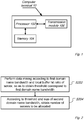
- FIG. 1 is a block diagram of hardware structure of a computer terminal in a server configuration method according to an embodiment of the present invention.
- the computer terminal 10 may comprise one or more (only one is shown in the figure) processors 102 (the processors 102 may include without limitation microprocessors MCU or programmable logic devices FPGA and other processing devices), a memory 104 for storing data and a transmission module 106 for communication function.
- processors 102 may include without limitation microprocessors MCU or programmable logic devices FPGA and other processing devices
- a memory 104 for storing data
- a transmission module 106 for communication function.
- the structure shown in FIG. 1 is example only and does not limit the structure of the foregoing electronic device.
- the computer terminal 10 may also comprise more or fewer components than those shown in FIG. 1 or have a configuration different from that shown in FIG. 1 .
- the memory 104 may be used to store software programs of application software and modules, such as the program instructions/modules corresponding to the server configuration method in an embodiment of the present invention.
- the processor 102 runs the software programs and modules stored in the memory 104 to execute various function applications and data processing, i.e., to achieve a server configuration method of the foregoing application program.
- the memory 104 may include a high speed random memory, or a nonvolatile memory, such as one or more magnetic storage devices, flash memories, or other nonvolatile solid state memories.
- the memory 104 may further comprise memories remotely arranged relative to the processor 102. These remote memories may be connected to the computer terminal 10 by means of a network. Examples of the foregoing network include but are not limited to Internet, Intranet, local area network (LAN), mobile communication network and combinations thereof.
- the transmission device 106 is used to receive or send data via a network.
- a specific example of the foregoing network may include a wireless network provided by the communication supplier of the computer terminal 10.
- the transmission device 106 comprises a network adapter (Network Interface Controller, NIC), which may be connected to other network devices by means of a base station, so that it may communicate with the Internet.
- the transmission device 106 may be a Radio Frequency (RF) module, which is used to communicate with the Internet in a wireless manner.
- RF Radio Frequency
- FIG. 2 is a flow chart of a server configuration method according to Embodiment 1 of the present invention.
- the server configuration method provided by the present application specifically is as follows:
- the reason that the local buffer hit ratio of the server no longer rises or rises within a small margin is that, taking a user accessing a file for example, if the probability that a user accesses a file is n%, after the number of users reaches a certain level, a file will exist in the cache with a high probability. Therefore, when the number of users reaches a certain level, it is reflected in the domain name bandwidth as a threshold. After the file exists in the cache with a high probability, the local buffer hit ratio of the server will no longer increase, that is, the increase in access will "dilute" the local cache "non-hit ratio" of the server.
- the thresholds vary with domain names. For example, the thresholds for non-popular websites and popular websites are different, and the thresholds for portal websites and video websites are also different. As an example, for webpage and image services, the reference single machine bandwidth threshold is 20M, while for live and on-demand services, the reference single machine bandwidth threshold is 50M.
- Step S204 according to the threshold and the size of a second domain name bandwidth, obtaining the number of servers to be allocated;
- the second domain name bandwidth in the present application may include: a bandwidth purchased from a supplier
- a corresponding number of servers to be allocated may be obtained, i.e., the number of servers to be allocated provided by the present application.
- the second domain name bandwidth may be understood as the bandwidth purchased from a supplier, for example, video website A purchases 10G bandwidth from CDN supplier B.
- the server configuration method provided by the present application aims to quantify the relationship between domain name bandwidth and number of servers during CDN traffic scheduling. For example, if a portal website has 10G bandwidth, then the method will calculate the number of servers needed in order to achieve the optimum effect, make the traffic neither too scattered, affecting the local buffer hit ratio nor too concentrated, affecting high availability (the more concentrated the traffic, the more users a single machine fault will affect, and the greater the harm to overall service quality will be), and achieve the purpose of taking into consideration both quality and high availability.
- FIG. 3 is a flow chart of an alternative server configuration method according to Embodiment 1 of the present invention.
- the server configuration method provided by the present application further comprises:
- step S206, adjusting the first domain name bandwidth on a server cluster according to a preset ratio comprises: scaling up or down the first domain name bandwidth on the server cluster according to the preset ratio.
- the preset ratio is 20% and the first domain name bandwidth is X, so X is adjusted at a floating ratio of 20%.
- Step S208 obtaining an adjusted threshold according to the adjusted first domain name bandwidth and the state change of the local buffer hit ratio of the server, so as to obtain the number of servers to be allocated according to the adjusted threshold.
- an adjusted threshold is obtained, that is, the first domain name bandwidth is scaled up or down according to a preset ratio, the state change of the local buffer hit ratio of the corresponding server is observed, and an adjusted threshold is obtained according to the threshold obtaining principle at step S202, so that after an adjusted threshold is obtained in the process of the second configuration of the number of servers, the number of servers to be allocated configured according to the adjusted threshold is obtained at step S204.
- the bandwidth of a certain domain name is intentionally scaled up or down on a small portion of machines to create conditions for mining the threshold, i.e., for better data mining, thereby determining a threshold and raising the threshold obtaining accuracy.
- scaling up means a value larger than the first domain name bandwidth in the process of obtaining a threshold at step S202 is used to observe if the local buffer hit ratio of the server increases; or, scaling down means a value smaller than the first domain name bandwidth in the process of obtaining a threshold at step S202 is used to observe if the local buffer hit ratio of the server decreases, so as to determine a threshold dynamically according to the state change of the local buffer hit ratio of the server.
- a threshold is obtained based on the relationship between a domain name bandwidth and a local buffer hit ratio of a server, and mining is performed according to a first domain name bandwidth and the local buffer hit ratio of the server, so as to obtain a threshold corresponding to the first domain name bandwidth; and according to the threshold and the size of a second domain name bandwidth, the number of servers to be allocated is obtained to achieve the purpose of alleviating the pressure of manual operation and maintenance, so as to achieve a technical effect of raising configuration accuracy, thereby solving the technical problem in the prior art that the configuration of the number of servers for a domain name in a region needs to be adjusted on the basis of experiences or manually in real time according to actual situations, resulting in high operation and maintenance costs and unguaranteed configuration accuracy.
- step S202 performing data mining according to a first domain name bandwidth and a local buffer hit ratio of a server, so as to obtain a threshold corresponding to the first domain name bandwidth comprises:
- the threshold is determined according to this law.
- determining a threshold according to the correspondence between the value change of the first domain name bandwidth and the state change of the local buffer hit ratio of the server comprises: according to the value change of the first domain name bandwidth and the state change of the local buffer hit ratio of the server, determining a specific value at which the local buffer hit ratio of the server no longer rises or rises within a small margin under the condition that the value of the first domain name bandwidth is a specific value as a threshold.
- obtaining a first domain name bandwidth of any domain name from a user access log and obtaining a local buffer hit ratio of a server comprises:
- obtaining the number of servers to be allocated comprises: Step S2041, obtaining the current number of servers to be allocated according to the current domain name bandwidth and the threshold under the condition that the second domain name bandwidth includes the current domain name bandwidth, which is obtained in real time by a traffic acquisition device.
- obtaining the current number of servers to be allocated according to the current domain name bandwidth and the threshold comprises: obtaining the current number of servers to be allocated by dividing the current domain name bandwidth by the threshold.
- calculating according to the threshold and the current domain name bandwidth to obtain the current number of servers to be allocated comprises:
- the current number of servers to be allocated current domain name bandwidth / threshold, where the current domain name bandwidth is obtained in real time by a traffic acquisition device.
- the traffic acquisition device may comprise a routing device.
- Solution 2 Obtain a predicted number of servers to be allocated
- obtaining the number of servers to be allocated comprises: Step S2041', under the condition that the second domain name bandwidth comprises a predicted value of domain name bandwidth, obtaining a predicted number of servers to be allocated according to the predicted value of domain name bandwidth and the threshold.
- obtaining a predicted number of servers to be allocated according to the predicted value of domain name bandwidth and the threshold comprises: obtaining the predicted number of servers to be allocated by dividing the predicted value of domain name bandwidth by the threshold.
- calculating according to the threshold and the predicted value of domain name bandwidth to obtain the predicted number of servers to be allocated comprises:
- the predicted number of servers to be allocated predicted value of domain name bandwidth / threshold; where the predicted value of domain name bandwidth may be predicted and obtained through machine learning, i.e., a domain name bandwidth to be obtained soon is predicted according to historical data to obtain the predicted value of domain name bandwidth, and the historical data may include domain name bandwidth purchased from a supplier in history.
- the server cluster comprises at least one server.
- the server configuration method provided by the present application achieves dynamic allocation of the number of servers according to the obtained threshold and in combination with the size of current bandwidth or the predicted value of future bandwidth.
- the minimum number of servers is directly used if the value is below the domain name requirement for minimum number of servers.
- step S202 through circulation of step S202 to step S208, as shown in FIG. 4 , which is a flow chart of an alternative server configuration method according to Embodiment 1 of the present invention, i.e.,
- the server configuration method provided by the present application may be realized and the purpose of alleviating the pressure of manual operation and maintenance may be achieved, so as to achieve a technical effect of raising configuration accuracy, thereby solving the technical problem in the prior art that the configuration of the number of servers for a domain name in a region needs to be adjusted on the basis of experiences or manually in real time according to actual situations, resulting in high operation and maintenance costs and unguaranteed configuration accuracy.
- the server configuration method provided by the present application clarifies the basis for quantification, that is, from the perspective of the relationship between the local buffer hit ratio of the server and the size of the traffic, the size of bandwidth and the number of servers are quantified.
- the system may intelligently decide how many machines should be used in a region, without the follow-up of operation and maintenance personnel, which greatly saves labor costs.
- server configuration method according to the foregoing embodiments may be implemented by means of software plus a necessary general hardware platform, of course, it may also be implemented by means of hardware, but in many cases, the former is a better implementation manner.
- the technical solutions of the present invention may be embodied in the form of a software product in essence or the part that contributes to the prior art may be embodied in the form of a software product.
- the computer software product is stored in a storage medium (such as ROM/RAM, disk and CD), and includes several instructions to cause a terminal device (which may be a mobile phone, computer, server, or network device, etc.) to perform the methods described in the embodiments of the present invention.
- a storage medium such as ROM/RAM, disk and CD
- a terminal device which may be a mobile phone, computer, server, or network device, etc.
- FIG. 5 is a structural diagram of a server configuration apparatus according to Embodiment 2 of the present invention. As shown in FIG. 5 , the apparatus comprises: an obtaining module 52 and a first configuration module 54.
- the obtaining module 52 for performing data mining according to a first domain name bandwidth and a local buffer hit ratio of a server, so as to obtain a threshold corresponding to the first domain name bandwidth; and the first configuration module 54, for according to the threshold and the size of a second domain name bandwidth, obtaining the number of servers to be allocated.
- a threshold is obtained based on the relationship between a domain name bandwidth and a local buffer hit ratio of a server, and through the obtaining module, which is for performing data mining according to a first domain name bandwidth and a local buffer hit ratio of a server, so as to obtain a threshold corresponding to the first domain name bandwidth; and the first configuration module, which is for according to the threshold and the size of a second domain name bandwidth, obtaining the number of servers to be allocated to achieve the purpose of alleviating the pressure of manual operation and maintenance, so as to achieve a technical effect of raising configuration accuracy, thereby solving the technical problem in the prior art that the configuration of the number of servers for a domain name in a region needs to be adjusted on the basis of experiences or manually in real time according to actual situations, resulting in high operation and maintenance costs and unguaranteed configuration accuracy.
- the foregoing obtaining module 52 and first configuration module 54 correspond to step S202 and step S204 in Embodiment 1, and the examples and application scenarios implemented by the two modules and the corresponding steps are the same, but are not limited to the content disclosed in the foregoing Embodiment 1. It should be noted that the foregoing modules as a part of the apparatus may run in the server provided by Embodiment 1, which may be implemented by means of software or by means of hardware.
- FIG. 6 is a structural diagram of an alternative server configuration apparatus according to Embodiment 2 of the present invention. As shown in FIG. 6 , the apparatus further comprises: an adjusting module 56 and a second configuration module 58.
- the adjusting module 56 for adjusting the first domain name bandwidth on a server cluster according to a preset ratio after the number of servers to be allocated is obtained; and the second configuration module 58, for obtaining an adjusted threshold according to the adjusted first domain name bandwidth and the state change of the local buffer hit ratio of the server, so as to obtain the number of servers to be allocated according to the adjusted threshold.
- the foregoing adjusting module 56 and second configuration module 58 correspond to step S206 and step S208 in Embodiment 1, and the examples and application scenarios implemented by the two modules and the corresponding steps are the same, but are not limited to the content disclosed in the foregoing Embodiment 1. It should be noted that the foregoing modules as a part of the apparatus may run in the server provided by Embodiment 1, which may be implemented by means of software or by means of hardware.
- a storage medium which includes a stored program, and during operation, the program controls the device where the storage medium is located to execute: performing data mining according to a first domain name bandwidth and a local buffer hit ratio of a server, so as to obtain a threshold corresponding to the first domain name bandwidth; according to the threshold and the size of a second domain name bandwidth, obtaining the number of servers to be allocated; adjusting the first domain name bandwidth on a server cluster according to a preset ratio; and obtaining an adjusted threshold according to the adjusted first domain name bandwidth and the state change of the local buffer hit ratio of the server.
- a processor is further provided, which is used to run a program, and during operation, the program executes: performing data mining according to a first domain name bandwidth and a local buffer hit ratio of a server, so as to obtain a threshold corresponding to the first domain name bandwidth; according to the threshold and the size of a second domain name bandwidth, obtaining the number of servers to be allocated; adjusting the first domain name bandwidth on a server cluster according to a preset ratio; and obtaining an adjusted threshold according to the adjusted first domain name bandwidth and the state change of the local buffer hit ratio of the server.
- An embodiment of the present invention further provides a storage medium.
- the foregoing storage medium may be used to save the program code executed by the server configuration method provided by the foregoing Embodiment 1.
- the foregoing storage medium may be located in any computer terminal of a computer terminal group in the computer network, or in any mobile terminal of a mobile terminal group.
- the storage medium is set to store program codes for executing the following steps: performing data mining according to a first domain name bandwidth and a local buffer hit ratio of a server, so as to obtain a threshold corresponding to the first domain name bandwidth; and according to the threshold and the size of a second domain name bandwidth, obtaining the number of servers to be allocated.
- the storage medium is set to store program codes for executing the following steps: adjusting the first domain name bandwidth on a server cluster according to a preset ratio after the number of servers to be allocated is obtained; and obtaining an adjusted threshold according to the adjusted first domain name bandwidth and the state change of the local buffer hit ratio of the server, so as to obtain the number of servers to be allocated according to the adjusted threshold.
- the storage medium is set to store program codes for executing the following steps: performing data mining according to a first domain name bandwidth and a local buffer hit ratio of a server, so as to obtain a threshold corresponding to the first domain name bandwidth comprises: obtaining a first domain name bandwidth of any domain name from a user access log and obtaining a local buffer hit ratio of a server; and determining a threshold according to the correspondence between the value change of the first domain name bandwidth and the state change of the local buffer hit ratio of the server.
- the storage medium is set to store program codes for executing the following steps: obtaining a first domain name bandwidth of any domain name from a user access log and obtaining a local buffer hit ratio of a server comprises: according to a preset cycle, obtaining a first domain name bandwidth of any domain name from a user access log and obtaining a local buffer hit ratio of a server.
- the storage medium is set to store program codes for executing the following steps: determining a threshold according to the correspondence between the value change of the first domain name bandwidth and the state change of the local buffer hit ratio of the server comprises: according to the value change of the first domain name bandwidth and the state change of the local buffer hit ratio of the server, determining a specific value at which the local buffer hit ratio of the server no longer rises or rises within a small margin under the condition that the value of the first domain name bandwidth is a specific value as a threshold.
- obtaining the number of servers to be allocated comprises: obtaining the current number of servers to be allocated according to the current domain name bandwidth and the threshold under the condition that the second domain name bandwidth includes the current domain name bandwidth, which is obtained in real time by a traffic acquisition device.
- the storage medium is set to store program codes for executing the following steps: obtaining the current number of servers to be allocated according to the current domain name bandwidth and the threshold comprises: obtaining the current number of servers to be allocated by dividing the current domain name bandwidth by the threshold.
- the storage medium is set to store program codes for executing the following steps: according to the threshold and the size of a second domain name bandwidth, obtaining the number of servers to be allocated comprises: under the condition that the second domain name bandwidth comprises a predicted value of domain name bandwidth, obtaining a predicted number of servers to be allocated according to the predicted value of domain name bandwidth and the threshold.
- the storage medium is set to store program codes for executing the following steps: obtaining a predicted number of servers to be allocated according to the predicted value of domain name bandwidth and the threshold comprises: obtaining the predicted number of servers to be allocated by dividing the predicted value of domain name bandwidth by the threshold.
- the storage medium is set to store program codes for executing the following steps: the first domain name bandwidth includes: a server bandwidth; the first domain name bandwidth includes: a bandwidth purchased from a supplier.
- the storage medium is set to store program codes for executing the following steps: adjusting the first domain name bandwidth on a server cluster according to a preset ratio comprises: scaling up or down the first domain name bandwidth on the server cluster according to the preset ratio.
- the storage medium is set to store program codes for executing the following steps: the server cluster comprises at least one server.
- the technical content disclosed by the several embodiments provided by the present application may be achieved in other ways.
- the apparatus embodiments described above are example only.
- the division of the units is only a division of logical functions.
- there may be other division methods for example, a plurality of units or components may be combined or integrated to another system, or some features may be ignored, or not implemented.
- the displayed or discussed mutual coupling or direct coupling or communication connection may be indirect coupling or communication connection through some interfaces, units or modules, and may be in electrical or other forms.
- the units described as separate components may or may not be physically separate, and the components displayed as units may or may not be physical units, i.e., they may be located in the same place, or distributed on a plurality of network units. Some or all of the units may be selected according to the actual need to achieve the objectives of the solution of this embodiment.
- each embodiment of the present invention may be integrated into one processing unit, or each unit may exist alone physically, or two or more units may be integrated into one unit.
- the foregoing integrated units may be implemented in the form of hardware or in the form of software function unit.
- the integrated unit is implemented in the form of a software functional unit and is sold or used as an independent product, it may be stored in a computer-readable storage medium.
- the technical solutions of the present invention may be embodied in the form of a software product in essence or the part that contributes to the prior art or all or part of each technical solution may be embodied in the form of a software product.
- the computer software product is stored in a storage medium and comprises a number of instructions so that a computing device (it may be a personal computer, a server, a network device, or others) implements all or some of the steps of the method in each embodiment of the present invention.
- the foregoing storage media include: various kinds of media that may store program codes, such as USB disk, ROM (Read-Only Memory), RAM (Random Access Memory), mobile hard disk, diskette and compact.
Landscapes
- Engineering & Computer Science (AREA)
- Computer Networks & Wireless Communication (AREA)
- Signal Processing (AREA)
- Environmental & Geological Engineering (AREA)
- Information Transfer Between Computers (AREA)
- Data Exchanges In Wide-Area Networks (AREA)
- Computer And Data Communications (AREA)
Abstract
Description
- The present application claims priority to the Chinese patent application No.
201810377843.1, filed on April 25, 2018 - The present invention relates to the field of Internet technology application, and, more particularly, to a server configuration method and apparatus.
- During traffic scheduling of the content delivery network (CDN), in order to prevent a single machine fault from affecting too many users, the traffic is typically scattered to a plurality of servers. The number of servers used for a domain name in a region may be randomly assigned by the scheduling system, while the operation and maintenance personnel take manual scheduling measures to avoid problems when they find the service quality is poor. Alternatively, the number of servers used for a domain name in a region may be subject to the domain name configuration file or the default value of the scheduling system, and after the service changes, the operation and maintenance personnel need to modify the configuration content accordingly.
- Here, if there are too few servers, the access speed will be slow. But having more servers does not mean better speed. In the CDN system, typically it is preferred to store the accessed domain name in a cache, so that the customer directly invokes the cache during accessing and the speed is the highest; if the accessed domain name is not stored in a cache, it is necessary to recursively request for a domain name from the upper Domain Name System (DNS), but the access speed will become slower.
- In the prior art, the number of servers configured for a domain name in a region is typically assigned randomly or based on configuration, which needs to be adjusted on the basis of experiences or manually in real time according to actual situations, resulting in high operation and maintenance costs and unguaranteed configuration accuracy.
- With respect to the foregoing problem that the configuration of the number of servers for a domain name in a region needs to be adjusted on the basis of experiences or manually in real time according to actual situations, resulting in high operation and maintenance costs and unguaranteed configuration accuracy, no effective solution has been proposed yet.
- An embodiment of the present invention provides a server configuration method and apparatus to at least solve the technical problem in the prior art that the configuration of the number of servers for a domain name in a region needs to be adjusted on the basis of experiences or manually in real time according to actual situations, resulting in high operation and maintenance costs and unguaranteed configuration accuracy.
- According to an aspect of an embodiment of the present invention, a server configuration method is provided, comprising: performing data mining according to a first domain name bandwidth and a local buffer hit ratio of a server, so as to obtain a threshold corresponding to the first domain name bandwidth; and according to the threshold and the size of a second domain name bandwidth, obtaining the number of servers to be allocated.
- Optionally, after obtaining the number of servers to be allocated, the method further comprises: adjusting the first domain name bandwidth on a server cluster according to a preset ratio; and obtaining an adjusted threshold according to the adjusted first domain name bandwidth and the state change of the local buffer hit ratio of the server, so as to obtain the number of servers to be allocated according to the adjusted threshold.
- Optionally, performing data mining according to a first domain name bandwidth and a local buffer hit ratio of a server, so as to obtain a threshold corresponding to the first domain name bandwidth comprises: obtaining a first domain name bandwidth of any domain name from a user access log and obtaining a local buffer hit ratio of a server; and determining a threshold according to the correspondence between the value change of the first domain name bandwidth and the state change of the local buffer hit ratio of the server.
- Further, optionally, obtaining a first domain name bandwidth of any domain name from a user access log and obtaining a local buffer hit ratio of a server comprises: according to a preset cycle, obtaining a first domain name bandwidth of any domain name from a user access log and obtaining a local buffer hit ratio of a server.
- Optionally, determining a threshold according to the correspondence between the value change of the first domain name bandwidth and the state change of the local buffer hit ratio of the server comprises: according to the value change of the first domain name bandwidth and the state change of the local buffer hit ratio of the server, determining a specific value at which the local buffer hit ratio of the server no longer rises or rises within a small margin as a threshold under the condition that the value of the first domain name bandwidth is the specific value.
- Optionally, according to the threshold and the size of a second domain name bandwidth, obtaining the number of servers to be allocated comprises: obtaining the current number of servers to be allocated according to the current domain name bandwidth and the threshold under the condition that the second domain name bandwidth includes the current domain name bandwidth. The current domain name bandwidth is obtained in real time by a traffic acquisition device.
- Further, optionally, obtaining the current number of servers to be allocated according to the current domain name bandwidth and the threshold comprises: obtaining the current number of servers to be allocated by dividing the current domain name bandwidth by the threshold.
- Optionally, according to the threshold and the size of a second domain name bandwidth, obtaining the number of servers to be allocated comprises: under the condition that the second domain name bandwidth comprises a predicted value of domain name bandwidth, obtaining a predicted number of servers to be allocated according to the predicted value of domain name bandwidth and the threshold.
- Further, optionally, obtaining a predicted number of servers to be allocated according to the predicted value of domain name bandwidth and the threshold comprises: obtaining the predicted number of servers to be allocated by dividing the predicted value of domain name bandwidth by the threshold.
- Optionally, the first domain name bandwidth includes: a server bandwidth; and the second domain name bandwidth includes: a bandwidth purchased from a supplier.
- Optionally, adjusting the first domain name bandwidth on a server cluster according to a preset ratio comprises: scaling up or down the first domain name bandwidth on the server cluster according to the preset ratio.
- Further, optionally, the server cluster comprises at least one server.
- According to another aspect of an embodiment of the present invention, a server configuration apparatus is further provided, comprising: an obtaining module, for performing data mining according to a first domain name bandwidth and a local buffer hit ratio of a server, so as to obtain a threshold corresponding to the first domain name bandwidth; and a first configuration module, for according to the threshold and the size of a second domain name bandwidth, obtaining the number of servers to be allocated.
- Optionally, the server configuration apparatus further comprises: an adjusting module, for adjusting the first domain name bandwidth on a server cluster according to a preset ratio after the number of servers to be allocated is obtained; and a second configuration module, for obtaining an adjusted threshold according to the adjusted first domain name bandwidth and the state change of the local buffer hit ratio of the server, so as to obtain the number of servers to be allocated according to the adjusted threshold.
- According to another aspect of an embodiment of the present invention, a storage medium is further provided, which includes a stored program, and during operation, the program controls the device where the storage medium is located to execute: performing data mining according to a first domain name bandwidth and a local buffer hit ratio of a server, so as to obtain a threshold corresponding to the first domain name bandwidth; and according to the threshold and the size of a second domain name bandwidth, obtaining the number of servers to be allocated.
- According to another aspect of an embodiment of the present invention, a processor is further provided, which is used to run a program, and during operation of the program, the processor executes: performing data mining according to a first domain name bandwidth and a local buffer hit ratio of a server, so as to obtain a threshold corresponding to the first domain name bandwidth; and according to the threshold and the size of a second domain name bandwidth, obtaining the number of servers to be allocated.
- In an embodiment of the present invention, a threshold is obtained based on the relationship between a domain name bandwidth and a local buffer hit ratio of a server, and data mining is performed according to a first domain name bandwidth and the local buffer hit ratio of the server, so as to obtain a threshold corresponding to the first domain name bandwidth; and according to the threshold and the size of a second domain name bandwidth, the number of servers to be allocated is obtained to achieve the purpose of alleviating the pressure of manual operation and maintenance, so as to achieve a technical effect of raising configuration accuracy, thereby solving the technical problem in the prior art that the configuration of the number of servers for a domain name in a region needs to be adjusted on the basis of experiences or manually in real time according to actual situations, resulting in high operation and maintenance costs and unguaranteed configuration accuracy.
- The drawings described herein are intended to provide further understanding of the present application and constitute a part of the present application, and the example embodiments of the present invention and their descriptions are intended to explain the present invention and not to improperly limit the present application. In the drawings:
-
FIG. 1 is a block diagram of hardware structure of a computer terminal in a server configuration method according to an embodiment of the present invention; -
FIG. 2 is a flow chart of a server configuration method according to Embodiment 1 of the present invention; -
FIG. 3 is a flow chart of an alternative server configuration method according to Embodiment 1 of the present invention; -
FIG. 4 is a flow chart of an alternative server configuration method according to Embodiment 1 of the present invention; -
FIG. 5 is a structural diagram of a server configuration apparatus according to Embodiment 2 of the present invention; -
FIG. 6 is a structural diagram of an alternative server configuration apparatus according to Embodiment 2 of the present invention. - In order that those skilled in the art have better understanding on the solutions of the present invention, the technical solutions in embodiments of the present invention will now be clearly and completely described by referring to the accompanying drawings in the embodiments of the present invention. Obviously, the described embodiments are only some and not all of the embodiments of the present invention. Based on the embodiments in the present invention, all other embodiments obtained by those of ordinary skill in the art without creative work shall fall within the scope of the present invention.
- It should be noted that terms like "first" and "second" in the description and claims of the present invention as well as the foregoing drawings are used to differentiate similar objects and are not necessarily for describing a specific sequence or a precedence order. It should be understood that the data used in this way may be interchanged under appropriate circumstances, so that the embodiments of the present invention described herein may be implemented in an order other than those illustrated or described herein. Further, the terms "comprise," "provide with" and any variations thereof are intended to cover non-exclusive inclusion, for example, a process, method, system, product or equipment that comprises a series of steps or units is not limited to those clearly listed steps or units and may include other steps or units that are not explicitly listed or are inherent to the process, method, product, or equipment.
- CDN: Content Delivery Network.
- According to an embodiment of the present invention, a method embodiment for server configuration is further provided. It needs to be noted that the steps shown in the flow chart of the drawings may be executed in a computer system such as a group of computer-executable instructions. A logic sequence is shown in the flow chart, but in some cases, the shown or described steps may be executed in a sequence different from this sequence.
- The method embodiment provided by Embodiment 1 of the present invention may be executed in a mobile terminal, a computer terminal or a similar computing device. Taking operation in a computer terminal for example,
FIG. 1 is a block diagram of hardware structure of a computer terminal in a server configuration method according to an embodiment of the present invention. As shown inFIG. 1 , thecomputer terminal 10 may comprise one or more (only one is shown in the figure) processors 102 (theprocessors 102 may include without limitation microprocessors MCU or programmable logic devices FPGA and other processing devices), amemory 104 for storing data and atransmission module 106 for communication function. Those of ordinary skill in the art may understand that the structure shown inFIG. 1 is example only and does not limit the structure of the foregoing electronic device. For example, thecomputer terminal 10 may also comprise more or fewer components than those shown inFIG. 1 or have a configuration different from that shown inFIG. 1 . - The
memory 104 may be used to store software programs of application software and modules, such as the program instructions/modules corresponding to the server configuration method in an embodiment of the present invention. Theprocessor 102 runs the software programs and modules stored in thememory 104 to execute various function applications and data processing, i.e., to achieve a server configuration method of the foregoing application program. Thememory 104 may include a high speed random memory, or a nonvolatile memory, such as one or more magnetic storage devices, flash memories, or other nonvolatile solid state memories. In some examples, thememory 104 may further comprise memories remotely arranged relative to theprocessor 102. These remote memories may be connected to thecomputer terminal 10 by means of a network. Examples of the foregoing network include but are not limited to Internet, Intranet, local area network (LAN), mobile communication network and combinations thereof. - The
transmission device 106 is used to receive or send data via a network. A specific example of the foregoing network may include a wireless network provided by the communication supplier of thecomputer terminal 10. In an example, thetransmission device 106 comprises a network adapter (Network Interface Controller, NIC), which may be connected to other network devices by means of a base station, so that it may communicate with the Internet. In an example, thetransmission device 106 may be a Radio Frequency (RF) module, which is used to communicate with the Internet in a wireless manner. - In the foregoing operating environment, the present application provides a server configuration method as shown in
FIG. 2. FIG. 2 is a flow chart of a server configuration method according to Embodiment 1 of the present invention. The server configuration method provided by the present application specifically is as follows: - Step S202, performing data mining according to a first domain name bandwidth and a local buffer hit ratio of a server, so as to obtain a threshold corresponding to the first domain name bandwidth;
- At the foregoing step S202 of the present application, based on CDN, it is for avoiding the technical problem in the prior art that the configuration of the number of servers for a domain name in a region needs to be adjusted on the basis of experiences or manually in real time according to actual situations, resulting in high operation and maintenance costs and unguaranteed configuration accuracy;
- The server configuration method provided by the present application obtains the size of domain name bandwidth of any domain name from a user access log (i.e., a first domain name bandwidth provided by the present application, which comprises: a server bandwidth), and a local buffer hit ratio of a server, and obtains a threshold according to the relationship between the size of the first domain name bandwidth of this domain name and the local buffer hit ratio of the server. Here, a principle for obtaining the threshold is as follows: after the first domain name bandwidth is greater than the threshold, the local buffer hit ratio of the server no longer rises or rises within a small margin; the threshold may be obtained according to this principle.
- The reason that the local buffer hit ratio of the server no longer rises or rises within a small margin is that, taking a user accessing a file for example, if the probability that a user accesses a file is n%, after the number of users reaches a certain level, a file will exist in the cache with a high probability. Therefore, when the number of users reaches a certain level, it is reflected in the domain name bandwidth as a threshold. After the file exists in the cache with a high probability, the local buffer hit ratio of the server will no longer increase, that is, the increase in access will "dilute" the local cache "non-hit ratio" of the server.
- Here, the thresholds vary with domain names. For example, the thresholds for non-popular websites and popular websites are different, and the thresholds for portal websites and video websites are also different. As an example, for webpage and image services, the reference single machine bandwidth threshold is 20M, while for live and on-demand services, the reference single machine bandwidth threshold is 50M.
- Step S204, according to the threshold and the size of a second domain name bandwidth, obtaining the number of servers to be allocated;
At the foregoing step S204 of the present application, based on the threshold and the size of a second domain name bandwidth obtained at step S202 (the second domain name bandwidth in the present application may include: a bandwidth purchased from a supplier), according to the mathematical relation between the second domain name bandwidth and the threshold, a corresponding number of servers to be allocated may be obtained, i.e., the number of servers to be allocated provided by the present application.
Here, the second domain name bandwidth may be understood as the bandwidth purchased from a supplier, for example, video website A purchases 10G bandwidth from CDN supplier B. - Here, the mathematical relation may include: the number of servers to be allocated = second domain name bandwidth/threshold;
According to the mathematical relation, the number of servers to be allocated may be obtained. The server configuration method provided by the present application aims to quantify the relationship between domain name bandwidth and number of servers during CDN traffic scheduling. For example, if a portal website has 10G bandwidth, then the method will calculate the number of servers needed in order to achieve the optimum effect, make the traffic neither too scattered, affecting the local buffer hit ratio nor too concentrated, affecting high availability (the more concentrated the traffic, the more users a single machine fault will affect, and the greater the harm to overall service quality will be), and achieve the purpose of taking into consideration both quality and high availability. - After the number of servers to be allocated is obtained, in order to raise the threshold obtaining accuracy,
FIG. 3 is a flow chart of an alternative server configuration method according to Embodiment 1 of the present invention. As shown inFIG. 3 , the server configuration method provided by the present application further comprises: - Step S206, adjusting the first domain name bandwidth on a server cluster according to a preset ratio;
- At the foregoing step S206 of the present application, the number of servers to be allocated is obtained based on step S204. After the step S204, in order to raise the threshold obtaining accuracy, the threshold is further mined, i.e., at step S206, the first domain name bandwidth is adjusted according to a preset ratio.
- Optionally, step S206, adjusting the first domain name bandwidth on a server cluster according to a preset ratio comprises: scaling up or down the first domain name bandwidth on the server cluster according to the preset ratio.
- Specifically, it is assumed that the preset ratio is 20% and the first domain name bandwidth is X, so X is adjusted at a floating ratio of 20%.
- Step S208, obtaining an adjusted threshold according to the adjusted first domain name bandwidth and the state change of the local buffer hit ratio of the server, so as to obtain the number of servers to be allocated according to the adjusted threshold.
- At the foregoing step S208 of the present application, based on the adjusted first domain name bandwidth and the state change of the local buffer hit ratio of the server, an adjusted threshold is obtained, that is, the first domain name bandwidth is scaled up or down according to a preset ratio, the state change of the local buffer hit ratio of the corresponding server is observed, and an adjusted threshold is obtained according to the threshold obtaining principle at step S202, so that after an adjusted threshold is obtained in the process of the second configuration of the number of servers, the number of servers to be allocated configured according to the adjusted threshold is obtained at step S204.
- Here, the bandwidth of a certain domain name is intentionally scaled up or down on a small portion of machines to create conditions for mining the threshold, i.e., for better data mining, thereby determining a threshold and raising the threshold obtaining accuracy.
- The small portion of machines in the present application are randomly selected from a total server cluster, and scaling up means a value larger than the first domain name bandwidth in the process of obtaining a threshold at step S202 is used to observe if the local buffer hit ratio of the server increases; or, scaling down means a value smaller than the first domain name bandwidth in the process of obtaining a threshold at step S202 is used to observe if the local buffer hit ratio of the server decreases, so as to determine a threshold dynamically according to the state change of the local buffer hit ratio of the server.
- In an embodiment of the present invention, a threshold is obtained based on the relationship between a domain name bandwidth and a local buffer hit ratio of a server, and mining is performed according to a first domain name bandwidth and the local buffer hit ratio of the server, so as to obtain a threshold corresponding to the first domain name bandwidth; and according to the threshold and the size of a second domain name bandwidth, the number of servers to be allocated is obtained to achieve the purpose of alleviating the pressure of manual operation and maintenance, so as to achieve a technical effect of raising configuration accuracy, thereby solving the technical problem in the prior art that the configuration of the number of servers for a domain name in a region needs to be adjusted on the basis of experiences or manually in real time according to actual situations, resulting in high operation and maintenance costs and unguaranteed configuration accuracy.
- Optionally, at step S202, performing data mining according to a first domain name bandwidth and a local buffer hit ratio of a server, so as to obtain a threshold corresponding to the first domain name bandwidth comprises:
- Step S2021, obtaining a first domain name bandwidth of any domain name from a user access log and obtaining a local buffer hit ratio of a server;
- Step S2022, determining a threshold according to the correspondence between the value change of the first domain name bandwidth and the state change of the local buffer hit ratio of the server.
- Here, after the first domain name bandwidth is greater than the threshold, the local buffer hit ratio of the server no longer rises or rises within a small margin. The threshold is determined according to this law.
- Here, determining a threshold according to the correspondence between the value change of the first domain name bandwidth and the state change of the local buffer hit ratio of the server comprises: according to the value change of the first domain name bandwidth and the state change of the local buffer hit ratio of the server, determining a specific value at which the local buffer hit ratio of the server no longer rises or rises within a small margin under the condition that the value of the first domain name bandwidth is a specific value as a threshold.
- Further, optionally, at step S2021, obtaining a first domain name bandwidth of any domain name from a user access log and obtaining a local buffer hit ratio of a server comprises:
- Step S20211, according to a preset cycle, obtaining a first domain name bandwidth of any domain name from a user access log and obtaining a local buffer hit ratio of a server. Specifically, the server configuration method provided by the present application not only may obtain a current number of servers to be allocated, but also may obtain a predicted number of servers to be allocated;
- Solution 1: Obtain a current number of servers to be allocated
- Optionally, at step S204, according to the threshold and the size of a second domain name bandwidth, obtaining the number of servers to be allocated comprises:
Step S2041, obtaining the current number of servers to be allocated according to the current domain name bandwidth and the threshold under the condition that the second domain name bandwidth includes the current domain name bandwidth, which is obtained in real time by a traffic acquisition device. - Here, obtaining the current number of servers to be allocated according to the current domain name bandwidth and the threshold comprises: obtaining the current number of servers to be allocated by dividing the current domain name bandwidth by the threshold.
- Specifically, calculating according to the threshold and the current domain name bandwidth to obtain the current number of servers to be allocated, where calculating according to the threshold and current domain name bandwidth comprises:
The current number of servers to be allocated = current domain name bandwidth / threshold, where the current domain name bandwidth is obtained in real time by a traffic acquisition device. Here, the traffic acquisition device may comprise a routing device. - Optionally, at step S204, according to the threshold and the size of a second domain name bandwidth, obtaining the number of servers to be allocated comprises:
Step S2041', under the condition that the second domain name bandwidth comprises a predicted value of domain name bandwidth, obtaining a predicted number of servers to be allocated according to the predicted value of domain name bandwidth and the threshold. - Here, obtaining a predicted number of servers to be allocated according to the predicted value of domain name bandwidth and the threshold comprises: obtaining the predicted number of servers to be allocated by dividing the predicted value of domain name bandwidth by the threshold.
- Specifically, calculating according to the threshold and the predicted value of domain name bandwidth to obtain the predicted number of servers to be allocated, where calculating according to the threshold and the predicted value of domain name bandwidth comprises:
The predicted number of servers to be allocated = predicted value of domain name bandwidth / threshold; where the predicted value of domain name bandwidth may be predicted and obtained through machine learning, i.e., a domain name bandwidth to be obtained soon is predicted according to historical data to obtain the predicted value of domain name bandwidth, and the historical data may include domain name bandwidth purchased from a supplier in history. - Further, optionally, the server cluster comprises at least one server.
- To sum up, in combination with solution 1 and solution 2, the server configuration method provided by the present application achieves dynamic allocation of the number of servers according to the obtained threshold and in combination with the size of current bandwidth or the predicted value of future bandwidth.
- In addition, the minimum number of servers is directly used if the value is below the domain name requirement for minimum number of servers.
- It needs to be noted that through circulation of step S202 to step S208, as shown in
FIG. 4 , which is a flow chart of an alternative server configuration method according to Embodiment 1 of the present invention, i.e., - Step 1, mine from a log a relationship between traffic (domain name bandwidth) and a local buffer hit ratio of a server, so as to obtain a threshold;
- Step 2, obtain, according to a dynamic threshold condition and the domain name bandwidth, the number of servers to be allocated;
-
Step 3, intentionally scale the bandwidth of a certain domain name on a small portion of machines, thereby creating threshold mining conditions for step 1. - As shown in
FIG. 3 , through circulation of step 1 to step 3, the server configuration method provided by the present application may be realized and the purpose of alleviating the pressure of manual operation and maintenance may be achieved, so as to achieve a technical effect of raising configuration accuracy, thereby solving the technical problem in the prior art that the configuration of the number of servers for a domain name in a region needs to be adjusted on the basis of experiences or manually in real time according to actual situations, resulting in high operation and maintenance costs and unguaranteed configuration accuracy. - The server configuration method provided by the present application clarifies the basis for quantification, that is, from the perspective of the relationship between the local buffer hit ratio of the server and the size of the traffic, the size of bandwidth and the number of servers are quantified. For a specific domain name, the system may intelligently decide how many machines should be used in a region, without the follow-up of operation and maintenance personnel, which greatly saves labor costs.
- It should be noted that, for the purpose of simple description, the foregoing method embodiments are all expressed as a series of action combinations, but those skilled in the art should know that the present invention is not limited by the sequence of actions described because according to the present invention, some steps may be performed in other orders or simultaneously. Secondly, those skilled in the art should also know that the embodiments described in the description are all preferred embodiments, and the actions and modules involved may not be necessary for the present invention.
- Through the description of the foregoing implementation manners, those skilled in the art may clearly understand that the server configuration method according to the foregoing embodiments may be implemented by means of software plus a necessary general hardware platform, of course, it may also be implemented by means of hardware, but in many cases, the former is a better implementation manner. Based on this understanding, the technical solutions of the present invention may be embodied in the form of a software product in essence or the part that contributes to the prior art may be embodied in the form of a software product. The computer software product is stored in a storage medium (such as ROM/RAM, disk and CD), and includes several instructions to cause a terminal device (which may be a mobile phone, computer, server, or network device, etc.) to perform the methods described in the embodiments of the present invention.
- According to an embodiment of the present invention, an apparatus for implementing the foregoing server configuration method is further provided.
FIG. 5 is a structural diagram of a server configuration apparatus according to Embodiment 2 of the present invention. As shown inFIG. 5 , the apparatus comprises: an obtainingmodule 52 and a first configuration module 54. - Here, the obtaining
module 52, for performing data mining according to a first domain name bandwidth and a local buffer hit ratio of a server, so as to obtain a threshold corresponding to the first domain name bandwidth; and the first configuration module 54, for according to the threshold and the size of a second domain name bandwidth, obtaining the number of servers to be allocated. - In an embodiment of the present invention, a threshold is obtained based on the relationship between a domain name bandwidth and a local buffer hit ratio of a server, and through the obtaining module, which is for performing data mining according to a first domain name bandwidth and a local buffer hit ratio of a server, so as to obtain a threshold corresponding to the first domain name bandwidth; and the first configuration module, which is for according to the threshold and the size of a second domain name bandwidth, obtaining the number of servers to be allocated to achieve the purpose of alleviating the pressure of manual operation and maintenance, so as to achieve a technical effect of raising configuration accuracy, thereby solving the technical problem in the prior art that the configuration of the number of servers for a domain name in a region needs to be adjusted on the basis of experiences or manually in real time according to actual situations, resulting in high operation and maintenance costs and unguaranteed configuration accuracy.
- It needs to be noted that the foregoing obtaining
module 52 and first configuration module 54 correspond to step S202 and step S204 in Embodiment 1, and the examples and application scenarios implemented by the two modules and the corresponding steps are the same, but are not limited to the content disclosed in the foregoing Embodiment 1. It should be noted that the foregoing modules as a part of the apparatus may run in the server provided by Embodiment 1, which may be implemented by means of software or by means of hardware. - Optionally,
FIG. 6 is a structural diagram of an alternative server configuration apparatus according to Embodiment 2 of the present invention. As shown inFIG. 6 , the apparatus further comprises: an adjusting module 56 and a second configuration module 58. - Here, the adjusting module 56, for adjusting the first domain name bandwidth on a server cluster according to a preset ratio after the number of servers to be allocated is obtained; and the second configuration module 58, for obtaining an adjusted threshold according to the adjusted first domain name bandwidth and the state change of the local buffer hit ratio of the server, so as to obtain the number of servers to be allocated according to the adjusted threshold.
- It needs to be noted that the foregoing adjusting module 56 and second configuration module 58 correspond to step S206 and step S208 in Embodiment 1, and the examples and application scenarios implemented by the two modules and the corresponding steps are the same, but are not limited to the content disclosed in the foregoing Embodiment 1. It should be noted that the foregoing modules as a part of the apparatus may run in the server provided by Embodiment 1, which may be implemented by means of software or by means of hardware.
- According to a further aspect of an embodiment of the present invention, a storage medium is further provided, which includes a stored program, and during operation, the program controls the device where the storage medium is located to execute: performing data mining according to a first domain name bandwidth and a local buffer hit ratio of a server, so as to obtain a threshold corresponding to the first domain name bandwidth; according to the threshold and the size of a second domain name bandwidth, obtaining the number of servers to be allocated; adjusting the first domain name bandwidth on a server cluster according to a preset ratio; and obtaining an adjusted threshold according to the adjusted first domain name bandwidth and the state change of the local buffer hit ratio of the server.
- According to a still further aspect of an embodiment of the present invention, a processor is further provided, which is used to run a program, and during operation, the program executes: performing data mining according to a first domain name bandwidth and a local buffer hit ratio of a server, so as to obtain a threshold corresponding to the first domain name bandwidth; according to the threshold and the size of a second domain name bandwidth, obtaining the number of servers to be allocated; adjusting the first domain name bandwidth on a server cluster according to a preset ratio; and obtaining an adjusted threshold according to the adjusted first domain name bandwidth and the state change of the local buffer hit ratio of the server.
- An embodiment of the present invention further provides a storage medium. Optionally, in this embodiment, the foregoing storage medium may be used to save the program code executed by the server configuration method provided by the foregoing Embodiment 1.
- Optionally, in this embodiment, the foregoing storage medium may be located in any computer terminal of a computer terminal group in the computer network, or in any mobile terminal of a mobile terminal group.
- Optionally, in this embodiment, the storage medium is set to store program codes for executing the following steps: performing data mining according to a first domain name bandwidth and a local buffer hit ratio of a server, so as to obtain a threshold corresponding to the first domain name bandwidth; and according to the threshold and the size of a second domain name bandwidth, obtaining the number of servers to be allocated.
- Optionally, in this embodiment, the storage medium is set to store program codes for executing the following steps: adjusting the first domain name bandwidth on a server cluster according to a preset ratio after the number of servers to be allocated is obtained; and obtaining an adjusted threshold according to the adjusted first domain name bandwidth and the state change of the local buffer hit ratio of the server, so as to obtain the number of servers to be allocated according to the adjusted threshold.
- Optionally, in this embodiment, the storage medium is set to store program codes for executing the following steps: performing data mining according to a first domain name bandwidth and a local buffer hit ratio of a server, so as to obtain a threshold corresponding to the first domain name bandwidth comprises: obtaining a first domain name bandwidth of any domain name from a user access log and obtaining a local buffer hit ratio of a server; and determining a threshold according to the correspondence between the value change of the first domain name bandwidth and the state change of the local buffer hit ratio of the server.
- Further, optionally, in this embodiment, the storage medium is set to store program codes for executing the following steps: obtaining a first domain name bandwidth of any domain name from a user access log and obtaining a local buffer hit ratio of a server comprises: according to a preset cycle, obtaining a first domain name bandwidth of any domain name from a user access log and obtaining a local buffer hit ratio of a server.
- Optionally, in this embodiment, the storage medium is set to store program codes for executing the following steps: determining a threshold according to the correspondence between the value change of the first domain name bandwidth and the state change of the local buffer hit ratio of the server comprises: according to the value change of the first domain name bandwidth and the state change of the local buffer hit ratio of the server, determining a specific value at which the local buffer hit ratio of the server no longer rises or rises within a small margin under the condition that the value of the first domain name bandwidth is a specific value as a threshold. Optionally, according to the threshold and the size of a second domain name bandwidth, obtaining the number of servers to be allocated comprises: obtaining the current number of servers to be allocated according to the current domain name bandwidth and the threshold under the condition that the second domain name bandwidth includes the current domain name bandwidth, which is obtained in real time by a traffic acquisition device.
- Further, optionally, in this embodiment, the storage medium is set to store program codes for executing the following steps: obtaining the current number of servers to be allocated according to the current domain name bandwidth and the threshold comprises: obtaining the current number of servers to be allocated by dividing the current domain name bandwidth by the threshold.
- Optionally, in this embodiment, the storage medium is set to store program codes for executing the following steps: according to the threshold and the size of a second domain name bandwidth, obtaining the number of servers to be allocated comprises: under the condition that the second domain name bandwidth comprises a predicted value of domain name bandwidth, obtaining a predicted number of servers to be allocated according to the predicted value of domain name bandwidth and the threshold.
- Further, optionally, in this embodiment, the storage medium is set to store program codes for executing the following steps: obtaining a predicted number of servers to be allocated according to the predicted value of domain name bandwidth and the threshold comprises: obtaining the predicted number of servers to be allocated by dividing the predicted value of domain name bandwidth by the threshold.
- Optionally, in this embodiment, the storage medium is set to store program codes for executing the following steps: the first domain name bandwidth includes: a server bandwidth; the first domain name bandwidth includes: a bandwidth purchased from a supplier.
- Optionally, in this embodiment, the storage medium is set to store program codes for executing the following steps: adjusting the first domain name bandwidth on a server cluster according to a preset ratio comprises: scaling up or down the first domain name bandwidth on the server cluster according to the preset ratio.
- Further, optionally, in this embodiment, the storage medium is set to store program codes for executing the following steps: the server cluster comprises at least one server.
- The sequence numbers of the foregoing embodiments of the present invention are for the purpose of description only and do not represent the superiority or inferiority of the embodiments.
- In the foregoing embodiments of the present invention, the description of each embodiment has its own focus. For a part not elaborated in an embodiment, you may refer to relevant descriptions of other embodiments.
- It should be understood that the technical content disclosed by the several embodiments provided by the present application may be achieved in other ways. Among them, the apparatus embodiments described above are example only. For example, the division of the units is only a division of logical functions. In actual implementation, there may be other division methods, for example, a plurality of units or components may be combined or integrated to another system, or some features may be ignored, or not implemented. In addition, the displayed or discussed mutual coupling or direct coupling or communication connection may be indirect coupling or communication connection through some interfaces, units or modules, and may be in electrical or other forms.
- The units described as separate components may or may not be physically separate, and the components displayed as units may or may not be physical units, i.e., they may be located in the same place, or distributed on a plurality of network units. Some or all of the units may be selected according to the actual need to achieve the objectives of the solution of this embodiment.
- Further, the functional units in each embodiment of the present invention may be integrated into one processing unit, or each unit may exist alone physically, or two or more units may be integrated into one unit. The foregoing integrated units may be implemented in the form of hardware or in the form of software function unit.
- If the integrated unit is implemented in the form of a software functional unit and is sold or used as an independent product, it may be stored in a computer-readable storage medium. Based on this understanding, the technical solutions of the present invention may be embodied in the form of a software product in essence or the part that contributes to the prior art or all or part of each technical solution may be embodied in the form of a software product. The computer software product is stored in a storage medium and comprises a number of instructions so that a computing device (it may be a personal computer, a server, a network device, or others) implements all or some of the steps of the method in each embodiment of the present invention. The foregoing storage media include: various kinds of media that may store program codes, such as USB disk, ROM (Read-Only Memory), RAM (Random Access Memory), mobile hard disk, diskette and compact.
- The foregoing description includes only preferred embodiments of the present invention. It should be noted that various modifications and improvements may be made by those of ordinary skill in the art without departing from the spirit of the present invention, and these modifications and improvements shall be considered falling within the scope of the present invention.
Claims (16)
- A server configuration method comprising:performing data mining according to a first domain name bandwidth and a local buffer hit ratio of a server to obtain a threshold corresponding to the first domain name bandwidth; andobtaining a number of servers to be allocated according to the threshold and a size of a second domain name bandwidth.
- The server configuration method according to claim 1, wherein after obtaining the number of servers to be allocated, the method further comprises:adjusting the first domain name bandwidth on a server cluster according to a preset ratio; andobtaining an adjusted threshold according to the adjusted first domain name bandwidth and a state change of the local buffer hit ratio of the server to obtain a number of servers to be allocated according to the adjusted threshold.
- The server configuration method according to claim 1, wherein the performing data mining according to the first domain name bandwidth and the local buffer hit ratio of the server to obtain the threshold corresponding to the first domain name bandwidth comprises:obtaining the first domain name bandwidth of a domain name and the local buffer hit ratio of the server from a user access log; anddetermining the threshold according to a correspondence between a value change of the first domain name bandwidth and a state change of the local buffer hit ratio of the server.
- The server configuration method according to claim 3, wherein the obtaining the first domain name bandwidth of the domain name from the user access log and obtaining the local buffer hit ratio of the server comprises:
according to a preset cycle, obtaining the first domain name bandwidth of the domain name from the user access log and obtaining the local buffer hit ratio of the server. - The server configuration method according to claim 3, wherein the determining the threshold according to the correspondence between the value change of the first domain name bandwidth and the state change of the local buffer hit ratio of the server comprises:
according to the value change of the first domain name bandwidth and the state change of the local buffer hit ratio of the server, determining a specific value at which the local buffer hit ratio of the server no longer rises or rises within a small margin as the threshold under the condition that the value of the first domain name bandwidth is the specific value. - The server configuration method according to claim 1, wherein according to the threshold and the size of the second domain name bandwidth, the obtaining the number of servers to be allocated comprises:
obtaining a current number of servers to be allocated according to a current domain name bandwidth and the threshold under the condition that the second domain name bandwidth includes the current domain name bandwidth, the current domain name bandwidth being obtained in real time by a traffic acquisition device. - The server configuration method according to claim 6, wherein the obtaining the current number of servers to be allocated according to the current domain name bandwidth and the threshold comprises:
obtaining the current number of servers to be allocated by dividing the current domain name bandwidth by the threshold. - The server configuration method according to claim 1, wherein according to the threshold and the size of the second domain name bandwidth, the obtaining the number of servers to be allocated comprises:
under the condition that the second domain name bandwidth comprises a predicted value of domain name bandwidth, obtaining a predicted number of servers to be allocated according to a predicted value of domain name bandwidth and the threshold. - The server configuration method according to claim 8, wherein the obtaining the predicted number of servers to be allocated according to the predicted value of domain name bandwidth and the threshold comprises:
obtaining the predicted number of servers to be allocated by dividing the predicted value of domain name bandwidth by the threshold. - The server configuration method according to claim 1, wherein:the first domain name bandwidth includes a server bandwidth; andthe second domain name bandwidth includes a bandwidth purchased from a supplier.
- The server configuration method according to claim 2, wherein the adjusting the first domain name bandwidth on the server cluster according to the preset ratio comprises:
scaling up or down the first domain name bandwidth on the server cluster according to the preset ratio. - The server configuration method according to claim 11, wherein the server cluster comprises at least one server.
- A server configuration apparatus comprising:an obtaining module for performing data mining according to a first domain name bandwidth and a local buffer hit ratio of a server to obtain a threshold corresponding to the first domain name bandwidth; anda first configuration module for obtaining the number of servers to be allocated according to the threshold and the size of a second domain name bandwidth.
- The server configuration apparatus according to claim 13, wherein the server configuration apparatus further comprises:an adjusting module for adjusting the first domain name bandwidth on a server cluster according to a preset ratio after a number of servers to be allocated is obtained; anda second configuration module for obtaining an adjusted threshold according to an adjusted first domain name bandwidth and a state change of the local buffer hit ratio of the server to obtain the number of servers to be allocated according to the adjusted threshold.
- A storage medium, wherein the storage medium includes a stored program, and during operation, the program controls the device where the storage medium is located to execute acts comprising:performing data mining according to a first domain name bandwidth and a local buffer hit ratio of a server to obtain a threshold corresponding to the first domain name bandwidth; andobtaining the number of servers to be allocated according to a threshold and a size of a second domain name bandwidth.
- A processor, wherein the processor is used to run a program, and during operation, the processor executes acts comprising:performing data mining according to a first domain name bandwidth and a local buffer hit ratio of a server to obtain a threshold corresponding to the first domain name bandwidth; andobtaining the number of servers to be allocated according to a threshold and a size of a second domain name bandwidth.
Applications Claiming Priority (2)
| Application Number | Priority Date | Filing Date | Title |
|---|---|---|---|
| CN201810377843.1A CN110401553B (en) | 2018-04-25 | 2018-04-25 | Server configuration method and device |
| PCT/CN2019/083423 WO2019206033A1 (en) | 2018-04-25 | 2019-04-19 | Server configuration method and apparatus |
Publications (3)
| Publication Number | Publication Date |
|---|---|
| EP3787231A1 true EP3787231A1 (en) | 2021-03-03 |
| EP3787231A4 EP3787231A4 (en) | 2022-01-19 |
| EP3787231B1 EP3787231B1 (en) | 2024-06-05 |
Family
ID=68294702
Family Applications (1)
| Application Number | Title | Priority Date | Filing Date |
|---|---|---|---|
| EP19793601.6A Active EP3787231B1 (en) | 2018-04-25 | 2019-04-19 | Server configuration method and apparatus |
Country Status (5)
| Country | Link |
|---|---|
| US (1) | US11431669B2 (en) |
| EP (1) | EP3787231B1 (en) |
| JP (1) | JP2021522583A (en) |
| CN (1) | CN110401553B (en) |
| WO (1) | WO2019206033A1 (en) |
Families Citing this family (3)
| Publication number | Priority date | Publication date | Assignee | Title |
|---|---|---|---|---|
| CN111327461B (en) * | 2020-01-23 | 2022-03-11 | 华为云计算技术有限公司 | A method, device, equipment and medium for domain name management based on CDN system |
| CN113364622A (en) * | 2021-06-04 | 2021-09-07 | 中国工商银行股份有限公司 | Method, device, equipment and storage medium for cross-region flow control |
| CN114465915B (en) * | 2021-12-22 | 2024-07-05 | 天翼云科技有限公司 | CDN bandwidth prediction method, device and system and electronic equipment |
Family Cites Families (29)
| Publication number | Priority date | Publication date | Assignee | Title |
|---|---|---|---|---|
| US7552235B2 (en) * | 2003-12-11 | 2009-06-23 | International Business Machines Corporation | Autonomic selection of a request routing policy based upon cache effectiveness |
| US7925738B2 (en) * | 2003-12-18 | 2011-04-12 | Hewlett-Packard Development Company, L.P. | Analytical cache performance model for a media server |
| US7584281B2 (en) | 2005-06-07 | 2009-09-01 | Datasynapse, Inc. | Method for allocating shared computing infrastructure for application server-based deployments |
| US7761538B2 (en) | 2006-08-30 | 2010-07-20 | Microsoft Corporation | Dynamically configuring, allocating and deploying computing systems |
| US7720936B2 (en) | 2007-03-12 | 2010-05-18 | Citrix Systems, Inc. | Systems and methods of freshening and prefreshening a DNS cache |
| US8145761B2 (en) * | 2008-03-03 | 2012-03-27 | Microsoft Corporation | Load skewing for power-aware server provisioning |
| US8195337B2 (en) | 2008-04-14 | 2012-06-05 | Cruickshank Iii Robert F | Method and apparatus for orchestrating utility power supply and demand in real time using a continuous pricing signal sent via a network to home networks and smart appliances |
| US8239482B2 (en) * | 2008-11-13 | 2012-08-07 | At&T Intellectual Property I, Lp | System and method for selectively caching hot content in a content delivery system |
| US8694642B2 (en) | 2010-10-21 | 2014-04-08 | Opendns, Inc. | Selective proxying in domain name systems |
| US9049244B2 (en) | 2011-04-19 | 2015-06-02 | Cloudflare, Inc. | Registering for internet-based proxy services |
| US9354989B1 (en) * | 2011-10-03 | 2016-05-31 | Netapp, Inc | Region based admission/eviction control in hybrid aggregates |
| CN102523231A (en) * | 2011-12-27 | 2012-06-27 | 北京蓝汛通信技术有限责任公司 | Flow scheduling method based on DNS analysis, apparatus and server thereof |
| US8874790B2 (en) | 2011-12-30 | 2014-10-28 | Verisign, Inc. | DNS package in a partitioned network |
| US9160809B2 (en) | 2012-11-26 | 2015-10-13 | Go Daddy Operating Company, LLC | DNS overriding-based methods of accelerating content delivery |
| US9141669B2 (en) | 2013-01-22 | 2015-09-22 | Go Daddy Operating Company, LLC | Configuring an origin server content delivery using a pulled data list |
| US10095978B2 (en) * | 2013-01-05 | 2018-10-09 | Microsoft Technology Licensing, Llc | Monitor-mine-manage cycle |
| US9372825B1 (en) * | 2013-02-27 | 2016-06-21 | Netapp, Inc. | Global non-volatile solid-state cache in a network storage system |
| US9213644B2 (en) * | 2013-03-07 | 2015-12-15 | Lenovo Enterprise Solutions (Singapore) Pte. Ltd. | Allocating enclosure cache in a computing system |
| US9596299B2 (en) | 2013-04-06 | 2017-03-14 | Citrix Systems, Inc. | Systems and methods for dynamically expanding load balancing pool |
| US20150074222A1 (en) * | 2013-09-12 | 2015-03-12 | Guanfeng Liang | Method and apparatus for load balancing and dynamic scaling for low delay two-tier distributed cache storage system |
| US9354937B2 (en) * | 2014-07-18 | 2016-05-31 | Thomson Reuters Global Resources | System and method for electronic work prediction and dynamically adjusting server resources |
| CN104320487B (en) * | 2014-11-11 | 2018-03-20 | 网宿科技股份有限公司 | The HTTP scheduling system and method for content distributing network |
| CN106034083B (en) * | 2015-03-12 | 2019-10-08 | 阿里巴巴集团控股有限公司 | CDN network system and its speed-limiting control method, CDN node and server |
| CN106921713B (en) * | 2015-12-25 | 2019-12-06 | 中国移动通信集团上海有限公司 | Resource caching method and device |
| CN105872029A (en) * | 2016-03-28 | 2016-08-17 | 乐视控股(北京)有限公司 | Method and system for implementing QoS of private cloud object storage |
| CN106027642A (en) * | 2016-05-19 | 2016-10-12 | 乐视控股(北京)有限公司 | Method and system for determining number of disks of CDN (Content Delivery Network) node |
| CN107172126A (en) * | 2017-04-21 | 2017-09-15 | 华为技术有限公司 | A kind of domain name system server distribution method and server |
| US11023381B2 (en) * | 2017-05-16 | 2021-06-01 | Sony Semiconductor Solutions Corporation | System and method for a hit-based ratio write cache operation mode in a storage controller |
| US11025710B1 (en) * | 2020-10-26 | 2021-06-01 | Verizon Digital Media Services Inc. | Systems and methods for dynamic load balancing based on server utilization and content popularity |
-
2018
- 2018-04-25 CN CN201810377843.1A patent/CN110401553B/en active Active
-
2019
- 2019-04-19 EP EP19793601.6A patent/EP3787231B1/en active Active
- 2019-04-19 JP JP2020559432A patent/JP2021522583A/en active Pending
- 2019-04-19 WO PCT/CN2019/083423 patent/WO2019206033A1/en not_active Ceased
-
2020
- 2020-10-23 US US17/079,231 patent/US11431669B2/en active Active
Also Published As
| Publication number | Publication date |
|---|---|
| CN110401553B (en) | 2022-06-03 |
| US20210044562A1 (en) | 2021-02-11 |
| CN110401553A (en) | 2019-11-01 |
| EP3787231B1 (en) | 2024-06-05 |
| JP2021522583A (en) | 2021-08-30 |
| US11431669B2 (en) | 2022-08-30 |
| EP3787231A4 (en) | 2022-01-19 |
| WO2019206033A1 (en) | 2019-10-31 |
Similar Documents
| Publication | Publication Date | Title |
|---|---|---|
| CN115277566B (en) | Load balancing method and device for data access, computer equipment and medium | |
| CN112559182B (en) | Resource allocation method, device, equipment and storage medium | |
| US11431669B2 (en) | Server configuration method and apparatus | |
| CA3044156C (en) | Adaptive service timeouts | |
| CN109151512A (en) | The method and device of content is obtained in CDN network | |
| CN114095567B (en) | Data access request processing method and device, computer equipment and medium | |
| US20160269479A1 (en) | Cloud virtual server scheduling method and apparatus | |
| CN109032805A (en) | A kind of scalable appearance method, apparatus of elasticity, server and storage medium | |
| CN110347546B (en) | Dynamic adjustment method, device, medium and electronic equipment for monitoring task | |
| CN110737856A (en) | page acquisition method, device and system | |
| CN115022278A (en) | CDN processing method and system | |
| CN112966200A (en) | Service degradation method and rendering server | |
| CN107623732A (en) | A cloud platform-based data storage method, device, equipment and storage medium | |
| US10157588B2 (en) | Systems and methods for image optimization | |
| CN105592134B (en) | A kind of method and apparatus of load balancing | |
| CN112422604B (en) | File uploading method, device and system and computer equipment | |
| CN105677678B (en) | Method and system for determining first screen position of webpage and displaying webpage information | |
| CN114465915A (en) | CDN bandwidth prediction method, device and system and electronic equipment | |
| CN115190180A (en) | Method and device for scheduling network resource request during sudden increase of network resource request | |
| CN113886329B (en) | Data acquisition method, device, system, equipment and storage medium | |
| CN104135525B (en) | The resource expansion method and apparatus of cloud platform ELB components | |
| CN114327918A (en) | Method and device for adjusting resource amount, electronic equipment and storage medium | |
| CN115604124B (en) | Bandwidth control method, device, equipment and storage medium | |
| CN103746968A (en) | CDN server removal method, CDN control center and system thereof | |
| CN116610477A (en) | Method, device, equipment and storage medium for adjusting power consumption of graphic processor |
Legal Events
| Date | Code | Title | Description |
|---|---|---|---|
| STAA | Information on the status of an ep patent application or granted ep patent |
Free format text: STATUS: THE INTERNATIONAL PUBLICATION HAS BEEN MADE |
|
| PUAI | Public reference made under article 153(3) epc to a published international application that has entered the european phase |
Free format text: ORIGINAL CODE: 0009012 |
|
| STAA | Information on the status of an ep patent application or granted ep patent |
Free format text: STATUS: REQUEST FOR EXAMINATION WAS MADE |
|
| 17P | Request for examination filed |
Effective date: 20201008 |
|
| AK | Designated contracting states |
Kind code of ref document: A1 Designated state(s): AL AT BE BG CH CY CZ DE DK EE ES FI FR GB GR HR HU IE IS IT LI LT LU LV MC MK MT NL NO PL PT RO RS SE SI SK SM TR |
|
| AX | Request for extension of the european patent |
Extension state: BA ME |
|
| DAV | Request for validation of the european patent (deleted) | ||
| DAX | Request for extension of the european patent (deleted) | ||
| REG | Reference to a national code |
Ref country code: DE Ref legal event code: R079 Free format text: PREVIOUS MAIN CLASS: H04L0012240000 Ipc: H04L0012260000 Ref document number: 602019053303 Country of ref document: DE |
|
| A4 | Supplementary search report drawn up and despatched |
Effective date: 20211222 |
|
| RIC1 | Information provided on ipc code assigned before grant |
Ipc: H04L 29/08 20060101ALI20211216BHEP Ipc: H04L 29/12 20060101ALI20211216BHEP Ipc: H04L 12/24 20060101ALI20211216BHEP Ipc: H04L 12/26 20060101AFI20211216BHEP |
|
| P01 | Opt-out of the competence of the unified patent court (upc) registered |
Effective date: 20230418 |
|
| REG | Reference to a national code |
Ref country code: DE Ref legal event code: R079 Free format text: PREVIOUS MAIN CLASS: H04L0012260000 Ipc: H04L0043081700 Ref country code: DE Ref legal event code: R079 Ref document number: 602019053303 Country of ref document: DE Free format text: PREVIOUS MAIN CLASS: H04L0012260000 Ipc: H04L0043081700 |
|
| GRAP | Despatch of communication of intention to grant a patent |
Free format text: ORIGINAL CODE: EPIDOSNIGR1 |
|
| STAA | Information on the status of an ep patent application or granted ep patent |
Free format text: STATUS: GRANT OF PATENT IS INTENDED |
|
| INTG | Intention to grant announced |
Effective date: 20231222 |
|
| RIC1 | Information provided on ipc code assigned before grant |
Ipc: H04L 61/4511 20220101ALN20231212BHEP Ipc: H04L 67/02 20220101ALN20231212BHEP Ipc: H04L 67/5682 20220101ALI20231212BHEP Ipc: H04L 67/568 20220101ALI20231212BHEP Ipc: H04L 47/70 20220101ALI20231212BHEP Ipc: H04L 43/16 20220101ALI20231212BHEP Ipc: H04L 41/0896 20220101ALI20231212BHEP Ipc: H04L 43/0817 20220101AFI20231212BHEP |
|
| GRAS | Grant fee paid |
Free format text: ORIGINAL CODE: EPIDOSNIGR3 |
|
| GRAA | (expected) grant |
Free format text: ORIGINAL CODE: 0009210 |
|
| STAA | Information on the status of an ep patent application or granted ep patent |
Free format text: STATUS: THE PATENT HAS BEEN GRANTED |
|
| AK | Designated contracting states |
Kind code of ref document: B1 Designated state(s): AL AT BE BG CH CY CZ DE DK EE ES FI FR GB GR HR HU IE IS IT LI LT LU LV MC MK MT NL NO PL PT RO RS SE SI SK SM TR |
|
| REG | Reference to a national code |
Ref country code: CH Ref legal event code: EP |
|
| REG | Reference to a national code |
Ref country code: DE Ref legal event code: R096 Ref document number: 602019053303 Country of ref document: DE |
|
| REG | Reference to a national code |
Ref country code: IE Ref legal event code: FG4D |
|
| REG | Reference to a national code |
Ref country code: LT Ref legal event code: MG9D |
|
| PG25 | Lapsed in a contracting state [announced via postgrant information from national office to epo] |
Ref country code: BG Free format text: LAPSE BECAUSE OF FAILURE TO SUBMIT A TRANSLATION OF THE DESCRIPTION OR TO PAY THE FEE WITHIN THE PRESCRIBED TIME-LIMIT Effective date: 20240605 |
|
| REG | Reference to a national code |
Ref country code: NL Ref legal event code: MP Effective date: 20240605 |
|
| PG25 | Lapsed in a contracting state [announced via postgrant information from national office to epo] |
Ref country code: FI Free format text: LAPSE BECAUSE OF FAILURE TO SUBMIT A TRANSLATION OF THE DESCRIPTION OR TO PAY THE FEE WITHIN THE PRESCRIBED TIME-LIMIT Effective date: 20240605 Ref country code: HR Free format text: LAPSE BECAUSE OF FAILURE TO SUBMIT A TRANSLATION OF THE DESCRIPTION OR TO PAY THE FEE WITHIN THE PRESCRIBED TIME-LIMIT Effective date: 20240605 |
|
| PG25 | Lapsed in a contracting state [announced via postgrant information from national office to epo] |
Ref country code: GR Free format text: LAPSE BECAUSE OF FAILURE TO SUBMIT A TRANSLATION OF THE DESCRIPTION OR TO PAY THE FEE WITHIN THE PRESCRIBED TIME-LIMIT Effective date: 20240906 |
|
| PG25 | Lapsed in a contracting state [announced via postgrant information from national office to epo] |
Ref country code: ES Free format text: LAPSE BECAUSE OF FAILURE TO SUBMIT A TRANSLATION OF THE DESCRIPTION OR TO PAY THE FEE WITHIN THE PRESCRIBED TIME-LIMIT Effective date: 20240605 |
|
| PG25 | Lapsed in a contracting state [announced via postgrant information from national office to epo] |
Ref country code: LV Free format text: LAPSE BECAUSE OF FAILURE TO SUBMIT A TRANSLATION OF THE DESCRIPTION OR TO PAY THE FEE WITHIN THE PRESCRIBED TIME-LIMIT Effective date: 20240605 |
|
| PG25 | Lapsed in a contracting state [announced via postgrant information from national office to epo] |
Ref country code: NO Free format text: LAPSE BECAUSE OF FAILURE TO SUBMIT A TRANSLATION OF THE DESCRIPTION OR TO PAY THE FEE WITHIN THE PRESCRIBED TIME-LIMIT Effective date: 20240905 Ref country code: LV Free format text: LAPSE BECAUSE OF FAILURE TO SUBMIT A TRANSLATION OF THE DESCRIPTION OR TO PAY THE FEE WITHIN THE PRESCRIBED TIME-LIMIT Effective date: 20240605 Ref country code: HR Free format text: LAPSE BECAUSE OF FAILURE TO SUBMIT A TRANSLATION OF THE DESCRIPTION OR TO PAY THE FEE WITHIN THE PRESCRIBED TIME-LIMIT Effective date: 20240605 Ref country code: GR Free format text: LAPSE BECAUSE OF FAILURE TO SUBMIT A TRANSLATION OF THE DESCRIPTION OR TO PAY THE FEE WITHIN THE PRESCRIBED TIME-LIMIT Effective date: 20240906 Ref country code: FI Free format text: LAPSE BECAUSE OF FAILURE TO SUBMIT A TRANSLATION OF THE DESCRIPTION OR TO PAY THE FEE WITHIN THE PRESCRIBED TIME-LIMIT Effective date: 20240605 Ref country code: ES Free format text: LAPSE BECAUSE OF FAILURE TO SUBMIT A TRANSLATION OF THE DESCRIPTION OR TO PAY THE FEE WITHIN THE PRESCRIBED TIME-LIMIT Effective date: 20240605 Ref country code: BG Free format text: LAPSE BECAUSE OF FAILURE TO SUBMIT A TRANSLATION OF THE DESCRIPTION OR TO PAY THE FEE WITHIN THE PRESCRIBED TIME-LIMIT Effective date: 20240605 Ref country code: RS Free format text: LAPSE BECAUSE OF FAILURE TO SUBMIT A TRANSLATION OF THE DESCRIPTION OR TO PAY THE FEE WITHIN THE PRESCRIBED TIME-LIMIT Effective date: 20240905 |
|
| PG25 | Lapsed in a contracting state [announced via postgrant information from national office to epo] |
Ref country code: NL Free format text: LAPSE BECAUSE OF FAILURE TO SUBMIT A TRANSLATION OF THE DESCRIPTION OR TO PAY THE FEE WITHIN THE PRESCRIBED TIME-LIMIT Effective date: 20240605 |
|
| REG | Reference to a national code |
Ref country code: AT Ref legal event code: MK05 Ref document number: 1693260 Country of ref document: AT Kind code of ref document: T Effective date: 20240605 |
|
| PG25 | Lapsed in a contracting state [announced via postgrant information from national office to epo] |
Ref country code: NL Free format text: LAPSE BECAUSE OF FAILURE TO SUBMIT A TRANSLATION OF THE DESCRIPTION OR TO PAY THE FEE WITHIN THE PRESCRIBED TIME-LIMIT Effective date: 20240605 |
|
| PG25 | Lapsed in a contracting state [announced via postgrant information from national office to epo] |
Ref country code: PT Free format text: LAPSE BECAUSE OF FAILURE TO SUBMIT A TRANSLATION OF THE DESCRIPTION OR TO PAY THE FEE WITHIN THE PRESCRIBED TIME-LIMIT Effective date: 20241007 |
|
| PG25 | Lapsed in a contracting state [announced via postgrant information from national office to epo] |
Ref country code: PT Free format text: LAPSE BECAUSE OF FAILURE TO SUBMIT A TRANSLATION OF THE DESCRIPTION OR TO PAY THE FEE WITHIN THE PRESCRIBED TIME-LIMIT Effective date: 20241007 |
|
| PG25 | Lapsed in a contracting state [announced via postgrant information from national office to epo] |
Ref country code: PL Free format text: LAPSE BECAUSE OF FAILURE TO SUBMIT A TRANSLATION OF THE DESCRIPTION OR TO PAY THE FEE WITHIN THE PRESCRIBED TIME-LIMIT Effective date: 20240605 |
|
| PG25 | Lapsed in a contracting state [announced via postgrant information from national office to epo] |
Ref country code: EE Free format text: LAPSE BECAUSE OF FAILURE TO SUBMIT A TRANSLATION OF THE DESCRIPTION OR TO PAY THE FEE WITHIN THE PRESCRIBED TIME-LIMIT Effective date: 20240605 |
|
| PG25 | Lapsed in a contracting state [announced via postgrant information from national office to epo] |
Ref country code: AT Free format text: LAPSE BECAUSE OF FAILURE TO SUBMIT A TRANSLATION OF THE DESCRIPTION OR TO PAY THE FEE WITHIN THE PRESCRIBED TIME-LIMIT Effective date: 20240605 Ref country code: IS Free format text: LAPSE BECAUSE OF FAILURE TO SUBMIT A TRANSLATION OF THE DESCRIPTION OR TO PAY THE FEE WITHIN THE PRESCRIBED TIME-LIMIT Effective date: 20241005 |
|
| PG25 | Lapsed in a contracting state [announced via postgrant information from national office to epo] |
Ref country code: CZ Free format text: LAPSE BECAUSE OF FAILURE TO SUBMIT A TRANSLATION OF THE DESCRIPTION OR TO PAY THE FEE WITHIN THE PRESCRIBED TIME-LIMIT Effective date: 20240605 |
|
| PG25 | Lapsed in a contracting state [announced via postgrant information from national office to epo] |
Ref country code: SK Free format text: LAPSE BECAUSE OF FAILURE TO SUBMIT A TRANSLATION OF THE DESCRIPTION OR TO PAY THE FEE WITHIN THE PRESCRIBED TIME-LIMIT Effective date: 20240605 Ref country code: RO Free format text: LAPSE BECAUSE OF FAILURE TO SUBMIT A TRANSLATION OF THE DESCRIPTION OR TO PAY THE FEE WITHIN THE PRESCRIBED TIME-LIMIT Effective date: 20240605 |
|
| PG25 | Lapsed in a contracting state [announced via postgrant information from national office to epo] |
Ref country code: SM Free format text: LAPSE BECAUSE OF FAILURE TO SUBMIT A TRANSLATION OF THE DESCRIPTION OR TO PAY THE FEE WITHIN THE PRESCRIBED TIME-LIMIT Effective date: 20240605 |
|
| PG25 | Lapsed in a contracting state [announced via postgrant information from national office to epo] |
Ref country code: SM Free format text: LAPSE BECAUSE OF FAILURE TO SUBMIT A TRANSLATION OF THE DESCRIPTION OR TO PAY THE FEE WITHIN THE PRESCRIBED TIME-LIMIT Effective date: 20240605 Ref country code: SK Free format text: LAPSE BECAUSE OF FAILURE TO SUBMIT A TRANSLATION OF THE DESCRIPTION OR TO PAY THE FEE WITHIN THE PRESCRIBED TIME-LIMIT Effective date: 20240605 Ref country code: RO Free format text: LAPSE BECAUSE OF FAILURE TO SUBMIT A TRANSLATION OF THE DESCRIPTION OR TO PAY THE FEE WITHIN THE PRESCRIBED TIME-LIMIT Effective date: 20240605 Ref country code: PL Free format text: LAPSE BECAUSE OF FAILURE TO SUBMIT A TRANSLATION OF THE DESCRIPTION OR TO PAY THE FEE WITHIN THE PRESCRIBED TIME-LIMIT Effective date: 20240605 Ref country code: IS Free format text: LAPSE BECAUSE OF FAILURE TO SUBMIT A TRANSLATION OF THE DESCRIPTION OR TO PAY THE FEE WITHIN THE PRESCRIBED TIME-LIMIT Effective date: 20241005 Ref country code: EE Free format text: LAPSE BECAUSE OF FAILURE TO SUBMIT A TRANSLATION OF THE DESCRIPTION OR TO PAY THE FEE WITHIN THE PRESCRIBED TIME-LIMIT Effective date: 20240605 Ref country code: CZ Free format text: LAPSE BECAUSE OF FAILURE TO SUBMIT A TRANSLATION OF THE DESCRIPTION OR TO PAY THE FEE WITHIN THE PRESCRIBED TIME-LIMIT Effective date: 20240605 Ref country code: AT Free format text: LAPSE BECAUSE OF FAILURE TO SUBMIT A TRANSLATION OF THE DESCRIPTION OR TO PAY THE FEE WITHIN THE PRESCRIBED TIME-LIMIT Effective date: 20240605 |
|
| PG25 | Lapsed in a contracting state [announced via postgrant information from national office to epo] |
Ref country code: IT Free format text: LAPSE BECAUSE OF FAILURE TO SUBMIT A TRANSLATION OF THE DESCRIPTION OR TO PAY THE FEE WITHIN THE PRESCRIBED TIME-LIMIT Effective date: 20240605 |
|
| REG | Reference to a national code |
Ref country code: DE Ref legal event code: R097 Ref document number: 602019053303 Country of ref document: DE |
|
| PLBE | No opposition filed within time limit |
Free format text: ORIGINAL CODE: 0009261 |
|
| STAA | Information on the status of an ep patent application or granted ep patent |
Free format text: STATUS: NO OPPOSITION FILED WITHIN TIME LIMIT |
|
| PG25 | Lapsed in a contracting state [announced via postgrant information from national office to epo] |
Ref country code: DK Free format text: LAPSE BECAUSE OF FAILURE TO SUBMIT A TRANSLATION OF THE DESCRIPTION OR TO PAY THE FEE WITHIN THE PRESCRIBED TIME-LIMIT Effective date: 20240605 |
|
| 26N | No opposition filed |
Effective date: 20250306 |
|
| PGFP | Annual fee paid to national office [announced via postgrant information from national office to epo] |
Ref country code: DE Payment date: 20250417 Year of fee payment: 7 |
|
| PGFP | Annual fee paid to national office [announced via postgrant information from national office to epo] |
Ref country code: FR Payment date: 20250429 Year of fee payment: 7 |
|
| PG25 | Lapsed in a contracting state [announced via postgrant information from national office to epo] |
Ref country code: SE Free format text: LAPSE BECAUSE OF FAILURE TO SUBMIT A TRANSLATION OF THE DESCRIPTION OR TO PAY THE FEE WITHIN THE PRESCRIBED TIME-LIMIT Effective date: 20240605 |
|
| REG | Reference to a national code |
Ref country code: CH Ref legal event code: H13 Free format text: ST27 STATUS EVENT CODE: U-0-0-H10-H13 (AS PROVIDED BY THE NATIONAL OFFICE) Effective date: 20251125 |
|
| PG25 | Lapsed in a contracting state [announced via postgrant information from national office to epo] |
Ref country code: LU Free format text: LAPSE BECAUSE OF NON-PAYMENT OF DUE FEES Effective date: 20250419 |
|
| PG25 | Lapsed in a contracting state [announced via postgrant information from national office to epo] |
Ref country code: MC Free format text: LAPSE BECAUSE OF FAILURE TO SUBMIT A TRANSLATION OF THE DESCRIPTION OR TO PAY THE FEE WITHIN THE PRESCRIBED TIME-LIMIT Effective date: 20240605 |
|
| REG | Reference to a national code |
Ref country code: BE Ref legal event code: MM Effective date: 20250430 |
|
| PG25 | Lapsed in a contracting state [announced via postgrant information from national office to epo] |
Ref country code: BE Free format text: LAPSE BECAUSE OF NON-PAYMENT OF DUE FEES Effective date: 20250430 |
|
| PG25 | Lapsed in a contracting state [announced via postgrant information from national office to epo] |
Ref country code: CH Free format text: LAPSE BECAUSE OF NON-PAYMENT OF DUE FEES Effective date: 20250430 |
|
| PGFP | Annual fee paid to national office [announced via postgrant information from national office to epo] |
Ref country code: GB Payment date: 20260327 Year of fee payment: 8 |
|
| PG25 | Lapsed in a contracting state [announced via postgrant information from national office to epo] |
Ref country code: IE Free format text: LAPSE BECAUSE OF NON-PAYMENT OF DUE FEES Effective date: 20250419 |