EP3787097B1 - Heating module, heating method for battery module, and heating system - Google Patents
Heating module, heating method for battery module, and heating system Download PDFInfo
- Publication number
- EP3787097B1 EP3787097B1 EP18919718.9A EP18919718A EP3787097B1 EP 3787097 B1 EP3787097 B1 EP 3787097B1 EP 18919718 A EP18919718 A EP 18919718A EP 3787097 B1 EP3787097 B1 EP 3787097B1
- Authority
- EP
- European Patent Office
- Prior art keywords
- unit
- battery
- switch device
- switch
- battery unit
- Prior art date
- Legal status (The legal status is an assumption and is not a legal conclusion. Google has not performed a legal analysis and makes no representation as to the accuracy of the status listed.)
- Active
Links
Images


Classifications
-
- H—ELECTRICITY
- H01—ELECTRIC ELEMENTS
- H01M—PROCESSES OR MEANS, e.g. BATTERIES, FOR THE DIRECT CONVERSION OF CHEMICAL ENERGY INTO ELECTRICAL ENERGY
- H01M10/00—Secondary cells; Manufacture thereof
- H01M10/42—Methods or arrangements for servicing or maintenance of secondary cells or secondary half-cells
- H01M10/48—Accumulators combined with arrangements for measuring, testing or indicating the condition of cells, e.g. the level or density of the electrolyte
- H01M10/486—Accumulators combined with arrangements for measuring, testing or indicating the condition of cells, e.g. the level or density of the electrolyte for measuring temperature
-
- H—ELECTRICITY
- H01—ELECTRIC ELEMENTS
- H01M—PROCESSES OR MEANS, e.g. BATTERIES, FOR THE DIRECT CONVERSION OF CHEMICAL ENERGY INTO ELECTRICAL ENERGY
- H01M10/00—Secondary cells; Manufacture thereof
- H01M10/60—Heating or cooling; Temperature control
- H01M10/61—Types of temperature control
- H01M10/615—Heating or keeping warm
-
- H—ELECTRICITY
- H01—ELECTRIC ELEMENTS
- H01M—PROCESSES OR MEANS, e.g. BATTERIES, FOR THE DIRECT CONVERSION OF CHEMICAL ENERGY INTO ELECTRICAL ENERGY
- H01M10/00—Secondary cells; Manufacture thereof
- H01M10/60—Heating or cooling; Temperature control
- H01M10/62—Heating or cooling; Temperature control specially adapted for specific applications
- H01M10/625—Vehicles
-
- H—ELECTRICITY
- H01—ELECTRIC ELEMENTS
- H01M—PROCESSES OR MEANS, e.g. BATTERIES, FOR THE DIRECT CONVERSION OF CHEMICAL ENERGY INTO ELECTRICAL ENERGY
- H01M10/00—Secondary cells; Manufacture thereof
- H01M10/60—Heating or cooling; Temperature control
- H01M10/63—Control systems
- H01M10/637—Control systems characterised by the use of reversible temperature-sensitive devices, e.g. NTC, PTC or bimetal devices; characterised by control of the internal current flowing through the cells, e.g. by switching
-
- H—ELECTRICITY
- H01—ELECTRIC ELEMENTS
- H01M—PROCESSES OR MEANS, e.g. BATTERIES, FOR THE DIRECT CONVERSION OF CHEMICAL ENERGY INTO ELECTRICAL ENERGY
- H01M10/00—Secondary cells; Manufacture thereof
- H01M10/60—Heating or cooling; Temperature control
- H01M10/65—Means for temperature control structurally associated with the cells
- H01M10/657—Means for temperature control structurally associated with the cells by electric or electromagnetic means
-
- H—ELECTRICITY
- H02—GENERATION; CONVERSION OR DISTRIBUTION OF ELECTRIC POWER
- H02J—ELECTRIC POWER NETWORKS; CIRCUIT ARRANGEMENTS OR SYSTEMS FOR SUPPLYING OR DISTRIBUTING ELECTRIC POWER; SYSTEMS FOR STORING ELECTRIC ENERGY
- H02J7/00—Circuit arrangements for charging or discharging batteries or for supplying loads from batteries
- H02J7/34—Parallel operation in networks using both storage and other DC sources, e.g. providing buffering
-
- H—ELECTRICITY
- H02—GENERATION; CONVERSION OR DISTRIBUTION OF ELECTRIC POWER
- H02J—ELECTRIC POWER NETWORKS; CIRCUIT ARRANGEMENTS OR SYSTEMS FOR SUPPLYING OR DISTRIBUTING ELECTRIC POWER; SYSTEMS FOR STORING ELECTRIC ENERGY
- H02J7/00—Circuit arrangements for charging or discharging batteries or for supplying loads from batteries
- H02J7/50—Circuit arrangements for charging or discharging batteries or for supplying loads from batteries acting upon multiple batteries simultaneously or sequentially
- H02J7/52—Circuit arrangements for charging or discharging batteries or for supplying loads from batteries acting upon multiple batteries simultaneously or sequentially for charge balancing, e.g. equalisation of charge between batteries
- H02J7/56—Active balancing, e.g. using capacitor-based, inductor-based or DC-DC converters
-
- H—ELECTRICITY
- H02—GENERATION; CONVERSION OR DISTRIBUTION OF ELECTRIC POWER
- H02J—ELECTRIC POWER NETWORKS; CIRCUIT ARRANGEMENTS OR SYSTEMS FOR SUPPLYING OR DISTRIBUTING ELECTRIC POWER; SYSTEMS FOR STORING ELECTRIC ENERGY
- H02J7/00—Circuit arrangements for charging or discharging batteries or for supplying loads from batteries
- H02J7/80—Circuit arrangements for charging or discharging batteries or for supplying loads from batteries including monitoring or indicating arrangements
- H02J7/82—Control of state of charge [SOC]
-
- H—ELECTRICITY
- H02—GENERATION; CONVERSION OR DISTRIBUTION OF ELECTRIC POWER
- H02J—ELECTRIC POWER NETWORKS; CIRCUIT ARRANGEMENTS OR SYSTEMS FOR SUPPLYING OR DISTRIBUTING ELECTRIC POWER; SYSTEMS FOR STORING ELECTRIC ENERGY
- H02J7/00—Circuit arrangements for charging or discharging batteries or for supplying loads from batteries
- H02J7/875—Charging or discharging for charge maintenance, battery initiation or rejuvenation
-
- H—ELECTRICITY
- H02—GENERATION; CONVERSION OR DISTRIBUTION OF ELECTRIC POWER
- H02J—ELECTRIC POWER NETWORKS; CIRCUIT ARRANGEMENTS OR SYSTEMS FOR SUPPLYING OR DISTRIBUTING ELECTRIC POWER; SYSTEMS FOR STORING ELECTRIC ENERGY
- H02J7/00—Circuit arrangements for charging or discharging batteries or for supplying loads from batteries
- H02J7/90—Regulation of charging or discharging current or voltage
- H02J7/971—Regulation of charging or discharging current or voltage the charge cycle being controlled or terminated in response to non-electric parameters
- H02J7/975—Regulation of charging or discharging current or voltage the charge cycle being controlled or terminated in response to non-electric parameters in response to temperature
- H02J7/977—Regulation of charging or discharging current or voltage the charge cycle being controlled or terminated in response to non-electric parameters in response to temperature of the battery
-
- Y—GENERAL TAGGING OF NEW TECHNOLOGICAL DEVELOPMENTS; GENERAL TAGGING OF CROSS-SECTIONAL TECHNOLOGIES SPANNING OVER SEVERAL SECTIONS OF THE IPC; TECHNICAL SUBJECTS COVERED BY FORMER USPC CROSS-REFERENCE ART COLLECTIONS [XRACs] AND DIGESTS
- Y02—TECHNOLOGIES OR APPLICATIONS FOR MITIGATION OR ADAPTATION AGAINST CLIMATE CHANGE
- Y02E—REDUCTION OF GREENHOUSE GAS [GHG] EMISSIONS, RELATED TO ENERGY GENERATION, TRANSMISSION OR DISTRIBUTION
- Y02E60/00—Enabling technologies; Technologies with a potential or indirect contribution to GHG emissions mitigation
- Y02E60/10—Energy storage using batteries
Definitions
- the present application relates to the field of battery technology, and in particular, to a heating module, a heating method for a battery module, and a heating system.
- the charging and discharging performance of a battery module When the temperature is lower than 0°C, the charging and discharging performance of a battery module will be greatly affected, for example, at minus 30°C, the charging and discharging performance of the battery module is extremely serious, therefore, major battery module manufacturers and also vehicle manufactures are working to develop heating systems for battery module working in low temperature environments.
- a heating method for a battery module mainly includes: installing a resistance element between cells of the battery module or introducing a heating liquid between the battery cells, using electricity from the city power or the power grid to heat the aforementioned resistance element or the liquid, and using the heat generated by the heating to heat the battery module.
- Document 1 ( EP 2 413 455 A1 ) provides a battery heating circuit, wherein, the battery comprises a first battery (E1) and a second battery (E2), the heating circuit comprises a first switch unit (10), a second switch unit (20), a damping element R1, a damping element R2, a current storage element L1, a current storage element L2, a switching control module (100) and a charge storage element C, the first battery, damping element R1, current storage element L1, first switch unit (10) and charge storage element C are connected in series to form a first charging/discharging circuit; the second battery (E2), damping element R2, current storage element L2, charge storage element C and second switch unit (20) are connected in series to form a second charging/discharging circuit; when the charge storage element C is charged or discharges, the direction of charging/discharging current in the second charging/discharging circuit is reverse to the direction of charging/discharging current in the first charging/discharging circuit; the switching control module (100) is electrically connected with the first switch
- Document 2 ( CN 105 762 434 A ) relates to a power supply system with a self-heating function.
- An alternative-current self-heating loop consists of a first electrical storage device, a second electrical storage device, a power electronic switch, a motor controller and a motor, wherein a motor neutral point is electrically connected with an equipotential point between the first electrical storage device and the second electrical storage device through the power electronic switch; the power electronic switch is connected between the motor neutral point and the equipotential point in series.
- Embodiments of the present application provide a heating module, a heating method for a battery module, and a heating system, which can implement self-discharging and self-charging of a battery module and implement heating of the battery module in an environment where heating facilities supported by the city power or the power grid are not provided.
- the embodiments of the present application provide a heating module configured to heat a battery module of a battery pack, where the battery module includes a first battery unit and a second battery unit connected in series, and the heating module includes: an energy storage unit, a first switch unit, a second switch unit and a control unit;
- the embodiments of the present application provide a heating method for a battery module, used to heat the battery module of a battery pack, where the battery module includes a first battery unit and a second battery unit connected in series.
- the heating method for a battery module includes: respectively constructing heating loops for the first battery unit and the second battery unit of the battery module having a demand for being heated, and transferring, between the first battery unit and the second battery unit, electric power in a battery unit with a higher state of charge to a battery unit with a lower state of charge, so that the battery module is in a state of being continuously charged and discharged and the battery module is heated with electric energy generated during the continuous discharging and charging.
- the embodiments of the present application provide a heating system for heating at least one battery module, where the battery module includes a first battery unit and a second battery unit connected in series, each battery unit includes at least one battery cell, where the heating system includes at least one heating module that is in one-to-one correspondence with the at least one battery module, and each heating module is the heating module according the first aspect.
- substantially, two heating loops of the battery module are constructed based on the energy storage unit, the first switch unit and the second switch unit, and with the utilization of the control unit, the electric power in the battery unit with the higher state of charge can be transferred to the battery unit with the lower state of charge through the first heating loop and the second heating loop which are sequentially switched on, so that the battery module is in the state of being continuously discharged and charged (that is, self-discharging and self-charging), and the battery module is heated by the electric energy generated during the process of continuous discharging and charging.
- the battery module can be heated without an external power source, such as electricity from the city power or the power grid, and the above arrangement is suitable for heating the battery module in the environment where heating facilities supported by the city power or the power grid are not provided and has high environmental adaptability.
- the energy storage unit, the first switch unit, and the second switch unit can each be connected to the battery module as external devices, therefore, a battery heating function can be conveniently added to the vehicle simply by interfacing the heating module according to the embodiments of the present invention with a reserved wiring harness structure in the battery module without the need to disassemble and modify the battery module, which is suitable for the type of vehicle which does not have a battery heating function itself.
- the inventor of the present application found that the heating system for battery module in the prior art needs to use electricity from the city power or the power grid, and cannot heat the battery module in an environment where heating facilities supported by the city power or the power grid are not provided.
- the embodiments of the present application provide a heating module, a heating method for a battery module, and a heating system.
- the heating module can self-discharge and selfcharge a battery pack to realize rapid heating of the battery pack.
- the battery pack may include lithium ion batteries, lithium metal batteries, lead-acid batteries, nickel barrier batteries, nickel hydrogen batteries, lithium sulfur batteries, lithium air batteries or sodium ion batteries, which is not limited herein.
- the battery pack may be a battery cell or a battery pack, which is not limited herein, or the battery pack may include at least one battery module, and each battery module includes at least one battery cell.
- Fig. 1 is a schematic structural diagram of a heating module according to a first embodiment of the present application, which is configured to heat a battery module, where the heating module and the battery module is in one-to-one correspondence.
- the battery pack shown in FIG. 1 includes n battery modules (M1...Mn). Each battery module may include a first battery unit and a second battery unit connected in series, and each battery unit may include at least one battery cell. Taking the battery module M1 as an example, the battery module M1 includes a first battery unit M11 and a second battery unit M12 connected in series.
- Fig. 1 also shows a heating module H1 corresponding to the battery module M1 and a heating module Hn corresponding to the battery module Mn.
- the heating module H1 includes an energy storage unit E1, a first switch unit K1, a second switch unit K2 and a control unit C 1.
- a first end P1 of the energy storage unit E1 is connected with a positive electrode of the first battery unit M11, a negative electrode of the first battery unit M11 is connected with an input end (see the indication of arrow in Fig. 1 ) of the first switch unit K1, and an output end of the first switch unit K1 is connected with a second end P2 of the energy storage unit E1, so as to form a first heating loop.
- the first end P1 of the energy storage unit E1 is further connected with a negative electrode of the second battery unit M12, a positive electrode of the second battery unit M12 is connected with an output end (see the indication of arrow in Fig. 1 ) of the second switch unit K2, and an input end of the second switch unit K2 is connected with the second end P2 of the energy storage unit E1, so as to form a second heating loop.
- the energy storage unit E1 may be an energy storage device with charging and discharging characteristics, such as a large-capacity capacitor, which is not limited herein.
- the first battery unit M11, the energy storage unit E1 and the first switch unit K1 form the first heating loop, and if the storage of the energy storage unit E1 is empty, after the first heating loop is switched on, the first battery unit M11 can charge the energy storage unit E1; and if the storage of the energy storage unit E1 is full, after the first heating loop is switched on, the energy storage unit E1 can discharge the first battery unit M11.
- the second battery unit M12, the energy storage unit E1 and the second switch unit K2 form the second heating loop, similarly, if the storage of the energy storage unit E1 is empty, after the second heating loop is switched on, the second battery unit M12 can charge the energy storage unit E1; and if the storage of the energy storage unit E1 is full, after the second heating loop is switched on, the energy storage unit E1 can charge the second battery unit M12.
- substantially, two heating loops of the battery module are constructed based on the energy storage unit E1, the first switch unit K1 and the second switch unit K2, and with the utilization of the control unit C1, the electric power in the battery unit with the higher state of charge can be transferred to the battery unit with the lower state of charge through the first heating loop and the second heating loop which are sequentially switched on, so that the battery module is in the state of being continuously discharged and charged (that is, self-discharging and self -charging), and the battery module is heated by the electric energy generated during the process of continuous discharging and charging.
- the battery module can be heated without an external power source, such as electricity from the city power or the power grid, and the above arrangement is suitable for heating the battery module in the environment where heating facilities supported by the city power or the power grid are not provided and has high environmental adaptability.
- a resistance element used to heat the battery module may include a PTC plate and/or a heating film disposed on the battery module, for example, disposed between battery cells, and the resistance element may also a heating liquid introduced into the battery cells, which is not limited herein.
- the heat generated by heating the internal resistance of the batteries connected to respective heating loops can be used to heat the battery module.
- a wire harness or copper bar extends between the positive electrode of the first battery unit M11 and the negative electrode of the second battery unit M12, and the first end P1 of the energy storage unit E1 is connected with the wire harness or the copper bar.
- the energy storage unit, the first switch unit, and the second switch unit can each be connected to the battery module as external devices, therefore, a battery heating function can be conveniently added to the vehicle simply by interfacing the heating module according to the embodiments of the present application with a reserved wiring harness structure in the battery module without the need to disassemble and modify the battery module, which is suitable for the type of vehicle which does not have a battery heating function itself.
- control unit C1 may be arranged in a distributed manner, that is, there is one control unit provided for each heating module; or alternatively, the control unit C1 may be arranged in an integrated manner, that is, one control unit is shared between multiple heating modules.
- control unit C1 may also be integrated in a battery management system (Battery Management System, BMS), so as to avoid increasing the cost of hardware modification.
- BMS Battery Management System
- Fig. 2 is a schematic structural diagram of a heating module according to a second embodiment of the present application, showing the specific components of the first switch unit K1 and the second switch unit K2 in Fig. 1 .
- the first switch unit K1 includes a first unidirectional rectifier D1 and a switch device K11
- the second switch unit K2 includes a second unidirectional rectifier D2 and a switch device K21.
- An input end of the first unidirectional rectifier D1 is connected with the negative electrode of the first battery unit M11, an output end of the first unidirectional rectifier D1 is connected with the second end P2 of the energy storage unit E1, the switch device K11 is connected in parallel to the two ends of the first unidirectional rectifier D1, and the first end of the energy storage unit E1 is connected with the positive electrode of the first battery unit M11.
- An input end of the second unidirectional rectifier D2 is connected with the second end P2 of the energy storage unit E1, an output end of the second unidirectional rectifier D2 is connected with the positive electrode of the second battery unit M12, the second switch device K21 is connected in parallel to the two ends of the second unidirectional rectifier D2, and the first end of the energy storage unit E1 is further connected with the negative electrode of the second battery unit M12.
- the switch device K11 when the switch device K11 is turned on, due to the reverse effect of the first unidirectional rectifier D1, the first battery unit M11 and the energy storage unit E1 form a heating loop, and at this time, the first battery unit M11 charges the energy storage unit E1.
- the energy storage unit E1 is equivalent to a power source, where the end P2 is the positive electrode of the power source, and the end P1 is the negative electrode of the power source.
- the switch device K11 and the switching device K21 when in a normal state, are both turned off, when the switch device K11 is turned off, the energy storage unit E1, the second unidirectional rectifier D2 and the second battery unit M12 form a heating loop, and the energy storage unit E1 charges the second battery unit M12 and transfers the electric power in the first battery unit M11 to the second battery unit M12, where the electric energy generated in the transfer process of the electric power is used to heat the battery module.
- the switch device K21 when the switch device K21 is turned on, due to the reverse effect of the second unidirectional rectifier D2, the second battery unit M12 and the energy storage unit E1 form a heating loop, and at this time, the second battery unit M12 charges the energy storage unit E1.
- the energy storage unit E1 is equivalent to a power source, where the end P1 is the positive electrode of the power source, and the end P2 is the negative electrode of the power source.
- the switch device K11 and the switching device K21 when in a normal state, are both turned off, when the switch device K21 is turned off, the energy storage unit E1, the first unidirectional rectifier D1 and the first battery unit M11 form a heating loop, and the energy storage unit E1 charges the first battery unit M11 and transfers the electric power in the second battery unit M12 to the first battery unit M11, where the electric energy generated in the transfer process of the electric power is used to heat the battery module.
- the operating principles of the switch devices K11 and K12 in Fig. 3 are described in detail below based on the states of charge of the first battery unit M11 and the second battery unit M12, that is, the transfer direction of electric power between the first battery unit M11 and the second battery unit M12.
- the switch device K11 In the first transfer mode of electric power, when the state of charge of the first battery unit M11 is higher than the state of charge of the second battery unit M12 of the battery module with a demand for being heated, the switch device K11 is turned on to switch on a heating loop formed by the first battery unit M11, the energy storage unit E1 and the switch device K11, and the switch device K11 is turned off to switch on a heating loop formed by the energy storage unit E1, the second unidirectional rectifier D2 and the second battery unit M12, so that the state of charge of the first battery unit M11 is transferred the second battery unit M12.
- the switch device K21 is turned on to switch on a heating loop formed by the second battery unit M12, the energy storage unit E1 and the switch device K21, and the switch device K21 is turned off to switch on a heating loop formed by the energy storage unit E1, the first unidirectional rectifier D1 and the first battery unit M11, so that the state of charge of the second battery unit M12 is transferred the first battery unit M11.
- the heating element in the each heating loops in Fig. 2 only involves the internal resistance of the battery, therefore, the positive electrode and the negative electrode in the heating loop are instantly short-circuited when any heating loop is switched on, thereby generating a large current that generates a lot of heat when flowing through the internal resistance of the battery in each heating loop, and rapidly heats the battery pack. Therefore, compared with the traditional heating system for battery, the heating module in the embodiment of the present application can shorten the heating time for battery and improve the user's battery heating experience.
- the switch device K11 and the switch device K21 can be components that can realize the switching function, for example, the switch device K11 and the switch device K21 may be mechanical switches such as single-pole single-throw switches or single-pole double-throw switches, or electronic switches such as triode and MOS transistors (metal-oxide-semiconductor field effect transistors), which are not limited herein.
- the switch device K11 and the switch device K21 may be mechanical switches such as single-pole single-throw switches or single-pole double-throw switches, or electronic switches such as triode and MOS transistors (metal-oxide-semiconductor field effect transistors), which are not limited herein.
- the first unidirectional rectifier D1 and the second unidirectional rectifier D2 may be components that can realize a unidirectional conduction function, such as diodes, which are not limited herein.
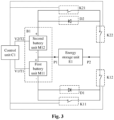
- Fig. 3 is a schematic structural diagram of a heating module according to a third embodiment of the present application, and Fig. 3 is different from fig. 2 in that: the first switch unit K1 further includes a switch device K12, and the second switch unit K2 further includes a switch device K22.
- one end of the switch device K12 is connected with the second end P2 of the energy storage unit E1, and the other end of the switch device K12 is respectively connected with the output end of the first unidirectional rectifier D1 and the switch device K11.
- One end of the switch device K22 is connected with the second end P2 of the energy storage unit E1, and the other end of the switch device K22 is respectively connected with the input end of the second unidirectional rectifier D2 and the switch device K21.
- the switch device K11 and the switch device K12 are synchronously turned on to switch on the discharging loop formed by the first battery unit M11, the energy storage unit E1, the switch device K12 and the switch device K11, and at this time, the first battery unit M11 charges the energy storage unit E1.
- the switch device K22 may be turned on to switch on the charging loop formed by the energy storage unit E1, the switch device K22, the second unidirectional rectifier D2 and the second battery unit M12, so that the state of charge of the first battery unit M11 is transferred to the second battery unit M12, and the electric energy generated during the transfer process of the electric power is utilized to heat the battery module.
- the switch device K21 and the switch device K22 may also be synchronously turned on to switch on the charging loop formed by the energy storage unit E1, the switch device K22, the switch device K21 and the second battery unit M12, so that the state of charge of the first battery unit M11 is transferred to the second battery unit M12, and the electric energy generated during the transfer process of the electric power is utilized to heat the battery module.
- the manner turning on the switching device K22 and the manner of synchronously turning on the switch device K21 and the switch device K22 can both realize the transfer of the state of charge in the first battery unit M11 to the second battery unit M12.
- the difference is that the heating current generated through the manner of synchronously turning on the switch device K21 and the switch device K22 is higher and the heating speed is faster.
- Those skilled in the art can choose a suitable control manner of switch according to actual needs.
- the switch device K21 and the switch device K22 are synchronously turned on to switch on the discharging loop formed by the second battery unit M12, the energy storage unit E1, the switch device K21 and the switch device K22, and at this time, the second battery unit M11 charges the energy storage unit E1.
- the switch device K12 may also be turned on to switch on the charging loop formed by the energy storage unit E1, the first battery unit M11, the first unidirectional rectifier D1 and the switch device K12, so that the state of charge of the second battery unit M12 is transferred to the first battery unit M11, and the electric energy generated during the transfer process of the electric power is utilized to heat the battery module.
- the manner turning on the switching device K22 and the manner of synchronously turning on the switch device K21 and the switch device K22 can both realize the transfer of the state of charge in the second battery unit M12 to the first battery unit M11.
- the difference is that the heating current generated through the manner of synchronously turning on the switch device K21 and the switch device K22 is higher and the heating speed is faster.
- Those skilled in the art can choose a suitable control manner of switch according to actual needs.
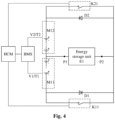
- Fig. 4 is a schematic structural diagram of a heating module according to a fourth embodiment of the present application, and Fig. 4 is different from Fig. 3 in that the control unit in Fig. 4 includes a BMS and a heat control module (Heat Control Module, HCM).
- HCM Heat Control Module
- Fig. 4 also shows a detailed structure of the battery module.
- the battery cells connected in series are assembled into the first battery unit M11 and the second battery unit M12, and the first battery unit M11 and the second battery unit are connected in series to form the battery module M1.
- the BMS instructs the HCM to turn on the switch device K11. Due to the reverse effect of the diode D1, at this time, the branch including the battery unit M11, the energy storage unit E1 and the diode D1 is switched off, and the battery unit M11, the energy storage unit E1 and the switch device K11 form a heating loop, and since there is no energy consumption device in the heating loop, that is, the current value in the heating loop will be quite large, the internal resistance in the battery unit M11 can be heated briefly by the large current.
- the BMS instructs the HCM to turn off the switch device K11, and at this time, the energy storage unit E1 is equivalent to a power source, where the end P2 is the positive electrode of the power source and the end P1 is the negative electrode of the power source. Since the switch device K11 and the switch device K21 are both turned off in a normal state, a heating loop including the energy storage unit E1, the diode D2 and the battery unit M12 can be formed. Since there is no energy-consuming device in the heating loop, the current value in the heating loop will be quite large, the energy storage unit E1 will be emptied in a short period, and the internal resistance in the battery unit M12 can be briefly heated by a large current.
- the BMS instructs the HCM to turn on the switch device K21. Due to the reverse effect of the diode D2, at this time, the branch including the battery unit M12, the energy storage unit E1 and the diode D2 is switched off, and the battery unit M12, the energy storage unit E1 and the switch device K21 form a heating loop, and since there is no energy consumption device in the heating loop, the current value in the heating loop will be quite large, the internal resistance in the battery unit M12 can be heated briefly by the large current.
- the BMS instructs the HCM to turn off the switch device K21, and at this time, the energy storage unit E1 is equivalent to a power source, where the end P1 is the positive electrode of the power source and the end P2 is the negative electrode of the power source. Since the switch device K11 and the switch device K21 are both turned off in a normal state, a heating loop including the energy storage unit E1, the diode D1 and the battery unit M11 can be formed. Since there is no energy-consuming device in the heating loop, the current value in the heating loop will be quite large, the energy storage unit E1 will be emptied in a short period, and the internal resistance in the battery unit M11 can also be briefly heated by a large current.
- the time required for the energy storage unit E1 to be fully charged may be accurately calculated according to a voltage across the energy storage unit E1 and a rated capacity, so as to determine a time length when the switch device K11 or the switch device K21 are turned on, and after the time length is reached, the BMS instructs the HCM to turn off the corresponding switch device.
- the time required for the energy storage unit E1 to be fully discharged may also be accurately calculated according to a voltage across the energy storage unit E1 and a rated capacity, so as to determine a time length when the switch device K11 or the switch device K21 are turned off, and after the time length is reached, the BMS instructs the HCM to turn on the corresponding switch device again.
- the BMS will continuously detect the temperatures and voltages of the respective battery units in the battery module during the heating process, and determine whether it is necessary to issue a control instruction to enable the heating according to the detected temperatures and voltages, while the HCM is only configured to drive the respective switch devices to perform corresponding operations according to the control instruction.
- the heating module may further include a temperature detection unit (not shown) configured to detect the temperatures of the respective battery units and transmit the temperatures to the BMS.
- the temperature detection unit may include contact temperature sensors attached to the respective battery units or non-contact temperature sensors provided near the surfaces of the respective battery units, which is not limited herein.
- the heating module may further include a voltage detection unit (not shown) configured to detect the voltages of the respective battery units and transmit the voltages to the BMS.
- the voltage detection module may include voltage detectors provided at the two ends of the respective battery units.
- the embodiments of the present application also provide a heating method for a battery module, used to heat the battery module of a battery pack, where the battery module includes a first battery unit and a second battery unit connected in series (see Fig. 1 ).
- the core concept of the heating method for a battery module includes: respectively constructing heating loops for the first battery unit and the second battery unit of the battery module having a demand for being heated, and transferring, between the first battery unit and the second battery unit, electric power in a battery unit with a higher state of charge to a battery unit with a lower state of charge, so that the battery module is in a state of being continuously charged and discharged and the battery module is heated by electric energy generated during continuous discharging and charging.
- any electrical device that can realize the transfer of the electric power in the battery unit with the higher state of charge between the first battery unit and the second battery unit to the battery unit with the lower state of charge is within the protection scope defined by the present application.
- the embodiments of the present application also provide a heating system for a battery module, used to heat the battery module of a battery pack, where the battery module includes a first battery unit and a second battery unit connected in series, and each battery unit includes at least one battery cell.
- the heating system includes one or more heating modules in one-to-one correspondence with one or more battery modules; where each heating module is a heating module as described above.
- the functional blocks shown in the block diagrams described above may be implemented in hardware, software, firmware, or a combination thereof.
- it may be, for example, an electronic circuit, an application specific integrated circuit (ASIC), a suitable firmware, a plug-in, a function card or the like.
- ASIC application specific integrated circuit
- elements of the embodiments of the present disclosure are programs or code segments used to perform required tasks.
- the programs or code segments may be stored in a machine-readable medium or transmitted over a transmission medium or a communication link via data signals carried in carriers.
- the "machine-readable medium” may include any medium capable of storing or transmitting information.
- Examples of the machine-readable medium include an electronic circuit, a semiconductor memory device, a ROM, a flash memory, an erasable ROM (EROM), a floppy disk, a CD-ROM, an optical disk, a hard disk, a fiber medium, a radio frequency (RF) link, and the like.
- the code segments may be downloaded via a computer network, such as the Internet, an intranet, or the like.
Landscapes
- Engineering & Computer Science (AREA)
- Electrochemistry (AREA)
- General Chemical & Material Sciences (AREA)
- Manufacturing & Machinery (AREA)
- Chemical & Material Sciences (AREA)
- Chemical Kinetics & Catalysis (AREA)
- Power Engineering (AREA)
- Automation & Control Theory (AREA)
- Electromagnetism (AREA)
- Physics & Mathematics (AREA)
- Secondary Cells (AREA)
- Battery Mounting, Suspending (AREA)
- Charge And Discharge Circuits For Batteries Or The Like (AREA)
- Electric Propulsion And Braking For Vehicles (AREA)
Description
- The present application relates to the field of battery technology, and in particular, to a heating module, a heating method for a battery module, and a heating system.
- When the temperature is lower than 0°C, the charging and discharging performance of a battery module will be greatly affected, for example, at minus 30°C, the charging and discharging performance of the battery module is extremely terrible, therefore, major battery module manufacturers and also vehicle manufactures are working to develop heating systems for battery module working in low temperature environments.
- In the prior art, a heating method for a battery module mainly includes: installing a resistance element between cells of the battery module or introducing a heating liquid between the battery cells, using electricity from the city power or the power grid to heat the aforementioned resistance element or the liquid, and using the heat generated by the heating to heat the battery module.
- Document 1 (
EP 2 413 455 A1 ) provides a battery heating circuit, wherein, the battery comprises a first battery (E1) and a second battery (E2), the heating circuit comprises a first switch unit (10), a second switch unit (20), a damping element R1, a damping element R2, a current storage element L1, a current storage element L2, a switching control module (100) and a charge storage element C, the first battery, damping element R1, current storage element L1, first switch unit (10) and charge storage element C are connected in series to form a first charging/discharging circuit; the second battery (E2), damping element R2, current storage element L2, charge storage element C and second switch unit (20) are connected in series to form a second charging/discharging circuit; when the charge storage element C is charged or discharges, the direction of charging/discharging current in the second charging/discharging circuit is reverse to the direction of charging/discharging current in the first charging/discharging circuit; the switching control module (100) is electrically connected with the first switch unit (10) and second switch unit (20), and is configured to control the electric energy flow between the first battery (E1), charge storage element C and second battery (E2). - Document 2 (
CN 105 762 434 A ) relates to a power supply system with a self-heating function. An alternative-current self-heating loop consists of a first electrical storage device, a second electrical storage device, a power electronic switch, a motor controller and a motor, wherein a motor neutral point is electrically connected with an equipotential point between the first electrical storage device and the second electrical storage device through the power electronic switch; the power electronic switch is connected between the motor neutral point and the equipotential point in series. - Embodiments of the present application provide a heating module, a heating method for a battery module, and a heating system, which can implement self-discharging and self-charging of a battery module and implement heating of the battery module in an environment where heating facilities supported by the city power or the power grid are not provided.
- In a first aspect, the embodiments of the present application provide a heating module configured to heat a battery module of a battery pack, where the battery module includes a first battery unit and a second battery unit connected in series, and the heating module includes: an energy storage unit, a first switch unit, a second switch unit and a control unit;
- a first end of the energy storage unit is connected with a positive electrode of the first battery unit, a negative electrode of the first battery unit is connected with an input end of the first switch unit, and an output end of the first switch unit is connected with a second end of the energy storage unit, so as to form a first heating loop;
- the first end of the energy storage unit is further connected with a negative electrode of the second battery unit, a positive electrode of the second battery unit is connected with an output end of the second switch unit, and an input end of the second switch unit is connected with the second end of the energy storage unit, so as to form a second heating loop;
- the control unit is configured to control the first switch unit or the second switch unit according to states of charge of the first battery unit and the second battery unit of the battery module having a demand for being heated, so as to sequentially switch on, between the first heating loop and the second heating loop, a heating loop where a battery unit with a higher state of charge is located and a heating loop where a battery unit with a lower state of charge is located, so that the battery module is in a state of being continuously charged and discharged and the battery module is heated with electric energy generated during the continuous discharging and charging.
- In a second aspect, the embodiments of the present application provide a heating method for a battery module, used to heat the battery module of a battery pack, where the battery module includes a first battery unit and a second battery unit connected in series. The heating method for a battery module includes: respectively constructing heating loops for the first battery unit and the second battery unit of the battery module having a demand for being heated, and transferring, between the first battery unit and the second battery unit, electric power in a battery unit with a higher state of charge to a battery unit with a lower state of charge, so that the battery module is in a state of being continuously charged and discharged and the battery module is heated with electric energy generated during the continuous discharging and charging.
- In a third aspect, the embodiments of the present application provide a heating system for heating at least one battery module, where the battery module includes a first battery unit and a second battery unit connected in series, each battery unit includes at least one battery cell, where the heating system includes at least one heating module that is in one-to-one correspondence with the at least one battery module, and each heating module is the heating module according the first aspect.
- As described above, according to the heating module in the embodiments of the present invention, substantially, two heating loops of the battery module are constructed based on the energy storage unit, the first switch unit and the second switch unit, and with the utilization of the control unit, the electric power in the battery unit with the higher state of charge can be transferred to the battery unit with the lower state of charge through the first heating loop and the second heating loop which are sequentially switched on, so that the battery module is in the state of being continuously discharged and charged (that is, self-discharging and self-charging), and the battery module is heated by the electric energy generated during the process of continuous discharging and charging. Through the above arrangement, the battery module can be heated without an external power source, such as electricity from the city power or the power grid, and the above arrangement is suitable for heating the battery module in the environment where heating facilities supported by the city power or the power grid are not provided and has high environmental adaptability.
- In addition, according to the embodiments of the present invention, the energy storage unit, the first switch unit, and the second switch unit can each be connected to the battery module as external devices, therefore, a battery heating function can be conveniently added to the vehicle simply by interfacing the heating module according to the embodiments of the present invention with a reserved wiring harness structure in the battery module without the need to disassemble and modify the battery module, which is suitable for the type of vehicle which does not have a battery heating function itself.
-
-
Fig. 1 is a schematic structural diagram of a heating module according to a first embodiment of the present application; -
Fig. 2 is a schematic structural diagram of a heating module according to a second embodiment of the present application; -
Fig. 3 is a schematic structural diagram of a heating module according to a third embodiment of the present application; -
Fig. 4 is a schematic structural diagram of a heating module according to a fourth embodiment of the present application. - Features and exemplary embodiments of various aspects of the present application will be described in detail below. In the following detailed description, many specific details are proposed in order to provide a comprehensive understanding of the present application.
- The inventor of the present application found that the heating system for battery module in the prior art needs to use electricity from the city power or the power grid, and cannot heat the battery module in an environment where heating facilities supported by the city power or the power grid are not provided.
- The embodiments of the present application provide a heating module, a heating method for a battery module, and a heating system. The heating module can self-discharge and selfcharge a battery pack to realize rapid heating of the battery pack.
- It should be noted that the battery pack according to the embodiments of the present application may include lithium ion batteries, lithium metal batteries, lead-acid batteries, nickel barrier batteries, nickel hydrogen batteries, lithium sulfur batteries, lithium air batteries or sodium ion batteries, which is not limited herein. In terms of scale, the battery pack may be a battery cell or a battery pack, which is not limited herein, or the battery pack may include at least one battery module, and each battery module includes at least one battery cell.
-
Fig. 1 is a schematic structural diagram of a heating module according to a first embodiment of the present application, which is configured to heat a battery module, where the heating module and the battery module is in one-to-one correspondence. - The battery pack shown in
FIG. 1 includes n battery modules (M1...Mn). Each battery module may include a first battery unit and a second battery unit connected in series, and each battery unit may include at least one battery cell. Taking the battery module M1 as an example, the battery module M1 includes a first battery unit M11 and a second battery unit M12 connected in series. -
Fig. 1 also shows a heating module H1 corresponding to the battery module M1 and a heating module Hn corresponding to the battery module Mn. As shown inFig. 1 , the heating module H1 includes an energy storage unit E1, a first switch unit K1, a second switch unit K2 and acontrol unit C 1. - A first end P1 of the energy storage unit E1 is connected with a positive electrode of the first battery unit M11, a negative electrode of the first battery unit M11 is connected with an input end (see the indication of arrow in
Fig. 1 ) of the first switch unit K1, and an output end of the first switch unit K1 is connected with a second end P2 of the energy storage unit E1, so as to form a first heating loop. - The first end P1 of the energy storage unit E1 is further connected with a negative electrode of the second battery unit M12, a positive electrode of the second battery unit M12 is connected with an output end (see the indication of arrow in
Fig. 1 ) of the second switch unit K2, and an input end of the second switch unit K2 is connected with the second end P2 of the energy storage unit E1, so as to form a second heating loop. - Exemplarily, the energy storage unit E1 may be an energy storage device with charging and discharging characteristics, such as a large-capacity capacitor, which is not limited herein.
- With reference to
Fig. 1 , it can be seen that the first battery unit M11, the energy storage unit E1 and the first switch unit K1 form the first heating loop, and if the storage of the energy storage unit E1 is empty, after the first heating loop is switched on, the first battery unit M11 can charge the energy storage unit E1; and if the storage of the energy storage unit E1 is full, after the first heating loop is switched on, the energy storage unit E1 can discharge the first battery unit M11. - With reference to
Fig. 1 , it can also be seen that the second battery unit M12, the energy storage unit E1 and the second switch unit K2 form the second heating loop, similarly, if the storage of the energy storage unit E1 is empty, after the second heating loop is switched on, the second battery unit M12 can charge the energy storage unit E1; and if the storage of the energy storage unit E1 is full, after the second heating loop is switched on, the energy storage unit E1 can charge the second battery unit M12. - As described above, according to the heating module in the embodiments of the present application, substantially, two heating loops of the battery module are constructed based on the energy storage unit E1, the first switch unit K1 and the second switch unit K2, and with the utilization of the control unit C1, the electric power in the battery unit with the higher state of charge can be transferred to the battery unit with the lower state of charge through the first heating loop and the second heating loop which are sequentially switched on, so that the battery module is in the state of being continuously discharged and charged (that is, self-discharging and self -charging), and the battery module is heated by the electric energy generated during the process of continuous discharging and charging. Through the above arrangement, the battery module can be heated without an external power source, such as electricity from the city power or the power grid, and the above arrangement is suitable for heating the battery module in the environment where heating facilities supported by the city power or the power grid are not provided and has high environmental adaptability.
- Exemplarily, a resistance element used to heat the battery module may include a PTC plate and/or a heating film disposed on the battery module, for example, disposed between battery cells, and the resistance element may also a heating liquid introduced into the battery cells, which is not limited herein. For a resistance module that is not provided with the above-mentioned resistance element, the heat generated by heating the internal resistance of the batteries connected to respective heating loops can be used to heat the battery module.
- In an optional embodiment, a wire harness or copper bar extends between the positive electrode of the first battery unit M11 and the negative electrode of the second battery unit M12, and the first end P1 of the energy storage unit E1 is connected with the wire harness or the copper bar.
- According to the embodiments of the present application, the energy storage unit, the first switch unit, and the second switch unit can each be connected to the battery module as external devices, therefore, a battery heating function can be conveniently added to the vehicle simply by interfacing the heating module according to the embodiments of the present application with a reserved wiring harness structure in the battery module without the need to disassemble and modify the battery module, which is suitable for the type of vehicle which does not have a battery heating function itself.
- It should be noted that, according to the embodiment of the present application, the control unit C1 may be arranged in a distributed manner, that is, there is one control unit provided for each heating module; or alternatively, the control unit C1 may be arranged in an integrated manner, that is, one control unit is shared between multiple heating modules.
- In an optional embodiment, the control unit C1 may also be integrated in a battery management system (Battery Management System, BMS), so as to avoid increasing the cost of hardware modification.
-
Fig. 2 is a schematic structural diagram of a heating module according to a second embodiment of the present application, showing the specific components of the first switch unit K1 and the second switch unit K2 inFig. 1 . - As shown in
Fig. 2 , the first switch unit K1 includes a first unidirectional rectifier D1 and a switch device K11, and the second switch unit K2 includes a second unidirectional rectifier D2 and a switch device K21. - An input end of the first unidirectional rectifier D1 is connected with the negative electrode of the first battery unit M11, an output end of the first unidirectional rectifier D1 is connected with the second end P2 of the energy storage unit E1, the switch device K11 is connected in parallel to the two ends of the first unidirectional rectifier D1, and the first end of the energy storage unit E1 is connected with the positive electrode of the first battery unit M11.
- An input end of the second unidirectional rectifier D2 is connected with the second end P2 of the energy storage unit E1, an output end of the second unidirectional rectifier D2 is connected with the positive electrode of the second battery unit M12, the second switch device K21 is connected in parallel to the two ends of the second unidirectional rectifier D2, and the first end of the energy storage unit E1 is further connected with the negative electrode of the second battery unit M12.
- As can be seen from
Figure 2 , when the switch device K11 is turned on, due to the reverse effect of the first unidirectional rectifier D1, the first battery unit M11 and the energy storage unit E1 form a heating loop, and at this time, the first battery unit M11 charges the energy storage unit E1. After the charging is completed, the energy storage unit E1 is equivalent to a power source, where the end P2 is the positive electrode of the power source, and the end P1 is the negative electrode of the power source. Since the switch device K11 and the switching device K21, when in a normal state, are both turned off, when the switch device K11 is turned off, the energy storage unit E1, the second unidirectional rectifier D2 and the second battery unit M12 form a heating loop, and the energy storage unit E1 charges the second battery unit M12 and transfers the electric power in the first battery unit M11 to the second battery unit M12, where the electric energy generated in the transfer process of the electric power is used to heat the battery module. - Similarly, when the switch device K21 is turned on, due to the reverse effect of the second unidirectional rectifier D2, the second battery unit M12 and the energy storage unit E1 form a heating loop, and at this time, the second battery unit M12 charges the energy storage unit E1. After the charging is completed, the energy storage unit E1 is equivalent to a power source, where the end P1 is the positive electrode of the power source, and the end P2 is the negative electrode of the power source. Since the switch device K11 and the switching device K21, when in a normal state, are both turned off, when the switch device K21 is turned off, the energy storage unit E1, the first unidirectional rectifier D1 and the first battery unit M11 form a heating loop, and the energy storage unit E1 charges the first battery unit M11 and transfers the electric power in the second battery unit M12 to the first battery unit M11, where the electric energy generated in the transfer process of the electric power is used to heat the battery module.
- Considering the states of charge in the same battery module, that is, the remaining SOC (State of Charge) electric power may be different, the operating principles of the switch devices K11 and K12 in
Fig. 3 are described in detail below based on the states of charge of the first battery unit M11 and the second battery unit M12, that is, the transfer direction of electric power between the first battery unit M11 and the second battery unit M12. - In the first transfer mode of electric power, when the state of charge of the first battery unit M11 is higher than the state of charge of the second battery unit M12 of the battery module with a demand for being heated, the switch device K11 is turned on to switch on a heating loop formed by the first battery unit M11, the energy storage unit E1 and the switch device K11, and the switch device K11 is turned off to switch on a heating loop formed by the energy storage unit E1, the second unidirectional rectifier D2 and the second battery unit M12, so that the state of charge of the first battery unit M11 is transferred the second battery unit M12.
- In the second transfer mode of electric power, when the state of charge of the first battery unit M11 is lower than the state of charge of the second battery unit M12 of the battery module with a demand for being heated, the switch device K21 is turned on to switch on a heating loop formed by the second battery unit M12, the energy storage unit E1 and the switch device K21, and the switch device K21 is turned off to switch on a heating loop formed by the energy storage unit E1, the first unidirectional rectifier D1 and the first battery unit M11, so that the state of charge of the second battery unit M12 is transferred the first battery unit M11.
- Combined with Joule's law: Q = I 2 RxT, it can be seen that the heat Q produced in the heating loop is proportional to the current value I2 and resistance value Rx of the heating circuit, and the heating time T, where the current value I in the heating loop has the largest influence factor on the heat Q.
- The heating element in the each heating loops in
Fig. 2 only involves the internal resistance of the battery, therefore, the positive electrode and the negative electrode in the heating loop are instantly short-circuited when any heating loop is switched on, thereby generating a large current that generates a lot of heat when flowing through the internal resistance of the battery in each heating loop, and rapidly heats the battery pack. Therefore, compared with the traditional heating system for battery, the heating module in the embodiment of the present application can shorten the heating time for battery and improve the user's battery heating experience. - The switch device K11 and the switch device K21 can be components that can realize the switching function, for example, the switch device K11 and the switch device K21 may be mechanical switches such as single-pole single-throw switches or single-pole double-throw switches, or electronic switches such as triode and MOS transistors (metal-oxide-semiconductor field effect transistors), which are not limited herein.
- The first unidirectional rectifier D1 and the second unidirectional rectifier D2 may be components that can realize a unidirectional conduction function, such as diodes, which are not limited herein.
-
Fig. 3 is a schematic structural diagram of a heating module according to a third embodiment of the present application, andFig. 3 is different fromfig. 2 in that: the first switch unit K1 further includes a switch device K12, and the second switch unit K2 further includes a switch device K22. - As shown in
Fig. 3 , one end of the switch device K12 is connected with the second end P2 of the energy storage unit E1, and the other end of the switch device K12 is respectively connected with the output end of the first unidirectional rectifier D1 and the switch device K11. One end of the switch device K22 is connected with the second end P2 of the energy storage unit E1, and the other end of the switch device K22 is respectively connected with the input end of the second unidirectional rectifier D2 and the switch device K21. - The operating principles of the switch devices K11, K12, K21, and K23 in
Fig. 3 are described in detail below based on the remaining electric power of the first battery unit M11 and the second battery unit M12, that is, the transfer direction of electric power between the first battery unit M11 and the second battery unit M12. - In the first transfer mode of electric power, when the state of charge of the first battery unit M11 is higher than the state of charge of the second battery unit M12 of the battery module with a demand for being heated, the switch device K11 and the switch device K12 are synchronously turned on to switch on the discharging loop formed by the first battery unit M11, the energy storage unit E1, the switch device K12 and the switch device K11, and at this time, the first battery unit M11 charges the energy storage unit E1.
- After the charging is completed, the switch device K22 may be turned on to switch on the charging loop formed by the energy storage unit E1, the switch device K22, the second unidirectional rectifier D2 and the second battery unit M12, so that the state of charge of the first battery unit M11 is transferred to the second battery unit M12, and the electric energy generated during the transfer process of the electric power is utilized to heat the battery module.
- Alternatively, after the charging is completed, the switch device K21 and the switch device K22 may also be synchronously turned on to switch on the charging loop formed by the energy storage unit E1, the switch device K22, the switch device K21 and the second battery unit M12, so that the state of charge of the first battery unit M11 is transferred to the second battery unit M12, and the electric energy generated during the transfer process of the electric power is utilized to heat the battery module.
- It should be noted that, the manner turning on the switching device K22 and the manner of synchronously turning on the switch device K21 and the switch device K22 can both realize the transfer of the state of charge in the first battery unit M11 to the second battery unit M12. The difference is that the heating current generated through the manner of synchronously turning on the switch device K21 and the switch device K22 is higher and the heating speed is faster. Those skilled in the art can choose a suitable control manner of switch according to actual needs.
- In the second transfer mode of electric power, when the state of charge of the first battery unit M11 is lower than the state of charge of the second battery unit M12 of the battery module with a demand for being heated, the switch device K21 and the switch device K22 are synchronously turned on to switch on the discharging loop formed by the second battery unit M12, the energy storage unit E1, the switch device K21 and the switch device K22, and at this time, the second battery unit M11 charges the energy storage unit E1.
- Alternatively, after the charging is completed, the switch device K12 may also be turned on to switch on the charging loop formed by the energy storage unit E1, the first battery unit M11, the first unidirectional rectifier D1 and the switch device K12, so that the state of charge of the second battery unit M12 is transferred to the first battery unit M11, and the electric energy generated during the transfer process of the electric power is utilized to heat the battery module.
- It should be noted that, the manner turning on the switching device K22 and the manner of synchronously turning on the switch device K21 and the switch device K22 can both realize the transfer of the state of charge in the second battery unit M12 to the first battery unit M11. The difference is that the heating current generated through the manner of synchronously turning on the switch device K21 and the switch device K22 is higher and the heating speed is faster. Those skilled in the art can choose a suitable control manner of switch according to actual needs.
-
Fig. 4 is a schematic structural diagram of a heating module according to a fourth embodiment of the present application, andFig. 4 is different fromFig. 3 in that the control unit inFig. 4 includes a BMS and a heat control module (Heat Control Module, HCM). -
Fig. 4 also shows a detailed structure of the battery module. The battery cells connected in series are assembled into the first battery unit M11 and the second battery unit M12, and the first battery unit M11 and the second battery unit are connected in series to form the battery module M1. - In the following, referring to
Fig. 3 , the working principle of the heating module in the embodiment of the present application is described in detail by taking a unidirectional rectifier as diode as an example: - (1) After the BMS is powered on, the BMS determines whether the battery module M1 has a demand for being heated according to a temperature T1 of the battery unit M11 and a temperature T2 of the battery unit M12. If any one of the temperature T1 and the temperature T2 is lower than a preset temperature threshold T0, it is determined that the battery module M1 has a demand for being heated.
- (2) If the battery module M1 has a demand for being heated, the BMS wakes up the HCM through the CAN protocol. Since the HCM involves a high-voltage part and a low-voltage part, in order to ensure that the housing of the heating device is not electrically charged, the insulation resistance between the high-voltage side ground and the low-voltage side ground of the HCM may be detected to ensure a short circuit does not occur between the high-voltage side ground and the low-voltage side ground. In addition, the BMS may also be detected for insulation, and then the HCM and the BMS exchange their respective situations regarding insulation resistance through CAN. When it is determined that the insulation resistance of the BMS and the HCM is correct, the HCM determines whether the switch device K11 and the switch device K21 are both turned off.
- (3) The BMS calculates the state of charge (SOC1) of the battery unit M11 based on a voltage V1, and calculates the state of charge (SOC2) of the battery unit M12 based on a voltage V2.
- (4) The BMS transmits a control signal, to the HCM, for driving the switch device K11 or the second switch device K21 to turn on or turn off according to a comparison result of SOC1 and SOC2.
- As a first comparison result, if SOC1 > SOC2, the BMS instructs the HCM to turn on the switch device K11. Due to the reverse effect of the diode D1, at this time, the branch including the battery unit M11, the energy storage unit E1 and the diode D1 is switched off, and the battery unit M11, the energy storage unit E1 and the switch device K11 form a heating loop, and since there is no energy consumption device in the heating loop, that is, the current value in the heating loop will be quite large, the internal resistance in the battery unit M11 can be heated briefly by the large current.
- After the energy storage unit E1 is fully charged, the BMS instructs the HCM to turn off the switch device K11, and at this time, the energy storage unit E1 is equivalent to a power source, where the end P2 is the positive electrode of the power source and the end P1 is the negative electrode of the power source. Since the switch device K11 and the switch device K21 are both turned off in a normal state, a heating loop including the energy storage unit E1, the diode D2 and the battery unit M12 can be formed. Since there is no energy-consuming device in the heating loop, the current value in the heating loop will be quite large, the energy storage unit E1 will be emptied in a short period, and the internal resistance in the battery unit M12 can be briefly heated by a large current.
- As a second comparison result, if SOC1 < SOC2, the BMS instructs the HCM to turn on the switch device K21. Due to the reverse effect of the diode D2, at this time, the branch including the battery unit M12, the energy storage unit E1 and the diode D2 is switched off, and the battery unit M12, the energy storage unit E1 and the switch device K21 form a heating loop, and since there is no energy consumption device in the heating loop, the current value in the heating loop will be quite large, the internal resistance in the battery unit M12 can be heated briefly by the large current.
- After the energy storage unit E1 is fully charged, the BMS instructs the HCM to turn off the switch device K21, and at this time, the energy storage unit E1 is equivalent to a power source, where the end P1 is the positive electrode of the power source and the end P2 is the negative electrode of the power source. Since the switch device K11 and the switch device K21 are both turned off in a normal state, a heating loop including the energy storage unit E1, the diode D1 and the battery unit M11 can be formed. Since there is no energy-consuming device in the heating loop, the current value in the heating loop will be quite large, the energy storage unit E1 will be emptied in a short period, and the internal resistance in the battery unit M11 can also be briefly heated by a large current.
- In an optional embodiment, the time required for the energy storage unit E1 to be fully charged may be accurately calculated according to a voltage across the energy storage unit E1 and a rated capacity, so as to determine a time length when the switch device K11 or the switch device K21 are turned on, and after the time length is reached, the BMS instructs the HCM to turn off the corresponding switch device.
- Similarly, the time required for the energy storage unit E1 to be fully discharged may also be accurately calculated according to a voltage across the energy storage unit E1 and a rated capacity, so as to determine a time length when the switch device K11 or the switch device K21 are turned off, and after the time length is reached, the BMS instructs the HCM to turn on the corresponding switch device again.
- It should be noted that, the BMS will continuously detect the temperatures and voltages of the respective battery units in the battery module during the heating process, and determine whether it is necessary to issue a control instruction to enable the heating according to the detected temperatures and voltages, while the HCM is only configured to drive the respective switch devices to perform corresponding operations according to the control instruction.
- In an optional embodiment, the heating module may further include a temperature detection unit (not shown) configured to detect the temperatures of the respective battery units and transmit the temperatures to the BMS. Specifically, the temperature detection unit may include contact temperature sensors attached to the respective battery units or non-contact temperature sensors provided near the surfaces of the respective battery units, which is not limited herein.
- In an optional embodiment, the heating module may further include a voltage detection unit (not shown) configured to detect the voltages of the respective battery units and transmit the voltages to the BMS. Specifically, the voltage detection module may include voltage detectors provided at the two ends of the respective battery units.
- The embodiments of the present application also provide a heating method for a battery module, used to heat the battery module of a battery pack, where the battery module includes a first battery unit and a second battery unit connected in series (see
Fig. 1 ). - The core concept of the heating method for a battery module includes: respectively constructing heating loops for the first battery unit and the second battery unit of the battery module having a demand for being heated, and transferring, between the first battery unit and the second battery unit, electric power in a battery unit with a higher state of charge to a battery unit with a lower state of charge, so that the battery module is in a state of being continuously charged and discharged and the battery module is heated by electric energy generated during continuous discharging and charging.
- That is to say, any electrical device that can realize the transfer of the electric power in the battery unit with the higher state of charge between the first battery unit and the second battery unit to the battery unit with the lower state of charge is within the protection scope defined by the present application.
- The embodiments of the present application also provide a heating system for a battery module, used to heat the battery module of a battery pack, where the battery module includes a first battery unit and a second battery unit connected in series, and each battery unit includes at least one battery cell.
- The heating system includes one or more heating modules in one-to-one correspondence with one or more battery modules; where each heating module is a heating module as described above.
- It should be noted that, the functional blocks shown in the block diagrams described above may be implemented in hardware, software, firmware, or a combination thereof. When implemented in hardware, it may be, for example, an electronic circuit, an application specific integrated circuit (ASIC), a suitable firmware, a plug-in, a function card or the like. When implemented in software, elements of the embodiments of the present disclosure are programs or code segments used to perform required tasks. The programs or code segments may be stored in a machine-readable medium or transmitted over a transmission medium or a communication link via data signals carried in carriers. The "machine-readable medium" may include any medium capable of storing or transmitting information. Examples of the machine-readable medium include an electronic circuit, a semiconductor memory device, a ROM, a flash memory, an erasable ROM (EROM), a floppy disk, a CD-ROM, an optical disk, a hard disk, a fiber medium, a radio frequency (RF) link, and the like. The code segments may be downloaded via a computer network, such as the Internet, an intranet, or the like.
- The above description is only for the specific embodiments of the present application, but the scope of the present application is not limited thereto, and any changes or substitutions that can be easily conceived by those skilled in the art within the technical scope disclosed by the present application should be covered within the scope of the present application. Therefore, the protection scope of the present application shall be defined by the protection scope of the claims.
Claims (9)
- A heating module (H1) configured to heat a battery module (M1), wherein the battery module (M1) comprises a first battery unit (M11) and a second battery unit (M12) connected in series, and the heating module (H1) is characterized by comprising: an energy storage unit (E1), a first switch unit (K1), a second switch unit (K2) and a control unit (C1);a first end (P1) of the energy storage unit (E1) is connectable to a positive electrode of the first battery unit (M11), a negative electrode of the first battery unit (M11) is connectable to an input end of the first switch unit (K1), and an output end of the first switch unit (K1) is connected with a second end (P2) of the energy storage unit (E1), so as to form a first heating loop;the first end (P1) of the energy storage unit (E1) is further connectable to a negative electrode of the second battery unit (M12), a positive electrode of the second battery unit (M12) is connectable to an output end of the second switch unit (K2), and an input end of the second switch unit (K2) is connected with the second end (P2) of the energy storage unit (E1), so as to form a second heating loop;the first switch unit (K1) comprises a first unidirectional rectifier (D1) and a first switch device (K11), and the second switch unit (K2) comprises a second unidirectional rectifier (D2) and a second switch device (K21);an input end of the first unidirectional rectifier (D1) is connectable to the negative electrode of the first battery unit (M11), an output end of the first unidirectional rectifier (D1) is connected with the second end (P2) of the energy storage unit (E1), and the first switch device (K11) is connected in parallel to the two ends of the first unidirectional rectifier (D1);an input end of the second unidirectional rectifier (D2) is connected with the second end (P2) of the energy storage unit (E1), an output end of the second unidirectional rectifier (D2) is connectable to the positive electrode of the second battery unit (M12), and the second switch device (K21) is connected in parallel to the two ends of the second unidirectional rectifier (D2);the control unit (C1) is configured to:when the battery module (M1) has a demand for being heated and the state of charge of the first battery unit (M11) is higher than the state of charge of the second battery unit (M12), turn on the first switch device (K11) to switch on a discharging loop formed by the first battery unit (M11), the energy storage unit (E1) and the first switch device (K11), and turn off the first switch device (K11) to switch on a charging loop formed by the energy storage unit (E1), the second unidirectional rectifier (D2) and the second battery unit (M12); orwhen the battery module (M1) has a demand for being heated and the state of charge of the first battery unit (M11) is lower than the state of charge of the second battery unit (M12), turn on the second switch device (K21) to switch on a discharging loop formed by the second battery unit (M12), the energy storage unit (E1) and the second switch device (K21), and turn off the second switch device (K21) to switch on a charging loop formed by the energy storage unit (E1), the first unidirectional rectifier (D1) and the first battery unit (M11).
- The heating module (H1) according to claim 1, wherein the first switch unit (K1) further comprises a third switch device (K12), and the second switch unit (K2) further comprises a fourth switch device (K22); wherein,one end of the third switch device (K12) is connected with the second end (P2) of the energy storage unit (E1), and the other end of the third switch device (K12) is respectively connected with the output end of the first unidirectional rectifier (D1) and the first switch device (K11);one end of the fourth switching device is connected to the second end (P2) of the energy storage unit (E1), and the other end of the fourth switching device is respectively connected to the input end of the second unidirectional rectifier (D2) and the second switching device;the control unit (C1) is further configured to:when the battery module (M1) has a demand for being heated and the state of charge of the first battery unit (M11) is higher than the state of charge of the second battery unit (M12), synchronously turn on the first switch device (K11) and the third switch device (K12) to switch on a discharging loop formed by the first battery unit (M11), the energy storage unit (E1), the first switch device (K11) and the third switch device (K12), and turn on the fourth switch device (K22) to switch on a charging loop formed by the energy storage unit (E1), the fourth switch device (K22), the second unidirectional rectifier (D2) and the second battery unit (M12); orwhen the battery module (M1) has a demand for being heated and the state of charge of the first battery unit (M11) is lower than the state of charge of the second battery unit (M12), synchronously turn on the second switch device (K21) and the fourth switch device (K22) to switch on a discharging loop formed by the second battery unit (M12), the energy storage unit (E1), the second switch device (K21) and the fourth switch device (K22), and turn on the third switch device (K12) to switch on a charging loop formed by the energy storage unit (E1), the first battery unit (M11), the first unidirectional rectifier (D1) and the third switch device (K12).
- The heating module (H1) according to claim 2, wherein the control unit (C1) is further configured to:after the discharging loop formed by the first battery unit (M11), the energy storage unit (E1), the first switch device (K11) and the third switch device (K12) is switched on, synchronously turn on the second switch device (K21) and the fourth switch device (K22) to switch on a charging loop formed by the energy storage unit (E1), the fourth switch device (K22), the second switch device (K21) and the second battery unit (M12); or;after the discharging loop formed by the second battery unit (M12), the energy storage unit (E1), the second switch device (K21) and the fourth switch device (K22) is switched on, synchronously turn on the first switch device (K11) and the third switch device (K12) to switch on a charging loop formed by the energy storage unit (E1), the third switch device (K12), the first switch device (K11) and the first battery unit (M11).
- The heating module (H1) according to any one of claims 1 to 3, wherein the first unidirectional rectifier (D1) and the second unidirectional rectifier (D2) are diodes.
- The heating module (H1) according to claim 1, wherein the heating module (H1) further comprises a voltage detection unit configured to detect voltages of respective battery units and transmit the voltages to the control unit (C1); the control unit (C1) is configured to calculate states of charge of the respective battery units according to the voltages.
- The heating module (H1) according to claim 1, wherein the heating module (H1) further comprises a temperature detection unit configured to detect temperatures of respective battery units and transmit the temperatures to the control unit (C1); the control unit (C1) is configured to determine, when a temperature of any battery unit is lower than a preset threshold, the battery module (M1) including the battery unit has a demand for being heated.
- The heating module (H1) according to claim 1, wherein under a condition that a wire harness or a copper bar extends between the positive electrode of the first battery unit (M11) and the negative electrode of the second battery unit (M12), the first end (P1) of the energy storage unit (E1) is connected with the wire harness or the copper bar.
- A heating method for a battery module (M1), used to heat the battery module (M1), wherein the battery module (M1) comprises a first battery unit (M11) and a second battery unit (M12) connected in series, and the heating method is applied to the heating module according to any one of claims 1 to 7 and characterized by comprising:
when the battery module (M1) has a demand for being heated, respectively constructing heating loops for the first battery unit (M11) and the second battery unit (M12), and transferring, between the first battery unit (M11) and the second battery unit (M12), electric power in a battery unit with a higher state of charge to a battery unit with a lower state of charge, so that the battery module (M1) is in a state of being continuously charged and discharged and the battery module (M1) is heated by electric energy generated during continuous discharging and charging. - A heating system for heating at least one battery module (M1), wherein the battery module (M1) comprises a first battery unit (M11) and a second battery unit (M12) connected in series, each battery unit comprises at least one battery cell, and the heating system is characterized by comprising at least one heating module corresponding to the at least one battery module, wherein each heating module is the heating module (H1) according to any one of claims 1 to 7.
Applications Claiming Priority (2)
| Application Number | Priority Date | Filing Date | Title |
|---|---|---|---|
| CN201810495084.9A CN108736107B (en) | 2018-05-22 | 2018-05-22 | Heating module and battery pack heating method, heating system |
| PCT/CN2018/124624 WO2019223312A1 (en) | 2018-05-22 | 2018-12-28 | Heating module, and heating method and heating system for battery pack |
Publications (3)
| Publication Number | Publication Date |
|---|---|
| EP3787097A1 EP3787097A1 (en) | 2021-03-03 |
| EP3787097A4 EP3787097A4 (en) | 2021-07-14 |
| EP3787097B1 true EP3787097B1 (en) | 2024-01-03 |
Family
ID=63938682
Family Applications (1)
| Application Number | Title | Priority Date | Filing Date |
|---|---|---|---|
| EP18919718.9A Active EP3787097B1 (en) | 2018-05-22 | 2018-12-28 | Heating module, heating method for battery module, and heating system |
Country Status (6)
| Country | Link |
|---|---|
| US (1) | US10957950B1 (en) |
| EP (1) | EP3787097B1 (en) |
| CN (1) | CN108736107B (en) |
| FI (1) | FI3787097T3 (en) |
| HU (1) | HUE065862T2 (en) |
| WO (1) | WO2019223312A1 (en) |
Families Citing this family (23)
| Publication number | Priority date | Publication date | Assignee | Title |
|---|---|---|---|---|
| CN108736107B (en) * | 2018-05-22 | 2020-06-23 | 宁德时代新能源科技股份有限公司 | Heating module and battery pack heating method, heating system |
| CN108666713B (en) * | 2018-05-22 | 2020-05-05 | 宁德时代新能源科技股份有限公司 | Battery pack heating device for double-vehicle heating and control method |
| CN110970689B (en) * | 2018-11-30 | 2020-12-29 | 宁德时代新能源科技股份有限公司 | Battery heating system and method |
| CN112019394A (en) * | 2019-05-31 | 2020-12-01 | 联合汽车电子有限公司 | Test circuit, test device and test method for evaluating CAN bus signal quality |
| TWI691142B (en) * | 2019-06-20 | 2020-04-11 | 廣達電腦股份有限公司 | Smart battery device and charging method |
| CN110126693B (en) * | 2019-06-24 | 2024-08-06 | 长春市夸克普精汽车电子有限责任公司 | Seat heating device and seat |
| DE102019121277A1 (en) | 2019-08-07 | 2021-02-11 | Bayerische Motoren Werke Aktiengesellschaft | Multi-voltage storage system for an at least partially electrically powered vehicle |
| KR102699008B1 (en) | 2019-08-30 | 2024-08-26 | 현대자동차주식회사 | System and method for increasing temperature of battery |
| CN113133138B (en) * | 2019-12-31 | 2022-09-30 | 广东美的白色家电技术创新中心有限公司 | Heating circuit |
| KR20220026970A (en) | 2020-08-26 | 2022-03-07 | 현대자동차주식회사 | System and method for increasing temperature of battery |
| CN112382806B (en) * | 2020-11-11 | 2021-11-05 | 北京理工大学 | Lithium-ion power battery system and control method for realizing internal and external combined heating |
| KR20220089347A (en) | 2020-12-21 | 2022-06-28 | 현대자동차주식회사 | System and method for increasing temperature of battery |
| CN112952882B (en) * | 2021-04-13 | 2024-04-12 | 阳光电源股份有限公司 | Energy storage conversion system, control method of energy storage conversion system, and computer-readable storage medium |
| CN113489090B (en) * | 2021-06-25 | 2023-07-21 | 广汽本田汽车有限公司 | Battery charging control system, method, device and storage medium |
| WO2023070553A1 (en) * | 2021-10-29 | 2023-05-04 | 宁德时代新能源科技股份有限公司 | Power battery heating method and heating system |
| CN216354438U (en) * | 2021-10-29 | 2022-04-19 | 宁德时代新能源科技股份有限公司 | Self-heating control circuit and system |
| EP4276980A4 (en) * | 2021-11-15 | 2025-03-26 | Contemporary Amperex Technology (Hong Kong) Limited | Battery heating circuit and control method thereof, battery, and electric vehicle |
| CN216389527U (en) | 2021-11-25 | 2022-04-26 | 宁德时代新能源科技股份有限公司 | Battery heating system, battery pack and electric device |
| EP4227150A4 (en) * | 2021-12-27 | 2023-12-13 | Contemporary Amperex Technology Co., Limited | METHOD AND DEVICE FOR BATTERY HEATING CONTROL AND ELECTRONIC DEVICE |
| WO2024092446A1 (en) * | 2022-10-31 | 2024-05-10 | 宁德时代新能源科技股份有限公司 | Battery heating control method and control apparatus |
| CN116545052A (en) * | 2023-03-29 | 2023-08-04 | 华为数字能源技术有限公司 | Power supply device and energy storage system |
| CN119261676B (en) * | 2023-07-04 | 2026-01-13 | 宁德时代新能源科技股份有限公司 | Power battery system, heating control method, heating control device, power battery apparatus, and storage medium |
| CN118281424B (en) * | 2023-07-31 | 2025-11-04 | 比亚迪股份有限公司 | Battery systems, battery packs and electric vehicles |
Family Cites Families (16)
| Publication number | Priority date | Publication date | Assignee | Title |
|---|---|---|---|---|
| JP5453877B2 (en) * | 2009-03-31 | 2014-03-26 | トヨタ自動車株式会社 | Power storage device temperature rising system |
| US9214706B2 (en) * | 2010-07-30 | 2015-12-15 | Byd Company Limited | Battery heating circuits and methods using resonance components in series based on charge balancing |
| CN102082306B (en) * | 2010-07-30 | 2012-11-21 | 比亚迪股份有限公司 | Heating circuit of battery |
| CN103419666B (en) * | 2012-05-22 | 2016-03-02 | 比亚迪股份有限公司 | The power system of electronlmobil, electronlmobil and heating of battery method |
| CN104282965B (en) * | 2013-10-11 | 2016-08-17 | 同济大学 | A kind of lithium ion battery self-heating apparatus and method |
| CN203631703U (en) * | 2013-12-13 | 2014-06-04 | 惠州市亿能电子有限公司 | Control circuit of electric car battery heating system |
| JP6280421B2 (en) * | 2014-04-07 | 2018-02-14 | 本田技研工業株式会社 | Battery heating system |
| CN105529508A (en) * | 2014-06-30 | 2016-04-27 | 比亚迪股份有限公司 | Battery heating systems, battery installations and electric vehicles |
| CN105356007B (en) * | 2014-08-22 | 2018-03-23 | 上海通用汽车有限公司 | It is a kind of to the pre-warmed method and system of battery pack |
| DE102015117744A1 (en) * | 2015-10-19 | 2017-04-20 | Dr. Ing. H.C. F. Porsche Aktiengesellschaft | battery system |
| CN106608195A (en) * | 2015-10-23 | 2017-05-03 | 北汽福田汽车股份有限公司 | Electric vehicle and battery heating method and system thereof |
| CN105680114B (en) * | 2016-01-07 | 2017-11-03 | 北京北交新能科技有限公司 | A kind of quick self-heating method of the low temperature of lithium ion battery |
| CN105762434B (en) * | 2016-05-16 | 2018-12-07 | 北京理工大学 | A kind of power-supply system and vehicle with self heating function |
| CN106376104B (en) * | 2016-09-07 | 2020-12-08 | 合肥工业大学智能制造技术研究院 | Battery self-discharge heating circuit |
| CN107394294B (en) * | 2017-07-20 | 2018-09-04 | 浙江谷神能源科技股份有限公司 | For the systems of lithium ion battery charge and discharge, control device and associated method |
| CN108736107B (en) * | 2018-05-22 | 2020-06-23 | 宁德时代新能源科技股份有限公司 | Heating module and battery pack heating method, heating system |
-
2018
- 2018-05-22 CN CN201810495084.9A patent/CN108736107B/en active Active
- 2018-12-28 EP EP18919718.9A patent/EP3787097B1/en active Active
- 2018-12-28 WO PCT/CN2018/124624 patent/WO2019223312A1/en not_active Ceased
- 2018-12-28 FI FIEP18919718.9T patent/FI3787097T3/en active
- 2018-12-28 HU HUE18919718A patent/HUE065862T2/en unknown
-
2020
- 2020-11-17 US US17/099,956 patent/US10957950B1/en active Active
Also Published As
| Publication number | Publication date |
|---|---|
| CN108736107B (en) | 2020-06-23 |
| US10957950B1 (en) | 2021-03-23 |
| EP3787097A4 (en) | 2021-07-14 |
| HUE065862T2 (en) | 2024-06-28 |
| EP3787097A1 (en) | 2021-03-03 |
| WO2019223312A1 (en) | 2019-11-28 |
| FI3787097T3 (en) | 2024-03-20 |
| US20210075073A1 (en) | 2021-03-11 |
| CN108736107A (en) | 2018-11-02 |
Similar Documents
| Publication | Publication Date | Title |
|---|---|---|
| EP3787097B1 (en) | Heating module, heating method for battery module, and heating system | |
| EP3790151B1 (en) | Balancing apparatus, and battery management system and battery pack including the same | |
| CN101184994B (en) | Multiplexer and switch-based electrochemical cell monitor and management system and method | |
| US9088052B2 (en) | Battery multi-series system and communication method thereof | |
| CN103329338B (en) | Battery pack and power consumption apparatus | |
| EP2523248B1 (en) | Battery control device and method | |
| US10044211B2 (en) | Battery pack and method of controlling the same | |
| EP2806525A2 (en) | Battery management system | |
| KR20080032454A (en) | Car battery management system | |
| WO2012053292A1 (en) | Battery pack, method for charging/discharging same, and power consumption device | |
| JP2017123327A (en) | Battery control device and battery control system | |
| KR102679256B1 (en) | Apparatus for balancing battery module and battery pack including the same | |
| CN102165667A (en) | Contactless Charging System | |
| KR20230079002A (en) | Battery Heating Systems, Battery Packs and Electrics | |
| ES3040292T3 (en) | Electricity storage device control system | |
| KR101480090B1 (en) | Control device for battery management system | |
| EP3820015A1 (en) | Battery management device | |
| KR102259965B1 (en) | Charging control apparatus and method for the same | |
| KR20180064131A (en) | Battery Pack Charging System | |
| KR102684206B1 (en) | Apparatus and method for balancing battery module | |
| CN105186629A (en) | Electric automobile and power battery active equalization system thereof | |
| US20110130907A1 (en) | Power source module and method for using the same | |
| CN103165960B (en) | Heating thermal insulation system for electrombile battery | |
| CN116344972B (en) | A battery pack system, power-on method and power-off method for an electric vehicle | |
| KR102851091B1 (en) | Heating method and heating system for a driving battery |
Legal Events
| Date | Code | Title | Description |
|---|---|---|---|
| STAA | Information on the status of an ep patent application or granted ep patent |
Free format text: STATUS: THE INTERNATIONAL PUBLICATION HAS BEEN MADE |
|
| PUAI | Public reference made under article 153(3) epc to a published international application that has entered the european phase |
Free format text: ORIGINAL CODE: 0009012 |
|
| STAA | Information on the status of an ep patent application or granted ep patent |
Free format text: STATUS: REQUEST FOR EXAMINATION WAS MADE |
|
| 17P | Request for examination filed |
Effective date: 20201123 |
|
| AK | Designated contracting states |
Kind code of ref document: A1 Designated state(s): AL AT BE BG CH CY CZ DE DK EE ES FI FR GB GR HR HU IE IS IT LI LT LU LV MC MK MT NL NO PL PT RO RS SE SI SK SM TR |
|
| AX | Request for extension of the european patent |
Extension state: BA ME |
|
| A4 | Supplementary search report drawn up and despatched |
Effective date: 20210610 |
|
| RIC1 | Information provided on ipc code assigned before grant |
Ipc: H01M 10/615 20140101AFI20210604BHEP Ipc: H01M 10/637 20140101ALI20210604BHEP Ipc: H01M 10/48 20060101ALI20210604BHEP Ipc: H01M 10/625 20140101ALI20210604BHEP Ipc: H01M 10/657 20140101ALI20210604BHEP Ipc: H02J 7/00 20060101ALI20210604BHEP Ipc: H02J 7/34 20060101ALI20210604BHEP |
|
| DAV | Request for validation of the european patent (deleted) | ||
| DAX | Request for extension of the european patent (deleted) | ||
| GRAP | Despatch of communication of intention to grant a patent |
Free format text: ORIGINAL CODE: EPIDOSNIGR1 |
|
| STAA | Information on the status of an ep patent application or granted ep patent |
Free format text: STATUS: GRANT OF PATENT IS INTENDED |
|
| INTG | Intention to grant announced |
Effective date: 20230801 |
|
| GRAS | Grant fee paid |
Free format text: ORIGINAL CODE: EPIDOSNIGR3 |
|
| GRAA | (expected) grant |
Free format text: ORIGINAL CODE: 0009210 |
|
| STAA | Information on the status of an ep patent application or granted ep patent |
Free format text: STATUS: THE PATENT HAS BEEN GRANTED |
|
| AK | Designated contracting states |
Kind code of ref document: B1 Designated state(s): AL AT BE BG CH CY CZ DE DK EE ES FI FR GB GR HR HU IE IS IT LI LT LU LV MC MK MT NL NO PL PT RO RS SE SI SK SM TR |
|
| RAP3 | Party data changed (applicant data changed or rights of an application transferred) |
Owner name: CONTEMPORARY AMPEREX TECHNOLOGY CO., LIMITED |
|
| REG | Reference to a national code |
Ref country code: GB Ref legal event code: FG4D |
|
| REG | Reference to a national code |
Ref country code: CH Ref legal event code: EP |
|
| REG | Reference to a national code |
Ref country code: DE Ref legal event code: R096 Ref document number: 602018063825 Country of ref document: DE |
|
| REG | Reference to a national code |
Ref country code: IE Ref legal event code: FG4D |
|
| P01 | Opt-out of the competence of the unified patent court (upc) registered |
Effective date: 20240104 |
|
| REG | Reference to a national code |
Ref country code: NL Ref legal event code: FP |
|
| REG | Reference to a national code |
Ref country code: FI Ref legal event code: FGE |
|
| REG | Reference to a national code |
Ref country code: LT Ref legal event code: MG9D |
|
| PG25 | Lapsed in a contracting state [announced via postgrant information from national office to epo] |
Ref country code: ES Free format text: LAPSE BECAUSE OF FAILURE TO SUBMIT A TRANSLATION OF THE DESCRIPTION OR TO PAY THE FEE WITHIN THE PRESCRIBED TIME-LIMIT Effective date: 20240103 |
|
| PG25 | Lapsed in a contracting state [announced via postgrant information from national office to epo] |
Ref country code: ES Free format text: LAPSE BECAUSE OF FAILURE TO SUBMIT A TRANSLATION OF THE DESCRIPTION OR TO PAY THE FEE WITHIN THE PRESCRIBED TIME-LIMIT Effective date: 20240103 |
|
| REG | Reference to a national code |
Ref country code: AT Ref legal event code: MK05 Ref document number: 1647739 Country of ref document: AT Kind code of ref document: T Effective date: 20240103 |
|
| REG | Reference to a national code |
Ref country code: HU Ref legal event code: AG4A Ref document number: E065862 Country of ref document: HU |
|
| PG25 | Lapsed in a contracting state [announced via postgrant information from national office to epo] |
Ref country code: IS Free format text: LAPSE BECAUSE OF FAILURE TO SUBMIT A TRANSLATION OF THE DESCRIPTION OR TO PAY THE FEE WITHIN THE PRESCRIBED TIME-LIMIT Effective date: 20240503 |
|
| PG25 | Lapsed in a contracting state [announced via postgrant information from national office to epo] |
Ref country code: LT Free format text: LAPSE BECAUSE OF FAILURE TO SUBMIT A TRANSLATION OF THE DESCRIPTION OR TO PAY THE FEE WITHIN THE PRESCRIBED TIME-LIMIT Effective date: 20240103 |
|
| PG25 | Lapsed in a contracting state [announced via postgrant information from national office to epo] |
Ref country code: GR Free format text: LAPSE BECAUSE OF FAILURE TO SUBMIT A TRANSLATION OF THE DESCRIPTION OR TO PAY THE FEE WITHIN THE PRESCRIBED TIME-LIMIT Effective date: 20240404 |
|
| PG25 | Lapsed in a contracting state [announced via postgrant information from national office to epo] |
Ref country code: HR Free format text: LAPSE BECAUSE OF FAILURE TO SUBMIT A TRANSLATION OF THE DESCRIPTION OR TO PAY THE FEE WITHIN THE PRESCRIBED TIME-LIMIT Effective date: 20240103 Ref country code: RS Free format text: LAPSE BECAUSE OF FAILURE TO SUBMIT A TRANSLATION OF THE DESCRIPTION OR TO PAY THE FEE WITHIN THE PRESCRIBED TIME-LIMIT Effective date: 20240403 |
|
| PG25 | Lapsed in a contracting state [announced via postgrant information from national office to epo] |
Ref country code: CZ Free format text: LAPSE BECAUSE OF FAILURE TO SUBMIT A TRANSLATION OF THE DESCRIPTION OR TO PAY THE FEE WITHIN THE PRESCRIBED TIME-LIMIT Effective date: 20240103 Ref country code: AT Free format text: LAPSE BECAUSE OF FAILURE TO SUBMIT A TRANSLATION OF THE DESCRIPTION OR TO PAY THE FEE WITHIN THE PRESCRIBED TIME-LIMIT Effective date: 20240103 |
|
| PG25 | Lapsed in a contracting state [announced via postgrant information from national office to epo] |
Ref country code: RS Free format text: LAPSE BECAUSE OF FAILURE TO SUBMIT A TRANSLATION OF THE DESCRIPTION OR TO PAY THE FEE WITHIN THE PRESCRIBED TIME-LIMIT Effective date: 20240403 Ref country code: LT Free format text: LAPSE BECAUSE OF FAILURE TO SUBMIT A TRANSLATION OF THE DESCRIPTION OR TO PAY THE FEE WITHIN THE PRESCRIBED TIME-LIMIT Effective date: 20240103 Ref country code: IS Free format text: LAPSE BECAUSE OF FAILURE TO SUBMIT A TRANSLATION OF THE DESCRIPTION OR TO PAY THE FEE WITHIN THE PRESCRIBED TIME-LIMIT Effective date: 20240503 Ref country code: HR Free format text: LAPSE BECAUSE OF FAILURE TO SUBMIT A TRANSLATION OF THE DESCRIPTION OR TO PAY THE FEE WITHIN THE PRESCRIBED TIME-LIMIT Effective date: 20240103 Ref country code: GR Free format text: LAPSE BECAUSE OF FAILURE TO SUBMIT A TRANSLATION OF THE DESCRIPTION OR TO PAY THE FEE WITHIN THE PRESCRIBED TIME-LIMIT Effective date: 20240404 Ref country code: CZ Free format text: LAPSE BECAUSE OF FAILURE TO SUBMIT A TRANSLATION OF THE DESCRIPTION OR TO PAY THE FEE WITHIN THE PRESCRIBED TIME-LIMIT Effective date: 20240103 Ref country code: BG Free format text: LAPSE BECAUSE OF FAILURE TO SUBMIT A TRANSLATION OF THE DESCRIPTION OR TO PAY THE FEE WITHIN THE PRESCRIBED TIME-LIMIT Effective date: 20240103 Ref country code: AT Free format text: LAPSE BECAUSE OF FAILURE TO SUBMIT A TRANSLATION OF THE DESCRIPTION OR TO PAY THE FEE WITHIN THE PRESCRIBED TIME-LIMIT Effective date: 20240103 |
|
| PG25 | Lapsed in a contracting state [announced via postgrant information from national office to epo] |
Ref country code: PT Free format text: LAPSE BECAUSE OF FAILURE TO SUBMIT A TRANSLATION OF THE DESCRIPTION OR TO PAY THE FEE WITHIN THE PRESCRIBED TIME-LIMIT Effective date: 20240503 Ref country code: PL Free format text: LAPSE BECAUSE OF FAILURE TO SUBMIT A TRANSLATION OF THE DESCRIPTION OR TO PAY THE FEE WITHIN THE PRESCRIBED TIME-LIMIT Effective date: 20240103 |
|
| REG | Reference to a national code |
Ref country code: DE Ref legal event code: R081 Ref document number: 602018063825 Country of ref document: DE Owner name: CONTEMPORARY AMPEREX TECHNOLOGY (HONG KONG) LI, HK Free format text: FORMER OWNER: CONTEMPORARY AMPEREX TECHNOLOGY CO., LIMITED, NINGDE CITY, FUJIAN, CN |
|
| REG | Reference to a national code |
Ref country code: NL Ref legal event code: PD Owner name: CONTEMPORARY AMPEREX TECHNOLOGY (HONG KONG) LIMITED; CN Free format text: DETAILS ASSIGNMENT: CHANGE OF OWNER(S), ASSIGNMENT; FORMER OWNER NAME: CONTEMPORARY AMPEREX TECHNOLOGY CO., LIMITED Effective date: 20240819 |
|
| PG25 | Lapsed in a contracting state [announced via postgrant information from national office to epo] |
Ref country code: SE Free format text: LAPSE BECAUSE OF FAILURE TO SUBMIT A TRANSLATION OF THE DESCRIPTION OR TO PAY THE FEE WITHIN THE PRESCRIBED TIME-LIMIT Effective date: 20240103 Ref country code: PT Free format text: LAPSE BECAUSE OF FAILURE TO SUBMIT A TRANSLATION OF THE DESCRIPTION OR TO PAY THE FEE WITHIN THE PRESCRIBED TIME-LIMIT Effective date: 20240503 Ref country code: PL Free format text: LAPSE BECAUSE OF FAILURE TO SUBMIT A TRANSLATION OF THE DESCRIPTION OR TO PAY THE FEE WITHIN THE PRESCRIBED TIME-LIMIT Effective date: 20240103 Ref country code: LV Free format text: LAPSE BECAUSE OF FAILURE TO SUBMIT A TRANSLATION OF THE DESCRIPTION OR TO PAY THE FEE WITHIN THE PRESCRIBED TIME-LIMIT Effective date: 20240103 |
|
| REG | Reference to a national code |
Ref country code: HU Ref legal event code: GB9C Owner name: CONTEMPORARY AMPEREX TECHNOLOGY (HONG KONG) LIMITED, HK Free format text: FORMER OWNER(S): CONTEMPORARY AMPEREX TECHNOLOGY CO., LIMITED, CN Ref country code: HU Ref legal event code: FH1C Free format text: FORMER REPRESENTATIVE(S): DANUBIA SZABADALMI ES JOGI IRODA KFT., HU Representative=s name: DANUBIA SZABADALMI ES JOGI IRODA KFT., HU |
|
| REG | Reference to a national code |
Ref country code: FI Ref legal event code: PCE Owner name: CONTEMPORARY AMPEREX TECHNOLOGY (HONG KONG) LIMITED |
|
| RAP2 | Party data changed (patent owner data changed or rights of a patent transferred) |
Owner name: CONTEMPORARY AMPEREX TECHNOLOGY(HONG KONG) LIMITED |
|
| REG | Reference to a national code |
Ref country code: DE Ref legal event code: R097 Ref document number: 602018063825 Country of ref document: DE |
|
| PG25 | Lapsed in a contracting state [announced via postgrant information from national office to epo] |
Ref country code: DK Free format text: LAPSE BECAUSE OF FAILURE TO SUBMIT A TRANSLATION OF THE DESCRIPTION OR TO PAY THE FEE WITHIN THE PRESCRIBED TIME-LIMIT Effective date: 20240103 |
|
| PG25 | Lapsed in a contracting state [announced via postgrant information from national office to epo] |
Ref country code: SM Free format text: LAPSE BECAUSE OF FAILURE TO SUBMIT A TRANSLATION OF THE DESCRIPTION OR TO PAY THE FEE WITHIN THE PRESCRIBED TIME-LIMIT Effective date: 20240103 |
|
| PG25 | Lapsed in a contracting state [announced via postgrant information from national office to epo] |
Ref country code: EE Free format text: LAPSE BECAUSE OF FAILURE TO SUBMIT A TRANSLATION OF THE DESCRIPTION OR TO PAY THE FEE WITHIN THE PRESCRIBED TIME-LIMIT Effective date: 20240103 |
|
| PG25 | Lapsed in a contracting state [announced via postgrant information from national office to epo] |
Ref country code: SK Free format text: LAPSE BECAUSE OF FAILURE TO SUBMIT A TRANSLATION OF THE DESCRIPTION OR TO PAY THE FEE WITHIN THE PRESCRIBED TIME-LIMIT Effective date: 20240103 |
|
| PG25 | Lapsed in a contracting state [announced via postgrant information from national office to epo] |
Ref country code: SM Free format text: LAPSE BECAUSE OF FAILURE TO SUBMIT A TRANSLATION OF THE DESCRIPTION OR TO PAY THE FEE WITHIN THE PRESCRIBED TIME-LIMIT Effective date: 20240103 Ref country code: SK Free format text: LAPSE BECAUSE OF FAILURE TO SUBMIT A TRANSLATION OF THE DESCRIPTION OR TO PAY THE FEE WITHIN THE PRESCRIBED TIME-LIMIT Effective date: 20240103 Ref country code: RO Free format text: LAPSE BECAUSE OF FAILURE TO SUBMIT A TRANSLATION OF THE DESCRIPTION OR TO PAY THE FEE WITHIN THE PRESCRIBED TIME-LIMIT Effective date: 20240103 Ref country code: EE Free format text: LAPSE BECAUSE OF FAILURE TO SUBMIT A TRANSLATION OF THE DESCRIPTION OR TO PAY THE FEE WITHIN THE PRESCRIBED TIME-LIMIT Effective date: 20240103 Ref country code: DK Free format text: LAPSE BECAUSE OF FAILURE TO SUBMIT A TRANSLATION OF THE DESCRIPTION OR TO PAY THE FEE WITHIN THE PRESCRIBED TIME-LIMIT Effective date: 20240103 |
|
| PLBE | No opposition filed within time limit |
Free format text: ORIGINAL CODE: 0009261 |
|
| STAA | Information on the status of an ep patent application or granted ep patent |
Free format text: STATUS: NO OPPOSITION FILED WITHIN TIME LIMIT |
|
| PG25 | Lapsed in a contracting state [announced via postgrant information from national office to epo] |
Ref country code: IT Free format text: LAPSE BECAUSE OF FAILURE TO SUBMIT A TRANSLATION OF THE DESCRIPTION OR TO PAY THE FEE WITHIN THE PRESCRIBED TIME-LIMIT Effective date: 20240103 |
|
| 26N | No opposition filed |
Effective date: 20241007 |
|
| PG25 | Lapsed in a contracting state [announced via postgrant information from national office to epo] |
Ref country code: IT Free format text: LAPSE BECAUSE OF FAILURE TO SUBMIT A TRANSLATION OF THE DESCRIPTION OR TO PAY THE FEE WITHIN THE PRESCRIBED TIME-LIMIT Effective date: 20240103 |
|
| PG25 | Lapsed in a contracting state [announced via postgrant information from national office to epo] |
Ref country code: SI Free format text: LAPSE BECAUSE OF FAILURE TO SUBMIT A TRANSLATION OF THE DESCRIPTION OR TO PAY THE FEE WITHIN THE PRESCRIBED TIME-LIMIT Effective date: 20240103 |
|
| PG25 | Lapsed in a contracting state [announced via postgrant information from national office to epo] |
Ref country code: MC Free format text: LAPSE BECAUSE OF FAILURE TO SUBMIT A TRANSLATION OF THE DESCRIPTION OR TO PAY THE FEE WITHIN THE PRESCRIBED TIME-LIMIT Effective date: 20240103 |
|
| REG | Reference to a national code |
Ref country code: CH Ref legal event code: PL |
|
| PG25 | Lapsed in a contracting state [announced via postgrant information from national office to epo] |
Ref country code: LU Free format text: LAPSE BECAUSE OF NON-PAYMENT OF DUE FEES Effective date: 20241228 |
|
| GBPC | Gb: european patent ceased through non-payment of renewal fee |
Effective date: 20241228 |
|
| REG | Reference to a national code |
Ref country code: BE Ref legal event code: MM Effective date: 20241231 |
|
| PG25 | Lapsed in a contracting state [announced via postgrant information from national office to epo] |
Ref country code: BE Free format text: LAPSE BECAUSE OF NON-PAYMENT OF DUE FEES Effective date: 20241231 Ref country code: GB Free format text: LAPSE BECAUSE OF NON-PAYMENT OF DUE FEES Effective date: 20241228 |
|
| PG25 | Lapsed in a contracting state [announced via postgrant information from national office to epo] |
Ref country code: FR Free format text: LAPSE BECAUSE OF NON-PAYMENT OF DUE FEES Effective date: 20241231 |
|
| PG25 | Lapsed in a contracting state [announced via postgrant information from national office to epo] |
Ref country code: CH Free format text: LAPSE BECAUSE OF NON-PAYMENT OF DUE FEES Effective date: 20241231 |
|
| PG25 | Lapsed in a contracting state [announced via postgrant information from national office to epo] |
Ref country code: IE Free format text: LAPSE BECAUSE OF NON-PAYMENT OF DUE FEES Effective date: 20241228 |
|
| PGFP | Annual fee paid to national office [announced via postgrant information from national office to epo] |
Ref country code: DE Payment date: 20251212 Year of fee payment: 8 |
|
| PGFP | Annual fee paid to national office [announced via postgrant information from national office to epo] |
Ref country code: NO Payment date: 20251215 Year of fee payment: 8 |
|
| PGFP | Annual fee paid to national office [announced via postgrant information from national office to epo] |
Ref country code: FI Payment date: 20251212 Year of fee payment: 8 |
|
| PGFP | Annual fee paid to national office [announced via postgrant information from national office to epo] |
Ref country code: HU Payment date: 20251209 Year of fee payment: 8 Ref country code: NL Payment date: 20251217 Year of fee payment: 8 |