EP3787062B1 - Cell module - Google Patents
Cell module Download PDFInfo
- Publication number
- EP3787062B1 EP3787062B1 EP19792855.9A EP19792855A EP3787062B1 EP 3787062 B1 EP3787062 B1 EP 3787062B1 EP 19792855 A EP19792855 A EP 19792855A EP 3787062 B1 EP3787062 B1 EP 3787062B1
- Authority
- EP
- European Patent Office
- Prior art keywords
- cylindrical batteries
- holder
- stopper portions
- cell module
- holder body
- Prior art date
- Legal status (The legal status is an assumption and is not a legal conclusion. Google has not performed a legal analysis and makes no representation as to the accuracy of the status listed.)
- Active
Links
Images









Classifications
-
- H—ELECTRICITY
- H01—ELECTRIC ELEMENTS
- H01M—PROCESSES OR MEANS, e.g. BATTERIES, FOR THE DIRECT CONVERSION OF CHEMICAL ENERGY INTO ELECTRICAL ENERGY
- H01M50/00—Constructional details or processes of manufacture of the non-active parts of electrochemical cells other than fuel cells, e.g. hybrid cells
- H01M50/20—Mountings; Secondary casings or frames; Racks, modules or packs; Suspension devices; Shock absorbers; Transport or carrying devices; Holders
- H01M50/244—Secondary casings; Racks; Suspension devices; Carrying devices; Holders characterised by their mounting method
-
- H—ELECTRICITY
- H01—ELECTRIC ELEMENTS
- H01M—PROCESSES OR MEANS, e.g. BATTERIES, FOR THE DIRECT CONVERSION OF CHEMICAL ENERGY INTO ELECTRICAL ENERGY
- H01M50/00—Constructional details or processes of manufacture of the non-active parts of electrochemical cells other than fuel cells, e.g. hybrid cells
- H01M50/20—Mountings; Secondary casings or frames; Racks, modules or packs; Suspension devices; Shock absorbers; Transport or carrying devices; Holders
- H01M50/204—Racks, modules or packs for multiple batteries or multiple cells
- H01M50/207—Racks, modules or packs for multiple batteries or multiple cells characterised by their shape
- H01M50/213—Racks, modules or packs for multiple batteries or multiple cells characterised by their shape adapted for cells having curved cross-section, e.g. round or elliptic
-
- H—ELECTRICITY
- H01—ELECTRIC ELEMENTS
- H01M—PROCESSES OR MEANS, e.g. BATTERIES, FOR THE DIRECT CONVERSION OF CHEMICAL ENERGY INTO ELECTRICAL ENERGY
- H01M50/00—Constructional details or processes of manufacture of the non-active parts of electrochemical cells other than fuel cells, e.g. hybrid cells
- H01M50/20—Mountings; Secondary casings or frames; Racks, modules or packs; Suspension devices; Shock absorbers; Transport or carrying devices; Holders
- H01M50/204—Racks, modules or packs for multiple batteries or multiple cells
-
- H—ELECTRICITY
- H01—ELECTRIC ELEMENTS
- H01M—PROCESSES OR MEANS, e.g. BATTERIES, FOR THE DIRECT CONVERSION OF CHEMICAL ENERGY INTO ELECTRICAL ENERGY
- H01M50/00—Constructional details or processes of manufacture of the non-active parts of electrochemical cells other than fuel cells, e.g. hybrid cells
- H01M50/20—Mountings; Secondary casings or frames; Racks, modules or packs; Suspension devices; Shock absorbers; Transport or carrying devices; Holders
- H01M50/204—Racks, modules or packs for multiple batteries or multiple cells
- H01M50/207—Racks, modules or packs for multiple batteries or multiple cells characterised by their shape
-
- H—ELECTRICITY
- H01—ELECTRIC ELEMENTS
- H01M—PROCESSES OR MEANS, e.g. BATTERIES, FOR THE DIRECT CONVERSION OF CHEMICAL ENERGY INTO ELECTRICAL ENERGY
- H01M50/00—Constructional details or processes of manufacture of the non-active parts of electrochemical cells other than fuel cells, e.g. hybrid cells
- H01M50/20—Mountings; Secondary casings or frames; Racks, modules or packs; Suspension devices; Shock absorbers; Transport or carrying devices; Holders
- H01M50/233—Mountings; Secondary casings or frames; Racks, modules or packs; Suspension devices; Shock absorbers; Transport or carrying devices; Holders characterised by physical properties of casings or racks, e.g. dimensions
- H01M50/242—Mountings; Secondary casings or frames; Racks, modules or packs; Suspension devices; Shock absorbers; Transport or carrying devices; Holders characterised by physical properties of casings or racks, e.g. dimensions adapted for protecting batteries against vibrations, collision impact or swelling
-
- H—ELECTRICITY
- H01—ELECTRIC ELEMENTS
- H01M—PROCESSES OR MEANS, e.g. BATTERIES, FOR THE DIRECT CONVERSION OF CHEMICAL ENERGY INTO ELECTRICAL ENERGY
- H01M50/00—Constructional details or processes of manufacture of the non-active parts of electrochemical cells other than fuel cells, e.g. hybrid cells
- H01M50/20—Mountings; Secondary casings or frames; Racks, modules or packs; Suspension devices; Shock absorbers; Transport or carrying devices; Holders
- H01M50/262—Mountings; Secondary casings or frames; Racks, modules or packs; Suspension devices; Shock absorbers; Transport or carrying devices; Holders with fastening means, e.g. locks
-
- H—ELECTRICITY
- H01—ELECTRIC ELEMENTS
- H01M—PROCESSES OR MEANS, e.g. BATTERIES, FOR THE DIRECT CONVERSION OF CHEMICAL ENERGY INTO ELECTRICAL ENERGY
- H01M50/00—Constructional details or processes of manufacture of the non-active parts of electrochemical cells other than fuel cells, e.g. hybrid cells
- H01M50/20—Mountings; Secondary casings or frames; Racks, modules or packs; Suspension devices; Shock absorbers; Transport or carrying devices; Holders
- H01M50/271—Lids or covers for the racks or secondary casings
-
- H—ELECTRICITY
- H01—ELECTRIC ELEMENTS
- H01M—PROCESSES OR MEANS, e.g. BATTERIES, FOR THE DIRECT CONVERSION OF CHEMICAL ENERGY INTO ELECTRICAL ENERGY
- H01M50/00—Constructional details or processes of manufacture of the non-active parts of electrochemical cells other than fuel cells, e.g. hybrid cells
- H01M50/20—Mountings; Secondary casings or frames; Racks, modules or packs; Suspension devices; Shock absorbers; Transport or carrying devices; Holders
- H01M50/289—Mountings; Secondary casings or frames; Racks, modules or packs; Suspension devices; Shock absorbers; Transport or carrying devices; Holders characterised by spacing elements or positioning means within frames, racks or packs
-
- Y—GENERAL TAGGING OF NEW TECHNOLOGICAL DEVELOPMENTS; GENERAL TAGGING OF CROSS-SECTIONAL TECHNOLOGIES SPANNING OVER SEVERAL SECTIONS OF THE IPC; TECHNICAL SUBJECTS COVERED BY FORMER USPC CROSS-REFERENCE ART COLLECTIONS [XRACs] AND DIGESTS
- Y02—TECHNOLOGIES OR APPLICATIONS FOR MITIGATION OR ADAPTATION AGAINST CLIMATE CHANGE
- Y02E—REDUCTION OF GREENHOUSE GAS [GHG] EMISSIONS, RELATED TO ENERGY GENERATION, TRANSMISSION OR DISTRIBUTION
- Y02E60/00—Enabling technologies; Technologies with a potential or indirect contribution to GHG emissions mitigation
- Y02E60/10—Energy storage using batteries
Definitions
- the present invention relates to a cell module in which cylindrical batteries are arranged at fixed positions by a holder, and particularly to a cell module composed by disposing a holder so as to inhibit positional shifts of cylindrical batteries and prevent/suppress the cylindrical batteries from rotating.
- a cell module has been developed in which a plurality of cylindrical batteries are placed in holding spaces of a holder and arranged in a parallel posture. In this cell module, it is important to inhibit the cylindrical batteries from rotating and to arrange the cylindrical batteries at fixed positions of the holder. This is because, when the cylindrical batteries rotate, a unreasonable load may act on a joint of each of the batteries to a metal-sheet bus bar that connects the batteries in series or in parallel to one another, and a harmful effect such as a breakage may occur.
- a cell module has been developed that inhibits the cylindrical batteries from rotating and arranges the cylindrical batteries in the holding spaces of the holder. (See PTL 1)
- document US2014/283360 discloses a cell module comprising a holder having holding spaces for arranging a plurality of cylindrical batteries at fixed positions.
- stopper portions that are brought into contact with surfaces of the batteries are provided in the holder, and the stopper portions are thrust against the cylindrical batteries inserted into the holder, and inhibit the cylindrical batteries from rotating.
- the cylindrical batteries cannot be smoothly inserted into the holding space of the holder. This is because the stopper portions are thrust against the surfaces of the cylindrical batteries inserted into the holder to increase frictional resistance between the cylindrical batteries and the stopper portions.
- the cell module has a drawback that, if the stopper portions are strongly thrust against the surfaces of the cylindrical batteries in order to surely inhibit the cylindrical batteries from rotating, then the frictional resistance will increase, and it becomes more and more impossible to smoothly insert the cylindrical batteries into the holder.
- the present invention has been developed for the purpose of eliminating the above drawback.
- One of the objects of the present invention is to provide a cell module that, while achieving a structure in which the cylindrical batteries can be smoothly inserted into the holder, can surely inhibit positional shifts of the cylindrical batteries, and can prevent/suppress the cylindrical batteries from rotating.
- a cell module of the present invention is defined by the features of claim 1 and includes a plurality of cylindrical batteries 1 and holder 2, 20 composed by arranging respective cylindrical batteries 1 in a parallel posture.
- Holder 2, 20 includes: holder body 3, 23 having holding spaces 13, 33 for arranging cylindrical batteries 1 at fixed positions; and sub holder 4, 24 stacked on holder body 3, 23.
- Holder body 3, 23 has stopper portions 5, 25 deformed toward surfaces of cylindrical batteries 1 arranged in holding spaces 13, 33.
- Sub holder 4, 24 has push rods 6, 26 that push out stopper portions 5, 25 to cylindrical batteries 1 in a state of being coupled to holder body 3, 23. In a state in which sub holder 4, 24 is coupled to holder body 3, 23, in the cell module, push rods 6, 26 thrust stopper portions 5, 25 against cylindrical batteries 1, and press the surfaces of cylindrical batteries 1 arranged in holding spaces 13, 33.
- the cell module of the present invention has a structure in which, in the state in which sub holder 4, 24 is coupled to holder body 3, 23, push rods 6, 26 are inserted into back surfaces of stopper portions 5, 25, press stopper portions 5, 25 from the back surfaces, and thrust and press front surfaces of stopper portions 5, 25 against cylindrical batteries 1.
- the front surfaces of stopper portions 5, 25 can be curved surfaces 5a, 25a that go along the surfaces of cylindrical batteries 1.
- push rods 6, 26 of sub holders 4, 24 can have protrusions 6a, 26a that locally push out the back surfaces of stopper portions 5, 25.
- each of pressed surfaces in which the back surfaces of stopper portions 5 are pressed by protrusions 6a provided on push rods 6 can be formed into a flat shape.
- stopper portions 5 can be formed as elastic arms 5A deformed and pressed against cylindrical batteries 1, and holder body 3 can be made of plastic composed by integrally molding elastic arms 5A.
- holder body 3 can be provided with insertion spaces 14 in each of which an entire shape is a substantially triangular prism shape, each of insertion spaces 14 being provided in a region surrounded by three cylindrical batteries 1 arranged in adjacent columns where the plurality of cylindrical batteries 1 are arranged in a bale stack and between cylindrical batteries 1 arranged in the same column, cylindrical cell 1 in an adjacent column is arranged, and between each of insertion spaces 14 and each of cylindrical batteries 1, two stopper portions 5 that push out surfaces of two cylindrical batteries 1 can be arranged as a pair of stopper portions 5 in an inverse V shape in plan view, and can be integrally coupled to holder body 3.
- holder body 3 can be provided with separation slits 15 along both side edges of stopper portions 5, each of separation slits 15 separating the pair of stopper portions 5 from holder body 3.
- two of stopper portions 5 that press the surfaces of two cylindrical batteries 1 and cover portion 7 that covers the surface of one cylindrical cell 1 can be provided integrally with holder body 3, and cover portion 7 can have both side edges integrally coupled to holder body 3.
- cylindrical batteries 1 arranged around insertion space 14 in three cylindrical batteries 1 arranged around insertion space 14, two cylindrical batteries 1 pressed by stopper portions 5 can be connected in parallel to each other, and cylindrical batteries 1 pressed by stopper portions 5 and cylindrical cell 1 arranged inside cover portion 7 can be connected in series to each other.
- the cell module of the present invention can have a structure in which holder body 23 includes rubbery holder 22 formed by molding a rubbery elastic body, rubbery holder 22 has holding spaces 33 for arranging cylindrical batteries 1, and insertion spaces 34 for push rods 26, portions between insertion spaces 34 and surfaces of rubbery holder 22, the surfaces facing cylindrical batteries 1, are defined as elastically deformable stopper portions 25, push rods 26 are inserted into insertion spaces 34, and push rods 26 thrust and press elastically deformed stopper portions 25 against the surfaces of cylindrical batteries 1.
- holder body 23 can have a stacked structure of rubbery holder 22 and plastic holder 21.
- an inner surface of each of holding spaces 33 can have a cylindrical shape that goes along the surface of each of cylindrical batteries 1
- an outer shape of each of push rods 26 can be made larger than an inner shape of each of insertion spaces 34
- push rods 26 can be inserted into insertion spaces 34
- stopper portions 5 can be elastically deformed and thrust against the surfaces of cylindrical batteries 1.
- push rods 26 can have protrusions 26a that protrude toward cylindrical batteries 1 arranged to face stopper portions 25.
- the cell module has features that the positional shifts of the cylindrical batteries arranged at fixed positions by the holder can be surely inhibited, and that the cylindrical batteries can be prevented/suppressed from rotating.
- a reason for the above is as follows.
- the holder is composed of the holder body and the sub holder, the holder body is provided with the stopper portions deformed toward the surfaces of the cylindrical batteries arranged in the holding spaces, the sub holder is provided with the push rods that push out the stopper portions to the cylindrical batteries in a state in which the sub holder is coupled to the holder body, the sub holder is coupled to the holder body, and the stopper portions are thrust against the cylindrical batteries by the push rods, and press the surfaces of the cylindrical batteries arranged in the holding spaces.
- the sub holder is coupled to the holder body, and the stopper portions are strongly thrust against the surfaces of the cylindrical batteries by the push rods of the sub holder.
- the stopper portions can be pressed against the surfaces of the cylindrical batteries by the push rods of the sub holder to increase the frictional resistance, so the positional shifts of the cylindrical batteries can be surely inhibited, and the cylindrical batteries can be prevented/suppressed from rotating.
- the cell module of the present invention also achieves a feature that the sub holder and the holder body can be coupled to each other at a fixed position in a state of causing no positional shift since the sub holder is coupled to the holder body via the push rods.
- FIGS. 1 to 5 A cell module according to an exemplary embodiment of the present invention is illustrated in FIGS. 1 to 5 .
- FIG. 1 illustrates a perspective view of the cell module
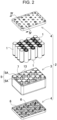
- FIG. 2 illustrates an exploded perspective view of the cell module illustrated in FIG. 1
- FIG. 3 illustrates an exploded perspective view of the cell module of FIG. 2 as viewed from below
- FIG. 4 illustrates a vertical sectional view of the cell module of FIG. 1
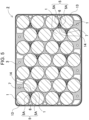
- FIG. 5 illustrates a horizontal sectional view of the cell module of FIG. 1 .
- 1 to 5 includes: a plurality of cylindrical batteries 1; holder 2 in which cylindrical batteries 1 are arranged in a parallel posture; bus bars 11 that connect cylindrical batteries 1 in series and in parallel to one another; and circuit board 10 that mounts thereon a protection circuit of cylindrical batteries 1.
- Holder 2 includes: holder body 3 having holding spaces 13 for cylindrical batteries 1; and sub holders 4 stacked on holder body 3.
- Holder body 3 is provided with stopper portions 5 deformed toward surfaces of cylindrical batteries 1 arranged in holding spaces 13.
- Each sub holder 4 has push rods 6 that push out stopper portions 5 to cylindrical batteries 1 in a state of being coupled to holder body 3.
- push rods 6 thrust stopper portions 5 against cylindrical batteries 1, press the surfaces of cylindrical batteries 1 in holding spaces 13, inhibit positional shifts of cylindrical batteries 1, and prevent/suppress cylindrical batteries 1 from rotating.
- FIG. 6 is an enlarged cross-sectional view of a portion in which sub holder 4 is coupled to holder body 3 and push rod 6 thrusts stopper portions 5 against cylindrical batteries 1.
- sub holder 4 is coupled to holder body 3, and each push rod 6 is inserted into back surfaces of stopper portions 5.
- Holder body 3 is provided with insertion spaces 14 for push rods 6.
- Each push rod 6 guided into insertion space 14 pushes out stopper portions 5 from back surfaces of stopper portions 5.
- Stopper portions 5 pressed from the back surfaces thrust front surfaces of stopper portions 5 against cylindrical batteries 1.
- the front surfaces of stopper portions 5 are thrust against cylindrical batteries 1 to inhibit the positional shifts of cylindrical batteries 1 and to prevent/suppress cylindrical batteries 1 from rotating.
- Stopper portions 5 are pressed from the back surfaces by push rod 6 and are elastically deformed.
- the elastically deformed front surfaces of stopper portions 5 are thrust against the surfaces of cylindrical batteries 1.
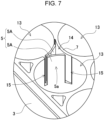
- the front surfaces of stopper portions 5 illustrated in FIGS. 6 and 7 are formed as curved surfaces 5a that go along the surfaces of cylindrical batteries 1.
- FIG. 7 is an enlarged perspective view illustrating stopper portions 5 provided on holder body 3. Stopper portions 5 bring the front surfaces into contact with the surfaces of cylindrical batteries 1 in a surface contact state, and closely adhere to the surfaces of cylindrical batteries 1 in a wide area, so that the positional shifts of cylindrical batteries 1 can be effectively inhibited, and the cylindrical batteries 1 can be prevented/suppressed from rotating.
- Stopper portions 5 having the flat back surfaces can reduce an imbalance of pressing force due to positional shifts of pressed portions pressed by push rod 6. This is because, even if positions pressed by push rod 6 move along the back surfaces of stopper portions 5, the back surfaces can be pressed by the same pressing force.
- FIG. 8 is an enlarged perspective view of push rod 6 provided on sub holder 4.
- Push rod 6 illustrated in FIG. 8 is provided with protrusions 6a that locally push out the back surfaces of stopper portion 5.
- Protrusions 6a are formed as ridges that extend in an insertion direction of push rod 6 such that push rod 6 can be smoothly inserted.
- a structure in which protrusions 6a of push rod 6 press the back surfaces of stopper portions 5 absorbs a dimensional error, thus making it possible to cause stopper portions 5 to surely prevent the positional shifts of cylindrical batteries 1, and to prevent/suppress the cylindrical batteries 1 from rotating. This is because each protrusion 6a and each back surface of stopper portion 5, which are brought into local contact with each other, are slightly deformed, thus making it possible to absorb the dimensional error.
- Stopper portions 5 illustrated in FIG. 7 are elastic arms 5A elastically deformed and thrust against cylindrical batteries 1.
- Elastic arms 5A are provided integrally with holder body 3.
- Holder body 3 is provided with elastic arms 5A by integrally molding plastic.
- Holder body 3 manufactured by integrally molding elastic arms 5A can be mass-produced at low cost.
- Holder body 3 is provided with holding spaces 13 into which cylindrical batteries 1 are inserted.
- Holding spaces 13 are provided in holder body 3 so as to arrange the plurality of cylindrical batteries 1 in multi-stages and multi-columns of a bale stack.
- each of holding spaces 13 is molded so as to have an inner shape slightly larger than an outer shape of each of cylindrical batteries 1, for example, have the inner diameter larger than the outer diameter of each of cylindrical batteries 1 by 0.1 mm to 0.3 mm inclusive. As illustrated in the cross-sectional view of FIG.
- holder body 3 that arranges cylindrical batteries 1 in multi-stages and multi-columns of a bale stack is provided with insertion spaces 14 for push rods 6 in regions each of which is surrounded by three cylindrical batteries 1.
- Cylindrical batteries 1 arranged in a bale stack are provided with insertion spaces 14 in each of which an entire shape is a substantially triangular prism shape.
- Each insertion space 14 is provided in a region surrounded by three cylindrical batteries 1 arranged in adjacent columns, in which, between cylindrical batteries 1 arranged in the same column, one cylindrical cell 1 in the adjacent column is arranged. Since each insertion space 14 is surrounded by three cylindrical batteries 1, insertion space 14 has a substantially triangular prism shape in which each side is curved inward.
- holder body 3 of FIGS. 4 and 7 is provided with stopper portions 5 as "pairs of stopper portions 5", which are composed of two elastic arms 5A pushing out the surfaces of two cylindrical batteries 1, such that the pair of stopper portions 5 have an inverse V shape in plan view.
- stopper portions 5 In each pair of stopper portions 5, rear ends of elastic arms 5A are integrally connected to holder body 3.
- Holder body 3 is provided with separation slits 15 along both side edges of stopper portions 5.
- Each separation slit 15 is formed into a shape of separating stopper portion 5 from holder body 3 and being easily elastically deformed by being pushed by push rod 6. Stopper portions 5 in FIG.
- each elastic arm 5A is rectangular elastic arms 5A elongated in the insertion direction of push rods 6, and each elastic arm 5A separates both side edges and a tip end edge from holder body 3, and couples a lower end edge integrally to holder body 3.
- Each elastic arm 5A has the both side edges separated from holder body 3 by separation slits 15, and has the tip end edge arranged on the surface of holder body 3 and separated from holder body 3. Since each elastic arm 5A has three sides separated from holder body 3, elastic arm 5A is elastically deformed by being pushed by push rod 6 from the back surface, and is thrust against cylindrical cell 1.
- holder body 3 illustrated in the cross-sectional view of FIG. 6 and the perspective view of FIG. 7 , in each triangular prism insertion space 14 surrounded by three cylindrical batteries 1, a pair of stopper portions 5 are provided at opposite positions on two sides of such a triangular prism, and on the remaining one side, stopper portion 5 is not provided, but cover portion 7 that is not elastically deformed is provided. Stopper portion 5 is elastically deformed by push rod 6 inserted into insertion space 14 to press cylindrical cell 1, but cover portion 7 is arranged along the surface of cylindrical cell 1 without being elastically deformed. Each of cylindrical batteries 1 arranged in multi-stages and multi-columns is pressed by one stopper portion 5 to be arranged at a fixed position. Hence, holder body 3 has a pair of stopper portions 5 arranged thereon such that one stopper portion 5 can be pressed against each of all cylindrical batteries 1.
- Holder body 3 Since holder body 3 is provided with separation slits 15 on both side edges of each stopper portion 5, separation slits 15 expose a part of the surface of cylindrical cell 1 to insertion space 14.
- Two sets of cylindrical batteries 1 of which surfaces are partially exposed to insertion space 14 are connected in parallel to each other via bus bar 11.
- Cylindrical cell 1 of which surface is insulated by being covered with cover portion 7 and is not exposed to insertion space 14 is connected, via bus bar 11, in series to cylindrical batteries 1 of which surfaces are exposed.
- Cylindrical batteries 1 connected in parallel to each other do not need to be insulated because exterior cans of cylindrical batteries 1 have the same potential, and even if the surfaces of cylindrical batteries 1 are partially exposed to same insertion space 14, there occurs no harmful effect such as electric leakage.
- Cylindrical cell 1 connected in series has a potential difference in an exterior can, and therefore needs to be arranged in an insulated manner. This is because a harmful effect such as electric leakage occurs if insulation characteristics are deteriorated.
- Cylindrical cell 1 arranged inside cover portion 7 is covered with cover portion 7, and does not cause the surface to be exposed to insertion space 14. Hence, since this cylindrical cell 1 is arranged so as to be sufficiently insulated from insertion space 14, cylindrical cell 1 can be arranged in holder body 3 while preventing a harmful effect due to electric leakage.
- each bus bar 11 illustrated in the drawing is a plate-shaped metal sheet, and is arranged between the columns of cylindrical batteries 1 connected in parallel to each other.
- Bus bars 12 connect cylindrical batteries 1, which are arranged in the same column, in parallel to one another, and in addition, connect cylindrical batteries 1, which are placed in adjacent columns, in series to one another.
- Sub holders 4 have push rods 6 arranged at positions of pressing stopper portions 5.
- Push rod 6 illustrated in the perspective view of FIG. 8 has a substantially triangular prism shape as a whole, and along tip end edges of the triangle, is provided with protrusions 6a that press the back surfaces of stopper portions 5.
- Protrusions 6a are provided as ridges that protrude on two sides of the triangle, and presses stopper portions 5 from the back surfaces.
- holder 2 illustrated in the above drawings, sub holders 4 are stacked on the top and bottom of holder body 3 in the drawings.
- This holder 2 has stopper portions 5 provided at both ends of each holding space 13 provided in holder body 3, and has a structure of holding both end portions of cylindrical batteries 1, which are accommodated in holder body 3, by stopper portions 5 in a state in which sub holders 4 are coupled to the top and bottom of holder body 3. Since this structure holds both ends of cylindrical batteries 1 by stopper portions 5, this structure has features that the positional shifts of cylindrical batteries 1 can be effectively inhibited, and that the cylindrical batteries 1 can be prevented/suppressed from rotating. However, the holder can also be provided with the stopper portion only on one side of the holding space provided in the holder body.
- the push rod can be provided only in the sub holder coupled to the side of the holder body, on which the stopper portion is provided.
- the holder body may be divided into a plurality of divided holders by dividing the holder body in an axial direction of the cylindrical batteries.
- holder body 3 is provided with elastically deformed elastic arms 5A as stopper portions 5, and in the cell module of the present invention, a part or all of the holder body can be formed as a rubbery holder formed by molding a rubbery elastic body.
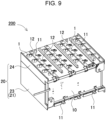
- FIGS. 9 to 16 a cell module having this structure is illustrated as a cell module according to another exemplary embodiment of the present invention.
- Cell module 200 illustrated in FIGS. 9 to 16 includes: a plurality of cylindrical batteries 1; holder 20 in which cylindrical batteries 1 are arranged in a parallel posture; bus bars 11 which connect cylindrical batteries 1 in series and in parallel to one another; and circuit board 10 that mounts thereon a protection circuit of cylindrical batteries 1.
- Holder 20 includes: holder body 23 having holding spaces 33 for cylindrical batteries 1; and sub holder 24 stacked on holder body 23.
- Holder body 23 includes rubbery holder 22 formed by molding a rubbery elastic body.
- Rubbery holder 22 includes: holding spaces 32 in which cylindrical batteries 1 are arranged; and insertion spaces 34 into which push rods 26 protruding from sub holder 24 are inserted.
- Elastically deformable stopper portions 25 are formed between these insertion spaces 34 and surfaces of rubbery holder 22, which face cylindrical batteries 1.
- Sub holder 24 includes push rods 26 that are inserted into insertion spaces 34 of rubbery holder 22 in a state of being coupled to holder body 23 and elastically deform stopper portions 25 to push stopper portions 25 toward cylindrical batteries 1.
- FIGS. 10 , 12 , and 16 are views illustrating a state in which sub holder 4 is coupled to holder body 3 and push rods 26 inserted into insertion spaces 34 of rubbery holder 22 thrust stopper portions 25 against cylindrical batteries 1.
- sub holder 24 is coupled to holder body 23, and push rods 26 are inserted into insertion spaces 34 of rubbery holder 22.
- each of push rods 26 inserted into corresponding insertion space 34 is larger than an inner shape of each of insertion spaces 34, and in a state in which push rods 26 are inserted into insertion spaces 34, push rods 26 elastically deform stopper portions 25 located between insertion spaces 34 and surfaces of rubbery holder 22, which face cylindrical batteries 1, and press the surfaces of stopper portions 25 against cylindrical batteries 1.
- the surfaces of stopper portions 25 are thrust against cylindrical batteries 1 to inhibit the positional shifts of cylindrical batteries 1 and to prevent/suppress cylindrical batteries 1 from rotating. This is because frictional resistance between stopper portions 25 and cylindrical batteries 1 increases. Stopper portions 25 are pressed from back surfaces by push rods 26 and are elastically deformed. The elastically deformed surfaces of stopper portions 25 are thrust against the surfaces of cylindrical batteries 1.
- Holder body 23 illustrated in FIGS. 10 and 11 includes: plastic holder 21 that holds respective cylindrical batteries 1 in a parallel posture; and rubbery holder 22 that is stacked on this plastic holder 21 and holds end portions of cylindrical batteries 1 inserted into plastic holder 21.
- Plastic holder 21 is provided with holding spaces 31 each of which accommodates almost the entire cylindrical cell 1 except one end portion.
- rubbery holder 22 is provided with holding spaces 32 into which the end portions of cylindrical batteries 1 are inserted.
- These holding spaces 31 and 32 are provided so as to arrange the plurality of cylindrical batteries 1 in multi-stages and multi-columns of a bale stack.
- Holding spaces 31 of plastic holder 21 and holding spaces 32 of rubbery holder 22 are provided at positions facing each other, and in a state in which rubbery holder 22 is stacked on plastic holder 21, columnar holding spaces 33 that go along the surfaces of cylindrical batteries 1 are formed of holding spaces 31 and 32 that are coupled to each other.
- each of holding spaces 33 is molded so as to have an inner shape slightly larger than an outer shape of each of cylindrical batteries 1, for example, have the inner diameter larger than the outer diameter of each of cylindrical batteries 1 by 0.1 mm to 0.3 mm inclusive.
- holder body 23 in order that rubbery holder 22 can be coupled to a fixed position of plastic holder 21, coupling holes 37 are provided in rubbery holder 22, and plastic holder 21 is provided with positioning pins 27 inserted into coupling holes 37.
- Holder body 23 is provided with each of coupling holes 37 and each of positioning pins 27 in a region on an opposing surface of plastic holder 21 and rubbery holder 22, the region being surrounded by three cylindrical batteries 1 arranged in a bale stack.
- positioning pins 27 are provided on plastic holder 21 by being molded integrally therewith.
- rubbery holder 22 is coupled to the fixed position of plastic holder 21 in a state of guiding positioning pins 27, which protrude from the end surface of plastic holder 21, to coupling holes 37.
- Rubbery holder 22 is formed by molding a rubbery elastic body into a plate shape having a predetermined thickness.
- Rubbery holder 22 illustrated in FIGS. 10 , 12 and 13 is provided with insertion spaces 34, into which push rods 26 of sub holder 24 are inserted, along peripheries of holding spaces 32 formed in a circular shape in plan view.
- Rubbery holder 22 illustrated in the drawings has a structure in which two to four insertion spaces 34 are provided around one holding space 32 and one cylindrical cell 1 is pressed and held from a plurality of surrounding spots.
- Each of insertion spaces 34 illustrated in the drawings is a through hole opened through plate-shaped rubbery holder 22, and has a cylindrical shape as an inner shape.
- Insertion space 34 provided along the periphery of holding space 32 is preferably provided in a region surrounded by three cylindrical batteries 1. Moreover, insertion spaces 34 arranged along an outer periphery of rubbery holder 22 are provided so as to face valleys of cylindrical batteries 1 adjacent to each other and an outer circumference of one cylindrical cell 1. As described above, it is made possible to press and hold such an outer circumferential surface of one cylindrical cell 1 from a plurality of spots.
- Rubbery holder 22 defines portions between insertion spaces 34 and surfaces of rubbery holder 22, which face cylindrical batteries 1, as elastically deformable stopper portions 25. In a state in which push rods 26 are inserted into insertion spaces 34, this rubbery holder 22 elastically deforms stopper portions 25 into a shape protruding toward cylindrical batteries 1, and presses the surfaces of cylindrical batteries 1.
- each of insertion spaces 34 is provided in the region surrounded by three cylindrical batteries 1 can cause each push rod 26 inserted into one insertion space 34 to protrude stopper portion 25 in a state of elastically deforming stopper portion 25 in three directions, and to press cylindrical batteries 1 facing stopper portion 25 in three directions.
- the structure in which a part of rubbery holder 22 molded of a rubbery elastic body is elastically deformed and pressed against the surfaces of cylindrical batteries 1 has a feature in that the rubbery elastic body having large frictional resistance can surely inhibit the positional shifts of the cylindrical batteries and can prevent/suppress the cylindrical batteries from rotating.
- the surfaces of stopper portions 25 illustrated in the drawings are formed as curved surfaces 25a that go along the surfaces of cylindrical batteries 1.
- FIG. 14 is a perspective view of rubbery holder 22.
- an opening edge portion of the through hole which is each insertion space 34 into which push rod 26 is inserted, is formed as a tapered surface.
- This structure can cause push rod 26, which has an outer shape larger than the inner shape of insertion space 34, to be press-fitted while being smoothly guided.
- Sub holder 24 includes the plurality of push rods 26, which are inserted into insertion spaces 34 of rubbery holder 22 in a state of being coupled to holder body 23, by molding push rods 26 integrally therewith.
- FIG. 15 is an enlarged perspective view of push rods 26 provided on sub holder 24.
- Push rods 26 illustrated in FIG. 15 are provided with protrusions 26a, which locally push out the back surfaces of stopper portions 25 in a state of being press-fitted into insertion spaces 34, so that protrusions 26a protrude from the surfaces of columnar rod bodies.
- Protrusions 26a are formed as ridges that extend in an insertion direction of push rods 26 along the side surfaces of such columnar rod bodies such that push rods 26 can be smoothly inserted into insertion spaces 34, and that the surfaces of cylindrical cell cells 1 can be pressed in the axial direction by stopper portions 25.
- protrusions 26a provided on outer circumferential surfaces of push rods 26 are caused to have a posture protruding toward centers of facing cylindrical batteries 1 such that stopper portions 25 can be surely elastically deformed toward facing cylindrical batteries 1.
- push rods 26 provided with protrusions 26a protruding toward facing cylindrical batteries 1 have a feature of being capable of surely pressing stopper portions 25 toward the surfaces of cylindrical batteries 1.
- push rods 26 illustrated in FIGS. 15 and 16 change a number and orientation of protrusions 26a according to a number of cylindrical batteries 1, which are arranged around push rods 26, such that stopper portions 25 can be pressed toward the plurality of facing cylindrical batteries 1.
- Push rods 26 shown in FIGS. 15 and 16 include: first rods 26A each of which is provided with three linear protrusions 26a protruding in three directions; second rods 26B each of which is provided with two linear protrusions 26a protruding in two directions; and third rods 26C each of which is provided with one linear protrusion 26a protruding in one direction.
- first rods 26A is inserted into insertion space 34 arranged in the region surrounded by three cylindrical batteries 1, elastically deforms stopper portion 25 made of a rubbery elastic body, and presses three cylindrical batteries 1.
- Each of second rods 26B is inserted into insertion space 34 arranged between two cylindrical batteries 1, elastically deforms stopper portion 25 made of a rubbery elastic body, and presses two cylindrical batteries 1.
- Each of third rods 26C is inserted into insertion space 34 facing one cylindrical cell 1, elastically deforms stopper portion 25 made of a rubbery elastic body, and presses one cylindrical cell 1.
- push rods 26 having predetermined shapes are inserted into the plurality of insertion spaces 34 arranged around the holding spaces 32, whereby the surfaces of respective cylindrical batteries 1 are pressed from a plurality of peripheral spots, thus making it possible to ideally inhibit the positional shifts of the cylindrical batteries, and to prevent/suppress the cylindrical batteries from rotating.
- Holder body 23 illustrated in the above drawings has a structure in which rubbery holder 22 is stacked only on one side (upper side in the drawings) of plastic holder 21.
- holder 20 illustrated in these drawings has a structure in which sub holder 24 is coupled only to one side of holder body 23.
- This holder 20 has a simple structure as a whole, and holds the end portions of cylindrical batteries 1 accommodated in holder body 23 by stopper portions 25, thus making it possible to prevent the positional shifts of cylindrical batteries 1, and to prevent/suppress cylindrical batteries 1 from rotating.
- the holder can also adopt a structure of stacking the sub holders on both sides of the holder body. Since this structure holds both ends of the cylindrical batteries by the stopper portions, this structure has features that the positional shifts of the cylindrical batteries can be effectively inhibited, and that the cylindrical batteries can be prevented/suppressed from rotating.
- the present invention is a cell module in which cylindrical batteries are arranged at fixed positions by a holder, and particularly, can be suitably used as a cell module capable of inhibiting positional shifts and rotation of the cylindrical batteries.
Landscapes
- Chemical & Material Sciences (AREA)
- Chemical Kinetics & Catalysis (AREA)
- Electrochemistry (AREA)
- General Chemical & Material Sciences (AREA)
- Battery Mounting, Suspending (AREA)
Description
- The present invention relates to a cell module in which cylindrical batteries are arranged at fixed positions by a holder, and particularly to a cell module composed by disposing a holder so as to inhibit positional shifts of cylindrical batteries and prevent/suppress the cylindrical batteries from rotating.
- A cell module has been developed in which a plurality of cylindrical batteries are placed in holding spaces of a holder and arranged in a parallel posture. In this cell module, it is important to inhibit the cylindrical batteries from rotating and to arrange the cylindrical batteries at fixed positions of the holder. This is because, when the cylindrical batteries rotate, a unreasonable load may act on a joint of each of the batteries to a metal-sheet bus bar that connects the batteries in series or in parallel to one another, and a harmful effect such as a breakage may occur. A cell module has been developed that inhibits the cylindrical batteries from rotating and arranges the cylindrical batteries in the holding spaces of the holder. (See PTL 1) Moreover, document
US2014/283360 discloses a cell module comprising a holder having holding spaces for arranging a plurality of cylindrical batteries at fixed positions. - PTL 1: Unexamined
Japanese Patent Publication No. 2010-9798 - In the cell module in which the cylindrical batteries are arranged in the holder so as not to rotate, stopper portions that are brought into contact with surfaces of the batteries are provided in the holder, and the stopper portions are thrust against the cylindrical batteries inserted into the holder, and inhibit the cylindrical batteries from rotating. In this cell module, the cylindrical batteries cannot be smoothly inserted into the holding space of the holder. This is because the stopper portions are thrust against the surfaces of the cylindrical batteries inserted into the holder to increase frictional resistance between the cylindrical batteries and the stopper portions. In particular, the cell module has a drawback that, if the stopper portions are strongly thrust against the surfaces of the cylindrical batteries in order to surely inhibit the cylindrical batteries from rotating, then the frictional resistance will increase, and it becomes more and more impossible to smoothly insert the cylindrical batteries into the holder.
- The present invention has been developed for the purpose of eliminating the above drawback. One of the objects of the present invention is to provide a cell module that, while achieving a structure in which the cylindrical batteries can be smoothly inserted into the holder, can surely inhibit positional shifts of the cylindrical batteries, and can prevent/suppress the cylindrical batteries from rotating.
- A cell module of the present invention is defined by the features of
claim 1 and includes a plurality ofcylindrical batteries 1 andholder cylindrical batteries 1 in a parallel posture.Holder holder body holding spaces cylindrical batteries 1 at fixed positions; andsub holder holder body Holder body portions cylindrical batteries 1 arranged inholding spaces Sub holder push rods stopper portions cylindrical batteries 1 in a state of being coupled to holderbody sub holder holder body push rods portions cylindrical batteries 1, and press the surfaces ofcylindrical batteries 1 arranged inholding spaces - The cell module of the present invention has a structure in which, in the state in which
sub holder holder body push rods stopper portions stopper portions stopper portions cylindrical batteries 1. - In the cell module of the present invention, the front surfaces of
stopper portions surfaces cylindrical batteries 1. - In the cell module of the present invention,
push rods sub holders protrusions stopper portions - In the cell module of the present invention, each of pressed surfaces in which the back surfaces of
stopper portions 5 are pressed byprotrusions 6a provided onpush rods 6 can be formed into a flat shape. - In the cell module of the present invention,
stopper portions 5 can be formed aselastic arms 5A deformed and pressed againstcylindrical batteries 1, andholder body 3 can be made of plastic composed by integrally moldingelastic arms 5A. - In the cell module of the present invention,
holder body 3 can be provided withinsertion spaces 14 in each of which an entire shape is a substantially triangular prism shape, each ofinsertion spaces 14 being provided in a region surrounded by threecylindrical batteries 1 arranged in adjacent columns where the plurality ofcylindrical batteries 1 are arranged in a bale stack and betweencylindrical batteries 1 arranged in the same column,cylindrical cell 1 in an adjacent column is arranged, and between each ofinsertion spaces 14 and each ofcylindrical batteries 1, twostopper portions 5 that push out surfaces of twocylindrical batteries 1 can be arranged as a pair ofstopper portions 5 in an inverse V shape in plan view, and can be integrally coupled toholder body 3. - In the cell module of the present invention,
holder body 3 can be provided withseparation slits 15 along both side edges ofstopper portions 5, each ofseparation slits 15 separating the pair ofstopper portions 5 fromholder body 3. - In the cell module of the present invention, between each of
insertion spaces 14 andcylindrical batteries 1, two ofstopper portions 5 that press the surfaces of twocylindrical batteries 1 andcover portion 7 that covers the surface of onecylindrical cell 1 can be provided integrally withholder body 3, andcover portion 7 can have both side edges integrally coupled toholder body 3. - In the cell module of the present invention, in three
cylindrical batteries 1 arranged aroundinsertion space 14, twocylindrical batteries 1 pressed bystopper portions 5 can be connected in parallel to each other, andcylindrical batteries 1 pressed bystopper portions 5 andcylindrical cell 1 arranged insidecover portion 7 can be connected in series to each other. - Moreover, the cell module of the present invention can have a structure in which
holder body 23 includesrubbery holder 22 formed by molding a rubbery elastic body,rubbery holder 22 has holdingspaces 33 for arrangingcylindrical batteries 1, andinsertion spaces 34 forpush rods 26, portions betweeninsertion spaces 34 and surfaces ofrubbery holder 22, the surfaces facingcylindrical batteries 1, are defined as elasticallydeformable stopper portions 25,push rods 26 are inserted intoinsertion spaces 34, and pushrods 26 thrust and press elastically deformedstopper portions 25 against the surfaces ofcylindrical batteries 1. - Furthermore, in the cell module of the present invention,
holder body 23 can have a stacked structure ofrubbery holder 22 andplastic holder 21. - Moreover, in the cell module of the present invention, an inner surface of each of
holding spaces 33 can have a cylindrical shape that goes along the surface of each ofcylindrical batteries 1, an outer shape of each ofpush rods 26 can be made larger than an inner shape of each ofinsertion spaces 34,push rods 26 can be inserted intoinsertion spaces 34, and stopperportions 5 can be elastically deformed and thrust against the surfaces ofcylindrical batteries 1. - Furthermore, in the cell module of the present invention,
push rods 26 can haveprotrusions 26a that protrude towardcylindrical batteries 1 arranged to facestopper portions 25. - Although the cylindrical batteries of the present invention can be smoothly inserted into the holder and assembled efficiently, the cell module has features that the positional shifts of the cylindrical batteries arranged at fixed positions by the holder can be surely inhibited, and that the cylindrical batteries can be prevented/suppressed from rotating. A reason for the above is as follows. In the above cell module, the holder is composed of the holder body and the sub holder, the holder body is provided with the stopper portions deformed toward the surfaces of the cylindrical batteries arranged in the holding spaces, the sub holder is provided with the push rods that push out the stopper portions to the cylindrical batteries in a state in which the sub holder is coupled to the holder body, the sub holder is coupled to the holder body, and the stopper portions are thrust against the cylindrical batteries by the push rods, and press the surfaces of the cylindrical batteries arranged in the holding spaces. In the power source module having this structure, after the cylindrical batteries are inserted into the holder, the sub holder is coupled to the holder body, and the stopper portions are strongly thrust against the surfaces of the cylindrical batteries by the push rods of the sub holder. Accordingly, it is not necessary to strongly thrust the stopper portions against the surfaces of the cylindrical batteries in a state of inserting the cylindrical batteries, and the cylindrical batteries can be smoothly inserted into the holder. In a state in which the cylindrical batteries are arranged at fixed positions of the holder, the stopper portions can be pressed against the surfaces of the cylindrical batteries by the push rods of the sub holder to increase the frictional resistance, so the positional shifts of the cylindrical batteries can be surely inhibited, and the cylindrical batteries can be prevented/suppressed from rotating.
- Moreover, the cell module of the present invention also achieves a feature that the sub holder and the holder body can be coupled to each other at a fixed position in a state of causing no positional shift since the sub holder is coupled to the holder body via the push rods.
-
-
FIG. 1 is a perspective view of a cell module according to a first exemplary embodiment of the present invention. -
FIG. 2 is an exploded perspective view of a holder of the cell module illustrated inFIG. 1 . -
FIG. 3 is an exploded perspective view of the holder illustrated inFIG. 2 as viewed from below. -
FIG. 4 is a vertical sectional view of the holder that accommodates cylindrical batteries, corresponding to a cross section taken along line IV-IV ofFIG. 2 . -
FIG. 5 is a cross-sectional view taken along line V-V of the holder illustrated inFIG. 4 . -
FIG. 6 is an enlarged cross-sectional view of a main part of the holder illustrated inFIG. 5 . -
FIG. 7 is an enlarged perspective view of a holder body. -
FIG. 8 is an enlarged bottom perspective view of a sub holder. -
FIG. 9 is a perspective view of a cell module according to a second exemplary embodiment of the present invention. -
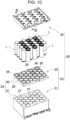
FIG. 10 is an exploded perspective view of a holder of the cell module illustrated inFIG. 9 . -
FIG. 11 is a vertical sectional view of the holder that accommodates cylindrical batteries, corresponding to a cross section taken along line XI-XI ofFIG. 9 . -
FIG. 12 is a cross-sectional view taken along line XII-XII of the holder illustrated inFIG. 11 . -
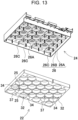
FIG. 13 is an exploded perspective view of a sub holder and a rubbery holder as viewed from below. -
FIG. 14 is an enlarged perspective view of the rubbery holder. -
FIG. 15 is an enlarged bottom perspective view of the sub holder. -
FIG. 16 is an enlarged cross-sectional view of a main part of the holder illustrated inFIG. 12 . - Hereinafter, the present invention will be described in detail with reference to the drawings.
- A cell module according to an exemplary embodiment of the present invention is illustrated in
FIGS. 1 to 5 . In these drawings,FIG. 1 illustrates a perspective view of the cell module,FIG. 2 illustrates an exploded perspective view of the cell module illustrated inFIG. 1 ,FIG. 3 illustrates an exploded perspective view of the cell module ofFIG. 2 as viewed from below,FIG. 4 illustrates a vertical sectional view of the cell module ofFIG. 1 , andFIG. 5 illustrates a horizontal sectional view of the cell module ofFIG. 1 .Cell module 100 illustrated inFIGS. 1 to 5 includes: a plurality ofcylindrical batteries 1; holder 2 in whichcylindrical batteries 1 are arranged in a parallel posture;bus bars 11 that connectcylindrical batteries 1 in series and in parallel to one another; andcircuit board 10 that mounts thereon a protection circuit ofcylindrical batteries 1. -
Holder 2 includes:holder body 3 having holdingspaces 13 forcylindrical batteries 1; andsub holders 4 stacked onholder body 3.Holder body 3 is provided withstopper portions 5 deformed toward surfaces ofcylindrical batteries 1 arranged in holdingspaces 13. Eachsub holder 4 haspush rods 6 that push outstopper portions 5 tocylindrical batteries 1 in a state of being coupled toholder body 3. In a state wheresub holder 4 is coupled toholder body 3, pushrods 6thrust stopper portions 5 againstcylindrical batteries 1, press the surfaces ofcylindrical batteries 1 in holdingspaces 13, inhibit positional shifts ofcylindrical batteries 1, and prevent/suppresscylindrical batteries 1 from rotating. -
FIG. 6 is an enlarged cross-sectional view of a portion in whichsub holder 4 is coupled toholder body 3 and pushrod 6 thrustsstopper portions 5 againstcylindrical batteries 1. As illustrated inFIGS. 4 to 6 , incell module 100,sub holder 4 is coupled toholder body 3, and eachpush rod 6 is inserted into back surfaces ofstopper portions 5.Holder body 3 is provided withinsertion spaces 14 forpush rods 6. Eachpush rod 6 guided intoinsertion space 14 pushes outstopper portions 5 from back surfaces ofstopper portions 5.Stopper portions 5 pressed from the back surfaces thrust front surfaces ofstopper portions 5 againstcylindrical batteries 1. The front surfaces ofstopper portions 5 are thrust againstcylindrical batteries 1 to inhibit the positional shifts ofcylindrical batteries 1 and to prevent/suppresscylindrical batteries 1 from rotating. This is because frictional resistance betweenstopper portion 5 andcylindrical cell 1 increases.Stopper portions 5 are pressed from the back surfaces bypush rod 6 and are elastically deformed. The elastically deformed front surfaces ofstopper portions 5 are thrust against the surfaces ofcylindrical batteries 1. The front surfaces ofstopper portions 5 illustrated inFIGS. 6 and7 are formed ascurved surfaces 5a that go along the surfaces ofcylindrical batteries 1.FIG. 7 is an enlarged perspective view illustratingstopper portions 5 provided onholder body 3.Stopper portions 5 bring the front surfaces into contact with the surfaces ofcylindrical batteries 1 in a surface contact state, and closely adhere to the surfaces ofcylindrical batteries 1 in a wide area, so that the positional shifts ofcylindrical batteries 1 can be effectively inhibited, and thecylindrical batteries 1 can be prevented/suppressed from rotating. - The back surfaces of
stopper portions 5, which are pressed bypush rod 6, respectively have flat shapes as illustrated inFIG. 7 .Stopper portions 5 having the flat back surfaces can reduce an imbalance of pressing force due to positional shifts of pressed portions pressed bypush rod 6. This is because, even if positions pressed bypush rod 6 move along the back surfaces ofstopper portions 5, the back surfaces can be pressed by the same pressing force. -
FIG. 8 is an enlarged perspective view ofpush rod 6 provided onsub holder 4. Pushrod 6 illustrated inFIG. 8 is provided withprotrusions 6a that locally push out the back surfaces ofstopper portion 5.Protrusions 6a are formed as ridges that extend in an insertion direction ofpush rod 6 such thatpush rod 6 can be smoothly inserted. A structure in whichprotrusions 6a ofpush rod 6 press the back surfaces ofstopper portions 5 absorbs a dimensional error, thus making it possible to causestopper portions 5 to surely prevent the positional shifts ofcylindrical batteries 1, and to prevent/suppress thecylindrical batteries 1 from rotating. This is because eachprotrusion 6a and each back surface ofstopper portion 5, which are brought into local contact with each other, are slightly deformed, thus making it possible to absorb the dimensional error. -
Stopper portions 5 illustrated inFIG. 7 areelastic arms 5A elastically deformed and thrust againstcylindrical batteries 1.Elastic arms 5A are provided integrally withholder body 3.Holder body 3 is provided withelastic arms 5A by integrally molding plastic.Holder body 3 manufactured by integrally moldingelastic arms 5A can be mass-produced at low cost. -
Holder body 3 is provided with holdingspaces 13 into whichcylindrical batteries 1 are inserted. Holdingspaces 13 are provided inholder body 3 so as to arrange the plurality ofcylindrical batteries 1 in multi-stages and multi-columns of a bale stack. Moreover, in order thatcylindrical batteries 1 can be smoothly inserted into holdingspaces 13, each of holdingspaces 13 is molded so as to have an inner shape slightly larger than an outer shape of each ofcylindrical batteries 1, for example, have the inner diameter larger than the outer diameter of each ofcylindrical batteries 1 by 0.1 mm to 0.3 mm inclusive. As illustrated in the cross-sectional view ofFIG. 5 ,holder body 3 that arrangescylindrical batteries 1 in multi-stages and multi-columns of a bale stack is provided withinsertion spaces 14 forpush rods 6 in regions each of which is surrounded by threecylindrical batteries 1.Cylindrical batteries 1 arranged in a bale stack are provided withinsertion spaces 14 in each of which an entire shape is a substantially triangular prism shape. Eachinsertion space 14 is provided in a region surrounded by threecylindrical batteries 1 arranged in adjacent columns, in which, betweencylindrical batteries 1 arranged in the same column, onecylindrical cell 1 in the adjacent column is arranged. Since eachinsertion space 14 is surrounded by threecylindrical batteries 1,insertion space 14 has a substantially triangular prism shape in which each side is curved inward. - Between
insertion spaces 14 andcylindrical batteries 1,holder body 3 ofFIGS. 4 and7 is provided withstopper portions 5 as "pairs ofstopper portions 5", which are composed of twoelastic arms 5A pushing out the surfaces of twocylindrical batteries 1, such that the pair ofstopper portions 5 have an inverse V shape in plan view. In each pair ofstopper portions 5, rear ends ofelastic arms 5A are integrally connected toholder body 3.Holder body 3 is provided withseparation slits 15 along both side edges ofstopper portions 5. Each separation slit 15 is formed into a shape of separatingstopper portion 5 fromholder body 3 and being easily elastically deformed by being pushed bypush rod 6.Stopper portions 5 inFIG. 4 are rectangularelastic arms 5A elongated in the insertion direction ofpush rods 6, and eachelastic arm 5A separates both side edges and a tip end edge fromholder body 3, and couples a lower end edge integrally toholder body 3. Eachelastic arm 5A has the both side edges separated fromholder body 3 byseparation slits 15, and has the tip end edge arranged on the surface ofholder body 3 and separated fromholder body 3. Since eachelastic arm 5A has three sides separated fromholder body 3,elastic arm 5A is elastically deformed by being pushed bypush rod 6 from the back surface, and is thrust againstcylindrical cell 1. - In
holder body 3 illustrated in the cross-sectional view ofFIG. 6 and the perspective view ofFIG. 7 , in each triangularprism insertion space 14 surrounded by threecylindrical batteries 1, a pair ofstopper portions 5 are provided at opposite positions on two sides of such a triangular prism, and on the remaining one side,stopper portion 5 is not provided, but coverportion 7 that is not elastically deformed is provided.Stopper portion 5 is elastically deformed bypush rod 6 inserted intoinsertion space 14 to presscylindrical cell 1, but coverportion 7 is arranged along the surface ofcylindrical cell 1 without being elastically deformed. Each ofcylindrical batteries 1 arranged in multi-stages and multi-columns is pressed by onestopper portion 5 to be arranged at a fixed position. Hence,holder body 3 has a pair ofstopper portions 5 arranged thereon such that onestopper portion 5 can be pressed against each of allcylindrical batteries 1. - Since
holder body 3 is provided withseparation slits 15 on both side edges of eachstopper portion 5, separation slits 15 expose a part of the surface ofcylindrical cell 1 toinsertion space 14.Holder body 3, in which threecylindrical batteries 1 are arranged around substantiallytriangular insertion space 14 andstopper portions 5 are provided on the surfaces of twocylindrical batteries 1, partially exposes the surfaces of twocylindrical batteries 1 toinsertion space 14, and does not expose the surface of onecylindrical cell 1 toinsertion space 14. This is becausestopper portions 5 partially expose the surfaces ofcylindrical batteries 1 toinsertion space 14, and becausecover portion 7 does not expose the surface ofcylindrical cell 1 toinsertion space 14. Two sets ofcylindrical batteries 1 of which surfaces are partially exposed toinsertion space 14 are connected in parallel to each other viabus bar 11.Cylindrical cell 1 of which surface is insulated by being covered withcover portion 7 and is not exposed toinsertion space 14 is connected, viabus bar 11, in series tocylindrical batteries 1 of which surfaces are exposed.Cylindrical batteries 1 connected in parallel to each other do not need to be insulated because exterior cans ofcylindrical batteries 1 have the same potential, and even if the surfaces ofcylindrical batteries 1 are partially exposed tosame insertion space 14, there occurs no harmful effect such as electric leakage.Cylindrical cell 1 connected in series has a potential difference in an exterior can, and therefore needs to be arranged in an insulated manner. This is because a harmful effect such as electric leakage occurs if insulation characteristics are deteriorated.Cylindrical cell 1 arranged insidecover portion 7 is covered withcover portion 7, and does not cause the surface to be exposed toinsertion space 14. Hence, since thiscylindrical cell 1 is arranged so as to be sufficiently insulated frominsertion space 14,cylindrical cell 1 can be arranged inholder body 3 while preventing a harmful effect due to electric leakage. - In
cell module 100 illustrated inFIG. 1 , end face electrodes at both ends of eachcylindrical cell 1 are connected tobus bar 11 vialead wires 12. Eachbus bar 11 illustrated in the drawing is a plate-shaped metal sheet, and is arranged between the columns ofcylindrical batteries 1 connected in parallel to each other. Bus bars 12 connectcylindrical batteries 1, which are arranged in the same column, in parallel to one another, and in addition, connectcylindrical batteries 1, which are placed in adjacent columns, in series to one another. -
Sub holders 4 havepush rods 6 arranged at positions of pressingstopper portions 5. Pushrod 6 illustrated in the perspective view ofFIG. 8 has a substantially triangular prism shape as a whole, and along tip end edges of the triangle, is provided withprotrusions 6a that press the back surfaces ofstopper portions 5.Protrusions 6a are provided as ridges that protrude on two sides of the triangle, and pressesstopper portions 5 from the back surfaces. - In
holder 2 illustrated in the above drawings,sub holders 4 are stacked on the top and bottom ofholder body 3 in the drawings. Thisholder 2 hasstopper portions 5 provided at both ends of each holdingspace 13 provided inholder body 3, and has a structure of holding both end portions ofcylindrical batteries 1, which are accommodated inholder body 3, bystopper portions 5 in a state in whichsub holders 4 are coupled to the top and bottom ofholder body 3. Since this structure holds both ends ofcylindrical batteries 1 bystopper portions 5, this structure has features that the positional shifts ofcylindrical batteries 1 can be effectively inhibited, and that thecylindrical batteries 1 can be prevented/suppressed from rotating. However, the holder can also be provided with the stopper portion only on one side of the holding space provided in the holder body. In this case, the push rod can be provided only in the sub holder coupled to the side of the holder body, on which the stopper portion is provided. Further, the holder body may be divided into a plurality of divided holders by dividing the holder body in an axial direction of the cylindrical batteries. - Moreover, in
cell module 100 described above,holder body 3 is provided with elastically deformedelastic arms 5A asstopper portions 5, and in the cell module of the present invention, a part or all of the holder body can be formed as a rubbery holder formed by molding a rubbery elastic body. InFIGS. 9 to 16 , a cell module having this structure is illustrated as a cell module according to another exemplary embodiment of the present invention. -
Cell module 200 illustrated inFIGS. 9 to 16 includes: a plurality ofcylindrical batteries 1;holder 20 in whichcylindrical batteries 1 are arranged in a parallel posture; bus bars 11 which connectcylindrical batteries 1 in series and in parallel to one another; andcircuit board 10 that mounts thereon a protection circuit ofcylindrical batteries 1.Holder 20 includes:holder body 23 having holdingspaces 33 forcylindrical batteries 1; andsub holder 24 stacked onholder body 23. -
Holder body 23 includesrubbery holder 22 formed by molding a rubbery elastic body.Rubbery holder 22 includes: holdingspaces 32 in whichcylindrical batteries 1 are arranged; andinsertion spaces 34 into which pushrods 26 protruding fromsub holder 24 are inserted. Elasticallydeformable stopper portions 25 are formed between theseinsertion spaces 34 and surfaces ofrubbery holder 22, which facecylindrical batteries 1.Sub holder 24 includespush rods 26 that are inserted intoinsertion spaces 34 ofrubbery holder 22 in a state of being coupled toholder body 23 and elastically deformstopper portions 25 to pushstopper portions 25 towardcylindrical batteries 1. In thisholder 20, in a state ofcoupling sub holder 24 toholder body 23, pushrods 26 inserted intoinsertion spaces 34thrust stopper portions 25 againstcylindrical batteries 1, and inhibit the positional shifts ofcylindrical batteries 1 in holdingspaces 33, and prevent/suppresscylindrical batteries 1 from rotating. -
FIGS. 10 ,12 , and16 are views illustrating a state in whichsub holder 4 is coupled toholder body 3 and pushrods 26 inserted intoinsertion spaces 34 ofrubbery holder 22thrust stopper portions 25 againstcylindrical batteries 1. As illustrated inFIGS. 11 and12 , incell module 200,sub holder 24 is coupled toholder body 23, and pushrods 26 are inserted intoinsertion spaces 34 ofrubbery holder 22. An outer shape of each ofpush rods 26 inserted intocorresponding insertion space 34 is larger than an inner shape of each ofinsertion spaces 34, and in a state in which pushrods 26 are inserted intoinsertion spaces 34, pushrods 26 elastically deformstopper portions 25 located betweeninsertion spaces 34 and surfaces ofrubbery holder 22, which facecylindrical batteries 1, and press the surfaces ofstopper portions 25 againstcylindrical batteries 1. The surfaces ofstopper portions 25 are thrust againstcylindrical batteries 1 to inhibit the positional shifts ofcylindrical batteries 1 and to prevent/suppresscylindrical batteries 1 from rotating. This is because frictional resistance betweenstopper portions 25 andcylindrical batteries 1 increases.Stopper portions 25 are pressed from back surfaces bypush rods 26 and are elastically deformed. The elastically deformed surfaces ofstopper portions 25 are thrust against the surfaces ofcylindrical batteries 1. -
Holder body 23 illustrated inFIGS. 10 and11 includes:plastic holder 21 that holds respectivecylindrical batteries 1 in a parallel posture; andrubbery holder 22 that is stacked on thisplastic holder 21 and holds end portions ofcylindrical batteries 1 inserted intoplastic holder 21.Plastic holder 21 is provided with holdingspaces 31 each of which accommodates almost the entirecylindrical cell 1 except one end portion. At positions facing holdingspaces 31 provided inplastic holder 21,rubbery holder 22 is provided with holdingspaces 32 into which the end portions ofcylindrical batteries 1 are inserted. These holdingspaces cylindrical batteries 1 in multi-stages and multi-columns of a bale stack. Holdingspaces 31 ofplastic holder 21 and holdingspaces 32 ofrubbery holder 22 are provided at positions facing each other, and in a state in whichrubbery holder 22 is stacked onplastic holder 21,columnar holding spaces 33 that go along the surfaces ofcylindrical batteries 1 are formed of holdingspaces cylindrical batteries 1 can be smoothly inserted into holdingspaces 33, each of holdingspaces 33 is molded so as to have an inner shape slightly larger than an outer shape of each ofcylindrical batteries 1, for example, have the inner diameter larger than the outer diameter of each ofcylindrical batteries 1 by 0.1 mm to 0.3 mm inclusive. - Moreover, in
holder body 23, as illustrated inFIGS. 10 ,12 , and13 , in order thatrubbery holder 22 can be coupled to a fixed position ofplastic holder 21, coupling holes 37 are provided inrubbery holder 22, andplastic holder 21 is provided withpositioning pins 27 inserted into coupling holes 37.Holder body 23 is provided with each of coupling holes 37 and each of positioning pins 27 in a region on an opposing surface ofplastic holder 21 andrubbery holder 22, the region being surrounded by threecylindrical batteries 1 arranged in a bale stack. In a posture of protruding in the axial direction ofcylindrical batteries 1 from an end surface ofplastic holder 21, on whichrubbery holder 22 is stacked, positioning pins 27 are provided onplastic holder 21 by being molded integrally therewith. In thisholder body 23,rubbery holder 22 is coupled to the fixed position ofplastic holder 21 in a state of guiding positioning pins 27, which protrude from the end surface ofplastic holder 21, to coupling holes 37. -
Rubbery holder 22 is formed by molding a rubbery elastic body into a plate shape having a predetermined thickness.Rubbery holder 22 illustrated inFIGS. 10 ,12 and13 is provided withinsertion spaces 34, into which pushrods 26 ofsub holder 24 are inserted, along peripheries of holdingspaces 32 formed in a circular shape in plan view.Rubbery holder 22 illustrated in the drawings has a structure in which two to fourinsertion spaces 34 are provided around one holdingspace 32 and onecylindrical cell 1 is pressed and held from a plurality of surrounding spots. Each ofinsertion spaces 34 illustrated in the drawings is a through hole opened through plate-shapedrubbery holder 22, and has a cylindrical shape as an inner shape.Insertion space 34 provided along the periphery of holdingspace 32 is preferably provided in a region surrounded by threecylindrical batteries 1. Moreover,insertion spaces 34 arranged along an outer periphery ofrubbery holder 22 are provided so as to face valleys ofcylindrical batteries 1 adjacent to each other and an outer circumference of onecylindrical cell 1. As described above, it is made possible to press and hold such an outer circumferential surface of onecylindrical cell 1 from a plurality of spots. -
Rubbery holder 22 defines portions betweeninsertion spaces 34 and surfaces ofrubbery holder 22, which facecylindrical batteries 1, as elasticallydeformable stopper portions 25. In a state in which pushrods 26 are inserted intoinsertion spaces 34, thisrubbery holder 22 elastically deformsstopper portions 25 into a shape protruding towardcylindrical batteries 1, and presses the surfaces ofcylindrical batteries 1. Hence, such a structure in which each ofinsertion spaces 34 is provided in the region surrounded by threecylindrical batteries 1 can cause eachpush rod 26 inserted into oneinsertion space 34 to protrudestopper portion 25 in a state of elastically deformingstopper portion 25 in three directions, and to presscylindrical batteries 1 facingstopper portion 25 in three directions. As described above, the structure in which a part ofrubbery holder 22 molded of a rubbery elastic body is elastically deformed and pressed against the surfaces ofcylindrical batteries 1 has a feature in that the rubbery elastic body having large frictional resistance can surely inhibit the positional shifts of the cylindrical batteries and can prevent/suppress the cylindrical batteries from rotating. The surfaces ofstopper portions 25 illustrated in the drawings are formed ascurved surfaces 25a that go along the surfaces ofcylindrical batteries 1. -
FIG. 14 is a perspective view ofrubbery holder 22. Inrubbery holder 22 illustrated in the drawing, an opening edge portion of the through hole, which is eachinsertion space 34 into which pushrod 26 is inserted, is formed as a tapered surface. This structure can causepush rod 26, which has an outer shape larger than the inner shape ofinsertion space 34, to be press-fitted while being smoothly guided. -
Sub holder 24 includes the plurality ofpush rods 26, which are inserted intoinsertion spaces 34 ofrubbery holder 22 in a state of being coupled toholder body 23, bymolding push rods 26 integrally therewith.FIG. 15 is an enlarged perspective view ofpush rods 26 provided onsub holder 24. Pushrods 26 illustrated inFIG. 15 are provided withprotrusions 26a, which locally push out the back surfaces ofstopper portions 25 in a state of being press-fitted intoinsertion spaces 34, so thatprotrusions 26a protrude from the surfaces of columnar rod bodies.Protrusions 26a are formed as ridges that extend in an insertion direction ofpush rods 26 along the side surfaces of such columnar rod bodies such thatpush rods 26 can be smoothly inserted intoinsertion spaces 34, and that the surfaces ofcylindrical cell cells 1 can be pressed in the axial direction bystopper portions 25. Inpush rods 26 illustrated inFIG. 16 ,protrusions 26a provided on outer circumferential surfaces ofpush rods 26 are caused to have a posture protruding toward centers of facingcylindrical batteries 1 such thatstopper portions 25 can be surely elastically deformed toward facingcylindrical batteries 1. As illustrated inFIG. 16 , pushrods 26 provided withprotrusions 26a protruding toward facingcylindrical batteries 1 have a feature of being capable of surely pressingstopper portions 25 toward the surfaces ofcylindrical batteries 1. - Moreover, push
rods 26 illustrated inFIGS. 15 and16 change a number and orientation ofprotrusions 26a according to a number ofcylindrical batteries 1, which are arranged aroundpush rods 26, such thatstopper portions 25 can be pressed toward the plurality of facingcylindrical batteries 1. Pushrods 26 shown inFIGS. 15 and16 include:first rods 26A each of which is provided with threelinear protrusions 26a protruding in three directions;second rods 26B each of which is provided with twolinear protrusions 26a protruding in two directions; andthird rods 26C each of which is provided with onelinear protrusion 26a protruding in one direction. Each offirst rods 26A is inserted intoinsertion space 34 arranged in the region surrounded by threecylindrical batteries 1, elastically deformsstopper portion 25 made of a rubbery elastic body, and presses threecylindrical batteries 1. Each ofsecond rods 26B is inserted intoinsertion space 34 arranged between twocylindrical batteries 1, elastically deformsstopper portion 25 made of a rubbery elastic body, and presses twocylindrical batteries 1. Each ofthird rods 26C is inserted intoinsertion space 34 facing onecylindrical cell 1, elastically deformsstopper portion 25 made of a rubbery elastic body, and presses onecylindrical cell 1. As described above, pushrods 26 having predetermined shapes are inserted into the plurality ofinsertion spaces 34 arranged around the holdingspaces 32, whereby the surfaces of respectivecylindrical batteries 1 are pressed from a plurality of peripheral spots, thus making it possible to ideally inhibit the positional shifts of the cylindrical batteries, and to prevent/suppress the cylindrical batteries from rotating. -
Holder body 23 illustrated in the above drawings has a structure in whichrubbery holder 22 is stacked only on one side (upper side in the drawings) ofplastic holder 21. Hence,holder 20 illustrated in these drawings has a structure in whichsub holder 24 is coupled only to one side ofholder body 23. Thisholder 20 has a simple structure as a whole, and holds the end portions ofcylindrical batteries 1 accommodated inholder body 23 bystopper portions 25, thus making it possible to prevent the positional shifts ofcylindrical batteries 1, and to prevent/suppresscylindrical batteries 1 from rotating. However, as a structure of stacking rubbery holders on both sides of a plastic holder, the holder can also adopt a structure of stacking the sub holders on both sides of the holder body. Since this structure holds both ends of the cylindrical batteries by the stopper portions, this structure has features that the positional shifts of the cylindrical batteries can be effectively inhibited, and that the cylindrical batteries can be prevented/suppressed from rotating. - The present invention is a cell module in which cylindrical batteries are arranged at fixed positions by a holder, and particularly, can be suitably used as a cell module capable of inhibiting positional shifts and rotation of the cylindrical batteries.
-
- 100, 200
- cell module
- 1
- cylindrical cell
- 2
- holder
- 3
- holder body
- 4
- sub holder
- 5
- stopper portion
- 5A
- elastic arm
- 5a
- curved surface
- 6
- push rod
- 6a
- protrusion
- 7
- cover portion
- 10
- circuit board
- 11
- bus bar
- 12
- lead wire
- 13
- holding space
- 14
- insertion space
- 15
- separation slit
- 20
- holder
- 21
- plastic holder
- 22
- rubbery holder
- 23
- holder body
- 24
- sub holder
- 25
- stopper portion
- 25a
- curved surface
- 26
- push rod
- 26a
- protrusion
- 26A
- first rod
- 26B
- second rod
- 26C
- third rod
- 27
- positioning pin
- 31
- holding space
- 32
- holding space
- 33
- holding space
- 34
- insertion space
- 37
- coupling hole
Claims (13)
- A cell module (100) comprising:a plurality of cylindrical batteries (1); anda holder (2, 20) holding the plurality of cylindrical batteries (1) in a parallel posture, whereinthe holder (2, 20) includes:a holder body (3, 23) having holding spaces (13, 31-33) for arranging the plurality of cylindrical batteries (1) at fixed positions; anda sub holder (4, 24) stacked on the holder body (3, 23),the holder body (3, 23) includes stopper portions (5, 25), the stopper portions (5, 25) each being deformed toward a surface of a corresponding one of the plurality of cylindrical batteries (1) arranged in a corresponding one of the holding spaces (13, 31-33),the sub holder (4, 24) includes push rods (6, 26), the push rods (6, 26) each pushing a corresponding one of the stopper portions (5, 25) to a corresponding one of the plurality of cylindrical batteries (1) when the sub holder (4, 24) is coupled to the holder body (3, 23), andthe sub holder (4, 24) is configured to be coupled to the holder body (3, 23), such that each of the push rods (6, 26) thrusts a corresponding one of the stopper portions (5, 25) against a corresponding one of the plurality of cylindrical batteries (1) and presses a surface of the corresponding one of the plurality of cylindrical batteries (1) arranged in a corresponding one of the holding spaces, andwherein the cell module (100) has a structure in which the sub holder (4, 24) is configured to be coupled to the holder body (3, 23), such that each of the push rods (6, 26) is inserted into a back surface of a corresponding one of the stopper portions (5, 25), press each of the stopper portions (5, 25) from the back surface, and thrusts and presses a front surface of the corresponding one of the stopper portions (5, 25) against the corresponding one of the plurality of cylindrical batteries (1).
- The cell module (100) according to claim 1, wherein the front surface of each of the stopper portions (5, 25) is curved surfaces that go along the surface of the corresponding one of the plurality of cylindrical batteries (1).
- The cell module (100) according to any one of claims 1 to 2, wherein each of the push rods (6, 26) of the sub holder (4, 24) have a corresponding one of protrusions (6a, 26a) that locally push out the back surface of the corresponding one of the stopper portions (5, 25).
- The cell module (100) according to claim 3, wherein each of the back surfaces of the stopper portions (5, 25) is composed by forming, into a flat shape, a corresponding one of pressed surfaces pressed by the corresponding one of the protrusions (6a, 26a) provided on the push rods (6, 26).
- The cell module (100) according to any one of claims 1 to 4, wherein the stopper portions (5, 25) are elastic arms deformed and pressed against the cylindrical batteries (1), and the holder body (3, 23) is made of plastic composed by integrally molding the elastic arms.
- The cell module (100) according to any one of claims 1 to 5, wherein the holder body (3, 23) includes insertion space (14, 34) having a substantially triangular prism shape as a whole, the insertion space (14, 34) being provided in a region surrounded by three cylindrical batteries (1) arranged in adjacent columns among columns of the plurality of cylindrical batteries (1), the plurality of cylindrical batteries (1) being arranged in a bale stack and between the cylindrical batteries (1) arranged in a same column, one of the plurality of cylindrical batteries (1) in an adjacent column is arranged, and
between the insertion space (14, 34) and the three cylindrical batteries (1), two of the stopper portions (5, 25) that push out surfaces of two of the plurality of cylindrical batteries (1) are arranged as a pair of stopper portions (5, 25) in an inverse V shape in plan view, and are integrally coupled to the holder body (3, 23). - The cell module (100) according to claim 6, wherein the holder body (3, 23) is provided with separation slits (15) along both side edges of the stopper portions (5, 25), each of the separation slits (15) separating the pair of stopper portions (5, 25) from the holder body (3, 23).
- The cell module (100) according to claim 6 or 7, whereinbetween the insertion space (14, 34) and the two of the plurality of cylindrical batteries (1), two of the stopper portions (5, 25) that press the surfaces of the two of the plurality of cylindrical batteries (1) and a cover portion (7) that covers the surface of one of the plurality of cylindrical batteries (1) are provided integrally with the holder body (3, 23), andthe cover portion (7) has both side edges integrally coupled to the holder body (3, 23).
- The cell module (100) according to claim 8, whereinin three of the plurality of cylindrical batteries (1) arranged around the insertion space (14, 34), two of the three of cylindrical batteries (1) pressed by the stopper portions (5, 25) are connected in parallel to each other, andthe two of the plurality of cylindrical batteries (1) pressed by the stopper portions (5, 25) and one of the plurality of cylindrical batteries (1) arranged inside the cover portion (7) are connected in series to each other.
- The cell module (100) according to any one of claims 1 to 3, whereinthe holder body (3, 23) includes a rubbery holder (22) formed by molding a rubbery elastic body,the rubbery holder (22) has holding spaces (13, 31-33) for arranging the plurality of cylindrical batteries (1), and insertion spaces (14, 34) for the push rods (6, 26),portions between the insertion spaces (14, 34) and surfaces of the rubbery holder (22), the surfaces facing the plurality of cylindrical batteries (1), are defined as elastically deformable stopper portions (5, 25), andthe elastically deformable stopper portions (5, 25) in which the push rods (6, 26) are inserted into the insertion spaces (14, 34) and are thrust and pressed against the surfaces of the plurality of cylindrical batteries (1).
- The cell module (100) according to claim 10, wherein the holder body (3, 23) has a stacked structure of the rubbery holder (22) and a plastic holder (21).
- The cell module (100) according to claim 10 or 11, whereinan inner surface of one of the holding spaces (13, 31-33) has a cylindrical shape that goes along the surface of a corresponding one of the plurality of cylindrical batteries (1),an outer shape of a corresponding one of the push rods (6, 26) is larger than an inner shape of a corresponding one of the insertion space (14, 34), andthe corresponding one of the push rods (6, 26) is inserted into the corresponding one of the insertion spaces (14, 34), and the elastically deformable stopper portions (5, 25) are thrust against the surfaces of the cylindrical batteries (1).
- The cell module (100) according to any one of claims 10 to 12, wherein the push rods (6, 26) have protrusions (6a, 26a) that protrude toward the cylindrical batteries (1) arranged to face the stopper portions (5, 25).
Applications Claiming Priority (2)
| Application Number | Priority Date | Filing Date | Title |
|---|---|---|---|
| JP2018083309 | 2018-04-24 | ||
| PCT/JP2019/015053 WO2019208157A1 (en) | 2018-04-24 | 2019-04-05 | Cell module |
Publications (3)
| Publication Number | Publication Date |
|---|---|
| EP3787062A1 EP3787062A1 (en) | 2021-03-03 |
| EP3787062A4 EP3787062A4 (en) | 2021-05-26 |
| EP3787062B1 true EP3787062B1 (en) | 2023-11-15 |
Family
ID=68294088
Family Applications (1)
| Application Number | Title | Priority Date | Filing Date |
|---|---|---|---|
| EP19792855.9A Active EP3787062B1 (en) | 2018-04-24 | 2019-04-05 | Cell module |
Country Status (5)
| Country | Link |
|---|---|
| US (1) | US11855298B2 (en) |
| EP (1) | EP3787062B1 (en) |
| JP (1) | JP7258861B2 (en) |
| CN (1) | CN112005399B (en) |
| WO (1) | WO2019208157A1 (en) |
Families Citing this family (19)
| Publication number | Priority date | Publication date | Assignee | Title |
|---|---|---|---|---|
| DE102019211359A1 (en) * | 2018-11-30 | 2020-06-04 | Robert Bosch Gmbh | Battery cell holder and battery system |
| KR102120933B1 (en) * | 2019-09-06 | 2020-06-09 | 주식회사 알멕 | battery module case for electric vehicle |
| KR102857423B1 (en) * | 2019-12-11 | 2025-09-08 | 삼성에스디아이 주식회사 | Battery pack |
| KR102924317B1 (en) * | 2019-12-31 | 2026-02-05 | 삼성에스디아이 주식회사 | Battery pack |
| DE102020124747A1 (en) * | 2020-09-23 | 2022-03-24 | Lisa Dräxlmaier GmbH | BATTERY MODULE HOUSING AND METHOD OF POSITIONING AND FIXING A BATTERY CELL WITHIN A BATTERY MODULE HOUSING |
| KR102909624B1 (en) * | 2020-11-16 | 2026-01-08 | 주식회사 엘지에너지솔루션 | Cell Module Having Guide Frame and Its Manufacturing Method |
| DE102021104625A1 (en) | 2021-02-26 | 2022-09-01 | Robert Bosch Gesellschaft mit beschränkter Haftung | Cell holder and battery pack with a cell holder |
| DE102021205796A1 (en) | 2021-06-09 | 2022-12-15 | Robert Bosch Gesellschaft mit beschränkter Haftung | Device for fastening electrical energy stores |
| CN113871773B (en) * | 2021-08-20 | 2023-01-03 | 清华大学 | Battery pack and electrical apparatus |
| IL311876A (en) * | 2021-10-18 | 2024-06-01 | Flyer Next Llc | Configurable vehicle battery backplane and modules and methods of operating the same |
| CN114006106A (en) * | 2021-11-01 | 2022-02-01 | 江苏集萃纳米应用技术研究所有限公司 | Safety lithium ion battery |
| DE102021213654A1 (en) * | 2021-12-02 | 2023-06-07 | Robert Bosch Gesellschaft mit beschränkter Haftung | Energy cell holder, battery pack with the energy cell holder and system with the battery pack |
| DE102021131784B3 (en) | 2021-12-02 | 2023-05-11 | Webasto SE | Battery, preferably traction battery |
| WO2023133808A1 (en) * | 2022-01-14 | 2023-07-20 | 宁德时代新能源科技股份有限公司 | Battery, electrical device, and battery preparation method and device |
| CN114583373A (en) * | 2022-02-09 | 2022-06-03 | 多氟多新能源科技有限公司 | Cylindrical battery module and cylindrical battery pack |
| WO2023176298A1 (en) * | 2022-03-18 | 2023-09-21 | パナソニックエナジー株式会社 | Battery pack |
| JPWO2024202608A1 (en) | 2023-03-27 | 2024-10-03 | ||
| WO2025070468A1 (en) * | 2023-09-29 | 2025-04-03 | パナソニックIpマネジメント株式会社 | Electric power storage module |
| KR20250154665A (en) * | 2024-04-22 | 2025-10-29 | 주식회사 엘지에너지솔루션 | A batterycell assembly |
Family Cites Families (20)
| Publication number | Priority date | Publication date | Assignee | Title |
|---|---|---|---|---|
| US4123598A (en) * | 1978-04-24 | 1978-10-31 | The Gates Rubber Company | Battery pack and container |
| JP2001243932A (en) * | 2000-03-01 | 2001-09-07 | Matsushita Electric Ind Co Ltd | Battery lid device |
| JP2001283808A (en) * | 2000-04-04 | 2001-10-12 | Furukawa Battery Co Ltd:The | Stand for storage battery |
| JP4556594B2 (en) * | 2004-09-28 | 2010-10-06 | 新神戸電機株式会社 | Battery pack, battery pack group and battery module |
| DE102008009041A1 (en) * | 2008-02-14 | 2009-08-20 | Valeo Klimasysteme Gmbh | Drive battery assembly of an electric, fuel cell or hybrid vehicle |
| JP5449708B2 (en) | 2008-06-25 | 2014-03-19 | 小島プレス工業株式会社 | Cylindrical battery holding structure |
| KR20100101756A (en) * | 2009-03-10 | 2010-09-20 | 주식회사 에이텍 | Dry cell holer and flashlight having the dry cell holder |
| JP5593894B2 (en) * | 2009-07-30 | 2014-09-24 | スズキ株式会社 | A battery pack to be attached to and detached from an electric vehicle and an electric vehicle including the battery pack |
| KR20110118807A (en) * | 2010-01-29 | 2011-11-01 | 파나소닉 주식회사 | Battery module |
| JP5812903B2 (en) * | 2012-03-08 | 2015-11-17 | アイシン軽金属株式会社 | Cylindrical battery holding structure |
| JP6069615B2 (en) | 2012-06-15 | 2017-02-01 | 株式会社キャプテックス | Battery module |
| JP5984009B2 (en) * | 2012-09-27 | 2016-09-06 | パナソニックIpマネジメント株式会社 | Battery pack and power supply device including the same |
| JP6130179B2 (en) * | 2013-03-21 | 2017-05-17 | 豊田合成株式会社 | Battery holder and method for manufacturing battery holder |
| JP6151940B2 (en) * | 2013-03-22 | 2017-06-21 | 豊田合成株式会社 | Battery device |
| CN105684212B (en) * | 2013-10-30 | 2021-01-05 | 胡斯华纳有限公司 | Flexible battery cell holder |
| US20170301964A1 (en) * | 2014-10-29 | 2017-10-19 | Sanyo Electric Co., Ltd. | Battery pack and heat dissipating holder |
| JP6380270B2 (en) * | 2015-07-21 | 2018-08-29 | トヨタ自動車株式会社 | Battery module and battery module manufacturing method |
| JP6746975B2 (en) * | 2016-03-11 | 2020-08-26 | 株式会社富士通ゼネラル | Electronics |
| JP6350592B2 (en) * | 2016-05-24 | 2018-07-04 | トヨタ自動車株式会社 | Automotive battery module |
| WO2018045858A1 (en) * | 2016-09-08 | 2018-03-15 | Ampd Thermalat Limited | Battery holder with enhanced thermal dissipation |
-
2019
- 2019-04-05 US US17/048,164 patent/US11855298B2/en active Active
- 2019-04-05 JP JP2020516175A patent/JP7258861B2/en active Active
- 2019-04-05 EP EP19792855.9A patent/EP3787062B1/en active Active
- 2019-04-05 WO PCT/JP2019/015053 patent/WO2019208157A1/en not_active Ceased
- 2019-04-05 CN CN201980027592.7A patent/CN112005399B/en active Active
Also Published As
| Publication number | Publication date |
|---|---|
| US11855298B2 (en) | 2023-12-26 |
| JP7258861B2 (en) | 2023-04-17 |
| EP3787062A4 (en) | 2021-05-26 |
| JPWO2019208157A1 (en) | 2021-04-30 |
| EP3787062A1 (en) | 2021-03-03 |
| CN112005399B (en) | 2023-01-10 |
| US20210167453A1 (en) | 2021-06-03 |
| WO2019208157A1 (en) | 2019-10-31 |
| CN112005399A (en) | 2020-11-27 |
Similar Documents
| Publication | Publication Date | Title |
|---|---|---|
| EP3787062B1 (en) | Cell module | |
| EP1283560B1 (en) | Coil spring contact type connector | |
| EP4142029B1 (en) | Battery module having structure capable of absorbing cell swelling, and battery pack and vehicle comprising same | |
| KR102105665B1 (en) | A pressing jig for pressing a bus bar and a battery module manufacturing system comprising the same | |
| US20120258335A1 (en) | Rechargeable battery pack | |
| KR101749509B1 (en) | Battery pack having welding portion | |
| CA2593944A1 (en) | Fuel cell stack | |
| JPS62177875A (en) | Flat cable connector | |
| EP2763207A1 (en) | Battery pack assembly | |
| CN110476269B (en) | Cap assembly for accommodating a plurality of secondary battery cells and battery module including the same | |
| EP4475324A1 (en) | Electric power storage module | |
| JPH1173932A (en) | Assembly device for electrochemical battery row | |
| EP3828957B1 (en) | Battery module having insulation pad with extended length, and battery pack and vehicle comprising same | |
| JP4652138B2 (en) | Holding member and battery pack | |
| EP0306975A2 (en) | A thin-type coaxial connector and receptacle for mating with the coaxial connectors | |
| KR102929984B1 (en) | A collection of contact units, sockets and connectors | |
| EP2169784A2 (en) | Connector terminal structure, connector and method of assembling connector | |
| US20150366109A1 (en) | Shielding cage with overinsertion prevention aspect | |
| JPH053119U (en) | Battery packaging box with partition plate having honeycomb structure | |
| JP2003272776A (en) | Combination type connector | |
| WO2022249573A1 (en) | Sensor unit and battery wiring module with sensor unit | |
| KR20220036499A (en) | Terminal | |
| JP6908425B2 (en) | Fixed structure of conductive member | |
| JPH11250878A (en) | Battery case for portable electrical equipment | |
| EP4475323A1 (en) | Electric power storage module |
Legal Events
| Date | Code | Title | Description |
|---|---|---|---|
| STAA | Information on the status of an ep patent application or granted ep patent |
Free format text: STATUS: THE INTERNATIONAL PUBLICATION HAS BEEN MADE |
|
| PUAI | Public reference made under article 153(3) epc to a published international application that has entered the european phase |
Free format text: ORIGINAL CODE: 0009012 |
|
| STAA | Information on the status of an ep patent application or granted ep patent |
Free format text: STATUS: REQUEST FOR EXAMINATION WAS MADE |
|
| 17P | Request for examination filed |
Effective date: 20201016 |
|
| AK | Designated contracting states |
Kind code of ref document: A1 Designated state(s): AL AT BE BG CH CY CZ DE DK EE ES FI FR GB GR HR HU IE IS IT LI LT LU LV MC MK MT NL NO PL PT RO RS SE SI SK SM TR |
|
| AX | Request for extension of the european patent |
Extension state: BA ME |
|
| A4 | Supplementary search report drawn up and despatched |
Effective date: 20210426 |
|
| RIC1 | Information provided on ipc code assigned before grant |
Ipc: H01M 50/213 20210101AFI20210420BHEP Ipc: H01M 50/242 20210101ALI20210420BHEP |
|
| DAV | Request for validation of the european patent (deleted) | ||
| DAX | Request for extension of the european patent (deleted) | ||
| REG | Reference to a national code |
Ref country code: DE Ref legal event code: R079 Free format text: PREVIOUS MAIN CLASS: H01M0002100000 Ipc: H01M0050213000 Ref document number: 602019041572 Country of ref document: DE |
|
| GRAP | Despatch of communication of intention to grant a patent |
Free format text: ORIGINAL CODE: EPIDOSNIGR1 |
|
| STAA | Information on the status of an ep patent application or granted ep patent |
Free format text: STATUS: GRANT OF PATENT IS INTENDED |
|
| RIC1 | Information provided on ipc code assigned before grant |
Ipc: H01M 50/289 20210101ALI20230531BHEP Ipc: H01M 50/271 20210101ALI20230531BHEP Ipc: H01M 50/262 20210101ALI20230531BHEP Ipc: H01M 50/242 20210101ALI20230531BHEP Ipc: H01M 50/213 20210101AFI20230531BHEP |
|
| INTG | Intention to grant announced |
Effective date: 20230613 |
|
| RIN1 | Information on inventor provided before grant (corrected) |
Inventor name: TAKATSU, TAKAO Inventor name: NAKANO, MASAYA Inventor name: YONEDA, HARUHIKO Inventor name: HASHIMOTO, TAKESHI Inventor name: KAWAKAMI, SATOSHI |
|
| GRAS | Grant fee paid |
Free format text: ORIGINAL CODE: EPIDOSNIGR3 |
|
| GRAA | (expected) grant |
Free format text: ORIGINAL CODE: 0009210 |
|
| STAA | Information on the status of an ep patent application or granted ep patent |
Free format text: STATUS: THE PATENT HAS BEEN GRANTED |
|
| RAP3 | Party data changed (applicant data changed or rights of an application transferred) |
Owner name: SANYO ELECTRIC CO., LTD. |
|
| RAP1 | Party data changed (applicant data changed or rights of an application transferred) |
Owner name: PANASONIC ENERGY CO., LTD. |
|
| AK | Designated contracting states |
Kind code of ref document: B1 Designated state(s): AL AT BE BG CH CY CZ DE DK EE ES FI FR GB GR HR HU IE IS IT LI LT LU LV MC MK MT NL NO PL PT RO RS SE SI SK SM TR |
|
| REG | Reference to a national code |
Ref country code: CH Ref legal event code: EP Ref country code: GB Ref legal event code: FG4D |
|
| REG | Reference to a national code |
Ref country code: DE Ref legal event code: R096 Ref document number: 602019041572 Country of ref document: DE |
|
| REG | Reference to a national code |
Ref country code: IE Ref legal event code: FG4D |
|
| REG | Reference to a national code |
Ref country code: LT Ref legal event code: MG9D |
|
| REG | Reference to a national code |
Ref country code: NL Ref legal event code: MP Effective date: 20231115 |
|
| PG25 | Lapsed in a contracting state [announced via postgrant information from national office to epo] |
Ref country code: GR Free format text: LAPSE BECAUSE OF FAILURE TO SUBMIT A TRANSLATION OF THE DESCRIPTION OR TO PAY THE FEE WITHIN THE PRESCRIBED TIME-LIMIT Effective date: 20240216 |
|
| PG25 | Lapsed in a contracting state [announced via postgrant information from national office to epo] |
Ref country code: IS Free format text: LAPSE BECAUSE OF FAILURE TO SUBMIT A TRANSLATION OF THE DESCRIPTION OR TO PAY THE FEE WITHIN THE PRESCRIBED TIME-LIMIT Effective date: 20240315 |
|
| PG25 | Lapsed in a contracting state [announced via postgrant information from national office to epo] |
Ref country code: LT Free format text: LAPSE BECAUSE OF FAILURE TO SUBMIT A TRANSLATION OF THE DESCRIPTION OR TO PAY THE FEE WITHIN THE PRESCRIBED TIME-LIMIT Effective date: 20231115 |
|
| REG | Reference to a national code |
Ref country code: AT Ref legal event code: MK05 Ref document number: 1632623 Country of ref document: AT Kind code of ref document: T Effective date: 20231115 |
|
| PG25 | Lapsed in a contracting state [announced via postgrant information from national office to epo] |
Ref country code: NL Free format text: LAPSE BECAUSE OF FAILURE TO SUBMIT A TRANSLATION OF THE DESCRIPTION OR TO PAY THE FEE WITHIN THE PRESCRIBED TIME-LIMIT Effective date: 20231115 |
|
| PG25 | Lapsed in a contracting state [announced via postgrant information from national office to epo] |
Ref country code: AT Free format text: LAPSE BECAUSE OF FAILURE TO SUBMIT A TRANSLATION OF THE DESCRIPTION OR TO PAY THE FEE WITHIN THE PRESCRIBED TIME-LIMIT Effective date: 20231115 |
|
| PG25 | Lapsed in a contracting state [announced via postgrant information from national office to epo] |
Ref country code: ES Free format text: LAPSE BECAUSE OF FAILURE TO SUBMIT A TRANSLATION OF THE DESCRIPTION OR TO PAY THE FEE WITHIN THE PRESCRIBED TIME-LIMIT Effective date: 20231115 |
|
| PG25 | Lapsed in a contracting state [announced via postgrant information from national office to epo] |
Ref country code: NL Free format text: LAPSE BECAUSE OF FAILURE TO SUBMIT A TRANSLATION OF THE DESCRIPTION OR TO PAY THE FEE WITHIN THE PRESCRIBED TIME-LIMIT Effective date: 20231115 Ref country code: LT Free format text: LAPSE BECAUSE OF FAILURE TO SUBMIT A TRANSLATION OF THE DESCRIPTION OR TO PAY THE FEE WITHIN THE PRESCRIBED TIME-LIMIT Effective date: 20231115 Ref country code: IS Free format text: LAPSE BECAUSE OF FAILURE TO SUBMIT A TRANSLATION OF THE DESCRIPTION OR TO PAY THE FEE WITHIN THE PRESCRIBED TIME-LIMIT Effective date: 20240315 Ref country code: GR Free format text: LAPSE BECAUSE OF FAILURE TO SUBMIT A TRANSLATION OF THE DESCRIPTION OR TO PAY THE FEE WITHIN THE PRESCRIBED TIME-LIMIT Effective date: 20240216 Ref country code: ES Free format text: LAPSE BECAUSE OF FAILURE TO SUBMIT A TRANSLATION OF THE DESCRIPTION OR TO PAY THE FEE WITHIN THE PRESCRIBED TIME-LIMIT Effective date: 20231115 Ref country code: BG Free format text: LAPSE BECAUSE OF FAILURE TO SUBMIT A TRANSLATION OF THE DESCRIPTION OR TO PAY THE FEE WITHIN THE PRESCRIBED TIME-LIMIT Effective date: 20240215 Ref country code: AT Free format text: LAPSE BECAUSE OF FAILURE TO SUBMIT A TRANSLATION OF THE DESCRIPTION OR TO PAY THE FEE WITHIN THE PRESCRIBED TIME-LIMIT Effective date: 20231115 Ref country code: PT Free format text: LAPSE BECAUSE OF FAILURE TO SUBMIT A TRANSLATION OF THE DESCRIPTION OR TO PAY THE FEE WITHIN THE PRESCRIBED TIME-LIMIT Effective date: 20240315 |
|
| PG25 | Lapsed in a contracting state [announced via postgrant information from national office to epo] |
Ref country code: SE Free format text: LAPSE BECAUSE OF FAILURE TO SUBMIT A TRANSLATION OF THE DESCRIPTION OR TO PAY THE FEE WITHIN THE PRESCRIBED TIME-LIMIT Effective date: 20231115 Ref country code: RS Free format text: LAPSE BECAUSE OF FAILURE TO SUBMIT A TRANSLATION OF THE DESCRIPTION OR TO PAY THE FEE WITHIN THE PRESCRIBED TIME-LIMIT Effective date: 20231115 Ref country code: PL Free format text: LAPSE BECAUSE OF FAILURE TO SUBMIT A TRANSLATION OF THE DESCRIPTION OR TO PAY THE FEE WITHIN THE PRESCRIBED TIME-LIMIT Effective date: 20231115 Ref country code: NO Free format text: LAPSE BECAUSE OF FAILURE TO SUBMIT A TRANSLATION OF THE DESCRIPTION OR TO PAY THE FEE WITHIN THE PRESCRIBED TIME-LIMIT Effective date: 20240215 Ref country code: LV Free format text: LAPSE BECAUSE OF FAILURE TO SUBMIT A TRANSLATION OF THE DESCRIPTION OR TO PAY THE FEE WITHIN THE PRESCRIBED TIME-LIMIT Effective date: 20231115 Ref country code: HR Free format text: LAPSE BECAUSE OF FAILURE TO SUBMIT A TRANSLATION OF THE DESCRIPTION OR TO PAY THE FEE WITHIN THE PRESCRIBED TIME-LIMIT Effective date: 20231115 |
|
| PG25 | Lapsed in a contracting state [announced via postgrant information from national office to epo] |
Ref country code: DK Free format text: LAPSE BECAUSE OF FAILURE TO SUBMIT A TRANSLATION OF THE DESCRIPTION OR TO PAY THE FEE WITHIN THE PRESCRIBED TIME-LIMIT Effective date: 20231115 |
|
| PG25 | Lapsed in a contracting state [announced via postgrant information from national office to epo] |
Ref country code: CZ Free format text: LAPSE BECAUSE OF FAILURE TO SUBMIT A TRANSLATION OF THE DESCRIPTION OR TO PAY THE FEE WITHIN THE PRESCRIBED TIME-LIMIT Effective date: 20231115 |
|
| PG25 | Lapsed in a contracting state [announced via postgrant information from national office to epo] |
Ref country code: SK Free format text: LAPSE BECAUSE OF FAILURE TO SUBMIT A TRANSLATION OF THE DESCRIPTION OR TO PAY THE FEE WITHIN THE PRESCRIBED TIME-LIMIT Effective date: 20231115 |
|
| PG25 | Lapsed in a contracting state [announced via postgrant information from national office to epo] |
Ref country code: SM Free format text: LAPSE BECAUSE OF FAILURE TO SUBMIT A TRANSLATION OF THE DESCRIPTION OR TO PAY THE FEE WITHIN THE PRESCRIBED TIME-LIMIT Effective date: 20231115 Ref country code: SK Free format text: LAPSE BECAUSE OF FAILURE TO SUBMIT A TRANSLATION OF THE DESCRIPTION OR TO PAY THE FEE WITHIN THE PRESCRIBED TIME-LIMIT Effective date: 20231115 Ref country code: RO Free format text: LAPSE BECAUSE OF FAILURE TO SUBMIT A TRANSLATION OF THE DESCRIPTION OR TO PAY THE FEE WITHIN THE PRESCRIBED TIME-LIMIT Effective date: 20231115 Ref country code: IT Free format text: LAPSE BECAUSE OF FAILURE TO SUBMIT A TRANSLATION OF THE DESCRIPTION OR TO PAY THE FEE WITHIN THE PRESCRIBED TIME-LIMIT Effective date: 20231115 Ref country code: EE Free format text: LAPSE BECAUSE OF FAILURE TO SUBMIT A TRANSLATION OF THE DESCRIPTION OR TO PAY THE FEE WITHIN THE PRESCRIBED TIME-LIMIT Effective date: 20231115 Ref country code: DK Free format text: LAPSE BECAUSE OF FAILURE TO SUBMIT A TRANSLATION OF THE DESCRIPTION OR TO PAY THE FEE WITHIN THE PRESCRIBED TIME-LIMIT Effective date: 20231115 Ref country code: CZ Free format text: LAPSE BECAUSE OF FAILURE TO SUBMIT A TRANSLATION OF THE DESCRIPTION OR TO PAY THE FEE WITHIN THE PRESCRIBED TIME-LIMIT Effective date: 20231115 |
|
| REG | Reference to a national code |
Ref country code: DE Ref legal event code: R097 Ref document number: 602019041572 Country of ref document: DE |
|
| PLBE | No opposition filed within time limit |
Free format text: ORIGINAL CODE: 0009261 |
|
| STAA | Information on the status of an ep patent application or granted ep patent |
Free format text: STATUS: NO OPPOSITION FILED WITHIN TIME LIMIT |
|
| 26N | No opposition filed |
Effective date: 20240819 |
|
| PG25 | Lapsed in a contracting state [announced via postgrant information from national office to epo] |
Ref country code: SI Free format text: LAPSE BECAUSE OF FAILURE TO SUBMIT A TRANSLATION OF THE DESCRIPTION OR TO PAY THE FEE WITHIN THE PRESCRIBED TIME-LIMIT Effective date: 20231115 |
|
| PG25 | Lapsed in a contracting state [announced via postgrant information from national office to epo] |
Ref country code: SI Free format text: LAPSE BECAUSE OF FAILURE TO SUBMIT A TRANSLATION OF THE DESCRIPTION OR TO PAY THE FEE WITHIN THE PRESCRIBED TIME-LIMIT Effective date: 20231115 |
|
| PG25 | Lapsed in a contracting state [announced via postgrant information from national office to epo] |
Ref country code: MC Free format text: LAPSE BECAUSE OF FAILURE TO SUBMIT A TRANSLATION OF THE DESCRIPTION OR TO PAY THE FEE WITHIN THE PRESCRIBED TIME-LIMIT Effective date: 20231115 |
|
| PG25 | Lapsed in a contracting state [announced via postgrant information from national office to epo] |
Ref country code: MC Free format text: LAPSE BECAUSE OF FAILURE TO SUBMIT A TRANSLATION OF THE DESCRIPTION OR TO PAY THE FEE WITHIN THE PRESCRIBED TIME-LIMIT Effective date: 20231115 |
|
| REG | Reference to a national code |
Ref country code: CH Ref legal event code: PL |
|
| PG25 | Lapsed in a contracting state [announced via postgrant information from national office to epo] |
Ref country code: LU Free format text: LAPSE BECAUSE OF NON-PAYMENT OF DUE FEES Effective date: 20240405 |
|
| REG | Reference to a national code |
Ref country code: BE Ref legal event code: MM Effective date: 20240430 |
|
| PG25 | Lapsed in a contracting state [announced via postgrant information from national office to epo] |
Ref country code: LU Free format text: LAPSE BECAUSE OF NON-PAYMENT OF DUE FEES Effective date: 20240405 |
|
| PG25 | Lapsed in a contracting state [announced via postgrant information from national office to epo] |
Ref country code: BE Free format text: LAPSE BECAUSE OF NON-PAYMENT OF DUE FEES Effective date: 20240430 |
|
| PG25 | Lapsed in a contracting state [announced via postgrant information from national office to epo] |
Ref country code: BE Free format text: LAPSE BECAUSE OF NON-PAYMENT OF DUE FEES Effective date: 20240430 Ref country code: CH Free format text: LAPSE BECAUSE OF NON-PAYMENT OF DUE FEES Effective date: 20240430 |
|
| PG25 | Lapsed in a contracting state [announced via postgrant information from national office to epo] |
Ref country code: IE Free format text: LAPSE BECAUSE OF NON-PAYMENT OF DUE FEES Effective date: 20240405 |
|
| PGFP | Annual fee paid to national office [announced via postgrant information from national office to epo] |
Ref country code: DE Payment date: 20250422 Year of fee payment: 7 |
|
| PGFP | Annual fee paid to national office [announced via postgrant information from national office to epo] |
Ref country code: GB Payment date: 20250423 Year of fee payment: 7 |
|
| PGFP | Annual fee paid to national office [announced via postgrant information from national office to epo] |
Ref country code: FR Payment date: 20250425 Year of fee payment: 7 |
|
| PG25 | Lapsed in a contracting state [announced via postgrant information from national office to epo] |
Ref country code: CY Free format text: LAPSE BECAUSE OF FAILURE TO SUBMIT A TRANSLATION OF THE DESCRIPTION OR TO PAY THE FEE WITHIN THE PRESCRIBED TIME-LIMIT; INVALID AB INITIO Effective date: 20190405 |
|
| PG25 | Lapsed in a contracting state [announced via postgrant information from national office to epo] |
Ref country code: HU Free format text: LAPSE BECAUSE OF FAILURE TO SUBMIT A TRANSLATION OF THE DESCRIPTION OR TO PAY THE FEE WITHIN THE PRESCRIBED TIME-LIMIT; INVALID AB INITIO Effective date: 20190405 |
|
| PG25 | Lapsed in a contracting state [announced via postgrant information from national office to epo] |
Ref country code: FI Free format text: LAPSE BECAUSE OF FAILURE TO SUBMIT A TRANSLATION OF THE DESCRIPTION OR TO PAY THE FEE WITHIN THE PRESCRIBED TIME-LIMIT Effective date: 20231115 |
|
| PG25 | Lapsed in a contracting state [announced via postgrant information from national office to epo] |
Ref country code: TR Free format text: LAPSE BECAUSE OF FAILURE TO SUBMIT A TRANSLATION OF THE DESCRIPTION OR TO PAY THE FEE WITHIN THE PRESCRIBED TIME-LIMIT Effective date: 20231115 |