EP3786878A1 - Image resolution processing method, system and apparatus, and storage medium and device - Google Patents
Image resolution processing method, system and apparatus, and storage medium and device Download PDFInfo
- Publication number
- EP3786878A1 EP3786878A1 EP19792700.7A EP19792700A EP3786878A1 EP 3786878 A1 EP3786878 A1 EP 3786878A1 EP 19792700 A EP19792700 A EP 19792700A EP 3786878 A1 EP3786878 A1 EP 3786878A1
- Authority
- EP
- European Patent Office
- Prior art keywords
- image
- resolution
- value
- motion
- display apparatus
- Prior art date
- Legal status (The legal status is an assumption and is not a legal conclusion. Google has not performed a legal analysis and makes no representation as to the accuracy of the status listed.)
- Granted
Links
Images



Classifications
-
- G—PHYSICS
- G06—COMPUTING OR CALCULATING; COUNTING
- G06T—IMAGE DATA PROCESSING OR GENERATION, IN GENERAL
- G06T3/00—Geometric image transformations in the plane of the image
- G06T3/40—Scaling of whole images or parts thereof, e.g. expanding or contracting
- G06T3/4053—Scaling of whole images or parts thereof, e.g. expanding or contracting based on super-resolution, i.e. the output image resolution being higher than the sensor resolution
-
- G—PHYSICS
- G06—COMPUTING OR CALCULATING; COUNTING
- G06T—IMAGE DATA PROCESSING OR GENERATION, IN GENERAL
- G06T3/00—Geometric image transformations in the plane of the image
- G06T3/40—Scaling of whole images or parts thereof, e.g. expanding or contracting
- G06T3/4092—Image resolution transcoding, e.g. by using client-server architectures
-
- G—PHYSICS
- G06—COMPUTING OR CALCULATING; COUNTING
- G06T—IMAGE DATA PROCESSING OR GENERATION, IN GENERAL
- G06T5/00—Image enhancement or restoration
- G06T5/73—Deblurring; Sharpening
-
- A—HUMAN NECESSITIES
- A61—MEDICAL OR VETERINARY SCIENCE; HYGIENE
- A61B—DIAGNOSIS; SURGERY; IDENTIFICATION
- A61B90/00—Instruments, implements or accessories specially adapted for surgery or diagnosis and not covered by any of the groups A61B1/00 - A61B50/00, e.g. for luxation treatment or for protecting wound edges
- A61B90/36—Image-producing devices or illumination devices not otherwise provided for
- A61B2090/364—Correlation of different images or relation of image positions in respect to the body
- A61B2090/365—Correlation of different images or relation of image positions in respect to the body augmented reality, i.e. correlating a live optical image with another image
-
- G—PHYSICS
- G02—OPTICS
- G02B—OPTICAL ELEMENTS, SYSTEMS OR APPARATUS
- G02B27/00—Optical systems or apparatus not provided for by any of the groups G02B1/00 - G02B26/00, G02B30/00
- G02B27/01—Head-up displays
- G02B27/0101—Head-up displays characterised by optical features
- G02B2027/0147—Head-up displays characterised by optical features comprising a device modifying the resolution of the displayed image
-
- G—PHYSICS
- G02—OPTICS
- G02B—OPTICAL ELEMENTS, SYSTEMS OR APPARATUS
- G02B27/00—Optical systems or apparatus not provided for by any of the groups G02B1/00 - G02B26/00, G02B30/00
- G02B27/01—Head-up displays
- G02B27/017—Head mounted
-
- G—PHYSICS
- G06—COMPUTING OR CALCULATING; COUNTING
- G06T—IMAGE DATA PROCESSING OR GENERATION, IN GENERAL
- G06T2207/00—Indexing scheme for image analysis or image enhancement
- G06T2207/10—Image acquisition modality
- G06T2207/10016—Video; Image sequence
-
- G—PHYSICS
- G09—EDUCATION; CRYPTOGRAPHY; DISPLAY; ADVERTISING; SEALS
- G09G—ARRANGEMENTS OR CIRCUITS FOR CONTROL OF INDICATING DEVICES USING STATIC MEANS TO PRESENT VARIABLE INFORMATION
- G09G2320/00—Control of display operating conditions
- G09G2320/02—Improving the quality of display appearance
- G09G2320/0261—Improving the quality of display appearance in the context of movement of objects on the screen or movement of the observer relative to the screen
-
- G—PHYSICS
- G09—EDUCATION; CRYPTOGRAPHY; DISPLAY; ADVERTISING; SEALS
- G09G—ARRANGEMENTS OR CIRCUITS FOR CONTROL OF INDICATING DEVICES USING STATIC MEANS TO PRESENT VARIABLE INFORMATION
- G09G2340/00—Aspects of display data processing
- G09G2340/04—Changes in size, position or resolution of an image
- G09G2340/0407—Resolution change, inclusive of the use of different resolutions for different screen areas
-
- G—PHYSICS
- G09—EDUCATION; CRYPTOGRAPHY; DISPLAY; ADVERTISING; SEALS
- G09G—ARRANGEMENTS OR CIRCUITS FOR CONTROL OF INDICATING DEVICES USING STATIC MEANS TO PRESENT VARIABLE INFORMATION
- G09G2340/00—Aspects of display data processing
- G09G2340/04—Changes in size, position or resolution of an image
- G09G2340/0407—Resolution change, inclusive of the use of different resolutions for different screen areas
- G09G2340/0414—Vertical resolution change
-
- G—PHYSICS
- G09—EDUCATION; CRYPTOGRAPHY; DISPLAY; ADVERTISING; SEALS
- G09G—ARRANGEMENTS OR CIRCUITS FOR CONTROL OF INDICATING DEVICES USING STATIC MEANS TO PRESENT VARIABLE INFORMATION
- G09G2340/00—Aspects of display data processing
- G09G2340/04—Changes in size, position or resolution of an image
- G09G2340/0407—Resolution change, inclusive of the use of different resolutions for different screen areas
- G09G2340/0421—Horizontal resolution change
-
- G—PHYSICS
- G09—EDUCATION; CRYPTOGRAPHY; DISPLAY; ADVERTISING; SEALS
- G09G—ARRANGEMENTS OR CIRCUITS FOR CONTROL OF INDICATING DEVICES USING STATIC MEANS TO PRESENT VARIABLE INFORMATION
- G09G3/00—Control arrangements or circuits, of interest only in connection with visual indicators other than cathode-ray tubes
- G09G3/001—Control arrangements or circuits, of interest only in connection with visual indicators other than cathode-ray tubes using specific devices not provided for in groups G09G3/02 - G09G3/36, e.g. using an intermediate record carrier such as a film slide; Projection systems; Display of non-alphanumerical information, solely or in combination with alphanumerical information, e.g. digital display on projected diapositive as background
- G09G3/003—Control arrangements or circuits, of interest only in connection with visual indicators other than cathode-ray tubes using specific devices not provided for in groups G09G3/02 - G09G3/36, e.g. using an intermediate record carrier such as a film slide; Projection systems; Display of non-alphanumerical information, solely or in combination with alphanumerical information, e.g. digital display on projected diapositive as background to produce spatial visual effects
-
- H—ELECTRICITY
- H04—ELECTRIC COMMUNICATION TECHNIQUE
- H04N—PICTORIAL COMMUNICATION, e.g. TELEVISION
- H04N13/00—Stereoscopic video systems; Multi-view video systems; Details thereof
- H04N13/30—Image reproducers
- H04N13/332—Displays for viewing with the aid of special glasses or head-mounted displays [HMD]
Definitions
- This application relates to the technology field of image processing, and in particular, to a method, a system, an apparatus, a storage medium and a device for processing a resolution of an image.
- a certain image refresh rate threshold for example, an image refresh rate of 90 fps (frames per second)
- Maintaining the refresh rate is an important index to ensure the image visual experience of the user. Therefore, how to ensure a certain refresh rate becomes a hot issue in research.
- Embodiments of this application provide a method, a system, an apparatus, a storage medium and a device for processing a resolution of an image.
- a method for processing a resolution of an image includes:
- a system for processing a resolution of an image includes an image processing device and a display apparatus, where the image processing device is configured to: obtain motion information of the display apparatus; determine a motion direction and rate information of the display apparatus according to the motion information; determine a target object that needs value adjustment according to the motion direction, where the target object is a horizontal resolution object or a vertical resolution object; determine a target value according to the rate information and a standard resolution of the display apparatus; generate a to-be-displayed image, where a value of a target object of an image resolution of the to-be-displayed image is equal to the target value; and output a target image according to the to-be-displayed image; and the display apparatus is configured to transmit the motion information to the image processing device, and display the target image after receiving the target image.
- An apparatus for processing a resolution of an image includes:
- a non-volatile computer-readable storage medium storing computer-readable instructions, where the computer-readable instructions, when executed by one or more processors, cause the one or more processors to perform the following operations:
- An image processing device includes a memory and a processor, where the memory stores computer-readable instructions, and the computer-readable instructions, when executed by the processor, cause the processor to perform the following operations:
- motion information (information such as a displacement velocity, displacement acceleration, a motion angle, a motion angular velocity, and motion angular acceleration) is introduced as a basis for regulating a resolution value.
- an image resolution may be dynamically adjusted by monitoring a motion state of the user in a process of generating a to-be-displayed image.
- the image resolution is reduced to a target resolution, and the to-be-displayed image is generated according to the target resolution.
- adjusting the image resolution specifically, adjusting a value of a horizontal resolution object and/or a value of a vertical resolution object of the standard resolution, a corresponding value is reduced, thus a computation amount of rendering an image is reduced to achieve a higher image refresh rate, thereby ensuring that when the user uses a display apparatus such as VR glasses and is in an image viewing scenario, a game playing scenario or the like, an image processing device may finish processing such as rendering the image in time. Therefore, the fluency of the images is ensured, immersion for the user is improved, and the user does not feel discomfort such as dizziness even in a moving process.
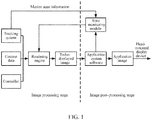
- FIG. 1 is a schematic diagram of an image processing procedure according to an embodiment of this application.
- the image processing procedure includes an image processing stage and an image post-processing stage.
- the image processing stage mainly includes processing such as rendering an image to generate a to-be-displayed image.
- the image post-processing stage mainly processes the to-be-displayed image into an image that can be displayed by a display apparatus.
- a process in the image processing stage is mainly performed based on a game engine or the like to obtain a to-be-displayed game image
- the to-be-displayed image is processed to obtain a game image that can be correctly displayed in VR glasses.
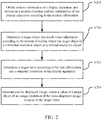
- FIG. 2 is a schematic flowchart of a method for processing a resolution of an image according to an embodiment of this application. The following describes an image processing procedure in this embodiment of this application in detail with reference to FIG. 1 and FIG. 2 .
- Content data mentioned in FIG. 1 refers to date such as original image content, game content and other data
- a controller may be a key controller for controlling an image, a game object, or the like.
- the controller controls an image play mode or motion of an object in a game by transmitting a control instruction.
- An image processing device performs image processing by using a rendering engine, and the rendering engine may be various types of game engines.
- the content data and the instruction transmitted by the controller are combined by the rendering engine, to perform basic processing such as logic processing, controlling, and image rendering.
- determination of a target object and calculation of a target value are performed based on a motion direction of the display apparatus.
- the image processing device synthesizes a result of the basic processing and the target value obtained through calculation to generate the to-be-displayed image, where a value of the target object (a horizontal resolution object and/or a vertical resolution object) of the to-be-displayed image is the target value.
- a value of the target object a horizontal resolution object and/or a vertical resolution object
- an image resolution includes two objects, where the two objects are the horizontal resolution object and the vertical resolution object, and the two objects of different image resolutions have respective values.
- a standard resolution is 1920 ⁇ 1080
- a value of the horizontal resolution object corresponding to the standard resolution is 1920
- a value of the vertical resolution object is 1080.
- the to-be-displayed image is processed by application system software to obtain an application image that can be directly displayed on a head-mounted display device.
- the application image is directly displayed by a display module of the head-mounted display device, and the display module may directly display the application image by using a display screen, or the application image may be displayed in another manner, such as projection display by a projection apparatus.
- the image resolution processing method includes the following steps:
- step S201 in a process of calculating the target value by the image processing device according to the motion direction, first, in step S201, the motion information of the display apparatus is obtained, and the motion direction and the rate information of the display apparatus are determined according to the motion information.
- the image processing device may determine a current motion direction of the display apparatus by using a tracking system shown in FIG. 1 .
- the motion information of the display apparatus may be detected by using a sensor such as an acceleration sensor, a gyro sensor, or the like installed on the display apparatus.
- the motion information may be, for example, three-axis rotation state information (including an angle / an angular velocity / angular acceleration), and/or position state information (including a position / a speed / acceleration) of the display apparatus, and the current motion direction of the display apparatus may be determined based on such motion information.
- the motion information may also directly include the motion direction.
- the image processing device determines a target object that needs value adjustment according to the motion direction of the display apparatus, and the target object is a horizontal resolution object or a vertical resolution object.
- the motion direction is determined according to the motion information. That is, a value of the horizontal resolution object may be reduced, a value of the vertical resolution object may be reduced, or both values may be reduced according to requirements.
- the image processing device may preset a mapping relationship between motion directions and coordinate axes in a pixel coordinate system. In an embodiment, the image processing device may create a correspondence between a motion direction during motion in a horizontal direction and a horizontal coordinate axis in the pixel coordinate system, that is, the value of the horizontal resolution object may be reduced during motion in the horizontal direction.
- the image processing device may create a correspondence between a motion direction during motion in a vertical direction and a vertical coordinate axis in the pixel coordinate system, that is, the value of the vertical resolution object may be reduced during motion in the vertical direction.
- the motion may be divided into two components: horizontal motion and vertical motion.
- a motion direction of a component in the horizontal direction may correspond to a decrease in the horizontal resolution object
- a motion direction of a component in the vertical direction may correspond to a decrease in the vertical resolution object.
- the image processing device may further determine the rate information of the display apparatus according to the motion information of the display apparatus.
- the motion information includes current angular velocity information, angular acceleration information, displacement velocity information, displacement acceleration information, and the like of the display apparatus.
- the motion information may be determined by obtaining motion data sensed on the three axes from a motion sensor such as an acceleration sensor, and/or a gyroscope.
- the image processing device determines the target value according to the rate information of the display apparatus and the standard resolution of the display apparatus, where the rate information is also determined according to the motion information.
- the standard resolution refers to a pre-configured resolution in a rendering engine. If the motion of the display apparatus is not considered, the rendering engine performs image processing according to the standard resolution to obtain the to-be-displayed image with the standard resolution.
- a resolution of the display apparatus is used as the standard resolution. For example, if the resolution of the display apparatus is 1920 ⁇ 1080, the standard resolution is 1920 ⁇ 1080.
- the to-be-displayed image may be generated in step S204 based on the target value, where the value of the target object of the image resolution of the to-be-displayed image is the target value. That is, if the display apparatus moves in the horizontal direction, the value of the horizontal resolution object of the standard resolution is subsequently adjusted, and if the display apparatus moves in the vertical direction, the value of the vertical resolution object of the standard resolution is subsequently adjusted.
- a to-be-displayed image with a resolution of 1080 ⁇ 1200 (the resolution is the standard resolution) which is to be outputted originally
- a to-be-displayed image with a resolution of 583 ⁇ 1200 may be outputted, that is, the value of the horizontal resolution object is adjusted from 1080 to a target value 583.
- a to-be-displayed image with a resolution of 1080 ⁇ 1080 is outputted, that is, the value of the vertical resolution object is adjusted from 1200 to a target value 1080.
- a to-be-displayed image with a resolution of 583 ⁇ 1080 may be outputted. That is, the target value is less than the value of the target object of the standard resolution, and the target value is determined according to the value of the target object of the standard resolution multiplied by a resolution ratio.
- the resolution ratio is a value greater than a lowest threshold and not greater than 1.
- the lowest threshold may be, for example, 0.4 or 0.5.
- the target value of the image resolution of the to-be-displayed image may be calculated by a state monitoring module in FIG. 1 .
- the state monitoring module finally outputs optimized rendering format indication information by using an algorithm about visual impact of a motion state according to information such as processing state information of the whole image processing process, the motion information of the display apparatus, the standard resolution information, and the like.
- the rendering format indication information includes one or two target values of the target object, a Level of Details (LoD for short, which is a method of reducing 3D object complexity) hierarchical geometric fineness regulation value, and the like.
- the state monitoring module may be a dedicated hardware module in a product, or may be a functional module implemented by a processor based on computer program instructions.
- the processing state information in the image processing process includes information such as a current processing duration and a current rendering resolution (that is, the standard resolution).
- the state monitoring module transmits the rendering format indication information to the rendering engine, and the rendering engine regulates the image resolution of the to-be-displayed image according to the rendering format indication information. That is, in an embodiment, step S201 to step S203 are performed by the dedicated state monitoring module configured in the image processing device, and step S204 is performed by the rendering engine in the image processing device.
- both the state monitoring module and the rendering engine may be configured in an image processing device, where the image processing device may be, for example, a VR host device or an AR host device.
- the image processing device may alternatively be some important structures in a wearable device having a host function and a display function. That is, the wearable device may include the image processing device and the display apparatus.
- the state monitoring module shown in FIG. 1 is in the image post-processing stage, and it mainly means that the state monitoring module is an application-level function, or a part of the application system software. In another embodiment, there may be no state monitoring module, and corresponding functions of the state monitoring module are directly configured in the rendering engine.
- the LoD method mentioned above is mainly used for reducing geometric fineness of some models in a compromise with the image refresh rate. That is, after the value of the target object in the standard resolution is adjusted to the target value (or while the value is adjusted), a target image object may be further determined, and the geometric fineness of the target image object is adjusted according to a geometric fineness adjustment rule.
- the determined target image object refers to an image object whose image area in the to-be-displayed image that needs to be finally outputted is less than an area threshold.
- an adjustment process of the geometric fineness includes: pre-configuring multiple different geometric fineness models, or dynamic control rules of the geometric fineness for each to-be-rendered object (image object).
- an image area occupied by the to-be-rendered object in the to-be-displayed image is calculated, and a corresponding geometric fineness model is determined or a corresponding dynamic control rule of the geometric fineness is selected according to the occupied image area, to control the geometric fineness of the to-be-rendered image.
- the occupied area changes as the target resolution of the to-be-rendered image changes.
- an occupied area of an image object is less than a designed threshold, for example, occupied area pixels are less than 1/4 of object geometric finesse (a ball area is four times a projected area), said image object is the target image object, and a model with lower first-order geometric fineness is directly used for the target image object during rendering, so that computation required by the rendering is reduced.
- a designed threshold for example, occupied area pixels are less than 1/4 of object geometric finesse (a ball area is four times a projected area)
- the step of determining the target value according to the standard resolution of the display apparatus and the rate information of the display apparatus which is determined according to the motion information may also be implemented simply by the rendering engine.
- the rendering engine may feed back the motion direction and the motion rate information obtained based on the motion information to the rendering engine, and then the rendering engine finally obtains the target value through calculation according to the standard resolution.
- the rendering engine may further finish adjustment processing of the geometric finesses mentioned above. That is, in an embodiment, all the steps from step S201 to step S204 may be performed by the rendering engine of the image processing device.
- the image processing device may be, for example, a VR host device or an AR host device, or may alternatively be an important part of a wearable device having a host function and a display function. That is, the wearable device may include the image processing device and the display apparatus.
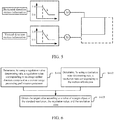
- FIG. 3 is a schematic diagram of a calculation method of a target value according to an embodiment of this application.
- Step S203 mentioned above that is, the step of determining a target value according to the rate information of the display apparatus and a standard resolution of the display apparatus, the rate information being determined according to the motion information, specifically includes the following steps: step S301, determining a resolution ratio corresponding to the motion information by using a resolution ratio determining rule; and step S3 02, obtaining the target value according to the value of the target object of the standard resolution and the resolution ratio.
- a motion speed is in direct proportion to a blur degree acceptable visually. Therefore, in this embodiment of this application, a relationship between the motion speed and the blur degree may be represented by a slope, and the resolution ratio determining rule may be determined according to the slope. Also, considering that human eyes will track the object during slight motion, the resolution is not reduced when it is determined that the motion is low-speed motion in this embodiment of this application. When setting the resolution ratio determining rule, the situation of not reducing the resolution in a low-speed case is also taken into consideration. In addition, lattice-like noise is generated when an image sampling rate is excessively low, which is easily noticed by the user. Therefore, an excessively low image sampling rate also needs to be avoided when setting the resolution ratio determining rule.
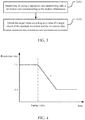
- FIG. 4 is a schematic diagram of a resolution ratio determining rule according to an embodiment of this application.
- Specific startup motion values for example, a motion velocity value, an angular velocity value, an angular acceleration value, and the like
- the slope vary due to system performance of the image processing device.
- a minimum reduction of the resolution value is multiplied by about a ratio of 0.4 to 0.5 in actual measurement, namely, a minimum resolution ratio is a value between 0.4 and 0.5.
- the resolution ratio is not less than a second fixed ratio.
- resolution ratios corresponding to different motion values may be measured by performing manual actual measurement on said image processing device, to manually calibrate the first threshold (that is, a startup value in FIG. 4 ) and the second fixed ratio (the second fixed ratio may be, for example, the ratio of 0.4 to 0.5 mentioned above) of the image processing device are manually calibrated.
- the first fixed ratio may be, for example, 1, that is, the resolution value is not reduced.
- the slope k may be obtained through mathematical calculation such as straight line fitting based on multiple coordinate points (the motion value and the resolution ratio) actually measured between the first threshold and a value corresponding to the motion information during generating of the second fixed ratio. While a reference refresh rate (for example, 90 fps) is ensured, multiple coordinate points may be obtained comprehensively based on acceptance degrees of multiple users for blurred images in motion during testing.
- resolution ratios of an image processing device corresponding to various motion values may be directly obtained through manual testing, and a mapping relationship, for example, a mapping table, between the motion values (or the motion value ranges) and the resolution ratios is established.
- a mapping relationship for example, a mapping table
- FIG. 5 is a schematic diagram of calculation of a target value in an embodiment.
- a resolution ratio of an X direction (corresponding to the horizontal resolution object) corresponding to horizontal direction motion information is denoted by Xf
- a resolution ratio of a Y direction (corresponding to the vertical resolution object) corresponding to vertical direction motion information is denoted by Yf.
- a target value in the X direction is equal to a value in the X direction in the standard resolution multiplied by Xf
- a target value in the Y direction is equal to a value in the Y direction in the standard resolution multiplied by Yf.
- a relationship between the finally obtained target value and the standard resolution may be as shown in FIG. 5 .
- FIG. 6 is a schematic diagram of a calculation method of a target value according to another embodiment of this application.
- Step S203 mentioned above that is, the step of determining a target value according to the rate information of the display apparatus and a standard resolution of the display apparatus specifically includes the following steps: step S601, determining, by using a regulation value determining rule, a regulation value corresponding to an image update duration included in a current image processing performance parameter; step S602, determining, by using a resolution ratio determining rule, a resolution ratio corresponding to the motion information; and step S603, obtaining the target value according to a value of the target object in the standard resolution, the regulation value, and the resolution ratio.
- step S602 refer to the description of an embodiment corresponding to FIG. 4 and FIG. 5 .
- the regulation value mentioned in step S601 may be generated according to a duration of the current rendering processing, and is denoted by Gf.
- the regulation value may be greater than 1.0 when a rendering duration is short (for example, far less than 11 ms) to facilitate oversampling processing, thereby improving the resolution and enhancing picture details.
- the value regulation is reduced according to an excess amount when the rendering duration is relatively long, thereby reducing the resolution.
- the relationship between the regulation value Gf and the processing duration shown in FIG. 7 may also be obtained by means of manual measurement as follows: marking image processing devices with different performances, and determining the slope k1 and the slope k2 in FIG. 7 based on straight line fitting or the like. As shown in FIG.
- the first fixed regulation value is 1.2
- the second fixed regulation value is 0.7
- the first duration threshold is a duration value less than 11 ms, for example, 6 ms. It is found through the actual measurement that, generally, the fluency of image displaying can be ensured as long as a refresh rate of 90 fps (frames per second) is maintained, and 11 ms approximately corresponds to 1/90.
- the first duration threshold may alternatively be other values. For example, if the refresh rate is required to be 60 fps, the first duration threshold may be 16.6 ms, or a similar value such as 16 ms.
- the processing duration may refer to a total duration for completing processing of one frame of an image in the above-mentioned two stages: the image processing stage and the image post-processing stage, and may be considered as a duration it takes for a general process unit (GPU) to finish a complete image that can be directly displayed. Time spent on each frame of image from the beginning of rendering to the final completion may be recorded by inquiring an operation state from the GPU, to obtain the processing duration.
- a period of time may be defined by a test user as the processing duration, so as to better and more accurately determine the regulation value Gf.
- FIG. 8 is a schematic diagram of a calculation method of a target value in another embodiment.
- a resolution ratio of an X direction (corresponding to the horizontal resolution object) corresponding to horizontal direction motion information is denoted by Xf
- a resolution ratio of a Y direction (corresponding to the vertical resolution object) corresponding to vertical direction motion information is denoted by Yf.
- a target value in the X direction is equal to a value in the X direction in the standard resolution multiplied by Xf and Gf
- a target value in the Y direction is equal to a value in the Y direction in the standard resolution multiplied by Yf and Gf.
- a relationship between the finally obtained target value and the standard resolution may be as shown in FIG. 8 .
- a value corresponding to the corresponding regulation value Gf is 0.9.
- an action of turning the head quickly is performed in the X direction, and a resolution ratio Xf corresponding to a speed in the X direction is 0.6.
- Motion in the Y direction is slow motion, and the resolution ratio is 1.0.
- a rendering load may be greatly reduced by reducing the resolution ratio, so as to maintain the image fluency.
- the to-be-displayed image may be magnified according to the display resolution of the display apparatus and the resolution of the to-be-displayed image, and the magnified to-be-displayed image is outputted to the display apparatus for display, so as to display the to-be-displayed image on the display apparatus in a full screen manner.
- a size of a render target is a screen resolution size of the display apparatus, so that the GPU may automatically render a magnification result.
- an image 901 is a to-be-displayed image having a standard resolution that is to be originally outputted
- an image 902 is an actually outputted image after image resolution value processing, that is, a to-be-displayed image of which the value of the horizontal resolution object in the X direction is adjusted to a corresponding target value.
- image resolution value processing that is, a to-be-displayed image of which the value of the horizontal resolution object in the X direction is adjusted to a corresponding target value.
- the image 902 Before being outputted to the display apparatus for final display, that is, in the image post-processing stage mentioned above, the image 902 is magnified based on an actual display resolution of the display apparatus, and an image 903 is finally outputted to the display apparatus for display.
- the image 903 is blurred in a certain degree in the X direction.
- the magnification performed after the resolution value is reduced blurs the image, and a pattern of the image blur is related to a direction in which the resolution value is reduced. For example, reducing the value in the X direction (that is, the horizontal resolution object) causes a horizontal blur of the magnified image, and reducing the value in the Y direction (that is, the vertical resolution object) causes a vertical blur of the magnified image.
- FIG. 10a is a schematic flowchart of an image resolution processing method according to an embodiment of this application.
- the method in this embodiment of this application may be performed by an image processing device, and the image processing device may be specifically implemented by a computer device or formed by some important structures of the computer device.
- the image processing device may be a VR host device or an AR host device, and the image processing device may alternatively be formed by some important structures installed on a wearable device having a host function and a display function.
- the method according to this embodiment of this application includes the following steps:
- steps S1002 to S1005 for specific implementation of steps S1002 to S1005, refer to the description of related content in the foregoing embodiments.
- the image processing performance parameter is the image refresh rate
- the preset rate threshold is 90 fps is used.
- the GPU of the image processing device outputs a rendered image 1011 having the standard resolution.
- FIG. 10c if it is determined through performance monitoring that the current image refresh rate is less than 90 fps, adjustment needs to be performed based on related steps from step S1002 to step S1005 mentioned above, to obtain a rendered image 1012 of which a value of a resolution object corresponding to the X coordinate direction and/or the Y coordinate direction is the corresponding target value.
- FIG. 11 is a schematic flowchart of another image resolution processing method according to an embodiment of this application.
- the method in this embodiment of this application may be performed by an image processing device, and the image processing device may be specifically implemented by a computer device or formed by some important structures in the computer device.
- the image processing device may be a VR host device or an AR host device, and the image processing device may alternatively be formed by some important structures installed on a wearable device having a host function and a display function.
- the method according to this embodiment of this application includes the following steps:
- whether to reduce the image resolution may be comprehensively considered based on an image processing performance parameter and the motion information.
- the current image processing performance parameter is obtained. If the image processing performance parameter meets a resolution adjustment condition, the motion information of the display apparatus is further determined, to determine whether the motion information meets the motion condition. If the motion information meets the motion condition, steps from step S1102 to step S1104 are subsequently triggered to be performed.
- FIG. 12 is a schematic flowchart of another image resolution processing method according to an embodiment of this application.
- the method in this embodiment of this application may be performed by an image processing device, and the image processing device may be specifically implemented by a computer device or formed by some important structures in the computer device.
- the image processing device may be a VR host device or an AR host device, and the image processing device may alternatively be formed by some important structures disposed in a wearable device having a host function and a display function.
- the method according to this embodiment of this application includes the following steps:
- steps S1207 to S1209 for specific implementation of steps S1207 to S1209, refer to the description of related content in the foregoing embodiments.
- whether the motion information meets the motion condition may alternatively be determined first. If the motion information meets the motion condition, a current image processing performance parameter may be further obtained. In a case that the image processing performance parameter meets the resolution adjustment condition, the operation of determining, according to the motion direction of the display apparatus that is determined according to the motion information, the target object that needs value adjustment is triggered, thereby facilitating execution of subsequent steps to obtain the to-be-displayed image.
- the step of determining, according to the motion direction of the display apparatus that is determined according to the motion information, the target object that needs value adjustment, or the like is stopped.
- the step of obtaining the target value is no longer executed, that is, resolution adjustment is not performed, and the to-be-displayed image of which the image resolution is the standard resolution is obtained.
- N may be set to a value of 3 to 5 as required.
- FIG. 13 is a schematic structural diagram of an image resolution processing system according to an embodiment of this application.
- the system includes an image processing device and a display apparatus.
- the image processing device may be implemented by a computer device, and the image processing device may be specifically a device such as an AR host or a VR host.
- FIG. 13 shows an example in which the AR host is used as the image processing device.
- the display apparatus may be a display device, such as AR glasses or a VR helmet, used for displaying a game screen image, a CG image, a high-definition image, and the like.
- FIG. 13 shows an example in which the VR helmet is used as the display apparatus.
- FIG. 13 mainly shows an image processing scenario in which the image processing device is separated from the display apparatus.
- the image processing device may perform image processing through related steps described in the foregoing embodiments to finally obtain a to-be-displayed image that can be finally displayed by the display apparatus, and the to-be-displayed image is outputted as a target image.
- the display apparatus directly displays the target image outputted by the image processing device.
- a network shown in FIG. 13 is merely an example.
- the VR host and the VR helmet may alternatively be connected by other means, for example, directly connected in a wired manner through a data cable.
- the image resolution processing system includes an image processing device and a display apparatus.
- the image processing device is configured to: obtain motion information of the display apparatus; determine a motion direction and rate information of the display apparatus according to the motion information; determine, according to the motion direction, a target object that needs value adjustment, where the target object is a horizontal resolution object or a vertical resolution object; determine a target value according to the rate information and a standard resolution of the display apparatus; generate a to-be-displayed image, where a value of a target object of an image resolution of the to-be-displayed image is equal to the target value; and output a target image according to the to-be-displayed image.
- the display apparatus is configured to: transmit the motion information to the image processing device, and display the target image after receiving the target image.
- the display apparatus is further configured to transmit the motion information to the image processing device when detecting that an image refresh rate of the displayed target image is less than a preset rate threshold, and/or detecting that collected motion information meets a motion condition.
- the image processing device 1400 may include a user interface 1401, a processor 1402, a storage apparatus 1403, and an output interface 1404. Certainly, the image processing device 1400 may further include a power supply module configured to supply power to the device, and a function module configured to download data including various images (for example, game data) from the Internet, and the like. The image processing device 1400 may further provide an interface module such as a speaker interface, a microphone interface, or the like.
- the user interface 1401 may include an interface module formed by some physical buttons, touch buttons, and the like, and may receive a user operation.
- the user interface 1401 may further include some structures such as a display screen that may prompt information such as a working state of the image processing device 1400 to the user.
- the storage apparatus 1403 may include a volatile memory, for example, a random access memory (RAM).
- the storage apparatus 1403 may alternatively include a non-volatile memory, for example, a flash memory, and a solid-state drive (SSD).
- the storage apparatus 1403 may alternatively include a combination of the foregoing types of memories.
- the processor 1402 may be a central processing unit (CPU) 1402.
- the processor 1402 may further include a hardware chip, where the hardware chip may be an application-specific integrated circuit (ASIC), a programmable logic device (PLD), or the like, and the PLD may be a field programmable gate array (FPGA), generic array logic (GAL), or the like.
- the processor 1402 may alternatively be a combination of the foregoing structures.
- the storage apparatus 1403 is further configured to store computer program instructions.
- the processor 1402 may call the computer program instructions, and may perform the foregoing various methods and steps.
- the processor 1402 is configured to call the computer program instructions stored in the storage apparatus 1403 to: obtain motion information of the display apparatus; determine a motion direction and rate information of the display apparatus according to the motion information; determine, according to the motion direction, a target object that needs value adjustment, where the target object is a horizontal resolution object or a vertical resolution object; determine a target value according to the rate information and a standard resolution of the display apparatus; and generate a to-be-displayed image, where a value of a target object of an image resolution of the to-be-displayed image is equal to the target value.
- the generated display image may be outputted through the output interface 1404, so that the images are displayed by the display apparatus.
- the image processing device 1400 further directly includes a display screen
- the to-be-displayed image generated by the processor 1402 is transmitted to the display screen through the output interface 1404, and is directly displayed by the display screen.
- the processor 1402 before obtaining the motion information of the display apparatus, is further configured to: obtain a current image processing performance parameter; and in a case that the image processing performance parameter meets a resolution adjustment condition, trigger the operation of obtaining motion information of the display apparatus.
- the image processing performance parameter meeting the resolution adjustment condition includes at least one of the following situations: an image refresh rate included in the image processing performance parameter is less than a preset rate threshold; an image update duration included in the image processing performance parameter is greater than a preset duration threshold; and an image processing resource usage ratio included in the image processing performance parameter is greater than a preset usage ratio threshold.
- the processor 1402 is further configured to: in a case that the motion information meets the motion condition, trigger the operation of determining, according to the motion direction of the display apparatus, the target object that needs value adjustment.
- the motion information meeting the motion condition includes: a motion value indicated by the rate information of the display apparatus that is determined according to the motion information is greater than a preset speed threshold.
- the processor 1402 is further configured to: determine, by using a resolution ratio determining rule, a resolution ratio corresponding to the motion information; and obtain the target value according to a value of the target object in the standard resolution and the resolution ratio.
- the processor 1402 is further configured to: determine, by using a regulation value determining rule, a regulation value corresponding to an image update duration included in a current image processing performance parameter; and determine, by using a resolution ratio determining rule, a resolution ratio corresponding to the motion information; and obtain the target value according to the value of the target object in the standard resolution, the regulation value, and the resolution ratio.
- the resolution ratio determining rule includes: in a case that the motion value corresponding to the rate information of the display apparatus is less than a first threshold, determining that the resolution ratio corresponding to the motion information is a first fixed ratio, where the resolution ratio is not less than a second fixed ratio.
- the resolution ratio determining rule includes: in a case that the image update duration included in the current image processing performance parameter is less than a first duration threshold, determining that the regulation value is a first fixed regulation value, where the regulation value is not less than a second fixed regulation value.
- the processor 1402 is configured to: call computer program instructions stored in the storage apparatus 1403, determine a target image object from the generated to-be-displayed image, and further adjust geometric fineness of the target image object according to a geometric fineness adjustment rule.
- the processor 1402 is configured to: call the computer program instructions stored in the storage apparatus 1403; magnify the to-be-displayed image according to a display resolution value of the display apparatus and a resolution value of the to-be-displayed image; and output the magnified to-be-displayed image to the display apparatus for display.
- a resolution value corresponding to an X axis or a Y axis in an image coordinate system is adjusted according to a motion direction.
- a certain refresh rate is ensured by changing the resolution value of the image in a processing process such as image rendering, and stability of an image displayed by a device such as a head-mounted display apparatus can be maintained.
- FIG. 15 is a schematic structural diagram of an image resolution processing apparatus 1500 according to an embodiment of this application.
- the apparatus in this embodiment of this application may be provided in a device such as VR host or an AR host according to a requirement.
- the apparatus in this embodiment of this application may alternatively be provided in a device such as a smartphone, a tablet computer, or an intelligent wearable device that can provide a host function.
- the apparatus in this embodiment of this application includes the following modules.
- An obtaining module 1501 is configured to: obtain motion information of a display apparatus, and determine a motion direction and rate information of the display apparatus according to the motion information.
- a determining module 1502 is configured to determine, according to the motion direction, a target object that needs value adjustment, where the target object is a horizontal resolution object or a vertical resolution object.
- a calculating module 1503 is configured to determine a target value according to the rate information and a standard resolution of the display apparatus.
- a generating module 1504 is configured to generate a to-be-displayed image, where a value of a target object of an image resolution of the to-be-displayed image is equal to the target value.
- the image resolution processing apparatus 1500 further includes a first trigger module 1505.
- the first trigger module 1505 is configured to: obtain a current image processing performance parameter; and in a case that the image processing performance parameter meets a resolution adjustment condition, trigger the obtaining module 1501 to obtain the motion information of the display apparatus.
- the image processing performance parameter meeting the resolution adjustment condition includes at least one of the following situations: an image refresh rate included in the image processing performance parameter is less than a preset rate threshold; an image update duration included in the image processing performance parameter is greater than a preset duration threshold; and an image processing resource usage ratio included in the image processing performance parameter is greater than a preset usage ratio threshold.
- the image resolution processing apparatus 1500 further includes a second trigger module 1506.
- the second trigger module 1506 is configured to: in a case that the motion information meets a motion condition, trigger the obtaining module 1501 to determine, according to the motion direction of the display apparatus that is determined according to the motion information, the target object that needs value adjustment.
- the motion information meeting the motion condition includes: a motion value indicated by the rate information of the display apparatus that is determined according to the motion information is greater than a preset speed threshold.
- trigger functions of the first trigger module 1505 and the second trigger module 1506 may be implemented by the same trigger module.
- the calculating module 1503 is specifically configured to: determine, by using a resolution ratio determining rule, a resolution ratio corresponding to the motion information; and obtain the target value according to a value of the target object in the standard resolution and the resolution ratio.
- the calculating module 1503 is specifically configured to: determine, by using a regulation value determining rule, a regulation value corresponding to an image update duration included in a current image processing performance parameter; determine, by using a resolution ratio determining rule, a resolution ratio corresponding to the motion information; and obtain the target value according to the value of the target object in the standard resolution, the regulation value, and the resolution ratio.
- the resolution ratio determining rule includes: in a case that a motion value corresponding to the rate information of the display apparatus is less than a first threshold, determining that the resolution ratio corresponding to the motion information is a first fixed ratio, where the resolution ratio is not less than a second fixed ratio.
- the resolution ratio determining rule includes: in a case that the image update duration included in the current image processing performance parameter is less than a first duration threshold, determining that the regulation value is a first fixed regulation value, where the regulation value is not less than a second fixed regulation value.
- the image resolution processing apparatus 1500 may further include an adjustment module 1507.
- the adjustment module 1507 is configured to: determine a target image object from the generated to-be-displayed image, and adjust geometric fineness of the target image object according to a geometric fineness adjustment rule.
- the image resolution processing apparatus 1500 may further include a scaling module 1508.
- the scaling module 1508 is configured to: magnify the to-be-displayed image according to a display resolution value of the display apparatus and a resolution value of the to-be-displayed image; and output the magnified to-be-displayed image to the display apparatus for display.
- the adjustment module 1507 and the scaling module 1508 may be implemented by one processing module.
- the to-be-displayed image outputted by the generating module 1504 may be transmitted directly to the scaling module 1508.
- the scaling module 1508 directly performs magnification without adjusting the geometric fineness of the target image object according to the geometric fineness adjustment rule.
- a resolution value corresponding to an X axis or a Y axis in an image coordinate system is adjusted according to a motion direction.
- a certain refresh rate is ensured by changing the resolution value of the image in a processing process such as image rendering, and stability of an image displayed by a device such as a head-mounted display apparatus can be maintained.
- the image resolution processing apparatus provided in this application may be implemented in a form of a computer program, and the computer program may run on the image processing device shown in FIG. 14 .
- the memory of the image processing device may store program modules forming the image resolution processing apparatus, for example, the obtaining module, the determining module, the calculating module, and the generating module shown in FIG. 15 .
- the computer program formed by the program modules causes the processor to perform the steps in the image resolution processing method in the embodiments of this application described in this specification.
- the image processing device shown in FIG. 14 may perform step S201 by using the obtaining module in the image resolution processing apparatus shown in FIG. 15 .
- the image processing device may perform step S202 by using the determining module.
- the image processing device may perform step S203 by using the calculating module.
- the image processing device may perform step S204 by using the generating module.
- an image processing device including a processor and a memory.
- the memory stores a computer program, and the computer program, when executed by the processor, causes the processor to perform the steps of the foregoing image resolution processing method.
- the steps of the image resolution processing method herein may be the steps of the image resolution processing method in the foregoing embodiments.
- a computer-readable storage medium storing a computer program, where the computer program, when executed by a processor, causes the processor to perform the steps of the foregoing image resolution processing method.
- the steps of the image resolution processing method herein may be the steps of the image resolution processing method in the foregoing embodiments.
- the program may be stored in a computer-readable storage medium. During execution of the program, processes of the foregoing method embodiments may be included.
- the storage medium may be a magnetic disk, an optical disc, a read-only memory (ROM) or a random access memory (RAM), or the like.
Landscapes
- Physics & Mathematics (AREA)
- General Physics & Mathematics (AREA)
- Engineering & Computer Science (AREA)
- Theoretical Computer Science (AREA)
- Controls And Circuits For Display Device (AREA)
Abstract
Description
- This application claims priority to Chinese Patent Application No.
201810392834.X - This application relates to the technology field of image processing, and in particular, to a method, a system, an apparatus, a storage medium and a device for processing a resolution of an image.
- With the development of electronic technology and computer technology, people may obtain various images, make various images, and process and display various images according to requirements, to meet an image visual requirement of a user. For example, in the field of Virtual Reality (VR) or Augmented Reality (AR), related image processing such as making or rendering some special images is involved, and processed images are finally displayed on a display apparatus such as VR/AR glasses, helmets, and the like, therefore, a good visual experience is brought to the user.
- In a system such as a VR/AR system, it is usually required to maintain an image refresh rate higher than a certain image refresh rate threshold, for example, an image refresh rate of 90 fps (frames per second), during display of an image, for example, during display of a game image. Maintaining the refresh rate is an important index to ensure the image visual experience of the user. Therefore, how to ensure a certain refresh rate becomes a hot issue in research.
- Embodiments of this application provide a method, a system, an apparatus, a storage medium and a device for processing a resolution of an image.
- A method for processing a resolution of an image includes:
- obtaining motion information of a display apparatus;
- determining a motion direction and rate information of the display apparatus according to the motion information;
- determining a target object that needs value adjustment according to the motion direction, where the target object is a horizontal resolution object or a vertical resolution object;
- determining a target value according to the rate information and a standard resolution of the display apparatus; and
- generating a to-be-displayed image, where a value of a target object of an image resolution of the to-be-displayed image is equal to the target value.
- A system for processing a resolution of an image includes an image processing device and a display apparatus, where
the image processing device is configured to: obtain motion information of the display apparatus; determine a motion direction and rate information of the display apparatus according to the motion information; determine a target object that needs value adjustment according to the motion direction, where the target object is a horizontal resolution object or a vertical resolution object; determine a target value according to the rate information and a standard resolution of the display apparatus; generate a to-be-displayed image, where a value of a target object of an image resolution of the to-be-displayed image is equal to the target value; and output a target image according to the to-be-displayed image; and
the display apparatus is configured to transmit the motion information to the image processing device, and display the target image after receiving the target image. - An apparatus for processing a resolution of an image includes:
- an obtaining module, configured to obtain motion information of a display apparatus, and determine a motion direction and rate information of the display apparatus according to the motion information;
- a determining module, configured to determine a target object that needs value adjustment according to the motion direction, where the target object is a horizontal resolution object or a vertical resolution object;
- a calculating module, configured to determine a target value according to the rate information and a standard resolution of the display apparatus; and
- a generating module, configured to generate a to-be-displayed image, where a value of a target object of an image resolution of the to-be-displayed image is equal to the target value.
- A non-volatile computer-readable storage medium, storing computer-readable instructions, where the computer-readable instructions, when executed by one or more processors, cause the one or more processors to perform the following operations:
- obtaining motion information of a display apparatus;
- determining a motion direction and rate information of the display apparatus according to the motion information;
- determining a target object that needs value adjustment according to the motion direction, where the target object is a horizontal resolution object or a vertical resolution object;
- determining a target value according to the rate information and a standard resolution of the display apparatus; and
- generating a to-be-displayed image, where a value of a target object of an image resolution of the to-be-displayed image is equal to the target value.
- An image processing device includes a memory and a processor, where the memory stores computer-readable instructions, and the computer-readable instructions, when executed by the processor, cause the processor to perform the following operations:
- obtaining motion information of a display apparatus;
- determining a motion direction and rate information of the display apparatus according to the motion information;
- determining a target object that needs value adjustment according to the motion direction, where the target object is a horizontal resolution object or a vertical resolution object;
- determining a target value according to the rate information and a standard resolution of the display apparatus; and
- generating a to-be-displayed image, where a value of a target object of an image resolution of the to-be-displayed image is equal to the target value.
- Details of one or more embodiments of this application are provided in the accompany drawings and descriptions below. Other features, objectives, and advantages of this application become apparent from the specification, the accompanying drawings, and the claims.
- To describe the technical solutions of the embodiments of this application or the related art more clearly, the following briefly introduces the accompanying drawings required for describing the embodiments or the related art. Apparently, the accompanying drawings in the following description show only some embodiments of this application, and a person of ordinary skill in the art may still derive other drawings from these accompanying drawings without creative efforts.
-
FIG. 1 is a schematic diagram of an image processing procedure according to an embodiment of this application. -
FIG. 2 is a schematic flowchart of a method for processing a resolution of an image according to an embodiment of this application. -
FIG. 3 is a schematic diagram of a calculation method of a target value according to an embodiment of this application. -
FIG. 4 is a schematic diagram of a resolution ratio determining rule according to an embodiment of this application. -
FIG. 5 is a schematic diagram of calculation of a target value according to an embodiment of this application. -
FIG. 6 is a schematic diagram of another calculation method of a target value according to an embodiment of this application. -
FIG. 7 is a schematic diagram of a relationship between a regulation value and a processing duration according to an embodiment of this application. -
FIG. 8 is a schematic diagram of another calculation of a target value according to an embodiment of this application. -
FIG. 9 is a schematic diagram of comparing images according to an embodiment of this application. -
FIG. 10a is a schematic flowchart of another method for processing a resolution of an image according to an embodiment of this application. -
FIG. 10b is a schematic diagram of image processing based on a refresh rate according to an embodiment of this application. -
FIG. 10c is a schematic diagram of another image processing based on a refresh rate according to an embodiment of this application. -
FIG. 11 is a schematic flowchart of another method for processing a resolution of an image according to an embodiment of this application. -
FIG. 12 is a schematic flowchart of another method for processing a resolution of an image according to an embodiment of this application. -
FIG. 13 is a schematic structural diagram of a system for processing a resolution of an image according to an embodiment of this application. -
FIG. 14 is a schematic structural diagram of an image processing device according to an embodiment of this application. -
FIG. 15 is a schematic structural diagram of an apparatus for processing a resolution of an image according to an embodiment of this application. - To ensure a certain image refresh rate, and further ensure an image visual experience of a user to a certain extent, comfort of the user when viewing an image in a head-mounted display apparatus is researched. It is found that, when an entire body or head of the user is in a still state or a low-speed motion state, attention of human eyes on a fine structure of the image outperforms refresh rate performance. That is, during slight motion, the user pays more attention to an image resolution and whether the image is clear. On the contrary, when the entire body or head moves rapidly, human eyes cannot clearly see details in a scene image actually, but are more sensitive to fluency of the image, namely, the image refresh rate. That is, during vigorous motion, the refresh rate may be improved, and the resolution may be reduced. Therefore, in a process of generating a to-be-displayed image in embodiments of this application, motion information (information such as a displacement velocity, displacement acceleration, a motion angle, a motion angular velocity, and motion angular acceleration) is introduced as a basis for regulating a resolution value. By reducing the resolution value in a motion direction during rapid motion, a finally generated to-be-displayed image is blurred in a certain degree, and the generated blur is closer to an effect of visual persistence.
- In embodiments of this application, when a user displays various images by using AR glasses, a VR helmet or other types of display apparatuses, an image resolution may be dynamically adjusted by monitoring a motion state of the user in a process of generating a to-be-displayed image. With an original standard resolution as a reference, the image resolution is reduced to a target resolution, and the to-be-displayed image is generated according to the target resolution. By adjusting the image resolution, specifically, adjusting a value of a horizontal resolution object and/or a value of a vertical resolution object of the standard resolution, a corresponding value is reduced, thus a computation amount of rendering an image is reduced to achieve a higher image refresh rate, thereby ensuring that when the user uses a display apparatus such as VR glasses and is in an image viewing scenario, a game playing scenario or the like, an image processing device may finish processing such as rendering the image in time. Therefore, the fluency of the images is ensured, immersion for the user is improved, and the user does not feel discomfort such as dizziness even in a moving process.
- Referring to
FIG. 1 andFIG. 2 ,FIG. 1 is a schematic diagram of an image processing procedure according to an embodiment of this application. The image processing procedure includes an image processing stage and an image post-processing stage. The image processing stage mainly includes processing such as rendering an image to generate a to-be-displayed image. The image post-processing stage mainly processes the to-be-displayed image into an image that can be displayed by a display apparatus. For example, in a VR application scenario, a process in the image processing stage is mainly performed based on a game engine or the like to obtain a to-be-displayed game image, and in the image post-processing stage, the to-be-displayed image is processed to obtain a game image that can be correctly displayed in VR glasses.FIG. 2 is a schematic flowchart of a method for processing a resolution of an image according to an embodiment of this application. The following describes an image processing procedure in this embodiment of this application in detail with reference toFIG. 1 andFIG. 2 . - Content data mentioned in
FIG. 1 refers to date such as original image content, game content and other data, and a controller may be a key controller for controlling an image, a game object, or the like. The controller controls an image play mode or motion of an object in a game by transmitting a control instruction. An image processing device performs image processing by using a rendering engine, and the rendering engine may be various types of game engines. On one hand, the content data and the instruction transmitted by the controller are combined by the rendering engine, to perform basic processing such as logic processing, controlling, and image rendering. On the other hand, determination of a target object and calculation of a target value are performed based on a motion direction of the display apparatus. Finally, the image processing device synthesizes a result of the basic processing and the target value obtained through calculation to generate the to-be-displayed image, where a value of the target object (a horizontal resolution object and/or a vertical resolution object) of the to-be-displayed image is the target value. In this embodiment of this application, it is defined that an image resolution includes two objects, where the two objects are the horizontal resolution object and the vertical resolution object, and the two objects of different image resolutions have respective values. For example, when a standard resolution is 1920∗1080, it can be considered that a value of the horizontal resolution object corresponding to the standard resolution is 1920, and a value of the vertical resolution object is 1080. - In an embodiment, after the to-be-displayed image is obtained in the image processing stage, the to-be-displayed image is processed by application system software to obtain an application image that can be directly displayed on a head-mounted display device. The application image is directly displayed by a display module of the head-mounted display device, and the display module may directly display the application image by using a display screen, or the application image may be displayed in another manner, such as projection display by a projection apparatus.
- In an embodiment, the image resolution processing method includes the following steps:
- Step S201, obtaining motion information of a display apparatus, and determining a motion direction and rate information of the display apparatus according to the motion information.
- Step S202, determining a target object that needs value adjustment according to the motion direction, where the target object is a horizontal resolution object or a vertical resolution obj ect.
- Step S203, determining a target value according to the rate information and a standard resolution of the display apparatus.
- Step S204, generating a to-be-displayed image, where a value of a target object of an image resolution of the to-be-displayed image is equal to the target value.
- In an embodiment, in a process of calculating the target value by the image processing device according to the motion direction, first, in step S201, the motion information of the display apparatus is obtained, and the motion direction and the rate information of the display apparatus are determined according to the motion information. In an embodiment, the image processing device may determine a current motion direction of the display apparatus by using a tracking system shown in
FIG. 1 . Specifically, the motion information of the display apparatus may be detected by using a sensor such as an acceleration sensor, a gyro sensor, or the like installed on the display apparatus. The motion information may be, for example, three-axis rotation state information (including an angle / an angular velocity / angular acceleration), and/or position state information (including a position / a speed / acceleration) of the display apparatus, and the current motion direction of the display apparatus may be determined based on such motion information. Certainly, the motion information may also directly include the motion direction. - In step S202, the image processing device determines a target object that needs value adjustment according to the motion direction of the display apparatus, and the target object is a horizontal resolution object or a vertical resolution object. As described above, the motion direction is determined according to the motion information. That is, a value of the horizontal resolution object may be reduced, a value of the vertical resolution object may be reduced, or both values may be reduced according to requirements. The image processing device may preset a mapping relationship between motion directions and coordinate axes in a pixel coordinate system. In an embodiment, the image processing device may create a correspondence between a motion direction during motion in a horizontal direction and a horizontal coordinate axis in the pixel coordinate system, that is, the value of the horizontal resolution object may be reduced during motion in the horizontal direction. The image processing device may create a correspondence between a motion direction during motion in a vertical direction and a vertical coordinate axis in the pixel coordinate system, that is, the value of the vertical resolution object may be reduced during motion in the vertical direction. For diagonally upward motion or diagonally downward motion, the motion may be divided into two components: horizontal motion and vertical motion. A motion direction of a component in the horizontal direction may correspond to a decrease in the horizontal resolution object, and a motion direction of a component in the vertical direction may correspond to a decrease in the vertical resolution object.
- In an embodiment, after the target object is determined, the image processing device may further determine the rate information of the display apparatus according to the motion information of the display apparatus. In an embodiment, the motion information includes current angular velocity information, angular acceleration information, displacement velocity information, displacement acceleration information, and the like of the display apparatus. The motion information may be determined by obtaining motion data sensed on the three axes from a motion sensor such as an acceleration sensor, and/or a gyroscope.
- After the motion information is obtained, in step S203, the image processing device determines the target value according to the rate information of the display apparatus and the standard resolution of the display apparatus, where the rate information is also determined according to the motion information. The standard resolution refers to a pre-configured resolution in a rendering engine. If the motion of the display apparatus is not considered, the rendering engine performs image processing according to the standard resolution to obtain the to-be-displayed image with the standard resolution. Generally, a resolution of the display apparatus is used as the standard resolution. For example, if the resolution of the display apparatus is 1920∗1080, the standard resolution is 1920∗1080. After the target value is obtained, the to-be-displayed image may be generated in step S204 based on the target value, where the value of the target object of the image resolution of the to-be-displayed image is the target value. That is, if the display apparatus moves in the horizontal direction, the value of the horizontal resolution object of the standard resolution is subsequently adjusted, and if the display apparatus moves in the vertical direction, the value of the vertical resolution object of the standard resolution is subsequently adjusted. For example, for a to-be-displayed image with a resolution of 1080∗1200 (the resolution is the standard resolution) which is to be outputted originally, if the motion in the horizontal direction is detected, a to-be-displayed image with a resolution of 583∗1200 may be outputted, that is, the value of the horizontal resolution object is adjusted from 1080 to a target value 583. If the motion in the vertical direction is detected, a to-be-displayed image with a resolution of 1080∗1080 is outputted, that is, the value of the vertical resolution object is adjusted from 1200 to a target value 1080. If there are motion components of the user in both the horizontal direction and the vertical direction, a to-be-displayed image with a resolution of 583∗1080 may be outputted. That is, the target value is less than the value of the target object of the standard resolution, and the target value is determined according to the value of the target object of the standard resolution multiplied by a resolution ratio. The resolution ratio is a value greater than a lowest threshold and not greater than 1. The lowest threshold may be, for example, 0.4 or 0.5.
- In an embodiment, the target value of the image resolution of the to-be-displayed image may be calculated by a state monitoring module in
FIG. 1 . The state monitoring module finally outputs optimized rendering format indication information by using an algorithm about visual impact of a motion state according to information such as processing state information of the whole image processing process, the motion information of the display apparatus, the standard resolution information, and the like. The rendering format indication information includes one or two target values of the target object, a Level of Details (LoD for short, which is a method of reducing 3D object complexity) hierarchical geometric fineness regulation value, and the like. The state monitoring module may be a dedicated hardware module in a product, or may be a functional module implemented by a processor based on computer program instructions. - In an embodiment, the processing state information in the image processing process includes information such as a current processing duration and a current rendering resolution (that is, the standard resolution). The state monitoring module transmits the rendering format indication information to the rendering engine, and the rendering engine regulates the image resolution of the to-be-displayed image according to the rendering format indication information. That is, in an embodiment, step S201 to step S203 are performed by the dedicated state monitoring module configured in the image processing device, and step S204 is performed by the rendering engine in the image processing device. In an embodiment, both the state monitoring module and the rendering engine may be configured in an image processing device, where the image processing device may be, for example, a VR host device or an AR host device. The image processing device may alternatively be some important structures in a wearable device having a host function and a display function. That is, the wearable device may include the image processing device and the display apparatus. The state monitoring module shown in
FIG. 1 is in the image post-processing stage, and it mainly means that the state monitoring module is an application-level function, or a part of the application system software. In another embodiment, there may be no state monitoring module, and corresponding functions of the state monitoring module are directly configured in the rendering engine. - The LoD method mentioned above is mainly used for reducing geometric fineness of some models in a compromise with the image refresh rate. That is, after the value of the target object in the standard resolution is adjusted to the target value (or while the value is adjusted), a target image object may be further determined, and the geometric fineness of the target image object is adjusted according to a geometric fineness adjustment rule. The determined target image object refers to an image object whose image area in the to-be-displayed image that needs to be finally outputted is less than an area threshold. In an embodiment, an adjustment process of the geometric fineness includes: pre-configuring multiple different geometric fineness models, or dynamic control rules of the geometric fineness for each to-be-rendered object (image object). When rendering occurs each time, an image area occupied by the to-be-rendered object in the to-be-displayed image is calculated, and a corresponding geometric fineness model is determined or a corresponding dynamic control rule of the geometric fineness is selected according to the occupied image area, to control the geometric fineness of the to-be-rendered image. In the to-be-displayed image that reaches the target value through adjustment, the occupied area changes as the target resolution of the to-be-rendered image changes. Once an occupied area of an image object is less than a designed threshold, for example, occupied area pixels are less than 1/4 of object geometric finesse (a ball area is four times a projected area), said image object is the target image object, and a model with lower first-order geometric fineness is directly used for the target image object during rendering, so that computation required by the rendering is reduced.
- In another embodiment, the step of determining the target value according to the standard resolution of the display apparatus and the rate information of the display apparatus which is determined according to the motion information may also be implemented simply by the rendering engine. After the tracking system obtains related motion information, the rendering engine may feed back the motion direction and the motion rate information obtained based on the motion information to the rendering engine, and then the rendering engine finally obtains the target value through calculation according to the standard resolution. The rendering engine may further finish adjustment processing of the geometric finesses mentioned above. That is, in an embodiment, all the steps from step S201 to step S204 may be performed by the rendering engine of the image processing device. In an embodiment, the image processing device may be, for example, a VR host device or an AR host device, or may alternatively be an important part of a wearable device having a host function and a display function. That is, the wearable device may include the image processing device and the display apparatus.
- In an embodiment,
FIG. 3 is a schematic diagram of a calculation method of a target value according to an embodiment of this application. Step S203 mentioned above, that is, the step of determining a target value according to the rate information of the display apparatus and a standard resolution of the display apparatus, the rate information being determined according to the motion information, specifically includes the following steps: step S301, determining a resolution ratio corresponding to the motion information by using a resolution ratio determining rule; and step S3 02, obtaining the target value according to the value of the target object of the standard resolution and the resolution ratio. - It is further found in a research that a motion speed is in direct proportion to a blur degree acceptable visually. Therefore, in this embodiment of this application, a relationship between the motion speed and the blur degree may be represented by a slope, and the resolution ratio determining rule may be determined according to the slope. Also, considering that human eyes will track the object during slight motion, the resolution is not reduced when it is determined that the motion is low-speed motion in this embodiment of this application. When setting the resolution ratio determining rule, the situation of not reducing the resolution in a low-speed case is also taken into consideration. In addition, lattice-like noise is generated when an image sampling rate is excessively low, which is easily noticed by the user. Therefore, an excessively low image sampling rate also needs to be avoided when setting the resolution ratio determining rule. Based on the foregoing, an actual adjustment manner may be shown in
FIG. 4. FIG. 4 is a schematic diagram of a resolution ratio determining rule according to an embodiment of this application. Specific startup motion values (for example, a motion velocity value, an angular velocity value, an angular acceleration value, and the like) and the slope vary due to system performance of the image processing device. In an embodiment, in order to avoiding the excessively low image sampling rate, a minimum reduction of the resolution value is multiplied by about a ratio of 0.4 to 0.5 in actual measurement, namely, a minimum resolution ratio is a value between 0.4 and 0.5. That is, it is defined in the resolution ratio determining rule that, if the motion value corresponding to the rate information is less than a first threshold, it is determined that the resolution ratio corresponding to the motion information is a first fixed ratio; and if the motion value corresponding to the rate information is greater than the first threshold, it is determined that the resolution ratio a corresponding to the rate information is a = kb, where k is a slope, and b is a motion value (for example, a speed value) corresponding to the rate information. In addition, it is also defined in the resolution ratio determining rule that the resolution ratio is not less than a second fixed ratio. - For each of the image processing devices with different performance, resolution ratios corresponding to different motion values may be measured by performing manual actual measurement on said image processing device, to manually calibrate the first threshold (that is, a startup value in
FIG. 4 ) and the second fixed ratio (the second fixed ratio may be, for example, the ratio of 0.4 to 0.5 mentioned above) of the image processing device are manually calibrated. The first fixed ratio may be, for example, 1, that is, the resolution value is not reduced. The slope k may be obtained through mathematical calculation such as straight line fitting based on multiple coordinate points (the motion value and the resolution ratio) actually measured between the first threshold and a value corresponding to the motion information during generating of the second fixed ratio. While a reference refresh rate (for example, 90 fps) is ensured, multiple coordinate points may be obtained comprehensively based on acceptance degrees of multiple users for blurred images in motion during testing. - In an embodiment, resolution ratios of an image processing device corresponding to various motion values (or motion value ranges) may be directly obtained through manual testing, and a mapping relationship, for example, a mapping table, between the motion values (or the motion value ranges) and the resolution ratios is established. When step S301 is subsequently performed, the resolution ratio mapped by the motion value corresponding to the motion information may be determined directly based on the mapping relationship.
-
FIG. 5 is a schematic diagram of calculation of a target value in an embodiment. A resolution ratio of an X direction (corresponding to the horizontal resolution object) corresponding to horizontal direction motion information is denoted by Xf, and a resolution ratio of a Y direction (corresponding to the vertical resolution object) corresponding to vertical direction motion information is denoted by Yf. A target value in the X direction is equal to a value in the X direction in the standard resolution multiplied by Xf, and a target value in the Y direction is equal to a value in the Y direction in the standard resolution multiplied by Yf. In a case that motion exists in both the X direction and the Y direction, a relationship between the finally obtained target value and the standard resolution may be as shown inFIG. 5 . - In an embodiment,
FIG. 6 is a schematic diagram of a calculation method of a target value according to another embodiment of this application. Step S203 mentioned above, that is, the step of determining a target value according to the rate information of the display apparatus and a standard resolution of the display apparatus specifically includes the following steps: step S601, determining, by using a regulation value determining rule, a regulation value corresponding to an image update duration included in a current image processing performance parameter; step S602, determining, by using a resolution ratio determining rule, a resolution ratio corresponding to the motion information; and step S603, obtaining the target value according to a value of the target object in the standard resolution, the regulation value, and the resolution ratio. For specific implementation of step S602, refer to the description of an embodiment corresponding toFIG. 4 andFIG. 5 . - In this embodiment of this application, the regulation value mentioned in step S601 may be generated according to a duration of the current rendering processing, and is denoted by Gf. The regulation value may be greater than 1.0 when a rendering duration is short (for example, far less than 11 ms) to facilitate oversampling processing, thereby improving the resolution and enhancing picture details. The value regulation is reduced according to an excess amount when the rendering duration is relatively long, thereby reducing the resolution. For a relationship between the regulation value Gf and the processing duration, refer to
FIG. 7 . That is, it is determined in the resolution ratio determining rule mentioned in step S601 that: if the image update duration included in the current image processing performance parameter is less than a first duration threshold, the regulation value is determined to be a first fixed regulation value, and the regulation value is not less than a second fixed regulation value. In an embodiment, the relationship between the regulation value Gf and the processing duration shown inFIG. 7 may also be obtained by means of manual measurement as follows: marking image processing devices with different performances, and determining the slope k1 and the slope k2 inFIG. 7 based on straight line fitting or the like. As shown inFIG. 7 , the first fixed regulation value is 1.2, the second fixed regulation value is 0.7, and the first duration threshold is a duration value less than 11 ms, for example, 6 ms. It is found through the actual measurement that, generally, the fluency of image displaying can be ensured as long as a refresh rate of 90 fps (frames per second) is maintained, and 11 ms approximately corresponds to 1/90. In other embodiments, the first duration threshold may alternatively be other values. For example, if the refresh rate is required to be 60 fps, the first duration threshold may be 16.6 ms, or a similar value such as 16 ms. In an embodiment, the processing duration may refer to a total duration for completing processing of one frame of an image in the above-mentioned two stages: the image processing stage and the image post-processing stage, and may be considered as a duration it takes for a general process unit (GPU) to finish a complete image that can be directly displayed. Time spent on each frame of image from the beginning of rendering to the final completion may be recorded by inquiring an operation state from the GPU, to obtain the processing duration. Certainly, in other embodiments, a period of time may be defined by a test user as the processing duration, so as to better and more accurately determine the regulation value Gf. -
FIG. 8 is a schematic diagram of a calculation method of a target value in another embodiment. A resolution ratio of an X direction (corresponding to the horizontal resolution object) corresponding to horizontal direction motion information is denoted by Xf, and a resolution ratio of a Y direction (corresponding to the vertical resolution object) corresponding to vertical direction motion information is denoted by Yf. A target value in the X direction is equal to a value in the X direction in the standard resolution multiplied by Xf and Gf, and a target value in the Y direction is equal to a value in the Y direction in the standard resolution multiplied by Yf and Gf. In a case that motion exists in both the X direction and the Y direction, a relationship between the finally obtained target value and the standard resolution may be as shown inFIG. 8 . - For example, for an image processing device of which a standard resolution is 1080∗1200, when the image processing device requires a processing duration of 13 ms, a value corresponding to the corresponding regulation value Gf is 0.9. In this case, an action of turning the head quickly is performed in the X direction, and a resolution ratio Xf corresponding to a speed in the X direction is 0.6. Motion in the Y direction is slow motion, and the resolution ratio is 1.0. In this case, a target value in the X direction = 1080∗0.6∗0.9 = 583 (which may be rounded up in a rounding-off manner), and a target value in the X direction = 1200∗1∗0.9 = 1080 may be obtained through calculation. Therefore, a suggested target value is 583∗1080, and a pixel calculation amount is reduced by 51.4%. A rendering load may be greatly reduced by reducing the resolution ratio, so as to maintain the image fluency.
- For the obtained to-be-displayed image of which the image resolution of the target object is the target value, before the to-be-displayed image is displayed by the display apparatus, the to-be-displayed image may be magnified according to the display resolution of the display apparatus and the resolution of the to-be-displayed image, and the magnified to-be-displayed image is outputted to the display apparatus for display, so as to display the to-be-displayed image on the display apparatus in a full screen manner. In an embodiment, it may be specified that a size of a render target is a screen resolution size of the display apparatus, so that the GPU may automatically render a magnification result.
- As shown in
FIG. 9 , animage 901 is a to-be-displayed image having a standard resolution that is to be originally outputted, and animage 902 is an actually outputted image after image resolution value processing, that is, a to-be-displayed image of which the value of the horizontal resolution object in the X direction is adjusted to a corresponding target value. Before being outputted to the display apparatus for final display, that is, in the image post-processing stage mentioned above, theimage 902 is magnified based on an actual display resolution of the display apparatus, and animage 903 is finally outputted to the display apparatus for display. Theimage 903 is blurred in a certain degree in the X direction. The magnification performed after the resolution value is reduced blurs the image, and a pattern of the image blur is related to a direction in which the resolution value is reduced. For example, reducing the value in the X direction (that is, the horizontal resolution object) causes a horizontal blur of the magnified image, and reducing the value in the Y direction (that is, the vertical resolution object) causes a vertical blur of the magnified image. - In this embodiment of this application, through the processing of reducing the resolution value in a known motion direction, a blur effect generated after the magnification coincides with the motion direction, which is in accordance with a visual effect, and the image refresh rate can be effectively improved, thereby reducing negative impact on the image quality caused by the blur to a certain extent.
-
FIG. 10a is a schematic flowchart of an image resolution processing method according to an embodiment of this application. The method in this embodiment of this application may be performed by an image processing device, and the image processing device may be specifically implemented by a computer device or formed by some important structures of the computer device. For example, the image processing device may be a VR host device or an AR host device, and the image processing device may alternatively be formed by some important structures installed on a wearable device having a host function and a display function. The method according to this embodiment of this application includes the following steps: - Step S1001, obtaining a current image processing performance parameter. The image processing performance parameter refers to a parameter used for measuring a current capability of generating a to-be-displayed image of the image processing device, and includes an image refresh rate of the current image processing device, an image update duration of a single frame of image, and an image processing resource usage ratio, for example, a usage ratio of a GPU.
- Step S1002, obtaining current motion information of a display apparatus in a case that the image processing performance parameter meets a resolution adjustment condition. The image processing performance parameter meeting the resolution adjustment condition includes any one or more of the following situations: an image refresh rate included in the image processing performance parameter is less than a preset rate threshold; an image update duration included in the image processing performance parameter is greater than a preset duration threshold; and an image processing resource usage ratio included in the image processing performance parameter is greater than a preset usage ratio threshold. That is, if the image refresh rate is relatively high, for example, not less than 90 fps, the image resolution does not need to be reduced, and it is only necessary to perform image processing such as image rendering based on a standard resolution in a normal processing manner. If the image update duration is relatively short, the image resolution does not need to be reduced, and it is only necessary to perform image processing such as image rendering based on the standard resolution in a normal processing manner. If the usage ratio of an image processing resource such as the GPU is relatively high, for example, the usage ratio of the GPU is up to 98%, and it is more likely that image processing cannot be normally performed subsequently, thus causing a lower refresh rate or a longer image processing duration. In this case, the image resolution needs to be reduced, and the usage ratio of the image processing resource may be used as a secondary condition to decide whether to reduce the resolution used in the image processing.
- Step S1003, determining, according to a motion direction of the display apparatus, a target object that needs value adjustment, where the motion direction is determined according to the motion information, and the target object is a horizontal resolution object or a vertical resolution obj ect.
- Step S1004, determining a target value according to rate information of the display apparatus and a standard resolution of the display apparatus, where the rate information is determined according to the motion information.
- Step S1005, generating a to-be-displayed image, where a value of a target object of an image resolution of the to-be-displayed image is the target value.
- In this embodiment of this application, for specific implementation of steps S1002 to S1005, refer to the description of related content in the foregoing embodiments.
- In an embodiment, for example, the image processing performance parameter is the image refresh rate, and the preset rate threshold is 90 fps is used. As shown in
FIG. 10b , if it is determined through performance monitoring that the current image refresh rate is greater than (or equal to) 90 fps, the GPU of the image processing device outputs a renderedimage 1011 having the standard resolution. As shown inFIG. 10c , if it is determined through performance monitoring that the current image refresh rate is less than 90 fps, adjustment needs to be performed based on related steps from step S1002 to step S1005 mentioned above, to obtain a renderedimage 1012 of which a value of a resolution object corresponding to the X coordinate direction and/or the Y coordinate direction is the corresponding target value. -
FIG. 11 is a schematic flowchart of another image resolution processing method according to an embodiment of this application. The method in this embodiment of this application may be performed by an image processing device, and the image processing device may be specifically implemented by a computer device or formed by some important structures in the computer device. For example, the image processing device may be a VR host device or an AR host device, and the image processing device may alternatively be formed by some important structures installed on a wearable device having a host function and a display function. The method according to this embodiment of this application includes the following steps: - Step S1101, determining whether motion information meets a motion condition. The motion information mainly includes information such as the three-axis rotation state information (including the angle/angular velocity/angular acceleration), and/or the position state information (including the position/speed/acceleration) of the display apparatus mentioned above. If a determination result is yes, that is, the motion information meets the motion condition, the following step S1102 is triggered to be performed. If the deternination result is no, step S1101 is continuously performed. That the motion information meets the motion condition includes: a motion value indicated by the rate information of the display apparatus that is determined according to the motion information is greater than a preset speed threshold. In a case that the motion value of the display apparatus is greater than the speed threshold, for example, in a case that a motion acceleration value is greater than an acceleration threshold, an angular acceleration value is greater than an angular acceleration threshold, or the like, an image resolution ratio used during image processing may also be reduced. In this way, a processing load of an image processing resource such as the GPU can be reduced, and energy consumption may be reduced to a certain extent, thereby providing longer endurance power of the image processing device.
- Step
S 1102, determining, according to a motion direction of the display apparatus, a target object that needs value adjustment, where the motion direction is determined according to the motion information, and the target object is a horizontal resolution object or a vertical resolution obj ect. - Step S 1103, determining the target value according to the rate information of the display apparatus and a standard resolution of the display apparatus, where the rate information is determined according to the motion information.
- Step S1104, generating a to-be-displayed image, where a value of a target object of an image resolution of the to-be-displayed image is the target value.
- In this embodiment of this application, for specific implementation of the steps S1102 to S1104, refer to the description of related content in the foregoing embodiments.
- It can be understood that in other embodiments, whether to reduce the image resolution may be comprehensively considered based on an image processing performance parameter and the motion information. In an embodiment, the current image processing performance parameter is obtained. If the image processing performance parameter meets a resolution adjustment condition, the motion information of the display apparatus is further determined, to determine whether the motion information meets the motion condition. If the motion information meets the motion condition, steps from step S1102 to step S1104 are subsequently triggered to be performed.
- In an embodiment,
FIG. 12 is a schematic flowchart of another image resolution processing method according to an embodiment of this application. The method in this embodiment of this application may be performed by an image processing device, and the image processing device may be specifically implemented by a computer device or formed by some important structures in the computer device. For example, the image processing device may be a VR host device or an AR host device, and the image processing device may alternatively be formed by some important structures disposed in a wearable device having a host function and a display function. The method according to this embodiment of this application includes the following steps: - Step S1201, performing initialization processing, including system initialization processing of an entire image processing device.
- Step S1202, monitoring image processing performance and a motion state of a display apparatus, and obtaining an image processing performance parameter and motion information of the display apparatus. Performance parameters such as an image refresh rate and data such as motion acceleration of the display apparatus are mainly determined from the GPU, so as to perform the determining operation in the following step S1203.
- Step S1203, determining whether the image processing performance parameter meets a resolution adjustment condition, for example, a condition such as whether the refresh rate is greater than 90 fps. If a determination result is no, that is, the resolution adjustment condition is not met, and step S1204 is performed, so that an optimal to-be-displayed image outputted according to optimal image quality rendering settings. If the determination result is yes, that is, the resolution adjustment condition is met, and the following step S1205 is performed.
- Step S1204, performing processing according to a set standard resolution to obtain a to-be-displayed image.
- Step S1205, determining whether the motion information meets a motion condition, that is, determining whether a user moves rapidly. For example, the motion condition may be: acceleration included in the motion information is greater than a preset acceleration threshold, or angular acceleration is greater than a preset angular acceleration threshold, or the like. If a determination result is no, that is, the motion condition does not meet the motion condition, the optimal to-be-displayed image may also be outputted according to the optimal image quality rendering settings, and the to-be-displayed image is directly obtained through processing based on the standard resolution. Alternatively, when the motion condition does not meet the motion condition, a resolution adjustment setting is performed according to a more moderate global resolution, or the following step S1206 may be performed. If the motion condition meets the motion condition, it indicates that the motion of the display apparatus is relatively vigorous, and the following step S1207 is performed.
- Step S1206, adjusting the standard resolution according to a moderate resolution adjustment rule to obtain an moderate resolution, and generating the to-be-displayed image, where a resolution of the generated to-be-displayed image is a moderate resolution, and the moderate resolution is different from the above-mentioned target value. In an embodiment, if it is detected that the motion information does not meet the motion condition, and/or the image processing performance parameter does not meet the resolution adjustment condition, the moderate resolution adjustment rule may alternatively be performed. Specific steps may include: obtaining a target ratio for performing value adjustment on the horizontal resolution object and the vertical resolution object; calculating a first resolution value of the horizontal resolution object and a second resolution value of the vertical resolution object according to the target ratio; and generating a to-be-displayed image, the to-be-displayed image having the first resolution value on the horizontal resolution object and the second resolution value on the vertical resolution object. The target ratio is a preset value, which is a value for slighting changing the standard resolution, for example, the value is 0.9. In this case, the first resolution value and the second resolution value are actually the standard resolution multiplied by 0.9, respectively. For example, the foregoing standard resolution of 1080∗1200 is multiplied by 0.9 to obtain a moderate resolution of 972∗1080.
- Step S1207, determining, according to a motion direction of the display apparatus that is determined according to the motion information, a target object that needs value adjustment, where the target object is a horizontal resolution object or a vertical resolution object.
- Step S1208, determining a target value according to rate information determined according to the motion information and the standard resolution of the display apparatus.
- Step S1209, generating a to-be-displayed image, where a value of the target object of an image resolution of the to-be-displayed image is equal to the target value.
- In this embodiment of this application, for specific implementation of steps S1207 to S1209, refer to the description of related content in the foregoing embodiments.
- In an embodiment, whether the motion information meets the motion condition may alternatively be determined first. If the motion information meets the motion condition, a current image processing performance parameter may be further obtained. In a case that the image processing performance parameter meets the resolution adjustment condition, the operation of determining, according to the motion direction of the display apparatus that is determined according to the motion information, the target object that needs value adjustment is triggered, thereby facilitating execution of subsequent steps to obtain the to-be-displayed image.
- In an embodiment, after the to-be-displayed image is generated, that is, after step S204, step S1005, or step S1104 described above is performed, if it is detected that the motion information does not meet the motion condition, and/or the image processing performance parameter does not meet the resolution adjustment condition, the step of determining, according to the motion direction of the display apparatus that is determined according to the motion information, the target object that needs value adjustment may be continuously performed, so as to obtain a new target value and generate a new to-be-displayed image. In addition, if it is continuously detected, in a process of generating N frames of to-be-displayed images, that no motion information meets the motion condition and/or no image processing performance parameter meets the resolution adjustment condition, the step of determining, according to the motion direction of the display apparatus that is determined according to the motion information, the target object that needs value adjustment, or the like is stopped. The step of obtaining the target value is no longer executed, that is, resolution adjustment is not performed, and the to-be-displayed image of which the image resolution is the standard resolution is obtained. N may be set to a value of 3 to 5 as required.
-
FIG. 13 is a schematic structural diagram of an image resolution processing system according to an embodiment of this application. The system includes an image processing device and a display apparatus. In an embodiment, the image processing device may be implemented by a computer device, and the image processing device may be specifically a device such as an AR host or a VR host.FIG. 13 shows an example in which the AR host is used as the image processing device. Correspondingly, the display apparatus may be a display device, such as AR glasses or a VR helmet, used for displaying a game screen image, a CG image, a high-definition image, and the like.FIG. 13 shows an example in which the VR helmet is used as the display apparatus. Processing such as image rendering is performed and an image is outputted in the image processing device, and the image is displayed in the display apparatus. The embodiment shown inFIG. 13 mainly shows an image processing scenario in which the image processing device is separated from the display apparatus. The image processing device may perform image processing through related steps described in the foregoing embodiments to finally obtain a to-be-displayed image that can be finally displayed by the display apparatus, and the to-be-displayed image is outputted as a target image. The display apparatus directly displays the target image outputted by the image processing device. A network shown inFIG. 13 is merely an example. In some embodiments, the VR host and the VR helmet may alternatively be connected by other means, for example, directly connected in a wired manner through a data cable. - In an embodiment, the image resolution processing system includes an image processing device and a display apparatus. The image processing device is configured to: obtain motion information of the display apparatus; determine a motion direction and rate information of the display apparatus according to the motion information; determine, according to the motion direction, a target object that needs value adjustment, where the target object is a horizontal resolution object or a vertical resolution object; determine a target value according to the rate information and a standard resolution of the display apparatus; generate a to-be-displayed image, where a value of a target object of an image resolution of the to-be-displayed image is equal to the target value; and output a target image according to the to-be-displayed image. The display apparatus is configured to: transmit the motion information to the image processing device, and display the target image after receiving the target image.
- In an embodiment, the display apparatus is further configured to transmit the motion information to the image processing device when detecting that an image refresh rate of the displayed target image is less than a preset rate threshold, and/or detecting that collected motion information meets a motion condition.
- In an embodiment, as shown in
FIG. 14 , theimage processing device 1400 may include auser interface 1401, aprocessor 1402, astorage apparatus 1403, and anoutput interface 1404. Certainly, theimage processing device 1400 may further include a power supply module configured to supply power to the device, and a function module configured to download data including various images (for example, game data) from the Internet, and the like. Theimage processing device 1400 may further provide an interface module such as a speaker interface, a microphone interface, or the like. - The
user interface 1401 may include an interface module formed by some physical buttons, touch buttons, and the like, and may receive a user operation. Theuser interface 1401 may further include some structures such as a display screen that may prompt information such as a working state of theimage processing device 1400 to the user. - The
storage apparatus 1403 may include a volatile memory, for example, a random access memory (RAM). Thestorage apparatus 1403 may alternatively include a non-volatile memory, for example, a flash memory, and a solid-state drive (SSD). Thestorage apparatus 1403 may alternatively include a combination of the foregoing types of memories. - The
processor 1402 may be a central processing unit (CPU) 1402. Theprocessor 1402 may further include a hardware chip, where the hardware chip may be an application-specific integrated circuit (ASIC), a programmable logic device (PLD), or the like, and the PLD may be a field programmable gate array (FPGA), generic array logic (GAL), or the like. Theprocessor 1402 may alternatively be a combination of the foregoing structures. - In an embodiment, the
storage apparatus 1403 is further configured to store computer program instructions. Theprocessor 1402 may call the computer program instructions, and may perform the foregoing various methods and steps. - The
processor 1402 is configured to call the computer program instructions stored in thestorage apparatus 1403 to: obtain motion information of the display apparatus; determine a motion direction and rate information of the display apparatus according to the motion information; determine, according to the motion direction, a target object that needs value adjustment, where the target object is a horizontal resolution object or a vertical resolution object; determine a target value according to the rate information and a standard resolution of the display apparatus; and generate a to-be-displayed image, where a value of a target object of an image resolution of the to-be-displayed image is equal to the target value. The generated display image may be outputted through theoutput interface 1404, so that the images are displayed by the display apparatus. Certainly, in other embodiments, if theimage processing device 1400 further directly includes a display screen, the to-be-displayed image generated by theprocessor 1402 is transmitted to the display screen through theoutput interface 1404, and is directly displayed by the display screen. - In an embodiment, before obtaining the motion information of the display apparatus, the
processor 1402 is further configured to: obtain a current image processing performance parameter; and in a case that the image processing performance parameter meets a resolution adjustment condition, trigger the operation of obtaining motion information of the display apparatus. The image processing performance parameter meeting the resolution adjustment condition includes at least one of the following situations: an image refresh rate included in the image processing performance parameter is less than a preset rate threshold; an image update duration included in the image processing performance parameter is greater than a preset duration threshold; and an image processing resource usage ratio included in the image processing performance parameter is greater than a preset usage ratio threshold. - In an embodiment, the
processor 1402 is further configured to: in a case that the motion information meets the motion condition, trigger the operation of determining, according to the motion direction of the display apparatus, the target object that needs value adjustment. The motion information meeting the motion condition includes: a motion value indicated by the rate information of the display apparatus that is determined according to the motion information is greater than a preset speed threshold. - In an embodiment, the
processor 1402 is further configured to: determine, by using a resolution ratio determining rule, a resolution ratio corresponding to the motion information; and obtain the target value according to a value of the target object in the standard resolution and the resolution ratio. - In an embodiment, the
processor 1402 is further configured to: determine, by using a regulation value determining rule, a regulation value corresponding to an image update duration included in a current image processing performance parameter; and determine, by using a resolution ratio determining rule, a resolution ratio corresponding to the motion information; and obtain the target value according to the value of the target object in the standard resolution, the regulation value, and the resolution ratio. - In an embodiment, the resolution ratio determining rule includes: in a case that the motion value corresponding to the rate information of the display apparatus is less than a first threshold, determining that the resolution ratio corresponding to the motion information is a first fixed ratio, where the resolution ratio is not less than a second fixed ratio.
- In an embodiment, the resolution ratio determining rule includes: in a case that the image update duration included in the current image processing performance parameter is less than a first duration threshold, determining that the regulation value is a first fixed regulation value, where the regulation value is not less than a second fixed regulation value.
- In an embodiment, the
processor 1402 is configured to: call computer program instructions stored in thestorage apparatus 1403, determine a target image object from the generated to-be-displayed image, and further adjust geometric fineness of the target image object according to a geometric fineness adjustment rule. - In an embodiment, the
processor 1402 is configured to: call the computer program instructions stored in thestorage apparatus 1403; magnify the to-be-displayed image according to a display resolution value of the display apparatus and a resolution value of the to-be-displayed image; and output the magnified to-be-displayed image to the display apparatus for display. - For specific function implementation of the
processor 1402 in this embodiment of this application, refer to the description of related content in the foregoing embodiments. Details are not described herein. - In this embodiment of this application, when motion of a user is detected, a resolution value corresponding to an X axis or a Y axis in an image coordinate system is adjusted according to a motion direction. A certain refresh rate is ensured by changing the resolution value of the image in a processing process such as image rendering, and stability of an image displayed by a device such as a head-mounted display apparatus can be maintained.
-
FIG. 15 is a schematic structural diagram of an image resolution processing apparatus 1500 according to an embodiment of this application. The apparatus in this embodiment of this application may be provided in a device such as VR host or an AR host according to a requirement. The apparatus in this embodiment of this application may alternatively be provided in a device such as a smartphone, a tablet computer, or an intelligent wearable device that can provide a host function. The apparatus in this embodiment of this application includes the following modules. - An obtaining
module 1501 is configured to: obtain motion information of a display apparatus, and determine a motion direction and rate information of the display apparatus according to the motion information. A determiningmodule 1502 is configured to determine, according to the motion direction, a target object that needs value adjustment, where the target object is a horizontal resolution object or a vertical resolution object. A calculatingmodule 1503 is configured to determine a target value according to the rate information and a standard resolution of the display apparatus. Agenerating module 1504 is configured to generate a to-be-displayed image, where a value of a target object of an image resolution of the to-be-displayed image is equal to the target value. - In an embodiment, the image resolution processing apparatus 1500 further includes a
first trigger module 1505. Thefirst trigger module 1505 is configured to: obtain a current image processing performance parameter; and in a case that the image processing performance parameter meets a resolution adjustment condition, trigger the obtainingmodule 1501 to obtain the motion information of the display apparatus. The image processing performance parameter meeting the resolution adjustment condition includes at least one of the following situations: an image refresh rate included in the image processing performance parameter is less than a preset rate threshold; an image update duration included in the image processing performance parameter is greater than a preset duration threshold; and an image processing resource usage ratio included in the image processing performance parameter is greater than a preset usage ratio threshold. - In an embodiment, the image resolution processing apparatus 1500 further includes a
second trigger module 1506. Thesecond trigger module 1506 is configured to: in a case that the motion information meets a motion condition, trigger the obtainingmodule 1501 to determine, according to the motion direction of the display apparatus that is determined according to the motion information, the target object that needs value adjustment. The motion information meeting the motion condition includes: a motion value indicated by the rate information of the display apparatus that is determined according to the motion information is greater than a preset speed threshold. - In an embodiment, trigger functions of the
first trigger module 1505 and thesecond trigger module 1506 may be implemented by the same trigger module. - In an embodiment, the calculating
module 1503 is specifically configured to: determine, by using a resolution ratio determining rule, a resolution ratio corresponding to the motion information; and obtain the target value according to a value of the target object in the standard resolution and the resolution ratio. - In an embodiment, the calculating
module 1503 is specifically configured to: determine, by using a regulation value determining rule, a regulation value corresponding to an image update duration included in a current image processing performance parameter; determine, by using a resolution ratio determining rule, a resolution ratio corresponding to the motion information; and obtain the target value according to the value of the target object in the standard resolution, the regulation value, and the resolution ratio. - In an embodiment, the resolution ratio determining rule includes: in a case that a motion value corresponding to the rate information of the display apparatus is less than a first threshold, determining that the resolution ratio corresponding to the motion information is a first fixed ratio, where the resolution ratio is not less than a second fixed ratio.
- In an embodiment, the resolution ratio determining rule includes: in a case that the image update duration included in the current image processing performance parameter is less than a first duration threshold, determining that the regulation value is a first fixed regulation value, where the regulation value is not less than a second fixed regulation value.
- In an embodiment, the image resolution processing apparatus 1500 may further include an
adjustment module 1507. Theadjustment module 1507 is configured to: determine a target image object from the generated to-be-displayed image, and adjust geometric fineness of the target image object according to a geometric fineness adjustment rule. - In an embodiment, the image resolution processing apparatus 1500 may further include a
scaling module 1508. Thescaling module 1508 is configured to: magnify the to-be-displayed image according to a display resolution value of the display apparatus and a resolution value of the to-be-displayed image; and output the magnified to-be-displayed image to the display apparatus for display. - In an embodiment, specific functions of the
adjustment module 1507 and thescaling module 1508 may be implemented by one processing module. In an embodiment, the to-be-displayed image outputted by thegenerating module 1504 may be transmitted directly to thescaling module 1508. Thescaling module 1508 directly performs magnification without adjusting the geometric fineness of the target image object according to the geometric fineness adjustment rule. - For specific function implementation of the function modules of the image resolution processing apparatus according to this embodiment of this application, refer to the description of related content in the foregoing embodiments. Details are not described herein.
- In this embodiment of this application, when motion of a user is detected, a resolution value corresponding to an X axis or a Y axis in an image coordinate system is adjusted according to a motion direction. A certain refresh rate is ensured by changing the resolution value of the image in a processing process such as image rendering, and stability of an image displayed by a device such as a head-mounted display apparatus can be maintained.
- In an embodiment, the image resolution processing apparatus provided in this application may be implemented in a form of a computer program, and the computer program may run on the image processing device shown in
FIG. 14 . The memory of the image processing device may store program modules forming the image resolution processing apparatus, for example, the obtaining module, the determining module, the calculating module, and the generating module shown inFIG. 15 . The computer program formed by the program modules causes the processor to perform the steps in the image resolution processing method in the embodiments of this application described in this specification. - For example, the image processing device shown in
FIG. 14 may perform step S201 by using the obtaining module in the image resolution processing apparatus shown inFIG. 15 . The image processing device may perform step S202 by using the determining module. The image processing device may perform step S203 by using the calculating module. The image processing device may perform step S204 by using the generating module. - In an embodiment, an image processing device is provided, including a processor and a memory. The memory stores a computer program, and the computer program, when executed by the processor, causes the processor to perform the steps of the foregoing image resolution processing method. The steps of the image resolution processing method herein may be the steps of the image resolution processing method in the foregoing embodiments.
- In an embodiment, a computer-readable storage medium is provided, storing a computer program, where the computer program, when executed by a processor, causes the processor to perform the steps of the foregoing image resolution processing method. The steps of the image resolution processing method herein may be the steps of the image resolution processing method in the foregoing embodiments.
- A person of ordinary skill in the art may understand that all or some of the processes of the methods in the foregoing embodiments may be implemented by a computer program instructing relevant hardware. The program may be stored in a computer-readable storage medium. During execution of the program, processes of the foregoing method embodiments may be included. The storage medium may be a magnetic disk, an optical disc, a read-only memory (ROM) or a random access memory (RAM), or the like.
- The foregoing descriptions are merely some embodiments of the present disclosure, and certainly are not intended to limit the protection scope of the present disclosure. A person of ordinary skill in the art may understand all or some processes of the foregoing embodiments, and equivalent modifications made according to the claims of the present disclosure shall still fall within the scope of the present disclosure.
Claims (20)
- A method for processing a resolution of an image, executed by an image processing device, comprising:obtaining motion information of a display apparatus;determining a motion direction and rate information of the display apparatus according to the motion information;determining a target object that needs value adjustment according to the motion direction, wherein the target object is a horizontal resolution object or a vertical resolution object;determining a target value according to the rate information and a standard resolution of the display apparatus; andgenerating a to-be-displayed image, wherein a value of a target object of an image resolution of the to-be-displayed image is equal to the target value.
- The method according to claim 1, wherein the obtaining motion information of a display apparatus comprises:obtaining a current image processing performance parameter; andtriggering, in a case that said image processing performance parameter meets a resolution adjustment condition, an operation of the obtaining motion information of a display apparatus;wherein the image processing performance parameter meeting the resolution adjustment condition comprises at least one of the following situations:an image refresh rate comprised in the image processing performance parameter is less than a preset rate threshold;an image update duration comprised in the image processing performance parameter is greater than a preset duration threshold; andan image processing resource usage ratio comprised in the image processing performance parameter is greater than a preset usage ratio threshold.
- The method according to claim 1, wherein the determining a target object that needs value adjustment according to the motion direction comprises:triggering, in a case that the motion information meets a motion condition, an operation of the determining a target object that needs value adjustment according to the motion direction;wherein the motion information meeting the motion condition comprises: a motion value indicated by the rate information of the display apparatus that is determined according to the motion information is greater than a preset speed threshold.
- The method according to claim 1, wherein the determining a target value according to the rate information and a standard resolution of the display apparatus comprises:determining, by using a resolution ratio determining rule, a resolution ratio corresponding to the motion information; andobtaining the target value according to a value of a target object of the standard resolution and the resolution ratio.
- The method according to claim 1, wherein the determining a target value according to the rate information and a standard resolution of the display apparatus comprises:determining, by using a regulation value determining rule, a regulation value corresponding to an image update duration comprised in a current image processing performance parameter;determining, by using a resolution ratio determining rule, a resolution ratio corresponding to the motion information; andobtaining the target value according to a value of a target object of the standard resolution, the regulation value, and the resolution ratio.
- The method according to claim 4 or 5, wherein the resolution ratio determining rule comprises: in a case that a motion value corresponding to the rate information of the display apparatus is less than a first threshold, determining that the resolution ratio corresponding to the motion information is a first fixed ratio, wherein the resolution ratio being is greater than or equal to a second fixed ratio.
- The method according to claim 5, wherein the regulation value determining rule comprises:
in a case that the image update duration comprised in the current image processing performance parameter is less than a first duration threshold, determining that the regulation value is a first fixed regulation value, wherein the regulation value is greater than or equal to a second fixed regulation value. - The method according to claim 1, further comprising:determining a target image object from the generated to-be-displayed image, andadjusting geometric fineness of the target image object according to a geometric fineness adjustment rule.
- The method according to claim 1, further comprising:magnifying the to-be-displayed image according to a display resolution value of the display apparatus and a resolution value of the to-be-displayed image; andoutputting the magnified to-be-displayed image to the display apparatus for display.
- A system for processing a resolution of an image, comprising: an image processing device and a display apparatus, wherein
the image processing device is configured to:obtain motion information of the display apparatus;determine a motion direction and rate information of the display apparatus according to the motion information;determine a target object that needs value adjustment according to the motion direction, wherein the target object is a horizontal resolution object or a vertical resolution object;determine a target value according to the rate information and a standard resolution of the display apparatus; andgenerate a to-be-displayed image, wherein a value of a target object of an image resolution of the to-be-displayed image is equal to the target value; andoutput a target image according to the to-be-displayed image; andthe display apparatus is configured to:transmit the motion information to the image processing device; anddisplay the target image after receiving the target image. - The system according to claim 10, wherein the display apparatus is further configured to transmit the motion information to the image processing device when detecting that an image refresh rate of the displayed target image is less than a preset rate threshold, and/or detecting that collected motion information meets a motion condition.
- A apparatus for processing a resolution of an image, comprising:an obtaining module, configured to obtain motion information of a display apparatus, and determine a motion direction and rate information of the display apparatus according to the motion information;a determining module, configured to determine a target object that needs value adjustment according to the motion direction, wherein the target object is a horizontal resolution object or a vertical resolution object;a calculating module, configured to determine a target value according to the rate information and a standard resolution of the display apparatus; anda generating module, configured to generate a to-be-displayed image, wherein a value of a target object of an image resolution of the to-be-displayed image is equal to the target value.
- The apparatus according to claim 12, further comprising:a first trigger module, configured to obtain a current image processing performance parameter, and trigger, in a case that the image processing performance parameter meets a resolution adjustment condition, an operation of the obtaining motion information of a display apparatus;wherein the image processing performance parameter meeting the resolution adjustment condition comprises at least one of the following situations:an image refresh rate comprised in the image processing performance parameter is less than a preset rate threshold;an image update duration comprised in the image processing performance parameter is greater than a preset duration threshold; andan image processing resource usage ratio comprised in the image processing performance parameter is greater than a preset usage ratio threshold.
- The apparatus according to claim 12, further comprising:a second trigger module, configured to trigger an operation of the determining a target object that needs value adjustment according to the motion direction of the display apparatus in a case that the motion information meets a motion condition;wherein the motion information meeting the motion condition comprises: a motion value indicated by the rate information of the display apparatus that is determined according to the motion information is greater than a preset speed threshold.
- The apparatus according to claim 12, wherein the calculating module is further configured to:determine, by using a resolution ratio determining rule, a resolution ratio corresponding to the motion information; andobtain the target value according to a value of a target object of the standard resolution and the resolution ratio.
- The apparatus according to claim 12, wherein the calculating module is further configured to:determine, by using a regulation value determining rule, a regulation value corresponding to an image update duration comprised in a current image processing performance parameter;determine, by using a resolution ratio determining rule, a resolution ratio corresponding to the motion information; andobtain the target value according to a value of a target object of the standard resolution, the regulation value, and the resolution ratio.
- The apparatus according to claim 12, further comprising:
an adjustment module, configured to determine a target image object from the generated to-be-displayed image, and adjust geometric fineness of the target image object according to a geometric fineness adjustment rule. - The apparatus according to claim 12, further comprising:
a scaling module, configured to magnify the to-be-displayed image according to a display resolution value of the display apparatus and a resolution value of the to-be-displayed image, and output the magnified to-be-displayed image to the display apparatus for display. - A non-volatile computer-readable storage medium, storing computer readable instructions, wherein the computer readable instructions, when executed by one or more processors, cause the one or more processors to perform the operations in the method according to any one of claims 1 to 9.
- An image processing device, comprising a memory and a processor, wherein the memory stores computer-readable instructions, and the computer-readable instructions, when executed by the processor, cause the processor to perform the operations in the method according to any one of claims 1 to 9.
Applications Claiming Priority (2)
| Application Number | Priority Date | Filing Date | Title |
|---|---|---|---|
| CN201810392834.XA CN108596834B (en) | 2018-04-27 | 2018-04-27 | Image resolution processing method, image processing device and system, storage medium |
| PCT/CN2019/075519 WO2019205782A1 (en) | 2018-04-27 | 2019-02-20 | Image resolution processing method, system and apparatus, and storage medium and device |
Publications (3)
| Publication Number | Publication Date |
|---|---|
| EP3786878A1 true EP3786878A1 (en) | 2021-03-03 |
| EP3786878A4 EP3786878A4 (en) | 2022-01-19 |
| EP3786878B1 EP3786878B1 (en) | 2025-08-06 |
Family
ID=63610098
Family Applications (1)
| Application Number | Title | Priority Date | Filing Date |
|---|---|---|---|
| EP19792700.7A Active EP3786878B1 (en) | 2018-04-27 | 2019-02-20 | Image resolution processing method, system and apparatus, and storage medium and device |
Country Status (4)
| Country | Link |
|---|---|
| US (1) | US11244427B2 (en) |
| EP (1) | EP3786878B1 (en) |
| CN (1) | CN108596834B (en) |
| WO (1) | WO2019205782A1 (en) |
Families Citing this family (11)
| Publication number | Priority date | Publication date | Assignee | Title |
|---|---|---|---|---|
| CN108596834B (en) * | 2018-04-27 | 2023-11-17 | 腾讯科技(深圳)有限公司 | Image resolution processing method, image processing device and system, storage medium |
| CN109473082A (en) * | 2019-01-08 | 2019-03-15 | 京东方科技集团股份有限公司 | A method, device and virtual reality device for adjusting the refresh rate of a display screen |
| JP6992769B2 (en) * | 2019-01-17 | 2022-01-13 | セイコーエプソン株式会社 | Display control method, display device and display system |
| CN110166758B (en) * | 2019-06-24 | 2021-08-13 | 京东方科技集团股份有限公司 | Image processing method, device, terminal device and storage medium |
| CN114691251A (en) * | 2020-12-28 | 2022-07-01 | 深圳Tcl新技术有限公司 | Display control method, display control device, terminal equipment and computer readable storage medium |
| CN113516782B (en) * | 2021-07-29 | 2023-09-05 | 中移(杭州)信息技术有限公司 | VR game rendering optimization method, device, device, and computer-readable storage medium |
| CN114363533A (en) | 2022-01-10 | 2022-04-15 | 京东方科技集团股份有限公司 | Display control method and device, display equipment and computer readable medium |
| WO2023171422A1 (en) * | 2022-03-10 | 2023-09-14 | 株式会社ソニー・インタラクティブエンタテインメント | Display control system, display control method, and program |
| CN114827662B (en) * | 2022-03-18 | 2024-06-25 | 百果园技术(新加坡)有限公司 | Video resolution adaptive adjustment method, device, equipment and storage medium |
| CN115547216A (en) * | 2022-09-22 | 2022-12-30 | 歌尔光学科技有限公司 | Image display method, device and system and head-mounted display equipment |
| CN120526018B (en) * | 2025-05-12 | 2026-02-03 | 北京传递快乐科技有限公司 | Game picture rendering method and system |
Family Cites Families (15)
| Publication number | Priority date | Publication date | Assignee | Title |
|---|---|---|---|---|
| US6747680B1 (en) * | 1999-12-13 | 2004-06-08 | Microsoft Corporation | Speed-dependent automatic zooming interface |
| US9897805B2 (en) * | 2013-06-07 | 2018-02-20 | Sony Interactive Entertainment Inc. | Image rendering responsive to user actions in head mounted display |
| US20160147063A1 (en) * | 2014-11-26 | 2016-05-26 | Osterhout Group, Inc. | See-through computer display systems |
| KR102454196B1 (en) * | 2014-05-27 | 2022-10-14 | 삼성전자 주식회사 | Method for controlling display and electronic device supporting the same |
| US10055009B2 (en) * | 2014-05-30 | 2018-08-21 | Apple Inc. | Dynamic display refresh rate based on device motion |
| US9804669B2 (en) * | 2014-11-07 | 2017-10-31 | Eye Labs, Inc. | High resolution perception of content in a wide field of view of a head-mounted display |
| WO2016092698A1 (en) * | 2014-12-12 | 2016-06-16 | キヤノン株式会社 | Image processing device, image processing method, and program |
| US9824498B2 (en) * | 2014-12-30 | 2017-11-21 | Sony Interactive Entertainment Inc. | Scanning display system in head-mounted display for virtual reality |
| US10121221B2 (en) * | 2016-01-18 | 2018-11-06 | Advanced Micro Devices, Inc. | Method and apparatus to accelerate rendering of graphics images |
| US20170352130A1 (en) * | 2016-06-05 | 2017-12-07 | Mediatek Inc. | Display apparatus dynamically adjusting display resolution and control method thereof |
| CN106250080A (en) * | 2016-07-29 | 2016-12-21 | 腾讯科技(深圳)有限公司 | Method for displaying image and device |
| US9928660B1 (en) * | 2016-09-12 | 2018-03-27 | Intel Corporation | Hybrid rendering for a wearable display attached to a tethered computer |
| US10769747B2 (en) * | 2017-03-31 | 2020-09-08 | Intel Corporation | Intermediate frame generation |
| CN107562351A (en) * | 2017-09-27 | 2018-01-09 | 努比亚技术有限公司 | A kind of method, terminal and computer-readable recording medium for controlling screen resolution |
| CN108596834B (en) * | 2018-04-27 | 2023-11-17 | 腾讯科技(深圳)有限公司 | Image resolution processing method, image processing device and system, storage medium |
-
2018
- 2018-04-27 CN CN201810392834.XA patent/CN108596834B/en active Active
-
2019
- 2019-02-20 WO PCT/CN2019/075519 patent/WO2019205782A1/en not_active Ceased
- 2019-02-20 EP EP19792700.7A patent/EP3786878B1/en active Active
-
2020
- 2020-07-01 US US16/918,175 patent/US11244427B2/en active Active
Also Published As
| Publication number | Publication date |
|---|---|
| CN108596834B (en) | 2023-11-17 |
| US11244427B2 (en) | 2022-02-08 |
| US20200334790A1 (en) | 2020-10-22 |
| EP3786878A4 (en) | 2022-01-19 |
| EP3786878B1 (en) | 2025-08-06 |
| WO2019205782A1 (en) | 2019-10-31 |
| CN108596834A (en) | 2018-09-28 |
Similar Documents
| Publication | Publication Date | Title |
|---|---|---|
| EP3786878B1 (en) | Image resolution processing method, system and apparatus, and storage medium and device | |
| US11836289B2 (en) | Use of eye tracking to adjust region-of-interest (ROI) for compressing images for transmission | |
| US10739849B2 (en) | Selective peripheral vision filtering in a foveated rendering system | |
| US10775886B2 (en) | Reducing rendering computation and power consumption by detecting saccades and blinks | |
| CN109741463B (en) | Rendering method, device and equipment of virtual reality scene | |
| US11294535B2 (en) | Virtual reality VR interface generation method and apparatus | |
| CN110300994B (en) | Image processing device, image processing method, and image system | |
| CN105452935A (en) | Predictive tracking-based perception for head-mounted displays | |
| CN114026603B (en) | Rendering computer-generated real text | |
| US20130113784A1 (en) | Maintenance of Three Dimensional Stereoscopic Effect Through Compensation for Parallax Setting | |
| TW201925986A (en) | Virtual reality device and method for operating a virtual reality device | |
| KR20180055637A (en) | Electronic apparatus and method for controlling thereof | |
| US10540826B2 (en) | Method of playing virtual reality image and program using the same | |
| KR20160128735A (en) | Display apparatus and control method thereof | |
| JP7300569B2 (en) | Information processing device, information processing method and program | |
| EP4414814B1 (en) | Temporal blending of depth maps | |
| JP7492497B2 (en) | PROGRAM, INFORMATION PROCESSING METHOD, AND INFORMATION PROCESSING APPARATUS | |
| KR102179810B1 (en) | Method and program for playing virtual reality image | |
| WO2023162504A1 (en) | Information processing device, information processing method, and program |
Legal Events
| Date | Code | Title | Description |
|---|---|---|---|
| STAA | Information on the status of an ep patent application or granted ep patent |
Free format text: STATUS: THE INTERNATIONAL PUBLICATION HAS BEEN MADE |
|
| PUAI | Public reference made under article 153(3) epc to a published international application that has entered the european phase |
Free format text: ORIGINAL CODE: 0009012 |
|
| STAA | Information on the status of an ep patent application or granted ep patent |
Free format text: STATUS: REQUEST FOR EXAMINATION WAS MADE |
|
| 17P | Request for examination filed |
Effective date: 20200916 |
|
| AK | Designated contracting states |
Kind code of ref document: A1 Designated state(s): AL AT BE BG CH CY CZ DE DK EE ES FI FR GB GR HR HU IE IS IT LI LT LU LV MC MK MT NL NO PL PT RO RS SE SI SK SM TR |
|
| AX | Request for extension of the european patent |
Extension state: BA ME |
|
| DAV | Request for validation of the european patent (deleted) | ||
| DAX | Request for extension of the european patent (deleted) | ||
| A4 | Supplementary search report drawn up and despatched |
Effective date: 20211222 |
|
| RIC1 | Information provided on ipc code assigned before grant |
Ipc: A61B 90/00 20160101ALN20211216BHEP Ipc: G09G 3/00 20060101ALN20211216BHEP Ipc: G02B 27/01 20060101ALN20211216BHEP Ipc: G06T 5/00 20060101ALI20211216BHEP Ipc: G06T 3/40 20060101AFI20211216BHEP |
|
| RAP3 | Party data changed (applicant data changed or rights of an application transferred) |
Owner name: TENCENT TECHNOLOGY (SHENZHEN) COMPANY LIMITED |
|
| REG | Reference to a national code |
Ref country code: DE Ref legal event code: R079 Free format text: PREVIOUS MAIN CLASS: G06T0003400000 Ipc: G06T0003409200 Ref country code: DE Ref legal event code: R079 Ref document number: 602019073731 Country of ref document: DE Free format text: PREVIOUS MAIN CLASS: G06T0003400000 Ipc: G06T0003409200 |
|
| GRAP | Despatch of communication of intention to grant a patent |
Free format text: ORIGINAL CODE: EPIDOSNIGR1 |
|
| STAA | Information on the status of an ep patent application or granted ep patent |
Free format text: STATUS: GRANT OF PATENT IS INTENDED |
|
| RIC1 | Information provided on ipc code assigned before grant |
Ipc: A61B 90/00 20160101ALN20250204BHEP Ipc: G09G 3/00 20060101ALN20250204BHEP Ipc: G02B 27/01 20060101ALN20250204BHEP Ipc: G06T 5/00 20060101ALI20250204BHEP Ipc: G06T 3/4092 20240101AFI20250204BHEP |
|
| INTG | Intention to grant announced |
Effective date: 20250217 |
|
| GRAS | Grant fee paid |
Free format text: ORIGINAL CODE: EPIDOSNIGR3 |
|
| GRAA | (expected) grant |
Free format text: ORIGINAL CODE: 0009210 |
|
| STAA | Information on the status of an ep patent application or granted ep patent |
Free format text: STATUS: THE PATENT HAS BEEN GRANTED |
|
| AK | Designated contracting states |
Kind code of ref document: B1 Designated state(s): AL AT BE BG CH CY CZ DE DK EE ES FI FR GB GR HR HU IE IS IT LI LT LU LV MC MK MT NL NO PL PT RO RS SE SI SK SM TR |
|
| REG | Reference to a national code |
Ref country code: GB Ref legal event code: FG4D |
|
| REG | Reference to a national code |
Ref country code: CH Ref legal event code: EP |
|
| REG | Reference to a national code |
Ref country code: IE Ref legal event code: FG4D |
|
| REG | Reference to a national code |
Ref country code: DE Ref legal event code: R096 Ref document number: 602019073731 Country of ref document: DE |
|
| REG | Reference to a national code |
Ref country code: NL Ref legal event code: MP Effective date: 20250806 |
|
| PG25 | Lapsed in a contracting state [announced via postgrant information from national office to epo] |
Ref country code: IS Free format text: LAPSE BECAUSE OF FAILURE TO SUBMIT A TRANSLATION OF THE DESCRIPTION OR TO PAY THE FEE WITHIN THE PRESCRIBED TIME-LIMIT Effective date: 20251206 |
|
| PG25 | Lapsed in a contracting state [announced via postgrant information from national office to epo] |
Ref country code: NO Free format text: LAPSE BECAUSE OF FAILURE TO SUBMIT A TRANSLATION OF THE DESCRIPTION OR TO PAY THE FEE WITHIN THE PRESCRIBED TIME-LIMIT Effective date: 20251106 |
|
| REG | Reference to a national code |
Ref country code: LT Ref legal event code: MG9D |
|
| PG25 | Lapsed in a contracting state [announced via postgrant information from national office to epo] |
Ref country code: PT Free format text: LAPSE BECAUSE OF FAILURE TO SUBMIT A TRANSLATION OF THE DESCRIPTION OR TO PAY THE FEE WITHIN THE PRESCRIBED TIME-LIMIT Effective date: 20251209 |
|
| PG25 | Lapsed in a contracting state [announced via postgrant information from national office to epo] |
Ref country code: FI Free format text: LAPSE BECAUSE OF FAILURE TO SUBMIT A TRANSLATION OF THE DESCRIPTION OR TO PAY THE FEE WITHIN THE PRESCRIBED TIME-LIMIT Effective date: 20250806 |
|
| PG25 | Lapsed in a contracting state [announced via postgrant information from national office to epo] |
Ref country code: HR Free format text: LAPSE BECAUSE OF FAILURE TO SUBMIT A TRANSLATION OF THE DESCRIPTION OR TO PAY THE FEE WITHIN THE PRESCRIBED TIME-LIMIT Effective date: 20250806 Ref country code: NL Free format text: LAPSE BECAUSE OF FAILURE TO SUBMIT A TRANSLATION OF THE DESCRIPTION OR TO PAY THE FEE WITHIN THE PRESCRIBED TIME-LIMIT Effective date: 20250806 |
|
| PG25 | Lapsed in a contracting state [announced via postgrant information from national office to epo] |
Ref country code: GR Free format text: LAPSE BECAUSE OF FAILURE TO SUBMIT A TRANSLATION OF THE DESCRIPTION OR TO PAY THE FEE WITHIN THE PRESCRIBED TIME-LIMIT Effective date: 20251107 |
|
| PG25 | Lapsed in a contracting state [announced via postgrant information from national office to epo] |
Ref country code: SE Free format text: LAPSE BECAUSE OF FAILURE TO SUBMIT A TRANSLATION OF THE DESCRIPTION OR TO PAY THE FEE WITHIN THE PRESCRIBED TIME-LIMIT Effective date: 20250806 |
|
| PG25 | Lapsed in a contracting state [announced via postgrant information from national office to epo] |
Ref country code: LV Free format text: LAPSE BECAUSE OF FAILURE TO SUBMIT A TRANSLATION OF THE DESCRIPTION OR TO PAY THE FEE WITHIN THE PRESCRIBED TIME-LIMIT Effective date: 20250806 |
|
| PG25 | Lapsed in a contracting state [announced via postgrant information from national office to epo] |
Ref country code: BG Free format text: LAPSE BECAUSE OF FAILURE TO SUBMIT A TRANSLATION OF THE DESCRIPTION OR TO PAY THE FEE WITHIN THE PRESCRIBED TIME-LIMIT Effective date: 20250806 Ref country code: PL Free format text: LAPSE BECAUSE OF FAILURE TO SUBMIT A TRANSLATION OF THE DESCRIPTION OR TO PAY THE FEE WITHIN THE PRESCRIBED TIME-LIMIT Effective date: 20250806 |
|
| PG25 | Lapsed in a contracting state [announced via postgrant information from national office to epo] |
Ref country code: RS Free format text: LAPSE BECAUSE OF FAILURE TO SUBMIT A TRANSLATION OF THE DESCRIPTION OR TO PAY THE FEE WITHIN THE PRESCRIBED TIME-LIMIT Effective date: 20251106 |
|
| PG25 | Lapsed in a contracting state [announced via postgrant information from national office to epo] |
Ref country code: ES Free format text: LAPSE BECAUSE OF FAILURE TO SUBMIT A TRANSLATION OF THE DESCRIPTION OR TO PAY THE FEE WITHIN THE PRESCRIBED TIME-LIMIT Effective date: 20250806 |
|
| REG | Reference to a national code |
Ref country code: AT Ref legal event code: MK05 Ref document number: 1822806 Country of ref document: AT Kind code of ref document: T Effective date: 20250806 |
|
| PG25 | Lapsed in a contracting state [announced via postgrant information from national office to epo] |
Ref country code: SM Free format text: LAPSE BECAUSE OF FAILURE TO SUBMIT A TRANSLATION OF THE DESCRIPTION OR TO PAY THE FEE WITHIN THE PRESCRIBED TIME-LIMIT Effective date: 20250806 |
|
| PGFP | Annual fee paid to national office [announced via postgrant information from national office to epo] |
Ref country code: GB Payment date: 20260219 Year of fee payment: 8 |
|
| PG25 | Lapsed in a contracting state [announced via postgrant information from national office to epo] |
Ref country code: DK Free format text: LAPSE BECAUSE OF FAILURE TO SUBMIT A TRANSLATION OF THE DESCRIPTION OR TO PAY THE FEE WITHIN THE PRESCRIBED TIME-LIMIT Effective date: 20250806 |
|
| PGFP | Annual fee paid to national office [announced via postgrant information from national office to epo] |
Ref country code: DE Payment date: 20260217 Year of fee payment: 8 |
|
| PG25 | Lapsed in a contracting state [announced via postgrant information from national office to epo] |
Ref country code: AT Free format text: LAPSE BECAUSE OF FAILURE TO SUBMIT A TRANSLATION OF THE DESCRIPTION OR TO PAY THE FEE WITHIN THE PRESCRIBED TIME-LIMIT Effective date: 20250806 |
|
| PG25 | Lapsed in a contracting state [announced via postgrant information from national office to epo] |
Ref country code: IT Free format text: LAPSE BECAUSE OF FAILURE TO SUBMIT A TRANSLATION OF THE DESCRIPTION OR TO PAY THE FEE WITHIN THE PRESCRIBED TIME-LIMIT Effective date: 20250806 |
|
| PGFP | Annual fee paid to national office [announced via postgrant information from national office to epo] |
Ref country code: FR Payment date: 20260219 Year of fee payment: 8 |
|
| PG25 | Lapsed in a contracting state [announced via postgrant information from national office to epo] |
Ref country code: CZ Free format text: LAPSE BECAUSE OF FAILURE TO SUBMIT A TRANSLATION OF THE DESCRIPTION OR TO PAY THE FEE WITHIN THE PRESCRIBED TIME-LIMIT Effective date: 20250806 |
|
| PG25 | Lapsed in a contracting state [announced via postgrant information from national office to epo] |
Ref country code: SK Free format text: LAPSE BECAUSE OF FAILURE TO SUBMIT A TRANSLATION OF THE DESCRIPTION OR TO PAY THE FEE WITHIN THE PRESCRIBED TIME-LIMIT Effective date: 20250806 Ref country code: EE Free format text: LAPSE BECAUSE OF FAILURE TO SUBMIT A TRANSLATION OF THE DESCRIPTION OR TO PAY THE FEE WITHIN THE PRESCRIBED TIME-LIMIT Effective date: 20250806 |