EP3786261A1 - Fire-retardant potting compound for backlit devices - Google Patents
Fire-retardant potting compound for backlit devices Download PDFInfo
- Publication number
- EP3786261A1 EP3786261A1 EP20192440.4A EP20192440A EP3786261A1 EP 3786261 A1 EP3786261 A1 EP 3786261A1 EP 20192440 A EP20192440 A EP 20192440A EP 3786261 A1 EP3786261 A1 EP 3786261A1
- Authority
- EP
- European Patent Office
- Prior art keywords
- fire
- potting compound
- retardant
- retardant potting
- mass
- Prior art date
- Legal status (The legal status is an assumption and is not a legal conclusion. Google has not performed a legal analysis and makes no representation as to the accuracy of the status listed.)
- Pending
Links
- 150000001875 compounds Chemical class 0.000 title claims abstract description 81
- 238000004382 potting Methods 0.000 title claims abstract description 81
- 239000003063 flame retardant Substances 0.000 title claims abstract description 72
- 239000004848 polyfunctional curative Substances 0.000 claims abstract description 26
- 239000000843 powder Substances 0.000 claims abstract description 25
- MXRIRQGCELJRSN-UHFFFAOYSA-N O.O.O.[Al] Chemical compound O.O.O.[Al] MXRIRQGCELJRSN-UHFFFAOYSA-N 0.000 claims abstract description 24
- 239000011347 resin Substances 0.000 claims abstract description 24
- 229920005989 resin Polymers 0.000 claims abstract description 24
- 239000000203 mixture Substances 0.000 claims description 30
- 238000000034 method Methods 0.000 claims description 16
- 238000005286 illumination Methods 0.000 claims description 2
- 239000007788 liquid Substances 0.000 description 4
- 238000010586 diagram Methods 0.000 description 3
- 238000009472 formulation Methods 0.000 description 3
- 230000035939 shock Effects 0.000 description 3
- 239000000428 dust Substances 0.000 description 2
- 239000012530 fluid Substances 0.000 description 2
- 239000000463 material Substances 0.000 description 2
- 229920000742 Cotton Polymers 0.000 description 1
- 238000010276 construction Methods 0.000 description 1
- 235000012907 honey Nutrition 0.000 description 1
- 229920003223 poly(pyromellitimide-1,4-diphenyl ether) Polymers 0.000 description 1
- 238000006467 substitution reaction Methods 0.000 description 1
- 239000000758 substrate Substances 0.000 description 1
Images


Classifications
-
- C—CHEMISTRY; METALLURGY
- C09—DYES; PAINTS; POLISHES; NATURAL RESINS; ADHESIVES; COMPOSITIONS NOT OTHERWISE PROVIDED FOR; APPLICATIONS OF MATERIALS NOT OTHERWISE PROVIDED FOR
- C09K—MATERIALS FOR MISCELLANEOUS APPLICATIONS, NOT PROVIDED FOR ELSEWHERE
- C09K21/00—Fireproofing materials
- C09K21/02—Inorganic materials
-
- B—PERFORMING OPERATIONS; TRANSPORTING
- B64—AIRCRAFT; AVIATION; COSMONAUTICS
- B64D—EQUIPMENT FOR FITTING IN OR TO AIRCRAFT; FLIGHT SUITS; PARACHUTES; ARRANGEMENT OR MOUNTING OF POWER PLANTS OR PROPULSION TRANSMISSIONS IN AIRCRAFT
- B64D45/00—Aircraft indicators or protectors not otherwise provided for
-
- C—CHEMISTRY; METALLURGY
- C08—ORGANIC MACROMOLECULAR COMPOUNDS; THEIR PREPARATION OR CHEMICAL WORKING-UP; COMPOSITIONS BASED THEREON
- C08K—Use of inorganic or non-macromolecular organic substances as compounding ingredients
- C08K3/00—Use of inorganic substances as compounding ingredients
- C08K3/18—Oxygen-containing compounds, e.g. metal carbonyls
- C08K3/20—Oxides; Hydroxides
- C08K3/22—Oxides; Hydroxides of metals
-
- C—CHEMISTRY; METALLURGY
- C08—ORGANIC MACROMOLECULAR COMPOUNDS; THEIR PREPARATION OR CHEMICAL WORKING-UP; COMPOSITIONS BASED THEREON
- C08K—Use of inorganic or non-macromolecular organic substances as compounding ingredients
- C08K3/00—Use of inorganic substances as compounding ingredients
- C08K3/18—Oxygen-containing compounds, e.g. metal carbonyls
- C08K3/20—Oxides; Hydroxides
- C08K3/22—Oxides; Hydroxides of metals
- C08K2003/2227—Oxides; Hydroxides of metals of aluminium
-
- C—CHEMISTRY; METALLURGY
- C08—ORGANIC MACROMOLECULAR COMPOUNDS; THEIR PREPARATION OR CHEMICAL WORKING-UP; COMPOSITIONS BASED THEREON
- C08L—COMPOSITIONS OF MACROMOLECULAR COMPOUNDS
- C08L2201/00—Properties
- C08L2201/02—Flame or fire retardant/resistant
Definitions
- a backlit device may include a potting compound that protects portions of the device (e.g., electrical components) from liquid, dust, shock, vibrations, etc.
- the potting compound may also be used to achieve a more even light distribution.
- some potting compound formulations are more likely to trap heat and/or catch fire. Accordingly, there is a need for potting compound formulations that meet thermal conductivity and fire-retardant requirements for critical applications.
- a potting compound for backlit devices within an aircraft cabin may be required to satisfy the Federal Aviation Regulations (FAR) 25.8.53 test criteria.
- FAR Federal Aviation Regulations
- a fire-retardant potting compound for a backlit device is disclosed.
- the fire-retarding potting compound includes a white resin, an Aluminum Trihydroxide powder, and a hardener mixed together.
- the fire-retardant potting compound may be applied to a panel of a backlit device, in between a light source and one or more transmissive features of the panel.
- the white resin constitutes approximately 30-35% of the fire-retardant potting compound by mass.
- the Aluminum Trihydroxide powder constitutes approximately 55-60% of the fire-retardant potting compound by mass.
- the hardener constitutes approximately 5-10% of the fire-retardant potting compound by mass.
- the white resin constitutes approximately 32% of the fire-retardant potting compound by mass
- the Aluminum Trihydroxide powder constitutes approximately 60% of the fire-retardant potting compound by mass
- the hardener constitutes approximately 8% of the fire-retardant potting compound by mass.
- the one or more transmissive features are one or more openings defined within the panel.
- the backlit device is a light fixture.
- the backlit device is a user interface device.
- a method of producing a fire-retardant potting compound for a backlit device includes mixing an Aluminum Trihydroxide powder into a white resin to form a first mixture; and mixing a hardener into the first mixture to form the fire-retardant potting compound.
- the first mixture is agitated for at least two minutes before mixing the hardener into the first mixture.
- the fire-retardant potting compound is agitated for at least three minutes after mixing the hardener into the first mixture.
- a letter following a reference numeral is intended to reference an embodiment of the feature or element that may be similar, but not necessarily identical, to a previously described element or feature bearing the same reference numeral (e.g., 1, 1a, 1b).
- reference numeral e.g. 1, 1a, 1b
- Such shorthand notations are used for purposes of convenience only and should not be construed to limit the disclosure in any way unless expressly stated to the contrary.
- any reference to “one embodiment” or “some embodiments” means that a particular element, feature, structure, or characteristic described in connection with the embodiment is included in at least one embodiment disclosed herein.
- the appearances of the phrase “in some embodiments” in various places in the specification are not necessarily all referring to the same embodiment, and embodiments may include one or more of the features expressly described or inherently present herein, or any combination of sub-combination of two or more such features, along with any other features which may not necessarily be expressly described or inherently present in the instant disclosure.
- a fire-retardant potting compound for a backlit device is disclosed.
- a backlit device mayinclude a potting compound that protects portions of the device (e.g., electrical components) from liquid, dust, shock, vibrations, etc.
- the potting compound may also be used to achieve a more even light distribution.
- the disclosed fire-retardant potting compound satisfies the Federal Aviation Regulations (FAR) 25.8.53 test criteria. Accordingly, the fire-retardant potting compound can be used for backlit devices within an aircraft cabin.
- FAR Federal Aviation Regulations
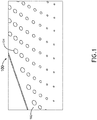
- FIG. 1 illustrates a portion of a backlit device 100 that includes a panel 102 (e.g., a metallic/non-metallic substrate) with one or more transmissive features 104 (e.g., openings and/or transparent/translucent regions) formed within the panel 102 or otherwise defined by the panel 102 structure.
- the backlit device 100 may be a light fixture (e.g., a backlit wall/ceiling mounted structure, galley structure, aircraft cabin monument, passenger chair structure, reading light, indicator light, or the like).
- the backlit device 100 may be any type of aircraft cabin lighting fixture.
- the backlit device 100 may be a user interface device (e.g., a backlit switch, button, knob, keypad, keyboard, touch/proximity sensor, touchscreen, touch panel, or the like).
- the backlit device 100 may be any type of onboard user interface device for use by passengers or flight crew onboard an aircraft.
- the backlit device 100 includes a light source 108 configured to transmit illumination through the panel 102 via the one or more transmissive features 104.
- the light source 108 may include, but is not limited to, a light-emitting diode (LED), LED array, LED light strip, fluorescent bulb/tube, incandescent bulb, or the like.
- a fire-retardant potting compound 106 is applied to the panel 102, in between the light source 108 and the one or more transmissive features 104 of the panel 102.
- the fire-retardant potting compound 106 may be disposed in between the light source 108 and the panel 102 so that the fire-retardant potting compound 106 is in contact with the panel 102 and the light source 108.
- the fire-retardant potting compound 106 may adhere or otherwise couple the light source 108 to the panel 102.
- the fire-retardant potting compound 106 simply fills a gap between the light source 108 and the panel 102, thereby reducing vibrations, preventing shock, and/or protecting the light source 108 from liquid or debris that may enter from the front or sides of the panel 102.
- the fire-retardant potting compound 106 may be applied across a surface of the panel 102 and may also be at least partially filled within the one or more transmissive features 104 (e.g., opening) that are defined within the panel 102.
- the fire-retardant potting compound 106 may be applied across a surface of the panel 102 but not within the one or more transmissive features 104 (e.g., as shown in FIG. 2A ); or the fire-retardant potting compound 106 may only be disposed within the one or more transmissive features 104 that are defined within the panel 102 (e.g., as shown in FIG. 2C ).
- the backlit device 100 may include one or more air gaps.
- the transmissive features 104 e.g., openings
- the backlit device 100 may include an air gap 112 between the light source 108 and the fire-retardant potting compound 106/panel 102.
- the fire-retarding potting compound 106 includes a white resin 114 (e.g., OPTI-TEC 5001 white resin, or the like), an Aluminum Trihydroxide powder 116, and a hardener 118 (e.g., OPTI-TEC 5001 clear hardener, or the like) mixed together.
- the white resin 114 constitutes approximately 30-35% of the fire-retardant potting compound by mass
- the Aluminum Trihydroxide powder constitutes approximately 55-60% of the fire-retardant potting compound by mass
- the hardener constitutes approximately 5-10% of the fire-retardant potting compound by mass.
- the ratio of the three components is 8 : 15 : 2 or 32% : 60% : 8%, where the white resin constitutes approximately 32% of the fire-retardant potting compound by mass, the Aluminum Trihydroxide powder constitutes approximately 60% of the fire-retardant potting compound by mass, and the hardener constitutes approximately 8% of the fire-retardant potting compound by mass.
- the tolerance of the percentage of Aluminum Trihydroxide powder may be in the range of 60% +0% or -3% because deviations may result in a reduction in strength of the material or its fire-retardant properties.
- FIG. 4 is a flow diagram illustrating a method 200 of producing the fire-retardant potting compound 106, in accordance with one or more embodiments of this disclosure.
- operations of disclosed processes e.g., method 200
- a selected amount of white resin 114 is disposed into a container (e.g., a measuring jug or any other vessel).
- a container e.g., a measuring jug or any other vessel.
- all components of the fire-retardant potting compound 106 may be measured by mass instead of volume.
- the components may be measured utilizing a balanced and calibrated set of scales.
- the white resin 114 may be measured out into the container mechanically (e.g., using an automated fluid dispenser) or manually (e.g., by pouring the white resin 114 out of its container, using a manually actuated dispenser, or the like).
- the selected amount of white resin 114 may equate to approximately 30-35% (e.g., 32%) of the entire fire-retardant potting compound 106 mixture.
- a selected amount of Aluminum Trihydroxide powder 116 is mixed into the white resin 114 to form a first (intermediate) mixture.
- the Aluminum Trihydroxide powder 116 may be measured out into the container mechanically (e.g., using an automated powder dispenser) or manually (e.g., by scooping/pouring the Aluminum Trihydroxide powder 116 out of its container, using a manually actuated dispenser, or the like).
- the selected amount of Aluminum Trihydroxide powder 116 may equate to approximately 55-60% (e.g., 60%) of the entire fire-retardant potting compound 106 mixture.
- the Aluminum Trihydroxide powder 116 may cause a slight color change when it is mixed into the white resin 114.
- the first mixture is agitated (e.g., stirred or otherwise mixed) for at least two minutes before mixing the hardener 118 into the first mixture.
- the white resin 114 and the Aluminum Trihydroxide powder 116 may be stirred together gently with a spatula or any other stirrer for 2 to 3 minutes making sure that there are no lumps caused by the Aluminum Trihydroxide powder 116 or bubbles introduced into the mixture.
- the mixture may have a thickness similar to that of melted honey.
- a selected amount of hardener 118 is mixed into the first mixture (i.e., the white resin 114 and Aluminum Trihydroxide powder 116 mixture) to form the fire-retardant potting compound 106.
- the hardener 118 may be measured out into the container mechanically (e.g., using an automated fluid dispenser) or manually (e.g., by pouring the hardener 118 out of its container, using a manually actuated dispenser, or the like).
- the selected amount of hardener 118 may equate to approximately 5-10% (e.g., 8%) of the entire fire-retardant potting compound 106 mixture.
- the fire-retardant potting compound 106 mixture is agitated (e.g., stirred or otherwise mixed) for at least three minutes after mixing the hardener 118 into the mixture.
- the mixture including white resin 114, Aluminum Trihydroxide powder 116, and hardener 118 may be stirred together gently with a spatula or any other stirrer for 3 to 4 minutes making sure that no bubbles are introduced into the mixture.
- the final mixture may be a thick liquid/gel.
- the fire-retardant potting compound 106 may be disposed within a syringe or any other dispenser ready for dispensing. Due to the consistency of the mixture, a wide needle syringe may be used when dispensing the fire-retardant potting compound 106. For example, the syringe may have a needle size may be approximately 2mm wide or wider.
- the panel 102 When applying the fire-retardant potting compound 106, the panel 102 may be set face down and potted from the back, ensuring that the potting compound does not flow out of channels on the rear face.
- the front face of the panel 102 prior to applying the fire-retardant potting compound 106 to the panel 102, the front face of the panel 102 may be masked in sections using Kapton tape, ensuring that the tension is even across the tape to prevent ripples in the tape once applied to the front face of the panel 102 as this may result in lumps on the finished product.
- the tape Once the tape has been applied, it may be rubbed down (e.g., using a cotton swab, or the like) to ensure that there are no leaks.
- the panel 102 may be cured for a sufficient amount of time (e.g., 12 hours) in a clean dust-free environment at a temperature in the range of 45C to achieve a tack free finish.
- implementations of the methods disclosed herein may include one or more of the steps described herein. Further, such steps may be carried out in any desired order and two or more of the steps may be carried out simultaneously with one another. Two or more of the steps disclosed herein may be combined in a single step, and in some implementations, one or more of the steps may be carried out as two or more sub-steps. Further, other steps or sub-steps may be carried in addition to, or as substitutes to one or more of the steps disclosed herein.
Landscapes
- Chemical & Material Sciences (AREA)
- Organic Chemistry (AREA)
- Chemical Kinetics & Catalysis (AREA)
- Medicinal Chemistry (AREA)
- Polymers & Plastics (AREA)
- Health & Medical Sciences (AREA)
- Engineering & Computer Science (AREA)
- Inorganic Chemistry (AREA)
- Materials Engineering (AREA)
- Aviation & Aerospace Engineering (AREA)
- Non-Portable Lighting Devices Or Systems Thereof (AREA)
- Casings For Electric Apparatus (AREA)
- Compositions Of Macromolecular Compounds (AREA)
Abstract
Description
- A backlit device may include a potting compound that protects portions of the device (e.g., electrical components) from liquid, dust, shock, vibrations, etc. The potting compound may also be used to achieve a more even light distribution. However, some potting compound formulations are more likely to trap heat and/or catch fire. Accordingly, there is a need for potting compound formulations that meet thermal conductivity and fire-retardant requirements for critical applications. For example, a potting compound for backlit devices within an aircraft cabin may be required to satisfy the Federal Aviation Regulations (FAR) 25.8.53 test criteria.
- A fire-retardant potting compound for a backlit device is disclosed. In one or more embodiments, the fire-retarding potting compound includes a white resin, an Aluminum Trihydroxide powder, and a hardener mixed together. The fire-retardant potting compound may be applied to a panel of a backlit device, in between a light source and one or more transmissive features of the panel.
- In some embodiments, the white resin constitutes approximately 30-35% of the fire-retardant potting compound by mass.
- In some embodiments, the Aluminum Trihydroxide powder constitutes approximately 55-60% of the fire-retardant potting compound by mass.
- In some embodiments, the hardener constitutes approximately 5-10% of the fire-retardant potting compound by mass.
- In some embodiments, the white resin constitutes approximately 32% of the fire-retardant potting compound by mass, the Aluminum Trihydroxide powder constitutes approximately 60% of the fire-retardant potting compound by mass, and the hardener constitutes approximately 8% of the fire-retardant potting compound by mass.
- In some embodiments, the one or more transmissive features are one or more openings defined within the panel.
- In some embodiments, the backlit device is a light fixture.
- In some embodiments, the backlit device is a user interface device.
- A method of producing a fire-retardant potting compound for a backlit device is also disclosed. In one or more embodiments, the method includes mixing an Aluminum Trihydroxide powder into a white resin to form a first mixture; and mixing a hardener into the first mixture to form the fire-retardant potting compound.
- In some embodiments, the first mixture is agitated for at least two minutes before mixing the hardener into the first mixture.
- In some embodiments, the fire-retardant potting compound is agitated for at least three minutes after mixing the hardener into the first mixture.
- This Summary is provided solely as an introduction to subject matter that is fully described in the Detailed Description and Drawings. The Summary should not be considered to describe essential features. Moreover, it is to be understood that both the foregoing Summary and the following Detailed Description are example and explanatory only and are not necessarily restrictive of the subject matter claimed. The scope of the invention is as defined by the claims.
- The detailed description is described with reference to the accompanying figures. The use of the same reference numbers in different instances in the description and the figures may indicate similar or identical items. Various embodiments or examples ("examples") of the present disclosure are disclosed in the following detailed description and the accompanying drawings. The drawings are not necessarily to scale. In general, operations of disclosed processes may be performed in an arbitrary order, unless otherwise provided in the claims. In the drawings:
-
FIG. 1 is a perspective view of a portion of a backlit device, in accordance with one or more embodiments of this disclosure; -
FIG. 2A is a cross-sectional view of a portion of a backlit device, in accordance with one or more embodiments of this disclosure; -
FIG. 2B is a cross-sectional view of a portion of a backlit device, in accordance with one or more embodiments of this disclosure; -
FIG. 2C is a cross-sectional view of a portion of a backlit device, in accordance with one or more embodiments of this disclosure; -
FIG. 2D is a cross-sectional view of a portion of a backlit device, in accordance with one or more embodiments of this disclosure; -
FIG. 3 is a block diagram illustrating a fire-retardant potting compound for a backlit device, in accordance with one or more embodiments of this disclosure; and -
FIG. 4 is a flow diagram illustrating method of producing a fire-retardant potting compound for a backlit device, in accordance with one or more embodiments of this disclosure. - Before explaining one or more embodiments of the disclosure in detail, it is to be understood that the embodiments are not limited in their application to the details of construction and the arrangement of the components or steps or methodologies set forth in the following description or illustrated in the drawings. In the following detailed description of embodiments, numerous specific details may be set forth in order to provide a more thorough understanding of the disclosure. However, it will be apparent to one of ordinary skill in the art having the benefit of the instant disclosure that the embodiments disclosed herein may be practiced without some of these specific details. In other instances, well-known features may not be described in detail to avoid unnecessarily complicating the instant disclosure.
- As used herein a letter following a reference numeral is intended to reference an embodiment of the feature or element that may be similar, but not necessarily identical, to a previously described element or feature bearing the same reference numeral (e.g., 1, 1a, 1b). Such shorthand notations are used for purposes of convenience only and should not be construed to limit the disclosure in any way unless expressly stated to the contrary.
- Further, unless expressly stated to the contrary, "or" refers to an inclusive or and not to an exclusive or. For example, a condition A or B is satisfied by anyone of the following: A is true (or present) and B is false (or not present), A is false (or not present) and B is true (or present), and both A and B are true (or present).
- In addition, use of "a" or "an" may be employed to describe elements and components of embodiments disclosed herein. This is done merely for convenience and "a" and "an" are intended to include "one" or "at least one," and the singular also includes the plural unless it is obvious that it is meant otherwise.
- Finally, as used herein any reference to "one embodiment" or "some embodiments" means that a particular element, feature, structure, or characteristic described in connection with the embodiment is included in at least one embodiment disclosed herein. The appearances of the phrase "in some embodiments" in various places in the specification are not necessarily all referring to the same embodiment, and embodiments may include one or more of the features expressly described or inherently present herein, or any combination of sub-combination of two or more such features, along with any other features which may not necessarily be expressly described or inherently present in the instant disclosure.
- A fire-retardant potting compound for a backlit device is disclosed. A backlit device mayinclude a potting compound that protects portions of the device (e.g., electrical components) from liquid, dust, shock, vibrations, etc. The potting compound may also be used to achieve a more even light distribution. As previously noted herein, there is a need for potting compound formulations that meet thermal conductivity and fire-retardant requirements for critical applications. In embodiments, the disclosed fire-retardant potting compound satisfies the Federal Aviation Regulations (FAR) 25.8.53 test criteria. Accordingly, the fire-retardant potting compound can be used for backlit devices within an aircraft cabin.
-
FIG. 1 illustrates a portion of abacklit device 100 that includes a panel 102 (e.g., a metallic/non-metallic substrate) with one or more transmissive features 104 (e.g., openings and/or transparent/translucent regions) formed within thepanel 102 or otherwise defined by thepanel 102 structure. In some embodiments, thebacklit device 100 may be a light fixture (e.g., a backlit wall/ceiling mounted structure, galley structure, aircraft cabin monument, passenger chair structure, reading light, indicator light, or the like). For example, thebacklit device 100 may be any type of aircraft cabin lighting fixture. In other embodiments, thebacklit device 100 may be a user interface device (e.g., a backlit switch, button, knob, keypad, keyboard, touch/proximity sensor, touchscreen, touch panel, or the like). For example, thebacklit device 100 may be any type of onboard user interface device for use by passengers or flight crew onboard an aircraft. - Referring now to
FIGS. 2A through 2D , thebacklit device 100 includes alight source 108 configured to transmit illumination through thepanel 102 via the one or more transmissive features 104. Thelight source 108 may include, but is not limited to, a light-emitting diode (LED), LED array, LED light strip, fluorescent bulb/tube, incandescent bulb, or the like. - In embodiments, a fire-
retardant potting compound 106 is applied to thepanel 102, in between thelight source 108 and the one or more transmissive features 104 of thepanel 102. For example, as shown inFIG. 2A , the fire-retardant potting compound 106 may be disposed in between thelight source 108 and thepanel 102 so that the fire-retardant potting compound 106 is in contact with thepanel 102 and thelight source 108. In some embodiments, the fire-retardant potting compound 106 may adhere or otherwise couple thelight source 108 to thepanel 102. In other embodiments, the fire-retardant potting compound 106 simply fills a gap between thelight source 108 and thepanel 102, thereby reducing vibrations, preventing shock, and/or protecting thelight source 108 from liquid or debris that may enter from the front or sides of thepanel 102. - As shown in
FIG. 2B , the fire-retardant potting compound 106 may be applied across a surface of thepanel 102 and may also be at least partially filled within the one or more transmissive features 104 (e.g., opening) that are defined within thepanel 102. Alternatively, the fire-retardant potting compound 106 may be applied across a surface of thepanel 102 but not within the one or more transmissive features 104 (e.g., as shown inFIG. 2A ); or the fire-retardant potting compound 106 may only be disposed within the one or more transmissive features 104 that are defined within the panel 102 (e.g., as shown inFIG. 2C ). - In some embodiments, the
backlit device 100 may include one or more air gaps. For example, as shown inFIG. 2A , the transmissive features 104 (e.g., openings) may includeair gaps 110 if the transmissive features 104 are not filled with the fire-retardant potting compound 106 or any other transmissive material. As shown inFIG. 2D , in some embodiments, thebacklit device 100 may include anair gap 112 between thelight source 108 and the fire-retardant potting compound 106/panel 102. - Referring now to
FIG. 3 , the fire-retardingpotting compound 106 includes a white resin 114 (e.g., OPTI-TEC 5001 white resin, or the like), anAluminum Trihydroxide powder 116, and a hardener 118 (e.g., OPTI-TEC 5001 clear hardener, or the like) mixed together. In some embodiments, thewhite resin 114 constitutes approximately 30-35% of the fire-retardant potting compound by mass, the Aluminum Trihydroxide powder constitutes approximately 55-60% of the fire-retardant potting compound by mass, and the hardener constitutes approximately 5-10% of the fire-retardant potting compound by mass. For example, in an embodiment, the ratio of the three components is 8 : 15 : 2 or 32% : 60% : 8%, where the white resin constitutes approximately 32% of the fire-retardant potting compound by mass, the Aluminum Trihydroxide powder constitutes approximately 60% of the fire-retardant potting compound by mass, and the hardener constitutes approximately 8% of the fire-retardant potting compound by mass. The tolerance of the percentage of Aluminum Trihydroxide powder may be in the range of 60% +0% or -3% because deviations may result in a reduction in strength of the material or its fire-retardant properties. -
FIG. 4 is a flow diagram illustrating amethod 200 of producing the fire-retardant potting compound 106, in accordance with one or more embodiments of this disclosure. In general, operations of disclosed processes (e.g., method 200) may be performed in an arbitrary order, unless otherwise provided in the claims. - At
step 202, a selected amount ofwhite resin 114 is disposed into a container (e.g., a measuring jug or any other vessel). In some embodiments, all components of the fire-retardant potting compound 106 may be measured by mass instead of volume. For example, the components may be measured utilizing a balanced and calibrated set of scales. Thewhite resin 114 may be measured out into the container mechanically (e.g., using an automated fluid dispenser) or manually (e.g., by pouring thewhite resin 114 out of its container, using a manually actuated dispenser, or the like). As previously noted, the selected amount ofwhite resin 114 may equate to approximately 30-35% (e.g., 32%) of the entire fire-retardant potting compound 106 mixture. - At
step 204, a selected amount ofAluminum Trihydroxide powder 116 is mixed into thewhite resin 114 to form a first (intermediate) mixture. TheAluminum Trihydroxide powder 116 may be measured out into the container mechanically (e.g., using an automated powder dispenser) or manually (e.g., by scooping/pouring theAluminum Trihydroxide powder 116 out of its container, using a manually actuated dispenser, or the like). As previously noted, the selected amount ofAluminum Trihydroxide powder 116 may equate to approximately 55-60% (e.g., 60%) of the entire fire-retardant potting compound 106 mixture. - The
Aluminum Trihydroxide powder 116 may cause a slight color change when it is mixed into thewhite resin 114. In some embodiments, the first mixture is agitated (e.g., stirred or otherwise mixed) for at least two minutes before mixing thehardener 118 into the first mixture. For example, in some embodiments, thewhite resin 114 and theAluminum Trihydroxide powder 116 may be stirred together gently with a spatula or any other stirrer for 2 to 3 minutes making sure that there are no lumps caused by theAluminum Trihydroxide powder 116 or bubbles introduced into the mixture. The mixture may have a thickness similar to that of melted honey. - At
step 206, a selected amount ofhardener 118 is mixed into the first mixture (i.e., thewhite resin 114 andAluminum Trihydroxide powder 116 mixture) to form the fire-retardant potting compound 106. Thehardener 118 may be measured out into the container mechanically (e.g., using an automated fluid dispenser) or manually (e.g., by pouring thehardener 118 out of its container, using a manually actuated dispenser, or the like). As previously noted, the selected amount ofhardener 118 may equate to approximately 5-10% (e.g., 8%) of the entire fire-retardant potting compound 106 mixture. - In some embodiments, the fire-
retardant potting compound 106 mixture is agitated (e.g., stirred or otherwise mixed) for at least three minutes after mixing thehardener 118 into the mixture. For example, in some embodiments, the mixture includingwhite resin 114,Aluminum Trihydroxide powder 116, andhardener 118 may be stirred together gently with a spatula or any other stirrer for 3 to 4 minutes making sure that no bubbles are introduced into the mixture. The final mixture may be a thick liquid/gel. - After the fire-
retardant potting compound 106 is prepared, the fire-retardant potting compound 106 may be disposed within a syringe or any other dispenser ready for dispensing. Due to the consistency of the mixture, a wide needle syringe may be used when dispensing the fire-retardant potting compound 106. For example, the syringe may have a needle size may be approximately 2mm wide or wider. - When applying the fire-
retardant potting compound 106, thepanel 102 may be set face down and potted from the back, ensuring that the potting compound does not flow out of channels on the rear face. In some embodiments, prior to applying the fire-retardant potting compound 106 to thepanel 102, the front face of thepanel 102 may be masked in sections using Kapton tape, ensuring that the tension is even across the tape to prevent ripples in the tape once applied to the front face of thepanel 102 as this may result in lumps on the finished product. Once the tape has been applied, it may be rubbed down (e.g., using a cotton swab, or the like) to ensure that there are no leaks. - After the
panel 102 has been potted with the fire-retardant potting compound 106, thepanel 102 may be cured for a sufficient amount of time (e.g., 12 hours) in a clean dust-free environment at a temperature in the range of 45C to achieve a tack free finish. - It is to be understood that implementations of the methods disclosed herein may include one or more of the steps described herein. Further, such steps may be carried out in any desired order and two or more of the steps may be carried out simultaneously with one another. Two or more of the steps disclosed herein may be combined in a single step, and in some implementations, one or more of the steps may be carried out as two or more sub-steps. Further, other steps or sub-steps may be carried in addition to, or as substitutes to one or more of the steps disclosed herein.
- Although inventive concepts have been described with reference to the embodiments illustrated in the attached drawing figures, equivalents may be employed and substitutions made herein without departing from the scope of the claims. Components illustrated and described herein are merely examples of a system/device and components that may be used to implement embodiments of the inventive concepts and may be replaced with other devices and components without departing from the scope of the claims. Furthermore, any dimensions, degrees, and/or numerical ranges provided herein are to be understood as non-limiting examples unless otherwise specified in the claims.
Claims (15)
- A fire-retardant potting compound for a backlit device, comprising:
a mixture including:a white resin (114);an Aluminum Trihydroxide powder (116); anda hardener (118). - The fire-retardant potting compound of claim 1, wherein the white resin (114) constitutes approximately 30-35% of the fire-retardant potting compound by mass.
- The fire-retardant potting compound of claim 2, wherein the Aluminum Trihydroxide powder (116) constitutes approximately 55-60% of the fire-retardant potting compound by mass.
- The fire-retardant potting compound of claim 3, wherein the hardener (118) constitutes approximately 5-10% of the fire-retardant potting compound by mass.
- The fire-retardant potting compound of any preceding claim, wherein the white resin constitutes approximately 32% of the fire-retardant potting compound by mass, the Aluminum Trihydroxide powder constitutes approximately 60% of the fire-retardant potting compound by mass, and the hardener constitutes approximately 8% of the fire-retardant potting compound by mass.
- A backlit device, comprising:a panel (102) with one or more transmissive features (104);a light source (108) configured to transmit illumination through the panel via the one or more transmissive features; anda fire-retardant potting compound (106) as claimed in any preceding claim applied to the panel, in between the light source and the one or more transmissive features.
- The backlit device of claim 6, wherein the one or more transmissive features (104) comprise one or more openings defined within the panel (102).
- The backlit device of claim 6 or 7, wherein the backlit device comprises a light fixture, or wherein the backlit device comprises a user interface device.
- A method of producing a fire-retardant potting compound for a backlit device, comprising:mixing an Aluminum Trihydroxide powder into a white resin to form a first mixture; andmixing a hardener into the first mixture to form the fire-retardant potting compound.
- The method of claim 9, wherein the white resin constitutes approximately 30-35% of the fire-retardant potting compound by mass.
- The method of claim 10, wherein the Aluminum Trihydroxide powder constitutes approximately 55-60% of the fire-retardant potting compound by mass.
- The method of claim 11, wherein the hardener constitutes approximately 5-10% of the fire-retardant potting compound by mass.
- The method of any of claims 8 to 12, wherein the white resin constitutes approximately 32% of the fire-retardant potting compound by mass, the Aluminum Trihydroxide powder constitutes approximately 60% of the fire-retardant potting compound by mass, and the hardener constitutes approximately 8% of the fire-retardant potting compound by mass.
- The method of any of claims 9 to 13, wherein the first mixture is agitated for at least two minutes before mixing the hardener into the first mixture.
- The method of any of claims 9 to 14, wherein the fire-retardant potting compound is agitated for at least three minutes after mixing the hardener into the first mixture.
Applications Claiming Priority (1)
| Application Number | Priority Date | Filing Date | Title |
|---|---|---|---|
| US16/549,998 US11261379B1 (en) | 2019-08-23 | 2019-08-23 | Fire-retardant potting compound for backlit devices |
Publications (1)
| Publication Number | Publication Date |
|---|---|
| EP3786261A1 true EP3786261A1 (en) | 2021-03-03 |
Family
ID=72234739
Family Applications (1)
| Application Number | Title | Priority Date | Filing Date |
|---|---|---|---|
| EP20192440.4A Pending EP3786261A1 (en) | 2019-08-23 | 2020-08-24 | Fire-retardant potting compound for backlit devices |
Country Status (3)
| Country | Link |
|---|---|
| US (1) | US11261379B1 (en) |
| EP (1) | EP3786261A1 (en) |
| CN (1) | CN112409809B (en) |
Citations (4)
| Publication number | Priority date | Publication date | Assignee | Title |
|---|---|---|---|---|
| US5883160A (en) * | 1996-12-06 | 1999-03-16 | Somar Corporation | Flame-retardant epoxy resin composition for case potting of film capacitors |
| DE102010022523A1 (en) * | 2010-06-02 | 2011-12-08 | Siemens Aktiengesellschaft | Potting compound suitable for potting an electronic component, in particular a large-volume coil such as a gradient coil |
| US8288455B1 (en) * | 2011-12-06 | 2012-10-16 | Empire Technology Development, Llc | Phosphorus loaded particles and methods for their preparation and use |
| WO2020131946A1 (en) * | 2018-12-18 | 2020-06-25 | Cytec Industries Inc. | Flame-retardant epoxy composition and method of using the same |
Family Cites Families (6)
| Publication number | Priority date | Publication date | Assignee | Title |
|---|---|---|---|---|
| CN100462397C (en) * | 2007-03-12 | 2009-02-18 | 无锡东润电子材料科技有限公司 | Method of treating aluminum hydroxide combustion inhibitor in epoxide resin encapsulation material |
| EP2149137A1 (en) * | 2007-05-16 | 2010-02-03 | Koninklijke Philips Electronics N.V. | Improved white backlight for a display |
| CN102276959B (en) * | 2011-06-22 | 2012-11-21 | 天津市凯华绝缘材料有限公司 | Halogen-free non-phosphorization flame-retardant epoxy resin composition and preparation method thereof |
| CN102888081B (en) * | 2012-09-24 | 2014-12-03 | 沈阳爱迪生科技有限公司 | Flame-retardant encapsulating material and preparation method thereof |
| TWI628477B (en) * | 2017-09-27 | 2018-07-01 | 睿亞光電股份有限公司 | Backlight device |
| JP7351291B2 (en) * | 2018-03-16 | 2023-09-27 | 株式会社レゾナック | Epoxy resin composition and electronic component equipment |
-
2019
- 2019-08-23 US US16/549,998 patent/US11261379B1/en not_active Expired - Fee Related
-
2020
- 2020-08-24 CN CN202010859777.9A patent/CN112409809B/en active Active
- 2020-08-24 EP EP20192440.4A patent/EP3786261A1/en active Pending
Patent Citations (4)
| Publication number | Priority date | Publication date | Assignee | Title |
|---|---|---|---|---|
| US5883160A (en) * | 1996-12-06 | 1999-03-16 | Somar Corporation | Flame-retardant epoxy resin composition for case potting of film capacitors |
| DE102010022523A1 (en) * | 2010-06-02 | 2011-12-08 | Siemens Aktiengesellschaft | Potting compound suitable for potting an electronic component, in particular a large-volume coil such as a gradient coil |
| US8288455B1 (en) * | 2011-12-06 | 2012-10-16 | Empire Technology Development, Llc | Phosphorus loaded particles and methods for their preparation and use |
| WO2020131946A1 (en) * | 2018-12-18 | 2020-06-25 | Cytec Industries Inc. | Flame-retardant epoxy composition and method of using the same |
Non-Patent Citations (1)
| Title |
|---|
| OKADA Y ET AL: "New highly reliable heat resistant magnet wire and epoxy potting compound system for electrical devices", 19890925; 19890925 - 19890928, 25 September 1989 (1989-09-25), pages 284 - 288, XP010090529 * |
Also Published As
| Publication number | Publication date |
|---|---|
| CN112409809A (en) | 2021-02-26 |
| US11261379B1 (en) | 2022-03-01 |
| CN112409809B (en) | 2023-06-20 |
Similar Documents
| Publication | Publication Date | Title |
|---|---|---|
| CN112424855B (en) | Decorative sheet and display device | |
| US20080001847A1 (en) | System and method of using a multi-view display | |
| TW201005392A (en) | Flat panel display assembly with improved luminance uniformity and method for constructing the same | |
| US3038271A (en) | Self-luminous signs | |
| US11261379B1 (en) | Fire-retardant potting compound for backlit devices | |
| EP3663201B1 (en) | Thermochromic paint for temperature-related warnings | |
| Yeh et al. | Human Factors Considerations in the Design and Evaluation of Flight Deck Displays and Controls, Version 3.0 | |
| US20200019909A1 (en) | Task management system of an aircraft crew during a mission and related method | |
| US10711487B2 (en) | Aircraft with a plurality of aircraft doors | |
| CN101446652A (en) | Optical element made from flame-retardant plastics | |
| United States. Department of Defense | Human engineering design criteria for military systems, equipment and facilities | |
| JP7135318B2 (en) | Display device with panel | |
| US2654020A (en) | Indirect instrument illumination | |
| CN104356333A (en) | Environment-friendly high-flame-retardant heat-insulating composite material for petroleum pipelines | |
| EP3608146B1 (en) | Flammability resistant visual display assembly | |
| CA3267369C (en) | Backlit button assembly | |
| Headquarters | Major Repair and Alteration Data Approval | |
| KAWAHARA et al. | Flight simulator evaluation of D-size liquid crystal flat panel displays(Ekishougata furatto paneru desipurei no shimyureta hyouka shiken. Sono 2: D saizu gata PFD, DMD)(Report No. 2) | |
| SONES | Electronic displays of flight information(Electronic integrated flight data displays for pilot workload reduction at takeoff, approach and landing, considering head-up and head-down and colored systems) | |
| No | Federal Aviation Administration | |
| Dowden et al. | UH-1N Instrument Flight, Turbulence, and Icing Tests | |
| Billingslea | Lessons learned from the developmental testing of the EA-6B night vision device integration program | |
| LURKER et al. | Ozone survey of C-9 A[Final Technical Report, Apr.- May 1982] | |
| Dornheim | Typist Rating(A-380 cockpit) | |
| Tannas Jr | System requirements |
Legal Events
| Date | Code | Title | Description |
|---|---|---|---|
| PUAI | Public reference made under article 153(3) epc to a published international application that has entered the european phase |
Free format text: ORIGINAL CODE: 0009012 |
|
| STAA | Information on the status of an ep patent application or granted ep patent |
Free format text: STATUS: THE APPLICATION HAS BEEN PUBLISHED |
|
| AK | Designated contracting states |
Kind code of ref document: A1 Designated state(s): AL AT BE BG CH CY CZ DE DK EE ES FI FR GB GR HR HU IE IS IT LI LT LU LV MC MK MT NL NO PL PT RO RS SE SI SK SM TR |
|
| AX | Request for extension of the european patent |
Extension state: BA ME |
|
| RAP3 | Party data changed (applicant data changed or rights of an application transferred) |
Owner name: B/E AEROSPACE, INC. |
|
| STAA | Information on the status of an ep patent application or granted ep patent |
Free format text: STATUS: REQUEST FOR EXAMINATION WAS MADE |
|
| 17P | Request for examination filed |
Effective date: 20210903 |
|
| RBV | Designated contracting states (corrected) |
Designated state(s): AL AT BE BG CH CY CZ DE DK EE ES FI FR GB GR HR HU IE IS IT LI LT LU LV MC MK MT NL NO PL PT RO RS SE SI SK SM TR |
|
| STAA | Information on the status of an ep patent application or granted ep patent |
Free format text: STATUS: EXAMINATION IS IN PROGRESS |
|
| 17Q | First examination report despatched |
Effective date: 20230403 |
|
| P01 | Opt-out of the competence of the unified patent court (upc) registered |
Effective date: 20230922 |