EP3784511B1 - A drive system and a truck bed comprising a roll-up truck bed cover and the drive system - Google Patents
A drive system and a truck bed comprising a roll-up truck bed cover and the drive system Download PDFInfo
- Publication number
- EP3784511B1 EP3784511B1 EP19726902.0A EP19726902A EP3784511B1 EP 3784511 B1 EP3784511 B1 EP 3784511B1 EP 19726902 A EP19726902 A EP 19726902A EP 3784511 B1 EP3784511 B1 EP 3784511B1
- Authority
- EP
- European Patent Office
- Prior art keywords
- truck bed
- roll
- belt
- bed cover
- connector
- Prior art date
- Legal status (The legal status is an assumption and is not a legal conclusion. Google has not performed a legal analysis and makes no representation as to the accuracy of the status listed.)
- Active
Links
Images








Classifications
-
- B—PERFORMING OPERATIONS; TRANSPORTING
- B60—VEHICLES IN GENERAL
- B60J—WINDOWS, WINDSCREENS, NON-FIXED ROOFS, DOORS, OR SIMILAR DEVICES FOR VEHICLES; REMOVABLE EXTERNAL PROTECTIVE COVERINGS SPECIALLY ADAPTED FOR VEHICLES
- B60J7/00—Non-fixed roofs; Roofs with movable panels, e.g. rotary sunroofs
- B60J7/02—Non-fixed roofs; Roofs with movable panels, e.g. rotary sunroofs of sliding type, e.g. comprising guide shoes
- B60J7/06—Non-fixed roofs; Roofs with movable panels, e.g. rotary sunroofs of sliding type, e.g. comprising guide shoes with non-rigid element or elements
-
- B—PERFORMING OPERATIONS; TRANSPORTING
- B60—VEHICLES IN GENERAL
- B60J—WINDOWS, WINDSCREENS, NON-FIXED ROOFS, DOORS, OR SIMILAR DEVICES FOR VEHICLES; REMOVABLE EXTERNAL PROTECTIVE COVERINGS SPECIALLY ADAPTED FOR VEHICLES
- B60J7/00—Non-fixed roofs; Roofs with movable panels, e.g. rotary sunroofs
- B60J7/02—Non-fixed roofs; Roofs with movable panels, e.g. rotary sunroofs of sliding type, e.g. comprising guide shoes
- B60J7/04—Non-fixed roofs; Roofs with movable panels, e.g. rotary sunroofs of sliding type, e.g. comprising guide shoes with rigid plate-like element or elements, e.g. open roofs with harmonica-type folding rigid panels
- B60J7/041—Non-fixed roofs; Roofs with movable panels, e.g. rotary sunroofs of sliding type, e.g. comprising guide shoes with rigid plate-like element or elements, e.g. open roofs with harmonica-type folding rigid panels for utility vehicles, e.g. with slidable and foldable rigid panels
-
- B—PERFORMING OPERATIONS; TRANSPORTING
- B60—VEHICLES IN GENERAL
- B60J—WINDOWS, WINDSCREENS, NON-FIXED ROOFS, DOORS, OR SIMILAR DEVICES FOR VEHICLES; REMOVABLE EXTERNAL PROTECTIVE COVERINGS SPECIALLY ADAPTED FOR VEHICLES
- B60J7/00—Non-fixed roofs; Roofs with movable panels, e.g. rotary sunroofs
- B60J7/02—Non-fixed roofs; Roofs with movable panels, e.g. rotary sunroofs of sliding type, e.g. comprising guide shoes
- B60J7/06—Non-fixed roofs; Roofs with movable panels, e.g. rotary sunroofs of sliding type, e.g. comprising guide shoes with non-rigid element or elements
- B60J7/067—Non-fixed roofs; Roofs with movable panels, e.g. rotary sunroofs of sliding type, e.g. comprising guide shoes with non-rigid element or elements sliding and winding up
- B60J7/068—Non-fixed roofs; Roofs with movable panels, e.g. rotary sunroofs of sliding type, e.g. comprising guide shoes with non-rigid element or elements sliding and winding up for utility vehicles, e.g. of tarpaulin or roller-blind type
-
- B—PERFORMING OPERATIONS; TRANSPORTING
- B60—VEHICLES IN GENERAL
- B60J—WINDOWS, WINDSCREENS, NON-FIXED ROOFS, DOORS, OR SIMILAR DEVICES FOR VEHICLES; REMOVABLE EXTERNAL PROTECTIVE COVERINGS SPECIALLY ADAPTED FOR VEHICLES
- B60J7/00—Non-fixed roofs; Roofs with movable panels, e.g. rotary sunroofs
- B60J7/02—Non-fixed roofs; Roofs with movable panels, e.g. rotary sunroofs of sliding type, e.g. comprising guide shoes
- B60J7/04—Non-fixed roofs; Roofs with movable panels, e.g. rotary sunroofs of sliding type, e.g. comprising guide shoes with rigid plate-like element or elements, e.g. open roofs with harmonica-type folding rigid panels
- B60J7/057—Driving or actuating arrangements e.g. manually operated levers or knobs
- B60J7/0573—Driving or actuating arrangements e.g. manually operated levers or knobs power driven arrangements, e.g. electrical
Definitions
- the present invention relates to a drive system configured for reciprocating, between an extended position and a retracted position, a roll-up truck bed cover above a truck bed, said roll-up truck bed cover being composed of a rear profile, a plurality of elongate slats that are hinged together wherein the plurality of elongate slats has a foremost front slat, said drive system comprising at least one reciprocating means adapted for reciprocating the roll-up truck bed cover, and at least one reversible electric motor adapted for driving the reciprocating means, wherein the at least one reciprocating means comprises at least one pulley system comprising at least one set of pulleys and at least one drive belt, which at least one set of pulleys includes a driven pulley and an idle pulley.
- Truck bed covers of the above-mentioned kind for converting an open bed of a pickup truck to a closed bed, and vice versa are well known.
- the truck bed cover When the truck bed cover is in its extended position closing the truck bed, it protects the content in the truck bed from bad weather and from unintentional access.
- a truck bed cover ensures that goods placed in the truck bed are not lost while driving the pickup truck.
- the truck bed cover When the truck bed cover is in its retracted position opening up the truck bed larger objects may be transported with the pickup truck.
- the depending portions of the cover which are constituted by the hinged parts of the cover, may become so worn that the slats of the cover can no longer rotate freely relative to each other, and furthermore the slats of the cover can be damaged so that the cover becomes leaky.
- a further disadvantage of this known system is the large number of gears used to transfer the power from the motor to the drum and thus the cable.
- the gears will become soiled relatively easily in the environment they are in, and thus be worn and cause malfunction.
- the cable may pose a potential danger that a person who has an errand in the truck bed will cut on the cable, if it is not properly shielded.
- the cable system and the main roller should be properly synchronized as they cooperate to retract and extend the flexible cover, where just a slight asynchronicity may result in a too loose cover or a too tense cover.
- the cover can curl if it does not get properly wrapped on the main roller.
- US 9,365,097 B1 discloses a motorised drive system for reciprocating a truck bed cover, which drive system utilizes a drive mechanism in form of a belt, which belt is routed around a drive gear on one end and a pulley on the other end to move the truck bed cover.
- the truck bed cover consists of a flexible shell suspended on U-shaped brackets, to thereby establish an enclosed area above the truck bed in the closed position of the truck bed cover.
- DE1266788B discloses another drive system similar to the preamble of claim 1.
- the present invention aims to provide and improvement to the prior art roll-up truck bed covers.
- a drive system of the kind mentioned in the opening paragraph with an increased reliability compared to conventional drive systems.
- a drive system of the kind mentioned in the opening paragraph wherein the slats of the roll-up truck bed cover are exposed to much less wear as compared to known drive systems.
- a drive system of the kind mentioned in the opening paragraph which provides a very precise and controlled movement of the roll-up truck bed cover.
- a drive system of the kind mentioned in the opening paragraph which can be mounted to the truck bed with minimum tools and minimum alteration of the truck.
- a drive system of the kind mentioned in the opening paragraph which has a mechanism for decoupling the truck bed cover from the electric drives system.
- a drive system of the kind mentioned in the opening paragraph which has reciprocating means including pulley systems at opposite sides of the truck bed.
- a truck bed comprising the drive system of the kind mentioned in the opening paragraph.
- the novel and unique whereby these and other aspects are achieved according to the present invention consist in that the drive belt is secured to the rear profile of the roll-up truck bed cover via an intermediate component that protrudes from the rear profile to detachably engage a resiliently extensible belt tensioner on the drive belt, whereby the resiliently extensible belt tensioner becomes coupled to the rear profile to move the roll-up truck bed cover to open and close the truck bed.
- driven pulley is to be understood as a pulley that drives a drive belt.
- an "idle pulley” is to be understood as a loose pulley opposite the driven pulley to tighten and guide the drive belt.
- the idle pulley is a free rolling or spinning pulley that provides a tension point.
- a "drive belt” is to be understood as a continuous band of tough flexible material for transmitting motion.
- a "roll-up truck bed cover” is to be understood as a lid that covers the bed of e.g. a pickup truck.
- the lid is assembled of elongate slats that are hinged alongside together, such as parallel to each other, to allow the lid to be rolled up.
- the roll-up truck bed cover of hinged slats is terminated at the tail gate by a rear profile and oppositely, at the driver's cab, by a front slat.
- the slats of the lid may be made in aluminum, plastic or any other suitable material, and a corresponding gasket or sealing may be provided at the linkage between two adjacent slats to keep rain from entering a potential gap at the linkage.
- front slat means the slat closest to the driver's cab, thus the last slat of the roll-up truck bed cover when seen from the tail gate.
- front slat is the first slat to be rolled-up when the truck bed cover is retracted, e.g. to be stored in a container, such as a canister.
- Soft cloth covers are not part of the present invention as roll-up truck bed covers but components of the present drive system can be used with soft flexible covers as well.
- a drive belt for providing the reciprocating movement of the roll-up truck bed cover By using a drive belt for providing the reciprocating movement of the roll-up truck bed cover a very good contact surface between the drive belt and the pulleys is obtained, which entails that the drive belt will not slide on the pulleys, but will instead ensure that the roll-up truck bed cover will move perfectly with the drive belt without any slip. This will minimize the wear of the drive belt as well as of the pulleys, thus extending the life of these parts, especially avoiding breaking the drive belt. Further, as the drive belt is secured to the rear profile of the roll-up truck bed cover a very consistent and reliable movement of the roll-up truck bed cover is obtained without resulting in a too loose cover or a too tense cover. Yet an advantage is that a drive belt is inexpensive and easy to replace.
- the drive system may comprise two opposite pulley systems, one at each long side of the truck bed, and a shaft connecting the corresponding driven pulleys of each pulley system to each other, which shaft is arranged rotatable about its axis by the electric motor.
- the drive belt may be constituted by any appropriate drive belt design, and thus the drive belt may be a flat belt, a V-belt, a multi-groove belt, a ribbed belt, a toothed belt or a timing belt.
- a flat belt is the simplest and also the cheapest belt, and is preferably used where the forces to be transferred are not so big and/or where a smaller slip can be allowed.
- a V-belt has a general trapezoidal cross-section shape and thus a somewhat larger drive surface, hence solving some of the slippage and alignment problems known from the flat belt.
- a multi-groove belt is usually made up of a number of V-shaped sections alongside each other, thus providing a thinner belt for the same drive surface.
- a ribbed belt is a belt featuring lengthwise grooves, and it operates from contact between the ribs of the belt and the grooves in the respective pulley.
- a timing belt which also is known as toothed, notch, cog or synchronous belt, is a so-called positive transfer belt and can avoid relative movements, it has teeth that fit into a matching toothed pulley, so when correctly tensioned it have no slippage and runs at constant speed.
- the drive belt has first teeth or first ribs
- the driven pulley and the idle pulley has second teeth or second ribs that engage the first teeth or first ribs.
- the roll-up truck bed cover may be driven into its extended and retracted positions, respectively, in a very precise way involving no slippage and at constant speed.
- the wear on the slats of the roll-up truck bed cover will be reduced to an absolutely minimum.
- the drive belt may be of "endless" design of a predetermined length, however, in one embodiment, the drive belt may be a length of toothed or ribbed belt or strip having a first free end and an opposite second free end, which first free end and second free end may be assembled into a loop by means of a resiliently extensible belt tensioner, which resiliently extensible belt tensioner has third teeth or third ribs configured for engaging the first teeth or first ribs of the drive belt.
- a drive belt sold by the meter may be used, which is often considerably cheaper than an endless drive belt sold in predetermined lengths, and furthermore a drive belt of any length can be obtained and customized on demand.
- the drive system may be adapted to any size of the truck bed, and should the drive belt slack it can be shortened as required.
- a drive belt with certain elasticity, and thus certain stretchability can be achieved with the resiliently extensible belt tensioner, which ensures that a certain tension is always present in the drive belt.
- slippage between the drive belt and the pulleys will be substantially eliminated and the drive belt be kept stretched irrespective of whether the roll-op truck bed cover is extended or retracted.
- the resiliently extensible belt tensioner may be constituted by any suitable tensioner, however, in one embodiment the resiliently extensible belt tensioner comprises a first part having a projecting L-shaped portion or claw and a second part having a groove or recess for accommodating the L-shaped portion or claw of the first part, and a spring placed in the groove or recess and abut against a first surface of the first part and a second surface of the second part, respectively.
- a very simple and compact resiliently extensible belt tensioner is obtained, that provides the drive belt with a required tension, so that good contact between the drive belt and the pulleys can be maintained. This means that slippage between the drive belt and the pulleys can be avoided or at least reduced.
- the first part may have a first top part and a first bottom part, which first top part may have a lateral first protrusion for engaging the intermediate component provided on the rear profile, and the second part may have a second top part and a second bottom part, which second top part may have a lateral second protrusion for engaging the intermediate component.
- the engagement between the lateral protrusion and the intermediate component advantageously serve to move the truck bed cover along with the motion of the drive belt, when said drive belt is run by the electric motor.
- the intermediate component may have protruding legs to engage the respective lateral protrusions.
- the distance between the protruding legs are larger than the distance between the lateral protrusions, so that the engagement between a pair of a lateral protrusion and an opposite leg typically takes place in alternating manner, depending on whether the roll-up truck bed cover is moved open or closed, and on the tensioning of the drive belt.
- the other pair is not.
- the drive belt may extend freely exposed to the surroundings of the truck bed, however in one embodiment the reciprocating means may comprise an elongate guide profile with an elongate guide track that accommodates at least the majority of the length of the drive belt between the driven pulley and the idle pulley.
- the reciprocating means may comprise bracket bearings for the driven pulley and the idle pulley, respectively, at or in the vicinity of opposite ends of the elongate guide track.
- the drive belt can be protected from being hit and possibly damaged by items placed in the truck bed.
- a user of the truck is prevented from striking against the drive belt during its movement and thereby being injured.
- the drive belt will run smoothly on the pulleys placed in bracket bearings over the full length of the elongate guide track. Hereby, the forces needed to move the roll-up truck bed cover are minimized.
- the elongate guide track may be configured to suspend and control the reciprocating motion of the resiliently extensible belt tensioner, for example by utilizing a slide foot of the resiliently extensible belt tensioner to slide in the elongate guide track.
- the driven pulley of the sets of pulleys of the pulley system may be driven via a motor drive belt directly on the shaft of the driven pulley.
- the roll-up truck bed cover reciprocating means includes a shaft pulley driven about its rotation axis via a motor drive belt by the electric motor, which shaft pulley may have a first shaft pulley end secured to the driven pulley and an opposite second shaft pulley end secured to the shaft that extends to connect the driven pulleys of opposite drive systems.
- the shaft pulley can simply be an extension of the driven pulley, so that both the motor drive belt and the drive belt directly drive the same pulley.
- the advantage of having a separate shaft pulley is however that the drive system can more easily be fitted and customized. So the sets of pulleys of the pulley system can be standards, and depending on the selected electric motor, its transmission, kind of motor drive belt, the weight of the roll-up truck bed cover, etc, the shaft pulley can be freely chosen provided it can couple to the driven pulley. So the shaft pulley can be ribbed or smooth to engage a complementarily ribbed or smooth shaft pulley.
- the roll-up truck bed cover may be reciprocatingly secured to the truck bed by means of coupling rails mounted to the sidewalls of the truck bed.
- the coupling rails may be of the kind adapted for mounting on top of the sidewalls, adjacent to an upper edge of the sidewalls or more or less below an upper edge of the sidewalls.
- a drive system can be pre-assembled with a coupling rail so as to be mounted as a combined unit, e.g. at the factory, to allow easy fitting on the truck bed.
- a drive system and a coupling rail can however in the alternative be mounted as separate units.
- the drive system may comprise any appropriate means for collecting the roll-up truck bed cover during its retracting, such as a rotating shaft contained in an elongate canister.
- a canister may have a lid and the roll-up cover be retracted inside the canister below the lid with the front slat being the leading slat to enter the canister.
- the guide profiles may be detachable or not detachable coupled to the canister.
- the drive system may comprise an elongate canister for collecting the roll-up truck bed cover during its retracting, which canister may have opposite first and second spiral-curved guide channels at opposite short ends of the canister, which opposite first and second spiral-curved guide channels may be configured to receive a free edge of the roll-up truck bed cover during its rolling up upon retracting.
- the slats of the roll-up truck bed cover will not impact each other and rub against each other during the movement of the roll-up truck bed cover between the retracted and the extended position and vice versa.
- the wear of the slats of the roll-up truck bed cover will be reduced to a minimum.
- the slats of the roll-up truck bed cover will be treated very gently and not be subjected to impact or bumps that can scratch them or at worst bend them or make bulges or dents in them.
- the invention also relates to a roll-up truck bed cover comprising a plurality of interconnected slats with the drive system described above.
- the roll-up truck bed cover has a rear profile provided at a rear end of the plurality of interconnected slats facing the tail gate of the truck bed, and a front slat provided at the opposite end of the plurality of interconnected slats.
- the rear profile is secured to the drive belt via the intermediate component that protrudes from the rear profile to engage a component of the reciprocating means.
- the intermediate component may have various configurations, however in a preferred embodiment the intermediate component can be a connector that comprises a housing component and a connector component reciprocatingly arranged in the housing component to engage the associated coupling component of the reciprocating means.
- the housing component can be hidden inside the rear profile by being inserted into the rear profile at a free end, and with the connector component reciprocatingly arranged in the housing component in order to be exposable from the housing component to engage the associated coupling component on the drive belt, to drive the truck bed cover open and closed, and to be retractable inside the housing component to disengage the resiliently extensible belt tensioner on the drive belt in case the electric motor malfunctions or the motion of drive system stops unintentionally, or if maintenance or repair is to be performed.
- the connector thus not only serves to carry the truck bed cover along when the drive belt rotates, the connector also serves as a safety mechanism to release the roll-up truck bed cover from the drive system.
- Such disengagement can be done manually from inside the truck bed cover even in the accidental situation where the roll-up truck bed cover is fully closed and cannot be opened using the electric motor, or in any intermediate position of the roll-up truck bed cover between open and closed. After disengagement the roll-up truck bed cover can be manually pushed towards the canister or pulled towards the tailgate.
- the housing component may comprise a securing end part adapted for being inserted into the free end of the rear profile and being configured as a tray for accommodating the connector component, which securing end part may comprise a tray bottom wall, a first tray end wall facing towards the drive belt, an opposite second tray end wall, and opposite tray side walls extending between the first tray end wall and the second tray end wall, the first tray end wall has a first tray opening, and the tray bottom wall has a second tray opening.
- a housing component having such a shape and configuration can easily be inserted axially from the free end of the rear profile to be, at least substantially, hidden inside the rear profile.
- a connector component can then be arranged in the housing component to slide along the tray bottom wall between the first tray end wall and the opposite second tray end wall guided by the opposite tray side walls.
- An advantageous connector component may comprise a fork or bifurcation aligned with the first tray opening to be exposed from a first connector end of a first connector end part of a main connector body of the connector component for engaging the belt tensioner.
- An opposite second connector end part of the main connector body of the connector component may have a second connector end that in the disengaged condition of the connector and belt tensioner can be retracted a maximum retracted length where it hits the second tray end wall.
- the second connector end part can have a connector opening, wherefrom a finger grip protrudes out of the second tray opening in the assembled state of connector component and housing component to be grasped to reciprocate the connector component in and along the housing component.
- the finger grip makes it easy to reach and to grasp to operate and control the movement of the connector to disengage the connector component and the housing component.
- the side of the rear profile that faces inside the truck bed has an operating opening aligned with the second tray opening to make the passage for the finger grip which allows the finger grip to protrude from the operating opening to be operated through the wall of the rear profile.
- the drive system may have locking means to keep the connector and the belt tensioner, or similar coupling component, engaged in the operative state of the roll-up truck bed cover, which is the usual state the roll-up truck bed cover.
- Such means can e.g. be obtained by the connector component having a locking pawl to detachably engage a locking tooth of the housing component.
- the drive system may also have synchronizing means to get two pulley systems of the reciprocating means system in synchronized aligned engagement after the opposite sets respective connector and belt tensioner have, for some reason been disengaged.
- the part of the connector acting as the first part of the synchronizing means may include that the housing component has a third tray opening, and that the first connector end part has a curved face aligned with the third tray opening.
- a trigger rod can then be provided as the part of a second part of synchronizing means at the front end of the truck bed to move inside the third tray opening to displace the connector component by moving along the curved face thereby pushing the connector component towards the belt tensioner the closer the rear profile gets to the front end of the truck bed.
- the trigger rod or similar protruding actuator means can e.g. be provided on the canister.
- the length of the trigger rod serves to make the lateral movement of the connector component inside the connector housing whereby the connector component and the belt tensioner at opposite sides of the truck bed cover snaps together into aligned and synchronized engagement. Once the electric motor starts again the roll-up truck bed cover can function without running askew.
- One set of connector and belt tensioner may be engaged first using the finger grip function. Then the electric motor can be operated to move the opposite set of connector and belt tensioner towards the front end of the truck bed, whereby the trigger rod enters the third tray opening of approaching connector and pushes the connector component laterally into engagement with the associated belt tensioner.
- the present invention also relates to a truck bed comprising the roll-up truck bed cover described above.
- Such a truck bed can easily be converted from an open bed of a pickup truck to a closed bed, and vice versa.
- the functional model is shown to illustrate the principles of the drive system and the reciprocating means, and it is to be understood that the real drive system and reciprocating means is longer, as shown in e.g. figs. 2a to 2d. Since the length between the pulleys of the reciprocating means of the drive system is substantially longer than the width of the driving belt, the full length of the system cannot reveal the details in a sufficiently clear way.
- the functional model serves this purpose.
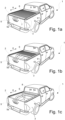
- a pickup truck 1 is schematically illustrated.
- the pickup truck 1 comprises a truck bed 2, which has sidewalls 3, a front wall 4 and a tail gate 5.
- the tail gate 5 is pivotally attached to a rear end 5a of the truck bed 2.
- a roll-up truck bed cover 6 is mounted to the top of the truck bed 2 and is movable between an extended position and a retracted position, as indicated by double arrow A.
- the roll-up truck bed cover 6 is shown in extended position, in fig. 1b in partially retracted position, and in fig. 1c in fully retracted position.
- the roll-up truck bed cover 6 is composed of a rear profile 7, a plurality of elongate slats 8 that are hinged together and having a foremost front slat 9 below a lid 9a for a canister 54 for the roll-up truck bed cover 6 in rolled-up condition.
- the lid 9a for the canister 54 may be detachable.
- the roll-up truck bed cover 6 further comprises coupling rails 10, one mounted on top of each sidewall 3.
- the coupling rails 10 are intended to accommodate the ends of the rear profile 7, the ends of the slats 8, including the ends of the foremost front slat 9, in an extended or partially extended position, which ends together defines the free edge of the roll-up truck bed cover.
- the coupling rails 10 are typically secured to the top of the sidewalls 3 by means of not shown clamps.
- the roll-up truck bed cover 6 can be of any conventional kind and the coupling rails designed to accommodate the free edge of the roll-up truck bed cover 6 in a sliding manner.
- the coupling rails 10 as well as the rear profile 7, and the slats 8,9 may be made of aluminum, plastic or any other suitable material, e.g. by extrusion.
- a drive system 11 to be mounted to the top of the sidewalls 3 of the truck bed 2 and configured for reciprocating the roll-up truck bed cover 6 between an extended position and a retracted position.
- the roll-up truck bed cover 6 is shown in figs. 2a and 2b in retracted position.
- the shown drive system 11 comprises a reciprocating means 11a with two sets of pulleys 13,14 that reciprocate, not orbit, a drive belt 12 for extending and retracting the roll-up truck bed cover 6, respectively.
- An elongate guide profile 15 with an elongate guide track 15a accommodates the majority of the length of the respective drive belt 12 between the driven pulley 13 and the idle pulley 14 to protect the drive belt 12, e.g. when the truck bed is loaded and during driving with goods that can bounce and hit an unprotected drive belt.
- the elongate guide profiles also make a cosmetically attractive transition to the space of the truck bed and keep the drive belt under control.
- the coupling rails 10 maintain the free edge of the roll-up truck bed cover 6 in place over the truck bed 2 by accommodating the ends of the rear profile 7, and the ends of the slats 8, including the ends of foremost slat, the front slat 9.
- An electric motor 16 operates a drive belt 19 that is connected to shaft 17.
- the shaft 17 connects the driven pulleys 13 of the two sets of pulleys 13,14 to each other, which shaft 17 is arranged rotatable about its axis by the electric motor 16. In this way, the two sets of pulleys are driven synchronously, which means that there will be absolutely minimal if not no distortion of the slats 8 of the roll-up truck bed cover 6.
- Each of the two drive belts 12 is secured to the free ends of the rear profile 7 of the roll-up truck bed cover 6 e.g. directly by means of a fastener, or at least one of the drive belts 12 has an intermediate component that protrudes from the rear profile 7 to engage another component associated with the reciprocating means 11a, to drive the rear profile 7 and thus the truck bed cover 6.
- Such an intermediate component can be inserted to laterally couple the drive belt 12 and the rear profile 7.
- Such an intermediate component may e.g. be a component configured as a release component for disconnecting the drive of the electric motor 16 from the roll-up truck bed cover 6 so that the roll-up truck bed cover 6 can be operated manually, e.g. in case of malfunction or maintenance of the roll-up truck bed cover.
- the component, which the intermediate component engages can e.g. be a first embodiment of a resiliently extensible belt tensioner 29 or a second embodiment of a resiliently extensible belt tensioner 29', the latter being described later in relation to figs. 17 - 30 .
- each drive belt 12 has not been shown in details, however it is to be understood that these exemplary drive belts 12 are toothed belts, such as a timing belt.
- Each drive belt may however also be constituted of a flat belt, a V-belt, a multi-groove belt, or a ribbed belt.
- the drive system 11 comprises an elongate canister 54, as seen in fig. 1c .
- the canister 54 comprises a spiral-curved guide channel 18 at each short ends (only one is shown) of the canister 54.
- the spiral-curved guide channels 18 are configured to guidingly wind up and receive the roll-up truck bed cover 6 when it is in a retracted or partly retracted position. In this way, the slats 8,9 of the roll-up truck bed cover 6 will be gently packed and accommodated in the canister 54 without contacting or being beaten against each other, thus minimizing the wear of the slats 8,9 of the roll-up truck bed cover 6.
- the driven pulley 13 and the idle pulley 14 of each set of pulleys 13,14 are arranged at the opposite ends of the respective elongate guide profile 15.
- the length of the drive belts 12 or in other words the distance between the driven pulley 13 and the idle pulley 14 in each set of pulleys, and optionally the presence of a canister 54, determines the maximum possible displacement of the rear profile 7 and thus of the roll-up truck bed cover 6 along the coupling rails 10, but are in practice shorter, e.g. a length corresponding to the width of the rear profile, due to the attachment of the rear profile to the drive belt, and because the rear profile 7 is typically left outside the spiral-curved guide channel 18, such as above or in extension of the canister 54.
- the electric motor 16 rotates the shaft 17 via the motor drive belt 19.
- the shaft 17 drives synchronously the two driven pulleys 13 of the reciprocating means 11a at each opposite side of the drive systems 11 which again and at the same speed drive the two drive belts 12 in one of the two directions, indicated by arrow A in fig. 1 , thereby moving the rear profile 7 and thus the roll-up truck bed cover 6 in said one of the two directions.
- the roll-up truck bed cover 6 is showed in its retracted position from where it may be moved in direction of the idle pulleys 14 into its extended position, not shown.
- the drive system 11 may comprise two motors 16 arranged at each their side at each their set of pulleys, where each electric motor 16 drives one driven pulley 13.
- each electric motor 16 drives one driven pulley 13.
- a suitable electric motor can e.g. be a 12V DC motor.
- the drive system may also work with only one set of pulleys, thus only comprising and driving one drive belt 12 at one of the two free edges of the roll-up truck bed cover 6. This may require a somewhat rigid construction of the roll-up truck bed cover 6 in order to avoid skewing of the rear profile 7, the plurality of interconnected slats 8 and the front slat 9 of the roll-up truck bed cover 6 when it is moved into its extended or retracted position.
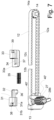
- Figs. 3 to 5 illustrate a functional model 21 with details of the drive system 11 and of the reciprocating means 11a seen in figs. 1a,1b,1c , 2a and 2b , in accordance with the present invention.
- the functional model 21 only shows essential parts of the drive system 11 and their relationship to each other.
- the functional model 21 shows a delimited part of the drive system 11 and of the reciprocating means 11a, and the relative distance between the driven pulley 13 and the idle pulley 14 does not correspond to the reality.
- the drive belt 12 the coupling rail 10 and the elongate guide profile 15 are designed and selected to fit the actual truck bed and the roll-up truck bed cover.
- the drive system 11 may have a reciprocating means 11a as schematised on both sidewalls 3 of the truck bed 2.
- the functional model of the drive system 11 is further shown without engaging a roll-up truck bed cover 6.
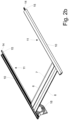
- the drive system 11 comprises the coupling rail 10 and a rear part 22, which is secured to the coupling rail 10 by means of screws 23 and may be covered by a not shown cover.
- the coupling rail 10 has a channel 41 used to guiding the slats 8,9 of the roll-up truck bed cover 6, not shown, when said roll-up truck bed cover 6 slides between the extended and retracted position.
- the coupling rail 10 has a gutter 24a to direct rainwater away and a securing track 24b facing away from the truck bed.
- the securing track 24b may be used for attaching different objects, not shown, to the coupling rail 10.
- the rainwater can flow to the rear part 22 and down through an opening 25 in said rear part 22 and may flow further out of a drain 26 in said rear part 22, in case such drain 26 is provided.
- the rear part 22 provides a smooth termination of the drive system 11 with the coupling rail 10 when the said features are mounted to the truck bed.
- the reciprocating means 11a of the drive system 11 comprises the driven pulley 13, the idle pulley 14 and the drive belt 12.
- the drive system 11 of the present embodiment comprises the elongate guide profile 15 with the elongate guide track 15a that in the assembled state of the drive system 11 shown in fig. 3 accommodates and protects the majority of the length of the drive belt 12 between the driven pulley 13 and the idle pulley 14.
- the reciprocating means 11a of the drive system 11 of the present embodiment also has a shaft pulley 27, which at a first end 27a has a bore (not seen in fig. 4 ) to lockingly receive a first protruding shaft 28a that protrudes from the driven pulley 13 in order to rotate said driven pulley 13.
- a shaft pulley 27 At the opposite second end 27b of the shaft pulley 27, that shaft pulley 27 has a second protruding shaft 28b constructed to lockingly receive the shaft 17 to rotate said shaft 17 to drive the reciprocating means 11a of the drive system 11 at the opposite end of the shaft, as shown in figs. 2a to 2d.
- the drive belt 12 of the reciprocating means 11a is constituted of a length of toothed belt 12 with first teeth 12a, which drive belt 12 serve as a timing belt.
- the length of toothed belt 12 is assembled into a loop by means of a first embodiment of a resiliently extensible belt tensioner 29.
- the first embodiment of a resiliently extensible belt tensioner 29 is explained in further details below.
- the driven pulley 13 and the idle pulley 14 have second teeth or ribs 13a and 14a respectively and the shaft pulley 27 has shaft pulley teeth 27a.
- the drive belt 12 may be driven in a very precise way involving no slippage and at constant speed.
- the wear on the drive belt 12 as well as the pulleys 13, 14 will be reduced to an absolutely minimum.
- the good engagement between the timing belt 12 and pulleys 13,14 makes the operation of the reciprocating means 11a low noise.
- the driven pulley 13 is mounted in a first bracket bearing 43, whereas the idle pulley 14 is mounted in a second bracket bearing 44, the latter being arranged at the rear part 22.
- the first bracket bearing 43 for the driven pulley 13 is secured to the coupling rail 10 by inserting and fastening an L-shaped hooking projection 40 of the first bracket bearing 43 into an elongate bottom slot 45 at the underside of the coupling rail 10.
- the elongate guide profile 15 is press-fitted, or otherwise secured in between a first end surface 47 of the first bracket bearing 43 and a second end surface 48 of the second bracket bearing 44.
- Fig. 6 is a fragmentary perspective view seen from below of the reciprocating means 11a of the functional model 21 without the shaft 17 and the second bracket bearing.
- the drive belt 12 runs around the idle pulley 14 and the driven pulley 13, and rotates these pulleys 13,14 in their respective bracket bearings 43,44 coupling rail.
- the resiliently extensible belt tensioner 29 is also shown in fig. 6 .
- the first embodiment of a resiliently extensible belt tensioner 29 is in the following explained in further details with reference to figs. 7 to 10 .
- the resiliently extensible belt tensioner 29 comprises a first part 31, which is lengthwise axially coupled to a second part 33 in restricted extensible manner via an inserted spring 35.
- the first part 31 and the second part 33 clamps around the free ends 12b, 12c of the length of drive belt 12 to make said drive belt 12 into a slightly extensible loop due to the spring 35.
- the first part 31 has mating first third teeth 38 and the second part 33 has mating second third teeth 39.
- the distance between the first part 31 and the second part 33 are adjusted and kept under control, on the one hand due to said engagement between first teeth 12a and third teeth 38,39, and on the other hand due to the design of said first part 31 and said second part 33.
- the first part 31 has a projecting L-shaped portion or claw 32 to hook into a groove or recess 34 of the second part 33 to provide space for adjusting said distance between the first part 31 and the second part 33 when the drive belt 12 moves.
- a bottom slide surface 31a of the first part 31 rests sliding on an upper slide surface 33a of the second part 33 with the L-shaped portion or claw 32 accommodated in the groove or recess 34 of the second part 33.
- the spring 35 that keeps the drive belt 12 stretched at all times, is located in the groove or recess 34 behind the nose 36 of the projecting L-shaped portion or claw 32, so that said nose 36 can compress the spring 35 in the event that the drive belt is "overstretched", and the first part 31 and the second part 3 compresses the spring 35 against a bottom 37 of the groove or recess 34 that faces the first part 31.
- the first part 31 and the second part 33 will be pushed towards each other by the spring 35, when stretching of belt is relieved due to relieving the compression force when the spring 35 returns to its relaxed condition.
- the drive belt 12 affects the resiliently extensible belt tensioner 29 with forces that try to pull the first part 31 and the second part 33 of the resiliently extensible belt tensioner 29 away from each other, whereas the spring 35 on the other hand tries to push the first part 31 and the second part 33 of the resiliently extensible belt tensioner 29 towards each other until an equilibrium situation is present.
- the drive belt 12 will be biased with a certain tension and not be too loose.
- the components of the resiliently extensible belt tensioner 29 is seen in a fragmentary exploded enlarge scale view in fig. 8 , which is a view from the driven pulley 13.
- the first part 31 has a first main body 31a wherefrom the claw 32 projects perpendicularly with the nose 36 facing the drive belt 12.
- the first main body 31a has an I-shaped first bottom part 31b that delimits opposite first guide grooves 31b',31b".
- the first top part 31c above the I-shaped first bottom part 31b faces away from the drive belt 12 and has the first third teeth 38 inside a gap 31d into between the first bottom part 31b and the first top part 31c, into which the first end 12b of the drive belt 12 can be laterally inserted to be locked to the first part 31.
- the first guide grooves 31b',31b" serve to engage the opposite guide webs 15b, see fig.
- the first top part 31c has a lateral first protrusion 31c' configured to engage an intermediate component 49, as illustrated in figs. 9 and 10 .
- the intermediate component 49 is connected to the rear profile 7 to reciprocate together with the drive belt 12.
- the second part 33 has a second main body 33a wherefrom a receiving part 33b protrudes axially towards the first part 31.
- the receiving part 33b has the groove or recess 34 that receives both the spring 35 and the sliding nose 36 of the first part 31.
- the second main body 33a has an I-shaped second bottom part 33c that delimits opposite second guide grooves 33c',33c".
- the second top part 33d on top of the I-shaped second bottom part 33c faces away from the drive belt 12 and has the second third teeth 39.
- the second top part 33d and the I-shaped second bottom part 33c delimits a gap 33e into which the second free end 12c of the drive belt 12 can be laterally inserted to be locked to the second part 33.
- the second guide grooves 33c',33c" serve to engage opposite guide webs 15b of the elongate guide profile 15 so that the resiliently extensible belt tensioner 29 is made to ride on and under the control of the elongate guide profile 15 while being partly immersed inside the elongate guide track 15a, as seen in e.g. fig. 3 .
- the second top part 33d has a lateral second protrusion 33d' configured to engage an intermediate component 49, as illustrated in figs. 9 and 10 .
- the intermediate component 49 is connected to the rear profile 7 and reciprocates with the drive belt 12.
- the height of the resiliently extensible belt tensioner 29 is selected so that it does not reach the bottom of the elongate guide profile 15 nor comes in any contact with the coupling rail 10 that would negatively affect the reciprocating of the roll-up truck bed cover 6, including avoiding friction.
- the spring 35 which is placed in the groove or recess 34 of the second part 33 is confined behind the nose 36 of the first part 31 and the bottom 37 of the groove or recess 34 that faces the first part 31, respectively.
- the shown and described resiliently extensible belt tensioner 29 may be used in all conceivable sizes for other applications where two parts needs to be pushed towards each other for tensioning a belt or a wire mounted to each of the two parts. So the extensible belt tensioner 29 may be used for other purposes than in a drive system according to the present invention.
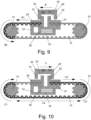
- Fig. 9 is a principle sketch of the functionality of the resiliently extensible belt tensioner 29 during retracting the roll-up truck bed cover 6 into the retracted position seen in fig. 1c , as illustrated by arrow B.
- Fig. 10 is a principle sketch of the functionality of the resiliently extensible belt tensioner 29 during extending the roll-up truck bed cover 6 towards the extended position seen in fig. 1a , as illustrated by arrow C.
- the intermediate component 49 has a securing end part (not shown) secured to the rear profile 7 and an opposite bifurcated belt tensioner engaging end 50 with two protruding legs, a first protruding leg 51 space from a second protruding leg 52 by a reciprocating gap 53.
- the length of the drive belt 12 that extends between the driven pulley 13 and the driving engagement between the lateral first protrusion 31c' of the first part 31 and the second leg 52 of the intermediate component 49 is the pulled length of the drive belt 12 which is subjected to pulling forces, as shown in fat line in fig. 10 , and indicated by arrows C1-C4.
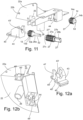
- Fig. 11 shows, in perspective, the first bracket bearing 43, the second bracket bearing 44 located in the rear part 22, the driven pulley 13, the idle pulley 14, and the shaft pulley 27.
- the driven pulley 13 has a driven pulley shaft 52 that extends on opposite sides of the toothed wheel body 13b with second teeth 13a.
- the driven pulley shaft 52 has a first protruding shaft 28a that protrudes from the driven pulley 13 in order to rotate said driven pulley 13 upon engaging the shaft pulley 27.
- the idle pulley 14 has an idle pulley shaft 53 that extends on opposite sides of the toothed wheel body 14b with second teeth 14a.
- the shaft pulley 27 has a shaft pulley shaft 27' that extends on opposite sides of the toothed wheel body 27'' .
- the shaft pulley shaft 27' has a second end 27b with a second protruding shaft 28b that couple with the shaft 17 to drive the drive belt via the electric motor and an opposite first end 27c that couple to the driven pulley 13.
- the first bracket bearing 43 has the L-shaped laterally hooking projection 40 to couple to the coupling rail 10 and axially protruding first extensions 40' for coupling to the free end of the elongate guide profile 15 by press-fitting into channels 15c delimited lengthwise between the bottom 15d of the elongate guide profile 15 and opposite guide webs 15b provided for reciprocating the resiliently extensible belt tensioner 29.
- a first bearing groove 43' serves to receive the driven pulley 13 in rotatory manner.
- Fig. 12b shows the rear part 22 from below, and fig. 11 shows the same from above.
- the rear part 22 has a coupling flange 22a for coupling to the free end of the coupling rail 10 at a tail gate corner of the truck bed, as also seen in fig. 4 .
- the coupling flange 22a has screw holes 22b and the coupling rail 10 has aligned screw holes 22c.
- the first bracket bearing 43 of the rear profile 22 has axially protruding second extensions 40" for coupling to the free end of the elongate guide profile 15 opposite the first bracket bearing 43 in same manner as described for said first bracket bearing 43.
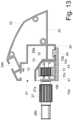
- Fig. 13 is a cross-sectional view according to line XI-XI in fig. 3 that shows an embodiment of the profile of the coupling rail 10 with the gutter 24 to direct rainwater away from the coupling rail 10 and the lengthwise extending channel 41 to accommodate the rear profile 7, the interconnected slats 8 with its foremost front slat 9 of the roll-up truck bed cover 6 when it is moved.
- the coupling rail 10 is formed with a lengthwise extending end stop surface 46 inside the channel 41, which end stop surface 46 constitutes an end stop for the rear profile 7, the slats 8 and the front slat 9 of the roll-up truck bed cover 6 for moving in their longitudinal direction, that is, across the direction of movement of the roll-up truck bed cover 6.
- the position of the driven pulley 13 in the first bracket bearing 43 and the drive belt 12 around the driven pulley 13 is shown in relation to the elongate guide profile 15 with the elongate guide track 15a that protects the drive belt 12.
- the projection 40 of the first bracket bearing 43 engages the elongate bottom slot 45 of the coupling rail 10, thus securing the first bracket bearing 43 to the coupling rail 10. Said securing can in the alternative or as a supplement be accomplished using screws or other fasteners.
- the coupling rail 10 comprises a planar surface 42 intended to be placed on top of the sidewall 3 of the truck bed 2, as shown in fig. 1 .
- the drive system of the present invention is not limited to coupling rails placed on top of the sidewall 3 of the truck bed 2.
- the drive system can also be used together with coupling rails more or less embedded in the truck bed or aligned with a top edge of the truck bed.
- Securing means may be placed in the elongate slot 45 to secure the coupling rail 10 to the sidewall 3 of the truck bed 2.
- the second protruding shaft 28b of the shaft pulley 27, which is used as the driving pin for rotating the shaft 17, may in the alternative extend to the opposite sidewall 3 of the truck bed 2, where a similar but inverted coupling rail 10 with a set of pulleys, including a driven pulley 13 and a drive belt 12 etc. may be provided, so that the opposite second protruding shafts 28b of opposite drive systems together constitutes the shaft 17.
- This alternative embodiment does however place a significant demand on tolerances and measuring to make the shaft and drive system fit the truck bed perfectly, whereas an embodiment with a separate shaft allows the same drive system to be used with different shaft lengths.
- a motor shaft pulley 50 is connected to a not shown motor via the toothed motor drive belt 19 that drives the shaft pulley 27 and thus the shaft 17.
- the shaft 17 is connected to and drives the driven pulley 13, which again drives the drive belt 12 in any of the two directions indicated by arrow A in fig. 1 .
- the shaft 17 may be connected to a second driven pulley 13, not shown, situated at the opposite sidewall 3 of the truck bed 2, so that the drive systems comprises two identical reciprocating means 11a, one at each sidewall 3, not shown, of the truck bed 2, although just one electrical motor may suffice.
- the two opposite pulley systems with one and the same shaft 17 for rotating the driven pulleys 13 it is ensured that the roll-up truck bed cover 6 is drawn in the intended direction synchronously at exactly the same speed at both sides of the roll-up truck bed cover 6.
- the wear on the slats 8 of the roll-up truck bed cover 6 will be minimal and the lifetime significantly extended.
- Fig. 14 and 15 show that the drive belt 12 is a toothed drive belt and that the driven pulley 13 likewise is a toothed pulley.
- the not shown idle pulley 14 is also a toothed pulley.
- the first teeth 12a of the drive belt 12 engage the second teeth 13a of the driven pulley 13 and the second teeth 14a of the idle pulley 14 when said pulleys 13,14 rotate.
- the roll-up truck bed cover 6 may be driven into its intended positions in a very precise way involving no slippage and at selected speed.
- the driven pulley 13 has a driven pulley shaft 52 rotatingly placed, e.g. journaled, in the first bracket bearing 43.
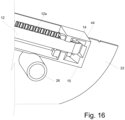
- the idle pulley 14 has an idle pulley shaft 53 rotatingly placed in the second bracket bearing 44 that are integral with the rear part 22, as seen in fig. 16 of the functional model 21 from below.
- Figs. 17 - 21 show a second embodiment of a resiliently extensible belt tensioner 29'.
- the second embodiment of a resiliently extensible belt tensioner 29' corresponds substantially to the first embodiment of a resiliently extensible belt tensioner 29 and for like parts same reference numerals are used.
- the second embodiment of a resiliently extensible belt tensioner 29' comprises a first part 54 and a second part 55 connected in restricted extensible manner via an inserted spring 35, in the same manner as the first embodiment of a resiliently extensible belt tensioner 29.
- the first part 54 and the second part 55 clamp around the free ends of the second embodiment of a drive belt 12', as seen in figs. 20 and 21 , in the same manner as the first embodiment of a resiliently extensible belt tensioner 29 due to the first part 54 having first third teeth 56 and the second part 55 having second third teeth 57.
- the first third teeth 56 and the second third teeth 57 of the resiliently extensible belt tensioner 29' have a semi-circular cross-section but serve the same function as the first third teeth 38 and the second third teeth 39 of the first embodiment of a resiliently extensible belt tensioner 29, which teeth 38,39 have flat-bottom U-shaped cross-sections where the opposite legs of the U diverge.
- the cross-sections of the first third teeth 38,56 and of the second third teeth 39,57, respectively, are selected to securely mate and engage the teeth 12a,58 of the drive belt 12,12', respectively. So the configuration of the respective first third teeth 38,56 and the respective second third teeth 39,57 is adapted to drive a correspondingly configured respective drive belt 12,12', wherein a tooth on one of the engaging parts engage a gap between opposite teeth of the other part.
- the second teeth or second ribs of the driven pulley and of the idle pulley are also adapted and configured to engage the first teeth 58 of the second embodiment of a drive belt 12'.
- the first part 54 has a projecting L-shaped portion or claw 32 to hook into a groove or recess 34 of the second part 55, in which groove the spring is positioned, to provide space for spring-biased adjusting of the distance between said first part 54 and second part 55.
- the extensible distance between the first part 54 and second part 55 is resiliently controlled by the spring 35 in a similar manner as described for the first embodiment of a resiliently extensible belt tensioner 29 when the electric motor drives the roll-up truck bed cover 6 to open and closed positions.
- the second embodiment of a resiliently extensible belt tensioner 29' differs from the first embodiment of a resiliently extensible belt tensioner 29 in particular in the configuration of the respective first top part 54a of the first part 54 and the respective second top part 55a of the second part 55, and in that the configuration of the first bottom part 54b of the first part 54 and the second bottom part 55b of the second part 55 have different shapes to allow said bottom parts 54b,55b to be slidingly suspended on a guide web 59 or guide rail inside a second embodiment of a guide profile 60 that in use surrounds and protects the drive belt 12' and associated resiliently extensible belt tensioner 29', as also shown for the first embodiment of a resiliently extensible belt tensioner 29, as exemplified in fig. 3 .
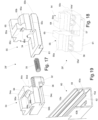
- the fragment of the guide profile is seen in enlarged scale view in fig. 19 from a free end.
- the first bottom part 54b of the first part 54 has a first guide groove 54c and the second bottom part 55b of the second part 55 has a second guide groove 55c.
- the guide web 59 of the guide profile slides inside aligned first guide groove 54c and second guide groove 55c in a manner similar to the manner described in relation to fig. 4 for the first embodiment of a resiliently extensible belt tensioner 29, while a protruding slide foot 61 of the second bottom part 55b slides freely in a third guide groove 62 of the guide profile 60, which third guide groove 62 is delimited by opposite stepped guide webs 63a,63b that protrude towards each other inside the guide profile 50 above the bottom 15d of the guide profile 60.
- the first top part 54 has a lateral first protrusion 64 and the second top part 55 has a lateral second protrusion 65 facing in same direction as the lateral first protrusion 64 and towards the rear profile 7 in the operative condition of the resiliently extensible belt tensioner 29'.
- the lateral first protrusion 64 and the lateral second protrusion 65 are substantially parallel.
- the lateral first protrusion 64 has a first exterior lateral engagement face 64a with a first exterior coupling groove 64b and a first interior lateral face 64c with an optional first interior groove 64d.
- the lateral second protrusion 65 has a second exterior lateral engagement face 65a with a second exterior coupling groove 65b and a second interior face 65c with an optional second interior groove 65d.
- the interior coupling grooves 64d,65d are beneficial in case of need to get access to manually move the first part and the second part apart from each other.
- the first exterior coupling groove 64b and the first interior groove 64d are axially offset in relation to each other along the height of the first top part 54, whereby the first interior groove 64d is closer to the roll-up truck bed cover 6 than the first exterior coupling groove 64b in the operative of the resiliently extensible belt tensioner 29'.
- the second exterior coupling groove 65b and the second interior groove 65d are offset in relation to each other along the height of the second top part 55, whereby the second interior groove 65d is closer to the roll-up truck bed cover 6 than the second exterior coupling groove 65b, to be easy to get hold on in case the first top part and the second top need to be pulled apart.
- the first top part 54a delimits a first gap 54a' into which the first free end 12c' of the second embodiment of the drive belt 12' can be laterally inserted to be locked to the first part 54
- the second top part 55a delimits a second gap 55a' into which the second free end 12b' of the second embodiment of the drive belt 12' can be laterally inserted to be locked to the second part 55 to allow the resiliently extensible belt tensioner 29' to reciprocate along with the drive belt 12'.
- the first exterior coupling groove 64b of the lateral first protrusion 64 and the second exterior coupling groove 65b of the lateral second protrusion 65 of the second embodiment of the resiliently extensible belt tensioner 29' are configured to engage a first protruding leg 66 and a second protruding leg 67 of a belt tensioner engaging end 68 of a connector component 69 of the connector 49' seen in the exploded and assembled views of figs. 22-30 .
- the connector 49' comprises the housing component 70 seen in figs. 23 and 24 , and the connector component 69 seen in figs. 22 and 25 .
- the housing component 70 accommodates the connector component 69 in reciprocating manner and is secured to the rear profile 7 of the roll-up truck bed cover 6, e.g. by means of screws.
- the connector 49' is inserted sidewise into a free end of the rear profile 7.
- the reciprocating direction is parallel to the longitudinal axis of the rear profile 7, as indicated by arrows A1,A2.
- the housing component 70 has a securing end part 71 configured as a tray for accommodating the connector component 69.
- the securing end part 71 of the housing component 70 has a tray bottom wall 72, a first tray end wall 73 facing towards a free end of the rear profile 7, an opposite second tray end wall 74, and opposite tray side walls 75a,75b extending between the first tray end wall 73 and the second tray end wall 74.
- the first tray end wall 73 has a first tray opening 76 through which the fork or bifurcation defined by the protruding legs 66,67 of the connector component 69 can be exposed by being moved into the direction indicated by arrow A1.
- the protruding legs 66,67 can be retracted from the first tray opening 76 by being moved into the direction indicated by arrow A2.
- the walls 72,73,74,75a,75b define a tray cavity 77 into which the connector component 69 fittingly can reciprocate to allow the above mentioned exposing and retracting.
- the belt tensioner engaging end 68 of the connector component 69 has its protruding legs 66,67 in resilient engagement with the exterior coupling grooves 64b,65b of the top parts 54,55 of the resiliently extensible belt tensioner 29', as shown in figs. 26 and 27 , similar as also described in relation to figs. 9 and 10 for the first embodiment of a resiliently extensible belt tensioner 29.
- the electric motor drives the drive belt the rear profile moves as well due to this engaging.
- the electric motor can stop moving the drive belt 29, and thus, move the rear profile 7 to place the associated roll-up truck bed cover 6 in any desired open or closed position.
- the connector component 69 has a main connector body 78 composed of a first connector end part 79 with a first connector end 80 that has the protruding legs 66,67, and an opposite second connector end part 81 with a second connector end 82. As seen in fig. 27 , when the connector component 49' engages the resiliently extensible belt tensioner 29' the legs 66,67 protrude from the first connector end 80 through the first tray opening 76 in the assembled state of the connector 49' .
- the second connector end part 81 of the connector component 69 has a connector opening 83, which connector opening 83 has a finger grip 84 that protrudes out of a second tray opening 85 in the tray bottom wall 72.
- the second tray opening 85 starts close to the second tray end wall 74.
- the second tray opening 85 is an elongate slot.
- the finger grip 84 In the position wherein the connector 49' is inserted into the rear profile 7 via a free end of the rear profile the finger grip 84 extends out of the second tray opening 85, and optionally out of a correspondingly operating opening (not shown) in the side of the rear profile 7 facing inside the truck bed.
- the finger grip 84 faces inside the truck bed to be accessible for manual operation, e.g. in case the electric motor stops working.
- the finger grip 84 is simply moved manually from inside the truck bed in the direction of arrow A2 to set the engagement between the legs 66,67 of the connector component 69 free of the exterior coupling grooves 64b,65b of the resiliently extensible belt tensioner 29', thereby subsequently allowing the roll-up truck bed cover 6 to be pushed and pulled manually along the coupling rails 10.
- the length and shape of the second tray opening 85 and of the operating opening define the maximum possible travel length L of the connector component 69 in relation to the housing component 70.
- the actual travel length L may be shorter depending on the distance to the resiliently extensible belt tensioner 29', but the travel length L of the connector component 69 is so long that the legs 66,67 of the connector component 69 are displaced to fully disengage or engage the resiliently extensible belt tensioner 29'.
- the connector 49' can e.g. be inserted and held in a track 93 provided at the underside 94 of the rear profile 7, as seen in fig. 30 .
- the exterior coupling grooves 64b,65b are the female parts and the legs 66,67 are the male parts fitting inside the female parts.
- both the coupling grooves 64b,65b and the legs 66,67 have substantially triangular cross-sections so that a leg 66,67 is naturally guided laterally inside the exterior coupling groove 64b,65b in front of said leg 66,67 to achieve mutual engagement, thus into the position seen in fig. 27 , a position, which is maintained as long as the roll-up truck bed cover 6 is electrically operated and smoothly runs open and closed without e.g. getting stuck in an intermediate half-open/half-closed position.
- the legs 66,67 of the connector component 69 must be kept exposed from the housing component 70.
- the second connector end part 81 has a locking pawl 86 protruding from second connector end 82 a distance along the second connector end part 81 towards the first connector end part 79 along the tray side walls 75b.
- the locking pawl 86 serves to engage a locking tooth 87 or similar protrusion on the tray side walls 75b, as seen best in the assembled views of figs. 27 and 29 .
- the connector component 69 In the engaged position seen in fig. 27 the connector component 69 has been moved the travel length L towards the resiliently extensible belt tensioner 29', whereby a hooking end 91 of the locking pawl 86 resiliently and biased passes by the locking tooth 87 and locks the connector component 69 in the forward engaging position.
- the connector component 69 In the position seen in figs. 28 and 29 the connector component 69 is retracted back into the housing component 70 and the hooking end 91 of the locking pawl 86 is not biased anymore, but free of the locking tooth 87.
- the position of the connector component 69 seen in figs. 28 and 29 is simply achieved by pulling the finger grip 84, that protrude from aligned operating opening (not shown) of the rear profile and the second tray opening 85 of the housing component 70 in the direction of the arrow A2 from inside the truck bed.
- the housing component 70 further has a mounting flange 88 with screw holes 89 for securing the housing component to the rear profile, e.g. at the free end of the rear profile, but can be mounted to the rear profile using any other suitable means.
- the connector can e.g. be forced-fitted into the free end of a hollow rear profile, or can be secured by means of screws.
- the housing component 70 also has a third tray opening 90 that extend from the tray bottom wall 72 into the tray side wall 75b.
- the finger grips 84 can be used for this purpose.
- a roll-up truck bed cover 6 of the present invention that has a drive system that comprises two opposite pulley systems, one at each long side of the truck bed, reestablishing engagement between a connector 49,49' and its associated resiliently extensible belt tensioner 29,29' must be attended to at both long sides of the truck bed.
- the rigid trigger may be a protruding post or rod that gradually slides on a curved face 92 of the connector component 69 parallel to the tray bottom wall 77, which causes displacing of the connector component 49' in the direction of arrow A1 whereby the locking pawl 91 passes by the locking tooth 87, thereby inserting the legs 66,67 in the exterior coupling grooves 64d,65d.
- the shown and described functional principle of the resiliently extensible resiliently extensible belt tensioners 29;29' of the present invention may be used in all conceivable sizes and shapes of resiliently extensible belt tensioners for other applications where two parts needs to be pushed towards each other for tensioning a belt or a wire mounted to each of the two parts. So the extensible belt tensioner 29;29' may be used for other purposes than in a drive system according to the present invention. Furthermore the connector 49;49' is not limited to use with the resiliently extensible belt tensioners of the present invention.
- An alternative component to the resiliently extensible belt tensioner may be any component that has female coupling grooves to catch and engage the legs of the connector component.
- the drive system of the present invention is described above in relation to a roll-up truck bed cover comprised of interconnected rigid slat.
- the drive system of the present invention can however also be used to drive a soft flexible roll-up truck bed cover, e.g. a fabric cover.
Landscapes
- Engineering & Computer Science (AREA)
- Mechanical Engineering (AREA)
- Power-Operated Mechanisms For Wings (AREA)
- Transmission Devices (AREA)
- Body Structure For Vehicles (AREA)
- Vehicle Body Suspensions (AREA)
- Platform Screen Doors And Railroad Systems (AREA)
- Fittings On The Vehicle Exterior For Carrying Loads, And Devices For Holding Or Mounting Articles (AREA)
Description
- The present invention relates to a drive system configured for reciprocating, between an extended position and a retracted position, a roll-up truck bed cover above a truck bed, said roll-up truck bed cover being composed of a rear profile, a plurality of elongate slats that are hinged together wherein the plurality of elongate slats has a foremost front slat, said drive system comprising at least one reciprocating means adapted for reciprocating the roll-up truck bed cover, and at least one reversible electric motor adapted for driving the reciprocating means, wherein the at least one reciprocating means comprises at least one pulley system comprising at least one set of pulleys and at least one drive belt, which at least one set of pulleys includes a driven pulley and an idle pulley.
- Truck bed covers of the above-mentioned kind for converting an open bed of a pickup truck to a closed bed, and vice versa, are well known. When the truck bed cover is in its extended position closing the truck bed, it protects the content in the truck bed from bad weather and from unintentional access. In addition, a truck bed cover ensures that goods placed in the truck bed are not lost while driving the pickup truck. When the truck bed cover is in its retracted position opening up the truck bed larger objects may be transported with the pickup truck.
- From
US 5,040,843 such a roll-up truck bed cover is known which is moved between an extended position and a retracted position by means of two drive wheels mounted on a motor driven shaft. The drive wheels physically engage the linkage between adjacent slats of the roll-up truck bed cover. So each time the roll-up truck bed cover is operated a linkage between adjacent slats is subjected to the heavy action of the drive wheels whereby the drive mechanism quite quickly will be worn, as both the notches in the drive wheels and the engaging depending portions on the roll-up truck bed cover are subjected to repeated mechanical impacts. Thus, clearance will occur rather rapidly in the cooperating parts, whereby their function becomes uncertain. Further, after prolonged operation of this known roll-up truck bed cover, the depending portions of the cover, which are constituted by the hinged parts of the cover, may become so worn that the slats of the cover can no longer rotate freely relative to each other, and furthermore the slats of the cover can be damaged so that the cover becomes leaky. - From
US 2017/0341494 another pickup truck bed cover system is known, where the cover is a flexible, soft cloth, which may be wrapped on and off a driven main roller. The system involves a cable system for extending and retracting the cover by means of a motor. The cable system comprises a cable, which is wrapped about a motor driven drum and a number of idle pulleys, where the front part of the cover is secured to the cable. The cover may be moved in either direction by rotating the drum and thus moving the cable over the drum and pulleys. One disadvantage of the known cover system is that if the cover is subjected to a certain load, the cable will slide relatively easily on the drum and the pulleys so that the cable and thus the cover will not move in the desired direction. If this occurs, the cable as well as the drum and pulleys will become worn and the cable may break. A further disadvantage of this known system is the large number of gears used to transfer the power from the motor to the drum and thus the cable. The gears will become soiled relatively easily in the environment they are in, and thus be worn and cause malfunction. In addition, the cable may pose a potential danger that a person who has an errand in the truck bed will cut on the cable, if it is not properly shielded. Furthermore, the cable system and the main roller should be properly synchronized as they cooperate to retract and extend the flexible cover, where just a slight asynchronicity may result in a too loose cover or a too tense cover. Yet a disadvantage is that the cover can curl if it does not get properly wrapped on the main roller. -
US 9,365,097 B1 -
DE1266788B discloses another drive system similar to the preamble ofclaim 1. - The present invention aims to provide and improvement to the prior art roll-up truck bed covers.
- In a main aspect of the present invention is provided a drive system of the kind mentioned in the opening paragraph with an increased reliability compared to conventional drive systems. In a further aspect is provided a drive system of the kind mentioned in the opening paragraph, wherein the slats of the roll-up truck bed cover are exposed to much less wear as compared to known drive systems.
- In a further aspect is provided a drive system of the kind mentioned in the opening paragraph, which provides a very precise and controlled movement of the roll-up truck bed cover. In a further aspect is provided a drive system of the kind mentioned in the opening paragraph, which can be mounted to the truck bed with minimum tools and minimum alteration of the truck.
- In a further aspect is provided a drive system of the kind mentioned in the opening paragraph, which does not need modification of the slats of the roll-up truck bed cover.
- In a further aspect is provided a drive system of the kind mentioned in the opening paragraph, which has a mechanism for decoupling the truck bed cover from the electric drives system. In a further aspect is provided a drive system of the kind mentioned in the opening paragraph, which has reciprocating means including pulley systems at opposite sides of the truck bed.
- In a further aspect is provided a truck bed comprising the drive system of the kind mentioned in the opening paragraph. The novel and unique whereby these and other aspects are achieved according to the present invention consist in that the drive belt is secured to the rear profile of the roll-up truck bed cover via an intermediate component that protrudes from the rear profile to detachably engage a resiliently extensible belt tensioner on the drive belt, whereby the resiliently extensible belt tensioner becomes coupled to the rear profile to move the roll-up truck bed cover to open and close the truck bed.
- Within the scope of the present invention a "driven pulley" is to be understood as a pulley that drives a drive belt.
- Within the scope of the present invention an "idle pulley" is to be understood as a loose pulley opposite the driven pulley to tighten and guide the drive belt. Thus the idle pulley is a free rolling or spinning pulley that provides a tension point. Within the scope of the present invention a "drive belt" is to be understood as a continuous band of tough flexible material for transmitting motion.
- Within the scope of the present invention a "roll-up truck bed cover" is to be understood as a lid that covers the bed of e.g. a pickup truck. The lid is assembled of elongate slats that are hinged alongside together, such as parallel to each other, to allow the lid to be rolled up. The roll-up truck bed cover of hinged slats is terminated at the tail gate by a rear profile and oppositely, at the driver's cab, by a front slat. The slats of the lid may be made in aluminum, plastic or any other suitable material, and a corresponding gasket or sealing may be provided at the linkage between two adjacent slats to keep rain from entering a potential gap at the linkage.
- Within the scope of the present invention the term "front slat" means the slat closest to the driver's cab, thus the last slat of the roll-up truck bed cover when seen from the tail gate. Thus the front slat is the first slat to be rolled-up when the truck bed cover is retracted, e.g. to be stored in a container, such as a canister.
- Soft cloth covers are not part of the present invention as roll-up truck bed covers but components of the present drive system can be used with soft flexible covers as well.
- By reciprocating the roll-up truck bed cover by means of a drive belt which is wrapped around at least one set of pulleys is obtained a very reliable system for reciprocating the roll-up truck bed cover between an extended position and a retracted position. No moving parts of the reciprocating means slide or roll over the roll-up truck bed cover, which is therefore exposed to minimal mechanical wear. Further, as the slats of the roll-up truck bed cover are not exposed to mechanical impacts or twists during its reciprocating movement no clearance or play due to wear will occur between the slats, thus the function of the slats is stable, where the slats constantly will remain freely hinging and rotatable relative to each other. During normal operation, no damage will occur to the slats of the roll-up truck bed cover allowing it to leak.
- By using a drive belt for providing the reciprocating movement of the roll-up truck bed cover a very good contact surface between the drive belt and the pulleys is obtained, which entails that the drive belt will not slide on the pulleys, but will instead ensure that the roll-up truck bed cover will move perfectly with the drive belt without any slip. This will minimize the wear of the drive belt as well as of the pulleys, thus extending the life of these parts, especially avoiding breaking the drive belt. Further, as the drive belt is secured to the rear profile of the roll-up truck bed cover a very consistent and reliable movement of the roll-up truck bed cover is obtained without resulting in a too loose cover or a too tense cover. Yet an advantage is that a drive belt is inexpensive and easy to replace.
- In one embodiment the drive system may comprise two opposite pulley systems, one at each long side of the truck bed, and a shaft connecting the corresponding driven pulleys of each pulley system to each other, which shaft is arranged rotatable about its axis by the electric motor. Thereby is ensured that the roll-up truck bed cover is driven equally on both sides thereof, so that any twisting or distortion of the roll-up truck bed cover is completely avoided and the roll-up truck bed cover can reciprocate smoothly and easily. It is thus avoided that the slats of the roll-up truck bed cover are bent or pulled askew, so that the roll-up truck bed cover may leak or otherwise lose its intended purpose. By providing the two opposite pulley systems with one and the same shaft for rotating the driven pulleys it is ensured that the roll-up truck bed cover is drawn in the extended and the retracted position, respectively, synchronously at exactly the same speed at both sides of the roll-up truck bed cover. Hereby, the wear on the slats of the roll-up truck bed cover will be minimal and its lifetime significantly extended.
- The drive belt may be constituted by any appropriate drive belt design, and thus the drive belt may be a flat belt, a V-belt, a multi-groove belt, a ribbed belt, a toothed belt or a timing belt. A flat belt is the simplest and also the cheapest belt, and is preferably used where the forces to be transferred are not so big and/or where a smaller slip can be allowed. A V-belt has a general trapezoidal cross-section shape and thus a somewhat larger drive surface, hence solving some of the slippage and alignment problems known from the flat belt. A multi-groove belt is usually made up of a number of V-shaped sections alongside each other, thus providing a thinner belt for the same drive surface. A ribbed belt is a belt featuring lengthwise grooves, and it operates from contact between the ribs of the belt and the grooves in the respective pulley. A timing belt, which also is known as toothed, notch, cog or synchronous belt, is a so-called positive transfer belt and can avoid relative movements, it has teeth that fit into a matching toothed pulley, so when correctly tensioned it have no slippage and runs at constant speed.
- In one embodiment the drive belt has first teeth or first ribs, and the driven pulley and the idle pulley has second teeth or second ribs that engage the first teeth or first ribs. Hereby, the roll-up truck bed cover may be driven into its extended and retracted positions, respectively, in a very precise way involving no slippage and at constant speed. Thus, the wear on the slats of the roll-up truck bed cover will be reduced to an absolutely minimum. In addition, it will be relatively easy to lead and control the roll-up truck bed cover to any particular position between the fully extended position and the fully retracted position.
- The drive belt may be of "endless" design of a predetermined length, however, in one embodiment, the drive belt may be a length of toothed or ribbed belt or strip having a first free end and an opposite second free end, which first free end and second free end may be assembled into a loop by means of a resiliently extensible belt tensioner, which resiliently extensible belt tensioner has third teeth or third ribs configured for engaging the first teeth or first ribs of the drive belt. A drive belt sold by the meter may be used, which is often considerably cheaper than an endless drive belt sold in predetermined lengths, and furthermore a drive belt of any length can be obtained and customized on demand. Hereby, the drive system may be adapted to any size of the truck bed, and should the drive belt slack it can be shortened as required. Yet and advantage is that a drive belt with certain elasticity, and thus certain stretchability, can be achieved with the resiliently extensible belt tensioner, which ensures that a certain tension is always present in the drive belt. Hence, slippage between the drive belt and the pulleys will be substantially eliminated and the drive belt be kept stretched irrespective of whether the roll-op truck bed cover is extended or retracted.
- The resiliently extensible belt tensioner may be constituted by any suitable tensioner, however, in one embodiment the resiliently extensible belt tensioner comprises a first part having a projecting L-shaped portion or claw and a second part having a groove or recess for accommodating the L-shaped portion or claw of the first part, and a spring placed in the groove or recess and abut against a first surface of the first part and a second surface of the second part, respectively. In this way a very simple and compact resiliently extensible belt tensioner is obtained, that provides the drive belt with a required tension, so that good contact between the drive belt and the pulleys can be maintained. This means that slippage between the drive belt and the pulleys can be avoided or at least reduced.
- In an expedient embodiment of an resiliently extensible belt tensioner the first part may have a first top part and a first bottom part, which first top part may have a lateral first protrusion for engaging the intermediate component provided on the rear profile, and the second part may have a second top part and a second bottom part, which second top part may have a lateral second protrusion for engaging the intermediate component. The engagement between the lateral protrusion and the intermediate component advantageously serve to move the truck bed cover along with the motion of the drive belt, when said drive belt is run by the electric motor.
- The intermediate component may have protruding legs to engage the respective lateral protrusions. Preferably the distance between the protruding legs are larger than the distance between the lateral protrusions, so that the engagement between a pair of a lateral protrusion and an opposite leg typically takes place in alternating manner, depending on whether the roll-up truck bed cover is moved open or closed, and on the tensioning of the drive belt. Thus when one pair of a lateral protrusion and an opposite leg is engagement the other pair is not.
- The drive belt may extend freely exposed to the surroundings of the truck bed, however in one embodiment the reciprocating means may comprise an elongate guide profile with an elongate guide track that accommodates at least the majority of the length of the drive belt between the driven pulley and the idle pulley. In addition, the reciprocating means may comprise bracket bearings for the driven pulley and the idle pulley, respectively, at or in the vicinity of opposite ends of the elongate guide track. In this way, the drive belt can be protected from being hit and possibly damaged by items placed in the truck bed. Similarly, a user of the truck is prevented from striking against the drive belt during its movement and thereby being injured. Further, the drive belt will run smoothly on the pulleys placed in bracket bearings over the full length of the elongate guide track. Hereby, the forces needed to move the roll-up truck bed cover are minimized.
- Furthermore, the elongate guide track may be configured to suspend and control the reciprocating motion of the resiliently extensible belt tensioner, for example by utilizing a slide foot of the resiliently extensible belt tensioner to slide in the elongate guide track.
- The driven pulley of the sets of pulleys of the pulley system may be driven via a motor drive belt directly on the shaft of the driven pulley. However, in one embodiment the roll-up truck bed cover reciprocating means includes a shaft pulley driven about its rotation axis via a motor drive belt by the electric motor, which shaft pulley may have a first shaft pulley end secured to the driven pulley and an opposite second shaft pulley end secured to the shaft that extends to connect the driven pulleys of opposite drive systems. In the alternative the shaft pulley can simply be an extension of the driven pulley, so that both the motor drive belt and the drive belt directly drive the same pulley. The advantage of having a separate shaft pulley is however that the drive system can more easily be fitted and customized. So the sets of pulleys of the pulley system can be standards, and depending on the selected electric motor, its transmission, kind of motor drive belt, the weight of the roll-up truck bed cover, etc, the shaft pulley can be freely chosen provided it can couple to the driven pulley. So the shaft pulley can be ribbed or smooth to engage a complementarily ribbed or smooth shaft pulley.
- The roll-up truck bed cover may be reciprocatingly secured to the truck bed by means of coupling rails mounted to the sidewalls of the truck bed. The coupling rails may be of the kind adapted for mounting on top of the sidewalls, adjacent to an upper edge of the sidewalls or more or less below an upper edge of the sidewalls. Advantageously a drive system can be pre-assembled with a coupling rail so as to be mounted as a combined unit, e.g. at the factory, to allow easy fitting on the truck bed. A drive system and a coupling rail can however in the alternative be mounted as separate units.
- The drive system may comprise any appropriate means for collecting the roll-up truck bed cover during its retracting, such as a rotating shaft contained in an elongate canister.
- A canister may have a lid and the roll-up cover be retracted inside the canister below the lid with the front slat being the leading slat to enter the canister. The guide profiles may be detachable or not detachable coupled to the canister.
- In one embodiment the drive system may comprise an elongate canister for collecting the roll-up truck bed cover during its retracting, which canister may have opposite first and second spiral-curved guide channels at opposite short ends of the canister, which opposite first and second spiral-curved guide channels may be configured to receive a free edge of the roll-up truck bed cover during its rolling up upon retracting. In this way, the slats of the roll-up truck bed cover will not impact each other and rub against each other during the movement of the roll-up truck bed cover between the retracted and the extended position and vice versa. Thus, the wear of the slats of the roll-up truck bed cover will be reduced to a minimum. Moreover, the slats of the roll-up truck bed cover will be treated very gently and not be subjected to impact or bumps that can scratch them or at worst bend them or make bulges or dents in them.
- The invention also relates to a roll-up truck bed cover comprising a plurality of interconnected slats with the drive system described above. The roll-up truck bed cover has a rear profile provided at a rear end of the plurality of interconnected slats facing the tail gate of the truck bed, and a front slat provided at the opposite end of the plurality of interconnected slats.
- The rear profile is secured to the drive belt via the intermediate component that protrudes from the rear profile to engage a component of the reciprocating means.
- The intermediate component may have various configurations, however in a preferred embodiment the intermediate component can be a connector that comprises a housing component and a connector component reciprocatingly arranged in the housing component to engage the associated coupling component of the reciprocating means.
- The housing component can be hidden inside the rear profile by being inserted into the rear profile at a free end, and with the connector component reciprocatingly arranged in the housing component in order to be exposable from the housing component to engage the associated coupling component on the drive belt, to drive the truck bed cover open and closed, and to be retractable inside the housing component to disengage the resiliently extensible belt tensioner on the drive belt in case the electric motor malfunctions or the motion of drive system stops unintentionally, or if maintenance or repair is to be performed.
- The connector thus not only serves to carry the truck bed cover along when the drive belt rotates, the connector also serves as a safety mechanism to release the roll-up truck bed cover from the drive system.
- Such disengagement can be done manually from inside the truck bed cover even in the accidental situation where the roll-up truck bed cover is fully closed and cannot be opened using the electric motor, or in any intermediate position of the roll-up truck bed cover between open and closed. After disengagement the roll-up truck bed cover can be manually pushed towards the canister or pulled towards the tailgate.
- To facilitate the engagement and the disengagement procedure the housing component may comprise a securing end part adapted for being inserted into the free end of the rear profile and being configured as a tray for accommodating the connector component, which securing end part may comprise a tray bottom wall, a first tray end wall facing towards the drive belt, an opposite second tray end wall, and opposite tray side walls extending between the first tray end wall and the second tray end wall, the first tray end wall has a first tray opening, and the tray bottom wall has a second tray opening.
- A housing component having such a shape and configuration can easily be inserted axially from the free end of the rear profile to be, at least substantially, hidden inside the rear profile.
- A connector component can then be arranged in the housing component to slide along the tray bottom wall between the first tray end wall and the opposite second tray end wall guided by the opposite tray side walls. An advantageous connector component may comprise a fork or bifurcation aligned with the first tray opening to be exposed from a first connector end of a first connector end part of a main connector body of the connector component for engaging the belt tensioner. An opposite second connector end part of the main connector body of the connector component may have a second connector end that in the disengaged condition of the connector and belt tensioner can be retracted a maximum retracted length where it hits the second tray end wall.
- The second connector end part can have a connector opening, wherefrom a finger grip protrudes out of the second tray opening in the assembled state of connector component and housing component to be grasped to reciprocate the connector component in and along the housing component. The finger grip makes it easy to reach and to grasp to operate and control the movement of the connector to disengage the connector component and the housing component.
- In the embodiment wherein the connector is inserted into the rear profile the side of the rear profile that faces inside the truck bed has an operating opening aligned with the second tray opening to make the passage for the finger grip which allows the finger grip to protrude from the operating opening to be operated through the wall of the rear profile.
- The drive system may have locking means to keep the connector and the belt tensioner, or similar coupling component, engaged in the operative state of the roll-up truck bed cover, which is the usual state the roll-up truck bed cover. Such means can e.g. be obtained by the connector component having a locking pawl to detachably engage a locking tooth of the housing component.
- The drive system may also have synchronizing means to get two pulley systems of the reciprocating means system in synchronized aligned engagement after the opposite sets respective connector and belt tensioner have, for some reason been disengaged.
- The part of the connector acting as the first part of the synchronizing means may include that the housing component has a third tray opening, and that the first connector end part has a curved face aligned with the third tray opening. A trigger rod can then be provided as the part of a second part of synchronizing means at the front end of the truck bed to move inside the third tray opening to displace the connector component by moving along the curved face thereby pushing the connector component towards the belt tensioner the closer the rear profile gets to the front end of the truck bed. The trigger rod or similar protruding actuator means can e.g. be provided on the canister. The length of the trigger rod serves to make the lateral movement of the connector component inside the connector housing whereby the connector component and the belt tensioner at opposite sides of the truck bed cover snaps together into aligned and synchronized engagement. Once the electric motor starts again the roll-up truck bed cover can function without running askew.
- One set of connector and belt tensioner may be engaged first using the finger grip function. Then the electric motor can be operated to move the opposite set of connector and belt tensioner towards the front end of the truck bed, whereby the trigger rod enters the third tray opening of approaching connector and pushes the connector component laterally into engagement with the associated belt tensioner.
- The present invention also relates to a truck bed comprising the roll-up truck bed cover described above.
- Such a truck bed can easily be converted from an open bed of a pickup truck to a closed bed, and vice versa.
- With reference to the drawing the invention will be described in further details by way of exemplary embodiments and a short functional model that illustrates the drive principle of the drive system. It should however be emphasised that the functional model is as long as needed to span the extended length of the roll-up truck bed cover from the driver's cab to the tail gate.
-
Fig. 1a, 1b and 1c are perspective views of a pickup truck, seen from the tail gate, with a roll-up truck bed cover in extended position, partly retracted position, and fully retracted position, -
fig. 2a is a perspective view seen from below the drive system according to the invention mounted to coupling rails that are adapted to be secured lengthwise to the truck bed, -
fig. 2b shows the same seen from above, -
fig. 3 is a perspective view seen from above and from the end facing the tail gate, of a short functional model showing details of the drive system according to the invention, -
fig. 4 is an exploded, perspective view seen from above of the functional model shown infig. 3 , -
fig. 5 is a perspective view seen from below of the functional model shown infig. 3 , -
fig. 6 is a perspective view seen from below of parts of the functional model showing a set of pulleys with drive belt and a first embodiment of a resiliently extensible belt tensioner, -
fig. 7 is a perspective view of the same parts as shown infig. 6 but seen slightly from above with the first embodiment of a resiliently extensible belt tensioner in separate exploded state, -
fig. 8 is a fragmentary exploded, perspective view of a fragment of the drive system seen slightly from above from the idle pulley end and with the first embodiment of a resiliently extensible belt tensioner, -
fig. 9 is a principle sketch of the functionality of the first embodiment of a resiliently extensible belt tensioner during retracting the roll-up truck bed cover into the retracted position, -
fig. 10 is a principle sketch of the functionality of the first embodiment of a resiliently extensible belt tensioner during extending the roll-up truck bed cover into the extended position, -
fig. 11 is a perspective view of the bracket bearings and the pulleys seen from the first bracket bearing, -
fig. 12a is a perspective top view of the first bracket bearing, -
fig. 12b is a perspective view seen from below of the second bracket bearing of the rear part, -
fig. 13 is a cross-sectional view according to line XIII-XIII infig. 3 of the functional model, -
fig. 14 is a fragmentary, enlarged scale perspective view of the engagement between the motor drive belt, the shaft pulley, the driven pulley, and the drive belt, and illustrating the first embodiment of a resiliently extensible belt tensioner, -
fig. 15 shows the same parts as shown infig. 12 but seen from the motor drive belt, -
fig. 16 is a perspective view seen from below of a fragment of the tail gate end of the functional model showing the idle pulley and part of the drive belt, -
fig. 17 is a perspective exploded view of a second embodiment of a resiliently extensible belt tensioner seen from the face facing the plurality of slats of the roll-up truck bed cover, -
fig. 18 shows the same in assembled state and seen from the opposite face, -
fig. 19 is a fragmentary, perspective view of a guide profile for the second embodiment of a resiliently extensible belt tensioner, -
fig. 20 corresponds tofig. 18 but in assembled state of the second embodiment of a resiliently extensible belt tensioner on a second embodiment of a drive belt, -
fig. 21 shows the same from the opposite side of the resiliently extensible belt tensioner, -
fig. 22 is a perspective view of a connector component of an intermediate component in the form of a connector, which is seen from the side facing inside the truck bed, -
fig. 23 is a perspective view of a housing component for the connector component seen infig. 22 , where the housing component is seen from the side facing the rear profile, -
fig. 24 shows the same asfig. 23 but from the opposite side, -
fig. 25 shows the same asfig. 22 but from the opposite side, -
fig. 26 shows, in perspective from the housing component, which is assembled with the connector, how the resiliently extensible belt tensioner engages the connector to open and close the roll-up truck bed cover if the connector is mounted to the rear profile of said roll-up truck bed cover, -
fig. 27 shows the same from the connector component, -
fig. 28 shows, in perspective from the assembled housing component and connector component, the connector disengaged from the resiliently extensible belt tensioner, -
fig. 29 shows the same from the connector component, and -
fig. 30 shows in fragmentary view and from below the rear profile, an embodiment of mounting the connector to said rear profile. - Below the drive system is described in relation to a preferred embodiment under the assumption that the drive belt is a timing belt. This assumption should not be construed as limiting the scope of the present invention. As described above other types of drive belts are also foreseen. The functional model is shown to illustrate the principles of the drive system and the reciprocating means, and it is to be understood that the real drive system and reciprocating means is longer, as shown in e.g.
figs. 2a to 2d. Since the length between the pulleys of the reciprocating means of the drive system is substantially longer than the width of the driving belt, the full length of the system cannot reveal the details in a sufficiently clear way. The functional model serves this purpose. - In
figs. 1a, 1b and 1c apickup truck 1 is schematically illustrated. Thepickup truck 1 comprises atruck bed 2, which has sidewalls 3, afront wall 4 and atail gate 5. Thetail gate 5 is pivotally attached to arear end 5a of thetruck bed 2. A roll-uptruck bed cover 6 is mounted to the top of thetruck bed 2 and is movable between an extended position and a retracted position, as indicated by double arrow A. Infig. 1a the roll-uptruck bed cover 6 is shown in extended position, infig. 1b in partially retracted position, and infig. 1c in fully retracted position. The roll-uptruck bed cover 6 is composed of arear profile 7, a plurality ofelongate slats 8 that are hinged together and having a foremostfront slat 9 below alid 9a for acanister 54 for the roll-uptruck bed cover 6 in rolled-up condition. Thelid 9a for thecanister 54 may be detachable. - The roll-up
truck bed cover 6 further comprises coupling rails 10, one mounted on top of eachsidewall 3. The coupling rails 10 are intended to accommodate the ends of therear profile 7, the ends of theslats 8, including the ends of the foremostfront slat 9, in an extended or partially extended position, which ends together defines the free edge of the roll-up truck bed cover. During extension and retraction of the roll-uptruck bed cover 6 therear profile 7 and theinterconnected slats 8 with the foremostfront slat 9 are thus guided in the coupling rails 10. The coupling rails 10 are typically secured to the top of thesidewalls 3 by means of not shown clamps. The roll-uptruck bed cover 6 can be of any conventional kind and the coupling rails designed to accommodate the free edge of the roll-uptruck bed cover 6 in a sliding manner. - The coupling rails 10 as well as the
rear profile 7, and theslats - In
figs. 2a and2b is partly shown adrive system 11 to be mounted to the top of thesidewalls 3 of thetruck bed 2 and configured for reciprocating the roll-uptruck bed cover 6 between an extended position and a retracted position. The roll-uptruck bed cover 6 is shown infigs. 2a and2b in retracted position. - The shown
drive system 11 comprises a reciprocating means 11a with two sets ofpulleys drive belt 12 for extending and retracting the roll-uptruck bed cover 6, respectively. Anelongate guide profile 15 with anelongate guide track 15a accommodates the majority of the length of therespective drive belt 12 between the drivenpulley 13 and theidle pulley 14 to protect thedrive belt 12, e.g. when the truck bed is loaded and during driving with goods that can bounce and hit an unprotected drive belt. The elongate guide profiles also make a cosmetically attractive transition to the space of the truck bed and keep the drive belt under control. - As seen e.g. in
fig. 2a the coupling rails 10 maintain the free edge of the roll-uptruck bed cover 6 in place over thetruck bed 2 by accommodating the ends of therear profile 7, and the ends of theslats 8, including the ends of foremost slat, thefront slat 9. Anelectric motor 16 operates adrive belt 19 that is connected toshaft 17. Theshaft 17 connects the drivenpulleys 13 of the two sets ofpulleys shaft 17 is arranged rotatable about its axis by theelectric motor 16. In this way, the two sets of pulleys are driven synchronously, which means that there will be absolutely minimal if not no distortion of theslats 8 of the roll-uptruck bed cover 6. - In
fig. 2a is seen therear profile 7 and oneslat 8 of the roll-uptruck bed cover 6, whereas infig. 2b twoslats 8 of the roll-uptruck bed cover 6 is visible. The remainingslats 8 of the roll-uptruck bed cover 6 are carefully wound up in the spiral-curved guide channel 18, as explained below. - Each of the two
drive belts 12 is secured to the free ends of therear profile 7 of the roll-uptruck bed cover 6 e.g. directly by means of a fastener, or at least one of thedrive belts 12 has an intermediate component that protrudes from therear profile 7 to engage another component associated with the reciprocating means 11a, to drive therear profile 7 and thus thetruck bed cover 6. Such an intermediate component can be inserted to laterally couple thedrive belt 12 and therear profile 7. Such an intermediate component may e.g. be a component configured as a release component for disconnecting the drive of theelectric motor 16 from the roll-uptruck bed cover 6 so that the roll-uptruck bed cover 6 can be operated manually, e.g. in case of malfunction or maintenance of the roll-up truck bed cover. The component, which the intermediate component engages, can e.g. be a first embodiment of a resilientlyextensible belt tensioner 29 or a second embodiment of a resiliently extensible belt tensioner 29', the latter being described later in relation tofigs. 17 - 30 . - A very good and reliable operation and movement of the roll-up
truck bed cover 6 is obtained without resulting in a loose or overstrained roll-uptruck bed cover 6. In other words, it is ensured that the roll-uptruck bed cover 6 is moved at exactly the same speed at both free edges of the roll-uptruck bed cover 6. - In the embodiments shown in
figs. 2a and2b thedrive belts 12 have not been shown in details, however it is to be understood that theseexemplary drive belts 12 are toothed belts, such as a timing belt. Each drive belt may however also be constituted of a flat belt, a V-belt, a multi-groove belt, or a ribbed belt. - In order to collect the roll-up
truck bed cover 6 when it is in a retracted or partly retracted position thedrive system 11 comprises anelongate canister 54, as seen infig. 1c . Thecanister 54 comprises a spiral-curved guide channel 18 at each short ends (only one is shown) of thecanister 54. The spiral-curved guide channels 18 are configured to guidingly wind up and receive the roll-uptruck bed cover 6 when it is in a retracted or partly retracted position. In this way, theslats truck bed cover 6 will be gently packed and accommodated in thecanister 54 without contacting or being beaten against each other, thus minimizing the wear of theslats truck bed cover 6. - As is apparent from
fig. 2a and2b the drivenpulley 13 and theidle pulley 14 of each set ofpulleys elongate guide profile 15. The length of thedrive belts 12 or in other words the distance between the drivenpulley 13 and theidle pulley 14 in each set of pulleys, and optionally the presence of acanister 54, determines the maximum possible displacement of therear profile 7 and thus of the roll-uptruck bed cover 6 along the coupling rails 10, but are in practice shorter, e.g. a length corresponding to the width of the rear profile, due to the attachment of the rear profile to the drive belt, and because therear profile 7 is typically left outside the spiral-curved guide channel 18, such as above or in extension of thecanister 54. - In operation the
electric motor 16 rotates theshaft 17 via themotor drive belt 19. Theshaft 17 drives synchronously the two drivenpulleys 13 of the reciprocating means 11a at each opposite side of thedrive systems 11 which again and at the same speed drive the twodrive belts 12 in one of the two directions, indicated by arrow A infig. 1 , thereby moving therear profile 7 and thus the roll-uptruck bed cover 6 in said one of the two directions. Infigs. 2a to 2d the roll-uptruck bed cover 6 is showed in its retracted position from where it may be moved in direction of theidle pulleys 14 into its extended position, not shown. - Instead of comprising only one
electric motor 16 and theshaft 17 connecting the two drivenpulleys 13, thedrive system 11 may comprise twomotors 16 arranged at each their side at each their set of pulleys, where eachelectric motor 16 drives one drivenpulley 13. In such a drive system it is important that the two electric motors work synchronously, so that the roll-uptruck bed cover 6 is moved at the same speed at both opposite sides, so that bending or skewing of therear profile 7, theinterconnected slats truck bed cover 6 is avoided and that the roll-uptruck bed cover 6 does not jam or get trapped. A suitable electric motor can e.g. be a 12V DC motor. - The drive system may also work with only one set of pulleys, thus only comprising and driving one
drive belt 12 at one of the two free edges of the roll-uptruck bed cover 6. This may require a somewhat rigid construction of the roll-uptruck bed cover 6 in order to avoid skewing of therear profile 7, the plurality ofinterconnected slats 8 and thefront slat 9 of the roll-uptruck bed cover 6 when it is moved into its extended or retracted position. -
Figs. 3 to 5 illustrate afunctional model 21 with details of thedrive system 11 and of the reciprocating means 11a seen infigs. 1a,1b,1c ,2a and2b , in accordance with the present invention. Thefunctional model 21 only shows essential parts of thedrive system 11 and their relationship to each other. Thefunctional model 21 shows a delimited part of thedrive system 11 and of the reciprocating means 11a, and the relative distance between the drivenpulley 13 and theidle pulley 14 does not correspond to the reality. Thus in a real installation thedrive belt 12, thecoupling rail 10 and theelongate guide profile 15 are designed and selected to fit the actual truck bed and the roll-up truck bed cover. Preferably, thedrive system 11 may have a reciprocating means 11a as schematised on bothsidewalls 3 of thetruck bed 2. The functional model of thedrive system 11 is further shown without engaging a roll-uptruck bed cover 6. - As illustrated by means of the
functional model 21 thedrive system 11 comprises thecoupling rail 10 and arear part 22, which is secured to thecoupling rail 10 by means ofscrews 23 and may be covered by a not shown cover. Thecoupling rail 10 has achannel 41 used to guiding theslats truck bed cover 6, not shown, when said roll-uptruck bed cover 6 slides between the extended and retracted position. - The
coupling rail 10 has agutter 24a to direct rainwater away and a securingtrack 24b facing away from the truck bed. The securingtrack 24b may be used for attaching different objects, not shown, to thecoupling rail 10. The rainwater can flow to therear part 22 and down through anopening 25 in saidrear part 22 and may flow further out of adrain 26 in saidrear part 22, in casesuch drain 26 is provided. Therear part 22 provides a smooth termination of thedrive system 11 with thecoupling rail 10 when the said features are mounted to the truck bed. - As best seen in the exploded view of
fig. 4 , the reciprocating means 11a of thedrive system 11 comprises the drivenpulley 13, theidle pulley 14 and thedrive belt 12. In addition, thedrive system 11 of the present embodiment comprises theelongate guide profile 15 with theelongate guide track 15a that in the assembled state of thedrive system 11 shown infig. 3 accommodates and protects the majority of the length of thedrive belt 12 between the drivenpulley 13 and theidle pulley 14. - The reciprocating means 11a of the
drive system 11 of the present embodiment also has ashaft pulley 27, which at afirst end 27a has a bore (not seen infig. 4 ) to lockingly receive a firstprotruding shaft 28a that protrudes from the drivenpulley 13 in order to rotate said drivenpulley 13. At the oppositesecond end 27b of theshaft pulley 27, thatshaft pulley 27 has a secondprotruding shaft 28b constructed to lockingly receive theshaft 17 to rotate saidshaft 17 to drive the reciprocating means 11a of thedrive system 11 at the opposite end of the shaft, as shown infigs. 2a to 2d. - The
drive belt 12 of the reciprocating means 11a is constituted of a length oftoothed belt 12 withfirst teeth 12a, which drivebelt 12 serve as a timing belt. The length oftoothed belt 12 is assembled into a loop by means of a first embodiment of a resilientlyextensible belt tensioner 29. The first embodiment of a resilientlyextensible belt tensioner 29 is explained in further details below. - The driven
pulley 13 and theidle pulley 14 have second teeth orribs shaft pulley 27 hasshaft pulley teeth 27a. Hereby, thedrive belt 12 may be driven in a very precise way involving no slippage and at constant speed. Thus, the wear on thedrive belt 12 as well as thepulleys timing belt 12 and pulleys 13,14 makes the operation of the reciprocating means 11a low noise. - As may be understood from
figs. 3 to 5 the drivenpulley 13 is mounted in a first bracket bearing 43, whereas theidle pulley 14 is mounted in a second bracket bearing 44, the latter being arranged at therear part 22. - As seen in
figs. 5 and6 the first bracket bearing 43 for the drivenpulley 13 is secured to thecoupling rail 10 by inserting and fastening an L-shaped hookingprojection 40 of the first bracket bearing 43 into anelongate bottom slot 45 at the underside of thecoupling rail 10. - The
elongate guide profile 15 is press-fitted, or otherwise secured in between afirst end surface 47 of the first bracket bearing 43 and asecond end surface 48 of the second bracket bearing 44. -
Fig. 6 is a fragmentary perspective view seen from below of the reciprocating means 11a of thefunctional model 21 without theshaft 17 and the second bracket bearing. Thedrive belt 12 runs around theidle pulley 14 and the drivenpulley 13, and rotates thesepulleys respective bracket bearings extensible belt tensioner 29 is also shown infig. 6 . - The first embodiment of a resiliently
extensible belt tensioner 29 is in the following explained in further details with reference tofigs. 7 to 10 . - The resiliently
extensible belt tensioner 29 comprises afirst part 31, which is lengthwise axially coupled to asecond part 33 in restricted extensible manner via an insertedspring 35. Thefirst part 31 and thesecond part 33 clamps around the free ends 12b, 12c of the length ofdrive belt 12 to make saiddrive belt 12 into a slightly extensible loop due to thespring 35. In order to firmly engage thefirst teeth 12a of thedrive belt 12 thefirst part 31 has mating firstthird teeth 38 and thesecond part 33 has mating secondthird teeth 39. - The distance between the
first part 31 and thesecond part 33 are adjusted and kept under control, on the one hand due to said engagement betweenfirst teeth 12a andthird teeth first part 31 and saidsecond part 33. So thefirst part 31 has a projecting L-shaped portion or claw 32 to hook into a groove orrecess 34 of thesecond part 33 to provide space for adjusting said distance between thefirst part 31 and thesecond part 33 when thedrive belt 12 moves. Abottom slide surface 31a of thefirst part 31 rests sliding on anupper slide surface 33a of thesecond part 33 with the L-shaped portion or claw 32 accommodated in the groove orrecess 34 of thesecond part 33. - The
spring 35, that keeps thedrive belt 12 stretched at all times, is located in the groove orrecess 34 behind thenose 36 of the projecting L-shaped portion or claw 32, so that saidnose 36 can compress thespring 35 in the event that the drive belt is "overstretched", and thefirst part 31 and thesecond part 3 compresses thespring 35 against a bottom 37 of the groove orrecess 34 that faces thefirst part 31. In this way, in the assembled state, thefirst part 31 and thesecond part 33 will be pushed towards each other by thespring 35, when stretching of belt is relieved due to relieving the compression force when thespring 35 returns to its relaxed condition. - Accordingly, the
drive belt 12 affects the resilientlyextensible belt tensioner 29 with forces that try to pull thefirst part 31 and thesecond part 33 of the resilientlyextensible belt tensioner 29 away from each other, whereas thespring 35 on the other hand tries to push thefirst part 31 and thesecond part 33 of the resilientlyextensible belt tensioner 29 towards each other until an equilibrium situation is present. Thus, thedrive belt 12 will be biased with a certain tension and not be too loose. - The components of the resiliently
extensible belt tensioner 29 is seen in a fragmentary exploded enlarge scale view infig. 8 , which is a view from the drivenpulley 13. - The
first part 31 has a firstmain body 31a wherefrom theclaw 32 projects perpendicularly with thenose 36 facing thedrive belt 12. The firstmain body 31a has an I-shaped firstbottom part 31b that delimits oppositefirst guide grooves 31b',31b". The firsttop part 31c above the I-shaped firstbottom part 31b faces away from thedrive belt 12 and has the firstthird teeth 38 inside agap 31d into between the firstbottom part 31b and the firsttop part 31c, into which thefirst end 12b of thedrive belt 12 can be laterally inserted to be locked to thefirst part 31. Thefirst guide grooves 31b',31b" serve to engage theopposite guide webs 15b, seefig. 4 , of theelongate guide profile 15 so that the resilientlyextensible belt tensioner 29 can ride on and/or under the control of theelongate guide profile 15 while being partly immersed inside theelongate guide track 15a, as seen in e.g.fig. 3 . The firsttop part 31c has a lateralfirst protrusion 31c' configured to engage anintermediate component 49, as illustrated infigs. 9 and 10 . Theintermediate component 49 is connected to therear profile 7 to reciprocate together with thedrive belt 12. - The
second part 33 has a secondmain body 33a wherefrom a receivingpart 33b protrudes axially towards thefirst part 31. The receivingpart 33b has the groove orrecess 34 that receives both thespring 35 and the slidingnose 36 of thefirst part 31. The secondmain body 33a has an I-shaped secondbottom part 33c that delimits oppositesecond guide grooves 33c',33c". The secondtop part 33d on top of the I-shaped secondbottom part 33c faces away from thedrive belt 12 and has the secondthird teeth 39. The secondtop part 33d and the I-shaped secondbottom part 33c delimits agap 33e into which the secondfree end 12c of thedrive belt 12 can be laterally inserted to be locked to thesecond part 33. Thesecond guide grooves 33c',33c" serve to engage opposite guidewebs 15b of theelongate guide profile 15 so that the resilientlyextensible belt tensioner 29 is made to ride on and under the control of theelongate guide profile 15 while being partly immersed inside theelongate guide track 15a, as seen in e.g.fig. 3 . The secondtop part 33d has a lateralsecond protrusion 33d' configured to engage anintermediate component 49, as illustrated infigs. 9 and 10 . Theintermediate component 49 is connected to therear profile 7 and reciprocates with thedrive belt 12. - The height of the resiliently
extensible belt tensioner 29 is selected so that it does not reach the bottom of theelongate guide profile 15 nor comes in any contact with thecoupling rail 10 that would negatively affect the reciprocating of the roll-uptruck bed cover 6, including avoiding friction. - The
spring 35, which is placed in the groove orrecess 34 of thesecond part 33 is confined behind thenose 36 of thefirst part 31 and the bottom 37 of the groove orrecess 34 that faces thefirst part 31, respectively. - The shown and described resiliently
extensible belt tensioner 29 may be used in all conceivable sizes for other applications where two parts needs to be pushed towards each other for tensioning a belt or a wire mounted to each of the two parts. So theextensible belt tensioner 29 may be used for other purposes than in a drive system according to the present invention. -
Fig. 9 is a principle sketch of the functionality of the resilientlyextensible belt tensioner 29 during retracting the roll-uptruck bed cover 6 into the retracted position seen infig. 1c , as illustrated by arrow B.Fig. 10 is a principle sketch of the functionality of the resilientlyextensible belt tensioner 29 during extending the roll-uptruck bed cover 6 towards the extended position seen infig. 1a , as illustrated by arrow C. - The
intermediate component 49 has a securing end part (not shown) secured to therear profile 7 and an opposite bifurcated belttensioner engaging end 50 with two protruding legs, a firstprotruding leg 51 space from a secondprotruding leg 52 by areciprocating gap 53. - In the situation shown in
fig. 9 wherein the electric motor drives the drivenpulley 13 and pulls the length ofdrive belt 12 shown in bold line infig. 9 , as indicated by straight arrow B1 and curved arrow B2, the lateralsecond protrusion 33d' of thesecond part 33 engages the firstprotruding leg 51 of the bifurcated belttensioner engaging end 50 ofintermediate component 49, which is secured to therear profile 7, whereby saidrear profile 7 comes along and the roll-uptruck bed cover 6 is being retracted to open the truck bed. At the same time the length of thedrive belt 12 not being shown in fat line is kept stretched by thespring 35, which is a pressure spring, but only the length of thedrive belt 12 which is shown in fat line infig. 9 is subjected to pulling forces. - In the situation shown in
fig. 10 has the rotation direction of the drivenpulley 13 been reversed, as indicated by curved arrow C1, in order to extend the roll-uptruck bed cover 6 to close the truck bed. When this is done the lateralfirst protrusion 31c' of thefirst part 31 of the resilientlyextensible belt tensioner 29 engages the secondprotruding leg 52 of theintermediate component 49, which is secured to therear profile 7, so that therear profile 7 comes along and the roll-uptruck bed cover 6 is being extended to close the truck bed. The length of thedrive belt 12 that extends between the drivenpulley 13 and the driving engagement between the lateralfirst protrusion 31c' of thefirst part 31 and thesecond leg 52 of theintermediate component 49 is the pulled length of thedrive belt 12 which is subjected to pulling forces, as shown in fat line infig. 10 , and indicated by arrows C1-C4. -
Fig. 11 shows, in perspective, the first bracket bearing 43, the second bracket bearing 44 located in therear part 22, the drivenpulley 13, theidle pulley 14, and theshaft pulley 27. - The driven
pulley 13 has a drivenpulley shaft 52 that extends on opposite sides of thetoothed wheel body 13b withsecond teeth 13a. The drivenpulley shaft 52 has a firstprotruding shaft 28a that protrudes from the drivenpulley 13 in order to rotate said drivenpulley 13 upon engaging theshaft pulley 27. Theidle pulley 14 has anidle pulley shaft 53 that extends on opposite sides of thetoothed wheel body 14b withsecond teeth 14a. Theshaft pulley 27 has a shaft pulley shaft 27' that extends on opposite sides of the toothed wheel body 27'' . The shaft pulley shaft 27' has asecond end 27b with a secondprotruding shaft 28b that couple with theshaft 17 to drive the drive belt via the electric motor and an oppositefirst end 27c that couple to the drivenpulley 13. - As seen in
fig. 12a the first bracket bearing 43 has the L-shaped laterally hookingprojection 40 to couple to thecoupling rail 10 and axially protruding first extensions 40' for coupling to the free end of theelongate guide profile 15 by press-fitting intochannels 15c delimited lengthwise between the bottom 15d of theelongate guide profile 15 andopposite guide webs 15b provided for reciprocating the resilientlyextensible belt tensioner 29. A first bearing groove 43' serves to receive the drivenpulley 13 in rotatory manner. -
Fig. 12b shows therear part 22 from below, andfig. 11 shows the same from above. Therear part 22 has acoupling flange 22a for coupling to the free end of thecoupling rail 10 at a tail gate corner of the truck bed, as also seen infig. 4 . To that aspect thecoupling flange 22a hasscrew holes 22b and thecoupling rail 10 has alignedscrew holes 22c. The first bracket bearing 43 of therear profile 22 has axially protrudingsecond extensions 40" for coupling to the free end of theelongate guide profile 15 opposite the first bracket bearing 43 in same manner as described for saidfirst bracket bearing 43. When therear part 22 and the first bracket both are coupled to theelongate guide profile 15 thedrive belt 12 moves partly inside theelongate guide profile 15. A second bearing groove 44' serves to receive theidle pulley 14 in rotatory manner. -
Fig. 13 is a cross-sectional view according to line XI-XI infig. 3 that shows an embodiment of the profile of thecoupling rail 10 with thegutter 24 to direct rainwater away from thecoupling rail 10 and the lengthwise extendingchannel 41 to accommodate therear profile 7, theinterconnected slats 8 with its foremostfront slat 9 of the roll-uptruck bed cover 6 when it is moved. Thecoupling rail 10 is formed with a lengthwise extendingend stop surface 46 inside thechannel 41, which end stopsurface 46 constitutes an end stop for therear profile 7, theslats 8 and thefront slat 9 of the roll-uptruck bed cover 6 for moving in their longitudinal direction, that is, across the direction of movement of the roll-uptruck bed cover 6. - The position of the driven
pulley 13 in the first bracket bearing 43 and thedrive belt 12 around the drivenpulley 13 is shown in relation to theelongate guide profile 15 with theelongate guide track 15a that protects thedrive belt 12. Theprojection 40 of the first bracket bearing 43 engages theelongate bottom slot 45 of thecoupling rail 10, thus securing the first bracket bearing 43 to thecoupling rail 10. Said securing can in the alternative or as a supplement be accomplished using screws or other fasteners. - The
coupling rail 10 comprises aplanar surface 42 intended to be placed on top of thesidewall 3 of thetruck bed 2, as shown infig. 1 . It should be noted that the drive system of the present invention is not limited to coupling rails placed on top of thesidewall 3 of thetruck bed 2. The drive system can also be used together with coupling rails more or less embedded in the truck bed or aligned with a top edge of the truck bed. - Securing means, not shown, may be placed in the
elongate slot 45 to secure thecoupling rail 10 to thesidewall 3 of thetruck bed 2. The secondprotruding shaft 28b of theshaft pulley 27, which is used as the driving pin for rotating theshaft 17, may in the alternative extend to theopposite sidewall 3 of thetruck bed 2, where a similar butinverted coupling rail 10 with a set of pulleys, including a drivenpulley 13 and adrive belt 12 etc. may be provided, so that the opposite second protrudingshafts 28b of opposite drive systems together constitutes theshaft 17. This alternative embodiment does however place a significant demand on tolerances and measuring to make the shaft and drive system fit the truck bed perfectly, whereas an embodiment with a separate shaft allows the same drive system to be used with different shaft lengths. - In
figs. 14 and15 theelongate guide profile 15 is left out for visual purposes to better overview motor drive system. Amotor shaft pulley 50 is connected to a not shown motor via the toothedmotor drive belt 19 that drives theshaft pulley 27 and thus theshaft 17. Theshaft 17 is connected to and drives the drivenpulley 13, which again drives thedrive belt 12 in any of the two directions indicated by arrow A infig. 1 . - As mentioned above the
shaft 17 may be connected to a second drivenpulley 13, not shown, situated at theopposite sidewall 3 of thetruck bed 2, so that the drive systems comprises two identical reciprocating means 11a, one at eachsidewall 3, not shown, of thetruck bed 2, although just one electrical motor may suffice. By providing the two opposite pulley systems with one and thesame shaft 17 for rotating the drivenpulleys 13 it is ensured that the roll-uptruck bed cover 6 is drawn in the intended direction synchronously at exactly the same speed at both sides of the roll-uptruck bed cover 6. Hereby, the wear on theslats 8 of the roll-uptruck bed cover 6 will be minimal and the lifetime significantly extended. -
Fig. 14 and15 show that thedrive belt 12 is a toothed drive belt and that the drivenpulley 13 likewise is a toothed pulley. The not shownidle pulley 14 is also a toothed pulley. Thefirst teeth 12a of thedrive belt 12 engage thesecond teeth 13a of the drivenpulley 13 and thesecond teeth 14a of theidle pulley 14 when said pulleys 13,14 rotate. Thus, the roll-uptruck bed cover 6 may be driven into its intended positions in a very precise way involving no slippage and at selected speed. - As seen in
fig. 14 the drivenpulley 13 has a drivenpulley shaft 52 rotatingly placed, e.g. journaled, in thefirst bracket bearing 43. Theidle pulley 14 has anidle pulley shaft 53 rotatingly placed in the second bracket bearing 44 that are integral with therear part 22, as seen infig. 16 of thefunctional model 21 from below. -
Figs. 17 - 21 show a second embodiment of a resiliently extensible belt tensioner 29'. The second embodiment of a resiliently extensible belt tensioner 29' corresponds substantially to the first embodiment of a resilientlyextensible belt tensioner 29 and for like parts same reference numerals are used. - The second embodiment of a resiliently extensible belt tensioner 29' comprises a
first part 54 and asecond part 55 connected in restricted extensible manner via an insertedspring 35, in the same manner as the first embodiment of a resilientlyextensible belt tensioner 29. - The
first part 54 and thesecond part 55 clamp around the free ends of the second embodiment of a drive belt 12', as seen infigs. 20 and 21 , in the same manner as the first embodiment of a resilientlyextensible belt tensioner 29 due to thefirst part 54 having firstthird teeth 56 and thesecond part 55 having secondthird teeth 57. The firstthird teeth 56 and the secondthird teeth 57 of the resiliently extensible belt tensioner 29' have a semi-circular cross-section but serve the same function as the firstthird teeth 38 and the secondthird teeth 39 of the first embodiment of a resilientlyextensible belt tensioner 29, whichteeth third teeth third teeth teeth drive belt 12,12', respectively. So the configuration of the respective firstthird teeth third teeth respective drive belt 12,12', wherein a tooth on one of the engaging parts engage a gap between opposite teeth of the other part. - It is emphasized that the second teeth or second ribs of the driven pulley and of the idle pulley are also adapted and configured to engage the
first teeth 58 of the second embodiment of a drive belt 12'. - The
first part 54 has a projecting L-shaped portion or claw 32 to hook into a groove orrecess 34 of thesecond part 55, in which groove the spring is positioned, to provide space for spring-biased adjusting of the distance between saidfirst part 54 andsecond part 55. - As described in relation to
figs. 9 and 10 the extensible distance between thefirst part 54 andsecond part 55 is resiliently controlled by thespring 35 in a similar manner as described for the first embodiment of a resilientlyextensible belt tensioner 29 when the electric motor drives the roll-uptruck bed cover 6 to open and closed positions. - The second embodiment of a resiliently extensible belt tensioner 29' differs from the first embodiment of a resiliently
extensible belt tensioner 29 in particular in the configuration of the respective firsttop part 54a of thefirst part 54 and the respective secondtop part 55a of thesecond part 55, and in that the configuration of the firstbottom part 54b of thefirst part 54 and the secondbottom part 55b of thesecond part 55 have different shapes to allow saidbottom parts guide web 59 or guide rail inside a second embodiment of aguide profile 60 that in use surrounds and protects the drive belt 12' and associated resiliently extensible belt tensioner 29', as also shown for the first embodiment of a resilientlyextensible belt tensioner 29, as exemplified infig. 3 . - The fragment of the guide profile is seen in enlarged scale view in
fig. 19 from a free end. - The first
bottom part 54b of thefirst part 54 has afirst guide groove 54c and the secondbottom part 55b of thesecond part 55 has asecond guide groove 55c. Theguide web 59 of the guide profile slides inside alignedfirst guide groove 54c andsecond guide groove 55c in a manner similar to the manner described in relation tofig. 4 for the first embodiment of a resilientlyextensible belt tensioner 29, while a protrudingslide foot 61 of the secondbottom part 55b slides freely in athird guide groove 62 of theguide profile 60, whichthird guide groove 62 is delimited by opposite steppedguide webs guide profile 50 above the bottom 15d of theguide profile 60. - The first
top part 54 has a lateralfirst protrusion 64 and the secondtop part 55 has a lateralsecond protrusion 65 facing in same direction as the lateralfirst protrusion 64 and towards therear profile 7 in the operative condition of the resiliently extensible belt tensioner 29'. In the present embodiment the lateralfirst protrusion 64 and the lateralsecond protrusion 65 are substantially parallel. - The lateral
first protrusion 64 has a first exteriorlateral engagement face 64a with a firstexterior coupling groove 64b and a first interiorlateral face 64c with an optional firstinterior groove 64d. The lateralsecond protrusion 65 has a second exteriorlateral engagement face 65a with a secondexterior coupling groove 65b and a secondinterior face 65c with an optional secondinterior groove 65d. - The
interior coupling grooves - The first
exterior coupling groove 64b and the firstinterior groove 64d are axially offset in relation to each other along the height of the firsttop part 54, whereby the firstinterior groove 64d is closer to the roll-uptruck bed cover 6 than the firstexterior coupling groove 64b in the operative of the resiliently extensible belt tensioner 29'. - Similarly the second
exterior coupling groove 65b and the secondinterior groove 65d are offset in relation to each other along the height of the secondtop part 55, whereby the secondinterior groove 65d is closer to the roll-uptruck bed cover 6 than the secondexterior coupling groove 65b, to be easy to get hold on in case the first top part and the second top need to be pulled apart. - As seen best in
figs. 18 ,20 and 21 the firsttop part 54a delimits afirst gap 54a' into which the firstfree end 12c' of the second embodiment of the drive belt 12' can be laterally inserted to be locked to thefirst part 54, and oppositely the secondtop part 55a delimits asecond gap 55a' into which the secondfree end 12b' of the second embodiment of the drive belt 12' can be laterally inserted to be locked to thesecond part 55 to allow the resiliently extensible belt tensioner 29' to reciprocate along with the drive belt 12'. - The first
exterior coupling groove 64b of the lateralfirst protrusion 64 and the secondexterior coupling groove 65b of the lateralsecond protrusion 65 of the second embodiment of the resiliently extensible belt tensioner 29' are configured to engage a firstprotruding leg 66 and a secondprotruding leg 67 of a belttensioner engaging end 68 of aconnector component 69 of the connector 49' seen in the exploded and assembled views offigs. 22-30 . - The connector 49' comprises the
housing component 70 seen infigs. 23 and24 , and theconnector component 69 seen infigs. 22 and25 . Thehousing component 70 accommodates theconnector component 69 in reciprocating manner and is secured to therear profile 7 of the roll-uptruck bed cover 6, e.g. by means of screws. For example the connector 49' is inserted sidewise into a free end of therear profile 7. The reciprocating direction is parallel to the longitudinal axis of therear profile 7, as indicated by arrows A1,A2. - The
housing component 70 has a securingend part 71 configured as a tray for accommodating theconnector component 69. - The securing
end part 71 of thehousing component 70 has atray bottom wall 72, a firsttray end wall 73 facing towards a free end of therear profile 7, an opposite secondtray end wall 74, and oppositetray side walls tray end wall 73 and the secondtray end wall 74. - The first
tray end wall 73 has a first tray opening 76 through which the fork or bifurcation defined by the protrudinglegs connector component 69 can be exposed by being moved into the direction indicated by arrow A1. The protrudinglegs first tray opening 76 by being moved into the direction indicated by arrow A2. - The
walls connector component 69 fittingly can reciprocate to allow the above mentioned exposing and retracting. - The belt
tensioner engaging end 68 of theconnector component 69 has its protrudinglegs exterior coupling grooves top parts figs. 26 and 27 , similar as also described in relation tofigs. 9 and 10 for the first embodiment of a resilientlyextensible belt tensioner 29. When the electric motor drives the drive belt the rear profile moves as well due to this engaging. - Further, due to this engaging the electric motor can stop moving the
drive belt 29, and thus, move therear profile 7 to place the associated roll-uptruck bed cover 6 in any desired open or closed position. - The
connector component 69 has amain connector body 78 composed of a firstconnector end part 79 with afirst connector end 80 that has the protrudinglegs connector end part 81 with asecond connector end 82. As seen infig. 27 , when the connector component 49' engages the resiliently extensible belt tensioner 29' thelegs first connector end 80 through the first tray opening 76 in the assembled state of the connector 49' . - The second
connector end part 81 of theconnector component 69 has aconnector opening 83, whichconnector opening 83 has afinger grip 84 that protrudes out of a second tray opening 85 in thetray bottom wall 72. The second tray opening 85 starts close to the secondtray end wall 74. In the exemplary embodiment of atray component 70 the second tray opening 85 is an elongate slot. - In the position wherein the connector 49' is inserted into the
rear profile 7 via a free end of the rear profile thefinger grip 84 extends out of the second tray opening 85, and optionally out of a correspondingly operating opening (not shown) in the side of therear profile 7 facing inside the truck bed. Thus thefinger grip 84 faces inside the truck bed to be accessible for manual operation, e.g. in case the electric motor stops working. In such cases thefinger grip 84 is simply moved manually from inside the truck bed in the direction of arrow A2 to set the engagement between thelegs connector component 69 free of theexterior coupling grooves truck bed cover 6 to be pushed and pulled manually along the coupling rails 10. The length and shape of the second tray opening 85 and of the operating opening define the maximum possible travel length L of theconnector component 69 in relation to thehousing component 70. The actual travel length L may be shorter depending on the distance to the resiliently extensible belt tensioner 29', but the travel length L of theconnector component 69 is so long that thelegs connector component 69 are displaced to fully disengage or engage the resiliently extensible belt tensioner 29'. - The connector 49' can e.g. be inserted and held in a
track 93 provided at theunderside 94 of therear profile 7, as seen infig. 30 . - The
exterior coupling grooves legs coupling grooves legs leg exterior coupling groove leg fig. 27 , a position, which is maintained as long as the roll-uptruck bed cover 6 is electrically operated and smoothly runs open and closed without e.g. getting stuck in an intermediate half-open/half-closed position. - To keep the resiliently extensible belt tensioner 29' and the connector 49' in engagement, the
legs connector component 69 must be kept exposed from thehousing component 70. To that aspect the secondconnector end part 81 has a lockingpawl 86 protruding from second connector end 82 a distance along the secondconnector end part 81 towards the firstconnector end part 79 along thetray side walls 75b. The lockingpawl 86 serves to engage a lockingtooth 87 or similar protrusion on thetray side walls 75b, as seen best in the assembled views offigs. 27 and29 . - In the engaged position seen in
fig. 27 theconnector component 69 has been moved the travel length L towards the resiliently extensible belt tensioner 29', whereby a hookingend 91 of the lockingpawl 86 resiliently and biased passes by the lockingtooth 87 and locks theconnector component 69 in the forward engaging position. In the position seen infigs. 28 and 29 theconnector component 69 is retracted back into thehousing component 70 and the hookingend 91 of the lockingpawl 86 is not biased anymore, but free of the lockingtooth 87. The position of theconnector component 69 seen infigs. 28 and 29 is simply achieved by pulling thefinger grip 84, that protrude from aligned operating opening (not shown) of the rear profile and the second tray opening 85 of thehousing component 70 in the direction of the arrow A2 from inside the truck bed. - The
housing component 70 further has a mountingflange 88 with screw holes 89 for securing the housing component to the rear profile, e.g. at the free end of the rear profile, but can be mounted to the rear profile using any other suitable means. The connector can e.g. be forced-fitted into the free end of a hollow rear profile, or can be secured by means of screws. - The
housing component 70 also has a third tray opening 90 that extend from thetray bottom wall 72 into thetray side wall 75b. After aconnector 49,49' has been manually disengaged its associated resilientlyextensible belt tensioner 29,29' engagement of saidconnector 49,49' and said resilientlyextensible belt tensioner 29,29' must be reestablished to allow the motor to operate the roll-uptruck bed cover 6. - The finger grips 84 can be used for this purpose. However in the embodiment of a roll-up
truck bed cover 6 of the present invention that has a drive system that comprises two opposite pulley systems, one at each long side of the truck bed, reestablishing engagement between aconnector 49,49' and its associated resilientlyextensible belt tensioner 29,29' must be attended to at both long sides of the truck bed. - To get the opposite resiliently extensible belt tensioners properly aligned again the
finger grip 84 of one of the connector components 49' is manually put into engagement with the associated resiliently extensible belt tensioner 29'. Then the roll-uptruck bed cover 6 is pushed fully open manually. Thereby the movement of theconnector housings 70 of opposite connectors 49' are stopped in aligned positions and a rigid trigger (not shown) on the canister moves inside thethird tray opening 90. The rigid trigger may be a protruding post or rod that gradually slides on acurved face 92 of theconnector component 69 parallel to the tray bottom wall 77, which causes displacing of the connector component 49' in the direction of arrow A1 whereby the lockingpawl 91 passes by the lockingtooth 87, thereby inserting thelegs exterior coupling grooves - So complete reestablishing of engagement between respective opposite sets of connector 49' and resiliently
extensible belt tensioners 29,29' is eventually done automatically when the rear profile reach the canister. - The shown and described functional principle of the resiliently extensible resiliently
extensible belt tensioners 29;29' of the present invention may be used in all conceivable sizes and shapes of resiliently extensible belt tensioners for other applications where two parts needs to be pushed towards each other for tensioning a belt or a wire mounted to each of the two parts. So theextensible belt tensioner 29;29' may be used for other purposes than in a drive system according to the present invention. Furthermore theconnector 49;49' is not limited to use with the resiliently extensible belt tensioners of the present invention. An alternative component to the resiliently extensible belt tensioner may be any component that has female coupling grooves to catch and engage the legs of the connector component. - The drive system of the present invention is described above in relation to a roll-up truck bed cover comprised of interconnected rigid slat. The drive system of the present invention can however also be used to drive a soft flexible roll-up truck bed cover, e.g. a fabric cover.
Claims (23)
- A drive system (11) configured for reciprocating, between an extended position and a retracted position, a roll-up truck bed cover (6) above a truck bed (2), said roll-up truck bed cover (6) being composed of a rear profile (7), a plurality of elongate slats (8) that are hinged together wherein the plurality of elongate slats has a foremost front slat (9), said drive system (11) comprising at least one reciprocating means (11a) adapted for reciprocating the roll-up truck bed cover (6), and at least one reversible electric motor (16) adapted for driving the reciprocating means (11a),the at least one reciprocating means (11a) comprises at least one pulley system comprising at least one set of pulleys (13,14) and at least one drive belt (12,12'), which at least one set of pulleys includes a driven pulley (13) and an idle pulley (14),characterised in that
the drive belt (12,12') is secured to the rear profile (7) of the roll-up truck bed cover (6) via an intermediate component that protrudes from the rear profile to detachably engage a resiliently extensible belt tensioner on the drive belt (12,12'). - A drive system (11) according to claim 1, characterised in that the drive system (11) comprises two opposite pulley systems, and a shaft (17) connecting the corresponding driven pulleys (13) of each pulley system to each other, which shaft (17) is arranged rotatable about its axis by the electric motor (16).
- A drive system (11) according to claims 1 or 2, characterised in that the drive belt (12,12') is a flat belt, a V-belt, a multi-groove belt, a ribbed belt, a toothed belt or a timing belt.
- A drive system (11) according to claims 1, 2 or 3, characterised in that the drive belt (12,12') has first teeth or first ribs (12a,58), and the driven pulley (13) and the idle pulley (14) has second teeth or second ribs (13a,14a) that engage the first teeth or first ribs (12a,58) .
- A drive system (11) according to any of claims 1 to 4, characterised in that the drive belt (12,12') is a length of toothed or ribbed belt or strip having a first free end (12b,12b') and an opposite second free end (12c,12c'), which first free end (12b,12b') and second free end (12c,12c') are assembled into a loop by means of the resiliently extensible belt tensioner (29,29'), which resiliently extensible belt tensioner (29,29') has third teeth or third ribs (38,39;56,57) configured for engaging the first teeth or first ribs (12a,58) of the driving belt (12,12').
- A drive system (11) according to any of the preceding claims 1 - 5, characterised in that the resiliently extensible belt tensioner (29,29') comprises a first part (31,54) having a projecting L-shaped portion or claw (32) and a second part (33,55) having a groove or recess (34) for accommodating the L-shaped portion or claw (32) of the first part (31), and a spring (35) placed in the groove or recess (34) and abutting against a first surface (36) of the first part (31) and a second surface (37) of the second part (33), respectively.
- A drive system (11) according to claims 6, characterised in that- the first part (31,54) has a first top part (31c,54a) and a first bottom part (31b,54b), which first top part (31c,54a) has a lateral first protrusion (31c',64) for engaging the intermediate component (49,49') provided on the rear profile (7), and- the second part (33,55) has a second top part (33d,55a) and a second bottom part (33c,55b), which second top part (33d,55a) has a lateral second protrusion (33d',65) for engaging the intermediate component (49,49').
- A drive system (11) according to claims 7, characterised in that the intermediate component (49,49') has protruding legs (66,67) to engage the respective lateral protrusions (31c',64;33d',65), preferably the distance between the protruding legs (66,67) is larger than the distance between the lateral protrusions (31c',64;33d',65).
- A drive system (11) according to any of claims 1 to 8, characterised in that the reciprocating means (11a) comprises an elongate guide profile (15,60) with an elongate guide track (15a) that accommodates at least the majority of the length of the drive belt (12,12') between the driven pulley (13) and the idle pulley (14), and bracket bearings (43,44) for the driven pulley (13) and the idle pulley (14), respectively, at opposite ends of the elongate guide track (15a).
- A drive system (11) according to claim 9, characterised in that the resiliently extensible belt tensioner (29,29') has a slide foot (61) that slides in the elongate guide track (15a).
- A drive system (11) according to any of claims 1 to 10, characterised in that the roll-up truck bed cover reciprocating means (11a) includes a shaft pulley (27) driven about its rotation axis via a motor drive belt (19) by the electric motor (16), which shaft pulley (27) having a first shaft pulley end (27a) secured to the driven pulley (14) and an opposite second shaft pulley end (27b) secured to the shaft (17) that extends to connect the driven pulleys (14) of opposite drive systems.
- A drive system (11) according to any of claims 1 to 11, characterised in that the drive system (11) further comprises an elongate canister (54) for collecting the roll-up truck bed cover (6) during its retracting, which canister (54) has opposite first and second spiral-curved guide channels (18) at opposite short ends of the canister (54), which opposite first and second spiral-curved guide channels (18) are configured to receive a free edge of the roll-up truck bed cover (6).
- A roll-up truck bed cover (6) comprising a plurality of interconnected slats and the drive system (11) according to any of the preceding claims 1 - 12, characterised in that the roll-up truck bed cover (6) has a rear profile (7) provided at a rear end of the plurality of interconnected slats and a foremost front slat (9) of the plurality of interconnected slats at the opposite end of the plurality of interconnected slats.
- A roll-up truck bed cover (6) according to claim 13, characterised in that the rear profile (7) is secured to the drive belt (12,12') via the intermediate component (49,49') that protrudes from the rear profile (7) to detachably engage the resiliently extensible belt tensioner (29,29') of the reciprocating means (11a).
- A roll-up truck bed cover (6) according to claim 13 or 14, characterised in that the intermediate component is a connector (69,70) comprising a housing component (70) and a connector component (69) arranged in the housing component (70) to engage the resiliently extensible belt tensioner (29,29')of the reciprocating means (11a).
- A roll-up truck bed cover (6) according to claim 15, characterised in that the housing component (70) is inserted into the rear profile (7) at a free end of said rear profile (7), and with the connector component (69) reciprocatingly arranged in the housing component (70) to be exposable from the housing component (70) to engage the resiliently extensible belt tensioner (29,29')on the drive belt (12,12'), and to be retractable towards the housing component (70) to disengage the resiliently extensible belt tensioner (29,29') on the drive belt (12,12').
- A roll-up truck bed cover (6) according to claim 15 or 16, characterised in that- the housing component (70) comprises a securing end part (71) adapted for being inserted into the free end of the rear profile (70) and being configured as a tray for accommodating the connector component (69), which securing end part (71) comprises- a tray bottom wall (72), a first tray end wall (73) facing towards the drive belt (12,12'), an opposite second tray end wall (74), and opposite tray side walls (75a,75b) extending between the first tray end wall (73) and the second tray end wall (74),- the first tray end wall (73) has a first tray opening (76), and- the tray bottom wall (72) has a second tray opening (85),- the connector component (69) comprises a main connector body (78) composed of a first connector end part (79) with a first connector end (80) and an opposite second connector end part (81) with a second connector end (82), wherein- the first connector end (80) comprises a fork or bifurcation aligned with the first tray opening (76) when the connector component (69) is arranged in the housing component (70) to be exposed from said first tray opening (76).
- A roll-up truck bed cover (6) according to claim 17, characterised in that the second connector end part (81) has a connector opening (83) with a finger grip (84) that protrudes out of the second tray opening (85) in the assembled state of the connector component (69) and housing component (70) to be grasped to reciprocate the connector component (69) in and along the housing component (70).
- A roll-up truck bed cover (6) according to any of the preceding claims 15 - 18, characterised in that the connector component (69) has a locking pawl (86) to detachably engage a locking tooth (87) of the housing component (70).
- A roll-up truck bed cover (6) according to claims 17, 18 or 19, characterised in that the housing component (70) has a third tray opening (90), and the first connector end part (79) has a curved face (92) aligned with the third tray opening (90).
- A roll-up truck bed cover (6) according to any of the preceding claims 17 - 20, characterised in that side of the rear profile that faces inside the truck bed has an operating opening aligned with the second tray opening (85) .
- A roll-up truck bed cover (6) according to claims 20 or 21, characterised in that a trigger rod is provided at the front end of the truck bed to move inside the third tray opening (90) to displaced the connector component (69) by moving along curved face (92).
- A truck bed (2) comprising a roll-up truck bed cover (6) according to any of the preceding claims 13 - 22.
Applications Claiming Priority (2)
| Application Number | Priority Date | Filing Date | Title |
|---|---|---|---|
| DKPA201870246A DK179995B1 (en) | 2018-04-26 | 2018-04-26 | A drive system and a truck bed comprising a roll-up truck bed cover and the drive system |
| PCT/DK2019/050125 WO2019206388A1 (en) | 2018-04-26 | 2019-04-24 | A drive system and a truck bed comprising a roll-up truck bed cover and the drive system |
Publications (3)
| Publication Number | Publication Date |
|---|---|
| EP3784511A1 EP3784511A1 (en) | 2021-03-03 |
| EP3784511C0 EP3784511C0 (en) | 2024-11-13 |
| EP3784511B1 true EP3784511B1 (en) | 2024-11-13 |
Family
ID=66668650
Family Applications (1)
| Application Number | Title | Priority Date | Filing Date |
|---|---|---|---|
| EP19726902.0A Active EP3784511B1 (en) | 2018-04-26 | 2019-04-24 | A drive system and a truck bed comprising a roll-up truck bed cover and the drive system |
Country Status (7)
| Country | Link |
|---|---|
| US (1) | US11046157B2 (en) |
| EP (1) | EP3784511B1 (en) |
| AR (1) | AR114831A1 (en) |
| AU (1) | AU2019260335B2 (en) |
| DK (1) | DK179995B1 (en) |
| TW (1) | TWI797318B (en) |
| WO (1) | WO2019206388A1 (en) |
Families Citing this family (13)
| Publication number | Priority date | Publication date | Assignee | Title |
|---|---|---|---|---|
| US11390225B2 (en) * | 2019-05-16 | 2022-07-19 | Mountain Top Industries Aps | Rear corner element |
| DK180438B1 (en) | 2019-08-30 | 2021-04-23 | Mountain Top Ind Aps | A clamp member assembly |
| WO2023272364A1 (en) * | 2021-06-28 | 2023-01-05 | Keko Acessórios S/A | Retractable cover for vehicles with a bed and the like |
| DE102022117999A1 (en) * | 2021-08-11 | 2023-03-16 | Magna Closures Inc. | Power operated retractable truck bed closure panel |
| US20230051109A1 (en) * | 2021-08-12 | 2023-02-16 | JDS Industries | Retractable container cover |
| US12162337B2 (en) | 2021-10-07 | 2024-12-10 | Extang Corporation | Remotely located tonneau cover drive systems |
| US12246779B2 (en) * | 2021-10-26 | 2025-03-11 | Retrax Holdings, Llc | Manual disconnect system for powered retractable cover |
| WO2023132799A1 (en) * | 2022-01-06 | 2023-07-13 | Yk Holding Co., Ltd. | An electric retractable tonneau cover unit driven by power source from solar cells |
| DK181428B1 (en) * | 2022-03-14 | 2023-11-22 | Mountain Top Denmark Aps | A fastening assembly, a cross bar comprising the fastening assembly, and a method of mounting the cross bar and the fastening assembly to a truck bed. |
| HUE071283T2 (en) * | 2022-07-18 | 2025-08-28 | Gi Anso 4X4 Club S A | Platform structure for truck loading surface |
| RS66789B1 (en) * | 2022-07-18 | 2025-06-30 | Gi Anso 4X4 Club S A | Cover assembly for truck bed |
| CN115769950B (en) * | 2022-12-28 | 2024-09-17 | 慕思健康睡眠股份有限公司 | Spareribs frame and bedstead |
| CN220150720U (en) * | 2023-06-02 | 2023-12-08 | 上海庆繁智能遮阳技术有限公司 | A roller blind with a tensioning device |
Family Cites Families (13)
| Publication number | Priority date | Publication date | Assignee | Title |
|---|---|---|---|---|
| BE634627A (en) | 1962-07-09 | |||
| US4138154A (en) | 1977-05-11 | 1979-02-06 | Mckeon James J | Sliding cover for a truck |
| US4717196A (en) * | 1986-07-11 | 1988-01-05 | Adelco, Inc. | Pick-up truck bed cover |
| US5040843A (en) | 1990-02-01 | 1991-08-20 | E. L. "Jack" Shockey | Roll-up pickup bed cover with integral tailgate cover and lock |
| US6893072B1 (en) | 2003-06-25 | 2005-05-17 | Jomoko Graves | Cover system |
| US7090604B2 (en) * | 2003-10-30 | 2006-08-15 | Benq Corporation | Belt tensioning device |
| TWM478628U (en) * | 2014-01-24 | 2014-05-21 | Macauto Ind Co Ltd | Roll blind for motor vehicles |
| US9424722B2 (en) * | 2014-05-14 | 2016-08-23 | Unlimited Liability, LLC | Smart memory material lock devices |
| US9731584B2 (en) * | 2015-02-13 | 2017-08-15 | Bos Automotive Products, Inc. | Automated soft tonneau cover |
| US9365097B1 (en) | 2015-02-19 | 2016-06-14 | Nicholas J. Singer | Pickup cab mount pack |
| US20170341494A1 (en) * | 2016-05-25 | 2017-11-30 | Bos Automotive Products, Inc. | Automated soft tonneau cover |
| CN106739998A (en) * | 2016-11-30 | 2017-05-31 | 清远浩和仪器设计有限公司 | A kind of environmentally friendly slag-soil truck of the rain-proof shower device that lands with vehicle window |
| US10457124B2 (en) * | 2017-08-18 | 2019-10-29 | Roll-N-Lock Corporation | Modified retractable tonneau cover |
-
2018
- 2018-04-26 DK DKPA201870246A patent/DK179995B1/en active IP Right Grant
-
2019
- 2019-04-24 AR ARP190101079A patent/AR114831A1/en active IP Right Grant
- 2019-04-24 EP EP19726902.0A patent/EP3784511B1/en active Active
- 2019-04-24 WO PCT/DK2019/050125 patent/WO2019206388A1/en not_active Ceased
- 2019-04-24 AU AU2019260335A patent/AU2019260335B2/en active Active
- 2019-04-24 US US17/050,416 patent/US11046157B2/en active Active
- 2019-04-24 TW TW108114238A patent/TWI797318B/en active
Also Published As
| Publication number | Publication date |
|---|---|
| EP3784511A1 (en) | 2021-03-03 |
| WO2019206388A1 (en) | 2019-10-31 |
| DK179995B1 (en) | 2020-01-14 |
| AR114831A1 (en) | 2020-10-21 |
| EP3784511C0 (en) | 2024-11-13 |
| TWI797318B (en) | 2023-04-01 |
| AU2019260335B2 (en) | 2024-07-18 |
| DK201870246A1 (en) | 2019-12-09 |
| US20210107343A1 (en) | 2021-04-15 |
| AU2019260335A1 (en) | 2020-12-10 |
| US11046157B2 (en) | 2021-06-29 |
| TW201945216A (en) | 2019-12-01 |
Similar Documents
| Publication | Publication Date | Title |
|---|---|---|
| EP3784511B1 (en) | A drive system and a truck bed comprising a roll-up truck bed cover and the drive system | |
| US4414778A (en) | Tape drive door operator | |
| JPH09511034A (en) | Window opener | |
| US8578653B2 (en) | Drive assemblies | |
| MXPA00002831A (en) | Rolling door with a flexible door leaf. | |
| CN1936260B (en) | Roller blind with smooth pusher elements | |
| CN112360283B (en) | Adjusting component, conveying mechanism and flat sliding door | |
| US5406750A (en) | Chain operator for windows | |
| GB2443905A (en) | Chain guide insert for a garage door | |
| JP2011094426A (en) | Device for driving opening/closing of sliding door of vehicle | |
| AU2003246432B2 (en) | Rolling door | |
| KR0178759B1 (en) | Sliding sash window with a curtain and fly screen device | |
| DK1462601T3 (en) | section Sport | |
| US9523231B2 (en) | Attachment assembly and drive unit having same | |
| CN216454524U (en) | A retractable curtain track | |
| KR101728297B1 (en) | Automatic door opening and closing device | |
| CN213807219U (en) | Adjusting component, conveying mechanism and flat sliding door | |
| WO2017205931A1 (en) | Latching closure drive assembly | |
| CN112431503B (en) | Linkage mechanism and flat sliding door | |
| CN114468728A (en) | Electric curtain telescopic guide rail system, adjustment step of pulley of electric curtain telescopic guide rail system and guide rail system | |
| US20060055203A1 (en) | Attachment assembly and drive unit having same | |
| CN224193258U (en) | Drive unit and electric curtains | |
| KR102949625B1 (en) | Smoke ventilator actuator stainless belt structure | |
| CN224193259U (en) | Electric curtains | |
| JP3892284B2 (en) | Draw interlock door |
Legal Events
| Date | Code | Title | Description |
|---|---|---|---|
| STAA | Information on the status of an ep patent application or granted ep patent |
Free format text: STATUS: THE INTERNATIONAL PUBLICATION HAS BEEN MADE |
|
| PUAI | Public reference made under article 153(3) epc to a published international application that has entered the european phase |
Free format text: ORIGINAL CODE: 0009012 |
|
| STAA | Information on the status of an ep patent application or granted ep patent |
Free format text: STATUS: REQUEST FOR EXAMINATION WAS MADE |
|
| 17P | Request for examination filed |
Effective date: 20201126 |
|
| AK | Designated contracting states |
Kind code of ref document: A1 Designated state(s): AL AT BE BG CH CY CZ DE DK EE ES FI FR GB GR HR HU IE IS IT LI LT LU LV MC MK MT NL NO PL PT RO RS SE SI SK SM TR |
|
| AX | Request for extension of the european patent |
Extension state: BA ME |
|
| DAV | Request for validation of the european patent (deleted) | ||
| DAX | Request for extension of the european patent (deleted) | ||
| STAA | Information on the status of an ep patent application or granted ep patent |
Free format text: STATUS: EXAMINATION IS IN PROGRESS |
|
| 17Q | First examination report despatched |
Effective date: 20211105 |
|
| GRAP | Despatch of communication of intention to grant a patent |
Free format text: ORIGINAL CODE: EPIDOSNIGR1 |
|
| STAA | Information on the status of an ep patent application or granted ep patent |
Free format text: STATUS: GRANT OF PATENT IS INTENDED |
|
| INTG | Intention to grant announced |
Effective date: 20240508 |
|
| GRAS | Grant fee paid |
Free format text: ORIGINAL CODE: EPIDOSNIGR3 |
|
| GRAA | (expected) grant |
Free format text: ORIGINAL CODE: 0009210 |
|
| STAA | Information on the status of an ep patent application or granted ep patent |
Free format text: STATUS: THE PATENT HAS BEEN GRANTED |
|
| RAP3 | Party data changed (applicant data changed or rights of an application transferred) |
Owner name: MOUNTAIN TOP (DENMARK) APS |
|
| AK | Designated contracting states |
Kind code of ref document: B1 Designated state(s): AL AT BE BG CH CY CZ DE DK EE ES FI FR GB GR HR HU IE IS IT LI LT LU LV MC MK MT NL NO PL PT RO RS SE SI SK SM TR |
|
| REG | Reference to a national code |
Ref country code: GB Ref legal event code: FG4D |
|
| REG | Reference to a national code |
Ref country code: CH Ref legal event code: EP |
|
| REG | Reference to a national code |
Ref country code: IE Ref legal event code: FG4D |
|
| REG | Reference to a national code |
Ref country code: DE Ref legal event code: R096 Ref document number: 602019061897 Country of ref document: DE |
|
| U01 | Request for unitary effect filed |
Effective date: 20241125 |
|
| U07 | Unitary effect registered |
Designated state(s): AT BE BG DE DK EE FI FR IT LT LU LV MT NL PT RO SE SI Effective date: 20241129 |
|
| PG25 | Lapsed in a contracting state [announced via postgrant information from national office to epo] |
Ref country code: IS Free format text: LAPSE BECAUSE OF FAILURE TO SUBMIT A TRANSLATION OF THE DESCRIPTION OR TO PAY THE FEE WITHIN THE PRESCRIBED TIME-LIMIT Effective date: 20250313 Ref country code: HR Free format text: LAPSE BECAUSE OF FAILURE TO SUBMIT A TRANSLATION OF THE DESCRIPTION OR TO PAY THE FEE WITHIN THE PRESCRIBED TIME-LIMIT Effective date: 20241113 |
|
| PG25 | Lapsed in a contracting state [announced via postgrant information from national office to epo] |
Ref country code: ES Free format text: LAPSE BECAUSE OF FAILURE TO SUBMIT A TRANSLATION OF THE DESCRIPTION OR TO PAY THE FEE WITHIN THE PRESCRIBED TIME-LIMIT Effective date: 20241113 |
|
| PG25 | Lapsed in a contracting state [announced via postgrant information from national office to epo] |
Ref country code: NO Free format text: LAPSE BECAUSE OF FAILURE TO SUBMIT A TRANSLATION OF THE DESCRIPTION OR TO PAY THE FEE WITHIN THE PRESCRIBED TIME-LIMIT Effective date: 20250213 |
|
| PG25 | Lapsed in a contracting state [announced via postgrant information from national office to epo] |
Ref country code: GR Free format text: LAPSE BECAUSE OF FAILURE TO SUBMIT A TRANSLATION OF THE DESCRIPTION OR TO PAY THE FEE WITHIN THE PRESCRIBED TIME-LIMIT Effective date: 20250214 |
|
| PG25 | Lapsed in a contracting state [announced via postgrant information from national office to epo] |
Ref country code: PL Free format text: LAPSE BECAUSE OF FAILURE TO SUBMIT A TRANSLATION OF THE DESCRIPTION OR TO PAY THE FEE WITHIN THE PRESCRIBED TIME-LIMIT Effective date: 20241113 |
|
| PG25 | Lapsed in a contracting state [announced via postgrant information from national office to epo] |
Ref country code: RS Free format text: LAPSE BECAUSE OF FAILURE TO SUBMIT A TRANSLATION OF THE DESCRIPTION OR TO PAY THE FEE WITHIN THE PRESCRIBED TIME-LIMIT Effective date: 20250213 |
|
| U20 | Renewal fee for the european patent with unitary effect paid |
Year of fee payment: 7 Effective date: 20250415 |
|
| PG25 | Lapsed in a contracting state [announced via postgrant information from national office to epo] |
Ref country code: SM Free format text: LAPSE BECAUSE OF FAILURE TO SUBMIT A TRANSLATION OF THE DESCRIPTION OR TO PAY THE FEE WITHIN THE PRESCRIBED TIME-LIMIT Effective date: 20241113 |
|
| PG25 | Lapsed in a contracting state [announced via postgrant information from national office to epo] |
Ref country code: SK Free format text: LAPSE BECAUSE OF FAILURE TO SUBMIT A TRANSLATION OF THE DESCRIPTION OR TO PAY THE FEE WITHIN THE PRESCRIBED TIME-LIMIT Effective date: 20241113 |
|
| PG25 | Lapsed in a contracting state [announced via postgrant information from national office to epo] |
Ref country code: CZ Free format text: LAPSE BECAUSE OF FAILURE TO SUBMIT A TRANSLATION OF THE DESCRIPTION OR TO PAY THE FEE WITHIN THE PRESCRIBED TIME-LIMIT Effective date: 20241113 |
|
| PLBE | No opposition filed within time limit |
Free format text: ORIGINAL CODE: 0009261 |
|
| STAA | Information on the status of an ep patent application or granted ep patent |
Free format text: STATUS: NO OPPOSITION FILED WITHIN TIME LIMIT |
|
| 26N | No opposition filed |
Effective date: 20250814 |
|
| REG | Reference to a national code |
Ref country code: CH Ref legal event code: H13 Free format text: ST27 STATUS EVENT CODE: U-0-0-H10-H13 (AS PROVIDED BY THE NATIONAL OFFICE) Effective date: 20251125 |
|
| PG25 | Lapsed in a contracting state [announced via postgrant information from national office to epo] |
Ref country code: MC Free format text: LAPSE BECAUSE OF FAILURE TO SUBMIT A TRANSLATION OF THE DESCRIPTION OR TO PAY THE FEE WITHIN THE PRESCRIBED TIME-LIMIT Effective date: 20241113 |
|
| GBPC | Gb: european patent ceased through non-payment of renewal fee |
Effective date: 20250424 |
|
| PG25 | Lapsed in a contracting state [announced via postgrant information from national office to epo] |
Ref country code: GB Free format text: LAPSE BECAUSE OF NON-PAYMENT OF DUE FEES Effective date: 20250424 |
|
| PG25 | Lapsed in a contracting state [announced via postgrant information from national office to epo] |
Ref country code: CH Free format text: LAPSE BECAUSE OF NON-PAYMENT OF DUE FEES Effective date: 20250430 |
|
| PG25 | Lapsed in a contracting state [announced via postgrant information from national office to epo] |
Ref country code: IE Free format text: LAPSE BECAUSE OF NON-PAYMENT OF DUE FEES Effective date: 20250424 |