EP3783869A1 - Cache server bandwidth scheduling method and device - Google Patents
Cache server bandwidth scheduling method and device Download PDFInfo
- Publication number
- EP3783869A1 EP3783869A1 EP20775568.7A EP20775568A EP3783869A1 EP 3783869 A1 EP3783869 A1 EP 3783869A1 EP 20775568 A EP20775568 A EP 20775568A EP 3783869 A1 EP3783869 A1 EP 3783869A1
- Authority
- EP
- European Patent Office
- Prior art keywords
- target
- health value
- cache server
- traffic information
- call
- Prior art date
- Legal status (The legal status is an assumption and is not a legal conclusion. Google has not performed a legal analysis and makes no representation as to the accuracy of the status listed.)
- Withdrawn
Links
Images


Classifications
-
- H—ELECTRICITY
- H04—ELECTRIC COMMUNICATION TECHNIQUE
- H04L—TRANSMISSION OF DIGITAL INFORMATION, e.g. TELEGRAPHIC COMMUNICATION
- H04L67/00—Network arrangements or protocols for supporting network services or applications
- H04L67/01—Protocols
- H04L67/10—Protocols in which an application is distributed across nodes in the network
- H04L67/1001—Protocols in which an application is distributed across nodes in the network for accessing one among a plurality of replicated servers
- H04L67/1004—Server selection for load balancing
- H04L67/101—Server selection for load balancing based on network conditions
-
- H—ELECTRICITY
- H04—ELECTRIC COMMUNICATION TECHNIQUE
- H04L—TRANSMISSION OF DIGITAL INFORMATION, e.g. TELEGRAPHIC COMMUNICATION
- H04L67/00—Network arrangements or protocols for supporting network services or applications
- H04L67/01—Protocols
- H04L67/10—Protocols in which an application is distributed across nodes in the network
- H04L67/1001—Protocols in which an application is distributed across nodes in the network for accessing one among a plurality of replicated servers
- H04L67/1004—Server selection for load balancing
- H04L67/1023—Server selection for load balancing based on a hash applied to IP addresses or costs
-
- H—ELECTRICITY
- H04—ELECTRIC COMMUNICATION TECHNIQUE
- H04L—TRANSMISSION OF DIGITAL INFORMATION, e.g. TELEGRAPHIC COMMUNICATION
- H04L67/00—Network arrangements or protocols for supporting network services or applications
- H04L67/01—Protocols
- H04L67/10—Protocols in which an application is distributed across nodes in the network
- H04L67/1001—Protocols in which an application is distributed across nodes in the network for accessing one among a plurality of replicated servers
- H04L67/1004—Server selection for load balancing
- H04L67/1008—Server selection for load balancing based on parameters of servers, e.g. available memory or workload
-
- H—ELECTRICITY
- H04—ELECTRIC COMMUNICATION TECHNIQUE
- H04L—TRANSMISSION OF DIGITAL INFORMATION, e.g. TELEGRAPHIC COMMUNICATION
- H04L67/00—Network arrangements or protocols for supporting network services or applications
- H04L67/01—Protocols
- H04L67/10—Protocols in which an application is distributed across nodes in the network
- H04L67/1001—Protocols in which an application is distributed across nodes in the network for accessing one among a plurality of replicated servers
- H04L67/1004—Server selection for load balancing
- H04L67/1012—Server selection for load balancing based on compliance of requirements or conditions with available server resources
-
- H—ELECTRICITY
- H04—ELECTRIC COMMUNICATION TECHNIQUE
- H04L—TRANSMISSION OF DIGITAL INFORMATION, e.g. TELEGRAPHIC COMMUNICATION
- H04L67/00—Network arrangements or protocols for supporting network services or applications
- H04L67/01—Protocols
- H04L67/10—Protocols in which an application is distributed across nodes in the network
- H04L67/1001—Protocols in which an application is distributed across nodes in the network for accessing one among a plurality of replicated servers
- H04L67/1029—Protocols in which an application is distributed across nodes in the network for accessing one among a plurality of replicated servers using data related to the state of servers by a load balancer
-
- H—ELECTRICITY
- H04—ELECTRIC COMMUNICATION TECHNIQUE
- H04L—TRANSMISSION OF DIGITAL INFORMATION, e.g. TELEGRAPHIC COMMUNICATION
- H04L67/00—Network arrangements or protocols for supporting network services or applications
- H04L67/50—Network services
- H04L67/56—Provisioning of proxy services
- H04L67/568—Storing data temporarily at an intermediate stage, e.g. caching
-
- H—ELECTRICITY
- H04—ELECTRIC COMMUNICATION TECHNIQUE
- H04L—TRANSMISSION OF DIGITAL INFORMATION, e.g. TELEGRAPHIC COMMUNICATION
- H04L47/00—Traffic control in data switching networks
- H04L47/70—Admission control; Resource allocation
- H04L47/80—Actions related to the user profile or the type of traffic
- H04L47/803—Application aware
-
- H—ELECTRICITY
- H04—ELECTRIC COMMUNICATION TECHNIQUE
- H04L—TRANSMISSION OF DIGITAL INFORMATION, e.g. TELEGRAPHIC COMMUNICATION
- H04L47/00—Traffic control in data switching networks
- H04L47/70—Admission control; Resource allocation
- H04L47/80—Actions related to the user profile or the type of traffic
- H04L47/805—QOS or priority aware
Definitions
- the present disclosure relates to the field of Internet technology, in particular to a bandwidth scheduling method and a bandwidth scheduling device for cache server.
- CDN Content Delivery Network
- the CDN service provider may set a rated bandwidth for each cache server deployed and keep the real-time bandwidth of the cache server lower than the rated bandwidth through bandwidth scheduling.
- technicians of the CDN service provider may collect the real-time bandwidth of each cache server through the background server in real time, and calculate the bandwidth call-out amount (that is, the amount of bandwidth needed to be scheduled to other cache servers to provide services) or calculate the bandwidth call-in amount (that is, the amount of bandwidth that the cache server may additionally carry) according to the real-time bandwidth and rated bandwidth of each cache server, and perform bandwidth scheduling according to the bandwidth call-out/call-in amount.
- the background server may conclude that the bandwidth call-out amount of the cache server is 100 megabytes; assuming that the cache server has a rated bandwidth of 1000 megabytes, the background server may conclude that the bandwidth call-in amount of the cache server is 200 megabytes.
- the load capacity of a cache server is not only affected by the total amount of bandwidth carried, but also affected by factors such as the type of service requested and the number of connections, it may occur that the load of the cache server is still too high after bandwidth scheduling performed on the cache server according to the bandwidth call-out amount, or that the cache server is overloaded after bandwidth scheduling performed on the cache server according to the bandwidth call-in amount, which affects the quality of network services.
- embodiments of the present disclosure provide a bandwidth scheduling method and a bandwidth scheduling device for cache server.
- the technical solutions are as follows.
- a bandwidth scheduling method for cache server includes:
- the method further includes:
- the updating the target health value calculation formula of the target cache server based on the historical health values and the historical traffic information includes: determining the target server category to which the target cache server belongs, and updating the target health value calculation formula of the target cache server based on the historical health values, the target server category, and the historical traffic information.
- the performing bandwidth scheduling on the target cache server based on the latest traffic information, the target health value calculation formula, and the rated health value includes:
- the method further includes:
- the determining, if it is not, call-out clients of cache servers other than the target cache server at a current moment includes:
- the performing bandwidth scheduling on the target cache server based on the latest traffic information, the target health value calculation formula, and the rated health value includes:
- the method further includes:
- the performing bandwidth scheduling on the target cache server based on the latest traffic information, the target health value calculation formula, and the rated health value includes:
- the method further includes: selecting, if it is not, a target call-in range from the adjustment range reference table of the of traffic information and health values of the target cache server, determining the target call-in range as target call-in amount, and performing bandwidth scheduling according to the target call-in amount.
- the traffic information of each service type at least includes live broadcast bandwidth, the number of live broadcast connections, on-demand bandwidth, the number of on-demand connections, webpage bandwidth, and the number of webpage connections.
- a bandwidth scheduling device for cache server includes an information acquiring module and a scheduling module.
- the information acquiring module is configured to acquire, in accordance with a pre-determined detection period, latest traffic information of a target cache server of each service type at a start time of the detection period; and to acquire a target health value calculation formula and a rated health value of the target cache server, the target health value calculation formula being fitted based on historical health values of the target cache server and historical traffic information of each service type.
- the scheduling module is configured to perform bandwidth scheduling on the target cache server based on the latest traffic information, the target health value calculation formula, and the rated health value.
- the device further includes a calculation module and a formula update module.
- the calculation module is configured to acquire, in accordance with a pre-determined formula update period, statistical data of each performance indicator of the target cache server within a historical duration before a start time of the formula update period, and calculate the historical health values of the target cache server at each moment within the historical duration based on the statistical data and a pre-determined performance health formula.
- the formula update module is configured to acquire the historical traffic information of the target cache server of each service type within the historical duration before the start time of the formula update period, and update the target health value calculation formula of the target cache server based on the historical health values and the historical traffic information.
- the formula update module is further configured to: determine a target server category to which the target cache server belongs, and update the target health value calculation formula of the target cache server based on the historical health values, the target server category, and the historical traffic information.
- the device further includes a determination module configured to:
- the scheduling module is further configured to:
- the scheduling module is further configured to:
- the determination module is configured to:
- the scheduling module is further configured to:
- the determination module is configured to:
- the scheduling module is further configured to: if it is not, select a target call-in range from the adjustment range reference table of the of traffic information and health values of the target cache server, determining the target call-in range as target call-in amount, and performing bandwidth scheduling according to the target call-in amount.
- the traffic information of each service type at least includes live broadcast bandwidth, the number of live broadcast connections, on-demand bandwidth, the number of on-demand connections, webpage bandwidth, and the number of webpage connections.
- a server including a processor and a memory.
- the memory stores at least one instruction, at least one program, a code set, or an instruction set, when loaded and executed by the processor, causing the processor to implement the bandwidth scheduling method for the cache server according to the first aspect.
- a computer-readable storage medium storing at least one instruction, at least one program, code set, or instruction set, when loaded and executed by a processor, causing the processor to implement the bandwidth scheduling method for the cache server according to the first aspect.
- latest traffic information of the target cache server of each service type at the start time of a pre-determined detection period is acquired in accordance with the pre-determined detection period; a target health value calculation formula and a rated health value of the target cache server are acquired, the target health value calculation formula being fitted based on historical health values of the target cache server and historical traffic information of each service type; bandwidth scheduling is performed on the target cache server based on the latest traffic information, the target health value calculation formula, and the rated health value.
- the background server is able to determine the health status of the cache server based on the traffic information of the cache server of each service type, the health value calculation formula, and the rated health value, and to perform bandwidth scheduling on the cache server according to the traffic information of each service type to keep the load of the cache server in good condition, which may effectively improve the quality of network services.
- the embodiments of the present disclosure provide a bandwidth scheduling method for cache server.
- the execution subject of the method may be a background server which may be any server, or a server cluster composed of multiple servers.
- the background server may be deployed in the computer room of the CDN service provider.
- the background server may perform bandwidth scheduling on cache server according to traffic information of each service type, based on the health value calculation formula of the cache server, the rated health value of the cache server, and the latest traffic information of the cache server.
- the above background server may include a processor, a memory, and a transceiver.
- the processor may be used to perform bandwidth scheduling processing on the cache server in the following process
- the memory may be used to store the data required and generated in the following process
- the transceiver may be used to receive and send related data in the following process.
- the processing flow of the bandwidth scheduling method for cache server shown in FIG. 1 will be described in detail in combination with specific embodiments below.
- the content may be as follows.
- Step 101 latest traffic information of a target cache server of each service type at a start time of a pre-determined detection period is acquired in accordance with the pre-determined detection period.
- CDN service providers may provide network acceleration services to clients through cache servers deployed in various regions.
- each cache server may record statistical data of its own performance indicators (such as CPU utilization, memory utilization, connection response time, hard disk utilization, etc.), and traffic information generated of each service type.
- the traffic information of each service type may at least include live broadcast bandwidth, the number of live broadcast connections, on-demand bandwidth, the number of on-demand connections, webpage bandwidth, the number of webpage connections, etc.
- the background server may acquire, in accordance with a pre-determined detection period, the latest traffic information of a certain cache server (also called a target cache server) of each service type generated at the start time of the current detection period, such as live broadcast bandwidth, the number of live broadcast connections, on-demand bandwidth, the number of on-demand connections, webpage bandwidth, the number of webpage connections and so on generated at the start time of the current detection period.
- the background server may perform bandwidth scheduling on the target cache server according to the traffic information of each service type, based on the latest traffic information, the health value calculation formula of the target cache server (also called a target health value calculation formula), and the rated health value.
- Step 102 a target health value calculation formula and a rated health value of the target cache server are acquired, the target health value calculation formula being fitted based on historical health values of the target cache server and historical traffic information of each service type.
- the background server may fit a health value calculation formula for each cache server based on historical health values of each cache server and historical traffic information of each cache server of each service type, and set a rated health value for each cache server, so that the background server may calculate a health value of the cache server through the health value calculation formula, and determine the load status of the cache server according to the calculated health value and the rated health value.
- the calculated health value of the cache server is greater than the rated health value, it is determined that the cache server is unhealthy (that is, the load is too high); otherwise, it is determined that the cache server is healthy.
- the background server may acquire the target health value calculation formula of the target cache server and the rated health value of the target cache server, the target health value calculation formula being fitted based on the historical health values of the target cache server and the historical traffic information of each service type.
- the target health value calculation formula of the target cache server may be updated in accordance with a pre-determined formula update period, and the corresponding processing may be as follows: statistical data of each performance indicator of the target cache server within a historical duration before a start time of a pre-determined formula update period is acquired in accordance with the pre-determined formula update period; the historical health values of the target cache server at each moment within the historical duration are calculated based on the statistical data and a pre-determined performance health formula; the historical traffic information of the target cache server of each service type within the historical duration before the start time of the pre-determined formula update period is acquired; and the target health server calculation formula is updated based on the historical health values and the historical traffic information.
- the historical traffic information of each service type at least includes live broadcast bandwidth, the number of live broadcast connections, on-demand bandwidth, the number of on-demand connections, webpage bandwidth, and the number of webpage connections.
- technicians of the CDN service provider may pre-determine the health value calculation formula (also called the pre-determined performance health formula) for each cache server with more than one of the above performance indicators (such as CPU utilization, memory utilization, connection response time, hard disk utilization, etc.) as variables.
- the background server may acquire, in accordance with the pre-determined formula update period, the statistical data of each performance indicator of the target cache server within the historical duration (for example, 1 hour) before the start time of the current formula update period, and based on the statistical data and the pre-determined performance health formula of the target cache server, calculate the historical health values of the target cache server at each moment within the above historical duration (for example, the historical health values of the target cache server may be calculated with 1 minute as granularity).
- the background server may acquire the historical traffic information of the target cache server of each service type within the historical duration before the start time of the formula update period, and count historical traffic information at each moment corresponding to the historical health values based on the acquired historical traffic information. Then, the background server may use regression analysis models (such as linear regression, polynomial regression, etc.) in machine learning to fit the health value calculation formula of the target cache server based on the counted historical traffic information of each service type corresponding to each moment and the historical health values corresponding to the above each moment, and update the target health value calculation formula of the target cache server with the currently fitted health value calculation formula.
- regression analysis models such as linear regression, polynomial regression, etc.
- the background server may also update the target health value calculation formula in combination with server category of the target cache server.
- the corresponding processing may be as follows: a target server category to which the target cache server belongs is determined, and the target health value calculation formula of the target cache server is updated based on the historical health values, the target server category and the historical traffic information.
- technicians of the CDN service provider may divide the cache servers into various server categories through the background server according to the hardware configurations of the cache servers. For example, the cache servers with the same hardware configurations such as CPU, memory, and hard disk may be divided into the same server category.
- the background server may determine the server category to which the target cache server belongs (also called target server category) after acquiring the historical traffic information of the target cache server of each service type within the historical duration before the start time of the formula update period, so as to update the target health value calculation formula of the target cache server based on the server category of the target cache server, the historical health values of the target cache server at each moment within the historical duration, and the historical traffic information of the target cache server of each service type within the historical duration before the start time of the formula update period.
- target server category also called target server category
- Step 103 bandwidth scheduling is performed on the target cache server based on the latest traffic information, the target health value calculation formula, and the rated health value.
- the background server may calculate the health value of the target cache server based on the latest traffic information of the target cache server and the target health value calculation formula of the target cache server. Then, the background server may perform bandwidth scheduling on the target cache server according to the health value of the target cache server, the rated health value of the target cache server, the target health value calculation formula, and the aforementioned latest traffic information.
- the background server may perform bandwidth call-out on the target cache server when the target health value of the target cache server is greater than the rated health value.
- the processing of the aforementioned step 103 may include: the target health value of the target cache server is calculated based on the target health value calculation formula and the latest traffic information, and whether the target health value is greater than the rated health value is judged; if it is, then bandwidth amount of each client to which the latest traffic information belongs is calculated, clients are successively selected as target call-out clients in the order of bandwidth amount from small to large, and the health value of the target cache server is calculated; when the health value of the target cache server is less than or equal to the rated health value, bandwidth scheduling is performed according to the target call-out client.
- the background server may calculate the health value of the target cache server (also called the target health value) at the start time of the pre-determined detection period based on the latest traffic information of the foregoing service types and the target health value calculation formula. Then the background server may judge whether the aforementioned target health value is greater than the rated health value. If the aforementioned target health value is greater than the rated health value, the background server may calculate the bandwidth amount of each client to which the aforementioned latest traffic information belongs, and sort all of the aforementioned clients in the order of bandwidth amount from small to large.
- the target health value also called the target health value
- the background server may successively select the aforementioned clients and mark them as call-out clients (also called the target call-out clients) in the order of bandwidth amount from small to large, calculate the health value of the target cache server after each marking, and compare the calculated health value with the rated health value. Once the health value of the target cache server calculated after a certain target call-out client is marked is less than or equal to the rated health value, the background server may stop marking and to perform bandwidth scheduling on the target cache server according to the above target call-out client.
- call-out clients also called the target call-out clients
- the clients to which the latest traffic information belongs include clients C 1 , C 2 , and C 3
- the traffic information of each service type corresponding to the clients C 1 , C 2 , and C 3 is shown in Table 1.
- the background server may perform bandwidth scheduling on the target cache server according to the aforementioned target call-out clients (that is, client C 1 and client C 3 ).
- the background server may perform bandwidth call-in on the target cache server when the target health value of the target cache server is less than the rated health value.
- the corresponding processing may include: if it is not, call-out clients of cache servers other than the target cache server at a current moment are determined, the call-out clients are successively selected as target call-in clients in the order of bandwidth amount of the call-out clients from small to large, and the health value of the target server is calculated; when the health value of the target cache server is less than or equal to the rated health value, and difference between the rated health value and the health value of the target cache server is less than or equal to a pre-determined difference value, bandwidth scheduling is performed according to the target call-in clients.
- the cache server may no longer be able to carry the traffic from other clients. Therefore, in order to prevent the background server from taking up more network resources to calculate and compare the health value of this circumstance, technicians of the CDN service provider may set a threshold for the difference between the health value and the rated health value of each cache server (also called a pre-determined difference), so that the background server would not perform the aforementioned calculation and comparison processing when the difference between the health value and the rated health value of the cache server is less than or equal to the pre-determined difference.
- a threshold for the difference between the health value and the rated health value of each cache server also called a pre-determined difference
- the background server may judge whether the aforementioned target health value is greater than the rated health value. If the aforementioned target health value is less than the rated health value, the background server may determine the call-out clients of the cache servers other than the target cache server at the current moment, and sort all the aforementioned call-out clients in the order of bandwidth amount from small to large. Then, the background server may select the aforementioned call-out clients and mark them as call-in clients (also called target call-in clients) in the order of bandwidth amount from small to large, calculate the health value of the target cache server after each marking, and compare the health value with the rated health value.
- call-in clients also called target call-in clients
- the background server may perform bandwidth scheduling on the target cache server according to the aforementioned target call-in clients.
- the clients to which the latest traffic information belongs include clients C 4 and C 5
- the traffic information of each service type corresponding to the clients C 4 and C 5 is shown in Table 3.
- the background server may perform bandwidth scheduling on the target cache server according to the aforementioned target call-in clients (i.e. client C 6 and client Cs).
- the background server may perform bandwidth call-in when the aforementioned target health value is less than an early warning health value.
- the corresponding processing may include: if it is not, whether the target health value is less than the early warning health value is judged; when the target health value is less than the early warning health value, the call-out clients of the cache servers other than the target cache server at the current moment are determined.
- the background server may take up more network resources to perform the aforementioned processing. Therefore, technicians of the CDN service provider may set an early warning health value for each cache server through the background server. In this way, when the target health value of the target cache server is less than the rated health value, the background server may further judge whether the target health value is less than the early warning health value. When the target health value is less than the early warning health value, the background server may determine the call-out clients of the cache servers other than the target cache server at the current moment, successively select the call-out clients in the order of bandwidth amount of the call-out clients from small to large as the target call-in clients, and calculate the health value of the target cache server.
- the background server may perform bandwidth scheduling according to the target call-in clients. Otherwise, the background server does not need to do any processing.
- the background server may perform bandwidth call-out on the target cache server according to an adjustment gradient of the service type corresponding to the target service category of the target cache server.
- the processing of the aforementioned step 103 may include: the target health value of the target cache server is calculated based on the target health value calculation formula and the latest traffic information, and whether the target health value is greater than the rated health value is judged; if it is, traffic information of a target service type is successively reduced according to an adjustment gradient of the target service type corresponding to a target service category to which the target cache server belongs, and the health value of the target cache server is calculated; when the health value of the target cache server is less than or equal to the rated health value, the reduced traffic information of the target service type is determined as target call-out amount, and bandwidth scheduling is performed according to the target call-out amount.
- technicians of the CDN service provider may classify each cache server as a certain server category by the service type through the background server. For example, if a certain cache server primarily provides a network service of live broadcast, the background server may classify the cache server as a live broadcast category and set corresponding adjustment gradients for each service type, such as reducing/increasing several connections at a time.
- the background server may calculate the target health value of the target cache server at the start time of the pre-determined detection period based on the latest traffic information of each service type and the aforementioned target health value calculation formula, and judge whether the target health value is greater than the aforementioned rated health value. If it is, the background server may determine the service category to which the target cache server belongs (also called the target service category) and the adjustment gradient of the service type (also called the target service type) corresponding to the target service category. Then, the background server may successively reduce the traffic information of the target service type according to the adjustment gradient of the target service type, and calculate the health value of the target cache server.
- the target service category also called the target service category
- the adjustment gradient of the service type also called the target service type
- the background server may determine the aforementioned reduced traffic information of target service type as the traffic to be called out from the target cache server (also called the target call-out amount), and perform bandwidth scheduling on the target cache server according to the target call-out amount.
- the target cache server belongs to the live broadcast category
- the adjustment gradient corresponding to the live broadcast service type is three connections
- the target cache server's rated health value is 80
- the target health value of the target cache server is 90.
- the background server may sort all live broadcast connections in the acquired latest traffic information of the target cache server in the order of live broadcast bandwidth corresponding to each live broadcast connection from small to large, as shown in table 5.
- the background server may first select the three live broadcast connections with the smallest live broadcast bandwidth (ie, connection 3, connection 5, connection 1) and their corresponding live broadcast bandwidth, mark them as the call-out amount, and calculate the health value of the target cache server. If the calculated health value is still greater than 80, the background server may then select further three live broadcast connections (i.e., connection 8, connection 2, connection 4) with the smallest live broadcast bandwidth from all the live broadcast connections that are not marked as the call-out amount and their corresponding live broadcast bandwidth, mark them as the call-out amount, and calculate the health value of the target cache server.
- the background server may select further three live broadcast connections (i.e., connection 8, connection 2, connection 4) with the smallest live broadcast bandwidth from all the live broadcast connections that are not marked as the call-out amount and their corresponding live broadcast bandwidth, mark them as the call-out amount, and calculate the health value of the target cache server.
- the background server may repeat the aforementioned process of selecting live broadcast connections and their corresponding live broadcast bandwidth, marking them as the call-out amount and calculating the health value. Otherwise, if the health value calculated at this time is less than or equal to 80, the background server may determine all live broadcast connections that have been marked as the call-out amount (i.e. connection 3, connection 5, connection 1, connection 8, connection 2, connection 4) and its corresponding live broadcast bandwidth as the target call-out amount, and perform bandwidth scheduling on the target cache server according to the target call-out amount.
- the call-out amount i.e. connection 3, connection 5, connection 1, connection 8, connection 2, connection 4
- the background server may perform bandwidth call-in on the target cache server according to the adjustment gradient of the service type corresponding to the target service category of the target cache server.
- the corresponding processing may include: if it is not, call-out amount of a target service type of cache servers other than the target cache server at a current moment is determined, traffic information of the target service type is successively increased based on the call-out amount according to an adjustment gradient of the target service type, and the health value of the target cache server is calculated; when the health value of the target cache server is less than or equal to the rated health value, and difference between the rated health value and the health value of the target cache server is less than or equal to a pre-determined difference value, the increased traffic information is determined as target call-in amount and bandwidth scheduling is performed according to the target call-in amount.
- the background server may determine the rated health value of the target cache server and judge whether the aforementioned target health value is greater than rated health value. If it is not, the background server may determine the call-out amount of the cache servers other than target cache server at the current moment, and sort the call-out amount of the other cache servers in the order of bandwidth amount from small to large. Then, the background server may successively increase the traffic information of the target service type according to the aforementioned adjustment gradient of the target service type, and calculate the health value of the target cache server.
- the background server may determine the aforementioned increased traffic information of the target service type as the traffic to be call in to the target cache server (also called the target call-in amount), and perform bandwidth scheduling on the target cache server according to the target call-in amount.
- the target cache server belongs to the live broadcast category, and the adjustment gradient corresponding to the live broadcast service type is three connections, the rated health value of the target cache server is 80, the target health value of the target cache server is 50, and the pre-determined difference value is 5.
- the background server may determine the call-out amount of all cache servers other than the target cache server at the current moment, and sort the call-out amount of all other cache servers in the order of live broadcast bandwidth corresponding to each live broadcast connection from small to large, as shown in see Table 6. Then, the background server may first select three live broadcast connections with the smallest live broadcast bandwidth (i.e. connection 7, connection 2, connection 5) and their corresponding live broadcast bandwidth, mark them as the call-in amount and calculate the health value of the target cache server. If the calculated health value is still less than the rated health value at this time, and the difference between the rated health value and the health value is greater than the pre-determined difference value, the background server may further select three live broadcast connections (i.e.
- connection 11 connection 1, connection 9) with the smallest live broadcast bandwidth from all the live broadcast connections that are not marked as the call-in amount and their corresponding live broadcast bandwidth, mark them as the call-in amount and calculate the health value of the target cache server. If the calculated health value is still less than the rated health value at this time, and the difference between the rated health value and the health value is greater than the pre-determined difference value, the background server may repeat the process of selecting the live broadcast connections and their corresponding live broadcast bandwidth, marking them as the call-in amount and calculating the health value.
- the background server may determine all the live broadcast connections that has been marked as the call-in amount (i.e. connection 7, connection 2, connection 5, connection 11, connection 1, connection 9) and their corresponding live broadcast bandwidth as the target call-in amount, and perform bandwidth scheduling on the target cache server according to the target call-in amount.
- the call-in amount i.e. connection 7, connection 2, connection 5, connection 11, connection 1, connection 9
- the background server may perform bandwidth scheduling on the target server according to an adjustment range reference table of traffic information and health values corresponding to the target cache server.
- the processing of the aforementioned step 103 may include: the target health value of the target cache server is calculated based on the target health value calculation formula and the latest traffic information, and whether the target health value is greater than the rated health value is judged; if it is, a target call-out range is selected from an adjustment range reference table of the traffic information and health values of the target cache server, the target call-out range is determined as target call-out amount, and bandwidth scheduling is performed according to the target call-out amount.
- technicians of the CDN service provider may set an adjustment range reference table of the health value and the traffic information for each cache server through the background server.
- the background server may calculate the target health value of the target cache server at the start time of the pre-determined detection period based on the latest traffic information of each service type and the aforementioned target health value calculation formula. Then, the background server may judge whether the target health value is greater than the rated health value.
- the background server may select corresponding scheduling range from the aforementioned adjustment range reference table of the health value and the traffic information as the call-out range (also called the target call-out range), determine the target call-out range as the target call-out amount and perform bandwidth scheduling on the target cache server based on the target call-out amount.
- the target cache server's rated health value is 80
- the adjustment range reference table of the health value and the traffic information corresponding to the target cache server are shown in Table 7, and the target cache server's health value is 65.
- the background server may determine that the absolute value of the difference between the target cache server's health value and the rated health value is 15.
- the background server may select a scheduling range from all scheduling solutions corresponding to the difference ranged from 10 to 20.
- Table 7 Range of difference between health value and rated health value (absolute value) Scheduling solution Bandwidth amount Number of connections 10 to 20 Scheduling range 1 450 3 Scheduling range 2 350 4 Scheduling range 3 300 6 20 to 30 Scheduling range 1 1000 5 Scheduling range 2 900 6 Scheduling range 3 800 7
- the background server may preferentially judge whether there are three connections with corresponding total bandwidth of 450M. It may be seen from Table 6 that the sum of the bandwidth of connections 3, connection 4 and connection 6 is 450M. Therefore, the background server may determine the connection 3, the connection 4, connection 6 and the live broadcast bandwidth corresponding to the three connections as the target call-out amount, and perform bandwidth scheduling on the target cache server according to the target call-out amount.
- Table 8 Conne ction 1 Connec tion 2 Connec tion 3 Conne ction 4 Conne ction 5 Conne ction 6 Conne ction 7 Conne ction 8 Conne ction 9 Bandwidth (M) 100 150 120 130 160 200 210 190 250
- the background server may perform bandwidth call-in on the target cache server according to an adjustment range reference table of the health value and the traffic information corresponding to the target cache server.
- the corresponding processing may include: if it is not, a target call-in range is selected from the adjustment range reference table of traffic information and health values of the target cache server, the target call-in range is determined as target call-in amount, and bandwidth scheduling is performed according to the target call-in amount.
- the background server may judge whether the target health value is greater than the rated health value. If it is not, the background server may select the corresponding scheduling range from the aforementioned adjustment range reference table of the health value and the traffic information as the call-in range (also called the target call-in range), and then the background server may determine the target call-in range as the target call-in amount, and may perform bandwidth scheduling on the target cache server based on the target call-in amount.
- latest traffic information of the target cache server of each service type at the start time of a pre-determined detection period is acquired in accordance with the pre-determined detection period; a target health value calculation formula and a rated health value of the target cache server are acquired, the target health value calculation formula being fitted based on historical health values of the target cache server and historical traffic information of each service type; bandwidth scheduling is performed on the target cache server based on the latest traffic information, the target health value calculation formula, and the rated health value.
- the background server is able to determine the health status of the cache server based on the traffic information of the cache server of each service type, the health value calculation formula, and the rated health value, and to perform bandwidth scheduling on the cache server according to the traffic information of each service type to keep the load of the cache server in good condition, which may effectively improve the quality of network services.
- the embodiments of the present disclosure further provide a bandwidth scheduling device for cache server.
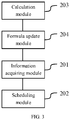
- the device includes an information acquiring module 201 and a scheduling module 202.
- the information acquiring module 201 is configured to acquire, in accordance with a pre-determined detection period, latest traffic information of a target cache server of each service type at the start time of the pre-determined detection period; and to acquire a target health value calculation formula and a rated health value of the target cache server, the target health value calculation formula being fitted based on historical health values of the target cache server and historical traffic information of each service type.
- the scheduling module 202 is configured to perform bandwidth scheduling on the target cache server based on the latest traffic information, the target health value calculation formula, and the rated health value.
- the device further includes a calculation module 203 and a formula update module 204.
- the calculation module 203 is configured to acquire, in accordance with a pre-determined formula update period, statistical data of each performance indicator of the target cache server within a historical period before a start time of the formula update period, and calculate the historical health values of the target cache server at each moment within the historical duration based on the statistical data and a pre-determined performance health formula.
- the formula update module 204 is configured to acquire the historical traffic information of the target cache server of each service type within the historical duration before the start time of the formula update period, and update the target health value calculation formula of the target cache server based on the historical health values and the historical traffic information.
- the formula update module 204 is further configured to: determine a target server category to which the target cache server belongs, and update the target health value calculation formula of the target cache server based on the historical health values, the target server category, and the historical traffic information.
- the device further includes a determination module configured to:
- the scheduling module 202 is further configured to:
- the scheduling module 202 is further configured to:
- the determination module is configured to:
- the scheduling module 202 is further configured to:
- the determination module is configured to:
- the scheduling module 202 is further configured to: if it is not, select a target call-in range from the adjustment range reference table of the of traffic information and health values of the target cache server, determine the target call-in range as target call-in amount, and perform bandwidth scheduling according to the target call-in amount.
- the traffic information of each service type at least includes live broadcast bandwidth, the number of live broadcast connections, on-demand bandwidth, the number of on-demand connections, webpage bandwidth, and the number of webpage connections.
- latest traffic information of the target cache server of each service type at the start time of a pre-determined detection period is acquired in accordance with the pre-determined detection period; a target health value calculation formula and a rated health value of the target cache server are acquired, the target health value calculation formula being fitted based on historical health values of the target cache server and historical traffic information of each service type; bandwidth scheduling is performed on the target cache server based on the latest traffic information, the target health value calculation formula, and the rated health value.
- the background server is able to determine the health status of the cache server based on the traffic information of the cache server of each service type, the health value calculation formula, and the rated health value, and to perform bandwidth scheduling on the cache server according to the traffic information of each service type to keep the load of the cache server in good condition, which may effectively improve the quality of network services.
- bandwidth scheduling device for cache server provided in the foregoing embodiments is described by taking only the division of the foregoing functional modules as an example. In actual applications, the foregoing functions may be allocated by different functional modules as required. That is, the internal structure of the device is divided into different functional modules to complete all or part of the functions described above.
- the bandwidth scheduling device for cache server provided by the foregoing embodiments and the bandwidth scheduling method for cache server provided by the foregoing embodiments belong to the same concept. Specific implementation processes of the bandwidth scheduling device for cache server are referred to the method embodiments, and details are not described herein again.
- FIG. 4 is a structural schematic diagram of the server provided by the embodiments of the present disclosure.
- the server 400 may vary a lot due to different configurations or performance, and may include one or more central processing units 422 (for example, one or more processors) and a memory 432, one or more storage media 430 (e.g., one or more mass storage devices) that store applications program 442 or data 444.
- the memory 432 and the storage medium 430 may be temporary storage or persistent storage.
- Programs stored in the storage medium 430 may include one or more modules (not shown in the drawings), and each module may include a series of instruction operations on the server 400.
- the central processing unit 422 may be configured to communicate with the storage medium 430 and execute a series of instruction operations in the storage medium 430 on the server 400.
- the server 400 may further include one or more power sources 426, one or more wired or wireless network interfaces 450, one or more input-output interfaces 458, one or more keyboards 456, and/or, one or more operating systems 441, such as Windows Server, Mac OS X, Unix, Linux, FreeBSD, etc.
- the server 400 may include a memory, and one or more programs stored in the memory and configured to be executed by one or more processors, the one or more programs including instructions for performing bandwidth scheduling on the above cache server.
- the storage medium may be a read-only memory, a magnetic disc, or a compact disc.
Landscapes
- Engineering & Computer Science (AREA)
- Computer Networks & Wireless Communication (AREA)
- Signal Processing (AREA)
- Computer Hardware Design (AREA)
- General Engineering & Computer Science (AREA)
- Data Exchanges In Wide-Area Networks (AREA)
- Memory System Of A Hierarchy Structure (AREA)
Abstract
Description
- The present disclosure refers to Chinese Patent Application No.
201910625761.9 - The present disclosure relates to the field of Internet technology, in particular to a bandwidth scheduling method and a bandwidth scheduling device for cache server.
- In CDN (Content Delivery Network) service, multiple cache servers are deployed on the existing Internet, so that users may acquire data from a closer or better cache server, to provide users with network acceleration services.
- In order to prevent the excessive load of the cache server due to the high real-time bandwidth which affects the quality of network services, the CDN service provider may set a rated bandwidth for each cache server deployed and keep the real-time bandwidth of the cache server lower than the rated bandwidth through bandwidth scheduling. Specifically, technicians of the CDN service provider may collect the real-time bandwidth of each cache server through the background server in real time, and calculate the bandwidth call-out amount (that is, the amount of bandwidth needed to be scheduled to other cache servers to provide services) or calculate the bandwidth call-in amount (that is, the amount of bandwidth that the cache server may additionally carry) according to the real-time bandwidth and rated bandwidth of each cache server, and perform bandwidth scheduling according to the bandwidth call-out/call-in amount. For example, if the real-time bandwidth of a cache server collected by the background server is 800 megabytes, assuming that the cache server has a rated bandwidth of 700 megabytes, the background server may conclude that the bandwidth call-out amount of the cache server is 100 megabytes; assuming that the cache server has a rated bandwidth of 1000 megabytes, the background server may conclude that the bandwidth call-in amount of the cache server is 200 megabytes.
- In the process of conceiving the present disclosure, the inventors found that the existing technology has at least the following problems:
- Since the load capacity of a cache server is not only affected by the total amount of bandwidth carried, but also affected by factors such as the type of service requested and the number of connections, it may occur that the load of the cache server is still too high after bandwidth scheduling performed on the cache server according to the bandwidth call-out amount, or that the cache server is overloaded after bandwidth scheduling performed on the cache server according to the bandwidth call-in amount, which affects the quality of network services.
- In order to solve the problems in the existing technology, embodiments of the present disclosure provide a bandwidth scheduling method and a bandwidth scheduling device for cache server. The technical solutions are as follows.
- In a first aspect, a bandwidth scheduling method for cache server is provided, and the method includes:
- acquiring, in accordance with a pre-determined detection period, latest traffic information of a target cache server of each service type at a start time of the detection period;
- acquiring a target health value calculation formula and a rated health value of the target cache server, the target health value calculation formula being fitted based on historical health values of the target cache server and historical traffic information of each service type; and
- performing bandwidth scheduling on the target cache server based on the latest traffic information, the target health value calculation formula, and the rated health value.
- In one embodiment, the method further includes:
- acquiring, in accordance with a pre-determined formula update period, statistical data of each performance indicator of the target cache server within a historical duration before a start time of the formula update period, and calculating the historical health values of the target cache server at each moment within the historical duration based on the statistical data and a pre-determined performance health formula; and
- acquiring the historical traffic information of the target cache server of each service type within the historical duration before the start time of the formula update period, and updating the target health value calculation formula of the target cache server based on the historical health values and the historical traffic information.
- In one embodiment, the updating the target health value calculation formula of the target cache server based on the historical health values and the historical traffic information includes:
determining the target server category to which the target cache server belongs, and updating the target health value calculation formula of the target cache server based on the historical health values, the target server category, and the historical traffic information. - In one embodiment, the performing bandwidth scheduling on the target cache server based on the latest traffic information, the target health value calculation formula, and the rated health value includes:
- calculating a target health value of the target cache server based on the target health value calculation formula and the latest traffic information, and judging whether the target health value is greater than the rated health value;
- calculating, if it is, bandwidth amount of each client to which the latest traffic information belongs, selecting clients in succession as target call-out clients in the order of bandwidth amount from small to large, and calculating a health value of the target cache server; and
- performing bandwidth scheduling according to the target call-out clients when the health value of the target cache server is less than or equal to the rated health value.
- In one embodiment, after calculating the target health value of the target cache server based on the target health value calculation formula and the latest traffic information and judging whether the target health value is greater than the rated health the value, the method further includes:
- determining, if it is not, call-out clients of cache servers other than the target cache server at a current moment, selecting the call-out clients in succession as target call-in clients in the order of bandwidth amount of the call-out clients from small to large, and calculating a health value of the target cache server; and
- performing bandwidth scheduling according to the target call-in clients when the health value of the target cache server is less than or equal to the rated health value and difference between the rated health value and the health value of the target cache server is less than or equal to a pre-determined difference value.
- In one embodiment, the determining, if it is not, call-out clients of cache servers other than the target cache server at a current moment includes:
- judging, if it is not, whether the target health value is less than an early warning health value; and
- determining the call-out clients of the cache servers other than the target cache server at the current moment when the target health value is less than the early warning health value.
- In one embodiment, the performing bandwidth scheduling on the target cache server based on the latest traffic information, the target health value calculation formula, and the rated health value includes:
- calculating a target health value of the target cache server based on the target health value calculation formula and the latest traffic information, and judging whether the target health value is greater than the rated health value;
- successively reducing, if it is, traffic information of a target service type according to an adjustment gradient of the target service type corresponding to a target service category to which the target cache server belongs, and calculating a health value of the target cache server; and
- determining the reduced traffic information of the target service type as target call-out amount when the health value of the target cache server is less than or equal to the rated health value, and performing bandwidth scheduling according to the target call-out amount.
- In one embodiment, after calculating the target health value of the target cache server based on the target health value calculation formula and the latest traffic information, and judging whether the target health value is greater than the rated health value, the method further includes:
- determining, if it is not, call-out amount of a target service type of cache servers other than the target cache server at a current moment, successively increasing traffic information of the target service type based on the call-out amount according to an adjustment gradient of the target service type, and calculating a health value of the target cache server; and
- determining the increased traffic information as target call-in amount when the health value of the target cache server is less than or equal to the rated health value, and difference between the rated health value and the health value of the target cache server is less than or equal to a pre-determined difference value, and performing bandwidth scheduling according to the target call-in amount.
- In one embodiment, the performing bandwidth scheduling on the target cache server based on the latest traffic information, the target health value calculation formula, and the rated health value includes:
- calculating a target health value of the target cache server based on the target health value calculation formula and the latest traffic information, and judging whether the target health value is greater than the rated health value;
- selecting, if it is, a target call-out range from an adjustment range reference table of traffic information and health values of the target cache server, determining the target call-out range as target call-out amount, and performing bandwidth scheduling according to the target call-out amount.
- In one embodiment, after calculating the target health value of the target cache server based on the target health value calculation formula and the latest traffic information, and judging whether the target health value is greater than the rated health the value, the method further includes:
selecting, if it is not, a target call-in range from the adjustment range reference table of the of traffic information and health values of the target cache server, determining the target call-in range as target call-in amount, and performing bandwidth scheduling according to the target call-in amount. - In one embodiment, the traffic information of each service type at least includes live broadcast bandwidth, the number of live broadcast connections, on-demand bandwidth, the number of on-demand connections, webpage bandwidth, and the number of webpage connections.
- In a second aspect, a bandwidth scheduling device for cache server is provided, and the device includes an information acquiring module and a scheduling module.
- The information acquiring module is configured to acquire, in accordance with a pre-determined detection period, latest traffic information of a target cache server of each service type at a start time of the detection period; and
to acquire a target health value calculation formula and a rated health value of the target cache server, the target health value calculation formula being fitted based on historical health values of the target cache server and historical traffic information of each service type. - The scheduling module is configured to perform bandwidth scheduling on the target cache server based on the latest traffic information, the target health value calculation formula, and the rated health value.
- In one embodiment, the device further includes a calculation module and a formula update module.
- The calculation module is configured to acquire, in accordance with a pre-determined formula update period, statistical data of each performance indicator of the target cache server within a historical duration before a start time of the formula update period, and calculate the historical health values of the target cache server at each moment within the historical duration based on the statistical data and a pre-determined performance health formula.
- The formula update module is configured to acquire the historical traffic information of the target cache server of each service type within the historical duration before the start time of the formula update period, and update the target health value calculation formula of the target cache server based on the historical health values and the historical traffic information.
- In one embodiment, the formula update module is further configured to:
determine a target server category to which the target cache server belongs, and update the target health value calculation formula of the target cache server based on the historical health values, the target server category, and the historical traffic information. - In one embodiment, the device further includes a determination module configured to:
- calculate a target health value of the target cache server based on the target health value calculation formula and the latest traffic information, and judge whether the target health value is greater than the rated health value;
- the scheduling module is further configured to:
- if it is, calculate bandwidth amount of each client to which the latest traffic information belongs, successively select clients as target call-out clients in the order of bandwidth amount from small to large, and calculate a health value of the target cache server; and
- perform bandwidth scheduling according to the target call-out clients when the health value of the target cache server is less than or equal to the rated health value.
- In one embodiment, the scheduling module is further configured to:
- if it is not, determine call-out clients of cache servers other than the target cache server at a current moment, successively select the call-out clients as target call-in clients in the order of bandwidth amount of the call-out clients from small to large, and calculate the health value of the target cache server; and
- perform bandwidth scheduling according to the target call-in clients when the health value of the target cache server is less than or equal to the rated health value and difference between the rated health value and the health value of the target cache server is less than or equal to a pre-determined difference value.
- In one embodiment, the scheduling module is further configured to:
- if it is not, judge whether the target health value is less than the early warning health value; and
- determine the call-out clients of the cache servers other than the target cache server at the current moment when the target health value is less than the early warning health value.
- In one embodiment, the determination module is configured to:
- calculate a target health value of the target cache server based on the target health value calculation formula and the latest traffic information, and judge whether the target health value is greater than the rated health value;
- the scheduling module is further configured to:
- if it is, successively reduce traffic information of a target service type according to an adjustment gradient of the target service type corresponding to a target service category to which the target cache server belongs, and calculate the health value of the target cache server; and
- determine the reduced traffic information of the target service type as target call-out amount when the health value of the target cache server is less than or equal to the rated health value, and perform bandwidth scheduling according to the target call-out amount.
- In one embodiment, the scheduling module is further configured to:
- if it is not, determine call-out amount of a target service type of cache servers other than the target cache server at a current moment, successively increase traffic information of the target service type based on the call-out amount according to an adjustment gradient of the target service type, and calculate the health value of the target cache server; and
- determine the increased traffic information as target call-in amount when the health value of the target cache server is less than or equal to the rated health value, and difference between the rated health value and the health value of the target cache server is less than or equal to a pre-determined difference value, and perform bandwidth scheduling according to the target call-in amount.
- In one embodiment, the determination module is configured to:
- calculate a target health value of the target cache server based on the target health value calculation formula and the latest traffic information, and judge whether the target health value is greater than the rated health value;
- the scheduling module is further configured to:
if it is, select a target call-out range from an adjustment range reference table of traffic information and health values of the target cache server, determine the target call-out range as target call-out amount, and perform bandwidth scheduling according to the target call-out amount. - In an embodiment, the scheduling module is further configured to:
if it is not, select a target call-in range from the adjustment range reference table of the of traffic information and health values of the target cache server, determining the target call-in range as target call-in amount, and performing bandwidth scheduling according to the target call-in amount. - In one embodiment, the traffic information of each service type at least includes live broadcast bandwidth, the number of live broadcast connections, on-demand bandwidth, the number of on-demand connections, webpage bandwidth, and the number of webpage connections.
- In a third aspect, a server is provided, including a processor and a memory. The memory stores at least one instruction, at least one program, a code set, or an instruction set, when loaded and executed by the processor, causing the processor to implement the bandwidth scheduling method for the cache server according to the first aspect.
- In a fourth aspect, a computer-readable storage medium is provided, storing at least one instruction, at least one program, code set, or instruction set, when loaded and executed by a processor, causing the processor to implement the bandwidth scheduling method for the cache server according to the first aspect.
- The beneficial effects brought by the technical solutions provided in the embodiments of the present disclosure are as follows. In the aforementioned embodiments, latest traffic information of the target cache server of each service type at the start time of a pre-determined detection period is acquired in accordance with the pre-determined detection period; a target health value calculation formula and a rated health value of the target cache server are acquired, the target health value calculation formula being fitted based on historical health values of the target cache server and historical traffic information of each service type; bandwidth scheduling is performed on the target cache server based on the latest traffic information, the target health value calculation formula, and the rated health value. In this way, the background server is able to determine the health status of the cache server based on the traffic information of the cache server of each service type, the health value calculation formula, and the rated health value, and to perform bandwidth scheduling on the cache server according to the traffic information of each service type to keep the load of the cache server in good condition, which may effectively improve the quality of network services.
- In order to illustrate the technical solutions in the embodiments of the present disclosure more clearly, the drawings used in the description of the embodiments will be briefly described below. It is obvious that the drawings in the following description are only some embodiments of the present disclosure. For those skilled in the art, other drawings may also be acquired in accordance with the drawings without any inventive effort.
-
FIG. 1 is a flowchart of a bandwidth scheduling method for cache server provided by embodiments of the present disclosure; -
FIG. 2 is a structural schematic diagram of a bandwidth scheduling device for cache server provided by embodiments of the present disclosure; -
FIG. 3 is a structural schematic diagram of a bandwidth scheduling device for cache server provided by embodiments of the present disclosure; -
FIG. 4 is a structural schematic diagram of a server provided by embodiments of the present disclosure. - In order to clarify the objective, the technical solutions and the advantages of the present disclosure, the embodiments of the present disclosure will be further described in details with reference to the accompany drawings.
- The embodiments of the present disclosure provide a bandwidth scheduling method for cache server. The execution subject of the method may be a background server which may be any server, or a server cluster composed of multiple servers. The background server may be deployed in the computer room of the CDN service provider. The background server may perform bandwidth scheduling on cache server according to traffic information of each service type, based on the health value calculation formula of the cache server, the rated health value of the cache server, and the latest traffic information of the cache server. The above background server may include a processor, a memory, and a transceiver. The processor may be used to perform bandwidth scheduling processing on the cache server in the following process, the memory may be used to store the data required and generated in the following process and the transceiver may be used to receive and send related data in the following process.
- The processing flow of the bandwidth scheduling method for cache server shown in
FIG. 1 will be described in detail in combination with specific embodiments below. The content may be as follows. - Step 101: latest traffic information of a target cache server of each service type at a start time of a pre-determined detection period is acquired in accordance with the pre-determined detection period.
- In implementation, CDN service providers may provide network acceleration services to clients through cache servers deployed in various regions. When providing network acceleration services to clients, each cache server may record statistical data of its own performance indicators (such as CPU utilization, memory utilization, connection response time, hard disk utilization, etc.), and traffic information generated of each service type. The traffic information of each service type may at least include live broadcast bandwidth, the number of live broadcast connections, on-demand bandwidth, the number of on-demand connections, webpage bandwidth, the number of webpage connections, etc. Considering that the bandwidth amount and the number of connections of different service types may affect the load status of the cache server at varying degrees, and that the excessive load of cache server will affect the network service quality of the cache server, technicians of the CDN service provider may perform bandwidth scheduling on the cache server according to each service type and the number of connections corresponding to each service type as granularity through the background server. Specifically, the background server may acquire, in accordance with a pre-determined detection period, the latest traffic information of a certain cache server (also called a target cache server) of each service type generated at the start time of the current detection period, such as live broadcast bandwidth, the number of live broadcast connections, on-demand bandwidth, the number of on-demand connections, webpage bandwidth, the number of webpage connections and so on generated at the start time of the current detection period. As a result, the background server may perform bandwidth scheduling on the target cache server according to the traffic information of each service type, based on the latest traffic information, the health value calculation formula of the target cache server (also called a target health value calculation formula), and the rated health value.
- Step 102: a target health value calculation formula and a rated health value of the target cache server are acquired, the target health value calculation formula being fitted based on historical health values of the target cache server and historical traffic information of each service type.
- In implementation, the background server may fit a health value calculation formula for each cache server based on historical health values of each cache server and historical traffic information of each cache server of each service type, and set a rated health value for each cache server, so that the background server may calculate a health value of the cache server through the health value calculation formula, and determine the load status of the cache server according to the calculated health value and the rated health value. When the calculated health value of the cache server is greater than the rated health value, it is determined that the cache server is unhealthy (that is, the load is too high); otherwise, it is determined that the cache server is healthy. After acquiring the latest traffic information of the target cache server of each service type at the start time of the detection period, the background server may acquire the target health value calculation formula of the target cache server and the rated health value of the target cache server, the target health value calculation formula being fitted based on the historical health values of the target cache server and the historical traffic information of each service type.
- In one embodiment, the target health value calculation formula of the target cache server may be updated in accordance with a pre-determined formula update period, and the corresponding processing may be as follows: statistical data of each performance indicator of the target cache server within a historical duration before a start time of a pre-determined formula update period is acquired in accordance with the pre-determined formula update period; the historical health values of the target cache server at each moment within the historical duration are calculated based on the statistical data and a pre-determined performance health formula; the historical traffic information of the target cache server of each service type within the historical duration before the start time of the pre-determined formula update period is acquired; and the target health server calculation formula is updated based on the historical health values and the historical traffic information.
- The historical traffic information of each service type at least includes live broadcast bandwidth, the number of live broadcast connections, on-demand bandwidth, the number of on-demand connections, webpage bandwidth, and the number of webpage connections.
- In implementation, technicians of the CDN service provider may pre-determine the health value calculation formula (also called the pre-determined performance health formula) for each cache server with more than one of the above performance indicators (such as CPU utilization, memory utilization, connection response time, hard disk utilization, etc.) as variables. And then the background server may acquire, in accordance with the pre-determined formula update period, the statistical data of each performance indicator of the target cache server within the historical duration (for example, 1 hour) before the start time of the current formula update period, and based on the statistical data and the pre-determined performance health formula of the target cache server, calculate the historical health values of the target cache server at each moment within the above historical duration (for example, the historical health values of the target cache server may be calculated with 1 minute as granularity). For example, if the pre-determined performance health formula of the target cache server is QOS = ax + by + cz + dk, with QOS representing the health value, x representing the CPU utilization, y representing the memory utilization, z representing the connection response time, and k representing hard disk utilization, a, b, c, and d representing the coefficients corresponding to each performance indicator, respectively, assuming that the CPU utilization, the memory utilization, the connection response time, and the hard disk utilization of the cache server at 10:00 are 70%, 75%, 0.1s, and 80%, respectively, and a, b, c, and d are 40, 30, 20, and 30, respectively, then the health value of the cache server at 10:00 may be calculated as HV = 0.7 × 40 + 0.75 × 30 + 0.1 × 20 + 0.8 × 30 = 76.5.
- After calculating the historical health values of the target cache server at each moment within the above historical duration, the background server may acquire the historical traffic information of the target cache server of each service type within the historical duration before the start time of the formula update period, and count historical traffic information at each moment corresponding to the historical health values based on the acquired historical traffic information. Then, the background server may use regression analysis models (such as linear regression, polynomial regression, etc.) in machine learning to fit the health value calculation formula of the target cache server based on the counted historical traffic information of each service type corresponding to each moment and the historical health values corresponding to the above each moment, and update the target health value calculation formula of the target cache server with the currently fitted health value calculation formula.
- In one embodiment, the background server may also update the target health value calculation formula in combination with server category of the target cache server. The corresponding processing may be as follows: a target server category to which the target cache server belongs is determined, and the target health value calculation formula of the target cache server is updated based on the historical health values, the target server category and the historical traffic information.
- In implementation, considering that different hardware configurations (such as CPU, memory, hard disk, etc.) of the cache server may affect the load capacity of the cache server at different degrees, technicians of the CDN service provider may divide the cache servers into various server categories through the background server according to the hardware configurations of the cache servers. For example, the cache servers with the same hardware configurations such as CPU, memory, and hard disk may be divided into the same server category. In this way, the background server may determine the server category to which the target cache server belongs (also called target server category) after acquiring the historical traffic information of the target cache server of each service type within the historical duration before the start time of the formula update period, so as to update the target health value calculation formula of the target cache server based on the server category of the target cache server, the historical health values of the target cache server at each moment within the historical duration, and the historical traffic information of the target cache server of each service type within the historical duration before the start time of the formula update period.
- Step 103: bandwidth scheduling is performed on the target cache server based on the latest traffic information, the target health value calculation formula, and the rated health value.
- In implementation, after acquiring the latest traffic information, the target health value calculation formula, and the rated health value of the target cache server, the background server may calculate the health value of the target cache server based on the latest traffic information of the target cache server and the target health value calculation formula of the target cache server. Then, the background server may perform bandwidth scheduling on the target cache server according to the health value of the target cache server, the rated health value of the target cache server, the target health value calculation formula, and the aforementioned latest traffic information. For example, the target health value calculation formula of the target cache server is: QOS = a1x1 + a2x2 + a3x3 + b1x4 + b2x5 + b3x6, with QOS representing the health value of the target cache server, x1 representing the live broadcast bandwidth of the target cache server at the current moment, x2 representing the on-demand bandwidth of the target cache server at the current moment, x3 representing the webpage bandwidth of the target cache server at the current moment, x4 representing the number of live broadcast connections of the target cache server at the current moment, x5 representing the number of on-demand connections of the target cache server at the current moment, and x6 representing the number of webpage connections of the target cache server at the current moment, and a1, a2, a3, b1, b2, b3 representing the corresponding coefficients of the traffic information of each service type, respectively. Assuming that the latest traffic information of the target cache server of each service type at 10:00 respectively are live broadcast bandwidth of 800 megabytes, on-demand bandwidth of 700 megabytes, webpage bandwidth of 900 megabytes, the number of live broadcast connections of 20, the number of on-demand connections of 15, the number of webpage connections of 40, and that a1, a2, a3, b1, b2, b3 are 0.03, 0.04, 0.02, 0.35, 0.2, 0.1 respectively, the background server may calculate the health value of the target cache server based on the above target health value calculation formula as QOS = 0.03 × 800 + 0.04 × 700 + 0.02 × 900 + 0.35 × 20 + 0.2 × 15 + 0.1 × 40 = 84.
- In one embodiment, the background server may perform bandwidth call-out on the target cache server when the target health value of the target cache server is greater than the rated health value. Correspondingly, the processing of the
aforementioned step 103 may include: the target health value of the target cache server is calculated based on the target health value calculation formula and the latest traffic information, and whether the target health value is greater than the rated health value is judged; if it is, then bandwidth amount of each client to which the latest traffic information belongs is calculated, clients are successively selected as target call-out clients in the order of bandwidth amount from small to large, and the health value of the target cache server is calculated; when the health value of the target cache server is less than or equal to the rated health value, bandwidth scheduling is performed according to the target call-out client. - In implementation, after acquiring the latest traffic information of the target cache server of each service type at the start time of the pre-determined detection period, the background server may calculate the health value of the target cache server (also called the target health value) at the start time of the pre-determined detection period based on the latest traffic information of the foregoing service types and the target health value calculation formula. Then the background server may judge whether the aforementioned target health value is greater than the rated health value. If the aforementioned target health value is greater than the rated health value, the background server may calculate the bandwidth amount of each client to which the aforementioned latest traffic information belongs, and sort all of the aforementioned clients in the order of bandwidth amount from small to large. Then, the background server may successively select the aforementioned clients and mark them as call-out clients (also called the target call-out clients) in the order of bandwidth amount from small to large, calculate the health value of the target cache server after each marking, and compare the calculated health value with the rated health value. Once the health value of the target cache server calculated after a certain target call-out client is marked is less than or equal to the rated health value, the background server may stop marking and to perform bandwidth scheduling on the target cache server according to the above target call-out client. For example, if the target health calculation formula of target cache server is QOS = 0.03x1+0.04x2+0.02x3+0.35x4+0.2x5+0.1x6, it is assumed that the rated health value of the target cache server is 75, the clients to which the latest traffic information belongs include clients C1, C2, and C3, and the traffic information of each service type corresponding to the clients C1, C2, and C3 is shown in Table 1.
Table 1 Client Live broadcast bandwidth (M) On-demand bandwidth (M) Webpage bandwidth (M) Number of live broadcast connections (pcs) Number of on-demand connections (pcs) Number of webpage connections (pcs) C1 250 180 170 5 7 9 C 2400 500 400 8 10 12 C3 280 320 380 7 8 15 - The background server may calculate the target health value of the target cache server as QOS = 0.03 × (250 + 400 + 280) + 0.04 × (180 + 500 + 320) + 0.02 × (170 + 400 + 380) +0.35 × (5 + 8 + 7) + 0.2 × (7 + 10 + 8) + 0.1 × (9 + 12 + 15) = 102.5. It can be seen that the target health value of the target cache server is much larger than the rated health value. Then, the background server may calculate the bandwidth amount of each client to which the aforementioned latest traffic information belongs, and sort them in the order of bandwidth amount from small to large, as shown in Table 2.
Table 2 Client Bandwidth amount (M) Live broadcast bandwidth (M) On-demand bandwidth (M) Webpage bandwidth (M) Number of live broadcast connections (pcs) Number of on-demand connections (pcs) Number of webpage connections (pcs) C1 600 250 180 170 5 7 9 C3 980 280 320 380 7 8 15 C2 1300 400 500 400 8 10 12 - Then, the background server may mark the client C1 as the target call-out client and calculate the health value of the target cache server as QOS = 0.03 × (280 + 400) + 0.04 × (320 + 500) + 0.02 × (380 + 400) + 0.35 × (7 + 8) + 0.2 × (8 + 10) + 0.1 × (15 + 12) = 80.35, which is still greater than the rated health value. Then the background server may further mark client C3 as the target call-out client (that is, client C1 and client C3 are both marked as the target call-out clients) and calculate the health value of the target cache server as QOS = 0.03 × 400 + 0.04 × 500 + 0.02 × 400 + 0.35 × 8 + 0.2 × 10 + 0.1 × 12 = 46, which is less than the rated health value. Then the background server may perform bandwidth scheduling on the target cache server according to the aforementioned target call-out clients (that is, client C1 and client C3).
- In one embodiment, the background server may perform bandwidth call-in on the target cache server when the target health value of the target cache server is less than the rated health value. The corresponding processing may include: if it is not, call-out clients of cache servers other than the target cache server at a current moment are determined, the call-out clients are successively selected as target call-in clients in the order of bandwidth amount of the call-out clients from small to large, and the health value of the target server is calculated; when the health value of the target cache server is less than or equal to the rated health value, and difference between the rated health value and the health value of the target cache server is less than or equal to a pre-determined difference value, bandwidth scheduling is performed according to the target call-in clients.
- In implementation, when bandwidth scheduling is performed and the difference between the health value of the cache server and the rated health value is small, the cache server may no longer be able to carry the traffic from other clients. Therefore, in order to prevent the background server from taking up more network resources to calculate and compare the health value of this circumstance, technicians of the CDN service provider may set a threshold for the difference between the health value and the rated health value of each cache server (also called a pre-determined difference), so that the background server would not perform the aforementioned calculation and comparison processing when the difference between the health value and the rated health value of the cache server is less than or equal to the pre-determined difference. Specifically, after calculating the target health value of the target cache server at the start time of the pre-determined detection period, the background server may judge whether the aforementioned target health value is greater than the rated health value. If the aforementioned target health value is less than the rated health value, the background server may determine the call-out clients of the cache servers other than the target cache server at the current moment, and sort all the aforementioned call-out clients in the order of bandwidth amount from small to large. Then, the background server may select the aforementioned call-out clients and mark them as call-in clients (also called target call-in clients) in the order of bandwidth amount from small to large, calculate the health value of the target cache server after each marking, and compare the health value with the rated health value. When the health value of the target cache server calculated after a certain marking is less than or equal to the rated health value, and the difference between the rated health value and the health value of the target cache server is less than or equal to the pre-determined difference, the background server then may perform bandwidth scheduling on the target cache server according to the aforementioned target call-in clients. For example, if the target health calculation formula of target cache server is QOS = 0.03xi + 0.04x2 + 0.02x3 + 0.35x4 + 0.2x5 + 0.1x6, it is assumed that the rated health value of the target cache server is 85, the clients to which the latest traffic information belongs include clients C4 and C5, and the traffic information of each service type corresponding to the clients C4 and C5 is shown in Table 3.
Table 3 Client Live broadcast bandwidth (M) On-demand bandwidth (M) Webpage bandwidth (M) Number of live broadcast connections (pcs) Number of on-demand connections (pcs) Number of webpage connections (pcs) C4 200 150 210 5 6 9 C5 300 280 320 9 7 10 - The background server may calculate the target health value of the target cache server as QOS = 0.03 × (200 + 300) + 0.04 × (150 + 280) + 0.02 × (210 + 320) + 0.35 × (5 + 9) + 0.2 × (6 + 7) + 0.1 × (9 + 10) = 52.2. It can be seen that the target health value of the target cache server is less than the rated health value. Then, the background server may determine the call-out clients of the cache servers other than the target cache server at the current moment. Assuming that the call-out clients of other cache servers include clients C6, C7, C8, which are sorted in the order of bandwidth amount from small to large, as shown in table 4.
Table 4 Client Bandwidth amount (M) Live broadcast bandwidth (M) On-demand bandwidth (M) Webpage bandwidth (M) Number of live broadcast connections (pcs) Number of on-demand connections (pcs) Number of webpage connections (pcs) C 6400 150 120 130 3 4 3 C8 500 190 180 130 4 3 3 C7 800 220 280 300 5 8 10 - Then, the background server may mark the client C6 as the target call-in client, and calculate the health value of the target cache server as QOS = 0.03 × (200 + 300 + 150) + 0.04 × (150 + 280 + 120) + 0.02 × (210 + 320 + 130) + 0.35 × (5 + 9 + 3) + 0.2 × (6 + 7 + 4) + 0.1 × (9 + 10 + 3) = 66.25, which is still less than the rated health value, and the difference between the rated health value and the health value is greater than the pre-determined difference that is assumed to be 5. Then the background server may further mark the client C8 as the target call-in client (that is, both clients C6 and C8 are marked as the target call-in clients) and calculate the health value of the target cache server as QOS = 0.03 × (200 + 300 + 150 + 190) + 0.04 × (150+ 280 + 120 + 180) + 0.02 × (210 + 320 + 130 + 130) + 0.35 × (5 + 9 + 3 + 4) + 0.2 × (6 + 7 + 4 + 3) + 0.1 × (9 + 10 + 3 + 3) = 84.05 which is less than the rated health value, and the difference between the rated health value and the health value is less than the pre-determined difference. Then the background server may perform bandwidth scheduling on the target cache server according to the aforementioned target call-in clients (i.e. client C6 and client Cs).
- In one embodiment, the background server may perform bandwidth call-in when the aforementioned target health value is less than an early warning health value. The corresponding processing may include: if it is not, whether the target health value is less than the early warning health value is judged; when the target health value is less than the early warning health value, the call-out clients of the cache servers other than the target cache server at the current moment are determined.
- In implementation, when the target health value is less than the rated health value, the background server may take up more network resources to perform the aforementioned processing. Therefore, technicians of the CDN service provider may set an early warning health value for each cache server through the background server. In this way, when the target health value of the target cache server is less than the rated health value, the background server may further judge whether the target health value is less than the early warning health value. When the target health value is less than the early warning health value, the background server may determine the call-out clients of the cache servers other than the target cache server at the current moment, successively select the call-out clients in the order of bandwidth amount of the call-out clients from small to large as the target call-in clients, and calculate the health value of the target cache server. When the health value of the target cache server is less than or equal to the rated health value, and the difference between the rated health value and the health value of the target cache server is less than or equal to the pre-determined difference value, the background server may perform bandwidth scheduling according to the target call-in clients. Otherwise, the background server does not need to do any processing.
- In one embodiment, when the target health value is greater than the rated health value, the background server may perform bandwidth call-out on the target cache server according to an adjustment gradient of the service type corresponding to the target service category of the target cache server. Correspondingly, the processing of the
aforementioned step 103 may include: the target health value of the target cache server is calculated based on the target health value calculation formula and the latest traffic information, and whether the target health value is greater than the rated health value is judged; if it is, traffic information of a target service type is successively reduced according to an adjustment gradient of the target service type corresponding to a target service category to which the target cache server belongs, and the health value of the target cache server is calculated; when the health value of the target cache server is less than or equal to the rated health value, the reduced traffic information of the target service type is determined as target call-out amount, and bandwidth scheduling is performed according to the target call-out amount. - In implementation, since the service types of the network services primarily provided by each cache server may be different from one another, technicians of the CDN service provider may classify each cache server as a certain server category by the service type through the background server. For example, if a certain cache server primarily provides a network service of live broadcast, the background server may classify the cache server as a live broadcast category and set corresponding adjustment gradients for each service type, such as reducing/increasing several connections at a time. In this way, after acquiring the latest traffic information of the target cache server of each service type at the start time of the pre-determined detection period, the background server may calculate the target health value of the target cache server at the start time of the pre-determined detection period based on the latest traffic information of each service type and the aforementioned target health value calculation formula, and judge whether the target health value is greater than the aforementioned rated health value. If it is, the background server may determine the service category to which the target cache server belongs (also called the target service category) and the adjustment gradient of the service type (also called the target service type) corresponding to the target service category. Then, the background server may successively reduce the traffic information of the target service type according to the adjustment gradient of the target service type, and calculate the health value of the target cache server. When the health value of the target cache server calculated by the background server is less than or equal to the rated health value, the background server may determine the aforementioned reduced traffic information of target service type as the traffic to be called out from the target cache server (also called the target call-out amount), and perform bandwidth scheduling on the target cache server according to the target call-out amount. For example, it is assumed that the target cache server belongs to the live broadcast category, the adjustment gradient corresponding to the live broadcast service type is three connections, and the target cache server's rated health value is 80, and the target health value of the target cache server is 90. In this case, the background server may sort all live broadcast connections in the acquired latest traffic information of the target cache server in the order of live broadcast bandwidth corresponding to each live broadcast connection from small to large, as shown in table 5. Then, the background server may first select the three live broadcast connections with the smallest live broadcast bandwidth (ie, connection 3, connection 5, connection 1) and their corresponding live broadcast bandwidth, mark them as the call-out amount, and calculate the health value of the target cache server. If the calculated health value is still greater than 80, the background server may then select further three live broadcast connections (i.e., connection 8, connection 2, connection 4) with the smallest live broadcast bandwidth from all the live broadcast connections that are not marked as the call-out amount and their corresponding live broadcast bandwidth, mark them as the call-out amount, and calculate the health value of the target cache server. If the calculated health value is still greater than 80 at this time, the background server may repeat the aforementioned process of selecting live broadcast connections and their corresponding live broadcast bandwidth, marking them as the call-out amount and calculating the health value. Otherwise, if the health value calculated at this time is less than or equal to 80, the background server may determine all live broadcast connections that have been marked as the call-out amount (i.e. connection 3, connection 5, connection 1, connection 8, connection 2, connection 4) and its corresponding live broadcast bandwidth as the target call-out amount, and perform bandwidth scheduling on the target cache server according to the target call-out amount.
Table 5 Connec tion 3 Connec tion 5 Connec tion 1 Connec tion 8 Connec tion 2 Connec tion 4 Connec tion 6 Connec tion 11 Connec tion 10 Connec tion 7 Connec tion 9 150 180 195 210 220 240 255 270 290 305 330 - In one embodiment, when the target health value is less than the rated health value, the background server may perform bandwidth call-in on the target cache server according to the adjustment gradient of the service type corresponding to the target service category of the target cache server. The corresponding processing may include: if it is not, call-out amount of a target service type of cache servers other than the target cache server at a current moment is determined, traffic information of the target service type is successively increased based on the call-out amount according to an adjustment gradient of the target service type, and the health value of the target cache server is calculated; when the health value of the target cache server is less than or equal to the rated health value, and difference between the rated health value and the health value of the target cache server is less than or equal to a pre-determined difference value, the increased traffic information is determined as target call-in amount and bandwidth scheduling is performed according to the target call-in amount.
- In implementation, after calculating the target health value of the target cache server at the start time of the pre-determined detection period, the background server may determine the rated health value of the target cache server and judge whether the aforementioned target health value is greater than rated health value. If it is not, the background server may determine the call-out amount of the cache servers other than target cache server at the current moment, and sort the call-out amount of the other cache servers in the order of bandwidth amount from small to large. Then, the background server may successively increase the traffic information of the target service type according to the aforementioned adjustment gradient of the target service type, and calculate the health value of the target cache server. When the health value of the target cache server calculated by the background server is less than or equal to the aforementioned rated health value, and the difference between the rated health value and the health value is less than or equal to the aforementioned pre-determined difference value, the background server may determine the aforementioned increased traffic information of the target service type as the traffic to be call in to the target cache server (also called the target call-in amount), and perform bandwidth scheduling on the target cache server according to the target call-in amount. For example, it is assumed that the target cache server belongs to the live broadcast category, and the adjustment gradient corresponding to the live broadcast service type is three connections, the rated health value of the target cache server is 80, the target health value of the target cache server is 50, and the pre-determined difference value is 5. In this case, the background server may determine the call-out amount of all cache servers other than the target cache server at the current moment, and sort the call-out amount of all other cache servers in the order of live broadcast bandwidth corresponding to each live broadcast connection from small to large, as shown in see Table 6. Then, the background server may first select three live broadcast connections with the smallest live broadcast bandwidth (i.e. connection 7, connection 2, connection 5) and their corresponding live broadcast bandwidth, mark them as the call-in amount and calculate the health value of the target cache server. If the calculated health value is still less than the rated health value at this time, and the difference between the rated health value and the health value is greater than the pre-determined difference value, the background server may further select three live broadcast connections (i.e. connection 11, connection 1, connection 9) with the smallest live broadcast bandwidth from all the live broadcast connections that are not marked as the call-in amount and their corresponding live broadcast bandwidth, mark them as the call-in amount and calculate the health value of the target cache server. If the calculated health value is still less than the rated health value at this time, and the difference between the rated health value and the health value is greater than the pre-determined difference value, the background server may repeat the process of selecting the live broadcast connections and their corresponding live broadcast bandwidth, marking them as the call-in amount and calculating the health value. Otherwise, if the calculated health value is less than or equal to 80 at this time, and the difference between the rated health value and the health value is less than or equal to the pre-determined difference value, the background server may determine all the live broadcast connections that has been marked as the call-in amount (i.e. connection 7, connection 2, connection 5, connection 11, connection 1, connection 9) and their corresponding live broadcast bandwidth as the target call-in amount, and perform bandwidth scheduling on the target cache server according to the target call-in amount.
Table 6 Connec tion 7 Connec tion 2 Connec tion 5 Connec tion 11 Connec tion 1 Connec tion 9 Connec tion 4 Connec tion 3 Connec tion 6 Connec tion 10 Connec tion 8 150 180 195 210 220 240 255 270 290 305 330 - In one embodiment, when the target health value is greater than the rated health value, the background server may perform bandwidth scheduling on the target server according to an adjustment range reference table of traffic information and health values corresponding to the target cache server. Correspondingly, the processing of the
aforementioned step 103 may include: the target health value of the target cache server is calculated based on the target health value calculation formula and the latest traffic information, and whether the target health value is greater than the rated health value is judged; if it is, a target call-out range is selected from an adjustment range reference table of the traffic information and health values of the target cache server, the target call-out range is determined as target call-out amount, and bandwidth scheduling is performed according to the target call-out amount. - In implementation, considering that the aforementioned processing of bandwidth scheduling performed on the target cache server based on the target health value calculation formula, the rated health value, and the latest traffic information may take up more network resources, technicians of the CDN service provider may set an adjustment range reference table of the health value and the traffic information for each cache server through the background server. In this way, after acquiring the latest traffic information of the target cache server of each service type at the start time of the pre-determined detection period, the background server may calculate the target health value of the target cache server at the start time of the pre-determined detection period based on the latest traffic information of each service type and the aforementioned target health value calculation formula. Then, the background server may judge whether the target health value is greater than the rated health value. If it is, the background server may select corresponding scheduling range from the aforementioned adjustment range reference table of the health value and the traffic information as the call-out range (also called the target call-out range), determine the target call-out range as the target call-out amount and perform bandwidth scheduling on the target cache server based on the target call-out amount. For example, it is assumed that the target cache server's rated health value is 80, the adjustment range reference table of the health value and the traffic information corresponding to the target cache server are shown in Table 7, and the target cache server's health value is 65. In this case, the background server may determine that the absolute value of the difference between the target cache server's health value and the rated health value is 15. At this time, the background server may select a scheduling range from all scheduling solutions corresponding to the difference ranged from 10 to 20.
Table 7 Range of difference between health value and rated health value (absolute value) Scheduling solution Bandwidth amount Number of connections 10 to 20 Scheduling range 1 450 3 Scheduling range 2 350 4 Scheduling range 3 300 6 20 to 30 Scheduling range 1 1000 5 Scheduling range 2 900 6 Scheduling range 3 800 7 - It is assumed that the traffic information of each service type of the target cache server is shown in Table 8, and the background server may preferentially judge whether there are three connections with corresponding total bandwidth of 450M. It may be seen from Table 6 that the sum of the bandwidth of connections 3, connection 4 and connection 6 is 450M. Therefore, the background server may determine the connection 3, the connection 4, connection 6 and the live broadcast bandwidth corresponding to the three connections as the target call-out amount, and perform bandwidth scheduling on the target cache server according to the target call-out amount.
Table 8 Conne ction 1 Connec tion 2 Connec tion 3 Conne ction 4 Conne ction 5 Conne ction 6 Conne ction 7 Conne ction 8 Conne ction 9 Bandwidth (M) 100 150 120 130 160 200 210 190 250 - In one embodiment, when the target health value is less than the rated health value, the background server may perform bandwidth call-in on the target cache server according to an adjustment range reference table of the health value and the traffic information corresponding to the target cache server. The corresponding processing may include: if it is not, a target call-in range is selected from the adjustment range reference table of traffic information and health values of the target cache server, the target call-in range is determined as target call-in amount, and bandwidth scheduling is performed according to the target call-in amount.
- In implementation, after calculating the target health value of the target cache server at the start time of the pre-determined detection period, the background server may judge whether the target health value is greater than the rated health value. If it is not, the background server may select the corresponding scheduling range from the aforementioned adjustment range reference table of the health value and the traffic information as the call-in range (also called the target call-in range), and then the background server may determine the target call-in range as the target call-in amount, and may perform bandwidth scheduling on the target cache server based on the target call-in amount.
- In this embodiment, latest traffic information of the target cache server of each service type at the start time of a pre-determined detection period is acquired in accordance with the pre-determined detection period; a target health value calculation formula and a rated health value of the target cache server are acquired, the target health value calculation formula being fitted based on historical health values of the target cache server and historical traffic information of each service type; bandwidth scheduling is performed on the target cache server based on the latest traffic information, the target health value calculation formula, and the rated health value. In this way, the background server is able to determine the health status of the cache server based on the traffic information of the cache server of each service type, the health value calculation formula, and the rated health value, and to perform bandwidth scheduling on the cache server according to the traffic information of each service type to keep the load of the cache server in good condition, which may effectively improve the quality of network services.
- Based on the same technical concept, the embodiments of the present disclosure further provide a bandwidth scheduling device for cache server. As shown in
FIG. 2 , the device includes aninformation acquiring module 201 and ascheduling module 202. - The
information acquiring module 201 is configured to acquire, in accordance with a pre-determined detection period, latest traffic information of a target cache server of each service type at the start time of the pre-determined detection period; and
to acquire a target health value calculation formula and a rated health value of the target cache server, the target health value calculation formula being fitted based on historical health values of the target cache server and historical traffic information of each service type. - The
scheduling module 202 is configured to perform bandwidth scheduling on the target cache server based on the latest traffic information, the target health value calculation formula, and the rated health value. - In one embodiment, as shown in
FIG. 3 , the device further includes acalculation module 203 and aformula update module 204. - The
calculation module 203 is configured to acquire, in accordance with a pre-determined formula update period, statistical data of each performance indicator of the target cache server within a historical period before a start time of the formula update period, and calculate the historical health values of the target cache server at each moment within the historical duration based on the statistical data and a pre-determined performance health formula. - The
formula update module 204 is configured to acquire the historical traffic information of the target cache server of each service type within the historical duration before the start time of the formula update period, and update the target health value calculation formula of the target cache server based on the historical health values and the historical traffic information. - In one embodiment, the
formula update module 204 is further configured to:
determine a target server category to which the target cache server belongs, and update the target health value calculation formula of the target cache server based on the historical health values, the target server category, and the historical traffic information. - In one embodiment, the device further includes a determination module configured to:
- calculate a target health value of the target cache server based on the target health value calculation formula and the latest traffic information, and judge whether the target health value is greater than the rated health value.
- The
scheduling module 202 is further configured to:- if it is, calculate bandwidth amount of each client to which the latest traffic information belongs, successively select clients as target call-out clients in the order of bandwidth amount from small to large, and calculate the health value of the target cache server; and
- perform bandwidth scheduling according to the target call-out clients when the health value of the target cache server is less than or equal to the rated health value.
- In one embodiment, the
scheduling module 202 is further configured to: - if it is not, determine call-out clients of cache servers other than the target cache server at a current moment, successively select the call-out clients as target call-in clients in the order of bandwidth amount of the call-out clients from small to large, and calculate the health value of the target cache server; and
- perform bandwidth scheduling according to the target call-in clients when the health value of the target cache server is less than or equal to the rated health value and difference between the rated health value and the health value of the target cache server is less than or equal to a pre-determined difference value.
- In one embodiment, the
scheduling module 202 is further configured to: - if it is not, judge whether the target health value is less than the early warning health value; and
- determine the call-out clients of the cache servers other than the target cache server at the current moment when the target health value is less than the early warning health value.
- In one embodiment, the determination module is configured to:
- calculate a target health value of the target cache server based on the target health value calculation formula and the latest traffic information, and judge whether the target health value is greater than the rated health value;
- the
scheduling module 202 is further configured to:- if it is, successively reduce traffic information of a target service type according to an adjustment gradient of the target service type corresponding to the target service category to which the target cache server belongs, and calculate the health value of the target cache server; and
- determine the reduced traffic information of the target service type as target call-out amount when the health value of the target cache server is less than or equal to the rated health value, and perform bandwidth scheduling according to the target call-out amount.
- In one embodiment, the
scheduling module 202 is further configured to: - if it is not, determine call-out amount of a target service type of cache servers other than the target cache server at a current moment, successively increase traffic information of the target service type based on the call-out amount according to an adjustment gradient of the target service type, and calculate the health value of the target cache server; and
- determine the increased traffic information as target call-in amount when the health value of the target cache server is less than or equal to the rated health value, and difference between the rated health value and the health value of the target cache server is less than or equal to a pre-determined difference value, and perform bandwidth scheduling according to the target call-in amount.
- In one embodiment, the determination module is configured to:
- calculate a target health value of the target cache server based on the target health value calculation formula and the latest traffic information, and determine whether the target health value is greater than the rated health value;
- the
scheduling module 202 is further configured to:
if it is, select a target call-out range from an adjustment range reference table of traffic information and health values of the target cache server, determine the target call-out range as target call-out amount, and perform bandwidth scheduling according to the target call-out amount. - In one embodiment, the
scheduling module 202 is further configured to:
if it is not, select a target call-in range from the adjustment range reference table of the of traffic information and health values of the target cache server, determine the target call-in range as target call-in amount, and perform bandwidth scheduling according to the target call-in amount. - In one embodiment, the traffic information of each service type at least includes live broadcast bandwidth, the number of live broadcast connections, on-demand bandwidth, the number of on-demand connections, webpage bandwidth, and the number of webpage connections.
- In this embodiment, latest traffic information of the target cache server of each service type at the start time of a pre-determined detection period is acquired in accordance with the pre-determined detection period; a target health value calculation formula and a rated health value of the target cache server are acquired, the target health value calculation formula being fitted based on historical health values of the target cache server and historical traffic information of each service type; bandwidth scheduling is performed on the target cache server based on the latest traffic information, the target health value calculation formula, and the rated health value. In this way, the background server is able to determine the health status of the cache server based on the traffic information of the cache server of each service type, the health value calculation formula, and the rated health value, and to perform bandwidth scheduling on the cache server according to the traffic information of each service type to keep the load of the cache server in good condition, which may effectively improve the quality of network services.
- It should be noted that the bandwidth scheduling device for cache server provided in the foregoing embodiments is described by taking only the division of the foregoing functional modules as an example. In actual applications, the foregoing functions may be allocated by different functional modules as required. That is, the internal structure of the device is divided into different functional modules to complete all or part of the functions described above. In addition, the bandwidth scheduling device for cache server provided by the foregoing embodiments and the bandwidth scheduling method for cache server provided by the foregoing embodiments belong to the same concept. Specific implementation processes of the bandwidth scheduling device for cache server are referred to the method embodiments, and details are not described herein again.
-
FIG. 4 is a structural schematic diagram of the server provided by the embodiments of the present disclosure. Theserver 400 may vary a lot due to different configurations or performance, and may include one or more central processing units 422 (for example, one or more processors) and amemory 432, one or more storage media 430 (e.g., one or more mass storage devices) thatstore applications program 442 ordata 444. Thememory 432 and thestorage medium 430 may be temporary storage or persistent storage. Programs stored in thestorage medium 430 may include one or more modules (not shown in the drawings), and each module may include a series of instruction operations on theserver 400. Furthermore, thecentral processing unit 422 may be configured to communicate with thestorage medium 430 and execute a series of instruction operations in thestorage medium 430 on theserver 400. - The
server 400 may further include one or more power sources 426, one or more wired or wireless network interfaces 450, one or more input-output interfaces 458, one ormore keyboards 456, and/or, one ormore operating systems 441, such as Windows Server, Mac OS X, Unix, Linux, FreeBSD, etc. - The
server 400 may include a memory, and one or more programs stored in the memory and configured to be executed by one or more processors, the one or more programs including instructions for performing bandwidth scheduling on the above cache server. - Those skilled in the art may appreciate that all or some steps that realize the above-described embodiments may be implemented through hardware, or may be implemented by instructing related hardware through a program which may be stored in a computer readable storage medium. The storage medium may be a read-only memory, a magnetic disc, or a compact disc.
- The description above are only preferable embodiments of the present disclosure, but are not intended to impose a limitation to the present disclosure. Any amendment, equivalent substitution and improvement made within the spirit and principle of the present disclosure shall be included in the protection scope of the present disclosure.
Claims (14)
- A bandwidth scheduling method for cache server, comprising:acquiring, in accordance with a pre-determined detection period, latest traffic information of a target cache server of each service type at a start time of the detection period;acquiring a target health value calculation formula and a rated health value of the target cache server, the target health value calculation formula being fitted based on historical health values of the target cache server and historical traffic information of each service type; andperforming bandwidth scheduling on the target cache server based on the latest traffic information, the target health value calculation formula, and the rated health value.
- The method according to claim 1, wherein the method further comprises:acquiring, in accordance with a pre-determined formula update period, statistical data of each performance indicator of the target cache server within a historical duration before a start time of the formula update period, and calculating the historical health values of the target cache server at each moment within the historical duration based on the statistical data and a pre-determined performance health formula; andacquiring the historical traffic information of the target cache server of each service type within the historical duration before the start time of the formula update period, and updating the target health value calculation formula of the target cache server based on the historical health values and the historical traffic information.
- The method according to claim 2, wherein the updating the target health value calculation formula of the target cache server based on the historical health values and the historical traffic information comprises:
determining a target server category to which the target cache server belongs, and updating the target health value calculation formula of the target cache server based on the historical health values, the target server category, and the historical traffic information. - The method according to claim 1, wherein the performing bandwidth scheduling on the target cache server based on the latest traffic information, the target health value calculation formula, and the rated health value comprises:calculating a target health value of the target cache server based on the target health value calculation formula and the latest traffic information, and judging whether the target health value is greater than the rated health value;calculating, if it is, bandwidth amount of each client to which the latest traffic information belongs, selecting clients in succession as target call-out clients in the order of bandwidth amount from small to large, and calculating a health value of the target cache server; andperforming bandwidth scheduling according to the target call-out clients when the health value of the target cache server is less than or equal to the rated health value.
- The method according to claim 4, wherein after calculating the target health value of the target cache server based on the target health value calculation formula and the latest traffic information, and judging whether the target health value is greater than the rated health value, the method further comprises:determining, if it is not, call-out clients of cache servers other than the target cache server at a current moment, selecting the call-out clients in succession as target call-in clients in the order of bandwidth amount of the call-out clients from small to large, and calculating a health value of the target cache server; andperforming bandwidth scheduling according to the target call-in clients when the health value of the target cache server is less than or equal to the rated health value and difference between the rated health value and the health value of the target cache server is less than or equal to a pre-determined difference value.
- The method according to claim 5, wherein the determining, if it is not, call-out clients of cache servers other than the target cache server at a current moment comprises:judging, if it is not, whether the target health value is less than an early warning health value; anddetermining the call-out clients of the cache servers other than the target cache server at the current moment when the target health value is less than the early warning health value.
- The method according to claim 1, wherein the performing bandwidth scheduling on the target cache server based on the latest traffic information, the target health value calculation formula, and the rated health value comprises:calculating a target health value of the target cache server based on the target health value calculation formula and the latest traffic information, and judging whether the target health value is greater than the rated health value;successively reducing, if it is, traffic information of a target service type according to an adjustment gradient of the target service type corresponding to a target service category to which the target cache server belongs, and calculating a health value of the target cache server; anddetermining the reduced traffic information of the target service type as target call-out amount when the health value of the target cache server is less than or equal to the rated health value, and performing bandwidth scheduling according to the target call-out amount.
- The method according to claim 7, wherein after calculating the target health value of the target cache server based on the target health value calculation formula and the latest traffic information, and judging whether the target health value is greater than the rated health value, the method further comprises:determining, if it is not, call-out amount of a target service type of cache servers other than the target cache server at a current moment, successively increasing traffic information of the target service type based on the call-out amount according to an adjustment gradient of the target service type, and calculating a health value of the target cache server; anddetermining the increased traffic information as target call-in amount when the health value of the target cache server is less than or equal to the rated health value, and difference between the rated health value and the health value of the target cache server is less than or equal to a pre-determined difference value, and performing bandwidth scheduling according to the target call-in amount.
- The method according to claim 1, wherein the performing bandwidth scheduling on the target cache server based on the latest traffic information, the target health value calculation formula, and the rated health value comprises:calculating a target health value of the target cache server based on the target health value calculation formula and the latest traffic information, and judging whether the target health value is greater than the rated health value;selecting, if it is, a target call-out range from an adjustment range reference table of traffic information and health values of the target cache server, determining the target call-out range as target call-out amount, and performing bandwidth scheduling according to the target call-out amount.
- The method according to claim 9, wherein after calculating the target health value of the target cache server based on the target health value calculation formula and the latest traffic information, and judging whether the target health value is greater than the rated health value, the method further comprises:
selecting, if it is not, a target call-in range from the adjustment range reference table of the of traffic information and health values of the target cache server, determining the target call-in range as target call-in amount, and performing bandwidth scheduling according to the target call-in amount. - The method according to claim 1 or 2, wherein the traffic information of each service type at least includes live broadcast bandwidth, the number of live broadcast connections, on-demand bandwidth, the number of on-demand connections, webpage bandwidth, and the number of webpage connections.
- A bandwidth scheduling device for cache server, comprising an information acquiring module and a scheduling module, wherein:the information acquiring module is configured to acquire, in accordance with a pre-determined detection period, latest traffic information of a target cache server under each service type at a start time of the detection period; andto acquire a target health value calculation formula and a rated health value of the target cache server, the target health value calculation formula being fitted based on historical health values of the target cache server and historical traffic information under each service type; andthe scheduling module is configured to perform bandwidth scheduling on the target cache server based on the latest traffic information, the target health value calculation formula, and the rated health value.
- A server comprising a processor and a memory, wherein the memory stores at least one instruction, at least one program, a code set or an instruction set, when loaded and executed by the processor, causing the processor to implement the bandwidth scheduling method for cache server according to any one of claims 1 to 11.
- A computer-readable storage medium storing at least one instruction, at least one program, a code set or an instruction set, when loaded and executed by a processor, causing the processor to implement the bandwidth scheduling method for cache server according to any one of claims 1 to 11.
Applications Claiming Priority (2)
| Application Number | Priority Date | Filing Date | Title |
|---|---|---|---|
| CN201910625761.9A CN110365765B (en) | 2019-07-11 | 2019-07-11 | A bandwidth scheduling method and device for a cache server |
| PCT/CN2020/074968 WO2021004063A1 (en) | 2019-07-11 | 2020-02-12 | Cache server bandwidth scheduling method and device |
Publications (2)
| Publication Number | Publication Date |
|---|---|
| EP3783869A1 true EP3783869A1 (en) | 2021-02-24 |
| EP3783869A4 EP3783869A4 (en) | 2021-06-23 |
Family
ID=68218992
Family Applications (1)
| Application Number | Title | Priority Date | Filing Date |
|---|---|---|---|
| EP20775568.7A Withdrawn EP3783869A4 (en) | 2019-07-11 | 2020-02-12 | Cache server bandwidth scheduling method and device |
Country Status (4)
| Country | Link |
|---|---|
| US (1) | US11102286B2 (en) |
| EP (1) | EP3783869A4 (en) |
| CN (1) | CN110365765B (en) |
| WO (1) | WO2021004063A1 (en) |
Families Citing this family (14)
| Publication number | Priority date | Publication date | Assignee | Title |
|---|---|---|---|---|
| CN110493046B (en) * | 2018-02-27 | 2022-08-16 | 贵州白山云科技股份有限公司 | Scheduling method and system for node server bandwidth resources in CDN (content delivery network) |
| CN110365765B (en) * | 2019-07-11 | 2022-04-22 | 网宿科技股份有限公司 | A bandwidth scheduling method and device for a cache server |
| CN112947843A (en) * | 2019-12-10 | 2021-06-11 | 北京金山云网络技术有限公司 | Configuration and scheduling method and device of storage system and electronic equipment |
| CN111913768A (en) * | 2020-05-27 | 2020-11-10 | 广州铁路职业技术学院(广州铁路机械学校) | Virtualized cloud desktop and construction method thereof |
| CN112751924B (en) * | 2020-12-29 | 2022-09-02 | 北京奇艺世纪科技有限公司 | Data pushing method, system and device |
| US12349118B2 (en) * | 2021-08-30 | 2025-07-01 | Electronics And Telecommunications Research Institute | Method and apparatus for resource allocation in wireless communication system |
| CN115941367B (en) * | 2021-09-29 | 2024-11-19 | 北京金山云网络技术有限公司 | Resource planning method, device, electronic equipment and storage medium |
| CN114513464B (en) * | 2021-12-31 | 2024-03-29 | 深圳市联洲国际技术有限公司 | Traffic load balancing scheduling method, device, equipment and storage medium |
| CN114531377B (en) * | 2022-01-19 | 2024-04-02 | 重庆川仪自动化股份有限公司 | Flow control methods, systems, equipment and media for process industry equipment data |
| CN116132705B (en) * | 2023-04-17 | 2023-06-09 | 北京盘腾科技有限公司 | Live broadcast buffer volume adjusting method, device, equipment and storage medium |
| CN116185965B (en) * | 2023-05-04 | 2023-08-04 | 联想凌拓科技有限公司 | Method, apparatus, device and medium for quality of service control |
| CN116347528B (en) * | 2023-05-29 | 2023-07-28 | 天翼云科技有限公司 | A method, device and electronic equipment for dynamically adjusting CDN coverage resources |
| CN116366657B (en) * | 2023-05-31 | 2023-08-04 | 天翼云科技有限公司 | Data request scheduling method and system of cache server |
| CN118158089B (en) * | 2024-05-09 | 2024-07-16 | 开平市应急救援和保障中心 | Using method for integrating multiple networks and video conference equipment |
Family Cites Families (8)
| Publication number | Priority date | Publication date | Assignee | Title |
|---|---|---|---|---|
| US8560695B2 (en) * | 2008-11-25 | 2013-10-15 | Citrix Systems, Inc. | Systems and methods for health based spillover |
| US8639813B2 (en) * | 2008-11-25 | 2014-01-28 | Citrix Systems, Inc. | Systems and methods for GSLB based on SSL VPN users |
| WO2010099513A2 (en) * | 2009-02-27 | 2010-09-02 | Coach Wei | Adaptive network with automatic scaling |
| CN102708011B (en) * | 2012-05-11 | 2014-03-26 | 南京邮电大学 | Adaptive task scheduling method of cloud computing platform |
| US9674042B2 (en) * | 2013-11-25 | 2017-06-06 | Amazon Technologies, Inc. | Centralized resource usage visualization service for large-scale network topologies |
| CN109284871A (en) * | 2018-09-30 | 2019-01-29 | 北京金山云网络技术有限公司 | Resource adjustment method, device and cloud platform |
| CN109889569B (en) * | 2019-01-03 | 2022-04-22 | 网宿科技股份有限公司 | CDN service scheduling method and system |
| CN110365765B (en) * | 2019-07-11 | 2022-04-22 | 网宿科技股份有限公司 | A bandwidth scheduling method and device for a cache server |
-
2019
- 2019-07-11 CN CN201910625761.9A patent/CN110365765B/en active Active
-
2020
- 2020-02-12 EP EP20775568.7A patent/EP3783869A4/en not_active Withdrawn
- 2020-02-12 WO PCT/CN2020/074968 patent/WO2021004063A1/en not_active Ceased
- 2020-09-30 US US17/060,032 patent/US11102286B2/en not_active Expired - Fee Related
Also Published As
| Publication number | Publication date |
|---|---|
| CN110365765A (en) | 2019-10-22 |
| US20210037089A1 (en) | 2021-02-04 |
| US11102286B2 (en) | 2021-08-24 |
| WO2021004063A1 (en) | 2021-01-14 |
| CN110365765B (en) | 2022-04-22 |
| EP3783869A4 (en) | 2021-06-23 |
Similar Documents
| Publication | Publication Date | Title |
|---|---|---|
| US11102286B2 (en) | Bandwidth scheduling method and device for cache server | |
| CN109104336B (en) | Service request processing method and device, computer equipment and storage medium | |
| CN109981702B (en) | File storage method and system | |
| US10498628B2 (en) | Adaptive metric collection, storage, and alert thresholds | |
| US20200351207A1 (en) | Method and system of limiting traffic | |
| CN105656962A (en) | Service calling method and device | |
| CN110474852B (en) | Bandwidth scheduling method and device | |
| CN112732405B (en) | JVM thread monitoring method and device and electronic equipment | |
| CN116089213A (en) | Cloud platform resource monitoring method and device, electronic equipment and readable storage medium | |
| CN114490078A (en) | Dynamic capacity reduction and expansion method, device and equipment for micro-service | |
| CN116166181A (en) | Cloud monitoring method and cloud management platform | |
| CN117742795A (en) | Instruction scheduling method and device based on time-dependent priority, computer equipment and medium | |
| US11477322B1 (en) | System and method for prioritizing tenants for a service for a request router in a cloud-based software as a service (SaaS) platform contact-center | |
| CN119938799A (en) | A data processing method and related device based on data warehouse | |
| CN112860763A (en) | Real-time stream data processing method and device, computer equipment and storage medium | |
| EP3032417A1 (en) | Cloud orchestration and placement using historical data | |
| CN109842518B (en) | Content distribution network disaster tolerance method and device, computer equipment and storage medium | |
| CN111061588A (en) | Method and device for locating database abnormal source | |
| CN115469966A (en) | Elastic expansion method and device for container cloud service | |
| CN113379208A (en) | Index calculation method and device and readable storage medium | |
| CN109510730A (en) | Distributed system and its monitoring method, device, electronic equipment and storage medium | |
| CN112003900A (en) | Method and system for realizing high service availability under high-load scene in distributed system | |
| CN119272186A (en) | Environmental data processing method and device | |
| CN114296865B (en) | Scheduling method and device for virtual machine threads, electronic equipment and storage medium | |
| CN110932935A (en) | Resource control method, apparatus, device and computer storage medium |
Legal Events
| Date | Code | Title | Description |
|---|---|---|---|
| STAA | Information on the status of an ep patent application or granted ep patent |
Free format text: STATUS: UNKNOWN |
|
| STAA | Information on the status of an ep patent application or granted ep patent |
Free format text: STATUS: THE INTERNATIONAL PUBLICATION HAS BEEN MADE |
|
| PUAI | Public reference made under article 153(3) epc to a published international application that has entered the european phase |
Free format text: ORIGINAL CODE: 0009012 |
|
| STAA | Information on the status of an ep patent application or granted ep patent |
Free format text: STATUS: REQUEST FOR EXAMINATION WAS MADE |
|
| 17P | Request for examination filed |
Effective date: 20200930 |
|
| AK | Designated contracting states |
Kind code of ref document: A1 Designated state(s): AL AT BE BG CH CY CZ DE DK EE ES FI FR GB GR HR HU IE IS IT LI LT LU LV MC MK MT NL NO PL PT RO RS SE SI SK SM TR |
|
| AX | Request for extension of the european patent |
Extension state: BA ME |
|
| A4 | Supplementary search report drawn up and despatched |
Effective date: 20210527 |
|
| RIC1 | Information provided on ipc code assigned before grant |
Ipc: H04L 29/08 20060101AFI20210520BHEP Ipc: H04L 12/927 20130101ALI20210520BHEP |
|
| STAA | Information on the status of an ep patent application or granted ep patent |
Free format text: STATUS: EXAMINATION IS IN PROGRESS |
|
| 17Q | First examination report despatched |
Effective date: 20220210 |
|
| STAA | Information on the status of an ep patent application or granted ep patent |
Free format text: STATUS: THE APPLICATION HAS BEEN WITHDRAWN |
|
| 18W | Application withdrawn |
Effective date: 20220512 |