EP3783767B1 - Charging method - Google Patents
Charging method Download PDFInfo
- Publication number
- EP3783767B1 EP3783767B1 EP19209686.5A EP19209686A EP3783767B1 EP 3783767 B1 EP3783767 B1 EP 3783767B1 EP 19209686 A EP19209686 A EP 19209686A EP 3783767 B1 EP3783767 B1 EP 3783767B1
- Authority
- EP
- European Patent Office
- Prior art keywords
- voltage value
- charging
- value
- battery module
- taper
- Prior art date
- Legal status (The legal status is an assumption and is not a legal conclusion. Google has not performed a legal analysis and makes no representation as to the accuracy of the status listed.)
- Active
Links
Images




Classifications
-
- H—ELECTRICITY
- H02—GENERATION; CONVERSION OR DISTRIBUTION OF ELECTRIC POWER
- H02J—ELECTRIC POWER NETWORKS; CIRCUIT ARRANGEMENTS OR SYSTEMS FOR SUPPLYING OR DISTRIBUTING ELECTRIC POWER; SYSTEMS FOR STORING ELECTRIC ENERGY
- H02J7/00—Circuit arrangements for charging or discharging batteries or for supplying loads from batteries
- H02J7/90—Regulation of charging or discharging current or voltage
- H02J7/933—Regulation of charging or discharging current or voltage the cycle being controlled or terminated in response to electric parameters
-
- H—ELECTRICITY
- H02—GENERATION; CONVERSION OR DISTRIBUTION OF ELECTRIC POWER
- H02J—ELECTRIC POWER NETWORKS; CIRCUIT ARRANGEMENTS OR SYSTEMS FOR SUPPLYING OR DISTRIBUTING ELECTRIC POWER; SYSTEMS FOR STORING ELECTRIC ENERGY
- H02J7/00—Circuit arrangements for charging or discharging batteries or for supplying loads from batteries
- H02J7/80—Circuit arrangements for charging or discharging batteries or for supplying loads from batteries including monitoring or indicating arrangements
-
- G—PHYSICS
- G01—MEASURING; TESTING
- G01R—MEASURING ELECTRIC VARIABLES; MEASURING MAGNETIC VARIABLES
- G01R31/00—Arrangements for testing electric properties; Arrangements for locating electric faults; Arrangements for electrical testing characterised by what is being tested not provided for elsewhere
- G01R31/36—Arrangements for testing, measuring or monitoring the electrical condition of accumulators or electric batteries, e.g. capacity or state of charge [SoC]
- G01R31/382—Arrangements for monitoring battery or accumulator variables, e.g. SoC
-
- Y—GENERAL TAGGING OF NEW TECHNOLOGICAL DEVELOPMENTS; GENERAL TAGGING OF CROSS-SECTIONAL TECHNOLOGIES SPANNING OVER SEVERAL SECTIONS OF THE IPC; TECHNICAL SUBJECTS COVERED BY FORMER USPC CROSS-REFERENCE ART COLLECTIONS [XRACs] AND DIGESTS
- Y02—TECHNOLOGIES OR APPLICATIONS FOR MITIGATION OR ADAPTATION AGAINST CLIMATE CHANGE
- Y02E—REDUCTION OF GREENHOUSE GAS [GHG] EMISSIONS, RELATED TO ENERGY GENERATION, TRANSMISSION OR DISTRIBUTION
- Y02E60/00—Enabling technologies; Technologies with a potential or indirect contribution to GHG emissions mitigation
- Y02E60/10—Energy storage using batteries
Definitions
- the disclosure relates to a charging method, and particularly relates to a charging method for charging a battery module.
- a battery module ages after use for a long time.
- a battery with the maximum voltage value may preferentially trigger an overvoltage protection mechanism of the battery module due to an imbalance of voltage values among a plurality of batteries of the battery module, thus making other batteries unable to reach the voltage saturation state.
- Fig. 1 is a schematic diagram of voltage curves for battery voltages of a plurality of batteries in a battery module charged according to a conventional charging method
- Fig. 1 shows battery voltage curves CB1, CB2 and CB3 of three batteries.
- the battery voltage values of the three batteries are approximately consistent at time points T1 and T2, indicating that the battery voltage values of the three batteries are balanced.
- the overvoltage protection voltage e.g., 4350 mV
- the battery voltage values of the three batteries all reach the taper voltage (e.g., 4345 mV). Therefore, the relative state of charge (RSOC) of the battery module reaches 100%.
- RSOC relative state of charge
- the battery voltage curves CB1, CB2 and CB3 become inconsistent.
- the battery voltage value represented by the battery voltage curve CB1 is higher than the battery voltage values represented by the battery voltage curves CB2 and CB3.
- the battery voltage curve CB1 reaches the overvoltage protection voltage (e.g., 4350 mV), triggers the overvoltage protection mechanism of the battery module, and stops the charging.
- the battery voltage values (e.g., 4335 and 4330 mV) of the batteries corresponding to the battery voltage curves CB2 and CB3 have not reached the taper voltage (e.g., 4345 mV).
- the RSOC of the battery module only reaches 97%, and cannot reach 100%. Therefore, how to alleviate the aging of the battery module and prolong the service life of the battery module through balancing the battery voltage values of the batteries is now an issue to work on in the charging technologies.
- US 5644212A discloses a battery management system for an electric vehicle, which can facilitate the maintenance of the electric vehicle by automatizing the equalizing charging work of the traction battery.
- US2010194339 also discloses a battery management system with a battery module.
- the battery module is charged until a maximum voltage of the battery cells reaches a reference voltage. At this point an equalizing operation is carried out to balance the battery cells of the module.
- the invention provides a charging method for balancing a plurality of battery values of a plurality of batteries to alleviate the aging of a battery module and prolong the service life of the battery module as defined in claim 1.
- a charging method is suitable for charging a plurality of batteries of a battery module.
- the batteries are connected in series with each other.
- the charging method includes: obtaining a charging voltage value of the battery module, wherein the charging voltage value is a voltage value used for charging the batteries; obtaining a maximum voltage value and a minimum voltage value of a plurality of battery voltage values of the batteries according to a relative state of charge (RSOC) of the battery module during a charging process; and obtaining a difference value between the maximum voltage value and the minimum voltage value:
- the method is characterized by obtaining a taper voltage value of the battery module, wherein the taper voltage value is a set voltage value for determining whether the batteries reach a charging saturation state; adjusting both the charging voltage value and the taper voltage value by performing a subtraction operation.
- Obtaining the taper voltage value comprises: detecting the RSOC of the battery module; and in response to that a 100% RSOC is detected, using a detected voltage value of the battery module corresponding to the 100% RSOC as the taper voltage value.
- the subtraction operation comprises: subtracting the difference value from the charging voltage value to obtain an adjusted charging voltage value; and subtracting the difference value from the taper voltage value to obtain an adjusted taper voltage value.
- obtaining the maximum voltage value and the minimum voltage value of the battery voltage values of the batteries according to the RSOC of the battery module includes: determining whether the RSOC of the battery module is greater than a preset state of charge; and obtaining the maximum voltage value and the minimum voltage value when the RSOC of the battery module is greater than the preset state of charge.
- the preset state of charge corresponds to an RSOC when the battery module is charged in a constant voltage charging mode.
- adjusting the charging voltage value for charging the batteries and the taper voltage value for determining whether the batteries reach the charging saturation state according to the difference value includes: determining whether the difference value is greater than a preset difference value; and adjusting the charging voltage value and the taper voltage value according to the difference value if the difference value is determined as being greater than the preset difference value.
- adjusting the charging voltage value for charging the batteries and the taper voltage value for determining whether the batteries reach the charging saturation state according to the difference value further includes: not adjusting the charging voltage value and the taper voltage value if the difference value is determined as being smaller than or equal to the preset difference value.
- the charging method includes determining whether the batteries reach the charging saturation state according to the adjusted taper voltage value.
- the maximum voltage value and the minimum voltage value in the battery voltage values of the batteries are obtained to derive the difference value between the maximum voltage value and the minimum voltage value, and the charging voltage value and the taper voltage value are adjusted according to the difference value. Accordingly, the aging of a battery module is alleviated and the service life of the battery module is prolonged.
- the charging method is suitable for charging a plurality of batteries of a battery module.
- the batteries are connected with each other in series.
- a maximum voltage value and a minimum voltage value in a plurality of battery voltage values of the batteries are obtained according to a relative state of charge (RSOC) of the battery module in the charging process.
- the battery voltage values of the batteries are obtained according to the RSOC of the battery module.
- the greatest battery voltage value and the smallest battery voltage value are selected from the battery voltage values. According to the charging method, the greatest battery voltage value is used as the maximum voltage value, and the smallest battery voltage value is used as the minimum voltage value.
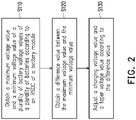
- step S120 according to the charging method, a difference value between the maximum voltage value and the minimum voltage value is obtained.
- the minimum voltage value is subtracted from the maximum voltage value to obtain the difference value between the maximum voltage value and the minimum voltage value.
- a charging voltage value and a taper voltage value are adjusted according to the difference value.
- the charging voltage value is a voltage value used for charging the batteries.
- the taper voltage value is a set voltage value for determining whether the batteries reach a charging saturation state.
- the maximum voltage value and the minimum voltage value in the battery voltage values of the batteries are obtained through the charging method to derive the difference value between the maximum voltage value and the minimum voltage value and the charging voltage value and the taper voltage value are adjusted according to the difference value. Therefore, by using the charging method, the battery voltage values of the batteries are balanced, the aging of a battery module is alleviated, and the service life of the battery module is prolonged.
- Fig. 3 is a schematic diagram of a charging device according to one embodiment of the disclosure.
- the charging method of the present embodiment is at least applicable to the charging device 100 shown in Fig. 3 .
- the charging device 100 includes a power adapter 110, a controller 120 and a charger 130.
- the power adapter 110 is configured for receiving an input power supply Pin, and providing a charging power supply PC according to the input power supply Pin.
- the controller 120 is coupled to a battery module 400.
- the controller 120 is configured for receiving the RSOC, a taper voltage value VT1, a charging voltage value VC1, a maximum voltage value VMAX and a minimum voltage value Vmin from the battery module 400.
- the charger 130 is coupled to the power adapter 110, the controller 120 and the battery module 400.
- the charger 130 is configured for receiving the provided charging power supply PC, and responds to the control of the controller 120 to charge batteries B1 to Bn of the battery module 400.
- the controller 120 may be arranged inside the battery module 400. In some embodiments, the controller 120 may be arranged inside the charger 130.
- step S110 the controller 120 is configured for receiving the RSOC, the taper voltage value VT1, the charging voltage value VC1, the maximum voltage value VMAX and the minimum voltage value Vmin from the battery module 400.
- the controller 120 obtains the maximum voltage value VMAX and the minimum voltage value Vmin according to the RSOC of the battery module 400.
- step S120 the controller 120 obtains a difference value ⁇ V between the maximum voltage value VMAX and the minimum voltage value Vmin.
- step S130 the controller 120 adjusts the taper voltage value VT1 to an adjusted taper voltage value VT2 according to the difference value ⁇ V, and determines whether the batteries B1 to Bn reach the charging saturation state according to the adjusted taper voltage value VT2.
- the charger 130 receives the difference value ⁇ V and the charging power supply PC.
- the charger 130 adjusts the charging voltage value VC1 of the charging power supply PC to an adjusted charging voltage value VC2 according to the difference value ⁇ V.
- the charger 130 charges the batteries B1 to Bn according to the adjusted charging voltage value VC2.
- Fig. 4 is an operation flow chart of a charging method according to another embodiment of the disclosure.
- the charging method shown in Fig. 4 is applicable to the charging device 100.
- step S210 whether the RSOC state of the battery module 400 is greater than a preset state of charge is determined in step S210.
- step S220 whether the RSOC of the battery module 400 is greater than the preset state of charge is determined by the controller 120.
- the operation flow process enters step S220.
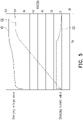
- Fig. 5 is a schematic diagram of a charging voltage curve, an RSOC curve and a charging current curve according to one embodiment of the disclosure.
- a charging voltage curve C1, an RSOC curve C2 and a charging current curve C3 are shown in the schematic diagram of the present embodiment.
- a constant current (CC) charging mode is configured for charging the battery module.
- the charging current curve C3 indicates that a charging current value is constant.
- the charging voltage curve C1 indicates that a charging voltage value is variable. The increase in the battery voltage values of the batteries of the battery module is large.
- a constant voltage (CV) charging mode is configured for charging the battery module.
- the charging voltage curve C1 indicates that the charging voltage value is constant.
- the charging current curve C3 indicates that the charging current value is gradually reduced.
- the change of the battery voltage values of the batteries of the battery module is small. Accordingly, the relatively accurate maximum voltage value and the relatively accurate minimum voltage value are obtained in the CV charging mode. Therefore, a default state of charge corresponds to a RSOC when the battery module 400 is charged in the CV charging mode.
- the RSOC after the time point T4 of the RSOC curve C2 can be used as the preset state of charge.
- the preset state of charge may be, for example, any value between 85% and 95%.
- the operation flow process returns to step S210.
- the charger 130 charges the batteries B1 to Bn according to the charging voltage value VC1.
- step S220 the controller 120 obtains the maximum voltage value VMAX and the minimum voltage value Vmin.
- step S230 the controller 120 obtains the difference value ⁇ V between the maximum voltage value VMAX and the minimum voltage value Vmin. In the present embodiment, the controller 120 subtracts the minimum voltage value Vmin from the maximum voltage value VMAX to obtain the difference value ⁇ V.
- Fig. 6 is a schematic diagram of battery voltage curves according to one embodiment of the disclosure.
- the schematic diagram in Fig. 6 shows battery voltage curves CB1 to CB3.
- the battery voltage curve CB1 in the battery voltage curves CB1 to CB3 has the largest battery voltage value (e.g., 4.4 V).
- the battery voltage curve CB3 has the smallest battery voltage (e.g., 4.32 V).
- the largest battery voltage is used as the maximum voltage value.
- the smallest battery voltage is used as the minimum voltage value. Therefore, the difference value equals to 0.08V.
- step S240 the controller 120 determines whether the difference value ⁇ V is greater than a preset difference value.
- step S250 the charging voltage value VC1 and the taper voltage value VT1 are adjusted according to the difference value ⁇ V.
- the controller 120 subtracts the difference value ⁇ V from the taper voltage value VT1 to obtain an adjusted taper voltage value VT2.
- the controller 130 subtracts the difference value ⁇ V from the charging voltage value VC1 to obtain the adjusted charging voltage value VC2. That is, once the RSOC of the battery module 400 is greater than the preset state of charge, and the difference value ⁇ V is greater than the default difference value, the charging voltage value CV1 and the taper voltage value VT1 are adjusted. Therefore, the charging device 100 charges the battery module 400 according to the adjusted charging voltage value VC2. The charging device 100 determines whether the batteries B1 to Bn reach the charging saturation state according to the adjusted taper voltage value VT2.
- the controller 120 determines that the difference value ⁇ V is smaller than or equal to the preset difference value, the charging voltage value VC1 and the taper voltage value VT1 are not adjusted.
- the operation flow process returns to step S210.
- the charger 130 charges the batteries B1 to Bn according to the charging voltage value VC1.
- the preset difference value is set to be 0.05V.
- the controller 120 determines that the difference value ⁇ V is greater than the preset difference value in step S240. Therefore, in step S250, the controller 120 subtracts the difference value ⁇ V (i.e., 0.08 V) from the taper voltage value VT1 to obtain the adjusted taper voltage value VT2.
- the charger 130 subtracts the difference value ⁇ V from the charging voltage value VC1 to obtain the adjusted charging voltage value VC2, and charges the battery module 400 according to the adjusted charging voltage value VC2.
- the preset difference value in the present embodiment may be set according to design requirements. The disclosure is not limited thereto.
- the maximum voltage value and the minimum voltage value in the battery voltage values of the batteries are obtained to derive difference value between the maximum voltage value and the minimum voltage value, and the charging voltage value and the taper voltage value are adjusted according to the difference value. Accordingly, with the charging method of the disclosure, the battery voltage values of the batteries are balanced, the aging of the battery module is alleviated, and the service life of the battery module is prolonged.
Landscapes
- Engineering & Computer Science (AREA)
- Power Engineering (AREA)
- Secondary Cells (AREA)
- Charge And Discharge Circuits For Batteries Or The Like (AREA)
Description
- The disclosure relates to a charging method, and particularly relates to a charging method for charging a battery module.
- In general, a battery module ages after use for a long time. In addition to battery inflation and durability reduction, a battery with the maximum voltage value may preferentially trigger an overvoltage protection mechanism of the battery module due to an imbalance of voltage values among a plurality of batteries of the battery module, thus making other batteries unable to reach the voltage saturation state.
- For example, referring to
Fig. 1 which is a schematic diagram of voltage curves for battery voltages of a plurality of batteries in a battery module charged according to a conventional charging method,Fig. 1 shows battery voltage curves CB1, CB2 and CB3 of three batteries. In multiple charging processes, the battery voltage values of the three batteries are approximately consistent at time points T1 and T2, indicating that the battery voltage values of the three batteries are balanced. When the battery voltage curves CB1, CB2 and CB3 approach the overvoltage protection voltage (e.g., 4350 mV), the battery voltage values of the three batteries all reach the taper voltage (e.g., 4345 mV). Therefore, the relative state of charge (RSOC) of the battery module reaches 100%. - However, after use for a long time, the battery voltage curves CB1, CB2 and CB3 become inconsistent. The battery voltage value represented by the battery voltage curve CB1 is higher than the battery voltage values represented by the battery voltage curves CB2 and CB3. At the time point T3, the battery voltage curve CB1 reaches the overvoltage protection voltage (e.g., 4350 mV), triggers the overvoltage protection mechanism of the battery module, and stops the charging. At this time, the battery voltage values (e.g., 4335 and 4330 mV) of the batteries corresponding to the battery voltage curves CB2 and CB3 have not reached the taper voltage (e.g., 4345 mV). As a result, the RSOC of the battery module only reaches 97%, and cannot reach 100%. Therefore, how to alleviate the aging of the battery module and prolong the service life of the battery module through balancing the battery voltage values of the batteries is now an issue to work on in the charging technologies.
-
US 5644212A discloses a battery management system for an electric vehicle, which can facilitate the maintenance of the electric vehicle by automatizing the equalizing charging work of the traction battery. -
US2010194339 also discloses a battery management system with a battery module. The battery module is charged until a maximum voltage of the battery cells reaches a reference voltage. At this point an equalizing operation is carried out to balance the battery cells of the module. - In order to overcome the above problems, the invention provides a charging method for balancing a plurality of battery values of a plurality of batteries to alleviate the aging of a battery module and prolong the service life of the battery module as defined in claim 1.
- A charging method according to the invention is suitable for charging a plurality of batteries of a battery module. The batteries are connected in series with each other. The charging method includes: obtaining a charging voltage value of the battery module, wherein the charging voltage value is a voltage value used for charging the batteries; obtaining a maximum voltage value and a minimum voltage value of a plurality of battery voltage values of the batteries according to a relative state of charge (RSOC) of the battery module during a charging process; and obtaining a difference value between the maximum voltage value and the minimum voltage value: The method is characterized by obtaining a taper voltage value of the battery module, wherein the taper voltage value is a set voltage value for determining whether the batteries reach a charging saturation state; adjusting both the charging voltage value and the taper voltage value by performing a subtraction operation. Obtaining the taper voltage value comprises: detecting the RSOC of the battery module; and in response to that a 100% RSOC is detected, using a detected voltage value of the battery module corresponding to the 100% RSOC as the taper voltage value. The subtraction operation comprises: subtracting the difference value from the charging voltage value to obtain an adjusted charging voltage value; and subtracting the difference value from the taper voltage value to obtain an adjusted taper voltage value.
- In one embodiment of the disclosure, obtaining the maximum voltage value and the minimum voltage value of the battery voltage values of the batteries according to the RSOC of the battery module includes: determining whether the RSOC of the battery module is greater than a preset state of charge; and obtaining the maximum voltage value and the minimum voltage value when the RSOC of the battery module is greater than the preset state of charge.
- In one embodiment of the disclosure, the preset state of charge corresponds to an RSOC when the battery module is charged in a constant voltage charging mode.
- In one embodiment of the disclosure, adjusting the charging voltage value for charging the batteries and the taper voltage value for determining whether the batteries reach the charging saturation state according to the difference value includes: determining whether the difference value is greater than a preset difference value; and adjusting the charging voltage value and the taper voltage value according to the difference value if the difference value is determined as being greater than the preset difference value.
- In one embodiment of the disclosure, adjusting the charging voltage value for charging the batteries and the taper voltage value for determining whether the batteries reach the charging saturation state according to the difference value further includes: not adjusting the charging voltage value and the taper voltage value if the difference value is determined as being smaller than or equal to the preset difference value.
- In one embodiment of the disclosure, the charging method includes determining whether the batteries reach the charging saturation state according to the adjusted taper voltage value.
- Based on the above, according to the charging method, the maximum voltage value and the minimum voltage value in the battery voltage values of the batteries are obtained to derive the difference value between the maximum voltage value and the minimum voltage value, and the charging voltage value and the taper voltage value are adjusted according to the difference value. Accordingly, the aging of a battery module is alleviated and the service life of the battery module is prolonged.
- In order to make the aforementioned and other objectives and advantages of the disclosure comprehensible, embodiments accompanied with figures are described in detail below.
-
-
Fig. 1 is a schematic diagram of voltage curves for battery voltages of a plurality of batteries in a battery module charged according to a conventional charging method. -
Fig. 2 is an operation flow chart of a charging method according to one embodiment of the disclosure. -
Fig. 3 is a schematic diagram of a charging device according to one embodiment of the disclosure. -
Fig. 4 is an operation flow chart of a charging method according to another embodiment of the disclosure. -
Fig. 5 is a schematic diagram of a charging voltage curve, an RSOC curve and a charging current curve according to one embodiment of the disclosure. -
Fig. 6 is a schematic diagram of battery voltage curves according to one embodiment of the disclosure. - Referring to
Fig. 2 which is an operation flow chart of a charging method according to one embodiment of the disclosure, in the present embodiment, the charging method is suitable for charging a plurality of batteries of a battery module. The batteries are connected with each other in series. In step S110, according to the charging method, a maximum voltage value and a minimum voltage value in a plurality of battery voltage values of the batteries are obtained according to a relative state of charge (RSOC) of the battery module in the charging process. In step S110, according to the charging method, the battery voltage values of the batteries are obtained according to the RSOC of the battery module. Then, according to the charging method, the greatest battery voltage value and the smallest battery voltage value are selected from the battery voltage values. According to the charging method, the greatest battery voltage value is used as the maximum voltage value, and the smallest battery voltage value is used as the minimum voltage value. - In step S120, according to the charging method, a difference value between the maximum voltage value and the minimum voltage value is obtained. In the present embodiment, according to the charging method, the minimum voltage value is subtracted from the maximum voltage value to obtain the difference value between the maximum voltage value and the minimum voltage value.
- In step S130, according to the charging method, a charging voltage value and a taper voltage value are adjusted according to the difference value. In the present embodiment, the charging voltage value is a voltage value used for charging the batteries. The taper voltage value is a set voltage value for determining whether the batteries reach a charging saturation state.
- In the charging process, the maximum voltage value and the minimum voltage value in the battery voltage values of the batteries are obtained through the charging method to derive the difference value between the maximum voltage value and the minimum voltage value and the charging voltage value and the taper voltage value are adjusted according to the difference value. Therefore, by using the charging method, the battery voltage values of the batteries are balanced, the aging of a battery module is alleviated, and the service life of the battery module is prolonged.
- Referring to
Fig. 2 andFig. 3 for specific illustration,Fig. 3 is a schematic diagram of a charging device according to one embodiment of the disclosure. The charging method of the present embodiment is at least applicable to thecharging device 100 shown inFig. 3 . In the present embodiment, thecharging device 100 includes apower adapter 110, acontroller 120 and acharger 130. Thepower adapter 110 is configured for receiving an input power supply Pin, and providing a charging power supply PC according to the input power supply Pin. Thecontroller 120 is coupled to abattery module 400. Thecontroller 120 is configured for receiving the RSOC, a taper voltage value VT1, a charging voltage value VC1, a maximum voltage value VMAX and a minimum voltage value Vmin from thebattery module 400. Thecharger 130 is coupled to thepower adapter 110, thecontroller 120 and thebattery module 400. Thecharger 130 is configured for receiving the provided charging power supply PC, and responds to the control of thecontroller 120 to charge batteries B1 to Bn of thebattery module 400. In some embodiments, thecontroller 120 may be arranged inside thebattery module 400. In some embodiments, thecontroller 120 may be arranged inside thecharger 130. - In step S110, the
controller 120 is configured for receiving the RSOC, the taper voltage value VT1, the charging voltage value VC1, the maximum voltage value VMAX and the minimum voltage value Vmin from thebattery module 400. Thecontroller 120 obtains the maximum voltage value VMAX and the minimum voltage value Vmin according to the RSOC of thebattery module 400. - In step S120, the
controller 120 obtains a difference value ΔV between the maximum voltage value VMAX and the minimum voltage value Vmin. - In step S130, the
controller 120 adjusts the taper voltage value VT1 to an adjusted taper voltage value VT2 according to the difference value ΔV, and determines whether the batteries B1 to Bn reach the charging saturation state according to the adjusted taper voltage value VT2. Thecharger 130 receives the difference value ΔV and the charging power supply PC. Thecharger 130 adjusts the charging voltage value VC1 of the charging power supply PC to an adjusted charging voltage value VC2 according to the difference value ΔV. Thus, thecharger 130 charges the batteries B1 to Bn according to the adjusted charging voltage value VC2. - Referring to
Fig. 3 andFig 4 simultaneously,Fig. 4 is an operation flow chart of a charging method according to another embodiment of the disclosure. In the present embodiment, the charging method shown inFig. 4 is applicable to thecharging device 100. After the charging method is started, whether the RSOC state of thebattery module 400 is greater than a preset state of charge is determined in step S210. In the present embodiment, according to the charging method, whether the RSOC of thebattery module 400 is greater than the preset state of charge is determined by thecontroller 120. When the RSOC of thebattery module 400 is smaller than or equal to the preset state of charge, the operation flow process enters step S220. - Referring to
Fig. 5 for further illustration,Fig. 5 is a schematic diagram of a charging voltage curve, an RSOC curve and a charging current curve according to one embodiment of the disclosure. A charging voltage curve C1, an RSOC curve C2 and a charging current curve C3 are shown in the schematic diagram of the present embodiment. In the present embodiment, before a time point T4 in the charging process, according to the charging method, a constant current (CC) charging mode is configured for charging the battery module. In the CC charging mode, the charging current curve C3 indicates that a charging current value is constant. The charging voltage curve C1 indicates that a charging voltage value is variable. The increase in the battery voltage values of the batteries of the battery module is large. After the time point T4, according to the charging method, a constant voltage (CV) charging mode is configured for charging the battery module. In the CV charging mode, the charging voltage curve C1 indicates that the charging voltage value is constant. The charging current curve C3 indicates that the charging current value is gradually reduced. The change of the battery voltage values of the batteries of the battery module is small. Accordingly, the relatively accurate maximum voltage value and the relatively accurate minimum voltage value are obtained in the CV charging mode. Therefore, a default state of charge corresponds to a RSOC when thebattery module 400 is charged in the CV charging mode. The RSOC after the time point T4 of the RSOC curve C2 can be used as the preset state of charge. By takingFig. 5 as an example, the preset state of charge may be, for example, any value between 85% and 95%. - Returning to the embodiments of
Fig. 3 andFig. 4 . On the other hand, when the RSOC of thebattery module 400 is greater than the preset state of charge, the operation flow process returns to step S210. Thecharger 130 charges the batteries B1 to Bn according to the charging voltage value VC1. - In step S220, the
controller 120 obtains the maximum voltage value VMAX and the minimum voltage value Vmin. In step S230, thecontroller 120 obtains the difference value ΔV between the maximum voltage value VMAX and the minimum voltage value Vmin. In the present embodiment, thecontroller 120 subtracts the minimum voltage value Vmin from the maximum voltage value VMAX to obtain the difference value ΔV. - Referring to
Fig. 6 for further illustration of embodiments for obtaining a difference value,Fig. 6 is a schematic diagram of battery voltage curves according to one embodiment of the disclosure. In the present embodiment, the schematic diagram inFig. 6 shows battery voltage curves CB1 to CB3. In a CV charging mode, the battery voltage curve CB1 in the battery voltage curves CB1 to CB3 has the largest battery voltage value (e.g., 4.4 V). The battery voltage curve CB3 has the smallest battery voltage (e.g., 4.32 V). The largest battery voltage is used as the maximum voltage value. The smallest battery voltage is used as the minimum voltage value. Therefore, the difference value equals to 0.08V. - Returning to the embodiments in
Fig. 3 andFig. 4 . After the difference value ΔV is obtained, the operation flow process enters step S240. In step S240, thecontroller 120 determines whether the difference value ΔV is greater than a preset difference value. When thecontroller 120 determines that the difference value ΔV is greater than the preset difference value, the operation flow process returns to step S250. In step S250, according to the charging method, the charging voltage value VC1 and the taper voltage value VT1 are adjusted according to the difference value ΔV. In the present embodiment, according to the charging method, thecontroller 120 subtracts the difference value ΔV from the taper voltage value VT1 to obtain an adjusted taper voltage value VT2. According to the charging method, thecontroller 130 subtracts the difference value ΔV from the charging voltage value VC1 to obtain the adjusted charging voltage value VC2. That is, once the RSOC of thebattery module 400 is greater than the preset state of charge, and the difference value ΔV is greater than the default difference value, the charging voltage value CV1 and the taper voltage value VT1 are adjusted. Therefore, the chargingdevice 100 charges thebattery module 400 according to the adjusted charging voltage value VC2. The chargingdevice 100 determines whether the batteries B1 to Bn reach the charging saturation state according to the adjusted taper voltage value VT2. - On the other hand, when the
controller 120 determines that the difference value ΔV is smaller than or equal to the preset difference value, the charging voltage value VC1 and the taper voltage value VT1 are not adjusted. The operation flow process returns to step S210. Thecharger 130 charges the batteries B1 to Bn according to the charging voltage value VC1. - For example, the preset difference value is set to be 0.05V. After the difference value ΔV equal to 0.08V is obtained in step S230, the
controller 120 determines that the difference value ΔV is greater than the preset difference value in step S240. Therefore, in step S250, thecontroller 120 subtracts the difference value ΔV (i.e., 0.08 V) from the taper voltage value VT1 to obtain the adjusted taper voltage value VT2. In addition, thecharger 130 subtracts the difference value ΔV from the charging voltage value VC1 to obtain the adjusted charging voltage value VC2, and charges thebattery module 400 according to the adjusted charging voltage value VC2. The preset difference value in the present embodiment may be set according to design requirements. The disclosure is not limited thereto. - Based on the above, according to the charging method of the disclosure, the maximum voltage value and the minimum voltage value in the battery voltage values of the batteries are obtained to derive difference value between the maximum voltage value and the minimum voltage value, and the charging voltage value and the taper voltage value are adjusted according to the difference value. Accordingly, with the charging method of the disclosure, the battery voltage values of the batteries are balanced, the aging of the battery module is alleviated, and the service life of the battery module is prolonged.
Claims (6)
- A charging method for charging a plurality of batteries (B1 to Bn) of a battery module (400), wherein the batteries (B1 to Bn) are connected in series with each other, and the charging method comprises:obtaining a charging voltage value (VC1) of the battery module (400), wherein the charging voltage value (VC1) is a voltage value used for charging the batteries (B1 to Bn),;obtaining a maximum voltage value (VMAX) and a minimum voltage value (Vmin) in a plurality of battery voltage values of the batteries (B1 to Bn) according to a relative state of charge (RSOC) of the battery module (400) during a charging process; andobtaining a difference value (ΔV) between the maximum voltage value (VMAX) and the minimum voltage value (Vmin); characterized byobtaining a taper voltage value (VT1) of the battery module (400), wherein the taper voltage value (VT1) is a set voltage value for determining whether the batteries (B1 to Bn) reach a charging saturation state;adjusting both the charging voltage value (VC1) and the taper voltage value (VT1) by performing a subtraction operation,wherein obtaining the taper voltage value (VT1) comprises:detecting the RSOC of the battery module (400); andin response to that a 100% RSOC is detected, using a detected voltage value of the battery module (400) corresponding to the 100% RSOC as the taper voltage value (VT1), andwherein the subtraction operation comprises:subtracting the difference value (ΔV) from the charging voltage value (VC1) to obtain an adjusted charging voltage value (VC2); andsubtracting the difference value (ΔV) from the taper voltage value (VT1) to obtain an adjusted taper voltage value (VT2).
- The charging method according to claim 1, wherein obtaining the maximum voltage value (VMAX) and the minimum voltage value (Vmin) in the battery voltage values of the batteries (B1 to Bn) according to the relative state of charge (RSOC) of the battery module (400) comprises:determining whether the relative state of charge (RSOC) of the battery module (400) is greater than a preset state of charge; andobtaining the maximum voltage value (VMAX) and the minimum voltage value (Vmin) when the relative state of charge (RSOC) of the battery module (400) is greater than the preset state of charge.
- The charging method according to claim 2, wherein the preset state of charge corresponds a relative state of charge (RSOC) when the battery module (400) is charged in a constant voltage charging mode.
- The charging method according to claim 1, wherein adjusting both the charging voltage value (VC1) and the taper voltage value (VT1) comprises:determining whether the difference value (ΔV) is greater than a preset difference value; andadjusting the charging voltage value (VC1) and the taper voltage value (VT1) according to the difference value (ΔV) when the difference value (ΔV) is determined as being greater than the preset difference value.
- The charging method according to claim 4, wherein adjusting both the charging voltage value (VC1) and the taper voltage value (VT1) further comprises:
not adjusting the charging voltage and the taper voltage value (VT1) when the difference value (ΔV) is determined as being smaller than or equal to the preset difference value. - The charging method according to claim 1, further comprising:
determining whether the batteries (B1 to Bn) reach the charging saturation state according to the adjusted taper voltage value (VT2).
Applications Claiming Priority (1)
| Application Number | Priority Date | Filing Date | Title |
|---|---|---|---|
| TW108129550A TW202110024A (en) | 2019-08-20 | 2019-08-20 | Charging method |
Publications (2)
| Publication Number | Publication Date |
|---|---|
| EP3783767A1 EP3783767A1 (en) | 2021-02-24 |
| EP3783767B1 true EP3783767B1 (en) | 2023-03-01 |
Family
ID=68609958
Family Applications (1)
| Application Number | Title | Priority Date | Filing Date |
|---|---|---|---|
| EP19209686.5A Active EP3783767B1 (en) | 2019-08-20 | 2019-11-18 | Charging method |
Country Status (3)
| Country | Link |
|---|---|
| US (1) | US11196270B2 (en) |
| EP (1) | EP3783767B1 (en) |
| TW (1) | TW202110024A (en) |
Family Cites Families (11)
| Publication number | Priority date | Publication date | Assignee | Title |
|---|---|---|---|---|
| JPH08140209A (en) | 1994-11-11 | 1996-05-31 | Fuji Heavy Ind Ltd | Battery management system for electric vehicles |
| US20070257642A1 (en) | 2003-06-19 | 2007-11-08 | Sean Xiao | Battery cell monitoring and balancing circuit |
| US8350528B2 (en) * | 2009-02-04 | 2013-01-08 | Samsung Sdi Co., Ltd. | Battery pack and balancing method of battery cells |
| TWI466408B (en) | 2012-01-20 | 2014-12-21 | 威盛電子股份有限公司 | Rechargeable battery module and charging battery module charging method |
| US10690725B2 (en) * | 2012-03-29 | 2020-06-23 | Atieva, Inc. | Battery state-of-charge estimation |
| US20130257381A1 (en) * | 2012-03-29 | 2013-10-03 | Steven Diamond | Peak-equalized battery charge balancing |
| US10063066B2 (en) | 2014-01-07 | 2018-08-28 | Utah State University | Battery control |
| TWI543495B (en) | 2014-11-04 | 2016-07-21 | 臺灣塑膠工業股份有限公司 | Battery management method |
| TWI569557B (en) | 2015-09-30 | 2017-02-01 | 環旭電子股份有限公司 | Charging control method for rechargable battery |
| DE102015117744A1 (en) | 2015-10-19 | 2017-04-20 | Dr. Ing. H.C. F. Porsche Aktiengesellschaft | battery system |
| CN106154175B (en) | 2016-06-29 | 2018-11-06 | 成都雅骏新能源汽车科技股份有限公司 | Rechargeable battery state-of-charge estimating system based on dynamic differential pressure and workflow |
-
2019
- 2019-08-20 TW TW108129550A patent/TW202110024A/en unknown
- 2019-11-12 US US16/681,786 patent/US11196270B2/en not_active Expired - Fee Related
- 2019-11-18 EP EP19209686.5A patent/EP3783767B1/en active Active
Also Published As
| Publication number | Publication date |
|---|---|
| US11196270B2 (en) | 2021-12-07 |
| US20210057922A1 (en) | 2021-02-25 |
| EP3783767A1 (en) | 2021-02-24 |
| TW202110024A (en) | 2021-03-01 |
Similar Documents
| Publication | Publication Date | Title |
|---|---|---|
| EP3518374B1 (en) | Power supply system | |
| US10608445B2 (en) | Power supply system | |
| US9438059B2 (en) | Battery control apparatus and battery control method | |
| KR101497602B1 (en) | Balancing system for battery and Method for balancing of battery using the same | |
| KR101182429B1 (en) | A battery pack and method for controlling the battery pack | |
| US20120313562A1 (en) | Battery control device, battery system, electric vehicle, charge control device, battery charger, movable body, power supply system, power storage device, and power supply device | |
| EP2418751B1 (en) | Battery charger and battery charging method | |
| US20140021925A1 (en) | Battery power supply apparatus and battery power supply system | |
| JP2015136268A (en) | Battery pack equalization device and method | |
| KR20160040108A (en) | Method for cell balancing a plurality of battery cells and battery system for carrying out such a method | |
| JPWO2012157747A1 (en) | Control method and control apparatus for battery pack | |
| US12040635B2 (en) | System and method for dynamically balancing power from distributed power sources in a battery pack | |
| JP7240994B2 (en) | Battery pack and charging system | |
| KR102045047B1 (en) | Maximum capacity charging apparatus considering SOH unbalance of battery module and control method thereof | |
| CN105162206B (en) | The charge control method of rechargeable battery | |
| KR20230152210A (en) | A system for operating and managing battery packs by KNN machine learning algorithm | |
| US20220037893A1 (en) | Disconnection detection device and disconnection detection method | |
| CN112467822A (en) | Battery management method, device and system | |
| EP3770002B1 (en) | Method for capacitor precharging and capacitance measurement in electric vehicle drive system | |
| JP5314626B2 (en) | Power supply system, discharge control method, and discharge control program | |
| CN103855747A (en) | Battery system and battery charging method | |
| US20100327808A1 (en) | Control unit | |
| KR20170022163A (en) | Multi battery pack apparatus and control method for charging the same | |
| EP3783767B1 (en) | Charging method | |
| KR101794101B1 (en) | Apparatus for controlling charging and method thereof |
Legal Events
| Date | Code | Title | Description |
|---|---|---|---|
| PUAI | Public reference made under article 153(3) epc to a published international application that has entered the european phase |
Free format text: ORIGINAL CODE: 0009012 |
|
| STAA | Information on the status of an ep patent application or granted ep patent |
Free format text: STATUS: REQUEST FOR EXAMINATION WAS MADE |
|
| 17P | Request for examination filed |
Effective date: 20200923 |
|
| AK | Designated contracting states |
Kind code of ref document: A1 Designated state(s): AL AT BE BG CH CY CZ DE DK EE ES FI FR GB GR HR HU IE IS IT LI LT LU LV MC MK MT NL NO PL PT RO RS SE SI SK SM TR |
|
| AX | Request for extension of the european patent |
Extension state: BA ME |
|
| STAA | Information on the status of an ep patent application or granted ep patent |
Free format text: STATUS: EXAMINATION IS IN PROGRESS |
|
| 17Q | First examination report despatched |
Effective date: 20220419 |
|
| GRAP | Despatch of communication of intention to grant a patent |
Free format text: ORIGINAL CODE: EPIDOSNIGR1 |
|
| STAA | Information on the status of an ep patent application or granted ep patent |
Free format text: STATUS: GRANT OF PATENT IS INTENDED |
|
| INTG | Intention to grant announced |
Effective date: 20220920 |
|
| GRAS | Grant fee paid |
Free format text: ORIGINAL CODE: EPIDOSNIGR3 |
|
| GRAA | (expected) grant |
Free format text: ORIGINAL CODE: 0009210 |
|
| STAA | Information on the status of an ep patent application or granted ep patent |
Free format text: STATUS: THE PATENT HAS BEEN GRANTED |
|
| AK | Designated contracting states |
Kind code of ref document: B1 Designated state(s): AL AT BE BG CH CY CZ DE DK EE ES FI FR GB GR HR HU IE IS IT LI LT LU LV MC MK MT NL NO PL PT RO RS SE SI SK SM TR |
|
| REG | Reference to a national code |
Ref country code: GB Ref legal event code: FG4D |
|
| REG | Reference to a national code |
Ref country code: CH Ref legal event code: EP Ref country code: AT Ref legal event code: REF Ref document number: 1551681 Country of ref document: AT Kind code of ref document: T Effective date: 20230315 |
|
| REG | Reference to a national code |
Ref country code: DE Ref legal event code: R096 Ref document number: 602019025781 Country of ref document: DE |
|
| REG | Reference to a national code |
Ref country code: IE Ref legal event code: FG4D |
|
| REG | Reference to a national code |
Ref country code: LT Ref legal event code: MG9D |
|
| REG | Reference to a national code |
Ref country code: NL Ref legal event code: MP Effective date: 20230301 |
|
| PG25 | Lapsed in a contracting state [announced via postgrant information from national office to epo] |
Ref country code: RS Free format text: LAPSE BECAUSE OF FAILURE TO SUBMIT A TRANSLATION OF THE DESCRIPTION OR TO PAY THE FEE WITHIN THE PRESCRIBED TIME-LIMIT Effective date: 20230301 Ref country code: NO Free format text: LAPSE BECAUSE OF FAILURE TO SUBMIT A TRANSLATION OF THE DESCRIPTION OR TO PAY THE FEE WITHIN THE PRESCRIBED TIME-LIMIT Effective date: 20230601 Ref country code: LV Free format text: LAPSE BECAUSE OF FAILURE TO SUBMIT A TRANSLATION OF THE DESCRIPTION OR TO PAY THE FEE WITHIN THE PRESCRIBED TIME-LIMIT Effective date: 20230301 Ref country code: LT Free format text: LAPSE BECAUSE OF FAILURE TO SUBMIT A TRANSLATION OF THE DESCRIPTION OR TO PAY THE FEE WITHIN THE PRESCRIBED TIME-LIMIT Effective date: 20230301 Ref country code: HR Free format text: LAPSE BECAUSE OF FAILURE TO SUBMIT A TRANSLATION OF THE DESCRIPTION OR TO PAY THE FEE WITHIN THE PRESCRIBED TIME-LIMIT Effective date: 20230301 Ref country code: ES Free format text: LAPSE BECAUSE OF FAILURE TO SUBMIT A TRANSLATION OF THE DESCRIPTION OR TO PAY THE FEE WITHIN THE PRESCRIBED TIME-LIMIT Effective date: 20230301 |
|
| REG | Reference to a national code |
Ref country code: AT Ref legal event code: MK05 Ref document number: 1551681 Country of ref document: AT Kind code of ref document: T Effective date: 20230301 |
|
| PG25 | Lapsed in a contracting state [announced via postgrant information from national office to epo] |
Ref country code: SE Free format text: LAPSE BECAUSE OF FAILURE TO SUBMIT A TRANSLATION OF THE DESCRIPTION OR TO PAY THE FEE WITHIN THE PRESCRIBED TIME-LIMIT Effective date: 20230301 Ref country code: PL Free format text: LAPSE BECAUSE OF FAILURE TO SUBMIT A TRANSLATION OF THE DESCRIPTION OR TO PAY THE FEE WITHIN THE PRESCRIBED TIME-LIMIT Effective date: 20230301 Ref country code: NL Free format text: LAPSE BECAUSE OF FAILURE TO SUBMIT A TRANSLATION OF THE DESCRIPTION OR TO PAY THE FEE WITHIN THE PRESCRIBED TIME-LIMIT Effective date: 20230301 Ref country code: GR Free format text: LAPSE BECAUSE OF FAILURE TO SUBMIT A TRANSLATION OF THE DESCRIPTION OR TO PAY THE FEE WITHIN THE PRESCRIBED TIME-LIMIT Effective date: 20230602 Ref country code: FI Free format text: LAPSE BECAUSE OF FAILURE TO SUBMIT A TRANSLATION OF THE DESCRIPTION OR TO PAY THE FEE WITHIN THE PRESCRIBED TIME-LIMIT Effective date: 20230301 |
|
| PG25 | Lapsed in a contracting state [announced via postgrant information from national office to epo] |
Ref country code: SM Free format text: LAPSE BECAUSE OF FAILURE TO SUBMIT A TRANSLATION OF THE DESCRIPTION OR TO PAY THE FEE WITHIN THE PRESCRIBED TIME-LIMIT Effective date: 20230301 Ref country code: RO Free format text: LAPSE BECAUSE OF FAILURE TO SUBMIT A TRANSLATION OF THE DESCRIPTION OR TO PAY THE FEE WITHIN THE PRESCRIBED TIME-LIMIT Effective date: 20230301 Ref country code: PT Free format text: LAPSE BECAUSE OF FAILURE TO SUBMIT A TRANSLATION OF THE DESCRIPTION OR TO PAY THE FEE WITHIN THE PRESCRIBED TIME-LIMIT Effective date: 20230703 Ref country code: EE Free format text: LAPSE BECAUSE OF FAILURE TO SUBMIT A TRANSLATION OF THE DESCRIPTION OR TO PAY THE FEE WITHIN THE PRESCRIBED TIME-LIMIT Effective date: 20230301 Ref country code: CZ Free format text: LAPSE BECAUSE OF FAILURE TO SUBMIT A TRANSLATION OF THE DESCRIPTION OR TO PAY THE FEE WITHIN THE PRESCRIBED TIME-LIMIT Effective date: 20230301 Ref country code: AT Free format text: LAPSE BECAUSE OF FAILURE TO SUBMIT A TRANSLATION OF THE DESCRIPTION OR TO PAY THE FEE WITHIN THE PRESCRIBED TIME-LIMIT Effective date: 20230301 |
|
| PG25 | Lapsed in a contracting state [announced via postgrant information from national office to epo] |
Ref country code: SK Free format text: LAPSE BECAUSE OF FAILURE TO SUBMIT A TRANSLATION OF THE DESCRIPTION OR TO PAY THE FEE WITHIN THE PRESCRIBED TIME-LIMIT Effective date: 20230301 Ref country code: IS Free format text: LAPSE BECAUSE OF FAILURE TO SUBMIT A TRANSLATION OF THE DESCRIPTION OR TO PAY THE FEE WITHIN THE PRESCRIBED TIME-LIMIT Effective date: 20230701 |
|
| REG | Reference to a national code |
Ref country code: DE Ref legal event code: R097 Ref document number: 602019025781 Country of ref document: DE |
|
| PLBE | No opposition filed within time limit |
Free format text: ORIGINAL CODE: 0009261 |
|
| STAA | Information on the status of an ep patent application or granted ep patent |
Free format text: STATUS: NO OPPOSITION FILED WITHIN TIME LIMIT |
|
| PG25 | Lapsed in a contracting state [announced via postgrant information from national office to epo] |
Ref country code: SI Free format text: LAPSE BECAUSE OF FAILURE TO SUBMIT A TRANSLATION OF THE DESCRIPTION OR TO PAY THE FEE WITHIN THE PRESCRIBED TIME-LIMIT Effective date: 20230301 Ref country code: DK Free format text: LAPSE BECAUSE OF FAILURE TO SUBMIT A TRANSLATION OF THE DESCRIPTION OR TO PAY THE FEE WITHIN THE PRESCRIBED TIME-LIMIT Effective date: 20230301 |
|
| 26N | No opposition filed |
Effective date: 20231204 |
|
| PG25 | Lapsed in a contracting state [announced via postgrant information from national office to epo] |
Ref country code: IT Free format text: LAPSE BECAUSE OF FAILURE TO SUBMIT A TRANSLATION OF THE DESCRIPTION OR TO PAY THE FEE WITHIN THE PRESCRIBED TIME-LIMIT Effective date: 20230301 |
|
| REG | Reference to a national code |
Ref country code: CH Ref legal event code: PL |
|
| PG25 | Lapsed in a contracting state [announced via postgrant information from national office to epo] |
Ref country code: MC Free format text: LAPSE BECAUSE OF FAILURE TO SUBMIT A TRANSLATION OF THE DESCRIPTION OR TO PAY THE FEE WITHIN THE PRESCRIBED TIME-LIMIT Effective date: 20230301 |
|
| PG25 | Lapsed in a contracting state [announced via postgrant information from national office to epo] |
Ref country code: LU Free format text: LAPSE BECAUSE OF NON-PAYMENT OF DUE FEES Effective date: 20231118 |
|
| PG25 | Lapsed in a contracting state [announced via postgrant information from national office to epo] |
Ref country code: CH Free format text: LAPSE BECAUSE OF NON-PAYMENT OF DUE FEES Effective date: 20231130 |
|
| PG25 | Lapsed in a contracting state [announced via postgrant information from national office to epo] |
Ref country code: MC Free format text: LAPSE BECAUSE OF FAILURE TO SUBMIT A TRANSLATION OF THE DESCRIPTION OR TO PAY THE FEE WITHIN THE PRESCRIBED TIME-LIMIT Effective date: 20230301 Ref country code: LU Free format text: LAPSE BECAUSE OF NON-PAYMENT OF DUE FEES Effective date: 20231118 Ref country code: CH Free format text: LAPSE BECAUSE OF NON-PAYMENT OF DUE FEES Effective date: 20231130 |
|
| REG | Reference to a national code |
Ref country code: BE Ref legal event code: MM Effective date: 20231130 |
|
| REG | Reference to a national code |
Ref country code: IE Ref legal event code: MM4A |
|
| PG25 | Lapsed in a contracting state [announced via postgrant information from national office to epo] |
Ref country code: IE Free format text: LAPSE BECAUSE OF NON-PAYMENT OF DUE FEES Effective date: 20231118 |
|
| PG25 | Lapsed in a contracting state [announced via postgrant information from national office to epo] |
Ref country code: BE Free format text: LAPSE BECAUSE OF NON-PAYMENT OF DUE FEES Effective date: 20231130 |
|
| PG25 | Lapsed in a contracting state [announced via postgrant information from national office to epo] |
Ref country code: IE Free format text: LAPSE BECAUSE OF NON-PAYMENT OF DUE FEES Effective date: 20231118 Ref country code: BE Free format text: LAPSE BECAUSE OF NON-PAYMENT OF DUE FEES Effective date: 20231130 |
|
| PG25 | Lapsed in a contracting state [announced via postgrant information from national office to epo] |
Ref country code: BG Free format text: LAPSE BECAUSE OF FAILURE TO SUBMIT A TRANSLATION OF THE DESCRIPTION OR TO PAY THE FEE WITHIN THE PRESCRIBED TIME-LIMIT Effective date: 20230301 |
|
| PG25 | Lapsed in a contracting state [announced via postgrant information from national office to epo] |
Ref country code: BG Free format text: LAPSE BECAUSE OF FAILURE TO SUBMIT A TRANSLATION OF THE DESCRIPTION OR TO PAY THE FEE WITHIN THE PRESCRIBED TIME-LIMIT Effective date: 20230301 |
|
| PGFP | Annual fee paid to national office [announced via postgrant information from national office to epo] |
Ref country code: DE Payment date: 20241029 Year of fee payment: 6 |
|
| PGFP | Annual fee paid to national office [announced via postgrant information from national office to epo] |
Ref country code: GB Payment date: 20241024 Year of fee payment: 6 |
|
| PGFP | Annual fee paid to national office [announced via postgrant information from national office to epo] |
Ref country code: FR Payment date: 20241111 Year of fee payment: 6 |
|
| PG25 | Lapsed in a contracting state [announced via postgrant information from national office to epo] |
Ref country code: CY Free format text: LAPSE BECAUSE OF FAILURE TO SUBMIT A TRANSLATION OF THE DESCRIPTION OR TO PAY THE FEE WITHIN THE PRESCRIBED TIME-LIMIT; INVALID AB INITIO Effective date: 20191118 |
|
| PG25 | Lapsed in a contracting state [announced via postgrant information from national office to epo] |
Ref country code: HU Free format text: LAPSE BECAUSE OF FAILURE TO SUBMIT A TRANSLATION OF THE DESCRIPTION OR TO PAY THE FEE WITHIN THE PRESCRIBED TIME-LIMIT; INVALID AB INITIO Effective date: 20191118 |
|
| PG25 | Lapsed in a contracting state [announced via postgrant information from national office to epo] |
Ref country code: TR Free format text: LAPSE BECAUSE OF FAILURE TO SUBMIT A TRANSLATION OF THE DESCRIPTION OR TO PAY THE FEE WITHIN THE PRESCRIBED TIME-LIMIT Effective date: 20230301 |