EP3783563A1 - Recognition device, recognition method, and recognition program - Google Patents
Recognition device, recognition method, and recognition program Download PDFInfo
- Publication number
- EP3783563A1 EP3783563A1 EP19788817.5A EP19788817A EP3783563A1 EP 3783563 A1 EP3783563 A1 EP 3783563A1 EP 19788817 A EP19788817 A EP 19788817A EP 3783563 A1 EP3783563 A1 EP 3783563A1
- Authority
- EP
- European Patent Office
- Prior art keywords
- recognition
- human
- animal
- target region
- image
- Prior art date
- Legal status (The legal status is an assumption and is not a legal conclusion. Google has not performed a legal analysis and makes no representation as to the accuracy of the status listed.)
- Granted
Links
Images


Classifications
-
- G—PHYSICS
- G06—COMPUTING OR CALCULATING; COUNTING
- G06V—IMAGE OR VIDEO RECOGNITION OR UNDERSTANDING
- G06V20/00—Scenes; Scene-specific elements
- G06V20/50—Context or environment of the image
- G06V20/56—Context or environment of the image exterior to a vehicle by using sensors mounted on the vehicle
- G06V20/58—Recognition of moving objects or obstacles, e.g. vehicles or pedestrians; Recognition of traffic objects, e.g. traffic signs, traffic lights or roads
-
- G—PHYSICS
- G06—COMPUTING OR CALCULATING; COUNTING
- G06V—IMAGE OR VIDEO RECOGNITION OR UNDERSTANDING
- G06V40/00—Recognition of biometric, human-related or animal-related patterns in image or video data
- G06V40/10—Human or animal bodies, e.g. vehicle occupants or pedestrians; Body parts, e.g. hands
-
- G—PHYSICS
- G06—COMPUTING OR CALCULATING; COUNTING
- G06T—IMAGE DATA PROCESSING OR GENERATION, IN GENERAL
- G06T7/00—Image analysis
- G06T7/70—Determining position or orientation of objects or cameras
- G06T7/73—Determining position or orientation of objects or cameras using feature-based methods
- G06T7/74—Determining position or orientation of objects or cameras using feature-based methods involving reference images or patches
-
- G—PHYSICS
- G06—COMPUTING OR CALCULATING; COUNTING
- G06V—IMAGE OR VIDEO RECOGNITION OR UNDERSTANDING
- G06V20/00—Scenes; Scene-specific elements
- G06V20/10—Terrestrial scenes
-
- G—PHYSICS
- G06—COMPUTING OR CALCULATING; COUNTING
- G06V—IMAGE OR VIDEO RECOGNITION OR UNDERSTANDING
- G06V40/00—Recognition of biometric, human-related or animal-related patterns in image or video data
- G06V40/10—Human or animal bodies, e.g. vehicle occupants or pedestrians; Body parts, e.g. hands
- G06V40/103—Static body considered as a whole, e.g. static pedestrian or occupant recognition
-
- G—PHYSICS
- G06—COMPUTING OR CALCULATING; COUNTING
- G06V—IMAGE OR VIDEO RECOGNITION OR UNDERSTANDING
- G06V40/00—Recognition of biometric, human-related or animal-related patterns in image or video data
- G06V40/10—Human or animal bodies, e.g. vehicle occupants or pedestrians; Body parts, e.g. hands
- G06V40/16—Human faces, e.g. facial parts, sketches or expressions
- G06V40/161—Detection; Localisation; Normalisation
-
- G—PHYSICS
- G08—SIGNALLING
- G08G—TRAFFIC CONTROL SYSTEMS
- G08G1/00—Traffic control systems for road vehicles
- G08G1/16—Anti-collision systems
-
- G—PHYSICS
- G06—COMPUTING OR CALCULATING; COUNTING
- G06T—IMAGE DATA PROCESSING OR GENERATION, IN GENERAL
- G06T2207/00—Indexing scheme for image analysis or image enhancement
- G06T2207/10—Image acquisition modality
- G06T2207/10048—Infrared image
-
- G—PHYSICS
- G06—COMPUTING OR CALCULATING; COUNTING
- G06T—IMAGE DATA PROCESSING OR GENERATION, IN GENERAL
- G06T2207/00—Indexing scheme for image analysis or image enhancement
- G06T2207/30—Subject of image; Context of image processing
- G06T2207/30196—Human being; Person
- G06T2207/30201—Face
Definitions
- the present invention relates to a recognition apparatus, a recognition method, and a recognition program.
- a safety support apparatus that recognizes a situation surrounding a vehicle with the use of an image captured by an on-board camera and warns a driver is widely available.
- Such a safety support apparatus recognizes, with the use of a recognition dictionary or the like, an object in the vicinity of a host vehicle based on an image captured by a camera.
- Patent Literature 1 describes a vehicle periphery monitoring apparatus.
- This vehicle periphery monitoring apparatus extracts an image region of an object from a captured image.
- this region includes a first object region of which the ratio of the widths in different directions falls within a predetermined range and a plurality of second object regions located below the first object region and having an area smaller than that of the first object region, the vehicle periphery monitoring apparatus determines that the type of the object is an animal other than a human being.
- Patent Literature 1 Japanese Unexamined Patent Application Publication No. 2007-310705
- Patent Literature 1 determines, when an object is an animal other than a human being, that the object is an animal based on the characteristics (the sizes of the torso and the front and rear legs, the aspect ratio thereof, the positional relationship thereof, etc.) observed when the animal is facing sideways.
- characteristics the sizes of the torso and the front and rear legs, the aspect ratio thereof, the positional relationship thereof, etc.
- the characteristics of the animal completely differ from the characteristics of a human being. Therefore, false detection between a human being and an animal rarely occurs.
- the present invention has been made to address such a problem and is directed to providing a recognition apparatus, a recognition method, and a recognition program that, even when a human being or an animal appears in an image showing his/her or its front or back, can correctly determine whether it is a human being or an animal that appears in the image.
- the embodiments provide a recognition apparatus that includes an image acquisition unit configured to acquire an image captured by a far-infrared camera and a recognition processing unit configured to set a target region in the image and determine whether an object in the target region is a human being or an animal based on a temperature variation in the target region.
- the embodiments provide a recognition method that includes a step of acquiring an image captured by a far-infrared camera and a step of setting a target region in the image and determining whether an object in the target region is a human being or an animal based on a temperature variation in the target region.
- the embodiments can provide a recognition apparatus, a recognition method, and a recognition program that, even when a human being or an animal appears in an image showing his/her or its front or back, correctly determines whether it is a human being or an animal that appears in the image.
- image used in the present specification includes a still image and a moving image.
- animal used in the present specification refers to any animal excluding a human being.
- a recognition system and a recognition method detects, with the use of a recognition dictionary, a human being or an animal in an image of a traveling direction and so on of a host vehicle captured by a far-infrared camera.
- a recognition dictionary detects, with the use of a recognition dictionary, a human being or an animal in an image of a traveling direction and so on of a host vehicle captured by a far-infrared camera.
- Fig. 1 is a block diagram illustrating a schematic configuration of a recognition system 1 according to the first embodiment.
- the recognition system 1 is, for example, a system to be mounted in a vehicle for use.
- the recognition system 1 includes a front view camera 10, a recognition apparatus 20, a dictionary data storage apparatus 30, and a display apparatus 40.
- the recognition system 1 can be used as, aside from a system to be mounted in a vehicle for use, various systems, including a mobile terminal, a drone, and a robot, that are intended to recognize an object with the use of a far-infrared camera.
- a system to be mounted in a vehicle for use serves as an example.
- the front view camera 10 captures an image of the traveling direction of the host vehicle and inputs the image into the recognition apparatus 20.
- the front view camera 10 is a far-infrared light camera but may also be a camera that uses another wavelength range.
- the front view camera 10 may be a combination of a visible light camera and a far-infrared light camera.
- the recognition apparatus 20 detects a human being and an animal with the use of an image captured by the front view camera 10 and outputs a warning signal to the display apparatus 40 and so on, if necessary.
- the recognition apparatus 20 detects a human being and an animal, for example, in every frame or every several frames of the image captured by the front view camera 10.
- the recognition apparatus 20 includes an image acquisition unit 21, a recognition processing unit 22, and a display control unit 23.
- the image acquisition unit 21 receives an input of the image captured by the front view camera 10, performs various types of image processing on the image, and outputs a resulting image to the recognition processing unit 22.
- the recognition processing unit 22 detects a human being or an animal in the received image with the use of a human recognition dictionary and an animal recognition dictionary stored in the dictionary data storage apparatus 30. In addition, the recognition processing unit 22 determines whether an object in a target region set in the received image is a human being or an animal based on a temperature variation within the region. Furthermore, the recognition processing unit 22, upon having determined whether the object is a human being or an animal, outputs a signal to the display control unit 23 so as to warn the driver, if necessary.
- the display control unit 23 performs control for displaying a warning image on the display apparatus 40 or outputting a warning sound.
- the dictionary data storage apparatus 30 stores various recognition dictionaries, including the human recognition dictionary and the animal recognition dictionary.
- the human recognition dictionary includes a human full-body recognition dictionary, a human face recognition dictionary, and a human head recognition dictionary.
- the animal recognition dictionary includes an animal full-body recognition dictionary, an animal face recognition dictionary, and an animal head recognition dictionary.
- the human full-body recognition dictionary or the animal full-body recognition dictionary is created through machine learning of a full-body image in which a pedestrian or an animal appears showing his/her or its front or back and a full-body image in which the pedestrian or the animal shows his/her or its side, that is, a full-body image in which the pedestrian or the animal appears facing sideways.
- the human face recognition dictionary, the human head recognition dictionary, the animal face recognition dictionary, and the animal head recognition dictionary are created through machine learning of an image in which the face or the head of a human being or of an animal appears or an image of the face or head portion cut out from a full-body image of a human being or an animal.
- a detection range enclosing a detection target or a rectangular detection range including a detection target is identified with the use of edge detection processing or the like, and recognition processing is performed on this detection range.
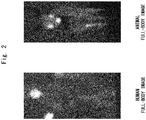
- Fig. 2 illustrates examples of full-body images of a human being and of an animal according to the first embodiment.
- Fig. 2 illustrates, from the left, an image in which a human being appears showing his/her front and an image in which an animal appears showing its front.
- These images are monochrome gray scale images captured at night with the use of a far-infrared light camera and expressing a difference in the radiation amount (intensity) of infrared radiation in the form of a difference in luminance.
- the face and hand portions where the skin is exposed and the thermal radiation is higher than that of the environment (background) have a higher luminance and result in white.
- a clothing portion where the thermal radiation is not much different from that of the environment has a medium luminance or a low luminance and results in gray or black.
- portions such as the head, the arms, and the legs where the skin is exposed have a higher luminance than a portion where the skin is not exposed.
- the image of the animal although there are some portions such as the eyes and the nose with a high luminance, the image as a whole has a medium luminance or a low luminance since almost the entire body is covered with fur.
- a comparison between the image of the human being and the image of the animal reveals that a white region where the thermal radiation is high appears in a larger number or in a larger area in the image of the human being than in the image of the animal.
- the display apparatus 40 warns the driver that a human being, an animal, or the like is present in the traveling direction of the host vehicle through an image, a sound, or the like.
- a portion of the configuration of the recognition apparatus 20 may be replaced by another apparatus connected via communication means (not illustrated).
- the recognition processing unit 22 and the dictionary data storage apparatus 30 may be replaced by another apparatus such as a recognition server connected via communication means.
- Each component implemented by the recognition apparatus 20 can be implemented, for example, by a program executed under the control of an arithmetic device (not illustrated), or a computer, included in the recognition apparatus 20.
- the recognition apparatus 20 loads a program stored in a storage unit (not illustrated) onto a main storage device (not illustrated), and executes the program under the control of the arithmetic device.
- each component is not limited to being implemented by software executed through a program and may instead be implemented by any combination of hardware, firmware, and software.
- the above program can be stored and provided to the recognition apparatus 20 with the use of various types of non-transitory computer readable media.
- the non-transitory computer readable media include various types of tangible storage media.
- non-transitory computer readable media examples include magnetic storage media (e.g., a flexible disk, a magnetic tape, a hard disk drive), optical magnetic storage media (e.g., a magneto-optical disk), CD-ROM (Read Only Memory), CD-R, CD-R/W, and semiconductor memories (e.g., a mask ROM, a PROM (Programmable ROM), an EPROM (Erasable PROM), a flash ROM, a RAM (random access memory)).
- magnetic storage media e.g., a flexible disk, a magnetic tape, a hard disk drive
- optical magnetic storage media e.g., a magneto-optical disk
- CD-ROM Read Only Memory
- CD-R Read Only Memory
- CD-R/W examples of the non-transitory computer readable media
- semiconductor memories e.g., a mask ROM, a PROM (Programmable ROM), an EPROM (Erasable PROM), a flash ROM, a RAM
- the program may be provided to the recognition apparatus 20 with the use of various types of transitory computer readable media.
- Examples of the transitory computer readable media include an electric signal, an optical signal, and an electromagnetic wave.
- the transitory computer readable media can provide the program to the recognition apparatus 20 via a wired communication line, such as an electric wire or an optical fiber, or a wireless communication line.
- Fig. 3 is a flowchart illustrating a processing procedure of the recognition method according to the first embodiment.
- the front view camera 10 captures an image of the traveling direction of the host vehicle, and the image acquisition unit 21 acquires the captured image as a recognition target image (step S10).
- the image acquisition unit 21 acquires the captured image that includes an image region where a human being or an animal appears, such as the ones illustrated in Fig. 2 , for example.
- the recognition processing unit 22 defines the entire captured image or a portion of the captured image as a recognition target region and detects a human being and an animal with the use of the human full-body recognition dictionary and the animal full-body recognition dictionary stored in the dictionary data storage apparatus 30 (step S20).
- the range for an object that can be a human being or an animal in the captured image is identified through edge detection processing or the like, for example.
- the recognition processing unit 22 determines whether the detection result in step S20 clearly indicates that the detected object is a human being or an animal (step S30).
- step S30 makes a determination on a case in which the detection result in step S20 does not clearly indicate whether the object is a human being or an animal, as in a case in which, for example, the probability that the object is a human being is 40% according to the human full-body recognition dictionary and the probability that the object is an animal is 60% according to the animal full-body recognition dictionary.
- a specific probability that serves as a reference for determining whether the detection result is clear may be set as desired. For example, when the probability that an object is one of a human being and an animal is 80% or higher and its difference from the probability that the object is the other one of a human being and an animal is 50% or higher, it may be clearly determined that the object is the one with a higher probability.
- step S30 When the recognition processing unit 22 has detected clearly either a human being or an animal (YES in step S30), the flow proceeds to step S50. Then, the display control unit 23 warns the driver of the presence of the human being or the animal detected clearly in step S20.
- the recognition processing unit 22 sets the range of this object as a target region and determines again whether the object is a human being or an animal based on a temperature variation within the region (step S40).
- the recognition processing unit 22 obtains, as the temperature variation within the target region, a lightness distribution indicated by pixels constituting a range that is recognized as a human being or an animal.
- the recognition processing unit 22 determines whether the object is a human being or an animal based on the detected temperature variation. The recognition processing unit 22 determines that the object is a human being when the temperature variation is greater than a predetermined value and determines that the object is an animal when the temperature variation is smaller than the predetermined value.
- an object is determined to be an animal because of a small temperature variation in the image captured by the far-infrared light camera in which, with regard to the lightness distribution indicated by the pixels constituting the range recognized as a human being or an animal, the gray range indicating a medium luminance is large and the white range indicating a high luminance is small.
- an object is determined to be a human being because of a large temperature variation in the image in which the gray range indicating a medium luminance is large and the white range indicating a high luminance is also large.
- the temperature variation within a target region becomes small even when an object is a human being or the temperature variation within a target region becomes large even when an object is an animal.
- the correspondence relationship between the magnitude of the temperature variation within a target region and the determination result as to whether an object is a human being or an animal can be determined in accordance with the environment, the image capturing condition, and so on.
- the recognition processing unit 22 determines that the object detected in step S20 is an animal.
- the recognition processing unit 22 determines that the object detected in step S20 is a human being.
- the recognition processing unit 22 may make a determination in a manner similar to the above.
- the display control unit 23 When the recognition processing unit 22 has detected a human being or an animal, the display control unit 23 notifies, through the display apparatus 40, the driver that a pedestrian or an animal has been detected.
- the recognition apparatus 20 determines whether to terminate the recognition processing (step S50). When the recognition apparatus 20 has determined to terminate the recognition processing (YES in step S50), the processing is terminated. When the recognition apparatus 20 has determined not to terminate the recognition processing (NO in step S50), the flow returns to step S10, for example.
- the recognition system 1 or the recognition method according to the first embodiment detects, with the use of a recognition dictionary, a human being or an animal in an image captured by a far-infrared camera.
- a recognition dictionary detects, with the use of a recognition dictionary, a human being or an animal in an image captured by a far-infrared camera.
- the recognition processing unit 22 may extract an upper region and a lower region in the target region and calculate a temperature variation between the upper region and the lower region, for example, a difference in the mean temperature between the upper region and the lower region.
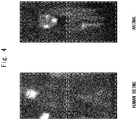
- Fig. 4 is an illustration for describing a method of extracting an upper region and a lower region according to the first embodiment.
- the extracted upper region and lower region are indicated by the respective dashed enclosures in each of the captured image.
- the method of extracting the upper region and the lower region is not limited to the illustrated one.
- the upper region and the lower region may be spaced apart from each other, or the upper region or the lower region may be spaced apart from the edges of the captured image.
- the upper region and the lower region are each a rectangular enclosure in Fig. 4 , with a region enclosed by a boundary between a range where an animal or a human being is detected and the background serving as a target region, an upper portion and a lower portion of that target region may serve as the upper region and the lower region, respectively.
- an upper region where the face appears has a larger white area
- a lower region where the clothing appears has a larger gray or black area.
- no large difference in color is observed between an upper region and a lower region.
- the recognition processing unit 22 detects a human being if the temperature difference between the upper region and the lower region is greater than a predetermined value and detects an animal when the temperature difference between the upper region and the lower region is smaller than the predetermined value.
- the recognition processing unit 22 may extract an upper region, a middle region, and a lower region from a target region and calculate a temperature variation between the upper region and the middle region.
- the method of extracting the upper region, the middle region, and the lower region can be set as desired, including a method in which the target region is equally divided into three.
- the recognition processing unit 22 may employ a method of determining whether an object is a human being or an animal based on the area of a portion constituted mainly by white pixels indicating a high luminance. For example, in the images illustrated in Fig. 2 , the ranges where the white pixels indicating a high luminance are concentrated are portions corresponding to the eyes, the nose, and so on in the image of the animal and portions corresponding to the face, the arms, the hands, and so on in the image of the human being.
- the area of the range where the white pixels are concentrated is small in the image of the animal and is large in the image of the human being in the target region where the object is recognized as the human being or the animal. Accordingly, it is possible to determine whether an object is a human being or an animal by determining whether the proportion of the area of the range where the white pixels are concentrated relative to the target region where the object is recognized as the human being or the animal is no lower than a predetermined threshold or lower than the predetermined threshold.
- the recognition processing unit 22 may detect the face or the head of the human being or of the animal from the image within the target region with the use of the human face recognition dictionary, the human head recognition dictionary, the animal face recognition dictionary, or the animal head recognition dictionary and calculate the temperature variation between the face or head region and a region other than the face or the head.
- step S40 the recognition processing unit 22 detects a human being if the temperature difference between the face or head region and the region other than the face or head region is greater than a predetermined value and detects an animal when the temperature difference between the face or head region and the region other than the face or head region is smaller than the predetermined value.
- the recognition processing unit 22 may omit the process (step S30) of determining the next procedure upon having determined whether it is clear that the object detected in step S20 is a human being or an animal, and the recognition processing unit 22 may mandatorily perform the process (step S40) of detecting a human being or an animal based on the temperature variation within the target region after the process (step S20) of detecting a human being and an animal from the captured image with the use of a recognition dictionary.
- the recognition processing unit 22 may make a determination upon giving a certain weight on the detection result of step S20.
- the recognition processing unit 22 may calculate the distance from the host vehicle to the human being or the animal or the size of the human being or the animal based on the position or the size of the target region or a detection frame enclosing the target region in the image and notify the driver.
- the distance to the human being or the animal is calculated based on the size of the target region or the detection frame enclosing the target region, for example, the distance is calculated with an assumption that the height of the human being is 1.7 m and the body length of the animal is 1.0 m. This leads to a difference of 170% in the calculated distance between when a human being is detected and when an animal is detected within the same detection frame. Accordingly, by accurately distinguishing between a human being and an animal with the recognition system 1 according to the first embodiment, the distance to the detected human being, animal, or the like can be calculated with higher accuracy.
- the display control unit 23 may change the method in which the display control unit 23 notifies the driver between when a human being, such as a pedestrian, is detected and when an animal is detected. For example, animals may be present in groups or an animal may take an unpredictable action, such as running into a road. Therefore, when an animal is detected, the display control unit 23 may provide an early notification to the driver.
- the configuration of the recognition system 1 is not limited to the one described above.
- a plurality of apparatuses such as the recognition apparatus 20 and the dictionary data storage apparatus 30, may be integrated into a unit to serve as a recognition apparatus provided with a dictionary data storage unit.
- all the components of the recognition system 1 may be integrated into a unit to serve as a recognition apparatus provided with a front view camera, a dictionary data storage unit, and a display unit.
- the recognition system 1 may be configured as a human recognition system, an animal recognition system, a human and animal distinguishing system, or the like.
- a mode in which the part of the whole of the recognition system 1 is mounted in a vehicle a mode in which the recognition system 1 is portably mounted or is custom installable may also be employed.
- the recognition system 1 may be installed, for example, in a building, and a camera may be provided in front of an automatic door or the like to determine whether to open or close the automatic door.
- the automatic door is opened only when the object is determined to be a human being, and the automatic door is closed when the object is determined to be an animal.
- the recognition processing unit 22 may perform different image recognition, such as pattern matching with the use of a template of a human being, an animal, or the like, for example.
- the recognition apparatus 20 includes the image acquisition unit 21 that acquires an image captured by the far-infrared camera 10 and the recognition processing unit 22 that sets a target region in the image and determines whether an object in the target region is a human being or an animal based on the temperature variation in the target region.
- the recognition processing unit 22 can detect a human being or an animal in the image with the use of the human full-body recognition dictionary and the animal full-body recognition dictionary.
- the recognition processing unit 22 can set a detection range at the time when a human being or an animal is detected as the target region and determine whether the object in the target region is a human being or an animal based on the temperature variation in the target region.
- the recognition processing unit 22 can use a temperature difference between an upper portion and a middle portion in the target region as the temperature variation in the target region.
- the recognition processing unit 22 can detect the face or the head in the target region with the use of a face recognition dictionary or a head recognition dictionary and use a temperature difference between the face or head region and a region other than the face or the head in the target region as the temperature variation in the target region.
- the recognition processing unit 22 can use the area of a region where the temperature is high in the target region as the temperature variation in the target region.
- the recognition method includes step S10 of acquiring an image captured by a far-infrared camera and step S40 of setting a target region in the image and determining whether an object in the target region is a human being or an animal based on a temperature variation in the target region.
- the recognition system 1 and the recognition method according to the first embodiment detect, with the use of a recognition dictionary, a human being or an animal in an image captured by the far-infrared camera 10. When it cannot be determined clearly whether an object is a human being or an animal, whether the object is a human being or an animal is determined based on a temperature variation within a target region.
- a recognition system and a recognition method set a target region in an image captured by a far-infrared camera, determine whether an object is a human being or an animal based on a temperature variation within the target region, and again detect, based on the determination result, a human being or an animal in the image of the target region with the use of a recognition dictionary.
- An overall configuration of the recognition system according to the second embodiment is similar to the overall configuration of the recognition system 1 according to the first embodiment, and thus illustration and detailed descriptions thereof will be omitted here.
- the reference characters of the components in the recognition system 1 according to the first embodiment are used as-is as the reference characters of the corresponding components in the recognition system according to the second embodiment.
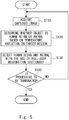
- Fig. 5 is a flowchart illustrating a processing procedure of the recognition method according to the second embodiment.
- the front view camera 10 captures an image of the traveling direction of the host vehicle, and the image acquisition unit 21 acquires the captured image as a recognition target image (step S110).
- the recognition processing unit 22 sets a region that includes a portion where the temperature is high in the captured image as a target region and determines whether an object in the target region is a human being or an animal based on a temperature variation in the target region (step S120).
- the recognition processing unit 22 can set a region with a predetermined size centered on a portion where the temperature is high in the captured image as the target region or can scan a region with a predetermined size in the captured image and set a portion where the mean temperature is high in that region as the target region, for example. In this manner, any method may be employed to set the target region, or a plurality of target regions may be set.
- the determination method through which the recognition processing unit 22 determines whether an object is a human being or an animal based on the temperature variation in the target region may be similar to the determination method according to the first embodiment.
- step S120 The determination in step S120 is made before detection is performed with the use of a recognition dictionary, and thus there may be a case in which whether an object is a human being or an animal cannot be confirmed. Accordingly, the recognition processing unit 22 determines whether an object is a human being or an animal in step S120, and then the flow proceeds to step S130.
- the recognition processing unit 22 again detects a human being and an animal in the target region with the use of the human full-body recognition dictionary and the animal full-body recognition dictionary stored in the dictionary data storage apparatus 30 (step S130).
- the detection method employed in this case may be similar to the detection method according to the first embodiment.
- the recognition processing unit 22 determines clearly whether what is detected in step S120 is a human being or an animal based on the detection results in step S120 and step S130.
- the display control unit 23 When the recognition processing unit 22 has detected a human being or an animal, the display control unit 23 notifies the driver that a pedestrian or an animal has been detected via the display apparatus 40.
- step S140 determines whether to terminate the recognition method.
- the processing is terminated.
- the recognition apparatus 20 has determined not to terminate the recognition method (NO in step S140)
- the flow returns to step S110, for example.
- the recognition system 1 or the recognition method according to the second embodiment sets a target region in an image captured by a far-infrared camera, detects a human being or an animal based on a temperature variation within the target region, and again detects a human being or an animal in the image of the target region with the use of a recognition dictionary.
- a human being and an animal can be detected and distinguished therebetween with high accuracy.
- the recognition processing unit 22 may detect the human being with the use of only the human full-body recognition dictionary in step S130.
- the recognition processing unit 22 may detect the animal with the use of only the animal full-body recognition dictionary in step S130.
- the processing load can be reduced as compared to a case where a plurality of recognition dictionaries are used, and false detection between a human and an animal can be reduced.
- a process of determining whether the determination result that is based on the temperature variation is clear may be added. For example, when the determination result that is based on the process (step S120) of determining whether the objects is a human being or an animal based on the temperature variation within the target region clearly indicates that the objects is a human being or an animal, the flow may proceed to step S140. When the determination result is not clear, the process (step S130) of detecting a human being or an animal in the target region with the use of a recognition dictionary may be performed.
- the recognition processing unit 22 can set a region where the temperature is high in a captured image as a target region, determine whether an object is a human being or an animal based on a temperature variation, and detect, when it is not determined clearly whether the object is a human being or an animal, a human being or an animal in the target region with the use of the human full-body recognition dictionary and the animal full-body recognition dictionary.
- the present invention can be used to recognize an environment surrounding a moving object.
Landscapes
- Engineering & Computer Science (AREA)
- Physics & Mathematics (AREA)
- General Physics & Mathematics (AREA)
- Theoretical Computer Science (AREA)
- Multimedia (AREA)
- Human Computer Interaction (AREA)
- Computer Vision & Pattern Recognition (AREA)
- Health & Medical Sciences (AREA)
- General Health & Medical Sciences (AREA)
- Oral & Maxillofacial Surgery (AREA)
- Image Analysis (AREA)
- Traffic Control Systems (AREA)
Abstract
Description
- The present invention relates to a recognition apparatus, a recognition method, and a recognition program.
- A safety support apparatus that recognizes a situation surrounding a vehicle with the use of an image captured by an on-board camera and warns a driver is widely available. Such a safety support apparatus recognizes, with the use of a recognition dictionary or the like, an object in the vicinity of a host vehicle based on an image captured by a camera.
- For example,
Patent Literature 1 describes a vehicle periphery monitoring apparatus. This vehicle periphery monitoring apparatus extracts an image region of an object from a captured image. When this region includes a first object region of which the ratio of the widths in different directions falls within a predetermined range and a plurality of second object regions located below the first object region and having an area smaller than that of the first object region, the vehicle periphery monitoring apparatus determines that the type of the object is an animal other than a human being. - Patent Literature 1: Japanese Unexamined Patent Application Publication No.
2007-310705 - The invention described in
Patent Literature 1 determines, when an object is an animal other than a human being, that the object is an animal based on the characteristics (the sizes of the torso and the front and rear legs, the aspect ratio thereof, the positional relationship thereof, etc.) observed when the animal is facing sideways. Generally, when an animal appears in an image facing sideways, that is, when an animal appears in an image showing its side, the characteristics of the animal completely differ from the characteristics of a human being. Therefore, false detection between a human being and an animal rarely occurs. - However, when a human being or an animal appears in an image showing his/her or its front or back, the human being and the animal may show many similar characteristics, and thus false detection between a human being and an animal may occur.
- The present invention has been made to address such a problem and is directed to providing a recognition apparatus, a recognition method, and a recognition program that, even when a human being or an animal appears in an image showing his/her or its front or back, can correctly determine whether it is a human being or an animal that appears in the image.
- Accordingly, the embodiments provide a recognition apparatus that includes an image acquisition unit configured to acquire an image captured by a far-infrared camera and a recognition processing unit configured to set a target region in the image and determine whether an object in the target region is a human being or an animal based on a temperature variation in the target region.
- Furthermore, the embodiments provide a recognition method that includes a step of acquiring an image captured by a far-infrared camera and a step of setting a target region in the image and determining whether an object in the target region is a human being or an animal based on a temperature variation in the target region.
- The embodiments can provide a recognition apparatus, a recognition method, and a recognition program that, even when a human being or an animal appears in an image showing his/her or its front or back, correctly determines whether it is a human being or an animal that appears in the image.
-
-
Fig. 1 is a block diagram illustrating a schematic configuration of arecognition system 1 according to a first embodiment; -
Fig. 2 illustrates examples of full-body images of a human being and of an animal according to the first embodiment; -
Fig. 3 is a flowchart illustrating a processing procedure of a recognition method according to the first embodiment; -
Fig. 4 is an illustration for describing a method of extracting an upper region and a lower region according to the first embodiment; and -
Fig. 5 is a flowchart illustrating a processing procedure of a recognition method according to a second embodiment. - Hereinafter, a recognition system and a recognition method according to some embodiments will be described with reference to the drawings.
- The term "image" used in the present specification includes a still image and a moving image.
- The term "animal" used in the present specification refers to any animal excluding a human being.
- A recognition system and a recognition method according to a first embodiment detects, with the use of a recognition dictionary, a human being or an animal in an image of a traveling direction and so on of a host vehicle captured by a far-infrared camera. When it cannot be determined clearly whether an object is a human being or an animal, whether the object is a human being or an animal is determined based on a temperature variation within a detection range at the time when the human being or the animal is detected.
- First, a configuration of the recognition system according to the first embodiment will be described.
-
Fig. 1 is a block diagram illustrating a schematic configuration of arecognition system 1 according to the first embodiment. - The
recognition system 1 is, for example, a system to be mounted in a vehicle for use. Therecognition system 1 includes afront view camera 10, arecognition apparatus 20, a dictionarydata storage apparatus 30, and adisplay apparatus 40. - The
recognition system 1 can be used as, aside from a system to be mounted in a vehicle for use, various systems, including a mobile terminal, a drone, and a robot, that are intended to recognize an object with the use of a far-infrared camera. In the following embodiment, a system to be mounted in a vehicle for use serves as an example. - The
front view camera 10 captures an image of the traveling direction of the host vehicle and inputs the image into therecognition apparatus 20. Thefront view camera 10 is a far-infrared light camera but may also be a camera that uses another wavelength range. For example, thefront view camera 10 may be a combination of a visible light camera and a far-infrared light camera. - The
recognition apparatus 20 detects a human being and an animal with the use of an image captured by thefront view camera 10 and outputs a warning signal to thedisplay apparatus 40 and so on, if necessary. Therecognition apparatus 20 detects a human being and an animal, for example, in every frame or every several frames of the image captured by thefront view camera 10. To this end, therecognition apparatus 20 includes an image acquisition unit 21, arecognition processing unit 22, and adisplay control unit 23. - The image acquisition unit 21 receives an input of the image captured by the
front view camera 10, performs various types of image processing on the image, and outputs a resulting image to therecognition processing unit 22. - The
recognition processing unit 22 detects a human being or an animal in the received image with the use of a human recognition dictionary and an animal recognition dictionary stored in the dictionarydata storage apparatus 30. In addition, therecognition processing unit 22 determines whether an object in a target region set in the received image is a human being or an animal based on a temperature variation within the region. Furthermore, therecognition processing unit 22, upon having determined whether the object is a human being or an animal, outputs a signal to thedisplay control unit 23 so as to warn the driver, if necessary. - The
display control unit 23 performs control for displaying a warning image on thedisplay apparatus 40 or outputting a warning sound. - The dictionary
data storage apparatus 30 stores various recognition dictionaries, including the human recognition dictionary and the animal recognition dictionary. - The human recognition dictionary includes a human full-body recognition dictionary, a human face recognition dictionary, and a human head recognition dictionary. Meanwhile, the animal recognition dictionary includes an animal full-body recognition dictionary, an animal face recognition dictionary, and an animal head recognition dictionary.
- The human full-body recognition dictionary or the animal full-body recognition dictionary is created through machine learning of a full-body image in which a pedestrian or an animal appears showing his/her or its front or back and a full-body image in which the pedestrian or the animal shows his/her or its side, that is, a full-body image in which the pedestrian or the animal appears facing sideways.
- Meanwhile, the human face recognition dictionary, the human head recognition dictionary, the animal face recognition dictionary, and the animal head recognition dictionary are created through machine learning of an image in which the face or the head of a human being or of an animal appears or an image of the face or head portion cut out from a full-body image of a human being or an animal.
- When a human being or an animal is to be detected in an image, a detection range enclosing a detection target or a rectangular detection range including a detection target is identified with the use of edge detection processing or the like, and recognition processing is performed on this detection range.
-
Fig. 2 illustrates examples of full-body images of a human being and of an animal according to the first embodiment.Fig. 2 illustrates, from the left, an image in which a human being appears showing his/her front and an image in which an animal appears showing its front. These images are monochrome gray scale images captured at night with the use of a far-infrared light camera and expressing a difference in the radiation amount (intensity) of infrared radiation in the form of a difference in luminance. - In the image of the human being, the face and hand portions where the skin is exposed and the thermal radiation is higher than that of the environment (background) have a higher luminance and result in white. A clothing portion where the thermal radiation is not much different from that of the environment has a medium luminance or a low luminance and results in gray or black. In other words, in the image of the human being, portions such as the head, the arms, and the legs where the skin is exposed have a higher luminance than a portion where the skin is not exposed.
- In contrast, in the image of the animal, although there are some portions such as the eyes and the nose with a high luminance, the image as a whole has a medium luminance or a low luminance since almost the entire body is covered with fur.
- A comparison between the image of the human being and the image of the animal reveals that a white region where the thermal radiation is high appears in a larger number or in a larger area in the image of the human being than in the image of the animal.
- The
display apparatus 40 warns the driver that a human being, an animal, or the like is present in the traveling direction of the host vehicle through an image, a sound, or the like. - A portion of the configuration of the
recognition apparatus 20 may be replaced by another apparatus connected via communication means (not illustrated). For example, therecognition processing unit 22 and the dictionarydata storage apparatus 30 may be replaced by another apparatus such as a recognition server connected via communication means. - Each component implemented by the
recognition apparatus 20 can be implemented, for example, by a program executed under the control of an arithmetic device (not illustrated), or a computer, included in therecognition apparatus 20. To be more specific, therecognition apparatus 20 loads a program stored in a storage unit (not illustrated) onto a main storage device (not illustrated), and executes the program under the control of the arithmetic device. - Furthermore, each component is not limited to being implemented by software executed through a program and may instead be implemented by any combination of hardware, firmware, and software.
- The above program can be stored and provided to the
recognition apparatus 20 with the use of various types of non-transitory computer readable media. The non-transitory computer readable media include various types of tangible storage media. - Examples of the non-transitory computer readable media include magnetic storage media (e.g., a flexible disk, a magnetic tape, a hard disk drive), optical magnetic storage media (e.g., a magneto-optical disk), CD-ROM (Read Only Memory), CD-R, CD-R/W, and semiconductor memories (e.g., a mask ROM, a PROM (Programmable ROM), an EPROM (Erasable PROM), a flash ROM, a RAM (random access memory)).
- Furthermore, the program may be provided to the
recognition apparatus 20 with the use of various types of transitory computer readable media. Examples of the transitory computer readable media include an electric signal, an optical signal, and an electromagnetic wave. The transitory computer readable media can provide the program to therecognition apparatus 20 via a wired communication line, such as an electric wire or an optical fiber, or a wireless communication line. - Next, an operation of the
recognition system 1 according to the first embodiment, that is, a recognition method, will be described. -
Fig. 3 is a flowchart illustrating a processing procedure of the recognition method according to the first embodiment. - Upon the
recognition system 1 starting to operate, thefront view camera 10 captures an image of the traveling direction of the host vehicle, and the image acquisition unit 21 acquires the captured image as a recognition target image (step S10). The image acquisition unit 21 acquires the captured image that includes an image region where a human being or an animal appears, such as the ones illustrated inFig. 2 , for example. - Then, the
recognition processing unit 22 defines the entire captured image or a portion of the captured image as a recognition target region and detects a human being and an animal with the use of the human full-body recognition dictionary and the animal full-body recognition dictionary stored in the dictionary data storage apparatus 30 (step S20). In step S20, the range for an object that can be a human being or an animal in the captured image is identified through edge detection processing or the like, for example. - Next, the
recognition processing unit 22 determines whether the detection result in step S20 clearly indicates that the detected object is a human being or an animal (step S30). - The processing of step S30 makes a determination on a case in which the detection result in step S20 does not clearly indicate whether the object is a human being or an animal, as in a case in which, for example, the probability that the object is a human being is 40% according to the human full-body recognition dictionary and the probability that the object is an animal is 60% according to the animal full-body recognition dictionary.
- A specific probability that serves as a reference for determining whether the detection result is clear may be set as desired. For example, when the probability that an object is one of a human being and an animal is 80% or higher and its difference from the probability that the object is the other one of a human being and an animal is 50% or higher, it may be clearly determined that the object is the one with a higher probability.
- When the
recognition processing unit 22 has detected clearly either a human being or an animal (YES in step S30), the flow proceeds to step S50. Then, thedisplay control unit 23 warns the driver of the presence of the human being or the animal detected clearly in step S20. - Meanwhile, when the
recognition processing unit 22 cannot recognize clearly whether the object is a human being or an animal (NO in step S30), therecognition processing unit 22 sets the range of this object as a target region and determines again whether the object is a human being or an animal based on a temperature variation within the region (step S40). - For example, the
recognition processing unit 22 obtains, as the temperature variation within the target region, a lightness distribution indicated by pixels constituting a range that is recognized as a human being or an animal. - Then, the
recognition processing unit 22 determines whether the object is a human being or an animal based on the detected temperature variation. Therecognition processing unit 22 determines that the object is a human being when the temperature variation is greater than a predetermined value and determines that the object is an animal when the temperature variation is smaller than the predetermined value. - This is because, when an object is a human being, a large temperature difference is present between a skin portion and a clothing portion, and thus the temperature variation within the target region, for example, the standard deviation of the temperature is large; whereas, when an object is an animal, the entire body is covered with fur, and the overall temperature difference is small, and thus, the temperature variation within the target region is small, as described with reference to
Fig. 2 . - Specifically, an object is determined to be an animal because of a small temperature variation in the image captured by the far-infrared light camera in which, with regard to the lightness distribution indicated by the pixels constituting the range recognized as a human being or an animal, the gray range indicating a medium luminance is large and the white range indicating a high luminance is small. In contrast, an object is determined to be a human being because of a large temperature variation in the image in which the gray range indicating a medium luminance is large and the white range indicating a high luminance is also large.
- It is of course possible that, depending on the time of the day, the season, the environment such as an indoor or outdoor environment, the image capturing condition, and so on, the temperature variation within a target region becomes small even when an object is a human being or the temperature variation within a target region becomes large even when an object is an animal. The correspondence relationship between the magnitude of the temperature variation within a target region and the determination result as to whether an object is a human being or an animal can be determined in accordance with the environment, the image capturing condition, and so on.
- When the
recognition processing unit 22 has detected an animal in step S40 while the probability that a human being is detected is higher than the probability that an animal is detected in step S20 but therecognition processing unit 22 cannot determine clearly that the object is a human being, therecognition processing unit 22 determines that the object detected in step S20 is an animal. - When the
recognition processing unit 22 has detected a human being in step S40 while the probability that a human being is detected is higher than the probability that an animal is detected in step S20 but therecognition processing unit 22 cannot determine clearly that the object is a human being, therecognition processing unit 22 determines that the object detected in step S20 is a human being. - When the probability that an animal is detected is higher than the probability that a human being is detected in step S20 but the
recognition processing unit 22 cannot determine clearly that the object is an animal, therecognition processing unit 22 may make a determination in a manner similar to the above. - When the
recognition processing unit 22 has detected a human being or an animal, thedisplay control unit 23 notifies, through thedisplay apparatus 40, the driver that a pedestrian or an animal has been detected. - Next, the
recognition apparatus 20 determines whether to terminate the recognition processing (step S50). When therecognition apparatus 20 has determined to terminate the recognition processing (YES in step S50), the processing is terminated. When therecognition apparatus 20 has determined not to terminate the recognition processing (NO in step S50), the flow returns to step S10, for example. - In this manner, the
recognition system 1 or the recognition method according to the first embodiment detects, with the use of a recognition dictionary, a human being or an animal in an image captured by a far-infrared camera. When it cannot be determined clearly whether an object is a human being or an animal, whether the object is a human being or an animal is determined based on a temperature variation within a detection range at the time when the human being or the animal is detected. Therefore, a human being and an animal can be detected and distinguished therebetween with high accuracy. - It is to be noted that various additions, modifications, and changes can be made to the
recognition system 1 and the recognition method according to the first embodiment. - For example, when the
recognition processing unit 22 determines whether an object is a human being or an animal based on the temperature variation within the target region (step S40), in addition to calculating the temperature variation within the entire target region as described above or in place of calculating the temperature variation within the entire target region, therecognition processing unit 22 may extract an upper region and a lower region in the target region and calculate a temperature variation between the upper region and the lower region, for example, a difference in the mean temperature between the upper region and the lower region. -
Fig. 4 is an illustration for describing a method of extracting an upper region and a lower region according to the first embodiment. The extracted upper region and lower region are indicated by the respective dashed enclosures in each of the captured image. Of course, the method of extracting the upper region and the lower region is not limited to the illustrated one. The upper region and the lower region may be spaced apart from each other, or the upper region or the lower region may be spaced apart from the edges of the captured image. - Although the upper region and the lower region are each a rectangular enclosure in
Fig. 4 , with a region enclosed by a boundary between a range where an animal or a human being is detected and the background serving as a target region, an upper portion and a lower portion of that target region may serve as the upper region and the lower region, respectively. - In an image of a human being, an upper region where the face appears has a larger white area, and a lower region where the clothing appears has a larger gray or black area. Meanwhile, in an image of an animal, no large difference in color is observed between an upper region and a lower region.
- Accordingly, the
recognition processing unit 22 detects a human being if the temperature difference between the upper region and the lower region is greater than a predetermined value and detects an animal when the temperature difference between the upper region and the lower region is smaller than the predetermined value. - In place of extracting an upper region and a lower region from a target region, the
recognition processing unit 22 may extract an upper region, a middle region, and a lower region from a target region and calculate a temperature variation between the upper region and the middle region. The method of extracting the upper region, the middle region, and the lower region can be set as desired, including a method in which the target region is equally divided into three. - With regard to another determination method that is based on a temperature variation, the
recognition processing unit 22 may employ a method of determining whether an object is a human being or an animal based on the area of a portion constituted mainly by white pixels indicating a high luminance. For example, in the images illustrated inFig. 2 , the ranges where the white pixels indicating a high luminance are concentrated are portions corresponding to the eyes, the nose, and so on in the image of the animal and portions corresponding to the face, the arms, the hands, and so on in the image of the human being. - Therefore, the area of the range where the white pixels are concentrated is small in the image of the animal and is large in the image of the human being in the target region where the object is recognized as the human being or the animal. Accordingly, it is possible to determine whether an object is a human being or an animal by determining whether the proportion of the area of the range where the white pixels are concentrated relative to the target region where the object is recognized as the human being or the animal is no lower than a predetermined threshold or lower than the predetermined threshold.
- When the
recognition processing unit 22 determines whether an object is a human being or an animal based on the temperature variation within the target region (step S40), therecognition processing unit 22 may detect the face or the head of the human being or of the animal from the image within the target region with the use of the human face recognition dictionary, the human head recognition dictionary, the animal face recognition dictionary, or the animal head recognition dictionary and calculate the temperature variation between the face or head region and a region other than the face or the head. - In this case, in step S40, the
recognition processing unit 22 detects a human being if the temperature difference between the face or head region and the region other than the face or head region is greater than a predetermined value and detects an animal when the temperature difference between the face or head region and the region other than the face or head region is smaller than the predetermined value. - The
recognition processing unit 22 may omit the process (step S30) of determining the next procedure upon having determined whether it is clear that the object detected in step S20 is a human being or an animal, and therecognition processing unit 22 may mandatorily perform the process (step S40) of detecting a human being or an animal based on the temperature variation within the target region after the process (step S20) of detecting a human being and an animal from the captured image with the use of a recognition dictionary. - Then, when determining whether the object is a human being or an animal in step S40, the
recognition processing unit 22 may make a determination upon giving a certain weight on the detection result of step S20. - Furthermore, when the
recognition processing unit 22 has detected a human being or an animal (step S20, step S40), therecognition processing unit 22 may calculate the distance from the host vehicle to the human being or the animal or the size of the human being or the animal based on the position or the size of the target region or a detection frame enclosing the target region in the image and notify the driver. - When the distance to the human being or the animal is calculated based on the size of the target region or the detection frame enclosing the target region, for example, the distance is calculated with an assumption that the height of the human being is 1.7 m and the body length of the animal is 1.0 m. This leads to a difference of 170% in the calculated distance between when a human being is detected and when an animal is detected within the same detection frame. Accordingly, by accurately distinguishing between a human being and an animal with the
recognition system 1 according to the first embodiment, the distance to the detected human being, animal, or the like can be calculated with higher accuracy. - The
display control unit 23 may change the method in which thedisplay control unit 23 notifies the driver between when a human being, such as a pedestrian, is detected and when an animal is detected. For example, animals may be present in groups or an animal may take an unpredictable action, such as running into a road. Therefore, when an animal is detected, thedisplay control unit 23 may provide an early notification to the driver. - The configuration of the
recognition system 1 is not limited to the one described above. A plurality of apparatuses, such as therecognition apparatus 20 and the dictionarydata storage apparatus 30, may be integrated into a unit to serve as a recognition apparatus provided with a dictionary data storage unit. In addition, all the components of therecognition system 1 may be integrated into a unit to serve as a recognition apparatus provided with a front view camera, a dictionary data storage unit, and a display unit. Of course, therecognition system 1 may be configured as a human recognition system, an animal recognition system, a human and animal distinguishing system, or the like. - With regard to the use in vehicles, in addition to a mode in which the part of the whole of the
recognition system 1 is mounted in a vehicle, a mode in which therecognition system 1 is portably mounted or is custom installable may also be employed. - Aside from being installed in a vehicle, the
recognition system 1 may be installed, for example, in a building, and a camera may be provided in front of an automatic door or the like to determine whether to open or close the automatic door. In this case, in one possible determination, the automatic door is opened only when the object is determined to be a human being, and the automatic door is closed when the object is determined to be an animal. - In place of performing image recognition with the use of a dictionary created through machine learning of an image of a human being, an animal, or the like, or in addition to performing image recognition with the use of a dictionary created through machine learning, the
recognition processing unit 22 may perform different image recognition, such as pattern matching with the use of a template of a human being, an animal, or the like, for example. - As described thus far, the
recognition apparatus 20 according to the first embodiment includes the image acquisition unit 21 that acquires an image captured by the far-infrared camera 10 and therecognition processing unit 22 that sets a target region in the image and determines whether an object in the target region is a human being or an animal based on the temperature variation in the target region. - In the
recognition apparatus 20 according to the first embodiment, therecognition processing unit 22 can detect a human being or an animal in the image with the use of the human full-body recognition dictionary and the animal full-body recognition dictionary. When therecognition processing unit 22 cannot determine whether the object is a human being or an animal, therecognition processing unit 22 can set a detection range at the time when a human being or an animal is detected as the target region and determine whether the object in the target region is a human being or an animal based on the temperature variation in the target region. - Furthermore, in the
recognition apparatus 20 according to the first embodiment, therecognition processing unit 22 can use a temperature difference between an upper portion and a middle portion in the target region as the temperature variation in the target region. - In addition, in the
recognition apparatus 20 according to the first embodiment, therecognition processing unit 22 can detect the face or the head in the target region with the use of a face recognition dictionary or a head recognition dictionary and use a temperature difference between the face or head region and a region other than the face or the head in the target region as the temperature variation in the target region. - Furthermore, in the
recognition apparatus 20 according to the first embodiment, therecognition processing unit 22 can use the area of a region where the temperature is high in the target region as the temperature variation in the target region. - The recognition method according to the first embodiment includes step S10 of acquiring an image captured by a far-infrared camera and step S40 of setting a target region in the image and determining whether an object in the target region is a human being or an animal based on a temperature variation in the target region.
- The
recognition system 1 and the recognition method according to the first embodiment detect, with the use of a recognition dictionary, a human being or an animal in an image captured by the far-infrared camera 10. When it cannot be determined clearly whether an object is a human being or an animal, whether the object is a human being or an animal is determined based on a temperature variation within a target region. - In contrast, a recognition system and a recognition method according to a second embodiment set a target region in an image captured by a far-infrared camera, determine whether an object is a human being or an animal based on a temperature variation within the target region, and again detect, based on the determination result, a human being or an animal in the image of the target region with the use of a recognition dictionary.
- An overall configuration of the recognition system according to the second embodiment is similar to the overall configuration of the
recognition system 1 according to the first embodiment, and thus illustration and detailed descriptions thereof will be omitted here. In the following, to simplify the description, the reference characters of the components in therecognition system 1 according to the first embodiment are used as-is as the reference characters of the corresponding components in the recognition system according to the second embodiment. - An operation of the
recognition system 1 according to the second embodiment, that is, a recognition method, will be described.
Fig. 5 is a flowchart illustrating a processing procedure of the recognition method according to the second embodiment. - Upon the
recognition system 1 starting to operate, thefront view camera 10 captures an image of the traveling direction of the host vehicle, and the image acquisition unit 21 acquires the captured image as a recognition target image (step S110). - Then, the
recognition processing unit 22 sets a region that includes a portion where the temperature is high in the captured image as a target region and determines whether an object in the target region is a human being or an animal based on a temperature variation in the target region (step S120). - The
recognition processing unit 22 can set a region with a predetermined size centered on a portion where the temperature is high in the captured image as the target region or can scan a region with a predetermined size in the captured image and set a portion where the mean temperature is high in that region as the target region, for example. In this manner, any method may be employed to set the target region, or a plurality of target regions may be set. - The determination method through which the
recognition processing unit 22 determines whether an object is a human being or an animal based on the temperature variation in the target region may be similar to the determination method according to the first embodiment. - The determination in step S120 is made before detection is performed with the use of a recognition dictionary, and thus there may be a case in which whether an object is a human being or an animal cannot be confirmed. Accordingly, the
recognition processing unit 22 determines whether an object is a human being or an animal in step S120, and then the flow proceeds to step S130. - Then, the
recognition processing unit 22 again detects a human being and an animal in the target region with the use of the human full-body recognition dictionary and the animal full-body recognition dictionary stored in the dictionary data storage apparatus 30 (step S130). The detection method employed in this case may be similar to the detection method according to the first embodiment. - In this manner, the
recognition processing unit 22 determines clearly whether what is detected in step S120 is a human being or an animal based on the detection results in step S120 and step S130. - When the
recognition processing unit 22 has detected a human being or an animal, thedisplay control unit 23 notifies the driver that a pedestrian or an animal has been detected via thedisplay apparatus 40. - Next, the
recognition apparatus 20 determines whether to terminate the recognition method (step S140). When therecognition apparatus 20 has determined to terminate the recognition method (YES in step S140), the processing is terminated. When therecognition apparatus 20 has determined not to terminate the recognition method (NO in step S140), the flow returns to step S110, for example. - In this manner, the
recognition system 1 or the recognition method according to the second embodiment sets a target region in an image captured by a far-infrared camera, detects a human being or an animal based on a temperature variation within the target region, and again detects a human being or an animal in the image of the target region with the use of a recognition dictionary. Thus, a human being and an animal can be detected and distinguished therebetween with high accuracy. - It is to be noted that various additions, modifications, and changes can be made to the
recognition system 1 or the recognition method according to the second embodiment as well. - For example, when the
recognition processing unit 22 has determined that the object is a human being in step S120, therecognition processing unit 22 may detect the human being with the use of only the human full-body recognition dictionary in step S130. When therecognition processing unit 22 has determined that the object is an animal in step S120, therecognition processing unit 22 may detect the animal with the use of only the animal full-body recognition dictionary in step S130. - In this manner, if only an optimal recognition dictionary is used, the processing load can be reduced as compared to a case where a plurality of recognition dictionaries are used, and false detection between a human and an animal can be reduced.
- When the
recognition processing unit 22 has determined that the object is either a human being or an animal in step S120, a process of determining whether the determination result that is based on the temperature variation is clear may be added. For example, when the determination result that is based on the process (step S120) of determining whether the objects is a human being or an animal based on the temperature variation within the target region clearly indicates that the objects is a human being or an animal, the flow may proceed to step S140. When the determination result is not clear, the process (step S130) of detecting a human being or an animal in the target region with the use of a recognition dictionary may be performed. - As described thus far, in the
recognition apparatus 20 according to the second embodiment, therecognition processing unit 22 can set a region where the temperature is high in a captured image as a target region, determine whether an object is a human being or an animal based on a temperature variation, and detect, when it is not determined clearly whether the object is a human being or an animal, a human being or an animal in the target region with the use of the human full-body recognition dictionary and the animal full-body recognition dictionary. - This application claims priority to Japanese Patent Application No.
2018-081071, filed on April 20, 2018 - The present invention can be used to recognize an environment surrounding a moving object.
-
- 1
- RECOGNITION SYSTEM
- 10
- FRONT VIEW CAMERA
- 20
- RECOGNITION APPARATUS
- 21
- IMAGE ACQUISITION UNIT
- 22
- RECOGNITION PROCESSING UNIT
- 23
- DISPLAY CONTROL UNIT
- 30
- DICTIONARY DATA STORAGE APPARATUS
- 40
- DISPLAY APPARATUS
Claims (8)
- A recognition apparatus comprising:an image acquisition unit configured to acquire an image captured by a far-infrared camera; anda recognition processing unit configured to set a target region in the image and determine whether an object in the target region is a human being or an animal based on a temperature variation in the target region.
- The recognition apparatus according to Claim 1, wherein the recognition processing unit
detects the human being or the animal in the image with the use of a human full-body recognition dictionary and an animal full-body recognition dictionary, and
when it cannot be determined whether the object is the human being or the animal, sets, as the target region, a detection range at the time when the human being or the animal is detected and determines whether the object is the human being or the animal based on the temperature variation in the target region. - The recognition apparatus according to Claim 1, wherein the recognition processing unit
sets, as the target region, a region where a predetermined condition is satisfied in the image,
determines whether the object is the human being or the animal based on the temperature variation in the target region, and
detects the human being or the animal in the target region with the use of a human full-body recognition dictionary and an animal full-body recognition dictionary based on the result of determining whether the object is the human being or the animal. - The recognition apparatus according to any one of Claims 1 to 3, wherein the recognition processing unit uses a temperature difference between an upper portion and a middle portion in the target region as the temperature difference in the target region.
- The recognition apparatus according to any one of Claims 1 to 3, wherein the recognition processing unit
detects a face or a head in the target region with the use of a face recognition dictionary or a head recognition dictionary, and
uses a temperature difference between a face or head region and a region other than the face or the head in the target region as the temperature variation in the target region. - The recognition apparatus according to any one of Claims 1 to 3, wherein the recognition processing unit uses the size of an area of a region where a temperature is high in the target region as the temperature variation in the target region.
- A recognition method comprising:a step of acquiring an image captured by a far-infrared camera; anda step of setting a target region in the image and determining whether an object in the target region is a human being or an animal based on a temperature variation in the target region.
- A recognition program causing a computer to execute:a procedure of acquiring an image captured by a far-infrared camera; anda procedure of setting a target region in the image and determining whether an object in the target region is a human being or an animal based on a temperature variation in the target region.
Applications Claiming Priority (2)
| Application Number | Priority Date | Filing Date | Title |
|---|---|---|---|
| JP2018081071A JP7063076B2 (en) | 2018-04-20 | 2018-04-20 | Recognition device, recognition method and recognition program |
| PCT/JP2019/014632 WO2019202969A1 (en) | 2018-04-20 | 2019-04-02 | Recognition device, recognition method, and recognition program |
Publications (3)
| Publication Number | Publication Date |
|---|---|
| EP3783563A1 true EP3783563A1 (en) | 2021-02-24 |
| EP3783563A4 EP3783563A4 (en) | 2021-06-23 |
| EP3783563B1 EP3783563B1 (en) | 2023-08-23 |
Family
ID=68240260
Family Applications (1)
| Application Number | Title | Priority Date | Filing Date |
|---|---|---|---|
| EP19788817.5A Active EP3783563B1 (en) | 2018-04-20 | 2019-04-02 | Recognition device, recognition method, and recognition program |
Country Status (5)
| Country | Link |
|---|---|
| US (1) | US11227152B2 (en) |
| EP (1) | EP3783563B1 (en) |
| JP (1) | JP7063076B2 (en) |
| CN (1) | CN111183454B (en) |
| WO (1) | WO2019202969A1 (en) |
Families Citing this family (4)
| Publication number | Priority date | Publication date | Assignee | Title |
|---|---|---|---|---|
| JP7143790B2 (en) * | 2019-03-12 | 2022-09-29 | トヨタ自動車株式会社 | Operation control system |
| JP2021110973A (en) * | 2020-01-06 | 2021-08-02 | オムロン株式会社 | Human body detection apparatus and human body detection method |
| US11984222B2 (en) | 2021-09-02 | 2024-05-14 | Safety Shield Products, LLC | System and method for sharing health data |
| CN120783372B (en) * | 2025-09-02 | 2025-11-07 | 成都大熊猫繁育研究基地 | Panda rapid identification system and identification method based on images |
Family Cites Families (12)
| Publication number | Priority date | Publication date | Assignee | Title |
|---|---|---|---|---|
| JP3924171B2 (en) | 2002-01-21 | 2007-06-06 | 株式会社トーエネック | Monitoring device for identifying monitoring objects |
| JP4519708B2 (en) * | 2005-05-11 | 2010-08-04 | 富士フイルム株式会社 | Imaging apparatus and method, and program |
| JP2007112213A (en) * | 2005-10-18 | 2007-05-10 | Toyota Motor Corp | Pedestrian determination device |
| JP4173902B2 (en) * | 2006-05-19 | 2008-10-29 | 本田技研工業株式会社 | Vehicle periphery monitoring device |
| JP4173901B2 (en) | 2006-05-19 | 2008-10-29 | 本田技研工業株式会社 | Vehicle periphery monitoring device |
| JP4995778B2 (en) | 2008-07-08 | 2012-08-08 | 本田技研工業株式会社 | Vehicle periphery monitoring device |
| JP4644273B2 (en) * | 2008-07-15 | 2011-03-02 | 本田技研工業株式会社 | Vehicle periphery monitoring device |
| JP5502149B2 (en) * | 2012-06-29 | 2014-05-28 | 本田技研工業株式会社 | Vehicle periphery monitoring device |
| JP6187817B2 (en) * | 2013-10-09 | 2017-08-30 | アイシン精機株式会社 | Face detection apparatus, method and program |
| CN104605813A (en) * | 2013-11-05 | 2015-05-13 | 南京理工高新技术发展有限公司 | Medical 3D infrared tomography system and method |
| JP2018081071A (en) | 2016-11-07 | 2018-05-24 | 株式会社アミック | Non-destructive inspection method for metal member |
| US10893243B1 (en) * | 2018-03-07 | 2021-01-12 | Alarm.Com Incorporated | Lawn violation detection |
-
2018
- 2018-04-20 JP JP2018081071A patent/JP7063076B2/en active Active
-
2019
- 2019-04-02 EP EP19788817.5A patent/EP3783563B1/en active Active
- 2019-04-02 CN CN201980004834.0A patent/CN111183454B/en active Active
- 2019-04-02 WO PCT/JP2019/014632 patent/WO2019202969A1/en not_active Ceased
-
2020
- 2020-05-28 US US16/886,637 patent/US11227152B2/en active Active
Also Published As
| Publication number | Publication date |
|---|---|
| WO2019202969A1 (en) | 2019-10-24 |
| US11227152B2 (en) | 2022-01-18 |
| CN111183454A (en) | 2020-05-19 |
| EP3783563A4 (en) | 2021-06-23 |
| JP7063076B2 (en) | 2022-05-09 |
| US20200293768A1 (en) | 2020-09-17 |
| JP2019191720A (en) | 2019-10-31 |
| EP3783563B1 (en) | 2023-08-23 |
| CN111183454B (en) | 2023-04-18 |
Similar Documents
| Publication | Publication Date | Title |
|---|---|---|
| US11227152B2 (en) | Recognition apparatus, recognition method, and recognition program | |
| KR102441085B1 (en) | Apparatus and method for providing guidance information using crosswalk recognition results | |
| US11030464B2 (en) | Privacy processing based on person region depth | |
| US10163027B2 (en) | Apparatus for and method of processing image based on object region | |
| EP3486872A1 (en) | Image processing apparatus, image processing method, and program | |
| US20190163984A1 (en) | Vessel monitoring apparatus | |
| US20150262068A1 (en) | Event detection apparatus and event detection method | |
| EP3410420A1 (en) | Person detection device, person detection system, person detection method, and person detection program | |
| JP5760090B2 (en) | Biological recognition device | |
| KR102474837B1 (en) | Foreground area extracting method and apparatus | |
| EP3319045A1 (en) | Image processing apparatus, image processing method, and storage medium | |
| US11983951B2 (en) | Human detection device and human detection method | |
| US12094251B2 (en) | Method and apparatus for swimmer tracking | |
| EP3836074A1 (en) | Recognition processing device, recognition processing method and recognition processing program | |
| EP3376439B1 (en) | Method, apparatus for image analyzation, and non-transitory computer-readable storage medium | |
| KR102754273B1 (en) | System for preventing safety accidents in dangerous areas and operation method thereof | |
| JP2007310706A (en) | Vehicle periphery monitoring device | |
| US11205067B2 (en) | Recognition apparatus, recognition method, and non-transitory computer readable medium | |
| US20210264638A1 (en) | Image processing device, movable device, method, and program | |
| JP6939065B2 (en) | Image recognition computer program, image recognition device and image recognition method | |
| KR101770586B1 (en) | Pedestrian detecting system and control method thereof | |
| EP2579229A1 (en) | Vehicle surroundings monitoring device | |
| US9082002B2 (en) | Detection device and detection method | |
| KR101765568B1 (en) | Pedestrian detecting system and control method thereof | |
| US20250363821A1 (en) | Information processing device, information processing method, and program |
Legal Events
| Date | Code | Title | Description |
|---|---|---|---|
| STAA | Information on the status of an ep patent application or granted ep patent |
Free format text: STATUS: THE INTERNATIONAL PUBLICATION HAS BEEN MADE |
|
| PUAI | Public reference made under article 153(3) epc to a published international application that has entered the european phase |
Free format text: ORIGINAL CODE: 0009012 |
|
| STAA | Information on the status of an ep patent application or granted ep patent |
Free format text: STATUS: REQUEST FOR EXAMINATION WAS MADE |
|
| 17P | Request for examination filed |
Effective date: 20200514 |
|
| AK | Designated contracting states |
Kind code of ref document: A1 Designated state(s): AL AT BE BG CH CY CZ DE DK EE ES FI FR GB GR HR HU IE IS IT LI LT LU LV MC MK MT NL NO PL PT RO RS SE SI SK SM TR |
|
| AX | Request for extension of the european patent |
Extension state: BA ME |
|
| A4 | Supplementary search report drawn up and despatched |
Effective date: 20210520 |
|
| RIC1 | Information provided on ipc code assigned before grant |
Ipc: G06T 7/00 20170101AFI20210514BHEP Ipc: G06K 9/00 20060101ALI20210514BHEP |
|
| DAV | Request for validation of the european patent (deleted) | ||
| DAX | Request for extension of the european patent (deleted) | ||
| STAA | Information on the status of an ep patent application or granted ep patent |
Free format text: STATUS: EXAMINATION IS IN PROGRESS |
|
| REG | Reference to a national code |
Ref country code: DE Ref legal event code: R079 Free format text: PREVIOUS MAIN CLASS: G06T0007000000 Ipc: G06V0020580000 Ref country code: DE Ref legal event code: R079 Ref document number: 602019035720 Country of ref document: DE Free format text: PREVIOUS MAIN CLASS: G06T0007000000 Ipc: G06V0020580000 |
|
| 17Q | First examination report despatched |
Effective date: 20230206 |
|
| GRAP | Despatch of communication of intention to grant a patent |
Free format text: ORIGINAL CODE: EPIDOSNIGR1 |
|
| STAA | Information on the status of an ep patent application or granted ep patent |
Free format text: STATUS: GRANT OF PATENT IS INTENDED |
|
| RIC1 | Information provided on ipc code assigned before grant |
Ipc: G06V 40/10 20220101ALI20230220BHEP Ipc: G06V 20/58 20220101AFI20230220BHEP |
|
| INTG | Intention to grant announced |
Effective date: 20230316 |
|
| RAP3 | Party data changed (applicant data changed or rights of an application transferred) |
Owner name: JVC KENWOOD CORPORATION |
|
| GRAS | Grant fee paid |
Free format text: ORIGINAL CODE: EPIDOSNIGR3 |
|
| GRAA | (expected) grant |
Free format text: ORIGINAL CODE: 0009210 |
|
| STAA | Information on the status of an ep patent application or granted ep patent |
Free format text: STATUS: THE PATENT HAS BEEN GRANTED |
|
| RAP3 | Party data changed (applicant data changed or rights of an application transferred) |
Owner name: JVCKENWOOD CORPORATION |
|
| AK | Designated contracting states |
Kind code of ref document: B1 Designated state(s): AL AT BE BG CH CY CZ DE DK EE ES FI FR GB GR HR HU IE IS IT LI LT LU LV MC MK MT NL NO PL PT RO RS SE SI SK SM TR |
|
| REG | Reference to a national code |
Ref country code: GB Ref legal event code: FG4D |
|
| REG | Reference to a national code |
Ref country code: CH Ref legal event code: EP |
|
| REG | Reference to a national code |
Ref country code: DE Ref legal event code: R096 Ref document number: 602019035720 Country of ref document: DE |
|
| REG | Reference to a national code |
Ref country code: IE Ref legal event code: FG4D |
|
| REG | Reference to a national code |
Ref country code: LT Ref legal event code: MG9D |
|
| REG | Reference to a national code |
Ref country code: NL Ref legal event code: MP Effective date: 20230823 |
|
| REG | Reference to a national code |
Ref country code: AT Ref legal event code: MK05 Ref document number: 1603518 Country of ref document: AT Kind code of ref document: T Effective date: 20230823 |
|
| PG25 | Lapsed in a contracting state [announced via postgrant information from national office to epo] |
Ref country code: GR Free format text: LAPSE BECAUSE OF FAILURE TO SUBMIT A TRANSLATION OF THE DESCRIPTION OR TO PAY THE FEE WITHIN THE PRESCRIBED TIME-LIMIT Effective date: 20231124 |
|
| PG25 | Lapsed in a contracting state [announced via postgrant information from national office to epo] |
Ref country code: IS Free format text: LAPSE BECAUSE OF FAILURE TO SUBMIT A TRANSLATION OF THE DESCRIPTION OR TO PAY THE FEE WITHIN THE PRESCRIBED TIME-LIMIT Effective date: 20231223 |
|
| PG25 | Lapsed in a contracting state [announced via postgrant information from national office to epo] |
Ref country code: SE Free format text: LAPSE BECAUSE OF FAILURE TO SUBMIT A TRANSLATION OF THE DESCRIPTION OR TO PAY THE FEE WITHIN THE PRESCRIBED TIME-LIMIT Effective date: 20230823 Ref country code: RS Free format text: LAPSE BECAUSE OF FAILURE TO SUBMIT A TRANSLATION OF THE DESCRIPTION OR TO PAY THE FEE WITHIN THE PRESCRIBED TIME-LIMIT Effective date: 20230823 Ref country code: PT Free format text: LAPSE BECAUSE OF FAILURE TO SUBMIT A TRANSLATION OF THE DESCRIPTION OR TO PAY THE FEE WITHIN THE PRESCRIBED TIME-LIMIT Effective date: 20231226 Ref country code: NO Free format text: LAPSE BECAUSE OF FAILURE TO SUBMIT A TRANSLATION OF THE DESCRIPTION OR TO PAY THE FEE WITHIN THE PRESCRIBED TIME-LIMIT Effective date: 20231123 Ref country code: NL Free format text: LAPSE BECAUSE OF FAILURE TO SUBMIT A TRANSLATION OF THE DESCRIPTION OR TO PAY THE FEE WITHIN THE PRESCRIBED TIME-LIMIT Effective date: 20230823 Ref country code: LV Free format text: LAPSE BECAUSE OF FAILURE TO SUBMIT A TRANSLATION OF THE DESCRIPTION OR TO PAY THE FEE WITHIN THE PRESCRIBED TIME-LIMIT Effective date: 20230823 Ref country code: LT Free format text: LAPSE BECAUSE OF FAILURE TO SUBMIT A TRANSLATION OF THE DESCRIPTION OR TO PAY THE FEE WITHIN THE PRESCRIBED TIME-LIMIT Effective date: 20230823 Ref country code: IS Free format text: LAPSE BECAUSE OF FAILURE TO SUBMIT A TRANSLATION OF THE DESCRIPTION OR TO PAY THE FEE WITHIN THE PRESCRIBED TIME-LIMIT Effective date: 20231223 Ref country code: HR Free format text: LAPSE BECAUSE OF FAILURE TO SUBMIT A TRANSLATION OF THE DESCRIPTION OR TO PAY THE FEE WITHIN THE PRESCRIBED TIME-LIMIT Effective date: 20230823 Ref country code: GR Free format text: LAPSE BECAUSE OF FAILURE TO SUBMIT A TRANSLATION OF THE DESCRIPTION OR TO PAY THE FEE WITHIN THE PRESCRIBED TIME-LIMIT Effective date: 20231124 Ref country code: FI Free format text: LAPSE BECAUSE OF FAILURE TO SUBMIT A TRANSLATION OF THE DESCRIPTION OR TO PAY THE FEE WITHIN THE PRESCRIBED TIME-LIMIT Effective date: 20230823 Ref country code: AT Free format text: LAPSE BECAUSE OF FAILURE TO SUBMIT A TRANSLATION OF THE DESCRIPTION OR TO PAY THE FEE WITHIN THE PRESCRIBED TIME-LIMIT Effective date: 20230823 |
|
| PG25 | Lapsed in a contracting state [announced via postgrant information from national office to epo] |
Ref country code: PL Free format text: LAPSE BECAUSE OF FAILURE TO SUBMIT A TRANSLATION OF THE DESCRIPTION OR TO PAY THE FEE WITHIN THE PRESCRIBED TIME-LIMIT Effective date: 20230823 |
|
| PG25 | Lapsed in a contracting state [announced via postgrant information from national office to epo] |
Ref country code: ES Free format text: LAPSE BECAUSE OF FAILURE TO SUBMIT A TRANSLATION OF THE DESCRIPTION OR TO PAY THE FEE WITHIN THE PRESCRIBED TIME-LIMIT Effective date: 20230823 |
|
| PG25 | Lapsed in a contracting state [announced via postgrant information from national office to epo] |
Ref country code: SM Free format text: LAPSE BECAUSE OF FAILURE TO SUBMIT A TRANSLATION OF THE DESCRIPTION OR TO PAY THE FEE WITHIN THE PRESCRIBED TIME-LIMIT Effective date: 20230823 Ref country code: RO Free format text: LAPSE BECAUSE OF FAILURE TO SUBMIT A TRANSLATION OF THE DESCRIPTION OR TO PAY THE FEE WITHIN THE PRESCRIBED TIME-LIMIT Effective date: 20230823 Ref country code: ES Free format text: LAPSE BECAUSE OF FAILURE TO SUBMIT A TRANSLATION OF THE DESCRIPTION OR TO PAY THE FEE WITHIN THE PRESCRIBED TIME-LIMIT Effective date: 20230823 Ref country code: EE Free format text: LAPSE BECAUSE OF FAILURE TO SUBMIT A TRANSLATION OF THE DESCRIPTION OR TO PAY THE FEE WITHIN THE PRESCRIBED TIME-LIMIT Effective date: 20230823 Ref country code: DK Free format text: LAPSE BECAUSE OF FAILURE TO SUBMIT A TRANSLATION OF THE DESCRIPTION OR TO PAY THE FEE WITHIN THE PRESCRIBED TIME-LIMIT Effective date: 20230823 Ref country code: CZ Free format text: LAPSE BECAUSE OF FAILURE TO SUBMIT A TRANSLATION OF THE DESCRIPTION OR TO PAY THE FEE WITHIN THE PRESCRIBED TIME-LIMIT Effective date: 20230823 Ref country code: SK Free format text: LAPSE BECAUSE OF FAILURE TO SUBMIT A TRANSLATION OF THE DESCRIPTION OR TO PAY THE FEE WITHIN THE PRESCRIBED TIME-LIMIT Effective date: 20230823 |
|
| REG | Reference to a national code |
Ref country code: DE Ref legal event code: R097 Ref document number: 602019035720 Country of ref document: DE |
|
| PG25 | Lapsed in a contracting state [announced via postgrant information from national office to epo] |
Ref country code: IT Free format text: LAPSE BECAUSE OF FAILURE TO SUBMIT A TRANSLATION OF THE DESCRIPTION OR TO PAY THE FEE WITHIN THE PRESCRIBED TIME-LIMIT Effective date: 20230823 |
|
| PLBE | No opposition filed within time limit |
Free format text: ORIGINAL CODE: 0009261 |
|
| STAA | Information on the status of an ep patent application or granted ep patent |
Free format text: STATUS: NO OPPOSITION FILED WITHIN TIME LIMIT |
|
| 26N | No opposition filed |
Effective date: 20240524 |
|
| PG25 | Lapsed in a contracting state [announced via postgrant information from national office to epo] |
Ref country code: SI Free format text: LAPSE BECAUSE OF FAILURE TO SUBMIT A TRANSLATION OF THE DESCRIPTION OR TO PAY THE FEE WITHIN THE PRESCRIBED TIME-LIMIT Effective date: 20230823 |
|
| PG25 | Lapsed in a contracting state [announced via postgrant information from national office to epo] |
Ref country code: BG Free format text: LAPSE BECAUSE OF FAILURE TO SUBMIT A TRANSLATION OF THE DESCRIPTION OR TO PAY THE FEE WITHIN THE PRESCRIBED TIME-LIMIT Effective date: 20230823 |
|
| PG25 | Lapsed in a contracting state [announced via postgrant information from national office to epo] |
Ref country code: MC Free format text: LAPSE BECAUSE OF FAILURE TO SUBMIT A TRANSLATION OF THE DESCRIPTION OR TO PAY THE FEE WITHIN THE PRESCRIBED TIME-LIMIT Effective date: 20230823 |
|
| PG25 | Lapsed in a contracting state [announced via postgrant information from national office to epo] |
Ref country code: MC Free format text: LAPSE BECAUSE OF FAILURE TO SUBMIT A TRANSLATION OF THE DESCRIPTION OR TO PAY THE FEE WITHIN THE PRESCRIBED TIME-LIMIT Effective date: 20230823 Ref country code: BG Free format text: LAPSE BECAUSE OF FAILURE TO SUBMIT A TRANSLATION OF THE DESCRIPTION OR TO PAY THE FEE WITHIN THE PRESCRIBED TIME-LIMIT Effective date: 20230823 |
|
| REG | Reference to a national code |
Ref country code: CH Ref legal event code: PL |
|
| PG25 | Lapsed in a contracting state [announced via postgrant information from national office to epo] |
Ref country code: LU Free format text: LAPSE BECAUSE OF NON-PAYMENT OF DUE FEES Effective date: 20240402 |
|
| REG | Reference to a national code |
Ref country code: BE Ref legal event code: MM Effective date: 20240430 |
|
| PG25 | Lapsed in a contracting state [announced via postgrant information from national office to epo] |
Ref country code: LU Free format text: LAPSE BECAUSE OF NON-PAYMENT OF DUE FEES Effective date: 20240402 |
|
| PG25 | Lapsed in a contracting state [announced via postgrant information from national office to epo] |
Ref country code: BE Free format text: LAPSE BECAUSE OF NON-PAYMENT OF DUE FEES Effective date: 20240430 |
|
| PG25 | Lapsed in a contracting state [announced via postgrant information from national office to epo] |
Ref country code: BE Free format text: LAPSE BECAUSE OF NON-PAYMENT OF DUE FEES Effective date: 20240430 Ref country code: CH Free format text: LAPSE BECAUSE OF NON-PAYMENT OF DUE FEES Effective date: 20240430 |
|
| PG25 | Lapsed in a contracting state [announced via postgrant information from national office to epo] |
Ref country code: IE Free format text: LAPSE BECAUSE OF NON-PAYMENT OF DUE FEES Effective date: 20240402 |
|
| PGFP | Annual fee paid to national office [announced via postgrant information from national office to epo] |
Ref country code: DE Payment date: 20250305 Year of fee payment: 7 |
|
| PG25 | Lapsed in a contracting state [announced via postgrant information from national office to epo] |
Ref country code: CY Free format text: LAPSE BECAUSE OF FAILURE TO SUBMIT A TRANSLATION OF THE DESCRIPTION OR TO PAY THE FEE WITHIN THE PRESCRIBED TIME-LIMIT; INVALID AB INITIO Effective date: 20190402 |
|
| PG25 | Lapsed in a contracting state [announced via postgrant information from national office to epo] |
Ref country code: HU Free format text: LAPSE BECAUSE OF FAILURE TO SUBMIT A TRANSLATION OF THE DESCRIPTION OR TO PAY THE FEE WITHIN THE PRESCRIBED TIME-LIMIT; INVALID AB INITIO Effective date: 20190402 |
|
| PG25 | Lapsed in a contracting state [announced via postgrant information from national office to epo] |
Ref country code: TR Free format text: LAPSE BECAUSE OF FAILURE TO SUBMIT A TRANSLATION OF THE DESCRIPTION OR TO PAY THE FEE WITHIN THE PRESCRIBED TIME-LIMIT Effective date: 20230823 |
|
| PGFP | Annual fee paid to national office [announced via postgrant information from national office to epo] |
Ref country code: GB Payment date: 20260313 Year of fee payment: 8 |
|
| PGFP | Annual fee paid to national office [announced via postgrant information from national office to epo] |
Ref country code: FR Payment date: 20260309 Year of fee payment: 8 |