EP3780694A1 - Method for monitoring paging message, mobile terminal, and server - Google Patents
Method for monitoring paging message, mobile terminal, and server Download PDFInfo
- Publication number
- EP3780694A1 EP3780694A1 EP19775262.9A EP19775262A EP3780694A1 EP 3780694 A1 EP3780694 A1 EP 3780694A1 EP 19775262 A EP19775262 A EP 19775262A EP 3780694 A1 EP3780694 A1 EP 3780694A1
- Authority
- EP
- European Patent Office
- Prior art keywords
- mobile terminal
- wireless access
- access device
- paging
- paging message
- Prior art date
- Legal status (The legal status is an assumption and is not a legal conclusion. Google has not performed a legal analysis and makes no representation as to the accuracy of the status listed.)
- Granted
Links
Images



Classifications
-
- H—ELECTRICITY
- H04—ELECTRIC COMMUNICATION TECHNIQUE
- H04W—WIRELESS COMMUNICATION NETWORKS
- H04W68/00—User notification, e.g. alerting and paging, for incoming communication, change of service or the like
- H04W68/02—Arrangements for increasing efficiency of notification or paging channel
-
- H—ELECTRICITY
- H04—ELECTRIC COMMUNICATION TECHNIQUE
- H04W—WIRELESS COMMUNICATION NETWORKS
- H04W68/00—User notification, e.g. alerting and paging, for incoming communication, change of service or the like
- H04W68/005—Transmission of information for alerting of incoming communication
-
- H—ELECTRICITY
- H04—ELECTRIC COMMUNICATION TECHNIQUE
- H04W—WIRELESS COMMUNICATION NETWORKS
- H04W24/00—Supervisory, monitoring or testing arrangements
- H04W24/02—Arrangements for optimising operational condition
-
- H—ELECTRICITY
- H04—ELECTRIC COMMUNICATION TECHNIQUE
- H04W—WIRELESS COMMUNICATION NETWORKS
- H04W52/00—Power management, e.g. Transmission Power Control [TPC] or power classes
- H04W52/02—Power saving arrangements
- H04W52/0209—Power saving arrangements in terminal devices
- H04W52/0212—Power saving arrangements in terminal devices managed by the network, e.g. network or access point is leader and terminal is follower
- H04W52/0216—Power saving arrangements in terminal devices managed by the network, e.g. network or access point is leader and terminal is follower using a pre-established activity schedule, e.g. traffic indication frame
-
- H—ELECTRICITY
- H04—ELECTRIC COMMUNICATION TECHNIQUE
- H04W—WIRELESS COMMUNICATION NETWORKS
- H04W52/00—Power management, e.g. Transmission Power Control [TPC] or power classes
- H04W52/02—Power saving arrangements
- H04W52/0209—Power saving arrangements in terminal devices
- H04W52/0225—Power saving arrangements in terminal devices using monitoring of external events, e.g. the presence of a signal
- H04W52/0248—Power saving arrangements in terminal devices using monitoring of external events, e.g. the presence of a signal dependent on the time of the day, e.g. according to expected transmission activity
-
- H—ELECTRICITY
- H04—ELECTRIC COMMUNICATION TECHNIQUE
- H04W—WIRELESS COMMUNICATION NETWORKS
- H04W64/00—Locating users or terminals or network equipment for network management purposes, e.g. mobility management
- H04W64/003—Locating users or terminals or network equipment for network management purposes, e.g. mobility management locating network equipment
-
- H—ELECTRICITY
- H04—ELECTRIC COMMUNICATION TECHNIQUE
- H04W—WIRELESS COMMUNICATION NETWORKS
- H04W52/00—Power management, e.g. Transmission Power Control [TPC] or power classes
- H04W52/02—Power saving arrangements
- H04W52/0209—Power saving arrangements in terminal devices
- H04W52/0225—Power saving arrangements in terminal devices using monitoring of external events, e.g. the presence of a signal
- H04W52/0229—Power saving arrangements in terminal devices using monitoring of external events, e.g. the presence of a signal where the received signal is a wanted signal
-
- H—ELECTRICITY
- H04—ELECTRIC COMMUNICATION TECHNIQUE
- H04W—WIRELESS COMMUNICATION NETWORKS
- H04W68/00—User notification, e.g. alerting and paging, for incoming communication, change of service or the like
-
- H—ELECTRICITY
- H04—ELECTRIC COMMUNICATION TECHNIQUE
- H04W—WIRELESS COMMUNICATION NETWORKS
- H04W76/00—Connection management
- H04W76/20—Manipulation of established connections
- H04W76/27—Transitions between radio resource control [RRC] states
-
- Y—GENERAL TAGGING OF NEW TECHNOLOGICAL DEVELOPMENTS; GENERAL TAGGING OF CROSS-SECTIONAL TECHNOLOGIES SPANNING OVER SEVERAL SECTIONS OF THE IPC; TECHNICAL SUBJECTS COVERED BY FORMER USPC CROSS-REFERENCE ART COLLECTIONS [XRACs] AND DIGESTS
- Y02—TECHNOLOGIES OR APPLICATIONS FOR MITIGATION OR ADAPTATION AGAINST CLIMATE CHANGE
- Y02D—CLIMATE CHANGE MITIGATION TECHNOLOGIES IN INFORMATION AND COMMUNICATION TECHNOLOGIES [ICT], I.E. INFORMATION AND COMMUNICATION TECHNOLOGIES AIMING AT THE REDUCTION OF THEIR OWN ENERGY USE
- Y02D30/00—Reducing energy consumption in communication networks
- Y02D30/70—Reducing energy consumption in communication networks in wireless communication networks
Definitions
- the present disclosure relates to the field of communication technologies, and in particular to a method for monitoring a paging message, a mobile terminal and a server.
- the mobile terminal needs to monitor a paging message once every 1024 milliseconds (a paging cycle specified in a mobile communication standard) in an idle state.
- operation period of a baseband chip is about 28ms
- average current is about 100 mA
- standby current is only about 1 mA.
- the embodiments of the present disclosure provide a method for monitoring a paging message, a mobile terminal, and a server, so as to solve a problem that more power consumption is generated by the mobile terminal due to the fact of monitoring the paging message in the related art.
- the present disclosure may be implemented as follows.
- a method, operable by a mobile terminal, for monitoring a paging message includes: detecting whether the mobile terminal is in a connected state where the mobile terminal is connected with a wireless access device accessing the Internet; when the mobile terminal is in the connected state where the mobile terminal is connected with the wireless access device, monitoring the paging message according to a first paging cycle; when the mobile terminal is not in the connected state where the mobile terminal is connected with the wireless access device, monitoring the paging message according to a second paging cycle, wherein the first paging cycle is longer than the second paging cycle, and the second paging cycle is equal to a cycle according to which a core network transmits the paging message.
- a method, operable in a core network, for monitoring a paging message includes: receiving identity information of a mobile terminal reported by the mobile terminal, and location information of a wireless access device in a connected state where the wireless access device is connected with the mobile terminal, wherein the wireless access device has access to the Internet; transmitting a first message to the mobile terminal according to the identity information of the mobile terminal and the location information of the wireless access device, wherein the first message includes information about a first paging cycle according to which the paging message is monitored when the mobile terminal is in the connected state where the mobile terminal is connected with the wireless access device, wherein the first paging cycle is longer than the second paging cycle, and the second paging cycle is equal to a cycle according to which the core network transmits the paging message.
- a mobile terminal including: a detection module, used to detect whether the mobile terminal is in a connected state where the mobile terminal is connected with a wireless access device accessing the Internet; a first processing module, used to monitor a paging message according to a first paging cycle when the mobile terminal is in the connected state where the mobile terminal is connected with the wireless access device; a second processing module, used to monitor the paging message according to a second paging cycle when the mobile terminal is not in the connected state where the mobile terminal is connected with the wireless access device, wherein the first paging cycle is longer than the second paging cycle, and the second paging cycle is equal to a cycle according to which a core network transmits the paging message.
- a server operable in a core network.
- the server includes: a third receiving module, used to receive identity information of a mobile terminal reported by the mobile terminal, and location information of a wireless access device in a connected state where the wireless access device is connected with the mobile terminal, wherein the wireless access device has access to the Internet; a third transmitting module, used to transmit a first message to the mobile terminal according to the identity information of the mobile terminal and the location information of the wireless access device, wherein the first message includes information about a first paging cycle according to which a paging message is monitored when the mobile terminal is in the connected state where the mobile terminal is connected with the wireless access device, wherein the first paging cycle is longer than the second paging cycle, and the second paging cycle is equal to a cycle according to which the core network transmits the paging message.
- a mobile terminal including a processor, a memory, and a computer program stored in the memory and capable of being executed by the processor, wherein the processor is used to execute the computer program to implement the steps of the method operably by a side of the mobile terminal for monitoring a paging message as described above.
- a server including a processor, a memory, and a computer program stored in the memory and capable of being executed by the processor, wherein the processor is used to execute the computer program to implement the steps of the method operably by a side of the core network for monitoring a paging message as described above.
- a new paging protocol is defined in a mobile communication system.
- a paging cycle according to which the mobile terminal monitors a paging message can be modified, so that the paging cycle of monitoring the paging message can be extended, so as to save power consumption and extend battery life of the mobile terminal.
- a method operable by a mobile terminal, for monitoring a paging message, is provided.
- a method for monitoring a paging message may include following steps.
- Step 101 detecting whether the mobile terminal is in a connected state where the mobile terminal is connected with a wireless access device accessing the Internet.
- the mobile terminal before the mobile terminal monitors a paging message, it first determines whether it is in the connected state where the mobile terminal is connected with the wireless access device. At same time, in order to ensure network connectivity, it is also necessary to determine whether the wireless access device is connected with the Internet.
- the wireless access device described herein includes but is not limited to: a wireless router, a wireless access point (Wireless Access Point, AP), or another device that enables the mobile terminal to access the Internet through a wireless local area network (Wireless Local Area Network, WLAN).
- the mobile terminal can access the wireless access device through a WLAN module or a satellite communication module arranged therein.
- Step 102 when the mobile terminal is in the connected state where the mobile terminal is connected with the wireless access device, monitoring a paging message according to a first paging cycle.
- a paging message is monitored according to the first paging cycle.
- the first paging cycle is longer than a cycle according to which a core network transmits the paging message, and the cycle according to which the core network transmits the paging message is a paging cycle specified in a mobile communication standard.
- a core network accesses the Internet at the side of the core network.
- the core network transmits the paging message to the mobile terminal through the wireless access device.
- a paging cycle according to which the mobile terminal monitors the paging message can be modified.
- the number of times of monitoring in same period is reduced, thereby achieving a purpose of reducing power consumption of monitoring the paging message.
- the paging cycle specified in the mobile communication standard is 1024ms
- the first paging cycle in embodiments of the present disclosure may be 3072ms, so that in same period, the number of times the mobile terminal being awakened is reduced to one third of the original number of times the mobile terminal being awakened, and the total power consumption is also reduced to one third of original total power consumption, thereby achieving a purpose of saving power consumption.
- Step 103 when the mobile terminal is not in the connected state where the mobile terminal is connected with the wireless access device, monitoring a paging message according to a second paging cycle.
- a paging message is monitored according to the second paging cycle.
- the core network transmits the paging message to the mobile terminal through a base station, as shown in Fig.2 .
- the second paging cycle is equal to the cycle according to which the core network transmits a paging message, that is, when the mobile terminal is not in the connected state where the mobile terminal is connected with the wireless access device, the mobile terminal monitors the paging message according to the paging cycle specified in the mobile communication standard.
- a new paging protocol is defined in a mobile communication system.
- the paging cycle according to which the mobile terminal monitors a paging message can be modified, so that the paging cycle of the mobile terminal can be extended, thereby reducing the number of times of waking up related circuit in the mobile terminal to monitor the paging message in same period, so as to save power consumption and extend battery life of the mobile terminal.
- the mobile terminal may also acquire its own identity information and location information of the wireless access device connected with the mobile terminal (that is, physical information corresponding to an address of the wireless access device), and report its own identity information and the location information of the wireless access device to the core network, so that the core network can determine the mobile terminal and the wireless access device connected with the mobile terminal according to this information.
- the identity information described herein includes but is not limited to: a media access control (Media Access Control, MAC) address of the mobile terminal, an Internet Protocol (IP) address assigned to the mobile terminal by the wireless access device, an international mobile equipment identity (International Mobile Equipment Identity, IMEI) code of the mobile terminal and a temporary mobile subscriber identity (Temporary Mobile Subscriber Identity, TMSI) code of the mobile terminal.
- Media Access Control Media Access Control
- IP Internet Protocol
- IMEI International Mobile Equipment Identity
- TMSI Temporal Mobile Subscriber Identity
- the mobile terminal can transmit its identity information and the location information of the wireless access device connected with the mobile terminal to the core network through the wireless access device, or transmit them through a mobile communication network.
- a specific implementation of transmitting the identity information of the mobile terminal and the location information of the wireless access device connected with the mobile terminal can be determined according to actual needs.
- the core network After the mobile terminal reports its own identity information and the location information of the wireless access device connected with the mobile terminal to the core network, the core network transmits a first message to the mobile terminal.
- the first message includes information about the first paging cycle according to which a paging message is monitored when the mobile terminal is in the connected state where the mobile terminal is connected with the wireless access device.
- the mobile terminal After receiving the first message, the mobile terminal monitors the paging message according to the first paging cycle.
- the core network transmits a paging message to the mobile terminal through the Internet, and the mobile terminal accesses the paging message through the Internet.
- the mobile terminal receives the paging message transmitted by the core network through the wireless access device, when the mobile terminal determines that the mobile terminal itself is the mobile terminal being paged, the mobile terminal responds to the paging through the mobile communication network.
- a second message is transmitted to the core network, wherein the second message includes information that the mobile terminal is in a disconnected state where the mobile terminal is disconnected from the wireless access device, so that the core network no longer transmits a paging message to the mobile terminal through the wireless access device.
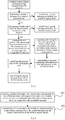
- a 5G network is taken as an example below for further explanation.
- a mobile terminal After a mobile terminal is powered on and registered in the 5G network, it determines whether it accesses to a wireless access device. When the mobile terminal does not access the wireless access device, a paging message is monitored according to a paging cycle specified in the mobile communication standard (hereinafter referred to as a protocol paging cycle). When the mobile terminal has access to the wireless access device, it is determined whether the wireless access device has access to the Internet; when the wireless access device does not access to the Internet, the paging message is monitored according to the protocol paging cycle; and when the wireless access device has access to the Internet, the mobile terminal reports its own identity information and the location information of the wireless access device connected with the mobile terminal to a core network through the 5G network.
- a protocol paging cycle specified in the mobile communication standard
- the core network records and stores the identity information reported by the mobile terminal and the location information of the wireless access device, and transmits a message containing information of a first paging cycle to the mobile terminal.
- the mobile terminal modifies the paging cycle to the first paging cycle, and monitors the paging message according to the first paging cycle, and the first paging cycle is longer than the paging cycle specified in the mobile communication standard. In this way, the paging cycle according to which the mobile terminal monitors the paging message is extended, the number of monitoring processes in same period is reduced, a purpose of reducing power consumption and saving power is achieved, and battery life of the mobile terminal is extended.
- a method for monitoring a paging message defines a new paging protocol in a mobile communication system.
- a core network transmits the paging message through the Internet, and the mobile terminal receives the paging message through the Internet.
- a paging cycle according to which the mobile terminal monitors the paging message can be modified, so that the paging cycle of the mobile terminal can be extended, thereby reducing the number of times of waking up the related circuit in the mobile terminal to monitor the paging message in the same period, so as to save power consumption and extend battery life of the mobile terminal.
- a method operable in a core network, for monitoring a paging message, is provided, which is suitable for the 5G network and precursor networks before the 5G network.
- a method for monitoring a paging message includes:
- Step 401 receiving identity information of a mobile terminal reported by the mobile terminal, and location information of a wireless access device in a connected state where the wireless access device is connected with the mobile terminal.
- the wireless access device has access to the Internet.
- the wireless access device described here may include but is not limited to: a wireless router, a wireless access point, or another device that enables the mobile terminal to access the Internet through WLAN.
- the mobile terminal can access the wireless access device through a WLAN module or a satellite communication module arranged therein.
- the core network is connected with the wireless access device through the Internet.
- the mobile terminal when the mobile terminal detects that the mobile terminal itself is in the connected state where the mobile terminal is connected with the wireless access device accessing the Internet, it will acquire its own identity information and the location information of the wireless access device connected with the mobile terminal, and report its own identity information and the location information of the wireless access device to the core network.
- the identity information described herein includes but is not limited to: a MAC address of the mobile terminal, an IP address assigned to the mobile terminal by the wireless access device, an IMEI code of the mobile terminal and a TMSI code of the mobile terminal.
- Step 402 transmitting a first message to the mobile terminal according to the identity information of the mobile terminal and the location information of the wireless access device.
- the core network After receiving the identity information of the mobile terminal reported by the mobile terminal and the location information of the wireless access device connected with the mobile terminal, the core network determines the wireless access device and the mobile terminal according to the above information, and transmits the first message to the mobile terminal.
- the first message includes information about a first paging cycle according to which a paging message is monitored when the mobile terminal is in the connected state where the mobile terminal is connected with the wireless access device.
- the first paging cycle is longer than the second paging cycle, and the second paging cycle is equal to the cycle according to which the core network transmits a paging message, and the cycle according to which the core network transmits the paging message is the paging cycle specified in the mobile communication standard.
- the paging cycle according to which the mobile terminal monitors a paging message can be modified, so that the paging cycle of the mobile terminal can be extended, thereby reducing the number of times of waking up the related circuit in the mobile terminal to monitor the paging message in the same period, so as to save power consumption and extend battery life of the mobile terminal.
- the core network when the mobile terminal is in the connected state where the mobile terminal is connected with the wireless access device that has access to the Internet, the core network transmits a paging message to the mobile terminal through the Internet, and the mobile terminal accesses the paging message through the Internet.
- the core network receives the paging message for the mobile terminal, it will transmit the paging message to the mobile terminal through the wireless access device (that is, through the Internet).
- Mode 1 upon receiving the identity information of the mobile terminal reported by the mobile terminal and the location information of the wireless access device, it is considered by default that the mobile terminal is in the connected state where the mobile terminal is connected with the wireless access device that has access to the Internet.
- Mode 2 the mobile terminal reports to the core network the state information that the mobile terminal is in the connected state where the mobile terminal is connected with the wireless access device that has access to the Internet.
- the mobile terminal may also transmit a second message to the core network.
- the second message may include information that the mobile terminal is in a disconnected state where the mobile terminal is disconnected from the wireless access device, so that the core network no longer transmits a paging message to the mobile terminal through the wireless access device.
- the core network After receiving the second message, the core network confirms that the mobile terminal is not in the connected state where the mobile terminal is connected with the wireless access device accessing the Internet, and then transmits the paging message to the mobile terminal through the base station (that is, through the mobile communication network).
- the 5G network is taken as an example below for further explanation.
- a core network searches for a mobile terminal and a wireless access device connected with the mobile terminal, and transmits a paging message to the mobile terminal through the Internet.
- the mobile terminal determines whether the mobile terminal itself is an object being paged, and when the mobile terminal itself is the object being paged, the mobile terminal will respond to the paging message through the 5G network; and when the mobile terminal itself is not the object being paged, it will discard the paging message and continue to sleep.
- a cycle according to which the core network transmits a paging message remains unchanged, and the paging message is still transmitted according to the cycle specified in the mobile communication standard, and only the paging cycle of the mobile terminal will change.
- a method for monitoring a paging message defines a new paging protocol in a mobile communication system.
- a core network transmits the paging message through the Internet, and the mobile terminal receives the paging message through the Internet.
- the paging cycle according to which the mobile terminal monitors the paging message can be modified, so that the paging cycle of the mobile terminal can be extended, thereby reducing the number of times of waking up the related circuit in the mobile terminal to monitor the paging message in the same period, so as to save power consumption and extend battery life of the mobile terminal.
- a mobile terminal is provided.
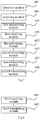
- a mobile terminal includes: a detection module 601, used to detect whether the mobile terminal is in a connected state where the mobile terminal is connected with a wireless access device accessing the Internet; a first processing module 602, used to monitor a paging message according to a first paging cycle when the mobile terminal is in the connected state where the mobile terminal is connected with the wireless access device; a second processing module 603, used to monitor the paging message according to a second paging cycle when the mobile terminal is not in the connected state where the mobile terminal is connected with the wireless access device, wherein the first paging cycle is longer than the second paging cycle, and the second paging cycle is equal to a cycle according to which a core network transmits the paging message, and the cycle according to which the core network transmits the paging message is the paging cycle specified in a mobile communication standard.
- a mobile terminal further includes: an acquiring module 604, used to acquire identity information of the mobile terminal and location information of the wireless access device; and a first transmitting module 605, used to report the identity information of the mobile terminal and the location information of the wireless access device to the core network.
- the identity information described herein includes but is not limited to: a MAC address of the mobile terminal, an IP address assigned to the mobile terminal by the wireless access device, an IMEI code of the mobile terminal and a TMSI code of the mobile terminal.
- the mobile terminal further includes: a first receiving module 606, used to receive a first message transmitted by the core network, wherein the first message includes information about the first paging cycle according to which a paging message is monitored when the mobile terminal is in the connected state where the mobile terminal is connected with the wireless access device.
- a first receiving module 606 used to receive a first message transmitted by the core network, wherein the first message includes information about the first paging cycle according to which a paging message is monitored when the mobile terminal is in the connected state where the mobile terminal is connected with the wireless access device.
- the mobile terminal further includes: a second receiving module 607, used to receive a paging message transmitted by the core network through the wireless access device.
- the mobile terminal further includes: a second transmitting module 608, used to transmit a second message to the core network when it is detected that the mobile terminal is disconnected from the wireless access device, wherein the second message includes information that the mobile terminal is in a disconnected state where the mobile terminal is disconnected from the wireless access device.
- a second transmitting module 608 used to transmit a second message to the core network when it is detected that the mobile terminal is disconnected from the wireless access device, wherein the second message includes information that the mobile terminal is in a disconnected state where the mobile terminal is disconnected from the wireless access device.
- the detection module 601 detects whether the mobile terminal is in the connected state where the mobile terminal is connected with the wireless access device accessing the Internet.
- the first processing module 602 controls the mobile terminal to monitor a paging message according to the first paging cycle.
- the second processing module 603 controls the mobile terminal to monitor the paging message according to the second paging cycle.
- the first paging cycle is longer than the second paging cycle, and the second paging cycle is equal to the cycle according to which the core network transmits the paging message, which is the paging cycle specified in the mobile communication standard.
- a new paging protocol is defined in a mobile communication system.
- a server operable in a core network.
- a server includes: a third receiving module 801, used to receive identity information of a mobile terminal reported by the mobile terminal, and location information of a wireless access device in a connected state where the wireless access device is connected with the mobile terminal, wherein the wireless access device has access to the Internet; a third transmitting module 802, used to transmit a first message to the mobile terminal according to the identity information of the mobile terminal and the location information of the wireless access device, wherein the first message includes information about a first paging cycle according to which a paging message is monitored when the mobile terminal is in the connected state where the mobile terminal is connected with the wireless access device, wherein the first paging cycle is longer than the second paging cycle, and the second paging cycle is equal to a cycle according to which the core network transmits the paging message, and the cycle according to which the core network transmits the paging message is the paging cycle specified in the mobile communication standard.
- the server further includes: a fourth transmitting module 803, used to transmit a paging message to the mobile terminal through the wireless access device when the paging message is received.
- the third transmitting module 802 transmits a first message to the mobile terminal to negotiate with the mobile terminal, so that the mobile terminal monitors a paging message according to a first paging cycle, thereby to modify the paging cycle of the mobile terminal, extend the paging cycle, reduce the number of times of waking up the related circuit to monitor the paging message in the same period, and achieve the purpose of saving power consumption.
- Fig.10 is a schematic diagram of a hardware structure of a mobile terminal for implementing various embodiments of the present disclosure.
- the mobile terminal 1000 includes, but is not limited to, a Radio Frequency (RF) unit 1001, a network module 1002, an audio output unit 1003, an input unit 1004, a sensor 1005, a display unit 1006, a user input unit 1007, an interface unit 1008, a memory 1009, a processor 1010, a power supply 1011, and the like.
- RF Radio Frequency
- the mobile terminal includes, but is not limited to being, a mobile phone, a tablet computer, a notebook computer, a palmtop computer, a vehicle-mounted terminal, a wearable device, a pedometer, and the like.
- the processor 1010 is used to detect whether the mobile terminal is in the connected state where the mobile terminal is connected with a wireless access device accessing the Internet; when the mobile terminal is in the connected state where the mobile terminal is connected with the wireless access device, a paging message is monitored according to a first paging cycle; otherwise, the paging message is monitored according to a second paging cycle, wherein the first paging cycle is longer than the second paging cycle, and the second paging cycle is equal to a cycle according to which a core network transmits the paging message.
- a new paging protocol is defined in a mobile communication system.
- a mobile terminal When a mobile terminal is in a connected state where the mobile terminal is connected with a wireless access device that has access to the Internet, a paging cycle according to which the mobile terminal monitors a paging message can be modified, so that the paging cycle of monitoring the paging message can be extended, so as to save power consumption and extend battery life of the mobile terminal.
- the RF unit 1001 can be used to receive and transmit information, or receive and transmit a signal during a call. Specifically, after receiving downlink data from a base station, the downlink data is processed by the processor 1010; in addition, uplink data is transmitted to the base station.
- the RF unit 1001 includes, but is not limited to, an antenna, at least one amplifier, a transceiver, a coupler, a low noise amplifier, a duplexer, and the like.
- the RF unit 1001 may also communicate with the network and another communication device through a wireless communication system.
- the mobile terminal may provide a user with wireless broadband Internet access through the network module 1002, such as enabling the user to send or receive an e-mail, browse a web page, access streaming media, and the like.
- the audio output unit 1003 may convert audio data received by the RF unit 1001 or the network module 1002 or stored in the memory 1009 into an audio signal and output it as a sound. Moreover, the audio output unit 1003 may also provide an audio output related to a specific function performed by the mobile terminal 1000 (for example, call signal reception sound, message reception sound, or the like).
- the audio output unit 1003 includes a speaker, a buzzer, a receiver, and the like.
- the input unit 1004 may be used to receive an audio or video signal.
- the input unit 1004 may include a graphics processing unit (Graphics Processing Unit, GPU) 10041 and a microphone 10042, and the GPU 10041 processes image data of a still picture or a video obtained by an image capturing device (such as a camera) in a video capturing mode or an image capturing mode.
- a processed image frame may be displayed on the display unit 1006.
- the image frame processed by the GPU 10041 may be stored in the memory 1009 (or other storage medium) or transmitted via the RF unit 1001 or the network module 1002.
- the microphone 10042 may receive sound and process such sound into audio data.
- the processed audio data may be converted into a format output that may be transmitted to a mobile communication base station via the RF unit 1001 in a case of a telephone call mode.
- the mobile terminal 1000 also may include at least one type of sensor 1005, such as a light sensor, a motion sensor, and other sensors.
- the light sensor includes an ambient light sensor and a proximity sensor, wherein the ambient light sensor may adjust brightness of the display panel 10061 according to brightness of ambient light, and the proximity sensor may turn off the display panel 10061 and/or backlight when the mobile terminal 1000 is near an ear.
- an accelerometer sensor may detect magnitude of acceleration in various directions (generally in three axes), and may detect magnitude and direction of gravity when the accelerometer sensor is still, and may be used to identify orientation of the mobile terminal (such as horizontal and vertical screen switching, related games, magnetometer orientation calibration), vibration identification related functions (such as pedometer, tapping), etc.; the sensor 1005 may also include a fingerprint sensor, a pressure sensor, an iris sensor, a molecular sensor, a gyroscope, a barometer, a hygrometer, a thermometer, an infrared sensor, and the like, and details thereof will not be described herein.
- the display unit 1006 may be used to display information input by the user or provided to the user.
- the display unit 1006 may include a display panel 10061, which may be configured in a form of a Liquid Crystal Display (LCD), an Organic Light-Emitting Diode (OLED) display, etc.
- LCD Liquid Crystal Display
- OLED Organic Light-Emitting Diode
- the user input unit 1007 may be used to receive numeric or character information being inputted, and generate a key signal input related to user settings and function control of the mobile terminal.
- the user input unit 1007 may include a touch panel 10071 and another input device 10072.
- the touch panel 10071 also known as a touch screen, may collect the user's touch operation on or near it (such as the user's operation on or near the touch panel 10071 using any suitable object or accessory such as a finger of the user, a stylus, etc.).
- the touch panel 10071 may include a touch detection device and a touch controller.
- the touch detection device detects an orientation of the touch of the user, and detects a signal brought by the touch operation, and transmits the signal to the touch controller; and the touch controller receives touch information from the touch detection device and converts it into contact coordinates, then transmits the contact coordinates to the processor 1010, and receives a command transmitted by the processor 1010 and executes the command.
- the touch panel 10071 may be implemented in various types, such as a resistive touch panel, a capacitive touch panel, an infrared touch panel, and a surface acoustic wave touch panel.
- the user input unit 1007 may also include the other input device 10072.
- the other input device 10072 may include, but is not limited to, a physical keyboard, a function key (such as a volume control key, a switch key, etc.), a trackball, a mouse, a joystick, and details thereof will not be described herein.
- a function key such as a volume control key, a switch key, etc.
- a trackball such as a mouse, a joystick, and details thereof will not be described herein.
- the touch panel 10071 may cover the display panel 10061.
- the touch panel 10071 detects the touch operation on or near it, information about the touch operation is transmitted to the processor 1010 to determine a type of a touch event, and then the processor 1010 may provide a corresponding visual output on the display panel 10061 according to the type of the touch event.
- the touch panel 10071 and the display panel 10061 as shown as two independent components to implement input and output functions of the mobile terminal, in some embodiments, the touch panel 10071 and the display panel 10061 may be integrated to implement the input and output functions of the mobile terminal, which is not specifically limited herein.
- the interface unit 1008 is an interface for connecting an external device to the mobile terminal 1000.
- the external device may include a wired or wireless headphone port, an external power (or battery charger) port, a wired or wireless data port, a memory card port, a port for connecting a device with an identification module, an audio input/output (I/O) port, a video I/O port, a headphone port, etc.
- the interface unit 1008 may be used to receive an input (for example, data information, electric power, etc.) from the external device, and transmit the received input to one or more elements within the mobile terminal 1000 or may be used to transmit data between the mobile terminal 1000 and the external device.
- the memory 1009 can be used to store a software program and various data.
- the memory 1009 may mainly include a program storage region and a data storage region, wherein the program storage region may store an operating system, an application required by at least one function (such as a sound playback function, an image playback function, etc.), etc.; the data storage region may store data (such as audio data, a phone book, etc.) created according to the use of the mobile phone, etc.
- the memory 1009 may include a high-speed random access memory, and may also include a non-volatile memory, such as at least one disk storage device, a flash memory device, or another volatile solid-state storage device.
- the processor 1010 may be a control center of the mobile terminal, which uses various interfaces and lines to connect various parts of the entire mobile terminal, runs or executes the software programs and/or modules stored in the memory 1009, and calls the data stored in the memory 1009, to execute various functions of the mobile terminal and process data, thereby monitoring the mobile terminal as a whole.
- the processor 1010 may include one or more processing units; optionally, the processor 1010 may integrate an application processor and a modem processor, wherein the application processor mainly processes an operating system, a user interface, an application, and the like, and the modem processor mainly processes wireless communication. It may be understood that the above modem processor may alternatively not be integrated into the processor 1010.
- the mobile terminal 1000 may also include a power supply 1011 (such as a battery) that supplies power to various components.
- a power supply 1011 (such as a battery) that supplies power to various components.
- the power supply 1011 may be logically connected with the processor 1010 through a power management system, thereby implementing functions such as charging management, discharging management, and power consumption management through the power management system.
- the mobile terminal 1000 may include some functional modules not shown, and details thereof will not be described herein.
- embodiments of the present disclosure further provide a mobile terminal, including a processor 1010, a memory 1009, a computer program stored in the memory 1009 and capable of being executed by the processor 1010, wherein the processor 1010 is used to execute the computer program to implement various processes of the embodiments of the above-described methods operable by the side of the mobile terminal for monitoring a paging message, and may achieve a same technical effect. In order to avoid repetition, details thereof will not be repeated herein.
- Embodiments of the present disclosure further provide a computer-readable storage medium, wherein a computer program is stored in the computer-readable storage medium, and the computer program is used to be executed by a processor to implement various processes of the embodiments of the above-described methods operable by the side of the mobile terminal for monitoring a paging message, and may achieve a same technical effect.
- the computer-readable storage medium may be, for example, a read-only memory (Read-Only Memory, ROM), a random-access memory (Random-Access Memory, RAM), a magnetic disk, an optical disk, or the like.
- a server is provided.
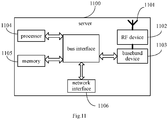
- the server 1100 includes an antenna 1101, an RF device 1102, and a baseband device 1103.
- the antenna 1101 is connected with the RF device 1102.
- the RF device 1102 receives information through the antenna 1101, and transmits the received information to the baseband device 1103 for processing.
- the baseband device 1103 processes the information to be transmitted and transmits it to the RF device 1102, and the RF device 1102 processes the received information and transmits it out through the antenna 1101.
- the above frequency band processing device may be located in the baseband device 1103, the method executed by the server in the above embodiments may be implemented in the baseband device 1103, and the baseband device 1103 may include a processor 1104 and a memory 1105.
- the baseband device 1103 may include, for example, at least one baseband board, and a plurality of chips arranged on the baseband board, as shown in Fig.11 ; one of the chips, e.g., the processor 1104, is connected with the memory 1105 to call programs in the memory 1105 to execute server operations described in connection with the above method embodiments.
- the baseband device 1103 may further include a network interface 1106 for exchanging information with the RF device 1102, and the network interface 1106 may be, for example, a Common Public Radio Interface (CPRI).
- CPRI Common Public Radio Interface
- the processor herein may refer to a single processor, or multiple processing elements.
- the processor may be a Central Processing Unit (CPU) or an Application Specific Integrated Circuit (ASIC), or may be one or more integrated circuits used to implement the methods executed by the above server, e.g., one or more microprocessors, or one or more Digital Signal Processors (DSPs), or one or more Field Programmable Gate Array (FPGAs), etc.
- a storage element may refer to a single memory or multiple storage elements.
- the memory 1105 may be a volatile memory or a non-volatile memory, or may include both the volatile memory and the non-volatile memory.
- the non-volatile memory may be a read only memory (Read Only Memory, ROM), a programmable read only memory (Programmable ROM, PROM), an erasable programmable read only memory (Erasable PROM, EPROM), an electrically erasable programmable read only memory (Electrically EPROM, EEPROM) or a flash memory.
- the volatile memory may be a random access memory (Random Access Memory, RAM) that acts as an external cache.
- RAMs such as a static random access memory (Static RAM, SRAM), a dynamic random access memory (Dynamic RAM, DRAM), a synchronous dynamic random access memory (Synchronous DRAM, SDRAM), a double data rate synchronous dynamic random access memory (Double Data Rate SDRAM, DDRSDRAM), an enhanced synchronous dynamic random access memory (Enhanced SDRAM, ESDRAM), a synchlink dynamic random access memory (Synchlink DRAM, SLDRAM) and a direct Rambus random access memory (Direct Rambus RAM, DRRAM).
- Static RAM static random access memory
- DRAM dynamic random access memory
- DRAM synchronous dynamic random access memory
- SDRAM double data rate synchronous dynamic random access memory
- Double Data Rate SDRAM Double Data Rate SDRAM
- ESDRAM enhanced synchronous dynamic random access memory
- Synchlink DRAM, SLDRAM synchlink dynamic random access memory
- Direct Rambus RAM Direct Rambus RAM
- the processor 1104 may be used to: receive the identity information of the mobile terminal reported by the mobile terminal, and the location information of the wireless access device in the connected state where the wireless access device is connected with the mobile terminal; and transmit the first message to the mobile terminal according to the identity information of the mobile terminal and the location information of the wireless access device.
- the wireless access device may have access to the Internet.
- the first message includes information about the first paging cycle according to which a paging message is monitored when the mobile terminal is in the connected state where the mobile terminal is connected with the wireless access device.
- the first paging cycle is longer than the second paging cycle, and the second paging cycle is equal to a cycle according to which the core network transmits a paging message, and the cycle according to which a core network transmits the paging message is the paging cycle specified in a mobile communication standard.
- the server may be a base transceiver station (Base Transceiver Station, BTS) in a global system of mobile communication (Global System of Mobile communication, GSM) or code division multiple access (Code Division Multiple Access, CDMA), or may be a NodeB (NB) in wideband code division multiple access (Wideband Code Division Multiple Access, WCDMA), or may be an Evolutional Node B (eNB or eNodeB) in long term evolution (Long Term Evolution, LTE), or a relay station or an access point, or a base station in a future fifth Generation (5G) network, etc., which is not limited herein.
- BTS Base Transceiver Station
- GSM Global System of Mobile communication
- CDMA Code Division Multiple Access
- NB wideband code division multiple access
- WCDMA Wideband Code Division Multiple Access
- eNB or eNodeB Evolutional Node B
- LTE Long Term Evolution
- LTE Long Term Evolution
- 5G fifth Generation
- a new paging protocol is defined in a mobile communication system.
- a mobile terminal When a mobile terminal is in a connected state where the mobile terminal is connected with a wireless access device that has access to the Internet, a paging cycle according to which the mobile terminal monitors a paging message can be modified, so that the paging cycle of monitoring the paging message can be extended, so as to save power consumption and extend battery life of the mobile terminal.
- embodiments of the present disclosure further provide a server, including a processor 1104, a memory 1105, and a computer program stored in the memory 1105 and capable of being executed by the processor 1104, and the computer program is used to be executed by the processor 1104 to implement various processes of embodiments of a method operable in the core network for monitoring a paging message, and may achieve a same technical effect. In order to avoid repetition, details thereof will not be repeated herein.
- Embodiments of the present disclosure further provide a computer-readable storage medium, wherein a computer program is stored in the computer-readable storage medium, and the computer program is used to be executed by a processor to implement various processes of embodiments of a method operable in a core network for monitoring a paging message, and may achieve a same technical effect.
- the computer-readable storage medium may be, for example, a read-only memory (Read-Only Memory, ROM), a random-access memory (Random-Access Memory, RAM), a magnetic disk or an optical disk.
- the technical solution of the present disclosure may be embodied in a form of a software product in essence, or a part of the technical solution of the present disclosure that contributes to the related art may be embodied in the form of the software product, and the computer software product may be stored in a storage medium (such as ROM/RAM, magnetic disk, optical disk), and include instructions to enable a terminal (which may be a mobile phone, a computer, a server, an air conditioner, a network device, or the like) to execute the methods described in various embodiments of the present disclosure.
- a terminal which may be a mobile phone, a computer, a server, an air conditioner, a network device, or the like
Landscapes
- Engineering & Computer Science (AREA)
- Computer Networks & Wireless Communication (AREA)
- Signal Processing (AREA)
- Mobile Radio Communication Systems (AREA)
- Telephone Function (AREA)
Abstract
Description
- The present application claims a priority to Chinese Patent Application No.
201810265306.8 - The present disclosure relates to the field of communication technologies, and in particular to a method for monitoring a paging message, a mobile terminal and a server.
- Based on a measurement result of power consumption of a 4G mobile terminal in an existing network in the related art, it is found that the mobile terminal needs to monitor a paging message once every 1024 milliseconds (a paging cycle specified in a mobile communication standard) in an idle state. Each time the paging message is being monitored, operation period of a baseband chip is about 28ms, average current is about 100 mA, and standby current is only about 1 mA. When the mobile terminal receives the paging message, the mobile terminal determines whether a mobile terminal being paged is the mobile terminal itself, when not, it discards the paging message and continues to sleep. However, in fact, the number of times that a user is actually paged in a day is very small, and most of the paging messages being monitored are invalid, which occupies much of the standby power consumption, and adversely affects battery life of a mobile terminal with respect to especially a fifth Generation (5G) mobile terminal of higher power consumption.
- The embodiments of the present disclosure provide a method for monitoring a paging message, a mobile terminal, and a server, so as to solve a problem that more power consumption is generated by the mobile terminal due to the fact of monitoring the paging message in the related art.
- In order to solve the above technical problem, the present disclosure may be implemented as follows.
- In a first aspect, a method, operable by a mobile terminal, for monitoring a paging message, is provided. The method includes: detecting whether the mobile terminal is in a connected state where the mobile terminal is connected with a wireless access device accessing the Internet; when the mobile terminal is in the connected state where the mobile terminal is connected with the wireless access device, monitoring the paging message according to a first paging cycle; when the mobile terminal is not in the connected state where the mobile terminal is connected with the wireless access device, monitoring the paging message according to a second paging cycle, wherein the first paging cycle is longer than the second paging cycle, and the second paging cycle is equal to a cycle according to which a core network transmits the paging message.
- In a second aspect, a method, operable in a core network, for monitoring a paging message, is provided. The method includes: receiving identity information of a mobile terminal reported by the mobile terminal, and location information of a wireless access device in a connected state where the wireless access device is connected with the mobile terminal, wherein the wireless access device has access to the Internet; transmitting a first message to the mobile terminal according to the identity information of the mobile terminal and the location information of the wireless access device, wherein the first message includes information about a first paging cycle according to which the paging message is monitored when the mobile terminal is in the connected state where the mobile terminal is connected with the wireless access device, wherein the first paging cycle is longer than the second paging cycle, and the second paging cycle is equal to a cycle according to which the core network transmits the paging message.
- In a third aspect, a mobile terminal is provided, including: a detection module, used to detect whether the mobile terminal is in a connected state where the mobile terminal is connected with a wireless access device accessing the Internet; a first processing module, used to monitor a paging message according to a first paging cycle when the mobile terminal is in the connected state where the mobile terminal is connected with the wireless access device; a second processing module, used to monitor the paging message according to a second paging cycle when the mobile terminal is not in the connected state where the mobile terminal is connected with the wireless access device, wherein the first paging cycle is longer than the second paging cycle, and the second paging cycle is equal to a cycle according to which a core network transmits the paging message.
- In a fourth aspect, a server, operable in a core network, is provided. The server includes: a third receiving module, used to receive identity information of a mobile terminal reported by the mobile terminal, and location information of a wireless access device in a connected state where the wireless access device is connected with the mobile terminal, wherein the wireless access device has access to the Internet; a third transmitting module, used to transmit a first message to the mobile terminal according to the identity information of the mobile terminal and the location information of the wireless access device, wherein the first message includes information about a first paging cycle according to which a paging message is monitored when the mobile terminal is in the connected state where the mobile terminal is connected with the wireless access device, wherein the first paging cycle is longer than the second paging cycle, and the second paging cycle is equal to a cycle according to which the core network transmits the paging message.
- In a fifth aspect, a mobile terminal is provided, including a processor, a memory, and a computer program stored in the memory and capable of being executed by the processor, wherein the processor is used to execute the computer program to implement the steps of the method operably by a side of the mobile terminal for monitoring a paging message as described above.
- In a sixth aspect, a server is provided, including a processor, a memory, and a computer program stored in the memory and capable of being executed by the processor, wherein the processor is used to execute the computer program to implement the steps of the method operably by a side of the core network for monitoring a paging message as described above.
- In the embodiments of the present disclosure, a new paging protocol is defined in a mobile communication system. When the mobile terminal is in a connected state where the mobile terminal is connected with the wireless access device that has access to the Internet, a paging cycle according to which the mobile terminal monitors a paging message can be modified, so that the paging cycle of monitoring the paging message can be extended, so as to save power consumption and extend battery life of the mobile terminal.
- In order to illustrate the technical solutions of the embodiments of the present disclosure in a clearer manner, the drawings desired for the present disclosure will be described hereinafter briefly. Obviously, the following drawings merely relate to some embodiments of the present disclosure, and based on these drawings, one of skill may obtain the other drawings without any creative effort.
-
Fig.1 shows a flowchart of a method operably by a side of the mobile terminal for monitoring a paging message provided by an embodiment of the present disclosure; -
Fig.2 shows a schematic diagram of a network system provided by an embodiment of the present disclosure; -
Fig.3 shows a flowchart of an example provided by an embodiment of the present disclosure; -
Fig.4 shows a flowchart of a method operably by a side of the core network for monitoring a paging message provided by an embodiment of the present disclosure; -
Fig.5 shows a flowchart of an example provided by an embodiment of the present disclosure; -
Fig.6 shows a first block diagram of a mobile terminal provided by an embodiment of the present disclosure; -
Fig.7 shows a second block diagram of a mobile terminal provided by an embodiment of the present disclosure; -
Fig.8 shows a first block diagram of a server provided by an embodiment of the present disclosure; -
Fig.9 shows a second block diagram of a server provided by the embodiment of the present disclosure; -
Fig. 10 shows a third block diagram of a mobile terminal provided by an embodiment of the present disclosure; and -
Fig.11 shows a third block diagram of a server provided by an embodiment of the present disclosure. - Technical solutions in the embodiments of the present disclosure will be clearly and completely described below in combination with the accompanying drawings in the embodiments of the present disclosure. Obviously, the following embodiments merely relate to a part of, rather than all of, the embodiments of the present disclosure, and based on these embodiments, one of skill may, without any creative effort, obtain the other embodiments, which also fall within the scope of the present disclosure.
- According to an aspect of the embodiments of the present disclosure, a method, operable by a mobile terminal, for monitoring a paging message, is provided.
- As shown in
Fig.1 , a method for monitoring a paging message may include following steps. - Step 101: detecting whether the mobile terminal is in a connected state where the mobile terminal is connected with a wireless access device accessing the Internet.
- In embodiments of the present disclosure, before the mobile terminal monitors a paging message, it first determines whether it is in the connected state where the mobile terminal is connected with the wireless access device. At same time, in order to ensure network connectivity, it is also necessary to determine whether the wireless access device is connected with the Internet.
- The wireless access device described herein includes but is not limited to: a wireless router, a wireless access point (Wireless Access Point, AP), or another device that enables the mobile terminal to access the Internet through a wireless local area network (Wireless Local Area Network, WLAN). The mobile terminal can access the wireless access device through a WLAN module or a satellite communication module arranged therein.
- Step 102: when the mobile terminal is in the connected state where the mobile terminal is connected with the wireless access device, monitoring a paging message according to a first paging cycle.
- In embodiments of the present disclosure, when it is detected that the mobile terminal is in the connected state where the mobile terminal is connected with the wireless access device, and the wireless access device has access to the Internet, a paging message is monitored according to the first paging cycle. The first paging cycle is longer than a cycle according to which a core network transmits the paging message, and the cycle according to which the core network transmits the paging message is a paging cycle specified in a mobile communication standard.
- As shown in
Fig.2 , a core network accesses the Internet at the side of the core network. When the mobile terminal monitors a paging message according to the first paging cycle, the core network transmits the paging message to the mobile terminal through the wireless access device. - Since the core network transmits a paging message to the mobile terminal through the Internet, in this case, a paging cycle according to which the mobile terminal monitors the paging message can be modified. In embodiments of the present disclosure, by extending the paging cycle according to which the mobile terminal monitors the paging message, the number of times of monitoring in same period is reduced, thereby achieving a purpose of reducing power consumption of monitoring the paging message. For example, the paging cycle specified in the mobile communication standard is 1024ms, while the first paging cycle in embodiments of the present disclosure may be 3072ms, so that in same period, the number of times the mobile terminal being awakened is reduced to one third of the original number of times the mobile terminal being awakened, and the total power consumption is also reduced to one third of original total power consumption, thereby achieving a purpose of saving power consumption.
- Step 103: when the mobile terminal is not in the connected state where the mobile terminal is connected with the wireless access device, monitoring a paging message according to a second paging cycle.
- In embodiments of the present disclosure, when it is detected that the mobile terminal is not connected with the wireless access device, a paging message is monitored according to the second paging cycle. At this time, the core network transmits the paging message to the mobile terminal through a base station, as shown in
Fig.2 . - The second paging cycle is equal to the cycle according to which the core network transmits a paging message, that is, when the mobile terminal is not in the connected state where the mobile terminal is connected with the wireless access device, the mobile terminal monitors the paging message according to the paging cycle specified in the mobile communication standard.
- In the above technical solution, a new paging protocol is defined in a mobile communication system. When the mobile terminal is in the connected state where the mobile terminal is connected with the wireless access device that has access to the Internet, the paging cycle according to which the mobile terminal monitors a paging message can be modified, so that the paging cycle of the mobile terminal can be extended, thereby reducing the number of times of waking up related circuit in the mobile terminal to monitor the paging message in same period, so as to save power consumption and extend battery life of the mobile terminal.
- Further, after detecting that the mobile terminal has been in the connected state where the mobile terminal is connected with the wireless access device, and before monitoring a paging message according to the first paging cycle, the mobile terminal may also acquire its own identity information and location information of the wireless access device connected with the mobile terminal (that is, physical information corresponding to an address of the wireless access device), and report its own identity information and the location information of the wireless access device to the core network, so that the core network can determine the mobile terminal and the wireless access device connected with the mobile terminal according to this information.
- The identity information described herein includes but is not limited to: a media access control (Media Access Control, MAC) address of the mobile terminal, an Internet Protocol (IP) address assigned to the mobile terminal by the wireless access device, an international mobile equipment identity (International Mobile Equipment Identity, IMEI) code of the mobile terminal and a temporary mobile subscriber identity (Temporary Mobile Subscriber Identity, TMSI) code of the mobile terminal.
- The mobile terminal can transmit its identity information and the location information of the wireless access device connected with the mobile terminal to the core network through the wireless access device, or transmit them through a mobile communication network. A specific implementation of transmitting the identity information of the mobile terminal and the location information of the wireless access device connected with the mobile terminal can be determined according to actual needs.
- After the mobile terminal reports its own identity information and the location information of the wireless access device connected with the mobile terminal to the core network, the core network transmits a first message to the mobile terminal. The first message includes information about the first paging cycle according to which a paging message is monitored when the mobile terminal is in the connected state where the mobile terminal is connected with the wireless access device. After receiving the first message, the mobile terminal monitors the paging message according to the first paging cycle.
- In embodiments of the present disclosure, when the mobile terminal is in the connected state where the mobile terminal is connected with the wireless access device that has access to the Internet, the core network transmits a paging message to the mobile terminal through the Internet, and the mobile terminal accesses the paging message through the Internet. After the mobile terminal receives the paging message transmitted by the core network through the wireless access device, when the mobile terminal determines that the mobile terminal itself is the mobile terminal being paged, the mobile terminal responds to the paging through the mobile communication network.
- Further, when it is detected that the mobile terminal is disconnected from the wireless access device, a second message is transmitted to the core network, wherein the second message includes information that the mobile terminal is in a disconnected state where the mobile terminal is disconnected from the wireless access device, so that the core network no longer transmits a paging message to the mobile terminal through the wireless access device.
- In order to further understand a method provided by embodiments of the present disclosure, a 5G network is taken as an example below for further explanation.
- As shown in
Fig.3 , after a mobile terminal is powered on and registered in the 5G network, it determines whether it accesses to a wireless access device. When the mobile terminal does not access the wireless access device, a paging message is monitored according to a paging cycle specified in the mobile communication standard (hereinafter referred to as a protocol paging cycle). When the mobile terminal has access to the wireless access device, it is determined whether the wireless access device has access to the Internet; when the wireless access device does not access to the Internet, the paging message is monitored according to the protocol paging cycle; and when the wireless access device has access to the Internet, the mobile terminal reports its own identity information and the location information of the wireless access device connected with the mobile terminal to a core network through the 5G network. The core network records and stores the identity information reported by the mobile terminal and the location information of the wireless access device, and transmits a message containing information of a first paging cycle to the mobile terminal. After receiving the message, the mobile terminal modifies the paging cycle to the first paging cycle, and monitors the paging message according to the first paging cycle, and the first paging cycle is longer than the paging cycle specified in the mobile communication standard. In this way, the paging cycle according to which the mobile terminal monitors the paging message is extended, the number of monitoring processes in same period is reduced, a purpose of reducing power consumption and saving power is achieved, and battery life of the mobile terminal is extended. - Finally, it should be noted that in embodiments of the present disclosure, when the mobile terminal is in the connected state where the mobile terminal is connected with the wireless access device that has access to the Internet, in addition to the core network transmitting a paging message through the Internet and the mobile terminal receiving the paging message through the Internet, interaction of other information between the core network and the mobile terminal can be transmitted through the Internet or through the mobile communication network. Specific situations can be selected according to actual needs, which are not limited in the embodiments of the present disclosure.
- In summary, a method for monitoring a paging message provided by embodiments of the present disclosure defines a new paging protocol in a mobile communication system. When a mobile terminal is in a connected state where the mobile terminal is connected with a wireless access device that has access to the Internet, a core network transmits the paging message through the Internet, and the mobile terminal receives the paging message through the Internet. In this way, a paging cycle according to which the mobile terminal monitors the paging message can be modified, so that the paging cycle of the mobile terminal can be extended, thereby reducing the number of times of waking up the related circuit in the mobile terminal to monitor the paging message in the same period, so as to save power consumption and extend battery life of the mobile terminal.
- According to another aspect of the embodiments of the present disclosure, a method, operable in a core network, for monitoring a paging message, is provided, which is suitable for the 5G network and precursor networks before the 5G network.
- As shown in
Fig.4 , a method for monitoring a paging message includes: - Step 401: receiving identity information of a mobile terminal reported by the mobile terminal, and location information of a wireless access device in a connected state where the wireless access device is connected with the mobile terminal.
- The wireless access device has access to the Internet. The wireless access device described here may include but is not limited to: a wireless router, a wireless access point, or another device that enables the mobile terminal to access the Internet through WLAN. The mobile terminal can access the wireless access device through a WLAN module or a satellite communication module arranged therein. The core network is connected with the wireless access device through the Internet.
- In embodiments of the present disclosure, when the mobile terminal detects that the mobile terminal itself is in the connected state where the mobile terminal is connected with the wireless access device accessing the Internet, it will acquire its own identity information and the location information of the wireless access device connected with the mobile terminal, and report its own identity information and the location information of the wireless access device to the core network.
- The identity information described herein includes but is not limited to: a MAC address of the mobile terminal, an IP address assigned to the mobile terminal by the wireless access device, an IMEI code of the mobile terminal and a TMSI code of the mobile terminal.
- Step 402: transmitting a first message to the mobile terminal according to the identity information of the mobile terminal and the location information of the wireless access device.
- After receiving the identity information of the mobile terminal reported by the mobile terminal and the location information of the wireless access device connected with the mobile terminal, the core network determines the wireless access device and the mobile terminal according to the above information, and transmits the first message to the mobile terminal.
- The first message includes information about a first paging cycle according to which a paging message is monitored when the mobile terminal is in the connected state where the mobile terminal is connected with the wireless access device.
- The first paging cycle is longer than the second paging cycle, and the second paging cycle is equal to the cycle according to which the core network transmits a paging message, and the cycle according to which the core network transmits the paging message is the paging cycle specified in the mobile communication standard.
- In embodiments of the present disclosure, when the mobile terminal is in the connected state where the mobile terminal is connected with the wireless access device that has access to the Internet, the paging cycle according to which the mobile terminal monitors a paging message can be modified, so that the paging cycle of the mobile terminal can be extended, thereby reducing the number of times of waking up the related circuit in the mobile terminal to monitor the paging message in the same period, so as to save power consumption and extend battery life of the mobile terminal.
- Further, in embodiments of the present disclosure, when the mobile terminal is in the connected state where the mobile terminal is connected with the wireless access device that has access to the Internet, the core network transmits a paging message to the mobile terminal through the Internet, and the mobile terminal accesses the paging message through the Internet. When the core network receives the paging message for the mobile terminal, it will transmit the paging message to the mobile terminal through the wireless access device (that is, through the Internet).
- In order to enable the core network to know that the mobile terminal is in the connected state where the mobile terminal is connected with the wireless access device that has access to the Internet, at least the following two modes can be adopted.
- Mode 1: upon receiving the identity information of the mobile terminal reported by the mobile terminal and the location information of the wireless access device, it is considered by default that the mobile terminal is in the connected state where the mobile terminal is connected with the wireless access device that has access to the Internet.
- Mode 2: the mobile terminal reports to the core network the state information that the mobile terminal is in the connected state where the mobile terminal is connected with the wireless access device that has access to the Internet.
- Naturally, after the mobile terminal is disconnected from the wireless access device, it may also transmit a second message to the core network. The second message may include information that the mobile terminal is in a disconnected state where the mobile terminal is disconnected from the wireless access device, so that the core network no longer transmits a paging message to the mobile terminal through the wireless access device. After receiving the second message, the core network confirms that the mobile terminal is not in the connected state where the mobile terminal is connected with the wireless access device accessing the Internet, and then transmits the paging message to the mobile terminal through the base station (that is, through the mobile communication network).
- In order to further facilitate to understand a process of transmitting a paging message by the core network in embodiments of the present disclosure, the 5G network is taken as an example below for further explanation.
- As shown in
Fig.5 , after receiving a paging message, a core network searches for a mobile terminal and a wireless access device connected with the mobile terminal, and transmits a paging message to the mobile terminal through the Internet. When the mobile terminal receives the paging message, the mobile terminal determines whether the mobile terminal itself is an object being paged, and when the mobile terminal itself is the object being paged, the mobile terminal will respond to the paging message through the 5G network; and when the mobile terminal itself is not the object being paged, it will discard the paging message and continue to sleep. - It should be noted that, in embodiments of the present disclosure, a cycle according to which the core network transmits a paging message remains unchanged, and the paging message is still transmitted according to the cycle specified in the mobile communication standard, and only the paging cycle of the mobile terminal will change.
- In addition, when the mobile terminal is in the connected state where the mobile terminal is connected with the wireless access device that has access to the Internet, in addition to the core network transmitting a paging message through the Internet and the mobile terminal receiving the paging message through the Internet, interaction of other information between the core network and the mobile terminal can be transmitted through the Internet or through the mobile communication network. Specific situations can be selected according to actual needs, which are not limited in the embodiments of the present disclosure.
- In summary, a method for monitoring a paging message provided by embodiments of the present disclosure defines a new paging protocol in a mobile communication system. When a mobile terminal is in a connected state where the mobile terminal is connected with the wireless access device that has access to the Internet, a core network transmits the paging message through the Internet, and the mobile terminal receives the paging message through the Internet. In this way, the paging cycle according to which the mobile terminal monitors the paging message can be modified, so that the paging cycle of the mobile terminal can be extended, thereby reducing the number of times of waking up the related circuit in the mobile terminal to monitor the paging message in the same period, so as to save power consumption and extend battery life of the mobile terminal.
- According to another aspect of embodiments of the present disclosure, a mobile terminal is provided.
- As shown in
Fig.6 , a mobile terminal includes: adetection module 601, used to detect whether the mobile terminal is in a connected state where the mobile terminal is connected with a wireless access device accessing the Internet; afirst processing module 602, used to monitor a paging message according to a first paging cycle when the mobile terminal is in the connected state where the mobile terminal is connected with the wireless access device; asecond processing module 603, used to monitor the paging message according to a second paging cycle when the mobile terminal is not in the connected state where the mobile terminal is connected with the wireless access device, wherein the first paging cycle is longer than the second paging cycle, and the second paging cycle is equal to a cycle according to which a core network transmits the paging message, and the cycle according to which the core network transmits the paging message is the paging cycle specified in a mobile communication standard. - Further, as shown in
Fig.7 , a mobile terminal further includes: an acquiringmodule 604, used to acquire identity information of the mobile terminal and location information of the wireless access device; and afirst transmitting module 605, used to report the identity information of the mobile terminal and the location information of the wireless access device to the core network. - The identity information described herein includes but is not limited to: a MAC address of the mobile terminal, an IP address assigned to the mobile terminal by the wireless access device, an IMEI code of the mobile terminal and a TMSI code of the mobile terminal.
- Further, as shown in
Fig.7 , the mobile terminal further includes: afirst receiving module 606, used to receive a first message transmitted by the core network, wherein the first message includes information about the first paging cycle according to which a paging message is monitored when the mobile terminal is in the connected state where the mobile terminal is connected with the wireless access device. - Further, as shown in
Fig.7 , the mobile terminal further includes: asecond receiving module 607, used to receive a paging message transmitted by the core network through the wireless access device. - Further, as shown in
Fig.7 , the mobile terminal further includes: asecond transmitting module 608, used to transmit a second message to the core network when it is detected that the mobile terminal is disconnected from the wireless access device, wherein the second message includes information that the mobile terminal is in a disconnected state where the mobile terminal is disconnected from the wireless access device. - In summary, in a mobile terminal provided by embodiments of the present disclosure, the
detection module 601 detects whether the mobile terminal is in the connected state where the mobile terminal is connected with the wireless access device accessing the Internet. When thedetection module 601 detects that the mobile terminal is in the connected state where the mobile terminal is connected with the wireless access device, thefirst processing module 602 controls the mobile terminal to monitor a paging message according to the first paging cycle. When thedetection module 601 detects that the mobile terminal is not in the connected state where the mobile terminal is connected with the wireless access device, thesecond processing module 603 controls the mobile terminal to monitor the paging message according to the second paging cycle. The first paging cycle is longer than the second paging cycle, and the second paging cycle is equal to the cycle according to which the core network transmits the paging message, which is the paging cycle specified in the mobile communication standard. In this way, a new paging protocol is defined in a mobile communication system. When the mobile terminal is in a connected state where the mobile terminal is connected with the wireless access device that has access to the Internet, the paging cycle according to which the mobile terminal monitors the paging message can be modified, so that the paging cycle of the mobile terminal can be extended, thereby reducing the number of times of waking up the related circuit in the mobile terminal to monitor the paging message in the same period, so as to save power consumption and extend battery life of the mobile terminal. - According to another aspect of embodiments of the present disclosure, a server, operable in a core network, is provided.
- As shown in
Fig.8 , a server includes: athird receiving module 801, used to receive identity information of a mobile terminal reported by the mobile terminal, and location information of a wireless access device in a connected state where the wireless access device is connected with the mobile terminal, wherein the wireless access device has access to the Internet; athird transmitting module 802, used to transmit a first message to the mobile terminal according to the identity information of the mobile terminal and the location information of the wireless access device, wherein the first message includes information about a first paging cycle according to which a paging message is monitored when the mobile terminal is in the connected state where the mobile terminal is connected with the wireless access device, wherein the first paging cycle is longer than the second paging cycle, and the second paging cycle is equal to a cycle according to which the core network transmits the paging message, and the cycle according to which the core network transmits the paging message is the paging cycle specified in the mobile communication standard. - Further, as shown in
Fig.9 , the server further includes: afourth transmitting module 803, used to transmit a paging message to the mobile terminal through the wireless access device when the paging message is received. - In summary, when a server provided by embodiments of the present disclosure detects that a mobile terminal is in a connected state where the mobile terminal is connected with a wireless access device accessing the Internet, the
third transmitting module 802 transmits a first message to the mobile terminal to negotiate with the mobile terminal, so that the mobile terminal monitors a paging message according to a first paging cycle, thereby to modify the paging cycle of the mobile terminal, extend the paging cycle, reduce the number of times of waking up the related circuit to monitor the paging message in the same period, and achieve the purpose of saving power consumption. -
Fig.10 is a schematic diagram of a hardware structure of a mobile terminal for implementing various embodiments of the present disclosure. - The
mobile terminal 1000 includes, but is not limited to, a Radio Frequency (RF)unit 1001, anetwork module 1002, anaudio output unit 1003, aninput unit 1004, asensor 1005, adisplay unit 1006, auser input unit 1007, aninterface unit 1008, amemory 1009, aprocessor 1010, apower supply 1011, and the like. One of skill may understand that the structure of the mobile terminal shown inFig. 10 does not constitute a limitation on the mobile terminal, and the mobile terminal may include more or fewer components than those illustrated, or may combine certain components, or may have a different component arrangement. In embodiments of the present disclosure, the mobile terminal includes, but is not limited to being, a mobile phone, a tablet computer, a notebook computer, a palmtop computer, a vehicle-mounted terminal, a wearable device, a pedometer, and the like. - The
processor 1010 is used to detect whether the mobile terminal is in the connected state where the mobile terminal is connected with a wireless access device accessing the Internet; when the mobile terminal is in the connected state where the mobile terminal is connected with the wireless access device, a paging message is monitored according to a first paging cycle; otherwise, the paging message is monitored according to a second paging cycle, wherein the first paging cycle is longer than the second paging cycle, and the second paging cycle is equal to a cycle according to which a core network transmits the paging message. - In embodiments of the present disclosure, a new paging protocol is defined in a mobile communication system. When a mobile terminal is in a connected state where the mobile terminal is connected with a wireless access device that has access to the Internet, a paging cycle according to which the mobile terminal monitors a paging message can be modified, so that the paging cycle of monitoring the paging message can be extended, so as to save power consumption and extend battery life of the mobile terminal.
- It should be understood that, in embodiments of the present disclosure, the
RF unit 1001 can be used to receive and transmit information, or receive and transmit a signal during a call. Specifically, after receiving downlink data from a base station, the downlink data is processed by theprocessor 1010; in addition, uplink data is transmitted to the base station. Generally, theRF unit 1001 includes, but is not limited to, an antenna, at least one amplifier, a transceiver, a coupler, a low noise amplifier, a duplexer, and the like. In addition, theRF unit 1001 may also communicate with the network and another communication device through a wireless communication system. - The mobile terminal may provide a user with wireless broadband Internet access through the
network module 1002, such as enabling the user to send or receive an e-mail, browse a web page, access streaming media, and the like. - The
audio output unit 1003 may convert audio data received by theRF unit 1001 or thenetwork module 1002 or stored in thememory 1009 into an audio signal and output it as a sound. Moreover, theaudio output unit 1003 may also provide an audio output related to a specific function performed by the mobile terminal 1000 (for example, call signal reception sound, message reception sound, or the like). Theaudio output unit 1003 includes a speaker, a buzzer, a receiver, and the like. - The
input unit 1004 may be used to receive an audio or video signal. Theinput unit 1004 may include a graphics processing unit (Graphics Processing Unit, GPU) 10041 and amicrophone 10042, and theGPU 10041 processes image data of a still picture or a video obtained by an image capturing device (such as a camera) in a video capturing mode or an image capturing mode. A processed image frame may be displayed on thedisplay unit 1006. The image frame processed by theGPU 10041 may be stored in the memory 1009 (or other storage medium) or transmitted via theRF unit 1001 or thenetwork module 1002. Themicrophone 10042 may receive sound and process such sound into audio data. The processed audio data may be converted into a format output that may be transmitted to a mobile communication base station via theRF unit 1001 in a case of a telephone call mode. - The mobile terminal 1000 also may include at least one type of
sensor 1005, such as a light sensor, a motion sensor, and other sensors. Specifically, the light sensor includes an ambient light sensor and a proximity sensor, wherein the ambient light sensor may adjust brightness of thedisplay panel 10061 according to brightness of ambient light, and the proximity sensor may turn off thedisplay panel 10061 and/or backlight when themobile terminal 1000 is near an ear. As a type of motion sensor, an accelerometer sensor may detect magnitude of acceleration in various directions (generally in three axes), and may detect magnitude and direction of gravity when the accelerometer sensor is still, and may be used to identify orientation of the mobile terminal (such as horizontal and vertical screen switching, related games, magnetometer orientation calibration), vibration identification related functions (such as pedometer, tapping), etc.; thesensor 1005 may also include a fingerprint sensor, a pressure sensor, an iris sensor, a molecular sensor, a gyroscope, a barometer, a hygrometer, a thermometer, an infrared sensor, and the like, and details thereof will not be described herein. - The
display unit 1006 may be used to display information input by the user or provided to the user. Thedisplay unit 1006 may include adisplay panel 10061, which may be configured in a form of a Liquid Crystal Display (LCD), an Organic Light-Emitting Diode (OLED) display, etc. - The
user input unit 1007 may be used to receive numeric or character information being inputted, and generate a key signal input related to user settings and function control of the mobile terminal. Specifically, theuser input unit 1007 may include atouch panel 10071 and anotherinput device 10072. Thetouch panel 10071, also known as a touch screen, may collect the user's touch operation on or near it (such as the user's operation on or near thetouch panel 10071 using any suitable object or accessory such as a finger of the user, a stylus, etc.). Thetouch panel 10071 may include a touch detection device and a touch controller. The touch detection device detects an orientation of the touch of the user, and detects a signal brought by the touch operation, and transmits the signal to the touch controller; and the touch controller receives touch information from the touch detection device and converts it into contact coordinates, then transmits the contact coordinates to theprocessor 1010, and receives a command transmitted by theprocessor 1010 and executes the command. In addition, thetouch panel 10071 may be implemented in various types, such as a resistive touch panel, a capacitive touch panel, an infrared touch panel, and a surface acoustic wave touch panel. In addition to thetouch panel 10071, theuser input unit 1007 may also include theother input device 10072. Specifically, theother input device 10072 may include, but is not limited to, a physical keyboard, a function key (such as a volume control key, a switch key, etc.), a trackball, a mouse, a joystick, and details thereof will not be described herein. - Further, the
touch panel 10071 may cover thedisplay panel 10061. When thetouch panel 10071 detects the touch operation on or near it, information about the touch operation is transmitted to theprocessor 1010 to determine a type of a touch event, and then theprocessor 1010 may provide a corresponding visual output on thedisplay panel 10061 according to the type of the touch event. Although inFig. 10 , thetouch panel 10071 and thedisplay panel 10061 as shown as two independent components to implement input and output functions of the mobile terminal, in some embodiments, thetouch panel 10071 and thedisplay panel 10061 may be integrated to implement the input and output functions of the mobile terminal, which is not specifically limited herein. - The
interface unit 1008 is an interface for connecting an external device to themobile terminal 1000. For example, the external device may include a wired or wireless headphone port, an external power (or battery charger) port, a wired or wireless data port, a memory card port, a port for connecting a device with an identification module, an audio input/output (I/O) port, a video I/O port, a headphone port, etc. Theinterface unit 1008 may be used to receive an input (for example, data information, electric power, etc.) from the external device, and transmit the received input to one or more elements within the mobile terminal 1000 or may be used to transmit data between themobile terminal 1000 and the external device. - The
memory 1009 can be used to store a software program and various data. Thememory 1009 may mainly include a program storage region and a data storage region, wherein the program storage region may store an operating system, an application required by at least one function (such as a sound playback function, an image playback function, etc.), etc.; the data storage region may store data (such as audio data, a phone book, etc.) created according to the use of the mobile phone, etc. In addition, thememory 1009 may include a high-speed random access memory, and may also include a non-volatile memory, such as at least one disk storage device, a flash memory device, or another volatile solid-state storage device. - The
processor 1010 may be a control center of the mobile terminal, which uses various interfaces and lines to connect various parts of the entire mobile terminal, runs or executes the software programs and/or modules stored in thememory 1009, and calls the data stored in thememory 1009, to execute various functions of the mobile terminal and process data, thereby monitoring the mobile terminal as a whole. Theprocessor 1010 may include one or more processing units; optionally, theprocessor 1010 may integrate an application processor and a modem processor, wherein the application processor mainly processes an operating system, a user interface, an application, and the like, and the modem processor mainly processes wireless communication. It may be understood that the above modem processor may alternatively not be integrated into theprocessor 1010. - The mobile terminal 1000 may also include a power supply 1011 (such as a battery) that supplies power to various components. Optionally, the
power supply 1011 may be logically connected with theprocessor 1010 through a power management system, thereby implementing functions such as charging management, discharging management, and power consumption management through the power management system. - In addition, the mobile terminal 1000 may include some functional modules not shown, and details thereof will not be described herein.
- Optionally, embodiments of the present disclosure further provide a mobile terminal, including a
processor 1010, amemory 1009, a computer program stored in thememory 1009 and capable of being executed by theprocessor 1010, wherein theprocessor 1010 is used to execute the computer program to implement various processes of the embodiments of the above-described methods operable by the side of the mobile terminal for monitoring a paging message, and may achieve a same technical effect. In order to avoid repetition, details thereof will not be repeated herein. - Embodiments of the present disclosure further provide a computer-readable storage medium, wherein a computer program is stored in the computer-readable storage medium, and the computer program is used to be executed by a processor to implement various processes of the embodiments of the above-described methods operable by the side of the mobile terminal for monitoring a paging message, and may achieve a same technical effect. In order to avoid repetition, details thereof will not be repeated herein. The computer-readable storage medium may be, for example, a read-only memory (Read-Only Memory, ROM), a random-access memory (Random-Access Memory, RAM), a magnetic disk, an optical disk, or the like.
- According to another aspect of the embodiments of the present disclosure, a server is provided. As shown in
Fig. 11 , theserver 1100 includes anantenna 1101, anRF device 1102, and abaseband device 1103. Theantenna 1101 is connected with theRF device 1102. In an uplink direction, theRF device 1102 receives information through theantenna 1101, and transmits the received information to thebaseband device 1103 for processing. In a downlink direction, thebaseband device 1103 processes the information to be transmitted and transmits it to theRF device 1102, and theRF device 1102 processes the received information and transmits it out through theantenna 1101. - The above frequency band processing device may be located in the
baseband device 1103, the method executed by the server in the above embodiments may be implemented in thebaseband device 1103, and thebaseband device 1103 may include aprocessor 1104 and amemory 1105. - The
baseband device 1103 may include, for example, at least one baseband board, and a plurality of chips arranged on the baseband board, as shown inFig.11 ; one of the chips, e.g., theprocessor 1104, is connected with thememory 1105 to call programs in thememory 1105 to execute server operations described in connection with the above method embodiments. - The
baseband device 1103 may further include anetwork interface 1106 for exchanging information with theRF device 1102, and thenetwork interface 1106 may be, for example, a Common Public Radio Interface (CPRI). - The processor herein may refer to a single processor, or multiple processing elements. For example, the processor may be a Central Processing Unit (CPU) or an Application Specific Integrated Circuit (ASIC), or may be one or more integrated circuits used to implement the methods executed by the above server, e.g., one or more microprocessors, or one or more Digital Signal Processors (DSPs), or one or more Field Programmable Gate Array (FPGAs), etc. A storage element may refer to a single memory or multiple storage elements.
- The
memory 1105 may be a volatile memory or a non-volatile memory, or may include both the volatile memory and the non-volatile memory. The non-volatile memory may be a read only memory (Read Only Memory, ROM), a programmable read only memory (Programmable ROM, PROM), an erasable programmable read only memory (Erasable PROM, EPROM), an electrically erasable programmable read only memory (Electrically EPROM, EEPROM) or a flash memory. The volatile memory may be a random access memory (Random Access Memory, RAM) that acts as an external cache. By way of example but not restrictive description, many forms of RAMs may be used, such as a static random access memory (Static RAM, SRAM), a dynamic random access memory (Dynamic RAM, DRAM), a synchronous dynamic random access memory (Synchronous DRAM, SDRAM), a double data rate synchronous dynamic random access memory (Double Data Rate SDRAM, DDRSDRAM), an enhanced synchronous dynamic random access memory (Enhanced SDRAM, ESDRAM), a synchlink dynamic random access memory (Synchlink DRAM, SLDRAM) and a direct Rambus random access memory (Direct Rambus RAM, DRRAM). Thememory 1105 described in this application is intended to include, but not be limited to, these and any other suitable types of memories. - Specifically, the
processor 1104 may be used to: receive the identity information of the mobile terminal reported by the mobile terminal, and the location information of the wireless access device in the connected state where the wireless access device is connected with the mobile terminal; and transmit the first message to the mobile terminal according to the identity information of the mobile terminal and the location information of the wireless access device. - The wireless access device may have access to the Internet. The first message includes information about the first paging cycle according to which a paging message is monitored when the mobile terminal is in the connected state where the mobile terminal is connected with the wireless access device.
- The first paging cycle is longer than the second paging cycle, and the second paging cycle is equal to a cycle according to which the core network transmits a paging message, and the cycle according to which a core network transmits the paging message is the paging cycle specified in a mobile communication standard.
- The server may be a base transceiver station (Base Transceiver Station, BTS) in a global system of mobile communication (Global System of Mobile communication, GSM) or code division multiple access (Code Division Multiple Access, CDMA), or may be a NodeB (NB) in wideband code division multiple access (Wideband Code Division Multiple Access, WCDMA), or may be an Evolutional Node B (eNB or eNodeB) in long term evolution (Long Term Evolution, LTE), or a relay station or an access point, or a base station in a future fifth Generation (5G) network, etc., which is not limited herein.
- In embodiments of the present disclosure, a new paging protocol is defined in a mobile communication system. When a mobile terminal is in a connected state where the mobile terminal is connected with a wireless access device that has access to the Internet, a paging cycle according to which the mobile terminal monitors a paging message can be modified, so that the paging cycle of monitoring the paging message can be extended, so as to save power consumption and extend battery life of the mobile terminal.
- Optionally, embodiments of the present disclosure further provide a server, including a
processor 1104, amemory 1105, and a computer program stored in thememory 1105 and capable of being executed by theprocessor 1104, and the computer program is used to be executed by theprocessor 1104 to implement various processes of embodiments of a method operable in the core network for monitoring a paging message, and may achieve a same technical effect. In order to avoid repetition, details thereof will not be repeated herein. - Embodiments of the present disclosure further provide a computer-readable storage medium, wherein a computer program is stored in the computer-readable storage medium, and the computer program is used to be executed by a processor to implement various processes of embodiments of a method operable in a core network for monitoring a paging message, and may achieve a same technical effect. In order to avoid repetition, details thereof will not be repeated herein. The computer-readable storage medium may be, for example, a read-only memory (Read-Only Memory, ROM), a random-access memory (Random-Access Memory, RAM), a magnetic disk or an optical disk.
- It should be noted that, in the present disclosure, the terms "including", "comprising" or any other variants thereof are intended to cover a non-exclusive inclusion, so that a process, method, article or device that includes a series of elements includes not only those elements, but also other elements that are not explicitly listed, or includes elements inherent to such process, method, article, or device. Without more restrictions, an element defined by a statement "include a ..." does not exclude that there are other elements or other identical elements in a process, method, article or device that includes the element.
- Through the description of the above embodiments, one of skill may clearly understand that the methods in the above embodiments may be implemented by means of software plus a necessary general hardware platform. Naturally, the methods in the above embodiments may alternatively be implemented by means of hardware. However, in many cases, the former is a better implementation. Based on such understanding, the technical solution of the present disclosure may be embodied in a form of a software product in essence, or a part of the technical solution of the present disclosure that contributes to the related art may be embodied in the form of the software product, and the computer software product may be stored in a storage medium (such as ROM/RAM, magnetic disk, optical disk), and include instructions to enable a terminal (which may be a mobile phone, a computer, a server, an air conditioner, a network device, or the like) to execute the methods described in various embodiments of the present disclosure.
- The embodiments of the present disclosure are described above in combination with the accompanying drawings, but the present disclosure is not limited to the above specific implementations. The above specific implementations are only descriptive rather than being restrictive. Under the teaching of the present disclosure, one of skill may make many modifications without departing from the principles of the present disclosure and the protection scope of the attached claims, all of which shall fall within the protection scope of the present disclosure.
Claims (18)
- A method, operable by a mobile terminal, for monitoring a paging message, comprising:detecting whether the mobile terminal is in a connected state where the mobile terminal is connected with a wireless access device accessing the Internet;when the mobile terminal is in the connected state where the mobile terminal is connected with the wireless access device, monitoring the paging message according to a first paging cycle;when the mobile terminal is not in the connected state where the mobile terminal is connected with the wireless access device, monitoring the paging message according to a second paging cycle,wherein the first paging cycle is longer than the second paging cycle, and the second paging cycle is equal to a cycle according to which a core network transmits the paging message.
- The method according to claim 1, wherein after detecting that the mobile terminal has been in the connected state where the mobile terminal is connected with the wireless access device, and before monitoring the paging message according to the first paging cycle, the method further comprises:acquiring identity information of the mobile terminal and location information of the wireless access device;reporting the identity information of the mobile terminal and the location information of the wireless access device to the core network.
- The method according to claim 2, wherein the identity information comprises: a Media Access Control (MAC) address of the mobile terminal, an Internet Protocol (IP) address assigned to the mobile terminal by the wireless access device, an International Mobile Equipment Identity (IMEI) code of the mobile terminal and a Temporary Mobile Subscriber Identity (TMSI) code of the mobile terminal.
- The method according to claim 2, wherein after the step of reporting the identity information of the mobile terminal and the location information of the wireless access device to the core network, the method further comprises:receiving a first message transmitted by the core network,wherein the first message comprises information about the first paging cycle according to which the paging message is monitored when the mobile terminal is in the connected state where the mobile terminal is connected with the wireless access device.
- The method according to claim 1, wherein after monitoring the paging message according to the first paging cycle, the method further comprises:
receiving the paging message transmitted by the core network through the wireless access device. - The method according to claim 1, wherein after the step of monitoring the paging message according to the first paging cycle when the mobile terminal is in the connected state where the mobile terminal is connected with the wireless access device, the method further comprises:upon detecting that the mobile terminal is disconnected from the wireless access device, transmitting a second message to the core network,wherein the second message comprises information that the mobile terminal is in a disconnected state where the mobile terminal is disconnected from the wireless access device.
- A method, operable in a core network, for monitoring a paging message, comprising:receiving identity information of a mobile terminal reported by the mobile terminal, and location information of a wireless access device in a connected state where the wireless access device is connected with the mobile terminal, wherein the wireless access device has access to the Internet;transmitting a first message to the mobile terminal according to the identity information of the mobile terminal and the location information of the wireless access device, wherein the first message comprises information about a first paging cycle according to which the paging message is monitored when the mobile terminal is in the connected state where the mobile terminal is connected with the wireless access device,wherein the first paging cycle is longer than the second paging cycle, and the second paging cycle is equal to a cycle according to which the core network transmits the paging message.
- The method according to claim 7, wherein after transmitting the first message to the mobile terminal, the method further comprises:
when the paging message is received, transmitting the paging message to the mobile terminal through the wireless access device. - A mobile terminal, comprising:a detection module, used to detect whether the mobile terminal is in a connected state where the mobile terminal is connected with a wireless access device accessing the Internet;a first processing module, used to monitor a paging message according to a first paging cycle when the mobile terminal is in the connected state where the mobile terminal is connected with the wireless access device;a second processing module, used to monitor the paging message according to a second paging cycle when the mobile terminal is not in the connected state where the mobile terminal is connected with the wireless access device,wherein the first paging cycle is longer than the second paging cycle, and the second paging cycle is equal to a cycle according to which a core network transmits the paging message.
- The mobile terminal according to claim 9, further comprising:an acquiring module, used to acquire identity information of the mobile terminal and location information of the wireless access device;a first transmitting module, used to report the identity information of the mobile terminal and the location information of the wireless access device to the core network.
- The mobile terminal according to claim 10, wherein the identity information comprises: a Media Access Control (MAC) address of the mobile terminal, an Internet Protocol (IP) address assigned to the mobile terminal by the wireless access device, an International Mobile Equipment Identity (IMEI) code of the mobile terminal and a Temporary Mobile Subscriber Identity (TMSI) code of the mobile terminal.
- The mobile terminal according to claim 10, further comprising:a first receiving module, used to receive a first message transmitted by the core network,wherein the first message comprises information about the first paging cycle according to which the paging message is monitored when the mobile terminal is in the connected state where the mobile terminal is connected with the wireless access device.
- The mobile terminal according to claim 9, further comprising:
a second receiving module, used to receive the paging message transmitted by the core network through the wireless access device. - The mobile terminal according to claim 9, further comprising:a second transmitting module, used to transmit a second message to the core network upon detecting that the mobile terminal is disconnected from the wireless access device,wherein the second message comprises information that the mobile terminal is in a disconnected state where the mobile terminal is disconnected from the wireless access device.
- A server, operable in a core network, comprising:a third receiving module, used to receive identity information of a mobile terminal reported by the mobile terminal, and location information of a wireless access device in a connected state where the wireless access device is connected with the mobile terminal, wherein the wireless access device has access to the Internet;a third transmitting module, used to transmit a first message to the mobile terminal according to the identity information of the mobile terminal and the location information of the wireless access device, wherein the first message comprises information about a first paging cycle according to which the paging message is monitored when the mobile terminal is in the connected state where the mobile terminal is connected with the wireless access device,wherein the first paging cycle is longer than the second paging cycle, and the second paging cycle is equal to a cycle according to which the core network transmits the paging message.
- The server according to claim 15, further comprising:
a fourth transmitting module, used to transmit the paging message to the mobile terminal through the wireless access device when the paging message is received. - A mobile terminal, comprising a processor, a memory, and a computer program stored in the memory and capable of being executed by the processor, wherein the processor is used to execute the computer program to implement the steps of the method for monitoring the paging message according to any one of claims 1 to 6.
- A server, comprising a processor, a memory, and a computer program stored in the memory and capable of being executed by the processor, wherein the processor is used to execute the computer program to implement the steps of the method for monitoring the paging message according to any one of claims 7 to 8.
Applications Claiming Priority (2)
| Application Number | Priority Date | Filing Date | Title |
|---|---|---|---|
| CN201810265306.8A CN108541002B (en) | 2018-03-28 | 2018-03-28 | Paging message monitoring method, mobile terminal and server |
| PCT/CN2019/079482 WO2019184858A1 (en) | 2018-03-28 | 2019-03-25 | Method for monitoring paging message, mobile terminal, and server |
Publications (3)
| Publication Number | Publication Date |
|---|---|
| EP3780694A1 true EP3780694A1 (en) | 2021-02-17 |
| EP3780694A4 EP3780694A4 (en) | 2021-05-26 |
| EP3780694B1 EP3780694B1 (en) | 2025-04-30 |
Family
ID=63481529
Family Applications (1)
| Application Number | Title | Priority Date | Filing Date |
|---|---|---|---|
| EP19775262.9A Active EP3780694B1 (en) | 2018-03-28 | 2019-03-25 | Method for monitoring paging message, mobile terminal, and server |
Country Status (8)
| Country | Link |
|---|---|
| US (1) | US11711783B2 (en) |
| EP (1) | EP3780694B1 (en) |
| CN (1) | CN108541002B (en) |
| CA (1) | CA3095463C (en) |
| ES (1) | ES3027417T3 (en) |
| RU (1) | RU2757574C1 (en) |
| UA (1) | UA127952C2 (en) |
| WO (1) | WO2019184858A1 (en) |
Families Citing this family (8)
| Publication number | Priority date | Publication date | Assignee | Title |
|---|---|---|---|---|
| CN108541002B (en) | 2018-03-28 | 2019-12-03 | 维沃移动通信有限公司 | Paging message monitoring method, mobile terminal and server |
| CN111148125B (en) * | 2018-11-02 | 2023-10-27 | 维沃移动通信有限公司 | Downlink information monitoring methods, configuration methods, terminals and network equipment |
| CN111372303A (en) * | 2018-12-26 | 2020-07-03 | 华为技术有限公司 | Method and device for monitoring paging message |
| CN113543159B (en) * | 2020-04-14 | 2024-12-10 | 维沃移动通信有限公司 | Paging monitoring method, paging method, message sending method and related equipment |
| WO2021232319A1 (en) * | 2020-05-20 | 2021-11-25 | 深圳传音控股股份有限公司 | Determination method, configuration method and devices for paging cycle, and readable storage medium |
| EP4376514A4 (en) * | 2021-07-23 | 2024-09-04 | Beijing Xiaomi Mobile Software Co., Ltd. | RADIO CALL MONITORING METHOD, RADIO CALL MONITORING DEVICE AND STORAGE MEDIUM |
| CN113965984A (en) * | 2021-10-19 | 2022-01-21 | 闻泰通讯股份有限公司 | Control method, device, communication device and storage medium for communication equipment |
| CN116367282A (en) * | 2023-03-31 | 2023-06-30 | 深圳市广和通无线股份有限公司 | Wireless module awakening method and device, electronic equipment and storage medium |
Family Cites Families (25)
| Publication number | Priority date | Publication date | Assignee | Title |
|---|---|---|---|---|
| FI109865B (en) * | 1999-12-08 | 2002-10-15 | Nokia Corp | Procedure for reducing the power consumption of a wireless communication device |
| US7496060B2 (en) * | 2005-05-20 | 2009-02-24 | Freescale Semiconductor, Inc. | Extending battery life in communication devices having a plurality of receivers |
| CN100556182C (en) | 2005-11-30 | 2009-10-28 | 展讯通信(上海)有限公司 | Method for changing period of mobile user terminal adopting discontinuous reception mode |
| CN101141784A (en) * | 2006-09-06 | 2008-03-12 | 华为技术有限公司 | A method, access device and system for idle state paging across access devices |
| US8755313B2 (en) | 2007-01-11 | 2014-06-17 | Qualcomm Incorporated | Using DTX and DRX in a wireless communication system |
| US20080261628A1 (en) | 2007-04-19 | 2008-10-23 | Motorola, Inc. | Inter-system paging control |
| CN101094475B (en) * | 2007-07-26 | 2010-07-07 | 华为技术有限公司 | Method and mobile terminal for monitoring paging channel |
| US8804546B2 (en) | 2008-06-13 | 2014-08-12 | Qualcomm Incorporated | Method and apparatus for managing interaction between DRX cycles and paging cycles |
| CN101808401B (en) | 2009-02-12 | 2013-01-16 | 中兴通讯股份有限公司 | Method and system for issuing page message in Ethernet |
| CN101801072B (en) | 2010-02-02 | 2012-09-05 | 华为终端有限公司 | Method and equipment for providing low power consumption service and communication system |
| CN101888698B (en) * | 2010-07-01 | 2014-05-21 | 黎英征 | Paging method for mobile communication system |
| US8406195B2 (en) * | 2010-07-19 | 2013-03-26 | At&T Intellectual Property I, L.P. | Radio network controller with IP mapping table |
| CN102740459B (en) * | 2011-03-31 | 2014-11-05 | 中国移动通信集团公司 | Method for receiving downlink message and mobile terminal |
| GB2495550A (en) | 2011-10-14 | 2013-04-17 | Ubiquisys Ltd | An access point that can be used to establish connections with UE devices using both cellular and wifi air interfaces |
| US9344995B2 (en) | 2011-12-17 | 2016-05-17 | Lg Electronics Inc. | Method for transceiving paging message in wireless communication system and apparatus for same |
| TR201806887T4 (en) | 2013-01-03 | 2018-06-21 | Huawei Tech Co Ltd | Systems and methods for accessing a network. |
| US20140221023A1 (en) * | 2013-02-05 | 2014-08-07 | Qualcomm Incorporated | Server-initiated paging cycles |
| EP3031244A4 (en) * | 2013-08-07 | 2017-01-04 | LG Electronics Inc. | Method for transiting status of network node upon request of user equipment in multi-radio access technology environment, and apparatus therefor |
| US20160192283A1 (en) * | 2013-09-12 | 2016-06-30 | Intellectual Discovery Co., Ltd. | Method for searching wireless lan and method for transferring wireless lan search information |
| US9408142B2 (en) | 2014-03-27 | 2016-08-02 | Intel Corporation | Power saving and device traffic offload |
| US10467036B2 (en) | 2014-09-30 | 2019-11-05 | International Business Machines Corporation | Dynamic metering adjustment for service management of computing platform |
| CN106376089B (en) * | 2015-07-24 | 2020-02-14 | 中国移动通信集团公司 | Data transmission method, system, user equipment and base station |
| US20170064625A1 (en) * | 2015-09-01 | 2017-03-02 | Qualcomm Incorporated | Coordinating receiver wakeup times used for wireless wide area networks and wireless local area networks |
| CN106060910A (en) * | 2016-05-31 | 2016-10-26 | 努比亚技术有限公司 | Device and method of dynamically adjusting paging cycle |
| CN108541002B (en) | 2018-03-28 | 2019-12-03 | 维沃移动通信有限公司 | Paging message monitoring method, mobile terminal and server |
-
2018
- 2018-03-28 CN CN201810265306.8A patent/CN108541002B/en active Active
-
2019
- 2019-03-25 CA CA3095463A patent/CA3095463C/en active Active
- 2019-03-25 ES ES19775262T patent/ES3027417T3/en active Active
- 2019-03-25 EP EP19775262.9A patent/EP3780694B1/en active Active
- 2019-03-25 RU RU2020134646A patent/RU2757574C1/en active
- 2019-03-25 UA UAA202006925A patent/UA127952C2/en unknown
- 2019-03-25 US US17/042,802 patent/US11711783B2/en active Active
- 2019-03-25 WO PCT/CN2019/079482 patent/WO2019184858A1/en not_active Ceased
Also Published As
| Publication number | Publication date |
|---|---|
| CN108541002A (en) | 2018-09-14 |
| CA3095463C (en) | 2023-12-12 |
| EP3780694A4 (en) | 2021-05-26 |
| US20210029669A1 (en) | 2021-01-28 |
| UA127952C2 (en) | 2024-02-21 |
| US11711783B2 (en) | 2023-07-25 |
| RU2757574C1 (en) | 2021-10-18 |
| WO2019184858A1 (en) | 2019-10-03 |
| ES3027417T3 (en) | 2025-06-13 |
| EP3780694B1 (en) | 2025-04-30 |
| CN108541002B (en) | 2019-12-03 |
| CA3095463A1 (en) | 2019-10-03 |
Similar Documents
| Publication | Publication Date | Title |
|---|---|---|
| US11711783B2 (en) | Method for monitoring paging message, mobile terminal and server | |
| CN108471626B (en) | A UE capability reporting method, detection method, mobile terminal and server | |
| US11963027B2 (en) | Measurement method, terminal and network side device | |
| US12432602B2 (en) | Measurement control method, terminal, and network-side device | |
| US11212670B2 (en) | Detecting method of UE capability, reporting method of UE capability, mobile terminal and server | |
| US12185277B2 (en) | Data receiving method, data sending method, terminal, and network device | |
| WO2019062509A1 (en) | Paging method, terminal and network side device | |
| CN113676990B (en) | Information detection and transmission method, terminal and network side equipment | |
| CN111278091A (en) | Auxiliary information reporting method and terminal | |
| EP4007361A1 (en) | Method for network switching and terminal | |
| EP3860198B1 (en) | Reporting method, receiving method, terminal, and network side device | |
| US12513580B2 (en) | Network switching method | |
| US20210153289A1 (en) | Information receiving method, information transmission method, terminal, and network-side device | |
| CN113271646B (en) | Decoding, decoding configuration method, terminal and network side equipment | |
| CA3094018C (en) | Detecting method of ue capability, reporting method of ue capability, mobile terminal and server | |
| CN110493712A (en) | A positioning method and mobile terminal |
Legal Events
| Date | Code | Title | Description |
|---|---|---|---|
| STAA | Information on the status of an ep patent application or granted ep patent |
Free format text: STATUS: THE INTERNATIONAL PUBLICATION HAS BEEN MADE |
|
| PUAI | Public reference made under article 153(3) epc to a published international application that has entered the european phase |
Free format text: ORIGINAL CODE: 0009012 |
|
| STAA | Information on the status of an ep patent application or granted ep patent |
Free format text: STATUS: REQUEST FOR EXAMINATION WAS MADE |
|
| 17P | Request for examination filed |
Effective date: 20201016 |
|
| AK | Designated contracting states |
Kind code of ref document: A1 Designated state(s): AL AT BE BG CH CY CZ DE DK EE ES FI FR GB GR HR HU IE IS IT LI LT LU LV MC MK MT NL NO PL PT RO RS SE SI SK SM TR |
|
| AX | Request for extension of the european patent |
Extension state: BA ME |
|
| A4 | Supplementary search report drawn up and despatched |
Effective date: 20210423 |
|
| RIC1 | Information provided on ipc code assigned before grant |
Ipc: H04W 24/02 20090101AFI20210419BHEP Ipc: H04W 52/02 20090101ALI20210419BHEP Ipc: H04W 68/00 20090101ALI20210419BHEP |
|
| DAV | Request for validation of the european patent (deleted) | ||
| DAX | Request for extension of the european patent (deleted) | ||
| STAA | Information on the status of an ep patent application or granted ep patent |
Free format text: STATUS: EXAMINATION IS IN PROGRESS |
|
| 17Q | First examination report despatched |
Effective date: 20230131 |
|
| GRAP | Despatch of communication of intention to grant a patent |
Free format text: ORIGINAL CODE: EPIDOSNIGR1 |
|
| STAA | Information on the status of an ep patent application or granted ep patent |
Free format text: STATUS: GRANT OF PATENT IS INTENDED |
|
| INTG | Intention to grant announced |
Effective date: 20241128 |
|
| GRAS | Grant fee paid |
Free format text: ORIGINAL CODE: EPIDOSNIGR3 |
|
| GRAA | (expected) grant |
Free format text: ORIGINAL CODE: 0009210 |
|
| STAA | Information on the status of an ep patent application or granted ep patent |
Free format text: STATUS: THE PATENT HAS BEEN GRANTED |
|
| AK | Designated contracting states |
Kind code of ref document: B1 Designated state(s): AL AT BE BG CH CY CZ DE DK EE ES FI FR GB GR HR HU IE IS IT LI LT LU LV MC MK MT NL NO PL PT RO RS SE SI SK SM TR |
|
| REG | Reference to a national code |
Ref country code: CH Ref legal event code: EP Ref country code: GB Ref legal event code: FG4D |
|
| REG | Reference to a national code |
Ref country code: IE Ref legal event code: FG4D |
|
| REG | Reference to a national code |
Ref country code: DE Ref legal event code: R096 Ref document number: 602019069357 Country of ref document: DE |
|
| REG | Reference to a national code |
Ref country code: ES Ref legal event code: FG2A Ref document number: 3027417 Country of ref document: ES Kind code of ref document: T3 Effective date: 20250613 |
|
| REG | Reference to a national code |
Ref country code: NL Ref legal event code: FP |
|
| REG | Reference to a national code |
Ref country code: AT Ref legal event code: MK05 Ref document number: 1791238 Country of ref document: AT Kind code of ref document: T Effective date: 20250430 |
|
| PG25 | Lapsed in a contracting state [announced via postgrant information from national office to epo] |
Ref country code: FI Free format text: LAPSE BECAUSE OF FAILURE TO SUBMIT A TRANSLATION OF THE DESCRIPTION OR TO PAY THE FEE WITHIN THE PRESCRIBED TIME-LIMIT Effective date: 20250430 Ref country code: PT Free format text: LAPSE BECAUSE OF FAILURE TO SUBMIT A TRANSLATION OF THE DESCRIPTION OR TO PAY THE FEE WITHIN THE PRESCRIBED TIME-LIMIT Effective date: 20250901 |
|
| REG | Reference to a national code |
Ref country code: LT Ref legal event code: MG9D |
|
| PG25 | Lapsed in a contracting state [announced via postgrant information from national office to epo] |
Ref country code: NO Free format text: LAPSE BECAUSE OF FAILURE TO SUBMIT A TRANSLATION OF THE DESCRIPTION OR TO PAY THE FEE WITHIN THE PRESCRIBED TIME-LIMIT Effective date: 20250730 Ref country code: GR Free format text: LAPSE BECAUSE OF FAILURE TO SUBMIT A TRANSLATION OF THE DESCRIPTION OR TO PAY THE FEE WITHIN THE PRESCRIBED TIME-LIMIT Effective date: 20250731 |
|
| PG25 | Lapsed in a contracting state [announced via postgrant information from national office to epo] |
Ref country code: PL Free format text: LAPSE BECAUSE OF FAILURE TO SUBMIT A TRANSLATION OF THE DESCRIPTION OR TO PAY THE FEE WITHIN THE PRESCRIBED TIME-LIMIT Effective date: 20250430 |
|
| PG25 | Lapsed in a contracting state [announced via postgrant information from national office to epo] |
Ref country code: BG Free format text: LAPSE BECAUSE OF FAILURE TO SUBMIT A TRANSLATION OF THE DESCRIPTION OR TO PAY THE FEE WITHIN THE PRESCRIBED TIME-LIMIT Effective date: 20250430 |
|
| PG25 | Lapsed in a contracting state [announced via postgrant information from national office to epo] |
Ref country code: HR Free format text: LAPSE BECAUSE OF FAILURE TO SUBMIT A TRANSLATION OF THE DESCRIPTION OR TO PAY THE FEE WITHIN THE PRESCRIBED TIME-LIMIT Effective date: 20250430 |
|
| PG25 | Lapsed in a contracting state [announced via postgrant information from national office to epo] |
Ref country code: AT Free format text: LAPSE BECAUSE OF FAILURE TO SUBMIT A TRANSLATION OF THE DESCRIPTION OR TO PAY THE FEE WITHIN THE PRESCRIBED TIME-LIMIT Effective date: 20250430 |
|
| PG25 | Lapsed in a contracting state [announced via postgrant information from national office to epo] |
Ref country code: RS Free format text: LAPSE BECAUSE OF FAILURE TO SUBMIT A TRANSLATION OF THE DESCRIPTION OR TO PAY THE FEE WITHIN THE PRESCRIBED TIME-LIMIT Effective date: 20250731 |
|
| PG25 | Lapsed in a contracting state [announced via postgrant information from national office to epo] |
Ref country code: IS Free format text: LAPSE BECAUSE OF FAILURE TO SUBMIT A TRANSLATION OF THE DESCRIPTION OR TO PAY THE FEE WITHIN THE PRESCRIBED TIME-LIMIT Effective date: 20250830 |
|
| PG25 | Lapsed in a contracting state [announced via postgrant information from national office to epo] |
Ref country code: LV Free format text: LAPSE BECAUSE OF FAILURE TO SUBMIT A TRANSLATION OF THE DESCRIPTION OR TO PAY THE FEE WITHIN THE PRESCRIBED TIME-LIMIT Effective date: 20250430 |
|
| PG25 | Lapsed in a contracting state [announced via postgrant information from national office to epo] |
Ref country code: SM Free format text: LAPSE BECAUSE OF FAILURE TO SUBMIT A TRANSLATION OF THE DESCRIPTION OR TO PAY THE FEE WITHIN THE PRESCRIBED TIME-LIMIT Effective date: 20250430 Ref country code: DK Free format text: LAPSE BECAUSE OF FAILURE TO SUBMIT A TRANSLATION OF THE DESCRIPTION OR TO PAY THE FEE WITHIN THE PRESCRIBED TIME-LIMIT Effective date: 20250430 |
|
| PG25 | Lapsed in a contracting state [announced via postgrant information from national office to epo] |
Ref country code: CZ Free format text: LAPSE BECAUSE OF FAILURE TO SUBMIT A TRANSLATION OF THE DESCRIPTION OR TO PAY THE FEE WITHIN THE PRESCRIBED TIME-LIMIT Effective date: 20250430 |
|
| PG25 | Lapsed in a contracting state [announced via postgrant information from national office to epo] |
Ref country code: EE Free format text: LAPSE BECAUSE OF FAILURE TO SUBMIT A TRANSLATION OF THE DESCRIPTION OR TO PAY THE FEE WITHIN THE PRESCRIBED TIME-LIMIT Effective date: 20250430 |
|
| PG25 | Lapsed in a contracting state [announced via postgrant information from national office to epo] |
Ref country code: SK Free format text: LAPSE BECAUSE OF FAILURE TO SUBMIT A TRANSLATION OF THE DESCRIPTION OR TO PAY THE FEE WITHIN THE PRESCRIBED TIME-LIMIT Effective date: 20250430 Ref country code: RO Free format text: LAPSE BECAUSE OF FAILURE TO SUBMIT A TRANSLATION OF THE DESCRIPTION OR TO PAY THE FEE WITHIN THE PRESCRIBED TIME-LIMIT Effective date: 20250430 |
|
| REG | Reference to a national code |
Ref country code: DE Ref legal event code: R097 Ref document number: 602019069357 Country of ref document: DE |
|
| PLBE | No opposition filed within time limit |
Free format text: ORIGINAL CODE: 0009261 |
|
| STAA | Information on the status of an ep patent application or granted ep patent |
Free format text: STATUS: NO OPPOSITION FILED WITHIN TIME LIMIT |
|
| REG | Reference to a national code |
Ref country code: CH Ref legal event code: L10 Free format text: ST27 STATUS EVENT CODE: U-0-0-L10-L00 (AS PROVIDED BY THE NATIONAL OFFICE) Effective date: 20260311 |
|
| PGFP | Annual fee paid to national office [announced via postgrant information from national office to epo] |
Ref country code: NL Payment date: 20260213 Year of fee payment: 8 |
|
| 26N | No opposition filed |
Effective date: 20260202 |
|
| PGFP | Annual fee paid to national office [announced via postgrant information from national office to epo] |
Ref country code: GB Payment date: 20260202 Year of fee payment: 8 |
|
| PGFP | Annual fee paid to national office [announced via postgrant information from national office to epo] |
Ref country code: DE Payment date: 20260128 Year of fee payment: 8 |
|
| PGFP | Annual fee paid to national office [announced via postgrant information from national office to epo] |
Ref country code: IT Payment date: 20260220 Year of fee payment: 8 |
|
| PGFP | Annual fee paid to national office [announced via postgrant information from national office to epo] |
Ref country code: FR Payment date: 20260209 Year of fee payment: 8 |