EP3780611A1 - Method and apparatus for determining coding cost of coding unit, and computer-readable storage medium - Google Patents
Method and apparatus for determining coding cost of coding unit, and computer-readable storage medium Download PDFInfo
- Publication number
- EP3780611A1 EP3780611A1 EP19782198.6A EP19782198A EP3780611A1 EP 3780611 A1 EP3780611 A1 EP 3780611A1 EP 19782198 A EP19782198 A EP 19782198A EP 3780611 A1 EP3780611 A1 EP 3780611A1
- Authority
- EP
- European Patent Office
- Prior art keywords
- pixel gradient
- coding
- threshold
- division
- determining
- Prior art date
- Legal status (The legal status is an assumption and is not a legal conclusion. Google has not performed a legal analysis and makes no representation as to the accuracy of the status listed.)
- Granted
Links
Images







Classifications
-
- H—ELECTRICITY
- H04—ELECTRIC COMMUNICATION TECHNIQUE
- H04N—PICTORIAL COMMUNICATION, e.g. TELEVISION
- H04N19/00—Methods or arrangements for coding, decoding, compressing or decompressing digital video signals
- H04N19/10—Methods or arrangements for coding, decoding, compressing or decompressing digital video signals using adaptive coding
- H04N19/102—Methods or arrangements for coding, decoding, compressing or decompressing digital video signals using adaptive coding characterised by the element, parameter or selection affected or controlled by the adaptive coding
- H04N19/119—Adaptive subdivision aspects, e.g. subdivision of a picture into rectangular or non-rectangular coding blocks
-
- H—ELECTRICITY
- H04—ELECTRIC COMMUNICATION TECHNIQUE
- H04N—PICTORIAL COMMUNICATION, e.g. TELEVISION
- H04N19/00—Methods or arrangements for coding, decoding, compressing or decompressing digital video signals
- H04N19/10—Methods or arrangements for coding, decoding, compressing or decompressing digital video signals using adaptive coding
- H04N19/102—Methods or arrangements for coding, decoding, compressing or decompressing digital video signals using adaptive coding characterised by the element, parameter or selection affected or controlled by the adaptive coding
- H04N19/103—Selection of coding mode or of prediction mode
- H04N19/105—Selection of the reference unit for prediction within a chosen coding or prediction mode, e.g. adaptive choice of position and number of pixels used for prediction
-
- G—PHYSICS
- G06—COMPUTING OR CALCULATING; COUNTING
- G06F—ELECTRIC DIGITAL DATA PROCESSING
- G06F17/00—Digital computing or data processing equipment or methods, specially adapted for specific functions
- G06F17/10—Complex mathematical operations
- G06F17/18—Complex mathematical operations for evaluating statistical data, e.g. average values, frequency distributions, probability functions, regression analysis
-
- H—ELECTRICITY
- H04—ELECTRIC COMMUNICATION TECHNIQUE
- H04N—PICTORIAL COMMUNICATION, e.g. TELEVISION
- H04N19/00—Methods or arrangements for coding, decoding, compressing or decompressing digital video signals
- H04N19/10—Methods or arrangements for coding, decoding, compressing or decompressing digital video signals using adaptive coding
- H04N19/134—Methods or arrangements for coding, decoding, compressing or decompressing digital video signals using adaptive coding characterised by the element, parameter or criterion affecting or controlling the adaptive coding
- H04N19/136—Incoming video signal characteristics or properties
-
- H—ELECTRICITY
- H04—ELECTRIC COMMUNICATION TECHNIQUE
- H04N—PICTORIAL COMMUNICATION, e.g. TELEVISION
- H04N19/00—Methods or arrangements for coding, decoding, compressing or decompressing digital video signals
- H04N19/10—Methods or arrangements for coding, decoding, compressing or decompressing digital video signals using adaptive coding
- H04N19/134—Methods or arrangements for coding, decoding, compressing or decompressing digital video signals using adaptive coding characterised by the element, parameter or criterion affecting or controlling the adaptive coding
- H04N19/146—Data rate or code amount at the encoder output
- H04N19/147—Data rate or code amount at the encoder output according to rate distortion criteria
-
- H—ELECTRICITY
- H04—ELECTRIC COMMUNICATION TECHNIQUE
- H04N—PICTORIAL COMMUNICATION, e.g. TELEVISION
- H04N19/00—Methods or arrangements for coding, decoding, compressing or decompressing digital video signals
- H04N19/10—Methods or arrangements for coding, decoding, compressing or decompressing digital video signals using adaptive coding
- H04N19/134—Methods or arrangements for coding, decoding, compressing or decompressing digital video signals using adaptive coding characterised by the element, parameter or criterion affecting or controlling the adaptive coding
- H04N19/157—Assigned coding mode, i.e. the coding mode being predefined or preselected to be further used for selection of another element or parameter
- H04N19/159—Prediction type, e.g. intra-frame, inter-frame or bidirectional frame prediction
-
- H—ELECTRICITY
- H04—ELECTRIC COMMUNICATION TECHNIQUE
- H04N—PICTORIAL COMMUNICATION, e.g. TELEVISION
- H04N19/00—Methods or arrangements for coding, decoding, compressing or decompressing digital video signals
- H04N19/10—Methods or arrangements for coding, decoding, compressing or decompressing digital video signals using adaptive coding
- H04N19/169—Methods or arrangements for coding, decoding, compressing or decompressing digital video signals using adaptive coding characterised by the coding unit, i.e. the structural portion or semantic portion of the video signal being the object or the subject of the adaptive coding
- H04N19/17—Methods or arrangements for coding, decoding, compressing or decompressing digital video signals using adaptive coding characterised by the coding unit, i.e. the structural portion or semantic portion of the video signal being the object or the subject of the adaptive coding the unit being an image region, e.g. an object
- H04N19/176—Methods or arrangements for coding, decoding, compressing or decompressing digital video signals using adaptive coding characterised by the coding unit, i.e. the structural portion or semantic portion of the video signal being the object or the subject of the adaptive coding the unit being an image region, e.g. an object the region being a block, e.g. a macroblock
-
- H—ELECTRICITY
- H04—ELECTRIC COMMUNICATION TECHNIQUE
- H04N—PICTORIAL COMMUNICATION, e.g. TELEVISION
- H04N19/00—Methods or arrangements for coding, decoding, compressing or decompressing digital video signals
- H04N19/10—Methods or arrangements for coding, decoding, compressing or decompressing digital video signals using adaptive coding
- H04N19/169—Methods or arrangements for coding, decoding, compressing or decompressing digital video signals using adaptive coding characterised by the coding unit, i.e. the structural portion or semantic portion of the video signal being the object or the subject of the adaptive coding
- H04N19/1883—Methods or arrangements for coding, decoding, compressing or decompressing digital video signals using adaptive coding characterised by the coding unit, i.e. the structural portion or semantic portion of the video signal being the object or the subject of the adaptive coding the unit relating to sub-band structure, e.g. hierarchical level, directional tree, e.g. low-high [LH], high-low [HL], high-high [HH]
-
- H—ELECTRICITY
- H04—ELECTRIC COMMUNICATION TECHNIQUE
- H04N—PICTORIAL COMMUNICATION, e.g. TELEVISION
- H04N19/00—Methods or arrangements for coding, decoding, compressing or decompressing digital video signals
- H04N19/90—Methods or arrangements for coding, decoding, compressing or decompressing digital video signals using coding techniques not provided for in groups H04N19/10-H04N19/85, e.g. fractals
- H04N19/96—Tree coding, e.g. quad-tree coding
Definitions
- This present disclosure relates to the field of computer technologies, and in particular, to a method and an apparatus for determining a coding cost of a coding unit (CU) and a computer-readable storage medium.
- CU coding unit
- High efficiency video coding is a new-generation efficient video coding standard jointly formulated by the International Telecommunications Union-Telecommunication Standardization Sector (ITU-T) and the International Standard Organized (ISO), which may also be referred to as H.265.
- ITU-T International Telecommunications Union-Telecommunication Standardization Sector
- ISO International Standard Organized
- HEVC adopts more coding technologies that are newer and more flexible. Under the same video quality condition, HEVC may further reduce a bit rate of coding.
- the HEVC standard reuses a block-based video compression coding framework in the H.264/AVC standard, and adopts a block structure that is more flexible than a macroblock (MB) used in the H.264/AVC.
- the MB has a fixed size of 16*16 pixels
- a CU may have four sizes: 64*64 pixels, 32*32 pixels, 16*16 pixels, and 8*8 pixels.
- a specific size of the CU is determined through a CU algorithm of a tree structure, to divide a frame of image, which is specifically as follows. First, the frame of image is divided into a plurality of coding tree units (CTUs).
- CTUs coding tree units
- CUs are traversed layer by layer in a Z shape through traversal and recursion, to determine a coding cost of each CU.
- a division policy that can minimize a coding cost corresponding to coding of the CTU is determined according to the coding cost of each CU.
- Division of the CTU is determined according to the division policy. In this way, division of the CU is implemented.
- predictive coding needs to be performed and coding cost calculation and other calculation need to be performed to determine the coding cost of the CU and determine whether the CU needs to be divided. Therefore, the algorithm requires a large amount of calculation, which takes much time, and causes a low coding rate.
- This application is mainly intended to provide a method for determining a coding cost of a CU and a related apparatus, which ends division of a CU in advance, so that calculation workload may be reduced, coding complexity may be reduced, and a coding rate may be improved.
- a first aspect of embodiments of this application provides a method for determining a coding cost of a CU, performed by a server, which may include:
- a second aspect of the embodiments of this application provides an apparatus for determining a coding cost of a CU, which may include:
- a third aspect of the embodiments of this application provides a computer-readable storage medium, storing a computer program, the computer program, when being executed by a processor, implementing steps of the method for determining a coding cost of a CU according to the first aspect of this application.
- a fourth aspect of the embodiments of this application provides a computer device, including a memory, a processor, and a computer program stored in the memory and run on the processor, the computer program, when being executed by the processor, implementing steps of the method for determining a coding cost of a CU according to the first aspect of the embodiments of this application.
- a coding cost obtained by performing predictive coding on the CU by using a current size of the CU as a size of a PU is determined as a final coding cost of the CU. Further, it may be determined that the CU does not need to be divided, and division of the CU is ended in advance. A process of dividing the CU into sub-CUs, performing predictive coding by using the sub-CUs as new CUs, and calculating coding costs is avoided, thereby reducing calculation workload and improving a coding rate.
- a division status of the CU in the CTU may be determined.
- the division policy corresponding to the CTU may be represented by a tree structure, and the division status of the CU of the CTU may be determined according to the tree structure.
- the division policy of the CTU is represented by a tree structure, a root node in the tree structure represents the CTU, and a leaf node in the tree structure represents a CU in the CTU. If there is a subnode under a node in the tree structure, it indicates that a CU corresponding to the node needs to be further divided. If there is no subnode under the node in the tree structure, it indicates that the node does not need to be further divided.
- FIG. 2B shows a division status of the CU in the CTU determined according to the tree structure shown in FIG. 2A .
- the division policy of the CTU may be determined by using a complete traversal and recursion coding algorithm.
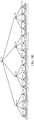
- FIG. 3A to FIG. 3E are schematic diagrams of the algorithm. That a size of the CTU is 64*64 pixels is used as an example.
- a traversal process may be shown in FIG. 3A and FIG. 3B .
- a CTU with a size of 64*64 pixels is divided into four CUs with 32*32 pixels as sub-CUs of the CTU.
- Each CU with 32*32 pixels is further divided into four CUs with 16*16 pixels as sub-CUs of the CU with 32*32 pixels.
- Each CU with 16*16 pixels is further divided into four CUs with 8*8 pixels as sub-CUs of the CU with 16*16 pixels.
- Four layers of CUs form a full quadtree (except the last layer without any subnodes, all nodes on each layer have four subnodes).
- predictive coding is performed on the CTU by using 64*64 pixels as a size of a PU to determine an optimal prediction mode, and determine a coding cost (C1) of the CTU in the optimal prediction mode.
- the coding cost is a minimum coding cost of the CTU in a PU division manner of 2N*2N.
- Predictive coding is performed on each CU of the second layer by using 32*32 pixels as a size of a PU to determine an optimal prediction mode of each CU of the second layer, and determine a coding cost (C21, C22, C22, and C24) of each CU of the second layer in the optimal prediction mode.
- the coding cost is a minimum coding cost of each CU of the second layer in the PU division manner of 2N*2N.
- Predictive coding is performed on each CU of the third layer by using 16*16 pixels as a size of a PU to determine an optimal prediction mode of each CU of the third layer, and determine a coding cost (C31, ..., C34; C35, ..., C38; C39, ..., C312; and C313, ..., C316) of each CU of the third layer in the optimal prediction mode.
- the coding cost is a minimum coding cost of each CU of the third layer in the PU division manner of 2N*2N.
- Predictive coding is performed on each CU of the fourth layer by using 8*8 pixels as a size of a PU to determine an optimal prediction mode of each CU of the fourth layer, and determine a coding cost (c1, ..., c4, c5, ..., c6, c57, ..., c60, c61, ..., c64) of each CU of the fourth layer in the optimal prediction mode.
- the coding cost is a minimum coding cost of each CU of the fourth layer in the PU division manner of 2N*2N.
- the optimal prediction mode is a prediction mode that can minimize a coding cost obtained by performing predictive coding on a CU in a plurality of prediction modes corresponding to a PU with a specific size. For example, if a PU with a size of 64*64 pixels corresponds to four prediction modes, coding costs obtained by performing predictive coding on the CU by using the four prediction modes are c1, c2, c3, and c4, and c1 ⁇ c2 ⁇ c3 ⁇ c4, a prediction mode corresponding to c1 is an optimal prediction mode.
- the coding cost may also be referred to as a rate distortion cost, which is used for indicating a difference between a reference value and a predicted value obtained through prediction when predictive coding is performed on the CU in a specific prediction mode.
- a smaller coding cost indicates a smaller difference between the predicted value and the reference value, fewer bits required for coding, and a lower bit rate.
- a coding cost obtained by performing predictive coding on a CU in a specific prediction mode may be determined by using an algorithm such as a sum of absolute difference (SAD) algorithm, a sum of absolute transformed difference (SATD) algorithm, or a sum of squared difference (SSD) algorithm.
- SAD sum of absolute difference
- SATD sum of absolute transformed difference
- SSD sum of squared difference
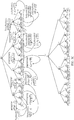
- a recursion process is performed after the traversal process.
- the recursion process is shown in FIG. 3C , FIG. 3D , and FIG. 3E .
- minimum coding costs for example, c1, c2, c3, and c4 of four sub-CUs of each CU of the third layer are added up to obtain another coding cost of each CU of the third layer, which is a minimum coding cost of each CU of the third layer in a PU division manner of N*N.
- the minimum coding cost of each CU of the third layer in the PU division manner of 2N*2N is compared with the minimum coding cost in the PU division manner of N*N (for example, C31 is compared with c1+c2+c3+c4), and a smaller one of the two minimum coding costs is selected as a minimum coding cost of each CU of the third layer, which is a final coding cost (c31, c32, ..., c316) of each CU of the third layer.
- minimum coding costs for example, c31, c32, c33, and c34
- minimum coding costs for example, c31, c32, c33, and c34
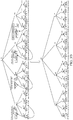
- the minimum coding cost of each CU of the second layer in the PU division manner of 2N*2N is compared with the minimum coding cost in the PU division manner of N*N (for example, C21 is compared with c31+c32+c33+c34), and a smaller one of the two minimum coding costs is selected as a minimum coding cost of each CU of the second layer, which is a final coding cost of each CU of the second layer (c21, c22, c23, and c24).
- minimum coding costs for example, c21, c22, c23, and c24
- C1 minimum coding cost of the CTU in the PU division manner of 2N*2N
- a smaller one of the two minimum coding costs is selected as a minimum coding cost (c0) of the CTU, which is a final coding cost of the CTU.
- each CU of the second layer needs to be divided is determined in sequence according to the minimum coding cost of each CU of the second layer. If the minimum coding cost is the minimum coding cost in the PU division manner of 2N*2N, each CU of the second layer does not need to be divided. If the minimum coding cost is the minimum coding cost in the PU division manner of N*N, each CU of the second layer needs to be divided. Similarly, whether each CU of the third layer needs to be divided is determined in sequence according to the minimum coding cost of each CU of the third layer.
- a division status of each CU may be represented by the tree structure shown in FIG. 2A .
- a process of the complete traversal and recursion algorithm is a process of finding a division policy that can minimize the coding cost of the CTU.
- the final coding cost of each CU determined by using the recursion process is used for determining the division policy, the CTU may be divided according to the division policy, and the CTU may be coded according to CUs obtained by dividing the CTU.
- the PU is a base unit used in performing predictive coding on a CU.
- the 2N*2N manner refers to dividing the CU into one PU for predictive coding, that is, one CU includes one PU.
- the N*N manner refers to dividing the CU into four PUs with the same size for predictive coding, that is, one CU includes four PUs.
- the division policy determined according to the coding algorithm of the tree structure may minimize the coding cost of the CTU, that is, the CTU may be coded by using minimum bits to reduce a bit rate.
- the bit rate is reduced, an involved calculation process is complex. Specifically, in the calculation process, coding costs of each CU in the full quadtree are calculated in different PU division manners and different prediction modes, and a plurality of coding costs obtained through calculation are compared to obtain a minimum coding cost of each CU. This may require a large amount of calculation, and has high complexity, which takes much time, and causes a low coding speed.
- the exemplary embodiments of the present disclosure provide a method for determining a coding cost of a CU and a related apparatus, to resolve a problem of high calculation complexity in a process of determining a division policy of a CTU.
- FIG. 5 is a flowchart of a method for determining a coding cost of a CU according to an exemplary embodiment.
- the method may be generally performed by a video coding server.
- the method in this embodiment of this application may include steps S101 to S104.
- step S101 a CU subject to predictive coding in an intra-frame prediction mode is determined.
- the CU is obtained by dividing a CTU, and a size of the CU may be any one of 8*8 pixels, 16*16 pixels, 32*32 pixels, and 64*64 pixels.
- the predictive coding in the intra-frame prediction mode refers to performing predictive coding by using a CU of a current frame as a reference CU, and the reference CU refers to a CU that has been coded.
- the CU may be directly determined as a CU subject to predictive coding in the intra-frame prediction mode.
- the CU is a CU in a non-I frame (for example, a P frame or a B frame)
- the CU subject to predictive coding in the intra-frame prediction mode may be determined with reference to an intra-frame mode decision algorithm in the H.264/AVC standard, in which after inter-frame predictive coding is performed on the CU and an optimal inter-frame mode is selected, an average bit rate of the CU and an average boundary error of the CU are determined.
- the CU subject to predictive coding in the intra-frame prediction mode may alternatively be determined in other manners without limitation.
- step S104 is performed without step S102 and step S103, that is, a first coding cost is determined as a second coding cost of the CU.
- step S102 pixel gradient information corresponding to the CU is determined.
- the pixel gradient information includes a pixel gradient variance, and the pixel gradient variance is a variance of image gradients of at least some pixels in the CU.
- the pixel gradient information corresponding to the CU is information obtained according to an image gradient of a pixel in the CU.
- the pixel gradient information may be information obtained according to image gradients of some or all pixels in the CU.
- the pixel gradient information may further include parameters, for example, a pixel gradient average value and a pixel gradient mean variance, used for measuring smoothness and texture complexity of an image.
- the pixel gradient average value refers to an average value of the image gradients of some or all the pixels in the CU.
- the pixel gradient mean variance refers to a mean variance of the image gradients of some or all the pixels in the CU.
- pixel gradient information of each pixel in the CU may be determined by using an image gradient algorithm, so as to determine image gradients of some or all pixels in the CU, and the pixel gradient information corresponding to the CU may be further determined according to the image gradients of some or all the pixels in the CU.
- the image gradient algorithm may be an image gradient algorithm based on a first derivative, for example, a Roberts operator, a Sobel operator, or a Prewitt operator.
- the image gradient algorithm may be an image gradient algorithm based on a second derivative, for example, a Laplace operator.
- the pixels may be some pixels selected randomly from all the pixels in the CU.
- the pixels may be some pixels selected from all the pixels in the CU according to a specific selecting rule, for example, may be some pixels selected according to a preset sampling rate.
- the preset sampling rate is 90%
- the size of the CU is 64*64 pixels, that is, 4096 pixels
- some pixels in the CU are 3687 pixels in the 4096 pixels. All the pixels in the CU may be sampled from left to right and from top to bottom to obtain the 3687 pixels.
- step S103 a division predecision is made regarding the CU according to the pixel gradient information.
- the division predecision may be made on the CU according to the pixel gradient variance. If the pixel gradient information further includes the pixel gradient average value, the division predecision may be made on the CU according to the pixel gradient variance and the pixel gradient average value. If the pixel gradient information further includes the pixel gradient mean variance, the division predecision may be made on the CU according to the pixel gradient variance and the pixel gradient mean variance.
- a specific implementation of making a division predecision on the CU according to the pixel gradient information is described in detail in embodiments shown in FIG. 8 to FIG. 12 , and reference may be made to descriptions in the embodiments shown in FIG. 8 to FIG. 12 .
- a first coding cost is determined as a second coding cost of the CU in a case that a result of the division predecision on the CU is negative.
- the second coding cost is used to determine a division policy of a CTU corresponding to the CU
- the first coding cost is a coding cost obtained by performing predictive coding on the CU by using a current size of the CU as a size of a PU.
- the first coding cost is a coding cost of the CU in a PU division manner of 2N*2N. If there is only one corresponding prediction mode when the size of the PU is the current size of the CU, the first coding cost is a coding cost obtained by performing predictive coding on the CU in the prediction mode, that is, a coding cost corresponding to the prediction mode. If there is a plurality of corresponding prediction modes when the size of the PU is the current size of the CU, the first coding cost is a minimum coding cost obtained by performing predictive coding on the CU by using the current size of the CU as the size of the PU.
- the first coding cost is a coding cost obtained by performing predictive coding on the CU in the prediction mode 1.
- a prediction mode 1 a prediction mode 2
- a prediction mode 3 a prediction mode 4
- coding costs obtained by performing predictive coding on the CU in the four prediction modes are c11, c12, c13, and c14 respectively, and c1 1 ⁇ c12 ⁇ c13 ⁇ c14
- the first coding cost is c11.
- the second coding cost refers to a final coding cost of the CU. If the CU is a CTU, a second coding cost of the CTU may be equivalent to the minimum coding cost (c0) of the CTU determined after the recursion process in the processes shown in FIG. 3E . Because the second coding cost is the first coding cost, it may be determined that a division policy of the CTU is negative according to the division status shown in FIG. 4 .
- the second coding cost of the CU may be equivalent to the minimum coding cost (c21, c31, or the like) of the CU determined by comparing the minimum coding cost of the CU in the PU division manner of 2N*2N with the minimum coding cost of the CU in the PU division manner of N*N in the processes shown in FIG. 3C or FIG. 3D .
- the second coding cost is used for calculating a minimum coding cost of a CU of an upper layer of the CU in the PU division manner of N*N, a second coding cost of the CTU may be determined through recursion, and then a division policy of the CTU may be determined.
- a CU is determined to be subject to predictive coding in an intra-frame prediction mode
- pixel gradient information of the CU is determined, and a division predecision is made on the CU according to the pixel gradient information of the CU.
- a coding cost obtained by performing predictive coding on the CU by using a current size of the CU as a size of a PU is determined as a final coding cost of the CU.
- FIG. 6 is a flowchart of a method for determining a coding cost of a CU according to an exemplary embodiment of the present disclosure.
- the method may be generally performed by a video coding server. As shown in FIG. 6 , the method includes steps S201 to S208.
- step S201 a CU subject to predictive coding in an intra-frame prediction mode is determined.
- the CU may be obtained by dividing a CTU, and a size of the CU may be any one of 8*8 pixels, 16*16 pixels, 32*32 pixels, and 64*64 pixels.
- the predictive coding in the intra-frame prediction mode refers to performing predictive coding by using a CU of a current frame as a reference CU, and the reference CU refers to a CU that has been coded.
- the CU may be directly determined as a CU subject to predictive coding in the intra-frame prediction mode.
- the CU is a CU in a non-I frame (for example, a P frame or a B frame)
- the CU subject to predictive coding in the intra-frame prediction mode may be determined with reference to an intra-frame mode decision algorithm in the H.264/AVC standard, in which after inter-frame predictive coding is performed on the CU and an optimal inter-frame mode is selected, an average bit rate of the CU and an average boundary error of the CU are determined.
- the CU is a CU subject to predictive coding in the intra-frame prediction mode.
- the CU subject to predictive coding in the intra-frame prediction mode may alternatively be determined in other manners without limitation.
- step S207 is performed without step S202 to step S206, that is, a first coding cost is determined as a second coding cost of the CU.
- step S202 pixel gradient information corresponding to the CU is determined.
- the pixel gradient information includes a pixel gradient variance, and the pixel gradient variance is a variance of image gradients of at least some pixels in the CU.
- the pixel gradient information corresponding to the CU is information obtained according to an image gradient of a pixel in the CU.
- the pixel gradient information may be information obtained according to image gradients of some or all pixels in the CU.
- the pixel gradient information may further include parameters, for example, a pixel gradient average value and a pixel gradient variance mean variance, used for measuring smoothness and texture complexity of an image.
- the pixel gradient average value refers to an average value of the image gradients of some or all the pixels in the CU.
- the pixel gradient mean variance refers to a mean variance of the image gradients of some or all the pixels in the CU.
- pixel gradient information of each pixel in the CU may be determined by using an image gradient algorithm, so as to determine image gradients of some or all pixels in the CU, and the pixel gradient information corresponding to the CU may be further determined according to the image gradients of some or all the pixels in the CU.
- the image gradient algorithm may be an image gradient algorithm based on a first derivative, for example, a Roberts operator, a Sobel operator, or a Prewitt operator.
- the image gradient algorithm may be an image gradient algorithm based on a second derivative, for example, a Laplace operator.
- the pixels may be some pixels selected randomly from all the pixels in the CU.
- the pixels may be some pixels selected from all the pixels in the CU according to a specific selecting rule, for example, may be some pixels selected according to a preset sampling rate.
- the preset sampling rate is 90%
- the size of the CU is 64*64 pixels, that is, 4096 pixels
- some pixels in the CU are 3687 pixels in the 4096 pixels. All the pixels in the CU may be sampled from left to right and from top to bottom to obtain the 3687 pixels.
- step S203 a division predecision regarding the CU is made according to the pixel gradient information.
- the division predecision may be made on the CU according to the pixel gradient variance. If the pixel gradient information further includes the pixel gradient average value, the division predecision may be made on the CU according to the pixel gradient variance and the pixel gradient average value. If the pixel gradient information further includes the pixel gradient mean variance, the division predecision may be made on the CU according to the pixel gradient variance and the pixel gradient mean variance.
- a specific implementation of making a division predecision on the CU according to the pixel gradient information is described in detail in embodiments shown in FIG. 8 to FIG. 12 , and reference may be made to descriptions in the embodiments shown in FIG. 8 to FIG. 12 .
- step S207 is performed. If the result of the division predecision on the CU is positive, step S204 is performed.
- step S204 the CU is divided into at least two sub-CUs.
- the CU may be divided into four sub-CUs with reference to a full quadtree manner in the related art.
- the CU may also be divided into another quantity of sub-CUs.
- the specific method of division is not limiting upon the present disclosure.
- step S205 a coding cost of each of the at least two sub-CUs is determined.
- the at least two sub-CUs may be determined as new CUs subject to predictive coding in the intra-frame prediction mode, and steps S201 to S208 are performed to determine a coding cost of each of the sub-CUs.
- step S206 a sum of coding costs of the at least two sub-CUs with a first coding cost are compared.
- the first coding cost is a coding cost obtained by performing predictive coding on the CU by using a current size of the CU as a size of a PU.
- the first coding cost is a coding cost of the CU in a PU division manner of 2N*2N. If there is only one corresponding prediction mode when the size of the PU is the current size of the CU, the first coding cost is a coding cost obtained by performing predictive coding on the CU in the prediction mode, that is, a coding cost corresponding to the prediction mode. If there is a plurality of corresponding prediction modes when the size of the PU is the current size of the CU, the first coding cost is a minimum coding cost obtained by performing predictive coding on the CU by using the current size of the CU as the size of the PU.
- the first coding cost is a coding cost obtained by performing predictive coding on the CU in the prediction mode 1.
- a prediction mode 1 a prediction mode 2
- a prediction mode 3 a prediction mode 4
- coding costs obtained by performing predictive coding on the CU in the four prediction modes are c11, c12, c13, and c14 respectively, and c11 ⁇ c12 ⁇ c13 ⁇ c14
- the first coding cost is c11.
- step S207 is performed. If the sum of the coding costs of the at least two sub-CUs is less than the first coding cost, step S208 is performed.
- step S207 the first coding cost is determined as a second coding cost of the CU.
- step S208 the sum of the coding costs of the at least two sub-CUs is determined as the second coding cost of the CU.
- the second coding cost refers to a final coding cost of the CU. If the CU is a CTU, a second coding cost of the CTU may be equivalent to the minimum coding cost (c0) of the CTU determined after the recursion process in the processes shown in FIG. 3E . Because the second coding cost is the first coding cost, it may be determined that a division policy of the CTU is negative according to the division status shown in FIG. 4 .
- the second coding cost of the CU may be equivalent to the minimum coding cost (c21, c31, and the like) of the CU determined by comparing the minimum coding cost of the CU in the PU division manner of 2N*2N with the minimum coding cost of the CU in the PU division manner of N*N in the processes shown in FIG. 3C or FIG. 3D .
- the second coding cost is used for calculating a minimum coding cost of a CU of an upper layer of the CU in the PU division manner of N*N, a second coding cost of the CTU may be determined through recursion, and then a division policy of the CTU may be determined.
- a coding cost obtained by performing predictive coding on the CU by using a current size of the CU as a size of a PU is determined as a final coding cost of the CU. Further, it may be determined that the CU does not need to be divided, and division of the CU is ended in advance.
- the CU Only when the result of the division predecision is positive, the CU is divided, and then a sum of coding costs of sub-CUs corresponding to the CU is compared with a first coding cost. Because the same method for determining a coding cost is adopted for determining the coding costs of the sub-CUs, further division of a sub-CU may be ended in advance. Division of the CU is ended as early as possible, so that a large quantity of processes of calculating a coding cost is avoided, thereby reducing calculation workload, determining a division policy of a CTU as soon as possible, and improving a coding speed.
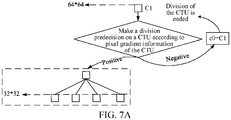
- a size of a CTU is 64*64 pixels is still used as an example, referring to FIG. 7A to FIG. 7E .
- a CTU is determined as a CU, predictive coding is performed on the CTU by using 64*64 pixels as a size of a PU to determine an optimal prediction mode of the CTU, and determine a coding cost C1 of the CTU in the optimal prediction mode.
- the coding cost is a first coding cost of the CTU.
- a division predecision is made on the CTU according to pixel gradient information of the CTU.
- the second coding cost of the CTU it may be learned from FIG. 4 that a division policy of the CTU is determined, that is, the CTU does not need to be divided and division is ended.
- the division policy of the CTU is determined without calculating coding costs of CUs of the second layer, CUs of the third layer, and CUs of the fourth layer in sequence as in the process shown in FIG. 3B .
- the processes of FIG. 3C to FIG. 3B do not need to be performed in this case, thereby saving a large amount of calculation and improving a coding speed.
- the CTU is divided into four CUs with 32*32 pixels, that is, the CUs of the second layer.
- predictive coding is performed on each CU of the second layer by using 32*32 pixels as the size of the PU to determine an optimal prediction mode of each CU, and determine a coding cost of each CU of the second layer in the optimal prediction mode.
- the coding cost is a first coding cost of each CU of the second layer, that is, C21, C22, C23, and C24.
- a division predecision is made on each CU of the second layer according to pixel gradient information of each CU of the second layer.
- a first coding cost is determined as a second coding cost of the target CU of the second layer.
- division of the target CU of the second layer is ended. There is no need to calculate coding costs of the CUs of the third layer and the CUs of the fourth layer under the target CU in sequence as in the process shown in FIG. 3B , thereby saving a large amount of calculation and improving a coding speed.
- the target CU of the second layer is divided into four sub-CUs with 16*16 pixels, that is, the CUs of the third layer.
- predictive coding is performed on each CU of the third layer by using 16*16 pixels as the size of the PU to determine an optimal prediction mode of each CU of the third layer, and determine a coding cost of each CU of the third layer in the optimal prediction mode.
- the coding cost is a first coding cost of each CU of the third layer.
- a division predecision is made on each CU of the second layer according to pixel gradient information of each CU of the third layer.
- a first coding cost of the target CU of the third layer is determined as a second coding cost of the target CU of the third layer.
- division of the target CU of the third layer is ended.
- the target CU is determined not to be divided, and there is no need to calculate coding costs of the CUs of the fourth layer under the target CU in sequence as in the process shown in FIG. 3B , thereby saving a large amount of calculation and improving a coding speed.
- the target CU of the third layer is divided into four CUs with 8*8 pixels, that is, the CUs of the third layer.
- predictive coding is performed on each CU of the fourth layer by using 8*8 pixels as the size of the PU to determine an optimal prediction mode of each CU of the fourth layer, and determine a coding cost of each CU of the fourth layer in the optimal prediction mode.
- the coding cost is a first coding cost of each CU of the fourth layer.
- second coding costs of CUs whose second coding costs are not determined in the CUs of the first layer, the second layer, and the third layer are determined in sequence from bottom to top.
- a smaller one of two coding costs (the first coding cost of the CU and a sum of second coding costs of four sub-CUs under the CU) of the CU is determined as a second coding cost of the CU.
- FIG. 7D the tree structure determined according to the processes of FIG. 7A to FIG. 7C is shown in FIG. 7D . It is determined that a CU numbered 1 (that is, a CTU) needs to be divided according to the process shown in FIG. 7A . It is determined that CUs numbered 3 and 4 need to be divided and CUs numbered 2 and 5 do not need to be divided according to the process shown in FIG. 7B . In this case, second coding costs of the CUs numbered 2 and 5 are determined, which are first coding costs of the CUs, and second coding costs of the CUs numbered 3 and 4 are not determined.
- second coding costs of the CUs numbered 7 to 13 are determined, which are first coding costs of the CUs, and a second coding cost of the CU numbered 6 is not determined.
- second coding costs of the CUs whose second coding costs are not determined are determined in sequence from bottom to top, that is, the second coding costs of the CUs numbered 6, 3, 4, and 1 are determined in sequence.
- the second coding cost of the CU numbered 6 in the CUs of the third layer is determined, then, the second coding costs of the CUs numbered 3 and 4 in the CUs of the second layer are determined, and finally, the second coding cost of the CU numbered 1, that is, the CTU, is determined.
- a division manner of the CTU is determined according to minimum coding costs of the CUs of each layer. If the second coding cost of the CTU is the first coding cost of the CTU, it is determined that the CTU is not divided and the tree structure of the CTU has only one layer, that is, a root node. A corresponding division status is shown in A of FIG. 4 . If the second coding cost of the CTU is a sum of the second coding costs of the CUs of the second layer, it is determined that the CTU needs to be divided into four CUs, as shown in B of FIG. 4 .
- a division manner of the second layer may be further determined according to the second coding costs of the CUs of the second layer, and so on. In this way, a final division status of the CTU may be determined.
- FIG. 8 is a schematic flowchart of a method for determining a coding cost of a CU according to an embodiment of this application.
- the making a division predecision on the CU according to the pixel gradient information may include steps S301 to S303.
- step S301 a variance threshold corresponding to the CU is determined.
- the variance threshold corresponding to the CU there are two cases for the variance threshold corresponding to the CU.
- a first case is that the variance threshold is a fixed threshold, and a second case is that the variance threshold is in a positive correlation with a quantization parameter corresponding to the CU. That is, a greater quantization parameter corresponding to the CU indicates a greater variance threshold.
- the quantization parameter reflects a compression status of space details. If the quantization parameter is small, most of the details are retained. If the quantization parameter is increased, the details are lost, and a bit rate is reduced, that is, the quantization parameter is in a negative correlation with the bit rate and the variance threshold is in a negative correlation with the bit rate.
- a value of the quantization parameter may be determined by an encoder. A value range of the quantization parameter is 0 to 52. When the quantization parameter is greater than 0, the variance threshold corresponding to the CU may be equal to a product of the quantization parameter corresponding to the CU and X, and X is greater than or equal to 1.
- step S302 the result of the division predecision on the CU is determined to be negative in a case that the pixel gradient variance corresponding to the CU is less than the variance threshold.
- the pixel gradient variance corresponding to the CU is used for reflecting statuses of a texture and an object boundary in an image of the CU.
- a relatively small pixel gradient variance of the CU indicates that the image of the CU may have a messy texture, and further division of the CU is not helpful to improve image quality. Due to the messy texture, eyes are not sensitive to the CU, and no further division is required.
- step S303 the result of the division predecision on the CU is determined to be positive in a case that the pixel gradient variance is greater than or equal to the variance threshold.
- a relatively large pixel gradient variance indicates that the CU may include an object boundary, and further division may help to improve the image quality. After further division, sub-CUs corresponding to the CU have higher similarity and compression efficiency is facilitated to improve.
- the predecision on whether the CU is divided is made according to the pixel gradient variance of the CU.
- the pixel gradient variance of the CU reflects the statuses of the texture and the boundary in the image of the CU, and division of the CU may be ended in advance according to the pixel gradient variance, thereby reducing calculation workload and balancing compression efficiency and image quality.
- the pixel gradient information according to the embodiments of this application may further include the pixel gradient average value.
- FIG. 9 is a schematic flowchart of a method for determining a coding cost of a CU according to an embodiment of this application.
- the making a division predecision on the CU according to the pixel gradient information may include the following steps S401 to S406.
- step S401 a first threshold corresponding to the CU, a second threshold corresponding to the CU, and a variance threshold corresponding to the CU are determined.
- the second threshold is greater than the first threshold.
- the variance threshold corresponding to the CU there are two cases for the variance threshold corresponding to the CU.
- One case is that the variance threshold is a fixed threshold, and the other case is that the variance threshold is in a positive correlation with a quantization parameter corresponding to the CU. That is, a greater quantization parameter corresponding to the CU indicates a greater variance threshold.
- the quantization parameter reflects a compression status of space details. If the quantization parameter is small, most of the details are retained. If the quantization parameter is increased, the details are lost, and a bit rate is reduced, that is, the quantization parameter is in a negative correlation with the bit rate and the variance threshold is in a negative correlation with the bit rate.
- a value of the quantization parameter may be determined by an encoder. A value range of the quantization parameter is 0 to 52. When the quantization parameter is greater than 0, the variance threshold corresponding to the CU may be equal to a product of the quantization parameter corresponding to the CU and X, and X is greater than or equal to 1.
- both the first threshold and the second threshold are average thresholds. If the first threshold corresponding to the CU is not 0, the second threshold corresponding to the CU may be a fixed multiple of the first threshold corresponding to the CU. To be specific, the second threshold corresponding to the CU is a product of the first threshold corresponding to the CU and a second coefficient, the second coefficient being greater than 1. If the first threshold corresponding to the CU is 0, the second threshold corresponding to the CU may be a sum of the threshold corresponding to the CU and a target average threshold, the target average threshold being a fixed threshold.
- the first threshold corresponding to the CU may be a fixed threshold. If the first threshold corresponding to the CU is a fixed threshold, the first threshold is in a negative correlation with the size of the CU.
- the first threshold corresponding to the CU may alternatively be correlated with an average value of pixel gradients of CUs near the CU.
- the determining a first threshold corresponding to the CU includes the following steps S501 to S503.
- step S501 a plurality of neighboring CUs of the CU is determined.
- An edge of the neighboring CU coincides with an edge of the CU or a vertex of the neighboring CU coincides with a vertex of the CU, and an image in the neighboring CU does not coincide with an image in the CU.
- the neighboring CU may be a CU near the CU and connected with the CU.
- the neighboring CU may be a CU on which predictive coding has been performed.
- a size of the neighboring CU may be the same as the size of the CU, or may be different from the size of the CU.
- the CU is CU1 shown in FIG. 11 , as CU7, CU17, CU19, CU20, and CU23 each have an edge coinciding with an edge of CU1, and CU6, CU10, CU22, and CU24 each have a vertex coinciding with a vertex of CU1, CU6, the CU7, CU10, CU17, CU19, CU20, CU22, CU23, and CU24 are all neighboring CUs of CU1, and because remaining CUs have no edge or vertex coinciding with that of CU1, the remaining CUs are not neighboring CUs of the CU.
- the neighboring CU may alternatively be a CU near the CU and in a specific orientation.
- the neighboring CUs are neighboring CUs near the CU and located in an upper left orientation, a right above orientation, an upper right orientation, and a right left orientation.
- CU6, CU7, CU10, CU17, and CU19 are neighboring CUs of CU1.
- neighboring CUs of CU1 may be: a CU formed by combining CU3, CU4, CU5, and CU6, CU7, a CU formed by combining CU8, CU9, CU10, and CU11, a CU formed by combining CU16, CU17, CU18, and CU19, CU20, CU22, CU23, and a CU formed by combining CU24, CU25, CU26, and CU27.
- the above examples of the neighboring CUs are only examples, and do not limit the embodiments of this application.
- the first threshold corresponding to the CU is determined according to a size of a first neighboring CU and a pixel gradient average value of the first neighboring CU in a case that a quantity of first neighboring CUs in the plurality of neighboring CUs is greater than or equal to a target quantity.
- the first neighboring CU being subject to predictive coding in the intra-frame prediction mode.
- the target quantity may be set to 4, 5, 6, or other values.
- all the neighboring CUs determined in step S501 are first neighboring CUs. If the CU is a CU in a non-I frame, the first neighboring CUs may be determined in the plurality of neighboring CUs according to the manner described in step S101.
- the determining the first threshold corresponding to the CU according to a size of a first neighboring CU and a pixel gradient average value of the first neighboring CU includes the following steps S601 to S603.
- step S601 the first neighboring CUs is searched for a second neighboring CU.
- a size of the second neighboring CU is greater than or equal to the size of the CU.
- CU7, CU10, CU17, CU20, CU22, and CU23 are all CUs subject to predictive coding in the intra-frame prediction mode.
- sizes of CU7, CU20, CU22, and CU23 are all equal to the size of CU1
- CU7, CU20, CU22, and CU23 are all second neighboring CUs.
- step S602 a product of a first coefficient and a target average value is determined as the first threshold corresponding to the CU in a case that there is the second neighboring CU.
- the target average value is a quotient of a sum of pixel gradient average values of the second neighboring CUs and a quantity of the second neighboring CUs.
- the first coefficient may be a coefficient greater than 1.
- a pixel gradient average value corresponding to each neighboring CU may be determined according to the manner of determining pixel gradient information corresponding to a CU described in step S102.
- the target average value is (the pixel gradient average value 1 + the pixel gradient average value 2 + the pixel gradient average value 3 + the pixel gradient average value 4)/4.
- step S603 the first threshold corresponding to the CU is determined to be 0 in a case that there is no second neighboring CU.
- the first threshold being 0 is a minimum value that can be obtained by performing gradient calculation.
- the manner of step S502 is a manner of determining the first threshold corresponding to the CU designed for a case that the size of the neighboring CU may be the same as the size of the CU, or may be different from the size of the CU.
- step S502 may be replaced with the following.
- the first threshold corresponding to the CU may be determined according to a division status of a first neighboring CU and a pixel gradient average value of the first neighboring CU in a case that a quantity of first neighboring CUs in the plurality of neighboring CUs is greater than or equal to a target quantity.
- the first neighboring CU is a CU subject to predictive coding in an intra-frame prediction mode.
- the first neighboring CUs are searched for a third neighboring CU.
- the third neighboring CU is a first neighboring CU that is not divided.
- a product of a first coefficient and a target average value is determined as the first threshold corresponding to the CU in a case that there is the third neighboring CU.
- the target average value is a quotient of a sum of pixel gradient average values corresponding to second neighboring CUs and a quantity of the second neighboring CUs.
- an average threshold corresponding to the size of the CU is determined as the first threshold corresponding to the CU in a case that the quantity of the first neighboring CU in the plurality of neighboring CUs is less than the target quantity.
- the average threshold corresponding to the size of the CU is a fixed threshold, and a larger size of the CU indicates a smaller average threshold corresponding to the size of the CU.
- three average threshold may be designed to correspond to a CU with a size of 16*16 pixels, a CU with a size of 32*32 pixels, and a CU with a size of 64*64 pixels respectively.
- step S402 the pixel gradient average value corresponding to the CU is compared with the first threshold.
- step S405 is performed. If the pixel gradient average value is greater than or equal to the first threshold, step S403 is performed.
- the pixel gradient average value corresponding to the CU is used for reflecting smoothness of image content in the CU.
- a relatively small pixel gradient average value of the CU indicates that the image content in the CU is relatively smooth and no further division is required.
- step S403 the pixel gradient average value is compared with the second threshold.
- step S404 is performed. If the pixel gradient average value is greater than or equal to the second threshold, step S406 is performed.
- a relatively large pixel gradient average value indicates that the image content in the CU is not smooth and a possibility of requiring further division is high.
- step S404 the pixel gradient variance corresponding to the CU is compared with the variance threshold.
- step S405 is performed. If the pixel gradient variance is greater than or equal to the variance threshold, step S406 is performed.
- the pixel gradient variance corresponding to the CU is used for reflecting statuses of a texture and an object boundary in an image of the CU.
- a relatively small pixel gradient variance of the CU indicates that the image of the CU may gave a messy texture, and further division of the CU is not helpful to improve an image quality. Due to the messy texture, eyes are not sensitive to the CU, and no further division is required.
- a relatively large pixel gradient variance indicates that the CU may include an object boundary, and further division may help to improve image quality. After the further division, sub-CUs corresponding to the CU have higher similarity, which helps to improve compression efficiency.
- step S405 the result of the division predecision on the CU is determined to be negative.
- step S406 the result of the division predecision on the CU is determined to be positive.
- the predecision on whether the CU is divided is made according to the pixel gradient variance of the CU and the pixel gradient average value of the CU.
- the pixel gradient variance of the CU reflects the statuses of the texture and the boundary in the image of the CU, and the pixel gradient average value reflects the smoothness of the image content in the CU.
- the apparatus for determining a coding cost of a CU may be a computer device with a calculation processing function.
- the apparatus shown in FIG. 13 to FIG. 16 is configured to perform the method in the exemplary embodiments shown in FIG. 5 to FIG. 12 of this application. For ease of description, only a part related to the exemplary embodiments is shown. For specific technical details that are not disclosed, refer to the exemplary embodiments described above with reference to FIG. 5 to FIG. 12 .
- FIG. 13 is a schematic structural diagram of an apparatus for determining a coding cost of a CU according to an exemplary embodiment of the present disclosure.
- the apparatus 70 for determining a coding cost of a CU of this embodiment of this application may include: a CU determining module 71, a gradient information determining module 72, a predecision module 73, and a cost determining module 74.
- the CU determining module 71 is configured to determine a CU subject to predictive coding in an intra-frame prediction mode.
- the CU is obtained by dividing a CTU, and a size of the CU may be any one of 8*8 pixels, 16*16 pixels, 32*32 pixels, and 64*64 pixels.
- the predictive coding in the intra-frame prediction mode refers to performing predictive coding by using a CU of a current frame as a reference CU, and the reference CU refers to a CU that has been coded.
- the CU determining module 71 may directly determine the CU as a CU subject to predictive coding in the intra-frame prediction mode. If the CU is a CU in a non-I frame (for example, a P frame or a B frame), the CU subject to predictive coding in the intra-frame prediction mode may be determined with reference to an intra-frame mode decision algorithm in the H.264/AVC standard, in which after performing inter-frame predictive coding on the CU and selecting an optimal inter-frame mode, the CU determining module 71 determines an average bit rate of the CU and an average boundary error of the CU.
- the CU determining module 71 determines that the CU is a CU subject to predictive coding in the intra-frame prediction mode. Certainly, if the CU is the CU in the non-I frame, the CU determining module 71 may alternatively determine the CU subject to predictive coding in the intra-frame prediction mode in other manners. This is not limited in this embodiment of this application.
- the cost determining module 74 directly determines a first coding cost as a second coding cost of the CU.
- the gradient information determining module 72 is configured to determine pixel gradient information corresponding to the CU, the pixel gradient information including a pixel gradient variance, and the pixel gradient variance being a variance of image gradients of at least some pixels in the CU.
- the pixel gradient information corresponding to the CU is information obtained according to an image gradient of a pixel in the CU by the gradient information determining module 72.
- the pixel gradient information may be information obtained according to image gradients of some or all pixels in the CU by the gradient information determining module 72.
- the pixel gradient information may further include parameters, for example, a pixel gradient average value and a pixel gradient variance mean variance, used for measuring smoothness and texture complexity of an image.
- the pixel gradient average value refers to an average value of the image gradients of some or all the pixels in the CU.
- the pixel gradient mean variance refers to a mean variance of the image gradients of some or all the pixels in the CU.
- the gradient information determining module 72 may determine pixel gradient information of each pixel in the CU by using an image gradient algorithm, so as to determine image gradients of some or all the pixels in the CU, and may further determine the pixel gradient information corresponding to the CU according to the image gradients of some or all the pixels in the CU.
- the image gradient algorithm may be an image gradient algorithm based on a first derivative, for example, a Roberts operator, a Sobel operator, or a Prewitt operator.
- the image gradient algorithm may be an image gradient algorithm based on a second derivative, for example, a Laplace operator.
- the pixels may be some pixels selected randomly from all the pixels in the CU by the gradient information determining module 72.
- the pixels may be some pixels selected from all the pixels in the CU by the gradient information determining module 72 according to a specific selecting rule, for example, may be some pixels selected according to a preset sampling rate.
- the preset sampling rate is 90%
- the size of the CU is 64*64 pixels, that is, 4096 pixels
- some pixels in the CU are 3687 pixels in the 4096 pixels.
- the gradient information determining module 72 may sample all the pixels in the CU from left to right and from top to bottom to obtain the 3687 pixels.
- the predecision module 73 is configured to make a division predecision on the CU according to the pixel gradient information.
- the predecision module 73 may make the division predecision on the CU according to the pixel gradient variance. If the pixel gradient information further includes the pixel gradient average value, the predecision module 73 may make the division predecision on the CU according to the pixel gradient variance and the pixel gradient average value. If the pixel gradient information further includes the pixel gradient mean variance, the predecision module 73 may make the division predecision on the CU according to the pixel gradient variance and the pixel gradient mean variance.
- the predecision module 73 may include a threshold determining unit 731 and a result determining unit 732.
- the threshold determining unit 731 is configured to determine a variance threshold corresponding to the CU
- the result determining unit 732 is configured to determine that the result of the division predecision on the CU is negative in a case that the pixel gradient variance is less than the variance threshold, and determine that the result of the division predecision is positive in a case that the pixel gradient variance is greater than or equal to the variance threshold.
- the pixel gradient information further includes the pixel gradient average value.
- the threshold determining unit 731 is configured to determine a first threshold corresponding to the CU, a second threshold corresponding to the CU, and a variance threshold corresponding to the CU, the second threshold being greater than the first threshold
- the result determining unit 732 is configured to determine that the result of the division predecision on the CU is negative in a case that the pixel gradient average value is less than the first threshold, or determine that the result of the division predecision on the CU is negative in a case that the pixel gradient average value is greater than or equal to the first threshold, the pixel gradient average value is less than the second threshold, and the pixel gradient variance is less than the variance threshold, or determine that the result of the division predecision on the CU is positive in a case that the pixel gradient average value is greater than or equal to the first threshold, the pixel gradient average value is less than the second threshold, and the pixel gradient variance is greater than or equal to the variance threshold, or determine that the
- the variance threshold corresponding to the CU there are two cases for the variance threshold corresponding to the CU.
- One case is that the variance threshold is a fixed threshold, and the other case is that the variance threshold is in a positive correlation with a quantization parameter corresponding to the CU. That is, a greater quantization parameter corresponding to the CU indicates a greater variance threshold.
- the quantization parameter reflects a compression status of space details. If the quantization parameter is small, most of the details are retained. If the quantization parameter is increased, the details are lost, and a bit rate is reduced, that is, the quantization parameter is in a negative correlation with the bit rate and the variance threshold is in a negative correlation with the bit rate.
- a value of the quantization parameter may be determined by an encoder. A value range of the quantization parameter is 0 to 52. When the quantization parameter is greater than 0, the threshold determining unit 731 may determine a product of the quantization parameter corresponding to the CU and X as the variance threshold corresponding to the CU, and X is greater than or equal to 1, or determine a fixed variance threshold as the variance threshold corresponding to the CU.
- both the first threshold and the second threshold are average thresholds. If the first threshold corresponding to the CU is not 0, the second threshold corresponding to the CU may be a fixed multiple of the first threshold corresponding to the CU. To be specific, the threshold determining unit 731 may determine that the second threshold corresponding to the CU is a product of the first threshold corresponding to the CU and a second coefficient, the second coefficient being greater than 1. If the first threshold corresponding to the CU is 0, the threshold determining unit 731 may determine that the second threshold corresponding to the CU may be a sum of first threshold corresponding to the CU and a target average threshold, the target average threshold being a fixed threshold.
- the first threshold corresponding to the CU may be a fixed threshold.
- the threshold determining unit 731 may determine an average threshold corresponding to a size of the CU as the first threshold corresponding to the CU. If the first threshold corresponding to the CU is a fixed threshold, the first threshold is in a negative correlation with the size of the CU.
- the first threshold corresponding to the CU may alternatively be correlated with an average value of pixel gradients of CUs near the CU.
- the threshold determining unit 731 may determine a plurality of neighboring CUs of the CU. An edge of the neighboring CU coincides with an edge of the CU or a vertex of the neighboring CU coincides with a vertex of the CU, and an image in the neighboring CU does not coincide with an image in the CU.
- the threshold determining unit 731 may also determine the first threshold corresponding to the CU according to a size of a first neighboring CU and a pixel gradient average value corresponding to the first neighboring CU in a case that a quantity of first neighboring CUs in the plurality of neighboring CUs is greater than or equal to a target quantity.
- the first neighboring CU is subject to predictive coding in the intra-frame prediction mode.
- the threshold determining unit 731 may further determine an average threshold corresponding to a size of the CU as the first threshold corresponding to the CU in a case that the quantity of the first neighboring CU in the plurality of neighboring CUs is less than the target quantity.
- the neighboring CU may be a CU near the CU and connected with the CU.
- the neighboring CU may be a CU on which predictive coding has been performed.
- a size of the neighboring CU may be the same as the size of the CU, or may be different from the size of the CU.
- the threshold determining unit 731 determines that the CU6, CU7, CU10, CU17, CU19, CU20, CU22, CU23, and CU24 are all neighboring CUs of CU1, and because remaining CUs have no edge or vertex coinciding with that of CU1, the threshold determining unit 731 determines that the remaining CUs are not neighboring CUs of the CU.
- the neighboring CU may alternatively be a CU near the CU and in a specific orientation.
- the neighboring CUs are neighboring CUs near the CU and located in an upper left orientation, a right above orientation, an upper right orientation, and a right left orientation.
- the threshold determining unit 731 determines that CU6, CU7, CU10, CU17, and CU19 are neighboring CUs of CU1.
- the threshold determining unit 731 determines the following CUs as neighboring CUs: a CU formed by combining CU3, CU4, CU5, and CU6, CU7, a CU formed by combining CU8, CU9, CU10, and CU11, a CU formed by combining CU16, CU17, CU18, and CU19, CU20, CU22, CU23, and a CU formed by combining CU24, CU25, CU26, and CU27.
- the target quantity may be set to 4, 5, 6, or other values.
- the average threshold corresponding to the size of the CU is a fixed threshold, and a larger size of the CU indicates a smaller average threshold corresponding to the size of the CU.
- three average thresholds may be designed to correspond to a CU with a size of 16*16 pixels, a CU with a size of 32*32 pixels, and a CU with a size of 64*64 pixels respectively.
- the threshold determining unit 731 determines that all the neighboring CUs are first neighboring CUs. If the CU is a CU in a non-I frame, the threshold determining unit 731 determines first neighboring CUs in the plurality of neighboring CUs by using the CU determining module 71.
- the threshold determining unit 731 may search the first neighboring CUs for a second neighboring CU, where a size of the second neighboring CU is greater than or equal to the size of the CU, and determine a product of a first coefficient and a target average value as the first threshold corresponding to the CU in a case that there is the second neighboring CU.
- the target average value is a quotient of a sum of pixel gradient average values of the second neighboring CUs and a quantity of the second neighboring CUs.
- the threshold determining unit 731 may also determine that the first threshold corresponding to the CU is 0 in a case that there is no second neighboring CU.
- CU7, CU10, CU17, CU20, CU22, and CU23 are all CU subject to predictive coding in the intra-frame prediction mode.
- the threshold determining unit 731 determines that CU7, CU20, CU22, and CU23 are all second neighboring CUs.
- the threshold determining unit 731 may determine a pixel gradient average value corresponding to each neighboring CU by using the gradient information determining module 72 and further determine the target average value.
- the threshold determining unit 731 determines that the target average value is (the pixel gradient average value 1 + the pixel gradient average value 2 + the pixel gradient average value 3 + the pixel gradient average value 4)/4.
- the first threshold being 0 is a minimum value that can be obtained by performing gradient calculation.
- the threshold determining unit 731 may determine a plurality of neighboring CUs of the CU, where an edge of the neighboring CU coincides with an edge of the CU or a vertex of the neighboring CU coincides with a vertex of the CU, and an image in the neighboring CU does not coincide with an image in the CU.
- the threshold determining unit 731 may also determine the first threshold corresponding to the CU according to a division status of a first neighboring CU and a pixel gradient average value of the first neighboring CU in a case that a quantity of first neighboring CUs in the plurality of neighboring CUs is greater than or equal to a target quantity.
- the first neighboring CU is a CU subject to predictive coding in an intra-frame prediction mode.
- the threshold determining unit 731 may search the first neighboring CUs for a third neighboring CU, where the third neighboring CU is a first neighboring CU that is not divided.
- the threshold determining unit 731 may determine a product of a first coefficient and a target average value as the first threshold corresponding to the CU in a case that there is the third neighboring CU.
- the target average value is a quotient of a sum of pixel gradient average values corresponding to third neighboring CUs and a quantity of the third neighboring CUs.
- the cost determining module 74 is configured to determine a first coding cost as a second coding cost of the CU in a case that a result of the division predecision made on the CU by the predecision module 73 is negative.
- the second coding cost is used for determining a division policy of a CTU corresponding to the CU
- the first coding cost is a coding cost obtained by performing predictive coding on the CU by using a current size of the CU as a size of a PU.
- the first coding cost is a coding cost of the CU in a PU division manner of 2N*2N. If there is only one corresponding prediction mode when the size of the PU is the current size of the CU, the first coding cost is a coding cost obtained by performing predictive coding on the CU in the prediction mode, that is, a coding cost corresponding to the prediction mode. If there is a plurality of corresponding prediction modes when the size of the PU is the current size of the CU, the first coding cost is a minimum coding cost obtained by performing predictive coding on the CU by using the current size of the CU as the size of the PU.
- the first coding cost is a coding cost obtained by performing predictive coding on the CU in the prediction mode 1.
- the cost determining module 74 determines that coding costs obtained by performing predictive coding on the CU in the four prediction modes are c11, c12, c13, and c14 respectively, and c11 ⁇ c12 ⁇ c13 ⁇ c14, the cost determining module 74 determines that the first coding cost is c11.
- the second coding cost refers to a final coding cost of the CU.
- a second coding cost of the CTU may be equivalent to the minimum coding cost (c0) of the CTU determined after the recursion process in the processes shown in FIG. 3E . Because the second coding cost is the first coding cost, it may be determined that a division policy of the CTU is negative according to the description of determining a division policy according to the minimum coding cost of the CTU, that is, coding is directly performed by using the current size of the CTU.
- the second coding cost of the CU may be equivalent to the minimum coding cost (c21, c31, and the like) of the CU determined by comparing the minimum coding cost of the CU in the PU division manner of 2N*2N with the minimum coding cost of the CU in the PU division manner of N*N in the processes shown in FIG. 3C or FIG. 3D .
- the second coding cost is used for calculating a minimum coding cost of a CU of an upper layer of the CU in the PU division manner of N*N, a second coding cost of the CTU may be determined through recursion, and then a division policy of the CTU is determined.
- a CU is determined to be subject to predictive coding in an intra-frame prediction mode
- pixel gradient information of the CU is determined, and a division predecision is made on the CU according to the pixel gradient information of the CU.
- a coding cost obtained by performing predictive coding on the CU by using a current size of the CU as a size of a PU is determined as a final coding cost of the CU.
- FIG. 15 is a schematic structural diagram of an apparatus for determining a coding cost of a CU according to an embodiment of this application.
- the apparatus may include the CU determining module 71, the gradient information determining module 72, the predecision module 73, and the cost determining module 74 in the embodiment corresponding to FIG. 13 , and the apparatus may further include a division module 75.
- the division module 75 is configured to divide the CU into at least two sub-CUs in a case that the result of the division predecision made on the CU by the predecision module is positive.
- the division module 75 may divide the CU into four sub-CUs with reference to a full quadtree manner in the related art. Certainly, the division module 75 may alternatively divide the CU into another quantity of sub-CUs. This is not limited in this embodiment of this application.
- the CU determining module 71 is further configured to use each of the at least two sub-CUs as a new CU subject to predictive coding in the intra-frame prediction mode, the gradient information determining module 72 is further configured to determine pixel gradient information corresponding to each of the at least two sub-CUs, the predecision module 73 is further configured to make a division predecision on each of the at least two sub-CUs according to the pixel gradient information, and the cost determining module 74 is further configured to determine a coding cost of each of the at least two sub-CUs.
- the gradient information determining module 72 may determine pixel gradient information corresponding to each of the at least two sub-CUs in the manner of determining the pixel gradient information corresponding to the CU
- the predecision module 73 may make a division predecision on each of the at least two sub-CUs in the manner of making the division predecision on the CU according to the pixel gradient information corresponding to the CU
- the cost determining module 74 may determine a coding cost of each of the at least two sub-CUs in the manner of determining the coding cost of the CU.
- the cost determining module 72 may determine pixel gradient information corresponding to each of the at least two sub-CUs in the manner of determining the pixel gradient information corresponding to the CU.
- the cost determining module 74 is further configured to determine the first coding cost as the second coding cost of the CU in a case that a sum of coding costs of the at least two sub-CUs is greater than or equal to the first coding cost.
- the cost determining module 74 is further configured to determine the sum of the coding costs of the at least two sub-CUs as the second coding cost of the CU in a case that the sum of the coding costs of the at least two sub-CUs is less than the first coding cost.
- a coding cost obtained by performing predictive coding on the CU by using a current size of the CU as a size of a PU is determined as a final coding cost of the CU. Further, it may be determined that the CU does not need to be divided, and division of the CU is ended in advance.
- the CU Only when the result of the division predecision is positive, the CU is divided, and then a sum of coding costs of sub-CUs corresponding to the CU is compared with a first coding cost. Because the same method for determining a coding cost is adopted for determining the coding costs of the sub-CUs, further division of a sub-CU may be ended in advance. Division of the CU is ended as early as possible, so that a large quantity of processes of calculating a coding cost is avoided, thereby reducing calculation workload, determining a division policy of a CTU as soon as possible, and improving a coding speed.
- FIG. 16 is a schematic structural diagram of a computer device according to an exemplary embodiment of the present disclosure.
- the computer device 80 may include at least one processor 801, for example, a CPU, an input/output interface 803, a memory 804, and at least one communications bus 802.
- the communications bus 802 is configured to implement connection and communication between these components.
- the input/output interface 803 may include a standard wired interface (for example, a USB interface) and a standard wireless interface (for example, a Wi-Fi interface).
- the input/output interface 803 may include a user interface (for example, a display, a keyboard, and a mouse).
- the memory 804 may be a highspeed random access memory (RAM), or may be a non-volatile memory, for example, at least one magnetic disk storage apparatus.
- the memory 804 may alternatively be at least one storage apparatus that is located far away from the processor 801.
- the memory 804, which is used as a computer storage medium may include an operating system, a network communications module, a user interface module, a program for determining a coding cost, and an image.
- the input/output interface 803 is configured to obtain an image and send the image to the computer device.
- the input/output interface 803 may be further configured to output the image processed by the processor.
- the processor 801 may divide the image to obtain a CU.
- the processor 801 may be configured to invoke the program for determining a coding cost stored in the memory 804 to specifically perform the following operations in which: a CU subject to predictive coding in an intra-frame prediction mode is determined.
- Pixel gradient information corresponding to the CU is determined.
- the pixel gradient information includes a pixel gradient variance, and the pixel gradient variance is a variance of image gradients of at least some pixels in the CU.
- a division predecision on the CU is made according to the pixel gradient information, and a first coding cost is determined as a second coding cost of the CU in a case that a result of the division predecision on the CU is negative.
- the second CU is used for determining a division policy of a CTU corresponding to the CU, and the first coding cost is a coding cost obtained by performing predictive coding on the CU by using a current size of the CU as a size of a PU.
- the processor 801 may be further configured to invoke the program for determining a coding cost stored in the memory 804, to perform the following operations, in which:
- the first coding cost is determined as the second coding cost of the CU in a case that a sum of coding costs of the at least two sub-CUs is greater than or equal to the first coding cost, and the sum of the coding costs of the at least two sub-CUs is determined as the second coding cost of the CU in a case that the sum of the coding costs of the at least two sub-CUs is less than the first coding cost.
- the processor 801 when making the division predecision on the CU according to the pixel gradient information, the processor 801 specifically performs the following operations, in which:
- the result of the division predecision on the CU is determined to be positive in a case that the pixel gradient variance is greater than or equal to the variance threshold.
- the pixel gradient information further includes a pixel gradient average value
- the pixel gradient average value is an average value of the image gradients of the at least some pixels in the CU.
- the processor 801 specifically performs the following operations, in which a first threshold corresponding to the CU, a second threshold corresponding to the CU, and a variance threshold corresponding to the CU are determined, where the second threshold is greater than the first threshold, the result of the division predecision on the CU is determined to be negative in a case that the pixel gradient average value is less than the first threshold, or the result of the division predecision on the CU is determined to be negative in a case that the pixel gradient average value is greater than or equal to the first threshold.
- the pixel gradient average value is less than the second threshold, and the pixel gradient variance is less than variance threshold.
- the result of the division predecision on the CU is determined to be positive in a case that the pixel gradient average value is greater than or equal to the first threshold, the pixel gradient average value is less than the second threshold, and the pixel gradient variance is greater than or equal to the variance threshold, or the result of the division predecision on the CU is determined to be positive in a case that the pixel gradient average value is greater than or equal to the second threshold.
- the processor 801 when determining the first threshold corresponding to the CU, specifically performs the following operations, in which: a plurality of neighboring CUs of the CU is determined. An edge of the neighboring CU coincides with an edge of the CU or a vertex of the neighboring CU coincides with a vertex of the CU, and an image in the neighboring CU does not coincide with an image in the CU;
- the first threshold corresponding to the CU is determined according to a size of a first neighboring CU and a pixel gradient average value corresponding to the first neighboring CU in a case that a quantity of first neighboring CUs in the plurality of neighboring CUs is greater than or equal to a target quantity.
- the first neighboring CU is subject to predictive coding in the intra-frame prediction mode.
- An average threshold corresponding to a size of the CU is determined as the first threshold corresponding to the CU in a case that the quantity of the first neighboring CUs in the plurality of neighboring CUs is less than the target quantity.
- the processor 801 when determining the first threshold corresponding to the CU according to the size of the first neighboring CU and the pixel gradient average value corresponding to the first neighboring CU, the processor 801 specifically performs the following operations, in which the first neighboring CUs is searched for a second neighboring CU, where a size of the second neighboring CU being greater than or equal to the size of the CU.
- a product of a first coefficient and a target average value is determined as the first threshold corresponding to the CU in a case that there is the second neighboring CU.
- the target average value is a quotient of a sum of pixel gradient average values of second neighboring CUs and a quantity of the second neighboring CUs.
- the first threshold corresponding to the CU is determined to be 0 in a case that there is no second neighboring CU.
- the second threshold corresponding to the CU is a product of the first threshold corresponding to the CU and a second coefficient.
- the variance threshold corresponding to the CU is in a positive correlation with a quantization parameter corresponding to the CU.
- a coding cost obtained by performing predictive coding on the CU by using a current size of the CU as a size of a PU is determined as a final coding cost of the CU. Further, it may be determined that the CU does not need to be divided, and division of the CU is ended in advance.
- the CU Only when the result of the division predecision is positive, the CU is divided, and then a sum of coding costs of sub-CUs corresponding to the CU is compared with a first coding cost. Because the same method for determining a coding cost is adopted for determining the coding costs of the sub-CUs, further division of a sub-CU may be ended in advance. Division of the CU is ended as early as possible, so that a large quantity of processes of calculating a coding cost is avoided, thereby reducing calculation workload, determining a division policy of a CTU as soon as possible, and improving a coding speed.
- the program may be stored in a computer-readable storage medium. When the program runs, the processes of the methods in the embodiments are performed.
- the storage medium may be: a magnetic disk, an optical disc, a read-only memory (ROM), a RAM, or the like.
Landscapes
- Engineering & Computer Science (AREA)
- Multimedia (AREA)
- Signal Processing (AREA)
- Physics & Mathematics (AREA)
- Data Mining & Analysis (AREA)
- General Physics & Mathematics (AREA)
- Pure & Applied Mathematics (AREA)
- Mathematical Optimization (AREA)
- Theoretical Computer Science (AREA)
- Mathematical Physics (AREA)
- Computational Mathematics (AREA)
- Mathematical Analysis (AREA)
- Life Sciences & Earth Sciences (AREA)
- Operations Research (AREA)
- Probability & Statistics with Applications (AREA)
- Bioinformatics & Cheminformatics (AREA)
- Algebra (AREA)
- Evolutionary Biology (AREA)
- Databases & Information Systems (AREA)
- Software Systems (AREA)
- General Engineering & Computer Science (AREA)
- Bioinformatics & Computational Biology (AREA)
- Compression Or Coding Systems Of Tv Signals (AREA)
Abstract
Description
- This application claims priority to Chinese Patent Application No.
201810287548.7 - This present disclosure relates to the field of computer technologies, and in particular, to a method and an apparatus for determining a coding cost of a coding unit (CU) and a computer-readable storage medium.
- High efficiency video coding (HEVC) is a new-generation efficient video coding standard jointly formulated by the International Telecommunications Union-Telecommunication Standardization Sector (ITU-T) and the International Standard Organized (ISO), which may also be referred to as H.265. Compared with the H.264/advanced video coding (AVC) standard, HEVC adopts more coding technologies that are newer and more flexible. Under the same video quality condition, HEVC may further reduce a bit rate of coding.
- The HEVC standard reuses a block-based video compression coding framework in the H.264/AVC standard, and adopts a block structure that is more flexible than a macroblock (MB) used in the H.264/AVC. In the H.264/AVC standard, the MB has a fixed size of 16*16 pixels, while in the HEVC standard, a CU may have four sizes: 64*64 pixels, 32*32 pixels, 16*16 pixels, and 8*8 pixels. In the HEVC standard, a specific size of the CU is determined through a CU algorithm of a tree structure, to divide a frame of image, which is specifically as follows. First, the frame of image is divided into a plurality of coding tree units (CTUs). Then, for each CTU, CUs are traversed layer by layer in a Z shape through traversal and recursion, to determine a coding cost of each CU. A division policy that can minimize a coding cost corresponding to coding of the CTU is determined according to the coding cost of each CU. Division of the CTU is determined according to the division policy. In this way, division of the CU is implemented. For each CU in the tree structure, predictive coding needs to be performed and coding cost calculation and other calculation need to be performed to determine the coding cost of the CU and determine whether the CU needs to be divided. Therefore, the algorithm requires a large amount of calculation, which takes much time, and causes a low coding rate.
- This application is mainly intended to provide a method for determining a coding cost of a CU and a related apparatus, which ends division of a CU in advance, so that calculation workload may be reduced, coding complexity may be reduced, and a coding rate may be improved.
- A first aspect of embodiments of this application provides a method for determining a coding cost of a CU, performed by a server, which may include:
- determining a CU subject to predictive coding in an intra-frame prediction mode;
- determining pixel gradient information corresponding to the CU, the pixel gradient information including a pixel gradient variance, and the pixel gradient variance being a variance of image gradients of at least some pixels in the CU;
- making a division predecision on the CU according to the pixel gradient information; and
- determining a first coding cost as a second coding cost of the CU in a case that a result of the division predecision on the CU is negative, the second CU being used for determining a division policy of a CTU corresponding to the CU, and the first coding cost being a coding cost obtained by performing predictive coding on the CU by using a current size of the CU as a size of a prediction unit (PU).
- A second aspect of the embodiments of this application provides an apparatus for determining a coding cost of a CU, which may include:
- a CU determining module, configured to determine a CU subject to predictive coding in an intra-frame prediction mode;
- a gradient information determining module, configured to determine pixel gradient information corresponding to the CU, the pixel gradient information including a pixel gradient variance, and the pixel gradient variance being a variance of image gradients of at least some pixels in the CU;
- a predecision module, configured to make a division predecision on the CU according to the pixel gradient information; and
- a cost determining module, configured to determine a first coding cost as a second coding cost of the CU in a case that a result of the division predecision made on the CU by the predecision module is negative, the second coding cost being used for determining a division policy of a CTU corresponding to the CU, and the first coding cost being a coding cost obtained by performing predictive coding on the CU by using a current size of the CU as a size of a PU.
- To achieve the foregoing objective, a third aspect of the embodiments of this application provides a computer-readable storage medium, storing a computer program, the computer program, when being executed by a processor, implementing steps of the method for determining a coding cost of a CU according to the first aspect of this application.
- To achieve the foregoing objective, a fourth aspect of the embodiments of this application provides a computer device, including a memory, a processor, and a computer program stored in the memory and run on the processor, the computer program, when being executed by the processor, implementing steps of the method for determining a coding cost of a CU according to the first aspect of the embodiments of this application.
- In the embodiments of this application, after a CU is determined to be subject to predictive coding in an intra-frame prediction mode, pixel gradient information of the CU is determined, and a division predecision is made on the CU according to the pixel gradient information of the CU. When a result of the division predecision is negative, a coding cost obtained by performing predictive coding on the CU by using a current size of the CU as a size of a PU is determined as a final coding cost of the CU. Further, it may be determined that the CU does not need to be divided, and division of the CU is ended in advance. A process of dividing the CU into sub-CUs, performing predictive coding by using the sub-CUs as new CUs, and calculating coding costs is avoided, thereby reducing calculation workload and improving a coding rate.
- To describe the technical solutions in the embodiments of this application more clearly, the following briefly describes the accompanying drawings required for the embodiments. Apparently, the accompanying drawings in the following description show merely some embodiments of this application, and a person of ordinary skill in the art may still derive other drawings from these accompanying drawings without creative efforts.
-
FIG. 1 is a schematic diagram of dividing a frame of image into a plurality of CTUs according to an exemplary embodiment of the present disclosure. -
FIG. 2A is a schematic diagram of a representation of a division policy of a CTU according to an exemplary embodiment of the present disclosure. -
FIG. 2B is a schematic diagram of another representation of a division policy of a CTU according to an exemplary embodiment of the present disclosure. -
FIG. 3A is a flowchart for determining a division policy of a CTU using a complete traversal and recursion algorithm according to an exemplary embodiment of the present disclosure. -
FIG. 3B is another flowchart for determining a division policy of a CTU using a complete traversal and recursion algorithm according to an exemplary embodiment of the present disclosure. -
FIG. 3C is another flowchart for determining a division policy of a CTU using a complete traversal and recursion algorithm according to an exemplary embodiment of the present disclosure. -
FIG. 3D is another flowchart for determining a division policy of a CTU using a complete traversal and recursion algorithm according to an exemplary embodiment of the present disclosure -
FIG. 3E is another flowchart for determining a division policy of a CTU using a complete traversal and recursion algorithm according to an exemplary embodiment of the present disclosure. -
FIG. 4 is a schematic diagram for determining a division manner of a CTU according to a final coding cost of the CTU according to an exemplary embodiment of the present disclosure. -
FIG. 5 is a flowchart of a method for determining a coding cost of a CU according to an exemplary embodiment of the present disclosure. -
FIG. 6 is a flowchart of a method for determining a coding cost of a CU according to an exemplary embodiment of the present disclosure. -
FIG. 7A is a schematic diagram of a process for determining a division policy of a CTU according to an exemplary embodiment of the present disclosure. -
FIG. 7B is another schematic diagram of a process for determining a division policy of a CTU according to an exemplary embodiment of the present disclosure. -
FIG. 7C is another schematic diagram of a process for determining a division policy of a CTU according to an exemplary embodiment of the present disclosure. -
FIG. 7D is another schematic diagram of a process for determining a division policy of a CTU according to an exemplary embodiment of the present disclosure. -
FIG. 7E is another schematic diagram of a process for determining a division policy of a CTU according to an exemplary embodiment of the present disclosure. -
FIG. 8 is a flowchart of a method for determining a coding cost of a CU according to an exemplary embodiment of the present disclosure. -
FIG. 9 is a flowchart of a method for determining a coding cost of a CU according to an exemplary embodiment of the present disclosure. -
FIG. 10 is a flowchart of a method for determining a coding cost of a CU according to an exemplary embodiment of the present disclosure. -
FIG. 11 is a schematic diagram of a neighboring CU according to an exemplary embodiment of the present disclosure. -
FIG. 12 is a flowchart of a method for determining a coding cost of a CU according to an exemplary embodiment of the present disclosure. -
FIG. 13 is a schematic structural diagram of an apparatus for determining a coding cost of a CU according to an exemplary embodiment of the present disclosure. -
FIG. 14 is a schematic structural diagram of a predecision module according to an exemplary embodiment of the present disclosure. -
FIG. 15 is a schematic structural diagram of an apparatus for determining a coding cost of a CU according to an exemplary embodiment of the present disclosure. -
FIG. 16 is a schematic structural diagram of a computer device according to an exemplary embodiment of the present disclosure. - The following clearly and completely describes the technical solutions in the embodiments of this application with reference to the accompanying drawings in the embodiments of this application. Apparently, the described embodiments are merely some but not all of the embodiments of this application. Based on the embodiments in the application, all other embodiments obtained by a person skilled in the art without paying any creative efforts all fall within the protection scope of this application.
- Before the solutions of the embodiments of this application are described, to facilitate understanding of the solutions of the embodiments of this application, some definitions in the HEVC standard and related to the embodiments of this application are first described.
- 1. CTU. The CTU is a base unit when a frame of image is divided. Before the frame of image is coded, it is required to divide the frame of image, and in an image division process, the image is first divided into a plurality of CTUs. Generally, a size of the CTU is 64*64 pixels. Optionally, the size of the CTU may be 32*32 pixels, or may be 16*16 pixels or 8*8 pixels. For example, for an I frame of image with 640*480 pixels, as shown in
FIG. 1 , after the frame of image is divided into 70 CTUs with 64*64 pixels, a remaining image is not sufficient to be divided into CTUs with 64*64 pixels, and therefore the remaining image is divided into 20 CTUs with 32*32 pixels. - 2. CU. The CU is a CU in the HEVC standard and similar to an MB in the H.264/AVC standard in concept. When video coding is performed on a specific frame of image, all CUs in the frame of image are coded one by one to form a coherent video stream. The CU is obtained by dividing a CTU, and a size of the CU is less than or equal to a size of the CTU. When a division status of each CTU in an image is determined, a division status of an entire frame of image may be determined.
- After the CTU is divided according to a division policy corresponding to the CTU, a division status of the CU in the CTU may be determined. The division policy corresponding to the CTU may be represented by a tree structure, and the division status of the CU of the CTU may be determined according to the tree structure. For example, as shown in
FIG. 2A , the division policy of the CTU is represented by a tree structure, a root node in the tree structure represents the CTU, and a leaf node in the tree structure represents a CU in the CTU. If there is a subnode under a node in the tree structure, it indicates that a CU corresponding to the node needs to be further divided. If there is no subnode under the node in the tree structure, it indicates that the node does not need to be further divided.FIG. 2B shows a division status of the CU in the CTU determined according to the tree structure shown inFIG. 2A . - If predictive coding is performed on the CTU in an intra-frame prediction mode, the division policy of the CTU may be determined by using a complete traversal and recursion coding algorithm.
FIG. 3A to FIG. 3E are schematic diagrams of the algorithm. That a size of the CTU is 64*64 pixels is used as an example. - A traversal process may be shown in
FIG. 3A andFIG. 3B . - First, as shown in
FIG. 3A , a CTU with a size of 64*64 pixels is divided into four CUs with 32*32 pixels as sub-CUs of the CTU. Each CU with 32*32 pixels is further divided into four CUs with 16*16 pixels as sub-CUs of the CU with 32*32 pixels. Each CU with 16*16 pixels is further divided into four CUs with 8*8 pixels as sub-CUs of the CU with 16*16 pixels. Four layers of CUs form a full quadtree (except the last layer without any subnodes, all nodes on each layer have four subnodes). - After the full quadtree is formed, as shown in
FIG. 3B , predictive coding is performed on the CTU by using 64*64 pixels as a size of a PU to determine an optimal prediction mode, and determine a coding cost (C1) of the CTU in the optimal prediction mode. The coding cost is a minimum coding cost of the CTU in a PU division manner of 2N*2N. Predictive coding is performed on each CU of the second layer by using 32*32 pixels as a size of a PU to determine an optimal prediction mode of each CU of the second layer, and determine a coding cost (C21, C22, C22, and C24) of each CU of the second layer in the optimal prediction mode. The coding cost is a minimum coding cost of each CU of the second layer in the PU division manner of 2N*2N. Predictive coding is performed on each CU of the third layer by using 16*16 pixels as a size of a PU to determine an optimal prediction mode of each CU of the third layer, and determine a coding cost (C31, ..., C34; C35, ..., C38; C39, ..., C312; and C313, ..., C316) of each CU of the third layer in the optimal prediction mode. The coding cost is a minimum coding cost of each CU of the third layer in the PU division manner of 2N*2N. Predictive coding is performed on each CU of the fourth layer by using 8*8 pixels as a size of a PU to determine an optimal prediction mode of each CU of the fourth layer, and determine a coding cost (c1, ..., c4, c5, ..., c6, c57, ..., c60, c61, ..., c64) of each CU of the fourth layer in the optimal prediction mode. The coding cost is a minimum coding cost of each CU of the fourth layer in the PU division manner of 2N*2N. - The optimal prediction mode is a prediction mode that can minimize a coding cost obtained by performing predictive coding on a CU in a plurality of prediction modes corresponding to a PU with a specific size. For example, if a PU with a size of 64*64 pixels corresponds to four prediction modes, coding costs obtained by performing predictive coding on the CU by using the four prediction modes are c1, c2, c3, and c4, and c1<c2<c3<c4, a prediction mode corresponding to c1 is an optimal prediction mode.
- The coding cost may also be referred to as a rate distortion cost, which is used for indicating a difference between a reference value and a predicted value obtained through prediction when predictive coding is performed on the CU in a specific prediction mode. A smaller coding cost indicates a smaller difference between the predicted value and the reference value, fewer bits required for coding, and a lower bit rate. In specific implementation, a coding cost obtained by performing predictive coding on a CU in a specific prediction mode may be determined by using an algorithm such as a sum of absolute difference (SAD) algorithm, a sum of absolute transformed difference (SATD) algorithm, or a sum of squared difference (SSD) algorithm.
- A recursion process is performed after the traversal process. The recursion process is shown in
FIG. 3C ,FIG. 3D , andFIG. 3E . - First, as shown in
FIG. 3C , minimum coding costs (for example, c1, c2, c3, and c4) of four sub-CUs of each CU of the third layer are added up to obtain another coding cost of each CU of the third layer, which is a minimum coding cost of each CU of the third layer in a PU division manner of N*N. The minimum coding cost of each CU of the third layer in the PU division manner of 2N*2N is compared with the minimum coding cost in the PU division manner of N*N (for example, C31 is compared with c1+c2+c3+c4), and a smaller one of the two minimum coding costs is selected as a minimum coding cost of each CU of the third layer, which is a final coding cost (c31, c32, ..., c316) of each CU of the third layer. - Then, as shown in
FIG. 3D , minimum coding costs (for example, c31, c32, c33, and c34) of four sub-CUs of each CU of the second layer are added up to obtain another coding cost of each CU of the second layer, which is a minimum coding cost of each CU of the second layer in the PU division manner of N*N. The minimum coding cost of each CU of the second layer in the PU division manner of 2N*2N is compared with the minimum coding cost in the PU division manner of N*N (for example, C21 is compared with c31+c32+c33+c34), and a smaller one of the two minimum coding costs is selected as a minimum coding cost of each CU of the second layer, which is a final coding cost of each CU of the second layer (c21, c22, c23, and c24). - Next, as shown in
FIG. 3E , minimum coding costs (for example, c21, c22, c23, and c24) of four CUs under the CTU of the first layer are added up to obtain another coding cost of the CTU, which is a minimum coding cost of the CTU in the PU division manner of N*N. The minimum coding cost (C1) of the CTU in the PU division manner of 2N*2N is compared with the minimum coding cost (c21+c22+c23+c24) in the PU division manner of N*N, and a smaller one of the two minimum coding costs is selected as a minimum coding cost (c0) of the CTU, which is a final coding cost of the CTU. - After the recursion process, a division manner of the CTU may be determined according to the minimum coding cost of the CU of each layer. If the minimum coding cost of the CTU is the minimum coding cost in the PU division manner of 2N*2N (c0=C1), it is determined that the CTU is not divided and the tree structure of the CTU has only one layer, that is, the root node. A corresponding division status is shown in A of
FIG. 4 . If the minimum coding cost of the CTU is the minimum coding cost in the PU division manner of N*N (c0=c21+c22+c23+c24), it is determined that the CTU needs to be divided into four CUs, as shown in B ofFIG. 4 . Then, whether each CU of the second layer needs to be divided is determined in sequence according to the minimum coding cost of each CU of the second layer. If the minimum coding cost is the minimum coding cost in the PU division manner of 2N*2N, each CU of the second layer does not need to be divided. If the minimum coding cost is the minimum coding cost in the PU division manner of N*N, each CU of the second layer needs to be divided. Similarly, whether each CU of the third layer needs to be divided is determined in sequence according to the minimum coding cost of each CU of the third layer. A division status of each CU may be represented by the tree structure shown inFIG. 2A . - As can be appreciated from
FIG. 3A to FIG. 3E that a process of the complete traversal and recursion algorithm is a process of finding a division policy that can minimize the coding cost of the CTU. The final coding cost of each CU determined by using the recursion process is used for determining the division policy, the CTU may be divided according to the division policy, and the CTU may be coded according to CUs obtained by dividing the CTU. - 3. PU. The PU is a base unit used in performing predictive coding on a CU. There are different PU division manners for different prediction modes. For example, for an intra-frame prediction mode, there are two PU division manners: 2N*2N and N*N. The 2N*2N manner refers to dividing the CU into one PU for predictive coding, that is, one CU includes one PU. The N*N manner refers to dividing the CU into four PUs with the same size for predictive coding, that is, one CU includes four PUs.
- As can be appreciated from
FIG. 3A to FIG. 3E that the division policy determined according to the coding algorithm of the tree structure may minimize the coding cost of the CTU, that is, the CTU may be coded by using minimum bits to reduce a bit rate. Although the bit rate is reduced, an involved calculation process is complex. Specifically, in the calculation process, coding costs of each CU in the full quadtree are calculated in different PU division manners and different prediction modes, and a plurality of coding costs obtained through calculation are compared to obtain a minimum coding cost of each CU. This may require a large amount of calculation, and has high complexity, which takes much time, and causes a low coding speed. - Therefore, the exemplary embodiments of the present disclosure provide a method for determining a coding cost of a CU and a related apparatus, to resolve a problem of high calculation complexity in a process of determining a division policy of a CTU.
- The method for determining a coding cost of a CU provided in the exemplary embodiments of the present disclosure is described in detail below with reference to
FIG. 5 to FIG. 12 . -
FIG. 5 is a flowchart of a method for determining a coding cost of a CU according to an exemplary embodiment. In this embodiment of this application, the method may be generally performed by a video coding server. As shown inFIG. 5 , the method in this embodiment of this application may include steps S101 to S104. - In step S101, a CU subject to predictive coding in an intra-frame prediction mode is determined.
- The CU is obtained by dividing a CTU, and a size of the CU may be any one of 8*8 pixels, 16*16 pixels, 32*32 pixels, and 64*64 pixels.
- In this embodiment of this application, the predictive coding in the intra-frame prediction mode refers to performing predictive coding by using a CU of a current frame as a reference CU, and the reference CU refers to a CU that has been coded.
- In specific implementation, if the CU is a CU in an I frame, because only intra-frame predictive coding is adopted for the I frame, the CU may be directly determined as a CU subject to predictive coding in the intra-frame prediction mode. If the CU is a CU in a non-I frame (for example, a P frame or a B frame), the CU subject to predictive coding in the intra-frame prediction mode may be determined with reference to an intra-frame mode decision algorithm in the H.264/AVC standard, in which after inter-frame predictive coding is performed on the CU and an optimal inter-frame mode is selected, an average bit rate of the CU and an average boundary error of the CU are determined. If the average bit rate of the CU is greater than or equal to the average boundary error of the CU, it is determined that the CU is a CU subject to predictive coding in the intra-frame prediction mode. Certainly, if the CU is the CU in the non-I frame, the CU subject to predictive coding in the intra-frame prediction mode may alternatively be determined in other manners without limitation..
- If a size of the CU is equal to a size of a small CU (SCU), that is, 8*8 pixels, and the CU cannot be further divided, step S104 is performed without step S102 and step S103, that is, a first coding cost is determined as a second coding cost of the CU.
- In step S102, pixel gradient information corresponding to the CU is determined. The pixel gradient information includes a pixel gradient variance, and the pixel gradient variance is a variance of image gradients of at least some pixels in the CU.
- In exemplary embodiments, the pixel gradient information corresponding to the CU is information obtained according to an image gradient of a pixel in the CU. The pixel gradient information may be information obtained according to image gradients of some or all pixels in the CU.
- In addition to the pixel gradient variance, the pixel gradient information may further include parameters, for example, a pixel gradient average value and a pixel gradient mean variance, used for measuring smoothness and texture complexity of an image. The pixel gradient average value refers to an average value of the image gradients of some or all the pixels in the CU. The pixel gradient mean variance refers to a mean variance of the image gradients of some or all the pixels in the CU.
- In exemplary embodiments, pixel gradient information of each pixel in the CU may be determined by using an image gradient algorithm, so as to determine image gradients of some or all pixels in the CU, and the pixel gradient information corresponding to the CU may be further determined according to the image gradients of some or all the pixels in the CU.
- The image gradient algorithm may be an image gradient algorithm based on a first derivative, for example, a Roberts operator, a Sobel operator, or a Prewitt operator. Alternatively, the image gradient algorithm may be an image gradient algorithm based on a second derivative, for example, a Laplace operator.
- In exemplary embodiments, if the pixel gradient information is the information obtained according to the image gradients of some pixels in the CU, the pixels may be some pixels selected randomly from all the pixels in the CU. Alternatively, the pixels may be some pixels selected from all the pixels in the CU according to a specific selecting rule, for example, may be some pixels selected according to a preset sampling rate. For example, the preset sampling rate is 90%, the size of the CU is 64*64 pixels, that is, 4096 pixels, and some pixels in the CU are 3687 pixels in the 4096 pixels. All the pixels in the CU may be sampled from left to right and from top to bottom to obtain the 3687 pixels.
- In step S103, a division predecision is made regarding the CU according to the pixel gradient information.
- If the pixel gradient information is the pixel gradient variance, the division predecision may be made on the CU according to the pixel gradient variance. If the pixel gradient information further includes the pixel gradient average value, the division predecision may be made on the CU according to the pixel gradient variance and the pixel gradient average value. If the pixel gradient information further includes the pixel gradient mean variance, the division predecision may be made on the CU according to the pixel gradient variance and the pixel gradient mean variance. A specific implementation of making a division predecision on the CU according to the pixel gradient information is described in detail in embodiments shown in
FIG. 8 to FIG. 12 , and reference may be made to descriptions in the embodiments shown inFIG. 8 to FIG. 12 . - In step S104, a first coding cost is determined as a second coding cost of the CU in a case that a result of the division predecision on the CU is negative. The second coding cost is used to determine a division policy of a CTU corresponding to the CU, and the first coding cost is a coding cost obtained by performing predictive coding on the CU by using a current size of the CU as a size of a PU.
- In exemplary embodiments, the first coding cost is a coding cost of the CU in a PU division manner of 2N*2N. If there is only one corresponding prediction mode when the size of the PU is the current size of the CU, the first coding cost is a coding cost obtained by performing predictive coding on the CU in the prediction mode, that is, a coding cost corresponding to the prediction mode. If there is a plurality of corresponding prediction modes when the size of the PU is the current size of the CU, the first coding cost is a minimum coding cost obtained by performing predictive coding on the CU by using the current size of the CU as the size of the PU.
- For example, if the size of the CU is 32*32 pixels, and there is only a
prediction mode 1 corresponding to the PU with the size of 32*32 pixels, the first coding cost is a coding cost obtained by performing predictive coding on the CU in theprediction mode 1. If there are four prediction modes corresponding to the PU with the size being 32*32 pixels: aprediction mode 1, aprediction mode 2, aprediction mode 3, and aprediction mode 4, coding costs obtained by performing predictive coding on the CU in the four prediction modes are c11, c12, c13, and c14 respectively, andc1 1<c12<c13<c14, the first coding cost is c11. - In exemplary embodiments, the second coding cost refers to a final coding cost of the CU. If the CU is a CTU, a second coding cost of the CTU may be equivalent to the minimum coding cost (c0) of the CTU determined after the recursion process in the processes shown in
FIG. 3E . Because the second coding cost is the first coding cost, it may be determined that a division policy of the CTU is negative according to the division status shown inFIG. 4 . If the CU is neither the CTU nor the CU of the fourth layer, the second coding cost of the CU may be equivalent to the minimum coding cost (c21, c31, or the like) of the CU determined by comparing the minimum coding cost of the CU in the PU division manner of 2N*2N with the minimum coding cost of the CU in the PU division manner of N*N in the processes shown inFIG. 3C orFIG. 3D . The second coding cost is used for calculating a minimum coding cost of a CU of an upper layer of the CU in the PU division manner of N*N, a second coding cost of the CTU may be determined through recursion, and then a division policy of the CTU may be determined. - In exemplary embodiments, after a CU is determined to be subject to predictive coding in an intra-frame prediction mode, pixel gradient information of the CU is determined, and a division predecision is made on the CU according to the pixel gradient information of the CU. When a result of the division predecision is negative, a coding cost obtained by performing predictive coding on the CU by using a current size of the CU as a size of a PU is determined as a final coding cost of the CU. Further, it may be determined that the CU does not need to be divided, and division of the CU is ended in advance. A process of dividing the CU into sub-CUs, performing predictive coding by using the sub-CUs as new CUs, and calculating coding costs is avoided, thereby reducing calculation workload and improving a coding rate.
-
FIG. 6 is a flowchart of a method for determining a coding cost of a CU according to an exemplary embodiment of the present disclosure. In this embodiment of this application, the method may be generally performed by a video coding server. As shown inFIG. 6 , the method includes steps S201 to S208. - In step S201, a CU subject to predictive coding in an intra-frame prediction mode is determined.
- The CU may be obtained by dividing a CTU, and a size of the CU may be any one of 8*8 pixels, 16*16 pixels, 32*32 pixels, and 64*64 pixels.
- In exemplary embodiments, the predictive coding in the intra-frame prediction mode refers to performing predictive coding by using a CU of a current frame as a reference CU, and the reference CU refers to a CU that has been coded.
- If the CU is a CU in an I frame, because only intra-frame predictive coding is adopted for the I frame, the CU may be directly determined as a CU subject to predictive coding in the intra-frame prediction mode. If the CU is a CU in a non-I frame (for example, a P frame or a B frame), the CU subject to predictive coding in the intra-frame prediction mode may be determined with reference to an intra-frame mode decision algorithm in the H.264/AVC standard, in which after inter-frame predictive coding is performed on the CU and an optimal inter-frame mode is selected, an average bit rate of the CU and an average boundary error of the CU are determined. If the average bit rate of the CU is greater than or equal to the average boundary error of the CU, it is determined that the CU is a CU subject to predictive coding in the intra-frame prediction mode. Of course, if the CU is the CU in the non-I frame, the CU subject to predictive coding in the intra-frame prediction mode may alternatively be determined in other manners without limitation.
- If a size of the CU is equal to a size of an SCU, that is, 8*8 pixels, and the CU cannot be further divided, step S207 is performed without step S202 to step S206, that is, a first coding cost is determined as a second coding cost of the CU.
- In step S202, pixel gradient information corresponding to the CU is determined. The pixel gradient information includes a pixel gradient variance, and the pixel gradient variance is a variance of image gradients of at least some pixels in the CU.
- In exemplary embodiments, the pixel gradient information corresponding to the CU is information obtained according to an image gradient of a pixel in the CU. The pixel gradient information may be information obtained according to image gradients of some or all pixels in the CU.
- In addition to the pixel gradient variance, the pixel gradient information may further include parameters, for example, a pixel gradient average value and a pixel gradient variance mean variance, used for measuring smoothness and texture complexity of an image. The pixel gradient average value refers to an average value of the image gradients of some or all the pixels in the CU. The pixel gradient mean variance refers to a mean variance of the image gradients of some or all the pixels in the CU.
- In exemplary embodiments, pixel gradient information of each pixel in the CU may be determined by using an image gradient algorithm, so as to determine image gradients of some or all pixels in the CU, and the pixel gradient information corresponding to the CU may be further determined according to the image gradients of some or all the pixels in the CU.
- The image gradient algorithm may be an image gradient algorithm based on a first derivative, for example, a Roberts operator, a Sobel operator, or a Prewitt operator. Alternatively, the image gradient algorithm may be an image gradient algorithm based on a second derivative, for example, a Laplace operator.
- In exemplary embodiments, if the pixel gradient information is the information obtained according to the image gradients of some pixels in the CU, the pixels may be some pixels selected randomly from all the pixels in the CU. Alternatively, the pixels may be some pixels selected from all the pixels in the CU according to a specific selecting rule, for example, may be some pixels selected according to a preset sampling rate. For example, the preset sampling rate is 90%, the size of the CU is 64*64 pixels, that is, 4096 pixels, and some pixels in the CU are 3687 pixels in the 4096 pixels. All the pixels in the CU may be sampled from left to right and from top to bottom to obtain the 3687 pixels.
- In step S203, a division predecision regarding the CU is made according to the pixel gradient information.
- If the pixel gradient information is the pixel gradient variance, the division predecision may be made on the CU according to the pixel gradient variance. If the pixel gradient information further includes the pixel gradient average value, the division predecision may be made on the CU according to the pixel gradient variance and the pixel gradient average value. If the pixel gradient information further includes the pixel gradient mean variance, the division predecision may be made on the CU according to the pixel gradient variance and the pixel gradient mean variance. A specific implementation of making a division predecision on the CU according to the pixel gradient information is described in detail in embodiments shown in
FIG. 8 to FIG. 12 , and reference may be made to descriptions in the embodiments shown inFIG. 8 to FIG. 12 . - If a result of the division predecision on the CU is negative, step S207 is performed. If the result of the division predecision on the CU is positive, step S204 is performed.
- In step S204, the CU is divided into at least two sub-CUs.
- In exemplary embodiments, the CU may be divided into four sub-CUs with reference to a full quadtree manner in the related art. The CU may also be divided into another quantity of sub-CUs. Thus, the specific method of division is not limiting upon the present disclosure.
- In step S205, a coding cost of each of the at least two sub-CUs is determined.
- In exemplary embodiments, the at least two sub-CUs may be determined as new CUs subject to predictive coding in the intra-frame prediction mode, and steps S201 to S208 are performed to determine a coding cost of each of the sub-CUs.
- In step S206, a sum of coding costs of the at least two sub-CUs with a first coding cost are compared. The first coding cost is a coding cost obtained by performing predictive coding on the CU by using a current size of the CU as a size of a PU.
- In exemplary embodiments, the first coding cost is a coding cost of the CU in a PU division manner of 2N*2N. If there is only one corresponding prediction mode when the size of the PU is the current size of the CU, the first coding cost is a coding cost obtained by performing predictive coding on the CU in the prediction mode, that is, a coding cost corresponding to the prediction mode. If there is a plurality of corresponding prediction modes when the size of the PU is the current size of the CU, the first coding cost is a minimum coding cost obtained by performing predictive coding on the CU by using the current size of the CU as the size of the PU.
- For example, if the size of the CU is 32*32 pixels, and there is only a
prediction mode 1 corresponding to the PU with the size of 32*32 pixels, the first coding cost is a coding cost obtained by performing predictive coding on the CU in theprediction mode 1. If there are four prediction modes corresponding to the PU with the size of 32*32 pixels: aprediction mode 1, aprediction mode 2, aprediction mode 3, and aprediction mode 4, coding costs obtained by performing predictive coding on the CU in the four prediction modes are c11, c12, c13, and c14 respectively, and c11<c12<c13<c14, the first coding cost is c11. - If the sum of the coding costs of the at least two sub-CUs is greater than or equal to the first coding cost, step S207 is performed. If the sum of the coding costs of the at least two sub-CUs is less than the first coding cost, step S208 is performed.
- In step S207, the first coding cost is determined as a second coding cost of the CU.
- In step S208, the sum of the coding costs of the at least two sub-CUs is determined as the second coding cost of the CU.
- In exemplary embodiments, the second coding cost refers to a final coding cost of the CU. If the CU is a CTU, a second coding cost of the CTU may be equivalent to the minimum coding cost (c0) of the CTU determined after the recursion process in the processes shown in
FIG. 3E . Because the second coding cost is the first coding cost, it may be determined that a division policy of the CTU is negative according to the division status shown inFIG. 4 . If the CU is neither the CTU nor the CU of the fourth layer, the second coding cost of the CU may be equivalent to the minimum coding cost (c21, c31, and the like) of the CU determined by comparing the minimum coding cost of the CU in the PU division manner of 2N*2N with the minimum coding cost of the CU in the PU division manner of N*N in the processes shown inFIG. 3C orFIG. 3D . The second coding cost is used for calculating a minimum coding cost of a CU of an upper layer of the CU in the PU division manner of N*N, a second coding cost of the CTU may be determined through recursion, and then a division policy of the CTU may be determined. - In exemplary embodiments, after a CU is determined to be subject to predictive coding in an intra-frame prediction mode, pixel gradient information of the CU is determined, and a division predecision is made on the CU according to the pixel gradient information of the CU. When a result of the division predecision is negative, a coding cost obtained by performing predictive coding on the CU by using a current size of the CU as a size of a PU is determined as a final coding cost of the CU. Further, it may be determined that the CU does not need to be divided, and division of the CU is ended in advance. Only when the result of the division predecision is positive, the CU is divided, and then a sum of coding costs of sub-CUs corresponding to the CU is compared with a first coding cost. Because the same method for determining a coding cost is adopted for determining the coding costs of the sub-CUs, further division of a sub-CU may be ended in advance. Division of the CU is ended as early as possible, so that a large quantity of processes of calculating a coding cost is avoided, thereby reducing calculation workload, determining a division policy of a CTU as soon as possible, and improving a coding speed.
- The following describes, by using an example that a CU is divided into four sub-CUs, a process of determining a division policy of a CTU by using the technical solutions of the embodiments of this application. A size of a CTU is 64*64 pixels is still used as an example, referring to
FIG. 7A to FIG. 7E . - First, as shown in
FIG. 7A , a CTU is determined as a CU, predictive coding is performed on the CTU by using 64*64 pixels as a size of a PU to determine an optimal prediction mode of the CTU, and determine a coding cost C1 of the CTU in the optimal prediction mode. The coding cost is a first coding cost of the CTU. A division predecision is made on the CTU according to pixel gradient information of the CTU. - If a result of the division predecision on the CTU is negative, the first coding cost C1 is determined as a second coding cost of the CTU, that is, c0=C1. In this case, as the second coding cost of the CTU is determined, it may be learned from
FIG. 4 that a division policy of the CTU is determined, that is, the CTU does not need to be divided and division is ended. The division policy of the CTU is determined without calculating coding costs of CUs of the second layer, CUs of the third layer, and CUs of the fourth layer in sequence as in the process shown inFIG. 3B . The processes ofFIG. 3C to FIG. 3B do not need to be performed in this case, thereby saving a large amount of calculation and improving a coding speed. - If the result of the division predecision on the CTU is positive, the CTU is divided into four CUs with 32*32 pixels, that is, the CUs of the second layer.
- Then, as shown in
FIG. 7B , predictive coding is performed on each CU of the second layer by using 32*32 pixels as the size of the PU to determine an optimal prediction mode of each CU, and determine a coding cost of each CU of the second layer in the optimal prediction mode. The coding cost is a first coding cost of each CU of the second layer, that is, C21, C22, C23, and C24. A division predecision is made on each CU of the second layer according to pixel gradient information of each CU of the second layer. - If a result of the division predecision on a target CU of the second layer is negative, a first coding cost is determined as a second coding cost of the target CU of the second layer. In this case, because the second coding cost of the target CU of the second layer is determined, division of the target CU of the second layer is ended. There is no need to calculate coding costs of the CUs of the third layer and the CUs of the fourth layer under the target CU in sequence as in the process shown in
FIG. 3B , thereby saving a large amount of calculation and improving a coding speed. - If the result of the division predecision on the target CU of the second layer is positive, the target CU of the second layer is divided into four sub-CUs with 16*16 pixels, that is, the CUs of the third layer.
- As shown in
FIG. 7C , predictive coding is performed on each CU of the third layer by using 16*16 pixels as the size of the PU to determine an optimal prediction mode of each CU of the third layer, and determine a coding cost of each CU of the third layer in the optimal prediction mode. The coding cost is a first coding cost of each CU of the third layer. A division predecision is made on each CU of the second layer according to pixel gradient information of each CU of the third layer. - If a result of the division predecision on a target CU of the third layer is negative, a first coding cost of the target CU of the third layer is determined as a second coding cost of the target CU of the third layer. In this case, because the second coding cost of the target CU of the third layer is determined, division of the target CU of the third layer is ended. The target CU is determined not to be divided, and there is no need to calculate coding costs of the CUs of the fourth layer under the target CU in sequence as in the process shown in
FIG. 3B , thereby saving a large amount of calculation and improving a coding speed. - If the result of the division predecision on the target CU of the third layer is positive, the target CU of the third layer is divided into four CUs with 8*8 pixels, that is, the CUs of the third layer.
- As shown in
FIG. 7C , predictive coding is performed on each CU of the fourth layer by using 8*8 pixels as the size of the PU to determine an optimal prediction mode of each CU of the fourth layer, and determine a coding cost of each CU of the fourth layer in the optimal prediction mode. The coding cost is a first coding cost of each CU of the fourth layer. - If a tree structure is formed, second coding costs of CUs whose second coding costs are not determined in the CUs of the first layer, the second layer, and the third layer are determined in sequence from bottom to top. A smaller one of two coding costs (the first coding cost of the CU and a sum of second coding costs of four sub-CUs under the CU) of the CU is determined as a second coding cost of the CU.
- For example, the tree structure determined according to the processes of
FIG. 7A to FIG. 7C is shown inFIG. 7D . It is determined that a CU numbered 1 (that is, a CTU) needs to be divided according to the process shown inFIG. 7A . It is determined that CUs numbered 3 and 4 need to be divided and CUs numbered 2 and 5 do not need to be divided according to the process shown inFIG. 7B . In this case, second coding costs of the CUs numbered 2 and 5 are determined, which are first coding costs of the CUs, and second coding costs of the CUs numbered 3 and 4 are not determined. It is determined that CUs numbered 7 to 13 need to be divided and CUs numbered 6 does not need to be divided according to the process shown inFIG. 7C . In this case, second coding costs of the CUs numbered 7 to 13 are determined, which are first coding costs of the CUs, and a second coding cost of the CU numbered 6 is not determined. - Then, second coding costs of the CUs whose second coding costs are not determined are determined in sequence from bottom to top, that is, the second coding costs of the CUs numbered 6, 3, 4, and 1 are determined in sequence. As shown in
FIG. 7E , first, the second coding cost of the CU numbered 6 in the CUs of the third layer is determined, then, the second coding costs of the CUs numbered 3 and 4 in the CUs of the second layer are determined, and finally, the second coding cost of the CU numbered 1, that is, the CTU, is determined. - After the second coding costs of the CUs of each layer are determined, a division manner of the CTU is determined according to minimum coding costs of the CUs of each layer. If the second coding cost of the CTU is the first coding cost of the CTU, it is determined that the CTU is not divided and the tree structure of the CTU has only one layer, that is, a root node. A corresponding division status is shown in A of
FIG. 4 . If the second coding cost of the CTU is a sum of the second coding costs of the CUs of the second layer, it is determined that the CTU needs to be divided into four CUs, as shown in B ofFIG. 4 . When it is determined that the CTU is divided into the four CUs, a division manner of the second layer may be further determined according to the second coding costs of the CUs of the second layer, and so on. In this way, a final division status of the CTU may be determined. - It may be learned from
FIG. 7A to FIG. 7E that the traversal and recursion manner shown inFIG. 3 is required only in an extreme case, that is, the result of the division predecision on each CU of the three upper layers (the first layer, the second layer, and the third layer) is positive, to determine the division policy of the CTU. Provided that a result of a division predecision on one CU in the three upper layers is negative, minimum coding costs of CUs under the CU may not be calculated. Because relatively complex calculation is required for determining a minimum coding cost of a CU, the solutions of the embodiments of this application can save a large amount of calculation, reduce a calculation time, and improve a coding speed. -
FIG. 8 is a schematic flowchart of a method for determining a coding cost of a CU according to an embodiment of this application. As shown inFIG. 8 , in this embodiment of this application, the making a division predecision on the CU according to the pixel gradient information may include steps S301 to S303. - In step S301, a variance threshold corresponding to the CU is determined.
- In exemplary embodiments, there are two cases for the variance threshold corresponding to the CU. A first case is that the variance threshold is a fixed threshold, and a second case is that the variance threshold is in a positive correlation with a quantization parameter corresponding to the CU. That is, a greater quantization parameter corresponding to the CU indicates a greater variance threshold.
- The quantization parameter reflects a compression status of space details. If the quantization parameter is small, most of the details are retained. If the quantization parameter is increased, the details are lost, and a bit rate is reduced, that is, the quantization parameter is in a negative correlation with the bit rate and the variance threshold is in a negative correlation with the bit rate. A value of the quantization parameter may be determined by an encoder. A value range of the quantization parameter is 0 to 52. When the quantization parameter is greater than 0, the variance threshold corresponding to the CU may be equal to a product of the quantization parameter corresponding to the CU and X, and X is greater than or equal to 1.
- In step S302, the result of the division predecision on the CU is determined to be negative in a case that the pixel gradient variance corresponding to the CU is less than the variance threshold.
- The pixel gradient variance corresponding to the CU is used for reflecting statuses of a texture and an object boundary in an image of the CU. A relatively small pixel gradient variance of the CU indicates that the image of the CU may have a messy texture, and further division of the CU is not helpful to improve image quality. Due to the messy texture, eyes are not sensitive to the CU, and no further division is required.
- In step S303, the result of the division predecision on the CU is determined to be positive in a case that the pixel gradient variance is greater than or equal to the variance threshold.
- A relatively large pixel gradient variance indicates that the CU may include an object boundary, and further division may help to improve the image quality. After further division, sub-CUs corresponding to the CU have higher similarity and compression efficiency is facilitated to improve.
- In exemplary embodiments, the predecision on whether the CU is divided is made according to the pixel gradient variance of the CU. The pixel gradient variance of the CU reflects the statuses of the texture and the boundary in the image of the CU, and division of the CU may be ended in advance according to the pixel gradient variance, thereby reducing calculation workload and balancing compression efficiency and image quality.
- In exemplary implementations, the pixel gradient information according to the embodiments of this application may further include the pixel gradient average value.
FIG. 9 is a schematic flowchart of a method for determining a coding cost of a CU according to an embodiment of this application. In exemplary embodiments, the making a division predecision on the CU according to the pixel gradient information may include the following steps S401 to S406. - In step S401, a first threshold corresponding to the CU, a second threshold corresponding to the CU, and a variance threshold corresponding to the CU are determined. The second threshold is greater than the first threshold.
- In exemplary embodiments, there are two cases for the variance threshold corresponding to the CU. One case is that the variance threshold is a fixed threshold, and the other case is that the variance threshold is in a positive correlation with a quantization parameter corresponding to the CU. That is, a greater quantization parameter corresponding to the CU indicates a greater variance threshold.
- The quantization parameter reflects a compression status of space details. If the quantization parameter is small, most of the details are retained. If the quantization parameter is increased, the details are lost, and a bit rate is reduced, that is, the quantization parameter is in a negative correlation with the bit rate and the variance threshold is in a negative correlation with the bit rate. A value of the quantization parameter may be determined by an encoder. A value range of the quantization parameter is 0 to 52. When the quantization parameter is greater than 0, the variance threshold corresponding to the CU may be equal to a product of the quantization parameter corresponding to the CU and X, and X is greater than or equal to 1.
- In exemplary embodiments, both the first threshold and the second threshold are average thresholds. If the first threshold corresponding to the CU is not 0, the second threshold corresponding to the CU may be a fixed multiple of the first threshold corresponding to the CU. To be specific, the second threshold corresponding to the CU is a product of the first threshold corresponding to the CU and a second coefficient, the second coefficient being greater than 1. If the first threshold corresponding to the CU is 0, the second threshold corresponding to the CU may be a sum of the threshold corresponding to the CU and a target average threshold, the target average threshold being a fixed threshold.
- In exemplary embodiments, the first threshold corresponding to the CU may be a fixed threshold. If the first threshold corresponding to the CU is a fixed threshold, the first threshold is in a negative correlation with the size of the CU.
- In exemplary embodiments, the first threshold corresponding to the CU may alternatively be correlated with an average value of pixel gradients of CUs near the CU. In specific implementation, as shown in
FIG. 10 , the determining a first threshold corresponding to the CU includes the following steps S501 to S503. - In step S501, a plurality of neighboring CUs of the CU is determined. An edge of the neighboring CU coincides with an edge of the CU or a vertex of the neighboring CU coincides with a vertex of the CU, and an image in the neighboring CU does not coincide with an image in the CU.
- It may be understood that the neighboring CU may be a CU near the CU and connected with the CU. The neighboring CU may be a CU on which predictive coding has been performed. A size of the neighboring CU may be the same as the size of the CU, or may be different from the size of the CU.
- The following describes the neighboring CU by using an example. As shown in
FIG. 11 , if the CU is CU1 shown inFIG. 11 , as CU7, CU17, CU19, CU20, and CU23 each have an edge coinciding with an edge of CU1, and CU6, CU10, CU22, and CU24 each have a vertex coinciding with a vertex of CU1, CU6, the CU7, CU10, CU17, CU19, CU20, CU22, CU23, and CU24 are all neighboring CUs of CU1, and because remaining CUs have no edge or vertex coinciding with that of CU1, the remaining CUs are not neighboring CUs of the CU. - Further, the neighboring CU may alternatively be a CU near the CU and in a specific orientation. For example, the neighboring CUs are neighboring CUs near the CU and located in an upper left orientation, a right above orientation, an upper right orientation, and a right left orientation. In this case, in
FIG. 11 , CU6, CU7, CU10, CU17, and CU19 are neighboring CUs of CU1. - Continuing to use CU1 as the exemplary CU, if the neighboring CU is defined as a CU with the same size as the CU, neighboring CUs of CU1 may be: a CU formed by combining CU3, CU4, CU5, and CU6, CU7, a CU formed by combining CU8, CU9, CU10, and CU11, a CU formed by combining CU16, CU17, CU18, and CU19, CU20, CU22, CU23, and a CU formed by combining CU24, CU25, CU26, and CU27.
- The above examples of the neighboring CUs are only examples, and do not limit the embodiments of this application.
- In step S502, the first threshold corresponding to the CU is determined according to a size of a first neighboring CU and a pixel gradient average value of the first neighboring CU in a case that a quantity of first neighboring CUs in the plurality of neighboring CUs is greater than or equal to a target quantity. The first neighboring CU being subject to predictive coding in the intra-frame prediction mode.
- In exemplary embodiments, the target quantity may be set to 4, 5, 6, or other values.
- In exemplary embodiments, if the CU is a CU in an I frame, all the neighboring CUs determined in step S501 are first neighboring CUs. If the CU is a CU in a non-I frame, the first neighboring CUs may be determined in the plurality of neighboring CUs according to the manner described in step S101.
- In exemplary embodiments, as shown in
FIG. 12 , the determining the first threshold corresponding to the CU according to a size of a first neighboring CU and a pixel gradient average value of the first neighboring CU includes the following steps S601 to S603. - In step S601, the first neighboring CUs is searched for a second neighboring CU. A size of the second neighboring CU is greater than or equal to the size of the CU.
- For example, in the neighboring CUs shown in
FIG. 11 , CU7, CU10, CU17, CU20, CU22, and CU23 are all CUs subject to predictive coding in the intra-frame prediction mode. As sizes of CU7, CU20, CU22, and CU23 are all equal to the size of CU1, CU7, CU20, CU22, and CU23 are all second neighboring CUs. - In step S602, a product of a first coefficient and a target average value is determined as the first threshold corresponding to the CU in a case that there is the second neighboring CU. The target average value is a quotient of a sum of pixel gradient average values of the second neighboring CUs and a quantity of the second neighboring CUs.
- The first coefficient may be a coefficient greater than 1.
- In exemplary embodiments, a pixel gradient average value corresponding to each neighboring CU may be determined according to the manner of determining pixel gradient information corresponding to a CU described in step S102.
- For example, if the second neighboring CUs are a
CU 2, aCU 3, aCU 4, and aCU 5, and corresponding pixel gradient average values are a pixel gradientaverage value 1, a pixel gradientaverage value 2, a pixel gradientaverage value 3, and a pixel gradientaverage value 4 respectively, the target average value is (the pixel gradientaverage value 1 + the pixel gradientaverage value 2 + the pixel gradientaverage value 3 + the pixel gradient average value 4)/4. - In step S603, the first threshold corresponding to the CU is determined to be 0 in a case that there is no second neighboring CU.
- It may be understood that the first threshold being 0 is a minimum value that can be obtained by performing gradient calculation.
- The manner of step S502 is a manner of determining the first threshold corresponding to the CU designed for a case that the size of the neighboring CU may be the same as the size of the CU, or may be different from the size of the CU. In exemplary embodiments, if the neighboring CU specifically refers to a CU with the same size as the CU, step S502 may be replaced with the following. The first threshold corresponding to the CU may be determined according to a division status of a first neighboring CU and a pixel gradient average value of the first neighboring CU in a case that a quantity of first neighboring CUs in the plurality of neighboring CUs is greater than or equal to a target quantity. The first neighboring CU is a CU subject to predictive coding in an intra-frame prediction mode.
- In exemplary embodiments, in the determining the first threshold corresponding to the CU according to a division status of a first neighboring CU and a pixel gradient average value of the first neighboring CU, the first neighboring CUs are searched for a third neighboring CU. The third neighboring CU is a first neighboring CU that is not divided. A product of a first coefficient and a target average value is determined as the first threshold corresponding to the CU in a case that there is the third neighboring CU. The target average value is a quotient of a sum of pixel gradient average values corresponding to second neighboring CUs and a quantity of the second neighboring CUs.
- In step S503, an average threshold corresponding to the size of the CU is determined as the first threshold corresponding to the CU in a case that the quantity of the first neighboring CU in the plurality of neighboring CUs is less than the target quantity.
- The average threshold corresponding to the size of the CU is a fixed threshold, and a larger size of the CU indicates a smaller average threshold corresponding to the size of the CU. In specific implementation, three average threshold may be designed to correspond to a CU with a size of 16*16 pixels, a CU with a size of 32*32 pixels, and a CU with a size of 64*64 pixels respectively.
- In step S402, the pixel gradient average value corresponding to the CU is compared with the first threshold.
- If the pixel gradient average value is less than the first threshold, step S405 is performed. If the pixel gradient average value is greater than or equal to the first threshold, step S403 is performed.
- The pixel gradient average value corresponding to the CU is used for reflecting smoothness of image content in the CU. A relatively small pixel gradient average value of the CU indicates that the image content in the CU is relatively smooth and no further division is required.
- In step S403, the pixel gradient average value is compared with the second threshold.
- If the pixel gradient average value is less than the second threshold, step S404 is performed. If the pixel gradient average value is greater than or equal to the second threshold, step S406 is performed.
- A relatively large pixel gradient average value indicates that the image content in the CU is not smooth and a possibility of requiring further division is high.
- In step S404, the pixel gradient variance corresponding to the CU is compared with the variance threshold.
- If the pixel gradient variance is less than the variance threshold, step S405 is performed. If the pixel gradient variance is greater than or equal to the variance threshold, step S406 is performed.
- The pixel gradient variance corresponding to the CU is used for reflecting statuses of a texture and an object boundary in an image of the CU. A relatively small pixel gradient variance of the CU indicates that the image of the CU may gave a messy texture, and further division of the CU is not helpful to improve an image quality. Due to the messy texture, eyes are not sensitive to the CU, and no further division is required. A relatively large pixel gradient variance indicates that the CU may include an object boundary, and further division may help to improve image quality. After the further division, sub-CUs corresponding to the CU have higher similarity, which helps to improve compression efficiency.
- In step S405, the result of the division predecision on the CU is determined to be negative.
- In step S406, the result of the division predecision on the CU is determined to be positive.
- In exemplary embodiments, the predecision on whether the CU is divided is made according to the pixel gradient variance of the CU and the pixel gradient average value of the CU. The pixel gradient variance of the CU reflects the statuses of the texture and the boundary in the image of the CU, and the pixel gradient average value reflects the smoothness of the image content in the CU. An accurate decision on whether the CU is divided can be made through comprehensive analysis of the image content in the CU, thereby reducing calculation workload and balancing compression efficiency and image quality.
- An apparatus for determining a coding cost of a CU provided in the exemplary embodiments of the present disclosure is described in detail below with reference to
FIG. 13 to FIG. 16 . The apparatus for determining a coding cost of a CU may be a computer device with a calculation processing function. The apparatus shown inFIG. 13 to FIG. 16 is configured to perform the method in the exemplary embodiments shown inFIG. 5 to FIG. 12 of this application. For ease of description, only a part related to the exemplary embodiments is shown. For specific technical details that are not disclosed, refer to the exemplary embodiments described above with reference toFIG. 5 to FIG. 12 . -
FIG. 13 is a schematic structural diagram of an apparatus for determining a coding cost of a CU according to an exemplary embodiment of the present disclosure. As shown inFIG. 13 , the apparatus 70 for determining a coding cost of a CU of this embodiment of this application may include: aCU determining module 71, a gradientinformation determining module 72, apredecision module 73, and acost determining module 74. - The
CU determining module 71 is configured to determine a CU subject to predictive coding in an intra-frame prediction mode. - It may be understood that the CU is obtained by dividing a CTU, and a size of the CU may be any one of 8*8 pixels, 16*16 pixels, 32*32 pixels, and 64*64 pixels.
- In exemplary embodiments, the predictive coding in the intra-frame prediction mode refers to performing predictive coding by using a CU of a current frame as a reference CU, and the reference CU refers to a CU that has been coded.
- In exemplary embodiments, if the CU is a CU in an I frame, because only intra-frame predictive coding is adopted for the I frame, the
CU determining module 71 may directly determine the CU as a CU subject to predictive coding in the intra-frame prediction mode. If the CU is a CU in a non-I frame (for example, a P frame or a B frame), the CU subject to predictive coding in the intra-frame prediction mode may be determined with reference to an intra-frame mode decision algorithm in the H.264/AVC standard, in which after performing inter-frame predictive coding on the CU and selecting an optimal inter-frame mode, theCU determining module 71 determines an average bit rate of the CU and an average boundary error of the CU. If the average bit rate of the CU is greater than or equal to the average boundary error of the CU, theCU determining module 71 determines that the CU is a CU subject to predictive coding in the intra-frame prediction mode. Certainly, if the CU is the CU in the non-I frame, theCU determining module 71 may alternatively determine the CU subject to predictive coding in the intra-frame prediction mode in other manners. This is not limited in this embodiment of this application. - It may be understood that if a size of the CU is equal to a size of an SCU, that is, 8*8 pixels, and the CU cannot be further divided, the
cost determining module 74 directly determines a first coding cost as a second coding cost of the CU. - The gradient
information determining module 72 is configured to determine pixel gradient information corresponding to the CU, the pixel gradient information including a pixel gradient variance, and the pixel gradient variance being a variance of image gradients of at least some pixels in the CU. - In exemplary embodiments, the pixel gradient information corresponding to the CU is information obtained according to an image gradient of a pixel in the CU by the gradient
information determining module 72. The pixel gradient information may be information obtained according to image gradients of some or all pixels in the CU by the gradientinformation determining module 72. - In addition to the pixel gradient variance, the pixel gradient information may further include parameters, for example, a pixel gradient average value and a pixel gradient variance mean variance, used for measuring smoothness and texture complexity of an image. The pixel gradient average value refers to an average value of the image gradients of some or all the pixels in the CU. The pixel gradient mean variance refers to a mean variance of the image gradients of some or all the pixels in the CU.
- In exemplary embodiments, the gradient
information determining module 72 may determine pixel gradient information of each pixel in the CU by using an image gradient algorithm, so as to determine image gradients of some or all the pixels in the CU, and may further determine the pixel gradient information corresponding to the CU according to the image gradients of some or all the pixels in the CU. - The image gradient algorithm may be an image gradient algorithm based on a first derivative, for example, a Roberts operator, a Sobel operator, or a Prewitt operator. Alternatively, the image gradient algorithm may be an image gradient algorithm based on a second derivative, for example, a Laplace operator.
- In exemplary embodiments, if the pixel gradient information is information obtained according to the image gradients of some pixels in the CU, the pixels may be some pixels selected randomly from all the pixels in the CU by the gradient
information determining module 72. Alternatively, the pixels may be some pixels selected from all the pixels in the CU by the gradientinformation determining module 72 according to a specific selecting rule, for example, may be some pixels selected according to a preset sampling rate. For example, the preset sampling rate is 90%, the size of the CU is 64*64 pixels, that is, 4096 pixels, and some pixels in the CU are 3687 pixels in the 4096 pixels. The gradientinformation determining module 72 may sample all the pixels in the CU from left to right and from top to bottom to obtain the 3687 pixels. - The
predecision module 73 is configured to make a division predecision on the CU according to the pixel gradient information. - It may be understood that if the pixel gradient information is the pixel gradient variance, the
predecision module 73 may make the division predecision on the CU according to the pixel gradient variance. If the pixel gradient information further includes the pixel gradient average value, thepredecision module 73 may make the division predecision on the CU according to the pixel gradient variance and the pixel gradient average value. If the pixel gradient information further includes the pixel gradient mean variance, thepredecision module 73 may make the division predecision on the CU according to the pixel gradient variance and the pixel gradient mean variance. - Optionally, as shown in
FIG. 14 , thepredecision module 73 may include athreshold determining unit 731 and aresult determining unit 732. - In exemplary embodiments, the
threshold determining unit 731 is configured to determine a variance threshold corresponding to the CU, and theresult determining unit 732 is configured to determine that the result of the division predecision on the CU is negative in a case that the pixel gradient variance is less than the variance threshold, and determine that the result of the division predecision is positive in a case that the pixel gradient variance is greater than or equal to the variance threshold. - In exemplary embodiments, the pixel gradient information further includes the pixel gradient average value. The
threshold determining unit 731 is configured to determine a first threshold corresponding to the CU, a second threshold corresponding to the CU, and a variance threshold corresponding to the CU, the second threshold being greater than the first threshold, and theresult determining unit 732 is configured to determine that the result of the division predecision on the CU is negative in a case that the pixel gradient average value is less than the first threshold, or determine that the result of the division predecision on the CU is negative in a case that the pixel gradient average value is greater than or equal to the first threshold, the pixel gradient average value is less than the second threshold, and the pixel gradient variance is less than the variance threshold, or determine that the result of the division predecision on the CU is positive in a case that the pixel gradient average value is greater than or equal to the first threshold, the pixel gradient average value is less than the second threshold, and the pixel gradient variance is greater than or equal to the variance threshold, or determine that the result of the division predecision on the CU is positive in a case that the pixel gradient average value is greater than or equal to the second threshold. - In exemplary embodiments, there are two cases for the variance threshold corresponding to the CU. One case is that the variance threshold is a fixed threshold, and the other case is that the variance threshold is in a positive correlation with a quantization parameter corresponding to the CU. That is, a greater quantization parameter corresponding to the CU indicates a greater variance threshold.
- The quantization parameter reflects a compression status of space details. If the quantization parameter is small, most of the details are retained. If the quantization parameter is increased, the details are lost, and a bit rate is reduced, that is, the quantization parameter is in a negative correlation with the bit rate and the variance threshold is in a negative correlation with the bit rate. A value of the quantization parameter may be determined by an encoder. A value range of the quantization parameter is 0 to 52. When the quantization parameter is greater than 0, the
threshold determining unit 731 may determine a product of the quantization parameter corresponding to the CU and X as the variance threshold corresponding to the CU, and X is greater than or equal to 1, or determine a fixed variance threshold as the variance threshold corresponding to the CU. - In exemplary embodiments, both the first threshold and the second threshold are average thresholds. If the first threshold corresponding to the CU is not 0, the second threshold corresponding to the CU may be a fixed multiple of the first threshold corresponding to the CU. To be specific, the
threshold determining unit 731 may determine that the second threshold corresponding to the CU is a product of the first threshold corresponding to the CU and a second coefficient, the second coefficient being greater than 1. If the first threshold corresponding to the CU is 0, thethreshold determining unit 731 may determine that the second threshold corresponding to the CU may be a sum of first threshold corresponding to the CU and a target average threshold, the target average threshold being a fixed threshold. - In exemplary embodiments, the first threshold corresponding to the CU may be a fixed threshold. The
threshold determining unit 731 may determine an average threshold corresponding to a size of the CU as the first threshold corresponding to the CU. If the first threshold corresponding to the CU is a fixed threshold, the first threshold is in a negative correlation with the size of the CU. - In exemplary embodiments, the first threshold corresponding to the CU may alternatively be correlated with an average value of pixel gradients of CUs near the CU. When determining the first threshold corresponding to the CU, the
threshold determining unit 731 may determine a plurality of neighboring CUs of the CU. An edge of the neighboring CU coincides with an edge of the CU or a vertex of the neighboring CU coincides with a vertex of the CU, and an image in the neighboring CU does not coincide with an image in the CU. Thethreshold determining unit 731 may also determine the first threshold corresponding to the CU according to a size of a first neighboring CU and a pixel gradient average value corresponding to the first neighboring CU in a case that a quantity of first neighboring CUs in the plurality of neighboring CUs is greater than or equal to a target quantity. The first neighboring CU is subject to predictive coding in the intra-frame prediction mode. Thethreshold determining unit 731 may further determine an average threshold corresponding to a size of the CU as the first threshold corresponding to the CU in a case that the quantity of the first neighboring CU in the plurality of neighboring CUs is less than the target quantity. - In exemplary embodiments, the neighboring CU may be a CU near the CU and connected with the CU. The neighboring CU may be a CU on which predictive coding has been performed. A size of the neighboring CU may be the same as the size of the CU, or may be different from the size of the CU.
- The following describes the neighboring CU by using an example. As shown in
FIG. 11 , if the CU is CU1 shown inFIG. 11 , as CU7, CU17, CU19, CU20, and CU23 each have an edge coinciding with an edge of CU1, and CU6, CU10, CU22, and CU24 each have a vertex coinciding with a vertex of CU1, thethreshold determining unit 731 determines that the CU6, CU7, CU10, CU17, CU19, CU20, CU22, CU23, and CU24 are all neighboring CUs of CU1, and because remaining CUs have no edge or vertex coinciding with that of CU1, thethreshold determining unit 731 determines that the remaining CUs are not neighboring CUs of the CU. - Further, the neighboring CU may alternatively be a CU near the CU and in a specific orientation. For example, the neighboring CUs are neighboring CUs near the CU and located in an upper left orientation, a right above orientation, an upper right orientation, and a right left orientation. In this case, the
threshold determining unit 731 determines that CU6, CU7, CU10, CU17, and CU19 are neighboring CUs of CU1. - That CU1 is used as the CU is still used as an example. If the neighboring CU is defined as a CU with the same size as the CU, the
threshold determining unit 731 determines the following CUs as neighboring CUs: a CU formed by combining CU3, CU4, CU5, and CU6, CU7, a CU formed by combining CU8, CU9, CU10, and CU11, a CU formed by combining CU16, CU17, CU18, and CU19, CU20, CU22, CU23, and a CU formed by combining CU24, CU25, CU26, and CU27. - In exemplary embodiments, the target quantity may be set to 4, 5, 6, or other values.
- The average threshold corresponding to the size of the CU is a fixed threshold, and a larger size of the CU indicates a smaller average threshold corresponding to the size of the CU. In specific implementation, three average thresholds may be designed to correspond to a CU with a size of 16*16 pixels, a CU with a size of 32*32 pixels, and a CU with a size of 64*64 pixels respectively.
- In exemplary embodiments, if the CU is a CU in an I frame, the
threshold determining unit 731 determines that all the neighboring CUs are first neighboring CUs. If the CU is a CU in a non-I frame, thethreshold determining unit 731 determines first neighboring CUs in the plurality of neighboring CUs by using theCU determining module 71. - In exemplary embodiments, when determining the first threshold corresponding to the CU according to the size of the first neighboring CU and the pixel gradient average value of the first neighboring CU, the
threshold determining unit 731 may search the first neighboring CUs for a second neighboring CU, where a size of the second neighboring CU is greater than or equal to the size of the CU, and determine a product of a first coefficient and a target average value as the first threshold corresponding to the CU in a case that there is the second neighboring CU. The target average value is a quotient of a sum of pixel gradient average values of the second neighboring CUs and a quantity of the second neighboring CUs. Thethreshold determining unit 731 may also determine that the first threshold corresponding to the CU is 0 in a case that there is no second neighboring CU. - For example, in the neighboring CUs shown in
FIG. 11 , CU7, CU10, CU17, CU20, CU22, and CU23 are all CU subject to predictive coding in the intra-frame prediction mode. As sizes of CU7, CU20, CU22, and CU23 are all equal to the size of CU1, thethreshold determining unit 731 determines that CU7, CU20, CU22, and CU23 are all second neighboring CUs. - In exemplary embodiments, the
threshold determining unit 731 may determine a pixel gradient average value corresponding to each neighboring CU by using the gradientinformation determining module 72 and further determine the target average value. - For example, if the second neighboring CUs are a
CU 2, aCU 3, aCU 4, and aCU 5, and corresponding pixel gradient average values are a pixel gradientaverage value 1, a pixel gradientaverage value 2, a pixel gradientaverage value 3, and a pixel gradientaverage value 4 respectively, thethreshold determining unit 731 determines that the target average value is (the pixel gradientaverage value 1 + the pixel gradientaverage value 2 + the pixel gradientaverage value 3 + the pixel gradient average value 4)/4. - It may be understood that the first threshold being 0 is a minimum value that can be obtained by performing gradient calculation.
- Optionally, when determining the first threshold corresponding to the CU, the
threshold determining unit 731 may determine a plurality of neighboring CUs of the CU, where an edge of the neighboring CU coincides with an edge of the CU or a vertex of the neighboring CU coincides with a vertex of the CU, and an image in the neighboring CU does not coincide with an image in the CU. Thethreshold determining unit 731 may also determine the first threshold corresponding to the CU according to a division status of a first neighboring CU and a pixel gradient average value of the first neighboring CU in a case that a quantity of first neighboring CUs in the plurality of neighboring CUs is greater than or equal to a target quantity. The first neighboring CU is a CU subject to predictive coding in an intra-frame prediction mode. - In exemplary embodiments, the
threshold determining unit 731 may search the first neighboring CUs for a third neighboring CU, where the third neighboring CU is a first neighboring CU that is not divided. Thethreshold determining unit 731 may determine a product of a first coefficient and a target average value as the first threshold corresponding to the CU in a case that there is the third neighboring CU. The target average value is a quotient of a sum of pixel gradient average values corresponding to third neighboring CUs and a quantity of the third neighboring CUs. - The
cost determining module 74 is configured to determine a first coding cost as a second coding cost of the CU in a case that a result of the division predecision made on the CU by thepredecision module 73 is negative. The second coding cost is used for determining a division policy of a CTU corresponding to the CU, and the first coding cost is a coding cost obtained by performing predictive coding on the CU by using a current size of the CU as a size of a PU. - In exemplary embodiments, the first coding cost is a coding cost of the CU in a PU division manner of 2N*2N. If there is only one corresponding prediction mode when the size of the PU is the current size of the CU, the first coding cost is a coding cost obtained by performing predictive coding on the CU in the prediction mode, that is, a coding cost corresponding to the prediction mode. If there is a plurality of corresponding prediction modes when the size of the PU is the current size of the CU, the first coding cost is a minimum coding cost obtained by performing predictive coding on the CU by using the current size of the CU as the size of the PU.
- For example, if the size of the CU is 32*32 pixels, and there is only a
prediction mode 1 corresponding to the PU with the size of 32*32 pixels, the first coding cost is a coding cost obtained by performing predictive coding on the CU in theprediction mode 1. If there are four prediction modes corresponding to the PU with the size being 32*32 pixels: aprediction mode 1, aprediction mode 2, aprediction mode 3, and aprediction mode 4, thecost determining module 74 determines that coding costs obtained by performing predictive coding on the CU in the four prediction modes are c11, c12, c13, and c14 respectively, and c11<c12<c13<c14, thecost determining module 74 determines that the first coding cost is c11. - In exemplary embodiments, the second coding cost refers to a final coding cost of the CU. If the CU is a CTU, a second coding cost of the CTU may be equivalent to the minimum coding cost (c0) of the CTU determined after the recursion process in the processes shown in
FIG. 3E . Because the second coding cost is the first coding cost, it may be determined that a division policy of the CTU is negative according to the description of determining a division policy according to the minimum coding cost of the CTU, that is, coding is directly performed by using the current size of the CTU. If the CU is neither the CTU nor the CU of the fourth layer, the second coding cost of the CU may be equivalent to the minimum coding cost (c21, c31, and the like) of the CU determined by comparing the minimum coding cost of the CU in the PU division manner of 2N*2N with the minimum coding cost of the CU in the PU division manner of N*N in the processes shown inFIG. 3C orFIG. 3D . The second coding cost is used for calculating a minimum coding cost of a CU of an upper layer of the CU in the PU division manner of N*N, a second coding cost of the CTU may be determined through recursion, and then a division policy of the CTU is determined. - In exemplary embodiments, after a CU is determined to be subject to predictive coding in an intra-frame prediction mode, pixel gradient information of the CU is determined, and a division predecision is made on the CU according to the pixel gradient information of the CU. When a result of the division predecision is negative, a coding cost obtained by performing predictive coding on the CU by using a current size of the CU as a size of a PU is determined as a final coding cost of the CU. Further, it may be determined that the CU does not need to be divided, and division of the CU is ended in advance. A process of dividing the CU into sub-CUs, performing predictive coding on the sub-CUs as new CUs, and calculating coding costs is avoided, thereby reducing calculation workload and improving a coding rate.
-
FIG. 15 is a schematic structural diagram of an apparatus for determining a coding cost of a CU according to an embodiment of this application. The apparatus may include theCU determining module 71, the gradientinformation determining module 72, thepredecision module 73, and thecost determining module 74 in the embodiment corresponding toFIG. 13 , and the apparatus may further include adivision module 75. - The
division module 75 is configured to divide the CU into at least two sub-CUs in a case that the result of the division predecision made on the CU by the predecision module is positive. - In exemplary embodiments, the
division module 75 may divide the CU into four sub-CUs with reference to a full quadtree manner in the related art. Certainly, thedivision module 75 may alternatively divide the CU into another quantity of sub-CUs. This is not limited in this embodiment of this application. - The
CU determining module 71 is further configured to use each of the at least two sub-CUs as a new CU subject to predictive coding in the intra-frame prediction mode, the gradientinformation determining module 72 is further configured to determine pixel gradient information corresponding to each of the at least two sub-CUs, thepredecision module 73 is further configured to make a division predecision on each of the at least two sub-CUs according to the pixel gradient information, and thecost determining module 74 is further configured to determine a coding cost of each of the at least two sub-CUs. - In exemplary embodiments, the gradient
information determining module 72 may determine pixel gradient information corresponding to each of the at least two sub-CUs in the manner of determining the pixel gradient information corresponding to the CU, thepredecision module 73 may make a division predecision on each of the at least two sub-CUs in the manner of making the division predecision on the CU according to the pixel gradient information corresponding to the CU, and thecost determining module 74 may determine a coding cost of each of the at least two sub-CUs in the manner of determining the coding cost of the CU. Specifically, reference may be made to related description in the embodiment corresponding toFIG. 13 . - The
cost determining module 74 is further configured to determine the first coding cost as the second coding cost of the CU in a case that a sum of coding costs of the at least two sub-CUs is greater than or equal to the first coding cost. - The
cost determining module 74 is further configured to determine the sum of the coding costs of the at least two sub-CUs as the second coding cost of the CU in a case that the sum of the coding costs of the at least two sub-CUs is less than the first coding cost. - In exemplary embodiments, after a CU is determined to be subject to predictive coding in an intra-frame prediction mode, pixel gradient information of the CU is determined, and a division predecision is made on the CU according to the pixel gradient information of the CU. When a result of the division predecision is negative, a coding cost obtained by performing predictive coding on the CU by using a current size of the CU as a size of a PU is determined as a final coding cost of the CU. Further, it may be determined that the CU does not need to be divided, and division of the CU is ended in advance. Only when the result of the division predecision is positive, the CU is divided, and then a sum of coding costs of sub-CUs corresponding to the CU is compared with a first coding cost. Because the same method for determining a coding cost is adopted for determining the coding costs of the sub-CUs, further division of a sub-CU may be ended in advance. Division of the CU is ended as early as possible, so that a large quantity of processes of calculating a coding cost is avoided, thereby reducing calculation workload, determining a division policy of a CTU as soon as possible, and improving a coding speed.
-
FIG. 16 is a schematic structural diagram of a computer device according to an exemplary embodiment of the present disclosure. As shown inFIG. 16 , thecomputer device 80 may include at least oneprocessor 801, for example, a CPU, an input/output interface 803, amemory 804, and at least onecommunications bus 802. Thecommunications bus 802 is configured to implement connection and communication between these components. The input/output interface 803 may include a standard wired interface (for example, a USB interface) and a standard wireless interface (for example, a Wi-Fi interface). Optionally, the input/output interface 803 may include a user interface (for example, a display, a keyboard, and a mouse). Thememory 804 may be a highspeed random access memory (RAM), or may be a non-volatile memory, for example, at least one magnetic disk storage apparatus. Optionally, thememory 804 may alternatively be at least one storage apparatus that is located far away from theprocessor 801. As shown inFIG. 15 , thememory 804, which is used as a computer storage medium, may include an operating system, a network communications module, a user interface module, a program for determining a coding cost, and an image. - In the
computer device 80 shown inFIG. 15 , the input/output interface 803 is configured to obtain an image and send the image to the computer device. Optionally, the input/output interface 803 may be further configured to output the image processed by the processor. Theprocessor 801 may divide the image to obtain a CU. Specifically, theprocessor 801 may be configured to invoke the program for determining a coding cost stored in thememory 804 to specifically perform the following operations in which:
a CU subject to predictive coding in an intra-frame prediction mode is determined. - Pixel gradient information corresponding to the CU is determined. The pixel gradient information includes a pixel gradient variance, and the pixel gradient variance is a variance of image gradients of at least some pixels in the CU.
- A division predecision on the CU is made according to the pixel gradient information, and
a first coding cost is determined as a second coding cost of the CU in a case that a result of the division predecision on the CU is negative. The second CU is used for determining a division policy of a CTU corresponding to the CU, and the first coding cost is a coding cost obtained by performing predictive coding on the CU by using a current size of the CU as a size of a PU. - In an exemplary embodiment, the
processor 801 may be further configured to invoke the program for determining a coding cost stored in thememory 804, to perform the following operations, in which: - the CU is divided into at least two sub-CUs in a case that the result of the division predecision on the CU is positive, and,;
- by using each of the at least two sub-CUs as a new CU subject to predictive coding in the intra-frame prediction mode, the method for determining a coding cost of a CU is performed, to determine a coding cost of each of the at least two sub-CUs;
- The first coding cost is determined as the second coding cost of the CU in a case that a sum of coding costs of the at least two sub-CUs is greater than or equal to the first coding cost, and
the sum of the coding costs of the at least two sub-CUs is determined as the second coding cost of the CU in a case that the sum of the coding costs of the at least two sub-CUs is less than the first coding cost. - In exemplary embodiments, when making the division predecision on the CU according to the pixel gradient information, the
processor 801 specifically performs the following operations, in which: - a variance threshold corresponding to the CU is determined; and,
- the result of the division predecision on the CU is determined to be negative in a case that the pixel gradient variance is less than the variance threshold.
- The result of the division predecision on the CU is determined to be positive in a case that the pixel gradient variance is greater than or equal to the variance threshold.
- In an exemplary embodiment, the pixel gradient information further includes a pixel gradient average value, and the pixel gradient average value is an average value of the image gradients of the at least some pixels in the CU. When making the division predecision on the CU according to the pixel gradient information, the
processor 801 specifically performs the following operations, in which a first threshold corresponding to the CU, a second threshold corresponding to the CU, and a variance threshold corresponding to the CU are determined, where the second threshold is greater than the first threshold, the result of the division predecision on the CU is determined to be negative in a case that the pixel gradient average value is less than the first threshold, or the result of the division predecision on the CU is determined to be negative in a case that the pixel gradient average value is greater than or equal to the first threshold. The pixel gradient average value is less than the second threshold, and the pixel gradient variance is less than variance threshold. Or, the result of the division predecision on the CU is determined to be positive in a case that the pixel gradient average value is greater than or equal to the first threshold, the pixel gradient average value is less than the second threshold, and the pixel gradient variance is greater than or equal to the variance threshold, or the result of the division predecision on the CU is determined to be positive in a case that the pixel gradient average value is greater than or equal to the second threshold. - In an exemplary embodiment, when determining the first threshold corresponding to the CU, the
processor 801 specifically performs the following operations, in which:
a plurality of neighboring CUs of the CU is determined. An edge of the neighboring CU coincides with an edge of the CU or a vertex of the neighboring CU coincides with a vertex of the CU, and an image in the neighboring CU does not coincide with an image in the CU; - The first threshold corresponding to the CU is determined according to a size of a first neighboring CU and a pixel gradient average value corresponding to the first neighboring CU in a case that a quantity of first neighboring CUs in the plurality of neighboring CUs is greater than or equal to a target quantity. The first neighboring CU is subject to predictive coding in the intra-frame prediction mode.
- An average threshold corresponding to a size of the CU is determined as the first threshold corresponding to the CU in a case that the quantity of the first neighboring CUs in the plurality of neighboring CUs is less than the target quantity.
- In an exemplary embodiment, when determining the first threshold corresponding to the CU according to the size of the first neighboring CU and the pixel gradient average value corresponding to the first neighboring CU, the
processor 801 specifically performs the following operations, in which the first neighboring CUs is searched for a second neighboring CU, where a size of the second neighboring CU being greater than or equal to the size of the CU. A product of a first coefficient and a target average value is determined as the first threshold corresponding to the CU in a case that there is the second neighboring CU. The target average value is a quotient of a sum of pixel gradient average values of second neighboring CUs and a quantity of the second neighboring CUs. The first threshold corresponding to the CU is determined to be 0 in a case that there is no second neighboring CU. - In an exemplary embodiment, the second threshold corresponding to the CU is a product of the first threshold corresponding to the CU and a second coefficient.
- In an exemplary embodiment, the variance threshold corresponding to the CU is in a positive correlation with a quantization parameter corresponding to the CU.
- In exemplary embodiments, after a CU is determined to be subject to predictive coding in an intra-frame prediction mode, pixel gradient information of the CU is determined, and a division predecision is made on the CU according to the pixel gradient information of the CU. When a result of the division predecision is negative, a coding cost obtained by performing predictive coding on the CU by using a current size of the CU as a size of a PU is determined as a final coding cost of the CU. Further, it may be determined that the CU does not need to be divided, and division of the CU is ended in advance. Only when the result of the division predecision is positive, the CU is divided, and then a sum of coding costs of sub-CUs corresponding to the CU is compared with a first coding cost. Because the same method for determining a coding cost is adopted for determining the coding costs of the sub-CUs, further division of a sub-CU may be ended in advance. Division of the CU is ended as early as possible, so that a large quantity of processes of calculating a coding cost is avoided, thereby reducing calculation workload, determining a division policy of a CTU as soon as possible, and improving a coding speed.
- A person of ordinary skill in the art will recognize that all or some of the processes of the methods in the exemplary embodiments may be implemented by a computer program instructing relevant hardware. The program may be stored in a computer-readable storage medium. When the program runs, the processes of the methods in the embodiments are performed. The storage medium may be: a magnetic disk, an optical disc, a read-only memory (ROM), a RAM, or the like.
- The above descriptions are merely exemplary embodiments of the present disclosure, and therefore not limiting upon the present disclosure. Therefore, equivalent variations may be made in accordance with the claims without departing from the scope of the present disclosure.
Claims (15)
- A method for determining a coding cost of a coding unit (CU), performed by a server, the method comprising:determining a CU subject to predictive coding in an intra-frame prediction mode;determining pixel gradient information corresponding to the CU, the pixel gradient information comprising a pixel gradient variance, and the pixel gradient variance being a variance of image gradients of at least some pixels in the CU;making a division predecision on the CU according to the pixel gradient information; anddetermining a first coding cost as a second coding cost of the CU in a case that a result of the division predecision on the CU is negative, the second CU being used for determining a division policy of a coding tree unit (CTU) corresponding to the CU, and the first coding cost being a coding cost obtained by performing predictive coding on the CU by using a current size of the CU as a size of a prediction unit (PU).
- The method according to claim 1, further comprising:dividing the CU into at least two sub-CUs in a case that the result of the division predecision on the CU is positive;performing, by using each of the at least two sub-CUs as a new CU subject to predictive coding in the intra-frame prediction mode, the method for determining a coding cost of a CU, to determine a coding cost of each of the at least two sub-CUs;determining the first coding cost as the second coding cost of the CU in a case that a sum of coding costs of the at least two sub-CUs is greater than or equal to the first coding cost; anddetermining the sum of the coding costs of the at least two sub-CUs as the second coding cost of the CU in a case that the sum of the coding costs of the at least two sub-CUs is less than the first coding cost.
- The method according to claim 1, wherein the making a division predecision on the CU according to the pixel gradient information comprises:determining a variance threshold corresponding to the CU;determining that the result of the division predecision on the CU is negative in a case that the pixel gradient variance is less than the variance threshold; anddetermining that the result of the division predecision on the CU is positive in a case that the pixel gradient variance is greater than or equal to the variance threshold.
- The method according to claim 1, wherein the pixel gradient information further comprises a pixel gradient average value, and the pixel gradient average value is an average value of the image gradients of the at least some pixels in the CU; and
the making a division predecision on the CU according to the pixel gradient information comprises:determining a first threshold corresponding to the CU, a second threshold corresponding to the CU, and a variance threshold corresponding to the CU, the second threshold being greater than the first threshold; anddetermining that the result of the division predecision on the CU is negative in a case that the pixel gradient average value is less than the first threshold, or determining that the result of the division predecision on the CU is negative in a case that the pixel gradient average value is greater than or equal to the first threshold, the pixel gradient average value is less than the second threshold, and the pixel gradient variance is less than the variance threshold, or determining that the result of the division predecision on the CU is positive in a case that the pixel gradient average value is greater than or equal to the first threshold, the pixel gradient average value is less than the second threshold, and the pixel gradient variance is greater than or equal to the variance threshold, or determining that the result of the division predecision on the CU is positive in a case that the pixel gradient average value is greater than or equal to the second threshold. - The method according to claim 4, wherein the determining a first threshold corresponding to the CU comprises:determining a plurality of neighboring CUs of the CU, an edge of a neighboring CU coinciding with an edge of the CU or a vertex of the neighboring CU coinciding with a vertex of the CU, and an image in the neighboring CU being not coinciding with an image in the CU;determining the first threshold corresponding to the CU according to a size of a first neighboring CU and a pixel gradient average value corresponding to the first neighboring CU in a case that a quantity of first neighboring CUs in the plurality of neighboring CUs is greater than or equal to a target quantity, the first neighboring CU being subject to predictive coding in the intra-frame prediction mode; anddetermining an average threshold corresponding to a size of the CU as the first threshold corresponding to the CU in a case that the quantity of the first neighboring CUs in the plurality of neighboring CUs is less than the target quantity.
- The method according to claim 5, wherein the determining the first threshold corresponding to the CU according to a size of a first neighboring CU and a pixel gradient average value corresponding to the first neighboring CU comprises:searching the first neighboring CUs for a second neighboring CU, a size of the second neighboring CU being greater than or equal to the size of the CU;determining a product of a first coefficient and a target average value as the first threshold corresponding to the CU in a case that there is the second neighboring CU, the target average value being a quotient of a sum of pixel gradient average values of second neighboring CUs and a quantity of the second neighboring CUs; anddetermining that the first threshold corresponding to the CU is 0 in a case that there is no second neighboring unit.
- The method according to any one of claims 4 to 6, wherein the second threshold corresponding to the CU is a product of the first threshold corresponding to the CU and a second coefficient.
- The method according to claim 3 or 4, wherein the variance threshold corresponding to the CU is in a positive correlation with a quantization parameter corresponding to the CU.
- An apparatus for determining a coding cost of a coding unit (CU), comprising:a CU determining module, configured to determine a CU subject to predictive coding in an intra-frame prediction mode;a gradient information determining module, configured to determine pixel gradient information corresponding to the CU, the pixel gradient information comprising a pixel gradient variance, and the pixel gradient variance being a variance of image gradients of at least some pixels in the CU;a predecision module, configured to make a division predecision on the CU according to the pixel gradient information; anda cost determining module, configured to determine a first coding cost as a second coding cost of the CU in a case that a result of the division predecision made on the CU by the predecision module is negative, the second coding cost being used for determining a division policy of a coding tree unit (CTU) corresponding to the CU, and the first coding cost being a coding cost obtained by performing predictive coding on the CU by using a current size of the CU as a size of a prediction unit (PU).
- The apparatus according to claim 9, wherein the apparatus further comprises:a division module, configured to divide the CU into at least two sub-CUs in a case that the result of the division predecision made on the CU by the predecision module is positive;the CU determining module being further configured to use each of the at least two sub-CUs as a new CU subject to predictive coding in the intra-frame prediction mode, the gradient information determining module being further configured to determine pixel gradient information corresponding to each of the at least two sub-CUs, the predecision module being further configured to make a division predecision on each of the at least two sub-CUs according to the pixel gradient information, and the cost determining module being further configured to determine a coding cost of each of the at least two sub-CUs;the cost determining module being further configured to determine the first coding cost as the second coding cost of the CU in a case that a sum of coding costs of the at least two sub-CUs is greater than or equal to the first coding cost; andthe cost determining module being further configured to determine the sum of the coding costs of the at least two sub-CUs as the second coding cost of the CU in a case that the sum of the coding costs of the at least two sub-CUs is greater than the first coding cost.
- The apparatus according to claim 9, wherein the decision module comprises:a threshold determining unit, configured to determine a variance threshold corresponding to the CU; anda result determining unit, configured to determine that the result of the division predecision on the CU is negative in a case that the pixel gradient variance is less than the variance threshold; anddetermine that the result of the division predecision on the CU is positive in a case that the pixel gradient variance is greater than or equal to the variance threshold.
- The apparatus according to claim 9, wherein the pixel gradient information further comprises a pixel gradient average value, and the pixel gradient average value is an average value of the image gradients of the at least some pixels in the CU; and
the predecision module comprises:a threshold determining unit, configured to determine a first threshold corresponding to the CU, a second threshold corresponding to the CU, and a variance threshold corresponding to the CU, the second threshold being greater than the first threshold; anda result determining unit, configured to determine that the result of the division predecision on the CU is negative in a case that the pixel gradient average value is less than the first threshold; ordetermine that the result of the division predecision on the CU is negative in a case that the pixel gradient average value is greater than or equal to the first threshold, the pixel gradient average value is less than the second threshold, and the pixel gradient variance is less than the variance threshold; ordetermine that the result of the division predecision on the CU is positive in a case that the pixel gradient average value is greater than or equal to the first threshold, the pixel gradient average value is less than the second threshold, and the pixel gradient variance is greater than or equal to the variance threshold; ordetermine that the result of the division predecision on the CU is positive in a case that the pixel gradient average value is greater than or equal to the second threshold. - The apparatus according to claim 12, wherein the threshold determining unit is specifically configured to:determine a plurality of neighboring CUs of the CU, an edge of the neighboring CU coinciding with an edge of the CU or a vertex of the neighboring CU coinciding with a vertex of the CU, and an image in the neighboring CU being not coinciding with an image in the CU;determine the first threshold corresponding to the CU according to a size of a first neighboring CU and a pixel gradient average value corresponding to the first neighboring CU in a case that a quantity of first neighboring CUs in the plurality of neighboring CUs is greater than or equal to a target quantity, the first neighboring CU being subject to predictive coding in the intra-frame prediction mode; anddetermine an average threshold corresponding to a size of the CU as the first threshold corresponding to the CU in a case that the quantity of the first neighboring CUs in the plurality of neighboring CUs is less than the target quantity.
- A computer storage medium, storing a plurality of instructions, the instructions being loaded by a processor to perform operations of the method according to any one of claims 1 to 8.
- A terminal, comprising a processor and a memory, the memory storing a computer program, the computer program being loaded by the processor to perform operations of the method according to any one of claims 1 to 8.
Applications Claiming Priority (2)
| Application Number | Priority Date | Filing Date | Title |
|---|---|---|---|
| CN201810287548.7A CN110351556B (en) | 2018-04-02 | 2018-04-02 | Method for determining coding cost of coding unit and related device |
| PCT/CN2019/078300 WO2019192309A1 (en) | 2018-04-02 | 2019-03-15 | Method and apparatus for determining coding cost of coding unit, and computer-readable storage medium |
Publications (3)
| Publication Number | Publication Date |
|---|---|
| EP3780611A1 true EP3780611A1 (en) | 2021-02-17 |
| EP3780611A4 EP3780611A4 (en) | 2021-06-02 |
| EP3780611B1 EP3780611B1 (en) | 2024-10-30 |
Family
ID=68100114
Family Applications (1)
| Application Number | Title | Priority Date | Filing Date |
|---|---|---|---|
| EP19782198.6A Active EP3780611B1 (en) | 2018-04-02 | 2019-03-15 | Method and apparatus for determining coding cost of coding unit, and computer-readable storage medium |
Country Status (5)
| Country | Link |
|---|---|
| US (1) | US11070803B2 (en) |
| EP (1) | EP3780611B1 (en) |
| JP (1) | JP7080542B2 (en) |
| CN (1) | CN110351556B (en) |
| WO (1) | WO2019192309A1 (en) |
Families Citing this family (11)
| Publication number | Priority date | Publication date | Assignee | Title |
|---|---|---|---|---|
| CN112702603B (en) | 2019-10-22 | 2024-11-29 | 腾讯科技(深圳)有限公司 | Video encoding method, apparatus, computer device and storage medium |
| CN110708551B (en) * | 2019-10-22 | 2024-07-02 | 腾讯科技(深圳)有限公司 | Video encoding method, apparatus, computer-readable storage medium, and computer device |
| CN111372079B (en) * | 2020-03-11 | 2021-01-22 | 南华大学 | A fast division method of CU depth between VVC frames |
| CN111294591B (en) * | 2020-05-09 | 2020-09-25 | 腾讯科技(深圳)有限公司 | Video information processing method, multimedia information processing method and device |
| CN111770340B (en) * | 2020-07-23 | 2022-03-15 | 腾讯科技(深圳)有限公司 | Video encoding method, device, equipment and storage medium |
| CN114640819A (en) * | 2020-12-01 | 2022-06-17 | 中国电信股份有限公司 | Target identification method and device and video monitoring system |
| CN112437310B (en) * | 2020-12-18 | 2022-07-08 | 重庆邮电大学 | VVC intra-frame coding rapid CU partition decision method based on random forest |
| US11490090B2 (en) * | 2020-12-30 | 2022-11-01 | Ati Technologies Ulc | Text and line detection in video encode by using co-sited gradient and variance values |
| CN112929657B (en) * | 2021-01-22 | 2022-09-27 | 郑州轻工业大学 | H.266/VVC rapid CU partition decision method based on gradient and variance |
| CN114827603A (en) * | 2022-03-22 | 2022-07-29 | 中山大学 | CU block division method, device and medium based on AVS3 texture information |
| CN119854499A (en) * | 2025-03-14 | 2025-04-18 | 龙芯中科(合肥)技术有限公司 | Video encoding method, video encoding device, electronic equipment and storage medium |
Family Cites Families (12)
| Publication number | Priority date | Publication date | Assignee | Title |
|---|---|---|---|---|
| US20130083851A1 (en) * | 2010-04-06 | 2013-04-04 | Samsung Electronics Co., Ltd. | Method and apparatus for video encoding and method and apparatus for video decoding |
| US10154257B2 (en) * | 2012-04-13 | 2018-12-11 | Sun Patent Trust | Image coding method in which offset is applied when an image is coded, and image decoding method in which offset is applied when an image is decoded |
| US11178407B2 (en) * | 2012-11-19 | 2021-11-16 | Texas Instruments Incorporated | Adaptive coding unit (CU) partitioning based on image statistics |
| US20150350671A1 (en) * | 2013-01-04 | 2015-12-03 | Samsung Electronics Co., Ltd. | Motion compensation method and device for encoding and decoding scalable video |
| JP2015027022A (en) * | 2013-07-29 | 2015-02-05 | Kddi株式会社 | Moving picture coding apparatus, moving picture coding method, and program |
| KR102169610B1 (en) * | 2013-08-21 | 2020-10-23 | 삼성전자주식회사 | Method and apparatus for determining intra prediction mode |
| CN104539949B (en) * | 2014-12-12 | 2018-02-06 | 北方工业大学 | The method and device of quick partitioning based on edge direction in HEVC screen codings |
| CN104883566B (en) * | 2015-05-27 | 2018-06-12 | 复旦大学 | The fast algorithm that a kind of intra prediction block size suitable for HEVC standard divides |
| US10171819B2 (en) * | 2015-08-03 | 2019-01-01 | Arris Enterprises Llc | Intra prediction mode selection in video coding |
| CN105391999B (en) * | 2015-10-30 | 2018-08-17 | 北京奇艺世纪科技有限公司 | A kind of coding mode judgment method and device |
| CN107071418B (en) * | 2017-05-05 | 2020-03-17 | 上海应用技术大学 | HEVC intra-frame coding unit rapid partitioning method based on decision tree |
| CN107105297B (en) * | 2017-05-19 | 2019-08-30 | 华侨大学 | A fast optimization method for intra-frame prediction coding of 3D-HEVC depth map |
-
2018
- 2018-04-02 CN CN201810287548.7A patent/CN110351556B/en active Active
-
2019
- 2019-03-15 JP JP2020547348A patent/JP7080542B2/en active Active
- 2019-03-15 WO PCT/CN2019/078300 patent/WO2019192309A1/en not_active Ceased
- 2019-03-15 EP EP19782198.6A patent/EP3780611B1/en active Active
-
2020
- 2020-08-18 US US16/996,358 patent/US11070803B2/en active Active
Also Published As
| Publication number | Publication date |
|---|---|
| CN110351556B (en) | 2021-03-02 |
| US20200382778A1 (en) | 2020-12-03 |
| EP3780611A4 (en) | 2021-06-02 |
| WO2019192309A1 (en) | 2019-10-10 |
| JP7080542B2 (en) | 2022-06-06 |
| EP3780611B1 (en) | 2024-10-30 |
| JP2021516504A (en) | 2021-07-01 |
| CN110351556A (en) | 2019-10-18 |
| US11070803B2 (en) | 2021-07-20 |
Similar Documents
| Publication | Publication Date | Title |
|---|---|---|
| EP3780611A1 (en) | Method and apparatus for determining coding cost of coding unit, and computer-readable storage medium | |
| CN108124154B (en) | Method and device for quickly selecting inter-frame prediction mode and electronic equipment | |
| JP6843239B2 (en) | Method and device for specifying the depth of the coding unit | |
| JP7650526B2 (en) | Inter-prediction in geometric partitioning using non-rectilinear non-rectangular partitioning. | |
| KR102495550B1 (en) | Deblocking filter method and apparatus | |
| JP7646258B2 (en) | Shape-adaptive discrete cosine transform for geometric partitioning with an adaptive number of regions. | |
| WO2014190468A1 (en) | Video encoder for images | |
| CN116996683A (en) | Video image processing method and device | |
| WO2020248715A1 (en) | Coding management method and apparatus based on high efficiency video coding | |
| JP7743089B2 (en) | Block-Based Picture Fusion for Contextual Segmentation and Processing | |
| WO2021185022A1 (en) | Method and apparatus for determining coding mode, and device and storage medium | |
| KR102811925B1 (en) | Predictive decoding method, device and computer storage medium | |
| CN114040204B (en) | Processing methods, apparatus, equipment and storage media for encoding units | |
| CN113068050A (en) | Method and device for determining sample point adaptive compensation mode of tree-shaped coding block | |
| JP2017050744A (en) | Image coding apparatus, image coding method, and program | |
| CN112866693B (en) | Method and device for dividing coding unit CU, electronic equipment and storage medium | |
| CN118175321A (en) | Video processing method, device, electronic equipment and storage medium | |
| CN103841422B (en) | The intra-frame prediction method and device of depth image | |
| CN117956157A (en) | Video encoding method, device, electronic device and computer storage medium | |
| US20140270538A1 (en) | Moving image processing apparatus, moving image processing method, and computer product | |
| CN110324624B (en) | Method and device for determining optimal coding unit | |
| CN119922306A (en) | Video encoding method, system, electronic device and storage medium | |
| CN115002486A (en) | Weight determination method and device for coding unit prediction block | |
| WO2025251647A1 (en) | Method for determining motion vector prediction (mvp) candidate, and storage medium and electronic apparatus | |
| CN115442601A (en) | A coding method, device and equipment based on a coding unit |
Legal Events
| Date | Code | Title | Description |
|---|---|---|---|
| STAA | Information on the status of an ep patent application or granted ep patent |
Free format text: STATUS: THE INTERNATIONAL PUBLICATION HAS BEEN MADE |
|
| PUAI | Public reference made under article 153(3) epc to a published international application that has entered the european phase |
Free format text: ORIGINAL CODE: 0009012 |
|
| STAA | Information on the status of an ep patent application or granted ep patent |
Free format text: STATUS: REQUEST FOR EXAMINATION WAS MADE |
|
| 17P | Request for examination filed |
Effective date: 20200827 |
|
| AK | Designated contracting states |
Kind code of ref document: A1 Designated state(s): AL AT BE BG CH CY CZ DE DK EE ES FI FR GB GR HR HU IE IS IT LI LT LU LV MC MK MT NL NO PL PT RO RS SE SI SK SM TR |
|
| AX | Request for extension of the european patent |
Extension state: BA ME |
|
| A4 | Supplementary search report drawn up and despatched |
Effective date: 20210429 |
|
| RIC1 | Information provided on ipc code assigned before grant |
Ipc: H04N 19/176 20140101AFI20210423BHEP Ipc: H04N 19/147 20140101ALI20210423BHEP Ipc: H04N 19/105 20140101ALI20210423BHEP Ipc: H04N 19/136 20140101ALI20210423BHEP Ipc: H04N 19/119 20140101ALI20210423BHEP |
|
| DAV | Request for validation of the european patent (deleted) | ||
| DAX | Request for extension of the european patent (deleted) | ||
| RAP3 | Party data changed (applicant data changed or rights of an application transferred) |
Owner name: TENCENT TECHNOLOGY (SHENZHEN) COMPANY LIMITED |
|
| STAA | Information on the status of an ep patent application or granted ep patent |
Free format text: STATUS: EXAMINATION IS IN PROGRESS |
|
| 17Q | First examination report despatched |
Effective date: 20230309 |
|
| GRAP | Despatch of communication of intention to grant a patent |
Free format text: ORIGINAL CODE: EPIDOSNIGR1 |
|
| STAA | Information on the status of an ep patent application or granted ep patent |
Free format text: STATUS: GRANT OF PATENT IS INTENDED |
|
| GRAS | Grant fee paid |
Free format text: ORIGINAL CODE: EPIDOSNIGR3 |
|
| INTG | Intention to grant announced |
Effective date: 20240826 |
|
| GRAA | (expected) grant |
Free format text: ORIGINAL CODE: 0009210 |
|
| STAA | Information on the status of an ep patent application or granted ep patent |
Free format text: STATUS: THE PATENT HAS BEEN GRANTED |
|
| AK | Designated contracting states |
Kind code of ref document: B1 Designated state(s): AL AT BE BG CH CY CZ DE DK EE ES FI FR GB GR HR HU IE IS IT LI LT LU LV MC MK MT NL NO PL PT RO RS SE SI SK SM TR |
|
| REG | Reference to a national code |
Ref country code: GB Ref legal event code: FG4D |
|
| REG | Reference to a national code |
Ref country code: CH Ref legal event code: EP |
|
| REG | Reference to a national code |
Ref country code: IE Ref legal event code: FG4D |
|
| REG | Reference to a national code |
Ref country code: DE Ref legal event code: R096 Ref document number: 602019061181 Country of ref document: DE |
|
| REG | Reference to a national code |
Ref country code: LT Ref legal event code: MG9D |
|
| REG | Reference to a national code |
Ref country code: NL Ref legal event code: MP Effective date: 20241030 |
|
| PG25 | Lapsed in a contracting state [announced via postgrant information from national office to epo] |
Ref country code: HR Free format text: LAPSE BECAUSE OF FAILURE TO SUBMIT A TRANSLATION OF THE DESCRIPTION OR TO PAY THE FEE WITHIN THE PRESCRIBED TIME-LIMIT Effective date: 20241030 Ref country code: PT Free format text: LAPSE BECAUSE OF FAILURE TO SUBMIT A TRANSLATION OF THE DESCRIPTION OR TO PAY THE FEE WITHIN THE PRESCRIBED TIME-LIMIT Effective date: 20250228 Ref country code: IS Free format text: LAPSE BECAUSE OF FAILURE TO SUBMIT A TRANSLATION OF THE DESCRIPTION OR TO PAY THE FEE WITHIN THE PRESCRIBED TIME-LIMIT Effective date: 20250228 |
|
| PG25 | Lapsed in a contracting state [announced via postgrant information from national office to epo] |
Ref country code: FI Free format text: LAPSE BECAUSE OF FAILURE TO SUBMIT A TRANSLATION OF THE DESCRIPTION OR TO PAY THE FEE WITHIN THE PRESCRIBED TIME-LIMIT Effective date: 20241030 Ref country code: NL Free format text: LAPSE BECAUSE OF FAILURE TO SUBMIT A TRANSLATION OF THE DESCRIPTION OR TO PAY THE FEE WITHIN THE PRESCRIBED TIME-LIMIT Effective date: 20241030 |
|
| REG | Reference to a national code |
Ref country code: AT Ref legal event code: MK05 Ref document number: 1738081 Country of ref document: AT Kind code of ref document: T Effective date: 20241030 |
|
| PG25 | Lapsed in a contracting state [announced via postgrant information from national office to epo] |
Ref country code: BG Free format text: LAPSE BECAUSE OF FAILURE TO SUBMIT A TRANSLATION OF THE DESCRIPTION OR TO PAY THE FEE WITHIN THE PRESCRIBED TIME-LIMIT Effective date: 20241030 |
|
| PG25 | Lapsed in a contracting state [announced via postgrant information from national office to epo] |
Ref country code: ES Free format text: LAPSE BECAUSE OF FAILURE TO SUBMIT A TRANSLATION OF THE DESCRIPTION OR TO PAY THE FEE WITHIN THE PRESCRIBED TIME-LIMIT Effective date: 20241030 |
|
| PG25 | Lapsed in a contracting state [announced via postgrant information from national office to epo] |
Ref country code: NO Free format text: LAPSE BECAUSE OF FAILURE TO SUBMIT A TRANSLATION OF THE DESCRIPTION OR TO PAY THE FEE WITHIN THE PRESCRIBED TIME-LIMIT Effective date: 20250130 |
|
| PG25 | Lapsed in a contracting state [announced via postgrant information from national office to epo] |
Ref country code: LV Free format text: LAPSE BECAUSE OF FAILURE TO SUBMIT A TRANSLATION OF THE DESCRIPTION OR TO PAY THE FEE WITHIN THE PRESCRIBED TIME-LIMIT Effective date: 20241030 Ref country code: AT Free format text: LAPSE BECAUSE OF FAILURE TO SUBMIT A TRANSLATION OF THE DESCRIPTION OR TO PAY THE FEE WITHIN THE PRESCRIBED TIME-LIMIT Effective date: 20241030 Ref country code: GR Free format text: LAPSE BECAUSE OF FAILURE TO SUBMIT A TRANSLATION OF THE DESCRIPTION OR TO PAY THE FEE WITHIN THE PRESCRIBED TIME-LIMIT Effective date: 20250131 |
|
| PG25 | Lapsed in a contracting state [announced via postgrant information from national office to epo] |
Ref country code: PL Free format text: LAPSE BECAUSE OF FAILURE TO SUBMIT A TRANSLATION OF THE DESCRIPTION OR TO PAY THE FEE WITHIN THE PRESCRIBED TIME-LIMIT Effective date: 20241030 |
|
| PG25 | Lapsed in a contracting state [announced via postgrant information from national office to epo] |
Ref country code: RS Free format text: LAPSE BECAUSE OF FAILURE TO SUBMIT A TRANSLATION OF THE DESCRIPTION OR TO PAY THE FEE WITHIN THE PRESCRIBED TIME-LIMIT Effective date: 20250130 |
|
| PG25 | Lapsed in a contracting state [announced via postgrant information from national office to epo] |
Ref country code: SM Free format text: LAPSE BECAUSE OF FAILURE TO SUBMIT A TRANSLATION OF THE DESCRIPTION OR TO PAY THE FEE WITHIN THE PRESCRIBED TIME-LIMIT Effective date: 20241030 |
|
| PG25 | Lapsed in a contracting state [announced via postgrant information from national office to epo] |
Ref country code: DK Free format text: LAPSE BECAUSE OF FAILURE TO SUBMIT A TRANSLATION OF THE DESCRIPTION OR TO PAY THE FEE WITHIN THE PRESCRIBED TIME-LIMIT Effective date: 20241030 |
|
| PG25 | Lapsed in a contracting state [announced via postgrant information from national office to epo] |
Ref country code: EE Free format text: LAPSE BECAUSE OF FAILURE TO SUBMIT A TRANSLATION OF THE DESCRIPTION OR TO PAY THE FEE WITHIN THE PRESCRIBED TIME-LIMIT Effective date: 20241030 |
|
| PG25 | Lapsed in a contracting state [announced via postgrant information from national office to epo] |
Ref country code: RO Free format text: LAPSE BECAUSE OF FAILURE TO SUBMIT A TRANSLATION OF THE DESCRIPTION OR TO PAY THE FEE WITHIN THE PRESCRIBED TIME-LIMIT Effective date: 20241030 |
|
| PG25 | Lapsed in a contracting state [announced via postgrant information from national office to epo] |
Ref country code: SK Free format text: LAPSE BECAUSE OF FAILURE TO SUBMIT A TRANSLATION OF THE DESCRIPTION OR TO PAY THE FEE WITHIN THE PRESCRIBED TIME-LIMIT Effective date: 20241030 |
|
| PG25 | Lapsed in a contracting state [announced via postgrant information from national office to epo] |
Ref country code: CZ Free format text: LAPSE BECAUSE OF FAILURE TO SUBMIT A TRANSLATION OF THE DESCRIPTION OR TO PAY THE FEE WITHIN THE PRESCRIBED TIME-LIMIT Effective date: 20241030 |
|
| PG25 | Lapsed in a contracting state [announced via postgrant information from national office to epo] |
Ref country code: IT Free format text: LAPSE BECAUSE OF FAILURE TO SUBMIT A TRANSLATION OF THE DESCRIPTION OR TO PAY THE FEE WITHIN THE PRESCRIBED TIME-LIMIT Effective date: 20241030 |
|
| REG | Reference to a national code |
Ref country code: DE Ref legal event code: R097 Ref document number: 602019061181 Country of ref document: DE |
|
| PLBE | No opposition filed within time limit |
Free format text: ORIGINAL CODE: 0009261 |
|
| STAA | Information on the status of an ep patent application or granted ep patent |
Free format text: STATUS: NO OPPOSITION FILED WITHIN TIME LIMIT |
|
| PG25 | Lapsed in a contracting state [announced via postgrant information from national office to epo] |
Ref country code: SE Free format text: LAPSE BECAUSE OF FAILURE TO SUBMIT A TRANSLATION OF THE DESCRIPTION OR TO PAY THE FEE WITHIN THE PRESCRIBED TIME-LIMIT Effective date: 20241030 |
|
| 26N | No opposition filed |
Effective date: 20250731 |
|
| PG25 | Lapsed in a contracting state [announced via postgrant information from national office to epo] |
Ref country code: MC Free format text: LAPSE BECAUSE OF FAILURE TO SUBMIT A TRANSLATION OF THE DESCRIPTION OR TO PAY THE FEE WITHIN THE PRESCRIBED TIME-LIMIT Effective date: 20241030 |
|
| REG | Reference to a national code |
Ref country code: CH Ref legal event code: H13 Free format text: ST27 STATUS EVENT CODE: U-0-0-H10-H13 (AS PROVIDED BY THE NATIONAL OFFICE) Effective date: 20251024 |
|
| PG25 | Lapsed in a contracting state [announced via postgrant information from national office to epo] |
Ref country code: LU Free format text: LAPSE BECAUSE OF NON-PAYMENT OF DUE FEES Effective date: 20250315 |
|
| REG | Reference to a national code |
Ref country code: BE Ref legal event code: MM Effective date: 20250331 |
|
| PG25 | Lapsed in a contracting state [announced via postgrant information from national office to epo] |
Ref country code: BE Free format text: LAPSE BECAUSE OF NON-PAYMENT OF DUE FEES Effective date: 20250331 |
|
| PG25 | Lapsed in a contracting state [announced via postgrant information from national office to epo] |
Ref country code: CH Free format text: LAPSE BECAUSE OF NON-PAYMENT OF DUE FEES Effective date: 20250331 |
|
| PG25 | Lapsed in a contracting state [announced via postgrant information from national office to epo] |
Ref country code: IE Free format text: LAPSE BECAUSE OF NON-PAYMENT OF DUE FEES Effective date: 20250315 |
|
| PGFP | Annual fee paid to national office [announced via postgrant information from national office to epo] |
Ref country code: GB Payment date: 20260324 Year of fee payment: 8 |
|
| PGFP | Annual fee paid to national office [announced via postgrant information from national office to epo] |
Ref country code: DE Payment date: 20260320 Year of fee payment: 8 |
|
| PGFP | Annual fee paid to national office [announced via postgrant information from national office to epo] |
Ref country code: FR Payment date: 20260324 Year of fee payment: 8 |