EP3780195B1 - Method for producing catalyst for air secondary batteries, method for producing air secondary battery, catalyst for air secondary batteries, and air secondary battery - Google Patents
Method for producing catalyst for air secondary batteries, method for producing air secondary battery, catalyst for air secondary batteries, and air secondary battery Download PDFInfo
- Publication number
- EP3780195B1 EP3780195B1 EP19775557.2A EP19775557A EP3780195B1 EP 3780195 B1 EP3780195 B1 EP 3780195B1 EP 19775557 A EP19775557 A EP 19775557A EP 3780195 B1 EP3780195 B1 EP 3780195B1
- Authority
- EP
- European Patent Office
- Prior art keywords
- secondary battery
- air
- bismuth
- air secondary
- electrode
- Prior art date
- Legal status (The legal status is an assumption and is not a legal conclusion. Google has not performed a legal analysis and makes no representation as to the accuracy of the status listed.)
- Active
Links
Images


Classifications
-
- H—ELECTRICITY
- H01—ELECTRIC ELEMENTS
- H01M—PROCESSES OR MEANS, e.g. BATTERIES, FOR THE DIRECT CONVERSION OF CHEMICAL ENERGY INTO ELECTRICAL ENERGY
- H01M4/00—Electrodes
- H01M4/86—Inert electrodes with catalytic activity, e.g. for fuel cells
- H01M4/90—Selection of catalytic material
- H01M4/9016—Oxides, hydroxides or oxygenated metallic salts
-
- B—PERFORMING OPERATIONS; TRANSPORTING
- B01—PHYSICAL OR CHEMICAL PROCESSES OR APPARATUS IN GENERAL
- B01J—CHEMICAL OR PHYSICAL PROCESSES, e.g. CATALYSIS OR COLLOID CHEMISTRY; THEIR RELEVANT APPARATUS
- B01J23/00—Catalysts comprising metals or metal oxides or hydroxides, not provided for in group B01J21/00
- B01J23/38—Catalysts comprising metals or metal oxides or hydroxides, not provided for in group B01J21/00 of noble metals
- B01J23/54—Catalysts comprising metals or metal oxides or hydroxides, not provided for in group B01J21/00 of noble metals combined with metals, oxides or hydroxides provided for in groups B01J23/02 - B01J23/36
- B01J23/56—Platinum group metals
- B01J23/64—Platinum group metals with arsenic, antimony, bismuth, vanadium, niobium, tantalum, polonium, chromium, molybdenum, tungsten, manganese, technetium or rhenium
- B01J23/644—Arsenic, antimony or bismuth
- B01J23/6447—Bismuth
-
- B—PERFORMING OPERATIONS; TRANSPORTING
- B01—PHYSICAL OR CHEMICAL PROCESSES OR APPARATUS IN GENERAL
- B01J—CHEMICAL OR PHYSICAL PROCESSES, e.g. CATALYSIS OR COLLOID CHEMISTRY; THEIR RELEVANT APPARATUS
- B01J27/00—Catalysts comprising the elements or compounds of halogens, sulfur, selenium, tellurium, phosphorus or nitrogen; Catalysts comprising carbon compounds
- B01J27/06—Halogens; Compounds thereof
- B01J27/128—Halogens; Compounds thereof with iron group metals or platinum group metals
- B01J27/13—Platinum group metals
-
- B—PERFORMING OPERATIONS; TRANSPORTING
- B01—PHYSICAL OR CHEMICAL PROCESSES OR APPARATUS IN GENERAL
- B01J—CHEMICAL OR PHYSICAL PROCESSES, e.g. CATALYSIS OR COLLOID CHEMISTRY; THEIR RELEVANT APPARATUS
- B01J35/00—Catalysts, in general, characterised by their form or physical properties
- B01J35/30—Catalysts, in general, characterised by their form or physical properties characterised by their physical properties
- B01J35/33—Electric or magnetic properties
-
- B—PERFORMING OPERATIONS; TRANSPORTING
- B01—PHYSICAL OR CHEMICAL PROCESSES OR APPARATUS IN GENERAL
- B01J—CHEMICAL OR PHYSICAL PROCESSES, e.g. CATALYSIS OR COLLOID CHEMISTRY; THEIR RELEVANT APPARATUS
- B01J37/00—Processes, in general, for preparing catalysts; Processes, in general, for activation of catalysts
- B01J37/0009—Use of binding agents; Moulding; Pressing; Powdering; Granulating; Addition of materials ameliorating the mechanical properties of the product catalyst
- B01J37/0027—Powdering
- B01J37/0036—Grinding
-
- B—PERFORMING OPERATIONS; TRANSPORTING
- B01—PHYSICAL OR CHEMICAL PROCESSES OR APPARATUS IN GENERAL
- B01J—CHEMICAL OR PHYSICAL PROCESSES, e.g. CATALYSIS OR COLLOID CHEMISTRY; THEIR RELEVANT APPARATUS
- B01J37/00—Processes, in general, for preparing catalysts; Processes, in general, for activation of catalysts
- B01J37/02—Impregnation, coating or precipitation
- B01J37/0236—Drying, e.g. preparing a suspension, adding a soluble salt and drying
-
- B—PERFORMING OPERATIONS; TRANSPORTING
- B01—PHYSICAL OR CHEMICAL PROCESSES OR APPARATUS IN GENERAL
- B01J—CHEMICAL OR PHYSICAL PROCESSES, e.g. CATALYSIS OR COLLOID CHEMISTRY; THEIR RELEVANT APPARATUS
- B01J37/00—Processes, in general, for preparing catalysts; Processes, in general, for activation of catalysts
- B01J37/02—Impregnation, coating or precipitation
- B01J37/03—Precipitation; Co-precipitation
- B01J37/031—Precipitation
- B01J37/033—Using Hydrolysis
-
- B—PERFORMING OPERATIONS; TRANSPORTING
- B01—PHYSICAL OR CHEMICAL PROCESSES OR APPARATUS IN GENERAL
- B01J—CHEMICAL OR PHYSICAL PROCESSES, e.g. CATALYSIS OR COLLOID CHEMISTRY; THEIR RELEVANT APPARATUS
- B01J37/00—Processes, in general, for preparing catalysts; Processes, in general, for activation of catalysts
- B01J37/06—Washing
-
- B—PERFORMING OPERATIONS; TRANSPORTING
- B01—PHYSICAL OR CHEMICAL PROCESSES OR APPARATUS IN GENERAL
- B01J—CHEMICAL OR PHYSICAL PROCESSES, e.g. CATALYSIS OR COLLOID CHEMISTRY; THEIR RELEVANT APPARATUS
- B01J37/00—Processes, in general, for preparing catalysts; Processes, in general, for activation of catalysts
- B01J37/08—Heat treatment
- B01J37/082—Decomposition and pyrolysis
- B01J37/088—Decomposition of a metal salt
-
- C—CHEMISTRY; METALLURGY
- C01—INORGANIC CHEMISTRY
- C01B—NON-METALLIC ELEMENTS; COMPOUNDS THEREOF; METALLOIDS OR COMPOUNDS THEREOF NOT COVERED BY SUBCLASS C01C
- C01B3/00—Hydrogen; Gaseous mixtures containing hydrogen; Separation of hydrogen from mixtures containing it; Purification of hydrogen; Reversible storage of hydrogen
-
- H—ELECTRICITY
- H01—ELECTRIC ELEMENTS
- H01M—PROCESSES OR MEANS, e.g. BATTERIES, FOR THE DIRECT CONVERSION OF CHEMICAL ENERGY INTO ELECTRICAL ENERGY
- H01M12/00—Hybrid cells; Manufacture thereof
- H01M12/08—Hybrid cells; Manufacture thereof composed of a half-cell of a fuel-cell type and a half-cell of the secondary-cell type
-
- H—ELECTRICITY
- H01—ELECTRIC ELEMENTS
- H01M—PROCESSES OR MEANS, e.g. BATTERIES, FOR THE DIRECT CONVERSION OF CHEMICAL ENERGY INTO ELECTRICAL ENERGY
- H01M4/00—Electrodes
- H01M4/02—Electrodes composed of, or comprising, active material
- H01M4/13—Electrodes for accumulators with non-aqueous electrolyte, e.g. for lithium-accumulators; Processes of manufacture thereof
- H01M4/134—Electrodes based on metals, Si or alloys
-
- H—ELECTRICITY
- H01—ELECTRIC ELEMENTS
- H01M—PROCESSES OR MEANS, e.g. BATTERIES, FOR THE DIRECT CONVERSION OF CHEMICAL ENERGY INTO ELECTRICAL ENERGY
- H01M4/00—Electrodes
- H01M4/02—Electrodes composed of, or comprising, active material
- H01M4/36—Selection of substances as active materials, active masses, active liquids
- H01M4/38—Selection of substances as active materials, active masses, active liquids of elements or alloys
- H01M4/383—Hydrogen absorbing alloys
-
- H—ELECTRICITY
- H01—ELECTRIC ELEMENTS
- H01M—PROCESSES OR MEANS, e.g. BATTERIES, FOR THE DIRECT CONVERSION OF CHEMICAL ENERGY INTO ELECTRICAL ENERGY
- H01M4/00—Electrodes
- H01M4/86—Inert electrodes with catalytic activity, e.g. for fuel cells
- H01M4/88—Processes of manufacture
- H01M4/8878—Treatment steps after deposition of the catalytic active composition or after shaping of the electrode being free-standing body
-
- H—ELECTRICITY
- H01—ELECTRIC ELEMENTS
- H01M—PROCESSES OR MEANS, e.g. BATTERIES, FOR THE DIRECT CONVERSION OF CHEMICAL ENERGY INTO ELECTRICAL ENERGY
- H01M4/00—Electrodes
- H01M4/86—Inert electrodes with catalytic activity, e.g. for fuel cells
- H01M4/90—Selection of catalytic material
- H01M4/9016—Oxides, hydroxides or oxygenated metallic salts
- H01M4/9025—Oxides specially used in fuel cell operating at high temperature, e.g. SOFC
- H01M4/9033—Complex oxides, optionally doped, of the type M1MeO3, M1 being an alkaline earth metal or a rare earth, Me being a metal, e.g. perovskites
-
- H—ELECTRICITY
- H01—ELECTRIC ELEMENTS
- H01M—PROCESSES OR MEANS, e.g. BATTERIES, FOR THE DIRECT CONVERSION OF CHEMICAL ENERGY INTO ELECTRICAL ENERGY
- H01M4/00—Electrodes
- H01M4/02—Electrodes composed of, or comprising, active material
- H01M2004/026—Electrodes composed of, or comprising, active material characterised by the polarity
- H01M2004/027—Negative electrodes
-
- H—ELECTRICITY
- H01—ELECTRIC ELEMENTS
- H01M—PROCESSES OR MEANS, e.g. BATTERIES, FOR THE DIRECT CONVERSION OF CHEMICAL ENERGY INTO ELECTRICAL ENERGY
- H01M4/00—Electrodes
- H01M4/86—Inert electrodes with catalytic activity, e.g. for fuel cells
- H01M2004/8678—Inert electrodes with catalytic activity, e.g. for fuel cells characterised by the polarity
- H01M2004/8689—Positive electrodes
-
- H—ELECTRICITY
- H01—ELECTRIC ELEMENTS
- H01M—PROCESSES OR MEANS, e.g. BATTERIES, FOR THE DIRECT CONVERSION OF CHEMICAL ENERGY INTO ELECTRICAL ENERGY
- H01M2300/00—Electrolytes
- H01M2300/0002—Aqueous electrolytes
- H01M2300/0014—Alkaline electrolytes
-
- Y—GENERAL TAGGING OF NEW TECHNOLOGICAL DEVELOPMENTS; GENERAL TAGGING OF CROSS-SECTIONAL TECHNOLOGIES SPANNING OVER SEVERAL SECTIONS OF THE IPC; TECHNICAL SUBJECTS COVERED BY FORMER USPC CROSS-REFERENCE ART COLLECTIONS [XRACs] AND DIGESTS
- Y02—TECHNOLOGIES OR APPLICATIONS FOR MITIGATION OR ADAPTATION AGAINST CLIMATE CHANGE
- Y02E—REDUCTION OF GREENHOUSE GAS [GHG] EMISSIONS, RELATED TO ENERGY GENERATION, TRANSMISSION OR DISTRIBUTION
- Y02E60/00—Enabling technologies; Technologies with a potential or indirect contribution to GHG emissions mitigation
- Y02E60/10—Energy storage using batteries
-
- Y—GENERAL TAGGING OF NEW TECHNOLOGICAL DEVELOPMENTS; GENERAL TAGGING OF CROSS-SECTIONAL TECHNOLOGIES SPANNING OVER SEVERAL SECTIONS OF THE IPC; TECHNICAL SUBJECTS COVERED BY FORMER USPC CROSS-REFERENCE ART COLLECTIONS [XRACs] AND DIGESTS
- Y02—TECHNOLOGIES OR APPLICATIONS FOR MITIGATION OR ADAPTATION AGAINST CLIMATE CHANGE
- Y02E—REDUCTION OF GREENHOUSE GAS [GHG] EMISSIONS, RELATED TO ENERGY GENERATION, TRANSMISSION OR DISTRIBUTION
- Y02E60/00—Enabling technologies; Technologies with a potential or indirect contribution to GHG emissions mitigation
- Y02E60/30—Hydrogen technology
- Y02E60/32—Hydrogen storage
Definitions
- the present invention relates to a method for producing a catalyst for an air secondary battery, a method for producing an air secondary battery, a catalyst for an air secondary battery, and an air secondary battery.
- Air secondary batteries which use oxygen in air as the positive electrode active material, have attracted attention recently as high-efficient and clean energy conversion devices.
- air hydrogen secondary batteries in which an alkaline aqueous solution (alkali electrolyte solution) is used as the electrolyte solution and which includes, as the negative electrode, a hydrogen storage alloy capable of absorbing and releasing hydrogen as the negative electrode active material, have advantages described below, and thus are expected to be next-generation secondary batteries.
- alkaline aqueous solution alkali electrolyte solution
- hydrogen storage alloy capable of absorbing and releasing hydrogen as the negative electrode active material
- an air hydrogen secondary battery in which oxygen in air is used as the positive electrode active material, does not require to reserve space for storing the positive electrode active material therein. Eliminating this space has an advantage of saving the space for the battery correspondingly.
- the battery capacity of the air hydrogen secondary battery depends only on the capacity of the negative electrode, and thus, there is an advantage of enhancing the capacity in accordance with the increase in the amount of the hydrogen storage alloy.
- such an air hydrogen secondary battery may achieve a higher energy density than that of a nickel hydrogen secondary battery, which also employs a hydrogen storage alloy.
- the air electrode in the air hydrogen secondary battery reduces oxygen to produce hydroxide ions on discharging, as represented by the reaction formula (I) and produces oxygen and water on charging, as represented by the reaction formula (II). Oxygen generated in the air electrode is released into the atmosphere from the portion open to the atmosphere in the air electrode.
- a pyrochlore-type oxide is used as a catalyst.
- this pyrochlore-type oxide include transition element oxides.
- a bismuth-ruthenium oxide is known, as disclosed in Patent Document 1. This bismuth-ruthenium oxide, which has catalytic activity on oxygen generation and oxygen reduction, is used in the positive electrode of an air hydrogen secondary battery.
- This bismuth-ruthenium oxide is produced by a production method in which a precursor is produced by a coprecipitation method by use of bismuth nitrate and ruthenium chloride as the starting material and thereafter the precursor is calcined, for example.
- the reactants employed were reagent grade oxides and/or nitrates of the appropriate metals.
- the reactants were generally combined in a post transition metal to noble metal molar ratio between 1:1 and 5:1, depending upon the composition of the product desired.
- the reactant mixture often contained a post transition metal to noble metal ratio appreciably higher than the final reacted product.
- the excess post transition metal oxide phase could be removed by selective leaching. For example, second phases of lead oxide were often removed by leaching in dilute acetic acid or concentrated caustic.
- US 4 129 525 A discloses a liquid solution method of preparing electrically conductive pyrochlore compounds of high surface area, having the formula A 2 [B 2-x A x ]O 7-y is disclosed wherein A is selected from lead, bismuth and mixtures thereof, B is selected from ruthenium, iridium and mixtures thereof, 0 ⁇ x ⁇ 1.0 and 0 ⁇ y ⁇ 1.
- the method involves reacting A and B cations to yield a pyrochlore oxide by precipitation of A and B cations from an aqueous solution source of these cations in a liquid alkaline medium having a pH of at least about 13.5 in the presence of an oxygen source at a temperature below about 200° C for a sufficient time for reaction to occur.
- KAHOUL A. ET AL "A Sol-Gel Route for the Synthesis of Bi2Ru2O7 Pyrochlore Oxide for Oxygen Reaction in Alkaline Medium", JOURNAL OF SOLID STATE CHEMISTRY, vol. 161, no.
- US 4 203 871 A discloses a liquid solution method of preparing electrically conductive pyrochlore compounds having the formula A 2 [B 2-x A x ]O 7- y, wherein A is selected from lead, bismuth and mixtures thereof, B is selected from ruthenium, iridium and mixtures thereof, 0 ⁇ 1.0 and 0 ⁇ y ⁇ 1.
- the method involves reacting A and B cations to yield a pyrochlore oxide by precipitation of A and B cations in a liquid medium having a pH which is equal to or greater than 4.5, but less than 13.5, in the presence of an oxygen source at a temperature below about 200° C. for a time sufficient for reaction to occur.
- these amorphous reaction products are subsequently heat treated at a temperature of about 200° C. to about 600° C. for a time sufficient to convert amorphous reaction products to crystalline pyrochlore(s).
- the bismuth-ruthenium oxide In the method for producing the bismuth-ruthenium oxide described above, by-products are formed in the process thereof.
- the bismuth-ruthenium oxide itself does not cause a dissolution and precipitation reaction, but the by-products described above cause the dissolution and precipitation reaction.
- the dissolution and precipitation reaction of the metal components (principally bismuth) in the by-products is repeated due to a chemical reaction on charging and discharging in the battery (hereinbelow, referred to as a battery reaction), and socalled dendritic growth occurs, in which the metal components are dendritically precipitated on the electrode plates.
- the metal components When the metal components thus dendritically grow, the metal components extend into the separator and penetrate the separator in the end. As a result, micro short-circuiting problematically occurs.
- the micro short-circuiting thus occurs, there is not only ion conductivity via the electrolyte, but also electron conductivity, between the positive electrode and the negative electrode inside the battery. In the case where electron conductivity exists, the battery is self-discharging.
- the dendritic growth of the metal components increases in accordance with the charge and discharge cycle. Thus, the amount self-discharged increases as the charge and discharge cycle proceeds. As a result, the discharge capacity of the battery decreases with a relatively small number of cycles, and the battery life is expired in the early stage.
- the present invention has been achieved in view of the above-described circumstances, and it is an object thereof to provide a method for producing a catalyst for an air secondary battery, a method for producing an air secondary battery, a catalyst for an air secondary battery, and an air secondary battery that are capable of preventing occurrence of micro short-circuiting.
- a method for producing a catalyst for an air secondary battery for use in the air electrode of the air secondary battery according to claim 1 a method for producing an air secondary battery according to claim 4, a catalyst for use in an air electrode of the air secondary battery according to claim 6, and an air secondary battery according to claim 8.
- Preferred embodiments are set forth in the subclaims.
- the method for producing a catalyst for an air secondary battery according to the present invention includes an acid treatment step of immersing the pyrochlore-type oxide in an acid aqueous solution to apply an acid treatment. Subjecting the oxide to this acid treatment step enables removal of by-products of the pyrochlore-type oxide to thereby prevent dendrites from occurring due to a dissolution and precipitation reaction of the metal components in the by-products.
- an acid treatment step of immersing the pyrochlore-type oxide in an acid aqueous solution to apply an acid treatment.
- Subjecting the oxide to this acid treatment step enables removal of by-products of the pyrochlore-type oxide to thereby prevent dendrites from occurring due to a dissolution and precipitation reaction of the metal components in the by-products.
- an air hydrogen secondary battery (hereinbelow, simply referred to as the battery) 2 incorporating an air electrode including a catalyst for an air secondary battery according to the present invention will be described with reference to the drawings.
- the battery 2 is formed by sandwiching an electrode group 6 accommodated in a container 4 between a top plate 8 and a bottom plate 10.
- the electrode group 6 is formed by stacking an air electrode (positive electrode) 14 on a negative electrode 12 with a separator 16 therebetween.
- the negative electrode 12 includes a conductive negative electrode substrate that forms a porous structure and has a large number of pores and a negative electrode mixture supported inside the pores and the surface of the negative electrode substrate.
- foam nickel can be used, for example.
- a negative electrode mixture includes a hydrogen storage alloy powder, which is an assembly of hydrogen storage alloy particles that can absorb and release hydrogen, as a negative electrode active agent, a conductive material, and a binder.
- a hydrogen storage alloy powder which is an assembly of hydrogen storage alloy particles that can absorb and release hydrogen
- a negative electrode active agent e.g., graphite, carbon black, or the like
- the conductive agent graphite, carbon black, or the like can be used.
- the hydrogen storage alloy constituting the hydrogen storage alloy particles which is not particularly limited, a rare earth-Mg-Ni-based hydrogen storage alloy is used.
- the composition of this rare earth-Mg-Ni-based hydrogen storage alloy can be optionally selected.
- one represented by the general formula: Ln 1-x Mg x Ni y-a-b Al a M b ⁇ (III) is preferably used.
- Ln represents at least one element selected from the group consisting of La, Ce, Pr, Nd, Pm, Sm, Eu, Gd, Tb, Dy, Ho, Er, Tm, Yb, Lu, Sc, Y, Zr, and Ti
- M represents at least one element selected from the group consisting of V, Nb, Ta, Cr, Mo, Mn, Fe, Co, Ga, Zn, Sn, In, Cu, Si, P, and B, subscripts a, b, x, and y respectively represent a number satisfying 0.05 ⁇ a ⁇ 0.30, 0 ⁇ b ⁇ 0.50, 0.01 ⁇ x ⁇ 0.30, 2.8 ⁇ y ⁇ 3.9.
- Hydrogen storage alloy particles are obtained as follows, for example.
- the metal raw materials are weighed and mixed to achieve a predetermined composition.
- This mixture is dissolved under an inert gas atmosphere in a high-frequency induction melting furnace, for example, to form an ingot.
- the ingot obtained is heated to 900 to 1200°C under an inert gas atmosphere.
- the ingot is subjected to a thermal treatment at this temperature for 5 to 24 hours and thus homogenized. Thereafter, this ingot is pulverized and sieved to thereby obtain a hydrogen storage alloy powder, which is an assembly of hydrogen storage alloy particles having a desired particle size.
- binder examples include sodium polyacrylate, carboxymethyl cellulose, and styrene butadiene rubber.
- the negative electrode 12 here can be produced as follows, for example.
- a hydrogen storage alloy powder which is an assembly of hydrogen storage alloy particles, a conductive agent, a binder, and water are kneaded to prepare a negative electrode mixture paste.
- the negative electrode mixture paste obtained is packed into a negative electrode substrate and then dried. After drying, the negative electrode substrate having the hydrogen storage alloy particles and the like attached thereto is rolled to increase the alloy content per volume. Thereafter, the rolled substrate is cut to thereby produce the negative electrode 12.
- This negative electrode 12 is in a plate form as a whole.
- the air electrode 14 includes a conductive air electrode substrate that forms a porous structure and has a large number of pores and an air electrode mixture (positive electrode mixture) carried inside the pores and the surface of the air electrode substrate.
- foam nickel or nickel mesh can be used, for example.
- the air electrode mixture includes a catalyst for an air secondary battery, a conductive agent, and a binder.
- the catalyst for an air secondary battery used is a pyrochlore-type oxide subjected to an acid treatment of immersion in an acidic aqueous solution.
- a pyrochlore-type transition element oxide having a composition represented by the general formula, as defined in claim 1, is used.
- the catalyst for an air secondary battery is produced as follows.
- a pyrochlore-type bismuth-ruthenium oxide is prepared.
- the preparation is specifically as follows.
- Bi(NO 3 ) 3 ⁇ 5H 2 O and RuCl 3 ⁇ 3H 2 O were introduced at the same concentration into distilled water and stirred to prepare a mixed aqueous solution of Bi(NO 3 ) 3 ⁇ 5H 2 O and RuCl 3 ⁇ 3H 2 O.
- the temperature of the distilled water at this time is set at 60°C or more and 90°C or less.
- a 1 mol%/l or more and 3 mol%/l or less NaOH aqueous solution is added to this mixed aqueous solution. While the bath temperature at this time is maintained at 60°C or more and 90°C or less, the solution is stirred under oxygen bubbling.
- the bismuth-ruthenium oxide prepared is subjected to a nitric acid treatment as the acid treatment, wherein the oxide is immersed in a nitric acid aqueous solution.
- the treatment is specifically as follows.
- a nitric acid aqueous solution is provided.
- the concentration of the nitric acid aqueous solution is preferably 1 mol%/l or more and 3 mol%/l or less.
- the amount of the nitric acid aqueous solution to be provided is preferably 40 ml per 2 g of a bismuth-ruthenium oxide.
- the temperature of the nitric acid aqueous solution is preferably set at 20°C or more and 25°C or less.
- the bismuth-ruthenium oxide is immersed and stirred for 10 minutes or more and 10 hours or less. After a predetermined time period elapses, the bismuth-ruthenium oxide is filtered with suction from the nitric acid aqueous solution. The bismuth-ruthenium oxide filtered is introduced in and washed with ion exchanged water set at 60°C or more and 80°C or less.
- the bismuth-ruthenium oxide subjected to the nitric acid treatment is obtained.
- Applying the nitric acid treatment as mentioned above enables removal of by-products generated during the production process of the pyrochlore-type oxide.
- the acidic aqueous solution used in the acid treatment is not limited to nitric acid aqueous solutions and hydrochloric acid aqueous solution and sulfuric acid aqueous solution can be used in addition to nitric acid aqueous solutions. In these hydrochloric acid aqueous solutions and sulfuric acid aqueous solutions, an effect of enabling by-products to be removed can be provided as in the case of nitric acid aqueous solutions.
- the conductive agent which is not particularly limited, for example, a nickel powder, which is an assembly of nickel particles, is preferably used.
- the binder binds a redox catalyst and additionally serves to impart suitable water repellency to the air electrode 14.
- examples of the binder include, but are not particularly limited to, fluorine resins. Note that, as a preferable fluorine resin, polytetrafluoroethylene (PTFE) is used, for example.
- PTFE polytetrafluoroethylene
- the air electrode 14 can be produced as follows, for example.
- prepared is an air electrode mixture paste including a bismuth-ruthenium oxide, a binder, and water.
- the air electrode mixture paste obtained is shaped into a sheet form and then is pressure-bonded by a press onto nickel mesh (an air electrode substrate). Thereby, an intermediate product for an air electrode is obtained.
- the intermediate product obtained is then introduced in a calciner and subjected to a calcining treatment.
- This calcining treatment is carried out under an inert gas atmosphere.
- nitrogen gas or argon gas is used, for example.
- the intermediate product is heated to a temperature of 300°C or more and 400°C or less and maintained in this state for 10 minutes or more and 20 minutes or less. Thereafter, the intermediate product is naturally cooled in the calciner and taken out in the atmosphere when the temperature of the intermediate product is lowered to 150°C or less. Thereby, obtained is an intermediate product subjected to the calcining treatment.
- the air electrode 14 is obtained by cutting this intermediate product into a predetermined shape.
- the air electrode 14 and the negative electrode 12 obtained as described above are stacked with the separator 16 therebetween to thereby form the electrode group 6.
- This separator 16 is provided to prevent short-circuiting between the air electrode 14 and the negative electrode 12, and an electrically insulating material is employed therefor.
- an electrically insulating material is employed therefor.
- non-woven fabric of polyamide fibers to which hydrophilic functional groups are imparted, and non-woven fabric of polyolefin fibers such as polyethylene and polypropylene to which hydrophilic functional groups are imparted can be used.
- the electrode group 6 formed is accommodated along with an alkali electrolyte solution into the container 4.
- the container 4 is not particularly limited as long as the container 4 can accommodate the electrode group 6 and the alkali electrolyte solution, and as an example thereof, a bagshaped container made of polyethylene (hereinbelow, referred to as the accommodating bag 18) is used.
- the accommodating bag 18 for example, an insertion/ejection port having a fastener (not shown) is provided in a portion thereof, and an opening 20 is provided in another portion thereof.
- the electrode group 6 is accommodated through the insertion/ejection port described above in the accommodating bag 18.
- carbon non-woven fabric 24 is disposed on the air electrode 14 side of the electrode group 6 so as to be in contact with the air electrode 14.
- This carbon non-woven fabric 24 has been subjected to a water repellent treatment with PTFE.
- a separator 17 is disposed on the negative electrode 12 side of the electrode group 6 so as to be in contact with the negative electrode 12.
- this separator 17 one made of the same material and having the same shape as that of separator 16 described above is used, for example.
- the electrode group 6 accommodated into the accommodating bag 18 is mounted on the separator 17 disposed on the negative electrode side, as shown in Figure 1 .
- the carbon non-woven fabric 24 is disposed on the air electrode 14 of the electrode group 6.
- only the carbon non-woven fabric 24 is exposed from the opening 20 of the accommodating bag 18.
- the electrode group 6 accommodated into the accommodating bag 18 as described above is sandwiched between the top plate 8 and the bottom plate 10.
- the top plate 8 is a plate material made of an acryl resin, having a venting passage 26 at a position opposite to the opening 20 of the accommodating bag 18, as shown in Figure 1 .
- This venting passage 26 entirely takes one serpentine shape, and the ends of the passage 26 are open to the atmosphere.
- the bottom plate 10 is a plate material made of an acryl resin, having the same size as the top plate 8. Note that the bottom plate 10 has no venting passage.
- the accommodating bag 18 accommodating the electrode group 6 therein is mounted on the bottom plate 10 with a flat negative electrode side buffer plate 22 formed of a resin interposed therebetween.
- the top plate 8 is mounted on the accommodating bag 18 accommodating the electrode group 6.
- the electrode group 6 accommodated in the accommodating bag 18 is thus sandwiched vertically by the top plate 8 and the bottom plate 10.
- the venting passage 26 of the top plate 8 is opposite to the carbon non-woven fabric 24.
- the carbon non-woven fabric 24 allows gas to permeate therethrough but blocks moisture, and thus the air electrode 14 is open to the atmosphere via the carbon non-woven fabric 24 and the venting passage 26. That is, the air electrode 14 is brought into contact with the atmosphere through the carbon non-woven fabric 24.
- the peripheral edge 38 of the top plate 8 and the peripheral edge 40 of the bottom plate 10 are clamped vertically by connectors 34 and 36, as schematically depicted in Figure 1 .
- the battery 2 is thus formed.
- a predetermined amount of Bi(NO 3 ) 3 ⁇ 5H 2 O and RuCl 3 ⁇ 3H 2 O was provided. These Bi(NO 3 ) 3 ⁇ 5H 2 O and RuCl 3 ⁇ 3H 2 O were introduced at the same concentration into distilled water at 75°C and stirred to prepare a mixed aqueous solution of Bi(NO 3 ) 3 ⁇ 5H 2 O and RuCl 3 ⁇ 3H 2 O. Then, a 2 mol%/l NaOH aqueous solution was added to this mixed aqueous solution. The bath temperature at this time was set at 75°C, and the solution was stirred under oxygen bubbling.
- the bismuth-ruthenium oxide obtained was pulverized using a mortar to obtain a bismuth-ruthenium oxide powder, which was an assembly of particles having a predetermined particle size.
- the bismuth-ruthenium oxide had a particle size of 0.1 ⁇ m or less.
- the bismuth-ruthenium oxide powder was taken out from the nitric acid aqueous solution by filtering with suction.
- the bismuth-ruthenium oxide powder taken out was washed with 1 liter of ion exchanged water heated to 70°C. After washing, the bismuth-ruthenium oxide powder was placed in a reduced pressure vessel at room temperature of 25°C and dried while maintained under a reduced pressure environment for 12 hours.
- the bismuth-ruthenium oxide powder subjected to the nitric acid treatment, a nickel powder, a polytetrafluoroethylene (PTFE) dispersion, and ion exchanged water were uniformly mixed at a mass ratio of 56.5:16.1:16.1:11.3 to produce an air electrode mixture paste.
- the air electrode mixture paste obtained was shaped into a sheet form.
- the air electrode mixture paste in a sheet form was pressure-bonded by a press onto nickel mesh having a mesh number of 60, a wire diameter of 0.08 mm, and an opening ratio of 60%.
- the air electrode mixture pressure-bonded on the nickel mesh was heated to 340°C under a nitrogen gas atmosphere and calcined while maintained at this temperature for 13 minutes. After the calcination, the calcined product was cut to a size of 40 mm in length and 40 mm in width to thereby obtain an air electrode 14.
- the air electrode 14 had a thickness of 0.20 mm.
- Metal materials of Nd, Mg, Ni, and Al were mixed at a predetermined molar ratio, then introduced in a high-frequency induction melting furnace, and melted under an argon gas atmosphere. The melted metal obtained was poured into a mold and cooled to room temperature of 25°C to produce an ingot.
- this ingot was subjected to a thermal treatment by being maintained under an argon gas atmosphere at a temperature of 1000°C for 10 hours. Then, the ingot was pulverized mechanically under an argon gas atmosphere to obtain a rare earth-Mg-Ni-based hydrogen storage alloy powder.
- the volume average particle size (MV) of the rare earth-Mg-Ni-based hydrogen storage alloy powder obtained was measured by a laser diffraction-scattering particle size distribution analyzer. As a result, the volume average particle size (MV) was 60 ⁇ m.
- composition of this hydrogen storage alloy powder was analyzed by inductively coupled high-frequency plasma spectroscopy (ICP) to find that the composition was Nd 0.89 Mg 0.11 Ni 3.33 Al 0.17 .
- This negative electrode mixture paste was packed into a foam nickel sheet having an areal density (basis weight) of about 250 g/m 2 and a thickness of about 0.6 mm and dried to obtain a foam nickel sheet packed with the negative electrode mixture.
- the sheet obtained was rolled to increase the alloy content per volume, and cut to a size of 40 mm in length and 40 mm in width to thereby obtain a negative electrode 12.
- the negative electrode 12 had a thickness of 0.25 mm.
- the negative electrode 12 obtained was subjected to an activation treatment.
- the procedure of this activation treatment is shown below.
- a common sintered nickel hydroxide positive electrode was provided. Note that, as this nickel hydroxide positive electrode, provided was one having a positive electrode capacity sufficiently larger than the negative electrode capacity of the negative electrode 12. Then, this nickel hydroxide positive electrode and the negative electrode 12 obtained were stacked with a separator formed of polyethylene non-woven fabric interposed therebetween to form an electrode group for an activation treatment. This electrode group for an activation treatment, along with a predetermined amount of an alkali electrolyte solution, was accommodated in a container made of an acrylic resin. Thereby, a single electrode cell for a nickel hydride secondary battery was formed.
- this single electrode cell was left to stand under an environment at a temperature of 25°C for 5 hours, then charged at 0.1 It for 14 hours, and then discharged at 0.5 It until the battery voltage reached 0.70 V.
- the single electrode cell under an environment at a temperature of 25°C, was charged at 0.5 It for 2.8 hours and then discharged at 0.5 It until the battery voltage reached 0.70 V.
- the second charge and discharge operation described above was taken as one cycle.
- the negative electrode 12 was subjected to an activation treatment by performing this charge and discharge cycle in a plurality of times. In each charge and discharge cycle, the capacity of the single electrode cell was determined. Then, the maximum value of the capacities obtained was taken as the capacity of the negative electrode.
- the negative electrode had a capacity of 700 mAh.
- the single electrode cell was charged at 0.5 It for 2.8 hours and then, the negative electrode 12 was removed from the single electrode cell. In this manner, obtained was a negative electrode 12 subjected to the activation treatment and charging.
- the air electrode 14 and the negative electrode 12 obtained were stacked with a separator 16 sandwiched therebetween to produce an electrode group 6.
- the separator 16 used for the production of this electrode group 6 was formed of non-woven fabric made of polypropylene fiber having a sulfone group and had a thickness of 0.1 mm (basis weight 53 g/m 2 ).
- an accommodating bag for evaluation 18 was provided, and the electrode group 6 described above was accommodated into this accommodating bag 18.
- this accommodating bag 18 which is a bag made of polyethylene, for example, an insertion/ejection port having a fastener (not shown) is provided in a portion thereof, and an opening 20 of 30 mm in length and 30 mm in width is provided in another portion thereof.
- the electrode group 6 was accommodated through the insertion/ejection port described above in the accommodating bag 18.
- a separator 17, different from the separator 16 was disposed below the electrode group 6 (below the negative electrode 12).
- carbon non-woven fabric (45 mm in length, 45 mm in width, and 0.2 mm in thickness) 24 subjected to a water repellent treatment with PTFE was disposed above the electrode group 6 (above the air electrode 14). Then, the peripheral portion of the opening 20 of the accommodating bag 18 was brought into a close contact with the carbon non-woven fabric 24, and only the carbon non-woven fabric 24 was exposed through the opening 20 from the accommodating bag 18.
- the top plate 8 is a plate material made of an acryl resin, having a venting passage 26, the ends of which are open to the atmosphere.
- This venting passage 26 entirely takes one serpentine shape having a width of 2 mm, an end width of 2.5 mm, a depth of 1 mm, and a peak width of 1 mm.
- This venting passage 26 faces the carbon non-woven fabric 24 via the opening 20.
- the bottom plate 10 is a plate material made of an acryl resin, having the same size as the top plate 8 and having no venting passage.
- a battery 2 was produced, as shown in FIG. 1 .
- the battery 2 obtained was left to stand under an environment at a temperature of 25°C for 3 hours to allow the alkali electrolyte solution to permeate the electrode group 6.
- an air electrode lead 42 is electrically connected to the air electrode 14 and a negative electrode lead 44 is electrically connected to the negative electrode 12.
- the air electrode lead 42 and negative electrode lead 44 are appropriately extend from the inner side to the outside of the accommodating bag 18 while air-tightness and water-tightness of the accommodating bag 18 are maintained.
- an air electrode terminal 46 is attached to the tip of the air electrode lead 42, and a negative electrode terminal 48 is attached to the tip of the negative electrode lead 44.
- the battery 2 obtained was discharged via the air electrode terminal 46 and the negative electrode terminal 48 under a condition where the current value per unit area of the air electrode 14 reached 20 mA/cm 2 to provide a battery 2 before property evaluation.
- An air hydrogen secondary battery was produced in the same manner as in Example 1 except that no nitric acid treatment was conducted on the bismuth-ruthenium oxide and the bismuth-ruthenium oxide not subjected to a nitric acid treatment was used.
- a portion of the bismuth-ruthenium oxide powder subjected to the nitric acid treatment in Example 1 and a portion of the bismuth-ruthenium oxide powder not subjected to the nitric acid treatment in Comparative Example 1 were reserved in advance as analysis samples.
- the analysis samples were subjected to an X-ray diffraction (XRD) analysis.
- XRD X-ray diffraction
- a parallel beam X-ray diffraction apparatus was used for the analysis.
- the profiles of the analysis results are shown in Figure 2 .
- the peak of portions marked with a triangle are the peaks of by-products. From the profiles of the analysis results, it can be seen that, from the catalyst for an air secondary battery according to Comparative Example 1, which was not subjected to the nitric acid treatment, by-products were generated.
- Example 1 In contrast, in Example 1, the peaks of by-products disappeared.
- the catalyst for an air secondary battery of Example 1 was subjected to the nitric acid treatment, and it is conceived that this nitric acid treatment removed by-products having high crystallinity. Also in Example 1, the background intensity has been lowered entirely compared with Comparative Example 1, and it is conceived that by-products seeming to be amorphous have been removed simultaneously.
- a portion of the bismuth-ruthenium oxide powder subjected to the nitric acid treatment in Example 1 and a portion of the bismuth-ruthenium oxide powder not subjected to the nitric acid treatment in Comparative Example 1 were reserved in advance as analysis samples.
- the analysis samples were observed with a scanning electron microscope (SEM), and simultaneously, the composition of the samples was analyzed using an energy dispersive X-ray spectrometer (EDS).
- a SEM image (magnification: 300 times) photograph of the analysis result of Example 1 is shown in Figure 3
- a SEM image (magnification: 300 times) photograph of the analysis result of Comparative Example 1 is shown in Figure 4 .
- a composition analysis was conducted based on area mapping.
- the composition of elements detected with the composition analysis is shown in Table 1.
- the ratio of the amount of bismuth to the amount of ruthenium (Bi/Ru) was also shown.
- the ratio of the amount of bismuth to the amount of ruthenium (Bi/Ru) in the catalyst for an air secondary battery of Example 1 was 0.85. Meanwhile, the amount of bismuth to the amount of ruthenium (Bi/Ru) in the catalyst for an air secondary battery of Comparative Example 1 was 0.91. That is, the ratio of the amount of bismuth to the amount of ruthenium in Example 1 is lower than that in Comparative Example 1. It is conceived that this resulted from removal of the by-products by the nitric acid treatment.
- the Bi/Ru value is 0.91 when the bismuth-ruthenium oxide is not subjected to the nitric acid treatment, and when the bismuth-ruthenium oxide is subjected to the nitric acid treatment, the by-products are removed, and the Bi/Ru value falls below 0.91.
- the charging and discharging cycle described above was taken as one cycle, and 20 cycles were repeated.
- the charge capacity on charging and the discharge capacity on discharging were determined in each cycle. From the charge capacity and the discharge capacity obtained, the percentage of the discharge capacity to the charge capacity in each cycle was determined as the discharge capacity ratio. Then, the variation in the discharge capacity was determined from the relationship between the discharge capacity ratio and the number of cycles. The results were shown in Figure 5 .
- the discharge capacity ratio exhibits substantially constant values of the order of 98 to 99% and stable, even when the charge and discharge cycle proceeds.
- the amount discharged of the battery of Example 1 is substantially equal to the amount charged, and additionally, the state is maintained even when the charge and discharge cycle proceeds.
- self-discharging in the battery of Example 1 is kept low. Conceivably, this is because micro short-circuiting has not occurred in the battery of Example 1.
- the value of the battery voltage lingers at of the order of 1.35 V and is stable with no sharp drop. Conceivably, this is because micro short-circuiting has not occurred in the battery of Example 1.
- Example 1 and Comparative Example 1 After 20 cycles of charging and discharging were repeated in the property analysis of the air hydrogen secondary batteries described above, were disassembled, and the separators were removed. A portion was cut off from each of the separator according to Example 1 and the separator according to Comparative Example 1 to take analysis samples.
- the analysis samples obtained were subjected to an X-ray diffraction (XRD) analysis.
- XRD X-ray diffraction
- a parallel beam X-ray diffraction apparatus was used for the analysis.
- the analysis conditions here included an X-ray source of CuK ⁇ , a tube voltage of 40 kV, a tube current of 15 mA, a scan speed of 1 degrees/min, and a step width of 0.01 degrees.
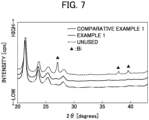
- the profiles of the analysis results is shown in Figure 7 .
- the profile of the separator according to Comparative Example 1 has peaks at portions marked with a black solid triangle. These peaks correspond to the peaks of bismuth.
- bismuth is deposited on the separator according to Comparative Example 1.
- by-products remained in Comparative Example 1 not subjected to the nitric acid treatment, bismuth included in the by-products caused a dissolution and precipitation reaction due to the battery reaction, and the bismuth dendritically grew to extend into the separator. It is conceived that this bismuth extended into the separator is responsible for the micro short-circuiting.
- the profile of the separator according to Example 1 has no peak at the portions marked with a black solid triangle.
- the profile of the unused separator substantially coincides with the profile of the separator of Example 1.
- the initial state is maintained even when charging and discharging are repeated. From those described above, it can be said that no bismuth is deposited on the separator according to Example 1. It is conceived that this is caused by removal of the by-products by the nitric acid treatment.
- the value of Bi/Ru is less than 0.80, the crystalline structure of the bismuth-ruthenium oxide may change.
- the value of Bi/Ru is more preferably 0.90 or less and 0.80 or more, measured by using an energy dispersive X-ray spectrometer (EDS).
- the present invention is not limited to the embodiments described above.
- the catalyst for an air secondary battery include the transition element oxides in addition to the bismuth-ruthenium oxide. According to the present invention, applying the acid treatment to the transition element oxide enables removal of by-products generated in the production process of the transition element oxide. Then, there can be obtained a catalyst for an air secondary battery from which the by-products have been removed, and thus it is possible to prevent occurrence of a problem of dendritic growth of the transition element in the by-products.
Landscapes
- Chemical & Material Sciences (AREA)
- Chemical Kinetics & Catalysis (AREA)
- Engineering & Computer Science (AREA)
- Materials Engineering (AREA)
- Organic Chemistry (AREA)
- Electrochemistry (AREA)
- General Chemical & Material Sciences (AREA)
- Manufacturing & Machinery (AREA)
- Combustion & Propulsion (AREA)
- Inorganic Chemistry (AREA)
- Physics & Mathematics (AREA)
- Thermal Sciences (AREA)
- Hybrid Cells (AREA)
- Inert Electrodes (AREA)
- Battery Electrode And Active Subsutance (AREA)
- Hydrogen, Water And Hydrids (AREA)
- Catalysts (AREA)
Description
- The present invention relates to a method for producing a catalyst for an air secondary battery, a method for producing an air secondary battery, a catalyst for an air secondary battery, and an air secondary battery.
- Air secondary batteries, which use oxygen in air as the positive electrode active material, have attracted attention recently as high-efficient and clean energy conversion devices.
- Among these, air hydrogen secondary batteries, in which an alkaline aqueous solution (alkali electrolyte solution) is used as the electrolyte solution and which includes, as the negative electrode, a hydrogen storage alloy capable of absorbing and releasing hydrogen as the negative electrode active material, have advantages described below, and thus are expected to be next-generation secondary batteries.
- First, an air hydrogen secondary battery, in which oxygen in air is used as the positive electrode active material, does not require to reserve space for storing the positive electrode active material therein. Eliminating this space has an advantage of saving the space for the battery correspondingly. Alternatively, in the case where this space is not eliminated but utilized for storing a hydrogen storage alloy, the battery capacity of the air hydrogen secondary battery depends only on the capacity of the negative electrode, and thus, there is an advantage of enhancing the capacity in accordance with the increase in the amount of the hydrogen storage alloy. In other words, such an air hydrogen secondary battery may achieve a higher energy density than that of a nickel hydrogen secondary battery, which also employs a hydrogen storage alloy.
- In an air secondary battery in which an alkali electrolyte solution is used as in the air hydrogen secondary battery described above, a charge and discharge reaction shown below occurs in the air electrode.
Discharge: O2 + 2H2O + 4e- → 4OH- (I)
Charge: 4OH- → O2 + 2H2O + 4e- (II)
- The air electrode in the air hydrogen secondary battery reduces oxygen to produce hydroxide ions on discharging, as represented by the reaction formula (I) and produces oxygen and water on charging, as represented by the reaction formula (II). Oxygen generated in the air electrode is released into the atmosphere from the portion open to the atmosphere in the air electrode.
- In the air electrode, which is the positive electrode of the air hydrogen secondary battery as described above, a pyrochlore-type oxide is used as a catalyst. Examples of this pyrochlore-type oxide include transition element oxides. For example, a bismuth-ruthenium oxide is known, as disclosed in
Patent Document 1. This bismuth-ruthenium oxide, which has catalytic activity on oxygen generation and oxygen reduction, is used in the positive electrode of an air hydrogen secondary battery. - This bismuth-ruthenium oxide is produced by a production method in which a precursor is produced by a coprecipitation method by use of bismuth nitrate and ruthenium chloride as the starting material and thereafter the precursor is calcined, for example.
- Patent Document 1:
Japanese Patent Laid-Open No. 2016-152068
HOROWITZ H S ET AL: "New oxide pyrochlores: A2[B2-xAx]O7-y (A = Pb, Bi; B = Ru, lr)", MATERIALS RESEARCH BULLETIN, ELSEVIER, KIDLINGTON, GB, vol. 16, no. 5, 1 May 1981 (1981-05-01), pages 489-496 discloses a new series of mixed metal oxides with the pyrochlore structure according to the general formula A2[B2-xAx]O7-y where A = Pb or Bi, B = Ru or Ir, 0 ≤ x ≤ 1 and 0 ≤ y ≤ 0.5. Values of x appreciably greater than zero may only be obtained at relatively low temperatures. It has been observed that when A = Pb and B : Ru, y = 0.5 for all values of x. Linear correlations between lattice parameter and x are presented for both Pb2[Ru2-xPbx]O6.5 and Bi2[Ru2-xBix]O7-y. The mixed metal oxides with the pyrochlore structure were obtained by carrying out solid state syntheses of a pyrochlore compound at temperatures between 3000 and 800 °C. These syntheses involved hand grinding, with an agate mortar and pestle, the metal-containing reactants and then firing in air or oxygen at the specified temperatures. These firings were usually interrupted at frequent intervals for additional grinding in order to facilitate the reaction. The reactants employed were reagent grade oxides and/or nitrates of the appropriate metals. The reactants were generally combined in a post transition metal to noble metal molar ratio between 1:1 and 5:1, depending upon the composition of the product desired. The reactant mixture often contained a post transition metal to noble metal ratio appreciably higher than the final reacted product. After reaction, the excess post transition metal oxide phase could be removed by selective leaching. For example, second phases of lead oxide were often removed by leaching in dilute acetic acid or concentrated caustic.
US 4 129 525 A discloses a liquid solution method of preparing electrically conductive pyrochlore compounds of high surface area, having the formula A2[B2-xAx]O7-y is disclosed wherein A is selected from lead, bismuth and mixtures thereof, B is selected from ruthenium, iridium and mixtures thereof, 0 < x ≦ 1.0 and 0 ≦ y ≦ 1. The method involves reacting A and B cations to yield a pyrochlore oxide by precipitation of A and B cations from an aqueous solution source of these cations in a liquid alkaline medium having a pH of at least about 13.5 in the presence of an oxygen source at a temperature below about 200° C for a sufficient time for reaction to occur.
KAHOUL A. ET AL: "A Sol-Gel Route for the Synthesis of Bi2Ru2O7 Pyrochlore Oxide for Oxygen Reaction in Alkaline Medium", JOURNAL OF SOLID STATE CHEMISTRY, vol. 161, no. 2, 1 November 2001 (2001 -11 -01), pages 379-384 discloses the synthesis of a bismuth ruthenium pyrochlore by the dissolution of a metal chloride and a metal oxide in a mixture of a weak hydroxy carboxylic acid, such as citric acid, and a polyol. A clear solution was obtained by heating a mixture of citric acid and ethylene glycol (1:4 molar ratio) at 90 °C, RuCI3.3H2O and Bi2O3 were added in appropriate amount. The solution was heated at 140 °C and Bi2Ru2O7 was obtained. Several samples were prepared by heating the Bi2Ru2O7 at temperatures ranging from 580 to 760 °C.
US 4 203 871 A discloses a liquid solution method of preparing electrically conductive pyrochlore compounds having the formula A2[B2-xAx]O7-y, wherein A is selected from lead, bismuth and mixtures thereof, B is selected from ruthenium, iridium and mixtures thereof, 0≦×≦1.0 and 0≦y≦1. The method involves reacting A and B cations to yield a pyrochlore oxide by precipitation of A and B cations in a liquid medium having a pH which is equal to or greater than 4.5, but less than 13.5, in the presence of an oxygen source at a temperature below about 200° C. for a time sufficient for reaction to occur. In those instances in which amorphous reaction products are obtained, these amorphous reaction products are subsequently heat treated at a temperature of about 200° C. to about 600° C. for a time sufficient to convert amorphous reaction products to crystalline pyrochlore(s). - In the method for producing the bismuth-ruthenium oxide described above, by-products are formed in the process thereof. When an air electrode is produced with a catalyst including by-products mixed therein, and charge and discharge cycles are performed on an air hydrogen secondary battery including the air electrode, the bismuth-ruthenium oxide itself does not cause a dissolution and precipitation reaction, but the by-products described above cause the dissolution and precipitation reaction. Particularly, the dissolution and precipitation reaction of the metal components (principally bismuth) in the by-products is repeated due to a chemical reaction on charging and discharging in the battery (hereinbelow, referred to as a battery reaction), and socalled dendritic growth occurs, in which the metal components are dendritically precipitated on the electrode plates. When the metal components thus dendritically grow, the metal components extend into the separator and penetrate the separator in the end. As a result, micro short-circuiting problematically occurs. When the micro short-circuiting thus occurs, there is not only ion conductivity via the electrolyte, but also electron conductivity, between the positive electrode and the negative electrode inside the battery. In the case where electron conductivity exists, the battery is self-discharging. The dendritic growth of the metal components increases in accordance with the charge and discharge cycle. Thus, the amount self-discharged increases as the charge and discharge cycle proceeds. As a result, the discharge capacity of the battery decreases with a relatively small number of cycles, and the battery life is expired in the early stage.
- For this reason, it is demanded to develop an air secondary battery that is unlikely to be subjected to decrease in the discharge capacity than before and has a stable discharge capacity, even when charging and discharging are repeated.
- The present invention has been achieved in view of the above-described circumstances, and it is an object thereof to provide a method for producing a catalyst for an air secondary battery, a method for producing an air secondary battery, a catalyst for an air secondary battery, and an air secondary battery that are capable of preventing occurrence of micro short-circuiting.
- In order to achieve the object described above, according to the present invention, there is provided a method for producing a catalyst for an air secondary battery for use in the air electrode of the air secondary battery according to
claim 1, a method for producing an air secondary battery according toclaim 4, a catalyst for use in an air electrode of the air secondary battery according toclaim 6, and an air secondary battery according toclaim 8. Preferred embodiments are set forth in the subclaims. - The method for producing a catalyst for an air secondary battery according to the present invention includes an acid treatment step of immersing the pyrochlore-type oxide in an acid aqueous solution to apply an acid treatment. Subjecting the oxide to this acid treatment step enables removal of by-products of the pyrochlore-type oxide to thereby prevent dendrites from occurring due to a dissolution and precipitation reaction of the metal components in the by-products. Thus, according to the present invention, it is possible to provide a method for producing a catalyst for an air secondary battery capable of preventing occurrence of micro short-circuiting.
-
- [
Figure 1] Figure 1 is a cross-sectional view schematically illustrating an air hydrogen secondary battery according to one embodiment of the present invention. - [
Figure 2] Figure 2 is a graph showing X-ray diffraction profiles of a bismuth-ruthenium oxide powder of Example 1 and a bismuth-ruthenium oxide powder of Comparative Example 1. - [
Figure 3] Figure 3 is a SEM image photograph of the bismuth-ruthenium oxide of Example 1 (magnification: 300 times). - [
Figure 4] Figure 4 is a SEM image photograph of the bismuth-ruthenium oxide of Comparative Example 1 (magnification: 300 times). - [
Figure 5] Figure 5 is a graph showing the relationship between the discharge capacity ratio and the number of cycles. - [
Figure 6] Figure 6 is a graph showing the relationship between the battery voltage and the elapsed time at a pause after charging is finished. - [
Figure 7] Figure 7 is a graph showing X-ray diffraction profiles of the separator of Example 1, the separator of Comparative Example 1, and an unused separator. - Hereinbelow, an air hydrogen secondary battery (hereinbelow, simply referred to as the battery) 2 incorporating an air electrode including a catalyst for an air secondary battery according to the present invention will be described with reference to the drawings.
- As shown in
Figure 1 , thebattery 2 is formed by sandwiching anelectrode group 6 accommodated in acontainer 4 between atop plate 8 and abottom plate 10. - The
electrode group 6 is formed by stacking an air electrode (positive electrode) 14 on a negative electrode 12 with a separator 16 therebetween. - The negative electrode 12 includes a conductive negative electrode substrate that forms a porous structure and has a large number of pores and a negative electrode mixture supported inside the pores and the surface of the negative electrode substrate.
- As such a negative electrode substrate, foam nickel can be used, for example.
- A negative electrode mixture includes a hydrogen storage alloy powder, which is an assembly of hydrogen storage alloy particles that can absorb and release hydrogen, as a negative electrode active agent, a conductive material, and a binder. Here, as the conductive agent, graphite, carbon black, or the like can be used.
- As the hydrogen storage alloy constituting the hydrogen storage alloy particles, which is not particularly limited, a rare earth-Mg-Ni-based hydrogen storage alloy is used. The composition of this rare earth-Mg-Ni-based hydrogen storage alloy can be optionally selected. For example, one represented by the general formula:
Ln1-xMgxNiy-a-bAlaMb ··· (III)
is preferably used. - In general formula (III), Ln represents at least one element selected from the group consisting of La, Ce, Pr, Nd, Pm, Sm, Eu, Gd, Tb, Dy, Ho, Er, Tm, Yb, Lu, Sc, Y, Zr, and Ti, M represents at least one element selected from the group consisting of V, Nb, Ta, Cr, Mo, Mn, Fe, Co, Ga, Zn, Sn, In, Cu, Si, P, and B, subscripts a, b, x, and y respectively represent a number satisfying 0.05 ≤ a ≤ 0.30, 0 ≤ b ≤ 0.50, 0.01 ≤ x ≤ 0.30, 2.8 ≤ y ≤ 3.9.
- Hydrogen storage alloy particles are obtained as follows, for example.
- First, the metal raw materials are weighed and mixed to achieve a predetermined composition. This mixture is dissolved under an inert gas atmosphere in a high-frequency induction melting furnace, for example, to form an ingot. The ingot obtained is heated to 900 to 1200°C under an inert gas atmosphere. The ingot is subjected to a thermal treatment at this temperature for 5 to 24 hours and thus homogenized. Thereafter, this ingot is pulverized and sieved to thereby obtain a hydrogen storage alloy powder, which is an assembly of hydrogen storage alloy particles having a desired particle size.
- Examples of a binder to be used include sodium polyacrylate, carboxymethyl cellulose, and styrene butadiene rubber.
- The negative electrode 12 here can be produced as follows, for example.
- First, a hydrogen storage alloy powder, which is an assembly of hydrogen storage alloy particles, a conductive agent, a binder, and water are kneaded to prepare a negative electrode mixture paste. The negative electrode mixture paste obtained is packed into a negative electrode substrate and then dried. After drying, the negative electrode substrate having the hydrogen storage alloy particles and the like attached thereto is rolled to increase the alloy content per volume. Thereafter, the rolled substrate is cut to thereby produce the negative electrode 12. This negative electrode 12 is in a plate form as a whole.
- Next, the air electrode 14 includes a conductive air electrode substrate that forms a porous structure and has a large number of pores and an air electrode mixture (positive electrode mixture) carried inside the pores and the surface of the air electrode substrate.
- As such an air electrode substrate, foam nickel or nickel mesh can be used, for example.
- The air electrode mixture includes a catalyst for an air secondary battery, a conductive agent, and a binder.
- As the catalyst for an air secondary battery, used is a pyrochlore-type oxide subjected to an acid treatment of immersion in an acidic aqueous solution. According to the present invention, as the pyrochlore-type oxide to be subjected to the acid treatment, a pyrochlore-type transition element oxide having a composition represented by the general formula, as defined in
claim 1, is used. - The catalyst for an air secondary battery is produced as follows.
- First, a pyrochlore-type bismuth-ruthenium oxide is prepared. The preparation is specifically as follows.
- Bi(NO3)3·5H2O and RuCl3·3H2O were introduced at the same concentration into distilled water and stirred to prepare a mixed aqueous solution of Bi(NO3)3·5H2O and RuCl3·3H2O. The temperature of the distilled water at this time is set at 60°C or more and 90°C or less. Then, a 1 mol%/l or more and 3 mol%/l or less NaOH aqueous solution is added to this mixed aqueous solution. While the bath temperature at this time is maintained at 60°C or more and 90°C or less, the solution is stirred under oxygen bubbling. While the solution containing a precipitate generated by this operation is maintained at 80°C or more and 100°C or less, a portion of the moisture is evaporated to form a paste. This paste is transferred to an evaporating dish and heated to 100°C or more and 150°C or less. The paste is dried while maintained in the state for 10 hours or more and 20 hours or less to obtain a dried product of the paste. After pulverized in a mortar, this dried product is heated under an air atmosphere to 500°C or more and 700°C or less. The dried product is calcined while maintained for 0.5 hours or more and 2 hours or less to obtain a calcined product. The calcined product obtained is washed with distilled water at 60°C or more and 90°C or less and then dried. This results in a pyrochlore-type bismuth-ruthenium oxide.
- Subsequently, the bismuth-ruthenium oxide prepared is subjected to a nitric acid treatment as the acid treatment, wherein the oxide is immersed in a nitric acid aqueous solution. The treatment is specifically as follows.
- First, a nitric acid aqueous solution is provided. Here, the concentration of the nitric acid aqueous solution is preferably 1 mol%/l or more and 3 mol%/l or less. The amount of the nitric acid aqueous solution to be provided is preferably 40 ml per 2 g of a bismuth-ruthenium oxide. The temperature of the nitric acid aqueous solution is preferably set at 20°C or more and 25°C or less.
- Then, in the nitric acid aqueous solution provided, the bismuth-ruthenium oxide is immersed and stirred for 10 minutes or more and 10 hours or less. After a predetermined time period elapses, the bismuth-ruthenium oxide is filtered with suction from the nitric acid aqueous solution. The bismuth-ruthenium oxide filtered is introduced in and washed with ion exchanged water set at 60°C or more and 80°C or less.
- The washed bismuth-ruthenium oxide is maintained under a reduced pressure environment of a room temperature (25°C) for 10 hours or more and 14 hours or less and dried. Note that, for drying the washed bismuth-ruthenium oxide, a drying condition for drying the oxide while the oxide is maintained in air under a temperature environment of 80°C to 150°C for one hour or more and 24 hours or less may be employed.
- In the manner as mentioned above, the bismuth-ruthenium oxide subjected to the nitric acid treatment is obtained. Applying the nitric acid treatment as mentioned above enables removal of by-products generated during the production process of the pyrochlore-type oxide. Note that the acidic aqueous solution used in the acid treatment is not limited to nitric acid aqueous solutions and hydrochloric acid aqueous solution and sulfuric acid aqueous solution can be used in addition to nitric acid aqueous solutions. In these hydrochloric acid aqueous solutions and sulfuric acid aqueous solutions, an effect of enabling by-products to be removed can be provided as in the case of nitric acid aqueous solutions.
- Subsequently, as the conductive agent, which is not particularly limited, for example, a nickel powder, which is an assembly of nickel particles, is preferably used.
- The binder binds a redox catalyst and additionally serves to impart suitable water repellency to the air electrode 14. Here, examples of the binder include, but are not particularly limited to, fluorine resins. Note that, as a preferable fluorine resin, polytetrafluoroethylene (PTFE) is used, for example.
- The air electrode 14 can be produced as follows, for example.
- First, prepared is an air electrode mixture paste including a bismuth-ruthenium oxide, a binder, and water.
- The air electrode mixture paste obtained is shaped into a sheet form and then is pressure-bonded by a press onto nickel mesh (an air electrode substrate). Thereby, an intermediate product for an air electrode is obtained.
- The intermediate product obtained is then introduced in a calciner and subjected to a calcining treatment. This calcining treatment is carried out under an inert gas atmosphere. As this inert gas, nitrogen gas or argon gas is used, for example. As the calcining treatment conditions, the intermediate product is heated to a temperature of 300°C or more and 400°C or less and maintained in this state for 10 minutes or more and 20 minutes or less. Thereafter, the intermediate product is naturally cooled in the calciner and taken out in the atmosphere when the temperature of the intermediate product is lowered to 150°C or less. Thereby, obtained is an intermediate product subjected to the calcining treatment. The air electrode 14 is obtained by cutting this intermediate product into a predetermined shape.
- The air electrode 14 and the negative electrode 12 obtained as described above are stacked with the separator 16 therebetween to thereby form the
electrode group 6. This separator 16 is provided to prevent short-circuiting between the air electrode 14 and the negative electrode 12, and an electrically insulating material is employed therefor. As the material employed for this separator 16, non-woven fabric of polyamide fibers to which hydrophilic functional groups are imparted, and non-woven fabric of polyolefin fibers such as polyethylene and polypropylene to which hydrophilic functional groups are imparted can be used. - The
electrode group 6 formed is accommodated along with an alkali electrolyte solution into thecontainer 4. Thecontainer 4 is not particularly limited as long as thecontainer 4 can accommodate theelectrode group 6 and the alkali electrolyte solution, and as an example thereof, a bagshaped container made of polyethylene (hereinbelow, referred to as the accommodating bag 18) is used. In thisaccommodating bag 18, for example, an insertion/ejection port having a fastener (not shown) is provided in a portion thereof, and anopening 20 is provided in another portion thereof. Theelectrode group 6 is accommodated through the insertion/ejection port described above in theaccommodating bag 18. - When the
electrode group 6 is accommodated into theaccommodating bag 18,carbon non-woven fabric 24 is disposed on the air electrode 14 side of theelectrode group 6 so as to be in contact with the air electrode 14. Thiscarbon non-woven fabric 24 has been subjected to a water repellent treatment with PTFE. Additionally, a separator 17 is disposed on the negative electrode 12 side of theelectrode group 6 so as to be in contact with the negative electrode 12. As this separator 17, one made of the same material and having the same shape as that of separator 16 described above is used, for example. - Here, the
electrode group 6 accommodated into theaccommodating bag 18 is mounted on the separator 17 disposed on the negative electrode side, as shown inFigure 1 . Then, thecarbon non-woven fabric 24 is disposed on the air electrode 14 of theelectrode group 6. Then, only thecarbon non-woven fabric 24 is exposed from theopening 20 of theaccommodating bag 18. - Subsequently, the
electrode group 6 accommodated into theaccommodating bag 18 as described above is sandwiched between thetop plate 8 and thebottom plate 10. - The
top plate 8 is a plate material made of an acryl resin, having a ventingpassage 26 at a position opposite to theopening 20 of theaccommodating bag 18, as shown inFigure 1 . This ventingpassage 26 entirely takes one serpentine shape, and the ends of thepassage 26 are open to the atmosphere. - The
bottom plate 10 is a plate material made of an acryl resin, having the same size as thetop plate 8. Note that thebottom plate 10 has no venting passage. - The
accommodating bag 18 accommodating theelectrode group 6 therein is mounted on thebottom plate 10 with a flat negative electrodeside buffer plate 22 formed of a resin interposed therebetween. Then, thetop plate 8 is mounted on theaccommodating bag 18 accommodating theelectrode group 6. Theelectrode group 6 accommodated in theaccommodating bag 18 is thus sandwiched vertically by thetop plate 8 and thebottom plate 10. At this time, the ventingpassage 26 of thetop plate 8 is opposite to thecarbon non-woven fabric 24. Thecarbon non-woven fabric 24 allows gas to permeate therethrough but blocks moisture, and thus the air electrode 14 is open to the atmosphere via thecarbon non-woven fabric 24 and theventing passage 26. That is, the air electrode 14 is brought into contact with the atmosphere through thecarbon non-woven fabric 24. - As for the
top plate 8 and thebottom plate 10 vertically sandwiching theelectrode group 6 accommodated in theaccommodating bag 18, theperipheral edge 38 of thetop plate 8 and theperipheral edge 40 of thebottom plate 10 are clamped vertically byconnectors Figure 1 . Thebattery 2 is thus formed. - Here, in this
battery 2, an air electrode lead (positive electrode lead) 42 is electrically connected to the air electrode (positive electrode) 14, and anegative electrode lead 44 is electrically connected to the negative electrode 12. Theair electrode lead 42 andnegative electrode lead 44, which are schematically depicted inFigure 1 , are drawn outside theaccommodating bag 18 while air-tightness and water-tightness are maintained. Then, an air electrode terminal (positive electrode terminal) 46 is provided on the tip ofair electrode lead 42, and anegative electrode terminal 48 is provided on the tip of thenegative electrode lead 44. Accordingly, in thebattery 2, theseair electrode terminal 46 andnegative electrode terminal 48 are used to input and output electric currents on charging and discharging. - As a first step, a predetermined amount of Bi(NO3)3·5H2O and RuCl3·3H2O was provided. These Bi(NO3)3·5H2O and RuCl3·3H2O were introduced at the same concentration into distilled water at 75°C and stirred to prepare a mixed aqueous solution of Bi(NO3)3·5H2O and RuCl3·3H2O. Then, a 2 mol%/l NaOH aqueous solution was added to this mixed aqueous solution. The bath temperature at this time was set at 75°C, and the solution was stirred under oxygen bubbling. While the solution containing a precipitate generated by this operation was maintained at 85°C, a portion of the moisture was evaporated to form a paste. This paste was transferred to an evaporating dish and heated to 120°C. This paste was dried while maintained in the state for 12 hours to obtain a dried product of the paste (precursor). Then, as a second step, this dried product was pulverized in a mortar then heated under an air atmosphere to 600°C, calcined while maintained for 1 hour to obtain a calcined product. The calcined product obtained was washed with distilled water at 70°C, then filtered with suction, and dried. This resulted a pyrochlore-type bismuth-ruthenium oxide.
- The bismuth-ruthenium oxide obtained was pulverized using a mortar to obtain a bismuth-ruthenium oxide powder, which was an assembly of particles having a predetermined particle size. As a result of observation on a secondary electron image of this bismuth-ruthenium oxide powder obtained using a scanning electron microscope, the bismuth-ruthenium oxide had a particle size of 0.1 µm or less.
- Subsequently, as a third step, 2 g of the bismuth-ruthenium oxide powder, along with 40 ml of nitric acid aqueous solution, was placed in the stirring tank of a stirrer and stirred for 6 hours while the temperature of the nitric acid aqueous solution was maintained at 25°C. Here, the concentration of the nitric acid aqueous solution was set at 2 mol%/l.
- After the stirring was completed, the bismuth-ruthenium oxide powder was taken out from the nitric acid aqueous solution by filtering with suction. The bismuth-ruthenium oxide powder taken out was washed with 1 liter of ion exchanged water heated to 70°C. After washing, the bismuth-ruthenium oxide powder was placed in a reduced pressure vessel at room temperature of 25°C and dried while maintained under a reduced pressure environment for 12 hours.
- In the manner as mentioned above, obtained was a bismuth-ruthenium oxide powder subjected to a nitric acid-treatment, that is, a catalyst for an air secondary battery.
- The bismuth-ruthenium oxide powder subjected to the nitric acid treatment, a nickel powder, a polytetrafluoroethylene (PTFE) dispersion, and ion exchanged water were uniformly mixed at a mass ratio of 56.5:16.1:16.1:11.3 to produce an air electrode mixture paste.
- The air electrode mixture paste obtained was shaped into a sheet form. The air electrode mixture paste in a sheet form was pressure-bonded by a press onto nickel mesh having a mesh number of 60, a wire diameter of 0.08 mm, and an opening ratio of 60%.
- The air electrode mixture pressure-bonded on the nickel mesh was heated to 340°C under a nitrogen gas atmosphere and calcined while maintained at this temperature for 13 minutes. After the calcination, the calcined product was cut to a size of 40 mm in length and 40 mm in width to thereby obtain an air electrode 14. The air electrode 14 had a thickness of 0.20 mm.
- Metal materials of Nd, Mg, Ni, and Al were mixed at a predetermined molar ratio, then introduced in a high-frequency induction melting furnace, and melted under an argon gas atmosphere. The melted metal obtained was poured into a mold and cooled to room temperature of 25°C to produce an ingot.
- Subsequently, this ingot was subjected to a thermal treatment by being maintained under an argon gas atmosphere at a temperature of 1000°C for 10 hours. Then, the ingot was pulverized mechanically under an argon gas atmosphere to obtain a rare earth-Mg-Ni-based hydrogen storage alloy powder. The volume average particle size (MV) of the rare earth-Mg-Ni-based hydrogen storage alloy powder obtained was measured by a laser diffraction-scattering particle size distribution analyzer. As a result, the volume average particle size (MV) was 60 µm.
- The composition of this hydrogen storage alloy powder was analyzed by inductively coupled high-frequency plasma spectroscopy (ICP) to find that the composition was Nd0.89Mg0.11Ni3.33Al0.17.
- To 100 parts by mass of the hydrogen storage alloy powder obtained were added 0.2 parts by mass of a sodium polyacrylate powder, 0.04 parts by mass of a carboxymethyl cellulose powder, 3.0 parts by mass of a dispersion of styrene butadiene rubber, 0.5 parts by mass of a carbon black powder, and 22.4 parts by mass of water, and the mixture was kneaded under an environment of 25°C to prepare a negative electrode mixture paste.
- This negative electrode mixture paste was packed into a foam nickel sheet having an areal density (basis weight) of about 250 g/m2 and a thickness of about 0.6 mm and dried to obtain a foam nickel sheet packed with the negative electrode mixture. The sheet obtained was rolled to increase the alloy content per volume, and cut to a size of 40 mm in length and 40 mm in width to thereby obtain a negative electrode 12. The negative electrode 12 had a thickness of 0.25 mm.
- Next, the negative electrode 12 obtained was subjected to an activation treatment. The procedure of this activation treatment is shown below.
- First, a common sintered nickel hydroxide positive electrode was provided. Note that, as this nickel hydroxide positive electrode, provided was one having a positive electrode capacity sufficiently larger than the negative electrode capacity of the negative electrode 12. Then, this nickel hydroxide positive electrode and the negative electrode 12 obtained were stacked with a separator formed of polyethylene non-woven fabric interposed therebetween to form an electrode group for an activation treatment. This electrode group for an activation treatment, along with a predetermined amount of an alkali electrolyte solution, was accommodated in a container made of an acrylic resin. Thereby, a single electrode cell for a nickel hydride secondary battery was formed.
- As an initial charge and discharge operation, this single electrode cell was left to stand under an environment at a temperature of 25°C for 5 hours, then charged at 0.1 It for 14 hours, and then discharged at 0.5 It until the battery voltage reached 0.70 V. Next, as a second charge and discharge operation, under an environment at a temperature of 25°C, the single electrode cell, after left to stand for 5 hours, was charged at 0.5 It for 2.8 hours and then discharged at 0.5 It until the battery voltage reached 0.70 V. The second charge and discharge operation described above was taken as one cycle. In the second and later operations, the negative electrode 12 was subjected to an activation treatment by performing this charge and discharge cycle in a plurality of times. In each charge and discharge cycle, the capacity of the single electrode cell was determined. Then, the maximum value of the capacities obtained was taken as the capacity of the negative electrode. The negative electrode had a capacity of 700 mAh.
- Thereafter, the single electrode cell was charged at 0.5 It for 2.8 hours and then, the negative electrode 12 was removed from the single electrode cell. In this manner, obtained was a negative electrode 12 subjected to the activation treatment and charging.
- The air electrode 14 and the negative electrode 12 obtained were stacked with a separator 16 sandwiched therebetween to produce an
electrode group 6. The separator 16 used for the production of thiselectrode group 6 was formed of non-woven fabric made of polypropylene fiber having a sulfone group and had a thickness of 0.1 mm (basis weight 53 g/m2). - Subsequently, an accommodating bag for
evaluation 18 was provided, and theelectrode group 6 described above was accommodated into thisaccommodating bag 18. In thisaccommodating bag 18, which is a bag made of polyethylene, for example, an insertion/ejection port having a fastener (not shown) is provided in a portion thereof, and anopening 20 of 30 mm in length and 30 mm in width is provided in another portion thereof. - The
electrode group 6 was accommodated through the insertion/ejection port described above in theaccommodating bag 18. In theaccommodating bag 18, a separator 17, different from the separator 16, was disposed below the electrode group 6 (below the negative electrode 12). Additionally, carbon non-woven fabric (45 mm in length, 45 mm in width, and 0.2 mm in thickness) 24 subjected to a water repellent treatment with PTFE was disposed above the electrode group 6 (above the air electrode 14). Then, the peripheral portion of theopening 20 of theaccommodating bag 18 was brought into a close contact with thecarbon non-woven fabric 24, and only thecarbon non-woven fabric 24 was exposed through the opening 20 from theaccommodating bag 18. Then, 10 ml of an alkali electrolyte solution (5 mol%/l KOH aqueous solution) was poured through the insertion/ejection port. Thereafter, the fastener of the insertion/ejection port was closed, and the inside of theaccommodating bag 18 was defoamed under reduced pressure. - The
electrode group 6 accommodated in theaccommodating bag 18 in the state described above was sandwiched along with theaccommodating bag 18 between thetop plate 8 and thebottom plate 10. At this time, a negative electrodeside buffer plate 22 was interposed between theaccommodating bag 18 and thebottom plate 10. Then, thetop plate 8 and thebottom plate 10 were connected and fixed withconnectors top plate 8 is a plate material made of an acryl resin, having a ventingpassage 26, the ends of which are open to the atmosphere. This ventingpassage 26 entirely takes one serpentine shape having a width of 2 mm, an end width of 2.5 mm, a depth of 1 mm, and a peak width of 1 mm. This ventingpassage 26 faces thecarbon non-woven fabric 24 via theopening 20. Thebottom plate 10 is a plate material made of an acryl resin, having the same size as thetop plate 8 and having no venting passage. - In the manner described above, a
battery 2 was produced, as shown inFIG. 1 . Thebattery 2 obtained was left to stand under an environment at a temperature of 25°C for 3 hours to allow the alkali electrolyte solution to permeate theelectrode group 6. - Note that an
air electrode lead 42 is electrically connected to the air electrode 14 and anegative electrode lead 44 is electrically connected to the negative electrode 12. Theair electrode lead 42 andnegative electrode lead 44 are appropriately extend from the inner side to the outside of theaccommodating bag 18 while air-tightness and water-tightness of theaccommodating bag 18 are maintained. Additionally, anair electrode terminal 46 is attached to the tip of theair electrode lead 42, and anegative electrode terminal 48 is attached to the tip of thenegative electrode lead 44. - The
battery 2 obtained was discharged via theair electrode terminal 46 and thenegative electrode terminal 48 under a condition where the current value per unit area of the air electrode 14 reached 20 mA/cm2 to provide abattery 2 before property evaluation. - An air hydrogen secondary battery was produced in the same manner as in Example 1 except that no nitric acid treatment was conducted on the bismuth-ruthenium oxide and the bismuth-ruthenium oxide not subjected to a nitric acid treatment was used.
- A portion of the bismuth-ruthenium oxide powder subjected to the nitric acid treatment in Example 1 and a portion of the bismuth-ruthenium oxide powder not subjected to the nitric acid treatment in Comparative Example 1 were reserved in advance as analysis samples. The analysis samples were subjected to an X-ray diffraction (XRD) analysis. A parallel beam X-ray diffraction apparatus was used for the analysis. The analysis conditions here included an X-ray source of CuKα, a tube voltage of 40 kV, a tube current of 15 mA, a scan speed of 5 degrees/min, and a step width of 0.02 degrees. The profiles of the analysis results are shown in
Figure 2 . - In the profiles of the analysis results, the peak of portions marked with a triangle are the peaks of by-products. From the profiles of the analysis results, it can be seen that, from the catalyst for an air secondary battery according to Comparative Example 1, which was not subjected to the nitric acid treatment, by-products were generated.
- In contrast, in Example 1, the peaks of by-products disappeared. The catalyst for an air secondary battery of Example 1 was subjected to the nitric acid treatment, and it is conceived that this nitric acid treatment removed by-products having high crystallinity. Also in Example 1, the background intensity has been lowered entirely compared with Comparative Example 1, and it is conceived that by-products seeming to be amorphous have been removed simultaneously.
- A portion of the bismuth-ruthenium oxide powder subjected to the nitric acid treatment in Example 1 and a portion of the bismuth-ruthenium oxide powder not subjected to the nitric acid treatment in Comparative Example 1 were reserved in advance as analysis samples. The analysis samples were observed with a scanning electron microscope (SEM), and simultaneously, the composition of the samples was analyzed using an energy dispersive X-ray spectrometer (EDS).
- A SEM image (magnification: 300 times) photograph of the analysis result of Example 1 is shown in
Figure 3 , and a SEM image (magnification: 300 times) photograph of the analysis result of Comparative Example 1 is shown inFigure 4 . From the SEM images of the analysis results, a composition analysis was conducted based on area mapping. The composition of elements detected with the composition analysis is shown in Table 1. The ratio of the amount of bismuth to the amount of ruthenium (Bi/Ru) was also shown. -
[Table 1] Composition of elements detected [number of atoms %] Bi/Ru O Na Ru Bi Example 1 57.85 4.72 20.26 17.17 0.85 Comparative Example 1 48.70 4.55 24.42 22.33 0.91 - The ratio of the amount of bismuth to the amount of ruthenium (Bi/Ru) in the catalyst for an air secondary battery of Example 1 was 0.85. Meanwhile, the amount of bismuth to the amount of ruthenium (Bi/Ru) in the catalyst for an air secondary battery of Comparative Example 1 was 0.91. That is, the ratio of the amount of bismuth to the amount of ruthenium in Example 1 is lower than that in Comparative Example 1. It is conceived that this resulted from removal of the by-products by the nitric acid treatment.
- From those described above, it can be seen that the Bi/Ru value is 0.91 when the bismuth-ruthenium oxide is not subjected to the nitric acid treatment, and when the bismuth-ruthenium oxide is subjected to the nitric acid treatment, the by-products are removed, and the Bi/Ru value falls below 0.91.
- Each of the batteries before property evaluation according to Example 1 and Comparative Example 1, under an environment at a temperature of 25°C, after left to stand for three hours, was charged for 2.2 hours at a charging current at 180 mA, and thereafter, left to stand for 20 minutes.
- Then, the battery after left to stand for 20 minutes, under the same environment, was discharged at a discharging current at 180 mA until the battery voltage reached 0.4 V, and left to stand for 10 minutes.
- The charging and discharging cycle described above was taken as one cycle, and 20 cycles were repeated.
- Note that 13 ml/minute of air was continuously allowed to flow through the venting
passage 26 irrespective of charging and discharging. - The charge capacity on charging and the discharge capacity on discharging were determined in each cycle. From the charge capacity and the discharge capacity obtained, the percentage of the discharge capacity to the charge capacity in each cycle was determined as the discharge capacity ratio. Then, the variation in the discharge capacity was determined from the relationship between the discharge capacity ratio and the number of cycles. The results were shown in
Figure 5 . - Additionally, the relationship between the battery voltage and the elapsed time was determined in the pause state after the charge of the 20th cycle was conducted. From this relationship between the battery voltage and the elapsed time, the variation in the voltage was determined. The results were shown in
Figure 6 . - In the graph of the variation in the discharge capacity ratio according to the battery of Example 1, the discharge capacity ratio exhibits substantially constant values of the order of 98 to 99% and stable, even when the charge and discharge cycle proceeds. In other words, the amount discharged of the battery of Example 1 is substantially equal to the amount charged, and additionally, the state is maintained even when the charge and discharge cycle proceeds. In other words, self-discharging in the battery of Example 1 is kept low. Conceivably, this is because micro short-circuiting has not occurred in the battery of Example 1.
- In contrast, in the graph of the variation in the discharge capacity ratio according to the battery of Comparative Example 1, the discharge capacity ratio decreases as the charge and discharge cycle proceeds. In other words, the amount discharged is lower than the amount charged in the battery of Comparative Example 1, and the battery is self-discharging. Conceivably, this is because micro short-circuiting has occurred in the battery of Comparative Example 1.
- In the graph of the variation in the voltage according to the battery of Example 1, the value of the battery voltage lingers at of the order of 1.35 V and is stable with no sharp drop. Conceivably, this is because micro short-circuiting has not occurred in the battery of Example 1.
- In contrast, in the graph of the variation in the voltage according to the battery of Comparative Example 1, the value of the battery voltage sharply drops immediately after the pause state is started. Conceivably, this is because micro short-circuiting has occurred in the battery of Comparative Example 1.
- The batteries of Example 1 and Comparative Example 1, after 20 cycles of charging and discharging were repeated in the property analysis of the air hydrogen secondary batteries described above, were disassembled, and the separators were removed. A portion was cut off from each of the separator according to Example 1 and the separator according to Comparative Example 1 to take analysis samples. The analysis samples obtained were subjected to an X-ray diffraction (XRD) analysis. A parallel beam X-ray diffraction apparatus was used for the analysis. The analysis conditions here included an X-ray source of CuKα, a tube voltage of 40 kV, a tube current of 15 mA, a scan speed of 1 degrees/min, and a step width of 0.01 degrees. The profiles of the analysis results is shown in
Figure 7 . - Additionally, an analysis sample of an unused separator was prepared and subjected to an X-ray diffraction (XRD) analysis under the same conditions as described above. The profile of the analysis results obtained is also shown in
Figure 7 . - The profile of the separator according to Comparative Example 1 has peaks at portions marked with a black solid triangle. These peaks correspond to the peaks of bismuth. In other words, it can be seen that bismuth is deposited on the separator according to Comparative Example 1. Thus, it is conceived that by-products remained in Comparative Example 1 not subjected to the nitric acid treatment, bismuth included in the by-products caused a dissolution and precipitation reaction due to the battery reaction, and the bismuth dendritically grew to extend into the separator. It is conceived that this bismuth extended into the separator is responsible for the micro short-circuiting.
- The profile of the separator according to Example 1 has no peak at the portions marked with a black solid triangle. The profile of the unused separator substantially coincides with the profile of the separator of Example 1. In the separator of Example 1, the initial state is maintained even when charging and discharging are repeated. From those described above, it can be said that no bismuth is deposited on the separator according to Example 1. It is conceived that this is caused by removal of the by-products by the nitric acid treatment.
- From those described above, it can be said that deposition of bismuth does not occur to thereby prevent micro short-circuiting from occurring as long as the by-products are removed by the nitric acid treatment. When the bismuth-ruthenium oxide is subjected to the nitric acid treatment and the Bi/Ru value reaches 0.90 or less, it is conceived that the by-products are removed from the oxide such that an effect of preventing deposition of bismuth is achieved. For this reason, it is conceived that the bismuth-ruthenium oxide is subjected to the nitric acid treatment and the value of Bi/Ru is 0.90 or less and as low as possible, measured by using an energy dispersive X-ray spectrometer (EDS). However, when the value of Bi/Ru is less than 0.80, the crystalline structure of the bismuth-ruthenium oxide may change. Thus, it is conceived that the value of Bi/Ru is more preferably 0.90 or less and 0.80 or more, measured by using an energy dispersive X-ray spectrometer (EDS).
- Note that the present invention is not limited to the embodiments described above. Examples of the catalyst for an air secondary battery include the transition element oxides in addition to the bismuth-ruthenium oxide. According to the present invention, applying the acid treatment to the transition element oxide enables removal of by-products generated in the production process of the transition element oxide. Then, there can be obtained a catalyst for an air secondary battery from which the by-products have been removed, and thus it is possible to prevent occurrence of a problem of dendritic growth of the transition element in the by-products.
-
- 2
- battery (air hydrogen secondary battery)
- 4
- container
- 6
- electrode group
- 8
- top plate
- 10
- bottom plate
- 12
- negative electrode
- 14
- air electrode (positive electrode)
- 16
- separator
- 24
- carbon non-woven fabric
- 26
- venting passage
Claims (9)
- A method for producing a catalyst for an air secondary battery for use in an air electrode of the air secondary battery, the method comprising:a precursor preparation step of preparing a pyrochlore-type oxide precursor,a calcination step of calcining the precursor to form a pyrochlore-type oxide, andan acid treatment step of immersing the pyrochlore-type oxide obtained from the calcination step in an acidic aqueous solution to apply an acid treatment,wherein the pyrochlore-type oxide is a pyrochlore-type transition element oxide having a composition represented by the general formula: Bi2-XRu2-YO7-Z, wherein x, y, and z each represent a numerical value of 0 or more and 1 or less, andwherein the acid treatment is applied such that, when X represents the amount of bismuth in terms of atom% contained in the bismuth-ruthenium oxide and Y represents the amount of ruthenium in terms of atom% contained in the bismuth-ruthenium oxide, the value of X/Y, which is the ratio of the amount of bismuth to the amount of ruthenium, is 0.90 or less, measured by using an energy dispersive X-ray spectrometer (EDS).
- The method for producing a catalyst for an air secondary battery according to claim 1, wherein the acidic aqueous solution is any of a nitric acid aqueous solution, a hydrochloric acid aqueous solution, and a sulfuric acid aqueous solution.
- The method for producing a catalyst for an air secondary battery according to claim 1 or 2, wherein the acid treatment is applied such that the value of X/Y, which is the ratio of the amount of bismuth to the amount of ruthenium, is 0.80 or more.
- A method for producing an air secondary battery comprising:an air electrode production step of allowing an air electrode substrate to carry an air electrode mixture comprising a catalyst for an air secondary battery to produce an air electrode,a negative electrode production step of allowing a negative electrode substrate to carry a negative electrode mixture to produce a negative electrode,an electrode group formation step of stacking the air electrode on the negative electrode with a separator therebetween to form an electrode group, andan accommodation step of accommodating the electrode group along with an alkali electrolyte solution into a container, whereinthe catalyst for an air secondary battery is produced by the method for producing a catalyst for an air secondary battery according to any of claims 1 to 3.
- The method for producing an air secondary battery according to claim 4, wherein the negative electrode production step further comprises a process of allowing the negative electrode mixture to contain a hydrogen storage alloy.
- A catalyst for an air secondary battery for use in an air electrode of the air secondary battery, comprising a pyrochlore-type oxide that has been subjected to an acid treatment of immersion in an acidic aqueous solution and from which by-products generated in the production process have been removed,wherein the pyrochlore-type oxide is a pyrochlore-type transition element oxide having a composition represented by the general formula: Bi2-XRu2-YO7-Z, wherein x, y, and z each represent a numerical value of 0 or more and 1 or less, andwherein the acid treatment is applied such that, when X represents the amount of bismuth in terms of atom% contained in the bismuth-ruthenium oxide and Y represents the amount of ruthenium in terms of atom% contained in the bismuth-ruthenium oxide, the value of X/Y, which is the ratio of the amount of bismuth to the amount of ruthenium, is 0.90 or less, measured by using an energy dispersive X-ray spectrometer (EDS).
- The catalyst for an air secondary battery according to claim 6, wherein the value of X/Y, which is the ratio of the amount of bismuth to the amount of ruthenium, is 0.80 or more.
- An air secondary battery comprising:an electrode group comprising an air electrode and a negative electrode stacked with a separator therebetween, anda container accommodating the electrode group along with an alkali electrolyte, wherein,the air electrode comprises the catalyst for an air secondary battery according to any of claims 6 or 7.
- The air secondary battery according to claim 8,
wherein the negative electrode comprises a hydrogen storage alloy.
Applications Claiming Priority (2)
| Application Number | Priority Date | Filing Date | Title |
|---|---|---|---|
| JP2018066454A JP7081762B2 (en) | 2018-03-30 | 2018-03-30 | Manufacturing method of catalyst for air secondary battery, manufacturing method of air secondary battery, catalyst for air secondary battery and air secondary battery |
| PCT/JP2019/012567 WO2019189014A1 (en) | 2018-03-30 | 2019-03-25 | Method for producing catalyst for air secondary batteries, method for producing air secondary battery, catalyst for air secondary batteries, and air secondary battery |
Publications (3)
| Publication Number | Publication Date |
|---|---|
| EP3780195A1 EP3780195A1 (en) | 2021-02-17 |
| EP3780195A4 EP3780195A4 (en) | 2022-01-05 |
| EP3780195B1 true EP3780195B1 (en) | 2025-04-16 |
Family
ID=68058164
Family Applications (1)
| Application Number | Title | Priority Date | Filing Date |
|---|---|---|---|
| EP19775557.2A Active EP3780195B1 (en) | 2018-03-30 | 2019-03-25 | Method for producing catalyst for air secondary batteries, method for producing air secondary battery, catalyst for air secondary batteries, and air secondary battery |
Country Status (5)
| Country | Link |
|---|---|
| US (1) | US11322751B2 (en) |
| EP (1) | EP3780195B1 (en) |
| JP (1) | JP7081762B2 (en) |
| CN (1) | CN111937198B (en) |
| WO (1) | WO2019189014A1 (en) |
Families Citing this family (14)
| Publication number | Priority date | Publication date | Assignee | Title |
|---|---|---|---|---|
| US20220085387A1 (en) * | 2019-01-23 | 2022-03-17 | The Doshisha | Oxygen catalyst and electrode using said oxygen catalyst |
| JP7299449B2 (en) * | 2019-11-12 | 2023-06-28 | Fdk株式会社 | Air electrode for air secondary battery and air secondary battery including this air electrode |
| JP7364317B2 (en) * | 2019-12-20 | 2023-10-18 | Fdk株式会社 | Air electrode catalyst for air secondary batteries and its manufacturing method, and air secondary batteries |
| JP7327798B2 (en) * | 2019-12-24 | 2023-08-16 | 学校法人神奈川大学 | Cathode catalyst for metal-air battery, positive electrode for metal-air battery and metal-air battery |
| JP7738856B2 (en) * | 2020-02-12 | 2025-09-16 | 学校法人同志社 | Zinc negative electrode and method for producing the same, and secondary battery including the zinc negative electrode and method for producing the same |
| JP7414584B2 (en) * | 2020-02-27 | 2024-01-16 | Fdk株式会社 | Air electrode for air secondary battery and air secondary battery |
| JP6799346B1 (en) * | 2020-05-21 | 2020-12-16 | 学校法人同志社 | Oxygen catalyst, electrodes using the oxygen catalyst, and electrochemical measurement method |
| JP7517685B2 (en) * | 2020-10-06 | 2024-07-17 | 国立大学法人 大分大学 | Method for producing bismuth-containing ruthenium pyrochlore metal oxide and method for producing oxygen electrode catalyst |
| WO2022102618A1 (en) * | 2020-11-12 | 2022-05-19 | 学校法人同志社 | Electrode, method for preparing said electrode, and electrochemical device using said electrode |
| JP7648398B2 (en) * | 2021-02-03 | 2025-03-18 | Fdk株式会社 | Catalyst for air secondary battery and air secondary battery |
| JP7648401B2 (en) * | 2021-02-12 | 2025-03-18 | Fdk株式会社 | Air electrode catalyst for air secondary battery, method for producing same, and air secondary battery |
| JP7740929B2 (en) * | 2021-08-16 | 2025-09-17 | Fdk株式会社 | Catalyst for air secondary battery, air electrode and air secondary battery |
| CN114560536B (en) * | 2022-03-09 | 2023-07-28 | 四川塔菲尔环境科技有限公司 | Terbium-rhenium modified Ti/RuO2 shape stable anode, preparation method and application |
| WO2026023009A1 (en) * | 2024-07-25 | 2026-01-29 | 学校法人同志社 | Pyrochlore oxide powder |
Family Cites Families (11)
| Publication number | Priority date | Publication date | Assignee | Title |
|---|---|---|---|---|
| US4129525A (en) * | 1977-12-02 | 1978-12-12 | Exxon Research & Engineering Co. | Method of making lead-rich and bismuth-rich pyrochlore compounds using an alkaline medium |
| US4203871A (en) * | 1977-12-02 | 1980-05-20 | Exxon Research & Engineering Co. | Method of making lead and bismuth ruthenate and iridate pyrochlore compounds |
| JP4903457B2 (en) | 2005-09-06 | 2012-03-28 | 財団法人電力中央研究所 | Metal-porous substrate composite material and method for producing the same |
| JP2009272231A (en) | 2008-05-09 | 2009-11-19 | Tokyo Univ Of Science | Alkaline direct alcohol fuel cell, oxide cathode catalyst, and metal oxide |
| CN102214827B (en) * | 2010-08-31 | 2013-10-02 | 中国科学院上海硅酸盐研究所 | Air electrode composite of dual-carrier recombination lithium air battery and preparation method thereof |
| US9305716B2 (en) | 2010-12-03 | 2016-04-05 | Imra America, Inc. | Rechargeable electrochemical energy storage device |
| EP4181241A1 (en) | 2011-04-05 | 2023-05-17 | Brilliant Light Power, Inc. | H20 - based electrochemical hydrogen - catalyst power system |
| JP5711710B2 (en) | 2012-09-25 | 2015-05-07 | 富士フイルム株式会社 | Etching solution, piezoelectric element manufacturing method and etching method |
| JP6086809B2 (en) | 2013-05-08 | 2017-03-01 | Jxエネルギー株式会社 | Electrode material, membrane electrode assembly, fuel cell stack, and method for producing electrode material |
| JP6444205B2 (en) | 2015-02-16 | 2018-12-26 | 学校法人同志社 | Positive electrode, manufacturing method thereof, and air secondary battery using the positive electrode |
| KR20160150009A (en) * | 2015-06-18 | 2016-12-28 | 울산과학기술원 | Complex catalyst for rechargeable metal-air battery, method for manufacturing the same, air electrode for rechargeable metal-air battery including the same, and metal-air battery |
-
2018
- 2018-03-30 JP JP2018066454A patent/JP7081762B2/en active Active
-
2019
- 2019-03-25 CN CN201980023869.9A patent/CN111937198B/en active Active
- 2019-03-25 US US16/981,275 patent/US11322751B2/en active Active
- 2019-03-25 EP EP19775557.2A patent/EP3780195B1/en active Active
- 2019-03-25 WO PCT/JP2019/012567 patent/WO2019189014A1/en not_active Ceased
Also Published As
| Publication number | Publication date |
|---|---|
| US20210043945A1 (en) | 2021-02-11 |
| WO2019189014A1 (en) | 2019-10-03 |
| US11322751B2 (en) | 2022-05-03 |
| EP3780195A4 (en) | 2022-01-05 |
| CN111937198A (en) | 2020-11-13 |
| JP2019179592A (en) | 2019-10-17 |
| EP3780195A1 (en) | 2021-02-17 |
| CN111937198B (en) | 2023-06-06 |
| JP7081762B2 (en) | 2022-06-07 |
Similar Documents
| Publication | Publication Date | Title |
|---|---|---|
| EP3780195B1 (en) | Method for producing catalyst for air secondary batteries, method for producing air secondary battery, catalyst for air secondary batteries, and air secondary battery | |
| CN100530813C (en) | Method of disposing of lithium battery | |
| EP4091989A1 (en) | Mixed powder for all-solid-state lithium ion batteries, mixed paste for all-solid-state lithium ion batteries, electrode and all-solid-state lithium ion battery | |
| JP7364317B2 (en) | Air electrode catalyst for air secondary batteries and its manufacturing method, and air secondary batteries | |
| US11355751B2 (en) | Air electrode for air secondary battery and air secondary battery | |
| EP4092786A1 (en) | Positive-electrode active material for all-solid-state lithium-ion cell, electrode, and all-solid-state lithium-ion cell | |
| JP7122946B2 (en) | Air electrode catalyst for air secondary battery, method for producing air electrode catalyst, and air secondary battery | |
| US11495804B2 (en) | Air electrode catalyst for air secondary battery and air secondary battery | |
| JP7697766B2 (en) | Air electrode catalyst, air electrode including said air electrode catalyst, and air secondary battery including said air electrode | |
| JP7648398B2 (en) | Catalyst for air secondary battery and air secondary battery | |
| JP7643825B2 (en) | Nickel electrode for alkaline secondary battery and alkaline secondary battery including said nickel electrode | |
| EP3778493B1 (en) | Method for producing lithium-nickel composite oxide | |
| US20230049091A1 (en) | Catalyst for air secondary battery, air electrode, and air secondary battery | |
| JP7758545B2 (en) | Catalyst for air electrode, air electrode including this catalyst for air electrode, and air secondary battery including this air electrode | |
| JP2000133265A (en) | Positive active material for lithium secondary battery and method for producing the same | |
| EP4620918A1 (en) | Metal composite compound and method of producing positive electrode active material for lithium secondary battery | |
| JP2021153013A (en) | Air secondary battery | |
| JP7572881B2 (en) | Catalyst for air secondary battery, air electrode and air secondary battery | |
| EP4640635A1 (en) | Lithium-metal complex oxide, positive electrode active material for lithium secondary battery, positive electrode for lithium secondary battery, and lithium secondary battery | |
| JP2020202155A (en) | Air electrode for air secondary battery, and air secondary battery | |
| EP4700864A1 (en) | Lithium metal composite oxide powder, positive electrode active material for solid secondary battery, positive electrode for solid secondary battery, and solid secondary battery | |
| JP2019145252A (en) | Method of producing positive electrode active material for alkaline secondary battery and method of manufacturing alkaline secondary battery | |
| JP2024113887A (en) | Air electrode for air secondary battery and air secondary battery | |
| JP2025037368A (en) | Method for producing positive electrode active material for lithium secondary battery | |
| WO2024190570A1 (en) | Air secondary battery |
Legal Events
| Date | Code | Title | Description |
|---|---|---|---|
| STAA | Information on the status of an ep patent application or granted ep patent |
Free format text: STATUS: THE INTERNATIONAL PUBLICATION HAS BEEN MADE |
|
| PUAI | Public reference made under article 153(3) epc to a published international application that has entered the european phase |
Free format text: ORIGINAL CODE: 0009012 |
|
| STAA | Information on the status of an ep patent application or granted ep patent |
Free format text: STATUS: REQUEST FOR EXAMINATION WAS MADE |
|
| 17P | Request for examination filed |
Effective date: 20200930 |
|
| AK | Designated contracting states |
Kind code of ref document: A1 Designated state(s): AL AT BE BG CH CY CZ DE DK EE ES FI FR GB GR HR HU IE IS IT LI LT LU LV MC MK MT NL NO PL PT RO RS SE SI SK SM TR |
|
| AX | Request for extension of the european patent |
Extension state: BA ME |
|
| DAV | Request for validation of the european patent (deleted) | ||
| DAX | Request for extension of the european patent (deleted) | ||
| A4 | Supplementary search report drawn up and despatched |
Effective date: 20211203 |
|
| RIC1 | Information provided on ipc code assigned before grant |
Ipc: H01M 4/86 20060101ALI20211129BHEP Ipc: H01M 4/02 20060101ALI20211129BHEP Ipc: H01M 4/38 20060101ALI20211129BHEP Ipc: B01J 37/08 20060101ALI20211129BHEP Ipc: B01J 37/06 20060101ALI20211129BHEP Ipc: B01J 37/03 20060101ALI20211129BHEP Ipc: B01J 37/02 20060101ALI20211129BHEP Ipc: B01J 37/00 20060101ALI20211129BHEP Ipc: B01J 35/00 20060101ALI20211129BHEP Ipc: B01J 27/13 20060101ALI20211129BHEP Ipc: H01M 4/90 20060101ALI20211129BHEP Ipc: H01M 4/134 20100101ALI20211129BHEP Ipc: H01M 12/08 20060101ALI20211129BHEP Ipc: H01M 4/26 20060101ALI20211129BHEP Ipc: H01M 4/24 20060101ALI20211129BHEP Ipc: C01B 3/00 20060101ALI20211129BHEP Ipc: B01J 23/644 20060101ALI20211129BHEP Ipc: H01M 4/88 20060101AFI20211129BHEP |
|
| P01 | Opt-out of the competence of the unified patent court (upc) registered |
Effective date: 20230509 |
|
| REG | Reference to a national code |
Ref country code: DE Ref legal event code: R079 Free format text: PREVIOUS MAIN CLASS: H01M0004880000 Ipc: B01J0035330000 Ref country code: DE Ref legal event code: R079 Ref document number: 602019068719 Country of ref document: DE Free format text: PREVIOUS MAIN CLASS: H01M0004880000 Ipc: B01J0035330000 |
|
| RIC1 | Information provided on ipc code assigned before grant |
Ipc: H01M 4/86 20060101ALI20240604BHEP Ipc: B01J 27/13 20060101ALI20240604BHEP Ipc: H01M 4/90 20060101ALI20240604BHEP Ipc: H01M 4/134 20100101ALI20240604BHEP Ipc: H01M 4/02 20060101ALI20240604BHEP Ipc: H01M 12/08 20060101ALI20240604BHEP Ipc: H01M 4/38 20060101ALI20240604BHEP Ipc: C01B 3/00 20060101ALI20240604BHEP Ipc: B01J 37/08 20060101ALI20240604BHEP Ipc: B01J 37/06 20060101ALI20240604BHEP Ipc: B01J 37/03 20060101ALI20240604BHEP Ipc: B01J 37/02 20060101ALI20240604BHEP Ipc: B01J 37/00 20060101ALI20240604BHEP Ipc: B01J 23/644 20060101ALI20240604BHEP Ipc: B01J 35/33 20240101AFI20240604BHEP |
|
| GRAP | Despatch of communication of intention to grant a patent |
Free format text: ORIGINAL CODE: EPIDOSNIGR1 |
|
| STAA | Information on the status of an ep patent application or granted ep patent |
Free format text: STATUS: GRANT OF PATENT IS INTENDED |
|
| INTG | Intention to grant announced |
Effective date: 20241115 |
|
| GRAS | Grant fee paid |
Free format text: ORIGINAL CODE: EPIDOSNIGR3 |
|
| GRAA | (expected) grant |
Free format text: ORIGINAL CODE: 0009210 |
|
| STAA | Information on the status of an ep patent application or granted ep patent |
Free format text: STATUS: THE PATENT HAS BEEN GRANTED |
|
| AK | Designated contracting states |
Kind code of ref document: B1 Designated state(s): AL AT BE BG CH CY CZ DE DK EE ES FI FR GB GR HR HU IE IS IT LI LT LU LV MC MK MT NL NO PL PT RO RS SE SI SK SM TR |
|
| REG | Reference to a national code |
Ref country code: GB Ref legal event code: FG4D |
|
| REG | Reference to a national code |
Ref country code: CH Ref legal event code: EP Ref country code: DE Ref legal event code: R096 Ref document number: 602019068719 Country of ref document: DE |
|
| REG | Reference to a national code |
Ref country code: IE Ref legal event code: FG4D |
|
| REG | Reference to a national code |
Ref country code: NL Ref legal event code: MP Effective date: 20250416 |
|
| PG25 | Lapsed in a contracting state [announced via postgrant information from national office to epo] |
Ref country code: NL Free format text: LAPSE BECAUSE OF FAILURE TO SUBMIT A TRANSLATION OF THE DESCRIPTION OR TO PAY THE FEE WITHIN THE PRESCRIBED TIME-LIMIT Effective date: 20250416 |
|
| REG | Reference to a national code |
Ref country code: AT Ref legal event code: MK05 Ref document number: 1785221 Country of ref document: AT Kind code of ref document: T Effective date: 20250416 |
|
| PG25 | Lapsed in a contracting state [announced via postgrant information from national office to epo] |
Ref country code: ES Free format text: LAPSE BECAUSE OF FAILURE TO SUBMIT A TRANSLATION OF THE DESCRIPTION OR TO PAY THE FEE WITHIN THE PRESCRIBED TIME-LIMIT Effective date: 20250416 Ref country code: PT Free format text: LAPSE BECAUSE OF FAILURE TO SUBMIT A TRANSLATION OF THE DESCRIPTION OR TO PAY THE FEE WITHIN THE PRESCRIBED TIME-LIMIT Effective date: 20250818 Ref country code: FI Free format text: LAPSE BECAUSE OF FAILURE TO SUBMIT A TRANSLATION OF THE DESCRIPTION OR TO PAY THE FEE WITHIN THE PRESCRIBED TIME-LIMIT Effective date: 20250416 |
|
| REG | Reference to a national code |
Ref country code: LT Ref legal event code: MG9D |
|
| PG25 | Lapsed in a contracting state [announced via postgrant information from national office to epo] |
Ref country code: GR Free format text: LAPSE BECAUSE OF FAILURE TO SUBMIT A TRANSLATION OF THE DESCRIPTION OR TO PAY THE FEE WITHIN THE PRESCRIBED TIME-LIMIT Effective date: 20250717 Ref country code: NO Free format text: LAPSE BECAUSE OF FAILURE TO SUBMIT A TRANSLATION OF THE DESCRIPTION OR TO PAY THE FEE WITHIN THE PRESCRIBED TIME-LIMIT Effective date: 20250716 |
|
| PG25 | Lapsed in a contracting state [announced via postgrant information from national office to epo] |
Ref country code: PL Free format text: LAPSE BECAUSE OF FAILURE TO SUBMIT A TRANSLATION OF THE DESCRIPTION OR TO PAY THE FEE WITHIN THE PRESCRIBED TIME-LIMIT Effective date: 20250416 |
|
| PG25 | Lapsed in a contracting state [announced via postgrant information from national office to epo] |
Ref country code: BG Free format text: LAPSE BECAUSE OF FAILURE TO SUBMIT A TRANSLATION OF THE DESCRIPTION OR TO PAY THE FEE WITHIN THE PRESCRIBED TIME-LIMIT Effective date: 20250416 |
|
| PG25 | Lapsed in a contracting state [announced via postgrant information from national office to epo] |
Ref country code: HR Free format text: LAPSE BECAUSE OF FAILURE TO SUBMIT A TRANSLATION OF THE DESCRIPTION OR TO PAY THE FEE WITHIN THE PRESCRIBED TIME-LIMIT Effective date: 20250416 |
|
| PG25 | Lapsed in a contracting state [announced via postgrant information from national office to epo] |
Ref country code: AT Free format text: LAPSE BECAUSE OF FAILURE TO SUBMIT A TRANSLATION OF THE DESCRIPTION OR TO PAY THE FEE WITHIN THE PRESCRIBED TIME-LIMIT Effective date: 20250416 |
|
| PG25 | Lapsed in a contracting state [announced via postgrant information from national office to epo] |
Ref country code: RS Free format text: LAPSE BECAUSE OF FAILURE TO SUBMIT A TRANSLATION OF THE DESCRIPTION OR TO PAY THE FEE WITHIN THE PRESCRIBED TIME-LIMIT Effective date: 20250716 |
|
| PG25 | Lapsed in a contracting state [announced via postgrant information from national office to epo] |
Ref country code: IS Free format text: LAPSE BECAUSE OF FAILURE TO SUBMIT A TRANSLATION OF THE DESCRIPTION OR TO PAY THE FEE WITHIN THE PRESCRIBED TIME-LIMIT Effective date: 20250816 |
|
| PG25 | Lapsed in a contracting state [announced via postgrant information from national office to epo] |
Ref country code: LV Free format text: LAPSE BECAUSE OF FAILURE TO SUBMIT A TRANSLATION OF THE DESCRIPTION OR TO PAY THE FEE WITHIN THE PRESCRIBED TIME-LIMIT Effective date: 20250416 |
|
| PG25 | Lapsed in a contracting state [announced via postgrant information from national office to epo] |
Ref country code: DK Free format text: LAPSE BECAUSE OF FAILURE TO SUBMIT A TRANSLATION OF THE DESCRIPTION OR TO PAY THE FEE WITHIN THE PRESCRIBED TIME-LIMIT Effective date: 20250416 Ref country code: SM Free format text: LAPSE BECAUSE OF FAILURE TO SUBMIT A TRANSLATION OF THE DESCRIPTION OR TO PAY THE FEE WITHIN THE PRESCRIBED TIME-LIMIT Effective date: 20250416 |
|
| REG | Reference to a national code |
Ref country code: DE Ref legal event code: R097 Ref document number: 602019068719 Country of ref document: DE |
|
| PG25 | Lapsed in a contracting state [announced via postgrant information from national office to epo] |
Ref country code: CZ Free format text: LAPSE BECAUSE OF FAILURE TO SUBMIT A TRANSLATION OF THE DESCRIPTION OR TO PAY THE FEE WITHIN THE PRESCRIBED TIME-LIMIT Effective date: 20250416 |
|
| PG25 | Lapsed in a contracting state [announced via postgrant information from national office to epo] |
Ref country code: EE Free format text: LAPSE BECAUSE OF FAILURE TO SUBMIT A TRANSLATION OF THE DESCRIPTION OR TO PAY THE FEE WITHIN THE PRESCRIBED TIME-LIMIT Effective date: 20250416 |
|
| PG25 | Lapsed in a contracting state [announced via postgrant information from national office to epo] |
Ref country code: SK Free format text: LAPSE BECAUSE OF FAILURE TO SUBMIT A TRANSLATION OF THE DESCRIPTION OR TO PAY THE FEE WITHIN THE PRESCRIBED TIME-LIMIT Effective date: 20250416 Ref country code: RO Free format text: LAPSE BECAUSE OF FAILURE TO SUBMIT A TRANSLATION OF THE DESCRIPTION OR TO PAY THE FEE WITHIN THE PRESCRIBED TIME-LIMIT Effective date: 20250416 |
|
| PG25 | Lapsed in a contracting state [announced via postgrant information from national office to epo] |
Ref country code: IT Free format text: LAPSE BECAUSE OF FAILURE TO SUBMIT A TRANSLATION OF THE DESCRIPTION OR TO PAY THE FEE WITHIN THE PRESCRIBED TIME-LIMIT Effective date: 20250416 |
|
| PLBE | No opposition filed within time limit |
Free format text: ORIGINAL CODE: 0009261 |
|
| STAA | Information on the status of an ep patent application or granted ep patent |
Free format text: STATUS: NO OPPOSITION FILED WITHIN TIME LIMIT |
|
| REG | Reference to a national code |
Ref country code: CH Ref legal event code: L10 Free format text: ST27 STATUS EVENT CODE: U-0-0-L10-L00 (AS PROVIDED BY THE NATIONAL OFFICE) Effective date: 20260225 |
|
| 26N | No opposition filed |
Effective date: 20260119 |
|
| PGFP | Annual fee paid to national office [announced via postgrant information from national office to epo] |
Ref country code: DE Payment date: 20260128 Year of fee payment: 8 |