EP3780193B1 - Electrode catalyst layer, membrane electrode assembly, and solid polymer electrolyte fuel cell - Google Patents
Electrode catalyst layer, membrane electrode assembly, and solid polymer electrolyte fuel cell Download PDFInfo
- Publication number
- EP3780193B1 EP3780193B1 EP19777686.7A EP19777686A EP3780193B1 EP 3780193 B1 EP3780193 B1 EP 3780193B1 EP 19777686 A EP19777686 A EP 19777686A EP 3780193 B1 EP3780193 B1 EP 3780193B1
- Authority
- EP
- European Patent Office
- Prior art keywords
- catalyst layer
- electrode catalyst
- polymer electrolyte
- electrode
- membrane
- Prior art date
- Legal status (The legal status is an assumption and is not a legal conclusion. Google has not performed a legal analysis and makes no representation as to the accuracy of the status listed.)
- Active
Links
Images


Classifications
-
- B—PERFORMING OPERATIONS; TRANSPORTING
- B01—PHYSICAL OR CHEMICAL PROCESSES OR APPARATUS IN GENERAL
- B01J—CHEMICAL OR PHYSICAL PROCESSES, e.g. CATALYSIS OR COLLOID CHEMISTRY; THEIR RELEVANT APPARATUS
- B01J23/00—Catalysts comprising metals or metal oxides or hydroxides, not provided for in group B01J21/00
- B01J23/38—Catalysts comprising metals or metal oxides or hydroxides, not provided for in group B01J21/00 of noble metals
- B01J23/40—Catalysts comprising metals or metal oxides or hydroxides, not provided for in group B01J21/00 of noble metals of the platinum group metals
- B01J23/42—Platinum
-
- H—ELECTRICITY
- H01—ELECTRIC ELEMENTS
- H01M—PROCESSES OR MEANS, e.g. BATTERIES, FOR THE DIRECT CONVERSION OF CHEMICAL ENERGY INTO ELECTRICAL ENERGY
- H01M4/00—Electrodes
- H01M4/86—Inert electrodes with catalytic activity, e.g. for fuel cells
- H01M4/8605—Porous electrodes
-
- H—ELECTRICITY
- H01—ELECTRIC ELEMENTS
- H01M—PROCESSES OR MEANS, e.g. BATTERIES, FOR THE DIRECT CONVERSION OF CHEMICAL ENERGY INTO ELECTRICAL ENERGY
- H01M4/00—Electrodes
- H01M4/86—Inert electrodes with catalytic activity, e.g. for fuel cells
- H01M4/90—Selection of catalytic material
- H01M4/9075—Catalytic material supported on carriers, e.g. powder carriers
-
- H—ELECTRICITY
- H01—ELECTRIC ELEMENTS
- H01M—PROCESSES OR MEANS, e.g. BATTERIES, FOR THE DIRECT CONVERSION OF CHEMICAL ENERGY INTO ELECTRICAL ENERGY
- H01M8/00—Fuel cells; Manufacture thereof
- H01M8/10—Fuel cells with solid electrolytes
- H01M8/1004—Fuel cells with solid electrolytes characterised by membrane-electrode assemblies [MEA]
-
- H—ELECTRICITY
- H01—ELECTRIC ELEMENTS
- H01M—PROCESSES OR MEANS, e.g. BATTERIES, FOR THE DIRECT CONVERSION OF CHEMICAL ENERGY INTO ELECTRICAL ENERGY
- H01M8/00—Fuel cells; Manufacture thereof
- H01M8/10—Fuel cells with solid electrolytes
- H01M8/1016—Fuel cells with solid electrolytes characterised by the electrolyte material
- H01M8/1018—Polymeric electrolyte materials
- H01M8/102—Polymeric electrolyte materials characterised by the chemical structure of the main chain of the ion-conducting polymer
- H01M8/1032—Polymeric electrolyte materials characterised by the chemical structure of the main chain of the ion-conducting polymer having sulfur, e.g. sulfonated-polyethersulfones [S-PES]
-
- H—ELECTRICITY
- H01—ELECTRIC ELEMENTS
- H01M—PROCESSES OR MEANS, e.g. BATTERIES, FOR THE DIRECT CONVERSION OF CHEMICAL ENERGY INTO ELECTRICAL ENERGY
- H01M8/00—Fuel cells; Manufacture thereof
- H01M8/10—Fuel cells with solid electrolytes
- H01M2008/1095—Fuel cells with polymeric electrolytes
-
- H—ELECTRICITY
- H01—ELECTRIC ELEMENTS
- H01M—PROCESSES OR MEANS, e.g. BATTERIES, FOR THE DIRECT CONVERSION OF CHEMICAL ENERGY INTO ELECTRICAL ENERGY
- H01M2300/00—Electrolytes
- H01M2300/0017—Non-aqueous electrolytes
- H01M2300/0065—Solid electrolytes
- H01M2300/0082—Organic polymers
-
- Y—GENERAL TAGGING OF NEW TECHNOLOGICAL DEVELOPMENTS; GENERAL TAGGING OF CROSS-SECTIONAL TECHNOLOGIES SPANNING OVER SEVERAL SECTIONS OF THE IPC; TECHNICAL SUBJECTS COVERED BY FORMER USPC CROSS-REFERENCE ART COLLECTIONS [XRACs] AND DIGESTS
- Y02—TECHNOLOGIES OR APPLICATIONS FOR MITIGATION OR ADAPTATION AGAINST CLIMATE CHANGE
- Y02E—REDUCTION OF GREENHOUSE GAS [GHG] EMISSIONS, RELATED TO ENERGY GENERATION, TRANSMISSION OR DISTRIBUTION
- Y02E60/00—Enabling technologies; Technologies with a potential or indirect contribution to GHG emissions mitigation
- Y02E60/30—Hydrogen technology
- Y02E60/50—Fuel cells
Definitions
- the present invention relates to an electrode catalyst layer, a membrane electrode assembly, and a polymer electrolyte fuel cell.
- Fuel cells generate an electric current from the chemical reaction between hydrogen and oxygen. Fuel cells have attracted attention as a clean energy source that has higher efficiency, low environmental load and reduced noise over conventional power generation systems. In particular, polymer electrolyte fuel cells, which can be used at around room temperature, are considered promising for application to in-vehicle power sources, domestic stationary power sources, and the like.
- Polymer electrolyte fuel cells have a structure in which a polymer electrolyte membrane is sandwiched between a fuel electrode (anode) and an oxygen electrode (cathode).
- the anode and the cathode each have a structure in which an electrode catalyst layer and a gas diffusion layer are laminated.
- the polymer electrolyte fuel cell generates power by electrochemical reactions described below when a fuel gas containing hydrogen is supplied to the fuel electrode, and an oxidant gas containing oxygen is supplied to the oxygen electrode.
- Reaction Formula (1) is a formula indicating a reaction at the fuel electrode
- Reaction Formula (2) is a formula indicating a reaction at the oxygen electrode.
- An anode-side electrode catalyst layer promotes a reaction that generates protons and electrons from the fuel gas supplied to the anode-side electrode catalyst layer (Reaction Formula (1)).
- the protons pass through a polymer electrolyte in the anode-side electrode catalyst layer and a polymer electrolyte membrane and migrate to the cathode.
- the electrons pass through an external circuit and migrate to the cathode.
- the protons and the electrons react with an oxidant gas to generate water (Reaction Formula (2)).
- the electrode catalyst layer generally includes carbon-supported platinum and a polymer electrolyte.
- the carbon contributes to electron conduction
- the polymer electrolyte contributes to proton conduction.
- Power generation performance of the polymer electrolyte fuel cell is significantly affected by the types of carbon and polymer electrolyte and the balance between contents of the carbon and the polymer electrolyte.
- gas diffusivity for hydrogen, oxygen, and the like in the polymer electrolyte fuel cell and drainage for generated moisture are also important in improving power generation performance of the polymer electrolyte fuel cell.
- a fuel cell having high gas diffusivity and high drainage has high power generation performance.
- the electrode catalyst layer is formed of a first layer portion, a second layer portion, and a third layer portion.
- the first layer portion is in contact with a polymer electrolyte membrane.
- the second layer portion is in contact with a gas diffusion layer.
- the third layer portion is sandwiched between the first layer portion and the second layer portion.
- Each of the first layer portion and the second layer portion has a larger amount of ionomer than the third layer portion (see, for example, PTL 1). See also PTL 2, PTL 3 and PTL 4.
- the second layer portion which is in contact with the gas diffusion layer, has a larger amount of ionomer than the third layer portion.
- the movement of water evaporated in the electrode catalyst layer toward the gas diffusion layer is prevented by the ionomer in the second layer portion. Accordingly, degradation of power generation performance due to reduction of the water content is prevented.
- the polymer electrolyte fuel cell since drainage from the polymer electrolyte fuel cell is prevented, activity of the electrode catalyst layer is reduced, and consequently, power generation performance may be reduced.
- An object of the present invention is to provide an electrode catalyst layer, a membrane electrode assembly, and a polymer electrolyte fuel cell that can improve power generation performance.
- the present invention provides an electrode catalyst layer according to claim 1.
- the dependent claims concern particular embodiments.
- a value becomes smaller from the first surface toward the second surface, so that the amount of polymer electrolyte becomes smaller from the first surface toward the second surface.
- the amount of voids in the electrode catalyst layer increases from the first surface toward the second surface. This enables gas diffusivity and drainage to be improved from the first surface toward the second surface. Accordingly, power generation performance can be improved in a polymer electrolyte fuel cell having the electrode catalyst layer.
- a membrane electrode assembly includes a polymer electrolyte membrane having two surfaces facing away from each other and the above-described electrode catalyst layer.
- the electrode catalyst layer is bonded to at least one of the two surfaces.
- a polymer electrolyte fuel cell to solve the above problem includes the membrane electrode assembly.
- an embodiment of an electrode catalyst layer, a membrane electrode assembly, and a polymer electrolyte fuel cell will be described.
- a configuration of the membrane electrode assembly, a configuration of the electrode catalyst layer, a configuration of a single cell that constitutes the polymer electrolyte fuel cell, a formation material for the electrode catalyst layer, a method of manufacturing the membrane electrode assembly, and Examples will be described below in order.
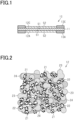
- Fig. 1 illustrates a cross-sectional structure along a thickness direction of the membrane electrode assembly.
- a membrane electrode assembly 10 includes a polymer electrolyte membrane 11, a cathode-side electrode catalyst layer 12C, and an anode-side electrode catalyst layer 12A.
- the polymer electrolyte membrane 11 is a solid polymer electrolyte membrane.
- the polymer electrolyte membrane 11 has a pair of surfaces facing away from each other. One of the surfaces is bonded to the cathode-side electrode catalyst layer 12C, and the other surface is bonded to the anode-side electrode catalyst layer 12A.
- the cathode-side electrode catalyst layer 12C is an electrode catalyst layer that constitutes an oxygen electrode (cathode).
- the anode-side electrode catalyst layer 12A is an electrode catalyst layer that constitutes a fuel electrode (anode).
- a portion other than where the cathode-side electrode catalyst layer 12C is positioned is sealed by a cathode-side gasket 13C.
- a portion other than where the anode-side electrode catalyst layer 12A is positioned is sealed by an anode-side gasket 13A.
- the cathode-side electrode catalyst layer 12C has a pair of surfaces facing away from each other.
- a surface in contact with the polymer electrolyte membrane 11 is a first surface S1 and a surface facing away from the first surface is a second surface S2.
- the anode-side electrode catalyst layer 12A has a pair of surfaces facing away from each other.
- a surface in contact with the polymer electrolyte membrane 11 is a first surface S1 and a surface facing away from the first surface is a second surface S2.
- the electrode catalyst layer provided in the membrane electrode assembly 10 will be described in detail. Note that the electrode catalyst layer described below is applied to both the cathode-side electrode catalyst layer 12C and the anode-side electrode catalyst layer 12A, but may be applied only to either one of the cathode-side electrode catalyst layer 12C or the anode-side electrode catalyst layer 12A.
- the electrode catalyst layer 12 includes a catalyst material 21, a conductive carrier 22, a polymer electrolyte 23, and a fibrous material 24.
- Voids correspond to portions of the electrode catalyst layer 12 in which the catalyst material 21, the conductive carrier 22, the polymer electrolyte 23, and the fibrous material 24 are not present.
- the polymer electrolyte 23 contains a sulfonate group.
- the polymer electrolyte 23 is preferably at least one selected from the group consisting of sulfonated polyether ketones, sulfonated polyether sulfones, sulfonated polyether ether sulfones, sulfonated polysulfides, and sulfonated polyphenylenes.
- the distribution of the polymer electrolyte 23 in the electrode catalyst layer 12 can be determined by using the peak intensity of SO 3 (m/z80) and the peak intensity of HSO 4 (m/z97) obtained by time-of-flight secondary ion mass spectrometry (TOF-SIMS).
- examples of the ions derived from the polymer electrolyte include SO 3 2- ions and HSO 4 - ions.
- the electrode catalyst layer 12 satisfies at least one of Conditions 1 to 4 described below, wherein Condition 4 is covered by the claims.
- a first standard value as a first value is a value normalized by dividing the peak intensity of SO 3 (m/z80) by the peak intensity of carbon (m/z12), and also dividing by the total thickness of the electrode catalyst layer 12, when the electrode catalyst layer 12 is analyzed using TOF-SIMS at each position in the thickness direction of the electrode catalyst layer 12.
- the rate of change of the first standard value with respect to the thickness of the electrode catalyst layer 12 from the first surface S1 to the second surface S2 is -0.0020 or less. This enables gas diffusivity and drainage from the first surface S1 to the second surface S2 in the electrode catalyst layer 12 to be improved.
- a second standard value as a second value is a value normalized by dividing the peak intensity of HSO 4 (m/z97) by the peak intensity of carbon (m/z12), and also dividing by the total thickness of the electrode catalyst layer 12, when the electrode catalyst layer 12 is analyzed using TOF-SIMS at each position in the thickness direction of the electrode catalyst layer 12.
- the rate of change of the second standard value with respect to the thickness of the electrode catalyst layer 12 from the first surface S1 to the second surface S2 is -0.0030 or less. As is the case where condition 1 is satisfied, gas diffusivity and drainage can be improved from the first surface S1 to the second surface.
- a fourth standard value as a fourth value is a value normalized by dividing the peak intensity of HSO 4 (m/z97) by the peak intensity of carbon (m/z12), when the electrode catalyst layer 12 is analyzed using TOF-SIMS at each position in the thickness direction of the electrode catalyst layer 12.
- the rate of change of the fourth standard value with respect to the thickness from the first surface S1 to the second surface S2 is -0.0080 or less.
- condition 1 is satisfied, gas diffusivity and drainage can be improved from the first surface S1 to the second surface.
- each standard value decreases from the first surface S1 toward the second surface S2, and thus the amount of polymer electrolytes 23 decreases from the first surface S1 toward the second surface S2.
- the amount of voids in the electrode catalyst layer 12 increases from the first surface toward the second surface. This enables gas diffusivity and drainage from the first surface to the second surface to be improved. Accordingly, the polymer electrolyte fuel cell having the electrode catalyst layer 12 can improve power generation performance.
- the electrode catalyst layer 12 preferably satisfies, in addition to Conditions 1 to 4 described above, Conditions 5 to 8 described below.
- the third standard value for the second surface S2 is 0.035 or more and 0.055 or less.
- the fourth standard value for the second surface S2 is 0.083 or more and 0.103 or less.
- the amount of voids on the second surface S2 can be increased to such an extent that sufficient gas diffusivity and sufficient drainage on the second surface S2 can be achieved.
- a difference between the third standard value for the first surface S1 and the third standard value for the second surface S2 is 0.05 or more.
- a difference between the fourth standard value for the first surface S1 and the fourth standard value for the second surface S2 is 0.08 or more.
- the thickness of the electrode catalyst layer 12 is preferably 10 ⁇ m or more and 20 ⁇ m or less. When the thickness of the electrode catalyst layer 12 is 20 ⁇ m or less, occurrence of cracking in the electrode catalyst layer 12 is prevented. Additionally, in a case where the electrode catalyst layer 12 is used in the polymer electrolyte fuel cell, diffusivity of gas and generated water, and a decrease in conductivity are prevented, and thus reduction in the output of the polymer electrolyte fuel cell is prevented. Additionally, when the thickness of the electrode catalyst layer 12 is 10 ⁇ m or more, variation in the thickness of the electrode catalyst layer 12 is less likely to occur, and an uneven distribution of the catalyst material 21 and the polymer electrolyte 23 contained in the electrode catalyst layer 12 is prevented.
- cracking of the surface of the electrode catalyst layer 12 and uneven thickness of the electrode catalyst layer 12 are not preferable in that cracking and uneven thickness are likely to affect durability of the polymer electrolyte fuel cell in a case where the electrode catalyst layer 12 is used as a part of the polymer electrolyte fuel cell and where the polymer electrolyte fuel cell is operated over time.
- Fig. 3 a configuration of the polymer electrolyte fuel cell having the membrane electrode assembly 10 will be described.
- the configuration described below is one example of a polymer electrolyte fuel cell.
- Fig. 3 illustrates a configuration of a single cell provided in the polymer electrolyte fuel cell.
- the polymer electrolyte fuel cell may include a plurality of single cells, and the plurality of single cells laminated with each another.
- a polymer electrolyte fuel cell 30 includes the membrane electrode assembly 10, a pair of gas diffusion layers, and a pair of separators.
- a pair of gas diffusion layers includes a cathode-side gas diffusion layer 31C and an anode-side gas diffusion layer 31A.
- the pair of separators includes a cathode-side separator 32C and an anode-side separator 32A.
- the cathode-side gas diffusion layer 31C is in contact with the cathode-side electrode catalyst layer 12C.
- the cathode-side electrode catalyst layer 12C and the cathode-side gas diffusion layer 31C form an oxygen electrode (cathode) 30C.
- the anode-side gas diffusion layer 31A is in contact with the anode-side electrode catalyst layer 12A.
- the anode-side electrode catalyst layer 12A and the anode-side gas diffusion layer 31A form a fuel electrode (anode) 30A.
- a surface to which the cathode-side electrode catalyst layer 12C is bonded is a cathode surface
- a surface to which the anode-side electrode catalyst layer 12A is bonded is an anode surface.
- a portion of the cathode surface that is not covered with the cathode-side electrode catalyst layer 12C is an outer peripheral portion.
- a cathode-side gasket 13C is located at the outer peripheral portion.
- a portion of the anode surface that is not covered with the anode-side electrode catalyst layer 12A is an outer peripheral portion.
- an anode-side gasket 13A is located at the outer peripheral portion. The gaskets 13C and 13A prevent leakage of gas from the outer peripheral portions of the surfaces.
- a multilayer composed of the membrane electrode assembly 10 and the two gas diffusion layers 31C and 31A is sandwiched between the cathode-side separator 32C and the anode-side separator 32A, in the thickness direction of the polymer electrolyte fuel cell 30.
- the cathode-side separator 32C faces the cathode-side gas diffusion layer 31C.
- the anode-side separator 32A faces the anode-side gas diffusion layer 31A.
- a pair of opposing surfaces facing away from each other respectively has a plurality of grooves.
- grooves on a surface facing the cathode-side gas diffusion layer 31C are gas flow paths 32Cg.
- grooves on a surface facing away from the cathode-side gas diffusion layer 31C are cooling water flow paths 32Cw.
- a pair of opposing surfaces facing away from each other respectively has a plurality of grooves.
- grooves on a surface facing the anode-side gas diffusion layer 31A are gas flow paths 32Ag.
- grooves on a surface facing away from the anode-side gas diffusion layer 31A are cooling water flow paths 32Aw.
- the separators 32C and 32A are formed of a material having conductivity, which is impermeable to gas.
- an oxidant is supplied through the gas flow paths 32Cg in the cathode-side separator 32C to the oxygen electrode 30C. Additionally, in the polymer electrolyte fuel cell 30, a fuel is supplied to the fuel electrode 30A through the gas flow paths 32Ag in the anode-side separator 32A. Thus, the polymer electrolyte fuel cell 30 generates power.
- the oxidant include air and oxygen.
- the fuel include fuel gases containing hydrogen and organic fuel.
- a material for forming the electrode catalyst layer 12 will be described in further detail below.
- the catalyst material 21 may be formed of a platinum group metal or a metal other than a platinum group metal.
- a platinum group metal may include platinum, palladium, ruthenium, iridium, rhodium, or osmium.
- a metal other than a platinum group metal include iron, lead, copper, chromium, cobalt, nickel, manganese, vanadium, molybdenum, gallium, or aluminum.
- the catalyst material 21 may be formed of an alloy, an oxide, a multiple oxide, or the like of these metals.
- the catalyst material 21 is preferably formed of platinum or a platinum alloy.
- the catalyst material 21 is granular, and preferably has a particle size in the range of 0.5 nm or more and 20 nm or less, and more preferably in the range of 1 nm or more and 5 nm or less.
- the particle size of the catalyst material 21 is 0.5 nm or more, stability of the catalyst material 21 is improved.
- the particle size of the catalyst material 21 is 20 nm or less, reduction in activity of the catalyst material 21 is prevented.
- the conductive carrier 22 may be, for example, carbon particles.
- the carbon particles are conductive fine particles and are not eroded by the catalyst material 21.
- the carbon particles preferably have a particle size in the range of 10 nm or more to 1,000 nm or less and more preferably 10 nm or more to 100 nm or less.
- the particle size of the carbon particles is 10 nm or more, an electron conductive path is more likely to be formed.
- the particle size of the carbon particles is 1,000 nm or less, an increase in resistance due to an increased thickness of the electrode catalyst layer 12, and consequently, reduction in power generation performance is prevented.
- the polymer electrolyte 23 may be an ion conductive polymer electrolyte. In order to improve adhesion between the electrode catalyst layer 12 and the polymer electrolyte membrane 11, the polymer electrolyte 23 is preferably the same electrolyte as or similar to the polymer electrolyte membrane 11.
- the polymer electrolyte 23 may be formed, for example, of a fluorine-based resin or a hydrocarbon-based resin. Examples of the fluorine-based resin include Nafion (registered trademark) (manufactured by DuPont). Examples of the hydrocarbon-based resin include engineering plastics and resins obtained by introducing sulfonate groups into copolymers of engineering plastics.
- hydrocarbon-based resins examples include sulfonated polyether ketones, sulfonated polyether sulfones, sulfonated polyether ether sulfones, sulfonated polysulfides, and sulfonated polyphenylenes.
- the polymer electrolytes contained in the polymer electrolyte membrane 11 may be the same electrolyte as or different electrolyte from the polymer electrolytes 23 contained in the electrode catalyst layer 12.
- the polymer electrolyte membrane 11 and the polymer electrolyte 23 preferably satisfy the following.
- the polymer electrolytes contained in the polymer electrolyte membrane 11 are preferably the same electrolyte as or similar electrolyte to the polymer electrolytes 23.
- the fibrous material 24 may be formed of electron conductive fibers or proton conductive fibers.
- the electron conductive fibers include carbon fibers, carbon nanotubes, carbon nanohorns, and conductive polymer nanofibers.
- the fibrous material 24 is preferably formed of carbon nanofibers.
- Electron conductive fibers having catalytic activity are more preferable in terms of reducing the amount of noble metal catalyst used.
- the electron conductive fibers having catalytic activity may be a carbon alloy catalyst made of carbon nanofibers.
- the electron conductive fibers having catalytic activity may be fibers formed of an electrode active material for a fuel electrode.
- the electrode active material may be a material containing at least one transition metal element selected from the group consisting of Ta, Nb, Ti, and Zr. Examples of the material containing a transition metal element include a partial oxide of a carbonitride of a transition metal element, a conductive oxide of a transition metal element, or a conductive oxynitride of a transition metal element.
- the proton conductive fiber is a fiber formed of a polymer electrolyte having proton conductivity.
- a material for forming the proton conductive fiber may be a fluorine polymer electrolyte, a hydrocarbon polymer electrolyte, or the like.
- the fluorine polymer electrolyte include Nafion (registered trademark) manufactured by Du Pont, Flemion (registered trademark) manufactured by Asahi Glass Co. Ltd., Aciplex (registered trademark) manufactured by Asahi Kasei Corporation, or Gore Select (registered trademark) manufactured by Gore.
- hydrocarbon polymer electrolyte examples include electrolytes such as sulfonated polyether ketones, sulfonated polyether sulfones, sulfonated polyether ether sulfones, sulfonated polysulfides, and sulfonated polyphenylenes.
- the fibrous material 24 may be formed of only one of the above-described types of fibers or two or more types of fibers.
- the electron conductive fibers and the proton conductive fibers may be used together as the fibrous material 24.
- the fiber diameter of the fibrous material 24 is preferably 0.1 ⁇ m or less. Consequently, strength of the electrode catalyst layer 12 can be improved, and when the electrode catalyst layer 12 is formed, occurrence of cracking in the electrode catalyst layer 12 is prevented.
- a fiber length of the fibrous material 24 is preferably in the range of 1 ⁇ m or more and 200 ⁇ m or less. When setting the fiber length in the range of 1 ⁇ m or more and 200 ⁇ m or less, aggregation of the polymer electrolytes contained in the electrode catalyst layer 12 is prevented, and thus voids can be formed in the electrode catalyst layer 12.
- the mass of the polymer electrolyte fiber is preferably 0.1 times or more and 3.0 times or less the mass of carbon particles excluding the catalyst.
- a method of producing the membrane electrode assembly 10 will be described below.
- the electrode catalyst layer 12 of the membrane electrode assembly 10 can be formed by preparing electrode catalyst layer slurry, applying the electrode catalyst layer slurry to a substrate or the like, and then drying the electrode catalyst layer slurry.
- ketones examples include acetone, methyl ethyl ketone, methyl propyl ketone, methyl butyl ketone, methyl isobutyl ketone, methyl amyl ketone, pentanone, heptanone, cyclohexanone, methylcyclohexanone, acetonyl acetone, diethyl ketone, dipropyl ketone, and diisobutyl ketone.
- ethers examples include tetrahydrofuran, tetrahydropyran, dioxane, diethylene glycol dimethyl ether, anisole, methoxytoluene, diethyl ether, dipropyl ether, and dibutyl ether.
- amines include isopropylamine, butylamine, isobutylamine, cyclohexylamine, diethylamine, and aniline.
- esters examples include propyl formate, isobutyl formate, amyl formate, methyl acetate, ethyl acetate, propyl acetate, butyl acetate, isobutyl acetate, pentyl acetate, isopentyl acetate, methyl propionate, ethyl propionate, and butyl propionate.
- the solvent may be formed of acetic acid, propionic acid, dimethylformamide, dimethylacetamide, N-methylpyrrolidone, or the like.
- the solvent may be made of a glycol or glycol ether solvent.
- glycol and glycol ether solvent include ethylene glycol, diethylene glycol, propylene glycol, ethylene glycol monomethylether, ethylene glycol dimethylether, ethylene glycol diethylether, diacetone alcohol, 1-methoxy-2-propanol, and 1-ethoxy-2-propanol.
- Examples of the method of applying the catalyst layer slurry include doctor blading, die coating, dipping, screen printing, laminator roll coating, and spraying.
- Examples of the method of drying the catalyst layer slurry include hot air drying and IR drying.
- the drying temperature is in the range of 40°C or more and 200°C or less, and preferably in the range of 40°C or more and 120°C or less.
- the drying time is in the range of 0.5 minute or more and 1 hour or less, and preferably in the range of 1 minute or more and 30 minutes or less.
- the method of producing the membrane electrode assembly 10 may include forming the electrode catalyst layer 12 directly on the polymer electrolyte membrane 11.
- the method of forming the electrode catalyst layer 12 directly on the polymer electrolyte membrane 11 is preferable in terms of high adhesion between the polymer electrolyte membrane 11 and the electrode catalyst layer 12 and in avoiding occurrence of crushing of the electrode catalyst layer 12 due to thermocompression bonding during transfer.
- Example 1 20 g of carbon-supported platinum (TEC10E50E, manufactured by Tanaka Kikinzoku Kogyo K.K.) was placed in a container, water was added to the container, and the carbon-supported platinum and water were mixed. Then, 1-propanol, a polymer electrolyte (Nafion (registered trademark) dispersion liquid, manufactured by Wako Pure Chemical Industries, Ltd.), and 10 g of carbon fibers (VGCF-H, manufactured by Showa Denko K.K.) (VGCF is a registered trademark) were added to the container and stirred. Thus, the catalyst layer slurry in Example 1 was obtained.
- TEC10E50E manufactured by Tanaka Kikinzoku Kogyo K.K.
- the catalyst layer slurries were applied to the surfaces of the polymer electrolyte membrane (Nafion 212, manufactured by Dupont) by die coating.
- the polymer electrolyte membrane and the catalyst layer slurries were dried in a furnace at 80°C to obtain a membrane electrode assembly in Example 1.
- a membrane electrode assembly in Comparative Example 1 was obtained in the same manner as in Example 1, except that catalyst slurry was applied to a transfer substrate using die coating then dried, and was subsequently bonded to the polymer electrolyte membrane by thermocompression bonding at 100°C.
- a membrane electrode assembly in Comparative Example 2 was obtained in the same manner as in Example 1, except that catalyst slurry containing no carbon fibers was applied to a transfer substrate using die coating then dried, and was subsequently bonded to the polymer electrolyte membrane by thermocompression bonding at 100°C.
- the thickness of the electrode catalyst layer was measured by using a scanning electron microscope (SEM) to observe a cross section of the electrode catalyst layer. Specifically, the cross section of the electrode catalyst layer was observed at 1,000-fold magnification using a scanning electron microscope (FE-SEM S-4800, manufactured by Hitachi High-Technologies Corporation). The thickness of the electrode catalyst layer was measured at 30 observation points on the cross section of the electrode catalyst layer. The average thickness at 30 observation points was taken as the thickness of the electrode catalyst layer.
- SEM scanning electron microscope
- a cross section of one of the electrode catalyst layers of each membrane electrode assembly was analyzed by TOF-SIMS.
- the electrode catalyst layer was divided into three equal portions in the thickness direction of the electrode catalyst layer, and Area 1, Area 2, and Area 3 were located in this order from the portion in contact with the polymer electrolyte membrane. Each area was analyzed using TOF-SIMS. Note that the analysis was conducted using a time-of-flight secondary ion mass spectrometer (TRIFT-V, manufactured by ULVAC-PHI, INCORPORATED.) and that analysis conditions were set as follows.
- TRIFT-V time-of-flight secondary ion mass spectrometer
- a pair of gas diffusion layers (SIGRACET (registered trademark) (35 BC manufactured by SGL Carbon) were placed outside the pair of catalyst layers provided in each membrane electrode assembly, and power generation performance was evaluated using a JARI standard cell.
- the cell temperature was set at 80°C, hydrogen (100%RH) was supplied to the anode, and air (100%RH) was supplied to the cathode.
- the thickness of an electrode catalyst layer used for TOF-SIMS analysis was measured among the electrode catalyst layers provided in each electrode catalyst layer. It was found that the thickness of the electrode catalyst layer was 16 ⁇ m in Example 1, 14 ⁇ m in Comparative Example 1, and 10 ⁇ m in Comparative Example 2.
- a first standard value was calculated by dividing the peak intensity of SO 3 (m/z80) by the peak intensity of carbon (m/z12), and also dividing by the total thickness of the electrode catalyst layer.
- a second standard value was calculated by dividing the peak intensity of HSO 4 (m/z97) by the peak intensity of carbon (m/z12) and the total thickness of the electrode catalyst layer.
- a third standard value was calculated by dividing the peak intensity of SO 3 (m/z80) by the peak intensity of carbon (m/z12).
- a fourth standard value was calculated by dividing the peak intensity of HSO 4 (m/z97) by the peak intensity of carbon (m/z12).
- the first standard value, the second standard value, the third standard value, and the fourth standard value were as indicated in Table 1.
- the rate of change of the first standard value with respect to the thickness of the electrode catalyst layer from the first surface to the second surface is preferably -0.020 or less.
- the rate of change of the second standard value with respect to the thickness of the electrode catalyst layer from the first surface to the second surface is preferably -0.003 or less.
- the third standard values and the fourth standard values were plotted, with the standard value for each area used as a median in the thickness direction of the area, and approximate straight lines were calculated.
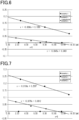
- the results are as illustrated in Fig. 6 and Fig. 7 . Note that Fig. 6 illustrates approximate straight lines calculated based on the third standard values and that Fig. 7 illustrates approximate straight lines calculated based on the fourth standard values.
- the rate of change of the third standard value with respect to the thickness of the electrode catalyst layer from the first surface to the second surface is preferably -0.0050 or less.
- the minimum value of the third standard value was calculated by substituting the thickness of each electrode catalyst layer into each of Equations (7) to (9). It was found that the minimum value was 0.0451 in Example 1, 0 in Comparative Example 1, and 0.0011 in Comparative Example 2. Additionally, it was found that, in Example 1, variation in the third standard value for Area 3 was ⁇ 0.01.
- the third standard value for the second surface is preferably in the range of 0.035 or more and 0.055 or less.
- the difference between the third standard value for the first surface and the third standard value for the second surface was calculated by subtracting, from an intercept of each of Equations (7) to (9), the minimum value calculated in each equation. It was found that the difference was 0.1504 in Example 1, 0 in Comparative Example 1, and 0.0450 in Comparative Example 2.
- the difference between the third standard value for the first surface and the third standard value for the second surface is preferably 0.05 or more.
- the calculation results as described above indicate that, in the electrode catalyst layer, the rate of change of the fourth standard value with respect to the thickness of the electrode catalyst layer from the first surface to the second surface is -0.0080 or less.
- the minimum value of the fourth standard value was calculated by substituting the thickness of each electrode catalyst layer into each of Equations (10) to (12). It was found that the minimum value was 0.0933 in Example 1, 0 in Comparative Example 1, and 0.0052 in Comparative Example 2. Additionally, it was found that, in Example 1, variation in the fourth standard value for Area 3 was ⁇ 0.01.
- the fourth standard value for the second surface is preferably in the range of 0.083 or more and 0.103 or less.
- a difference between the fourth standard value for the first surface and the fourth standard value for the second surface was calculated by subtracting, from an intercept of each of Equations (10) to (12), the minimum value calculated in each equation. It was found that the difference was 0.1664 in Example 1, 0 in Comparative Example 1, and 0.0760 in Comparative Example 2.
- the difference between the fourth standard value for the first surface and the fourth standard value for the second surface is preferably 0.08 or more.
- Example 1 It was found that the membrane electrode assembly in Example 1 had a maximum output density of 863 mW/cm 2 . It was found that the membrane electrode assembly had a maximum output density of 597 mW/cm 2 in Comparative Example 1, and 633 mW/cm 2 in Comparative Example 2. According to the membrane electrode assembly in Example 1, it was found that power generation performance of the membrane electrode assemblies in each Comparative Example was improved.
- the following effects can be obtained.
Landscapes
- Chemical & Material Sciences (AREA)
- Chemical Kinetics & Catalysis (AREA)
- Engineering & Computer Science (AREA)
- General Chemical & Material Sciences (AREA)
- Electrochemistry (AREA)
- Life Sciences & Earth Sciences (AREA)
- Manufacturing & Machinery (AREA)
- Sustainable Development (AREA)
- Sustainable Energy (AREA)
- Materials Engineering (AREA)
- Crystallography & Structural Chemistry (AREA)
- Organic Chemistry (AREA)
- Fuel Cell (AREA)
- Inert Electrodes (AREA)
- Catalysts (AREA)
Description
- The present invention relates to an electrode catalyst layer, a membrane electrode assembly, and a polymer electrolyte fuel cell.
- Fuel cells generate an electric current from the chemical reaction between hydrogen and oxygen. Fuel cells have attracted attention as a clean energy source that has higher efficiency, low environmental load and reduced noise over conventional power generation systems. In particular, polymer electrolyte fuel cells, which can be used at around room temperature, are considered promising for application to in-vehicle power sources, domestic stationary power sources, and the like.
- Polymer electrolyte fuel cells (PEFCs) have a structure in which a polymer electrolyte membrane is sandwiched between a fuel electrode (anode) and an oxygen electrode (cathode). The anode and the cathode each have a structure in which an electrode catalyst layer and a gas diffusion layer are laminated. The polymer electrolyte fuel cell generates power by electrochemical reactions described below when a fuel gas containing hydrogen is supplied to the fuel electrode, and an oxidant gas containing oxygen is supplied to the oxygen electrode. Note that, of the reaction formulae described below, Reaction Formula (1) is a formula indicating a reaction at the fuel electrode, and Reaction Formula (2) is a formula indicating a reaction at the oxygen electrode.
H2 → 2H+ + 2e- ... Reaction Formula (1)
1/2 O2 + 2H+ + 2e- → H2O ... Reaction Formula (2)
- An anode-side electrode catalyst layer promotes a reaction that generates protons and electrons from the fuel gas supplied to the anode-side electrode catalyst layer (Reaction Formula (1)). The protons pass through a polymer electrolyte in the anode-side electrode catalyst layer and a polymer electrolyte membrane and migrate to the cathode. The electrons pass through an external circuit and migrate to the cathode. In the cathode-side electrode catalyst layer, the protons and the electrons react with an oxidant gas to generate water (Reaction Formula (2)).
- The electrode catalyst layer generally includes carbon-supported platinum and a polymer electrolyte. During power generation, the carbon contributes to electron conduction, and the polymer electrolyte contributes to proton conduction. Power generation performance of the polymer electrolyte fuel cell is significantly affected by the types of carbon and polymer electrolyte and the balance between contents of the carbon and the polymer electrolyte. On the other hand, during power generation, gas diffusivity for hydrogen, oxygen, and the like in the polymer electrolyte fuel cell and drainage for generated moisture are also important in improving power generation performance of the polymer electrolyte fuel cell. A fuel cell having high gas diffusivity and high drainage has high power generation performance.
- In order to obtain high power generation performance, a membrane electrode assembly having an electrode catalyst layer in which the amount of ionomer changes in a thickness direction of the electrode catalyst layer has been proposed. The electrode catalyst layer is formed of a first layer portion, a second layer portion, and a third layer portion. The first layer portion is in contact with a polymer electrolyte membrane. The second layer portion is in contact with a gas diffusion layer. The third layer portion is sandwiched between the first layer portion and the second layer portion. Each of the first layer portion and the second layer portion has a larger amount of ionomer than the third layer portion (see, for example, PTL 1). See also
PTL 2,PTL 3 and PTL 4. -
- PTL 1:
JP 2010-251140 A - PTL 2:
US 2006/093893 A1 - PTL 3:
WO 02/056404 A1 - PTL 4:
US 2007/231672 A1 - In the above-described polymer electrolyte fuel cell, the second layer portion, which is in contact with the gas diffusion layer, has a larger amount of ionomer than the third layer portion. The movement of water evaporated in the electrode catalyst layer toward the gas diffusion layer is prevented by the ionomer in the second layer portion. Accordingly, degradation of power generation performance due to reduction of the water content is prevented. On the other hand, in such a polymer electrolyte fuel cell, since drainage from the polymer electrolyte fuel cell is prevented, activity of the electrode catalyst layer is reduced, and consequently, power generation performance may be reduced.
- An object of the present invention is to provide an electrode catalyst layer, a membrane electrode assembly, and a polymer electrolyte fuel cell that can improve power generation performance.
- To solve the above problem, the present invention provides an electrode catalyst layer according to
claim 1. The dependent claims concern particular embodiments. - According to the above configuration, a value becomes smaller from the first surface toward the second surface, so that the amount of polymer electrolyte becomes smaller from the first surface toward the second surface. In other words, the amount of voids in the electrode catalyst layer increases from the first surface toward the second surface. This enables gas diffusivity and drainage to be improved from the first surface toward the second surface. Accordingly, power generation performance can be improved in a polymer electrolyte fuel cell having the electrode catalyst layer.
- To achieve the above-described object, a membrane electrode assembly includes a polymer electrolyte membrane having two surfaces facing away from each other and the above-described electrode catalyst layer. The electrode catalyst layer is bonded to at least one of the two surfaces.
- A polymer electrolyte fuel cell to solve the above problem includes the membrane electrode assembly.
-
-
Fig. 1 is a cross-sectional view illustrating a structure of a membrane electrode assembly according to an embodiment. -
Fig. 2 is a schematic diagram illustrating a structure of an electrode catalyst layer provided in the membrane electrode assembly illustrated inFig. 1 . -
Fig. 3 is an exploded perspective view illustrating a structure of a polymer electrolyte fuel cell having the membrane electrode assembly illustrated inFig. 1 . -
Fig. 4 is a graph showing a relationship between a first standard value and each area in Example and Comparative Examples. -
Fig. 5 is a graph showing a relationship between a second standard value and each area in Example and Comparative Examples. -
Fig. 6 is a graph showing a relationship between a third standard value and the thickness of the electrode catalyst layer in Example and Comparative Examples. -
Fig. 7 is a graph indicating a relationship between a fourth standard value and the thickness of the electrode catalyst layer in Example and Comparative Examples. - With reference to
Figs. 1 to 7 , an embodiment of an electrode catalyst layer, a membrane electrode assembly, and a polymer electrolyte fuel cell will be described. A configuration of the membrane electrode assembly, a configuration of the electrode catalyst layer, a configuration of a single cell that constitutes the polymer electrolyte fuel cell, a formation material for the electrode catalyst layer, a method of manufacturing the membrane electrode assembly, and Examples will be described below in order. - With reference to
Fig. 1 , a configuration of the membrane electrode assembly will be described.Fig. 1 illustrates a cross-sectional structure along a thickness direction of the membrane electrode assembly. - As illustrated in
Fig. 1 , amembrane electrode assembly 10 includes apolymer electrolyte membrane 11, a cathode-sideelectrode catalyst layer 12C, and an anode-sideelectrode catalyst layer 12A. Thepolymer electrolyte membrane 11 is a solid polymer electrolyte membrane. Thepolymer electrolyte membrane 11 has a pair of surfaces facing away from each other. One of the surfaces is bonded to the cathode-sideelectrode catalyst layer 12C, and the other surface is bonded to the anode-sideelectrode catalyst layer 12A. The cathode-sideelectrode catalyst layer 12C is an electrode catalyst layer that constitutes an oxygen electrode (cathode). The anode-sideelectrode catalyst layer 12A is an electrode catalyst layer that constitutes a fuel electrode (anode). - In the
polymer electrolyte membrane 11, of a surface to which the cathode-sideelectrode catalyst layer 12C is bonded, a portion other than where the cathode-sideelectrode catalyst layer 12C is positioned is sealed by a cathode-side gasket 13C. In thepolymer electrolyte membrane 11, of a surface to which the anode-sideelectrode catalyst layer 12A is bonded, a portion other than where the anode-sideelectrode catalyst layer 12A is positioned is sealed by an anode-side gasket 13A. - The cathode-side
electrode catalyst layer 12C has a pair of surfaces facing away from each other. A surface in contact with thepolymer electrolyte membrane 11 is a first surface S1 and a surface facing away from the first surface is a second surface S2. The anode-sideelectrode catalyst layer 12A has a pair of surfaces facing away from each other. A surface in contact with thepolymer electrolyte membrane 11 is a first surface S1 and a surface facing away from the first surface is a second surface S2. - With reference to
Fig. 2 , the electrode catalyst layer provided in themembrane electrode assembly 10 will be described in detail. Note that the electrode catalyst layer described below is applied to both the cathode-sideelectrode catalyst layer 12C and the anode-sideelectrode catalyst layer 12A, but may be applied only to either one of the cathode-sideelectrode catalyst layer 12C or the anode-sideelectrode catalyst layer 12A. - As illustrated in
Fig. 2 , theelectrode catalyst layer 12 includes acatalyst material 21, aconductive carrier 22, apolymer electrolyte 23, and afibrous material 24. Voids correspond to portions of theelectrode catalyst layer 12 in which thecatalyst material 21, theconductive carrier 22, thepolymer electrolyte 23, and thefibrous material 24 are not present. - The
polymer electrolyte 23 contains a sulfonate group. Thepolymer electrolyte 23 is preferably at least one selected from the group consisting of sulfonated polyether ketones, sulfonated polyether sulfones, sulfonated polyether ether sulfones, sulfonated polysulfides, and sulfonated polyphenylenes. - With the
polymer electrolyte 23 containing at least one included in the above-described group, the distribution of thepolymer electrolyte 23 in theelectrode catalyst layer 12 can be determined by using the peak intensity of SO3 (m/z80) and the peak intensity of HSO4 (m/z97) obtained by time-of-flight secondary ion mass spectrometry (TOF-SIMS). - The characteristics contributing to the improvement of power generation performance in the
electrode catalyst layer 12 are, for example, gas diffusivity of theelectrode catalyst layer 12 and drainage of theelectrode catalyst layer 12. In theelectrode catalyst layer 12, a surface in contact with thepolymer electrolyte membrane 11 is the above-described first surface S1 and a surface in contact with a gas diffusion layer is the above-described second surface S2. In order to improve gas diffusivity and drainage of theelectrode catalyst layer 12, the amount of the polymer electrolyte on the second surface S2 is preferably smaller than the amount of the polymer electrolyte on the first surface S1. Additionally, in a region of theelectrode catalyst layer 12, it is preferable that the shorter the distance from the second surface S2, the smaller the amount of polymer electrolyte. In other words, in the thickness direction from the first surface S1 to the second surface S2, the rate of change of the amount of polymer electrolyte is preferably negative and smaller in value. The rate of change of the amount of polymer electrolyte is preferably negative and smaller in value within a range in which a mechanical strength required for theelectrode catalyst layer 12 is maintained. Specifically, the rate of change of the amount of polymer electrolyte is preferably a negative value. Additionally, the absolute value of the rate of change is preferably a larger value. - Additionally, the amount of polymer electrolytes in each region of the
electrode catalyst layer 12 can be determined based on the amount of ions derived from the polymer electrolytes contained in each region of theelectrode catalyst layer 12. Specifically, for example, in a case where a cross section of theelectrode catalyst layer 12 along the thickness direction is analyzed using TOF-SIMS, the amount of polymer electrolytes in each region of theelectrode catalyst layer 12 can be determined based on the peak intensity of ions derived from the polymer electrolytes. It can be considered that the greater the peak intensity of the ions derived from the polymer electrolyte, the greater the amount of the polymer electrolyte. In contrast, it can be considered that the smaller the peak intensity of ions derived from the polymer electrolyte, the smaller the amount of the polymer electrolyte. The larger the peak intensity of ions derived from the polymer electrolyte, the smaller the amount of voids contained in the portion in theelectrode catalyst layer 12, and the smaller the peak intensity of ions derived from the polymer electrolyte, the larger the amount of voids contained in the portion in theelectrode catalyst layer 12 Note that examples of the ions derived from the polymer electrolyte include SO3 2-ions and HSO4 -ions. - In the thickness direction of the
electrode catalyst layer 12, the rate of change of the amount of ions can be determined by, for example, the following method. In the thickness direction of theelectrode catalyst layer 12, theelectrode catalyst layer 12 is equally divided into a plurality of portions, and the peak intensity of the ions in each portion is measured. Then, based on the peak intensity obtained from each portion, an approximate straight line is created to thereby obtain the rate of change of the amount of ions as the inclination of the approximate straight line. - From the above-described viewpoints, the
electrode catalyst layer 12 satisfies at least one ofConditions 1 to 4 described below, wherein Condition 4 is covered by the claims. - Under
Condition 1, a first standard value as a first value is a value normalized by dividing the peak intensity of SO3 (m/z80) by the peak intensity of carbon (m/z12), and also dividing by the total thickness of theelectrode catalyst layer 12, when theelectrode catalyst layer 12 is analyzed using TOF-SIMS at each position in the thickness direction of theelectrode catalyst layer 12. The rate of change of the first standard value with respect to the thickness of theelectrode catalyst layer 12 from the first surface S1 to the second surface S2 is -0.0020 or less. This enables gas diffusivity and drainage from the first surface S1 to the second surface S2 in theelectrode catalyst layer 12 to be improved. - Under
Condition 2, a second standard value as a second value is a value normalized by dividing the peak intensity of HSO4 (m/z97) by the peak intensity of carbon (m/z12), and also dividing by the total thickness of theelectrode catalyst layer 12, when theelectrode catalyst layer 12 is analyzed using TOF-SIMS at each position in the thickness direction of theelectrode catalyst layer 12. The rate of change of the second standard value with respect to the thickness of theelectrode catalyst layer 12 from the first surface S1 to the second surface S2 is -0.0030 or less. As is the case wherecondition 1 is satisfied, gas diffusivity and drainage can be improved from the first surface S1 to the second surface. - Under
Condition 3, a third standard value as a third value is a value normalized by dividing the peak intensity of SO3 (m/z80) by the peak intensity of carbon (m/z12), when theelectrode catalyst layer 12 is analyzed using TOF-SIMS at each position in the thickness direction of theelectrode catalyst layer 12. The rate of change of the third standard value with respect to the thickness of theelectrode catalyst layer 12 from the first surface S1 to the second surface S2 is -0.0050 or less. As is the case wherecondition 1 is satisfied, gas diffusivity and drainage from the first surface S1 to the second surface S2 in theelectrode catalyst layer 12 can be improved. - Under Condition 4, a fourth standard value as a fourth value is a value normalized by dividing the peak intensity of HSO4 (m/z97) by the peak intensity of carbon (m/z12), when the
electrode catalyst layer 12 is analyzed using TOF-SIMS at each position in the thickness direction of theelectrode catalyst layer 12. The rate of change of the fourth standard value with respect to the thickness from the first surface S1 to the second surface S2 is -0.0080 or less. As is the case wherecondition 1 is satisfied, gas diffusivity and drainage can be improved from the first surface S1 to the second surface. - As described above, in the
electrode catalyst layer 12 satisfying any ofConditions 1 to 4, each standard value decreases from the first surface S1 toward the second surface S2, and thus the amount ofpolymer electrolytes 23 decreases from the first surface S1 toward the second surface S2. In other words, the amount of voids in theelectrode catalyst layer 12 increases from the first surface toward the second surface. This enables gas diffusivity and drainage from the first surface to the second surface to be improved. Accordingly, the polymer electrolyte fuel cell having theelectrode catalyst layer 12 can improve power generation performance. - The
electrode catalyst layer 12 preferably satisfies, in addition toConditions 1 to 4 described above, Conditions 5 to 8 described below. - The third standard value for the second surface S2 is 0.035 or more and 0.055 or less.
- The fourth standard value for the second surface S2 is 0.083 or more and 0.103 or less.
- By having each of the third value and fourth standard value in the range described above, the amount of voids on the second surface S2 can be increased to such an extent that sufficient gas diffusivity and sufficient drainage on the second surface S2 can be achieved.
- A difference between the third standard value for the first surface S1 and the third standard value for the second surface S2 is 0.05 or more.
- A difference between the fourth standard value for the first surface S1 and the fourth standard value for the second surface S2 is 0.08 or more.
- With the difference in third standard value and the difference in fourth standard value included within the above-described ranges, dispersion of gas from the second surface S2 to the first surface S1 is likely to occur, and dispersion of generated water from the first surface S1 to the second surface S2 is likely to occur. This improves both gas diffusivity and drainage of the
electrode catalyst layer 12. - Note that the thickness of the
electrode catalyst layer 12 is preferably 10 µm or more and 20 µm or less. When the thickness of theelectrode catalyst layer 12 is 20 µm or less, occurrence of cracking in theelectrode catalyst layer 12 is prevented. Additionally, in a case where theelectrode catalyst layer 12 is used in the polymer electrolyte fuel cell, diffusivity of gas and generated water, and a decrease in conductivity are prevented, and thus reduction in the output of the polymer electrolyte fuel cell is prevented. Additionally, when the thickness of theelectrode catalyst layer 12 is 10 µm or more, variation in the thickness of theelectrode catalyst layer 12 is less likely to occur, and an uneven distribution of thecatalyst material 21 and thepolymer electrolyte 23 contained in theelectrode catalyst layer 12 is prevented. Note that cracking of the surface of theelectrode catalyst layer 12 and uneven thickness of theelectrode catalyst layer 12 are not preferable in that cracking and uneven thickness are likely to affect durability of the polymer electrolyte fuel cell in a case where theelectrode catalyst layer 12 is used as a part of the polymer electrolyte fuel cell and where the polymer electrolyte fuel cell is operated over time. - With reference to
Fig. 3 , a configuration of the polymer electrolyte fuel cell having themembrane electrode assembly 10 will be described. The configuration described below is one example of a polymer electrolyte fuel cell. Additionally,Fig. 3 illustrates a configuration of a single cell provided in the polymer electrolyte fuel cell. The polymer electrolyte fuel cell may include a plurality of single cells, and the plurality of single cells laminated with each another. - As illustrated in
Fig. 3 , a polymerelectrolyte fuel cell 30 includes themembrane electrode assembly 10, a pair of gas diffusion layers, and a pair of separators. A pair of gas diffusion layers includes a cathode-sidegas diffusion layer 31C and an anode-sidegas diffusion layer 31A. The pair of separators includes a cathode-side separator 32C and an anode-side separator 32A. - The cathode-side
gas diffusion layer 31C is in contact with the cathode-sideelectrode catalyst layer 12C. The cathode-sideelectrode catalyst layer 12C and the cathode-sidegas diffusion layer 31C form an oxygen electrode (cathode) 30C. The anode-sidegas diffusion layer 31A is in contact with the anode-sideelectrode catalyst layer 12A. The anode-sideelectrode catalyst layer 12A and the anode-sidegas diffusion layer 31A form a fuel electrode (anode) 30A. - In the
polymer electrolyte membrane 11, a surface to which the cathode-sideelectrode catalyst layer 12C is bonded is a cathode surface, and a surface to which the anode-sideelectrode catalyst layer 12A is bonded is an anode surface. A portion of the cathode surface that is not covered with the cathode-sideelectrode catalyst layer 12C is an outer peripheral portion. As described above, at the outer peripheral portion, a cathode-side gasket 13C is located. A portion of the anode surface that is not covered with the anode-sideelectrode catalyst layer 12A is an outer peripheral portion. As described above, an anode-side gasket 13A is located at the outer peripheral portion. Thegaskets - A multilayer composed of the
membrane electrode assembly 10 and the twogas diffusion layers side separator 32C and the anode-side separator 32A, in the thickness direction of the polymerelectrolyte fuel cell 30. The cathode-side separator 32C faces the cathode-sidegas diffusion layer 31C. The anode-side separator 32A faces the anode-sidegas diffusion layer 31A. - In the cathode-
side separator 32C, a pair of opposing surfaces facing away from each other respectively has a plurality of grooves. Among the pair of surfaces, grooves on a surface facing the cathode-sidegas diffusion layer 31C are gas flow paths 32Cg. Among the pair of surfaces, grooves on a surface facing away from the cathode-sidegas diffusion layer 31C are cooling water flow paths 32Cw. - In the anode-
side separator 32A, a pair of opposing surfaces facing away from each other respectively has a plurality of grooves. Among the pair of surfaces, grooves on a surface facing the anode-sidegas diffusion layer 31A are gas flow paths 32Ag. Among the pair of surfaces, grooves on a surface facing away from the anode-sidegas diffusion layer 31A are cooling water flow paths 32Aw. - The
separators - In the polymer
electrolyte fuel cell 30, an oxidant is supplied through the gas flow paths 32Cg in the cathode-side separator 32C to the oxygen electrode 30C. Additionally, in the polymerelectrolyte fuel cell 30, a fuel is supplied to thefuel electrode 30A through the gas flow paths 32Ag in the anode-side separator 32A. Thus, the polymerelectrolyte fuel cell 30 generates power. Note that examples of the oxidant include air and oxygen. Examples of the fuel include fuel gases containing hydrogen and organic fuel. - A material for forming the
electrode catalyst layer 12 will be described in further detail below. - The
catalyst material 21 may be formed of a platinum group metal or a metal other than a platinum group metal. Examples of a platinum group metal may include platinum, palladium, ruthenium, iridium, rhodium, or osmium. Examples of a metal other than a platinum group metal include iron, lead, copper, chromium, cobalt, nickel, manganese, vanadium, molybdenum, gallium, or aluminum. Thecatalyst material 21 may be formed of an alloy, an oxide, a multiple oxide, or the like of these metals. Thecatalyst material 21 is preferably formed of platinum or a platinum alloy. Thecatalyst material 21 is granular, and preferably has a particle size in the range of 0.5 nm or more and 20 nm or less, and more preferably in the range of 1 nm or more and 5 nm or less. When the particle size of thecatalyst material 21 is 0.5 nm or more, stability of thecatalyst material 21 is improved. When the particle size of thecatalyst material 21 is 20 nm or less, reduction in activity of thecatalyst material 21 is prevented. - The
conductive carrier 22 may be, for example, carbon particles. The carbon particles are conductive fine particles and are not eroded by thecatalyst material 21. The carbon particles preferably have a particle size in the range of 10 nm or more to 1,000 nm or less and more preferably 10 nm or more to 100 nm or less. When the particle size of the carbon particles is 10 nm or more, an electron conductive path is more likely to be formed. When the particle size of the carbon particles is 1,000 nm or less, an increase in resistance due to an increased thickness of theelectrode catalyst layer 12, and consequently, reduction in power generation performance is prevented. - The
polymer electrolyte 23 may be an ion conductive polymer electrolyte. In order to improve adhesion between theelectrode catalyst layer 12 and thepolymer electrolyte membrane 11, thepolymer electrolyte 23 is preferably the same electrolyte as or similar to thepolymer electrolyte membrane 11. Thepolymer electrolyte 23 may be formed, for example, of a fluorine-based resin or a hydrocarbon-based resin. Examples of the fluorine-based resin include Nafion (registered trademark) (manufactured by DuPont). Examples of the hydrocarbon-based resin include engineering plastics and resins obtained by introducing sulfonate groups into copolymers of engineering plastics. Examples of hydrocarbon-based resins include sulfonated polyether ketones, sulfonated polyether sulfones, sulfonated polyether ether sulfones, sulfonated polysulfides, and sulfonated polyphenylenes. - The polymer electrolytes contained in the
polymer electrolyte membrane 11 may be the same electrolyte as or different electrolyte from thepolymer electrolytes 23 contained in theelectrode catalyst layer 12. However, in consideration of the interface resistance between thepolymer electrolyte membrane 11 and theelectrode catalyst layer 12, and the rate of dimensional change between thepolymer electrolyte membrane 11 and theelectrode catalyst layer 12 when humidity changes, thepolymer electrolyte membrane 11 and thepolymer electrolyte 23 preferably satisfy the following. In other words, the polymer electrolytes contained in thepolymer electrolyte membrane 11 are preferably the same electrolyte as or similar electrolyte to thepolymer electrolytes 23. - The
fibrous material 24 may be formed of electron conductive fibers or proton conductive fibers. Examples of the electron conductive fibers include carbon fibers, carbon nanotubes, carbon nanohorns, and conductive polymer nanofibers. In terms of conductivity and dispersibility, thefibrous material 24 is preferably formed of carbon nanofibers. - Electron conductive fibers having catalytic activity are more preferable in terms of reducing the amount of noble metal catalyst used. In a case where the
electrode catalyst layer 12 is used as theelectrode catalyst layer 12 constituting an oxygen electrode, the electron conductive fibers having catalytic activity may be a carbon alloy catalyst made of carbon nanofibers. The electron conductive fibers having catalytic activity may be fibers formed of an electrode active material for a fuel electrode. The electrode active material may be a material containing at least one transition metal element selected from the group consisting of Ta, Nb, Ti, and Zr. Examples of the material containing a transition metal element include a partial oxide of a carbonitride of a transition metal element, a conductive oxide of a transition metal element, or a conductive oxynitride of a transition metal element. - The proton conductive fiber is a fiber formed of a polymer electrolyte having proton conductivity. A material for forming the proton conductive fiber may be a fluorine polymer electrolyte, a hydrocarbon polymer electrolyte, or the like. Examples of the fluorine polymer electrolyte include Nafion (registered trademark) manufactured by Du Pont, Flemion (registered trademark) manufactured by Asahi Glass Co. Ltd., Aciplex (registered trademark) manufactured by Asahi Kasei Corporation, or Gore Select (registered trademark) manufactured by Gore. Examples of the hydrocarbon polymer electrolyte include electrolytes such as sulfonated polyether ketones, sulfonated polyether sulfones, sulfonated polyether ether sulfones, sulfonated polysulfides, and sulfonated polyphenylenes.
- The
fibrous material 24 may be formed of only one of the above-described types of fibers or two or more types of fibers. The electron conductive fibers and the proton conductive fibers may be used together as thefibrous material 24. - The fiber diameter of the
fibrous material 24 is preferably 0.1 µm or less. Consequently, strength of theelectrode catalyst layer 12 can be improved, and when theelectrode catalyst layer 12 is formed, occurrence of cracking in theelectrode catalyst layer 12 is prevented. A fiber length of thefibrous material 24 is preferably in the range of 1 µm or more and 200 µm or less. When setting the fiber length in the range of 1 µm or more and 200 µm or less, aggregation of the polymer electrolytes contained in theelectrode catalyst layer 12 is prevented, and thus voids can be formed in theelectrode catalyst layer 12. - In a case where the
fibrous material 24 contains polymer electrolyte fibers, the mass of the polymer electrolyte fiber is preferably 0.1 times or more and 3.0 times or less the mass of carbon particles excluding the catalyst. Thus, conduction of protons during power generation is promoted, and the output of the polymer electrolyte fuel cell can be increased. - A method of producing the
membrane electrode assembly 10 will be described below. - The
electrode catalyst layer 12 of themembrane electrode assembly 10 can be formed by preparing electrode catalyst layer slurry, applying the electrode catalyst layer slurry to a substrate or the like, and then drying the electrode catalyst layer slurry. - The catalyst layer slurry contains the
catalyst material 21, theconductive carrier 22, thepolymer electrolyte 23, thefibrous material 24, and a solvent. The solvent is preferably, for example, a solvent in which thepolymer electrolyte 23 can be dispersed or a solvent in which thepolymer electrolyte 23 can be dissolved. The solvent may be formed of water, alcohols, ketones, ethers, amines, esters, or the like. Examples of the alcohols include methanol, ethanol, 1-propanol, 2-propanol, 1-butanol, 2-butanol, isobutyl alcohol, and tert-butyl alcohol. Examples of the ketones include acetone, methyl ethyl ketone, methyl propyl ketone, methyl butyl ketone, methyl isobutyl ketone, methyl amyl ketone, pentanone, heptanone, cyclohexanone, methylcyclohexanone, acetonyl acetone, diethyl ketone, dipropyl ketone, and diisobutyl ketone. Examples of the ethers include tetrahydrofuran, tetrahydropyran, dioxane, diethylene glycol dimethyl ether, anisole, methoxytoluene, diethyl ether, dipropyl ether, and dibutyl ether. Examples of the amines include isopropylamine, butylamine, isobutylamine, cyclohexylamine, diethylamine, and aniline. Examples of the esters include propyl formate, isobutyl formate, amyl formate, methyl acetate, ethyl acetate, propyl acetate, butyl acetate, isobutyl acetate, pentyl acetate, isopentyl acetate, methyl propionate, ethyl propionate, and butyl propionate. - The solvent may be formed of acetic acid, propionic acid, dimethylformamide, dimethylacetamide, N-methylpyrrolidone, or the like. The solvent may be made of a glycol or glycol ether solvent. Examples of the glycol and glycol ether solvent include ethylene glycol, diethylene glycol, propylene glycol, ethylene glycol monomethylether, ethylene glycol dimethylether, ethylene glycol diethylether, diacetone alcohol, 1-methoxy-2-propanol, and 1-ethoxy-2-propanol.
- Examples of the method of applying the catalyst layer slurry include doctor blading, die coating, dipping, screen printing, laminator roll coating, and spraying.
- Examples of the method of drying the catalyst layer slurry include hot air drying and IR drying. The drying temperature is in the range of 40°C or more and 200°C or less, and preferably in the range of 40°C or more and 120°C or less. The drying time is in the range of 0.5 minute or more and 1 hour or less, and preferably in the range of 1 minute or more and 30 minutes or less.
- The method of producing the
membrane electrode assembly 10 may include forming theelectrode catalyst layer 12 directly on thepolymer electrolyte membrane 11. The method of forming theelectrode catalyst layer 12 directly on thepolymer electrolyte membrane 11 is preferable in terms of high adhesion between thepolymer electrolyte membrane 11 and theelectrode catalyst layer 12 and in avoiding occurrence of crushing of theelectrode catalyst layer 12 due to thermocompression bonding during transfer. - Example and Comparative Examples will be described with reference to
Figs. 4 to 7 . - 20 g of carbon-supported platinum (TEC10E50E, manufactured by Tanaka Kikinzoku Kogyo K.K.) was placed in a container, water was added to the container, and the carbon-supported platinum and water were mixed. Then, 1-propanol, a polymer electrolyte (Nafion (registered trademark) dispersion liquid, manufactured by Wako Pure Chemical Industries, Ltd.), and 10 g of carbon fibers (VGCF-H, manufactured by Showa Denko K.K.) (VGCF is a registered trademark) were added to the container and stirred. Thus, the catalyst layer slurry in Example 1 was obtained. The catalyst layer slurries were applied to the surfaces of the polymer electrolyte membrane (Nafion 212, manufactured by Dupont) by die coating. The polymer electrolyte membrane and the catalyst layer slurries were dried in a furnace at 80°C to obtain a membrane electrode assembly in Example 1.
- A membrane electrode assembly in Comparative Example 1 was obtained in the same manner as in Example 1, except that catalyst slurry was applied to a transfer substrate using die coating then dried, and was subsequently bonded to the polymer electrolyte membrane by thermocompression bonding at 100°C.
- A membrane electrode assembly in Comparative Example 2 was obtained in the same manner as in Example 1, except that catalyst slurry containing no carbon fibers was applied to a transfer substrate using die coating then dried, and was subsequently bonded to the polymer electrolyte membrane by thermocompression bonding at 100°C.
- The thickness of the electrode catalyst layer was measured by using a scanning electron microscope (SEM) to observe a cross section of the electrode catalyst layer. Specifically, the cross section of the electrode catalyst layer was observed at 1,000-fold magnification using a scanning electron microscope (FE-SEM S-4800, manufactured by Hitachi High-Technologies Corporation). The thickness of the electrode catalyst layer was measured at 30 observation points on the cross section of the electrode catalyst layer. The average thickness at 30 observation points was taken as the thickness of the electrode catalyst layer.
- A cross section of one of the electrode catalyst layers of each membrane electrode assembly was analyzed by TOF-SIMS. The electrode catalyst layer was divided into three equal portions in the thickness direction of the electrode catalyst layer, and
Area 1,Area 2, andArea 3 were located in this order from the portion in contact with the polymer electrolyte membrane. Each area was analyzed using TOF-SIMS. Note that the analysis was conducted using a time-of-flight secondary ion mass spectrometer (TRIFT-V, manufactured by ULVAC-PHI, INCORPORATED.) and that analysis conditions were set as follows. -
- Primary ion species: Bi 3+
- Acceleration voltage: 30 kV
- Electric current: 1.5 nA
- Measurement time: 10 minutes (count number: approximately 500 thousand to 600 thousand)
- Charge neutralization: none
- Mass range: 1 to 1,900 emu
- Acquired ions: negative ions
- A pair of gas diffusion layers (SIGRACET (registered trademark) (35 BC manufactured by SGL Carbon) were placed outside the pair of catalyst layers provided in each membrane electrode assembly, and power generation performance was evaluated using a JARI standard cell. At this time, the cell temperature was set at 80°C, hydrogen (100%RH) was supplied to the anode, and air (100%RH) was supplied to the cathode.
- The thickness of an electrode catalyst layer used for TOF-SIMS analysis was measured among the electrode catalyst layers provided in each electrode catalyst layer. It was found that the thickness of the electrode catalyst layer was 16 µm in Example 1, 14 µm in Comparative Example 1, and 10 µm in Comparative Example 2.
- Each electrode catalyst layer was divided into three equal areas in the thickness direction, and TOF-SIMS analysis was performed on each of the areas. The peak intensity of carbon (m/z12), the peak intensity of SO3 (m/z80), and the peak intensity of HSO4 (m/z97) were obtained. The analysis was performed at three regions in each area, and the average value of the peak intensity obtained at each region was taken as the peak intensity in the area.
- A first standard value was calculated by dividing the peak intensity of SO3 (m/z80) by the peak intensity of carbon (m/z12), and also dividing by the total thickness of the electrode catalyst layer. A second standard value was calculated by dividing the peak intensity of HSO4 (m/z97) by the peak intensity of carbon (m/z12) and the total thickness of the electrode catalyst layer. A third standard value was calculated by dividing the peak intensity of SO3 (m/z80) by the peak intensity of carbon (m/z12). A fourth standard value was calculated by dividing the peak intensity of HSO4 (m/z97) by the peak intensity of carbon (m/z12). The first standard value, the second standard value, the third standard value, and the fourth standard value were as indicated in Table 1.
[Table 1] Standard value Area 1 Area 2Area 3Example 1 First standard value 0.0106 0.0073 0.0044 Second standard value 0.0142 0.0110 0.0075 Third standard value 0.1700 0.1167 0.0700 Fourth standard value 0.2267 0.1767 0.1200 Comparative Example 1 First standard value 0.0000 0.0000 0.0000 Second standard value 0.0000 0.0000 0.0000 Third standard value 0.0000 0.0000 0.0000 Fourth standard value 0.0000 0.0000 0.0000 Comparative Example 2 First standard value 0.0043 0.0020 0.0010 Second standard value 0.0073 0.0043 0.0017 Third standard value 0.0433 0.0200 0.0100 Fourth standard value 0.0733 0.0433 0.0167 - The first standard values and the second standard values were plotted for each area, and approximate straight lines were calculated. The results are as illustrated in
Fig. 4 and Fig. 5 . Note thatFig. 4 illustrates approximate straight lines calculated based on the first standard values and thatFig. 5 illustrates approximate straight lines calculated based on the second standard values. - As illustrated in
Fig. 4 , the approximate straight lines calculated based on the first standard values are as described below. - Example 1:

- Comparative Example 1:

- Comparative Example 2:

- The calculation results as described above indicate that, in the electrode catalyst layer, the rate of change of the first standard value with respect to the thickness of the electrode catalyst layer from the first surface to the second surface is preferably -0.020 or less.
- As illustrated in
Fig. 5 , the approximate straight lines calculated based on the second standard values are as described below. - Example 1:

- Comparative Example 1:

- Comparative Example 2:

- The calculation results as described above indicate that, in the electrode catalyst layer, the rate of change of the second standard value with respect to the thickness of the electrode catalyst layer from the first surface to the second surface is preferably -0.003 or less.
- The third standard values and the fourth standard values were plotted, with the standard value for each area used as a median in the thickness direction of the area, and approximate straight lines were calculated. The results are as illustrated in
Fig. 6 and Fig. 7 . Note thatFig. 6 illustrates approximate straight lines calculated based on the third standard values and thatFig. 7 illustrates approximate straight lines calculated based on the fourth standard values. - As illustrated in
Fig. 6 , the approximate straight lines calculated based on the third standard values are as described below. - Example 1:

- Comparative Example 1:

- Comparative Example 2:

- The calculation results as described above indicate that, in the electrode catalyst layer, the rate of change of the third standard value with respect to the thickness of the electrode catalyst layer from the first surface to the second surface is preferably -0.0050 or less.
- The minimum value of the third standard value was calculated by substituting the thickness of each electrode catalyst layer into each of Equations (7) to (9). It was found that the minimum value was 0.0451 in Example 1, 0 in Comparative Example 1, and 0.0011 in Comparative Example 2. Additionally, it was found that, in Example 1, variation in the third standard value for
Area 3 was ±0.01. Thus, in the electrode catalyst layer in Example 1, the third standard value for the second surface is preferably in the range of 0.035 or more and 0.055 or less. - Additionally, a difference between the third standard value for the first surface and the third standard value for the second surface was calculated by subtracting, from an intercept of each of Equations (7) to (9), the minimum value calculated in each equation. It was found that the difference was 0.1504 in Example 1, 0 in Comparative Example 1, and 0.0450 in Comparative Example 2. Thus, in the electrode catalyst layer, the difference between the third standard value for the first surface and the third standard value for the second surface is preferably 0.05 or more.
- As illustrated in
Fig. 7 , the approximate straight lines calculated based on the fourth standard values are as described below. - Example 1:

- Comparative Example 1:

- Comparative Example 2:

- The calculation results as described above indicate that, in the electrode catalyst layer, the rate of change of the fourth standard value with respect to the thickness of the electrode catalyst layer from the first surface to the second surface is -0.0080 or less.
- The minimum value of the fourth standard value was calculated by substituting the thickness of each electrode catalyst layer into each of Equations (10) to (12). It was found that the minimum value was 0.0933 in Example 1, 0 in Comparative Example 1, and 0.0052 in Comparative Example 2. Additionally, it was found that, in Example 1, variation in the fourth standard value for
Area 3 was ±0.01. Thus, in the electrode catalyst layer in Example 1, the fourth standard value for the second surface is preferably in the range of 0.083 or more and 0.103 or less. - Additionally, a difference between the fourth standard value for the first surface and the fourth standard value for the second surface was calculated by subtracting, from an intercept of each of Equations (10) to (12), the minimum value calculated in each equation. It was found that the difference was 0.1664 in Example 1, 0 in Comparative Example 1, and 0.0760 in Comparative Example 2. Thus, in the electrode catalyst layer, the difference between the fourth standard value for the first surface and the fourth standard value for the second surface is preferably 0.08 or more.
- It was found that the membrane electrode assembly in Example 1 had a maximum output density of 863 mW/cm2. It was found that the membrane electrode assembly had a maximum output density of 597 mW/cm2 in Comparative Example 1, and 633 mW/cm2 in Comparative Example 2. According to the membrane electrode assembly in Example 1, it was found that power generation performance of the membrane electrode assemblies in each Comparative Example was improved.
- As described above, according to an embodiment of the electrode catalyst layer, the membrane electrode assembly, and the polymer electrolyte fuel cell, the following effects can be obtained.
- (1) Each of the standard values decreases from the first surface S1 toward the second surface S2, and thus the amount of the
polymer electrolyte 23 decreases from the first surface S1 toward the second surface S2. In other words, the amount of voids in theelectrode catalyst layer 12 increases from the first surface toward the second surface. This enables gas diffusivity and drainage from the first surface to the second surface to be improved. Accordingly, the polymerelectrolyte fuel cell 30 provided in theelectrode catalyst layer 12 can improve power generation performance. - (2) By including each of the third value and fourth standard value in the range described above, the amount of voids on the second surface S2 can be increased to such an extent that sufficient gas diffusivity and sufficient drainage on the second surface S2 can be achieved.
- (3) With the difference in third standard value and the difference in fourth standard value included within the above-described ranges, diffusion of gas from the second surface S2 to the first surface S1 is likely to occur, and diffusion of generated water from the first surface S1 to the second surface S2 is likely to occur. This improves both gas diffusivity and drainage of the
electrode catalyst layer 12. - (4) The distribution of the polymer electrolyte in the electrode catalyst layer can be determined by using the peak intensity of SO3 (m/z80) and the peak intensity of HSO4 (m/z97) obtained by analysis by TOF-SIMS.
Claims (6)
- An electrode catalyst layer (12) configured to be bonded to a polymer electrolyte membrane (11) in a polymer electrolyte fuel cell, the electrode catalyst layer comprising:a catalyst material (21);a conductive carrier (22) that supports the catalyst material;a polymer electrolyte (23) containing a sulfonate group; anda fibrous material (24),wherein the electrode catalyst layer includes a first surface (S1) configured to be in contact with the polymer electrolyte membrane and a second surface (S2) facing away from the first surface, andwherein a value is obtained by dividing a peak intensity of HSO4 (m/z97) by a peak intensity of carbon (m/z12), when the electrode catalyst layer is analyzed using time-of-flight secondary ion mass spectrometry (TOF-SIMS) at each of a plurality of positions in a thickness direction of the electrode catalyst layer from the first surface to the second surface, and a rate of change of the value with respect to a thickness of the electrode catalyst layer is -0.0080 or less, andwherein the analysis using the time-of-flight secondary ion mass spectrometry (TOF-SIMS) is conducted as explained in the description.
- The electrode catalyst layer according to claim 1, wherein the value for the second surface (S2) is in a range of 0.083 or more and 0.103 or less.
- The electrode catalyst layer according to claim 1, wherein a difference between the value for the first surface (S1) and the value for the second surface (S2) is 0.08 or more.
- The electrode catalyst layer according to any one of claims 1 to 3, wherein the polymer electrolyte is at least one selected from the group consisting of sulfonated polyether ketones, sulfonated polyether sulfones, sulfonated polyether ether sulfones, sulfonated polysulfides, and sulfonated polyphenylenes.
- A membrane electrode assembly comprising:a polymer electrolyte membrane having two surfaces facing away from each other; andthe electrode catalyst layer according to any one of claims 1 to 4, whereinthe electrode catalyst layer is bonded to at least one of the two surfaces.
- A polymer electrolyte fuel cell comprising the membrane electrode assembly according to claim 5.
Applications Claiming Priority (2)
| Application Number | Priority Date | Filing Date | Title |
|---|---|---|---|
| JP2018069986A JP7243030B2 (en) | 2018-03-30 | 2018-03-30 | Electrode catalyst layer, membrane electrode assembly, and polymer electrolyte fuel cell |
| PCT/JP2019/014195 WO2019189832A1 (en) | 2018-03-30 | 2019-03-29 | Electrode catalyst layer, membrane electrode assembly, and solid polymer electrolyte fuel cell |
Publications (3)
| Publication Number | Publication Date |
|---|---|
| EP3780193A1 EP3780193A1 (en) | 2021-02-17 |
| EP3780193A4 EP3780193A4 (en) | 2021-11-24 |
| EP3780193B1 true EP3780193B1 (en) | 2025-02-26 |
Family
ID=68062004
Family Applications (1)
| Application Number | Title | Priority Date | Filing Date |
|---|---|---|---|
| EP19777686.7A Active EP3780193B1 (en) | 2018-03-30 | 2019-03-29 | Electrode catalyst layer, membrane electrode assembly, and solid polymer electrolyte fuel cell |
Country Status (5)
| Country | Link |
|---|---|
| US (1) | US11575135B2 (en) |
| EP (1) | EP3780193B1 (en) |
| JP (1) | JP7243030B2 (en) |
| CN (1) | CN111919319B (en) |
| WO (1) | WO2019189832A1 (en) |
Families Citing this family (1)
| Publication number | Priority date | Publication date | Assignee | Title |
|---|---|---|---|---|
| JP2021111516A (en) * | 2020-01-10 | 2021-08-02 | 凸版印刷株式会社 | Electrode catalyst layer, membrane electrode assembly and polymer electrolyte fuel cell |
Family Cites Families (18)
| Publication number | Priority date | Publication date | Assignee | Title |
|---|---|---|---|---|
| WO2002056404A1 (en) * | 2001-01-16 | 2002-07-18 | Showa Denko K. K. | Catalyst composition for cell, gas diffusion layer, and fuel cell comprising the same |
| JP3608053B2 (en) * | 2001-01-16 | 2005-01-05 | 昭和電工株式会社 | Battery catalyst composition, gas diffusion layer, and fuel cell including these |
| AU2003261944A1 (en) * | 2002-09-20 | 2004-04-08 | Kaneka Corporation | Proton conducting polymer film and method for production thereof |
| US20060204831A1 (en) * | 2004-01-22 | 2006-09-14 | Yan Susan G | Control parameters for optimizing MEA performance |
| CN100420078C (en) * | 2004-01-26 | 2008-09-17 | 松下电器产业株式会社 | Membrane catalyst layer complex, membrane electrode complex, and polymer electrolyte fuel cell |
| JP4234629B2 (en) | 2004-03-30 | 2009-03-04 | 本田技研工業株式会社 | Polymer electrolyte fuel cell |
| JP2006134630A (en) * | 2004-11-04 | 2006-05-25 | Honda Motor Co Ltd | Electrode structure of polymer electrolyte fuel cell |
| WO2006123529A1 (en) * | 2005-05-18 | 2006-11-23 | Toagosei Co., Ltd. | Membrane electrode assembly and direct liquid fuel type fuel cell |
| JP5004489B2 (en) * | 2006-03-31 | 2012-08-22 | 株式会社巴川製紙所 | FUEL CELL CELL AND METHOD FOR PRODUCING THE SAME |
| JP5402196B2 (en) | 2009-04-16 | 2014-01-29 | トヨタ自動車株式会社 | Membrane electrode assembly, fuel cell, and method of manufacturing membrane electrode assembly |
| JP2012074224A (en) * | 2010-09-28 | 2012-04-12 | Toppan Printing Co Ltd | Solid polymer fuel battery membrane electrode assembly, solid polymer fuel battery single cell, solid polymer fuel battery stack, solid polymer fuel battery membrane electrode assembly manufacturing method |
| JP2012243693A (en) | 2011-05-24 | 2012-12-10 | Honda Motor Co Ltd | Method for manufacturing electrolyte membrane-electrode assembly |
| CN103165915B (en) * | 2011-12-16 | 2016-05-11 | 中国科学院大连化学物理研究所 | A kind of catalyst layer structure of effective reduction fuel cell Pt load amount |
| EP3032623B1 (en) * | 2013-08-08 | 2018-01-10 | Tanaka Kikinzoku Kogyo K.K. | Catalyst for solid polymer fuel cells and method for producing same |
| WO2016067879A1 (en) * | 2014-10-29 | 2016-05-06 | 日産自動車株式会社 | Electrode catalyst layer for fuel cell, and fuel cell membrane electrode assembly and fuel cell using said catalyst layer |
| JP6135644B2 (en) * | 2014-11-13 | 2017-05-31 | トヨタ自動車株式会社 | Membrane electrode assembly and fuel cell |
| CN106684395B (en) * | 2016-11-22 | 2019-04-12 | 新源动力股份有限公司 | Cathode catalytic layer fabrication process with gradient porosity for fuel cells |
| JP6465237B1 (en) * | 2017-10-30 | 2019-02-06 | 凸版印刷株式会社 | Electrode catalyst layer, membrane electrode assembly, and polymer electrolyte fuel cell |
-
2018
- 2018-03-30 JP JP2018069986A patent/JP7243030B2/en active Active
-
2019
- 2019-03-29 WO PCT/JP2019/014195 patent/WO2019189832A1/en not_active Ceased
- 2019-03-29 CN CN201980021712.2A patent/CN111919319B/en active Active
- 2019-03-29 EP EP19777686.7A patent/EP3780193B1/en active Active
-
2020
- 2020-09-23 US US17/029,701 patent/US11575135B2/en active Active
Also Published As
| Publication number | Publication date |
|---|---|
| JP2019179743A (en) | 2019-10-17 |
| EP3780193A4 (en) | 2021-11-24 |
| US11575135B2 (en) | 2023-02-07 |
| JP7243030B2 (en) | 2023-03-22 |
| US20210013520A1 (en) | 2021-01-14 |
| CN111919319B (en) | 2024-06-11 |
| CN111919319A (en) | 2020-11-10 |
| WO2019189832A1 (en) | 2019-10-03 |
| EP3780193A1 (en) | 2021-02-17 |
Similar Documents
| Publication | Publication Date | Title |
|---|---|---|
| EP3694037A1 (en) | Electrode catalyst layer, membrane electrode assembly, and solid polymer-type fuel cell | |
| JP6332541B1 (en) | Electrocatalyst layer | |
| EP3780203B1 (en) | Membrane electrode assembly, and polymer electrolyte fuel cell | |
| US12573640B2 (en) | Electrode catalyst layer, membrane electrode assembly, and polymer electrolyte fuel cell | |
| JP7516825B2 (en) | Catalyst layer for polymer electrolyte fuel cell, membrane electrode assembly and polymer electrolyte fuel cell | |
| US11545674B2 (en) | Electrode catalyst layer and polymer electrolyte fuel cell | |
| US11575135B2 (en) | Electrode catalyst layer, membrane electrode assembly, and polymer electrolyte fuel cell | |
| JP7294513B2 (en) | Electrode catalyst layer and polymer electrolyte fuel cell | |
| US20230395814A1 (en) | Electrode catalyst layer, membrane electrode assembly and polymer electrolyte fuel cell | |
| JP2023075233A (en) | Membrane electrode assembly for fuel cell and polymer electrolyte fuel cell | |
| EP3944383A1 (en) | Catalyst layer for solid polymer fuel cells, membrane electrode assembly, and solid polymer fuel cell | |
| JP7140256B2 (en) | Electrocatalyst layer | |
| EP4293759A1 (en) | Membrane electrode assembly and solid-polymer fuel cell | |
| JP2021111516A (en) | Electrode catalyst layer, membrane electrode assembly and polymer electrolyte fuel cell | |
| JP2024063350A (en) | Electrode catalyst layer and membrane electrode assembly | |
| JP2022168133A (en) | Electrode catalyst layer, membrane electrode assembly and polymer electrolyte fuel cell |
Legal Events
| Date | Code | Title | Description |
|---|---|---|---|
| STAA | Information on the status of an ep patent application or granted ep patent |
Free format text: STATUS: THE INTERNATIONAL PUBLICATION HAS BEEN MADE |
|
| PUAI | Public reference made under article 153(3) epc to a published international application that has entered the european phase |
Free format text: ORIGINAL CODE: 0009012 |
|
| STAA | Information on the status of an ep patent application or granted ep patent |
Free format text: STATUS: REQUEST FOR EXAMINATION WAS MADE |
|
| 17P | Request for examination filed |
Effective date: 20200921 |
|
| AK | Designated contracting states |
Kind code of ref document: A1 Designated state(s): AL AT BE BG CH CY CZ DE DK EE ES FI FR GB GR HR HU IE IS IT LI LT LU LV MC MK MT NL NO PL PT RO RS SE SI SK SM TR |
|
| AX | Request for extension of the european patent |
Extension state: BA ME |
|
| RIC1 | Information provided on ipc code assigned before grant |
Ipc: H01M 4/86 20060101AFI20210422BHEP Ipc: B01J 23/42 20060101ALI20210422BHEP Ipc: H01M 8/10 20160101ALI20210422BHEP Ipc: H01M 4/90 20060101ALI20210422BHEP Ipc: H01M 8/1004 20160101ALI20210422BHEP Ipc: H01M 8/1032 20160101ALI20210422BHEP Ipc: H01M 8/1018 20160101ALN20210422BHEP |
|
| DAV | Request for validation of the european patent (deleted) | ||
| DAX | Request for extension of the european patent (deleted) | ||
| A4 | Supplementary search report drawn up and despatched |
Effective date: 20211026 |
|
| RIC1 | Information provided on ipc code assigned before grant |
Ipc: H01M 8/1018 20160101ALN20211018BHEP Ipc: H01M 8/1032 20160101ALI20211018BHEP Ipc: H01M 8/1004 20160101ALI20211018BHEP Ipc: H01M 4/90 20060101ALI20211018BHEP Ipc: H01M 8/10 20160101ALI20211018BHEP Ipc: B01J 23/42 20060101ALI20211018BHEP Ipc: H01M 4/86 20060101AFI20211018BHEP |
|
| STAA | Information on the status of an ep patent application or granted ep patent |
Free format text: STATUS: EXAMINATION IS IN PROGRESS |
|
| 17Q | First examination report despatched |
Effective date: 20230123 |
|
| GRAP | Despatch of communication of intention to grant a patent |
Free format text: ORIGINAL CODE: EPIDOSNIGR1 |
|
| STAA | Information on the status of an ep patent application or granted ep patent |
Free format text: STATUS: GRANT OF PATENT IS INTENDED |
|
| RIC1 | Information provided on ipc code assigned before grant |
Ipc: H01M 8/1018 20160101ALN20241001BHEP Ipc: H01M 8/1032 20160101ALI20241001BHEP Ipc: H01M 8/1004 20160101ALI20241001BHEP Ipc: H01M 4/90 20060101ALI20241001BHEP Ipc: H01M 8/10 20160101ALI20241001BHEP Ipc: B01J 23/42 20060101ALI20241001BHEP Ipc: H01M 4/86 20060101AFI20241001BHEP |
|
| INTG | Intention to grant announced |
Effective date: 20241105 |
|
| RIC1 | Information provided on ipc code assigned before grant |
Ipc: H01M 8/1018 20160101ALN20241025BHEP Ipc: H01M 8/1032 20160101ALI20241025BHEP Ipc: H01M 8/1004 20160101ALI20241025BHEP Ipc: H01M 4/90 20060101ALI20241025BHEP Ipc: H01M 8/10 20160101ALI20241025BHEP Ipc: B01J 23/42 20060101ALI20241025BHEP Ipc: H01M 4/86 20060101AFI20241025BHEP |
|
| RIN1 | Information on inventor provided before grant (corrected) |
Inventor name: MATSUURA, TAKAHIRO Inventor name: TANIWAKI, KAZUMA |
|
| GRAS | Grant fee paid |
Free format text: ORIGINAL CODE: EPIDOSNIGR3 |
|
| GRAA | (expected) grant |
Free format text: ORIGINAL CODE: 0009210 |
|
| STAA | Information on the status of an ep patent application or granted ep patent |
Free format text: STATUS: THE PATENT HAS BEEN GRANTED |
|
| AK | Designated contracting states |
Kind code of ref document: B1 Designated state(s): AL AT BE BG CH CY CZ DE DK EE ES FI FR GB GR HR HU IE IS IT LI LT LU LV MC MK MT NL NO PL PT RO RS SE SI SK SM TR |
|
| REG | Reference to a national code |
Ref country code: GB Ref legal event code: FG4D |
|
| REG | Reference to a national code |
Ref country code: CH Ref legal event code: EP |
|
| REG | Reference to a national code |
Ref country code: DE Ref legal event code: R096 Ref document number: 602019066528 Country of ref document: DE |
|
| REG | Reference to a national code |
Ref country code: IE Ref legal event code: FG4D |
|
| REG | Reference to a national code |
Ref country code: NL Ref legal event code: MP Effective date: 20250226 |
|
| PG25 | Lapsed in a contracting state [announced via postgrant information from national office to epo] |
Ref country code: RS Free format text: LAPSE BECAUSE OF FAILURE TO SUBMIT A TRANSLATION OF THE DESCRIPTION OR TO PAY THE FEE WITHIN THE PRESCRIBED TIME-LIMIT Effective date: 20250526 |
|
| PG25 | Lapsed in a contracting state [announced via postgrant information from national office to epo] |
Ref country code: FI Free format text: LAPSE BECAUSE OF FAILURE TO SUBMIT A TRANSLATION OF THE DESCRIPTION OR TO PAY THE FEE WITHIN THE PRESCRIBED TIME-LIMIT Effective date: 20250226 |
|
| PG25 | Lapsed in a contracting state [announced via postgrant information from national office to epo] |
Ref country code: PL Free format text: LAPSE BECAUSE OF FAILURE TO SUBMIT A TRANSLATION OF THE DESCRIPTION OR TO PAY THE FEE WITHIN THE PRESCRIBED TIME-LIMIT Effective date: 20250226 |
|
| PG25 | Lapsed in a contracting state [announced via postgrant information from national office to epo] |
Ref country code: ES Free format text: LAPSE BECAUSE OF FAILURE TO SUBMIT A TRANSLATION OF THE DESCRIPTION OR TO PAY THE FEE WITHIN THE PRESCRIBED TIME-LIMIT Effective date: 20250226 |
|
| REG | Reference to a national code |
Ref country code: LT Ref legal event code: MG9D |
|
| PG25 | Lapsed in a contracting state [announced via postgrant information from national office to epo] |
Ref country code: NO Free format text: LAPSE BECAUSE OF FAILURE TO SUBMIT A TRANSLATION OF THE DESCRIPTION OR TO PAY THE FEE WITHIN THE PRESCRIBED TIME-LIMIT Effective date: 20250526 Ref country code: IS Free format text: LAPSE BECAUSE OF FAILURE TO SUBMIT A TRANSLATION OF THE DESCRIPTION OR TO PAY THE FEE WITHIN THE PRESCRIBED TIME-LIMIT Effective date: 20250626 |
|
| PG25 | Lapsed in a contracting state [announced via postgrant information from national office to epo] |
Ref country code: NL Free format text: LAPSE BECAUSE OF FAILURE TO SUBMIT A TRANSLATION OF THE DESCRIPTION OR TO PAY THE FEE WITHIN THE PRESCRIBED TIME-LIMIT Effective date: 20250226 |
|
| PG25 | Lapsed in a contracting state [announced via postgrant information from national office to epo] |
Ref country code: HR Free format text: LAPSE BECAUSE OF FAILURE TO SUBMIT A TRANSLATION OF THE DESCRIPTION OR TO PAY THE FEE WITHIN THE PRESCRIBED TIME-LIMIT Effective date: 20250226 |
|
| PG25 | Lapsed in a contracting state [announced via postgrant information from national office to epo] |
Ref country code: PT Free format text: LAPSE BECAUSE OF FAILURE TO SUBMIT A TRANSLATION OF THE DESCRIPTION OR TO PAY THE FEE WITHIN THE PRESCRIBED TIME-LIMIT Effective date: 20250626 Ref country code: LV Free format text: LAPSE BECAUSE OF FAILURE TO SUBMIT A TRANSLATION OF THE DESCRIPTION OR TO PAY THE FEE WITHIN THE PRESCRIBED TIME-LIMIT Effective date: 20250226 |
|
| PG25 | Lapsed in a contracting state [announced via postgrant information from national office to epo] |
Ref country code: GR Free format text: LAPSE BECAUSE OF FAILURE TO SUBMIT A TRANSLATION OF THE DESCRIPTION OR TO PAY THE FEE WITHIN THE PRESCRIBED TIME-LIMIT Effective date: 20250527 Ref country code: BG Free format text: LAPSE BECAUSE OF FAILURE TO SUBMIT A TRANSLATION OF THE DESCRIPTION OR TO PAY THE FEE WITHIN THE PRESCRIBED TIME-LIMIT Effective date: 20250226 |
|
| REG | Reference to a national code |
Ref country code: AT Ref legal event code: MK05 Ref document number: 1771580 Country of ref document: AT Kind code of ref document: T Effective date: 20250226 |
|
| PG25 | Lapsed in a contracting state [announced via postgrant information from national office to epo] |
Ref country code: SE Free format text: LAPSE BECAUSE OF FAILURE TO SUBMIT A TRANSLATION OF THE DESCRIPTION OR TO PAY THE FEE WITHIN THE PRESCRIBED TIME-LIMIT Effective date: 20250226 |
|
| PG25 | Lapsed in a contracting state [announced via postgrant information from national office to epo] |
Ref country code: SM Free format text: LAPSE BECAUSE OF FAILURE TO SUBMIT A TRANSLATION OF THE DESCRIPTION OR TO PAY THE FEE WITHIN THE PRESCRIBED TIME-LIMIT Effective date: 20250226 |
|
| PG25 | Lapsed in a contracting state [announced via postgrant information from national office to epo] |
Ref country code: DK Free format text: LAPSE BECAUSE OF FAILURE TO SUBMIT A TRANSLATION OF THE DESCRIPTION OR TO PAY THE FEE WITHIN THE PRESCRIBED TIME-LIMIT Effective date: 20250226 |
|
| PG25 | Lapsed in a contracting state [announced via postgrant information from national office to epo] |
Ref country code: IT Free format text: LAPSE BECAUSE OF FAILURE TO SUBMIT A TRANSLATION OF THE DESCRIPTION OR TO PAY THE FEE WITHIN THE PRESCRIBED TIME-LIMIT Effective date: 20250226 |
|
| PG25 | Lapsed in a contracting state [announced via postgrant information from national office to epo] |
Ref country code: AT Free format text: LAPSE BECAUSE OF FAILURE TO SUBMIT A TRANSLATION OF THE DESCRIPTION OR TO PAY THE FEE WITHIN THE PRESCRIBED TIME-LIMIT Effective date: 20250226 |
|
| PG25 | Lapsed in a contracting state [announced via postgrant information from national office to epo] |
Ref country code: EE Free format text: LAPSE BECAUSE OF FAILURE TO SUBMIT A TRANSLATION OF THE DESCRIPTION OR TO PAY THE FEE WITHIN THE PRESCRIBED TIME-LIMIT Effective date: 20250226 Ref country code: CZ Free format text: LAPSE BECAUSE OF FAILURE TO SUBMIT A TRANSLATION OF THE DESCRIPTION OR TO PAY THE FEE WITHIN THE PRESCRIBED TIME-LIMIT Effective date: 20250226 |
|
| PG25 | Lapsed in a contracting state [announced via postgrant information from national office to epo] |
Ref country code: RO Free format text: LAPSE BECAUSE OF FAILURE TO SUBMIT A TRANSLATION OF THE DESCRIPTION OR TO PAY THE FEE WITHIN THE PRESCRIBED TIME-LIMIT Effective date: 20250226 |
|
| REG | Reference to a national code |
Ref country code: CH Ref legal event code: H13 Free format text: ST27 STATUS EVENT CODE: U-0-0-H10-H13 (AS PROVIDED BY THE NATIONAL OFFICE) Effective date: 20251023 |
|
| PG25 | Lapsed in a contracting state [announced via postgrant information from national office to epo] |
Ref country code: SK Free format text: LAPSE BECAUSE OF FAILURE TO SUBMIT A TRANSLATION OF THE DESCRIPTION OR TO PAY THE FEE WITHIN THE PRESCRIBED TIME-LIMIT Effective date: 20250226 |
|
| PG25 | Lapsed in a contracting state [announced via postgrant information from national office to epo] |
Ref country code: LU Free format text: LAPSE BECAUSE OF NON-PAYMENT OF DUE FEES Effective date: 20250329 |
|
| REG | Reference to a national code |
Ref country code: DE Ref legal event code: R097 Ref document number: 602019066528 Country of ref document: DE |
|
| REG | Reference to a national code |
Ref country code: BE Ref legal event code: MM Effective date: 20250331 |
|
| PG25 | Lapsed in a contracting state [announced via postgrant information from national office to epo] |
Ref country code: MC Free format text: LAPSE BECAUSE OF FAILURE TO SUBMIT A TRANSLATION OF THE DESCRIPTION OR TO PAY THE FEE WITHIN THE PRESCRIBED TIME-LIMIT Effective date: 20250226 |
|
| PLBE | No opposition filed within time limit |
Free format text: ORIGINAL CODE: 0009261 |
|
| STAA | Information on the status of an ep patent application or granted ep patent |
Free format text: STATUS: NO OPPOSITION FILED WITHIN TIME LIMIT |
|
| PG25 | Lapsed in a contracting state [announced via postgrant information from national office to epo] |
Ref country code: BE Free format text: LAPSE BECAUSE OF NON-PAYMENT OF DUE FEES Effective date: 20250331 |
|
| PG25 | Lapsed in a contracting state [announced via postgrant information from national office to epo] |
Ref country code: CH Free format text: LAPSE BECAUSE OF NON-PAYMENT OF DUE FEES Effective date: 20250331 |
|
| PG25 | Lapsed in a contracting state [announced via postgrant information from national office to epo] |
Ref country code: IE Free format text: LAPSE BECAUSE OF NON-PAYMENT OF DUE FEES Effective date: 20250329 |
|
| 26N | No opposition filed |
Effective date: 20251127 |
|
| PGFP | Annual fee paid to national office [announced via postgrant information from national office to epo] |
Ref country code: GB Payment date: 20260209 Year of fee payment: 8 |
|
| PGFP | Annual fee paid to national office [announced via postgrant information from national office to epo] |
Ref country code: DE Payment date: 20260204 Year of fee payment: 8 |
|
| PGFP | Annual fee paid to national office [announced via postgrant information from national office to epo] |
Ref country code: FR Payment date: 20260209 Year of fee payment: 8 |