EP3780177A1 - Non-aqueous electrolyte secondary battery - Google Patents
Non-aqueous electrolyte secondary battery Download PDFInfo
- Publication number
- EP3780177A1 EP3780177A1 EP19780995.7A EP19780995A EP3780177A1 EP 3780177 A1 EP3780177 A1 EP 3780177A1 EP 19780995 A EP19780995 A EP 19780995A EP 3780177 A1 EP3780177 A1 EP 3780177A1
- Authority
- EP
- European Patent Office
- Prior art keywords
- aqueous electrolyte
- positive electrode
- composite oxide
- particles
- electrolyte secondary
- Prior art date
- Legal status (The legal status is an assumption and is not a legal conclusion. Google has not performed a legal analysis and makes no representation as to the accuracy of the status listed.)
- Withdrawn
Links
- 239000011255 nonaqueous electrolyte Substances 0.000 title claims abstract description 44
- 239000002245 particle Substances 0.000 claims abstract description 96
- 239000002131 composite material Substances 0.000 claims abstract description 48
- 229910052744 lithium Inorganic materials 0.000 claims abstract description 47
- WHXSMMKQMYFTQS-UHFFFAOYSA-N Lithium Chemical compound [Li] WHXSMMKQMYFTQS-UHFFFAOYSA-N 0.000 claims abstract description 46
- 229910052751 metal Inorganic materials 0.000 claims abstract description 24
- 239000002184 metal Substances 0.000 claims description 23
- 239000007774 positive electrode material Substances 0.000 description 19
- 239000010410 layer Substances 0.000 description 17
- 239000000203 mixture Substances 0.000 description 16
- 239000007773 negative electrode material Substances 0.000 description 13
- KWYUFKZDYYNOTN-UHFFFAOYSA-M Potassium hydroxide Chemical compound [OH-].[K+] KWYUFKZDYYNOTN-UHFFFAOYSA-M 0.000 description 12
- 230000000052 comparative effect Effects 0.000 description 12
- 238000007789 sealing Methods 0.000 description 12
- 229910052782 aluminium Inorganic materials 0.000 description 11
- 230000006866 deterioration Effects 0.000 description 10
- 239000011230 binding agent Substances 0.000 description 9
- 238000010304 firing Methods 0.000 description 9
- -1 polytetrafluoroethylene Polymers 0.000 description 9
- 230000014759 maintenance of location Effects 0.000 description 8
- WMFOQBRAJBCJND-UHFFFAOYSA-M Lithium hydroxide Chemical compound [Li+].[OH-] WMFOQBRAJBCJND-UHFFFAOYSA-M 0.000 description 7
- 229910052759 nickel Inorganic materials 0.000 description 7
- 239000002002 slurry Substances 0.000 description 7
- 239000003125 aqueous solvent Substances 0.000 description 6
- 150000001875 compounds Chemical class 0.000 description 6
- OKTJSMMVPCPJKN-UHFFFAOYSA-N Carbon Chemical compound [C] OKTJSMMVPCPJKN-UHFFFAOYSA-N 0.000 description 5
- 229910045601 alloy Inorganic materials 0.000 description 5
- 239000000956 alloy Substances 0.000 description 5
- 229910052802 copper Inorganic materials 0.000 description 5
- 239000010949 copper Substances 0.000 description 5
- 238000000034 method Methods 0.000 description 5
- 150000003839 salts Chemical class 0.000 description 5
- 229920003048 styrene butadiene rubber Polymers 0.000 description 5
- 239000003575 carbonaceous material Substances 0.000 description 4
- 239000006258 conductive agent Substances 0.000 description 4
- 239000008151 electrolyte solution Substances 0.000 description 4
- JBTWLSYIZRCDFO-UHFFFAOYSA-N ethyl methyl carbonate Chemical compound CCOC(=O)OC JBTWLSYIZRCDFO-UHFFFAOYSA-N 0.000 description 4
- 239000010408 film Substances 0.000 description 4
- 239000011888 foil Substances 0.000 description 4
- 229910003002 lithium salt Inorganic materials 0.000 description 4
- 159000000002 lithium salts Chemical group 0.000 description 4
- 238000004519 manufacturing process Methods 0.000 description 4
- 229920000642 polymer Polymers 0.000 description 4
- 229920005989 resin Polymers 0.000 description 4
- 239000011347 resin Substances 0.000 description 4
- 239000011135 tin Substances 0.000 description 4
- UZKWTJUDCOPSNM-UHFFFAOYSA-N 1-ethenoxybutane Chemical compound CCCCOC=C UZKWTJUDCOPSNM-UHFFFAOYSA-N 0.000 description 3
- WEVYAHXRMPXWCK-UHFFFAOYSA-N Acetonitrile Chemical compound CC#N WEVYAHXRMPXWCK-UHFFFAOYSA-N 0.000 description 3
- RTZKZFJDLAIYFH-UHFFFAOYSA-N Diethyl ether Chemical compound CCOCC RTZKZFJDLAIYFH-UHFFFAOYSA-N 0.000 description 3
- XEKOWRVHYACXOJ-UHFFFAOYSA-N Ethyl acetate Chemical compound CCOC(C)=O XEKOWRVHYACXOJ-UHFFFAOYSA-N 0.000 description 3
- KMTRUDSVKNLOMY-UHFFFAOYSA-N Ethylene carbonate Chemical compound O=C1OCCO1 KMTRUDSVKNLOMY-UHFFFAOYSA-N 0.000 description 3
- 229910001290 LiPF6 Inorganic materials 0.000 description 3
- ZMXDDKWLCZADIW-UHFFFAOYSA-N N,N-Dimethylformamide Chemical compound CN(C)C=O ZMXDDKWLCZADIW-UHFFFAOYSA-N 0.000 description 3
- 239000002033 PVDF binder Substances 0.000 description 3
- 239000003513 alkali Substances 0.000 description 3
- 229910052797 bismuth Inorganic materials 0.000 description 3
- 229910052796 boron Inorganic materials 0.000 description 3
- 229910052791 calcium Inorganic materials 0.000 description 3
- 229910052804 chromium Inorganic materials 0.000 description 3
- 229920001971 elastomer Polymers 0.000 description 3
- 150000002170 ethers Chemical class 0.000 description 3
- 229920002313 fluoropolymer Polymers 0.000 description 3
- 239000004811 fluoropolymer Substances 0.000 description 3
- 229910052742 iron Inorganic materials 0.000 description 3
- 229910052749 magnesium Inorganic materials 0.000 description 3
- 229910052748 manganese Inorganic materials 0.000 description 3
- 239000000463 material Substances 0.000 description 3
- 229920002981 polyvinylidene fluoride Polymers 0.000 description 3
- 239000005060 rubber Substances 0.000 description 3
- 229910052710 silicon Inorganic materials 0.000 description 3
- 230000001629 suppression Effects 0.000 description 3
- YLQBMQCUIZJEEH-UHFFFAOYSA-N tetrahydrofuran Natural products C=1C=COC=1 YLQBMQCUIZJEEH-UHFFFAOYSA-N 0.000 description 3
- 239000002562 thickening agent Substances 0.000 description 3
- 229910052718 tin Inorganic materials 0.000 description 3
- 229910052719 titanium Inorganic materials 0.000 description 3
- 229910052720 vanadium Inorganic materials 0.000 description 3
- XLYOFNOQVPJJNP-UHFFFAOYSA-N water Substances O XLYOFNOQVPJJNP-UHFFFAOYSA-N 0.000 description 3
- 229910052725 zinc Inorganic materials 0.000 description 3
- 229910052726 zirconium Inorganic materials 0.000 description 3
- DHKHKXVYLBGOIT-UHFFFAOYSA-N 1,1-Diethoxyethane Chemical compound CCOC(C)OCC DHKHKXVYLBGOIT-UHFFFAOYSA-N 0.000 description 2
- VQKFNUFAXTZWDK-UHFFFAOYSA-N 2-Methylfuran Chemical compound CC1=CC=CO1 VQKFNUFAXTZWDK-UHFFFAOYSA-N 0.000 description 2
- YEJRWHAVMIAJKC-UHFFFAOYSA-N 4-Butyrolactone Chemical compound O=C1CCCO1 YEJRWHAVMIAJKC-UHFFFAOYSA-N 0.000 description 2
- 229920002134 Carboxymethyl cellulose Polymers 0.000 description 2
- RYGMFSIKBFXOCR-UHFFFAOYSA-N Copper Chemical compound [Cu] RYGMFSIKBFXOCR-UHFFFAOYSA-N 0.000 description 2
- OIFBSDVPJOWBCH-UHFFFAOYSA-N Diethyl carbonate Chemical compound CCOC(=O)OCC OIFBSDVPJOWBCH-UHFFFAOYSA-N 0.000 description 2
- XTHFKEDIFFGKHM-UHFFFAOYSA-N Dimethoxyethane Chemical compound COCCOC XTHFKEDIFFGKHM-UHFFFAOYSA-N 0.000 description 2
- MYMOFIZGZYHOMD-UHFFFAOYSA-N Dioxygen Chemical compound O=O MYMOFIZGZYHOMD-UHFFFAOYSA-N 0.000 description 2
- HBBGRARXTFLTSG-UHFFFAOYSA-N Lithium ion Chemical compound [Li+] HBBGRARXTFLTSG-UHFFFAOYSA-N 0.000 description 2
- 229910014223 LixNi1-yMyO2 Inorganic materials 0.000 description 2
- 229910014042 LixNi1−yMyO2 Inorganic materials 0.000 description 2
- RJUFJBKOKNCXHH-UHFFFAOYSA-N Methyl propionate Chemical compound CCC(=O)OC RJUFJBKOKNCXHH-UHFFFAOYSA-N 0.000 description 2
- SECXISVLQFMRJM-UHFFFAOYSA-N N-Methylpyrrolidone Chemical compound CN1CCCC1=O SECXISVLQFMRJM-UHFFFAOYSA-N 0.000 description 2
- 229920003171 Poly (ethylene oxide) Polymers 0.000 description 2
- 239000004372 Polyvinyl alcohol Substances 0.000 description 2
- 239000002174 Styrene-butadiene Substances 0.000 description 2
- WYURNTSHIVDZCO-UHFFFAOYSA-N Tetrahydrofuran Chemical compound C1CCOC1 WYURNTSHIVDZCO-UHFFFAOYSA-N 0.000 description 2
- 239000006230 acetylene black Substances 0.000 description 2
- XAGFODPZIPBFFR-UHFFFAOYSA-N aluminium Chemical compound [Al] XAGFODPZIPBFFR-UHFFFAOYSA-N 0.000 description 2
- RDOXTESZEPMUJZ-UHFFFAOYSA-N anisole Chemical compound COC1=CC=CC=C1 RDOXTESZEPMUJZ-UHFFFAOYSA-N 0.000 description 2
- 150000007942 carboxylates Chemical class 0.000 description 2
- 238000000975 co-precipitation Methods 0.000 description 2
- 239000011248 coating agent Substances 0.000 description 2
- 238000000576 coating method Methods 0.000 description 2
- 229920001577 copolymer Polymers 0.000 description 2
- 150000005676 cyclic carbonates Chemical class 0.000 description 2
- MHDVGSVTJDSBDK-UHFFFAOYSA-N dibenzyl ether Chemical compound C=1C=CC=CC=1COCC1=CC=CC=C1 MHDVGSVTJDSBDK-UHFFFAOYSA-N 0.000 description 2
- IEJIGPNLZYLLBP-UHFFFAOYSA-N dimethyl carbonate Chemical compound COC(=O)OC IEJIGPNLZYLLBP-UHFFFAOYSA-N 0.000 description 2
- 229910001882 dioxygen Inorganic materials 0.000 description 2
- USIUVYZYUHIAEV-UHFFFAOYSA-N diphenyl ether Chemical compound C=1C=CC=CC=1OC1=CC=CC=C1 USIUVYZYUHIAEV-UHFFFAOYSA-N 0.000 description 2
- 238000001035 drying Methods 0.000 description 2
- 239000003792 electrolyte Substances 0.000 description 2
- 230000007613 environmental effect Effects 0.000 description 2
- 150000002148 esters Chemical class 0.000 description 2
- FJKIXWOMBXYWOQ-UHFFFAOYSA-N ethenoxyethane Chemical compound CCOC=C FJKIXWOMBXYWOQ-UHFFFAOYSA-N 0.000 description 2
- FKRCODPIKNYEAC-UHFFFAOYSA-N ethyl propionate Chemical compound CCOC(=O)CC FKRCODPIKNYEAC-UHFFFAOYSA-N 0.000 description 2
- 239000004744 fabric Substances 0.000 description 2
- 229910052733 gallium Inorganic materials 0.000 description 2
- GAEKPEKOJKCEMS-UHFFFAOYSA-N gamma-valerolactone Chemical compound CC1CCC(=O)O1 GAEKPEKOJKCEMS-UHFFFAOYSA-N 0.000 description 2
- 229910052732 germanium Inorganic materials 0.000 description 2
- 229910002804 graphite Inorganic materials 0.000 description 2
- 239000010439 graphite Substances 0.000 description 2
- XLYOFNOQVPJJNP-UHFFFAOYSA-M hydroxide Chemical compound [OH-] XLYOFNOQVPJJNP-UHFFFAOYSA-M 0.000 description 2
- 239000012535 impurity Substances 0.000 description 2
- 150000002500 ions Chemical class 0.000 description 2
- AMXOYNBUYSYVKV-UHFFFAOYSA-M lithium bromide Chemical compound [Li+].[Br-] AMXOYNBUYSYVKV-UHFFFAOYSA-M 0.000 description 2
- KWGKDLIKAYFUFQ-UHFFFAOYSA-M lithium chloride Chemical compound [Li+].[Cl-] KWGKDLIKAYFUFQ-UHFFFAOYSA-M 0.000 description 2
- 229910001416 lithium ion Inorganic materials 0.000 description 2
- 238000005259 measurement Methods 0.000 description 2
- 229940017219 methyl propionate Drugs 0.000 description 2
- 239000012046 mixed solvent Substances 0.000 description 2
- 238000002156 mixing Methods 0.000 description 2
- 229920001343 polytetrafluoroethylene Polymers 0.000 description 2
- 239000004810 polytetrafluoroethylene Substances 0.000 description 2
- 229920002451 polyvinyl alcohol Polymers 0.000 description 2
- RUOJZAUFBMNUDX-UHFFFAOYSA-N propylene carbonate Chemical compound CC1COC(=O)O1 RUOJZAUFBMNUDX-UHFFFAOYSA-N 0.000 description 2
- 238000005096 rolling process Methods 0.000 description 2
- 229910052706 scandium Inorganic materials 0.000 description 2
- 239000010703 silicon Substances 0.000 description 2
- 239000002344 surface layer Substances 0.000 description 2
- ZUHZGEOKBKGPSW-UHFFFAOYSA-N tetraglyme Chemical compound COCCOCCOCCOCCOC ZUHZGEOKBKGPSW-UHFFFAOYSA-N 0.000 description 2
- 229910001887 tin oxide Inorganic materials 0.000 description 2
- ABDKAPXRBAPSQN-UHFFFAOYSA-N veratrole Chemical compound COC1=CC=CC=C1OC ABDKAPXRBAPSQN-UHFFFAOYSA-N 0.000 description 2
- 238000005406 washing Methods 0.000 description 2
- 238000003466 welding Methods 0.000 description 2
- RBACIKXCRWGCBB-UHFFFAOYSA-N 1,2-Epoxybutane Chemical compound CCC1CO1 RBACIKXCRWGCBB-UHFFFAOYSA-N 0.000 description 1
- ZZXUZKXVROWEIF-UHFFFAOYSA-N 1,2-butylene carbonate Chemical compound CCC1COC(=O)O1 ZZXUZKXVROWEIF-UHFFFAOYSA-N 0.000 description 1
- LZDKZFUFMNSQCJ-UHFFFAOYSA-N 1,2-diethoxyethane Chemical compound CCOCCOCC LZDKZFUFMNSQCJ-UHFFFAOYSA-N 0.000 description 1
- BGJSXRVXTHVRSN-UHFFFAOYSA-N 1,3,5-trioxane Chemical compound C1OCOCO1 BGJSXRVXTHVRSN-UHFFFAOYSA-N 0.000 description 1
- VDFVNEFVBPFDSB-UHFFFAOYSA-N 1,3-dioxane Chemical compound C1COCOC1 VDFVNEFVBPFDSB-UHFFFAOYSA-N 0.000 description 1
- WNXJIVFYUVYPPR-UHFFFAOYSA-N 1,3-dioxolane Chemical compound C1COCO1 WNXJIVFYUVYPPR-UHFFFAOYSA-N 0.000 description 1
- RYHBNJHYFVUHQT-UHFFFAOYSA-N 1,4-Dioxane Chemical compound C1COCCO1 RYHBNJHYFVUHQT-UHFFFAOYSA-N 0.000 description 1
- WEEGYLXZBRQIMU-UHFFFAOYSA-N 1,8-cineole Natural products C1CC2CCC1(C)OC2(C)C WEEGYLXZBRQIMU-UHFFFAOYSA-N 0.000 description 1
- GDXHBFHOEYVPED-UHFFFAOYSA-N 1-(2-butoxyethoxy)butane Chemical compound CCCCOCCOCCCC GDXHBFHOEYVPED-UHFFFAOYSA-N 0.000 description 1
- GEWWCWZGHNIUBW-UHFFFAOYSA-N 1-(4-nitrophenyl)propan-2-one Chemical compound CC(=O)CC1=CC=C([N+]([O-])=O)C=C1 GEWWCWZGHNIUBW-UHFFFAOYSA-N 0.000 description 1
- DURPTKYDGMDSBL-UHFFFAOYSA-N 1-butoxybutane Chemical compound CCCCOCCCC DURPTKYDGMDSBL-UHFFFAOYSA-N 0.000 description 1
- RRQYJINTUHWNHW-UHFFFAOYSA-N 1-ethoxy-2-(2-ethoxyethoxy)ethane Chemical compound CCOCCOCCOCC RRQYJINTUHWNHW-UHFFFAOYSA-N 0.000 description 1
- UALKQROXOHJHFG-UHFFFAOYSA-N 1-ethoxy-3-methylbenzene Chemical compound CCOC1=CC=CC(C)=C1 UALKQROXOHJHFG-UHFFFAOYSA-N 0.000 description 1
- BPIUIOXAFBGMNB-UHFFFAOYSA-N 1-hexoxyhexane Chemical compound CCCCCCOCCCCCC BPIUIOXAFBGMNB-UHFFFAOYSA-N 0.000 description 1
- CRWNQZTZTZWPOF-UHFFFAOYSA-N 2-methyl-4-phenylpyridine Chemical compound C1=NC(C)=CC(C=2C=CC=CC=2)=C1 CRWNQZTZTZWPOF-UHFFFAOYSA-N 0.000 description 1
- JWUJQDFVADABEY-UHFFFAOYSA-N 2-methyltetrahydrofuran Chemical compound CC1CCCO1 JWUJQDFVADABEY-UHFFFAOYSA-N 0.000 description 1
- UNDXPKDBFOOQFC-UHFFFAOYSA-N 4-[2-nitro-4-(trifluoromethyl)phenyl]morpholine Chemical compound [O-][N+](=O)C1=CC(C(F)(F)F)=CC=C1N1CCOCC1 UNDXPKDBFOOQFC-UHFFFAOYSA-N 0.000 description 1
- SBLRHMKNNHXPHG-UHFFFAOYSA-N 4-fluoro-1,3-dioxolan-2-one Chemical compound FC1COC(=O)O1 SBLRHMKNNHXPHG-UHFFFAOYSA-N 0.000 description 1
- SBUOHGKIOVRDKY-UHFFFAOYSA-N 4-methyl-1,3-dioxolane Chemical compound CC1COCO1 SBUOHGKIOVRDKY-UHFFFAOYSA-N 0.000 description 1
- 229920000178 Acrylic resin Polymers 0.000 description 1
- 239000004925 Acrylic resin Substances 0.000 description 1
- BVKZGUZCCUSVTD-UHFFFAOYSA-L Carbonate Chemical compound [O-]C([O-])=O BVKZGUZCCUSVTD-UHFFFAOYSA-L 0.000 description 1
- 229910020596 CmF2m+1SO2 Inorganic materials 0.000 description 1
- ZAFNJMIOTHYJRJ-UHFFFAOYSA-N Diisopropyl ether Chemical compound CC(C)OC(C)C ZAFNJMIOTHYJRJ-UHFFFAOYSA-N 0.000 description 1
- WEEGYLXZBRQIMU-WAAGHKOSSA-N Eucalyptol Chemical compound C1C[C@H]2CC[C@]1(C)OC2(C)C WEEGYLXZBRQIMU-WAAGHKOSSA-N 0.000 description 1
- PSMFFFUWSMZAPB-UHFFFAOYSA-N Eukalyptol Natural products C1CC2CCC1(C)COCC2(C)C PSMFFFUWSMZAPB-UHFFFAOYSA-N 0.000 description 1
- PXGOKWXKJXAPGV-UHFFFAOYSA-N Fluorine Chemical compound FF PXGOKWXKJXAPGV-UHFFFAOYSA-N 0.000 description 1
- UFHFLCQGNIYNRP-UHFFFAOYSA-N Hydrogen Chemical compound [H][H] UFHFLCQGNIYNRP-UHFFFAOYSA-N 0.000 description 1
- 229910011131 Li2B4O7 Inorganic materials 0.000 description 1
- 229910003253 LiB10Cl10 Inorganic materials 0.000 description 1
- 229910000552 LiCF3SO3 Inorganic materials 0.000 description 1
- 229910013406 LiN(SO2CF3)2 Inorganic materials 0.000 description 1
- 229910012161 LiPF6-x Inorganic materials 0.000 description 1
- 229910012171 LiPF6−x Inorganic materials 0.000 description 1
- 239000004698 Polyethylene Substances 0.000 description 1
- 239000004642 Polyimide Substances 0.000 description 1
- 239000004743 Polypropylene Substances 0.000 description 1
- XBDQKXXYIPTUBI-UHFFFAOYSA-M Propionate Chemical compound CCC([O-])=O XBDQKXXYIPTUBI-UHFFFAOYSA-M 0.000 description 1
- GOOHAUXETOMSMM-UHFFFAOYSA-N Propylene oxide Chemical compound CC1CO1 GOOHAUXETOMSMM-UHFFFAOYSA-N 0.000 description 1
- VYPSYNLAJGMNEJ-UHFFFAOYSA-N Silicium dioxide Chemical compound O=[Si]=O VYPSYNLAJGMNEJ-UHFFFAOYSA-N 0.000 description 1
- XUIMIQQOPSSXEZ-UHFFFAOYSA-N Silicon Chemical compound [Si] XUIMIQQOPSSXEZ-UHFFFAOYSA-N 0.000 description 1
- 229920002125 Sokalan® Polymers 0.000 description 1
- ATJFFYVFTNAWJD-UHFFFAOYSA-N Tin Chemical compound [Sn] ATJFFYVFTNAWJD-UHFFFAOYSA-N 0.000 description 1
- RTAQQCXQSZGOHL-UHFFFAOYSA-N Titanium Chemical compound [Ti] RTAQQCXQSZGOHL-UHFFFAOYSA-N 0.000 description 1
- BEKPOUATRPPTLV-UHFFFAOYSA-N [Li].BCl Chemical compound [Li].BCl BEKPOUATRPPTLV-UHFFFAOYSA-N 0.000 description 1
- KXKVLQRXCPHEJC-UHFFFAOYSA-N acetic acid trimethyl ester Natural products COC(C)=O KXKVLQRXCPHEJC-UHFFFAOYSA-N 0.000 description 1
- 229910052783 alkali metal Inorganic materials 0.000 description 1
- 229910052784 alkaline earth metal Inorganic materials 0.000 description 1
- 150000001336 alkenes Chemical class 0.000 description 1
- 150000001408 amides Chemical class 0.000 description 1
- 229910021383 artificial graphite Inorganic materials 0.000 description 1
- QVGXLLKOCUKJST-UHFFFAOYSA-N atomic oxygen Chemical compound [O] QVGXLLKOCUKJST-UHFFFAOYSA-N 0.000 description 1
- 229910052788 barium Inorganic materials 0.000 description 1
- 229910052790 beryllium Inorganic materials 0.000 description 1
- 150000001642 boronic acid derivatives Chemical class 0.000 description 1
- YFNONBGXNFCTMM-UHFFFAOYSA-N butoxybenzene Chemical compound CCCCOC1=CC=CC=C1 YFNONBGXNFCTMM-UHFFFAOYSA-N 0.000 description 1
- 229910052799 carbon Inorganic materials 0.000 description 1
- 150000004649 carbonic acid derivatives Chemical class 0.000 description 1
- 239000001768 carboxy methyl cellulose Substances 0.000 description 1
- 235000010948 carboxy methyl cellulose Nutrition 0.000 description 1
- 239000008112 carboxymethyl-cellulose Substances 0.000 description 1
- 229920002678 cellulose Polymers 0.000 description 1
- 239000001913 cellulose Substances 0.000 description 1
- RFFOTVCVTJUTAD-UHFFFAOYSA-N cineole Natural products C1CC2(C)CCC1(C(C)C)O2 RFFOTVCVTJUTAD-UHFFFAOYSA-N 0.000 description 1
- 239000000571 coke Substances 0.000 description 1
- 238000005336 cracking Methods 0.000 description 1
- 150000003983 crown ethers Chemical class 0.000 description 1
- 239000013078 crystal Substances 0.000 description 1
- 150000004292 cyclic ethers Chemical class 0.000 description 1
- 229940019778 diethylene glycol diethyl ether Drugs 0.000 description 1
- SBZXBUIDTXKZTM-UHFFFAOYSA-N diglyme Chemical compound COCCOCCOC SBZXBUIDTXKZTM-UHFFFAOYSA-N 0.000 description 1
- NKDDWNXOKDWJAK-UHFFFAOYSA-N dimethoxymethane Chemical compound COCOC NKDDWNXOKDWJAK-UHFFFAOYSA-N 0.000 description 1
- POLCUAVZOMRGSN-UHFFFAOYSA-N dipropyl ether Chemical compound CCCOCCC POLCUAVZOMRGSN-UHFFFAOYSA-N 0.000 description 1
- 229940093499 ethyl acetate Drugs 0.000 description 1
- CYEDOLFRAIXARV-UHFFFAOYSA-N ethyl propyl carbonate Chemical compound CCCOC(=O)OCC CYEDOLFRAIXARV-UHFFFAOYSA-N 0.000 description 1
- 229910052731 fluorine Inorganic materials 0.000 description 1
- 239000011737 fluorine Substances 0.000 description 1
- 239000007789 gas Substances 0.000 description 1
- 239000008187 granular material Substances 0.000 description 1
- 125000005843 halogen group Chemical group 0.000 description 1
- 230000020169 heat generation Effects 0.000 description 1
- 229910052739 hydrogen Inorganic materials 0.000 description 1
- 239000001257 hydrogen Substances 0.000 description 1
- 238000010191 image analysis Methods 0.000 description 1
- 230000010220 ion permeability Effects 0.000 description 1
- 238000010030 laminating Methods 0.000 description 1
- 239000011244 liquid electrolyte Substances 0.000 description 1
- XGZVUEUWXADBQD-UHFFFAOYSA-L lithium carbonate Chemical compound [Li+].[Li+].[O-]C([O-])=O XGZVUEUWXADBQD-UHFFFAOYSA-L 0.000 description 1
- 229910052808 lithium carbonate Inorganic materials 0.000 description 1
- 229910001547 lithium hexafluoroantimonate(V) Inorganic materials 0.000 description 1
- 229910001540 lithium hexafluoroarsenate(V) Inorganic materials 0.000 description 1
- HSZCZNFXUDYRKD-UHFFFAOYSA-M lithium iodide Inorganic materials [Li+].[I-] HSZCZNFXUDYRKD-UHFFFAOYSA-M 0.000 description 1
- MHCFAGZWMAWTNR-UHFFFAOYSA-M lithium perchlorate Chemical compound [Li+].[O-]Cl(=O)(=O)=O MHCFAGZWMAWTNR-UHFFFAOYSA-M 0.000 description 1
- 229910001486 lithium perchlorate Inorganic materials 0.000 description 1
- 229910001537 lithium tetrachloroaluminate Inorganic materials 0.000 description 1
- 229910001496 lithium tetrafluoroborate Inorganic materials 0.000 description 1
- HSFDLPWPRRSVSM-UHFFFAOYSA-M lithium;2,2,2-trifluoroacetate Chemical compound [Li+].[O-]C(=O)C(F)(F)F HSFDLPWPRRSVSM-UHFFFAOYSA-M 0.000 description 1
- QSZMZKBZAYQGRS-UHFFFAOYSA-N lithium;bis(trifluoromethylsulfonyl)azanide Chemical compound [Li+].FC(F)(F)S(=O)(=O)[N-]S(=O)(=O)C(F)(F)F QSZMZKBZAYQGRS-UHFFFAOYSA-N 0.000 description 1
- 238000000691 measurement method Methods 0.000 description 1
- 238000002844 melting Methods 0.000 description 1
- 230000008018 melting Effects 0.000 description 1
- 150000002736 metal compounds Chemical class 0.000 description 1
- MHAIQPNJLRLFLO-UHFFFAOYSA-N methyl 2-fluoropropanoate Chemical compound COC(=O)C(C)F MHAIQPNJLRLFLO-UHFFFAOYSA-N 0.000 description 1
- RCIJMMSZBQEWKW-UHFFFAOYSA-N methyl propan-2-yl carbonate Chemical compound COC(=O)OC(C)C RCIJMMSZBQEWKW-UHFFFAOYSA-N 0.000 description 1
- KKQAVHGECIBFRQ-UHFFFAOYSA-N methyl propyl carbonate Chemical compound CCCOC(=O)OC KKQAVHGECIBFRQ-UHFFFAOYSA-N 0.000 description 1
- 229910052750 molybdenum Inorganic materials 0.000 description 1
- YKYONYBAUNKHLG-UHFFFAOYSA-N n-Propyl acetate Natural products CCCOC(C)=O YKYONYBAUNKHLG-UHFFFAOYSA-N 0.000 description 1
- 229910021382 natural graphite Inorganic materials 0.000 description 1
- 238000006386 neutralization reaction Methods 0.000 description 1
- 229910052758 niobium Inorganic materials 0.000 description 1
- 150000002825 nitriles Chemical class 0.000 description 1
- 229910021470 non-graphitizable carbon Inorganic materials 0.000 description 1
- JRZJOMJEPLMPRA-UHFFFAOYSA-N olefin Natural products CCCCCCCC=C JRZJOMJEPLMPRA-UHFFFAOYSA-N 0.000 description 1
- 229910052760 oxygen Inorganic materials 0.000 description 1
- 239000001301 oxygen Substances 0.000 description 1
- 230000037361 pathway Effects 0.000 description 1
- HPUOAJPGWQQRNT-UHFFFAOYSA-N pentoxybenzene Chemical compound CCCCCOC1=CC=CC=C1 HPUOAJPGWQQRNT-UHFFFAOYSA-N 0.000 description 1
- DLRJIFUOBPOJNS-UHFFFAOYSA-N phenetole Chemical compound CCOC1=CC=CC=C1 DLRJIFUOBPOJNS-UHFFFAOYSA-N 0.000 description 1
- 229920000573 polyethylene Polymers 0.000 description 1
- 229920001721 polyimide Polymers 0.000 description 1
- 229920005672 polyolefin resin Polymers 0.000 description 1
- 229920001155 polypropylene Polymers 0.000 description 1
- 229910052700 potassium Inorganic materials 0.000 description 1
- 239000000843 powder Substances 0.000 description 1
- 238000002360 preparation method Methods 0.000 description 1
- 239000011164 primary particle Substances 0.000 description 1
- 229940090181 propyl acetate Drugs 0.000 description 1
- 229910052814 silicon oxide Inorganic materials 0.000 description 1
- 229910052708 sodium Inorganic materials 0.000 description 1
- 239000007784 solid electrolyte Substances 0.000 description 1
- 239000002904 solvent Substances 0.000 description 1
- 239000010935 stainless steel Substances 0.000 description 1
- 229910001220 stainless steel Inorganic materials 0.000 description 1
- 229910052712 strontium Inorganic materials 0.000 description 1
- 229910052715 tantalum Inorganic materials 0.000 description 1
- 239000010409 thin film Substances 0.000 description 1
- 150000003606 tin compounds Chemical class 0.000 description 1
- XOLBLPGZBRYERU-UHFFFAOYSA-N tin dioxide Chemical compound O=[Sn]=O XOLBLPGZBRYERU-UHFFFAOYSA-N 0.000 description 1
- 238000004448 titration Methods 0.000 description 1
- YFNKIDBQEZZDLK-UHFFFAOYSA-N triglyme Chemical compound COCCOCCOCCOC YFNKIDBQEZZDLK-UHFFFAOYSA-N 0.000 description 1
- 229910052721 tungsten Inorganic materials 0.000 description 1
- NQPDZGIKBAWPEJ-UHFFFAOYSA-N valeric acid Chemical compound CCCCC(O)=O NQPDZGIKBAWPEJ-UHFFFAOYSA-N 0.000 description 1
- 238000004804 winding Methods 0.000 description 1
Images

Classifications
-
- H—ELECTRICITY
- H01—ELECTRIC ELEMENTS
- H01M—PROCESSES OR MEANS, e.g. BATTERIES, FOR THE DIRECT CONVERSION OF CHEMICAL ENERGY INTO ELECTRICAL ENERGY
- H01M4/00—Electrodes
- H01M4/02—Electrodes composed of, or comprising, active material
- H01M4/36—Selection of substances as active materials, active masses, active liquids
- H01M4/362—Composites
- H01M4/366—Composites as layered products
-
- C—CHEMISTRY; METALLURGY
- C01—INORGANIC CHEMISTRY
- C01G—COMPOUNDS CONTAINING METALS NOT COVERED BY SUBCLASSES C01D OR C01F
- C01G53/00—Compounds of nickel
- C01G53/40—Complex oxides containing nickel and at least one other metal element
- C01G53/42—Complex oxides containing nickel and at least one other metal element containing alkali metals, e.g. LiNiO2
-
- H—ELECTRICITY
- H01—ELECTRIC ELEMENTS
- H01M—PROCESSES OR MEANS, e.g. BATTERIES, FOR THE DIRECT CONVERSION OF CHEMICAL ENERGY INTO ELECTRICAL ENERGY
- H01M4/00—Electrodes
- H01M4/02—Electrodes composed of, or comprising, active material
- H01M4/13—Electrodes for accumulators with non-aqueous electrolyte, e.g. for lithium-accumulators; Processes of manufacture thereof
- H01M4/131—Electrodes based on mixed oxides or hydroxides, or on mixtures of oxides or hydroxides, e.g. LiCoOx
-
- H—ELECTRICITY
- H01—ELECTRIC ELEMENTS
- H01M—PROCESSES OR MEANS, e.g. BATTERIES, FOR THE DIRECT CONVERSION OF CHEMICAL ENERGY INTO ELECTRICAL ENERGY
- H01M4/00—Electrodes
- H01M4/02—Electrodes composed of, or comprising, active material
- H01M4/36—Selection of substances as active materials, active masses, active liquids
- H01M4/38—Selection of substances as active materials, active masses, active liquids of elements or alloys
-
- H—ELECTRICITY
- H01—ELECTRIC ELEMENTS
- H01M—PROCESSES OR MEANS, e.g. BATTERIES, FOR THE DIRECT CONVERSION OF CHEMICAL ENERGY INTO ELECTRICAL ENERGY
- H01M4/00—Electrodes
- H01M4/02—Electrodes composed of, or comprising, active material
- H01M4/36—Selection of substances as active materials, active masses, active liquids
- H01M4/48—Selection of substances as active materials, active masses, active liquids of inorganic oxides or hydroxides
- H01M4/52—Selection of substances as active materials, active masses, active liquids of inorganic oxides or hydroxides of nickel, cobalt or iron
- H01M4/525—Selection of substances as active materials, active masses, active liquids of inorganic oxides or hydroxides of nickel, cobalt or iron of mixed oxides or hydroxides containing iron, cobalt or nickel for inserting or intercalating light metals, e.g. LiNiO2, LiCoO2 or LiCoOxFy
-
- H—ELECTRICITY
- H01—ELECTRIC ELEMENTS
- H01M—PROCESSES OR MEANS, e.g. BATTERIES, FOR THE DIRECT CONVERSION OF CHEMICAL ENERGY INTO ELECTRICAL ENERGY
- H01M4/00—Electrodes
- H01M4/02—Electrodes composed of, or comprising, active material
- H01M4/62—Selection of inactive substances as ingredients for active masses, e.g. binders, fillers
- H01M4/621—Binders
- H01M4/622—Binders being polymers
- H01M4/623—Binders being polymers fluorinated polymers
-
- H—ELECTRICITY
- H01—ELECTRIC ELEMENTS
- H01M—PROCESSES OR MEANS, e.g. BATTERIES, FOR THE DIRECT CONVERSION OF CHEMICAL ENERGY INTO ELECTRICAL ENERGY
- H01M4/00—Electrodes
- H01M4/02—Electrodes composed of, or comprising, active material
- H01M4/62—Selection of inactive substances as ingredients for active masses, e.g. binders, fillers
- H01M4/624—Electric conductive fillers
- H01M4/625—Carbon or graphite
-
- C—CHEMISTRY; METALLURGY
- C01—INORGANIC CHEMISTRY
- C01P—INDEXING SCHEME RELATING TO STRUCTURAL AND PHYSICAL ASPECTS OF SOLID INORGANIC COMPOUNDS
- C01P2004/00—Particle morphology
- C01P2004/20—Particle morphology extending in two dimensions, e.g. plate-like
-
- C—CHEMISTRY; METALLURGY
- C01—INORGANIC CHEMISTRY
- C01P—INDEXING SCHEME RELATING TO STRUCTURAL AND PHYSICAL ASPECTS OF SOLID INORGANIC COMPOUNDS
- C01P2006/00—Physical properties of inorganic compounds
- C01P2006/40—Electric properties
-
- H—ELECTRICITY
- H01—ELECTRIC ELEMENTS
- H01M—PROCESSES OR MEANS, e.g. BATTERIES, FOR THE DIRECT CONVERSION OF CHEMICAL ENERGY INTO ELECTRICAL ENERGY
- H01M10/00—Secondary cells; Manufacture thereof
- H01M10/05—Accumulators with non-aqueous electrolyte
- H01M10/052—Li-accumulators
- H01M10/0525—Rocking-chair batteries, i.e. batteries with lithium insertion or intercalation in both electrodes; Lithium-ion batteries
-
- H—ELECTRICITY
- H01—ELECTRIC ELEMENTS
- H01M—PROCESSES OR MEANS, e.g. BATTERIES, FOR THE DIRECT CONVERSION OF CHEMICAL ENERGY INTO ELECTRICAL ENERGY
- H01M4/00—Electrodes
- H01M4/02—Electrodes composed of, or comprising, active material
- H01M2004/021—Physical characteristics, e.g. porosity, surface area
-
- H—ELECTRICITY
- H01—ELECTRIC ELEMENTS
- H01M—PROCESSES OR MEANS, e.g. BATTERIES, FOR THE DIRECT CONVERSION OF CHEMICAL ENERGY INTO ELECTRICAL ENERGY
- H01M4/00—Electrodes
- H01M4/02—Electrodes composed of, or comprising, active material
- H01M2004/026—Electrodes composed of, or comprising, active material characterised by the polarity
- H01M2004/027—Negative electrodes
-
- H—ELECTRICITY
- H01—ELECTRIC ELEMENTS
- H01M—PROCESSES OR MEANS, e.g. BATTERIES, FOR THE DIRECT CONVERSION OF CHEMICAL ENERGY INTO ELECTRICAL ENERGY
- H01M4/00—Electrodes
- H01M4/02—Electrodes composed of, or comprising, active material
- H01M2004/026—Electrodes composed of, or comprising, active material characterised by the polarity
- H01M2004/028—Positive electrodes
-
- Y—GENERAL TAGGING OF NEW TECHNOLOGICAL DEVELOPMENTS; GENERAL TAGGING OF CROSS-SECTIONAL TECHNOLOGIES SPANNING OVER SEVERAL SECTIONS OF THE IPC; TECHNICAL SUBJECTS COVERED BY FORMER USPC CROSS-REFERENCE ART COLLECTIONS [XRACs] AND DIGESTS
- Y02—TECHNOLOGIES OR APPLICATIONS FOR MITIGATION OR ADAPTATION AGAINST CLIMATE CHANGE
- Y02E—REDUCTION OF GREENHOUSE GAS [GHG] EMISSIONS, RELATED TO ENERGY GENERATION, TRANSMISSION OR DISTRIBUTION
- Y02E60/00—Enabling technologies; Technologies with a potential or indirect contribution to GHG emissions mitigation
- Y02E60/10—Energy storage using batteries
Definitions
- the present invention relates to techniques for a non-aqueous electrolyte secondary battery.
- a non-aqueous electrolyte secondary battery comprising a positive electrode, a negative electrode and a non-aqueous electrolyte, in which charge/discharge is performed by movement of lithium ions and the like between the positive electrode and the negative electrode, has been used widely as a high-output and high-energy density secondary battery.
- the followings are, for example, known as positive electrode active materials for use in positive electrodes of non-aqueous electrolyte secondary batteries.
- Patent Literature 1 discloses a positive electrode active material represented by compositional formula: Li x Ni 1-y M y O 2 + ⁇ (wherein M is one or more selected from the group consisting of Sc, Ti, V, Cr, Mn, Fe, Co, Cu, Zn, Ga, Ge, Al, Bi, Sn, Mg, Ca, B and Zr, and 0.9 ⁇ x ⁇ 1.2, 0 ⁇ y ⁇ 0.7 and ⁇ ⁇ 0.), in which the average crystal particle size is 1.2 to 5.0 ⁇ m in observation of cross sections of particles with a SIM (scanning ion microscope) image.
- SIM scanning ion microscope
- Patent Literature 2 discloses a positive electrode active material represented by compositional formula: Li x Ni 1-y M y O 2+ ⁇ (wherein M is one or more selected from the group consisting of Sc, Ti, V, Cr, Mn, Fe, Co, Cu, Zn, Ga, Ge, Bi, Sn, Mg, Ca, B and Zr, and 0.9 ⁇ x ⁇ 1.2, 0 ⁇ y ⁇ 0.7 and ⁇ > 0.1.), in which the average particle size D50 of primary particles is 1.6 to 2.3 ⁇ m, the amount of alkali on the surface of particles, as measured by two-stage neutralization titration, is 1.2% by mass or less, and with respect to the amount of alkali on the surface of particles, A/B is 1 or less, where the amount of lithium hydroxide is designated as A% by mass and the amount of lithium carbonate is designated as B% by mass.
- M is one or more selected from the group consisting of Sc, Ti, V, Cr, Mn, Fe, Co, Cu,
- a non-aqueous electrolyte secondary battery comprises a positive electrode, a negative electrode and a non-aqueous electrolyte, wherein the positive electrode has lithium composite oxide particles including 80 mol% or more and less than 100 mol% of Ni relative to the total number of moles of metal element(s) except for Li, and the lithium composite oxide particles include particles each having a stepped structure obtained by stacking three or more flat surfaces having outer edges each having a length of 1 ⁇ m or more.
- deterioration in charge/discharge cycle characteristics can be suppressed in a non-aqueous electrolyte secondary battery using a lithium composite oxide in which the proportion of Ni relative to the total number of moles of metal element(s) except for Li is 80 mol% or more and less than 100 mol%.
- the present inventors have made intensive studies, and as a result, have found that deterioration in charge/discharge cycle characteristics of a non-aqueous electrolyte secondary battery is suppressed by using particles each having a specific shape, specifically, particles each having a stepped structure obtained by stacking three or more flat surfaces having outer edges each having a length of 1 ⁇ m or more, for lithium composite oxide particles including 80 mol% or more and less than 100 mol% of Ni relative to the total number of moles of metal element(s) except for Li.
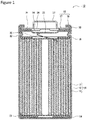
- FIG. 1 is a sectional view of a non-aqueous electrolyte secondary battery according to one example of an embodiment.
- a non-aqueous electrolyte secondary battery 10 illustrated in FIG. 1 comprises a wound electrode assembly 14 formed by winding a positive electrode 11 and a negative electrode 12 with a separator 13 being interposed therebetween, a non-aqueous electrolyte, insulating plates 18 and 19 disposed on and under the electrode assembly 14, respectively, and a battery case 15 housing such members.
- the battery case 15 is configured from a bottomed circular cylindrical case body 16 and a sealing assembly 17 that closes an opening in the case body 16.
- an electrode assembly such as a stacked electrode assembly formed by alternately stacking a positive electrode and a negative electrode with a separator being interposed therebetween, may be applied instead of the wound electrode assembly 14.
- the battery case 15 can include respective metal cases of cylindrical, square, coin, and button shapes, and a resin case (laminate battery) formed by laminating a resin sheet.
- the case body 16 is, for example, a bottomed circular cylindrical metallic container.
- a gasket 28 is provided between the case body 16 and the sealing assembly 17, and sealability in the battery is ensured.
- the case body 16 has, for example, a projecting portion 22 in which a side surface portion is partially projected and which supports the sealing assembly 17.
- the projecting portion 22 is preferably formed annularly along with the circumferential direction of the case body 16, and supports the sealing assembly 17 on the upper surface thereof.
- the sealing assembly 17 has a structure in which a filter 23, a lower vent member 24, an insulating member 25, an upper vent member 26 and a cap 27 are stacked closer to the electrode assembly 14 in the listed order.
- the respective members constituting the sealing assembly 17 each have, for example, a disc or ring shape, and such respective members except for the insulating member 25 are mutually electrically connected.
- the lower vent member 24 and the upper vent member 26 are mutually connected at the respective central portions, and the insulating member 25 is interposed between the respective peripheries of the vent members.
- the lower vent member 24 is deformed and fractured so as to push the upper vent member 26 toward the cap 27, thereby causing the current pathway between the lower vent member 24 and the upper vent member 26 to be blocked. If the internal pressure is further increased, the upper vent member 26 is fractured to cause gas to be discharged through an opening in the cap 27.
- a positive electrode lead 20 attached to the positive electrode 11 extends toward the sealing assembly 17 through a through-hole of the insulating plate 18, and a negative electrode lead 21 attached to the negative electrode 12 extends toward the bottom of the case body 16 through the outside of the insulating plate 19.
- the positive electrode lead 20 is connected to the lower surface of the filter 23, as the bottom plate of the sealing assembly 17, by welding or the like, and the cap 27 which is a top panel of the sealing assembly 17 electrically connected to the filter 23 serves as a positive electrode terminal.
- the negative electrode lead 21 is connected to the inner surface of the bottom of the case body 16, by welding or the like, and the case body 16 serves as a negative electrode terminal.
- the positive electrode 11, the negative electrode 12, the non-aqueous electrolyte and the separator 13 will be described in detail.
- the positive electrode 11 is configured from, for example, a positive electrode current collector such as metal foil and a positive electrode active material layer formed on the positive electrode current collector.
- the positive electrode current collector which can be here used is, for example, any foil of a metal which is stable in the potential range of the positive electrode, such as aluminum, or any film obtained by placing such a metal on a surface layer.
- the positive electrode active material layer includes, for example, a positive electrode active material, a binder, a conductive agent, and the like.
- the positive electrode 11 is obtained by, for example, applying a positive electrode mixture slurry including a positive electrode active material, a binder, a conductive agent, and the like onto the positive electrode current collector and drying the resultant, thereby forming a positive electrode active material layer on the positive electrode current collector, and rolling the positive electrode active material layer.
- the positive electrode active material includes lithium composite oxide particles including 80 mol% or more and less than 100 mol% of Ni relative to the total number of moles of metal element(s) except for Li.
- the lithium composite oxide particles may include any element(s) other than Ni and Li, and examples thereof include at least one element selected from the group consisting of Al, Co, Mn, Ti, Nb, Si, Mo, Zr, V, Fe, Mg, Cr, Cu, Sn, Ta, W, Na, K, Ba, Sr, Bi, Be, Zn, Ca and B.
- at least one element selected from the group consisting of Al and Co is preferable from the viewpoint of, for example, suppression of deterioration in charge/discharge cycle characteristics.
- FIGS. 2(a) and (b) are each a schematic view illustrating one example of the shapes of the lithium composite oxide particles.
- the lithium composite oxide particles including 80 mol% or more and less than 100 mol% of Ni relative to the total number of moles of metal element(s) except for Li include particle 32 having a stepped structure obtained by three or more flat surfaces 30 having outer edges each having a length (A) of 1 ⁇ m or more, as illustrated in FIGS. 2(a) and (b) .
- the lithium composite oxide particles including 80 mol% or more and less than 100 mol% of Ni relative to the total number of moles of metal element(s) except for Li may include particles having any other known shape, in addition to particles 32.
- the length (A) of the outer edge of the flat surface 30 may be 1 ⁇ m or more, and is, for example, preferably 2 ⁇ m or more.
- the upper limit of the length (A) of the outer edge is, for example, 15 ⁇ m or less, depending on the particle sizes of particles.
- the shape of the outer edge of the flat surface 30 is a polygonal shape, a curved shape, or the like, and is not particularly limited.
- the number of the flat surfaces 30 stacked may be three or more, and is preferably five or more from the viewpoint of more suppression of deterioration in charge/discharge cycle characteristics.
- the upper limit of the number of the flat surfaces 30 stacked is, for example, 15 or less depending on the particle sizes of particles.
- the difference in level in the stepped structure is, for example, preferably in the range of 0.01 ⁇ m or more and 1 ⁇ m or less, more preferably in the range of 0.03 ⁇ m or more and 0.2 ⁇ m or less from the viewpoint of more suppression of deterioration in charge/discharge cycle characteristics.
- the proportion of particles 32 is preferably 3% or more, more preferably 5% or more, relative to the entire lithium composite oxide particles including 80 mol% or more and less than 100 mol% of Ni relative to the total number of moles of metal element(s) except for Li. In a case where the proportion of particles 32 satisfies the range, deterioration in charge/discharge cycle characteristics is further suppressed, as compared with a case where the range is not satisfied.
- the proportion of particles 32 is determined by the following method. An electron microscope is used to observe randomly twenty fields of view at a magnification which enables the surfaces of the lithium composite oxide particles to be sufficiently observed. The number (M) of all particles and the number (N) of particles 32, as observed in such fields of view, are measured. Such measurements are performed in twenty fields of view, and the ratio (N/M) of the number (N) of particles 32 to the number (M) of all particles is determined. The average value of the resulting values is defined as the proportion of particles 32.
- the particle size of particles 32 is, for example, preferably 1.5 ⁇ m or more, more preferably 3 ⁇ m or more in terms of charge/discharge cycle characteristics.
- the upper limit of the particle size of particle 32 is, for example, preferably 20 ⁇ m or less, more preferably 15 ⁇ m or less.
- a too large particle size of particle 32 may cause deterioration in battery capacity.
- the particle size of particle 32 is obtained by specifying randomly twenty particles 32 with an electron microscope, subjecting the particles 32 specified, to image analysis, to thereby determine the longest sizes of the twenty particles 32, and defining the average value thereof as the particle size of particle 32.
- the particle breakage strength of particles 32 is, for example, preferably 230 MPa or more, more preferably 300 MPa or more. In a case where the particle breakage strength of particles 32 satisfies the range, cracking of particles 32 due to charge/discharge may be suppressed and deterioration in charge/discharge cycle characteristics may be further suppressed, as compared with a case where the range is not satisfied.
- the upper limit value of the particle breakage strength of particles 32 is not particularly limited, and is, for example, preferably 1000 MPa or less.
- the particle breakage strength is measured by the method prescribed in JIS-R1639-5. It is noted that ⁇ (dimensionless number changed depending on the position in granules), which is defined as 2.48 in JIS-R1639-5, is defined as 2.8 in the present application.
- the content of the lithium composite oxide particles including 80 mol% or more and less than 100 mol% of Ni relative to the total number of moles of metal element(s) except for Li is preferably 90% by mass or more, preferably 99% by mass or more relative to the total mass of the positive electrode active material from the viewpoint of, for example, an enhancement in battery capacity.
- the positive electrode active material may include any lithium composite oxide particles other than the lithium composite oxide particles including 80 mol% or more and less than 100 mol% of Ni relative to the total number of moles of metal element(s) except for Li.
- Examples of such any other lithium composite oxide particles include lithium composite oxide particles in which the proportion of Ni is less than 80 mol%.
- the lithium composite oxide particles including 80 mol% or more and less than 100 mol% of Ni relative to the total number of moles of metal element(s) except for Li are obtained by mixing a Ni-containing oxide and a Li compound, and firing the mixture.
- Particles 32 each having a stepped structure obtained by stacking three or more flat surfaces 30 having outer edges each having a length (A) of 1 ⁇ m or more are obtained by, for example, adding an alkali or alkali earth metal compound having a melting point of 600°C or less, such as potassium hydroxide, to a mixture of a Ni-containing oxide and a Li compound, and firing the mixture at two stages.
- the conditions of such two-stage firing are appropriately set depending on the composition of the Ni-containing oxide, the mixing ratio between the Ni-containing oxide and the Li compound, the presence of addition of potassium hydroxide and/or the like, and the like, and, for example, the firing temperature at the second stage is preferably less than the firing temperature at the first stage.
- the firing temperature at the first stage is, for example, in the range from 700°C to 1000°C
- the firing temperature at the second stage is, for example, in the range from 600°C to 800°C.
- the firing times at the first stage and the second stage are each, for example, 1 to 10 hours.
- Examples of the conductive agent included in the positive electrode active material layer include carbon powders of carbon black, acetylene black, ketchen black, and graphite. These may be used singly or in combinations of two or more kinds thereof.
- binder included in the positive electrode active material layer examples include a fluoropolymer and a rubber-based polymer.
- the fluoropolymer include polytetrafluoroethylene (PTFE), polyvinylidene fluoride (PVdF), or any modified product thereof
- the rubber-based polymer include an ethylene-propylene-isoprene copolymer and an ethylene-propylene-butadiene copolymer. These may be used singly or in combinations of two or more kinds thereof.
- the negative electrode 12 comprises, for example, a negative electrode current collector such as metal foil and a negative electrode active material layer formed on the negative electrode current collector.
- the negative electrode current collector which can be here used is, for example, any foil of a metal which is stable in the potential range of the negative electrode, such as copper, or any film obtained by placing such a metal on a surface layer.
- the negative electrode active material layer includes, for example, a negative electrode active material, a binder, a thickener, and the like.
- the negative electrode 12 is obtained by, for example, applying a negative electrode mixture slurry including a negative electrode active material, a thickener, and a binder onto a negative electrode current collector and drying the resultant, thereby forming a negative electrode active material layer on the negative electrode current collector, and rolling the negative electrode active material layer.
- the negative electrode active material included in the negative electrode active material layer is not particularly limited as long as the material can occlude and release lithium ions, and examples thereof include a carbon material, a metal which can form an alloy together with lithium, or an alloy compound including such a metal.
- the carbon material which can be here used is, for example, any of graphites such as natural graphite, non-graphitizable carbon and artificial graphite, and cokes, and examples of the alloy compound include any compound including at least one metal which can form an alloy together with lithium.
- Such an element which can form an alloy together with lithium is preferably silicon or tin, and silicon oxide, tin oxide or the like obtained by binding such an element to oxygen can also be used.
- a mixed product of the carbon material with a silicon or tin compound can be used. Any other than the above can also be used where the charge/discharge potential to metallic lithium such as lithium titanate is higher than that of the carbon material or the like.
- the binder included in the negative electrode active material layer which can be here used, is for example, a fluoropolymer or a rubber-based polymer, as in the case of the positive electrode, and a styrene-butadiene copolymer (SBR) or a modified product thereof may also be used.
- the binder included in the negative electrode active material layer which can be here used, is for example, a fluororesin, PAN, a polyimide-based resin, an acrylic resin, or a polyolefin-based resin, as in the case of the positive electrode.
- the negative electrode mixture slurry is prepared by use of an aqueous solvent, styrene-butadiene rubber (SBR), CMC or a salt thereof, polyacrylic acid (PAA) or a salt thereof (PAA-Na, PAA-K or the like, alternatively, a partially neutralized salt may be adopted), polyvinyl alcohol (PVA), or the like is preferably used.
- Examples of the thickener included in the negative electrode active material layer include carboxymethylcellulose (CMC) and polyethylene oxide (PEO). These may be used singly or in combinations of two or more kinds thereof.
- CMC carboxymethylcellulose
- PEO polyethylene oxide
- the non-aqueous electrolyte includes a non-aqueous solvent and an electrolyte salt dissolved in the non-aqueous solvent.
- the non-aqueous electrolyte is not limited to a liquid electrolyte (non-aqueous electrolytic solution), and may be a solid electrolyte using a gel-like polymer or the like.
- the non-aqueous solvent which can be used is, for example, any of esters, ethers, nitriles such as acetonitrile, amides such as dimethylformamide, and a mixed solvent of two or more kinds thereof.
- the non-aqueous solvent may contain a halogen-substituted product obtained by at least partially replacing hydrogen in such a solvent with a halogen atom such as fluorine.
- esters examples include cyclic carbonates such as ethylene carbonate (EC), propylene carbonate (PC) and butylene carbonate, linear carbonates such as dimethyl carbonate (DMC), ethyl methyl carbonate (EMC), diethyl carbonate (DEC), methyl propyl carbonate, ethyl propyl carbonate and methyl isopropyl carbonate, cyclic carboxylates such as ⁇ -butyrolactone (GBL) and ⁇ -valerolactone (GVL), and linear carboxylates such as methyl acetate, ethyl acetate, propyl acetate, methyl propionate (MP), ethyl propionate and ⁇ -butyrolactone.
- cyclic carbonates such as ethylene carbonate (EC), propylene carbonate (PC) and butylene carbonate
- linear carbonates such as dimethyl carbonate (DMC), ethyl methyl carbonate (EMC), diethyl carbonate (D
- ethers examples include cyclic ethers such as 1,3-dioxolane, 4-methyl-1,3-dioxolane, tetrahydrofuran, 2-methyltetrahydrofuran, propylene oxide, 1,2-butylene oxide, 1,3-dioxane, 1,4-dioxane, 1,3,5-trioxane, furan, 2-methylfuran, 1,8-cineol and crown ether, and linear ethers such as 1,2-dimethoxyethane, diethyl ether, dipropyl ether, diisopropyl ether, dibutyl ether, dihexyl ether, ethyl vinyl ether, butyl vinyl ether, methyl phenyl ether, ethyl phenyl ether, butyl phenyl ether, pentyl phenyl ether, methoxytoluene, benzyl ethyl ether, diphenyl
- fluorinated cyclic carbonate such as fluoroethylene carbonate (FEC), a fluorinated linear carbonate, and a fluorinated linear carboxylate such as methyl fluoropropionate (FMP) is preferably used as the halogen-substituted product.
- FEC fluoroethylene carbonate
- linear carbonate a fluorinated linear carbonate
- FMP fluorinated linear carboxylate
- the electrolyte salt is preferably a lithium salt.
- the lithium salt include LiBF 4 , LiClO 4 , LiPF 6 , LiAsF 6 , LiSbF 6 , LiAlCl 4 , LiSCN, LiCF 3 SO 3 , LiCF 3 CO 2 , Li(P(C 2 O 4 )F 4 ), LiPF 6-x (C n F 2n+1 ) x (1 ⁇ x ⁇ 6 and n is 1 or 2), LiB 10 Cl 10 , LiCl, LiBr, LiI, lithium chloroborane, lithium lower aliphatic carboxylate, borates such as Li 2 B 4 O 7 and Li(B(C 2 O 4 )F 2 ), and imide salts such as LiN(SO 2 CF 3 ) 2 , LiN(C 1 F 21+1 SO 2 )(C m F 2m+1 SO 2 ) ⁇ 1 and m are each an integer of 0 or more ⁇ .
- Such lithium salts may be used singly or in combinations of two or more kinds thereof.
- LiPF 6 is preferably used from the viewpoints of ion conductivity, electrochemical stability, and the like.
- the concentration of the lithium salt is preferably 0.8 to 1.8 mol per liter of the non-aqueous solvent.
- the separator 13 here used is, for example, a porous sheet having ion permeability and insulating properties.
- the porous sheet include a microporous thin film, a woven cloth, and an unwoven cloth.
- the material of the separator is suitably an olefin-based resin such as polyethylene or polypropylene, cellulose, or the like.
- the average particle size (D50) of the composite oxide was 12 ⁇ m.
- LiOH and the composite oxide containing Ni, Co and Al were mixed so that the molar ratio of Li and the total amount of Ni, Co and Al was 1.03:1, and KOH was then added in an amount of 10% by mass relative to the mixture.
- the mixture was fired in a 90% oxygen gas flow at 750°C for 40 hours, and impurities were removed by washing with water, thereby obtaining Ni-containing lithium composite oxide particles.
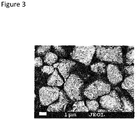
- FIG. 3 is a reflection electron composition image (3000x) of SEM of a positive electrode plate including Ni-containing lithium composite oxide particles obtained in Example 1.
- the Ni-containing lithium composite oxide particles obtained in Example 1 included particles each having a stepped structure obtained by stacking three or more flat surfaces whose outer peripheries each had a length of 1 ⁇ m or more, as illustrated in FIG. 3 .
- the proportion of the particles each having a stepped structure was 90% relative to the entire Ni-containing lithium composite oxide particles obtained in Example 1.
- the measurement methods are as described above.
- Ni-containing lithium composite oxide particles were obtained in the same manner as in Example 1 except that no KOH was added.
- the Ni-containing lithium composite oxide particles obtained in Comparative Example 1 was confirmed with an electron microscope, and particles each having a stepped structure, as in Example 1, were not confirmed.
- the average particle size (D50) of the composite oxide was 5 ⁇ m.
- LiOH and the composite oxide containing Ni, Co and Al were mixed so that the molar ratio of Li and the total amount of Ni, Co and Al was 1.05:1.
- the mixture was fired in a 90% oxygen gas flow at 890°C for 2.5 hours and then at 760°C for 7.5 hours, the resulting fired product was pulverized by a jet mill, and impurities were then removed by washing with water, thereby obtaining Ni-containing lithium composite oxide particles.
- Ni-containing lithium composite oxide particles obtained in Example 2 were confirmed with an electron microscope, and thus particles each having a stepped structure obtained by stacking three or more flat surfaces whose outer peripheries each had a length of 1 ⁇ m or more were confirmed.
- the proportion of the particles each having a stepped structure was 6% relative to the entire Ni-containing lithium composite oxide particles obtained in Example 2.
- Ni-containing lithium composite oxide particles were obtained in the same manner as in Example 2 except that no step of firing at 890°C was included.
- the Ni-containing lithium composite oxide particles obtained in Comparative Example 2 were confirmed with an electron microscope, and particles each having a stepped structure, as in Example 1, were not confirmed.
- Example 1 After 100% by mass of the Ni-containing lithium composite oxide particles of Example 1 as a positive electrode active material, 1% by mass of acetylene black as a conductive agent, and 0.9% by mass of polyvinylidene fluoride as a binder were mixed, a proper amount of N-methyl-2-pyrrolidone was added, thereby preparing a positive electrode mixture slurry. Next, the positive electrode mixture slurry was applied to each of both surfaces of a positive electrode current collector made of aluminum, having a thickness of 15 ⁇ m, and a coating film was rolled, thereby forming a positive electrode active material layer having a thickness of 70 ⁇ m, on each of both surfaces of the positive electrode current collector. The resultant was adopted as a positive electrode of Example 1. The same manner was conducted to produce each positive electrode also in other Examples and Comparative Examples.
- LiPF 6 Lithium hexafluorophosphate
- FEC fluorinated ethylene carbonate
- EMC ethyl methyl carbonate
- DMC dimethyl carbonate
- the positive electrode and the negative electrode of Example 1 were cut to respective predetermined dimensions, respective electrode tabs were attached thereto, a separator was then interposed between these electrodes, and the resultant was wound, thereby producing a wound electrode assembly.
- the electrode assembly where respective insulating plates were disposed thereon and thereunder, was housed in a Ni-plated case body (diameter 18 mm, height 65 mm) made of stainless steel, and a negative electrode tab was welded to the bottom of the case body and a positive electrode tab was welded to a sealing assembly.
- the electrolytic solution was injected into the case body and the case body was then sealed by the sealing assembly, thereby producing a non-aqueous electrolyte secondary battery.
- the same manner was conducted to produce each non-aqueous electrolyte secondary battery also in other Examples and Comparative Examples.
- Ni-containing lithium composite oxide particles including particles each having a stepped structure obtained by stacking three or more flat surfaces having outer edges each having a length of 1 ⁇ m or more can be used in a positive electrode active material, thereby allowing deterioration in charge/discharge cycle characteristics of a non-aqueous electrolyte secondary battery to be suppressed.
Landscapes
- Chemical & Material Sciences (AREA)
- Chemical Kinetics & Catalysis (AREA)
- Electrochemistry (AREA)
- General Chemical & Material Sciences (AREA)
- Inorganic Chemistry (AREA)
- Organic Chemistry (AREA)
- Composite Materials (AREA)
- Engineering & Computer Science (AREA)
- Materials Engineering (AREA)
- Battery Electrode And Active Subsutance (AREA)
- Secondary Cells (AREA)
- Inorganic Compounds Of Heavy Metals (AREA)
Abstract
Description
- The present invention relates to techniques for a non-aqueous electrolyte secondary battery.
- Recently, a non-aqueous electrolyte secondary battery comprising a positive electrode, a negative electrode and a non-aqueous electrolyte, in which charge/discharge is performed by movement of lithium ions and the like between the positive electrode and the negative electrode, has been used widely as a high-output and high-energy density secondary battery.
- The followings are, for example, known as positive electrode active materials for use in positive electrodes of non-aqueous electrolyte secondary batteries.
- For example,
Patent Literature 1 discloses a positive electrode active material represented by compositional formula: LixNi1-yMyO2+α (wherein M is one or more selected from the group consisting of Sc, Ti, V, Cr, Mn, Fe, Co, Cu, Zn, Ga, Ge, Al, Bi, Sn, Mg, Ca, B and Zr, and 0.9 ≤ x ≤ 1.2, 0 < y ≤ 0.7 and α ≥ 0.), in which the average crystal particle size is 1.2 to 5.0 µm in observation of cross sections of particles with a SIM (scanning ion microscope) image. - For example, Patent Literature 2 discloses a positive electrode active material represented by compositional formula: LixNi1-yMyO2+α (wherein M is one or more selected from the group consisting of Sc, Ti, V, Cr, Mn, Fe, Co, Cu, Zn, Ga, Ge, Bi, Sn, Mg, Ca, B and Zr, and 0.9 ≤ x ≤ 1.2, 0 < y ≤ 0.7 and α > 0.1.), in which the average particle size D50 of primary particles is 1.6 to 2.3 µm, the amount of alkali on the surface of particles, as measured by two-stage neutralization titration, is 1.2% by mass or less, and with respect to the amount of alkali on the surface of particles, A/B is 1 or less, where the amount of lithium hydroxide is designated as A% by mass and the amount of lithium carbonate is designated as B% by mass.
-
- PATENT LITERATURE 1: Japanese Patent No.
5876739 - PATENT LITERATURE 2: Japanese Patent No.
6030546 - Meanwhile, in a case where a lithium composite oxide in which the proportion of Ni relative to the total number of moles of metal element(s) except for Li is 80 mol% or more and less than 100 mol% is used as a positive electrode active material, a problem is that, although an increase in capacity of a non-aqueous electrolyte secondary battery may be achieved, charge/discharge cycle characteristics are deteriorated.
- It is an advantage of the present disclosure to suppress deterioration in charge/discharge cycle characteristics in a non-aqueous electrolyte secondary battery using a lithium composite oxide in which the proportion of Ni relative to the total number of moles of metal element(s) except for Li is 80 mol% or more and less than 100 mol%.
- A non-aqueous electrolyte secondary battery according to one aspect of the present disclosure comprises a positive electrode, a negative electrode and a non-aqueous electrolyte, wherein the positive electrode has lithium composite oxide particles including 80 mol% or more and less than 100 mol% of Ni relative to the total number of moles of metal element(s) except for Li, and the lithium composite oxide particles include particles each having a stepped structure obtained by stacking three or more flat surfaces having outer edges each having a length of 1 µm or more.
- According to one aspect of the present disclosure, deterioration in charge/discharge cycle characteristics can be suppressed in a non-aqueous electrolyte secondary battery using a lithium composite oxide in which the proportion of Ni relative to the total number of moles of metal element(s) except for Li is 80 mol% or more and less than 100 mol%.
-
-
FIG. 1 is a sectional view of a non-aqueous electrolyte secondary battery according to one example of an embodiment. -
FIG. 2 is a schematic view illustrating one example of shapes of lithium composite oxide particles. -
FIG. 3 is a reflection electron composition image (3000x) of SEM of a positive electrode plate including Ni-containing lithium composite oxide particles obtained in Example 1. - The present inventors have made intensive studies, and as a result, have found that deterioration in charge/discharge cycle characteristics of a non-aqueous electrolyte secondary battery is suppressed by using particles each having a specific shape, specifically, particles each having a stepped structure obtained by stacking three or more flat surfaces having outer edges each having a length of 1 µm or more, for lithium composite oxide particles including 80 mol% or more and less than 100 mol% of Ni relative to the total number of moles of metal element(s) except for Li.
- Hereinafter, one example of a non-aqueous electrolyte secondary battery according to one aspect of the present disclosure will be described.
-
FIG. 1 is a sectional view of a non-aqueous electrolyte secondary battery according to one example of an embodiment. A non-aqueous electrolytesecondary battery 10 illustrated inFIG. 1 comprises awound electrode assembly 14 formed by winding apositive electrode 11 and anegative electrode 12 with aseparator 13 being interposed therebetween, a non-aqueous electrolyte,insulating plates electrode assembly 14, respectively, and abattery case 15 housing such members. Thebattery case 15 is configured from a bottomed circularcylindrical case body 16 and asealing assembly 17 that closes an opening in thecase body 16. Other form of an electrode assembly, such as a stacked electrode assembly formed by alternately stacking a positive electrode and a negative electrode with a separator being interposed therebetween, may be applied instead of thewound electrode assembly 14. Examples of thebattery case 15 can include respective metal cases of cylindrical, square, coin, and button shapes, and a resin case (laminate battery) formed by laminating a resin sheet. - The
case body 16 is, for example, a bottomed circular cylindrical metallic container. Agasket 28 is provided between thecase body 16 and thesealing assembly 17, and sealability in the battery is ensured. Thecase body 16 has, for example, a projectingportion 22 in which a side surface portion is partially projected and which supports thesealing assembly 17. The projectingportion 22 is preferably formed annularly along with the circumferential direction of thecase body 16, and supports thesealing assembly 17 on the upper surface thereof. - The
sealing assembly 17 has a structure in which afilter 23, alower vent member 24, aninsulating member 25, anupper vent member 26 and acap 27 are stacked closer to theelectrode assembly 14 in the listed order. The respective members constituting thesealing assembly 17 each have, for example, a disc or ring shape, and such respective members except for the insulatingmember 25 are mutually electrically connected. Thelower vent member 24 and theupper vent member 26 are mutually connected at the respective central portions, and theinsulating member 25 is interposed between the respective peripheries of the vent members. If the internal pressure of the non-aqueous electrolytesecondary battery 10 is increased due to heat generation by internal short-circuit or the like, for example, thelower vent member 24 is deformed and fractured so as to push theupper vent member 26 toward thecap 27, thereby causing the current pathway between thelower vent member 24 and theupper vent member 26 to be blocked. If the internal pressure is further increased, theupper vent member 26 is fractured to cause gas to be discharged through an opening in thecap 27. - In the non-aqueous electrolyte
secondary battery 10 illustrated inFIG. 1 , apositive electrode lead 20 attached to thepositive electrode 11 extends toward thesealing assembly 17 through a through-hole of theinsulating plate 18, and anegative electrode lead 21 attached to thenegative electrode 12 extends toward the bottom of thecase body 16 through the outside of theinsulating plate 19. Thepositive electrode lead 20 is connected to the lower surface of thefilter 23, as the bottom plate of thesealing assembly 17, by welding or the like, and thecap 27 which is a top panel of thesealing assembly 17 electrically connected to thefilter 23 serves as a positive electrode terminal. Thenegative electrode lead 21 is connected to the inner surface of the bottom of thecase body 16, by welding or the like, and thecase body 16 serves as a negative electrode terminal. - Hereinafter, the
positive electrode 11, thenegative electrode 12, the non-aqueous electrolyte and theseparator 13 will be described in detail. - The
positive electrode 11 is configured from, for example, a positive electrode current collector such as metal foil and a positive electrode active material layer formed on the positive electrode current collector. The positive electrode current collector which can be here used is, for example, any foil of a metal which is stable in the potential range of the positive electrode, such as aluminum, or any film obtained by placing such a metal on a surface layer. The positive electrode active material layer includes, for example, a positive electrode active material, a binder, a conductive agent, and the like. - The
positive electrode 11 is obtained by, for example, applying a positive electrode mixture slurry including a positive electrode active material, a binder, a conductive agent, and the like onto the positive electrode current collector and drying the resultant, thereby forming a positive electrode active material layer on the positive electrode current collector, and rolling the positive electrode active material layer. - The positive electrode active material includes lithium composite oxide particles including 80 mol% or more and less than 100 mol% of Ni relative to the total number of moles of metal element(s) except for Li. The lithium composite oxide particles may include any element(s) other than Ni and Li, and examples thereof include at least one element selected from the group consisting of Al, Co, Mn, Ti, Nb, Si, Mo, Zr, V, Fe, Mg, Cr, Cu, Sn, Ta, W, Na, K, Ba, Sr, Bi, Be, Zn, Ca and B. In particular, at least one element selected from the group consisting of Al and Co is preferable from the viewpoint of, for example, suppression of deterioration in charge/discharge cycle characteristics.
-
FIGS. 2(a) and (b) are each a schematic view illustrating one example of the shapes of the lithium composite oxide particles. The lithium composite oxide particles including 80 mol% or more and less than 100 mol% of Ni relative to the total number of moles of metal element(s) except for Li includeparticle 32 having a stepped structure obtained by three or moreflat surfaces 30 having outer edges each having a length (A) of 1 µm or more, as illustrated inFIGS. 2(a) and (b) . The lithium composite oxide particles including 80 mol% or more and less than 100 mol% of Ni relative to the total number of moles of metal element(s) except for Li may include particles having any other known shape, in addition toparticles 32. - The length (A) of the outer edge of the
flat surface 30 may be 1 µm or more, and is, for example, preferably 2 µm or more. The upper limit of the length (A) of the outer edge is, for example, 15 µm or less, depending on the particle sizes of particles. The shape of the outer edge of theflat surface 30 is a polygonal shape, a curved shape, or the like, and is not particularly limited. The number of theflat surfaces 30 stacked may be three or more, and is preferably five or more from the viewpoint of more suppression of deterioration in charge/discharge cycle characteristics. The upper limit of the number of theflat surfaces 30 stacked is, for example, 15 or less depending on the particle sizes of particles. The difference in level in the stepped structure (height (B) from oneflat surface 30 to the next flat surface 30) is, for example, preferably in the range of 0.01 µm or more and 1 µm or less, more preferably in the range of 0.03 µm or more and 0.2 µm or less from the viewpoint of more suppression of deterioration in charge/discharge cycle characteristics. - The proportion of
particles 32 is preferably 3% or more, more preferably 5% or more, relative to the entire lithium composite oxide particles including 80 mol% or more and less than 100 mol% of Ni relative to the total number of moles of metal element(s) except for Li. In a case where the proportion ofparticles 32 satisfies the range, deterioration in charge/discharge cycle characteristics is further suppressed, as compared with a case where the range is not satisfied. - The proportion of
particles 32 is determined by the following method. An electron microscope is used to observe randomly twenty fields of view at a magnification which enables the surfaces of the lithium composite oxide particles to be sufficiently observed. The number (M) of all particles and the number (N) ofparticles 32, as observed in such fields of view, are measured. Such measurements are performed in twenty fields of view, and the ratio (N/M) of the number (N) ofparticles 32 to the number (M) of all particles is determined. The average value of the resulting values is defined as the proportion ofparticles 32. - The particle size of
particles 32 is, for example, preferably 1.5 µm or more, more preferably 3 µm or more in terms of charge/discharge cycle characteristics. The upper limit of the particle size ofparticle 32 is, for example, preferably 20 µm or less, more preferably 15 µm or less. A too large particle size ofparticle 32 may cause deterioration in battery capacity. The particle size ofparticle 32 is obtained by specifying randomly twentyparticles 32 with an electron microscope, subjecting theparticles 32 specified, to image analysis, to thereby determine the longest sizes of the twentyparticles 32, and defining the average value thereof as the particle size ofparticle 32. - The particle breakage strength of
particles 32 is, for example, preferably 230 MPa or more, more preferably 300 MPa or more. In a case where the particle breakage strength ofparticles 32 satisfies the range, cracking ofparticles 32 due to charge/discharge may be suppressed and deterioration in charge/discharge cycle characteristics may be further suppressed, as compared with a case where the range is not satisfied. The upper limit value of the particle breakage strength ofparticles 32 is not particularly limited, and is, for example, preferably 1000 MPa or less. The particle breakage strength is measured by the method prescribed in JIS-R1639-5. It is noted that α (dimensionless number changed depending on the position in granules), which is defined as 2.48 in JIS-R1639-5, is defined as 2.8 in the present application. - The content of the lithium composite oxide particles including 80 mol% or more and less than 100 mol% of Ni relative to the total number of moles of metal element(s) except for Li is preferably 90% by mass or more, preferably 99% by mass or more relative to the total mass of the positive electrode active material from the viewpoint of, for example, an enhancement in battery capacity.
- The positive electrode active material may include any lithium composite oxide particles other than the lithium composite oxide particles including 80 mol% or more and less than 100 mol% of Ni relative to the total number of moles of metal element(s) except for Li. Examples of such any other lithium composite oxide particles include lithium composite oxide particles in which the proportion of Ni is less than 80 mol%.
- The lithium composite oxide particles including 80 mol% or more and less than 100 mol% of Ni relative to the total number of moles of metal element(s) except for Li are obtained by mixing a Ni-containing oxide and a Li compound, and firing the mixture.
Particles 32 each having a stepped structure obtained by stacking three or moreflat surfaces 30 having outer edges each having a length (A) of 1 µm or more are obtained by, for example, adding an alkali or alkali earth metal compound having a melting point of 600°C or less, such as potassium hydroxide, to a mixture of a Ni-containing oxide and a Li compound, and firing the mixture at two stages. The conditions of such two-stage firing are appropriately set depending on the composition of the Ni-containing oxide, the mixing ratio between the Ni-containing oxide and the Li compound, the presence of addition of potassium hydroxide and/or the like, and the like, and, for example, the firing temperature at the second stage is preferably less than the firing temperature at the first stage. The firing temperature at the first stage is, for example, in the range from 700°C to 1000°C, and the firing temperature at the second stage is, for example, in the range from 600°C to 800°C. The firing times at the first stage and the second stage are each, for example, 1 to 10 hours. - Hereinafter, other material(s) included in the positive electrode active material layer will be described.
- Examples of the conductive agent included in the positive electrode active material layer include carbon powders of carbon black, acetylene black, ketchen black, and graphite. These may be used singly or in combinations of two or more kinds thereof.
- Examples of the binder included in the positive electrode active material layer include a fluoropolymer and a rubber-based polymer. Examples of the fluoropolymer include polytetrafluoroethylene (PTFE), polyvinylidene fluoride (PVdF), or any modified product thereof, and examples of the rubber-based polymer include an ethylene-propylene-isoprene copolymer and an ethylene-propylene-butadiene copolymer. These may be used singly or in combinations of two or more kinds thereof.
- The
negative electrode 12 comprises, for example, a negative electrode current collector such as metal foil and a negative electrode active material layer formed on the negative electrode current collector. The negative electrode current collector which can be here used is, for example, any foil of a metal which is stable in the potential range of the negative electrode, such as copper, or any film obtained by placing such a metal on a surface layer. The negative electrode active material layer includes, for example, a negative electrode active material, a binder, a thickener, and the like. - The
negative electrode 12 is obtained by, for example, applying a negative electrode mixture slurry including a negative electrode active material, a thickener, and a binder onto a negative electrode current collector and drying the resultant, thereby forming a negative electrode active material layer on the negative electrode current collector, and rolling the negative electrode active material layer. - The negative electrode active material included in the negative electrode active material layer is not particularly limited as long as the material can occlude and release lithium ions, and examples thereof include a carbon material, a metal which can form an alloy together with lithium, or an alloy compound including such a metal. The carbon material which can be here used is, for example, any of graphites such as natural graphite, non-graphitizable carbon and artificial graphite, and cokes, and examples of the alloy compound include any compound including at least one metal which can form an alloy together with lithium. Such an element which can form an alloy together with lithium is preferably silicon or tin, and silicon oxide, tin oxide or the like obtained by binding such an element to oxygen can also be used. A mixed product of the carbon material with a silicon or tin compound can be used. Any other than the above can also be used where the charge/discharge potential to metallic lithium such as lithium titanate is higher than that of the carbon material or the like.
- The binder included in the negative electrode active material layer, which can be here used, is for example, a fluoropolymer or a rubber-based polymer, as in the case of the positive electrode, and a styrene-butadiene copolymer (SBR) or a modified product thereof may also be used. The binder included in the negative electrode active material layer, which can be here used, is for example, a fluororesin, PAN, a polyimide-based resin, an acrylic resin, or a polyolefin-based resin, as in the case of the positive electrode. In a case where the negative electrode mixture slurry is prepared by use of an aqueous solvent, styrene-butadiene rubber (SBR), CMC or a salt thereof, polyacrylic acid (PAA) or a salt thereof (PAA-Na, PAA-K or the like, alternatively, a partially neutralized salt may be adopted), polyvinyl alcohol (PVA), or the like is preferably used.
- Examples of the thickener included in the negative electrode active material layer include carboxymethylcellulose (CMC) and polyethylene oxide (PEO). These may be used singly or in combinations of two or more kinds thereof.
- The non-aqueous electrolyte includes a non-aqueous solvent and an electrolyte salt dissolved in the non-aqueous solvent. The non-aqueous electrolyte is not limited to a liquid electrolyte (non-aqueous electrolytic solution), and may be a solid electrolyte using a gel-like polymer or the like. The non-aqueous solvent which can be used is, for example, any of esters, ethers, nitriles such as acetonitrile, amides such as dimethylformamide, and a mixed solvent of two or more kinds thereof. The non-aqueous solvent may contain a halogen-substituted product obtained by at least partially replacing hydrogen in such a solvent with a halogen atom such as fluorine.
- Examples of the esters include cyclic carbonates such as ethylene carbonate (EC), propylene carbonate (PC) and butylene carbonate, linear carbonates such as dimethyl carbonate (DMC), ethyl methyl carbonate (EMC), diethyl carbonate (DEC), methyl propyl carbonate, ethyl propyl carbonate and methyl isopropyl carbonate, cyclic carboxylates such as γ-butyrolactone (GBL) and γ-valerolactone (GVL), and linear carboxylates such as methyl acetate, ethyl acetate, propyl acetate, methyl propionate (MP), ethyl propionate and γ-butyrolactone.
- Examples of the ethers include cyclic ethers such as 1,3-dioxolane, 4-methyl-1,3-dioxolane, tetrahydrofuran, 2-methyltetrahydrofuran, propylene oxide, 1,2-butylene oxide, 1,3-dioxane, 1,4-dioxane, 1,3,5-trioxane, furan, 2-methylfuran, 1,8-cineol and crown ether, and linear ethers such as 1,2-dimethoxyethane, diethyl ether, dipropyl ether, diisopropyl ether, dibutyl ether, dihexyl ether, ethyl vinyl ether, butyl vinyl ether, methyl phenyl ether, ethyl phenyl ether, butyl phenyl ether, pentyl phenyl ether, methoxytoluene, benzyl ethyl ether, diphenyl ether, dibenzyl ether, o-dimethoxybenzene, 1,2-diethoxyethane, 1,2-dibutoxyethane, diethylene glycol dimethyl ether, diethylene glycol diethyl ether, diethylene glycol dibutyl ether, 1,1-dimethoxymethane, 1,1-diethoxyethane, triethylene glycol dimethyl ether and tetraethylene glycol dimethyl ether.
- Any of a fluorinated cyclic carbonate such as fluoroethylene carbonate (FEC), a fluorinated linear carbonate, and a fluorinated linear carboxylate such as methyl fluoropropionate (FMP) is preferably used as the halogen-substituted product.
- The electrolyte salt is preferably a lithium salt. Examples of the lithium salt include LiBF4, LiClO4, LiPF6, LiAsF6, LiSbF6, LiAlCl4, LiSCN, LiCF3SO3, LiCF3CO2, Li(P(C2O4)F4), LiPF6-x(CnF2n+1)x (1 < x < 6 and n is 1 or 2), LiB10Cl10, LiCl, LiBr, LiI, lithium chloroborane, lithium lower aliphatic carboxylate, borates such as Li2B4O7 and Li(B(C2O4)F2), and imide salts such as LiN(SO2CF3)2, LiN(C1F21+1SO2)(CmF2m+1SO2) {1 and m are each an integer of 0 or more}. Such lithium salts may be used singly or in combinations of two or more kinds thereof. In particular, LiPF6 is preferably used from the viewpoints of ion conductivity, electrochemical stability, and the like. The concentration of the lithium salt is preferably 0.8 to 1.8 mol per liter of the non-aqueous solvent.
- The
separator 13 here used is, for example, a porous sheet having ion permeability and insulating properties. Examples of the porous sheet include a microporous thin film, a woven cloth, and an unwoven cloth. The material of the separator is suitably an olefin-based resin such as polyethylene or polypropylene, cellulose, or the like. - Hereinafter, the present invention will be further described with reference to Examples, but the present invention is not intended to be limited to such Examples.
- A composite hydroxide represented by [Ni0.88CO0.09Al0.03](OH)2, obtained according to a co-precipitation method, was fired at 500°C for 10 hours, thereby obtaining a composite oxide containing Ni, Co and Al. The average particle size (D50) of the composite oxide was 12 µm. Next, LiOH and the composite oxide containing Ni, Co and Al were mixed so that the molar ratio of Li and the total amount of Ni, Co and Al was 1.03:1, and KOH was then added in an amount of 10% by mass relative to the mixture. The mixture was fired in a 90% oxygen gas flow at 750°C for 40 hours, and impurities were removed by washing with water, thereby obtaining Ni-containing lithium composite oxide particles.
-
FIG. 3 is a reflection electron composition image (3000x) of SEM of a positive electrode plate including Ni-containing lithium composite oxide particles obtained in Example 1. The Ni-containing lithium composite oxide particles obtained in Example 1 included particles each having a stepped structure obtained by stacking three or more flat surfaces whose outer peripheries each had a length of 1 µm or more, as illustrated inFIG. 3 . The proportion of the particles each having a stepped structure was 90% relative to the entire Ni-containing lithium composite oxide particles obtained in Example 1. The measurement methods are as described above. - Ni-containing lithium composite oxide particles were obtained in the same manner as in Example 1 except that no KOH was added. The Ni-containing lithium composite oxide particles obtained in Comparative Example 1 was confirmed with an electron microscope, and particles each having a stepped structure, as in Example 1, were not confirmed.
- A composite hydroxide represented by [Ni0.82CO0.15Al0.03](OH)2, obtained according to a co-precipitation method, was fired at 500°C for 10 hours, thereby obtaining a composite oxide containing Ni, Co and Al. The average particle size (D50) of the composite oxide was 5 µm. Next, LiOH and the composite oxide containing Ni, Co and Al were mixed so that the molar ratio of Li and the total amount of Ni, Co and Al was 1.05:1. The mixture was fired in a 90% oxygen gas flow at 890°C for 2.5 hours and then at 760°C for 7.5 hours, the resulting fired product was pulverized by a jet mill, and impurities were then removed by washing with water, thereby obtaining Ni-containing lithium composite oxide particles.
- The Ni-containing lithium composite oxide particles obtained in Example 2 were confirmed with an electron microscope, and thus particles each having a stepped structure obtained by stacking three or more flat surfaces whose outer peripheries each had a length of 1 µm or more were confirmed. The proportion of the particles each having a stepped structure was 6% relative to the entire Ni-containing lithium composite oxide particles obtained in Example 2.
- Ni-containing lithium composite oxide particles were obtained in the same manner as in Example 2 except that no step of firing at 890°C was included. The Ni-containing lithium composite oxide particles obtained in Comparative Example 2 were confirmed with an electron microscope, and particles each having a stepped structure, as in Example 1, were not confirmed.
- After 100% by mass of the Ni-containing lithium composite oxide particles of Example 1 as a positive electrode active material, 1% by mass of acetylene black as a conductive agent, and 0.9% by mass of polyvinylidene fluoride as a binder were mixed, a proper amount of N-methyl-2-pyrrolidone was added, thereby preparing a positive electrode mixture slurry. Next, the positive electrode mixture slurry was applied to each of both surfaces of a positive electrode current collector made of aluminum, having a thickness of 15 µm, and a coating film was rolled, thereby forming a positive electrode active material layer having a thickness of 70 µm, on each of both surfaces of the positive electrode current collector. The resultant was adopted as a positive electrode of Example 1. The same manner was conducted to produce each positive electrode also in other Examples and Comparative Examples.
- After 100% by mass of graphite as a negative electrode active material and 1% by mass of a styrene-butadiene copolymer (SBR) as a binder were mixed, a proper amount of water was added, thereby preparing a negative electrode mixture slurry. Next, the negative electrode mixture slurry was applied to each of both surfaces of a negative electrode current collector made of copper, having a thickness of 10 µm, and a coating film was rolled, thereby forming a negative electrode active material layer having a thickness of 100 µm, on each of both surfaces of the negative electrode current collector. The resultant was adopted as a negative electrode.
- Lithium hexafluorophosphate (LiPF6) was dissolved in a mixed solvent of fluorinated ethylene carbonate (FEC), ethyl methyl carbonate (EMC) and dimethyl carbonate (DMC) mixed at a volume ratio of 15:45:40 so that the concentration was 1.3 mol/L, and thus an electrolytic solution was prepared.
- The positive electrode and the negative electrode of Example 1 were cut to respective predetermined dimensions, respective electrode tabs were attached thereto, a separator was then interposed between these electrodes, and the resultant was wound, thereby producing a wound electrode assembly. The electrode assembly, where respective insulating plates were disposed thereon and thereunder, was housed in a Ni-plated case body (
diameter 18 mm, height 65 mm) made of stainless steel, and a negative electrode tab was welded to the bottom of the case body and a positive electrode tab was welded to a sealing assembly. The electrolytic solution was injected into the case body and the case body was then sealed by the sealing assembly, thereby producing a non-aqueous electrolyte secondary battery. The same manner was conducted to produce each non-aqueous electrolyte secondary battery also in other Examples and Comparative Examples. -
- (1) After each of the non-aqueous electrolyte secondary batteries of Example 1 and Comparative Example 1 was subjected to constant current charge at a constant current of 0.5 C under an environmental temperature of 25°C until the battery voltage reached 4.15 V, the non-aqueous electrolyte secondary battery was subjected to constant current discharge at a constant current of 0.5 C until the battery voltage reached 3.0 V. The charge/discharge cycle was performed for 750 cycles, and the capacity retention in the charge/discharge cycle of each of the non-aqueous electrolyte secondary batteries of Example 1 and Comparative Example 1 was determined according to the following equation.
- (2) After each of the non-aqueous electrolyte secondary batteries of Example 2 and Comparative Example 2 was subjected to constant current charge at a constant current of 0.5 C under an environmental temperature of 25°C until the battery voltage reached 4.10 V, the non-aqueous electrolyte secondary battery was subjected to constant current discharge at a constant current of 0.5 C until the battery voltage reached 3.0 V. The charge/discharge cycle was performed for 750 cycles, and the capacity retention in the charge/discharge cycle of each of the non-aqueous electrolyte secondary batteries of Example 2 and Comparative Example 2 was determined according to the following expression.
- The capacity retention of the non-aqueous electrolyte secondary battery of Example 1 was 86%, and the capacity retention of the non-aqueous electrolyte secondary battery of Comparative Example 1 was 80%. The capacity retention of the non-aqueous electrolyte secondary battery of Example 2 was 93%, and the capacity retention of the non-aqueous electrolyte secondary battery of Comparative Example 2 was 90%. That is, Ni-containing lithium composite oxide particles including particles each having a stepped structure obtained by stacking three or more flat surfaces having outer edges each having a length of 1 µm or more can be used in a positive electrode active material, thereby allowing deterioration in charge/discharge cycle characteristics of a non-aqueous electrolyte secondary battery to be suppressed.
-
- 10
- non-aqueous electrolyte secondary battery
- 11
- positive electrode
- 12
- negative electrode
- 13
- separator
- 14
- electrode assembly
- 15
- battery case
- 16
- case body
- 17
- sealing assembly
- 18, 19
- insulating plate
- 20
- positive electrode lead
- 21
- negative electrode lead
- 22
- projecting portion
- 23
- filter
- 24
- lower vent member
- 25
- insulating member
- 26
- upper vent member
- 27
- cap
- 28
- gasket.

Claims (4)
- A non-aqueous electrolyte secondary battery, comprising:a positive electrode;a negative electrode; anda non-aqueous electrolyte, whereinthe positive electrode has lithium composite oxide particles including 80 mol% or more and less than 100 mol% of Ni relative to the total number of moles of metal element(s) except for Li, andthe lithium composite oxide particles include particles each having a stepped structure obtained by stacking three or more flat surfaces having outer edges each having a length of 1 µm or more.
- The non-aqueous electrolyte secondary battery according to claim 1, wherein a difference in level in the stepped structure is 0.01 µm or more and 1 µm or less.
- The non-aqueous electrolyte secondary battery according to claim 1 or 2, wherein a proportion of the particles each having the stepped structure is 3% or more relative to the entire lithium composite oxide particles.
- The non-aqueous electrolyte secondary battery according to any one of claims 1 to 3, wherein a particle breakage strength of the particles each having the stepped structure is 230 MPa or more.
Applications Claiming Priority (2)
| Application Number | Priority Date | Filing Date | Title |
|---|---|---|---|
| JP2018071818 | 2018-04-03 | ||
| PCT/JP2019/006378 WO2019193857A1 (en) | 2018-04-03 | 2019-02-20 | Non-aqueous electrolyte secondary battery |
Publications (2)
| Publication Number | Publication Date |
|---|---|
| EP3780177A1 true EP3780177A1 (en) | 2021-02-17 |
| EP3780177A4 EP3780177A4 (en) | 2021-05-19 |
Family
ID=68100207
Family Applications (1)
| Application Number | Title | Priority Date | Filing Date |
|---|---|---|---|
| EP19780995.7A Withdrawn EP3780177A4 (en) | 2018-04-03 | 2019-02-20 | Non-aqueous electrolyte secondary battery |
Country Status (5)
| Country | Link |
|---|---|
| US (1) | US20210075013A1 (en) |
| EP (1) | EP3780177A4 (en) |
| JP (1) | JPWO2019193857A1 (en) |
| CN (1) | CN111971827A (en) |
| WO (1) | WO2019193857A1 (en) |
Families Citing this family (3)
| Publication number | Priority date | Publication date | Assignee | Title |
|---|---|---|---|---|
| JP7648908B2 (en) | 2019-11-29 | 2025-03-19 | 日亜化学工業株式会社 | Positive electrode active material for non-aqueous electrolyte secondary battery and method for producing same |
| KR102749968B1 (en) * | 2020-06-12 | 2025-01-03 | 주식회사 에코프로비엠 | Positive active material and lithium secondary battery comprising the same |
| JP2024534588A (en) * | 2021-10-14 | 2024-09-20 | エルジー エナジー ソリューション リミテッド | Lithium secondary battery |
Family Cites Families (13)
| Publication number | Priority date | Publication date | Assignee | Title |
|---|---|---|---|---|
| JPS6030546B2 (en) | 1982-08-16 | 1985-07-17 | 日本パツキング工業株式会社 | Gasket manufacturing method |
| KR101220677B1 (en) * | 2005-04-28 | 2013-01-09 | 닛산 지도우샤 가부시키가이샤 | Positive electrode material for lithium ion battery with nonaqueous electrolyte, and battery using the same |
| KR100820057B1 (en) * | 2006-12-21 | 2008-04-07 | 주식회사 엘 앤 에프 | Cathode active material for lithium secondary battery, preparation method thereof, and lithium secondary battery comprising same |
| WO2012046557A1 (en) * | 2010-10-08 | 2012-04-12 | 日本碍子株式会社 | Plate-shaped particles for positive electrode active material of lithium secondary battery |
| JP5876739B2 (en) | 2012-02-07 | 2016-03-02 | Jx金属株式会社 | Positive electrode active material for lithium ion battery, positive electrode for lithium ion battery, and lithium ion battery |
| WO2014061399A1 (en) * | 2012-10-15 | 2014-04-24 | 日本碍子株式会社 | Positive active material for lithium secondary battery, and positive electrode obtained using same |
| US9947924B2 (en) * | 2012-12-27 | 2018-04-17 | Sanyo Electric Co., Ltd. | Positive electrode active material for nonaqueous electrolyte secondary batteries, and nonaqueous electrolyte secondary battery |
| JP6624885B2 (en) * | 2015-02-19 | 2019-12-25 | パナソニック株式会社 | Positive active material for non-aqueous electrolyte secondary battery and non-aqueous electrolyte secondary battery |
| JP6908368B2 (en) * | 2016-02-29 | 2021-07-28 | パナソニック株式会社 | Positive electrode active material for non-aqueous electrolyte secondary batteries and non-aqueous electrolyte secondary batteries |
| US11005099B2 (en) * | 2016-03-31 | 2021-05-11 | Panasonic Intellectual Property Management Co., Ltd. | Nonaqueous electrolyte secondary battery |
| US11302919B2 (en) * | 2016-07-20 | 2022-04-12 | Samsung Sdi Co., Ltd. | Nickel-based active material for lithium secondary battery, method of preparing the same, and lithium secondary battery including positive electrode including the nickel-based active material |
| WO2018021453A1 (en) * | 2016-07-28 | 2018-02-01 | 住友化学株式会社 | Method for producing lithium nickel composite oxide |
| CN109643800B (en) * | 2016-08-31 | 2022-02-15 | 松下知识产权经营株式会社 | Positive electrode active material for nonaqueous electrolyte secondary battery and nonaqueous electrolyte secondary battery |
-
2019
- 2019-02-20 JP JP2020511632A patent/JPWO2019193857A1/en active Pending
- 2019-02-20 US US17/040,153 patent/US20210075013A1/en not_active Abandoned
- 2019-02-20 WO PCT/JP2019/006378 patent/WO2019193857A1/en not_active Ceased
- 2019-02-20 CN CN201980022812.7A patent/CN111971827A/en active Pending
- 2019-02-20 EP EP19780995.7A patent/EP3780177A4/en not_active Withdrawn
Also Published As
| Publication number | Publication date |
|---|---|
| CN111971827A (en) | 2020-11-20 |
| JPWO2019193857A1 (en) | 2021-04-15 |
| US20210075013A1 (en) | 2021-03-11 |
| EP3780177A4 (en) | 2021-05-19 |
| WO2019193857A1 (en) | 2019-10-10 |
Similar Documents
| Publication | Publication Date | Title |
|---|---|---|
| US11450852B2 (en) | Positive electrode for secondary battery, and secondary battery | |
| US11742480B2 (en) | Positive electrode active material for nonaqueous electrolyte secondary batteries, and nonaqueous electrolyte secondary battery | |
| US20250183296A1 (en) | Positive electrode active material for nonaqueous electrolyte secondary batteries, and nonaqueous electrolyte secondary battery | |
| EP4099444B1 (en) | Positive electrode active material for nonaqueous electrolyte secondary batteries, and nonaqueous electrolyte secondary battery | |
| WO2017169129A1 (en) | Nonaqueous electrolyte secondary battery | |
| JPWO2016151983A1 (en) | Nonaqueous electrolyte secondary battery | |
| JP7574203B2 (en) | Positive electrode active material for non-aqueous electrolyte secondary battery, and non-aqueous electrolyte secondary battery | |
| US20200168907A1 (en) | Nonaqueous electrolyte secondary battery | |
| US12046748B2 (en) | Non-aqueous electrolyte secondary battery | |
| CN113330603B (en) | Positive electrode active material for non-aqueous electrolyte secondary batteries and non-aqueous electrolyte secondary batteries | |
| EP3780177A1 (en) | Non-aqueous electrolyte secondary battery | |
| JP7584048B2 (en) | Positive electrode active material for non-aqueous electrolyte secondary battery, non-aqueous electrolyte secondary battery, and method for producing positive electrode active material for non-aqueous electrolyte secondary battery | |
| US11870035B2 (en) | Non-aqueous electrolyte secondary cell | |
| US20200411856A1 (en) | Positive electrode active material for non-aqueous electrolyte secondary battery, and method for producing positive electrode active material for non-aqueous electrolyte secondary battery | |
| JP7466211B2 (en) | Positive electrode for non-aqueous electrolyte secondary battery and non-aqueous electrolyte secondary battery | |
| US20250183258A1 (en) | Positive electrode active material for non-aqueous electrolyte secondary battery, and non-aqueous electrolyte secondary battery |
Legal Events
| Date | Code | Title | Description |
|---|---|---|---|
| STAA | Information on the status of an ep patent application or granted ep patent |
Free format text: STATUS: THE INTERNATIONAL PUBLICATION HAS BEEN MADE |
|
| PUAI | Public reference made under article 153(3) epc to a published international application that has entered the european phase |
Free format text: ORIGINAL CODE: 0009012 |
|
| STAA | Information on the status of an ep patent application or granted ep patent |
Free format text: STATUS: REQUEST FOR EXAMINATION WAS MADE |
|
| 17P | Request for examination filed |
Effective date: 20201001 |
|
| AK | Designated contracting states |
Kind code of ref document: A1 Designated state(s): AL AT BE BG CH CY CZ DE DK EE ES FI FR GB GR HR HU IE IS IT LI LT LU LV MC MK MT NL NO PL PT RO RS SE SI SK SM TR |
|
| AX | Request for extension of the european patent |
Extension state: BA ME |
|
| A4 | Supplementary search report drawn up and despatched |
Effective date: 20210415 |
|
| RIC1 | Information provided on ipc code assigned before grant |
Ipc: H01M 4/525 20100101AFI20210409BHEP Ipc: C01G 53/00 20060101ALI20210409BHEP Ipc: H01M 4/36 20060101ALI20210409BHEP Ipc: H01M 4/131 20100101ALI20210409BHEP Ipc: H01M 10/0525 20100101ALN20210409BHEP Ipc: H01M 4/02 20060101ALN20210409BHEP |
|
| DAV | Request for validation of the european patent (deleted) | ||
| DAX | Request for extension of the european patent (deleted) | ||
| STAA | Information on the status of an ep patent application or granted ep patent |
Free format text: STATUS: EXAMINATION IS IN PROGRESS |
|
| 17Q | First examination report despatched |
Effective date: 20240208 |
|
| STAA | Information on the status of an ep patent application or granted ep patent |
Free format text: STATUS: THE APPLICATION IS DEEMED TO BE WITHDRAWN |
|
| 18D | Application deemed to be withdrawn |
Effective date: 20240611 |