EP3779683A1 - Different profiles for selecting different network interfaces for communications of an electronic device - Google Patents
Different profiles for selecting different network interfaces for communications of an electronic device Download PDFInfo
- Publication number
- EP3779683A1 EP3779683A1 EP20174802.7A EP20174802A EP3779683A1 EP 3779683 A1 EP3779683 A1 EP 3779683A1 EP 20174802 A EP20174802 A EP 20174802A EP 3779683 A1 EP3779683 A1 EP 3779683A1
- Authority
- EP
- European Patent Office
- Prior art keywords
- application
- network
- electronic device
- profile
- communications
- Prior art date
- Legal status (The legal status is an assumption and is not a legal conclusion. Google has not performed a legal analysis and makes no representation as to the accuracy of the status listed.)
- Granted
Links
Images


Classifications
-
- H—ELECTRICITY
- H04—ELECTRIC COMMUNICATION TECHNIQUE
- H04W—WIRELESS COMMUNICATION NETWORKS
- H04W4/00—Services specially adapted for wireless communication networks; Facilities therefor
- H04W4/60—Subscription-based services using application servers or record carriers, e.g. SIM application toolkits
-
- H—ELECTRICITY
- H04—ELECTRIC COMMUNICATION TECHNIQUE
- H04W—WIRELESS COMMUNICATION NETWORKS
- H04W8/00—Network data management
- H04W8/18—Processing of user or subscriber data, e.g. subscribed services, user preferences or user profiles; Transfer of user or subscriber data
- H04W8/183—Processing at user equipment or user record carrier
-
- G—PHYSICS
- G06—COMPUTING OR CALCULATING; COUNTING
- G06F—ELECTRIC DIGITAL DATA PROCESSING
- G06F9/00—Arrangements for program control, e.g. control units
- G06F9/06—Arrangements for program control, e.g. control units using stored programs, i.e. using an internal store of processing equipment to receive or retain programs
- G06F9/44—Arrangements for executing specific programs
- G06F9/445—Program loading or initiating
- G06F9/44505—Configuring for program initiating, e.g. using registry, configuration files
- G06F9/4451—User profiles; Roaming
-
- H—ELECTRICITY
- H04—ELECTRIC COMMUNICATION TECHNIQUE
- H04L—TRANSMISSION OF DIGITAL INFORMATION, e.g. TELEGRAPHIC COMMUNICATION
- H04L12/00—Data switching networks
- H04L12/28—Data switching networks characterised by path configuration, e.g. LAN [Local Area Networks] or WAN [Wide Area Networks]
- H04L12/46—Interconnection of networks
- H04L12/4641—Virtual LANs, VLANs, e.g. virtual private networks [VPN]
-
- H—ELECTRICITY
- H04—ELECTRIC COMMUNICATION TECHNIQUE
- H04L—TRANSMISSION OF DIGITAL INFORMATION, e.g. TELEGRAPHIC COMMUNICATION
- H04L63/00—Network architectures or network communication protocols for network security
- H04L63/10—Network architectures or network communication protocols for network security for controlling access to devices or network resources
- H04L63/102—Entity profiles
-
- H—ELECTRICITY
- H04—ELECTRIC COMMUNICATION TECHNIQUE
- H04L—TRANSMISSION OF DIGITAL INFORMATION, e.g. TELEGRAPHIC COMMUNICATION
- H04L67/00—Network arrangements or protocols for supporting network services or applications
- H04L67/2866—Architectures; Arrangements
- H04L67/30—Profiles
-
- H—ELECTRICITY
- H04—ELECTRIC COMMUNICATION TECHNIQUE
- H04L—TRANSMISSION OF DIGITAL INFORMATION, e.g. TELEGRAPHIC COMMUNICATION
- H04L67/00—Network arrangements or protocols for supporting network services or applications
- H04L67/2866—Architectures; Arrangements
- H04L67/30—Profiles
- H04L67/303—Terminal profiles
-
- H—ELECTRICITY
- H04—ELECTRIC COMMUNICATION TECHNIQUE
- H04W—WIRELESS COMMUNICATION NETWORKS
- H04W12/00—Security arrangements; Authentication; Protecting privacy or anonymity
- H04W12/40—Security arrangements using identity modules
- H04W12/45—Security arrangements using identity modules using multiple identity modules
-
- H—ELECTRICITY
- H04—ELECTRIC COMMUNICATION TECHNIQUE
- H04W—WIRELESS COMMUNICATION NETWORKS
- H04W12/00—Security arrangements; Authentication; Protecting privacy or anonymity
- H04W12/40—Security arrangements using identity modules
- H04W12/48—Security arrangements using identity modules using secure binding, e.g. securely binding identity modules to devices, services or applications
-
- H—ELECTRICITY
- H04—ELECTRIC COMMUNICATION TECHNIQUE
- H04W—WIRELESS COMMUNICATION NETWORKS
- H04W8/00—Network data management
- H04W8/18—Processing of user or subscriber data, e.g. subscribed services, user preferences or user profiles; Transfer of user or subscriber data
-
- H—ELECTRICITY
- H04—ELECTRIC COMMUNICATION TECHNIQUE
- H04W—WIRELESS COMMUNICATION NETWORKS
- H04W88/00—Devices specially adapted for wireless communication networks, e.g. terminals, base stations or access point devices
- H04W88/02—Terminal devices
- H04W88/06—Terminal devices adapted for operation in multiple networks or having at least two operational modes, e.g. multi-mode terminals
-
- H—ELECTRICITY
- H04—ELECTRIC COMMUNICATION TECHNIQUE
- H04W—WIRELESS COMMUNICATION NETWORKS
- H04W92/00—Interfaces specially adapted for wireless communication networks
- H04W92/04—Interfaces between hierarchically different network devices
- H04W92/10—Interfaces between hierarchically different network devices between terminal device and access point, i.e. wireless air interface
-
- H—ELECTRICITY
- H04—ELECTRIC COMMUNICATION TECHNIQUE
- H04W—WIRELESS COMMUNICATION NETWORKS
- H04W4/00—Services specially adapted for wireless communication networks; Facilities therefor
- H04W4/50—Service provisioning or reconfiguring
-
- H—ELECTRICITY
- H04—ELECTRIC COMMUNICATION TECHNIQUE
- H04W—WIRELESS COMMUNICATION NETWORKS
- H04W48/00—Access restriction; Network selection; Access point selection
- H04W48/18—Selecting a network or a communication service
Definitions
- An electronic device can include various applications to allow a user to perform different tasks.
- the user may use the electronic device both in a work environment and outside of work (referred to as a "personal environment" of the user).
- An “electronic” device can refer to any or some combination of the following: a desktop computer, a notebook computer, a tablet computer, a smartphone, a game appliance, a wearable device (e.g., a smart watch, smart eyeglasses, a head-mounted device, etc.), or any other electronic device that can be used by a user.
- a desktop computer e.g., a notebook computer, a tablet computer, a smartphone, a game appliance, a wearable device (e.g., a smart watch, smart eyeglasses, a head-mounted device, etc.), or any other electronic device that can be used by a user.
- An “application” can refer to any program in the form of machine-readable instructions that a user can interact with.
- an electronic device can have different applications used by a user for different purposes.
- applications can include social media applications that are used to access social media sites, gaming applications to perform online gaming sessions, dating applications for accessing dating sites, and so forth.
- Applications can also include productivity applications, such as to generate word processing documents, spreadsheets, presentations, and so forth.
- Applications can also include browsing applications to allow a user to browse various sites, such as websites.
- the electronic device can be used by the user both in a work environment and in a personal environment of the user
- the electronic device can include applications used by the user for work purposes, such as to access resources of an enterprise, including accessing information sources of the enterprise, accessing programs or machines of the enterprise, interacting with colleagues in the enterprise, and so forth.
- An “enterprise” can refer to a company, a government agency, an educational organization, a home, or any other type of organization.
- an electronic device can be used by a user in both a work environment and a personal environment
- the use of certain applications for personal reasons by the user may pose a security risk when the user is at work.
- the user may access an external resource using the enterprise's wireless network (referred to as "enterprise network"), such as a wireless local area network (WLAN), an Ethernet network, or any other type of wired or wireless network.
- enterprise network such as a wireless local area network (WLAN), an Ethernet network, or any other type of wired or wireless network.
- malware or an unauthorized entity e.g., a human, a machine, or a program
- malware or an unauthorized entity may attempt to hack into the enterprise network through the electronic device to gain access to confidential information or to introduce malware into systems connected to the enterprise's network, or to otherwise perform an unauthorized operation in a system coupled to the enterprise's network.
- an electronic device 100 that includes multiple applications (including application 1 and application 2) can be used in a work environment and a personal environment, respectively, of a user of the electronic device 100.
- a "work environment” can refer to an environment where the user is engaged in activities when working for an enterprise.
- the electronic device used in the work environment may be located physically at the facilities of the enterprise, or alternatively, may be external of the physical facilities of the enterprise but is coupled to the enterprise network using a secure connection, such as a virtual private network (VPN) or other type of secure connection.
- the electronic device used in the work environment can refer to the electronic device being used for purposes of work for the enterprise.
- the electronic device used in the personal environment can refer to when the electronic device is being used for any purpose other than for work.
- application 1 is executable in the electronic device 100 to access resources of an enterprise network 102, which is the network of an enterprise at which the user of the electronic device 100 works.
- enterprise network can refer to any network that is considered a secure network to be protected against unauthorized access.
- an "outside network” can refer to any network that is separate and distinct from the enterprise network 102.
- the outside network 104 can include a public WLAN (such as a WLAN in a coffee shop, a WLAN in a hotel, a WLAN at an airport, a WLAN that is available generally in a geographic region such as a city, and so forth), a cellular network, or any other type of wired or wireless network.
- the enterprise network 102 can include a secure WLAN that is accessible by the electronic device 100 only if the appropriate credentials are provided by the electronic device 100.
- a credential can include a username and password, a certificate, a key, or any other type of credential.
- the electronic device 100 further includes a network interface 110 and a network interface 112. Although just two network interfaces are shown, in other examples, the electronic device can include more than two network interfaces.
- a “network interface” can refer to any communication component (or arrangement of components) used by the electronic device 100 to access a respective network.
- the network interface can include network interface hardware, such as a network interface controller (NIC), and module(s) that is (are) used to allow communication over a respective network according to one or more protocols, such as an Ethernet protocol, an Internet Protocol (IP), a cellular network protocol, and so forth.
- NIC network interface controller
- IP Internet Protocol
- a “module” can refer to a hardware component or to software.
- the network interface 110 is allocated for communication over the enterprise network 102 (but not over the outside network 104), while the network interface 112 is allocated for communication over the outsie network 104 (but not over the enterprise network 102).
- application 1 accesses the enterprise network 102 using the network interface 110 to interact with a resource of the enterprise network 102
- application 2 accesses the outside network 104 using the network interface 112 to interact with a resource of the outside network 104.
- An application interacting with a resource of a network can refer to the application accessing a resource connected to the network, such as a storage resource that includes an information repository, a web resource, a network resource, and so forth. Accessing a resource of an application can also refer to a user of the electronic device 100 interacting with another user that is communicating over the network using another different electronic device.
- the network interface 110 can be allocated for application 1 to perform communications over the enterprise network 102 at the user's work, while the network interface 112 can be allocated for application 2 to perform communications over the outside network 104, such as to access public websites, gaming sites, dating sites, social media sites, or any other resource that is not part of the enterprise network 102.
- the electronic device 100 further includes a storage medium 114, which can be implemented using one or more storage devices, such as any one or more of the following: a memory device (e.g., a dynamic random access memory or DRAM device, a static random access memory or SRAM device, a flash memory device, a disk-based storage device, etc.).
- a memory device e.g., a dynamic random access memory or DRAM device, a static random access memory or SRAM device, a flash memory device, a disk-based storage device, etc.
- the storage medium 114 can store various profiles, which in the example of Fig. 1 includes profile 1 and profile 2.
- a "profile” can refer to any data structure containing information that is usable by the electronic device 100 to control communications of an application over a respective network, such as the enterprise network 102 or the outside network 104.
- the electronic device 100 includes a network connection manager 116, which can be implemented using machine-readable instructions or a hardware processing circuit, such as any or some combination of the following: a microprocessor, a core of a multi-core microprocessor, a microcontroller, a programmable integrated circuit, a programmable gate array, a digital signal processor, or another hardware processing circuit.
- a network connection manager 116 can be part of an operating system (OS) of the electronic device 100, or can be separate from the OS.
- OS operating system
- the network connection manager 116 uses the profiles stored in the storage medium 114 to control which network interface a corresponding application is to use for accessing a corresponding network.
- the network connection manager 116 can access association information 118 stored in the storage medium, where the association information 118 associates different applications with respective different profiles.
- the association information 118 can associate application 1 with profile 1, and can associate application 2 with profile 2.
- the storage medium 114 can store additional profiles in other examples, where the additional profiles can be associated with other respective applications.
- the association information 118 can associate one or more applications with a given profile.
- Profile 1 contains information that selects the network interface 110 to be used for communications
- profile 2 contains information that selects the network interface 112 to perform communications.
- the association information 118 can cause the given application to use a specific network interface to communicate over a corresponding network.
- enhanced security can be provided to protect against an unauthorized access or an unauthorized operation on the enterprise network 102 due to use of an application in the electronic device 100 (such as application 2) to interact with a resource that is outside of the enterprise network 102.
- Fig. 2 is a flow diagram of a process 200 according to some examples.
- the process 200 can be performed by the electronic device 100, for example.
- the process 200 stores (at 202), in a storage medium (e.g., 114 in Fig. 1 ), information (e.g., 118 in Fig. 1 ) associating a first application of the electronic device with a first profile (e.g. profile 1 in Fig. 1 ), and associating a second application of the electronic device with a second profile (e.g., profile 2 in Fig. 2 ).
- the first profile selects a first network interface (e.g., 110 in Fig. 1 ) of a plurality of network interfaces to use for communications
- the second profile selects a second network interface (e.g., 112 in Fig. 1 ) of the plurality of network interfaces to use for communications.
- the profiles stored in the storage medium may be pre-stored in the storage medium of the electronic device. Alternatively, the profiles can be stored in the storage medium during setup of the electronic device, during a registration or onboarding process of the electronic device, or at any other time. The profiles stored in the storage medium can also be updated, such as from a remote source.
- the process 200 selects (at 204), based on the first profile associated with the first application, the first network interface for communication of the first application over the first network.
- the association of the first profile with the first application can be based on use of association information (e.g., 118 in Fig. 1 ) that associates different profiles with respective different applications.
- the network connection manager 116 uses the association information and the profiles to control which network interface is to be used by which application when accessing a resource over a network.
- the process 200 selects (at 206), based on the second profile associated with the second application, the second network interface for communication of the second application over the second network.
- the first profile specifies use of a first service set identifier (SSID) from among a plurality of SSIDs for communications
- the second profile specifies use of a second SSID from among the plurality of SSIDs for communications.
- An SSID includes a name of a WLAN.
- the first profile specifies that the first application is to use a first VPN for communications.
- a VPN can refer to a virtual network that is protected by a security mechanism that prevents an unauthorized entity to access data communicated over the VPN.
- the network connection manager 116 is able to identify which network interface is to be used by the corresponding application for accessing the VPN.
- the second profile specifies that the second application is to use a second VPN for communications.
- the second profile specifies that the second application is to not use of a VPN for communications.
- the electronic device 100 of Fig. 1 can include multiple subscriber identity modules (SIMs), such as SIM 1 and SIM 2.
- SIM can include an integrated circuit that security stores the international mobile subscriber identity (IMSI) or another user identity or device identity to be used to identify and authenticate a subscriber in a cellular network.
- IMSI international mobile subscriber identity
- eSIM embedded SIM
- the different SIMs correspond to different wireless networks. For example, SIM 1 includes information for authenticating a subscriber to a first wireless network, and SIM 2 includes information for authenticating a subscriber to a second wireless network.
- the first profile can specify use of a first SIM from among the multiple SIMs for communications
- the second profile can specify use of a second SIM from among the multiple SIMs for communications.
- the network connection manager 116 is able to identify which network interface is to be used for accessing a respective network using the given SIM.
- the first profile can specify use or prohibit the use of data over a specific wireless network when the electronic device is roaming.
- the first profile can specify that use of data over the enterprise network 102 is prohibited when the electronic device 100 has roamed outside the enterprise network 102. This would prevent the use of the network interface 110 when the electronic device 100 has roamed outside the enterprise network 102, in which case an application would use the other network interface 112 to establish communication over the outside network 104.
- the network interface 110 is a WLAN interface
- the network interface 112 is a network interface (e.g., a cellular interface) different from the WLAN interface.
- the second profile can specify that the second application is to not use the WLAN interface, which would case the second application to use the non-WLAN interface.
- the network interface 110 is a cellular interface
- the network interface 112 is a network interface (e.g., a WLAN interface) different from the cellular interface.
- the second profile can specify that the second application is to not use the cellular interface, which would case the second application to use the non-cellular interface.
- an enterprise may have a policy prohibiting the use of the enterprise network 102 for certain activities (dating applications, games, etc.) on the user's personal device, but the user still wants to use the enterprise network 102 for work related matters and other activities.
- the profiles can prevent the dating applications and gaming applications from using the enterprise network 102, but can allow these applications to use the outside network 104.
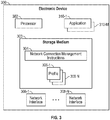
- Fig. 3 is a block diagram of an electronic device 300 that includes one or more hardware processors 302.
- the electronic device 300 further includes a non-transitory machine-readable or computer-readable storage medium 303 that stores machine-readable instructions to perform various tasks.
- the machine-readable instructions can include network connection management instructions 304 to use profiles 306-1 to 306-N to determine which network interfaces 308-1 to 308-N (N > 2) in the electronic device 300 are to be used for communications of respective applications 310-1 to 310-M (M > 2, where M can be the same as or different from N).
- network connection management instructions 304 to use profiles 306-1 to 306-N to determine which network interfaces 308-1 to 308-N (N > 2) in the electronic device 300 are to be used for communications of respective applications 310-1 to 310-M (M > 2, where M can be the same as or different from N).
- the storage medium 303 can include any or some combination of the following: a semiconductor memory device such as a dynamic or static random access memory (a DRAM or SRAM), an erasable and programmable read-only memory (EPROM), an electrically erasable and programmable read-only memory (EEPROM) and flash memory; a magnetic disk such as a fixed, floppy and removable disk; another magnetic medium including tape; an optical medium such as a compact disc (CD) or a digital video disc (DVD); or another type of storage device.
- a semiconductor memory device such as a dynamic or static random access memory (a DRAM or SRAM), an erasable and programmable read-only memory (EPROM), an electrically erasable and programmable read-only memory (EEPROM) and flash memory
- a magnetic disk such as a fixed, floppy and removable disk
- another magnetic medium including tape an optical medium such as a compact disc (CD) or a digital video disc (DVD); or another type of storage device.
- CD compact disc
- Such computer-readable or machine-readable storage medium or media is (are) considered to be part of an article (or article of manufacture).
- An article or article of manufacture can refer to any manufactured single component or multiple components.
- the storage medium or media can be located either in the machine running the machine-readable instructions, or located at a remote site from which machine-readable instructions can be downloaded over a network for execution.
Landscapes
- Engineering & Computer Science (AREA)
- Computer Networks & Wireless Communication (AREA)
- Signal Processing (AREA)
- Computer Security & Cryptography (AREA)
- Databases & Information Systems (AREA)
- Software Systems (AREA)
- Theoretical Computer Science (AREA)
- General Engineering & Computer Science (AREA)
- Computing Systems (AREA)
- Physics & Mathematics (AREA)
- General Physics & Mathematics (AREA)
- Computer Hardware Design (AREA)
- Mobile Radio Communication Systems (AREA)
Abstract
Description
- An electronic device can include various applications to allow a user to perform different tasks. For example, the user may use the electronic device both in a work environment and outside of work (referred to as a "personal environment" of the user).
- Accordingly there is provided a device, a method, and a computer program as detailed in the claims that follow.
- Some implementations of the present disclosure are described with respect to the following figures.
-
Fig. 1 is a block diagram of an example arrangement according to some implementations of the present disclosure. -
Fig. 2 is a flow diagram of a process according to some examples. -
Fig. 3 is a block diagram of an electronic device according to some examples. - Throughout the drawings, identical reference numbers designate similar, but not necessarily identical, elements. The figures are not necessarily to scale, and the size of some parts may be exaggerated to more clearly illustrate the example shown. Moreover, the drawings provide examples and/or implementations consistent with the description; however, the description is not limited to the examples and/or implementations provided in the drawings.
- In the present disclosure, use of the term "a," "an", or "the" is intended to include the plural forms as well, unless the context clearly indicates otherwise. Also, the term "includes," "including," "comprises," "comprising," "have," or "having" when used in this disclosure specifies the presence of the stated elements, but do not preclude the presence or addition of other elements.
- An "electronic" device can refer to any or some combination of the following: a desktop computer, a notebook computer, a tablet computer, a smartphone, a game appliance, a wearable device (e.g., a smart watch, smart eyeglasses, a head-mounted device, etc.), or any other electronic device that can be used by a user.
- An "application" can refer to any program in the form of machine-readable instructions that a user can interact with.
- In some examples, an electronic device can have different applications used by a user for different purposes. For example, applications can include social media applications that are used to access social media sites, gaming applications to perform online gaming sessions, dating applications for accessing dating sites, and so forth. Applications can also include productivity applications, such as to generate word processing documents, spreadsheets, presentations, and so forth. Applications can also include browsing applications to allow a user to browse various sites, such as websites.
- Furthermore, in examples where the electronic device can be used by the user both in a work environment and in a personal environment of the user, the electronic device can include applications used by the user for work purposes, such as to access resources of an enterprise, including accessing information sources of the enterprise, accessing programs or machines of the enterprise, interacting with colleagues in the enterprise, and so forth.
- An "enterprise" can refer to a company, a government agency, an educational organization, a home, or any other type of organization.
- In examples where an electronic device can be used by a user in both a work environment and a personal environment, the use of certain applications for personal reasons by the user may pose a security risk when the user is at work. For example, when at work, the user may access an external resource using the enterprise's wireless network (referred to as "enterprise network"), such as a wireless local area network (WLAN), an Ethernet network, or any other type of wired or wireless network. For example, if a user uses the user's electronic device to access a social media site or browse public websites using the enterprise network, there can be a risk that malware or an unauthorized entity (e.g., a human, a machine, or a program) may attempt to hack into the enterprise network through the electronic device to gain access to confidential information or to introduce malware into systems connected to the enterprise's network, or to otherwise perform an unauthorized operation in a system coupled to the enterprise's network.
- In accordance with some implementations of the present disclosure, and as shown in
Fig. 1 , anelectronic device 100 that includes multiple applications (includingapplication 1 and application 2) can be used in a work environment and a personal environment, respectively, of a user of theelectronic device 100. - A "work environment" can refer to an environment where the user is engaged in activities when working for an enterprise. For example, the electronic device used in the work environment may be located physically at the facilities of the enterprise, or alternatively, may be external of the physical facilities of the enterprise but is coupled to the enterprise network using a secure connection, such as a virtual private network (VPN) or other type of secure connection. The electronic device used in the work environment can refer to the electronic device being used for purposes of work for the enterprise.
- The electronic device used in the personal environment can refer to when the electronic device is being used for any purpose other than for work.
- Although two applications are shown in
Fig.1 , it is noted that in other examples, there can be more than two applications for use in the work environment, the personal environment, and possibly other environments, respectively. In the example ofFig. 1 ,application 1 is executable in theelectronic device 100 to access resources of anenterprise network 102, which is the network of an enterprise at which the user of theelectronic device 100 works. Generally, an "enterprise network" can refer to any network that is considered a secure network to be protected against unauthorized access. -
Application 2 is executable in theelectronic device 100 to access resources of anoutside network 104. As used here, an "outside network" can refer to any network that is separate and distinct from theenterprise network 102. For example, theoutside network 104 can include a public WLAN (such as a WLAN in a coffee shop, a WLAN in a hotel, a WLAN at an airport, a WLAN that is available generally in a geographic region such as a city, and so forth), a cellular network, or any other type of wired or wireless network. - The
enterprise network 102 can include a secure WLAN that is accessible by theelectronic device 100 only if the appropriate credentials are provided by theelectronic device 100. A credential can include a username and password, a certificate, a key, or any other type of credential. - The
electronic device 100 further includes anetwork interface 110 and anetwork interface 112. Although just two network interfaces are shown, in other examples, the electronic device can include more than two network interfaces. - A "network interface" can refer to any communication component (or arrangement of components) used by the
electronic device 100 to access a respective network. The network interface can include network interface hardware, such as a network interface controller (NIC), and module(s) that is (are) used to allow communication over a respective network according to one or more protocols, such as an Ethernet protocol, an Internet Protocol (IP), a cellular network protocol, and so forth. A "module" can refer to a hardware component or to software. - In some examples, the
network interface 110 is allocated for communication over the enterprise network 102 (but not over the outside network 104), while thenetwork interface 112 is allocated for communication over the outsie network 104 (but not over the enterprise network 102). - Thus, according to some examples,
application 1 accesses theenterprise network 102 using thenetwork interface 110 to interact with a resource of theenterprise network 102, andapplication 2 accesses theoutside network 104 using thenetwork interface 112 to interact with a resource of theoutside network 104. - An application interacting with a resource of a network can refer to the application accessing a resource connected to the network, such as a storage resource that includes an information repository, a web resource, a network resource, and so forth. Accessing a resource of an application can also refer to a user of the
electronic device 100 interacting with another user that is communicating over the network using another different electronic device. - For example, the
network interface 110 can be allocated forapplication 1 to perform communications over theenterprise network 102 at the user's work, while thenetwork interface 112 can be allocated forapplication 2 to perform communications over theoutside network 104, such as to access public websites, gaming sites, dating sites, social media sites, or any other resource that is not part of theenterprise network 102. - The
electronic device 100 further includes astorage medium 114, which can be implemented using one or more storage devices, such as any one or more of the following: a memory device (e.g., a dynamic random access memory or DRAM device, a static random access memory or SRAM device, a flash memory device, a disk-based storage device, etc.). - The
storage medium 114 can store various profiles, which in the example ofFig. 1 includesprofile 1 andprofile 2. A "profile" can refer to any data structure containing information that is usable by theelectronic device 100 to control communications of an application over a respective network, such as theenterprise network 102 or theoutside network 104. - In accordance with some implementations of the present disclosure, the
electronic device 100 includes anetwork connection manager 116, which can be implemented using machine-readable instructions or a hardware processing circuit, such as any or some combination of the following: a microprocessor, a core of a multi-core microprocessor, a microcontroller, a programmable integrated circuit, a programmable gate array, a digital signal processor, or another hardware processing circuit. In some examples, thenetwork connection manager 116 can be part of an operating system (OS) of theelectronic device 100, or can be separate from the OS. - The
network connection manager 116 uses the profiles stored in thestorage medium 114 to control which network interface a corresponding application is to use for accessing a corresponding network. - For example, the
network connection manager 116 can accessassociation information 118 stored in the storage medium, where theassociation information 118 associates different applications with respective different profiles. For example, theassociation information 118 can associateapplication 1 withprofile 1, and can associateapplication 2 withprofile 2. - Although just two profiles are shown in
Fig. 1 , it is noted that thestorage medium 114 can store additional profiles in other examples, where the additional profiles can be associated with other respective applications. Theassociation information 118 can associate one or more applications with a given profile. -
Profile 1 contains information that selects thenetwork interface 110 to be used for communications, andprofile 2 contains information that selects thenetwork interface 112 to perform communications. By associating a respective profile with a given application, theassociation information 118 can cause the given application to use a specific network interface to communicate over a corresponding network. - As a result, enhanced security can be provided to protect against an unauthorized access or an unauthorized operation on the
enterprise network 102 due to use of an application in the electronic device 100 (such as application 2) to interact with a resource that is outside of theenterprise network 102. -
Fig. 2 is a flow diagram of aprocess 200 according to some examples. Theprocess 200 can be performed by theelectronic device 100, for example. - The
process 200 stores (at 202), in a storage medium (e.g., 114 inFig. 1 ), information (e.g., 118 inFig. 1 ) associating a first application of the electronic device with a first profile (e.g. profile 1 inFig. 1 ), and associating a second application of the electronic device with a second profile (e.g.,profile 2 inFig. 2 ). The first profile selects a first network interface (e.g., 110 inFig. 1 ) of a plurality of network interfaces to use for communications, and the second profile selects a second network interface (e.g., 112 inFig. 1 ) of the plurality of network interfaces to use for communications. - The profiles stored in the storage medium may be pre-stored in the storage medium of the electronic device. Alternatively, the profiles can be stored in the storage medium during setup of the electronic device, during a registration or onboarding process of the electronic device, or at any other time. The profiles stored in the storage medium can also be updated, such as from a remote source.
- During execution of the first application, the
process 200 selects (at 204), based on the first profile associated with the first application, the first network interface for communication of the first application over the first network. As discussed above, the association of the first profile with the first application can be based on use of association information (e.g., 118 inFig. 1 ) that associates different profiles with respective different applications. - The
network connection manager 116 uses the association information and the profiles to control which network interface is to be used by which application when accessing a resource over a network. - During execution of the second application, the
process 200 selects (at 206), based on the second profile associated with the second application, the second network interface for communication of the second application over the second network. - In some examples, the first profile specifies use of a first service set identifier (SSID) from among a plurality of SSIDs for communications, and the second profile specifies use of a second SSID from among the plurality of SSIDs for communications. An SSID includes a name of a WLAN. When a profile specifies use of a given SSID, the
network connection manager 116 is able to identify which network interface is to be used for accessing the WLAN identified by the given SSID. - In further examples, the first profile specifies that the first application is to use a first VPN for communications. A VPN can refer to a virtual network that is protected by a security mechanism that prevents an unauthorized entity to access data communicated over the VPN. When a profile specifies use of a given VPN, the
network connection manager 116 is able to identify which network interface is to be used by the corresponding application for accessing the VPN. - In some examples, the second profile specifies that the second application is to use a second VPN for communications. Alternatively, the second profile specifies that the second application is to not use of a VPN for communications.
- In some examples, the
electronic device 100 ofFig. 1 can include multiple subscriber identity modules (SIMs), such asSIM 1 andSIM 2. A SIM can include an integrated circuit that security stores the international mobile subscriber identity (IMSI) or another user identity or device identity to be used to identify and authenticate a subscriber in a cellular network. Alternatively, a SIM can refer to an embedded SIM (eSIM), which is a digital file. The different SIMs correspond to different wireless networks. For example,SIM 1 includes information for authenticating a subscriber to a first wireless network, andSIM 2 includes information for authenticating a subscriber to a second wireless network. - In examples where the
electronic device 100 includes multiple SIMs, the first profile can specify use of a first SIM from among the multiple SIMs for communications, and the second profile can specify use of a second SIM from among the multiple SIMs for communications. When a profile specifies use of a given SIM, thenetwork connection manager 116 is able to identify which network interface is to be used for accessing a respective network using the given SIM. - In further examples, the first profile can specify use or prohibit the use of data over a specific wireless network when the electronic device is roaming. For example, the first profile can specify that use of data over the
enterprise network 102 is prohibited when theelectronic device 100 has roamed outside theenterprise network 102. This would prevent the use of thenetwork interface 110 when theelectronic device 100 has roamed outside theenterprise network 102, in which case an application would use theother network interface 112 to establish communication over theoutside network 104. - In alternative examples, the
network interface 110 is a WLAN interface, and thenetwork interface 112 is a network interface (e.g., a cellular interface) different from the WLAN interface. In such examples, the second profile can specify that the second application is to not use the WLAN interface, which would case the second application to use the non-WLAN interface. - In other examples, the
network interface 110 is a cellular interface, and thenetwork interface 112 is a network interface (e.g., a WLAN interface) different from the cellular interface. In such examples, the second profile can specify that the second application is to not use the cellular interface, which would case the second application to use the non-cellular interface. - In further examples, an enterprise may have a policy prohibiting the use of the
enterprise network 102 for certain activities (dating applications, games, etc.) on the user's personal device, but the user still wants to use theenterprise network 102 for work related matters and other activities. The profiles can prevent the dating applications and gaming applications from using theenterprise network 102, but can allow these applications to use theoutside network 104. -
Fig. 3 is a block diagram of anelectronic device 300 that includes one ormore hardware processors 302. Theelectronic device 300 further includes a non-transitory machine-readable or computer-readable storage medium 303 that stores machine-readable instructions to perform various tasks. - For example, the machine-readable instructions can include network
connection management instructions 304 to use profiles 306-1 to 306-N to determine which network interfaces 308-1 to 308-N (N > 2) in theelectronic device 300 are to be used for communications of respective applications 310-1 to 310-M (M > 2, where M can be the same as or different from N). - The
storage medium 303 can include any or some combination of the following: a semiconductor memory device such as a dynamic or static random access memory (a DRAM or SRAM), an erasable and programmable read-only memory (EPROM), an electrically erasable and programmable read-only memory (EEPROM) and flash memory; a magnetic disk such as a fixed, floppy and removable disk; another magnetic medium including tape; an optical medium such as a compact disc (CD) or a digital video disc (DVD); or another type of storage device. Note that the instructions discussed above can be provided on one computer-readable or machine-readable storage medium, or alternatively, can be provided on multiple computer-readable or machine-readable storage media distributed in a large system having possibly plural nodes. Such computer-readable or machine-readable storage medium or media is (are) considered to be part of an article (or article of manufacture). An article or article of manufacture can refer to any manufactured single component or multiple components. The storage medium or media can be located either in the machine running the machine-readable instructions, or located at a remote site from which machine-readable instructions can be downloaded over a network for execution. - In the foregoing description, numerous details are set forth to provide an understanding of the subject disclosed herein. However, implementations may be practiced without some of these details. Other implementations may include modifications and variations from the details discussed above. It is intended that the appended claims cover such modifications and variations.
Claims (14)
- An electronic device comprising:a plurality of network interfaces to communicate over respective different networks;a storage medium to store information associating a first application of the electronic device with a first profile, and associating a second application of the electronic device with a second profile, the first profile selecting a first network interface of the plurality of network interfaces to use for communications, and the second profile selecting a second network interface of the plurality of network interfaces to use for communications; andat least one processor configured to:during execution of the first application, select, based on the first profile associated with the first application, the first network interface for communication of the first application over the first network, andduring execution of the second application, select, based on the second profile associated with the second application, the second network interface for communication of the second application over the second network.
- The electronic device of claim 1, wherein the first profile specifies use of a first service set identifier (SSID) from among a plurality of SSIDs for communications.
- The electronic device of claim 1, wherein the first profile specifies that the first application is to use a virtual private network (VPN) for communications.
- The electronic device of claim 3, wherein the second profile specifies that the second application is to not use of the VPN for communications.
- The electronic device of claim 1, wherein the first profile specifies use of a subscriber identity module (SIM) from among a plurality of SIMs for communications.
- The electronic device of claim 5, wherein the plurality of SIMs correspond to different wireless networks.
- The electronic device of claim 1, wherein the first profile specifies use or prohibits use of data over a wireless network when the electronic device is roaming.
- The electronic device of claim 1, wherein the first network interface comprises a wireless local area network (WLAN) interface to communicate over a WLAN; and optionally wherein the second profile specifies that the second application is to not use the WLAN interface.
- The electronic device of claim 1, wherein the first network interface comprises a cellular network interface to communicate over a cellular network; and optionally wherein the second profile specifies that the second application is to not use the cellular network interface.
- A method of an electronic device, comprising:storing, in a storage medium, information associating a first application of the electronic device with a first profile, and associating a second application of the electronic device with a second profile, the first profile selecting a first network interface of a plurality of network interfaces to use for communications, and the second profile selecting a second network interface of the plurality of network interfaces to use for communications;during execution of the first application, selecting, based on the first profile associated with the first application, the first network interface for communication of the first application over the first network, andduring execution of the second application, selecting, based on the second profile associated with the second application, the second network interface for communication of the second application over the second network.
- The method of claim 10, wherein the first profile specifies at least one of:use of a first service set identifier (SSID) from among a plurality of SSIDs for communications;that the first application is to use a virtual private network (VPN) for communications;use of a subscriber identity module (SIM) from among a plurality of SIMs for communications;use or prohibits use of data over a wireless network when the electronic device is roaming.
- The method of claim 11, wherein the first network interface comprises:a wireless local area network (WLAN) interface to communicate over a WLAN; ora cellular network interface to communicate over a cellular network.
- A computer program comprising instructions that upon execution cause an electronic device to:store, in a storage medium, information associating a first application of the electronic device with a first profile, and associating a second application of the electronic device with a second profile, the first profile selecting a first network interface of a plurality of network interfaces to use for communications, and the second profile selecting a second network interface of the plurality of network interfaces to use for communications;during execution of the first application, select, based on the first profile associated with the first application, the first network interface for communication of the first application over the first network, andduring execution of the second application, select, based on the second profile associated with the second application, the second network interface for communication of the second application over the second network.
- The computer program of claim 13, wherein the first profile specifies that the first application is to use a virtual private network (VPN) for communications, and the second profile specifies that the second application is to not use a VPN for communications.
Applications Claiming Priority (1)
| Application Number | Priority Date | Filing Date | Title |
|---|---|---|---|
| US16/540,950 US10959076B2 (en) | 2019-08-14 | 2019-08-14 | Different profiles for selecting different network interfaces for communications of an electronic device |
Publications (2)
| Publication Number | Publication Date |
|---|---|
| EP3779683A1 true EP3779683A1 (en) | 2021-02-17 |
| EP3779683B1 EP3779683B1 (en) | 2025-11-19 |
Family
ID=70738278
Family Applications (1)
| Application Number | Title | Priority Date | Filing Date |
|---|---|---|---|
| EP20174802.7A Active EP3779683B1 (en) | 2019-08-14 | 2020-05-14 | Different profiles for selecting different network interfaces for communications of an electronic device |
Country Status (4)
| Country | Link |
|---|---|
| US (2) | US10959076B2 (en) |
| EP (1) | EP3779683B1 (en) |
| CN (1) | CN112399398B (en) |
| CA (1) | CA3080764A1 (en) |
Families Citing this family (3)
| Publication number | Priority date | Publication date | Assignee | Title |
|---|---|---|---|---|
| CN113395694B (en) * | 2021-06-23 | 2023-07-07 | 深圳市凯莱特科技股份有限公司 | Smart security defense system and defense method based on 5G and local area base stations |
| US12477321B2 (en) * | 2022-11-14 | 2025-11-18 | Dish Wireless L.L.C. | Enterprise profile associated with a subscriber identity module (SIM) |
| US20250081062A1 (en) * | 2023-09-05 | 2025-03-06 | Dish Wireless L.L.C. | Intelligent simultaneous core |
Citations (1)
| Publication number | Priority date | Publication date | Assignee | Title |
|---|---|---|---|---|
| US20180007211A1 (en) * | 2015-05-29 | 2018-01-04 | Blackberry Limited | Method and system for transition of applications to a second cellular data networking interface for a virtual sim service |
Family Cites Families (20)
| Publication number | Priority date | Publication date | Assignee | Title |
|---|---|---|---|---|
| US6289381B1 (en) * | 1998-11-20 | 2001-09-11 | Qwest Communications International Inc. | Video and data communication system having downstream network interface entitlement profile for restricting transmission to selection device |
| US7065367B2 (en) | 2002-07-11 | 2006-06-20 | Oliver Michaelis | Interface selection in a wireless communication network |
| US7996505B2 (en) | 2003-10-24 | 2011-08-09 | Microsoft Corporation | Network and interface selection on a computing device capable of establishing connections via multiple network communications media |
| US8019296B1 (en) * | 2008-04-17 | 2011-09-13 | Sprint Spectrum L.P. | Selective scanning for WLAN coverage by a multi-mode device |
| US20140071895A1 (en) * | 2008-12-12 | 2014-03-13 | Ryan H. Bane | Network Selection Based On Customizing Crowdsourced Connection Quality Data |
| US8639245B2 (en) * | 2009-06-08 | 2014-01-28 | Qualcomm Incorporated | Method and apparatus for updating rules governing the switching of virtual SIM service contracts |
| CN101959321B (en) * | 2010-09-17 | 2014-03-19 | 惠州Tcl移动通信有限公司 | Scene mode switching method based on mobile phone WIFI and mobile phone |
| US8780797B2 (en) * | 2010-10-29 | 2014-07-15 | Cellco Partnership | Universal integrated circuit card activation in a hybrid network |
| US20140220952A1 (en) * | 2011-08-22 | 2014-08-07 | Nokia Corporation | Multi-SIM Enabling Application and Use of EUICC in Legacy Terminals |
| EP2629478B1 (en) * | 2012-02-16 | 2018-05-16 | BlackBerry Limited | Method and apparatus for separation of connection data by perimeter type |
| EP2672761B1 (en) * | 2012-06-06 | 2020-08-05 | BlackBerry Limited | Methods and apparatus for use in facilitating communication for different types of wireless networks |
| WO2013188545A1 (en) * | 2012-06-12 | 2013-12-19 | Qualcomm Incorporated | Dynamic multi operator selection in a multiple-sims ue |
| KR102294747B1 (en) * | 2013-11-27 | 2021-08-30 | 삼성전자 주식회사 | Method and apparatus for connecting wireless lanof multi sim terminal |
| US9648491B2 (en) | 2014-02-19 | 2017-05-09 | Mediatek Inc. | Method of selecting an active SIM from multiple SIMs and a wireless device utilizing the same |
| KR102254849B1 (en) * | 2014-07-19 | 2021-05-25 | 삼성전자주식회사 | processing Method and apparatus for provisioning profile |
| KR102329824B1 (en) * | 2014-09-16 | 2021-11-23 | 삼성전자주식회사 | Method for providing network service and electronic device |
| US10206138B2 (en) * | 2015-06-18 | 2019-02-12 | Parallel Wireless, Inc. | SSID to QCI mapping |
| US9712452B2 (en) * | 2015-11-05 | 2017-07-18 | Qualcomm Incorporated | System and methods for improving support of a virtual subscriber identity module (SIM) in a multi-SIM wireless communication device |
| EP3277000A1 (en) * | 2016-07-29 | 2018-01-31 | Deutsche Telekom AG | Profile server for provisioning of e-sim profiles according to terminal capabilities |
| US10779157B2 (en) * | 2017-09-28 | 2020-09-15 | Apple Inc. | Methods and apparatus for accessing services of multiple wireless networks via a single radio access network |
-
2019
- 2019-08-14 US US16/540,950 patent/US10959076B2/en active Active
-
2020
- 2020-05-13 CA CA3080764A patent/CA3080764A1/en active Pending
- 2020-05-14 EP EP20174802.7A patent/EP3779683B1/en active Active
- 2020-07-24 CN CN202010721434.6A patent/CN112399398B/en active Active
-
2021
- 2021-03-08 US US17/195,059 patent/US11516642B2/en active Active
Patent Citations (1)
| Publication number | Priority date | Publication date | Assignee | Title |
|---|---|---|---|---|
| US20180007211A1 (en) * | 2015-05-29 | 2018-01-04 | Blackberry Limited | Method and system for transition of applications to a second cellular data networking interface for a virtual sim service |
Also Published As
| Publication number | Publication date |
|---|---|
| US20210195391A1 (en) | 2021-06-24 |
| US11516642B2 (en) | 2022-11-29 |
| CN112399398A (en) | 2021-02-23 |
| US10959076B2 (en) | 2021-03-23 |
| CA3080764A1 (en) | 2021-02-14 |
| CN112399398B (en) | 2024-03-22 |
| US20210051467A1 (en) | 2021-02-18 |
| EP3779683B1 (en) | 2025-11-19 |
Similar Documents
| Publication | Publication Date | Title |
|---|---|---|
| US11507680B2 (en) | System and method for access control using network verification | |
| CN107005442B (en) | Method and apparatus for remote access | |
| US9973489B2 (en) | Providing virtualized private network tunnels | |
| EP2907289B1 (en) | Providing virtualized private network tunnels | |
| US8914845B2 (en) | Providing virtualized private network tunnels | |
| US10932129B2 (en) | Network access control | |
| US8856909B1 (en) | IF-MAP provisioning of resources and services | |
| CN108337677B (en) | Network authentication method and device | |
| US11516642B2 (en) | Different profiles for selecting different network interfaces for communications of an electronic device | |
| WO2017219748A1 (en) | Method and device for access permission determination and page access | |
| CN109067715B (en) | Verification method and device | |
| US20170053136A1 (en) | Policy-based trusted peer-to-peer connections | |
| US12615261B2 (en) | Enterprise user access discovery and management using policy and entitlement framework | |
| US12223054B2 (en) | Denial of dynamic host configuration protocol internet protocol address allocation to an unauthorized node via cross secure boot verification | |
| HK40037851A (en) | Different profiles for selecting different network interfaces for communications of an electronic device | |
| HK40037851B (en) | Different profiles for selecting different network interfaces for communications of an electronic device | |
| US20240056806A1 (en) | Device authorization in an enterprise network based on whether a mobile number is in a user information repository | |
| US20180124063A1 (en) | Composite security identifier | |
| Ferdous et al. | CAFS: A framework for context-aware federated services | |
| HK1258487A1 (en) | Network authentication method and device | |
| HK1258487B (en) | Network authentication method and device |
Legal Events
| Date | Code | Title | Description |
|---|---|---|---|
| PUAI | Public reference made under article 153(3) epc to a published international application that has entered the european phase |
Free format text: ORIGINAL CODE: 0009012 |
|
| STAA | Information on the status of an ep patent application or granted ep patent |
Free format text: STATUS: THE APPLICATION HAS BEEN PUBLISHED |
|
| AK | Designated contracting states |
Kind code of ref document: A1 Designated state(s): AL AT BE BG CH CY CZ DE DK EE ES FI FR GB GR HR HU IE IS IT LI LT LU LV MC MK MT NL NO PL PT RO RS SE SI SK SM TR |
|
| AX | Request for extension of the european patent |
Extension state: BA ME |
|
| STAA | Information on the status of an ep patent application or granted ep patent |
Free format text: STATUS: REQUEST FOR EXAMINATION WAS MADE |
|
| 17P | Request for examination filed |
Effective date: 20210512 |
|
| RBV | Designated contracting states (corrected) |
Designated state(s): AL AT BE BG CH CY CZ DE DK EE ES FI FR GB GR HR HU IE IS IT LI LT LU LV MC MK MT NL NO PL PT RO RS SE SI SK SM TR |
|
| STAA | Information on the status of an ep patent application or granted ep patent |
Free format text: STATUS: EXAMINATION IS IN PROGRESS |
|
| 17Q | First examination report despatched |
Effective date: 20220819 |
|
| P01 | Opt-out of the competence of the unified patent court (upc) registered |
Effective date: 20230518 |
|
| GRAP | Despatch of communication of intention to grant a patent |
Free format text: ORIGINAL CODE: EPIDOSNIGR1 |
|
| STAA | Information on the status of an ep patent application or granted ep patent |
Free format text: STATUS: GRANT OF PATENT IS INTENDED |
|
| RIC1 | Information provided on ipc code assigned before grant |
Ipc: H04W 48/18 20090101ALN20250604BHEP Ipc: H04W 12/48 20210101ALI20250604BHEP Ipc: H04W 12/45 20210101ALI20250604BHEP Ipc: H04L 9/40 20220101ALI20250604BHEP Ipc: H04L 67/303 20220101ALI20250604BHEP Ipc: G06F 9/445 20180101AFI20250604BHEP |
|
| INTG | Intention to grant announced |
Effective date: 20250624 |
|
| GRAS | Grant fee paid |
Free format text: ORIGINAL CODE: EPIDOSNIGR3 |
|
| GRAA | (expected) grant |
Free format text: ORIGINAL CODE: 0009210 |
|
| STAA | Information on the status of an ep patent application or granted ep patent |
Free format text: STATUS: THE PATENT HAS BEEN GRANTED |
|
| AK | Designated contracting states |
Kind code of ref document: B1 Designated state(s): AL AT BE BG CH CY CZ DE DK EE ES FI FR GB GR HR HU IE IS IT LI LT LU LV MC MK MT NL NO PL PT RO RS SE SI SK SM TR |
|
| REG | Reference to a national code |
Ref country code: CH Ref legal event code: F10 Free format text: ST27 STATUS EVENT CODE: U-0-0-F10-F00 (AS PROVIDED BY THE NATIONAL OFFICE) Effective date: 20251119 Ref country code: GB Ref legal event code: FG4D |
|
| REG | Reference to a national code |
Ref country code: DE Ref legal event code: R096 Ref document number: 602020062331 Country of ref document: DE |
|
| REG | Reference to a national code |
Ref country code: IE Ref legal event code: FG4D |
|
| REG | Reference to a national code |
Ref country code: NL Ref legal event code: MP Effective date: 20251119 |
|
| PGFP | Annual fee paid to national office [announced via postgrant information from national office to epo] |
Ref country code: GB Payment date: 20260324 Year of fee payment: 7 |
|
| PG25 | Lapsed in a contracting state [announced via postgrant information from national office to epo] |
Ref country code: ES Free format text: LAPSE BECAUSE OF FAILURE TO SUBMIT A TRANSLATION OF THE DESCRIPTION OR TO PAY THE FEE WITHIN THE PRESCRIBED TIME-LIMIT Effective date: 20251119 |
|
| REG | Reference to a national code |
Ref country code: LT Ref legal event code: MG9D |
|
| PG25 | Lapsed in a contracting state [announced via postgrant information from national office to epo] |
Ref country code: NO Free format text: LAPSE BECAUSE OF FAILURE TO SUBMIT A TRANSLATION OF THE DESCRIPTION OR TO PAY THE FEE WITHIN THE PRESCRIBED TIME-LIMIT Effective date: 20260219 |
|
| PG25 | Lapsed in a contracting state [announced via postgrant information from national office to epo] |
Ref country code: FI Free format text: LAPSE BECAUSE OF FAILURE TO SUBMIT A TRANSLATION OF THE DESCRIPTION OR TO PAY THE FEE WITHIN THE PRESCRIBED TIME-LIMIT Effective date: 20251119 Ref country code: AT Free format text: LAPSE BECAUSE OF FAILURE TO SUBMIT A TRANSLATION OF THE DESCRIPTION OR TO PAY THE FEE WITHIN THE PRESCRIBED TIME-LIMIT Effective date: 20251119 Ref country code: HR Free format text: LAPSE BECAUSE OF FAILURE TO SUBMIT A TRANSLATION OF THE DESCRIPTION OR TO PAY THE FEE WITHIN THE PRESCRIBED TIME-LIMIT Effective date: 20251119 |
|
| REG | Reference to a national code |
Ref country code: AT Ref legal event code: MK05 Ref document number: 1859402 Country of ref document: AT Kind code of ref document: T Effective date: 20251119 |
|
| PG25 | Lapsed in a contracting state [announced via postgrant information from national office to epo] |
Ref country code: NL Free format text: LAPSE BECAUSE OF FAILURE TO SUBMIT A TRANSLATION OF THE DESCRIPTION OR TO PAY THE FEE WITHIN THE PRESCRIBED TIME-LIMIT Effective date: 20251119 |
|
| PG25 | Lapsed in a contracting state [announced via postgrant information from national office to epo] |
Ref country code: RS Free format text: LAPSE BECAUSE OF FAILURE TO SUBMIT A TRANSLATION OF THE DESCRIPTION OR TO PAY THE FEE WITHIN THE PRESCRIBED TIME-LIMIT Effective date: 20260219 |
|
| PG25 | Lapsed in a contracting state [announced via postgrant information from national office to epo] |
Ref country code: IS Free format text: LAPSE BECAUSE OF FAILURE TO SUBMIT A TRANSLATION OF THE DESCRIPTION OR TO PAY THE FEE WITHIN THE PRESCRIBED TIME-LIMIT Effective date: 20260319 |
|
| PG25 | Lapsed in a contracting state [announced via postgrant information from national office to epo] |
Ref country code: PT Free format text: LAPSE BECAUSE OF FAILURE TO SUBMIT A TRANSLATION OF THE DESCRIPTION OR TO PAY THE FEE WITHIN THE PRESCRIBED TIME-LIMIT Effective date: 20260319 |
|
| PG25 | Lapsed in a contracting state [announced via postgrant information from national office to epo] |
Ref country code: PL Free format text: LAPSE BECAUSE OF FAILURE TO SUBMIT A TRANSLATION OF THE DESCRIPTION OR TO PAY THE FEE WITHIN THE PRESCRIBED TIME-LIMIT Effective date: 20251119 |
|
| PG25 | Lapsed in a contracting state [announced via postgrant information from national office to epo] |
Ref country code: LV Free format text: LAPSE BECAUSE OF FAILURE TO SUBMIT A TRANSLATION OF THE DESCRIPTION OR TO PAY THE FEE WITHIN THE PRESCRIBED TIME-LIMIT Effective date: 20251119 |
|
| PG25 | Lapsed in a contracting state [announced via postgrant information from national office to epo] |
Ref country code: BG Free format text: LAPSE BECAUSE OF FAILURE TO SUBMIT A TRANSLATION OF THE DESCRIPTION OR TO PAY THE FEE WITHIN THE PRESCRIBED TIME-LIMIT Effective date: 20251119 |