EP3779641A1 - Method and device for adjusting neural-network-based wireless modem, and storage medium - Google Patents
Method and device for adjusting neural-network-based wireless modem, and storage medium Download PDFInfo
- Publication number
- EP3779641A1 EP3779641A1 EP19214641.3A EP19214641A EP3779641A1 EP 3779641 A1 EP3779641 A1 EP 3779641A1 EP 19214641 A EP19214641 A EP 19214641A EP 3779641 A1 EP3779641 A1 EP 3779641A1
- Authority
- EP
- European Patent Office
- Prior art keywords
- sample
- neural network
- clock frequency
- wireless modem
- working voltage
- Prior art date
- Legal status (The legal status is an assumption and is not a legal conclusion. Google has not performed a legal analysis and makes no representation as to the accuracy of the status listed.)
- Granted
Links
Images




Classifications
-
- G—PHYSICS
- G06—COMPUTING OR CALCULATING; COUNTING
- G06F—ELECTRIC DIGITAL DATA PROCESSING
- G06F1/00—Details not covered by groups G06F3/00 - G06F13/00 and G06F21/00
- G06F1/26—Power supply means, e.g. regulation thereof
- G06F1/32—Means for saving power
- G06F1/3203—Power management, i.e. event-based initiation of a power-saving mode
- G06F1/3234—Power saving characterised by the action undertaken
- G06F1/3296—Power saving characterised by the action undertaken by lowering the supply or operating voltage
-
- G—PHYSICS
- G06—COMPUTING OR CALCULATING; COUNTING
- G06N—COMPUTING ARRANGEMENTS BASED ON SPECIFIC COMPUTATIONAL MODELS
- G06N3/00—Computing arrangements based on biological models
- G06N3/02—Neural networks
- G06N3/04—Architecture, e.g. interconnection topology
- G06N3/045—Combinations of networks
-
- H—ELECTRICITY
- H04—ELECTRIC COMMUNICATION TECHNIQUE
- H04L—TRANSMISSION OF DIGITAL INFORMATION, e.g. TELEGRAPHIC COMMUNICATION
- H04L1/00—Arrangements for detecting or preventing errors in the information received
- H04L1/0001—Systems modifying transmission characteristics according to link quality, e.g. power backoff
- H04L1/0009—Systems modifying transmission characteristics according to link quality, e.g. power backoff by adapting the channel coding
-
- G—PHYSICS
- G06—COMPUTING OR CALCULATING; COUNTING
- G06F—ELECTRIC DIGITAL DATA PROCESSING
- G06F1/00—Details not covered by groups G06F3/00 - G06F13/00 and G06F21/00
- G06F1/26—Power supply means, e.g. regulation thereof
- G06F1/32—Means for saving power
- G06F1/3203—Power management, i.e. event-based initiation of a power-saving mode
- G06F1/3206—Monitoring of events, devices or parameters that trigger a change in power modality
-
- G—PHYSICS
- G06—COMPUTING OR CALCULATING; COUNTING
- G06F—ELECTRIC DIGITAL DATA PROCESSING
- G06F1/00—Details not covered by groups G06F3/00 - G06F13/00 and G06F21/00
- G06F1/26—Power supply means, e.g. regulation thereof
- G06F1/32—Means for saving power
- G06F1/3203—Power management, i.e. event-based initiation of a power-saving mode
- G06F1/3234—Power saving characterised by the action undertaken
- G06F1/324—Power saving characterised by the action undertaken by lowering clock frequency
-
- G—PHYSICS
- G06—COMPUTING OR CALCULATING; COUNTING
- G06F—ELECTRIC DIGITAL DATA PROCESSING
- G06F1/00—Details not covered by groups G06F3/00 - G06F13/00 and G06F21/00
- G06F1/26—Power supply means, e.g. regulation thereof
- G06F1/32—Means for saving power
- G06F1/3203—Power management, i.e. event-based initiation of a power-saving mode
- G06F1/3234—Power saving characterised by the action undertaken
- G06F1/325—Power saving in peripheral device
- G06F1/3278—Power saving in modem or I/O interface
-
- G—PHYSICS
- G06—COMPUTING OR CALCULATING; COUNTING
- G06N—COMPUTING ARRANGEMENTS BASED ON SPECIFIC COMPUTATIONAL MODELS
- G06N3/00—Computing arrangements based on biological models
- G06N3/02—Neural networks
- G06N3/04—Architecture, e.g. interconnection topology
- G06N3/0464—Convolutional networks [CNN, ConvNet]
-
- G—PHYSICS
- G06—COMPUTING OR CALCULATING; COUNTING
- G06N—COMPUTING ARRANGEMENTS BASED ON SPECIFIC COMPUTATIONAL MODELS
- G06N3/00—Computing arrangements based on biological models
- G06N3/02—Neural networks
- G06N3/08—Learning methods
-
- G—PHYSICS
- G06—COMPUTING OR CALCULATING; COUNTING
- G06N—COMPUTING ARRANGEMENTS BASED ON SPECIFIC COMPUTATIONAL MODELS
- G06N3/00—Computing arrangements based on biological models
- G06N3/02—Neural networks
- G06N3/08—Learning methods
- G06N3/09—Supervised learning
-
- H—ELECTRICITY
- H04—ELECTRIC COMMUNICATION TECHNIQUE
- H04L—TRANSMISSION OF DIGITAL INFORMATION, e.g. TELEGRAPHIC COMMUNICATION
- H04L1/00—Arrangements for detecting or preventing errors in the information received
- H04L1/0001—Systems modifying transmission characteristics according to link quality, e.g. power backoff
- H04L1/0002—Systems modifying transmission characteristics according to link quality, e.g. power backoff by adapting the transmission rate
- H04L1/0003—Systems modifying transmission characteristics according to link quality, e.g. power backoff by adapting the transmission rate by switching between different modulation schemes
-
- H—ELECTRICITY
- H04—ELECTRIC COMMUNICATION TECHNIQUE
- H04L—TRANSMISSION OF DIGITAL INFORMATION, e.g. TELEGRAPHIC COMMUNICATION
- H04L1/00—Arrangements for detecting or preventing errors in the information received
- H04L1/0001—Systems modifying transmission characteristics according to link quality, e.g. power backoff
- H04L1/0023—Systems modifying transmission characteristics according to link quality, e.g. power backoff characterised by the signalling
- H04L1/0026—Transmission of channel quality indication
-
- H—ELECTRICITY
- H04—ELECTRIC COMMUNICATION TECHNIQUE
- H04L—TRANSMISSION OF DIGITAL INFORMATION, e.g. TELEGRAPHIC COMMUNICATION
- H04L1/00—Arrangements for detecting or preventing errors in the information received
- H04L1/0001—Systems modifying transmission characteristics according to link quality, e.g. power backoff
- H04L1/0033—Systems modifying transmission characteristics according to link quality, e.g. power backoff arrangements specific to the transmitter
-
- H—ELECTRICITY
- H04—ELECTRIC COMMUNICATION TECHNIQUE
- H04L—TRANSMISSION OF DIGITAL INFORMATION, e.g. TELEGRAPHIC COMMUNICATION
- H04L1/00—Arrangements for detecting or preventing errors in the information received
- H04L1/20—Arrangements for detecting or preventing errors in the information received using signal quality detector
- H04L1/203—Details of error rate determination, e.g. BER, FER or WER
-
- H—ELECTRICITY
- H04—ELECTRIC COMMUNICATION TECHNIQUE
- H04L—TRANSMISSION OF DIGITAL INFORMATION, e.g. TELEGRAPHIC COMMUNICATION
- H04L5/00—Arrangements affording multiple use of the transmission path
- H04L5/0001—Arrangements for dividing the transmission path
- H04L5/0003—Two-dimensional division
- H04L5/0005—Time-frequency
- H04L5/0007—Time-frequency the frequencies being orthogonal, e.g. OFDM(A) or DMT
-
- H—ELECTRICITY
- H04—ELECTRIC COMMUNICATION TECHNIQUE
- H04L—TRANSMISSION OF DIGITAL INFORMATION, e.g. TELEGRAPHIC COMMUNICATION
- H04L5/00—Arrangements affording multiple use of the transmission path
- H04L5/003—Arrangements for allocating sub-channels of the transmission path
- H04L5/0053—Allocation of signalling, i.e. of overhead other than pilot signals
-
- H—ELECTRICITY
- H04—ELECTRIC COMMUNICATION TECHNIQUE
- H04W—WIRELESS COMMUNICATION NETWORKS
- H04W28/00—Network traffic management; Network resource management
- H04W28/16—Central resource management; Negotiation of resources or communication parameters, e.g. negotiating bandwidth or QoS [Quality of Service]
- H04W28/18—Negotiating wireless communication parameters
-
- H—ELECTRICITY
- H04—ELECTRIC COMMUNICATION TECHNIQUE
- H04W—WIRELESS COMMUNICATION NETWORKS
- H04W52/00—Power management, e.g. Transmission Power Control [TPC] or power classes
- H04W52/02—Power saving arrangements
- H04W52/0209—Power saving arrangements in terminal devices
- H04W52/0225—Power saving arrangements in terminal devices using monitoring of external events, e.g. the presence of a signal
- H04W52/0229—Power saving arrangements in terminal devices using monitoring of external events, e.g. the presence of a signal where the received signal is a wanted signal
-
- H—ELECTRICITY
- H04—ELECTRIC COMMUNICATION TECHNIQUE
- H04W—WIRELESS COMMUNICATION NETWORKS
- H04W52/00—Power management, e.g. Transmission Power Control [TPC] or power classes
- H04W52/02—Power saving arrangements
- H04W52/0209—Power saving arrangements in terminal devices
- H04W52/0261—Power saving arrangements in terminal devices managing power supply demand, e.g. depending on battery level
- H04W52/0274—Power saving arrangements in terminal devices managing power supply demand, e.g. depending on battery level by switching on or off the equipment or parts thereof
- H04W52/028—Power saving arrangements in terminal devices managing power supply demand, e.g. depending on battery level by switching on or off the equipment or parts thereof switching on or off only a part of the equipment circuit blocks
-
- H—ELECTRICITY
- H04—ELECTRIC COMMUNICATION TECHNIQUE
- H04W—WIRELESS COMMUNICATION NETWORKS
- H04W52/00—Power management, e.g. Transmission Power Control [TPC] or power classes
- H04W52/02—Power saving arrangements
- H04W52/0209—Power saving arrangements in terminal devices
- H04W52/0261—Power saving arrangements in terminal devices managing power supply demand, e.g. depending on battery level
- H04W52/0287—Power saving arrangements in terminal devices managing power supply demand, e.g. depending on battery level changing the clock frequency of a controller in the equipment
- H04W52/029—Power saving arrangements in terminal devices managing power supply demand, e.g. depending on battery level changing the clock frequency of a controller in the equipment reducing the clock frequency of the controller
-
- Y—GENERAL TAGGING OF NEW TECHNOLOGICAL DEVELOPMENTS; GENERAL TAGGING OF CROSS-SECTIONAL TECHNOLOGIES SPANNING OVER SEVERAL SECTIONS OF THE IPC; TECHNICAL SUBJECTS COVERED BY FORMER USPC CROSS-REFERENCE ART COLLECTIONS [XRACs] AND DIGESTS
- Y02—TECHNOLOGIES OR APPLICATIONS FOR MITIGATION OR ADAPTATION AGAINST CLIMATE CHANGE
- Y02D—CLIMATE CHANGE MITIGATION TECHNOLOGIES IN INFORMATION AND COMMUNICATION TECHNOLOGIES [ICT], I.E. INFORMATION AND COMMUNICATION TECHNOLOGIES AIMING AT THE REDUCTION OF THEIR OWN ENERGY USE
- Y02D10/00—Energy efficient computing, e.g. low power processors, power management or thermal management
Definitions
- the present disclosure generally relates to the field of mobile terminals, and more specifically to a method and device for adjusting a wireless modem for a mobile terminal.
- a mobile terminal With the development of mobile communication technologies, a mobile terminal has become an indispensable tool in users' daily lives.
- a mobile terminal is usually provided with a wireless modem for data transmission on a bandwidth-limited wireless channel. Due to portability of the mobile terminal, the wireless modem is required to be as low as possible in power consumption.
- a Dynamic Voltage and Frequency Scaling (DVFS) mechanism is adopted to adjust working voltages and clock frequencies of a processor and a memory, based on a state combination table or an empirical formula according to statistical data and known channel state in a working process of the wireless modem, to reduce the power consumption.
- DVFS Dynamic Voltage and Frequency Scaling
- the wireless channel changes in real time and the statistical data and the known channel state may have hysteresis, so that it is impossible to control a working voltage and a clock frequency of the wireless modem to be adjusted to an optimal state.
- the empirical formula is relatively low in reliability, the adjusting accuracy of working voltage and clock frequency may further be reduced.
- a purpose of the present disclosure is to provide a method and a device for adjusting a wireless modem, to solve the problem of hysteresis and inaccuracy of adjusting a working voltage and a clock frequency in the conventional art.
- a method for adjusting a wireless modem which may include that:
- the channel parameter of the wireless modem at the present moment is acquired at first, then the target clock frequency and the target working voltage of the wireless modem are generated, according to the channel parameter, by using the neural network which is pre-trained, and finally the working voltage and clock frequency of the wireless modem are adjusted to the target working voltage and the target clock frequency respectively.
- the clock frequency and the working voltage of the wireless modem may be adjusted in real time according to a state of the wireless channel, so that adjusting accuracy is improved, and power consumption is reduced.
- the wireless modem may include multiple function modules, and the operation that the target clock frequency and the target working voltage of the wireless modem are generated, according to the channel parameter, by using the neural network which is pre-trained may include that:
- the channel parameter is used as input of the neural network to acquire at least one target clock frequency and at least one target working voltage which are outputted by the neural network and are corresponding to at least one of the multiple function modules; and the operation that the working voltage and the clock frequency of the wireless modem are adjusted to the target working voltage and the target clock frequency respectively may include that: a clock frequency of each of the at least one function module is adjusted to the target clock frequency which is outputted by the neural network and is corresponding to the function module, and a working voltage of each of the at least one function module is adjusted to the target working voltage which is outputted by the neural network and is corresponding to the function module.
- the neural network may be pre-trained through the following steps:
- the operation that the sample input set and the associated sample output set are acquired may include that:
- the neural network may further be corrected through the following step: the neural network is corrected according to the target clock frequencies and the target working voltages generated by the neural network for many times within a preset historical time period before the present moment and/or multiple load values of the wireless modem within the preset historical time period.
- the channel parameter may include at least one of: a channel bandwidth, signal strength, a Signal Noise Ratio (SNR), Reference Signal Receiving Power (RSRP), an uplink/downlink resource scheduling strategy, a modulation mode, a coding mode or a transport block size.
- SNR Signal Noise Ratio
- RSRP Reference Signal Receiving Power
- uplink/downlink resource scheduling strategy a modulation mode, a coding mode or a transport block size.
- a device for adjusting a wireless modem which may include:
- the wireless modem may include multiple function modules; the processing module may be configured to use the channel parameter as input of the neural network to acquire at least one target clock frequency and at least one target working voltage which are outputted by the neural network and are corresponding to at least one of the multiple function modules; and the adjusting module may be configured to adjust a clock frequency of each of the at least one function module to the target clock frequency which is outputted by the neural network and is corresponding to the function module, and to adjust a working voltage of each of the at least one function module to the target working voltage which is outputted by the neural network and is corresponding to the function module.
- the neural network may be pre-trained through the following steps:
- the sample input set and the associated sample output set may be acquired through the following steps:
- the neural network may further be corrected through the following step: the neural network is corrected according to the target clock frequencies and the target working voltages generated by the neural network for many times within a preset historical time period before the present moment and/or multiple load values of the wireless modem within the preset historical time period.
- the channel parameter may include at least one of: a channel bandwidth, signal strength, an SNR, RSRP, an uplink/downlink resource scheduling strategy, a modulation mode, a coding mode or a transport block size.
- a computer-readable storage medium having stored a computer program that, when being executed by a processor, implements the steps of the method for adjusting the wireless modem provided in the first aspect.
- an electronic device which may include:
- the application scenario is a wireless modem in any wireless communication terminal, configured for data transmission on a wireless channel.
- the wireless modem may include modules such as a processor, a memory, a digital baseband processing module, a filter, an equalizer, a modulation module, a demodulation module, a coder and a decoder.
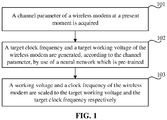
- FIG. 1 is a flowchart showing a method for adjusting a wireless modem, according to some embodiments of the present disclosure. As shown in FIG. 1 , the method may include the following steps.
- Step 101 a channel parameter of the wireless modem at a present moment is acquired.
- the wireless modem performs data transmission in a transmission environment (i.e., a wireless channel) at the present moment.
- the wireless modem may acquire the channel parameter capable of reflecting channel quality at the present moment in real time. For example, strength of a desired signal, strength of an interference signal (which may include noise and interference), and strength of a reference signal (pilot signal) and the like may be measured according to various signals (for example, a pilot signal and an answer signal) received by the wireless modem, thereby obtaining the channel parameter.
- the channel parameter may include, but not limited to, for example, at least one of a channel bandwidth, signal strength, an SNR, RSRP, an uplink/downlink resource scheduling strategy, a modulation mode, a coding mode or a transport block size.
- Step 102 a target clock frequency and a target working voltage of the wireless modem are generated, according to the channel parameter, by using a neural network which is pre-trained.
- Step 103 a working voltage and a clock frequency of the wireless modem are adjusted to the target working voltage and the target clock frequency respectively.
- the target clock frequency and target working voltage, adapted to the channel at the present moment, of the wireless modem may be determined according to the channel parameter and the neural network which is pre-trained.
- the target clock frequency and the target working voltage are an optimal clock frequency and an optimal working voltage of the wireless modem on the premise that a preset performance condition (for example, a bit error rate is less than a threshold value of a bit error rate, or a packet loss rate is less than a threshold value of a packet loss rate, or a transmission success rate is greater than a threshold value of a transmission success rate) is met, and the target clock frequency and the target working voltage may also be understood as a minimum clock frequency and a minimum working voltage.
- the neural network may be a neural network which is trained according to a preset sample input set, and may determine target clock frequencies and target working voltages corresponding to different channel parameters according to different channel parameters.
- the sample input set may be acquired in a manner of simulating various combinations of the channel parameters by simulation software and recording the target clock frequencies and target working voltages, corresponding to the different channel parameters, of the wireless modem on the premise that the preset performance condition is met.
- the neural network is trained by using various channel parameters as the sample input set (i.e., input of the neural network) and by using the target clock frequencies and the target working voltages corresponding to the different channel parameters as a sample output set (i.e., output of the neural network).
- the neural network may be, for example, a Convolutional Neural Network (CNN). It is to be noted that the CNN is only an example of the neural network in the embodiment of the present disclosure and the present disclosure is not limited thereto but may involve other neural networks.
- CNN Convolutional Neural Network
- the clock frequency of the wireless modem is adjusted to the target clock frequency
- the working voltage of the wireless modem is adjusted to the target working voltage.
- the target clock frequency and the target working voltage which are determined by the neural network are the optimal clock frequency and optimal working voltage that the wireless modem may reach on the premise that the preset performance condition is met during data transmission on a channel indicated by the channel parameters at the present moment. That is, the target clock frequency and the target working voltage which are determined by the neural network are the minimum clock frequency and the minimum working voltage that are determined in real time according to the channel parameter and that the wireless modem may reach, so that the adjusting accuracy of clock frequency and working voltage may be improved, and power consumption of the wireless modem may be reduced.
- the preset performance condition may include, but not limited to, for example, that the bit error rate is less than a threshold value of the bit error rate, or the packet loss rate is less than a threshold value of the packet loss rate, or the transmission success rate is greater than a threshold value of the transmission success rate, etc.
- the working voltage and clock frequency of the wireless modem in Step 103 may be understood as a total working voltage and a total clock frequency of the wireless modem.
- the total working voltage may be a power supply voltage of the wireless modem
- the total clock frequency may be equal to a clock frequency of a processor of the wireless modem.
- the channel parameter of the wireless modem at the present moment is acquired at first; then the target clock frequency and the target working voltage of the wireless modem are generated, according to the channel parameter, by using the neural network which is pre-trained; and finally the working voltage and clock frequency of the wireless modem are adjusted to the target working voltage and the target clock frequency respectively.
- the clock frequency and the working voltage of the wireless modem may be adjusted in real time according to a state of the wireless channel, so that the adjusting accuracy is improved, and the power consumption is reduced.
- the wireless modem usually includes multiple function modules and, for example, may include function modules such as the processor, a memory, a digital baseband processing module, a filter, an equalizer, a modulation module, a demodulation module, a coder and a decoder.
- Each function module may be a group of Application Specific Integrated Circuits (ASICs) and also correspondingly has a corresponding clock frequency and a corresponding working voltage.
- ASICs Application Specific Integrated Circuits
- the clock frequencies and the working voltage of each function module may also be adjusted respectively according to the method for adjusting the wireless modem disclosed in the present disclosure.
- the channel parameter may be used as input of the neural network to acquire at least one target clock frequency and at least one target working voltage which are outputted by the neural network and are corresponding to at least one of the multiple function modules.
- the corresponding sample input set for training the neural network may include various parameters
- the sample output set may include the at least one target clock frequency and at least one target working voltage, corresponding to various channel parameters, of the at least one function module on the premise that the preset performance condition is met.
- the at least one function module may include all function modules of the wireless modem and may also include part of function modules or a certain module of the wireless modem.
- an implementation mode of Step 103 may be as follows.
- a clock frequency of each of the at least one function module is adjusted to the target clock frequency which is outputted by the neural network and is corresponding to the function module, and a working voltage of each of the at least one function module is adjusted to the target working voltage which is outputted by the neural network and is corresponding to the function module.
- the neural network may determine respectively each target clock frequency and each target working voltage, corresponding to different channel parameters, of each function module according to different channel parameters. Therefore, adjusting the clock frequency of each of various function modules to the target clock frequency corresponding to the function module and adjusting the working voltage of the function module to the target working voltage corresponding to the function module may be implemented in real time according to different channel parameters, to further improve the adjusting accuracy of the clock frequency and working voltage and further reduce the power consumption of the wireless modem.
- the neural network in the embodiment may include an input layer, a convolutional layer, a feedback layer, a fully connected layer and an output layer.
- the channel parameter is input as a characteristic vector sequence into the input layer at first; a convolutional-layer characteristic is extracted from the characteristic vector sequence via the convolutional layer; a present feedback-layer characteristic is extracted from the convolutional layer via the feedback layer in combination with a previous feedback-layer characteristic and a next feedback-layer characteristic; the feedback-layer characteristic is abstractly process via the fully connected layer to generate the target working voltage and the target clock frequency; and finally the target working voltage and the target clock frequency are outputted via the output layer.
- FIG. 2 is a flowchart showing steps for training neural network, according to some embodiments of the present disclosure. As shown in FIG. 2 , the neural network is pre-trained through the following steps.
- Step 104 a sample input set and an associated sample output set are acquired, each sample input of the sample input set including a group of channel parameters which are preset for the wireless modem, each sample output of the associated sample output set including a sample working voltage and a sample clock frequency of the wireless modem which operates under a corresponding group of channel parameters, and the sample working voltage and the sample clock frequency being a target working voltage and a target clock frequency of the wireless modem when a preset performance condition is met.
- Step 105 the neural network is trained by using the group of channel parameters included in each sample input as the input of the neural network and by using the sample working voltage and the sample clock frequency included in the sample output associated with each sample input as output of the neural network.
- the sample input set (which may be understood as a sample dataset for constructing the neural network) and the associated sample output set may be acquired in advance.
- the sample input set includes an input parameter of the neural network
- the sample output set includes an output parameter of the neural network.
- a purpose of the neural network which is generated by using the sample input set is that the output of the neural network may be matched with the sample output set when the input of the neural network is the sample input set.
- Each sample input of the sample input set may be a group of channel parameters which are preset for the wireless modem, namely the sample input set may include multiple groups of channel parameters.
- Each group of channel parameters may include multiple channel parameters.
- a group of channel parameters may include the channel bandwidth, the signal strength, the SNR scheduling strategy and the like, namely the channel bandwidth, the signal strength, the SNR scheduling strategy form a vector I.
- Each sample output of the associated sample output set may include a combination of the sample working voltage v and the sample clock frequency f of the wireless modem which operates under a corresponding group of channel parameters, and the sample working voltage and the sample clock frequency are the target working voltage and the target clock frequency of the wireless modem when the preset performance condition is met, i.e., an optimal working voltage and an optimal clock frequency of the wireless modem when the preset performance condition is met.
- the wireless modem including, for example, the multiple function modules, a selection rule for the sample output set may include that: at first, under the condition that a group of channel parameters is given, both the clock frequency and the working voltage of each function module of the wireless modem are set to be maximum values, and in such case, a performance index (which may be, for example, the bit error rate, the packet loss rate and the transmission success rate) of the wireless modem is optimal; and then, for a certain function module, the clock frequency and the working voltage of the function module are gradually reduced according to a preset step length until the performance index of the wireless modem (or a performance index of the function module) does not meet the preset performance condition, and in such case, the clock frequency and the working voltage are the sample clock frequency and the sample working voltage corresponding to the function module, i.e., the sample clock frequency and the sample working voltage of the function module under the condition of the group of channel parameters.
- the same operations are executed for each function module of the wireless modem to obtain the corresponding sample clock frequencies and the corresponding
- training of the neural network may be executed before adjusting the wireless modem and may also be executed after adjusting the wireless modem or executed in a adjusting process of the wireless modem, namely the neural network may be pre-trained and may also be regulated in a data transmission process of the wireless modem.
- An execution sequence is not limited in the present disclosure.
- FIG. 3 is another flowchart showing steps for training neural network, according to some embodiments of the present disclosure. As shown in FIG. 3 , Step 105 may be implemented through the following steps.
- a first channel parameter is used as input of an initial neural network to acquire output of the initial neural network, the first channel parameter being any group of channel parameters of the multiple groups of channel parameters.
- Step 1052 the output of the initial neural network is compared with a first sample output to correct a parameter of at least one neuron of the initial neural network, the first sample output being a sample working voltage and a sample clock frequency of the wireless modem which operates under the first channel parameter.
- the initial neural network may be preselected at first (for example, a class, depth and the like of the neural network may be selected according to a requirement); the first channel parameter is used as the input of the initial neural network to acquire the output of the initial neural network; the output of the initial neural network is compared with the first sample output; and the parameter of the at least one neuron of the initial neural network is corrected according to a difference value between the output of the initial neural network and the output of the first sample output.
- the first channel parameter is any group of channel parameters of the multiple groups of channel parameters
- the first sample output is the sample working voltage and the sample clock frequency of the wireless modem which operates under the first channel parameter
- the parameter of the neuron may be, for example, a weight and bias of the neuron.
- Step 1053 Step 1051 to Step 1052 are repeatedly executed until the initial neural network meets a preset condition.
- Step 1054 the initial neural network meeting the preset condition is used as the neural network.
- Step 1051 to Step 1052 are repeatedly executed to ensure that, when the input of the initial neural network is a certain channel parameter, the output of the initial neural network may be matched with a sample output corresponding to the channel parameter, and when the initial neural network meets the preset condition, the initial neural network is used as the neural network.
- the preset condition may be that, when the input of the initial neural network is any of channel parameter of the sample input set, the output of the initial neural network may be consistent with the sample output corresponding to the channel parameter of the sample output set, or a difference value between the output of the neural network and the sample output corresponding to the channel parameter of the sample output set may be less than a preset threshold value.
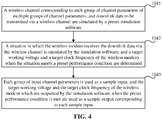
- FIG. 4 is another flowchart showing steps for training neural network, according to some embodiments of the present disclosure. As shown in FIG. 4 , an implementation mode of Step 104 may include the following steps.
- Step 1041 a wireless channel corresponding to each group of channel parameters of multiple groups of channel parameters, and downlink data to be transmitted via the wireless channel are simulated by a preset simulation software.
- Step 1042 a situation in which the wireless modem receives the downlink data via the wireless channel is simulated by the simulation software, and the target working voltage and the target clock frequency of the wireless modem when the situation meets the preset performance condition are determined.
- each group of input channel parameters is used as a sample input, and the target working voltage and the target clock frequency of the wireless modem which are outputted by the simulation software when the preset performance condition is met are used as a sample output corresponding to each sample input.
- the sample input set and the associated sample output set may be acquired in a manner of simulating the multiple groups of channel parameters by the simulation software and then simulating the downlink data to be transmitted under the condition of the multiple groups of channel parameters, to acquire the multiple groups of sample outputs corresponding to the multiple groups of channel parameters (i.e., the sample clock frequencies and sample working voltages corresponding to the multiple groups of channel parameters) on the premise that the wireless modem meets the preset performance condition (for example, the bit error rate is less than a threshold value of the bit error rate).
- the preset performance condition for example, the bit error rate is less than a threshold value of the bit error rate
- the wireless modem may also perform data transmission on a practical wireless channel, and the multiple groups of channel parameters for working of the wireless modem and the multiple groups of corresponding sample outputs are acquired by using an external device or instrument according to a preset acquisition frequency within a period of time.
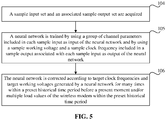
- FIG. 5 is another flowchart showing steps for training neural network, according to some embodiments of the present disclosure. As shown in FIG. 5 , after Step 105, the neural network is further corrected through the following step.
- Step 106 the neural network is corrected according to the target clock frequencies and the target working voltages generated by the neural network for many times within a preset historical time period before the present moment and/or multiple load values of the wireless modem within the preset historical time period.
- the neural network may further be corrected according to statistical data in a working process of the wireless modem.
- the statistical data may include, for example, the multiple target clock frequencies and the multiple target working voltages generated by the neural network for many times and recorded according to a preset frequency within the historical time period before the present moment, and may further include the multiple load values of the wireless modem, which are recorded according to the preset frequency within the historical time period.
- the load value may be a total load value of the wireless modem and may also be a load value of each function module of the wireless modem.
- differences between the output of the neural network, and the multiple target clock frequencies and multiple target working voltages which are generated by the neural network and are recorded according to the preset frequency within the historical time period are calculated as reverse weights to correct the neural network, to improve a matching degree between the neural network and the wireless channel, further to improve adjusting accuracy of the clock frequency and working voltage and further to reduce the power consumption of the wireless modem.
- the channel parameter of the wireless modem at the present moment is acquired at first, then the target clock frequency and the target working voltage of the wireless modem are generated, according to the channel parameter, by using the neural network which is pre-trained, and finally the working voltage and clock frequency of the wireless modem are adjusted to the target working voltage and the target clock frequency respectively.
- the clock frequency and working voltage of the wireless modem may be adjusted in real time according to a state of the wireless channel, so that the adjusting accuracy is improved, and the power consumption is reduced.
- FIG. 6 is a block diagram of a device for adjusting a wireless modem, according to some embodiments of the present disclosure. As shown in FIG. 6 , the following modules are included.
- An acquisition module 201 is configured to acquire a channel parameter of the wireless modem at a present moment.
- a processing module 202 is configured to generate a target clock frequency and a target working voltage of the wireless modem, according to the channel parameter, by using a neural network which is pre-trained.
- An adjusting module 203 is configured to adjust a working voltage and a clock frequency of the wireless modem to the target working voltage and the target clock frequency respectively.
- the channel parameter may include at least one of: a channel bandwidth, signal strength, an SNR, RSRP, an uplink/downlink resource scheduling strategy, a modulation mode, a coding mode or a transport block size.
- the processing module 202 may be configured to execute the following step: the channel parameter is used as input of the neural network to acquire at least one target clock frequency and at least one target working voltage which are outputted by the neural network and are corresponding to at least one of the multiple function modules.
- the adjusting module 203 may be configured to execute the following step: a clock frequency of each of the at least one function module is adjusted to the target clock frequency which is outputted by the neural network and is corresponding to the function module, and a working voltage of each of the at least one function module is adjusted to the target working voltage which is outputted by the neural network and is corresponding to the function module.
- the neural network is pre-trained through the following steps.
- Step A) a sample input set and an associated sample output set are acquired, each sample input of the sample input set including a group of channel parameters which are preset for the wireless modem, each sample output of the associated sample output set including a sample working voltage and a sample clock frequency of the wireless modem which operates under a corresponding group of channel parameters, and the sample working voltage and the sample clock frequency being a target working voltage and a target clock frequency of the wireless modem when a preset performance condition is met.
- Step B the neural network is trained by using the group of channel parameters included in each sample input as the input of the neural network and by using the sample working voltage and the sample clock frequency included in the sample output associated with each sample input as output of the neural network.
- Step B) may be implemented through the following steps.
- a first channel parameter is used as input of an initial neural network to acquire output of the initial neural network, the first channel parameter being any group of channel parameters of the multiple groups of channel parameters.
- the output of the initial neural network is compared with a first sample output to correct a parameter of at least one neuron of the initial neural network, the first sample output being a sample working voltage and a sample clock frequency of the wireless modem which operates under the first channel parameter.
- Steps 1) to 2) are repeatedly executed until the initial neural network meets a preset condition.
- the initial neural network meeting the preset condition is used as the neural network.
- Step A) may be implemented through the following steps.
- a wireless channel corresponding to each group of channel parameters of multiple groups of channel parameters, and downlink data to be transmitted via the wireless channel are simulated by a preset simulation software.
- a situation in which the wireless modem receives the downlink data via the wireless channel is simulated by the simulation software, and the target working voltage and the target clock frequency of the wireless modem when the situation meets the preset performance condition are determined.
- each group of input channel parameters is used as a sample input, and the target working voltage and the target clock frequency of the wireless modem which are outputted by the simulation software when the preset performance condition is met are used as a sample output corresponding to each sample input.
- the neural network is further corrected through the following step.
- Step C the neural network is corrected according to the target clock frequencies and the target working voltages generated by the neural network for many times within a preset historical time period before the present moment and/or multiple load values of the wireless modem within the preset historical time period.
- the channel parameter of the wireless modem at the present moment is acquired at first, then the target clock frequency and target working voltage of the wireless modem are generated, according to the channel parameter, by using the neural network which is pre-trained, and finally the working voltage and clock frequency of the wireless modem are adjusted to the target working voltage and the target clock frequency respectively.
- the clock frequency and working voltage of the wireless modem may be adjusted in real time according to a state of the wireless channel, so that adjusting accuracy is improved, and power consumption is reduced.
- FIG. 7 is a block diagram of an electronic device 300, according to some embodiments of the present disclosure.
- the electronic device 300 may include a processor 301 and a memory 302.
- the electronic device 300 may further include one or more of a multimedia component 303, an Input/Output (I/O) interface 304 and a communication component 305.
- I/O Input/Output
- the processor 301 is configured to control overall operations of the electronic device 300 to complete all or part of the steps in the method for adjusting wireless modem.
- the memory 302 is configured to store various types of data to support the operation of the electronic device 400. Examples of such data include instructions for any application programs or methods operated on the electronic device 400 and data related to the application programs, for example, contact data, transmitted and received messages, pictures, audio, video, etc..
- the memory 302 may be implemented by any type of volatile or non-volatile memory devices, or a combination thereof, such as a Static Random Access Memory (SRAM), an Electrically Erasable Programmable Read-Only Memory (EEPROM), an Erasable Programmable Read-Only Memory (EPROM), a Programmable Read-Only Memory (PROM), a Read-Only Memory (ROM), a magnetic memory, a flash memory, and a magnetic or optical disk.
- the multimedia component 303 may include a screen and an audio component.
- the screen may be, for example, a touch screen, and the audio component is configured to output and/or input an audio signal.
- the audio component may include a microphone, and the microphone is configured to receive an external audio signal.
- the received audio signal may further be stored in the memory 302 or sent through the communication component 305.
- the audio component further includes at least one speaker configured to output the audio signal.
- the I/O interface 304 provides an interface between the processor 301 and another interface module, and the other interface module may be a keyboard, a mouse, a button and the like. These buttons may be virtual buttons or physical buttons.
- the communication component 305 is configured for wired or wireless communication between the electronic device 300 and another device.
- Wireless communication is, for example, Wireless Fidelity (Wi-Fi), Bluetooth, Near Field Communication (NFC), 2nd-Generation (2G), 3rd-Generation (3G) or 4th-Generation (4G) or one or combination of multiple therein, and thus the communication component 305 may correspondingly include a Wi-Fi module, a Bluetooth module, an NFC module and the like.
- Wi-Fi Wireless Fidelity
- NFC Near Field Communication
- 2G 2nd-Generation
- 3G 3rd-Generation
- 4G 4th-Generation
- the electronic device 300 may be implemented by one or more Application Specific Integrated Circuit (ASICs), Digital Signal Processors (DSPs), Digital Signal Processing Devices (DSPDs), Programmable Logic Devices (PLDs), Field Programmable Gate Arrays (FPGAs), controllers, micro-controllers, microprocessors or other electronic components, and is configured to execute the method for adjusting wireless modem.
- ASICs Application Specific Integrated Circuit
- DSPs Digital Signal Processors
- DSPDs Digital Signal Processing Devices
- PLDs Programmable Logic Devices
- FPGAs Field Programmable Gate Arrays
- controllers micro-controllers, microprocessors or other electronic components, and is configured to execute the method for adjusting wireless modem.
- Another exemplary embodiment also provides a computer-readable storage medium including a program instruction, the program instruction being executed by a processor to implement the steps of the method for adjusting wireless modem.
- the computer-readable storage medium may be the memory 302 including the program instruction, and the program instruction may be executed by the processor 301 of the electronic device 300 to complete method for adjusting wireless modem.
- the channel parameter of the wireless modem at the present moment is acquired at first, then the target clock frequency and the target working voltage of the wireless modem are generated, according to the channel parameter, by using the neural network which is pre-trained, and finally the working voltage and clock frequency of the wireless modem are adjusted to the target working voltage and the target clock frequency respectively.
- the clock frequency and working voltage of the wireless modem may be adjusted in real time according to a state of the wireless channel, so that adjusting accuracy is improved, and power consumption is reduced.
Landscapes
- Engineering & Computer Science (AREA)
- Theoretical Computer Science (AREA)
- Signal Processing (AREA)
- Physics & Mathematics (AREA)
- Computer Networks & Wireless Communication (AREA)
- General Engineering & Computer Science (AREA)
- General Physics & Mathematics (AREA)
- Quality & Reliability (AREA)
- Biophysics (AREA)
- Mathematical Physics (AREA)
- General Health & Medical Sciences (AREA)
- Molecular Biology (AREA)
- Computing Systems (AREA)
- Data Mining & Analysis (AREA)
- Computational Linguistics (AREA)
- Evolutionary Computation (AREA)
- Software Systems (AREA)
- Biomedical Technology (AREA)
- Artificial Intelligence (AREA)
- Life Sciences & Earth Sciences (AREA)
- Health & Medical Sciences (AREA)
- Transceivers (AREA)
- Electromagnetism (AREA)
- Mobile Radio Communication Systems (AREA)
Abstract
Description
- The present disclosure generally relates to the field of mobile terminals, and more specifically to a method and device for adjusting a wireless modem for a mobile terminal.
- With the development of mobile communication technologies, a mobile terminal has become an indispensable tool in users' daily lives. A mobile terminal is usually provided with a wireless modem for data transmission on a bandwidth-limited wireless channel. Due to portability of the mobile terminal, the wireless modem is required to be as low as possible in power consumption. A Dynamic Voltage and Frequency Scaling (DVFS) mechanism is adopted to adjust working voltages and clock frequencies of a processor and a memory, based on a state combination table or an empirical formula according to statistical data and known channel state in a working process of the wireless modem, to reduce the power consumption. However, the wireless channel changes in real time and the statistical data and the known channel state may have hysteresis, so that it is impossible to control a working voltage and a clock frequency of the wireless modem to be adjusted to an optimal state. Moreover, the empirical formula is relatively low in reliability, the adjusting accuracy of working voltage and clock frequency may further be reduced.
- A purpose of the present disclosure is to provide a method and a device for adjusting a wireless modem, to solve the problem of hysteresis and inaccuracy of adjusting a working voltage and a clock frequency in the conventional art.
- In order to achieve the purpose, according to a first aspect of embodiments of the present disclosure, there is provided a method for adjusting a wireless modem, which may include that:
- a channel parameter of the wireless modem at a present moment is acquired;
- a target clock frequency and a target working voltage of the wireless modem are generated, according to the channel parameter, by using a neural network which is pre-trained; and
- a working voltage and a clock frequency of the wireless modem are adjusted to the target working voltage and the target clock frequency respectively.
- The technical solutions provided in the embodiments of the present disclosure may have the following beneficial effects. According to the present disclosure, the channel parameter of the wireless modem at the present moment is acquired at first, then the target clock frequency and the target working voltage of the wireless modem are generated, according to the channel parameter, by using the neural network which is pre-trained, and finally the working voltage and clock frequency of the wireless modem are adjusted to the target working voltage and the target clock frequency respectively. The clock frequency and the working voltage of the wireless modem may be adjusted in real time according to a state of the wireless channel, so that adjusting accuracy is improved, and power consumption is reduced.
- According to an exemplary embodiment, the wireless modem may include multiple function modules, and the operation that the target clock frequency and the target working voltage of the wireless modem are generated, according to the channel parameter, by using the neural network which is pre-trained may include that:
- the channel parameter is used as input of the neural network to acquire at least one target clock frequency and at least one target working voltage which are outputted by the neural network and are corresponding to at least one of the multiple function modules; and
the operation that the working voltage and the clock frequency of the wireless modem are adjusted to the target working voltage and the target clock frequency respectively may include that:
a clock frequency of each of the at least one function module is adjusted to the target clock frequency which is outputted by the neural network and is corresponding to the function module, and a working voltage of each of the at least one function module is adjusted to the target working voltage which is outputted by the neural network and is corresponding to the function module. - According to an exemplary embodiment, the neural network may be pre-trained through the following steps:
- a sample input set and an associated sample output set are acquired, each sample input of the sample input set including a group of channel parameters which are preset for the wireless modem, each sample output of the associated sample output set including a sample working voltage and a sample clock frequency of the wireless modem which operates under a corresponding group of channel parameters, and the sample working voltage and the sample clock frequency being a target working voltage and a target clock frequency of the wireless modem when a preset performance condition is met; and
- the neural network is trained by using the group of channel parameters included in each sample input as the input of the neural network and by using the sample working voltage and the sample clock frequency included in the sample output associated with each sample input as output of the neural network.
- According to an exemplary embodiment, the operation that the sample input set and the associated sample output set are acquired may include that:
- a wireless channel corresponding to each group of channel parameters of multiple groups of channel parameters, and downlink data to be transmitted via the wireless channel are simulated by a preset simulation software;
- a situation in which the wireless modem receives the downlink data via the wireless channel is simulated by the simulation software, and the target working voltage and the target clock frequency of the wireless modem when the situation meets the preset performance condition are determined; and
- each group of input channel parameters is used as a sample input, and the target working voltage and the target clock frequency of the wireless modem outputted by the simulation software when the preset performance condition is met are used as a sample output corresponding to each sample input.
- According to an exemplary embodiment, after the neural network is trained by using the group of channel parameters included in each sample input as the input of the neural network and by using the sample working voltage and the sample clock frequency included in the sample output associated with each sample input as the output of the neural network, the neural network may further be corrected through the following step:
the neural network is corrected according to the target clock frequencies and the target working voltages generated by the neural network for many times within a preset historical time period before the present moment and/or multiple load values of the wireless modem within the preset historical time period. - According to an exemplary embodiment, the channel parameter may include at least one of:
a channel bandwidth, signal strength, a Signal Noise Ratio (SNR), Reference Signal Receiving Power (RSRP), an uplink/downlink resource scheduling strategy, a modulation mode, a coding mode or a transport block size. - According to a second aspect of the embodiments of the present disclosure, there is provided a device for adjusting a wireless modem, which may include:
- an acquisition module, configured to acquire a channel parameter of the wireless modem at a present moment;
- a processing module, configured to generate, according to the channel parameter, a target clock frequency and a target working voltage of the wireless modem by using a neural network which is pre-trained; and
- an adjusting module, configured to adjust a working voltage and a clock frequency of the wireless modem to the target working voltage and the target clock frequency respectively.
- The advantages and technical effects of the device according to the present disclosure correspond to those of the method presented above.
- According to an exemplary embodiment, the wireless modem may include multiple function modules;
the processing module may be configured to use the channel parameter as input of the neural network to acquire at least one target clock frequency and at least one target working voltage which are outputted by the neural network and are corresponding to at least one of the multiple function modules; and
the adjusting module may be configured to adjust a clock frequency of each of the at least one function module to the target clock frequency which is outputted by the neural network and is corresponding to the function module, and to adjust a working voltage of each of the at least one function module to the target working voltage which is outputted by the neural network and is corresponding to the function module. - According to an exemplary embodiment, the neural network may be pre-trained through the following steps:
- a sample input set and an associated sample output set are acquired, each sample input of the sample input set including a group of channel parameters which are preset for the wireless modem, each sample output of the associated sample output set including a sample working voltage and a sample clock frequency of the wireless modem which operates under a corresponding group of channel parameters, and the sample working voltage and the sample clock frequency being a target working voltage and a target clock frequency of the wireless modem when a preset performance condition is met; and
- the neural network is trained by using the group of channel parameters included in each sample input as the input of the neural network and by using the sample working voltage and the sample clock frequency included in the sample output associated with each sample input as output of the neural network.
- According to an exemplary embodiment, the sample input set and the associated sample output set may be acquired through the following steps:
- a wireless channel corresponding to each group of channel parameters of multiple groups of channel parameters, and downlink data to be transmitted via the wireless channel are simulated by a preset simulation software;
- a situation in which the wireless modem receives the downlink data via the wireless channel is simulated by the simulation software, and the target working voltage and the target clock frequency of the wireless modem when the situation meets the preset performance condition are determined; and
- each group of input channel parameters is used as a sample input, and the target working voltage and target clock frequency of the wireless modem output by the simulation software when the preset performance condition is met are used as a sample output corresponding to each sample input.
- According to an exemplary embodiment, after the neural network is trained by using the group of channel parameters included in each sample input as the input of the neural network and by using the sample working voltage and the sample clock frequency included in the sample output associated with each sample input as the output of the neural network, the neural network may further be corrected through the following step:
the neural network is corrected according to the target clock frequencies and the target working voltages generated by the neural network for many times within a preset historical time period before the present moment and/or multiple load values of the wireless modem within the preset historical time period. - According to an exemplary embodiment, the channel parameter may include at least one of:
a channel bandwidth, signal strength, an SNR, RSRP, an uplink/downlink resource scheduling strategy, a modulation mode, a coding mode or a transport block size. - According to a third aspect of the embodiments of the present disclosure, there is provided a computer-readable storage medium having stored a computer program that, when being executed by a processor, implements the steps of the method for adjusting the wireless modem provided in the first aspect.
- According to a fourth aspect of the embodiments of the present disclosure, there is provided an electronic device, which may include:
- a memory with a computer program stored therein; and
- a processor, configured to execute the computer program in the memory to implement the steps of the method for adjusting wireless modem provided in the first aspect.
- Other characteristics and advantages of the present disclosure will subsequently be described in DETAILED DESCRIPTION in detail.
- The accompanying drawings referred to in the specification are a part of this disclosure, and provide illustrative embodiments consistent with the disclosure and, together with the detailed description, serve to illustrate some embodiments of the disclosure
-
FIG. 1 is a flowchart showing a method for adjusting a wireless modem, according to some embodiments of the present disclosure. -
FIG. 2 is a flowchart showing steps for training neural network, according to some embodiments of the present disclosure. -
FIG. 3 is another flowchart showing steps for training neural network, according to some embodiments of the present disclosure. -
FIG. 4 is another flowchart showing steps for training neural network, according to some embodiments of the present disclosure. -
FIG. 5 is another flowchart showing steps for training neural network, according to some embodiments of the present disclosure. -
FIG. 6 is a block diagram of a device for adjusting a wireless modem, according to some embodiments of the present disclosure. -
FIG. 7 is a block diagram of an electronic device, according to some embodiments of the present disclosure. - Reference will now be made in detail to exemplary embodiments, examples of which are illustrated in the accompanying drawings. The following description refers to the accompanying drawings in which the same numbers in different drawings represent the same or similar elements unless otherwise represented. The implementations set forth in the following description of exemplary embodiments do not represent all implementations consistent with the present disclosure. Instead, they are merely examples of apparatuses and methods consistent with aspects related to the present disclosure as recited in the appended claims.
- Before a method and a device for adjusting a wireless modem provided in the present disclosure are introduced, an application scenario involved in each embodiment of the present disclosure will be introduced at first. The application scenario is a wireless modem in any wireless communication terminal, configured for data transmission on a wireless channel. The wireless modem may include modules such as a processor, a memory, a digital baseband processing module, a filter, an equalizer, a modulation module, a demodulation module, a coder and a decoder.
-
FIG. 1 is a flowchart showing a method for adjusting a wireless modem, according to some embodiments of the present disclosure. As shown inFIG. 1 , the method may include the following steps. - In
Step 101, a channel parameter of the wireless modem at a present moment is acquired. - For example, in a wireless communication process, the wireless modem performs data transmission in a transmission environment (i.e., a wireless channel) at the present moment. The wireless modem may acquire the channel parameter capable of reflecting channel quality at the present moment in real time. For example, strength of a desired signal, strength of an interference signal (which may include noise and interference), and strength of a reference signal (pilot signal) and the like may be measured according to various signals (for example, a pilot signal and an answer signal) received by the wireless modem, thereby obtaining the channel parameter. Here, the channel parameter may include, but not limited to, for example, at least one of a channel bandwidth, signal strength, an SNR, RSRP, an uplink/downlink resource scheduling strategy, a modulation mode, a coding mode or a transport block size.
- In
Step 102, a target clock frequency and a target working voltage of the wireless modem are generated, according to the channel parameter, by using a neural network which is pre-trained. - In
Step 103, a working voltage and a clock frequency of the wireless modem are adjusted to the target working voltage and the target clock frequency respectively. - Exemplarily, after the channel parameter is acquired, the target clock frequency and target working voltage, adapted to the channel at the present moment, of the wireless modem may be determined according to the channel parameter and the neural network which is pre-trained. The target clock frequency and the target working voltage are an optimal clock frequency and an optimal working voltage of the wireless modem on the premise that a preset performance condition (for example, a bit error rate is less than a threshold value of a bit error rate, or a packet loss rate is less than a threshold value of a packet loss rate, or a transmission success rate is greater than a threshold value of a transmission success rate) is met, and the target clock frequency and the target working voltage may also be understood as a minimum clock frequency and a minimum working voltage. The neural network may be a neural network which is trained according to a preset sample input set, and may determine target clock frequencies and target working voltages corresponding to different channel parameters according to different channel parameters. The sample input set may be acquired in a manner of simulating various combinations of the channel parameters by simulation software and recording the target clock frequencies and target working voltages, corresponding to the different channel parameters, of the wireless modem on the premise that the preset performance condition is met. The neural network is trained by using various channel parameters as the sample input set (i.e., input of the neural network) and by using the target clock frequencies and the target working voltages corresponding to the different channel parameters as a sample output set (i.e., output of the neural network). Exemplarily, the neural network may be, for example, a Convolutional Neural Network (CNN). It is to be noted that the CNN is only an example of the neural network in the embodiment of the present disclosure and the present disclosure is not limited thereto but may involve other neural networks.
- After the target clock frequency and the target working voltage are acquired, the clock frequency of the wireless modem is adjusted to the target clock frequency, and the working voltage of the wireless modem is adjusted to the target working voltage. The target clock frequency and the target working voltage which are determined by the neural network are the optimal clock frequency and optimal working voltage that the wireless modem may reach on the premise that the preset performance condition is met during data transmission on a channel indicated by the channel parameters at the present moment. That is, the target clock frequency and the target working voltage which are determined by the neural network are the minimum clock frequency and the minimum working voltage that are determined in real time according to the channel parameter and that the wireless modem may reach, so that the adjusting accuracy of clock frequency and working voltage may be improved, and power consumption of the wireless modem may be reduced. The preset performance condition may include, but not limited to, for example, that the bit error rate is less than a threshold value of the bit error rate, or the packet loss rate is less than a threshold value of the packet loss rate, or the transmission success rate is greater than a threshold value of the transmission success rate, etc.
- It is to be noted that the working voltage and clock frequency of the wireless modem in
Step 103 may be understood as a total working voltage and a total clock frequency of the wireless modem. For example, the total working voltage may be a power supply voltage of the wireless modem, and the total clock frequency may be equal to a clock frequency of a processor of the wireless modem. - From the above, according to the present disclosure, the channel parameter of the wireless modem at the present moment is acquired at first; then the target clock frequency and the target working voltage of the wireless modem are generated, according to the channel parameter, by using the neural network which is pre-trained; and finally the working voltage and clock frequency of the wireless modem are adjusted to the target working voltage and the target clock frequency respectively. The clock frequency and the working voltage of the wireless modem may be adjusted in real time according to a state of the wireless channel, so that the adjusting accuracy is improved, and the power consumption is reduced.
- Furthermore, during a practical application, the wireless modem usually includes multiple function modules and, for example, may include function modules such as the processor, a memory, a digital baseband processing module, a filter, an equalizer, a modulation module, a demodulation module, a coder and a decoder. Each function module may be a group of Application Specific Integrated Circuits (ASICs) and also correspondingly has a corresponding clock frequency and a corresponding working voltage. In an existing DVFS mechanism, only the clock frequencies and working voltages of the processor and memory of the wireless modem may be adjusted and the clock frequencies and working voltages of the other function modules may not be adjusted, which increases the power consumption of the wireless modem. Therefore, for each function module of the wireless modem, the clock frequency and the working voltage of each function module may also be adjusted respectively according to the method for adjusting the wireless modem disclosed in the present disclosure.
- For example, in
Step 102, the channel parameter may be used as input of the neural network to acquire at least one target clock frequency and at least one target working voltage which are outputted by the neural network and are corresponding to at least one of the multiple function modules. - When the wireless modem includes the multiple function modules, the corresponding sample input set for training the neural network may include various parameters, and the sample output set may include the at least one target clock frequency and at least one target working voltage, corresponding to various channel parameters, of the at least one function module on the premise that the preset performance condition is met. The at least one function module may include all function modules of the wireless modem and may also include part of function modules or a certain module of the wireless modem.
- Correspondingly, if the neural network may output the target clock frequency and the target working voltage which are corresponding to the at least one function module, an implementation mode of
Step 103 may be as follows. - A clock frequency of each of the at least one function module is adjusted to the target clock frequency which is outputted by the neural network and is corresponding to the function module, and a working voltage of each of the at least one function module is adjusted to the target working voltage which is outputted by the neural network and is corresponding to the function module.
- When the wireless modem includes the multiple function modules, the neural network may determine respectively each target clock frequency and each target working voltage, corresponding to different channel parameters, of each function module according to different channel parameters. Therefore, adjusting the clock frequency of each of various function modules to the target clock frequency corresponding to the function module and adjusting the working voltage of the function module to the target working voltage corresponding to the function module may be implemented in real time according to different channel parameters, to further improve the adjusting accuracy of the clock frequency and working voltage and further reduce the power consumption of the wireless modem.
- It is to be noted that the neural network in the embodiment may include an input layer, a convolutional layer, a feedback layer, a fully connected layer and an output layer. The channel parameter is input as a characteristic vector sequence into the input layer at first; a convolutional-layer characteristic is extracted from the characteristic vector sequence via the convolutional layer; a present feedback-layer characteristic is extracted from the convolutional layer via the feedback layer in combination with a previous feedback-layer characteristic and a next feedback-layer characteristic; the feedback-layer characteristic is abstractly process via the fully connected layer to generate the target working voltage and the target clock frequency; and finally the target working voltage and the target clock frequency are outputted via the output layer.
-
FIG. 2 is a flowchart showing steps for training neural network, according to some embodiments of the present disclosure. As shown inFIG. 2 , the neural network is pre-trained through the following steps. - In
Step 104, a sample input set and an associated sample output set are acquired, each sample input of the sample input set including a group of channel parameters which are preset for the wireless modem, each sample output of the associated sample output set including a sample working voltage and a sample clock frequency of the wireless modem which operates under a corresponding group of channel parameters, and the sample working voltage and the sample clock frequency being a target working voltage and a target clock frequency of the wireless modem when a preset performance condition is met. - In
Step 105, the neural network is trained by using the group of channel parameters included in each sample input as the input of the neural network and by using the sample working voltage and the sample clock frequency included in the sample output associated with each sample input as output of the neural network. - For example, for obtaining the neural network capable of determining the target clock frequencies and target working voltages corresponding to different channel parameters according to different channel parameters, the sample input set (which may be understood as a sample dataset for constructing the neural network) and the associated sample output set may be acquired in advance. The sample input set includes an input parameter of the neural network, and the sample output set includes an output parameter of the neural network. A purpose of the neural network which is generated by using the sample input set is that the output of the neural network may be matched with the sample output set when the input of the neural network is the sample input set. Each sample input of the sample input set may be a group of channel parameters which are preset for the wireless modem, namely the sample input set may include multiple groups of channel parameters. Each group of channel parameters may include multiple channel parameters. For example, a group of channel parameters may include the channel bandwidth, the signal strength, the SNR scheduling strategy and the like, namely the channel bandwidth, the signal strength, the SNR scheduling strategy form a vector I. Each sample output of the associated sample output set may include a combination of the sample working voltage v and the sample clock frequency f of the wireless modem which operates under a corresponding group of channel parameters, and the sample working voltage and the sample clock frequency are the target working voltage and the target clock frequency of the wireless modem when the preset performance condition is met, i.e., an optimal working voltage and an optimal clock frequency of the wireless modem when the preset performance condition is met. The operation that the neural network is generated according to the multiple groups of channel parameters I and the multiple groups of sample working voltages v and the sample clock frequencies f may be understood as that a function F is determined to ensure F(I)=(f, v).
- Exemplarily, the wireless modem including, for example, the multiple function modules, a selection rule for the sample output set may include that: at first, under the condition that a group of channel parameters is given, both the clock frequency and the working voltage of each function module of the wireless modem are set to be maximum values, and in such case, a performance index (which may be, for example, the bit error rate, the packet loss rate and the transmission success rate) of the wireless modem is optimal; and then, for a certain function module, the clock frequency and the working voltage of the function module are gradually reduced according to a preset step length until the performance index of the wireless modem (or a performance index of the function module) does not meet the preset performance condition, and in such case, the clock frequency and the working voltage are the sample clock frequency and the sample working voltage corresponding to the function module, i.e., the sample clock frequency and the sample working voltage of the function module under the condition of the group of channel parameters. The same operations are executed for each function module of the wireless modem to obtain the corresponding sample clock frequencies and the corresponding sample working voltages, corresponding to the group of channel parameters, of all the function modules.
- It is to be noted that training of the neural network (i.e.,
Step 104 to Step 105) may be executed before adjusting the wireless modem and may also be executed after adjusting the wireless modem or executed in a adjusting process of the wireless modem, namely the neural network may be pre-trained and may also be regulated in a data transmission process of the wireless modem. An execution sequence is not limited in the present disclosure. -
FIG. 3 is another flowchart showing steps for training neural network, according to some embodiments of the present disclosure. As shown inFIG. 3 ,Step 105 may be implemented through the following steps. - In
Step 1051, a first channel parameter is used as input of an initial neural network to acquire output of the initial neural network, the first channel parameter being any group of channel parameters of the multiple groups of channel parameters. - In
Step 1052, the output of the initial neural network is compared with a first sample output to correct a parameter of at least one neuron of the initial neural network, the first sample output being a sample working voltage and a sample clock frequency of the wireless modem which operates under the first channel parameter. - For example, for generating the neural network, the initial neural network may be preselected at first (for example, a class, depth and the like of the neural network may be selected according to a requirement); the first channel parameter is used as the input of the initial neural network to acquire the output of the initial neural network; the output of the initial neural network is compared with the first sample output; and the parameter of the at least one neuron of the initial neural network is corrected according to a difference value between the output of the initial neural network and the output of the first sample output. The first channel parameter is any group of channel parameters of the multiple groups of channel parameters, the first sample output is the sample working voltage and the sample clock frequency of the wireless modem which operates under the first channel parameter, and the parameter of the neuron may be, for example, a weight and bias of the neuron.
- In
Step 1053,Step 1051 to Step 1052 are repeatedly executed until the initial neural network meets a preset condition. - In
Step 1054, the initial neural network meeting the preset condition is used as the neural network. - Exemplarily,
Step 1051 to Step 1052 are repeatedly executed to ensure that, when the input of the initial neural network is a certain channel parameter, the output of the initial neural network may be matched with a sample output corresponding to the channel parameter, and when the initial neural network meets the preset condition, the initial neural network is used as the neural network. The preset condition may be that, when the input of the initial neural network is any of channel parameter of the sample input set, the output of the initial neural network may be consistent with the sample output corresponding to the channel parameter of the sample output set, or a difference value between the output of the neural network and the sample output corresponding to the channel parameter of the sample output set may be less than a preset threshold value. -
FIG. 4 is another flowchart showing steps for training neural network, according to some embodiments of the present disclosure. As shown inFIG. 4 , an implementation mode ofStep 104 may include the following steps. - In
Step 1041, a wireless channel corresponding to each group of channel parameters of multiple groups of channel parameters, and downlink data to be transmitted via the wireless channel are simulated by a preset simulation software. - In
Step 1042, a situation in which the wireless modem receives the downlink data via the wireless channel is simulated by the simulation software, and the target working voltage and the target clock frequency of the wireless modem when the situation meets the preset performance condition are determined. - In
Step 1043, each group of input channel parameters is used as a sample input, and the target working voltage and the target clock frequency of the wireless modem which are outputted by the simulation software when the preset performance condition is met are used as a sample output corresponding to each sample input. - For example, the sample input set and the associated sample output set may be acquired in a manner of simulating the multiple groups of channel parameters by the simulation software and then simulating the downlink data to be transmitted under the condition of the multiple groups of channel parameters, to acquire the multiple groups of sample outputs corresponding to the multiple groups of channel parameters (i.e., the sample clock frequencies and sample working voltages corresponding to the multiple groups of channel parameters) on the premise that the wireless modem meets the preset performance condition (for example, the bit error rate is less than a threshold value of the bit error rate). The wireless modem may also perform data transmission on a practical wireless channel, and the multiple groups of channel parameters for working of the wireless modem and the multiple groups of corresponding sample outputs are acquired by using an external device or instrument according to a preset acquisition frequency within a period of time.
-
FIG. 5 is another flowchart showing steps for training neural network, according to some embodiments of the present disclosure. As shown inFIG. 5 , afterStep 105, the neural network is further corrected through the following step. - In
Step 106, the neural network is corrected according to the target clock frequencies and the target working voltages generated by the neural network for many times within a preset historical time period before the present moment and/or multiple load values of the wireless modem within the preset historical time period. - For example, after the neural network is generated in
Step 105, the neural network may further be corrected according to statistical data in a working process of the wireless modem. The statistical data may include, for example, the multiple target clock frequencies and the multiple target working voltages generated by the neural network for many times and recorded according to a preset frequency within the historical time period before the present moment, and may further include the multiple load values of the wireless modem, which are recorded according to the preset frequency within the historical time period. The load value may be a total load value of the wireless modem and may also be a load value of each function module of the wireless modem. For example, when the channel parameter at the present moment is used as the input of the neural network, differences between the output of the neural network, and the multiple target clock frequencies and multiple target working voltages which are generated by the neural network and are recorded according to the preset frequency within the historical time period are calculated as reverse weights to correct the neural network, to improve a matching degree between the neural network and the wireless channel, further to improve adjusting accuracy of the clock frequency and working voltage and further to reduce the power consumption of the wireless modem. - From the above, according to the present disclosure, the channel parameter of the wireless modem at the present moment is acquired at first, then the target clock frequency and the target working voltage of the wireless modem are generated, according to the channel parameter, by using the neural network which is pre-trained, and finally the working voltage and clock frequency of the wireless modem are adjusted to the target working voltage and the target clock frequency respectively. The clock frequency and working voltage of the wireless modem may be adjusted in real time according to a state of the wireless channel, so that the adjusting accuracy is improved, and the power consumption is reduced.
-
FIG. 6 is a block diagram of a device for adjusting a wireless modem, according to some embodiments of the present disclosure. As shown inFIG. 6 , the following modules are included. - An
acquisition module 201 is configured to acquire a channel parameter of the wireless modem at a present moment. - A
processing module 202 is configured to generate a target clock frequency and a target working voltage of the wireless modem, according to the channel parameter, by using a neural network which is pre-trained. - An
adjusting module 203 is configured to adjust a working voltage and a clock frequency of the wireless modem to the target working voltage and the target clock frequency respectively. - According to an exemplary embodiment, the channel parameter may include at least one of:
a channel bandwidth, signal strength, an SNR, RSRP, an uplink/downlink resource scheduling strategy, a modulation mode, a coding mode or a transport block size. - Furthermore, when the wireless modem includes multiple function modules, the
processing module 202 may be configured to execute the following step:
the channel parameter is used as input of the neural network to acquire at least one target clock frequency and at least one target working voltage which are outputted by the neural network and are corresponding to at least one of the multiple function modules. - The adjusting
module 203 may be configured to execute the following step:
a clock frequency of each of the at least one function module is adjusted to the target clock frequency which is outputted by the neural network and is corresponding to the function module, and a working voltage of each of the at least one function module is adjusted to the target working voltage which is outputted by the neural network and is corresponding to the function module. - According to an exemplary embodiment, the neural network is pre-trained through the following steps.
- In Step A), a sample input set and an associated sample output set are acquired, each sample input of the sample input set including a group of channel parameters which are preset for the wireless modem, each sample output of the associated sample output set including a sample working voltage and a sample clock frequency of the wireless modem which operates under a corresponding group of channel parameters, and the sample working voltage and the sample clock frequency being a target working voltage and a target clock frequency of the wireless modem when a preset performance condition is met.
- In Step B), the neural network is trained by using the group of channel parameters included in each sample input as the input of the neural network and by using the sample working voltage and the sample clock frequency included in the sample output associated with each sample input as output of the neural network.
- Step B) may be implemented through the following steps.
- In 1), a first channel parameter is used as input of an initial neural network to acquire output of the initial neural network, the first channel parameter being any group of channel parameters of the multiple groups of channel parameters.
- In 2), the output of the initial neural network is compared with a first sample output to correct a parameter of at least one neuron of the initial neural network, the first sample output being a sample working voltage and a sample clock frequency of the wireless modem which operates under the first channel parameter.
- Steps 1) to 2) are repeatedly executed until the initial neural network meets a preset condition. The initial neural network meeting the preset condition is used as the neural network.
- According to an exemplary embodiment, Step A) may be implemented through the following steps.
- In 3), a wireless channel corresponding to each group of channel parameters of multiple groups of channel parameters, and downlink data to be transmitted via the wireless channel are simulated by a preset simulation software.
- In 4), a situation in which the wireless modem receives the downlink data via the wireless channel is simulated by the simulation software, and the target working voltage and the target clock frequency of the wireless modem when the situation meets the preset performance condition are determined.
- In 5), each group of input channel parameters is used as a sample input, and the target working voltage and the target clock frequency of the wireless modem which are outputted by the simulation software when the preset performance condition is met are used as a sample output corresponding to each sample input.
- Furthermore, the neural network is further corrected through the following step.
- In Step C), the neural network is corrected according to the target clock frequencies and the target working voltages generated by the neural network for many times within a preset historical time period before the present moment and/or multiple load values of the wireless modem within the preset historical time period.
- With respect to the device in the above embodiment, the specific manners for performing operations by individual modules therein have been described in detail in the embodiment regarding the method, which will not be elaborated herein.
- From the above, according to the present disclosure, the channel parameter of the wireless modem at the present moment is acquired at first, then the target clock frequency and target working voltage of the wireless modem are generated, according to the channel parameter, by using the neural network which is pre-trained, and finally the working voltage and clock frequency of the wireless modem are adjusted to the target working voltage and the target clock frequency respectively. The clock frequency and working voltage of the wireless modem may be adjusted in real time according to a state of the wireless channel, so that adjusting accuracy is improved, and power consumption is reduced.
-
FIG. 7 is a block diagram of anelectronic device 300, according to some embodiments of the present disclosure. As shown inFIG. 7 , theelectronic device 300 may include aprocessor 301 and amemory 302. Theelectronic device 300 may further include one or more of amultimedia component 303, an Input/Output (I/O)interface 304 and acommunication component 305. - The
processor 301 is configured to control overall operations of theelectronic device 300 to complete all or part of the steps in the method for adjusting wireless modem. Thememory 302 is configured to store various types of data to support the operation of the electronic device 400. Examples of such data include instructions for any application programs or methods operated on the electronic device 400 and data related to the application programs, for example, contact data, transmitted and received messages, pictures, audio, video, etc.. Thememory 302 may be implemented by any type of volatile or non-volatile memory devices, or a combination thereof, such as a Static Random Access Memory (SRAM), an Electrically Erasable Programmable Read-Only Memory (EEPROM), an Erasable Programmable Read-Only Memory (EPROM), a Programmable Read-Only Memory (PROM), a Read-Only Memory (ROM), a magnetic memory, a flash memory, and a magnetic or optical disk. Themultimedia component 303 may include a screen and an audio component. The screen may be, for example, a touch screen, and the audio component is configured to output and/or input an audio signal. For example, the audio component may include a microphone, and the microphone is configured to receive an external audio signal. The received audio signal may further be stored in thememory 302 or sent through thecommunication component 305. The audio component further includes at least one speaker configured to output the audio signal. The I/O interface 304 provides an interface between theprocessor 301 and another interface module, and the other interface module may be a keyboard, a mouse, a button and the like. These buttons may be virtual buttons or physical buttons. Thecommunication component 305 is configured for wired or wireless communication between theelectronic device 300 and another device. Wireless communication is, for example, Wireless Fidelity (Wi-Fi), Bluetooth, Near Field Communication (NFC), 2nd-Generation (2G), 3rd-Generation (3G) or 4th-Generation (4G) or one or combination of multiple therein, and thus thecommunication component 305 may correspondingly include a Wi-Fi module, a Bluetooth module, an NFC module and the like. - In some embodiments of the present disclosure, the
electronic device 300 may be implemented by one or more Application Specific Integrated Circuit (ASICs), Digital Signal Processors (DSPs), Digital Signal Processing Devices (DSPDs), Programmable Logic Devices (PLDs), Field Programmable Gate Arrays (FPGAs), controllers, micro-controllers, microprocessors or other electronic components, and is configured to execute the method for adjusting wireless modem. - Another exemplary embodiment also provides a computer-readable storage medium including a program instruction, the program instruction being executed by a processor to implement the steps of the method for adjusting wireless modem. For example, the computer-readable storage medium may be the
memory 302 including the program instruction, and the program instruction may be executed by theprocessor 301 of theelectronic device 300 to complete method for adjusting wireless modem. - From the above, according to the present disclosure, the channel parameter of the wireless modem at the present moment is acquired at first, then the target clock frequency and the target working voltage of the wireless modem are generated, according to the channel parameter, by using the neural network which is pre-trained, and finally the working voltage and clock frequency of the wireless modem are adjusted to the target working voltage and the target clock frequency respectively. The clock frequency and working voltage of the wireless modem may be adjusted in real time according to a state of the wireless channel, so that adjusting accuracy is improved, and power consumption is reduced.
- The exemplary implementation mode of the present disclosure is described above in combination with the accompanying drawings in detail, but the present disclosure is not limited to specific details in the implementation mode and all other implementation solutions of the present disclosure apparent to those skilled in the art within the scope of the technical concept of the present disclosure after considering the specification and implementing the present disclosure shall fall within the scope of protection of the present disclosure.
- In addition, it is to be noted that each specific technical characteristic described in DETAILED DESCRIPTION may be combined in any proper manner without conflicts. Meanwhile, different implementation modes of the present disclosure may also be freely combined without prejudice to the idea of the present disclosure, and such combinations shall also be considered as contents disclosed in the present disclosure. The present disclosure is not limited to the exact structures described above, and the scope of the present disclosure is only limited by the appended claims.
Claims (15)
- A method for adjusting a wireless modem, characterized by the method comprising:acquiring (101) a channel parameter of the wireless modem at a present moment;generating (102), according to the channel parameter, a target clock frequency and a target working voltage of the wireless modem by using a neural network which is pre-trained; andadjusting (103) a working voltage and a clock frequency of the wireless modem to the target working voltage and the target clock frequency respectively.
- The method of claim 1, wherein the wireless modem comprises a plurality of function modules, and generating (102), according to the channel parameter, the target clock frequency and the target working voltage of the wireless modem by using the neural network which is pre-trained comprises:using the channel parameter as input of the neural network to acquire at least one target clock frequency and at least one target working voltage which are outputted by the neural network and are corresponding to at least one of the plurality of function modules, andadjusting the working voltage and the clock frequency of the wireless modem to the target working voltage and the target clock frequency respectively comprises:
adjusting a clock frequency of each of the at least one function module to the target clock frequency which is outputted by the neural network and is corresponding to the function module, and adjusting a working voltage of each of the at least one function module to the target working voltage which is outputted by the neural network and is corresponding to the function module. - The method of claim 1 or 2, wherein the neural network is pre-trained through steps of:acquiring (104) a sample input set and an associated sample output set, each sample input of the sample input set comprising a group of channel parameters which are preset for the wireless modem, each sample output of the associated sample output set comprising a sample working voltage and a sample clock frequency of the wireless modem which operates under a corresponding group of channel parameters, and the sample working voltage and the sample clock frequency being a target working voltage and a target clock frequency of the wireless modem when a preset performance condition is met; andtraining (105) the neural network by using the group of channel parameters comprised in each sample input as the input of the neural network and by using the sample working voltage and the sample clock frequency comprised in the sample output associated with each sample input as output of the neural network.
- The method of claim 3, wherein acquiring (104) the sample input set and the associated sample output set comprises:simulating (1041), by a preset simulation software, a wireless channel corresponding to each group of channel parameters of a plurality of groups of channel parameters and simulating downlink data to be transmitted via the wireless channel;simulating (1042), by the simulation software, a situation in which the wireless modem receives the downlink data via the wireless channel, and determining the target working voltage and the target clock frequency of the wireless modem when the situation meets the preset performance condition; andusing (1043) each group of input channel parameters as a sample input, and using the target working voltage and the target clock frequency of the wireless modem which are outputted by the simulation software when the preset performance condition is met as a sample output corresponding to each sample input.
- The method of claim 3, wherein, after training (105) the neural network by using the group of channel parameters comprised in each sample input as the input of the neural network and by using the sample working voltage and sample clock frequency comprised in the sample output associated with each sample input as the output of the neural network, the method further comprises: correcting the neural network by:
correcting (106) the neural network according to the target clock frequencies and the target working voltages generated by the neural network for many times within a preset historical time period before the present moment and/or a plurality of load values of the wireless modem within the preset historical time period. - The method of claim 1, wherein the channel parameter comprises at least one of:
a channel bandwidth, signal strength, a Signal Noise Ratio, SNR, Reference Signal Receiving Power, RSRP, an uplink/downlink resource scheduling strategy, a modulation mode, a coding mode or a transport block size. - The method of claim 3, wherein the preset performance condition comprises one of:
a bit error rate is less than a threshold value of the bit error rate, a packet loss rate is less than a threshold value of the packet loss rate, or a transmission success rate is greater than a threshold value of the transmission success rate. - A device for adjusting a wireless modem, characterized by the device comprising:an acquisition module (201), configured to acquire a channel parameter of the wireless modem at a present moment;a processing module (202), configured to generate, according to the channel parameter, a target clock frequency and a target working voltage of the wireless modem by using a neural network which is pre-trained; andan adjusting module (203), configured to adjust a working voltage and a clock frequency of the wireless modem to the target working voltage and the target clock frequency respectively.
- The device of claim 8, wherein the wireless modem comprises a plurality of function modules;
the processing module (202) is configured to use the channel parameter as input of the neural network to acquire at least one target clock frequency and at least one target working voltage which are outputted by the neural network and are corresponding to at least one of the plurality of function modules; and
the adjusting module (203) is configured to adjust a clock frequency of each of the at least one function module to the target clock frequency which is outputted by the neural network and is corresponding to the function module, and to adjust a working voltage of each of the at least one function module to the target working voltage which is outputted by the neural network and is corresponding to the function module. - The device of claim 8 or 9, wherein the processing module (202) is further configured to pre-train the neural network by:acquiring a sample input set and an associated sample output set, each sample input of the sample input set comprising a group of channel parameters which are preset for the wireless modem, each sample output of the associated sample output set comprising a sample working voltage and a sample clock frequency of the wireless modem which operates under a corresponding group of channel parameters and the sample working voltage and the sample clock frequency being a target working voltage and a target clock frequency of the wireless modem when a preset performance condition is met; andtraining the neural network by using the group of channel parameters comprised in each sample input as the input of the neural network and by using the sample working voltage and the sample clock frequency comprised in the sample output associated with each sample input as output of the neural network.
- The device of claim 10, wherein the processing module (202) is further configured to acquire the sample input set and the associated sample output set by:simulating, by preset simulation software, a wireless channel corresponding to each group of channel parameters of a plurality of groups of channel parameters and simulating downlink data to be transmitted via the wireless channel;simulating, by the simulation software, a situation in which the wireless modem receives the downlink data via the wireless channel, and determining the target working voltage and the target clock frequency of the wireless modem when the situation meets the preset performance condition; andusing each group of input channel parameters as a sample input, and using the target working voltage and the target clock frequency of the wireless modem which are outputted by the simulation software when the preset performance condition is met as a sample output corresponding to each sample input.
- The device of claim 10, wherein, after training the neural network by using the group of channel parameters comprised in each sample input as the input of the neural network and by using the sample working voltage and sample clock frequency comprised in the sample output associated with each sample input as the output of the neural network, the processing module (202) is further configured to correct the neural network by:
correcting the neural network according to the target clock frequencies and the target working voltages generated by the neural network for many times within a preset historical time period before the present moment and/or a plurality of load values of the wireless modem within the preset historical time period. - The device of claim 8, wherein the channel parameter comprises at least one of:
a channel bandwidth, signal strength, a Signal Noise Ratio, SNR, Reference Signal Receiving Power, RSRP, an uplink/downlink resource scheduling strategy, a modulation mode, a coding mode or a transport block size. - The device of claim 10, wherein the preset performance condition comprises one of: a bit error rate is less than a threshold value of the bit error rate, a packet loss rate is less than a threshold value of the packet loss rate, or a transmission success rate is greater than a threshold value of the transmission success rate.
- A computer-readable storage medium having stored a computer program instruction that, when being executed by a processor, implements the steps of the method according to any one of claims 1 to 7.
Applications Claiming Priority (1)
| Application Number | Priority Date | Filing Date | Title |
|---|---|---|---|
| CN201910760086.0A CN110417516B (en) | 2019-08-16 | 2019-08-16 | Method and device for adjusting wireless modem |
Publications (2)
| Publication Number | Publication Date |
|---|---|
| EP3779641A1 true EP3779641A1 (en) | 2021-02-17 |
| EP3779641B1 EP3779641B1 (en) | 2022-08-17 |
Family
ID=68367593
Family Applications (1)
| Application Number | Title | Priority Date | Filing Date |
|---|---|---|---|
| EP19214641.3A Active EP3779641B1 (en) | 2019-08-16 | 2019-12-10 | Method and device for adjusting neural-network-based wireless modem, and storage medium |
Country Status (3)
| Country | Link |
|---|---|
| US (2) | US11190296B2 (en) |
| EP (1) | EP3779641B1 (en) |
| CN (1) | CN110417516B (en) |
Cited By (3)
| Publication number | Priority date | Publication date | Assignee | Title |
|---|---|---|---|---|
| CN114217688A (en) * | 2021-12-24 | 2022-03-22 | 中国科学技术大学 | NPU power consumption optimization system and method based on neural network structure |
| CN114980165A (en) * | 2022-05-11 | 2022-08-30 | Oppo广东移动通信有限公司 | Frequency modulation and voltage regulation method, modem, mobile terminal and storage medium |
| WO2024131784A1 (en) * | 2022-12-23 | 2024-06-27 | 摩尔线程智能科技(北京)有限责任公司 | Power consumption control method and apparatus for graphics processing unit, device, medium and program product |
Families Citing this family (7)
| Publication number | Priority date | Publication date | Assignee | Title |
|---|---|---|---|---|
| CN110417516B (en) * | 2019-08-16 | 2022-03-01 | 北京小米移动软件有限公司 | Method and device for adjusting wireless modem |
| CN111404856B (en) * | 2020-03-09 | 2021-10-08 | 西安电子科技大学 | High-order modulated signal demodulation method based on deep learning network |
| CN112578896B (en) * | 2020-12-18 | 2023-03-28 | Oppo(重庆)智能科技有限公司 | Frequency adjusting method, frequency adjusting device, electronic apparatus, and storage medium |
| US11368349B1 (en) * | 2021-11-15 | 2022-06-21 | King Abdulaziz University | Convolutional neural networks based computationally efficient method for equalization in FBMC-OQAM system |
| US20230297149A1 (en) * | 2022-03-15 | 2023-09-21 | Intel Corporation | On-chip digitally controlled error rate-locked loop for error resilient edge artificial intelligence |
| CN115829016B (en) * | 2022-12-15 | 2024-01-16 | 广州鲁邦通物联网科技股份有限公司 | Adjustment method and device for wireless modem based on neural network |
| US12445114B1 (en) * | 2023-09-06 | 2025-10-14 | Amazon Technologies, Inc. | Intelligent power noise reduction |
Citations (3)
| Publication number | Priority date | Publication date | Assignee | Title |
|---|---|---|---|---|
| US20130142049A1 (en) * | 2011-12-06 | 2013-06-06 | Qualcomm Incorporated | Using wireless wide area network protocol information for managing a performance level of a processor |
| US20140301259A1 (en) * | 2013-04-05 | 2014-10-09 | Qualcomm Incorporated | Dynamic voltage and frequency scaling in wireless modems |
| WO2019117623A1 (en) * | 2017-12-12 | 2019-06-20 | Samsung Electronics Co., Ltd. | Method and apparatus for operating a processor in an electronic device |
Family Cites Families (9)
| Publication number | Priority date | Publication date | Assignee | Title |
|---|---|---|---|---|
| US6996730B2 (en) * | 2002-11-25 | 2006-02-07 | Texas Instruments Incorporated | Adjusting voltage supplied to a processor in response to clock frequency |
| CN100466413C (en) * | 2007-02-15 | 2009-03-04 | 湖南大学 | Multivariable Control Method for Distribution Static Var Generator |
| US20150220097A1 (en) * | 2014-02-04 | 2015-08-06 | Qualcomm Incorporated | System and method for just-in-time learning-based predictive thermal mitigation in a portable computing device |
| KR102661491B1 (en) * | 2016-12-26 | 2024-04-29 | 삼성전자주식회사 | System on chip using dynamic voltage frequency scaling and operating method thereof |
| KR102434729B1 (en) * | 2017-10-20 | 2022-08-19 | 상하이 캠브리콘 인포메이션 테크놀로지 컴퍼니 리미티드 | Processing method and apparatus |
| KR102174777B1 (en) * | 2018-01-23 | 2020-11-06 | 주식회사 날비컴퍼니 | Method for processing image for improving the quality of the image and apparatus for performing the same |
| CN108777157B (en) * | 2018-05-08 | 2021-07-09 | 南京邮电大学 | An Adaptive Method for Predicting Voltage Threshold of MLC Flash Memory Based on Deep Neural Network |
| CN109636009B (en) * | 2018-11-22 | 2022-07-01 | 中国电力科学研究院有限公司 | Method and system for establishing neural network model for determining line loss of power grid |
| CN110417516B (en) * | 2019-08-16 | 2022-03-01 | 北京小米移动软件有限公司 | Method and device for adjusting wireless modem |
-
2019
- 2019-08-16 CN CN201910760086.0A patent/CN110417516B/en active Active
- 2019-11-22 US US16/693,095 patent/US11190296B2/en active Active
- 2019-12-10 EP EP19214641.3A patent/EP3779641B1/en active Active
-
2021
- 2021-11-01 US US17/453,180 patent/US11658767B2/en active Active
Patent Citations (3)
| Publication number | Priority date | Publication date | Assignee | Title |
|---|---|---|---|---|
| US20130142049A1 (en) * | 2011-12-06 | 2013-06-06 | Qualcomm Incorporated | Using wireless wide area network protocol information for managing a performance level of a processor |
| US20140301259A1 (en) * | 2013-04-05 | 2014-10-09 | Qualcomm Incorporated | Dynamic voltage and frequency scaling in wireless modems |
| WO2019117623A1 (en) * | 2017-12-12 | 2019-06-20 | Samsung Electronics Co., Ltd. | Method and apparatus for operating a processor in an electronic device |
Cited By (4)
| Publication number | Priority date | Publication date | Assignee | Title |
|---|---|---|---|---|
| CN114217688A (en) * | 2021-12-24 | 2022-03-22 | 中国科学技术大学 | NPU power consumption optimization system and method based on neural network structure |
| CN114217688B (en) * | 2021-12-24 | 2024-05-10 | 中国科学技术大学 | NPU power consumption optimization system and method based on neural network structure |
| CN114980165A (en) * | 2022-05-11 | 2022-08-30 | Oppo广东移动通信有限公司 | Frequency modulation and voltage regulation method, modem, mobile terminal and storage medium |
| WO2024131784A1 (en) * | 2022-12-23 | 2024-06-27 | 摩尔线程智能科技(北京)有限责任公司 | Power consumption control method and apparatus for graphics processing unit, device, medium and program product |
Also Published As
| Publication number | Publication date |
|---|---|
| CN110417516B (en) | 2022-03-01 |
| US20220052780A1 (en) | 2022-02-17 |
| US11658767B2 (en) | 2023-05-23 |
| EP3779641B1 (en) | 2022-08-17 |
| CN110417516A (en) | 2019-11-05 |
| US20210050932A1 (en) | 2021-02-18 |
| US11190296B2 (en) | 2021-11-30 |
Similar Documents
| Publication | Publication Date | Title |
|---|---|---|
| EP3779641A1 (en) | Method and device for adjusting neural-network-based wireless modem, and storage medium | |
| CN114363921B (en) | AI network parameter configuration method and device | |
| US20250287244A1 (en) | Measurement feedback method and apparatus, and storage medium | |
| US20240078439A1 (en) | Training Data Set Obtaining Method, Wireless Transmission Method, and Communications Device | |
| WO2023207412A1 (en) | Beam management method, user device, base station, storage medium, and program product | |
| US20250021841A1 (en) | Sample determining method and apparatus, and device | |
| CN117692954A (en) | Measurement feedback processing method, device, terminal and network side equipment | |
| WO2024099091A1 (en) | Beam prediction method and apparatus, terminal, network side device, and storage medium | |
| WO2024099094A1 (en) | Beam measurement method and apparatus, terminal, network side device and storage medium | |
| CN111447041A (en) | Modulation and coding strategy control method and device, storage medium and electronic equipment | |
| WO2024078405A1 (en) | Transmission methods, apparatus, communication device, and readable storage medium | |
| KR20230041031A (en) | Power control method, device, communication node and storage medium | |
| WO2024067280A1 (en) | Method and apparatus for updating ai model parameter, and communication device | |
| WO2024041420A1 (en) | Measurement feedback processing method and apparatus, and terminal and network-side device | |
| CN105993198B (en) | Method and device for controlling transmit power of user equipment | |
| WO2024046206A1 (en) | Receiving method, device and readable storage medium | |
| CN116614870B (en) | Methods, devices, and terminals for determining power control PC parameters | |
| CN118804054A (en) | Channel state information CSI report reporting method, CSI report receiving method | |
| Fan et al. | An Adaptive Proximal Inexact Gradient Framework and Its Application to Per-Antenna Constrained Joint Beamforming and Compression Design | |
| WO2024032695A1 (en) | Csi prediction processing method and apparatus, communication device, and readable storage medium | |
| CN118519881A (en) | A test method and related device | |
| WO2024104070A1 (en) | Beam report sending method and apparatus, beam report receiving method and apparatus, and communication device | |
| WO2024130523A1 (en) | Communication method and communication apparatus | |
| CN121924526A (en) | Feature mining methods and devices for data indicators | |
| WO2024037380A1 (en) | Channel information processing methods and apparatus, communication device, and storage medium |
Legal Events
| Date | Code | Title | Description |
|---|---|---|---|
| PUAI | Public reference made under article 153(3) epc to a published international application that has entered the european phase |
Free format text: ORIGINAL CODE: 0009012 |
|
| STAA | Information on the status of an ep patent application or granted ep patent |
Free format text: STATUS: THE APPLICATION HAS BEEN PUBLISHED |
|
| AK | Designated contracting states |
Kind code of ref document: A1 Designated state(s): AL AT BE BG CH CY CZ DE DK EE ES FI FR GB GR HR HU IE IS IT LI LT LU LV MC MK MT NL NO PL PT RO RS SE SI SK SM TR |
|
| AX | Request for extension of the european patent |
Extension state: BA ME |
|
| STAA | Information on the status of an ep patent application or granted ep patent |
Free format text: STATUS: REQUEST FOR EXAMINATION WAS MADE |
|
| 17P | Request for examination filed |
Effective date: 20210224 |
|
| RBV | Designated contracting states (corrected) |
Designated state(s): AL AT BE BG CH CY CZ DE DK EE ES FI FR GB GR HR HU IE IS IT LI LT LU LV MC MK MT NL NO PL PT RO RS SE SI SK SM TR |
|
| GRAP | Despatch of communication of intention to grant a patent |
Free format text: ORIGINAL CODE: EPIDOSNIGR1 |
|
| STAA | Information on the status of an ep patent application or granted ep patent |
Free format text: STATUS: GRANT OF PATENT IS INTENDED |
|
| INTG | Intention to grant announced |
Effective date: 20220422 |
|
| GRAS | Grant fee paid |
Free format text: ORIGINAL CODE: EPIDOSNIGR3 |
|
| GRAA | (expected) grant |
Free format text: ORIGINAL CODE: 0009210 |
|
| STAA | Information on the status of an ep patent application or granted ep patent |
Free format text: STATUS: THE PATENT HAS BEEN GRANTED |
|
| AK | Designated contracting states |
Kind code of ref document: B1 Designated state(s): AL AT BE BG CH CY CZ DE DK EE ES FI FR GB GR HR HU IE IS IT LI LT LU LV MC MK MT NL NO PL PT RO RS SE SI SK SM TR |
|
| REG | Reference to a national code |
Ref country code: CH Ref legal event code: EP |
|
| REG | Reference to a national code |
Ref country code: DE Ref legal event code: R096 Ref document number: 602019018334 Country of ref document: DE |
|
| REG | Reference to a national code |
Ref country code: IE Ref legal event code: FG4D |
|
| REG | Reference to a national code |
Ref country code: AT Ref legal event code: REF Ref document number: 1512594 Country of ref document: AT Kind code of ref document: T Effective date: 20220915 |
|
| REG | Reference to a national code |
Ref country code: NL Ref legal event code: MP Effective date: 20220817 |
|
| REG | Reference to a national code |
Ref country code: LT Ref legal event code: MG9D |
|
| PG25 | Lapsed in a contracting state [announced via postgrant information from national office to epo] |
Ref country code: SE Free format text: LAPSE BECAUSE OF FAILURE TO SUBMIT A TRANSLATION OF THE DESCRIPTION OR TO PAY THE FEE WITHIN THE PRESCRIBED TIME-LIMIT Effective date: 20220817 Ref country code: RS Free format text: LAPSE BECAUSE OF FAILURE TO SUBMIT A TRANSLATION OF THE DESCRIPTION OR TO PAY THE FEE WITHIN THE PRESCRIBED TIME-LIMIT Effective date: 20220817 Ref country code: PT Free format text: LAPSE BECAUSE OF FAILURE TO SUBMIT A TRANSLATION OF THE DESCRIPTION OR TO PAY THE FEE WITHIN THE PRESCRIBED TIME-LIMIT Effective date: 20221219 Ref country code: NO Free format text: LAPSE BECAUSE OF FAILURE TO SUBMIT A TRANSLATION OF THE DESCRIPTION OR TO PAY THE FEE WITHIN THE PRESCRIBED TIME-LIMIT Effective date: 20221117 Ref country code: NL Free format text: LAPSE BECAUSE OF FAILURE TO SUBMIT A TRANSLATION OF THE DESCRIPTION OR TO PAY THE FEE WITHIN THE PRESCRIBED TIME-LIMIT Effective date: 20220817 Ref country code: LV Free format text: LAPSE BECAUSE OF FAILURE TO SUBMIT A TRANSLATION OF THE DESCRIPTION OR TO PAY THE FEE WITHIN THE PRESCRIBED TIME-LIMIT Effective date: 20220817 Ref country code: LT Free format text: LAPSE BECAUSE OF FAILURE TO SUBMIT A TRANSLATION OF THE DESCRIPTION OR TO PAY THE FEE WITHIN THE PRESCRIBED TIME-LIMIT Effective date: 20220817 Ref country code: FI Free format text: LAPSE BECAUSE OF FAILURE TO SUBMIT A TRANSLATION OF THE DESCRIPTION OR TO PAY THE FEE WITHIN THE PRESCRIBED TIME-LIMIT Effective date: 20220817 |
|
| REG | Reference to a national code |
Ref country code: AT Ref legal event code: MK05 Ref document number: 1512594 Country of ref document: AT Kind code of ref document: T Effective date: 20220817 |
|
| PG25 | Lapsed in a contracting state [announced via postgrant information from national office to epo] |
Ref country code: PL Free format text: LAPSE BECAUSE OF FAILURE TO SUBMIT A TRANSLATION OF THE DESCRIPTION OR TO PAY THE FEE WITHIN THE PRESCRIBED TIME-LIMIT Effective date: 20220817 Ref country code: IS Free format text: LAPSE BECAUSE OF FAILURE TO SUBMIT A TRANSLATION OF THE DESCRIPTION OR TO PAY THE FEE WITHIN THE PRESCRIBED TIME-LIMIT Effective date: 20221217 Ref country code: HR Free format text: LAPSE BECAUSE OF FAILURE TO SUBMIT A TRANSLATION OF THE DESCRIPTION OR TO PAY THE FEE WITHIN THE PRESCRIBED TIME-LIMIT Effective date: 20220817 Ref country code: GR Free format text: LAPSE BECAUSE OF FAILURE TO SUBMIT A TRANSLATION OF THE DESCRIPTION OR TO PAY THE FEE WITHIN THE PRESCRIBED TIME-LIMIT Effective date: 20221118 |
|
| PG25 | Lapsed in a contracting state [announced via postgrant information from national office to epo] |
Ref country code: SM Free format text: LAPSE BECAUSE OF FAILURE TO SUBMIT A TRANSLATION OF THE DESCRIPTION OR TO PAY THE FEE WITHIN THE PRESCRIBED TIME-LIMIT Effective date: 20220817 Ref country code: RO Free format text: LAPSE BECAUSE OF FAILURE TO SUBMIT A TRANSLATION OF THE DESCRIPTION OR TO PAY THE FEE WITHIN THE PRESCRIBED TIME-LIMIT Effective date: 20220817 Ref country code: ES Free format text: LAPSE BECAUSE OF FAILURE TO SUBMIT A TRANSLATION OF THE DESCRIPTION OR TO PAY THE FEE WITHIN THE PRESCRIBED TIME-LIMIT Effective date: 20220817 Ref country code: DK Free format text: LAPSE BECAUSE OF FAILURE TO SUBMIT A TRANSLATION OF THE DESCRIPTION OR TO PAY THE FEE WITHIN THE PRESCRIBED TIME-LIMIT Effective date: 20220817 Ref country code: CZ Free format text: LAPSE BECAUSE OF FAILURE TO SUBMIT A TRANSLATION OF THE DESCRIPTION OR TO PAY THE FEE WITHIN THE PRESCRIBED TIME-LIMIT Effective date: 20220817 Ref country code: AT Free format text: LAPSE BECAUSE OF FAILURE TO SUBMIT A TRANSLATION OF THE DESCRIPTION OR TO PAY THE FEE WITHIN THE PRESCRIBED TIME-LIMIT Effective date: 20220817 |
|
| REG | Reference to a national code |
Ref country code: DE Ref legal event code: R097 Ref document number: 602019018334 Country of ref document: DE |
|
| PG25 | Lapsed in a contracting state [announced via postgrant information from national office to epo] |
Ref country code: SK Free format text: LAPSE BECAUSE OF FAILURE TO SUBMIT A TRANSLATION OF THE DESCRIPTION OR TO PAY THE FEE WITHIN THE PRESCRIBED TIME-LIMIT Effective date: 20220817 Ref country code: EE Free format text: LAPSE BECAUSE OF FAILURE TO SUBMIT A TRANSLATION OF THE DESCRIPTION OR TO PAY THE FEE WITHIN THE PRESCRIBED TIME-LIMIT Effective date: 20220817 |
|
| PLBE | No opposition filed within time limit |
Free format text: ORIGINAL CODE: 0009261 |
|
| STAA | Information on the status of an ep patent application or granted ep patent |
Free format text: STATUS: NO OPPOSITION FILED WITHIN TIME LIMIT |
|
| P01 | Opt-out of the competence of the unified patent court (upc) registered |
Effective date: 20230523 |
|
| PG25 | Lapsed in a contracting state [announced via postgrant information from national office to epo] |
Ref country code: AL Free format text: LAPSE BECAUSE OF FAILURE TO SUBMIT A TRANSLATION OF THE DESCRIPTION OR TO PAY THE FEE WITHIN THE PRESCRIBED TIME-LIMIT Effective date: 20220817 |
|
| 26N | No opposition filed |
Effective date: 20230519 |
|
| REG | Reference to a national code |
Ref country code: CH Ref legal event code: PL |
|
| REG | Reference to a national code |
Ref country code: BE Ref legal event code: MM Effective date: 20221231 |
|
| PG25 | Lapsed in a contracting state [announced via postgrant information from national office to epo] |
Ref country code: SI Free format text: LAPSE BECAUSE OF FAILURE TO SUBMIT A TRANSLATION OF THE DESCRIPTION OR TO PAY THE FEE WITHIN THE PRESCRIBED TIME-LIMIT Effective date: 20220817 Ref country code: LU Free format text: LAPSE BECAUSE OF NON-PAYMENT OF DUE FEES Effective date: 20221210 |
|
| PG25 | Lapsed in a contracting state [announced via postgrant information from national office to epo] |
Ref country code: LI Free format text: LAPSE BECAUSE OF NON-PAYMENT OF DUE FEES Effective date: 20221231 Ref country code: IE Free format text: LAPSE BECAUSE OF NON-PAYMENT OF DUE FEES Effective date: 20221210 Ref country code: CH Free format text: LAPSE BECAUSE OF NON-PAYMENT OF DUE FEES Effective date: 20221231 |
|
| PG25 | Lapsed in a contracting state [announced via postgrant information from national office to epo] |
Ref country code: BE Free format text: LAPSE BECAUSE OF NON-PAYMENT OF DUE FEES Effective date: 20221231 |
|
| PG25 | Lapsed in a contracting state [announced via postgrant information from national office to epo] |
Ref country code: CY Free format text: LAPSE BECAUSE OF FAILURE TO SUBMIT A TRANSLATION OF THE DESCRIPTION OR TO PAY THE FEE WITHIN THE PRESCRIBED TIME-LIMIT Effective date: 20220817 |
|
| PG25 | Lapsed in a contracting state [announced via postgrant information from national office to epo] |
Ref country code: MK Free format text: LAPSE BECAUSE OF FAILURE TO SUBMIT A TRANSLATION OF THE DESCRIPTION OR TO PAY THE FEE WITHIN THE PRESCRIBED TIME-LIMIT Effective date: 20220817 Ref country code: IT Free format text: LAPSE BECAUSE OF FAILURE TO SUBMIT A TRANSLATION OF THE DESCRIPTION OR TO PAY THE FEE WITHIN THE PRESCRIBED TIME-LIMIT Effective date: 20220817 Ref country code: HU Free format text: LAPSE BECAUSE OF FAILURE TO SUBMIT A TRANSLATION OF THE DESCRIPTION OR TO PAY THE FEE WITHIN THE PRESCRIBED TIME-LIMIT; INVALID AB INITIO Effective date: 20191210 |
|
| PG25 | Lapsed in a contracting state [announced via postgrant information from national office to epo] |
Ref country code: MC Free format text: LAPSE BECAUSE OF FAILURE TO SUBMIT A TRANSLATION OF THE DESCRIPTION OR TO PAY THE FEE WITHIN THE PRESCRIBED TIME-LIMIT Effective date: 20220817 |
|
| PG25 | Lapsed in a contracting state [announced via postgrant information from national office to epo] |
Ref country code: TR Free format text: LAPSE BECAUSE OF FAILURE TO SUBMIT A TRANSLATION OF THE DESCRIPTION OR TO PAY THE FEE WITHIN THE PRESCRIBED TIME-LIMIT Effective date: 20220817 Ref country code: MC Free format text: LAPSE BECAUSE OF FAILURE TO SUBMIT A TRANSLATION OF THE DESCRIPTION OR TO PAY THE FEE WITHIN THE PRESCRIBED TIME-LIMIT Effective date: 20220817 |
|
| PG25 | Lapsed in a contracting state [announced via postgrant information from national office to epo] |
Ref country code: BG Free format text: LAPSE BECAUSE OF FAILURE TO SUBMIT A TRANSLATION OF THE DESCRIPTION OR TO PAY THE FEE WITHIN THE PRESCRIBED TIME-LIMIT Effective date: 20220817 |
|
| PG25 | Lapsed in a contracting state [announced via postgrant information from national office to epo] |
Ref country code: MT Free format text: LAPSE BECAUSE OF FAILURE TO SUBMIT A TRANSLATION OF THE DESCRIPTION OR TO PAY THE FEE WITHIN THE PRESCRIBED TIME-LIMIT Effective date: 20220817 |
|
| PGFP | Annual fee paid to national office [announced via postgrant information from national office to epo] |
Ref country code: DE Payment date: 20251126 Year of fee payment: 7 |
|
| PGFP | Annual fee paid to national office [announced via postgrant information from national office to epo] |
Ref country code: GB Payment date: 20251127 Year of fee payment: 7 |
|
| PGFP | Annual fee paid to national office [announced via postgrant information from national office to epo] |
Ref country code: FR Payment date: 20251124 Year of fee payment: 7 |