EP3779613B1 - Gyratory sensing system to enhance wearable device user experience via hmi extension - Google Patents
Gyratory sensing system to enhance wearable device user experience via hmi extension Download PDFInfo
- Publication number
- EP3779613B1 EP3779613B1 EP20200719.1A EP20200719A EP3779613B1 EP 3779613 B1 EP3779613 B1 EP 3779613B1 EP 20200719 A EP20200719 A EP 20200719A EP 3779613 B1 EP3779613 B1 EP 3779613B1
- Authority
- EP
- European Patent Office
- Prior art keywords
- wearable device
- rotatable
- user
- user interface
- gyroscope sensor
- Prior art date
- Legal status (The legal status is an assumption and is not a legal conclusion. Google has not performed a legal analysis and makes no representation as to the accuracy of the status listed.)
- Active
Links
Images




Classifications
-
- G—PHYSICS
- G06—COMPUTING OR CALCULATING; COUNTING
- G06F—ELECTRIC DIGITAL DATA PROCESSING
- G06F3/00—Input arrangements for transferring data to be processed into a form capable of being handled by the computer; Output arrangements for transferring data from processing unit to output unit, e.g. interface arrangements
- G06F3/01—Input arrangements or combined input and output arrangements for interaction between user and computer
- G06F3/03—Arrangements for converting the position or the displacement of a member into a coded form
- G06F3/033—Pointing devices displaced or positioned by the user, e.g. mice, trackballs, pens or joysticks; Accessories therefor
- G06F3/0362—Pointing devices displaced or positioned by the user, e.g. mice, trackballs, pens or joysticks; Accessories therefor with detection of one-dimensional [1D] translations or rotations of an operating part of the device, e.g. scroll wheels, sliders, knobs, rollers or belts
-
- G—PHYSICS
- G01—MEASURING; TESTING
- G01C—MEASURING DISTANCES, LEVELS OR BEARINGS; SURVEYING; NAVIGATION; GYROSCOPIC INSTRUMENTS; PHOTOGRAMMETRY OR VIDEOGRAMMETRY
- G01C19/00—Gyroscopes; Turn-sensitive devices using vibrating masses; Turn-sensitive devices without moving masses; Measuring angular rate using gyroscopic effects
- G01C19/56—Turn-sensitive devices using vibrating masses, e.g. vibratory angular rate sensors based on Coriolis forces
- G01C19/5705—Turn-sensitive devices using vibrating masses, e.g. vibratory angular rate sensors based on Coriolis forces using masses driven in reciprocating rotary motion about an axis
- G01C19/5712—Turn-sensitive devices using vibrating masses, e.g. vibratory angular rate sensors based on Coriolis forces using masses driven in reciprocating rotary motion about an axis the devices involving a micromechanical structure
-
- G—PHYSICS
- G06—COMPUTING OR CALCULATING; COUNTING
- G06F—ELECTRIC DIGITAL DATA PROCESSING
- G06F1/00—Details not covered by groups G06F3/00 - G06F13/00 and G06F21/00
- G06F1/16—Constructional details or arrangements
- G06F1/1613—Constructional details or arrangements for portable computers
- G06F1/163—Wearable computers, e.g. on a belt
-
- G—PHYSICS
- G04—HOROLOGY
- G04G—ELECTRONIC TIME-PIECES
- G04G9/00—Visual time or date indication means
- G04G9/0064—Visual time or date indication means in which functions not related to time can be displayed
-
- B—PERFORMING OPERATIONS; TRANSPORTING
- B81—MICROSTRUCTURAL TECHNOLOGY
- B81B—MICROSTRUCTURAL DEVICES OR SYSTEMS, e.g. MICROMECHANICAL DEVICES
- B81B7/00—Microstructural systems ; Auxiliary parts of microstructural devices or systems
- B81B7/02—Microstructural systems ; Auxiliary parts of microstructural devices or systems containing distinct electrical or optical devices of particular relevance for their function, e.g. microelectro-mechanical systems [MEMS]
-
- G—PHYSICS
- G04—HOROLOGY
- G04G—ELECTRONIC TIME-PIECES
- G04G21/00—Input or output devices integrated in time-pieces
- G04G21/08—Touch switches specially adapted for time-pieces
-
- G—PHYSICS
- G06—COMPUTING OR CALCULATING; COUNTING
- G06F—ELECTRIC DIGITAL DATA PROCESSING
- G06F3/00—Input arrangements for transferring data to be processed into a form capable of being handled by the computer; Output arrangements for transferring data from processing unit to output unit, e.g. interface arrangements
- G06F3/01—Input arrangements or combined input and output arrangements for interaction between user and computer
- G06F3/03—Arrangements for converting the position or the displacement of a member into a coded form
- G06F3/033—Pointing devices displaced or positioned by the user, e.g. mice, trackballs, pens or joysticks; Accessories therefor
- G06F3/0338—Pointing devices displaced or positioned by the user, e.g. mice, trackballs, pens or joysticks; Accessories therefor with detection of limited linear or angular displacement of an operating part of the device from a neutral position, e.g. isotonic or isometric joysticks
-
- G—PHYSICS
- G06—COMPUTING OR CALCULATING; COUNTING
- G06F—ELECTRIC DIGITAL DATA PROCESSING
- G06F3/00—Input arrangements for transferring data to be processed into a form capable of being handled by the computer; Output arrangements for transferring data from processing unit to output unit, e.g. interface arrangements
- G06F3/01—Input arrangements or combined input and output arrangements for interaction between user and computer
- G06F3/03—Arrangements for converting the position or the displacement of a member into a coded form
- G06F3/033—Pointing devices displaced or positioned by the user, e.g. mice, trackballs, pens or joysticks; Accessories therefor
- G06F3/0346—Pointing devices displaced or positioned by the user, e.g. mice, trackballs, pens or joysticks; Accessories therefor with detection of the device orientation or free movement in a three-dimensional [3D] space, e.g. 3D mice, 6-DOF [six degrees of freedom] pointers using gyroscopes, accelerometers or tilt-sensors
-
- G—PHYSICS
- G06—COMPUTING OR CALCULATING; COUNTING
- G06F—ELECTRIC DIGITAL DATA PROCESSING
- G06F3/00—Input arrangements for transferring data to be processed into a form capable of being handled by the computer; Output arrangements for transferring data from processing unit to output unit, e.g. interface arrangements
- G06F3/01—Input arrangements or combined input and output arrangements for interaction between user and computer
- G06F3/03—Arrangements for converting the position or the displacement of a member into a coded form
- G06F3/033—Pointing devices displaced or positioned by the user, e.g. mice, trackballs, pens or joysticks; Accessories therefor
- G06F3/0354—Pointing devices displaced or positioned by the user, e.g. mice, trackballs, pens or joysticks; Accessories therefor with detection of two-dimensional [2D] relative movements between the device, or an operating part thereof, and a plane or surface, e.g. 2D mice, trackballs, pens or pucks
-
- G—PHYSICS
- G06—COMPUTING OR CALCULATING; COUNTING
- G06F—ELECTRIC DIGITAL DATA PROCESSING
- G06F3/00—Input arrangements for transferring data to be processed into a form capable of being handled by the computer; Output arrangements for transferring data from processing unit to output unit, e.g. interface arrangements
- G06F3/01—Input arrangements or combined input and output arrangements for interaction between user and computer
- G06F3/048—Interaction techniques based on graphical user interfaces [GUI]
- G06F3/0481—Interaction techniques based on graphical user interfaces [GUI] based on specific properties of the displayed interaction object or a metaphor-based environment, e.g. interaction with desktop elements like windows or icons, or assisted by a cursor's changing behaviour or appearance
- G06F3/0482—Interaction with lists of selectable items, e.g. menus
-
- G—PHYSICS
- G06—COMPUTING OR CALCULATING; COUNTING
- G06F—ELECTRIC DIGITAL DATA PROCESSING
- G06F3/00—Input arrangements for transferring data to be processed into a form capable of being handled by the computer; Output arrangements for transferring data from processing unit to output unit, e.g. interface arrangements
- G06F3/01—Input arrangements or combined input and output arrangements for interaction between user and computer
- G06F3/048—Interaction techniques based on graphical user interfaces [GUI]
- G06F3/0487—Interaction techniques based on graphical user interfaces [GUI] using specific features provided by the input device, e.g. functions controlled by the rotation of a mouse with dual sensing arrangements, or of the nature of the input device, e.g. tap gestures based on pressure sensed by a digitiser
- G06F3/0488—Interaction techniques based on graphical user interfaces [GUI] using specific features provided by the input device, e.g. functions controlled by the rotation of a mouse with dual sensing arrangements, or of the nature of the input device, e.g. tap gestures based on pressure sensed by a digitiser using a touch-screen or digitiser, e.g. input of commands through traced gestures
- G06F3/04883—Interaction techniques based on graphical user interfaces [GUI] using specific features provided by the input device, e.g. functions controlled by the rotation of a mouse with dual sensing arrangements, or of the nature of the input device, e.g. tap gestures based on pressure sensed by a digitiser using a touch-screen or digitiser, e.g. input of commands through traced gestures for inputting data by handwriting, e.g. gesture or text
-
- B—PERFORMING OPERATIONS; TRANSPORTING
- B81—MICROSTRUCTURAL TECHNOLOGY
- B81B—MICROSTRUCTURAL DEVICES OR SYSTEMS, e.g. MICROMECHANICAL DEVICES
- B81B2201/00—Specific applications of microelectromechanical systems
- B81B2201/02—Sensors
Definitions
- Smart devices including smart phones, mobile phones, tablet computers, and the like have become pervasive. Further, wearable devices, such as smartwatches, fitness bands and monitors, action cameras, and the like, have become increasingly popular. These wearable devices may often include a very small touchscreen to interact with the device. Users of these devices may need to accurately touch the correct user interface (UI) or icons, which are often spaced closely together, and/or swipe the interface several times to search and launch an application. Further, some of these devices include no touchscreen or user interface at all. As a result, the user experience for these small wearable devices may be degraded due to their confined Human Machine Interface (HMI).
- HMI Human Machine Interface
- Some of the existing hardware and software solutions to sense user input may include push buttons, voice controls and gesture controls.
- US 6 556 222 B1 discusses a wearable mobile computing device/appliance (e.g., a wrist watch) with a high resolution display that is capable of wirelessly accessing information from the network and a variety of other devices.
- the mobile computing device/appliance includes a user interface employing a bezel-based input mechanism including a bezel ring which may be rotated and depressed for generating both rotation and wheel click events for enabling navigation, selection and entry of various displayed textual and graphical items.
- US 2002/101457 A1 discusses a bezel interface for small computing devices. More specifically, the bezel interface includes a display screen and a bezel encircling the display screen. The bezel is adapted to rotate about the display screen in one or more axes. A cursor displayed within the display screen is responsive to movement of the bezel.
- FIGs. 1A-B show side and top views, respectively, of a wearable device 100 having a gyroscopic sensing system 110 in accordance with an embodiment of the disclosure.
- the wearable device 100 may be one or many devices including, for example, a smartwatch, a fitness band or monitor, an action camera, and the like, that have relatively small or no graphical user input (GUI), such as a touchscreen.
- GUI graphical user input
- the wearable device 100 includes a rotatable device 110 having one or more rotatable components, e.g., a rotatable edge component 112 (e.g., a watch bezel), a rotatable face component 114 (e.g., a watch crystal), and a rotatable body component 116 (e.g., a watch body or case), that are in communication with and engage an embedded gyroscopic sensor 120.
- the wearable device 100 may also include a strap or bracelet 130 that may be used to attach the wearable device 100 to a user, e.g., to the wrist of a user.
- the rotatable device 110 and the associated rotatable components 112, 114, 116 are capable of rotating separately (i.e., independently) around at least one axis of rotation, e.g., x -axis, y -axis, or z -axis.
- the gyroscopic sensor 120 embodies a single axis, micro-electro-mechanical systems (MEMS) rate gyroscope chip that is capable of sensing rotation on one of three axes of movement, e.g., x -axis (pitch), y- axis (roll), and z -axis (yaw), depending on the mounting arrangement.
- MEMS micro-electro-mechanical systems
- the gyroscopic sensor 120 may embody a relatively small size and low cost arrangement suitable for sensing motion in small consumer electronic devices, e.g., the wearable device 100.
- An example of a suitable gyroscopic sensor chip for use with the disclosure is the single axis (z) MEMS gyroscope model ISZ-2510 available from InvenSense ® Inc. of San Jose, California.
- the illustrated rotatable device 110 and the gyroscopic sensor 120 form at least a portion of a gyroscopic sensing system that may extend a Human Machine Interface (HMI), e.g., a touchscreen, of a small wearable device, e.g., the wearable device 100, to be more useful (i.e., more accurate, user-friendly, integrated and compatible).
- HMI Human Machine Interface
- the wearable device 100 includes illustrated corresponding landmark lines 101 that align to define a reset (i.e., rest or ready) position for the rotatable components 112, 114, 116. It is noted that while the landmark lines 101 are illustrated by straight lines, this is for illustration purposes only. Other arrangements may be used to define the alignment of rotatable components 112, 114, 116 including, for example, stops, bumps, and similar structures that bring the rotatable components into alignment at the reset position.
- the gyroscopic sensor 120 may be arranged to receive a user input via the rotation of one or more of the rotatable components 112, 114, 116 of the rotatable device 110, e.g., around the z-axis, to form an HMI that extends the utility of the user interface (i.e., touchscreen) to include more input states and allows the user interface to be faster, more accurate, and more reliable.
- a user may rotate one or more of the rotatable components 112, 114, 116 in order to provide an input, e.g., to browse, select and/or launch (i.e., activate), for an application associated with the wearable device 100.
- the input may be based on various factors including, for example, the degree of rotation from the reset position, the direction of rotation, rotation to a corresponding function icon, a sequence of rotation(s), and the like.
- the rotary, more ergonomically friendly inputs enabled by the rotatable device 110 may thereby provide the wearable device 100 with greater utility by allowing increased functionality and accuracy of input compared to a small user input (e.g., a touchscreen) having confined and limited display space with an ever-increasing number of applications. Users may thereby provide more effective and reliable inputs.
- FIGs. 1C-D side and top views, respectively, of a wearable device 150 are shown in accordance with an embodiment of the disclosure.
- the wearable device 150 is similar to the wearable device 100 ( FIGs.
- FIGs. 1E-F show side and top views, respectively, of a wearable device 160 in accordance with an embodiment of the disclosure.
- the wearable device 160 is similar to the wearable device 100 ( FIGs.
- FIGs. 1G-H show side and top views of a wearable device 170 in accordance with an embodiment of the disclosure.
- the wearable device is similar to wearable device 100 ( FIGs.
- a rotatable edge 172 and a rotatable face 174 that are both capable of rotating around a z-axis (e.g., in the clockwise direction (see arrow 173) and in the counter-clockwise direction (see arrow 175), respectively) from the reset position (i.e., such that the landmark lines 171 are not in alignment) in order to browse, navigate, and/or launch applications associated with the wearable device 170.
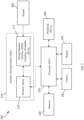
- the system 200 may include a gyratory sensing system 210, a processor 220, and a memory device 230.
- the gyratory sensing system 210 may include a Human Machine Interface (HMI) 212 (having a rotatable device) and a gyratory sensor 214 (both discussed more thoroughly above with respect to FIGs. 1A-H ).
- the HMI 212 may be configured and arranged to receive an input from a user 205, e.g., a human, and communicate the input to the gyratory sensor 214.
- the gyratory sensor 214 may be in communication with the processor 230 (e.g., a system on chip (SoC) processor) and the memory device 230, and may sense the user input in a manner that extends the HMI 212 to be more useful.
- the system 200 may also include various optional components including, for example, a camera 240, display 250, and other peripheral device(s) 260.
- the gyratory sensing system 210 may receive an input from a user 205 via a rotatable device of the HMI 212.
- the input(s) (corresponding to a user selection of system or application function, option, process, etc.) may be communicated, for example, by the user 205 rotating one or more of the rotatable components of the rotatable device.
- the rotatable device may embody a rotatable device as discussed above with respect to FIGs. 1A-D .
- the gyratory sensor 214 may be in communication with the HMI 212 to receive and sense the user input(s) based on, for example, the degree of rotation of the one or more rotating components from a reset position.
- the user input(s) may be communicated via a component of the system 200, e.g., the display 250.
- the user input(s) may also be used to adjust, alter, change, navigate, browse, and/or select, etc. the functions, options, processes, and the like of the camera 240, display 250, or other peripheral device(s) 260.
- the gyratory sensing system 200 may thereby provide the wearable device with greater utility by allowing improved input functionality, ergonomics, reliability and accuracy.
- the gyratory sensing system 210 may, for example, allow more functions and/or applications (which may be represented, for example, by icons) associated with the wearable device (e.g., wearable device 150) or an associated peripheral device to be more quickly, reliably and accurately browsed and selected when compared to other user interfaces.
- the ergonomics and tactile layout of the HMI 212 may improve the speed, reliability, and accuracy of user inputs when compared to other user interfaces.
- the gyratory sensing system 200 may allow the functionality of a wearable device (e.g., wearable device 150, 160 or 170) to be improved by extending a utility of the HMI 212.
- a wearable device e.g., wearable device 150, 160 or 170
- "extending a utility of the human machine interface” may mean providing the wearable device with greater utility by enabling improved input functionality, ergonomics, reliability and accuracy consistent with the disclosure herein.
- the improved input functionality may be accomplished via one or more rotatable components such as, for example, the rotatable components 112, 114, 116 ( FIGs.
- the rotatable components may allow a user to quickly and accurately zoom in and out of one or more functions associated with the HMI such that the functionality, ergonomics, reliability or accuracy of the user input may be improved.
- the improved input functionality may be accomplished via one or more rotatable components such as, for example, the rotatable components 112, 114, 116 ( FIGs.
- the improved input functionality may be accomplished via one or more rotatable components such as, for example, the rotatable components 112, 114, 116 ( FIGs. 1A-B ), that allow the one or more applications associated with the HMI 212 to be quickly and accurately accessed in a manner that enables multidimensional access to the applications (as discussed more thoroughly below with respect to FIGs. 6A-D ).
- FIG. 3 shows an example of a gyroscopic sensing process in accordance with an embodiment of the disclosure.
- the process 300 may be implemented as one or more modules in executable software as a set of logic instructions stored in a machine- or computer-readable storage medium of a memory such as random access memory (RAM), read only memory (ROM), programmable ROM (PROM), firmware, flash memory, etc., in configurable logic such as, for example, programmable logic arrays (PLAs), field programmable gate arrays (FPGAs), complex programmable logic devices (CPLDs), in fixed-functionality logic hardware using circuit technology such as, for example, application specific integrated circuit (ASIC), complementary metal oxide semiconductor (CMOS) or transistor-transistor logic (TTL) technology, or any combination thereof.
- PLAs programmable logic arrays
- FPGAs field programmable gate arrays
- CPLDs complex programmable logic devices
- ASIC application specific integrated circuit
- CMOS complementary metal oxide semiconductor
- TTL transistor-transistor logic
- Illustrated processing block 302 provides for remaining in a "Standby” (i.e., reset, rest, or ready) state.
- a determination may be made as to whether one or more rotatable component(s) of the rotatable device has been rotated greater than a predetermined number of degrees (e.g., x degrees or x °). If “No”, the process 300 returns to block 302 and remains in a "Standby” state. If “Yes”, the process 300 proceeds to block 306 in which the gyratory sensor is triggered and interrupts a processor (i.e., an SoC) for a state change (e.g., update of the user interface (touchscreen or GUI) based on the input).
- a processor i.e., an SoC
- a state change e.g., update of the user interface (touchscreen or GUI) based on the input.
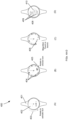
- FIGs. 4A-D show an illustration of an example of a quick launch routine 400 for a wearable device in accordance with an embodiment of the disclosure.
- the quick launch routine 400 of a wearable device 401 may define a pre-determined list and operation of quick launch icons 404 to launch an application.
- the quick launch routine 400 may begin at (A) by engaging (i.e., rotating) a rotating component 402, e.g., a watch face, in a direction (e.g., counter-clockwise (see arrow 403)) around a z-axis.
- Rotating the rotating component 402 e.g., beyond a predetermined degree or to a predetermined location
- awakes the system by triggering a gyratory sensor (not shown) and interrupts the processor (e.g., SoC) for a state change.
- the system may show a list of shortcut icons to quick launch an application.
- the system presents various application quick launch (i.e., shortcut) icons 404 for browsing and selection by the user in order to quick launch an application.
- the total number of items or applications to be listed may be customized by the user (e.g., by software). User selection may be made by rotating the rotating component 402, for example, in an opposite direction (e.g., clockwise direction (see arrow 405)).
- the illustrated system magnifies the selected application quick launch icon 406 (i.e., a phonebook) for easier and more reliable activation (i.e., launch) by, for example, being touched by a user and/or after a pre-determined period of time (e.g., after 2 seconds).
- the various individual entries 409 of the selected application 408 may be browsed via the rotatable component 402, and the selected individual entry 410 may be magnified and launched by the passage of time or by touch.
- the illustrated quick launch routine 400 may thereby provide a quick, accurate and reliable means for extending the utility of an HMI.
- FIGs. 5A-B show an illustration of an example of a lock/unlock routine 500 of a gyroscopic sensing system in accordance with an embodiment of the disclosure.
- the lock/unlock routine 500 i.e., unlock routine
- a wearable device 501 may define a pre-determined sequence of rotating one or more of rotatable components 502, 504 of the wearable device 501.
- the unlock routine 500 may begin at (A) by engaging (i.e., rotating) a first rotating component 502 (e.g., a watch face) in a first direction (e.g., a counter-clockwise direction (see arrow 503)) a pre-determined distance or degree (e.g., 30 degrees or 30°) around a z-axis, and then rotating a second rotating component 504 (e.g., a watch edge) in a second direction (e.g., a clockwise direction (see arrow 505)) a predetermined distance or degree (e.g., 60 degrees or 60°) around the z-axis.
- a first rotating component 502 e.g., a watch face
- a first direction e.g., a counter-clockwise direction (see arrow 503)
- a pre-determined distance or degree e.g., 30 degrees or 30°
- a second rotating component 504 e.g., a watch edge
- the wearable device may quickly and reliably be transformed from a locked state 506 to an unlocked state 508. It is noted that the wearable device 501 may similarly be locked by performing a comparable operation, i.e., lock routine.
- the lock/unlock routine 500 may thereby provide another quick, accurate and reliable means for extending the utility of an HMI.
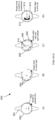
- FIGs. 6A-D show an illustration of an example of a multi-dimension access routine 600 of a gyroscopic sensing system according to an embodiment of the disclosure.
- the multi-dimension access routine 600 of a wearable device 601 may define a pre-determined operation of a multi-dimension application interface.
- the multi-dimension access routine 600 may begin at by engaging (i.e., rotating) a first rotating component 602 (e.g., a watch body) in a first direction (e.g., a clockwise direction (see arrow 603)) a pre-determined distance or degree around the z -axis in order to activate (i.e., awake) the user interface (i.e., touchscreen or GUI).
- a first rotating component 602 e.g., a watch body
- a first direction e.g., a clockwise direction (see arrow 603)
- a pre-determined distance or degree around the z -axis in order to activate (i.e., awake) the user interface
- various application icons 604 may be presented on the user interface for selection by a user.
- the first rotating component 602 may be further rotated in a clockwise direction, for example, in order to navigate the various application icons 604.
- the selected application icon 606 e.g., a phonebook
- a second rotatable component 608 e.g., a watch edge
- the details 610 of the selected application 606 i.e., search the contacts of the phonebook.
- the selected detail 612 (i.e., contact) may be magnified for easier launch via touch by the user or passage of a pre-determine period of time (e.g., 2 seconds).
- Other features may also be launched via the rotatable components 602, 608.
- a loudspeaker may be activated, for example, by rotating the first rotatable component 608 (i.e., the watch body) in a clockwise direction (see arrow 613).
- the call may be ended, for example, by rotating the second rotating component (i.e., the watch edge) in a clockwise direction (see arrow 615).
- the multi-dimension access routine 600 may thereby provide another quick, accurate and reliable means for extending the utility of an HMI.
- the specific arrangements disclosed herein may be arranged and/or rearranged in various combinations to include one or more rotatable component(s) which may or may not have been discussed specifically herein without departing from the disclosure.
- particular embodiments may include arrangements that have a rotatable body, a rotatable edge, and a rotatable face.
- the direction of rotation of the rotatable components is not intended to be limiting and may be reversed and/or rearranged without departing from the disclosure.
- various embodiments may utilize a rotation to a specific angle which may be further facilitated by the use of various stops, bumps, vibrations, haptic, sound, mechanical notches, and other arrangements that provide feedback in order to indicate the specific angle. Such embodiments may be particularly useful for user having impaired vision and/or impaired sensitivity to touch.
- embodiments disclosed herein have been shown with respect to wearable device having a substantially round shape, other shapes may be used. For example, a rectangular smartwatch design may be used.
- the keyboard orientation may be switched to a landscape orientation in order to take advantage of (i.e., match) the device design and improve the user experience.
- Various embodiments may be implemented using hardware elements, software elements, or a combination of both.
- hardware elements may include processors, microprocessors, circuits, circuit elements (e.g., transistors, resistors, capacitors, inductors, and so forth), integrated circuits, application specific integrated circuits (ASIC), programmable logic devices (PLD), digital signal processors (DSP), field programmable gate array (FPGA), logic gates, registers, semiconductor device, chips, microchips, chip sets, and so forth.
- Examples of software may include software components, programs, applications, computer programs, application programs, system programs, machine programs, operating system software, middleware, firmware, software modules, routines, subroutines, functions, methods, procedures, software interfaces, application program interfaces (API), instruction sets, computing code, computer code, code segments, computer code segments, words, values, symbols, or any combination thereof. Determining whether an embodiment is implemented using hardware elements and/or software elements may vary in accordance with any number of factors, such as desired computational rate, power levels, heat tolerances, processing cycle budget, input data rates, output data rates, memory resources, data bus speeds and other design or performance constraints.
- IP cores may be stored on a tangible, machine readable medium and supplied to various customers or manufacturing facilities to load into the fabrication machines that actually make the logic or processor.
- Embodiments are applicable for use with all types of semiconductor integrated circuit (“IC") chips.
- IC semiconductor integrated circuit
- Examples of these IC chips include but are not limited to processors, controllers, chipset components, programmable logic arrays (PLAs), memory chips, network chips, and the like.
- PPAs programmable logic arrays
- signal conductor lines are represented with lines. Some may be different, to indicate more constituent signal paths, have a number label, to indicate a number of constituent signal paths, and/or have arrows at one or more ends, to indicate primary information flow direction. This, however, should not be construed in a limiting manner. Rather, such added detail may be used in connection with one or more exemplary embodiments to facilitate easier understanding of a circuit.
- Any represented signal lines may actually comprise one or more signals that may travel in multiple directions and may be implemented with any suitable type of signal scheme, e.g., digital or analog lines implemented with differential pairs, optical fiber lines, and/or single-ended lines.
- Example sizes/models/values/ranges may have been given, although embodiments are not limited to the same. As manufacturing techniques (e.g., photolithography) mature over time, it is expected that devices of smaller size could be manufactured.
- well known power/ground connections to IC chips and other components may or may not be shown within the figures, for simplicity of illustration and discussion, and so as not to obscure certain aspects of the embodiments. Further, arrangements may be shown in block diagram form in order to avoid obscuring embodiments, and also in view of the fact that specifics with respect to implementation of such block diagram arrangements are highly dependent upon the platform within which the embodiment is to be implemented, i.e., such specifics should be well within purview of one skilled in the art.
- Some embodiments may be implemented, for example, using a machine or tangible computer-readable medium or article which may store an instruction or a set of instructions that, if executed by a machine, may cause the machine to perform a method and/or operations in accordance with the embodiments.
- a machine may include, for example, any suitable processing platform, computing platform, computing device, processing device, computing system, processing system, computer, processor, or the like, and may be implemented using any suitable combination of hardware and/or software.
- the machine-readable medium or article may include, for example, any suitable type of memory unit, memory device, memory article, memory medium, storage device, storage article, storage medium and/or storage unit, for example, memory, removable or non-removable media, erasable or non-erasable media, writeable or re-writeable media, digital or analog media, hard disk, floppy disk, Compact Disk Read Only Memory (CD-ROM), Compact Disk Recordable (CD-R), Compact Disk Rewriteable (CD-RW), optical disk, magnetic media, magneto-optical media, removable memory cards or disks, various types of Digital Versatile Disk (DVD), a tape, a cassette, or the like.
- memory removable or non-removable media, erasable or non-erasable media, writeable or re-writeable media, digital or analog media, hard disk, floppy disk, Compact Disk Read Only Memory (CD-ROM), Compact Disk Recordable (CD-R), Compact Disk Rewriteable (CD-RW), optical disk, magnetic
- the instructions may include any suitable type of code, such as source code, compiled code, interpreted code, executable code, static code, dynamic code, encrypted code, and the like, implemented using any suitable high-level, low-level, object-oriented, visual, compiled and/or interpreted programming language.
- processing refers to the action and/or processes of a computer or computing system, or similar electronic computing device, that manipulates and/or transforms data represented as physical quantities (e.g., electronic) within the computing system's registers and/or memories into other data similarly represented as physical quantities within the computing system's memories, registers or other such information storage, transmission or display devices.
- physical quantities e.g., electronic
- Coupled may be used herein to refer to any type of relationship, direct or indirect, between the components in question, and may apply to electrical, mechanical, fluid, optical, electromagnetic, electromechanical or other connections.
- first”, second, etc. may be used herein only to facilitate discussion, and carry no particular temporal or chronological significance unless otherwise indicated.
Landscapes
- Engineering & Computer Science (AREA)
- Theoretical Computer Science (AREA)
- General Engineering & Computer Science (AREA)
- Physics & Mathematics (AREA)
- General Physics & Mathematics (AREA)
- Human Computer Interaction (AREA)
- Computer Hardware Design (AREA)
- Radar, Positioning & Navigation (AREA)
- Remote Sensing (AREA)
- Microelectronics & Electronic Packaging (AREA)
- User Interface Of Digital Computer (AREA)
- Electric Clocks (AREA)
- Dental Tools And Instruments Or Auxiliary Dental Instruments (AREA)
- Position Input By Displaying (AREA)
Description
- The present application claims the benefit of priority to
U.S. Non-Provisional Patent Application No. 14/740,609 filed on June 16, 2015 - Smart devices including smart phones, mobile phones, tablet computers, and the like have become pervasive. Further, wearable devices, such as smartwatches, fitness bands and monitors, action cameras, and the like, have become increasingly popular. These wearable devices may often include a very small touchscreen to interact with the device. Users of these devices may need to accurately touch the correct user interface (UI) or icons, which are often spaced closely together, and/or swipe the interface several times to search and launch an application. Further, some of these devices include no touchscreen or user interface at all. As a result, the user experience for these small wearable devices may be degraded due to their confined Human Machine Interface (HMI). Some of the existing hardware and software solutions to sense user input may include push buttons, voice controls and gesture controls. These solutions, however, may suffer several disadvantages including limited states (i.e., ON and OFF states for hardware push buttons), complex and expensive interfaces (i.e., gesture and voice sensing require complex and expensive computing power and sensors), and unfashionable appearance (e.g., protruding hardware is not integrated, stylish or compatible with wearable devices). Simply put, conventional small wearable devices, such as smartwatches, having confined touchscreens and/or user interfaces may not be optimally useful (i.e., inaccurate, less user-friendly, unintegrated, and incompatible) to the wearer.
-
US 6 556 222 B1 discusses a wearable mobile computing device/appliance (e.g., a wrist watch) with a high resolution display that is capable of wirelessly accessing information from the network and a variety of other devices. The mobile computing device/appliance includes a user interface employing a bezel-based input mechanism including a bezel ring which may be rotated and depressed for generating both rotation and wheel click events for enabling navigation, selection and entry of various displayed textual and graphical items. -
US 2002/101457 A1 discusses a bezel interface for small computing devices. More specifically, the bezel interface includes a display screen and a bezel encircling the display screen. The bezel is adapted to rotate about the display screen in one or more axes. A cursor displayed within the display screen is responsive to movement of the bezel. - The invention is defined in the claims. In the following description, any embodiments referred to and not falling within the scope of the claims is merely an example useful to the understanding of the invention. BRIEF DESCRIPTION OF THE DRAWINGS
- The various advantages of the embodiments will become apparent to one skilled in the art by reading the following specification and appended claims, and by referencing the following drawings, in which:
-
FIGs. 1A-B are illustrations of an example of a smartwatch having a gyroscopic sensing system according to an embodiment; -
FIGs. 1C-D are illustrations of an example of a smartwatch having a gyroscopic sensing system with a rotating body according to an embodiment; -
FIGs. 1E-F are illustrations of an example of a smartwatch having a gyroscopic sensing system with a rotating edge according to an embodiment; -
FIGs. 1G-H are illustrations of an example of a smartwatch having a gyroscopic sensing system with a rotating face and edge according to an embodiment; -
FIG. 2 is a block diagram of an example of a gyroscopic sensing system according to an embodiment; -
FIG. 3 is a flowchart of an example of a gyroscopic sensing process according to an embodiment; -
FIGs. 4A-D is an illustration of an example of a quick launch routine of a gyroscopic sensing system according to an embodiment; -
FIGs. 5A-B is an illustration of an example of a lock/unlock routine of a gyroscopic sensing system according to an embodiment; and -
FIGs. 6A-D is an illustration of an example of a multi-dimension access routine of a gyroscopic sensing system according to an embodiment. -
FIGs. 1A-B show side and top views, respectively, of awearable device 100 having agyroscopic sensing system 110 in accordance with an embodiment of the disclosure. Thewearable device 100 may be one or many devices including, for example, a smartwatch, a fitness band or monitor, an action camera, and the like, that have relatively small or no graphical user input (GUI), such as a touchscreen. Thewearable device 100 includes arotatable device 110 having one or more rotatable components, e.g., a rotatable edge component 112 (e.g., a watch bezel), a rotatable face component 114 (e.g., a watch crystal), and a rotatable body component 116 (e.g., a watch body or case), that are in communication with and engage an embeddedgyroscopic sensor 120. Thewearable device 100 may also include a strap orbracelet 130 that may be used to attach thewearable device 100 to a user, e.g., to the wrist of a user. Therotatable device 110 and the associatedrotatable components gyroscopic sensor 120 embodies a single axis, micro-electro-mechanical systems (MEMS) rate gyroscope chip that is capable of sensing rotation on one of three axes of movement, e.g., x-axis (pitch), y-axis (roll), and z-axis (yaw), depending on the mounting arrangement. Thegyroscopic sensor 120 may embody a relatively small size and low cost arrangement suitable for sensing motion in small consumer electronic devices, e.g., thewearable device 100. An example of a suitable gyroscopic sensor chip for use with the disclosure is the single axis (z) MEMS gyroscope model ISZ-2510 available from InvenSense® Inc. of San Jose, California. The illustratedrotatable device 110 and thegyroscopic sensor 120 form at least a portion of a gyroscopic sensing system that may extend a Human Machine Interface (HMI), e.g., a touchscreen, of a small wearable device, e.g., thewearable device 100, to be more useful (i.e., more accurate, user-friendly, integrated and compatible). - In the illustrated example, the
wearable device 100 includes illustratedcorresponding landmark lines 101 that align to define a reset (i.e., rest or ready) position for therotatable components landmark lines 101 are illustrated by straight lines, this is for illustration purposes only. Other arrangements may be used to define the alignment ofrotatable components gyroscopic sensor 120 may be arranged to receive a user input via the rotation of one or more of therotatable components rotatable device 110, e.g., around the z-axis, to form an HMI that extends the utility of the user interface (i.e., touchscreen) to include more input states and allows the user interface to be faster, more accurate, and more reliable. - For example, a user may rotate one or more of the
rotatable components wearable device 100. As will be discussed further below, the input may be based on various factors including, for example, the degree of rotation from the reset position, the direction of rotation, rotation to a corresponding function icon, a sequence of rotation(s), and the like. The rotary, more ergonomically friendly inputs enabled by therotatable device 110 may thereby provide thewearable device 100 with greater utility by allowing increased functionality and accuracy of input compared to a small user input (e.g., a touchscreen) having confined and limited display space with an ever-increasing number of applications. Users may thereby provide more effective and reliable inputs.
Turning now toFIGs. 1C-D , side and top views, respectively, of awearable device 150 are shown in accordance with an embodiment of the disclosure. Thewearable device 150 is similar to the wearable device 100 (FIGs. 1A-B ) and includes a gyroscopic sensing system having arotatable body 156 capable of rotating around a z-axis (e.g., in the clockwise direction (see arrow 157)) from the reset position (i.e., such that thelandmark lines 151 are not in alignment) in order to browse, navigate, and/or launch applications associated with thewearable device 150.FIGs. 1E-F show side and top views, respectively, of awearable device 160 in accordance with an embodiment of the disclosure. Thewearable device 160 is similar to the wearable device 100 (FIGs. 1A-B ) and includes arotatable edge 162 capable of rotating around a z-axis (e.g., in the clockwise direction (see arrow 163)) from the reset position (i.e., such that thelandmark lines 161 are not in alignment) in order to browse, navigate, and/or launch applications associated with thewearable device 160.FIGs. 1G-H show side and top views of awearable device 170 in accordance with an embodiment of the disclosure. The wearable device is similar to wearable device 100 (FIGs. 1A-B ) and includes arotatable edge 172 and arotatable face 174 that are both capable of rotating around a z-axis (e.g., in the clockwise direction (see arrow 173) and in the counter-clockwise direction (see arrow 175), respectively) from the reset position (i.e., such that thelandmark lines 171 are not in alignment) in order to browse, navigate, and/or launch applications associated with thewearable device 170. - Turning now to
FIG. 2 , an example of agyroscopic sensing system 200 in accordance with an embodiment of the disclosure is shown. Thesystem 200 may include agyratory sensing system 210, aprocessor 220, and amemory device 230. Thegyratory sensing system 210 may include a Human Machine Interface (HMI) 212 (having a rotatable device) and a gyratory sensor 214 (both discussed more thoroughly above with respect toFIGs. 1A-H ). TheHMI 212 may be configured and arranged to receive an input from auser 205, e.g., a human, and communicate the input to thegyratory sensor 214. Thegyratory sensor 214 may be in communication with the processor 230 (e.g., a system on chip (SoC) processor) and thememory device 230, and may sense the user input in a manner that extends theHMI 212 to be more useful. Thesystem 200 may also include various optional components including, for example, acamera 240,display 250, and other peripheral device(s) 260. - In use, the
gyratory sensing system 210 may receive an input from auser 205 via a rotatable device of theHMI 212. The input(s) (corresponding to a user selection of system or application function, option, process, etc.) may be communicated, for example, by theuser 205 rotating one or more of the rotatable components of the rotatable device. The rotatable device may embody a rotatable device as discussed above with respect toFIGs. 1A-D . Thegyratory sensor 214 may be in communication with theHMI 212 to receive and sense the user input(s) based on, for example, the degree of rotation of the one or more rotating components from a reset position. The user input(s) may be communicated via a component of thesystem 200, e.g., thedisplay 250. The user input(s) may also be used to adjust, alter, change, navigate, browse, and/or select, etc. the functions, options, processes, and the like of thecamera 240,display 250, or other peripheral device(s) 260. Thegyratory sensing system 200 may thereby provide the wearable device with greater utility by allowing improved input functionality, ergonomics, reliability and accuracy. As an example, due to the limited size and screen space that may be offered by small wearable devices (e.g., wearable device 150), thegyratory sensing system 210 may, for example, allow more functions and/or applications (which may be represented, for example, by icons) associated with the wearable device (e.g., wearable device 150) or an associated peripheral device to be more quickly, reliably and accurately browsed and selected when compared to other user interfaces. Further, in at least some embodiments, the ergonomics and tactile layout of theHMI 212 may improve the speed, reliability, and accuracy of user inputs when compared to other user interfaces. - In various embodiments, the
gyratory sensing system 200 may allow the functionality of a wearable device (e.g.,wearable device HMI 212. In some embodiments, "extending a utility of the human machine interface" may mean providing the wearable device with greater utility by enabling improved input functionality, ergonomics, reliability and accuracy consistent with the disclosure herein. In at least some embodiments, the improved input functionality may be accomplished via one or more rotatable components such as, for example, therotatable components FIGs. 1A-B ), that enable functions of one or more applications associated with theHMI 212 to be selected in a manner that quickly and accurately launches the applications (as discussed more thoroughly below with respect toFIGs. 4A-D ). For example, the rotatable components may allow a user to quickly and accurately zoom in and out of one or more functions associated with the HMI such that the functionality, ergonomics, reliability or accuracy of the user input may be improved. In at least some embodiments, the improved input functionality may be accomplished via one or more rotatable components such as, for example, therotatable components FIGs. 1A-B ) that allow a wearable device and/or one or more applications associated with the wearable device to be quickly and accurately locked and/or unlocked (as discussed more thoroughly below with respect toFIGs. 5A -D). In at least some embodiments, the improved input functionality may be accomplished via one or more rotatable components such as, for example, therotatable components FIGs. 1A-B ), that allow the one or more applications associated with theHMI 212 to be quickly and accurately accessed in a manner that enables multidimensional access to the applications (as discussed more thoroughly below with respect toFIGs. 6A-D ). -
FIG. 3 shows an example of a gyroscopic sensing process in accordance with an embodiment of the disclosure. Theprocess 300 may be implemented as one or more modules in executable software as a set of logic instructions stored in a machine- or computer-readable storage medium of a memory such as random access memory (RAM), read only memory (ROM), programmable ROM (PROM), firmware, flash memory, etc., in configurable logic such as, for example, programmable logic arrays (PLAs), field programmable gate arrays (FPGAs), complex programmable logic devices (CPLDs), in fixed-functionality logic hardware using circuit technology such as, for example, application specific integrated circuit (ASIC), complementary metal oxide semiconductor (CMOS) or transistor-transistor logic (TTL) technology, or any combination thereof. - Illustrated
processing block 302 provides for remaining in a "Standby" (i.e., reset, rest, or ready) state. At block 304 a determination may be made as to whether one or more rotatable component(s) of the rotatable device has been rotated greater than a predetermined number of degrees (e.g., x degrees or x°). If "No", theprocess 300 returns to block 302 and remains in a "Standby" state. If "Yes", theprocess 300 proceeds to block 306 in which the gyratory sensor is triggered and interrupts a processor (i.e., an SoC) for a state change (e.g., update of the user interface (touchscreen or GUI) based on the input). Atblock 308, a software interrupt-routine is invoked, and the new event is executed. Once complete, the illustratedprocess 300 returns to block 302. An example of suitable pseudo-code for executing theprocess 300 is provided, as follows:
FIGs. 4A-D show an illustration of an example of aquick launch routine 400 for a wearable device in accordance with an embodiment of the disclosure. Thequick launch routine 400 of awearable device 401, consistent with the disclosure herein, may define a pre-determined list and operation ofquick launch icons 404 to launch an application. Thequick launch routine 400 may begin at (A) by engaging (i.e., rotating) arotating component 402, e.g., a watch face, in a direction (e.g., counter-clockwise (see arrow 403)) around a z-axis. Rotating the rotating component 402 (e.g., beyond a predetermined degree or to a predetermined location) awakes the system by triggering a gyratory sensor (not shown) and interrupts the processor (e.g., SoC) for a state change. Once awake, the system may show a list of shortcut icons to quick launch an application. At (B) the system presents various application quick launch (i.e., shortcut)icons 404 for browsing and selection by the user in order to quick launch an application. The total number of items or applications to be listed may be customized by the user (e.g., by software). User selection may be made by rotating therotating component 402, for example, in an opposite direction (e.g., clockwise direction (see arrow 405)). At (C) the illustrated system magnifies the selected application quick launch icon 406 (i.e., a phonebook) for easier and more reliable activation (i.e., launch) by, for example, being touched by a user and/or after a pre-determined period of time (e.g., after 2 seconds). At (D) the variousindividual entries 409 of the selected application 408 (i.e., phonebook) may be browsed via therotatable component 402, and the selectedindividual entry 410 may be magnified and launched by the passage of time or by touch. The illustratedquick launch routine 400 may thereby provide a quick, accurate and reliable means for extending the utility of an HMI. -
FIGs. 5A-B show an illustration of an example of a lock/unlock routine 500 of a gyroscopic sensing system in accordance with an embodiment of the disclosure. The lock/unlock routine 500 (i.e., unlock routine) of awearable device 501, consistent with the disclosure herein, may define a pre-determined sequence of rotating one or more ofrotatable components wearable device 501. Theunlock routine 500 may begin at (A) by engaging (i.e., rotating) a first rotating component 502 (e.g., a watch face) in a first direction (e.g., a counter-clockwise direction (see arrow 503)) a pre-determined distance or degree (e.g., 30 degrees or 30°) around a z-axis, and then rotating a second rotating component 504 (e.g., a watch edge) in a second direction (e.g., a clockwise direction (see arrow 505)) a predetermined distance or degree (e.g., 60 degrees or 60°) around the z-axis. Upon completion of the lock/unlock routine 500 the wearable device may quickly and reliably be transformed from a lockedstate 506 to anunlocked state 508. It is noted that thewearable device 501 may similarly be locked by performing a comparable operation, i.e., lock routine. The lock/unlock routine 500 may thereby provide another quick, accurate and reliable means for extending the utility of an HMI. -
FIGs. 6A-D show an illustration of an example of amulti-dimension access routine 600 of a gyroscopic sensing system according to an embodiment of the disclosure. Themulti-dimension access routine 600 of awearable device 601, consistent with the disclosure herein, may define a pre-determined operation of a multi-dimension application interface. Themulti-dimension access routine 600 may begin at by engaging (i.e., rotating) a first rotating component 602 (e.g., a watch body) in a first direction (e.g., a clockwise direction (see arrow 603)) a pre-determined distance or degree around the z-axis in order to activate (i.e., awake) the user interface (i.e., touchscreen or GUI). At (B)various application icons 604 may be presented on the user interface for selection by a user. The firstrotating component 602 may be further rotated in a clockwise direction, for example, in order to navigate thevarious application icons 604. At (C) the selected application icon 606 (e.g., a phonebook) may be magnified and a second rotatable component 608 (e.g., a watch edge) may be rotated, for example, in a clockwise direction in order to launch or "step into" thedetails 610 of the selected application 606 (i.e., search the contacts of the phonebook). At (D) the selected detail 612 (i.e., contact) may be magnified for easier launch via touch by the user or passage of a pre-determine period of time (e.g., 2 seconds). Other features may also be launched via therotatable components multi-dimension access routine 600 may thereby provide another quick, accurate and reliable means for extending the utility of an HMI. - An example of suitable pseudo-code for executing the routines disclosed herein is provided, as follows:

- As would be appreciated by a person of ordinary skill in the art, the specific arrangements disclosed herein may be arranged and/or rearranged in various combinations to include one or more rotatable component(s) which may or may not have been discussed specifically herein without departing from the disclosure. For example, particular embodiments may include arrangements that have a rotatable body, a rotatable edge, and a rotatable face. Further, the direction of rotation of the rotatable components is not intended to be limiting and may be reversed and/or rearranged without departing from the disclosure. Further still, various embodiments may utilize a rotation to a specific angle which may be further facilitated by the use of various stops, bumps, vibrations, haptic, sound, mechanical notches, and other arrangements that provide feedback in order to indicate the specific angle. Such embodiments may be particularly useful for user having impaired vision and/or impaired sensitivity to touch. In addition, while embodiments disclosed herein have been shown with respect to wearable device having a substantially round shape, other shapes may be used. For example, a rectangular smartwatch design may be used. In such use, once a rotatable component, e.g., a watch body or edge has been rotated during text input, for example, the keyboard orientation may be switched to a landscape orientation in order to take advantage of (i.e., match) the device design and improve the user experience.
- Various embodiments may be implemented using hardware elements, software elements, or a combination of both. Examples of hardware elements may include processors, microprocessors, circuits, circuit elements (e.g., transistors, resistors, capacitors, inductors, and so forth), integrated circuits, application specific integrated circuits (ASIC), programmable logic devices (PLD), digital signal processors (DSP), field programmable gate array (FPGA), logic gates, registers, semiconductor device, chips, microchips, chip sets, and so forth. Examples of software may include software components, programs, applications, computer programs, application programs, system programs, machine programs, operating system software, middleware, firmware, software modules, routines, subroutines, functions, methods, procedures, software interfaces, application program interfaces (API), instruction sets, computing code, computer code, code segments, computer code segments, words, values, symbols, or any combination thereof. Determining whether an embodiment is implemented using hardware elements and/or software elements may vary in accordance with any number of factors, such as desired computational rate, power levels, heat tolerances, processing cycle budget, input data rates, output data rates, memory resources, data bus speeds and other design or performance constraints.
- One or more aspects of at least one embodiment may be implemented by representative instructions stored on a machine-readable medium which represents various logic within the processor, which when read by a machine causes the machine to fabricate logic to perform the techniques described herein. Such representations, known as "IP cores" may be stored on a tangible, machine readable medium and supplied to various customers or manufacturing facilities to load into the fabrication machines that actually make the logic or processor.
- Embodiments are applicable for use with all types of semiconductor integrated circuit ("IC") chips. Examples of these IC chips include but are not limited to processors, controllers, chipset components, programmable logic arrays (PLAs), memory chips, network chips, and the like. In addition, in some of the drawings, signal conductor lines are represented with lines. Some may be different, to indicate more constituent signal paths, have a number label, to indicate a number of constituent signal paths, and/or have arrows at one or more ends, to indicate primary information flow direction. This, however, should not be construed in a limiting manner. Rather, such added detail may be used in connection with one or more exemplary embodiments to facilitate easier understanding of a circuit. Any represented signal lines, whether or not having additional information, may actually comprise one or more signals that may travel in multiple directions and may be implemented with any suitable type of signal scheme, e.g., digital or analog lines implemented with differential pairs, optical fiber lines, and/or single-ended lines.
- Example sizes/models/values/ranges may have been given, although embodiments are not limited to the same. As manufacturing techniques (e.g., photolithography) mature over time, it is expected that devices of smaller size could be manufactured. In addition, well known power/ground connections to IC chips and other components may or may not be shown within the figures, for simplicity of illustration and discussion, and so as not to obscure certain aspects of the embodiments. Further, arrangements may be shown in block diagram form in order to avoid obscuring embodiments, and also in view of the fact that specifics with respect to implementation of such block diagram arrangements are highly dependent upon the platform within which the embodiment is to be implemented, i.e., such specifics should be well within purview of one skilled in the art. Where specific details (e.g., circuits) are set forth in order to describe example embodiments, it should be apparent to one skilled in the art that embodiments can be practiced without, or with variation of, these specific details. The description is thus to be regarded as illustrative instead of limiting.
- Some embodiments may be implemented, for example, using a machine or tangible computer-readable medium or article which may store an instruction or a set of instructions that, if executed by a machine, may cause the machine to perform a method and/or operations in accordance with the embodiments. Such a machine may include, for example, any suitable processing platform, computing platform, computing device, processing device, computing system, processing system, computer, processor, or the like, and may be implemented using any suitable combination of hardware and/or software. The machine-readable medium or article may include, for example, any suitable type of memory unit, memory device, memory article, memory medium, storage device, storage article, storage medium and/or storage unit, for example, memory, removable or non-removable media, erasable or non-erasable media, writeable or re-writeable media, digital or analog media, hard disk, floppy disk, Compact Disk Read Only Memory (CD-ROM), Compact Disk Recordable (CD-R), Compact Disk Rewriteable (CD-RW), optical disk, magnetic media, magneto-optical media, removable memory cards or disks, various types of Digital Versatile Disk (DVD), a tape, a cassette, or the like. The instructions may include any suitable type of code, such as source code, compiled code, interpreted code, executable code, static code, dynamic code, encrypted code, and the like, implemented using any suitable high-level, low-level, object-oriented, visual, compiled and/or interpreted programming language.
- Unless specifically stated otherwise, it may be appreciated that terms such as "processing," "computing," "calculating," "determining," or the like, refer to the action and/or processes of a computer or computing system, or similar electronic computing device, that manipulates and/or transforms data represented as physical quantities (e.g., electronic) within the computing system's registers and/or memories into other data similarly represented as physical quantities within the computing system's memories, registers or other such information storage, transmission or display devices.
- The term "coupled" may be used herein to refer to any type of relationship, direct or indirect, between the components in question, and may apply to electrical, mechanical, fluid, optical, electromagnetic, electromechanical or other connections. In addition, the terms "first", "second", etc. may be used herein only to facilitate discussion, and carry no particular temporal or chronological significance unless otherwise indicated.
Claims (14)
- A wearable device, comprising:a touchscreen configured to display a user interface;a rotatable device (110) having one or more rotatable components to receive user input configured to control the user interface, the rotatable device (110) being capable of rotation around one axis of rotation;characterised by further comprising:a gyroscope sensor (120; 214) configured to sense rotation of the rotatable device (110), the gyroscope sensor (120; 214) being a micro-electro-mechanical systems, MEMS, rate gyroscope; andprocessing circuitry configured to:be interrupted for a state change by the gyroscope sensor (120; 214) when the gyroscope sensor (120; 214) is triggered by rotating of a rotatable component of the rotatable device (110);provide various application icons on the user interface for selection by the user, based on the state change triggered by the gyroscope sensor (120; 214); andactivate an application by selecting an application icon on the user interface, based on the user input received with the rotatable device (110).
- The wearable device of claim 1, wherein the rotatable device (110) is a rotatable component located at an edge of the wearable device (100).
- The wearable device of claim 2, further comprising structures configured to bring the rotatable device (110) into alignment at a reset position.
- The wearable device of claim 1, wherein the gyroscope sensor (120; 214) is configured to sense the rotation in at least one axis of rotation.
- The wearable device of claim 1, wherein the rotatable device (110) is usable to activate a second application in the user interface, based on a second user input received with the rotatable device (110).
- The wearable device of any of claims 1-5, wherein the application is activatable in the user interface, based on a user selection received with the touchscreen.
- The wearable device of claim 1, wherein the wearable device (100) is a smartwatch.
- The wearable device of claim 7, further comprising fastening means (130) for attaching the wearable device (100) to the user.
- At least one machine-readable storage medium comprising instructions stored thereupon, which when executed by processor circuitry of a wearable device (100), cause the processor circuitry to perform operations comprising:become interrupted for a state change by a gyroscope sensor (120; 214) of the wearable device (100), when the gyroscope sensor (120; 214) is triggered by rotating of a rotatable component of a rotatable device (110) of the wearable device (100), the gyroscope sensor (120; 214) being a micro-electro-mechanical systems, MEMS, rate gyroscope;generate various application items on a user interface of the wearable device (100) for selection by the user, based on the state change triggered by the gyroscope sensor (120; 214), the user interface displayed via a touchscreen of the wearable device (100); andactivate an application by selecting an application icon on the user interface, based on the user input received with the rotatable device (110) of the wearable device (100), the rotatable device (110) having one or more rotatable components to receive user input to control the user interface, the rotatable device (110) being capable of rotation around one axis of rotation and the gyroscope sensor (120; 214) being configured to sense rotation of the rotatable device (110).
- The machine-readable storage medium of claim 9, wherein the wearable device (100) comprises structures to bring the rotatable device (110) into alignment at a reset position.
- The machine-readable storage medium of claim 9, wherein the rotatable device (110) is usable to activate a second application in the user interface, based on a second user input received with the rotatable device (110).
- The machine-readable storage medium of claim 9, wherein the selectable application is activatable in the user interface, based on a user selection received with the touchscreen.
- The machine-readable storage medium of claim 9, wherein the wearable device (100) is a smartwatch.
- The machine-readable storage medium of claim 13, wherein the smartwatch is coupled to a strap or bracelet (130), the strap or bracelet (130) to attach the smartwatch to the user.
Priority Applications (3)
| Application Number | Priority Date | Filing Date | Title |
|---|---|---|---|
| EP25176829.7A EP4579422A3 (en) | 2015-06-16 | 2016-05-16 | Gyratory sensing system to enhance wearable device user experience via hmi extension |
| EP21210419.4A EP3979052A1 (en) | 2015-06-16 | 2016-05-16 | Gyratory sensing system to enhance wearable device user experience via hmi extension |
| EP23198388.3A EP4273664B1 (en) | 2015-06-16 | 2016-05-16 | Gyratory sensing system to enhance wearable device user experience via hmi extension |
Applications Claiming Priority (3)
| Application Number | Priority Date | Filing Date | Title |
|---|---|---|---|
| US14/740,609 US10386941B2 (en) | 2015-06-16 | 2015-06-16 | Gyratory sensing system to enhance wearable device user experience via HMI extension |
| EP16812108.5A EP3311253B1 (en) | 2015-06-16 | 2016-05-16 | Gyratory sensing system to enhance wearable device user experience via hmi extension |
| PCT/US2016/032626 WO2016204902A1 (en) | 2015-06-16 | 2016-05-16 | Gyratory sensing system to enhance wearable device user experience via hmi extension |
Related Parent Applications (2)
| Application Number | Title | Priority Date | Filing Date |
|---|---|---|---|
| EP16812108.5A Division-Into EP3311253B1 (en) | 2015-06-16 | 2016-05-16 | Gyratory sensing system to enhance wearable device user experience via hmi extension |
| EP16812108.5A Division EP3311253B1 (en) | 2015-06-16 | 2016-05-16 | Gyratory sensing system to enhance wearable device user experience via hmi extension |
Related Child Applications (5)
| Application Number | Title | Priority Date | Filing Date |
|---|---|---|---|
| EP25176829.7A Division EP4579422A3 (en) | 2015-06-16 | 2016-05-16 | Gyratory sensing system to enhance wearable device user experience via hmi extension |
| EP23198388.3A Division EP4273664B1 (en) | 2015-06-16 | 2016-05-16 | Gyratory sensing system to enhance wearable device user experience via hmi extension |
| EP23198388.3A Division-Into EP4273664B1 (en) | 2015-06-16 | 2016-05-16 | Gyratory sensing system to enhance wearable device user experience via hmi extension |
| EP21210419.4A Division EP3979052A1 (en) | 2015-06-16 | 2016-05-16 | Gyratory sensing system to enhance wearable device user experience via hmi extension |
| EP21210419.4A Division-Into EP3979052A1 (en) | 2015-06-16 | 2016-05-16 | Gyratory sensing system to enhance wearable device user experience via hmi extension |
Publications (2)
| Publication Number | Publication Date |
|---|---|
| EP3779613A1 EP3779613A1 (en) | 2021-02-17 |
| EP3779613B1 true EP3779613B1 (en) | 2024-01-31 |
Family
ID=57545882
Family Applications (6)
| Application Number | Title | Priority Date | Filing Date |
|---|---|---|---|
| EP20200720.9A Active EP3779649B1 (en) | 2015-06-16 | 2016-05-16 | Gyratory sensing system to enhance wearable device user experience via hmi extension |
| EP16812108.5A Active EP3311253B1 (en) | 2015-06-16 | 2016-05-16 | Gyratory sensing system to enhance wearable device user experience via hmi extension |
| EP20200719.1A Active EP3779613B1 (en) | 2015-06-16 | 2016-05-16 | Gyratory sensing system to enhance wearable device user experience via hmi extension |
| EP23198388.3A Active EP4273664B1 (en) | 2015-06-16 | 2016-05-16 | Gyratory sensing system to enhance wearable device user experience via hmi extension |
| EP21210419.4A Withdrawn EP3979052A1 (en) | 2015-06-16 | 2016-05-16 | Gyratory sensing system to enhance wearable device user experience via hmi extension |
| EP25176829.7A Pending EP4579422A3 (en) | 2015-06-16 | 2016-05-16 | Gyratory sensing system to enhance wearable device user experience via hmi extension |
Family Applications Before (2)
| Application Number | Title | Priority Date | Filing Date |
|---|---|---|---|
| EP20200720.9A Active EP3779649B1 (en) | 2015-06-16 | 2016-05-16 | Gyratory sensing system to enhance wearable device user experience via hmi extension |
| EP16812108.5A Active EP3311253B1 (en) | 2015-06-16 | 2016-05-16 | Gyratory sensing system to enhance wearable device user experience via hmi extension |
Family Applications After (3)
| Application Number | Title | Priority Date | Filing Date |
|---|---|---|---|
| EP23198388.3A Active EP4273664B1 (en) | 2015-06-16 | 2016-05-16 | Gyratory sensing system to enhance wearable device user experience via hmi extension |
| EP21210419.4A Withdrawn EP3979052A1 (en) | 2015-06-16 | 2016-05-16 | Gyratory sensing system to enhance wearable device user experience via hmi extension |
| EP25176829.7A Pending EP4579422A3 (en) | 2015-06-16 | 2016-05-16 | Gyratory sensing system to enhance wearable device user experience via hmi extension |
Country Status (6)
| Country | Link |
|---|---|
| US (5) | US10386941B2 (en) |
| EP (6) | EP3779649B1 (en) |
| JP (3) | JP7077018B2 (en) |
| KR (3) | KR20230146107A (en) |
| CN (4) | CN114035651B (en) |
| WO (1) | WO2016204902A1 (en) |
Families Citing this family (7)
| Publication number | Priority date | Publication date | Assignee | Title |
|---|---|---|---|---|
| US10739971B2 (en) * | 2015-06-05 | 2020-08-11 | Apple Inc. | Accessing and displaying information corresponding to past times and future times |
| US10386941B2 (en) * | 2015-06-16 | 2019-08-20 | Intel Corporation | Gyratory sensing system to enhance wearable device user experience via HMI extension |
| US11194463B2 (en) * | 2017-11-08 | 2021-12-07 | Google Llc | Methods, systems, and media for presenting offset content |
| KR102049262B1 (en) * | 2017-11-15 | 2020-01-08 | 주식회사 디지캡 | Telematics system with security |
| US11131967B2 (en) | 2019-05-06 | 2021-09-28 | Apple Inc. | Clock faces for an electronic device |
| WO2021016908A1 (en) * | 2019-07-31 | 2021-02-04 | 高驰运动科技(深圳)有限公司 | Method for unlocking by means of knob, electronic device, and readable storage medium |
| CN113985965B (en) * | 2021-10-26 | 2024-07-02 | 维沃移动通信有限公司 | Wearing equipment |
Citations (2)
| Publication number | Priority date | Publication date | Assignee | Title |
|---|---|---|---|---|
| KR101520806B1 (en) * | 2014-10-24 | 2015-05-15 | (주)아바엔터테인먼트 | Watch type mobile terminal using the bezel |
| US20150261310A1 (en) * | 2012-08-01 | 2015-09-17 | Whirlscape, Inc. | One-dimensional input system and method |
Family Cites Families (62)
| Publication number | Priority date | Publication date | Assignee | Title |
|---|---|---|---|---|
| CH683481B5 (en) * | 1992-05-01 | 1994-09-30 | Ebauchesfabrik Eta Ag | Timepiece including a rotating bezel. |
| WO1994028469A1 (en) * | 1993-05-21 | 1994-12-08 | Seiko Epson Corporation | Electronic watch having multi-functional display |
| JPH103467A (en) * | 1996-06-14 | 1998-01-06 | Tokin Corp | Image processing device |
| JPH11211862A (en) * | 1997-11-19 | 1999-08-06 | Seiko Epson Corp | Information processing device |
| JP3988102B2 (en) * | 1998-11-06 | 2007-10-10 | 富士フイルム株式会社 | Arm-mounted camera |
| JP2000267797A (en) * | 1999-03-15 | 2000-09-29 | Seiko Epson Corp | Information processing device |
| US6288704B1 (en) * | 1999-06-08 | 2001-09-11 | Vega, Vista, Inc. | Motion detection and tracking system to control navigation and display of object viewers |
| US6556222B1 (en) * | 2000-06-30 | 2003-04-29 | International Business Machines Corporation | Bezel based input mechanism and user interface for a smart watch |
| US20020101457A1 (en) * | 2001-01-31 | 2002-08-01 | Microsoft Corporation | Bezel interface for small computing devices |
| JP2002229675A (en) * | 2001-02-07 | 2002-08-16 | Matsushita Electric Ind Co Ltd | Portable terminal equipment for forearm wearing |
| US7312785B2 (en) * | 2001-10-22 | 2007-12-25 | Apple Inc. | Method and apparatus for accelerated scrolling |
| GB2384395A (en) | 2002-01-19 | 2003-07-23 | Hewlett Packard Co | Personal article capable of receiving specified items or data |
| US6968508B2 (en) * | 2002-07-30 | 2005-11-22 | Motorola, Inc. | Rotating user interface |
| JP2004199145A (en) * | 2002-12-16 | 2004-07-15 | Sony Corp | Information processing system, transmitting device, and receiving device |
| JP2005017012A (en) * | 2003-06-24 | 2005-01-20 | Seiko Epson Corp | Electronic equipment and watches |
| WO2005065404A2 (en) * | 2003-12-31 | 2005-07-21 | James Marin | Rotating bezel watch |
| US20060092177A1 (en) * | 2004-10-30 | 2006-05-04 | Gabor Blasko | Input method and apparatus using tactile guidance and bi-directional segmented stroke |
| JP5187849B2 (en) * | 2005-12-09 | 2013-04-24 | トムソン ライセンシング | Inertial sensor pointing device with detachable transceiver |
| JP4756345B2 (en) * | 2006-02-28 | 2011-08-24 | 日本電気株式会社 | Information processing apparatus, information search system, information search method, and program |
| JP2008277213A (en) * | 2007-05-07 | 2008-11-13 | Tokai Rika Co Ltd | Lever switch device |
| US7778118B2 (en) | 2007-08-28 | 2010-08-17 | Garmin Ltd. | Watch device having touch-bezel user interface |
| KR101427260B1 (en) * | 2007-11-05 | 2014-08-06 | 엘지전자 주식회사 | Band type portable terminal |
| JP5529399B2 (en) * | 2008-07-11 | 2014-06-25 | 任天堂株式会社 | Operation system |
| EP2329407A1 (en) * | 2008-09-12 | 2011-06-08 | Koninklijke Philips Electronics N.V. | Navigating in graphical user interface on handheld devices |
| KR100920252B1 (en) | 2008-11-07 | 2009-10-05 | 서창수 | Mouse controlled by finger movement in the air |
| KR101626621B1 (en) * | 2009-12-30 | 2016-06-01 | 엘지전자 주식회사 | Method for controlling data in mobile termina having circle type display unit and mobile terminal thereof |
| US20110239142A1 (en) * | 2010-03-25 | 2011-09-29 | Nokia Corporation | Method and apparatus for providing content over multiple displays |
| WO2012119085A1 (en) * | 2011-03-02 | 2012-09-07 | Touchdome Llc. | A talking dome watch for the visually impaired |
| US8179604B1 (en) * | 2011-07-13 | 2012-05-15 | Google Inc. | Wearable marker for passive interaction |
| US8644884B2 (en) * | 2011-08-04 | 2014-02-04 | Qualcomm Incorporated | Sensor-based user interface control |
| KR101262700B1 (en) * | 2011-08-05 | 2013-05-08 | 삼성전자주식회사 | Method for Controlling Electronic Apparatus based on Voice Recognition and Motion Recognition, and Electric Apparatus thereof |
| US8988349B2 (en) * | 2012-02-28 | 2015-03-24 | Google Technology Holdings LLC | Methods and apparatuses for operating a display in an electronic device |
| KR101971200B1 (en) * | 2012-06-19 | 2019-04-23 | 삼성디스플레이 주식회사 | Terminal system and flexible terminal |
| US20140045547A1 (en) * | 2012-08-10 | 2014-02-13 | Silverplus, Inc. | Wearable Communication Device and User Interface |
| US11237719B2 (en) * | 2012-11-20 | 2022-02-01 | Samsung Electronics Company, Ltd. | Controlling remote electronic device with wearable electronic device |
| US11372536B2 (en) * | 2012-11-20 | 2022-06-28 | Samsung Electronics Company, Ltd. | Transition and interaction model for wearable electronic device |
| US8994827B2 (en) * | 2012-11-20 | 2015-03-31 | Samsung Electronics Co., Ltd | Wearable electronic device |
| EP3617843B1 (en) * | 2012-12-10 | 2025-03-19 | Samsung Electronics Co., Ltd. | Mobile device, control method thereof, and ui display method |
| GB201304220D0 (en) * | 2013-03-08 | 2013-04-24 | Tomtom Int Bv | Fitness watch case |
| JP6108926B2 (en) * | 2013-04-15 | 2017-04-05 | オリンパス株式会社 | Wearable device, program, and display control method for wearable device |
| WO2014170236A1 (en) * | 2013-04-16 | 2014-10-23 | Atlas Copco Industrial Technique Ab | Power tool |
| KR102144763B1 (en) | 2013-05-22 | 2020-08-28 | 삼성전자주식회사 | Method and apparatus for displaying schedule on wearable device |
| JP2015005182A (en) * | 2013-06-21 | 2015-01-08 | カシオ計算機株式会社 | Input device, input method, program and electronic apparatus |
| KR102094889B1 (en) | 2013-08-28 | 2020-03-30 | 엘지전자 주식회사 | Mobile terminal |
| KR102034587B1 (en) * | 2013-08-29 | 2019-10-21 | 엘지전자 주식회사 | Mobile terminal and controlling method thereof |
| KR102169952B1 (en) * | 2013-10-18 | 2020-10-26 | 엘지전자 주식회사 | Wearable device and method of controlling thereof |
| KR20150057841A (en) * | 2013-11-20 | 2015-05-28 | 엘지전자 주식회사 | Smart watch and operation method thereof |
| WO2015083969A1 (en) | 2013-12-05 | 2015-06-11 | Lg Electronics Inc. | Mobile terminal and method for controlling the same |
| TWI521382B (en) * | 2013-12-06 | 2016-02-11 | 廣達電腦股份有限公司 | Method for controlling wearable device |
| CN104281261B (en) * | 2014-09-16 | 2018-04-13 | 苏州能斯达电子科技有限公司 | A kind of wearable tension sensor for gesture interaction system and preparation method thereof |
| US9785123B2 (en) | 2014-09-26 | 2017-10-10 | Intel Corporation | Digital analog display with rotating bezel |
| CN104283876A (en) * | 2014-09-29 | 2015-01-14 | 小米科技有限责任公司 | Operation authorization method and device |
| US9892249B2 (en) * | 2014-09-29 | 2018-02-13 | Xiaomi Inc. | Methods and devices for authorizing operation |
| CN104483825B (en) * | 2014-12-11 | 2017-01-25 | 深圳市华星光电技术有限公司 | Dial plate of intelligent watch and intelligent watch |
| US9734779B2 (en) * | 2015-02-12 | 2017-08-15 | Qualcomm Incorporated | Efficient operation of wearable displays |
| US10386941B2 (en) | 2015-06-16 | 2019-08-20 | Intel Corporation | Gyratory sensing system to enhance wearable device user experience via HMI extension |
| KR101708319B1 (en) * | 2015-10-12 | 2017-02-20 | 엘지전자 주식회사 | Watch type terminal |
| WO2017200279A1 (en) | 2016-05-17 | 2017-11-23 | Samsung Electronics Co., Ltd. | Method and apparatus for facilitating interaction with virtual reality equipment |
| KR102592053B1 (en) * | 2016-07-04 | 2023-10-23 | 삼성전자주식회사 | User interface providing method and electronic device supporting the same |
| US10182746B1 (en) * | 2017-07-25 | 2019-01-22 | Verily Life Sciences Llc | Decoupling body movement features from sensor location |
| US10075846B1 (en) * | 2017-08-10 | 2018-09-11 | The Florida International University Board Of Trustees | Method for continuous user authentication with wearables |
| US11720814B2 (en) * | 2017-12-29 | 2023-08-08 | Samsung Electronics Co., Ltd. | Method and system for classifying time-series data |
-
2015
- 2015-06-16 US US14/740,609 patent/US10386941B2/en active Active
-
2016
- 2016-05-16 KR KR1020237033534A patent/KR20230146107A/en not_active Ceased
- 2016-05-16 EP EP20200720.9A patent/EP3779649B1/en active Active
- 2016-05-16 CN CN202111304310.9A patent/CN114035651B/en active Active
- 2016-05-16 EP EP16812108.5A patent/EP3311253B1/en active Active
- 2016-05-16 KR KR1020177032909A patent/KR102616405B1/en active Active
- 2016-05-16 CN CN202010309240.5A patent/CN111650993B/en active Active
- 2016-05-16 CN CN201680028425.0A patent/CN107636560B/en active Active
- 2016-05-16 EP EP20200719.1A patent/EP3779613B1/en active Active
- 2016-05-16 EP EP23198388.3A patent/EP4273664B1/en active Active
- 2016-05-16 CN CN202010309411.4A patent/CN111522400B/en active Active
- 2016-05-16 EP EP21210419.4A patent/EP3979052A1/en not_active Withdrawn
- 2016-05-16 WO PCT/US2016/032626 patent/WO2016204902A1/en not_active Ceased
- 2016-05-16 JP JP2017559835A patent/JP7077018B2/en active Active
- 2016-05-16 KR KR1020217039040A patent/KR20210149231A/en not_active Ceased
- 2016-05-16 EP EP25176829.7A patent/EP4579422A3/en active Pending
-
2019
- 2019-08-20 US US16/545,453 patent/US10996773B2/en active Active
-
2020
- 2020-03-30 US US16/834,865 patent/US11061492B2/en active Active
-
2021
- 2021-03-08 US US17/194,669 patent/US11422642B2/en active Active
- 2021-06-22 JP JP2021103092A patent/JP7173223B2/en active Active
- 2021-10-07 US US17/496,504 patent/US11614811B2/en active Active
- 2021-11-26 JP JP2021191750A patent/JP7283021B2/en active Active
Patent Citations (2)
| Publication number | Priority date | Publication date | Assignee | Title |
|---|---|---|---|---|
| US20150261310A1 (en) * | 2012-08-01 | 2015-09-17 | Whirlscape, Inc. | One-dimensional input system and method |
| KR101520806B1 (en) * | 2014-10-24 | 2015-05-15 | (주)아바엔터테인먼트 | Watch type mobile terminal using the bezel |
Also Published As
Similar Documents
| Publication | Publication Date | Title |
|---|---|---|
| US11422642B2 (en) | Gyratory sensing system to enhance wearable device user experience via HMI extension | |
| JP7532568B2 (en) | User interface for manipulating user interface objects | |
| US8760417B2 (en) | Touch-enabled circle control for time and date entry | |
| EP3047359B1 (en) | User interface for manipulating user interface objects | |
| EP2866130B1 (en) | Activation of an application on a programmable device using gestures on an image | |
| Yu et al. | Motion UI: Motion-based user interface for movable wrist-worn devices | |
| JP2017079038A (en) | Wearable terminal device and method for controlling wearable terminal device |
Legal Events
| Date | Code | Title | Description |
|---|---|---|---|
| PUAI | Public reference made under article 153(3) epc to a published international application that has entered the european phase |
Free format text: ORIGINAL CODE: 0009012 |
|
| STAA | Information on the status of an ep patent application or granted ep patent |
Free format text: STATUS: THE APPLICATION HAS BEEN PUBLISHED |
|
| AC | Divisional application: reference to earlier application |
Ref document number: 3311253 Country of ref document: EP Kind code of ref document: P |
|
| AK | Designated contracting states |
Kind code of ref document: A1 Designated state(s): AL AT BE BG CH CY CZ DE DK EE ES FI FR GB GR HR HU IE IS IT LI LT LU LV MC MK MT NL NO PL PT RO RS SE SI SK SM TR |
|
| STAA | Information on the status of an ep patent application or granted ep patent |
Free format text: STATUS: REQUEST FOR EXAMINATION WAS MADE |
|
| 17P | Request for examination filed |
Effective date: 20210817 |
|
| RBV | Designated contracting states (corrected) |
Designated state(s): AL AT BE BG CH CY CZ DE DK EE ES FI FR GB GR HR HU IE IS IT LI LT LU LV MC MK MT NL NO PL PT RO RS SE SI SK SM TR |
|
| STAA | Information on the status of an ep patent application or granted ep patent |
Free format text: STATUS: EXAMINATION IS IN PROGRESS |
|
| 17Q | First examination report despatched |
Effective date: 20220510 |
|
| GRAP | Despatch of communication of intention to grant a patent |
Free format text: ORIGINAL CODE: EPIDOSNIGR1 |
|
| STAA | Information on the status of an ep patent application or granted ep patent |
Free format text: STATUS: GRANT OF PATENT IS INTENDED |
|
| INTG | Intention to grant announced |
Effective date: 20230823 |
|
| RIN1 | Information on inventor provided before grant (corrected) |
Inventor name: PHUN, SU SIN FLORENCE Inventor name: HECK, HOWARD L. Inventor name: SONG, WIL CHOON Inventor name: YONG, KHANG CHOONG |
|
| GRAS | Grant fee paid |
Free format text: ORIGINAL CODE: EPIDOSNIGR3 |
|
| GRAA | (expected) grant |
Free format text: ORIGINAL CODE: 0009210 |
|
| STAA | Information on the status of an ep patent application or granted ep patent |
Free format text: STATUS: THE PATENT HAS BEEN GRANTED |
|
| AC | Divisional application: reference to earlier application |
Ref document number: 3311253 Country of ref document: EP Kind code of ref document: P |
|
| AK | Designated contracting states |
Kind code of ref document: B1 Designated state(s): AL AT BE BG CH CY CZ DE DK EE ES FI FR GB GR HR HU IE IS IT LI LT LU LV MC MK MT NL NO PL PT RO RS SE SI SK SM TR |
|
| REG | Reference to a national code |
Ref country code: GB Ref legal event code: FG4D Ref country code: CH Ref legal event code: EP |
|
| REG | Reference to a national code |
Ref country code: IE Ref legal event code: FG4D |
|
| REG | Reference to a national code |
Ref country code: DE Ref legal event code: R096 Ref document number: 602016085619 Country of ref document: DE |
|
| P01 | Opt-out of the competence of the unified patent court (upc) registered |
Effective date: 20240129 |
|
| REG | Reference to a national code |
Ref country code: NL Ref legal event code: FP |
|
| REG | Reference to a national code |
Ref country code: LT Ref legal event code: MG9D |
|
| PG25 | Lapsed in a contracting state [announced via postgrant information from national office to epo] |
Ref country code: IS Free format text: LAPSE BECAUSE OF FAILURE TO SUBMIT A TRANSLATION OF THE DESCRIPTION OR TO PAY THE FEE WITHIN THE PRESCRIBED TIME-LIMIT Effective date: 20240531 |
|
| PG25 | Lapsed in a contracting state [announced via postgrant information from national office to epo] |
Ref country code: LT Free format text: LAPSE BECAUSE OF FAILURE TO SUBMIT A TRANSLATION OF THE DESCRIPTION OR TO PAY THE FEE WITHIN THE PRESCRIBED TIME-LIMIT Effective date: 20240131 |
|
| PG25 | Lapsed in a contracting state [announced via postgrant information from national office to epo] |
Ref country code: GR Free format text: LAPSE BECAUSE OF FAILURE TO SUBMIT A TRANSLATION OF THE DESCRIPTION OR TO PAY THE FEE WITHIN THE PRESCRIBED TIME-LIMIT Effective date: 20240501 |
|
| REG | Reference to a national code |
Ref country code: AT Ref legal event code: MK05 Ref document number: 1654286 Country of ref document: AT Kind code of ref document: T Effective date: 20240131 |
|
| PG25 | Lapsed in a contracting state [announced via postgrant information from national office to epo] |
Ref country code: HR Free format text: LAPSE BECAUSE OF FAILURE TO SUBMIT A TRANSLATION OF THE DESCRIPTION OR TO PAY THE FEE WITHIN THE PRESCRIBED TIME-LIMIT Effective date: 20240131 Ref country code: RS Free format text: LAPSE BECAUSE OF FAILURE TO SUBMIT A TRANSLATION OF THE DESCRIPTION OR TO PAY THE FEE WITHIN THE PRESCRIBED TIME-LIMIT Effective date: 20240430 |
|
| PG25 | Lapsed in a contracting state [announced via postgrant information from national office to epo] |
Ref country code: ES Free format text: LAPSE BECAUSE OF FAILURE TO SUBMIT A TRANSLATION OF THE DESCRIPTION OR TO PAY THE FEE WITHIN THE PRESCRIBED TIME-LIMIT Effective date: 20240131 |
|
| PG25 | Lapsed in a contracting state [announced via postgrant information from national office to epo] |
Ref country code: AT Free format text: LAPSE BECAUSE OF FAILURE TO SUBMIT A TRANSLATION OF THE DESCRIPTION OR TO PAY THE FEE WITHIN THE PRESCRIBED TIME-LIMIT Effective date: 20240131 |
|
| PG25 | Lapsed in a contracting state [announced via postgrant information from national office to epo] |
Ref country code: RS Free format text: LAPSE BECAUSE OF FAILURE TO SUBMIT A TRANSLATION OF THE DESCRIPTION OR TO PAY THE FEE WITHIN THE PRESCRIBED TIME-LIMIT Effective date: 20240430 Ref country code: NO Free format text: LAPSE BECAUSE OF FAILURE TO SUBMIT A TRANSLATION OF THE DESCRIPTION OR TO PAY THE FEE WITHIN THE PRESCRIBED TIME-LIMIT Effective date: 20240430 Ref country code: LT Free format text: LAPSE BECAUSE OF FAILURE TO SUBMIT A TRANSLATION OF THE DESCRIPTION OR TO PAY THE FEE WITHIN THE PRESCRIBED TIME-LIMIT Effective date: 20240131 Ref country code: IS Free format text: LAPSE BECAUSE OF FAILURE TO SUBMIT A TRANSLATION OF THE DESCRIPTION OR TO PAY THE FEE WITHIN THE PRESCRIBED TIME-LIMIT Effective date: 20240531 Ref country code: HR Free format text: LAPSE BECAUSE OF FAILURE TO SUBMIT A TRANSLATION OF THE DESCRIPTION OR TO PAY THE FEE WITHIN THE PRESCRIBED TIME-LIMIT Effective date: 20240131 Ref country code: GR Free format text: LAPSE BECAUSE OF FAILURE TO SUBMIT A TRANSLATION OF THE DESCRIPTION OR TO PAY THE FEE WITHIN THE PRESCRIBED TIME-LIMIT Effective date: 20240501 Ref country code: FI Free format text: LAPSE BECAUSE OF FAILURE TO SUBMIT A TRANSLATION OF THE DESCRIPTION OR TO PAY THE FEE WITHIN THE PRESCRIBED TIME-LIMIT Effective date: 20240131 Ref country code: ES Free format text: LAPSE BECAUSE OF FAILURE TO SUBMIT A TRANSLATION OF THE DESCRIPTION OR TO PAY THE FEE WITHIN THE PRESCRIBED TIME-LIMIT Effective date: 20240131 Ref country code: BG Free format text: LAPSE BECAUSE OF FAILURE TO SUBMIT A TRANSLATION OF THE DESCRIPTION OR TO PAY THE FEE WITHIN THE PRESCRIBED TIME-LIMIT Effective date: 20240131 Ref country code: AT Free format text: LAPSE BECAUSE OF FAILURE TO SUBMIT A TRANSLATION OF THE DESCRIPTION OR TO PAY THE FEE WITHIN THE PRESCRIBED TIME-LIMIT Effective date: 20240131 |
|
| PG25 | Lapsed in a contracting state [announced via postgrant information from national office to epo] |
Ref country code: PL Free format text: LAPSE BECAUSE OF FAILURE TO SUBMIT A TRANSLATION OF THE DESCRIPTION OR TO PAY THE FEE WITHIN THE PRESCRIBED TIME-LIMIT Effective date: 20240131 Ref country code: PT Free format text: LAPSE BECAUSE OF FAILURE TO SUBMIT A TRANSLATION OF THE DESCRIPTION OR TO PAY THE FEE WITHIN THE PRESCRIBED TIME-LIMIT Effective date: 20240531 |
|
| PG25 | Lapsed in a contracting state [announced via postgrant information from national office to epo] |
Ref country code: SE Free format text: LAPSE BECAUSE OF FAILURE TO SUBMIT A TRANSLATION OF THE DESCRIPTION OR TO PAY THE FEE WITHIN THE PRESCRIBED TIME-LIMIT Effective date: 20240131 Ref country code: PT Free format text: LAPSE BECAUSE OF FAILURE TO SUBMIT A TRANSLATION OF THE DESCRIPTION OR TO PAY THE FEE WITHIN THE PRESCRIBED TIME-LIMIT Effective date: 20240531 Ref country code: PL Free format text: LAPSE BECAUSE OF FAILURE TO SUBMIT A TRANSLATION OF THE DESCRIPTION OR TO PAY THE FEE WITHIN THE PRESCRIBED TIME-LIMIT Effective date: 20240131 Ref country code: LV Free format text: LAPSE BECAUSE OF FAILURE TO SUBMIT A TRANSLATION OF THE DESCRIPTION OR TO PAY THE FEE WITHIN THE PRESCRIBED TIME-LIMIT Effective date: 20240131 |
|
| PG25 | Lapsed in a contracting state [announced via postgrant information from national office to epo] |
Ref country code: DK Free format text: LAPSE BECAUSE OF FAILURE TO SUBMIT A TRANSLATION OF THE DESCRIPTION OR TO PAY THE FEE WITHIN THE PRESCRIBED TIME-LIMIT Effective date: 20240131 |
|
| PG25 | Lapsed in a contracting state [announced via postgrant information from national office to epo] |
Ref country code: SM Free format text: LAPSE BECAUSE OF FAILURE TO SUBMIT A TRANSLATION OF THE DESCRIPTION OR TO PAY THE FEE WITHIN THE PRESCRIBED TIME-LIMIT Effective date: 20240131 |
|
| PG25 | Lapsed in a contracting state [announced via postgrant information from national office to epo] |
Ref country code: CZ Free format text: LAPSE BECAUSE OF FAILURE TO SUBMIT A TRANSLATION OF THE DESCRIPTION OR TO PAY THE FEE WITHIN THE PRESCRIBED TIME-LIMIT Effective date: 20240131 Ref country code: EE Free format text: LAPSE BECAUSE OF FAILURE TO SUBMIT A TRANSLATION OF THE DESCRIPTION OR TO PAY THE FEE WITHIN THE PRESCRIBED TIME-LIMIT Effective date: 20240131 |
|
| PG25 | Lapsed in a contracting state [announced via postgrant information from national office to epo] |
Ref country code: SK Free format text: LAPSE BECAUSE OF FAILURE TO SUBMIT A TRANSLATION OF THE DESCRIPTION OR TO PAY THE FEE WITHIN THE PRESCRIBED TIME-LIMIT Effective date: 20240131 |
|
| PG25 | Lapsed in a contracting state [announced via postgrant information from national office to epo] |
Ref country code: SM Free format text: LAPSE BECAUSE OF FAILURE TO SUBMIT A TRANSLATION OF THE DESCRIPTION OR TO PAY THE FEE WITHIN THE PRESCRIBED TIME-LIMIT Effective date: 20240131 Ref country code: SK Free format text: LAPSE BECAUSE OF FAILURE TO SUBMIT A TRANSLATION OF THE DESCRIPTION OR TO PAY THE FEE WITHIN THE PRESCRIBED TIME-LIMIT Effective date: 20240131 Ref country code: RO Free format text: LAPSE BECAUSE OF FAILURE TO SUBMIT A TRANSLATION OF THE DESCRIPTION OR TO PAY THE FEE WITHIN THE PRESCRIBED TIME-LIMIT Effective date: 20240131 Ref country code: EE Free format text: LAPSE BECAUSE OF FAILURE TO SUBMIT A TRANSLATION OF THE DESCRIPTION OR TO PAY THE FEE WITHIN THE PRESCRIBED TIME-LIMIT Effective date: 20240131 Ref country code: DK Free format text: LAPSE BECAUSE OF FAILURE TO SUBMIT A TRANSLATION OF THE DESCRIPTION OR TO PAY THE FEE WITHIN THE PRESCRIBED TIME-LIMIT Effective date: 20240131 Ref country code: CZ Free format text: LAPSE BECAUSE OF FAILURE TO SUBMIT A TRANSLATION OF THE DESCRIPTION OR TO PAY THE FEE WITHIN THE PRESCRIBED TIME-LIMIT Effective date: 20240131 |
|
| REG | Reference to a national code |
Ref country code: DE Ref legal event code: R097 Ref document number: 602016085619 Country of ref document: DE |
|
| PG25 | Lapsed in a contracting state [announced via postgrant information from national office to epo] |
Ref country code: IT Free format text: LAPSE BECAUSE OF FAILURE TO SUBMIT A TRANSLATION OF THE DESCRIPTION OR TO PAY THE FEE WITHIN THE PRESCRIBED TIME-LIMIT Effective date: 20240131 |
|
| PLBE | No opposition filed within time limit |
Free format text: ORIGINAL CODE: 0009261 |
|
| STAA | Information on the status of an ep patent application or granted ep patent |
Free format text: STATUS: NO OPPOSITION FILED WITHIN TIME LIMIT |
|
| REG | Reference to a national code |
Ref country code: CH Ref legal event code: PL |
|
| PG25 | Lapsed in a contracting state [announced via postgrant information from national office to epo] |
Ref country code: IT Free format text: LAPSE BECAUSE OF FAILURE TO SUBMIT A TRANSLATION OF THE DESCRIPTION OR TO PAY THE FEE WITHIN THE PRESCRIBED TIME-LIMIT Effective date: 20240131 |
|
| 26N | No opposition filed |
Effective date: 20241101 |
|
| PG25 | Lapsed in a contracting state [announced via postgrant information from national office to epo] |
Ref country code: MC Free format text: LAPSE BECAUSE OF FAILURE TO SUBMIT A TRANSLATION OF THE DESCRIPTION OR TO PAY THE FEE WITHIN THE PRESCRIBED TIME-LIMIT Effective date: 20240131 |
|
| PG25 | Lapsed in a contracting state [announced via postgrant information from national office to epo] |
Ref country code: LU Free format text: LAPSE BECAUSE OF NON-PAYMENT OF DUE FEES Effective date: 20240516 |
|
| PGFP | Annual fee paid to national office [announced via postgrant information from national office to epo] |
Ref country code: FR Payment date: 20241129 Year of fee payment: 10 |
|
| PG25 | Lapsed in a contracting state [announced via postgrant information from national office to epo] |
Ref country code: MC Free format text: LAPSE BECAUSE OF FAILURE TO SUBMIT A TRANSLATION OF THE DESCRIPTION OR TO PAY THE FEE WITHIN THE PRESCRIBED TIME-LIMIT Effective date: 20240131 Ref country code: LU Free format text: LAPSE BECAUSE OF NON-PAYMENT OF DUE FEES Effective date: 20240516 Ref country code: CH Free format text: LAPSE BECAUSE OF NON-PAYMENT OF DUE FEES Effective date: 20240531 |
|
| REG | Reference to a national code |
Ref country code: BE Ref legal event code: MM Effective date: 20240531 |
|
| PG25 | Lapsed in a contracting state [announced via postgrant information from national office to epo] |
Ref country code: IE Free format text: LAPSE BECAUSE OF NON-PAYMENT OF DUE FEES Effective date: 20240516 |
|
| PG25 | Lapsed in a contracting state [announced via postgrant information from national office to epo] |
Ref country code: SI Free format text: LAPSE BECAUSE OF FAILURE TO SUBMIT A TRANSLATION OF THE DESCRIPTION OR TO PAY THE FEE WITHIN THE PRESCRIBED TIME-LIMIT Effective date: 20240131 Ref country code: BE Free format text: LAPSE BECAUSE OF NON-PAYMENT OF DUE FEES Effective date: 20240531 |
|
| PGFP | Annual fee paid to national office [announced via postgrant information from national office to epo] |
Ref country code: DE Payment date: 20250319 Year of fee payment: 10 |
|
| PG25 | Lapsed in a contracting state [announced via postgrant information from national office to epo] |
Ref country code: CY Free format text: LAPSE BECAUSE OF FAILURE TO SUBMIT A TRANSLATION OF THE DESCRIPTION OR TO PAY THE FEE WITHIN THE PRESCRIBED TIME-LIMIT; INVALID AB INITIO Effective date: 20160516 |
|
| PG25 | Lapsed in a contracting state [announced via postgrant information from national office to epo] |
Ref country code: HU Free format text: LAPSE BECAUSE OF FAILURE TO SUBMIT A TRANSLATION OF THE DESCRIPTION OR TO PAY THE FEE WITHIN THE PRESCRIBED TIME-LIMIT; INVALID AB INITIO Effective date: 20160516 |
|
| PGFP | Annual fee paid to national office [announced via postgrant information from national office to epo] |
Ref country code: GB Payment date: 20260323 Year of fee payment: 11 |
|
| PGFP | Annual fee paid to national office [announced via postgrant information from national office to epo] |
Ref country code: NL Payment date: 20260327 Year of fee payment: 11 |