EP3779359B1 - Improved noise performance for vibrating structure gyroscopes - Google Patents
Improved noise performance for vibrating structure gyroscopes Download PDFInfo
- Publication number
- EP3779359B1 EP3779359B1 EP19215705.5A EP19215705A EP3779359B1 EP 3779359 B1 EP3779359 B1 EP 3779359B1 EP 19215705 A EP19215705 A EP 19215705A EP 3779359 B1 EP3779359 B1 EP 3779359B1
- Authority
- EP
- European Patent Office
- Prior art keywords
- transducers
- sensor
- pick
- transducer
- drive
- Prior art date
- Legal status (The legal status is an assumption and is not a legal conclusion. Google has not performed a legal analysis and makes no representation as to the accuracy of the status listed.)
- Active
Links
Images



Classifications
-
- G—PHYSICS
- G01—MEASURING; TESTING
- G01C—MEASURING DISTANCES, LEVELS OR BEARINGS; SURVEYING; NAVIGATION; GYROSCOPIC INSTRUMENTS; PHOTOGRAMMETRY OR VIDEOGRAMMETRY
- G01C19/00—Gyroscopes; Turn-sensitive devices using vibrating masses; Turn-sensitive devices without moving masses; Measuring angular rate using gyroscopic effects
- G01C19/56—Turn-sensitive devices using vibrating masses, e.g. vibratory angular rate sensors based on Coriolis forces
- G01C19/567—Turn-sensitive devices using vibrating masses, e.g. vibratory angular rate sensors based on Coriolis forces using the phase shift of a vibration node or antinode
- G01C19/5677—Turn-sensitive devices using vibrating masses, e.g. vibratory angular rate sensors based on Coriolis forces using the phase shift of a vibration node or antinode of essentially two-dimensional [2D] vibrators, e.g. ring-shaped vibrators
- G01C19/5684—Turn-sensitive devices using vibrating masses, e.g. vibratory angular rate sensors based on Coriolis forces using the phase shift of a vibration node or antinode of essentially two-dimensional [2D] vibrators, e.g. ring-shaped vibrators the devices involving a micromechanical structure
-
- G—PHYSICS
- G01—MEASURING; TESTING
- G01C—MEASURING DISTANCES, LEVELS OR BEARINGS; SURVEYING; NAVIGATION; GYROSCOPIC INSTRUMENTS; PHOTOGRAMMETRY OR VIDEOGRAMMETRY
- G01C19/00—Gyroscopes; Turn-sensitive devices using vibrating masses; Turn-sensitive devices without moving masses; Measuring angular rate using gyroscopic effects
- G01C19/56—Turn-sensitive devices using vibrating masses, e.g. vibratory angular rate sensors based on Coriolis forces
- G01C19/5705—Turn-sensitive devices using vibrating masses, e.g. vibratory angular rate sensors based on Coriolis forces using masses driven in reciprocating rotary motion about an axis
- G01C19/5712—Turn-sensitive devices using vibrating masses, e.g. vibratory angular rate sensors based on Coriolis forces using masses driven in reciprocating rotary motion about an axis the devices involving a micromechanical structure
-
- G—PHYSICS
- G01—MEASURING; TESTING
- G01C—MEASURING DISTANCES, LEVELS OR BEARINGS; SURVEYING; NAVIGATION; GYROSCOPIC INSTRUMENTS; PHOTOGRAMMETRY OR VIDEOGRAMMETRY
- G01C19/00—Gyroscopes; Turn-sensitive devices using vibrating masses; Turn-sensitive devices without moving masses; Measuring angular rate using gyroscopic effects
- G01C19/56—Turn-sensitive devices using vibrating masses, e.g. vibratory angular rate sensors based on Coriolis forces
- G01C19/5719—Turn-sensitive devices using vibrating masses, e.g. vibratory angular rate sensors based on Coriolis forces using planar vibrating masses driven in a translation vibration along an axis
-
- G—PHYSICS
- G01—MEASURING; TESTING
- G01P—MEASURING LINEAR OR ANGULAR SPEED, ACCELERATION, DECELERATION, OR SHOCK; INDICATING PRESENCE, ABSENCE, OR DIRECTION, OF MOVEMENT
- G01P3/00—Measuring linear or angular speed; Measuring differences of linear or angular speeds
- G01P3/02—Devices characterised by the use of mechanical means
- G01P3/14—Devices characterised by the use of mechanical means by exciting one or more mechanical resonance systems
-
- G—PHYSICS
- G01—MEASURING; TESTING
- G01P—MEASURING LINEAR OR ANGULAR SPEED, ACCELERATION, DECELERATION, OR SHOCK; INDICATING PRESENCE, ABSENCE, OR DIRECTION, OF MOVEMENT
- G01P3/00—Measuring linear or angular speed; Measuring differences of linear or angular speeds
- G01P3/42—Devices characterised by the use of electric or magnetic means
- G01P3/44—Devices characterised by the use of electric or magnetic means for measuring angular speed
Definitions
- This disclosure generally relates to vibrating structure gyroscopes and angular rate sensors and, more specifically, Coriolis type angular rate sensors comprising a vibrating structure such as a planar ring, and to methods of improving the noise performance of such angular rate sensors.
- vibrating structure angular rate sensors also known as gyroscopes
- MEMS Micro-Electro-Mechanical Systems
- planar rings typically, many of the higher performance MEMS gyroscopes use structures comprising planar rings, supported by a number of flexible, or compliant, supporting structures (also known as “legs") which are in turn attached to a mount, which may consist of a rigid silicon frame or central hub.
- the frame or hub is in turn rigidly fixed to a glass substrate. Due to the compliant nature of the supporting structures, the planar ring may move elastically relative to the silicon mount, for example when deformed by an applied force.
- the planar ring structure can be made to vibrate in a resonant mode using actuators located around the ring perimeter.
- pairs of actuators can excite the planar ring into a primary mode of resonance, in which a constant amplitude of motion is maintained at all times.
- Coriolis forces couple energy into a secondary mode of vibration, with the amplitude of the vibration being proportional to the applied angular rate.
- Coriolis-induced vibration can therefore be measured and used to calculate the rate of angular motion experienced by the angular rate sensor.
- angular rate sensors may be actuated using capacitive, piezoelectric or electromagnetic transducers, which are typically arranged in diametrically opposed pairs of transducers for both the driving and detection of vibrational modes.
- the primary mode of resonance (the Cos 2 ⁇ mode) is routinely achieved using a common Primary Drive (PD) signal applied to a pair of drive transducers aligned at, for example, 0° and 180°.
- PD Primary Drive
- the signals derived from two diametrically opposed Primary Pick-off (PPO) sensing transducers located at, e.g. 90° and 270°, can be used to measure the vibration amplitude.
- PPO Primary Pick-off
- the Coriolis-induced secondary vibration mode motion excited when the ring is rotated, is typically detected by means of a pair of Secondary Pick-off (SPO) sensing transducers aligned at, for example, 135° and 315°.
- SPO Secondary Pick-off
- This secondary vibration motion may be measured directly or, more typically, the induced motion is nulled by means of Secondary Drive (SD) transducers aligned, for example, at 45° and 225°.
- SD Secondary Drive
- the applied nulling force is directly proportional to the applied angular rate, allowing the rate of angular motion experienced by the angular rate sensor to be determined.
- Diametrically opposed drive transducer pairs are used in the prior art so that the forces applied by the transducer pairs to excite the cos 2 ⁇ mode do not apply any net linear force which could induce a rigid body motion of the ring. Additionally, the use of opposed sensing transducer pairs can prevent perturbing signals, resulting from in-plane motion caused by applied shock or vibration, from being detected. Perturbing signals such as those caused by shock will be out-of-phase as determined by the opposed pairs of sensing transducers, and therefore cancel when the signals are summed together.
- US 2012/125100A1 describes ring-shaped vibrating structure gyroscopes comprising piezoelectric elements formed as electrodes on the surface of a vibrating structure, and configured to measure angular velocity around three axes.
- US 6401534B1 describes a two-axis gyroscope comprising a ring-shaped planar resonator configured to detect rotation about the X, Y axes in the plane of the planar resonator.
- a vibrating structure angular rate sensor comprising:
- the additional secondary pick-off transducer does not have a corresponding diametrically opposed transducer, as is conventional, so any perturbing signals (such as those caused by shock) will generate a signal which is not cancelled, as for diametrically opposed pairs.
- any perturbing signals such as those caused by shock
- the Applicant has realised that these perturbing signals will not be at the resonant frequency of the ring so can be rejected by signal processing electronics, provided the amplitude is below the saturation threshold of the sensing amplifiers.
- saturation will not typically occur when measurements are made in static or non-dynamic environments with low levels of shock and vibration.
- Such sensors may find particular use in applications such as North Finding, where measurements of the Earth's rotation rate are made with the sensor stationary so the required angular rate range is very low.
- the sensing signals from the secondary pick-off transducers may be summed together.
- the at least three secondary pick-off transducers are electrically connected in series.
- the sensing signals from the secondary pick-off transducers may be combined at any stage. However, it is preferable to retain conventional pin connections and arrange for each of the at least three secondary pick-off transducers to be connected to a common output.
- the sensor may further comprise a secondary pick-off signal output arranged to receive a secondary pick-off signal from each of the at least three secondary pick-off transducers.
- the secondary pick-off signal output may amplify its sensing signal, as is conventional, using analogue or digital techniques.
- the Applicant has realised that the increased amplitude of the sensing signal is most useful for improving signal-to-noise ratio when analogue amplification is applied.
- the secondary pick-off signal output comprises an analogue amplifier. The secondary pick-off signal is first amplified by the analogue amplifier even if the signal is then applied to a digital control loop.
- a sensing signal from the secondary pick-off signal output can be used for angular rate detection in a closed loop implementation, that is, where the at least one secondary drive transducer is arranged to null the induced oscillation in the secondary mode. This is described, for example, in US 8,555,717 .
- the sensor further comprises a rate control loop connected to the secondary pick-off signal output.
- the sensor further comprises a rate output circuit connected to the secondary pick-off signal output and arranged to provide an output representative of the applied angular rate. The rate output circuit may be connected to the secondary pick-off signal output via the rate control loop.
- a secondary drive signal is applied to the at least one secondary drive transducer with a magnitude set to null the induced oscillation in the secondary mode.
- the number of secondary drive transducers is reduced and a single secondary drive transducer may be used instead of a pair of secondary drive transducers, as is conventional. It may be desirable to maintain the same level of oscillation in the primary mode, regardless of the number of secondary drive transducers, and hence the scale factor (i.e. the drive required to null a given applied angular rate, which is typically 1 degree per second) will be doubled when using a single secondary drive rather than a pair of secondary drive transducers.
- the scale factor may be identical to the value for the sensor using two secondary drive transducers. This may be achieved by adjusting (halving) the gain of the rate output circuit.
- the secondary drive signal may be multiplied by a coefficient that depends on the number of secondary drive transducers.
- the rate control loop is arranged to apply a secondary drive signal to the at least one secondary drive transducer, the secondary drive signal having a magnitude including a coefficient dependent on the number of secondary drive transducers.
- the coefficient is two when there are three secondary pick-off transducers.
- the coefficient is a multiplier selected depending on the number of secondary drive transducers.
- This rate control loop may otherwise be implemented in the same way as for example that described in US 8,555,717 .
- the senor may include any suitable number of primary drive transducers and primary pick-off transducers. It is conventional to have an even number of primary drive transducers and an even number of primary pick-off transducers, and usually the same number of primary drive transducers and primary pick-off transducers. Symmetrical pairs are conventional at least for the reasons already discussed above. Most usually, in a sensor as disclosed herein, the primary transducers may consist of a pair of primary drive transducers and a pair of primary pick-off transducers. In at least some examples of the present disclosure, the sensor retains a conventional eight-fold arrangement of transducers. Such an arrangement is preferable as eight is the minimum number of transducers required to enable each of the four transducer functions (i.e.
- the transducers consist of a pair of primary drive transducers, a pair of primary pick-off transducers, one secondary drive transducer and three secondary pick-off transducers.
- the transducers are spaced equiangularly around a circumference of the vibrating planar ring structure. Such an arrangement is well known in the art, for example as described in US 8,555,717 .
- a sensor according to the present disclosure is suitable for an electromagnetic drive and sensing scheme.
- each transducer is an inductive-type transducer.
- Such an arrangement is well known in the art, for example as described in US 8,555,717 .
- a sensor according to the present disclosure is suitable for an electrostatic drive and sensing scheme.
- each transducer is a capacitive-type transducer.
- Such an arrangement is well known in the art, for example as described in US 7,958,781 .
- the MEMS structure is conveniently fabricated using wafer etching techniques.
- the MEMS structure is a semiconductor structure, for example a silicon structure.
- the mount, supporting structures and ring structure may all be etched from the same silicon wafer as a monolithic structure.
- the MEMS structure may optionally be fixed to a substrate, or sandwiched between substrates. Such substrate(s) may be formed of glass or silicon.
- the various circuits or control loops disclosed herein are not usually formed in the MEMS structure but may be electrically connected to the MEMS structure by appropriate means, such as e.g. downhole vias and wire bonds.
- the sensor may further comprise a sensor package, the MEMS structure being sealed inside the sensor package, and a printed circuit board on which the sensor package is mounted, wherein electrical connections are made from the printed circuit board to the MEMS structure through the sensor package.
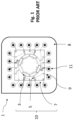
- Figure 1 shows a schematic plan view of a MEMS angular rate sensing device 1 as known from the prior art, for example as described in US,8555,717 , and known to be used in exemplary gyro products (e.g. Silicon Sensing Ltd. CRS39 and CRH02 gyros).
- exemplary gyro products e.g. Silicon Sensing Ltd. CRS39 and CRH02 gyros.
- the angular rate sensing device 1 comprises a MEMS structure 10 which consists of an annular resonator in the form of a planar ring 3 supported by eight pairs of equiangularly spaced compliant supporting structures 5, which extend from the planar ring 3 to a rigid mount 7.
- the planar ring 3, supporting structures 5 and rigid mount 7 are typically formed from a semiconductor material, e.g. silicon.
- the supporting structures 5 are flexible or compliant compared to the rigid mount 7 and planar ring 3, allowing the planar ring 3 to move elastically relative to the rigid mount 7, for example when deformed by an applied force.
- the MEMS structure 10 is mounted on the base 8 of a sealed metal can package with electrical connections made from either end of each tracking loop on the rigid mount 7, via wire bonds 9, to isolated pin connections 11 in the package base 8, as shown in Figure 1 .
- the package is mounted on a printed circuit board (PCB) via the contact pins 11 in the base 8 which connect to electrical circuitry (not shown in Figure 1 ).
- PCB printed circuit board
- Eight conductive tracking loops are configured on the surface of the MEMS structure 10.
- Each of the tracking loops passes from the mount 7, along the first leg of the pair, around an eighth segment of the ring 3 and then back to the mount 7 via the adjacent leg of the pair.
- the sensing device 1 is actuated electromagnetically.
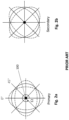
- a magnetic field is provided around the ring circumference, perpendicular to the tracking and ring 3, to enable Cos 2 ⁇ vibration modes, shown in Figure 2a , to be excited and detected electromagnetically.
- Such an inductive-type sensor is described in detail in US 8,555,717 .
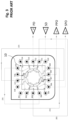
- the electrical connections on the PCB between the pins 301-318 of the angular rate sensing device 1 as known from the prior art is shown in Figure 3 .
- the primary drive (PD) current is applied via circuitry on the PCB at PD input 20 (shown in more detail in Figure 4 ) to pin 312.
- the PD current flows around a first tracking loop on the MEMS structure 10 to pin 311.
- pins 311, 312 correspond to a first primary drive transducer.
- Pin 311 is connected via tracking 201 on the PCB to pin 303 and the PD current then flows around a second tracking loop to pin 302.
- Pins 302, 303 correspond to a second primary drive transducer that is diametrically opposed to the first, forming a symmetrical pair of primary drive transducers.
- a first primary sensing or pick off (PPO) tracking loop connects from pin 316 around an eighth segment of the ring to pin 317 which is electrically connected via tracking 221 on the PCB to pin 307.
- a second tracking loop runs from pin 307, via a second MEMS ring segment, to pin 308 which is then connected to a PPO output 22 on the PCB.
- the pins 316, 317 and 307, 308 correspond to a symmetrical pair of diametrically opposed primary pick-off transducers.
- the two secondary drive (SD) loop segments are similarly connected in series by tracking 211 on the PCB between pins 309 and 301 with the SD current applied via pin 310 from SD input 21.
- the pins 309, 310 and 301, 318 correspond to a symmetrical pair of diametrically opposed secondary drive transducers.
- a secondary sensing or pick off (SPO) loop between pins 313 and 315 is connected by tracking 231 on the PCB to a second loop between pins 304 and 306.
- Pin 306 connects to SPO output 23 on the PCB.
- the pins 313, 315 and 304, 306 correspond to a symmetrical pair of diametrically opposed secondary pick-off transducers.
- Pins 305 and 314 connect the MEMS structure 10 to the PCB ground.
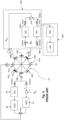
- FIG 4 shows a schematic diagram of a conventional control electronics implementation for an angular rate sensing device 1 according to the prior art.
- a primary drive (PD) signal derived from the primary control loops, configured as shown in Figure 3 is applied via PD input 20, to the diametrically opposed PD transducers 41a, 41b, at 0° and 180°.
- the resultant ring motion is detected using the PPO transducer pair 42a, 42b, at 90° and 270°.
- the PPO signal is applied to an output 22, e.g. comprising a front end amplifier, and is then demodulated and applied to a Phase Locked Loop (PLL) 45, which measures the phase difference between the PD signal applied at the PD input 20 and the PPO signal from the PPO output 22.
- PLL Phase Locked Loop
- the PLL output is then used to adjust a Voltage Control Oscillator (VCO) 46, which adjusts the primary drive signal frequency to maintain a 90° phase shift between the applied drive force and the induced resonant motion.
- VCO Voltage Control Oscillator
- the demodulated PPO signal is also applied to an Automatic Gain Control (AGC) loop 47 which compares the signal level to a fixed reference voltage V 0 , and adjusts the PD signal amplitude to maintain a fixed signal level at the PPO amplifier 22 and hence a fixed vibration amplitude.
- AGC Automatic Gain Control
- the signal from the SPO transducers 43a, 43b is applied to an output 23 and then demodulated at demodulators 48a, 48b to separate the real and quadrature signal components.
- the real component is that which is in phase with the primary mode motion and is generated due to the Coriolis forces arising due to applied rotation.
- the quadrature component arises due to errors in the frequency matching between the two vibration modes and must be separated from the rate-induced signal.
- the SPO real and quadrature signals are filtered (blocks 400, 402) to achieve the required system performance in terms of noise and bandwidth.
- the real component is filtered (block 404) and output (block 406) to provide an output representative of the applied angular rate.
- the filtered real and quadrature signal components from blocks 400,402 are then re-modulated at modulators 481a, 481b, summed, and a secondary drive signal V SD is applied to SD input 21 to drive the secondary drive transducers 44a, 44b, to null the secondary mode motion of the angular rate sensing device 1.
- FIG. 3 and 4 employs diametrically opposed transducer pairs for the primary drive transducers 41a, 41b, secondary drive transducers 44a, 44b, primary sensing or pick-off transducers 42a, 42b and secondary sensing or pick-off transducers 43a, 43b.
- the Applicant has recognised that a single secondary drive transducer 44a, 44b is sufficient to null the secondary mode, allowing the unused secondary drive transducer to be repurposed as a sensing transducer.
- the secondary drive transducers 44a, 44b are located at 90° with respect to the standard secondary sensing transducer pair 43a, 43b. As a result, if one of the secondary drive transducers 44a, 44b were to be repurposed as an additional secondary sensing transducer 43c, as seen in Figure 6 , any signal detected would be in anti-phase compared to that of the pair of secondary drive transducers due to the cos2 ⁇ motion.
- Modifications may be made to the standard configuration of the angular rate sensors known in the prior art, such as that shown in Figures 3 and 4 , to enable an additional sensing transducer signal to be added directly to a secondary sensing channel, thus enabling the signal to noise ratio to be improved by a factor of 3/2. These modifications may be made to the PCB connections and control electronics, as shown in Figures 5 and 6 respectively.
- FIG 5 shows a modified set of electrical connections for the angular rate sensing device 1 according to an example of the present disclosure.
- the MEMS structure 10 is equivalent to that described in the prior art and shown in Figure 1 , however the electrical connections between the MEMS structure 10 and the control circuitry are modified by changing the appropriate connections between the pins 501-518.
- the primary drive (PD) current is applied via circuitry on the PCB at PD input 20 (shown in more detail in Figure 4 ) to pin 512.
- the current flows around a first tracking loop on the MEMS structure 10 to pin 511.
- Pin 511 is connected via tracking 201 on the PCB to pin 503 and the current then flows around a second tracking loop to pin 502.
- a first primary sensing (PPO) tracking loop connects from pin 516 around an eighth segment of the ring to pin 517 which is electrically connected via tracking 221 on the PCB to pin 507.
- a second tracking loop runs from pin 507, via a second ring segment, to pin 508 which is then connected to a PPO output 22.
- the primary drive and primary pickoff connections are identical to those described in the prior art and shown in Figure 3 .
- the secondary drive (SD) loop segments are modified compared to the prior art.
- the secondary drive input 21 is connected to pin 510 and flows around a single tracking loop segment to pin 509.
- the secondary drive current is only applied via a single tracking loop segment, i.e. a single secondary drive transducer corresponding to the pins 509, 510.
- tracking loop 211 there is no further connection via tracking loop 211 to pins 501 and 518.
- pins 501 and 518 are included in the secondary sensing loop segment and therefore correspond to an additional secondary pick-off transducer.
- the secondary sensing or pick-off (SPO) loop is connected from the SPO output 23 on the PCB to a loop between pins 506 and 504.
- Pin 504 is now connected by tracking 241 to the additional loop between pins 518 and 501, and the additional loop is further connected via tracking 251 to the loop segment between pins 515 and 513. In this way, three tracking loop segments are included in the secondary sensing loop.
- the additional secondary pick-off transducer added to the secondary sensing loop provides an extra secondary pick-off transducer signal to the secondary sensor channel, and can enable the signal to noise ratio to be improved by a factor of 3/2.
- This improvement in signal to noise ratio can be achieved without making any changes to the MEMS structure 10 or can package and requires only simple connection modifications to the PCB, such as those as described in relation to Figure 5 . These modifications may therefore be implemented very easily and at low cost.
- Figure 6 shows a schematic diagram of a control electronics implementation for an angular rate sensing device 1 according to an example of the present disclosure.
- the control electronics may be implemented almost identically to those described for the prior art implementation shown in Figure 4 .
- a primary drive (PD) signal derived from the primary control loops is applied via an input (e.g. amplifier) 20, to the diametrically opposed PD transducers 41a, 41b, at 0° and 180°.
- the resultant ring motion is detected using the PPO transducer pair 42a, 42b, at 90° and 270°.
- This PPO signal is applied to an output (e.g. amplifier) 22 and is then demodulated and applied to a Phase Locked Loop (PLL) 45, which measures the phase difference between the PD signal applied at the input 20 and the PPO signal from the output 22.
- PLL Phase Locked Loop
- the PLL output is then used to adjust a Voltage Control Oscillator (VCO) 46, which adjusts the drive frequency to maintain a 90° phase shift between the applied drive force and the induced resonant motion.
- VCO Voltage Control Oscillator
- the demodulated PPO signal is also applied to an Automatic Gain Control (AGC) loop 47 which compares the signal level to a fixed reference voltage V 0 , and adjusts the PD signal amplitude to maintain a fixed signal level at the PPO output 22 and hence a fixed vibration amplitude.
- AGC Automatic Gain Control
- the signal from the SPO transducers 43a, 43b, 43c includes the signal from the additional secondary transducer 43c, and is applied to SPO output 23 before undergoing demodulation to separate the real and quadrature signal components.
- the SPO real and quadrature signals are filtered (blocks 400,402) to achieve the required system performance in terms of noise and bandwidth.
- the real component is filtered (block 404) and output (block 406) to provide an output representative of the applied angular rate.
- the filtered real and quadrature signal components from blocks 400, 402 are then re-modulated at modulators 481a, 481b, summed, and multiplied by a coefficient, ⁇ , dependent on the number of secondary drive transducers.
- a secondary drive signal of magnitude ⁇ V SD is then applied to SD input 21 to drive the secondary drive transducer 44b, to null the secondary mode motion of the angular rate sensing device 1.
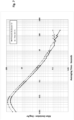
- Figure 7 shows an Allan Deviation comparison, which shows the output noise in degrees per hour of an angular rate sensor as a function of the averaging time for a time sequence of rate output data on a log-log scale.
- Curve 71 shows the Allan Deviation for a standard angular rate sensing device as known from the prior art, while curve 72 shows the results measured using an angular rate sensing device according to the present disclosure, i.e. including an additional secondary sensing tracking loop.
- the concept of repurposing a secondary drive transducer as a secondary sensing or pick-off transducer may also be applied to capacitive-type vibrating structure angular rate sensors, such as described in US,7,958,781 .
- the transducers for this design consist of discrete capacitor plates with the ring forming a common capacitor plate.
- the transducers for each drive and sensing function consist of pairs of diametrically opposed pairs.
- the drive and sensing plates are positioned on opposite sides of the ring circumference. This arrangement has performance advantages as described in US7958781 .
- Figure 8 shows a schematic of the capacitive transducer arrangement around the inner and outer periphery of the ring 142.
- the primary drive transducers, 145a and 145b, and secondary drive transducers 146a and 146b are located externally to the ring with primary sensing transducers, 147a and 147b, and secondary sensing transducers, 148a and 148b, located internally.
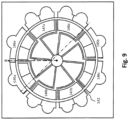
- such an arrangement may be modified as shown schematically in Figure 9 .
- the secondary drive nulling may be performed using only a single secondary drive transducer 146a with the other transducer of the pair being electrically connected to secondary sensing transducer pair 148a and 148b to form a third secondary sensing or pick-off transducer 148c, to increase the signal input to the SPO output by a factor of 1.5.
- the modified arrangement, shown in Figure 9 provides the same noise reduction benefits as achieved for the inductive-type sensor described above and evidenced by Figure 7 .
Landscapes
- Physics & Mathematics (AREA)
- General Physics & Mathematics (AREA)
- Engineering & Computer Science (AREA)
- Radar, Positioning & Navigation (AREA)
- Remote Sensing (AREA)
- Gyroscopes (AREA)
Description
- This disclosure generally relates to vibrating structure gyroscopes and angular rate sensors and, more specifically, Coriolis type angular rate sensors comprising a vibrating structure such as a planar ring, and to methods of improving the noise performance of such angular rate sensors.
- In many applications, vibrating structure angular rate sensors (also known as gyroscopes) are constructed using Micro-Electro-Mechanical Systems (MEMS) techniques, in which a device is fabricated from a silicon wafer, which may be bonded to a glass substrate wafer or alternatively sandwiched between two glass substrate layers.
- Typically, many of the higher performance MEMS gyroscopes use structures comprising planar rings, supported by a number of flexible, or compliant, supporting structures (also known as "legs") which are in turn attached to a mount, which may consist of a rigid silicon frame or central hub. The frame or hub is in turn rigidly fixed to a glass substrate. Due to the compliant nature of the supporting structures, the planar ring may move elastically relative to the silicon mount, for example when deformed by an applied force.
- It is well known in the prior art that the planar ring structure can be made to vibrate in a resonant mode using actuators located around the ring perimeter. In practice, pairs of actuators can excite the planar ring into a primary mode of resonance, in which a constant amplitude of motion is maintained at all times. When a rotation is applied around an axis perpendicular to the plane of the ring, Coriolis forces couple energy into a secondary mode of vibration, with the amplitude of the vibration being proportional to the applied angular rate. Coriolis-induced vibration can therefore be measured and used to calculate the rate of angular motion experienced by the angular rate sensor.
- These angular rate sensors may be actuated using capacitive, piezoelectric or electromagnetic transducers, which are typically arranged in diametrically opposed pairs of transducers for both the driving and detection of vibrational modes. The primary mode of resonance (the Cos 2θ mode) is routinely achieved using a common Primary Drive (PD) signal applied to a pair of drive transducers aligned at, for example, 0° and 180°. Similarly, the signals derived from two diametrically opposed Primary Pick-off (PPO) sensing transducers, located at, e.g. 90° and 270°, can be used to measure the vibration amplitude.
- The Coriolis-induced secondary vibration mode motion, excited when the ring is rotated, is typically detected by means of a pair of Secondary Pick-off (SPO) sensing transducers aligned at, for example, 135° and 315°. This secondary vibration motion may be measured directly or, more typically, the induced motion is nulled by means of Secondary Drive (SD) transducers aligned, for example, at 45° and 225°. In this "force-feedback" mode of operation, the applied nulling force is directly proportional to the applied angular rate, allowing the rate of angular motion experienced by the angular rate sensor to be determined.
- Diametrically opposed drive transducer pairs are used in the prior art so that the forces applied by the transducer pairs to excite the cos 2θ mode do not apply any net linear force which could induce a rigid body motion of the ring. Additionally, the use of opposed sensing transducer pairs can prevent perturbing signals, resulting from in-plane motion caused by applied shock or vibration, from being detected. Perturbing signals such as those caused by shock will be out-of-phase as determined by the opposed pairs of sensing transducers, and therefore cancel when the signals are summed together.
- An important consideration for vibrating structure gyroscopes and angular rate sensors is the noise performance, which is known to be dominated by the noise of the sensing amplifier receiving signals from the SPO sensing transducers. There remains a need to improve noise performance.
-
US 2012/125100A1 describes ring-shaped vibrating structure gyroscopes comprising piezoelectric elements formed as electrodes on the surface of a vibrating structure, and configured to measure angular velocity around three axes.US 6401534B1 describes a two-axis gyroscope comprising a ring-shaped planar resonator configured to detect rotation about the X, Y axes in the plane of the planar resonator. - According to a first aspect of this disclosure, there is provided a vibrating structure angular rate sensor comprising:
- a MEMS structure comprising a mount, a plurality of supporting structures fixed to the mount, and a vibrating planar ring structure flexibly supported by the plurality of supporting structures to move elastically relative to the mount;
- at least one primary drive transducer arranged to cause the ring structure to oscillate in a primary mode at the resonant frequency of the primary mode;
- at least one primary pick-off transducer arranged to detect oscillation of the ring structure in the primary mode;
- at least three secondary pick-off transducers arranged to detect oscillation of the ring structure in a secondary mode induced by Coriolis force when an angular rate is applied around an axis substantially perpendicular to the ring structure;
- at least one secondary drive transducer arranged to null the induced oscillation in the secondary mode;
- wherein the number of secondary pick-off transducers and the number of secondary drive transducers is an odd number, and wherein the number of secondary drive transducers is smaller than the number of secondary pick-off transducers.
- In such a vibrating structure angular rate sensor, there may be just one secondary drive transducer rather than a pair of drive transducers, as is conventional. Without changing the physical layout of the transducers, there can then be made available an extra secondary pick-off transducer, e.g. so that there are at least three secondary pick-off transducers. The sensing signal from the additional secondary pick-off transducer can be added directly to the existing sensing signals, thereby improving the signal-to-noise ratio without using a second sensing amplifier (which would add unwanted noise).
- In accordance with this disclosure, there is an odd number of secondary drive and pick-off transducers. The additional secondary pick-off transducer does not have a corresponding diametrically opposed transducer, as is conventional, so any perturbing signals (such as those caused by shock) will generate a signal which is not cancelled, as for diametrically opposed pairs. However, the Applicant has realised that these perturbing signals will not be at the resonant frequency of the ring so can be rejected by signal processing electronics, provided the amplitude is below the saturation threshold of the sensing amplifiers. The Applicant has further realised that saturation will not typically occur when measurements are made in static or non-dynamic environments with low levels of shock and vibration. In those environments where perturbing signals are unlikely, and/or in which measurements are taken over relatively long time periods (e.g. 10 seconds or more), there is less need for diametrically opposed drive transducer pairs. The Applicant has recognised that, in such scenarios, re-purposing one of a pair of secondary drive transducers as a sensing transducer can result in an improved signal to noise ratio when compared to the case of diametrically opposed drive transducer pairs.
- Such sensors may find particular use in applications such as North Finding, where measurements of the Earth's rotation rate are made with the sensor stationary so the required angular rate range is very low.
- In order to benefit from having a larger number of secondary pick-off transducers, the sensing signals from the secondary pick-off transducers may be summed together. Thus, in at least some examples, the at least three secondary pick-off transducers are electrically connected in series.
- The sensing signals from the secondary pick-off transducers may be combined at any stage. However, it is preferable to retain conventional pin connections and arrange for each of the at least three secondary pick-off transducers to be connected to a common output. Thus, in at least some examples, the sensor may further comprise a secondary pick-off signal output arranged to receive a secondary pick-off signal from each of the at least three secondary pick-off transducers.
- The secondary pick-off signal output may amplify its sensing signal, as is conventional, using analogue or digital techniques. However, the Applicant has realised that the increased amplitude of the sensing signal is most useful for improving signal-to-noise ratio when analogue amplification is applied. Thus, in at least some examples, the secondary pick-off signal output comprises an analogue amplifier. The secondary pick-off signal is first amplified by the analogue amplifier even if the signal is then applied to a digital control loop.
- It is well known that a sensing signal from the secondary pick-off signal output can be used for angular rate detection in a closed loop implementation, that is, where the at least one secondary drive transducer is arranged to null the induced oscillation in the secondary mode. This is described, for example, in
US 8,555,717 . In at least some examples, the sensor further comprises a rate control loop connected to the secondary pick-off signal output. In at least some examples, in addition or alternatively, the sensor further comprises a rate output circuit connected to the secondary pick-off signal output and arranged to provide an output representative of the applied angular rate. The rate output circuit may be connected to the secondary pick-off signal output via the rate control loop. - In closed loop operation, a secondary drive signal is applied to the at least one secondary drive transducer with a magnitude set to null the induced oscillation in the secondary mode. According to the present disclosure, the number of secondary drive transducers is reduced and a single secondary drive transducer may be used instead of a pair of secondary drive transducers, as is conventional. It may be desirable to maintain the same level of oscillation in the primary mode, regardless of the number of secondary drive transducers, and hence the scale factor (i.e. the drive required to null a given applied angular rate, which is typically 1 degree per second) will be doubled when using a single secondary drive rather than a pair of secondary drive transducers. In some instances it may be desirable to adjust the scale factor to be identical to the value for the sensor using two secondary drive transducers. This may be achieved by adjusting (halving) the gain of the rate output circuit. More generally, the secondary drive signal may be multiplied by a coefficient that depends on the number of secondary drive transducers. Thus, in at least some examples, the rate control loop is arranged to apply a secondary drive signal to the at least one secondary drive transducer, the secondary drive signal having a magnitude including a coefficient dependent on the number of secondary drive transducers. For example, the coefficient is two when there are three secondary pick-off transducers. Thus it will be understood that the coefficient is a multiplier selected depending on the number of secondary drive transducers. This rate control loop may otherwise be implemented in the same way as for example that described in
US 8,555,717 . - It should be appreciated that the sensor may include any suitable number of primary drive transducers and primary pick-off transducers. It is conventional to have an even number of primary drive transducers and an even number of primary pick-off transducers, and usually the same number of primary drive transducers and primary pick-off transducers. Symmetrical pairs are conventional at least for the reasons already discussed above. Most usually, in a sensor as disclosed herein, the primary transducers may consist of a pair of primary drive transducers and a pair of primary pick-off transducers. In at least some examples of the present disclosure, the sensor retains a conventional eight-fold arrangement of transducers. Such an arrangement is preferable as eight is the minimum number of transducers required to enable each of the four transducer functions (i.e. primary drive, primary pick-off, secondary drive and secondary pick-off) to operate with a ring utilising cos2θ vibration modes, to be implemented conventionally using diametrically opposed transducer pairs. Thus, in at least some examples, the transducers consist of a pair of primary drive transducers, a pair of primary pick-off transducers, one secondary drive transducer and three secondary pick-off transducers.
- In various examples of the present disclosure, the transducers are spaced equiangularly around a circumference of the vibrating planar ring structure. Such an arrangement is well known in the art, for example as described in
US 8,555,717 . - A sensor according to the present disclosure is suitable for an electromagnetic drive and sensing scheme. In at least some examples, each transducer is an inductive-type transducer. Such an arrangement is well known in the art, for example as described in
US 8,555,717 . - A sensor according to the present disclosure is suitable for an electrostatic drive and sensing scheme. In at least some examples, each transducer is a capacitive-type transducer. Such an arrangement is well known in the art, for example as described in
US 7,958,781 . - The MEMS structure is conveniently fabricated using wafer etching techniques. In at least some examples, the MEMS structure is a semiconductor structure, for example a silicon structure. For example, the mount, supporting structures and ring structure may all be etched from the same silicon wafer as a monolithic structure. The MEMS structure may optionally be fixed to a substrate, or sandwiched between substrates. Such substrate(s) may be formed of glass or silicon.
- It will be appreciated that the various circuits or control loops disclosed herein are not usually formed in the MEMS structure but may be electrically connected to the MEMS structure by appropriate means, such as e.g. downhole vias and wire bonds. In at least some examples, the sensor may further comprise a sensor package, the MEMS structure being sealed inside the sensor package, and a printed circuit board on which the sensor package is mounted, wherein electrical connections are made from the printed circuit board to the MEMS structure through the sensor package.
- Certain exemplary embodiments of this disclosure will now be described, with reference to the accompanying drawings, in which:
-
Figure 1 illustrates a typical vibrating structure angular rate sensor as found in the prior art; -
Figures 2a and 2b show diagrammatically the primary Cos 2θ and secondary Sin 2θ vibration modes, respectively, of a vibrating planar ring structure in a vibrating structure angular rate sensor; -
Figure 3 illustrates a standard layout of the connections between a vibrating planar ring structure and its associated control electronics as known in the prior art; -
Figure 4 schematically illustrates the control electronics of a vibrating structure angular rate sensor as known in the prior art; -
Figure 5 illustrates a layout of the connections between a vibrating planar ring structure and its associated control electronics according to an example of the present disclosure; -
Figure 6 schematically illustrates the control electronics of a vibrating structure angular rate sensor according to an example of the present disclosure; -
Figure 7 is a graphical comparison of the relationship between Allan Deviation and averaging time as determined for a vibrating structure angular rate sensor as known in the prior art and a vibrating structure angular rate sensor according to the present disclosure; -
Figure 8 illustrates a standard layout of a vibrating planar ring structure in a capacitive-type vibrating structure angular rate sensor; and -
Figure 9 illustrates a layout of a vibrating planar ring structure in a capacitive-type vibrating structure angular rate sensor according to another example of the present disclosure. -
Figure 1 shows a schematic plan view of a MEMS angularrate sensing device 1 as known from the prior art, for example as described inUS,8555,717 , and known to be used in exemplary gyro products (e.g. Silicon Sensing Ltd. CRS39 and CRH02 gyros). - The angular
rate sensing device 1 comprises aMEMS structure 10 which consists of an annular resonator in the form of aplanar ring 3 supported by eight pairs of equiangularly spaced compliant supportingstructures 5, which extend from theplanar ring 3 to arigid mount 7. Theplanar ring 3, supportingstructures 5 andrigid mount 7 are typically formed from a semiconductor material, e.g. silicon. The supportingstructures 5 are flexible or compliant compared to therigid mount 7 andplanar ring 3, allowing theplanar ring 3 to move elastically relative to therigid mount 7, for example when deformed by an applied force. - Typically the
MEMS structure 10 is mounted on thebase 8 of a sealed metal can package with electrical connections made from either end of each tracking loop on therigid mount 7, viawire bonds 9, toisolated pin connections 11 in thepackage base 8, as shown inFigure 1 . The package is mounted on a printed circuit board (PCB) via the contact pins 11 in thebase 8 which connect to electrical circuitry (not shown inFigure 1 ). - Eight conductive tracking loops, shown diagrammatically as arrows on the supporting
structures 5, are configured on the surface of theMEMS structure 10. Each of the tracking loops passes from themount 7, along the first leg of the pair, around an eighth segment of thering 3 and then back to themount 7 via the adjacent leg of the pair. In this example thesensing device 1 is actuated electromagnetically. A magnetic field is provided around the ring circumference, perpendicular to the tracking andring 3, to enable Cos 2θ vibration modes, shown inFigure 2a , to be excited and detected electromagnetically. Such an inductive-type sensor is described in detail inUS 8,555,717 . When a rotation at an angular rate Ω is applied around anaxis 100 perpendicular to the plane of the ring (i.e. out of the page inFigure 2a ), Coriolis forces couple energy into a secondary mode of vibration, shown inFigure 2b , with the amplitude of the vibration being proportional to the applied angular rate. - The electrical connections on the PCB between the pins 301-318 of the angular
rate sensing device 1 as known from the prior art is shown inFigure 3 . The primary drive (PD) current is applied via circuitry on the PCB at PD input 20 (shown in more detail inFigure 4 ) to pin 312. The PD current flows around a first tracking loop on theMEMS structure 10 to pin 311. Thus pins 311, 312 correspond to a first primary drive transducer.Pin 311 is connected via tracking 201 on the PCB to pin 303 and the PD current then flows around a second tracking loop to pin 302.Pins pin 316 around an eighth segment of the ring to pin 317 which is electrically connected via tracking 221 on the PCB to pin 307. A second tracking loop runs frompin 307, via a second MEMS ring segment, to pin 308 which is then connected to aPPO output 22 on the PCB. Thepins - The two secondary drive (SD) loop segments, the first of which is connected to
pins pins pins pin 310 fromSD input 21. Thepins pins pins Pin 306 connects toSPO output 23 on the PCB. Thepins Pins MEMS structure 10 to the PCB ground. -
Figure 4 shows a schematic diagram of a conventional control electronics implementation for an angularrate sensing device 1 according to the prior art. A primary drive (PD) signal derived from the primary control loops, configured as shown inFigure 3 , is applied viaPD input 20, to the diametricallyopposed PD transducers PPO transducer pair output 22, e.g. comprising a front end amplifier, and is then demodulated and applied to a Phase Locked Loop (PLL) 45, which measures the phase difference between the PD signal applied at thePD input 20 and the PPO signal from thePPO output 22. The PLL output is then used to adjust a Voltage Control Oscillator (VCO) 46, which adjusts the primary drive signal frequency to maintain a 90° phase shift between the applied drive force and the induced resonant motion. The demodulated PPO signal is also applied to an Automatic Gain Control (AGC)loop 47 which compares the signal level to a fixed reference voltage V0, and adjusts the PD signal amplitude to maintain a fixed signal level at thePPO amplifier 22 and hence a fixed vibration amplitude. - The signal from the
SPO transducers output 23 and then demodulated atdemodulators - After being demodulated at
demodulators blocks 400, 402) to achieve the required system performance in terms of noise and bandwidth. In arate output circuit 440, the real component is filtered (block 404) and output (block 406) to provide an output representative of the applied angular rate. In arate control loop 450, the filtered real and quadrature signal components from blocks 400,402 are then re-modulated at modulators 481a, 481b, summed, and a secondary drive signal VSD is applied toSD input 21 to drive thesecondary drive transducers 44a, 44b, to null the secondary mode motion of the angularrate sensing device 1. - The prior art implementation shown in
Figures 3 and4 employs diametrically opposed transducer pairs for theprimary drive transducers secondary drive transducers 44a, 44b, primary sensing or pick-off transducers off transducers secondary drive transducer 44a, 44b is sufficient to null the secondary mode, allowing the unused secondary drive transducer to be repurposed as a sensing transducer. - As can be seen in
Figure 4 , thesecondary drive transducers 44a, 44b are located at 90° with respect to the standard secondarysensing transducer pair secondary drive transducers 44a, 44b were to be repurposed as an additionalsecondary sensing transducer 43c, as seen inFigure 6 , any signal detected would be in anti-phase compared to that of the pair of secondary drive transducers due to the cos2θ motion. - Modifications may be made to the standard configuration of the angular rate sensors known in the prior art, such as that shown in
Figures 3 and4 , to enable an additional sensing transducer signal to be added directly to a secondary sensing channel, thus enabling the signal to noise ratio to be improved by a factor of 3/2. These modifications may be made to the PCB connections and control electronics, as shown inFigures 5 and6 respectively. -
Figure 5 shows a modified set of electrical connections for the angularrate sensing device 1 according to an example of the present disclosure. TheMEMS structure 10 is equivalent to that described in the prior art and shown inFigure 1 , however the electrical connections between theMEMS structure 10 and the control circuitry are modified by changing the appropriate connections between the pins 501-518. - In
Figure 5 , the primary drive (PD) current is applied via circuitry on the PCB at PD input 20 (shown in more detail inFigure 4 ) to pin 512. The current flows around a first tracking loop on theMEMS structure 10 to pin 511.Pin 511 is connected via tracking 201 on the PCB to pin 503 and the current then flows around a second tracking loop to pin 502. Similarly, a first primary sensing (PPO) tracking loop connects frompin 516 around an eighth segment of the ring to pin 517 which is electrically connected via tracking 221 on the PCB to pin 507. A second tracking loop runs frompin 507, via a second ring segment, to pin 508 which is then connected to aPPO output 22. The primary drive and primary pickoff connections are identical to those described in the prior art and shown inFigure 3 . - The secondary drive (SD) loop segments are modified compared to the prior art. The
secondary drive input 21 is connected to pin 510 and flows around a single tracking loop segment to pin 509. Unlike in the prior art, the secondary drive current is only applied via a single tracking loop segment, i.e. a single secondary drive transducer corresponding to thepins loop 211 topins - The secondary sensing or pick-off (SPO) loop is connected from the
SPO output 23 on the PCB to a loop betweenpins Pin 504 is now connected by tracking 241 to the additional loop betweenpins pins - The additional secondary pick-off transducer added to the secondary sensing loop provides an extra secondary pick-off transducer signal to the secondary sensor channel, and can enable the signal to noise ratio to be improved by a factor of 3/2. This improvement in signal to noise ratio can be achieved without making any changes to the
MEMS structure 10 or can package and requires only simple connection modifications to the PCB, such as those as described in relation toFigure 5 . These modifications may therefore be implemented very easily and at low cost. -
Figure 6 shows a schematic diagram of a control electronics implementation for an angularrate sensing device 1 according to an example of the present disclosure. The control electronics may be implemented almost identically to those described for the prior art implementation shown inFigure 4 . - A primary drive (PD) signal derived from the primary control loops, is applied via an input (e.g. amplifier) 20, to the diametrically
opposed PD transducers PPO transducer pair input 20 and the PPO signal from theoutput 22. - The PLL output is then used to adjust a Voltage Control Oscillator (VCO) 46, which adjusts the drive frequency to maintain a 90° phase shift between the applied drive force and the induced resonant motion. The demodulated PPO signal is also applied to an Automatic Gain Control (AGC)
loop 47 which compares the signal level to a fixed reference voltage V0, and adjusts the PD signal amplitude to maintain a fixed signal level at thePPO output 22 and hence a fixed vibration amplitude. - In the embodiment shown in
Figure 6 , the signal from theSPO transducers secondary transducer 43c, and is applied toSPO output 23 before undergoing demodulation to separate the real and quadrature signal components. - After being demodulated at
demodulators rate output circuit 440, the real component is filtered (block 404) and output (block 406) to provide an output representative of the applied angular rate. In arate control loop 450, the filtered real and quadrature signal components fromblocks SD input 21 to drive thesecondary drive transducer 44b, to null the secondary mode motion of the angularrate sensing device 1. - Importantly, when compared to the prior art control circuitry shown in
Figure 4 , the feedback electronics do not need to be changed significantly to implement theangular rate sensor 1 in this example of the present disclosure. Due to the fact that only a singlesecondary drive transducer 44b is provided, instead of two, the drive voltage required to deliver the required nulling force will be doubled thus altering the drive voltage by a factor corresponding to the coefficient β (where β = 2), as indicated inFigure 6 . If required, the output scaling can be adjusted by multiplying by acoefficient 1/β prior to output atblock 406. - The noise characteristics of the angular rate sensing device according to an example of the present disclosure and those of an angular rate sensing device known in the prior art are compared in
Figure 7. Figure 7 shows an Allan Deviation comparison, which shows the output noise in degrees per hour of an angular rate sensor as a function of the averaging time for a time sequence of rate output data on a log-log scale.Curve 71 shows the Allan Deviation for a standard angular rate sensing device as known from the prior art, whilecurve 72 shows the results measured using an angular rate sensing device according to the present disclosure, i.e. including an additional secondary sensing tracking loop. - It can be seen in
Figure 7 that the noise level for the angular rate sensor of the present disclosure is reduced by a factor of ~2/3 over the majority of the averaging time range compared to that measured for the angular rate sensor known from the prior art. These improved noise characteristics provide a corresponding improvement in the North finding accuracy that can be achieved. - The concept of repurposing a secondary drive transducer as a secondary sensing or pick-off transducer may also be applied to capacitive-type vibrating structure angular rate sensors, such as described in
US,7,958,781 . The transducers for this design consist of discrete capacitor plates with the ring forming a common capacitor plate. As with known inductive-type designs, the transducers for each drive and sensing function consist of pairs of diametrically opposed pairs. For this design, the drive and sensing plates are positioned on opposite sides of the ring circumference. This arrangement has performance advantages as described inUS7958781 . -
Figure 8 (taken fromUS7958781 ) shows a schematic of the capacitive transducer arrangement around the inner and outer periphery of thering 142. The primary drive transducers, 145a and 145b, andsecondary drive transducers Figure 9 . The secondary drive nulling may be performed using only a singlesecondary drive transducer 146a with the other transducer of the pair being electrically connected to secondarysensing transducer pair transducer 148c, to increase the signal input to the SPO output by a factor of 1.5. The modified arrangement, shown inFigure 9 , provides the same noise reduction benefits as achieved for the inductive-type sensor described above and evidenced byFigure 7 . - It will be appreciated by those skilled in the art that the present disclosure has been illustrated by describing one or more specific examples thereof, but is not limited to these examples; many variations and modifications are possible, within the scope of the accompanying claims.
Claims (14)
- A vibrating structure angular rate sensor (1) comprising:a MEMS structure (10) comprising a mount (7), a plurality of supporting structures (5) fixed to the mount (7), and a vibrating planar ring structure (3) flexibly supported by the plurality of supporting structures (5) to move elastically relative to the mount (7);at least one primary drive transducer (41a, 41b) arranged to cause the ring structure (3) to oscillate in a primary mode at the resonant frequency of the primary mode;at least one primary pick-off transducer (42a, 42b) arranged to detect oscillation of the ring structure (3) in the primary mode;at least three secondary pick-off transducers (43a, 43b, 43c) arranged to detect oscillation of the ring structure (3) in a secondary mode induced by Coriolis force when an angular rate is applied around an axis substantially perpendicular to the ring structure (3);at least one secondary drive transducer (44b) arranged to null the induced oscillation in the secondary mode;characterized in that:the number of secondary pick-off transducers (43a, 43b, 43c) and the number of secondary drive transducers (44b) is an odd number;and in that the number of secondary drive transducers (44b) is smaller than the number of secondary pick-off transducers (43a, 43b, 43c).
- The sensor of claim 1, wherein the at least three secondary pick-off transducers (43a, 43b, 43c) are electrically connected in series.
- The sensor of claim 1 or 2, further comprising a secondary pick-off signal output (23) arranged to receive a secondary pick-off signal from each of the at least three secondary pick-off transducers (43a, 43b, 43c).
- The sensor of claim 3, wherein the secondary pick-off signal output (23) comprises an analogue amplifier.
- The sensor of claim 3 or 4, further comprising a rate output circuit (440) connected to the secondary pick-off signal output (23) to provide an output representative of the applied angular rate.
- The sensor of any of claims 3-5, further comprising a rate control loop (450) connected to the secondary pick-off signal output (23).
- The sensor of claim 6, wherein the rate control loop (450) is arranged to apply a secondary drive signal to the at least one secondary drive transducer (44b), the secondary drive signal having a magnitude including a coefficient dependent on the number of secondary drive transducers (44b).
- The sensor of claim 7, wherein the coefficient is two when there are three secondary pick-off transducers (43a, 43b, 43c).
- The sensor of any preceding claim, wherein the transducers consist of a pair of primary drive transducers (41a, 41b), a pair of primary pick-off transducers (42a, 42b), one secondary drive transducer (44b) and three secondary pick-off transducers (43a, 43b, 43c).
- The sensor of any preceding claim, wherein the transducers are spaced equiangularly around a circumference of the vibrating planar ring structure (3).
- The sensor of any preceding claim, wherein each transducer is an inductive-type transducer.
- The sensor of any of claims 1-10, wherein each transducer is a capacitive-type transducer.
- The sensor of any preceding claim, wherein the MEMS structure (10) is a semiconductor structure, for example a silicon structure.
- The sensor of any preceding claim, further comprising a sensor package, the MEMS structure being sealed inside the sensor package, and a printed circuit board on which the sensor package in mounted, wherein electrical connections are made from the printed circuit board to the MEMS structure (10) through the sensor package.
Applications Claiming Priority (1)
| Application Number | Priority Date | Filing Date | Title |
|---|---|---|---|
| GBGB1911534.4A GB201911534D0 (en) | 2019-08-12 | 2019-08-12 | Improved noise performance for vibrating structure gyroscopes |
Publications (2)
| Publication Number | Publication Date |
|---|---|
| EP3779359A1 EP3779359A1 (en) | 2021-02-17 |
| EP3779359B1 true EP3779359B1 (en) | 2023-07-26 |
Family
ID=67990938
Family Applications (1)
| Application Number | Title | Priority Date | Filing Date |
|---|---|---|---|
| EP19215705.5A Active EP3779359B1 (en) | 2019-08-12 | 2019-12-12 | Improved noise performance for vibrating structure gyroscopes |
Country Status (5)
| Country | Link |
|---|---|
| US (1) | US11221218B2 (en) |
| EP (1) | EP3779359B1 (en) |
| JP (1) | JP7267908B2 (en) |
| KR (1) | KR20210019369A (en) |
| GB (1) | GB201911534D0 (en) |
Families Citing this family (7)
| Publication number | Priority date | Publication date | Assignee | Title |
|---|---|---|---|---|
| CN115917249A (en) * | 2020-07-03 | 2023-04-04 | 住友精密工业株式会社 | Vibration type gyro element and angular velocity sensor including the vibration type gyro element |
| DE102022114406A1 (en) | 2022-06-08 | 2023-12-14 | Northrop Grumman Litef Gmbh | Microelectromechanical coupling device |
| EP4312000B1 (en) | 2022-07-29 | 2025-11-05 | Leica Geosystems AG | Automatic, stationing of a geodetic survey instrument based on reference marker database |
| EP4311999B1 (en) | 2022-07-29 | 2026-01-21 | Leica Geosystems AG | Automatic, reference-free precise stationing of a geodetic survey instrument based on environment information |
| US11852483B1 (en) * | 2022-08-12 | 2023-12-26 | Honeywell International Inc. | Dither motor apparatus with pickoff embedded drives for ring laser gyroscope |
| EP4361558A1 (en) | 2022-10-24 | 2024-05-01 | Leica Geosystems AG | A point cloud aided calibration of a combined geodetic survey instrument |
| DE102023117380A1 (en) * | 2023-06-30 | 2025-01-02 | Northrop Grumman Litef Gmbh | microelectromechanical coupling device |
Family Cites Families (11)
| Publication number | Priority date | Publication date | Assignee | Title |
|---|---|---|---|---|
| GB2322196B (en) | 1997-02-18 | 2000-10-18 | British Aerospace | A vibrating structure gyroscope |
| GB2335273B (en) * | 1998-03-14 | 2002-02-27 | British Aerospace | A two axis gyroscope |
| US8011245B2 (en) | 2005-05-31 | 2011-09-06 | Innalabs Technologies, Inc. | Sensing element of coriolis force gyroscope |
| EP2092272B1 (en) | 2006-12-15 | 2015-01-21 | Atlantic Inertial Systems Limited | Improvements in or relating to a gyroscope |
| US8056413B2 (en) * | 2007-09-11 | 2011-11-15 | Evigia Systems, Inc. | Sensor and sensing method utilizing symmetrical differential readout |
| US8205495B2 (en) | 2008-06-10 | 2012-06-26 | The Boeing Company | Systematic disc resonator gyroscope tuning |
| GB0812788D0 (en) * | 2008-07-12 | 2008-08-20 | Atlantic Inertial Systems Ltd | Improvements in or relating to vibrating structure gyroscopes |
| JP2011027562A (en) | 2009-07-27 | 2011-02-10 | Sumitomo Precision Prod Co Ltd | Vibration gyro using piezoelectric film |
| US20120125100A1 (en) * | 2009-07-27 | 2012-05-24 | Sumitomo Precision Products Co, Ltd. | Vibrating gyroscope including piezoelectric film |
| JP2011027561A (en) | 2009-07-27 | 2011-02-10 | Sumitomo Precision Prod Co Ltd | Vibration gyro using piezoelectric film |
| GB2567479B (en) | 2017-10-13 | 2022-04-06 | Atlantic Inertial Systems Ltd | Angular rate sensors |
-
2019
- 2019-08-12 GB GBGB1911534.4A patent/GB201911534D0/en not_active Ceased
- 2019-12-12 EP EP19215705.5A patent/EP3779359B1/en active Active
- 2019-12-13 US US16/713,378 patent/US11221218B2/en active Active
- 2019-12-16 JP JP2019226514A patent/JP7267908B2/en active Active
- 2019-12-16 KR KR1020190167492A patent/KR20210019369A/en not_active Ceased
Also Published As
| Publication number | Publication date |
|---|---|
| JP7267908B2 (en) | 2023-05-02 |
| JP2021028626A (en) | 2021-02-25 |
| EP3779359A1 (en) | 2021-02-17 |
| GB201911534D0 (en) | 2019-09-25 |
| US20210048296A1 (en) | 2021-02-18 |
| KR20210019369A (en) | 2021-02-22 |
| US11221218B2 (en) | 2022-01-11 |
Similar Documents
| Publication | Publication Date | Title |
|---|---|---|
| US11221218B2 (en) | Noise performance for vibrating structure gyroscopes | |
| US6282958B1 (en) | Angular rate sensor | |
| EP1723388B1 (en) | Digital electronics on suspended assembly | |
| US5915276A (en) | Rate sensor | |
| US5698784A (en) | Vibratory rate gyroscope and methods of assembly and operation | |
| EP1425554B1 (en) | Vibratory gyroscopic rate sensor | |
| US6343509B1 (en) | Gyroscope | |
| US8763441B2 (en) | Method and apparatus for self-calibration of gyroscopes | |
| US6360601B1 (en) | Microgyroscope with closed loop output | |
| WO2008072008A1 (en) | Improvements in or relating to a gyroscope | |
| WO2005075939A1 (en) | Method for reducing bias error in a vibrating structure gyroscope | |
| US6467346B1 (en) | Coriolis sensor interface | |
| JP2003521682A (en) | Improvements on angular velocity sensor devices | |
| US20040118204A1 (en) | Vibratory gyroscopic rate sensor | |
| US20020135414A1 (en) | Acceleration signal amplifier with signal centering control technology | |
| US6611170B2 (en) | Angular rate amplifier with noise shield technology | |
| EP4650713A1 (en) | Capacitive gyroscope pickoff | |
| TW507077B (en) | Improvements relating to angular rate sensor devices |
Legal Events
| Date | Code | Title | Description |
|---|---|---|---|
| PUAI | Public reference made under article 153(3) epc to a published international application that has entered the european phase |
Free format text: ORIGINAL CODE: 0009012 |
|
| STAA | Information on the status of an ep patent application or granted ep patent |
Free format text: STATUS: THE APPLICATION HAS BEEN PUBLISHED |
|
| AK | Designated contracting states |
Kind code of ref document: A1 Designated state(s): AL AT BE BG CH CY CZ DE DK EE ES FI FR GB GR HR HU IE IS IT LI LT LU LV MC MK MT NL NO PL PT RO RS SE SI SK SM TR |
|
| AX | Request for extension of the european patent |
Extension state: BA ME |
|
| STAA | Information on the status of an ep patent application or granted ep patent |
Free format text: STATUS: REQUEST FOR EXAMINATION WAS MADE |
|
| 17P | Request for examination filed |
Effective date: 20210817 |
|
| RBV | Designated contracting states (corrected) |
Designated state(s): AL AT BE BG CH CY CZ DE DK EE ES FI FR GB GR HR HU IE IS IT LI LT LU LV MC MK MT NL NO PL PT RO RS SE SI SK SM TR |
|
| INTG | Intention to grant announced |
Effective date: 20220923 |
|
| INTG | Intention to grant announced |
Effective date: 20220928 |
|
| INTG | Intention to grant announced |
Effective date: 20221025 |
|
| INTG | Intention to grant announced |
Effective date: 20221031 |
|
| GRAS | Grant fee paid |
Free format text: ORIGINAL CODE: EPIDOSNIGR3 |
|
| STAA | Information on the status of an ep patent application or granted ep patent |
Free format text: STATUS: GRANT OF PATENT IS INTENDED |
|
| GRAA | (expected) grant |
Free format text: ORIGINAL CODE: 0009210 |
|
| STAA | Information on the status of an ep patent application or granted ep patent |
Free format text: STATUS: THE PATENT HAS BEEN GRANTED |
|
| AK | Designated contracting states |
Kind code of ref document: B1 Designated state(s): AL AT BE BG CH CY CZ DE DK EE ES FI FR GB GR HR HU IE IS IT LI LT LU LV MC MK MT NL NO PL PT RO RS SE SI SK SM TR |
|
| REG | Reference to a national code |
Ref country code: CH Ref legal event code: EP |
|
| REG | Reference to a national code |
Ref country code: IE Ref legal event code: FG4D |
|
| REG | Reference to a national code |
Ref country code: DE Ref legal event code: R096 Ref document number: 602019033457 Country of ref document: DE |
|
| REG | Reference to a national code |
Ref country code: LT Ref legal event code: MG9D |
|
| REG | Reference to a national code |
Ref country code: NL Ref legal event code: MP Effective date: 20230726 |
|
| REG | Reference to a national code |
Ref country code: AT Ref legal event code: MK05 Ref document number: 1592391 Country of ref document: AT Kind code of ref document: T Effective date: 20230726 |
|
| PG25 | Lapsed in a contracting state [announced via postgrant information from national office to epo] |
Ref country code: NL Free format text: LAPSE BECAUSE OF FAILURE TO SUBMIT A TRANSLATION OF THE DESCRIPTION OR TO PAY THE FEE WITHIN THE PRESCRIBED TIME-LIMIT Effective date: 20230726 |
|
| PG25 | Lapsed in a contracting state [announced via postgrant information from national office to epo] |
Ref country code: GR Free format text: LAPSE BECAUSE OF FAILURE TO SUBMIT A TRANSLATION OF THE DESCRIPTION OR TO PAY THE FEE WITHIN THE PRESCRIBED TIME-LIMIT Effective date: 20231027 |
|
| PG25 | Lapsed in a contracting state [announced via postgrant information from national office to epo] |
Ref country code: IS Free format text: LAPSE BECAUSE OF FAILURE TO SUBMIT A TRANSLATION OF THE DESCRIPTION OR TO PAY THE FEE WITHIN THE PRESCRIBED TIME-LIMIT Effective date: 20231126 |
|
| PG25 | Lapsed in a contracting state [announced via postgrant information from national office to epo] |
Ref country code: SE Free format text: LAPSE BECAUSE OF FAILURE TO SUBMIT A TRANSLATION OF THE DESCRIPTION OR TO PAY THE FEE WITHIN THE PRESCRIBED TIME-LIMIT Effective date: 20230726 Ref country code: RS Free format text: LAPSE BECAUSE OF FAILURE TO SUBMIT A TRANSLATION OF THE DESCRIPTION OR TO PAY THE FEE WITHIN THE PRESCRIBED TIME-LIMIT Effective date: 20230726 Ref country code: PT Free format text: LAPSE BECAUSE OF FAILURE TO SUBMIT A TRANSLATION OF THE DESCRIPTION OR TO PAY THE FEE WITHIN THE PRESCRIBED TIME-LIMIT Effective date: 20231127 Ref country code: NO Free format text: LAPSE BECAUSE OF FAILURE TO SUBMIT A TRANSLATION OF THE DESCRIPTION OR TO PAY THE FEE WITHIN THE PRESCRIBED TIME-LIMIT Effective date: 20231026 Ref country code: LV Free format text: LAPSE BECAUSE OF FAILURE TO SUBMIT A TRANSLATION OF THE DESCRIPTION OR TO PAY THE FEE WITHIN THE PRESCRIBED TIME-LIMIT Effective date: 20230726 Ref country code: LT Free format text: LAPSE BECAUSE OF FAILURE TO SUBMIT A TRANSLATION OF THE DESCRIPTION OR TO PAY THE FEE WITHIN THE PRESCRIBED TIME-LIMIT Effective date: 20230726 Ref country code: IS Free format text: LAPSE BECAUSE OF FAILURE TO SUBMIT A TRANSLATION OF THE DESCRIPTION OR TO PAY THE FEE WITHIN THE PRESCRIBED TIME-LIMIT Effective date: 20231126 Ref country code: HR Free format text: LAPSE BECAUSE OF FAILURE TO SUBMIT A TRANSLATION OF THE DESCRIPTION OR TO PAY THE FEE WITHIN THE PRESCRIBED TIME-LIMIT Effective date: 20230726 Ref country code: GR Free format text: LAPSE BECAUSE OF FAILURE TO SUBMIT A TRANSLATION OF THE DESCRIPTION OR TO PAY THE FEE WITHIN THE PRESCRIBED TIME-LIMIT Effective date: 20231027 Ref country code: FI Free format text: LAPSE BECAUSE OF FAILURE TO SUBMIT A TRANSLATION OF THE DESCRIPTION OR TO PAY THE FEE WITHIN THE PRESCRIBED TIME-LIMIT Effective date: 20230726 Ref country code: AT Free format text: LAPSE BECAUSE OF FAILURE TO SUBMIT A TRANSLATION OF THE DESCRIPTION OR TO PAY THE FEE WITHIN THE PRESCRIBED TIME-LIMIT Effective date: 20230726 |
|
| PG25 | Lapsed in a contracting state [announced via postgrant information from national office to epo] |
Ref country code: PL Free format text: LAPSE BECAUSE OF FAILURE TO SUBMIT A TRANSLATION OF THE DESCRIPTION OR TO PAY THE FEE WITHIN THE PRESCRIBED TIME-LIMIT Effective date: 20230726 |
|
| PG25 | Lapsed in a contracting state [announced via postgrant information from national office to epo] |
Ref country code: ES Free format text: LAPSE BECAUSE OF FAILURE TO SUBMIT A TRANSLATION OF THE DESCRIPTION OR TO PAY THE FEE WITHIN THE PRESCRIBED TIME-LIMIT Effective date: 20230726 |
|
| REG | Reference to a national code |
Ref country code: DE Ref legal event code: R097 Ref document number: 602019033457 Country of ref document: DE |
|
| PG25 | Lapsed in a contracting state [announced via postgrant information from national office to epo] |
Ref country code: SM Free format text: LAPSE BECAUSE OF FAILURE TO SUBMIT A TRANSLATION OF THE DESCRIPTION OR TO PAY THE FEE WITHIN THE PRESCRIBED TIME-LIMIT Effective date: 20230726 Ref country code: RO Free format text: LAPSE BECAUSE OF FAILURE TO SUBMIT A TRANSLATION OF THE DESCRIPTION OR TO PAY THE FEE WITHIN THE PRESCRIBED TIME-LIMIT Effective date: 20230726 Ref country code: ES Free format text: LAPSE BECAUSE OF FAILURE TO SUBMIT A TRANSLATION OF THE DESCRIPTION OR TO PAY THE FEE WITHIN THE PRESCRIBED TIME-LIMIT Effective date: 20230726 Ref country code: EE Free format text: LAPSE BECAUSE OF FAILURE TO SUBMIT A TRANSLATION OF THE DESCRIPTION OR TO PAY THE FEE WITHIN THE PRESCRIBED TIME-LIMIT Effective date: 20230726 Ref country code: DK Free format text: LAPSE BECAUSE OF FAILURE TO SUBMIT A TRANSLATION OF THE DESCRIPTION OR TO PAY THE FEE WITHIN THE PRESCRIBED TIME-LIMIT Effective date: 20230726 Ref country code: CZ Free format text: LAPSE BECAUSE OF FAILURE TO SUBMIT A TRANSLATION OF THE DESCRIPTION OR TO PAY THE FEE WITHIN THE PRESCRIBED TIME-LIMIT Effective date: 20230726 Ref country code: SK Free format text: LAPSE BECAUSE OF FAILURE TO SUBMIT A TRANSLATION OF THE DESCRIPTION OR TO PAY THE FEE WITHIN THE PRESCRIBED TIME-LIMIT Effective date: 20230726 |
|
| PG25 | Lapsed in a contracting state [announced via postgrant information from national office to epo] |
Ref country code: IT Free format text: LAPSE BECAUSE OF FAILURE TO SUBMIT A TRANSLATION OF THE DESCRIPTION OR TO PAY THE FEE WITHIN THE PRESCRIBED TIME-LIMIT Effective date: 20230726 |
|
| PLBE | No opposition filed within time limit |
Free format text: ORIGINAL CODE: 0009261 |
|
| STAA | Information on the status of an ep patent application or granted ep patent |
Free format text: STATUS: NO OPPOSITION FILED WITHIN TIME LIMIT |
|
| 26N | No opposition filed |
Effective date: 20240429 |
|
| PG25 | Lapsed in a contracting state [announced via postgrant information from national office to epo] |
Ref country code: SI Free format text: LAPSE BECAUSE OF FAILURE TO SUBMIT A TRANSLATION OF THE DESCRIPTION OR TO PAY THE FEE WITHIN THE PRESCRIBED TIME-LIMIT Effective date: 20230726 |
|
| REG | Reference to a national code |
Ref country code: CH Ref legal event code: PL |
|
| PG25 | Lapsed in a contracting state [announced via postgrant information from national office to epo] |
Ref country code: LU Free format text: LAPSE BECAUSE OF NON-PAYMENT OF DUE FEES Effective date: 20231212 |
|
| PG25 | Lapsed in a contracting state [announced via postgrant information from national office to epo] |
Ref country code: MC Free format text: LAPSE BECAUSE OF FAILURE TO SUBMIT A TRANSLATION OF THE DESCRIPTION OR TO PAY THE FEE WITHIN THE PRESCRIBED TIME-LIMIT Effective date: 20230726 |
|
| REG | Reference to a national code |
Ref country code: BE Ref legal event code: MM Effective date: 20231231 |
|
| PG25 | Lapsed in a contracting state [announced via postgrant information from national office to epo] |
Ref country code: MC Free format text: LAPSE BECAUSE OF FAILURE TO SUBMIT A TRANSLATION OF THE DESCRIPTION OR TO PAY THE FEE WITHIN THE PRESCRIBED TIME-LIMIT Effective date: 20230726 Ref country code: LU Free format text: LAPSE BECAUSE OF NON-PAYMENT OF DUE FEES Effective date: 20231212 |
|
| REG | Reference to a national code |
Ref country code: IE Ref legal event code: MM4A |
|
| PG25 | Lapsed in a contracting state [announced via postgrant information from national office to epo] |
Ref country code: IE Free format text: LAPSE BECAUSE OF NON-PAYMENT OF DUE FEES Effective date: 20231212 |
|
| PG25 | Lapsed in a contracting state [announced via postgrant information from national office to epo] |
Ref country code: BE Free format text: LAPSE BECAUSE OF NON-PAYMENT OF DUE FEES Effective date: 20231231 |
|
| PG25 | Lapsed in a contracting state [announced via postgrant information from national office to epo] |
Ref country code: CH Free format text: LAPSE BECAUSE OF NON-PAYMENT OF DUE FEES Effective date: 20231231 |
|
| PG25 | Lapsed in a contracting state [announced via postgrant information from national office to epo] |
Ref country code: IE Free format text: LAPSE BECAUSE OF NON-PAYMENT OF DUE FEES Effective date: 20231212 Ref country code: CH Free format text: LAPSE BECAUSE OF NON-PAYMENT OF DUE FEES Effective date: 20231231 Ref country code: BE Free format text: LAPSE BECAUSE OF NON-PAYMENT OF DUE FEES Effective date: 20231231 |
|
| PG25 | Lapsed in a contracting state [announced via postgrant information from national office to epo] |
Ref country code: BG Free format text: LAPSE BECAUSE OF FAILURE TO SUBMIT A TRANSLATION OF THE DESCRIPTION OR TO PAY THE FEE WITHIN THE PRESCRIBED TIME-LIMIT Effective date: 20230726 |
|
| PG25 | Lapsed in a contracting state [announced via postgrant information from national office to epo] |
Ref country code: BG Free format text: LAPSE BECAUSE OF FAILURE TO SUBMIT A TRANSLATION OF THE DESCRIPTION OR TO PAY THE FEE WITHIN THE PRESCRIBED TIME-LIMIT Effective date: 20230726 |
|
| PG25 | Lapsed in a contracting state [announced via postgrant information from national office to epo] |
Ref country code: CY Free format text: LAPSE BECAUSE OF FAILURE TO SUBMIT A TRANSLATION OF THE DESCRIPTION OR TO PAY THE FEE WITHIN THE PRESCRIBED TIME-LIMIT; INVALID AB INITIO Effective date: 20191212 |
|
| PG25 | Lapsed in a contracting state [announced via postgrant information from national office to epo] |
Ref country code: HU Free format text: LAPSE BECAUSE OF FAILURE TO SUBMIT A TRANSLATION OF THE DESCRIPTION OR TO PAY THE FEE WITHIN THE PRESCRIBED TIME-LIMIT; INVALID AB INITIO Effective date: 20191212 |
|
| PG25 | Lapsed in a contracting state [announced via postgrant information from national office to epo] |
Ref country code: TR Free format text: LAPSE BECAUSE OF FAILURE TO SUBMIT A TRANSLATION OF THE DESCRIPTION OR TO PAY THE FEE WITHIN THE PRESCRIBED TIME-LIMIT Effective date: 20230726 |
|
| PGFP | Annual fee paid to national office [announced via postgrant information from national office to epo] |
Ref country code: DE Payment date: 20251126 Year of fee payment: 7 |
|
| PGFP | Annual fee paid to national office [announced via postgrant information from national office to epo] |
Ref country code: GB Payment date: 20251119 Year of fee payment: 7 |
|
| PGFP | Annual fee paid to national office [announced via postgrant information from national office to epo] |
Ref country code: FR Payment date: 20251120 Year of fee payment: 7 |
|
| P01 | Opt-out of the competence of the unified patent court (upc) registered |
Free format text: CASE NUMBER: UPC_APP_0019432_3779359/2025 Effective date: 20251223 |