EP3779143A1 - Waste gate valve - Google Patents
Waste gate valve Download PDFInfo
- Publication number
- EP3779143A1 EP3779143A1 EP18913608.8A EP18913608A EP3779143A1 EP 3779143 A1 EP3779143 A1 EP 3779143A1 EP 18913608 A EP18913608 A EP 18913608A EP 3779143 A1 EP3779143 A1 EP 3779143A1
- Authority
- EP
- European Patent Office
- Prior art keywords
- attachment plate
- rotary shaft
- valve
- main body
- wastegate valve
- Prior art date
- Legal status (The legal status is an assumption and is not a legal conclusion. Google has not performed a legal analysis and makes no representation as to the accuracy of the status listed.)
- Withdrawn
Links
Images






Classifications
-
- F—MECHANICAL ENGINEERING; LIGHTING; HEATING; WEAPONS; BLASTING
- F02—COMBUSTION ENGINES; HOT-GAS OR COMBUSTION-PRODUCT ENGINE PLANTS
- F02B—INTERNAL-COMBUSTION PISTON ENGINES; COMBUSTION ENGINES IN GENERAL
- F02B37/00—Engines characterised by provision of pumps driven at least for part of the time by exhaust
- F02B37/12—Control of the pumps
- F02B37/18—Control of the pumps by bypassing exhaust from the inlet to the outlet of turbine or to the atmosphere
- F02B37/183—Arrangements of bypass valves or actuators therefor
- F02B37/186—Arrangements of actuators or linkage for bypass valves
-
- F—MECHANICAL ENGINEERING; LIGHTING; HEATING; WEAPONS; BLASTING
- F02—COMBUSTION ENGINES; HOT-GAS OR COMBUSTION-PRODUCT ENGINE PLANTS
- F02B—INTERNAL-COMBUSTION PISTON ENGINES; COMBUSTION ENGINES IN GENERAL
- F02B37/00—Engines characterised by provision of pumps driven at least for part of the time by exhaust
- F02B37/12—Control of the pumps
- F02B37/18—Control of the pumps by bypassing exhaust from the inlet to the outlet of turbine or to the atmosphere
- F02B37/183—Arrangements of bypass valves or actuators therefor
-
- F—MECHANICAL ENGINEERING; LIGHTING; HEATING; WEAPONS; BLASTING
- F01—MACHINES OR ENGINES IN GENERAL; ENGINE PLANTS IN GENERAL; STEAM ENGINES
- F01D—NON-POSITIVE DISPLACEMENT MACHINES OR ENGINES, e.g. STEAM TURBINES
- F01D17/00—Regulating or controlling by varying flow
- F01D17/10—Final actuators
- F01D17/105—Final actuators by passing part of the fluid
-
- F—MECHANICAL ENGINEERING; LIGHTING; HEATING; WEAPONS; BLASTING
- F01—MACHINES OR ENGINES IN GENERAL; ENGINE PLANTS IN GENERAL; STEAM ENGINES
- F01D—NON-POSITIVE DISPLACEMENT MACHINES OR ENGINES, e.g. STEAM TURBINES
- F01D17/00—Regulating or controlling by varying flow
- F01D17/10—Final actuators
- F01D17/12—Final actuators arranged in stator parts
- F01D17/14—Final actuators arranged in stator parts varying effective cross-sectional area of nozzles or guide conduits
- F01D17/141—Final actuators arranged in stator parts varying effective cross-sectional area of nozzles or guide conduits by means of shiftable members or valves obturating part of the flow path
- F01D17/145—Final actuators arranged in stator parts varying effective cross-sectional area of nozzles or guide conduits by means of shiftable members or valves obturating part of the flow path by means of valves, e.g. for steam turbines
-
- F—MECHANICAL ENGINEERING; LIGHTING; HEATING; WEAPONS; BLASTING
- F16—ENGINEERING ELEMENTS AND UNITS; GENERAL MEASURES FOR PRODUCING AND MAINTAINING EFFECTIVE FUNCTIONING OF MACHINES OR INSTALLATIONS; THERMAL INSULATION IN GENERAL
- F16K—VALVES; TAPS; COCKS; ACTUATING-FLOATS; DEVICES FOR VENTING OR AERATING
- F16K1/00—Lift valves or globe valves, i.e. cut-off apparatus with closure members having at least a component of their opening and closing motion perpendicular to the closing faces
- F16K1/16—Lift valves or globe valves, i.e. cut-off apparatus with closure members having at least a component of their opening and closing motion perpendicular to the closing faces with pivoted closure-members
- F16K1/18—Lift valves or globe valves, i.e. cut-off apparatus with closure members having at least a component of their opening and closing motion perpendicular to the closing faces with pivoted closure-members with pivoted discs or flaps
- F16K1/20—Lift valves or globe valves, i.e. cut-off apparatus with closure members having at least a component of their opening and closing motion perpendicular to the closing faces with pivoted closure-members with pivoted discs or flaps with axis of rotation arranged externally of valve member
- F16K1/2007—Lift valves or globe valves, i.e. cut-off apparatus with closure members having at least a component of their opening and closing motion perpendicular to the closing faces with pivoted closure-members with pivoted discs or flaps with axis of rotation arranged externally of valve member specially adapted operating means therefor
-
- F—MECHANICAL ENGINEERING; LIGHTING; HEATING; WEAPONS; BLASTING
- F05—INDEXING SCHEMES RELATING TO ENGINES OR PUMPS IN VARIOUS SUBCLASSES OF CLASSES F01-F04
- F05D—INDEXING SCHEME FOR ASPECTS RELATING TO NON-POSITIVE-DISPLACEMENT MACHINES OR ENGINES, GAS-TURBINES OR JET-PROPULSION PLANTS
- F05D2230/00—Manufacture
- F05D2230/20—Manufacture essentially without removing material
- F05D2230/21—Manufacture essentially without removing material by casting
-
- F—MECHANICAL ENGINEERING; LIGHTING; HEATING; WEAPONS; BLASTING
- F05—INDEXING SCHEMES RELATING TO ENGINES OR PUMPS IN VARIOUS SUBCLASSES OF CLASSES F01-F04
- F05D—INDEXING SCHEME FOR ASPECTS RELATING TO NON-POSITIVE-DISPLACEMENT MACHINES OR ENGINES, GAS-TURBINES OR JET-PROPULSION PLANTS
- F05D2230/00—Manufacture
- F05D2230/20—Manufacture essentially without removing material
- F05D2230/23—Manufacture essentially without removing material by permanently joining parts together
- F05D2230/232—Manufacture essentially without removing material by permanently joining parts together by welding
- F05D2230/239—Inertia or friction welding
-
- F—MECHANICAL ENGINEERING; LIGHTING; HEATING; WEAPONS; BLASTING
- F05—INDEXING SCHEMES RELATING TO ENGINES OR PUMPS IN VARIOUS SUBCLASSES OF CLASSES F01-F04
- F05D—INDEXING SCHEME FOR ASPECTS RELATING TO NON-POSITIVE-DISPLACEMENT MACHINES OR ENGINES, GAS-TURBINES OR JET-PROPULSION PLANTS
- F05D2230/00—Manufacture
- F05D2230/20—Manufacture essentially without removing material
- F05D2230/25—Manufacture essentially without removing material by forging
-
- F—MECHANICAL ENGINEERING; LIGHTING; HEATING; WEAPONS; BLASTING
- F05—INDEXING SCHEMES RELATING TO ENGINES OR PUMPS IN VARIOUS SUBCLASSES OF CLASSES F01-F04
- F05D—INDEXING SCHEME FOR ASPECTS RELATING TO NON-POSITIVE-DISPLACEMENT MACHINES OR ENGINES, GAS-TURBINES OR JET-PROPULSION PLANTS
- F05D2260/00—Function
- F05D2260/60—Fluid transfer
- F05D2260/606—Bypassing the fluid
-
- Y—GENERAL TAGGING OF NEW TECHNOLOGICAL DEVELOPMENTS; GENERAL TAGGING OF CROSS-SECTIONAL TECHNOLOGIES SPANNING OVER SEVERAL SECTIONS OF THE IPC; TECHNICAL SUBJECTS COVERED BY FORMER USPC CROSS-REFERENCE ART COLLECTIONS [XRACs] AND DIGESTS
- Y02—TECHNOLOGIES OR APPLICATIONS FOR MITIGATION OR ADAPTATION AGAINST CLIMATE CHANGE
- Y02T—CLIMATE CHANGE MITIGATION TECHNOLOGIES RELATED TO TRANSPORTATION
- Y02T10/00—Road transport of goods or passengers
- Y02T10/10—Internal combustion engine [ICE] based vehicles
- Y02T10/12—Improving ICE efficiencies
Definitions
- the present invention pertains to a wastegate valve that is provided at an exhaust gas flow path in an engine which is turbocharged through use of a turbocharger and that adjusts the amount of exhaust gas which flows into a turbine by causing diversion of a portion of the exhaust gas, and in particular relates to a wastegate valve which is formed such that the overall shape thereof is approximately L-shaped as seen in plan view and in which a rotary shaft extends, in a direction approximately perpendicular to the central axis of a valve body and in such fashion as to be offset from the valve body, from an attachment plate that supports the valve body.
- exhaust turbine turbochargers for improving engine performance and reducing fuel consumption are known.
- exhaust turbine turbochargers are constituted such that engine exhaust gas made to enter thereinto from an exhaust gas inlet causes rotation of a turbine impeller provided at the turbine housing and is thereafter discharged from an exhaust gas outlet to an exhaust gas flow path.
- wastegate valve 11 is provided at bypass flow path 10 which extends between exhaust gas inlet 3 and exhaust gas outlet 8; for example, when turbocharged pressure exceeds a set value, wastegate valve 11 might open and cause a portion of the exhaust gas directed toward turbine impeller 4 to be directed from bypass flow path 10 to exhaust gas flow path 9 so as to prevent turbocharged pressure from becoming excessive.
- wastegate valve 11 is formed such that the overall shape thereof is approximately L-shaped as seen in plan view and is such that rotary shaft 13 extends, in a direction approximately perpendicular to the central axis of valve body 12 and in such fashion as to be offset from valve body 12, from attachment plate 17 which supports valve body 12.
- Valve body 12 is disposed so as to make contact with valve seat surface 10a, rotation of rotary shaft 13 causing valve body 12 to separate from valve seat surface 10a, opening valve 11.
- wastegate valve 11 might, for example, be constituted such that rotary shaft 13 is secured to attachment plate 17 as a result of having been arc-welded thereto, swaging being carried out to secure valve body 12 by way of attachment dowel 23 and washer 24 so that it does not come free of attachment plate 17.
- Patent Reference No. 1 Japanese Patent Application Publication Kokai No. 2013-2431 (see paragraphs 0016-0021 and FIGS. 1, 2 , and 3 )
- valve body 12 not only valve body 12 but also rotary shaft 13, attachment plate 17, washer 24, and all of the other valve constituent members will be made of heat-resistant alloy, the cost of which will increase as a function of the operating temperature limit of the alloy employed, thus causing increase in the unit cost of valve 11 as well by a corresponding amount.
- engagement hole 19 is provided for insertion of rotary shaft 13 into attachment plate 17, the constitution being such as to permit the weld bead to be formed at weld hole 21 which is provided at the wall at which engagement hole 19 is formed.
- attachment plate 17 is thus increased by an amount corresponding to that which is necessary to permit provision of engagement hole 19 and weld hole 21. For this reason, it is firstly the case that in addition to the fact that valve 11 is made expensive, increase in the weight of valve 11 can lead to increase in the overall weight of the engine. It is secondly the case that as the space for arrangement of the valve provided at exhaust gas flow path 9 (bypass flow path 10) within turbine housing 1 will be large, this will constitute a constraint when designing an exhaust gas flow path 9 provided with a bypass flow path 10.
- the present invention was conceived in light of the foregoing problems in the conventional art, it being an object thereof to provide a wastegate valve that makes it possible to achieve alleviation of constraints that would otherwise apply to design of an exhaust gas flow path provided with a bypass flow path, reduction in weight, and decrease in cost due to having made an attachment plate more compact as a result of causing a rotary shaft main body to be secured by means of solid-phase welding to the attachment plate.
- the invention as recited at claim 1 in the context of a wastegate valve formed such that the overall shape thereof is approximately L-shaped as seen in plan view and such that a rotary shaft extends, in a direction approximately perpendicular to a central axis of a valve body and in such fashion as to be offset from the valve body, from an attachment plate which supports the valve body, is characterized in that the rotary shaft is constituted from a rotary shaft main body that is solid-phase-welded to a side of the attachment plate.
- Solid-phase welding e.g., friction welding or resistance welding
- one end of a rotary shaft main body to the side of an attachment plate
- Solid-phase welding can be employed not only to mutually secure metals of the same type but also to mutually secure metals of different types, little time is required for processing, quality (joint strength) is uniform, and because there is little occurrence of burrs along the joint surface, post-processing during which burrs are removed is also easy.
- solid-phase welding refers to a joining method in which the members being joined-without being melted and while still in solid phase (solid state)-are softened as a result of application of heat, and are further made to adhere as a result of application of pressure
- solid-phase welding in the context of the invention under application including friction welding and resistance welding.
- friction welding refers to a method in which members to be joined are made to mutually rub against each other at high speed such that the heat due to friction which is produced at such time causes the members to soften, simultaneous with which pressured is applied thereto, the diffusion of atoms which occurs across the joint surface being utilized to causing joining thereof.
- resistance welding refers to a method in which members to be joined are made to mutually overlap, the location to be joined is straddled between electrodes, and a prescribed pressure is applied thereto and electric current is made to flow therethrough, joining occurring as a result of the joint surface having been softened due to the Joule heating produced as a result of the electrical resistance at the region being joined.
- the rotary shaft main body is solid-phase-welded to the side of the attachment plate, it is possible to cause the attachment plate, which is constituted from expensive heat-resistant metal, to be made more compact. For this reason, it is firstly the case that the cost of the wastegate valve can be reduced, and it will also be possible to reduce overall weight. It is secondly the case that as the wastegate valve is arranged in the vicinity of the valve seat surface at the exhaust gas flow path (bypass flow path) within the turbine housing, and as the space required for arrangement of the valve is small, it will be possible to alleviate the constraint that would otherwise exist when designing an exhaust gas flow path provided with a bypass flow path.
- a rotary shaft that bears on a through-hole provided in the turbine housing will not need to be as heat-resistant as the valve body or the attachment plate to the extent that heat transmitted thereto from the attachment plate is dissipated to the turbine housing.
- the rotary shaft main body to be constituted from a metal that is not as heat-resistant as the heat-resistant metal(s) from which the valve body and the attachment plate are constituted, it will be possible to further reduce the cost of the wastegate valve to an extent corresponding to the degree to which the rotary shaft main body is made less expensive.
- the invention as recited at claim 2, in the context of the wastegate valve according to claim 1, is characterized in that the rotary shaft is constituted from the rotary shaft main body, and from a boss that is approximately identical in diameter to the rotary shaft main body and that is formed in protruding fashion at the side of the attachment plate.
- the rotary shaft which extends from the attachment plate is able to cause a portion of the heat that is transmitted thereto from the attachment plate to be dissipated to the turbine housing it will not need to be as heat-resistant as the valve body or the attachment plate, but regions of the rotary shaft that are near the attachment plate will reach temperatures (elevated temperatures) that are close to the temperatures (elevated temperatures) experienced by the attachment plate.
- regions of the rotary shaft that are near the attachment plate are constituted from a boss that is formed in protruding fashion at the side of the attachment plate, which is to say that they are constituted from the same heat-resistant metal as that from which the attachment plate is constituted, as a result of which the heat resistance (decrease in mechanical strength due to influence of heat) of regions of the rotary shaft that are near the attachment plate does not present a problem.
- the rotary shaft main body is constituted from a metal of lower heat resistance than that of the heat-resistant metal(s) from which the valve body and the attachment plate are constituted, the possibility that the mechanical strength of the rotary shaft main body will be reduced due to the influence of heat can be eliminated, which is to say that the heat resistance of the rotary shaft main body will not present a problem.
- the temperature of the exhaust gas that flows through the exhaust gas flow path (bypass flow path) will be different, where the temperature of the exhaust gas is high it will be necessary not only that the valve body and the attachment plate be constituted from metal(s) having excellent heat resistance but also that the rotary shaft main body be constituted from metal that to some degree has excellent heat resistance.
- the length by which a boss which is formed at an attachment plate constituted from heat-resistant metal protrudes therefrom is made large, it will be possible to suppress the influence of heat on a rotary shaft main body that is constituted from a metal of lower heat resistance than that of the metal from which the attachment plate is constituted. That is, it will be possible as a result of adjustment of the length by which the boss protrudes therefrom to select from among a variety of heat-resistant metals from which the rotary shaft main body may be constituted.
- the invention as recited at claim 3, in the context of the wastegate valve according to claim 1 or 2, is characterized in that the rotary shaft main body is constituted from a hollow pipe.
- the invention as recited at claim 4, in the context of the wastegate valve according to claim 3, is characterized in that the rotary shaft main body extends all the way through a turbine housing of an exhaust turbine turbocharger, and a hollow portion of said rotary shaft main body is open to an exterior of the turbine housing.
- the rotary shaft main body is constituted from a metal of lower heat resistance than the heat-resistant metal(s) from which the valve body and the attachment plate are constituted, there will be absolutely no possibility that the heat resistance of the main body of the rotary shaft will present a problem.
- valve body is secured to the attachment plate as a result of swaging by way of an attachment dowel and a washer so as not to come free therefrom, and the attachment plate has been shaped as a result of having been forged.
- an operation in which an attachment plate is forged, an operation in which a rotary shaft main body is solid-phase-welded (e.g., friction-welded), a deburring operation, and an operation in which a through-hole for the attachment plate is formed are conducted during the course of manufacturing a valve manufacturing intermediary at which the rotary shaft extends from the side of the attachment plate and the overall shape of which is approximately L-shaped as seen in plan view, and an operation is lastly carried out in which swaging is performed to secure the valve body to (the through-hole of) the attachment plate of the valve manufacturing intermediary.
- valve body and the attachment plate have been formed into their respective shapes in integral fashion by forging or lost wax casting.
- valve body and the attachment plate are formed into their respective shapes in integral fashion by forging or lost wax casting, the number of parts from which the wastegate valve is constituted being made small to a corresponding extent.
- a wastegate valve formed such that the overall shape thereof is approximately L-shaped as seen in plan view and such that a rotary shaft extends from the side of the attachment plate which supports the valve body may be manufactured.
- the present invention because it is such that a rotary shaft main body is secured to an attachment plate by means of solid-phase welding, permits provision of a wastegate valve that makes it possible to achieve alleviation of constraints that would otherwise apply to design of an exhaust gas flow path provided with a bypass flow path, reduction in weight, and decrease in wastegate valve cost due to having made the attachment plate more compact, as compared with a conventional wastegate valve in which a rotary shaft is secured to an attachment plate by means of arc welding.
- FIGS. 1 through 4 show a working example of an exhaust turbine turbocharger provided with a wastegate valve in accordance with the present invention, the exhaust turbine turbocharger having the same structure as that at prior Patent Reference No. 1 (Japanese Patent Application Publication Kokai No. 2013-2431 ). More specifically, FIG. 1 is a side view of same exhaust turbine turbocharger, FIG. 2 is a front view of same exhaust turbine turbocharger, FIG. 3 is rear view of same exhaust turbine turbocharger, and FIG. 4 is a sectional view (sectional view along section IV-IV shown in FIG. 2 ) showing an exhaust gas flow path and a bypass flow path. Furthermore, FIGS. 5 through 10 are drawings showing wastegate valve 50 associated with a first embodiment.
- reference numeral 1 is the turbine housing of exhaust turbine turbocharger 100, and within turbine housing 1 exhaust gas from the exhaust manifold of the engine is directed toward exhaust gas inlet 3 (see FIG. 4 ) of turbine scroll 2, exhaust gas supplied to turbine scroll 2 causing rotation of turbine impeller 4 (see FIG. 4 ).
- compressor impeller (not shown) which is coaxial with turbine impeller 4, rotation of the compressor impeller causing compression of air drawn thereinto from axially centered air intake port 7a, the compressed air being supplied to the engine from compressed air outtake port 7b to turbocharge the engine.
- a bypass flow path 10 for bypass of the exhaust gas is provided between exhaust gas inlet 3 and exhaust gas outlet 8.
- annular valve seat surface 10a is formed at the periphery of circular opening 10b to exhaust gas flow path 9 of bypass flow path 10, wastegate valve 50-which is equipped with valve body 56 that opens and closes opening 10a, which is to say that it opens and closes bypass flow path 10-being provided at a location which is downstream from and in the vicinity of opening 10b (valve seat surface 10a) in such fashion as to make contact with valve seat surface 10a.
- wastegate valve 50 is such that valve body 56 moves in a direction (downward in FIG. 4 ) causing it to be separated from valve seat surface 10a, and a portion of the exhaust gas is made to bypass turbine impeller 4 as a result of being sent from bypass flow path 10 to exhaust gas flow path 9.
- wastegate valve 50 has a structure such that it is provided with rotary shaft 58 that extends, in offset fashion with respect to valve body 56, from attachment plate 52, which is more or less rectangular as seen in front view and which supports valve body 56; and as shown in FIG. 10 , rotary shaft 58 bears on circular-pipe-like bearing 13A which extends all the way through the wall at which turbine housing 1 is formed, the other end 58a thereof being exposed to the exterior of turbine housing 1.
- Bearing 13A is secured as a result of having been press-fit into through-hole 1a in the wall at which turbine housing 1 is formed.
- rotary lever 14 is secured in crankshaft-like fashion to the outer end (other end) 58a of rotary shaft 58, the tip of reciprocating rod 16a of actuator 16 which is secured to compressor housing 5 being coupled by way of drive pin 15 to pivoting tip 14a of rotary lever 14
- Actuator 16 might, for example, be constituted as an air-driven diaphragm-type driving apparatus, such that when turbocharged pressure of compressed air exceeds a set value, wastegate valve 50 opens, causing a portion of the exhaust gas to bypass turbine impeller 4 and be discharged from exhaust gas inlet 3 to exhaust gas flow path 9 (see FIG. 4 ).
- wastegate valve 50 The structure of wastegate valve 50 will next be described in detail with reference to FIGS. 5 through 10 .
- Wastegate valve 50 is provided with attachment plate 52 which is more or less rectangular as seen in front view and which supports valve body 56, and rotary shaft 58 which is joined (secured) by means of friction welding to the side of attachment plate 52 and which extends, in offset fashion with respect to valve body 56, in a direction perpendicular to central axis O of valve body 56, being formed such that the overall shape thereof is approximately L-shaped as seen in plan view (see FIG. 5 and see (a) at FIG. 8 ).
- valve 50 In addition, rotation of valve 50 about center of rotation L as indicated by arrow C in FIG. 5 causes opening and closing of valve body 56 with respect to valve seat surface 10a (opening 10b).
- discoid protuberance 52a perpendicular to rotary shaft 58 is formed at the side of attachment plate 52 from which rotary shaft 58 extends, cylindrical rotary shaft 58 extending from the end face of protuberance 52a.
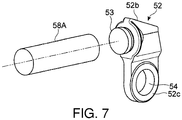
- Rotary shaft 58 is constituted by using a friction welding operation, described below, to cause one end face of rotary shaft main body 58A to be joined by means of friction welding to and made integral with the distal face of boss 53 (see FIGS. 6 and 7 ) which protrudes slightly from the end face of protuberance 52a.
- reference numeral 59 at FIGS. 5 , 8 , and 10 indicates the joint (joint surface) between the two members 53, 58A.
- attachment plate 52 which is opposite the side at which protuberance 52a is formed is formed in downwardly extending flattened plate-like fashion, and the upper edge 52b thereof is formed in cristate fashion such that what would otherwise be an upper edge right-triangular corner is notched in right-triangular fashion as indicated by the alternating long and short chain line at (a) in FIG. 8 , being constituted so as to reduce the amount by which attachment plate 52 protrudes into exhaust gas flow path 9.
- bypass flow path 10 is provided in parallel fashion with respect to exhaust gas flow path 9 at a location adjacent to and diagonally downward and to the right from said exhaust gas flow path 9 as the exhaust turbine turbocharger is seen in front view, such that it is in communication with exhaust gas flow path 9 by way of opening 10b at which annular valve seat surface 10a is formed.
- wastegate valve 50 is such that sealing surface 56a1 of the valve body 56 thereof is in intimate contact with valve seat surface 10a, and is such that the rotary shaft 58 thereof is disposed in a horizontal direction (the direction connecting the left and right sides in FIGS. 2 and 4 ) which is more or less perpendicular to bypass flow path 10, as a result of which the side of attachment plate 52 which is opposite the side at which protuberance 52a is formed protrudes into exhaust gas flow path 9.
- through-hole 54 is provided at discoid lower region 52c of attachment plate 52, swaging being carried out to secure valve body 56 by way of attachment dowel 56c and washer 57 to this through-hole 54 so that it does not come free therefrom.
- valve body 56 is such that projecting shaft 56b which is capable of passing through through-hole 54 of attachment plate 52 is formed in protruding fashion at the rear surface side of flat sealing surface 56a1, attachment dowel 56c which is capable of engaging with through-hole 57a of washer 57 being formed in protruding fashion at the tip of projecting shaft 56b.
- projecting shaft 56b which is capable of passing through through-hole 54 of attachment plate 52 is formed in protruding fashion at the rear surface side of flat sealing surface 56a1
- attachment dowel 56c which is capable of engaging with through-hole 57a of washer 57 being formed in protruding fashion at the tip of projecting shaft 56b.
- wastegate valve 50 is arranged in the vicinity of valve seat surface 10a provided at exhaust gas flow path 9 (bypass flow path 10) within turbine housing 1, it is exposed to high-temperature exhaust gas.
- the temperature of the exhaust gas within exhaust gas flow path 9 (bypass flow path 10) may reach 1000° C or more
- the present working example is such that wastegate valve 50 is constituted from the high-Ni alloy NCF751 (operating temperature limit 950° C) so as to permit it to accommodate the specifications of exhaust turbine turbochargers (maximum exhaust gas temperature 900° C). That is, attachment plate 52, valve body 56, washer 57, and rotary shaft 58 are all constituted from the high-Ni alloy NCF751.
- an operation in which attachment plate 52 is forged, an operation in which rotary shaft main body 58A is friction-welded, a deburring operation, and an operation in which through-hole 54 in attachment plate 52 is formed are conducted during the course of manufacturing a valve manufacturing intermediary U (not shown) at which rotary shaft 58 extends from the side of attachment plate 52 and the overall shape of which is approximately L-shaped as seen in plan view, and an operation is lastly carried out in which swaging is performed to secure valve body 56 to (through-hole 54 of) attachment plate 52 of valve manufacturing intermediary U.
- attachment plate 52 is forged
- the side of attachment plate 52 is formed into the shape of boss 53, the forming of this into the shape of boss 53 during the forging operation being simple to the extent that the length by which boss 53 protrudes therefrom is small.
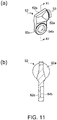
- attachment plate 52 is forged, by also forming this into the shape of a concavity (thin-walled region) 54b (see FIG. 11 ) corresponding to through-hole 54 for causing valve body 56 to be secured thereto by swaging, this will facilitate the operation in which the through-hole 54 for attachment plate 52 is formed that is carried out following the deburring operation which takes place after the friction welding operation. That is, the procedure by which through-hole 54 is formed in concavity (thin-walled region) 54b will be made simple to the extent that the thickness of the material at the bottom of the concavity (thin-walled region) 54b formed in attachment plate 52 is made small.
- attachment plate 52 is made to move in a direction such as will cause it to approach rotary shaft main body 58A as rotary shaft main body 58A is made to rotate at prescribed speed, application of pressure to the abutting surfaces of rotary shaft main body 58A and boss 53 of attachment plate 52 causing rotary shaft main body 58A to be joined (secured) by friction welding to boss 53 of attachment plate 52.
- burrs are produced at the outside circumference of joint (joint surface) 59 between rotary shaft main body 58A and boss 53 of attachment plate 52, the burrs are removed during the deburring operation that takes place following the friction welding operation.
- valve manufacturing intermediary U at which rotary shaft 58 extends from the side of attachment plate 52 and the overall shape of which is approximately L-shaped as seen in plan view is manufactured.
- an operation is lastly carried out in which swaging is performed to secure valve body 56 by way of attachment dowel 56c and washer 57 to (through-hole 54 of) attachment plate 52 of valve manufacturing intermediary U to complete wastegate valve 50 shown in FIGS. 5 and 8 .
- Rotary shaft 58 of wastegate valve 50 of the present embodiment is thus constituted from boss 53 which is formed so as to protrude slightly from the side of attachment plate 52, and rotary shaft main body 58A which is joined (secured) by means of friction welding to this boss 53, the fact that there is almost no variation in joint strength at joint (joint surface) 59 when the joint has been produced as a result of friction welding being characteristic thereof.
- the joint strength at rotary shaft main body 58A of the wastegate valve 50 that is manufactured is always uniform, and it will be possible to that extent to assure the quality of wastegate valve 50.
- wastegate valve 50 in accordance with the present embodiment, because rotary shaft main body 58A is joined (secured) by means of friction welding to boss 53 of attachment plate 52, it is possible to make attachment plate 52, which is made of the expensive high-Ni alloy NCF751, more compact. For this reason, it is firstly the case that the cost of wastegate valve 50 can be reduced, and it will also be possible to reduce overall weight. It is secondly the case that as wastegate valve 50 is arranged in the vicinity of valve seat surface 10a provided at exhaust gas flow path 9 (bypass flow path 10) within turbine housing 1, because the space for arrangement of valve 50 is made small, this alleviates any constraint that might otherwise exist when designing an exhaust gas flow path 9 provided with a bypass flow path 10.
- FIG. 12 shows a wastegate valve 50A associated with a second embodiment, this being shown as it would exist when installed at a turbine housing 1.
- Rotary shaft 58 of wastegate valve 50A i.e., rotary shaft 58 which extends from the side of attachment plate 52, is constituted from boss 53A which is formed in protruding fashion at the side of attachment plate 52, and rotary shaft main body 58B which is identical in diameter to boss 53 and which is joined by means of friction welding to boss 53.
- boss 53A which is formed in protruding fashion at the side of attachment plate 52, and rotary shaft main body 58B which is joined to boss 53A cooperate to constitute rotary shaft 58 which bears on bearing 13A provided at turbine housing 1. Note that the length L1 by which boss 53A protrudes is greater than that of boss 53 formed at attachment plate 52 of wastegate valve 50 at the foregoing first embodiment.
- valve body 56 and attachment plate 52 which are directly exposed to exhaust gas are constituted from the high-Ni alloy NCF751 (operating temperature limit 950° C)
- rotary shaft main body 58B which is in a region distant from attachment plate 52 is constituted from stainless steel (operating temperature limit 850° C).
- rotary shaft 58 which extends from attachment plate 52 is able to cause the heat that is transmitted thereto from attachment plate 52 to be dissipated to turbine housing 1 it will not need to be as heat-resistant as valve body 56 or attachment plate 52, but regions of rotary shaft 58 that are near attachment plate 52 will reach temperatures (elevated temperatures) close to the temperatures (elevated temperatures) experienced by attachment plate 52 as a result of transmission thereto of heat from the exhaust gas.
- regions of rotary shaft 58 that are near attachment plate 52 are constituted as boss 53A which is formed in protruding fashion at attachment plate 52, i.e., they are constituted from the high-Ni alloy NCF751 (operating temperature limit 950° C) which has excellent heat resistance.
- FIG. 13 shows a wastegate valve 50B associated with a third embodiment, this being shown as it would exist when installed at a turbine housing 1.
- Rotary shaft 58 of wastegate valve 50B is constituted from boss 53 which is formed in protruding fashion at the side of attachment plate 52 constituted from the high-Ni alloy NCF751 (operating temperature limit 950° C), and rotary shaft main body 58C which is in the shape of a hollow pipe, which is constituted from stainless steel (operating temperature limit 850° C), and which is joined (secured) by means of friction welding to boss 53.
- rotary shaft 58 bears on bearing 13A provided at turbine housing 1, and the hollow portion of rotary shaft main body 58C which makes up rotary shaft 58 extends all the way through turbine housing 1 in such fashion as to be open to the exterior of turbine housing 1.
- rotary shaft main body 58B is such that heat transmitted thereto from attachment plate 52 is dissipated to turbine housing 1 by way of bearing 13A and is further dissipated by convection of air occurring at the hollow portion, rotary shaft main body 58B need not be as heat-resistant as valve body 56 or attachment plate 52.
- FIGS. 14 and 15 show a wastegate valve 50C associated with a fourth embodiment of the present invention, FIG. 14 being a front view of same wastegate valve 50C, and FIG. 15 being an exploded front perspective view of same wastegate valve 50C.
- Wastegate valve 50C is such that valve body 56A and attachment plate 52A are formed in cylindrically integral fashion, and such that rotary shaft 58 extends, in offset fashion with respect to valve body 56A, in a direction perpendicular to central axis O of valve body 56A, from the side of attachment plate 52A which supports valve body 56A, being formed such that the overall shape thereof is approximately L-shaped as seen in plan view.
- Rotary shaft 58 which extends from cylindrical attachment plate 52A is constituted from boss 53B which is formed so as to protrude from the side of attachment plate 52A, and rotary shaft main body 58D which is joined (secured) to boss 53B by means of friction welding. Boss 53B and rotary shaft main body 58D are formed so as to be of identical diameter.
- Sealing surface 56a1 of valve body 56A is formed as a continuous curved surface that is capable of making contact with annular valve seat surface 10a which is provided at exhaust gas flow path 9 (bypass flow path 10).
- concavity 56A1 Provided at the rear surface side of sealing surface 56a1 of valve body 56A is concavity 56A1 for reducing the weight of valve body 56A.
- inclined upper edge 52A1 at which what would otherwise be an upper edge right-triangular corner is notched in right-triangular fashion as indicated by the alternating long and short chain line at FIGS. 14 and 15 is provided at the side of attachment plate 52A which is opposite the side at which boss 53B is formed, such that, in similar fashion as with upper edge 52b (see (a) at FIG. 8 ) formed in cristate fashion at attachment plate 52 of wastegate valve 50 of the first embodiment, there is no reduction in the cross-sectional area of exhaust gas flow path 9 as a result of protrusion by attachment plate 52A into exhaust gas flow path 9.
- valve body 56A which is equipped with attachment plate 52A, and rotary shaft main body 58D, which make up wastegate valve 50C, are each constituted from the high-Ni alloy 713c (operating temperature limit 1050° C), these being constituted so as to permit satisfaction of the specifications of exhaust turbine turbochargers for which the temperature of the exhaust gas within exhaust gas flow path 9 (bypass flow path 10) may reach 1000° C or more.
- rotary shaft main body 58D is disposed at a location which is distant from attachment plate 52A by an amount corresponding to the length by which boss 53B protrudes therefrom, it may be constituted from the high-Ni alloy NCF751 (operating temperature limit 950° C) which has a lower operating temperature limit than that of the high-Ni alloy 713c. Furthermore, rotary shaft main body 58D may be constituted from a hollow pipe (see FIG. 13 ) so as to increase ability of rotary shaft 58 (rotary shaft main body 58D) to dissipate heat.
- wastegate valve 50C is constituted from a small number of parts, the constitution of wastegate valve 50C is simplified to a corresponding extent.
- valve body 56A which is equipped with attachment plate 52A is limited to lost wax casting due to the fact that forging of the high-Ni alloy 713c is difficult, there is no avoiding the fact that the unit manufacturing cost of wastegate valve 50C will be high.
- wastegate valve 10C may be constituted from the high-Ni alloy NCF751 (operating temperature limit 950° C), which is a heat-resistant alloy.
- wastegate valve 50C may be manufactured by carrying out an operation in which a valve body 56A equipped with an attachment plate 52A is forged, an operation in which rotary shaft main body 58D is friction-welded, and a deburring operation.
- wastegate valve 50 of the first embodiment As the operation in which through-hole 54 was formed in attachment plate 52 and the operation in which swaging was performed to secure valve body 56 to attachment plate 52 are unnecessary, it will be possible to that extent to reduce the number of manufacturing operations and to manufacture wastegate valve 50C in a short amount of time.
- wastegate valve 50C associated with this fourth embodiment forging or lost wax casting is performed to integrally form this into the shapes of valve body 56A and attachment plate 52A as shown in FIGS. 14 and 15 , the number of parts from which wastegate valve 50C is constituted being made small to a corresponding extent.
- first through fourth embodiments described above were each constituted such that a rotary shaft was made to extend from the side of an attachment plate as a result of causing a rotary shaft main body to be joined (secured) by means of friction welding to the side of the attachment plate
- the structure it is also possible for the structure to be such that the rotary shaft main body is joined (secured) to the side of the attachment plate by solid-phase welding other than friction welding; e.g., by resistance welding.
- a well-known (commonly known) resistance welding apparatus might be used, and, for example, rotary shaft main body 58A and boss 53 formed in protruding fashion at the side of attachment plate 52 might, for example, be arranged in mutually abutting and coaxial fashion in the horizontal direction, the two members 52, 58A might be straddled between electrodes, and a prescribed pressure might be applied thereto and electric current might be made to flow therethrough, so as to cause rotary shaft main body 58A to be joined (secured) by resistance welding to boss 53 of attachment plate 52.
Landscapes
- Engineering & Computer Science (AREA)
- General Engineering & Computer Science (AREA)
- Mechanical Engineering (AREA)
- Chemical & Material Sciences (AREA)
- Combustion & Propulsion (AREA)
- Supercharger (AREA)
Abstract
Description
- The present invention pertains to a wastegate valve that is provided at an exhaust gas flow path in an engine which is turbocharged through use of a turbocharger and that adjusts the amount of exhaust gas which flows into a turbine by causing diversion of a portion of the exhaust gas, and in particular relates to a wastegate valve which is formed such that the overall shape thereof is approximately L-shaped as seen in plan view and in which a rotary shaft extends, in a direction approximately perpendicular to the central axis of a valve body and in such fashion as to be offset from the valve body, from an attachment plate that supports the valve body.
- Exhaust turbine turbochargers for improving engine performance and reducing fuel consumption are known. In addition, exhaust turbine turbochargers are constituted such that engine exhaust gas made to enter thereinto from an exhaust gas inlet causes rotation of a turbine impeller provided at the turbine housing and is thereafter discharged from an exhaust gas outlet to an exhaust gas flow path.
- At Patent Reference No. 1, below, to regulate turbocharged pressure supplied to an engine, wastegate valve 11 is provided at
bypass flow path 10 which extends betweenexhaust gas inlet 3 andexhaust gas outlet 8; for example, when turbocharged pressure exceeds a set value, wastegate valve 11 might open and cause a portion of the exhaust gas directed toward turbine impeller 4 to be directed frombypass flow path 10 to exhaustgas flow path 9 so as to prevent turbocharged pressure from becoming excessive. - More specifically, wastegate valve 11 is formed such that the overall shape thereof is approximately L-shaped as seen in plan view and is such that rotary shaft 13 extends, in a direction approximately perpendicular to the central axis of valve body 12 and in such fashion as to be offset from valve body 12, from attachment plate 17 which supports valve body 12. Rotary shaft 13 of wastegate valve 11, which extends all the way through
bypass flow path 10 so as to emerge at the exterior ofturbine housing 1, is made to rotate byactuator 16. Valve body 12 is disposed so as to make contact withvalve seat surface 10a, rotation of rotary shaft 13 causing valve body 12 to separate fromvalve seat surface 10a, opening valve 11. - Furthermore, wastegate valve 11 might, for example, be constituted such that rotary shaft 13 is secured to attachment plate 17 as a result of having been arc-welded thereto, swaging being carried out to secure valve body 12 by way of attachment dowel 23 and washer 24 so that it does not come free of attachment plate 17.
- Patent Reference No. 1: Japanese Patent Application Publication Kokai No.
2013-2431 FIGS. 1, 2 , and3 ) - However, because wastegate valve 11 is exposed to high-temperature exhaust gas, not only valve body 12 but also rotary shaft 13, attachment plate 17, washer 24, and all of the other valve constituent members will be made of heat-resistant alloy, the cost of which will increase as a function of the operating temperature limit of the alloy employed, thus causing increase in the unit cost of valve 11 as well by a corresponding amount.
- Furthermore, as rotary shaft 13 is secured by arc welding to attachment plate 17, because arc welding causes occurrence of a weld bead in accompaniment thereto, engagement hole 19 is provided for insertion of rotary shaft 13 into attachment plate 17, the constitution being such as to permit the weld bead to be formed at weld hole 21 which is provided at the wall at which engagement hole 19 is formed.
- The size of attachment plate 17 is thus increased by an amount corresponding to that which is necessary to permit provision of engagement hole 19 and weld hole 21. For this reason, it is firstly the case that in addition to the fact that valve 11 is made expensive, increase in the weight of valve 11 can lead to increase in the overall weight of the engine. It is secondly the case that as the space for arrangement of the valve provided at exhaust gas flow path 9 (bypass flow path 10) within
turbine housing 1 will be large, this will constitute a constraint when designing an exhaustgas flow path 9 provided with abypass flow path 10. - The present invention was conceived in light of the foregoing problems in the conventional art, it being an object thereof to provide a wastegate valve that makes it possible to achieve alleviation of constraints that would otherwise apply to design of an exhaust gas flow path provided with a bypass flow path, reduction in weight, and decrease in cost due to having made an attachment plate more compact as a result of causing a rotary shaft main body to be secured by means of solid-phase welding to the attachment plate.
- To achieve the foregoing object, the invention as recited at
claim 1, in the context of a wastegate valve formed such that the overall shape thereof is approximately L-shaped as seen in plan view and such that a rotary shaft extends, in a direction approximately perpendicular to a central axis of a valve body and in such fashion as to be offset from the valve body, from an attachment plate which supports the valve body,
is characterized in that the rotary shaft is constituted from a rotary shaft main body that is solid-phase-welded to a side of the attachment plate. - (EFFECT) By solid-phase welding (e.g., friction welding or resistance welding) one end of a rotary shaft main body to the side of an attachment plate, it is possible to constitute a rotary shaft that extends from the attachment plate. Solid-phase welding can be employed not only to mutually secure metals of the same type but also to mutually secure metals of different types, little time is required for processing, quality (joint strength) is uniform, and because there is little occurrence of burrs along the joint surface, post-processing during which burrs are removed is also easy.
- Note that solid-phase welding refers to a joining method in which the members being joined-without being melted and while still in solid phase (solid state)-are softened as a result of application of heat, and are further made to adhere as a result of application of pressure, solid-phase welding in the context of the invention under application including friction welding and resistance welding.
- Furthermore, friction welding refers to a method in which members to be joined are made to mutually rub against each other at high speed such that the heat due to friction which is produced at such time causes the members to soften, simultaneous with which pressured is applied thereto, the diffusion of atoms which occurs across the joint surface being utilized to causing joining thereof.
- Furthermore, resistance welding refers to a method in which members to be joined are made to mutually overlap, the location to be joined is straddled between electrodes, and a prescribed pressure is applied thereto and electric current is made to flow therethrough, joining occurring as a result of the joint surface having been softened due to the Joule heating produced as a result of the electrical resistance at the region being joined.
- At the prior patent reference, because the rotary shaft is arc-welded to the attachment plate, due to the fact that a weld hole for the weld bead and a rotary shaft engagement hole are needed at the attachment plate, this causes the attachment plate to be large in size to a corresponding extent.
- However, in accordance with the invention under application, as it is sufficient that the rotary shaft main body is solid-phase-welded to the side of the attachment plate, it is possible to cause the attachment plate, which is constituted from expensive heat-resistant metal, to be made more compact. For this reason, it is firstly the case that the cost of the wastegate valve can be reduced, and it will also be possible to reduce overall weight. It is secondly the case that as the wastegate valve is arranged in the vicinity of the valve seat surface at the exhaust gas flow path (bypass flow path) within the turbine housing, and as the space required for arrangement of the valve is small, it will be possible to alleviate the constraint that would otherwise exist when designing an exhaust gas flow path provided with a bypass flow path.
- Furthermore, as compared with a valve body and an attachment plate that are arranged within the exhaust gas flow path and are directly exposed to exhaust gas, a rotary shaft that bears on a through-hole provided in the turbine housing will not need to be as heat-resistant as the valve body or the attachment plate to the extent that heat transmitted thereto from the attachment plate is dissipated to the turbine housing.
- For this reason, by for example causing the rotary shaft main body to be constituted from a metal that is not as heat-resistant as the heat-resistant metal(s) from which the valve body and the attachment plate are constituted, it will be possible to further reduce the cost of the wastegate valve to an extent corresponding to the degree to which the rotary shaft main body is made less expensive.
- The invention as recited at
claim 2, in the context of the wastegate valve according toclaim 1, is characterized in that the rotary shaft is constituted from the rotary shaft main body, and from a boss that is approximately identical in diameter to the rotary shaft main body and that is formed in protruding fashion at the side of the attachment plate. - (EFFECT) Because the rotary shaft main body and the boss at the side of the attachment plate-which are solid-phase-welded (e.g., friction-welded)-are formed so as to be of approximately identical diameter, during solid-phase welding (e.g., friction welding) of the two, it will be possible to cause heat due to friction to be efficiently produced at the abutting surfaces thereof, such that burrs are produced along the outside circumference of said abutting surfaces, and such that solid-phase welding (e.g., friction welding) of said abutting surfaces is carried out in smooth fashion.
- Furthermore, the boss which is formed in protruding fashion at the side of the attachment plate, and the rotary shaft main body which is solid-phase-welded to said boss, cooperate to constitute a rotary shaft which extends from the attachment plate, i.e., a rotary shaft which bears on the through-hole provided at the turbine housing.
- To the extent that the rotary shaft which extends from the attachment plate is able to cause a portion of the heat that is transmitted thereto from the attachment plate to be dissipated to the turbine housing it will not need to be as heat-resistant as the valve body or the attachment plate, but regions of the rotary shaft that are near the attachment plate will reach temperatures (elevated temperatures) that are close to the temperatures (elevated temperatures) experienced by the attachment plate.
- However, at
claim 2, regions of the rotary shaft that are near the attachment plate are constituted from a boss that is formed in protruding fashion at the side of the attachment plate, which is to say that they are constituted from the same heat-resistant metal as that from which the attachment plate is constituted, as a result of which the heat resistance (decrease in mechanical strength due to influence of heat) of regions of the rotary shaft that are near the attachment plate does not present a problem. - On the other hand, to the extent that regions of the rotary shaft that are near the attachment plate (the boss that is formed in protruding fashion at the side of the attachment plate) are able to cause heat that is transmitted thereto from the attachment plate to be dissipated to the turbine housing, a region of the rotary shaft that is distant from the attachment plate will not reach temperatures as high as those experienced by regions of the rotary shaft that are near the attachment plate (the boss that is formed in protruding fashion at the side of the attachment plate) and will not need to be as heat-resistant as regions of the rotary shaft that are near the attachment plate (the boss that is formed in protruding fashion at the side of the attachment plate). Accordingly, even where the rotary shaft main body is constituted from a metal of lower heat resistance than that of the heat-resistant metal(s) from which the valve body and the attachment plate are constituted, the possibility that the mechanical strength of the rotary shaft main body will be reduced due to the influence of heat can be eliminated, which is to say that the heat resistance of the rotary shaft main body will not present a problem.
- Furthermore, while depending on the properties of the exhaust turbine turbocharger, for example, the temperature of the exhaust gas that flows through the exhaust gas flow path (bypass flow path) will be different, where the temperature of the exhaust gas is high it will be necessary not only that the valve body and the attachment plate be constituted from metal(s) having excellent heat resistance but also that the rotary shaft main body be constituted from metal that to some degree has excellent heat resistance. However, if the length by which a boss which is formed at an attachment plate constituted from heat-resistant metal protrudes therefrom is made large, it will be possible to suppress the influence of heat on a rotary shaft main body that is constituted from a metal of lower heat resistance than that of the metal from which the attachment plate is constituted. That is, it will be possible as a result of adjustment of the length by which the boss protrudes therefrom to select from among a variety of heat-resistant metals from which the rotary shaft main body may be constituted.
- On the other hand, if the temperature of the exhaust gas is comparatively low, by causing the length by which a boss which is formed at an attachment plate constituted from heat-resistant metal protrudes therefrom to be made small (causing the length of a rotary shaft main body constituted from a metal of low heat resistance to be made large), working of the boss provided at the attachment plate (e.g., forging of the attachment plate) will be facilitated, there will be an increased number of alternatives in terms of the heat-resistant metal(s) from which the attachment plate and the rotary shaft main body may be constituted, and it will also be possible to achieve further reduction in the cost of the wastegate valve.
- By thus adjusting the length by which a boss which is formed at an attachment plate protrudes therefrom in correspondence to the properties of the exhaust turbine turbocharger (exhaust gas temperature) and the desired wastegate valve cost performance, appropriate selection of heat-resistant metal(s) from which the attachment plate and the rotary shaft main body are constituted will be possible.
- The invention as recited at
claim 3, in the context of the wastegate valve according toclaim - (EFFECT) In addition to the fact that the attachment plate is made more compact, to the extent that the rotary shaft main body is hollow and lightweight, it will be possible to dramatically reduce the weight of the wastegate valve.
- The invention as recited at claim 4, in the context of the wastegate valve according to
claim 3, is characterized in that the rotary shaft main body extends all the way through a turbine housing of an exhaust turbine turbocharger, and a hollow portion of said rotary shaft main body is open to an exterior of the turbine housing. - (EFFECT) Convection of air occurs outside the turbine housing where the hollow portion of the rotary shaft main body (hollow pipe) is open to the exterior of the turbine housing. For this reason, because the rotary shaft main body is such that heat transmitted thereto from the attachment plate is dissipated to the turbine housing and is further dissipated by convection of air occurring at the hollow portion, it will be all the more the case that the rotary shaft main body need not be as heat-resistant as the valve body or the attachment plate. Accordingly, even where the rotary shaft main body is constituted from a metal of lower heat resistance than the heat-resistant metal(s) from which the valve body and the attachment plate are constituted, there will be absolutely no possibility that the heat resistance of the main body of the rotary shaft will present a problem.
- The invention as recited at
claim 5, in the context of the wastegate valve according to any ofclaims 1 through 4, is characterized in that the valve body is secured to the attachment plate as a result of swaging by way of an attachment dowel and a washer so as not to come free therefrom, and the attachment plate has been shaped as a result of having been forged. - (EFFECT) To manufacture a wastegate valve, an operation in which an attachment plate is forged, an operation in which a rotary shaft main body is solid-phase-welded (e.g., friction-welded), a deburring operation, and an operation in which a through-hole for the attachment plate is formed are conducted during the course of manufacturing a valve manufacturing intermediary at which the rotary shaft extends from the side of the attachment plate and the overall shape of which is approximately L-shaped as seen in plan view, and an operation is lastly carried out in which swaging is performed to secure the valve body to (the through-hole of) the attachment plate of the valve manufacturing intermediary.
- In particular, during the operation in which the attachment plate is forged, by also forming this into the shape of a concavity (thin-walled region) corresponding to the through-hole for causing the valve body to be secured thereto by swaging, this will facilitate the procedure by which the through-hole is formed in the concavity (thin-walled region) of the attachment plate during the operation in which the through-hole for the attachment plate is formed that is carried out following the deburring operation which takes place after the solid-phase welding (e.g., friction welding) operation.
- The invention as recited at
claim 6, in the context of the wastegate valve according to any ofclaims 1 through 4, is characterized in that the valve body and the attachment plate have been formed into their respective shapes in integral fashion by forging or lost wax casting. - (EFFECT) The valve body and the attachment plate are formed into their respective shapes in integral fashion by forging or lost wax casting, the number of parts from which the wastegate valve is constituted being made small to a corresponding extent.
- Furthermore, as a result of carrying out an operation in which a valve body and an attachment plate are formed into their respective shapes in integral fashion, an operation in which the rotary shaft main body is solid-phase-welded (e.g., friction-welded), and a deburring operation, a wastegate valve formed such that the overall shape thereof is approximately L-shaped as seen in plan view and such that a rotary shaft extends from the side of the attachment plate which supports the valve body may be manufactured.
- As is clear from the foregoing description, the present invention, because it is such that a rotary shaft main body is secured to an attachment plate by means of solid-phase welding, permits provision of a wastegate valve that makes it possible to achieve alleviation of constraints that would otherwise apply to design of an exhaust gas flow path provided with a bypass flow path, reduction in weight, and decrease in wastegate valve cost due to having made the attachment plate more compact, as compared with a conventional wastegate valve in which a rotary shaft is secured to an attachment plate by means of arc welding.
-
- [
FIG. 1 ] Side view of exhaust turbine turbocharger provided with wastegate valve associated with first embodiment. - [
FIG. 2 ] Front view of same exhaust turbine turbocharger. - [
FIG. 3 ] Rear view of same exhaust turbine turbocharger. - [
FIG. 4 ] Sectional view (sectional view along section IV-IV shown inFIG. 2 ) showing exhaust gas flow path and bypass flow path. - [
FIG. 5 ] Front perspective view of wastegate valve associated with first embodiment. - [
FIG. 6 ] Exploded perspective view of same wastegate valve. - [
FIG. 7 ] Perspective view showing boss formed in protruding fashion at attachment plate. - [
FIG. 8 ] (a) Front view of same wastegate valve; (b) plan view of same wastegate valve. - [
FIG. 9 ] Vertical sectional view (sectional view along section IX-IX shown inFIG. 8 ) of same wastegate valve. - [
FIG. 10 ] Sectional view showing wastegate valve installed at turbine housing. - [
FIG. 11 ] (a) Perspective view of attachment plate manufactured through employment of forging operation; (b) vertical sectional view (enlarged sectional view along section X-X shown at (a) inFIG. 10 ) of same attachment plate. - [
FIG. 12 ] Sectional view showing wastegate valve installed at turbine housing, this wastegate valve being associated with a second embodiment. - [
FIG. 13 ] Sectional view showing wastegate valve installed at turbine housing, this wastegate valve being associated with a third embodiment. - [
FIG. 14 ] Sectional view showing wastegate valve installed at turbine housing, this wastegate valve being associated with a fourth embodiment. - [
FIG. 15 ] Exploded front perspective view of same wastegate valve. - Below, embodiments of the present invention are described with reference to the drawings.
-
FIGS. 1 through 4 show a working example of an exhaust turbine turbocharger provided with a wastegate valve in accordance with the present invention, the exhaust turbine turbocharger having the same structure as that at prior Patent Reference No. 1 (Japanese Patent Application Publication Kokai No.2013-2431 FIG. 1 is a side view of same exhaust turbine turbocharger,FIG. 2 is a front view of same exhaust turbine turbocharger,FIG. 3 is rear view of same exhaust turbine turbocharger, andFIG. 4 is a sectional view (sectional view along section IV-IV shown inFIG. 2 ) showing an exhaust gas flow path and a bypass flow path. Furthermore,FIGS. 5 through 10 are drawings showingwastegate valve 50 associated with a first embodiment. - At these drawings,
reference numeral 1 is the turbine housing ofexhaust turbine turbocharger 100, and withinturbine housing 1 exhaust gas from the exhaust manifold of the engine is directed toward exhaust gas inlet 3 (seeFIG. 4 ) ofturbine scroll 2, exhaust gas supplied toturbine scroll 2 causing rotation of turbine impeller 4 (seeFIG. 4 ). - Provided within
compressor scroll 6 ofcompressor housing 5 is a compressor impeller (not shown) which is coaxial with turbine impeller 4, rotation of the compressor impeller causing compression of air drawn thereinto from axially centeredair intake port 7a, the compressed air being supplied to the engine from compressedair outtake port 7b to turbocharge the engine. - As shown in
FIG. 4 , after the exhaust gas drives turbine impeller 4, it is discharged to exhaustgas flow path 9 fromexhaust gas outlet 8. Furthermore, to control the turbocharged pressure of the compressed air that is supplied to the engine, abypass flow path 10 for bypass of the exhaust gas is provided betweenexhaust gas inlet 3 andexhaust gas outlet 8. - In addition, annular
valve seat surface 10a is formed at the periphery ofcircular opening 10b to exhaustgas flow path 9 ofbypass flow path 10, wastegate valve 50-which is equipped withvalve body 56 that opens and closes opening 10a, which is to say that it opens and closes bypass flow path 10-being provided at a location which is downstream from and in the vicinity of opening 10b (valve seat surface 10a) in such fashion as to make contact withvalve seat surface 10a. When turbocharged pressure to the engine exceeds a set value,wastegate valve 50 is such thatvalve body 56 moves in a direction (downward inFIG. 4 ) causing it to be separated fromvalve seat surface 10a, and a portion of the exhaust gas is made to bypass turbine impeller 4 as a result of being sent frombypass flow path 10 to exhaustgas flow path 9. - As shown in
FIGS. 5 through 10 ,wastegate valve 50 has a structure such that it is provided withrotary shaft 58 that extends, in offset fashion with respect tovalve body 56, fromattachment plate 52, which is more or less rectangular as seen in front view and which supportsvalve body 56; and as shown inFIG. 10 ,rotary shaft 58 bears on circular-pipe-like bearing 13A which extends all the way through the wall at whichturbine housing 1 is formed, theother end 58a thereof being exposed to the exterior ofturbine housing 1.Bearing 13A is secured as a result of having been press-fit into through-hole 1a in the wall at whichturbine housing 1 is formed. As shown inFIGS. 1, 2 , and10 ,rotary lever 14 is secured in crankshaft-like fashion to the outer end (other end) 58a ofrotary shaft 58, the tip of reciprocating rod 16a ofactuator 16 which is secured tocompressor housing 5 being coupled by way ofdrive pin 15 to pivotingtip 14a ofrotary lever 14 - This being the case, reciprocating action of reciprocating rod 16a due to driving by
actuator 16 in the direction indicated by arrow A inFIG. 1 causesrotary lever 14 to pivot in the direction indicated by arrow B atFIG. 1 , causingrotary shaft 58 which is secured torotary lever 14 to rotate in a circumferential direction with respect to bearing 13A. That is, as a result of driving ofactuator 16,wastegate valve 50 is made to pivot (rotate) about bearing 13A as indicated by reference numeral C inFIG. 5 , which causes opening and closing ofvalve body 56 with respect to opening 10b (valve seat surface 10a). - As shown in
FIG. 10 , note that small gaps S1, S2 (e.g., S1 + S2 = 1 mm) are provided between bearing 13A androtary lever 14 and between bearing 13A andattachment plate 52 ofvalve 50; while there is play (e.g., 1 mm) in the axial direction between bearing 13A andwastegate valve 50, by causing sealing surface 56a1 ofvalve body 56 to be formed large relative to annularvalve seat surface 10a which is provided at exhaust gas flow path 9 (bypass flow path 10), it is possible to eliminate this play (seeFIG. 4 ). -
Actuator 16 might, for example, be constituted as an air-driven diaphragm-type driving apparatus, such that when turbocharged pressure of compressed air exceeds a set value,wastegate valve 50 opens, causing a portion of the exhaust gas to bypass turbine impeller 4 and be discharged fromexhaust gas inlet 3 to exhaust gas flow path 9 (seeFIG. 4 ). - The structure of
wastegate valve 50 will next be described in detail with reference toFIGS. 5 through 10 . -
Wastegate valve 50 is provided withattachment plate 52 which is more or less rectangular as seen in front view and which supportsvalve body 56, androtary shaft 58 which is joined (secured) by means of friction welding to the side ofattachment plate 52 and which extends, in offset fashion with respect tovalve body 56, in a direction perpendicular to central axis O ofvalve body 56, being formed such that the overall shape thereof is approximately L-shaped as seen in plan view (seeFIG. 5 and see (a) atFIG. 8 ). - In addition, rotation of
valve 50 about center of rotation L as indicated by arrow C inFIG. 5 causes opening and closing ofvalve body 56 with respect tovalve seat surface 10a (opening 10b). - As shown at (a) and (b) in
FIG. 8 ,discoid protuberance 52a perpendicular torotary shaft 58 is formed at the side ofattachment plate 52 from whichrotary shaft 58 extends, cylindricalrotary shaft 58 extending from the end face ofprotuberance 52a. -
Rotary shaft 58 is constituted by using a friction welding operation, described below, to cause one end face of rotary shaftmain body 58A to be joined by means of friction welding to and made integral with the distal face of boss 53 (seeFIGS. 6 and7 ) which protrudes slightly from the end face ofprotuberance 52a. Note thatreference numeral 59 atFIGS. 5 ,8 , and10 indicates the joint (joint surface) between the twomembers - Furthermore, the side of
attachment plate 52 which is opposite the side at whichprotuberance 52a is formed is formed in downwardly extending flattened plate-like fashion, and theupper edge 52b thereof is formed in cristate fashion such that what would otherwise be an upper edge right-triangular corner is notched in right-triangular fashion as indicated by the alternating long and short chain line at (a) inFIG. 8 , being constituted so as to reduce the amount by whichattachment plate 52 protrudes into exhaustgas flow path 9. - That is, as shown in
FIGS. 2 and4 , in contradistinction to exhaustgas flow path 9 which is directed toward the front ofturbine housing 1 fromexhaust gas outlet 8,bypass flow path 10 is provided in parallel fashion with respect to exhaustgas flow path 9 at a location adjacent to and diagonally downward and to the right from said exhaustgas flow path 9 as the exhaust turbine turbocharger is seen in front view, such that it is in communication with exhaustgas flow path 9 by way of opening 10b at which annularvalve seat surface 10a is formed. - In addition,
wastegate valve 50 is such that sealing surface 56a1 of thevalve body 56 thereof is in intimate contact withvalve seat surface 10a, and is such that therotary shaft 58 thereof is disposed in a horizontal direction (the direction connecting the left and right sides inFIGS. 2 and4 ) which is more or less perpendicular to bypassflow path 10, as a result of which the side ofattachment plate 52 which is opposite the side at whichprotuberance 52a is formed protrudes into exhaustgas flow path 9. However, becauseupper edge 52b ofattachment plate 52 which protrudes into exhaustgas flow path 9 is formed in cristate fashion such that what would otherwise be an upper edge right-triangular corner is notched in right-triangular fashion as has been described above, the amount by whichattachment plate 52 protrudes into exhaustgas flow path 9 is made small,wastegate valve 50 being such that the cross-sectional area of exhaustgas flow path 9 is not reduced byattachment plate 52. - Furthermore, through-
hole 54 is provided at discoidlower region 52c ofattachment plate 52, swaging being carried out to securevalve body 56 by way ofattachment dowel 56c andwasher 57 to this through-hole 54 so that it does not come free therefrom. - More specifically,
valve body 56 is such that projectingshaft 56b which is capable of passing through through-hole 54 ofattachment plate 52 is formed in protruding fashion at the rear surface side of flat sealing surface 56a1,attachment dowel 56c which is capable of engaging with through-hole 57a ofwasher 57 being formed in protruding fashion at the tip of projectingshaft 56b. In addition, as shown inFIG. 9 , projectingshaft 56b ofvalve body 56 is made to pass through through-hole 54 ofattachment plate 52,washer 57 is further made to engage withattachment dowel 56c, and the tip ofattachment dowel 56c which protrudes from through-hole 57a ofwasher 57 is subjected to a swaging process so as to form swagedportion 56c', as a result of whichvalve body 56 is attached in such state that it is prevented from coming free from through-hole 54 ofattachment plate 52 by way ofwasher 57. Moreover, taperedbevel 57b (seeFIG. 9 ) is formed at the periphery of through-hole 57a ofwasher 57 on the side thereof at whichattachment dowel 56c protrudes, increasing the surface area with which intimate contact is made between swagedportion 56c' andwasher 57, and increasing the strength with whichvalve body 56 is prevented from coming free therefrom. - Furthermore, as shown in
FIG. 4 , aswastegate valve 50 is arranged in the vicinity ofvalve seat surface 10a provided at exhaust gas flow path 9 (bypass flow path 10) withinturbine housing 1, it is exposed to high-temperature exhaust gas. Moreover, while depending on the specifications of the exhaust turbine turbocharger the temperature of the exhaust gas within exhaust gas flow path 9 (bypass flow path 10) may reach 1000° C or more, the present working example is such thatwastegate valve 50 is constituted from the high-Ni alloy NCF751 (operating temperature limit 950° C) so as to permit it to accommodate the specifications of exhaust turbine turbochargers (maximum exhaust gas temperature 900° C). That is,attachment plate 52,valve body 56,washer 57, androtary shaft 58 are all constituted from the high-Ni alloy NCF751. - Operations for the manufacture of
wastegate valve 50 will next be described. - To manufacture
wastegate valve 50, an operation in whichattachment plate 52 is forged, an operation in which rotary shaftmain body 58A is friction-welded, a deburring operation, and an operation in which through-hole 54 inattachment plate 52 is formed are conducted during the course of manufacturing a valve manufacturing intermediary U (not shown) at whichrotary shaft 58 extends from the side ofattachment plate 52 and the overall shape of which is approximately L-shaped as seen in plan view, and an operation is lastly carried out in which swaging is performed to securevalve body 56 to (through-hole 54 of)attachment plate 52 of valve manufacturing intermediary U. - During the operation in which
attachment plate 52 is forged, the side ofattachment plate 52 is formed into the shape ofboss 53, the forming of this into the shape ofboss 53 during the forging operation being simple to the extent that the length by whichboss 53 protrudes therefrom is small. - Furthermore, during the operation in which
attachment plate 52 is forged, by also forming this into the shape of a concavity (thin-walled region) 54b (seeFIG. 11 ) corresponding to through-hole 54 for causingvalve body 56 to be secured thereto by swaging, this will facilitate the operation in which the through-hole 54 forattachment plate 52 is formed that is carried out following the deburring operation which takes place after the friction welding operation. That is, the procedure by which through-hole 54 is formed in concavity (thin-walled region) 54b will be made simple to the extent that the thickness of the material at the bottom of the concavity (thin-walled region) 54b formed inattachment plate 52 is made small. - Furthermore, during the friction welding operation in which rotary shaft
main body 58A is joined to the side ofattachment plate 52, using a well-known (commonly known) friction welding apparatus, rotary shaftmain body 58A andboss 53 formed in protruding fashion at the side ofattachment plate 52 are arranged in mutually opposed and coaxial fashion in the horizontal direction,attachment plate 52 is made to move in a direction such as will cause it to approach rotary shaftmain body 58A as rotary shaftmain body 58A is made to rotate at prescribed speed, application of pressure to the abutting surfaces of rotary shaftmain body 58A andboss 53 ofattachment plate 52 causing rotary shaftmain body 58A to be joined (secured) by friction welding toboss 53 ofattachment plate 52. - Because burrs are produced at the outside circumference of joint (joint surface) 59 between rotary shaft
main body 58A andboss 53 ofattachment plate 52, the burrs are removed during the deburring operation that takes place following the friction welding operation. - Next, during the operation in which the through-hole is formed, procedures are employed to cause formation of a hole at concavity (thin-walled region) 54b corresponding to through-
hole 54 provided atattachment plate 52. Note that procedures to cause formation of the hole may be employed at the deburring operation. - As a result of the foregoing operations having been carried out, a valve manufacturing intermediary U at which
rotary shaft 58 extends from the side ofattachment plate 52 and the overall shape of which is approximately L-shaped as seen in plan view is manufactured. In addition, an operation is lastly carried out in which swaging is performed to securevalve body 56 by way ofattachment dowel 56c andwasher 57 to (through-hole 54 of)attachment plate 52 of valve manufacturing intermediary U to completewastegate valve 50 shown inFIGS. 5 and8 . -
Rotary shaft 58 ofwastegate valve 50 of the present embodiment is thus constituted fromboss 53 which is formed so as to protrude slightly from the side ofattachment plate 52, and rotary shaftmain body 58A which is joined (secured) by means of friction welding to thisboss 53, the fact that there is almost no variation in joint strength at joint (joint surface) 59 when the joint has been produced as a result of friction welding being characteristic thereof. This being the case, the joint strength at rotary shaftmain body 58A of thewastegate valve 50 that is manufactured is always uniform, and it will be possible to that extent to assure the quality ofwastegate valve 50. - Moreover, at
wastegate valve 50 in accordance with the present embodiment, because rotary shaftmain body 58A is joined (secured) by means of friction welding toboss 53 ofattachment plate 52, it is possible to makeattachment plate 52, which is made of the expensive high-Ni alloy NCF751, more compact. For this reason, it is firstly the case that the cost ofwastegate valve 50 can be reduced, and it will also be possible to reduce overall weight. It is secondly the case that aswastegate valve 50 is arranged in the vicinity ofvalve seat surface 10a provided at exhaust gas flow path 9 (bypass flow path 10) withinturbine housing 1, because the space for arrangement ofvalve 50 is made small, this alleviates any constraint that might otherwise exist when designing an exhaustgas flow path 9 provided with abypass flow path 10. -
FIG. 12 shows awastegate valve 50A associated with a second embodiment, this being shown as it would exist when installed at aturbine housing 1. -
Rotary shaft 58 ofwastegate valve 50A, i.e.,rotary shaft 58 which extends from the side ofattachment plate 52, is constituted fromboss 53A which is formed in protruding fashion at the side ofattachment plate 52, and rotary shaftmain body 58B which is identical in diameter toboss 53 and which is joined by means of friction welding toboss 53. Stating this another way,boss 53A which is formed in protruding fashion at the side ofattachment plate 52, and rotary shaftmain body 58B which is joined toboss 53A, cooperate to constituterotary shaft 58 which bears on bearing 13A provided atturbine housing 1. Note that the length L1 by whichboss 53A protrudes is greater than that ofboss 53 formed atattachment plate 52 ofwastegate valve 50 at the foregoing first embodiment. - Furthermore, while
valve body 56 andattachment plate 52 which are directly exposed to exhaust gas are constituted from the high-Ni alloy NCF751 (operating temperature limit 950° C), rotary shaftmain body 58B which is in a region distant fromattachment plate 52 is constituted from stainless steel (operating temperature limit 850° C). - That is, to the extent that
rotary shaft 58 which extends fromattachment plate 52 is able to cause the heat that is transmitted thereto fromattachment plate 52 to be dissipated toturbine housing 1 it will not need to be as heat-resistant asvalve body 56 orattachment plate 52, but regions ofrotary shaft 58 that arenear attachment plate 52 will reach temperatures (elevated temperatures) close to the temperatures (elevated temperatures) experienced byattachment plate 52 as a result of transmission thereto of heat from the exhaust gas. - For this reason, regions of
rotary shaft 58 that arenear attachment plate 52 are constituted asboss 53A which is formed in protruding fashion atattachment plate 52, i.e., they are constituted from the high-Ni alloy NCF751 (operating temperature limit 950° C) which has excellent heat resistance. On the other hand, to the extent that exhaust gas heat transmitted to rotary shaftmain body 58A which is in a region ofrotary shaft 58 that is distant fromattachment plate 52 can be dissipated from a location partway therealong toturbine housing 1 by way ofboss 53A, this will permit the amount thereof to be reduced; and because it will not reach temperatures as high as those experienced by regions (boss 53A) ofrotary shaft 58 nearattachment plate 52, the possibility that the mechanical strength thereof will be reduced due to the influence of high temperature is eliminated. Accordingly, as a result of causing rotary shaftmain body 58A to be constituted from stainless steel (operating temperature limit 850° C) which is less expensive than the high-Ni alloy NCF751, it is possible to achieve reduction in the unit cost ofwastegate valve 50. -
FIG. 13 shows awastegate valve 50B associated with a third embodiment, this being shown as it would exist when installed at aturbine housing 1. -
Rotary shaft 58 ofwastegate valve 50B is constituted fromboss 53 which is formed in protruding fashion at the side ofattachment plate 52 constituted from the high-Ni alloy NCF751 (operating temperature limit 950° C), and rotary shaftmain body 58C which is in the shape of a hollow pipe, which is constituted from stainless steel (operating temperature limit 850° C), and which is joined (secured) by means of friction welding toboss 53. - In addition,
rotary shaft 58 bears on bearing 13A provided atturbine housing 1, and the hollow portion of rotary shaftmain body 58C which makes uprotary shaft 58 extends all the way throughturbine housing 1 in such fashion as to be open to the exterior ofturbine housing 1. - Because rotary shaft
main body 58C is hollow and lightweight, the overall weight ofwastegate valve 50B will be reduced to a corresponding extent. - Furthermore, convection of the air outside
turbine housing 1 occurs where the hollow portion of rotary shaft main body (hollow pipe) 58C is open to the exterior ofturbine housing 1. For this reason, because rotary shaftmain body 58B is such that heat transmitted thereto fromattachment plate 52 is dissipated toturbine housing 1 by way of bearing 13A and is further dissipated by convection of air occurring at the hollow portion, rotary shaftmain body 58B need not be as heat-resistant asvalve body 56 orattachment plate 52. - That is, even where rotary shaft
main body 58B is constituted from metal of lower heat resistance thanvalve body 56 andattachment plate 52 which are constituted from the high-Ni alloy NCF751 (operating temperature limit 950° C), there will be absolutely no possibility that the heat resistance ofrotary shaft 58 will pose a problem. Accordingly, in accordance with the present embodiment, by causing rotary shaftmain body 58C to be constituted from stainless steel (operating temperature limit 850° C) which is less expensive than the high-Ni alloy NCF751, it is possible to achieve reduction in the unit cost ofwastegate valve 50B. -
FIGS. 14 and 15 show awastegate valve 50C associated with a fourth embodiment of the present invention,FIG. 14 being a front view ofsame wastegate valve 50C, andFIG. 15 being an exploded front perspective view ofsame wastegate valve 50C. -
Wastegate valve 50C is such thatvalve body 56A andattachment plate 52A are formed in cylindrically integral fashion, and such thatrotary shaft 58 extends, in offset fashion with respect tovalve body 56A, in a direction perpendicular to central axis O ofvalve body 56A, from the side ofattachment plate 52A which supportsvalve body 56A, being formed such that the overall shape thereof is approximately L-shaped as seen in plan view. -
Rotary shaft 58 which extends fromcylindrical attachment plate 52A is constituted fromboss 53B which is formed so as to protrude from the side ofattachment plate 52A, and rotary shaftmain body 58D which is joined (secured) toboss 53B by means of friction welding.Boss 53B and rotary shaftmain body 58D are formed so as to be of identical diameter. - Sealing surface 56a1 of
valve body 56A is formed as a continuous curved surface that is capable of making contact with annularvalve seat surface 10a which is provided at exhaust gas flow path 9 (bypass flow path 10). Provided at the rear surface side of sealing surface 56a1 ofvalve body 56A is concavity 56A1 for reducing the weight ofvalve body 56A. - Furthermore, inclined upper edge 52A1 at which what would otherwise be an upper edge right-triangular corner is notched in right-triangular fashion as indicated by the alternating long and short chain line at
FIGS. 14 and 15 is provided at the side ofattachment plate 52A which is opposite the side at whichboss 53B is formed, such that, in similar fashion as withupper edge 52b (see (a) atFIG. 8 ) formed in cristate fashion atattachment plate 52 ofwastegate valve 50 of the first embodiment, there is no reduction in the cross-sectional area of exhaustgas flow path 9 as a result of protrusion byattachment plate 52A into exhaustgas flow path 9. - Furthermore,
valve body 56A which is equipped withattachment plate 52A, and rotary shaftmain body 58D, which make upwastegate valve 50C, are each constituted from the high-Ni alloy 713c (operating temperature limit 1050° C), these being constituted so as to permit satisfaction of the specifications of exhaust turbine turbochargers for which the temperature of the exhaust gas within exhaust gas flow path 9 (bypass flow path 10) may reach 1000° C or more. - Furthermore, because rotary shaft
main body 58D is disposed at a location which is distant fromattachment plate 52A by an amount corresponding to the length by whichboss 53B protrudes therefrom, it may be constituted from the high-Ni alloy NCF751 (operating temperature limit 950° C) which has a lower operating temperature limit than that of the high-Ni alloy 713c. Furthermore, rotary shaftmain body 58D may be constituted from a hollow pipe (seeFIG. 13 ) so as to increase ability of rotary shaft 58 (rotary shaftmain body 58D) to dissipate heat. - In accordance with this embodiment, as
wastegate valve 50C is constituted from a small number of parts, the constitution ofwastegate valve 50C is simplified to a corresponding extent. - However, because manufacture of
valve body 56A which is equipped withattachment plate 52A is limited to lost wax casting due to the fact that forging of the high-Ni alloy 713c is difficult, there is no avoiding the fact that the unit manufacturing cost ofwastegate valve 50C will be high. - Note that where the specifications of the exhaust turbine turbocharger specify that the temperature of the exhaust gas is 900° C, it will also be possible for wastegate valve 10C to be constituted from the high-Ni alloy NCF751 (operating temperature limit 950° C), which is a heat-resistant alloy. In addition, where
wastegate valve 50C is constituted from the high-Ni alloy NCF751,wastegate valve 50C may be manufactured by carrying out an operation in which avalve body 56A equipped with anattachment plate 52A is forged, an operation in which rotary shaftmain body 58D is friction-welded, and a deburring operation. That is, among the operations carried out during manufacture ofwastegate valve 50 of the first embodiment, as the operation in which through-hole 54 was formed inattachment plate 52 and the operation in which swaging was performed to securevalve body 56 toattachment plate 52 are unnecessary, it will be possible to that extent to reduce the number of manufacturing operations and to manufacturewastegate valve 50C in a short amount of time. - Whereas at the first through third embodiments described above swaging was performed to secure
valve body 56 by way ofattachment dowel 56c andwasher 57 to through-hole 54 provided atattachment plate 52 so that it would not come free therefrom, atwastegate valve 50C associated with this fourth embodiment forging or lost wax casting is performed to integrally form this into the shapes ofvalve body 56A andattachment plate 52A as shown inFIGS. 14 and 15 , the number of parts from whichwastegate valve 50C is constituted being made small to a corresponding extent. - Furthermore, whereas the first through fourth embodiments described above were each constituted such that a rotary shaft was made to extend from the side of an attachment plate as a result of causing a rotary shaft main body to be joined (secured) by means of friction welding to the side of the attachment plate, it is also possible for the structure to be such that the rotary shaft main body is joined (secured) to the side of the attachment plate by solid-phase welding other than friction welding; e.g., by resistance welding.
- In addition, during the resistance welding operation in which the rotary shaft main body is joined to the side of the attachment plate, a well-known (commonly known) resistance welding apparatus might be used, and, for example, rotary shaft
main body 58A andboss 53 formed in protruding fashion at the side ofattachment plate 52 might, for example, be arranged in mutually abutting and coaxial fashion in the horizontal direction, the twomembers main body 58A to be joined (secured) by resistance welding toboss 53 ofattachment plate 52. -
- 1
- Turbine housing
- 9
- Exhaust gas flow path
- 10
- Bypass flow path
- 10a
- Valve seat surface
- 10b
- Opening to exhaust gas flow path of bypass flow path
- 13A
- Bearing
- 14
- Rotary lever
- 50, 50A, 50B, 50C
- Wastegate valve
- 52, 52A
- Attachment plate
- 52b
- Cristate upper edge of attachment plate
- 52A1
- Inclined upper edge of attachment plate
- 52c
- Discoid lower region
- 53, 53A
- Boss
- 54
- Through-hole
- 56
- Valve body
- 56A
- Valve body equipped with attachment plate
- O
- Central axis of valve body
- 56a
- Sealing surface of valve body
- 56c
- Attachment dowel
- 57
- Washer
- 58
- Rotary shaft
- 58A, 58B, 58C, 58D
- Rotary shaft main body
- 59
- Joint surface
Claims (6)
- In the context of a wastegate valve formed such that the overall shape thereof is approximately L-shaped as seen in plan view and such that a rotary shaft extends, in a direction approximately perpendicular to a central axis of a valve body and in such fashion as to be offset from the valve body, from an attachment plate which supports the valve body;
the wastegate valve characterized in that the rotary shaft is constituted from a rotary shaft main body that is solid-phase-welded to a side of the attachment plate. - The wastegate valve according to claim 1 characterized in that the rotary shaft is constituted from the rotary shaft main body, and from a boss that is approximately identical in diameter to the rotary shaft main body and that is formed in protruding fashion at the side of the attachment plate.
- The wastegate valve according to claim 1 or 2 characterized in that the rotary shaft main body is constituted from a hollow pipe.
- The wastegate valve according to claim 3 characterized in that the rotary shaft main body extends all the way through a turbine housing of an exhaust turbine turbocharger, and a hollow portion of said rotary shaft main body is open to an exterior of the turbine housing.
- The wastegate valve according to any of claims 1 through 4 characterized in that the valve body is secured to the attachment plate as a result of swaging by way of an attachment dowel and a washer so as not to come free therefrom, and the attachment plate has been shaped as a result of having been forged.
- The wastegate valve according to any of claims 1 through 4 characterized in that the valve body and the attachment plate have been formed into their respective shapes in integral fashion by forging or lost wax casting.
Applications Claiming Priority (1)
| Application Number | Priority Date | Filing Date | Title |
|---|---|---|---|
| PCT/JP2018/014596 WO2019193711A1 (en) | 2018-04-05 | 2018-04-05 | Waste gate valve |
Publications (2)
| Publication Number | Publication Date |
|---|---|
| EP3779143A1 true EP3779143A1 (en) | 2021-02-17 |
| EP3779143A4 EP3779143A4 (en) | 2021-12-01 |
Family
ID=68100595
Family Applications (1)
| Application Number | Title | Priority Date | Filing Date |
|---|---|---|---|
| EP18913608.8A Withdrawn EP3779143A4 (en) | 2018-04-05 | 2018-04-05 | DISCHARGE VALVE |
Country Status (6)
| Country | Link |
|---|---|
| US (1) | US20210017900A1 (en) |
| EP (1) | EP3779143A4 (en) |
| JP (1) | JP7034260B2 (en) |
| KR (1) | KR20200138162A (en) |
| CN (1) | CN111902617A (en) |
| WO (1) | WO2019193711A1 (en) |
Families Citing this family (1)
| Publication number | Priority date | Publication date | Assignee | Title |
|---|---|---|---|---|
| WO2022038653A1 (en) * | 2020-08-17 | 2022-02-24 | 三菱重工エンジン&ターボチャージャ株式会社 | Waste gate valve device, turbine, and turbocharger |
Family Cites Families (11)
| Publication number | Priority date | Publication date | Assignee | Title |
|---|---|---|---|---|
| JP3708538B1 (en) * | 2004-05-31 | 2005-10-19 | 株式会社巴技術研究所 | Triple eccentric butterfly valve |
| JP5060086B2 (en) * | 2006-09-01 | 2012-10-31 | 日本軽金属株式会社 | Suspension component and method for manufacturing suspension component |
| DE102008032929A1 (en) * | 2008-07-12 | 2010-01-14 | Bosch Mahle Turbo Systems Gmbh & Co. Kg | Exhaust-gas turbo charger for internal combustion engine in motor vehicle, has waste gate rod connected with waste gate lever and formed from waste gate rod lower part and waste gate rod upper part, which are welded with each other |
| JP5845650B2 (en) | 2011-06-22 | 2016-01-20 | 株式会社Ihi | Wastegate valve |
| JP2013245562A (en) * | 2012-05-23 | 2013-12-09 | Denso Corp | Turbo charger |
| JP2014074333A (en) * | 2012-10-02 | 2014-04-24 | Toyota Motor Corp | Waste gate valve |
| JP2014083564A (en) * | 2012-10-23 | 2014-05-12 | Ihi Corp | Friction joining method, and joined structure |
| CN203742772U (en) * | 2014-02-18 | 2014-07-30 | 丰田自动车株式会社 | Exhaust gas bypass valve |
| EP3382177B1 (en) * | 2014-05-08 | 2021-04-07 | Borgwarner Inc. | Method for assembling a control arrangement of an exhaust-gas turbocharger |
| JP2017150306A (en) * | 2014-06-09 | 2017-08-31 | 株式会社Ihi | Supercharger |
| JP2017025888A (en) * | 2015-07-28 | 2017-02-02 | 株式会社デンソー | Turbocharger |
-
2018
- 2018-04-05 WO PCT/JP2018/014596 patent/WO2019193711A1/en not_active Ceased
- 2018-04-05 JP JP2020512181A patent/JP7034260B2/en not_active Expired - Fee Related
- 2018-04-05 CN CN201880089819.6A patent/CN111902617A/en active Pending
- 2018-04-05 KR KR1020207020481A patent/KR20200138162A/en not_active Withdrawn
- 2018-04-05 EP EP18913608.8A patent/EP3779143A4/en not_active Withdrawn
-
2020
- 2020-10-01 US US17/061,506 patent/US20210017900A1/en not_active Abandoned
Also Published As
| Publication number | Publication date |
|---|---|
| JPWO2019193711A1 (en) | 2021-04-22 |
| US20210017900A1 (en) | 2021-01-21 |
| JP7034260B2 (en) | 2022-03-11 |
| CN111902617A (en) | 2020-11-06 |
| EP3779143A4 (en) | 2021-12-01 |
| WO2019193711A1 (en) | 2019-10-10 |
| KR20200138162A (en) | 2020-12-09 |
Similar Documents
| Publication | Publication Date | Title |
|---|---|---|
| US6848180B2 (en) | Turbocharger turbine shaft joining method | |
| JP6234478B2 (en) | Nozzle vane / lever joining structure, joining method, and variable capacity turbocharger | |
| US8146795B2 (en) | Method of friction welding | |
| KR100769392B1 (en) | Method for manufacturing variable-throat exhaust turbocharger and constituent members of variable throat-area mechanism | |
| US10662868B2 (en) | Regulating device for a turbocharger | |
| US20230058821A1 (en) | Closed impeller and method for producing closed impeller | |
| CN105339626B (en) | Exhaust gas turbocharger | |
| WO2015097786A1 (en) | Waste gate valve device | |
| US20170122192A1 (en) | Variable-flow-rate valve mechanism and turbocharger | |
| CN1357426A (en) | Friction welding process of jointing different metal material | |
| EP3779143A1 (en) | Waste gate valve | |
| CN104350236B (en) | Turbine housing for exhaust gas turbocharger | |
| JP2015505004A (en) | Exhaust gas turbocharger turbine guide mechanism and turbine | |
| CN106460547A (en) | Turbocharger with adjustable vanes | |
| US11639672B2 (en) | Valve seat for automotive cylinder head | |
| CN110748408B (en) | Turbocharger for an internal combustion engine | |
| CN212296509U (en) | Deflector rod and variable cross-section turbocharger VGT assembly | |
| US11136915B2 (en) | Wastegate assembly and turbocharger including the same | |
| US11428114B1 (en) | Actuation lever for turbine VTG | |
| US20240060446A1 (en) | Valve for a dual-volute turbine | |
| JP7753158B2 (en) | Valve device manufacturing method | |
| JP2019078194A (en) | Valve element | |
| WO2014119179A1 (en) | Turbine housing, turbocharger, and method for manufacturing turbine housing | |
| JP2018189049A (en) | Exhaust flow path valve | |
| JPS63227914A (en) | Manufacturing method of poppet valve for internal combustion engine |
Legal Events
| Date | Code | Title | Description |
|---|---|---|---|
| STAA | Information on the status of an ep patent application or granted ep patent |
Free format text: STATUS: THE INTERNATIONAL PUBLICATION HAS BEEN MADE |
|
| PUAI | Public reference made under article 153(3) epc to a published international application that has entered the european phase |
Free format text: ORIGINAL CODE: 0009012 |
|
| STAA | Information on the status of an ep patent application or granted ep patent |
Free format text: STATUS: REQUEST FOR EXAMINATION WAS MADE |
|
| 17P | Request for examination filed |
Effective date: 20201009 |
|
| AK | Designated contracting states |
Kind code of ref document: A1 Designated state(s): AL AT BE BG CH CY CZ DE DK EE ES FI FR GB GR HR HU IE IS IT LI LT LU LV MC MK MT NL NO PL PT RO RS SE SI SK SM TR |
|
| AX | Request for extension of the european patent |
Extension state: BA ME |
|
| DAV | Request for validation of the european patent (deleted) | ||
| DAX | Request for extension of the european patent (deleted) | ||
| A4 | Supplementary search report drawn up and despatched |
Effective date: 20211028 |
|
| RIC1 | Information provided on ipc code assigned before grant |
Ipc: F01D 17/10 20060101ALI20211022BHEP Ipc: F02B 37/18 20060101AFI20211022BHEP |
|
| STAA | Information on the status of an ep patent application or granted ep patent |
Free format text: STATUS: THE APPLICATION HAS BEEN WITHDRAWN |
|
| 18W | Application withdrawn |
Effective date: 20220125 |