EP3778724A1 - Molded article - Google Patents
Molded article Download PDFInfo
- Publication number
- EP3778724A1 EP3778724A1 EP19775572.1A EP19775572A EP3778724A1 EP 3778724 A1 EP3778724 A1 EP 3778724A1 EP 19775572 A EP19775572 A EP 19775572A EP 3778724 A1 EP3778724 A1 EP 3778724A1
- Authority
- EP
- European Patent Office
- Prior art keywords
- molded article
- vdf
- tfe copolymer
- melt
- temperature
- Prior art date
- Legal status (The legal status is an assumption and is not a legal conclusion. Google has not performed a legal analysis and makes no representation as to the accuracy of the status listed.)
- Granted
Links
Images



Classifications
-
- B—PERFORMING OPERATIONS; TRANSPORTING
- B29—WORKING OF PLASTICS; WORKING OF SUBSTANCES IN A PLASTIC STATE IN GENERAL
- B29C—SHAPING OR JOINING OF PLASTICS; SHAPING OF MATERIAL IN A PLASTIC STATE, NOT OTHERWISE PROVIDED FOR; AFTER-TREATMENT OF THE SHAPED PRODUCTS, e.g. REPAIRING
- B29C48/00—Extrusion moulding, i.e. expressing the moulding material through a die or nozzle which imparts the desired form; Apparatus therefor
- B29C48/03—Extrusion moulding, i.e. expressing the moulding material through a die or nozzle which imparts the desired form; Apparatus therefor characterised by the shape of the extruded material at extrusion
- B29C48/07—Flat, e.g. panels
- B29C48/08—Flat, e.g. panels flexible, e.g. films
-
- B—PERFORMING OPERATIONS; TRANSPORTING
- B29—WORKING OF PLASTICS; WORKING OF SUBSTANCES IN A PLASTIC STATE IN GENERAL
- B29C—SHAPING OR JOINING OF PLASTICS; SHAPING OF MATERIAL IN A PLASTIC STATE, NOT OTHERWISE PROVIDED FOR; AFTER-TREATMENT OF THE SHAPED PRODUCTS, e.g. REPAIRING
- B29C43/00—Compression moulding, i.e. applying external pressure to flow the moulding material; Apparatus therefor
- B29C43/32—Component parts, details or accessories; Auxiliary operations
- B29C43/58—Measuring, controlling or regulating
-
- B—PERFORMING OPERATIONS; TRANSPORTING
- B29—WORKING OF PLASTICS; WORKING OF SUBSTANCES IN A PLASTIC STATE IN GENERAL
- B29C—SHAPING OR JOINING OF PLASTICS; SHAPING OF MATERIAL IN A PLASTIC STATE, NOT OTHERWISE PROVIDED FOR; AFTER-TREATMENT OF THE SHAPED PRODUCTS, e.g. REPAIRING
- B29C48/00—Extrusion moulding, i.e. expressing the moulding material through a die or nozzle which imparts the desired form; Apparatus therefor
- B29C48/001—Combinations of extrusion moulding with other shaping operations
- B29C48/0018—Combinations of extrusion moulding with other shaping operations combined with shaping by orienting, stretching or shrinking, e.g. film blowing
-
- B—PERFORMING OPERATIONS; TRANSPORTING
- B29—WORKING OF PLASTICS; WORKING OF SUBSTANCES IN A PLASTIC STATE IN GENERAL
- B29C—SHAPING OR JOINING OF PLASTICS; SHAPING OF MATERIAL IN A PLASTIC STATE, NOT OTHERWISE PROVIDED FOR; AFTER-TREATMENT OF THE SHAPED PRODUCTS, e.g. REPAIRING
- B29C55/00—Shaping by stretching, e.g. drawing through a die; Apparatus therefor
- B29C55/02—Shaping by stretching, e.g. drawing through a die; Apparatus therefor of plates or sheets
- B29C55/18—Shaping by stretching, e.g. drawing through a die; Apparatus therefor of plates or sheets by squeezing between surfaces, e.g. rollers
-
- C—CHEMISTRY; METALLURGY
- C08—ORGANIC MACROMOLECULAR COMPOUNDS; THEIR PREPARATION OR CHEMICAL WORKING-UP; COMPOSITIONS BASED THEREON
- C08F—MACROMOLECULAR COMPOUNDS OBTAINED BY REACTIONS ONLY INVOLVING CARBON-TO-CARBON UNSATURATED BONDS
- C08F214/00—Copolymers of compounds having one or more unsaturated aliphatic radicals, each having only one carbon-to-carbon double bond, and at least one being terminated by a halogen
- C08F214/18—Monomers containing fluorine
- C08F214/22—Vinylidene fluoride
-
- C—CHEMISTRY; METALLURGY
- C08—ORGANIC MACROMOLECULAR COMPOUNDS; THEIR PREPARATION OR CHEMICAL WORKING-UP; COMPOSITIONS BASED THEREON
- C08F—MACROMOLECULAR COMPOUNDS OBTAINED BY REACTIONS ONLY INVOLVING CARBON-TO-CARBON UNSATURATED BONDS
- C08F214/00—Copolymers of compounds having one or more unsaturated aliphatic radicals, each having only one carbon-to-carbon double bond, and at least one being terminated by a halogen
- C08F214/18—Monomers containing fluorine
- C08F214/26—Tetrafluoroethene
-
- C—CHEMISTRY; METALLURGY
- C08—ORGANIC MACROMOLECULAR COMPOUNDS; THEIR PREPARATION OR CHEMICAL WORKING-UP; COMPOSITIONS BASED THEREON
- C08J—WORKING-UP; GENERAL PROCESSES OF COMPOUNDING; AFTER-TREATMENT NOT COVERED BY SUBCLASSES C08B, C08C, C08F, C08G or C08H
- C08J5/00—Manufacture of articles or shaped materials containing macromolecular substances
- C08J5/18—Manufacture of films or sheets
-
- C—CHEMISTRY; METALLURGY
- C08—ORGANIC MACROMOLECULAR COMPOUNDS; THEIR PREPARATION OR CHEMICAL WORKING-UP; COMPOSITIONS BASED THEREON
- C08L—COMPOSITIONS OF MACROMOLECULAR COMPOUNDS
- C08L27/00—Compositions of homopolymers or copolymers of compounds having one or more unsaturated aliphatic radicals, each having only one carbon-to-carbon double bond, and at least one being terminated by a halogen; Compositions of derivatives of such polymers
- C08L27/02—Compositions of homopolymers or copolymers of compounds having one or more unsaturated aliphatic radicals, each having only one carbon-to-carbon double bond, and at least one being terminated by a halogen; Compositions of derivatives of such polymers not modified by chemical after-treatment
- C08L27/12—Compositions of homopolymers or copolymers of compounds having one or more unsaturated aliphatic radicals, each having only one carbon-to-carbon double bond, and at least one being terminated by a halogen; Compositions of derivatives of such polymers not modified by chemical after-treatment containing fluorine atoms
- C08L27/16—Homopolymers or copolymers or vinylidene fluoride
-
- C—CHEMISTRY; METALLURGY
- C08—ORGANIC MACROMOLECULAR COMPOUNDS; THEIR PREPARATION OR CHEMICAL WORKING-UP; COMPOSITIONS BASED THEREON
- C08L—COMPOSITIONS OF MACROMOLECULAR COMPOUNDS
- C08L27/00—Compositions of homopolymers or copolymers of compounds having one or more unsaturated aliphatic radicals, each having only one carbon-to-carbon double bond, and at least one being terminated by a halogen; Compositions of derivatives of such polymers
- C08L27/02—Compositions of homopolymers or copolymers of compounds having one or more unsaturated aliphatic radicals, each having only one carbon-to-carbon double bond, and at least one being terminated by a halogen; Compositions of derivatives of such polymers not modified by chemical after-treatment
- C08L27/12—Compositions of homopolymers or copolymers of compounds having one or more unsaturated aliphatic radicals, each having only one carbon-to-carbon double bond, and at least one being terminated by a halogen; Compositions of derivatives of such polymers not modified by chemical after-treatment containing fluorine atoms
- C08L27/18—Homopolymers or copolymers or tetrafluoroethene
-
- H—ELECTRICITY
- H10—SEMICONDUCTOR DEVICES; ELECTRIC SOLID-STATE DEVICES NOT OTHERWISE PROVIDED FOR
- H10D—INORGANIC ELECTRIC SEMICONDUCTOR DEVICES
- H10D62/00—Semiconductor bodies, or regions thereof, of devices having potential barriers
- H10D62/40—Crystalline structures
- H10D62/405—Orientations of crystalline planes
-
- B—PERFORMING OPERATIONS; TRANSPORTING
- B29—WORKING OF PLASTICS; WORKING OF SUBSTANCES IN A PLASTIC STATE IN GENERAL
- B29C—SHAPING OR JOINING OF PLASTICS; SHAPING OF MATERIAL IN A PLASTIC STATE, NOT OTHERWISE PROVIDED FOR; AFTER-TREATMENT OF THE SHAPED PRODUCTS, e.g. REPAIRING
- B29C43/00—Compression moulding, i.e. applying external pressure to flow the moulding material; Apparatus therefor
- B29C43/32—Component parts, details or accessories; Auxiliary operations
- B29C43/58—Measuring, controlling or regulating
- B29C2043/5833—Measuring, controlling or regulating movement of moulds or mould parts, e.g. opening or closing, actuating
-
- B—PERFORMING OPERATIONS; TRANSPORTING
- B29—WORKING OF PLASTICS; WORKING OF SUBSTANCES IN A PLASTIC STATE IN GENERAL
- B29C—SHAPING OR JOINING OF PLASTICS; SHAPING OF MATERIAL IN A PLASTIC STATE, NOT OTHERWISE PROVIDED FOR; AFTER-TREATMENT OF THE SHAPED PRODUCTS, e.g. REPAIRING
- B29C48/00—Extrusion moulding, i.e. expressing the moulding material through a die or nozzle which imparts the desired form; Apparatus therefor
- B29C48/25—Component parts, details or accessories; Auxiliary operations
- B29C48/30—Extrusion nozzles or dies
- B29C48/305—Extrusion nozzles or dies having a wide opening, e.g. for forming sheets
-
- B—PERFORMING OPERATIONS; TRANSPORTING
- B29—WORKING OF PLASTICS; WORKING OF SUBSTANCES IN A PLASTIC STATE IN GENERAL
- B29C—SHAPING OR JOINING OF PLASTICS; SHAPING OF MATERIAL IN A PLASTIC STATE, NOT OTHERWISE PROVIDED FOR; AFTER-TREATMENT OF THE SHAPED PRODUCTS, e.g. REPAIRING
- B29C48/00—Extrusion moulding, i.e. expressing the moulding material through a die or nozzle which imparts the desired form; Apparatus therefor
- B29C48/25—Component parts, details or accessories; Auxiliary operations
- B29C48/88—Thermal treatment of the stream of extruded material, e.g. cooling
- B29C48/911—Cooling
- B29C48/9135—Cooling of flat articles, e.g. using specially adapted supporting means
- B29C48/914—Cooling drums
-
- B—PERFORMING OPERATIONS; TRANSPORTING
- B29—WORKING OF PLASTICS; WORKING OF SUBSTANCES IN A PLASTIC STATE IN GENERAL
- B29K—INDEXING SCHEME ASSOCIATED WITH SUBCLASSES B29B, B29C OR B29D, RELATING TO MOULDING MATERIALS OR TO MATERIALS FOR MOULDS, REINFORCEMENTS, FILLERS OR PREFORMED PARTS, e.g. INSERTS
- B29K2027/00—Use of polyvinylhalogenides or derivatives thereof as moulding material
- B29K2027/12—Use of polyvinylhalogenides or derivatives thereof as moulding material containing fluorine
- B29K2027/16—PVDF, i.e. polyvinylidene fluoride
-
- B—PERFORMING OPERATIONS; TRANSPORTING
- B29—WORKING OF PLASTICS; WORKING OF SUBSTANCES IN A PLASTIC STATE IN GENERAL
- B29K—INDEXING SCHEME ASSOCIATED WITH SUBCLASSES B29B, B29C OR B29D, RELATING TO MOULDING MATERIALS OR TO MATERIALS FOR MOULDS, REINFORCEMENTS, FILLERS OR PREFORMED PARTS, e.g. INSERTS
- B29K2027/00—Use of polyvinylhalogenides or derivatives thereof as moulding material
- B29K2027/12—Use of polyvinylhalogenides or derivatives thereof as moulding material containing fluorine
- B29K2027/18—PTFE, i.e. polytetrafluoroethylene, e.g. ePTFE, i.e. expanded polytetrafluoroethylene
-
- B—PERFORMING OPERATIONS; TRANSPORTING
- B29—WORKING OF PLASTICS; WORKING OF SUBSTANCES IN A PLASTIC STATE IN GENERAL
- B29K—INDEXING SCHEME ASSOCIATED WITH SUBCLASSES B29B, B29C OR B29D, RELATING TO MOULDING MATERIALS OR TO MATERIALS FOR MOULDS, REINFORCEMENTS, FILLERS OR PREFORMED PARTS, e.g. INSERTS
- B29K2105/00—Condition, form or state of moulded material or of the material to be shaped
- B29K2105/06—Condition, form or state of moulded material or of the material to be shaped containing reinforcements, fillers or inserts
- B29K2105/16—Fillers
- B29K2105/162—Nanoparticles
-
- B—PERFORMING OPERATIONS; TRANSPORTING
- B29—WORKING OF PLASTICS; WORKING OF SUBSTANCES IN A PLASTIC STATE IN GENERAL
- B29K—INDEXING SCHEME ASSOCIATED WITH SUBCLASSES B29B, B29C OR B29D, RELATING TO MOULDING MATERIALS OR TO MATERIALS FOR MOULDS, REINFORCEMENTS, FILLERS OR PREFORMED PARTS, e.g. INSERTS
- B29K2105/00—Condition, form or state of moulded material or of the material to be shaped
- B29K2105/06—Condition, form or state of moulded material or of the material to be shaped containing reinforcements, fillers or inserts
- B29K2105/16—Fillers
- B29K2105/18—Fillers oriented
-
- B—PERFORMING OPERATIONS; TRANSPORTING
- B29—WORKING OF PLASTICS; WORKING OF SUBSTANCES IN A PLASTIC STATE IN GENERAL
- B29K—INDEXING SCHEME ASSOCIATED WITH SUBCLASSES B29B, B29C OR B29D, RELATING TO MOULDING MATERIALS OR TO MATERIALS FOR MOULDS, REINFORCEMENTS, FILLERS OR PREFORMED PARTS, e.g. INSERTS
- B29K2995/00—Properties of moulding materials, reinforcements, fillers, preformed parts or moulds
- B29K2995/0003—Properties of moulding materials, reinforcements, fillers, preformed parts or moulds having particular electrical or magnetic properties, e.g. piezoelectric
-
- B—PERFORMING OPERATIONS; TRANSPORTING
- B29—WORKING OF PLASTICS; WORKING OF SUBSTANCES IN A PLASTIC STATE IN GENERAL
- B29K—INDEXING SCHEME ASSOCIATED WITH SUBCLASSES B29B, B29C OR B29D, RELATING TO MOULDING MATERIALS OR TO MATERIALS FOR MOULDS, REINFORCEMENTS, FILLERS OR PREFORMED PARTS, e.g. INSERTS
- B29K2995/00—Properties of moulding materials, reinforcements, fillers, preformed parts or moulds
- B29K2995/0012—Properties of moulding materials, reinforcements, fillers, preformed parts or moulds having particular thermal properties
- B29K2995/0016—Non-flammable or resistant to heat
-
- B—PERFORMING OPERATIONS; TRANSPORTING
- B29—WORKING OF PLASTICS; WORKING OF SUBSTANCES IN A PLASTIC STATE IN GENERAL
- B29K—INDEXING SCHEME ASSOCIATED WITH SUBCLASSES B29B, B29C OR B29D, RELATING TO MOULDING MATERIALS OR TO MATERIALS FOR MOULDS, REINFORCEMENTS, FILLERS OR PREFORMED PARTS, e.g. INSERTS
- B29K2995/00—Properties of moulding materials, reinforcements, fillers, preformed parts or moulds
- B29K2995/0037—Other properties
- B29K2995/0041—Crystalline
-
- B—PERFORMING OPERATIONS; TRANSPORTING
- B29—WORKING OF PLASTICS; WORKING OF SUBSTANCES IN A PLASTIC STATE IN GENERAL
- B29K—INDEXING SCHEME ASSOCIATED WITH SUBCLASSES B29B, B29C OR B29D, RELATING TO MOULDING MATERIALS OR TO MATERIALS FOR MOULDS, REINFORCEMENTS, FILLERS OR PREFORMED PARTS, e.g. INSERTS
- B29K2995/00—Properties of moulding materials, reinforcements, fillers, preformed parts or moulds
- B29K2995/0037—Other properties
- B29K2995/005—Oriented
-
- B—PERFORMING OPERATIONS; TRANSPORTING
- B29—WORKING OF PLASTICS; WORKING OF SUBSTANCES IN A PLASTIC STATE IN GENERAL
- B29K—INDEXING SCHEME ASSOCIATED WITH SUBCLASSES B29B, B29C OR B29D, RELATING TO MOULDING MATERIALS OR TO MATERIALS FOR MOULDS, REINFORCEMENTS, FILLERS OR PREFORMED PARTS, e.g. INSERTS
- B29K2995/00—Properties of moulding materials, reinforcements, fillers, preformed parts or moulds
- B29K2995/0037—Other properties
- B29K2995/0072—Roughness, e.g. anti-slip
-
- B—PERFORMING OPERATIONS; TRANSPORTING
- B29—WORKING OF PLASTICS; WORKING OF SUBSTANCES IN A PLASTIC STATE IN GENERAL
- B29K—INDEXING SCHEME ASSOCIATED WITH SUBCLASSES B29B, B29C OR B29D, RELATING TO MOULDING MATERIALS OR TO MATERIALS FOR MOULDS, REINFORCEMENTS, FILLERS OR PREFORMED PARTS, e.g. INSERTS
- B29K2995/00—Properties of moulding materials, reinforcements, fillers, preformed parts or moulds
- B29K2995/0037—Other properties
- B29K2995/0077—Yield strength; Tensile strength
-
- B—PERFORMING OPERATIONS; TRANSPORTING
- B82—NANOTECHNOLOGY
- B82Y—SPECIFIC USES OR APPLICATIONS OF NANOSTRUCTURES; MEASUREMENT OR ANALYSIS OF NANOSTRUCTURES; MANUFACTURE OR TREATMENT OF NANOSTRUCTURES
- B82Y15/00—Nanotechnology for interacting, sensing or actuating, e.g. quantum dots as markers in protein assays or molecular motors
-
- B—PERFORMING OPERATIONS; TRANSPORTING
- B82—NANOTECHNOLOGY
- B82Y—SPECIFIC USES OR APPLICATIONS OF NANOSTRUCTURES; MEASUREMENT OR ANALYSIS OF NANOSTRUCTURES; MANUFACTURE OR TREATMENT OF NANOSTRUCTURES
- B82Y30/00—Nanotechnology for materials or surface science, e.g. nanocomposites
-
- B—PERFORMING OPERATIONS; TRANSPORTING
- B82—NANOTECHNOLOGY
- B82Y—SPECIFIC USES OR APPLICATIONS OF NANOSTRUCTURES; MEASUREMENT OR ANALYSIS OF NANOSTRUCTURES; MANUFACTURE OR TREATMENT OF NANOSTRUCTURES
- B82Y40/00—Manufacture or treatment of nanostructures
-
- C—CHEMISTRY; METALLURGY
- C08—ORGANIC MACROMOLECULAR COMPOUNDS; THEIR PREPARATION OR CHEMICAL WORKING-UP; COMPOSITIONS BASED THEREON
- C08J—WORKING-UP; GENERAL PROCESSES OF COMPOUNDING; AFTER-TREATMENT NOT COVERED BY SUBCLASSES C08B, C08C, C08F, C08G or C08H
- C08J2327/00—Characterised by the use of homopolymers or copolymers of compounds having one or more unsaturated aliphatic radicals, each having only one carbon-to-carbon double bond, and at least one being terminated by a halogen; Derivatives of such polymers
- C08J2327/02—Characterised by the use of homopolymers or copolymers of compounds having one or more unsaturated aliphatic radicals, each having only one carbon-to-carbon double bond, and at least one being terminated by a halogen; Derivatives of such polymers not modified by chemical after-treatment
- C08J2327/12—Characterised by the use of homopolymers or copolymers of compounds having one or more unsaturated aliphatic radicals, each having only one carbon-to-carbon double bond, and at least one being terminated by a halogen; Derivatives of such polymers not modified by chemical after-treatment containing fluorine atoms
- C08J2327/16—Homopolymers or copolymers of vinylidene fluoride
-
- C—CHEMISTRY; METALLURGY
- C08—ORGANIC MACROMOLECULAR COMPOUNDS; THEIR PREPARATION OR CHEMICAL WORKING-UP; COMPOSITIONS BASED THEREON
- C08J—WORKING-UP; GENERAL PROCESSES OF COMPOUNDING; AFTER-TREATMENT NOT COVERED BY SUBCLASSES C08B, C08C, C08F, C08G or C08H
- C08J2327/00—Characterised by the use of homopolymers or copolymers of compounds having one or more unsaturated aliphatic radicals, each having only one carbon-to-carbon double bond, and at least one being terminated by a halogen; Derivatives of such polymers
- C08J2327/02—Characterised by the use of homopolymers or copolymers of compounds having one or more unsaturated aliphatic radicals, each having only one carbon-to-carbon double bond, and at least one being terminated by a halogen; Derivatives of such polymers not modified by chemical after-treatment
- C08J2327/12—Characterised by the use of homopolymers or copolymers of compounds having one or more unsaturated aliphatic radicals, each having only one carbon-to-carbon double bond, and at least one being terminated by a halogen; Derivatives of such polymers not modified by chemical after-treatment containing fluorine atoms
- C08J2327/18—Homopolymers or copolymers of tetrafluoroethylene
-
- C—CHEMISTRY; METALLURGY
- C08—ORGANIC MACROMOLECULAR COMPOUNDS; THEIR PREPARATION OR CHEMICAL WORKING-UP; COMPOSITIONS BASED THEREON
- C08J—WORKING-UP; GENERAL PROCESSES OF COMPOUNDING; AFTER-TREATMENT NOT COVERED BY SUBCLASSES C08B, C08C, C08F, C08G or C08H
- C08J2427/00—Characterised by the use of homopolymers or copolymers of compounds having one or more unsaturated aliphatic radicals, each having only one carbon-to-carbon double bond, and at least one being terminated by a halogen; Derivatives of such polymers
- C08J2427/02—Characterised by the use of homopolymers or copolymers of compounds having one or more unsaturated aliphatic radicals, each having only one carbon-to-carbon double bond, and at least one being terminated by a halogen; Derivatives of such polymers not modified by chemical after-treatment
- C08J2427/12—Characterised by the use of homopolymers or copolymers of compounds having one or more unsaturated aliphatic radicals, each having only one carbon-to-carbon double bond, and at least one being terminated by a halogen; Derivatives of such polymers not modified by chemical after-treatment containing fluorine atoms
- C08J2427/18—Homopolymers or copolymers of tetrafluoroethylene
-
- C—CHEMISTRY; METALLURGY
- C08—ORGANIC MACROMOLECULAR COMPOUNDS; THEIR PREPARATION OR CHEMICAL WORKING-UP; COMPOSITIONS BASED THEREON
- C08L—COMPOSITIONS OF MACROMOLECULAR COMPOUNDS
- C08L2203/00—Applications
- C08L2203/16—Applications used for films
-
- H—ELECTRICITY
- H10—SEMICONDUCTOR DEVICES; ELECTRIC SOLID-STATE DEVICES NOT OTHERWISE PROVIDED FOR
- H10D—INORGANIC ELECTRIC SEMICONDUCTOR DEVICES
- H10D30/00—Field-effect transistors [FET]
- H10D30/01—Manufacture or treatment
- H10D30/021—Manufacture or treatment of FETs having insulated gates [IGFET]
- H10D30/0415—Manufacture or treatment of FETs having insulated gates [IGFET] of FETs having ferroelectric gate insulators
Definitions
- HFP hexafluoropropylene
- ethylene propylene
- alkyl vinyl ether vinyl acetate
- vinyl chloride vinylidene chloride
- the crystals of the VdF/TFE copolymer constitute nano-oriented crystals (NOCs).
- NOCs each have a crystal size of 100 nm or smaller and include crystals (also referred to as nano crystals, NCs) of the VdF/TFE copolymer in which the polymer chain is oriented in the elongational direction (machine direction, MD).
- the structure of the NOCs is analyzed using a polarization microscope and the results of X-ray diffraction.
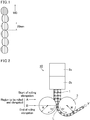
- the analysis demonstrates that the NOCs have a structure in which spherical nano crystals (NCs) are linked in the form of a rosary along the elongational direction (MD) as illustrated in Fig. 1 .
- NCs spherical nano crystals
- the molded article of the invention preferably has a melting point of 130°C or higher, more preferably 134°C or higher, still more preferably 137°C or higher.
- each sandwiching roller 3 of the rolling elongation crystallization device 10 is expressed as R; the angular velocity of each sandwiching roller 3 as ⁇ ; the angle at which each sandwiching roller 3 rotates as ⁇ ; the thickness of a supercooled melt at any position in the region AB as L 0 ; the thickness of a VdF/TFE copolymer sheet at the point B at the end of the rolling elongation as L; the sheet-taking speed by the sandwiching rollers as V; and the elongational strain rate as ⁇ .
- the roller rotation angle ⁇ in the region AB is very small. ⁇ ⁇ 1 rad
- the melting point of the molded article was determined as the temperature corresponding to the maximum value on a heat-of-fusion curve drawn by increasing the temperature at a rate of 5 K/min using a differential scanning calorimeter (DSC).
- DSC differential scanning calorimeter
- the tensile modulus was a value determined by the method in conformity with JIS-7127.
- the "Elongation strain rate ( ⁇ )/s -1 " in Table 1 represents the elongational strain rate when the VdF/TFE copolymer melt was rolled and elongated using the rollers.
Landscapes
- Chemical & Material Sciences (AREA)
- Engineering & Computer Science (AREA)
- Polymers & Plastics (AREA)
- Organic Chemistry (AREA)
- Health & Medical Sciences (AREA)
- Chemical Kinetics & Catalysis (AREA)
- Medicinal Chemistry (AREA)
- Mechanical Engineering (AREA)
- Manufacturing & Machinery (AREA)
- Materials Engineering (AREA)
- Manufacture Of Macromolecular Shaped Articles (AREA)
- Addition Polymer Or Copolymer, Post-Treatments, Or Chemical Modifications (AREA)
- Fixed Capacitors And Capacitor Manufacturing Machines (AREA)
Abstract
Description
- The invention relates to molded articles having excellent mechanical strength, heat resistance, surface roughness, and ferroelectricity.
- A variety of organic dielectric films and inorganic dielectric films are conventionally known as films to be used for piezoelectric films that serve as ferroelectric materials and for electrowetting applications or film capacitor applications. Films of a vinylidene fluoride (VdF)/tetrafluoroethylene (TFE) copolymer or a vinylidene fluoride (VdF) polymer among these advantageously have transparency and, unlike inorganic dielectric thin films, flexibility, so that such films can be used in a variety of applications.
- For a ferroelectric film of a VdF polymer, which is a typical example of ferroelectric polymer films, conventional production thereof includes melt crystallization that causes generation of α crystals after film formation. Thus, in order to form β crystals that exhibit ferroelectricity, the resulting film needs to undergo complicated steps of stretching, heatsetting, and poling the film.
- For a conventional ferroelectric film of a VdF/TFE copolymer, melt crystallization with 7 mol% or more of a TFE unit can lead to a film in which β crystals are directly formed. Thus, poling the resulting film can provide the target ferroelectric film. Still, in order to achieve high ferroelectricity, the molecular chain needs to be oriented by complicated steps of stretching and heatsetting (Non-Patent Literature 1).
- A conventionally known method for improving the ferroelectricity of a VdF/TFE copolymer is a method for producing a highly crystallized film including melt crystallization at high temperature and high pressure. Still, the resulting film is disadvantageously cloudy and brittle (Non-Patent Literature 2).
- Production of films by stretching unfortunately includes complicated production steps and the resulting films are insufficient for some applications in terms of properties such as mechanical strength and heat resistance. Thus, films need to be further improved so as to meet current high-level requirements.
- For commodity plastics such as polypropylene and polyester, the presence of nano-oriented crystals (NOCs) is known to improve the properties, such as heat resistance, of films (
Patent Literature documents 1 and 2). For fluororesins, the presence of NOCs is known to improve the heat resistance of polyvinylidene fluoride (PVdF) and a VdF/trifluoroethylene (TrFE) copolymer (Non-Patent Literature 3). -
- Patent Literature 1:
JP 5487964 B - Patent Literature 2:
WO 2016/035598 -
- Non-Patent Literature 1: Hicks, J. C. et al. J. Appl. Phys., 49, 6092 (1978)
- Non-Patent Literature 2: Tasaka, S. et al. J. Appl. Phys. 57(3), 906 (1985)
- Non-Patent Literature 3: Hikosaka, M. et al. Polymer Preprints, Japan 64(2), 1G11 (2015)
- Non-Patent Literature 4: Lovinger, A. J. et al. Macromolecules 19, 1491 (1986)
- Non-Patent Literature 5: Hikosaka, M. Polymer 28, 1257 (1987)
- Non-Patent Literature 6: Okada, K. et al. Polymer Preprints, Japan 63(1), 1331 (2014)
- Non-Patent Literature 7: Hikosaka, M. et al. J. Macromol. Sci. Phys. B31(1), 87 (1992)
- Non-Patent Literature 8: Fukushima, T. et al. Polymer Preprints, Japan 66(1), 2C03 (2017)
- Non-Patent Literature 9: Lovinger, A. J. et al. Macromolecules 21, 78 (1988)
- The invention aims to provide a molded article having excellent mechanical strength, heat resistance, surface roughness, and ferroelectricity.
- The inventors have diligently studied for solutions of the above problems and, as a result, succeeded for the first time in obtaining a molded article containing very small crystals of a VdF/TFE copolymer by crystalizing a melt of the VdF/TFE copolymer while elongating the melt at a rate not lower than the "critical elongational strain rate". The inventors then found that the resulting molded article has excellent mechanical strength expressed by the elastic modulus and has excellent heat resistance, surface roughness, and ferroelectricity, completing the invention.
- In other words, the invention relates to a molded article containing a crystal of a vinylidene fluoride/tetrafluoroethylene copolymer, the crystal being a β crystal and being a nano-oriented crystal (NOC) that has a size of 100 nm or smaller, the molded article having an arithmetic average roughness of 3.0 µm or lower.
- The vinylidene fluoride/tetrafluoroethylene copolymer in the molded article of the invention preferably has high crystallinity.
- The vinylidene fluoride/tetrafluoroethylene copolymer preferably contains 50 to 95 mol% of a vinylidene fluoride unit and 5 to 50 mol% of a tetrafluoroethylene unit relative to 100 mol% in total of the vinylidene fluoride unit and the tetrafluoroethylene unit.
- The molded article of the invention is preferably a ferroelectric.
- The molded article of the invention preferably has a melting point of 130°C or higher.
- The molded article of the invention preferably has a heatproof temperature of 90°C or higher.
- The molded article of the invention preferably has an elastic modulus of 1.0 GPa or higher.
- The molded article of the invention preferably has a remanent polarization of 45 mC/m2 or higher.
- The molded article of the invention preferably has a coercive field of 35 MV/m or lower.
- The molded article of the invention having the above structure can have excellent mechanical strength, heat resistance, surface roughness, and ferroelectricity.
-
-
Fig. 1 is a schematic view of a structure of nano-oriented crystals (NOCs). -
Fig. 2 is a schematic view of a rolling elongation crystallization device used for production of samples in examples. -
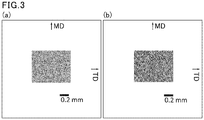
Fig. 3 includes polarization microscopic images (results of observation in the through direction) of a sample in an example. -
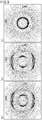
Fig. 4 includes small-angle X-ray scattering images of a sample in an example;Fig. 4(a) shows the result of observation in the through direction;Fig. 4(b) shows the result of observation in the edge direction; andFig. 4(c) shows the result of observation in the end direction. -
Fig. 5 includes wide-angle X-ray scattering images of a sample in an example;Fig. 5(a) shows the result of observation in the through direction;Fig. 5(b) shows the result of observation in the edge direction; andFig. 5(c) shows the result of observation in the end direction. -
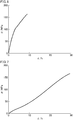
Fig. 6 is a typical diagram of the results of measuring the tensile stress at break (σB) and the tensile modulus (Et) of a sample in an example. -
Fig. 7 is a diagram of the results of measuring the tensile stress at break (σB) and the tensile modulus (Et) of a sample in a comparative example. -
Fig. 8 is a typical diagram of the results of measuring the remanent polarization (Pr) and the coercive field (Ec) of a sample in an example. -
Fig. 9 is a diagram of the results of measuring the remanent polarization (Pr) and the coercive field (Ec) of a sample of a comparative example. -
Fig. 10 is a diagram of the results of measuring the tensile stress at break (σB) and the tensile modulus (Et) of a sample of a comparative example. -
Fig. 11 is a plot of the results of measuring the heatproof temperature of a sample in an example. -
Fig. 12 is a plot of the results of measuring the heatproof temperature of a sample in a comparative example. - The following description will discuss details of the invention. The scope of the invention is not limited to the following description. Besides the examples below, the invention may be modified and put into practice as appropriate within the spirit of the invention. All literature documents described in the description are hereby incorporated by reference.
- The molded article of the invention contains a crystal of a VdF/TFE copolymer having a crystal size of 100 nm or smaller.
- The VdF/TFE copolymer is a copolymer containing a polymerized unit based on VdF (hereinafter, also referred to as a "VdF unit") and a polymerized unit based on TFE (hereinafter, also referred to as a "TFE unit").
- In order to provide a molded article having excellent mechanical strength, heat resistance, surface roughness, and ferroelectricity, the VdF/TFE copolymer preferably contains 50 to 95 mol% of a VdF unit and 5 to 50 mol% of a TFE unit relative to 100 mol% in total of the VdF unit and the TFE unit. In the VdF/TFE copolymer, more preferably, the VdF unit represents 60 to 95 mol% and the TFE unit represents 5 to 40 mol%, particularly preferably, the VdF unit represents 70 to 90 mol% and the TFE unit represents 10 to 30 mol%.
- The VdF/TFE copolymer may consist only of a VdF unit and a TFE unit, or may contain a polymerized unit based on a monomer copolymerizable with VdF and TFE and other than VdF and TFE. The VdF/TFE copolymer preferably contains the VdF unit and the TFE unit in a total amount of 90 mol% or more, more preferably 95 mol% or more, still more preferably 98 mol%, of all polymerized units.
- Examples of the monomer copolymerizable with VdF and TFE include hexafluoropropylene (HFP), ethylene, propylene, alkyl vinyl ether, vinyl acetate, vinyl chloride, vinylidene chloride, CH2=CHCF3, CH2=CFCF3, CH2=CF (CF2) nH (n = 3 to 7), and CH2=CH (CF2)nF (n = 1 to 8).
- Preferred among these is at least one selected from the group consisting of HFP and CH2=CFCF3, more preferred is HFP.
- In order to provide a molded article having excellent mechanical strength, heat resistance, surface roughness, and ferroelectricity, the polymerized unit based on a monomer copolymerizable with VdF and TFE is preferably in an amount of 0 to 10 mol%, more preferably 0.01 to 5 mol%, still more preferably 0.1 to 2.
- The VdF/TFE copolymer used in the invention preferably has a weight average molecular weight of 10000 or higher, more preferably 50000 or higher, while preferably 400000 or lower, more preferably 300000 or lower.
- The weight average molecular weight is a value determined by gel permeation chromatography (GPC).
- The VdF/TFE copolymer can be crystallized into a hexagonal crystal form (morphology) (Non-Patent Literature 4) and thus is likely to show polymer chain sliding diffusion (Non-Patent Literature 5), so that the critical elongational strain rate thereof for formation of nano-oriented crystals is presumed to be lower (Non-Patent Literature 6). Accordingly, as described later, the VdF/TFE copolymer can easily form NOCs and is industrially advantageous.
- The VdF/TFE copolymer is obtainable by a conventionally known solution polymerization, suspension polymerization (dispersion polymerization), emulsion polymerization, or the like. A polymerization initiator to be used can be selected as appropriate from those conventionally used in accordance with the polymerization technique used.
- Examples of the polymerization initiator include organic peroxides such as bis(chlorofluoroacyl)peroxide, bis(perfluoroacyl)peroxide, bis (ω-hydroperfluoroacyl)peroxide, t-butyl peroxyisobutyrate, and diisopropyl peroxydicarbonate; and azo compounds such as azobisisobutyronitrile. The polymerization initiator may be used in an amount that can be changed as appropriate in accordance with factors such as the type of the initiator and the polymerization reaction conditions. The amount thereof is usually 0.005 to 5% by weight, particularly about 0.05 to 0.5% by weight, relative to all monomers to be polymerized.
- Polymerization reaction conditions used may be wide range reaction conditions without limitation. For example, an optimal polymerization reaction temperature may be selected in accordance with the type of a polymerization initiator. The polymerization reaction temperature used may be usually about 0°C to 100°C, particularly about 30°C to 90°C. The reaction pressure may also be selected as appropriate, and is usually 0.1 to 5 MPa, particularly about 0.5 to 3 MPa. Polymerization for the VdF copolymer used in the invention can be advantageously performed at the above reaction pressure. Still, the polymerization may be performed at a higher pressure or under a reduced pressure condition. The polymerization type used may be either a batch type or continuous type, for example.
- In order to adjust the molecular weight of the VdF/TFE copolymer, a chain transfer agent may be used. The chain transfer agent used may be a common one. Examples thereof include hydrocarbons such as n-hexane and cyclohexane; aromatic compounds such as toluene and xylene; ketones such as acetone; acetates such as ethyl acetate and butyl acetate; alcohols such as methanol and ethanol; and mercaptans such as methylmercaptan. The chain transfer agent may be used in an amount that varies in accordance with the chain transfer constant of a compound used. The amount thereof usually falls within the range of 0.01% by weight to 20% by weight relative to a polymerization solvent.
- The polymerization solvent used may be a liquid solvent conventionally used in accordance with the polymerization technique used. In order to provide a molded article having excellent heat resistance, the VdF/TFE copolymer used in the invention is preferably formed by suspension polymerization (dispersion polymerization) in the presence of a fluorine-based solvent.
- The VdF/TFE copolymer contained in the molded article of the invention has a crystal size of 100 nm or smaller. In order to provide a molded article having excellent mechanical strength, heat resistance, surface roughness, and ferroelectricity, the crystal size is preferably 90 nm or smaller, more preferably 80 nm or smaller, still more preferably 70 nm or smaller.
- The lower limit of the crystal size may be, but is not limited to, 3 nm. In order to achieve more improved heat resistance, the crystal size is preferably 5 nm or greater, more preferably 8 nm or greater, still more preferably 10 nm or greater.
- The crystal size can be determined by a known small-angle X-ray scattering technique (hereinafter, referred to as "SAXS").
- Owing to high crystallinity, the primary peak of a scattering vector (q)-small-angle X-ray scattering intensity (Ix) curve in SAXS corresponds to the shortest distance between microcrystals (= crystal size d) in cases where microcrystals having an average size d are randomly packed (reference: A. Guinier, "Ekkusu-sen Kessho-gaku no Riron to Jissai (Theory and Practice of X-ray crystallography)", Rigaku Corp., p513, 1967). Thus, the crystal size d is calculated by the following Bragg equation.
- Bragg equation:

- The crystals of the VdF/TFE copolymer are β crystals.
- In order to achieve better mechanical strength, heat resistance, and ferroelectricity, the molded article of the invention preferably contains a VdF/TFE copolymer having high crystallinity.
- The crystals of the VdF/TFE copolymer constitute nano-oriented crystals (NOCs). NOCs each have a crystal size of 100 nm or smaller and include crystals (also referred to as nano crystals, NCs) of the VdF/TFE copolymer in which the polymer chain is oriented in the elongational direction (machine direction, MD).
- The structure of the NOCs is analyzed using a polarization microscope and the results of X-ray diffraction. The analysis demonstrates that the NOCs have a structure in which spherical nano crystals (NCs) are linked in the form of a rosary along the elongational direction (MD) as illustrated in
Fig. 1 . - In order to achieve better mechanical strength, heat resistance, and ferroelectricity, the molded article of the invention preferably contains NOCs of a VdF/TFE copolymer as a main component.
- For example, the molded article of the invention preferably contains 60% or more, more preferably 70% or more, still more preferably 80% or more, particularly preferably 90% or more, further more preferably 95% or more, of NOCs of a VdF/TFE copolymer.
- The proportion of the NOCs (NOC fraction) contained in the molded article can be calculated by X-ray diffraction.
- NOCs are highly oriented and non-NOCs are isotropic. Thus, the NOC fraction can be calculated from the intensity ratio in wide-angle X-ray scattering.
- Whether the polymer chain of NCs included in the NOCs constituting the molded article or the NCs themselves constituting the NOCs is/are oriented can be observed using a polarization microscope or by a known X-ray diffraction technique (small-angle X-ray scattering (SAXS), wide-angle X-ray scattering (WAXS)). High crystallinity of the molded article can be concluded by the fact that amorphous halo is hardly observed by WAXS. The examples to be described later can be referred to as appropriate for specific methods of the observation using a polarization microscope and the X-ray diffraction techniques (small-angle X-ray scattering, wide-angle X-ray scattering).
- The NCs included in the NOCs and the polymer chains included in the NCs are oriented substantially in MD of the molded article (e.g., sheet).
- The crystal size of each NC constituting the NOCs can be determined by measuring the size in MD. For example, the crystal size of a NOC illustrated in
Fig. 1 can be determined as about 29 nm. - The molded article of the invention has an arithmetic average roughness of 3.0 µm or lower. The arithmetic average roughness is more preferably 2.0 µm or lower, still more preferably 1.5 µm or lower, particularly preferably 1.0 µm or lower. Use of a rolling elongation crystallization device to be described later can lead to production of a molded article containing NOCs of a VdF/TFE copolymer as a main component and improvement in the arithmetic average roughness of the surface.
- The arithmetic average roughness is a value determined using a portable surface roughness tester in conformity with ISO 1997.
- The molded article of the invention preferably has a melting point of 130°C or higher, more preferably 134°C or higher, still more preferably 137°C or higher.
- The melting point of the molded article is the temperature corresponding to the maximum value on a heat-of-fusion curve drawn by increasing the temperature at a rate of 5 K/min using a differential scanning calorimeter (DSC). The melting point of the molded article is the temperature corresponding to the maximum value on a retardation change in the melting behavior during a temperature increase at a rate of 1 K/min using a polarization microscope equipped with a hot stage.
- The melting point of the molded article of the invention is preferably higher than the temperature that is 14°C lower than the equilibrium melting point of β crystals of the VdF/TFE copolymer at rest. The melting point of the molded article is more preferably higher than the temperature that is 10°C lower than the equilibrium melting point of β crystals, still more preferably higher than the temperature that is 7°C lower than the equilibrium melting point of β crystals.
- The equilibrium melting point (Tm 0) means the melting point of a macroscopic perfect crystal that is formed with the molecule chain of a polymer (hereinafter, also referred to as "polymer chain" as appropriate) being fully stretched, and is calculated by the following formula:

- Specifically, the equilibrium melting point can be determined by the method of Hikosaka et al. using a polarization microscope (Non-Patent Literature 7). For example, the equilibrium melting point of hexagonal crystal of a VdF/TFE copolymer at VdF/TFE = 80/20 (mole ratio) at rest is determined as about 134.3°C (Non-Patent Literature 8), and the equilibrium melting point of β crystals at rest is determined as 143.9°C in our study (unpublished).
- The melting point is contrasted to the equilibrium melting point of a VdF/TFE copolymer having the same monomer compositional ratio.
- The molded article of the invention preferably has a heatproof temperature of 90°C or higher, more preferably 110°C or higher, still more preferably 130°C or higher.
- The heatproof temperature of the molded article of the invention is preferably higher than the temperature that is 54°C lower, more preferably higher than the temperature that is 34°C lower, still more preferably higher than the temperature that is 14°C lower, than the equilibrium melting point of β crystals of the VdF/TFE copolymer at rest.
- The "heatproof temperature" herein means the heatproof temperature measured by test-piece size direct reading using an optical microscope. The "test-piece size direct reading" is performed using an optical microscope equipped with a CCD camera (BX51, available from Olympus Corp.), a hot stage (LK-600PM, available from Linkam Scientific Instruments Ltd.), and image analysis software (Image-Pro PLUS, available from Media Cybernetics, Ltd.) that can quantify the size on a display. The test piece used had a size of 0.7 mm in length and 0.5 mm in width. The test piece was heated at a temperature-increasing rate of 1 K/min. The temperature at which the test piece started to deform (shrink or expand) by 3% or more in the longitudinal direction (MD) or the transverse direction (TD) was defined as the heatproof temperature.
- The molded article of the invention preferably has a tensile strength at break of 80 MPa or higher. The tensile strength at break is more preferably 110 MPa or higher, still more preferably 150 MPa or higher. The tensile strength at break is determined using a test piece having a length of 42 mm, a width of 2 mm, and a thickness of 0.01 to 0.3 mm in conformity with JIS K 7127. The tensile rate is 0.3 mm/s.
- The molded article of the invention preferably has an elastic modulus of 1.0 GPa or higher. The elastic modulus is more preferably 1.2 GPa or higher, still more preferably 1.5 GPa or higher, particularly preferably 2 GPa or higher. The elastic modulus is a value determined by the method in conformity with JIS-7127.
- The molded article of the invention is preferably a ferroelectric, and preferably has a remanent polarization of 45 mC/m2 or higher. The remanent polarization is more preferably 55 mC/m2 or higher. The upper limit thereof may be, but is not limited to, 100 mC/m2, for example.
- The remanent polarization is a value determined as follows. Specifically, a sample film having a size of 20 mm × 20 mm is cut out and a pattern of an aluminum electrode (planar electrode) is vacuum deposited on a 5 mm × 5 mm central portion of the film. An electrode provided with two lead lines (30 mm × 80 mm) and formed of aluminum foil reinforced with insulating tape is stuck to the planar electrode using a conductive double-sided tape. This sample film, a function generator, a high voltage amplifier, and an oscilloscope are incorporated into a sawyer-tower circuit. Triangle waves are applied to the sample film (max: ±10 kV) and the response of the sample film is measured using the oscilloscope. Thereby, the remanent polarization is determined.
- The molded article of the invention preferably has a coercive field of 35 MV/m or lower. The coercive field is more preferably 34 MV/m or lower, more preferably 33 MV/m or lower.
- The lower limit of the coercive field may be 5 MV/m, for example.
- The coercive field is a value determined as follows. Specifically, a sample film having a size of 20 mm × 20 mm is cut out and a pattern of an aluminum electrode (planar electrode) is vacuum deposited on a 5 mm × 5 mm central portion of the film. An electrode provided with two lead lines (30 mm × 80 mm) and formed of aluminum foil reinforced with insulating tape is stuck to the planar electrode using a conductive double-sided tape. This sample film, a function generator, a high voltage amplifier, and an oscilloscope are incorporated into a sawyer-tower circuit. Triangle waves are applied to the sample film (max: ±10 kV) and the response of the sample film is measured using the oscilloscope. Thereby, the coercive field is determined.
- The molded article of the invention may consist only of a VdF/TFE copolymer or may contain a component other than the VdF/TFE copolymer to the extent that the effects of the invention are not impaired.
- The molded article of the invention may be a sheet, a tube, a fiber, or the like. Preferred is a sheet because it can be relatively easily produced.
- The sheet may have any thickness that can be adjusted as appropriate by the amount of the material to be extruded, for example, in accordance with the intended use. Specifically, the thickness may preferably fall within the range of 80 µm to 10 mm, more preferably 90 µm to 5 mm, particularly preferably 110 µm to 1 mm.
- The thickness of the sheet can be measured using a micrometer.
- The molded article of the invention having the aforementioned structure has excellent mechanical strength, heat resistance, and ferroelectricity. The molded article of the invention also has excellent dimension stability, electric properties, and gas barrier properties, and thus can be used for a variety of applications. For example, its excellent electric properties may be utilized so that the molded article of the invention can be suitably used as a piezoelectric film, a film of an electrowetting device, or a film of a film capacitor. The molded article of the invention can also suitably be used as a pyroelectric film, for example.
- The molded article of the invention may be produced by the following production method, for example. The following production method is a method of crystallization (solidification) by rolling and elongating a VdF/TFE copolymer in the form of a melt and is completely different from a stretching method of rolling and elongating a solidified molded article.
-
Fig. 2 is a schematic view of a device (rolling elongation crystallization device 10) for producing the molded article of the invention. The rollingelongation crystallization device 10 includes a supercooled melt feeder (including anextruder 2a that melts a VdF/TFE copolymer and feeds a melt of the VdF/TFE copolymer and acooling adaptor 2b that cools the melt fed from theextruder 2a into a supercooled state) andsandwiching rollers 3. Theextruder 2a of the supercooled melt feeder is provided with a slit die (not illustrated) at an outlet thereof, and the slit die has a quadrangular end. The VdF/TFE copolymer melt discharged through the slit die is cooled to a supercooled state while passing through the coolingadaptor 2b (the melt in the supercooled state is referred to as a "supercooled melt"), and the supercooled melt is discharged toward the sandwichingrollers 3. Let the difference between the equilibrium melting point and the crystallization temperature of a hexagonal crystal at rest be the "supercooling degree ΔT". A particularly optimal supercooling degree ΔT is not limited because it greatly varies in accordance with the type and characterization of the polymer. Still, the supercooling degree ΔT is preferably -35°C to +35°C, more preferably - 30°C to +30°C, still more preferably -20°C to +20°C. The crystallization temperature herein means the temperature of a supercooled melt. - The sandwiching
rollers 3 are provided such that paired rotatable rollers face each other, and are configured to sandwich thesupercooled melt 1 fed from the supercooled melt feeder and elongate thesupercooled melt 1 in the rotating direction of the rollers to mold thesupercooled melt 1 into a sheet shape. - In production of the molded article of the invention, the
supercooled melt 1 is fed from the supercooled melt feeder, sandwiched between the sandwichingrollers 3, and then rolled and elongated at an elongational strain rate not lower than the critical elongational strain rate, so that thesupercooled melt 1 is crystallized. Thereby, thesupercooled melt 1 becomes an oriented melt and can be crystallized with this state maintained. The molecular chains contained in the oriented melt associate with each other to cause nucleation (referred to as "homogeneous nucleation") and growth without the help of a foreign substance. This consequently allows for generation of NOCs, resulting in production of the molded article of the invention. - The method for producing the molded article of the invention is further described with reference to the rolling
elongation crystallization device 10 ofFig. 2 . InFig. 2 , focus is given to a region (hereinafter, referred to as "region AB") from the start (A) of rolling elongation to the end (B) of rolling elongation using thesandwiching rollers 3. The radius of each sandwichingroller 3 of the rollingelongation crystallization device 10 is expressed as R; the angular velocity of each sandwichingroller 3 as ω; the angle at which each sandwichingroller 3 rotates as θ; the thickness of a supercooled melt at any position in the region AB as L0; the thickness of a VdF/TFE copolymer sheet at the point B at the end of the rolling elongation as L; the sheet-taking speed by the sandwiching rollers as V; and the elongational strain rate as ε. The roller rotation angle θ in the region AB is very small.
- The radius R of each roller is much larger than the sheet thicknesses L0 and L.

- The minute volume Φ at any position in the region AB is considered with the center of the minute volume taken as the origin. The direction (MD) in which the supercooled melt and the VdF/TFE copolymer sheet travel is taken as an x-axis, the direction (TD) of the width of the supercooled melt sheet is taken as a y-axis, and the direction of the thickness of the supercooled melt sheet is taken as a z-axis. The minute volume Φ is approximated by a rectangular parallelepiped, and the lengths of the sides of the rectangular parallelepiped are taken as x, y, and L0.
- In sheet formation, the width, i.e., y, of the supercooled melt sheet can be considered as sufficiently greater than x and L0 and not being changed by rolling elongation.

- Thus, in the rolling elongation using the sandwiching rollers, the supercooled melt sheet is compressed in the z-axis direction and is elongated in the x-axis direction. In other words, the rolling elongation using the sandwiching rollers acts only on the x-axis and the z-axis.
- Letting the elongational strain rate tensor in the x-axis direction be εxx and the elongational strain rate tensor in the z-axis direction be εzz, the relationship therebetween is defined as follows.

- In derivation of the formula (5), the following law of conservation of mass related to the minute volume Φ in the rolling elongation is used.

- The strain rate εzz in the z-axis direction of the region AB in
Fig. 2 is defined by the following definitional equation:
- In the formula,


- Based on the formulae (5) and (8), the elongational strain rate to be calculated is obtained.

- εxx is a function of L0 from the formula (9) .
- εxx has a maximum value at

- This means that εxx reaches its maximum at L0 = 2L and that the maximum elongational strain rate is applied to the supercooled melt.
- Letting the maximum elongational strain rate be εmax, substitution of the formula (10) into the formula (9) gives the following formula.

- A condition for forming the sheet at a supercritical elongational strain rate is that εmax is not lower than the critical elongational strain rate ε*.
- Thus, the formula (11) is defined as the elongational strain rate ε, giving the following formula.
[Math. 1]


- Based on the formulae (12) and (14), the following formula is given.
[Math. 2]
- Accordingly, a desired molded article of the invention can be produced by setting the radius R of each sandwiching roller, the average thickness L of the elongated polymer sheet, and the sheet-taking speed V by the sandwiching rollers such that the elongational strain rate ε(R, L, V) is not lower than the critical elongational strain rate using the formula (15).
- The critical elongational strain rate ε*(R, L, V) may be any rate determined by any method. For example, the rate may be calculated by the following approximate expression (Formula i).
-

- The sheet-taking speed V* at the critical point means the sheet-taking speed V at the critical point at which NOCs are generated upon crystallization of a supercooled VdF/TFE copolymer melt into a VdF/TFE copolymer sheet having a thickness L by feeding the VdF/TFE copolymer melt, sandwiching the VdF/TFE copolymer melt between paired sandwiching rollers each having a radius R, and rolling and elongating the VdF/TFE copolymer melt at the sheet-taking speed V.
- In the method for producing the molded article of the invention, the critical elongational strain rate ε*(R, L, V) may be calculated using the following approximate expression (Formula ii).
-

- The thickness L* of a VdF/TFE copolymer sheet at the critical point means the thickness L of a VdF/TFE copolymer sheet at the critical point at which NOCs are generated upon crystallization of a supercooled VdF/TFE copolymer melt into a VdF/TFE copolymer sheet having a thickness L by feeding the VdF/TFE copolymer melt, sandwiching the VdF/TFE copolymer melt between paired sandwiching rollers each having a radius R, and rolling and elongating the VdF/TFE copolymer melt at the sheet-taking speed V.
- Whether NOCs are generated or not can be determined by, although not limited to, an X-ray diffraction technique described in the examples below.
- A VdF/TFE copolymer melt having a high fluidity may be difficult to elongate using sandwiching rollers in rolling elongation and crystallization with rollers, and may not be elongated at the critical elongational strain rate or higher. Thus, in production of the molded article of the invention (VdF/TFE copolymer sheet), the fluidity (melt flow rate, MFR) is preferably adjusted such that the elongation can be performed at the critical elongational strain rate or higher. In other words, the method for producing the molded article of the invention (VdF/TFE copolymer sheet) preferably includes adjusting the fluidity of the VdF/TFE copolymer melt.
- In the method for producing the molded article of the invention, the fluidity of the VdF/TFE copolymer melt is adjusted to a fluidity that enables elongation at the critical elongational strain rate or higher. For example, the MFR of the VdF/TFE copolymer melt at 230°C is preferably 100 (g/10 min) or lower, more preferably 80 (g/10 min) or lower, still more preferably 60 (g/10 min) or lower, most preferably 50 (g/10 min) or lower.
- The lower limit of the MFR of the VdF/TFE copolymer melt at 230°C may be any value that enables elongation at the critical elongational strain rate or higher and is usually preferably 3 g/10 min or higher.
- The invention will be described hereinbelow with reference to examples. Still, the invention is not intended to be limited by these examples.
- The following VdF/TFE copolymer was used in the examples.
- VdF/TFE copolymer 1: VdF/TFE = 80/20 (mole ratio), MFR = 16 (g/10 min, measurement temperature: 230°C, load: 2.1 kgf), weight average molecular weight = 19 × 104
- The following VdF/TFE copolymer was used in the comparative examples.
- VdF/TFE copolymer 2: VdF/TFE = 80/20 (mole ratio), MFR = 6 (g/10 min, measurement temperature: 230°C, load: 2.1 kgf), weight average molecular weight = 23 × 104
- The evaluations in the examples and the comparative examples were performed by the following methods.
- The samples obtained in the examples and the comparative examples were observed using a polarization microscope. The polarization microscope used was BX51 available from Olympus Corp. and the observation was performed in crossed nicols. In order to quantitatively measure the change in retardation, a sensitive color test plate was inserted between a polarizer and an analyzer (polarizing plate) of the polarization microscope (Reference: Kobunshi Sozai no Henko Kenbikyo Nyumon (Introduction to polarization microscope for polymer material), Yu Awaya, AGNE Gijutsu Center Inc., 2001, p.75-103). The observation with the polarization microscope was performed at room temperature, 25°C. Each sample was observed in the sheet thickness direction (ND, through direction).
- The samples were observed by SAXS. SAXS was performed in conformity with "Kobunshi Ekkusu-sen Kaisetsu (Polymer X-ray diffraction)", Masao Kakudo, Nobutami Kasai, Maruzen Publishing Co., Ltd., 1968, and "Kobunshi Ekkusu-sen Kaisetsu (Polymer X-ray diffraction)", edition 3.3, Toru Masuko, Yamagata University Co-op, 1995. More specifically, SAXS was performed with Beamline BL40B2 at Japan Synchrotron Radiation Research Institute (JASRI), SPring-8, at an X-ray wavelength λ of 0.15 nm, a camera length of 3 m, and room temperature, 25°C, using an imaging plate as a detector. The observation was performed in three directions, i.e., the direction (through) perpendicular to MD and TD, the direction (edge) parallel to TD, and the direction (end) parallel to MD. For the observation of the samples in the through and edge directions, MD was set to be the Z-axis direction. For the observation of the samples in the end direction, TD was set to be the Z-axis direction. The time period during which the samples were exposed to X-rays was 5 to 180 seconds. The imaging plate was scanned with a scanning device available from Rigaku Corp. and reading software (available from Rigaku Corp., raxwish, control), and thereby a two-dimensional image was obtained.
- The samples were observed by WAXS. WAXS was performed with Beamline BL03XU or BL40B2 at Japan Synchrotron Radiation Research Institute (JASRI), SPring-8, at an X-ray wavelength λ of 0.0709 nm, a camera length (R) of 280 mm, and room temperature, 25°C, using an imaging plate as a detector. For the observation of the samples in the through and edge directions, MD was set to be the Z-axis direction. For the observation of the samples in the end direction, TD was set to be the Z-axis direction. The time period during which the samples were exposed to X-rays was 10 to 180 seconds. The imaging plate was scanned with a scanning device available from Rigaku Corp. and reading software (available from Rigaku Corp., raxwish, control), and thereby a two-dimensional image was obtained.
- The crystal size (d) of the VdF/TFE copolymer was determined from the two-point image in MD of the small-angle X-ray scattering image. The primary peak of a scattering vector (q)-small-angle X-ray scattering intensity (Ix) curve in SAXS corresponds to the shortest distance between microcrystals (= crystal size d) in cases where microcrystals having an average size d are randomly packed (reference: A. Guinier, "Ekkusu-sen Kessho-gaku no Riron to Jissai (Theory and Practice of X-ray crystallography)", Rigaku Corp., p513, 1967). Thus, the crystal size d is calculated by the Bragg equation.

- The heatproof temperatures of the samples according to the examples and the comparative examples were measured by test-piece size direct reading using an optical microscope. Specifically, each test piece (0.6 mm in length, 0.8 mm in width) was placed in a hot stage (L-600A, available from Linkam Scientific Instruments, Ltd.) and the temperature in the hot stage was increased at a temperature-increasing rate of 1 K/min. At this time, an optical microscope equipped with a CCD camera (BX51, available from Olympus Corp.) was used for observation and recording. Using image analysis software (Image-Pro PLUS, available from Media Cybernetics, Ltd.), the length direction (MD) and the width direction (TD) of the test piece were quantitatively measured. The temperature at which the test piece started to shrink (or expand) by 3% or more in MD or TD was defined as the heatproof temperature TH. The melting points of the samples according to the examples and the comparative examples were also analyzed. The melting point was determined as the temperature corresponding to the maximum value of the retardation change in the melting behavior during the temperature increase at a rate of 1 K/min using a polarization microscope equipped with a hot stage.
- The melting point of the molded article was determined as the temperature corresponding to the maximum value on a heat-of-fusion curve drawn by increasing the temperature at a rate of 5 K/min using a differential scanning calorimeter (DSC).
- The tensile stress at break was determined in conformity with JIS-7127.
- The tensile modulus was a value determined by the method in conformity with JIS-7127.
- The arithmetic average roughness (Rz) was measured using a portable surface roughness tester (SJ-210, available from Mitsutoyo Corp.) in conformity with ISO 1997.
- A sample film having a size of 20 mm × 20 mm was cut out and a pattern of an aluminum electrode (planar electrode) was vacuum deposited on a 5 mm × 5 mm central portion of the film. An electrode provided with two lead lines (30 mm × 80 mm) and formed of aluminum foil reinforced with insulating tape was stuck to the planar electrode using a conductive double-sided tape. This sample film, a function generator, a high voltage amplifier, and an oscilloscope were incorporated into a sawyer-tower circuit. Triangle waves were applied to the sample film (max: ±10 kV) and the response of the sample film was measured using the oscilloscope. Thereby, the remanent polarization and the coercive field were determined.
- Using the rolling elongation crystallization device schematically illustrated in
Fig. 2 , the VdF/TFE copolymer was elongated and crystallized. The conditions for elongation and crystallization are as shown in Table 1.[Table 1] Maximum extrusion temperature (Tmax)/°C Melt temperature (Tmelt)/°C Roller temperature (TR)/°C Elongation strain rate (ε)/s-1 Sample thickness /mm Crystal size (d)/nm Example 1 210 130 120 10 0.19 28 Example 2 210 130 120 31 0.15 38 Example 3 210 136 120 21 0.18 38 Example 4 200 136 120 35 0.18 55 Example 5 200 136 120 45 0.16 57 Example 6 210 139 120 29 0.17 51 Example 7 210 139 120 37 0.16 54 Example 8 220 144 120 38 0.15 57 Example 9 180 147 120 27 0.20 56 Example 10 210 148 90 59 0.11 30 Example 11 200 136 85, 90 13 0.21 29 Example 12 200 145 80,85 40 0.14 27 Example 13 200 149 75,80 57 0.12 24 Example 14 200 137 90 17 0.20 29 Example 15 200 140 110 40 0.11 29 Example 16 200 146 105 67 0.097 28 Example 17 200 146 105 75 0.088 - Example 18 210 158 90 85 0.12 30 Example 19 210 152 90 28 0.18 28 Example 20 210 158 90 110 0.11 35 - The "Maximum extrusion temperature (Tmax)/°C" in Table 1 represents the temperature of an extruder when the VdF/TFE copolymer was melted using a heater of the extruder to prepare the VdF/TFE copolymer melt.
- The "Melt temperature (Tmelt) /°C" in Table 1 represents the temperature of the VdF/TFE copolymer melt when the VdF/TFE copolymer melt was rolled and elongated using rollers.
- The "Roller temperature (TR)/°C" in Table 1 represents the surface temperature of the rollers when the VdF/TFE copolymer melt was rolled and elongated using the rollers. If two temperatures are shown in Table 1, they represent the respective surface temperatures of the two facing rollers.
- The "Elongation strain rate (ε)/s-1" in Table 1 represents the elongational strain rate when the VdF/TFE copolymer melt was rolled and elongated using the rollers.
- The "sample thickness/mm" in Table 1 represents the thickness of the sample obtained by elongation and crystallization.
- The "Crystal size (d)/nm" in Table 1 represents the crystal size of NOCs of the sample obtained by elongation and crystallization.
- An extruder was used to produce a VdF/TFE copolymer sheet. The extrusion molding conditions were as follows. A resin was melted at a temperature of 240°C and extruded into a sheet shape through a die. The sheet was solidified on a cast roller at a temperature of 60°C. Thereby, a sample of Comparative Example 2 was produced. Sample thickness: 0.057 mm
- The resulting sheet was stretched using a stretching machine (biaxial film stretcher, available from Imoto machinery Co., Ltd.), whereby a uniaxially stretched sheet was produced. The stretching was performed in MD at an ambient temperature of 60°C with a stretch ratio of five times.
- The resulting uniaxially stretched sheet was fixed within a frame and heat-set at an ambient temperature of 113°C for 10 minutes. Thereby, a sample of Comparative Example 1 was produced. Sample thickness: 0.021 µm
- The samples obtained above were observed using a polarization microscope in the sheet thickness direction (ND, through direction).
Fig. 3 shows the results of observation using a polarization microscope on Example 11 in Table 1 as a representative example of the samples according to the examples of the VdF/TFE copolymer.Fig. 3(a) is a polarization microscopic image of the sample with MD parallel to a sensitive color test plate andFig. 3(b) is a polarization microscopic image of the sample at the extinction angle. - As the sample was rotated with the sensitive color test plate being inserted, the color in the elongational direction (MD) (i.e., retardation) changed from reddish purple to yellow (
Fig. 3(a) ), and then to reddish purple, exhibiting a clear extinction angle (reddish purple) (Fig. 3(b) ). Thus, this change in retardation demonstrates that the polymer chain of the sample according to the example (Example 11 of Table 1) was oriented in the elongational direction (MD). - The samples of the examples of the VdF/TFE copolymer were observed by SAXS.
Fig. 4 shows SAXS images of Example 11 in Table 1 as a representative example of the samples according to the examples of the VdF/TFE copolymer.Fig. 4(a) shows the result of observation in the through direction;Fig. 4(b) shows the result of observation in the edge direction; andFig. 4(c) shows the result of observation in the end direction.Fig. 4(a) and Fig. 4(b) each show a sharp two-point image in MD. This demonstrates that the crystals (NCs) of the VdF/TFE copolymer are oriented in MD.Fig. 4(c) shows only diffuse scattering and no correlation with TD and ND. This means that the crystals are non-oriented in TD and ND, and therefore demonstrates that the sample according to the example of the VdF/TFE copolymer formed NOCs. - The samples of the examples of the VdF/TFE copolymer were observed by WAXS.
Fig. 5 shows WAXS images of Example 11 in Table 1 as a representative example of the samples according to the examples of the VdF/TFE copolymer.Fig. 5(a) shows the result of observation in the through direction;Fig. 5(b) shows the result of observation in the edge direction; andFig. 5(c) shows the result of observation in the end direction.Fig. 5(a) and Fig. 5(b) each show a fiber pattern, which demonstrates that the polymer chain (c-axis of crystal) was highly oriented in MD. In contrast,Fig. 5(c) shows a Debye-Scherrer ring with substantially no orientation, which demonstrates that the a-axis and b-axis of the crystals of the sample according to the example of the VdF/TFE copolymer were substantially no oriented. This demonstrates that the sample according to the example of the VdF/TFE copolymer formed NOCs. - Further, the results of
Fig. 5 demonstrate that the crystals of the sample according to the example of the VdF/TFE copolymer were β crystals (see Non-Patent Literature 9). Since amorphous halo was hardly observed, the sample was found to have high crystallinity. - The crystal size (d) of the sample according to the example of the VdF/TFE copolymer was determined from the two-point image in MD of
Fig. 4 . The crystal size (d) of the sample of Example 11 in Table 1, which is a representative example of the samples according to the examples of the VdF/TFE copolymer, was found to be 29 nm. For Examples 1 to 16 and 18 to 20, the crystal sizes are shown in Table 1. - The results of microscopic observation and X-ray observation lead to a presumption that the sample according to the example of the VdF/TFE copolymer has a structure in which substantially spherical NCs as illustrated in
Fig. 1 are arranged in a paracrystalline manner in MD. - The heatproof temperatures of the samples according to the example (Example 20 in Table 1) of the VdF/TFE copolymer and to Comparative Example 1 of the VdF/TFE copolymer were measured by test-piece size direct reading using an optical microscope. The length direction (MD) and the transverse direction (TD) of the test piece were quantitatively measured. The temperature at which the test piece started to shrink (or expand) by 3% or more in MD or TD was defined as the heatproof temperature Th. The melting point Tm was also analyzed.
-
Fig. 11 shows that the heatproof temperature Th at which the sample according to Example 20 of the VdF/TFE copolymer deformed by 3% or more was about 134°C. The melting point Tm was about 140°C. -
Fig. 12 shows that the heatproof temperature Th of the sample according to Comparative Example 1 was about 75°C. The melting point Tm was about 129°C. - The melting points of the samples according to the examples (Examples 9, 10, and 16 in Table 1) of the VdF/TFE copolymer and the sample according to Comparative Example 1 of the VdF/TFE copolymer were each determined as the temperature corresponding to the maximum value on a heat-of-fusion curve drawn by increasing the temperature at a rate of 5 K/min using a differential scanning calorimeter (DSC). The melting point Tm of the sample according to Example 9 was 137.2°C, that of the sample according to Example 10 was 138.1°C, and that of the sample according to Example 16 was 137.7°C. The melting point Tm of the sample according to Comparative Example 1 had two maximum values, 126.4°C and 128.0°C.
- Analysis with the optical microscope and DSC demonstrates that in comparison between Example 11 and Comparative Example 1 of the VdF/TFE copolymer, the heatproof temperature and the melting point of the sample according to the example were greatly higher than those of the sample according to the comparative example.
- For the examples (Examples 10, 11, 12, 13, 14, 15, 16, 18, 19, and 20 in Table 1) of the VdF/TFE copolymer and Comparative Examples 1 and 2 of the VdF/TFE copolymer, the tensile stress at break and the tensile modulus were determined. The results are shown in Table 2.
Fig. 6 is a typical diagram of the results of measuring the tensile stress at break σB and the tensile modulus Et of the sample according to Example 10.Fig. 7 is a typical diagram of the results of measuring the tensile stress at break (σB) and the tensile modulus (Et) of the sample according to Comparative Example 1.Fig. 10 is a typical diagram of the results of measuring the tensile stress at break (σB) and the tensile modulus (Et) of the sample according to Comparative Example 2. Comparison between the samples according to the examples and the comparative examples of the VdF/TFE copolymer demonstrates that the elastic modulus of each of the samples according to the examples was greatly higher than that of each of the samples according to the comparative examples.[Table 2] Tensile stress at break (σB)/MPa Tensile modulus (Et)/GPa Example 10 156 4.3 Example 11 84 1.3 Example 12 105 1.4 Example 13 117 1.1 Example 14 131 1.0 Example 15 91 1.5 Example 16 116 1.8 Example 18 140 2.3 Example 19 181 1.7 Example 20 143 2.2 Comparative Example 1 165 0.50 Comparative Example 2 47 0.12 - For the examples (Examples 9, 10, and 11 in Table 1) of the VdF/TFE copolymer, the arithmetic average roughness (Rz) was determined using a portable surface roughness tester (SJ-210, available from Mitsutoyo Corp.) in conformity with ISO 1997. Rz of the sample according to Example 9 was 2.54 pm, that of the sample according to Example 10 was 0.39 µm, and that of the sample according to Example 11 was 0.19 µm. Comparison between the samples according to Examples 10 and 11 with the sample according to Example 9 demonstrates that the Rz of the samples according to Examples 10 and 11 were greatly lower than that of the sample according to Example 9. This was achieved by setting the temperatures of the rollers to a lower value than the crystallization temperature in Examples 10 and 11 to enable easy removal of a molded sample from the rollers.
- The remanent polarization and coercive field of the samples according to the examples (Example 10, 16, and 17 in Table 1) of the VdF/TFE copolymer and of the sample according to Comparative Example 1 were determined at an electric field of 85 MVm-1 for the sample according to Example 10, an electric field of 80 MVm-1 for the sample according to Example 16, an electric field of 80 MVm-1 for the sample according to Example 17, and an electric field of 140 MVm-1 for the sample according to Comparative Example 1. The results are shown in Table 3.
Fig. 8 is a typical diagram of the results of measuring the remanent polarization Pr and the coercive field Ec of the sample according to Example 10.Fig. 9 is a typical diagram of the results of measuring the remanent polarization Pr and the coercive field Ec of the sample according to Comparative Example 1. The samples according to the examples (Examples 10, 16, and 17 in Table 1) showed a high remanent polarization Pr exceeding 45 mCm-2 in comparison with the sample according to Comparative Example 1. The samples according to the examples (Examples 10, 16, and 17 in Table 1) showed a low coercive field Ec lower than 35 MVm-1 even though they showed a high remanent polarization.[Table 3] Remanent polarization (Pr)/mCm-2 Coercive field (Ec)/MVm-1 Example 10 56.6 32.5 Example 16 47.6 31.5 Example 17 50.2 30.4 Comparative Example 1 27.3 25.5 - The molded article of the invention has excellent heat resistance, mechanical properties, and ferroelectricity in comparison with a molded article formed of a conventional VdF/TFE copolymer, and thus can be used for applications of a molded article containing crystals of a conventional vinylidene fluoride/tetrafluoroethylene copolymer, such as a piezoelectric film and a pyroelectric sensor. In addition, the molded article of the invention can achieve polarization reversal at a low coercive field, and thus can suitably be used for applications such as a high-speed switching device, a vibration power generator, an imaging device, and a wearable sensor.
-
- 1: supercooled melt
- 2a: extruder
- 2b: cooling adaptor
- 3: sandwiching roller
- 10: rolling elongation crystallization device
Claims (9)
- A molded article comprising a crystal of a vinylidene fluoride/tetrafluoroethylene copolymer,
the crystal being a β crystal and being a nano-oriented crystal that has a size of 100 nm or smaller,
the molded article having an arithmetic average roughness of 3.0 µm or lower. - The molded article according to claim 1,
wherein the vinylidene fluoride/tetrafluoroethylene copolymer has high crystallinity. - The molded article according to claim 1 or 2,
wherein the vinylidene fluoride/tetrafluoroethylene copolymer contains 50 to 95 mol% of a vinylidene fluoride unit and 5 to 50 mol% of a tetrafluoroethylene unit relative to 100 mol% in total of the vinylidene fluoride unit and the tetrafluoroethylene unit. - The molded article according to any one of claims 1 to 3,
wherein the molded article is a ferroelectric. - The molded article according to any one of claims 1 to 4,
wherein the molded article has a melting point of 130°C or higher. - The molded article according to any one of claims 1 to 5,
wherein the molded article has a heatproof temperature of 90°C or higher. - The molded article according to any one of claims 1 to 6,
wherein the molded article has an elastic modulus of 1.0 GPa or higher. - The molded article according to any one of claims 1 to 7,
wherein the molded article has a remanent polarization of 45 mC/m2 or higher. - The molded article according to any one of claims 1 to 8,
wherein the molded article has a coercive field of 35 MV/m or lower.
Applications Claiming Priority (2)
| Application Number | Priority Date | Filing Date | Title |
|---|---|---|---|
| JP2018069704 | 2018-03-30 | ||
| PCT/JP2019/013109 WO2019189319A1 (en) | 2018-03-30 | 2019-03-27 | Molded article |
Publications (3)
| Publication Number | Publication Date |
|---|---|
| EP3778724A1 true EP3778724A1 (en) | 2021-02-17 |
| EP3778724A4 EP3778724A4 (en) | 2021-12-29 |
| EP3778724B1 EP3778724B1 (en) | 2024-05-01 |
Family
ID=68060125
Family Applications (1)
| Application Number | Title | Priority Date | Filing Date |
|---|---|---|---|
| EP19775572.1A Active EP3778724B1 (en) | 2018-03-30 | 2019-03-27 | Molded article |
Country Status (7)
| Country | Link |
|---|---|
| US (1) | US20210017375A1 (en) |
| EP (1) | EP3778724B1 (en) |
| JP (1) | JP7101373B2 (en) |
| KR (1) | KR102430668B1 (en) |
| CN (1) | CN111936562B (en) |
| TW (1) | TWI759589B (en) |
| WO (1) | WO2019189319A1 (en) |
Cited By (1)
| Publication number | Priority date | Publication date | Assignee | Title |
|---|---|---|---|---|
| EP3763772A4 (en) * | 2018-03-30 | 2021-11-24 | Daikin Industries, Ltd. | MOLDED ARTICLE |
Families Citing this family (1)
| Publication number | Priority date | Publication date | Assignee | Title |
|---|---|---|---|---|
| CN116675800B (en) * | 2023-08-03 | 2024-01-30 | 宁德时代新能源科技股份有限公司 | Fluorine-containing polymer, preparation method, positive electrode plate, secondary battery and electricity utilization device |
Family Cites Families (16)
| Publication number | Priority date | Publication date | Assignee | Title |
|---|---|---|---|---|
| JP2002219750A (en) | 2000-11-10 | 2002-08-06 | Asahi Glass Co Ltd | Fluorine resin film with high mechanical strength |
| US7214410B2 (en) * | 2002-10-04 | 2007-05-08 | Shipley Company, L.L.C. | Process for selecting solvents for forming films of ferroelectric polymers |
| US8804307B2 (en) * | 2007-01-26 | 2014-08-12 | Daikin Industries, Ltd. | Highly dielectric film having high withstanding voltage |
| KR101038802B1 (en) | 2007-03-02 | 2011-06-03 | 고쿠리츠다이가쿠호진 히로시마다이가쿠 | Polymer crystals |
| JP2008248039A (en) * | 2007-03-29 | 2008-10-16 | Hiroshima Univ | Polymer crystal and method for producing the same |
| KR100930588B1 (en) * | 2007-09-21 | 2009-12-09 | 경희대학교 산학협력단 | Method for producing polyvinylidene fluoride film having high content of β-crystal |
| US20090317916A1 (en) * | 2008-06-23 | 2009-12-24 | Ewing Kenneth J | Chemical sample collection and detection device using atmospheric pressure ionization |
| KR101294538B1 (en) * | 2009-01-23 | 2013-08-07 | 선알로머 가부시키카이샤 | Polymer sheet and method for producing same |
| US9751967B2 (en) * | 2010-12-22 | 2017-09-05 | Solvay Specialty Polymers Italy S.P.A. | Vinylidene fluoride and trifluoroethylene polymers |
| JP5628054B2 (en) | 2011-01-18 | 2014-11-19 | 株式会社クレハ | Polyvinylidene fluoride resin composition, colored resin film, and back sheet for solar cell module |
| JP2012181513A (en) | 2011-02-10 | 2012-09-20 | Daikin Ind Ltd | Hydrophobic dielectric film for electrowetting |
| DK2910604T3 (en) * | 2012-10-16 | 2022-05-16 | Daikin Ind Ltd | HIGH-ELECTRICAL FILM |
| EP2973775B1 (en) * | 2013-03-14 | 2017-06-07 | Saudi Basic Industries Corporation | Ferroelectric capacitor with improved fatigue and breakdown properties |
| US20160130388A1 (en) * | 2013-07-19 | 2016-05-12 | Mitsui Chemicals, Inc. | Crystallized polymer film and method for producing the same |
| US10420209B2 (en) | 2014-09-02 | 2019-09-17 | Hiroshima University | Highly heat-resistant polyester sheet |
| JP6455367B2 (en) * | 2014-09-16 | 2019-01-23 | Agc株式会社 | Fluorine-containing resin composition, molded article, electric wire, and method for producing fluorine-containing resin composition |
-
2019
- 2019-03-27 EP EP19775572.1A patent/EP3778724B1/en active Active
- 2019-03-27 JP JP2020509169A patent/JP7101373B2/en active Active
- 2019-03-27 US US17/043,294 patent/US20210017375A1/en active Pending
- 2019-03-27 CN CN201980023067.8A patent/CN111936562B/en active Active
- 2019-03-27 WO PCT/JP2019/013109 patent/WO2019189319A1/en not_active Ceased
- 2019-03-27 KR KR1020207027775A patent/KR102430668B1/en active Active
- 2019-03-28 TW TW108110981A patent/TWI759589B/en active
Cited By (2)
| Publication number | Priority date | Publication date | Assignee | Title |
|---|---|---|---|---|
| EP3763772A4 (en) * | 2018-03-30 | 2021-11-24 | Daikin Industries, Ltd. | MOLDED ARTICLE |
| US11773225B2 (en) | 2018-03-30 | 2023-10-03 | Daikin Industries, Ltd. | Molded article |
Also Published As
| Publication number | Publication date |
|---|---|
| US20210017375A1 (en) | 2021-01-21 |
| JP7101373B2 (en) | 2022-07-15 |
| CN111936562A (en) | 2020-11-13 |
| JPWO2019189319A1 (en) | 2021-01-14 |
| CN111936562B (en) | 2023-06-16 |
| KR20200128076A (en) | 2020-11-11 |
| TWI759589B (en) | 2022-04-01 |
| WO2019189319A1 (en) | 2019-10-03 |
| EP3778724B1 (en) | 2024-05-01 |
| KR102430668B1 (en) | 2022-08-09 |
| TW201942156A (en) | 2019-11-01 |
| EP3778724A4 (en) | 2021-12-29 |
Similar Documents
| Publication | Publication Date | Title |
|---|---|---|
| TWI824088B (en) | Biaxially oriented polypropylene film | |
| Li et al. | Studies on the transformation process of PVDF from α to β phase by stretching | |
| TWI833867B (en) | Biaxially oriented polypropylene film | |
| Carr et al. | Structure and transport properties of polyethylene terephthalate and poly (vinylidene fluoride-co-tetrafluoroethylene) multilayer films | |
| EP2390079B1 (en) | Polymer sheet and method for producing same | |
| Wang et al. | Competition of shearing and cavitation effects on the deformation behavior of isotactic polypropylene during stretching | |
| EP3189955B1 (en) | Highly heat-resistant polyester sheet | |
| JPWO2014104089A1 (en) | Biaxially stretched polypropylene film | |
| Yang et al. | Effect of rolling temperature on the microstructure and electric properties of β-polyvinylidene fluoride films | |
| EP3763772B1 (en) | Molded article | |
| TW202031752A (en) | Biaxially oriented polypropylene film | |
| EP3778724B1 (en) | Molded article | |
| Bargain et al. | Semicrystalline organization of VDF-and TrFE-based electroactive terpolymers: impact of the trans-1, 3, 3, 3-tetrafluoropropene termonomer | |
| WO2021261505A1 (en) | Biaxially-oriented polypropylene film | |
| Offenbach et al. | Real-time infrared–mechano-optical behavior and structural evolution of polypropylene and hydroxyl-functionalized polypropylene during uniaxial deformation | |
| EP3636693A1 (en) | Polyamide resin member and production method therefor | |
| TWI813841B (en) | Manufacturing method of biaxially oriented polypropylene film | |
| Fougnies et al. | Cold crystallization of narrow molecular weight fractions of PEEK | |
| Jayasuriya et al. | Ferroelectric behavior in solvent cast poly (vinylidene fluoride/hexafluoropropylene) copolymer films | |
| Nakayama et al. | Dynamic mechanical properties of rolled polypropylene sheets | |
| WO2017150193A1 (en) | Highly heat-resistant polyethylene naphthalate sheet | |
| Fang et al. | Strain rate mediated microstructure evolution for extruded poly (vinylidene fluoride) polymer films under uniaxial tension | |
| Mallick et al. | Fabrication of smooth and deep microchannels on soft polymer by stretching enhanced cryogenic assisted micro milling | |
| JP7841874B2 (en) | Method for manufacturing crystalline resin sheets | |
| TWI835964B (en) | Biaxially oriented polypropylene film |
Legal Events
| Date | Code | Title | Description |
|---|---|---|---|
| STAA | Information on the status of an ep patent application or granted ep patent |
Free format text: STATUS: THE INTERNATIONAL PUBLICATION HAS BEEN MADE |
|
| PUAI | Public reference made under article 153(3) epc to a published international application that has entered the european phase |
Free format text: ORIGINAL CODE: 0009012 |
|
| STAA | Information on the status of an ep patent application or granted ep patent |
Free format text: STATUS: REQUEST FOR EXAMINATION WAS MADE |
|
| 17P | Request for examination filed |
Effective date: 20201020 |
|
| AK | Designated contracting states |
Kind code of ref document: A1 Designated state(s): AL AT BE BG CH CY CZ DE DK EE ES FI FR GB GR HR HU IE IS IT LI LT LU LV MC MK MT NL NO PL PT RO RS SE SI SK SM TR |
|
| AX | Request for extension of the european patent |
Extension state: BA ME |
|
| DAV | Request for validation of the european patent (deleted) | ||
| DAX | Request for extension of the european patent (deleted) | ||
| A4 | Supplementary search report drawn up and despatched |
Effective date: 20211201 |
|
| RIC1 | Information provided on ipc code assigned before grant |
Ipc: C08F 214/26 20060101ALI20211125BHEP Ipc: C08F 214/22 20060101ALI20211125BHEP Ipc: B82Y 40/00 20110101ALI20211125BHEP Ipc: B29C 48/08 20190101ALI20211125BHEP Ipc: B82Y 15/00 20110101ALI20211125BHEP Ipc: B29K 105/18 20060101ALI20211125BHEP Ipc: B29K 105/16 20060101ALI20211125BHEP Ipc: B29K 27/18 20060101ALI20211125BHEP Ipc: B29K 27/00 20060101ALI20211125BHEP Ipc: B29C 55/18 20060101ALI20211125BHEP Ipc: B29C 48/00 20190101ALI20211125BHEP Ipc: B29C 43/58 20060101ALI20211125BHEP Ipc: C08L 27/18 20060101ALI20211125BHEP Ipc: C08L 27/16 20060101ALI20211125BHEP Ipc: C08J 5/18 20060101ALI20211125BHEP Ipc: C08J 5/00 20060101AFI20211125BHEP |
|
| RAP3 | Party data changed (applicant data changed or rights of an application transferred) |
Owner name: DAIKIN INDUSTRIES, LTD. Owner name: HIROSHIMA UNIVERSITY |
|
| P01 | Opt-out of the competence of the unified patent court (upc) registered |
Effective date: 20230525 |
|
| GRAP | Despatch of communication of intention to grant a patent |
Free format text: ORIGINAL CODE: EPIDOSNIGR1 |
|
| STAA | Information on the status of an ep patent application or granted ep patent |
Free format text: STATUS: GRANT OF PATENT IS INTENDED |
|
| INTG | Intention to grant announced |
Effective date: 20231121 |
|
| GRAS | Grant fee paid |
Free format text: ORIGINAL CODE: EPIDOSNIGR3 |
|
| GRAA | (expected) grant |
Free format text: ORIGINAL CODE: 0009210 |
|
| STAA | Information on the status of an ep patent application or granted ep patent |
Free format text: STATUS: THE PATENT HAS BEEN GRANTED |
|
| AK | Designated contracting states |
Kind code of ref document: B1 Designated state(s): AL AT BE BG CH CY CZ DE DK EE ES FI FR GB GR HR HU IE IS IT LI LT LU LV MC MK MT NL NO PL PT RO RS SE SI SK SM TR |
|
| REG | Reference to a national code |
Ref country code: GB Ref legal event code: FG4D |
|
| REG | Reference to a national code |
Ref country code: CH Ref legal event code: EP |
|
| REG | Reference to a national code |
Ref country code: IE Ref legal event code: FG4D |
|
| REG | Reference to a national code |
Ref country code: DE Ref legal event code: R096 Ref document number: 602019051469 Country of ref document: DE |
|
| REG | Reference to a national code |
Ref country code: LT Ref legal event code: MG9D |
|
| REG | Reference to a national code |
Ref country code: NL Ref legal event code: MP Effective date: 20240501 |
|
| PG25 | Lapsed in a contracting state [announced via postgrant information from national office to epo] |
Ref country code: IS Free format text: LAPSE BECAUSE OF FAILURE TO SUBMIT A TRANSLATION OF THE DESCRIPTION OR TO PAY THE FEE WITHIN THE PRESCRIBED TIME-LIMIT Effective date: 20240901 |
|
| PG25 | Lapsed in a contracting state [announced via postgrant information from national office to epo] |
Ref country code: BG Free format text: LAPSE BECAUSE OF FAILURE TO SUBMIT A TRANSLATION OF THE DESCRIPTION OR TO PAY THE FEE WITHIN THE PRESCRIBED TIME-LIMIT Effective date: 20240501 |
|
| PG25 | Lapsed in a contracting state [announced via postgrant information from national office to epo] |
Ref country code: FI Free format text: LAPSE BECAUSE OF FAILURE TO SUBMIT A TRANSLATION OF THE DESCRIPTION OR TO PAY THE FEE WITHIN THE PRESCRIBED TIME-LIMIT Effective date: 20240501 Ref country code: HR Free format text: LAPSE BECAUSE OF FAILURE TO SUBMIT A TRANSLATION OF THE DESCRIPTION OR TO PAY THE FEE WITHIN THE PRESCRIBED TIME-LIMIT Effective date: 20240501 |
|
| PG25 | Lapsed in a contracting state [announced via postgrant information from national office to epo] |
Ref country code: GR Free format text: LAPSE BECAUSE OF FAILURE TO SUBMIT A TRANSLATION OF THE DESCRIPTION OR TO PAY THE FEE WITHIN THE PRESCRIBED TIME-LIMIT Effective date: 20240802 |
|
| PG25 | Lapsed in a contracting state [announced via postgrant information from national office to epo] |
Ref country code: PT Free format text: LAPSE BECAUSE OF FAILURE TO SUBMIT A TRANSLATION OF THE DESCRIPTION OR TO PAY THE FEE WITHIN THE PRESCRIBED TIME-LIMIT Effective date: 20240902 |
|
| REG | Reference to a national code |
Ref country code: AT Ref legal event code: MK05 Ref document number: 1682318 Country of ref document: AT Kind code of ref document: T Effective date: 20240501 |
|
| PG25 | Lapsed in a contracting state [announced via postgrant information from national office to epo] |
Ref country code: NL Free format text: LAPSE BECAUSE OF FAILURE TO SUBMIT A TRANSLATION OF THE DESCRIPTION OR TO PAY THE FEE WITHIN THE PRESCRIBED TIME-LIMIT Effective date: 20240501 |
|
| PG25 | Lapsed in a contracting state [announced via postgrant information from national office to epo] |
Ref country code: ES Free format text: LAPSE BECAUSE OF FAILURE TO SUBMIT A TRANSLATION OF THE DESCRIPTION OR TO PAY THE FEE WITHIN THE PRESCRIBED TIME-LIMIT Effective date: 20240501 |
|
| PG25 | Lapsed in a contracting state [announced via postgrant information from national office to epo] |
Ref country code: AT Free format text: LAPSE BECAUSE OF FAILURE TO SUBMIT A TRANSLATION OF THE DESCRIPTION OR TO PAY THE FEE WITHIN THE PRESCRIBED TIME-LIMIT Effective date: 20240501 |
|
| PG25 | Lapsed in a contracting state [announced via postgrant information from national office to epo] |
Ref country code: PL Free format text: LAPSE BECAUSE OF FAILURE TO SUBMIT A TRANSLATION OF THE DESCRIPTION OR TO PAY THE FEE WITHIN THE PRESCRIBED TIME-LIMIT Effective date: 20240501 |
|
| PG25 | Lapsed in a contracting state [announced via postgrant information from national office to epo] |
Ref country code: LV Free format text: LAPSE BECAUSE OF FAILURE TO SUBMIT A TRANSLATION OF THE DESCRIPTION OR TO PAY THE FEE WITHIN THE PRESCRIBED TIME-LIMIT Effective date: 20240501 |
|
| PG25 | Lapsed in a contracting state [announced via postgrant information from national office to epo] |
Ref country code: PT Free format text: LAPSE BECAUSE OF FAILURE TO SUBMIT A TRANSLATION OF THE DESCRIPTION OR TO PAY THE FEE WITHIN THE PRESCRIBED TIME-LIMIT Effective date: 20240902 Ref country code: PL Free format text: LAPSE BECAUSE OF FAILURE TO SUBMIT A TRANSLATION OF THE DESCRIPTION OR TO PAY THE FEE WITHIN THE PRESCRIBED TIME-LIMIT Effective date: 20240501 Ref country code: NO Free format text: LAPSE BECAUSE OF FAILURE TO SUBMIT A TRANSLATION OF THE DESCRIPTION OR TO PAY THE FEE WITHIN THE PRESCRIBED TIME-LIMIT Effective date: 20240801 Ref country code: NL Free format text: LAPSE BECAUSE OF FAILURE TO SUBMIT A TRANSLATION OF THE DESCRIPTION OR TO PAY THE FEE WITHIN THE PRESCRIBED TIME-LIMIT Effective date: 20240501 Ref country code: LV Free format text: LAPSE BECAUSE OF FAILURE TO SUBMIT A TRANSLATION OF THE DESCRIPTION OR TO PAY THE FEE WITHIN THE PRESCRIBED TIME-LIMIT Effective date: 20240501 Ref country code: IS Free format text: LAPSE BECAUSE OF FAILURE TO SUBMIT A TRANSLATION OF THE DESCRIPTION OR TO PAY THE FEE WITHIN THE PRESCRIBED TIME-LIMIT Effective date: 20240901 Ref country code: HR Free format text: LAPSE BECAUSE OF FAILURE TO SUBMIT A TRANSLATION OF THE DESCRIPTION OR TO PAY THE FEE WITHIN THE PRESCRIBED TIME-LIMIT Effective date: 20240501 Ref country code: GR Free format text: LAPSE BECAUSE OF FAILURE TO SUBMIT A TRANSLATION OF THE DESCRIPTION OR TO PAY THE FEE WITHIN THE PRESCRIBED TIME-LIMIT Effective date: 20240802 Ref country code: FI Free format text: LAPSE BECAUSE OF FAILURE TO SUBMIT A TRANSLATION OF THE DESCRIPTION OR TO PAY THE FEE WITHIN THE PRESCRIBED TIME-LIMIT Effective date: 20240501 Ref country code: ES Free format text: LAPSE BECAUSE OF FAILURE TO SUBMIT A TRANSLATION OF THE DESCRIPTION OR TO PAY THE FEE WITHIN THE PRESCRIBED TIME-LIMIT Effective date: 20240501 Ref country code: BG Free format text: LAPSE BECAUSE OF FAILURE TO SUBMIT A TRANSLATION OF THE DESCRIPTION OR TO PAY THE FEE WITHIN THE PRESCRIBED TIME-LIMIT Effective date: 20240501 Ref country code: AT Free format text: LAPSE BECAUSE OF FAILURE TO SUBMIT A TRANSLATION OF THE DESCRIPTION OR TO PAY THE FEE WITHIN THE PRESCRIBED TIME-LIMIT Effective date: 20240501 Ref country code: RS Free format text: LAPSE BECAUSE OF FAILURE TO SUBMIT A TRANSLATION OF THE DESCRIPTION OR TO PAY THE FEE WITHIN THE PRESCRIBED TIME-LIMIT Effective date: 20240801 |
|
| PG25 | Lapsed in a contracting state [announced via postgrant information from national office to epo] |
Ref country code: DK Free format text: LAPSE BECAUSE OF FAILURE TO SUBMIT A TRANSLATION OF THE DESCRIPTION OR TO PAY THE FEE WITHIN THE PRESCRIBED TIME-LIMIT Effective date: 20240501 |
|
| PG25 | Lapsed in a contracting state [announced via postgrant information from national office to epo] |
Ref country code: EE Free format text: LAPSE BECAUSE OF FAILURE TO SUBMIT A TRANSLATION OF THE DESCRIPTION OR TO PAY THE FEE WITHIN THE PRESCRIBED TIME-LIMIT Effective date: 20240501 |
|
| PG25 | Lapsed in a contracting state [announced via postgrant information from national office to epo] |
Ref country code: CZ Free format text: LAPSE BECAUSE OF FAILURE TO SUBMIT A TRANSLATION OF THE DESCRIPTION OR TO PAY THE FEE WITHIN THE PRESCRIBED TIME-LIMIT Effective date: 20240501 |
|
| PG25 | Lapsed in a contracting state [announced via postgrant information from national office to epo] |
Ref country code: RO Free format text: LAPSE BECAUSE OF FAILURE TO SUBMIT A TRANSLATION OF THE DESCRIPTION OR TO PAY THE FEE WITHIN THE PRESCRIBED TIME-LIMIT Effective date: 20240501 Ref country code: SK Free format text: LAPSE BECAUSE OF FAILURE TO SUBMIT A TRANSLATION OF THE DESCRIPTION OR TO PAY THE FEE WITHIN THE PRESCRIBED TIME-LIMIT Effective date: 20240501 |
|
| PG25 | Lapsed in a contracting state [announced via postgrant information from national office to epo] |
Ref country code: SM Free format text: LAPSE BECAUSE OF FAILURE TO SUBMIT A TRANSLATION OF THE DESCRIPTION OR TO PAY THE FEE WITHIN THE PRESCRIBED TIME-LIMIT Effective date: 20240501 |
|
| PG25 | Lapsed in a contracting state [announced via postgrant information from national office to epo] |
Ref country code: SM Free format text: LAPSE BECAUSE OF FAILURE TO SUBMIT A TRANSLATION OF THE DESCRIPTION OR TO PAY THE FEE WITHIN THE PRESCRIBED TIME-LIMIT Effective date: 20240501 Ref country code: SK Free format text: LAPSE BECAUSE OF FAILURE TO SUBMIT A TRANSLATION OF THE DESCRIPTION OR TO PAY THE FEE WITHIN THE PRESCRIBED TIME-LIMIT Effective date: 20240501 Ref country code: RO Free format text: LAPSE BECAUSE OF FAILURE TO SUBMIT A TRANSLATION OF THE DESCRIPTION OR TO PAY THE FEE WITHIN THE PRESCRIBED TIME-LIMIT Effective date: 20240501 Ref country code: EE Free format text: LAPSE BECAUSE OF FAILURE TO SUBMIT A TRANSLATION OF THE DESCRIPTION OR TO PAY THE FEE WITHIN THE PRESCRIBED TIME-LIMIT Effective date: 20240501 Ref country code: DK Free format text: LAPSE BECAUSE OF FAILURE TO SUBMIT A TRANSLATION OF THE DESCRIPTION OR TO PAY THE FEE WITHIN THE PRESCRIBED TIME-LIMIT Effective date: 20240501 Ref country code: CZ Free format text: LAPSE BECAUSE OF FAILURE TO SUBMIT A TRANSLATION OF THE DESCRIPTION OR TO PAY THE FEE WITHIN THE PRESCRIBED TIME-LIMIT Effective date: 20240501 |
|
| REG | Reference to a national code |
Ref country code: DE Ref legal event code: R097 Ref document number: 602019051469 Country of ref document: DE |
|
| PLBE | No opposition filed within time limit |
Free format text: ORIGINAL CODE: 0009261 |
|
| STAA | Information on the status of an ep patent application or granted ep patent |
Free format text: STATUS: NO OPPOSITION FILED WITHIN TIME LIMIT |
|
| 26N | No opposition filed |
Effective date: 20250204 |
|
| PG25 | Lapsed in a contracting state [announced via postgrant information from national office to epo] |
Ref country code: SI Free format text: LAPSE BECAUSE OF FAILURE TO SUBMIT A TRANSLATION OF THE DESCRIPTION OR TO PAY THE FEE WITHIN THE PRESCRIBED TIME-LIMIT Effective date: 20240501 |
|
| PG25 | Lapsed in a contracting state [announced via postgrant information from national office to epo] |
Ref country code: SE Free format text: LAPSE BECAUSE OF FAILURE TO SUBMIT A TRANSLATION OF THE DESCRIPTION OR TO PAY THE FEE WITHIN THE PRESCRIBED TIME-LIMIT Effective date: 20240501 |
|
| PG25 | Lapsed in a contracting state [announced via postgrant information from national office to epo] |
Ref country code: MC Free format text: LAPSE BECAUSE OF FAILURE TO SUBMIT A TRANSLATION OF THE DESCRIPTION OR TO PAY THE FEE WITHIN THE PRESCRIBED TIME-LIMIT Effective date: 20240501 |
|
| REG | Reference to a national code |
Ref country code: CH Ref legal event code: H13 Free format text: ST27 STATUS EVENT CODE: U-0-0-H10-H13 (AS PROVIDED BY THE NATIONAL OFFICE) Effective date: 20251023 |
|
| PG25 | Lapsed in a contracting state [announced via postgrant information from national office to epo] |
Ref country code: LU Free format text: LAPSE BECAUSE OF NON-PAYMENT OF DUE FEES Effective date: 20250327 |
|
| GBPC | Gb: european patent ceased through non-payment of renewal fee |
Effective date: 20250327 |
|
| REG | Reference to a national code |
Ref country code: BE Ref legal event code: MM Effective date: 20250331 |
|
| PG25 | Lapsed in a contracting state [announced via postgrant information from national office to epo] |
Ref country code: GB Free format text: LAPSE BECAUSE OF NON-PAYMENT OF DUE FEES Effective date: 20250327 |
|
| PG25 | Lapsed in a contracting state [announced via postgrant information from national office to epo] |
Ref country code: BE Free format text: LAPSE BECAUSE OF NON-PAYMENT OF DUE FEES Effective date: 20250331 |
|
| PG25 | Lapsed in a contracting state [announced via postgrant information from national office to epo] |
Ref country code: CH Free format text: LAPSE BECAUSE OF NON-PAYMENT OF DUE FEES Effective date: 20250331 |
|
| PG25 | Lapsed in a contracting state [announced via postgrant information from national office to epo] |
Ref country code: IE Free format text: LAPSE BECAUSE OF NON-PAYMENT OF DUE FEES Effective date: 20250327 |
|
| PGFP | Annual fee paid to national office [announced via postgrant information from national office to epo] |
Ref country code: DE Payment date: 20260319 Year of fee payment: 8 |
|
| PGFP | Annual fee paid to national office [announced via postgrant information from national office to epo] |
Ref country code: IT Payment date: 20260324 Year of fee payment: 8 |
|
| PGFP | Annual fee paid to national office [announced via postgrant information from national office to epo] |
Ref country code: FR Payment date: 20260323 Year of fee payment: 8 |