EP3778670A1 - Ethylene/alpha-olefin copolymer and method for preparing same - Google Patents
Ethylene/alpha-olefin copolymer and method for preparing same Download PDFInfo
- Publication number
- EP3778670A1 EP3778670A1 EP19796558.5A EP19796558A EP3778670A1 EP 3778670 A1 EP3778670 A1 EP 3778670A1 EP 19796558 A EP19796558 A EP 19796558A EP 3778670 A1 EP3778670 A1 EP 3778670A1
- Authority
- EP
- European Patent Office
- Prior art keywords
- alpha
- ethylene
- olefin copolymer
- alkyl
- cycloalkyl
- Prior art date
- Legal status (The legal status is an assumption and is not a legal conclusion. Google has not performed a legal analysis and makes no representation as to the accuracy of the status listed.)
- Pending
Links
- 239000004711 α-olefin Substances 0.000 title claims abstract description 88
- VGGSQFUCUMXWEO-UHFFFAOYSA-N Ethene Chemical compound C=C VGGSQFUCUMXWEO-UHFFFAOYSA-N 0.000 title claims abstract description 85
- 239000005977 Ethylene Substances 0.000 title claims abstract description 85
- 229920000089 Cyclic olefin copolymer Polymers 0.000 title claims abstract description 77
- 238000000034 method Methods 0.000 title claims description 34
- 238000009826 distribution Methods 0.000 claims abstract description 41
- 239000000155 melt Substances 0.000 claims abstract description 9
- 238000004132 cross linking Methods 0.000 claims description 81
- -1 trivinyl Chemical group 0.000 claims description 69
- 239000011342 resin composition Substances 0.000 claims description 67
- 229910052739 hydrogen Inorganic materials 0.000 claims description 55
- 239000001257 hydrogen Substances 0.000 claims description 51
- UFHFLCQGNIYNRP-UHFFFAOYSA-N Hydrogen Chemical compound [H][H] UFHFLCQGNIYNRP-UHFFFAOYSA-N 0.000 claims description 38
- 239000012788 optical film Substances 0.000 claims description 38
- 125000003118 aryl group Chemical group 0.000 claims description 36
- 150000001875 compounds Chemical class 0.000 claims description 36
- 150000003623 transition metal compounds Chemical class 0.000 claims description 31
- 239000003054 catalyst Substances 0.000 claims description 30
- 229910052736 halogen Inorganic materials 0.000 claims description 30
- 150000002367 halogens Chemical class 0.000 claims description 30
- 229920001577 copolymer Polymers 0.000 claims description 29
- 125000004432 carbon atom Chemical group C* 0.000 claims description 28
- 125000000391 vinyl group Chemical group [H]C([*])=C([H])[H] 0.000 claims description 26
- 239000000203 mixture Substances 0.000 claims description 24
- 125000004400 (C1-C12) alkyl group Chemical group 0.000 claims description 23
- 238000006116 polymerization reaction Methods 0.000 claims description 23
- 125000002877 alkyl aryl group Chemical group 0.000 claims description 22
- 125000003710 aryl alkyl group Chemical group 0.000 claims description 22
- 125000003837 (C1-C20) alkyl group Chemical group 0.000 claims description 21
- 125000006651 (C3-C20) cycloalkyl group Chemical group 0.000 claims description 20
- 238000002834 transmittance Methods 0.000 claims description 19
- 125000003358 C2-C20 alkenyl group Chemical group 0.000 claims description 18
- 125000004435 hydrogen atom Chemical group [H]* 0.000 claims description 18
- 125000001997 phenyl group Chemical group [H]C1=C([H])C([H])=C(*)C([H])=C1[H] 0.000 claims description 18
- 125000003342 alkenyl group Chemical group 0.000 claims description 15
- 125000002573 ethenylidene group Chemical group [*]=C=C([H])[H] 0.000 claims description 15
- 239000000178 monomer Substances 0.000 claims description 15
- 125000006652 (C3-C12) cycloalkyl group Chemical group 0.000 claims description 14
- 238000004458 analytical method Methods 0.000 claims description 14
- 239000003431 cross linking reagent Substances 0.000 claims description 13
- 125000005678 ethenylene group Chemical group [H]C([*:1])=C([H])[*:2] 0.000 claims description 13
- VXNZUUAINFGPBY-UHFFFAOYSA-N 1-Butene Chemical compound CCC=C VXNZUUAINFGPBY-UHFFFAOYSA-N 0.000 claims description 12
- 238000004611 spectroscopical analysis Methods 0.000 claims description 11
- KWKAKUADMBZCLK-UHFFFAOYSA-N 1-octene Chemical compound CCCCCCC=C KWKAKUADMBZCLK-UHFFFAOYSA-N 0.000 claims description 10
- 125000003860 C1-C20 alkoxy group Chemical group 0.000 claims description 10
- 230000000379 polymerizing effect Effects 0.000 claims description 10
- 125000004642 (C1-C12) alkoxy group Chemical group 0.000 claims description 9
- LIKMAJRDDDTEIG-UHFFFAOYSA-N 1-hexene Chemical compound CCCCC=C LIKMAJRDDDTEIG-UHFFFAOYSA-N 0.000 claims description 8
- 125000001183 hydrocarbyl group Chemical group 0.000 claims description 8
- 229920002554 vinyl polymer Polymers 0.000 claims description 8
- 125000001118 alkylidene group Chemical group 0.000 claims description 7
- 239000006096 absorbing agent Substances 0.000 claims description 6
- 125000001931 aliphatic group Chemical group 0.000 claims description 6
- 125000002102 aryl alkyloxo group Chemical group 0.000 claims description 6
- 229910052799 carbon Inorganic materials 0.000 claims description 6
- 239000012760 heat stabilizer Substances 0.000 claims description 6
- 150000001336 alkenes Chemical class 0.000 claims description 5
- 239000004611 light stabiliser Substances 0.000 claims description 5
- 229910052751 metal Inorganic materials 0.000 claims description 5
- 239000002184 metal Substances 0.000 claims description 5
- TVMXDCGIABBOFY-UHFFFAOYSA-N n-Octanol Natural products CCCCCCCC TVMXDCGIABBOFY-UHFFFAOYSA-N 0.000 claims description 5
- 229910052757 nitrogen Inorganic materials 0.000 claims description 5
- JRZJOMJEPLMPRA-UHFFFAOYSA-N olefin Natural products CCCCCCCC=C JRZJOMJEPLMPRA-UHFFFAOYSA-N 0.000 claims description 5
- 229910052698 phosphorus Inorganic materials 0.000 claims description 5
- 229910052710 silicon Inorganic materials 0.000 claims description 5
- 229910052723 transition metal Inorganic materials 0.000 claims description 5
- 150000003624 transition metals Chemical class 0.000 claims description 5
- ZGEGCLOFRBLKSE-UHFFFAOYSA-N 1-Heptene Chemical compound CCCCCC=C ZGEGCLOFRBLKSE-UHFFFAOYSA-N 0.000 claims description 4
- AFFLGGQVNFXPEV-UHFFFAOYSA-N 1-decene Chemical compound CCCCCCCCC=C AFFLGGQVNFXPEV-UHFFFAOYSA-N 0.000 claims description 4
- CRSBERNSMYQZNG-UHFFFAOYSA-N 1-dodecene Chemical compound CCCCCCCCCCC=C CRSBERNSMYQZNG-UHFFFAOYSA-N 0.000 claims description 4
- GQEZCXVZFLOKMC-UHFFFAOYSA-N 1-hexadecene Chemical compound CCCCCCCCCCCCCCC=C GQEZCXVZFLOKMC-UHFFFAOYSA-N 0.000 claims description 4
- HFDVRLIODXPAHB-UHFFFAOYSA-N 1-tetradecene Chemical compound CCCCCCCCCCCCC=C HFDVRLIODXPAHB-UHFFFAOYSA-N 0.000 claims description 4
- DCTOHCCUXLBQMS-UHFFFAOYSA-N 1-undecene Chemical compound CCCCCCCCCC=C DCTOHCCUXLBQMS-UHFFFAOYSA-N 0.000 claims description 4
- WSSSPWUEQFSQQG-UHFFFAOYSA-N 4-methyl-1-pentene Chemical compound CC(C)CC=C WSSSPWUEQFSQQG-UHFFFAOYSA-N 0.000 claims description 4
- 125000003282 alkyl amino group Chemical group 0.000 claims description 4
- 125000001769 aryl amino group Chemical group 0.000 claims description 4
- YWAKXRMUMFPDSH-UHFFFAOYSA-N pentene Chemical compound CCCC=C YWAKXRMUMFPDSH-UHFFFAOYSA-N 0.000 claims description 4
- 229910052752 metalloid Inorganic materials 0.000 claims description 3
- 125000001181 organosilyl group Chemical group [SiH3]* 0.000 claims description 3
- 229910052717 sulfur Inorganic materials 0.000 claims description 3
- 229940069096 dodecene Drugs 0.000 claims description 2
- QQONPFPTGQHPMA-UHFFFAOYSA-N propylene Natural products CC=C QQONPFPTGQHPMA-UHFFFAOYSA-N 0.000 claims description 2
- 125000004805 propylene group Chemical group [H]C([H])([H])C([H])([*:1])C([H])([H])[*:2] 0.000 claims description 2
- 230000000052 comparative effect Effects 0.000 description 50
- YXFVVABEGXRONW-UHFFFAOYSA-N Toluene Chemical compound CC1=CC=CC=C1 YXFVVABEGXRONW-UHFFFAOYSA-N 0.000 description 33
- 229920000642 polymer Polymers 0.000 description 28
- VLKZOEOYAKHREP-UHFFFAOYSA-N n-Hexane Chemical compound CCCCCC VLKZOEOYAKHREP-UHFFFAOYSA-N 0.000 description 27
- RTZKZFJDLAIYFH-UHFFFAOYSA-N Diethyl ether Chemical compound CCOCC RTZKZFJDLAIYFH-UHFFFAOYSA-N 0.000 description 25
- 239000002904 solvent Substances 0.000 description 23
- 238000002360 preparation method Methods 0.000 description 21
- 230000003287 optical effect Effects 0.000 description 17
- 238000003756 stirring Methods 0.000 description 16
- 239000010408 film Substances 0.000 description 15
- 125000000524 functional group Chemical group 0.000 description 14
- XDLMVUHYZWKMMD-UHFFFAOYSA-N 3-trimethoxysilylpropyl 2-methylprop-2-enoate Chemical compound CO[Si](OC)(OC)CCCOC(=O)C(C)=C XDLMVUHYZWKMMD-UHFFFAOYSA-N 0.000 description 13
- BTBUEUYNUDRHOZ-UHFFFAOYSA-N Borate Chemical compound [O-]B([O-])[O-] BTBUEUYNUDRHOZ-UHFFFAOYSA-N 0.000 description 13
- 230000000704 physical effect Effects 0.000 description 13
- KOMNUTZXSVSERR-UHFFFAOYSA-N 1,3,5-tris(prop-2-enyl)-1,3,5-triazinane-2,4,6-trione Chemical compound C=CCN1C(=O)N(CC=C)C(=O)N(CC=C)C1=O KOMNUTZXSVSERR-UHFFFAOYSA-N 0.000 description 12
- UHOVQNZJYSORNB-MZWXYZOWSA-N benzene-d6 Chemical compound [2H]C1=C([2H])C([2H])=C([2H])C([2H])=C1[2H] UHOVQNZJYSORNB-MZWXYZOWSA-N 0.000 description 12
- 238000001035 drying Methods 0.000 description 12
- 238000004519 manufacturing process Methods 0.000 description 12
- 238000006243 chemical reaction Methods 0.000 description 11
- 230000008569 process Effects 0.000 description 11
- WYURNTSHIVDZCO-UHFFFAOYSA-N Tetrahydrofuran Chemical compound C1CCOC1 WYURNTSHIVDZCO-UHFFFAOYSA-N 0.000 description 10
- 230000001976 improved effect Effects 0.000 description 10
- 239000000047 product Substances 0.000 description 10
- OFBQJSOFQDEBGM-UHFFFAOYSA-N Pentane Chemical compound CCCCC OFBQJSOFQDEBGM-UHFFFAOYSA-N 0.000 description 9
- 125000002496 methyl group Chemical group [H]C([H])([H])* 0.000 description 9
- CURLTUGMZLYLDI-UHFFFAOYSA-N Carbon dioxide Chemical compound O=C=O CURLTUGMZLYLDI-UHFFFAOYSA-N 0.000 description 8
- 239000012968 metallocene catalyst Substances 0.000 description 8
- 230000000694 effects Effects 0.000 description 7
- 239000007789 gas Substances 0.000 description 7
- 239000007787 solid Substances 0.000 description 7
- 238000005160 1H NMR spectroscopy Methods 0.000 description 6
- XEKOWRVHYACXOJ-UHFFFAOYSA-N Ethyl acetate Chemical compound CCOC(C)=O XEKOWRVHYACXOJ-UHFFFAOYSA-N 0.000 description 6
- CTQNGGLPUBDAKN-UHFFFAOYSA-N O-Xylene Chemical group CC1=CC=CC=C1C CTQNGGLPUBDAKN-UHFFFAOYSA-N 0.000 description 6
- 238000007334 copolymerization reaction Methods 0.000 description 6
- 239000008393 encapsulating agent Substances 0.000 description 6
- 238000002347 injection Methods 0.000 description 6
- 239000007924 injection Substances 0.000 description 6
- 239000000463 material Substances 0.000 description 6
- 239000000243 solution Substances 0.000 description 6
- 239000004698 Polyethylene Substances 0.000 description 5
- BLRPTPMANUNPDV-UHFFFAOYSA-N Silane Chemical compound [SiH4] BLRPTPMANUNPDV-UHFFFAOYSA-N 0.000 description 5
- 229910052782 aluminium Inorganic materials 0.000 description 5
- 238000002425 crystallisation Methods 0.000 description 5
- 230000008025 crystallization Effects 0.000 description 5
- 239000000706 filtrate Substances 0.000 description 5
- 125000002887 hydroxy group Chemical group [H]O* 0.000 description 5
- 230000000977 initiatory effect Effects 0.000 description 5
- 238000002844 melting Methods 0.000 description 5
- 230000008018 melting Effects 0.000 description 5
- 229920000573 polyethylene Polymers 0.000 description 5
- 150000003254 radicals Chemical group 0.000 description 5
- 229910000077 silane Inorganic materials 0.000 description 5
- QPFMBZIOSGYJDE-QDNHWIQGSA-N 1,1,2,2-tetrachlorethane-d2 Chemical compound [2H]C(Cl)(Cl)C([2H])(Cl)Cl QPFMBZIOSGYJDE-QDNHWIQGSA-N 0.000 description 4
- RFONJRMUUALMBA-UHFFFAOYSA-N 2-methanidylpropane Chemical compound CC(C)[CH2-] RFONJRMUUALMBA-UHFFFAOYSA-N 0.000 description 4
- NQSVLUNXRDDHQD-UHFFFAOYSA-N 8-(2,3,4,5-tetramethylcyclopenta-1,3-dien-1-yl)-1,2,3,4-tetrahydroquinoline Chemical compound CC1C(C)=C(C)C(C)=C1C1=CC=CC2=C1NCCC2 NQSVLUNXRDDHQD-UHFFFAOYSA-N 0.000 description 4
- CSCPPACGZOOCGX-UHFFFAOYSA-N Acetone Chemical compound CC(C)=O CSCPPACGZOOCGX-UHFFFAOYSA-N 0.000 description 4
- HEDRZPFGACZZDS-MICDWDOJSA-N Trichloro(2H)methane Chemical compound [2H]C(Cl)(Cl)Cl HEDRZPFGACZZDS-MICDWDOJSA-N 0.000 description 4
- 239000000654 additive Substances 0.000 description 4
- XAGFODPZIPBFFR-UHFFFAOYSA-N aluminium Chemical compound [Al] XAGFODPZIPBFFR-UHFFFAOYSA-N 0.000 description 4
- 150000001412 amines Chemical class 0.000 description 4
- 229910002092 carbon dioxide Inorganic materials 0.000 description 4
- 230000001276 controlling effect Effects 0.000 description 4
- 230000003247 decreasing effect Effects 0.000 description 4
- 230000003028 elevating effect Effects 0.000 description 4
- 238000000605 extraction Methods 0.000 description 4
- 238000005227 gel permeation chromatography Methods 0.000 description 4
- 239000003446 ligand Substances 0.000 description 4
- DLEDOFVPSDKWEF-UHFFFAOYSA-N lithium butane Chemical compound [Li+].CCC[CH2-] DLEDOFVPSDKWEF-UHFFFAOYSA-N 0.000 description 4
- 238000005259 measurement Methods 0.000 description 4
- MZRVEZGGRBJDDB-UHFFFAOYSA-N n-Butyllithium Substances [Li]CCCC MZRVEZGGRBJDDB-UHFFFAOYSA-N 0.000 description 4
- 230000005693 optoelectronics Effects 0.000 description 4
- 150000001451 organic peroxides Chemical class 0.000 description 4
- 239000011347 resin Substances 0.000 description 4
- 229920005989 resin Polymers 0.000 description 4
- FZHAPNGMFPVSLP-UHFFFAOYSA-N silanamine Chemical compound [SiH3]N FZHAPNGMFPVSLP-UHFFFAOYSA-N 0.000 description 4
- 239000010936 titanium Substances 0.000 description 4
- 239000008096 xylene Substances 0.000 description 4
- 125000003903 2-propenyl group Chemical group [H]C([*])([H])C([H])=C([H])[H] 0.000 description 3
- UHOVQNZJYSORNB-UHFFFAOYSA-N Benzene Chemical compound C1=CC=CC=C1 UHOVQNZJYSORNB-UHFFFAOYSA-N 0.000 description 3
- YMWUJEATGCHHMB-UHFFFAOYSA-N Dichloromethane Chemical compound ClCCl YMWUJEATGCHHMB-UHFFFAOYSA-N 0.000 description 3
- 238000005481 NMR spectroscopy Methods 0.000 description 3
- 125000005234 alkyl aluminium group Chemical group 0.000 description 3
- FWDBOZPQNFPOLF-UHFFFAOYSA-N ethenyl(triethoxy)silane Chemical compound CCO[Si](OCC)(OCC)C=C FWDBOZPQNFPOLF-UHFFFAOYSA-N 0.000 description 3
- 238000001125 extrusion Methods 0.000 description 3
- 238000001914 filtration Methods 0.000 description 3
- 239000012467 final product Substances 0.000 description 3
- 238000003475 lamination Methods 0.000 description 3
- 229920000092 linear low density polyethylene Polymers 0.000 description 3
- 239000004707 linear low-density polyethylene Substances 0.000 description 3
- NFHFRUOZVGFOOS-UHFFFAOYSA-N palladium;triphenylphosphane Chemical compound [Pd].C1=CC=CC=C1P(C=1C=CC=CC=1)C1=CC=CC=C1.C1=CC=CC=C1P(C=1C=CC=CC=1)C1=CC=CC=C1.C1=CC=CC=C1P(C=1C=CC=CC=1)C1=CC=CC=C1.C1=CC=CC=C1P(C=1C=CC=CC=1)C1=CC=CC=C1 NFHFRUOZVGFOOS-UHFFFAOYSA-N 0.000 description 3
- 239000002245 particle Substances 0.000 description 3
- 229920000098 polyolefin Polymers 0.000 description 3
- 239000000376 reactant Substances 0.000 description 3
- 239000002002 slurry Substances 0.000 description 3
- 238000002791 soaking Methods 0.000 description 3
- 125000001424 substituent group Chemical group 0.000 description 3
- 239000000758 substrate Substances 0.000 description 3
- VOITXYVAKOUIBA-UHFFFAOYSA-N triethylaluminium Chemical compound CC[Al](CC)CC VOITXYVAKOUIBA-UHFFFAOYSA-N 0.000 description 3
- XLYOFNOQVPJJNP-UHFFFAOYSA-N water Substances O XLYOFNOQVPJJNP-UHFFFAOYSA-N 0.000 description 3
- WYTZZXDRDKSJID-UHFFFAOYSA-N (3-aminopropyl)triethoxysilane Chemical compound CCO[Si](OCC)(OCC)CCCN WYTZZXDRDKSJID-UHFFFAOYSA-N 0.000 description 2
- LBUJPTNKIBCYBY-UHFFFAOYSA-N 1,2,3,4-tetrahydroquinoline Chemical compound C1=CC=C2CCCNC2=C1 LBUJPTNKIBCYBY-UHFFFAOYSA-N 0.000 description 2
- FCEHBMOGCRZNNI-UHFFFAOYSA-N 1-benzothiophene Chemical compound C1=CC=C2SC=CC2=C1 FCEHBMOGCRZNNI-UHFFFAOYSA-N 0.000 description 2
- 238000001644 13C nuclear magnetic resonance spectroscopy Methods 0.000 description 2
- OZAIFHULBGXAKX-UHFFFAOYSA-N 2-(2-cyanopropan-2-yldiazenyl)-2-methylpropanenitrile Chemical compound N#CC(C)(C)N=NC(C)(C)C#N OZAIFHULBGXAKX-UHFFFAOYSA-N 0.000 description 2
- KUDUQBURMYMBIJ-UHFFFAOYSA-N 2-prop-2-enoyloxyethyl prop-2-enoate Chemical compound C=CC(=O)OCCOC(=O)C=C KUDUQBURMYMBIJ-UHFFFAOYSA-N 0.000 description 2
- SJECZPVISLOESU-UHFFFAOYSA-N 3-trimethoxysilylpropan-1-amine Chemical compound CO[Si](OC)(OC)CCCN SJECZPVISLOESU-UHFFFAOYSA-N 0.000 description 2
- VEXZGXHMUGYJMC-UHFFFAOYSA-N Hydrochloric acid Chemical compound Cl VEXZGXHMUGYJMC-UHFFFAOYSA-N 0.000 description 2
- CPLXHLVBOLITMK-UHFFFAOYSA-N Magnesium oxide Chemical compound [Mg]=O CPLXHLVBOLITMK-UHFFFAOYSA-N 0.000 description 2
- IMNFDUFMRHMDMM-UHFFFAOYSA-N N-Heptane Chemical compound CCCCCCC IMNFDUFMRHMDMM-UHFFFAOYSA-N 0.000 description 2
- NQRYJNQNLNOLGT-UHFFFAOYSA-N Piperidine Chemical compound C1CCNCC1 NQRYJNQNLNOLGT-UHFFFAOYSA-N 0.000 description 2
- 239000004793 Polystyrene Substances 0.000 description 2
- VYPSYNLAJGMNEJ-UHFFFAOYSA-N Silicium dioxide Chemical compound O=[Si]=O VYPSYNLAJGMNEJ-UHFFFAOYSA-N 0.000 description 2
- 229910003074 TiCl4 Inorganic materials 0.000 description 2
- 239000011954 Ziegler–Natta catalyst Substances 0.000 description 2
- XLOMVQKBTHCTTD-UHFFFAOYSA-N Zinc monoxide Chemical compound [Zn]=O XLOMVQKBTHCTTD-UHFFFAOYSA-N 0.000 description 2
- 230000000996 additive effect Effects 0.000 description 2
- 125000003368 amide group Chemical group 0.000 description 2
- 125000003277 amino group Chemical group 0.000 description 2
- 150000003863 ammonium salts Chemical class 0.000 description 2
- TZCXTZWJZNENPQ-UHFFFAOYSA-L barium sulfate Chemical compound [Ba+2].[O-]S([O-])(=O)=O TZCXTZWJZNENPQ-UHFFFAOYSA-L 0.000 description 2
- 239000001569 carbon dioxide Substances 0.000 description 2
- 235000011089 carbon dioxide Nutrition 0.000 description 2
- 230000015556 catabolic process Effects 0.000 description 2
- 239000007795 chemical reaction product Substances 0.000 description 2
- 239000000460 chlorine Substances 0.000 description 2
- MVPPADPHJFYWMZ-UHFFFAOYSA-N chlorobenzene Chemical compound ClC1=CC=CC=C1 MVPPADPHJFYWMZ-UHFFFAOYSA-N 0.000 description 2
- ZSWFCLXCOIISFI-UHFFFAOYSA-N cyclopentadiene Chemical compound C1C=CC=C1 ZSWFCLXCOIISFI-UHFFFAOYSA-N 0.000 description 2
- DIOQZVSQGTUSAI-UHFFFAOYSA-N decane Chemical compound CCCCCCCCCC DIOQZVSQGTUSAI-UHFFFAOYSA-N 0.000 description 2
- 230000007547 defect Effects 0.000 description 2
- 238000006731 degradation reaction Methods 0.000 description 2
- 125000005131 dialkylammonium group Chemical group 0.000 description 2
- 238000005516 engineering process Methods 0.000 description 2
- NKSJNEHGWDZZQF-UHFFFAOYSA-N ethenyl(trimethoxy)silane Chemical compound CO[Si](OC)(OC)C=C NKSJNEHGWDZZQF-UHFFFAOYSA-N 0.000 description 2
- 239000011521 glass Substances 0.000 description 2
- 150000002431 hydrogen Chemical class 0.000 description 2
- 239000003999 initiator Substances 0.000 description 2
- 230000010354 integration Effects 0.000 description 2
- SKVWXDRVFXUPJX-UHFFFAOYSA-M lithium;carbamate Chemical compound [Li+].NC([O-])=O SKVWXDRVFXUPJX-UHFFFAOYSA-M 0.000 description 2
- 229920002521 macromolecule Polymers 0.000 description 2
- CPOFMOWDMVWCLF-UHFFFAOYSA-N methyl(oxo)alumane Chemical compound C[Al]=O CPOFMOWDMVWCLF-UHFFFAOYSA-N 0.000 description 2
- 238000000465 moulding Methods 0.000 description 2
- 239000012299 nitrogen atmosphere Substances 0.000 description 2
- 239000012044 organic layer Substances 0.000 description 2
- 150000004714 phosphonium salts Chemical class 0.000 description 2
- 239000002685 polymerization catalyst Substances 0.000 description 2
- 229920002223 polystyrene Polymers 0.000 description 2
- BWHMMNNQKKPAPP-UHFFFAOYSA-L potassium carbonate Chemical compound [K+].[K+].[O-]C([O-])=O BWHMMNNQKKPAPP-UHFFFAOYSA-L 0.000 description 2
- 125000001436 propyl group Chemical group [H]C([*])([H])C([H])([H])C([H])([H])[H] 0.000 description 2
- 238000000425 proton nuclear magnetic resonance spectrum Methods 0.000 description 2
- JUJWROOIHBZHMG-RALIUCGRSA-N pyridine-d5 Chemical compound [2H]C1=NC([2H])=C([2H])C([2H])=C1[2H] JUJWROOIHBZHMG-RALIUCGRSA-N 0.000 description 2
- 125000005373 siloxane group Chemical group [SiH2](O*)* 0.000 description 2
- 230000008093 supporting effect Effects 0.000 description 2
- YLQBMQCUIZJEEH-UHFFFAOYSA-N tetrahydrofuran Natural products C=1C=COC=1 YLQBMQCUIZJEEH-UHFFFAOYSA-N 0.000 description 2
- XJDNKRIXUMDJCW-UHFFFAOYSA-J titanium tetrachloride Chemical compound Cl[Ti](Cl)(Cl)Cl XJDNKRIXUMDJCW-UHFFFAOYSA-J 0.000 description 2
- MCULRUJILOGHCJ-UHFFFAOYSA-N triisobutylaluminium Chemical compound CC(C)C[Al](CC(C)C)CC(C)C MCULRUJILOGHCJ-UHFFFAOYSA-N 0.000 description 2
- JLTRXTDYQLMHGR-UHFFFAOYSA-N trimethylaluminium Chemical compound C[Al](C)C JLTRXTDYQLMHGR-UHFFFAOYSA-N 0.000 description 2
- 238000005406 washing Methods 0.000 description 2
- WCFQIFDACWBNJT-UHFFFAOYSA-N $l^{1}-alumanyloxy(2-methylpropyl)aluminum Chemical compound CC(C)C[Al]O[Al] WCFQIFDACWBNJT-UHFFFAOYSA-N 0.000 description 1
- WRXCBRHBHGNNQA-UHFFFAOYSA-N (2,4-dichlorobenzoyl) 2,4-dichlorobenzenecarboperoxoate Chemical compound ClC1=CC(Cl)=CC=C1C(=O)OOC(=O)C1=CC=C(Cl)C=C1Cl WRXCBRHBHGNNQA-UHFFFAOYSA-N 0.000 description 1
- ZICNIEOYWVIEQJ-UHFFFAOYSA-N (2-methylbenzoyl) 2-methylbenzenecarboperoxoate Chemical compound CC1=CC=CC=C1C(=O)OOC(=O)C1=CC=CC=C1C ZICNIEOYWVIEQJ-UHFFFAOYSA-N 0.000 description 1
- FVQMJJQUGGVLEP-UHFFFAOYSA-N (2-methylpropan-2-yl)oxy 2-ethylhexaneperoxoate Chemical compound CCCCC(CC)C(=O)OOOC(C)(C)C FVQMJJQUGGVLEP-UHFFFAOYSA-N 0.000 description 1
- QEQBMZQFDDDTPN-UHFFFAOYSA-N (2-methylpropan-2-yl)oxy benzenecarboperoxoate Chemical compound CC(C)(C)OOOC(=O)C1=CC=CC=C1 QEQBMZQFDDDTPN-UHFFFAOYSA-N 0.000 description 1
- KDGNCLDCOVTOCS-UHFFFAOYSA-N (2-methylpropan-2-yl)oxy propan-2-yl carbonate Chemical compound CC(C)OC(=O)OOC(C)(C)C KDGNCLDCOVTOCS-UHFFFAOYSA-N 0.000 description 1
- RSGZQYVTVPJMTG-UHFFFAOYSA-N (5-benzoylperoxy-2,5-dimethylhex-3-yn-2-yl) benzenecarboperoxoate Chemical compound C=1C=CC=CC=1C(=O)OOC(C)(C)C#CC(C)(C)OOC(=O)C1=CC=CC=C1 RSGZQYVTVPJMTG-UHFFFAOYSA-N 0.000 description 1
- RIPYNJLMMFGZSX-UHFFFAOYSA-N (5-benzoylperoxy-2,5-dimethylhexan-2-yl) benzenecarboperoxoate Chemical compound C=1C=CC=CC=1C(=O)OOC(C)(C)CCC(C)(C)OOC(=O)C1=CC=CC=C1 RIPYNJLMMFGZSX-UHFFFAOYSA-N 0.000 description 1
- RELMFMZEBKVZJC-UHFFFAOYSA-N 1,2,3-trichlorobenzene Chemical compound ClC1=CC=CC(Cl)=C1Cl RELMFMZEBKVZJC-UHFFFAOYSA-N 0.000 description 1
- UICXTANXZJJIBC-UHFFFAOYSA-N 1-(1-hydroperoxycyclohexyl)peroxycyclohexan-1-ol Chemical compound C1CCCCC1(O)OOC1(OO)CCCCC1 UICXTANXZJJIBC-UHFFFAOYSA-N 0.000 description 1
- AYMDJPGTQFHDSA-UHFFFAOYSA-N 1-(2-ethenoxyethoxy)-2-ethoxyethane Chemical compound CCOCCOCCOC=C AYMDJPGTQFHDSA-UHFFFAOYSA-N 0.000 description 1
- ZDKPIHMFWCOHRD-UHFFFAOYSA-N 1-[[4-[4-bis(2,4-ditert-butylphenoxy)phosphorylphenyl]phenyl]-(2,4-ditert-butylphenoxy)phosphoryl]oxy-2,4-ditert-butylbenzene Chemical compound CC(C)(C)C1=CC(C(C)(C)C)=CC=C1OP(=O)(C=1C=CC(=CC=1)C=1C=CC(=CC=1)P(=O)(OC=1C(=CC(=CC=1)C(C)(C)C)C(C)(C)C)OC=1C(=CC(=CC=1)C(C)(C)C)C(C)(C)C)OC1=CC=C(C(C)(C)C)C=C1C(C)(C)C ZDKPIHMFWCOHRD-UHFFFAOYSA-N 0.000 description 1
- LGJCFVYMIJLQJO-UHFFFAOYSA-N 1-dodecylperoxydodecane Chemical compound CCCCCCCCCCCCOOCCCCCCCCCCCC LGJCFVYMIJLQJO-UHFFFAOYSA-N 0.000 description 1
- FYQSZSZYVKRRGX-UHFFFAOYSA-N 2,2,3,3-tetramethylcyclopentan-1-one Chemical compound CC1(C)CCC(=O)C1(C)C FYQSZSZYVKRRGX-UHFFFAOYSA-N 0.000 description 1
- VKCMZEUOQWUNAR-UHFFFAOYSA-N 2,2-bis(2,4-ditert-butyl-6-methylphenyl)ethyl dihydrogen phosphite Chemical compound CC1=CC(C(C)(C)C)=CC(C(C)(C)C)=C1C(COP(O)O)C1=C(C)C=C(C(C)(C)C)C=C1C(C)(C)C VKCMZEUOQWUNAR-UHFFFAOYSA-N 0.000 description 1
- BJELTSYBAHKXRW-UHFFFAOYSA-N 2,4,6-triallyloxy-1,3,5-triazine Chemical compound C=CCOC1=NC(OCC=C)=NC(OCC=C)=N1 BJELTSYBAHKXRW-UHFFFAOYSA-N 0.000 description 1
- ODBCKCWTWALFKM-UHFFFAOYSA-N 2,5-bis(tert-butylperoxy)-2,5-dimethylhex-3-yne Chemical compound CC(C)(C)OOC(C)(C)C#CC(C)(C)OOC(C)(C)C ODBCKCWTWALFKM-UHFFFAOYSA-N 0.000 description 1
- DMWVYCCGCQPJEA-UHFFFAOYSA-N 2,5-bis(tert-butylperoxy)-2,5-dimethylhexane Chemical compound CC(C)(C)OOC(C)(C)CCC(C)(C)OOC(C)(C)C DMWVYCCGCQPJEA-UHFFFAOYSA-N 0.000 description 1
- JGBAASVQPMTVHO-UHFFFAOYSA-N 2,5-dihydroperoxy-2,5-dimethylhexane Chemical compound OOC(C)(C)CCC(C)(C)OO JGBAASVQPMTVHO-UHFFFAOYSA-N 0.000 description 1
- XMNIXWIUMCBBBL-UHFFFAOYSA-N 2-(2-phenylpropan-2-ylperoxy)propan-2-ylbenzene Chemical compound C=1C=CC=CC=1C(C)(C)OOC(C)(C)C1=CC=CC=C1 XMNIXWIUMCBBBL-UHFFFAOYSA-N 0.000 description 1
- WYGWHHGCAGTUCH-UHFFFAOYSA-N 2-[(2-cyano-4-methylpentan-2-yl)diazenyl]-2,4-dimethylpentanenitrile Chemical compound CC(C)CC(C)(C#N)N=NC(C)(C#N)CC(C)C WYGWHHGCAGTUCH-UHFFFAOYSA-N 0.000 description 1
- YVSMQHYREUQGRX-UHFFFAOYSA-N 2-ethyloxaluminane Chemical compound CC[Al]1CCCCO1 YVSMQHYREUQGRX-UHFFFAOYSA-N 0.000 description 1
- WFUGQJXVXHBTEM-UHFFFAOYSA-N 2-hydroperoxy-2-(2-hydroperoxybutan-2-ylperoxy)butane Chemical compound CCC(C)(OO)OOC(C)(CC)OO WFUGQJXVXHBTEM-UHFFFAOYSA-N 0.000 description 1
- BIISIZOQPWZPPS-UHFFFAOYSA-N 2-tert-butylperoxypropan-2-ylbenzene Chemical compound CC(C)(C)OOC(C)(C)C1=CC=CC=C1 BIISIZOQPWZPPS-UHFFFAOYSA-N 0.000 description 1
- AIBRSVLEQRWAEG-UHFFFAOYSA-N 3,9-bis(2,4-ditert-butylphenoxy)-2,4,8,10-tetraoxa-3,9-diphosphaspiro[5.5]undecane Chemical compound CC(C)(C)C1=CC(C(C)(C)C)=CC=C1OP1OCC2(COP(OC=3C(=CC(=CC=3)C(C)(C)C)C(C)(C)C)OC2)CO1 AIBRSVLEQRWAEG-UHFFFAOYSA-N 0.000 description 1
- FRIBMENBGGCKPD-UHFFFAOYSA-N 3-(2,3-dimethoxyphenyl)prop-2-enal Chemical compound COC1=CC=CC(C=CC=O)=C1OC FRIBMENBGGCKPD-UHFFFAOYSA-N 0.000 description 1
- MZWXWSVCNSPBLH-UHFFFAOYSA-N 3-(3-aminopropyl-methoxy-methylsilyl)oxypropan-1-amine Chemical compound NCCC[Si](C)(OC)OCCCN MZWXWSVCNSPBLH-UHFFFAOYSA-N 0.000 description 1
- HXLAEGYMDGUSBD-UHFFFAOYSA-N 3-[diethoxy(methyl)silyl]propan-1-amine Chemical compound CCO[Si](C)(OCC)CCCN HXLAEGYMDGUSBD-UHFFFAOYSA-N 0.000 description 1
- ZYAASQNKCWTPKI-UHFFFAOYSA-N 3-[dimethoxy(methyl)silyl]propan-1-amine Chemical compound CO[Si](C)(OC)CCCN ZYAASQNKCWTPKI-UHFFFAOYSA-N 0.000 description 1
- DBCAQXHNJOFNGC-UHFFFAOYSA-N 4-bromo-1,1,1-trifluorobutane Chemical compound FC(F)(F)CCCBr DBCAQXHNJOFNGC-UHFFFAOYSA-N 0.000 description 1
- HSFWRNGVRCDJHI-UHFFFAOYSA-N Acetylene Chemical compound C#C HSFWRNGVRCDJHI-UHFFFAOYSA-N 0.000 description 1
- NLHHRLWOUZZQLW-UHFFFAOYSA-N Acrylonitrile Chemical compound C=CC#N NLHHRLWOUZZQLW-UHFFFAOYSA-N 0.000 description 1
- 241000349731 Afzelia bipindensis Species 0.000 description 1
- 239000004342 Benzoyl peroxide Substances 0.000 description 1
- OMPJBNCRMGITSC-UHFFFAOYSA-N Benzoylperoxide Chemical compound C=1C=CC=CC=1C(=O)OOC(=O)C1=CC=CC=C1 OMPJBNCRMGITSC-UHFFFAOYSA-N 0.000 description 1
- ZOXJGFHDIHLPTG-UHFFFAOYSA-N Boron Chemical compound [B] ZOXJGFHDIHLPTG-UHFFFAOYSA-N 0.000 description 1
- 0 CC(C1c(cccc2)c2SC1C12)C(C)*1[Tl](C)(C)N(C(C)(C)C)[Si]2(C)c(cc1)ccc1F Chemical compound CC(C1c(cccc2)c2SC1C12)C(C)*1[Tl](C)(C)N(C(C)(C)C)[Si]2(C)c(cc1)ccc1F 0.000 description 1
- JZJDQBZDSBCARL-UHFFFAOYSA-N CC1=C(CC2=C1C1=C(S2)C=CC=C1)C Chemical compound CC1=C(CC2=C1C1=C(S2)C=CC=C1)C JZJDQBZDSBCARL-UHFFFAOYSA-N 0.000 description 1
- 239000004215 Carbon black (E152) Substances 0.000 description 1
- BVKZGUZCCUSVTD-UHFFFAOYSA-L Carbonate Chemical compound [O-]C([O-])=O BVKZGUZCCUSVTD-UHFFFAOYSA-L 0.000 description 1
- 229910004664 Cerium(III) chloride Inorganic materials 0.000 description 1
- ZAMOUSCENKQFHK-UHFFFAOYSA-N Chlorine atom Chemical group [Cl] ZAMOUSCENKQFHK-UHFFFAOYSA-N 0.000 description 1
- 239000004641 Diallyl-phthalate Substances 0.000 description 1
- YCKRFDGAMUMZLT-UHFFFAOYSA-N Fluorine atom Chemical compound [F] YCKRFDGAMUMZLT-UHFFFAOYSA-N 0.000 description 1
- MHAJPDPJQMAIIY-UHFFFAOYSA-N Hydrogen peroxide Chemical compound OO MHAJPDPJQMAIIY-UHFFFAOYSA-N 0.000 description 1
- 239000002841 Lewis acid Substances 0.000 description 1
- CSNNHWWHGAXBCP-UHFFFAOYSA-L Magnesium sulfate Chemical compound [Mg+2].[O-][S+2]([O-])([O-])[O-] CSNNHWWHGAXBCP-UHFFFAOYSA-L 0.000 description 1
- 229910002651 NO3 Inorganic materials 0.000 description 1
- KKCBUQHMOMHUOY-UHFFFAOYSA-N Na2O Inorganic materials [O-2].[Na+].[Na+] KKCBUQHMOMHUOY-UHFFFAOYSA-N 0.000 description 1
- NHNBFGGVMKEFGY-UHFFFAOYSA-N Nitrate Chemical compound [O-][N+]([O-])=O NHNBFGGVMKEFGY-UHFFFAOYSA-N 0.000 description 1
- JKIJEFPNVSHHEI-UHFFFAOYSA-N Phenol, 2,4-bis(1,1-dimethylethyl)-, phosphite (3:1) Chemical compound CC(C)(C)C1=CC(C(C)(C)C)=CC=C1OP(OC=1C(=CC(=CC=1)C(C)(C)C)C(C)(C)C)OC1=CC=C(C(C)(C)C)C=C1C(C)(C)C JKIJEFPNVSHHEI-UHFFFAOYSA-N 0.000 description 1
- OAICVXFJPJFONN-UHFFFAOYSA-N Phosphorus Chemical compound [P] OAICVXFJPJFONN-UHFFFAOYSA-N 0.000 description 1
- UIIMBOGNXHQVGW-UHFFFAOYSA-M Sodium bicarbonate Chemical class [Na+].OC([O-])=O UIIMBOGNXHQVGW-UHFFFAOYSA-M 0.000 description 1
- QAOWNCQODCNURD-UHFFFAOYSA-L Sulfate Chemical compound [O-]S([O-])(=O)=O QAOWNCQODCNURD-UHFFFAOYSA-L 0.000 description 1
- 239000004809 Teflon Substances 0.000 description 1
- 229920006362 Teflon® Polymers 0.000 description 1
- GWEVSGVZZGPLCZ-UHFFFAOYSA-N Titan oxide Chemical compound O=[Ti]=O GWEVSGVZZGPLCZ-UHFFFAOYSA-N 0.000 description 1
- OKKRPWIIYQTPQF-UHFFFAOYSA-N Trimethylolpropane trimethacrylate Chemical compound CC(=C)C(=O)OCC(CC)(COC(=O)C(C)=C)COC(=O)C(C)=C OKKRPWIIYQTPQF-UHFFFAOYSA-N 0.000 description 1
- NOZAQBYNLKNDRT-UHFFFAOYSA-N [diacetyloxy(ethenyl)silyl] acetate Chemical compound CC(=O)O[Si](OC(C)=O)(OC(C)=O)C=C NOZAQBYNLKNDRT-UHFFFAOYSA-N 0.000 description 1
- 230000003213 activating effect Effects 0.000 description 1
- 230000004913 activation Effects 0.000 description 1
- 239000012190 activator Substances 0.000 description 1
- 230000002411 adverse Effects 0.000 description 1
- 150000001338 aliphatic hydrocarbons Chemical class 0.000 description 1
- 125000003545 alkoxy group Chemical group 0.000 description 1
- PNEYBMLMFCGWSK-UHFFFAOYSA-N aluminium oxide Inorganic materials [O-2].[O-2].[O-2].[Al+3].[Al+3] PNEYBMLMFCGWSK-UHFFFAOYSA-N 0.000 description 1
- 239000007864 aqueous solution Substances 0.000 description 1
- 150000004945 aromatic hydrocarbons Chemical class 0.000 description 1
- 230000008901 benefit Effects 0.000 description 1
- RWCCWEUUXYIKHB-UHFFFAOYSA-N benzophenone Chemical compound C=1C=CC=CC=1C(=O)C1=CC=CC=C1 RWCCWEUUXYIKHB-UHFFFAOYSA-N 0.000 description 1
- 239000012965 benzophenone Substances 0.000 description 1
- QRUDEWIWKLJBPS-UHFFFAOYSA-N benzotriazole Chemical compound C1=CC=C2N[N][N]C2=C1 QRUDEWIWKLJBPS-UHFFFAOYSA-N 0.000 description 1
- 239000012964 benzotriazole Substances 0.000 description 1
- 235000019400 benzoyl peroxide Nutrition 0.000 description 1
- 230000002902 bimodal effect Effects 0.000 description 1
- ZPOLOEWJWXZUSP-AATRIKPKSA-N bis(prop-2-enyl) (e)-but-2-enedioate Chemical compound C=CCOC(=O)\C=C\C(=O)OCC=C ZPOLOEWJWXZUSP-AATRIKPKSA-N 0.000 description 1
- ZPOLOEWJWXZUSP-WAYWQWQTSA-N bis(prop-2-enyl) (z)-but-2-enedioate Chemical compound C=CCOC(=O)\C=C/C(=O)OCC=C ZPOLOEWJWXZUSP-WAYWQWQTSA-N 0.000 description 1
- QUDWYFHPNIMBFC-UHFFFAOYSA-N bis(prop-2-enyl) benzene-1,2-dicarboxylate Chemical compound C=CCOC(=O)C1=CC=CC=C1C(=O)OCC=C QUDWYFHPNIMBFC-UHFFFAOYSA-N 0.000 description 1
- 230000000903 blocking effect Effects 0.000 description 1
- 238000000071 blow moulding Methods 0.000 description 1
- 229910052796 boron Inorganic materials 0.000 description 1
- 229910052795 boron group element Inorganic materials 0.000 description 1
- 239000001273 butane Substances 0.000 description 1
- VYLVYHXQOHJDJL-UHFFFAOYSA-K cerium trichloride Chemical compound Cl[Ce](Cl)Cl VYLVYHXQOHJDJL-UHFFFAOYSA-K 0.000 description 1
- 229910052801 chlorine Inorganic materials 0.000 description 1
- 238000004440 column chromatography Methods 0.000 description 1
- 238000010960 commercial process Methods 0.000 description 1
- 238000010924 continuous production Methods 0.000 description 1
- 238000007796 conventional method Methods 0.000 description 1
- 150000004696 coordination complex Chemical class 0.000 description 1
- 229920006037 cross link polymer Polymers 0.000 description 1
- SPTHWAJJMLCAQF-UHFFFAOYSA-M ctk4f8481 Chemical compound [O-]O.CC(C)C1=CC=CC=C1C(C)C SPTHWAJJMLCAQF-UHFFFAOYSA-M 0.000 description 1
- 238000012888 cubic function Methods 0.000 description 1
- 125000004122 cyclic group Chemical group 0.000 description 1
- 238000000354 decomposition reaction Methods 0.000 description 1
- 230000001419 dependent effect Effects 0.000 description 1
- LSXWFXONGKSEMY-UHFFFAOYSA-N di-tert-butyl peroxide Chemical compound CC(C)(C)OOC(C)(C)C LSXWFXONGKSEMY-UHFFFAOYSA-N 0.000 description 1
- 239000012933 diacyl peroxide Substances 0.000 description 1
- GNEPOXWQWFSSOU-UHFFFAOYSA-N dichloro-methyl-phenylsilane Chemical compound C[Si](Cl)(Cl)C1=CC=CC=C1 GNEPOXWQWFSSOU-UHFFFAOYSA-N 0.000 description 1
- MYBJXSAXGLILJD-UHFFFAOYSA-N diethyl(methyl)alumane Chemical compound CC[Al](C)CC MYBJXSAXGLILJD-UHFFFAOYSA-N 0.000 description 1
- YNLAOSYQHBDIKW-UHFFFAOYSA-M diethylaluminium chloride Chemical compound CC[Al](Cl)CC YNLAOSYQHBDIKW-UHFFFAOYSA-M 0.000 description 1
- JGHYBJVUQGTEEB-UHFFFAOYSA-M dimethylalumanylium;chloride Chemical compound C[Al](C)Cl JGHYBJVUQGTEEB-UHFFFAOYSA-M 0.000 description 1
- 239000006185 dispersion Substances 0.000 description 1
- 229920001971 elastomer Polymers 0.000 description 1
- PWOZXQOZUNMWKG-UHFFFAOYSA-N ethenyl(tripentoxy)silane Chemical compound CCCCCO[Si](OCCCCC)(OCCCCC)C=C PWOZXQOZUNMWKG-UHFFFAOYSA-N 0.000 description 1
- FEHYCIQPPPQNMI-UHFFFAOYSA-N ethenyl(triphenoxy)silane Chemical compound C=1C=CC=CC=1O[Si](OC=1C=CC=CC=1)(C=C)OC1=CC=CC=C1 FEHYCIQPPPQNMI-UHFFFAOYSA-N 0.000 description 1
- NNBRCHPBPDRPIT-UHFFFAOYSA-N ethenyl(tripropoxy)silane Chemical compound CCCO[Si](OCCC)(OCCC)C=C NNBRCHPBPDRPIT-UHFFFAOYSA-N 0.000 description 1
- MABAWBWRUSBLKQ-UHFFFAOYSA-N ethenyl-tri(propan-2-yloxy)silane Chemical compound CC(C)O[Si](OC(C)C)(OC(C)C)C=C MABAWBWRUSBLKQ-UHFFFAOYSA-N 0.000 description 1
- SHGOGDWTZKFNSC-UHFFFAOYSA-N ethyl(dimethyl)alumane Chemical compound CC[Al](C)C SHGOGDWTZKFNSC-UHFFFAOYSA-N 0.000 description 1
- STVZJERGLQHEKB-UHFFFAOYSA-N ethylene glycol dimethacrylate Substances CC(=C)C(=O)OCCOC(=O)C(C)=C STVZJERGLQHEKB-UHFFFAOYSA-N 0.000 description 1
- 230000005284 excitation Effects 0.000 description 1
- 229910052731 fluorine Inorganic materials 0.000 description 1
- 239000011737 fluorine Substances 0.000 description 1
- 230000009477 glass transition Effects 0.000 description 1
- 238000010438 heat treatment Methods 0.000 description 1
- AQXQIUZAGYLHQA-UHFFFAOYSA-N hexane silane Chemical compound [SiH4].CCCCCC AQXQIUZAGYLHQA-UHFFFAOYSA-N 0.000 description 1
- 229920001903 high density polyethylene Polymers 0.000 description 1
- 239000004700 high-density polyethylene Substances 0.000 description 1
- 229920001519 homopolymer Polymers 0.000 description 1
- 150000004678 hydrides Chemical class 0.000 description 1
- 229930195733 hydrocarbon Natural products 0.000 description 1
- 150000002430 hydrocarbons Chemical class 0.000 description 1
- 238000006460 hydrolysis reaction Methods 0.000 description 1
- 150000002432 hydroperoxides Chemical class 0.000 description 1
- 238000011065 in-situ storage Methods 0.000 description 1
- 230000001939 inductive effect Effects 0.000 description 1
- 150000002596 lactones Chemical class 0.000 description 1
- UBJFKNSINUCEAL-UHFFFAOYSA-N lithium;2-methylpropane Chemical compound [Li+].C[C-](C)C UBJFKNSINUCEAL-UHFFFAOYSA-N 0.000 description 1
- IHLVCKWPAMTVTG-UHFFFAOYSA-N lithium;carbanide Chemical compound [Li+].[CH3-] IHLVCKWPAMTVTG-UHFFFAOYSA-N 0.000 description 1
- 229920001684 low density polyethylene Polymers 0.000 description 1
- 239000004702 low-density polyethylene Substances 0.000 description 1
- YIXJRHPUWRPCBB-UHFFFAOYSA-N magnesium nitrate Inorganic materials [Mg+2].[O-][N+]([O-])=O.[O-][N+]([O-])=O YIXJRHPUWRPCBB-UHFFFAOYSA-N 0.000 description 1
- 239000000395 magnesium oxide Substances 0.000 description 1
- NXPHGHWWQRMDIA-UHFFFAOYSA-M magnesium;carbanide;bromide Chemical compound [CH3-].[Mg+2].[Br-] NXPHGHWWQRMDIA-UHFFFAOYSA-M 0.000 description 1
- 238000012423 maintenance Methods 0.000 description 1
- 150000002736 metal compounds Chemical class 0.000 description 1
- BQBCXNQILNPAPX-UHFFFAOYSA-N methoxy(dimethyl)alumane Chemical compound [O-]C.C[Al+]C BQBCXNQILNPAPX-UHFFFAOYSA-N 0.000 description 1
- SNVLJLYUUXKWOJ-UHFFFAOYSA-N methylidenecarbene Chemical compound C=[C] SNVLJLYUUXKWOJ-UHFFFAOYSA-N 0.000 description 1
- 238000002156 mixing Methods 0.000 description 1
- 238000012986 modification Methods 0.000 description 1
- 230000004048 modification Effects 0.000 description 1
- INJVFBCDVXYHGQ-UHFFFAOYSA-N n'-(3-triethoxysilylpropyl)ethane-1,2-diamine Chemical compound CCO[Si](OCC)(OCC)CCCNCCN INJVFBCDVXYHGQ-UHFFFAOYSA-N 0.000 description 1
- PHQOGHDTIVQXHL-UHFFFAOYSA-N n'-(3-trimethoxysilylpropyl)ethane-1,2-diamine Chemical compound CO[Si](OC)(OC)CCCNCCN PHQOGHDTIVQXHL-UHFFFAOYSA-N 0.000 description 1
- CIAYYZGZMJDALI-UHFFFAOYSA-N n'-(triethoxysilylmethyl)ethane-1,2-diamine Chemical compound CCO[Si](OCC)(OCC)CNCCN CIAYYZGZMJDALI-UHFFFAOYSA-N 0.000 description 1
- NHBRUUFBSBSTHM-UHFFFAOYSA-N n'-[2-(3-trimethoxysilylpropylamino)ethyl]ethane-1,2-diamine Chemical compound CO[Si](OC)(OC)CCCNCCNCCN NHBRUUFBSBSTHM-UHFFFAOYSA-N 0.000 description 1
- YLBPOJLDZXHVRR-UHFFFAOYSA-N n'-[3-[diethoxy(methyl)silyl]propyl]ethane-1,2-diamine Chemical compound CCO[Si](C)(OCC)CCCNCCN YLBPOJLDZXHVRR-UHFFFAOYSA-N 0.000 description 1
- PJIIFHZKHAFVIF-UHFFFAOYSA-N n'-[[diethoxy(methyl)silyl]methyl]ethane-1,2-diamine Chemical compound CCO[Si](C)(OCC)CNCCN PJIIFHZKHAFVIF-UHFFFAOYSA-N 0.000 description 1
- LIBWSLLLJZULCP-UHFFFAOYSA-N n-(3-triethoxysilylpropyl)aniline Chemical compound CCO[Si](OCC)(OCC)CCCNC1=CC=CC=C1 LIBWSLLLJZULCP-UHFFFAOYSA-N 0.000 description 1
- KBJFYLLAMSZSOG-UHFFFAOYSA-N n-(3-trimethoxysilylpropyl)aniline Chemical compound CO[Si](OC)(OC)CCCNC1=CC=CC=C1 KBJFYLLAMSZSOG-UHFFFAOYSA-N 0.000 description 1
- XCOASYLMDUQBHW-UHFFFAOYSA-N n-(3-trimethoxysilylpropyl)butan-1-amine Chemical compound CCCCNCCC[Si](OC)(OC)OC XCOASYLMDUQBHW-UHFFFAOYSA-N 0.000 description 1
- KOVKEDGZABFDPF-UHFFFAOYSA-N n-(triethoxysilylmethyl)aniline Chemical compound CCO[Si](OCC)(OCC)CNC1=CC=CC=C1 KOVKEDGZABFDPF-UHFFFAOYSA-N 0.000 description 1
- VNBLTKHUCJLFSB-UHFFFAOYSA-N n-(trimethoxysilylmethyl)aniline Chemical compound CO[Si](OC)(OC)CNC1=CC=CC=C1 VNBLTKHUCJLFSB-UHFFFAOYSA-N 0.000 description 1
- NQKOSCFDFJKWOX-UHFFFAOYSA-N n-[3-[diethoxy(methyl)silyl]propyl]aniline Chemical compound CCO[Si](C)(OCC)CCCNC1=CC=CC=C1 NQKOSCFDFJKWOX-UHFFFAOYSA-N 0.000 description 1
- YZPARGTXKUIJLJ-UHFFFAOYSA-N n-[3-[dimethoxy(methyl)silyl]propyl]aniline Chemical compound CO[Si](C)(OC)CCCNC1=CC=CC=C1 YZPARGTXKUIJLJ-UHFFFAOYSA-N 0.000 description 1
- FVMHCRMQWNASEI-UHFFFAOYSA-N n-[[diethoxy(methyl)silyl]methyl]aniline Chemical compound CCO[Si](C)(OCC)CNC1=CC=CC=C1 FVMHCRMQWNASEI-UHFFFAOYSA-N 0.000 description 1
- BNQFLOSSLHYGLQ-UHFFFAOYSA-N n-[[dimethoxy(methyl)silyl]methyl]aniline Chemical compound CO[Si](C)(OC)CNC1=CC=CC=C1 BNQFLOSSLHYGLQ-UHFFFAOYSA-N 0.000 description 1
- IJDNQMDRQITEOD-UHFFFAOYSA-N n-butane Chemical compound CCCC IJDNQMDRQITEOD-UHFFFAOYSA-N 0.000 description 1
- KUFYUMSBZMUWAN-UHFFFAOYSA-N n-methyl-n-tetradecyltetradecan-1-amine Chemical compound CCCCCCCCCCCCCCN(C)CCCCCCCCCCCCCC KUFYUMSBZMUWAN-UHFFFAOYSA-N 0.000 description 1
- 230000007935 neutral effect Effects 0.000 description 1
- ZCYXXKJEDCHMGH-UHFFFAOYSA-N nonane Chemical compound CCCC[CH]CCCC ZCYXXKJEDCHMGH-UHFFFAOYSA-N 0.000 description 1
- BKIMMITUMNQMOS-UHFFFAOYSA-N normal nonane Natural products CCCCCCCCC BKIMMITUMNQMOS-UHFFFAOYSA-N 0.000 description 1
- 229940078552 o-xylene Drugs 0.000 description 1
- SRSFOMHQIATOFV-UHFFFAOYSA-N octanoyl octaneperoxoate Chemical compound CCCCCCCC(=O)OOC(=O)CCCCCCC SRSFOMHQIATOFV-UHFFFAOYSA-N 0.000 description 1
- 125000000538 pentafluorophenyl group Chemical group FC1=C(F)C(F)=C(*)C(F)=C1F 0.000 description 1
- 150000002978 peroxides Chemical class 0.000 description 1
- 125000000864 peroxy group Chemical group O(O*)* 0.000 description 1
- 238000007539 photo-oxidation reaction Methods 0.000 description 1
- 239000002574 poison Substances 0.000 description 1
- 231100000614 poison Toxicity 0.000 description 1
- 230000037048 polymerization activity Effects 0.000 description 1
- 239000011148 porous material Substances 0.000 description 1
- 229910000027 potassium carbonate Inorganic materials 0.000 description 1
- 150000003141 primary amines Chemical group 0.000 description 1
- 238000012545 processing Methods 0.000 description 1
- 230000001737 promoting effect Effects 0.000 description 1
- 238000011002 quantification Methods 0.000 description 1
- 238000010526 radical polymerization reaction Methods 0.000 description 1
- 239000012429 reaction media Substances 0.000 description 1
- 239000011541 reaction mixture Substances 0.000 description 1
- 230000009257 reactivity Effects 0.000 description 1
- 230000001105 regulatory effect Effects 0.000 description 1
- 150000003335 secondary amines Chemical class 0.000 description 1
- 150000004756 silanes Chemical class 0.000 description 1
- 239000000377 silicon dioxide Substances 0.000 description 1
- 238000001694 spray drying Methods 0.000 description 1
- 229920006302 stretch film Polymers 0.000 description 1
- OPQYOFWUFGEMRZ-UHFFFAOYSA-N tert-butyl 2,2-dimethylpropaneperoxoate Chemical compound CC(C)(C)OOC(=O)C(C)(C)C OPQYOFWUFGEMRZ-UHFFFAOYSA-N 0.000 description 1
- ROEHNQZQCCPZCH-UHFFFAOYSA-N tert-butyl 2-tert-butylperoxycarbonylbenzoate Chemical compound CC(C)(C)OOC(=O)C1=CC=CC=C1C(=O)OC(C)(C)C ROEHNQZQCCPZCH-UHFFFAOYSA-N 0.000 description 1
- SWAXTRYEYUTSAP-UHFFFAOYSA-N tert-butyl ethaneperoxoate Chemical compound CC(=O)OOC(C)(C)C SWAXTRYEYUTSAP-UHFFFAOYSA-N 0.000 description 1
- 125000000999 tert-butyl group Chemical group [H]C([H])([H])C(*)(C([H])([H])[H])C([H])([H])[H] 0.000 description 1
- YBRBMKDOPFTVDT-UHFFFAOYSA-N tert-butylamine Chemical compound CC(C)(C)N YBRBMKDOPFTVDT-UHFFFAOYSA-N 0.000 description 1
- CIHOLLKRGTVIJN-UHFFFAOYSA-N tert‐butyl hydroperoxide Chemical compound CC(C)(C)OO CIHOLLKRGTVIJN-UHFFFAOYSA-N 0.000 description 1
- 229910052719 titanium Inorganic materials 0.000 description 1
- OGIDPMRJRNCKJF-UHFFFAOYSA-N titanium oxide Inorganic materials [Ti]=O OGIDPMRJRNCKJF-UHFFFAOYSA-N 0.000 description 1
- 238000012546 transfer Methods 0.000 description 1
- 230000001131 transforming effect Effects 0.000 description 1
- 230000007704 transition Effects 0.000 description 1
- NDUUEFPGQBSFPV-UHFFFAOYSA-N tri(butan-2-yl)alumane Chemical compound CCC(C)[Al](C(C)CC)C(C)CC NDUUEFPGQBSFPV-UHFFFAOYSA-N 0.000 description 1
- SGCFZHOZKKQIBU-UHFFFAOYSA-N tributoxy(ethenyl)silane Chemical compound CCCCO[Si](OCCCC)(OCCCC)C=C SGCFZHOZKKQIBU-UHFFFAOYSA-N 0.000 description 1
- SQBBHCOIQXKPHL-UHFFFAOYSA-N tributylalumane Chemical compound CCCC[Al](CCCC)CCCC SQBBHCOIQXKPHL-UHFFFAOYSA-N 0.000 description 1
- CMHHITPYCHHOGT-UHFFFAOYSA-N tributylborane Chemical compound CCCCB(CCCC)CCCC CMHHITPYCHHOGT-UHFFFAOYSA-N 0.000 description 1
- PYLGJXLKFZZEBJ-UHFFFAOYSA-N tricyclopentylalumane Chemical compound C1CCCC1[Al](C1CCCC1)C1CCCC1 PYLGJXLKFZZEBJ-UHFFFAOYSA-N 0.000 description 1
- ZMANZCXQSJIPKH-UHFFFAOYSA-O triethylammonium ion Chemical compound CC[NH+](CC)CC ZMANZCXQSJIPKH-UHFFFAOYSA-O 0.000 description 1
- LALRXNPLTWZJIJ-UHFFFAOYSA-N triethylborane Chemical compound CCB(CC)CC LALRXNPLTWZJIJ-UHFFFAOYSA-N 0.000 description 1
- ORYGRKHDLWYTKX-UHFFFAOYSA-N trihexylalumane Chemical compound CCCCCC[Al](CCCCCC)CCCCCC ORYGRKHDLWYTKX-UHFFFAOYSA-N 0.000 description 1
- WXRGABKACDFXMG-UHFFFAOYSA-N trimethylborane Chemical compound CB(C)C WXRGABKACDFXMG-UHFFFAOYSA-N 0.000 description 1
- LFXVBWRMVZPLFK-UHFFFAOYSA-N trioctylalumane Chemical compound CCCCCCCC[Al](CCCCCCCC)CCCCCCCC LFXVBWRMVZPLFK-UHFFFAOYSA-N 0.000 description 1
- JOJQVUCWSDRWJE-UHFFFAOYSA-N tripentylalumane Chemical compound CCCCC[Al](CCCCC)CCCCC JOJQVUCWSDRWJE-UHFFFAOYSA-N 0.000 description 1
- JQPMDTQDAXRDGS-UHFFFAOYSA-N triphenylalumane Chemical compound C1=CC=CC=C1[Al](C=1C=CC=CC=1)C1=CC=CC=C1 JQPMDTQDAXRDGS-UHFFFAOYSA-N 0.000 description 1
- CNWZYDSEVLFSMS-UHFFFAOYSA-N tripropylalumane Chemical compound CCC[Al](CCC)CCC CNWZYDSEVLFSMS-UHFFFAOYSA-N 0.000 description 1
- ZMPKTELQGVLZTD-UHFFFAOYSA-N tripropylborane Chemical compound CCCB(CCC)CCC ZMPKTELQGVLZTD-UHFFFAOYSA-N 0.000 description 1
- XDSSGQHOYWGIKC-UHFFFAOYSA-N tris(2-methylpropyl)borane Chemical compound CC(C)CB(CC(C)C)CC(C)C XDSSGQHOYWGIKC-UHFFFAOYSA-N 0.000 description 1
- WSITXTIRYQMZHM-UHFFFAOYSA-N tris(4-methylphenyl)alumane Chemical compound C1=CC(C)=CC=C1[Al](C=1C=CC(C)=CC=1)C1=CC=C(C)C=C1 WSITXTIRYQMZHM-UHFFFAOYSA-N 0.000 description 1
- 238000009827 uniform distribution Methods 0.000 description 1
- 238000001291 vacuum drying Methods 0.000 description 1
- 238000004383 yellowing Methods 0.000 description 1
- 239000011787 zinc oxide Substances 0.000 description 1
Images


Classifications
-
- C—CHEMISTRY; METALLURGY
- C08—ORGANIC MACROMOLECULAR COMPOUNDS; THEIR PREPARATION OR CHEMICAL WORKING-UP; COMPOSITIONS BASED THEREON
- C08F—MACROMOLECULAR COMPOUNDS OBTAINED BY REACTIONS ONLY INVOLVING CARBON-TO-CARBON UNSATURATED BONDS
- C08F210/00—Copolymers of unsaturated aliphatic hydrocarbons having only one carbon-to-carbon double bond
- C08F210/16—Copolymers of ethene with alpha-alkenes, e.g. EP rubbers
-
- C—CHEMISTRY; METALLURGY
- C08—ORGANIC MACROMOLECULAR COMPOUNDS; THEIR PREPARATION OR CHEMICAL WORKING-UP; COMPOSITIONS BASED THEREON
- C08L—COMPOSITIONS OF MACROMOLECULAR COMPOUNDS
- C08L23/00—Compositions of homopolymers or copolymers of unsaturated aliphatic hydrocarbons having only one carbon-to-carbon double bond; Compositions of derivatives of such polymers
- C08L23/02—Compositions of homopolymers or copolymers of unsaturated aliphatic hydrocarbons having only one carbon-to-carbon double bond; Compositions of derivatives of such polymers not modified by chemical after-treatment
- C08L23/04—Homopolymers or copolymers of ethene
- C08L23/08—Copolymers of ethene
- C08L23/0807—Copolymers of ethene with unsaturated hydrocarbons only containing four or more carbon atoms
- C08L23/0815—Copolymers of ethene with unsaturated hydrocarbons only containing four or more carbon atoms with aliphatic 1-olefins containing one carbon-to-carbon double bond
-
- C—CHEMISTRY; METALLURGY
- C08—ORGANIC MACROMOLECULAR COMPOUNDS; THEIR PREPARATION OR CHEMICAL WORKING-UP; COMPOSITIONS BASED THEREON
- C08F—MACROMOLECULAR COMPOUNDS OBTAINED BY REACTIONS ONLY INVOLVING CARBON-TO-CARBON UNSATURATED BONDS
- C08F210/00—Copolymers of unsaturated aliphatic hydrocarbons having only one carbon-to-carbon double bond
- C08F210/04—Monomers containing three or four carbon atoms
- C08F210/08—Butenes
-
- C—CHEMISTRY; METALLURGY
- C08—ORGANIC MACROMOLECULAR COMPOUNDS; THEIR PREPARATION OR CHEMICAL WORKING-UP; COMPOSITIONS BASED THEREON
- C08F—MACROMOLECULAR COMPOUNDS OBTAINED BY REACTIONS ONLY INVOLVING CARBON-TO-CARBON UNSATURATED BONDS
- C08F4/00—Polymerisation catalysts
- C08F4/42—Metals; Metal hydrides; Metallo-organic compounds; Use thereof as catalyst precursors
- C08F4/44—Metals; Metal hydrides; Metallo-organic compounds; Use thereof as catalyst precursors selected from light metals, zinc, cadmium, mercury, copper, silver, gold, boron, gallium, indium, thallium, rare earths or actinides
- C08F4/60—Metals; Metal hydrides; Metallo-organic compounds; Use thereof as catalyst precursors selected from light metals, zinc, cadmium, mercury, copper, silver, gold, boron, gallium, indium, thallium, rare earths or actinides together with refractory metals, iron group metals, platinum group metals, manganese, rhenium technetium or compounds thereof
- C08F4/62—Refractory metals or compounds thereof
- C08F4/64—Titanium, zirconium, hafnium or compounds thereof
- C08F4/659—Component covered by group C08F4/64 containing a transition metal-carbon bond
- C08F4/6592—Component covered by group C08F4/64 containing a transition metal-carbon bond containing at least one cyclopentadienyl ring, condensed or not, e.g. an indenyl or a fluorenyl ring
-
- C—CHEMISTRY; METALLURGY
- C08—ORGANIC MACROMOLECULAR COMPOUNDS; THEIR PREPARATION OR CHEMICAL WORKING-UP; COMPOSITIONS BASED THEREON
- C08J—WORKING-UP; GENERAL PROCESSES OF COMPOUNDING; AFTER-TREATMENT NOT COVERED BY SUBCLASSES C08B, C08C, C08F, C08G or C08H
- C08J5/00—Manufacture of articles or shaped materials containing macromolecular substances
- C08J5/18—Manufacture of films or sheets
-
- G—PHYSICS
- G02—OPTICS
- G02B—OPTICAL ELEMENTS, SYSTEMS OR APPARATUS
- G02B1/00—Optical elements characterised by the material of which they are made; Optical coatings for optical elements
- G02B1/04—Optical elements characterised by the material of which they are made; Optical coatings for optical elements made of organic materials, e.g. plastics
-
- C—CHEMISTRY; METALLURGY
- C08—ORGANIC MACROMOLECULAR COMPOUNDS; THEIR PREPARATION OR CHEMICAL WORKING-UP; COMPOSITIONS BASED THEREON
- C08F—MACROMOLECULAR COMPOUNDS OBTAINED BY REACTIONS ONLY INVOLVING CARBON-TO-CARBON UNSATURATED BONDS
- C08F2/00—Processes of polymerisation
- C08F2/38—Polymerisation using regulators, e.g. chain terminating agents, e.g. telomerisation
-
- C—CHEMISTRY; METALLURGY
- C08—ORGANIC MACROMOLECULAR COMPOUNDS; THEIR PREPARATION OR CHEMICAL WORKING-UP; COMPOSITIONS BASED THEREON
- C08F—MACROMOLECULAR COMPOUNDS OBTAINED BY REACTIONS ONLY INVOLVING CARBON-TO-CARBON UNSATURATED BONDS
- C08F2420/00—Metallocene catalysts
- C08F2420/02—Cp or analog bridged to a non-Cp X anionic donor
-
- C—CHEMISTRY; METALLURGY
- C08—ORGANIC MACROMOLECULAR COMPOUNDS; THEIR PREPARATION OR CHEMICAL WORKING-UP; COMPOSITIONS BASED THEREON
- C08F—MACROMOLECULAR COMPOUNDS OBTAINED BY REACTIONS ONLY INVOLVING CARBON-TO-CARBON UNSATURATED BONDS
- C08F2420/00—Metallocene catalysts
- C08F2420/06—Cp analog where at least one of the carbon atoms of the non-coordinating part of the condensed ring is replaced by a heteroatom
-
- C—CHEMISTRY; METALLURGY
- C08—ORGANIC MACROMOLECULAR COMPOUNDS; THEIR PREPARATION OR CHEMICAL WORKING-UP; COMPOSITIONS BASED THEREON
- C08F—MACROMOLECULAR COMPOUNDS OBTAINED BY REACTIONS ONLY INVOLVING CARBON-TO-CARBON UNSATURATED BONDS
- C08F4/00—Polymerisation catalysts
- C08F4/42—Metals; Metal hydrides; Metallo-organic compounds; Use thereof as catalyst precursors
- C08F4/44—Metals; Metal hydrides; Metallo-organic compounds; Use thereof as catalyst precursors selected from light metals, zinc, cadmium, mercury, copper, silver, gold, boron, gallium, indium, thallium, rare earths or actinides
- C08F4/60—Metals; Metal hydrides; Metallo-organic compounds; Use thereof as catalyst precursors selected from light metals, zinc, cadmium, mercury, copper, silver, gold, boron, gallium, indium, thallium, rare earths or actinides together with refractory metals, iron group metals, platinum group metals, manganese, rhenium technetium or compounds thereof
- C08F4/62—Refractory metals or compounds thereof
- C08F4/64—Titanium, zirconium, hafnium or compounds thereof
- C08F4/659—Component covered by group C08F4/64 containing a transition metal-carbon bond
- C08F4/65908—Component covered by group C08F4/64 containing a transition metal-carbon bond in combination with an ionising compound other than alumoxane, e.g. (C6F5)4B-X+
-
- C—CHEMISTRY; METALLURGY
- C08—ORGANIC MACROMOLECULAR COMPOUNDS; THEIR PREPARATION OR CHEMICAL WORKING-UP; COMPOSITIONS BASED THEREON
- C08F—MACROMOLECULAR COMPOUNDS OBTAINED BY REACTIONS ONLY INVOLVING CARBON-TO-CARBON UNSATURATED BONDS
- C08F4/00—Polymerisation catalysts
- C08F4/42—Metals; Metal hydrides; Metallo-organic compounds; Use thereof as catalyst precursors
- C08F4/44—Metals; Metal hydrides; Metallo-organic compounds; Use thereof as catalyst precursors selected from light metals, zinc, cadmium, mercury, copper, silver, gold, boron, gallium, indium, thallium, rare earths or actinides
- C08F4/60—Metals; Metal hydrides; Metallo-organic compounds; Use thereof as catalyst precursors selected from light metals, zinc, cadmium, mercury, copper, silver, gold, boron, gallium, indium, thallium, rare earths or actinides together with refractory metals, iron group metals, platinum group metals, manganese, rhenium technetium or compounds thereof
- C08F4/62—Refractory metals or compounds thereof
- C08F4/64—Titanium, zirconium, hafnium or compounds thereof
- C08F4/659—Component covered by group C08F4/64 containing a transition metal-carbon bond
- C08F4/65912—Component covered by group C08F4/64 containing a transition metal-carbon bond in combination with an organoaluminium compound
-
- C—CHEMISTRY; METALLURGY
- C08—ORGANIC MACROMOLECULAR COMPOUNDS; THEIR PREPARATION OR CHEMICAL WORKING-UP; COMPOSITIONS BASED THEREON
- C08J—WORKING-UP; GENERAL PROCESSES OF COMPOUNDING; AFTER-TREATMENT NOT COVERED BY SUBCLASSES C08B, C08C, C08F, C08G or C08H
- C08J2323/00—Characterised by the use of homopolymers or copolymers of unsaturated aliphatic hydrocarbons having only one carbon-to-carbon double bond; Derivatives of such polymers
- C08J2323/02—Characterised by the use of homopolymers or copolymers of unsaturated aliphatic hydrocarbons having only one carbon-to-carbon double bond; Derivatives of such polymers not modified by chemical after treatment
- C08J2323/04—Homopolymers or copolymers of ethene
- C08J2323/08—Copolymers of ethene
-
- C—CHEMISTRY; METALLURGY
- C08—ORGANIC MACROMOLECULAR COMPOUNDS; THEIR PREPARATION OR CHEMICAL WORKING-UP; COMPOSITIONS BASED THEREON
- C08L—COMPOSITIONS OF MACROMOLECULAR COMPOUNDS
- C08L2201/00—Properties
- C08L2201/10—Transparent films; Clear coatings; Transparent materials
-
- C—CHEMISTRY; METALLURGY
- C08—ORGANIC MACROMOLECULAR COMPOUNDS; THEIR PREPARATION OR CHEMICAL WORKING-UP; COMPOSITIONS BASED THEREON
- C08L—COMPOSITIONS OF MACROMOLECULAR COMPOUNDS
- C08L2203/00—Applications
- C08L2203/16—Applications used for films
-
- C—CHEMISTRY; METALLURGY
- C08—ORGANIC MACROMOLECULAR COMPOUNDS; THEIR PREPARATION OR CHEMICAL WORKING-UP; COMPOSITIONS BASED THEREON
- C08L—COMPOSITIONS OF MACROMOLECULAR COMPOUNDS
- C08L2314/00—Polymer mixtures characterised by way of preparation
- C08L2314/06—Metallocene or single site catalysts
Definitions
- the present invention relates to an ethylene/alpha-olefin copolymer having narrow molecular weight distribution and the vinyl group content in a polymer, controlled in a certain range, and showing excellent physical properties, and a method for preparing the same.
- Olefin polymerization catalyst systems may be classified into Ziegler-Natta and metallocene catalyst systems, and these two highly active catalyst systems have been developed in accordance with the characteristics of each.
- the Ziegler-Natta catalyst has been widely applied in a commercial process since its invention in the 1950s, but is a multi-site catalyst in which many active sites coexist and has the characteristics of broad molecular weight distribution of a polymer.
- the composition distribution of a comonomer is nonuniform, there are limitations in securing desired physical properties.
- the metallocene catalyst is composed of the combination of a main catalyst having a transition metal compound as a main component and a promoter which is an organometal compound having aluminum as a main component, and such catalyst is a homogeneous complex catalyst and is a single site catalyst.
- a polymer having narrow molecular weight distribution and uniform composition distribution of a comonomer is obtained, and according to the structural deformation of the ligand of a catalyst and polymerization conditions, the steric regularity, copolymerization properties, a molecular weight, crystallinity, etc. of a polymer may be changed.
- US Patent No. 5,914,289 discloses a method of controlling the molecular weight and molecular weight distribution of a polymer using metallocene catalysts supported by individual supports, but the amount of a solvent used for preparing a supported catalyst and preparation time are consumed a lot, and there is inconvenience to support the metallocene catalysts used on individual supports.
- Korean Patent Application No. 10-2003-0012308 discloses a method of controlling molecular weight distribution by supporting a dinuclear metallocene catalyst and a mononuclear metallocene catalyst together with an activator on a support and polymerizing while changing the combination of the catalysts in a reactor.
- such method has limitations in accomplishing the properties of individual catalysts at the same time, and a metallocene catalyst part is separated from a support component of a completed catalyst, thereby inducing fouling in a reactor.
- a linear low-density polyethylene is prepared by copolymerizing ethylene and alpha olefin using a polymerization catalyst at a low pressure, and is a resin having narrow molecular weight distribution and a short chain branch with a certain length without a long chain branch.
- a linear low-density polyethylene film has the properties of a common polyethylene, high breaking strength and elongation, and excellent tearing strength and falling weight impact strength, and thus, is increasingly used in a stretch film, an overlap film, etc., to which the conventional low-density polyethylene or high-density polyethylene is difficult to apply.
- US Patent No. 4,935,474 reports a method of preparing polyethylene having broad molecular weight distribution by using two or more metallocene compounds.
- US Patent No. 6,828,394 reports a method of preparing polyethylene having excellent processability and which is particularly suitable as a film, by mixing a comonomer having good bonding properties and a comonomer without them.
- US Patent No. 6,841,631 and US Patent No. 6,894,128 indicate that polyethylene having bimodal or multimodal molecular weight distribution is prepared as a metallocene catalyst using at least two kinds of metal compounds, and is applicable to the use of a film, a blow molding, a pipe, etc.
- such products have improved processability but a nonuniform dispersion state by the molecular weight in a unit particle, and extrusion appearance is rough and physical properties are unstable though under relatively good extrusion conditions.
- the present invention is to solve the above-described limitations of the conventional art, and to provide an ethylene/alpha-olefin copolymer having narrow molecular weight distribution and the vinyl group content in a polymer, controlled in a certain range, and showing excellent physical properties, and a method for preparing the same.
- the present invention provides a resin composition for an optical film showing excellent physical properties, particularly, excellent crosslinking properties by including the ethylene/alpha-olefin copolymer.
- an object of the present invention is to provide a resin composition for an optical film having improved optical properties such as yellow index (YI) and total light transmittance (Tt), and an optical film manufactured using the resin composition.
- YI yellow index
- Tt total light transmittance
- An embodiment of the present invention provides an ethylene/alpha-olefin copolymer satisfying the following conditions (a) to (d):
- N vd , N tv , N vl and N v mean the number of vinylidene, trivinyl, vinylene and vinyl functional groups per 1000 carbon atoms, respectively, measured by nuclear magnetic spectroscopy analysis.
- Another embodiment of the present invention provides a method for preparing the ethylene/alpha-olefin copolymer, including a step of polymerizing ethylene and an alpha-olefin-based monomer by injecting hydrogen in 5 to 100 cc/min in the presence of a catalyst composition including a transition metal compound of the following Formula 1:
- Another embodiment of the present invention provides a resin composition for an optical film, including the ethylene/alpha-olefin copolymer.
- Another embodiment of the present invention provides an optical film, including the resin composition.
- the ethylene/alpha-olefin copolymer of the present invention has narrower molecular weight distribution than the conventional technique, and the vinyl content in a polymer satisfies a specific ratio with respect to total unsaturated functional groups, thereby showing excellent crosslinking properties.
- the ethylene/alpha-olefin copolymer of the present invention is applied as a resin composition for an optical film, optical properties such as yellow index (YI) and total light transmittance (Tt) are excellent. Accordingly, the ethylene/alpha-olefin copolymer of the present invention may be usefully applied for preparing a resin composition for an optical film which requires excellent optical properties.
- YI yellow index
- Tt total light transmittance
- the present invention may have various changes and be embodied in various forms, and specific embodiments are illustrated and will be explained in detail below. However, it should be understood that the present invention is not limited to a specific disclosure type, but includes all changes, equivalents and substituents included in the scope and technical range of the present invention.
- composition used in the present disclosure includes a mixture of materials, including the corresponding composition as well as reaction product and decomposition product formed from materials of the corresponding composition.
- polymer used in the present disclosure refers to a polymer compound prepared by polymerizing monomers which may be the same or different kinds.
- the common term, polymer refers to a polymer prepared by only one kind of monomer and includes a commonly used term, homopolymer, and a term, interpolymer which is regulated as follows.
- interpolymer used in the present disclosure refers to a polymer prepared by polymerizing at least two kinds of different monomers.
- the common term, interpolymer refers to a polymer prepared from two different kinds of monomers and includes a commonly used copolymer, and a polymer prepared from two or more different kinds of monomers.
- the ethylene/alpha-olefin copolymer according to an embodiment of the present invention satisfies the following conditions (a) to (d):
- N vd , N tv , N vl and N v mean the number of vinylidene, trivinyl, vinylene and vinyl functional groups per 1000 carbon atoms, respectively, measured by nuclear magnetic spectroscopy analysis.
- the present invention may largely improve the physical properties, particularly, the crosslinking properties of an ethylene/alpha-olefin copolymer by using a catalyst which will be explained later and injecting the optimal amount of hydrogen during polymerizing so as to fulfill the conditions (a) to (d) at the same time.
- the ethylene/alpha-olefin copolymer of the present invention is a low-density polymer having a density measured according to ASTM D-792 in a range of 0.850 to 0.910 g/cc.
- the density may be 0.850 g/cc or more, or 0.855 g/cc or more, or 0.86 g/cc or more, or 0.865 or more, and 0.91 g/cc or less, or 0.90 g/cc or less, or 0.89 g/cc or less.
- the density of an olefin-based polymer is influenced by the kind and amount of a monomer used during polymerization, a polymerization degree, etc., and a copolymer may be largely influenced by the amount of a comonomer.
- a comonomer With the increase of the comonomer, an ethylene/alpha-olefin copolymer having a low density may be prepared, and the amount of the comonomer which is capable of being introduced into a copolymer may be dependent on the copolymerization properties of a catalyst, that is, the properties of the catalyst.
- the ethylene/alpha-olefin copolymer according to an embodiment of the present invention may have a low density as described above, and as a result, excellent processability may be shown. More particularly, the ethylene/alpha-olefin copolymer may have a density of 0.850 to 0.910 g/cc, and in this case, the maintenance of mechanical properties and improving effect of impact strength according to the control of the density are even more remarkable.
- the ethylene/alpha-olefin copolymer of the present invention has narrow molecular weight distribution (MWD) in a range of 1.5 to 3.0.
- the molecular weight distribution may be 1.6 or more, or 1.7 or more, or 1.8 or more, and 2.7 or less, or 2.4 or less, or 2.2 or less.
- MWD molecular weight distribution
- impact strength and mechanical properties may decrease and blocking phenomenon, etc. may arise.
- the optimal amount of hydrogen is injected during carrying out polymerization reaction, and the molecular weight and molecular weight distribution of the ethylene/alpha-olefin copolymer thus prepared is decreased, and as a result, crosslinking properties, impact strength, mechanical properties, etc. are improved.
- the weight average molecular weight (Mw) and number average molecular weight (Mn) are polystyrene conversion molecular weights which are analyzed by gel permeation chromatography (GPC), and the molecular weight distribution may be calculated from the ratio of Mw/Mn.
- the ethylene/alpha-olefin copolymer according to an embodiment of the present invention may be a polymer having a weight average molecular weight (Mw) of 40,000 to 150,000 g/mol. More particularly, the weight average molecular weight may be 45,000 g/mol or more, or 49,000 g/mol or more, or 52,000 g/mol or more, and 130,000 g/mol or less, or 90,000 g/mol or less, or 65,000 g/mol or less.
- Mw weight average molecular weight
- the ethylene/alpha-olefin copolymer of the present invention has a melt index (MI, 190°C, 2.16 kg load conditions) in a range of 0.1 to 100 dg/min.
- the ethylene/alpha-olefin copolymer of the present invention may have the melt index (MI) of 1 dg/min or more, or 1.5 dg/min or more, or 3 dg/min or more, or 5 dg/min or more, or 12 dg/min or more, or 16 dg/min or more, and 90 dg/min or less, or 70 dg/min or less, or 40 dg/min or less, or 37 dg/min or less, or 35 dg/min or less.
- MI melt index
- the ethylene/alpha-olefin copolymer may have the melt index (MI, measured under 190°C and 10 kg load conditions according to ASTM D1238) in a range of 5 to 230 dg/min.
- MI melt index
- the ethylene/alpha-olefin copolymer has a MI 10/ MI 2.16 value, which is value of melt index (190°C, 10 kg load conditions) with respect to a melt index (190°C, 2.16 kg load conditions), of 8.5 or less, or 7.9 or less, or 7.5 or less, and 5.0 or more, or 5.5 or more, or 6.0 or more.
- MI 10/ MI 2.16 is an index on the long chain branch degree of a copolymer, and if the MI 10/ MI 2.16 value is 8.5 or less, it means that a long chain branch is small.
- the copolymer may be suitably applied to a resin composition for an optical film.
- the mechanical properties and impact strength of the ethylene/alpha-olefin copolymer may be controlled by adjusting the kind of the catalyst used and the amount used of the catalyst during polymerization, and by satisfying the above-described conditions, excellent mechanical properties may be maintained and improved processability may be shown.
- the ethylene/alpha-olefin copolymer of the present invention is characterized in that the vinyl group content per 1000 carbon atoms in the copolymer is controlled to a certain range.
- R v is a ratio of the number of vinyl groups with respect to the number of functional groups per 1000 carbon atoms, measured through nuclear magnetic spectroscopy analysis.
- R vd is a ratio of the number of vinylidene groups with respect to the number of functional groups per 1000 carbon atoms, measured through nuclear magnetic spectroscopy analysis.
- N vd , N tv , N vl and N v mean the number of vinylidene, trivinyl, vinylene and vinyl functional groups, respectively, per 1000 carbon atoms, measured through nuclear magnetic spectroscopy analysis.
- the R v value may be 0.55 or less, or 0.50 or less, or 0.46 or less, or 0.40 or less, or 0.39 or less, or 0.35 or less, or 0.32 or less, or 0.30 or less, or 0.29 or less, and 0.19 or more, or 0.22 or more, or 0.24 or more.
- the vinyl group content in the copolymer may be controlled by controlling the polymerization temperature and the injection amount of hydrogen during preparation, and if the ethylene/alpha-olefin copolymer of the present invention satisfy the vinyl group content, and if the copolymer is applied to a resin composition for an optical film, excellent crosslinking degree and/or optical properties may be shown.
- the R vd value may be 0.25 or less, or 0.22 or less, or 0.20 or less, or 0.15 or less, or 0.10 or less, or 0.09 or less, or 0.08 or less, or 0.07 or less, or 0.06 or less, and 0.02 or more, or 0.03 or more, or 0.04 or more. If the vinylidene group content satisfies the above-described numerical range, narrow molecular weight distribution, excellent crosslinking properties, and consequent optical properties may be shown.
- the ethylene/alpha-olefin copolymer of the present invention is characterized in that the trivinyl content per 1000 carbon atoms in the copolymer is controlled to a certain ratio or more.
- R tv is a ratio of the number of the trivinyl groups with respect to the number of functional groups per 1000 carbon atoms, measured through nuclear magnetic spectroscopy analysis.
- the trivinyl content in the copolymer may be controlled through the control of the polymerization temperature and the injection amount of hydrogen during preparation.
- the double bond in the copolymer is bonded to a radical produced by the crosslinking agent to stimulate crosslinking reaction, and if the ratio of the number of trivinyl groups with respect to the number of functional groups per 1000 carbon atoms is a certain ratio or more, crosslinking properties may become excellent.
- the ethylene/alpha-olefin copolymer according to the present invention may maintain the trivinyl content to a certain ratio or more as described above, and narrow molecular weight distribution, excellent crosslinking properties and consequent optical properties may be shown.
- the R tv value may be 0.08 or more, or 0.10 or more, or 0.12 or more, or 0.15 or more, and 0.30 or less, 0.29 or less, or 0.27 or less, or 0.26 or less, or 0.25 or less. If the trivinyl content satisfies the above-described numerical range, narrow molecular weight distribution, excellent crosslinking properties and consequent optical properties may be shown.
- the ethylene/alpha-olefin copolymer of the present invention may preferably satisfy the R v value, R vd value and/or R tv value and at the same time have the number of unsaturated functional groups including vinyl, trivinyl, vinylene and vinylidene in the copolymer of 0.65 or less per 1000 carbon atoms.
- the number may be 0.6 or less, or 0.5 or less, or 0.45 or less, or 0.4 or less, and 0.1 or more, or 0.15 or more, or 0.2 or more, or 0.23 or more. If the number of the unsaturated functional groups satisfies the above-described numerical range, narrow molecular weight distribution, excellent crosslinking properties and consequent optical properties may be shown.
- the number of the vinyl functional groups in the copolymer may be 0.3 or less per 1000 carbon atoms. Particularly, the number may be 0.29 or less, or 0.25 or less, or 0.2 or less, or 0.15 or less, or 0.1 or less, and 0.01 or more, or 0.02 or more, or 0.04 or more, or 0.06 or more. If the number of the unsaturated functional groups satisfies the above-described numerical range, narrow molecular weight distribution, excellent crosslinking properties and consequent optical properties may be shown.
- the number of the vinylene functional groups in the copolymer may be 0.3 or less, or 0.29 or less, or 0.25 or less, or 0.2 or less, or 0.15 or less, or 0.1 or less, and 0.01 or more, or 0.02 or more, or 0.04 or more, or 0.06 or more per 1000 carbon atoms. If the number of the unsaturated functional groups satisfies the above-described numerical range, narrow molecular weight distribution, excellent crosslinking properties and consequent optical properties may be shown.
- the number of the vinylidene functional groups in the copolymer may be 0.07 or less, or 0.05 or less, and 0.01 or more, or 0.02 or more per 1000 carbon atoms. If the number of the unsaturated functional groups satisfies the above-described numerical range, narrow molecular weight distribution, excellent crosslinking properties and consequent optical properties may be shown.
- the number of the trivinyl functional groups in the copolymer may be 0.15 or less, or 0.1 or less, or 0.08 or less, and 0.01 or more, or 0.02 or more per 1000 carbon atoms. If the number of the unsaturated functional groups satisfies the above-described numerical range, narrow molecular weight distribution, excellent crosslinking properties and consequent optical properties may be shown.
- R, R' and R" may be each independently a polymer chain or a branch chain according to alpha-olefin which is a comonomer.
- the contents of the vinyl, vinylidene, vinylene and trivinyl in the copolymer may be calculated from the NMR analysis results. Particularly, measurement may be conducted after dissolving the copolymer in a 1,1,2,2-tetrachloroethane D2 (TCE-d2) solvent using Bruker AVANCE III 500MHz NMR equipment at 393 K. In 1 H NMR spectrum, the amount ratio of a comonomer is calculated by calibrating a TCE-d2 peak to 6.0 ppm, and using integration values in 1.4 ppm and 0.96 ppm regions.
- TCE-d2 1,1,2,2-tetrachloroethane D2
- the ethylene/alpha-olefin copolymer according to an embodiment of the present invention may have a crystallization temperature (Tc) of 35°C to 80°C. More particularly, the crystallization temperature may be 40°C or more, or 45°C or more, and 75°C or less, or 70°C or less, or 65°C or less. As described above, the high crystallization temperature is due to the uniform distribution of a comonomer in the ethylene/alpha-olefin copolymer, and with the temperature range, excellent structural stability may be shown.
- Tc crystallization temperature
- the ethylene/alpha-olefin copolymer according to an embodiment of the present invention may have a melting temperature (Tm) of 50 to 110°C. More particularly, the melting temperature may be 55°C or more, or 60°C or more, or 70°C or more, and 110°C or less, or 105°C or less, or 95°C or less. As described above, with the melting temperature in the temperature range, excellent thermal stability may be shown.
- the crystallization temperature and melting temperature of the ethylene/alpha-olefin copolymer may be measured using a differential scanning calorimeter (DSC).
- DSC differential scanning calorimeter
- the copolymer is heated to 150°C, kept for 5 minutes, cooled to 20°C again, and heated again.
- the temperature elevating rate and decreasing rate are controlled to 10°C/min, respectively, and the results measured in a section where the temperature is secondly elevated is set to the melting temperature, and the results measured in a section where the temperature is decreased is set to the crystallization temperature.
- the alpha-olefin-based monomer which is the comonomer may be a C4-20 olefin-based monomer.
- Particular example may include propylene, 1-butene, 1-pentene, 4-methyl-1-pentene, 1-hexene, 1-heptene, 1-octene, 1-decene, 1-undecene, 1-dodecene, 1-tetradecene, 1-hexadecene, or 1-eicocene, and these may be used alone or as a mixture of two or more.
- the alpha-olefin monomer may be 1-butene, 1-hexene or 1-octene considering the remarkable improving effects if applied to a resin composition for an optical film, and most preferably, 1-butene may be used.
- the amount of the alpha-olefin which is a comonomer may be appropriately selected from a range satisfying the above-described physical property conditions, and may be particularly greater than 0 and 99 mol% or less, or 10 to 50 mol%.
- Another embodiment of the present invention provides a method for preparing an ethylene/alpha-olefin copolymer, including a step of polymerizing ethylene and an alpha-olefin monomer by injecting hydrogen in 5 to 100 cc/min in the presence of a catalyst composition including a transition metal compound of the following Formula 1:
- the transition metal compound of Formula 1 forms a structure in which cyclopentadiene is fused with benzothiophene via a cyclic type bond, and an amido group ((N-R 1 ) are stably crosslinked by Q (Si, C, N or P), and a transition metal in group 4 makes a coordination bond. If the catalyst composition is applied for polymerizing an olefin, the production of a polyolefin having properties such as high activity, a high molecular weight and a high copolymerization degree at a high polymerization temperature is possible.
- transition metal compound of Formula 1 as the amido group (N-R 1 ) is crosslinked by Q (Si, C, N, P), since Q is bonded to a substituted or unsubstituted phenyl group, more stable crosslinking may be achieved and electronically excellent stability may be achieved when making coordination bond with a transition metal.
- the transition metal compound is used but an optimized amount of hydrogen is injected during polymerization reaction in the present invention, and thus, an ethylene/alpha-olefin copolymer having narrow molecular weight distribution and excellent crosslinking properties may be provided. Due to the electronic/structural stability of the transition metal compound, the inclusion of hydrogen is advantageous. In addition, since the initial molecular weight of a polymer formed by the injection of a catalyst prior to injecting hydrogen is high, after injecting hydrogen, the preparation of a product having narrow molecular weight distribution and a high molecular weight is also possible.
- the compound represented by Formula 1 may be any one among the compounds represented by the following formulae:
- the catalyst composition may further include a promoter for activating the transition metal compound of Formula 1 above.
- the promoter is an organometal compound including a metal in group 13, and particularly may include one or more among a compound of the following Formula 2, a compound of the following Formula 3 and a compound of the following Formula 4: [Formula 2] R 41 -[Al(R 42 )-O] n -R 43
- D is aluminum or boron
- each R 44 is independently any one among halogen, a hydrocarbyl group of 1 to 20 carbon atoms, and a halogen-substituted hydrocarbyl group of 1 to 20 carbon atoms.
- the compound of Formula 2 may be an alkylaluminoxane-based compound in which repeating units are combined into a linear, circular or network type, and particular examples may include methylaluminoxane (MAO), ethylaluminoxane, isobutylaluminoxane or tert-butylalminoxane.
- MAO methylaluminoxane
- ethylaluminoxane ethylaluminoxane
- isobutylaluminoxane isobutylaluminoxane or tert-butylalminoxane.
- particular examples of the compound of Formula 3 may include trimethylaluminum, triethylaluminum, triisobutylaluminum, tripropylaluminum, tributylaluminum, dimethylchloroaluminum, triisopropylaluminum, tri-s-butylaluminum, tricyclopentylaluminum, tripentylaluminum, triisopentylaluminum, trihexylaluminum, trioctylaluminum, ethyldimethylaluminum, methyldiethylaluminum, triphenylaluminum, tri-p-tolylaluminum, dimethylaluminummethoxide, dimethylaluminumethoxide, trimethylboron, triethylboron, triisobutylboron, tripropylboron or tributylboron, and particularly, may be selected from trimethylaluminum, triethylalumin
- the compound of Formula 4 may include a trisubstituted ammonium salt, dialkyl ammonium salt, or trisubstituted phosphonium salt type borate-based compound. More particular examples may include a trisubstituted ammonium salt type borate-based compound such as trimethylammonium tetraphenylborate, methyldioctadecylammonium tetraphenylborate, triethylammonium tetraphenylborate, tripropylammonium tetraphenylborate, tri(n-butyl)ammonium tetraphenylborate, methyltetradecyloctadecylammonium tetraphenylborate, N,N-dimethylanilium tetraphenylborate, N,N-diethylanilium tetraphenylborate, N,N-dimethyl(2,4,6-trimethylanilium
- the molecular weight distribution of a finally prepared ethylene/alpha-olefin copolymer may become more uniform, and polymerization activity may be improved.
- the promoter may be used in an appropriate amount so that the activation of the transition metal compound of Formula 1 may be sufficiently performed.
- the catalyst composition may include the transition metal compound of Formula 1 in a supported state on a support.
- the weight ratio of the transition metal compound to the support may be 1:10 to 1:1,000, more preferably, 1:10 to 1:500. If the support and the transition metal compound are included in the weight ratio range, an optimized shape may be shown. In addition, if the promoter is supported together on the support, the weight ratio of the promoter to the support may be 1:1 to 1:100, more preferably, 1:1 to 1:50. If the promoter and the support are included in the weight ratio, catalyst activity may be improved, and the minute structure of the polymer thus prepared may be optimized.
- the support may use silica, alumina, magnesia or a mixture thereof, or these materials may be used after removing moisture from the surface by drying at a high temperature, in a state where a hydroxyl group or a siloxane group, which have high reactivity, are included.
- the support dried at a high temperature may further include an oxide, a carbonate, a sulfate, or a nitrate component, for example, Na 2 O, K 2 CO 3 , BaSO 4 and Mg(NO 3 ) 2 .
- the drying temperature of the support is preferably, from 200 to 800°C, more preferably, from 300 to 600°C, most preferably, from 300 to 400°C. If the drying temperature of the support is less than 200°C, humidity is too high and water at the surface may react with the promoter, and if the temperature is greater than 800°C, the pores at the surface of the support may be combined to decrease the surface area, and a large amount of the hydroxyl groups at the surface may be removed to remain only siloxane groups to decrease reaction sites with the promoter, undesirably.
- the amount of the hydroxyl group at the surface of the support may preferably be 0.1 to 10 mmol/g, and more preferably, 0.5 to 5 mmol/g.
- the amount of the hydroxyl group at the surface of the support may be controlled by the preparation method and conditions of the support, or drying conditions such as temperature, time, vacuum and spray drying.
- the polymerization reaction of the ethylene/alpha-olefin copolymer may be performed by continuously injecting hydrogen and continuously polymerizing ethylene and an alpha-olefin-based monomer in the presence of the catalyst composition.
- the hydrogen gas restrains the rapid reaction of the transition metal compound at an initial stage of polymerization and plays the role of terminating polymerization reaction. Accordingly, by the use of such hydrogen gas and the control of the amount thereof used, an ethylene/alpha-olefin copolymer having narrow molecular weight distribution and the vinyl content in the copolymer controlled to a certain range may be effectively prepared.
- the hydrogen gas may be injected in 5 cc/min or more, or 7 cc/min or more, or 10 cc/min or more, or 15 cc/min or more, or 19 cc/min or more, or 22 cc/min or more, and 100 cc/min or less, or 50 cc/min or less, or 45 cc/min or less, or 35 cc/min or less, or 29 cc/min or less. If the hydrogen gas is injected under the above-described conditions, the ethylene/alpha-olefin polymer thus prepared may accomplish the physical properties in the present invention.
- the termination of the polymerization reaction may not homogeneously carried out, and the preparation of an ethylene/alpha-olefin copolymer having desired physical properties may become difficult, and if the amount is greater than 100 cc/min, the terminating reaction may arise excessively fast, and an ethylene/alpha-olefin copolymer having an excessively small molecular weight may be prepared.
- the polymerization reaction may be performed at 80 to 200°C, but by controlling the injection amount of the hydrogen together with the polymerization temperature, the vinyl group content in the ethylene/alpha-olefin copolymer may be controlled even more advantageously.
- the polymerization reaction temperature may be 100°C or more, or 120°C or more, or 140°C or more, and 190°C or less, or 180°C or less, or 170°C or less, or 160°C or less.
- an organoaluminum compound is further injected to remove moisture in a reactor, and the polymerization reaction may be performed in the presence of the compound.
- organoaluminum compound may include trialkyl aluminum, dialkyl aluminum halide, alkyl aluminum dihalide, aluminum dialkyl hydride or alkyl aluminum sesquihalide, etc., and more particular examples may include Al(C 2 H 5 ) 3 , Al(C 2 H 5 ) 2 H, Al(C 3 H 7 ) 3 , Al(C 3 H 7 ) 2 H, Al(i-C 4 H 9 ) 2 H, Al(C 8 H 17 ) 3 , Al(C 12 H 25 ) 3 , Al(C 2 H 5 )(C 12 H 25 ) 2 , Al(i-C 4 H 9 )(C 12 H 25 ) 2 , Al(i-C 4 H 9 ) 2 H, Al(i-C 4 H 9 ) 3 , (C 2 H 5 ) 3 , Al(C 2 H 5
- Such an organoaluminum compound may be continuously injected into the reactor, and in order for appropriate removal of humidity, the organoaluminum compound may be injected in a ratio of about 0.1 to 10 mole per 1 kg of a reaction medium injected into the reactor.
- a polymerization pressure may be about 1 to about 100 Kgf/cm 2 , preferably, about 70 to about 96 Kgf/cm 2 , more preferably, about 80 to about 93 Kgf/cm 2 .
- the transition metal compound may be injected after being dissolved or diluted in an aliphatic hydrocarbon solvent of 5 to 12 carbon atoms, for example, pentane, hexane, heptane, nonane, decane, and isomers thereof, an aromatic hydrocarbon solvent such as toluene and benzene, a chlorine atom-substituted hydrocarbon solvent such as dichloromethane and chlorobenzene, etc.
- the solvent used herein is preferably used after removing a small amount of water or air, which acts as a catalyst poison, by treating with a small amount of alkyl aluminum, and a promoter may be further used.
- Another embodiment of the present invention provides a resin composition for an optical film, including the ethylene/alpha-olefin copolymer of the present invention.
- the resin composition for an optical film of the present invention may be extruded into a sheet or film shape, without specific limitation.
- the resin composition for an optical film of the present invention may show an excellent crosslinking degree.
- the crosslinking degree of the resin composition for an optical film may be 55% or more, or 58% or more, or 63% or more, or 67% or more, or 69% or more.
- the glass transition temperature of the resin composition for an optical film of the present invention may be -55°C to -45°C, or -53°C to -42°C, or -50°C to -40°C.
- the resin composition for an optical film of the present invention may satisfy numerical ranges of the yellow index (YI) and the total light transmittance (Tt) after crosslinking, which are appropriate to be used in an optical film.
- the yellow index (hereinafter, YI) value of the resin composition for an optical film of the present invention may be 0.5 or more, or 1.0 or more, or 1.25 or more, or 1.30 or more, and 5.5 or less, or 4.9 or less, or 4.5 or less, or 3.9 or less, or 2.9 or less, or 1.5 or less, or 1.2 or less.
- YI values guarantee the quality stability of an optical film.
- the yellow index after performing the crosslinking may be 0.5 or more, or 0.7 or more, or 0.9 or more, or 1.0 or more, and 1.5 or less, or 1.48 or less, or 1.3 or less, or 1.2 or less.
- Equation 4 YI is a value calculated using a color difference analysis program using a UV/VIS/NIR spectrometer, and XCIE, YCIE, and ZCIE are relative values representing red, green and blue color coordinates, respectively.
- the resin composition for an optical film of the present invention may have excellent light transmittance.
- total light transmittance (Tt) measured using a haze meter after crosslinking the resin composition of a sheet shape at a temperature of 150°C may satisfy the following Equation 5: Tt ⁇ 90.0 %
- the total light transmittance may be a measured value using a haze meter with respect to a wavelength of light of 200 nm or more, for example, a wavelength of light of 300 nm, 350 nm, 400 nm, 450 nm, 500 nm, 550 nm or 600 nm, preferably, may be a measured value using a haze meter with respect to a light of a wavelength of 550 nm.
- the total light transmittance of the resin composition thus measured represents the total light transmittance after crosslinking the resin composition of a sheet shape, and the resin composition of a sheet shape may be laminated through a vacuum laminator.
- the total light transmittance of the resin composition for an optical film of the present invention as a measured value after crosslinking the resin composition of a sheet shape at a temperature of 150°C may be 90% or more, or 90.2% or more, or 90.5% or more, or 90.9% or more, or 91% or more, or 92% or more.
- the total light transmittance may be controlled in the above-described range.
- a modified resin composition for example, a silane modified resin composition or an amino silane modified resin composition may be prepared.
- the resin composition for an optical film of the present invention may additionally include a known unsaturated silane compound, amino silane compound, crosslinking agent and crosslinking coagent in addition to the ethylene/alpha-olefin copolymer of the present invention.
- the unsaturated silane compound may be grafted into a main chain including a polymerization unit of the monomer of the copolymer of the present invention in the presence of a radical initiator to be included in a polymerized state into a silane modified resin composition or an amino silane modified resin composition.
- the unsaturated silane compound may be vinyltrimethoxy silane, vinyltriethoxy silane, vinyltripropoxy silane, vinyltriisopropoxy silane, vinyltributoxy silane, vinyltripentoxy silane, vinyltriphenoxy silane, vinyltriacetoxy silane, or the like, and in an embodiment, the vinyltrimethoxy silane or the vinyltriethoxy silane may be used among them, without limitation.
- the amino silane compound may further improve adhesion strength with the back side sheet composed of upper and lower glass substrates or a fluorine resin, by acting as a catalyst promoting hydrolysis reaction transforming a reactive functional group such as an alkoxy group of an unsaturated silane compound, for example, vinyltriethoxy silane, which is grafted into the copolymer of the present invention, into a hydroxyl group in the grafting modification step of an ethylene/alpha-olefin copolymer.
- the amino silane compound participates directly in a copolymerization reaction as a reactant, and a moiety having an amine functional group in an amino silane modified resin composition may be provided.
- the amino silane compound may be any silane compounds including an amine group as long as it is a primary amine and a secondary amine, without specific limitation.
- amino silane compound aminotrialkoxysilane, aminodialkoxysilane, etc.
- the example thereof may include one or more selected from the group consisting of 3-aminopropyltrimethoxysilane (APTMS), 3-aminopropyltriethoxysilane (APTES), bis[(3-triethoxysilyl)propyl]amine, bis[(3-trimethoxysilyl)propyl]amine, 3-aminopropylmethyldiethoxysilane, 3-aminopropylmethyldimethoxysilane, N-[3-(trimethoxysilyl)propyl]ethylenediamine (DAS), aminoethylaminopropyltriethoxysilane, aminoethylaminopropylmethyldimethoxysilane
- the amounts of the unsaturated silane compound and/or amino silane compound are not specifically limited.
- the crosslinking agent is a radical initiator in the preparation step of the silane modified resin composition and may play the role of initiating the grafting reaction of the unsaturated silane compound into the resin composition.
- the heat resistance and durability of a final product, for example, an encapsulant sheet may be improved.
- the crosslinking agent may use various crosslinking agents known in the art as long as it may be a crosslinking agent which may initiate the radical polymerization of a vinyl group or form a crosslinking bond, for example, one or two or more selected from the group consisting of an organic peroxide, a hydroperoxide and an azo compound may be used.
- dialkyl peroxides such as t-butylcumylperoxide, di-t-butyl peroxide, di-cumyl peroxide, 2,5-dimethyl-2,5-di(t-butylperoxy)hexane, and 2,5-dimethyl-2,5-di(t-butylperoxy)-3-hexyne; hydro peroxides such as cumene hydroperoxide, diisopropyl benzene hydro peroxide, 2,5-dimethyl-2,5-di(hydroperoxy)hexane, and t-butylhydroperoxide; diacylperoxides such as bis-3,5,5-trimethylhexanoyl peroxide, octanoylperoxide, benzoyl peroxide, o-methylbenzoylperoxide, and 2,4-dichlorobenzoyl peroxide; peroxy est
- the organic peroxide may be an organic peroxide having a one-hour half-life temperature of 120°C to 135°C, for example, 120°C to 130°C, 120°C to 125°C, preferably, 121°C.
- one-hour half-life temperature means a temperature at which the half-life of the crosslinking agent becomes one hour. According to the one hour half-life temperature, the temperature at which the radical initiation reaction is efficiently carried out is changed, and accordingly, if an organic peroxide having the one hour half-life temperature in the above-described range is used as the crosslinking agent, radical initiation reaction, that is, crosslinking reaction may be effectively performed at a lamination process temperature for manufacturing a optoelectronic device.
- the crosslinking agent may be included in an amount of 0.01 to 1 parts by weight, for example, 0.05 to 0.55, 0.1 to 0.5, or 0.15 to 0.45 parts by weight based on 100 parts by weight of the resin composition, and if the crosslinking agent is included in less than 0.01 parts by weight, improving effect of heat resistance is insignificant, and if the amount is greater than 1 part by weight, the moldability of an encapsulant sheet may decrease, and thus, defects of generating process limitation may arise, and the physical properties of the encapsulant may be adversely affected.
- the resin composition of the present invention may include a crosslinking coagent in addition to the crosslinking agent.
- a crosslinking coagent in addition to the crosslinking agent.
- the crosslinking coagent may be included in an amount of 0.01 to 0.5 parts by weight, for example, 0.01 to 0.3, 0.015 to 0.2, or 0.016 to 0.16 parts by weight based on 100 parts by weight of the resin composition, and if the crosslinking coagent is included in less than 0.01 parts by weight, the improving effect of heat resistant properties may be insignificant, and if the amount is greater than 0.5 parts by weight, defects of affecting the physical properties of a final product, for example, an encapsulant sheet may arise, and production cost may increase.
- the crosslinking coagent may use various known crosslinking coagents in the art, for example, a compound including at least one unsaturated group such as an allyl group and a (meth)acryloxy group, may be used as the crosslinking coagent.
- the compound containing the allyl group may include, for example, poly allyl compounds such as triallyl isocyanurate, triallyl cyanurate, diallyl phthalate, diallyl fumarate and diallyl maleate, and the compound containing the (meth)acryloxy group may include, for example, ethylene glycol diacrylate, ethylene glycol dimethacrylate, trimethylolpropane trimethacrylate, t-butyl-1-(2-ethylhexyl)monoperoxycarbonate (TBEC), methacryloxypropyltrimethoxysilane (MEMO), etc., without specific limitation.
- poly allyl compounds such as triallyl isocyanurate, triallyl cyanurate, diallyl phthalate, diallyl fumarate and diallyl maleate
- the compound containing the (meth)acryloxy group may include, for example, ethylene glycol diacrylate, ethylene glycol dimethacrylate, trimethylolpropane trim
- the resin composition of the present invention may additionally include one or more kinds of additives selected from a light stabilizer, a UV absorber and a heat stabilizer as necessary.
- the light stabilizer may capture an active species for initiating the photo-induced degradation of a resin according to the use of the composition applied to play the role of preventing photooxidation.
- the kind of the light stabilizer used is not specifically limited, for example, known compounds such as a hindered amine-based compound and a hindered piperidine-based compound may be used.
- the UV absorber may absorb ultraviolet rays from the sunlight, etc. and transform into harmless thermal energy in a molecule, and may play the role of preventing the excitation of the active species for initiating the photo-induced degradation in the resin composition.
- Particular kinds of the UV absorber used is not specifically limited, but, for example, benzophenone-based, benzotriazole-based, acrylonitrile-based, metal complex-based, hindered amine-based, inorganic UV absorber such as ultrafine titanium oxide particles and ultrafine zinc oxide particles may be used alone, or a mixture of two or more thereof may be used.
- examples of the heat stabilizer may include a phosphor-based heat stabilizer such as tris(2,4-di-tert-butylphenyl)phosphite, bis[2,4-bis(1,1-dimethylethyl)-6-methylphenyl]ethyl phosphite, tetrakis(2,4-di-tert-butylphenyl)[1,1-biphenyl]-4,4'-diylbisphosphonate and bis(2,4-di-tert-butylphenyl)pentaerythritoldiphosphite; and a lactone-based heat stabilizer such as a reaction product of 8-hydroxy-5,7-di-tert-butyl-furan-2-on and o-xylene, and one or two or more thereof may be used.
- a phosphor-based heat stabilizer such as tris(2,4-di-tert-butylphenyl)phos
- the amounts of the light stabilizer, UV absorber and/or heat stabilizer are not specifically limited. That is, the amount of the additive may be appropriately selected considering the use of the resin composition, the shape or density of the additive, etc., and generally, may be appropriately controlled in a range of 0.01 parts by weight to 5 parts by weight with respect to 100 parts by weight of the total solid content of the resin composition.
- the resin composition may additionally and appropriately include various additives known in the art according to the use of the resin component applied in addition to the components.
- the resin composition for an optical film of the present invention may be used as an encapsulant for encapsulating a device in various optoelectronic devices, but an embodiment is not limited thereto.
- the resin composition may be used as a material for industry applied to a lamination process with heating, etc.
- Another embodiment of the present invention provides an optical film including the resin composition.
- the optical film of the present invention may be manufactured by molding the resin composition into a film or a sheet shape.
- the molding method is not specifically limited, and may be manufactured by making a sheet or film through a common process, for example, a T die process or extrusion.
- the manufacture of the optical film may be performed by an in situ process using an apparatus in which the preparation of a modified resin composition using the resin composition, and a process for making a film or a sheet are connected with each other.
- the thickness of the optical film may be controlled to about 10 ⁇ m to 2,000 ⁇ m, or about 100 ⁇ m to 1,250 ⁇ m, and considering the supporting efficiency and breaking possibility of a device in an optoelectronic device, the weight lightening or workability of the device, etc., the thickness may be changed according to particular use.
- a ligand compound of Formula 2-4 (12.575 mmol, 1.0 eq) and 50 mL of toluene (0.2 M) were put and 10.3 mL of n-BuLi (25.779 mmol, 2.05 eq, 2.5M in hexane) was added thereto dropwise at -30°C, followed by stirring at room temperature overnight.
- 1,2,3,4-tetrahydroquinoline (13.08 g, 98.24 mmol) and diethyl ether (150 mL) were put in a schlenk flask.
- the schlenk flask was immersed and stirred for 30 minutes.
- n-BuLi 39.3 mL, 2.5 M, 98.24 mmol
- a paleyellow slurry was formed.
- the flask was stirred for 2 hours, and the temperature of the flask was elevated to room temperature while removing the butane gas thus produced.
- the flask was immersed into the low temperature bath of -78°C again to decrease its temperature and a CO 2 gas was injected. During the injection of the carbon dioxide gas, the slurry disappeared and a transparent solution was obtained.
- the flask was connected with a bubbler, and the temperature was elevated to room temperature while removing carbon dioxide gas. Then, the remaining CO 2 gas and solvents were removed in vacuum. After transporting the flask into a dry box, pentane was added, and vigorous stirring and filtering were carried out to obtain lithium carbamate which was a white solid compound.
- the white solid compound made a coordination bond with diethyl ether. In this case, yield was 100%.
- the lithium carbamate compound (8.47 g, 42.60 mmol) prepared in step (i) was put in a schlenk flask. Then, tetrahydrofuran (4.6 g, 63.9 mmol) and 45 mL of diethyl ether were added thereto in order. To a low temperature bath of - 20°C obtained using acetone and a small amount of dry ice, the schlenk flask was immersed and stirred, and then, t-BuLi (25.1 mL, 1.7 M, 42.60 mmol) was added. At this point, the color of the reaction mixture was changed to red. Stirring was carried out for 6 hours while keeping at -20°C.
- the filtrate was transported to a separating funnel and hydrochloric acid (2 N, 80 mL) was added thereto, followed by shaking for 12 minutes. Then, a saturated sodium bicarbonate aqueous solution (160 mL) was added thereto to neutralize, and an organic layer was extracted. To the organic layer, anhydrous magnesium sulfate was added to remove moisture and filtering was carried out. The filtrate was taken and solvents were removed. The filtrate thus obtained was separated by a column chromatography method using a solvent of hexane and ethyl acetate (v/v, 10:1) to obtain a yellow oil. Yield was 40%.
- 8-(2,3,4,5-tetramethyl-1,3-cyclopentadienyl)-1,2,3,4-tetrahydroquinoline (8.07 g, 32.0 mmol) prepared through step (1) and 140 mL of diethyl ether were put in a round flask, the temperature was decreased to - 30°C, and n-BuLi (17.7 g, 2.5 M, 64.0 mmol) was slowly added thereto while stirring. The reaction was carried out for 6 hours while elevating the temperature to room temperature. Then, the resultant product was filtered while washing with diethyl ether many times to obtain a solid.
- Polymers of Examples 2 to 14 were prepared by carrying out the same method as in Example 1 except that the reactant materials were injected in amounts listed in Table 1 below.
- Example 1 0.87 5.5 0.8 25 0.15 0.15 140
- Example 2 0.87 5.5 0.8 26 0.25 0.375 144
- Example 3 0.87 5.5 0.9 15 0.3 0.45 160
- Example 4 0.87 5.5 0.8 20 0.075 1 140
- Example 5 0.87 5.5 0.8 20 0.25 0.04 140
- Example 6 0.87 5.5 0.7 22 0.075 0.5 140
- Example 7 0.87 5.5 0.7 22 0.25 0.04 140
- Example 8 0.87 5.5 0.85 24 0.25 0.375 155
- Example 9 0.87 5.5 0.8 10 0.25 0.375 148
- Example 10 0.87 5.5 0.8 10 0.25 0.375 146
- Example 11 0.87 5.5 0.85 24 0.25 0.375 152
- Example 12 0.87 5.5 0.85 24 0.25 0.375 161
- Example 13 0.87 5.5 0.85 24 0.25 0.375 161
- Example 13 0.87 5.5 0.85 24 0.25 0.375 161
- Example 13 0.87 5.5 0.85 24 0.25 0.375 172
- Example 14 0.87
- melt index melt index, density, weight average molecular weight (Mw) and molecular weight distribution (MWD) of Examples 1 to 14 and Comparative Examples 1 to 6 were measured and are listed in Table 3 below.
- Example 2 had narrower molecular weight distribution when compared with Comparative Example 1.
- the film containing the crosslinking coagent composition was manufactured with 5 g into a disc shape having a diameter of 4 cm in (2), and resultant values are shown in Table 4 together with the maximum torque MH values until being scorched at 150°C for 1 hour, etc.
- the top and bottom of the film sample manufactured in the process (2) of [manufacture of film] were covered with Teflon sheets and then, the sample was put in a vacuum laminator and laminated at 150°C for 15 minutes to manufacture a crosslinked sheet.
- the crosslinked sheet is for the measurement of a crosslinking degree and optical properties after crosslinking, and is not attached to any substrate such as a glass substrate.
- the crosslinked sheet was put in toluene (solvent for extracting non-crosslinked polymer) by 0.5 g and aged at 60°C for 15 hours. After washing toluene, drying was performed at 80°C for 6 hours. After drying, the weight of the sample was measured and the crosslinking degree was measured according to the equation below and is shown in Table 4.
- the T value is a factor relating to a crosslinking rate, and for example T90 represents time required until a torque value reaches 90% saturation, and the smaller this value is, the faster the crosslinking rate is.
- FIG. 2 shows (a) the crosslinking behavior properties of Example 1 and Comparative Example 1 according to crosslinking recipe (a), and FIG. 3 shows the crosslinking behavior properties of Example 2 and Comparative Example 1 according to crosslinking recipe (b).
- yellow index (YI) and total light transmittance (Tt) were measured according to the methods below, and the results are listed in Table 5 below.
- the YI is a value calculated using a color difference analysis program in UV/VIS/NIR spectrometer (ASTM, D1925), and XCIE, YCIE, and ZCIE are relative values representing red, green and blue color coordinates, respectively.
- Total light transmittance (Tt) Total light transmittance on light with a wavelength of 550 nm was measured using a haze meter. The transmittance was measured after putting a specimen in a specimen holder three times under standard conditions of JIS K 7105, and an average value was obtained.
- the Examples of the present invention showed a yellow index numerical in a range of 0.82 to 1.34 and was very excellent when compared with that of 1.63 to 3.7 of the Comparative Examples.
- the Examples of the present invention showed the total light transmittance after crosslinking of 90.9 or more, and was remarkably improved when compared with the Comparative Examples, which showed maximum 89.4.
- the ethylene/alpha-olefin copolymer of the present invention is expected to be applied for the manufacture of an optical film having excellent optical properties.
Landscapes
- Chemical & Material Sciences (AREA)
- Health & Medical Sciences (AREA)
- Chemical Kinetics & Catalysis (AREA)
- Medicinal Chemistry (AREA)
- Polymers & Plastics (AREA)
- Organic Chemistry (AREA)
- Physics & Mathematics (AREA)
- Engineering & Computer Science (AREA)
- Optics & Photonics (AREA)
- General Physics & Mathematics (AREA)
- Materials Engineering (AREA)
- Manufacturing & Machinery (AREA)
- Crystallography & Structural Chemistry (AREA)
- Addition Polymer Or Copolymer, Post-Treatments, Or Chemical Modifications (AREA)
- Transition And Organic Metals Composition Catalysts For Addition Polymerization (AREA)
- Compositions Of Macromolecular Compounds (AREA)
- Polymerisation Methods In General (AREA)
- Polymerization Catalysts (AREA)
Abstract
Description
- This application claims the benefit of Korean Patent Application No.
2018-0052071, filed on May 4, 2018 2018-0111511, filed on September 18, 2018 2018-0111510, filed on September 18, 2018 2018-0052072, filed on May 4, 2018 2019-0050468, filed on April 30, 2019 - The present invention relates to an ethylene/alpha-olefin copolymer having narrow molecular weight distribution and the vinyl group content in a polymer, controlled in a certain range, and showing excellent physical properties, and a method for preparing the same.
- Olefin polymerization catalyst systems may be classified into Ziegler-Natta and metallocene catalyst systems, and these two highly active catalyst systems have been developed in accordance with the characteristics of each. The Ziegler-Natta catalyst has been widely applied in a commercial process since its invention in the 1950s, but is a multi-site catalyst in which many active sites coexist and has the characteristics of broad molecular weight distribution of a polymer. In addition, since the composition distribution of a comonomer is nonuniform, there are limitations in securing desired physical properties.
- Meanwhile, the metallocene catalyst is composed of the combination of a main catalyst having a transition metal compound as a main component and a promoter which is an organometal compound having aluminum as a main component, and such catalyst is a homogeneous complex catalyst and is a single site catalyst. According to the single site properties, a polymer having narrow molecular weight distribution and uniform composition distribution of a comonomer is obtained, and according to the structural deformation of the ligand of a catalyst and polymerization conditions, the steric regularity, copolymerization properties, a molecular weight, crystallinity, etc. of a polymer may be changed.
-
US Patent No. 5,914,289 discloses a method of controlling the molecular weight and molecular weight distribution of a polymer using metallocene catalysts supported by individual supports, but the amount of a solvent used for preparing a supported catalyst and preparation time are consumed a lot, and there is inconvenience to support the metallocene catalysts used on individual supports. - Korean Patent Application No.
10-2003-0012308 - Meanwhile, a linear low-density polyethylene is prepared by copolymerizing ethylene and alpha olefin using a polymerization catalyst at a low pressure, and is a resin having narrow molecular weight distribution and a short chain branch with a certain length without a long chain branch. A linear low-density polyethylene film has the properties of a common polyethylene, high breaking strength and elongation, and excellent tearing strength and falling weight impact strength, and thus, is increasingly used in a stretch film, an overlap film, etc., to which the conventional low-density polyethylene or high-density polyethylene is difficult to apply.
- However, most linear low-density polyethylene using 1-butene or 1-hexene as a comonomer is prepared in a single gas phase reactor or a single loop slurry reactor, and has higher productivity when compared with a process using a 1-octene comonomer. However, the properties of such a product also are greatly inferior to a case using a 1-octene comonomer due to the limitations of catalyst technology used and process technology used, and the molecular weight distribution thereof is narrow, and thus, processability is poor.
-
US Patent No. 4,935,474 reports a method of preparing polyethylene having broad molecular weight distribution by using two or more metallocene compounds.US Patent No. 6,828,394 reports a method of preparing polyethylene having excellent processability and which is particularly suitable as a film, by mixing a comonomer having good bonding properties and a comonomer without them. In addition,US Patent No. 6,841,631 andUS Patent No. 6,894,128 indicate that polyethylene having bimodal or multimodal molecular weight distribution is prepared as a metallocene catalyst using at least two kinds of metal compounds, and is applicable to the use of a film, a blow molding, a pipe, etc. However, such products have improved processability but a nonuniform dispersion state by the molecular weight in a unit particle, and extrusion appearance is rough and physical properties are unstable though under relatively good extrusion conditions. - In such a background, the preparation of an excellent product making balance between physical properties and processability is continuously required, and particularly, an excellent polyethylene copolymer having excellent processability and excellent optical properties is required.
-
-
US Patent No. 5,914,289 - Korean Patent Publication No.
2004-0076965 -
US Patent No. 4,935,474 -
US Patent No. 6,828,394 -
US Patent No. 6,841,631 -
US Patent No. 6,894,128 - Accordingly, the present invention is to solve the above-described limitations of the conventional art, and to provide an ethylene/alpha-olefin copolymer having narrow molecular weight distribution and the vinyl group content in a polymer, controlled in a certain range, and showing excellent physical properties, and a method for preparing the same.
- In addition, the present invention provides a resin composition for an optical film showing excellent physical properties, particularly, excellent crosslinking properties by including the ethylene/alpha-olefin copolymer.
- In addition, an object of the present invention is to provide a resin composition for an optical film having improved optical properties such as yellow index (YI) and total light transmittance (Tt), and an optical film manufactured using the resin composition.
- An embodiment of the present invention provides an ethylene/alpha-olefin copolymer satisfying the following conditions (a) to (d):
- (a) density: 0.850 to 0.910 g/cc,
- (b) melt index (MI, 190°C, 2.16 kg load conditions): 0.1 to 100 dg/min,
- (c) molecular weight distribution (MWD): 1.5 to 3.0, and
- (d) a Rv value according to
Equation 1 below of 0.18 to 0.59:
- In
Equation 1, Nvd, Ntv, Nvl and Nv mean the number of vinylidene, trivinyl, vinylene and vinyl functional groups per 1000 carbon atoms, respectively, measured by nuclear magnetic spectroscopy analysis. - Another embodiment of the present invention provides a method for preparing the ethylene/alpha-olefin copolymer, including a step of polymerizing ethylene and an alpha-olefin-based monomer by injecting hydrogen in 5 to 100 cc/min in the presence of a catalyst composition including a transition metal compound of the following Formula 1:

- In Formula 1,
- R1 is hydrogen; C1-20 alkyl; C3-20 cycloalkyl; C2-20 alkenyl; C1-20 alkoxy; C6-20 aryl; C7-20 arylalkoxy; C7-20 alkylaryl; or C7-20 arylalkyl,
- R2a to R2e are each independently hydrogen; halogen; C1-20 alkyl; C3-20 cycloalkyl; C2-20 alkenyl; C1-20 alkoxy; or C6-20 aryl,
- R3 is hydrogen; halogen; C1-20 alkyl; C3-20 cycloalkyl; C2-20 alkenyl; C6-20 aryl; C6-20 alkylaryl; C7-20 arylalkyl; C1-20 alkyl amido; C6-20 aryl amido; C1-20 alkylidene; or phenyl which is substituted with one or more selected from the group consisting of halogen, C1-20 alkyl, C3-20 cycloalkyl, C2-20 alkenyl, C1-20 alkoxy and C6-20 aryl,
- R4 to R9 are each independently hydrogen; silyl; C1-20 alkyl; C3-20 cycloalkyl; C2-20 alkenyl; C6-20 aryl; C7-20 alkylaryl; C7-20 arylalkyl; or a metalloid radical of a metal in group 14 which is substituted with C1-20 hydrocarbyl; among the R6 to R9, adjacent two or more may be connected with each other to form a ring,
- Q is Si, C, N, P or S,
- M is a transition metal in group 4, and
- X1 and X2 are each independently hydrogen; halogen; C1-20 alkyl; C3-20 cycloalkyl; C2-20 alkenyl; C6-20 aryl; C7-20 alkylaryl; C7-20 arylalkyl; C1-20 alkylamino; C6-20 arylamino; or C1-20 alkylidene.
- Another embodiment of the present invention provides a resin composition for an optical film, including the ethylene/alpha-olefin copolymer.
- Another embodiment of the present invention provides an optical film, including the resin composition.
- The ethylene/alpha-olefin copolymer of the present invention has narrower molecular weight distribution than the conventional technique, and the vinyl content in a polymer satisfies a specific ratio with respect to total unsaturated functional groups, thereby showing excellent crosslinking properties.
- In addition, if the ethylene/alpha-olefin copolymer of the present invention is applied as a resin composition for an optical film, optical properties such as yellow index (YI) and total light transmittance (Tt) are excellent. Accordingly, the ethylene/alpha-olefin copolymer of the present invention may be usefully applied for preparing a resin composition for an optical film which requires excellent optical properties.
-
-
FIG. 1 shows molecular weight distribution on Example 2 as an embodiment of the present invention and Comparative Example 1. -
FIG. 2 shows crosslinking behavior properties according to a crosslinking recipe (a) on Example 1 as an embodiment of the present invention and Comparative Example 1. -
FIG. 3 shows crosslinking behavior properties according to a crosslinking recipe (b) on Example 2 as an embodiment of the present invention and Comparative Example 1. - The terminology used herein is for the purpose of describing particular example embodiments only and is not intended to limit the present invention. The singular forms are intended to include the plural forms as well, unless the context clearly indicates otherwise. It will be understood that the terms "comprise" and/or "comprising," when used in this specification, specify the presence of stated features, steps, elements or the combination thereof, but do not preclude the presence or addition of one or more other features, steps, elements or the combination thereof.
- The present invention may have various changes and be embodied in various forms, and specific embodiments are illustrated and will be explained in detail below. However, it should be understood that the present invention is not limited to a specific disclosure type, but includes all changes, equivalents and substituents included in the scope and technical range of the present invention.
- The term "composition" used in the present disclosure includes a mixture of materials, including the corresponding composition as well as reaction product and decomposition product formed from materials of the corresponding composition.
- The term "polymer" used in the present disclosure refers to a polymer compound prepared by polymerizing monomers which may be the same or different kinds. As described above, the common term, polymer refers to a polymer prepared by only one kind of monomer and includes a commonly used term, homopolymer, and a term, interpolymer which is regulated as follows.
- The term "interpolymer" used in the present disclosure refers to a polymer prepared by polymerizing at least two kinds of different monomers. Thus, the common term, interpolymer refers to a polymer prepared from two different kinds of monomers and includes a commonly used copolymer, and a polymer prepared from two or more different kinds of monomers.
- Hereinafter, the ethylene/alpha-olefin copolymer of the present invention will be explained in detail.
- The ethylene/alpha-olefin copolymer according to an embodiment of the present invention satisfies the following conditions (a) to (d):
- (a) density: 0.850 to 0.910 g/cc,
- (b) melt index (MI, 190°C, 2.16 kg load conditions): 0.1 to 100 dg/min,
- (c) molecular weight distribution (MWD): 1.5 to 3.0, and
- (d) a Rv value according to
Equation 1 below of 0.18 to 0.59: - In
Equation 1, Nvd, Ntv, Nvl and Nv mean the number of vinylidene, trivinyl, vinylene and vinyl functional groups per 1000 carbon atoms, respectively, measured by nuclear magnetic spectroscopy analysis. - The present invention may largely improve the physical properties, particularly, the crosslinking properties of an ethylene/alpha-olefin copolymer by using a catalyst which will be explained later and injecting the optimal amount of hydrogen during polymerizing so as to fulfill the conditions (a) to (d) at the same time.
- Particularly, the ethylene/alpha-olefin copolymer of the present invention is a low-density polymer having a density measured according to ASTM D-792 in a range of 0.850 to 0.910 g/cc. Particularly, the density may be 0.850 g/cc or more, or 0.855 g/cc or more, or 0.86 g/cc or more, or 0.865 or more, and 0.91 g/cc or less, or 0.90 g/cc or less, or 0.89 g/cc or less.
- Generally, the density of an olefin-based polymer is influenced by the kind and amount of a monomer used during polymerization, a polymerization degree, etc., and a copolymer may be largely influenced by the amount of a comonomer. With the increase of the comonomer, an ethylene/alpha-olefin copolymer having a low density may be prepared, and the amount of the comonomer which is capable of being introduced into a copolymer may be dependent on the copolymerization properties of a catalyst, that is, the properties of the catalyst.
- In the present invention, a large amount of a comonomer may be introduced due to the use of a catalyst composition including a transition metal compound having a specific structure. As a result, the ethylene/alpha-olefin copolymer according to an embodiment of the present invention may have a low density as described above, and as a result, excellent processability may be shown. More particularly, the ethylene/alpha-olefin copolymer may have a density of 0.850 to 0.910 g/cc, and in this case, the maintenance of mechanical properties and improving effect of impact strength according to the control of the density are even more remarkable.
- In addition, the ethylene/alpha-olefin copolymer of the present invention has narrow molecular weight distribution (MWD) in a range of 1.5 to 3.0. In an embodiment, the molecular weight distribution may be 1.6 or more, or 1.7 or more, or 1.8 or more, and 2.7 or less, or 2.4 or less, or 2.2 or less.
- Generally, in case of polymerizing two or more kinds of monomers, molecular weight distribution (MWD) increases, and as a result, impact strength and mechanical properties may decrease and blocking phenomenon, etc. may arise. About this, in the present invention, the optimal amount of hydrogen is injected during carrying out polymerization reaction, and the molecular weight and molecular weight distribution of the ethylene/alpha-olefin copolymer thus prepared is decreased, and as a result, crosslinking properties, impact strength, mechanical properties, etc. are improved.
- Meanwhile, in the present invention, the weight average molecular weight (Mw) and number average molecular weight (Mn) are polystyrene conversion molecular weights which are analyzed by gel permeation chromatography (GPC), and the molecular weight distribution may be calculated from the ratio of Mw/Mn.
- The ethylene/alpha-olefin copolymer according to an embodiment of the present invention may be a polymer having a weight average molecular weight (Mw) of 40,000 to 150,000 g/mol. More particularly, the weight average molecular weight may be 45,000 g/mol or more, or 49,000 g/mol or more, or 52,000 g/mol or more, and 130,000 g/mol or less, or 90,000 g/mol or less, or 65,000 g/mol or less.
- In addition, the ethylene/alpha-olefin copolymer of the present invention has a melt index (MI, 190°C, 2.16 kg load conditions) in a range of 0.1 to 100 dg/min. In an embodiment, the ethylene/alpha-olefin copolymer of the present invention may have the melt index (MI) of 1 dg/min or more, or 1.5 dg/min or more, or 3 dg/min or more, or 5 dg/min or more, or 12 dg/min or more, or 16 dg/min or more, and 90 dg/min or less, or 70 dg/min or less, or 40 dg/min or less, or 37 dg/min or less, or 35 dg/min or less.
- In addition, the ethylene/alpha-olefin copolymer may have the melt index (MI, measured under 190°C and 10 kg load conditions according to ASTM D1238) in a range of 5 to 230 dg/min.
- In addition, the ethylene/alpha-olefin copolymer has a MI10/MI2.16 value, which is value of melt index (190°C, 10 kg load conditions) with respect to a melt index (190°C, 2.16 kg load conditions), of 8.5 or less, or 7.9 or less, or 7.5 or less, and 5.0 or more, or 5.5 or more, or 6.0 or more. MI10/MI2.16 is an index on the long chain branch degree of a copolymer, and if the MI10/MI2.16 value is 8.5 or less, it means that a long chain branch is small.
- If the weight average molecular weight and the melt index satisfy the above-described range, the copolymer may be suitably applied to a resin composition for an optical film.
- That is, the mechanical properties and impact strength of the ethylene/alpha-olefin copolymer may be controlled by adjusting the kind of the catalyst used and the amount used of the catalyst during polymerization, and by satisfying the above-described conditions, excellent mechanical properties may be maintained and improved processability may be shown.
- In addition, the ethylene/alpha-olefin copolymer of the present invention is characterized in that the vinyl group content per 1000 carbon atoms in the copolymer is controlled to a certain range. Particularly, the ethylene/alpha-olefin copolymer of the present invention has a Rv value according to the following
Equation 1 of 0.18 to 0.59:
- In
Equation 1, Rv is a ratio of the number of vinyl groups with respect to the number of functional groups per 1000 carbon atoms, measured through nuclear magnetic spectroscopy analysis. - Optionally, the ethylene/alpha-olefin copolymer of the present invention may have a Rvd value according to the following
Equation 2 of 0.25 or less:
- In
Equation 2, Rvd is a ratio of the number of vinylidene groups with respect to the number of functional groups per 1000 carbon atoms, measured through nuclear magnetic spectroscopy analysis. - In
Equations - In an embodiment, the Rv value may be 0.55 or less, or 0.50 or less, or 0.46 or less, or 0.40 or less, or 0.39 or less, or 0.35 or less, or 0.32 or less, or 0.30 or less, or 0.29 or less, and 0.19 or more, or 0.22 or more, or 0.24 or more.
- The vinyl group content in the copolymer may be controlled by controlling the polymerization temperature and the injection amount of hydrogen during preparation, and if the ethylene/alpha-olefin copolymer of the present invention satisfy the vinyl group content, and if the copolymer is applied to a resin composition for an optical film, excellent crosslinking degree and/or optical properties may be shown.
- In an embodiment, the Rvd value may be 0.25 or less, or 0.22 or less, or 0.20 or less, or 0.15 or less, or 0.10 or less, or 0.09 or less, or 0.08 or less, or 0.07 or less, or 0.06 or less, and 0.02 or more, or 0.03 or more, or 0.04 or more. If the vinylidene group content satisfies the above-described numerical range, narrow molecular weight distribution, excellent crosslinking properties, and consequent optical properties may be shown.
- Optionally, the ethylene/alpha-olefin copolymer of the present invention is characterized in that the trivinyl content per 1000 carbon atoms in the copolymer is controlled to a certain ratio or more. Particularly, the ethylene/alpha-olefin copolymer of the present invention may have a Rtv value according to the following Equation 3 of 0.12 or more:

- In Equation 3, Rtv is a ratio of the number of the trivinyl groups with respect to the number of functional groups per 1000 carbon atoms, measured through nuclear magnetic spectroscopy analysis.
- The trivinyl content in the copolymer may be controlled through the control of the polymerization temperature and the injection amount of hydrogen during preparation. The double bond in the copolymer is bonded to a radical produced by the crosslinking agent to stimulate crosslinking reaction, and if the ratio of the number of trivinyl groups with respect to the number of functional groups per 1000 carbon atoms is a certain ratio or more, crosslinking properties may become excellent.
- The ethylene/alpha-olefin copolymer according to the present invention may maintain the trivinyl content to a certain ratio or more as described above, and narrow molecular weight distribution, excellent crosslinking properties and consequent optical properties may be shown.
- For example, the Rtv value may be 0.08 or more, or 0.10 or more, or 0.12 or more, or 0.15 or more, and 0.30 or less, 0.29 or less, or 0.27 or less, or 0.26 or less, or 0.25 or less. If the trivinyl content satisfies the above-described numerical range, narrow molecular weight distribution, excellent crosslinking properties and consequent optical properties may be shown.
- In addition, the ethylene/alpha-olefin copolymer of the present invention may preferably satisfy the Rv value, Rvd value and/or Rtv value and at the same time have the number of unsaturated functional groups including vinyl, trivinyl, vinylene and vinylidene in the copolymer of 0.65 or less per 1000 carbon atoms. Particularly, the number may be 0.6 or less, or 0.5 or less, or 0.45 or less, or 0.4 or less, and 0.1 or more, or 0.15 or more, or 0.2 or more, or 0.23 or more. If the number of the unsaturated functional groups satisfies the above-described numerical range, narrow molecular weight distribution, excellent crosslinking properties and consequent optical properties may be shown.
- In addition, the number of the vinyl functional groups in the copolymer may be 0.3 or less per 1000 carbon atoms. Particularly, the number may be 0.29 or less, or 0.25 or less, or 0.2 or less, or 0.15 or less, or 0.1 or less, and 0.01 or more, or 0.02 or more, or 0.04 or more, or 0.06 or more. If the number of the unsaturated functional groups satisfies the above-described numerical range, narrow molecular weight distribution, excellent crosslinking properties and consequent optical properties may be shown.
- In addition, the number of the vinylene functional groups in the copolymer may be 0.3 or less, or 0.29 or less, or 0.25 or less, or 0.2 or less, or 0.15 or less, or 0.1 or less, and 0.01 or more, or 0.02 or more, or 0.04 or more, or 0.06 or more per 1000 carbon atoms. If the number of the unsaturated functional groups satisfies the above-described numerical range, narrow molecular weight distribution, excellent crosslinking properties and consequent optical properties may be shown.
- In addition, the number of the vinylidene functional groups in the copolymer may be 0.07 or less, or 0.05 or less, and 0.01 or more, or 0.02 or more per 1000 carbon atoms. If the number of the unsaturated functional groups satisfies the above-described numerical range, narrow molecular weight distribution, excellent crosslinking properties and consequent optical properties may be shown.
- In addition, the number of the trivinyl functional groups in the copolymer may be 0.15 or less, or 0.1 or less, or 0.08 or less, and 0.01 or more, or 0.02 or more per 1000 carbon atoms. If the number of the unsaturated functional groups satisfies the above-described numerical range, narrow molecular weight distribution, excellent crosslinking properties and consequent optical properties may be shown.
- In the present invention, the vinyl group has a structure of R-CH=CH2, the trivinyl group has a structure of RCH=CR'R", the vinylene has a structure of RCH=CHR' (E form) or RCH=CHR' (Z form), and the vinylidene has a structure of RR'C=CH2. Here, R, R' and R" may be each independently a polymer chain or a branch chain according to alpha-olefin which is a comonomer.
- In the present invention, the contents of the vinyl, vinylidene, vinylene and trivinyl in the copolymer may be calculated from the NMR analysis results. Particularly, measurement may be conducted after dissolving the copolymer in a 1,1,2,2-tetrachloroethane D2 (TCE-d2) solvent using Bruker AVANCE III 500MHz NMR equipment at 393 K. In 1H NMR spectrum, the amount ratio of a comonomer is calculated by calibrating a TCE-d2 peak to 6.0 ppm, and using integration values in 1.4 ppm and 0.96 ppm regions. The contents of a vinyl group, vinylidene group, vinylene group and trivinylene group observed at 4.7 ppm-5.6 ppm are calculated, respectively (analysis method: AMT-3863). Peak assignment refers to a document [Macromolecules 2014, 47, 3282-3790].
- In addition, the ethylene/alpha-olefin copolymer according to an embodiment of the present invention may have a crystallization temperature (Tc) of 35°C to 80°C. More particularly, the crystallization temperature may be 40°C or more, or 45°C or more, and 75°C or less, or 70°C or less, or 65°C or less. As described above, the high crystallization temperature is due to the uniform distribution of a comonomer in the ethylene/alpha-olefin copolymer, and with the temperature range, excellent structural stability may be shown.
- In addition, the ethylene/alpha-olefin copolymer according to an embodiment of the present invention may have a melting temperature (Tm) of 50 to 110°C. More particularly, the melting temperature may be 55°C or more, or 60°C or more, or 70°C or more, and 110°C or less, or 105°C or less, or 95°C or less. As described above, with the melting temperature in the temperature range, excellent thermal stability may be shown.
- In the present invention, the crystallization temperature and melting temperature of the ethylene/alpha-olefin copolymer may be measured using a differential scanning calorimeter (DSC). Particularly, the copolymer is heated to 150°C, kept for 5 minutes, cooled to 20°C again, and heated again. In this case, the temperature elevating rate and decreasing rate are controlled to 10°C/min, respectively, and the results measured in a section where the temperature is secondly elevated is set to the melting temperature, and the results measured in a section where the temperature is decreased is set to the crystallization temperature.
- In addition, in the ethylene/alpha-olefin copolymer according to an embodiment of the present invention, the alpha-olefin-based monomer which is the comonomer may be a C4-20 olefin-based monomer. Particular example may include propylene, 1-butene, 1-pentene, 4-methyl-1-pentene, 1-hexene, 1-heptene, 1-octene, 1-decene, 1-undecene, 1-dodecene, 1-tetradecene, 1-hexadecene, or 1-eicocene, and these may be used alone or as a mixture of two or more.
- Among them, the alpha-olefin monomer may be 1-butene, 1-hexene or 1-octene considering the remarkable improving effects if applied to a resin composition for an optical film, and most preferably, 1-butene may be used.
- In addition, in the ethylene/alpha-olefin copolymer, the amount of the alpha-olefin which is a comonomer may be appropriately selected from a range satisfying the above-described physical property conditions, and may be particularly greater than 0 and 99 mol% or less, or 10 to 50 mol%.
- Another embodiment of the present invention provides a method for preparing an ethylene/alpha-olefin copolymer, including a step of polymerizing ethylene and an alpha-olefin monomer by injecting hydrogen in 5 to 100 cc/min in the presence of a catalyst composition including a transition metal compound of the following Formula 1:


- In
Formula 1, - R1 is hydrogen; C1-20 alkyl; C3-20 cycloalkyl; C2-20 alkenyl; C1-20 alkoxy; C6-20 aryl; C7-20 arylalkoxy; C7-20 alkylaryl; or C7-20 arylalkyl,
- R2a to R2e are each independently hydrogen; halogen; C1-20 alkyl; C3-20 cycloalkyl; C2-20 alkenyl; C1-20 alkoxy; or C6-20 aryl,
- R3 is hydrogen; halogen; C1-20 alkyl; C3-20 cycloalkyl; C2-20 alkenyl; C6-20 aryl; C6-20 alkylaryl; C7-20 arylalkyl; C1-20 alkyl amido; C6-20 aryl amido; C1-20 alkylidene; or phenyl which is substituted with one or more selected from the group consisting of halogen, C1-20 alkyl, C3-20 cycloalkyl, C2-20 alkenyl, C1-20 alkoxy and C6-20 aryl,
- R4 to R9 are each independently hydrogen; silyl; C1-20 alkyl; C3-20 cycloalkyl; C2-20 alkenyl; C6-20 aryl; C7-20 alkylaryl; C7-20 arylalkyl; or a metalloid radical of a metal in group 14 which is substituted with C1-20 hydrocarbyl; among the R6 to Rg, adjacent two or more may be connected with each other to form a ring,
- Q is Si, C, N, P or S,
- M is a transition metal in group 4, and
- X1 and X2 are each independently hydrogen; halogen; C1-20 alkyl; C3-20 cycloalkyl; C2-20 alkenyl; C6-20 aryl; C7-20 alkylaryl; C7-20 arylalkyl; C1-20 alkylamino; C6-20 arylamino; or C1-20 alkylidene.
- In the transition compound of
Formula 1 according to an embodiment of the present invention, - R1 may be hydrogen; C1-20 alkyl; C3-20 cycloalkyl; C1-20 alkoxy; C6-20 aryl; C7-20 arylalkoxy; C7-20 alkylaryl; or C7-20 arylalkyl,
- R2a to R2e may be each independently hydrogen; halogen; C1-12 alkyl; C3-12 cycloalkyl; C2-12 alkenyl; C1-12 alkoxy; or phenyl,
- R3 may be hydrogen; halogen; C1-12 alkyl; C3-12 cycloalkyl; C2-12 alkenyl; C6-20 aryl; C7-13 alkylaryl; C7-13 arylalkyl; or phenyl which is substituted with one or more selected from the group consisting of halogen, C1-12 alkyl, C3-12 cycloalkyl, C2-12 alkenyl, C1-12 alkoxy and phenyl,
- R4 to R9 may be each independently hydrogen; C1-20 alkyl; C3-20 cycloalkyl; C6-20 aryl; C7-20 alkylaryl; or C7-20 arylalkyl,
- two or more adjacent to each other among R6 to R9 may be connected with each other to form a C5-20 aliphatic ring or a C6-20 aromatic ring; the aliphatic ring or the aromatic ring may be substituted with halogen, C1-20 alkyl, C2-12 alkenyl, or C6-12 aryl,
- Q may be Si,
- M may be Ti, and
- X1 and X2 may be each independently hydrogen; halogen; C1-12 alkyl; C3-12 cycloalkyl; C2-12 alkenyl; C6-12 aryl; C7-13 alkylaryl; C7-13 arylalkyl; C1-13 alkylamino; C6-12 arylamino; or C1-12 alkylidene.
- In addition, in the transition metal compound of
Formula 1 according to another embodiment of the present invention, - R1 may be hydrogen; C1-12 alkyl; C3-12 cycloalkyl; C1-12 alkoxy; C6-12 aryl; C7-13 arylalkoxy; C7-13 alkylaryl; or C7-13 arylalkyl,
- R2a to R2e may be each independently hydrogen; halogen; C1-12 alkyl; C3-12 cycloalkyl; C2-12 alkenyl; C1-12 alkoxy; or phenyl,
- R3 may be hydrogen; halogen; C1-12 alkyl; C3-12 cycloalkyl; C2-12 alkenyl; C7-13 alkylaryl; C7-13 arylalkyl; phenyl; or phenyl which is substituted with one or more selected from the group consisting of halogen, C1-12 alkyl, C3-12 cycloalkyl, C2-12 alkenyl, C1-12 alkoxy and phenyl,
- R4 to R9 may be each independently hydrogen; C1-12 alkyl; C3-12 cycloalkyl; C6-12 aryl; C7-13 alkylaryl; or C7-13 arylalkyl,
- two or more adjacent to each other among R6 to R9 may be connected with each other to form a C5-12 aliphatic ring or a C6-12 aromatic ring;
- the aliphatic ring or aromatic ring may be substituted with halogen, C1-12 alkyl, C2-12 alkenyl, or C6-12 aryl,
- Q may be Si,
- M may be Ti, and
- X1 and X2 may be each independently hydrogen; halogen; a C1-12 alkyl group; or C2-12 alkenyl.
- In addition, in the transition metal compound of
Formula 1 according to another embodiment of the present invention, - R1 may be hydrogen or C1-12 alkyl,
- R2a to R2e may be each independently hydrogen; C1-12 alkyl; or C1-12 alkoxy,
- R3 may be hydrogen; C1-12 alkyl; or phenyl,
- R4 and R5 may be each independently hydrogen; or C1-12 alkyl,
- R6 to R9 may be each independently hydrogen or methyl,
- Q may be Si,
- M may be Ti, and
- X1 and X2 may be each independently hydrogen or C1-12 alkyl.
- The transition metal compound of
Formula 1 forms a structure in which cyclopentadiene is fused with benzothiophene via a cyclic type bond, and an amido group ((N-R1) are stably crosslinked by Q (Si, C, N or P), and a transition metal in group 4 makes a coordination bond. If the catalyst composition is applied for polymerizing an olefin, the production of a polyolefin having properties such as high activity, a high molecular weight and a high copolymerization degree at a high polymerization temperature is possible. - Further, in the transition metal compound of
Formula 1, as the amido group (N-R1) is crosslinked by Q (Si, C, N, P), since Q is bonded to a substituted or unsubstituted phenyl group, more stable crosslinking may be achieved and electronically excellent stability may be achieved when making coordination bond with a transition metal. - In addition, since the phenyl group which is a bulky substituent is positioned around a central metal, β-hydrogen transfer is restrained, and an olefin polymer having an even higher molecular weight may be prepared and excellent copolymerization properties may be achieved.
- That is, the transition metal compound is used but an optimized amount of hydrogen is injected during polymerization reaction in the present invention, and thus, an ethylene/alpha-olefin copolymer having narrow molecular weight distribution and excellent crosslinking properties may be provided. Due to the electronic/structural stability of the transition metal compound, the inclusion of hydrogen is advantageous. In addition, since the initial molecular weight of a polymer formed by the injection of a catalyst prior to injecting hydrogen is high, after injecting hydrogen, the preparation of a product having narrow molecular weight distribution and a high molecular weight is also possible.
- The compound represented by
Formula 1 may be any one among the compounds represented by the following formulae:


- Meanwhile, in the preparation of the ethylene/alpha-olefin copolymer according to an embodiment of the present invention, the catalyst composition may further include a promoter for activating the transition metal compound of
Formula 1 above. - The promoter is an organometal compound including a metal in group 13, and particularly may include one or more among a compound of the following
Formula 2, a compound of the following Formula 3 and a compound of the following Formula 4:
[Formula 2] R41-[Al(R42)-O]n-R43
- In
Formula 2, - R41, R42 and R43 are each independently any one among hydrogen, halogen, a hydrocarbyl group of 1 to 20 carbon atoms, and a halogen-substituted hydrocarbyl group of 1 to 20 carbon atoms, and
- n is an integer of 2 or more,
- In Formula 3, D is aluminum or boron, and
each R44 is independently any one among halogen, a hydrocarbyl group of 1 to 20 carbon atoms, and a halogen-substituted hydrocarbyl group of 1 to 20 carbon atoms.
[Formula 4] [L-H]+[Z(A)4]-or[L]+[Z(A)4] -
- In Formula 4,
- L is a neutral or a cationic Lewis acid; H is a hydrogen atom, and
- Z is an element in group 13, and each A is independently a hydrocarbyl group of 1 to 20 carbon atoms; or a hydrocarbyloxy group of 1 to 20 carbon atoms, of which one or more hydrogen atoms are substituted with one or more substituents among halogen, a hydrocarbyloxy group of 1 to 20 carbon atoms, and a hydrocarbylsilyl group of 1 to 20 carbon atoms.
- More particularly, the compound of
Formula 2 may be an alkylaluminoxane-based compound in which repeating units are combined into a linear, circular or network type, and particular examples may include methylaluminoxane (MAO), ethylaluminoxane, isobutylaluminoxane or tert-butylalminoxane. - In addition, particular examples of the compound of Formula 3 may include trimethylaluminum, triethylaluminum, triisobutylaluminum, tripropylaluminum, tributylaluminum, dimethylchloroaluminum, triisopropylaluminum, tri-s-butylaluminum, tricyclopentylaluminum, tripentylaluminum, triisopentylaluminum, trihexylaluminum, trioctylaluminum, ethyldimethylaluminum, methyldiethylaluminum, triphenylaluminum, tri-p-tolylaluminum, dimethylaluminummethoxide, dimethylaluminumethoxide, trimethylboron, triethylboron, triisobutylboron, tripropylboron or tributylboron, and particularly, may be selected from trimethylaluminum, triethylaluminum or triisobutylaluminum.
- In addition, the compound of Formula 4 may include a trisubstituted ammonium salt, dialkyl ammonium salt, or trisubstituted phosphonium salt type borate-based compound. More particular examples may include a trisubstituted ammonium salt type borate-based compound such as trimethylammonium tetraphenylborate, methyldioctadecylammonium tetraphenylborate, triethylammonium tetraphenylborate, tripropylammonium tetraphenylborate, tri(n-butyl)ammonium tetraphenylborate, methyltetradecyloctadecylammonium tetraphenylborate, N,N-dimethylanilium tetraphenylborate, N,N-diethylanilium tetraphenylborate, N,N-dimethyl(2,4,6-trimethylanilium)tetraphenylborate, trimethylammonium tetrakis(pentafluorophenyl)borate, methylditetradecylammonium tetrakis(pentaphenyl)borate, methyldioctadecylammonium tetrakis(pentafluorophenyl)borate, triethylammonium, tetrakis(pentafluorophenyl)borate, tripropylammoniumtetrakis(pentafluorophenyl)borate, tri(n-butyl)ammonium tetrakis(pentafluorophenyl)borate, tri(sec-butyl)ammoniumtetrakis(pentafluorophenyl)borate, N,N-dimethylanilium tetrakis(pentafluorophenyl)borate, N,N-diethylaniliumtetrakis(pentafluorophenyl)borate, N,N-dimethyl(2,4,6-trimethylanilium)tetrakis(pentafluorophenyl)borate, trimethylammoniumtetrakis(2,3,4,6-tetrafluorophenyl)borate, triethylammonium tetrakis(2,3,4,6-tetrafluorophenyl)borate, tripropylammonium tetrakis(2,3,4,6-tetrafluorophenyl)borate, tri(n-butyl)ammonium tetrakis(2,3,4,6-tetrafluorophenyl)borate, dimethyl(t-butyl)ammonium tetrakis(2,3,4,6-tetrafluorophenyl)borate, N,N-dimethylanilium tetrakis(2,3,4,6-tetrafluorophenyl)borate, N,N-diethylanilium tetrakis(2,3,4,6-tetrafluorophenyl)borate, N,N-dimethyl-(2,4,6-trimethylanilium)tetrakis-(2,3,4,6-tetrafluorophenyl)borate, etc.; a dialkylammonium salt type borate-based compound such as dioctadecylammonium tetrakis(pentafluorophenyl)borate, ditetradecylammonium tetrakis(pentafluorophenyl)borate, dicyclohexylammonium tetrakis(pentafluorophenyl)borate, etc.; or a trisubstituted phosphonium salt type borate-based compound such as triphenylphosphonium tetrakis(pentafluorophenyl)borate, methyldioctadecylphosphonium tetrakis(pentafluorophenyl)borate, tri(2,6-dimethylphenyl)phosphoniumtetrakis(pentafluorophenyl)borate, etc.
- By using such a promoter, the molecular weight distribution of a finally prepared ethylene/alpha-olefin copolymer may become more uniform, and polymerization activity may be improved.
- The promoter may be used in an appropriate amount so that the activation of the transition metal compound of
Formula 1 may be sufficiently performed. - In addition, the catalyst composition may include the transition metal compound of
Formula 1 in a supported state on a support. - If the transition metal compound of
Formula 1 is supported on the support, the weight ratio of the transition metal compound to the support may be 1:10 to 1:1,000, more preferably, 1:10 to 1:500. If the support and the transition metal compound are included in the weight ratio range, an optimized shape may be shown. In addition, if the promoter is supported together on the support, the weight ratio of the promoter to the support may be 1:1 to 1:100, more preferably, 1:1 to 1:50. If the promoter and the support are included in the weight ratio, catalyst activity may be improved, and the minute structure of the polymer thus prepared may be optimized. - Meanwhile, the support may use silica, alumina, magnesia or a mixture thereof, or these materials may be used after removing moisture from the surface by drying at a high temperature, in a state where a hydroxyl group or a siloxane group, which have high reactivity, are included. In addition, the support dried at a high temperature may further include an oxide, a carbonate, a sulfate, or a nitrate component, for example, Na2O, K2CO3, BaSO4 and Mg(NO3)2.
- The drying temperature of the support is preferably, from 200 to 800°C, more preferably, from 300 to 600°C, most preferably, from 300 to 400°C. If the drying temperature of the support is less than 200°C, humidity is too high and water at the surface may react with the promoter, and if the temperature is greater than 800°C, the pores at the surface of the support may be combined to decrease the surface area, and a large amount of the hydroxyl groups at the surface may be removed to remain only siloxane groups to decrease reaction sites with the promoter, undesirably.
- In addition, the amount of the hydroxyl group at the surface of the support may preferably be 0.1 to 10 mmol/g, and more preferably, 0.5 to 5 mmol/g. The amount of the hydroxyl group at the surface of the support may be controlled by the preparation method and conditions of the support, or drying conditions such as temperature, time, vacuum and spray drying.
- Meanwhile, the polymerization reaction of the ethylene/alpha-olefin copolymer may be performed by continuously injecting hydrogen and continuously polymerizing ethylene and an alpha-olefin-based monomer in the presence of the catalyst composition.
- In this case, the hydrogen gas restrains the rapid reaction of the transition metal compound at an initial stage of polymerization and plays the role of terminating polymerization reaction. Accordingly, by the use of such hydrogen gas and the control of the amount thereof used, an ethylene/alpha-olefin copolymer having narrow molecular weight distribution and the vinyl content in the copolymer controlled to a certain range may be effectively prepared.
- For example, the hydrogen gas may be injected in 5 cc/min or more, or 7 cc/min or more, or 10 cc/min or more, or 15 cc/min or more, or 19 cc/min or more, or 22 cc/min or more, and 100 cc/min or less, or 50 cc/min or less, or 45 cc/min or less, or 35 cc/min or less, or 29 cc/min or less. If the hydrogen gas is injected under the above-described conditions, the ethylene/alpha-olefin polymer thus prepared may accomplish the physical properties in the present invention. If the hydrogen gas is injected in an amount less than 5 cc/min, the termination of the polymerization reaction may not homogeneously carried out, and the preparation of an ethylene/alpha-olefin copolymer having desired physical properties may become difficult, and if the amount is greater than 100 cc/min, the terminating reaction may arise excessively fast, and an ethylene/alpha-olefin copolymer having an excessively small molecular weight may be prepared.
- In addition, the polymerization reaction may be performed at 80 to 200°C, but by controlling the injection amount of the hydrogen together with the polymerization temperature, the vinyl group content in the ethylene/alpha-olefin copolymer may be controlled even more advantageously. Accordingly, particularly, the polymerization reaction temperature may be 100°C or more, or 120°C or more, or 140°C or more, and 190°C or less, or 180°C or less, or 170°C or less, or 160°C or less.
- In addition, during the polymerization reaction, an organoaluminum compound is further injected to remove moisture in a reactor, and the polymerization reaction may be performed in the presence of the compound. Particular examples of such organoaluminum compound may include trialkyl aluminum, dialkyl aluminum halide, alkyl aluminum dihalide, aluminum dialkyl hydride or alkyl aluminum sesquihalide, etc., and more particular examples may include Al(C2H5)3, Al(C2H5)2H, Al(C3H7)3, Al(C3H7)2H, Al(i-C4H9)2H, Al(C8H17)3, Al(C12H25)3, Al(C2H5)(C12H25)2, Al(i-C4H9)(C12H25)2, Al(i-C4H9)2H, Al(i-C4H9)3, (C2H5)2AlCl, (i-C3H9)2AlCl or (C2H5)3Al2Cl3. Such an organoaluminum compound may be continuously injected into the reactor, and in order for appropriate removal of humidity, the organoaluminum compound may be injected in a ratio of about 0.1 to 10 mole per 1 kg of a reaction medium injected into the reactor.
- In addition, a polymerization pressure may be about 1 to about 100 Kgf/cm2, preferably, about 70 to about 96 Kgf/cm2, more preferably, about 80 to about 93 Kgf/cm2.
- In addition, if a transition metal compound is used in a supported state on a support, the transition metal compound may be injected after being dissolved or diluted in an aliphatic hydrocarbon solvent of 5 to 12 carbon atoms, for example, pentane, hexane, heptane, nonane, decane, and isomers thereof, an aromatic hydrocarbon solvent such as toluene and benzene, a chlorine atom-substituted hydrocarbon solvent such as dichloromethane and chlorobenzene, etc. The solvent used herein is preferably used after removing a small amount of water or air, which acts as a catalyst poison, by treating with a small amount of alkyl aluminum, and a promoter may be further used.
- Another embodiment of the present invention provides a resin composition for an optical film, including the ethylene/alpha-olefin copolymer of the present invention. The resin composition for an optical film of the present invention may be extruded into a sheet or film shape, without specific limitation.
- The resin composition for an optical film of the present invention may show an excellent crosslinking degree. For example, the crosslinking degree of the resin composition for an optical film may be 55% or more, or 58% or more, or 63% or more, or 67% or more, or 69% or more.
- The glass transition temperature of the resin composition for an optical film of the present invention may be -55°C to -45°C, or -53°C to -42°C, or -50°C to -40°C.
- In addition, as a result of the measurement of yellow index (YI) and total light transmittance (Tt) before and after the crosslinking of an ethylene/alpha-olefin copolymer, the resin composition for an optical film of the present invention may satisfy numerical ranges of the yellow index (YI) and the total light transmittance (Tt) after crosslinking, which are appropriate to be used in an optical film.
- Particularly, the yellow index (hereinafter, YI) value of the resin composition for an optical film of the present invention may be 0.5 or more, or 1.0 or more, or 1.25 or more, or 1.30 or more, and 5.5 or less, or 4.9 or less, or 4.5 or less, or 3.9 or less, or 2.9 or less, or 1.5 or less, or 1.2 or less. Lower YI values guarantee the quality stability of an optical film.
- Particularly, if the yellow index is measured after performing crosslinking with respect to the resin composition for an optical film of the present invention, even better values may be shown. For example, the yellow index after performing the crosslinking may be 0.5 or more, or 0.7 or more, or 0.9 or more, or 1.0 or more, and 1.5 or less, or 1.48 or less, or 1.3 or less, or 1.2 or less.
- The yellow index is a quantification value of yellowing phenomenon of the resin composition if exposed to ultraviolet rays, and may be measured based on ASTM D1925 using UV/Vis spectrometer. For example, the reflectance of the resin composition in a wavelength region of 400 nm to 700 nm is measured using the UV/Vis spectrometer, and by using the value, the yellow index value may be calculated by the following Equation 4:

- In Equation 4, YI is a value calculated using a color difference analysis program using a UV/VIS/NIR spectrometer, and XCIE, YCIE, and ZCIE are relative values representing red, green and blue color coordinates, respectively.
- In addition, the resin composition for an optical film of the present invention may have excellent light transmittance. In an embodiment, total light transmittance (Tt) measured using a haze meter after crosslinking the resin composition of a sheet shape at a temperature of 150°C may satisfy the following Equation 5:

- The total light transmittance may be a measured value using a haze meter with respect to a wavelength of light of 200 nm or more, for example, a wavelength of light of 300 nm, 350 nm, 400 nm, 450 nm, 500 nm, 550 nm or 600 nm, preferably, may be a measured value using a haze meter with respect to a light of a wavelength of 550 nm. The total light transmittance of the resin composition thus measured represents the total light transmittance after crosslinking the resin composition of a sheet shape, and the resin composition of a sheet shape may be laminated through a vacuum laminator.
- The total light transmittance of the resin composition for an optical film of the present invention, as a measured value after crosslinking the resin composition of a sheet shape at a temperature of 150°C may be 90% or more, or 90.2% or more, or 90.5% or more, or 90.9% or more, or 91% or more, or 92% or more. In addition, considering the photoelectric efficiency of an optical device, the total light transmittance may be controlled in the above-described range.
- In addition, by using the resin composition for an optical film of the present invention, a modified resin composition, for example, a silane modified resin composition or an amino silane modified resin composition may be prepared.
- For example, the resin composition for an optical film of the present invention may additionally include a known unsaturated silane compound, amino silane compound, crosslinking agent and crosslinking coagent in addition to the ethylene/alpha-olefin copolymer of the present invention.
- The unsaturated silane compound may be grafted into a main chain including a polymerization unit of the monomer of the copolymer of the present invention in the presence of a radical initiator to be included in a polymerized state into a silane modified resin composition or an amino silane modified resin composition.
- In an embodiment, the unsaturated silane compound may be vinyltrimethoxy silane, vinyltriethoxy silane, vinyltripropoxy silane, vinyltriisopropoxy silane, vinyltributoxy silane, vinyltripentoxy silane, vinyltriphenoxy silane, vinyltriacetoxy silane, or the like, and in an embodiment, the vinyltrimethoxy silane or the vinyltriethoxy silane may be used among them, without limitation.
- In addition, the amino silane compound may further improve adhesion strength with the back side sheet composed of upper and lower glass substrates or a fluorine resin, by acting as a catalyst promoting hydrolysis reaction transforming a reactive functional group such as an alkoxy group of an unsaturated silane compound, for example, vinyltriethoxy silane, which is grafted into the copolymer of the present invention, into a hydroxyl group in the grafting modification step of an ethylene/alpha-olefin copolymer. At the same time, the amino silane compound participates directly in a copolymerization reaction as a reactant, and a moiety having an amine functional group in an amino silane modified resin composition may be provided.
- The amino silane compound may be any silane compounds including an amine group as long as it is a primary amine and a secondary amine, without specific limitation. For example, as the amino silane compound, aminotrialkoxysilane, aminodialkoxysilane, etc., may be used, and the example thereof may include one or more selected from the group consisting of 3-aminopropyltrimethoxysilane (APTMS), 3-aminopropyltriethoxysilane (APTES), bis[(3-triethoxysilyl)propyl]amine, bis[(3-trimethoxysilyl)propyl]amine, 3-aminopropylmethyldiethoxysilane, 3-aminopropylmethyldimethoxysilane, N-[3-(trimethoxysilyl)propyl]ethylenediamine (DAS), aminoethylaminopropyltriethoxysilane, aminoethylaminopropylmethyldimethoxysilane, aminoethylaminopropylmethyldiethoxysilane, aminoethylaminomethyltriethoxysilane, aminoethylaminomethylmethyldiethoxysilane, diethylenetriaminopropyltrimethoxysilane, diethylenetriaminopropyltriethoxysilane, diethylenetriaminopropylmethyldimethoxysilane, diethyleneaminomethylmethyldiethoxysilane, (N-phenylamino)methyltrimethoxysilane, (N-phenylamino)methyltriethoxysilane, (N-phenylamino)methylmethyldimethoxysilane, (N-phenylamino)methylmethyldiethoxysilane, 3-(N-phenylamino)propyltrimethoxysilane, 3-(N-phenylamino)propyltriethoxysilane, 3-(N-phenylamino)propylmethyldimethoxysilane, 3-(N-phenylamino)propylmethyldiethoxysilane, and N-(N-butyl)-3-aminopropyltrimethoxysilane. The amino silane compounds may be used alone or as a mixture type.
- In the resin composition, the amounts of the unsaturated silane compound and/or amino silane compound are not specifically limited.
- The crosslinking agent is a radical initiator in the preparation step of the silane modified resin composition and may play the role of initiating the grafting reaction of the unsaturated silane compound into the resin composition. In addition, by forming a crosslinking bond in the silane modified resin composition or between the silane modified resin composition and an unmodified resin composition in the step of lamination during manufacturing an optoelectronic device, the heat resistance and durability of a final product, for example, an encapsulant sheet may be improved.
- The crosslinking agent may use various crosslinking agents known in the art as long as it may be a crosslinking agent which may initiate the radical polymerization of a vinyl group or form a crosslinking bond, for example, one or two or more selected from the group consisting of an organic peroxide, a hydroperoxide and an azo compound may be used.
- Particularly, one or more selected from the group consisting of dialkyl peroxides such as t-butylcumylperoxide, di-t-butyl peroxide, di-cumyl peroxide, 2,5-dimethyl-2,5-di(t-butylperoxy)hexane, and 2,5-dimethyl-2,5-di(t-butylperoxy)-3-hexyne; hydro peroxides such as cumene hydroperoxide, diisopropyl benzene hydro peroxide, 2,5-dimethyl-2,5-di(hydroperoxy)hexane, and t-butylhydroperoxide; diacylperoxides such as bis-3,5,5-trimethylhexanoyl peroxide, octanoylperoxide, benzoyl peroxide, o-methylbenzoylperoxide, and 2,4-dichlorobenzoyl peroxide; peroxy esters such as t-butylperoxy iso butyrate, t-butylperoxy acetate, t-butylperoxy-2-ethylhexanoate, t-butylperoxy pivalate, t-butylperoxy octoate, t-butylperoxyisopropyl carbonate, t-butylperoxybenzoate, di-t-butylperoxyphthalate, 2,5-dimethyl-2,5-di(benzoylperoxy)hexane, and 2,5-dimethyl-2,5-di(benzoylperoxy)-3-hexyne; ketone peroxides such as methyl ethyl ketone peroxide, and cyclohexanone peroxide; lauryl peroxide; and azo compounds such as azobisisobutyronitrile and azobis(2,4-dimethylvaleronitrile), may be used, without limitation.
- The organic peroxide may be an organic peroxide having a one-hour half-life temperature of 120°C to 135°C, for example, 120°C to 130°C, 120°C to 125°C, preferably, 121°C. In the above, "one-hour half-life temperature" means a temperature at which the half-life of the crosslinking agent becomes one hour. According to the one hour half-life temperature, the temperature at which the radical initiation reaction is efficiently carried out is changed, and accordingly, if an organic peroxide having the one hour half-life temperature in the above-described range is used as the crosslinking agent, radical initiation reaction, that is, crosslinking reaction may be effectively performed at a lamination process temperature for manufacturing a optoelectronic device.
- The crosslinking agent may be included in an amount of 0.01 to 1 parts by weight, for example, 0.05 to 0.55, 0.1 to 0.5, or 0.15 to 0.45 parts by weight based on 100 parts by weight of the resin composition, and if the crosslinking agent is included in less than 0.01 parts by weight, improving effect of heat resistance is insignificant, and if the amount is greater than 1 part by weight, the moldability of an encapsulant sheet may decrease, and thus, defects of generating process limitation may arise, and the physical properties of the encapsulant may be adversely affected.
- In addition, the resin composition of the present invention may include a crosslinking coagent in addition to the crosslinking agent. By including the crosslinking coagent in the resin composition, the crosslinking degree of the resin composition by the above-described crosslinking agent may be increased, and accordingly, the heat resistance and durability of a final product, for example, an encapsulant sheet may be even further improved.
- The crosslinking coagent may be included in an amount of 0.01 to 0.5 parts by weight, for example, 0.01 to 0.3, 0.015 to 0.2, or 0.016 to 0.16 parts by weight based on 100 parts by weight of the resin composition, and if the crosslinking coagent is included in less than 0.01 parts by weight, the improving effect of heat resistant properties may be insignificant, and if the amount is greater than 0.5 parts by weight, defects of affecting the physical properties of a final product, for example, an encapsulant sheet may arise, and production cost may increase.
- The crosslinking coagent may use various known crosslinking coagents in the art, for example, a compound including at least one unsaturated group such as an allyl group and a (meth)acryloxy group, may be used as the crosslinking coagent.
- The compound containing the allyl group may include, for example, poly allyl compounds such as triallyl isocyanurate, triallyl cyanurate, diallyl phthalate, diallyl fumarate and diallyl maleate, and the compound containing the (meth)acryloxy group may include, for example, ethylene glycol diacrylate, ethylene glycol dimethacrylate, trimethylolpropane trimethacrylate, t-butyl-1-(2-ethylhexyl)monoperoxycarbonate (TBEC), methacryloxypropyltrimethoxysilane (MEMO), etc., without specific limitation.
- In addition, the resin composition of the present invention may additionally include one or more kinds of additives selected from a light stabilizer, a UV absorber and a heat stabilizer as necessary.
- The light stabilizer may capture an active species for initiating the photo-induced degradation of a resin according to the use of the composition applied to play the role of preventing photooxidation. The kind of the light stabilizer used is not specifically limited, for example, known compounds such as a hindered amine-based compound and a hindered piperidine-based compound may be used.
- The UV absorber, according to the use of the composition, may absorb ultraviolet rays from the sunlight, etc. and transform into harmless thermal energy in a molecule, and may play the role of preventing the excitation of the active species for initiating the photo-induced degradation in the resin composition. Particular kinds of the UV absorber used is not specifically limited, but, for example, benzophenone-based, benzotriazole-based, acrylonitrile-based, metal complex-based, hindered amine-based, inorganic UV absorber such as ultrafine titanium oxide particles and ultrafine zinc oxide particles may be used alone, or a mixture of two or more thereof may be used.
- In addition, examples of the heat stabilizer may include a phosphor-based heat stabilizer such as tris(2,4-di-tert-butylphenyl)phosphite, bis[2,4-bis(1,1-dimethylethyl)-6-methylphenyl]ethyl phosphite, tetrakis(2,4-di-tert-butylphenyl)[1,1-biphenyl]-4,4'-diylbisphosphonate and bis(2,4-di-tert-butylphenyl)pentaerythritoldiphosphite; and a lactone-based heat stabilizer such as a reaction product of 8-hydroxy-5,7-di-tert-butyl-furan-2-on and o-xylene, and one or two or more thereof may be used.
- In the resin composition, the amounts of the light stabilizer, UV absorber and/or heat stabilizer are not specifically limited. That is, the amount of the additive may be appropriately selected considering the use of the resin composition, the shape or density of the additive, etc., and generally, may be appropriately controlled in a range of 0.01 parts by weight to 5 parts by weight with respect to 100 parts by weight of the total solid content of the resin composition.
- In addition, the resin composition may additionally and appropriately include various additives known in the art according to the use of the resin component applied in addition to the components.
- In addition, the resin composition for an optical film of the present invention may be used as an encapsulant for encapsulating a device in various optoelectronic devices, but an embodiment is not limited thereto. For example, the resin composition may be used as a material for industry applied to a lamination process with heating, etc.
- Another embodiment of the present invention provides an optical film including the resin composition.
- The optical film of the present invention may be manufactured by molding the resin composition into a film or a sheet shape. The molding method is not specifically limited, and may be manufactured by making a sheet or film through a common process, for example, a T die process or extrusion. For example, the manufacture of the optical film may be performed by an in situ process using an apparatus in which the preparation of a modified resin composition using the resin composition, and a process for making a film or a sheet are connected with each other.
- The thickness of the optical film may be controlled to about 10 µm to 2,000 µm, or about 100 µm to 1,250 µm, and considering the supporting efficiency and breaking possibility of a device in an optoelectronic device, the weight lightening or workability of the device, etc., the thickness may be changed according to particular use.
- Hereinafter, preferred embodiments will be suggested to assist the understanding of the present invention. However, the embodiments are provided only for easy understanding of the present invention, and the contents of the present invention is not limited thereto.
- To a 250 mL schlenk flask, 10 g of 1,2-dimethyl-3H-benzo[b]cyclopenta[d]thiophene (1.0 eq, 49.925 mmol) and 100 mL of THF were put, and 22 mL of n-BuLi (1.1 eq, 54.918 mmol, 2.5 M in hexane) was added thereto dropwise at -30°C, followed by stirring at room temperature for 3 hours. A stirred Li-complex THF solution was cannulated into a schlenk flask containing 8.1 mL of dichloro (methyl) (phenyl) silane (1.0 eq, 49.925 mmol) and 70 mL of THF at -78°C, followed by stirring at room temperature overnight. After stirring, drying in vacuum was carried out and extraction with 100 ml of hexane was carried out.
- To 100 ml of an extracted chloro-1-(1,2-dimethyl-3H-benzo[b]cyclopenta[d]thiophene-3-yl)-1.1-(methyl)(phenyl)silane hexane solution, 42 mL of t-BuNH2 (8 eq, 399.4 mmol) was injected at room temperature, followed by stirring at room temperature overnight. After stirring, drying in vacuum was carried out and extraction with 150 ml of hexane was carried out. After drying the solvents, 13.36 g of a yellow solid (68%, dr = 1:1) was obtained.

- 1H NMR(CDCl3, 500 MHz) : δ 7.93(t, 2H), 7.79(d, 1H), 7.71(d, 1H), 7.60(d, 2H), 7.48(d, 2H), 7.40-7.10(m, 10H, aromatic), 3.62(s, 1H), 3.60(s, 1H), 2.28(s, 6H), 2.09(s, 3H), 1.76(s, 3H), 1.12(s, 18H), 0.23(s, 3H), 0.13(s, 3H)
- To a 100 mL schlenk flask, 4.93 g of a ligand compound of Formula 2-4 (12.575 mmol, 1.0 eq) and 50 mL of toluene (0.2 M) were put and 10.3 mL of n-BuLi (25.779 mmol, 2.05 eq, 2.5M in hexane) was added thereto dropwise at -30°C, followed by stirring at room temperature overnight. After stirring, 12.6 mL of MeMgBr (37.725 mmol, 3.0 eq, 3.0 M in diethyl ether) was added thereto dropwise, 13.2 mL of TiCl4 (13.204 mmol, 1.05 eq, 1.0 M in toluene) was put in order, followed by stirring at room temperature overnight. After stirring, drying in vacuum and extraction with 150 mL of hexane were carried out, the solvent was removed to 50 mL, and 4 mL of DME (37.725 mmol, 3.0 eq) was added dropwise, followed by stirring at room temperature overnight. Again, drying in vacuum and extraction with 150 mL of hexane were carried out. After dying the solvents, 2.23 g of a brown solid (38%, dr = 1:0.5) was obtained.


- 1H NMR (CDCl3, 500 MHz): δ 7.98(d, 1H), 7.94(d, 1H), 7.71(t, 6H), 7.50-7.30(10H), 2.66(s, 3H), 2.61(s, 3H), 2.15(s, 3H), 1.62(s, 9H), 1.56(s, 9H), 1.53(s, 3H), 0.93(s, 3H), 0.31(s, 3H), 0.58(s, 3H), 0.51(s, 3H), -0.26(s, 3H), -0.39(s, 3H)
- 1,2,3,4-tetrahydroquinoline (13.08 g, 98.24 mmol) and diethyl ether (150 mL) were put in a schlenk flask. To a low temperature bath of -78°C obtained using dry ice and acetone, the schlenk flask was immersed and stirred for 30 minutes. Then, n-BuLi (39.3 mL, 2.5 M, 98.24 mmol) was injected thereto using a syringe in a nitrogen atmosphere, and a paleyellow slurry was formed. Then, the flask was stirred for 2 hours, and the temperature of the flask was elevated to room temperature while removing the butane gas thus produced. The flask was immersed into the low temperature bath of -78°C again to decrease its temperature and a CO2 gas was injected. During the injection of the carbon dioxide gas, the slurry disappeared and a transparent solution was obtained. The flask was connected with a bubbler, and the temperature was elevated to room temperature while removing carbon dioxide gas. Then, the remaining CO2 gas and solvents were removed in vacuum. After transporting the flask into a dry box, pentane was added, and vigorous stirring and filtering were carried out to obtain lithium carbamate which was a white solid compound. The white solid compound made a coordination bond with diethyl ether. In this case, yield was 100%.
1H NMR(C6D6, C5D5N) : δ 1.90 (t, J = 7.2 Hz, 6H, ether), 1.50 (br s, 2H, quin-CH2) , 2.34 (br s, 2H, quin-CH2) , 3.25 (q, J = 7.2 Hz, 4H, ether), 3.87 (br, s, 2H, quin-CH2) , 6.76 (br d, J = 5.6 Hz, 1H, quin-CH) ppm
13C NMR(C6D6): δ 24.24, 28.54, 45.37, 65.95, 121.17, 125.34, 125.57, 142.04, 163.09(C=0) ppm - The lithium carbamate compound (8.47 g, 42.60 mmol) prepared in step (i) was put in a schlenk flask. Then, tetrahydrofuran (4.6 g, 63.9 mmol) and 45 mL of diethyl ether were added thereto in order. To a low temperature bath of - 20°C obtained using acetone and a small amount of dry ice, the schlenk flask was immersed and stirred, and then, t-BuLi (25.1 mL, 1.7 M, 42.60 mmol) was added. At this point, the color of the reaction mixture was changed to red. Stirring was carried out for 6 hours while keeping at -20°C. A CeCl3· 2LiCl solution dissolved in tetrahydrofuran (129 mL, 0.33 M, 42.60 mmol) and tetramethylcyclopentanone (5.89 g, 42.60 mmol) were mixed in a syringe, and then, the mixture was injected into the flask in a nitrogen atmosphere. While slowly elevating the temperature of the flask to room temperature, a constant-temperature bath was removed after one hour, and the temperature was maintained to room temperature. Then, water (15 mL) was added to the flask, ethyl acetate was added thereto, and filtering was performed to obtain a filtrate. The filtrate was transported to a separating funnel and hydrochloric acid (2 N, 80 mL) was added thereto, followed by shaking for 12 minutes. Then, a saturated sodium bicarbonate aqueous solution (160 mL) was added thereto to neutralize, and an organic layer was extracted. To the organic layer, anhydrous magnesium sulfate was added to remove moisture and filtering was carried out. The filtrate was taken and solvents were removed. The filtrate thus obtained was separated by a column chromatography method using a solvent of hexane and ethyl acetate (v/v, 10:1) to obtain a yellow oil. Yield was 40%.

- 1H NMR (C6D6) : δ 1.00 (br d, 3H, Cp-CH3) , 1.63 - 1.73 (m, 2H, quin-CH2), 1.80 (s, 3H, Cp-CH3), 1.81 (s, 3H, Cp-CH3), 1.85 (s, 3H, Cp-CH3) , 2.64 (t, J = 6.0 Hz, 2H, quin-CH2), 2.84 - 2.90 (br, 2H, quin-CH2), 3.06 (br s, 1H, Cp-H), 3.76 (br s, 1H, N-H), 6.77 (t, J = 7.2 Hz, 1H, quin-CH), 6.92 (d, J = 2.4 Hz, 1H, quin-CH), 6.94 (d, J = 2.4 Hz, 1H, quin-CH) ppm
- In a dry box, 8-(2,3,4,5-tetramethyl-1,3-cyclopentadienyl)-1,2,3,4-tetrahydroquinoline (8.07 g, 32.0 mmol) prepared through step (1) and 140 mL of diethyl ether were put in a round flask, the temperature was decreased to - 30°C, and n-BuLi (17.7 g, 2.5 M, 64.0 mmol) was slowly added thereto while stirring. The reaction was carried out for 6 hours while elevating the temperature to room temperature. Then, the resultant product was filtered while washing with diethyl ether many times to obtain a solid. The remaining solvents were removed in vacuum to obtain a dilithium compound as a yellow solid (9.83 g). Yield was 95%.
1H NMR (C6D6, C5D5N) : δ 2.38 (br s, 2H, quin-CH2), 2.53 (br s, 12H, Cp-CH3), 3.48 (br s, 2H, quin-CH2), 4.19 (br s, 2H, quin-CH2) , 6.77 (t, J = 6.8 Hz, 2H, quin-CH) , 7.28 (br s, 1H, quin-CH), 7.75 (brs, 1H, quin-CH) ppm - In a dry box, TiCl4·DME (4.41 g, 15.76 mmol) and diethyl ether (150 mL) were put in a round flask and while stirring at -30°C, MeLi (21.7 mL, 31.52 mmol, 1.4 M) was slowly added. After stirring for 15 minutes, the (1,2,3,4-tetrahydroquinolin-8-yl)tetramethylcyclopentadienyl-η5, κ-N]dilithium compound (5.30 g, 15.76 mmol) prepared in step (i) was added to the flask. Stirring was performed for 3 hours while elevating the temperature to room temperature. After finishing the reaction, the solvents were removed in vacuum, and the resultant product was dissolved in pentane and filtered, and the filtrate was obtained. Pentane was removed in vacuum to obtain a dark brown compound (3.70 g) . Yield was 71.3%.


- 1H NMR(C6D6) : δ 0.59 (s, 6H, Ti-CH3), 1.66 (s, 6H, Cp-CH3), 1.69 (br t, J = 6.4 Hz, 2H, quin-CH2), 2.05 (s, 6H, Cp-CH3), 2.47 (t, J = 6.0 Hz, 2H, quin-CH2), 4.53 (m, 2H, quin-CH2), 6.84 (t, J = 7.2 Hz, 1H, quin-CH), 6.93 (d, J =7.6 Hz, quin-CH), 7.01 (d, J =6.8 Hz, quin-CH) ppm
13C NMR (C6D6): δ 12.12, 23.08, 27.30, 48.84, 51.01, 119.70, 119.96, 120.95, 126.99, 128.73, 131.67, 136.21 ppm. - Into a 1.5 L autoclave continuous process reactor, a hexane solvent (5.5 kg/h) and 1-butene (0.8 kg/h) were charged, and the top of the reactor was pre-heated to a temperature of 155°C. A triisobutylaluminum compound (0.05 mmol/min), the transition metal compound (1a) (0.15 µmol/min) prepared in Synthetic Example 1 as a catalyst, a dimethylanilium tetrakis(pentafluorophenyl) borate promoter (0.15 µmol/min) were injected into the reactor at the same time. Then, into the autoclave reactor, ethylene (0.87 kg/h) and a hydrogen gas (25 cc/min) were injected and a copolymerization reaction was continuously carried out while maintaining a pressure of 89 bar and a polymerization temperature of 140°C for 60 minutes or more to prepare a copolymer.
- Then, a remaining ethylene gas was exhausted out and the copolymer-containing solution thus obtained was dried in a vacuum oven for 12 hours or more. The physical properties of the copolymer thus obtained in a bale type were measured.
- Polymers of Examples 2 to 14 were prepared by carrying out the same method as in Example 1 except that the reactant materials were injected in amounts listed in Table 1 below.
- In addition, polymers of Comparative Examples 4 to 6 were prepared by using the transition metal compound (2a) prepared in Synthetic Example 2 and carrying out the same method as in Example 1 except that the reactant materials were injected in amounts listed in Table 1 below.
- Meanwhile, a LC885X product of LG Chem, was purchased and used as Comparative Example 1, a DF8200 product of Mitsui Co. was purchased and used as Comparative Example 2, and a DF610 product of Mitsui Co. was purchased and used as Comparative Example 3.
[Table 1] C2 C6 1-C4 H2 Cat. Co-cat. polymerization temperature Kg/h seem µmol/min °C Example 1 0.87 5.5 0.8 25 0.15 0.15 140 Example 2 0.87 5.5 0.8 26 0.25 0.375 144 Example 3 0.87 5.5 0.9 15 0.3 0.45 160 Example 4 0.87 5.5 0.8 20 0.075 1 140 Example 5 0.87 5.5 0.8 20 0.25 0.04 140 Example 6 0.87 5.5 0.7 22 0.075 0.5 140 Example 7 0.87 5.5 0.7 22 0.25 0.04 140 Example 8 0.87 5.5 0.85 24 0.25 0.375 155 Example 9 0.87 5.5 0.8 10 0.25 0.375 148 Example 10 0.87 5.5 0.8 10 0.25 0.375 146 Example 11 0.87 5.5 0.85 24 0.25 0.375 152 Example 12 0.87 5.5 0.85 24 0.25 0.375 161 Example 13 0.87 5.5 0.85 24 0.25 0.375 172 Example 14 0.87 7.0 0.83 16 0.17 0.34 140 Comparative Example 4 0.87 5.5 0.45 6 0.30 0.90 160 Comparative Example 5 0.87 5.5 0.43 6 0.24 0.72 160 Comparative Example 6 0.87 5.0 0.62 0 0.32 0.96 145 Comparative Example 7 0.87 5.5 0.7 0 0.33 0.74 165 - In addition, the number of each functional group of vinylene, trivinyl, vinyl and vinylidene per 1000 carbon atoms in the copolymers of Examples 1 to 14 and Comparative Examples 1 to 7 were measured through nuclear magnetic spectroscopy analysis according to the methods below and the results are shown in Table 2.
- ① Measurement was carried out after dissolving the copolymer in a 1,1,2,2-tetrachloroethane D2 (TCE-d2) solvent, using a Bruker AVANCE III 500MHz NMR equipment at 393K.
- ① The amount ratio of a comonomer was calculated by calibrating a TCE-d2 peak in 1H NMR spectrum and using integration values in 1.4 ppm and 0.96 ppm regions. Each of the amounts of the vinyl group, the vinylidene group, the vinylene group and the trivinylene group observed at 4.7 ppm-5.6 ppm was calculated (analysis method: AMT-3863). Peak assignment referred to a document [Macromolecules 2014, 47, 3282-3790].
- In addition, the melt index, density, weight average molecular weight (Mw) and molecular weight distribution (MWD) of Examples 1 to 14 and Comparative Examples 1 to 6 were measured and are listed in Table 3 below.
- ① Density (g/cm3): measured according to ASTM D-792.
- ② Melt Index (MI): measured according to ASTM D-1238 (Condition E, 190°C, 2.16 Kg load).
- ③ Melt Index (MI10): measured according to ASTM D-1238 (Condition E, 190°C, 10 Kg load).
- ④ Weight average molecular weight (Mw) and number average molecular weight (Mn) of the copolymer thus produced were measured under the following conditions of gel permeation chromatography (GPC) analysis:
- column: Agilent Olexis
- solvent: trichlorobenzene (TCB)
- flow rate: 1.0 ml/min
- specimen concentration: 1.0 mg/ml
- injection amount: 200 µl
- column temperature: 160°C
- Detector: Agilent High Temperature RI detector
- Standard: Polystyrene (calibrated by cubic function)
- Data processing: Cirrus
- ⑤ Molecular weight distribution was calculated from a ratio of Mw/Mn.
- From the results of Table 3, it could be confirmed that the ethylene/alpha-olefin copolymers of Examples 1 to 14 of the present invention had narrower molecular weight distribution when compared with Comparative Examples 1, 6.
- In addition, the molecular weight distributions of Example 2 and Comparative Example 1 are shown in
FIG. 1 . From the results, it could be confirmed that Example 2 had narrower molecular weight distribution when compared with Comparative Example 1. -
- (1) To 500 g of a sample of Example 1, a crosslinking coagent composition was injected according to the recipe (a) below and then, the resultant composition was soaked at 40°C for 1 hour and aged for 15 hours.
In addition, resin compositions were prepared by the same method as described above except for applying a different recipe among (a) to (f) to each sample of Examples 2, 8 and 14, and Comparative Examples 1, 2, 4 and 5 as shown in Table 4 below.- (a) t-butyl 1-(2-ethylhexyl) monoperoxycarbonate (TBEC) 1 phr (parts per hundred rubber), triallylisocyanurate (TAIC) 0.5 phr, methacryloxypropyltrimethoxysilane (MEMO) 0.2 phr
- (b) TBEC 0.6 phr, TAIC 0.8 phr, MEMO 0.2 phr / toluene
- (c) TBEC 0.6 phr, TAIC 0.93 phr, MEMO 0.21 phr / toluene
- (d) The same recipe (c) was applied except for applying 1.5 hours of soaking time instead of 1 hour.
- (e) TBEC 0.6 phr, TAIC 0.93 phr, MEMO 0.21 phr / xylene
- (f) TBEC 0.6 phr, TAIC 0.8 phr, MEMO 0.3 phr / xylene
- (2) A film with an average thickness of 450 µm was manufactured using the sample thus soaked and a micro extruder, at a low temperature not enough for crosslinking at a high temperature (conditions of extruder barrel temperature of 90°C or less).
- In order to apprehend crosslinking behavior properties, the film containing the crosslinking coagent composition was manufactured with 5 g into a disc shape having a diameter of 4 cm in (2), and resultant values are shown in Table 4 together with the maximum torque MH values until being scorched at 150°C for 1 hour, etc.
- Such crosslinking behavior properties were measured using a Moving Die Rheometer called Premier MDR of Alpha Technologies Co.
- The top and bottom of the film sample manufactured in the process (2) of [manufacture of film] were covered with Teflon sheets and then, the sample was put in a vacuum laminator and laminated at 150°C for 15 minutes to manufacture a crosslinked sheet. The crosslinked sheet is for the measurement of a crosslinking degree and optical properties after crosslinking, and is not attached to any substrate such as a glass substrate.
- The crosslinked sheet was put in toluene (solvent for extracting non-crosslinked polymer) by 0.5 g and aged at 60°C for 15 hours. After washing toluene, drying was performed at 80°C for 6 hours. After drying, the weight of the sample was measured and the crosslinking degree was measured according to the equation below and is shown in Table 4.

[Table 4] crosslink ing degree ML MH Final torque T10 T50 T90 T95 Max rate % dNm min dNm/ min (a) Example 1 67 0.02 2.77 2.75 1.64 4.49 13.26 18.48 0.45 (a) Comparative Example 1 57 0.04 2.54 2.53 2.14 5.87 16.17 20.26 0.30 (b) Example 2 58 0.01 2.54 2.51 2.94 6.26 15.63 20.07 0.34 (b) Comparative Example 1 44 0.03 1.88 1.87 2.08 6.11 17.03 23.32 0.20 (c) Example 8 56 0.02 2.79 2.78 3.03 6.78 17.00 22.90 0.33 (d) Example 8 60.2 0.02 2.97 2.96 2.95 6.52 16.58 20.58 0.37 (c) Comparative Example 2 49 0.01 2.80 2.79 3.09 6.07 15.07 18.95 0.41 (e) Example 14 55 0.02 2.41 2.40 3.26 7.12 17.17 22.66 0.27 (e) Comparative Example 2 51 0.02 2.10 2.09 3.19 6.59 15.93 19.53 0.27 (f) Example 14 56 0.01 2.51 2.49 3.08 6.62 16.82 21.45 0.30 (f) Comparative Example 4 41 0.02 1.62 1.60 3.87 7.42 18.44 26.12 0.18 (f) Comparative Example 5 39 0.01 1.59 1.56 3.94 7.57 18.62 26.35 0.17 (a) TBEC 1 phr, TAIC 0.5 phr, MEMO 0.2 phr / toluene (solvent for extracting non-crosslinking polymer)
(b) TBEC 0.6 phr, TAIC 0.8 phr, MEMO 0.2 phr / toluene (solvent for extracting non-crosslinking polymer)
(c) TBEC 0.6 phr, TAIC 0.93 phr, MEMO 0.21 phr / toluene (solvent for extracting non-crosslinking polymer)
(d) The same recipe (c) was applied except for applying 1.5 hours of soaking time instead of 1 hour.
(e) TBEC 0.6 phr, TAIC 0.93 phr, MEMO 0.21 phr / xylene (solvent for extracting non-crosslinking polymer)
(f) TBEC 0.6 phr, TAIC 0.8 phr, MEMO 0.3 phr / xylene (solvent for extracting non-crosslinking polymer) - In the results of the crosslinking behavior properties in Table 4, the higher the MH value and the final torque value are, the higher the crosslinking degree is. In addition, the T value is a factor relating to a crosslinking rate, and for example T90 represents time required until a torque value reaches 90% saturation, and the smaller this value is, the faster the crosslinking rate is.
-
FIG. 2 shows (a) the crosslinking behavior properties of Example 1 and Comparative Example 1 according to crosslinking recipe (a), andFIG. 3 shows the crosslinking behavior properties of Example 2 and Comparative Example 1 according to crosslinking recipe (b). - In addition, from the results of Table 4, when comparing the Example and the Comparative Example, to which the same crosslinking recipe was applied, it could be confirmed that the resin composition using the polymer of the Example showed higher crosslinking degree when compared with that of the Comparative Example. Particularly, the crosslinking degrees of the resin compositions of Examples 1 and 2 were higher by 10% or more when compared with Comparative Example 1, to which the same crosslinking recipe was applied. In addition, Example 14 showed remarkably higher crosslinking degree when compared with Comparative Examples 4 and 5, to which the same crosslinking recipe (f) was applied.
- In addition, it could be confirmed that the crosslinking degree was even further improved if the soaking time is increased (that is, recipe (d)) for Example 8.
- With respect to the crosslinked sheets, yellow index (YI) and total light transmittance (Tt) were measured according to the methods below, and the results are listed in Table 5 below.
- In addition, the yellow index (YI) and the total light transmittance (Tt) after the process of [manufacture of film] and prior to the manufacture of the crosslinked sheet, were listed as data of "prior to crosslinking" in Table 5 below.
- ① Yellow index (YI): reflectance in a region of 400 nm to 700 nm was measured based on ASTM 1925 using Colorflex (Hunter lab), and a YI value was obtained using the same and according to the following Equation 4:

- The YI is a value calculated using a color difference analysis program in UV/VIS/NIR spectrometer (ASTM, D1925), and XCIE, YCIE, and ZCIE are relative values representing red, green and blue color coordinates, respectively.
- ② Total light transmittance (Tt): Total light transmittance on light with a wavelength of 550 nm was measured using a haze meter. The transmittance was measured after putting a specimen in a specimen holder three times under standard conditions of JIS K 7105, and an average value was obtained.
[Table 5] After crosslinking Prior to crosslinking Tt@550 nm YI Tt@550 nm YI (a)Example 1 91 0.82 89.4 3.5 (b)Example 2 90.9 1.34 88.7 3.9 (c)Example 8 90.9 0.86 88.2 3.4 (e)Example 14 91.2 0.83 89.1 3.7 (f)Example 14 91.5 0.9 90.0 3.4 (a) Comparative Example 1 89.4 1.63 86 6.1 (c) Comparative Example 2 89.3 1.74 85.3 5.9 (f) Comparative Example 4 89.1 3.1 88.5 7.4 Comparative Example 5 88.8 3.7 88.1 8.1 - In Table 5, it could be confirmed that a film formed by including the ethylene/alpha-olefin copolymer of the present invention showed excellent total light transmittance and yellow index when compared with the Comparative Examples.
- Particularly, the Examples of the present invention showed a yellow index numerical in a range of 0.82 to 1.34 and was very excellent when compared with that of 1.63 to 3.7 of the Comparative Examples. In addition, it could be confirmed that the Examples of the present invention showed the total light transmittance after crosslinking of 90.9 or more, and was remarkably improved when compared with the Comparative Examples, which showed maximum 89.4. Accordingly, the ethylene/alpha-olefin copolymer of the present invention is expected to be applied for the manufacture of an optical film having excellent optical properties.

[Formula 3] D(R44) 3
| Relative amount (no./1000 C) | Vinyl /Total | Vinyli dene/T otal | Trivin yl/Tot al (%) | |||||
| Vinyl ene | Trivi nyl | Vinyl | Vinyli dene | Total | ||||
| Example 1 | 0.1 | 0.04 | 0.05 | 0.02 | 0.2 | 0.25 | 0.1 | 0.20 |
| Example 2 | 0.16 | 0.02 | 0.06 | 0.02 | 0.26 | 0.23 | 0.08 | 0. 08 |
| Example 3 | 0.19 | 0.04 | 0.1 | 0.03 | 0.36 | 0.28 | 0.08 | 0.11 |
| Example 4 | 0.1 | 0.02 | 0.07 | 0.06 | 0.25 | 0.28 | 0.24 | 0. 08 |
| Example 5 | 0. 08 | 0.02 | 0.05 | 0.04 | 0.2 | 0.25 | 0.2 | 0.10 |
| Example 6 | 0.07 | 0.03 | 0.05 | 0.04 | 0.19 | 0.26 | 0.21 | 0.16 |
| Example 7 | 0.06 | 0.02 | 0.05 | 0.04 | 0.17 | 0.29 | 0.24 | 0.12 |
| Example 8 | 0.12 | 0.07 | 0.07 | 0.01 | 0.27 | 0.26 | 0.04 | 0.26 |
| Example 9 | 0.11 | 0.07 | 0.07 | 0.01 | 0.25 | 0.28 | 0.04 | 0.28 |
| Example 10 | 0.11 | 0.06 | 0.08 | 0.01 | 0.25 | 0.32 | 0.04 | 0.24 |
| Example 11 | 0.15 | 0.13 | 0.14 | 0.01 | 0.43 | 0.33 | 0.02 | 0.30 |
| Example 12 | 0.13 | 0.08 | 0.09 | 0.02 | 0.31 | 0.29 | 0.06 | 0.26 |
| Example 13 | 0.1 | 0.05 | 0.05 | 0.02 | 0.22 | 0.23 | 0.09 | 0.23 |
| Example 14 | 0.09 | 0.03 | 0.03 | 0 | 0.15 | 0.20 | 0.00 | 0.20 |
| Comparative Example 1 | 0.46 | 0.05 | 0.1 | 0. 08 | 0.69 | 0.14 | 0.12 | 0.07 |
| Comparative Example 2 | 0.01 | 0 | 0.03 | 0.01 | 0.05 | 0.60 | 0.20 | 0 |
| Comparative Example 3 | 0.06 | 0.02 | 0.02 | 0.03 | 0.12 | 0.17 | 0.25 | 0.17 |
| Comparative Example 4 | 0.10 | 0.02 | 0.03 | 0.05 | 0.21 | 0.14 | 0.24 | 0.10 |
| Comparative Example 5 | 0. 08 | 0.02 | 0.03 | 0.04 | 0.18 | 0.17 | 0.22 | 0.11 |
| Comparative Example 6 | 0.4 | 0.09 | 0.09 | 0.07 | 0.65 | 0.14 | 0.11 | 0.14 |
| Comparative Example 7 | 0.06 | 0.02 | 0.15 | 0.04 | 0.27 | 0.56 | 0.15 | 0.07 |
| density | MI2.16 | MI10 | MI10/MI2.16 | Mw | MWD | |
| g/cm3 | dg/min | dg/min | - | Da | - | |
| Example 1 | 0.876 | 18 | 102.5 | 5.69 | 55,000 | 1.94 |
| Example 2 | 0.879 | 20 | 113.8 | 5.69 | 55,000 | 2.1 |
| Example 3 | 0.877 | 14 | 103.2 | 7.37 | 55,000 | 1.9 |
| Example 4 | 0.870 | 14.5 | 93.3 | 6.43 | - | - |
| Example 5 | 0.871 | 13.5 | 84.1 | 6.23 | - | - |
| Example 6 | 0.876 | 12.8 | 82.4 | 6.44 | 54, 000 | 1.9 |
| Example 7 | 0.876 | 14 | 85.2 | 6.08 | 52, 000 | 1.9 |
| Example 8 | 0.879 | 18.4 | 119.7 | 6.50 | 55,000 | 2.14 |
| Example 9 | 0.879 | 2.24 | 16.3 | 7.29 | 89, 000 | 2.04 |
| Example 10 | 0.879 | 0.95 | 7.3 | 7.67 | 112, 00 0 | 2.1 |
| Example 11 | 0.874 | 33.7 | 217.8 | 6.46 | 47,000 | 2.06 |
| Example 12 | 0.883 | 25.3 | 160.8 | 6.36 | 50,000 | 2.01 |
| Example 13 | 0.893 | 11.9 | 83.3 | 7.00 | 58,000 | 2.12 |
| Example 14 | 0.880 | 16.3 | 103.0 | 6.32 | 50,000 | 2.14 |
| Comparative Example 1 | 0.881 | 22 | 151.8 | 6.9 | 54, 000 | 2.4 |
| Comparative Example 2 | 0.884 | 17 | 108.2 | 6.36 | 55,000 | 1.9 |
| Comparative Example 3 | 0.863 | 1.32 | 8.6 | 6.52 | 107,00 0 | 1.98 |
| Comparative Example 4 | 0.897 | 5.86 | 41.7 | 7.12 | 68, 000 | 1.92 |
| Comparative Example 5 | 0.900 | 2.80 | 20.4 | 7.30 | 77,000 | 2.02 |
| Comparative Example 6 | 0.862 | 1.20 | 9.3 | 7.72 | 91, 000 | 2.18 |
Claims (22)
- An ethylene/alpha-olefin copolymer satisfying the following conditions (a) to (d):(a) density: 0.850 to 0.910 g/cc,(b) melt index (MI, 190°C, 2.16 kg load conditions): 0.1 to 100 dg/min,(c) molecular weight distribution (MWD): 1.5 to 3.0, and(d) a Rv value according to Equation 1 below of 0.18 to 0.59:

Nvd, Ntv, Nvl and Nv are the number of vinylidene, trivinyl, vinylene and vinyl functional groups per 1000 carbon atoms, respectively, measured by nuclear magnetic spectroscopy analysis. - The ethylene/alpha-olefin copolymer according to claim 1, wherein (e) a Rvd value according to Equation 2 below is 0.25 or less:

Nvd, Ntv, Nvl and Nv are the number of vinylidene, trivinyl, vinylene and vinyl functional groups per 1000 carbon atoms, respectively, measured by nuclear magnetic spectroscopy analysis. - The ethylene/alpha-olefin copolymer according to claim 1, wherein the Rv value is 0.19 to 0.46.
- The ethylene/alpha-olefin copolymer according to claim 2, wherein the Rvd value is 0.02 to 0.10.
- The ethylene/alpha-olefin copolymer according to claim 1, wherein (f) a Rtv value according to Equation 3 below is 0.12 or more:

Nv, Ntv, Nvl and Nvd are the number of vinyl, trivinyl, vinylene and vinylidene functional groups per 1000 carbon atoms, respectively, measured by nuclear magnetic spectroscopy analysis. - The ethylene/alpha-olefin copolymer according to claim 5, wherein the Rtv value is 0.12 to 0.30.
- The ethylene/alpha-olefin copolymer according to claim 1, wherein the density is 0.855 to 0.90 g/cc.
- The ethylene/alpha-olefin copolymer according to claim 1, wherein the melt index (190°C, 2.16 kg load conditions) is 1.5 to 37 dg/min.
- The ethylene/alpha-olefin copolymer according to claim 1, wherein the number of vinyl functional groups per 1000 carbon atoms, measured by nuclear magnetic spectroscopy analysis is 0.01 to 0.3; and
a MI10/MI2.16 value, which is a value of melt index (190°C, 10 kg load conditions) with respect to the melt index (190°C, 2.16 kg load conditions), is 8.5 or less. - The ethylene/alpha-olefin copolymer according to claim 1, which has a weight average molecular weight (Mw) of 40,000 to 150,000 g/mol.
- The ethylene/alpha-olefin copolymer according to claim 1, wherein the molecular weight distribution is 1.5 to 2.2.
- The ethylene/alpha-olefin copolymer according to claim 1, wherein the alpha-olefin comprises one or more selected from the group consisting of propylene, 1-butene, 1-pentene, 4-methyl-1-pentene, 1-hexene, 1-heptene, 1-octene, 1-decene, 1-undecene, 1-dodecene, 1-tetradecene, 1-hexadecene, and 1-eicocene.
- The ethylene/alpha-olefin copolymer according to claim 1, wherein the alpha/olefin is comprised in an amount of greater than 0 to 99 mol% or less based on a total weight of the copolymer.
- A method for preparing the ethylene/alpha-olefin copolymer of claim 1, the method comprising:
a step of polymerizing ethylene and an alpha-olefin-based monomer by injecting hydrogen in 5 to 100 cc/min in the presence of a catalyst composition comprising a transition metal compound represented by the following Formula 1:
 R1 is hydrogen; C1-20 alkyl; C3-20 cycloalkyl; C2-20 alkenyl; C1-20 alkoxy; C6-20 aryl; C7-20 arylalkoxy; C7-20 alkylaryl; or C7-20 arylalkyl,R2a to R2e are each independently hydrogen; halogen; C1-20 alkyl; C3-20 cycloalkyl; C2-20 alkenyl; C1-20 alkoxy; or C6-20 aryl,R3 is hydrogen; halogen; C1-20 alkyl; C3-20 cycloalkyl; C2-20 alkenyl; C6-20 aryl; C6-20 alkylaryl; C7-20 arylalkyl; C1-20 alkyl amido; C6-20 aryl amido; C1-20 alkylidene; or phenyl which is substituted with one or more selected from the group consisting of halogen, C1-20 alkyl, C3-20 cycloalkyl, C2-20 alkenyl, C1-20 alkoxy and C6-20 aryl,R4 to R9 are each independently hydrogen; silyl; C1-20 alkyl; C3-20 cycloalkyl; C2-20 alkenyl; C6-20 aryl; C7-20 alkylaryl; C7-20 arylalkyl; or a metalloid radical of a metal in group 14 which is substituted with C1-20 hydrocarbyl; wherein among the R6 to Rg, adjacent two or more are optionally connected with each other to form a ring,Q is Si, C, N, P or S,M is a transition metal in group 4, andX1 and X2 are each independently hydrogen; halogen; C1-20 alkyl; C3-20 cycloalkyl; C2-20 alkenyl; C6-20 aryl; C7-20 alkylaryl; C7-20 arylalkyl; C1-20 alkylamino; C6-20 arylamino; or C1-20 alkylidene.
 - The method for preparing the ethylene/alpha-olefin copolymer according to claim 14, whereinR1 is hydrogen; C1-12 alkyl; C3-12 cycloalkyl; C1-12 alkoxy; C6-12 aryl; C7-13 arylalkoxy; C7-13 alkylaryl; or C7-13 arylalkyl,R2a to R2e are each independently hydrogen; halogen; C1-12 alkyl; C3-12 cycloalkyl; C2-12 alkenyl; C1-12 alkoxy; or phenyl,R3 is hydrogen; halogen; C1-12 alkyl; C3-12 cycloalkyl; C2-12 alkenyl; C7-13 alkylaryl; C7-13 arylalkyl; phenyl; or phenyl which is substituted with one or more selected from the group consisting of halogen, C1-12 alkyl, C3-12 cycloalkyl, C2-12 alkenyl, C1-12 alkoxy and phenyl,R4 to R9 are each independently hydrogen; C1-12 alkyl; C3-12 cycloalkyl; C6-12 aryl; C7-13 alkylaryl; or C7-13 arylalkyl;Wherein among the R6 to Rg, adjacent two or more are optionally connected with each other to form a C5-12 aliphatic ring or a C6-12 aromatic ring,the aliphatic ring or the aromatic ring is optionally substituted with halogen, C1-12 alkyl, C2-12 alkenyl, or C6-12 aryl,Q is Si,M is Ti, andX1 and X2 are each independently hydrogen; halogen; C1-12 alkyl; or C2-12 alkenyl.
- The method for preparing the ethylene/alpha-olefin copolymer according to claim 14, wherein the transition metal compound is selected from the group consisting of compounds of the following Formula 1-1 to Formula 1-10:


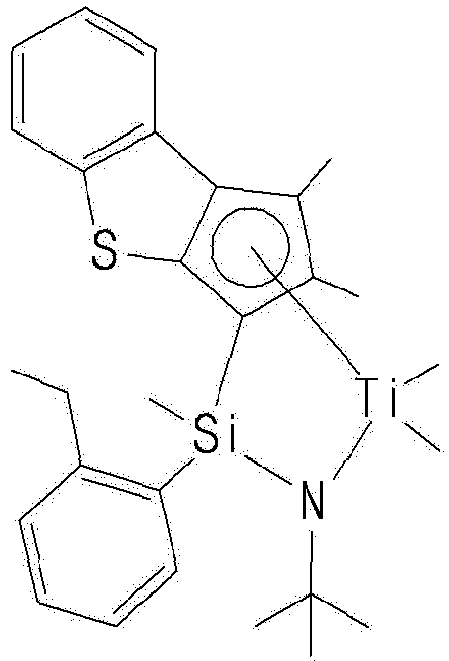


- The method for preparing the ethylene/alpha-olefin copolymer according to claim 14, wherein the polymerization is carried out at 100 to 180°C.
- A resin composition for an optical film, comprising the ethylene/alpha-olefin copolymer according to any one of claims 1 to 13.
- The resin composition for an optical film according to claim 18, wherein a yellow index value measured after performing crosslinking is 1.5 or less.
- The resin composition for an optical film according to claim 18, wherein total light transmittance (Tt) measured after performing crosslinking is 90.0% or more.
- The resin composition for an optical film according to claim 18, further comprising one or more selected from the group consisting of an unsaturated silane compound, an amino silane compound, a crosslinking agent, a crosslinking coagent, a light stabilizer, a UV absorber, and a heat stabilizer.
- An optical film comprising the resin composition for an optical film of claim 18.
Applications Claiming Priority (6)
| Application Number | Priority Date | Filing Date | Title |
|---|---|---|---|
| KR20180052072 | 2018-05-04 | ||
| KR20180052071 | 2018-05-04 | ||
| KR1020180111511A KR102421535B1 (en) | 2018-05-04 | 2018-09-18 | Ethylene/alpha-olefin Copolymer, Method For Preparing The Same |
| KR1020180111510A KR102527751B1 (en) | 2018-05-04 | 2018-09-18 | Resin Composition For Optical Film Comprising Ethylene/alpha-olefin Copolymer, And Optical Film Comprising The Same |
| KR1020190050468A KR102622329B1 (en) | 2018-05-04 | 2019-04-30 | Ethylene/alpha-olefin Copolymer, Method For Preparing The Same And Resin Composition For Optical Film Comprising The Same |
| PCT/KR2019/005368 WO2019212307A1 (en) | 2018-05-04 | 2019-05-03 | Ethylene/alpha-olefin copolymer and method for preparing same |
Publications (2)
| Publication Number | Publication Date |
|---|---|
| EP3778670A1 true EP3778670A1 (en) | 2021-02-17 |
| EP3778670A4 EP3778670A4 (en) | 2021-06-09 |
Family
ID=73733235
Family Applications (1)
| Application Number | Title | Priority Date | Filing Date |
|---|---|---|---|
| EP19796558.5A Pending EP3778670A4 (en) | 2018-05-04 | 2019-05-03 | Ethylene/alpha-olefin copolymer and method for preparing same |
Country Status (4)
| Country | Link |
|---|---|
| US (1) | US20210238398A1 (en) |
| EP (1) | EP3778670A4 (en) |
| JP (1) | JP7086432B2 (en) |
| CN (1) | CN112088177B (en) |
Families Citing this family (5)
| Publication number | Priority date | Publication date | Assignee | Title |
|---|---|---|---|---|
| WO2021128126A1 (en) | 2019-12-26 | 2021-07-01 | Dow Global Technologies Llc | Alpha-olefin interpolymers with improved molecular design for photovoltaic encapsulants |
| JP7371228B2 (en) | 2020-04-16 | 2023-10-30 | エルジー・ケム・リミテッド | Ethylene/α-olefin copolymer with excellent electrical insulation properties |
| WO2021210756A1 (en) * | 2020-04-16 | 2021-10-21 | 주식회사 엘지화학 | Encapsulating film composition comprising ethylene/alpha-olefin copolymer, and encapsulating film comprising same |
| EP4612217A1 (en) * | 2022-11-02 | 2025-09-10 | SABIC Global Technologies B.V. | Polymer composition for use in solar cell assemblies |
| WO2025183096A1 (en) * | 2024-02-29 | 2025-09-04 | 三井化学株式会社 | ETHYLENE/α-OLEFIN COPOLYMER, METHOD FOR PRODUCING SAME, AND USE THEREOF |
Family Cites Families (12)
| Publication number | Priority date | Publication date | Assignee | Title |
|---|---|---|---|---|
| JP3355534B2 (en) * | 1992-09-10 | 2002-12-09 | 住友化学工業株式会社 | Ethylene-α-olefin copolymer and molded article molded using the copolymer |
| CN1250587C (en) * | 2000-07-26 | 2006-04-12 | 三井化学株式会社 | Novel ethylene copolymers and uses thereof |
| JP5307552B2 (en) * | 2005-12-29 | 2013-10-02 | ダウ グローバル テクノロジーズ エルエルシー | Low molecular weight ethylene interpolymers, their production and use |
| KR100994252B1 (en) * | 2007-05-09 | 2010-11-12 | 주식회사 엘지화학 | Ethylene Alpha-olefin Copolymer |
| JP6428199B2 (en) | 2013-11-26 | 2018-11-28 | 日本ポリエチレン株式会社 | Resin composition for solar cell encapsulant, and solar cell encapsulant and solar cell module using the same |
| JP6394327B2 (en) * | 2013-11-26 | 2018-09-26 | 日本ポリエチレン株式会社 | Crosslinking ethylene / α-olefin copolymer, crosslinkable resin composition, and crosslinked product using the same |
| JP2015162498A (en) * | 2014-02-26 | 2015-09-07 | 日本ポリエチレン株式会社 | Laminated body for solar cell encapsulant, solar cell encapsulant and solar cell module |
| WO2015129414A1 (en) * | 2014-02-28 | 2015-09-03 | 三井化学株式会社 | Cross-linked product and production method and use therefor, and ethylene copolymer |
| JP6488817B2 (en) | 2014-03-31 | 2019-03-27 | 日本ポリエチレン株式会社 | Method for producing resin composition for solar cell encapsulant, solar cell encapsulant and solar cell module using the same |
| JP5800053B2 (en) * | 2014-04-28 | 2015-10-28 | 日本ポリエチレン株式会社 | Resin composition for solar cell encapsulant, and solar cell encapsulant and solar cell module using the same |
| KR101637982B1 (en) * | 2014-11-07 | 2016-07-11 | 주식회사 엘지화학 | Ligand compound, transition metal compound, and catalystic composition comprising the same |
| KR101967775B1 (en) * | 2015-12-08 | 2019-08-13 | 주식회사 엘지화학 | Polypropylene based composite |
-
2019
- 2019-05-03 US US17/050,998 patent/US20210238398A1/en active Pending
- 2019-05-03 JP JP2021512350A patent/JP7086432B2/en active Active
- 2019-05-03 EP EP19796558.5A patent/EP3778670A4/en active Pending
- 2019-05-03 CN CN201980028472.9A patent/CN112088177B/en active Active
Also Published As
| Publication number | Publication date |
|---|---|
| EP3778670A4 (en) | 2021-06-09 |
| JP7086432B2 (en) | 2022-06-20 |
| CN112088177B (en) | 2023-06-02 |
| JP2021520444A (en) | 2021-08-19 |
| CN112088177A (en) | 2020-12-15 |
| US20210238398A1 (en) | 2021-08-05 |
Similar Documents
| Publication | Publication Date | Title |
|---|---|---|
| KR102622329B1 (en) | Ethylene/alpha-olefin Copolymer, Method For Preparing The Same And Resin Composition For Optical Film Comprising The Same | |
| EP3778670A1 (en) | Ethylene/alpha-olefin copolymer and method for preparing same | |
| KR101617870B1 (en) | Olefin based polymer having excellent processibility | |
| EP3130616B1 (en) | Polyolefin having excellent environmental stress crack resistance | |
| KR102387101B1 (en) | A composition for an encapsulant film comprising ethylene/alpha-olefin copolymer and an encapsulant film comprising the same | |
| US11718693B2 (en) | Ethylene/alpha-olefin copolymer and method for preparing the same | |
| EP3988614B1 (en) | Composition for encapsulant film comprising ethylene/alpha-olefin copolymer and encapsulant film comprising the same | |
| EP3747916A1 (en) | Ethylene/alpha-olefin copolymer and method for preparing same | |
| KR102282283B1 (en) | Ethylene/alpha-olefin copolymer and method for preparing the same | |
| EP3760652B1 (en) | Ethylene/alpha-olefin copolymer and method for preparing the same | |
| JP7374312B2 (en) | Composition for encapsulant film and encapsulant film containing the same | |
| KR102527751B1 (en) | Resin Composition For Optical Film Comprising Ethylene/alpha-olefin Copolymer, And Optical Film Comprising The Same | |
| US12240926B2 (en) | Composition for encapsulant film comprising ethylene/alpha-olefin copolymer and encapsulant film comprising the same | |
| KR102347984B1 (en) | A composition for an encapsulant film comprising ethylene/alpha-olefin copolymer and an encapsulant film comprising the same | |
| EP4047026A1 (en) | Ethylene/alpha-olefin copolymer having excellent electrical insulation | |
| US11884801B2 (en) | Composition for encapsulant film comprising ethylene/alpha-olefin copolymer and encapsulant film comprising the same | |
| US12371517B2 (en) | Ethylene/alpha-olefin copolymer with excellent electrical insulation | |
| US12528898B2 (en) | Ethylene/alpha-olefin copolymer with excellent electrical insulation | |
| EP4624501A1 (en) | Ethylene alpha-olefin copolymer and method for preparing same |
Legal Events
| Date | Code | Title | Description |
|---|---|---|---|
| STAA | Information on the status of an ep patent application or granted ep patent |
Free format text: STATUS: THE INTERNATIONAL PUBLICATION HAS BEEN MADE |
|
| PUAI | Public reference made under article 153(3) epc to a published international application that has entered the european phase |
Free format text: ORIGINAL CODE: 0009012 |
|
| STAA | Information on the status of an ep patent application or granted ep patent |
Free format text: STATUS: REQUEST FOR EXAMINATION WAS MADE |
|
| 17P | Request for examination filed |
Effective date: 20201102 |
|
| AK | Designated contracting states |
Kind code of ref document: A1 Designated state(s): AL AT BE BG CH CY CZ DE DK EE ES FI FR GB GR HR HU IE IS IT LI LT LU LV MC MK MT NL NO PL PT RO RS SE SI SK SM TR |
|
| AX | Request for extension of the european patent |
Extension state: BA ME |
|
| A4 | Supplementary search report drawn up and despatched |
Effective date: 20210510 |
|
| RIC1 | Information provided on ipc code assigned before grant |
Ipc: C08F 210/16 20060101AFI20210503BHEP Ipc: C08F 210/14 20060101ALI20210503BHEP Ipc: C08F 2/38 20060101ALI20210503BHEP Ipc: C08F 4/6592 20060101ALI20210503BHEP Ipc: C08F 4/649 20060101ALI20210503BHEP Ipc: C08L 23/08 20060101ALI20210503BHEP Ipc: G02B 1/04 20060101ALI20210503BHEP |
|
| DAV | Request for validation of the european patent (deleted) | ||
| DAX | Request for extension of the european patent (deleted) | ||
| STAA | Information on the status of an ep patent application or granted ep patent |
Free format text: STATUS: EXAMINATION IS IN PROGRESS |
|
| 17Q | First examination report despatched |
Effective date: 20230615 |