EP3778609A1 - Novel penam derivatives or salts thereof, pharmaceutical compositions and use thereof - Google Patents
Novel penam derivatives or salts thereof, pharmaceutical compositions and use thereof Download PDFInfo
- Publication number
- EP3778609A1 EP3778609A1 EP19781624.2A EP19781624A EP3778609A1 EP 3778609 A1 EP3778609 A1 EP 3778609A1 EP 19781624 A EP19781624 A EP 19781624A EP 3778609 A1 EP3778609 A1 EP 3778609A1
- Authority
- EP
- European Patent Office
- Prior art keywords
- group
- substituted
- formula
- compound
- reaction mixture
- Prior art date
- Legal status (The legal status is an assumption and is not a legal conclusion. Google has not performed a legal analysis and makes no representation as to the accuracy of the status listed.)
- Granted
Links
- 0 C*C(C1)N[C@](*)(C2*C(C(N)=*C)=O)*1C2=O Chemical compound C*C(C1)N[C@](*)(C2*C(C(N)=*C)=O)*1C2=O 0.000 description 15
- ISLNFJQEGLASPP-UHFFFAOYSA-N CC(C)COC(C1(CCCC1)O)=O Chemical compound CC(C)COC(C1(CCCC1)O)=O ISLNFJQEGLASPP-UHFFFAOYSA-N 0.000 description 1
Classifications
-
- C—CHEMISTRY; METALLURGY
- C07—ORGANIC CHEMISTRY
- C07D—HETEROCYCLIC COMPOUNDS
- C07D499/00—Heterocyclic compounds containing 4-thia-1-azabicyclo [3.2.0] heptane ring systems, i.e. compounds containing a ring system of the formula:, e.g. penicillins, penems; Such ring systems being further condensed, e.g. 2,3-condensed with an oxygen-, nitrogen- or sulfur-containing hetero ring
- C07D499/897—Compounds with substituents other than a carbon atom having three bonds to hetero atoms with at the most one bond to halogen, directly attached in position 2
-
- C—CHEMISTRY; METALLURGY
- C07—ORGANIC CHEMISTRY
- C07D—HETEROCYCLIC COMPOUNDS
- C07D499/00—Heterocyclic compounds containing 4-thia-1-azabicyclo [3.2.0] heptane ring systems, i.e. compounds containing a ring system of the formula:, e.g. penicillins, penems; Such ring systems being further condensed, e.g. 2,3-condensed with an oxygen-, nitrogen- or sulfur-containing hetero ring
- C07D499/21—Heterocyclic compounds containing 4-thia-1-azabicyclo [3.2.0] heptane ring systems, i.e. compounds containing a ring system of the formula:, e.g. penicillins, penems; Such ring systems being further condensed, e.g. 2,3-condensed with an oxygen-, nitrogen- or sulfur-containing hetero ring with a nitrogen atom directly attached in position 6 and a carbon atom having three bonds to hetero atoms with at the most one bond to halogen, e.g. an ester or nitrile radical, directly attached in position 2
- C07D499/44—Compounds with an amino radical acylated by carboxylic acids, attached in position 6
- C07D499/76—Compounds with an amino radical acylated by carboxylic acids, attached in position 6 with hetero rings directly attached to the carboxamido radical
-
- C—CHEMISTRY; METALLURGY
- C07—ORGANIC CHEMISTRY
- C07D—HETEROCYCLIC COMPOUNDS
- C07D499/00—Heterocyclic compounds containing 4-thia-1-azabicyclo [3.2.0] heptane ring systems, i.e. compounds containing a ring system of the formula:, e.g. penicillins, penems; Such ring systems being further condensed, e.g. 2,3-condensed with an oxygen-, nitrogen- or sulfur-containing hetero ring
- C07D499/21—Heterocyclic compounds containing 4-thia-1-azabicyclo [3.2.0] heptane ring systems, i.e. compounds containing a ring system of the formula:, e.g. penicillins, penems; Such ring systems being further condensed, e.g. 2,3-condensed with an oxygen-, nitrogen- or sulfur-containing hetero ring with a nitrogen atom directly attached in position 6 and a carbon atom having three bonds to hetero atoms with at the most one bond to halogen, e.g. an ester or nitrile radical, directly attached in position 2
- C07D499/44—Compounds with an amino radical acylated by carboxylic acids, attached in position 6
- C07D499/48—Compounds with an amino radical acylated by carboxylic acids, attached in position 6 with a carbon chain, substituted by hetero atoms or by carbon atoms having three bonds to hetero atoms with at the most one bond to halogen, e.g. ester or nitrile radicals, attached to the carboxamido radical
- C07D499/58—Compounds with an amino radical acylated by carboxylic acids, attached in position 6 with a carbon chain, substituted by hetero atoms or by carbon atoms having three bonds to hetero atoms with at the most one bond to halogen, e.g. ester or nitrile radicals, attached to the carboxamido radical substituted in alpha-position to the carboxamido radical
- C07D499/64—Compounds with an amino radical acylated by carboxylic acids, attached in position 6 with a carbon chain, substituted by hetero atoms or by carbon atoms having three bonds to hetero atoms with at the most one bond to halogen, e.g. ester or nitrile radicals, attached to the carboxamido radical substituted in alpha-position to the carboxamido radical by nitrogen atoms
- C07D499/70—Compounds with an amino radical acylated by carboxylic acids, attached in position 6 with a carbon chain, substituted by hetero atoms or by carbon atoms having three bonds to hetero atoms with at the most one bond to halogen, e.g. ester or nitrile radicals, attached to the carboxamido radical substituted in alpha-position to the carboxamido radical by nitrogen atoms with hetero rings as additional substituents on the carbon chain
-
- A—HUMAN NECESSITIES
- A61—MEDICAL OR VETERINARY SCIENCE; HYGIENE
- A61K—PREPARATIONS FOR MEDICAL, DENTAL OR TOILETRY PURPOSES
- A61K31/00—Medicinal preparations containing organic active ingredients
- A61K31/33—Heterocyclic compounds
- A61K31/395—Heterocyclic compounds having nitrogen as a ring hetero atom, e.g. guanethidine or rifamycins
- A61K31/41—Heterocyclic compounds having nitrogen as a ring hetero atom, e.g. guanethidine or rifamycins having five-membered rings with two or more ring hetero atoms, at least one of which being nitrogen, e.g. tetrazole
- A61K31/425—Thiazoles
- A61K31/429—Thiazoles condensed with heterocyclic ring systems
- A61K31/43—Compounds containing 4-thia-1-azabicyclo [3.2.0] heptane ring systems, i.e. compounds containing a ring system of the formula, e.g. penicillins, penems
- A61K31/431—Compounds containing 4-thia-1-azabicyclo [3.2.0] heptane ring systems, i.e. compounds containing a ring system of the formula, e.g. penicillins, penems containing further heterocyclic rings, e.g. ticarcillin, azlocillin, oxacillin
-
- A—HUMAN NECESSITIES
- A61—MEDICAL OR VETERINARY SCIENCE; HYGIENE
- A61K—PREPARATIONS FOR MEDICAL, DENTAL OR TOILETRY PURPOSES
- A61K31/00—Medicinal preparations containing organic active ingredients
- A61K31/33—Heterocyclic compounds
- A61K31/395—Heterocyclic compounds having nitrogen as a ring hetero atom, e.g. guanethidine or rifamycins
- A61K31/435—Heterocyclic compounds having nitrogen as a ring hetero atom, e.g. guanethidine or rifamycins having six-membered rings with one nitrogen as the only ring hetero atom
- A61K31/44—Non condensed pyridines; Hydrogenated derivatives thereof
- A61K31/4427—Non condensed pyridines; Hydrogenated derivatives thereof containing further heterocyclic ring systems
- A61K31/4439—Non condensed pyridines; Hydrogenated derivatives thereof containing further heterocyclic ring systems containing a five-membered ring with nitrogen as a ring hetero atom, e.g. omeprazole
-
- A—HUMAN NECESSITIES
- A61—MEDICAL OR VETERINARY SCIENCE; HYGIENE
- A61K—PREPARATIONS FOR MEDICAL, DENTAL OR TOILETRY PURPOSES
- A61K31/00—Medicinal preparations containing organic active ingredients
- A61K31/33—Heterocyclic compounds
- A61K31/395—Heterocyclic compounds having nitrogen as a ring hetero atom, e.g. guanethidine or rifamycins
- A61K31/495—Heterocyclic compounds having nitrogen as a ring hetero atom, e.g. guanethidine or rifamycins having six-membered rings with two or more nitrogen atoms as the only ring heteroatoms, e.g. piperazine or tetrazines
- A61K31/496—Non-condensed piperazines containing further heterocyclic rings, e.g. rifampin, thiothixene or sparfloxacin
-
- A—HUMAN NECESSITIES
- A61—MEDICAL OR VETERINARY SCIENCE; HYGIENE
- A61K—PREPARATIONS FOR MEDICAL, DENTAL OR TOILETRY PURPOSES
- A61K31/00—Medicinal preparations containing organic active ingredients
- A61K31/33—Heterocyclic compounds
- A61K31/395—Heterocyclic compounds having nitrogen as a ring hetero atom, e.g. guanethidine or rifamycins
- A61K31/495—Heterocyclic compounds having nitrogen as a ring hetero atom, e.g. guanethidine or rifamycins having six-membered rings with two or more nitrogen atoms as the only ring heteroatoms, e.g. piperazine or tetrazines
- A61K31/4965—Non-condensed pyrazines
- A61K31/497—Non-condensed pyrazines containing further heterocyclic rings
-
- A—HUMAN NECESSITIES
- A61—MEDICAL OR VETERINARY SCIENCE; HYGIENE
- A61P—SPECIFIC THERAPEUTIC ACTIVITY OF CHEMICAL COMPOUNDS OR MEDICINAL PREPARATIONS
- A61P31/00—Antiinfectives, i.e. antibiotics, antiseptics, chemotherapeutics
- A61P31/04—Antibacterial agents
-
- Y—GENERAL TAGGING OF NEW TECHNOLOGICAL DEVELOPMENTS; GENERAL TAGGING OF CROSS-SECTIONAL TECHNOLOGIES SPANNING OVER SEVERAL SECTIONS OF THE IPC; TECHNICAL SUBJECTS COVERED BY FORMER USPC CROSS-REFERENCE ART COLLECTIONS [XRACs] AND DIGESTS
- Y02—TECHNOLOGIES OR APPLICATIONS FOR MITIGATION OR ADAPTATION AGAINST CLIMATE CHANGE
- Y02P—CLIMATE CHANGE MITIGATION TECHNOLOGIES IN THE PRODUCTION OR PROCESSING OF GOODS
- Y02P20/00—Technologies relating to chemical industry
- Y02P20/50—Improvements relating to the production of bulk chemicals
- Y02P20/55—Design of synthesis routes, e.g. reducing the use of auxiliary or protecting groups
Definitions
- the present invention relates to a novel penam derivative or a salt thereof exhibiting strong antibacterial activity against Gram-negative bacteria, particularly, Pseudomonas aeruginosa, and a pharmaceutical composition containing the novel penam derivative and a salt thereof.
- Non-Patent Document 1 Non-Patent Document 1
- ⁇ -lactamase that decomposes ⁇ -lactam-based drugs is known.
- the ⁇ -lactamase is roughly classified into Class A (such as TEM, SHV, CTX-M, KPC, and GES-type ⁇ -lactamases), Class B (such as IMP, VIM, and NDM-type ⁇ -lactamases), Class C (such as AmpC-type ⁇ -lactamase), and class D (OXA-type ⁇ -lactamase), which decompose ⁇ -lactam-based drugs with different substrate specificities (Non-Patent Document 2).
- Class A such as TEM, SHV, CTX-M, KPC, and GES-type ⁇ -lactamases
- Class B such as IMP, VIM, and NDM-type ⁇ -lactamases
- Class C such as AmpC-type ⁇ -lactamase
- class D OXA-type ⁇ -lactamase
- each type of ⁇ -lactamase of class B and KPC, GES, and OXA-type ⁇ -lactamases are called carbapenemase, and many of these exhibit high resistance to almost all ⁇ -lactam-based drugs including carbapenem-based drugs.
- Non-Patent Document 3 Pseudomonas aeruginosa strains have been isolated which exhibit high resistance to ceftolozane/tazobactam and ceftazidime/avibactam that are newly developed cephalosporin-based combination medicines.
- a compound represented by General Formula [1] or a salt thereof has excellent solubility in water and exhibits strong antibacterial activity against Gram-negative bacteria such as Pseudomonas aeruginosa and drug-resistant Gram-negative bacteria including multidrug-resistant Pseudomonas aeruginosa, for example, enterobacteria or Pseudomonas aeruginosa producing carbapenemase. Based on this finding, the inventors have accomplished the present invention.
- the present invention provides the following.
- the compound or a salt thereof according to an embodiment of the present invention exhibits strong antibacterial activity against Gram-negative bacteria and drug-resistant Gram-negative bacteria such as enterobacteria or Pseudomonas aeruginosa producing carbapenemase. Therefore, the compound or a salt thereof is useful as a medicine.
- the pharmaceutical composition according to an embodiment of the present invention exhibits strong antibacterial activity against Gram-negative bacteria and drug-resistant Gram-negative bacteria.
- composition according to an embodiment of the present invention is useful for treating infections caused by Gram-negative bacteria or drug-resistant Gram-negative bacteria.
- the halogen atom means a fluorine atom, a chlorine atom, a bromine atom, or an iodine atom.
- the C 1-6 alkyl group means, for example, a linear or branched C 1-6 alkyl group such as a methyl, ethyl, propyl, isopropyl, butyl, sec-butyl, isobutyl, tert-butyl, pentyl, isopentyl, or hexyl group.
- the C 1-3 alkyl group means a methyl, ethyl, propyl, or isopropyl group.
- the C 2-6 alkenyl group means, for example, a linear or branched C 2-6 alkenyl group such as a vinyl, allyl, propenyl, isopropenyl, butenyl, isobutenyl, 1,3-butadienyl, pentenyl, or hexenyl group.
- the C 2-6 alkynyl group means a linear or branched C 2-6 alkynyl group such as an ethynyl, propynyl, butynyl, pentynyl, or hexynyl group.
- the C 3-8 cycloalkyl group means a C 3-8 cycloalkyl group such as a cyclopropyl, cyclobutyl, cyclopentyl, or cyclohexyl group.
- the aryl group means, for example, a C 6-18 aryl group such as a phenyl or naphthyl group.
- the aryl C 1-6 alkyl group means, for example, an aryl C 1-6 alkyl group such as a benzyl, diphenylmethyl, trityl, phenethyl, or naphthylmethyl group.
- the C 1-6 alkylene group means a linear or branched C 1-6 alkylene group such as a methylene, ethylene, propylene, butylene, or hexylene group.
- the C 1-3 alkylene group means a methylene, ethylene, or propylene group.
- the C 2-6 alkylene group means a linear or branched C 1-6 alkylene group such as an ethylene, propylene, butylene, or hexylene group.
- the C 2-6 alkenylene group means a linear or branched C 2-6 alkenylene group such as a vinylene, propenylene, butenylene, or pentenylene group.
- the C 2-6 alkynylene group means a linear or branched C 2-6 alkynylene group such as an ethynylene, propynylene, butynylene, or pentynylene group.
- the C 1-6 alkoxy group means, for example, a linear or branched C 1-6 alkyloxy group such as a methoxy, ethoxy, propoxy, isopropoxy, butoxy, isobutoxy, sec-butoxy, tert-butoxy, pentyloxy, or hexyloxy group.
- the C 1-6 alkoxy C 1-6 alkyl group means, for example, a C 1-6 alkyloxy C 1-6 alkyl group such as a methoxymethyl or 1-ethoxyethyl group.
- the C 2-12 alkanoyl group means, for example, a linear or branched C 2-12 alkanoyl group such as an acetyl, propionyl, valeryl, isovaleryl, or pivaloyl group.
- the aroyl group means, for example, a benzoyl or naphthoyl group.
- the acyl group means, for example, a formyl group, a succinyl group, a glutaryl group, a maleoyl group, a phthaloyl group, a C 2-12 alkanoyl group, or an aroyl group.
- the C 1-6 alkoxycarbonyl group means, for example, a linear or branched C 1-6 alkyloxycarbonyl group such as a methoxycarbonyl, ethoxycarbonyl, isopropoxycarbonyl, tert-butoxycarbonyl, or 1,1-dimethylpropoxycarbonyl group.
- the aryl C 1-6 alkoxycarbonyl group means, for example, an ar C 1-6 alkyloxycarbonyl group such as a benzyloxycarbonyl or phenethyloxycarbonyl group.
- the aryloxycarbonyl group means, for example, a phenyloxycarbonyl or naphthyloxycarbonyl group.
- the C 1-6 alkylamino group means a linear or branched C 1-6 alkylamino group such as a methylamino, ethylamino, propylamino, isopropylamino, butylamino, sec-butylamino, tert-butylamino, pentylamino, or hexylamino group.
- the di(C 1-6 alkyl) amino group means a linear or branched di(C 1-6 alkyl) amino group such as a dimethylamino, diethylamino, dipropylamino, diisopropylamino, dibutylamino, di (tert-butyl) amino, dipentylamino, dihexylamino, (ethyl)(methyl) amino, or (methyl)(propyl) amino group.
- the C 1-6 alkylthio group means, for example, a C 1-6 alkylthio group such as a methylthio, ethylthio, or propylthio group.
- the C 1-6 alkylsulfonyl group means, for example, a C 1-6 alkylsulfonyl group such as a methylsulfonyl, ethylsulfonyl, or propylsulfonyl group.
- the arylsulfonyl group means, for example, a benzenesulfonyl, p-toluenesulfonyl, or naphthalenesulfonyl group.
- the C 1-6 alkylsulfonyloxy group means, for example, a C 1-6 alkylsulfonyloxy group such as a methylsulfonyloxy an ethylsulfonyloxy group.
- the arylsulfonyloxy group means a benzenesulfonyloxy or p-toluenesulfonyloxy group.
- the silyl group means, for example, a trimethylsilyl, triethylsilyl, or tributylsilyl group.
- the cyclic amino group means a cyclic amino group which contains one or more nitrogen atoms as hetero atoms forming a ring, such as a aziridinyl, azetidinyl, pyrrolyl, dihydropyrrolyl, pyrrolidinyl, tetrahydropyridyl, piperidinyl, homopiperidinyl, pyrazolyl, pyrazolinyl, pyrazolidinyl, imidazolyl, imidazolinyl, imidazolidinyl, thiazolinyl, thiazolidinyl, dihydrothiadiazolyl, piperazinyl, homopiperazinyl, morpholinyl, homomorpholinyl, or thiomorpholinyl group, and may further contain one or more oxygen atoms or sulfur atoms.
- the monocyclic nitrogen-containing heterocyclic group means a monocyclic nitrogen-containing heterocyclic group containing only nitrogen atoms as hetero atoms forming a ring.
- Examples of the monocyclic nitrogen-containing heterocyclic group include an azetidinyl group; a 5-membered nitrogen-containing heterocyclic group such as a pyrrolidinyl, pyrrolinyl, pyrrolyl, imidazolidinyl, imidazolinyl, imidazolyl, pyrazolidinyl, pyrazolinyl, pyrazolyl, triazolyl, or tetrazolyl group; a 6-membered nitrogen-containing heterocyclic group such as a piperidyl, tetrahydropyridyl, pyridyl, piperazinyl, pyrazinyl, pyridazinyl, pyrimidinyl, tetrahydropyrimidyl, or homopiperazin
- the monocyclic oxygen-containing heterocyclic group means a monocyclic oxygen-containing heterocyclic group containing only oxygen atoms as hetero atoms forming a ring.
- Examples of the monocyclic oxygen-containing heterocyclic group include a 5-membered oxygen-containing heterocyclic group such as a tetrahydrofuranyl or furanyl group; and a 6-membered oxygen-containing heterocyclic group such as a tetrahydropyranyl or pyranyl group.
- the monocyclic sulfur-containing heterocyclic group means a thienyl group or the like.
- the monocyclic nitrogen and oxygen-containing heterocyclic group means a monocyclic nitrogen and oxygen-containing heterocyclic group containing only a nitrogen atom and an oxygen atom as hetero atoms forming a ring.
- Examples of the monocyclic nitrogen and oxygen-containing heterocyclic group include a 5-membered nitrogen and oxygen-containing heterocyclic group such as an oxazolyl, oxazolidinyl, isoxazolyl, or oxadiazolyl group; and a 6-membered nitrogen and oxygen-containing heterocyclic group such as a homomorpholinyl group.
- the monocyclic nitrogen and sulfur-containing heterocyclic group means a monocyclic nitrogen and sulfur-containing heterocyclic group containing only a nitrogen atom and a sulfur atom as hetero atoms forming a ring.
- Examples of the monocyclic nitrogen and sulfur-containing heterocyclic group include a 5-membered nitrogen and sulfur-containing heterocyclic group such as a thiazolyl, isothiazolyl, or thiadiazolyl group; and a 6-membered nitrogen and sulfur-containing heterocyclic group such as a thiomorpholinyl, 1-oxidethiomorpholinyl, or 1,1-dioxidethiomorpholinyl group.
- the monocyclic heterocyclic group means a monocyclic nitrogen-containing heterocyclic group, a monocyclic oxygen-containing heterocyclic group, a monocyclic sulfur-containing heterocyclic group, a monocyclic nitrogen and oxygen-containing heterocyclic group, or a monocyclic nitrogen and sulfur-containing heterocyclic group.
- the monocyclic saturated heterocyclic group means a monocyclic heterocyclic group not containing a multiple bond.
- Examples of the monocyclic saturated heterocyclic group include aziridinyl, azetidinyl, pyrrolidinyl, piperidinyl, imidazolidinyl, pyrazolidinyl, piperazinyl, oxazolidinyl, tetrahydropyrimidyl, tetrahydrofuranyl, tetrahydropyranyl, and morpholinyl groups.
- the bicyclic nitrogen-containing heterocyclic group means a bicyclic nitrogen-containing heterocyclic group which contains only nitrogen atoms as hetero atoms forming a ring such as an indolinyl, indolyl, isoindolinyl, isoindolyl, benzimidazolyl, indazolyl, benzotriazolyl, quinolyl, tetrahydroquinolinyl, quinolyl, tetrahydroisoquinolinyl, isoquinolinyl, quinolizinyl, cinnolinyl, phthalazinyl, quinazolinyl, dihydroquinoxalinyl, quinoxalinyl, naphthyridinyl, purinyl, pyrrolopyridinyl, dihydrocyclopentapyridinyl, pteridinyl, or quinuclidinyl group.
- the bicyclic oxygen-containing heterocyclic group means a bicyclic oxygen-containing heterocyclic group containing only oxygen atoms as hetero atoms forming a ring such as a 2,3-dihydrobenzofuranyl, benzofuranyl, isobenzofuranyl, chromanyl, chromenyl, isochromanyl, 1,3-benzodioxolyl, 1,3-benzodioxanyl, or 1,4-benzodioxanyl group.
- the bicyclic sulfur-containing heterocyclic group means a bicyclic sulfur-containing heterocyclic group containing only sulfur atoms as hetero atoms forming a ring such as a 2,3-dihydrobenzothienyl or benzothienyl group.
- the bicyclic nitrogen and oxygen-containing heterocyclic group means a bicyclic nitrogen and oxygen-containing heterocyclic group containing only a nitrogen atom and an oxygen atom as hetero atoms forming a ring such as a benzoxazolyl, benzisoxazolyl, benzoxadiazolyl, benzomorpholinyl, dihydropyranopyridyl, dihydrodioxynopyridyl, or dihydropyridoxazinyl group.
- the bicyclic nitrogen and sulfur-containing heterocyclic group means a bicyclic nitrogen and sulfur-containing heterocyclic group containing a nitrogen atom and a sulfur atom as hetero atoms forming a ring such as a benzothiazolyl, benzisothiazolyl, or benzothiadiazolyl group.
- the bicyclic heterocyclic group means a bicyclic nitrogen-containing heterocyclic group, a bicyclic oxygen-containing heterocyclic group, a bicyclic sulfur-containing heterocyclic group, a bicyclic nitrogen and oxygen-containing heterocyclic group, or a bicyclic nitrogen and sulfur-containing heterocyclic group.
- the heterocyclic group means a monocyclic heterocyclic group or a bicyclic heterocyclic group.
- the divalent cyclic hydrocarbon group means a group formed by removing any two hydrogen atoms from cyclic hydrocarbons such as cyclopropane-1,1-diyl, cyclobutane-1,1-diyl, cyclopentane-1,1-diyl, cyclohexane-1,1-diyl, cyclopropane-1,2-diyl, cyclobutane-1,3-diyl, cyclobutene-1,3-diyl, cyclopentane-1,3-diyl, cyclopentene-1,3-diyl, cyclopentadiene-1,3-diyl, cyclohexane-1,3-diyl, cyclohexane-1,4-diyl, cyclohexene-1,3-diyl, cyclohexene-1,4-diyl, cyclohexadiene
- the divalent monocyclic saturated heterocyclic group is a divalent group formed by further removing any one hydrogen atom from the aforementioned monocyclic heterocyclic group not containing a multiple bond.
- the divalent monocyclic saturated heterocyclic group means a group formed by further removing any one hydrogen atom from an aziridinyl, azetidinyl, pyrrolidinyl, piperidinyl, imidazolidinyl, pyrazolidinyl, piperazinyl, tetrahydrofuranyl, tetrahydropyranyl, or morpholinyl group, and the like.
- the divalent heterocyclic group is a divalent group formed by further removing any one hydrogen atom from the aforementioned heterocyclic group.
- the divalent heterocyclic group includes a divalent monocyclic heterocyclic group and a divalent bicyclic heterocyclic group.
- the divalent monocyclic heterocyclic group is a divalent group formed by further removing any one hydrogen atom from the aforementioned monocyclic heterocyclic group.
- the divalent monocyclic heterocyclic group includes a divalent monocyclic nitrogen-containing heterocyclic group, a divalent monocyclic oxygen-containing heterocyclic group, a divalent monocyclic sulfur-containing heterocyclic group, a divalent monocyclic nitrogen and oxygen-containing heterocyclic group, and a divalent monocyclic nitrogen and sulfur-containing heterocyclic group.
- the divalent bicyclic heterocyclic group is a divalent group formed by further removing any one hydrogen atom from the aforementioned bicyclic heterocyclic group.
- the divalent bicyclic heterocyclic group includes a divalent bicyclic nitrogen-containing heterocyclic group, a divalent bicyclic oxygen-containing heterocyclic group, a divalent bicyclic sulfur-containing heterocyclic group, a divalent bicyclic nitrogen and oxygen-containing heterocyclic group, and a divalent bicyclic nitrogen and sulfur-containing heterocyclic group.
- the divalent cyclic amino group is a divalent group formed by further removing any one hydrogen atom from the aforementioned cyclic amino group.
- Examples of the divalent cyclic amino group include a divalent group formed by removing any two hydrogen atoms from aziridine, azetidine, pyrrole, dihydropyrrole, pyrrolidine, tetrahydropyridine, piperidine, homopiperidine, pyrazolyl, pyrazoline, pyrazolidine, imidazole, imidazoline, imidazolidine, thiazoline, thiazolidine, dihydrothiadiazole, piperazine, homopiperazine, morpholine, homomorpholine, and thiomorpholine.
- Examples of the leaving group include a halogen atom, a C 1-6 alkylsulfonyloxy group, an arylsulfonyloxy group, and an imidazole group.
- the C 1-6 alkylsulfonyloxy group, the arylsulfonyloxy group, or the imidazole group may have a substituent.
- the hydroxyl protecting group includes all groups that can be used as a protecting group of general hydroxyl groups.
- Examples of the hydroxyl protecting group include the groups described in " Protective Groups in Organic Synthesis, W. Greene et al., 4th Edition, pp. 16-299, 2007, John Wiley & Sons, INC ".
- examples thereof include a C 1-6 alkyl group, a C 2-6 alkenyl group, an aryl C 1-6 alkyl group, a C 1-6 alkoxy C 1-6 alkyl group, an acyl group, a C 1-6 alkoxycarbonyl group, an aryl C 1-6 alkoxycarbonyl group, a C 1-6 alkylsulfonyl group, an arylsulfonyl group, a silyl group, a tetrahydrofuranyl group, and a tetrahydropyranyl group.
- These groups may be substituted with one or more groups selected from the substituent group A1.
- the amino protecting group includes all groups that can be used as a protecting group of general amino groups.
- the amino protecting group include the groups described in " Protective Groups in Organic Synthesis, W. Greene et al., 4th Edition, pp. 696-926, 2007, John Wiley & Sons, INC ".
- examples thereof include an aryl C 1-6 alkyl group, a C 1-6 alkoxy C 1-6 alkyl group, an acyl group, a C 1-6 alkoxycarbonyl group, an aryl C 1-6 alkoxycarbonyl group, an aryloxycarbonyl group, a C 1-6 alkylsulfonyl group, an arylsulfonyl group, and a silyl group.
- These groups may be substituted with one or more groups selected from the substituent group A1.
- the imino protecting group includes all groups that can be used as a protecting group of general imino groups.
- Examples of the imino protecting group include the groups described in " Protective Groups in Organic Synthesis, W. Greene et al., 4th Edition, pp. 696-868, 2007, John Wiley & Sons, INC ".
- examples thereof include an aryl C 1-6 alkyl group, a C 1-6 alkoxy C 1-6 alkyl group, an acyl group, a C 1-6 alkoxycarbonyl group, an aryl C 1-6 alkoxycarbonyl group, an aryloxycarbonyl group, a C 1-6 alkylsulfonyl group, an arylsulfonyl group, and a silyl group.
- These groups may be substituted with one or more groups selected from the substituent group A1.
- the carboxyl protecting group includes all groups that can be used as a protecting group of general carboxyl groups.
- Examples of the carboxyl protecting group include the groups described in " Protective Groups in Organic Synthesis, W. Greene et al., 4th Edition, pp. 533-643, 2007, John Wiley & Sons, INC ". Specifically, examples thereof include a C 1-6 alkyl group, a C 2-6 alkenyl group, an aryl C 1-6 alkyl group, a C 1-6 alkoxy C 1-6 alkyl group, and a silyl group. These groups may be substituted with one or more groups selected from the substituent group A1.
- aliphatic hydrocarbons examples include pentane, hexane, cyclohexane, heptane, and decahydronaphthalene.
- halogenated hydrocarbons examples include methylene chloride, chloroform, and dichloroethane.
- alcohols examples include methanol, ethanol, propanol, 2-propanol, butanol, and 2-methyl-2-propanol.
- ethers include diethyl ether, diisopropyl ether, dioxane, tetrahydrofuran, anisole, ethylene glycol dimethyl ether, diethylene glycol dimethyl ether, and diethylene glycol diethyl ether.
- ketones include acetone, 2-butanone, and 4-methyl-2-pentanone.
- esters examples include methyl acetate, ethyl acetate, propyl acetate, and butyl acetate.
- amides examples include N,N-dimethylformamide, N,N-dimethylacetamide, and 1-methyl-2-pyrrolidone.
- nitriles examples include acetonitrile and propionitrile.
- aromatic hydrocarbons examples include benzene, toluene, and xylene.
- the C 1-6 alkylene group, the C 2-6 alkenylene group, and the C 2-6 alkynylene group represented by X 1 , Y 1 , and Y 2 may be substituted with one or more groups selected from the substituent group A2.
- the C 1-6 alkyl group represented by R 4 , R 5 , R 6 , R 7 , R 8 , R 9 , and R 10 may be substituted with one or more groups selected from the substituent group A2.
- the C 2-6 alkylene and C 2-6 alkenylene groups that R 5 and R 6 form in combination may be substituted with one or more groups selected from the substituent group A1.
- the C 2-6 alkylene group that R 5a and R 6a form in combination may be substituted with one or more groups selected from the substituent group A1.
- the C 1-6 alkoxy group, the C 1-6 alkylamino group, the di(C 1-6 alkyl)amino group, and the amino group represented by R 10 may be substituted with one or more groups selected from the substituent group A2.
- the C 1-6 alkoxy group represented by R 10a may be substituted with one or more groups selected from the substituent group A2.
- the cyclic amino group represented by R 10 may be substituted with one or more groups selected from the substituent group A1.
- the carbamoyl group represented by R 10 and R 11 may be substituted with one or more groups selected from the substituent group A1.
- the aryl group and the heterocyclic group represented by R 2 may be substituted with one or more groups selected from the substituent group A1.
- the heterocyclic group represented by A may be substituted with one or more groups selected from the substituent group A1.
- the divalent cyclic hydrocarbon group represented by X 1 may be substituted with one or more groups selected from the substituent group A1.
- the divalent monocyclic saturated heterocyclic group represented by X 1 may be substituted with one or more groups selected from the substituent group A1.
- the divalent heterocyclic group and the divalent cyclic amino group represented by X 2 and Q may be substituted with one or more groups selected from the substituent group A1.
- the following compounds are preferable.
- a compound in which R 1 represents a hydrogen atom is preferable.
- a compound in which R 2 represents an aryl group that may be substituted is preferable, and a compound in which R 2 represents a phenyl group that may be substituted is more preferable.
- substituent of the aryl group or the heterocyclic group represented by R 2 one or more groups selected from a halogen atom and a hydroxyl group which may be protected are preferable.
- a compound in which R 3 represents a hydrogen atom is preferable.
- X 1 is preferably a C 1-6 alkylene group which may be substituted or a divalent cyclic hydrocarbon group which may be substituted, and more preferably a C 1-3 alkylene group which may be substituted or a divalent cyclic hydrocarbon group which may be substituted.
- A is preferably a compound that is a monocyclic heterocyclic group which may be substituted, more preferably a monocyclic nitrogen-containing heterocyclic group which may be substituted or a monocyclic nitrogen and sulfur-containing heterocyclic group which may be substituted, even more preferably a monocyclic nitrogen and sulfur-containing heterocyclic group, still more preferably 2-amino-5-chlorothiazol-4-yl, 5-amino-1,2,4-thiadiazole-3-yl, or 2-aminothiazol-4-yl, and particularly preferably 2-aminothiazol-4-yl.
- Q is preferably a divalent heterocyclic group which may be substituted, more preferably a divalent monocyclic heterocyclic group which may be substituted, even more preferably a divalent imidazolidine group, a divalent piperazine group, a divalent pyrrolidine group, or a divalent oxazolidine group which may be substituted, and still more preferably a divalent imidazolidine group, a divalent piperazine group, or a divalent pyrrolidine group which may be substituted.
- Q is preferably, for example, a 2-oxoimidazolidin-1-yl group, a 2,3-dioxopiperazin-1-yl group, a 2-oxopyrrolidin-1-yl group, or a 2-oxooxazolidin-3-yl group.
- Y 2 is preferably a C 1-6 alkylene group which may be substituted or a bond, and more preferably a C 1-3 alkylene group or a bond.
- X 3 is preferably a group represented by General Formula -NR9 a - (where R9 a represents a hydrogen atom) or a bond.
- Examples of the salt of the compound represented by General Formula [1] include salts in a basic group such as a generally known amino group or in an acidic group such as a hydroxyl or carboxyl group.
- salts in the basic group include salts with mineral acids such as hydrochloric acid, hydrobromic acid, nitric acid, and sulfuric acid; salts with organic carboxylic acids such as formic acid, acetic acid, citric acid, oxalic acid, fumaric acid, maleic acid, succinic acid, malic acid, tartaric acid, aspartic acid, trichloroacetic acid, and trifluoroacetic acid; and salts with sulfonic acids such as methanesulfonic acid, benzenesulfonic acid, p-toluenesulfonic acid, mesitylenesulfonic acid, and naphthalenesulfonic acid.
- mineral acids such as hydrochloric acid, hydrobromic acid, nitric acid, and sulfuric acid
- organic carboxylic acids such as formic acid, acetic acid, citric acid, oxalic acid, fumaric acid, maleic acid, succinic acid, malic acid,
- salts in the acidic group include salts with alkali metals such as sodium and potassium; salts with alkaline earth metals such as calcium and magnesium; ammonium salts; salts with nitrogen-containing organic bases such as trimethylamine, triethylamine, tributylamine, pyridine, N,N-dimethylaniline, N-methylpiperidine, N-methylmorpholine, diethylamine, dicyclohexylamine, procaine, dibenzylamine, N-benzyl- ⁇ -phenethylamine, 1-ephenamine, and N,N'-dibenzylethylenediamine, and the like.
- alkali metals such as sodium and potassium
- salts with alkaline earth metals such as calcium and magnesium
- ammonium salts salts with nitrogen-containing organic bases such as trimethylamine, triethylamine, tributylamine, pyridine, N,N-dimethylaniline, N-methylpiperidine, N-methylmorpholine
- salts for example, pharmacologically acceptable salts are preferable.
- the present invention includes the isomers as well as solvates, hydrates, and various forms of crystals.
- the compound or a salt thereof according to the embodiment of the present invention can be made into a pharmaceutical composition (pharmaceutical formulation) by being combined with one or two or more pharmaceutically acceptable carriers, excipients, or diluents.
- the carriers, excipients, and diluents include, for example, water, lactose, dextrose, fructose, sucrose, sorbitol, mannitol, polyethylene glycol, propylene glycol, starch, gum, gelatin, alginate, calcium silicate, calcium phosphate, cellulose, aqueous syrup, methylcellulose, polyvinylpyrrolidone, alkyl parahydroxybenzosorbate, talc, magnesium stearate, stearic acid, glycerin, various oils such as sesame oil, olive oil, and soybean oil, and the like.
- the compound or a salt thereof can be made into oral or parenteral medicines such as tablets, pills, capsules, granules, powders, solutions, emulsions, suspensions, ointments, injections, or skin patches through commonly used formulation techniques.
- the treatment using the compound or a salt thereof or the pharmaceutical composition according to the embodiment of the present invention include treatment and prevention.
- the administration method, dosage, and number of doses of the compound according to the embodiment of the present invention or a salt thereof or the pharmaceutical composition according to the embodiment of the present invention can be appropriately selected according to the age, body weight, and symptom of the patient.
- the compound according to the embodiment of the present invention may be orally or parenterally administered (for example, by means of injection, infusion, administration to the rectal site, and the like) at a dose of 0.01 to 1,000 mg/kg once a day or in divided portions a day.
- the compound or a salt thereof or the pharmaceutical composition according to the embodiment of the present invention is preferably administered as an injection.
- the pharmaceutical composition containing the compound or a salt thereof according to the embodiment of the present invention is preferably manufactured as a solution, a frozen solution, or a lyophilized formulation.
- the pharmaceutical composition is more preferably a lyophilized formulation.
- the compound according to the embodiment of the present invention is manufactured by combining known methods.
- the compound can be manufactured according to a manufacturing method described below.
- R a represents a halogen atom
- Y 1a represents a bond
- X 2a is a group represented by Formula -NH-
- R 1a and R 3a each represent a carboxyl protecting group
- R 2 , Q, Y 2 , Y 3 , X 1 , X 3 , and A have the same definitions as R 2 , Q, Y 2 , Y 3 , X 1 , X 3 , and A described above.
- the compound represented by General Formula [1a] can be manufactured by reacting the compound represented by General Formula [2a] with the compound represented by General Formula [2b] in the presence of a base.
- Examples of the compound represented by General Formula [2b] include acid halides such as 2-chloro-3,4-bis((4-methoxybenzyl)oxy)benzoyl chloride and 2-(2-chloro-3,4-bis((4-methoxybenzyl)oxy)phenyl)-2-oxoacetyl chloride described in the present specification.
- the amount of the compound represented by General Formula [2b] used is not particularly limited, but may be 0.9 to 10 times and preferably 0.9 to 2.0 times the molar amount of the compound represented by General Formula [2a].
- the amount of the solvent used is not particularly limited, but may be 1 to 500 times (v/w) the amount of the compound represented by General Formula [2a].
- the amount of the base used may be 1 to 50 times and preferably 1 to 10 times the molar amount of the compound represented by General Formula [2a].
- This reaction may be carried out at -30°C to 150°C for 30 minutes to 72 hours, and preferably carried out at 0°C to 40°C for 1 to 4 hours.
- the solvent used in this reaction is not particularly limited as long as it does not affect the reaction.
- examples thereof include halogenated hydrocarbons, ethers, esters, amides, nitriles, sulfoxides, aromatic hydrocarbons, and water. These solvents may be used by being mixed together.
- the solvent for example, tetrahydrofuran, acetonitrile, and water are preferable.
- the solvent is more preferably a mixed solvent of tetrahydrofuran and water.
- Examples of the base used in this reaction include an inorganic base and an organic base.
- As the base for example, an inorganic base is preferable.
- the base is preferably sodium hydrogen carbonate.
- R b represents a hydroxyl group or a carboxyl group
- R 1a , R 3a , R 2 , Q, Y 1a , Y 2 , Y 3 , X 1 , X 2 , X 3 , and A have the same definitions as R 1a , R 3a , R 2 , Q, Y 1a , Y 2 , Y 3 , X 1 , X 2 , X 3 , and A described above.
- the compound represented by General Formula [1b] can be manufactured by reacting the compound represented by General Formula [2a] with the compound represented by General Formula [3a] in the presence of a condensing agent or an acid halide or in the presence of a base.
- the amount of the compound represented by General Formula [3a] used is not particularly limited, but may be 0.9 to 10 times and preferably 0.9 to 2.0 times the molar amount of the compound represented by General Formula [2a].
- the amount of the solvent used is not particularly limited, but may be 1 to 500 times (v/w) the amount of the compound represented by General Formula [2a].
- the amount of the base used may be 1 to 50 times and preferably 1 to 10 times the molar amount of the compound represented by General Formula [2a].
- This reaction may be carried out at -30°C to 150°C for 30 minutes to 72 hours, and preferably carried out at 0°C to 40°C for 1 to 24 hours.
- the solvent used in this reaction is not particularly limited as long as it does not affect the reaction.
- examples thereof include halogenated hydrocarbons, ethers, esters, amides, nitriles, sulfoxides, aromatic hydrocarbons, and water. These solvents may be used by being mixed together.
- dimethylacetamide and DMF are preferable.
- the solvent for example, tetrahydrofuran, acetonitrile, and water are preferable.
- a mixed solvent of tetrahydrofuran and water is more preferable.
- Examples of the base used in this reaction include an inorganic base and an organic base.
- the base for example, an organic base is preferable.
- the condensing agent is more preferably N-methylmorpholine.
- an inorganic base is preferable.
- sodium hydrogen carbonate is preferable.
- examples of the condensing agent include carbodiimides such as N,N'-diisopropylcarbodiimide (DIC), N,N'-di-(tert-butyl)carbodiimide, N,N'-dicyclohexylcarbodiimide (DCC), N-(tert-butyl)-N'-ethylcarbodiimide (BEC), N-cyclohexyl-N'-(2-morpholinoethyl)carbodiimide (CMC), and 1-ethyl-3-(3-dimethylaminopropyl)carbodiimide (EDC); imidazoliums such as 1,1'-carbonyldiimidazole (CDI) and 1,1'-carbonyl di(1,2,4-triazole) (CDT); acid azides such as diphenylphosphoryl azide; acid cyanides such as diethylphosphoryl
- condensing agent for example, carbodiimides, uroniums, and triazines are preferable.
- the condensing agent is more preferably EDC, HATU, or DMT-MM
- the amount of the condensing agent used may be 1 to 50 times and preferably 1 to 5 times the molar amount of the compound represented by General Formula [2a].
- additives examples include 1-hydroxybenzotriazole (HOBT), 1-hydroxy-7-azabenzotriazole (HOAT), and ethyl(hydroxyimino)cyanoacetate. Among these, HOBT and ethyl(hydroxyimino)cyanoacetate are preferable.
- the amount of the additives used may be 0.01 to 10 times and preferably 0.1 to 1 time the molar amount of the compound represented by General Formula [2a].
- examples of the acid halide include oxalyl chloride; carboxylic acid halides such as acetyl chloride and trifluoroacetyl chloride; sulfonic acid halides such as methanesulfonyl chloride and tosyl chloride; chloroformic acid esters such as ethyl chloroformate and isobutyl chloroformate; halides of sulfites such as thionyl chloride and thionyl bromide; and halides of phosphate such as phosphorus oxychloride, phosphorus oxybromide, phosphorus trichloride, and phosphorus pentachloride.
- oxalyl chloride is preferable.
- the amount of the acid halide used may be 0.9 to 3 times and preferably 0.9 to 1.5 times the molar amount of the compound represented by General Formula [3a].
- L 1c represents a leaving group
- R c represents a tertiary amino group or a heterocyclic group
- X 2 is a group represented by General Formula -N + R 5 R 6 - (where R 5 and R 6 have the same definitions as R 5 and R 6 described above); and R 1a , R 3a , R 2 , Q, Y 1a , Y 2 , Y 3 , X 1 , X 3 , and A have the same definitions as R 1a , R 3a , R 2 , Q, Y 1a , Y 2 , Y 3 , X 1 , X 3 , and A described above.”
- the compound represented by General Formula [1c] can be manufactured by the following method.
- the compound represented by General Formula [4b] can be manufactured by reacting the compound represented by General Formula [2a] with the compound represented by General Formula [4a] in the presence of a base.
- the amount of the compound represented by General Formula [4a] used is not particularly limited, but may be 0.9 to 20 times and preferably 0.9 to 10 times the molar amount of the compound represented by General Formula [2a].
- the amount of the solvent used is not particularly limited, but may be 1 to 500 times (v/w) the amount of the compound represented by General Formula [2a].
- the amount of the base used may be 1 to 50 times and preferably 1 to 20 times the molar amount of the compound represented by General Formula [2a].
- This reaction may be carried out at -30°C to 150°C for 30 minutes to 48 hours, and preferably carried out at 0°C to 40°C for 1 to 5 hours.
- the solvent used in this reaction is not particularly limited as long as it does not affect the reaction.
- examples thereof include halogenated hydrocarbons, ethers, esters, amides, nitriles, sulfoxides, aromatic hydrocarbons, and water. These solvents may be used by being mixed together.
- Examples of the base used in this reaction include an inorganic base and an organic base.
- an organic base is preferable.
- the base is more preferably pyridine.
- Examples of the compound represented by General Formula [4c] include 2-chloro-3,4-bis((4-methoxybenzyl)oxy)-N-(2-(pyrrolidin-1-yl)ethyl)benzamide described in the present specification and the like.
- the compound represented by General Formula [1c] can be manufactured by reacting the compound represented by General Formula [4b] with the compound represented by General Formula [4c].
- the amount of the compound represented by General Formula [4c] used is not particularly limited, but may be 1 to 20 times and preferably 1 to 5 times the molar amount of the compound represented by General Formula [4b].
- the amount of the solvent used is not particularly limited, but may be 1 to 500 times (v/w) the amount of the compound represented by General Formula [4b].
- This reaction may be carried out at -30°C to 150°C for 30 minutes to 72 hours, and preferably carried out at 0°C to 50°C for 1 to 24 hours.
- the solvent used in this reaction is not particularly limited as long as it does not affect the reaction.
- the solvent include halogenated hydrocarbons, ethers, esters, amides, nitriles, sulfoxides, and aromatic hydrocarbons. These solvents may be used by being mixed together.
- L 1d represents a leaving group
- R d represents an aldehyde group which may be protected
- R 1a , R 3a , R 2 , R c , Q, Y 1a , Y 2 , Y 3 , X 1 , X 2 , X 3 , and A have the same definitions as R 1a , R 3a , R 2 , R c , Q, Y 1a , Y 2 , Y 3 , X 1 , X 2 , X 3 , and A described above.”
- the compound represented by General Formula [1d] can be manufactured by the following method.
- the compound represented by General Formula [5b] can be manufactured by reacting the compound represented by General Formula [2a] with the compound represented by General Formula [5a].
- the amount of the compound represented by General Formula [5a] used is not particularly limited, but may be 0.9 to 20 times and preferably 0.9 to 10 times the molar amount of the compound represented by General Formula [2a].
- the amount of the solvent used is not particularly limited, but may be 1 to 500 times (v/w) the amount of the compound represented by General Formula [2a].
- This reaction may be carried out at -30°C to 150°C for 30 minutes to 48 hours, and preferably carried out at 0°C to 50°C for 1 to 4 hours.
- the solvent used in this reaction is not particularly limited as long as it does not affect the reaction.
- the solvent include halogenated hydrocarbons, ethers, esters, amides, nitriles, sulfoxides, and aromatic hydrocarbons. These solvents may be used by being mixed together.
- acetal-protected halogenated acetaldehyde is used as the compound represented by General Formula [5a]
- an acid catalyst examples include p-toluenesulfonic acid monohydrate, pyridinium p-toluenesulfonate, 10-camphorsulfonic acid, and the like. Among these, p-toluenesulfonic acid monohydrate is preferable.
- the amount of the acid catalyst used may be 0.01 to 10 times and preferably 0.1 to 1 time the molar amount of the compound represented by General Formula [5a].
- Examples of the compound represented by General Formula [4c] include 2-chloro-3,4-bis((4-methoxybenzyl)oxy)-N-(2-(pyrrolidin-1-yl)ethyl)benzamide described in the present specification and the like.
- the compound represented by General Formula [1d] can be manufactured by reacting the compound represented by General Formula [5b] with the compound represented by General Formula [4c].
- the amount of the compound represented by General Formula [4c] used is not particularly limited, but may be 1 to 20 times and preferably 1 to 5 times the molar amount of the compound represented by General Formula [5b].
- the amount of the solvent used is not particularly limited, but may be 1 to 500 times (v/w) the amount of the compound represented by General Formula [5b].
- This reaction may be carried out at -30°C to 150°C for 30 minutes to 72 hours, and preferably carried out at 0°C to 50°C for 1 to 4 hours.
- the solvent used in this reaction is not particularly limited as long as it does not affect the reaction.
- the solvent include halogenated hydrocarbons, ethers, esters, amides, nitriles, sulfoxides, and aromatic hydrocarbons. These solvents may be used by being mixed together.
- R e represents an aldehyde group and a carboxyl group
- R f represents a substituted primary amino group
- R 1a , R 3a , R 2 , Q, Y 1a , Y 2 , Y 3 , X 1 , X 3 , and A have the same definitions as R 1a , R 3a , R 2 , Q, Y 1a , Y 2 , Y 3 , X 1 , X 3 , and A described above.
- the compound represented by General Formula [1e] can be manufactured by the following method.
- the compound represented by General Formula [6b] can be manufactured by reacting the compound represented by General Formula [2a] with the compound represented by General Formula [6a].
- the amount of the compound represented by General Formula [6a] used is not particularly limited, but may be 1 to 50 times and preferably 1 to 20 times the molar amount of the compound represented by General Formula [2a].
- the amount of the solvent used is not particularly limited, but may be 1 to 500 times (v/w) the amount of the compound represented by General Formula [2a].
- This reaction may be carried out at -30°C to 150°C for 30 minutes to 48 hours, and preferably carried out at 0°C to 40°C for 1 to 12 hours.
- the solvent used in this reaction is not particularly limited as long as it does not affect the reaction.
- the solvent include halogenated hydrocarbons, ethers, esters, amides, nitriles, sulfoxides, and aromatic hydrocarbons. These solvents may be used by being mixed together.
- Examples of the compound represented by General Formula [6c] include N-(2-aminoethyl)-2-chloro-3,4-bis((4-methoxybenzyl)oxy)benzamide described in the present specification and the like.
- the compound represented by General Formula [1e] can be manufactured by reacting the compound represented by General Formula [6b] with the compound represented by General Formula [6c].
- the amount of the compound represented by General Formula [6c] used is not particularly limited, but may be 1 to 20 times and preferably 1 to 10 times the molar amount of the compound represented by General Formula [6b].
- the amount of the solvent used is not particularly limited, but may be 1 to 500 times (v/w) the amount of the compound represented by General Formula [6b].
- This reaction may be carried out at -30°C to 150°C for 30 minutes to 72 hours, and preferably carried out at 0°C to 40°C for 1 to 12 hours.
- the solvent used in this reaction is not particularly limited as long as it does not affect the reaction.
- the solvent include halogenated hydrocarbons, ethers, esters, amides, nitriles, sulfoxides, and aromatic hydrocarbons. These solvents may be used by being mixed together.
- R g represents an acetaldehyde group
- X 2 is a group represented by Formula -NH-
- R 1a , R 3a , R 2 , Q, Y 1a , Y 2 , Y 3 , X 1 , X 3 , and A have the same definitions as R 1a , R 3a , R 2 , Q, Y 1a , Y 2 , Y 3 , X 1 , X 3 , and A described above.
- the compound represented by General Formula [1f] can be manufactured by the following method.
- Examples of the compound represented by General Formula [7a] include 2-chloro-3,4-bis((4-methoxybenzyl)oxy)-N-(2-oxoethyl)benzamide described in the present specification and the like.
- the compound represented by General Formula [1f] can be manufactured by reacting the compound represented by General Formula [2a] with the compound represented by General Formula [7a].
- the amount of the compound represented by General Formula [7a] used is not particularly limited, but may be 1 to 50 times and preferably 1 to 10 times the molar amount of the compound represented by General Formula [2a].
- the amount of the solvent used is not particularly limited, but may be 1 to 500 times (v/w) the amount of the compound represented by General Formula [2a].
- This reaction may be carried out at -30°C to 150°C for 30 minutes to 72 hours, and preferably carried out at 0°C to 40°C for 1 to 12 hours.
- the solvent used in this reaction is not particularly limited as long as it does not affect the reaction.
- the solvent include halogenated hydrocarbons, ethers, esters, amides, nitriles, sulfoxides, and aromatic hydrocarbons. These solvents may be used by being mixed together.
- L 1e represents a leaving group
- R f represents a primary amino group, a secondary amino group, and a secondary cyclic amino group
- R 1a , R 3a , R 2 , Q, Y 1a , Y 2 , Y 3 , X 1 , X 3 , and A have the same definitions as R 1a , R 3a , R 2 , Q, Y 1a , Y 2 , Y 3 , X 1 , X 3 , and A described above.
- the compound represented by General Formula [1g] can be manufactured by the following method.
- Examples of the compound represented by General Formula [8a] include phosgene, triphosgene, carbonyldiimidazole, and the like.
- the compound represented by General Formula [8b] can be manufactured by reacting the compound represented by General Formula [2a] with the compound represented by General Formula [8a].
- the amount of the compound represented by General Formula [8a] used is not particularly limited, but may be 1 to 20 times and preferably 1 to 10 times the molar amount of the compound represented by General Formula [2a].
- the amount of the solvent used is not particularly limited, but may be 1 to 500 times (v/w) the amount of the compound represented by General Formula [2a].
- This reaction may be carried out at -30°C to 150°C for 30 minutes to 48 hours, and preferably carried out at 0°C to 80°C for 1 to 24 hours.
- the solvent used in this reaction is not particularly limited as long as it does not affect the reaction.
- the solvent include halogenated hydrocarbons, ethers, esters, amides, nitriles, sulfoxides, and aromatic hydrocarbons. These solvents may be used by being mixed together.
- Examples of the compound represented by General Formula [6c] include N-(2-aminoethyl)-2-chloro-3,4-bis((4-methoxybenzyl)oxy)benzamide described in the present specification and the like.
- the compound represented by General Formula [1g] can be manufactured by reacting the compound represented by General Formula [8b] with the compound represented by General Formula [6c] in the presence of a base.
- the amount of the compound represented by General Formula [6c] used is not particularly limited, but may be 1 to 20 times and preferably 1 to 5 times the molar amount of the compound represented by General Formula [8b].
- Examples of the base used in this reaction include an inorganic base and an organic base.
- the amount of the base used may be 1 to 50 times and preferably 1 to 10 times the molar amount of the compound represented by General Formula [2a].
- the amount of the solvent used is not particularly limited, but may be 1 to 500 times (v/w) the amount of the compound represented by General Formula [8b].
- This reaction may be carried out at -30°C to 150°C for 30 minutes to 48 hours, and preferably carried out at 0°C to 40°C for 1 to 12 hours.
- the solvent used in this reaction is not particularly limited as long as it does not affect the reaction.
- examples thereof include halogenated hydrocarbons, ethers, esters, amides, nitriles, sulfoxides, aromatic hydrocarbons, and water. These solvents may be used by being mixed together.
- R 1 , R 2 , R 3 , Q, Y 1 , Y 2 , Y 3 , X 1 , X 2 , X 3 , and A have the same definition as R 1 , R 2 , R 3 , Q, Y 1 , Y 2 , Y 3 , X 1 , X 2 , X 3 , and A described above.
- R 1 or R 3 is a protecting group.
- the compound represented by General Formula [1i] can be manufactured by performing deprotection by the method described, for example, in " Protective Groups in Organic Synthesis, W. Greene et al., 4th edition, pp. 533-643, 2007, John Wiley & Sons, INC .” and the like.
- R h represents an aryl group; and R 1a , R 3a , Q, X 1 , Y 1a , and A have the same definitions as R 1a , R 3a , Q, X 1 , Y 1a , and A described above.”
- the compound represented by General Formula [2a] can be manufactured by the following method.
- the compound represented by General Formula [9c] can be manufactured by reacting the compound represented by General Formula [9a] or a hydrochloride thereof with the compound represented by General Formula [9b] in the presence of a condensing agent or an acid halide or in the presence of a base.
- Examples of the compound represented by General Formula [9a] include benzhydryl (3R,5R,6R)-6-amino-3-(3-(((E)-benzylidene)amino)-2-oxoimidazolidin-1-yl)-7-oxo-4-thia-1-a zabicyclo[3.2.0]heptane-3-carboxylate hydrochloride described in the present specification.
- the compound represented by General Formula [9a] can be manufactured based on the methods described, for example, on pp. 9-14 in JP1992-074182A ( JP-H04-074182A ), pp. 6-12 in JP1998-182654A ( JP-H10-182654A ), and pp. 8-20 in US5185330A , in addition to the method described in the present specification.
- Examples of the compound represented by General Formula [9b] include (Z)-2-(2-aminothiazol-4-yl)-2-(((1-(tert-butoxy)-2-methyl-1-oxopropan-2-yl)oxy)imino)acetic acid described in the present specification and the like.
- the compound represented by General Formula [9c] can also be manufactured by reacting the compound represented by General Formula [9a] with a benzothiazolyl ester as the compound represented by General Formula [9b].
- the solvent used in this reaction is not particularly limited as long as it does not affect the reaction.
- the solvent include halogenated hydrocarbons, ethers, esters, amides, nitriles, sulfoxides, and aromatic hydrocarbons. These solvents may be used by being mixed together.
- halogenated hydrocarbons for example, halogenated hydrocarbons, ethers, esters, and amides are preferable. Among these, halogenated hydrocarbons and amides are more preferable.
- the amount of the solvent used is not particularly limited, but may be 1 to 500 times (v/w) the amount of the compound represented by General Formula [9a].
- Examples of the base used in this reaction include an inorganic base and an organic base.
- an organic base is preferable.
- organic base triethylamine, N,N-diisopropylethylamine, and 4-methylmorpholine are more preferable, and N,N-diisopropylethylamine and 4-methylmorpholine are even more preferable.
- the amount of the base used may be 1 to 50 times and preferably 1 to 10 times the molar amount of the compound represented by General Formula [9a].
- Examples of the condensing agent used in this reaction include the condensing agent described in Manufacturing Method 3.
- condensing agent for example, carbodiimides are preferable.
- condensing agent EDC is more preferable.
- the amount of the condensing agent used may be 1 to 50 times and preferably 1 to 5 times the molar amount of the compound represented by General Formula [9a].
- additives examples include 1-hydroxybenzotriazole (HOBT), 1-hydroxy-7-azabenzotriazole (HOAT), and ethyl(hydroxyimino)cyanoacetate. Among these, HOBT and ethyl(hydroxyimino)cyanoacetate are preferable.
- the amount of the additives used may be 0.01 to 10 times and preferably 0.1 to 1 time the molar amount of the compound represented by General Formula [9a].
- Examples of the acid halide used in this reaction include oxalyl chloride; carboxylic acid halides such as acetyl chloride and trifluoroacetyl chloride; sulfonic acid halides such as methanesulfonyl chloride and tosyl chloride; chloroformic acid esters such as ethyl chloroformate and isobutyl chloroformate; halides of sulfites such as thionyl chloride and thionyl bromide; and halides of phosphate such as phosphorus oxychloride, phosphorus oxybromide, phosphorus trichloride, and phosphorus pentachloride.
- carboxylic acid halides such as acetyl chloride and trifluoroacetyl chloride
- sulfonic acid halides such as methanesulfonyl chloride and tosyl chloride
- chloroformic acid esters such as
- the amount of the acid halide used may be 0.9 to 3 times and preferably 0.9 to 1.5 times the molar amount of the compound represented by General Formula [9b].
- the amount of the compound represented by General Formula [9b] used is not particularly limited, but may be 1 to 10 times and preferably 1 to 3 times the molar amount of the compound represented by General Formula [9a].
- This reaction may be carried out at -30°C to 150°C for 30 minutes to 48 hours, and preferably carried out at 0°C to 50°C for 1 to 12 hours.
- the compound represented by General Formula [2a] can be manufactured by deprotecting the compound represented by General Formula [9c] by the method described, for example, in " Protective Groups in Organic Synthesis, W. Greene et al., 4th edition, pp. 533-643, 2007, John Wiley & Sons, INC. " and the like.
- silica gel column chromatography is flash column chromatography in which B. W. Silica gel, BW-300 manufactured by Fuji Silysia Chemical, Ltd. is used as a carrier.
- Isolera SV or Isolera LSV manufactured by Biotage Japan Ltd. was used. Furthermore, as a carrier, SNAP Ultra C18 Cartridge manufactured by Biotage Japan Ltd. was used.
- the mixing ratio in the eluent is a volume ratio.
- the NMR spectrum was measured using AVANCE III HD400 (Bruker).
- the NMR spectrum shows proton NMR, and the internal standard is as follows.
- the ⁇ value is expressed as ppm.
- the NMR spectra in reference examples were measured using CDCl 3
- the NMR spectra in examples were measured using D 2 O.
- MS spectrum was measured by an electrospray ionization method (ESI) by using an ACQUITY SQD LC/MS System (Waters Corporation).
- the measured values of NMR of the compounds in the table are as follows.
- the measured values of NMR of the compounds in the table are as follows.
- the aqueous layer was extracted using ethyl acetate, and the organic layers were combined, washed with a saturated aqueous sodium chloride solution, and then dehydrated and dried over anhydrous sodium sulfate.
- the solvent was distilled away under reduced pressure, IPE (20 mL) and hexane (100 mL) were added to the residue, and solids were collected by filtration.
- Benzene (10 mL) was added to the compound obtained in Reference Example 19 (1).
- Thionyl chloride (5.4 mL) was added to the reaction mixture at room temperature, and the mixture was stirred for 2 hours and 30 minutes.
- the solvent was distilled away under reduced pressure, diethyl ether was added to the residue, and solids were collected by filtration. The solids were dried, thereby obtaining a target substance (10.93 g) as light yellow solids.
- the measured values of NMR of the compounds in the table are as follows.
- the measured values of NMR of the compounds in the table are as follows.
- the organic layer was dehydrated and dried over anhydrous sodium sulfate, and the solvent was distilled away under reduced pressure.
- N,N-dimethylaniline (435 ⁇ L) and phosphorus pentachloride (306 mg) were sequentially added to the reaction mixture, and the reaction mixture was stirred at -30°C for 1 hour.
- methanol 600 ⁇ L was added to the reaction mixture, and the reaction mixture was stirred for 30 minutes under ice cooling.
- Dichloromethane (20 mL) and an aqueous sodium hydrogen carbonate solution (1.07 g of sodium hydrogen carbonate/20 mL of water) were added to the reaction mixture, and the organic layer was separated. The organic layer was dehydrated and dried over anhydrous sodium sulfate, and solids were filtered.
- the organic layer was dehydrated and dried over anhydrous sodium sulfate, and then the solvent was distilled away under reduced pressure.
- the measured values of NMR of the compounds in the table are as follows.
- the measured values of NMR of the compounds in the table are as follows.
- a saturated aqueous ammonium chloride solution, ethyl acetate, and 6 mol/L hydrochloric acid were sequentially added to the reaction mixture such that the pH was adjusted to 5.0.
- the organic layer was separated and washed with a saturated aqueous sodium chloride solution.
- the organic layer was dehydrated and dried over anhydrous magnesium sulfate, and then the solvent was distilled away under reduced pressure, thereby obtaining a target substance (1.62 g) as light yellow solids.
- the fraction containing a target substance was concentrated under reduced pressure, and ethyl acetate and IPE were added to the residue. Solids were collected by filtration, thereby obtaining 2-(2,5-dichloro-3,4-bis((4-methoxybenzyl)oxy)phenyl)-2-oxoacetic acid (200 mg) as light brown solids.
- the organic layers were combined and sequentially washed with water and a saturated aqueous sodium chloride solution.
- the organic layer was dehydrated and dried over anhydrous sodium sulfate, and then the solvent was distilled away under reduced pressure, thereby obtaining a target substance (7.1 g) as white solids.
- the measured values of NMR of the compounds in the table are as follows.
- the measured values of NMR of the compounds in the table are as follows.
- the measured values of NMR of the compounds in the table are as follows.
- the organic layer was separated, washed twice with water (100 mL), and sequentially washed with a saturated aqueous sodium hydrogen carbonate solution (100 mL) and a saturated aqueous sodium chloride solution (100 mL).
- the organic layer was dehydrated and dried over anhydrous sodium sulfate, and the solvent was distilled away under reduced pressure.
- Dichloromethane (15 mL) and hexane (15 mL) were added to the residue, and solids were collected by filtration, thereby obtaining a target substance (1.60 g) as white solids.
- the organic layer was dehydrated and dried over anhydrous sodium sulfate, and the solvent was distilled away under reduced pressure until the amount of the solvent became about 50 mL.
- Triethylamine (143 ⁇ L) and methyl chloroglyoxylate (92 ⁇ L) were added to the reaction mixture under ice cooling, and the reaction mixture was stirred at room temperature overnight.
- Water (30 mL) was added to the reaction mixture, and the organic layer was separated.
- the aqueous layer was extracted twice by using dichloromethane (10 mL).
- the organic layers were combined and sequentially washed with water and a saturated aqueous sodium chloride solution.
- the organic layer was dehydrated and dried over anhydrous sodium sulfate, and the solvent was distilled away under reduced pressure.
- Dichloromethane 120 mL was added to (((9H-fluoren-9-yl)methoxy)carbonyl)glycine (6.96 g), and the mixture was stirred under ice cooling. Oxalyl chloride (2.4 mL) and DMF (91 ⁇ L) were sequentially added to the reaction mixture. The reaction mixture was stirred at room temperature for 2 hours, and the solvent was distilled away under reduced pressure. Dichloromethane (50 mL) was added to the residue, thereby obtaining an acid chloride in a dichloromethane solution.
- the measured values of NMR of the compounds in the table are as follows.
- the organic layer was dehydrated and dried over anhydrous sodium sulfate, and the solvent was distilled away under reduced pressure.
- THF (370 mL) was added to the compound (18.5 g) obtained in Reference Example 84 (3), and the mixture was stirred under ice cooling. At the same temperature, 2,6-lutidine (4.1 mL) and thionyl chloride (2.48 mL) were sequentially added to the reaction mixture. The reaction mixture was stirred at room temperature for 1 hour and 30 minutes. Insoluble matters were filtered, and the solvent was distilled away under reduced pressure. At room temperature, THF (370 mL) and N,O-bis(trimethylsilyl)acetamide (7.8 mL) were sequentially added to the residue, and the mixture was stirred for 30 minutes.
- hexamethylphosphoric triamide 23 mL was added to the reaction mixture, and the reaction mixture was cooled to -60°C.
- a 1.3 mol/L lithium bis(trimethylsilyl)amide/tetrahydrofuran solution 24 mL was added dropwise to the reaction mixture.
- the reaction mixture was stirred at -10°C for 1 hour.
- the reaction mixture was added to a mixture of ethyl acetate (750 mL), water (370 mL), and 1 mol/L hydrochloric acid (52 mL) under ice cooling, and the organic layer was separated. The organic layer was sequentially washed with water and a saturated aqueous sodium chloride solution.
- the measured values of NMR of the compounds in the table are as follows.
- the measured values of NMR of the compounds in the table are as follows.
- the measured values of NMR of the compounds in the table are as follows.
- the reaction mixture was added to a mixture of acetonitrile (10 mL), water (10 mL), and trisodium citrate dihydrate (1.17 g) under ice cooling.
- a saturated aqueous sodium hydrogen carbonate solution was added to the reaction mixture such that the pH was adjusted to 5.1, and the aqueous layer was separated.
- the measured values of NMR of the compounds in the table are as follows.
- the measured values of NMR of the compounds in the table are as follows.
- Acetic acid 14 ⁇ L was added to the reaction mixture, and the mixture was stirred at room temperature for 8 hours. The reaction mixture was stirred at 50°C for 10 hours. The reaction mixture was cooled to room temperature, ethyl acetate (5 mL) and water (5 mL) were added to the reaction mixture, and the organic layer was separated. The organic layer was washed twice with a 5% aqueous sodium chloride solution. The organic layer was dehydrated and dried over anhydrous sodium sulfate, and the solvent was distilled away under reduced pressure.
- the aqueous solution containing a target substance was lyophilized, thereby obtaining (3R,SR,6R)-6-((Z)-2-(2-aminothiazol-4-yl)-2-((1-carboxycyclobutoxy)imino)acetamido)-3-(3-(2-chloro-3,4-dihydroxybenzamido)-2-oxoimidazolidin-1-yl)-7-oxo-4-thia-1-azabicyclo [3.2.0] heptane-3-carboxylate (15 mg) as white solids.
- Example No. Structural Formula Name 2 (3R,5R,6R)-6-((Z)-2-(2-aminothiazol-4-yl)-2-(((2-carbox ypropan-2-yl)oxy)imino)acetamido)-3-(3-(2-chloro-3,4-di hydroxybenzamido)-2-oxoimidazolidin-1-yl)-7-oxo-4-thi a-1-azabicyclo[3.2.0]heptane-3-carboxylate 3 (3R,5R,6R)-6-((Z)-2-(2-aminothiazol-4-yl)-2-(((2-carbox ypropan-2-yl)oxy)imino)acetamido)-3-((S)-3-(2-chloro-3, 4-dihydroxybenzamido)-5-methyl-2-oxoimidazolidin-1
- the aqueous solution containing a target substance was lyophilized, thereby obtaining (3R,5R,6R)-6-((Z)-2-(2-aminothiazol-4-yl)-2-((-1-carboxycyclobutoxy)imino)acetamido)-3-(3 -(2-(2-chloro-3,4-dihydroxyphenyl)-2-oxoacetamido)-2-oxoimidazolidin-1-yl)-7-oxo-4-thia-1-azabicyclo[3.2.0]heptane-3-carboxylate (33.5 mg) as yellow solids.
- Example No. Structural Formula Name 20 (3R,5R,6R)-6-((Z)-2-(2-aminothiazol-4-yl)-2-(((2-carbox ypropan-2-yl)oxy)imino)acetamido)-3-(3-(2-(2-chloro-3,4 -dihydroxyphenyl)-2-oxoacetamido)-2-oxoimidazolidin-1 -yl)-7-oxo-4-thia-1-azabicyclo[3.2.0]heptane-3-carboxyla te 21 (3R,5R,6R)-6-((Z)-2-(2-aminothiazol-4-yl)-2-((1-carboxy cyclopropoxy)imino)acetamido)-3-(3-(2-(2-chloro-3,4-dih ydroxyphenyl
- the aqueous solution containing a target substance was lyophilized, thereby obtaining (3R,5R,6R)-6-((Z)-2-(2-aminothiazol-4-yl)-2-(((2-carboxypropan-2-yl)oxy)imino)acetamido)-3-(3-(2-(2-chloro-3,4-dihydroxybenzamide)acetamido)-2-oxoimidazolidin-1-yl)-7-oxo-4-thia-1-azabicyclo[3.2.0]heptane-3-carboxylate (42 mg) as light yellow solids.
- Example No. Structural Formula Name 28 (3R,5R,6R)-6-((Z)-2-(2-aminothiazol-4-yl)-2-(((2-carboxypropan-2-yl)oxy)imino)acetamido)-3-(3-(3 -(2-chloro-3,4-dihydroxybenzamido)propanamido) -2-oxoimidazolidin-1-yl)-7-oxo-4-thia-1-azabicycl o[3.2.0]heptane-3-carboxylate 29 (3R,5R,6R)-6-((Z)-2-(2-aminothiazol-4-yl)-2-(((2-carboxypropan-2-yl)oxy)imino)acetamido)-3-(3-(2 -(2-(2-chloro-3,4-dihydroxyphenyl)-2
- the reaction mixture was added to a mixture of acetonitrile (25 mL), water (15 mL), and trisodium citrate dihydrate (6.37 g) under ice cooling.
- a saturated aqueous sodium hydrogen carbonate solution was added to the reaction mixture such that the pH was adjusted to 5.1, and the aqueous layer was separated.
- N-(2-aminoethyl)-2-chloro-3,4-bis((4-methoxybenzyl)oxy)benzamide (381 mg) was added to the reaction mixture, and the reaction mixture was stirred at room temperature for 1 hour.
- the reaction mixture was added to a mixture of dichloromethane (35 mL) and water (35 mL) under ice cooling.
- Hydrochloric acid (1 mol/L) was added to the reaction mixture such that the pH was adjusted to 2.5.
- the organic layer was separated and sequentially washed with water and a saturated aqueous sodium chloride solution.
- the organic layer was dehydrated and dried over anhydrous sodium sulfate, and the solvent was distilled away under reduced pressure.
- the aqueous solution containing a target substance was lyophilized, thereby obtaining (3R,5R,6R)-6-((Z)-2-(2-aminothiazol-4-yl)-2-(((2-carboxypropan-2-yl)oxy)imino)acetamido)-3-(3-(3-(2-(2-chloro-3,4-dihydroxybenzamide)ethyl)ureido)-2-oxoimidazolidin-1-yl)-7-oxo-4-thia-1-azabicyclo[3.2.0]heptane-3-carboxylate (50 mg) as white solids.
- Example No. Structural Formula Name 38 (3R,5R, 6R)-6-((Z)-2-(2-aminothiazol-4-yl)-2-(((2-carboxypropan-2-yl)oxy)imino)aceta mido)-3-(3-(2-(2-chloro-3,4-dihydroxybenz oyl)hydrazine-1-carboxamido)-2-oxoimidaz olidin-1-yl)-7-oxo-4-thia-1-azabicyclo[3.2.0 ]heptane-3-carboxylate 39 (3R,5R,6R)-6-((Z)-2-(2-aminothiazol-4-yl)-2-(((2-carboxypropan-2-yl)oxy)imino)aceta mido)-3-(3-(3-(2-(2-chloro-3,4-dihydroxybe
- heptane-3 -carboxylate 43 (3R,5R,6R)-6-((Z)-2-(2-aminothiazol-4-yl)-2-(((2-carboxypropan-2-yl)oxy)imino)aceta mido)-3-(3-(4-(2-(2-chloro-3,4-dihydroxyph enyl)-2-oxoacetyl)piperazine-1-carboxamid o)-2-oxoimidazolidin-1-yl)-7-oxo-4-thia-1-a zabicyclo [3.2.0]heptane-3-carboxylate
- the aqueous solution containing a target substance was lyophilized, thereby obtaining (3R,5R,6R)-6-((Z)-2-(2-aminothiazol-4-yl)-2-(((2-carboxypropan-2-yl)oxy)imino)acetamido)-3-(3-(((E)-2-(2-chloro-3,4-dihydroxybenzamido)ethylidene)amino)-2-oxoimidazolidin-1-yl)-7 -oxo-4-thia-1-azabicyclo[3.2.0]heptane-3-carboxylate (22.7 mg) as white solids.
- Dichloromethane (4.5 mL) was added to 2-(2-chloro-3,4-bis((4-methoxybenzyl)oxy)phenyl)-N-(2-hydroxyethyl)-2-oxoacetamide (450 mg), and the mixture was stirred under ice cooling. Dess-Martin periodinane (764 mg) was added to the reaction mixture, and the reaction mixture was stirred at room temperature for 3 hours. Dichloromethane (10 mL), water (5 mL), and a 1 mol/L aqueous sodium thiosulfate solution (5 mL) were sequentially added to the reaction mixture, and the organic layer was separated.
- the aqueous solution containing a target substance was lyophilized, thereby obtaining (3R,5R,6R)-6-((Z)-2-(2-aminothiazol-4-yl)-2-(((2-carboxypropan-2-yl)oxy)imino)acetamido)-3-(3-(((E)-2-(2-(2-chloro-3,4-dihydroxyphenyl)-2-oxoacetamido)ethylidene)amino)-2-oxoimid azolidin-1-yl)-7-oxo-4-thia-1-azabicyclo[3.2.0]heptane-3-carboxylate (43.5 mg) as light yellow solids.
- the reaction mixture was added to a mixture of water (15 mL), dichloromethane (15 mL), and 1 mol/L hydrochloric acid (1.5 mL), and the organic layer was separated. The organic layer was washed twice with a 5% aqueous sodium chloride solution and then dehydrated and dried over anhydrous sodium sulfate. The solvent was distilled away under reduced pressure, and dichloromethane (10 mL) and 2-chloro-3,4-bis ((4-methoxybenzyl)oxy)benzohydrazine (512 mg) were added to the residue, and the mixture was stirred at room temperature for 2 hours and 40 minutes.
- the reaction mixture was added to a mixture of acetonitrile (25 mL), water (20 mL), and trisodium citrate dihydrate (3.80 g) under ice cooling.
- a saturated aqueous sodium hydrogen carbonate solution was added to the reaction mixture such that the pH was adjusted to 5.0, and the aqueous layer was separated.
- Example No. Structural Formula Name 50 (3R,5R,6R)-6-((Z)-2-(2-aminothiazol-4-yl )-2-(((2-carboxypropan-2-yl)oxy)imino)ac etamido)-3-((S)-3-(((1E,2E)-2-(2-((2-(2-c hloro-3,4-dihydroxybenzamido)ethyl)carb amoyl)hydrazono)ethylidene)amino)-5-me thyl-2-oxoimidazolidin-1-yl)-7-oxo-4-thia -1-azabicyclo[3.2.0]heptane-3-carboxylate 51 (3R,5R,6R)-6-((Z)-2-(2-aminothiazol-4-yl )-2-(((2-carboxypropan-2-yl)oxy)imino)ac et
- the reaction mixture was added to a mixture of water (30 mL), ethyl acetate (30 mL), and 1 mol/L hydrochloric acid (1.5 mL), and the organic layer was separated. The organic layer was washed with a 5% aqueous sodium chloride solution and then dehydrated and dried over anhydrous sodium sulfate.
- the organic layer was separated, washed twice with a 5% aqueous sodium chloride solution, and then dehydrated and dried over anhydrous sodium sulfate.
- the solvent was distilled away under reduced pressure, thereby obtaining a target substance (1.175 g) as a light brown oily substance.
- a saturated aqueous sodium hydrogen carbonate solution was added to the reaction mixture such that the pH was adjusted to 5.7, and the aqueous layer was separated.
- Example No. Structural Formula Name 56 (3R,5R,6R)-6-((Z)-2-(2-aminothiazol-4-yl )-2-(((2-carboxypropan-2-yl)oxy)imino)ac etamido)-3-((S)-3-(((E)-2-(1-(2-(2-chloro-3,4-dihydroxybenzamido)ethyl)pyrrolidin-1-ium-1-yl)ethylidene)amino)-4-methyl-2-oxoimidazolidin-1-yl)-7-oxo-4-thia-1-aza bicyclo[3.2.0]heptane-3-carboxylate 57 (3R,5R,6R)-6-((Z)-2-(2-aminothiazol-4-yl )-2-(((2-carboxypropan-2-yl)oxy
- the reaction mixture was added to a mixture of ethyl acetate (40 mL) and water (40 mL). The organic layer was separated and washed twice with water (50 mL). The organic layer was washed with a saturated aqueous sodium chloride solution (10 mL) and then dehydrated and dried over anhydrous sodium sulfate. The solvent was distilled away under reduced pressure, thereby obtaining a target substance (500 mg) as light yellow solids.
Landscapes
- Health & Medical Sciences (AREA)
- Chemical & Material Sciences (AREA)
- Organic Chemistry (AREA)
- General Health & Medical Sciences (AREA)
- Public Health (AREA)
- Veterinary Medicine (AREA)
- Medicinal Chemistry (AREA)
- Animal Behavior & Ethology (AREA)
- Life Sciences & Earth Sciences (AREA)
- Pharmacology & Pharmacy (AREA)
- Epidemiology (AREA)
- Oncology (AREA)
- Nuclear Medicine, Radiotherapy & Molecular Imaging (AREA)
- Communicable Diseases (AREA)
- Chemical Kinetics & Catalysis (AREA)
- General Chemical & Material Sciences (AREA)
- Pharmaceuticals Containing Other Organic And Inorganic Compounds (AREA)
- Acyclic And Carbocyclic Compounds In Medicinal Compositions (AREA)
- Organic Low-Molecular-Weight Compounds And Preparation Thereof (AREA)
Abstract
Description
- The present invention relates to a novel penam derivative or a salt thereof exhibiting strong antibacterial activity against Gram-negative bacteria, particularly, Pseudomonas aeruginosa, and a pharmaceutical composition containing the novel penam derivative and a salt thereof.
- β-lactam-based drugs are clinically very important antibacterial agents, and various β-lactam-based drugs have been developed so far. Meanwhile, Gram-negative bacteria highly resistant to many β-lactam-based drugs such as cephalosporin-based drugs and/or carbapenem-based drugs have been isolated. The infections caused by these resistant bacteria have a high fatality rate and tend to result in a long hospital stay for patients, which are major clinical and economical issues (Non-Patent Document 1).
- As a resistance mechanism of β-lactam-based drugs, β-lactamase that decomposes β-lactam-based drugs is known. According to the Ambler's molecular classification method, the β-lactamase is roughly classified into Class A (such as TEM, SHV, CTX-M, KPC, and GES-type β-lactamases), Class B (such as IMP, VIM, and NDM-type β-lactamases), Class C (such as AmpC-type β-lactamase), and class D (OXA-type β-lactamase), which decompose β-lactam-based drugs with different substrate specificities (Non-Patent Document 2). Particularly, each type of β-lactamase of class B and KPC, GES, and OXA-type β-lactamases are called carbapenemase, and many of these exhibit high resistance to almost all β-lactam-based drugs including carbapenem-based drugs.
- Furthermore, in recent years, Pseudomonas aeruginosa strains have been isolated which exhibit high resistance to ceftolozane/tazobactam and ceftazidime/avibactam that are newly developed cephalosporin-based combination medicines (Non-Patent Document 3).
-
- Non-Patent Document 1: Antimicrobial Agents and Chemotherapy, 2008, No. 52, pp. 813-821
- Non-Patent Document 2: Scientific Reports, 2017, No. 24, Article No. 43232
- Non-Patent Document 3: International Journal of Antimicrobial Agents, 2014, No. 43, pp. 533-539
- Infections caused by multidrug-resistant Pseudomonas aeruginosa have few effective therapeutic agents and are a major problem worldwide as intractable diseases.
- There is a need for the provision of compounds and pharmaceutical compositions that exhibit strong antibacterial activity against Gram-negative bacteria and drug-resistant Gram-negative bacteria.
- Particularly, there is a desperate need for the provision of a compound and a pharmaceutical composition that exhibit strong antibacterial activity against enterobacteria or Pseudomonas aeruginosa producing carbapenemase.
- Under these circumstances, the inventors of the present invention have conducted intensive studies and have found that a compound represented by General Formula [1] or a salt thereof has excellent solubility in water and exhibits strong antibacterial activity against Gram-negative bacteria such as Pseudomonas aeruginosa and drug-resistant Gram-negative bacteria including multidrug-resistant Pseudomonas aeruginosa, for example, enterobacteria or Pseudomonas aeruginosa producing carbapenemase. Based on this finding, the inventors have accomplished the present invention.
- The present invention provides the following.
- <1> A compound represented by General Formula [1] or a salt thereof.

"In the formula,- R1 represents a hydrogen atom or a carboxyl protecting group;
R2 represents an aryl group which may be substituted or a heterocyclic group which may be substituted; - R3 represents a hydrogen atom or a carboxyl protecting group;
- X1 represents a C1-6 alkylene group which may be substituted, a C2-6 alkenylene group which may be substituted, a C2-6 alkynylene group which may be substituted, a divalent cyclic hydrocarbon group which may be substituted, or a divalent monocyclic saturated heterocyclic group which may be substituted;
- A represents a heterocyclic group which may be substituted; Q represents a divalent cyclic amino group which may be substituted or a divalent heterocyclic group which may be substituted;
- Y1 represents a C1-6 alkylene group which may be substituted, a C2-6 alkenylene group which may be substituted, a C2-6 alkynylene group which may be substituted, a group represented by Formula -N=CH-CH=N-, a group represented by Formula -N=CH-CH=N-O-, a group represented by Formula -N=CH-CH2-, a group represented by Formula -N=CHC(=O)-, a group represented by Formula -NHC(=O)-, a group represented by Formula -NHC(=O)CH2-, a group represented by Formula -NHC(=O)NH-, a group represented by Formula -NHC(=O)NH-O-, a group represented by Formula -NHC(=O)C(=O)NH-, a group represented by Formula -NHC(=O)C(=O)N(OH)-, a group represented by Formula -NHCH2C(=O)-, a group represented by Formula -NHS(=O)2NHC(=O)-, a group represented by Formula -NHC(=O)NHS(=O)2-, or a bond;
- X2 represents a group represented by General Formula -NR4- (where R4 represents a hydrogen atom, a carbamoyl group, a C1-6 alkyl group which may be substituted, or a hydroxyl group which may be protected), a group represented by General Formula -N+R5R6- (where R5 and R6 are the same as or different from each other and each represent a C1-6 alkyl group which may be substituted, or in combination represent a C2-6 alkylene group which may be substituted or a C2-6 alkenylene group which may be substituted), a group represented by General Formula -NR7-C(=O)-NR8- (where R7 and R8 are the same as or different from each other and each represent a hydrogen atom, a C1-6 alkyl group which may be substituted, or a hydroxyl group which may be protected), a divalent cyclic amino group which may be substituted, a divalent heterocyclic group which may be substituted, or a bond;
- Y2 represents a C1-6 alkylene group which may be substituted, a C2-6 alkenylene group which may be substituted, a C2-6 alkynylene group which may be substituted, or a bond; X3 represents a group represented by General Formula -NR9- (where R9 represents a hydrogen atom, a C1-6 alkyl group which may be substituted, or a hydroxyl group which may be protected) or a bond; and
- Y3 represents a group represented by Formula -C(=O)-, a group represented by Formula -C(=O)-C(=O)-, a group represented by Formula -C(=O)-CH(-OH)-, a group represented by General Formula -C(=O)-C(=NR10)- (where R10 represents a hydrogen atom, a C1-6 alkyl group which may be substituted, a C1-6 alkoxy group which may be substituted, a C1-6 alkylamino group which may be substituted, a di(C1-6 alkyl)amino group which may be substituted, a cyclic amino group which may be substituted, an amino group which may be substituted, an amino group which may be protected, a hydroxyl group which may be protected, a carbamoyl group which may be substituted, a carboxyl group which may be protected, or a ureido group), or a group represents by -N=CR11 (where R11 represents a hydrogen atom, a carbamoyl group which may be substituted, or a carboxyl group which may be protected".
- R1 represents a hydrogen atom or a carboxyl protecting group;
- <2> The compound or a salt thereof described in <1>, in which R2 represents an aryl group which may be substituted.
- <3> The compound or a salt thereof described in <1> or <2>, in which A represents a monocyclic heterocyclic group which may be substituted.
- <4> The compound or a salt thereof described in any one of <1> to <3>, in which X1 represents a C1-6 alkylene group which may be substituted or a divalent cyclic hydrocarbon group which may be substituted.
- <5> The compound or a salt thereof described in any one of <1> to <4>, in which Q represents a divalent heterocyclic group which may be substituted.
- <6> The compound or a salt thereof described in any one of <1> to <5>, in which Y1 represents a C1-6 alkylene group which may be substituted, a group represented by Formula -N=CH-CH=N-, a group represented by Formula -N=CH-CH2-, a group represented by Formula -N=CHC(=O)-, a group represented by Formula -NHC(=O)-, a group represented by Formula -NHC(=O)CH2-, a group represented by Formula -NHC(=O)NH-, a group represented by Formula -NHC(=O)NH-O-, a group represented by Formula -NHC(=O)C(=O)NH-, a group represented by Formula -NHCH2C(=O)-, or a bond.
- <7> The compound or a salt thereof described in any one of <1> to <6>, in which X2 represents a group represented by General Formula -NR4a- (where R4a represents a hydrogen atom or a carbamoyl group), a group represented by General Formula -N+R5aR6a- (where R5a and R6a in combination represent a C2-6 alkylene group which may be substituted), a group represented by General Formula -NR7a-C(=O)-NR8a- (where R7a and R8a each represent a hydrogen atom), a divalent cyclic amino group which may be substituted, a divalent heterocyclic group which may be substituted, or a bond.
- <8> The compound or a salt thereof described in any one of <1> to <7>, in which Y2 represents a C1-6 alkylene group which may be substituted or a bond.
- <9> The compound or a salt thereof described in any one of <1> to <8>, in which X3 represents a group represented by General Formula -NR9a- (where R9a represents a hydrogen atom) or a bond.
- <10> The compound or a salt thereof described in any one of <1> to <9>, in which Y3 represents a group represented by Formula -C(=O)-, a group represented by Formula -C(=O)-C(=O)-, a group represented by General Formula -C(=O)-C(=NR10a)- (where R10a represents a C1-6 alkoxy group which may be substituted, a hydroxyl group which may be protected, or a ureido group), or a group represented by Formula -N=CR11a- (where R11a represents a carbamoyl group which may be substituted or a carboxyl group which may be protected).
- <11> The compound or a salt thereof described in any one of <1> to <10>, in which R3 represents a hydrogen atom.
- <12> The compound or a salt thereof described in any one of <1> to <11>, in which R1 represents a hydrogen atom.
- <13> The compound or a salt thereof described in any one of <1> to <12>, in which R2 represents a phenyl group which may be substituted;
A represents a monocyclic nitrogen and sulfur-containing heterocyclic group which may be substituted;
Q represents a divalent monocyclic heterocyclic group which may be substituted;
Y1 represents a group represented by Formula -NHC(=O)-, a group represented by Formula -NHC(=O)C(=O)NH-, or a bond;
X2 represents a group represented by General Formula -NR4b- (where R4b represents a hydrogen atom) or a bond;
Y2 represents a C1-3 alkylene group or a bond; and
Y3 represents a group represented by Formula -C(=O)- or a group represented by Formula -C(=O)-C(=O)-. - <14> The compound or a salt thereof described in <1>, in which the compound is a compound selected from (3R,5R,6R)-6-((Z)-2-(2-aminothiazol-4-yl)-2-((1-carboxycyclobutoxy)imino)acetamido)-3-(3-(2-(2-chloro-3,4-dihydroxyphenyl)-2-oxoacetamido)-2-oxoimidazolidin-1-yl)-7-oxo-4-thia-1-a zabicyclo[3.2.0]heptane-3-carboxylate, (3R,5R,6R)-6-((Z)-2-(2-aminothiazol-4-yl)-2-(((2-carboxypropan-2-yl)oxy)imino)acetamido)-3-(3-(2-(2-chloro-3,4-dihydroxyphenyl)-2-oxoacetamido)-2-oxoimidazolidin-1-yl)-7-oxo-4-thi a-1-azabicyclo[3.2.0]heptane-3-carboxylate, (3R,5R,6R)-6-((Z)-2-(2-amino-5-chlorothiazol-4-yl)-2-(((2-carboxypropan-2-yl)oxy)imino)ac etamido)-3-(3-(2-(2-chloro-3,4-dihydroxyphenyl)-2-oxoacetamido)-2-oxoimidazolidin-1-yl)-7 -oxo-4-thia-1-azabicyclo[3.2.0]heptane-3-carboxylate, (3R,5R,6R)-6-((Z) -2-(2-aminothiazol-4-yl)-2-(((2-carboxypropan-2-yl)oxy)imino)acetamido)-3-((S)-3-(2-(2-chlo ro-3,4-dihydroxyphenyl)-2-oxoacetamido)-2-oxopyrrolidin-1-yl)-7-oxo-4-thia-1-azabicyclo[3. 2.0]heptane-3-carboxylate, (3R,5R,6R)-6-((Z)-2-(2-aminothiazol-4-yl)-2-(((2-carboxypropan-2-yl)oxy)imino)acetamido)-3-((R)-3-(2-(2-chloro-3,4-dihydroxyphenyl)-2-oxoacetamido)-2-oxopyrrolidin-1-yl)-7-oxo-4-t hia-1-azabicyclo[3.2.0]heptane-3-carboxylate, (3R,5R,6R)-6-((Z)-2-(2-aminothiazol-4-yl)-2-(((2-carboxypropan-2-yl)oxy)imino)acetamido)-3-(4-(2-(2-chloro-3,4-dihydroxyphenyl)-2-oxoacetatamido)-2,3-dioxopiperazin-1-yl)-7-oxo-4-thia-1-azabicyclo[3.2.0]heptane-3-carboxylate, and (3R,5R,6R)-6-((Z)-2-(2-amino-5-chlorothiazol-4-yl)-2-(((2-carboxypropan-2-yl)oxy)imino)ac etamido)-3-(3-(2-(2-(2-(2-chloro-3,4-dihydroxyphenyl)-2-oxoacetyl)hydradienyl)-2-oxoaceta mido)-2-oxoimidazolidin-1-yl)-7-oxo-4-thia-1-azabicyclo[3.2.0]heptane-3-carboxylate.
- <15> A pharmaceutical composition containing the compound or a salt thereof described in any one of <1> to <14>.
- <A> A method for treating infections caused by Gram-negative bacteria or drug-resistant Gram-negative bacteria, including
administering the compound or a salt thereof described in any one of <1> to <14> to a subject. - <B> The compound or a salt thereof described in any one of <1> to <14> that is used for treating infections caused by Gram-negative bacteria or drug-resistant Gram-negative bacteria.
- <C> Use of the compound or a salt thereof described in any one of <1> to <14> for manufacturing a pharmaceutical composition.
- <D> Use of the compound or a salt thereof described in any one of <1> to <14> for manufacturing a pharmaceutical composition for treating infections caused by Gram-negative bacteria or drug-resistant Gram-negative bacteria.
- <A> A method for treating infections caused by Gram-negative bacteria or drug-resistant Gram-negative bacteria, including
- The compound or a salt thereof according to an embodiment of the present invention exhibits strong antibacterial activity against Gram-negative bacteria and drug-resistant Gram-negative bacteria such as enterobacteria or Pseudomonas aeruginosa producing carbapenemase. Therefore, the compound or a salt thereof is useful as a medicine. The pharmaceutical composition according to an embodiment of the present invention exhibits strong antibacterial activity against Gram-negative bacteria and drug-resistant Gram-negative bacteria.
- Furthermore, the pharmaceutical composition according to an embodiment of the present invention is useful for treating infections caused by Gram-negative bacteria or drug-resistant Gram-negative bacteria.
- Hereinafter, the present invention will be specifically described.
- In the present specification, unless otherwise specified, "%" means "% by mass".
- In the present specification, unless otherwise specified, each term has the following meaning.
- The halogen atom means a fluorine atom, a chlorine atom, a bromine atom, or an iodine atom.
- The C1-6 alkyl group means, for example, a linear or branched C1-6 alkyl group such as a methyl, ethyl, propyl, isopropyl, butyl, sec-butyl, isobutyl, tert-butyl, pentyl, isopentyl, or hexyl group.
- The C1-3 alkyl group means a methyl, ethyl, propyl, or isopropyl group.
- The C2-6 alkenyl group means, for example, a linear or branched C2-6 alkenyl group such as a vinyl, allyl, propenyl, isopropenyl, butenyl, isobutenyl, 1,3-butadienyl, pentenyl, or hexenyl group.
- The C2-6 alkynyl group means a linear or branched C2-6 alkynyl group such as an ethynyl, propynyl, butynyl, pentynyl, or hexynyl group.
- The C3-8 cycloalkyl group means a C3-8 cycloalkyl group such as a cyclopropyl, cyclobutyl, cyclopentyl, or cyclohexyl group.
- The aryl group means, for example, a C6-18 aryl group such as a phenyl or naphthyl group.
- The aryl C1-6 alkyl group means, for example, an aryl C1-6 alkyl group such as a benzyl, diphenylmethyl, trityl, phenethyl, or naphthylmethyl group.
- The C1-6 alkylene group means a linear or branched C1-6 alkylene group such as a methylene, ethylene, propylene, butylene, or hexylene group.
- The C1-3 alkylene group means a methylene, ethylene, or propylene group.
- The C2-6 alkylene group means a linear or branched C1-6 alkylene group such as an ethylene, propylene, butylene, or hexylene group.
- The C2-6 alkenylene group means a linear or branched C2-6 alkenylene group such as a vinylene, propenylene, butenylene, or pentenylene group.
- The C2-6 alkynylene group means a linear or branched C2-6 alkynylene group such as an ethynylene, propynylene, butynylene, or pentynylene group.
- The C1-6 alkoxy group means, for example, a linear or branched C1-6 alkyloxy group such as a methoxy, ethoxy, propoxy, isopropoxy, butoxy, isobutoxy, sec-butoxy, tert-butoxy, pentyloxy, or hexyloxy group.
- The C1-6 alkoxy C1-6 alkyl group means, for example, a C1-6 alkyloxy C1-6 alkyl group such as a methoxymethyl or 1-ethoxyethyl group.
- The C2-12 alkanoyl group means, for example, a linear or branched C2-12 alkanoyl group such as an acetyl, propionyl, valeryl, isovaleryl, or pivaloyl group.
- The aroyl group means, for example, a benzoyl or naphthoyl group.
- The acyl group means, for example, a formyl group, a succinyl group, a glutaryl group, a maleoyl group, a phthaloyl group, a C2-12 alkanoyl group, or an aroyl group.
- The C1-6 alkoxycarbonyl group means, for example, a linear or branched C1-6 alkyloxycarbonyl group such as a methoxycarbonyl, ethoxycarbonyl, isopropoxycarbonyl, tert-butoxycarbonyl, or 1,1-dimethylpropoxycarbonyl group.
- The aryl C1-6 alkoxycarbonyl group means, for example, an ar C1-6 alkyloxycarbonyl group such as a benzyloxycarbonyl or phenethyloxycarbonyl group.
- The aryloxycarbonyl group means, for example, a phenyloxycarbonyl or naphthyloxycarbonyl group.
- The C1-6 alkylamino group means a linear or branched C1-6 alkylamino group such as a methylamino, ethylamino, propylamino, isopropylamino, butylamino, sec-butylamino, tert-butylamino, pentylamino, or hexylamino group.
- The di(C1-6 alkyl) amino group means a linear or branched di(C1-6 alkyl) amino group such as a dimethylamino, diethylamino, dipropylamino, diisopropylamino, dibutylamino, di (tert-butyl) amino, dipentylamino, dihexylamino, (ethyl)(methyl) amino, or (methyl)(propyl) amino group.
- The C1-6 alkylthio group means, for example, a C1-6 alkylthio group such as a methylthio, ethylthio, or propylthio group.
- The C1-6 alkylsulfonyl group means, for example, a C1-6 alkylsulfonyl group such as a methylsulfonyl, ethylsulfonyl, or propylsulfonyl group.
- The arylsulfonyl group means, for example, a benzenesulfonyl, p-toluenesulfonyl, or naphthalenesulfonyl group.
- The C1-6 alkylsulfonyloxy group means, for example, a C1-6 alkylsulfonyloxy group such as a methylsulfonyloxy an ethylsulfonyloxy group.
- The arylsulfonyloxy group means a benzenesulfonyloxy or p-toluenesulfonyloxy group.
- The silyl group means, for example, a trimethylsilyl, triethylsilyl, or tributylsilyl group.
- The cyclic amino group means a cyclic amino group which contains one or more nitrogen atoms as hetero atoms forming a ring, such as a aziridinyl, azetidinyl, pyrrolyl, dihydropyrrolyl, pyrrolidinyl, tetrahydropyridyl, piperidinyl, homopiperidinyl, pyrazolyl, pyrazolinyl, pyrazolidinyl, imidazolyl, imidazolinyl, imidazolidinyl, thiazolinyl, thiazolidinyl, dihydrothiadiazolyl, piperazinyl, homopiperazinyl, morpholinyl, homomorpholinyl, or thiomorpholinyl group, and may further contain one or more oxygen atoms or sulfur atoms.
- The monocyclic nitrogen-containing heterocyclic group means a monocyclic nitrogen-containing heterocyclic group containing only nitrogen atoms as hetero atoms forming a ring. Examples of the monocyclic nitrogen-containing heterocyclic group include an azetidinyl group; a 5-membered nitrogen-containing heterocyclic group such as a pyrrolidinyl, pyrrolinyl, pyrrolyl, imidazolidinyl, imidazolinyl, imidazolyl, pyrazolidinyl, pyrazolinyl, pyrazolyl, triazolyl, or tetrazolyl group; a 6-membered nitrogen-containing heterocyclic group such as a piperidyl, tetrahydropyridyl, pyridyl, piperazinyl, pyrazinyl, pyridazinyl, pyrimidinyl, tetrahydropyrimidyl, or homopiperazinyl group; a 7-membered nitrogen-containing heterocyclic group such as a homopiperidinyl group; and an 8-membered nitrogen-containing heterocyclic group such as an octahydroazocinyl group.
- The monocyclic oxygen-containing heterocyclic group means a monocyclic oxygen-containing heterocyclic group containing only oxygen atoms as hetero atoms forming a ring. Examples of the monocyclic oxygen-containing heterocyclic group include a 5-membered oxygen-containing heterocyclic group such as a tetrahydrofuranyl or furanyl group; and a 6-membered oxygen-containing heterocyclic group such as a tetrahydropyranyl or pyranyl group.
- The monocyclic sulfur-containing heterocyclic group means a thienyl group or the like.
- The monocyclic nitrogen and oxygen-containing heterocyclic group means a monocyclic nitrogen and oxygen-containing heterocyclic group containing only a nitrogen atom and an oxygen atom as hetero atoms forming a ring. Examples of the monocyclic nitrogen and oxygen-containing heterocyclic group include a 5-membered nitrogen and oxygen-containing heterocyclic group such as an oxazolyl, oxazolidinyl, isoxazolyl, or oxadiazolyl group; and a 6-membered nitrogen and oxygen-containing heterocyclic group such as a homomorpholinyl group.
- The monocyclic nitrogen and sulfur-containing heterocyclic group means a monocyclic nitrogen and sulfur-containing heterocyclic group containing only a nitrogen atom and a sulfur atom as hetero atoms forming a ring. Examples of the monocyclic nitrogen and sulfur-containing heterocyclic group include a 5-membered nitrogen and sulfur-containing heterocyclic group such as a thiazolyl, isothiazolyl, or thiadiazolyl group; and a 6-membered nitrogen and sulfur-containing heterocyclic group such as a thiomorpholinyl, 1-oxidethiomorpholinyl, or 1,1-dioxidethiomorpholinyl group.
- The monocyclic heterocyclic group means a monocyclic nitrogen-containing heterocyclic group, a monocyclic oxygen-containing heterocyclic group, a monocyclic sulfur-containing heterocyclic group, a monocyclic nitrogen and oxygen-containing heterocyclic group, or a monocyclic nitrogen and sulfur-containing heterocyclic group.
- The monocyclic saturated heterocyclic group means a monocyclic heterocyclic group not containing a multiple bond. Examples of the monocyclic saturated heterocyclic group include aziridinyl, azetidinyl, pyrrolidinyl, piperidinyl, imidazolidinyl, pyrazolidinyl, piperazinyl, oxazolidinyl, tetrahydropyrimidyl, tetrahydrofuranyl, tetrahydropyranyl, and morpholinyl groups.
- The bicyclic nitrogen-containing heterocyclic group means a bicyclic nitrogen-containing heterocyclic group which contains only nitrogen atoms as hetero atoms forming a ring such as an indolinyl, indolyl, isoindolinyl, isoindolyl, benzimidazolyl, indazolyl, benzotriazolyl, quinolyl, tetrahydroquinolinyl, quinolyl, tetrahydroisoquinolinyl, isoquinolinyl, quinolizinyl, cinnolinyl, phthalazinyl, quinazolinyl, dihydroquinoxalinyl, quinoxalinyl, naphthyridinyl, purinyl, pyrrolopyridinyl, dihydrocyclopentapyridinyl, pteridinyl, or quinuclidinyl group.
- The bicyclic oxygen-containing heterocyclic group means a bicyclic oxygen-containing heterocyclic group containing only oxygen atoms as hetero atoms forming a ring such as a 2,3-dihydrobenzofuranyl, benzofuranyl, isobenzofuranyl, chromanyl, chromenyl, isochromanyl, 1,3-benzodioxolyl, 1,3-benzodioxanyl, or 1,4-benzodioxanyl group.
- The bicyclic sulfur-containing heterocyclic group means a bicyclic sulfur-containing heterocyclic group containing only sulfur atoms as hetero atoms forming a ring such as a 2,3-dihydrobenzothienyl or benzothienyl group.
- The bicyclic nitrogen and oxygen-containing heterocyclic group means a bicyclic nitrogen and oxygen-containing heterocyclic group containing only a nitrogen atom and an oxygen atom as hetero atoms forming a ring such as a benzoxazolyl, benzisoxazolyl, benzoxadiazolyl, benzomorpholinyl, dihydropyranopyridyl, dihydrodioxynopyridyl, or dihydropyridoxazinyl group.
- The bicyclic nitrogen and sulfur-containing heterocyclic group means a bicyclic nitrogen and sulfur-containing heterocyclic group containing a nitrogen atom and a sulfur atom as hetero atoms forming a ring such as a benzothiazolyl, benzisothiazolyl, or benzothiadiazolyl group.
- The bicyclic heterocyclic group means a bicyclic nitrogen-containing heterocyclic group, a bicyclic oxygen-containing heterocyclic group, a bicyclic sulfur-containing heterocyclic group, a bicyclic nitrogen and oxygen-containing heterocyclic group, or a bicyclic nitrogen and sulfur-containing heterocyclic group.
- The heterocyclic group means a monocyclic heterocyclic group or a bicyclic heterocyclic group.
- The divalent cyclic hydrocarbon group means a group formed by removing any two hydrogen atoms from cyclic hydrocarbons such as cyclopropane-1,1-diyl, cyclobutane-1,1-diyl, cyclopentane-1,1-diyl, cyclohexane-1,1-diyl, cyclopropane-1,2-diyl, cyclobutane-1,3-diyl, cyclobutene-1,3-diyl, cyclopentane-1,3-diyl, cyclopentene-1,3-diyl, cyclopentadiene-1,3-diyl, cyclohexane-1,3-diyl, cyclohexane-1,4-diyl, cyclohexene-1,3-diyl, cyclohexene-1,4-diyl, cyclohexadiene-1,3 -diyl, cyclohexadiene-1,4-diyl, cycloheptane-1,3-diyl, cycloheptene-1,4-diyl, cyclooctane-1,3-diyl, benzene-1,3-diyl, and benzene-1,4-diyl.
- The divalent monocyclic saturated heterocyclic group is a divalent group formed by further removing any one hydrogen atom from the aforementioned monocyclic heterocyclic group not containing a multiple bond. For example, the divalent monocyclic saturated heterocyclic group means a group formed by further removing any one hydrogen atom from an aziridinyl, azetidinyl, pyrrolidinyl, piperidinyl, imidazolidinyl, pyrazolidinyl, piperazinyl, tetrahydrofuranyl, tetrahydropyranyl, or morpholinyl group, and the like.
- The divalent heterocyclic group is a divalent group formed by further removing any one hydrogen atom from the aforementioned heterocyclic group. The divalent heterocyclic group includes a divalent monocyclic heterocyclic group and a divalent bicyclic heterocyclic group.
- The divalent monocyclic heterocyclic group is a divalent group formed by further removing any one hydrogen atom from the aforementioned monocyclic heterocyclic group. The divalent monocyclic heterocyclic group includes a divalent monocyclic nitrogen-containing heterocyclic group, a divalent monocyclic oxygen-containing heterocyclic group, a divalent monocyclic sulfur-containing heterocyclic group, a divalent monocyclic nitrogen and oxygen-containing heterocyclic group, and a divalent monocyclic nitrogen and sulfur-containing heterocyclic group.
- The divalent bicyclic heterocyclic group is a divalent group formed by further removing any one hydrogen atom from the aforementioned bicyclic heterocyclic group. The divalent bicyclic heterocyclic group includes a divalent bicyclic nitrogen-containing heterocyclic group, a divalent bicyclic oxygen-containing heterocyclic group, a divalent bicyclic sulfur-containing heterocyclic group, a divalent bicyclic nitrogen and oxygen-containing heterocyclic group, and a divalent bicyclic nitrogen and sulfur-containing heterocyclic group.
- The divalent cyclic amino group is a divalent group formed by further removing any one hydrogen atom from the aforementioned cyclic amino group. Examples of the divalent cyclic amino group include a divalent group formed by removing any two hydrogen atoms from aziridine, azetidine, pyrrole, dihydropyrrole, pyrrolidine, tetrahydropyridine, piperidine, homopiperidine, pyrazolyl, pyrazoline, pyrazolidine, imidazole, imidazoline, imidazolidine, thiazoline, thiazolidine, dihydrothiadiazole, piperazine, homopiperazine, morpholine, homomorpholine, and thiomorpholine.
- Examples of the leaving group include a halogen atom, a C1-6 alkylsulfonyloxy group, an arylsulfonyloxy group, and an imidazole group. The C1-6 alkylsulfonyloxy group, the arylsulfonyloxy group, or the imidazole group may have a substituent.
- The hydroxyl protecting group includes all groups that can be used as a protecting group of general hydroxyl groups. Examples of the hydroxyl protecting group include the groups described in "Protective Groups in Organic Synthesis, W. Greene et al., 4th Edition, pp. 16-299, 2007, John Wiley & Sons, INC". Specifically, examples thereof include a C1-6 alkyl group, a C2-6 alkenyl group, an aryl C1-6 alkyl group, a C1-6 alkoxy C1-6 alkyl group, an acyl group, a C1-6 alkoxycarbonyl group, an aryl C1-6 alkoxycarbonyl group, a C1-6 alkylsulfonyl group, an arylsulfonyl group, a silyl group, a tetrahydrofuranyl group, and a tetrahydropyranyl group. These groups may be substituted with one or more groups selected from the substituent group A1.
- The amino protecting group includes all groups that can be used as a protecting group of general amino groups. Examples of the amino protecting group include the groups described in "Protective Groups in Organic Synthesis, W. Greene et al., 4th Edition, pp. 696-926, 2007, John Wiley & Sons, INC". Specifically, examples thereof include an aryl C1-6 alkyl group, a C1-6 alkoxy C1-6 alkyl group, an acyl group, a C1-6 alkoxycarbonyl group, an aryl C1-6 alkoxycarbonyl group, an aryloxycarbonyl group, a C1-6 alkylsulfonyl group, an arylsulfonyl group, and a silyl group. These groups may be substituted with one or more groups selected from the substituent group A1.
- The imino protecting group includes all groups that can be used as a protecting group of general imino groups. Examples of the imino protecting group include the groups described in "Protective Groups in Organic Synthesis, W. Greene et al., 4th Edition, pp. 696-868, 2007, John Wiley & Sons, INC". Specifically, examples thereof include an aryl C1-6 alkyl group, a C1-6 alkoxy C1-6 alkyl group, an acyl group, a C1-6 alkoxycarbonyl group, an aryl C1-6 alkoxycarbonyl group, an aryloxycarbonyl group, a C1-6 alkylsulfonyl group, an arylsulfonyl group, and a silyl group. These groups may be substituted with one or more groups selected from the substituent group A1.
- The carboxyl protecting group includes all groups that can be used as a protecting group of general carboxyl groups. Examples of the carboxyl protecting group include the groups described in "Protective Groups in Organic Synthesis, W. Greene et al., 4th Edition, pp. 533-643, 2007, John Wiley & Sons, INC". Specifically, examples thereof include a C1-6 alkyl group, a C2-6 alkenyl group, an aryl C1-6 alkyl group, a C1-6 alkoxy C1-6 alkyl group, and a silyl group. These groups may be substituted with one or more groups selected from the substituent group A1.
- Examples of aliphatic hydrocarbons include pentane, hexane, cyclohexane, heptane, and decahydronaphthalene.
- Examples of halogenated hydrocarbons include methylene chloride, chloroform, and dichloroethane.
- Examples of alcohols include methanol, ethanol, propanol, 2-propanol, butanol, and 2-methyl-2-propanol.
- Examples of ethers include diethyl ether, diisopropyl ether, dioxane, tetrahydrofuran, anisole, ethylene glycol dimethyl ether, diethylene glycol dimethyl ether, and diethylene glycol diethyl ether.
- Examples of ketones include acetone, 2-butanone, and 4-methyl-2-pentanone.
- Examples of esters include methyl acetate, ethyl acetate, propyl acetate, and butyl acetate.
- Examples of amides include N,N-dimethylformamide, N,N-dimethylacetamide, and 1-methyl-2-pyrrolidone.
- Examples of nitriles include acetonitrile and propionitrile.
- Examples of aromatic hydrocarbons include benzene, toluene, and xylene.
- In the present specification, the substituent group means the following.
- Substituent group A1:
- a hydrogen atom,
- a halogen atom,
- a cyano group,
- a nitro group,
- an oxo group,
- a C1-6 alkyl group which may be substituted with one or more groups selected from a substituent group B2,
- a C2-6 alkenyl group which may be substituted with one or more groups selected from the substituent group B2,
- a C2-6 alkynyl group which may be substituted with one or more groups selected from the substituent group B2,
- a C1-6 alkoxy group which may be substituted with one or more groups selected from the substituent group B2,
- an aryloxy group which may be substituted with one or more groups selected from a substituent group B1,
- an acyl group which may be substituted with one or more groups selected from the substituent group B1,
- a C1-6 alkylamino group which may be substituted with one or more groups selected from the substituent group B2,
- a di(C1-6 alkyl)amino group which may be substituted with one or more groups selected from the substituent group B2,
- an imino group which may be protected or substituted with one or more groups selected from the substituent group B1,
a C1-6 alkylthio group which may be substituted with one or more groups selected from the substituent group B2, - an arylthio group which may be substituted with one or more groups selected from the substituent group B1,
- a C1-6 alkylsulfonyl group which may be substituted with one or more groups selected from the substituent group B2,
- an arylsulfonyl group which may be substituted with one or more groups selected from the substituent group B1,
- a C3-8 cycloalkyl group which may be substituted with one or more groups selected from the substituent group B1,
- an aryl group which may be substituted with one or more groups selected from the substituent group B1,
- a heterocyclic group which may be substituted with one or more groups selected from the substituent group B1,
- a carbamoyl group which may be substituted with one or more groups selected from the substituent group B1,
- a sulfamoyl group which may be substituted with one or more groups selected from the substituent group B1,
- a hydroxyl group which may be protected,
- an amino group which may be protected, and
- a carboxyl group which may be protected.
- Substituent group A2:
- a hydrogen atom,
- a halogen atom,
- a cyano group,
- a nitro group,
- an oxo group,
- a C1-6 alkoxy group which may be substituted with one or more groups selected from the substituent group B2,
- an aryloxy group which may be substituted with one or more groups selected from a substituent group B1,
- an acyl group which may be substituted with one or more groups selected from the substituent group B1,
- a C1-6 alkylamino group which may be substituted with one or more groups selected from the substituent group B2,
- a di(C1-6 alkyl)amino group which may be substituted with one or more groups selected from the substituent group B2,
- a C1-6 alkylthio group which may be substituted with one or more groups selected from the substituent group B2,
- an arylthio group which may be substituted with one or more groups selected from the substituent group B1,
- a C1-6 alkylsulfonyl group which may be substituted with one or more groups selected from the substituent group B2,
- an arylsulfonyl group which may be substituted with one or more groups selected from the substituent group B1,
- a C3-8 cycloalkyl group which may be substituted with one or more groups selected from the substituent group B1,
- an aryl group which may be substituted with one or more groups selected from the substituent group B1,
- a heterocyclic group which may be substituted with one or more groups selected from the substituent group B1,
- a carbamoyl group which may be substituted with one or more groups selected from the substituent group B1,
- a sulfamoyl group which may be substituted with one or more groups selected from the substituent group B1,
- a hydroxyl group which may be protected,
- an amino group which may be protected, and
- a carboxyl group which may be protected.
- Substituent group B1:
- a hydrogen atom,
- a halogen atom,
- a cyano group,
- a nitro group,
- an oxo group,
- a C1-6 alkyl group which may be substituted with one or more groups selected from a substituent group C,
- a C2-6 alkenyl group which may be substituted with one or more groups selected from the substituent group C,
- a C2-6 alkynyl group which may be substituted with one or more groups selected from the substituent group C,
- a C1-6 alkoxy group which may be substituted with one or more groups selected from the substituent group C,
- an aryloxy group which may be substituted with one or more groups selected from the substituent group C,
- an acyl group which may be substituted with one or more groups selected from the substituent group C,
- a C1-6 alkylamino group which may be substituted with one or more groups selected from the substituent group C,
- a di(C1-6 alkyl)amino group which may be substituted with one or more groups selected from the substituent group C,
- a C1-6 alkylthio group which may be substituted with one or more groups selected from the substituent group C,
- an arylthio group which may be substituted with one or more groups selected from the substituent group C,
- a C1-6 alkylsulfonyl group which may be substituted with one or more groups selected from the substituent group C,
- an arylsulfonyl group which may be substituted with one or more groups selected from the substituent group C,
- a C3-8 cycloalkyl group which may be substituted with one or more groups selected from the substituent group C,
- an aryl group which may be substituted with one or more groups selected from the substituent group C,
- a heterocyclic group which may be substituted with one or more groups selected from the substituent group C,
- a carbamoyl group which may be substituted with one or more groups selected from the substituent group C,
- a sulfamoyl group which may be substituted with one or more groups selected from the substituent group C,
- a hydroxyl group which may be protected,
- an amino group which may be protected, and
- a carboxyl group which may be protected.
- Substituent group B2:
- a hydrogen atom,
- a halogen atom,
- a cyano group,
- a nitro group,
- an oxo group,
- a C1-6 alkoxy group which may be substituted with one or more groups selected from the substituent group C,
- an aryloxy group which may be substituted with one or more groups selected from the substituent group C,
- an acyl group which may be substituted with one or more groups selected from the substituent group C,
- a C1-6 alkylamino group which may be substituted with one or more groups selected from the substituent group C,
- a di(C1-6 alkyl)amino group which may be substituted with one or more groups selected from the substituent group C,
- a C1-6 alkylthio group which may be substituted with one or more groups selected from the substituent group C,
- an arylthio group which may be substituted with one or more groups selected from the substituent group C,
- a C1-6 alkylsulfonyl group which may be substituted with one or more groups selected from the substituent group C,
- an arylsulfonyl group which may be substituted with one or more groups selected from the substituent group C,
- a C3-8 cycloalkyl group which may be substituted with one or more groups selected from the substituent group C,
- an aryl group which may be substituted with one or more groups selected from the substituent group C,
- a heterocyclic group which may be substituted with one or more groups selected from the substituent group C,
- a carbamoyl group which may be substituted with one or more groups selected from the substituent group C,
- a sulfamoyl group which may be substituted with one or more groups selected from the substituent group C,
- a hydroxyl group which may be protected,
- an amino group which may be protected, and
- a carboxyl group which may be protected.
- Substituent group C:
- a halogen atom,
- a cyano group,
- a carbamoyl group,
- a C1-6 alkyl group,
- a C1-6 alkoxy group,
- an amino group which may be protected, and
- an imino group which may be protected,
- a hydroxyl group which may be protected,
- a carboxyl group which may be protected.
- The C1-6 alkylene group, the C2-6 alkenylene group, and the C2-6 alkynylene group represented by X1, Y1, and Y2 may be substituted with one or more groups selected from the substituent group A2.
- The C1-6 alkyl group represented by R4, R5, R6, R7, R8, R9, and R10 may be substituted with one or more groups selected from the substituent group A2.
- The C2-6 alkylene and C2-6 alkenylene groups that R5 and R6 form in combination may be substituted with one or more groups selected from the substituent group A1.
- The C2-6 alkylene group that R5a and R6a form in combination may be substituted with one or more groups selected from the substituent group A1.
- The C1-6 alkoxy group, the C1-6 alkylamino group, the di(C1-6 alkyl)amino group, and the amino group represented by R10 may be substituted with one or more groups selected from the substituent group A2.
- The C1-6 alkoxy group represented by R10a may be substituted with one or more groups selected from the substituent group A2.
- The cyclic amino group represented by R10 may be substituted with one or more groups selected from the substituent group A1.
- The carbamoyl group represented by R10 and R11 may be substituted with one or more groups selected from the substituent group A1.
- The aryl group and the heterocyclic group represented by R2 may be substituted with one or more groups selected from the substituent group A1.
- The heterocyclic group represented by A may be substituted with one or more groups selected from the substituent group A1.
- The divalent cyclic hydrocarbon group represented by X1 may be substituted with one or more groups selected from the substituent group A1.
- The divalent monocyclic saturated heterocyclic group represented by X1 may be substituted with one or more groups selected from the substituent group A1.
- The divalent heterocyclic group and the divalent cyclic amino group represented by X2 and Q may be substituted with one or more groups selected from the substituent group A1.
- As the compound according to the embodiment of the present invention, for example, the following compounds are preferable.
- A compound in which R1 represents a hydrogen atom is preferable.
- A compound in which R2 represents an aryl group that may be substituted is preferable, and a compound in which R2 represents a phenyl group that may be substituted is more preferable.
- As the substituent of the aryl group or the heterocyclic group represented by R2, one or more groups selected from a halogen atom and a hydroxyl group which may be protected are preferable.
- A compound in which R3 represents a hydrogen atom is preferable.
- X1 is preferably a C1-6 alkylene group which may be substituted or a divalent cyclic hydrocarbon group which may be substituted, and more preferably a C1-3 alkylene group which may be substituted or a divalent cyclic hydrocarbon group which may be substituted.
- A is preferably a compound that is a monocyclic heterocyclic group which may be substituted, more preferably a monocyclic nitrogen-containing heterocyclic group which may be substituted or a monocyclic nitrogen and sulfur-containing heterocyclic group which may be substituted, even more preferably a monocyclic nitrogen and sulfur-containing heterocyclic group, still more preferably 2-amino-5-chlorothiazol-4-yl, 5-amino-1,2,4-thiadiazole-3-yl, or 2-aminothiazol-4-yl, and particularly preferably 2-aminothiazol-4-yl.
- Q is preferably a divalent heterocyclic group which may be substituted, more preferably a divalent monocyclic heterocyclic group which may be substituted, even more preferably a divalent imidazolidine group, a divalent piperazine group, a divalent pyrrolidine group, or a divalent oxazolidine group which may be substituted, and still more preferably a divalent imidazolidine group, a divalent piperazine group, or a divalent pyrrolidine group which may be substituted.
- Q is preferably, for example, a 2-oxoimidazolidin-1-yl group, a 2,3-dioxopiperazin-1-yl group, a 2-oxopyrrolidin-1-yl group, or a 2-oxooxazolidin-3-yl group.
- Y1 is preferably a C1-6 alkylene group which may be substituted, a group represented by Formula -N=CH-CH=N-, a group represented by Formula -N=CH-CH=N-O-, a group represented by -N=CH-CH2-, a group represented by Formula -N=CHC(=O)-, a group represented by Formula -NHC(=O)-, a group represented by Formula -NHC(=O)CH2, a group represented by Formula -NHC(=O)NH-, a group represented by Formula -NHC(=O)NH-O-, a group represented by Formula -NHC(=O)C(=O)NH-, a group represented by Formula -NHCH2C(=O)-, a group represented by Formula -NHS(=O)2NHC(=O)-, a group represented by Formula -NHC(=O)NHS(=O)2-, or a bond, more preferably a C1-6 alkylene group which may be substituted, a group represented by Formula -N=CH-CH=N-, a group represented by Formula -N=CH-CH2-, a group represented by Formula -N=CHC(=O)-, a group represented by Formula -NHC(=O)-, a group represented by Formula -NHC(=O)CH2-, a group represented by Formula -NHC(=O)NH-, a group represented by Formula -NHC(=O)NH-O-, a group represented by Formula -NHC(=O)C(=O)NH-, a group represented by Formula -NHCH2C(=O)-, or a bond, and even more preferably a group represented by formula -NHC(=O)-, a group represented by formula -NHC(=O)C(=O)NH-, or a bond.
- X2 is preferably a group represented by General Formula -NR4a- (where R4a represents a hydrogen atom or a carbamoyl group), a group represented by General Formula -N+R5aR6a- (where R5a and R6a in combination represent a C2-6 alkylene group which may be substituted), a group represented by General Formula-NR7a-C(=O)-NR8a- (where R7a and R8a each represent a hydrogen atom), a divalent cyclic amino group which may be substituted, a divalent heterocyclic group which may be substituted, or a bond, and more preferably a group represented by General Formula -NR4b- (where R4b represents a hydrogen atom) or a bond.
- Y2 is preferably a C1-6 alkylene group which may be substituted or a bond, and more preferably a C1-3 alkylene group or a bond.
- X3 is preferably a group represented by General Formula -NR9a- (where R9a represents a hydrogen atom) or a bond.
- Y3 is preferably a group represented by Formula -C(=O)-, a group represented by Formula -C(=O)-C(=O)-, a group represented by General Formula -C(=O)-C(=NR10a)- (where R10a represents a C1-6 alkoxy group which may be substituted, a hydroxyl group which may be protected, or a ureido group), or a group represented by Formula -N=CR11a- (where R11a represents a carbamoyl group which may be substituted or a carboxyl group which may be protected), and more preferably a group represented by Formula -C(=O)- or a group represented by Formula -C(=O)-C(=O)-.
- More specifically, the following compounds are preferable.
- (3R,5R,6R)-6-((Z)-2-(2-aminothiazol-4-yl)-2-(((2-carboxypropan-2-yl)oxy)imino)ace tamido)-3 -(3 -(2-chloro-3,4-dihydroxybenzamido)-2-oxoimidazolidin-1-yl)-7-oxo-4-thia-1-aza bicyclo[3.2.0]heptane-3-carboxylate (compound of Example 2)
- (3R,5R,6R)-6-((Z)-2-(2-aminothiazol-4-yl)-2-((1-carboxycyclopropoxy)imino)acetam ido)-3-(3-(2-chloro-3,4-dihydroxybenzamido)-2-oxoimidazolidin-1-yl)-7-oxo-4-thia-1-azabicy clo[3.2.0]heptane-3-carboxylate (compound of Example 8)
- (3R,5R,6R)-6-((Z)-2-(2-aminothiazol-4-yl)-2-((1-carboxycyclobutoxy)imino)acetami do)-3-(3-(2-(2-chloro-3,4-dihydroxyphenyl)-2-oxoacetamido)-2-oxoimidazolidin-1-yl)-7-oxo-4-thia-1-azabicyclo[3.2.0]heptane-3-carboxylate (compound of Example 19)
- (3R,5R,6R)-6-((Z)-2-(2-aminothiazol-4-yl)-2-(((2-carboxypropan-2-yl)oxy)imino)ace tamido)-3-(3-(2-(2-chloro-3,4-dihydroxyphenyl)-2-oxoacetamido)-2-oxoimidazolidin-1-yl)-7-oxo-4-thia-1-azabicyclo[3.2.0]heptane-3-carboxylate (compound of Example 20)
- (3R,5R,6R)-6-((Z)-2-(2-aminothiazol-4-yl)-2-((1-carboxycyclopropoxy)imino)acetam ido)-3-(3-(2-(2-chloro-3,4-dihydroxyphenyl)-2-oxoacetamido)-2-oxoimidazolidin-1-yl)-7-oxo-4-thia-1-azabicyclo[3.2.0]heptane-3-carboxylate (compound of Example 21)
- (3R,5R,6R)-6-((Z)-2-(2-amino-5-chlorothiazol-4-yl)-2-(((2-carboxypropan-2-yl)oxy)imino)ac etamido)-3-(3-(2-(2-chloro-3,4-dihydroxyphenyl)-2-oxoacetamido)-2-oxoimidazolidin-1-yl)-7 -oxo-4-thia-1-azabicyclo[3.2.0]heptane-3-carboxylate (compound of Example 22)
- (3R,5R,6R)-6-((Z)-2-(5-amino-1,2,4-thiadiazol-3-yl)-2-(((2-carboxypropan-2-yl)oxy) imino)acetamido)-3-(3-(2-(2-chloro-3,4-dihydroxyphenyl)-2-oxoacetamido)-2-oxoimidazolidi n-1-yl)-7-oxo-4-thia-1-azabicyclo[3.2.0]heptane-3-carboxylate (compound of Example 23)
- (3R,5R,6R)-6-((Z)-2-(2-aminothiazol-4-yl)-2-(((2-carboxypropan-2-yl)oxy)imino)ace tamido)-3-(4-(2-(2-chloro-3,4-dihydroxyphenyl)-2-oxoacetamido)-5-oxo-4,5-dihydro-1H-1,2, 4-triazol-1-yl)-7-oxo-4-thia-1-azabicyclo[3.2.0]heptane-3-carboxylate (compound of Example 26)
- (3R,5R,6R)-6-((Z)-2-(2-aminothiazol-4-yl)-2-(((2-carboxypropan-2-yl)oxy)imino)ace tamido)-3-(3-(3-(2-chloro-3,4-dihydroxybenzamido)propanamido)-2-oxoimidazolidin-1-yl)-7-oxo-4-thia-1-azabicyclo[3.2.0]heptane-3-carboxylate (compound of Example 28)
- (3R,5R,6R)-6-((Z)-2-(2-aminothiazol-4-yl)-2-(((2-carboxypropan-2-yl)oxy)imino)ace tamido)-3-(3-2-(2-(2-chloro-3,4-dihydroxyphenyl)-2-oxoacetamido)acetamido)-2-oxoimidazol idin-1-yl)-7-oxo-4-thia-1-azabicyclo[3.2.0]heptane-3-carboxylate (compound of Example 29)
- (3R,5R,6R)-6-((Z)-2-(2-aminothiazol-4-yl)-2-(((2-carboxypropan-2-yl)oxy)imino)ace tamido)-3-(3-(3-(2-(2-chloro-3,4-dihydroxyphenyl)-2-oxoacetamido)propanamido)-2-oxoimid azolidin-1-yl)-7-oxo-4-thia-1-azabicyclo[3.2.0]heptane-3-carboxylate (compound of Example 30)
- (3R,5R,6R)-6-((Z)-2-(2-aminothiazol-4-yl)-2-((1-carboxycyclopropoxy)imino)acetamido)-3-( 3-(3-(2-(2-chloro-3,4-dihydroxyphenyl)-2-oxoacetamido)propanamido)-2-oxoimidazolidin-1-yl)-7-oxo-4-thia-1-azabicyclo[3.2.0]heptane-3-carboxylate (compound of Example 31)
- (3R,5R,6R)-6-((Z)-2-(2-aminothiazol-4-yl)-2-(((2-carboxypropan-2-yl)oxy)imino)ace tamido)-3-((S)-(3-(((E)-2-(2-chloro-3,4-dihydroxybenzamido)ethylidene)amino)-5-methyl-2-o xoimidazolidin-1-yl)-7-oxo-4-thia-1-azabicyclo[3.2.0]heptane-3-carboxylate (compound of Example 45)
- (3R,5R,6R)-6-((Z)-2-(2-aminothiazol-4-yl)-2-(((2-carboxypropan-2-yl)oxy)imino)ace tamido)-3-((S)-(3-(((E)-2-(2-(2-chloro-3,4-dihydroxyphenyl)-2-oxoacetamido)ethylidene)amin o)-5-methyl-2-oxoimidazolidin-1-yl)-7-oxo-4-thia-1-azabicyclo[3.2.0]heptane-3-carboxylate (compound of Example 47)
- (3R,5R,6R)-6-((Z)-2-(2-aminothiazol-4-yl)-2-(((2-carboxypropan-2-yl)oxy)imino)ace tamido)-3-(3-(((1E,2E)-2-(2-((2-(2-chloro-3,4-dihydroxybenzamido)ethyl)carbamoyl)hydrazo no)ethylidene)amino)-2-oxoimidazolidin-1-yl)-7-oxo-4-thia-1-azabicyclo[3.2.0]heptane-3-car boxylate (compound of Example 53)
- (3R,5R,6R)-6-((Z)-2-(2-aminothiazol-4-yl)-2-(((2-carboxypropan-2-yl)oxy)imino)ace tamido)-3-(3-(2-((2-(2-chloro-3,4-dihydroxybenzamido)ethyl)amino)-2-oxoacetamido)-2-oxoi midazolidin-1-yl)-7-oxo-4-thia-1-azabicyclo[3.2.0]heptane-3-carboxylate (compound of Example 68)
- (3R,5R,6R)-6-((Z)-2-(2-aminothiazol-4-yl)-2-(((2-carboxypropan-2-yl)oxy)imino)acetamido)-3-(5-((2-chloro-3,4-dihydroxybenzamido)methyl)-2-oxooxazolidin-3-yl)-7-oxo-4-thia-1-azabi cyclo[3.2.0]heptane-3-carboxylate (compound of Example 73)
- (3R,5R,6R)-6-((Z)-2-(2-aminothiazol-4-yl)-2-(((2-carboxypropan-2-yl)oxy)imino)ace tamido)-3-(4-((2-chloro-3,4-dihydroxybenzamido)methyl)-1H-1,2,3-triazol-1-yl)-7-oxo-4-thia -1-azabicyclo[3.2.0]heptane-3-carboxylate (compound of Example 74)
- (3R,5R,6R)-6-((Z)-2-(2-amino-5-chlorothiazol-4-yl)-2-((1-carboxycyclopropoxy)imi no)acetamido)-3-(3-(2-(2-chloro-3,4-dihydroxyphenyl)-2-oxoacetamido)-2-oxoimidazolidin-1 -yl)-7-oxo-4-thia-1-azabicyclo[3.2.0]heptane-3-carboxylate (compound of Example 76)
- (3R,5R,6R)-6-((Z)-2-(2-amino-5-chlorothiazol-4-yl)-2-((1-carboxycyclobutoxy)imino )acetamido)-3-(3-(2-(2-chloro-3,4-dihydroxyphenyl)-2-oxoacetamido)-2-oxoimidazolidin-1-yl )-7-oxo-4-thia-1-azabicyclo[3.2.0]heptane-3-carboxylate (compound of Example 78)
- (3R,5R,6R)-6-((Z)-2-(2-aminothiazol-4-yl)-2-(((2-carboxypropan-2-yl)oxy)imino)ace tamido)-3-(4-(2-(2-chloro-3,4-dihydroxyphenyl)-2-oxoacetamido)-2,5-dioxopiperazin-1-yl)-7-oxo-4-thia-1-azabicyclo[3.2.0]heptane-3-carboxylate (compound of Example 82)
- (3R,5R,6R)-6-((Z)-2-(2-aminothiazol-4-yl)-2-(((2-carboxypropan-2-yl)oxy)imino)ace tamido)-3-(3-(2,5-dichloro-3,4-dihydroxybenzamido)-2-oxoimidazolidin-1-yl)-7-oxo-4-thia-1-azabicyclo[3.2.0]heptane-3-carboxylate (compound of Example 83)
- (3R,5R,6R)-6-((Z)-2-(2-aminothiazol-4-yl)-2-(((2-carboxypropan-2-yl)oxy)imino)acetamido)-3-((S)-3-(2-(2-chloro-3,4-dihydroxyphenyl)-2-oxoacetamido)-2-oxopyrrolidin-1-yl)-7-oxo-4-t hia-1-azabicyclo[3.2.0]heptane-3-carboxylate (compound of Example 84)
- (3R,5R,6R)-6-((Z)-2-(2-aminothiazol-4-yl)-2-(((2-carboxypropan-2-yl)oxy)imino)ace tamido)-3-((R)-3-(2-(2-chloro-3,4-dihydroxyphenyl)-2-oxoacetamido)-2-oxopyrrolidin-1-yl)-7 -oxo-4-thia-1-azabicyclo[3.2.0]heptane-3-carboxylate (compound of Example 85)
- (3R,5R,6R)-6-((Z)-2-(2-aminothiazol-4-yl)-2-(((2-carboxypropan-2-yl)oxy)imino)ace tamido)-3-(3(-2-(2-chloro-3,4-dihydroxyphenyl)-2-oxoacetamido)-2-oxotetrahydropyrimidin-1(2H)-yl)-7-oxo-4-thia-1-azabicyclo[3.2.0]heptane-3-carboxylate (compound of Example 86)
- (3R,5R,6R)-6-((Z)-2-(2-aminothiazol-4-yl)-2-(((2-carboxypropan-2-yl)oxy)imino)ace tamido)-3-(3-(2-(2-(2-(2-chloro-3,4-dihydroxyphenyl)-2-oxoacetyl)hydradienyl)-2-oxoacetami do)-2-oxoimidazolidin-1-yl)-7-oxo-4-thia-1-azabicyclo[3.2.0]heptane-3-carboxylate (compound of Example 88)
- (3R,5R,6R)-6-((Z)-2-(2-aminothiazol-4-yl)-2-(((2-carboxypropan-2-yl)oxy)imino)ace tamido)-3-(3-(2-((2-(2-chloro-3,4-dihydroxybenzamido)ethyl)(hydroxy)amino)-2-oxoacetamid o)-2-oxoimidazolidin-1-yl)-7-oxo-4-thia-1-azabicyclo[3.2.0]heptane-3-carboxylate (compound of Example 104)
- (3R,5R,6R)-6-((Z)-2-(2-aminothiazol-4-yl)-2-(((S)-1-carboxypropoxy)imino)acetamido)-3-(3-(2-(2-chloro-3,4-dihydroxyphenyl)-2-oxoacetamido)-2-oxoimidazolidin-1-yl)-7-oxo-4-thia-1-a zabicyclo[3.2.0]heptane-3-carboxylate (compound of Example 105)
- (3R,5R,6R)-6-((Z)-2-(2-amino-5-chlorothiazol-4-yl)-2-((1-carboxycyclopropoxy)imi no)acetamido)-3-(3-(3-(2-(2-chloro-3,4-dihydroxyphenyl)-2-oxoacetamido)propanamido)-2-o xoimidazolidin-1-yl)-7-oxo-4-thia-1-azabicyclo[3.2.0]heptane-3-carboxylate (compound of Example 107)
- (3R,5R,6R)-6-((Z)-2-(2-aminothiazol-4-yl)-2-(((S)-1-carboxy-2-hydroxyethoxy)imin o)acetamido)-3-(3-(2-(2-chloro-3,4-dihydroxyphenyl)-2-oxoacetamido)-2-oxoimidazolidin-1-yl)-7-oxo-4-thia-1-azabicyclo[3.2.0]heptane-3-carboxylate (compound of Example 113)
- (3R,5R,6R)-6-((Z)-2-(2-aminothiazol-4-yl)-2-(((S)-1-carboxy-2-methylpropoxy)imin o)acetamido)-3-(3-(2-(2-chloro-3,4-dihydroxyphenyl)-2-oxoacetamido)-2-oxoimidazolidin-1-yl)-7-oxo-4-thia-1-azabicyclo[3.2.0]heptane-3-carboxylate (compound of Example 114)
- (3R,5R,6R)-6-((Z)-2-(2-aminothiazol-4-yl)-2-(((S)-1-carboxybutoxy)imino)acetamid o)-3-(3-(2-(2-chloro-3,4-dihydroxyphenyl)-2-oxoacetamido)-2-oxoimidazolidin-1-yl)-7-oxo-4 -thia-1-azabicyclo[3.2.0]heptane-3-carboxylate (compound of Example 115)
- (3R,5R,6R)-6-((Z)-2-(2-aminothiazol-4-yl)-2-(((2-carboxypropan-2-yl)oxy)imino)acetamido)-3-(3-((Z)-2-(2-chloro-3,4-dihydroxyphenyl)-2-(hydroxyimino)acetamido)-2-oxoimidazolidin-1-yl)-7-oxo-4-thia-1-azabicyclo[3.2.0]heptane-3-carboxylate (compound of Example 117)
- (3R,5R,6R)-6-((Z)-2-(2-aminothiazol-4-yl)-2-(((2-carboxypropan-2-yl)oxy)imino)ace tamido)-3-(3-(2-((2-(2-(2-chloro-3,4-dihydroxyphenyl)-2-oxoacetamide(ethyl)amino)-2-oxoac etamido)-2-oxoimidazolidin-1-yl)-7-oxo-4-thia-1-azabicyclo[3.2.0]heptane-3-carboxylate (compound of Example 121)
- (3R,5R,6R)-6-((Z)-2-(2-aminothiazol-4-yl)-2-(((2-carboxypropan-2-yl)oxy)imino)ace tamido)-3-(3-(3-((Z)-2-(2-chloro-3,4-dihydroxyphenyl)-2-(hydroxyimino)acetamido)propana mido)-2-oxoimidazolidin-1-yl)-7-oxo-4-thia-1-azabicyclo[3.2.0]heptane-3-carboxylate (compound of Example 122)
- (3R,5R,6R)-6-((Z)-2-(2-aminothiazol-4-yl)-2-(((2-carboxypropan-2-yl)oxy)imino)ace tamido)-3-(4-(2-(2-chloro-3,4-dihydroxyphenyl)-2-oxoacetamido)-2,3-dioxopiperazin-1-yl)-7-oxo-4-thia-1-azabicyclo[3.2.0]heptane-3-carboxylate (compound of Example 126)
- (3R,5R,6R)-6-((Z)-2-(2-aminothiazol-4-yl)-2-(((2-carboxypropan-2-yl)oxy)imino)ace tamido)-3-(4-(2-chloro-3,4-dihydroxybenzamido)-2,3-dioxopiperazin-1-yl)-7-oxo-4-thia-1-aza bicyclo[3.2.0]heptane-3-carboxylate (compound of Example 132)
- (3R,5R,6R)-6-((Z)-2-(2-amino-5-chlorothiazol-4-yl)-2-(((2-carboxypropan-2-yl)oxy)i mino)acetamido)-3-(3-(2-(2-(2-(2-chloro-3,4-dihydroxyphenyl)-2-oxoacetyl)hydradienyl)-2-o xoacetamido)-2-oxoimidazolidin-1-yl)-7-oxo-4-thia-1-azabicyclo[3.2.0]heptane-3-carboxylate (compound of Example 136)
- (3R,5R,6R)-6-((Z)-2-(2-aminothiazol-4-yl)-2-(((2-carboxypropan-2-yl)oxy)imino)ace tamido)-3-(3-((R)-2-(2-(2-chloro-3,4-dihydroxyphenyl)-2-oxoacetamido)-3-methoxypropanam ido)-2-oxoimidazolidin-1-yl)-7-oxo-4-thia-1-azabicyclo[3.2.0]heptane-3-carboxylate (compound of Example 139)
- (3R,5R,6R)-6-((Z)-2-(2-aminothiazol-4-yl)-2-(((2-carboxypropan-2-yl)oxy)imino)ace tamido)-3-(5-((2-chloro-3,4-dihydroxybenzamido)methyl)-2H-tetrazol-2-yl)-7-oxo-4-thia-1-az abicyclo[3.2.0]heptane-3-carboxylate (compound of Example 141)
- Examples of the salt of the compound represented by General Formula [1] include salts in a basic group such as a generally known amino group or in an acidic group such as a hydroxyl or carboxyl group.
- Examples of the salts in the basic group include salts with mineral acids such as hydrochloric acid, hydrobromic acid, nitric acid, and sulfuric acid; salts with organic carboxylic acids such as formic acid, acetic acid, citric acid, oxalic acid, fumaric acid, maleic acid, succinic acid, malic acid, tartaric acid, aspartic acid, trichloroacetic acid, and trifluoroacetic acid; and salts with sulfonic acids such as methanesulfonic acid, benzenesulfonic acid, p-toluenesulfonic acid, mesitylenesulfonic acid, and naphthalenesulfonic acid.
- Examples of the salts in the acidic group include salts with alkali metals such as sodium and potassium; salts with alkaline earth metals such as calcium and magnesium; ammonium salts; salts with nitrogen-containing organic bases such as trimethylamine, triethylamine, tributylamine, pyridine, N,N-dimethylaniline, N-methylpiperidine, N-methylmorpholine, diethylamine, dicyclohexylamine, procaine, dibenzylamine, N-benzyl-β-phenethylamine, 1-ephenamine, and N,N'-dibenzylethylenediamine, and the like.
- Among the above salts, for example, pharmacologically acceptable salts are preferable.
- In a case where the compound represented by General Formula [1] or a salt thereof has isomers (for example, an optical isomer, a geometric isomer, a tautomer, and the like), the present invention includes the isomers as well as solvates, hydrates, and various forms of crystals.
- The compound or a salt thereof according to the embodiment of the present invention can be made into a pharmaceutical composition (pharmaceutical formulation) by being combined with one or two or more pharmaceutically acceptable carriers, excipients, or diluents.
- The carriers, excipients, and diluents include, for example, water, lactose, dextrose, fructose, sucrose, sorbitol, mannitol, polyethylene glycol, propylene glycol, starch, gum, gelatin, alginate, calcium silicate, calcium phosphate, cellulose, aqueous syrup, methylcellulose, polyvinylpyrrolidone, alkyl parahydroxybenzosorbate, talc, magnesium stearate, stearic acid, glycerin, various oils such as sesame oil, olive oil, and soybean oil, and the like.
- Furthermore, if necessary, by being mixed with the aforementioned carriers, excipients, and diluents as well as additives such as a bulking agent, a binder, a disintegrant, a pH adjuster, and a solubilizing agent that are generally used, the compound or a salt thereof can be made into oral or parenteral medicines such as tablets, pills, capsules, granules, powders, solutions, emulsions, suspensions, ointments, injections, or skin patches through commonly used formulation techniques.
- The treatment using the compound or a salt thereof or the pharmaceutical composition according to the embodiment of the present invention include treatment and prevention.
- The administration method, dosage, and number of doses of the compound according to the embodiment of the present invention or a salt thereof or the pharmaceutical composition according to the embodiment of the present invention can be appropriately selected according to the age, body weight, and symptom of the patient. Usually, for an adult, the compound according to the embodiment of the present invention may be orally or parenterally administered (for example, by means of injection, infusion, administration to the rectal site, and the like) at a dose of 0.01 to 1,000 mg/kg once a day or in divided portions a day.
- The compound or a salt thereof or the pharmaceutical composition according to the embodiment of the present invention is preferably administered as an injection.
- The pharmaceutical composition containing the compound or a salt thereof according to the embodiment of the present invention is preferably manufactured as a solution, a frozen solution, or a lyophilized formulation. The pharmaceutical composition is more preferably a lyophilized formulation.
- Next, a method for manufacturing the compound according to the embodiment of the present invention will be described.
- The compound according to the embodiment of the present invention is manufactured by combining known methods. For example, the compound can be manufactured according to a manufacturing method described below.
-
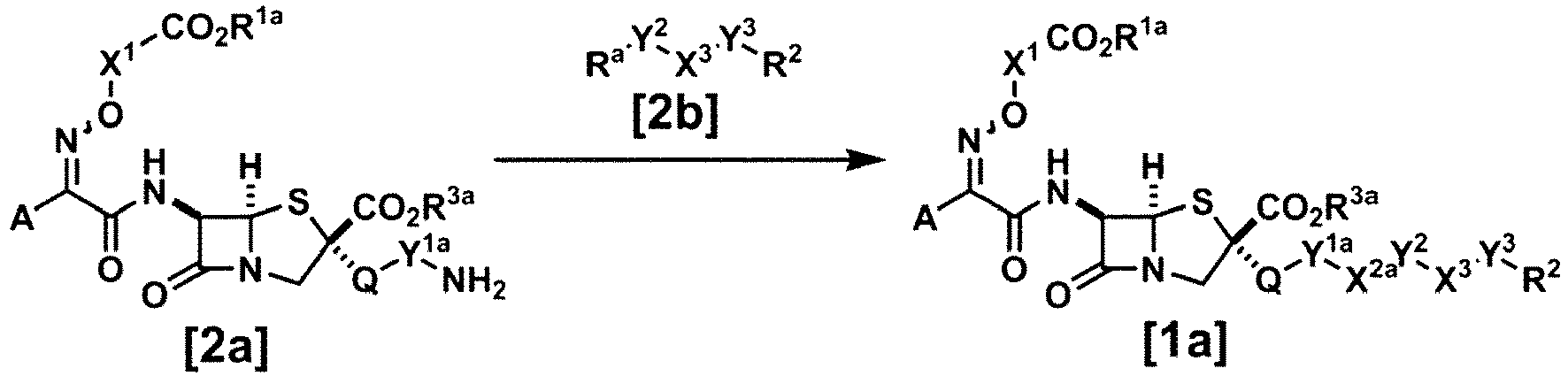
- "In the formula, Ra represents a halogen atom; Y1a represents a bond; X2a is a group represented by Formula -NH-; R1a and R3a each represent a carboxyl protecting group; and R2, Q, Y2, Y3, X1, X3, and A have the same definitions as R2, Q, Y2, Y3, X1, X3, and A described above."
- The compound represented by General Formula [1a] can be manufactured by reacting the compound represented by General Formula [2a] with the compound represented by General Formula [2b] in the presence of a base.
- Examples of the compound represented by General Formula [2b] include acid halides such as 2-chloro-3,4-bis((4-methoxybenzyl)oxy)benzoyl chloride and 2-(2-chloro-3,4-bis((4-methoxybenzyl)oxy)phenyl)-2-oxoacetyl chloride described in the present specification.
- The amount of the compound represented by General Formula [2b] used is not particularly limited, but may be 0.9 to 10 times and preferably 0.9 to 2.0 times the molar amount of the compound represented by General Formula [2a].
- The amount of the solvent used is not particularly limited, but may be 1 to 500 times (v/w) the amount of the compound represented by General Formula [2a].
- The amount of the base used may be 1 to 50 times and preferably 1 to 10 times the molar amount of the compound represented by General Formula [2a].
- This reaction may be carried out at -30°C to 150°C for 30 minutes to 72 hours, and preferably carried out at 0°C to 40°C for 1 to 4 hours.
- The solvent used in this reaction is not particularly limited as long as it does not affect the reaction. Examples thereof include halogenated hydrocarbons, ethers, esters, amides, nitriles, sulfoxides, aromatic hydrocarbons, and water. These solvents may be used by being mixed together. As the solvent, for example, tetrahydrofuran, acetonitrile, and water are preferable. The solvent is more preferably a mixed solvent of tetrahydrofuran and water.
- Examples of the base used in this reaction include an inorganic base and an organic base. As the base, for example, an inorganic base is preferable. The base is preferably sodium hydrogen carbonate.
-

- "In the formula, Rb represents a hydroxyl group or a carboxyl group; Y1b is a group represented by -NHC(=O)-; and R1a, R3a, R2, Q, Y1a, Y2, Y3, X1, X2, X3, and A have the same definitions as R1a, R3a, R2, Q, Y1a, Y2, Y3, X1, X2, X3, and A described above."
- The compound represented by General Formula [1b] can be manufactured by reacting the compound represented by General Formula [2a] with the compound represented by General Formula [3a] in the presence of a condensing agent or an acid halide or in the presence of a base.
- The amount of the compound represented by General Formula [3a] used is not particularly limited, but may be 0.9 to 10 times and preferably 0.9 to 2.0 times the molar amount of the compound represented by General Formula [2a].
- The amount of the solvent used is not particularly limited, but may be 1 to 500 times (v/w) the amount of the compound represented by General Formula [2a].
- The amount of the base used may be 1 to 50 times and preferably 1 to 10 times the molar amount of the compound represented by General Formula [2a].
- This reaction may be carried out at -30°C to 150°C for 30 minutes to 72 hours, and preferably carried out at 0°C to 40°C for 1 to 24 hours.
- The solvent used in this reaction is not particularly limited as long as it does not affect the reaction. Examples thereof include halogenated hydrocarbons, ethers, esters, amides, nitriles, sulfoxides, aromatic hydrocarbons, and water. These solvents may be used by being mixed together.
- In a case where a condensing agent is used, as the solvent, dimethylacetamide and DMF are preferable.
- In a case where an acid halide is used, as the solvent, for example, tetrahydrofuran, acetonitrile, and water are preferable. As the solvent, a mixed solvent of tetrahydrofuran and water is more preferable.
- Examples of the base used in this reaction include an inorganic base and an organic base.
- In a case where a condensing agent is used, as the base, for example, an organic base is preferable. The condensing agent is more preferably N-methylmorpholine.
- In a case where an acid halide is used, as the base, for example, an inorganic base is preferable. As the base, sodium hydrogen carbonate is preferable.
- In a case where the condensing agent is used, examples of the condensing agent include carbodiimides such as N,N'-diisopropylcarbodiimide (DIC), N,N'-di-(tert-butyl)carbodiimide, N,N'-dicyclohexylcarbodiimide (DCC), N-(tert-butyl)-N'-ethylcarbodiimide (BEC), N-cyclohexyl-N'-(2-morpholinoethyl)carbodiimide (CMC), and 1-ethyl-3-(3-dimethylaminopropyl)carbodiimide (EDC); imidazoliums such as 1,1'-carbonyldiimidazole (CDI) and 1,1'-carbonyl di(1,2,4-triazole) (CDT); acid azides such as diphenylphosphoryl azide; acid cyanides such as diethylphosphoryl cyanide; 2-ethoxy-1-ethoxycarbonyl-1,2-dihydroquinoline; uroniums such as O-(benzotriazol-1-yl)-N,N,N',N'-tetramethyluronium hexafluorophosphate (HBTU), O-(7-azabenzotriazol-1-yl)-N,N,N',N'-tetramethyluronium hexafluorophosphate (HATU), O-(benzotriazol-1-yl)-N,N,N',N'-bis(tetramethylene)uronium hexafluorophosphate (HBPyU), O-(benzotriazol-1-yl)-N,N,N',N'-bis(pentamethylene)uronium hexafluorophosphate (HBPipU), O-(6-chlorobenzotriazol-1-yl)-N,N,N',N'-tetramethyluronium hexafluorophosphate (HCTU), O-(3,4-dihydro-4-oxo-1,2,3-benzotriazin-3-yl)-N,N,N',N'-tetramethyluronium hexafluorophosphate (HDBTU), O-(2-oxo-1(2H)pyridyl)-N,N,N',N'-tetramethyluronium hexafluorophosphate (TPTU), O-((ethoxycarbonyl)cyanomethyleneamino)-N,N,N',N'-tetramethyluronium hexafluorophosphate (HOTU), O-((ethoxycarbonyl)cyanomethyleneamino)-N,N,N',N'-tetramethyluronium tetrafluoroborate (TOTU), N,N,N',N'-tetramethyl-O-(N-succinimidyl)uronium hexafluorophosphate (HSTU), N,N,N',N'-tetramethyl-O-(N-succinimidyl)uronium tetrafluoroborate (TSTU), dipyrrolidino(N-succinimidyloxy)carbenium hexafluorophosphate (HSPyU), and S-(1-oxide-2-pyridyl)-N,N,N',N'-tetramethylthiouronium tetrafluoroborate (TOTT); and triazines such as 4-(4,6-dimethoxy-1,3,5-triazin-2-yl)-4-methylmorpholinium chloride (DMT-MM).
- As a condensing agent, for example, carbodiimides, uroniums, and triazines are preferable. The condensing agent is more preferably EDC, HATU, or DMT-MM
- In a case where a condensing agent is used, the amount of the condensing agent used may be 1 to 50 times and preferably 1 to 5 times the molar amount of the compound represented by General Formula [2a].
- In a case where carbodiimides are used as a condensing agent, it is preferable to further add additives thereto.
- Examples of the additives include 1-hydroxybenzotriazole (HOBT), 1-hydroxy-7-azabenzotriazole (HOAT), and ethyl(hydroxyimino)cyanoacetate. Among these, HOBT and ethyl(hydroxyimino)cyanoacetate are preferable.
- The amount of the additives used may be 0.01 to 10 times and preferably 0.1 to 1 time the molar amount of the compound represented by General Formula [2a].
- In a case where an acid halide is used, examples of the acid halide include oxalyl chloride; carboxylic acid halides such as acetyl chloride and trifluoroacetyl chloride; sulfonic acid halides such as methanesulfonyl chloride and tosyl chloride; chloroformic acid esters such as ethyl chloroformate and isobutyl chloroformate; halides of sulfites such as thionyl chloride and thionyl bromide; and halides of phosphate such as phosphorus oxychloride, phosphorus oxybromide, phosphorus trichloride, and phosphorus pentachloride. Among these, oxalyl chloride is preferable.
- The amount of the acid halide used may be 0.9 to 3 times and preferably 0.9 to 1.5 times the molar amount of the compound represented by General Formula [3a].
-

- "In the formula, L1c represents a leaving group; Y1c is a group represented by Formula -NHC(=O)CH2-; Rc represents a tertiary amino group or a heterocyclic group; X2 is a group represented by General Formula -N+R5R6- (where R5 and R6 have the same definitions as R5 and R6 described above); and R1a, R3a, R2, Q, Y1a, Y2, Y3, X1, X3, and A have the same definitions as R1a, R3a, R2, Q, Y1a, Y2, Y3, X1, X3, and A described above."
- The compound represented by General Formula [1c] can be manufactured by the following method.
- As the compound represented by General Formula [4a], for example, chloroacetyl chloride and the like are known.
- The compound represented by General Formula [4b] can be manufactured by reacting the compound represented by General Formula [2a] with the compound represented by General Formula [4a] in the presence of a base.
- The amount of the compound represented by General Formula [4a] used is not particularly limited, but may be 0.9 to 20 times and preferably 0.9 to 10 times the molar amount of the compound represented by General Formula [2a].
- The amount of the solvent used is not particularly limited, but may be 1 to 500 times (v/w) the amount of the compound represented by General Formula [2a].
- The amount of the base used may be 1 to 50 times and preferably 1 to 20 times the molar amount of the compound represented by General Formula [2a].
- This reaction may be carried out at -30°C to 150°C for 30 minutes to 48 hours, and preferably carried out at 0°C to 40°C for 1 to 5 hours.
- The solvent used in this reaction is not particularly limited as long as it does not affect the reaction. Examples thereof include halogenated hydrocarbons, ethers, esters, amides, nitriles, sulfoxides, aromatic hydrocarbons, and water. These solvents may be used by being mixed together.
- Examples of the base used in this reaction include an inorganic base and an organic base. As the base, for example, an organic base is preferable. The base is more preferably pyridine.
- Examples of the compound represented by General Formula [4c] include 2-chloro-3,4-bis((4-methoxybenzyl)oxy)-N-(2-(pyrrolidin-1-yl)ethyl)benzamide described in the present specification and the like.
- The compound represented by General Formula [1c] can be manufactured by reacting the compound represented by General Formula [4b] with the compound represented by General Formula [4c].
- The amount of the compound represented by General Formula [4c] used is not particularly limited, but may be 1 to 20 times and preferably 1 to 5 times the molar amount of the compound represented by General Formula [4b].
- The amount of the solvent used is not particularly limited, but may be 1 to 500 times (v/w) the amount of the compound represented by General Formula [4b].
- This reaction may be carried out at -30°C to 150°C for 30 minutes to 72 hours, and preferably carried out at 0°C to 50°C for 1 to 24 hours.
- The solvent used in this reaction is not particularly limited as long as it does not affect the reaction. Examples of the solvent include halogenated hydrocarbons, ethers, esters, amides, nitriles, sulfoxides, and aromatic hydrocarbons. These solvents may be used by being mixed together.
-

- "In the formula, L1d represents a leaving group; Rd represents an aldehyde group which may be protected; Y1d is a group represented by Formula -N=CH-CH2-; and R1a, R3a, R2, Rc, Q, Y1a, Y2, Y3, X1, X2, X3, and A have the same definitions as R1a, R3a, R2, Rc, Q, Y1a, Y2, Y3, X1, X2, X3, and A described above."
- The compound represented by General Formula [1d] can be manufactured by the following method.
- As the compound represented by General Formula [5a], for example, chloroacetaldehyde, acetal-protected chloroacetaldehyde, and the like are known.
- The compound represented by General Formula [5b] can be manufactured by reacting the compound represented by General Formula [2a] with the compound represented by General Formula [5a].
- The amount of the compound represented by General Formula [5a] used is not particularly limited, but may be 0.9 to 20 times and preferably 0.9 to 10 times the molar amount of the compound represented by General Formula [2a].
- The amount of the solvent used is not particularly limited, but may be 1 to 500 times (v/w) the amount of the compound represented by General Formula [2a].
- This reaction may be carried out at -30°C to 150°C for 30 minutes to 48 hours, and preferably carried out at 0°C to 50°C for 1 to 4 hours.
- The solvent used in this reaction is not particularly limited as long as it does not affect the reaction. Examples of the solvent include halogenated hydrocarbons, ethers, esters, amides, nitriles, sulfoxides, and aromatic hydrocarbons. These solvents may be used by being mixed together.
- In a case where acetal-protected halogenated acetaldehyde is used as the compound represented by General Formula [5a], it is desirable to further add an acid catalyst thereto. Examples of the acid catalyst include p-toluenesulfonic acid monohydrate, pyridinium p-toluenesulfonate, 10-camphorsulfonic acid, and the like. Among these, p-toluenesulfonic acid monohydrate is preferable.
- The amount of the acid catalyst used may be 0.01 to 10 times and preferably 0.1 to 1 time the molar amount of the compound represented by General Formula [5a].
- Examples of the compound represented by General Formula [4c] include 2-chloro-3,4-bis((4-methoxybenzyl)oxy)-N-(2-(pyrrolidin-1-yl)ethyl)benzamide described in the present specification and the like.
- The compound represented by General Formula [1d] can be manufactured by reacting the compound represented by General Formula [5b] with the compound represented by General Formula [4c].
- The amount of the compound represented by General Formula [4c] used is not particularly limited, but may be 1 to 20 times and preferably 1 to 5 times the molar amount of the compound represented by General Formula [5b].
- The amount of the solvent used is not particularly limited, but may be 1 to 500 times (v/w) the amount of the compound represented by General Formula [5b].
- This reaction may be carried out at -30°C to 150°C for 30 minutes to 72 hours, and preferably carried out at 0°C to 50°C for 1 to 4 hours.
- The solvent used in this reaction is not particularly limited as long as it does not affect the reaction. Examples of the solvent include halogenated hydrocarbons, ethers, esters, amides, nitriles, sulfoxides, and aromatic hydrocarbons. These solvents may be used by being mixed together.
-

- "In the formula, Re represents an aldehyde group and a carboxyl group; Rf represents a substituted primary amino group; Y1e is a group represented by Formula -N=CH-CH=N-, a group represented by Formula -N=CH-CH=N-O-, or a group represented by Formula -N=CH-C(=O)-, X2 is a group represented by Formula -NH-, a group represented by Formula -NHC(=O)NH-, or a bond; and R1a, R3a, R2, Q, Y1a, Y2, Y3, X1, X3, and A have the same definitions as R1a, R3a, R2, Q, Y1a, Y2, Y3, X1, X3, and A described above."
- The compound represented by General Formula [1e] can be manufactured by the following method.
- As the compound represented by General Formula [6a], for example, glyoxal, glyoxylic acid, hydrates of these, and the like are known.
- The compound represented by General Formula [6b] can be manufactured by reacting the compound represented by General Formula [2a] with the compound represented by General Formula [6a].
- The amount of the compound represented by General Formula [6a] used is not particularly limited, but may be 1 to 50 times and preferably 1 to 20 times the molar amount of the compound represented by General Formula [2a].
- The amount of the solvent used is not particularly limited, but may be 1 to 500 times (v/w) the amount of the compound represented by General Formula [2a].
- This reaction may be carried out at -30°C to 150°C for 30 minutes to 48 hours, and preferably carried out at 0°C to 40°C for 1 to 12 hours.
- The solvent used in this reaction is not particularly limited as long as it does not affect the reaction. Examples of the solvent include halogenated hydrocarbons, ethers, esters, amides, nitriles, sulfoxides, and aromatic hydrocarbons. These solvents may be used by being mixed together.
- Examples of the compound represented by General Formula [6c] include N-(2-aminoethyl)-2-chloro-3,4-bis((4-methoxybenzyl)oxy)benzamide described in the present specification and the like.
- The compound represented by General Formula [1e] can be manufactured by reacting the compound represented by General Formula [6b] with the compound represented by General Formula [6c].
- The amount of the compound represented by General Formula [6c] used is not particularly limited, but may be 1 to 20 times and preferably 1 to 10 times the molar amount of the compound represented by General Formula [6b].
- The amount of the solvent used is not particularly limited, but may be 1 to 500 times (v/w) the amount of the compound represented by General Formula [6b].
- This reaction may be carried out at -30°C to 150°C for 30 minutes to 72 hours, and preferably carried out at 0°C to 40°C for 1 to 12 hours.
- The solvent used in this reaction is not particularly limited as long as it does not affect the reaction. Examples of the solvent include halogenated hydrocarbons, ethers, esters, amides, nitriles, sulfoxides, and aromatic hydrocarbons. These solvents may be used by being mixed together.
-

- "In the formula, Rg represents an acetaldehyde group; Y1f is a group represented by Formula -N=CH-CH2-; X2 is a group represented by Formula -NH-; and R1a, R3a, R2, Q, Y1a, Y2, Y3, X1, X3, and A have the same definitions as R1a, R3a, R2, Q, Y1a, Y2, Y3, X1, X3, and A described above."
- The compound represented by General Formula [1f] can be manufactured by the following method.
- Examples of the compound represented by General Formula [7a] include 2-chloro-3,4-bis((4-methoxybenzyl)oxy)-N-(2-oxoethyl)benzamide described in the present specification and the like.
- The compound represented by General Formula [1f] can be manufactured by reacting the compound represented by General Formula [2a] with the compound represented by General Formula [7a].
- The amount of the compound represented by General Formula [7a] used is not particularly limited, but may be 1 to 50 times and preferably 1 to 10 times the molar amount of the compound represented by General Formula [2a].
- The amount of the solvent used is not particularly limited, but may be 1 to 500 times (v/w) the amount of the compound represented by General Formula [2a].
- This reaction may be carried out at -30°C to 150°C for 30 minutes to 72 hours, and preferably carried out at 0°C to 40°C for 1 to 12 hours.
- The solvent used in this reaction is not particularly limited as long as it does not affect the reaction. Examples of the solvent include halogenated hydrocarbons, ethers, esters, amides, nitriles, sulfoxides, and aromatic hydrocarbons. These solvents may be used by being mixed together.
-

- "In the formula, L1e represents a leaving group; Rf represents a primary amino group, a secondary amino group, and a secondary cyclic amino group; Y1g is a group represented by Formula-NHC(=O)-, a group represented by Formula -NHC(=O)NH-, or a group represented by Formula -NHC(=O)NH-O-, X2 is a group represented by Formula -NH-, a group represented by Formula -NHC(=O)NH-, a heterocyclic group, or a bond; and R1a, R3a, R2, Q, Y1a, Y2, Y3, X1, X3, and A have the same definitions as R1a, R3a, R2, Q, Y1a, Y2, Y3, X1, X3, and A described above."
- The compound represented by General Formula [1g] can be manufactured by the following method.
- Examples of the compound represented by General Formula [8a] include phosgene, triphosgene, carbonyldiimidazole, and the like.
- The compound represented by General Formula [8b] can be manufactured by reacting the compound represented by General Formula [2a] with the compound represented by General Formula [8a].
- The amount of the compound represented by General Formula [8a] used is not particularly limited, but may be 1 to 20 times and preferably 1 to 10 times the molar amount of the compound represented by General Formula [2a].
- The amount of the solvent used is not particularly limited, but may be 1 to 500 times (v/w) the amount of the compound represented by General Formula [2a].
- This reaction may be carried out at -30°C to 150°C for 30 minutes to 48 hours, and preferably carried out at 0°C to 80°C for 1 to 24 hours.
- The solvent used in this reaction is not particularly limited as long as it does not affect the reaction. Examples of the solvent include halogenated hydrocarbons, ethers, esters, amides, nitriles, sulfoxides, and aromatic hydrocarbons. These solvents may be used by being mixed together.
- Examples of the compound represented by General Formula [6c] include N-(2-aminoethyl)-2-chloro-3,4-bis((4-methoxybenzyl)oxy)benzamide described in the present specification and the like.
- The compound represented by General Formula [1g] can be manufactured by reacting the compound represented by General Formula [8b] with the compound represented by General Formula [6c] in the presence of a base.
- The amount of the compound represented by General Formula [6c] used is not particularly limited, but may be 1 to 20 times and preferably 1 to 5 times the molar amount of the compound represented by General Formula [8b].
- Examples of the base used in this reaction include an inorganic base and an organic base.
- The amount of the base used may be 1 to 50 times and preferably 1 to 10 times the molar amount of the compound represented by General Formula [2a].
- The amount of the solvent used is not particularly limited, but may be 1 to 500 times (v/w) the amount of the compound represented by General Formula [8b].
- This reaction may be carried out at -30°C to 150°C for 30 minutes to 48 hours, and preferably carried out at 0°C to 40°C for 1 to 12 hours.
- The solvent used in this reaction is not particularly limited as long as it does not affect the reaction. Examples thereof include halogenated hydrocarbons, ethers, esters, amides, nitriles, sulfoxides, aromatic hydrocarbons, and water. These solvents may be used by being mixed together.
- Next, a method for manufacturing raw materials for manufacturing the compound according to the embodiment of the present invention will be described.
-

- "In the formula, R1, R2, R3, Q, Y1, Y2, Y3, X1, X2, X3, and A have the same definition as R1, R2, R3, Q, Y1, Y2, Y3, X1, X2, X3, and A described above. Here, in General Formula [1h], at least one of R1 or R3 is a protecting group."
- The compound represented by General Formula [1i] can be manufactured by performing deprotection by the method described, for example, in "Protective Groups in Organic Synthesis, W. Greene et al., 4th edition, pp. 533-643, 2007, John Wiley & Sons, INC." and the like.
-

- "In the formula, Rh represents an aryl group; and R1a, R3a, Q, X1, Y1a, and A have the same definitions as R1a, R3a, Q, X1, Y1a, and A described above."
- The compound represented by General Formula [2a] can be manufactured by the following method.
- The compound represented by General Formula [9c] can be manufactured by reacting the compound represented by General Formula [9a] or a hydrochloride thereof with the compound represented by General Formula [9b] in the presence of a condensing agent or an acid halide or in the presence of a base.
- Examples of the compound represented by General Formula [9a] include benzhydryl (3R,5R,6R)-6-amino-3-(3-(((E)-benzylidene)amino)-2-oxoimidazolidin-1-yl)-7-oxo-4-thia-1-a zabicyclo[3.2.0]heptane-3-carboxylate hydrochloride described in the present specification.
- The compound represented by General Formula [9a] can be manufactured based on the methods described, for example, on pp. 9-14 in
JP1992-074182A JP-H04-074182A JP1998-182654A JP-H10-182654A US5185330A , in addition to the method described in the present specification. - Examples of the compound represented by General Formula [9b] include (Z)-2-(2-aminothiazol-4-yl)-2-(((1-(tert-butoxy)-2-methyl-1-oxopropan-2-yl)oxy)imino)acetic acid described in the present specification and the like.
- Furthermore, the compound represented by General Formula [9c] can also be manufactured by reacting the compound represented by General Formula [9a] with a benzothiazolyl ester as the compound represented by General Formula [9b].
- The solvent used in this reaction is not particularly limited as long as it does not affect the reaction. Examples of the solvent include halogenated hydrocarbons, ethers, esters, amides, nitriles, sulfoxides, and aromatic hydrocarbons. These solvents may be used by being mixed together.
- As the solvent, for example, halogenated hydrocarbons, ethers, esters, and amides are preferable. Among these, halogenated hydrocarbons and amides are more preferable.
- The amount of the solvent used is not particularly limited, but may be 1 to 500 times (v/w) the amount of the compound represented by General Formula [9a].
- Examples of the base used in this reaction include an inorganic base and an organic base.
- As the base, for example, an organic base is preferable. As the organic base, triethylamine, N,N-diisopropylethylamine, and 4-methylmorpholine are more preferable, and N,N-diisopropylethylamine and 4-methylmorpholine are even more preferable.
- The amount of the base used may be 1 to 50 times and preferably 1 to 10 times the molar amount of the compound represented by General Formula [9a].
- Examples of the condensing agent used in this reaction include the condensing agent described in Manufacturing Method 3.
- As the condensing agent, for example, carbodiimides are preferable. As the condensing agent, EDC is more preferable.
- The amount of the condensing agent used may be 1 to 50 times and preferably 1 to 5 times the molar amount of the compound represented by General Formula [9a].
- In a case where carbodiimides are used as the condensing agent, it is preferable to add additives thereto.
- Examples of the additives include 1-hydroxybenzotriazole (HOBT), 1-hydroxy-7-azabenzotriazole (HOAT), and ethyl(hydroxyimino)cyanoacetate. Among these, HOBT and ethyl(hydroxyimino)cyanoacetate are preferable.
- The amount of the additives used may be 0.01 to 10 times and preferably 0.1 to 1 time the molar amount of the compound represented by General Formula [9a].
- Examples of the acid halide used in this reaction include oxalyl chloride; carboxylic acid halides such as acetyl chloride and trifluoroacetyl chloride; sulfonic acid halides such as methanesulfonyl chloride and tosyl chloride; chloroformic acid esters such as ethyl chloroformate and isobutyl chloroformate; halides of sulfites such as thionyl chloride and thionyl bromide; and halides of phosphate such as phosphorus oxychloride, phosphorus oxybromide, phosphorus trichloride, and phosphorus pentachloride.
- The amount of the acid halide used may be 0.9 to 3 times and preferably 0.9 to 1.5 times the molar amount of the compound represented by General Formula [9b].
- The amount of the compound represented by General Formula [9b] used is not particularly limited, but may be 1 to 10 times and preferably 1 to 3 times the molar amount of the compound represented by General Formula [9a].
- This reaction may be carried out at -30°C to 150°C for 30 minutes to 48 hours, and preferably carried out at 0°C to 50°C for 1 to 12 hours.
- The compound represented by General Formula [2a] can be manufactured by deprotecting the compound represented by General Formula [9c] by the method described, for example, in "Protective Groups in Organic Synthesis, W. Greene et al., 4th edition, pp. 533-643, 2007, John Wiley & Sons, INC." and the like.
- Next, the present invention will be described based on examples and reference examples, but the present invention is not limited thereto.
- Unless otherwise specified, silica gel column chromatography is flash column chromatography in which B. W. Silica gel, BW-300 manufactured by Fuji Silysia Chemical, Ltd. is used as a carrier.
- In the medium-pressure reverse-phase silica gel column chromatography, Isolera SV or Isolera LSV manufactured by Biotage Japan Ltd. was used. Furthermore, as a carrier, SNAP Ultra C18 Cartridge manufactured by Biotage Japan Ltd. was used.
- The mixing ratio in the eluent is a volume ratio.
- The NMR spectrum was measured using AVANCE III HD400 (Bruker).
- The NMR spectrum shows proton NMR, and the internal standard is as follows.
- The δ value is expressed as ppm.
- Deuterated chloroform (CDCl3): tetramethylsilane (0.00 ppm)
- Deuterated methanol (CD3OD): methanol (CH3OH) (3.30 ppm)
- Deuterated dimethyl sulfoxide (CD3SOCD3): tetramethylsilane (0.00 ppm)
- Heavy water (D2O): water (4.65 ppm)
- In the NMR spectrum, for example, the description of [1.45] 1.46 (3H, s) means that the peak derived from each diastereomer in a diastereomer mixture, the peak derived from each isomer in a geometric isomer mixture, or the peak derived from the same protons observed separately in a pH-dependent manner is observed as a singlet at 1.45 and 1.46, and the total number of protons is 3.
- Unless otherwise stated, the NMR spectra in reference examples were measured using CDCl3, and the NMR spectra in examples were measured using D2O.
- The MS spectrum was measured by an electrospray ionization method (ESI) by using an ACQUITY SQD LC/MS System (Waters Corporation).
- The abbreviation in each of the examples and reference examples has the following meaning.
- Alloc: allyloxycarbonyl, BH: diphenylmethyl, Boc: tert-butoxycarbonyl, Cbz: benzyloxycarbonyl, DBU: 1,8-diazabicyclo[5.4.0]-7-undecene, DMAC: N,N-dimethylacetamide, DMAP: 4-(dimethylamino)pyridine, DMF: N,N-dimethylformamide, EDC: 1-ethyl-3-(3-dimethylaminopropyl)carbodiimide hydrochloride,ESI: electrospray ionization method, Et: ethyl, HOBt: 1-hydroxybenzotriazole monohydrate, HATU: O-(7-azabenzotriazol-1-yl)-N,N,N',N'-tetramethyluronium hexafluorophosphate, IPE: diisopropyl ether, Me: methyl, Moz: 4-methoxybenzyloxycarbonyl, Ms: methanesulfonyl, MTBE : tert-butyl methyl ether, NMM: N-methylmorpholine, NMP: 1-methyl-2-pyrrolidone, PMB 4-methoxybenzyl, PNZ: p-nitrobenzyloxycarbonyl, SEM: 2-(trimethylsilyl)ethoxymethyl, TBDPS: tert-butyldiphenylsilyl, TBS: tert-butyldimethylsilyl, t-Bu: tert-butyl, THF: tetrahydrofuran, THP: tetrahydro-2H-pyran-2-yl, Tr: triphenylmethyl, Ts: p-toluenesulfonyl, s: singlet, brs: broad singlet, d: doublet, dd: double doublet, dt: doublet triplet, m: multiplet, t: triplet
-

- THF (400 mL) was added to 2-chloro-3,4-bis((4-methoxybenzyl)oxy)benzoic acid (40.0 g), and the mixture was stirred under ice cooling. At the same temperature, DMF (361 µL) was added to the reaction mixture, and then oxalyl dichloride (14.2 g) was added dropwise thereto. The reaction mixture was stirred at room temperature for 1 hour, and then oxalyl dichloride (14.2 g) was added dropwise thereto. The reaction mixture was stirred at room temperature overnight, and then IPE (400 mL) was added to the reaction mixture. Solids were collected by filtration and washed with IPE. The solids were dried, thereby obtaining 2-chloro-3,4-bis((4-methoxybenzyl)oxy)benzoyl chloride (30 g) as white solids.
NMR (DMSO-d6): 3.74 (3H, s), 3.78 (3H, s), 4.88 (2H, s), 5.18 (2H, s), 6.82-6.89 (2H, m), 6.95-7.02 (2H, m), 7.23 (1H, d, J = 9.2 Hz), 7.26-7.33 (2H, m), 7.41-7.49 (2H, m), 7.62 (1H, d, J = 8.4 Hz) -

- THF (20 mL), water (20 mL), sodium hydrogen carbonate (281 mg), and 2-chloro-3,4-bis((4-methoxybenzyl)oxy)benzoyl chloride (500 mg) were sequentially added to ethyl 3-aminopropanoate hydrochloride (257mg). The reaction mixture was stirred at room temperature for 4 hours, ethyl acetate (50 mL) and water (50 mL) were then added to the reaction mixture, and the organic layer was separated. The organic layer was washed with a saturated aqueous sodium chloride solution and dehydrated and dried over anhydrous sodium sulfate. The solvent was distilled away under reduced pressure, thereby obtaining a target substance (600 mg) as yellow solids.
- Methanol (5.8 mL), THF (5.8 mL), and a 2 mol/L aqueous sodium hydroxide solution (4.5 mL) were added to the compound (600 mg) obtained in Reference Example 2 (1), and the mixture was stirred at room temperature overnight. Ethyl acetate (20 mL) and water (20 mL) were added to the reaction mixture, 2 mol/L hydrochloric acid was added thereto such that the pH was adjusted to 1.8. The reaction mixture was stirred at room temperature for 30 minutes, and solids were collected by filtration. The solids were dried under reduced pressure, thereby obtaining 3-(2-chloro-3,4-bis((4-methoxybenzyl)oxy)benzamido)propionic acid (488 mg) as white solids.
NMR (DMSO-d6): 2.48 (2H, t, J = 6.8 Hz), 3.39 (2H, q, J = 6.7 Hz), 3.75 (3H, s), 3.77 (3H, s), 4.87 (2H, s), 5.15 (2H, s), 6.87 (2H, dd, J = 6.8, 2.0 Hz), 6.97 (2H, dd, J = 6.6, 1.8 Hz), 7.11 (1H, d, J = 8.8 Hz), 7.18 (1H, d, J = 8.4 Hz), 7.31 (2H, dd, J = 6.8, 2.0 Hz), 7.43 (2H, d, J = 8.8 Hz), 8.33 (1H, t, J = 5.4 Hz), 12.22 (1H, s) -

- 2-(2-Chloro-3,4-bis((4-methoxybenzyl)oxy)phenyl)-2-oxoacetic acid (1.64 g), HOBt (532 mg), EDC (755 mg), DMF (10 mL), and NMM (0.47 mL) were sequentially added to ethyl glycinate hydrochloride (500 mg). The reaction mixture was stirred at room temperature overnight. Ethyl acetate (30 mL) and water (30 mL) were added to the reaction mixture, and the organic layer was separated. The organic layer was washed with a saturated aqueous sodium chloride solution and dehydrated and dried over anhydrous sodium sulfate. The solvent was distilled away under reduced pressure, and the residue was purified by silica gel column chromatography [eluent; ethyl acetate:hexane = 25:75 → 50:50], thereby obtaining a target substance (1.27 g) as light yellow solids.
- Methanol (13 mL), THF (13 mL), and a 2 mol/L aqueous sodium hydroxide solution (4.7 mL) were added to the compound (1.27 g) obtained in Reference Example 3 (1), and the mixture was stirred at room temperature for 2 hours and 30 minutes. Hydrochloric acid (2 mol/L) was added to the reaction mixture such that the pH was adjusted to 1.9. Ethyl acetate (25 mL) and water (25 mL) were added to the reaction mixture, and the organic layer was separated. The organic layer was washed with a saturated aqueous sodium chloride solution and then dehydrated and dried over anhydrous sodium sulfate. The solvent was distilled away under reduced pressure, thereby obtaining (2-(2-chloro-3,4-bis((4-methoxybenzyl)oxy)phenyl)-2-oxoacetyl)glycine (1.19 g) as light yellow solids.
MS: 512.10 [M-H]- - The compounds in Table 1 were obtained in the same manner as in Reference Example 3.
[Table 1] Reference Example No. Structural Formula Name 4 
3-(2-(2-chloro-3,4-bis((4-methoxybenzyl)oxy)phenyl)-2-oxoac etamido)propionic acid 5 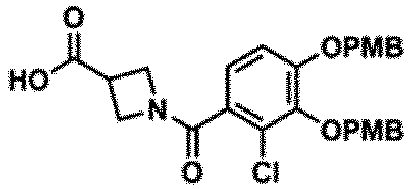
1-(2-chloro-3,4-bis((4-methoxybenzyl)oxy)benzoyl)azetidine-3-carboxylic acid 6 
1-(2-(2-chloro-3,4-bis((4-methoxybenzyl)oxy)phenyl)-2-oxoac etyl)azetidine-3-carboxylic acid - The measured values of NMR of the compounds in the table are as follows.
- NMR (DMSO-d6): 2.49-2.53 (2H, m), 3.41 (2H, q, J = 6.5Hz), 3.74 (3H, s), 3.78 (3H, s), 4.90 (2H, s), 5.22 (2H, s), 6.86 (2H, dd, J = 6.8, 2.0 Hz), 6.99 (2H, dd, J = 6.8, 2.0 Hz), 7.29 (2H, d, J = 8.4 Hz), 7.31 (1H, d, J = 8.8 Hz), 7.46 (2H, d, J = 8.8 Hz), 7.52 (1H, d, J = 8.8 Hz), 8.93 (1H, t, J = 5.6 Hz), 12.31 (1H, s)
- NMR (DMSO-d6): 3.37-3.47 (1H, m), 3.73 (3H, s), 3.78 (3H, s), 3.81-4.06 (3H, m), 4.13-4.23 (1H, m), 4.92 (2H, s), 5.14 (2H, s), 6.80-6.88 (2H, m), 6.95-7.02 (2H, m), 7.11 (1H, d, J = 8.4 Hz), 7.21 (1H, d, J = 8.4 Hz), 7.23-7.30 (2H, m), 7.40-7.48 (2H, m), 12.75 (1H, s)
- NMR (DMSO-d6): 3.50-3.62 (1H, m), 3.74 (3H, s), 3.78 (3H, s), 4.05-4.13 (1H, m), 4.20-4.29 (2H, m), 4.34 (1H, m), 4.91 (2H, s), 5.23 (2H, s), 6.81-6.89 (2H, m), 6.96-7.03 (2H, m), 7.24-7.38 (3H, m), 7.42-7.50 (2H, m), 7.57 (1H, dd, J = 14.4, 8.8 Hz), 12.85 (1H, s)
-

- 2-Chloro-3,4-bis((4-methoxybenzyl)oxy)benzoic acid (1.6 g), HOBt (555 mg), EDC (858 mg), DMAC (21 mL), and NMM (1.4 mL) were sequentially added to 2-(2-aminoethoxy)isoindoline-1,3-dioxohydrochloride (951 mg). The reaction mixture was stirred at room temperature for 3 hours and 30 minutes. Water (60 mL) was added to the reaction mixture, and solids were collected by filtration. The solids were dried, thereby obtaining a target substance (2.30 g) as light brown solids.
- Dichloromethane (20 mL) and methylhydrazine (189 µL) were added to the compound (2.30 g) obtained in Reference Example 7 (1), and the mixture was stirred at room temperature for 2 hours. Then, solids were filtered, and the solvent was distilled away under reduced pressure, thereby obtaining N-(2-(aminooxy)ethyl)-2-chloro-3,4-bis((4-methoxybenzyl)oxy)benzamide (1.97 g) as brown solids.
NMR: 3.63-3.88 (10H, m), 4.94 (2H, s), 5.07 (2H, s), 6.72-6.97 (7H, m), 7.29-7.39 (4H, m), 7.44 (1H, d, J = 8.8 Hz) -
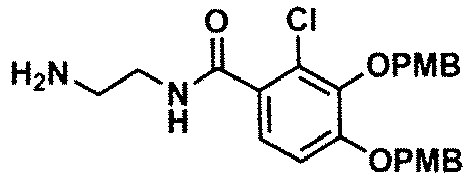
- By using 2-(2-aminoethyl)isoindoline-1,3-dione hydrochloride instead of 2-(2-aminoethoxy)isoindoline-1,3-dione hydrochloride in Reference Example 7, N-(2-aminoethyl)-2-chloro-3,4-bis((4-methoxybenzyl)oxy)benzamide was obtained in the same manner as in Reference Example 7.
NMR: 1.40 (2H, s), 2.94 (2H, t, J = 5.8 Hz), 3.46-3.55 (2H, m), 3.80 (3H, s), 3.83 (3H, s), 4.95 (2H, s), 5.08 (2H, s), 6.67 (1H, s), 6.80-6.97 (5H, m), 7.35 (4H, dd, J = 8.6, 3.0 Hz), 7.45 (1H, d, J = 8.8 Hz) -

- Chlorobenzene (30 mL) and tert-butyl (2-aminoethyl)carbamate (9.82 g) were sequentially added to (E)-2-benzylidenehydrazine-1-carboxamide (10.0 g), and the mixture was stirred. The reaction mixture was heated and stirred under reflux for 3 hours and 15 minutes. The reaction mixture was cooled to room temperature, and chlorobenzene (20 mL) and tert-butyl (2-aminoethyl)carbamate (2.95 g) were added thereto. The reaction mixture was heated and stirred under reflux for 2 hours 40 minutes. The reaction mixture was cooled to room temperature, IPE (200 mL) was added thereto, and the reaction mixture was stirred for 1 hour. Solids were collected by filtration and dried, thereby obtaining a target substance (18.0 g) as white solids.
- Ethyl acetate (100 mL) and a 4 mol/L hydrochloric acid in an ethyl acetate solution (16.3 mL) were added to the compound (10.0 g) obtained in Reference Example 9 (1), and the mixture was stirred at room temperature for 1 hour. Methanol (1 mL) was added to the reaction mixture, and the reaction mixture was stirred at room temperature for 1 hour. 1,4-Dioxane (50 mL), 4 mol/L hydrochloric acid in a 1,4-dioxane solution (16.3 mL), and methanol (10 mL) were added to the reaction mixture, and the reaction mixture was stirred at room temperature for 2 hours and 30 minutes. IPE (150 mL) was added to the reaction mixture, and solids were collected by filtration. The solids were dried, thereby obtaining a target substance (5.0 g) as light brown solids.
- THF (100 mL), water (39 mL), and sodium hydrogen carbonate (2.2 g) were added to the compound (1.3 g) obtained in Reference Example 9 (2), and the mixture was stirred under ice cooling. At the same temperature, water (39 mL), sodium hydrogen carbonate (2.2 g), and 2-chloro-3,4-bis((4-methoxybenzyl)oxy)benzoyl chloride (7.0 g) were sequentially added to the reaction mixture. At the same temperature, the reaction mixture was stirred for 2 hours and 30 minutes. THF (250 mL) and water (50 mL) were added to the reaction mixture, and the solvent was distilled away under reduced pressure. IPE was added to the residue, and solids were collected by filtration. The solids were dried, thereby obtaining a target substance (7.3 g) as white solids.
- Dichloromethane (20 mL) and methanol (10 mL) were added to the compound (1.0 g) obtained in Reference Example 9 (3), and the mixture was stirred under ice cooling. At the same temperature, 2,4-dinitrophenylhydrazine (wetted with 50% water, 1.28 g) and p-toluenesulfonic acid monohydrate (308 mg) were sequentially added to the reaction mixture. The reaction mixture was stirred at room temperature for 2 hours and 30 minutes. Ethyl acetate (220 mL) and water (110 mL) were added to the reaction mixture. A saturated aqueous sodium hydrogen carbonate solution was added to the reaction mixture such that the pH was adjusted to 8.2. The organic layer was separated, washed with a saturated aqueous sodium chloride solution, and then dehydrated and dried over anhydrous sodium sulfate. The solvent was distilled away under reduced pressure, and the residue was purified by silica gel column chromatography [eluent; ethyl acetate:hexane = 90:10 → chloroform:methanol = 90:10 → 80:20], thereby obtaining N-(2-(2-chloro-3,4-bis((4-methoxybenzyl)oxy)benzamido)ethyl)hydrazine carboxamide (250 mg) as light yellow solids.
NMR (DMSO-d6): 3.17-3.27 (4H, m), 3.75 (3H, s), 3.77 (3H, s), 4.08 (2H, s), 4.88 (2H, s), 5.15 (2H, s), 6.57 (1H, s), 6.88 (2H, dd, J = 6.4, 2.0 Hz), 6.98 (2H, dd, J = 6.8, 2.0 Hz), 7.01 (1H, s), 7.17 (2H, dd, J = 10.4, 8.8 Hz), 7.32 (2H, d, J = 8.4 Hz), 7.58 (2H, d, J = 8.4 Hz), 8.32 (1H, t, J = 5.0 Hz) -

- THF (100 mL) and water (75 mL) were added to allylpiperazine-1-carboxylate (2.5 g), and the mixture was stirred under ice cooling. Sodium hydrogen carbonate (1.5 g) and 2-chloro-3,4-bis((4-methoxybenzyl)oxy)benzoyl chloride (6.6 g) were sequentially added to the reaction mixture. The reaction mixture was stirred at room temperature overnight, ethyl acetate (100 mL) and water (50 mL) were then added to the reaction mixture, and the organic layer was separated. The organic layer was washed with a saturated aqueous sodium chloride solution and dehydrated and dried over anhydrous sodium sulfate. The solvent was distilled away under reduced pressure, thereby obtaining a target substance (9.17 g) as light yellow solids.
- THF (170 mL), 1,3-dimethylbarbituric acid (2.5 g), and tetrakis(triphenylphosphine)palladium (0) (1.7 g) were sequentially added to the compound (8.5 g) obtained in Reference Example 10 (1), and the mixture was stirred at room temperature for 1 hour. Ethyl acetate (100 mL) and water (100 mL) were added to the reaction mixture, and the organic layer was separated. The organic layer was washed with a saturated aqueous sodium chloride solution and dehydrated and dried over anhydrous sodium sulfate. The solvent was distilled away under reduced pressure, and the residue was purified by silica gel column chromatography [carrier: silica gel NH-DM1020 (Fuji Silysia Chemical, Ltd.), eluent; chloroform], thereby obtaining 2-chloro-3,4-bis((4-methoxybenzyl)oxy)phenyl)(piperazin-1-yl)methanone (4.98g) as a brown oily substance.
NMR: 2.65-2.74 (1H, m), 2.78-2.86 (1H, m), 2.86-2.99 (2H, m), 3.04-3.12 (1H, m), 3.12-3.21 (1H, m), 3.28 (1H, s), 3.66-3.75 (1H, m), 3.75-3.87 (1H, m), 3.79 (3H, s), 3.83 (3H, s), 4.93-5.06 (2H, m), 5.07 (2H, s), 6.78-6.85 (2H, m), 6.90-6.97 (4H, m), 7.29-7.39 (4H, m) -

- DMAC (16mL), 2-chloro-3,4-bis((4-methoxybenzyl)oxy)benzoic acid (10.1 g), HOBt (3.89 g), EDC (6.03 g), and NMM (7.2 mL) were sequentially added to 2-aminoethanol (1.6 g). The reaction mixture was stirred at room temperature for 6 hours. Water (150 mL) and 1 mol/L hydrochloric acid were added to the reaction mixture such that the pH was adjusted to 4.9. The reaction mixture was stirred at room temperature for 1 hour, and solids were collected by filtration. The solids were dried, thereby obtaining 2-chloro-N(2-hydroxyethyl)-3,4-bis((4-methoxybenzyl)oxy)benzamide (11.86 g) as gray solids.
NMR (DMSO-d6): 3.21-3.30 (2H, m), 3.43-3.53 (2H, m), 3.75 (3H, s), 3.77 (3H, s), 4.69 (1H, t, J = 5.6 Hz), 4.88 (2H, s), 5.15 (2H, s), 6.84-6.91 (2H, m), 6.94-7.01 (2H, m), 7.12-7.22 (2H, m), 7.28-7.35 (2H, m), 7.40-7.47 (2H, m), 8.22 (1H, t, J = 5.6 Hz) - The compounds in Table 2 were obtained in the same manner as in Reference Example 11.
[Table 2] Reference Example No. Structural Formula Name 12 
2-(2-chloro-3,4-bis((4-methoxybenzyl)oxy)phenyl)-N-(2-hydroxye thyl)-2-oxoacetamide 13 
(Z)-2-(2-chloro-3,4-bis((4-methoxybenzyl)oxy)phenyl)-N-(2-hydr oxyethyl)-2-((trityloxy)imino)acetamide 14 
N-(2-(1H-imidazol-1-yl)ethyl)-2-chloro-3,4-bis((4-methoxybenzyl )oxy)benzamide 15 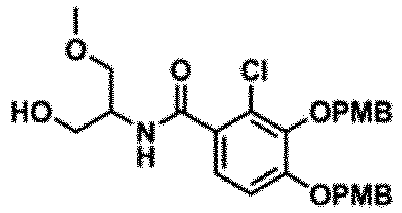
2-chloro-N-(1-hydroxy-3-methoxypropan-2-yl)-3,4-bis((4-methox ybenzyl)oxy)benzamide - The measured values of NMR of the compounds in the table are as follows.
- NMR (DMSO-d6): 3.23-3.31 (2H, m), 3.46-3.54 (2H, m), 3.74 (3H, s), 3.78 (3H, s), 4.76 (1H, t, J = 5.6 Hz), 4.90 (2H, s), 5.22 (2H, s), 6.81-6.89 (2H, m), 6.95-7.03 (2H, m), 7.24-7.35 (3H, m), 7.42-7.49 (2H, m), 7.52 (1H, d, J = 8.4 Hz), 8.83 (1H, t, J = 5.6 Hz)
- NMR (DMSO-d6): 3.10-3.20 (2H, m), 3.31-3.40 (2H, m), 3.66 (3H, s), 3.78 (3H, s), 4.69 (1H, t, J = 5.2 Hz), 4.94 (2H, s), 5.20 (2H, s), 6.75-6.82 (2H, m), 6.96-7.03 (3H, m), 7.13-7.21 (7H, m), 7.25-7.34 (12H, m), 7.44-7.50 (2H, m)
- NMR: 3.71-3.88 (2H, m), 3.80 (3H, s), 3.83 (3H, s), 4.23 (2H, t, J = 5.8 Hz), 4.93 (2H, s), 5.08 (2H, s), 6.53 (1H, t, J = 5.8 Hz), 6.83 (2H, d, J = 8.4 Hz), 6.88-6.99 (4H, m), 7.07 (1H, s), 7.29-7.42 (5H, m), 7.51 (1H, s)
- NMR: 3.40 (3H, s), 3.67 (1H, dd, J = 9.6, 4.0 Hz), 3.71 (1H, dd, J = 9.6, 3.6 Hz), 3.76-3.82 (1H, m), 3.81 (3H, s), 3.83 (3H, s), 3.94 (1H, dd, J = 11.2, 4.0 Hz), 4.23-4.32 (1H, m), 4.95 (2H, s), 5.09 (2H, s), 6.84 (2H, dd, J = 6.8, 2.0 Hz), 6.89-7.02 (4H, m), 7.35 (4H, dd, J = 8.8, 1.2 Hz), 7.46 (1H, d, J = 8.8 Hz)
-

- 2-(2-Chloro-3,4-bis((4-methoxybenzyl)oxy)phenyl)-2-oxoacetic acid (6.7 g), HOBt (2.2 g), EDC (3.1 g), DMAC (25 mL), and NMM (1.9 mL) were sequentially added to allylpiperazine-1-carboxylate (2.5 g). The reaction mixture was stirred at room temperature overnight. Ethyl acetate (100 mL) and water (100 mL) were added to the reaction mixture, and the organic layer was separated. The organic layer was washed with a saturated aqueous sodium chloride solution and then dehydrated and dried over anhydrous sodium sulfate. The solvent was distilled away under reduced pressure, and the residue was purified by silica gel column chromatography [eluent; ethyl acetate:hexane = 25:75 → 50:50], thereby obtaining a target substance (6.2 g) as light yellow solids.
- THF (130 mL), 1,3-dimethylbarbituric acid (1.8 g), and tetrakis(triphenylphosphine)palladium (0) (1.2 g) were sequentially added to the compound (6.3 g) obtained in Reference Example 16 (1), and the mixture was stirred at room temperature for 1 hour. Ethyl acetate (100 mL) and water (100 mL) were added to the reaction mixture, and the organic layer was separated. The organic layer was washed with a saturated aqueous sodium chloride solution and dehydrated and dried over anhydrous sodium sulfate. The solvent was distilled away under reduced pressure, and the residue was purified by silica gel column chromatography [carrier: silica gel NH-DM1020 (Fuji Silysia Chemical, Ltd.), eluent; chloroform], thereby obtaining 1-(2-chloro-3,4-bis((4-methoxybenzyl)oxy)phenyl)-2-(piperazin-1-yl)ethane-1,2-dione (4.6 g) as a brown oily substance.
NMR: 2.90 (2H, t, J = 5.0 Hz), 2.96 (2H, t, J = 5.0 Hz), 3.28 (1H, s), 3.41 (2H, t, J = 5.0 Hz), 3.68 (2H, t, J = 5.0 Hz), 3.80 (3H, s), 3.83 (3H, s), 4.95 (2H, s), 5.13 (2H, s), 6.80-6.85 (2H, m), 6.90-6.95 (2H, m), 6.99 (1H, d, J = 8.8 Hz), 7.30-7.35 (4H, m), 7.67-7.71 (1H, m) -

- At room temperature, dichloromethane (40 mL), pyridine (310 µL), and ethyl chlorooxoacetate (430 µL) were sequentially added to N-(2-aminoethyl)-2-chloro-3,4-bis((4-methoxybenzyl)oxy)benzamide (1.2 g). The reaction mixture was stirred at a temperature of 40°C to 50°C for 2 hours. At the same temperature, pyridine (100 µL) and ethyl chlorooxoacetate (145 µL) were sequentially added to the reaction mixture. The reaction mixture was stirred at the same temperature for 3 hours. Chloroform and a saturated aqueous ammonium chloride solution were sequentially added to the reaction mixture, and the organic layer was separated. The organic layer was washed with a saturated aqueous sodium chloride solution and dehydrated and dried over anhydrous sodium sulfate. The solvent was distilled away under reduced pressure, and the residue was purified by silica gel column chromatography [eluent; ethyl acetate:hexane = 0:100 → 100:0], thereby obtaining a target substance (0.61 g) as white solids.
- THF (20 mL), water (10 mL), and lithium hydroxide (120 mg) were sequentially added to the compound obtained in Reference Example 17 (1), and the mixture was stirred at room temperature for 1 hour. Ethyl acetate and water were sequentially added to the reaction mixture, and the organic layer was separated. The organic layer was washed with a saturated aqueous sodium chloride solution and dehydrated and dried over anhydrous sodium sulfate. The solvent was distilled away under reduced pressure, IPE was added to the residue, and solids were collected by filtration. The solids were dried, thereby obtaining 2-((2-(2-chloro-3,4-bis((4-methoxybenzyl)oxy)benzamido)ethyl)amino)-2-oxoacetic acid (458 mg) as white solids.
NMR: 3.46-3.60 (4H, m), 3.80 (3H, s), 3.84 (3H, s), 4.95 (2H, s), 5.12 (2H, s), 6.83 (2H, d, J = 8.8 Hz), 6.97 (2H, d, J = 8.8 Hz), 7.13 (1H, d, J = 8.4 Hz), 7.22 (1H, d, J = 8.4 Hz), 7.31 (2H, d, J = 8.4 Hz), 7.41 (2H, d, J = 8.4 Hz) -

- THF (16 mL) was added to 4-hydroxytetrahydro-2H-pyran-4-carboxylic acid (2.0 g), and the mixture was stirred under ice cooling. At the same temperature, 1 mol/L diphenyldiazomethane in a THF solution (16 mL) was added dropwise to the reaction mixture. The reaction mixture was stirred at room temperature overnight. The solvent was distilled away under reduced pressure, and the residue was purified by silica gel column chromatography [eluent; ethyl acetate:hexane = 10:90 → 40:60], thereby obtaining a target substance (4.23 g) as white solids.
- THF (40 mL) was added to the compound (4.32 g) obtained in Reference Example 18 (1), and the mixture was stirred under ice cooling. At the same temperature, 60% oily sodium hydride (664 mg) was added to the reaction mixture, and the reaction mixture was stirred for 20 minutes. At the same temperature, O-(mesitylsulfonyl)hydroxylamine (3.87 g) in a THF solution (40 mL) was added dropwise to the reaction mixture. At the same temperature, the reaction mixture was stirred for 3 hours. Ethyl acetate and water were added to the reaction mixture, and the organic layer was separated. The organic layer was washed with a saturated aqueous sodium chloride solution and dehydrated and dried over anhydrous sodium sulfate. The solvent was distilled away under reduced pressure, and the residue was purified by silica gel column chromatography [eluent; ethyl acetate:hexane = 10:90 → 80:20], thereby obtaining benzhydryl 4-(aminooxy)tetrahydro-2H-pyran-4-carboxylate (3.85g) as white solids.
NMR: 1.93-2.03 (2H, m), 2.07-2.19 (2H, m), 3.65-3.90 (4H, m), 5.29 (2H, s), 6.95 (1H, s), 7.24-7.42 (10H, m) - Methanol (40 mL) was added to benzhydryl 4-(aminooxy)tetrahydro-2H-pyran-4-carboxylate (2.73 g), and the mixture was stirred under ice cooling. At the same temperature, 2-(2-((tert-butoxycarbonyl)amino)thiazol-4-yl)-2-oxoacetic acid (2.07 g) was added to the reaction mixture, and the reaction mixture was stirred at room temperature for 3 hours. The solvent was distilled away under reduced pressure, ethyl acetate (100 mL), 1 mol/L hydrochloric acid (50 mL), and a saturated aqueous sodium chloride solution were added to the residue, and the organic layer was separated. The aqueous layer was extracted using ethyl acetate, and the organic layers were combined, washed with a saturated aqueous sodium chloride solution, and then dehydrated and dried over anhydrous sodium sulfate. The solvent was distilled away under reduced pressure, IPE (20 mL) and hexane (100 mL) were added to the residue, and solids were collected by filtration. The solids were dried, thereby obtaining (Z)-2-(((4-((benzhydryloxy)carbonyl)tetrahydro-2H-pyran-4-yl)oxy)imino)-2-(2-((tert-butoxy carbonyl)amino)thiazol-4-yl)acetic acid (3.88 g) as white solids.
NMR (DMSO-d6): 1.47 (9H, s), 1.88-2.15 (4H, m), 3.50-3.76 (4H, m), 6.84 (1H, s), 7.19-7.47 (11H, m), 11.81 (1H, s), 14.17-14.22 (1H, brs) -

- Chlorobenzene (20 mL) and D-alaninol (3.8 mL) were sequentially added to (E)-2-benzylidenehydrazine-1-carboxamide (8.00 g), and the mixture was stirred. The reaction mixture was heated and stirred under reflux for 4 hours and 20 minutes. At the same temperature, the solvent (14 mL) was distilled away. The reaction mixture was cooled to room temperature, thereby obtaining a target substance as a mixture of chlorobenzene.
- Benzene (10 mL) was added to the compound obtained in Reference Example 19 (1). Thionyl chloride (5.4 mL) was added to the reaction mixture at room temperature, and the mixture was stirred for 2 hours and 30 minutes. The solvent was distilled away under reduced pressure, diethyl ether was added to the residue, and solids were collected by filtration. The solids were dried, thereby obtaining a target substance (10.93 g) as light yellow solids.
- Benzene (120 mL) and toluene (40 mL) were added to the compound (10.93 g) obtained in Reference Example 19 (2), and the mixture was stirred. The reaction mixture was heated and stirred under reflux for 1 hour and 40 minutes. The reaction mixture was cooled to room temperature, and the solvent was distilled away under reduced pressure, thereby obtaining a target substance as light yellow solids.
- DMF (80 mL) was added to the compound obtained in Reference Example 19 (3), and the mixture was stirred under ice cooling. At the same temperature, 60% oily sodium hydride (1.76 g) was added to the reaction mixture by being divided into three portions. The reaction mixture was stirred at room temperature for 1 hour. Ethyl acetate, water, and 1 mol/L hydrochloric acid were added to the reaction mixture. Solids were filtered, and the organic layer was separated from the filtrate. The aqueous layer was extracted twice by using ethyl acetate, and the organic layers were combined and washed with a 5% aqueous sodium chloride solution. The organic layer was dehydrated and dried over anhydrous sodium sulfate, and the solvent was distilled away under reduced pressure. IPE was added to the residue, and solids were collected by filtration. The solids were dried, thereby obtaining (R,E)-I-(benzylideneamino)-4-methylimidazolidin-2-one (6.01 g) as light yellow solids.
NMR (DMSO-d6): 1.21 (3H, d, J = 6.0 Hz), 3.21-3.29 (1H, m), 3.78-3.95 (2H, m), 7.29 (1H, s), 7.31-7.45 (3H, m), 7.59 (1H, s), 7.62-7.69 (2H, m) - The compounds in Table 3 were obtained in the same manner as in Reference Example 19.
[Table 3] Reference Example No. Structural Formula Name 20 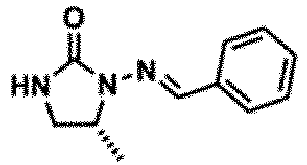
(R,E)-1(benzylideneamino)-5-methylimidazolidin-2-one 21 
(S,E)-1(benzylideneamino)-5-methylimidazolidin-2-one - The measured values of NMR of the compounds in the table are as follows.
- NMR (DMSO-d6): 1.26 (3H, d, J = 6.0 Hz), 2.95-3.02 (1H, m), 3.51-3.58 (1H, m), 4.23-4.35 (1H, m), 7.07 (1H, s), 7.32-7.45 (3H, m), 7.64-7.70 (2H, m), 8.20 (1H, s)
- NMR: 1.26 (3H, d, J = 6.0 Hz), 2.94-3.04 (1H, m), 3.55 (1H, t, J = 8.6 Hz), 4.23-4.25 (1H, m), 7.08 (1H, s), 7.32-7.47 (3H, m), 7.67 (2H, d, J = 6.8 Hz), 8.20 (1H, s)
-

- Benzhydryl 2,2-dihydroxyacetate (8.14g) and dichloromethane (61mL) were added to (S,E)-1-(benzylideneamino)-4-methylimidazolidin-2-one (6.10g), and the mixture was stirred under ice cooling. At the same temperature, DBU (226 µL) was added to the reaction mixture, and then the reaction mixture was stirred at room temperature for 5 hours and 30 minutes. At room temperature, benzhydryl 2,2-dihydroxyacetate (1.16 g) was added to the reaction mixture, and the reaction mixture was stirred for 30 minutes. The solvent was distilled away under reduced pressure, thereby obtaining a target substance (13.3 g) as a yellow oily substance.
- THF (130 mL) was added to the compound (13.3 g) obtained in Reference Example 22 (1), and the mixture was stirred under ice cooling. At the same temperature, 2,6-lutidine (3.8 mL) and thionyl chloride (2.4 mL) were sequentially added to the reaction mixture. The reaction mixture was stirred at room temperature for 2 hours. The reaction mixture was ice-cooled, 2,6-lutidine (3.1 mL) and thionyl chloride (2.0 mL) were sequentially added thereto, and the reaction mixture was stirred at room temperature for 30 minutes. Insoluble matters were filtered, thereby obtaining a mixture containing a target substance.
- DMF (130 mL) was added to the mixture obtained in Reference Example 22 (2), and the mixture was stirred under ice cooling. At the same temperature, N-((2R,3R)-1-(hydroxymethyl)-2-mercapto-4-oxoazetidin-3-yl)-2-phenylacetamide (8.8g) and triethylamine (4.6mL) were sequentially added to the reaction mixture. The reaction mixture was stirred at room temperature for 1 hour. Ethyl acetate (300 mL), water (300 mL), and 1 mol/L hydrochloric acid (20 mL) were added to the reaction mixture. The organic layer was separated and sequentially washed with water and a saturated aqueous sodium chloride solution. After the organic layer was dehydrated and dried over anhydrous sodium sulfate, the solvent was distilled away under reduced pressure. IPE was added to the residue, and solids were collected by filtration. The solids were dried, thereby obtaining a target substance (20.1 g) as light yellow solids.
- THF (15 mL) was added to the compound (1.5 g) obtained in Reference Example 22 (3), and the mixture was stirred under ice cooling. At the same temperature, 2,6-lutidine (280 µL) and thionyl chloride (170 µL) were sequentially added to the reaction mixture. The reaction mixture was stirred at room temperature for 1 hour. The reaction mixture was ice-cooled, 2,6-lutidine (76 µL) and thionyl chloride (47 µL) were sequentially added thereto, and the reaction mixture was stirred at room temperature for 50 minutes. Insoluble matters were filtered, and the solvent was distilled away under reduced pressure. DMF (15 mL) was added to the residue, and the mixture was stirred under ice cooling. At the same temperature, DBU (326 µL) was added to the reaction mixture, and the reaction mixture was stirred for 1 hour. Ethyl acetate (50 mL), water (50 mL), and 1 mol/L hydrochloric acid (4 mL) were added to the reaction mixture, and the organic layer was separated. The organic layer was sequentially washed with water and a 5% aqueous sodium chloride solution. After the organic layer was dehydrated and dried over anhydrous sodium sulfate, the solvent was distilled away under reduced pressure. The residue was purified by silica gel column chromatography [eluent; ethyl acetate:hexane = 30:70 → 75:25], thereby obtaining benzhydryl (3R,5R,6R)-3-((S)-3-(((E)) -benzylidene)amino)-5-methyl-2-oxoimidazolidin-1-yl)-7-oxo-6-(2-phenylacetamido)-4-thia-1 -azabicyclo[3.2.0]heptane-3-carboxylate (660 mg) as yellow solids.
NMR: 1.27 (3H, d, J = 7.2 Hz), 3.28-3.41 (3H, m), 3.44-3.52 (1H, m), 3.76-3.85 (1H, m), 4.17-4.28 (1H, m), 5.17 (1H, d, J = 13.6 Hz), 5.48-5.56 (2H, m), 6.31 (1H, d, J = 8.4 Hz), 6.89 (1H, s), 7.13-7.19 (2H, m), 7.20-7.45 (16H, m), 7.67 (1H, s), 7.70-7.77 (2H, m) - The compounds in Table 4 were obtained in the same manner as in Reference Example 22.
[Table 4] Reference Example No. Structural Formula Name 23 
Benzhydryl (3R,5R,6R)-3-((S)-3-(((E)-benzylidene)amino)-4-methyl-2-ox oimidazolidin-1-yl)-7-oxo-6-(2-phenylacetamido)-4-thia-1-az abicyclo[3.2.0]heptane-3-carboxylate 24 
Benzhydryl (3R,5R,6R)-3-((R)-3-(((E)-benzylidene)amino)-4-methyl-2-ox oimidazolidin-1-yl)-7-oxo-6-(2-phenylacetamido)-4-thia-1-az abicyclo[3.2.0]heptane-3-carboxylate 25 
Benzhydryl (3R,5R,6R)-3-((R)-3-(((E)-benzylidene)amino)-5-methyl-2-ox oimidazolidin-1-yl)-7-oxo-6-(2-phenylacetamido)-4-thia-1-az abicyclo[3.2.0]heptane-3-carboxylate - The measured values of NMR of the compounds in the table are as follows.
- NMR: 1.37 (3H, d, J = 6.0 Hz), 3.26 (1H, dd, J = 7.8, 5.4 Hz), 3.36 (1H, dd, J = 13.2, 0.8 Hz), 3.39-3.41 (2H, m), 3.73 (1H, t, J = 8.0 Hz), 4.10-4.22 (1H, m), 4.85 (1H, d, J = 13.2 Hz), 5.50 (1H, d, J = 4.0 Hz), 5.61 (1H, ddd, J = 8.9, 3.9, 0.7 Hz), 6.56 (1H, d, J = 9.2 Hz), 6.88 (1H, s), 7.15-7.43 (17H, m), 7.63-7.72 (3H, m), 8.61 (1H, s)
- NMR: 1.35 (3H, d, J = 6.0 Hz), 3.19 (1H, t, J = 8.0 Hz), 3.35 (1H, d, J = 13.2 Hz), 3.40 (2H, s), 3.80 (1H, t, J = 8.0 Hz), 4.12-4.18 (1H, m), 4.93 (1H, d, J = 13.2 Hz), 5.50 (1H, d, J = 4.0 Hz), 5.57 (1H, dd, J = 8.8, 3.6 Hz), 6.48 (1H, d, J = 8.4 Hz), 6.90 (1H, s), 7.18 (2H, d, J = 8.0 Hz), 7.21-7.43 (16H, m), 7.65-7.70 (2H, m), 8.73 (1H, s)
- NMR: 1.45 (3H, d, J = 6.4 Hz), 3.27 (2H, s), 3.34 (1H, dd, J = 13.4, 1.0 Hz), 3.79 (1H, t, J = 8.8 Hz), 4.03-4.11 (2H, m), 5.23 (1H, d, J = 13.2 Hz), 5.45-5.53 (2H, m), 6.05 (1H, d, J = 3.6 Hz), 6.88 (1H, s), 7.15-7.43 (17H, m), 7.54 (1H, s), 7.68-7.77 (2H, m)
-

- Benzhydryl 2,2-dihydroxyacetate (2.88 g) and dichloromethane (30 mL) were added to (E)-4-(benzylideneamino)-2,4-dihydro-3H-1,2,4-triazol-3-one (2.00 g), and the mixture was stirred under ice cooling. At the same temperature, DBU (79 µL) was added to the reaction mixture, and then the reaction mixture was stirred at room temperature for 1 hour and 15 minutes. Ethyl acetate (30 mL) was added to the reaction mixture, and solids were collected by filtration. The solids were washed with ethyl acetate. The solids were dried under reduced pressure, thereby obtaining a target substance (3.87 g) as white solids.
- DMF (19 mL) was added to the compound (1.89 g) obtained in Reference Example 26 (1), and the mixture was stirred under ice cooling. At the same temperature, triphenylphosphine (1.5 g) and bromine (272 µL) were sequentially added to the reaction mixture. The reaction mixture was stirred at room temperature for 1 hour and 30 minutes. The reaction mixture was added to a mixture of ethyl acetate (50 mL) and water (50 mL). The organic layer was separated and sequentially washed with water and a saturated aqueous sodium chloride solution. The organic layer was dehydrated and dried over anhydrous sodium sulfate, and then the solvent was distilled away under reduced pressure. The residue was purified by silica gel column chromatography [eluent; ethyl acetate:hexane = 15:85 → 20:80], thereby obtaining a target substance (2.02 g) as yellow solids.
- DMF (40 mL) was added to the compound (2.02 g) obtained in Reference Example 26 (2), and the mixture was stirred under ice cooling. At the same temperature, N-((2R,3R)-1-(hydroxymethyl)-2-mercapto-4-oxoazetidin-3-yl)-2-phenylacetamide (1.2 g) and triethylamine (630 µL) were sequentially added to the reaction mixture. At the same temperature, the reaction mixture was stirred for 35 minutes. Ethyl acetate (78 mL) and water (62 mL) were added to the reaction mixture. The organic layer was separated and sequentially washed with water and a saturated aqueous sodium chloride solution. The organic layer was dehydrated and dried over anhydrous sodium sulfate, and the solvent was distilled away under reduced pressure. The residue was purified by silica gel column chromatography [eluent; ethyl acetate:hexane = 75:25 → 80:20], thereby obtaining a target substance (2.81 g) as white solids.
- THF (56 mL) was added to the compound (2.81 g) obtained in Reference Example 26 (3), and the mixture was stirred under ice cooling. At the same temperature, 2,6-lutidine (773 µL) and thionyl chloride (484 µL) were sequentially added to the reaction mixture. The reaction mixture was stirred at room temperature for 1 hour. Insoluble matters were filtered, and the solvent was distilled away under reduced pressure. DMF (28 mL) was added to the residue, and the mixture was stirred under ice cooling. DBU (749 µL) was added to the reaction mixture, and the reaction mixture was stirred at the same temperature for 1 hour and 30 minutes. Then, at the same temperature, DBU (62 µL) was added to the reaction mixture, and the reaction mixture was stirred for 20 minutes. The reaction mixture was added to a mixture of ethyl acetate (82 mL), water (82 mL), and 1 mol/L hydrochloric acid (5 mL), and the organic layer was separated. The aqueous layer was extracted three times by using ethyl acetate (100 mL), and the organic layers were combined and sequentially washed with water and a saturated aqueous sodium chloride solution. After the organic layer was dehydrated and dried over anhydrous sodium sulfate, the solvent was distilled away under reduced pressure. Ethyl acetate (15 mL) was added to the residue, and solids were collected by filtration. The solids were dried, thereby obtaining benzhydryl (3R,5R,6R)-3-(4-(((E)-benzylidene)amino)-5-oxo-4,5-dihydro-1H-1,2,4-triazol-1-yl)-7-oxo-6-(2-phenylacetamido)-4-thia-1-azabicyclo[3.2.0]heptane-3-carboxylate (1.97 g) as white solids. NMR: 3.47 (2H, s), 3.93 (1H, dd, J = 13.4, 0.6 Hz), 4.75 (1H, d, J = 13.6 Hz), 5.58 (1H, d, J = 4.0 Hz), 5.73 (1H, dd, J = 9.2,3.6 Hz), 6.75 (1H, d, J = 9.6 Hz), 6.78 (1H, s), 7.16-7.35 (14H, m), 7.44-7.56 (4H, m), 7.75 (2H, dd, J = 8.2, 1.4 Hz), 7.80 (1H, s), 9.54 (1H, s)
-

- Dichloromethane (6.6 mL) was added to benzhydryl (3R,5R,6R)-3-((S)-3-(((E)-benzylidene)amino)-5-methyl-2-oxoimidazolidin-1-yl)-7-oxo-6-(2-phenylacetamido)-4-thia-1-azabicyclo[3.2.0]heptane-3-carboxylate (660 mg), and the reaction mixture was cooled to a temperature equal to or lower than -30°C. At the same temperature, N,N-dimethylaniline (435 µL) and phosphorus pentachloride (306 mg) were sequentially added to the reaction mixture, and the reaction mixture was stirred at -30°C for 1 hour. Then, at the same temperature, methanol (600 µL) was added to the reaction mixture, and the reaction mixture was stirred for 30 minutes under ice cooling. Dichloromethane (20 mL) and an aqueous sodium hydrogen carbonate solution (1.07 g of sodium hydrogen carbonate/20 mL of water) were added to the reaction mixture, and the organic layer was separated. The organic layer was dehydrated and dried over anhydrous sodium sulfate, and solids were filtered.
(Z)-2-(2-aminothiazol-4-yl)-2-(((1-(tert-butoxy)-2-methyl-1-oxopropan-2-yl)oxy)imino)acetic acid (355 mg), HATU (410 mg), 2,6-lutidine (251 µL), and DMF (6.6 mL) were added to the filtrate. The reaction mixture was stirred at room temperature under reduced pressure until the reaction mixture became a solution. Water (20 mL) and ethyl acetate (20 mL) were added to the reaction mixture, and the organic layer was separated. The organic layer was washed three times with a 5% aqueous sodium chloride solution. The organic layer was dehydrated and dried over anhydrous sodium sulfate, and then the solvent was distilled away under reduced pressure. The residue was purified by silica gel column chromatography [eluent; ethyl acetate:hexane = 60:40 → 100:0], thereby obtaining a target substance (180 mg) as a yellow oily substance. - Dichloromethane (3.6 mL) and methanol (1.8 mL) were added to the compound (180 mg) obtained in Reference Example 27 (1), and the mixture was stirred under ice cooling. At the same temperature, 2,4-dinitrophenylhydrazine (wetted with 50% water, 165 mg) and p-toluenesulfonic acid monohydrate (40 mg) were sequentially added to the reaction mixture. The reaction mixture was stirred at room temperature for 5 hours. Ethyl acetate (20 mL) and water (10 mL) were added to the reaction mixture. A saturated aqueous sodium hydrogen carbonate solution was added to the reaction mixture such that the pH was adjusted to 7.7. The organic layer was separated, washed with a 5% aqueous sodium chloride solution, and then dehydrated and dried over anhydrous sodium sulfate. The solvent was distilled away under reduced pressure, and the residue was purified by silica gel column chromatography [eluent; ethyl acetate:hexane = 70:30 → 100:0 → chloroform:2-propanol = 100:0 → 80:20], thereby obtaining benzhydryl (3R,5R,6R)-3-((S)-3-amino-5-methyl-2-oxoimidazolidinon-1-yl)-6-((Z)-2-(2-aminothiazol-4-y 1)-2-(((1-(tert-butoxy)-2-methyl-1-oxopropan-2-yl)oxy)imino)acetamido)-7-oxo-4-thia-1-azabi cyclo[3.2.0]heptane-3-carboxylate (90 mg) as a yellow oily substance.
NMR: 1.16-1.23 (3H, m), 1.41 (9H, s), 1.49 (3H, s), 1.51 (3H, s), 3.17 (1H, dd, J = 8.4,2.0Hz), 3.36 (1H, d, J = 13.2 Hz), 3.45-3.54 (1H, m), 3.81 (2H, s), 3.92-4.03 (1H, m), 5.07 (1H, d, J = 13.2 Hz), 5.59 (1H, d, J = 4.0 Hz), 5.80 (1H, dd, J = 8.8,4.0Hz), 6.48 (2H, s), 6.79 (1H, s), 6.88 (1H, s), 6.92-7.01 (1H, m), 7.21-7.42 (10H, m) - The compounds in Table 5 were obtained in the same manner as in Reference Example 27.
[Table 5] Reference Example No. Structural Formula Name 28 
Benzhydryl (3R,5R,6R)-3-(3-amino-2-oxoimidazolidin-1-yl)-6-((Z)-2-(2 -aminothiazol-4-yl)-2-(((1-(tert-butoxy)-2-methyl-1-oxopro pan-2-yl)oxy)imino)acetamido)-7-oxo-4-thia-1-azabicyclo[3 .2.0]heptane-3-carboxylate 29 
Benzhydryl (3R,5R,6R)-3-((S)-3-amino-5-methyl-2-oxoimidazolidin-1-yl)-6-((Z)-2-(((1-(tert-butoxy)-2-methyl-1-oxopropan-2-yl)o xy)imino)-2-(2-((tert-butoxycarbonyl)amino)thiazol-4-yl)ac etamido)-7-oxo-4-thia-1-azabicyclo[3.2.0]heptane-3-carbox ylate 30 
Benzhydryl (3R,5R,6R)-3-((S)-3-amino-4-methyl-2-oxoimidazolidin-1-yl)-6-((Z)-2-(((1-(tert-butoxy)-2-methyl-1-oxopropan-2-yl)o xy)imino)-2-(2-((tert-butoxycarbonyl)amino)thiazol-4-yl)ac etamido)-7-oxo-4-thia-1-azabicyclo[3.2.0]heptane-3-carbox ylate 31 
Benzhydryl (3R,5R,6R)-3-((R)-3-amino-4-methyl-2-oxoimidazolidin-1-yl)-6-((Z)-2-(2-aminothiazol-4-yl)-2-(((1-(tert-butoxy)-2-me thyl-1-oxopropan-2-yl)oxy)imino)acetamido)-7-oxo-4-thia-1-azabicyclo [3.2.0]heptane-3-carboxylate 32 
Benzhydryl (3R,5R,6R)-3-((R)-3-amino-5-methyl-2-oxoimidazolidin-1-yl)-6-((Z)-2-(2-aminothiazol-4-yl)-2-(((1-(tert-butoxy)-2-me thyl-1-oxopropan-2-yl)oxy)imino)acetamido)-7-oxo-4-thia-1-azabicyclo[3.2.0]heptane-3-carboxylate 33 
Benzhydryl (3R,5R,6R)-3-((R)-3-amino-5-methyl-2-oxoimidazolidin-1-yl)-6-((Z)-2-((1-((benzhydryloxy)carbonyl)cyclobutoxy)imi no)-2-(2-((tert-butoxy)amino)thiazol-4-yl)acetamido)-7-oxo -4-thia-1-azabicyclo[3.2.0]heptane-3-carboxylate 34 
Benzhydryl (3R,5R,6R)-3-((4-amino-5-oxo-4,5-dihydro-1H-1,2,4-triazol -1-yl))-6-((Z)-2-(((1-(tert-butoxy)-2-methyl-1-oxopropan-2-yl)oxy)imino)-2-(2-((tert-butoxycarbonyl)amino)thiazol-4-y l)acetamido)-7-oxo-4-thia-1-azabicyclo[3.2.0]heptane-3-car boxylate - The measured values of NMR of the compounds in the table are as follows.
- NMR: 1.39 (9H, s), 1.48 (3H, s), 1.50 (3H, s), 3.40-3.55 (5H, m), 3.83 (2H, s), 4.95 (1H, d, J = 13.2 Hz), 5.57 (1H, d, J = 4.0 Hz), 5.79 (1H, dd, J = 8.4, 3.6 Hz), 6.40 (2H, s), 6.79 (1H, s), 6.87 (1H, s), 7.06 (1H, d, J = 8.8 Hz), 7.16-7.40 (10H, m)
- NMR: 1.19 (3H, d, J = 6.4 Hz), 1.41 (9H, s), 1.49-1.57 (15H, m), 3.17 (1H, dd, J = 8.0,1.6 Hz), 3.35 (1H, dd, J = 13.2, 0.8 Hz), 3.45-3.54 (1H, m), 3.81 (2H, s), 3.93-4.04 (1H, m), 5.09 (1H, d, J = 13.2 Hz), 5.60 (1H, d, J = 4.0 Hz), 5.78 (1H, dd, J = 8.0,4.0Hz), 6.88 (1H, s), 7.09-7.17 (1H, m), 7.19-7.43 (11H, m), 8.15 (1H, s)
- NMR: 1.23 (3H, d, J = 6.0 Hz), 1.39 (9H, s), 1.50 (3H, s), 1.52 (3H, s), 1.54 (9H, s), 3.01 (1H, t, J = 6.8 Hz), 3.43-3.57 (3H, m), 3.67 (2H, s), 4.83 (1H, d, J = 12.8 Hz), 5.58 (1H, d, J = 4.0 Hz), 5.82 (1H, dd, J = 8.4,3.6 Hz), 6.86 (1H, s), 7.14-7.44 (11H, m), 7.54 (1H, d, J = 8.8 Hz), 8.19 (1H, s)
- NMR: 1.22 (3H, d, J = 6.0 Hz), 1.39 (9H, s), 1.50 (3H, s), 1.52 (3H, s), 3.01 (1H, t, J = 8.4 Hz), 3.46-3.58 (2H, m), 3.60-3.73 (3H, m), 4.99 (1H, d, J = 13.2 Hz), 5.57 (1H, d, J = 4.0 Hz), 5.75-5.81 (1H, m), 6.84 (1H, s), 6.85 (1H, s), 7.15-7.38 (13H, m)
- NMR: 1.35 (3H, d, J = 6.4 Hz), 1.39 (9H, s), 1.48 (3H, s), 1.49 (3H, s), 3.14 (1H, dd, J = 8.2, 3.0 Hz), 3.36 (1H, dd, J = 13.2, 0.8 Hz), 3.54 (1H, t, J = 8.6 Hz), 3.69 (2H, s), 3.83-3.94 (1H, m), 5.15 (1H, d, J = 13.2 Hz), 5.58 (1H, d, J = 4.0 Hz), 5.74 (1H, dd, J = 7.8,3.4 Hz), 6.50 (2H, s), 6.77 (1H, s), 6.88 (1H, s), 6.95 (1H, d, J = 8.4 Hz), 7.14-7.42 (10H, m)
- NMR: 1.32 (3H, d, J = 6.4 Hz), 1.55 (9H, s), 1.92-2.03 (2H, m), 2.38-2.51 (2H, m), 2.55-2.69 (2H, m), 3.12 (1H, dd, J = 8.0, 2.8 Hz), 3.35 (1H, dd, J = 13.0, 1.0 Hz), 3.49 (1H, t, J = 8.4 Hz), 3.66 (2H, s), 3.77-3.87 (1H, m), 5.17 (1H, d, J = 13.6 Hz), 5.55 (1H, d, J = 3.6 Hz), 5.75 (1H, dd, J = 8.0, 3.6 Hz), 6.86 (1H, s), 6.91 (1H, s), 7.03 (1H, s), 7.11-7.42 (21H, m), 8.16 (1H, s)
- NMR: 1.38 (9H, s), 1.51 (3H, s), 1.53 (9H, s), 1.54 (3H, s), 4.00 (1H, d, J = 13.6 Hz), 4.24 (2H, s), 4.70 (1H, d, J = 13.6 Hz), 5.64 (1H, d, J = 4.0 Hz), 5.93 (1H, dd, J = 9.2, 4.0 Hz), 6.81 (1H, s), 7.17-7.40 (11H, m), 7.56 (1H, s), 7.63 (1H, d, J = 9.2 Hz), 8.20 (1H, s)
-

- (Z)-2-((1-((benzhydryloxy)carbonyl)cyclobutoxy)imino)-2-(2-((tert-butoxycarbonyl)a mino)thiazol-4-yl)acetic acid (191 mg), HOBt (51 mg), EDC (73 mg), NMM (84 µL), and DMF (2 mL) were sequentially added to benzhydryl (3R,5R,6R)-6-amino-3-(3-(((E)-benzylidene)amino)-2-oxoimidazolidin-1-yl)-7-oxo-4-thia-1-a zabicyclo[3.2.0]heptane-3-carboxylate hydrochloride (200 mg). The reaction mixture was stirred at room temperature overnight. Ethyl acetate (10 mL) and water (10 mL) were added to the reaction mixture, and the organic layer was separated. The organic layer was washed with a saturated aqueous sodium chloride solution and dehydrated and dried over anhydrous sodium sulfate. The solvent was distilled away under reduced pressure, and the residue was purified by silica gel column chromatography [eluent; ethyl acetate:hexane = 40:60 → 80:20], thereby obtaining a target substance (159 mg) as light yellow solids.
- Dichloromethane (3.2 mL) and methanol (1.6 mL) were added to the compound (159 mg) obtained in Reference Example 35 (1), and the mixture was stirred under ice cooling. At the same temperature, 2,4-dinitrophenylhydrazine (wetted with 50% water, 59 mg) and p-toluenesulfonic acid monohydrate (28 mg) were sequentially added to the reaction mixture. The reaction mixture was stirred at room temperature for 3 hours. Ethyl acetate (20 mL) and water (20 mL) were added to the reaction mixture. A saturated aqueous sodium hydrogen carbonate solution was added to the reaction mixture such that the pH was adjusted to 6.4. The organic layer was separated, washed with a saturated aqueous sodium chloride solution, and then dehydrated and dried over anhydrous sodium sulfate. The solvent was distilled away under reduced pressure, and the residue was purified by silica gel column chromatography [eluent; ethyl acetate:hexane = 70:30 → 100:0], thereby obtaining benzhydryl (3R,5R,6R)-3-(3-amino-2-oxoimidazolidin-1-yl)-6-((Z)-2-((1-((benzhydryloxy)carbonyl)cyclo butoxy)imino)-2-(2-((tert-butoxycarbonyl)amino)thiazol-4-yl)acetamido)-7-oxo-4-thia-1-azabi cyclo[3.2.0]heptane-3-carboxylate (104 mg) as light yellow solids.
NMR: 1.54 (9H, s), 1.92-2.02 (2H, m), 2.36-2.53 (2H, m), 2.56-2.67 (2H, m), 3.31-3.49 (4H, m), 3.52 (1H, d, J = 13.2 Hz), 3.81 (2H, s), 4.95 (1H, d, J = 13.2 Hz), 5.55 (1H, d, J = 4.0 Hz), 5.79 (1H, dd, J = 8.8, 3.6 Hz), 6.84 (1H, s), 6.90 (1H, s), 7.06 (1H, s), 7.09-7.15 (1H, m), 7.17-7.39 (20H, m), 8.13 (1H, s) - The compounds in Table 6 were obtained in the same manner as in Reference Example 35.
[Table 6] Reference Example No. Structural Formula Name 36 
Benzhydryl (3R,5R,6R)-3-(3-amino-2-oxoimidazolidin-1-yl)-6-((Z)-2-(( (1-(tert-butoxy)-2-methyl-1-oxopropan-2-yl)oxy)imino)-2-( 2-((tert -butoxycarbonyl)amino)thiazol-4-yl)acetamido)-7-ox o-4-thia-1-azabicyclo[3.2.0]heptane-3-carboxylate 37 
Benzhydryl (3R,5R,6R)-3-(3-amino-2-oxoimidazolidin-1-yl)-6-((Z)-2-(( 1-((benzhydryloxy)carbonyl)cyclopropoxy)imino)-2-(2-((ter t-butoxycarbonyl)amino)thiazol-4-yl)acetamido)-7-oxo-4-th ia-1-azabicyclo [3.2.0]heptane-3-carboxylate 38 
Benzhydryl (3R,5R,6R)-3-(3-amino-2-oxoimidazolidin-1-yl)-6-((Z)-2-(( (1-(tert-butoxy)-2-methyl-1-oxopropan-2-yl)oxy)imino)-2-( 2-((tert-butoxycarbonyl)amino)-5-chlorothiazol-4-yl)acetam ido)-7-oxo-4-thia-1-azabicyclo[3.2.0]heptane-3-carboxylate 39 
Benzhydryl (3R,5R,6R)-3-(3-amino-2-oxoimidazolidin-1-yl)-6-((Z)-2-(( (1-(tert-butoxy)-2-methyl-1-oxopropan-2-yl)oxy)imino)-2-( 5-((tert-butoxycarbonyl)amino)-1,2,4-thiadiazol-3-yl)acetam ido)-7-oxo-4-thia-1-azabicyclo[3.2.0]heptane-3-carboaηlate 40 
Benzhydryl (3R,5R,6R)-3-(3-amino-2-oxoimidazolidin-1-yl)-6-((Z)-2-(( 2-((tert-butoxy)-2-oxoethoxy)imino)-2-(2-((tert-butoxycarbo nyl)amino)thiazol-4-yl)acetamido)-7-oxo-4-thia-1-azabicycl o[3.2.0]heptane-3-carboxylate 41 
Benzhydryl (3R,5R,6R)-3-(3-amino-2-oxoimidazolidin-1-yl)-6-((Z)-2-(( ((R)-1-(benzhydryloxy)-1-oxopropan-2-yl)oxy)imino)-2-(2-((tert-butoxycarbonyl)amino)thiazol-4-yl)acetamido)-7-oxo-4-thia-1-azabicyclo [3.2.0]heptane-3-carboxylate 42 
Benzhydryl (3R,5R,6R)-3-(3-amino-2-oxoimidazolidin-1-yl)-6-((Z)-2-(( ((S)-1-(benzhydryloxy)-1-oxopropan-2-yl)oxy)imino)-2-(2-( (tert -butoxycarbonyl)amino)thiazol-4-yl)acetamido)-7-oxo-4-thia-1-azabicyclo [3.2.0]heptane-3-carboxylate 43 
Benzhydryl (3R,5R,6R)-3-(3-amino-2-oxoimidazolidin-1-yl)-6-((S,Z)-5-(tert-butoxycarbonyl)-2-(2-((tert-butoxycarbonyl)amino)thia zol-4-yl)-8,8,9,9-tetramethyl-4,7-dioxa-3-aza-8-siladec-2-en amido)-7-oxo-4-thia-1-azabicyclo[3.2.0]heptane-3-carboxyl ate 44 
4-(tert-butyl)l-(4-methoxybenzyl)(S)-2-((((Z)-2-(((3R,5R,6R)-3-(3-amino-2-oxoimidazolidin-1-yl)-3-((benzhydryloxy)carbo nyl)-7-oxo-4-thia-1 -azabicyclo[3.2.0]heptan-6-yl)amino)-1-(2-((tert-butoxycarbonyl)amino)thiazol-4-yl)-2-oxoethylidene)am ino)oxy)succinic acid 45 
Benzhydryl (3R,5R,6R)-3-(3-amino-2-oxoimidazolidin-1-yl)-6-((Z)-2-(((4-((benzhydryloxy)carbonyl)tetrahydro-2H-pyran-4-yl)oxy)imin o)-2-(2-((tert-butoxycarbonyl)amino)thiazol-4-yl)acetamido)-7 -oxo-4-thia-1-azabicyclo[3.2.0]heptane-3-carboxylate 46 
Benzhydryl (3R,5R,6R)-3-(3-amino-2-oxoimidazolidin-1-yl)-6-((Z)-2-(2-a minothiazol-4-yl)-2-(((1-(tert-butoxycarbonyl)cyclopentyl)oxy )imino)acetamido)-7-oxo-4-thia-1-azabicyclo[3.2.0]heptane-3-carboxylate - The measured values of NMR of the compounds in the table are as follows.
- NMR: 1.39 (9H, s), 1.48-1.56 (15H, m), 3.37-3.57 (5H, m), 3.81 (2H, s), 4.95 (1H, d, J = 13.2 Hz), 5.58 (1H, d, J = 4.0 Hz), 5.79 (1H, dd, J = 8.0, 4.0 Hz), 6.87 (1H, s), 7.12-7.20 (1H, m), 7.21-7.41 (10H, m), 7.47 (1H, d, J = 8.0 Hz), 8.12 (1H, s)
- NMR: 1.46-1.61 (4H, m), 1.54 (9H, s), 3.31-3.48 (4H, m), 3.50 (1H, d, J = 13.2 Hz), 3.82 (2H, s), 4.94 (1H, d, J = 13.2 Hz), 5.56 (1H, d, J = 3.6 Hz), 5.74 (1H, dd, J = 8.4, 3.6 Hz), 6.83 (1H, s), 6.88 (1H, s), 7.08-7.15 (1H, m), 7.16-7.43 (21H, m), 8.18 (1H, s)
- NMR: 1.40 (9H, s), 1.50 (3H, s), 1.52 (3H, s), 1.52 (9H, s), 3.38-3.56 (5H, m), 3.81 (2H, s), 4.95 (1H, d, J = 13.2 Hz), 5.56 (1H, d, J = 4.0 Hz), 5.79 (1H, dd, J = 8.8, 3.2 Hz), 6.88 (1H, s), 7.18-7.39 (11H, m), 8.05 (1H, s)
- NMR: 1.39 (9H, s), 1.55 (3H, s), 1.57 (3H, s), 1.57 (9H, s), 3.38-3.56 (5H, m), 3.83 (2H, s), 4.92 (1H, d, J = 13.2 Hz), 5.57 (1H, d, J = 3.6 Hz), 5.83 (1H, dd, J = 8.8, 3.6 Hz), 6.87 (1H, s), 7.12-7.18 (1H, m), 7.22-7.43 (10H, m), 8.58 (1H, s)
- NMR: 1.41 (9H, s), 1.55 (9H, s), 3.37-3.58 (5H, m), 3.80 (2H, s), 4.57 (1H, d, J = 16.4 Hz), 4.63 (1H, d, J = 16.4 Hz), 5.00 (1H, d, J = 13.2 Hz), 5.60 (1H, d, J = 4.0 Hz), 5.66 (1H, dd, J = 7.2, 3.4 Hz), 6.87 (1H, s), 7.10-7.18 (1H, m), 7.20-7.41 (10H, m), 7.90 (1H, d, J = 7.2 Hz), 8.13 (1H, s)
- NMR: 1.53 (3H, d, J = 7.2 Hz), 1.54 (9H, s), 3.25-3.49 (4H, m), 3.53 (1H, d, J = 13.2 Hz), 3.80 (2H, s), 4.96 (1H, d, J = 13.2 Hz), 5.02 (1H, dd, J = 14.0, 7.2 Hz), 5.55 (1H, d, J = 4.0 Hz), 5.78 (1H, dd, J = 9.2, 3.6 Hz), 6.82 (1H, s), 6.89 (1H, s), 7.05-7.12 (1H, m), 7.12-7.42 (21H, m), 8.12 (1H, s)
- NMR: 1.51 (3H, d, J = 7.2 Hz), 1.55 (9H, s), 3.37-3.53 (5H, m), 3.83 (2H, s), 4.97-5.06 (2H, m), 5.53 (1H, d, J = 4.0 Hz), 5.69 (1H, dd, J = 7.6, 3.6 Hz), 6.86 (1H, s), 6.89 (1H, s), 7.06-7.12 (1H, m), 7.15-7.44 (21H, m), 8.08 (1H, s)
- NMR: -0.01 (3H, s), 0.00 (3H, s), 0.82 (9H, s), 1.57 (9H, s), 3.25-3.60 (5H, m), 3.84 (2H, s), 4.06-4.18 (3H, m), 5.04-5.11 (2H, m), 5.46-5.53 (1H, m), 5.59 (1H, d, J = 4.0 Hz), 6.85 (1H, s), 6.92 (1H, s), 6.98-7.40 (20H, m), 7.72 (1H, d, J = 5.6 Hz), 8.10 (1H, s)
- NMR: 1.40 (9H, s), 1.55 (9H, s), 2.83 (2H, d, J = 6.8 Hz), 3.34-3.59 (5H, m), 3.76 (3H, s), 3.81 (2H, s), 4.97 (1H, d, J = 12.0 Hz), 5.02 (1H, d, J = 13.2 Hz), 5.03 (1H, d, J = 12.0 Hz), 5.26 (1H, t, J = 6.4 Hz), 5.58 (1H, d, J = 3.6 Hz), 5.64 (1H, dd, J = 6.8, 3.6 Hz), 6.78 (1H, d, J = 8.8 Hz), 6.86 (1H, s), 7.12-7.40 (14H, m), 7.70 (1H, d, J = 7.2 Hz), 8.13 (1H, s)
- NMR: 1.54 (9H, s), 2.09-2.29 (4H, m), 3.32-3.49 (4H, m), 3.52 (1H, dd, J = 13.2, 0.8 Hz), 3.67-3.85 (6H, m), 4.85 (1H, d, J = 13.2 Hz), 5.57 (1H, d, J = 4.0 Hz), 5.86 (1H, dd, J = 9.2, 3.6 Hz), 6.85 (1H, s), 6.90-6.93 (2H, m), 7.13-7.45 (21H, m), 8.15 (1H, s)
- NMR: 1.38 (9H, s), 1.64-1.79 (4H, m), 2.02-2.25 (4H, m), 3.38-3.59 (5H, m), 3.82 (2H, s), 4.97 (1H, d, J = 13.2 Hz), 5.57 (1H, d, J = 3.6 Hz), 5.77 (1H, dd, J = 8.0, 3.6 Hz), 6.82 (1H, s), 6.87 (1H, s), 7.13-7.40 (11H, m)
-

- THF (2.3 mL) was added to (E)-1-(benzylideneamino)imidazolidin-2-one (230 mg), and the mixture was stirred under ice cooling. At the same temperature, triphosgene (180 mg) was added to the reaction mixture, and the reaction mixture was stirred at room temperature for 1 hour. Then, the reaction mixture was stirred at 60°C for 2 hours, thereby obtaining a THF mixture of (E)-3-(benzylideneamino)-2-oxoimidazolidine-1-carbonyl chloride.
- THF (3 mL) and water (6 mL) were added to benzhydryl (3R,5R,6R)-3-(3-amino-2-oxoimidazolidin-1-yl)-6-((Z)-2-(((1-(tert-butoxy)-2-methyl-1-oxopr opan-2-yl)oxy)imino)-2-(2-((tert-butoxycarbonyl)amino)thiazol-4-yl)acetamido)-7-oxo-4-thia-1-azabicyclo[3.2.0]heptane-3-carboxylate (300 mg), and the mixture was stirred under ice cooling. At the same temperature, sodium hydrogen carbonate (146 mg) and the prepared THF mixture of (E)-3-(benzylideneamino)-2-oxoimidazolidine-1-carbonyl chloride were sequentially added to the reaction mixture, and the reaction mixture was stirred for 1 hour. Ethyl acetate (15 mL) and water (15 mL) were added to the reaction mixture, and the organic layer was separated. The organic layer was washed with a 5% aqueous sodium chloride solution and then dehydrated and dried over anhydrous sodium sulfate. The solvent was distilled away under reduced pressure, and the residue was purified by silica gel column chromatography [eluent; chloroform:2-propanol = 100:0 → 90:10], thereby obtaining a target substance (66 mg) as a yellow oily substance.
- By using the compound (66 mg) obtained in Reference Example 47 (1), benzhydryl (3R,5R,6R)-3-(3-(3-amino-2-oxoimidazolidine-1-carboxamido)-2-oxoimidazolidin-1-yl)-6-((Z )-2-(((1-(tert-butoxy)-2-methyl-1-oxopropan-2-yl)oxy)imino)-2-(2-((tert-butoxycarbonyl)amin o)thiazol-4-yl)acetamido)-7-oxo-4-thia-1-azabicyclo[3.2.0]heptane-3-carboxylate (20 mg) was obtained in the same manner as in Reference Example 27 (2) as a brown oily substance.
NMR: 1.39 (9H, s), 1.47-1.56 (15H, m), 3.48-3.63 (4H, m), 3.66-3.84 (7H, m), 5.03 (1H, d, J = 13.2 Hz), 5.59 (1H, d, J = 3.6 Hz), 5.78 (1H, dd, J = 8.8, 3.6 Hz), 6.86 (1H, s), 7.08-7.44 (11H, m), 9.43 (1H, s) -

- Dichloromethane (48 mL), N,O-dimethylhydroxylamine hydrochloride (1.64 g), and EDC (3.23 g) were sequentially added to 2,5-dichloro-3,4-bis((4-methoxybenzyl)oxy)benzoic acid (6.0 g). The reaction mixture was stirred at room temperature for 4 hours. Water (20 mL) was added to the reaction mixture, and the organic layer was separated. The organic layer was sequentially washed with water (20 mL), a 2% aqueous sodium chloride solution (20 mL), and a 10% aqueous sodium chloride solution (20 mL). The organic layer was dehydrated and dried over anhydrous magnesium sulfate, and then the solvent was distilled away under reduced pressure, thereby obtaining a target substance (3.7 g) as a yellow oily substance.
- THF (40 mL) was added to the compound (3.7 g) obtained in Reference Example 48 (1), and the mixture was stirred under ice cooling. At the same temperature, a 3 mol/L methyl magnesium bromide/diethyl ether solution (5.5 mL) was added to the reaction mixture, and the reaction mixture was stirred at room temperature for 2 hours and 30 minutes. At the same temperature, a 3 mol/L methyl magnesium bromide/diethyl ether solution (2.7 mL) was added to the reaction mixture, and the reaction mixture was stirred at room temperature for 2 hours. A 3 mol/L methyl magnesium bromide/diethyl ether solution (2.7 mL) was added to the reaction mixture, and the reaction mixture was stirred at room temperature for 1 hour. A saturated aqueous ammonium chloride solution, ethyl acetate, and 6 mol/L hydrochloric acid were sequentially added to the reaction mixture such that the pH was adjusted to 5.0. The organic layer was separated and washed with a saturated aqueous sodium chloride solution. The organic layer was dehydrated and dried over anhydrous magnesium sulfate, and then the solvent was distilled away under reduced pressure, thereby obtaining a target substance (1.62 g) as light yellow solids.
- Pyridine (16 mL) and selenium dioxide (0.98 g) were sequentially added to the compound (1.62 g) obtained in Reference Example 48(2). The reaction mixture was stirred at a temperature of 90°C to 100°C for 5 hours and 30 minutes. The reaction mixture was filtered through celite, and the residue was sequentially washed with water and ethyl acetate. The organic layer was separated, 6 mol/L hydrochloric acid was added to the aqueous layer such that the pH was adjusted to a value lower than 2, and extraction was performed using ethyl acetate. The organic layers were combined and dehydrated and dried over anhydrous magnesium sulfate, and the solvent was distilled away under reduced pressure. The residue was purified by silica gel column chromatography [eluent; methanol:chloroform = 0:100 → 30:70]. The fraction containing a target substance was concentrated under reduced pressure, and ethyl acetate and IPE were added to the residue. Solids were collected by filtration, thereby obtaining 2-(2,5-dichloro-3,4-bis((4-methoxybenzyl)oxy)phenyl)-2-oxoacetic acid (200 mg) as light brown solids.
NMR (DMSO-d6): 3.77 (3H, s), 3.78 (3H, s), 4.98 (2H, s), 5.07 (2H, s), 6.91-6.99 (5H, m), 7.34-7.43 (4H, m), 7.60 (1H, s) -

- Dichloromethane (150 mL) and triethylamine (4.48 mL) were added to tert-butyl(2-aminoethyl)carbamate (5.0 g), and the mixture was stirred under ice cooling. At the same temperature, methyl chloroglyoxylate (2.95 mL) was added to the reaction mixture, and the reaction mixture was stirred at room temperature for 6 hours and 30 minutes. Water (100 mL) was added to the reaction mixture, and 1 mol/L hydrochloric acid was added thereto such that the pH was adjusted to 2.6. The organic layer was separated, and the aqueous layer was extracted twice by using dichloromethane (50 mL). The organic layers were combined and sequentially washed with water and a saturated aqueous sodium chloride solution. The organic layer was dehydrated and dried over anhydrous sodium sulfate, and then the solvent was distilled away under reduced pressure, thereby obtaining a target substance (7.1 g) as white solids.
- Ethyl acetate (210 mL) was added to the compound (7.1 g) obtained in Reference Example 49 (1), and the mixture was stirred under ice cooling. At the same temperature, a 4 mol/L hydrochloric acid/ethyl acetate solution (71 mL) was added to the reaction mixture, and the reaction mixture was stirred at room temperature for 8 hours. Solids were collected by filtration and washed with ethyl acetate. The solids were dried, thereby obtaining methyl 2-((2-aminoethyl)amino)-2-oxoacetate hydrochloride (6.42g) as white solids.
NMR (D2O): 3.23 (2H, t, J = 6.0 Hz), 3.64 (2H, t, J = 6.0 Hz), 3.91 (3H, s) - The compounds in Table 7 were obtained in the same manner as in Reference Example 49.
[Table 7] Reference Example No. Structural Formula Name 5 0 
Methyl 2-((3-aminopropyl)amino)-2-oxoacetate hydrochloride 5 1 
Methyl 2-((4-aminobutyl)amino)-2-oxoacetate hydrochloride - The measured values of NMR of the compounds in the table are as follows.
- NMR (D2O): 1.96 (2H, quintet, J = 7.2 Hz), 3.04 (2H, t, J = 7.8 Hz), 3.42 (2H, t, J = 6.8 Hz), 3.91 (3H, s)
- NMR (D2O): 1.61-1.77 (4H, m), 3.03 (2H, t, J = 7.2 Hz), 3.35 (2H, t, J = 6.4 Hz), 3.90 (3H, s)
-

- Methanol (25 mL) and O-tritylhydroxylamine (3.58 g) were added to 2-(3,4-bis((4-methoxybenzyl)oxy)phenyl)-2-oxoacetic acid (5.00 g), and the mixture was stirred at room temperature for 1 hour and 30 minutes. Water (125 mL) was added to the reaction mixture, the reaction mixture was stirred at room temperature for 30 minutes, and solids were collected by filtration. The solids were dried, thereby obtaining (Z)-2-(3,4-bis((4-methoxybenzyl)oxy)phenyl)-2-((trityloxy)imino)acetic acid (7.84 g) as yellow solids.
NMR (DMSO-d6): 3.72 [3.74] (3H, s), 3.74 [3.76] (3H, s), 4.90 [4.92] (2H, s), 5.04 [5.11] (2H, s), 6.81-6.99 (5H, m), 7.05-7.11 (1H, m), 7.15-7.44 (20H, m) - The compounds in Table 8 were obtained in the same manner as in Reference Example 52.
[Table 8] Reference Example No. Structural Formula Name 53 
(Z)-2-(2-(tert-butoxycarbonyl)hydradienylidene)-2-(2-chloro-3 ,4-bis((4-methoxybenzyl)oxy)phenyl) acetic acid 54 
(Z)-2-(2-(1-(tert-butoxycarbonyl)piperidine-4-carbonyl) hydradienylidene)-2-(2-chloro-3,4-bis((4-methoxybenzyl)oxy) phenyl) acetic acid - The measured values of NMR of the compounds in the table are as follows.
- NMR (DMSO-d6): 1.44 [1.47] (9H, s), 3.75 [3.75] (3H, s), 3.78 [3.78] (3H, s), 4.89 (2H, s), 5.15 (2H, s), 6.83-6.91 (2H, m), 6.93-7.04 (2H, m), 7.07-7.25 (2H, m), 7.27-7.37 (2H, m), 7.40-7.49 (2H, m), 9.90 (1H, s), 12.40-12.44 (1H, brs)
- NMR (DMSO-d6): 1.16-1.46 (2H, m), 1.39 (9H, s), 1.47-1.74 (2H, m), 2.70-2.90 (1H, m), 3.72-4.05 (4H, m), 3.75 (3H, s), 3.78 (3H, s), 4.89 (2H, s), 5.16 (2H, s), 6.83-6.91 (2H, m), 6.95-7.09 (3H, m), 7.14-7.36 (3H, m), 7.40-7.50 (2H, m), 10.33-10.60 (1H, brs)
- The compounds in Table 9 were obtained in the same manner as in Reference Example 3.
[Table 9] Reference Example No. Structural Formula Name 55 
(Z)-3-(2-(2-(tert-butoxycarbonyl)hydradienylidene)-2-(2-chloro-3,4-bis((4-methoxybenzyl)oxy)phenyl)aceta mido)propionic acid 56 
(Z)-3-(2-(2-chloro-3,4-bis((4-methoxybenzyl)oxy)phe nyl)-2-((trityloxy)imino)acetamido)propionic acid 57 
2-((2-(2-(2-chloro-3,4-bis((4-methoxybenzyl)oxy)phe nyl)-2-oxoacetamido)ethyl)amino)-2-oxoacetic acid 58 
2-((3-(2-(2-chloro-3,4-bis((4-methoxybenzyl)oxy)phe nyl)-2-oxoacetamido)propyl)amino)-2-oxoacetic acid 59 
2-((4-(2-(2-chloro-3,4-bis((4-methoxybenzyl)oxy)phe nyl)-2-oxoacetamido)butyl)amino)-2-oxoacetic acid 60 
N-(2-(2-chloro-3,4-bis((4-methoxybenzyl)oxy)phenyl) -2-oxoacetyl)-O-methyl-D-serine - The measured values of NMR of the compounds in the table are as follows.
- NMR (DMSO-d6): 1.44 [1.46] (9H, s), 2.37-2.49 (2H, m), 3.25-3.35 (1H, m), 3.35-3.43 (1H, m), 3.75 [3.75] (3H, s), 3.78 (3H, s), 4.81-4.98 (2H, m), 5.15 [5.16] (2H, s), 6.84-6.93 (3H, m), 6.95-7.04 (2H, m), 7.15-7.37 (3H, m), 7.40-7.49 (2H, m), 7.83-7.93 (1H, m), 9.91 (1H, s), 12.26 [12.48] (1H, s)
- NMR (DMSO-d6): 1.97 [2.20] (2H, t, J = 6.2 Hz), 3.12-3.21 (2H, m), 3.66 [3.74] (3H, s),3.76 [3.78] (3H, s), 4.81 [4.93] (2H, s), 5.10 [5.20] (2H, s), 6.76-6.88 (2H, m), 6.93-7.03 (2H, m), 7.10-7.18 (4H, m), 7.18-7.37 (15H, m), 7.37-7.51 (2H, m), 8.03 (1H, t, J = 5.4 Hz)
- NMR: 3.58-3.65 (4H, m), 3.79 (3H, s), 3.83 (3H, s), 4.94 (2H, s), 5.09 (2H, s), 6.78-6.84 (2H, m), 6.89-6.97 (3H, m), 7.29-7.37 (5H, m), 7.41 (1H, s), 7.60 (1H, d, J = 8.8 Hz), 7.86 (1H, s)
- NMR: 1.83-1.91 (2H, m), 3.42-3.51 (4H, m), 3.80 (3H, s), 3.84 (3H, s), 5.00 (2H, s), 5.12 (2H, s), 6.80-6.86 (2H, m), 6.88-7.00 (3H, m), 7.22-7.39 (6H, m), 7.62 (1H, d, J = 8.8 Hz), 7.90 (1H, s)
- NMR: 1.65-1.73 (4H, m), 3.40-3.47 (4H, m), 3.80 (3H, s), 3.84 (3H, s), 4.96 (2H, s), 5.12 (2H, s), 6.81-6.85 (2H, m), 6.90-6.97 (3H, m), 7.03-7.10 (1H, m), 7.23-7.39 (6H, m), 7.62 (1H, d, J = 8.4 Hz)
- NMR: 3.42 (3H, s), 3.72 (1H, dd, J = 9.4, 3.8 Hz), 3.80 (3H, s), 3.83 (3H, s), 3.98 (1H, dd, J = 9.6, 3.2 Hz), 4.80 (1H, dt, J = 8.0, 3.6 Hz), 4.96 (2H, s), 5.11 (2H, s), 6.80-6.85 (2H, m), 6.90-6.97 (3H, m), 7.31-7.37 (5H, m), 7.61 (1H, d, J = 8.8 Hz), 7.68 (1H, d, J = 8.0 Hz)
-

- In the same manner as in Reference Example 3 (1), 2-(2-chloro-3,4-bis((4-methoxybenzyl)oxy)phenyl)-N-(1-hydroxy-3-methoxypropan-2-yl)-2-o xoacetamide was obtained as a light yellow oily substance.
NMR: 3.41 (3H, s), 3.63 (1H, dd, J = 9.6, 4.4 Hz), 3.70 (1H, dd, J = 9.6, 4.0 Hz), 3.76-3.83 (1H, m), 3.80 (3H, s), 3.84 (3H, s), 3.93 (1H, dd, J = 11.6, 4.0 Hz), 4.09-4.18 (1H, m), 4.96 (2H, s), 5.11 (2H, s), 6.80-6.86 (2H, m), 6.90-6.98 (3H, m), 7.31-7.38 (4H, m), 7.51 (1H, d, J = 8.4 Hz), 7.60 (1H, d, J = 8.4 Hz) -

- Dichloromethane (45 mL) and triethylamine (991 µL) were added to 2-chloro-3,4-bis ((4-methoxybenzyl)oxy) benzohydrazide (3.0 g), and the mixture was stirred under ice cooling. At the same temperature, methyl chloroglyoxylate (654 µL) was added to the reaction mixture, and the reaction mixture was stirred at room temperature overnight. Water (60 mL) was added to the reaction mixture, and solids were collected by filtration. The solids were washed twice with dichloromethane (5 mL), thereby obtaining a target substance (3.42 g) as white solids.
- THF (68 mL), water (34 mL), and lithium hydroxide monohydrate (1.36 g) were sequentially added to the compound (3.42 g) obtained in Reference Example 62 (1), and the mixture was stirred at room temperature for 1 hour. Water (250 mL) and 2 mol/L hydrochloric acid were added to the reaction mixture under ice cooling such that the pH was adjusted to 1.9. Solids were collected by filtration, thereby obtaining 2-((2-(2-chloro-3,4-bis((4-methoxybenzyl)oxy)benzoyl)hydradienyl)-2-oxoacetic acid (1.43 g) as white solids.
NMR (DMSO-d6): 3.75 (3H, s), 3.78 (3H, s), 4.90 (2H, s), 5.17 (2H, s), 6.85-6.90 (2H, m), 6.96-7.01 (2H, m), 7.20-7.28 (2H, m), 7.29-7.34 (2H, m), 7.42-7.47 (2H, m), 10.31 (1H, s), 10.78 (1H, s), 13.67-14.62 (1H, brs) -

- Ethyl acetate (64 mL) was added to tert-butyl 2-(2-methoxy-2-oxoacetyl)hydrazine-1-carboxylate (4.23 g), and the mixture was stirred under ice cooling. At the same temperature, a 4 mol/L hydrochloric acid/ethyl acetate solution (42 mL) was added to the reaction mixture, and the reaction mixture was stirred at room temperature for 6 hours. Solids were collected by filtration and washed with ethyl acetate. The solids were dried, thereby obtaining a target substance (2.65 g) as white solids.
- 2-(2-Chloro-3,4-bis((4-methoxybenzyl)oxy)phenyl)-2-oxoacetic acid (4.0 g), HOBt (1.42 g), EDC (2.01 g), DMAC (80 mL), and NMM (4.4 mL) were sequentially added to the compound (1.35 g) obtained in Reference Example 63 (1). The reaction mixture was stirred at room temperature overnight. Ethyl acetate (160 mL) and water (160 mL) were added to the reaction mixture. Hydrochloric acid (1 mol/L) was added to the reaction mixture such that the pH was adjusted to 3.5. The organic layer was separated, washed twice with water (100 mL), and sequentially washed with a saturated aqueous sodium hydrogen carbonate solution (100 mL) and a saturated aqueous sodium chloride solution (100 mL). The organic layer was dehydrated and dried over anhydrous sodium sulfate, and the solvent was distilled away under reduced pressure. Dichloromethane (15 mL) and hexane (15 mL) were added to the residue, and solids were collected by filtration, thereby obtaining a target substance (1.60 g) as white solids.
- By using the compound (1.60 g) obtained in Reference Example 63 (2), 2-(2-(2-(2-chloro-3,4-bis((4-methoxybenzyl)oxy)phenyl)-2-oxoacetyl)hydradienyl)-2-oxoaceti c acid (1.43 g) was obtained as white solids in the same manner as in Reference Example 62 (2).
NMR (DMSO-d6): 3.74 (3H, s), 3.78 (3H, s), 4.91 (2H, s), 5.26 (2H, s), 6.83-6.88 (2H, m), 6.97-7.02 (2H, m), 7.26-7.32 (2H, m), 7.37 (1H, d, J = 8.8 Hz), 7.43-7.50 (3H, m), 7.74 (1H, d, J = 8.8 Hz), 10.70-10.92 (1H, brs), 10.95 (1H, s) -

- In the same manner as in Reference Example 63, (Z)-2-(2-(2-(2-chloro-3,4-bis((4-methoxybenzyl)oxy)phenyl)-2-((trityloxy)imino)acetyl)hydra dienyl)-2-oxoacetic acid was obtained as white solids.
NMR: 3.73 (3H, s), 3.84 (3H, s), 5.01 (2H, s), 5.11 (2H, s), 6.76-6.81 (2H, m), 6.90-7.05 (4H, m), 7.20-7.41 (20H, m), 8.47 (1H, s), 9.26-9.48 (1H, brs) -

- THF (70 mL), water (70 mL), and sodium hydrogen carbonate (9.8 g) were sequentially added to O-(tetrahydro-2H-pyran-2-yl)hydroxylamine (7.5 g), and the mixture was stirred under ice cooling. At the same temperature, allyl chloroformate (6.2 mL) was added to the reaction mixture, and the reaction mixture was stirred at room temperature for 1 hour. Ethyl acetate (50 mL) and water (50 mL) were added to the reaction mixture. Hydrochloric acid (2 mol/L) was added to the reaction mixture such that the pH was adjusted to 2.3. The organic layer was separated and washed with a saturated aqueous sodium chloride solution. The organic layer was dehydrated and dried over anhydrous sodium sulfate. The solvent was distilled away under reduced pressure, thereby obtaining a target substance (12.4 g) as a colorless oily substance.
- 2-(2-Hydroxyethyl)isoindoline-1,3-dione (3.2 g), triphenylphosphine (5.35 g), and toluene (30 mL) were added to the compound (3.0 g) obtained in Reference Example 65 (1), and the mixture was stirred under ice cooling. At the same temperature, a 40% diisopropyl azodicarboxylate/toluene solution (9.1 mL) was added dropwise to the reaction mixture, and the reaction mixture was stirred at room temperature overnight. Magnesium chloride (3.54 g) was added to the reaction mixture, and the reaction mixture was stirred at 60°C for 1 hour. At the same temperature, hexane (30 mL) was added to the reaction mixture, and the reaction mixture was stirred for 1 hour at the same temperature. The reaction mixture was cooled to room temperature, and insoluble matters were filtered. The residue was washed with toluene (20 mL), and the solvent was distilled away under reduced pressure. The residue was purified by silica gel column chromatography [eluent; ethyl acetate:hexane = 10:90 → 40:60], and the fraction containing a target substance was concentrated under reduced pressure. The residue was purified by silica gel column chromatography [eluent; chloroform], thereby obtaining a target substance (4.02 g) as a colorless oily substance.
- By using the compound (1.5 g) obtained in Reference Example 65 (2), a target substance (592 mg) was obtained as a colorless oily substance in the same manner as in Reference Example 10 (2).
- By using the compound (592 mg) obtained in Reference Example 65 (3), a target substance (1.41 g) was obtained as white solids in the same manner as in Reference Example 2 (1)
- THF (7 mL), methanol (7 mL), and hydrazine hydrate (485 µL) were added to the compound (700 mg) obtained in Reference Example 65 (4), and the mixture was stirred at 70°C for 1 hour. The reaction mixture was cooled to room temperature. The reaction mixture was filtered, and the residue was washed with dichloromethane (20 mL). Water was added to the filtrate, and the organic layer was separated. The aqueous layer was extracted twice by using dichloromethane (10 mL). The organic layers were combined and sequentially washed with water and a saturated aqueous sodium chloride solution. The organic layer was dehydrated and dried over anhydrous sodium sulfate, and the solvent was distilled away under reduced pressure until the amount of the solvent became about 50 mL. Triethylamine (143 µL) and methyl chloroglyoxylate (92 µL) were added to the reaction mixture under ice cooling, and the reaction mixture was stirred at room temperature overnight. Water (30 mL) was added to the reaction mixture, and the organic layer was separated. The aqueous layer was extracted twice by using dichloromethane (10 mL). The organic layers were combined and sequentially washed with water and a saturated aqueous sodium chloride solution. The organic layer was dehydrated and dried over anhydrous sodium sulfate, and the solvent was distilled away under reduced pressure. The residue was purified by silica gel column chromatography [eluent; ethyl acetate:hexane = 40:60 → 60:40], thereby obtaining a target substance (280 mg) as white solids.
- By using the compound (280 mg) obtained in Reference Example 65 (5), 2-((2-(2-chloro-3,4-bis((4-methoxybenzyl)oxy)-N-((tetrahydro-2H-pyran-2-yl)oxy)benzamido )ethyl)amino)-2-oxoacetic acid (276 mg) was obtained as white solids in the same manner as in Reference Example 62 (2).
NMR: 1.30-1.88 (6H, m), 3.52-3.78 (3H, m), 3.80 (3H, s), 3.83 (3H, s), 3.85-4.21 (3H, m), 4.60-4.90 (1H, m), 4.96 (2H, s), 5.08 (2H, s), 6.81-6.86 (2H, m), 6.87-6.94 (3H, m), 6.95-7.01 (1H, m), 7.32-7.37 (5H, m), 8.20 (1H, s) -
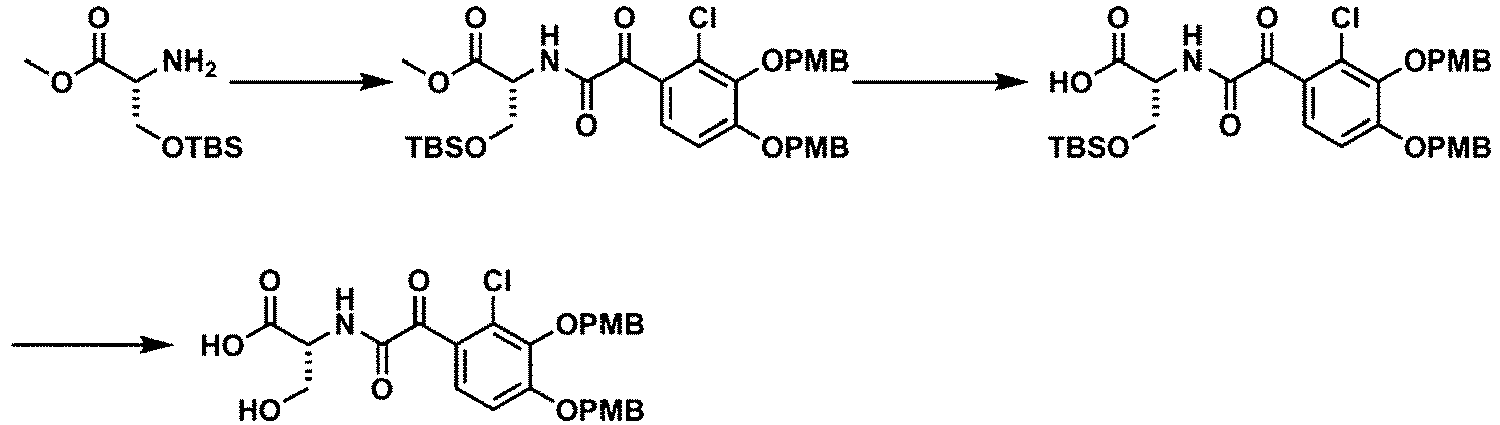
- By using methyl O-(tert-butyldimethylsilyl)-D-serinate (2.3 g), a target substance (2.16 g) was obtained as a light yellow oily substance in the same manner as in reference Example 11.
- By using the compound (2.16 g) obtained in Reference Example 66 (1), a target substance (1.92 g) was obtained as green solids in the same manner as in Reference Example 62 (2).
- THF (8 mL) was added to the compound (400 mg) obtained in Reference Example 66 (2), and the mixture was stirred under ice cooling. At the same temperature, a 1 mol/L tetra-n-butylammonium fluoride/THF solution (912 µL) was added to the reaction mixture, and the reaction mixture was stirred at room temperature overnight. Ethyl acetate (10 mL) and water (10 mL) were added to the reaction mixture, and the organic layer was separated. The aqueous layer was extracted twice by using ethyl acetate (10 mL). The organic layer was washed with a saturated aqueous sodium chloride solution and dehydrated and dried over anhydrous sodium sulfate. The solvent was distilled away under reduced pressure, thereby obtaining (2-(2-chloro-3,4-bis((4-methoxybenzyl)oxy)phenyl)-2-oxoacetyl)-D-serine (313 mg) as green solids.
NMR: 3.74 (3H, s), 3.79 (3H, s), 3.83 (1H, s), 3.89-3.97 (1H, m), 4.17 (1H, dd, J = 11.6, 3.6 Hz), 4.60-4.66 (1H, m), 4.84 (2H, s), 4.96 (2H, s), 6.75 (2H, d, J = 8.8 Hz), 6.81-6.88 (3H, m), 7.20-7.38 (5H, m), 7.56 (1H, d, J = 8.4 Hz), 8.15 (1H, d, J = 7.2 Hz) -
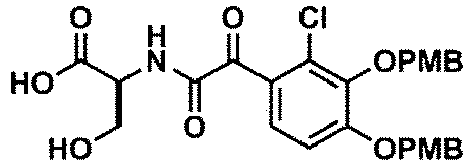
- (2-(2-Chloro-3,4-bis((4-methoxybenzyl)oxy)phenyl)-2-oxoacetyl)-L-serine was obtained in the same manner as in Reference Example 66.
NMR: 3.75 (3H, s), 3.80 (3H, s), 3.83 (1H, s), 3.92-4.00 (1H, m), 4.15-4.22 (1H, m), 4.65-4.71 (1H, m), 4.86 (2H, s), 4.98 (2H, s), 6.74-6.78 (3H, m), 6.83-6.90 (4H, m), 7.22-7.38 (3H, m), 7.56 (1H, d, J = 8.8 Hz), 8.06 (1H, d, J = 6.8 Hz) -

- By using O-(4-methoxybenzyl)hydroxylamine hydrochloride (500 mg), a target substance (1.38 g) was obtained as white solids in the same manner as in Reference Example 2 (1).
- Potassium carbonate (686 mg), acetone (3.5 mL), and 2-bromoacetic acid (345 mg) were sequentially added to the compound (700 mg) obtained in Reference Example 68 (1), and the mixture was stirred at room temperature overnight. DMF (7 mL), potassium carbonate (686 mg), and 2-bromoacetic acid (345 mg) were added to the reaction mixture, and the reaction mixture was stirred at room temperature for 2 days. Ethyl acetate (30 mL), water (30 mL), and 1 mol/L hydrochloric acid were added to the reaction mixture such that the pH was adjusted to 2.3. The organic layer was separated and washed with water and a saturated aqueous sodium chloride solution. The organic layer was dehydrated and dried over anhydrous sodium sulfate, and the solvent was distilled away under reduced pressure. The residue was purified by silica gel column chromatography [eluent; ethyl acetate:hexane = 34:66 → 66:34], thereby obtaining N-(2-chloro-3,4-bis((4-methoxybenzyl)oxy)benzoyl)-N-((4-methoxybenzyl)oxy)glycine (114 mg) as a colorless oily substance.
NMR: 3.78-3.82 (6H, m), 3.83 (3H, s), 4.91-5.00 (4H, m), 5.02-5.12 (4H, m), 6.88-7.00 (11H, m), 7.21-7.40 (4H, m) -

- By using 2-chloro-N-(2-hydroxyethyl)-3,4-bis((4-methoxybenzyl)oxy)benzamide (2.0 g), a target substance (642 mg) was obtained as light yellow solids in the same manner as in Example 65 (1).
- By using the compound (500 mg) obtained in Reference Example 69 (1), a target substance (607 mg) was obtained as light yellow solids in the same manner as in Reference Example 49 (1).
- By using the compound (500 mg) obtained in Reference Example 69 (2), 2-((2-(2-chloro-3,4-bis((4-methoxybenzyl)oxy)benzamido)ethyl)((tetrahydro-2H-pyran-2-yl)o xy)amino)-2-oxoacetic acid (496 mg) was obtained as yellow solids in the same manner as in Reference Example 62 (2).
NMR: 1.45-1.57 (4H, m), 1.65-1.82 (2H, m), 3.15-3.21 (2H, m), 3.48-3.57 (1H, m), 3.63-3.70 (2H, m), 3.80 (3H, s), 3.83 (3H, s), 3.85-3.93 (1H, m), 4.73-4.78 (1H, m), 4.94 (2H, s), 5.08 (2H, s), 6.81-6.86 (2H, m), 6.89-6.94 (3H, m), 6.94-7.00 (1H, m), 7.30-7.38 (5H, m), 7.42 (1H, d, J = 8.8 Hz) -

- THF (14 mL) was added to (S)-2-bromo-3-hydroxypropionic acid (4.4 g), and the mixture was stirred under ice cooling. At the same temperature, diphenylmethyldiazomethane (4.6 g) in a THF (24 mL) solution was added dropwise to the reaction mixture for 40 minutes. The reaction mixture was stirred at room temperature overnight. Ethyl acetate (22 mL) and water (11 mL) were added to the reaction mixture. A saturated aqueous sodium hydrogen carbonate solution (11 mL) was added to the reaction mixture, and the organic layer was separated. The organic layer was washed with a saturated aqueous sodium chloride solution and dehydrated and dried over anhydrous sodium sulfate. The solvent was distilled away under reduced pressure, thereby obtaining benzhydryl (S)-2-bromo-3-hydroxypropanoate (7.52 g) as a light yellow oily substance.
NMR: 2.35 (1H, t, J = 7.2 Hz), 3.92-4.01 (1H, m), 4.02-4.11 (1H, m), 4.43-4.49 (1H, m), 6.91 (1H, s), 7.28-7.40 (10H, m) -

- Benzhydryl (R)-2-bromopentanoate was obtained in the same manner as in Reference Example 70.
NMR: 0.91 (3H, t, J = 7.4 Hz), 1.22-1.52 (2H, m), 1.93-2.12 (2H, m), 4.33 (1H, dd, J = 8.0, 6.8 Hz), 6.89 (1H, s), 7.26-7.40 (10H, m) -

- THF (75 mL) was added to benzhydryl (S)-2-bromo-3-hydroxypropanoate (7.52 g), and the mixture was stirred under ice cooling. At the same temperature, Imidazole (1.68 g), tert-butyl dimethylchlorosilane (3.83 g), and DMF (7.5 mL) were sequentially added to the reaction mixture, and the reaction mixture was stirred at room temperature overnight. Ethyl acetate (180 mL) and water (90 mL) were added to the reaction mixture, and the organic layer was separated. The organic layer was sequentially washed with water and a saturated aqueous sodium chloride solution and dehydrated and dried over anhydrous magnesium sulfate. The solvent was distilled away under reduced pressure. The residue was purified by silica gel column chromatography [eluent; ethyl acetate:hexane = 0:100 → 20:80], thereby obtaining benzhydryl (S)-2-bromo-3-((tert-butyldimethylsilyl)oxy)propanoate (7.0 g) as a light yellow oily substance.
NMR: -0.01 (3H, s), 0.03 (3H, s), 0.81 (9H, s), 3.88-3.96 (1H, m), 4.08-4.16 (1H, m), 4.28-4.35 (1H, m), 6.91 (1H, s), 7.27-7.38 (10H, m) -

- At room temperature, DMF (46mL), N-hydroxyphthalimide (4.73g), and triethylamine (3.24mL) were sequentially added to benzhydryl (S)-2-bromo-3-((tert-butyldimethylsilyl)oxy)propanoate (6.52g). The reaction mixture was stirred at the same temperature for 4 hours. Ethyl acetate (150 mL) and water (50 mL) were sequentially added to the reaction mixture, and the organic layer was separated. The organic layer was washed three times with a saturated aqueous sodium hydrogen carbonate solution and then washed with a saturated aqueous sodium chloride solution. The organic layer was dehydrated and dried over anhydrous sodium sulfate. The solvent was distilled away under reduced pressure, thereby obtaining a target substance (7.82 g) as a light yellow oily substance.
- Dichloromethane (24 mL) was added to the compound (7.82 g) obtained in Reference Example 73 (1), and the mixture was stirred under ice cooling. At the same temperature, methylhydrazine (780 µL) was added to the reaction mixture, and the reaction mixture was stirred for 2 hours and 30 minutes at the same temperature. The reaction mixture was filtered, and the solvent was distilled away under reduced pressure. Methanol (47 mL) was added to the residue, and the mixture was stirred under ice cooling. At the same temperature, 2-(2-((tert-butoxycarbonyl)amino)thiazol-4-yl)-2-oxoacetic acid (4.0 g) was added to the reaction mixture, and the reaction mixture was stirred at room temperature for 2 hours and 30 minutes. Ethyl acetate (80 mL), water (50 mL), and 1 mol/L hydrochloric acid were added to the reaction mixture such that the pH was adjusted to 2.1, and the organic layer was separated. The organic layer was washed with a saturated aqueous sodium chloride solution and dehydrated and dried over anhydrous sodium sulfate. The solvent was distilled away under reduced pressure, hexane (200 mL) was added to the residue, and solids were collected by filtration. The solids were dried, thereby obtaining (R,Z)-5-((benzhydryloxy)carbonyl)-2-(2-((tert-butoxycarbonyl)amino)thiazol-4-yl)-8,8,9,9-tet ramethyl-4,7-dioxa-3-aza-8-siladec-2-enoic acid (8.73 g) as light yellow solids.
NMR: -0.02 (3H, s), 0.02 (3H, s), 0.81 (9H, s), 0.88 (9H, s), 4.09-4.18 (1H, m), 4.19-4.26 (1H, m), 5.11-5.15 (1H, m), 6.97 (1H, s), 7.27-7.34 (11H, m), 7.41 (1H, s), 8.22 (1H, s) -

- In the same manner as in Reference Example 73, (S,Z)-2-(((1-(benzhydryloxy)-1-oxopentan-2-yl)oxy)imino)-2-(2-((tert-butoxycarbonyl)amino) thiazol-4-yl)acetic acid was obtained.
NMR: 0.90 (3H, t, J = 7.4 Hz), 1.32-1.51 (2H, m), 1.53 (9H, s), 1.81-1.99 (2H, m), 5.09 (1H, dd, J = 8.0, 4.4 Hz), 6.93 (1H, s), 7.27-7.36 (11H, m), 7.37 (1H, s) -

- By using benzhydryl 1-((1,3-dioxoisoindoline-2-yl)oxy)cyclobutane-1-carboxylate, (Z)-2-((1-((benzhydryloxy)carbonyl)cyclobutoxy)imino)-2-(2-((tert-butoxycarbonyl)amino)-5-chlorothiazol-4-yl)acetic acid was obtained in the same manner as in Reference Example 73 (2).
NMR: 1.52 (9H, s), 2.07-2.19 (2H, m), 2.55-2.70 (4H, m), 6.94 (1H, s), 7.27-7.38 (12H, m) - The compounds in Table 10 were obtained in the same manner as in Reference Example 75.
[Table 10] Reference Example No. Structural Formula Name 76 
(Z)-2-(((1-(tert-butoxy)-2-methyl-1-oxopropan-2-yl)oxy)i mino)-2-(2-((tert-butoxycarbonyl)amino)-5-methylanisol-4-yl)acetic acid 77 
(Z)-2-((1-((benzhydryloxy)carbonyl)cyclobutoxy)imino)-2-(5-((tert-butoxycarbonyl)amino)-1,2,4-thiadiazol-3-yl) acetic acid - The measured values of NMR of the compounds in the table are as follows. Reference Example 76
NMR (DMSO-d6): 1.39 (9H, s), 1.42 (9H, s), 1.42 (3H, s), 1.46 (3H, s), 2.42 (3H, s), 11.54 (1H, s) - NMR: 1.57 (9H, s), 1.93-2.14 (2H, m), 2.42-2.72 (4H, m), 6.90 (1H, s), 7.20-7.40 (11H, m), 8.95-9.22 (1H, brs)
-

- Dichloromethane (120 mL) was added to (((9H-fluoren-9-yl)methoxy)carbonyl)glycine (6.96 g), and the mixture was stirred under ice cooling. Oxalyl chloride (2.4 mL) and DMF (91 µL) were sequentially added to the reaction mixture. The reaction mixture was stirred at room temperature for 2 hours, and the solvent was distilled away under reduced pressure. Dichloromethane (50 mL) was added to the residue, thereby obtaining an acid chloride in a dichloromethane solution.
- At room temperature, dichloromethane (25 mL), sodium hydrogen carbonate (5.90 g), and water (70 mL) were added to tert-butyl 2-(2-methoxy-2-oxoethyl)hydrazine-1-carboxylate (4.78 g). At the same temperature, the acid chloride in a dichloromethane solution was added dropwise to the reaction mixture. The reaction mixture was stirred at room temperature for 1 hour, and the organic layer was separated. The aqueous layer was extracted by using dichloromethane (20 mL), and the organic layer was dehydrated and dried over anhydrous sodium sulfate. The solvent was distilled away under reduced pressure. The residue was purified by silica gel column chromatography [eluent; ethyl acetate:hexane = 10:90 → 35:65], thereby obtaining a target substance (9.36 g) as white solids.
- Dichloromethane (100 mL) was added to the compound (9.36 g) obtained in Reference Example 78 (1), and the mixture was stirred under ice cooling. At the same temperature, piperidine (5.7 mL) was added to the reaction mixture, and the reaction mixture was stirred at room temperature for 6 hours. The solvent was distilled away under reduced pressure, diethyl ether (20 mL) was added to the residue, and solids were collected by filtration. The residue was purified by silica gel column chromatography [eluent; methanol:chloroform = 0:100 → 10:90], thereby obtaining a target substance (3.03 g) as white solids.
- Dichloromethane (65 mL) was added to the compound (3.0 g) obtained in Reference Example 78 (2), and the mixture was stirred under ice cooling. At the same temperature, a 4 mol/L hydrochloric acid/1,4-dioxane solution (33 mL) was added to the reaction mixture, and the reaction mixture was stirred at room temperature for 1 hour and 30 minutes. The solvent was distilled away under reduced pressure, thereby obtaining a target substance (2.2 g) as white solids.
- Ethanol (22 mL) and p-tolualdehyde (1.6 mL) were added to the compound (2.2 g) obtained in Reference Example 78 (3), and the mixture was stirred at room temperature overnight. Solids were collected by filtration and washed with ethanol (10 mL). The solids were dried, thereby obtaining (E)-1-((4-methylbenzylidene)amino)piperazine-2,5-dione (2.72 g) as white solids.
NMR (DMSO-d6): 2.35 (3H, s), 3.98 (2H, s), 4.32 (2H, s), 7.28 (2H, d, J = 8.0 Hz), 7.67 (2H, d, J = 8.0 Hz), 8.24 (1H, s), 8.31 (1H, s) -
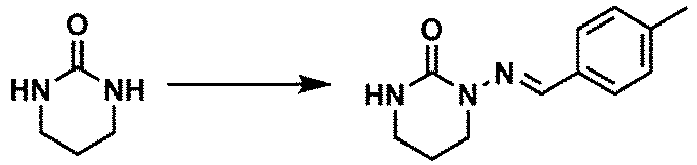
- Concentrated sulfuric acid (69.1 g) was added dropwise to ice water (650 mL) under ice cooling. At the same temperature, tetrahydropyrimidin-2(1H)-one (25.0 g) was added to the reaction mixture. At the same temperature, a 34% aqueous sodium nitrite solution (50 mL) was added dropwise to the reaction mixture. At the same temperature, the reaction mixture was stirred for 1 hour. At the same temperature, zinc dust (37.5 g) was added to the reaction mixture by being divided into 5 portions. The reaction mixture was stirred at 20°C for 2 hours. Celpure (5 g) was added to the reaction mixture, and the reaction mixture was filtered. The residue was washed with water (50 mL). At room temperature, ethanol (100 mL) and p-tolualdehyde (27.0 g) were sequentially added to the filtrate, and the mixture was stirred for 3 hours at the same temperature. Solids were collected by filtration and sequentially washed with water (250 mL) and ethanol (25 mL). The solids were blast-dried at 40°C, thereby obtaining (E)-1-((4-methylbenzylidene)amino)tetrahydropyrimidin-2(1H)-one (7.3 g) as white solids.
-

- In the same manner as in Reference Example 3 (1), a target substance (10.8 g) was obtained as white solids from (2-((2-(trimethylsilyl)ethoxy)methyl)-2H-tetrazol-5-yl)methanamine (4.5 g).
- In the same manner as in Reference Example 66 (3), a target substance (5.75 g) was obtained as white solids from the compound (10.8 g) obtained in Reference Example 80 (1).
- THF (115 mL) was added to the compound (5.75 g) obtained in Reference Example 80 (2), and the mixture was stirred under ice cooling. At the same temperature, N,O-bis(trimethylsilyl)acetamide (2.78 mL) and 4-dimethylaminopyridine (1.38 g) were sequentially added to the reaction mixture, and the reaction mixture was stirred at room temperature for 1 hour. At the same temperature, di-tert-butyl dicarbonate (5.1 mL) was added dropwise to the reaction mixture, and the reaction mixture was stirred at room temperature for 1 hour. Ethyl acetate (200 mL) and water (200 mL) were added to the reaction mixture, and 1 mol/L hydrochloric acid was added thereto such that the pH was adjusted to 3.1. The organic layer was separated and washed with a saturated aqueous sodium chloride solution. The organic layer was dehydrated and dried over anhydrous magnesium sulfate, and the solvent was distilled away under reduced pressure. The residue was purified by silica gel column chromatography [eluent; methanol:chloroform = 0:100 → 10:90], thereby obtaining tert-butyl((2H-tetrazol-5-yl)methyl)(2-chloro-3,4-bis((4-methoxybenzyl)oxy)benzoyl)carbama te (5.56 g) as white solids.
NMR(DMSO-d6): 1.08 (9H, s), 3.75 (3H, s), 3.77 (3H, s), 4.89 (2H, s), 5.17-5.25 (4H, m), 6.84-6.91 (2H, m), 6.94-7.01 (2H, m), 7.20-7.35 (4H, m), 7.41-7.48 (2H, m) - The compounds in Table 11 were obtained in the same manner as in Reference Example 22.
[Table 11] Reference Example No. Structural Formula Name 81 
Benzhydryl (3R,5R,6R)-3-(5-((N-(tert-butoxycarbonyl)-2-chloro-3,4-bis((4-methoxybenzyl)oxy)benzamido)methyl)-2H-tetraz ol-2-yl)-7-oxo-6-(2-phenylacetamido)-4-thia-1-azabicycl o[3.2.0]heptane-3-carboxylate 82 
Benzhydryl (3R,5R,6R)-3-(5-(azidomethyl)-2-oxooxazolidin-3 -yl)-7-oxo-6-(2-phenylacetamido)-4-thia-1-azabicyclo[3.2.0]he ptane-3-carboxylate 83 
4-Nitrobenzyl (3R,5R,6R)-3-(4-(((tert-butoxycarbonyl)amino)methyl)-1 H-1,2,3-triazol-1-yl)-7-oxo-6-(2-phenylacetamido)-4-thia -1-azabicyclo[3.2.0]heptane-3-carboxylate - The measured values of NMR of the compounds in the table are as follows.
- NMR: 1.13 (9H, s), 3.45-3.56 (3H, s), 3.80 (3H, s), 3.82-3.84 (5H, m), 4.95 (2H, s), 5.07 (1H, d, J = 13.6 Hz), 5.11 (2H, s), 5.66-5.72 (2H, m), 6.82-6.88 (4H, m), 6.88-6.96 (5H, m), 7.07-7.42 (18H, m)
- NMR: 3.30-3.64 (6H, m), 3.74-3.89 (1H, m), 4.56-4.69 (1H, m), 4.90 [5.01] (1H, d, J = 13.4 Hz), 5.10-5.19 (2H, m), 6.15-6.31 (1H, m), 6.86 [6.87] (1H, s), 7.12-7.17 (2H, m), 7.20-7.44 (13H, m)
- NMR: 1.46 (9H, s), 3.65 (2H, d, J = 2.4 Hz), 4.12 (1H, dd, J = 13.4, 1.0 Hz), 4.38 (2H, d, J = 5.6 Hz), 4.83 (1H, d, J = 13.2 Hz), 4.94-5.00 (1H, brs), 5.13 (1H, d, J = 13.2 Hz), 5.19 (1H, d, J = 13.6 Hz), 5.64 (1H, d, J = 4.0 Hz), 5.82 (1H, ddd, J = 9.3, 3.9, 0.9 Hz), 6.71 (1H, d, J = 9.6 Hz), 7.22-7.37 (7H, m), 7.65 (1H, s), 8.19-8.27 (2H, m)
-

- Dichloromethane (220 mL) and benzhydryl 2,2-dihydroxyacetate (13.7 g) were sequentially added to (E)-1-(benzylideneamino)piperazine-2,3-dione (11.0 g), and the mixture was stirred under ice cooling. At the same temperature, DBU (0.38 mL) was added to the reaction mixture, and the reaction mixture was stirred at room temperature for 3 hours. At the same temperature, benzhydryl 2,2-dihydroxyacetate (6.85 g) was added to the reaction mixture, and the reaction mixture was stirred overnight. IPE (110 mL) was added to the reaction mixture, and solids were collected by filtration and washed with IPE (50 mL). The solids were dried, thereby obtaining a target substance (21.4 g) as white solids.
- THF (420 mL) was added to the compound (21.0 g) obtained in Reference Example 84 (1), and the mixture was stirred under ice cooling. At the same temperature, 2,6-lutidine (9.1 mL) and thionyl chloride (5.4 mL) were sequentially added to the reaction mixture. The reaction mixture was stirred at room temperature for 2 hours and 30 minutes, and insoluble matters were filtered. The solvent was distilled away under reduced pressure, thereby obtaining a mixture containing a target substance.
- Dichloromethane (420 mL) and N-((2R,3R)-1-(hydroxymethyl)-2-mercapto-4-oxoazetidin-3-yl)-2-phenylacetamide (13.4 g) were sequentially added to the mixture obtained in Reference Example 84 (2), and the mixture was stirred under ice cooling. At the same temperature, triethylamine (7.0 mL) was added to the reaction mixture, and the reaction mixture was stirred for 2 hours. Water (420 mL) and 6 mol/L hydrochloric acid were added to the reaction mixture such that the pH was adjusted to 2.0. The organic layer was separated and sequentially washed with water and a saturated aqueous sodium chloride solution. The organic layer was dehydrated and dried over anhydrous sodium sulfate, and the solvent was distilled away under reduced pressure. The residue was purified by silica gel column chromatography [eluent; ethyl acetate:hexane = 50:50 → 100:0], thereby obtaining a target substance (16.1 g) as white solids.
- THF (370 mL) was added to the compound (18.5 g) obtained in Reference Example 84 (3), and the mixture was stirred under ice cooling. At the same temperature, 2,6-lutidine (4.1 mL) and thionyl chloride (2.48 mL) were sequentially added to the reaction mixture. The reaction mixture was stirred at room temperature for 1 hour and 30 minutes. Insoluble matters were filtered, and the solvent was distilled away under reduced pressure. At room temperature, THF (370 mL) and N,O-bis(trimethylsilyl)acetamide (7.8 mL) were sequentially added to the residue, and the mixture was stirred for 30 minutes. At the same temperature, hexamethylphosphoric triamide (23 mL) was added to the reaction mixture, and the reaction mixture was cooled to -60°C. At the same temperature, a 1.3 mol/L lithium bis(trimethylsilyl)amide/tetrahydrofuran solution (24 mL) was added dropwise to the reaction mixture. The reaction mixture was stirred at -10°C for 1 hour. The reaction mixture was added to a mixture of ethyl acetate (750 mL), water (370 mL), and 1 mol/L hydrochloric acid (52 mL) under ice cooling, and the organic layer was separated. The organic layer was sequentially washed with water and a saturated aqueous sodium chloride solution. The organic layer was dehydrated and dried over anhydrous magnesium sulfate, and the solvent was distilled away under reduced pressure. The residue was purified by silica gel column chromatography [eluent; ethyl acetate:hexane = 40:60 → 80:20], thereby obtaining benzhydryl (3R,5R,6R)-3-(4-(((E)-benzylidene)amino)-2,3-dioxopiperazin-1-yl)-7-oxo-6-(2-phenylacetam ido)-4-thia-1-azabicyclo[3.2.0]heptane-3-carboxylate (6.0 g) as light yellow solids.
NMR: 3.12 (1H, d, J = 13.6 Hz), 3.24 (1H, d, J = 15.2 Hz), 3.29 (1H, d, J = 14.8 Hz), 3.97-4.17 (4H, m), 5.39 (1H, d, J = 13.6 Hz), 5.42-5.49 (2H, m), 5.93 (1H, d, J = 6.8 Hz), 6.92 (1H, s), 7.06-7.14 (2H, m), 7.22-7.49 (16H, m), 7.69-7.78 (2H, m), 9.22 (1H, s) - The compounds in Table 12 were obtained in the same manner as in Reference Example 84.
[Table 12] Reference Example No. Structural Formula Name 85 
Benzhydryl (3R,5R,6R)-3-(4-(((E)-4-methylbenzylidene)amino) -2,5-dioxopiperazin-1-yl)-7-oxo-6-(2-phenylacetami do)-4-thia-1-azabicyclo[3.2.0]heptane-3-carboxylate 86 
Benzhydryl (3R,5R,6R)-3-((S)-3-((tert-butoxycarbonyl)amino)-2-oxopyrrolidin-1-yl)-7-oxo-6-(2-phenylacetamido)-4-thia-1-azabicyclo[3.2.0]heptane-3-carboxylate 87 
Benzhydryl (3R,5R,6R)-3-((R)-3-((tert-butoxycarbonyl)amino)-2-oxopyrrolidin-1-yl)-7-oxo-6-(2-phenylacetamido)-4-thia-1-azabicyclo [3.2.0]heptane-3-carboxylate 88 
Benzhydryl (3R,5R,6R)-3-(3-(((E)-4-methylbenzylidene)amino-2-oxotetrahydropyrimidin-1(2H)-yl)-7-oxo-6-(2-phe nylacetamido)-4-thia-1-azabicyclo[3.2.0]heptane-3-carboxylate - The measured values of NMR of the compounds in the table are as follows.
- NMR: 2.40 (3H, s), 3.10 (1H, dd, J = 13.4, 1.0 Hz), 3.30 (2H, s), 4.19-4.41 (2H, m), 4.42-4.60 (2H, m), 5.29 (1H, d, J = 13.2 Hz), 5.46 (1H, d, J = 3.6 Hz), 5.52 (1H, dd, J = 8.0, 2.8 Hz), 6.05 (1H, d, J = 8.0 Hz), 6.92 (1H, s), 7.08-7.14 (2H, m), 7.20-7.43 (14H, m), 7.60-7.68 (3H, m), 8.59 (1H, s)
- NMR: 1.45 (9H, s), 1.86-2.01 (1H, m), 2.53-2.66 (1H, m), 3.25 (1H, dd, J = 13.4, 1.0 Hz), 3.34 (2H, s), 3.46-3.56 (1H, m), 3.59-3.69 (1H, m), 3.97-4.09 (1H, m), 4.79-4.93 (1H, m), 5.01 (1H, d, J = 13.2 Hz), 5.44 (1H, d, J = 4.0 Hz), 5.54 (1H, dd, J = 8.6, 3.0 Hz), 6.29 (1H, d, J = 8.4 Hz), 6.85 (1H, s), 7.11-7.18 (2H, m), 7.19-7.43 (13H, m)
- NMR: 1.46 (9H, s), 1.74-1.89 (1H, m), 2.55-2.72 (1H, m), 3.18 (1H, dd, J = 13.2, 0.8 Hz), 3.33 (2H, s), 3.50-3.63 (2H, m), 4.16-4.33 (1H, m), 4.63-4.78 (1H, m), 5.02 (1H, d, J = 13.2 Hz), 5.46 (1H, d, J = 3.6 Hz), 5.52 (1H, dd, J = 8.2, 3.4 Hz), 6.28 (1H, d, J = 8.4 Hz), 6.85 (1H, s), 7.10-7.16 (2H, m), 7.18-7.43 (13H, m)
- NMR: 2.15-2.26 (2H, m), 2.38 (3H, s), 3.18 (1H, dd, J = 13.4, 1.0 Hz), 3.29 (2H, s), 3.53-3.77 (4H, m), 5.19 (1H, d, J = 13.6 Hz), 5.41 (1H, d, J = 3.6 Hz), 5.49 (1H, ddd, J = 8.4, 3.8, 0.8 Hz), 6.28 (1H, d, J = 8.4 Hz), 6.91 (1H, s), 7.11-7.42 (17H, m), 7.62 (2H, d, J = 8.4 Hz), 7.94 (1H, s)
- The compounds in Table 13 were obtained in the same manner as in Reference Example 27.
[Table 13] Reference Example No. Structural Formula Name 89 
Benzhydryl (3R,5R,6R)-3-(4-amino-2,3-dioxopiperazin-1-yl)-6-((Z)-2-(2-aminothiazol-4-yl)-2-(((1-(tert-butoxy)-2-methyl-1-oxopropan-2-yl)oxy)imino)acetamido)-7-o xo-4-thia-1-azabicyclo[3.2.0]heptane-3-carboxylate 90 
Benzhydryl (3R,5R,6R)-3-(4-amino-2,3 -dioxopiperazin-1-yl)-6-((Z)-2-(((1-(tert-butoxy)-2-methyl-1-oxopropan-2-yl )oxy)imino)-2-((tert-butoxycarbonyl)amino)thiazol-4-yl)acetamido)-7-oxo-4-thia-1-azabicyclo[3.2.0]he ptane-3-carboxylate 91 
Benzhydryl (3R,5R,6R)-3-(4-amino-2,5-dioxopiperazin-1-yl)-6-((Z)-2-((2-aminothiazol-4-yl)-2-(((1-(tert-butoxy)-2-methyl-1-oxopropan-2-yl)oxy)imino)acetamido)-7-o xo-4-thia-1-azabicyclo[3.2.0]heptane-3-carboxylate 92 
Benzhydryl (3R,5R,6R)-3-(3-amino-2-oxotetrahydropyrimidin-1 (2H)-yl)-6-((Z)-2-(2-aminothiazol-4-yl)-2-(((1-(tert-butoxy)-2-methyl-1-oxopropan-2-yl)oxy)imino)acet amido)-7-oxo-4-thia-1-azabicyclo[3.2.0]heptane-3-c arboxylate 93 
Benzhydryl (3R,5R,6R)-3-(4-amino-2,3-dioxopiperazin-1-yl)-6-((Z)-2-(5-bromo-2-((tert-butoxycarbonyl)amino)thia zol-4-yl)-2-(((1-(tert-butoxy)-2-methyl-1-oxopropan -2-yl)oxy)imino)acetamido)-7-oxo-4-thia-1-azabicy clo[3.2.0]heptane-3-carboxylate 94 
Benzhydryl (3R,5R,6R)-3-(4-amino-2,3-dioxopiperazin-1-yl)-6-((Z)-2-(((1-(tert-butoxy)-2-methyl-1-oxopropan-2-yl )oxy)imino)-2-(5-((tert-butoxycarbonyl)amino)-1,2, 4-thiadiazol-3-yl)acetamido)-7-oxo-4-thia-1-azabicy clo[3.2.0]heptane-3-carboxylate 95 
Benzhydryl (3R,5R,6R)-3-(4-amino-2,3-dioxopiperazin-1-yl)-6-((Z)-2-(((1-(tert-butoxy)-2-methyl-1-oxopropan-2-yl )oxy)imino)-2-(2-((tert-butoxycarbonyl)amino)-5-ch lorothiazol-4-yl)acetamido)-7-oxo-4-thia-1-azabicyc lo[3.2.0]heptane-3-carboxylate - The measured values of NMR of the compounds in the table are as follows.
- NMR: 1.40 (9H, s), 1.50 (6H, s), 3.12 (1H, d, J = 13.6 Hz), 3.71-3.85 (2H, m), 3.97-4.07 (2H, m), 5.42 (1H, d, J = 13.6 Hz), 5.53 (1H, d, J = 3.6 Hz), 5.66 (1H, dd, J = 7.2, 3.2 Hz), 6.10 (2H, s), 6.78 (1H, s), 6.84-6.92 (2H, m), 7.06-7.12 (1H, m), 7.15-7.44 (11H, m)
- NMR: 1.40 (9H, s), 1.52 (3H, s), 1.52 (3H, s), 1.55 (9H, s), 3.11 (1H, dd, J = 13.6, 0.8 Hz), 3.69-3.86 (2H, m), 3.92-4.12 (2H, m), 4.59 (2H, s), 5.47 (1H, d, J = 13.6 Hz), 5.54 (1H, d, J = 3.6 Hz), 5.65 (1H, dd, J = 6.8, 3.6 Hz), 6.86 (1H, s), 7.00-7.08 (1H, m), 7.13-7.45 (11H, m), 8.14 (1H, s)
- NMR: 1.40 (9H, s), 1.50 (3H, s), 1.51 (3H, s), 3.10 (1H, d, J = 13.6 Hz), 3.92-4.17 (2H, m), 4.30-4.46 (4H, m), 5.40 (1H, d, J = 13.6 Hz), 5.50 (1H, d, J = 3.6 Hz), 5.76 (1H, dd, J = 7.8, 3.4 Hz), 6.07 (2H, s), 6.80 (1H, s), 6.88 (1H, s), 7.14-7.33 (11H, m)
- NMR: 1.39 (9H, s), 1.46 (3H, s), 1.48 (3H, s), 2.01-2.12 (2H, m), 3.17 (1H, dd, J = 13.4, 1.0 Hz), 3.36-3.48 (2H, m), 3.63 (2H, t, J = 6.0 Hz), 3.84-3.99 (2H, brs), 5.16 (1H, d, J = 13.6 Hz), 5.47 (1H, d, J = 4.0 Hz), 5.75 (1H, ddd, J = 8.6, 3.8, 0.8 Hz), 6.63 (2H, s), 6.77 (1H, s), 6.89 (1H, s), 7.01 (1H, d, J = 8.4 Hz), 7.14-7.43 (10H, m)
- NMR: 1.42 (9H, s), 1.51-1.56 (15H, m), 3.08 (1H, dd, J = 13.8, 1.0 Hz), 3.70-3.86 (2H, m), 3.99-4.07 (2H, m), 4.58 (2H, s), 5.49 (1H, d, J = 13.6 Hz), 5.53 (1H, d, J = 3.6 Hz), 5.64 (1H, dd, J = 7.2, 3.6 Hz), 6.86 (1H, s), 6.93-7.44 (11H, m), 8.07 (1H, s)
- NMR: 1.41 (9H, s), 1.55 (9H, s), 1.56 (3H, s), 1.58 (3H, s), 3.10 (1H, d, J = 12.8 Hz), 3.72-3.86 (2H, m), 4.00-4.09 (2H, m), 4.59 (2H, s), 5.47 (1H, d, J = 13.6 Hz), 5.54 (1H, d, J = 3.6 Hz), 5.66 (1H, d, J = 7.8, 3.0 Hz), 6.82 (1H, d, J = 7.2 Hz), 6.87 (1H, s), 6.98-7.06 (1H, m), 7.08-7.45 (9H, m), 8.41 (1H, s)
- NMR: 1.42 (9H, s), 1.53 (9H, s), 1.54 (6H, s), 3.08 (1H, d, J = 12.4 Hz), 3.70-3.85 (2H, m), 3.97-4.08 (2H, m), 4.58 (2H, s), 5.49 (1H, d, J = 14.0 Hz), 5.53 (1H, d, J = 4.0 Hz), 5.64 (1H, d, J = 7.2, 3.2 Hz), 6.87 (1H, s), 6.97-7.01 (1H, m), 7.07-7.14 (1H, m), 7.17-7.43(9H,m), 7.95 (1H, s)
- The compounds in Table 14 were obtained in the same manner as in Reference Example 27 (1).
[Table 14] Reference Example No. Structural Formula Name 96 
Benzhydryl (3R,5R,6R)-6-((Z)-2-(2-aminothiazol-4-yl)-2-(((1-(t ert-butoxy)-2-methyl-1-oxopropan-2-yl)oxy)imino)a cetamido)-3-(5-((N-(tert-butoxycarbonyl)-2-chloro-3,4-bis((4-methoxybenzyl)oxy)benzamido)methyl)-2H-tetrazol-2-yl)-7-oxo-4-thia-1-azabicyclo[3.2.0]h eptane-3-carboxylate 97 
Benzhydryl (3R,5R,6R)-3-(5-(azidomethyl)-2-oxooxazolidin-3-yl)-6-((Z)-2-(((1-(tert-butoxy)-2-methyl-1-oxopropa n-2-yl)oxy)imino)-2-(2-((tert-butoxycarbonyl)amino )thiazol-4-yl)acetamido)-7-oxo-4-thia-1-azabicyclo[ 3.2.0]heptane-3-carboxylate 98 
4-Nitrobenzyl (3R,5R,6R)-6-((Z)-2-(2-aminothiazol-4-yl)-2-(((1-(t ert-butoxy)-2-methyl-1-oxopropan-2-yl)oxy)imino)a cetamido)-3-(4-(((tert-butoxycarbonyl)amino)methy 1)-1H-1,2,3-triazol-1-yl)-7-oxo-4-thia-1-azabicyclo[ 3.2.0]heptane-3-carboxylate 99 
Benzhydryl (3R,5R,6R)-6-((Z)-2-(2-aminothiazol-4-yl)-2-(((1-(t ert-butoxy)-2-methyl-1-oxopropan-2-yl)oxy)imino)a cetamido)-3-((S)-3-((tert-butoxycarbonyl)amino)-2-oxopyrrolidin-1-yl)-7-oxo-4-thia-1-azabicyclo[3.2.0 ]heptane-3-carboxylate 100 
Benzhydryl (3R,5R,6R)-6-((Z)-2-(2-aminothiazol-4-yl)-2-(((1-(t ert-butoxy)-2-methyl-1-oxopropan-2-yl)oxy)imino)a cetamido)-3-((R)-3-((tert-butoxycarbonyl)amino)-2-oxopyrrolidin-1-yl)-7-oxo-4-thia-1-azabicyclo[3.2.0 ]heptane-3-carboxylate - The measured values of NMR of the compounds in the table are as follows.
- NMR: 1.09-1.19 (9H,m), 1.36-1.60 (15H, m), 3.78-3.85 (6H, m), 4.94 (2H, s), 5.06-5.15 (3H, m), 5.30-5.38 (1H, m), 5.55-5.65 (1H, m), 5.72-5.76 (1H, m), 5.88-6.00 (1H, m), 6.81-6.87 (2H, m), 6.88-6.95 (4H, m), 7.10-7.40 (15H, m)
- NMR: 1.39 (9H, s), 1.51 (3H, s), 1.53 (3H, s), 1.54 (9H, s), 3.33 (1H, d, J = 5.2 Hz), 3.43-3.66 (3H, m), 3.82 [3.91] (1H, t, J = 8.4 Hz), 4.58-4.70 (1H, m), 5.00 [5.06] (1H, d, J = 13.2 Hz), 5.61-5.66 (1H, m), 5.74-5.85 (1H, m), 6.87 (1H, s), 7.13-7.21 (1H, m), 7.22-7.56 (11H, m), 8.09 (1H, s)
- NMR: 1.42 (9H, s), 1.46 (3H, s), 1.46 (3H, s), 1.46 (9H, s), 4.08 (1H, d, J = 13.6 Hz), 4.39 (2H, d, J = 5.6 Hz), 4.92 (1H, d, J = 13.2 Hz), 5.18-5.38 (2H, m), 5.75 (1H, d, J = 4.0 Hz), 5.95 (1H, dd, J = 8.4, 4.4 Hz), 6.27 (2H, s), 6.88 (1H, s), 6.94-7.01 (1H, m), 7.38-7.45 (2H, m), 7.61-7.73 (2H, m), 8.13-8.19 (2H, m)
- NMR: 1.40 (9H, s), 1.44 (9H, s), 1.48 (3H, s), 1.50 (3H, s), 1.89-2.03 (1H, m), 2.50-2.68 (1H, m), 3.34 (1H, d, J = 13.2 Hz), 3.49-3.59 (1H, m), 3.68 (1H, t, J = 8.6 Hz), 3.99-4.09 (1H, m), 4.84-4.97 (1H, m), 5.09 (1H, d, J = 13.6 Hz), 5.54 (1H, d, J = 4.0 Hz), 5.78 (1H, dd, J = 8.6, 3.8 Hz), 6.66-6.76 (2H, brs), 6.76 (1H, s), 6.85 (1H, s), 6.86-6.94 (1H, m), 7.12-7.45 (10H, m)
- NMR: 1.39 (9H, s), 1.44 (9H, s), 1.48 (3H, s), 1.49 (3H, s), 1.78-1.91 (1H, m), 2.51-2.71 (1H, m), 3.28 (1H, d, J = 13.2 Hz), 3.48-3.65 (2H, m), 4.17-4.35 (1H, m), 4.69-4.80 (1H, m), 5.10 (1H, d, J = 13.6 Hz), 5.57 (1H, d, J = 3.6 Hz), 5.78 (1H, dd, J = 8.2, 3.8 Hz), 6.39-6.67 (2H, brs), 6.79 (1H, s), 6.86 (1H, s), 7.05-7.14 (1H, m), 7.18-7.43 (10H, m)
-
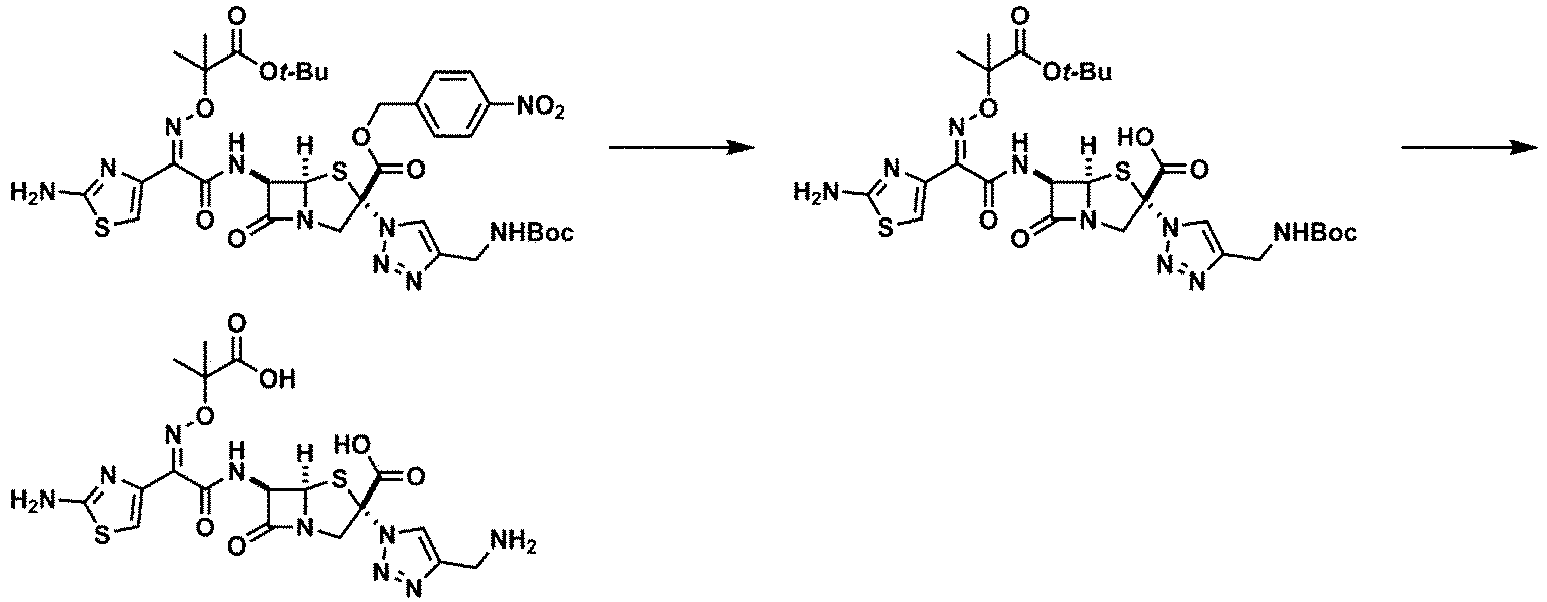
- Ethyl acetate (3 mL) and 10% palladium-carbon (300 mg) were added to 4-nitrobenzyl(3R,5R,6R)-6-((Z)-2-(2-aminothiazol-4-yl)-2-(((1-(tert-butoxy)-2-methyl-1-oxop ropan-2-yl)oxy)imino)acetamido)-3-(4-(((tert-butoxycarbonyl)amino)methyl)-1H-1,2,3-triazol -1-yl)-7-oxo-4-thia-1-azabicyclo[3.2.0]heptane-3-carboxylate (300 mg), and the mixture was stirred at room temperature for 3 hours in a hydrogen atmosphere. The reaction mixture was filtered through celite, and the residue was washed with ethyl acetate. The solvent was distilled away under reduced pressure, thereby obtaining a target substance (233 mg) as yellow solids.
- Dichloromethane (3.5 mL) and nitromethane (1.2 mL) were added to the compound (230 mg) obtained in Reference Example 101 (1), and the mixture was stirred at -20°C. At the same temperature, anisole (1.4 mL) and aluminum chloride (353 mg) were sequentially added to the reaction mixture. The reaction mixture was stirred at a temperature equal to or lower than -20°C for 1 hour and 30 minutes. At the same temperature, trifluoroacetic acid (0.13 mL) was added to the reaction mixture, and the reaction mixture was stirred at a temperature equal to or lower than -10°C for 1 hour 30 minutes. The reaction mixture was added to a mixture of acetonitrile (10 mL), water (10 mL), and trisodium citrate dihydrate (1.17 g) under ice cooling. A saturated aqueous sodium hydrogen carbonate solution was added to the reaction mixture such that the pH was adjusted to 5.1, and the aqueous layer was separated. The aqueous layer was concentrated under reduced pressure, and the residue was purified by medium-pressure reverse-phase silica gel column chromatography [eluent; water:acetonitrile = 100:0 → 85:15]. The aqueous solution containing a target substance was concentrated under reduced pressure and lyophilized, thereby obtaining (3R,5R,6R)-3-(4-(aminomethyl)-1H-1,2,3-triazol-1-yl)-6-((Z)-2-(2-aminothiazol-4-yl)-2-(((2-carboxypropan-2-yl)oxy)imino)acetamido)-7-oxo-4-thia-1-azabicyclo[3.2.0]heptane-3-carbox ylate (40 mg) as white solids.
NMR (D2O): 1.50 (3H, s), 1.52 (3H, s), 4.08 (1H, dd, J = 13.2, 1.2 Hz), 4.36 (2H, s), 4.74 (1H, d, J = 13.2 Hz), 5.64 (1H, d, J = 3.6 Hz), 5.81 (1H, dd, J = 3.6, 1.2 Hz), 7.04 (1H, s), 7.92 (1H, s) -

- In the same manner as in Reference Example 101(1), benzhydryl(3R,5R,6R)-3-(5-(aminomethyl)-2-oxooxazolidin-3-yl)-6-((Z)-2-(((1-(tert-Butoxy)-2-methyl-1-oxopropan-2-yl)oxy)imino)-2-(2-((tert-butoxycarbonyl)amino)thiazol-4-yl)acetam ido)-7-Oxo-4-thia-1-azabicyclo[3.2.0]heptane-3-carboxylate was obtained.
NMR: 1.39 [1.39] (9H, s), 1.50 (3H, s), 1.52 (3H, s), 1.54 (9H, s), 2.73 [2.76] (1H, d, J = 5.8 Hz), 2.92-3.01 (1H, m), 3.55-3.63 (2H, m), 3.76 [3.86] (1H, t, J = 7.9 Hz), 4.54-4.61 (1H, m), 4.95 [5.05] (1H, d, J = 13.2 Hz), 5.61 [5.62] (1H, d, J = 3.8 Hz), 5.72-5.84 (1H, m), 6.88 (1H, s), 7.13-7.53 (15H, m) - The compounds of Table 15 were obtained in the same manner as in Reference Example 101 (2).
[Table 15] Reference Example No. Structural Formula Name 103 
(3R,5R,6R)-3-((S)-3-amino-2-oxopyrrolidin-1-yl)-6-((Z)-2-(2-aminothiazol-4-yl)-2-(((2-carboxypropan-2-yl)oxy)i mino)acetamido)-7-oxo-4-thia-1-azabicyclo[3.2.0]heptan e-3-carboxylate 104 
(3R,5R,6R)-3-((R)-3-amino-2-oxopyrrolidin-1-yl)-6-((Z)-2-(2-aminothiazol-4-yl)-2-(((2-carboxypropan-2-yl)oxy)i mino)acetamido)-7-oxo-4-thia-1-azabicyclo[3.2.0]heptan e-3-carboxylate - The measured values of NMR of the compounds in the table are as follows.
- NMR (D2O): 1.49 (3H, s), 1.51 (3H, s), 2.10-2.24 (1H, m), 2.59-2.72 (1H, m), 3.38 (1H, dd, J = 12.8, 1.2 Hz), 3.72-3.82 (1H, m), 3.86 (1H, t, J = 9.2 Hz), 4.25 (1H, dd, J = 10.4, 9.2 Hz), 4.82 (1H, d, J = 12.8 Hz), 5.68 (1H, d, J = 3.6 Hz), 5.72 (1H, dd, J = 3.6, 1.2 Hz), 7.05 (1H, s)
- NMR (D2O): 1.50 (3H, s), 1.51 (3H, s), 2.12-2.26 (1H, m), 2.61-2.73 (1H, m), 3.36 (1H, dd, J = 12.8, 1.2 Hz), 3.67-3.80 (1H, m), 3.80-3.93 (1H, m), 4.23 (1H, dd, J = 10.0, 9.2 Hz), 4.82 (1H, d, J = 12.8 Hz), 5.68 (1H, d, J = 3.6 Hz), 5.72 (1H, dd, J = 3.6, 1.2 Hz), 7.06 (1H, s)
- The compounds in Table 16 were obtained in the same manner as in Reference Example 35.
[Table 16] Reference Example No Structural Formula Name 105 
Benzhydryl (3R,5R,6R)-3-(3-amino-2-oxoimidazolidin-1-yl)-6-((Z)-2-(((( S)-1-(benzhydryloxy)-1-oxobutan-2-yl)oxy)imino)-2-(2-((tert-butoxycarbonyl)amino)thiazol-4-yl)acetamido)-7-oxo-4-thia-1 -azabicyclo[3.2.0]heptane-3-carboxylate 106 
Benzhydryl (3R,5R,6R)-3-(3-amino-2-oxoimidazolidin-1-yl)-6-((Z)-2-((1-( (benzhydryloxy)carbonyl)cyclopropoxy)imino)-2-(5-((tert-but oxycarbonyl)amino)-1,2,4-thiadiazol-3-yl)acetamido)-7-oxo-4 -thia-1-azabicyclo[3.2.0]heptane-3-carboxylate 107 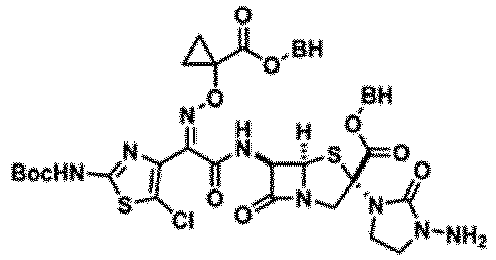
Benzhydryl (3R,5R,6R)-3-(3-amino-2-oxoimidazolidin-1-yl)-6-((Z)-2-((1-( (benzhydryloxy)carbonyl)cyclopropoxy)imino)-2-(2-((tert-but oxycarbonyl)amino)-5-chlorothiazol-4-yl)acetamido)-7-oxo-4-thia-1-azabicyclo[3.2.0]heptane-3-carboxylate 108 
Benzhydryl (3R,5R,6R)-3-(3-amino-2-oxoimidazolidin-1-yl)-6-((Z)-2-((1-( (benzhydryloxy)carbonyl)cyclobutoxy)imino)-2-(2-((tert-buto xycarbonyl)amino)-5-chlorothiazol-4-yl)acetamido)-7-oxo-4-t hia-1-azabicyclo[3.2.0]heptane-3-carboxylate 109 
Benzhydryl (3R,5R,6R)-3-(3-amino-2-oxoimidazolidin-1-yl)-6-((Z)-2-((1-((benzhydryloxy)carbonyl)cyclobutoxy)imino)-2-(5-((tert-buto xycarbonyl)amino)-1,2,4-thiadiazol-3-yl)acetamido)-7-oxo-4-t hia-1-azabicyclo[3.2.0]heptane-3-carboxylate 110 
Benzhydryl (3R,5R,6R)-3-(3-amino-2-oxoimidazolidin-1-yl)-6-((Z)-2-(((1 -(tert-butoxy)-2-methyl-1-oxopropan-2-yl)oxy)imino)-2-(2-((t ert-butoxycarbonyl)amino)-5-methylthiazol-4-yl)acetamido)-7 -oxo-4-thia-1-azabicyclo[3.2.0]heptane-3-carboxylate 11 1 
Benzhydryl (3R,5R,6R)-3-(3-amino-2-oxoimidazolidin-1-yl)-6-((Z)-2-(5-b romo-2-((tert-butoxycarbonyl)amino)thiazol-4-yl)-2-(((1-(tert-butoxy)-2-methyl-1-oxopropan-2-yl)oxy)imino)acetamido)-7-oxo-4-thia-1-azabicyclo[3.2.0]heptane-3-carboxylate 112 
Benzhydryl (3R,5R,6R)-3-(3-amino-2-oxoimidazolidin-1-yl)-6-((Z)-2-(((( S)-1-(benzhydryloxy)-3-methyl-1-oxobutan-2-yl)oxy)imino)-2 -(2-((tert-butoxycarbonyl)amino)thiazol-4-yl)acetamido)-7-ox o-4-thia-1-azabicyclo[3.2.0]heptane-3-carboxylate 113 
Benzhydryl (3R,5R,6R)-3-(3-amino-2-oxoimidazolidin-1-yl)-6-((Z)-2-(((( S)-1-(benzhydryloxy)-1-oxopentan-2-yl)oxy)imino)-2-(2-((tert -butoxycarbonyl)amino)thiazol-4-yl)acetamido)-7-oxo-4-thia-1-azabicyclo[3.2.0]heptane-3-carboxylate 114 
Benzhydryl (3R,5R,6R)-3-(3-amino-2-oxoimidazolidin-1-yl)-6-((R,Z)-5-(b enzhydryloxy)carbonyl-2-(2-((tert-butoxycarbonyl)amino)thia zol-4-yl)-8,8,9,9-tetramethyl-4,7-dioxa-3-aza-8-siladec-2-ena mido)-7-oxo-4-thia-1-azabicyclo[3.2.0]heptane-3-carboxylate - The measured values of NMR of the compounds in the table are as follows.
- NMR: 0.94 (3H, t, J = 7.4 Hz), 1.55 (9H, s), 1.85-2.02 (2H, m), 3.30-3.57 (5H, m), 3.84 (2H, s), 4.91 (1H, dd, J = 7.8, 5.2 Hz), 5.03 (1H, d, J = 13.2 Hz), 5.56 (1H, d, J = 3.6 Hz), 5.64 (1H, dd, J = 6.6, 3.4 Hz), 6.86 (1H, s), 6.90 (1H, s), 7.01-7.09 (1H, m), 7.12-7.40 (20H, m), 7.58 (1H, d, J = 6.8 Hz), 8.11 (1H, s)
- NMR: 1.51-1.64 (4H, m), 1.58 (9H, s), 3.33-3.55 (5H, m), 3.82 (2H, s), 4.91 (1H, d, J = 13.6 Hz), 5.56 (1H, d, J = 4.0 Hz), 5.78 (1H, dd, J = 8.6, 3.4 Hz), 6.83 (1H, s), 6.87 (1H, s), 7.07-7.14 (2H, m), 7.16-7.42 (19H, m), 8.60 (1H, s)
- NMR: 1.46-1.59 (4H, m), 1.53 (9H, s), 3.32-3.54 (5H, m), 3.81 (2H, s), 4.92 (1H, d, J = 13.2 Hz), 5.53 (1H, d, J = 4.0 Hz), 5.75 (1H, dd, J = 8.6, 3.8 Hz), 6.82 (1H, s), 6.89 (1H, s), 7.14-7.43 (21H, m), 8.08 (1H, s)
- NMR: 1.52 (9H, s), 1.90-2.02 (2H, m), 2.37-2.66 (4H, m), 3.35-3.51 (5H, m), 3.82 (2H, s), 4.95 (1H, d, J = 13.2 Hz), 5.52 (1H, d, J = 3.6 Hz), 5.77 (1H, dd, J = 9.4, 3.4 Hz), 6.83 (1H, s), 6.89 (1H, s), 7.13-7.42 (22H, m), 8.11 (1H, s)
- NMR: 1.57 (9H, s), 1.97-2.09 (2H, m), 2.45-2.59 (2H, m), 2.60-2.71 (2H, m), 3.31-3.47 (4H, m), 3.50 (1H, dd, J = 13.2,0.8 Hz), 3.83 (2H, s), 4.93 (1H, d, J = 13.2 Hz), 5.54 (1H, d, J = 3.6 Hz), 5.80 (1H, dd, J = 8.6, 3.4 Hz), 6.83 (1H, s), 6.88 (1H, s), 7.02-7.13 (2H, m), 7.16-7.43 (19H, m), 8.63 (1H, s)
- NMR: 1.39 (9H, s), 1.47-1.55 (15H, m), 2.48 (3H, s), 3.37-3.56 (5H, m), 3.82 (2H, s), 4.96 (1H, d, J = 13.2 Hz), 5.56 (1H, d, J = 4.0 Hz), 5.83 (1H, dd, J = 9.2, 4.0 Hz), 6.88 (1H, s), 7.13-7.21 (2H, m), 7.22-7.39 (9H, m), 7.94 (1H, s)
- NMR: 1.40 (9H, s), 1.50-1.56 (15H, m), 3.40-3.56 (5H, m), 3.82 (2H, s), 4.95 (1H, d, J = 13.2 Hz), 5.56 (1H, d, J = 4.0 Hz), 5.79 (1H, dd, J = 8.4, 3.8 Hz), 6.88 (1H, s), 7.17-7.42 (11H, m), 8.14 (1H, s)
- NMR: 0.90 (3H, d, J = 6.8 Hz), 1.00 (3H, d, J = 7.2 Hz), 1.55 (9H, s), 2.25-2.38 (1H, m), 3.39-3.58 (5H, m), 3.85 (2H, s), 4.84 (1H, d, J = 4.8 Hz), 5.06 (1H, d, J = 13.2 Hz), 5.52-5.57 (1H, m), 5.59 (1H, d, J = 3.6 Hz), 6.86 (1H, s), 6.91 (1H, s), 6.99-7.05 (1H, m), 7.09-7.41 (20H, m), 7.81 (1H, d, J = 5.6 Hz), 8.13 (1H, s)
- NMR: 0.88 (3H, t, J = 7.4 Hz), 1.34-1.46 (2H, m), 1.55 (9H, s), 1.82-1.92 (2H, m), 3.48-3.56 (5H, m), 3.86 (2H, s), 4.97 (1H, t, J = 6.8 Hz), 5.05 (1H, d, J = 13.2 Hz), 5.57 (1H, d, J = 4.0 Hz), 5.64 (1H, dd, J = 6.6, 3.4 Hz), 6.86 (1H, s), 6.89 (1H, s), 7.01-7.08 (1H, m), 7.11-7.41 (20H, m), 7.53 (1H, d, J = 7.2 Hz), 8.12 (1H, s)
- NMR: -0.04 (6H, s), 0.82 (9H, s), 1.55 (9H, s), 3.24-3.41 (4H, m), 3.50 (1H, d, J = 12.8 Hz), 3.82 (2H, s), 4.09-4.16 (2H, m), 5.01 (1H, d, J = 13.2 Hz), 5.05 (1H, t, J = 4.6 Hz), 5.50 (1H, d, J = 4.0 Hz), 5.77 (1H, dd, J = 8.8, 3.6 Hz), 6.83 (1H, s), 6.90 (1H, s), 6.99-7.08 (1H, m), 7.09-7.43 (21H, m), 8.15 (1H, s)
-

- Paraformaldehyde (123 mg) and NMP (1 mL) were added to benzhydryl (3R,SR,6R)-3-(3-amino-2-oxoimidazolidin-1-yl)-6-((Z)-2-(((1-(tert-butoxy)-2-methyl 1-oxopropan-2-yl)oxy)imino)-2-(2-((tert-butoxycarbonyl)amino)thiazol-4-yl)acetamido)-7-ox o-4-thia-1-azabicyclo[3.2.0] heptane-3-carboxylate (100 mg), and the mixture was stirred at room temperature overnight. Acetic acid (14 µL) was added to the reaction mixture, and the mixture was stirred at room temperature for 8 hours. The reaction mixture was stirred at 50°C for 10 hours. The reaction mixture was cooled to room temperature, ethyl acetate (5 mL) and water (5 mL) were added to the reaction mixture, and the organic layer was separated. The organic layer was washed twice with a 5% aqueous sodium chloride solution. The organic layer was dehydrated and dried over anhydrous sodium sulfate, and the solvent was distilled away under reduced pressure. Dichloromethane (1 mL) was added to the residue, and a 85% borane-2-picoline complex (18 mg) and p-toluenesulfonic acid monohydrate (31 mg) were sequentially added thereto under ice cooling, and the reaction mixture was stirred at room temperature for 1 hour. At room temperature, ethyl acetate (5 mL) and water (5 mL) were added to the reaction mixture, and the organic layer was separated. The organic layer was washed twice with a 5% aqueous sodium chloride solution and then dehydrated and dried over anhydrous sodium sulfate. The solvent was distilled away under reduced pressure. The residue was purified by silica gel column chromatography [eluent; ethyl acetate:hexane = 70:30 → 100:0], thereby obtaining benzhydryl (3R,5R,6R)-6-((Z)-2-(((1-(tert-butoxy)-2-methyl-1-oxopropan-2-yl)oxy)imino)-2-(2-((tert-but oxycarbonyl)amino)thiazol-4-yl)acetamido)-3-(3-methylamino)-2-oxoimidazolidin-1-yl)-7-ox o-4-thia-1-azabicyclo[3.2.0]heptane-3-carboxylate (52 mg) as a yellow oily substance.
NMR: 1.39 (9H, s), 1.51 (3H, s), 1.53 (3H, s), 1.54 (9H, s), 2.57 (3H, s), 3.39-3.57(6H,m), 4.91 (1H, d, J = 13.2 Hz), 5.58 (1H, d, J = 4.0 Hz), 5.81 (1H, dd, J = 8.6, 3.4 Hz), 6.87 (1H, s), 7.15-7.41(13H,m) -

- THF (4.2 mL) and water (4.2 mL) were added to benzhydryl (3R,5R,6R)-3-(3-amino-2-oxoimidazolidin-1-yl)-6-((Z)-2-((1-((benzhydryloxy)carbonyl)cyclo butoxy)imino)-2-(2-((tert-butoxycarbonyl)amino)thiazol-4-yl)acetamido)-7-oxo-4-thia-1-azabi cyclo[3.2.0]heptane-3-carboxylate (104 mg), and the mixture was stirred under ice cooling. At the same temperature, sodium hydrogen carbonate (11 mg) was added to the reaction mixture, and then 2-chloro-3,4-bis((4-methoxybenzyl)oxy)benzoyl chloride (52 mg) obtained in Reference Example 1 was sequentially added thereto. The reaction mixture was stirred at room temperature for 4 hours, ethyl acetate (15 mL) and water (15 mL) were then added thereto, and the organic layer was separated. The organic layer was washed with a saturated aqueous sodium chloride solution and dehydrated and dried over anhydrous sodium sulfate. The solvent was distilled away under reduced pressure, thereby obtaining a target substance (126 mg) as light yellow solids.
- Dichloromethane (1.9 mL) was added to the compound (126 mg) obtained in Example 1 (1), and the mixture was cooled to -20°C. At the same temperature, anisole (0.59 mL) and aluminum chloride (180 mg) were sequentially added to the reaction mixture, and the reaction mixture was stirred at the same temperature for 30 minutes. The reaction mixture was added to a mixture of acetonitrile (5 mL), water (5 mL), and trisodium citrate dihydrate (596 mg) under ice cooling. A saturated aqueous sodium hydrogen carbonate solution was added to the reaction mixture such that the pH was adjusted to 5.1, and the aqueous layer was separated. The aqueous layer was concentrated under reduced pressure, and the residue was purified by medium-pressure reverse-phase silica gel column chromatography [eluent; water:acetonitrile = 100:0 → 85:15]. The aqueous solution containing a target substance was lyophilized, thereby obtaining (3R,SR,6R)-6-((Z)-2-(2-aminothiazol-4-yl)-2-((1-carboxycyclobutoxy)imino)acetamido)-3-(3-(2-chloro-3,4-dihydroxybenzamido)-2-oxoimidazolidin-1-yl)-7-oxo-4-thia-1-azabicyclo [3.2.0] heptane-3-carboxylate (15 mg) as white solids.
NMR: 1.80-2.09 (2H, m), 2.24-2.40 (2H, m), 2.40-2.62 (2H, m), 3.64 (1H, d, J = 12.4 Hz), 3.69-3.80 (4H,m,), 4.69 (1H, d, J = 12.4 Hz), 5.73 (1H, d, J = 4.0 Hz), 5.79 (1H, d, J = 2.8 Hz), 6.94 (1H, d, J = 8.0 Hz), 7.07 (1H, s), 7.10 (1H, d, J = 8.4 Hz)
MS: 725.00 [M + H]+, 722.95 [M - H]- - The compounds shown in Table 17 were obtained in the same manner as in Example 1.
[Table 17] Example No. Structural Formula Name 2 
(3R,5R,6R)-6-((Z)-2-(2-aminothiazol-4-yl)-2-(((2-carbox ypropan-2-yl)oxy)imino)acetamido)-3-(3-(2-chloro-3,4-di hydroxybenzamido)-2-oxoimidazolidin-1-yl)-7-oxo-4-thi a-1-azabicyclo[3.2.0]heptane-3-carboxylate 3 
(3R,5R,6R)-6-((Z)-2-(2-aminothiazol-4-yl)-2-(((2-carbox ypropan-2-yl)oxy)imino)acetamido)-3-((S)-3-(2-chloro-3, 4-dihydroxybenzamido)-5-methyl-2-oxoimidazolidin-1-yl )-7-oxo-4-thia-1-azabicyclo[3.2.0]heptane-3-carboxylate 4 
(3R,5R,6R)-6-((Z)-2-(2-aminothiazol-4-yl)-2-(((2-carbox ypropan-2-yl)oxy)imino)acetamido)-3-((S)-3-(2-chloro-3, 4-dihydroxybenzamido)-4-methyl-2-oxoimidazolidin-1-yl )-7-oxo-4-thia-1-azabicyclo[3.2.0]heptane-3-carboxylate 5 
(3R,5R,6R)-6-((Z)-2-(2-aminothiazol-4-yl)-2-(((2-carbox ypropan-2-yl)oxy)imino)acetamido)-3-((R)-3-(2-chloro-3, 4-dihydroxybenzamido)-4-methyl-2-oxoimidazolidin-1-yl )-7-oxo-4-thia-1-azabicyclo[3.2.0]heptane-3-carboxylate 6 
(3R,5R,6R)-6-((Z)-2-(2-aminothiazol-4-yl)-2-(((2-carbox ypropan-2-yl)oxy)imino)acetamido)-3-((R)-3-(2-chloro-3, 4-dihydroxybenzamido)-5-methyl-2-oxoimidazolidin-1-yl )-7-oxo-4-thia-1-azabicyclo[3.2.0]heptane-3-carboxylate 7 
(3R,5R,6R)-6-((Z)-2-(2-aminothiazol-4-yl)-2-((1-carboxy cyclobutoxy)imino)acetamido)-3-((R)-3-(2-chloro-3,4-dih ydroxybenzamido)-5-methyl-2-oxoimidazolidin-1-yl)-7-o xo-4-thia-1-azabicyclo[3.2.0]heptane-3-carboxylate 8 
(3R,5R,6R)-6-((Z)-2-(2-aminothiazol-4-yl)-2-((1-carboxy cyclopropoxy)imino)acetamido)-3-(3-(2-chloro-3,4-dihyd roxybenzaniido)-2-oxoimidazolidin-1-yl)-7-oxo-4-thia-1-azabicyclo[3.2.0]heptane-3-carboxylate 9 
(3R,5R,6R)-6-((Z)-2-(2-amino-5-chlorothiazol-4-yl)-2-((( 2-carboxypropan-2-yl)oxy)imino)acetamido)-3-(3-(2-chlo ro-3,4-dihydroxybenzamido)-2-oxoimidazolidin-1-yl)-7-o xo-4-thia-1-azabicyclo[3.2.0]heptane-3-carboxylate 10 
(3R,5R,6R)-6-((Z)-2-(5-amino-1,2,4-thiadiazol-3-yl)-2-((( 2-carboxypropan-2-yl)oxy)imino)acetamido)-3-(3-(2-chlo ro-3,4-dihydroxybenzamido)-2-oxoimidazolidin-1-yl)-7-o xo-4-thia-1-azabicyclo[3.2.0]heptane-3-carboxylate 11 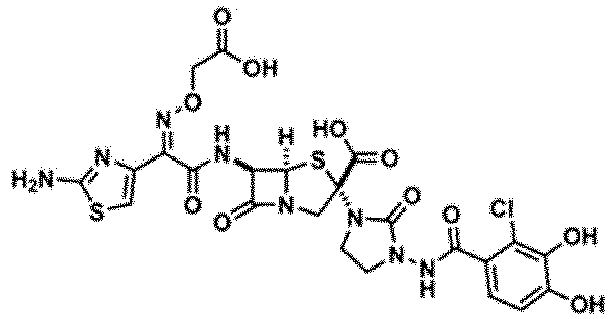
(3R,5R,6R)-6-((Z)-2-(2-aminothiazol-4-yl)-2-((carboxym ethoxy)imino)acetamido)-3-(3-(2-chloro-3,4-dihydroxybe nzamido)-2-oxoimidazolidin-1-yl)-7-oxo-4-thia-1-azabicy clo[3.2.0]heptane-3-carboxylate 12 
(3R,5R,6R)-6-((Z)-2-(2-aminothiazol-4-yl)-2-(((R)-1-carb oxyethoxy)imino)acetamido)-3-(3-(2-chloro-3,4-dihydrox ybenzamido)-2-oxoimidazolidin-1-yl)-7-oxo-4-thia-1-aza bicyclo[3.2.0]heptane-3-carboxylate 13 
(3R,5R,6R)-6-((Z)-2-(2-aminothiazol-4-yl)-2-(((S)-1-carb oxyethoxy)imino)acetamido)-3-(3-(2-chloro-3,4-dihydrox ybenzamido)-2-oxoimidazolidin-1-yl)-7-oxo-4-thia-1-aza bicyclo[3.2.0]heptane-3-carboxylate 14 
(3R,5R,6R)-6-((Z)-2-(2-aminothiazol-4-yl)-2-(((S)-1-carb oxy-2-hydroxyethoxy)imino)acetamido)-3-(3-(2-chloro-3, 4-dihydroxybenzamido)-2-oxoimidazolidin-1-yl)-7-oxo-4 -thia-1-azabicyclo[3.2.0]heptane-3-carboxylate 1 5 
(S)-2-((((Z)-1-(2-aminothiazol-4-yl)-2-(((3R,5R,6R)-3-ca rboxy-3-(3-(2-chloro-3,4-dihydroxybenzamido)-2-oxoimi dazolidin-1-yl)-7-oxo-4-thia-1-azabicyclo[3.2.0]heptan-6-yl)amino)-2-oxoethylidene)amino)oxy)succinic acid 1 6 
(3R,5R,6R)-6-((Z)-2-(2-aminothiazol-4-yl)-2-(((4-carbox ytetrahydro-2H-pyran-4-yl)oxy)imino)acetamido)-3-(3-(2 -chloro-3,4-dihydroxybenzamido)-2-oxoimidazolidin-1-yl )-7-oxo-4-thia-1-azabicyclo[3.2.0]heptane-3-carboxylate 1 7 
(3R,5R,6R)-6-((Z)-2-(2-aminothiazol-4-yl)-2-(((1-carbox ycyclopentyl)oxy)imino)acetamido)-3-(3-(2-chloro-3,4-di hydroxybenzamido)-2-oxoimidazolidin-1-yl)-7-oxo-4-thi a-1-azabicyclo[3.2.0]heptane-3-carboxylate 18 
(3R,5R,6R)-6-((Z)-2-(2-aminothiazol-4-yl)-2-(((2-carbox ypropan-2-yl)oxy)imino)acetamido)-3-(4-(2-chloro-3,4-di hydroxybenzamido)-5-oxo-4,5-dihydro-1H-1,2,4-triazol-1 -yl)-7-oxo-4-thia-1-azabicyclo[3.2.0]heptane-3-carboxyla te - The measured values of NMR and MS of the compounds in the table are as follows.
- NMR: 1.49 (3H, s), 1.51 (3H, s), 3.64 (1H, d, J = 12.4 Hz), 3.70-3.80 (4H, m), 4.68 (1H, d, J = 12.4 Hz), 5.71 (1H, d, J = 3.6 Hz), 5.76 (1H, d, J = 2.8 Hz), 6.94 (1H, d, J = 8.4 Hz), 7.04 (1H, s), 7.10 (1H, d, J = 8.4 Hz)
MS: 713.00 [M + H]+, 710.90 [M - H]- - NMR: 1.28 (3H, d, J = 6.0 Hz), 1.42 (3H, s), 1.44 (3H, s), 3.28-3.40 (2H, m), 3.76-3.84 (1H, m), 4.21-4.31 (1H, m), 5.66 (2H, s), 6.87 (1H, d, J = 8.4 Hz), 6.97 (1H, s), 7.04 (1H, d, J = 8.4 Hz)
MS: 727.05 [M + H]+, 725.00 [M - H]- - NMR: 1.28 (3H, d, J = 6.0 Hz), 1.40 (3H, s), 1.42 (3H, s), 3.17 (1H, t, J = 9.4 Hz), 3.57 (1H, d, J = 13.2 Hz), 3.73-3.81 (1H, m), 3.85-3.97 (1H, m), 4.54 (1H, d, J = 12.4 Hz), 5.60 (1H, d, J = 3.6 Hz), 5.67 (1H, d, J = 2.8 Hz), 6.85 (1H, d, J = 8.4 Hz), 6.95 (1H, s), 7.02 (1H, d, J = 8.4 Hz)
MS: 727.05 [M + H]+, 725.10 [M - H]- - NMR: 1.37 (3H, d, J = 5.6 Hz), 1.49 (3H, s), 1.51 (3H, s), 3.35 (1H, t, J = 8.0 Hz), 3.61 (1H, dd, J = 12.6,1.0 Hz), 3.94-4.08 (2H, m), 4.71 (1H, d, J = 12.8 Hz), 5.72 (1H, d, J = 3.6 Hz), 5.77 (1H, dd, J = 3.8, 0.8 Hz), 6.94 (1H, d, J = 8.4 Hz), 7.03 (1H, s), 7.10 (1H, d, J = 8.4 Hz), 7.43 (1H, s)
MS: 727.10 [M + H]+, 725.00 [M - H]- - NMR: 1.47 (3H, d, J = 6.4 Hz), 1.49 (3H, s), 1.51 (3H, s), 3.41 (1H, dd, J = 8.0, 2.0 Hz), 3.50 (1H, dd, J = 12.6, 1.4 Hz), 3.89 (1H, t, J = 8.2 Hz), 4.22-4.33 (1H, m), 4.83 (1H, d, J = 13.6 Hz), 5.75 (1H, dd, J = 3.8, 1.0 Hz), 5.78 (1H, d, J = 3.6 Hz), 6.93 (1H, d, J = 8.4 Hz), 7.04 (1H, s), 7.09 (1H, d, J = 8.4 Hz)
MS: 727.05 [M + H]+, 725.05 [M - H]- - NMR: 1.47 (3H, d, J = 6.4 Hz), 1.80-2.09 (2H, m), 2.26-2.79 (4H, m), 3.41 (1H, dd, J = 8.0, 2.4 Hz), 3.52 (1H, dd, J = 12.8, 1.2 Hz), 3.89 (1H, t, J = 8.2 Hz), 4.23-4.32 (1H, m), 4.83 (1H, d, J = 12.8 Hz), 5.78 (1H, d, J = 3.6 Hz), 5.81 (1H, d, J = 3.6 Hz), 6.94 (1H, d, J = 8.4 Hz), 7.08 (1H, s), 7.10 (1H, d, J = 8.4 Hz)
MS: 739.05 [M + H]+, 737.05 [M - H]- - NMR: 1.22-1.43 (4H, m), 3.63 (1H, d, J = 12.4 Hz), 3.68-3.80 (4H, m), 4.67 (1H, d, J = 12.8 Hz), 5.69 (1H, d, J = 3.6 Hz), 5.74 (1H, d, J = 3.2 Hz), 6.93 (1H, d, J = 8.4 Hz), 7.10 (1H, d, J = 7.2 Hz), 7.11 (1H, s)
MS: 711.00 [M + H]+, 708.95 [M - H]- - NMR: 1.51 (3H, s), 1.52 (3H, s), 3.67 (1H, d, J = 12.8 Hz), 3.70-3.79 (4H, m), 4.67 (1H, d, J = 12.8 Hz), 5.69 (1H, d, J = 4.0 Hz), 5.80 (1H, d, J = 2.8 Hz), 6.93 (1H, d, J = 8.4 Hz), 7.10 (1H, d, J = 8.4 Hz)
MS: 747.00 [M + H]+, 744.90 [M - H]- - NMR: 1.53 (3H, s), 1.55 (3H, s), 3.65 (1H, d, J = 12.8 Hz), 3.70-3.80 (4H, m), 4.67 (1H, d, J = 12.8 Hz), 5.70 (1H, d, J = 3.6 Hz), 5.82 (1H, d, J = 4.0 Hz), 6.93 (1H, d, J = 8.4 Hz), 7.10 (1H, d, J = 8.4 Hz)
MS: 714.00 [M + H]+, 711.95 [M - H]- - NMR: 3.62 (1H, d, J = 12.8 Hz), 3.69-3.80 (4H, m), 4.57 (2H, s), 4.68 (1H, d, J = 12.8 Hz), 5.70 (1H, d, J = 3.6 Hz), 5.77 (1H, d, J = 3.6 Hz), 6.94 (1H, d, J = 8.4 Hz), 7.10 (1H, s), 7.10 (1H, d, J = 8.4 Hz)
MS: 685.00 [M + H]+,682.95 [M - H]- - NMR: 1.46 (3H, d, J = 7.2 Hz), 3.63 (1H, d, J = 12.8 Hz), 3.68-3.80 (4H, m), 4.63 (1H, d, J = 6.8 Hz), 4.68 (1H, d, J = 12.4 Hz), 5.71 (1H, d, J = 3.6 Hz), 5.76 (1H, d, J = 2.8 Hz), 6.94 (1H, d, J = 8.4 Hz), 7.07 (1H, s), 7.10 (1H, d, J = 8.4 Hz)
MS: 699.05 [M + H]+,697.05 [M - H]- - NMR: 1.47 (3H, d, J = 7.2 Hz), 3.63 (1H, d, J = 12.8 Hz), 3.69-3.80 (4H, m), 4.63-4.69 (1H, m), 4.68 (1H, d, J = 13.2 Hz), 5.72 (1H, d, J = 3.6 Hz), 5.78 (1H, d, J = 2.8 Hz), 6.94 (1H, d, J = 8.4 Hz), 7.08 (1H, s), 7.10 (1H, d, J = 8.4 Hz)
MS: 699.05 [M + H]+,696.95 [M - H]- - NMR: 3.63 (1H, d, J = 12.8 Hz), 3.69-3.80 (4H, m), 3.95 (1H, dd, J = 12.6, 7.0 Hz), 4.02 (1H, dd, J = 12.6, 3.0 Hz), 4.68 (1H, d, J = 12.8 Hz), 4.71 (1H, dd, J = 6.8, 3.2 Hz), 5.72 (1H, d, J = 3.6 Hz), 5.80 (1H, d, J = 3.6 Hz), 6.94 (1H, d, J = 8.4 Hz), 7.10 (1H, s), 7.10 (1H, d, J = 8.4 Hz)
MS: 715.00 [M + H]+, 712.85 [M - H]- - NMR: 2.65 (1H, dd, J = 16.0, 10.0 Hz), 2.78 (1H, dd, J = 15.8,3.8 Hz), 3.62 (1H, d, J = 12.8 Hz), 3.68-3.81 (4H, m), 4.68 (1H, d, J = 12.8 Hz), 4.92 (1H, dd, J = 10.0, 3.6 Hz), 5.70 (1H, d, J = 4.0 Hz), 5.73 (1H, d, J = 2.8 Hz), 6.94 (1H, d, J = 8.4 Hz), 7.09 (1H, s), 7.11 (1H, d, J = 9.2 Hz)
MS: 743.00 [M + H]+, 741.00 [M - H]- - NMR: 1.97-2.20 (4H, m), 3.62-3.93 (9H, m), 4.67 (1H, d, J = 12.8 Hz), 5.73 (1H, d, J = 4.0 Hz), 5.81 (1H, d, J = 3.6 Hz), 6.94 (1H, d, J = 8.4 Hz), 7.07 (1H, s), 7.10 (1H, d, J = 8.4 Hz)
MS: 755.10 [M + H]+, 753.10 [M - H]- - NMR: 1.65-1.80 (4H, m), 1.97-2.17 (4H, m), 3.65 (1H, d, J = 12.4 Hz), 3.69-3.79 (4H, m), 4.68 (1H, d, J = 12.4 Hz), 5.71 (1H, d, J = 3.6 Hz), 5.75 (1H, d, J = 3.6 Hz), 6.93 (1H, d, J = 8.4 Hz), 7.03 (1H, s), 7.09 (1H, d, J = 8.4 Hz)
MS: 739.00 [M + H]+, 736.90 [M - H]- - NMR: 1.49 (3H, s), 1.52 (3H, s), 4.00 (1H, d, J = 13.6 Hz), 4.57 (1H, d, J = 12.8 Hz), 5.68 (1H, d, J = 4.0 Hz), 5.83 (1H, d, J = 3.6 Hz), 6.81 (1H, d, J = 8.4 Hz), 7.03 (1H, s), 7.22 (1H, d, J = 8.4 Hz), 8.15 (1H, s)
MS: 711.90 [M + H]+, 710.00 [M - H]- -

- Dichloromethane (1.0 mL) was added to 2-(2-chloro-3,4-bis((4-methoxybenzyl)oxy)phenyl)-2-oxoacetic acid (100 mg), and then oxalyl chloride (23 µL) and DMF (2 µL) were sequentially added thereto under ice cooling. The reaction mixture was stirred at room temperature for 1 hour, thereby obtaining 2-(2-chloro-3,4-bis((4-methoxybenzyl)oxy)phenyl)-2-oxoacetyl chloride in a dichloromethane solution.
- THF (2 mL) and water (2 mL) were added to benzhydryl (3R,5R,6R)-3-(3-amino-2-oxoimidazolidin-1-yl)-6-((Z)-2-((1-((benzhydryloxy)carbonyl)cyclo butoxy)imino)-2-(2-((tert-butoxycarbonyl)amino)thiazol-4-yl)acetamido)-7-oxo-4-thia-1-azabi cyclo[3.2.0]heptane-3-carboxylate (216 mg), and the mixture was stirred under ice cooling. At the same temperature, sodium hydrogen carbonate (55 mg) was added to the reaction mixture, and then 2-(2-chloro-3,4-bis((4-methoxybenzyl)oxy)phenyl)-2-oxoacetyl chloride obtained in Example 19 (1) in a dichloromethane solution was sequentially added thereto. The reaction mixture was stirred at room temperature for 1 hour, ethyl acetate (10 mL) and water (10 mL) were then added thereto, and the organic layer was separated. The organic layer was washed with a 5% aqueous sodium chloride solution and then dehydrated and dried over anhydrous sodium sulfate. The solvent was distilled away under reduced pressure, thereby obtaining a target substance (340 mg) as a yellow oily substance.
- Dichloromethane (6.2 mL) was added to the compound (312 mg) obtained in Example 19 (2), and the mixture was cooled to -20°C. At the same temperature, anisole (1.4 mL) and aluminum chloride (438 mg) were sequentially added to the reaction mixture. The reaction mixture was stirred at the same temperature for 1 hour. The reaction mixture was added to a mixture of acetonitrile (20 mL), water (10 mL), and trisodium citrate dihydrate (1.45 g) under ice cooling. A saturated aqueous sodium hydrogen carbonate solution was added to the reaction mixture such that the pH was adjusted to 5.2, and the aqueous layer was separated. The aqueous layer was concentrated under reduced pressure, and the residue was purified by medium-pressure reverse-phase silica gel column chromatography [eluent; water:acetonitrile = 100:0 → 85:15]. The aqueous solution containing a target substance was lyophilized, thereby obtaining (3R,5R,6R)-6-((Z)-2-(2-aminothiazol-4-yl)-2-((-1-carboxycyclobutoxy)imino)acetamido)-3-(3 -(2-(2-chloro-3,4-dihydroxyphenyl)-2-oxoacetamido)-2-oxoimidazolidin-1-yl)-7-oxo-4-thia-1-azabicyclo[3.2.0]heptane-3-carboxylate (33.5 mg) as yellow solids.
- NMR: 1.80-2.10 (2H, m), 2.25-2.60 (4H, m), 3.62 (1H, d, J = 12.2 Hz), 3.67-3.82 (4H, m), 4.69 (1H, d, J = 12.2 Hz), 5.70-5.82 (2H, m), 6.87-6.97 (1H, m), 7.07 (1H, s), 7.41-7.48 (1H, m)
MS: 753.05 [M + H]+, 751.05 [M - H]- - The compounds shown in Table 18 were obtained in the same manner as in Example 19.
[Table 18] Example No. Structural Formula Name 20 
(3R,5R,6R)-6-((Z)-2-(2-aminothiazol-4-yl)-2-(((2-carbox ypropan-2-yl)oxy)imino)acetamido)-3-(3-(2-(2-chloro-3,4 -dihydroxyphenyl)-2-oxoacetamido)-2-oxoimidazolidin-1 -yl)-7-oxo-4-thia-1-azabicyclo[3.2.0]heptane-3-carboxyla te 21 
(3R,5R,6R)-6-((Z)-2-(2-aminothiazol-4-yl)-2-((1-carboxy cyclopropoxy)imino)acetamido)-3-(3-(2-(2-chloro-3,4-dih ydroxyphenyl)-2-oxoacetamido)-2-oxoimidazolidin-1-yl)-7-oxo-4-thia-1-azabicyclo[3.2.0]heptane-3-carboxylate 22 
(3R,5R,6R)-6-((Z)-2-(2-amino-5-chlorothiazol-4-yl)-2-((( 2-carboxypropan-2-yl)oxy)imino)acetamido)-3-(3-(2-(2-c hloro-3,4-dihydroxyphenyl)-2-oxoacetamido)-2-oxoimida zolidin-1-yl)-7-oxo-4-thia-1-azabicyclo[3.2.0]heptane-3-c arboxylate 23 
(3R,5R,6R)-6-((Z)-2-(5-amino-1,2,4-thiadiazol-3-yl)-2-((( 2-carboxypropan-2-yl)oxy)imino)acetamido)-3-(3-(2-(2-c hloro-3,4-dihydroxyphenyl)-2-oxoacetamido)-2-oxoimida zolidin-1-yl)-7-oxo-4-thia-1-azabicyclo[3.2.0]heptane-3-c arboxylate 24 
(3R,5R,6R)-6-((Z)-2-(2-aminothiazol-4-yl)-2-(((4-carbox ytetrahydro-2H-pyran-4-yl)oxy)imino)acetamido)-3-(3-(2 -(2-chloro-3,4-dihydroxyphenyl)-2-oxoacetamido)-2-oxoi midazolidin-1-yl)-7-oxo-4-thia-1-azabicyclo [3.2.0]heptan e-3-carboxylate 25 
(3R,5R,6R)-6-((Z)-2-(2-aminothiazol-4-yl)-2-(((2-carbox ypropan-2-yl)oxy)imino)acetamido)-3-(3-(3-(2-(2-chloro-3,4-dihydroxyphenyl)-2-oxoacetamido)-2-oxoimidazolidi n-1-carboxamido)-2-oxoimidazolidin-1-yl)-7-oxo-4-thia-1-azabicyclo[3.2.0]heptane-3-carboxylate 26 
(3R,5R,6R)-6-((Z)-2-(2-aminothiazol-4-yl)-2-(((2-carbox ypropan-2-yl)oxy)imino)acetamido)-3-(4-(2-(2-chloro-3,4 -dihydroxyphenyl)-2-oxoacetamido)-5-oxo-4,5-dihydro-1 H-1,2, 4-triazol-1-yl)-7-oxo-4-thia-1-azabicyclo[3.2.0]hep tane-3-carboxylate - The measured values of NMR and MS of the compounds in the table are as follows.
- NMR: 1.45-1.53 (6H, m), 3.62 (1H, d, J = 12.8 Hz), 3.66-3.82 (4H, m), 4.68 (1H, d, J = 12.8 Hz), 5.67-5.78 (2H, m), 6.89-6.98 (1H, m), 7.03 (1H, s), 7.41-7.48 (1H, m)
MS: 741.00 [M + H]+, 739.00 [M - H]- - NMR: 1.22-1.43 (4H, m), 3.61 (1H, dd, J = 12.6, 1.0 Hz), 3.68-3.81 (4H, m), 4.29 [4.67] (1H, d, J = 12.4 Hz), 5.69 (1H, d, J = 3.6 Hz), 5.73 (1H, d, J = 4.4 Hz), 6.87[6.91] (1H, d, J = 8.6 Hz), 7.10 [7.03] (1H, s), 7.33[7.44] (1H, d, J = 8.8 Hz)
MS: 739.00 [M + H]+, 736.90 [M - H]- - NMR: 1.46-1.55 (6H, m), 3.38-3.49 (1H, m), 3.55-3.81 (4H, m), 4.67 (1H, d, J = 12.4 Hz), 5.64-5.83 (2H, m), 6.88-6.97 (1H, m), 7.41-7.48 (1H, m)
MS: 774.95 [M + H]+, 773.00 [M - H]- - NMR: 1.52 [1.53] (3H, s), 1.53 [1.55] (3H, s), 3.63 (1H, d, J = 13.2 Hz), 3.68-3.81 (4H, m), 4.31 [4.67] (1H, d, J = 12.6 Hz), 5.68 [5.70] (1H, d, J = 3.8 Hz), 5.77 [5.81] (1H, d, J = 3.4 Hz), 6.89 [6.93] (1H, d, J = 8.8 Hz), 7.44 (1H, d, J = 8.4 Hz)
MS: 742.00 [M + H]+, 740.00 [M - H]- - NMR: 1.96-2.19 (4H, m), 3.35-3.50 (1H, m), 3.57-3.92 (8H, m), 4.27 [4.67] (1H, d, J = 12.6 Hz), 5.72 (1H, d, J = 3.6 Hz), 5.76 [5.81] (1H, d, J = 3.4 Hz), 6.91 [6.95] (1H, d, J = 8.8 Hz), 7.06 (1H, s), 7.44 [7.46] (1H, d, J = 8.4 Hz)
MS: 783.05 [M + H]+, 780.90 [M - H]- - NMR: 1.49 (3H, s), 1.51 (3H, s), 3.58-3.76 (2H, m), 3.80-3.88 (2H, m), 3.94-4.02 (5H, m), 4.66 (1H, d, J = 12.4 Hz), 5.69 (1H, d, J = 3.6 Hz), 5.75 (1H, d, J = 3.6 Hz), 6.73 (1H, d, J = 8.8 Hz), 7.03 (1H, s), 7.45 (1H, d, J = 8.8 Hz)
MS: 868.00 [M + H]+, 865.95 [M - H]- - NMR: 1.49 (3H, s), 1.52 (3H, s), 3.85 (1H, d, J = 12.8 Hz), 4.56 (1H, d, J = 12.4 Hz), 5.66 (1H, d, J = 4.0 Hz), 5.82 (1H, d, J = 3.6 Hz), 6.97 (1H, d, J = 8.8 Hz), 7.03 (1H, s), 7.49 (1H, d, J = 8.4 Hz), 8.09 (1H, s)
MS: 739.95 [M + H]+, 737.90 [M - H]- -

- (2-Chloro-3,4-bis((4-methoxybenzyl)oxy)benzoyl)glycine (112 mg), HoBt (34 mg), EDC (49 mg), DMF (2 mL), and NMM (31 µL) were sequentially added to benzhydryl (3R,5R,6R)-3-(3-amino-2-oxoimidazolidin-1-yl)-6-((Z)-2-(((1-(tert-butoxy)-2-methyl-1-oxopr opan-2-yl)oxy)imino)-2-(2-((tert-butoxycarbonyl)amino)thiazol-4-yl)acetamido)-7-oxo-4-thia-1-azabicyclo[3.2.0]heptane-3-carboxylate (200 mg). The reaction mixture was stirred at room temperature overnight. Ethyl acetate (10 mL) and water (10 mL) were added to the reaction mixture, and the organic layer was separated. The organic layer was washed with a saturated aqueous sodium chloride solution and dehydrated and dried over anhydrous sodium sulfate. The solvent was distilled away under reduced pressure, and the residue was purified by silica gel column chromatography [eluent; ethyl acetate:hexane = 40:60 → 100:0], thereby obtaining a target substance (188 mg) as light yellow solids.
- Dichloromethane (2.8 mL) was added to the compound (188 mg) obtained in Example 27 (1), and the mixture was stirred at -20°C. At the same temperature, anisole (0.92 mL) and aluminum chloride (282 mg) were sequentially added to the reaction mixture. The reaction mixture was stirred at a temperature equal to or lower than -20°C for 30 minutes. The reaction mixture was added to a mixture of acetonitrile (5 mL), water (5 mL), and trisodium citrate dihydrate (933 mg) under ice cooling. A saturated aqueous sodium hydrogen carbonate solution was added to the reaction mixture such that the pH was adjusted to 5.1, and the aqueous layer was separated. The aqueous layer was concentrated under reduced pressure, and the residue was purified by medium-pressure reverse-phase silica gel column chromatography [eluent; water:acetonitrile = 100:0 → 85:15]. The aqueous solution containing a target substance was lyophilized, thereby obtaining (3R,5R,6R)-6-((Z)-2-(2-aminothiazol-4-yl)-2-(((2-carboxypropan-2-yl)oxy)imino)acetamido)-3-(3-(2-(2-chloro-3,4-dihydroxybenzamide)acetamido)-2-oxoimidazolidin-1-yl)-7-oxo-4-thia-1-azabicyclo[3.2.0]heptane-3-carboxylate (42 mg) as light yellow solids.
NMR: 1.48 (3H, s), 1.50 (3H, s), 3.50-3.87 (5H, m), 4.17 (2H, s), 4.65 (1H, d, J = 12.8 Hz), 5.69 (1H, d, J = 4.0 Hz), 5.75 (1H, d, J = 3.6 Hz), 6.91 (1H, d, J = 8.4 Hz), 7.03 (1H, s), 7.07 (1H, d, J = 8.4 Hz)
MS: 777.00 [M + H]+, 768.00 [M - H]- - The compounds shown in Table 19 were obtained in the same manner as in Example 27.
[Table 19] Example No. Structural Formula Name 28 
(3R,5R,6R)-6-((Z)-2-(2-aminothiazol-4-yl)-2-(((2-carboxypropan-2-yl)oxy)imino)acetamido)-3-(3-(3 -(2-chloro-3,4-dihydroxybenzamido)propanamido) -2-oxoimidazolidin-1-yl)-7-oxo-4-thia-1-azabicycl o[3.2.0]heptane-3-carboxylate 29 
(3R,5R,6R)-6-((Z)-2-(2-aminothiazol-4-yl)-2-(((2-carboxypropan-2-yl)oxy)imino)acetamido)-3-(3-(2 -(2-(2-chloro-3,4-dihydroxyphenyl)-2-oxoacetamid o)acetamido)-2-oxoimidazolidin-1-yl)-7-oxo-4-thi a-1-azabicyclo[3.2.0]heptane-3-carboxylate 30 
(3R,5R,6R)-6-((Z)-2-(2-aminothiazol-4-yl)-2-(((2-carboxypropan-2-yl)oxy)imino)acetamido)-3-(3-(3 -(2-(2-chloro-3,4-dihydroxyphenyl)-2-oxoacetamid o)propanamido)-2-oxoimidazolidin-1-yl)-7-oxo-4-t hia-1-azabicyclo[3.2.0]heptane-3-carboxylate 31 
(3R,5R,6R)-6-((Z)-2-(2-aminothiazol-4-yl)-2-((1-c arboxycyclopropoxy)imino)acetamido)-3-(3-(3-(2-(2-chloro-3,4-dihydroxyphenyl)-2-oxoacetamido)p ropanamido)-2-oxoimidazolidin-1-yl)-7-oxo-4-thia -1-azabicyclo[3.2.0]heptane-3-carboxylate 32 
(3R,5R,6R)-6-((Z)-2-(2-aminothiazol-4-yl)-2-(((4-carboxytetrahydro-2H-pyran-4-yl)oxy)imino)aceta mido)-3-(3-(3-(2-(2-chloro-3,4-dihydroxyphenyl)-2-oxoacetamido)propanamido)-2-oxoimidazolidin-1-yl)-7-oxo-4-thia-1-azabicyclo[3.2.0]heptane-3-ca rboxylate 33 
(3R,5R,6R)-6-((Z)-2-(2-aminothiazol-4-yl)-2-(((2-carboxypropan-2-yl)oxy)imino)acetamido)-3-(3-(1 -(2-chloro-3,4-dihydroxybenzoyl)azetidine)-3-carb oxamido)-2-oxoimidazolidin-1-yl)-7-oxo-4-thia-1-azabicyclo[3.2.0]heptane-3-carboxylate 34 
(3R,5R,6R)-6-((Z)-2-(2-aminothiazol-4-yl)-2-(((2-carboxypropan-2-yl)oxy)imino)acetamido)-3-(3-(1 -(2-(2-chloro-3,4-dihydroxyphenyl)-2-oxoacetyl)az etidine-3-carboxamido)-2-oxoimidazolidin-1-yl)-7 -oxo-4-thia-1-azabicyclo[3.2.0]heptane-3-carboxyl ate - The measured values of NMR and MS of the compounds in the table are as follows.
- NMR: 1.48 (3H, s), 1.50 (3H, s), 2.65 (2H, t, J = 6.2 Hz), 3.54-3.72 (7H, m), 4.63 (1H, d, J = 12.8 Hz), 5.66 (1H, d, J = 3.6 Hz), 5.74 (1H, d, J = 3.2 Hz), 6.89 (1H, d, J = 8.4 Hz), 6.95 (1H, d, J = 8.4 Hz), 7.03 (1H, s)
MS: 784.05 [M + H]+, 781.95 [M - H]-. - NMR: 1.49 (3H, s), 1.51 (3H, s), 3.50-3.77 (5H, m), 4.19 (2H, s), 4.66 (1H, d, J = 12.8 Hz), 5.69 (1H, d, J = 3.6 Hz), 5.75 (1H, d, J = 3.2 Hz), 6.93 (1H, d, J = 8.4Hz), 7.03 (1H, s), 7.41 (1H, d, J = 8.4 Hz)
MS: 798.00 [M + H]+, 796.10 [M - H]- - NMR: 1.48 (3H, s), 1.50 (3H, s), 2.66 (2H, t, J = 6.2 Hz), 3.50-3.74 (7H, m), 4.61 (1H, d, J = 12.4 Hz), 5.64 (1H, d, J = 3.6 Hz), 5.72 (1H, d, J = 3.2 Hz), 6.94 (1H, d, J = 8.8 Hz), 7.03 (1H, s), 7.34 (1H, d, J = 8.8 Hz)
MS: 812.05 [M + H]+, 810.15 [M - H]- - NMR: 1.21-1.43 (4H, m), 2.66 (2H, t, J = 6.0 Hz), 3.46-3.74 (7H, m), 4.60 (1H, d, J = 12.8 Hz), 5.62 (1H, d, J = 4.0 Hz), 5.70 (1H, d, J = 4.0 Hz), 6.92 (1H, d, J = 8.4 Hz), 7.10 (1H, s), 7.34 (1H, d, J = 8.8 Hz)
MS: 810.05 [M + H]+, 807.90 [M - H]- - NMR: 1.95-2.18 (4H, m), 2.66 (2H, t, J = 6.2 Hz), 3.49-3.76 (9H, m), 3.77-3.90 (2H, m), 4.59 (1H, d, J = 12.4 Hz), 5.65 (1H, d, J = 3.6 Hz), 5.77 (1H, d, J = 3.2 Hz), 6.94 (1H, d, J = 8.8 Hz), 7.06 (1H, s), 7.34 (1H, d, J = 8.4 Hz)
MS: 854.10 [M + H]+, 851.95 [M - H]- - NMR: 1.48 (3H, s), 1.50 (3H, s), 3.54-3.75 (6H, m), 4.13-4.34 (3H, m), 4.36-4.46 (1H, m), 4.65 (1H, dd, J = 12.4, 1.2 Hz), 5.69 (1H, d, J = 3.6 Hz), 5.75 (1H, d, J = 3.6 Hz), 6.87-6.97 (2H, m), 7.03 (1H, s)
MS: 796.05 [M + H]+, 794.05 [M - H]- - NMR: 1.48 (3H, s), 1.50 (3H, s), 3.55-3.75 (6H, m), 4.30-4.53 (4H, m), 4.65 (1H, d, J = 12.4 Hz), 5.69 (1H, d, J = 3.6 Hz), 5.75 (1H, d, J = 3.6 Hz), 6.88 (1H, d, J = 8.8 Hz), 7.03 (1H, s), 7.40 (1H, d, J = 8.8 Hz)
MS: 824.05 [M + H]+, 822.10 [M-H]- -

- Dichloromethane (3.9 mL) and pyridine (38 µL) were added to benzhydryl (3R,5R,6R)-3-(3-amino-2-oxoimidazolidin-1-yl)-6-((Z)-2-(((1-(tert-butoxy)-2-methyl-1-oxopr opan-2-yl)oxy)imino)-2-(2-((tert-butoxycarbonyl)amino)thiazol-4-yl)acetamido)-7-oxo-4-thia-1-azabicyclo[3.2.0]heptane-3-carboxylate (390 mg), and the mixture was stirred under ice cooling. At the same temperature, chloroacetyl chloride (38 µL) was added to the reaction mixture, and the reaction mixture was stirred at room temperature for 2 hours. Water (10 mL) and 1 mol/L hydrochloric acid (2 mL) were added to the reaction mixture, and the organic layer was separated. The organic layer was dehydrated and dried over anhydrous sodium sulfate, and the solvent was distilled away under reduced pressure, thereby obtaining a target substance (424 mg) as a yellow oily substance.
- DMF (4.3 mL), 2-chloro-3,4-bis((4-methoxybenzyl)oxy)-N-(2-(pyrrolidin-1-yl)ethyl)benzamide (473 mg), and sodium iodide (68 mg) were sequentially added to the compound (424 mg) obtained in Example 35 (1), and the mixture was stirred at 40°C for 11 hours. Ethyl acetate (15 mL) and water (15 mL) were added to the reaction mixture. Hydrochloric acid (1 mol/L) was added to the reaction mixture such that the pH was adjusted to 2.5. The organic layer was separated, washed twice with a 5% aqueous sodium chloride solution, and then dehydrated and dried over anhydrous sodium sulfate. The solvent was distilled away under reduced pressure, thereby obtaining a target substance (702 mg) as a brown oily substance.
- Dichloromethane (15.0 mL) was added to the compound (702 mg) obtained in Example 35 (2), and the mixture was stirred at a temperature equal to or lower than -20°C. At the same temperature, anisole (3.0 mL) and aluminum chloride (1.50 g) were sequentially added to the reaction mixture. The reaction mixture was stirred at a temperature equal to or lower than -20°C for 1 hour. At a temperature equal to or lower than -20°C, aluminum chloride (421 mg) was added to the reaction mixture, and the reaction mixture was stirred at a temperature equal to or lower than -20°C for 1 hour. The reaction mixture was added to a mixture of acetonitrile (25 mL), water (15 mL), and trisodium citrate dihydrate (6.37 g) under ice cooling. A saturated aqueous sodium hydrogen carbonate solution was added to the reaction mixture such that the pH was adjusted to 5.1, and the aqueous layer was separated. The aqueous layer was concentrated under reduced pressure, and the residue was purified by medium-pressure reverse-phase silica gel column chromatography [eluent; water:acetonitrile = 100:0 → 85:15]. The aqueous solution containing a target substance was lyophilized, thereby obtaining (3R,5R,6R)-6-((Z)-2-(2-aminothiazol-4-yl)-2-(((2-carboxypropan-2-yl)oxy)imino)acetamido)-3-(3-(2-(1-(2-(2-chloro-3,4--dihydroxybenzamido)ethyl)pyrrolidin-1-ium-1-yl)acetamido)-2-o xoimidazolidin-1-yl)-7-oxo-4-thia-1-azabicyclo[3.2.0]heptane-3-carboxylate (33.5 mg) as white solids.
NMR: 1.48 (3H, s), 1.50 (3H, s), 2.17-2.34 (4H, m), 3.42-3.58 (4H, m), 3.61-3.71 (2H, m), 3.73-3.95(9H,m), 4.59 (1H, d, J = 12.8 Hz), 5.62 (1H, d, J = 4.0 Hz), 5.72 (1H, d, J = 4.0 Hz), 6.87-6.94 (1H, m), 6.96-7.04 (2H, m)
MS: 867.10 [M + H]+, 865.05 [M - H]- -
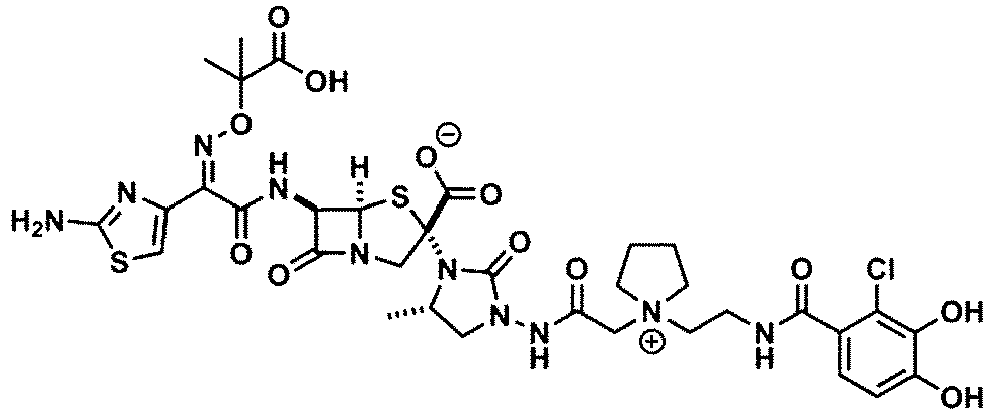
- By using the compound obtained in Reference Example 29, (3R,5R,6R)-6-((Z)-2-(2-aminothiazol-4-yl)-2-(((2-carboxypropan-2-yl)oxy)imino)acetamido)-3-(S)-3-(2-(1-(2-(2-chloro-3,4-dihydroxybenzamido)ethyl)pyrrolidin-1-ium-1-yl)acetamido)-5 -methyl-2-oxoimidazolidin-1-yl)-7-oxo-4-thia-1-azabicyclo[3.2.0]heptane-3-carboxylate was obtained in the same manner as in Example 35.
NMR: 1.26 (3H, d, J = 4.8 Hz), 1.47 (3H, s), 1.50 (3H, s), 2.20-2.33 (4H, m), 3.06 (1H, dd, J = 4.0, 2.0 Hz), 3.26 (1H, d, J = 12.8 Hz), 3.58-3.67 (1H, m), 3.79-3.96 (9H, m), 4.17-4.27 (1H, m), 4.73 (1H, d, J = 12.8 Hz), 5.55 (1H, d, J = 3.6 Hz), 5.67 (1H, d, J = 3.6 Hz), 6.91 (1H, d, J = 8.4 Hz), 7.00 (1H, d, J = 8.4 Hz), 7.01 (1H, s)
MS: 881.15 [M + H]+, 879.15 [M - H]- -

- Dichloromethane (7.0 mL) and 1,1'-carbonylimidazole (131 mg) were added to benzhydryl (3R,5R,6R)-3-(3-amino-2-oxoimidazolidin-1-yl)-6-((Z)-2-(((1-(tert-butoxy)-2-methyl-1-oxopr opan-2-yl)oxy)imino)-2-(2-((tert-butoxycarbonyl)amino)thiazol-4-yl)acetamido)-7-oxo-4-thia-1-azabicyclo[3.2.0]heptane-3-carboxylate (350 mg), and the mixture was stirred at room temperature for 4 hours. At the same temperature, N-(2-aminoethyl)-2-chloro-3,4-bis((4-methoxybenzyl)oxy)benzamide (381 mg)was added to the reaction mixture,
and the reaction mixture was stirred at room temperature for 1 hour. The reaction mixture was added to a mixture of dichloromethane (35 mL) and water (35 mL) under ice cooling. Hydrochloric acid (1 mol/L) was added to the reaction mixture such that the pH was adjusted to 2.5. The organic layer was separated and sequentially washed with water and a saturated aqueous sodium chloride solution. The organic layer was dehydrated and dried over anhydrous sodium sulfate, and the solvent was distilled away under reduced pressure. The residue was purified by silica gel column chromatography [eluent; chloroform:2-propanol = 0:100 → 93:7], thereby obtaining a target substance (310 mg) as yellow solids. - Dichloromethane (6.2 mL) was added to the compound (310 mg) obtained in Example 37 (1), and the mixture was stirred at a temperature equal to or lower than -20°C. At the same temperature, anisole (1.49 mL) and aluminum chloride (455 mg) were sequentially added to the reaction mixture. The reaction mixture was stirred at a temperature equal to or lower than -20°C for 30 minutes. The reaction mixture was added to a mixture of acetonitrile (20 mL), water (20 mL), and trisodium citrate dihydrate (1.51 g) under ice cooling. A saturated aqueous sodium hydrogen carbonate solution was added to the reaction mixture such that the pH was adjusted to 5.1, and the aqueous layer was separated. The aqueous layer was concentrated under reduced pressure, and the residue was purified by medium-pressure reverse-phase silica gel column chromatography [eluent; water:acetonitrile = 100:0 → 84:16]. The aqueous solution containing a target substance was lyophilized, thereby obtaining (3R,5R,6R)-6-((Z)-2-(2-aminothiazol-4-yl)-2-(((2-carboxypropan-2-yl)oxy)imino)acetamido)-3-(3-(3-(2-(2-chloro-3,4-dihydroxybenzamide)ethyl)ureido)-2-oxoimidazolidin-1-yl)-7-oxo-4-thia-1-azabicyclo[3.2.0]heptane-3-carboxylate (50 mg) as white solids.
NMR: 1.48 (3H, s), 1.50 (3H, s), 3.39-3.45 (2H, m), 3.48-3.56 (5H, m), 3.60-3.71 (2H, m), 4.59 (1H, d, J = 12.4 Hz), 5.63 (1H, d, J = 3.6 Hz), 5.72 (1H, d, J = 3.2 Hz), 6.90 (1H, d, J = 8.4 Hz), 6.97 (1H, d, J = 8.4 Hz), 7.03 (1H, s)
MS: 799.05 [M + H]+, 797.15 [M - H]- - The compounds shown in Table 20 were obtained in the same manner as in Example 37.
[Table 20] Example No. Structural Formula Name 38 
(3R,5R, 6R)-6-((Z)-2-(2-aminothiazol-4-yl)-2-(((2-carboxypropan-2-yl)oxy)imino)aceta mido)-3-(3-(2-(2-chloro-3,4-dihydroxybenz oyl)hydrazine-1-carboxamido)-2-oxoimidaz olidin-1-yl)-7-oxo-4-thia-1-azabicyclo[3.2.0 ]heptane-3-carboxylate 39 
(3R,5R,6R)-6-((Z)-2-(2-aminothiazol-4-yl)-2-(((2-carboxypropan-2-yl)oxy)imino)aceta mido)-3-(3-(3-(2-(2-chloro-3,4-dihydroxybe nzamido)ethoxy)ureido)-2-oxoimidazolidin-1-yl)-7-oxo-4-thia-1-azabicyclo[3.2.0]hepta ne-3-carboxylate 40 
(3R,5R, 6R)-6-((Z)-2-(2-aminothiazol-4-yl)-2-(((2-carboxypropan-2-yl)oxy)imino)aceta mido)-3-(3-(2-((2-(2-chloro-3,4-dihydroxyb enzamido)ethyl)carbamoyl)hydrazine-1-car boxamido)-2-oxoimidazolidin-1-yl)-7-oxo-4-thia-1-azabicyclo[3.2.0]heptane-3-carbox ylate 41 
(3R,5R,6R)-6-((Z)-2-(2-aminothiazol-4-yl)-2-(((2-carboxypropan-2-yl)oxy)imino)aceta mido)-3-(3-(3-((1,5-dihydroxy-4-oxo-1,4-di hydropyridin-2-yl)methyl)ureido)-2-oxoimi dazolidin-1-yl)-7-oxo-4-thia-1-azabicyclo [3 .2.0]heptane-3-carboxylate 42 
(3R,5R,6R)-6-((Z)-2-(2-aminothiazol-4-yl)-2-(((2-carboxypropan-2-yl)oxy)imino)aceta mido)-3-(3-(4-(2-chloro-3,4-dihydroxybenz oyl)piperazine-1-carboxamido)-2-oxoimida zolidin-1-yl)-7-oxo-4-thia-1-azabicyclo[3.2. 0] heptane-3 -carboxylate 43 
(3R,5R,6R)-6-((Z)-2-(2-aminothiazol-4-yl)-2-(((2-carboxypropan-2-yl)oxy)imino)aceta mido)-3-(3-(4-(2-(2-chloro-3,4-dihydroxyph enyl)-2-oxoacetyl)piperazine-1-carboxamid o)-2-oxoimidazolidin-1-yl)-7-oxo-4-thia-1-a zabicyclo [3.2.0]heptane-3-carboxylate - The measured values of NMR and MS of the compounds in the table are as follows.
- NMR: 1.49 (3H, s), 1.51 (3H, s), 3.52-3.80 (5H, m), 5.70 (1H, d, J = 3.6 Hz), 5.75 (1H, d, J = 3.6 Hz), 6.93 (1H, d, J = 8.4 Hz), 7.03 (1H, s), 7.11 (1H, d, J = 8.4 Hz)
MS: 771.00 [M + H]+, 769.00 [M - H]- - NMR: 1.48 (3H, s), 1.50 (3H, s), 3.43-3.73 (7H, m), 4.06-4.13 (2H, m), 4.69 (1H, d, J = 12.8 Hz), 5.61 (1H, d, J = 3.6 Hz), 5.74 (1H, d, J = 3.6 Hz), 6.91 (1H, d, J = 8.4 Hz), 6.99 (1H, d, J = 8.4 Hz), 7.02 (1H, s)
MS: 815.10 [M + H]+,812.95 [M - H]- - NMR: 1.48 (3H, s), 1.50 (3H, s), 3.36-3.69 (9H, m), 4.60 (1H, d, J = 12.0 Hz), 5.62 (1H, d, J = 3.6 Hz), 5.73 (1H, d, J = 3.6 Hz), 6.87-7.00 (2H, m), 7.02 (1H, s)
MS: 857.10 [M + H]+, 854.90 [M - H]- - NMR: 1.47 (3H, s), 1.50 (3H, s), 3.50-3.80 (7H, m), 4.40-4.45 (1H, m), 5.70 (1H, d, J = 4.0 Hz), 5.75 (1H, d, J = 4.0 Hz), 6.72 (1H, s), 7.03 (1H, s), 7.44 (1H, s)
MS: 725.10 [M + H]+, 723.05 [M - H]- - NMR: 1.48 (3H, s), 1.50 (3H, s), 3.40-3.50 (4H, m), 3.54-3.70 (6H, m), 3.66 (1H, d, J = 7.2 Hz), 3.72-3.82 (1H, m), 3.82-3.90 (1H, m), 4.63 (1H, d, J = 12.8 Hz), 5.68 (1H, d, J = 3.6 Hz), 5.75 (1H, dd, J = 4.0, 1.0 Hz), 6.82 (1H, d, J = 8.4 Hz), 6.95 (1H, d, J = 8.0 Hz), 7.02 (1H, s)
MS: 825.30 [M + H]+, 823.20 [M - H]- - NMR: 1.48 (3H, s), 1.50 (3H, s), 3.58-3.70 (11H, m), 3.73-3.80 (2H, m), 4.63 (1H, d, J = 12.4 Hz), 5.68 (1H, d, J = 3.6 Hz), 5.74 (1H, d, J = 3.6 Hz), 6.90 (1H, d, J = 8.8 Hz), 7.03 (1H, s), 7.51 (1H, d, J= 8.8 Hz)
MS: 853.05 [M + H]+, 851.15 [M - H]- -

- Dichloromethane (4.3 mL) was added to 2-chloro-N-(2-hydroxyethyl)-3,4-bis ((4-methoxybenzyl)oxy)benzamide (430 mg), and the mixture was stirred under ice cooling. Dess-Martin periodinane (773 mg) was added to the reaction mixture, and the reaction mixture was stirred at room temperature for 3 hours. Dichloromethane (10 mL), water (5 mL), and a 1 mol/L aqueous sodium thiosulfate solution (5 mL) were sequentially added to the reaction mixture, and the organic layer was separated. The organic layer was washed with a saturated aqueous sodium chloride solution and dehydrated and dried over anhydrous sodium sulfate. The solvent was distilled away under reduced pressure, dichloromethane (5 mL) benzhydryl (3R,5R,6R)-3-(3-amino-2-oxoimidazolidin-1-yl)-6-((Z)-2-(((1-(tert-butoxy)-2-methyl-1-oxopr opan-2-yl)oxy)imino)-2-(2-((tert-butoxycarbonyl)amino)thiazol-4-yl)acetamido)-7-oxo-4-thia-1-azabicyclo[3.2.0]heptane-3-carboxylate (500 mg) were added to the residue, and the mixture was stirred at room temperature for 2 hours. Dichloromethane (15.2 mL) was added to the reaction mixture, and the reaction mixture was stirred at a temperature equal to or lower than -20°C. At the same temperature, anisole (3.8 mL) and aluminum chloride (1.16 g) were sequentially added to the reaction mixture. The reaction mixture was stirred at a temperature equal to or lower than -20°C for 30 minutes. The reaction mixture was added to a mixture of acetonitrile (15 mL), water (15 mL), and trisodium citrate dihydrate (3.83 g) under ice cooling. A saturated aqueous sodium hydrogen carbonate solution was added to the reaction mixture such that the pH was adjusted to 5.1, and the aqueous layer was separated. The aqueous layer was concentrated under reduced pressure, and the residue was purified by medium-pressure reverse-phase silica gel column chromatography [eluent; water:acetonitrile = 100:0 → 85:15]. The aqueous solution containing a target substance was lyophilized, thereby obtaining (3R,5R,6R)-6-((Z)-2-(2-aminothiazol-4-yl)-2-(((2-carboxypropan-2-yl)oxy)imino)acetamido)-3-(3-(((E)-2-(2-chloro-3,4-dihydroxybenzamido)ethylidene)amino)-2-oxoimidazolidin-1-yl)-7 -oxo-4-thia-1-azabicyclo[3.2.0]heptane-3-carboxylate (22.7 mg) as white solids.
NMR: 1.40 (3H, s), 1.42 (3H, s), 3.49 (1H, d, J = 12.8 Hz), 3.59-3.78 (4H, m), 4.16 (2H, d, J = 4.0 Hz), 5.61 (1H, d, J = 3.6 Hz), 5.66 (1H, d, J = 3.6 Hz), 6.83 (1H, d, J = 8.4 Hz), 6.95 (1H, s), 6.96 (1H, d, J = 8.4 Hz), 6.99 (1H, t, J = 4.0Hz)
MS: 754.05 [M + H]+, 752.10 [M - H]- -

- By using the compound obtained in Reference Example 29, (3R,5R,6R)-6-((Z)-2-(2-aminothiazol-4-yl)-2-(((2-carboxypropan-2-yl)oxy)imino)acetamido)-3-((S)-(3-(((E)-2-(2-chloro-3,4-dihydroxybenzamido)ethylidene)amino)-5-methyl-2-oxoimida zolidin-1-yl)-7-oxo-4-thia-1-azabicyclo[3.2.0]heptane-3-carboxylate was obtained in the same manner as in Example 44.
NMR: 1.21 (3H, d, J = 4.8 Hz), 1.39 (3H, s), 1.41 (3H, s), 3.29-3.41 (2H, m), 3.63-3.72 (1H, m), 4.15 (2H, d, J = 4.4 Hz), 4.24-4.35 (1H, m), 5.62-5.68 (2H, m), 6.82 (1H, d, J = 8.4 Hz), 6.92-6.99 (3H, m)
MS: 768.05 [M + H]+, 766.10 [M - H]-. -

- Dichloromethane (4.5 mL) was added to 2-(2-chloro-3,4-bis((4-methoxybenzyl)oxy)phenyl)-N-(2-hydroxyethyl)-2-oxoacetamide (450 mg), and the mixture was stirred under ice cooling. Dess-Martin periodinane (764 mg) was added to the reaction mixture, and the reaction mixture was stirred at room temperature for 3 hours. Dichloromethane (10 mL), water (5 mL), and a 1 mol/L aqueous sodium thiosulfate solution (5 mL) were sequentially added to the reaction mixture, and the organic layer was separated. The organic layer was washed with a saturated aqueous sodium chloride solution and dehydrated and dried over anhydrous sodium sulfate. The solvent was distilled away under reduced pressure, dichloromethane (5 mL) and benzhydryl (3R,5R,6R)-3-(3-amino-2-oxoimidazolidin-1-yl)-6-((Z)-2-(((1-(tert-butoxy)-2-methyl-1-oxopr opan-2-yl)oxy)imino)-2-(2-((tert-butoxycarbonyl)amino)thiazol-4-yl)acetamido)-7-oxo-4-thia-1-azabicyclo[3.2.0]heptane-3-carboxylate (500 mg) were added to the residue under ice cooling, and the mixture was stirred at room temperature for 2 hours. Dichloromethane (15.6 mL) was added to the reaction mixture, and the reaction mixture was stirred at a temperature equal to or lower than -20°C. At the same temperature, anisole (3.8 mL) and aluminum chloride (1.16 g) were sequentially added to the reaction mixture. The reaction mixture was stirred at a temperature equal to or lower than -20°C for 30 minutes. The reaction mixture was added to a mixture of acetonitrile (20 mL), water (20 mL), and trisodium citrate dihydrate (3.83 g) under ice cooling. A saturated aqueous sodium hydrogen carbonate solution was added to the reaction mixture such that the pH was adjusted to 5.1, and the aqueous layer was separated. The aqueous layer was concentrated under reduced pressure, and the residue was purified by medium-pressure reverse-phase silica gel column chromatography [eluent; water:acetonitrile = 100:0 → 85:15]. The aqueous solution containing a target substance was lyophilized, thereby obtaining (3R,5R,6R)-6-((Z)-2-(2-aminothiazol-4-yl)-2-(((2-carboxypropan-2-yl)oxy)imino)acetamido)-3-(3-(((E)-2-(2-(2-chloro-3,4-dihydroxyphenyl)-2-oxoacetamido)ethylidene)amino)-2-oxoimid azolidin-1-yl)-7-oxo-4-thia-1-azabicyclo[3.2.0]heptane-3-carboxylate (43.5 mg) as light yellow solids.
NMR: 1.40 (3H, s), 1.42 (3H, s), 3.49 (1H, d, J = 12.4 Hz), 3.58-3.80 (4H, m), 4.16 (2H, d, J = 4.0 Hz), 5.62 (1H, d, J = 3.6 Hz), 5.67 (1H, d, J = 3.6 Hz), 6.86 (1H, d, J = 8.8 Hz), 6.95 (1H, s), 6.97 (1H, t, J = 4.0 Hz), 7.34 (1H, d, J = 8.8 Hz)
MS: 782.05 [M + H]+, 780.00 [M - H]- -

- In the same manner as in Example 46, (3R,5R,6R)-6-((Z)-2-(2-aminothiazol-4-yl)-2-(((2-carboxypropan-2-yl)oxy)imino)acetamido)-3-((S)-(3-(((E)-2-(2-(2-chloro-3,4-dihydroxyphenyl)-2-oxoacetamido)ethylidene)amino)-5-me thyl-2-oxoimidazolidin-1-yl)-7-oxo-4-thia-1-azabicyclo [3.2.0] heptane-3-carboxylate was obtained.
NMR: 1.24 (3H, d, J = 4.5 Hz), 1.40 (3H, s), 1.43 (3H, s), 3.28-3.43 (2H, m), 3.64-3.73 (1H, m), 4.17 (2H, d, J = 4.4 Hz), 4.25-4.35 (1H, m), 5.60-5.71 (2H, m), 6.89 (1H, d, J = 8.4 Hz), 6.93-7.01 (2H, m), 7.35 (1H, d, J = 8.4 Hz)
MS: 796.05 [M + H]+, 793.90 [M - H]- -

- In the same manner as in Example 46, (3R,5R,6R)-6-((Z)-2-(2-aminothiazol-4-yl)-2-(((2-carboxypropan-2-yl)oxy)imino)acetamido)-3-(S)-(3-(((E)-2-((Z)-2-(2-chloro-3,4-dihydroxyphenyl)-2-(hydroxyimino)acetamido)ethyliden e)amino)-5-methyl-2-oxoimidazolidin-1-yl)-7-oxo-4-thia-1-azabicyclo [3.2.0] heptane-3-carbox ylate was obtained.
NMR: 1.22 (3H, d, J = 4.8 Hz), 1.40 (3H, s), 1.42 (3H, s), 3.30-3.38 (2H, m), 3.62-3.70 (1H, m), 4.08-4.13 (2H, m), 4.25-4.33 (1H, m), 5.61-5.70 (2H, m), 6.77 (1H, d, J = 8.4 Hz), 6.87-6.93 (2H, m), 6.96 (1H, s)
MS: 811.05 [M + H]+, 809.00 [M - H]- -

- THF (5 mL) was added to a 40% aqueous glyoxal solution (1.3 mL), and the mixture was stirred under ice cooling. Benzhydryl (3R,5R,6R)-3-(3-amino-2-oxoimidazolidin-1-yl)-6-((Z)-2-(((1-(tert-butoxy)-2-methyl-1-oxopr opan-2-yl)oxy)imino)-2-(2-((tert-butoxycarbonyl)amino)thiazol-4-yl)acetamido)-7-oxo-4-thia-1-azabicyclo[3.2.0]heptane-3-carboxylate (500 mg) and THF (10 mL) were added to the reaction mixture, and the reaction mixture was stirred at room temperature for 3 hours and 30 minutes. The reaction mixture was added to a mixture of water (15 mL), dichloromethane (15 mL), and 1 mol/L hydrochloric acid (1.5 mL), and the organic layer was separated. The organic layer was washed twice with a 5% aqueous sodium chloride solution and then dehydrated and dried over anhydrous sodium sulfate. The solvent was distilled away under reduced pressure, and dichloromethane (10 mL) and 2-chloro-3,4-bis ((4-methoxybenzyl)oxy)benzohydrazine (512 mg) were added to the residue, and the mixture was stirred at room temperature for 2 hours and 40 minutes. Dichloromethane (15.3 mL) was added to the reaction mixture, and the reaction mixture was stirred at a temperature equal to or lower than -20°C. At the same temperature, anisole (3.8 mL) and aluminum chloride (1.15 g) were sequentially added to the reaction mixture. The reaction mixture was stirred at a temperature equal to or lower than -20°C for 2 hours. At the same temperature, aluminum chloride (383 mg) was added to the reaction mixture, and the reaction mixture was stirred at the same temperature for 30 minutes. Then, aluminum chloride (383 mg) was added to the reaction mixture, and the reaction mixture was stirred at the same temperature for 30 minutes. The reaction mixture was added to a mixture of acetonitrile (25 mL), water (20 mL), and trisodium citrate dihydrate (3.80 g) under ice cooling. A saturated aqueous sodium hydrogen carbonate solution was added to the reaction mixture such that the pH was adjusted to 5.0, and the aqueous layer was separated. The aqueous layer was concentrated under reduced pressure, and the residue was purified by medium-pressure reverse-phase silica gel column chromatography [eluent; water:acetonitrile = 100:0 → 85:15]. The aqueous solution containing a target substance was lyophilized, thereby obtaining (3R,5R,6R)-6-((Z)-2-(2-aminothiazol-4-yl)-2-(((2-carboxypropan-2-yl)oxy)imino)acetamido)-3-(3-(((1E,2E)-2-(2-(2-chloro-3,4-dihydroxybenzoyl)hydrazono)ethylidene)amino)-2-oxoimid azolidin-1-yl)-7-oxo-4-thia-1-azabicyclo[3.2.0]heptane-3-carboxylate (32.5 mg) as light yellow solids.
NMR: 1.41 (3H, s), 1.43 (3H, s), 3.48 (1H, d, J = 13.2 Hz), 3.75-3.86 (4H, m), 5.63 (1H, d, J = 3.4 Hz), 5.67 (1H, d, J = 3.4 Hz), 6.85 (1H, d, J = 8.4 Hz), 6.95 (1H, s), 7.00 (1H, d, J = 8.4 Hz), 7.38 (1H, d, J = 8.0 Hz), 7.91 (1H, d, J = 8.0 Hz)
MS: 767.05 [M + H]+, 765.10 [M - H]- - The compounds shown in Table 21 were obtained in the same manner as in Example 49.
[Table 21] Example No. Structural Formula Name 50 
(3R,5R,6R)-6-((Z)-2-(2-aminothiazol-4-yl )-2-(((2-carboxypropan-2-yl)oxy)imino)ac etamido)-3-((S)-3-(((1E,2E)-2-(2-((2-(2-c hloro-3,4-dihydroxybenzamido)ethyl)carb amoyl)hydrazono)ethylidene)amino)-5-me thyl-2-oxoimidazolidin-1-yl)-7-oxo-4-thia -1-azabicyclo[3.2.0]heptane-3-carboxylate 51 
(3R,5R,6R)-6-((Z)-2-(2-aminothiazol-4-yl )-2-(((2-carboxypropan-2-yl)oxy)imino)ac etamido)-3-((S)-3-(((1E,2E)-2-(2-((2-(2-c hloro-3,4-dihydroxybenzamido)ethyl)carb amoyl)hydrazono)ethylildene)amino)-4-m ethyl-2-oxoimidazolidin-1-yl)-7-oxo-4-thi a-1-azabicyclo[3.2.0]heptane-3-carboxylat e 52 
(3R,5R,6R)-6-((Z)-2-(2-aminothiazol-4-yl )-2-(((2-carboxypropan-2-yl)oxy)imino)ac etamido)-3-((S)-3-(((1E,2E)-2-(2-(2-chlor o-3,4-dihydroxybenzoyl)hydrazono)ethyli dene)amino)-5-methyl-2-oxoimidazolidin-1-yl)-7-oxo-4-thia-1-azabicyclo[3.2.0]hept ane-3-carboxylate 53 
(3R,5R,6R)-6-((Z)-2-(2-aminothiazol-4-yl )-2-(((2-carboxypropan-2-yl)oxy)imino)ac etamido)-3-(3-(((1E,2E)-2-(2-((2-(2-chlor o-3,4-dihydroxybenzamido)ethyl)carbamo yl)hydrazono)ethylidene)amino)-2-oxoimi dazolidin-1-yl)-7-oxo-4-thia-1-azabicyclo[ 3 2.0]heptane-3-carboxylate 54 
(3R,5R, 6R)-6-((Z)-2-(2-aminothiazol-4-yl )-2-(((2-carboxypropan-2-yl)oxy)imino)ac etamido)-3-(3-(((1E,2E)-2-((2-(2-chloro-3 ,4-dihydroxybenzamido)ethoxy)imino)eth ylidene)amino)-2-oxoimidazolidin-1-yl)-7 -oxo-4-thia-1-azabicyclo[3.2.0]heptane-3-carboxylate - The measured values of NMR and MS of the compounds in the table are as follows.
- NMR: 1.26 (3H, d, J = 4.8 Hz), 1.42 (3H, s), 1.44 (3H, s), 3.35 (1H, d, J = 12.0 Hz), 3.39-3.52 (5H, m), 3.71-3.81 (1H, m), 4.30-4.42 (1H, m), 5.65-5.72 (2H, m), 6.82 (1H, d, J = 8.4 Hz), 6.90 (1H, d, J = 8.4 Hz), 6.98 (1H, s), 7.25 (1H, d, J = 8.0 Hz), 7.59 (1H, d, J = 8.0 Hz)
MS: 867.05 [M + H]+, 865.00 [M - H]- - NMR: 1.31 (3H, d, J = 5.6 Hz), 1.50 (6H, s), 3.42-3.62 (7H, m), 3.85-4.00 (1H, t, J = 8.4 Hz), 4.37-4.48 (1H, m), 5.67-5.72 (1H, m), 5.72-5.78 (1H, m), 6.88 (1H, d, J = 8.0 Hz), 6.96 (1H, d, J = 8.0 Hz), 7.46-7.58 (2H, m), 7.62 (1H, d, J = 6.0 Hz)
MS: 867.10 [M + H]+, 865.00 [M - H]- - NMR: 1.27 (3H, d, J = 4.8 Hz), 1.40 (3H, s), 1.43 (3H, s), 3.34 (1H, d, J = 12.8 Hz), 3.50-3.57 (1H, m), 3.79-3.88 (1H, m), 4.35-4.45 (1H, m), 5.63-5.71 (2H, m), 6.86 (1H, d, J = 8.4 Hz), 6.96 (1H, s), 7.01 (1H, d, J = 8.4 Hz), 7.37 (1H, d, J = 8.0 Hz), 7.92 (1H, d, J = 8.0 Hz)
MS: 781.05 [M + H]+, 779.05 [M - H]- - NMR: 1.49 (3H, s), 1.51 (3H, s), 3.44-3.62 (5H, m), 3.73-3.91 (4H, m), 4.71 (1H, d, J = 12.4 Hz), 5.71 (1H, d, J = 3.6 Hz), 5.75 (1H, d, J = 3.6 Hz), 6.88 (1H, d, J = 8.4 Hz), 6.95 (1H, d, J = 8.4 Hz), 7.03 (1H, s), 7.33 (1H, d, J = 8.0 Hz), 7.65 (1H, d, J = 8.0 Hz)
MS: 853.10 [M + H]+, 850.95 [M - H]- - NMR: 1.49 (3H, s), 1.51 (3H, s), 3.56 (1H, d, J = 12.4 Hz), 3.64-3.93 (6H, m), 4.34-4.42 (2H, m), 4.72 (1H, d, J = 12.4 Hz), 5.71 (1H, d, J = 3.6 Hz), 5.75 (1H, d, J = 3.6 Hz), 6.86-6.99 (2H, m), 7.03 (1H, s), 7.29 (1H, d, J = 8.4 Hz), 7.97 (1H, d, J = 8.4 Hz)
MS: 811.05 [M + H]+, 808.95 [M - H]- -

- Dichloromethane (10 mL) were added to benzhydryl (3R,5R,6R)-3-(3-amino-2-oxoimidazolidin-1-yl)-6-((Z)-2-(((1-(tert-butoxy)-2-methyl-1-oxopr opan-2-yl)oxy)imino)-2-(2-((tert-butoxycarbonyl)amino)thiazol-4-yl)acetamido)-7-oxo-4-thia-1-azabicyclo[3.2.0]heptane-3-carboxylate (1.00 g), and the mixture was stirred under ice cooling. At the same temperature, 2-chloro-1,1-dimethoxyethane (2.0 mL) and p-toluenesulfonic acid monohydrate (66 mg) were sequentially added to the reaction mixture, and the reaction mixture was stirred at room temperature for 3 hours and 30 minutes. At the same temperature, 2-chloro-1,1-dimethoxyethane (0.66 mL) and p-toluenesulfonic acid monohydrate (44 mg) were sequentially added to the reaction mixture, and the reaction mixture was stirred at room temperature for 1 hour. The reaction mixture was added to a mixture of water (30 mL), ethyl acetate (30 mL), and 1 mol/L hydrochloric acid (1.5 mL), and the organic layer was separated. The organic layer was washed with a 5% aqueous sodium chloride solution and then dehydrated and dried over anhydrous sodium sulfate. The solvent was distilled away under reduced pressure, and the residue was purified by silica gel column chromatography [eluent; ethyl acetate:hexane = 40:60 → 70:30], thereby obtaining benzhydryl (3R,5R,6R)-6-((Z)-2-(((1-(tert-butoxy)-2-methyl-1-oxopropan-2-yl)oxy)imino)-2-(2-((tert-but oxycarbonyl)amino)thiazol-4-yl)acetamido)-3-(3-((E)-2-chloroethylidene)amino)-2-oxoimidaz olidin-1-yl)-7-oxo-4-thia-1-azabicyclo[3.2.0]heptane-3-carboxylate (765 mg) as a yellow oily substance.
NMR (CDCl3): 1.39 (9H, s), 1.49-1.56 (15H, m), 3.48-3.74 (4H, m), 3.76-3.86 (1H, m), 4.28 (1H, d, J = 5.6 Hz), 5.10 (1H, d, J = 13.2 Hz), 5.60 (1H, d, J = 3.6 Hz), 5.76 (1H, dd, J = 8.0, 3.6 Hz), 6.86 (1H, s), 6.88-6.95 (1H, m), 7.08-7.15 (1H, m), 7.17-7.32 (11H, m), 7.40 (1H, d, J = 8.0 Hz), 8.08 (1H, s) - DMF (7.0 mL) was added to benzhydryl (3R,5R,6R)-6-((Z)-2-(((1-(tert-butoxy)-2-methyl-1-oxopropan-2-yl)oxy)imino)-2-(2-((tert-but oxycarbonyl)amino)thiazol-4-yl)acetamido)-3-(3-(((E)-2-chloroethylidene)amino)-2-oxoimida zolidin-1-yl)-7-oxo-4-thia-1-azabicyclo[3.2.0]heptane-3-carboxylate (705 mg), and the mixture was stirred under ice cooling. At the same temperature, 2-chloro-3,4-bis((4-methoxybenzyl)oxy)-N-(2-(pyrrolidin-1-yl)ethyl)benzamide (800 mg) and sodium iodide (57 mg) were sequentially added to the reaction mixture, and the reaction mixture was stirred at room temperature for 4 hours. Sodium iodide (57 mg) was added to the reaction mixture, and the reaction mixture was stirred at room temperature for 2 hours. Ethyl acetate (20 mL) and water (20 mL) were added to the reaction mixture. Hydrochloric acid (1 mol/L) was added to the reaction mixture such that the pH was adjusted to 2.6. The organic layer was separated, washed twice with a 5% aqueous sodium chloride solution, and then dehydrated and dried over anhydrous sodium sulfate. The solvent was distilled away under reduced pressure, thereby obtaining a target substance (1.175 g) as a light brown oily substance.
- Dichloromethane (10 mL) was added to the compound (1.175 g) obtained in Example 55 (2), and the mixture was stirred at a temperature equal to or lower than -20°C. At the same temperature, anisole (5.0 mL) and aluminum chloride (2.0 g) were sequentially added to the reaction mixture. The reaction mixture was stirred at a temperature equal to or lower than -20°C for 40 minutes. At the same temperature, aluminum chloride (1.0 g) was added to the reaction mixture, and the reaction mixture was stirred at the same temperature for 30 minutes. The reaction mixture was added to a mixture of acetonitrile (20 mL), water (20 mL), and trisodium citrate dihydrate (6.72 g) under ice cooling. A saturated aqueous sodium hydrogen carbonate solution was added to the reaction mixture such that the pH was adjusted to 5.7, and the aqueous layer was separated. The aqueous layer was concentrated under reduced pressure, and the residue was purified by medium-pressure reverse-phase silica gel column chromatography [eluent; water:acetonitrile = 100:0 → 85:15]. The aqueous solution containing a target substance was lyophilized, thereby obtaining (3R,5R,6R)-6-((Z)-2-(2-aminothiazol-4-yl)-2-(((2-carboxypropan-2-yl)oxy)imino)acetamido)-3-(3-(((E)-2-(1-(2-(2-chloro-3,4--dihydroxybenzamido)ethyl)pyrrolidin-1-ium-1-yl)ethylidene )amino)-2-oxoimidazolidin-1-yl)-7-oxo-4-thia-1-azabicyclo [3.2.0] heptane-3-carboxylate (60.3 mg) as white solids.
NMR: 1.40 (3H, s), 1.42 (3H, s), 2.12-2.24 (4H, m), 3.41 (1H, d, J = 12.8 Hz), 3.50-3.88 (12H, m), 4.14-4.24 (2H, m), 5.59 (1H, d, J = 3.8 Hz), 5.67 (1H, d, J = 3.8 Hz), 6.74-7.07 (4H, m)
MS: 851.10 [M + H]+, 849.00 [M - H]- - The compounds shown in Table 22 were obtained in the same manner as in Example 55.
[Table 22] Example No. Structural Formula Name 56 
(3R,5R,6R)-6-((Z)-2-(2-aminothiazol-4-yl )-2-(((2-carboxypropan-2-yl)oxy)imino)ac etamido)-3-((S)-3-(((E)-2-(1-(2-(2-chloro-3,4-dihydroxybenzamido)ethyl)pyrrolidin-1-ium-1-yl)ethylidene)amino)-4-methyl-2-oxoimidazolidin-1-yl)-7-oxo-4-thia-1-aza bicyclo[3.2.0]heptane-3-carboxylate 57 
(3R,5R,6R)-6-((Z)-2-(2-aminothiazol-4-yl )-2-(((2-carboxypropan-2-yl)oxy)imino)ac etamido)-3-((S)-3-(((E)-2-(1-(2-(2-chloro-3,4-dihydroxybenzamido)ethyl)-1H-imida zol-3 -ium-3 -yl)ethylidene)amino)-4-meth yl-2-oxoimidazolidin-1-yl)-7-oxo-4-thia-1 -azabicyclo [3.2.0]heptane-3 -carboxylate 58 
(3R,5R,6R)-6-((Z)-2-(2-aminothiazol-4-yl )-2-(((2-carboxypropan-2-yl)oxy)imino)ac etamido)-3-(3-(((E)-2-(1-(2-(2-chloro-3,4-dihydroxybenzamido)ethyl)-1H-imidazol-3-ium-3-yl)ethylidene)amino)-2-oxoimida zolidin-1-yl)-7-oxo-4-thia-1-azabicyclo[3. 2.0]heptane-3-carboxylate - The measured values of NMR and MS of the compounds in the table are as follows.
- NMR: 1.31 (3H, d, J = 6.0 Hz), 1.48 (3H, s), 1.50 (3H, s), 2.21-2.32 (4H, m), 3.51 (1H, d, J = 12.0 Hz), 3.60-3.72 (5H, m), 3.73-3.82 (2H, m), 3.87-3.97 (3H, m), 4.23-4.31 (2H, m), 4.37-4.47 (1H, m), 4.68 (1H, d, J = 12.8 Hz), 5.67 (1H, d, J = 3.6 Hz), 5.76 (1H, d, J = 3.2 Hz), 6.80-6.92 (1H, m), 7.02 (1H, s), 7.30 (1H, s), 7.34-7.40 (1H, m)
MS: 866.05 [M + H]+, 864.15 [M - H]- - NMR: 1.16 (3H, d, J = 6.0 Hz), 1.48 (3H, s), 1.50 (3H, s), 3.12-3.15 (1H, m), 3.30 (1H, d, J = 12.8 Hz), 3.34 (1H, dd, J = 9.0,3.8 Hz), 3.78 (1H, t, J = 8.8 Hz), 4.47(2H,t,J=5.4 Hz), 4.52 (2H, t, J = 5.2 Hz), 4.59 (1H, d, J = 12.8 Hz), 5.13 (2H, d, J = 3.6 Hz), 5.60 (1H, d, J = 3.6 Hz), 5.74 (1H, d, J = 3.2 Hz), 6.81 (1H, d, J = 8.4 Hz), 6.84 (1H, d, J = 8.4 Hz), 6.87 (1H, s), 7.03 (1H, s), 7.44 (1H, s), 7.61 (1H, s), 8.99 (1H, s)
MS: 863.05 [M + H]+, 861.35 [M - H]- - NMR: 1.49 (3H, s), 1.50 (3H, s), 3.27 (1H, d, J = 12.8 Hz), 3.27-3.42 (2H, m), 3.58-3.73 (2H, m), 3.79-3.89 (4H, m), 4.63 (1H, d, J = 13.2 Hz), 5.11 (2H, d, J = 4.0 Hz), 5.62 (1H, d, J = 3.6 Hz), 5.72 (1H, d, J = 3.6 Hz), 6.77-6.83 (2H, m), 6.97 (1H, t, J = 4.2 Hz), 7.04 (1H, s), 7.46 (1H, s), 7.67 (1H, s), 9.01 (1H, s)
MS: 849.10 [M + H]+, 846.90 [M - H]- -
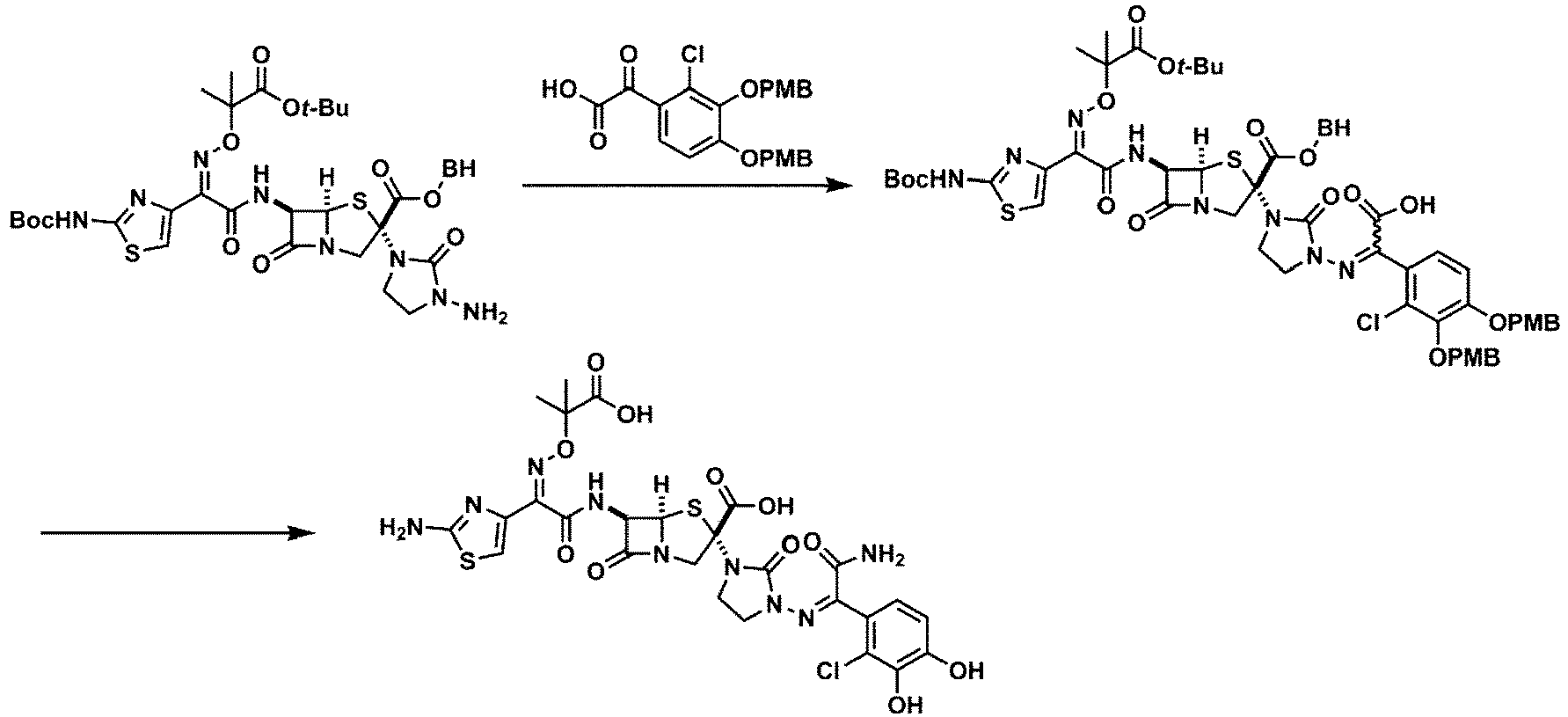
- Ethanol (4 mL) was added to 2-(2-chloro-3,4-bis((4-methoxybenzyl)oxy)phenyl)-2-oxoacetic acid (222 mg), and the mixture was stirred under ice cooling. At the same temperature, benzhydryl (3R,5R,6R)-3-(3-amino-2-oxoimidazolidin-1-yl)-6-((Z)-2-(((1-(tert-butoxy)-2-methyl-1-oxopr opan-2-yl)oxy)imino)-2-(2-((tert-butoxycarbonyl)amino)thiazol-4-yl)acetamido)-7-oxo-4-thia-1-azabicyclo[3.2.0]heptane-3-carboxylate (400 mg) was added to the mixture, and the mixture was stirred at room temperature overnight. The reaction mixture was added to a mixture of ethyl acetate (40 mL) and water (40 mL). The organic layer was separated and washed twice with water (50 mL). The organic layer was washed with a saturated aqueous sodium chloride solution (10 mL) and then dehydrated and dried over anhydrous sodium sulfate. The solvent was distilled away under reduced pressure, thereby obtaining a target substance (500 mg) as light yellow solids.
- DMAC (5 mL) was added to the compound (500 mg) obtained in Example 59 (1), and the mixture was stirred under ice cooling. Ammonium chloride (45 mg), HOBt (106 mg), EDC (176 mg), and NMM (254 µL) were sequentially added to the reaction mixture under ice cooling. The reaction mixture was stirred at room temperature overnight. The reaction mixture was added to a mixture of ethyl acetate (30 mL) and water (30 mL), and 1 mol/L hydrochloric acid was added thereto such that the pH was adjusted to 5.4. The organic layer was separated, and the aqueous layer was extracted three times by using ethyl acetate (5 mL). The organic layers were combined, sequentially washed with water and a saturated aqueous sodium chloride solution, and then dehydrated and dried over anhydrous sodium sulfate. The solvent was distilled away under reduced pressure, thereby obtaining a target substance (499 mg) as yellow solids.
- Dichloromethane (10 mL) was added to the compound (499 mg) obtained in Example 59 (2), and the mixture was stirred at a temperature equal to or lower than -20°C. At the same temperature, anisole (2.5 mL) and aluminum chloride (766 mg) were sequentially added to the reaction mixture. The reaction mixture was stirred at a temperature equal to or lower than -20°C for 40 minutes. The reaction mixture was added to a mixture of acetonitrile (40 mL), water (40 mL), and trisodium citrate dihydrate (2.53 g) under ice cooling. A saturated aqueous sodium hydrogen carbonate solution was added to the reaction mixture such that the pH was adjusted to 5.3, and the aqueous layer was separated. The aqueous layer was concentrated under reduced pressure, and the residue was purified by medium-pressure reverse-phase silica gel column chromatography [eluent; water:acetonitrile = 100:0 → 75:25]. The aqueous solution containing a target substance was lyophilized, thereby obtaining (3R,5R,6R)-3-(3-(((Z)-2-amino-1-(2-chloro-3,4-dihydroxyphenyl)-2-oxoethylidene)amino)-2-oxoimidazolidin-1-yl)-6-((Z)-2-(2-aminothiazol-4-yl)-2-(((2-carboxypropan-2-yl)oxy)imino)a cetamido)-7-oxo-4-thia-1-azabicyclo[3.2.0]heptane-3-carboxylate (24.9 mg) as yellow solids.
NMR: 1.48 (3H, s), 1.50 (3H, s), 3.14-3.40 (2H, m), 3.50 (1H, d, J = 13.2 Hz), 3.53-3.65 (2H, m), 4.75 (1H, d, J = 8.8 Hz), 5.67 (1H, d, J = 3.6 Hz), 5.74 (1H, d, J = 3.6 Hz), 6.82 (1H, d, J = 8.0 Hz), 6.94 (1H, d, J = 8.0 Hz), 7.02 (1H, s)
MS: 740.05 [M + H]+, 738.00 [M - H]- - The compounds shown in Table 23 were obtained in the same manner as in Example 59.
[Table 23] Example No. Structural Formula Name 60 
(3R,SR,6R)-3-((R)-3-(((Z)-2-amino-1-(2-chloro-3,4-dihyd roxyphenyl)-2-oxoethylidene)amino)-4-methyl-2-oxoimid azolidin-1-yl)-6-((Z)-2-(2-aminothiazol-4-yl)-2-(((2-carbo xypropan-2-yl)oxy)imino)acetamido)-7-oxo-4-thia-1-azab icyclo [3.2.0]heptane-3 -carboxylate 61 
(3R,5R,6R)-3-(3-(((Z)-2-amino-1-(2-chloro-3,4-dihydroxy phenyl)-2-oxoethylidene)amino)-2-oxoimidazolidin-1-yl)-6-((Z)-2-(2-aminothiazol-4-yl)-2-((1-carboxycyclobutoxy) imino)acetamido)-7-oxo-4-thia-1-azabicyclo[3 2.0]heptan e-3-carboxylate 6 2 
(3R,5R,6R)-3-(3-(((Z)-2-amino-1-(2-chloro-3,4-dihydroxy phenyl)-2-oxoethylidene)amino)-2-oxoimidazolidin-1-yl)-6-((Z)-2-(2-amino-5-chlorothiazol-4-yl)-2-(((2-carboxypro pan-2-yl)oxy)imino)acetamido)-7-oxo-4-thia-1-azabicyclo [3.2.0]heptane-3-carboxylate - The measured values of NMR and MS of the compounds in the table are as follows.
- NMR: 0.98 (3H, d, J = 6.0Hz), 1.49 (3H, s), 1.51 (3H, s), 3.10-3.11 (1H, m), 3.29 (1H, d, J = 8.0Hz), 3.58-3.64 (2H, m), 4.61 (1H, d, J = 12.4 Hz), 5.65 (1H, d, J = 3.6 Hz), 5.75 (1H, d, J = 3.6 Hz), 6.88-6.94 (1H, m), 6.97 (1H, d, J = 8.0Hz), 7.04 (1H, s)
MS: 754.15 [M + H]+, 752.10 [M - H]- - NMR: 1.80-1.93 (1H, m), 1.94-2.07 (1H, m), 2.24-2.38 (2H, m), 2.39-2.49 (1H, m), 2.49-2.60 (1H, m), 3.13-3.37 (2H, m), 3.50 (1H, d, J = 13.2 Hz), 3.55-3.66 (2H, m), 4.70 (1H, d, J = 2.0Hz), 5.69 (1H, d, J = 3.6 Hz), 5.76 (1H, d, J = 3.6 Hz), 6.82 (1H, d, J = 8.4 Hz), 6.94 (1H, d, J = 8.4 Hz), 7.06 (1H, s)
MS: 752.00 [M + H]+, 750.15 [M-H]- - NMR: 1.50 (3H, s), 1.51 (3H, s), 3.15-3.37 (2H, m), 3.52 (1H, d, J = 12.8 Hz), 3.55-3.65 (2H, m), 4.75 (1H, d, J = 5.2 Hz), 5.65 (1H, d, J = 4.0 Hz), 5.78 (1H, d, J = 3.2 Hz), 6.82 (1H, d, J = 8.4 Hz), 6.94 (1H, d, J = 8.4 Hz)
MS: 774.20 [M + H]+, 772.10 [M-H]- -

- THF (3 mL) was added to glyoxylic acid monohydrate (160 mg), and the mixture was stirred under ice cooling. At the same temperature, benzhydryl (3R,5R,6R)-3-(3-amino-2-oxoimidazolidin-1-yl)-6-((Z)-2-(((1-(tert-butoxy)-2-methyl-1-oxopr opan-2-yl)oxy)imino)-2-(2-((tert-butoxycarbonyl)amino)thiazol-4-yl)acetamido)-7-oxo-4-thia-1-azabicyclo[3.2.0]heptane-3-carboxylate (300 mg) was added to the reaction mixture, and the reaction mixture was stirred at room temperature for 3 hours. The reaction mixture was added to a mixture of ethyl acetate (30 mL) and water (30 mL). The organic layer was separated and dehydrated and dried over anhydrous sodium sulfate. The solvent was distilled away under reduced pressure, thereby obtaining a target substance (340 mg) as yellow solids.
- DMAC (3.1 mL) was added to the compound (309 mg) obtained in Example 63 (1), and the mixture was stirred under ice cooling. At the same temperature, N-(2-aminoethyl)-2-chloro-3,4-bis((4-methoxybenzyl)oxy)benzamide (158 mg), HOBt (51 mg), EDC (71 mg), and NMM (81 µL) were sequentially added to the reaction mixture. The reaction mixture was stirred at room temperature overnight. At room temperature, the reaction mixture was added to a mixture of ethyl acetate (20 mL) and water (20 mL), and 1 mol/L hydrochloric acid was added thereto such that the pH was adjusted to 5.4. The organic layer was separated, and the aqueous layer was extracted three times by using ethyl acetate (5 mL). The organic layers were combined, sequentially washed with water and a saturated aqueous sodium chloride solution, and then dehydrated and dried over anhydrous sodium sulfate. The solvent was distilled away under reduced pressure, thereby obtaining benzhydryl
- (3R,5R,6R)-6-((Z)-2-(((1-(tert-butoxy)-2-methyl-1-oxopropan-2-yl)oxy)imino)-2-(2-((tert-but oxycarbonyl)amino)thiazol-4-yl)acetamido)-3-(3-(((E)-2-((2-(2-chloro-3,4-bis((4-methoxyben zyl)oxy)benzamido)ethyl)amino)-2-oxoethylidene)amino)-2-oxoimidazolidin-1-yl)-7-oxo-4-th ia-1-azabicyclo[3.2.0]heptane-3-carboxylate (336 mg) as light yellow solids.
NMR (CDCl3): 1.39 (9H, s), 1.51 (3H, s), 1.52 (3H, s), 1.54 (9H, s), 3.50 (1H, d, J = 13.6 Hz), 3.55-3.69(8H,m), 3.80 (3H, s), 3.83 (3H, s), 4.93 (2H, s), 5.06 (2H, s), 5.14 (1H, d, J = 13.6 Hz), 5.60 (1H, d, J = 4.0 Hz), 5.75 (1H, dd, J = 7.8, 3.8 Hz), 6.77-6.85 (7H, m), 6.86 (1H, s), 6.86-6.94 (6H, m), 7.04-7.10 (1H, m), 7.21-7.45 (12H, m) - Dichloromethane (3.4 mL) was added to the compound (168 mg) obtained in Example 63 (2), and the mixture was stirred at a temperature equal to or lower than -20°C. At the same temperature, anisole (799 µL) and aluminum chloride (244 mg) were sequentially added to the reaction mixture. The reaction mixture was stirred at a temperature equal to or lower than -20°C for 30 minutes. The reaction mixture was added to a mixture of acetonitrile (10 mL), water (10 mL), and trisodium citrate dihydrate (809 mg) under ice cooling. A saturated aqueous sodium hydrogen carbonate solution was added to the reaction mixture such that the pH was adjusted to 5.2, and the aqueous layer was separated. The aqueous layer was concentrated under reduced pressure, and the residue was purified by medium-pressure reverse-phase silica gel column chromatography [eluent; water:acetonitrile = 100:0 → 75:25]. The aqueous solution containing a target substance was lyophilized, thereby obtaining (3R,5R,6R)-6-((Z)-2-(2-aminothiazol-4-yl)-2-(((2-carboxypropan-2-yl)oxy)imino)acetamido)-3-(3-(((E)-2-((2-(2-chloro-3,4-dihydroxybenzamido)ethyl)amino)-2-oxoethylidene)amino)-2-o xoimidazolidin-1-yl)-7-oxo-4-thia-1-azabicyclo[3.2.0]heptane-3-carboxylate (20.5 mg) as white solids.
NMR: 1.49 (3H, s), 1.51 (3H, s), 3.55 (1H, d, J = 13.6 Hz), 3.54-3.61 (4H, m), 3.76-3.84 (2H, m), 3.86-3.95 (2H, m), 4.73 (1H, d, J = 12.8 Hz), 5.70 (1H, d, J = 3.6 Hz), 5.75 (1H, d, J = 3.6 Hz), 6.86-6.95 (3H, m), 7.04 (1H, s)
MS: 811.05 [M + H]+, 809.30 [M - H]- -

- Dichloromethane (3.4 mL) was added to benzhydryl (3R,5R,6R)-6-((Z)-2-(((1-(tert-butoxy)-2-methyl-1-oxopropan-2-yl)oxy)imino)-2-(2-((tert-but oxycarbonyl)amino)thiazol-4-yl)acetamido)-3-(3-(((E)-2-((2-(2-chloro-3,4-bis((4-methoxyben zyl)oxy)benzamido)ethyl)amino)-2-oxoethylidene)amino)-2-oxoimidazolidin-1-yl)-7-oxo-4-th ia-1-azabicyclo[3.2.0]heptane-3-carboxylate (168 mg), and the mixture was stirred under ice cooling. At the same temperature, a 85% borane-2-picoline complex (19 mg) and p-toluenesulfonic acid monohydrate (47 mg) were sequentially added to the reaction mixture, and the reaction mixture was stirred at room temperature for 3 hours and 30 minutes. The reaction mixture was ice-cooled, and a 85% borane-2-picoline complex (12 mg) and p-toluenesulfonic acid monohydrate (23 mg) were sequentially added thereto, and the reaction mixture was stirred at room temperature overnight. At room temperature, the reaction mixture was added to a mixture of ethyl acetate (15 mL) and water (15 mL), and a saturated aqueous sodium hydrogen carbonate solution was added thereto such that the pH was adjusted to 4.6. The organic layer was separated, and the aqueous layer was extracted three times by using ethyl acetate. The organic layers were combined, sequentially washed with water and a saturated aqueous sodium chloride solution, and then dehydrated and dried over anhydrous sodium sulfate. The solvent was distilled away under reduced pressure, and the residue was purified by silica gel column chromatography [eluent; chloroform:2-propanol = 100:0 → 93:7], thereby obtaining a target substance (101 mg) as yellow solids.
- Dichloromethane (2.0 mL) was added to the compound (101 mg) obtained in Example 64 (1), and the mixture was stirred at a temperature equal to or lower than -20°C. At the same temperature, anisole (480 µL) and aluminum chloride (147 mg) were sequentially added to the reaction mixture. The reaction mixture was stirred at a temperature equal to or lower than -20°C for 30 minutes. The reaction mixture was added to a mixture of acetonitrile (6 mL), water (6 mL), and trisodium citrate dihydrate (486 mg) under ice cooling. A saturated aqueous sodium hydrogen carbonate solution was added to the reaction mixture such that the pH was adjusted to 5.1, and the aqueous layer was separated. The aqueous layer was concentrated under reduced pressure, and the residue was purified by medium-pressure reverse-phase silica gel column chromatography [eluent; water:acetonitrile = 100:0 → 80:20]. The aqueous solution containing a target substance was lyophilized, thereby obtaining (3R,5R,6R)-6-((Z)-2-(2-aminothiazol-4-yl)-2-(((2-carboxypropan-2-yl)oxy)imino)acetamido)-3-(3-((-2-((2-(2-chloro-3,4-dihydroxybenzamido)ethyl)amino)-2-oxoethyl)amino)-2-oxoimida zolidin-1-yl)-7-oxo-4-thia-1-azabicyclo[3.2.0]heptane-3-carboxylate (1.7 mg) as light yellow solids.
NMR: 1.47 (3H, s), 1.49 (3H, s), 3.14 (1H, d, J = 13.2 Hz), 3.58 (2H, s), 3.34-3.65(8H,m), 4.40 (1H, d, J = 12.8 Hz), 5.38 (1H, d, J = 3.6 Hz), 5.68 (1H, d, J = 3.6 Hz), 6.90 (1H, d, J = 8.0 Hz), 6.93 (1H, d, J = 8.0 Hz), 6.99 (1H, s)
MS: 813.10 [M + H]+, 810.90 [M - H]- -

- Dichloromethane (3.6 mL) was added to 2-chloro-N-(2-hydroxyethyl)-3,4-bis ((4-methoxybenzyl)oxy)benzamide (0.36 g), and the mixture was stirred under ice cooling. Dess-Martin periodinane (0.65 g) was added to the reaction mixture, and the reaction mixture was stirred at room temperature for 1 hour. Dichloromethane (10 mL), water (5 mL), and a 1 mol/L aqueous sodium thiosulfate solution (5 mL) were sequentially added to the reaction mixture, and the organic layer was separated. The organic layer was washed with a saturated aqueous sodium chloride solution and dehydrated and dried over anhydrous sodium sulfate. The solvent was distilled away under reduced pressure, dichloromethane (10 mL) and benzhydryl (3R,5R,6R)-3-(3-amino-2-oxoimidazolidin-1-yl)-6-((Z)-2-(((1-(tert-butoxy)-2-methyl-1-oxopr opan-2-yl)oxy)imino)-2-(2-((tert-butoxycarbonyl)amino)thiazol-4-yl)acetamido)-7-oxo-4-thia-1-azabicyclo[3.2.0]heptane-3-carboxylate (0.50 g) were added to the residue, and the mixture was stirred at room temperature for 1 hour. The reaction mixture was ice-cooled, and a 85% borane-2-picoline complex (91 mg) and p-toluenesulfonic acid monohydrate (220 mg) were sequentially added to the reaction mixture, and the reaction mixture was stirred at room temperature for 1 hour. At room temperature, dichloromethane (5 mL) and water (10 mL) were added to the reaction mixture, and a saturated aqueous sodium hydrogen carbonate solution was added thereto such that the pH was adjusted to 3.5. The organic layer was separated, washed with a saturated aqueous sodium chloride solution, and then dehydrated and dried over anhydrous sodium sulfate. The solvent was distilled away under reduced pressure, and the residue was purified by silica gel column chromatography [eluent; ethyl acetate :hexane = 70:30 → 100:0], thereby obtaining benzhydryl (3R,5R,6R)-6-((Z)-2-(((1-(tert-butoxy)-2-methyl-1-oxopropan-2-yl)oxy)imino)-2-(2-((tert-but oxycarbonyl)amino)thiazol-4-yl)acetamido)-3-(3-((2-(2-chloro-3,4-bis((4-methoxybenzyl)oxy )benzamido)ethyl)amino)-2-oxoimidazolidin-1-yl)-7-oxo-4-thia-1-azabicyclo[3.2.0]heptane-3-carboxylate (625 mg) as a yellow oily substance.
NMR (CDCl3): 1.37 (9H, s), 1.44-1.56 (15H, m), 2.86-3.04 (2H, m), 3.15-3.29 (1H, m), 3.48-3.52 (6H, m), 3.53-3.62 (1H, m), 3.80 (3H, s), 3.83 (3H, s), 4.23-4.33 (1H, m), 4.92 (1H, d, J = 13.2 Hz), 4.95 (2H, s), 5.08 (2H, s), 5.56 (1H, d, J = 3.6 Hz), 5.79 (1H, dd, J = 8.4, 3.6 Hz), 6.80-6.87 (4H, m), 6.89-6.96 (4H, m), 7.13-7.29 (13H, m), 7.49 (1H, d, J = 8.4 Hz), 8.17 (1H, s) - Dichloromethane (12.5 mL) was added to benzhydryl (3R,5R,6R)-6-((Z)-2-(((1-(tert-butoxy)-2-methyl-1-oxopropan-2-yl)oxy)imino)-2-(2-((tert-but oxycarbonyl)amino)thiazol-4-yl)acetamido)-3-(3-((2-(2-chloro-3,4-bis((4-methoxybenzyl)oxy )benzamido)ethyl)amino)-2-oxoimidazolidin-1-yl)-7-oxo-4-thia-1-azabicyclo[3.2.0]heptane-3-carboxylate (625 mg), and the mixture was stirred at a temperature equal to or lower than -20°C. At the same temperature, anisole (3.1 mL) and aluminum chloride (0.95 g) were sequentially added to the reaction mixture. The reaction mixture was stirred at a temperature equal to or lower than -20°C for 1 hour. The reaction mixture was added to a mixture of acetonitrile (30 mL), water (20 mL), and trisodium citrate dihydrate (3.14 g) under ice cooling. A saturated aqueous sodium hydrogen carbonate solution was added to the reaction mixture such that the pH was adjusted to 5.2, and the aqueous layer was separated. The aqueous layer was concentrated under reduced pressure, and the residue was purified by medium-pressure reverse-phase silica gel column chromatography [eluent; water:acetonitrile = 100:0 → 85:15]. The aqueous solution containing a target substance was lyophilized, thereby obtaining (3R,5R,6R)-6-((Z)-2-(2-aminothiazol-4-yl)-2-(((2-carboxypropan-2-yl)oxy)imino)acetamido)-3-(3-((2-(2-chloro-3,4-dihydroxybenzamido)ethyl)amino)-2-oxoimidazolidin-1-yl)-7-oxo-4-thi a-1-azabicyclo[3.2.0]heptane-3-carboxylate (112.5 mg) as white solids.
NMR: 1.47 (3H, s), 1.49 (3H, s), 3.05-3.19 (2H, m), 3.30 (1H, d, J = 12.8 Hz), 3.43-3.66 (6H, m), 4.47 (1H, d, J = 12.8 Hz), 5.52 (1H, d, J = 3.6 Hz), 5.72 (1H, d, J = 3.6 Hz), 6.90 (1H, d, J = 8.0 Hz), 7.01 (1H, d, J = 8.0 Hz), 7.02 (1H, s)
MS: 756.05 [M + H]+, 754.10 [M - H]- -

- In the same manner as in Example 65, (3R,5R,6R)-6-((Z)-2-(2-aminothiazol-4-yl)-2-(((2-carboxypropan-2-yl)oxy)imino)acetamido)-3 -(3 -((2-(2-chloro-3,4-dihydroxybenzamido)-3-methoxypropyl)amino)-2-oxoimidazolidin-1-y 1)-7-oxo-4-thia-1-azabicyclo [3.2.0] heptane-3 -carboxylate was obtained.
NMR: 1.47 (3H, s), 1.49 (3H, s), 3.06-3.20 (2H, m), 3.24 (1H, d, J = 11.6 Hz), 3.38-3.75 (6H, m), 3.43 (3H, s), 4.26-4.38 (1H, m), 4.46 [4.48] (1H, d, J = 12.8 Hz), 5.52 [5.55] (1H, d, J = 3.6 Hz), 5.69-5.76 (1H, m), 6.91 (1H, d, J = 8.4 Hz), 6.99-7.06 (2H, m)
MS: 800.10 [M + H]+, 797.95 [M - H]- -

- Dichloromethane (2.2 mL) was added to benzhydryl (3R,5R,6R)-6-((Z)-2-(((1-(tert-butoxy)-2-methyl-1-oxopropan-2-yl)oxy)imino)-2-(2-((tert-but oxycarbonyl)amino)thiazol-4-yl)acetamido)-3-(3-((2-(2-chloro-3,4-bis((4-methoxybenzyl)oxy )benzamido)ethyl)amino)-2-oxoimidazolidin-1-yl)-7-oxo-4-thia-1-azabicyclo[3.2.0]heptane-3-carboxylate (0.22 g), and the mixture was stirred under ice cooling. At the same temperature, triphosgene (20 mg) and N,N-diisopropylethylamine (35 µL) were sequentially added to the reaction mixture, and the reaction mixture was stirred at room temperature for 1 hour 30 minutes. At room temperature, ammonium chloride (13 mg) and triethylamine (46 µL) were added to the reaction mixture, and the reaction mixture was stirred for 1 hour. The reaction mixture was added to a mixture of ethyl acetate (10 mL), water (10 mL), and 1 mol/L hydrochloric acid (2 mL). The organic layer was separated, washed with a 5% aqueous sodium chloride solution, and then dehydrated and dried over anhydrous sodium sulfate. The solvent was distilled away under reduced pressure, and the residue was purified by silica gel column chromatography [eluent; ethyl acetate:hexane = 100:0 → chloroform:2-propanol = 90:10], thereby obtaining a target substance (99 mg) as a light brown oily substance.
- Dichloromethane (2 mL) was added to the compound (100 mg) obtained in Example 67 (1), and the mixture was stirred at a temperature equal to or lower than -20°C. At the same temperature, anisole (480 µL) and aluminum chloride (147 mg) were sequentially added to the reaction mixture. The reaction mixture was stirred at a temperature equal to or lower than -20°C for 1 hour. The reaction mixture was added to a mixture of acetonitrile (10 mL), water (5 mL), and trisodium citrate dihydrate (486 mg) under ice cooling. A saturated aqueous sodium hydrogen carbonate solution was added to the reaction mixture such that the pH was adjusted to 5.1, and the aqueous layer was separated. The aqueous layer was concentrated under reduced pressure, and the residue was purified by medium-pressure reverse-phase silica gel column chromatography [eluent; water:acetonitrile = 100:0 → 85:15]. The aqueous solution containing a target substance was lyophilized, thereby obtaining (3R,5R,6R)-6-((Z)-2-(2-aminothiazol-4-yl)-2-(((2-carboxypropan-2-yl)oxy)imino)acetamido)-3-(3-(1-(2-(2-chloro-3,4-dihydroxybenzamido)ethyl)ureido)-2-oxoimidazolidin-1-yl)-7-oxo-4-thia-1-azabicyclo[3.2.0]heptane-3-carboxylate (2.8 mg) as white solids.
NMR: 1.44-1.52 (6H, m), 3.32 (1H, d, J = 12.4 Hz), 3.39-3.99 (8H, m), 4.41-4.51 (1H, m), 5.50 (1H, dd, J = 6.0, 3.6 Hz), 5.68-5.73 (1H, m), 6.88-6.94 (1H, m), 6.97-7.06 (2H, m)
MS: 799.05 [M + H]+, 796.90 [M - H]- -

- Dichloromethane (1.3 mL) was added to the compound (70 mg) obtained in Reference Example 17, and the mixture was stirred under ice cooling. At the same temperature, oxalyl dichloride (13 µL) and DMF (7 µL) were sequentially added to the reaction mixture, and the reaction mixture was stirred for 1 hour. At the same temperature, oxalyl dichloride (7 µL) and DMF (3 µL) were sequentially added to the reaction mixture, and the reaction mixture was stirred for 1 hour, thereby obtaining a dichloromethane mixture containing the corresponding acid chloride.
- THF (2.8 mL) and water (2.8 mL) were added to benzhydryl (3R,5R,6R)-3-(3-amino-2-oxoimidazolidin-1-yl)-6-((Z)-2-(((1-(tert-butoxy)-2-methyl-1-oxopr opan-2-yl)oxy)imino)-2-(2-((tert-butoxycarbonyl)amino)thiazol-4-yl)acetamido)-7-oxo-4-thia-1-azabicyclo[3.2.0]heptane-3-carboxylate (111 mg), and the mixture was stirred under ice cooling. At the same temperature, sodium hydrogen carbonate (33 mg) was added to the reaction mixture. Then, at the same temperature, the prepared dichloromethane mixture containing the acid chloride was added dropwise to the reaction mixture. The reaction mixture was stirred at the same temperature for 15 minutes. Ethyl acetate (10 mL) and water (10 mL) were added to the reaction mixture, and the organic layer was separated. The organic layer was washed with a saturated aqueous sodium chloride solution and dehydrated and dried over anhydrous sodium sulfate. The solvent was distilled away under reduced pressure, thereby obtaining a target substance (179 mg) as yellow solids.
- Dichloromethane (3.6 mL) was added to the compound (179 mg) obtained in Example 68 (1), and the mixture was stirred at a temperature equal to or lower than -20°C. At the same temperature, anisole (841 µL) and aluminum chloride (258 mg) were sequentially added to the reaction mixture. The reaction mixture was stirred at a temperature equal to or lower than -20°C for 30 minutes. The reaction mixture was added to a mixture of acetonitrile (11 mL), water (11 mL), and trisodium citrate dihydrate (852 mg) under ice cooling. A saturated aqueous sodium hydrogen carbonate solution was added to the reaction mixture such that the pH was adjusted to 5.1, and the aqueous layer was separated. The aqueous layer was concentrated under reduced pressure, and the residue was purified by medium-pressure reverse-phase silica gel column chromatography [eluent; water: acetonitrile = 100:0 → 90:10]. The aqueous solution containing a target substance was lyophilized, thereby obtaining (3R,5R,6R)-6-((Z)-2-(2-aminothiazol-4-yl)-2-(((2-carboxypropan-2-yl)oxy)imino)acetamido)-3-(3-(2-((2-(2-chloro-3,4-dihydroxybenzamido)ethyl)amino)-2-oxoacetamido)-2-oxoimidazoli din-1-yl)-7-oxo-4-thia-1-azabicyclo[3.2.0]heptane-3-carboxylate (29.1 mg) as white solids.
NMR: 1.48 (3H, s), 1.50 (3H, s), 3.54-3.62 (5H, m), 3.62-3.67 (2H, m), 3.69-3.79 (2H, m), 4.65 (1H, d, J = 12.4 Hz), 5.69 (1H, d, J = 3.6 Hz), 5.75 (1H, d, J = 3.2 Hz), 6.90 (1H, d, J = 8.4 Hz), 6.94 (1H, d, J = 8.0 Hz), 7.03 (1H, s)
MS: 827.10 [M + H]+, 825.30 [M - H]- -

- Dichloromethane (1.9 mL) was added to N-(2-aminoethyl)-2-chloro-3,4-bis ((4-methoxybenzyl)oxy)benzamide (90 mg), and the mixture was stirred under ice cooling. At the same temperature, chlorosulfonyl isocyanate (17 µL) was added to the reaction mixture, and the reaction mixture was stirred at the same temperature for 40 minutes. At the same temperature, benzhydryl (3R,5R,6R)-3-(3-amino-2-oxoimidazolidin-1-yl)-6-((Z)-2-(((1-(tert-butoxy)-2-methyl-1-oxopr opan-2-yl)oxy)imino)-2-(2-((tert-butoxycarbonyl)amino)thiazol-4-yl)acetamido)-7-oxo-4-thia-1-azabicyclo[3.2.0]heptane-3-carboxylate (150 mg) and N,N-diisopropylethylamine (36 µL) were sequentially added to the reaction mixture, and the reaction mixture was stirred for 2 hours. At the same temperature, anisole (1.1 mL) and aluminum chloride (347 mg) were sequentially added to the reaction mixture, and the reaction mixture was stirred for 30 minutes. At the same temperature, the reaction mixture was added to a mixture of acetonitrile (20 mL), water (15 mL), and trisodium citrate dihydrate (1.15 g). A saturated aqueous sodium hydrogen carbonate solution was added to the reaction mixture such that the pH was adjusted to 5.3, and the aqueous layer was separated. The aqueous layer was concentrated under reduced pressure, and the residue was purified by medium-pressure reverse-phase silica gel column chromatography [eluent; water:acetonitrile = 100:0 → 85:15]. The aqueous solution containing a target substance was lyophilized, thereby obtaining (3R,5R,6R)-6-((Z)-2-(2-aminothiazol-4-yl)-2-(((2-carboxypropan-2-yl)oxy)imino)acetamido)-3-(3-((N-((2-(2-chloro-3,4-dihydroxybenzamido)ethyl)carbamoyl)sulfamoyl)amino)-2-oxoimi dazolidin-1-yl)-7-oxo-4-thia-1-azabicyclo[3.2.0]heptane-3-carboxylate as white solids.
MS: 878.00 [M + H]+, 875.90 [M - H]- -

- Dichloromethane (1.7 mL) was added to benzhydryl (3R,5R,6R)-3-(3-amino-2-oxoimidazolidin-1-yl)-6-((Z)-2-(((1-(tert-butoxy)-2-methyl-1-oxopr opan-2-yl)oxy)imino)-2-(2-((tert-butoxycarbonyl)amino)thiazol-4-yl)acetamido)-7-oxo-4-thia-1-azabicyclo[3.2.0]heptane-3-carboxylate (150 mg), and the mixture was stirred under ice cooling. At the same temperature, chlorosulfonyl isocyanate (15 µL) was added to the reaction mixture, and the reaction mixture was stirred at the same temperature for 40 minutes. At the same temperature, N-(2-aminoethyl)-2-chloro-3,4-bis((4-methoxybenzyl)oxy)benzamide (82 mg) and N,N-diisopropylethylamine (36 µL) were sequentially added to the reaction mixture, and the reaction mixture was stirred for 2 hours. At the same temperature, anisole (1.1 mL) and aluminum chloride (347 mg) were sequentially added to the reaction mixture, and the reaction mixture was stirred for 30 minutes. At the same temperature, the reaction mixture was added to a mixture of acetonitrile (20 mL), water (15 mL), and trisodium citrate dihydrate (1.15 g). A saturated aqueous sodium hydrogen carbonate solution was added to the reaction mixture such that the pH was adjusted to 5.3, and the aqueous layer was separated. The aqueous layer was concentrated under reduced pressure, and the residue was purified by medium-pressure reverse-phase silica gel column chromatography [eluent; water:acetonitrile = 100:0 → 85:15]. The aqueous solution containing a target substance was lyophilized, thereby obtaining (3R,5R,6R)-6-((Z)-2-(2-aminothiazol-4-yl)-2-(((2-carboxypropan-2-yl)oxy)imino)acetamido)-3-(3-(3-(N-(2-(2-chloro-3,4-dihydroxybenzamido)ethyl)sulfamoyl)ureido)-2-oxoimidazolidin-1-yl)-7-oxo-4-thia-1-azabicyclo[3.2.0]heptane-3-carboxylate as white solids.
NMR: 1.48 (3H, s), 1.49 (3H, s), 3.23 (2H, t, J = 6.2 Hz), 3.32-3.44 (1H, m), 3.49-3.60 (6H, m), 4.51 (1H, d, J = 12.8 Hz), 5.58 (1H, d, J = 3.6 Hz), 5.71 (1H, d, J = 3.2 Hz), 6.92 (1H, d, J = 8.0 Hz), 7.02 (1H, s), 7.07 (1H, d, J = 8.4 Hz)
MS: 878.05 [M + H]+, 875.90 [M - H]- -

- Water (1.0 mL) and semicarbazide hydrochloride (4.5 mg) were added to (3R,5R,6R)-6-((Z)-2-(2-aminothiazol-4-yl)-2-(((2-carboxypropan-2-yl)oxy)imino)acetamido)-3-(3-(2-(2-chloro-3,4-dihydroxyphenyl)-2-oxoacetamido)-2-oxoimidazolidin-1-yl)-7-oxo-4-thi a-1-azabicyclo[3.2.0]heptane-3-carboxylate (30 mg), and the mixture was stirred. A saturated aqueous sodium hydrogen carbonate solution was added to the reaction mixture such that the pH was adjusted to 4.6, and the mixture was stirred at room temperature for 6 days. The reaction mixture was purified by medium-pressure reverse-phase silica gel column chromatography [eluent; water:acetonitrile = 100:0 → 85:15]. The aqueous solution containing a target substance was lyophilized, thereby obtaining (3R,5R,6R)-6-((Z)-2-(2-aminothiazol-4-yl)-2-(((2-carboxypropan-2-yl)oxy)imino)acetamido)-3-(3-((Z)-2-(2-carbamoylhydrozono)-2-(2-chloro-3,4-dihydroxyphenyl)acetamido)-2-oxoimid azolidin-1-yl)-7-oxo-4-thia-1-azabicyclo[3.2.0]heptane-3-carboxylate (3.3 mg) as white solids.
NMR: 1.44-1.53 (6H, m), 3.52-3.80 (5H, m), 4.65 (1H, d, J = 12.4 Hz), 5.69 (1H, d, J = 3.6 Hz), 5.75 (1H, d, J = 3.6 Hz), 6.98 (1H, d, J = 8.4 Hz), 7.02 (1H, s), 7.07 (1H, d, J = 8.4 Hz)
MS: 798.05 [M + H]+, 795.90 [M - H]- - The compounds shown in Table 24 were obtained in the same manner as in Example 1.
[Table 24] Example No. Structural Formula Name 72 
(3R,5R,6R)-6-((Z)-2-(2-aminothiazol-4-yl)-2-(((2-carboxy propan-2-yl)oxy)imino)acetamido)-3-(3-(3-(2-chloro-3,4-dihydroxybenzamido)-2-oxoimidazolidin-1-carboxamido) -2-oxoimidazolidin-1-yl)-7-oxo-4-thia-1-azabicyclo[3.2.0] heptane-3-carboxylate 73 
(3R,5R,6R)-6-((Z)-2-(2-aminothiazol-4-yl)-2-(((2-carboxy propan-2-yl)oxy)imino)acetamido)-3-(5-((2-chloro-3,4-dih ydroxybenzamido)methyl)-2-oxoimidazolidin-3-yl)-7-oxo -4-thia-1-azabicyclo[3.2.0]heptane-3-carboxylate 74 
(3R,5R, 6R)-6-((Z)-2-(2-aminothiazol-4-yl)-2-(((2-carboxy propan-2-yl)oxy)imino)acetamido)-3-(4-((2-chloro-3,4-dih ydroxybenzamido)methyl)-1H-1,2,3-triazol-1-yl)-7-oxo-4-thia-1-azabicyclo [3.2.0]heptane-3-carboxylate - The measured values of NMR and MS of the compounds in the table are as follows.
- NMR: 1.49 (3H, s), 1.51 (3H, s), 3.57-3.75 (6H, m), 3.77-3.89 (2H, m), 3.93-4.02 (1H, m), 4.65 (1H, d, J = 12.0 Hz), 5.70 (1H, d, J = 3.6 Hz), 5.73-5.77 (1H, m), 6.95 (1H, d, J = 8.4 Hz), 7.03 (1H, s), 7.15 (1H, d, J = 8.4 Hz)
MS: 840.00 [M + H]+, 837.85 [M - H]- - NMR: 1.43 (3H, s), 1.44 (3H, s), 3.72-3.89 (4H, m), 3.95-4.03 (1H, m), 4.60 (1H, d, J = 12.8 Hz), 4.91-5.00 (1H, m), 5.64 (1H, d, J = 3.6 Hz), 5.73 (1H, d, J = 3.6 Hz), 6.90 (1H, d, J = 8.4 Hz), 6.93 (1H, s), 7.00 (1H, d, J = 8.8 Hz)
MS: 728.00 [M + H]+, 726.00 [M - H]- - NMR: 1.47 (3H, s), 1.50 (3H, s), 4.10 (1H, dd, J= 13.2, 1.2 Hz), 4.65-4.73 (3H, m), 5.59 (1H, d, J = 3.6 Hz), 5.81 (1H, dd, J = 3.8, 1.0 Hz), 6.91 (1H, d, J = 8.4 Hz), 7.01 (1H, s), 7.01 (1H, d, J = 8.4 Hz), 7.87 (1H, s)
MS: 710.05 [M + H]+, 708.00 [M - H]- - The compounds shown in Table 25 were obtained in the same manner as in Example 19.
[Table 25] Example No. Structural Formula Name 75 
(3R,5R,6R)-6-((Z)-2-(2-aminothiazol-4-yl)-2-(((2-carboxypropan-2-yl)oxy)imino)acetamido)-3-(3-(2 -(2-chloro-3,4-dihydroxyphenyl)-N-methyl-2-oxoa cetamido)-2-oxoimidazolidin-1-yl)-7-oxo-4-thia-1-azabicyclo[3.2.0]heptane-3-carboxylate 76 
(3R,5R,6R)-6-((Z)-2-(2-amino-5-chlorothiazol-4-y 1)-2-((1-carboxycyclopropoxy-)imino)acetamido)-3-(3-(2-(2-chloro-3,4-dihydroxyphenyl)-2-oxoacet amido)-2-oxoimidazolidin-1-yl)-7-oxo-4-thia-1-az abicyclo[3.2.0]heptane-3-carboxylate 77 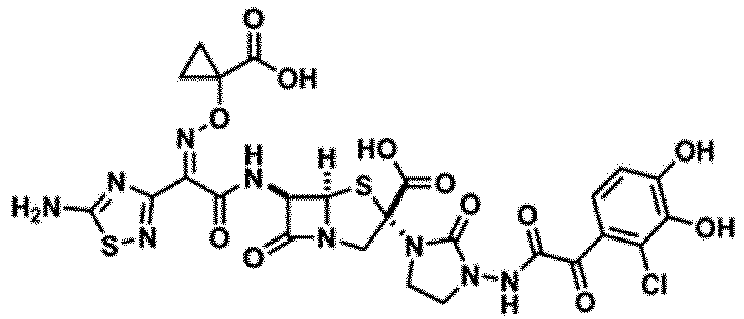
(3R,5R,6R)-6-((Z)-2-(5-ammo-1,2,4-thiadiazol-3-yl)-2-((1-carboxycyclopropoxy-)imino)acetamido) -3-(3-(2-(2-chloro-3,4-dihydroxyphenyl)-2-oxoace tamido)-2-oxoimidazolidin-1-yl)-7-oxo-4-thia-1-az abicyclo[3.2.0]heptane-3-carboxylate 78 
(3R,5R,6R)-6-((Z)-2-(2-amino-5-chlorothiazol-4-y 1)-2-((1-carboxycyclobutooxy)imino)acetamido)-3 -(3-(2-(2-chloro-3,4-dihydroxyphenyl)-2-oxoaceta mido)-2-oxoimidazolidin-1-yl)-7-oxo-4-thia-1-aza bicyclo[3.2.0]heptane-3-carboxylate 79 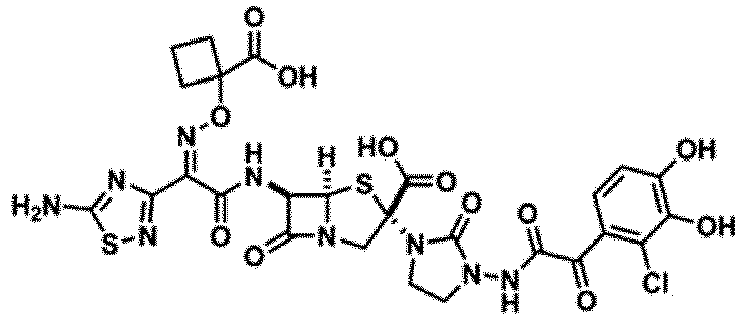
(3R,5R,6R)-6-((Z)-2-(5-amino-1,2,4-thiadiazol-3-yl)-2-((1-carboxycyclobutoxy)imino)acetamido)-3 -(3-(2-(2-chloro-3,4-dihydroxyphenyl)-2-oxoaceta mido)-2-oxoimidazolidin-1-yl)-7-oxo-4-thia-1-aza bicyclo[3.2.0]heptane-3-carboxylate 80 
(3R,5R,6R)-6-((Z)-2-(2-amino-5-methylthiazol-4-yl)-2-(((2-carboxypropan-2-yl)oxy)imino)acetamid o)-3-(3-(2-(2-chloro-3,4-dihydroxyphenyl)-2-oxoa cetamido)-2-oxoimidazolidin-1-yl)-7-oxo-4-thia-1-azabicyclo[3.2.0]heptane-3-carboxylate 81 
(3R,5R,6R)-6-((Z)-2-(2-amino-5-bromothiazol-4-y 1)-2-(((2-carboxypropan-2-yl)oxy)imino)acetamido )-3-(3-(2-(2-chloro-3,4-dihydroxyphenyl)-2-oxoac etamido)-2-oxoimidazolidin-1-yl)-7-oxo-4-thia-1-a zabicyclo [3.2.0]heptane-3 -carboxylate 82 
(3R,5R,6R)-6-((Z)-2-(2-aminothiazol-4-yl)-2-(((2-carboxypropan-2-yl)oxy)imino)acetamido)-3-(4-(2 -(2-chloro-3,4-dihydroxyphenyl)-2-oxoacetamido) -2,5-dioxopiperazin-1-yl)-7-oxo-4-thia-1-azabicycl o[3.2.0]heptane-3-carboxylate 83 
(3R,5R,6R)-6-((Z)-2-(2-aminothiazol-4-yl)-2-(((2-carboxypropan-2-yl)oxy)imino)acetamido)-3-(3-(2 ,5-dichloro-3,4-dihydroxybenzamido)-2-oxoimida zolidin-1-yl)-7-oxo-4-thia-1-azabicyclo[3.2.0]hept ane-3-carboxylate 84 
(3R,5R,6R)-6-((Z)-2-(2-aminothiazol-4-yl)-2-(((2-carboxypropan-2-yl)oxy)imino)acetamido)-3-((S)-3-(2-(2-chloro-3,4-dihydroxyphenyl)-2-oxoacetam ido)-2-oxopyrrolidin-1-yl)-7-oxo-4-thia-1-azabicy clo[3.2.0]heptane-3-carboxylate 85 
(3R,5R,6R)-6-((Z)-2-(2-aminothiazol-4-yl)-2-(((2-carboxypropan-2-yl)oxy)imino)acetamido)-3-((R)-3-(2-(2-chloro-3,4-dihydroxyphenyl)-2-oxoacetam ido)-2-oxopyrrolidin-1-yl)-7-oxo-4-thia-1-azabicy clo[3.2.0]heptane-3-carboxylate 86 
(3R,5R, 6R)-6-((Z)-2-(2-aminothiazol-4-yl)-2-(((2-carboxypropan-2-yl)oxy)imino)acetamido)-3-(3-(2 -(2-chloro-3,4-dihydroxyphenyl)-2-oxoacetamido) -2-oxotetrahydropyrrolidin-1(2H)-yl)-7-oxo-4-thia -1-azabicyclo[3.2.0]heptane-3-carboxylate - The measured values of NMR and MS of the compounds in the table are as follows.
- NMR: 1.49 (3H, s), 1.50 (3H, s), 3.18 (3H, s), 3.20-3.37 (2H, m), 3.44-3.52 (1H, m), 3.59-3.73 (2H, m), 4.29 (1H, d, J = 12.8 Hz), 4.99 (1H, d, J = 3.6 Hz), 5.71 (1H, d, J = 3.2 Hz), 6.94 (1H, d, J = 8.8 Hz), 7.04 (1H, s), 7.39 (1H, d, J = 8.4 Hz)
MS: 754.95 [M + H]+, 752.95 [M - H]- - NMR: 1.22-1.46 (4H, m), 3.64 (1H, d, J = 12.8 Hz), 3.67-3.82 (4H, m), 4.66 (1H, d, J = 12.8 Hz), 5.67 (1H, d, J = 3.6 Hz), 5.79 (1H, d, J = 2.8 Hz), 6.87 (1H, d, J = 8.8 Hz), 7.44 (1H, d, J = 8.4 Hz)
MS: 772.90 [M + H]+, 771.00 [M - H]- - NMR: 1.24-1.47 (4H, m), 3.62 (1H, dd, J = 13.0, 1.0 Hz), 3.67-3.82 (4H, m), 4.66 (1H, d, J = 12.8 Hz), 5.68 (1H, d, J = 3.6 Hz), 5.80 (1H, d, J = 2.8 Hz), 6.90 (1H, d, J = 8.8 Hz), 7.44 (1H, d, J = 8.4 Hz)
MS: 739.90 [M + H]+, 737.90 [M - H]- - NMR: 1.81-1.93 (1H, m), 2.05-2.10 (1H, m), 2.26-2.40 (2H, m), 2.40-2.50 (1H, m), 2.51-2.61 (1H, m), 3.41-3.47 (1H, m), 3.65 (1H, d, J = 12.8 Hz), 3.65-3.81 (3H, m), 4.68 (1H, d, J = 12.4 Hz), 5.71 (1H, d, J = 2.8 Hz), 5.83 (1H, d, J = 3.6 Hz), 6.93 (1H, d, J = 8.8 Hz), 7.44 (1H, d, J = 8.4 Hz)
MS: 786.95 [M + H]+, 785.15 [M - H]- - NMR: 1.85-1.95 (1H, m), 1.98-2.12 (1H, m), 2.28-2.43 (2H, m), 2.44-2.64 (2H, m), 3.41-3.46 (1H, m), 3.63 (1H, d, J = 12.8 Hz), 3.67-3.81 (3H, m), 4.68 (1H, d, J = 12.8 Hz), 5.72 (1H, d, J = 3.6 Hz), 5.84 (1H, d, J = 2.8 Hz), 6.95 (1H, d, J = 8.4 Hz), 7.44 (1H, d, J = 8.4 Hz)
MS: 754.25 [M + H]+, 752.00 [M - H]- - NMR: 1.49 (3H, s), 1.50 (3H, s), 2.36 (3H, s), 3.58-3.62 (1H, m), 3.62-3.65 (1H, m), 3.68-3.80 (3H, m), 4.67 (1H, d, J = 12.4 Hz), 5.69 (1H, d, J = 3.6 Hz), 5.79 (1H, d, J = 4.0 Hz), 6.93 (1H, d, J = 8.4 Hz), 7.44 (1H, d, J = 8.4 Hz)
MS: 755.00 [M + H]+, 753.05 [M - H]- - NMR: 1.52 (3H, s), 1.53 (3H, s), 3.64 (1H, d, J = 12.4 Hz), 3.69-3.79 (4H, m), 4.67 (1H, d, J = 12.4 Hz), 5.69 (1H, d, J = 4.0 Hz), 5.80 (1H, d, J = 2.8 Hz), 6.94 (1H, d, J = 8.4 Hz), 7.44 (1H, d, J = 8.8 Hz)
MS: 818.90 [M + H]+, 816.90 [M - H]- - NMR: 1.49 (3H, s), 1.50 (3H, s), 3.26 (1H, d, J = 11.8 Hz), 4.32-4.62 (4H, m), 5.13 (1H, d, J = 12.8 Hz), 5.71 (1H, d, J = 3.6 Hz), 5.74 (1H, dd, J = 3.6, 0.8 Hz), 6.81 (1H, d, J = 8.8 Hz), 7.02 (1H, s), 7.48 (1H, d, J = 8.8 Hz)
MS: 769.05 [M + H]+, 767.00 [M - H]- - NMR: 1.49 (3H, s), 1.51 (3H, s), 3.64 (1H, d, J = 12.8 Hz), 3.70-3.77 (4H, m), 4.68 (1H, d, J = 12.8 Hz), 5.71 (1H, d, J = 3.6 Hz), 5.76 (1H, d, J = 2.8 Hz), 6.97 (1H, s), 7.05 (1H, s)
MS: 746.95 [M + H]+, 745.05 [M - H]- - NMR: 1.49 (3H, s), 1.50 (3H, s), 2.14-2.28 (1H, m), 2.56-2.68 (1H, m), 3.40 (1H, dd, J = 12.8, 1.2 Hz), 3.74-3.84 (1H, m), 3.84-3.93 (1H, m), 4.69 (1H, t, J = 9.4 Hz), 4.87 (1H, d, J = 12.8 Hz), 5.69 (1H, d, J = 3.6 Hz), 5.72 (1H, dd, J = 3.6, 0.8 Hz), 6.92 (1H, d, J = 8.4 Hz), 7.03 (1H, s), 7.38 (1H, d, J = 8.4 Hz)
MS: 740.05 [M + H]+, 738.10 [M - H]- - NMR: 1.48 (3H, s), 1.51 (3H, s), 2.09-2.24 (1H, m), 2.58-2.71 (1H, m), 3.44 (1H, d, J = 12.8 Hz), 3.67-3.78 (1H, m), 3.80-3.90 (1H, m), 4.78-4.82 (2H, m),5.70 (1H, d, J = 3.6 Hz), 5.74 (1H, d, J = 3.6 Hz), 6.90 (1H, d, J = 8.4 Hz), 7.04 (1H, s), 7.39 (1H, d, J = 8.8 Hz)
MS: 740.05 [M + H]+, 738.00 [M - H]- - NMR: 1.48 (3H, s), 1.50 (3H, s), 2.15-2.34 (2H, m), 3.25 (1H, d, J = 12.4 Hz), 3.44-3.53 (1H, m), 3.59-3.71 (2H, m), 3.84-3.96 (1H, m), 4.96 (1H, d, J = 12.8 Hz), 5.65 (1H, d, J = 3.2 Hz), 5.72 (1H, d, J = 2.8 Hz), 6.62 (1H, d, J = 8.4 Hz), 7.04 (1H, s), 7.32 (1H, d, J = 8.4 Hz)
MS: 755.05 [M + H]+, 752.95 [M - H]- - The compounds shown in Table 26 were obtained in the same manner as in Example 27.
[Table 26] Example No. Structural Formula Name 87 
(3R,5R,6R)-6-((Z)-2-(2-aminothiazol-4-yl)-2-(((2-carboxypropan-2-yl)oxy)imino)acetamido)-3-(3-(2 -(2-(2-chloro-3,4-dihydroxybenzoyl)hydrazinyl)-2 -oxoacetamido)-2-oxoimidazolidin-1-yl)-7-oxo-4-t hia-1-azabicyclo[3.2.0]heptane-3-carboxylate 88 
(3R,5R,6R)-6-((Z)-2-(2-aminothiazol-4-yl)-2-(((2-carboxypropan-2-yl)oxy)imino)acetamido)-3-(3-(2 -(2-(2-(2-chloro-3,4-dihydroxyphenyl)-2-oxoacety 1)hydrazinyl)-2-oxoacetamido)-2-oxoimidazolidin-1-yl)-7-oxo-4-thia-1-azabicyclo[3.2.0]heptane-3-c arboxylate 89 
(3R,5R,6R)-6-((Z)-2-(2-amino-5-bromothiazol-4-y 1)-2-(((2-carboxypropan-2-yl)oxy)imino)acetamido )-3-(3-(2-(2-(2-(2-chloro-3,4-dihydroxyphenyl)-2-oxoacetyl)hydrazinyl)-2-oxoacetamido)-2-oxoimid azolidin-1-yl)-7-oxo-4-thia-1-azabicyclo[32.0]hep tane-3-carboxylate 90 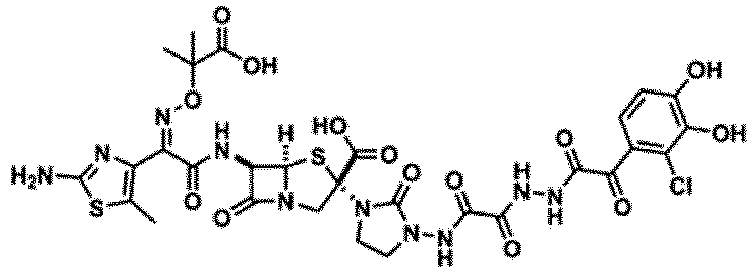
(3R,5R,6R)-6-((Z)-2-(2-amino-5-methylthiazol-4-yl)-2-(((2-carboxypropan-2-yl)oxy)imino)acetamid o)-3-(3-(2-(2-(2-(2-chloro-3,4-dihydroxyphenyl)-2 -oxoacetyl)hydrazinyl)-2-oxoacetamido)-2-oxoimi dazolidin-1-yl)-7-oxo-4-thia-1-azabicyclo [3.2.0]he ptane-3-carboxylate 91 
(3R,5R,6R)-6-((Z)-2-(2-aminothiazol-4-yl)-2-(((2-carboxypropan-2-yl)oxy)imino)acetamido)-3 -(3 -(2 -(2-((Z)-(2-(2-chloro-3,4-dihydroxyphenyl)-2-hydr oxyimino)acetyl)hydrazinyl)-2-oxoacetamido)-2-o xoimidazolidin-1-yl)-7-oxo-4-thia-1-azabicyclo [3. 2.0] heptane-3-carboxylate 92 
(3R,5R,6R)-6-((Z)-2-(2-aminothiazol-4-yl)-2-(((2-carboxypropan-2-yl)oxy)imino)acetamido)-3 -(3 -(2 -((3-(2-(2-chloro-3,4-dihydroxyphenyl)-2-oxoacet amido)propyl)amino)-2-oxoacetamido)-2-oxoimid azolidin-1-yl)-7-oxo-4-thia-1-azabicyclo[3.2.0]hep tane-3-carboxylate 93 
(3R,5R,6R)-6-((Z)-2-(2-aminothiazol-4-yl)-2-(((2-carboxypropan-2-yl)oxy)imino)acetamido)-3 -(3-(2 -((4-(2-(2-chloro-3,4-dihydroxyphenyl)-2-oxoacet amido)butyl)amino)-oxoacetamido)-2-oxoimidazol idin-1-yl)-7-oxo-4-thia-1-azabicyclo[32.0]heptane -3-carboxylate 94 
(3R,5R,6R)-6-((Z)-2-(2-aminothiazol-4-yl)-2-(((2-carboxypropan-2-yl)oxy)imino)acetamido)-3-(3-(2 -((2-(2-chloro-N,3,4-trihydroxybenzamido)ethyl)a mino)-2-oxoacetamido)-2-oxoimidazolidin-1-yl)-7 -oxo-4-thia-1-azabicyclo[3.2.0]heptane-3-carboxyl ate - The measured values of NMR and MS of the compounds in the table are as follows.
- NMR: 1.49 (3H, s), 1.51 (3H, s), 3.61 (1H, d, J = 12.8 Hz), 3.64-3.79 (4H, m), 4.67 (1H, d, J = 12.4 Hz), 5.70 (1H, d, J = 3.6 Hz), 5.75 (1H, d, J = 2.8 Hz), 6.95 (1H, d, J = 8.4 Hz), 7.04 (1H, s), 7.15 (1H, d, J = 8.4 Hz)
MS: 799.05 [M + H]+, 797.00 [M - H]- - NMR: 1.49 (3H, s), 1.51 (3H, s), 3.61 (1H, d, J = 12.8 Hz), 3.64-3.79 (4H, m), 4.67 (1H, d, J = 12.4 Hz), 5.70 (1H, d, J = 3.6 Hz), 5.75 (1H, d, J = 2.8 Hz), 6.92 (1H, d, J = 8.4 Hz), 7.03 (1H, s), 7.42 (1H, d, J = 8.4 Hz)
MS: 827.05 [M + H]+, 824.90 [M - H]- - NMR: 1.52 (3H, s), 1.53 (3H, s), 3.60-3.70 (3H, m), 3.70-3.78 (2H, m), 4.66 (1H, d, J = 13.6 Hz), 5.68 (1H, d, J = 4.0 Hz), 5.80 (1H, d, J = 3.6 Hz), 6.95 (1H, d, J = 8.4 Hz), 7.43 (1H, d, J = 8.8 Hz)
MS: 904.90 [M + H]+, 902.60 [M - H]- - NMR: 1.50 (3H, s), 1.52 (3H, s), 2.34 (3H, s), 3.48-3.80 (5H, m), 4.65 (1H, d, J = 12.8 Hz), 5.68 (1H, d, J = 3.6 Hz), 5.78 (1H, d, J = 2.8 Hz), 6.97 (1H, d, J = 8.8 Hz), 7.44 (1H, d, J = 8.4 Hz)
MS: 841.00 [M + H]+, 838.90 [M - H]- - NMR: 1.49 (3H, s), 1.51 (3H, s), 3.59 (1H, d, J = 12.4 Hz), 3.62-3.78 (4H, m), 4.66 (1H, d, J = 12.8 Hz), 5.69 (1H, d, J = 3.6 Hz), 5.75 (1H, d, J = 4.0 Hz), 6.88 (1H, d, J = 8.4 Hz), 6.98 (1H, d, J = 8.4 Hz), 7.03 (1H, s)
MS: 842.05 [M + H]+, 839.90 [M - H]- - NMR: 1.49 (3H, s), 1.50 (3H, s), 1.92 (2H, t, J = 6.4 Hz), 3.38-3.46 (4H, m), 3.54-3.65 (3H, m), 3.68-3.76 (2H, m), 4.64 (1H, d, J = 12.4 Hz), 5.68 (1H, d, J = 4.0 Hz), 5.74 (1H, d, J = 2.8 Hz), 6.96 (1H, d, J = 8.4 Hz), 7.03 (1H, s), 7.33 (1H, d, J = 8.8 Hz)
MS: 869.10 [M + H]+, 867.00 [M - H]- - NMR: 1.49 (3H, s), 1.50 (3H, s), 1.62-1.70 (4H, m), 3.31-3.42 (4H, m), 3.53-3.66 (3H, m), 3.66-3.76 (2H, m), 4.65 (1H, d, J = 12.8 Hz), 5.68 (1H, d, J = 4.0 Hz), 5.74 (1H, d, J = 3.2 Hz), 6.96 (1H, d, J = 8.4 Hz), 7.04 (1H, s), 7.31 (1H, d, J = 8.4 Hz)
MS: 883.05 [M + H]+, 880.95 [M - H]- - NMR: 1.49 (3H, s), 1.51 (3H, s), 3.48-3.56 (2H, m), 3.60 (1H, d, J = 13.2 Hz), 3.63-3.83 (6H, m), 4.67 (1H, d, J = 12.8 Hz), 5.71 (1H, d, J = 4.0 Hz), 5.75 (1H, d, J = 2.8 Hz), 6.77 (1H, d, J = 8.4 Hz), 6.93 (1H, d, J = 8.4 Hz), 7.04 (1H, s)
MS: 843.10 [M + H]+, 840.90 [M - H]- - The compounds shown in Table 27 were obtained in the same manner as in Example 49.
[Table 27] Example No. Structural Formula Name 95 
(3R,5R, 6R)-6-((Z)-2-(2-aminothiazol-4-yl)-2-(((2-carboxypropan-2-yl)oxy)imino )acetamido)-3-(4-(((1E,2E)-2-(2-((2-(2-c hloro-3,4-dihydroxybenzamido)ethyl)car bamoyl)hydrazinylidene)ethyl)amino)-2, 3-dioxopiperazin-1-yl)-7-oxo-4-thia-1-az abicyclo[3.2.0]heptane-3-carboxylate - The measured values of NMR and MS of the compounds in the table are as follows.
- NMR: 1.49 (3H, s), 1.51 (3H, s), 3.26 (1H, d, J = 12.8 Hz), 3.49-3.60 (4H, m), 4.05-4.35 (4H, m), 5.08 (1H, d, J = 13.2 Hz), 5.71 (1H, d, J = 4.0 Hz), 5.75 (1H, d, J = 2.8 Hz), 6.90 (1H, d, J = 8.4 Hz), 6.97 (1H, d, J = 8.4 Hz), 7.03 (1H, s), 7.70 (1H, d, J = 8.0 Hz), 7.95 (1H, d, J = 8.0 Hz)
MS: 881.15 [M + H]+, 878.90 [M - H]- - The compounds shown in Table 28 were obtained in the same manner as in Example 59.
[Table 28] Example No. Structural Formula Name 9 6 
(3R,5R,6R)-6-((Z)-2-(2-aminothiazol-4-yl)-2-(((2-carbo xypropan-2-yl)oxy)imino)acetamido)-3-(3-(((Z)-1-(2-ch loro-3,4-dihydroxyphenyl)-2-(methylamino)-2-oxoethyl idene)ammo)-2-oxoimidazolidm-1-yl)-7-oxo-4-thia-1-a zabicyclo[3.2.0]heptane-3-carboxylate 97 
(3R,5R,6R)-3-(3-(((Z)-2-((2-aminoethyl)amino)-1-(2-ch loro-3,4-dihydroxyphenyl)-2-oxoethylidene)amino)-2-o xoimidazolidin-1-yl)-6-((Z)-2-(2-aminothiazol-4-yl)-2-( ((2-carboxypropan-2-yl)oxy)imino)acetamido)-7-oxo-4-thia-1-azabicyclo [3.2.0]heptane-3-carboxylate 98 
(3R,5R,6R)-6-((Z)-2-(2-aminothiazol-4-yl)-2-(((2-carbo xypropan-2-yl)oxy)imino)acetamido)-3-(3-(((Z)-carbox y(2-chloro-3,4-dihydroxyphenyl)methylene)amino)-2-o xoimidazolidin-1-yl)-7-oxo-4-thia-1-azabicyclo[32.0]h eptane-3-carboxylate - The measured values of NMR and MS of the compounds in the table are as follows.
- NMR: 1.48 (3H, s), 1.50 (3H, s), 2.86 (3H, s), 3.11-3.35 (2H, m), 3.49 (1H, d, J = 12.4 Hz), 3.53-3.65 (2H, m), 5.67 (1H, d, J = 3.6 Hz), 5.74 (1H, d, J = 3.2 Hz), 6.81 (1H, d, J = 8.0 Hz), 6.94 (1H, d, J = 8.0 Hz), 7.02 (1H, s)
MS: 754.05 [M + H]+, 752.05 [M - H]- - NMR: 1.57 (3H, s), 1.61 (3H, s), 3.18-3.25 (4H, m), 3.55-3.69 (5H, m), 4.93-5.09 (1H, m), 5.42-5.49 (1H, m), 5.69-5.73 (1H, m), 6.81 (1H, d, J = 8.4 Hz), 6.93 (1H, d, J = 8.4 Hz), 7.20-7.24 (1H, m)
MS: 783.10 [M + H]+, 781.05 [M-H]- - NMR: 1.48 (3H, s), 1.49 (3H, s), 3.12-3.24 (2H, m), 3.51-3.60 (3H, m), 4.67 (1H, d, J = 12.8 Hz), 5.64 (1H, d, J = 4.0 Hz), 5.73 (1H, d, J = 3.2 Hz), 6.79 (1H, d, J = 8.4 Hz), 6.93 (1H, d, J = 8.0 Hz), 7.02 (1H, s)
MS: 741.05 [M+H]+, 739.10 [M-H]- -

- In the same manner as in Example 65, (3R,5R,6R)-6-((Z)-2-(2-aminothiazol-4-yl)-2-(((2-carboxypropan-2-yl)oxy)imino)acetamido)-3-(3-((2-(2-(2-chloro-3,4-dihydroxyphenyl)-2-hydroxyacetamido)-3-methoxypropyl)amino)-2-oxoimidazolidin-1-yl)-7-oxo-4-thia-1-azabicyclo[3.2.0]heptane-3-carboxylate was obtained.
NMR: 1.42-1.56 (6H, m), 3.03-3.13 (1H, m), 3.16-3.99 (11H, m), 4.12-4.34 (1H, m), 4.45-4.56 (1H, m), 5.10-5.39 (1H, m), 5.45-5.63 (1H, m), 5.64-5.78 (1H, m), 6.82-6.97 (2H, m), 6.98-7.06 (1H, m)
MS: 830.10 [M + H]+, 827.90 [M - H]- - The compounds shown in Table 29 were obtained in the same manner as in Example 68.
[Table 29] Example No. Structural Formula Name 100 
(3R,5R,6R)-6-((Z)-2-(2-ammo-5-chlorothiazol-4-yl )-2-((1-carboxycyclopropoxy-)imino)acetamido)-3-(3-(2-((2-(2-chloro-3,4-dihydroxybenzamido)ethyl) amino)-2-oxoacetamido)-2-oxoimidazolidin-1-yl)-7-oxo-4-thia-1-azabicyclo[3.2.0]heptane-3-carboxy late 101 
(3R,SR,6R)-6-((Z)-2-(5-amino-1,2,4-thiadiazol-3-y 1)-2-((1-carboxycyclopropoxy-)imino)acetamido)-3 -(3-(2-((2-(2-chloro-3,4-dihydroxybenzamido)ethyl )amino)-2-oxoacetamido)-2-oxoimidazolidin-1-yl)-7-oxo-4-thia-1-azabicyclo[3.2.0]heptane-3-carboxy late 102 
(3R,5R,6R)-6-((Z)-2-(2-amino-5-chlorothiazol-4-yl )-2-((1-carboxycyclobutoxy)immo)acetamido)-3-(3 -(2-((2-(2-chloro-3,4-dihydroxybenzamido)ethyl)a mino)-2-oxoacetamido)-2-oxoimidazolidin-1-yl)-7-oxo-4-thia-1-azabicyclo[3.2.0]heptane-3-carboxyla te 103 
(3R,5R,6R)-6-((Z)-2-(5-amino-1,2,4-thiadiazol-3-y 1)-2-((1-carboxycyclopropoxy-)imino)acetamido)-3 -(3-(2-((2-(2-chloro-3,4-dihydroxybenzamido)ethyl )amino)-2-oxoacetamido)-2-oxoimidazolidin-1-yl)-7-oxo-4-thia-1-azabicyclo[3.2.0]heptane-3-carboxy late 104 
(3R,5R,6R)-6-((Z)-2-(2-aminothiazol-4-yl)-2-(((2-c arboxypropan-2-yl)oxy)imino)acetamido)-3-(3-(2-( (2-(2-chloro-3,4-dihydroxybenzamido)ethyl)hydro xy)amino)-2-oxoacetamido)-2-oxoimidazolidin-1-y 1)-7-oxo-4-thia-1-azabicyclo[3.2.0]heptane-3-carbo xylate - The measured values of NMR and MS of the compounds in the table are as follows.
- NMR: 1.23-1.44 (4H, m), 3.53-3.67 (8H, m), 3.72 (1H, d, J = 6.8 Hz), 4.63 (1H, d, J = 12.8 Hz), 5.65 (1H, d, J = 4.0 Hz), 5.78 (1H, d, J = 3.2 Hz), 6.89 (1H, d, J = 8.0 Hz), 6.94 (1H, d, J = 8.4 Hz)
MS: 858.95 [M+H]+, 856.95 [M - H]- - NMR: 1.27-1.46 (4H, m), 3.50-3.69 (7H, m), 3.69-3.77 (2H, m), 4.63 (1H, d, J = 12.8 Hz), 5.66 (1H, d, J = 3.6 Hz), 5.79 (1H, d, J = 3.6 Hz), 6.90 (1H, d, J = 8.4 Hz), 6.94 (1H, d, J = 8.4 Hz)
MS: 826.15[M + H]+, 824.10[M-H]- - NMR: 1.82-1.95 (1H, m), 1.96-2.09 (1H, m), 2.27-2.40 (2H, m), 2.40-2.50 (1H, m), 2.51-2.60 (1H, m), 3.54-3.67 (7H, m), 3.70-3.75 (2H, m), 4.65 (1H, d, J = 12.8 Hz), 5.69 (1H, d, J = 3.6 Hz), 5.82 (1H, d, J = 3.6 Hz), 6.90 (1H, d, J = 8.4 Hz), 6.94 (1H, d, J = 8.4 Hz)
MS: 873.00 [M+H]+, 871.00 [M-H]- - NMR: 1.84-1.97 (1H, m), 1.98-2.11 (1H, m), 2.28-2.44 (2H, m), 2.44-2.53 (1H, m), 2.53-2.63 (1H, m), 3.54-3.68 (7H, m), 3.70-3.77 (2H, m), 4.66 (1H, d, J = 12.4 Hz), 5.70 (1H, d, J = 3.6 Hz), 5.83 (1H, dd, J = 3.6,1.2 Hz), 6.89 (1H, d, J = 8.4 Hz), 6.94 (1H, d, J = 8.4 Hz)
MS: 840.25 [M+H]+, 838.25 [M-H]- - NMR: 1.45 (3H, s), 1.46 (3H, s), 3.42-3.73 (9H, m), 4.55 (1H, d, J = 12.4 Hz), 5.65 (1H, d, J = 3.6 Hz), 5.70 (1H, dd, J = 10.2, 3.0 Hz), 6.88 (1H, s), 6.93 (1H, d, J = 8.8 Hz), 6.99 (1H, d, J = 6.4 Hz)
MS: 843.05 [M+H]+, 841.05 [M-H]- -

- 2-(2-Chloro-3,4-bis((4-methoxybenzyl)oxy)phenyl)-2-oxoacetic acid (155 mg), HATU (129 mg), DMAC (3 mL), and NMM (75 µL) were sequentially added to benzhydryl (3R,5R,6R)-3-(3-amino-2-oxoimidazolidin-1-yl)-6-((Z)-2-((((S)-1-(benzhydryloxy)-1-oxobuta n-2-yl)oxy)imino)-2-(2-((tert-butoxycarbonyl)amino)thiazol-4-yl)acetamido)-7-oxo-4-thia-1-a zabicyclo[3.2.0]heptane-3-carboxylate (300 mg). The reaction mixture was stirred at room temperature for 2 hours. Ethyl acetate (10 mL) and water (10 mL) were added to the reaction mixture, and the organic layer was separated. The organic layer was washed with a saturated aqueous sodium chloride solution and dehydrated and dried over anhydrous sodium sulfate. The solvent was distilled away under reduced pressure. The residue was purified by silica gel column chromatography [eluent; ethyl acetate:hexane = 30:70 → 70:30], thereby obtaining a target substance (374 mg) as light yellow solids.
- Dichloromethane (5.6 mL) was added to the compound (374 mg) obtained in Example 105 (1), and the mixture was stirred at -20°C. At the same temperature, anisole (1.7 mL) and aluminum chloride (529 mg) were sequentially added to the reaction mixture. The reaction mixture was stirred at a temperature equal to or lower than -20°C for 30 minutes. The reaction mixture was added to a mixture of acetonitrile (15 mL), water (15 mL), and trisodium citrate dihydrate (1.75 g) under ice cooling. A saturated aqueous sodium hydrogen carbonate solution was added to the reaction mixture such that the pH was adjusted to 5.3, and the aqueous layer was separated. The aqueous layer was concentrated under reduced pressure, and the residue was purified by medium-pressure reverse-phase silica gel column chromatography [eluent; water: acetonitrile = 100:0 → 90:10]. The aqueous solution containing a target substance was lyophilized, thereby obtaining (3R,5R,6R)-6-((Z)-2-(2-aminothiazol-4-yl)-2-(((S)-1-carboxypropoxy)imino)acetamido)-3-(3-(2-(2-chloro-3,4-dihydroxyphenyl)-2-oxoacetamido)-2-oxoimidazolidin-1-yl)-7-oxo-4-thia-1-a zabicyclo[3.2.0]heptane-3-carboxylate (90 mg) as yellow solids.
NMR: 0.97 (3H, t, J = 7.4 Hz), 1.77-1.94 (2H, m), 3.63 (1H,d, J=12.8 Hz), 3.67-3.87 (4H, m), 4.49-4.56 (1H, m), 4.68 (1H, d, J = 12.8 Hz), 5.71 (1H, d, J = 4.0 Hz), 5.79 (1H, d, J = 3.6 Hz), 6.83 (1H, d, J = 8.4 Hz), 7.05-7.08 (1H, m), 7.44 (1H, d, J = 8.8 Hz)
MS: 741.05 [M+H]+, 738.95 [M - H]- - The compounds shown in Table 30 were obtained in the same manner as in Example 105.
[Table 30] Example No. Structural Formula Name 106 
(3R,5R,6R)-6-((Z)-2-(5-ammo-1,2,4-thiadiazol-3-y 1)-2-((1-carboxycyclopropoxy-)imino)acetamido)-3 -(3-(3-(2-(2-chloro-3,4-dihydroxyphenyl)-2-oxoace tamido)propanamido)-2-oxoimidazolidin-1-yl)-7-o xo-4-thia-1-azabicyclo[3.2.0]heptane-3-carboxylate 107 
(3R,5R,6R)-6-((Z)-2-(2-amino-5-chlorothiazol-4-yl )-2-((1-carboxycyclopropoxy-)imino)acetamido)-3-(3-(3-(2-(2-chloro-3,4-dihydroxyphenyl)-2-oxoacet amido)propanamido)-2-oxoimidazolidin-1-yl)-7-ox o-4-thia-1-azabicyclo[3.2.0]heptane-3-carboxylate 108 
(3R,5R,6R)-6-((Z)-2-(2-ammo-5-chlorothiazol-4-yl )-2-((1-carboxycyclobutoxy)immo)acetamido)-3-(3 -(3-(2-(2-chloro-3,4-dihydroxyphenyl)-2-oxoaceta mido)propanamido)-2-oxoimidazolidin-1-yl)-7-oxo -4-thia-1-azabicyclo[3.2.0]heptane-3-carboxylate 109 
(3R,5R,6R)-6-((Z)-2-(5-amino-1,2,4-thiadiazol-3-y 1)-2-((1-carboxycyclobutoxy)imino)acetamido)-3-( 3-(3-(2-(2-chloro-3,4-dihydroxyphenyl)-2-oxoaceta mido)propanamido)-2-oxoimidazolidin-1-yl)-7-oxo -4-thia-1-azabicyclo[3.2.0]heptane-3-carboxylate 110 
(3R,5R,6R)-6-((Z)-2-(2-amino-5-methylthiazol-4-y 1)-2-(((2-carboxypropan-2-yl)oxy)imino)acetamido )-3-(3-(3-(2-(2-chloro-3,4-dihydroxyphenyl)-2-oxo acetamido)propanamido)-2-oxoimidazolidin-1-yl)-7-oxo-4-thia-1-azabicyclo[3.2.0]heptane-3-carboxy late 111 
(3R,5R,6R)-6-((Z)-2-(2-amino-5-bromothiazol-4-yl )-2-(((2-carboxypropan-2-yl)oxy)imino)acetamido) -3-(3-(3-(2-(2-chloro-3,4-dihydroxyphenyl)-2-oxoa cetamido)propanamido)-2-oxoimidazolidin-1-yl)-7 -oxo-4-thia-1-azabicyclo[3.2.0]heptane-3-carboxyl ate 112 
(3R,5R,6R)-6-((Z)-2-(2-aminothiazol-4-yl)-2-(((2-c arboxypropan-2-yl)oxy)imino)acetamido)-3-(3-(2-( 2,5-dichloro-3,4-dihydroxyphenyl)-2-oxoacetamid o)-2-oxoimidazolidin-1-yl)-7-oxo-4-thia-1-azabicy clo[3.2.0]heptane-3-carboxylate 113 
(3R,5R,6R)-6-((Z)-2-(2-aminothiazol-4-yl)-2-(((S)-1-carboxy-2-hydroxyethoxy)imino)acetamido)-3-(3 -(2-(2-chloro-3,4-dihydroxyphenyl)- 2-oxoacetamid o)-2-oxoimidazolidin-1-yl)-7-oxo-4-thia-1-azabicy clo[3.2.0]heptane-3-carboxylate 114 
(3R,5R,6R)-6-((Z)-2-(2-aminothiazol-4-yl)-2-(((S)-1-carboxy-2-methylpropoxy)imino)acetamido)-3-( 3-(2-(2-chloro-3,4-dihydroxyphenyl)-2-oxoacetami do)-2-oxoimidazolidin-1-yl)-7-oxo-4-thia-1-azabic yclo[3.2.0]heptane-3-carboxylate 115 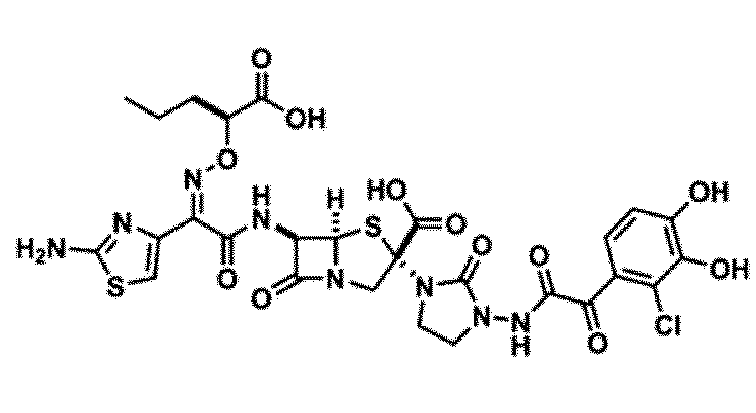
(3R,5R,6R)-6-((Z)-2-(2-aminothiazol-4-yl)-2-(((S)-1-carboxybutoxy)imino)acetamido)-3-(3-(2-(2-chlo ro-3,4-dihydroxyphenyl)-2-oxoacetamido)-2-oxoi midazolidin-1-yl)-7-oxo-4-thia-1-azabicyclo[3.2.0] heptane-3-carboxylate 116 
(3R,5R, 6R)-6-((Z)-2-(2-aminothiazol-4-yl)-2-(((R) -1-catboxy-2-hydroxyethoxy)imino)acetamido)-3-( 3-(2-(2-chloro-3,4-dihydroxyphenyl)-2-oxoacetami do)-2-oxoimidazolidin-1-yl)-7-oxo-4-thia-1-azabic yclo[3.2.0]heptane-3-carboxylate 117 
(3R,5R,6R)-6-((Z)-2-(2-aminothiazol-4-yl)-2-(((2-c arboxypropan-2-yl)oxy)imino)acetamido)-3-(3-((Z) -2-(2-chloro-3,4-dihydroxyphenyl)-2-(hydroxyimin o)acetamido)-2-oxoimidazolidin-1-yl)-7-oxo-4-thia -1-azabicyclo [3.2.0]heptane-3-carboxylate 118 
(3R,5R,6R)-6-((Z)-2-(2-aminothiazol-4-yl)-2-(((2-c arboxypropan-2-yl)oxy)imino)acetamido)-3-(3-((Z) -2-(3,4-dihydroxyphenyl)-2-(hydroxyimino)acetam ido)-2-oxoimidazolidin-1-yl)-7-oxo-4-thia-1-azabic yclo[3.2.0]heptane-3-carboxylate 119 
(3R,5R,6R)-6-((Z)-2-(2-aminothiazol-4-yl)-2-(((2-c arboxypropan-2-yl)oxy)imino)acetamido)-3-(3-((Z) -2-(2-chloro-3,4-dihydroxyphenyl)-2-hydrazinylide neacetamido)-2-oxoimidazolidin-1-yl)-7-oxo-4-thia -1-azabicyclo[3.2.0]heptane-3-carboxylate 120 
(3R,5R,6R)-6-((Z)-2-(2-aminothiazol-4-yl)-2-(((2-c arboxypropan-2-yl)oxy)imino)acetamido)-3-(3-((Z) -2-(2-chloro-3,4-dihydroxyphenyl)-2-(2-piperidine-4-carbonyl)hydrazinylidene)acetamido)-2-oxoimid azolidin-1-yl)-7[3.2.0]hept ane-3 -carboxylate 121 
(3R,5R,6R)-6-((Z)-2-(2-aminothiazol-4-yl)-2-(((2-c arboxypropan-2-yl)oxy)imino)acetamido)-3-(3-(2-( (2-(2-(2-chloro-3,4-dihydroxyphenyl)-2-oxoacetam ido)ethyl)amino)-2-oxoacetamido)-2-oxoimidazoli din-1-yl)-7-oxo-4-thia-1-azabicyclo[3 .2.0]heptane-3 -carboxylate 122 
(3R,5R,6R)-6-((Z)-2-(2-aminothiazol-4-yl)-2-(((2-c arboxypropan-2-yl)oxy)imino)acetamido)-3-(3-(3-( (Z)-2-(2-chloro-3,4-dihydroxyphenyl)-2-(hydroxyi mino)acetamido)propanamido)-2-oxoimidazolidin-1-yl)-7-oxo-4-thia-1-azabicyclo[3.2.0]heptane-3-ca rboxylate 123 
(3R,5R,6R)-6-((Z)-2-(2-aminothiazol-4-yl)-2-(((2-c arboxypropan-2-yl)oxy)imino)acetamido)-3-(3-(3-( (Z)-2-(2-chloro-3,4-dihydroxyphenyl)-2-hydrazinyl ideneacetamido)propanamido)-2-oxoimidazolidin-1-yl)-7-oxo-4-thia-1-azabicyclo[3.2.0]heptane-3-ca rboxylate 124 
(3R,5R,6R)-6-((Z)-2-(2-aminothiazol-4-yl)-2-(((2-c arboxypropan-2-yl)oxy)imino)acetamido)-3-(3-(5-hydroxy-4-oxo-1,4-dihydropyridine-2-carboxamid o)-2-oxoimidazolidin-1-yl)-7-oxo-4-thia-1-azabicy clo[3.2.0]heptane-3-carboxylate 125 
(3R,5R,6R)-6-((Z)-2-(2-aminothiazol-4-yl)-2-(((2-c arboxypropan-2-yl)oxy)imino)acetamido)-3-(3-(1,5 -dihydroxy-4-oxo-1,4-dihydropyridine-2-carboxam ido)-2-oxoimidazolidin-1-yl)-7-oxo-4-thia-1-azabic yclo[3.2.0]heptane-3-carboxylate 126 
(3R,5R,6R)-6-((Z)-2-(2-aminothiazol-4-yl)-2-(((2-c arboxypropan-2-yl)oxy)imino)acetamido)-3-(4-(2-( 2-chloro-3,4-dihydroxyphenyl)-2-oxoacetamido)-2, 3-dioxopiperazin-1-yl)-7-oxo-4-thia-1-azabicyclo[3 .2.0]heptane-3-carboxylate 127 
(3R,5R,6R)-6-((Z)-2-(2-aminothiazol-4-yl)-2-(((2-c arboxypropan-2-yl)oxy)imino)acetamido)-3-(4-(2-( (2-(2-chloro-3,4-dihydroxybenzamido)ethyl)amino )-2-oxoacetamido)-2,3-dioxopiperazin-1-yl)-7-oxo-4-thia-1-azabicyclo[3.2.0]heptane-3-carboxylate 128 
(3R,5R,6R)-6-((Z)-2-(2-aminothiazol-4-yl)-2-(((2-c arboxypropan-2-yl)oxy)imino)acetamido)-3-(4-(3-( (Z)-(2-(2-chloro-3,4-dihydroxyphenyl)-2-(hydroxyi mino)acetamido)propanamido)-2,3 -dioxopiperazin-1-yl)-7-oxo-4-thia-1-azabicyclo[3.2.0]heptane-3-ca rboxylate 129 
(3R,5R,6R)-6-((Z)-2-(2-aminothiazol-4-yl)-2-(((2-c arboxypropan-2-yl)oxy)imino)acetamido)-3-(4-(3-( (E)-2-(2-chloro-3,4-dihydroxyphenyl)-2-(hydroxyi mino)acetamido)propanamido)-2,3 -dioxopiperazin-1-yl)-7-oxo-4-thia-1-azabicyclo[3.2.0]heptane-3-ca rboxylate 130 
(3R,5R,6R)-6-((Z)-2-(2-aminothiazol-4-yl)-2-(((2-c arboxypropan-2-yl)oxy)imino)acetamido)-3-(4-(3-( (Z)-2-(2-chloro-3,4-dihydroxyphenyl)-2-hydrazinyl ideneacetamido)propanamido)-2,3 -dioxopiperazin-1-yl)-7-oxo-4-thia-1-azabicyclo[3.2.0]heptane-3-ca rboxylate 131 
(3R,5R,6R)-6-((Z)-2-(2-aminothiazol-4-yl)-2-(((2-c arboxypropan-2-yl)oxy)imino)acetamido)-3-(4-((Z) -2-(2-chloro-3,4-dihydroxyphenyl)-2-(hydroxyimin o)acetamido)-2,3-dioxopiperazin-1-yl)-7-oxo-4-thi a-1-azabicyclo[3.2.0]heptane-3-carboxylate 132 
(3R,5R,6R)-6-((Z)-2-(2-aminothiazol-4-yl)-2-(((2-c arboxypropan-2-yl)oxy)imino)acetamido)-3-(4-(2-c hloro-3,4-dihydroxybenzamido)-2,3-dioxopiperazi n-1-yl)-7-oxo-4-thia-1-azabicyclo [3.2.0]heptane-3-carboxylate 133 
(3R,5R,6R)-6-((Z)-2-(2-amino-5-bromothiazol-4-yl )-2-(((2-carboxypropan-2-yl)oxy)imino)acetamido) -3-(4-(2-(2-chloro-3,4-dihydroxyphenyl)-2-oxoacet amido)-2,3-dioxopiperazin-1-yl)-7-oxo-4-thia-1-az abicyclo[3.2.0]heptane-3-carboxylate 134 
(3R,5R,6R)-6-((Z)-2-(5-amino-1,2,4-thiadiazol-3-y 1)-2-(((2-carboxypropan-2-yl)oxy)imino)acetamido )-3-(4-(2-(2-chloro-3,4-dihydroxyphenyl)-2-oxoace tamido)-2,3-dioxopiperazin-1-yl)-7-oxo-4-thia-1-az abicyclo[3.2.0]heptane-3-carboxylate 135 
(3R,5R,6R)-6-((Z)-2-(2-amino-5-chlorothiazol-4-yl )-2-(((2-carboxypropan-2-yl)oxy)imino)acetamido) -3-(4-(2-(2-chloro-3,4-dihydroxyphenyl)-2-oxoacet amido)-2,3-dioxopiperazin-1-yl)-7-oxo-4-thia-1-az abicyclo[3.2.0]heptane-3-carboxylate 13 6 
(3R,5R,6R)-6-((Z)-2-(2-amino-5-chlorothiazol-4-yl )-2-(((2-carboxypropan-2-yl)oxy)imino)acetamido) -3-(3-(2-(2-(2-(2-chloro-3,4-dihydroxyphenyl)-2-o xoacetyl)hydrazinyl)-2-oxoacetamido)-2-oxoimida zolidin-1-yl)-7-oxo-4-thia-1-azabicyclo[3.2.0]hepta ne-3 -carboxylate - The measured values of NMR and MS of the compounds in the table are as follows.
- NMR: 1.23-1.46 (4H, m), 2.65 (2H, t, J = 6.2 Hz), 3.52-3.62 (3H, m), 3.62-3.74 (4H, m), 4.59 (1H, d, J = 12.4 Hz), 5.39 (1H, d, J = 3.6 Hz), 5.77 (1H, d, J = 4.0 Hz), 6.95 (1H, d, J = 8.4 Hz), 7.34 (1H, d, J = 8.8 Hz)
MS: 810.95 [M+H]+, 809.10 [M-H]- - NMR: 1.22-1.45 (4H, m), 2.66 (2H, t, J = 6.4 Hz), 3.53-3.72 (7H, m), 4.58 (1H, d, J = 12.8 Hz), 5.60 (1H, d, J = 4.0 Hz), 5.75 (1H, d, J = 4.0 Hz), 6.95 (1H, d, J = 8.8 Hz), 7.34 (1H, d, J = 8.8 Hz)
MS: 843.95 [M+H]+, 842.05 [M-H]- - NMR: 1.81-1.95 (1H, m), 1.95-2.08 (1H, m), 2.27-2.39 (2H, m), 2.39-2.49 (1H, m), 2.50-2.60 (1H, m), 2.66 (2H, t, J = 6.4 Hz), 3.54-3.72 (7H, m), 4.61 (1H, d, J = 12.8 Hz), 5.64 (1H, d, J = 4.0 Hz), 5.79 (1H, d, J = 3.6 Hz), 6.95 (1H, d, J = 8.8 Hz), 7.34 (1H, d, J = 8.4 Hz)
MS: 858.00 [M+H]+, 855.95 [M-H]- - NMR: 1.83-1.96 (1H, m), 1.96-2.10 (1H, m), 2.27-2.41 (2H, m), 2.43-2.53 (1H, m), 2.53-2.62 (1H, m), 2.65 (2H, t, J = 6.2 Hz), 3.53-3.73 (7H, m), 4.61 (1H, d, J = 12.4 Hz), 5.66 (1H, d, J = 3.6 Hz), 5.81 (1H, d, J = 3.6 Hz), 6.95 (1H, d, J = 8.4 Hz), 7.34 (1H, d, J = 8.4 Hz)
MS: 825.20 [M+H]+, 822.95 [M-H]- - NMR: 1.49 (3H, s), 1.50 (3H, s), 2.34 (3H, s), 2.66 (2H, t, J = 6.2 Hz), 3.52-3.62 (3H, m), 3.64-3.71 (4H, m), 4.59 (1H, d, J = 12.4 Hz), 5.63 (1H, d, J = 4.0 Hz), 5.75 (1H, d, J = 3.2 Hz), 6.96 (1H, d, J = 8.4 Hz), 7.34 (1H, d, J = 8.4 Hz)
MS: 826.00 [M+H]+, 824.00 [M-H]- - NMR: 1.50 (3H, s), 1.52 (3H, s), 2.66 (2H, t, J = 6.2 Hz), 3.54-3.63 (3H, m), 3.63-3.71 (4H, m), 4.59 (1H, d, J = 12.4 Hz), 5.62 (1H, d, J = 4.0 Hz), 5.76 (1H, d, J = 2.8 Hz), 6.96 (1H, d, J = 8.4 Hz), 7.34 (1H, d, J = 8.8 Hz)
MS: 889.90 [M+H]+, 887.75 [M-H]- - NMR: 1.49 (3H, s), 1.51 (3H, s), 3.54-3.68 (2H, m), 3.68-3.80 (3H, m), 4.68 (1H, d, J = 13.2 Hz), 5.71 (1H, d, J = 4.0 Hz), 5.75 (1H, d, J= 3.6 Hz), 7.05 (1H, s), 7.40 (1H, s)
MS: 774.95 [M + H]+, 773.00 [M - H]- - NMR: 3.61 (1H, d, J = 12.8 Hz), 3.68-3.80 (4H, m), 3.93-4.02 (2H, m), 4.64-4.73 (2H, m), 5.71 (1H, d, J = 4.0 Hz), 5.80 (1H, d, J = 2.8 Hz), 6.96 (1H, d, J = 8.8 Hz), 7.10 (1H, s), 7.44 (1H, d, J = 8.4 Hz)
MS: 743.00 [M + H]+, 741.00 [M - H]- - NMR: 0.98 (3H, d, J = 6.8 Hz), 1.01 (3H, d, J = 7.2 Hz), 2.15-2.22 (1H, m), 3.64 (1H, d, J = 12.8 Hz), 3.68-3.87 (4H, m), 4.30-4.36 (1H, m), 4.67 (1H, dd, J = 12.6, 4.6 Hz), 5.71 (1H, d, J = 3.6 Hz), 5.77-5.82 (1H, m), 6.84 (1H, d, J = 8.4 Hz), 7.06 (1H, s), 7.44 (1H, d, J = 8.8 Hz)
MS: 755.05 [M + H]+, 752.95 [M - H]- - NMR: 0.94 (3H, t, J = 7.4 Hz), 1.35-1.49 (2H, m), 1.75-1.86 (2H, m), 3.66 (1H, d, J = 12.4 Hz), 3.70-3.87 (4H, m), 4.55-4.61 (1H, m), 4.66 (1H, d, J = 12.8 Hz), 5.70 (1H, d, J = 3.6 Hz), 5.80 (1H, d, J = 3.6 Hz), 6.81[6.88] (1H, d, J = 8.8 Hz), 7.06 [7.06] (1H, s),7.44 [7.45] (1H, d, J = 8.6 Hz)
MS: 755.05 [M + H]+, 752.95 [M - H]- - NMR: 3.61 (1H, d, J = 12.8 Hz), 3.68-3.80 (4H, m), 3.91-4.02 (2H, m), 4.64-4.73 (2H, m), 5.71 (1H, d, J = 4.0 Hz), 5.80 (1H, d, J = 3.6 Hz), 6.92 (1H, d, J = 8.4 Hz), 7.08 (1H, s), 7.44 (1H, d, J = 8.4 Hz)
MS: 743.00 [M + H]+, 740.90 [M - H]- - NMR: 1.48 (3H, s), 1.50 (3H, s), 3.60 (1H, d, J = 12.8 Hz), 3.61-3.78 (4H, m), 4.65[4.66] (1H, d, J = 12.6 Hz), 5.69 [5.69] (1H, d, J = 3.6 Hz), 5.75 (1H, d, J = 3.6 Hz), 6.87 (1H, d, J = 8.0 Hz), 6.98 (1H, d, J = 8.4 Hz), 7.03[7.03] (1H, s)
MS: 756.05 [M + H]+, 753.95 [M - H]- - NMR: 1.49 (3H, s), 1.51 (3H, s), 3.61 (1H, d, J = 12.8 Hz), 3.63-3.81 (4H, m), 4.66 (1H, d, J = 12.8 Hz), 5.70 (1H, d, J = 3.6 Hz), 5.75 (1H, d, J = 4.0 Hz), 6.94-7.07 (3H, m), 7.12 [7.12] (1H, s)
MS: 722.10 [M + H]+, 720.00 [M - H]- - NMR: 1.48 (3H, s), 1.50 (3H, s), 3.54-3.77 (5H, m), 4.64 (1H, d, J = 12.8 Hz), 5.68 (1H, d, J = 3.6 Hz), 5.74 (1H, dd, J = 3.6, 0.8 Hz), 6.79 (1H, d, J = 8.0 Hz), 7.01 (1H, d, J = 8.4 Hz), 7.02 (1H, s)
MS: 755.10 [M + H]+, 752.95 [M - H]- - NMR: 1.48 (3H, s), 1.50 (3H, s), 1.70-2.18 (4H, m), 2.90-3.18 (1H, m), 3.18-3.41 (2H, m), 3.41-3.62 (2H, m), 3.62-3.81 (4H, m), 3.81-3.92 (1H, m), 4.64 (1H, d, J = 12.8 Hz), 5.67-5.78 (2H, m), 6.76-6.90 (1H, m), 6.92-7.09 (2H, m)
MS: 866.15 [M + H]+, 864.10 [M - H]- - NMR: 1.49 (3H, s), 1.50 (3H, s), 3.51-3.68 (8H,m), 3.70-3.77 (1H, m), 4.63 (1H, d, J = 12.8 Hz), 5.69 (1H, d, J = 3.6 Hz), 5.74 (1H, d, J = 3.2 Hz), 6.95 (1H, d, J = 8.8 Hz), 7.05 (1H, s), 7.28 (1H, d, J = 8.4 Hz)
MS: 855.00 [M + H]+, 853.25 [M - H]- - NMR: 1.48 (3H, s), 1.50 (3H, s), 2.58 (2H, t, J = 6.2 Hz), 3.62-3.73 (7H, m), 4.63 (1H, d, J = 12.8 Hz), 5.68 (1H, d, J = 3.6 Hz), 5.75 (1H, dd, J = 3.6, 1.2 Hz), 6.81 (1H, d, J = 8.4 Hz), 6.97 (1H, d, J = 8.4 Hz), 7.03 (1H, s)
MS: 827.10 [M + H]+, 824.95 [M - H]- - NMR: 1.49 (3H, s), 1.50 (3H, s), 2.56 (2H, t, J = 6.4 Hz), 3.50-3.73 (7H, m), 4.63 (1H, d, J = 12.8 Hz), 5.68 (1H, d, J = 3.6 Hz), 5.75 (1H, dd, J = 3.8, 1.0Hz), 6.74 (1H, d, J = 8.4 Hz), 7.00 (1H, d, J = 8.4 Hz), 7.03 (1H, s)
MS: 826.10 [M + H]+, 824.00 [M - H]- - NMR: 1.49 (3H, s), 1.51 (3H, s), 3.62 (1H, dd, J = 12.8, 1.2 Hz), 3.66-3.82 (4H, m), 4.67 (1H, d, J = 12.4 Hz), 5.71 (1H, d, J = 4.0 Hz), 5.76 (1H, dd, J = 3.6, 0.8 Hz), 7.03 (1H, s), 7.16 (1H, s), 7.82 (1H, s)
MS: 680.10 [M + H]+, 678.00 [M - H]- - NMR: 1.49 (3H, s), 1.51 (3H, s), 3.65 (1H, dd, J = 12.8, 1.2 Hz), 3.68-3.79 (4H, m), 4.66 (1H, d, J = 12.8 Hz), 5.71 (1H, d, J = 3.6 Hz), 5.76 (1H, dd, J = 3.6, 1.2 Hz), 7.03 (1H, s), 7.42 (1H, s), 7.59 (1H, s)
MS: 696.10 [M + H]+, 694.00 [M - H]- - NMR: 1.49 (3H, s), 1.50 (3H, s), 3.28 (1H, d, J = 13.2 Hz), 4.01-4.13 (2H, m), 4.18-4.36 (2H, m), 5.09 (1H, d, J = 13.2 Hz), 5.71 (1H, d, J = 3.6 Hz), 5.74 (1H, d, J = 3.6 Hz), 6.81 (1H, d, J = 8.8 Hz), 7.03 (1H, s), 7.47 (1H, d, J = 8.4 Hz)
MS: 769.05 [M + H]+, 766.90 [M - H]- - NMR: 1.49 (3H, s), 1.50 (3H, s), 3.18 [3.26] (1H, dd, J = 12.8, 1.2 Hz), 3.53-3.67 (4H, m), 3.76-4.33 (4H, m), 5.05 [5.08] (1H, d, J = 13.0Hz), 5.67[5.69] (1H, d, J = 3.6 Hz), 5.74 (1H, dd, J = 3.6, 1.2 Hz), 6.77-6.87 (2H, m), 7.02 [7.03] (1H, s)
MS: 855.20 [M + H]+, 852.95 [M - H]- - NMR: 1.49 (3H, s), 1.50 (3H, s), 2.64 (2H, t, J = 6.2 Hz), 3.25 (1H, dd, J = 13.0, 1.0 Hz), 3.66 (2H, t, J = 6.4 Hz), 3.82-3.95 (2H, m), 4.09-4.27 (2H, m), 5.07 (1H, d, J = 12.8 Hz), 5.69 (1H, d, J = 3.6 Hz), 5.74 (1H, dd, J = 3.2, 0.8 Hz), 6.80 (1H, d, J = 8.0 Hz), 6.97 (1H, d, J = 8.0 Hz), 7.02 (1H, s)
MS: 855.10 [M + H]+, 852.90 [M - H]- - NMR: 1.49 (3H, s), 1.50 (3H, s), 2.61-2.73 (2H, m), 3.25 (1H, d, J = 12.8 Hz), 3.62-3.92 (4H, m), 4.07-4.27 (2H, m), 5.07 (1H, d, J = 12.8 Hz), 5.70 (1H, d, J = 3.2 Hz), 5.74 (1H, d, J = 3.2 Hz), 6.93 (1H, d, J = 8.4 Hz), 6.97 (1H, d, J = 8.0 Hz), 7.02 (1H, s)
MS: 855.10 [M + H]+, 852.90 [M - H]- - NMR: 1.49 (3H, s), 1.50 (3H, s), 2.62 (2H, t, J = 6.4 Hz), 3.25 (1H, dd, J = 12.8,1.2 Hz), 3.58-3.94 (2H, m), 3.83-3.94 (2H, m), 4.10-4.28 (2H, m), 5.07 (1H, d, J = 13.2 Hz), 5.70 (1H, d, J = 3.6 Hz), 5.73 (1H, dd, J = 3.6, 1.2 Hz), 6.74 (1H, d, J = 8.4 Hz), 7.01 (1H, d, J = 8.4 Hz), 7.02 (1H, s)
MS: 854.20 [M + H]+, 852.00 [M - H]- - NMR: 1.48 (3H, s), 1.50 (3H, s), 3.26 (1H, dd, J = 12.8, 0.8 Hz), 3.97-4.08 (2H, m), 4.16-4.33 (2H, m), 5.08 (1H, d, J = 13.2 Hz), 5.69 (1H, d, J = 3.6 Hz), 5.74 (1H, dd, J = 3.6, 1.2 Hz),6.87 (1H, d, J = 8.4 Hz), 6.98 (1H, d, J = 8.4 Hz), 7.02 (1H, s)
MS: 784.05 [M + H]+, 781.85 [M - H]- - NMR: 1.49 (3H, s),1.51 (3H, s), 3.29 (1H, dd, J = 13.0, 1.0 Hz), 4.05-4.15 (2H, m), 4.20-4.36 (2H, m), 5.10 (1H, d, J = 12.8 Hz), 5.71 (1H, d, J = 3.6 Hz), 5.75 (1H, dd, J = 3.6, 1.2 Hz), 6.95 (1H, d, J = 8.8 Hz), 7.03 (1H, s), 7.17 (1H, d, J = 8.4 Hz)
MS: 741.05 [M + H]+, 739.05 [M - H]- - NMR: 1.52 (3H, s), 1.53 (3H, s), 3.28 (1H, d, J = 12.4 Hz), 4.01-4.13 (2H, m), 4.17-4.37 (2H, m), 5.09 (1H, d, J = 13.2 Hz), 5.67 (1H, d, J = 3.2 Hz), 5.76-5.82 (1H, m), 6.90-7.07 (1H, m), 7.42-7.51 (1H, m)
MS: 846.90 [M + H]+, 844.90 [M - H]- - NMR: 1.53 (3H, s), 1.54 (3H, s), 3.28 (1H, d, J = 12.8 Hz), 4.02-4.15 (2H, m), 4.16-4.37 (2H, m), 5.08 (1H, d, J = 12.8 Hz), 5.68 (1H, d, J = 2.8 Hz), 5.80 (1H, d, J = 2.8 Hz), 6.98 (1H, d, J = 8.4 Hz), 7.46 (1H, d, J = 7.6 Hz)
MS: 770.05 [M + H]+, 767.95 [M - H]- - NMR: 1.50 (3H, s), 1.52 (3H, s), 3.29 (1H, d, J = 13.2 Hz), 4.01-4.15 (2H, m), 4.15-4.37 (2H, m), 5.09 (1H, d, J = 12.8 Hz), 5.67 (1H, d, J = 3.6 Hz), 5.78 (1H, d, J = 2.0Hz), 6.98 (1H, d, J = 8.4 Hz), 7.46 (1H, d, J = 8.4 Hz)
MS: 802.95 [M + H]+, 800.90 [M - H]- - NMR: 1.51 (3H, s), 1.52 (3H, s), 3.57-3.80 (5H, m), 4.65 (1H, d, J = 12.8 Hz), 5.68 (1H, d, J = 4.0 Hz), 5.79 (1H, d, J = 3.6 Hz), 6.96 (1H, d, J = 8.4 Hz), 7.43 (1H, d, J = 8.4 Hz)
MS: 861.00 [M + H]+, 858.95 [M-H]- -

- (2-(2-Chloro-3,4-bis((4-methoxybenzyl)oxy)phenyl)-2-oxoacetyl)-L-serine (166 mg), 4-(4,6-dimethoxy-1,3,5-triazin-2-yl)-4-methylmorpholinium chloride (137 mg), and THF (3.6 mL) were sequentially added to benzhydryl (3R,5R,6R)-3-(3-amino-2-oxoimidazolidin-1-yl)-6-((Z)-2-(((1-(tert-butoxy)-2-methyl-1-oxopr opan-2-yl)oxy)imino)-2-(2-((tert-butoxycarbonyl)amino)thiazol-4-yl)acetamido)-7-oxo-4-thia-1-azabicyclo[3.2.0]heptane-3-carboxylate (120 mg). The reaction mixture was stirred at room temperature overnight. Ethyl acetate (6 mL) and water (6 mL) were added to the reaction mixture, and the organic layer was separated. The aqueous layer was extracted twice by using ethyl acetate (10 mL). The organic layer was washed a saturated aqueous sodium chloride solution (20 mL) and dehydrated and dried over anhydrous sodium sulfate. The solvent was distilled away under reduced pressure. The residue was purified by silica gel column chromatography [eluent; ethyl acetate:hexane = 50:50 → 100:0], thereby obtaining a target substance (200 mg) as brown solids.
- Dichloromethane (4 mL) was added to the compound (200 mg) obtained in Example 137 (1), and the mixture was stirred at -20°C. At the same temperature, anisole (940 µL) and aluminum chloride (288 mg) were sequentially added to the reaction mixture. The reaction mixture was stirred at a temperature equal to or lower than -20°C for 30 minutes. The reaction mixture was added to a mixture of acetonitrile (15 mL), water (15 mL), and trisodium citrate dihydrate (952 mg) under ice cooling. A saturated aqueous sodium hydrogen carbonate solution was added to the reaction mixture such that the pH was adjusted to 5.2, and the aqueous layer was separated. The aqueous layer was concentrated under reduced pressure, and the residue was purified by medium-pressure reverse-phase silica gel column chromatography [eluent; water:acetonitrile = 100:0 → 85:15]. The aqueous solution containing a target substance was lyophilized, thereby obtaining (3R,5R,6R)-6-((Z)-2-(2-aminothiazol-4-yl)-2-(((2-carboxypropan-2-yl)oxy)imino)acetamido)-3-(3-((S)-2-(2-(2-chloro-3,4-dihydroxyphenyl)-2-oxoacetamido)-3-hydroxypropanamido)-2-o xoimidazolidin-1-yl)-7-oxo-4-thia-1-azabicyclo[3.2.0]heptane-3-carboxylate (35 mg) as yellow solids.
NMR: 1.49 (3H, s), 1.50 (3H, s), 3.54-3.68 (3H, m), 3.68-3.76 (2H, m), 3.99 (2H, d, J = 5.6 Hz), 4.66 (1H, d, J = 13.2 Hz), 5.69 (1H, d, J = 3.6 Hz), 5.75 (1H, d, J = 4.0 Hz), 6.95 (1H, d, J = 8.4 Hz), 7.04 (1H, s), 7.40 (1H, d, J = 8.8 Hz)
MS: 828.00 [M + H]+, 826.15 [M - H]- - The compounds shown in Table 31 were obtained in the same manner as in Example 137.
[Table 31] Example No. Structural Formula Name 1 3 8 
(3R,5R,6R)-6-((Z)-2-(2-aminothiazol-4-yl)-2 -(((2-carboxypropan-2-yl)oxy)imino)acetami do)-3-(3-((R)-2-(2-(2-chloro-3,4-dihydroxyp henyl)-2-oxoacetamido)-3-hydroxypropanam ido)-2-oxoimidazolidin-1-yl)-7-oxo-4-thia-1-azabicyclo[3.2.0]heptane-3-carboxylate 139 
(3R,5R,6R)-6-((Z)-2-(2-aminothiazol-4-yl)-2 -(((2-carboxypropan-2-yl)oxy)imino)acetami do)-3-(3-((R)-2-(2-(2-chloro-3,4-dihydroxyp henyl)-2-oxoacetamido)-3-hydroxypropanam ido)-2-oxoimidazolidin-1-yl)-7-oxo-4-thia-1-azabicyclo[3.2.0]heptane-3-carboxylate 1 4 0 
(3R,5R,6R)-6-((Z)-2-(2-aminothiazol-4-yl)-2 -(((2-carboxypropan-2-yl)oxy)imino)acetami do)-3-(3-(2-(2-chloro-N,3,4-trihydroxybenza mido)-2-oxoimidazolidin-1-yl)-7-oxo-4-thia-1-azabicyclo[3.2.0]heptane-3-carboxylate - The measured values of NMR and MS of the compounds in the table are as follows.
- NMR: 1.48 (3H, s), 1.50 (3H, s), 3.53-3.67 (3H, m), 3.67-3.75 (2H, m), 3.99 (2H, d, J = 6.0 Hz), 4.67 (1H, d, J = 5.6 Hz), 5.69 (1H, d, J = 4.0 Hz), 5.74 (1H, d, J = 3.2 Hz), 6.94 (1H, d, J = 8.8 Hz), 7.03 (1H, s), 7.39 (1H, d, J = 8.8 Hz)
MS: 828.00 [M + H]+, 826.15 [M-H]- - NMR: 1.46 (3H, s), 1.47 (3H, s), 3.40 (3H, s), 3.42-3.47 (1H, m), 3.51-3.64 (3H, m), 3.64-3.71 (2H, m), 3.84 (2H, d, J = 5.6 Hz), 4.62 (1H, d, J = 12.8 Hz), 5.65 (1H, d, J = 4.0 Hz), 5.71 (1H, d, J = 3.2 Hz), 6.94 (1H, d, J = 8.4 Hz), 7.01 (1H, s), 7.36 (1H, d, J = 8.4 Hz)
MS: 841.95 [M + H]+, 840.05 [M - H]- - NMR: 1.49 (3H, s), 1.51 (3H, s), 3.54-3.86 (7H, m), 4.66 (1H, dd, J = 12.6, 3.0 Hz), 5.69 (1H, d, J = 3.6 Hz), 5.75 (1H, d, J = 3.2 Hz), 6.93 (1H, d, J = 8.4 Hz), 7.03 (1H, s), 7.07 (1H, d, J = 8.4 Hz)
MS: 786.05 [M + H]+, 783.95 [M - H]- -

- Dichloromethane (1.1 mL) was added to benzhydryl (3R,5R,6R)-6-((Z)-2-(2-aminothiazol-4-yl)-2-(((1-(tert-butoxy)-2-methyl-1-oxopropan-2-yl)o xy)imino)acetamido)-3-(5-((N-(tert-butoxycarbonyl)-2-chloro-3,4-bis((4-methoxybenzyl)oxy) benzamido)methyl)-2H-tetrazol-2-yl)-7-oxo-4-thia-1-azabicyclo [3.2.0] heptane-3 -carboxylate (71 mg), and the mixture was stirred at -20°C. At the same temperature, anisole (0.36 mL) and aluminum chloride (110 mg) were sequentially added to the reaction mixture. The reaction mixture was stirred at a temperature equal to or lower than -20°C for 50 minutes. The reaction mixture was added to a mixture of acetonitrile (5 mL), water (5 mL), and trisodium citrate dihydrate (0.37 g) under ice cooling. A saturated aqueous sodium hydrogen carbonate solution was added to the reaction mixture such that the pH was adjusted to 5.1, and the aqueous layer was separated. The aqueous layer was concentrated under reduced pressure, and the residue was purified by medium-pressure reverse-phase silica gel column chromatography [eluent; water:acetonitrile = 100:0 → 75:25]. The aqueous solution containing a target substance was lyophilized, thereby obtaining (3R,5R,6R)-6-((Z)-2-(2-aminothiazol-4-yl)-2-(((2-carboxypropan-2-yl)oxy)imino)acetamido)-3-(5-((2-chloro-3,4-dihydroxybenzamido)methyl)-2H-tetrazol-2-yl)-7-oxo-4-thia-1-azabicyclo [3.2.0]heptane-3-carboxylate (7.6 mg) as white solids.
NMR: 1.45 (3H, s), 1.46 (3H, s), 4.16 (1H, d, J = 12.8 Hz), 4.67 (1H, dd, J = 16.4, 5.6 Hz), 4.78 (1H, dd, J = 16.4, 5.6 Hz), 4.90 (1H, d, J = 12.8 Hz), 5.70 (1H, d, J = 4.0 Hz), 5.77 (1H, dd, J = 8.0,4.0Hz), 6.78 (1H, d, J = 8.0 Hz), 6.84 (1H, s), 6.86 (1H, d, J = 8.0 Hz), 7.70 (1H, d, J = 1.2 Hz), 8.86 (1H, t, J = 5.6 Hz), 9.34 (1H, d, J = 8.0 Hz), 10.08-10.09 (1H, brs)
MS: 711.05 [M + H]+, 708.90 [M - H]- - The minimum inhibitory concentration (MIC) was measured according to the Clinical and Laboratory Standards Institute (CLSI) standard method by using the following broth microdilution method.
- As bacteria, a Pseudomonas aeruginosa strain ATCC27853, an AmpC-derepressed Pseudomonas aeruginosa mutant strain (S-3028), an IMP-1-containing Pseudomonas aeruginosa strain (S-2838), a VIM-2-containing Pseudomonas aeruginosa strain (S-3779), a GES-19 and GES-20-containing Pseudomonas aeruginosa strain (S-3759), a CTX-M-15-containing Escherichia coli strain (TK-1747), a KPC-2-containing Klebsiella pneumoniae strain (Y-995), an OXA-48-containing Klebsiella pneumoniae strain (Y-1062), and an NDM-1-containing Klebsiella pneumoniae strain (Y-1007) were used. The test bacterial cells that had been cultured overnight on a Mueller Hinton agar medium were scraped off, suspended at a density equivalent to 0.5 McFarland standard, and diluted 10-fold, thereby obtaining an inoculum. A cation-adjusted Mueller Hinton medium containing a test compound was inoculated with 0.005 mL of the inoculum, and the cells were cultured at 35°C for 16 to 20 hours. The minimum drug concentration at which the growth of bacteria was not visually observed was defined as MIC (µg/mL).
- As test compounds, the compounds obtained in Examples 2, 8, 19, 20, 21, 22, 23, 28, 29, 30, 31, 45, 47, 53, and 68 were used.
- The results are shown in Table 32.
[Table 32] Example No. Pseudomonas aeruginosa ATCC 27853 Pseudomonas aeruginosa S-3028 Pseudomonas aeruginosa S-2838 Pseudomonas aeruginosa S-3779 Pseudomonas aeruginosa S3759 Escherichia coli TK-1747 Klebsiella pneumoniae Y-1007 Klebsiella pneumoniae Y-995 Klebsiella pneumoniae Y-1062 2 1 1 0.5 0.25 4 0.25 < 0.06 0.12 2 8 0.25 0.5 4 1 2 0.12 < 0.06 0.06 16 19 0.25 2 0.25 0.25 0.25 0.5 < 0.06 0.25 0.12 20 0.5 0.25 0.12 0.25 0.5 < 0.06 < 0.06 0.12 0.5 21 0.25 4 2 0.5 1 0.12 < 0.06 < 0.06 2 22 0.5 0.5 0.5 0.25 0.5 < 0.06 < 0.06 0.06 0.06 23 0.25 0.5 1 0.25 1 0.25 < 0.06 0.25 0.5 28 0.5 0.25 0.25 0.5 2 2 < 0.06 1 0.25 29 0.25 < 0.06 1 0.5 0.5 2 < 0.06 0.5 1 30 0.25 < 0.06 0.5 0.5 0.5 0.25 < 0.06 0.25 0.5 31 0.25 < 0.06 1 0.25 0.5 1 0.12 0.12 1 45 1 2 2 1 2 0.12 < 0.06 0.25 1 47 0.5 0.12 4 1 1 < 0.06 < 0.06 0.5 0.25 53 0.5 1 4 0.5 2 2 0.12 2 0.5 68 1 0.25 1 2 4 1 < 0.06 0.5 1 - As mice, ICR male SPF mice (4 weeks old: 10 mice per group) were used. Clinically isolated multidrug-resistant Pseudomonas aeruginosa strain (S-2838 strain) cultured overnight on a Mueller-Hinton agar plate at 37°C was cultured on a cation-adjusted Mueller Hinton medium for 5 hours, and then diluted 20-fold with a 10% mucin/phosphate buffer, thereby preparing an inoculum. An infection was induced by intraperitoneally inoculating the mice with the inoculum at 0.5 mL (about 106 CFU/mouse). Each test compound was dissolved in physiological saline, and 1 hour after the infection, the compound was subcutaneously administered once to the mice at 40 mg/kg. The control group was administered with the same amount of physiological saline used as a vehicle. The number of surviving mice was recorded 3 days after the infection.
- As the test compounds, the compounds obtained in Examples 19, 20, 21, 22, 23, and 31 were used.
- As a result, it has been revealed that while all the control groups not being administered with the test compounds die, the mice in the groups administered with the test compounds of Examples 19, 20, 21, 22, 23, and 31 show a survival rate equal to or higher than 90% 3 days after the inoculation with bacteria, which tells that the test compounds have in-vivo antibacterial activity against multidrug-resistant Pseudomonas aeruginosa.
- An antibacterial activity evaluation test was performed in the same manner as in Test Example 1.
- As test compounds, the compounds obtained in Examples 26, 73, 74, 76, 78, 82, 83, 84, 85, 86, 88, 104, 105, 107, 113, 114, 115, 117, 121, 122, 126, 136, 139, and 141 were used.
- The results are shown in Table 33.
[Table 33] Example No. Pseudomonas aeruginosa Pseudomonas aeruginosa Pseudomonas aeruginosa Pseudomonas aeruginosa Pseudomonas aeruginosa Escherichia coli Klebsiella pneumoniae Klebsiella pneumoniae Klebsiella pneumoniae ATCC 27853 S-3028 S-2838 S-3779 S3759 TK-1747 Y-1007 Y-995 Y-1062 26 1 0.12 0.25 0.25 0.25 0.12 < 0.06 0.12 0.5 73 0.5 0.25 0.5 1 0.5 0.25 0.12 16 1 74 0.5 0.5 0.25 1 1 1 0.25 2 4 76 0.5 0.12 0.5 0.25 0.25 0.06 0.25 0.25 0.25 78 0.5 < 0.06 1 0.25 1 0.25 < 0.06 0.25 0.25 82 0.5 4 4 1 2 1 0.5 4 2 83 0.25 0.5 0.5 0.5 1 0.5 < 0.06 0.25 2 84 0.5 0.5 0.5 0.5 1 < 0.06 < 0.06 0.5 < 0.06 85 0.5 0.12 0.25 0.25 0.25 < 0.06 < 0.06 < 0.06 0.12 86 4 1 1 2 2 1 < 0.06 0.5 1 88 0.5 0.5 0.5 0.5 0.5 2 < 0.06 0.25 0.5 104 2 2 0.5 1 4 1 < 0.06 2 2 105 0.25 < 0.06 0.25 0.25 0.5 0.5 < 0.06 0.12 0.5 107 0.25 2 0.5 0.25 0.5 0.25 < 0.06 2 0.25 113 4 0.25 0.5 0.5 1 < 0.06 < 0.06 0.12 0.25 114 2 1 4 1 2 0.25 < 0.06 0.25 0.25 115 0.5 0.12 1 0.5 0.5 0.25 < 0.06 0.25 1 117 2 0.25 2 0.5 2 0.12 < 0.06 0.25 0.5 121 2 2 4 1 2 < 0.06 0.12 0.25 0.5 122 1 2 2 2 2 0.5 < 0.06 0.5 1 126 1 0.5 2 1 0.5 < 0.06 < 0.06 0.12 1 136 0.5 0.12 0.12 0.5 0.5 < 0.06 0.12 0.25 0.12 139 1 0.5 0.5 1 2 2 0.12 1 4 141 1 0.5 0.25 1 4 0.5 0.25 > 32 1 - A test for protection against systemic infection in a mouse with multidrug-resistant Pseudomonas aeruginosa was performed in the same manner as in Test Example 2.
- As test compounds, the compounds obtained in Examples 83, 105, 114, 117, 122, 126, and 139 were used.
- As a result, it has been revealed that while all the control groups not being administered with the test compounds die, the mice in the groups administered with the test compounds of Examples 83, 105, 114, 117, 122, 126, and 139 show a survival rate equal to or higher than 90% 3 days after the inoculation with bacteria, which tells that the test compounds have in-vivo antibacterial activity against multidrug-resistant Pseudomonas aeruginosa.
- The compound represented by General Formula [1] or a salt thereof has a strong antibacterial activity against Gram-negative bacteria such as Pseudomonas aeruginosa and drug-resistant Gram-negative bacteria including multidrug-resistant Pseudomonas aeruginosa, for example, enterobacteria or Pseudomonas aeruginosa producing carbapenemase. Therefore, the compound or a salt thereof is useful as an antibacterial agent.
Claims (19)
- A compound represented by General Formula [1] or a salt thereof,
 R1 represents a hydrogen atom or a carboxyl protecting group;R2 represents an aryl group which may be substituted or a heterocyclic group which may be substituted;R3 represents a hydrogen atom or a carboxyl protecting group;X1 represents a C1-6 alkylene group which may be substituted, a C2-6 alkenylene group which may be substituted, a C2-6 alkynylene group which may be substituted, a divalent cyclic hydrocarbon group which may be substituted, or a divalent monocyclic saturated heterocyclic group which may be substituted;A represents a heterocyclic group which may be substituted;Q represents a divalent cyclic amino group which may be substituted or a divalent heterocyclic group which may be substituted;Y1 represents a C1-6 alkylene group which may be substituted, a C2-6 alkenylene group which may be substituted, a C2-6 alkynylene group which may be substituted, a group represented by Formula -N=CH-CH=N-, a group represented by Formula -N=CH-CH=N-O-, a group represented by Formula -N=CH-CH2-, a group represented by Formula -N=CHC(=O)-, a group represented by Formula -NHC(=O)-, a group represented by Formula -NHC(=O)CH2-, a group represented by Formula -NHC(=O)NH-, a group represented by Formula -NHC(=O)NH-O-, a group represented by Formula -NHC(=O)C(=O)NH-, a group represented by Formula -NHC(=O)C(=O)N(OH)-, a group represented by Formula -NHCH2C(=O)-, a group represented by Formula -NHS(=O)2NHC(=O)-, a group represented by Formula -NHC(=O)NHS(=O)2-, or a bond;X2 represents a group represented by General Formula -NR4- (where R4 represents a hydrogen atom, a carbamoyl group, a C1-6 alkyl group which may be substituted, or a hydroxyl group which may be protected), a group represented by General Formula -N+R5R6- (where R5 and R6 are the same as or different from each other and each represent a C1-6 alkyl group which may be substituted, or in combination represent a C2-6 alkylene group which may be substituted or a C2-6 alkenylene group which may be substituted), a group represented by General Formula -NR7-C(=O)-NR8- (where R7 and R8 are the same as or different from each other and each represent a hydrogen atom, a C1-6 alkyl group which may be substituted, or a hydroxyl group which may be protected), a divalent cyclic amino group which may be substituted, a divalent heterocyclic group which may be substituted, or a bond;Y2 represents a C1-6 alkylene group which may be substituted, a C2-6 alkenylene group which may be substituted, a C2-6 alkynylene group which may be substituted, or a bond;
X3 represents a group represented by General Formula -NR9- (where R9 represents a hydrogen atom, a C1-6 alkyl group which may be substituted, or a hydroxyl group which may be protected) or a bond; andY3 represents a group represented by Formula -C(=O)-, a group represented by Formula -C(=O)-C(=O)-, a group represented by Formula -C(=O)-CH(-OH)-, a group represented by General Formula -C(=O)-C(=NR10)- (where R10 represents a hydrogen atom, a C1-6 alkyl group which may be substituted, a C1-6 alkoxy group which may be substituted, a C1-6 alkylamino group which may be substituted, a di(C1-6 alkyl)amino group which may be substituted, a cyclic amino group which may be substituted, an amino group which may be substituted, an amino group which may be protected, a hydroxyl group which may be protected, a carbamoyl group which may be substituted, a carboxyl group which may be protected, or a ureido group), or a group represents by -N=CR11 (where R11 represents a hydrogen atom, a carbamoyl group which may be substituted, or a carboxyl group which may be protected". - The compound or a salt thereof according to claim 1,
wherein R2 represents an aryl group which may be substituted. - The compound or a salt thereof according to claim 1 or 2,
wherein A represents a monocyclic heterocyclic group which may be substituted. - The compound or a salt thereof according to any one of claims 1 to 3,
wherein X1 represents a C1-6 alkylene group which may be substituted or a divalent cyclic hydrocarbon group which may be substituted. - The compound or a salt thereof according to any one of claims 1 to 4,
wherein Q represents a divalent heterocyclic group which may be substituted. - The compound or a salt thereof according to any one of claims 1 to 5,
wherein Y1 represents a C1-6 alkylene group which may be substituted, a group represented by Formula -N=CH-CH=N-, a group represented by Formula -N=CH-CH2-, a group represented by Formula -N=CHC(=O)-, a group represented by Formula -NHC(=O)-, a group represented by Formula -NHC(=O)CH2-, a group represented by Formula -NHC(=O)NH-, a group represented by Formula -NHC(=O)NH-O-, a group represented by Formula -NHC(=O)C(=O)NH-, a group represented by Formula -NHCH2C(=O)-, or a bond. - The compound or a salt thereof according to any one of claims 1 to 6,
wherein X2 represents a group represented by General Formula -NR4a- (where R4a represents a hydrogen atom or a carbamoyl group), a group represented by General Formula -N+R5aR6a- (where R5a and R6a in combination represent a C2-6 alkylene group which may be substituted), a group represented by General Formula -NR7a-C(=O)-NR8a- (where R7a and R8a each represent a hydrogen atom), a divalent cyclic amino group which may be substituted, a divalent heterocyclic group which may be substituted, or a bond. - The compound or a salt thereof according to any one of claims 1 to 7,
wherein Y2 represents a C1-6 alkylene group which may be substituted or a bond. - The compound or a salt thereof according to any one of claims 1 to 8,
wherein X3 represents a group represented by General Formula -NR9a- (where R9a represents a hydrogen atom) or a bond. - The compound or a salt thereof according to any one of claims 1 to 9,
wherein Y3 represents a group represented by Formula -C(=O)-, a group represented by Formula -C(=O)-C(=O)-, a group represented by General Formula -C(=O)-C(=NR10a)-(where R10a represents a C1-6 alkoxy group which may be substituted, a hydroxyl group which may be protected, or a ureido group), or a group represented by Formula -N=CR11a- (where R11a represents a carbamoyl group which may be substituted or a carboxyl group which may be protected). - The compound or a salt thereof according to any one of claims 1 to 10,
wherein R3 represents a hydrogen atom. - The compound or a salt thereof according to any one of claims 1 to 11,
wherein R1 represents a hydrogen atom. - The compound or a salt thereof according to any one of claims 1 to 12,wherein R2 represents a phenyl group which may be substituted;A represents a monocyclic nitrogen and sulfur-containing heterocyclic group which may be substituted;Q represents a divalent monocyclic heterocyclic group which may be substituted; Y1 represents a group represented by Formula -NHC(=O)-, a group represented by Formula -NHC(=O)C(=O)NH-, or a bond;X2 represents a group represented by General Formula -NR4b- (where R4b represents a hydrogen atom) or a bond;Y2 represents a C1-3 alkylene group or a bond; andY3 represents a group represented by Formula -C(=O)- or a group represented by Formula -C(=O)-C(=O)-.
- The compound or a salt thereof according to claim 1,
wherein the compound is a compound selected from (3R,5R,6R)-6-((Z)-2-(2-aminothiazol-4-yl)-2-((1-carboxycyclobutoxy)imino)acetamido)-3-(3-(2-(2-chloro-3,4-dihydroxyphenyl)-2-oxoacetamido)-2-oxoimidazolidin-1-yl)-7-oxo-4-thia-1-a zabicyclo[3 .2.0]heptane-3 -carboxylate, (3R,5R,6R)-6-((Z)-2-(2-aminothiazol-4-yl)-2-(((2-carboxypropan-2-yl)oxy)imino)acetamido)-3-(3-(2-(2-chloro-3,4-dihydroxyphenyl)-2-oxoacetamido)-2-oxoimidazolidin-1-yl)-7-oxo-4-thi a-1-azabicyclo[3.2.0]heptane-3-carboxylate, (3R,5R,6R)-6-((Z)-2-(2-amino-5-chlorothiazol-4-yl)-2-(((2-carboxypropan-2-yl)oxy)imino)ac etamido)-3 -(3 -(2-(2-chloro-3,4-dihydroxyphenyl)-2-oxoacetamido)-2-oxoimidazolidin-1-yl)-7 -oxo-4-thia-1-azabicyclo[3.2.0]heptane-3 -carboxylate, (3R,5R,6R)-6-((Z) -2-(2-aminothiazol-4-yl)-2-(((2-carboxypropan-2-yl)oxy)imino)acetamido)-3-((S)-3-(2-(2-chlo ro-3,4-dihydroxyphenyl)-2-oxoacetamido)-2-oxopyrrolidin-1-yl)-7-oxo-4-thia-1-azabicyclo[3. 2. 0]heptane-3 -carboxylate, (3R,5R,6R)-6-((Z)-2-(2-aminothiazol-4-yl)-2-(((2-carboxypropan-2-yl)oxy)imino)acetamido)-3-((R)-3-(2-(2-chloro-3,4-dihydroxyphenyl)-2-oxoacetamido)-2-oxopyrrolidin-1-yl)-7-oxo-4-t hia-1-azabicyclo[3.2.0]heptane-3-carboxylate, (3R,5R,6R)-6-((Z)-2-(2-aminothiazol-4-yl)-2-(((2-carboxypropan-2-yl)oxy)imino)acetamido)-3-(4-(2-(2-chloro-3,4-dihydroxyphenyl)-2-oxoacetatamido)-2,3-dioxopiperazin-1-yl)-7-oxo-4-thia-1-azabicyclo[3.2.0]heptane-3-carboxylate, and (3R,5R,6R)-6-((Z)-2-(2-amino-5-chlorothiazol-4-yl)-2-(((2-carboxypropan-2-yl)oxy)imino)ac etamido)-3-(3-(2-(2-(2-(2-chloro-3,4-dihydroxyphenyl)-2-oxoacetyl)hydradienyl)-2-oxoaceta mido)-2-oxoimidazolidin-1-yl)-7-oxo-4-thia-1-azabicyclo[3.2.0]heptane-3 -carboxylate. - A pharmaceutical composition comprising:
the compound or a salt thereof according to any one of claims 1 to 14. - A method for treating infections caused by Gram-negative bacteria or drug-resistant Gram-negative bacteria, comprising:
administering the compound or a salt thereof according to any one of claims 1 to 14 to a subject. - The compound or a salt thereof according to any one of claims 1 to 14 that is used for treating infections caused by Gram-negative bacteria or drug-resistant Gram-negative bacteria.
- Use of the compound or a salt thereof according to any one of claims 1 to 14 for manufacturing a pharmaceutical composition.
- Use of the compound or a salt thereof according to any one of claims 1 to 14 for manufacturing a pharmaceutical composition for treating infections caused by Gram-negative bacteria or drug-resistant Gram-negative bacteria.
Priority Applications (5)
| Application Number | Priority Date | Filing Date | Title |
|---|---|---|---|
| PL19781624T PL3778609T3 (en) | 2018-04-06 | 2019-04-05 | Penam derivatives or salts thereof, pharmaceutical compositions and use thereof |
| SM20220150T SMT202200150T1 (en) | 2018-04-06 | 2019-04-05 | Penam derivatives or salts thereof, pharmaceutical compositions and use thereof |
| RS20220298A RS63060B1 (en) | 2018-04-06 | 2019-04-05 | Penam derivatives or salts thereof, pharmaceutical compositions and use thereof |
| SI201930168T SI3778609T1 (en) | 2018-04-06 | 2019-04-05 | Penam derivatives or salts thereof, pharmaceutical compositions and use thereof |
| HRP20220408TT HRP20220408T1 (en) | 2018-04-06 | 2019-04-05 | Novel penam derivatives or salts thereof, pharmaceutical compositions and use thereof |
Applications Claiming Priority (2)
| Application Number | Priority Date | Filing Date | Title |
|---|---|---|---|
| JP2018073568 | 2018-04-06 | ||
| PCT/JP2019/015176 WO2019194306A1 (en) | 2018-04-06 | 2019-04-05 | Novel penam derivatives or salts thereof, pharmaceutical compositions and use thereof |
Publications (3)
| Publication Number | Publication Date |
|---|---|
| EP3778609A1 true EP3778609A1 (en) | 2021-02-17 |
| EP3778609A4 EP3778609A4 (en) | 2021-02-17 |
| EP3778609B1 EP3778609B1 (en) | 2022-01-26 |
Family
ID=68100759
Family Applications (1)
| Application Number | Title | Priority Date | Filing Date |
|---|---|---|---|
| EP19781624.2A Active EP3778609B1 (en) | 2018-04-06 | 2019-04-05 | Penam derivatives or salts thereof, pharmaceutical compositions and use thereof |
Country Status (19)
| Country | Link |
|---|---|
| US (1) | US12286440B2 (en) |
| EP (1) | EP3778609B1 (en) |
| JP (1) | JP7092869B2 (en) |
| KR (1) | KR102442994B1 (en) |
| CN (1) | CN111954673B (en) |
| AU (1) | AU2019249008B2 (en) |
| CA (1) | CA3096177C (en) |
| CY (1) | CY1125078T1 (en) |
| DK (1) | DK3778609T3 (en) |
| ES (1) | ES2908044T3 (en) |
| HR (1) | HRP20220408T1 (en) |
| LT (1) | LT3778609T (en) |
| PL (1) | PL3778609T3 (en) |
| PT (1) | PT3778609T (en) |
| RS (1) | RS63060B1 (en) |
| SI (1) | SI3778609T1 (en) |
| SM (1) | SMT202200150T1 (en) |
| TW (1) | TWI795549B (en) |
| WO (1) | WO2019194306A1 (en) |
Families Citing this family (3)
| Publication number | Priority date | Publication date | Assignee | Title |
|---|---|---|---|---|
| CN114531850B (en) * | 2019-10-04 | 2024-08-06 | 富士胶片株式会社 | Pharmaceutical composition and kit characterized by containing novel penicillin derivative or salt thereof and at least 1 compound selected from beta-lactamase inhibitory compound and antibacterial compound or salt thereof |
| KR102657446B1 (en) * | 2021-09-27 | 2024-04-17 | 서울대학교산학협력단 | Anti-bacterial composition |
| KR20250071123A (en) | 2023-11-14 | 2025-05-21 | 신재환 | Foldable Cell Phone White Paper Full Protection Case |
Family Cites Families (8)
| Publication number | Priority date | Publication date | Assignee | Title |
|---|---|---|---|---|
| JPH089627B2 (en) * | 1986-12-23 | 1996-01-31 | 富山化学工業株式会社 | Novel penam derivative or salt thereof |
| JP2973126B2 (en) * | 1989-06-22 | 1999-11-08 | 富山化学工業株式会社 | Novel penam derivatives and their salts |
| AU627895B2 (en) * | 1989-06-22 | 1992-09-03 | Toyama Chemical Co. Ltd. | Novel penam derivatives and salts thereof, processes for producing the same and antibacterial agent comprising the same |
| JP3523664B2 (en) * | 1992-05-18 | 2004-04-26 | 富山化学工業株式会社 | Novel penam derivatives or their salts |
| JPH10130272A (en) * | 1996-10-25 | 1998-05-19 | Toyama Chem Co Ltd | Method for producing 2-carboxypenam derivative or salt thereof |
| JP2936404B2 (en) | 1998-01-16 | 1999-08-23 | 富山化学工業株式会社 | Method for producing penam-3-carboxylic acid derivative and penam-2,3-dicarboxylic acid derivative |
| TWI547496B (en) * | 2011-10-04 | 2016-09-01 | 葛蘭素集團公司 | Antibacterial compounds |
| CN108463461B (en) * | 2015-12-10 | 2021-11-19 | 奈加-Rgm制药有限公司 | Cephem compounds, their preparation and use |
-
2019
- 2019-04-03 TW TW108111972A patent/TWI795549B/en active
- 2019-04-05 WO PCT/JP2019/015176 patent/WO2019194306A1/en not_active Ceased
- 2019-04-05 RS RS20220298A patent/RS63060B1/en unknown
- 2019-04-05 EP EP19781624.2A patent/EP3778609B1/en active Active
- 2019-04-05 LT LTEPPCT/JP2019/015176T patent/LT3778609T/en unknown
- 2019-04-05 DK DK19781624.2T patent/DK3778609T3/en active
- 2019-04-05 PL PL19781624T patent/PL3778609T3/en unknown
- 2019-04-05 AU AU2019249008A patent/AU2019249008B2/en active Active
- 2019-04-05 CA CA3096177A patent/CA3096177C/en active Active
- 2019-04-05 PT PT197816242T patent/PT3778609T/en unknown
- 2019-04-05 CN CN201980024184.6A patent/CN111954673B/en active Active
- 2019-04-05 KR KR1020207028336A patent/KR102442994B1/en active Active
- 2019-04-05 JP JP2020512335A patent/JP7092869B2/en active Active
- 2019-04-05 SI SI201930168T patent/SI3778609T1/en unknown
- 2019-04-05 ES ES19781624T patent/ES2908044T3/en active Active
- 2019-04-05 SM SM20220150T patent/SMT202200150T1/en unknown
- 2019-04-05 HR HRP20220408TT patent/HRP20220408T1/en unknown
-
2020
- 2020-10-05 US US17/063,110 patent/US12286440B2/en active Active
-
2022
- 2022-03-16 CY CY20221100209T patent/CY1125078T1/en unknown
Also Published As
| Publication number | Publication date |
|---|---|
| CA3096177C (en) | 2023-12-12 |
| PT3778609T (en) | 2022-03-02 |
| EP3778609B1 (en) | 2022-01-26 |
| JPWO2019194306A1 (en) | 2021-03-11 |
| KR20200128556A (en) | 2020-11-13 |
| HRP20220408T1 (en) | 2022-05-27 |
| CY1125078T1 (en) | 2024-02-16 |
| TW202005969A (en) | 2020-02-01 |
| PL3778609T3 (en) | 2022-04-25 |
| RS63060B1 (en) | 2022-04-29 |
| SMT202200150T1 (en) | 2022-05-12 |
| CA3096177A1 (en) | 2019-10-10 |
| CN111954673B (en) | 2023-09-05 |
| DK3778609T3 (en) | 2022-03-14 |
| US12286440B2 (en) | 2025-04-29 |
| LT3778609T (en) | 2022-04-25 |
| EP3778609A4 (en) | 2021-02-17 |
| WO2019194306A1 (en) | 2019-10-10 |
| ES2908044T3 (en) | 2022-04-27 |
| KR102442994B1 (en) | 2022-09-13 |
| AU2019249008B2 (en) | 2021-11-11 |
| AU2019249008A1 (en) | 2020-10-22 |
| US20210024543A1 (en) | 2021-01-28 |
| JP7092869B2 (en) | 2022-06-28 |
| TWI795549B (en) | 2023-03-11 |
| CN111954673A (en) | 2020-11-17 |
| SI3778609T1 (en) | 2022-06-30 |
Similar Documents
| Publication | Publication Date | Title |
|---|---|---|
| EP3511328B1 (en) | Monobactam organic compounds for the treatment of bacterial infections | |
| EP2857401A1 (en) | Novel -lactamase inhibitor and method for producing same | |
| RS55210B1 (en) | BETA-LACTAM COMPOUNDS SUBSTITUTED BY AMIDINE, THEIR PRODUCTION AND USE AS ANTIBACTERIAL AGENTS | |
| US12286440B2 (en) | Penam derivative or salt thereof, pharmaceutical composition, and applications thereof | |
| US20220241249A1 (en) | PHARMACEUTICAL COMPOSITION AND KIT CONTAINING NOVEL PENAM DERIVATIVE OR SALT THEREOF AND ONE OR MORE COMPOUNDS SELECTED FROM beta-LACTAMASE INHIBITORY COMPOUND AND ANTIBACTERIAL COMPOUND OR SALTS THEREOF | |
| US20180282331A1 (en) | 7-Oxo -6-(sulfooxy)- 1,6-diazabicyclo [3.2.1] octane containing compounds and their use in treatment of bacterial infections (changed by PCT to: 7-OXO -6-(SULFOOXY)- 1,6-DIAZABICYCLO [3.2.1] OCTANE CONTAINING COMPOUNDS AND THEIR USE IN TREATMENT OF BACTERIAL INFECTIONS | |
| US11208421B2 (en) | 2-carboxypenam compound or salt thereof, pharmaceutical composition containing novel 2-carboxypenam compound or salt thereof, and applications thereof | |
| HK40039919A (en) | Novel penam derivatives or salts thereof, pharmaceutical compositions and use thereof | |
| HK40039919B (en) | Novel penam derivatives or salts thereof, pharmaceutical compositions and use thereof | |
| HK40068951B (en) | Pharmaceutical composition and kit characterized by containing novel penam derivative or salt thereof and one or more compounds selected from β-lactamase inhibitor compound, antibacterial compound and salts of these | |
| HK40068951A (en) | Pharmaceutical composition and kit characterized by containing novel penam derivative or salt thereof and one or more compounds selected from β-lactamase inhibitor compound, antibacterial compound and salts of these | |
| WO2025178125A1 (en) | Novel piperazine derivative or salt thereof | |
| WO2020138499A1 (en) | Alkyl-substituted compound | |
| HK1230592B (en) | Monobactam organic compounds for the treatment of bacterial infections | |
| HK1230592A1 (en) | Monobactam organic compounds for the treatment of bacterial infections |
Legal Events
| Date | Code | Title | Description |
|---|---|---|---|
| REG | Reference to a national code |
Ref country code: HR Ref legal event code: TUEP Ref document number: P20220408 Country of ref document: HR |
|
| STAA | Information on the status of an ep patent application or granted ep patent |
Free format text: STATUS: THE INTERNATIONAL PUBLICATION HAS BEEN MADE |
|
| PUAI | Public reference made under article 153(3) epc to a published international application that has entered the european phase |
Free format text: ORIGINAL CODE: 0009012 |
|
| STAA | Information on the status of an ep patent application or granted ep patent |
Free format text: STATUS: REQUEST FOR EXAMINATION WAS MADE |
|
| 17P | Request for examination filed |
Effective date: 20201006 |
|
| A4 | Supplementary search report drawn up and despatched |
Effective date: 20201208 |
|
| AK | Designated contracting states |
Kind code of ref document: A1 Designated state(s): AL AT BE BG CH CY CZ DE DK EE ES FI FR GB GR HR HU IE IS IT LI LT LU LV MC MK MT NL NO PL PT RO RS SE SI SK SM TR |
|
| AX | Request for extension of the european patent |
Extension state: BA ME |
|
| RAP3 | Party data changed (applicant data changed or rights of an application transferred) |
Owner name: FUJIFILM CORPORATION |
|
| GRAP | Despatch of communication of intention to grant a patent |
Free format text: ORIGINAL CODE: EPIDOSNIGR1 |
|
| RIC1 | Information provided on ipc code assigned before grant |
Ipc: C07D 499/00 20060101AFI20210319BHEP Ipc: A61K 31/431 20060101ALI20210319BHEP Ipc: A61K 31/4439 20060101ALI20210319BHEP Ipc: A61K 31/497 20060101ALI20210319BHEP Ipc: A61P 31/04 20060101ALI20210319BHEP Ipc: C07D 499/76 20060101ALI20210319BHEP |
|
| STAA | Information on the status of an ep patent application or granted ep patent |
Free format text: STATUS: GRANT OF PATENT IS INTENDED |
|
| DAV | Request for validation of the european patent (deleted) | ||
| DAX | Request for extension of the european patent (deleted) | ||
| INTG | Intention to grant announced |
Effective date: 20210429 |
|
| GRAJ | Information related to disapproval of communication of intention to grant by the applicant or resumption of examination proceedings by the epo deleted |
Free format text: ORIGINAL CODE: EPIDOSDIGR1 |
|
| STAA | Information on the status of an ep patent application or granted ep patent |
Free format text: STATUS: REQUEST FOR EXAMINATION WAS MADE |
|
| INTC | Intention to grant announced (deleted) | ||
| GRAP | Despatch of communication of intention to grant a patent |
Free format text: ORIGINAL CODE: EPIDOSNIGR1 |
|
| STAA | Information on the status of an ep patent application or granted ep patent |
Free format text: STATUS: GRANT OF PATENT IS INTENDED |
|
| INTG | Intention to grant announced |
Effective date: 20210930 |
|
| GRAS | Grant fee paid |
Free format text: ORIGINAL CODE: EPIDOSNIGR3 |
|
| GRAA | (expected) grant |
Free format text: ORIGINAL CODE: 0009210 |
|
| STAA | Information on the status of an ep patent application or granted ep patent |
Free format text: STATUS: THE PATENT HAS BEEN GRANTED |
|
| AK | Designated contracting states |
Kind code of ref document: B1 Designated state(s): AL AT BE BG CH CY CZ DE DK EE ES FI FR GB GR HR HU IE IS IT LI LT LU LV MC MK MT NL NO PL PT RO RS SE SI SK SM TR |
|
| REG | Reference to a national code |
Ref country code: GB Ref legal event code: FG4D |
|
| REG | Reference to a national code |
Ref country code: CH Ref legal event code: EP |
|
| REG | Reference to a national code |
Ref country code: AT Ref legal event code: REF Ref document number: 1465219 Country of ref document: AT Kind code of ref document: T Effective date: 20220215 |
|
| REG | Reference to a national code |
Ref country code: IE Ref legal event code: FG4D |
|
| REG | Reference to a national code |
Ref country code: DE Ref legal event code: R096 Ref document number: 602019011304 Country of ref document: DE |
|
| REG | Reference to a national code |
Ref country code: PT Ref legal event code: SC4A Ref document number: 3778609 Country of ref document: PT Date of ref document: 20220302 Kind code of ref document: T Free format text: AVAILABILITY OF NATIONAL TRANSLATION Effective date: 20220223 |
|
| REG | Reference to a national code |
Ref country code: RO Ref legal event code: EPE |
|
| REG | Reference to a national code |
Ref country code: DK Ref legal event code: T3 Effective date: 20220311 |
|
| REG | Reference to a national code |
Ref country code: NL Ref legal event code: FP |
|
| REG | Reference to a national code |
Ref country code: SE Ref legal event code: TRGR |
|
| REG | Reference to a national code |
Ref country code: FI Ref legal event code: FGE Ref country code: NO Ref legal event code: T2 Effective date: 20220126 |
|
| REG | Reference to a national code |
Ref country code: ES Ref legal event code: FG2A Ref document number: 2908044 Country of ref document: ES Kind code of ref document: T3 Effective date: 20220427 |
|
| REG | Reference to a national code |
Ref country code: GR Ref legal event code: EP Ref document number: 20220400501 Country of ref document: GR Effective date: 20220418 |
|
| REG | Reference to a national code |
Ref country code: HR Ref legal event code: ODRP Ref document number: P20220408 Country of ref document: HR Payment date: 20220404 Year of fee payment: 4 |
|
| REG | Reference to a national code |
Ref country code: EE Ref legal event code: FG4A Ref document number: E022141 Country of ref document: EE Effective date: 20220401 |
|
| REG | Reference to a national code |
Ref country code: HR Ref legal event code: T1PR Ref document number: P20220408 Country of ref document: HR |
|
| REG | Reference to a national code |
Ref country code: HU Ref legal event code: AG4A Ref document number: E058570 Country of ref document: HU |
|
| REG | Reference to a national code |
Ref country code: DE Ref legal event code: R097 Ref document number: 602019011304 Country of ref document: DE |
|
| PLBE | No opposition filed within time limit |
Free format text: ORIGINAL CODE: 0009261 |
|
| STAA | Information on the status of an ep patent application or granted ep patent |
Free format text: STATUS: NO OPPOSITION FILED WITHIN TIME LIMIT |
|
| 26N | No opposition filed |
Effective date: 20221027 |
|
| REG | Reference to a national code |
Ref country code: HR Ref legal event code: ODRP Ref document number: P20220408 Country of ref document: HR Payment date: 20230313 Year of fee payment: 5 |
|
| P01 | Opt-out of the competence of the unified patent court (upc) registered |
Effective date: 20230515 |
|
| REG | Reference to a national code |
Ref country code: HR Ref legal event code: ODRP Ref document number: P20220408 Country of ref document: HR Payment date: 20240308 Year of fee payment: 6 |
|
| REG | Reference to a national code |
Ref country code: AT Ref legal event code: UEP Ref document number: 1465219 Country of ref document: AT Kind code of ref document: T Effective date: 20220126 |
|
| PGFP | Annual fee paid to national office [announced via postgrant information from national office to epo] |
Ref country code: IS Payment date: 20250314 Year of fee payment: 7 |
|
| REG | Reference to a national code |
Ref country code: HR Ref legal event code: ODRP Ref document number: P20220408 Country of ref document: HR Payment date: 20250311 Year of fee payment: 7 |
|
| PGFP | Annual fee paid to national office [announced via postgrant information from national office to epo] |
Ref country code: BG Payment date: 20250317 Year of fee payment: 7 |
|
| PGFP | Annual fee paid to national office [announced via postgrant information from national office to epo] |
Ref country code: SI Payment date: 20250314 Year of fee payment: 7 |
|
| PGFP | Annual fee paid to national office [announced via postgrant information from national office to epo] |
Ref country code: TR Payment date: 20250321 Year of fee payment: 7 |
|
| PGFP | Annual fee paid to national office [announced via postgrant information from national office to epo] |
Ref country code: FI Payment date: 20250421 Year of fee payment: 7 |
|
| PGFP | Annual fee paid to national office [announced via postgrant information from national office to epo] |
Ref country code: DE Payment date: 20250305 Year of fee payment: 7 |
|
| PGFP | Annual fee paid to national office [announced via postgrant information from national office to epo] |
Ref country code: ES Payment date: 20250506 Year of fee payment: 7 Ref country code: DK Payment date: 20250411 Year of fee payment: 7 |
|
| PGFP | Annual fee paid to national office [announced via postgrant information from national office to epo] |
Ref country code: HU Payment date: 20250327 Year of fee payment: 7 Ref country code: NO Payment date: 20250409 Year of fee payment: 7 |
|
| PGFP | Annual fee paid to national office [announced via postgrant information from national office to epo] |
Ref country code: AL Payment date: 20250404 Year of fee payment: 7 |
|
| PGFP | Annual fee paid to national office [announced via postgrant information from national office to epo] |
Ref country code: PT Payment date: 20250404 Year of fee payment: 7 |
|
| PGFP | Annual fee paid to national office [announced via postgrant information from national office to epo] |
Ref country code: MT Payment date: 20250423 Year of fee payment: 7 |
|
| PGFP | Annual fee paid to national office [announced via postgrant information from national office to epo] |
Ref country code: CH Payment date: 20250501 Year of fee payment: 7 |
|
| PGFP | Annual fee paid to national office [announced via postgrant information from national office to epo] |
Ref country code: AT Payment date: 20250325 Year of fee payment: 7 |
|
| PGFP | Annual fee paid to national office [announced via postgrant information from national office to epo] |
Ref country code: CY Payment date: 20250312 Year of fee payment: 7 |
|
| PGFP | Annual fee paid to national office [announced via postgrant information from national office to epo] |
Ref country code: MK Payment date: 20250305 Year of fee payment: 7 |
|
| PGFP | Annual fee paid to national office [announced via postgrant information from national office to epo] |
Ref country code: SM Payment date: 20260330 Year of fee payment: 8 |
|
| PGFP | Annual fee paid to national office [announced via postgrant information from national office to epo] |
Ref country code: SE Payment date: 20260312 Year of fee payment: 8 |
|
| PGFP | Annual fee paid to national office [announced via postgrant information from national office to epo] |
Ref country code: LT Payment date: 20260303 Year of fee payment: 8 Ref country code: GB Payment date: 20260313 Year of fee payment: 8 |
|
| PGFP | Annual fee paid to national office [announced via postgrant information from national office to epo] |
Ref country code: MC Payment date: 20260325 Year of fee payment: 8 |
|
| REG | Reference to a national code |
Ref country code: HR Ref legal event code: ODRP Ref document number: P20220408 Country of ref document: HR Payment date: 20260311 Year of fee payment: 8 |
|
| PGFP | Annual fee paid to national office [announced via postgrant information from national office to epo] |
Ref country code: IE Payment date: 20260310 Year of fee payment: 8 |
|
| PGFP | Annual fee paid to national office [announced via postgrant information from national office to epo] |
Ref country code: HR Payment date: 20260311 Year of fee payment: 8 |
|
| PGFP | Annual fee paid to national office [announced via postgrant information from national office to epo] |
Ref country code: RO Payment date: 20260318 Year of fee payment: 8 Ref country code: LU Payment date: 20260326 Year of fee payment: 8 Ref country code: BE Payment date: 20260317 Year of fee payment: 8 Ref country code: IT Payment date: 20260320 Year of fee payment: 8 |
|
| PGFP | Annual fee paid to national office [announced via postgrant information from national office to epo] |
Ref country code: NL Payment date: 20260317 Year of fee payment: 8 |
|
| PGFP | Annual fee paid to national office [announced via postgrant information from national office to epo] |
Ref country code: RS Payment date: 20260323 Year of fee payment: 8 |
|
| PGFP | Annual fee paid to national office [announced via postgrant information from national office to epo] |
Ref country code: FR Payment date: 20260309 Year of fee payment: 8 |
|
| PGFP | Annual fee paid to national office [announced via postgrant information from national office to epo] |
Ref country code: CZ Payment date: 20260324 Year of fee payment: 8 |
|
| PGFP | Annual fee paid to national office [announced via postgrant information from national office to epo] |
Ref country code: GR Payment date: 20260310 Year of fee payment: 8 Ref country code: PL Payment date: 20260316 Year of fee payment: 8 |
|
| PGFP | Annual fee paid to national office [announced via postgrant information from national office to epo] |
Ref country code: SK Payment date: 20260312 Year of fee payment: 8 Ref country code: EE Payment date: 20260304 Year of fee payment: 8 Ref country code: LV Payment date: 20260303 Year of fee payment: 8 |