EP3778586A1 - Quinazoline compound serving as egfr triple mutation inhibitor and applications thereof - Google Patents
Quinazoline compound serving as egfr triple mutation inhibitor and applications thereof Download PDFInfo
- Publication number
- EP3778586A1 EP3778586A1 EP19785966.3A EP19785966A EP3778586A1 EP 3778586 A1 EP3778586 A1 EP 3778586A1 EP 19785966 A EP19785966 A EP 19785966A EP 3778586 A1 EP3778586 A1 EP 3778586A1
- Authority
- EP
- European Patent Office
- Prior art keywords
- compound
- substituted
- alkyl
- pharmaceutically acceptable
- stereoisomer
- Prior art date
- Legal status (The legal status is an assumption and is not a legal conclusion. Google has not performed a legal analysis and makes no representation as to the accuracy of the status listed.)
- Withdrawn
Links
- 0 C*(C)C(c1ccccc1)N1CCCC1 Chemical compound C*(C)C(c1ccccc1)N1CCCC1 0.000 description 7
- FUMWBHUSKSHFJW-UHFFFAOYSA-N CC(C)C(c1nc2ccccc2[nH]1)c1ccccc1 Chemical compound CC(C)C(c1nc2ccccc2[nH]1)c1ccccc1 FUMWBHUSKSHFJW-UHFFFAOYSA-N 0.000 description 2
- OHXLVBFNCNKYHU-UHFFFAOYSA-N CC(c1ccccc1)N(Cc1c2cccc1)C2=O Chemical compound CC(c1ccccc1)N(Cc1c2cccc1)C2=O OHXLVBFNCNKYHU-UHFFFAOYSA-N 0.000 description 2
- RDHFEHGTLVMMOK-UHFFFAOYSA-N CC(c1nc2ccccc2[s]1)c1ccccc1 Chemical compound CC(c1nc2ccccc2[s]1)c1ccccc1 RDHFEHGTLVMMOK-UHFFFAOYSA-N 0.000 description 2
- PXYJBEALIXOXDA-UHFFFAOYSA-N CN1CCC(COc2cc3ncnc(Nc(cc(cc4)NC(C(c5ccccc5)N(Cc5ccccc55)C5=O)=O)c4F)c3cc2OC)CC1 Chemical compound CN1CCC(COc2cc3ncnc(Nc(cc(cc4)NC(C(c5ccccc5)N(Cc5ccccc55)C5=O)=O)c4F)c3cc2OC)CC1 PXYJBEALIXOXDA-UHFFFAOYSA-N 0.000 description 1
- CYWOZOKRFARJJZ-UHFFFAOYSA-N CN1CCC(COc2cc3ncnc(Nc(cc(cc4)NC(CC(C5)Cc6c5cccc6)=O)c4F)c3cc2OC)CC1 Chemical compound CN1CCC(COc2cc3ncnc(Nc(cc(cc4)NC(CC(C5)Cc6c5cccc6)=O)c4F)c3cc2OC)CC1 CYWOZOKRFARJJZ-UHFFFAOYSA-N 0.000 description 1
- RXBJWXMSUHWTLW-UHFFFAOYSA-N CN1CCC(COc2cc3ncnc(Nc(cc(cc4)NC(Cc5ccccc5)=O)c4F)c3cc2OC)CC1 Chemical compound CN1CCC(COc2cc3ncnc(Nc(cc(cc4)NC(Cc5ccccc5)=O)c4F)c3cc2OC)CC1 RXBJWXMSUHWTLW-UHFFFAOYSA-N 0.000 description 1
- OGARAQZJFVUHBN-UHFFFAOYSA-N CN1CCC(COc2cc3ncnc(Nc(cc4)ccc4Oc4ccccc4)c3cc2OC)CC1 Chemical compound CN1CCC(COc2cc3ncnc(Nc(cc4)ccc4Oc4ccccc4)c3cc2OC)CC1 OGARAQZJFVUHBN-UHFFFAOYSA-N 0.000 description 1
- JCXVNXGKLRPYHH-UHFFFAOYSA-N CN1CCC(COc2cc3ncnc(Nc(ccc(NC(C(c4ccccc4)c4ccccc4)=O)c4)c4F)c3cc2OC)CC1 Chemical compound CN1CCC(COc2cc3ncnc(Nc(ccc(NC(C(c4ccccc4)c4ccccc4)=O)c4)c4F)c3cc2OC)CC1 JCXVNXGKLRPYHH-UHFFFAOYSA-N 0.000 description 1
- QTOUSLCQIXCNCE-UHFFFAOYSA-N CN1CCC(COc2cc3ncnc(Nc(ccc(NC(CC(C4)Cc5c4cccc5)=O)c4)c4F)c3cc2OC)CC1 Chemical compound CN1CCC(COc2cc3ncnc(Nc(ccc(NC(CC(C4)Cc5c4cccc5)=O)c4)c4F)c3cc2OC)CC1 QTOUSLCQIXCNCE-UHFFFAOYSA-N 0.000 description 1
- GOHVFUOAZCLZMV-DHUJRADRSA-N CN1CCC(COc2cc3ncnc(Nc(ccc(NC([C@H](c4ccccc4)N(Cc4ccccc44)C4=O)=O)c4)c4F)c3cc2OC)CC1 Chemical compound CN1CCC(COc2cc3ncnc(Nc(ccc(NC([C@H](c4ccccc4)N(Cc4ccccc44)C4=O)=O)c4)c4F)c3cc2OC)CC1 GOHVFUOAZCLZMV-DHUJRADRSA-N 0.000 description 1
- LFYWOHBNYIIOEY-UHFFFAOYSA-N CN1CCN(COc2cc3c(Nc(ccc(NC(C(c4ccccc4)N(Cc4c5cccc4)C5=O)=O)c4)c4F)ncnc3cc2OC)CC1 Chemical compound CN1CCN(COc2cc3c(Nc(ccc(NC(C(c4ccccc4)N(Cc4c5cccc4)C5=O)=O)c4)c4F)ncnc3cc2OC)CC1 LFYWOHBNYIIOEY-UHFFFAOYSA-N 0.000 description 1
- JNOIRGAQGLCXKX-HNNXBMFYSA-N CNC([C@H](c1ccccc1)N(Cc1ccccc11)C1=O)=O Chemical compound CNC([C@H](c1ccccc1)N(Cc1ccccc11)C1=O)=O JNOIRGAQGLCXKX-HNNXBMFYSA-N 0.000 description 1
- IYZQOALZCXGJIJ-UHFFFAOYSA-N CSOc1ccccc1 Chemical compound CSOc1ccccc1 IYZQOALZCXGJIJ-UHFFFAOYSA-N 0.000 description 1
- LSBDFXRDZJMBSC-UHFFFAOYSA-N NC(Cc1ccccc1)=O Chemical compound NC(Cc1ccccc1)=O LSBDFXRDZJMBSC-UHFFFAOYSA-N 0.000 description 1
Classifications
-
- C—CHEMISTRY; METALLURGY
- C07—ORGANIC CHEMISTRY
- C07D—HETEROCYCLIC COMPOUNDS
- C07D413/00—Heterocyclic compounds containing two or more hetero rings, at least one ring having nitrogen and oxygen atoms as the only ring hetero atoms
- C07D413/14—Heterocyclic compounds containing two or more hetero rings, at least one ring having nitrogen and oxygen atoms as the only ring hetero atoms containing three or more hetero rings
-
- A—HUMAN NECESSITIES
- A61—MEDICAL OR VETERINARY SCIENCE; HYGIENE
- A61K—PREPARATIONS FOR MEDICAL, DENTAL OR TOILETRY PURPOSES
- A61K31/00—Medicinal preparations containing organic active ingredients
- A61K31/33—Heterocyclic compounds
- A61K31/395—Heterocyclic compounds having nitrogen as a ring hetero atom, e.g. guanethidine or rifamycins
- A61K31/495—Heterocyclic compounds having nitrogen as a ring hetero atom, e.g. guanethidine or rifamycins having six-membered rings with two or more nitrogen atoms as the only ring heteroatoms, e.g. piperazine or tetrazines
- A61K31/505—Pyrimidines; Hydrogenated pyrimidines, e.g. trimethoprim
- A61K31/517—Pyrimidines; Hydrogenated pyrimidines, e.g. trimethoprim ortho- or peri-condensed with carbocyclic ring systems, e.g. quinazoline, perimidine
-
- A—HUMAN NECESSITIES
- A61—MEDICAL OR VETERINARY SCIENCE; HYGIENE
- A61K—PREPARATIONS FOR MEDICAL, DENTAL OR TOILETRY PURPOSES
- A61K31/00—Medicinal preparations containing organic active ingredients
- A61K31/33—Heterocyclic compounds
- A61K31/395—Heterocyclic compounds having nitrogen as a ring hetero atom, e.g. guanethidine or rifamycins
- A61K31/535—Heterocyclic compounds having nitrogen as a ring hetero atom, e.g. guanethidine or rifamycins having six-membered rings with at least one nitrogen and one oxygen as the ring hetero atoms, e.g. 1,2-oxazines
- A61K31/5375—1,4-Oxazines, e.g. morpholine
- A61K31/5377—1,4-Oxazines, e.g. morpholine not condensed and containing further heterocyclic rings, e.g. timolol
-
- A—HUMAN NECESSITIES
- A61—MEDICAL OR VETERINARY SCIENCE; HYGIENE
- A61K—PREPARATIONS FOR MEDICAL, DENTAL OR TOILETRY PURPOSES
- A61K31/00—Medicinal preparations containing organic active ingredients
- A61K31/66—Phosphorus compounds
- A61K31/675—Phosphorus compounds having nitrogen as a ring hetero atom, e.g. pyridoxal phosphate
-
- A—HUMAN NECESSITIES
- A61—MEDICAL OR VETERINARY SCIENCE; HYGIENE
- A61P—SPECIFIC THERAPEUTIC ACTIVITY OF CHEMICAL COMPOUNDS OR MEDICINAL PREPARATIONS
- A61P35/00—Antineoplastic agents
-
- C—CHEMISTRY; METALLURGY
- C07—ORGANIC CHEMISTRY
- C07D—HETEROCYCLIC COMPOUNDS
- C07D239/00—Heterocyclic compounds containing 1,3-diazine or hydrogenated 1,3-diazine rings
- C07D239/70—Heterocyclic compounds containing 1,3-diazine or hydrogenated 1,3-diazine rings condensed with carbocyclic rings or ring systems
- C07D239/72—Quinazolines; Hydrogenated quinazolines
- C07D239/86—Quinazolines; Hydrogenated quinazolines with hetero atoms directly attached in position 4
- C07D239/94—Nitrogen atoms
-
- C—CHEMISTRY; METALLURGY
- C07—ORGANIC CHEMISTRY
- C07D—HETEROCYCLIC COMPOUNDS
- C07D401/00—Heterocyclic compounds containing two or more hetero rings, having nitrogen atoms as the only ring hetero atoms, at least one ring being a six-membered ring with only one nitrogen atom
- C07D401/02—Heterocyclic compounds containing two or more hetero rings, having nitrogen atoms as the only ring hetero atoms, at least one ring being a six-membered ring with only one nitrogen atom containing two hetero rings
- C07D401/12—Heterocyclic compounds containing two or more hetero rings, having nitrogen atoms as the only ring hetero atoms, at least one ring being a six-membered ring with only one nitrogen atom containing two hetero rings linked by a chain containing hetero atoms as chain links
-
- C—CHEMISTRY; METALLURGY
- C07—ORGANIC CHEMISTRY
- C07D—HETEROCYCLIC COMPOUNDS
- C07D401/00—Heterocyclic compounds containing two or more hetero rings, having nitrogen atoms as the only ring hetero atoms, at least one ring being a six-membered ring with only one nitrogen atom
- C07D401/14—Heterocyclic compounds containing two or more hetero rings, having nitrogen atoms as the only ring hetero atoms, at least one ring being a six-membered ring with only one nitrogen atom containing three or more hetero rings
-
- C—CHEMISTRY; METALLURGY
- C07—ORGANIC CHEMISTRY
- C07D—HETEROCYCLIC COMPOUNDS
- C07D403/00—Heterocyclic compounds containing two or more hetero rings, having nitrogen atoms as the only ring hetero atoms, not provided for by group C07D401/00
- C07D403/02—Heterocyclic compounds containing two or more hetero rings, having nitrogen atoms as the only ring hetero atoms, not provided for by group C07D401/00 containing two hetero rings
- C07D403/12—Heterocyclic compounds containing two or more hetero rings, having nitrogen atoms as the only ring hetero atoms, not provided for by group C07D401/00 containing two hetero rings linked by a chain containing hetero atoms as chain links
-
- C—CHEMISTRY; METALLURGY
- C07—ORGANIC CHEMISTRY
- C07D—HETEROCYCLIC COMPOUNDS
- C07D403/00—Heterocyclic compounds containing two or more hetero rings, having nitrogen atoms as the only ring hetero atoms, not provided for by group C07D401/00
- C07D403/14—Heterocyclic compounds containing two or more hetero rings, having nitrogen atoms as the only ring hetero atoms, not provided for by group C07D401/00 containing three or more hetero rings
-
- C—CHEMISTRY; METALLURGY
- C07—ORGANIC CHEMISTRY
- C07D—HETEROCYCLIC COMPOUNDS
- C07D413/00—Heterocyclic compounds containing two or more hetero rings, at least one ring having nitrogen and oxygen atoms as the only ring hetero atoms
- C07D413/02—Heterocyclic compounds containing two or more hetero rings, at least one ring having nitrogen and oxygen atoms as the only ring hetero atoms containing two hetero rings
- C07D413/12—Heterocyclic compounds containing two or more hetero rings, at least one ring having nitrogen and oxygen atoms as the only ring hetero atoms containing two hetero rings linked by a chain containing hetero atoms as chain links
-
- C—CHEMISTRY; METALLURGY
- C07—ORGANIC CHEMISTRY
- C07F—ACYCLIC, CARBOCYCLIC OR HETEROCYCLIC COMPOUNDS CONTAINING ELEMENTS OTHER THAN CARBON, HYDROGEN, HALOGEN, OXYGEN, NITROGEN, SULFUR, SELENIUM OR TELLURIUM
- C07F9/00—Compounds containing elements of Groups 5 or 15 of the Periodic Table
- C07F9/02—Phosphorus compounds
- C07F9/547—Heterocyclic compounds, e.g. containing phosphorus as a ring hetero atom
- C07F9/6558—Heterocyclic compounds, e.g. containing phosphorus as a ring hetero atom containing at least two different or differently substituted hetero rings neither condensed among themselves nor condensed with a common carbocyclic ring or ring system
-
- C—CHEMISTRY; METALLURGY
- C07—ORGANIC CHEMISTRY
- C07F—ACYCLIC, CARBOCYCLIC OR HETEROCYCLIC COMPOUNDS CONTAINING ELEMENTS OTHER THAN CARBON, HYDROGEN, HALOGEN, OXYGEN, NITROGEN, SULFUR, SELENIUM OR TELLURIUM
- C07F9/00—Compounds containing elements of Groups 5 or 15 of the Periodic Table
- C07F9/02—Phosphorus compounds
- C07F9/547—Heterocyclic compounds, e.g. containing phosphorus as a ring hetero atom
- C07F9/6558—Heterocyclic compounds, e.g. containing phosphorus as a ring hetero atom containing at least two different or differently substituted hetero rings neither condensed among themselves nor condensed with a common carbocyclic ring or ring system
- C07F9/65583—Heterocyclic compounds, e.g. containing phosphorus as a ring hetero atom containing at least two different or differently substituted hetero rings neither condensed among themselves nor condensed with a common carbocyclic ring or ring system each of the hetero rings containing nitrogen as ring hetero atom
Definitions
- the present invention belongs to the field of medicine and drug synthesis.
- the present invention relates to a quinazoline compound as an EGFR triple mutation inhibitor and uses thereof.
- Epidermal growth factor receptor (EGFR, also known as HER-1 or c-erbB-1) is a 170-kDa transmembrane glycoprotein composed of 1186 amino acids. EGFR is composed of three parts: extracellular receptor region; transmembrane region; intracellular tyrosine kinase region. EGFR is a member of the c-erbB family of receptor tyrosine kinases and forms the c-erbB family together with HER2 (c-erbB-2), HER3 (c-erbB-3) and HER4 (c-erbB-4) .
- EGF epidermal growth factor
- TGF ⁇ transforming growth factor ⁇
- two-way regulator heparin-binding EGF
- cytokine cytokine
- the ErbB family members When the ligand binds to the extracellular binding domain of EGFR, the ErbB family members will form homodimers or heterodimers, causing the conformational changes of the protein in the cytoplasmic tyrosine kinase region, binding to ATP for autophosphorylation, and then activating downstream signaling molecules (Ras-Raf-MEK/MAPK, Ras-Raf-mitogen-activated protein kinase pathway; PI3K/Akt, phosphatidylinositol 3-kinase/Akt pathway), thereby play a role in maintaining cell growth and proliferation, cell movement, and angiogenesis , inhibition of apoptosis and many other physiological functions.
- Ras-Raf-MEK/MAPK Ras-Raf-mitogen-activated protein kinase pathway
- PI3K/Akt phosphatidylinositol 3-kinase/Akt pathway
- tumor molecular targeted drugs for EGFR are mainly divided into two categories according to their properties: one is monoclonal antibodies that directly act on the extracellular receptor region; the other is small molecule inhibitor that interferes with the intracellular EGFR tyrosine kinase activitys.
- Monoclonal antibody drugs interact with the extra-membrane ligand binding domain of EGFR, so that endogenous ligands such as EGF cannot bind to EGFR, thereby preventing the signal from entering cells; while small molecule drugs bind to the intracellular tyrosine kinase catalytic region, and inhibit its catalytic activity, thereby blocking cell proliferation signals.
- EGFR mutations are mainly concentrated on exons 18-21, which are responsible for encoding the EGFR tyrosine kinase domain.
- the deletion of exon 19 accounts for 44% of EGFR tyrosine kinase sensitive mutations.
- the point mutation in exon 21, L858R mutation accounts for 41% of EGFR tyrosine kinase sensitive mutations.
- the mutation of residue 719 from glycine to serine, alanine or cysteine accounts for 10% of the total mutations, while insertion or replication mutations in exon 20 accounts for the remaining 5%.
- the deletion of exon 19 and the L858R point mutation are the most common sensitive mutations.
- T790M point mutation in exon 20 was found in 50% of patients with drug resistance caused by treatment with EGFR tyrosine kinase inhibitors. This mutation is believed to occur during treatment since it has not been detected in untreated patients. A series of small molecule inhibitors have been derived from these different mutations.
- the first generation of EGFR small molecule inhibitors is, such as Gefitinib and Erlotinib. These inhibitors mainly focuse on sensitive mutations, however, with the discovery of T790M resistance mutations, patients gradually develop resistance. Therefore, the second and third generations of EGFR inhibitors were developed, which mainly increase the inhibitory activity by covalently binding the Michael receptor on the molecule to the cysteine 797 residue of the protein.
- the purpose of the present invention is to provide a class of compounds with novel structures that can be used as ECFR inhibitors.
- R2 is selected from the following group:
- the compound is represented by Formula II: wherein R1, R2, R3, R4, and Y are as defined above.
- the compound is represented by Formula III:
- one of R6 and R7 is selected from the following group: (preferably, ); and the other is selected from the following group: wherein n and R11 are as defined above.
- R11 is selected from the following group: a hydrogen, halogen (preferably, F).
- R2 is phenyl or phenyl C1-4 alkyl; preferably, phenyl.
- R3 and R4 are each independently selected from the following: n is 1, 2 or 3.
- the compound is represented by Formula IV: wherein R8, R9, and R10 are each independently selected from the following group: a hydrogen, halogen, and hydroxyl.
- R8 is a hydroxyl or fluorine.
- R9 is a hydrogen
- R10 is a fluorine
- the compound is selected from the following group:
- a pharmaceutical composition comprising the compound described in the first aspect or a stereoisomer or optical isomer, or pharmaceutically acceptable salt thereof, and a pharmaceuitically acceptable carrier or excipient.
- the use of the compound described in the first aspect of the present invention or a stereoisomer or optical isomer, or pharmaceutically acceptable salt thereof is provided for preparing a medicament for treating or preventing EGFR-mediated diseases or inhibiting EGFR.
- the EGFR-mediated disease is cancer.
- the cancer is selected from the group consisting of non-small cell lung cancer, small cell lung cancer, lung adenocarcinoma, lung squamous cell carcinoma, breast cancer, prostate cancer, glioma, ovarian cancer, and head Squamous cell carcinoma, cervical cancer, esophageal cancer, liver cancer, kidney cancer, pancreatic cancer, colon cancer, skin cancer, leukemia, lymphoma, gastric cancer, multiple bone marrow cancer and solid tumors.
- the present invention provides a treatment method, comprising the step of administering the compound described in the first aspect of the present invention or a stereoisomer or optical isomer, or pharmaceutically acceptable salt thereof to a subject in need thereof.
- the subject in need thereof suffers from an EGFR-mediated disease.
- alkyl refers to a saturated branched or straight chain alkyl with a carbon chain length of 1-10 carbon atoms.
- the preferred alkyls include alkyls with 1-6, 1-4 or 1-3 carbons in length.
- alkyl groups include, but are not limited to, methyl, ethyl, n-propyl, isopropyl, n-butyl, isobutyl, heptyl and the like.
- An alkyl may be substituted by one or more substituents, for example by a halogen or haloalkyl.
- an alkyl may be an alkyl group substituted with 1 to 4 fluorine atoms, or the alkyl may be an alkyl group substituted with a fluoroalkyl.
- alkoxy refers to an oxy group substituted by an alkyl group.
- the preferred alkoxy is an alkoxy having 1 to 6 carbon atoms in length, more preferably an alkoxy having 1 to 4 carbon atoms in length.
- Examples of alkoxy include, but are not limited to, a methoxy, ethoxy, propoxy and the like.
- an alkoxy may be a substituted alkoxy, for example, an alkoxy-substituted alkoxy.
- a C1-C3 alkoxy substituted C1-C3 alkoxy is preferred.
- cycloalkyl refers to a saturated cyclic alkyl containing 3-10, preferably 4-7 ring carbon atoms.
- examples of cycloalkyl include, but are not limited to, cyclopropyl, cyclobutyl, cyclohexyl, cycloheptyl, and the like.
- a cycloalkyl may be substituted by one or more substituents, such as a halogen or haloalkyl.
- a cycloalkyl groups can be substituted with 1-4 fluorine atoms.
- the cycloalkyl group in the present invention is a cyclohexyl.
- halogen refers to a fluorine, chlorine, bromine or iodine.
- aryl refers to a monocyclic, bicyclic or tricyclic aromatic group containing 6 to 14 carbon atoms, including phenyl, naphthyl, phenanthryl, anthryl, indenyl, fluorenyl, tetrahydronaphthyl and indanyl, etc.
- An aryl may be optionally substituted with 1-5 (for example, 1, 2, 3, 4, or 5) substituents selected from the group consisting of a halogen, C1-4 aldehyde group, C1-6 alkyl, cyano, nitro, amino, hydroxy, hydroxymethyl, halogen-substituted alkyl (e.g.
- halogen-substituted alkoxy e.g. trifluoromethoxy
- carboxyl C1-4 alkoxy
- ethoxy formyl N(CH3)
- C1-4 acyl e.g. N(CH3)
- heterocyclyl or heteroaryl e.g. N(CH3)
- heterocyclyl includes, but is not limited to, a 5- or 6-membered heterocyclic group containing 1-3 heteroatoms selected from O, S or N, including but not limited to furyl, thienyl, pyrrolyl, pyrrolidinyl, pyrazolyl, imidazolyl, triazolyl, oxazolyl, pyranyl, pyridyl, pyrimidinyl, pyrazinyl, piperidinyl, morpholinyl, etc.
- optionally substituted means that the group modified by this term can be optionally substituted by 1-5 (for example, 1, 2, 3, 4, or 5) substituents selected from the following group: a halogen, C1-4 aldehyde group, C1-6 linear or branched alkyl, cyano, nitro, amino, hydroxyl, hydroxymethyl, halogen-substituted alkyl (e.g. trifluoromethyl), halogen-substituted alkoxy (for example, trifluoromethoxy), carboxyl, C1-4 alkoxy, ethoxyformyl, N(CH3) and C1-4 acyl.
- substituents selected from the following group: a halogen, C1-4 aldehyde group, C1-6 linear or branched alkyl, cyano, nitro, amino, hydroxyl, hydroxymethyl, halogen-substituted alkyl (e.g. trifluoromethyl), halogen-substituted alkoxy (for example, triflu
- the compound of the present invention may also be a stereoisomer or optical isomer, or a pharmaceutically acceptable salt thereof of the compound represented by formula I.
- Examples of the pharmaceutically acceptable salt of the compound of the present invention include, but are not limited to, a salt formed by the compound of the present invention and an acid.
- the acid suitable for forming a salt includes but not limited to: an inorganic acid, such as hydrochloric acid, hydrobromic acid, hydrofluoric acid, sulfuric acid, nitric acid, phosphoric acid, an organic acid, such as formic acid, acetic acid, propionic acid, oxalic acid, malonic acid, succinic acid, fumaric acid, maleic acid, lactic acid, malic acid, tartaric acid, citric acid, picric acid, methanesulfonic acid, toluenesulfonic acid, and benzenesulfonic acid; and an acidic amino acid, such as aspartic acid and glutamic acid.
- an inorganic acid such as hydrochloric acid, hydrobromic acid, hydrofluoric acid, sulfuric acid, nitric acid, phosphoric acid
- the structural formula described in the present invention is intended to include all isomeric forms (such as enantiomers, diastereomers and geometric isomers (or conformational isomers)): for example, R and S configurations containing an asymmetry center, (Z) and (E) isomers of the double bond, etc. Therefore, a single stereochemical isomer of the compound of the present invention or a mixture of enantiomers, diastereomers or geometric isomers (or conformational isomers) thereof will fall within to the scope of the present invention.
- the compound of the present invention exhibits excellent EGFR kinase-inhibiting activities (especially EGFR triple mutation-inhibiting activities), therefore, the compound of the present invention and various crystal forms, pharmaceutically acceptable inorganic or organic salts, hydrates or solvates thereof, and the pharmaceutical composition containing the compound of the present invention as the main active ingredient can be used to prevent and/or treat (stabilize, alleviate or cure) EGFR kinase related diseases.
- the pharmaceutical composition of the present invention comprises a safe and effective amount of the compound of the present invention and a pharmaceutically acceptable excipient or carrier.
- the "safe and effective amount” means that the amount of the compound is sufficient to significantly improve the condition without causing serious side effects.
- the pharmaceutical composition contains 1-2000 mg of the compound of the present invention per agent, and more preferably, 10-200 mg of the compound of the present invention per agent.
- the "one dose" is one capsule or tablet.
- the pharmaceutical composition of the present invention comprises a safe and effective amount of the compound of the present invention and a pharmaceutically acceptable excipient or carrier.
- the "safe and effective amount” means that the amount of the compound is sufficient to significantly improve the condition without causing serious side effects.
- the pharmaceutical composition contains 1-2000 mg of the compound of the present invention per agent, and more preferably, 10-200 mg of the compound of the present invention per agent.
- the "one dose" is one capsule or tablet.
- “Pharmaceutically acceptable carrier” refers to: one or more compatible solid or liquid fillers or gel substances, which are suitable for human use, and must have sufficient purity and sufficiently low toxicity.
- “compatibility” means that each component in the composition can be blended with the compound of the present invention without significantly reducing the efficacy of the compound.
- Examples of pharmaceutically acceptable carriers include cellulose and a derivative thereof (such as sodium carboxymethyl cellulose, sodium ethyl cellulose, cellulose acetate, etc.), gelatin, talc, and solid lubricants (such as stearic acid, Magnesium stearate), calcium sulfate, vegetable oils (such as soybean oil, sesame oil, peanut oil, olive oil, etc.), polyols (such as propylene glycol, glycerin, mannitol, sorbitol, etc.), emulsifiers (such as Tween®), wetting agents (such as sodium lauryl sulfate), coloring agents, flavoring agents, stabilizers, antioxidants, preservatives, pyrogen-free water, etc.
- solid lubricants such as stearic acid, Magnesium stearate
- calcium sulfate such as soybean oil, sesame oil, peanut oil, olive oil, etc.
- polyols such as propylene
- the method for administering the compound or pharmaceutical composition of the present invention is not particularly limited, and representative administration methods include (but are not limited to): oral, parenteral (intravenous, intramuscular, or subcutaneous) administration.
- Solid dosage forms for oral administration include capsules, tablets, pills, powders and granules.
- the active compound is mixed with at least one conventional inert excipient (or carrier), such as sodium citrate or dicalcium phosphate, or mixed with the following ingredients: (a) fillers or compatibilizers, for example, Starch, lactose, sucrose, glucose, mannitol and silicic acid; (b) binders such as hydroxymethyl cellulose, alginate, gelatin, polyvinylpyrrolidone, sucrose and gum arabic; (c) humectants, For example, glycerin; (d) disintegrating agents, such as agar, calcium carbonate, potato starch or tapioca starch, alginic acid, certain complex silicates, and sodium carbonate; (e) slow solvents, such as paraffin; (f) Absorption accelerators, such as quaternary amine compounds; (g) wetting agents, such as cetyl alcohol and glycyl
- Solid dosage forms such as tablets, sugar pills, capsules, pills and granules can be prepared with coatings and shell materials, such as enteric coatings and other materials known in the art. They may contain opacifying agents, and the active compound or the release of the compound in such a composition may be released in a certain part of the digestive tract in a delayed manner. Examples of embedding components that can be used are polymeric substances and waxes. If necessary, the active compound can also be formed into microcapsules with one or more of the above-mentioned excipients.
- Liquid dosage forms for oral administration include pharmaceutically acceptable emulsions, solutions, suspensions, syrups or tinctures.
- the liquid dosage form may contain inert diluents conventionally used in the art, such as water or other solvents, solubilizers and emulsifiers, for example, ethanol, isopropanol, ethyl carbonate, ethyl acetate, propylene glycol, 1,3-butanediol, dimethylformamide and oils, especially cottonseed oil, peanut oil, corn germ oil, olive oil, castor oil and sesame oil or mixtures thereof.
- inert diluents conventionally used in the art, such as water or other solvents, solubilizers and emulsifiers, for example, ethanol, isopropanol, ethyl carbonate, ethyl acetate, propylene glycol, 1,3-butanediol, dimethylformamide and oils, especially cottons
- composition may also contain adjuvants, such as wetting agents, emulsifying and suspending agents, sweetening agents, flavoring agents and perfumes.
- adjuvants such as wetting agents, emulsifying and suspending agents, sweetening agents, flavoring agents and perfumes.
- the suspension may contain suspending agents, for example, ethoxylated isostearyl alcohol, polyoxyethylene sorbitol and sorbitan esters, microcrystalline cellulose, aluminum methoxide and agar, or mixtures thereof, and the like.
- suspending agents for example, ethoxylated isostearyl alcohol, polyoxyethylene sorbitol and sorbitan esters, microcrystalline cellulose, aluminum methoxide and agar, or mixtures thereof, and the like.
- composition for parenteral injection may contain physiologically acceptable sterile aqueous or non-aqueous solutions, dispersions, suspensions or emulsions, and sterile powders for reconstitution into sterile injectable solutions or dispersions.
- Suitable aqueous and non-aqueous carriers, diluents, solvents or excipients include water, ethanol, polyols and suitable mixtures thereof.
- the compound of the present invention can be administered alone or in combination with other pharmaceutically acceptable compounds.
- the pharmaceutical composition When administered in combination, the pharmaceutical composition also includes one or more (2, 3, 4, or more) other pharmaceutically acceptable compounds.
- One or more of the other pharmaceutically acceptable compounds can be administered simultaneously, separately or sequentially with the compounds of the invention.
- a safe and effective amount of the compound of the present invention is applied to a mammal (such as a human) in need of the treatment, wherein the administered dosage is a pharmaceutically effective dosage.
- the daily dosage is usually 1 to 2000 mg, preferably 20 to 500 mg.
- the preparation method for the compound of the present invention may be a conventional method in the art, or the synthetic route of the present invention may be adopted, wherein the reagents and conditions of each step are listed as follows:
- Methyl trioxalate (1g, 5.49mmol) was weighted into a 100 mL eggplant-shaped bottle, and anhydrous potassium carbonate (1.52g, 10.98mmol) and about 50 mL of DMF were added, and stirred for about 15 min at room temperature.
- Tert-butyl tert-butyl-4-((tosyloxy)methyl)piperidine-1-carboxylate (2.75g, 7.41mmol) was added, heated to 95°C and refluxed for 3h. The reaction was confirmed as being completed by TLC. The reaction mixture was extracted with saturated sodium chloride/ethyl acetate and dried over anhydrous sodium sulfate.
- Methyl 4-(N-Boc-4-piperidinylmethoxy)-3-methoxybenzoate (1g, 2.64mmol) was weighted into a 100 mL eggplant-shaped flask, and about 12 mL of formic acid was added, and stirred for about 30 min at room temperature for dissolving it. Afterwards, formaldehyde solution (4 mL, 47.44 mmol, 37%) was slowly added dropwise, heated under reflux at 95°C in an atomsphere of argon for about 6 h. The reaction was confirmed as being completed by TLC. The solvent was removed by a diaphragm pump.
- Methyl 4-(N-methyl-4-piperidinylmethoxy)-3-methoxybenzoate 500 mg, 1.7 mmol was weighted into a 100 mL eggplant-shaped flask, and about 20 mL of DCM was added to dissolve it. About 2 mL of trifluoroacetic acid was slowly added dropwise in an ice bath, and 24 M fuming nitric acid (400 uL, 8.52mmol) was added dropwise within 15 minutes. The reaction was conducted at room temperature for about 6 h.
- Methyl 6-nitro-4-(N-methyl-4-piperidinylmethoxy)-3-methoxybenzoate (400mg, 1.36mmol) was weighted into a 250 mL eggplant-shaped bottle, about 100 mL of methanol was added to dissolve it, and Pd/C (40 mg, 10%) was added. The reaction was conducted under hydrogen for about 6 hours. The reaction was confirmed as being completed by TLC. Pd/C was removed through diatomaceous earth, and the solvent was removed in vacuo to obtain about 350 mg of methyl 6-amino-4-(N-methyl-4-piperidinylmethoxy)-3-methoxybenzoate as an oily liquid with a yield of 96%, which was directly used in the next step.
- Methyl 6-amino-4-(N-methyl-4-piperidinylmethoxy)-3-methoxybenzote (350 mg, 1.13 mmol) was weighted into a 250 mL eggplant-shaped bottle, about 100 mL of ethylene glycol monomethyl ether was added to dissolve it, and formamidine acetate (355 mg, 3.4 mmol) was added in batches for 40 minutes. The reaction was refluxed at 120°C for about 3 hours. It was found by TLC that the raw materials were not consumed. Formamidine acetate (240 mg, 2.27mmol) was added in two batches (one batch every 1 hour). After about 5 hours, it was found by TLC that a small amount of raw materials were not consumed yet.
- 3-fluoro-4-nitroaniline (2 g, 12.55 mmol) was weighted into a 250 mL eggplant-shaped flask, and ethyl acetate was added to dissolve it.
- Benzenesulfonyl chloride (2 mL, 15.07 mmol) and triethylamine (2.2 mL, 15.07 mmol) were added dropwise.
- the reactiom mixture was stirred at room temperature under argon for 1 hour, and then refluxed for 6 hours. The raw materials were consumed as confirmed by TLC. The solvent was removed in vacuo.
- N-(3-fluoro-4-nitrophenyl)-4-methoxybenzamide 500 mg, 1.92 mmol was weighted into a 250 mL eggplant-shaped flask, and methanol was added to dissolve it. Palladium on carbon (50 mg, 10%) was added. The reaction system was vacuumed and stirred at room temperature for 3 hours under hydrogen. The raw materials were consumed as confirmed by TLC. The Pd/C was removed through diatomaceous earth, and the solvent was removed in vacuo to obtain about 430 mg of N-(4-amino-3-fluorophenyl)benzamide with a yield of 97%, which was directly used in the next step.
- N-(4-amino-3-fluorophenyl)benzamide (180mg, 0.56mmol) was weighted into the above-mentioned eggplant-shaped bottle, and about 15 mL of isopropanol was added to dissolve it.
- 4-chloro-6-methoxy-7-((1-methylpiperidin-4-yl)methoxy)quinazoline (196 mg, 0.75 mmol) was taken in a test tube, dissolved by adding isopropanol, and then added dropwise to the eggplant-shaped bottle. The reaction was conducted at room temperature for about 1 h, and the reaction solution was slightly reddish.
- the reaction system was suction-filtered and the solid precipitate was washed with a small amount of isopropanol.
- the precipitate was dissolved in dichloromethane, and the pH was adjusted to 9 with saturated sodium bicarbonate solution.
- the resulting solution was extracted for several times with saturated sodium chloride / dichloromethane, and dried over anhydrous sodium sulfate. The solvent was removed in vacuo.
- Enzyme-Linked Immunosorbent Assay was used to detect the ability of a kinase to phosphorylate a substrate and calculate the inhibitory effect of a compound on the kinase activity.
- the used kinase was EGFR L858R/T790M/C797S (purchased from BPS Bioscience).
- the substrate Poly(Glu, Tyr) 4:1 was diluted with potassium ion-free PBS to 2.5 ⁇ g/well, incubated at 37°C for 12-16 h to coat the ELISA plate for use.
- An ATP solution (final concentration of 5 ⁇ M) diluted with a reaction buffer (50 mM HEPES pH 7.4, 20 mM MgCl 2 , 0.1 mM MnCl 2 , 0.2 mM Na 3 VO 4 , 1 mM DTT) was added to each well.
- a compound or solvent control was added, and then a kinase was added to start the reaction at 37°C in a shaker for 1 h.
- the plate was washed for three times with T-PBS, and 100 ⁇ L of antibody PY99 (diluted in T-PBS containing 5 mg/mL BSA, 1: 500) was added, and incubated in a shaker at 37°C for 0.5 h. After washing the plate with T-PBS, 100 ⁇ L of horseradish peroxidase-labeled goat anti-mouse IgG (diluted in T-PBS containing 5 mg/mL BSA, 1: 2000) was added, and incubated in a shaker at 37°C for 0.5 h.
- a developing liquid containing 0.03% H 2 O 2 , 2 mg/mL OPD (0.1 mol/L, in citrate buffer solution pH 5.4) was added at 100 ⁇ L/well, and incubated for 1-10 min at 25°C in darkness. 50 ⁇ L/well of 2 M H 2 SO 4 was added to quench the reaction, and read with a wavelength-tunable microplate reader (SpectraMax Plus384, Molecular Devices) at a wavelength of 490 nm. The IC50 value was obtained from the inhibition curve.
- the data are the average of at least two independent determinations and are expressed as the mean ⁇ SD (standard deviation).
- b double mutant (EGFR LSSSR/T790M ).
- c triple mutant (EGFR L858R/T790M/C797S ).
Landscapes
- Chemical & Material Sciences (AREA)
- Organic Chemistry (AREA)
- Health & Medical Sciences (AREA)
- Life Sciences & Earth Sciences (AREA)
- General Health & Medical Sciences (AREA)
- Animal Behavior & Ethology (AREA)
- Medicinal Chemistry (AREA)
- Pharmacology & Pharmacy (AREA)
- Public Health (AREA)
- Veterinary Medicine (AREA)
- Molecular Biology (AREA)
- Biochemistry (AREA)
- Epidemiology (AREA)
- Chemical Kinetics & Catalysis (AREA)
- General Chemical & Material Sciences (AREA)
- Nuclear Medicine, Radiotherapy & Molecular Imaging (AREA)
- Pharmaceuticals Containing Other Organic And Inorganic Compounds (AREA)
- Plural Heterocyclic Compounds (AREA)
Abstract
Description
- The present invention belongs to the field of medicine and drug synthesis. In aprticular, the present invention relates to a quinazoline compound as an EGFR triple mutation inhibitor and uses thereof.
- Epidermal growth factor receptor (EGFR, also known as HER-1 or c-erbB-1) is a 170-kDa transmembrane glycoprotein composed of 1186 amino acids. EGFR is composed of three parts: extracellular receptor region; transmembrane region; intracellular tyrosine kinase region. EGFR is a member of the c-erbB family of receptor tyrosine kinases and forms the c-erbB family together with HER2 (c-erbB-2), HER3 (c-erbB-3) and HER4 (c-erbB-4) . The ligands that have been confirmed to bind to EGFR are: epidermal growth factor (EGF), transforming growth factor α(TGFα), two-way regulator, heparin-binding EGF, cytokine, etc. In human tissues, EGF and TGFα are considered to be the two most important ligands of EGFR [2]. When the ligand binds to the extracellular binding domain of EGFR, the ErbB family members will form homodimers or heterodimers, causing the conformational changes of the protein in the cytoplasmic tyrosine kinase region, binding to ATP for autophosphorylation, and then activating downstream signaling molecules (Ras-Raf-MEK/MAPK, Ras-Raf-mitogen-activated protein kinase pathway; PI3K/Akt, phosphatidylinositol 3-kinase/Akt pathway), thereby play a role in maintaining cell growth and proliferation, cell movement, and angiogenesis , inhibition of apoptosis and many other physiological functions.
- Due to the key role of EGFR in controlling cell proliferation, survival, and metabolism, interference with its activity can block signal transduction, thereby making EGFR a compelling tumor-targeted therapeutic molecular target, and a drug targeting EGFR has also become a hot spot for tumor treatment. At present, tumor molecular targeted drugs for EGFR are mainly divided into two categories according to their properties: one is monoclonal antibodies that directly act on the extracellular receptor region; the other is small molecule inhibitor that interferes with the intracellular EGFR tyrosine kinase activitys. Monoclonal antibody drugs interact with the extra-membrane ligand binding domain of EGFR, so that endogenous ligands such as EGF cannot bind to EGFR, thereby preventing the signal from entering cells; while small molecule drugs bind to the intracellular tyrosine kinase catalytic region, and inhibit its catalytic activity, thereby blocking cell proliferation signals.
- EGFR mutations are mainly concentrated on exons 18-21, which are responsible for encoding the EGFR tyrosine kinase domain. The deletion of exon 19 accounts for 44% of EGFR tyrosine kinase sensitive mutations. The point mutation in exon 21, L858R mutation, accounts for 41% of EGFR tyrosine kinase sensitive mutations. The mutation of residue 719 from glycine to serine, alanine or cysteine accounts for 10% of the total mutations, while insertion or replication mutations in exon 20 accounts for the remaining 5%. The deletion of exon 19 and the L858R point mutation are the most common sensitive mutations. These mutations will enhance the activity of EGFR kinase, thereby improving downstream signaling pathways. Moreover, it is reported that T790M point mutation in exon 20 was found in 50% of patients with drug resistance caused by treatment with EGFR tyrosine kinase inhibitors. This mutation is believed to occur during treatment since it has not been detected in untreated patients. A series of small molecule inhibitors have been derived from these different mutations.
- The first generation of EGFR small molecule inhibitors is, such as Gefitinib and Erlotinib. These inhibitors mainly focuse on sensitive mutations, however, with the discovery of T790M resistance mutations, patients gradually develop resistance. Therefore, the second and third generations of EGFR inhibitors were developed, which mainly increase the inhibitory activity by covalently binding the Michael receptor on the molecule to the cysteine 797 residue of the protein.
- Although it is promising to use the third-generation of EGFR inhibitors to treat non-small cell lung cancer patients with T790M mutations, drug resistance is gradually emerging. After research, it was found that the occurrence of drug resistance was mainly due to the mutation of Cys797 residue to Ser797 residue, which caused the third-generation of inhibitors to be unable to covalently bind to protein kinases.
- Therefore, there is an urgent need to develop a new generation of inhibitors to overcome the EGFR L858R/T790M/C797S triple mutation.
- The purpose of the present invention is to provide a class of compounds with novel structures that can be used as ECFR inhibitors.
- In the first aspect of the present invention, a compound of Formula I or a stereoisomer or optical isomer, or pharmaceutically acceptable salt thereof is provided:
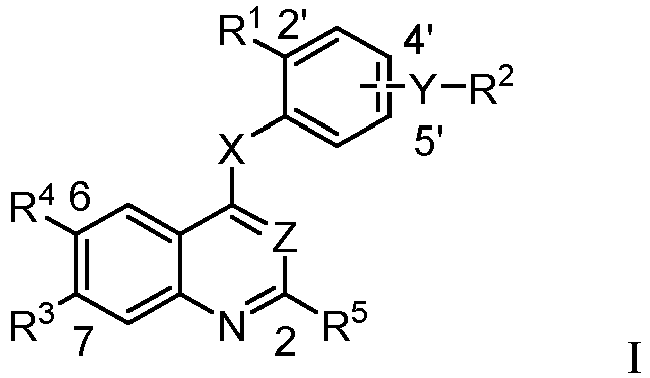
- X is a CH2, NH, O or S;
- Z is N or a CH;
- Y is absent, -O-, -NHCO-, -CONH-, -NHSO-, -SONH-, -NHCONH- or -NHSONH-;
- R1 is a hydrogen, halogen (fluorine, chlorine, bromine, iodine), C1-4 alkyl, halogenated C1-4 alkyl, C1-4 alkoxy, halogenated C1-4 alkoxy, C1-4 alkylthio group, (C1-4 alkyl) (C1-4 alkyl)P(=O)-, nitro or amino;
- R2 is selected from the following group: a hydrogen, substituted or unsubstituted phenyl, substituted or unsubstituted phenyl C1-4 alkyl, substituted or unsubstituted benzo C4-7 cycloalkyl, substituted or unsubstituted C4 -7 cycloalkyl C1-4 alkyl, 5 or 6-membered heterocyclic ring containing N or O, and the "substituted" means that one or more hydrogen atoms in the above group are replaced by a group selected from the following group: a halogen, C1-4 alkyl, phenyl,
- R3 and R4 are each independently selected from the group consisting of a hydrogen, substituted or unsubstituted C1-6 alkyl, substituted or unsubstituted C1-6 alkoxy, substituted or unsubstituted piperazinyl C1-6 alkoxy, substituted or unsubstituted piperidinyl C1-6 alkoxy, substituted or unsubstituted morpholinyl C1-6 alkoxy, or R3 and R4 form -O-C1-6 alkyl-O-; and the "substituted" means that one or more hydrogen atoms in the above-mentioned groups are substituted by a group selected from the group consisting of a halogen, C1-4 alkyl, C1-4 alkoxy, and phenyl;
- R5 is a hydrogen, halogen, hydroxyl or amino.
- In another preferred embodiment, R2 is selected from the following group:


- In another preferred embodiment, the compound is represented by Formula II:

- In another preferred embodiment, the compound is represented by Formula III:

- wherein R3, R4, R1 and Y are as described in claim 1;
- R6 and R7 are each independently selected from the following group:
- wherein R11 is selected from the group consisting of a hydrogen, halogen, and hydroxyl;
- m is 0, 1 or 2;
- t is 0, 1, or 2.
- In another preferred embodiment, one of R6 and R7 is selected from the following group:



- In another preferred embodiment, R11 is selected from the following group: a hydrogen, halogen (preferably, F).
- In another preferred embodiment, when Y is -O-, R2 is phenyl or phenyl C1-4 alkyl; preferably, phenyl.
- In another preferred embodiment, when Y is -NHCO- or -CONH-, R2 is

- In another preferred embodiment, R3 and R4 are each independently selected from the following:



- In another preferred embodiment, the compound is represented by Formula IV:

- In another preferred embodiment, R8 is a hydroxyl or fluorine.
- In another preferred embodiment, R9 is a hydrogen.
- In another preferred embodiment, R10 is a fluorine.
- In another preferred embodiment, the compound is selected from the following group:


- In the second aspect of the present invention, a pharmaceutical composition is provided, comprising the compound described in the first aspect or a stereoisomer or optical isomer, or pharmaceutically acceptable salt thereof, and a pharmaceuitically acceptable carrier or excipient.
- In the third aspect of the present invention, the use of the compound described in the first aspect of the present invention or a stereoisomer or optical isomer, or pharmaceutically acceptable salt thereof is provided for preparing a medicament for treating or preventing EGFR-mediated diseases or inhibiting EGFR.
- In another preferred embodiment, the EGFR-mediated disease is cancer.
- In another preferred embodiment, the cancer is selected from the group consisting of non-small cell lung cancer, small cell lung cancer, lung adenocarcinoma, lung squamous cell carcinoma, breast cancer, prostate cancer, glioma, ovarian cancer, and head Squamous cell carcinoma, cervical cancer, esophageal cancer, liver cancer, kidney cancer, pancreatic cancer, colon cancer, skin cancer, leukemia, lymphoma, gastric cancer, multiple bone marrow cancer and solid tumors.
- The present invention provides a treatment method, comprising the step of administering the compound described in the first aspect of the present invention or a stereoisomer or optical isomer, or pharmaceutically acceptable salt thereof to a subject in need thereof.
- In another preferred embodiment, the subject in need thereof suffers from an EGFR-mediated disease.
- It should be understood that within the scope of the present invention, the above-mentioned technical features of the present invention and the technical features specifically described in the following (such as the embodiments) can be combined with each other to form new or preferred technical solutions, and it is not necessary to repeat them one-by-one.
- Through extensive and in-depth research, the inventors unexpectedly discovered a class of quinazoline compounds with excellent EGFR inhibitory activity, based on which the present invention is completed.
- Some groups involved herein are defined as follows:
As used herein, "alkyl" refers to a saturated branched or straight chain alkyl with a carbon chain length of 1-10 carbon atoms. The preferred alkyls include alkyls with 1-6, 1-4 or 1-3 carbons in length. Examples of alkyl groups include, but are not limited to, methyl, ethyl, n-propyl, isopropyl, n-butyl, isobutyl, heptyl and the like. An alkyl may be substituted by one or more substituents, for example by a halogen or haloalkyl. For example, an alkyl may be an alkyl group substituted with 1 to 4 fluorine atoms, or the alkyl may be an alkyl group substituted with a fluoroalkyl. - As used herein, "alkoxy" refers to an oxy group substituted by an alkyl group. The preferred alkoxy is an alkoxy having 1 to 6 carbon atoms in length, more preferably an alkoxy having 1 to 4 carbon atoms in length. Examples of alkoxy include, but are not limited to, a methoxy, ethoxy, propoxy and the like. In a specific embodiment, an alkoxy may be a substituted alkoxy, for example, an alkoxy-substituted alkoxy. In a specific embodiment, a C1-C3 alkoxy substituted C1-C3 alkoxy is preferred.
- As used herein, "cycloalkyl" refers to a saturated cyclic alkyl containing 3-10, preferably 4-7 ring carbon atoms. Examples of cycloalkyl include, but are not limited to, cyclopropyl, cyclobutyl, cyclohexyl, cycloheptyl, and the like. A cycloalkyl may be substituted by one or more substituents, such as a halogen or haloalkyl. For example, a cycloalkyl groups can be substituted with 1-4 fluorine atoms. In a preferred embodiment, the cycloalkyl group in the present invention is a cyclohexyl.
- As used herein, "halogen" refers to a fluorine, chlorine, bromine or iodine.
- As used herein, "aryl" refers to a monocyclic, bicyclic or tricyclic aromatic group containing 6 to 14 carbon atoms, including phenyl, naphthyl, phenanthryl, anthryl, indenyl, fluorenyl, tetrahydronaphthyl and indanyl, etc. An aryl may be optionally substituted with 1-5 (for example, 1, 2, 3, 4, or 5) substituents selected from the group consisting of a halogen, C1-4 aldehyde group, C1-6 alkyl, cyano, nitro, amino, hydroxy, hydroxymethyl, halogen-substituted alkyl (e.g. trifluoromethyl), halogen-substituted alkoxy (e.g. trifluoromethoxy), carboxyl, C1-4 alkoxy, ethoxy formyl, N(CH3) and C1-4 acyl, heterocyclyl or heteroaryl, etc.
- As used herein, "heterocyclyl" includes, but is not limited to, a 5- or 6-membered heterocyclic group containing 1-3 heteroatoms selected from O, S or N, including but not limited to furyl, thienyl, pyrrolyl, pyrrolidinyl, pyrazolyl, imidazolyl, triazolyl, oxazolyl, pyranyl, pyridyl, pyrimidinyl, pyrazinyl, piperidinyl, morpholinyl, etc.
- As used herein, "optionally substituted" means that the group modified by this term can be optionally substituted by 1-5 (for example, 1, 2, 3, 4, or 5) substituents selected from the following group: a halogen, C1-4 aldehyde group, C1-6 linear or branched alkyl, cyano, nitro, amino, hydroxyl, hydroxymethyl, halogen-substituted alkyl (e.g. trifluoromethyl), halogen-substituted alkoxy (for example, trifluoromethoxy), carboxyl, C1-4 alkoxy, ethoxyformyl, N(CH3) and C1-4 acyl.
- A series of quinoline compounds with novel structures, as shown in general formula I is provided, and structurally characterized in the present invention.
- The compound of the present invention may also be a stereoisomer or optical isomer, or a pharmaceutically acceptable salt thereof of the compound represented by formula I.
- Examples of the pharmaceutically acceptable salt of the compound of the present invention include, but are not limited to, a salt formed by the compound of the present invention and an acid. The acid suitable for forming a salt includes but not limited to: an inorganic acid, such as hydrochloric acid, hydrobromic acid, hydrofluoric acid, sulfuric acid, nitric acid, phosphoric acid, an organic acid, such as formic acid, acetic acid, propionic acid, oxalic acid, malonic acid, succinic acid, fumaric acid, maleic acid, lactic acid, malic acid, tartaric acid, citric acid, picric acid, methanesulfonic acid, toluenesulfonic acid, and benzenesulfonic acid; and an acidic amino acid, such as aspartic acid and glutamic acid.
- Unless otherwise specified, the structural formula described in the present invention is intended to include all isomeric forms (such as enantiomers, diastereomers and geometric isomers (or conformational isomers)): for example, R and S configurations containing an asymmetry center, (Z) and (E) isomers of the double bond, etc. Therefore, a single stereochemical isomer of the compound of the present invention or a mixture of enantiomers, diastereomers or geometric isomers (or conformational isomers) thereof will fall within to the scope of the present invention.
- The compound of the present invention exhibits excellent EGFR kinase-inhibiting activities (especially EGFR triple mutation-inhibiting activities), therefore, the compound of the present invention and various crystal forms, pharmaceutically acceptable inorganic or organic salts, hydrates or solvates thereof, and the pharmaceutical composition containing the compound of the present invention as the main active ingredient can be used to prevent and/or treat (stabilize, alleviate or cure) EGFR kinase related diseases.
- The pharmaceutical composition of the present invention comprises a safe and effective amount of the compound of the present invention and a pharmaceutically acceptable excipient or carrier. The "safe and effective amount" means that the amount of the compound is sufficient to significantly improve the condition without causing serious side effects. Generally, the pharmaceutical composition contains 1-2000 mg of the compound of the present invention per agent, and more preferably, 10-200 mg of the compound of the present invention per agent. Preferably, the "one dose" is one capsule or tablet.
- The pharmaceutical composition of the present invention comprises a safe and effective amount of the compound of the present invention and a pharmaceutically acceptable excipient or carrier. The "safe and effective amount" means that the amount of the compound is sufficient to significantly improve the condition without causing serious side effects. Generally, the pharmaceutical composition contains 1-2000 mg of the compound of the present invention per agent, and more preferably, 10-200 mg of the compound of the present invention per agent. Preferably, the "one dose" is one capsule or tablet.
- "Pharmaceutically acceptable carrier" refers to: one or more compatible solid or liquid fillers or gel substances, which are suitable for human use, and must have sufficient purity and sufficiently low toxicity. As used herein, "compatibility" means that each component in the composition can be blended with the compound of the present invention without significantly reducing the efficacy of the compound. Examples of pharmaceutically acceptable carriers include cellulose and a derivative thereof (such as sodium carboxymethyl cellulose, sodium ethyl cellulose, cellulose acetate, etc.), gelatin, talc, and solid lubricants (such as stearic acid, Magnesium stearate), calcium sulfate, vegetable oils (such as soybean oil, sesame oil, peanut oil, olive oil, etc.), polyols (such as propylene glycol, glycerin, mannitol, sorbitol, etc.), emulsifiers (such as Tween®), wetting agents (such as sodium lauryl sulfate), coloring agents, flavoring agents, stabilizers, antioxidants, preservatives, pyrogen-free water, etc.
- The method for administering the compound or pharmaceutical composition of the present invention is not particularly limited, and representative administration methods include (but are not limited to): oral, parenteral (intravenous, intramuscular, or subcutaneous) administration.
- Solid dosage forms for oral administration include capsules, tablets, pills, powders and granules. In these solid dosage forms, the active compound is mixed with at least one conventional inert excipient (or carrier), such as sodium citrate or dicalcium phosphate, or mixed with the following ingredients: (a) fillers or compatibilizers, for example, Starch, lactose, sucrose, glucose, mannitol and silicic acid; (b) binders such as hydroxymethyl cellulose, alginate, gelatin, polyvinylpyrrolidone, sucrose and gum arabic; (c) humectants, For example, glycerin; (d) disintegrating agents, such as agar, calcium carbonate, potato starch or tapioca starch, alginic acid, certain complex silicates, and sodium carbonate; (e) slow solvents, such as paraffin; (f) Absorption accelerators, such as quaternary amine compounds; (g) wetting agents, such as cetyl alcohol and glyceryl monostearate; (h) adsorbents, such as kaolin; and (i) lubricants, such as talc, hard Calcium fatty acid, magnesium stearate, solid polyethylene glycol, sodium lauryl sulfate, or mixtures thereof. In capsules, tablets and pills, the dosage form may also contain buffering agents.
- Solid dosage forms, such as tablets, sugar pills, capsules, pills and granules can be prepared with coatings and shell materials, such as enteric coatings and other materials known in the art. They may contain opacifying agents, and the active compound or the release of the compound in such a composition may be released in a certain part of the digestive tract in a delayed manner. Examples of embedding components that can be used are polymeric substances and waxes. If necessary, the active compound can also be formed into microcapsules with one or more of the above-mentioned excipients.
- Liquid dosage forms for oral administration include pharmaceutically acceptable emulsions, solutions, suspensions, syrups or tinctures. In addition to the active compound, the liquid dosage form may contain inert diluents conventionally used in the art, such as water or other solvents, solubilizers and emulsifiers, for example, ethanol, isopropanol, ethyl carbonate, ethyl acetate, propylene glycol, 1,3-butanediol, dimethylformamide and oils, especially cottonseed oil, peanut oil, corn germ oil, olive oil, castor oil and sesame oil or mixtures thereof.
- In addition to these inert diluents, the composition may also contain adjuvants, such as wetting agents, emulsifying and suspending agents, sweetening agents, flavoring agents and perfumes.
- In addition to the active compound, the suspension may contain suspending agents, for example, ethoxylated isostearyl alcohol, polyoxyethylene sorbitol and sorbitan esters, microcrystalline cellulose, aluminum methoxide and agar, or mixtures thereof, and the like.
- The composition for parenteral injection may contain physiologically acceptable sterile aqueous or non-aqueous solutions, dispersions, suspensions or emulsions, and sterile powders for reconstitution into sterile injectable solutions or dispersions. Suitable aqueous and non-aqueous carriers, diluents, solvents or excipients include water, ethanol, polyols and suitable mixtures thereof.
- The compound of the present invention can be administered alone or in combination with other pharmaceutically acceptable compounds.
- When administered in combination, the pharmaceutical composition also includes one or more (2, 3, 4, or more) other pharmaceutically acceptable compounds. One or more of the other pharmaceutically acceptable compounds can be administered simultaneously, separately or sequentially with the compounds of the invention.
- When using the pharmaceutical composition, a safe and effective amount of the compound of the present invention is applied to a mammal (such as a human) in need of the treatment, wherein the administered dosage is a pharmaceutically effective dosage. For a human with a body weight of 60 kg, the daily dosage is usually 1 to 2000 mg, preferably 20 to 500 mg. When determining a specific dosage, factors such as the route of administration, the patient's health status and the like should also be considered, which are within the skill of a skilled physician.
- The preparation method for the compound of the present invention may be a conventional method in the art, or the synthetic route of the present invention may be adopted,

- (a) tert-butyl 4-((tosyloxy)methyl)piperidine-1-carboxylate, DMF, K2CO3; 120°C, 5h;
- (b) HCHO, HCOOH, 120°C, 8h;
- (c) fuming nitric acid, DCM, 25°C, overnight;
- (d) Pd/C, MeOH/DCM, H2, 25°C, 4h;
- (e) formamidine acetate, CH3OCH2CH2OH, 120°C, 8h;
- (f) SOCl2, DMF, 80°C, 3h;
- (g) THF, Et3N, 60°C, 5h;
- (h) Pd/C, H2, MeOH/DCM, 25°C, 5h;
- (i) i-PrOH, HCl, 80°C, 8h.
- Wherein the preparation method for compound 2h is shown as follows:

- The present invention will be further described below in combination with specific embodiments. It should be understood that these embodiments are only used to illustrate the present invention and not to limit the scope of the present invention. The experimental methods, specific conditions of which are not indicated in the following examples, usually follow the conventional conditions or the conditions recommended by the manufacturer. Unless otherwise specified, percentages and parts are weight percentages and parts by weight.
- The experimental materials and reagents used in the following examples are commercially available unless otherwise specified.
-

- Methyl trioxalate (1g, 5.49mmol) was weighted into a 100 mL eggplant-shaped bottle, and anhydrous potassium carbonate (1.52g, 10.98mmol) and about 50 mL of DMF were added, and stirred for about 15 min at room temperature. Tert-butyl tert-butyl-4-((tosyloxy)methyl)piperidine-1-carboxylate (2.75g, 7.41mmol) was added, heated to 95°C and refluxed for 3h. The reaction was confirmed as being completed by TLC. The reaction mixture was extracted with saturated sodium chloride/ethyl acetate and dried over anhydrous sodium sulfate. Most of the solvent was removed in vacuo, and the residual DMF was removed by a diaphragm pump at 70°C for about 20 minutes. The crude product was separated by silica gel-column chromatography (petroleum ether / ethyl acetate = 8: 1) to obtain 2 g of methyl 4-(N-Boc-4-piperidinylmethoxy)-3-methoxybenzoate with a yield of 86%. 1H NMR(400MHz, DMSO): δ 7.57 (d, J = 8.4Hz, 1H), 7.45 (s, 1H), 7.07 (d, J = 8.4Hz, 1H), 3.97 (d, J = 12Hz, 2H), 3.9 (d, J= 6.4Hz, 2H), 3.82 (s, 3H), 3.81 (s, 3H), 2.74 (s, 2H), 1.95-1.85 (m, 1H), 1.75 (d, J = 8.4Hz, 2H), 1.4 (s, 9H), 1.15 (m, 2H).
-

- Methyl 4-(N-Boc-4-piperidinylmethoxy)-3-methoxybenzoate (1g, 2.64mmol) was weighted into a 100 mL eggplant-shaped flask, and about 12 mL of formic acid was added, and stirred for about 30 min at room temperature for dissolving it. Afterwards, formaldehyde solution (4 mL, 47.44 mmol, 37%) was slowly added dropwise, heated under reflux at 95°C in an atomsphere of argon for about 6 h. The reaction was confirmed as being completed by TLC. The solvent was removed by a diaphragm pump. The crude product was separated by silica gel column chromatography (dichloromethane / methanol = 30: 1) to obtain 730 mg of methyl
4-(N-methyl-4-piperidinylmethoxy)-3-methoxybenzoate as a white solid with a yield of 94%. 1H NMR(400MHz, DMSO): δ 7.57 (d, J= 8.4Hz, 1H), 7.42 (s, 1H), 7.10 (d, J= 8.4Hz, 1H), 3.94 (d, J = 6Hz, 2H), 3.82 (s, 3H), 3.81 (s, 3H), 3.25 (d, J = 12Hz, 2H), 2.70 (dd, J1 = 11.2Hz, J2 = 22.8Hz, 2H), 2.6 (s, 3H), 1.97-1.80 (m, 1H), 1.88 (d, J= 21.6Hz, 2H), 1.49-1.40 (m, 2H). -

- Methyl 4-(N-methyl-4-piperidinylmethoxy)-3-methoxybenzoate (500 mg, 1.7 mmol) was weighted into a 100 mL eggplant-shaped flask, and about 20 mL of DCM was added to dissolve it. About 2 mL of trifluoroacetic acid was slowly added dropwise in an ice bath, and 24 M fuming nitric acid (400 uL, 8.52mmol) was added dropwise within 15 minutes. The reaction was conducted at room temperature for about 6 h. After the reaction was completed, the pH was adjusted to 7 with saturated sodium bicarbonate aqueous solution, and the resulting system was extracted with saturated sodium chloride / ethyl acetate, and dried over anhydrous sodium sulfate. The solvent was removed in vacuo, and the crude product was separated by silica gel column chromatography (dichloromethane / methanol = 30: 1) to obtain 450 mg of light yellow oily methyl 6-nitro-4-(N-methyl-4-piperidinylmethoxy)-3-methylbenzoate with a yield of 78%. 1H NMR(400MHz, DMSO): δ 7.62 (s, 1H), 7.31 (s, 1H), 3.97 (d, J = 6Hz), 3.92 (s, 3H), 3.83 (s, 3H), 2.77 (d, J= 11.2 Hz, 2H), 2.15 (s, 3H), 1.86 (t, J = 11.2Hz, 2H), 1.76-1.74 (m, 1H), 1.72 (d, J = 10.4Hz, 2H), 1.30-1.25 (m, 2H).
-

- Methyl 6-nitro-4-(N-methyl-4-piperidinylmethoxy)-3-methoxybenzoate (400mg, 1.36mmol) was weighted into a 250 mL eggplant-shaped bottle, about 100 mL of methanol was added to dissolve it, and Pd/C (40 mg, 10%) was added. The reaction was conducted under hydrogen for about 6 hours. The reaction was confirmed as being completed by TLC. Pd/C was removed through diatomaceous earth, and the solvent was removed in vacuo to obtain about 350 mg of methyl 6-amino-4-(N-methyl-4-piperidinylmethoxy)-3-methoxybenzoate as an oily liquid with a yield of 96%, which was directly used in the next step.
-

- Methyl 6-amino-4-(N-methyl-4-piperidinylmethoxy)-3-methoxybenzote (350 mg, 1.13 mmol) was weighted into a 250 mL eggplant-shaped bottle, about 100 mL of ethylene glycol monomethyl ether was added to dissolve it, and formamidine acetate (355 mg, 3.4 mmol) was added in batches for 40 minutes. The reaction was refluxed at 120°C for about 3 hours. It was found by TLC that the raw materials were not consumed. Formamidine acetate (240 mg, 2.27mmol) was added in two batches (one batch every 1 hour). After about 5 hours, it was found by TLC that a small amount of raw materials were not consumed yet. The reaction was quenched, the solvent was removed in vacuo, the pH was adjusted to 9 with saturated sodium bicarbonate aqueous solution, and the solution was extracted with saturated sodium chloride / dichloromethane for several times, dried over anhydrous sodium sulfate, and the solvent was removed in vacuo. The crude product was separated by silica gel column chromatography (dichloromethane / methanol = 10: 1) to obtain 6-methoxy-7-(N-methyl-4-piperidinylmethoxy)-3,4-dihydroquinazolin-4-one as a pale yellow solid (100 mg, a yield of 30%). 1H NMR(400MHz, DMSO): δ 7.98 (s, 1H), 7.45 (s, 1H), 7.13 (s, 1H), 3.98 (d, J= 6.0 Hz, 2H), 3.87 (s, 3H), 2.92 (d, J = 10.8Hz, 2H), 2.29 (s, 3H), 2.13 (t, J=10.4Hz, 2H), 1.85-1.81 (m, 1H), 1.79 (d, J= 12Hz, 2H), 1.39-1.32 (m, 2H).
-

- About 5 mL of thionyl chloride was added into a 50 mL eggplant-shaped bottle, and about 1 drop of N,N-dimethylformamide was added, and stirred for about 30 minutes in an ice bath. 100 mg of 6-methoxy-7-(N-methyl -4-piperidinylmethoxy)-3,4-dihydroquinazolin-4-one as a pale yellow solid was placed into the above-mentioned eggplant-shaped bottle, and stirred at room temperature for about 12 h. A small amount of sample was taken and TCL-detected. After the raw materials were consumed, the solvent was removed in vacuo. The pH was adjusted to 9 with saturated aqueous sodium bicarbonate solution, and the resulting system was extracted for several times with saturated sodium chloride / dichloromethane, and dried over anhydrous sodium sulfate. The solvent was removed in vacuo. The crude product was separated by silica gel column chromatography (dichloromethane / methanol = 10: 1) to obtain
4-chloro-6-methoxy-7-((1-methylpiperidin-4-yl)methoxy)quinazoline as a pale yellow solid (75mg, a yield of 75%). 1H NMR(400MHz, DMSO): δ 8.87 (s, 1H), 7.45 (s, 1H), 7.40 (s, 1H), 4.00 (d, J = 6.4Hz, 2H), 4.00 (s, 3H), 2.78 (d, J = 11.2Hz, 2H), 2.16 (s, 3H), 1.90 (t, J=13.2Hz, 2H),1.79 (d, J = 12Hz, 3H), 1.35-1.32 (m, 2H). -

- 3-fluoro-4-nitroaniline (2 g, 12.55 mmol) was weighted into a 250 mL eggplant-shaped flask, and ethyl acetate was added to dissolve it. Benzenesulfonyl chloride (2 mL, 15.07 mmol) and triethylamine (2.2 mL, 15.07 mmol) were added dropwise. The reactiom mixture was stirred at room temperature under argon for 1 hour, and then refluxed for 6 hours. The raw materials were consumed as confirmed by TLC. The solvent was removed in vacuo. The crude product was separated by silica gel column chromatography (dichloromethane / petroleum ether = 3: 1) to obtain 2.78 g of N-(3-fluoro-4-nitrophenyl)-4-methoxybenzamide as a pale yellow solid with a yield of 80%. 1H NMR(400MHz, DMSO): δ 11.03 (s, 1H), 8.22 (t, J= 9.2Hz, 1H), 8.10 (d, J= 14.4Hz, 1H), 8.00 (d, J = 7.2Hz, 1H), 7.82 (d, J= 9.2Hz, 1H), 7.65 (t, J= 7.2Hz, 1H), 7.57 (t, J= 7.6Hz, 1H).
-

- N-(3-fluoro-4-nitrophenyl)-4-methoxybenzamide (500 mg, 1.92 mmol) was weighted into a 250 mL eggplant-shaped flask, and methanol was added to dissolve it. Palladium on carbon (50 mg, 10%) was added. The reaction system was vacuumed and stirred at room temperature for 3 hours under hydrogen. The raw materials were consumed as confirmed by TLC. The Pd/C was removed through diatomaceous earth, and the solvent was removed in vacuo to obtain about 430 mg of N-(4-amino-3-fluorophenyl)benzamide with a yield of 97%, which was directly used in the next step.
-

- N-(4-amino-3-fluorophenyl)benzamide (180mg, 0.56mmol) was weighted into the above-mentioned eggplant-shaped bottle, and about 15 mL of isopropanol was added to dissolve it. 4-chloro-6-methoxy-7-((1-methylpiperidin-4-yl)methoxy)quinazoline (196 mg, 0.75 mmol) was taken in a test tube, dissolved by adding isopropanol, and then added dropwise to the eggplant-shaped bottle. The reaction was conducted at room temperature for about 1 h, and the reaction solution was slightly reddish. 2 drops of 2 N hydrochloric acid was added, and refluxed at 80°C for about 6 h, so that white precipitate was produced. The raw materials were consumed as detected by TLC. The reaction system was suction-filtered and the solid precipitate was washed with a small amount of isopropanol. The precipitate was dissolved in dichloromethane, the pH was adjusted to 9 with saturated sodium bicarbonate solution, and the resulting solution was extracted for several times with saturated sodium chloride/dichloromethane, and dried over anhydrous sodium sulfate. The solvent was removed in vacuo. The crude product was separated by silica gel column chromatography (dichloromethane / methanol = 10: 1) to obtain N-(3-fluoro-4-((6-methoxy-7-((1-methylpiperidine-4-yl)methoxy)quinazolin-4-yl)amino)phenyl) as a white solid (180mg, yield of 62%). 1H NMR(400MHz, DMSO): δ 10.49 (s, 1H), 9.48 (s, 1H), 8.34 (s, 1H), 7.98 (d, J = 7.2Hz, 2H), 7.87 (d, J = 12.8Hz, 1H), 7.83 (s, 1H), 7.6 (s, 1H), 7.57 (t, J = 7.6Hz, 2H), 7.53 (t, J = 8.8Hz, 1H), 7.6 (s, 1H), 4.99 (d, J = 6Hz, 2H), 3.95 (s, 3H), 2.79 (d, J = 11.2Hz, 2H), 2.17 (s, 3H), 1.89 (t, J = 11.2Hz, 3H), 1.37-1.34 (m, 2H). 13C NMR(100 MHz, DMSO-d6) δ 165.69, 157.37, 153.60, 153.10, 148.94, 148.77, 138.04, 137.94, 134.64, 131.75, 128.43, 127.67, 121.81, 121.68, 115.86, 108.45, 107.61, 102.01, 72.70, 56.12, 54.83, 46.16, 34.57, 28.45. HRMS (ESI) (m/z): [M + H]+ calcd for C29H33N8O3, 516.2433; found, 516.2410. HPLC purity: 96.92%, retention time = 11.06 min.
- All of the following compounds were synthesized using the same or similar routes as in Example 1.
-

- Light yellow solid, the yield of 45%. 1H NMR (400 MHz, DMSO-d6): δ 10.38 (s, 1H), 9.58 (s, 1H), 8.36 (s, 1H), 8.05 (d, J = 7.2Hz, 1H), 7.87(d, J = 7.2Hz, 2H), 7.84 (s, 1H), 7.67-7.53 (m, 4H), 7.31 (t, J =12Hz, 1H), 7.18 (s, 1H), 4.01(d, J = 6Hz, 2H), 3.95(s, 3H), 2.83 (d, J = 11.2Hz, 2H), 2.21 (s, 3H), 1.96 (t, J = 12Hz, 3H), 1.78(d, J = 10.4Hz, 2H), 1.30-1.58 (m, 2H). 13C NMR(100 MHz, DMSO-d6) δ 170.74, 157.40, 153.54, 153.10, 148.90, 146.73, 142.50, 128.62, 126.13, 124.39, 114.60, 108.43, 107.62, 102.02, 72.58, 56.12, 54.65, 48.55, 45.86, 42.02, 38.30, 36.20, 34.37, 28.22. HRMS (ESI) (m/z): [M + H]+, calcd for C29H33N8O3, 516.2433; found, 516.2410. HPLC purity: 95.36%, retention time = 10.78 min.
-

- White solid, yield of 40%. 1H NMR (400 MHz, DMSO-d6): δ 10.42(s, 1H), 10.41(s, 1H), 8.30(s, 1H), 7.80(s, 1H), 7.73(dd, J1=12.4Hz, J2=2Hz, 1H), 7.46 (t, J=8.4Hz, 1H), 7.37-7.32 (m, 5H), 7.26 (m, 1H), 4.00(d, J=6Hz, 2H), 3.96(s, 3H), 3.68(s, 2H), 2.80(d, J=12Hz, 2H), 2.17(s, 3H), 1.89 (t, J=11.2Hz, 2H), 1.78-1.76(m, 3H). 13C NMR(100 MHz, DMSO-d6): δ 169.32, 157.36, 153.58, 153.08, 148.92 146.75, 135.73, 129.10, 128.31, 126.57, 114.67, 108.42, 107.61, 106.75, 102.00, 72.67, 56.11, 54.81, 48.56, 46.11, 43.26, 34.54, 28.42. HRMS (ESI) (m/z): [M + H]+ calcd for C29H33N8O3, 530.2567; found, 530.2543. HPLC purity: 95.00 %, retention time = 11.20 min.
-

- White solid, yield of 43%. 1H NMR (400 MHz, DMSO-d6): δ 10.29(s, 1H), 9.50(s, 1H), 8.35(s, 1H), 7.87(dd, J1=7.2Hz, J2=2.8Hz, 1H), 7.80(s, 1H), 7.44-7.45 (m, 1H), 7.34-7.24 (m, 6H), 7.17(s, 1H), 4.00(d, J=6Hz, 2H), 3.94(s, 3H), 3.65(s, 2H), 2.80(d, J=12Hz, 2H), 2.17(s, 3H), 1.89 (t, J=11.2Hz, 2H), 1.78-1.76(m, 3H). 13C NMR(100 MHz, DMSO-d6): δ 169.06, 157.03, 153.67, 153.00, 149.00 146.85, 135.90, 129.00, 128.29, 126.52, 118.55, 115.90, 108.51, 107.60, 102.00, 72.71, 56.10, 54.83, 46.16, 43.26, 34.56, 26.44. HRMS (ESI) (m/z): [M + H]+ calcd for C29H33N8O3, 530.2567; found, 530.2543. HPLC purity: 97.22%, retention time = 11.05 min.
-

- Light yellow solid, yield of 48%. 1H NMR (400 MHz, DMSO-d6): δ 10.2 (s, 1H), 9.44 (s, 1H), 8.31 (s, 1H), 7.82 (s, 1H), 7.74 (s, 1H), 7.41 (s, 1H), 7.35 (d, J = 8.8Hz, 1H), 7.23 (t, J = 3.2Hz, 2H), 7.18 (s, 1H), 7.14-7.11 (m, 2H), 4.01 (d, J = 6Hz, 2H), 3.94 (s, 3H), 3.17 (s, 2H), 3.13-3.05 (m, 3H), 2.90-2.83 (m, 2H), 2.87 (s, 1H), 2.83 (s, 1H), 2.22 (s, 3H), 1.98 (t, J = 10.8Hz, 2H), 1.78 (d, J = 10.4Hz, 2H), 1.30-1.58 (m, 2H). 13C NMR(100 MHz, DMSO-d6): δ 170.74, 157.40, 153.54, 153.10, 148.90, 146.73, 142.50, 126.13, 124.39, 114.60, 108.43, 107.62, 106.71, 106.46, 102.02, 72.58, 56.12, 54.65, 46.55, 45.86, 42.02, 36.30, 36.20, 34.37, 28.22. HRMS (ESI) (m/z): [M + H]+ calcd for C29H33N8O3, 570.2880; found, 570.2889. HPLC purity: 96.71%, retention time = 12.41 min.
-

- White solid, yield of 32%. 1H NMR (400 MHz, DMSO-d6): δ 10.2(s, 1H), 9.67(s, 1H), 8.35(s, 1H), 7.90(s, 1H), 7.50(s, 1H), 7.25-7.20 (m, 4H), 7.12-7.10 (m, 2H), 4.03(d, J=6Hz, 2H), 3.96(s, 3H), 3.08-3.02(m, 4H), 2.90-2.82(m, 2H), 2.87(s, 1H), 2.83(s, 1H), 2.42(s, 5H), 2.02-1.86(m, 4H), 1.52-1.48(m, 2H). 13C NMR(100 MHz, DMSO-d6): δ 170.48, 157.08, 153.62, 153.03, 148.98, 146.80, 142.50, 126.12, 124.37, 118.52, 115.86, 115.67, 108.52, 107.60, 102.05, 72.58, 56.11, 54.60, 45.80, 41.95, 38.28, 36.28, 34.31, 26.15. HRMS (ESI) (m/z): [M + H]+ calcd for C31H31F4N5O3, 570.2880; found, 570.2879. HPLC purity: 95.33%, retention time = 12.20 min.
-

- White solid (yield of 45%). 1H NMR(400MHz, DMSO): δ 9.53 (s, 1H), 8.38 (s, 1H), 7.91 (s, 1H), 7.68 (s, 1H), 7.66 (s, 1H), 7.18 (s, 1H), 7.47 (d, J = 7.2 Hz, 1H), 7.46 (s, 1H), 7.42-7.38 (m, 2H), 7.35-7.32 (m, 1H), 7.15 (s, 1H), 7.05 (s, 1H), 7.03 (s, 1H), 5.11 (s, 2H), 4.99 (d, J = 6.0 Hz, 2H), 3.96 (s, 3H), 2.96 (d, J = 11.6 Hz, 2H), 2.32 (s, 3H), 2.23-2.17 (m, 2H), 1.84-1.81(m, 3H), 1.48-1.39 (m, 2H). 13C NMR(100 MHz, DMSO-d6) δ 158.55, 154.58, 153.29, 152.98, 148.77, 146.87, 137.20, 132.47, 128.38, 127.75, 127.64, 124.30, 114.52, 108.68, 107.75, 102.27, 72.27, 69.33, 56.33, 54.03, 44.99, 33.83, 27.53. HRMS (ESI) (m/z): [M + H]+ calcd for C29H32N4O3, 485.2553; found, 485.2556. HPLC purity: 99.64%, retention time = 12.54 min.
-

- White solid (yield of 45%). 1H NMR(400MHz, DMSO): δ 9.57 (s, 1H), 8.43 (s, 1H), 7.89 (s, 1H), 7.79 (d, J = 8.8 Hz, 2H), 7.40 (t, J = 8.4 Hz, 2H), 7.18 (s, 1H), 7.13 (t, J = 7.2 Hz, 1H), 7.07 (d, J = 8.0 Hz, 2H), 7.02 (d, J = 8.0 Hz, 2H), 4.01 (d, J = 6.0 Hz, 2H), 3.97 (s, 3H), 2.96 (d, J = 11.2 Hz, 2H), 2.32 (s, 2H), 2.18 (m, 2H), 1.90-1.88 (m, 1H), 1.83(d, J = 12.0Hz, 2H), 1.48-1.39 (m, 2H). 13C NMR(100 MHz, DMSO-d6) δ 157.82, 156.83, 153.94, 153.38, 152.48, 149.39, 147.34, 135.70, 130.47, 124.64, 123.50, 119.53, 118.45, 109.22, 108.31, 102.61, 72.84, 56.81, 54.72, 45.70, 34.42, 29.50, 28.18. HRMS (ESI) (m/z): [M + H]+ calcd for C28H31N4O3, 471.2396; found, 471.2412. HPLC purity: 97.93 %, retention time = 12.41 min.
- Light yellow solid (yield of 35 %), melting point: 199.6-199.8°C. 1H NMR(400MHz, DMSO-d6): δ 10.67 (s, 1H), 9.58 (s, 1H), 8.31 (s, 1H), 7.91 (s, 1H), 7.77 (d, J = 8.8 Hz, 1H), 7.46-7.42 (m, 4H), 7.34 (t, J = 7.6 Hz, 2H), 7.27-7.20 (m, 2H), 4.17-4.15 (m, 1H), 4.05 (d, J = 6.0 Hz, 2H), 3.95 (s, 3H), 3.28 (d, J = 10.4 Hz, 2H), 2.85-2.83 (m, 2H), 2.62 (s, 3H), 2.07-1.98 (m, 3H), 1.67-1.64 (m, 2H), 1.45-1.43 (d, J = 6.8 Hz, 3H). 13C NMR (100 MHz, DMSO-d6) δ 173.04, 157.91, 155.86, 153.77, 153.63, 149.29, 147.16, 142.23, 138.74, 129.00, 128.84, 127.81, 127.20, 115.17, 109.10, 108.29, 107.25, 107.00, 102.85, 72.16, 58.73, 53.22, 49.04, 46.23, 33.03, 26.42, 18.97. HRMS (ESI) (m/z): [M + H]+ calcd for C31H34FN5O3, 544.2724; found, 544.2709. HPLC purity: 98.56 %, retention time = 12.02 min.
-

- White solid (yield of 37%), melting point: 196.0-196.2°C. 1H NMR(400MHz, DMSO-d6): δ 10.52 (s, 1H), 9.49 (s, 1H), 8.30 (s, 1H), 7.85 (s, 1H), 7.75 (dd, J1 = 2.0 Hz, J2 = 13.2 Hz, 1H), 7.45-7.38 (m, 4H), 7.33 (t, J = 7.6 Hz, 2H), 7.24 (m, 1H), 7.18 (s, 1H), 4.01 (d, J = 6.4 Hz, 2H), 3.94 (s, 3H), 3.33 (d, J = 10.4 Hz, 1H), 3.03 (d, J = 11.6 Hz, 2H), 2.37 (s, 3H), 2.34-2.24 (m, 3H), 1.91-1.84 (m, 3H), 1.50-1.45 (m, 2H), 1.04 (d, J = 6.4 Hz, 1H), 0.88 (d, J = 6.4 Hz, 1H). 13C NMR (100 MHz, DMSO-d6) δ 172.48, 157.89, 155.86, 153.93, 153.59, 149.35, 147.21, 140.04, 128.77, 128.68, 127.37, 115.19, 108.99, 108.17, 107.26, 107.00, 102.63, 72.70, 60.98, 56.65, 54.43, 45.27, 34.14, 31.47, 27.65, 21.70, 20.68. HRMS (ESI) (m/z): [M + H]+ calcd for C33H38FN5O3, 572.3037; found, 572.3047. HPLC purity: 97.51 % , retention time = 13.00 min.
-

- White solid (yield of 30%), melting point: 257.0-257.2°C. 1H NMR(400MHz, DMSO-d6): δ 10.83 (s, 1H), 9.50 (s, 1H), 8.31 (s, 1H), 7.85 (s, 1H), 7.78 (d, J = 12.8 Hz, 1H), 7.47-7.34 (m, 10H), 7.29-7.26 (m, 2H), 7.18 (s, 1H), 5.27 (s, 1H), 4.01(d, J = 5.6 Hz, 2H), 3.94 (s, 3H), 3.02 (d, J = 10.8 Hz, 2H), 2.38 (s, 3H), 2.33-2.25 (m, 2H), 1.90-1.84 (m, 3H), 1.91-1.84 (m, 3H), 1.50-1.42 (m, 2H). 13C NMR (100 MHz, DMSO-d6) δ 170.64, 157.86, 155.86, 153.94, 153.60, 149.37, 147.22, 140.26, 129.04, 128.89, 127.38, 115.33, 109.00, 108.19, 107.41, 102.62, 72.69, 57.74, 56.65, 54.43, 45.25, 34.12, 27.84. HRMS (ESI) (m/z): [M + H]+ calcd for C36H36FN5O3, 606.2880; found, 606.2888. HPLC purity: 98.61 % , retention time = 13.25 min.
-

- 4-chloro-6-methoxy-7-((1-methylpiperidin-4-yl)methoxy)quinazoline (100 mg, 0.32 mmol) was weighted into a 100 mL eggplant-shaped bottle, and about 15mL of isopropanol was added to dissolve it. N-(4-amino-3-fluorophenyl)-2-(1-oxoisoindolin-2-yl)-2-phenylacetamide (120 mg, 0.32 mmol) was added, and 2 drops of 6 N hydrochloric acid was added and refluxed at 80°C for about 6 hours, so that a white precipitate was formed. The raw materials were consumed as detected by TLC. The reaction system was suction-filtered and the solid precipitate was washed with a small amount of isopropanol. The precipitate was dissolved in dichloromethane, and the pH was adjusted to 9 with saturated sodium bicarbonate solution. The resulting solution was extracted for several times with saturated sodium chloride / dichloromethane, and dried over anhydrous sodium sulfate. The solvent was removed in vacuo. The crude product was separated by silica gel column chromatography (dichloromethane / methanol = 10: 1) to obtain
N-(3-fluoro-4-((6-methoxy-7-((1-methylpiperidin-4-yl)methoxy)quinazolin-4-yl)amino)phenyl)-2-(1-oxoisoindolin-2-yl)yl)-2-phenylacetamide 90 mg, yield of 42 %. 1H NMR (400 MHz, DMSO-d6): δ 10.80 (s, 1H), 9.45 (s, 1H), 8.32 (s, 1H), 7.82 (s, 1H), 7.78 (s, 1H), 7.75 (d, J = 4.4Hz 1H), 7.64-7.57 (m, 2H), 7.54-7.43 (m, 7H), 7.39 (d, J = 8.4Hz, 1H), 7.17 (s, 1H), 7.26 (s, 1H), 4.85 (d, J = 18Hz, 1H), 4.02-3.87 (m, 3H), 3.96 (s, 3H), 2.82 (d, J = 12.0 Hz, 2H), 2.18 (s, 3H), 2.03 (t, J = 11.2Hz, 2H), 1.81-1.78 (m, 3H), 1.38-1.35 (m, 2H). 13C NMR (100 MHz, DMSO-d6) : δ 168.34, 167.73, 157.33, 153.60, 153.06, 148.95, 146.77, 142.38, 135.18, 131.70, 131.42, 129.09, 128.54, 127.95, 123.64, 122.94, 108.45, 107.63, 102.02, 72.66, 58.54, 56.13, 54.76, 48.35, 46.05, 34.50, 28.37. HRMS (ESI) (m/z): [M + H]+ calcd for C38H37FN6O4, 661.2939; found, 661.2929. HPLC purity: 95.64 %, retention time = 12.42 min. -

- White solid (yield of 43%), melting point: 150.5-150.8°C. 1H NMR (400 MHz, DMSO-d6): δ 12.09 (s, 1H), 9.10-9.03 (m, 1H), 8.57 (s, 1H), 7.45 (s, 1H), 7.66-7.57 (m, 2H), 7.18 (s, 1H), 7.15 (t, J = 7.2 Hz, 1H), 3.98 (d, J = 6 Hz, 2H), 3.92 (s, 3H), 2.78 (d, J = 12 Hz, 2H), 2.16 (s, 3H), 1.91-1.89 (m, 5H), 1.86 (s, 3H), 1.76-1.74 (m, 3H). 13C NMR (100 MHz, DMSO-d6): δ 155.61, 153.63, 152.62, 149.27, 146.73, 144.51, 132.43, 130.95, 120.46, 109.38, 107.94, 101.17, 72.77, 55.88, 54.80, 48.56, 46.12, 34.53, 26.41, 18.89, 18.19. HRMS (ESI) (m/z): [M + H]+ calcd for C29H33N8O3, 455.2212; found, 455.2207. HPLC purity: 97.49 %, retention time = 9.23 min.
-

- White solid (yield of 45 %), melting point: 170.7-172.4°C. 1H NMR(400MHz, DMSO-d6): δ 12.36 (s, 1H), 9.11 (s, 1H), 8.65 (s, 1H), 8.29 (d, J = 9.2 Hz, 1H), 7.68-7.58 (m, 2H), 7.25 (dd, J1 = 2.4 Hz, J2 = 9.2 Hz, 1H), 7.23-7.15 (m, 2H), 4.02 (d, J = 6 Hz, 2H), 2.97 (d, J = 11.2 Hz, 2H), 2.33 (s, 3H), 2.20 (t, J = 10.8 Hz, 2H), 1.89 (s, 3H), 1.88 (s, 3H), 1.83 (d, J = 10.8 Hz, 3H), 1.48-1.39 (m, 2H). 13C NMR (100 MHz, DMSO-d6) : δ 162.05, 158.68, 154.77, 151.93, 144.19, 132.40, 131.04, 123.71, 122.14, 121.02, 120.95, 1118.48, 109.92, 107.79, 72.04, 54.16, 45.07, 33.95, 27.57, 18.85, 18.14. HRMS (ESI) (m/z): [M + H]+ calcd for C23H30N4O2P, 425.2106; found, 425.2110. HPLC purity: 98.02 %, retention time = 8.75 min.
-

- White solid (yield of 40%). 1H NMR (400 MHz, DMSO-d6): δ 10.80 (s, 1H), 9.45 (s, 1H), 8.33 (s, 1H), 7.81 (s, 1H), 7.78 (s, 1H), 7.75(d, J = 4.4Hz 1H), 7.64-7.57 (m, 2H), 7.54-7.43 (m, 7H), 7.39 (d, J = 8.4Hz, 1H), 7.17 (s, 1H), 6.26 (s, 1H), 4.85 (d, J = 18Hz, 1H), 4.02-3.87 (m, 3H), 3.96 (s, 3H), 2.82 (d, J = 12Hz, 2H), 2.18 (s, 3H), 2.03 (t, J = 11.2Hz, 2H), 1.81-1.78 (m, 3H), 1.38-1.35 (m, 2H). 13C NMR(100 MHz, DMSO-d6): δ 165.70, 157.41, 154.21, 153.13, 148.81, 146.80, 134.65, 131.75, 128.43, 127.67, 115.87, 108.54, 107.01, 101.90, 56.05, 55.76. HRMS (ESI) (m/z): [M + H]+ calcd for C29H33N8O3, 516.2407; found, 516.2410.
-

- White solid, yield of 30%. 1H NMR(400MHz, DMSO): δ 11.90(s, 1H), 10.59(s, 1H), 8.83(s, 1H), 8.47(s, 1H), 7.25(dd, J1=2.8Hz, J2=7.2Hz, 1H), 8.01 (s, 1H), 8.00 (s, 1H), 7.83-7.79 (m, 2H), 7.61 (t, J=4.8Hz, 1H), 7.56-7.52 (m, 2H), 7.47 (s, 1H), 7.40 (t, J=9.6Hz, 1H), 4.03(s, 3H), 4.00(s, J=3H). 13C NMR (100 MHz, DMSO-d6): δ 106.03, 157.73, 154.81, 153.49, 152.36, 149.36, 135.24, 132.11, 128.88, 128.14, 120.39, 109.10, 107.33, 102.57, 56.60, 56.30. HRMS (ESI) (m/z): [M + H]+ calcd for C23H20FN4O3, 419.1508; found, 419.1524.
-

- White solid, yield of 45%. 1H NMR(400MHz, DMSO): δ 10.80 (s, 1H), 9.45 (s, 1H), 8.33 (s, 1H), 7.81 (s, 1H), 7.78 (s, 1H), 7.75 (d, J = 4.4Hz 1H), 7.64-7.57 (m, 2H), 7.54-7.43 (m, 7H), 7.39 (d, J = 8.4Hz, 1H), 7.17 (s, 1H), 6.26 (s, 1H), 4.85 (d, J = 18Hz, 1H), 4.00 (d, J = 18Hz, 1H), 3.94 (s, 3H), 3.93 (s, 3H). 13C NMR (100 MHz, DMSO-d6) : δ 168.35, 157.36, 154.22, 153.07, 148.81, 146.81, 142.39, 137.28, 135.17, 131.71, 131.42, 129.09, 128.54, 127.95, 123.65, 122.93, 108.53, 107.01, 101.90, 58.54, 56.04, 55.76, 48.57. HRMS (ESI) (m/z): [M + H]+ calcd for C27H25FN4O3,564.2012; found, 564.2045. HPLC purity: 96.86% , retention time = 14.16 min.
-
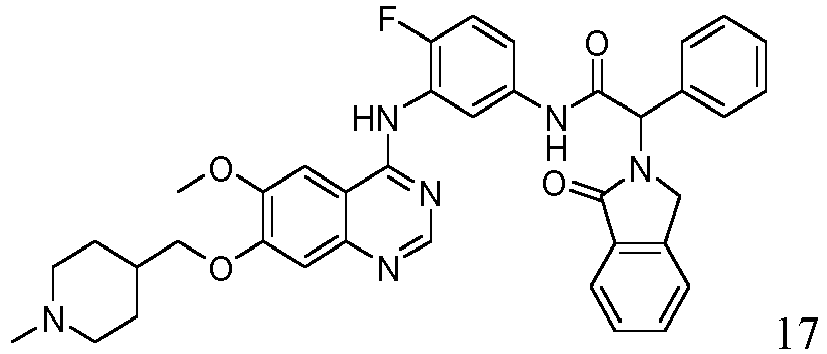
- White solid (yield of 20%). 1H NMR(400MHz, DMSO): δ 10.77 (s, 1H), 9.70 (s, 1H), 8.36 (s, 1H), 7.90 (s, 1H), 7.76 (d, J = 7.6 Hz, 1H), 7.64-7.62 (m, 2H), 7.53-7.49 (m, 2H), 7.47-7.41 (m, 4H), 7.28 (t, J = 10.0 Hz, 1H), 7.21 (s, 1H), 6.26 (s, 1H), 4.82 (d, J = 17.6 Hz, 1H), 4.03 (d, J = 17.6 Hz, 1H), 4.00 (d, J = 6.0 Hz, 2H), 3.96 (s, 3H), 3.12 (d, J = 11.6 Hz, 2H), 2.48 (s, 3H), 2.02-1.95 (m, 1H), 1.94-1.91 (m, 4H), 1.56-1.49 (m, 2H). 13C NMR(100 MHz, DMSO-d6) δ 168.64, 168.19, 157.70, 153.89, 149.45, 142.86, 135.81, 135.28, 132.17, 131.92, 129.53 129.02, 128.43, 124.12, 123.41, 119.39, 109.15, 108.11, 105.63, 103.00, 62.07, 58.96, 56.81, 56.28, 53.27, 48.89, 46.99. HRMS (ESI) (m/z): [M + H]+ calcd for C38H37FN6O4, 661.2913; found, 661.2943. HPLC purity: 95.85% , retention time = 12.42 min.
-

- White solid (yield of 45%). 1H NMR(400MHz, DMSO): δ 10.37 (s, 1H), 9.54 (s, 1H), 8.33 (s, 1H), 7.85 (s, 1H), 7.80 (dd, J1=2Hz, J2=5.6Hz, 1H), 7.77 (s, 1H), 7.62-7.58 (m, 2H), 7.54-7.44 (m, 7H), 7.39 (dd, J1 = 1.6 Hz, J2 = 8.8 Hz, 2H), 7.18 (s, 1H), 6.27 (s, 1H), 4.85 (d, J = 17.6 Hz, 1H), 4.02 (d, J = 5.6 Hz, 2H), 4.00 (d, J = 17.6 Hz, 2H), 3.96 (s, 3H), 2.93 (d, J = 11.2 Hz, 2H), 2.29 (s, 3H), 2.13 (t, J = 11.2 Hz, 2H). 1.82-1.80 (m, 3H), 1.48-1.38 (m, 2H). 13C NMR(100 MHz, DMSO-d6) δ 168.86, 168.23, 157.83, 155.87, 154.01, 153.57, 149.39, 147.24, 142.88, 135.86, 132.21, 129.59, 129.19, 128.45, 124.15, 123.44, 115.45, 108.98, 108.12, 107.59, 102.57, 72.89, 59.03, 58.48, 56.64, 54.79, 49.07, 48.88, 45.82, 34.50, 28.28. HRMS (ESI) (m/z): [M + H]+ calcd for C38H38FN6O4, 661.2912; found, 661.2938. HPLC purity: 97.68% , retention time = 12.48 min.
-

- White solid (yield of 45%). 1H NMR(400MHz, DMSO): δ 10.96 (s, 1H), 9.73 (s, 1H), 8.32 (s, 1H), 7.96 (s, 1H), 7.79-7.78 (m, 1H), 7.77 (s, 1H), 7.64-7.58 (m, 2H), 7.52 (t, J = 14 Hz, 1H), 7.49 (s, 1H), 7.47-7.43 (m, 5H), 7.39 (dd, J1 = 1.6 Hz, J2 = 8.8 Hz, 1H), 7.22 (s, 1H), 6.28 (s, 1H), 4.84 (d, J = 17.6 Hz, 1H), 4.02 (d, J = 5.6 Hz, 2H), 4.00 (d, J = 17.6 Hz, 1H), 3.96 (s, 3H), 3.22 (d, J = 11.2 Hz, 2H), 2.74 (t, J = 9.6 Hz, 2H), 2.57 (s, 3H), 1.96-1.92 (m, 3H), 1.86-1.80 (m, 2H). 13C NMR(100 MHz, DMSO-d6) δ 168.92, 168.19, 158.14, 154.06, 149.49, 142.87, 135.71, 132.20, 131.93, 129.55, 129.09, 128.99, 124.45, 123.42, 115.45 , 108.12, 107.59, 102.57, 72.90, 60.42, 59.05, 58.48, 56.98, 53.14, 49.94, 43.05, 33.00, 26.31. HRMS (ESI) (m/z): [M + H]+ calcd for C38H38FN6O4, 661.2925; found, 661.2935.
-

- White solid (yield of 26%). 1H NMR(400MHz, DMSO): δ 10.78 (s, 1H), 9.51 (s, 1H), 8.32 (s, 1H), 7.84 (s, 1H), 7.77 (d, J = 6.8 Hz, 1H), 7.75 (s, 1H), 7.67-7.63 (m, 2H), 7.53-7.41 (m, 3H), 7.18 (s, 1H), 4.87 (d, J = 18.4 Hz, 1H), 4.83 (s, 1H), 4.61 (d, J = 18.4 Hz, 1H), 4.00 (d, J = 6 Hz, 2H), 3.95 (s, 3H), 2.91 (d, J = 11.2 Hz, 2H), 2.26 (s, 3H), 2.11 (t, J = 10.8 Hz, 3H), 1.83-1.76 (m, 4H), 1.62-1.64 (m, 3H), 1.48-1.37 (m, 3H), 1.26-1.22 (m, 5H). 13C NMR(100 MHz, DMSO-d6) δ 169.29, 168.32, 158.23, 157.83, 155.79, 154.00, 153.56, 149.38, 147.23, 142.79, 137.68, 137.57, 129.08, 128.36, 124.04 , 123.43, 122.43, 122.31, 115.85, 108.96, 108.11, 107.72, 107.47, 102.54, 72.91, 60.24, 56.63, 54.84, 47.70, 45.90, 37.54, 34.55, 29.67, 29.58, 28.35, 26.27, 25.56, 25.41. HRMS (ESI) (m/z): [M + H]+ calcd for C38H43FN6O4, 667.3412; found, 667.3406. HPLC purity: 96.75% , retention time = 13.09 min.
-

- White solid (yield of 41%). 1H NMR(400MHz, DMSO): δ 10.95 (s, 1H), 9.63 (s, 1H), 8.32 (s, 1H), 7.90 (s, 1H), 7.78 (s, 1H), 7.76 (d, J = 4.8 Hz, 1H), 7.65-7.59 (m, 2H), 7.57-7.50 (m, 2H), 7.46 (d, J = 8.8 Hz, 1H), 7.38 (d, J = 8.8 Hz, 1H), 7.31-7.26 (m, 3H), 7.22 (s, 1H), 6.26 (s, 1H), 4.82 (d, J = 17.6 Hz, 1H), 4.02 (d, J = 5.6 Hz, 2H), 4.00 (d, J = 17.6 Hz, 1H), 3.95 (s, 3H), 3.31 (d, J = 11.2 Hz, 2H), 2.84 (t, J = 9.6 Hz, 2H), 2.64 (s, 3H), 1.96-1.92 (m, 3H), 1.66-1.58 (m, 2H). 13C NMR(100 MHz, DMSO-d6) δ 168.25, 163.96, 161.52, 157.81, 155.84, 154.00, 153.57, 149.39, 147.24, 142.92, 132.28, 131.79, 129.16, 128.48, 125.18 , 124.18, 123.47, 108.98, 108.12, 102.58, 74.35, 72.87, 60.47, 58.48, 56.64, 54.76, 48.92, 45.77, 34.54, 28.25. HRMS (ESI) (m/z): [M + H]+ calcd for C38H37F2N6O4, 679.2837; found, 679.2845. HPLC purity: 97.51% , retention time = 12.72 min.
-

- Tert-butyl ((4-((2-fluoro-4-(2-(1-oxoisoindolin-2-yl)-2-phenylacetylamino)phenyl)amino)-7-methoxyquinazolin -6-yl)oxy)methyl)piperidine-1-carboxylate (600 mg, 0.80 mmol) was weighted into a 100 mL eggplant-shaped flask, and about 12 mL of formic acid was added, and stirred at room temperature for about 30 min to dissolve it. Then a formaldehyde solution (4 mL, 47.44 mmol, 37%) was slowly add dropwise, and heated to reflux at 95°C under argon. After about 6 h, the reaction was determined to be complete by TLC. The solvent was removed by a diaphragm pump. The crude product was separated by silica gel column chromatography (dichloromethane / methanol = 10: 1) to obtain N-(3-fluoro-4-((7-methoxy-6-((1-methylpiperidine-4-yl)methoxy)quinazolin-4-yl)amino)phenyl)-2-( 1-oxoisoindolin-2-yl)yl)-2-phenylacetamide as a white solid (120 mg, yield of 22%). 1H NMR (400MHz, DMSO): δ 10.87 (s, 1H), 9.59 (s, 1H), 8.31 (s, 1H), 7.91 (s, 1H), 7.77 (s, 1H), 7.75 (d, J = 3.2 Hz, 1H), 7.64-7.57 (m, 2H), 7.54-7.43 (m, 7H), 7.37 (d, J = 8.8 Hz, 1H), 7.19 (s, 1H), 6.25 (s, 1H), 4.24 (d, J = 17.6 Hz, 1H), 4.04-4.03 (m, 2H), 3.98 (d, J = 17.6 Hz , 1H), 3.94 (s, 3H), 3.01-2.90 (m, 2H), 2.69 (s, 3H), 2.16-2.08 (m, 1H), 2.03-1.96 (m, 3H), 1.67-1.64 (m, 2H). 13C NMR(100 MHz, DMSO-d6) δ 168.87, 168.23, 158.36, 157.88, 155.92, 154.79, 153.60, 148.52, 147.22, 142.88, 135.65, 132.21, 131.91, 129.59, 129.29, 129.05, 128.46, 124.15, 123.43, 115.48, 109.01, 107.59, 107.34, 103.29, 73.09, 59.05, 56.33, 54.03, 49.06, 44.57, 33.94, 27.52. HRMS (ESI) (m/z): [M + H]+ calcd for C38H37FN6O4, 661.2908; found, 661.2932. HPLC purity: 95.95% , retention time = 12.32 min.
-
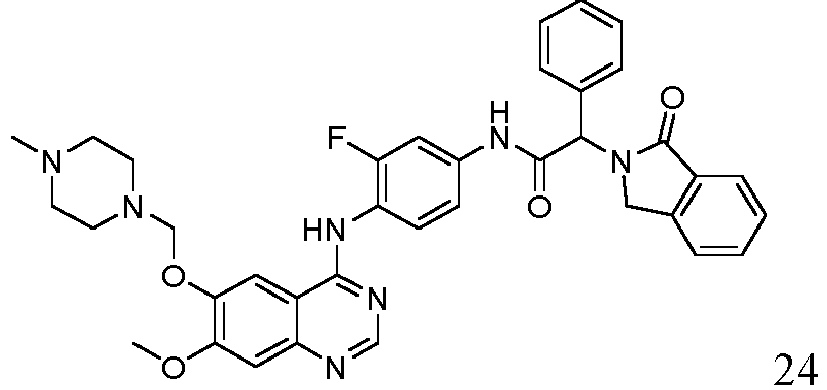
- 3-fluoro-4-((6-hydroxy-7-methoxyquinazolin-4-yl)amino)phenyl)-2-(1-oxoisoindolin-2-yl)-2-phenylacetamide (300 mg, 0.54 mmol) was weighted into a 100 mL eggplant-shaped bottle and ethanol was added to dissolve it. Sodium ethoxide (100 mg, 1.36 mmol), paraformaldehyde (50 mg, 1.09 mmol), N-methylpiperazine (140 mg, 1.36 mmol), 2-3 drops of concentrated HCl were added, and refluxed for about 3 hours. The reaction was determined to be complete by TLC. The solvent was removed by a water pump. The crude product was separated by silica gel column chromatography (dichloromethane / methanol = 10: 1) to obtain
N-(3-fluoro-4-((7-methoxy-6-((4-methylpiperazine-1-yl)methoxy)quinazolin-4-yl)amino)phenyl)-2-( 1-oxoisoindolin-2-yl)yl)-2-phenylacetamide as a white solid (120 mg, yield of 25%). 1H NMR(400MHz, DMSO): δ 10.78 (s, 1H), 9.49 (s, 1H), 8.22 (s, 1H), 7.96 (s, 1H), 7.78-7.72 (m, 2H), 7.63-7.56 (m, 3H), 7.52 (d, J = 7.6 Hz, 2H), 7.48-7.43 (m, 5H), 7.33 (d, J = 8.8 Hz, 1H), 7.15 (s, 1H), 6.25 (s, 1H), 4.23 (d, J = 17.6 Hz, 1H), 3.98 (d, J = 17.6 Hz, 1H), 3.98 (s, 3H), 3.92 (s, 2H), 2.89 (s, 2H), 2.73 (s, 2H), 2.67-2.58 (m, 4H), 2.15 (s, 3H). 13C NMR(100 MHz, DMSO-d6) δ 168.75, 168.19, 158.66, 153.08, 147.81, 146.35, 142.88, 135.77, 132.18, 131.93, 129.55, 129.03, 128.44, 124.13, 123.43, 114.77, 111.46, 107.56, 107.31, 107.08, 59.98, 56.52, 54.48, 51.67, 48.87, 45.90, 45.70, 43.14. HRMS (ESI) (m/z): [M + H]+ calcd for C37H36FN7O4, 662.2883; found, 662.2885. HPLC purity: 98.81% , retention time = 12.00 min. -

- White solid (yield of 25%). 1H NMR(400MHz, DMSO): δ 10.87 (s, 1H), 9.55 (s, 1H), 8.33 (s, 1H), 7.85 (s, 1H), 7.77 (d, J = 8.4 Hz, 2H), 7.64-7.58 (m, 2H), 7.54-7.44 (m, 7H), 7.38 (d, J = 8.8 Hz, 1H), 7.19 (s, 1H), 6.27 (s, 1H), 4.84 (d, J = 18.0 Hz, 1H), 4.17 (t, J = 6.4 Hz, 2H), 4.00 (d, J = 18.0 Hz, 1H), 3.94 (s, 3H), 3.79-3.74 (m, 4H), 2.47-2.44 (m, 2H), 2.42-2.41 (m, 4H), 2.02-1.97 (m, 2H). 13C NMR(100 MHz, DMSO-d6) δ 168.32, 168.03, 157.16, 156.97, 154.62, 152.71, 148.42, 142.36, 136.46, 134.68, 131.45, 131.39, 128.70, 128.67, 128.37, 127.59, 127.27, 123.06, 122.76, 114.96, 108.58, 107.31, 107.06, 106.86, 101.59, 66.86, 66.98, 59.25, 55.36, 54.83, 53.12, 48.24, 25.48. HRMS (ESI) (m/z): [M + H]+ calcd for C38H37FN6O5, 677.2908; found, 677.2912. HPLC purity: 95.91 % , retention time = 12.25 min.
-

- White solid (yield of 22%). 1H NMR(400MHz, DMSO): δ 10.83 (s, 1H), 9.47 (s, 1H), 8.33 (s, 1H), 7.85 (s, 1H), 7.77 (d, J = 8.0 Hz, 2H), 7.62-7.58 (m, 2H), 7.54-7.44 (m, 7H), 7.38 (dd, J1 = 1.6 Hz, J2 = 8.8 Hz, 3H), 7.22 (s, 1H), 6.26 (s, 1H), 4.84 (d, J = 18.4 Hz, 1H), 4.27 (m, 4H), 4.99 (d, J = 18.4 Hz, 1H), 3.79-3.74 (m, 4H), 3.37 (s, 3H), 3.36 (s, 3H). 13C NMR(100 MHz, DMSO-d6) δ 168.86, 168.24, 157.82, 155.83, 154.02, 153.63, 148.44, 147.18, 142.88, 135.64, 132.22, 131.90, 129.00, 129.05, 128.46 , 124.16, 123.44, 115.43, 109.04, 108.45, 103.58, 70.52, 68.63, 68.43, 59.03, 58.84, 58.80, 48.87. HRMS (ESI) (m/z): [M + H]+ calcd for C36H34FN5O6, 652.2527; found, 642.2567. HPLC purity: 97.77% , retention time = 14.36 min.
-

- 4-chloro-6,7-dimethoxy-2-amine (100 mg, 0.41 mmol) was weighted into a 100 mL eggplant-shaped bottle, about 15 mL of isopropanol was added to dissolve it. N-(4-amino-3-fluorophenyl)-2-(1-oxoisoindolin-2-yl)-2-phenylacetamide (190 mg, 0.50 mmol) was added, and 2 drops of 6 N hydrochloric acid was added and refluxed at 80°C for about 6 hours. A white precipitate was produced. The raw materials were consumed as detected by TLC. The reaction system was suction-filtered and the solid precipitate was washed with a small amount of isopropanol. The precipitate was dissolved in dichloromethane, and the pH was adjusted to 9 with saturated sodium bicarbonate solution. The resulting solution was extracted for several times with saturated sodium chloride / dichloromethane, and dried over anhydrous sodium sulfate, and the solvent was removed in vacuo. The crude product was separated by silica gel column chromatography (dichloromethane / methanol = 10: 1) to obtain
(4-((2-amino-6,7-dimethoxyquinazolin-4-yl)amino)-3-fluorophenyl)-2-(l-oxoisoindolin-2-yl)-2-phen ylacetamide (90 mg, yield of 37%). 1H NMR(400MHz, DMSO): δ 10.66 (s, 1H), 8.18 (t, J = 8.8 Hz, 1H), 7.79 (s, 1H), 7.76 (d, J= 8.0 Hz, 1H), 7.70 (d, J= 12.8 Hz, 1H), 7.62-7.56 (m, 2H), 7.52-7.44 (m, 5H), 7.27-7.25 (m, 3H), 6.80 (s, 1H), 6.24 (s, 1H), 4.85 (d, J= 17.6 Hz, 1H), 4.97 (d, J= 17.6 Hz, 1H), 3.84 (s, 3H), 3.82 (s, 3H), 3.38 (s, 2H). 13C NMR(100 MHz, DMSO-d6) δ 168.70, 168.20, 162.05, 155.24, 146.58, 142.88, 135.72, 132.19, 131.93, 129.55, 129.05, 128.45, 124.15, 123.41, 115.47, 107.34, 107.09, 104.74, 103.88, 107.08, 59.03, 56.53, 56.22, 48.91. HRMS (ESI) (m/z): [M + H]+ calcd for C32H27FN6O4, 579.2134; found, 579.2155. HPLC purity: 98.12% , retention time = 14.71 min. -

- White solid (yield of 38%), melting point: 202.2-202.4°C. 1H NMR (400 MHz, DMSO-d 6): δ 10.85 (s, 1H), 9.53 (s, 1H), 8.33 (s, 1H), 7.85 (s, 1H), 7.79-7.73 m, 2H), 7.66-7.29 (m, 9H), 7.18 (s, 1H), 6.42 (s, 1H), 4.82 (d, J= 17.6 Hz, 1H), 4.14 (d, J= 17.6 Hz, 1H), 4.01 (d, J= 6.0 Hz, 2H), 3.95 (s, 3H), 2.96 (d, J= 10.4 Hz, 2H), 2.32 (s, 3H), 2.19 (t, J= 11.2 Hz, 2H), 1.85-1.75 (m, 3H), 1.48-1.36 (m, 2H). 13C NMR (100 MHz, DMSO-d6): δ 168.00, 167.40, 157.82, 155.92, 154.01, 153.57, 149.40, 147.25, 142.82, 132.38, 131.63, 129.14, 128.53, 124.23, 123.53, 115.73, 108.99, 108.15, 102.59, 72.84, 56.65, 56.68, 53.35, 48.77, 45.64, 34.38, 28.14. HRMS (ESI) (m/z): [M + H]+calcd for C38H35F3N6O4, 697.2750; found, 679.2759. HPLC purity: 95.36 %, retention time = 10.78 min.
-
- Tyrosine kinase:
- EGFR(WT)
- EGFRT790M/L858R(LR/TM)
- EGFRT790M/L858R/C797S(LR/TM/CS)
- ELISA kinase activity detection
- Enzyme-Linked Immunosorbent Assay (ELISA) was used to detect the ability of a kinase to phosphorylate a substrate and calculate the inhibitory effect of a compound on the kinase activity. The used kinase was EGFR L858R/T790M/C797S (purchased from BPS Bioscience).
- The main steps of ELISA are listed as follows: the substrate Poly(Glu, Tyr) 4:1 was diluted with potassium ion-free PBS to 2.5 µg/well, incubated at 37°C for 12-16 h to coat the ELISA plate for use. An ATP solution (final concentration of 5 µM) diluted with a reaction buffer (50 mM HEPES pH 7.4, 20 mM MgCl2, 0.1 mM MnCl2, 0.2 mM Na3VO4, 1 mM DTT) was added to each well. A compound or solvent control was added, and then a kinase was added to start the reaction at 37°C in a shaker for 1 h. The plate was washed for three times with T-PBS, and 100 µL of antibody PY99 (diluted in T-PBS containing 5 mg/mL BSA, 1: 500) was added, and incubated in a shaker at 37°C for 0.5 h. After washing the plate with T-PBS, 100 µL of horseradish peroxidase-labeled goat anti-mouse IgG (diluted in T-PBS containing 5 mg/mL BSA, 1: 2000) was added, and incubated in a shaker at 37°C for 0.5 h. After washing the plate again, a developing liquid containing 0.03% H2O2, 2 mg/mL OPD (0.1 mol/L, in citrate buffer solution pH 5.4) was added at 100 µL/well, and incubated for 1-10 min at 25°C in darkness. 50 µL/well of 2 M H2SO4 was added to quench the reaction, and read with a wavelength-tunable microplate reader (SpectraMax Plus384, Molecular Devices) at a wavelength of 490 nm. The IC50 value was obtained from the inhibition curve.
- The results of enzyme activity test are listed as follows:
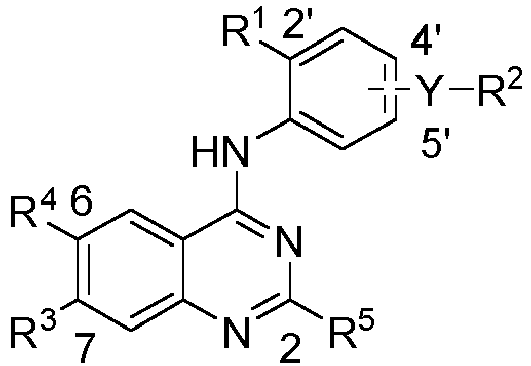
R1 Y-R2 R3 R4 R5 EGFR kinase IC50(nM) WT LR/TM LR/TM/CS 1 -F 

-OMe -H 59.9 ± 1.8 6631.5 ± 657.5 >10000 2 -F 

-OMe -H 53.7 ± 138 >10000 >10000 3 -F 

-OMe -H 3.7±1.6 7555.2 ± 1200.0 >10000 4 -F 
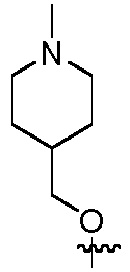
-OMe -H 1346.3 ± 312.4 >10000 >10000 5 -F 
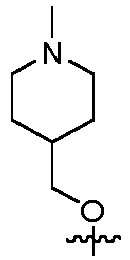
-OMe -H 68.3 ± 13.0 1381.4 ± 234.6 >10000 6 -F 

-OMe -H 1095.0 ± 180.3 3033.4 ± 688.9 >10000 7 -H 

-OMe -H 2.6 ± 1.3 4628.2 ± 825.12 5574.7 ± 1002.0 8 -H 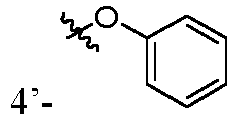

-OMe -H 0.9 ± 0.2 191.7 ± 53.4 42.7 ± 5.4 9 -F 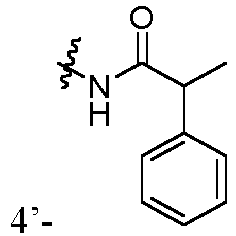

-OMe -H 7.7 ± 1.8 2555.2 ± 800.0 4808.5 ± 2924.2 10 -F 

-OMe -H 23.1 ± 8 2032.2 ± 755.3 3186.0 ± 2502.1 11 -F 

-OMe -H 5.6 ± 3.3 1001.2 ± 435.0 1295.9 ± 308.2 12 -F 

-OMe -H 1.3 ± 0.3 3.2±0.8 14.5±3.3 13 
4'-H 
-OMe -H 7341.1 ± 2515.4 >10000 >10000 14 
4'-H 
-H -H 2709.8 ± 80.2 >10000 9512.3 ± 526.2 15 -F 
-OMe -OMe -H 113.5± 80.2 >10000 >10000 16 -F 
-OMe -OMe -H 137.4± 80.2 >10000 >10000 17 -F 

-OMe -H 16.1±4.8 8.5±0.7 37.1±18.8 18 -F 
-OMe -OMe -H 1.3±0.6 3.2±1.3 14.5±5.2 19 -F 

-OMe -H 4.6 ± 2.8 8.6±2.1 7.9±2.0 20 -F 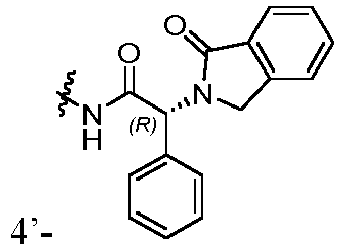

-OMe -H 3.5 ± 1.0 6.4±1.6 19.2±3.2 21 -F 
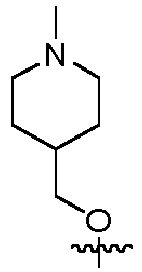
-OMe -H 27.1± 12.0 179.6 ± 94.9 361.3 ± 123.4 22 -F 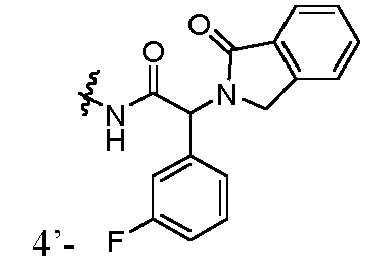

-OMe -H 2.0 ± 0.5 6.7 ± 2.2 13.4 ± 2.7 23 -F 
-OMe 
-H 0.8 ± 0.3 2.4 ± 0.5 18.0±8.6 24 -F 
-OMe 
-H 1.0±0.2 4.8±0.7 19.1±4.6 25 -F 
-OMe 
-H 1.6 ± 0.3 7.3 ± 1.3 97.5±12.9 26 -F 


-H 0.7±0.1 1.5±0.2 8.5±2.6 27 -F 
-OMe -OMe -NH2 388.3 ± 55.3 >1000 >1000 28 -F 

-OMe -H 2.5 ± 0.8 35.3 ± 12.1 27.5±17.7 a The test on kinase activity is performed by using ELISA-based EGFR-TK assay. The data are the average of at least two independent determinations and are expressed as the mean ± SD (standard deviation). b double mutant (EGFRLSSSR/T790M). c triple mutant (EGFRL858R/T790M/C797S). - All documents mentioned in the present invention are cited as references in this application, as if each document is individually cited as a reference. In addition, it should be understood that after reading the above teachings of the present invention, a skilled person can make various changes or modifications to the present invention, and these equivalent forms also fall within the scope defined by the appended claims of the present application.


Claims (12)




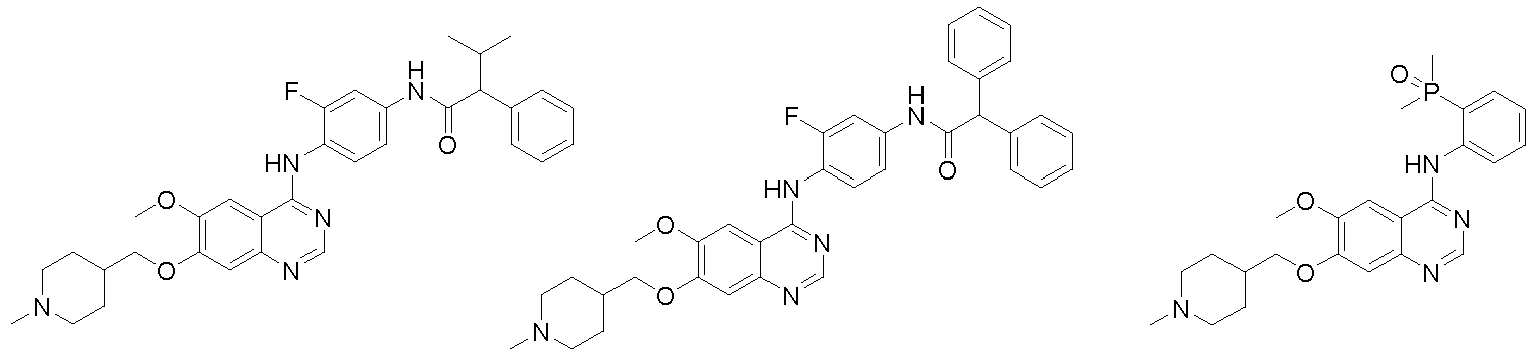


Applications Claiming Priority (2)
| Application Number | Priority Date | Filing Date | Title |
|---|---|---|---|
| CN201810332709.XA CN110372666B (en) | 2018-04-13 | 2018-04-13 | Quinazoline compound as EGFR (epidermal growth factor receptor) triple mutation inhibitor and application thereof |
| PCT/CN2019/082498 WO2019196938A1 (en) | 2018-04-13 | 2019-04-12 | Quinazoline compound serving as egfr triple mutation inhibitor and applications thereof |
Publications (2)
| Publication Number | Publication Date |
|---|---|
| EP3778586A1 true EP3778586A1 (en) | 2021-02-17 |
| EP3778586A4 EP3778586A4 (en) | 2022-03-16 |
Family
ID=68163006
Family Applications (1)
| Application Number | Title | Priority Date | Filing Date |
|---|---|---|---|
| EP19785966.3A Withdrawn EP3778586A4 (en) | 2018-04-13 | 2019-04-12 | QUINAZOLINE COMPOUND AS A EGFR TRIPLE MUTATION INHIBITOR AND USES THEREOF |
Country Status (6)
| Country | Link |
|---|---|
| US (1) | US20210155604A1 (en) |
| EP (1) | EP3778586A4 (en) |
| JP (1) | JP2021521215A (en) |
| KR (1) | KR20210003807A (en) |
| CN (2) | CN110372666B (en) |
| WO (1) | WO2019196938A1 (en) |
Families Citing this family (4)
| Publication number | Priority date | Publication date | Assignee | Title |
|---|---|---|---|---|
| CN112778217B (en) * | 2019-11-08 | 2024-01-26 | 沈阳化工研究院有限公司 | A kind of quinazoline compound and its application |
| KR102267662B1 (en) * | 2019-11-19 | 2021-06-22 | 한국화학연구원 | Benzamide derivatives, preparation method thereof, and pharmaceutical composition for use in preventing or treating cancer containing the same as an active ingredient |
| CN117126142B (en) * | 2023-08-30 | 2026-02-10 | 遵义医科大学珠海校区 | Heterocyclic EGFR mutation inhibitors and their applications |
| CN117800925A (en) * | 2023-10-25 | 2024-04-02 | 浙江工业大学 | Phenyl ureido quinazoline compound, preparation method thereof and application thereof in preparation of medicines for preventing or treating liver cancer |
Family Cites Families (15)
| Publication number | Priority date | Publication date | Assignee | Title |
|---|---|---|---|---|
| JPS5538325A (en) * | 1978-09-11 | 1980-03-17 | Sankyo Co Ltd | 4-anilinoquinazoline derivative and its preparation |
| DK1117653T3 (en) * | 1998-10-01 | 2003-05-26 | Astrazeneca Ab | Quinoline and quinazoline derivatives and their use as inhibitors of cycokin-mediated diseases |
| US20030149045A1 (en) * | 1999-08-20 | 2003-08-07 | Fatih M Uckun | Therapeutic compounds |
| SK3822002A3 (en) * | 1999-09-21 | 2002-10-08 | Astrazeneca Ab | Quinazoline derivatives, process for the preparation thereof and their use |
| AU2003247141A1 (en) * | 2002-08-01 | 2004-02-23 | Yissum Research Development Company Of The Hebrew University Of Jerusalem | 4-anilido substituted quinazolines and use thereof as inhibitors of epidermal growth factor receptor kinases |
| TW200505452A (en) * | 2003-06-17 | 2005-02-16 | Astrazeneca Ab | Chemical compounds |
| JO2787B1 (en) * | 2005-04-27 | 2014-03-15 | امجين إنك, | Substituted Amid derivatives & methods of use |
| US9101631B2 (en) * | 2008-12-12 | 2015-08-11 | Georgetown University | Combination therapy based on SRC and aurora kinase inhibition for the treatment of cancer |
| CN102146059A (en) * | 2010-02-08 | 2011-08-10 | 上海艾力斯医药科技有限公司 | Quinazoline derivatives and preparation method and application thereof |
| CN103965120B (en) * | 2013-01-25 | 2016-08-17 | 上海医药集团股份有限公司 | Quinoline and quinazoline derivant, preparation method, intermediate, compositions and application |
| CN104230826B (en) * | 2013-06-08 | 2017-03-29 | 复旦大学 | 2 fluoro quinazoline cyclics and preparation method thereof and pharmaceutical usage |
| CN104530063B (en) * | 2015-01-13 | 2017-01-18 | 北京赛特明强医药科技有限公司 | Quinazoline and heterocyclic ring compounds, preparing method of compounds, and application of compounds serving as epidermal growth factor receptor inhibitors used for treating cancer |
| CA2987914C (en) * | 2015-06-30 | 2022-09-13 | Dana-Farber Cancer Institute, Inc. | Inhibitors of egfr and methods of use thereof |
| CN107129506B (en) * | 2016-02-26 | 2019-10-22 | 华东理工大学 | Pyrimido[4,5-d][1,3]oxazin-2-one derivatives as EGFR inhibitors and their applications |
| CN105884699B (en) * | 2016-05-11 | 2019-05-07 | 中国药科大学 | 4-Substituted aniline quinazoline derivatives and preparation method and use thereof |
-
2018
- 2018-04-13 CN CN201810332709.XA patent/CN110372666B/en not_active Expired - Fee Related
-
2019
- 2019-04-12 EP EP19785966.3A patent/EP3778586A4/en not_active Withdrawn
- 2019-04-12 US US17/047,002 patent/US20210155604A1/en not_active Abandoned
- 2019-04-12 CN CN201980025718.7A patent/CN112236422B/en not_active Expired - Fee Related
- 2019-04-12 JP JP2020556322A patent/JP2021521215A/en active Pending
- 2019-04-12 KR KR1020207032817A patent/KR20210003807A/en not_active Withdrawn
- 2019-04-12 WO PCT/CN2019/082498 patent/WO2019196938A1/en not_active Ceased
Also Published As
| Publication number | Publication date |
|---|---|
| CN110372666A (en) | 2019-10-25 |
| US20210155604A1 (en) | 2021-05-27 |
| CN112236422A (en) | 2021-01-15 |
| EP3778586A4 (en) | 2022-03-16 |
| CN112236422B (en) | 2023-05-16 |
| WO2019196938A1 (en) | 2019-10-17 |
| KR20210003807A (en) | 2021-01-12 |
| CN110372666B (en) | 2022-11-08 |
| JP2021521215A (en) | 2021-08-26 |
Similar Documents
| Publication | Publication Date | Title |
|---|---|---|
| EP3584239B1 (en) | O-aminoheteroaryl alkynyl-containing compound, preparation method therefor, and use thereof | |
| EP3299369B1 (en) | Pyrido-azaheterecydic compound and preparation method and use thereof | |
| KR101614572B1 (en) | Diamino heterocyclic carboxamide compound | |
| CN104736155B (en) | Inhibitor of the dicyclic compound as kinases | |
| US20180369242A1 (en) | Novel egfr and alk dual inhibitor | |
| JPWO2009008371A1 (en) | Di (arylamino) aryl compounds | |
| JP2016516826A (en) | Deuterated diaminopyrimidine compound and drug composition containing this compound | |
| JP2014521613A (en) | Quinazoline derivative, production method thereof, intermediate, composition and application thereof | |
| CN111825658B (en) | EGFR triple mutation inhibitors and their applications | |
| CN112236422B (en) | Quinazoline compounds as EGFR triple mutation inhibitors and their application | |
| JP6916562B2 (en) | Compounds, pharmaceutically acceptable salts thereof, solvates, stereoisomers and tautomers, and drug compositions, hyperproliferative disorder therapeutic agents, hyperproliferative disorder prophylaxis agents, drugs, cancer therapeutic agents, cancer Prophylactic agents and kinase signaling regulators | |
| AU2015303724B2 (en) | Quinazoline derivative | |
| CN111763215A (en) | A kind of compound with nitrogen-containing heterocyclic structure and preparation method and use thereof | |
| KR102267662B1 (en) | Benzamide derivatives, preparation method thereof, and pharmaceutical composition for use in preventing or treating cancer containing the same as an active ingredient | |
| KR102685187B1 (en) | Compounds inhibiting ALK and/or EGFR mutation kinases and medical use thereof | |
| WO2011068187A1 (en) | Quinazoline derivatives | |
| CN110885331A (en) | Preparation and application of novel 6-amino-1H-pyrazolo [3, 4-d ] pyrimidine JAK kinase inhibitor | |
| CN118652239A (en) | Synthesis and use of a class of EGFR allosteric inhibitors | |
| KR102409595B1 (en) | Novel purinone derivatives as protein kinase CSF-1R inhibitor | |
| EP4306518A1 (en) | Novel pyrimidine derivative showing inhibition effect on growth of cancer cells | |
| CN114957224A (en) | Tumor hypoxia-targeted EGFR inhibitor and application thereof | |
| CN115403557A (en) | Quinoline and quinazoline compounds as fourth-generation EGFR (epidermal growth factor receptor) inhibitor and application thereof | |
| CN118221696A (en) | Pyrimidine heterocyclic compound containing N-methylpiperazine structure and preparation method and application thereof | |
| WO2023046114A1 (en) | Pteridinone derivative and use thereof | |
| CN116655600A (en) | Substituted 2-arylamino pyrimidine compound, pharmaceutical composition and application thereof |
Legal Events
| Date | Code | Title | Description |
|---|---|---|---|
| STAA | Information on the status of an ep patent application or granted ep patent |
Free format text: STATUS: THE INTERNATIONAL PUBLICATION HAS BEEN MADE |
|
| PUAI | Public reference made under article 153(3) epc to a published international application that has entered the european phase |
Free format text: ORIGINAL CODE: 0009012 |
|
| STAA | Information on the status of an ep patent application or granted ep patent |
Free format text: STATUS: REQUEST FOR EXAMINATION WAS MADE |
|
| 17P | Request for examination filed |
Effective date: 20201112 |
|
| AK | Designated contracting states |
Kind code of ref document: A1 Designated state(s): AL AT BE BG CH CY CZ DE DK EE ES FI FR GB GR HR HU IE IS IT LI LT LU LV MC MK MT NL NO PL PT RO RS SE SI SK SM TR |
|
| AX | Request for extension of the european patent |
Extension state: BA ME |
|
| DAV | Request for validation of the european patent (deleted) | ||
| DAX | Request for extension of the european patent (deleted) | ||
| RIC1 | Information provided on ipc code assigned before grant |
Ipc: A61P 35/00 20060101ALI20211105BHEP Ipc: A61K 31/675 20060101ALI20211105BHEP Ipc: A61K 31/5377 20060101ALI20211105BHEP Ipc: A61K 31/517 20060101ALI20211105BHEP Ipc: C07F 9/6558 20060101ALI20211105BHEP Ipc: C07D 403/12 20060101ALI20211105BHEP Ipc: C07D 401/14 20060101ALI20211105BHEP Ipc: C07D 401/12 20060101ALI20211105BHEP Ipc: C07D 239/94 20060101AFI20211105BHEP |
|
| REG | Reference to a national code |
Ref country code: DE Ref legal event code: R079 Free format text: PREVIOUS MAIN CLASS: C07D0401120000 Ipc: C07D0239940000 |
|
| A4 | Supplementary search report drawn up and despatched |
Effective date: 20220215 |
|
| RIC1 | Information provided on ipc code assigned before grant |
Ipc: A61P 35/00 20060101ALI20220209BHEP Ipc: A61K 31/675 20060101ALI20220209BHEP Ipc: A61K 31/5377 20060101ALI20220209BHEP Ipc: A61K 31/517 20060101ALI20220209BHEP Ipc: C07F 9/6558 20060101ALI20220209BHEP Ipc: C07D 403/12 20060101ALI20220209BHEP Ipc: C07D 401/14 20060101ALI20220209BHEP Ipc: C07D 401/12 20060101ALI20220209BHEP Ipc: C07D 239/94 20060101AFI20220209BHEP |
|
| STAA | Information on the status of an ep patent application or granted ep patent |
Free format text: STATUS: THE APPLICATION IS DEEMED TO BE WITHDRAWN |
|
| 18D | Application deemed to be withdrawn |
Effective date: 20220915 |