EP3778580A1 - Synthesis of furans from sugars via keto intermediates - Google Patents
Synthesis of furans from sugars via keto intermediates Download PDFInfo
- Publication number
- EP3778580A1 EP3778580A1 EP20182712.8A EP20182712A EP3778580A1 EP 3778580 A1 EP3778580 A1 EP 3778580A1 EP 20182712 A EP20182712 A EP 20182712A EP 3778580 A1 EP3778580 A1 EP 3778580A1
- Authority
- EP
- European Patent Office
- Prior art keywords
- keto
- acid
- intermediate product
- dehydratases
- classification
- Prior art date
- Legal status (The legal status is an assumption and is not a legal conclusion. Google has not performed a legal analysis and makes no representation as to the accuracy of the status listed.)
- Granted
Links
- CHTHALBTIRVDBM-UHFFFAOYSA-N OC(c1ccc(C(O)=O)[o]1)=O Chemical compound OC(c1ccc(C(O)=O)[o]1)=O CHTHALBTIRVDBM-UHFFFAOYSA-N 0.000 description 3
- PXJJKVNIMAZHCB-UHFFFAOYSA-N O=Cc1ccc(C=O)[o]1 Chemical compound O=Cc1ccc(C=O)[o]1 PXJJKVNIMAZHCB-UHFFFAOYSA-N 0.000 description 2
- SHNRXUWGUKDPMA-UHFFFAOYSA-N OC(c1ccc(C=O)[o]1)=O Chemical compound OC(c1ccc(C=O)[o]1)=O SHNRXUWGUKDPMA-UHFFFAOYSA-N 0.000 description 1
Images



Classifications
-
- C—CHEMISTRY; METALLURGY
- C12—BIOCHEMISTRY; BEER; SPIRITS; WINE; VINEGAR; MICROBIOLOGY; ENZYMOLOGY; MUTATION OR GENETIC ENGINEERING
- C12P—FERMENTATION OR ENZYME-USING PROCESSES TO SYNTHESISE A DESIRED CHEMICAL COMPOUND OR COMPOSITION OR TO SEPARATE OPTICAL ISOMERS FROM A RACEMIC MIXTURE
- C12P17/00—Preparation of heterocyclic carbon compounds with only O, N, S, Se or Te as ring hetero atoms
- C12P17/02—Oxygen as only ring hetero atoms
- C12P17/04—Oxygen as only ring hetero atoms containing a five-membered hetero ring, e.g. griseofulvin, vitamin C
-
- C—CHEMISTRY; METALLURGY
- C12—BIOCHEMISTRY; BEER; SPIRITS; WINE; VINEGAR; MICROBIOLOGY; ENZYMOLOGY; MUTATION OR GENETIC ENGINEERING
- C12N—MICROORGANISMS OR ENZYMES; COMPOSITIONS THEREOF; PROPAGATING, PRESERVING, OR MAINTAINING MICROORGANISMS; MUTATION OR GENETIC ENGINEERING; CULTURE MEDIA
- C12N1/00—Microorganisms; Compositions thereof; Processes of propagating, maintaining or preserving microorganisms or compositions thereof; Processes of preparing or isolating a composition containing a microorganism; Culture media therefor
- C12N1/14—Fungi; Culture media therefor
- C12N1/145—Fungi isolates
-
- C—CHEMISTRY; METALLURGY
- C07—ORGANIC CHEMISTRY
- C07D—HETEROCYCLIC COMPOUNDS
- C07D307/00—Heterocyclic compounds containing five-membered rings having one oxygen atom as the only ring hetero atom
- C07D307/02—Heterocyclic compounds containing five-membered rings having one oxygen atom as the only ring hetero atom not condensed with other rings
- C07D307/34—Heterocyclic compounds containing five-membered rings having one oxygen atom as the only ring hetero atom not condensed with other rings having two or three double bonds between ring members or between ring members and non-ring members
- C07D307/38—Heterocyclic compounds containing five-membered rings having one oxygen atom as the only ring hetero atom not condensed with other rings having two or three double bonds between ring members or between ring members and non-ring members with substituted hydrocarbon radicals attached to ring carbon atoms
- C07D307/40—Radicals substituted by oxygen atoms
- C07D307/42—Singly bound oxygen atoms
- C07D307/44—Furfuryl alcohol
-
- C—CHEMISTRY; METALLURGY
- C07—ORGANIC CHEMISTRY
- C07D—HETEROCYCLIC COMPOUNDS
- C07D307/00—Heterocyclic compounds containing five-membered rings having one oxygen atom as the only ring hetero atom
- C07D307/02—Heterocyclic compounds containing five-membered rings having one oxygen atom as the only ring hetero atom not condensed with other rings
- C07D307/34—Heterocyclic compounds containing five-membered rings having one oxygen atom as the only ring hetero atom not condensed with other rings having two or three double bonds between ring members or between ring members and non-ring members
- C07D307/38—Heterocyclic compounds containing five-membered rings having one oxygen atom as the only ring hetero atom not condensed with other rings having two or three double bonds between ring members or between ring members and non-ring members with substituted hydrocarbon radicals attached to ring carbon atoms
- C07D307/40—Radicals substituted by oxygen atoms
- C07D307/46—Doubly bound oxygen atoms, or two oxygen atoms singly bound to the same carbon atom
- C07D307/48—Furfural
-
- C—CHEMISTRY; METALLURGY
- C07—ORGANIC CHEMISTRY
- C07D—HETEROCYCLIC COMPOUNDS
- C07D307/00—Heterocyclic compounds containing five-membered rings having one oxygen atom as the only ring hetero atom
- C07D307/02—Heterocyclic compounds containing five-membered rings having one oxygen atom as the only ring hetero atom not condensed with other rings
- C07D307/34—Heterocyclic compounds containing five-membered rings having one oxygen atom as the only ring hetero atom not condensed with other rings having two or three double bonds between ring members or between ring members and non-ring members
- C07D307/56—Heterocyclic compounds containing five-membered rings having one oxygen atom as the only ring hetero atom not condensed with other rings having two or three double bonds between ring members or between ring members and non-ring members with hetero atoms or with carbon atoms having three bonds to hetero atoms with at the most one bond to halogen, e.g. ester or nitrile radicals, directly attached to ring carbon atoms
-
- C—CHEMISTRY; METALLURGY
- C07—ORGANIC CHEMISTRY
- C07D—HETEROCYCLIC COMPOUNDS
- C07D307/00—Heterocyclic compounds containing five-membered rings having one oxygen atom as the only ring hetero atom
- C07D307/02—Heterocyclic compounds containing five-membered rings having one oxygen atom as the only ring hetero atom not condensed with other rings
- C07D307/34—Heterocyclic compounds containing five-membered rings having one oxygen atom as the only ring hetero atom not condensed with other rings having two or three double bonds between ring members or between ring members and non-ring members
- C07D307/56—Heterocyclic compounds containing five-membered rings having one oxygen atom as the only ring hetero atom not condensed with other rings having two or three double bonds between ring members or between ring members and non-ring members with hetero atoms or with carbon atoms having three bonds to hetero atoms with at the most one bond to halogen, e.g. ester or nitrile radicals, directly attached to ring carbon atoms
- C07D307/68—Carbon atoms having three bonds to hetero atoms with at the most one bond to halogen
-
- C—CHEMISTRY; METALLURGY
- C07—ORGANIC CHEMISTRY
- C07H—SUGARS; DERIVATIVES THEREOF; NUCLEOSIDES; NUCLEOTIDES; NUCLEIC ACIDS
- C07H19/00—Compounds containing a hetero ring sharing one ring hetero atom with a saccharide radical; Nucleosides; Mononucleotides; Anhydro-derivatives thereof
- C07H19/01—Compounds containing a hetero ring sharing one ring hetero atom with a saccharide radical; Nucleosides; Mononucleotides; Anhydro-derivatives thereof sharing oxygen
-
- C—CHEMISTRY; METALLURGY
- C12—BIOCHEMISTRY; BEER; SPIRITS; WINE; VINEGAR; MICROBIOLOGY; ENZYMOLOGY; MUTATION OR GENETIC ENGINEERING
- C12N—MICROORGANISMS OR ENZYMES; COMPOSITIONS THEREOF; PROPAGATING, PRESERVING, OR MAINTAINING MICROORGANISMS; MUTATION OR GENETIC ENGINEERING; CULTURE MEDIA
- C12N9/00—Enzymes; Proenzymes; Compositions thereof; Processes for preparing, activating, inhibiting, separating or purifying enzymes
- C12N9/14—Hydrolases (3)
- C12N9/24—Hydrolases (3) acting on glycosyl compounds (3.2)
-
- C—CHEMISTRY; METALLURGY
- C12—BIOCHEMISTRY; BEER; SPIRITS; WINE; VINEGAR; MICROBIOLOGY; ENZYMOLOGY; MUTATION OR GENETIC ENGINEERING
- C12R—INDEXING SCHEME ASSOCIATED WITH SUBCLASSES C12C - C12Q, RELATING TO MICROORGANISMS
- C12R2001/00—Microorganisms ; Processes using microorganisms
- C12R2001/645—Fungi ; Processes using fungi
- C12R2001/66—Aspergillus
- C12R2001/685—Aspergillus niger
Definitions
- the present invention relates to a method of preparing a furan derivative via a keto-intermediate product.
- the method may further comprise a step of oxidizing the furan derivative to provide furandicarboxylic acid or a furandicarboxylic acid derivative.
- Five-carbon and six-carbon furans such as furfural and 5-hydroxymethylfurfural may be derived from renewable resources and are promising platform chemicals which may be used in a wide range of applications.
- 5-hydroxymethylfurfural may be oxidized into 2,5-furandicarboxylic acid, a component of polyesters resembling polyethylene terephthalate but with improved barrier properties.
- the challenge of producing furan compounds such as 5-hydroxymethylfurfural in high yield at low cost hinders such applications.
- 5-hydroxymethylfurfural is traditionally produced from fructose, yet fructose is not as common as other sugars like sucrose and glucose and the pathways are not efficient. Therefore, new routes to furans like 5-hydroxymethylfurfural are needed.
- fructose is a more common and cheaper sugar, but glucose is either converted into fructose in situ or ex situ to make furans such as 5-hydroxymethylfurfural. Routes to furans which did not require fructose as an intermediate would be advantageous.
- a method of preparing a furan derivative comprising the steps of (a) converting a monosaccharide to provide a keto-intermediate product; and (b) dehydrating the keto-intermediate product to provide a furan derivative, wherein the keto-intermediate product is pre-disposed to forming keto-furanose tautomers in solution.
- the method may further comprise a step of oxidizing the furan derivative to provide a furandicarboxylic acid or a furandicarboxylic acid derivative.
- the furandicarboxylic acid derivative may be a furandicarboxylic acid ester.
- fructose has a 2-keto functionality. This 2-keto functionality allows fructose to form keto-furanose tautomers in solution, and these keto-furanose tautomers are pre-disposed to dehydration into 2,5-disubstituted furans.
- glucose does not adopt any furanose forms, making it a poor precursor for furan formation.
- sugars which can form furanose tautomers.
- sugars such as 2-keto-3-deoxygluconic acid, 2-keto-D-gluconate, 5-keto-D-gluconic acid, D-lyxo-5-hexosulose, and 3-deoxy-D-fructose adopt furanose forms at even higher fractions than fructose, and this pre-disposes them to dehydration into furans.
- the invention takes this insight from the structure of fructose and applies it to non-fructose sugars. In effect, the invention converts other sugars into derivatives which have keto functionality like that of fructose and have a pre-disposition to form keto-furanose tautomers in solution.
- NMR spectroscopy measurements show that fructose is present as more than 25% furanose form in water, and this fraction of furanose is even higher in other solvents such as DMSO.
- glucose does not adopt any furanose forms, making it a poor precursor for furan formation.
- sugars which can form furanose tautomers.
- sugars such as 2-keto-3-deoxygluconic acid, 2-keto-D-gluconate, 5-keto-D-gluconic acid, 3-deoxy-D-fructose, and D-lyxo-5-hexosulose adopt furanose forms at even higher fractions than fructose, and this pre-disposes them to dehydration into furans.
- 2-keto-3-deoxygluconic acid, 5-keto-D-gluconic acid, and 2-keto-D-gluconate are the most common 2- or 5-keto sugars which are known to prefer furanose tautomeric forms.
- 4-deoxy-5-ketoglucaric acid is another example of a 5-keto sugar which occurs naturally.
- keto sugars which prefer furanose forms have been reported in the literature, including 3-deoxy-D-fructose, D- lyxo -5-hexulosonic acid, D-lyxo-5-hexosulose, and 4-deoxy-5-ketogalactaric acid.
- 2- and 5- keto sugars which prefer furanose tautomeric forms are not known.
- 2-keto or 5-keto derivatives may be produced by enzymatic chemistry in high selectivity, including enzymes from the modified Entner-Doudoroff pathway. While it is most likely that the reaction pathway would be practiced with glucose, analogous pathways may be used with other C-6 sugars such as galactose and mannose.
- Other dehydration products derived from glucose, sorbitol, or glucose oxidation products which have the 2-keto or 5-keto functionality for dehydration into furans include, but are not limited to, the following:
- 2- and 5- keto sugars which do not prefer furanose tautomeric forms, including L-sorbose, 5-ketoglucose, L- xylo -2-hexulosonic acid, D-glucosone, D-allosone, D-galactosone, and 3-deoxy-D-glucosone. These sugars would not be preferred candidates for dehydration to furans.
- a method of preparing a furan derivative comprising the steps of (a) converting a monosaccharide to provide a keto-intermediate product, and (b) dehydrating the keto-intermediate product to provide a furan derivative, wherein the keto-intermediate product is pre-disposed to forming keto-furanose tautomers in solution.
- the method may further comprise a step of oxidizing the furan derivative to provide a furandicarboxylic acid or a furandicarboxylic acid derivative such as, but not limited thereto, a furandicarboxylic acid ester.
- the keto-intermediate product is pre-disposed to forming at least 30% keto-furanose tautomers in solution such as, for example but not limited thereto, water at a temperature of about 25°C.
- the monosaccharide is an aldohexose selected from a group consisting of allose, altrose, glucose, mannose, gulose, idose, galactose, and talose.
- the monosaccharide is an aldohexose selected from a group consisting of D-allose, D-altrose, D-glucose, D-mannose, D-gulose, D-idose, D-galactose, and D-talose.
- the furan derivative is 5-hydroxymethyl-2-furoic acid.
- keto-intermediate product is a 2-keto derivative of the monosaccharide.
- the keto-intermediate product is a 5-keto derivative of the monosaccharide.
- the keto-intermediate product is selected from the group consisting of 3-deoxy-D-fructose, D-lyso-5-hexulosonic acid and 4-deoxy-5-ketogalactactaric acid or any combination thereof.
- dehydration of the keto-intermediate product occurs by acid catalysis.
- step (a) of the method comprises oxidation of the monosaccharide to provide an oxidized-product followed by dehydration of the oxidized product to provide a keto-intermediate product, wherein the oxidized product is gluconic acid and wherein the keto-intermediate product is 2-keto-3-deoxygluconic acid.
- oxidation of the monosaccharide occurs microbially. In another embodiment, oxidation of the monosaccharide occurs enzymatically.
- dehydration of the oxidized product comprises contacting the oxidized product with an enzyme to provide keto-intermediate product, wherein the enzyme is selected from the group consisting of Galactonate dehydratases having the classification E.C. 4.2.1.6, Altronate dehydratases having the classification E.C. 4.2.1.7, Mannonate dehydratases having the classification E.C. 4.2.1.8, Dihydroxyacid dehydratases having the classification E.C. 4.2.1.9, Gluconate dehydratases having the classification E.C. 4.2.1.39, Glucarate dehydratases having the classification E.C. 4.2.1.40, Galactarate dehydratases having the classification E.C.
- the enzyme is selected from the group consisting of gluconate dehydratase and dihydroxyacid dehydratase or a combination thereof.
- FIG. 1 illustrates a possible pathway of the invention utilizing a keto intermediate and its dehydration into a furan.
- Glucose can be oxidized microbially or enzymatically into gluconic acid.
- Gluconic acid can be dehydrated by gluconate dehydratase enzymes or dihydroxyacid dehydratase enzymes to form 2-keto-3-deoxygluconic acid, which is a 2-keto sugar which adopts furanose tautomeric forms. Consequently, 2-keto-3-deoxygluconic acid may be dehydrated by acid catalysis into 5-hydroxymethyl-2-furoic acid.
- 5-hydroxymethyl-2-furoic acid may be oxidized into furandicarboxylic acid using a variety of catalysts for oxidation of aldehydes to acids using a variety of oxidation systems.
- 5-hydroxymethyl-2-furoic acid may be contacted with an oxygen source, acetic acid solvent, cobalt and manganese oxidation catalyst, a bromine source, at a temperature in the range of about 50°C to about 200°C, and a pressure in the range of about 1 bar to about 100 bar for a period of time from about 1 minutes to about 10 hours to provide furandicarboxylic acid.
- step (a) of the method comprises oxidation of the monosaccharide to provide a keto-intermediate product such as, for example but not limited thereto, 5-ketogluconic acid
- step (b) of the method comprises dehydrating the keto-intermediate product to provide a furan derivative such as, for example but not limited thereto, 5-formyl-2-furoic acid.
- FIG. 2 illustrates a possible pathway of the invention utilizing a keto intermediate and its dehydration into a furan.
- Glucose can be oxidized microbially into 5-keto-D-gluconic acid.
- This acid is a 5-keto sugar which adopts furanose tautomeric forms. Consequently, 5-keto-D-gluconic acid may be dehydrated by acid catalysis into 5-formyl-2-furoic acid.
- 5-formyl-2-furoic acid may be oxidized into furandicarboxylic acid using a variety of catalysts for oxidation of aldehydes to acids using a variety of oxidation systems.
- 5-formyl-2-furoic acid may be contacted with an oxygen source, acetic acid solvent, cobalt and manganese oxidation catalyst, a bromine source, at a temperature in the range of about 50°C to about 200°C, and a pressure in the range of about 1 bar to about 100 bar for a period of time from about 1 minutes to about 10 hours to provide furandicarboxylic acid.
- an oxygen source acetic acid solvent, cobalt and manganese oxidation catalyst, a bromine source
- step (a) of the method comprises hydrogenation of the monosaccharide to provide a reduced-product followed by dehydration of the reduced product to provide a keto-intermediate product.
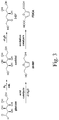
- Figure 3 illustrates a possible pathway of the invention utilizing a keto intermediate and its dehydration into a furan.
- Glucose can be hydrogenated catalytically into sorbitol. If a new enzymatic activity may be found to selectively dehydrate sorbitol to 3-deoxy-D-fructose, then it can be converted into this keto-sugar.
- This 3-deoxy-D-fructose may be dehydrated by acid catalysis into 2,5-bis(hydroxymethyl)furan. 2,5-bis(hydroxymethyl)furan may be oxidized into furandicarboxylic acid using a variety of catalysts for oxidation of aldehydes to acids using a variety of oxidation systems.
- 2,5-bis(hydroxymethyl)furan may be contacted with an oxygen source, acetic acid solvent, cobalt and manganese oxidation catalyst, a bromine source, at a temperature in the range of about 50°C to about 200°C, and a pressure in the range of about 1 bar to about 100 bar for a period of time from about 1 minutes to about 10 hours to provide furandicarboxylic acid,
- a method of preparing a furan derivative comprising the steps of (a) oxidizing a monosaccharide to provide a keto-intermediate product, and (b) dehydrating the keto-intermediate product to provide a furan derivative; wherein the keto-intermediate product is pre-disposed to forming keto-furanose tautomers in solution.
- the keto-intermediate product is pre-disposed to forming at least 30% keto-furanose tautomers in solution such as, for example but not limited thereto, water at a temperature of about 25°C.
- a method of preparing a furan derivative comprising the steps of (a) oxidizing glucose to provide 5-ketogluconic acid, and (b) dehydrating 5-ketogluconic acid to provide 5-formyl-2-furoic acid, wherein 5-ketogluconic acid is pre-disposed to forming keto-furanose tautomers in solution.
- the 5-ketogluconic acid is pre-disposed to forming at least 30% keto-furanose tautomers in solution such as, for example but not limited thereto, water at a temperature of about 25°C.
- a method of preparing a furan derivative comprising the steps of (a) oxidizing a monosaccharide to provide an oxidation product, (b) dehydrating the oxidation product to provide a keto-intermediate product, and (c) dehydrating the keto-intermediate product to provide a furan derivative, wherein the keto-intermediate product is pre-disposed to forming keto-furanose tautomers in solution.
- the keto-intermediate product is pre-disposed to forming at least 30% keto-furanose tautomers in solution such as, for example but not limited thereto, water at a temperature of about 25°C.
- a method of preparing a furan derivative comprising the steps of (a) oxidizing glucose to provide gluconic acid, (b) dehydrating gluconic acid to provide 2-keto-3-deoxygluconic acid, and (c) dehydrating 2-keto-3-deoxygluconic acid to provide 5-hydroxymethyl-2-furoic acid, wherein 2-keto-3-deoxygluconic acid is pre-disposed to forming keto-furanose tautomers in solution.
- the 2-keto-3-deoxygluconic acid is pre-disposed to forming at least 30% keto-furanose tautomers in solution such as, for example but not limited thereto, water at a temperature of about 25°C.
- a method of preparing 2,5-furandicarboxylic acid comprising the steps of (a) oxidizing glucose to provide gluconic acid, (b) dehydrating gluconic acid to provide 2-keto-3-deoxygluconic acid, (c) dehydrating 2-keto-3-deoxygluconic acid to provide 5-hydroxymethyl-2-furoic acid, and (d) oxidizing 5-hydroxymethyl-2-furoic acid to provide 2,5-furandicarboxylic acid, wherein 2-keto-3-deoxygluconic acid is pre-disposed to forming keto-furanose tautomers in solution.
- the 2-keto-3-deoxygluconic acid is pre-disposed to forming at least 30% keto-furanose tautomers in solution such as, for example but not limited thereto, water at a temperature of about 25°C.
- the glucose of step (a) is contacted with at least one an enzyme to form gluconic acid, wherein the enzyme is selected from the group consisting of glucose oxidase and glucose dehydrogenase or a combination thereof.
- the glucose of step (a) is oxidized by a microbe to produce gluconic acid, wherein the microbe is selected from the group consisting of Pseudomonas, Acetobacter, Zymomonas, Gluconobacter, Azospirillum, Aspergillus, Penicillium, Gliocladium, Scopulariopsis, Gonatobotrys, Endomycopsis, Aureobasidium, Tricholoma, and Gluconacetobacter.
- the microbe is selected from the group consisting of Pseudomonas, Acetobacter, Zymomonas, Gluconobacter, Azospirillum, Aspergillus, Penicillium, Gliocladium, Scopulariopsis, Gonatobotrys, Endomycopsis, Aureobasidium, Tricholoma, and Gluconacetobacter.
- the microbe is selected from the group consisting of Pseudomonas ovalis, Pseudomonas savastanoi, Acetobacter methanolicus, Zymomonas mobilis, Acetobacter diazotrophicus, Gluconobacter oxydans, Gluconobacter suboxydans, Azospirillum brasiliense, Aspergillus niger, Penicillium funiculosum, Penicillium glaucum, Penicillium variabile, Penicillium amagasakiense, Aureobasidium pullulans, Tricholoma robustum, Pseudomonas fluorescens, Gluconobacter cerinus, Gluconacetobacter diazotrophicus, Acetobacter aceti, Acetobacter pasteurianus, Acetobacter tropicalis, and Gluconacetobacter xylinus.
- the gluconic acid of step (b) is contacted with at least one enzyme to form 2-keto-3-deoxygluconic acid, wherein the enzyme is selected from the group consisting of Galactonate dehydratases having the classification E.C. 4.2.1.6, Altronate dehydratases having the classification E.C. 4.2.1.7, Mannonate dehydratases having the classification E.C. 4.2.1.8, Dihydroxyacid dehydratases having the classification E.C. 4.2.1.9, Gluconate dehydratases having the classification E.C. 4.2.1.39, Glucarate dehydratases having the classification E.C. 4.2.1.40, Galactarate dehydratases having the classification E.C.
- the enzyme is selected from the group consisting of Galactonate dehydratases having the classification E.C. 4.2.1.6, Altronate dehydratases having the classification E.C. 4.2.1.7, Mannonate dehydratases having the classification E.C. 4.2.1.8, Dihydroxyacid dehydrat
- the enzyme is selected from the group consisting of gluconate dehydratase and dihydroxy-acid dehydratase.
- the 2-keto-3-deoxygluconic acid of step (c) undergoes acid catalysed dehydration by contacting the 2-keto-3-deoxygluconic acid with an acid to provide 5-hydroxymethyl-2-furoic acid, wherein the acid is selected from the group consisting of acetic acid, sulphuric acid, trifluoroacetic acid, hydrobromic acid, hydrochloric acid, and hydroiodic acid or any combination thereof.
- the 2-keto-3-deoxygluconic acid in step (c) is subjected to acid catalysed dehydration by contacting the 2-keto-3-deoxygluconic acid with an acid and heated to a temperature in the range of about 10°C to about 200°C for a period of time of about 5 minutes to about 10 hours to provide 5-hydroxymethyl-2-furoic acid.
- the acid is selected from the group consisting of acetic acid, sulphuric acid, trifluoroacetic acid, hydrobromic acid, hydrochloric acid, and hydroiodic acid or any combination thereof.
- the 5-hydroxymethyl-2-furoic acid of step (d) is oxidized to 2,5-furandicarboxylic acid by contacting the 5-hydroxymethyl-2-furoic acid with an oxygen source, acetic acid solvent, cobalt and manganese oxidation catalyst, a bromine source, at a temperature in the range of about 50°C to about 200°C, and a pressure in the range of about 1 bar to about 100 bar for a period of time from about 1 minutes to about 10 hours.
- a method of preparing a furan derivative comprising the steps of (a) hydrogenating a monosaccharide to provide a reduced-product, (b) dehydrating the reduced-product to provide a keto-intermediate product, and (c) dehydrating the keto-intermediate product to provide a furan derivative, wherein the keto-intermediate product is pre-disposed to forming keto-furanose tautomers in solution.
- the keto-intermediate product is pre-disposed to forming at least 30% keto-furanose tautomers in solution such as, for example but not limited thereto, water at a temperature of about 25°C.
- a method of preparing a furan derivative comprising the steps of (a) hydrogenating glucose to provide sorbitol, (b) dehydrating sorbitol to provide 3-deoxy-D-fructose, and (c) dehydrating 3-deoxy-D-fructose to provide 2,5-bis(hydroxymethyl)furan, wherein 3-deoxy-D-fructose is pre-disposed to forming keto-furanose tautomers in solution.
- the 3-deoxy-D-fructose is pre-disposed to forming at least 30% keto-furanose tautomers in solution such as, for example but not limited thereto, water at a temperature of about 25°C.
- a method of preparing 2,5-furandicarboxylic acid comprising the steps of (a) hydrogenating glucose to provide sorbitol, (b) dehydrating sorbitol to provide 3-deoxy-D-fructose, (c) dehydrating 3-deoxy-D-fructose to provide 2,5-bis(hydroxymethyl)furan, and (d) oxidizing 2,5-bis(hydroxymethyl)furan to provide 2,5-furandicarboxylic acid, wherein 3-deoxy-D-fructose is pre-disposed to forming keto-furanose tautomers in solution.
- the 3-deoxy-D-fructose is pre-disposed to forming at least 30% keto-furanose tautomers in solution such as, for example but not limited thereto, water at a temperature of about 25°C.
- a method of preparing a furan derivative comprising the steps of, (a) oxidizing fructose to provide D-lyxo-5-hexosulose, and (b) dehydrating D-lyxo-5-hexosulose to provide 2,5-diformylfuran, wherein the D-lyxo-5-hexosulose is pre-disposed to forming keto-furanose tautomers in solution.
- the method further comprises the step of oxidizing 2,5-diformylfuran to provide 2,5-furandicarboxylic acid.
- 2,5-diformylfuran may be contacted with an oxygen source, acetic acid solvent, cobalt and manganese oxidation catalyst, a bromine source, at a temperature in the range of about 50°C to about 200°C, and a pressure in the range of about 1 bar to about 100 bar for a period of time from about 1 minutes to about 10 hours to provide furandicarboxylic acid.
- the keto-intermediate product is pre-disposed to forming at least 30% keto-furanose tautomers in solution such as, for example, but not limited thereto, water at a temperature of about 25°C.
- 2-keto-3-deoxygluconic acid lithium salt hydrate potassium 5-keto-D-gluconate, calcium 2-keto-D-gluconate hemihydrate, hydrogen bromide in acetic acid (33 wt %, HBr/HOAc), Hydrogen bromide in water (48 wt %, HBr), trifluoroacetic acid (TFA), acetic anhydride (Ac 2 O), acetic acid, sulfuric acid (98% in water, H 2 SO 4 ), and hydroiodic acid (57% in water, HI) were obtained from Sigma-Aldrich.
- Glucose (20 g), polypeptone (2 g), and yeast extract (1 g) are mixed in 1 L of deionized water, and this medium is placed in a fermentation tank.
- the tank is inoculated with a culture of Gluconobacter suboxydans IFO 12528 and agitated and aerated at 30°C for 170 hours with pH maintained at pH 3.5 by controlled addition of sodium hydroxide.
- glucose is converted to sodium 5-ketogluconate with traces of sodium gluconate and sodium 2-ketogluconate.
- Glucose 100 g
- corn steep liquor 5 g
- urea 2 g
- MgSO 4 heptahydrate (0.25 g
- KH 2 PO 4 0.6 g
- CaCO 3 27 g
- the tank is inoculated with a culture of Pseudomonas fluorescens, and agitated and aerated at 25°C for 43 hours.
- glucose is converted to calcium 2-ketogluconate.
- Glucose (100 g) and yeast extract (10 g) are mixed in 1 L of deionized water, and this medium is divided amongst several shake flasks. Each flask containing medium is inoculated with a culture of Gluconobacter oxydans, and incubated at 32°C for 8 hours in a shaker with good agitation for medium aeration. During the fermentation, glucose is converted to gluconate and gluconic acid.
- the dihydroxyacid dehydratase from Sulfolobus solfataricus ( Kim, S; Lee, S.B. "Catalytic Promiscuity in Dihydroxy-Acid Dehydratase from the Thennoacidophilic Archaeon Sulfolobus solfataricus.” Journal of Biochemistry, 2006, 139, 591-596 ) was expressed in E. coli.
- the gene was synthesized, cloned into a vector, and transformed into E. coli. Transformed E. coli were grown on a shake flask scale to express the heterologous dihydroxyacid dehydratase protein. On completion of the fermentation, protein was extracted using a detergent extraction reagent and clarified protein extracts were produced.
- Gluconate dehydration reactions were performed by combining the clarified cell extract in a 1:1 volume ratio with 50 mM Tris HCl buffer containing 40 mM sodium gluconate (measured pH 8.35). These were incubated at 60°C for 24.75 hours and analyzed by liquid chromatography for conversion of gluconate. Nearly all of the gluconate was converted to a new product. For positive identification of the 2-keto-3-deoxygluconic acid product, proton NMR was used.
- Glucose is dissolved in water to produce a 40 wt % glucose solution, and the solution is adjusted to pH 8 using sodium hydroxide.
- the glucose solution is contacted with hydrogen gas at a hydrogen partial pressure of 2000 psig in the presence of Raney nickel catalyst at a temperature of 140°C. Under these conditions, glucose is converted to sorbitol in near quantitative yield.
- Sorbitol is dissolved in 50 mM Tris HCl buffer to which a clarified cell extract containing dehydratase enzyme of class 4.2.1 is added. This mixture is incubated at 30°C for 24 hours. Sorbitol is converted into 3-deoxyfructose.
- 2-keto-3-deoxygluconic acid was dissolved in water and acetic acid by placing 8.45 mg of 2-keto-3-deoxygluconic acid in a very small sample vial. To this was added 120 ul of water and 120 ul of acetic acid, and this was mixed to dissolve the 2-keto-3-deoxygluconic acid. This stock solution was used for each reaction according to Table 2. In each case, 20 ul of the 2-keto-3-deoxygluconic acid solution was added first to a vial along with a mini stir bar. The remaining reagents were added in the order shown in Table 2 (left to right) and mixed by stirring on a stirplate. Each vial was capped and heated to 60°C with stirring.
- H 2 SO 4 refers to 98% sulfuric acid.
- TFA is trifluoroacetic acid.
- Ac 2 O is acetic anhydride.
- HCl is 37% concentrated hydrochloric acid. 48% HBr is 48% hydrobromic acid in water.
- MSA is methanesulfonic acid.
- HMFA 5-hydroxymethyl-2-furoic acid
- FFA 5-formyl-2-furoic acid
- HMFA % FFA % 40 70 3000 100 2 0.19 0.19 41 70 3000 58, H 2 SO 4 100 2 0.13 42 70 242 2700 60 4 18.9 43 70 3000, HCl 60 4 0.81
- Acetic acid/HBr refers to 33 wt % HBr in acetic acid.
- H 2 SO 4 refers to 98% sulfuric acid.
- HCl is 37% concentrated aqueous hydrochloric acid.
- 3-deoxy-D-fructose is dissolved in water by placing 10 mg of 3-deoxy-D-fructose in a very small sample vial. To this is added 250 ul of water, and this is mixed to dissolve the 3-deoxy-D-fructose. This stock solution is used for each reaction according to Table 5. In each case, 20 ul of the 3-deoxy-D-fructose solution is added first to a vial along with a mini stir bar. The remaining reagents are added in the order shown in Table 5 (left to right) and mixed by stirring on a stirplate. Each vial is capped and heated to 60°C with stirring.
- 5-hydroxymethyl-2-furoic acid (2.5 g), acetic acid (30 ml), cobalt acetate (0.083 g), sodium bromide (0.071 g), and manganese acetate (0.084 g) are mixed in a batch reactor and placed under an excess of oxygen at 800 psig with vigorous mixing for 1 hour at 180°C.
- LC analysis of the total reaction mixture shows conversion of 5-hydroxymethyl-2-furoic acid to furandicarboxylic acid.
- 5-formyl-2-furoic acid (2.5 g), acetic acid (30 ml), cobalt acetate (0.083 g), sodium bromide (0.071 g), and manganese acetate (0.084 g) are mixed in a batch reactor and placed under an excess of oxygen at 800 psig with vigorous mixing for 1 hour at 180°C.
- LC analysis of the total reaction mixture shows conversion of 5-formyl-2-furoic acid to furandicarboxylic acid.
- 2,5-bis(hydroxymethyl)furan (2.5 g), acetic acid (30 ml), cobalt acetate (0.083 g), sodium bromide (0.071 g), and manganese acetate (0.084 g) are mixed in a batch reactor and placed under an excess of oxygen at 800 psig with vigorous mixing for 1 hour at 180°C.
- LC analysis of the total reaction mixture shows conversion of 2,5-bis(hydroxymethyl)furan to furandicarboxylic acid.
- Fructose (100 g) and yeast extract (10 g) are mixed in 1 L of deionized water, and this medium is divided amongst several shake flasks. Each flask containing medium is inoculated with a culture of Gluconobacter oxydans, and incubated at 32°C for 8 hours in a shaker with good agitation for medium aeration. During the fermentation, fructose is converted to D- lyxo -5-hexosulose.
- D- lyxo -5-hexosulose is dissolved in water by placing 10 mg of D- lyxo -5-hexosulose in a very small sample vial. To this is added 250 ul of water, and this is mixed to dissolve the D- lyxo -5-hexosulose. This stock solution is used for each reaction according to Table 6. In each case, 20 ul of the D- lyxo -5-hexosulose solution is added first to a vial along with a mini stir bar. The remaining reagents are added in the order shown in Table 6 (left to right) and mixed by stirring on a stirplate. Each vial is capped and heated to 60°C with stirring.
- 2,5-diformylfuran (2.5 g), acetic acid (30 ml), cobalt acetate (0.083 g), sodium bromide (0.071 g), and manganese acetate (0.084 g) are mixed in a batch reactor and placed under an excess of oxygen at 800 psig with vigorous mixing for 1 hour at 180°C.
- LC analysis of the total reaction mixture shows conversion of 2,5-diformylfuran to furandicarboxylic acid.
Landscapes
- Chemical & Material Sciences (AREA)
- Organic Chemistry (AREA)
- Life Sciences & Earth Sciences (AREA)
- Health & Medical Sciences (AREA)
- Engineering & Computer Science (AREA)
- Genetics & Genomics (AREA)
- Zoology (AREA)
- Wood Science & Technology (AREA)
- Biotechnology (AREA)
- Bioinformatics & Cheminformatics (AREA)
- Biochemistry (AREA)
- General Health & Medical Sciences (AREA)
- Molecular Biology (AREA)
- Microbiology (AREA)
- General Engineering & Computer Science (AREA)
- Medicinal Chemistry (AREA)
- Biomedical Technology (AREA)
- Botany (AREA)
- Tropical Medicine & Parasitology (AREA)
- Mycology (AREA)
- Virology (AREA)
- Chemical Kinetics & Catalysis (AREA)
- General Chemical & Material Sciences (AREA)
- Furan Compounds (AREA)
- Preparation Of Compounds By Using Micro-Organisms (AREA)
- Saccharide Compounds (AREA)
- Low-Molecular Organic Synthesis Reactions Using Catalysts (AREA)
- Organic Low-Molecular-Weight Compounds And Preparation Thereof (AREA)
Abstract
Description
- The present invention relates to a method of preparing a furan derivative via a keto-intermediate product. The method may further comprise a step of oxidizing the furan derivative to provide furandicarboxylic acid or a furandicarboxylic acid derivative.
- Five-carbon and six-carbon furans such as furfural and 5-hydroxymethylfurfural may be derived from renewable resources and are promising platform chemicals which may be used in a wide range of applications. For instance, 5-hydroxymethylfurfural may be oxidized into 2,5-furandicarboxylic acid, a component of polyesters resembling polyethylene terephthalate but with improved barrier properties. The challenge of producing furan compounds such as 5-hydroxymethylfurfural in high yield at low cost hinders such applications. 5-hydroxymethylfurfural is traditionally produced from fructose, yet fructose is not as common as other sugars like sucrose and glucose and the pathways are not efficient. Therefore, new routes to furans like 5-hydroxymethylfurfural are needed.
- One of the problems with 5-hydroxymethylfurfural synthesis is that 5-hydroxymethylfurfural itself is not very stable and is difficult to isolate. Therefore routes to furans in which 5-hydroxymethylfurfural is not an isolated intermediate are advantageous.
- Moreover, most routes to bio-based furans use fructose as an intermediate. Glucose is a more common and cheaper sugar, but glucose is either converted into fructose in situ or ex situ to make furans such as 5-hydroxymethylfurfural. Routes to furans which did not require fructose as an intermediate would be advantageous.
- Therefore what is provided herein is a method of preparing a furan derivative comprising the steps of (a) converting a monosaccharide to provide a keto-intermediate product; and (b) dehydrating the keto-intermediate product to provide a furan derivative, wherein the keto-intermediate product is pre-disposed to forming keto-furanose tautomers in solution. The method may further comprise a step of oxidizing the furan derivative to provide a furandicarboxylic acid or a furandicarboxylic acid derivative. The furandicarboxylic acid derivative may be a furandicarboxylic acid ester.
-
-
Figure 1 shows the conversion of glucose to furandicarboxylic acid through 2-keto-3-deoxygluconic acid as a keto-sugar intermediate; -
Figure 2 shows the conversion of glucose to furandicarboxylic acid through 5-keto-D-gluconic acid as a keto-sugar intermediate; and -
Figure 3 shows the conversion of glucose to furandicarboxylic acid through 3-deoxy-D-fructose as a keto-sugar intermediate. -
Figure 4 shows the conversion of fructose to furandicarboxylic acid through D-lyxo-5-hexosulose as a keto-sugar intermediate. - One of the reasons which makes fructose a key intermediate for production of bio-furans with 2,5-substituents is that fructose has a 2-keto functionality. This 2-keto functionality allows fructose to form keto-furanose tautomers in solution, and these keto-furanose tautomers are pre-disposed to dehydration into 2,5-disubstituted furans.
- In contrast, glucose does not adopt any furanose forms, making it a poor precursor for furan formation. However, there are other sugars which can form furanose tautomers. In fact, sugars such as 2-keto-3-deoxygluconic acid, 2-keto-D-gluconate, 5-keto-D-gluconic acid, D-lyxo-5-hexosulose, and 3-deoxy-D-fructose adopt furanose forms at even higher fractions than fructose, and this pre-disposes them to dehydration into furans.
- The invention takes this insight from the structure of fructose and applies it to non-fructose sugars. In effect, the invention converts other sugars into derivatives which have keto functionality like that of fructose and have a pre-disposition to form keto-furanose tautomers in solution.
- As shown in
Table 1, NMR spectroscopy measurements show that fructose is present as more than 25% furanose form in water, and this fraction of furanose is even higher in other solvents such as DMSO. In contrast, glucose does not adopt any furanose forms, making it a poor precursor for furan formation. However, there are other sugars which can form furanose tautomers. In fact, sugars such as 2-keto-3-deoxygluconic acid, 2-keto-D-gluconate, 5-keto-D-gluconic acid, 3-deoxy-D-fructose, and D-lyxo-5-hexosulose adopt furanose forms at even higher fractions than fructose, and this pre-disposes them to dehydration into furans.Table 1. Tautomeric Composition of Sugars in Solution Sugar Temp. (°C) Solvent keto α-pyranose β-pyranose α furanose β furanose %furanose D-Fructose 20 D2O 0.5 2.7 68.2 6.2 22.4 28.6 D-glucose 31 D2O 38 62 0 2-keto-3-deoxy-D-gluconic acid (KDG) 20 D2O 0 11 49 23 17 40 D-arabino-2-hexulosonic acid (2-KG) 20 D2O 73 0 16 11 73 20 DMSO 36 6 35 23 42 20 DMF 42 0 36 22 42 Sodium D-xylo-5-hexulosonate (5-KG) 20 D2O 11 10 79 89 3-deoxy-D-fructose (3-DF) 22 D2O 7.5 5 52.5 20 15 35 D-lyxo-5-hexosulose D2O 8 0 10 14 52 66 - 2-keto-3-deoxygluconic acid, 5-keto-D-gluconic acid, and 2-keto-D-gluconate are the most common 2- or 5-keto sugars which are known to prefer furanose tautomeric forms. 4-deoxy-5-ketoglucaric acid is another example of a 5-keto sugar which occurs naturally. Several keto sugars which prefer furanose forms have been reported in the literature, including 3-deoxy-D-fructose, D-lyxo-5-hexulosonic acid, D-lyxo-5-hexosulose, and 4-deoxy-5-ketogalactaric acid. However, there are probably other 2- and 5- keto sugars which prefer furanose tautomeric forms but are not known.
- Many of the 2-keto or 5-keto derivatives may be produced by enzymatic chemistry in high selectivity, including enzymes from the modified Entner-Doudoroff pathway. While it is most likely that the reaction pathway would be practiced with glucose, analogous pathways may be used with other C-6 sugars such as galactose and mannose.
Other dehydration products derived from glucose, sorbitol, or glucose oxidation products which have the 2-keto or 5-keto functionality for dehydration into furans include, but are not limited to, the following: - From glucose:

- From sorbitol:

- From single oxidation products:

- From double oxidation products:

- From treble oxidation products:

- Alternatively, there are some 2- and 5- keto sugars which do not prefer furanose tautomeric forms, including L-sorbose, 5-ketoglucose, L-xylo-2-hexulosonic acid, D-glucosone, D-allosone, D-galactosone, and 3-deoxy-D-glucosone. These sugars would not be preferred candidates for dehydration to furans.
- Now therefore, what is provided in a first embodiment is a method of preparing a furan derivative comprising the steps of (a) converting a monosaccharide to provide a keto-intermediate product, and (b) dehydrating the keto-intermediate product to provide a furan derivative, wherein the keto-intermediate product is pre-disposed to forming keto-furanose tautomers in solution. The method may further comprise a step of oxidizing the furan derivative to provide a furandicarboxylic acid or a furandicarboxylic acid derivative such as, but not limited thereto, a furandicarboxylic acid ester.
- In one embodiment, the keto-intermediate product is pre-disposed to forming at least 30% keto-furanose tautomers in solution such as, for example but not limited thereto, water at a temperature of about 25°C.
- In one embodiment, the monosaccharide is an aldohexose selected from a group consisting of allose, altrose, glucose, mannose, gulose, idose, galactose, and talose. In another embodiment, the monosaccharide is an aldohexose selected from a group consisting of D-allose, D-altrose, D-glucose, D-mannose, D-gulose, D-idose, D-galactose, and D-talose.
- In one embodiment, the furan derivative is 5-hydroxymethyl-2-furoic acid.
- In one embodiment the, keto-intermediate product is a 2-keto derivative of the monosaccharide. In another embodiment, the keto-intermediate product is a 5-keto derivative of the monosaccharide. In yet another embodiment, the keto-intermediate product is selected from the group consisting of 3-deoxy-D-fructose, D-lyso-5-hexulosonic acid and 4-deoxy-5-ketogalactactaric acid or any combination thereof.
- In one embodiment, dehydration of the keto-intermediate product occurs by acid catalysis.
- In one embodiment, step (a) of the method comprises oxidation of the monosaccharide to provide an oxidized-product followed by dehydration of the oxidized product to provide a keto-intermediate product, wherein the oxidized product is gluconic acid and wherein the keto-intermediate product is 2-keto-3-deoxygluconic acid.
- In one embodiment, oxidation of the monosaccharide occurs microbially. In another embodiment, oxidation of the monosaccharide occurs enzymatically.
- In one embodiment, dehydration of the oxidized product comprises contacting the oxidized product with an enzyme to provide keto-intermediate product, wherein the enzyme is selected from the group consisting of Galactonate dehydratases having the classification E.C. 4.2.1.6, Altronate dehydratases having the classification E.C. 4.2.1.7, Mannonate dehydratases having the classification E.C. 4.2.1.8, Dihydroxyacid dehydratases having the classification E.C. 4.2.1.9, Gluconate dehydratases having the classification E.C. 4.2.1.39, Glucarate dehydratases having the classification E.C. 4.2.1.40, Galactarate dehydratases having the classification E.C. 4.2.1.42, D-Fuconate dehydratases having the classification E.C. 4.2.1.67, L-Fuconate dehydratases having the classification E.C. 4.2.1.68, Xylonate dehydratases having the classification E.C. 4.2.1.82, Gluconate/galactonate dehydratases having the classification E.C. 4.2.1.140, and L-Galactonate dehydratases having the classification E.C. 4.2.1.146. More specifically, the enzyme is selected from the group consisting of gluconate dehydratase and dihydroxyacid dehydratase or a combination thereof.
-
Figure 1 illustrates a possible pathway of the invention utilizing a keto intermediate and its dehydration into a furan. Glucose can be oxidized microbially or enzymatically into gluconic acid. Gluconic acid can be dehydrated by gluconate dehydratase enzymes or dihydroxyacid dehydratase enzymes to form 2-keto-3-deoxygluconic acid, which is a 2-keto sugar which adopts furanose tautomeric forms. Consequently, 2-keto-3-deoxygluconic acid may be dehydrated by acid catalysis into 5-hydroxymethyl-2-furoic acid. 5-hydroxymethyl-2-furoic acid may be oxidized into furandicarboxylic acid using a variety of catalysts for oxidation of aldehydes to acids using a variety of oxidation systems. For example, 5-hydroxymethyl-2-furoic acid may be contacted with an oxygen source, acetic acid solvent, cobalt and manganese oxidation catalyst, a bromine source, at a temperature in the range of about 50°C to about 200°C, and a pressure in the range of about 1 bar to about 100 bar for a period of time from about 1 minutes to about 10 hours to provide furandicarboxylic acid. - In one embodiment, step (a) of the method comprises oxidation of the monosaccharide to provide a keto-intermediate product such as, for example but not limited thereto, 5-ketogluconic acid, and step (b) of the method comprises dehydrating the keto-intermediate product to provide a furan derivative such as, for example but not limited thereto, 5-formyl-2-furoic acid.
-
Figure 2 illustrates a possible pathway of the invention utilizing a keto intermediate and its dehydration into a furan. Glucose can be oxidized microbially into 5-keto-D-gluconic acid. This acid is a 5-keto sugar which adopts furanose tautomeric forms. Consequently, 5-keto-D-gluconic acid may be dehydrated by acid catalysis into 5-formyl-2-furoic acid. 5-formyl-2-furoic acid may be oxidized into furandicarboxylic acid using a variety of catalysts for oxidation of aldehydes to acids using a variety of oxidation systems. For example, 5-formyl-2-furoic acid may be contacted with an oxygen source, acetic acid solvent, cobalt and manganese oxidation catalyst, a bromine source, at a temperature in the range of about 50°C to about 200°C, and a pressure in the range of about 1 bar to about 100 bar for a period of time from about 1 minutes to about 10 hours to provide furandicarboxylic acid. - In one embodiment, step (a) of the method comprises hydrogenation of the monosaccharide to provide a reduced-product followed by dehydration of the reduced product to provide a keto-intermediate product.
-
Figure 3 illustrates a possible pathway of the invention utilizing a keto intermediate and its dehydration into a furan. Glucose can be hydrogenated catalytically into sorbitol. If a new enzymatic activity may be found to selectively dehydrate sorbitol to 3-deoxy-D-fructose, then it can be converted into this keto-sugar. This 3-deoxy-D-fructose may be dehydrated by acid catalysis into 2,5-bis(hydroxymethyl)furan. 2,5-bis(hydroxymethyl)furan may be oxidized into furandicarboxylic acid using a variety of catalysts for oxidation of aldehydes to acids using a variety of oxidation systems. For example, 2,5-bis(hydroxymethyl)furan may be contacted with an oxygen source, acetic acid solvent, cobalt and manganese oxidation catalyst, a bromine source, at a temperature in the range of about 50°C to about 200°C, and a pressure in the range of about 1 bar to about 100 bar for a period of time from about 1 minutes to about 10 hours to provide furandicarboxylic acid, - In a second embodiment, what is provided is a method of preparing a furan derivative comprising the steps of (a) oxidizing a monosaccharide to provide a keto-intermediate product, and (b) dehydrating the keto-intermediate product to provide a furan derivative; wherein the keto-intermediate product is pre-disposed to forming keto-furanose tautomers in solution. In one embodiment, the keto-intermediate product is pre-disposed to forming at least 30% keto-furanose tautomers in solution such as, for example but not limited thereto, water at a temperature of about 25°C.
- In a third embodiment, what is provided is a method of preparing a furan derivative comprising the steps of (a) oxidizing glucose to provide 5-ketogluconic acid, and (b) dehydrating 5-ketogluconic acid to provide 5-formyl-2-furoic acid, wherein 5-ketogluconic acid is pre-disposed to forming keto-furanose tautomers in solution. In one embodiment, the 5-ketogluconic acid is pre-disposed to forming at least 30% keto-furanose tautomers in solution such as, for example but not limited thereto, water at a temperature of about 25°C.
- In a fourth embodiment, what is provided is a method of preparing a furan derivative comprising the steps of (a) oxidizing a monosaccharide to provide an oxidation product, (b) dehydrating the oxidation product to provide a keto-intermediate product, and (c) dehydrating the keto-intermediate product to provide a furan derivative, wherein the keto-intermediate product is pre-disposed to forming keto-furanose tautomers in solution. In one embodiment, the keto-intermediate product is pre-disposed to forming at least 30% keto-furanose tautomers in solution such as, for example but not limited thereto, water at a temperature of about 25°C.
- In a fifth embodiment, what is provided is a method of preparing a furan derivative comprising the steps of (a) oxidizing glucose to provide gluconic acid, (b) dehydrating gluconic acid to provide 2-keto-3-deoxygluconic acid, and (c) dehydrating 2-keto-3-deoxygluconic acid to provide 5-hydroxymethyl-2-furoic acid, wherein 2-keto-3-deoxygluconic acid is pre-disposed to forming keto-furanose tautomers in solution. In one embodiment, the 2-keto-3-deoxygluconic acid is pre-disposed to forming at least 30% keto-furanose tautomers in solution such as, for example but not limited thereto, water at a temperature of about 25°C.
- In a sixth embodiment what is provided is a method of preparing 2,5-furandicarboxylic acid comprising the steps of (a) oxidizing glucose to provide gluconic acid, (b) dehydrating gluconic acid to provide 2-keto-3-deoxygluconic acid, (c) dehydrating 2-keto-3-deoxygluconic acid to provide 5-hydroxymethyl-2-furoic acid, and (d) oxidizing 5-hydroxymethyl-2-furoic acid to provide 2,5-furandicarboxylic acid, wherein 2-keto-3-deoxygluconic acid is pre-disposed to forming keto-furanose tautomers in solution. In one embodiment, the 2-keto-3-deoxygluconic acid is pre-disposed to forming at least 30% keto-furanose tautomers in solution such as, for example but not limited thereto, water at a temperature of about 25°C.
- In one embodiment, the glucose of step (a) is contacted with at least one an enzyme to form gluconic acid, wherein the enzyme is selected from the group consisting of glucose oxidase and glucose dehydrogenase or a combination thereof.
- In another embodiment, the glucose of step (a) is oxidized by a microbe to produce gluconic acid, wherein the microbe is selected from the group consisting of Pseudomonas, Acetobacter, Zymomonas, Gluconobacter, Azospirillum, Aspergillus, Penicillium, Gliocladium, Scopulariopsis, Gonatobotrys, Endomycopsis, Aureobasidium, Tricholoma, and Gluconacetobacter. More specifically, the microbe is selected from the group consisting of Pseudomonas ovalis, Pseudomonas savastanoi, Acetobacter methanolicus, Zymomonas mobilis, Acetobacter diazotrophicus, Gluconobacter oxydans, Gluconobacter suboxydans, Azospirillum brasiliense, Aspergillus niger, Penicillium funiculosum, Penicillium glaucum, Penicillium variabile, Penicillium amagasakiense, Aureobasidium pullulans, Tricholoma robustum, Pseudomonas fluorescens, Gluconobacter cerinus, Gluconacetobacter diazotrophicus, Acetobacter aceti, Acetobacter pasteurianus, Acetobacter tropicalis, and Gluconacetobacter xylinus.
- In one embodiment, the gluconic acid of step (b) is contacted with at least one enzyme to form 2-keto-3-deoxygluconic acid, wherein the enzyme is selected from the group consisting of Galactonate dehydratases having the classification E.C. 4.2.1.6, Altronate dehydratases having the classification E.C. 4.2.1.7, Mannonate dehydratases having the classification E.C. 4.2.1.8, Dihydroxyacid dehydratases having the classification E.C. 4.2.1.9, Gluconate dehydratases having the classification E.C. 4.2.1.39, Glucarate dehydratases having the classification E.C. 4.2.1.40, Galactarate dehydratases having the classification E.C. 4.2.1.42, D-Fuconate dehydratases having the classification E.C. 4.2.1.67, L-Fuconate dehydratases having the classification E.C. 4.2.1.68, Xylonate dehydratases having the classification E.C. 4.2.1.82, Gluconate/galactonate dehydratases having the classification E.C. 4.2.1.140, and L-Galactonate dehydratases having the classification E.C. 4.2.1.146. More specicifcally, the enzyme is selected from the group consisting of gluconate dehydratase and dihydroxy-acid dehydratase.
- In one embodiment, the 2-keto-3-deoxygluconic acid of step (c) undergoes acid catalysed dehydration by contacting the 2-keto-3-deoxygluconic acid with an acid to provide 5-hydroxymethyl-2-furoic acid, wherein the acid is selected from the group consisting of acetic acid, sulphuric acid, trifluoroacetic acid, hydrobromic acid, hydrochloric acid, and hydroiodic acid or any combination thereof. In one embodiment, the 2-keto-3-deoxygluconic acid in step (c) is subjected to acid catalysed dehydration by contacting the 2-keto-3-deoxygluconic acid with an acid and heated to a temperature in the range of about 10°C to about 200°C for a period of time of about 5 minutes to about 10 hours to provide 5-hydroxymethyl-2-furoic acid. In one embodiment, the acid is selected from the group consisting of acetic acid, sulphuric acid, trifluoroacetic acid, hydrobromic acid, hydrochloric acid, and hydroiodic acid or any combination thereof.
- In one embodiment, the 5-hydroxymethyl-2-furoic acid of step (d) is oxidized to 2,5-furandicarboxylic acid by contacting the 5-hydroxymethyl-2-furoic acid with an oxygen source, acetic acid solvent, cobalt and manganese oxidation catalyst, a bromine source, at a temperature in the range of about 50°C to about 200°C, and a pressure in the range of about 1 bar to about 100 bar for a period of time from about 1 minutes to about 10 hours.
- In a seventh embodiment, what is provided is a method of preparing a furan derivative comprising the steps of (a) hydrogenating a monosaccharide to provide a reduced-product, (b) dehydrating the reduced-product to provide a keto-intermediate product, and (c) dehydrating the keto-intermediate product to provide a furan derivative, wherein the keto-intermediate product is pre-disposed to forming keto-furanose tautomers in solution. In one embodiment, the keto-intermediate product is pre-disposed to forming at least 30% keto-furanose tautomers in solution such as, for example but not limited thereto, water at a temperature of about 25°C.
- In an eighth embodiment, what is provided is a method of preparing a furan derivative comprising the steps of (a) hydrogenating glucose to provide sorbitol, (b) dehydrating sorbitol to provide 3-deoxy-D-fructose, and (c) dehydrating 3-deoxy-D-fructose to provide 2,5-bis(hydroxymethyl)furan, wherein 3-deoxy-D-fructose is pre-disposed to forming keto-furanose tautomers in solution. In one embodiment, the 3-deoxy-D-fructose is pre-disposed to forming at least 30% keto-furanose tautomers in solution such as, for example but not limited thereto, water at a temperature of about 25°C.
- In a ninth embodiment, what is provided is a method of preparing 2,5-furandicarboxylic acid comprising the steps of (a) hydrogenating glucose to provide sorbitol, (b) dehydrating sorbitol to provide 3-deoxy-D-fructose, (c) dehydrating 3-deoxy-D-fructose to provide 2,5-bis(hydroxymethyl)furan, and (d) oxidizing 2,5-bis(hydroxymethyl)furan to provide 2,5-furandicarboxylic acid, wherein 3-deoxy-D-fructose is pre-disposed to forming keto-furanose tautomers in solution. In one embodiment, the 3-deoxy-D-fructose is pre-disposed to forming at least 30% keto-furanose tautomers in solution such as, for example but not limited thereto, water at a temperature of about 25°C.
- In a tenth embodiment, what is provided is a method of preparing a furan derivative comprising the steps of, (a) oxidizing fructose to provide D-lyxo-5-hexosulose, and (b) dehydrating D-lyxo-5-hexosulose to provide 2,5-diformylfuran, wherein the D-lyxo-5-hexosulose is pre-disposed to forming keto-furanose tautomers in solution.
- In one embodiment, the method further comprises the step of oxidizing 2,5-diformylfuran to provide 2,5-furandicarboxylic acid. For example, 2,5-diformylfuran may be contacted with an oxygen source, acetic acid solvent, cobalt and manganese oxidation catalyst, a bromine source, at a temperature in the range of about 50°C to about 200°C, and a pressure in the range of about 1 bar to about 100 bar for a period of time from about 1 minutes to about 10 hours to provide furandicarboxylic acid.
- In one embodiment, the keto-intermediate product is pre-disposed to forming at least 30% keto-furanose tautomers in solution such as, for example, but not limited thereto, water at a temperature of about 25°C.
- 2-keto-3-deoxygluconic acid lithium salt hydrate, potassium 5-keto-D-gluconate, calcium 2-keto-D-gluconate hemihydrate, hydrogen bromide in acetic acid (33 wt %, HBr/HOAc), Hydrogen bromide in water (48 wt %, HBr), trifluoroacetic acid (TFA), acetic anhydride (Ac2O), acetic acid, sulfuric acid (98% in water, H2SO4), and hydroiodic acid (57% in water, HI) were obtained from Sigma-Aldrich.
- Glucose (20 g), polypeptone (2 g), and yeast extract (1 g) are mixed in 1 L of deionized water, and this medium is placed in a fermentation tank. The tank is inoculated with a culture of Gluconobacter suboxydans IFO 12528 and agitated and aerated at 30°C for 170 hours with pH maintained at pH 3.5 by controlled addition of sodium hydroxide. During the fermentation, glucose is converted to sodium 5-ketogluconate with traces of sodium gluconate and sodium 2-ketogluconate.
- Glucose (100 g), corn steep liquor (5 g), urea (2 g), MgSO4 heptahydrate (0.25 g), KH2PO4 (0.6 g), and CaCO3 (27 g) are mixed in 1 L of deionized water, and this medium is placed in a fermentation tank. The tank is inoculated with a culture of Pseudomonas fluorescens, and agitated and aerated at 25°C for 43 hours. During the fermentation, glucose is converted to calcium 2-ketogluconate.
- Glucose (100 g) and yeast extract (10 g) are mixed in 1 L of deionized water, and this medium is divided amongst several shake flasks. Each flask containing medium is inoculated with a culture of Gluconobacter oxydans, and incubated at 32°C for 8 hours in a shaker with good agitation for medium aeration. During the fermentation, glucose is converted to gluconate and gluconic acid.
- The dihydroxyacid dehydratase from Sulfolobus solfataricus (Kim, S; Lee, S.B. "Catalytic Promiscuity in Dihydroxy-Acid Dehydratase from the Thennoacidophilic Archaeon Sulfolobus solfataricus." Journal of Biochemistry, 2006, 139, 591-596) was expressed in E. coli. The gene was synthesized, cloned into a vector, and transformed into E. coli. Transformed E. coli were grown on a shake flask scale to express the heterologous dihydroxyacid dehydratase protein. On completion of the fermentation, protein was extracted using a detergent extraction reagent and clarified protein extracts were produced. Gluconate dehydration reactions were performed by combining the clarified cell extract in a 1:1 volume ratio with 50 mM Tris HCl buffer containing 40 mM sodium gluconate (measured pH 8.35). These were incubated at 60°C for 24.75 hours and analyzed by liquid chromatography for conversion of gluconate. Nearly all of the gluconate was converted to a new product. For positive identification of the 2-keto-3-deoxygluconic acid product, proton NMR was used. Comparison of the spectra of the enzymatic reaction samples show that gluconate has disappeared from the reaction mixture and new peaks corresponding to the reported spectrum of 2-keto-3-deoxygluconic acid have appeared (reported spectrum from Plantier-Royon, R.; Cardona, F.; Anker, D.; Condemine, G.; Nasser, W.; Robert-Baudouy, J. Nouvelle Synthese de L'Acide 3-Desoxy-D-Erythro-2-Hexulosonique. J. Carbohydrate Chem. 1991, 10, 787-811).
- Glucose is dissolved in water to produce a 40 wt % glucose solution, and the solution is adjusted to pH 8 using sodium hydroxide. The glucose solution is contacted with hydrogen gas at a hydrogen partial pressure of 2000 psig in the presence of Raney nickel catalyst at a temperature of 140°C. Under these conditions, glucose is converted to sorbitol in near quantitative yield.
- Sorbitol is dissolved in 50 mM Tris HCl buffer to which a clarified cell extract containing dehydratase enzyme of class 4.2.1 is added. This mixture is incubated at 30°C for 24 hours. Sorbitol is converted into 3-deoxyfructose.
- 2-keto-3-deoxygluconic acid was dissolved in water and acetic acid by placing 8.45 mg of 2-keto-3-deoxygluconic acid in a very small sample vial. To this was added 120 ul of water and 120 ul of acetic acid, and this was mixed to dissolve the 2-keto-3-deoxygluconic acid. This stock solution was used for each reaction according to Table 2. In each case, 20 ul of the 2-keto-3-deoxygluconic acid solution was added first to a vial along with a mini stir bar. The remaining reagents were added in the order shown in Table 2 (left to right) and mixed by stirring on a stirplate. Each vial was capped and heated to 60°C with stirring. After the reaction time, the vial contents were cooled and analyzed for 5-hydroxymethyl-2-furoic acid by HPLC.
Table 2. Dehydration of 2-keto-3-deoxygluconic acid and yield of 5-hydroxymethyl-2-furoic acid # Ac2O (ul) Acetic (ul) HBr/HOAc (ul) H2O (ul) Acid (ul) Time (h) Yield (mol %) 7 - 365 375 - - 4 12 8 - - 740 - - 4 7 9 405 299 - - H2SO4, 36 4 <5 10 365 - 375 - - 4 6 11 364 263 113 - - 4 6 12 - - 675 65 - 4 <5 13 - 337 338 65 - 4 10 14 - - - - TFA, 740 4 45 15 683 TFA, 57 1 21 16 700 H2SO4, 40 1 15 17 655 HBr, 85 1 9 18 641 HI, 99 1 <5 - Potassium 5-keto-D-gluconate (70 mg) was placed in a vial along with a mini stir bar. The other reagents in Table 3 were added to the vial in order from left to right and mixed by stirring on a stirplate. Each vial was capped and heated to the reaction temperature with stirring. After the reaction time, the vial contents were cooled and analyzed for furans by HPLC.
Table 3. Dehydration of 5-keto-D-gluconic acid into 5-hydroxymethyl-2-furoic acid (HMFA) and 5-formyl-2-furoic acid (FFA) # 5-KG (mg) LiBr (mg) H2O (ul) Ac2O (ul) Acetic (ul) Acctic/HBr (ul) Other acid (ul) Temp. (°C) Time (h) HMFA % FFA % 19 70 242 2700 100 2 0.04 20 70 1500 1500, H2SO4 100 2 21 70 1500 1500, MSA 100 2 22 70 1430 1430 - 142, H2SO4 100 2 0.7 23 70 3000, 48% HBr 100 2 24 70 242 2700, H2SO4 100 2 25 70 3000, HCl 100 2 26 70 3000, TFA 100 2 0.2 27 70 2700 230, TFA 100 2 28 140 2002 446 1260, 48% HBr 100 2 29 70 242 2700 60 4 6.9 0.03 30 70 1500 1500, H2SO4 60 4 0,01 31 70 1500 1500, MSA 60 4 0.04 32 70 1430 1430 - 142, H2SO4 60 4 0.75 33 70 3000, 48% HBr 60 4 3.42 34 70 242 2700, H2SO4 60 4 0.20 35 70 3000, HCl 60 4 0.96 36 70 3000, TFA 60 4 37 70 2700 230, TFA 60 4 0.21 38 140 2002 446 1260, 48% HBr 60 4 39 70 3000 100 2 1.7 Note: Acetic acid/HBr refers to 33 wt % HBr in acetic acid. H2SO4 refers to 98% sulfuric acid. TFA is trifluoroacetic acid. Ac2O is acetic anhydride. HCl is 37% concentrated hydrochloric acid. 48% HBr is 48% hydrobromic acid in water. MSA is methanesulfonic acid. - Calcium 2-keto-D-gluconate hemihydrate (64 mg) was placed in a vial along with a mini stir bar. The other reagents in Table 4 were added to the vial in order from left to right. and mixed by stirring on a stirplate. Each vial was capped and heated to the reaction temperature with stirring. After the reaction time, the vial contents were cooled and analyzed for furans by HPLC.
Table 4. Dehydration of 2-keto-D-gluconate into 5-hydroxymethyl-2-furoic acid (HMFA) and 5-formyl-2-furoic acid (FFA) # 2-KG (mg) LiBr (mg) H2O (ul) Ac2O (ul) Acetic (ul) Acetic/HBr (ul) Other acid (ul) Temp. (°C) Time (h) HMFA % FFA % 40 70 3000 100 2 0.19 0.19 41 70 3000 58, H2SO4 100 2 0.13 42 70 242 2700 60 4 18.9 43 70 3000, HCl 60 4 0.81 Note: Acetic acid/HBr refers to 33 wt % HBr in acetic acid. H2SO4 refers to 98% sulfuric acid. HCl is 37% concentrated aqueous hydrochloric acid. - 3-deoxy-D-fructose is dissolved in water by placing 10 mg of 3-deoxy-D-fructose in a very small sample vial. To this is added 250 ul of water, and this is mixed to dissolve the 3-deoxy-D-fructose. This stock solution is used for each reaction according to Table 5. In each case, 20 ul of the 3-deoxy-D-fructose solution is added first to a vial along with a mini stir bar. The remaining reagents are added in the order shown in Table 5 (left to right) and mixed by stirring on a stirplate. Each vial is capped and heated to 60°C with stirring. After the reaction time, the vial contents are cooled and analyzed for 2,5-bis(hydroxymethyl)furan by HPLC analysis. Conversion of 3-deoxy-D-fructose into 2,5-bis(hydroxymethyl)furan is observed.
Table 5. Dehydration of 3-deoxy-D-fructose to form 2,5-bis(hydroxymethyl)furan # Ac2O (ul) Acetic (ul) HBr/HOAc (ul) H2O (ul) Acid (ul) Time (h) 44 - 365 375 - - 4 45 - - 740 - - 4 46 405 299 - - H2SO4, 36 4 47 365 - 375 - - 4 48 364 263 113 - - 4 49 - - 675 65 - 4 50 - 337 338 65 - 4 51 - - - - TFA, 740 4 52 683 TFA, 57 1 53 700 H2SO4, 40 1 54 655 HBr, 85 1 55 641 HI, 99 1 - 5-hydroxymethyl-2-furoic acid (2.5 g), acetic acid (30 ml), cobalt acetate (0.083 g), sodium bromide (0.071 g), and manganese acetate (0.084 g) are mixed in a batch reactor and placed under an excess of oxygen at 800 psig with vigorous mixing for 1 hour at 180°C. LC analysis of the total reaction mixture shows conversion of 5-hydroxymethyl-2-furoic acid to furandicarboxylic acid.
- 5-formyl-2-furoic acid (2.5 g), acetic acid (30 ml), cobalt acetate (0.083 g), sodium bromide (0.071 g), and manganese acetate (0.084 g) are mixed in a batch reactor and placed under an excess of oxygen at 800 psig with vigorous mixing for 1 hour at 180°C. LC analysis of the total reaction mixture shows conversion of 5-formyl-2-furoic acid to furandicarboxylic acid.
- 2,5-bis(hydroxymethyl)furan (2.5 g), acetic acid (30 ml), cobalt acetate (0.083 g), sodium bromide (0.071 g), and manganese acetate (0.084 g) are mixed in a batch reactor and placed under an excess of oxygen at 800 psig with vigorous mixing for 1 hour at 180°C. LC analysis of the total reaction mixture shows conversion of 2,5-bis(hydroxymethyl)furan to furandicarboxylic acid.
- Fructose (100 g) and yeast extract (10 g) are mixed in 1 L of deionized water, and this medium is divided amongst several shake flasks. Each flask containing medium is inoculated with a culture of Gluconobacter oxydans, and incubated at 32°C for 8 hours in a shaker with good agitation for medium aeration. During the fermentation, fructose is converted to D-lyxo-5-hexosulose.
- D-lyxo-5-hexosulose is dissolved in water by placing 10 mg of D-lyxo-5-hexosulose in a very small sample vial. To this is added 250 ul of water, and this is mixed to dissolve the D-lyxo-5-hexosulose. This stock solution is used for each reaction according to Table 6. In each case, 20 ul of the D-lyxo-5-hexosulose solution is added first to a vial along with a mini stir bar. The remaining reagents are added in the order shown in Table 6 (left to right) and mixed by stirring on a stirplate. Each vial is capped and heated to 60°C with stirring. After the reaction time, the vial contents are cooled and analyzed for 2,5-bis(hydroxymethyl)furan by HPLC analysis. Conversion of D-lyxo-5-hexosulose into 2,5-diformylfuran is observed.
Table 6. Dehydration of D-lyxo-5-hexosulose to form 2,5-diformylfuran # Ac2O (ul) Acetic (ul) HBr/HOAc (ul) H2O (ul) Acid (ul) Time (h) 60 - 365 375 - - 4 61 - - 740 - - 4 62 405 299 - - H2SO4, 36 4 63 365 - 375 - - 4 64 364 263 113 - - 4 65 - - 675 65 - 4 66 - 337 338 65 - 4 67 - - - - TFA, 740 4 68 683 TFA, 57 1 69 700 H2SO4, 40 1 70 655 HBr, 85 1 71 641 HI, 99 1 - 2,5-diformylfuran (2.5 g), acetic acid (30 ml), cobalt acetate (0.083 g), sodium bromide (0.071 g), and manganese acetate (0.084 g) are mixed in a batch reactor and placed under an excess of oxygen at 800 psig with vigorous mixing for 1 hour at 180°C. LC analysis of the total reaction mixture shows conversion of 2,5-diformylfuran to furandicarboxylic acid.
- The invention is also described by reference to the following clauses:
- 1. A method of preparing a furan derivative comprising the steps of:
- a. converting a monosaccharide to provide a keto-intermediate product; and
- b. dehydrating the keto-intermediate product to provide a furan derivative;
- 2. The method of clause 1, wherein the monosaccharide is an aldohexose.
- 3. The method of clause 2, wherein the aldohexose is selected from a group consisting of allose, altrose, glucose, mannose, gulose, idose, galactose, and talose.
- 4. The method of clause 2, wherein the aldohexose is selected from a group consisting of D-allose, D-altrose, D-glucose, D-mannose, D-gulose, D-idose, D-galactose, and D-talose.
- 5. The method of clause 1 further comprising a step of oxidizing the furan derivative to provide a furandicarboxylic acid or a furandicarboxylic acid derivative.
- 6. The method of
clause 5, wherein the furandicarboxylic acid derivative is furandicarboxylic acid ester. - 7. The method of clause 1, wherein step (a) comprises oxidation of the monosaccharide to provide a keto-intermediate product.
- 8. The method of clause 1, wherein step (a) comprises oxidation of the monosaccharide to provide an oxidized-product followed by dehydration of the oxidized product to provide a keto-intermediate product.
- 9. The method of clause8, wherein the oxidized product is gluconic acid.
- 10. The method of clause 8, wherein the keto-intermediate product is 2-keto-3-deoxygluconic acid.
- 11. The method of clause 1, wherein the furan derivative is 5-hydroxymethyl-2-furoic acid.
- 12. The method of clause 7, wherein the keto-intermediate product is 5-ketogluconic acid.
- 13. The method of clause 12, wherein the furan derivative is 5-formyl-2-furoic acid.
- 14. The method of clause 1, wherein the keto-intermediate product is a 2-keto derivative of the monosaccharide.
- 15. The method of clause 1, wherein the keto-intermediate product is a 5-keto derivative of the monosaccharide.
- 16. The method of clause 8, wherein oxidation of the monosaccharide occurs microbially.
- 17. The method of clause 8, wherein oxidation of the monosaccharide occurs enzymatically.
- 18. The method of clause 1, wherein the dehydration of the keto-intermediate product occurs by acid catalysis.
- 19. The method of clause 8, wherein dehydration of the oxidized product comprises contacting the oxidized product with an enzyme to provide keto-intermediate product.
- 20. The method of clause 19, wherein the enzyme is selected from the group consisting of Galactonate dehydratases having the classification E.C. 4.2.1.6, Altronate dehydratases having the classification E.C. 4.2.1.7, Mannonate dehydratases having the classification E.C. 4.2.1.8, Dihydroxyacid dehydratases having the classification E.C. 4.2.1.9, Gluconate dehydratases having the classification E.C. 4.2.1.39, Glucarate dehydratases having the classification E.C. 4.2.1.40, Galactarate dehydratases having the classification E.C. 4.2.1.42, D-Fuconate dehydratases having the classification E.C. 4.2.1.67, L-Fuconate dehydratases having the classification E.C. 4.2.1.68, Xylonate dehydratases having the classification E.C. 4.2.1.82, Gluconate/galactonate dehydratases having the classification E.C. 4.2.1.140, and L-Galactonate dehydratases having the classification E.C. 4.2.1.146.
- 21. The method of clause 19, wherein the enzyme is selected from the group consisting of gluconate dehydratase and dihydroxyacid dehydratase or a combination thereof.
- 22. The method of clause 1, wherein step (a) comprises hydrogenation of the monosaccharide to provide a reduced-product followed by dehydration of the reduced product to provide a keto-intermediate product.
- 23. The method of clause 1, wherein the keto-intermediate product is selected from the group consisting of 3-deoxy-D-fructose, D-lyso-5-hexulosonic acid and 4-deoxy-5-ketogalactactaric acid or any combination thereof.
- 24. A method of preparing 2,5-furandicarboxylic acid derivative comprising the steps of:
- a. oxidizing glucose to provide gluconic acid;
- b. dehydrating gluconic acid to provide 2-keto-3-deoxygluconic acid;
- c. dehydrating 2-keto-3-deoxygluconic acid to provide 5-hydroxymethyl-2-furoic acid; and
- d. oxidizing 5-hydroxymethyl-2-furoic acid to provide 2,5-furandicarboxylic acid;
- 25. The method of clause 24, wherein the glucose of step (a) is contacted with at least one enzyme to form gluconic acid.
- 26. The method of clause 25, wherein the enzyme is selected from the group consisting of glucose oxidase and glucose dehydrogenase or a combination thereof.
- 27. The method of clause 24, wherein the glucose of step (a) is oxidized by a microbe to produce gluconic acid.
- 28. The method of clause 27, wherein the microbe is selected from the group consisting of Pseudomonas, Acetobacter, Zyrnomonas, Gluconobacter, Azospirillum, Aspergillus, Penicillium, Gliocladium, Scopulariopsis, Gonatobotrys, Endomycopsis, Aureobasidium, Tricholoma, and Gluconacetobacter,
- 29. The method of clause 27, wherein the microbe is selected from the group consisting of Pseudomonas ovalis, Pseudomonas savastanoi, Acetobacter methanolicus, Zymomonas mobilis, Acetobacter diazotrophicus, Gluconobacter oxydans, Gluconobacter suboxydans, Azospirillum brasiliense, Aspergillus niger, Penicillium funiculosum, Penicillium glaucum, Penicillium variabile, Penicillium amagasakiense, Aureobasidium pullulans, Tricholoma robustum, Pseudomonas fluorescens, Gluconobacter cerinus, Gluconacetobacter diazotrophicus, Acetobacter aceti, Acetobacter pasteurianus, Acetobacter tropicalis, and Gluconacetobacter xylinus.
- 30. The method of clause 24, wherein the gluconic acid of step (b) is contacted with at least one enzyme to form 2-keto-3-deoxygluconic acid.
- 31. The method of clause 30, wherein the enzyme is selected from the group consisting of Galactonate dehydratases having the classification E.C. 4.2.1.6, Altronate dehydratases having the classification E.C. 4.2.1.7, Mannonate dehydratases having the classification E.C. 4.2.1.8, Dihydroxyacid dehydratases having the classification E.C. 4.2.1.9, Gluconate dehydratases having the classification E.C. 4.2.1.39, Glucarate dehydratases having the classification E.C. 4.2.1.40, Galactarate dehydratases having the classification E.C. 4.2.1.42, D-Fuconate dehydratases having the classification E.C. 4.2.1.67, L-Fuconate dehydratases having the classification E.C. 4.2.1.68, Xylonate dehydratases having the classification E.C. 4.2.1.82, Gluconate/galactonate dehydratases having the classification E.C. 4.2.1.140, and L-Galactonate dehydratases having the classification E.C. 4.2.1.146.
- 32. The method of clause 30, wherein the enzyme is selected from the group consisting of gluconate dehydratase and dihydroxy-acid dehydratase.
- 33. The method of clause 24, wherein the 2-keto-3-deoxygluconic acid of step (c) undergoes acid catalysed dehydration by contacting the 2-keto-3-deoxygluconic acid with an acid to provide 5-hydroxymethyl-2-furoic acid.
- 34. The method of clause 33, wherein the acid is selected from the group consisting of acetic acid, sulphuric acid, trifluoroacetic acid, hydrobromic acid, hydrochloric acid, and hydroiodic acid or any combination thereof.
- 35. The method of clause 34, wherein the 2-keto-3-deoxygluconic acid in step (c) is subjected to acid catalysed dehydration by contacting the 2-keto-3-deoxygluconic acid with an acid and heated to a temperature in the range of about 10°C to about 200°C for a period of time of about 5 minutes to about 10 hours to provide 5-hydroxymethyl-2-furoic acid.
- 36. The method of clause 35, wherein the acid is selected from the group consisting of acetic acid, sulphuric acid, trifluoroacetic acid, hydrobromic acid, hydrochloric acid, and hydroiodic acid or any combination thereof.
- 37. The method of clause 23, wherein the 5-hydroxymethyl-2-furoic acid of step (d) is oxidized to 2,5-furandicarboxylic acid by contacting the 5-hydroxymethyl-2-furoic acid with an oxygen source, acetic acid solvent, cobalt and manganese oxidation catalyst, a bromine source, at a temperature in the range of about 50°C to about 200°C, and a pressure in the range of about 1 bar to about 100 bar for a period of time from about 1 minutes to about 10 hours.
- 38. The method of clause 27, wherein the microbe is Aspergillus niger.
- 39. A method of preparing 2,5-furandicarboxylic acid comprising the steps of:
- a. oxidizing glucose to provide 5-ketogluconic acid;
- b. dehydrating 5-ketogluconic acid to provide 5-formyl-2-furoic acid; and
- c. oxidizing 5-formyl-2-furoic acid to provide 2,5-furandicarboxylic acid;
- 40. The method of clause 39, wherein glucose is oxidized by a microbe to provide 5-ketogluconic acid.
- 41. The method of clause 39, wherein the microbe is selected from the group consisting of Pseudomonas, Acetobacter, Zymomonas. Gluconobacter, Azospirillum, Aspergillus, Penicillium, Gliocladium, Scopulariopsis, Gonatobotrys. Endomycopsis, Aureobasidium, Tricholoma, and Gluconacetobacter.
- 42. The method of clause 39, wherein the microbe is selected from the group consisting of Pseudomonas ovalis, Pseudomonas savastanoi, Acetobacter methanolicus, Zymomonas mobilis, Acetobacter diazotrophicus, Gluconobacter oxydans, Gluconobacter suboxydans, Azospirillum brasiliense, Aspergillus niger, Penicillium funiculosum, Penicillium glaucum, Penicillium variabile, Penicillium amagasakiense, Aureobasidium pullulans, Tricholoma robustum, Pseudomonas fluorescens, Gluconobacter cerinus, Gluconacetobacter diazotrophicus, Acetobacter aceti, Acetobacter pasteurianus, Acetobacter tropicalis, and Gluconacetobacter xylinus.
- 43. The method of clause 39, wherein the microbe is selected from the group consisting of Pseudomonas ovalis, Pseudomonas savastanoi, Acetobacter methanolicus, Acetobacter diazotrophicus, Gluconobacter oxydans, Gluconobacter suboxydans, Pseudomonas fluorescens, Gluconobacter cerinus, Gluconacetobacter diazotrophicus, Acetobacter aceti, Acetobacter pasteurianus, Acetobacter tropicalis, and Gluconacetobacter xylinus.
- 44. The method of clause 39, wherein 5-ketogluconic acid in step (b) is subjected to acid catalysed dehydration by contacting the 5-ketogluconic acid with an acid and heated to a temperature in the range of about 10°C to about 200°C for a period of time of about 5 minutes to about 10 hours to provide 5-formyl-2-furoic acid.
- 45. The method of clause 44, wherein the acid is selected from the group consisting of acetic acid, sulphuric acid, trifluoroacetic acid, hydrobromic acid, hydroiodic acid, hydrochloric, methanesulfonic acid or any combination thereof.
- 46. The method of clause 39, wherein the 5-formyl-2-furoic acid in step (c) is oxidized to 2,5-furandicarboxylic acid by contacting the 5-formyl-2-furoic acid with an oxygen source, acetic acid solvent, cobalt and manganese oxidation catalyst, a bromine source, at a temperature in the range of about 50°C to about 200°C, and a pressure in the range of about 1 bar to about 100 bar for a period of time from about 1 minutes to about 10 hours.
- 47. A method of preparing 2,5-furandicarboxylic acid comprising the steps of:
- a. hydrogenating glucose to provide sorbitol;
- b. dehydrating sorbitol to provide 3-deoxy-D-fructose;
- c. dehydrating 3-deoxy-D-fructose to provide 2,5-bis(hydroxymethyl)furan; and
- d. oxidizing 2,5-bis(hydroxymethyl)furan to provide 2,5-furandicarboxylic acid;
- 48. A method of preparing a furan derivative comprising the steps of:
- a. oxidizing glucose to provide gluconic acid;
- b. dehydrating gluconic acid to provide 2-keto-3-deoxygluconic acid; and
- c. dehydrating 2-keto-3-deoxygluconic acid to provide 5-hydroxymethyl-2-furoic acid;
- 49. A method of preparing a furan derivative comprising the steps of:
- a. oxidizing glucose to provide 5-ketogluconic acid; and
- b. dehydrating 5-ketogluconic acid to provide 5-formyl-2-furoic acid;
- 50. A method of preparing a furan derivative comprising the steps of:
- a. hydrogenating glucose to provide sorbitol;
- b. dehydrating sorbitol to provide 3-deoxy-D-fructose; and
- c. dehydrating 3-deoxy-D-fructose to provide 2,5-bis(hydroxymethyl)furan;
- 51. A method of preparing a furan derivative comprising the steps of:
- a. oxidizing a monosaccharide to provide an oxidation product;
- b. dehydrating the oxidation product to provide a keto-intermediate product; and
- c. dehydrating the keto-intermediate product to provide a furan derivative;
- 52. A method of preparing a furan derivative comprising the steps of:
- a. oxidizing a monosaccharide to provide a keto-intermediate product; and
- b. dehydrating the keto-intermediate product to provide a furan derivative;
- 53. A method of preparing a furan derivative comprising the steps of:
- a. hydrogenating a monosaccharide to provide a reduced-product;
- b. dehydrating the reduced-product to provide a keto-intermediate product; and
- c. dehydrating the keto-intermediate product to provide a furan derivative;
- 54. A method of preparing a furan derivative comprising the steps of:
- a. oxidizing fructose to provide D-lyxo-5-hexosulose; and
- b. dehydrating D-lyxo-5-hexosulose to provide 2,5-diformylfuran;
- 55. The method of clause 54 further comprising the step of oxidizing 2,5-diformylfuran to provide 2,5-furandicarboxylic acid.
- 56. The method of clause 1, wherein the keto-intermediate product is pre-disposed to forming at least 30% keto-furanose tautomers in solution.
- 57. The method of clause 56, wherein the solution is water at a temperature of about 25°C.
Claims (16)
- A method of preparing a furan derivative comprising the steps of:a. converting a monosaccharide to provide a keto-intermediate product; andb. dehydrating the keto-intermediate product to provide a furan derivative;wherein the keto-intermediate product is pre-disposed to forming keto-furanose tautomers in solution.
- The method of claim 1, wherein the keto-intermediate product is pre-disposed to forming at least 30% keto-furanose tautomers in solution.
- The method of claim 2, wherein the solution is water at a temperature of about 25°C.
- The method of claim 1, wherein the keto-intermediate product is selected from 2-keto-3-deoxygluconic acid, 2-ketogluconate, 5-ketogluconic acid, 3-deoxy-D-fructose, D-lyxo-5-hexosulose, D-lyxo-5-hexulosonic acid, and 4-deoxy-5-ketogalactactaric acid.
- The method of claim 1, wherein the keto-intermediate product is 2-keto-3-deoxygluconic acid, 5-keto-D-gluconic acid, 3-deoxy-D-fructose, or D-lyxo-5-hexosulose; or wherein the keto-intermediate product is 2-keto-3-deoxygluconic acid or 5-keto-D-gluconic acid.
- The method of claim 1, wherein the monosaccharide is an aldohexose selected from a group consisting of allose, altrose, glucose, mannose, gulose, idose, galactose, and talose; or wherein the monosaccharide is an aldohexose selected from a group consisting of D-allose, D-altrose, D-glucose, D-mannose, D-gulose, D-idose, D-galactose, and D-talose.
- The method of claim 1, wherein the dehydration of the keto-intermediate product occurs by acid catalysis.
- The method of claim 1 further comprising a step of oxidizing the furan derivative to provide a furandicarboxylic acid or a furandicarboxylic acid derivative.
- The method of claim 8, wherein the furandicarboxylic acid derivative is furandicarboxylic acid ester.
- The method of claim 1, wherein step (a) comprises oxidation of the monosaccharide to provide a keto-intermediate product;
or wherein step (a) comprises oxidation of the monosaccharide to provide an oxidized-product followed by dehydration of the oxidized product to provide a keto-intermediate product; or
or wherein step (a) comprises hydrogenation of the monosaccharide to provide a reduced-product followed by dehydration of the reduced product to provide a keto-intermediate product. - The method of claim 10, wherein the oxidized product is gluconic acid.
- The method of claim 10, wherein the keto-intermediate product is 2-keto-3-deoxygluconic acid; or wherein the keto-intermediate product is 5-ketogluconic acid; or wherein the keto-intermediate product is selected from the group consisting of 3-deoxy-D-fructose, D-lyxo-5-hexulosonic acid and 4-deoxy-5-ketogalactactaric acid or any combination thereof.
- The method of claim 10, wherein oxidation of the monosaccharide occurs microbially; or wherein oxidation of the monosaccharide occurs enzymatically.
- The method of claim 10, wherein dehydration of the oxidized product comprises contacting the oxidized product with an enzyme to provide keto-intermediate product.
- The method of claim 14, wherein the enzyme is selected from the group consisting of Galactonate dehydratases having the classification E.C. 4.2.1.6, Altronate dehydratases having the classification E.C. 4.2.1.7, Mannonate dehydratases having the classification E.C. 4.2.1.8, Dihydroxyacid dehydratases having the classification E.C. 4.2.1.9, Gluconate dehydratases having the classification E.C. 4.2.1.39, Glucarate dehydratases having the classification E.C. 4.2.1.40, Galactarate dehydratases having the classification E.C. 4.2.1.42, D-Fuconate dehydratases having the classification E.C. 4.2.1.67, L-Fuconate dehydratases having the classification E.C. 4.2.1.68, Xylonate dehydratases having the classification E.C. 4.2.1.82, Gluconate/galactonate dehydratases having the classification E.C. 4.2.1.140, and L-Galactonate dehydratases having the classification E.C. 4.2.1.146; or wherein the enzyme is selected from the group consisting of gluconate dehydratase and dihydroxyacid dehydratase or a combination thereof.
- The method of claim 1, wherein the furan derivative is 5-hydroxymethyl-2-furoic acid; or wherein the furan derivative is 5-formyl-2-furoic acid.
Applications Claiming Priority (3)
| Application Number | Priority Date | Filing Date | Title |
|---|---|---|---|
| US201562128767P | 2015-03-05 | 2015-03-05 | |
| EP16714612.5A EP3265450B1 (en) | 2015-03-05 | 2016-03-03 | Synthesis of furans from sugars via keto intermediates |
| PCT/US2016/020621 WO2016141148A1 (en) | 2015-03-05 | 2016-03-03 | Synthesis of furans from sugars via keto intermediates |
Related Parent Applications (2)
| Application Number | Title | Priority Date | Filing Date |
|---|---|---|---|
| EP16714612.5A Division EP3265450B1 (en) | 2015-03-05 | 2016-03-03 | Synthesis of furans from sugars via keto intermediates |
| EP16714612.5A Division-Into EP3265450B1 (en) | 2015-03-05 | 2016-03-03 | Synthesis of furans from sugars via keto intermediates |
Publications (2)
| Publication Number | Publication Date |
|---|---|
| EP3778580A1 true EP3778580A1 (en) | 2021-02-17 |
| EP3778580B1 EP3778580B1 (en) | 2025-12-17 |
Family
ID=55661547
Family Applications (2)
| Application Number | Title | Priority Date | Filing Date |
|---|---|---|---|
| EP16714612.5A Active EP3265450B1 (en) | 2015-03-05 | 2016-03-03 | Synthesis of furans from sugars via keto intermediates |
| EP20182712.8A Active EP3778580B1 (en) | 2015-03-05 | 2016-03-03 | Synthesis of furans from sugars via keto intermediates |
Family Applications Before (1)
| Application Number | Title | Priority Date | Filing Date |
|---|---|---|---|
| EP16714612.5A Active EP3265450B1 (en) | 2015-03-05 | 2016-03-03 | Synthesis of furans from sugars via keto intermediates |
Country Status (7)
| Country | Link |
|---|---|
| US (2) | US11193106B2 (en) |
| EP (2) | EP3265450B1 (en) |
| CN (1) | CN107429277B (en) |
| BR (1) | BR112017019024B1 (en) |
| CA (1) | CA2977391A1 (en) |
| ES (2) | ES3060148T3 (en) |
| WO (1) | WO2016141148A1 (en) |
Families Citing this family (17)
| Publication number | Priority date | Publication date | Assignee | Title |
|---|---|---|---|---|
| CA2977391A1 (en) * | 2015-03-05 | 2016-09-09 | Bp Corporation North America Inc. | Synthesis of furans from sugars via keto intermediates |
| US10087161B2 (en) * | 2015-08-20 | 2018-10-02 | Synthetic Genomics, Inc. | Synthesis of FDCA and FDCA precursors from gluconic acid derivatives |
| CN108779088B (en) | 2016-01-13 | 2021-10-08 | 斯道拉恩索公司 | Preparation method of 2,5-furandicarboxylic acid and its intermediates and derivatives |
| CN107417651A (en) * | 2017-06-20 | 2017-12-01 | 合肥利夫生物科技有限公司 | A kind of method for preparing 2,5 furandicarboxylic acids and its derivative |
| EP3652161A1 (en) | 2017-07-12 | 2020-05-20 | Stora Enso Oyj | Purified 2,5-furandicarboxylic acid pathway products |
| CN107954959A (en) * | 2017-11-22 | 2018-04-24 | 南京工业大学 | Method for preparing 2, 5-furandicarboxylic acid and precursor substance thereof |
| WO2019170204A1 (en) | 2018-03-05 | 2019-09-12 | Københavns Universitet | Synthesis of precursors of 2,5-furandicarboxylic acid |
| JP7446239B2 (en) * | 2018-04-13 | 2024-03-08 | アーチャー-ダニエルズ-ミッドランド カンパニー | Dehydration and cyclization of alpha-,beta-dihydroxycarbonyl compounds to 2-substituted furan derivatives |
| JP7071534B2 (en) * | 2018-04-13 | 2022-05-19 | アーチャー-ダニエルズ-ミッドランド カンパニー | Conversion of 1,2,5,6-Hexane Tetrol (HTO) to Tetrahydrofuran Dicarboxylic Acid (THDCA) |
| US11708571B2 (en) | 2018-05-17 | 2023-07-25 | Bp Corporation North America Inc. | Production of 2-keto-3-deoxy-d-gluconic acid in filamentous fungi |
| EP3844292A1 (en) | 2018-08-29 | 2021-07-07 | Matis Ohf. | Methods for enzymatic processing of polysaccharides from brown algae |
| US20230272364A1 (en) * | 2019-07-11 | 2023-08-31 | Bp Corporation North America Inc. | Gluconate dehydratase enzymes and recombinant cells |
| WO2021016220A2 (en) | 2019-07-19 | 2021-01-28 | Bp Corporation North America Inc. | Synthesis of substituted furans |
| EP4118221A4 (en) * | 2020-03-12 | 2024-09-04 | Solugen, Inc. | COMPOSITIONS AND METHODS FOR THE PRODUCTION OF 2,5-FURANDICARBOXYLIC ACID |
| CN113563289B (en) * | 2021-08-05 | 2023-04-28 | 华东师范大学 | Method for preparing 2, 5-furandicarboxylic acid from furfural |
| EP4574988A1 (en) | 2023-12-22 | 2025-06-25 | Annikki GmbH | Process for the preparation of 2,5-furandicarboxylic acid |
| EP4574987A1 (en) | 2023-12-22 | 2025-06-25 | Annikki GmbH | Process for the preparation of 2,5-furandicarboxylic acid |
Citations (6)
| Publication number | Priority date | Publication date | Assignee | Title |
|---|---|---|---|---|
| EP0518136A2 (en) * | 1991-06-13 | 1992-12-16 | F. Hoffmann-La Roche Ag | Fermentation process for producing 2-keto-L-gulonic acid |
| WO2011124639A1 (en) * | 2010-04-07 | 2011-10-13 | Novozymes A/S | A method of producing hydroxymethylfurfural |
| WO2012030860A1 (en) * | 2010-08-30 | 2012-03-08 | Arzeda Corp. | Fermentation route for the production of levulinic acid, levulinate esters, valerolactone, and derivatives thereof |
| WO2013049711A1 (en) * | 2011-09-29 | 2013-04-04 | Bio Architecture Lab, Inc. | Methods for preparing 2,5-furandicarboxylic acid |
| WO2014047510A1 (en) * | 2012-09-21 | 2014-03-27 | Synthetic Genomics, Inc. | Compositions and methods for producing chemicals and derivatives thereof |
| WO2014182171A1 (en) * | 2013-05-08 | 2014-11-13 | Stichting Dienst Landbouwkundig Onderzoek | Process and intermediates for the production of furan-2,5-dicarboxylic acid or derivatives thereof |
Family Cites Families (3)
| Publication number | Priority date | Publication date | Assignee | Title |
|---|---|---|---|---|
| CN101613331B (en) | 2009-07-23 | 2011-09-14 | 四川大学 | Method for preparing 5-acetoxymethyl furfural with carbohydrate |
| US9528133B2 (en) * | 2012-09-21 | 2016-12-27 | Synthetic Genomics, Inc. | Compositions and methods for producing chemicals and derivatives thereof |
| CA2977391A1 (en) * | 2015-03-05 | 2016-09-09 | Bp Corporation North America Inc. | Synthesis of furans from sugars via keto intermediates |
-
2016
- 2016-03-03 CA CA2977391A patent/CA2977391A1/en not_active Abandoned
- 2016-03-03 ES ES20182712T patent/ES3060148T3/en active Active
- 2016-03-03 EP EP16714612.5A patent/EP3265450B1/en active Active
- 2016-03-03 CN CN201680012860.4A patent/CN107429277B/en active Active
- 2016-03-03 US US15/556,084 patent/US11193106B2/en active Active
- 2016-03-03 EP EP20182712.8A patent/EP3778580B1/en active Active
- 2016-03-03 ES ES16714612T patent/ES2830174T3/en active Active
- 2016-03-03 BR BR112017019024-9A patent/BR112017019024B1/en active IP Right Grant
- 2016-03-03 WO PCT/US2016/020621 patent/WO2016141148A1/en not_active Ceased
-
2021
- 2021-11-15 US US17/527,142 patent/US11981888B2/en active Active
Patent Citations (6)
| Publication number | Priority date | Publication date | Assignee | Title |
|---|---|---|---|---|
| EP0518136A2 (en) * | 1991-06-13 | 1992-12-16 | F. Hoffmann-La Roche Ag | Fermentation process for producing 2-keto-L-gulonic acid |
| WO2011124639A1 (en) * | 2010-04-07 | 2011-10-13 | Novozymes A/S | A method of producing hydroxymethylfurfural |
| WO2012030860A1 (en) * | 2010-08-30 | 2012-03-08 | Arzeda Corp. | Fermentation route for the production of levulinic acid, levulinate esters, valerolactone, and derivatives thereof |
| WO2013049711A1 (en) * | 2011-09-29 | 2013-04-04 | Bio Architecture Lab, Inc. | Methods for preparing 2,5-furandicarboxylic acid |
| WO2014047510A1 (en) * | 2012-09-21 | 2014-03-27 | Synthetic Genomics, Inc. | Compositions and methods for producing chemicals and derivatives thereof |
| WO2014182171A1 (en) * | 2013-05-08 | 2014-11-13 | Stichting Dienst Landbouwkundig Onderzoek | Process and intermediates for the production of furan-2,5-dicarboxylic acid or derivatives thereof |
Non-Patent Citations (2)
| Title |
|---|
| KIM, SLEE, S.B: "Catalytic Promiscuity in Dihydroxy-Acid Dehydratase from the Thennoacidophilic Archaeon Sulfolobus solfataricus", JOURNAL OF BIOCHEMISTRY, vol. 139, 2006, pages 591 - 596, XP055222943, DOI: 10.1093/jb/mvj057 |
| PLANTIER-ROYON, R.CARDONA, F.ANKER, D.CONDEMINE, G.NASSER, W.ROBERT-BAUDOUY, J: "Nouvelle Synthese de L'Acide 3-Desoxy-D-Erythro-2-Hexulosonique", J CARBOHYDRATE CHEM., vol. 70, 1991, pages 787 - 811 |
Also Published As
| Publication number | Publication date |
|---|---|
| US11981888B2 (en) | 2024-05-14 |
| BR112017019024B1 (en) | 2021-12-21 |
| CA2977391A1 (en) | 2016-09-09 |
| CN107429277A (en) | 2017-12-01 |
| ES2830174T3 (en) | 2021-06-03 |
| EP3778580B1 (en) | 2025-12-17 |
| US20180057897A1 (en) | 2018-03-01 |
| WO2016141148A1 (en) | 2016-09-09 |
| US11193106B2 (en) | 2021-12-07 |
| EP3265450A1 (en) | 2018-01-10 |
| BR112017019024A2 (en) | 2018-07-31 |
| CN107429277B (en) | 2022-06-17 |
| EP3265450B1 (en) | 2020-08-05 |
| US20220145238A1 (en) | 2022-05-12 |
| ES3060148T3 (en) | 2026-03-25 |
Similar Documents
| Publication | Publication Date | Title |
|---|---|---|
| US11981888B2 (en) | Synthesis of furans from sugars via keto intermediates | |
| Wang et al. | Catalytic dehydration of C6 carbohydrates for the production of hydroxymethylfurfural (HMF) as a versatile platform chemical | |
| Wojcieszak et al. | Engineering the future: Perspectives in the 2, 5-furandicarboxylic acid synthesis | |
| Girisuta et al. | Green chemicals: A kinetic study on the conversion of glucose to levulinic acid | |
| Zhang et al. | Efficient chemoenzymatic valorization of biobased D-fructose into 2, 5-bis (hydroxymethyl) furan with deep eutectic solvent Lactic acid: Betaine and Pseudomonas putida S12 whole cells | |
| US20140349351A1 (en) | Production of 5-Hydroxymethylfurfural From Fructose | |
| KR20130091637A (en) | A method of producing hydroxymethylfurfural | |
| Alipour | High yield 5-(hydroxymethyl) furfural production from biomass sugars under facile reaction conditions: a hybrid enzyme-and chemo-catalytic technology | |
| JP7184132B2 (en) | Alcohol production method | |
| US20170044123A1 (en) | Synthesis of r-glucosides, sugar alcohols, reduced sugar alcohols, and furan derivatives of reduced sugar alcohols | |
| US9828615B2 (en) | Methods for high yield production of furans from biomass sugars at mild operating conditions | |
| Wu et al. | Co-production of HMF and gluconic acid from sucrose by chemo-enzymatic method | |
| Alipour et al. | Enzymatic and catalytic hybrid method for levulinic acid synthesis from biomass sugars | |
| JP7794195B2 (en) | Method for producing a furan derivative containing 5-hydroxymethylfurfural (5-HMF), a furan derivative, a solution containing the furan derivative, and a method for producing furandicarboxylic acid or a furandicarboxylic acid ester | |
| US10519124B2 (en) | Synthesis of R-glucosides, sugar alcohols, reduced sugar alcohols, and furan derivatives of reduced sugar alcohols | |
| Golysheva et al. | Search for the Sustainable Optimum: Review of 5-(Hydroxymethyl) furfural Stability Under Various Reaction Conditions | |
| US20170121258A1 (en) | Synthesis of r-glucosides, sugar alcohols, reduced sugar alcohols, and furan derivatives of reduced sugar alcohols | |
| JP6900801B2 (en) | Method for producing carboxylic acid ester or carboxylic acid | |
| Abbadi et al. | New food antioxidant additive based on hydrolysis products of lactose | |
| Zhang et al. | Catalytic ethanolysis of fructan-rich and starchy expired food into biofuel 5-ethoxymethylfurfural | |
| EP4696684A1 (en) | Dehydration and hydrogenation process of biomass feedstock for preparing furanic intermediates | |
| KIM et al. | Switchgrass Fractionation Followed by Catalytic Conversion to Produce Lactic Acid | |
| Pal et al. | Commercially attractive process for the production of 5-hydroxymethyl-2-furfural (HMF) from biomass | |
| Aranha et al. | Enhanced Levulinic Acid Production from Carbohydrates in Aqueous HCl Using Formic Acid as an Additive |
Legal Events
| Date | Code | Title | Description |
|---|---|---|---|
| PUAI | Public reference made under article 153(3) epc to a published international application that has entered the european phase |
Free format text: ORIGINAL CODE: 0009012 |
|
| STAA | Information on the status of an ep patent application or granted ep patent |
Free format text: STATUS: THE APPLICATION HAS BEEN PUBLISHED |
|
| AC | Divisional application: reference to earlier application |
Ref document number: 3265450 Country of ref document: EP Kind code of ref document: P |
|
| AK | Designated contracting states |
Kind code of ref document: A1 Designated state(s): AL AT BE BG CH CY CZ DE DK EE ES FI FR GB GR HR HU IE IS IT LI LT LU LV MC MK MT NL NO PL PT RO RS SE SI SK SM TR |
|
| STAA | Information on the status of an ep patent application or granted ep patent |
Free format text: STATUS: REQUEST FOR EXAMINATION WAS MADE |
|
| 17P | Request for examination filed |
Effective date: 20211119 |
|
| RBV | Designated contracting states (corrected) |
Designated state(s): AL AT BE BG CH CY CZ DE DK EE ES FI FR GB GR HR HU IE IS IT LI LT LU LV MC MK MT NL NO PL PT RO RS SE SI SK SM TR |
|
| STAA | Information on the status of an ep patent application or granted ep patent |
Free format text: STATUS: EXAMINATION IS IN PROGRESS |
|
| 17Q | First examination report despatched |
Effective date: 20241113 |
|
| GRAP | Despatch of communication of intention to grant a patent |
Free format text: ORIGINAL CODE: EPIDOSNIGR1 |
|
| STAA | Information on the status of an ep patent application or granted ep patent |
Free format text: STATUS: GRANT OF PATENT IS INTENDED |
|
| INTG | Intention to grant announced |
Effective date: 20250717 |
|
| GRAS | Grant fee paid |
Free format text: ORIGINAL CODE: EPIDOSNIGR3 |
|
| GRAA | (expected) grant |
Free format text: ORIGINAL CODE: 0009210 |
|
| STAA | Information on the status of an ep patent application or granted ep patent |
Free format text: STATUS: THE PATENT HAS BEEN GRANTED |
|
| AC | Divisional application: reference to earlier application |
Ref document number: 3265450 Country of ref document: EP Kind code of ref document: P |
|
| AK | Designated contracting states |
Kind code of ref document: B1 Designated state(s): AL AT BE BG CH CY CZ DE DK EE ES FI FR GB GR HR HU IE IS IT LI LT LU LV MC MK MT NL NO PL PT RO RS SE SI SK SM TR |
|
| REG | Reference to a national code |
Ref country code: CH Ref legal event code: F10 Free format text: ST27 STATUS EVENT CODE: U-0-0-F10-F00 (AS PROVIDED BY THE NATIONAL OFFICE) Effective date: 20251217 Ref country code: GB Ref legal event code: FG4D |
|
| REG | Reference to a national code |
Ref country code: DE Ref legal event code: R096 Ref document number: 602016094366 Country of ref document: DE |
|
| P01 | Opt-out of the competence of the unified patent court (upc) registered |
Free format text: CASE NUMBER: UPC_APP_0015529_3778580/2025 Effective date: 20251202 |
|
| REG | Reference to a national code |
Ref country code: NL Ref legal event code: FP |
|
| REG | Reference to a national code |
Ref country code: ES Ref legal event code: FG2A Ref document number: 3060148 Country of ref document: ES Kind code of ref document: T3 Effective date: 20260325 |
|
| PGFP | Annual fee paid to national office [announced via postgrant information from national office to epo] |
Ref country code: GB Payment date: 20260327 Year of fee payment: 11 |
|
| REG | Reference to a national code |
Ref country code: LT Ref legal event code: MG9D |
|
| PG25 | Lapsed in a contracting state [announced via postgrant information from national office to epo] |
Ref country code: NO Free format text: LAPSE BECAUSE OF FAILURE TO SUBMIT A TRANSLATION OF THE DESCRIPTION OR TO PAY THE FEE WITHIN THE PRESCRIBED TIME-LIMIT Effective date: 20260317 |
|
| PGFP | Annual fee paid to national office [announced via postgrant information from national office to epo] |
Ref country code: DE Payment date: 20260327 Year of fee payment: 11 |
|
| PG25 | Lapsed in a contracting state [announced via postgrant information from national office to epo] |
Ref country code: FI Free format text: LAPSE BECAUSE OF FAILURE TO SUBMIT A TRANSLATION OF THE DESCRIPTION OR TO PAY THE FEE WITHIN THE PRESCRIBED TIME-LIMIT Effective date: 20251217 Ref country code: HR Free format text: LAPSE BECAUSE OF FAILURE TO SUBMIT A TRANSLATION OF THE DESCRIPTION OR TO PAY THE FEE WITHIN THE PRESCRIBED TIME-LIMIT Effective date: 20251217 |
|
| PGFP | Annual fee paid to national office [announced via postgrant information from national office to epo] |
Ref country code: BE Payment date: 20260327 Year of fee payment: 11 Ref country code: IT Payment date: 20260319 Year of fee payment: 11 |
|
| PGFP | Annual fee paid to national office [announced via postgrant information from national office to epo] |
Ref country code: NL Payment date: 20260326 Year of fee payment: 11 |
|
| PG25 | Lapsed in a contracting state [announced via postgrant information from national office to epo] |
Ref country code: RS Free format text: LAPSE BECAUSE OF FAILURE TO SUBMIT A TRANSLATION OF THE DESCRIPTION OR TO PAY THE FEE WITHIN THE PRESCRIBED TIME-LIMIT Effective date: 20260317 |
|
| PGFP | Annual fee paid to national office [announced via postgrant information from national office to epo] |
Ref country code: FR Payment date: 20260325 Year of fee payment: 11 |
|
| PG25 | Lapsed in a contracting state [announced via postgrant information from national office to epo] |
Ref country code: LV Free format text: LAPSE BECAUSE OF FAILURE TO SUBMIT A TRANSLATION OF THE DESCRIPTION OR TO PAY THE FEE WITHIN THE PRESCRIBED TIME-LIMIT Effective date: 20251217 |
|
| PG25 | Lapsed in a contracting state [announced via postgrant information from national office to epo] |
Ref country code: BG Free format text: LAPSE BECAUSE OF FAILURE TO SUBMIT A TRANSLATION OF THE DESCRIPTION OR TO PAY THE FEE WITHIN THE PRESCRIBED TIME-LIMIT Effective date: 20251217 |
|
| REG | Reference to a national code |
Ref country code: AT Ref legal event code: MK05 Ref document number: 1868417 Country of ref document: AT Kind code of ref document: T Effective date: 20251217 |
|
| PG25 | Lapsed in a contracting state [announced via postgrant information from national office to epo] |
Ref country code: LT Free format text: LAPSE BECAUSE OF FAILURE TO SUBMIT A TRANSLATION OF THE DESCRIPTION OR TO PAY THE FEE WITHIN THE PRESCRIBED TIME-LIMIT Effective date: 20251217 |
|
| PG25 | Lapsed in a contracting state [announced via postgrant information from national office to epo] |
Ref country code: SM Free format text: LAPSE BECAUSE OF FAILURE TO SUBMIT A TRANSLATION OF THE DESCRIPTION OR TO PAY THE FEE WITHIN THE PRESCRIBED TIME-LIMIT Effective date: 20251217 |
|
| PGFP | Annual fee paid to national office [announced via postgrant information from national office to epo] |
Ref country code: ES Payment date: 20260401 Year of fee payment: 11 |
|
| PG25 | Lapsed in a contracting state [announced via postgrant information from national office to epo] |
Ref country code: PL Free format text: LAPSE BECAUSE OF FAILURE TO SUBMIT A TRANSLATION OF THE DESCRIPTION OR TO PAY THE FEE WITHIN THE PRESCRIBED TIME-LIMIT Effective date: 20251217 |
|
| PG25 | Lapsed in a contracting state [announced via postgrant information from national office to epo] |
Ref country code: AT Free format text: LAPSE BECAUSE OF FAILURE TO SUBMIT A TRANSLATION OF THE DESCRIPTION OR TO PAY THE FEE WITHIN THE PRESCRIBED TIME-LIMIT Effective date: 20251217 |
|
| PG25 | Lapsed in a contracting state [announced via postgrant information from national office to epo] |
Ref country code: EE Free format text: LAPSE BECAUSE OF FAILURE TO SUBMIT A TRANSLATION OF THE DESCRIPTION OR TO PAY THE FEE WITHIN THE PRESCRIBED TIME-LIMIT Effective date: 20251217 |
|
| PG25 | Lapsed in a contracting state [announced via postgrant information from national office to epo] |
Ref country code: IS Free format text: LAPSE BECAUSE OF FAILURE TO SUBMIT A TRANSLATION OF THE DESCRIPTION OR TO PAY THE FEE WITHIN THE PRESCRIBED TIME-LIMIT Effective date: 20260417 Ref country code: PT Free format text: LAPSE BECAUSE OF FAILURE TO SUBMIT A TRANSLATION OF THE DESCRIPTION OR TO PAY THE FEE WITHIN THE PRESCRIBED TIME-LIMIT Effective date: 20260417 |
|
| PG25 | Lapsed in a contracting state [announced via postgrant information from national office to epo] |
Ref country code: CZ Free format text: LAPSE BECAUSE OF FAILURE TO SUBMIT A TRANSLATION OF THE DESCRIPTION OR TO PAY THE FEE WITHIN THE PRESCRIBED TIME-LIMIT Effective date: 20251217 |
|
| PG25 | Lapsed in a contracting state [announced via postgrant information from national office to epo] |
Ref country code: SK Free format text: LAPSE BECAUSE OF FAILURE TO SUBMIT A TRANSLATION OF THE DESCRIPTION OR TO PAY THE FEE WITHIN THE PRESCRIBED TIME-LIMIT Effective date: 20251217 |
|
| PG25 | Lapsed in a contracting state [announced via postgrant information from national office to epo] |
Ref country code: SE Free format text: LAPSE BECAUSE OF FAILURE TO SUBMIT A TRANSLATION OF THE DESCRIPTION OR TO PAY THE FEE WITHIN THE PRESCRIBED TIME-LIMIT Effective date: 20251217 |