EP3778421A1 - Heat-sealable biodegradable packaging material, its manufacturing method and a produt package made therefrom and a product package made therefrom - Google Patents
Heat-sealable biodegradable packaging material, its manufacturing method and a produt package made therefrom and a product package made therefrom Download PDFInfo
- Publication number
- EP3778421A1 EP3778421A1 EP20198598.3A EP20198598A EP3778421A1 EP 3778421 A1 EP3778421 A1 EP 3778421A1 EP 20198598 A EP20198598 A EP 20198598A EP 3778421 A1 EP3778421 A1 EP 3778421A1
- Authority
- EP
- European Patent Office
- Prior art keywords
- layer
- weight
- polylactide
- fiber substrate
- set forth
- Prior art date
- Legal status (The legal status is an assumption and is not a legal conclusion. Google has not performed a legal analysis and makes no representation as to the accuracy of the status listed.)
- Withdrawn
Links
- 239000005022 packaging material Substances 0.000 title claims abstract description 20
- 238000004519 manufacturing process Methods 0.000 title claims abstract description 5
- 229920000747 poly(lactic acid) Polymers 0.000 claims abstract description 72
- 239000010410 layer Substances 0.000 claims abstract description 57
- 239000000835 fiber Substances 0.000 claims abstract description 35
- 239000000758 substrate Substances 0.000 claims abstract description 35
- 229920006243 acrylic copolymer Polymers 0.000 claims abstract description 28
- 238000007789 sealing Methods 0.000 claims abstract description 28
- 239000000463 material Substances 0.000 claims abstract description 26
- 239000011247 coating layer Substances 0.000 claims abstract description 19
- 239000000654 additive Substances 0.000 claims abstract description 15
- 230000000996 additive effect Effects 0.000 claims abstract description 14
- 238000000034 method Methods 0.000 claims abstract description 4
- 238000000576 coating method Methods 0.000 claims description 19
- 239000011248 coating agent Substances 0.000 claims description 17
- 239000000203 mixture Substances 0.000 claims description 14
- 239000004629 polybutylene adipate terephthalate Substances 0.000 claims description 14
- 229920001897 terpolymer Polymers 0.000 claims description 11
- 239000012790 adhesive layer Substances 0.000 claims description 9
- -1 polybutylene adipate terephthalate Polymers 0.000 claims description 8
- CLABUGUUEWHKMS-UHFFFAOYSA-N butyl prop-2-enoate;ethene;oxiran-2-ylmethyl 2-methylprop-2-enoate Chemical group C=C.CCCCOC(=O)C=C.CC(=C)C(=O)OCC1CO1 CLABUGUUEWHKMS-UHFFFAOYSA-N 0.000 claims description 7
- 239000002344 surface layer Substances 0.000 claims description 6
- 239000002356 single layer Substances 0.000 claims description 3
- 239000005977 Ethylene Substances 0.000 claims 1
- 238000001125 extrusion Methods 0.000 description 9
- 238000012360 testing method Methods 0.000 description 8
- 229920000642 polymer Polymers 0.000 description 7
- 238000004806 packaging method and process Methods 0.000 description 5
- 229920001634 Copolyester Polymers 0.000 description 4
- 239000011230 binding agent Substances 0.000 description 4
- 239000000123 paper Substances 0.000 description 4
- 238000003475 lamination Methods 0.000 description 3
- 239000012925 reference material Substances 0.000 description 3
- 208000034530 PLAA-associated neurodevelopmental disease Diseases 0.000 description 2
- KKEYFWRCBNTPAC-UHFFFAOYSA-N Terephthalic acid Chemical compound OC(=O)C1=CC=C(C(O)=O)C=C1 KKEYFWRCBNTPAC-UHFFFAOYSA-N 0.000 description 2
- WNLRTRBMVRJNCN-UHFFFAOYSA-N adipic acid Chemical compound OC(=O)CCCCC(O)=O WNLRTRBMVRJNCN-UHFFFAOYSA-N 0.000 description 2
- 229920003232 aliphatic polyester Polymers 0.000 description 2
- 230000004888 barrier function Effects 0.000 description 2
- WERYXYBDKMZEQL-UHFFFAOYSA-N butane-1,4-diol Chemical compound OCCCCO WERYXYBDKMZEQL-UHFFFAOYSA-N 0.000 description 2
- 229920001688 coating polymer Polymers 0.000 description 2
- 239000011087 paperboard Substances 0.000 description 2
- 229920009537 polybutylene succinate adipate Polymers 0.000 description 2
- 239000004630 polybutylene succinate adipate Substances 0.000 description 2
- 229920001610 polycaprolactone Polymers 0.000 description 2
- 239000004632 polycaprolactone Substances 0.000 description 2
- 229920000219 Ethylene vinyl alcohol Polymers 0.000 description 1
- 239000004609 Impact Modifier Substances 0.000 description 1
- 239000004952 Polyamide Substances 0.000 description 1
- 239000000853 adhesive Substances 0.000 description 1
- 230000001070 adhesive effect Effects 0.000 description 1
- 229960000250 adipic acid Drugs 0.000 description 1
- QVGXLLKOCUKJST-UHFFFAOYSA-N atomic oxygen Chemical compound [O] QVGXLLKOCUKJST-UHFFFAOYSA-N 0.000 description 1
- 229920002988 biodegradable polymer Polymers 0.000 description 1
- 239000004621 biodegradable polymer Substances 0.000 description 1
- 229920002678 cellulose Polymers 0.000 description 1
- 238000009264 composting Methods 0.000 description 1
- 230000000593 degrading effect Effects 0.000 description 1
- 229920005839 ecoflex® Polymers 0.000 description 1
- 230000000694 effects Effects 0.000 description 1
- 230000002708 enhancing effect Effects 0.000 description 1
- UFRKOOWSQGXVKV-UHFFFAOYSA-N ethene;ethenol Chemical compound C=C.OC=C UFRKOOWSQGXVKV-UHFFFAOYSA-N 0.000 description 1
- 239000004715 ethylene vinyl alcohol Substances 0.000 description 1
- 239000007789 gas Substances 0.000 description 1
- 238000010438 heat treatment Methods 0.000 description 1
- 238000002844 melting Methods 0.000 description 1
- 230000008018 melting Effects 0.000 description 1
- 230000004048 modification Effects 0.000 description 1
- 238000012986 modification Methods 0.000 description 1
- 239000000178 monomer Substances 0.000 description 1
- 239000001301 oxygen Substances 0.000 description 1
- 229910052760 oxygen Inorganic materials 0.000 description 1
- 238000012856 packing Methods 0.000 description 1
- 229920002647 polyamide Polymers 0.000 description 1
- 229920006149 polyester-amide block copolymer Polymers 0.000 description 1
- 229920000139 polyethylene terephthalate Polymers 0.000 description 1
- 239000005020 polyethylene terephthalate Substances 0.000 description 1
- 229920000098 polyolefin Polymers 0.000 description 1
- 239000004753 textile Substances 0.000 description 1
- XLYOFNOQVPJJNP-UHFFFAOYSA-N water Chemical compound O XLYOFNOQVPJJNP-UHFFFAOYSA-N 0.000 description 1
- 230000003313 weakening effect Effects 0.000 description 1
Images


Classifications
-
- C—CHEMISTRY; METALLURGY
- C09—DYES; PAINTS; POLISHES; NATURAL RESINS; ADHESIVES; COMPOSITIONS NOT OTHERWISE PROVIDED FOR; APPLICATIONS OF MATERIALS NOT OTHERWISE PROVIDED FOR
- C09D—COATING COMPOSITIONS, e.g. PAINTS, VARNISHES OR LACQUERS; FILLING PASTES; CHEMICAL PAINT OR INK REMOVERS; INKS; CORRECTING FLUIDS; WOODSTAINS; PASTES OR SOLIDS FOR COLOURING OR PRINTING; USE OF MATERIALS THEREFOR
- C09D167/00—Coating compositions based on polyesters obtained by reactions forming a carboxylic ester link in the main chain; Coating compositions based on derivatives of such polymers
- C09D167/04—Polyesters derived from hydroxycarboxylic acids, e.g. lactones
-
- B—PERFORMING OPERATIONS; TRANSPORTING
- B32—LAYERED PRODUCTS
- B32B—LAYERED PRODUCTS, i.e. PRODUCTS BUILT-UP OF STRATA OF FLAT OR NON-FLAT, e.g. CELLULAR OR HONEYCOMB, FORM
- B32B27/00—Layered products comprising a layer of synthetic resin
- B32B27/12—Layered products comprising a layer of synthetic resin next to a fibrous or filamentary layer
-
- B—PERFORMING OPERATIONS; TRANSPORTING
- B32—LAYERED PRODUCTS
- B32B—LAYERED PRODUCTS, i.e. PRODUCTS BUILT-UP OF STRATA OF FLAT OR NON-FLAT, e.g. CELLULAR OR HONEYCOMB, FORM
- B32B27/00—Layered products comprising a layer of synthetic resin
- B32B27/30—Layered products comprising a layer of synthetic resin comprising vinyl (co)polymers; comprising acrylic (co)polymers
- B32B27/308—Layered products comprising a layer of synthetic resin comprising vinyl (co)polymers; comprising acrylic (co)polymers comprising acrylic (co)polymers
-
- B—PERFORMING OPERATIONS; TRANSPORTING
- B32—LAYERED PRODUCTS
- B32B—LAYERED PRODUCTS, i.e. PRODUCTS BUILT-UP OF STRATA OF FLAT OR NON-FLAT, e.g. CELLULAR OR HONEYCOMB, FORM
- B32B27/00—Layered products comprising a layer of synthetic resin
- B32B27/36—Layered products comprising a layer of synthetic resin comprising polyesters
-
- B—PERFORMING OPERATIONS; TRANSPORTING
- B32—LAYERED PRODUCTS
- B32B—LAYERED PRODUCTS, i.e. PRODUCTS BUILT-UP OF STRATA OF FLAT OR NON-FLAT, e.g. CELLULAR OR HONEYCOMB, FORM
- B32B27/00—Layered products comprising a layer of synthetic resin
- B32B27/36—Layered products comprising a layer of synthetic resin comprising polyesters
- B32B27/365—Layered products comprising a layer of synthetic resin comprising polyesters comprising polycarbonates
-
- B—PERFORMING OPERATIONS; TRANSPORTING
- B32—LAYERED PRODUCTS
- B32B—LAYERED PRODUCTS, i.e. PRODUCTS BUILT-UP OF STRATA OF FLAT OR NON-FLAT, e.g. CELLULAR OR HONEYCOMB, FORM
- B32B2307/00—Properties of the layers or laminate
- B32B2307/70—Other properties
- B32B2307/716—Degradable
- B32B2307/7163—Biodegradable
-
- B—PERFORMING OPERATIONS; TRANSPORTING
- B32—LAYERED PRODUCTS
- B32B—LAYERED PRODUCTS, i.e. PRODUCTS BUILT-UP OF STRATA OF FLAT OR NON-FLAT, e.g. CELLULAR OR HONEYCOMB, FORM
- B32B2439/00—Containers; Receptacles
-
- C—CHEMISTRY; METALLURGY
- C08—ORGANIC MACROMOLECULAR COMPOUNDS; THEIR PREPARATION OR CHEMICAL WORKING-UP; COMPOSITIONS BASED THEREON
- C08L—COMPOSITIONS OF MACROMOLECULAR COMPOUNDS
- C08L23/00—Compositions of homopolymers or copolymers of unsaturated aliphatic hydrocarbons having only one carbon-to-carbon double bond; Compositions of derivatives of such polymers
- C08L23/02—Compositions of homopolymers or copolymers of unsaturated aliphatic hydrocarbons having only one carbon-to-carbon double bond; Compositions of derivatives of such polymers not modified by chemical after-treatment
- C08L23/04—Homopolymers or copolymers of ethene
- C08L23/08—Copolymers of ethene
- C08L23/0846—Copolymers of ethene with unsaturated hydrocarbons containing atoms other than carbon or hydrogen
- C08L23/0869—Copolymers of ethene with unsaturated hydrocarbons containing atoms other than carbon or hydrogen with unsaturated acids, e.g. [meth]acrylic acid; with unsaturated esters, e.g. [meth]acrylic acid esters
- C08L23/0884—Epoxide-containing esters
Definitions
- the invention relates to a heat-sealable biodegradable packaging material, comprising a fiber substrate, as well as one or more polymeric coating layers extruded thereon.
- the invention relates to a method for manufacturing such a packaging material, as well as to a closed product package made from the material.
- the fiber-based packaging material for product packages such as packaging paper or board
- a polymer coating for making the package leakproof and for closing the package by heat sealing.
- Multilayer coatings have possibly comprised an inner EVOH, PET or polyamide layer, which provides the material with an effective barrier to water vapor and oxygen, as well as an outer polyolefin layer for making the material heat-sealable. It is a drawback, however, that these widely popular coating polymers are not biodegradable.
- the coating polymer that has been employed for a biodegradable packaging material is polylactide (PLA), which has reasonably good moisture and gas barrier properties adequate for many applications, but the use of which has involved a number of problems.
- PLA polylactide
- polylactide is stiff and brittle and requires a high extrusion temperature and a fairly large layer thickness for managing its adherence to the fiber substrate of a packaging material.
- polylactide runs a risk of degrading, and in extrusion, the molten web tends to experience occurrences of tearing along its edges and the extruded layer is easily left with pin holes.
- the specification FI-112624 (corresponds to EP-1094944 B1 ) discloses an inner adhesion layer to be coextruded together with an outer polylactide layer and consisting of a biodegradable polymer, examples of which including some commercial copolyesters, cellulose esters, and polyester amides. These have enabled facilitating the extrusion of polylactide and reaching adhesion that prevents detachment of the coating from the fiber substrate by peeling.
- the mixture can be extruded for a film that can be stretched axially or biaxially and attached to the fiber substrate by lamination.
- the result is a polymer-coated biodegradable packaging material with a remarkably improved heat sealing ability.
- the specification US 2007/0259195 A1 describes polylactide-based films, which contain, blended therein, 0,1-10 weight-% of a biodegradable polymeric additive, the purpose of which is to increase the crystallinity of polylactide and thereby to improve its heat resistance.
- a biodegradable polymeric additive such additives, the specification discloses FEPOL 2040 marketed by Far Eastern Textile, as well as Ecoflex marketed by BASF, both consisting of polybutylene adipate terephthalate. According to the specification, such mixtures can be extruded in a conventional manner onto a fiber substrate, yet nothing is mentioned in the specification regarding the adhesiveness of the mixture to a substrate or the heat sealing ability of the obtained coating.
- the improved heat resistance of PLA pursued in the specification does not, however, suggest an improvement of the heat sealing ability but rather its weakening.
- An objective of the present invention is to provide a heat-sealable biodegradable packaging material based on the use of polylactide, wherein a lesser amount of additive introduced into polylactide has enabled an improvement in the adhesiveness of polylactide in extrusion to a fiber substrate and/or in the heat sealing ability of a polylactide-containing surface layer of the material.
- the solution is that the material has a polymeric coating layer that contains not less than 90 weight-% of polylactide and, as an additive, not more than 10 weight-% of acrylic copolymer blended therein for improving the adhesion and/or heat sealing ability of the layer.
- a minor, suitably about 2-10 weight-% addition of acrylic copolymer improves significantly the heat sealing ability of a polylactide layer to itself and to another similar coating layer e.g. on the opposite side of a bilaterally coated packaging material, or also to an uncoated fiber substrate.
- the additive improves the adhesion of polylactide in extrusion to a fiber substrate, such that the coating process does not require a multiphase film lamination as described in the specification US-2002/006534 A1 .
- the acrylic copolymer used in the invention is not in itself biodegradable, but it makes up such a small portion of the mixture that it does not prevent the package from biodegrading in composting or in a landfill. A small amount of acrylic copolymer is also acceptable when the material is used for food containers, in which the polymer coating is in direct contact with the packaged product.
- the portion of polylactide in the coating layer is not less than 95 weight-% and the portion of acrylic copolymer is not more than 5 weight-%.
- the acrylic copolymer to be blended as an additive to polylactide can be especially ethylene-alkyl acrylate dipolymer or terpolymer.
- a particularly suitable additive is ethylene butyl acrylate glycidyl methacrylate terpolymer, which is known as such from publications WO2004/101642 A1 and WO2008/013699 A1 .
- the terpolymer mentioned in the publications is described as an impact modifier for polylactide, and the publications also mention the use of such a PLA mixture as an oriented film attachable by lamination to constitute a coating for paper.
- the adhesiveness or heat sealability of the mixture of PLA and said terpolymer, or extruding the mixture directly on a fiber substrate, is not presented in the publications.
- the polymer coating of a packaging material may consist of a single layer, and such a layer can be either on just one side of the material or on both sides thereof.
- the acrylic copolymer, present in the coating as an additive for PLA improves in extrusion the adherence of the layer to a fiber substrate of the material, as well as the heat sealability of a coating to itself or to a coating layer or a bare fiber substrate on the opposite side of the material.
- the fiber substrate may carry an inner polymeric biodegradable adhesive layer, as well as polylactide- and acrylic copolymer-containing outer surface layer, both delivered onto the fiber substrate by coextrusion.
- the adhesive layer is used to facilitate the cohesion of a polylactide web in extrusion, and the only role of acrylic copolymer blended in with polylactide is in this case to improve the heat sealing ability of polylactide.
- Appropriate polymer adhesives have been described in the above-cited specification FI 112624 B .
- PBAT polybutylene adipate terephthalate
- PBAT polybutylene adipate terephthalate
- PBAT may constitute the adhesive layer in itself or by being blended in with polylactide.
- a similar copolyester e.g. PBAT
- PBAT copolyester
- the fiber substrate is by coextrusion supplied with an inner layer of polylactide and ethylene butyl acrylate glycidyl methacrylate terpolymer against the fiber substrate, as well as with an outer surface layer of the mixture of polylactide and polybutylene adipate terephthalate.
- the method according to the invention for manufacturing a heat-sealable packaging material as described above is characterized in that upon a fiber substrate is extruded or coextruded one or more polymeric layers, at least one of which contains not less than 90 weight-%, preferably not less than 95 weight-% of polylactide, as well as not more than 10 weight-%, preferably not more than 5 weight-% of acrylic copolymer blended therein for improving the adhesion and/or heat sealing ability of the layer.
- the product package according to the invention is characterized in that it is made from a packaging material of the invention as described above and closed by heat sealing a surface layer of the material which contains not less than 90 weight-%, preferably not less than 95 weight-% of polylactide and not more than 10 weight-%, preferably not more than 5 weight-% of acrylic copolymer.
- the embodiment of fig. 1 for the invention comprises a fiber substrate, such as a packaging paper or board 1, as well as a biodegradable polymeric coating layer (PLA layer) 2, which is extruded thereon and comprises 90-98 weight-% of polylactide (PLA) and 2-10 weight-% of acrylic copolymer, such as e.g. ethylene butyl acrylate glycidyl methacrylate terpolymer.
- the fiber substrate 1 can have a weight of 40-350 g/m 2 and the PLA layer can have a weight of 10-30 g/m 2 .
- the packaging material of fig. 1 is capable of being folded and heat sealed for a bag or box type package, in which the PLA layer 2 can be sealed against itself or against an uncoated opposite surface of the material.
- the embodiment shown in fig. 2 for the invention differs from that illustrated in fig. 1 in the sense that between the fiber substrate 1 and the PLA layer 2 is present a polymeric biodegradable adhesive layer 3 of e.g. polybutylene adipate terephthalate (PBAT).
- PBAT polybutylene adipate terephthalate
- the polymer layers 2, 3 have been brought onto the fiber substrate 1 by coextrusion.
- the PLA layer 2 can have a weight in the range of 7-20 g/m 2 and the PBAT layer can have a weight in the range of 7-15 g/m 2 .
- the PBAT layer enables making the PLA layer thinner and prevents its tearing occurrences in extrusion.
- the polylactide coating is divided into two sections 4, 2, such that the inner layer 4 consists totally of polylactide without added acrylic copolymer and the outer one 2 consists of the above-described mixture of PLA and acrylic copolymer.
- the innermost adhesive layer 3 can have a weight in the range of 7-15 g/m 2 and each of the polylactide-containing layers 4, 2 can have a weight in the range of 6-10 g/m 2 .
- the heat-sealability enhancing acrylic copolymer is confined within the outermost PLA layer 2 of the material.
- the fiber substrate 1 carries a coextruded three-layer coating, wherein the innermost one is a PLA layer 2a, the next one is a binder layer 3a which may consist of the same copolyester (PBAT) as the adhesive layer 3 of fig. 2 , and the outermost one is a PLA layer 2b making up a surface of the material.
- PBAT copolyester
- Each of the PLA layers 2a, 2b can have a weight in the range of 6-13 g/m 2 and the binder layer 3a can likewise have a weight in the range of 6-13 g/m 2 .
- the acrylic copolymer additive of PLA improves the layer 2a in terms of its adhesion to paperboard and the layer 2b in terms of its heating sealing ability, and the binder layer 3 is used for improving the PLA layers 2a, 2b in terms of their cohesion.
- fig. 5 only differs from fig. 4 in the sense that a middle coating layer 4 functioning as a bond for the PLA layers 2a, 2b consists of polylactide as such, in a manner similar to the layer 4 in fig. 3 .
- Each layer 2a, 4, 2b can have a weight in the range of 6-13 g/m 2 .
- each layer 2a, 2b can be in the range of 7-15 g/m 2 with a possibility of the weights being equal or unequal to each other.
- fig. 7 is shown a modification for the embodiment of fig. 1 , wherein upon the fiber substrate 1, on both sides thereof, have been extruded PLA layers 2 which are similar to each other.
- the weight of each PLA layer can be in the range of 10-30 g/m 2 .
- the heat sealing of a package is based on sealing the PLA layers 2 to each other.
- the inner layer can have a weight in the range of 5-20 g/m 2 , preferably 7-15 g/m 2
- the outer layer 5 can have a weight in the range of 5-20 g/m 2 , preferably 7-15 g/m 2 .
- the test material was packaging board, which had a weight of 280 g/m 2 and had extruded thereon a single-layer coating whose composition was 95 weight-% of polylactide and 5 weight-% of ethylene butyl acrylate glycidyl methacrylate terpolymer (Biomax strong, marketed by DuPont) and whose weight was 25 g/m 2 .
- the reference material was equivalent coated packing board, wherein the coating consisted totally of polylactide without said acrylic copolymer addition. Heat sealing tests were conducted, wherein the coated side of board was sealed to the uncoated opposite surface of board. The sealing pressure was 300 N the sealing time between heated sealing dies was 0,5 s.
- a test series was conducted, wherein upon packaging board, which had a weight of 280 g/m 2 , were coextruded two coating layers with weights equal to each other, the inner one of which had a composition with 95 weight-% of polylactide and 5 weight-% of the above-mentioned ethylene butyl acrylate glycidyl methacrylate terpolymer and the outer one consisted of nothing but polylactide.
- upon the same packaging board were coextruded two layers of plain polylactide with weights equal to each other without said acrylic copolymer addition.
Landscapes
- Chemical & Material Sciences (AREA)
- Chemical Kinetics & Catalysis (AREA)
- Life Sciences & Earth Sciences (AREA)
- Engineering & Computer Science (AREA)
- Materials Engineering (AREA)
- Wood Science & Technology (AREA)
- Organic Chemistry (AREA)
- Wrappers (AREA)
- Laminated Bodies (AREA)
- Extrusion Moulding Of Plastics Or The Like (AREA)
Abstract
Description
- The invention relates to a heat-sealable biodegradable packaging material, comprising a fiber substrate, as well as one or more polymeric coating layers extruded thereon. In addition, the invention relates to a method for manufacturing such a packaging material, as well as to a closed product package made from the material.
- The fiber-based packaging material for product packages, such as packaging paper or board, is usually provided with a polymer coating for making the package leakproof and for closing the package by heat sealing. Multilayer coatings have possibly comprised an inner EVOH, PET or polyamide layer, which provides the material with an effective barrier to water vapor and oxygen, as well as an outer polyolefin layer for making the material heat-sealable. It is a drawback, however, that these widely popular coating polymers are not biodegradable.
- The coating polymer that has been employed for a biodegradable packaging material is polylactide (PLA), which has reasonably good moisture and gas barrier properties adequate for many applications, but the use of which has involved a number of problems. As such, polylactide is stiff and brittle and requires a high extrusion temperature and a fairly large layer thickness for managing its adherence to the fiber substrate of a packaging material. As a result of the high temperature, polylactide runs a risk of degrading, and in extrusion, the molten web tends to experience occurrences of tearing along its edges and the extruded layer is easily left with pin holes.
- As a solution to said problems, the specification
FI-112624 EP-1094944 B1 ) discloses an inner adhesion layer to be coextruded together with an outer polylactide layer and consisting of a biodegradable polymer, examples of which including some commercial copolyesters, cellulose esters, and polyester amides. These have enabled facilitating the extrusion of polylactide and reaching adhesion that prevents detachment of the coating from the fiber substrate by peeling. - Another problem with the use of polylactide in an outermost coating layer of the packaging material is its fairly high melting temperature and the resulting poor heat sealing ability. As an improvement to this, the specification
US-2002/0065345 A1 discloses a biodegradable aliphatic polyester, which is blended with polylactide and makes up a portion in the mixture of not less than 9%, as well as a tackifier which makes up a portion in the mixture of not less than 1%. As suitable aliphatic polyesters, the publication mentions polycaprolactone (PCL) and polybutylene succinate adipate (PBSA). According to the cited publication, the mixture can be extruded for a film that can be stretched axially or biaxially and attached to the fiber substrate by lamination. The result is a polymer-coated biodegradable packaging material with a remarkably improved heat sealing ability. - The specification
US 2007/0259195 A1 describes polylactide-based films, which contain, blended therein, 0,1-10 weight-% of a biodegradable polymeric additive, the purpose of which is to increase the crystallinity of polylactide and thereby to improve its heat resistance. As examples of such additives, the specification discloses FEPOL 2040 marketed by Far Eastern Textile, as well as Ecoflex marketed by BASF, both consisting of polybutylene adipate terephthalate. According to the specification, such mixtures can be extruded in a conventional manner onto a fiber substrate, yet nothing is mentioned in the specification regarding the adhesiveness of the mixture to a substrate or the heat sealing ability of the obtained coating. The improved heat resistance of PLA pursued in the specification does not, however, suggest an improvement of the heat sealing ability but rather its weakening. - An objective of the present invention is to provide a heat-sealable biodegradable packaging material based on the use of polylactide, wherein a lesser amount of additive introduced into polylactide has enabled an improvement in the adhesiveness of polylactide in extrusion to a fiber substrate and/or in the heat sealing ability of a polylactide-containing surface layer of the material. According to the invention, the solution is that the material has a polymeric coating layer that contains not less than 90 weight-% of polylactide and, as an additive, not more than 10 weight-% of acrylic copolymer blended therein for improving the adhesion and/or heat sealing ability of the layer.
- According to the invention, it has been found that a minor, suitably about 2-10 weight-% addition of acrylic copolymer improves significantly the heat sealing ability of a polylactide layer to itself and to another similar coating layer e.g. on the opposite side of a bilaterally coated packaging material, or also to an uncoated fiber substrate. At the same time, the additive improves the adhesion of polylactide in extrusion to a fiber substrate, such that the coating process does not require a multiphase film lamination as described in the specification
US-2002/006534 A1 . The acrylic copolymer used in the invention is not in itself biodegradable, but it makes up such a small portion of the mixture that it does not prevent the package from biodegrading in composting or in a landfill. A small amount of acrylic copolymer is also acceptable when the material is used for food containers, in which the polymer coating is in direct contact with the packaged product. - Preferably the portion of polylactide in the coating layer is not less than 95 weight-% and the portion of acrylic copolymer is not more than 5 weight-%.
- According to the invention, the acrylic copolymer to be blended as an additive to polylactide can be especially ethylene-alkyl acrylate dipolymer or terpolymer. A particularly suitable additive is ethylene butyl acrylate glycidyl methacrylate terpolymer, which is known as such from publications
WO2004/101642 A1 andWO2008/013699 A1 . The terpolymer mentioned in the publications is described as an impact modifier for polylactide, and the publications also mention the use of such a PLA mixture as an oriented film attachable by lamination to constitute a coating for paper. The adhesiveness or heat sealability of the mixture of PLA and said terpolymer, or extruding the mixture directly on a fiber substrate, is not presented in the publications. - According to the invention, the polymer coating of a packaging material, such as paper or board, may consist of a single layer, and such a layer can be either on just one side of the material or on both sides thereof. The acrylic copolymer, present in the coating as an additive for PLA, improves in extrusion the adherence of the layer to a fiber substrate of the material, as well as the heat sealability of a coating to itself or to a coating layer or a bare fiber substrate on the opposite side of the material.
- Alternatively, the fiber substrate may carry an inner polymeric biodegradable adhesive layer, as well as polylactide- and acrylic copolymer-containing outer surface layer, both delivered onto the fiber substrate by coextrusion. The adhesive layer is used to facilitate the cohesion of a polylactide web in extrusion, and the only role of acrylic copolymer blended in with polylactide is in this case to improve the heat sealing ability of polylactide. Appropriate polymer adhesives have been described in the above-cited specification
FI 112624 B - It is further possible to arrange a similar copolyester (e.g. PBAT) -containing layer in coextrusion between two polylactide layers as a binder to avoid tearing occurrences in molten polylactide webs.
- According to yet another preferred embodiment of the invention, the fiber substrate is by coextrusion supplied with an inner layer of polylactide and ethylene butyl acrylate glycidyl methacrylate terpolymer against the fiber substrate, as well as with an outer surface layer of the mixture of polylactide and polybutylene adipate terephthalate.
- The method according to the invention for manufacturing a heat-sealable packaging material as described above is characterized in that upon a fiber substrate is extruded or coextruded one or more polymeric layers, at least one of which contains not less than 90 weight-%, preferably not less than 95 weight-% of polylactide, as well as not more than 10 weight-%, preferably not more than 5 weight-% of acrylic copolymer blended therein for improving the adhesion and/or heat sealing ability of the layer.
- The product package according to the invention is characterized in that it is made from a packaging material of the invention as described above and closed by heat sealing a surface layer of the material which contains not less than 90 weight-%, preferably not less than 95 weight-% of polylactide and not more than 10 weight-%, preferably not more than 5 weight-% of acrylic copolymer.
- The invention will now be described in more detail with reference first to the accompanying drawing, wherein
figures 1-8 illustrate layer structures in various embodiments for a packaging material of the invention. - The embodiment of
fig. 1 for the invention comprises a fiber substrate, such as a packaging paper orboard 1, as well as a biodegradable polymeric coating layer (PLA layer) 2, which is extruded thereon and comprises 90-98 weight-% of polylactide (PLA) and 2-10 weight-% of acrylic copolymer, such as e.g. ethylene butyl acrylate glycidyl methacrylate terpolymer. Thefiber substrate 1 can have a weight of 40-350 g/m2 and the PLA layer can have a weight of 10-30 g/m2. - The packaging material of
fig. 1 is capable of being folded and heat sealed for a bag or box type package, in which thePLA layer 2 can be sealed against itself or against an uncoated opposite surface of the material. - The embodiment shown in
fig. 2 for the invention differs from that illustrated infig. 1 in the sense that between thefiber substrate 1 and thePLA layer 2 is present a polymeric biodegradableadhesive layer 3 of e.g. polybutylene adipate terephthalate (PBAT). Thepolymer layers fiber substrate 1 by coextrusion. ThePLA layer 2 can have a weight in the range of 7-20 g/m2 and the PBAT layer can have a weight in the range of 7-15 g/m2. The PBAT layer enables making the PLA layer thinner and prevents its tearing occurrences in extrusion. - In
fig. 3 , the polylactide coating is divided into twosections 4, 2, such that the inner layer 4 consists totally of polylactide without added acrylic copolymer and the outer one 2 consists of the above-described mixture of PLA and acrylic copolymer. The innermostadhesive layer 3 can have a weight in the range of 7-15 g/m2 and each of the polylactide-containinglayers 4, 2 can have a weight in the range of 6-10 g/m2. Hence, the heat-sealability enhancing acrylic copolymer is confined within theoutermost PLA layer 2 of the material. - In
fig. 4 , thefiber substrate 1 carries a coextruded three-layer coating, wherein the innermost one is aPLA layer 2a, the next one is a binder layer 3a which may consist of the same copolyester (PBAT) as theadhesive layer 3 offig. 2 , and the outermost one is aPLA layer 2b making up a surface of the material. Each of thePLA layers layer 2a in terms of its adhesion to paperboard and thelayer 2b in terms of its heating sealing ability, and thebinder layer 3 is used for improving thePLA layers - The embodiment of
fig. 5 only differs fromfig. 4 in the sense that a middle coating layer 4 functioning as a bond for thePLA layers fig. 3 . Eachlayer - In
fig. 6 , on top of thefiber substrate 1 has been coextruded twoPLA layers layer - In
fig. 7 is shown a modification for the embodiment offig. 1 , wherein upon thefiber substrate 1, on both sides thereof, have been extrudedPLA layers 2 which are similar to each other. The weight of each PLA layer can be in the range of 10-30 g/m2. The heat sealing of a package is based on sealing thePLA layers 2 to each other. - In the embodiment of
fig. 8 for the invention, upon the fiber substrate have been coextruded aninner polylactide layer 2 blended with acrylic copolymer and anouter layer 5, having blended therein 35-90, preferably 45 weight-% of polylactide and 10-65, preferably 55 weight-% of polybutylene adipate terephthalate. The inner layer can have a weight in the range of 5-20 g/m2, preferably 7-15 g/m2, and theouter layer 5 can have a weight in the range of 5-20 g/m2, preferably 7-15 g/m2. - The subsequently described trials were conducted by testing the effect of acrylic copolymer on the heat sealing ability of polylactide and on the adhesion to an uncoated paperboard surface in extrusion.
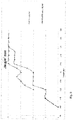
- The test material was packaging board, which had a weight of 280 g/m2 and had extruded thereon a single-layer coating whose composition was 95 weight-% of polylactide and 5 weight-% of ethylene butyl acrylate glycidyl methacrylate terpolymer (Biomax strong, marketed by DuPont) and whose weight was 25 g/m2. The reference material was equivalent coated packing board, wherein the coating consisted totally of polylactide without said acrylic copolymer addition. Heat sealing tests were conducted, wherein the coated side of board was sealed to the uncoated opposite surface of board. The sealing pressure was 300 N the sealing time between heated sealing dies was 0,5 s. The results appear in the accompanying
figure 9 , which display graphically the strength of a resulting heat seal as a function of the sealing temperature for test and reference materials. On a scale of 1-5 along a vertical axis of the figure, theminimum value 1 stands for failed sealing without any sort of adhesion, and themaximum value 5 stands for total sealing, the opening attempt of which leads not to the opening of the seal by peeling but, instead, to tearing that occurs in the board. It is observed that by virtue of added acrylic copolymer the total heat sealing is achieved at a temperature clearly lower than with the reference material. - A test series was conducted, wherein upon packaging board, which had a weight of 280 g/m2, were coextruded two coating layers with weights equal to each other, the inner one of which had a composition with 95 weight-% of polylactide and 5 weight-% of the above-mentioned ethylene butyl acrylate glycidyl methacrylate terpolymer and the outer one consisted of nothing but polylactide. In a reference test series, upon the same packaging board were coextruded two layers of plain polylactide with weights equal to each other without said acrylic copolymer addition. In both test series, studies were conducted regarding the adhesion of coating to board as a function of the total coating weight, and the results are presented graphically in the accompanying
figure 10 . On a scale of 1-5 along a vertical axis of the figure, theminimum value 1 stands for the absence of adhesion between the board and the extruded coating and themaximum value 5 stands for total adhesion, wherein the removal attempt leads not to the detachment of coating by peeling but, instead, to tearing that occurs in the board. It is observed that by virtue of added acrylic copolymer the total adhesion is achieved with a coating layer weight clearly lower than in reference tests.
Claims (12)
- A heat-sealable biodegradable packaging material, which comprises a fiber substrate (1) as well as one or more polymeric coating layers extruded thereon, characterized in that the material includes a polymeric coating layer (2), which contains not less than 90 weight-% of polylactide and, as an additive, not more than 10 weight-% of acrylic copolymer blended therein for improving the adhesion and/or heat sealing ability of the layer.
- A material as set forth in claim 1, characterized in that the additive is ethylene alkyl acrylate dipolymer or terpolymer.
- A material as set forth in claim 2, characterized in that the additive is ethylene butyl acrylate glycidyl methacrylate terpolymer.
- A material as set forth in any of the preceding claims, characterized in that the coating layer (2) contains not less than 95 weight-% of polylactide and, as an additive, not more than 5 weight-% of acrylic copolymer blended therein.
- A material as set forth in any of the preceding claims, characterized in that the fiber substrate (1) carries a single-layer coating (2), which has been extruded thereon and which is heat-sealable.
- A material as set forth in any of claims 1-4, characterized in that the fiber substrate (1) carries an inner polymeric biodegradable adhesive layer (3), as well an outer, said additive containing surface layer (2), both brought onto the fiber substrate by coextrusion.
- A material as set forth in claim 6, characterized in that the adhesive layer consists of polybutylene adipate terephthalate.
- A material as set forth in any of the preceding claims, characterized in that the fiber substrate (1) is on both sides provided with one or more extruded coating layers (2).
- A material as set forth in claim 9, characterized in that the extruded coating layers (2) on both sides of the fiber substrate (1) are similar to each other.
- A material as set forth in claim 1, characterized in that the fiber substrate (1) carries an inner layer (2) of polylactide and ethylene butyl acrylate glycidyl methacrylate terpolymer, and an outer surface layer (5) of a blend of polylactide and polybutylene adipate terephthalate, both brought onto the fiber substrate by coextrusion.
- A method for manufacturing a heat-sealable packaging material as set forth in any of the preceding claims, characterized in that upon a fiber substrate (1) is extruded or coextruded one or more polymeric coating layers, at least one of which contains not less than 90 weight-% of polylactide and not more than 10 weight-% of acrylic copolymer blended therein for improving the adhesion and/or heat sealing ability of the layer (2).
- A closed product package made of a packaging material as set forth in any of claims 1-9, which is closed by the heat sealing of a coating layer containing not less than 90 weight-% of polylactide and not more than 10 weight-% of acrylic copolymer.
Applications Claiming Priority (3)
| Application Number | Priority Date | Filing Date | Title |
|---|---|---|---|
| FI20115226A FI20115226A0 (en) | 2011-03-07 | 2011-03-07 | Heat-sealable packaging material, its manufacturing method and its packaging |
| EP12755294.1A EP2683623B1 (en) | 2011-03-07 | 2012-03-07 | Heat sealable biodegradable packaging material, its manufacturing method and a product package made therefrom |
| PCT/FI2012/050225 WO2012120199A1 (en) | 2011-03-07 | 2012-03-07 | Heat sealable biodegradable packaging material, its manufacturing method and a product package made therefrom |
Related Parent Applications (2)
| Application Number | Title | Priority Date | Filing Date |
|---|---|---|---|
| EP12755294.1A Division EP2683623B1 (en) | 2011-03-07 | 2012-03-07 | Heat sealable biodegradable packaging material, its manufacturing method and a product package made therefrom |
| EP12755294.1A Division-Into EP2683623B1 (en) | 2011-03-07 | 2012-03-07 | Heat sealable biodegradable packaging material, its manufacturing method and a product package made therefrom |
Publications (1)
| Publication Number | Publication Date |
|---|---|
| EP3778421A1 true EP3778421A1 (en) | 2021-02-17 |
Family
ID=43806438
Family Applications (2)
| Application Number | Title | Priority Date | Filing Date |
|---|---|---|---|
| EP12755294.1A Active EP2683623B1 (en) | 2011-03-07 | 2012-03-07 | Heat sealable biodegradable packaging material, its manufacturing method and a product package made therefrom |
| EP20198598.3A Withdrawn EP3778421A1 (en) | 2011-03-07 | 2012-03-07 | Heat-sealable biodegradable packaging material, its manufacturing method and a produt package made therefrom and a product package made therefrom |
Family Applications Before (1)
| Application Number | Title | Priority Date | Filing Date |
|---|---|---|---|
| EP12755294.1A Active EP2683623B1 (en) | 2011-03-07 | 2012-03-07 | Heat sealable biodegradable packaging material, its manufacturing method and a product package made therefrom |
Country Status (6)
| Country | Link |
|---|---|
| EP (2) | EP2683623B1 (en) |
| ES (1) | ES2843049T3 (en) |
| FI (1) | FI20115226A0 (en) |
| PL (1) | PL2683623T3 (en) |
| PT (1) | PT2683623T (en) |
| WO (1) | WO2012120199A1 (en) |
Cited By (1)
| Publication number | Priority date | Publication date | Assignee | Title |
|---|---|---|---|---|
| US20230294348A1 (en) * | 2020-06-11 | 2023-09-21 | Tipa Corp. Ltd | Biodegradable laminated sheets |
Families Citing this family (29)
| Publication number | Priority date | Publication date | Assignee | Title |
|---|---|---|---|---|
| JP5859526B2 (en) | 2010-07-02 | 2016-02-10 | ザ プロクター アンド ギャンブルカンパニー | Filaments containing an activator nonwoven web and methods for making the same |
| EP3533908B1 (en) | 2010-07-02 | 2026-07-01 | The Procter & Gamble Company | NON-WOVEN FABRIC CONTAINING ONE OR MORE ACTIVE INGREDIENTS |
| MX382405B (en) | 2010-07-02 | 2025-03-13 | Procter & Gamble | METHOD FOR DELIVERY OF AN ACTIVE AGENT. |
| FI124660B (en) | 2011-07-12 | 2014-11-28 | Stora Enso Oyj | Use of polybutylene succinate in extrusion coating of a packaging material |
| WO2015164227A2 (en) | 2014-04-22 | 2015-10-29 | The Procter & Gamble Company | Compositions in the form of dissolvable solid structures |
| CN110167639B (en) | 2017-01-27 | 2022-10-14 | 宝洁公司 | Composition in the form of a soluble solid structure comprising effervescent agglomerated granules |
| CN110191700A (en) | 2017-01-27 | 2019-08-30 | 宝洁公司 | The composition of soluble solids structure type |
| JP6923673B2 (en) | 2017-05-16 | 2021-08-25 | ザ プロクター アンド ギャンブル カンパニーThe Procter & Gamble Company | Conditioning hair care compositions in the form of soluble solid structures |
| JP1629688S (en) | 2018-07-16 | 2019-04-15 | ||
| US11666514B2 (en) | 2018-09-21 | 2023-06-06 | The Procter & Gamble Company | Fibrous structures containing polymer matrix particles with perfume ingredients |
| JP7381613B2 (en) | 2019-06-28 | 2023-11-15 | ザ プロクター アンド ギャンブル カンパニー | Dissolvable solid fibrous article containing anionic surfactant |
| CN114025738A (en) | 2019-07-03 | 2022-02-08 | 宝洁公司 | Fibrous structures comprising cationic surfactants and soluble acids |
| USD939359S1 (en) | 2019-10-01 | 2021-12-28 | The Procter And Gamble Plaza | Packaging for a single dose personal care product |
| JP7473636B2 (en) * | 2019-10-14 | 2024-04-23 | ザ プロクター アンド ギャンブル カンパニー | Biodegradable and/or home compostable pouches for containing solid items |
| JP7359958B2 (en) | 2019-11-20 | 2023-10-11 | ザ プロクター アンド ギャンブル カンパニー | porous soluble solid structure |
| JP7617104B2 (en) | 2019-12-01 | 2025-01-17 | ザ プロクター アンド ギャンブル カンパニー | Hair conditioner composition having a preservative system containing sodium benzoate and glycol and/or glyceryl esters |
| USD941051S1 (en) | 2020-03-20 | 2022-01-18 | The Procter And Gamble Company | Shower hanger |
| USD962050S1 (en) | 2020-03-20 | 2022-08-30 | The Procter And Gamble Company | Primary package for a solid, single dose beauty care composition |
| USD965440S1 (en) | 2020-06-29 | 2022-10-04 | The Procter And Gamble Company | Package |
| WO2022027067A1 (en) | 2020-07-31 | 2022-02-03 | The Procter & Gamble Company | Water-soluble fibrous pouch containing prills for hair care |
| MX2023001043A (en) | 2020-08-11 | 2023-02-16 | Procter & Gamble | CLEAN RINSE CONDITIONING COMPOSITIONS FOR HAIR CONTAINING BRASSCYL VALINATE ESILATE. |
| US11633338B2 (en) | 2020-08-11 | 2023-04-25 | The Procter & Gamble Company | Moisturizing hair conditioner compositions containing brassicyl valinate esylate |
| US11633336B2 (en) | 2020-08-11 | 2023-04-25 | The Procter & Gamble Company | Low viscosity hair conditioner compositions containing brassicyl valinate esylate |
| MX2023005792A (en) | 2020-12-01 | 2023-05-29 | Procter & Gamble | AQUEOUS HAIR CONDITIONING COMPOSITIONS CONTAINING SOLUBILIZED ANTI-DANDRUFF ACTIVE COMPOSITIONS. |
| USD1045064S1 (en) | 2020-12-17 | 2024-10-01 | The Procter & Gamble Company | Single-dose dissolvable personal care unit |
| EP4395730A1 (en) | 2021-08-30 | 2024-07-10 | The Procter & Gamble Company | Dissolvable solid structure comprising first and second polymeric structurants |
| JP7686917B2 (en) | 2021-12-16 | 2025-06-03 | ケーティー アンド ジー コーポレイション | Biodegradable films for cigarette packaging |
| US12576013B2 (en) | 2021-12-17 | 2026-03-17 | The Procter & Gamble Company | Dissolvable solid fibrous shampoo articles containing salts |
| US12540238B2 (en) | 2022-03-10 | 2026-02-03 | The Procter & Gamble Company | Dissolvable solid structure having first and second layers |
Citations (8)
| Publication number | Priority date | Publication date | Assignee | Title |
|---|---|---|---|---|
| WO2000001530A1 (en) * | 1998-07-07 | 2000-01-13 | Enso Oyj | Compostable coated paper or paperboard, a method for manufacturing the same and products obtained thereof |
| US20020006534A1 (en) | 1998-12-01 | 2002-01-17 | Wilkinson David P. | Method and apparatus for controlling the temperature within an electrochemical fuel cell |
| US20020065345A1 (en) | 2000-09-28 | 2002-05-30 | Junichi Narita | Aliphatic polyester compositions, films made thereof and laminates thereof |
| WO2004101642A1 (en) | 2003-05-13 | 2004-11-25 | E.I. Dupont De Nemours And Company | Toughened polyoxymethylene-poly(lactic acid) compositions |
| US20050151296A1 (en) * | 2002-03-29 | 2005-07-14 | Mutsui Chemicals, Inc. | Lactic acid-based resin composition |
| US20070259195A1 (en) | 2006-05-08 | 2007-11-08 | Far Eastern Textile Ltd. | Polylactic acid composition, transparent heat resistant biodegradable molded article made of the same, and method for making the article |
| WO2008013699A1 (en) | 2006-07-27 | 2008-01-31 | E. I. Du Pont De Nemours And Company | Article comprising poly(hydroxyalkanoic acid) |
| US20090191371A1 (en) * | 2003-12-12 | 2009-07-30 | E.I. Du Pont De Nemours And Company | Article Comprising Poly(hydroxyalkanoic acid) |
Family Cites Families (8)
| Publication number | Priority date | Publication date | Assignee | Title |
|---|---|---|---|---|
| US6183814B1 (en) * | 1997-05-23 | 2001-02-06 | Cargill, Incorporated | Coating grade polylactide and coated paper, preparation and uses thereof, and articles prepared therefrom |
| EP1025180A1 (en) * | 1997-10-31 | 2000-08-09 | Eastman Chemical Company | Aliphatic-aromatic copolyesters as adhesive tie-layers in extrusion coatings |
| SE9902112D0 (en) * | 1999-06-07 | 1999-06-07 | Tetra Laval Holdings & Finance | Packaging laminate having barrier properties, method of producing the laminate and packaging containers prepared from the packaging laminate |
| US7354973B2 (en) * | 2003-12-12 | 2008-04-08 | E.I. Du Pont De Nemours And Company | Toughened poly(lactic acid) compositions |
| JP4943960B2 (en) * | 2006-07-19 | 2012-05-30 | 三菱樹脂株式会社 | Laminated sheet |
| JP5973132B2 (en) * | 2007-10-01 | 2016-08-23 | アーケマ・インコーポレイテッド | Blend of biodegradable polymer and acrylic copolymer |
| US20110244257A1 (en) * | 2007-12-11 | 2011-10-06 | Toray Plastics (America), Inc. | Method to reprocess polylactic acid resin and articles |
| EP2467430A1 (en) * | 2009-08-19 | 2012-06-27 | Cereplast, Inc. | Polymer compositions having poly(lactic acid) |
-
2011
- 2011-03-07 FI FI20115226A patent/FI20115226A0/en not_active Application Discontinuation
-
2012
- 2012-03-07 EP EP12755294.1A patent/EP2683623B1/en active Active
- 2012-03-07 WO PCT/FI2012/050225 patent/WO2012120199A1/en not_active Ceased
- 2012-03-07 ES ES12755294T patent/ES2843049T3/en active Active
- 2012-03-07 PL PL12755294T patent/PL2683623T3/en unknown
- 2012-03-07 PT PT127552941T patent/PT2683623T/en unknown
- 2012-03-07 EP EP20198598.3A patent/EP3778421A1/en not_active Withdrawn
Patent Citations (9)
| Publication number | Priority date | Publication date | Assignee | Title |
|---|---|---|---|---|
| WO2000001530A1 (en) * | 1998-07-07 | 2000-01-13 | Enso Oyj | Compostable coated paper or paperboard, a method for manufacturing the same and products obtained thereof |
| EP1094944B1 (en) | 1998-07-07 | 2004-09-29 | Stora Enso Oyj | Compostable coated paper or paperboard, a method for manufacturing the same and products obtained thereof |
| US20020006534A1 (en) | 1998-12-01 | 2002-01-17 | Wilkinson David P. | Method and apparatus for controlling the temperature within an electrochemical fuel cell |
| US20020065345A1 (en) | 2000-09-28 | 2002-05-30 | Junichi Narita | Aliphatic polyester compositions, films made thereof and laminates thereof |
| US20050151296A1 (en) * | 2002-03-29 | 2005-07-14 | Mutsui Chemicals, Inc. | Lactic acid-based resin composition |
| WO2004101642A1 (en) | 2003-05-13 | 2004-11-25 | E.I. Dupont De Nemours And Company | Toughened polyoxymethylene-poly(lactic acid) compositions |
| US20090191371A1 (en) * | 2003-12-12 | 2009-07-30 | E.I. Du Pont De Nemours And Company | Article Comprising Poly(hydroxyalkanoic acid) |
| US20070259195A1 (en) | 2006-05-08 | 2007-11-08 | Far Eastern Textile Ltd. | Polylactic acid composition, transparent heat resistant biodegradable molded article made of the same, and method for making the article |
| WO2008013699A1 (en) | 2006-07-27 | 2008-01-31 | E. I. Du Pont De Nemours And Company | Article comprising poly(hydroxyalkanoic acid) |
Cited By (1)
| Publication number | Priority date | Publication date | Assignee | Title |
|---|---|---|---|---|
| US20230294348A1 (en) * | 2020-06-11 | 2023-09-21 | Tipa Corp. Ltd | Biodegradable laminated sheets |
Also Published As
| Publication number | Publication date |
|---|---|
| CN103429503A (en) | 2013-12-04 |
| EP2683623A4 (en) | 2014-12-17 |
| PT2683623T (en) | 2021-01-07 |
| WO2012120199A1 (en) | 2012-09-13 |
| ES2843049T3 (en) | 2021-07-15 |
| FI20115226A0 (en) | 2011-03-07 |
| EP2683623A1 (en) | 2014-01-15 |
| PL2683623T3 (en) | 2021-05-04 |
| EP2683623B1 (en) | 2020-11-04 |
Similar Documents
| Publication | Publication Date | Title |
|---|---|---|
| EP2683623B1 (en) | Heat sealable biodegradable packaging material, its manufacturing method and a product package made therefrom | |
| CN102858649B (en) | Heat-sealable biodegradable packaging material, method for its manufacture, and product packaging made of said material | |
| US11434605B2 (en) | Method for manufacturing biodegradable packaging material, biodegradable packaging material and a package or a container made thereof | |
| EP3708514B1 (en) | A heat-sealed liquid container | |
| FI126885B (en) | Use of terpene phenol resin in extrusion coating | |
| WO2014064335A1 (en) | A method for manufacturing biodegradable packaging material, biodegradable packaging material, and packages and containers made thereof | |
| CN103429503B (en) | Heat-sealable biodegradable packaging material, its manufacture method and the product packaging being produced from | |
| JPH02276637A (en) | Multilayer packaging material |
Legal Events
| Date | Code | Title | Description |
|---|---|---|---|
| PUAI | Public reference made under article 153(3) epc to a published international application that has entered the european phase |
Free format text: ORIGINAL CODE: 0009012 |
|
| STAA | Information on the status of an ep patent application or granted ep patent |
Free format text: STATUS: THE APPLICATION HAS BEEN PUBLISHED |
|
| AC | Divisional application: reference to earlier application |
Ref document number: 2683623 Country of ref document: EP Kind code of ref document: P |
|
| AK | Designated contracting states |
Kind code of ref document: A1 Designated state(s): AL AT BE BG CH CY CZ DE DK EE ES FI FR GB GR HR HU IE IS IT LI LT LU LV MC MK MT NL NO PL PT RO RS SE SI SK SM TR |
|
| STAA | Information on the status of an ep patent application or granted ep patent |
Free format text: STATUS: REQUEST FOR EXAMINATION WAS MADE |
|
| 17P | Request for examination filed |
Effective date: 20210816 |
|
| RBV | Designated contracting states (corrected) |
Designated state(s): AL AT BE BG CH CY CZ DE DK EE ES FI FR GB GR HR HU IE IS IT LI LT LU LV MC MK MT NL NO PL PT RO RS SE SI SK SM TR |
|
| STAA | Information on the status of an ep patent application or granted ep patent |
Free format text: STATUS: EXAMINATION IS IN PROGRESS |
|
| 17Q | First examination report despatched |
Effective date: 20230224 |
|
| STAA | Information on the status of an ep patent application or granted ep patent |
Free format text: STATUS: THE APPLICATION IS DEEMED TO BE WITHDRAWN |
|
| 18D | Application deemed to be withdrawn |
Effective date: 20241001 |