EP3778272B1 - Vehicle interior panel with thermoelectric air conditioning - Google Patents
Vehicle interior panel with thermoelectric air conditioning Download PDFInfo
- Publication number
- EP3778272B1 EP3778272B1 EP20187648.9A EP20187648A EP3778272B1 EP 3778272 B1 EP3778272 B1 EP 3778272B1 EP 20187648 A EP20187648 A EP 20187648A EP 3778272 B1 EP3778272 B1 EP 3778272B1
- Authority
- EP
- European Patent Office
- Prior art keywords
- air
- duct
- vehicle interior
- along
- passenger cabin
- Prior art date
- Legal status (The legal status is an assumption and is not a legal conclusion. Google has not performed a legal analysis and makes no representation as to the accuracy of the status listed.)
- Active
Links
Images


Classifications
-
- B—PERFORMING OPERATIONS; TRANSPORTING
- B60—VEHICLES IN GENERAL
- B60H—ARRANGEMENTS OF HEATING, COOLING, VENTILATING OR OTHER AIR-TREATING DEVICES SPECIALLY ADAPTED FOR PASSENGER OR GOODS SPACES OF VEHICLES
- B60H1/00—Heating, cooling or ventilating devices
- B60H1/22—Heating, cooling or ventilating devices the heat source being other than the propulsion plant
- B60H1/2215—Heating, cooling or ventilating devices the heat source being other than the propulsion plant the heat being derived from electric heaters
- B60H1/2225—Heating, cooling or ventilating devices the heat source being other than the propulsion plant the heat being derived from electric heaters arrangements of electric heaters for heating air
-
- B—PERFORMING OPERATIONS; TRANSPORTING
- B60—VEHICLES IN GENERAL
- B60H—ARRANGEMENTS OF HEATING, COOLING, VENTILATING OR OTHER AIR-TREATING DEVICES SPECIALLY ADAPTED FOR PASSENGER OR GOODS SPACES OF VEHICLES
- B60H1/00—Heating, cooling or ventilating devices
- B60H1/00478—Air-conditioning devices using the Peltier effect
-
- B—PERFORMING OPERATIONS; TRANSPORTING
- B60—VEHICLES IN GENERAL
- B60H—ARRANGEMENTS OF HEATING, COOLING, VENTILATING OR OTHER AIR-TREATING DEVICES SPECIALLY ADAPTED FOR PASSENGER OR GOODS SPACES OF VEHICLES
- B60H1/00—Heating, cooling or ventilating devices
- B60H1/00271—HVAC devices specially adapted for particular vehicle parts or components and being connected to the vehicle HVAC unit
- B60H1/00295—HVAC devices specially adapted for particular vehicle parts or components and being connected to the vehicle HVAC unit for trim components, e.g. panels, dashboards, liners
-
- B—PERFORMING OPERATIONS; TRANSPORTING
- B60—VEHICLES IN GENERAL
- B60H—ARRANGEMENTS OF HEATING, COOLING, VENTILATING OR OTHER AIR-TREATING DEVICES SPECIALLY ADAPTED FOR PASSENGER OR GOODS SPACES OF VEHICLES
- B60H1/00—Heating, cooling or ventilating devices
- B60H1/00007—Combined heating, ventilating, or cooling devices
- B60H1/00207—Combined heating, ventilating, or cooling devices characterised by the position of the HVAC devices with respect to the passenger compartment
-
- B—PERFORMING OPERATIONS; TRANSPORTING
- B60—VEHICLES IN GENERAL
- B60H—ARRANGEMENTS OF HEATING, COOLING, VENTILATING OR OTHER AIR-TREATING DEVICES SPECIALLY ADAPTED FOR PASSENGER OR GOODS SPACES OF VEHICLES
- B60H1/00—Heating, cooling or ventilating devices
- B60H1/00642—Control systems or circuits; Control members or indication devices for heating, cooling or ventilating devices
- B60H1/00814—Control systems or circuits characterised by their output, for controlling particular components of the heating, cooling or ventilating installation
- B60H1/00821—Control systems or circuits characterised by their output, for controlling particular components of the heating, cooling or ventilating installation the components being ventilating, air admitting or air distributing devices
-
- B—PERFORMING OPERATIONS; TRANSPORTING
- B60—VEHICLES IN GENERAL
- B60H—ARRANGEMENTS OF HEATING, COOLING, VENTILATING OR OTHER AIR-TREATING DEVICES SPECIALLY ADAPTED FOR PASSENGER OR GOODS SPACES OF VEHICLES
- B60H1/00—Heating, cooling or ventilating devices
- B60H1/24—Ventilating devices where the heating or cooling is irrelevant
- B60H1/241—Ventilating devices where the heating or cooling is irrelevant characterised by the location of ventilation devices in the vehicle
- B60H1/243—Ventilating devices where the heating or cooling is irrelevant characterised by the location of ventilation devices in the vehicle located in the lateral area (e.g. doors, pillars)
-
- B—PERFORMING OPERATIONS; TRANSPORTING
- B60—VEHICLES IN GENERAL
- B60H—ARRANGEMENTS OF HEATING, COOLING, VENTILATING OR OTHER AIR-TREATING DEVICES SPECIALLY ADAPTED FOR PASSENGER OR GOODS SPACES OF VEHICLES
- B60H1/00—Heating, cooling or ventilating devices
- B60H1/00007—Combined heating, ventilating, or cooling devices
- B60H1/00207—Combined heating, ventilating, or cooling devices characterised by the position of the HVAC devices with respect to the passenger compartment
- B60H2001/00221—Devices in the floor or side wall area of the passenger compartment
-
- B—PERFORMING OPERATIONS; TRANSPORTING
- B60—VEHICLES IN GENERAL
- B60H—ARRANGEMENTS OF HEATING, COOLING, VENTILATING OR OTHER AIR-TREATING DEVICES SPECIALLY ADAPTED FOR PASSENGER OR GOODS SPACES OF VEHICLES
- B60H1/00—Heating, cooling or ventilating devices
- B60H1/00007—Combined heating, ventilating, or cooling devices
- B60H1/00207—Combined heating, ventilating, or cooling devices characterised by the position of the HVAC devices with respect to the passenger compartment
- B60H2001/00228—Devices in the interior of the passenger compartment
-
- B—PERFORMING OPERATIONS; TRANSPORTING
- B60—VEHICLES IN GENERAL
- B60H—ARRANGEMENTS OF HEATING, COOLING, VENTILATING OR OTHER AIR-TREATING DEVICES SPECIALLY ADAPTED FOR PASSENGER OR GOODS SPACES OF VEHICLES
- B60H1/00—Heating, cooling or ventilating devices
- B60H1/00271—HVAC devices specially adapted for particular vehicle parts or components and being connected to the vehicle HVAC unit
- B60H2001/003—Component temperature regulation using an air flow
Definitions
- the present disclosure is related generally to vehicle interior panels and, more particularly, to vehicle interior panels with an air conditioning function.
- Conventional vehicle HVAC systems rely on a central blower system to circulate air in the passenger cabin. Air is drawn from outside the vehicle or from within the passenger cabin and flows along a centralized heat exchanger to heat or cool the air before sending it to the passenger cabin.
- the centralized heat exchanger is typically a heater core through which hot vehicle engine coolant flows or an evaporator coil through which a compressible refrigerant flows.
- a problem with such systems is their limited ability to heat or cool areas of the passenger cabin remote from the centralized heat exchanger and blower, such as the rear seating area of a front-engine vehicle. To effectively reach remote areas of the passenger cabin, the blower must be capable of volumetric flow rates much higher than are necessary to reach the front seating area alone. The problem is compounded with the advent of electric and hybrid vehicles, in which electrical energy must be conserved to a greater extent and in which conventional engine-powered air-conditioning compressors and engine cooling systems may not be present.
- KR 2015-0113630 by Dong et al. discloses a vehicle cabin heating and cooling system that discharges air along surfaces that vehicle passengers come into contact with, such as armrests, gear-shifting knobs, and window ledges.
- One example includes a supplementary heat exchange module built into a vehicle door.
- the Dong system relies mainly on a centralized blower of the vehicle HVAC system to force air from the front of the vehicle to the rear of the passenger cabin.
- WO 2020/065284 A1 as a document falling under Article 54(3) EPC, discloses an air conditioning system comprising a thermoelectric device built into a vehicle door.
- the vehicle interior door panel according to the invention is defined by claim 1.
- the vehicle interior panel includes a first air mover operable to move the air along the first side of the thermoelectric device and a second air mover operable to move the additional air along the second side of the thermoelectric device.
- the waste duct being separate from the conditioning duct and the duct along which the additional air moves along the second side of the thermoelectric device.
- the vehicle interior panel includes an intake port through which air from the passenger cabin enters a conditioning duct.
- the vehicle interior panel includes an intake port through which the additional air enters a waste duct.
- the additional air moved along the second side of the thermoelectric device is drawn from the passenger cabin.
- the invention relates also to a vehicle according to claims 12 and 13.
- the vehicle interior panel includes a temperature sensor positioned downstream from the thermoelectric device to sense the temperature of the air before the air is discharged back into the passenger cabin.
- thermoelectric air conditioner is configured to communicate with a controller that receives air temperature information from the air conditioner and controls the air conditioner based on the air temperature information.
- a controller receives temperature setpoint information and controls the air conditioner based on the setpoint information.
- the conditioning and waste ducts are interconnected by the thermoelectric device.
- the vehicle interior panel comprises the features of claim 11.
- the additional air drawn through an intake port at an intake end of a waste duct of the air conditioner is drawn from the passenger cabin.
- a vehicle interior door panel capable of providing conditioned air locally within a passenger cabin of the vehicle. Air can be drawn from the passenger cabin through a portion of the panel, conditioned along the back of the panel by a thermoelectric device, and discharged back into the cabin through the same panel. Additional and separately controllable air can flow along a waste side of the thermoelectric device to be discharged outside the passenger cabin.
- the panel is an interior door panel from which the waste side air is discharged within a B-pillar of the vehicle body.
- waste side air can be discharged elsewhere, such as to a different part of the vehicle in need of heating or cooling.
- FIG. 1 is a view of the interior side of an open vehicle door 10 that includes an exemplary vehicle interior panel 12 including a trim piece 14 and a thermoelectric air conditioner 16.
- the vehicle door 10 includes a metal or composite structural frame to which the interior panel 12 is attached on one side and to which an exterior body panel is attached on the opposite side.
- the door 10 is attached via hinges to a structural body of the vehicle, also referred to as the body-in-white (BIW).
- the door 10 of FIG. 1 is a rear door affixed to a B-pillar 18 of the vehicle body.
- the B-pillar is a structural member extending between the floor and the roof of the vehicle body and between front and rear door openings of the vehicle body.
- the front side of the rear door may be hinged to one side of the B-pillar, as in FIG. 1 , and the rear side of the front door may be latched to the opposite side of the B-pillar.
- thermoelectric air conditioner 16 is located in a hollow space between the trim piece 14 and the exterior door panel. Utilitarian components such as a window regulator, an audio speaker, a door latch mechanism, electrical wiring, etc. are also housed in this hollow space.
- the thermoelectric air conditioner 16 is located along a back side of the trim piece 14 which is opposite a decorative side 20 that faces and defines a portion of the passenger cabin when the door is closed.
- the air conditioner 16 can be affixed to one or both of the trim piece 14 and the structural portion of the door 10 by fasteners or any other suitable means.
- the trim piece 14 of the panel 12 may be a multilayer piece including, for example, an injection molded substrate that generally defines the shape of the panel, and one or more overlying decorative coverings that provide the aesthetic look and feel of the panel 12.
- the trim piece 14 conceals the hollow interior of the door 10 and its contents from view and can itself be constructed as one or more pieces assembled together.
- the trim piece 14 of FIG. 1 is a lower trim piece that extends vertically between a bottom side of the door 10 and the bottom of the window opening and lengthwise between front and rear sides of the door.
- An upper trim piece may trim out the window opening or be made as one piece with the lower trim piece.
- thermoelectric device 22 Central to the operation of the thermoelectric air conditioner 16 is a thermoelectric device 22.
- the thermoelectric device 22 is a solid-state electrically powered component that operates according to the Peltier effect in which a heat flux is created at the junction between certain different types of materials - usually semiconductors - when an electric current crosses the junction. The direction of the heat flux depends on the direction of the current flow across the junction.
- One side of the thermoelectric device (or TED) thus increases in temperature, while the opposite side decreases in temperature when a DC voltage is applied. The heated and cooled sides are reversed when the polarity of the DC voltage is reversed.
- the TED 22 requires no liquid/vapor refrigerant, compressor, condenser, or evaporator and can therefore be located anywhere a DC voltage is available to power it.
- the thermoelectric air conditioner 16 is configured to move air (A) from the vehicle passenger cabin along a first side of the thermoelectric device 22 to change the temperature of the air before discharging the air back into the passenger cabin as conditioned air (C).
- conditioned means heated or cooled relative to the air temperature before moving along the TED 22, and an “air conditioner” is thus an air heater and/or an air cooler.
- the thermoelectric air conditioner 16 is also configured to move additional air (A') along an opposite second side of the thermoelectric device 22 and discharge the additional air as waste air (W) to a location outside the passenger cabin.
- the waste air is discharged into a hollow portion of the B-pillar 18 via a port 24 formed through a B-pillar trim piece.
- the amount of air moved along the first side of the TED 22 is separately controllable from the amount of air moved along the second side of the TED by the provision of separate first and second air movers 26, 28.
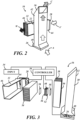
- FIG. 2 is a perspective view of an example of the thermoelectric air conditioner 16 similar in configuration with that of FIG. 1 , shown separately from the trim piece 14 of the panel 12, and FIG. 3 is an exploded view of the air conditioner of FIG. 2 .
- the illustrated air conditioner 16 includes the aforementioned first and second air movers 26, 28, along with a conditioning duct 30, a separate waste duct 32, an input device 34, and a controller 36.
- the input device 34 is any component operable to provide temperature set-point information to the controller 36, such as a user interface (e.g., switch or panel) or another vehicle control module that receives or calculates the set-point information to provide to the controller.
- the controller 36 is configured to receive information from the input device 34 along with information from a temperature sensor 38 and to control the TED 22, the first air mover 26, and/or the second air mover 28 based on the received information.
- the controller may, for example, increase or decrease power to the air movers 26, 28 to change the volumetric flow of air in each duct 30, 32.
- the controller 36 may also increase or decrease power to or change the polarity of the voltage to the TED 22 based on the received information.
- the controller 36 can be integrated as part of the air conditioner 16 and dedicated solely to the air conditioner or it may be a central controller for the vehicle or for a vehicle subsystem (e.g., an HVAC system).
- the temperature sensor 38 may be a thermocouple, thermistor, IR-sensor, or any other suitable sensor.
- the air conditioner 16 of FIGS. 2 and 3 is generally oriented as in FIG. 1 , with the air (A) to be conditioned entering from the bottom and being discharged from the top, and with the additional air (A') moving in a direction from the rear side of the door toward the front side of the door at the B-pillar.
- the conditioning duct 30 has an intake end 40 and an opposite discharge end 42.
- the first air mover 26 is a fan located at the intake end 40 of the duct 30.
- Other types of air movers can be employed and may be positioned elsewhere, such as at the discharge end 42 or between the intake and discharge ends.
- the air mover 26 need only create a pressure differential or otherwise cause the air to move in the desired direction along the duct 30.
- the first air mover 26 is also located at the intake end of the conditioning duct 30 but is oriented vertically to draw passenger cabin air into the duct through a port formed through a hidden map pocket portion of the trim piece 14.
- the waste duct 32 has an intake end 44 and an opposite discharge end 46.
- the second air mover 28 may be a fan located at the intake end 44 of the duct 32 as in FIGS. 2 and 3 , or it may be any other type of air mover located elsewhere and operable to move the additional air A' in the desired direction along the duct 32. In the example of FIG. 1 , for instance, the second air mover 28 is located at the discharge end of the waste duct 32.
- the thermoelectric device 22 is located at a junction of the conditioning duct 30 and the waste duct 32 effectively interconnects the ducts as an assembly.
- the TED 22 includes a base thermoelectric unit 48 to which the DC voltage is applied to create the temperature differential.
- a first side of the TED 22 includes a first heat sink 50 bonded to one side 52 of the thermoelectric unit 48, and a second side of the TED includes a second heat sink 54 bonded to an opposite side 56 of the thermoelectric unit.
- Thermal bonding layers 58 e.g., thermally conductive paste or tape
- the first heat sink 50 is disposed in the conditioning duct 30, and the second heat sink 54 is disposed in the waste duct 32.
- each heat sink 50, 54 effectively forms a wall of the respective duct 30, 32 in which it is housed.
- the back sides of the heat sinks 50, 54 face each other and are separated by the thickness of the thermoelectric unit 48.
- a thermally insulating layer of material such as EPS or polyurethane foam may be interposed between the two heat sinks 50, 54 and around the perimeter of the thermoelectric unit 48 to thermally isolate the opposite sides of the TED 22 from one another.
- multiple thermoelectric units 48 may be sandwiched between the heat sinks or otherwise be thermally connected with the heat sinks.
- the heating and/or cooling capacity of the air conditioner may be a function of the number of included TEDs 22 or thermoelectric units 48.
- Each of the illustrated heat sinks 50, 54 is formed from a thermally conductive material (e.g., an aluminum alloy) and has a series of fins that protrude into and across the inside of the respective duct 30, 32.
- the fins are elongated in the direction of air flow and separated by gaps elongated in the same direction. Other configurations are possible.
- Each heat sink 50, 54 functions to quickly transfer thermal energy between the thermoelectric unit 48 and the air in the respective duct 30, 32.
- the relatively large surface area of the fins promotes forced convective energy transfer with the flowing air, while the flat full-contact surface on the back side of each heat sink promotes conductive energy transfer with the thermoelectric unit 48.
- thermoelectric unit 48 In a cooling mode of the air conditioner 16, a DC voltage is applied to the thermoelectric unit 48 with a polarity that induces a heat flux from the first side 52 to the second side 56 of the unit 48. Thermal energy thus flows from the first heat sink 50 to the second heat sink 54, which accordingly tend to respectively decrease and increase in temperature.
- Air (A) from the passenger cabin flows along the first heat sink 50 under the influence of the first air mover 26, the heat sink 50 absorbs thermal energy from the air in the duct 30 until there is no longer a temperature differential between the air in the duct and the heat sink.
- thermoelectric unit 48 When the passenger cabin is hot, as is the typically the case when the air conditioner 16 is first placed into the cooling mode, there is a continuous flow of heat from the air in the conditioning duct 30 to the heat sink 50 and through the thermoelectric unit 48 to the other heat sink 54.
- the conditioned air (C) discharged back into the cabin thus has less thermal energy than the air (A) drawn into the conditioning duct 30 as long as the thermal energy flow through the thermoelectric unit 48 is maintained.
- the second air mover 28, waste duct 32, and second heat sink 54 work together to maintain that thermal energy flow by extracting thermal energy from the second side 56 of the thermoelectric unit 48.
- the second heat sink 54 absorbs thermal energy from the thermoelectric unit 48, and the additional air (A') flowing along the waste duct 32 extracts thermal energy from the heat sink 54 to create the waste air (W), which is hotter than the air drawn into the intake end 44 of the waste duct. Without the waste duct 32, second air mover 28, and second heat sink 54, the second side 56 of the thermoelectric unit 48 would eventually be hotter than the first side 52 by a sufficient amount to prevent thermal energy flow from the first to second side.
- the air conditioner 16 may also operate in a heating mode by reversing the polarity of the DC voltage from the cooling mode. In that case, the presumably cold air from the passenger cabin is drawn across the hot side of the TED 22 and absorbs thermal energy before being discharged back into the passenger cabin. In some cases, the second air mover 28 may be turned off in the heating mode.
- the first and second air movers 26, 28 is separately controllable by the controller 36 to independently switch them off and on and/or or control their respective speeds or effective flow rates.
- Another way of separately controlling the air flowing along the conditioning duct from the additional air flowing along the waste duct is via controlling a damper or flapper valve.
- a single air mover may be employed to draw air into the air conditioner through a common air intake port before the intake air is separated into the separate conditioning and waste ducts with the valve at the separation point.
- the air to be conditioned flows into the conditioning duct 30, and the remainder of the intake air becomes the additional air that flows along the waste duct 32.
- FIG. 4 is a vertical cross-sectional view taken through the TED 22 of a similar configuration to that of FIG. 1 .
- the air (A) is drawn into the conditioning duct 30 from the passenger cabin under the influence of the first air mover 26 through a first intake port 60 formed through the trim piece 14, and the additional air (A') is drawn into the waste duct 32 from the passenger cabin under the influence of the second air mover through a second intake port 62, also formed through the trim piece 14.
- the first intake port 60 is located along an outboard wall of a map pocket of the door panel and is thus partly hidden from view by an inboard wall of the map pocket.
- the second intake port 62 is located along a forward-facing wall of the map pocket and is thus also partly hidden from view due to its orientation.
- Each intake port 60, 62 is depicted with a grille spanning the port which helps prevent foreign objects from entering the respective ducts.
- the waste duct 32 in this example includes a main portion 64 extending in a direction between forward and rearward sides of the door (into and out of the page in FIG. 4 ).
- the second heat sink 54 is in the main portion 64 of the duct 32 in this example.
- a secondary portion 66 of the waste duct 32 interconnects the second intake port 62 with the main portion 64.
- Each duct 30, 32 may of course assume any shape — i.e., generally straight and rectangular ducts are shown here for simplicity in understanding the operation of the air conditioner 16.
- the back side of the trim piece 14 defines at least a portion of a wall of one or both ducts.
- the first heat sink 50 is illustrated in phantom lines for simplicity to better show conversion of the air (A) drawn in through the first intake port 60 to the conditioned air (C) as it moves along the conditioning duct 30 and first heat sink 50 before eventually being discharged back into the passenger cabin through a discharge port 68 vertically above the corresponding intake port 60.
- the discharge port 68 is also formed through the trim piece 14 and depicted with a diffusing grille spanning the port.
- a similar discharge port is formed through the trim piece 14 at the discharge end of the waste duct 32 (not visible in FIG. 4 ).
- the discharge port through which the waste air is discharged to a hollow portion of the B-pillar, or to some other location outside the passenger cabin, may be formed along a side wall 70 of the trim piece 14 as shown in FIG. 1 .
- This side wall 70 is not visible in the passenger cabin when the vehicle door 10 is closed and the waste discharge port is sealed together with the port 24 formed through the B-pillar trim piece.
- the waste air (W) is discharged within the hollow portion of the vehicle door 10, such as on the opposite side of a thermally insulating panel that separates the heat sinks 50, 54 from each other.
Landscapes
- Physics & Mathematics (AREA)
- Thermal Sciences (AREA)
- Engineering & Computer Science (AREA)
- Mechanical Engineering (AREA)
- Air-Conditioning For Vehicles (AREA)
Description
- The present disclosure is related generally to vehicle interior panels and, more particularly, to vehicle interior panels with an air conditioning function.
- Conventional vehicle HVAC systems rely on a central blower system to circulate air in the passenger cabin. Air is drawn from outside the vehicle or from within the passenger cabin and flows along a centralized heat exchanger to heat or cool the air before sending it to the passenger cabin. The centralized heat exchanger is typically a heater core through which hot vehicle engine coolant flows or an evaporator coil through which a compressible refrigerant flows. A problem with such systems is their limited ability to heat or cool areas of the passenger cabin remote from the centralized heat exchanger and blower, such as the rear seating area of a front-engine vehicle. To effectively reach remote areas of the passenger cabin, the blower must be capable of volumetric flow rates much higher than are necessary to reach the front seating area alone. The problem is compounded with the advent of electric and hybrid vehicles, in which electrical energy must be conserved to a greater extent and in which conventional engine-powered air-conditioning compressors and engine cooling systems may not be present.
-
KR 2015-0113630 by Dong et al. -
WO 2020/065284 A1 , as a document falling under Article 54(3) EPC, discloses an air conditioning system comprising a thermoelectric device built into a vehicle door. - The vehicle interior door panel according to the invention is defined by claim 1.
- In various embodiments, the vehicle interior panel includes a first air mover operable to move the air along the first side of the thermoelectric device and a second air mover operable to move the additional air along the second side of the thermoelectric device.
- In various embodiments of the vehicle interior panel, the waste duct being separate from the conditioning duct and the duct along which the additional air moves along the second side of the thermoelectric device.
- In various embodiments, the vehicle interior panel includes an intake port through which air from the passenger cabin enters a conditioning duct.
- In various embodiments, the vehicle interior panel includes an intake port through which the additional air enters a waste duct.
- In various embodiments, the additional air moved along the second side of the thermoelectric device is drawn from the passenger cabin.
- The invention relates also to a vehicle according to
claims 12 and 13. - In various embodiments, the vehicle interior panel includes a temperature sensor positioned downstream from the thermoelectric device to sense the temperature of the air before the air is discharged back into the passenger cabin.
- In various embodiments, the thermoelectric air conditioner is configured to communicate with a controller that receives air temperature information from the air conditioner and controls the air conditioner based on the air temperature information.
- In various embodiments, wherein a controller receives temperature setpoint information and controls the air conditioner based on the setpoint information.
- In various embodiments, the conditioning and waste ducts are interconnected by the thermoelectric device.
- In various embodiments, the vehicle interior panel comprises the features of claim 11.
- In various embodiments, the additional air drawn through an intake port at an intake end of a waste duct of the air conditioner is drawn from the passenger cabin.
- It is contemplated than any of the above-listed features can be combined with any other feature or features of the above-described embodiments or the features described below and/or depicted in the drawings, except where there is an incompatibility of features.
- Illustrative embodiments will hereinafter be described in conjunction with the following figures, wherein like numerals denote like elements, and wherein:
-
FIG. 1 is a view of the interior side of an open vehicle door that includes an exemplary vehicle interior door panel including a thermoelectric air conditioner; -
FIG. 2 is a perspective view of the thermoelectric air conditioner without a concealing trim piece; -
FIG. 3 is an exploded view of the thermoelectric air conditioner ofFIG. 2 ; and -
FIG. 4 is a vertical cross-sectional view taken through the thermoelectric air conditioner illustrating air intake ports along a map pocket of the interior door panel and a discharge port along an upper portion of the panel. - Described below is a vehicle interior door panel capable of providing conditioned air locally within a passenger cabin of the vehicle. Air can be drawn from the passenger cabin through a portion of the panel, conditioned along the back of the panel by a thermoelectric device, and discharged back into the cabin through the same panel. Additional and separately controllable air can flow along a waste side of the thermoelectric device to be discharged outside the passenger cabin. In the examples described below, the panel is an interior door panel from which the waste side air is discharged within a B-pillar of the vehicle body. However, the following teachings are applicable to other vehicle interior door panels, and waste side air can be discharged elsewhere, such as to a different part of the vehicle in need of heating or cooling.
-
FIG. 1 is a view of the interior side of anopen vehicle door 10 that includes an exemplaryvehicle interior panel 12 including atrim piece 14 and athermoelectric air conditioner 16. Thevehicle door 10 includes a metal or composite structural frame to which theinterior panel 12 is attached on one side and to which an exterior body panel is attached on the opposite side. Thedoor 10 is attached via hinges to a structural body of the vehicle, also referred to as the body-in-white (BIW). Thedoor 10 ofFIG. 1 is a rear door affixed to a B-pillar 18 of the vehicle body. The B-pillar is a structural member extending between the floor and the roof of the vehicle body and between front and rear door openings of the vehicle body. On a vehicle with forward-hinged doors, the front side of the rear door may be hinged to one side of the B-pillar, as inFIG. 1 , and the rear side of the front door may be latched to the opposite side of the B-pillar. - In this example, the
thermoelectric air conditioner 16 is located in a hollow space between thetrim piece 14 and the exterior door panel. Utilitarian components such as a window regulator, an audio speaker, a door latch mechanism, electrical wiring, etc. are also housed in this hollow space. Thethermoelectric air conditioner 16 is located along a back side of thetrim piece 14 which is opposite adecorative side 20 that faces and defines a portion of the passenger cabin when the door is closed. Theair conditioner 16 can be affixed to one or both of thetrim piece 14 and the structural portion of thedoor 10 by fasteners or any other suitable means. - The
trim piece 14 of thepanel 12 may be a multilayer piece including, for example, an injection molded substrate that generally defines the shape of the panel, and one or more overlying decorative coverings that provide the aesthetic look and feel of thepanel 12. Thetrim piece 14 conceals the hollow interior of thedoor 10 and its contents from view and can itself be constructed as one or more pieces assembled together. Thetrim piece 14 ofFIG. 1 is a lower trim piece that extends vertically between a bottom side of thedoor 10 and the bottom of the window opening and lengthwise between front and rear sides of the door. An upper trim piece may trim out the window opening or be made as one piece with the lower trim piece. - Central to the operation of the
thermoelectric air conditioner 16 is athermoelectric device 22. Thethermoelectric device 22 is a solid-state electrically powered component that operates according to the Peltier effect in which a heat flux is created at the junction between certain different types of materials - usually semiconductors - when an electric current crosses the junction. The direction of the heat flux depends on the direction of the current flow across the junction. One side of the thermoelectric device (or TED) thus increases in temperature, while the opposite side decreases in temperature when a DC voltage is applied. The heated and cooled sides are reversed when the polarity of the DC voltage is reversed. The TED 22 requires no liquid/vapor refrigerant, compressor, condenser, or evaporator and can therefore be located anywhere a DC voltage is available to power it. - The
thermoelectric air conditioner 16 is configured to move air (A) from the vehicle passenger cabin along a first side of thethermoelectric device 22 to change the temperature of the air before discharging the air back into the passenger cabin as conditioned air (C). As used here, "conditioned" means heated or cooled relative to the air temperature before moving along the TED 22, and an "air conditioner" is thus an air heater and/or an air cooler. Thethermoelectric air conditioner 16 is also configured to move additional air (A') along an opposite second side of thethermoelectric device 22 and discharge the additional air as waste air (W) to a location outside the passenger cabin. In this example, the waste air is discharged into a hollow portion of the B-pillar 18 via aport 24 formed through a B-pillar trim piece. The amount of air moved along the first side of the TED 22 is separately controllable from the amount of air moved along the second side of the TED by the provision of separate first andsecond air movers -
FIG. 2 is a perspective view of an example of thethermoelectric air conditioner 16 similar in configuration with that ofFIG. 1 , shown separately from thetrim piece 14 of thepanel 12, andFIG. 3 is an exploded view of the air conditioner ofFIG. 2 . The illustratedair conditioner 16 includes the aforementioned first andsecond air movers conditioning duct 30, aseparate waste duct 32, aninput device 34, and acontroller 36. Theinput device 34 is any component operable to provide temperature set-point information to thecontroller 36, such as a user interface (e.g., switch or panel) or another vehicle control module that receives or calculates the set-point information to provide to the controller. Thecontroller 36 is configured to receive information from theinput device 34 along with information from atemperature sensor 38 and to control theTED 22, thefirst air mover 26, and/or thesecond air mover 28 based on the received information. The controller may, for example, increase or decrease power to theair movers duct controller 36 may also increase or decrease power to or change the polarity of the voltage to theTED 22 based on the received information. Thecontroller 36 can be integrated as part of theair conditioner 16 and dedicated solely to the air conditioner or it may be a central controller for the vehicle or for a vehicle subsystem (e.g., an HVAC system). Thetemperature sensor 38 may be a thermocouple, thermistor, IR-sensor, or any other suitable sensor. - The
air conditioner 16 ofFIGS. 2 and 3 is generally oriented as inFIG. 1 , with the air (A) to be conditioned entering from the bottom and being discharged from the top, and with the additional air (A') moving in a direction from the rear side of the door toward the front side of the door at the B-pillar. Other orientations are possible. Theconditioning duct 30 has anintake end 40 and anopposite discharge end 42. In this example, thefirst air mover 26 is a fan located at theintake end 40 of theduct 30. Other types of air movers can be employed and may be positioned elsewhere, such as at thedischarge end 42 or between the intake and discharge ends. Theair mover 26 need only create a pressure differential or otherwise cause the air to move in the desired direction along theduct 30. In the example ofFIG. 1 , thefirst air mover 26 is also located at the intake end of theconditioning duct 30 but is oriented vertically to draw passenger cabin air into the duct through a port formed through a hidden map pocket portion of thetrim piece 14. - Similarly, the
waste duct 32 has anintake end 44 and anopposite discharge end 46. Thesecond air mover 28 may be a fan located at theintake end 44 of theduct 32 as inFIGS. 2 and 3 , or it may be any other type of air mover located elsewhere and operable to move the additional air A' in the desired direction along theduct 32. In the example ofFIG. 1 , for instance, thesecond air mover 28 is located at the discharge end of thewaste duct 32. - The
thermoelectric device 22 is located at a junction of theconditioning duct 30 and thewaste duct 32 effectively interconnects the ducts as an assembly. TheTED 22 includes a basethermoelectric unit 48 to which the DC voltage is applied to create the temperature differential. A first side of theTED 22 includes afirst heat sink 50 bonded to oneside 52 of thethermoelectric unit 48, and a second side of the TED includes asecond heat sink 54 bonded to anopposite side 56 of the thermoelectric unit. Thermal bonding layers 58 (e.g., thermally conductive paste or tape) are interposed between thethermoelectric unit 48 and the heat sinks 50, 54 to ensure full thermal contact at the interfaces. Thefirst heat sink 50 is disposed in theconditioning duct 30, and thesecond heat sink 54 is disposed in thewaste duct 32. - In the illustrated example, the back side of each
heat sink respective duct thermoelectric unit 48. A thermally insulating layer of material (not shown) such as EPS or polyurethane foam may be interposed between the twoheat sinks thermoelectric unit 48 to thermally isolate the opposite sides of theTED 22 from one another. In some embodiments, multiplethermoelectric units 48 may be sandwiched between the heat sinks or otherwise be thermally connected with the heat sinks. The heating and/or cooling capacity of the air conditioner may be a function of the number of includedTEDs 22 orthermoelectric units 48. - Each of the illustrated
heat sinks respective duct heat sink thermoelectric unit 48 and the air in therespective duct thermoelectric unit 48. - In a cooling mode of the
air conditioner 16, a DC voltage is applied to thethermoelectric unit 48 with a polarity that induces a heat flux from thefirst side 52 to thesecond side 56 of theunit 48. Thermal energy thus flows from thefirst heat sink 50 to thesecond heat sink 54, which accordingly tend to respectively decrease and increase in temperature. Air (A) from the passenger cabin flows along thefirst heat sink 50 under the influence of thefirst air mover 26, theheat sink 50 absorbs thermal energy from the air in theduct 30 until there is no longer a temperature differential between the air in the duct and the heat sink. When the passenger cabin is hot, as is the typically the case when theair conditioner 16 is first placed into the cooling mode, there is a continuous flow of heat from the air in theconditioning duct 30 to theheat sink 50 and through thethermoelectric unit 48 to theother heat sink 54. The conditioned air (C) discharged back into the cabin thus has less thermal energy than the air (A) drawn into theconditioning duct 30 as long as the thermal energy flow through thethermoelectric unit 48 is maintained. - The
second air mover 28,waste duct 32, andsecond heat sink 54 work together to maintain that thermal energy flow by extracting thermal energy from thesecond side 56 of thethermoelectric unit 48. Thesecond heat sink 54 absorbs thermal energy from thethermoelectric unit 48, and the additional air (A') flowing along thewaste duct 32 extracts thermal energy from theheat sink 54 to create the waste air (W), which is hotter than the air drawn into theintake end 44 of the waste duct. Without thewaste duct 32,second air mover 28, andsecond heat sink 54, thesecond side 56 of thethermoelectric unit 48 would eventually be hotter than thefirst side 52 by a sufficient amount to prevent thermal energy flow from the first to second side. - While TEDs may be more commonly used as cooling devices, the
air conditioner 16 may also operate in a heating mode by reversing the polarity of the DC voltage from the cooling mode. In that case, the presumably cold air from the passenger cabin is drawn across the hot side of theTED 22 and absorbs thermal energy before being discharged back into the passenger cabin. In some cases, thesecond air mover 28 may be turned off in the heating mode. - In the illustrated embodiments, the first and
second air movers controller 36 to independently switch them off and on and/or or control their respective speeds or effective flow rates. Another way of separately controlling the air flowing along the conditioning duct from the additional air flowing along the waste duct is via controlling a damper or flapper valve. In that case, a single air mover may be employed to draw air into the air conditioner through a common air intake port before the intake air is separated into the separate conditioning and waste ducts with the valve at the separation point. The air to be conditioned flows into theconditioning duct 30, and the remainder of the intake air becomes the additional air that flows along thewaste duct 32. - In the example of
FIG. 1 , the air in the twoseparate ducts air conditioner 16 at two separate locations.FIG. 4 is a vertical cross-sectional view taken through theTED 22 of a similar configuration to that ofFIG. 1 . In particular, the air (A) is drawn into theconditioning duct 30 from the passenger cabin under the influence of thefirst air mover 26 through afirst intake port 60 formed through thetrim piece 14, and the additional air (A') is drawn into thewaste duct 32 from the passenger cabin under the influence of the second air mover through asecond intake port 62, also formed through thetrim piece 14. Thefirst intake port 60 is located along an outboard wall of a map pocket of the door panel and is thus partly hidden from view by an inboard wall of the map pocket. Thesecond intake port 62 is located along a forward-facing wall of the map pocket and is thus also partly hidden from view due to its orientation. Eachintake port - The
waste duct 32 in this example includes amain portion 64 extending in a direction between forward and rearward sides of the door (into and out of the page inFIG. 4 ). Thesecond heat sink 54 is in themain portion 64 of theduct 32 in this example. Asecondary portion 66 of thewaste duct 32 interconnects thesecond intake port 62 with themain portion 64. Eachduct air conditioner 16. In some cases, the back side of thetrim piece 14 defines at least a portion of a wall of one or both ducts. - In the example of
FIG. 4 , thefirst heat sink 50 is illustrated in phantom lines for simplicity to better show conversion of the air (A) drawn in through thefirst intake port 60 to the conditioned air (C) as it moves along theconditioning duct 30 andfirst heat sink 50 before eventually being discharged back into the passenger cabin through adischarge port 68 vertically above the correspondingintake port 60. Thedischarge port 68 is also formed through thetrim piece 14 and depicted with a diffusing grille spanning the port. A similar discharge port is formed through thetrim piece 14 at the discharge end of the waste duct 32 (not visible inFIG. 4 ). The discharge port through which the waste air is discharged to a hollow portion of the B-pillar, or to some other location outside the passenger cabin, may be formed along aside wall 70 of thetrim piece 14 as shown inFIG. 1 . Thisside wall 70 is not visible in the passenger cabin when thevehicle door 10 is closed and the waste discharge port is sealed together with theport 24 formed through the B-pillar trim piece. In other examples, the waste air (W) is discharged within the hollow portion of thevehicle door 10, such as on the opposite side of a thermally insulating panel that separates the heat sinks 50, 54 from each other. - It is to be understood that the foregoing is a description of one or more embodiments of the invention. The invention is not limited to the particular embodiment(s) disclosed herein, but rather is defined solely by the claims below.
- As used in this specification, the terms "e.g.," "for example," "for instance," "such as," and "like," and the verbs "comprising," "having," "including," and their other verb forms, when used in conjunction with a listing of one or more components or other items, are each to be construed as open-ended, meaning that the listing is not to be considered as excluding other, additional components or items. Other terms are to be construed using their broadest reasonable meaning unless they are used in a context that requires a different interpretation.
Claims (13)
- A vehicle interior door panel (12), when mounted on a door, comprisinga thermoelectric air conditioner (16) comprising a conditioning duct (30) having an intake end (40) and a discharge end (42), a waste duct (32) having an intake end (44) and a discharge end (46), and a thermoelectric device (22) having a first heat sink (50) on a first side and a second heat sink (54) on an opposite second side,the first heat sink being positioned in the conditioning duct (30),the second heat sink being positioned in the waste duct (32),the thermoelectric air conditioner (16) being able to move air from a vehicle passenger cabin along the first side of the thermoelectric device (22) to change the temperature of the air before discharging the air back into the passenger cabin through a discharge port at the discharge end (42) of the conditioning duct (30),the thermoelectric air conditioner (16) being further able to move additional air along the opposite second side of the thermoelectric device (22)and discharge the additional air through a discharge port at the discharge end (46) of the waste duct (32) to a location outside the passenger cabin, whereinthe amount of air moved along the first side is separately controllable from the amount of air moved along the second side, and characterized in that the discharge end (46) of the waste duct (32) is formed through a side wall of the door panel (12) in a direction between forward and rearward sides of the door when the door is mounted on a vehicle.
- The vehicle interior panel (12) of claim 1, further comprising a first air mover (26) operable to move the air along the first side of the thermoelectric device (22) and a second air mover (28) operable to move the additional air along the second side of the thermoelectric device (22).
- The vehicle interior panel (12) of claim 1 or 2, the waste duct (32) being separate from the conditioning duct (30) and the duct along which the additional air moves along the second side of the thermoelectric device (22).
- The vehicle interior panel (12) of claim 3, further comprising an intake port (60) through which air from the passenger cabin enters the conditioning duct (30).
- The vehicle interior panel (12) of any one of claims 1 to 4, further comprising an intake port (62) through which the additional air enters the waste duct (32).
- The vehicle interior panel (12) of any one of claims 1 to 5, wherein the additional air moved along the second side of the thermoelectric device (22) is drawn from the passenger cabin.
- The vehicle interior panel (12) of any one of claims 1 to 5, further comprising a temperature sensor (38) positioned downstream from the thermoelectric device (22) to sense the temperature of the air before the air is discharged back into the passenger cabin.
- The vehicle interior panel (12) of any one of claims 1 to 7, wherein the thermoelectric air conditioner (16) is configured to communicate with a controller (36) that receives air temperature information from the air conditioner and controls the air conditioner based on the air temperature information.
- The vehicle interior panel (12) of claim 8, wherein the controller (36) receives temperature setpoint information and controls the air conditioner (16) based on the setpoint information.
- The vehicle interior panel (12) of any one of claims 1 to 9, wherein the conditioning and waste ducts are interconnected by the thermoelectric device (22).
- The vehicle interior panel (12) of at least claims 2, 4 and 5 taken together or any one of the claims depending on claims 2, 4 and 5 taken together, whereinthe first air mover (26) is positioned along the conditioning duct to draw air from the passenger cabin through the intake port (60) at the intake end (40) of the conditioning duct (30), move the air along the first heat sink (50) of the thermoelectric device (22) positioned in the conditioning duct (30), and discharge the air back into the passenger cabin through the discharge port at the discharge end (42) of the conditioning duct (30); andthe second air mover (28) is positioned along the waste duct (32) to draw the additional air through the intake port (62) at the intake end (44) of the waste duct (32), move the additional air along the second heat sink (54) of the thermoelectric device (22) positioned in the waste duct (32), and discharge the additional air through the discharge port at the discharge end (44) of the waste duct (32), wherein the first and second air movers (26, 28) are separately controllable.
- A vehicle comprising a structural member of a body of the vehicle, a door and a vehicle interior panel (12) according to any one of claims 1 to 11, wherein the location outside the passenger cabin is within a hollow portion of the structural member.
- The vehicle according to claim 12, wherein the structural member is a B-pillar (18).
Applications Claiming Priority (1)
| Application Number | Priority Date | Filing Date | Title |
|---|---|---|---|
| US16/539,374 US11712941B2 (en) | 2019-08-13 | 2019-08-13 | Vehicle interior panel with thermoelectric air conditioning |
Publications (2)
| Publication Number | Publication Date |
|---|---|
| EP3778272A1 EP3778272A1 (en) | 2021-02-17 |
| EP3778272B1 true EP3778272B1 (en) | 2023-05-03 |
Family
ID=71786823
Family Applications (1)
| Application Number | Title | Priority Date | Filing Date |
|---|---|---|---|
| EP20187648.9A Active EP3778272B1 (en) | 2019-08-13 | 2020-07-24 | Vehicle interior panel with thermoelectric air conditioning |
Country Status (3)
| Country | Link |
|---|---|
| US (1) | US11712941B2 (en) |
| EP (1) | EP3778272B1 (en) |
| CN (1) | CN112389163B (en) |
Families Citing this family (4)
| Publication number | Priority date | Publication date | Assignee | Title |
|---|---|---|---|---|
| GB2577554B (en) * | 2018-09-28 | 2021-08-25 | Dyson Technology Ltd | Vehicle air conditioning |
| EP3819139A1 (en) * | 2019-11-08 | 2021-05-12 | Volvo Car Corporation | A module for accomodating and cooling electronic circuitry in a vehicle |
| CN114435095A (en) * | 2022-03-08 | 2022-05-06 | 蚌埠学院 | Door structure with waterproof soundproof panel for car |
| US12459328B2 (en) * | 2022-09-12 | 2025-11-04 | Aptera Motors Corp. | Supplemental aerodynamic heat exchanger for a vehicle |
Family Cites Families (14)
| Publication number | Priority date | Publication date | Assignee | Title |
|---|---|---|---|---|
| JP3301109B2 (en) * | 1991-11-14 | 2002-07-15 | 株式会社デンソー | Air conditioning system for seats |
| DE4207283A1 (en) | 1992-03-07 | 1993-09-09 | Webasto Karosseriesysteme | Cooling device for interior of car - has flap allowing fan to draw blow exterior or interior air past peltier cold generator in roof |
| GB2327148A (en) | 1997-04-26 | 1999-01-13 | Barry John Coles | Thermoelectric cooling systems |
| JP4293054B2 (en) * | 2003-09-26 | 2009-07-08 | 株式会社デンソー | Air conditioner for vehicles |
| JP4193667B2 (en) * | 2003-10-07 | 2008-12-10 | 株式会社デンソー | Gas blower and air conditioner |
| FR2865436B1 (en) | 2004-01-22 | 2008-05-16 | Valeo Climatisation | DEVICE FOR HEATING OR COOLING A MOTOR VEHICLE HABITACLE COMPRISING A PELTIER ELEMENT |
| FR2902700A1 (en) | 2006-10-12 | 2007-12-28 | Valeo Systemes Thermiques | Cab interior air-conditioning, heating, ventilating and pre-ventilating device for e.g. dome light of vehicle, has partition subdividing channel into air passages at respective unit`s surfaces, where integrality of air flow traverses unit |
| US8029343B2 (en) * | 2007-10-02 | 2011-10-04 | Gm Global Technology Operations, Llc | Vehicle body pressure relief system |
| KR20120064910A (en) | 2010-12-10 | 2012-06-20 | 갑을오토텍(주) | One body type air conditioner for vehicle |
| KR101946520B1 (en) | 2011-05-26 | 2019-02-11 | 한온시스템 주식회사 | Air conditioning system for automotive vehicles |
| KR20150113630A (en) | 2014-03-31 | 2015-10-08 | 주식회사 대창 | Blower for vehicles |
| CN206049302U (en) | 2014-04-29 | 2017-03-29 | 株式会社大昌 | Car air cleaning device |
| KR20180061726A (en) | 2016-11-30 | 2018-06-08 | 르노삼성자동차 주식회사 | Thermoelectric HVAC apparatus for motor vehicles |
| GB2577554B (en) | 2018-09-28 | 2021-08-25 | Dyson Technology Ltd | Vehicle air conditioning |
-
2019
- 2019-08-13 US US16/539,374 patent/US11712941B2/en active Active
-
2020
- 2020-07-24 EP EP20187648.9A patent/EP3778272B1/en active Active
- 2020-08-12 CN CN202010805232.XA patent/CN112389163B/en active Active
Also Published As
| Publication number | Publication date |
|---|---|
| CN112389163A (en) | 2021-02-23 |
| EP3778272A1 (en) | 2021-02-17 |
| US11712941B2 (en) | 2023-08-01 |
| CN112389163B (en) | 2025-01-17 |
| US20210046798A1 (en) | 2021-02-18 |
Similar Documents
| Publication | Publication Date | Title |
|---|---|---|
| EP3778272B1 (en) | Vehicle interior panel with thermoelectric air conditioning | |
| US7073338B2 (en) | Thermally controlled storage space system for an interior cabin of a vehicle | |
| KR101595170B1 (en) | Supplemental heating and cooling sources for a heating, ventilation and air conditioning system | |
| JP2013032045A (en) | Air conditioning apparatus for vehicle | |
| JPH10230733A (en) | Vehicle air conditioner | |
| US20050263277A1 (en) | HVAC system controlled by a left-and-right independent process for use in an automobile | |
| JP2019018774A (en) | Air conditioner for vehicles | |
| US20040089006A1 (en) | Vehicle air conditioner | |
| US20210101439A1 (en) | Modular climate system enabling flexible multi-zone temperature and mode control in automotive hvac systems | |
| US12023981B2 (en) | Quad zone booster intake LPM cooling assembly | |
| US6942564B1 (en) | Passenger foot duct | |
| JP2005255000A (en) | Air conditioner for vehicles | |
| CN108340754A (en) | A kind of on-board air conditioner | |
| US20170274731A1 (en) | Hvac blower adjustable divergence | |
| US10821800B2 (en) | Heating, ventilation, and air conditioning system | |
| JPH1111135A (en) | Vehicle air conditioner | |
| JP2021110500A (en) | Air conditioning device | |
| KR20100006962A (en) | Apparatus for cooling and heating seat of air conditioner for vehicles | |
| JP4280576B2 (en) | Air conditioner for vehicles | |
| GB2396690A (en) | Multi zone air conditioning unit with recessed air duct and deformed partition | |
| CN107953740A (en) | Air-conditioning unit | |
| JP2000219024A (en) | Auxiliary air conditioner for automobile | |
| JP2008049984A (en) | Air conditioner for vehicles | |
| EP2944488B1 (en) | Dual temperature hvac system | |
| JP4228981B2 (en) | Air conditioner for vehicles |
Legal Events
| Date | Code | Title | Description |
|---|---|---|---|
| PUAI | Public reference made under article 153(3) epc to a published international application that has entered the european phase |
Free format text: ORIGINAL CODE: 0009012 |
|
| STAA | Information on the status of an ep patent application or granted ep patent |
Free format text: STATUS: THE APPLICATION HAS BEEN PUBLISHED |
|
| AK | Designated contracting states |
Kind code of ref document: A1 Designated state(s): AL AT BE BG CH CY CZ DE DK EE ES FI FR GB GR HR HU IE IS IT LI LT LU LV MC MK MT NL NO PL PT RO RS SE SI SK SM TR |
|
| AX | Request for extension of the european patent |
Extension state: BA ME |
|
| STAA | Information on the status of an ep patent application or granted ep patent |
Free format text: STATUS: REQUEST FOR EXAMINATION WAS MADE |
|
| 17P | Request for examination filed |
Effective date: 20210811 |
|
| RBV | Designated contracting states (corrected) |
Designated state(s): AL AT BE BG CH CY CZ DE DK EE ES FI FR GB GR HR HU IE IS IT LI LT LU LV MC MK MT NL NO PL PT RO RS SE SI SK SM TR |
|
| STAA | Information on the status of an ep patent application or granted ep patent |
Free format text: STATUS: EXAMINATION IS IN PROGRESS |
|
| 17Q | First examination report despatched |
Effective date: 20211223 |
|
| GRAP | Despatch of communication of intention to grant a patent |
Free format text: ORIGINAL CODE: EPIDOSNIGR1 |
|
| STAA | Information on the status of an ep patent application or granted ep patent |
Free format text: STATUS: GRANT OF PATENT IS INTENDED |
|
| INTG | Intention to grant announced |
Effective date: 20221118 |
|
| GRAS | Grant fee paid |
Free format text: ORIGINAL CODE: EPIDOSNIGR3 |
|
| GRAA | (expected) grant |
Free format text: ORIGINAL CODE: 0009210 |
|
| STAA | Information on the status of an ep patent application or granted ep patent |
Free format text: STATUS: THE PATENT HAS BEEN GRANTED |
|
| AK | Designated contracting states |
Kind code of ref document: B1 Designated state(s): AL AT BE BG CH CY CZ DE DK EE ES FI FR GB GR HR HU IE IS IT LI LT LU LV MC MK MT NL NO PL PT RO RS SE SI SK SM TR |
|
| REG | Reference to a national code |
Ref country code: GB Ref legal event code: FG4D |
|
| REG | Reference to a national code |
Ref country code: DE Ref legal event code: R096 Ref document number: 602020010307 Country of ref document: DE |
|
| REG | Reference to a national code |
Ref country code: AT Ref legal event code: REF Ref document number: 1564292 Country of ref document: AT Kind code of ref document: T Effective date: 20230515 Ref country code: CH Ref legal event code: EP |
|
| REG | Reference to a national code |
Ref country code: IE Ref legal event code: FG4D |
|
| REG | Reference to a national code |
Ref country code: LT Ref legal event code: MG9D |
|
| REG | Reference to a national code |
Ref country code: NL Ref legal event code: MP Effective date: 20230503 |
|
| REG | Reference to a national code |
Ref country code: AT Ref legal event code: MK05 Ref document number: 1564292 Country of ref document: AT Kind code of ref document: T Effective date: 20230503 |
|
| PG25 | Lapsed in a contracting state [announced via postgrant information from national office to epo] |
Ref country code: SE Free format text: LAPSE BECAUSE OF FAILURE TO SUBMIT A TRANSLATION OF THE DESCRIPTION OR TO PAY THE FEE WITHIN THE PRESCRIBED TIME-LIMIT Effective date: 20230503 Ref country code: PT Free format text: LAPSE BECAUSE OF FAILURE TO SUBMIT A TRANSLATION OF THE DESCRIPTION OR TO PAY THE FEE WITHIN THE PRESCRIBED TIME-LIMIT Effective date: 20230904 Ref country code: NO Free format text: LAPSE BECAUSE OF FAILURE TO SUBMIT A TRANSLATION OF THE DESCRIPTION OR TO PAY THE FEE WITHIN THE PRESCRIBED TIME-LIMIT Effective date: 20230803 Ref country code: NL Free format text: LAPSE BECAUSE OF FAILURE TO SUBMIT A TRANSLATION OF THE DESCRIPTION OR TO PAY THE FEE WITHIN THE PRESCRIBED TIME-LIMIT Effective date: 20230503 Ref country code: ES Free format text: LAPSE BECAUSE OF FAILURE TO SUBMIT A TRANSLATION OF THE DESCRIPTION OR TO PAY THE FEE WITHIN THE PRESCRIBED TIME-LIMIT Effective date: 20230503 Ref country code: AT Free format text: LAPSE BECAUSE OF FAILURE TO SUBMIT A TRANSLATION OF THE DESCRIPTION OR TO PAY THE FEE WITHIN THE PRESCRIBED TIME-LIMIT Effective date: 20230503 |
|
| PG25 | Lapsed in a contracting state [announced via postgrant information from national office to epo] |
Ref country code: RS Free format text: LAPSE BECAUSE OF FAILURE TO SUBMIT A TRANSLATION OF THE DESCRIPTION OR TO PAY THE FEE WITHIN THE PRESCRIBED TIME-LIMIT Effective date: 20230503 Ref country code: PL Free format text: LAPSE BECAUSE OF FAILURE TO SUBMIT A TRANSLATION OF THE DESCRIPTION OR TO PAY THE FEE WITHIN THE PRESCRIBED TIME-LIMIT Effective date: 20230503 Ref country code: LV Free format text: LAPSE BECAUSE OF FAILURE TO SUBMIT A TRANSLATION OF THE DESCRIPTION OR TO PAY THE FEE WITHIN THE PRESCRIBED TIME-LIMIT Effective date: 20230503 Ref country code: LT Free format text: LAPSE BECAUSE OF FAILURE TO SUBMIT A TRANSLATION OF THE DESCRIPTION OR TO PAY THE FEE WITHIN THE PRESCRIBED TIME-LIMIT Effective date: 20230503 Ref country code: IS Free format text: LAPSE BECAUSE OF FAILURE TO SUBMIT A TRANSLATION OF THE DESCRIPTION OR TO PAY THE FEE WITHIN THE PRESCRIBED TIME-LIMIT Effective date: 20230903 Ref country code: HR Free format text: LAPSE BECAUSE OF FAILURE TO SUBMIT A TRANSLATION OF THE DESCRIPTION OR TO PAY THE FEE WITHIN THE PRESCRIBED TIME-LIMIT Effective date: 20230503 Ref country code: GR Free format text: LAPSE BECAUSE OF FAILURE TO SUBMIT A TRANSLATION OF THE DESCRIPTION OR TO PAY THE FEE WITHIN THE PRESCRIBED TIME-LIMIT Effective date: 20230804 |
|
| PG25 | Lapsed in a contracting state [announced via postgrant information from national office to epo] |
Ref country code: FI Free format text: LAPSE BECAUSE OF FAILURE TO SUBMIT A TRANSLATION OF THE DESCRIPTION OR TO PAY THE FEE WITHIN THE PRESCRIBED TIME-LIMIT Effective date: 20230503 |
|
| PG25 | Lapsed in a contracting state [announced via postgrant information from national office to epo] |
Ref country code: SK Free format text: LAPSE BECAUSE OF FAILURE TO SUBMIT A TRANSLATION OF THE DESCRIPTION OR TO PAY THE FEE WITHIN THE PRESCRIBED TIME-LIMIT Effective date: 20230503 |
|
| PG25 | Lapsed in a contracting state [announced via postgrant information from national office to epo] |
Ref country code: SM Free format text: LAPSE BECAUSE OF FAILURE TO SUBMIT A TRANSLATION OF THE DESCRIPTION OR TO PAY THE FEE WITHIN THE PRESCRIBED TIME-LIMIT Effective date: 20230503 Ref country code: SK Free format text: LAPSE BECAUSE OF FAILURE TO SUBMIT A TRANSLATION OF THE DESCRIPTION OR TO PAY THE FEE WITHIN THE PRESCRIBED TIME-LIMIT Effective date: 20230503 Ref country code: RO Free format text: LAPSE BECAUSE OF FAILURE TO SUBMIT A TRANSLATION OF THE DESCRIPTION OR TO PAY THE FEE WITHIN THE PRESCRIBED TIME-LIMIT Effective date: 20230503 Ref country code: EE Free format text: LAPSE BECAUSE OF FAILURE TO SUBMIT A TRANSLATION OF THE DESCRIPTION OR TO PAY THE FEE WITHIN THE PRESCRIBED TIME-LIMIT Effective date: 20230503 Ref country code: DK Free format text: LAPSE BECAUSE OF FAILURE TO SUBMIT A TRANSLATION OF THE DESCRIPTION OR TO PAY THE FEE WITHIN THE PRESCRIBED TIME-LIMIT Effective date: 20230503 Ref country code: CZ Free format text: LAPSE BECAUSE OF FAILURE TO SUBMIT A TRANSLATION OF THE DESCRIPTION OR TO PAY THE FEE WITHIN THE PRESCRIBED TIME-LIMIT Effective date: 20230503 |
|
| REG | Reference to a national code |
Ref country code: DE Ref legal event code: R097 Ref document number: 602020010307 Country of ref document: DE |
|
| PG25 | Lapsed in a contracting state [announced via postgrant information from national office to epo] |
Ref country code: MC Free format text: LAPSE BECAUSE OF FAILURE TO SUBMIT A TRANSLATION OF THE DESCRIPTION OR TO PAY THE FEE WITHIN THE PRESCRIBED TIME-LIMIT Effective date: 20230503 |
|
| PG25 | Lapsed in a contracting state [announced via postgrant information from national office to epo] |
Ref country code: MC Free format text: LAPSE BECAUSE OF FAILURE TO SUBMIT A TRANSLATION OF THE DESCRIPTION OR TO PAY THE FEE WITHIN THE PRESCRIBED TIME-LIMIT Effective date: 20230503 |
|
| REG | Reference to a national code |
Ref country code: CH Ref legal event code: PL |
|
| PLBE | No opposition filed within time limit |
Free format text: ORIGINAL CODE: 0009261 |
|
| STAA | Information on the status of an ep patent application or granted ep patent |
Free format text: STATUS: NO OPPOSITION FILED WITHIN TIME LIMIT |
|
| REG | Reference to a national code |
Ref country code: BE Ref legal event code: MM Effective date: 20230731 |
|
| PG25 | Lapsed in a contracting state [announced via postgrant information from national office to epo] |
Ref country code: LU Free format text: LAPSE BECAUSE OF NON-PAYMENT OF DUE FEES Effective date: 20230724 |
|
| PG25 | Lapsed in a contracting state [announced via postgrant information from national office to epo] |
Ref country code: LU Free format text: LAPSE BECAUSE OF NON-PAYMENT OF DUE FEES Effective date: 20230724 |
|
| 26N | No opposition filed |
Effective date: 20240206 |
|
| REG | Reference to a national code |
Ref country code: IE Ref legal event code: MM4A |
|
| PG25 | Lapsed in a contracting state [announced via postgrant information from national office to epo] |
Ref country code: CH Free format text: LAPSE BECAUSE OF NON-PAYMENT OF DUE FEES Effective date: 20230731 |
|
| PG25 | Lapsed in a contracting state [announced via postgrant information from national office to epo] |
Ref country code: SI Free format text: LAPSE BECAUSE OF FAILURE TO SUBMIT A TRANSLATION OF THE DESCRIPTION OR TO PAY THE FEE WITHIN THE PRESCRIBED TIME-LIMIT Effective date: 20230503 |
|
| PG25 | Lapsed in a contracting state [announced via postgrant information from national office to epo] |
Ref country code: SI Free format text: LAPSE BECAUSE OF FAILURE TO SUBMIT A TRANSLATION OF THE DESCRIPTION OR TO PAY THE FEE WITHIN THE PRESCRIBED TIME-LIMIT Effective date: 20230503 Ref country code: IT Free format text: LAPSE BECAUSE OF FAILURE TO SUBMIT A TRANSLATION OF THE DESCRIPTION OR TO PAY THE FEE WITHIN THE PRESCRIBED TIME-LIMIT Effective date: 20230503 Ref country code: BE Free format text: LAPSE BECAUSE OF NON-PAYMENT OF DUE FEES Effective date: 20230731 |
|
| PG25 | Lapsed in a contracting state [announced via postgrant information from national office to epo] |
Ref country code: IE Free format text: LAPSE BECAUSE OF NON-PAYMENT OF DUE FEES Effective date: 20230724 |
|
| PG25 | Lapsed in a contracting state [announced via postgrant information from national office to epo] |
Ref country code: IE Free format text: LAPSE BECAUSE OF NON-PAYMENT OF DUE FEES Effective date: 20230724 |
|
| PG25 | Lapsed in a contracting state [announced via postgrant information from national office to epo] |
Ref country code: BG Free format text: LAPSE BECAUSE OF FAILURE TO SUBMIT A TRANSLATION OF THE DESCRIPTION OR TO PAY THE FEE WITHIN THE PRESCRIBED TIME-LIMIT Effective date: 20230503 |
|
| PG25 | Lapsed in a contracting state [announced via postgrant information from national office to epo] |
Ref country code: BG Free format text: LAPSE BECAUSE OF FAILURE TO SUBMIT A TRANSLATION OF THE DESCRIPTION OR TO PAY THE FEE WITHIN THE PRESCRIBED TIME-LIMIT Effective date: 20230503 |
|
| GBPC | Gb: european patent ceased through non-payment of renewal fee |
Effective date: 20240724 |
|
| PG25 | Lapsed in a contracting state [announced via postgrant information from national office to epo] |
Ref country code: GB Free format text: LAPSE BECAUSE OF NON-PAYMENT OF DUE FEES Effective date: 20240724 |
|
| PGFP | Annual fee paid to national office [announced via postgrant information from national office to epo] |
Ref country code: FR Payment date: 20250620 Year of fee payment: 6 |
|
| PG25 | Lapsed in a contracting state [announced via postgrant information from national office to epo] |
Ref country code: CY Free format text: LAPSE BECAUSE OF FAILURE TO SUBMIT A TRANSLATION OF THE DESCRIPTION OR TO PAY THE FEE WITHIN THE PRESCRIBED TIME-LIMIT; INVALID AB INITIO Effective date: 20200724 |
|
| PG25 | Lapsed in a contracting state [announced via postgrant information from national office to epo] |
Ref country code: HU Free format text: LAPSE BECAUSE OF FAILURE TO SUBMIT A TRANSLATION OF THE DESCRIPTION OR TO PAY THE FEE WITHIN THE PRESCRIBED TIME-LIMIT; INVALID AB INITIO Effective date: 20200724 |
|
| PGFP | Annual fee paid to national office [announced via postgrant information from national office to epo] |
Ref country code: DE Payment date: 20250620 Year of fee payment: 6 |
|
| PG25 | Lapsed in a contracting state [announced via postgrant information from national office to epo] |
Ref country code: TR Free format text: LAPSE BECAUSE OF FAILURE TO SUBMIT A TRANSLATION OF THE DESCRIPTION OR TO PAY THE FEE WITHIN THE PRESCRIBED TIME-LIMIT Effective date: 20230503 |