EP3778240A1 - Ink absorbent and ink absorber - Google Patents
Ink absorbent and ink absorber Download PDFInfo
- Publication number
- EP3778240A1 EP3778240A1 EP18912183.3A EP18912183A EP3778240A1 EP 3778240 A1 EP3778240 A1 EP 3778240A1 EP 18912183 A EP18912183 A EP 18912183A EP 3778240 A1 EP3778240 A1 EP 3778240A1
- Authority
- EP
- European Patent Office
- Prior art keywords
- ink
- absorption member
- ink absorption
- liquid
- absorbent resin
- Prior art date
- Legal status (The legal status is an assumption and is not a legal conclusion. Google has not performed a legal analysis and makes no representation as to the accuracy of the status listed.)
- Withdrawn
Links
- 239000002250 absorbent Substances 0.000 title claims abstract description 121
- 239000006096 absorbing agent Substances 0.000 title claims abstract description 10
- 230000002745 absorbent Effects 0.000 title description 2
- 238000010521 absorption reaction Methods 0.000 claims abstract description 187
- 229920005989 resin Polymers 0.000 claims abstract description 133
- 239000011347 resin Substances 0.000 claims abstract description 133
- 239000000835 fiber Substances 0.000 claims abstract description 91
- 239000000463 material Substances 0.000 claims abstract description 42
- 239000011230 binding agent Substances 0.000 claims description 30
- 239000002245 particle Substances 0.000 claims description 23
- 229920003043 Cellulose fiber Polymers 0.000 claims description 12
- 239000010893 paper waste Substances 0.000 claims description 12
- 239000002994 raw material Substances 0.000 claims description 7
- 239000000976 ink Substances 0.000 description 268
- 239000002253 acid Substances 0.000 description 17
- 238000009792 diffusion process Methods 0.000 description 15
- -1 alkali metal salts Chemical class 0.000 description 11
- 239000007788 liquid Substances 0.000 description 11
- 230000000694 effects Effects 0.000 description 10
- 229920002678 cellulose Polymers 0.000 description 9
- 239000001913 cellulose Substances 0.000 description 9
- 125000003178 carboxy group Chemical group [H]OC(*)=O 0.000 description 8
- 239000003431 cross linking reagent Substances 0.000 description 8
- 238000000034 method Methods 0.000 description 8
- 239000002699 waste material Substances 0.000 description 8
- 229920002125 Sokalan® Polymers 0.000 description 7
- 230000000052 comparative effect Effects 0.000 description 7
- 150000001875 compounds Chemical class 0.000 description 7
- 238000009826 distribution Methods 0.000 description 7
- 229920000728 polyester Polymers 0.000 description 7
- 150000003839 salts Chemical class 0.000 description 7
- NIXOWILDQLNWCW-UHFFFAOYSA-M Acrylate Chemical compound [O-]C(=O)C=C NIXOWILDQLNWCW-UHFFFAOYSA-M 0.000 description 6
- PEDCQBHIVMGVHV-UHFFFAOYSA-N Glycerine Chemical compound OCC(O)CO PEDCQBHIVMGVHV-UHFFFAOYSA-N 0.000 description 6
- 125000000524 functional group Chemical group 0.000 description 6
- 238000004519 manufacturing process Methods 0.000 description 6
- HRPVXLWXLXDGHG-UHFFFAOYSA-N Acrylamide Chemical compound NC(=O)C=C HRPVXLWXLXDGHG-UHFFFAOYSA-N 0.000 description 5
- 239000000470 constituent Substances 0.000 description 5
- 238000011156 evaluation Methods 0.000 description 5
- 230000002265 prevention Effects 0.000 description 5
- RTZKZFJDLAIYFH-UHFFFAOYSA-N Diethyl ether Chemical compound CCOCC RTZKZFJDLAIYFH-UHFFFAOYSA-N 0.000 description 4
- LYCAIKOWRPUZTN-UHFFFAOYSA-N Ethylene glycol Chemical compound OCCO LYCAIKOWRPUZTN-UHFFFAOYSA-N 0.000 description 4
- PPBRXRYQALVLMV-UHFFFAOYSA-N Styrene Chemical compound C=CC1=CC=CC=C1 PPBRXRYQALVLMV-UHFFFAOYSA-N 0.000 description 4
- 229920001577 copolymer Polymers 0.000 description 4
- 238000010586 diagram Methods 0.000 description 4
- 230000009467 reduction Effects 0.000 description 4
- 230000008961 swelling Effects 0.000 description 4
- 229920005992 thermoplastic resin Polymers 0.000 description 4
- DNIAPMSPPWPWGF-UHFFFAOYSA-N Propylene glycol Chemical compound CC(O)CO DNIAPMSPPWPWGF-UHFFFAOYSA-N 0.000 description 3
- 230000035515 penetration Effects 0.000 description 3
- 229920001200 poly(ethylene-vinyl acetate) Polymers 0.000 description 3
- 229920002647 polyamide Polymers 0.000 description 3
- 229920001223 polyethylene glycol Polymers 0.000 description 3
- 229920000098 polyolefin Polymers 0.000 description 3
- 230000008569 process Effects 0.000 description 3
- 159000000000 sodium salts Chemical class 0.000 description 3
- LEJBBGNFPAFPKQ-UHFFFAOYSA-N 2-(2-prop-2-enoyloxyethoxy)ethyl prop-2-enoate Chemical compound C=CC(=O)OCCOCCOC(=O)C=C LEJBBGNFPAFPKQ-UHFFFAOYSA-N 0.000 description 2
- QGZKDVFQNNGYKY-UHFFFAOYSA-N Ammonia Chemical compound N QGZKDVFQNNGYKY-UHFFFAOYSA-N 0.000 description 2
- KAKZBPTYRLMSJV-UHFFFAOYSA-N Butadiene Chemical compound C=CC=C KAKZBPTYRLMSJV-UHFFFAOYSA-N 0.000 description 2
- VZCYOOQTPOCHFL-OWOJBTEDSA-N Fumaric acid Chemical compound OC(=O)\C=C\C(O)=O VZCYOOQTPOCHFL-OWOJBTEDSA-N 0.000 description 2
- VQTUBCCKSQIDNK-UHFFFAOYSA-N Isobutene Chemical compound CC(C)=C VQTUBCCKSQIDNK-UHFFFAOYSA-N 0.000 description 2
- 229920000572 Nylon 6/12 Polymers 0.000 description 2
- GLUUGHFHXGJENI-UHFFFAOYSA-N Piperazine Chemical compound C1CNCCN1 GLUUGHFHXGJENI-UHFFFAOYSA-N 0.000 description 2
- 229920003171 Poly (ethylene oxide) Polymers 0.000 description 2
- 239000004952 Polyamide Substances 0.000 description 2
- 239000002202 Polyethylene glycol Substances 0.000 description 2
- 230000015572 biosynthetic process Effects 0.000 description 2
- 239000003795 chemical substances by application Substances 0.000 description 2
- 238000004140 cleaning Methods 0.000 description 2
- 239000003086 colorant Substances 0.000 description 2
- 229920001971 elastomer Polymers 0.000 description 2
- 230000007613 environmental effect Effects 0.000 description 2
- 239000000945 filler Substances 0.000 description 2
- 239000007789 gas Substances 0.000 description 2
- 239000011521 glass Substances 0.000 description 2
- 229920000578 graft copolymer Polymers 0.000 description 2
- NAQMVNRVTILPCV-UHFFFAOYSA-N hexane-1,6-diamine Chemical compound NCCCCCCN NAQMVNRVTILPCV-UHFFFAOYSA-N 0.000 description 2
- 230000002209 hydrophobic effect Effects 0.000 description 2
- WGCNASOHLSPBMP-UHFFFAOYSA-N hydroxyacetaldehyde Natural products OCC=O WGCNASOHLSPBMP-UHFFFAOYSA-N 0.000 description 2
- 150000002500 ions Chemical class 0.000 description 2
- 239000000314 lubricant Substances 0.000 description 2
- 239000000178 monomer Substances 0.000 description 2
- 229920001778 nylon Polymers 0.000 description 2
- 239000004800 polyvinyl chloride Substances 0.000 description 2
- 229920000915 polyvinyl chloride Polymers 0.000 description 2
- 239000005060 rubber Substances 0.000 description 2
- 239000002904 solvent Substances 0.000 description 2
- 239000000126 substance Substances 0.000 description 2
- 239000004094 surface-active agent Substances 0.000 description 2
- 229920002725 thermoplastic elastomer Polymers 0.000 description 2
- VZCYOOQTPOCHFL-UHFFFAOYSA-N trans-butenedioic acid Natural products OC(=O)C=CC(O)=O VZCYOOQTPOCHFL-UHFFFAOYSA-N 0.000 description 2
- DNIAPMSPPWPWGF-VKHMYHEASA-N (+)-propylene glycol Chemical compound C[C@H](O)CO DNIAPMSPPWPWGF-VKHMYHEASA-N 0.000 description 1
- WBYWAXJHAXSJNI-VOTSOKGWSA-M .beta-Phenylacrylic acid Natural products [O-]C(=O)\C=C\C1=CC=CC=C1 WBYWAXJHAXSJNI-VOTSOKGWSA-M 0.000 description 1
- YPFDHNVEDLHUCE-UHFFFAOYSA-N 1,3-propanediol Substances OCCCO YPFDHNVEDLHUCE-UHFFFAOYSA-N 0.000 description 1
- UWFRVQVNYNPBEF-UHFFFAOYSA-N 1-(2,4-dimethylphenyl)propan-1-one Chemical compound CCC(=O)C1=CC=C(C)C=C1C UWFRVQVNYNPBEF-UHFFFAOYSA-N 0.000 description 1
- RESPXSHDJQUNTN-UHFFFAOYSA-N 1-piperidin-1-ylprop-2-en-1-one Chemical compound C=CC(=O)N1CCCCC1 RESPXSHDJQUNTN-UHFFFAOYSA-N 0.000 description 1
- WLPAQAXAZQUXBG-UHFFFAOYSA-N 1-pyrrolidin-1-ylprop-2-en-1-one Chemical compound C=CC(=O)N1CCCC1 WLPAQAXAZQUXBG-UHFFFAOYSA-N 0.000 description 1
- PHZSUOPYLUNLDX-UHFFFAOYSA-N 2,2-bis(prop-2-enoxy)acetic acid Chemical compound C=CCOC(C(=O)O)OCC=C PHZSUOPYLUNLDX-UHFFFAOYSA-N 0.000 description 1
- STMDPCBYJCIZOD-UHFFFAOYSA-N 2-(2,4-dinitroanilino)-4-methylpentanoic acid Chemical compound CC(C)CC(C(O)=O)NC1=CC=C([N+]([O-])=O)C=C1[N+]([O-])=O STMDPCBYJCIZOD-UHFFFAOYSA-N 0.000 description 1
- SMZOUWXMTYCWNB-UHFFFAOYSA-N 2-(2-methoxy-5-methylphenyl)ethanamine Chemical compound COC1=CC=C(C)C=C1CCN SMZOUWXMTYCWNB-UHFFFAOYSA-N 0.000 description 1
- JAHNSTQSQJOJLO-UHFFFAOYSA-N 2-(3-fluorophenyl)-1h-imidazole Chemical compound FC1=CC=CC(C=2NC=CN=2)=C1 JAHNSTQSQJOJLO-UHFFFAOYSA-N 0.000 description 1
- NIXOWILDQLNWCW-UHFFFAOYSA-N 2-Propenoic acid Natural products OC(=O)C=C NIXOWILDQLNWCW-UHFFFAOYSA-N 0.000 description 1
- HDPLHDGYGLENEI-UHFFFAOYSA-N 2-[1-(oxiran-2-ylmethoxy)propan-2-yloxymethyl]oxirane Chemical compound C1OC1COC(C)COCC1CO1 HDPLHDGYGLENEI-UHFFFAOYSA-N 0.000 description 1
- 125000000954 2-hydroxyethyl group Chemical group [H]C([*])([H])C([H])([H])O[H] 0.000 description 1
- BXAAQNFGSQKPDZ-UHFFFAOYSA-N 3-[1,2,2-tris(prop-2-enoxy)ethoxy]prop-1-ene Chemical compound C=CCOC(OCC=C)C(OCC=C)OCC=C BXAAQNFGSQKPDZ-UHFFFAOYSA-N 0.000 description 1
- MECNWXGGNCJFQJ-UHFFFAOYSA-N 3-piperidin-1-ylpropane-1,2-diol Chemical compound OCC(O)CN1CCCCC1 MECNWXGGNCJFQJ-UHFFFAOYSA-N 0.000 description 1
- FYRWKWGEFZTOQI-UHFFFAOYSA-N 3-prop-2-enoxy-2,2-bis(prop-2-enoxymethyl)propan-1-ol Chemical compound C=CCOCC(CO)(COCC=C)COCC=C FYRWKWGEFZTOQI-UHFFFAOYSA-N 0.000 description 1
- 239000004925 Acrylic resin Substances 0.000 description 1
- 229920000178 Acrylic resin Polymers 0.000 description 1
- NLHHRLWOUZZQLW-UHFFFAOYSA-N Acrylonitrile Chemical compound C=CC#N NLHHRLWOUZZQLW-UHFFFAOYSA-N 0.000 description 1
- 229930185605 Bisphenol Natural products 0.000 description 1
- OYPRJOBELJOOCE-UHFFFAOYSA-N Calcium Chemical compound [Ca] OYPRJOBELJOOCE-UHFFFAOYSA-N 0.000 description 1
- 229920002134 Carboxymethyl cellulose Polymers 0.000 description 1
- 239000004709 Chlorinated polyethylene Substances 0.000 description 1
- WBYWAXJHAXSJNI-SREVYHEPSA-N Cinnamic acid Chemical compound OC(=O)\C=C/C1=CC=CC=C1 WBYWAXJHAXSJNI-SREVYHEPSA-N 0.000 description 1
- PIICEJLVQHRZGT-UHFFFAOYSA-N Ethylenediamine Chemical compound NCCN PIICEJLVQHRZGT-UHFFFAOYSA-N 0.000 description 1
- 108010022355 Fibroins Proteins 0.000 description 1
- 229920002488 Hemicellulose Polymers 0.000 description 1
- JHWNWJKBPDFINM-UHFFFAOYSA-N Laurolactam Chemical compound O=C1CCCCCCCCCCCN1 JHWNWJKBPDFINM-UHFFFAOYSA-N 0.000 description 1
- 229920000106 Liquid crystal polymer Polymers 0.000 description 1
- 239000004977 Liquid-crystal polymers (LCPs) Substances 0.000 description 1
- FYYHWMGAXLPEAU-UHFFFAOYSA-N Magnesium Chemical compound [Mg] FYYHWMGAXLPEAU-UHFFFAOYSA-N 0.000 description 1
- CERQOIWHTDAKMF-UHFFFAOYSA-N Methacrylic acid Chemical compound CC(=C)C(O)=O CERQOIWHTDAKMF-UHFFFAOYSA-N 0.000 description 1
- WHNWPMSKXPGLAX-UHFFFAOYSA-N N-Vinyl-2-pyrrolidone Chemical compound C=CN1CCCC1=O WHNWPMSKXPGLAX-UHFFFAOYSA-N 0.000 description 1
- 239000004677 Nylon Substances 0.000 description 1
- 229920000571 Nylon 11 Polymers 0.000 description 1
- 229920000299 Nylon 12 Polymers 0.000 description 1
- 229920003189 Nylon 4,6 Polymers 0.000 description 1
- 229920002292 Nylon 6 Polymers 0.000 description 1
- 229920000305 Nylon 6,10 Polymers 0.000 description 1
- 229920002302 Nylon 6,6 Polymers 0.000 description 1
- 239000004696 Poly ether ether ketone Substances 0.000 description 1
- 229930182556 Polyacetal Natural products 0.000 description 1
- 239000005062 Polybutadiene Substances 0.000 description 1
- 239000004698 Polyethylene Substances 0.000 description 1
- 229920002873 Polyethylenimine Polymers 0.000 description 1
- 239000004721 Polyphenylene oxide Substances 0.000 description 1
- 239000004734 Polyphenylene sulfide Substances 0.000 description 1
- 239000004743 Polypropylene Substances 0.000 description 1
- 239000004793 Polystyrene Substances 0.000 description 1
- OFOBLEOULBTSOW-UHFFFAOYSA-N Propanedioic acid Natural products OC(=O)CC(O)=O OFOBLEOULBTSOW-UHFFFAOYSA-N 0.000 description 1
- UWHCKJMYHZGTIT-UHFFFAOYSA-N Tetraethylene glycol, Natural products OCCOCCOCCOCCO UWHCKJMYHZGTIT-UHFFFAOYSA-N 0.000 description 1
- GSEJCLTVZPLZKY-UHFFFAOYSA-N Triethanolamine Chemical compound OCCN(CCO)CCO GSEJCLTVZPLZKY-UHFFFAOYSA-N 0.000 description 1
- DAKWPKUUDNSNPN-UHFFFAOYSA-N Trimethylolpropane triacrylate Chemical compound C=CC(=O)OCC(CC)(COC(=O)C=C)COC(=O)C=C DAKWPKUUDNSNPN-UHFFFAOYSA-N 0.000 description 1
- BZHJMEDXRYGGRV-UHFFFAOYSA-N Vinyl chloride Chemical compound ClC=C BZHJMEDXRYGGRV-UHFFFAOYSA-N 0.000 description 1
- HCHKCACWOHOZIP-UHFFFAOYSA-N Zinc Chemical compound [Zn] HCHKCACWOHOZIP-UHFFFAOYSA-N 0.000 description 1
- UXRNWUYCCQFHIH-UHFFFAOYSA-N [2-(hydroxymethyl)-3-prop-2-enoyloxy-2-(prop-2-enoyloxymethyl)propyl] octadecanoate Chemical compound CCCCCCCCCCCCCCCCCC(=O)OCC(CO)(COC(=O)C=C)COC(=O)C=C UXRNWUYCCQFHIH-UHFFFAOYSA-N 0.000 description 1
- 229920006322 acrylamide copolymer Polymers 0.000 description 1
- 229920000122 acrylonitrile butadiene styrene Polymers 0.000 description 1
- 229910052783 alkali metal Inorganic materials 0.000 description 1
- 229910052782 aluminium Inorganic materials 0.000 description 1
- XAGFODPZIPBFFR-UHFFFAOYSA-N aluminium Chemical compound [Al] XAGFODPZIPBFFR-UHFFFAOYSA-N 0.000 description 1
- 125000003277 amino group Chemical group 0.000 description 1
- 229910021529 ammonia Inorganic materials 0.000 description 1
- 150000008064 anhydrides Chemical class 0.000 description 1
- 239000003125 aqueous solvent Substances 0.000 description 1
- 238000000149 argon plasma sintering Methods 0.000 description 1
- 125000003118 aryl group Chemical group 0.000 description 1
- JQRRFDWXQOQICD-UHFFFAOYSA-N biphenylen-1-ylboronic acid Chemical compound C12=CC=CC=C2C2=C1C=CC=C2B(O)O JQRRFDWXQOQICD-UHFFFAOYSA-N 0.000 description 1
- 239000011575 calcium Substances 0.000 description 1
- 229910052791 calcium Inorganic materials 0.000 description 1
- 239000001768 carboxy methyl cellulose Substances 0.000 description 1
- 235000010948 carboxy methyl cellulose Nutrition 0.000 description 1
- 239000008112 carboxymethyl-cellulose Substances 0.000 description 1
- 229910010293 ceramic material Inorganic materials 0.000 description 1
- 238000007385 chemical modification Methods 0.000 description 1
- 229930016911 cinnamic acid Natural products 0.000 description 1
- 235000013985 cinnamic acid Nutrition 0.000 description 1
- 238000004891 communication Methods 0.000 description 1
- 238000004132 cross linking Methods 0.000 description 1
- LDHQCZJRKDOVOX-NSCUHMNNSA-N crotonic acid Chemical compound C\C=C\C(O)=O LDHQCZJRKDOVOX-NSCUHMNNSA-N 0.000 description 1
- 125000004386 diacrylate group Chemical group 0.000 description 1
- ZBCBWPMODOFKDW-UHFFFAOYSA-N diethanolamine Chemical compound OCCNCCO ZBCBWPMODOFKDW-UHFFFAOYSA-N 0.000 description 1
- GPLRAVKSCUXZTP-UHFFFAOYSA-N diglycerol Chemical compound OCC(O)COCC(O)CO GPLRAVKSCUXZTP-UHFFFAOYSA-N 0.000 description 1
- GYZLOYUZLJXAJU-UHFFFAOYSA-N diglycidyl ether Chemical class C1OC1COCC1CO1 GYZLOYUZLJXAJU-UHFFFAOYSA-N 0.000 description 1
- 239000002612 dispersion medium Substances 0.000 description 1
- 125000003438 dodecyl group Chemical group [H]C([H])([H])C([H])([H])C([H])([H])C([H])([H])C([H])([H])C([H])([H])C([H])([H])C([H])([H])C([H])([H])C([H])([H])C([H])([H])C([H])([H])* 0.000 description 1
- 238000001035 drying Methods 0.000 description 1
- 239000000975 dye Substances 0.000 description 1
- 125000003700 epoxy group Chemical group 0.000 description 1
- BEFDCLMNVWHSGT-UHFFFAOYSA-N ethenylcyclopentane Chemical compound C=CC1CCCC1 BEFDCLMNVWHSGT-UHFFFAOYSA-N 0.000 description 1
- 239000005038 ethylene vinyl acetate Substances 0.000 description 1
- 239000003063 flame retardant Substances 0.000 description 1
- NBVXSUQYWXRMNV-UHFFFAOYSA-N fluoromethane Chemical compound FC NBVXSUQYWXRMNV-UHFFFAOYSA-N 0.000 description 1
- 239000001530 fumaric acid Substances 0.000 description 1
- 235000011087 fumaric acid Nutrition 0.000 description 1
- 125000002887 hydroxy group Chemical group [H]O* 0.000 description 1
- 125000001449 isopropyl group Chemical group [H]C([H])([H])C([H])(*)C([H])([H])[H] 0.000 description 1
- 239000004816 latex Substances 0.000 description 1
- 229920000126 latex Polymers 0.000 description 1
- 229920005610 lignin Polymers 0.000 description 1
- 229910003002 lithium salt Inorganic materials 0.000 description 1
- 159000000002 lithium salts Chemical class 0.000 description 1
- 239000011777 magnesium Substances 0.000 description 1
- 229910052749 magnesium Inorganic materials 0.000 description 1
- 238000012423 maintenance Methods 0.000 description 1
- VZCYOOQTPOCHFL-UPHRSURJSA-N maleic acid Chemical compound OC(=O)\C=C/C(O)=O VZCYOOQTPOCHFL-UPHRSURJSA-N 0.000 description 1
- 239000011976 maleic acid Substances 0.000 description 1
- 238000005259 measurement Methods 0.000 description 1
- 230000007246 mechanism Effects 0.000 description 1
- 229910052751 metal Inorganic materials 0.000 description 1
- 239000002184 metal Substances 0.000 description 1
- 239000007769 metal material Substances 0.000 description 1
- FQPSGWSUVKBHSU-UHFFFAOYSA-N methacrylamide Chemical compound CC(=C)C(N)=O FQPSGWSUVKBHSU-UHFFFAOYSA-N 0.000 description 1
- WBYWAXJHAXSJNI-UHFFFAOYSA-N methyl p-hydroxycinnamate Natural products OC(=O)C=CC1=CC=CC=C1 WBYWAXJHAXSJNI-UHFFFAOYSA-N 0.000 description 1
- LVHBHZANLOWSRM-UHFFFAOYSA-N methylenebutanedioic acid Natural products OC(=O)CC(=C)C(O)=O LVHBHZANLOWSRM-UHFFFAOYSA-N 0.000 description 1
- 239000000203 mixture Substances 0.000 description 1
- ZIUHHBKFKCYYJD-UHFFFAOYSA-N n,n'-methylenebisacrylamide Chemical compound C=CC(=O)NCNC(=O)C=C ZIUHHBKFKCYYJD-UHFFFAOYSA-N 0.000 description 1
- 239000000025 natural resin Substances 0.000 description 1
- 230000003287 optical effect Effects 0.000 description 1
- 230000003204 osmotic effect Effects 0.000 description 1
- 239000008188 pellet Substances 0.000 description 1
- 239000000049 pigment Substances 0.000 description 1
- 229920003229 poly(methyl methacrylate) Polymers 0.000 description 1
- 229920002401 polyacrylamide Polymers 0.000 description 1
- 239000004584 polyacrylic acid Substances 0.000 description 1
- 229920000768 polyamine Polymers 0.000 description 1
- 229920002857 polybutadiene Polymers 0.000 description 1
- 229920001707 polybutylene terephthalate Polymers 0.000 description 1
- 239000004417 polycarbonate Substances 0.000 description 1
- 229920000515 polycarbonate Polymers 0.000 description 1
- 229920000570 polyether Polymers 0.000 description 1
- 229920002530 polyetherether ketone Polymers 0.000 description 1
- 229920001601 polyetherimide Polymers 0.000 description 1
- 229920000139 polyethylene terephthalate Polymers 0.000 description 1
- 239000005020 polyethylene terephthalate Substances 0.000 description 1
- 229920002643 polyglutamic acid Polymers 0.000 description 1
- 229920001195 polyisoprene Polymers 0.000 description 1
- 239000004926 polymethyl methacrylate Substances 0.000 description 1
- 229920006324 polyoxymethylene Polymers 0.000 description 1
- 229920001955 polyphenylene ether Polymers 0.000 description 1
- 229920006380 polyphenylene oxide Polymers 0.000 description 1
- 229920000069 polyphenylene sulfide Polymers 0.000 description 1
- 229920005606 polypropylene copolymer Polymers 0.000 description 1
- 229920005650 polypropylene glycol diacrylate Polymers 0.000 description 1
- 229920002223 polystyrene Polymers 0.000 description 1
- 229920000166 polytrimethylene carbonate Polymers 0.000 description 1
- 229920002635 polyurethane Polymers 0.000 description 1
- 239000004814 polyurethane Substances 0.000 description 1
- 159000000001 potassium salts Chemical class 0.000 description 1
- 239000000843 powder Substances 0.000 description 1
- 239000004334 sorbic acid Substances 0.000 description 1
- 229940075582 sorbic acid Drugs 0.000 description 1
- 235000010199 sorbic acid Nutrition 0.000 description 1
- 239000007921 spray Substances 0.000 description 1
- 238000003860 storage Methods 0.000 description 1
- 150000005846 sugar alcohols Polymers 0.000 description 1
- 229920002994 synthetic fiber Polymers 0.000 description 1
- 239000012209 synthetic fiber Substances 0.000 description 1
- 229920003002 synthetic resin Polymers 0.000 description 1
- 239000000057 synthetic resin Substances 0.000 description 1
- 229920006259 thermoplastic polyimide Polymers 0.000 description 1
- LDHQCZJRKDOVOX-UHFFFAOYSA-N trans-crotonic acid Natural products CC=CC(O)=O LDHQCZJRKDOVOX-UHFFFAOYSA-N 0.000 description 1
- ZIBGPFATKBEMQZ-UHFFFAOYSA-N triethylene glycol Chemical compound OCCOCCOCCO ZIBGPFATKBEMQZ-UHFFFAOYSA-N 0.000 description 1
- 238000009281 ultraviolet germicidal irradiation Methods 0.000 description 1
- 238000011144 upstream manufacturing Methods 0.000 description 1
- 125000000391 vinyl group Chemical group [H]C([*])=C([H])[H] 0.000 description 1
- 229920002554 vinyl polymer Polymers 0.000 description 1
- XLYOFNOQVPJJNP-UHFFFAOYSA-N water Substances O XLYOFNOQVPJJNP-UHFFFAOYSA-N 0.000 description 1
- 229920003169 water-soluble polymer Polymers 0.000 description 1
- 229910052725 zinc Inorganic materials 0.000 description 1
- 239000011701 zinc Substances 0.000 description 1
Images
Classifications
-
- B—PERFORMING OPERATIONS; TRANSPORTING
- B41—PRINTING; LINING MACHINES; TYPEWRITERS; STAMPS
- B41J—TYPEWRITERS; SELECTIVE PRINTING MECHANISMS, i.e. MECHANISMS PRINTING OTHERWISE THAN FROM A FORME; CORRECTION OF TYPOGRAPHICAL ERRORS
- B41J2/00—Typewriters or selective printing mechanisms characterised by the printing or marking process for which they are designed
- B41J2/005—Typewriters or selective printing mechanisms characterised by the printing or marking process for which they are designed characterised by bringing liquid or particles selectively into contact with a printing material
- B41J2/01—Ink jet
- B41J2/17—Ink jet characterised by ink handling
- B41J2/1721—Collecting waste ink; Collectors therefor
-
- B—PERFORMING OPERATIONS; TRANSPORTING
- B41—PRINTING; LINING MACHINES; TYPEWRITERS; STAMPS
- B41J—TYPEWRITERS; SELECTIVE PRINTING MECHANISMS, i.e. MECHANISMS PRINTING OTHERWISE THAN FROM A FORME; CORRECTION OF TYPOGRAPHICAL ERRORS
- B41J2/00—Typewriters or selective printing mechanisms characterised by the printing or marking process for which they are designed
- B41J2/005—Typewriters or selective printing mechanisms characterised by the printing or marking process for which they are designed characterised by bringing liquid or particles selectively into contact with a printing material
- B41J2/01—Ink jet
- B41J2/17—Ink jet characterised by ink handling
-
- B—PERFORMING OPERATIONS; TRANSPORTING
- B41—PRINTING; LINING MACHINES; TYPEWRITERS; STAMPS
- B41J—TYPEWRITERS; SELECTIVE PRINTING MECHANISMS, i.e. MECHANISMS PRINTING OTHERWISE THAN FROM A FORME; CORRECTION OF TYPOGRAPHICAL ERRORS
- B41J2/00—Typewriters or selective printing mechanisms characterised by the printing or marking process for which they are designed
- B41J2/005—Typewriters or selective printing mechanisms characterised by the printing or marking process for which they are designed characterised by bringing liquid or particles selectively into contact with a printing material
- B41J2/01—Ink jet
- B41J2/17—Ink jet characterised by ink handling
- B41J2/175—Ink supply systems ; Circuit parts therefor
- B41J2/17503—Ink cartridges
- B41J2/17513—Inner structure
-
- D—TEXTILES; PAPER
- D04—BRAIDING; LACE-MAKING; KNITTING; TRIMMINGS; NON-WOVEN FABRICS
- D04H—MAKING TEXTILE FABRICS, e.g. FROM FIBRES OR FILAMENTARY MATERIAL; FABRICS MADE BY SUCH PROCESSES OR APPARATUS, e.g. FELTS, NON-WOVEN FABRICS; COTTON-WOOL; WADDING ; NON-WOVEN FABRICS FROM STAPLE FIBRES, FILAMENTS OR YARNS, BONDED WITH AT LEAST ONE WEB-LIKE MATERIAL DURING THEIR CONSOLIDATION
- D04H1/00—Non-woven fabrics formed wholly or mainly of staple fibres or like relatively short fibres
- D04H1/40—Non-woven fabrics formed wholly or mainly of staple fibres or like relatively short fibres from fleeces or layers composed of fibres without existing or potential cohesive properties
- D04H1/407—Non-woven fabrics formed wholly or mainly of staple fibres or like relatively short fibres from fleeces or layers composed of fibres without existing or potential cohesive properties containing absorbing substances, e.g. activated carbon
-
- D—TEXTILES; PAPER
- D04—BRAIDING; LACE-MAKING; KNITTING; TRIMMINGS; NON-WOVEN FABRICS
- D04H—MAKING TEXTILE FABRICS, e.g. FROM FIBRES OR FILAMENTARY MATERIAL; FABRICS MADE BY SUCH PROCESSES OR APPARATUS, e.g. FELTS, NON-WOVEN FABRICS; COTTON-WOOL; WADDING ; NON-WOVEN FABRICS FROM STAPLE FIBRES, FILAMENTS OR YARNS, BONDED WITH AT LEAST ONE WEB-LIKE MATERIAL DURING THEIR CONSOLIDATION
- D04H1/00—Non-woven fabrics formed wholly or mainly of staple fibres or like relatively short fibres
- D04H1/40—Non-woven fabrics formed wholly or mainly of staple fibres or like relatively short fibres from fleeces or layers composed of fibres without existing or potential cohesive properties
- D04H1/42—Non-woven fabrics formed wholly or mainly of staple fibres or like relatively short fibres from fleeces or layers composed of fibres without existing or potential cohesive properties characterised by the use of certain kinds of fibres insofar as this use has no preponderant influence on the consolidation of the fleece
- D04H1/425—Cellulose series
-
- D—TEXTILES; PAPER
- D04—BRAIDING; LACE-MAKING; KNITTING; TRIMMINGS; NON-WOVEN FABRICS
- D04H—MAKING TEXTILE FABRICS, e.g. FROM FIBRES OR FILAMENTARY MATERIAL; FABRICS MADE BY SUCH PROCESSES OR APPARATUS, e.g. FELTS, NON-WOVEN FABRICS; COTTON-WOOL; WADDING ; NON-WOVEN FABRICS FROM STAPLE FIBRES, FILAMENTS OR YARNS, BONDED WITH AT LEAST ONE WEB-LIKE MATERIAL DURING THEIR CONSOLIDATION
- D04H1/00—Non-woven fabrics formed wholly or mainly of staple fibres or like relatively short fibres
- D04H1/40—Non-woven fabrics formed wholly or mainly of staple fibres or like relatively short fibres from fleeces or layers composed of fibres without existing or potential cohesive properties
- D04H1/42—Non-woven fabrics formed wholly or mainly of staple fibres or like relatively short fibres from fleeces or layers composed of fibres without existing or potential cohesive properties characterised by the use of certain kinds of fibres insofar as this use has no preponderant influence on the consolidation of the fleece
- D04H1/4274—Rags; Fabric scraps
-
- D—TEXTILES; PAPER
- D04—BRAIDING; LACE-MAKING; KNITTING; TRIMMINGS; NON-WOVEN FABRICS
- D04H—MAKING TEXTILE FABRICS, e.g. FROM FIBRES OR FILAMENTARY MATERIAL; FABRICS MADE BY SUCH PROCESSES OR APPARATUS, e.g. FELTS, NON-WOVEN FABRICS; COTTON-WOOL; WADDING ; NON-WOVEN FABRICS FROM STAPLE FIBRES, FILAMENTS OR YARNS, BONDED WITH AT LEAST ONE WEB-LIKE MATERIAL DURING THEIR CONSOLIDATION
- D04H1/00—Non-woven fabrics formed wholly or mainly of staple fibres or like relatively short fibres
- D04H1/40—Non-woven fabrics formed wholly or mainly of staple fibres or like relatively short fibres from fleeces or layers composed of fibres without existing or potential cohesive properties
- D04H1/58—Non-woven fabrics formed wholly or mainly of staple fibres or like relatively short fibres from fleeces or layers composed of fibres without existing or potential cohesive properties by applying, incorporating or activating chemical or thermoplastic bonding agents, e.g. adhesives
-
- D—TEXTILES; PAPER
- D21—PAPER-MAKING; PRODUCTION OF CELLULOSE
- D21H—PULP COMPOSITIONS; PREPARATION THEREOF NOT COVERED BY SUBCLASSES D21C OR D21D; IMPREGNATING OR COATING OF PAPER; TREATMENT OF FINISHED PAPER NOT COVERED BY CLASS B31 OR SUBCLASS D21G; PAPER NOT OTHERWISE PROVIDED FOR
- D21H11/00—Pulp or paper, comprising cellulose or lignocellulose fibres of natural origin only
- D21H11/14—Secondary fibres
-
- D—TEXTILES; PAPER
- D21—PAPER-MAKING; PRODUCTION OF CELLULOSE
- D21H—PULP COMPOSITIONS; PREPARATION THEREOF NOT COVERED BY SUBCLASSES D21C OR D21D; IMPREGNATING OR COATING OF PAPER; TREATMENT OF FINISHED PAPER NOT COVERED BY CLASS B31 OR SUBCLASS D21G; PAPER NOT OTHERWISE PROVIDED FOR
- D21H11/00—Pulp or paper, comprising cellulose or lignocellulose fibres of natural origin only
- D21H11/16—Pulp or paper, comprising cellulose or lignocellulose fibres of natural origin only modified by a particular after-treatment
-
- D—TEXTILES; PAPER
- D21—PAPER-MAKING; PRODUCTION OF CELLULOSE
- D21H—PULP COMPOSITIONS; PREPARATION THEREOF NOT COVERED BY SUBCLASSES D21C OR D21D; IMPREGNATING OR COATING OF PAPER; TREATMENT OF FINISHED PAPER NOT COVERED BY CLASS B31 OR SUBCLASS D21G; PAPER NOT OTHERWISE PROVIDED FOR
- D21H19/00—Coated paper; Coating material
- D21H19/10—Coatings without pigments
- D21H19/14—Coatings without pigments applied in a form other than the aqueous solution defined in group D21H19/12
- D21H19/20—Coatings without pigments applied in a form other than the aqueous solution defined in group D21H19/12 comprising macromolecular compounds obtained by reactions only involving carbon-to-carbon unsaturated bonds
-
- D—TEXTILES; PAPER
- D21—PAPER-MAKING; PRODUCTION OF CELLULOSE
- D21H—PULP COMPOSITIONS; PREPARATION THEREOF NOT COVERED BY SUBCLASSES D21C OR D21D; IMPREGNATING OR COATING OF PAPER; TREATMENT OF FINISHED PAPER NOT COVERED BY CLASS B31 OR SUBCLASS D21G; PAPER NOT OTHERWISE PROVIDED FOR
- D21H19/00—Coated paper; Coating material
- D21H19/10—Coatings without pigments
- D21H19/14—Coatings without pigments applied in a form other than the aqueous solution defined in group D21H19/12
- D21H19/24—Coatings without pigments applied in a form other than the aqueous solution defined in group D21H19/12 comprising macromolecular compounds obtained otherwise than by reactions only involving carbon-to-carbon unsaturated bonds
-
- D—TEXTILES; PAPER
- D21—PAPER-MAKING; PRODUCTION OF CELLULOSE
- D21H—PULP COMPOSITIONS; PREPARATION THEREOF NOT COVERED BY SUBCLASSES D21C OR D21D; IMPREGNATING OR COATING OF PAPER; TREATMENT OF FINISHED PAPER NOT COVERED BY CLASS B31 OR SUBCLASS D21G; PAPER NOT OTHERWISE PROVIDED FOR
- D21H19/00—Coated paper; Coating material
- D21H19/36—Coatings with pigments
- D21H19/44—Coatings with pigments characterised by the other ingredients, e.g. the binder or dispersing agent
-
- D—TEXTILES; PAPER
- D21—PAPER-MAKING; PRODUCTION OF CELLULOSE
- D21H—PULP COMPOSITIONS; PREPARATION THEREOF NOT COVERED BY SUBCLASSES D21C OR D21D; IMPREGNATING OR COATING OF PAPER; TREATMENT OF FINISHED PAPER NOT COVERED BY CLASS B31 OR SUBCLASS D21G; PAPER NOT OTHERWISE PROVIDED FOR
- D21H21/00—Non-fibrous material added to the pulp, characterised by its function, form or properties; Paper-impregnating or coating material, characterised by its function, form or properties
- D21H21/14—Non-fibrous material added to the pulp, characterised by its function, form or properties; Paper-impregnating or coating material, characterised by its function, form or properties characterised by function or properties in or on the paper
- D21H21/22—Agents rendering paper porous, absorbent or bulky
Definitions
- the present invention relates to an ink absorption member and an ink absorber.
- waste ink is typically generated during a head cleaning operation, which is performed to prevent a reduction in printing quality due to clogging caused by ink, and during an ink filling operation after a replacement of an ink cartridge.
- ink jet printers are provided with a liquid absorption member (ink absorption member) for absorbing waste ink, to prevent the occurrence of unintentional adhesion of such waste ink to a mechanism or the like within the printers.
- liquid absorption members those that include a natural cellulose fiber and/or a synthetic fiber together with a thermally fusible substance have been used (see PTL 1, for example).
- liquid absorption members ink absorption members
- the liquid absorption members have a low ink penetration property and, therefore, present a problem in that a sufficient amount of waste ink cannot be absorbed, or waste ink cannot be absorbed rapidly.
- unintentional ink leakage may occur in some cases, depending on the amount of the ink absorbed.
- An object of the present invention is to provide an ink absorption member and an ink absorber that have an improved ink absorption characteristic and prevent ink leakage from occurring after ink has been absorbed.
- the present invention has been made to solve at least some of the problems described above and can be realized in the aspects described below.
- An ink absorption member of the present invention is an ink absorption member to be used to absorb ink.
- the ink absorption member includes a fiberized material and a liquid-absorbent resin.
- the fiberized material includes a fiber.
- a content of the liquid-absorbent resin is greater than 5 wt.% and 90 wt.% or less relative to a weight of the fiber.
- the inclusion of a fiber and a liquid-absorbent resin in the ink absorption member enables ink dropped onto the ink absorption member to be transmitted along the fiber to be diffused over a relatively wide area in the ink absorption member. While the ink is diffused, the ink is absorbed by the liquid-absorbent resin. Hence, ink can be rapidly diffused, absorbed, and held, and, therefore, an excellent liquid absorption characteristic is achieved.
- the content of the liquid-absorbent resin of greater than 5 wt.% and 90 wt.% or less relative to the weight of the fiber enables ink to be favorably diffused, absorbed, and held.
- a bulk density of the ink absorption member be 0.01 g/cm 3 or greater and 0.5 g/cm 3 or less.
- the ink absorption member can suitably absorb ink, and the ink absorption member is prevented from swelling and expanding out from the container when the ink absorption member absorbs ink.
- the fiber be a cellulose fiber.
- Cellulose is a material having a suitable hydrophilicity, and thus, when ink is applied to the ink absorption member, the ink can be suitably diffused.
- the ink absorption member can rapidly escape from a state in which the flowability is particularly high (e.g., a state in which a viscosity is not greater than 10 mPa ⁇ s), and, in addition, the ink can be suitably delivered to the liquid-absorbent resin.
- the ink absorption characteristic of the ink absorption member as a whole is particularly enhanced.
- cellulose has a high affinity for liquid-absorbent resins, and, therefore, the liquid-absorbent resin can be more suitably supported on a surface of the fiber.
- cellulose fibers are renewable natural materials and are inexpensive and readily available compared with various other fibers. As such, cellulose fibers are advantageous also from the standpoint of reducing the cost of producing the ink absorption member, ensuring stable production, and reducing environmental impact, for example.
- an average length of the fiber be 0.1 mm or greater and 7 mm or less.
- liquid-absorbent resin can be supported more suitably, and ink can be held and diffused by the fiber more suitably, and, therefore, the ink absorption characteristic of the ink absorption member as a whole is further enhanced.
- an average diameter of the fiber be 0.5 ⁇ m or greater and 200 ⁇ m or less.
- liquid-absorbent resin can be supported more suitably, and ink can be diffused by the fiber more suitably, and, therefore, the ink absorption characteristic of the ink absorption member as a whole is further enhanced.
- the liquid-absorbent resin be supported on the fiber.
- leakage of the liquid-absorbent resin from the container storing the ink absorption member is more suitably prevented, and the position of the liquid-absorbent resin in the ink absorption member can be fixed to some extent, which prevents unintentional uneven distribution of the liquid-absorbent resin.
- a raw material for the fiber be previously used waste paper.
- the liquid-absorbent resin be in the form of particles.
- the ink absorption member can be suitably loaded in a container while an ink penetration property is easily ensured. Furthermore, good conformability to containers of various shapes is achieved, which suitably prevents the formation of an unnecessarily large space in the container. Furthermore, in a case in which the ink absorption member includes a fiber such as those described in detail later, the liquid-absorbent resin can be suitably supported on a surface of the fiber.
- the ink absorption member of the present invention further include a binder.
- liquid-absorbent resin can be supported on the fiber more reliably, and the individual fibers can be partially settled together.
- An ink absorber of the present invention includes the ink absorption member of the present invention and a container storing the ink absorption member.
- ink can be absorbed while the advantages of the ink absorption member described above are enjoyed.
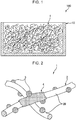
- Fig. 1 is a cross-sectional view of an ink absorption member of the present invention stored in a container.
- Fig. 2 is an enlarged view (schematic diagram) of the ink absorption member illustrated in Fig. 1 .
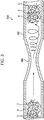
- Fig. 3 is a schematic diagram (cross-sectional view) of a production apparatus for producing the ink absorption member illustrated in Fig. 1 .
- upper positions as viewed in Fig. 1 may be referred to as “upper” or “upward” positions, lower positions as “lower” or “downward” positions, left positions as “left” or “upstream” positions, and right positions as “right” or “downstream” positions, for convenience of description.
- An ink absorption member 1 of the present invention is an ink absorption member used to absorb ink.
- the ink absorption member 1 includes a fiberized material 2, which includes fibers 20, and a liquid-absorbent resin 3, with a content of the liquid-absorbent resin 3 being greater than 5 wt.% and 90 wt.% or less relative to a weight of the fibers 20.
- the content of the liquid-absorbent resin 3 is preferably 20% or greater and 70% or less and more preferably 40% or greater and 55% or less, relative to the fibers 20.
- the ink absorption member 1 of the present invention does not have a particular external shape, and, therefore, the ink absorption member 1 has excellent shape conformability and can be stored in a container in conformity with any container shape.
- the inclusion of the fibers 20 and the liquid-absorbent resin 3 in the ink absorption member 1 enables an ink Q dropped onto the ink absorption member 1 to be transmitted along the fibers 20 to be diffused over a relatively wide area in the ink absorption member 1. While the ink Q is diffused, the ink Q is absorbed by the liquid-absorbent resin 3. Hence, the ink Q can be rapidly diffused, absorbed, and held, and, therefore, an excellent liquid absorption characteristic is achieved.
- the ink Q may not be sufficiently held, and, for example, if the container storing the ink absorption member 1 falls over, the ink Q may leak out.
- the content of the liquid-absorbent resin 3 is too high, the amount of the fibers 20 is relatively reduced, and, consequently, the ink Q may not be sufficiently diffused.
- liquid-absorbent resin 3 when the content of the liquid-absorbent resin 3 is 20% or greater and 70% or less or 40% or greater and 55% or less, relative to the fibers 20, ink can be diffused, absorbed, and held more favorably.
- the ink absorber 100 of the present invention illustrated in Fig. 1 , includes the ink absorption member 1 of the present invention and a container 10, which stores the ink absorption member 1.
- a container 10 which stores the ink absorption member 1.
- liquid-absorbent refers to an absorbency for general types of inks. That is, aqueous inks in which a colorant is dissolved in an aqueous solvent can be absorbed, of course, and, in addition, solvent-based inks in which a binder is dissolved in a solvent, UV curable inks in which a binder is dissolved in a liquid monomer and which are cured by UV irradiation, latex inks in which a binder is dispersed in a dispersion medium, and the like can be absorbed.
- the container 10 will be described below before the constituent materials of the ink absorption member 1 of the present invention are described.
- the container 10, illustrated in Fig. 1 stores the ink absorption member 1.
- the container 10 is formed of a housing that has an opening portion and a storage space that is in communication with the opening portion.
- a shape of the housing is not particularly limited provided that the shape is a tubular shape having a closed end, for example. Examples thereof include circular tubular shapes and polygonal tubular shapes.
- a cover member that closes the opening portion may be included. In this case, the cover member may be formed integrally with the housing or may be included as a separate member.
- a constituent material of the container 10 is not particularly limited provided that the material is not an ink-permeable material.
- Examples of the constituent material include various hard resin materials, various ceramic materials, and various metal materials.
- the container 10 is not limited to the housing described above and may be in the form of a soft bag.
- examples of the constituent material of the container 10 include various soft resin materials and various rubber materials.
- the ink absorption member 1 can be freely deformed or moved within the container 10 by, for instance, crumpling the ink absorption member 1 together with the container 10, in a state in which the ink absorption member 1 is stored in the container 10.
- a capacity of the container 10 is not particularly limited and is approximately 10 cm 3 or greater and 20000 cm 3 or less.
- the container 10, as described, may or may not have optical transparency (internal visibility).
- the liquid-absorbent resin 3, illustrated in Fig. 2 is not particularly limited provided that the resin has liquid absorbency.
- the liquid-absorbent resin 3 include carboxymethyl cellulose, polyacrylic acids, polyacrylamides, starch-acrylic acid graft copolymers, hydrolysates of starch-acrylonitrile graft copolymers, vinyl acetate-acrylic ester copolymers, isobutylene-maleic acid copolymers, hydrolysates of acrylonitrile copolymers or acrylamide copolymers, polyethylene oxide, polysulfonic acid compounds, polyglutamic acids, salts (neutralized products) thereof, and crosslinked products thereof.
- the term "liquid absorbency” refers to the ability to exhibit hydrophilicity and retain liquid. Many liquid-absorbent resins 3 form a gel when the resins absorb liquid.
- the liquid-absorbent resin 3 be a resin having a functional group in a side chain thereof.
- the functional group include acid groups, hydroxyl groups, epoxy groups, and amino groups.
- the liquid-absorbent resin 3 is a resin having an acid group in a side chain thereof, and, more preferably, the liquid-absorbent resin 3 is a resin having a carboxyl group in a side chain thereof.
- Examples of a carboxyl-group-containing unit that may be included in the liquid-absorbent resin 3 include units derived from a monomer such as acrylic acid, methacrylic acid, itaconic acid, maleic acid, crotonic acid, fumaric acid, sorbic acid, cinnamic acid, an anhydride of any of these, or a salt of any of these.
- a percentage of acid groups that are neutralized and form a salt of all the acid groups present in the liquid-absorbent resin 3 is preferably 30 mol% or greater and 100 mol% or less, more preferably 50 mol% or greater and 95 mol% or less, even more preferably 60 mol% or greater and 90 mol% or less, and most preferably 70 mol% or greater and 80 mol% or less.
- liquid-absorbent resin 3 has a further enhanced ink absorption property.
- the type of the neutralized salt is not particularly limited, and examples thereof include alkali metal salts, such as sodium salts, potassium salts, and lithium salts, and salts of a nitrogen-containing basic compound, such as ammonia.
- alkali metal salts such as sodium salts, potassium salts, and lithium salts
- salts of a nitrogen-containing basic compound such as ammonia.
- a sodium salt is preferable.
- liquid-absorbent resin 3 has a further enhanced ink absorption property.
- the liquid-absorbent resin 3 that contains an acid group in a side chain thereof is preferable because during the absorption of ink, electrostatic repulsion occurs therein between acid groups, which increases the absorption rate. Furthermore, in the case in which acid groups are neutralized, ink can be easily absorbed into the liquid-absorbent resin 3 under osmotic pressure.
- the liquid-absorbent resin 3 may include a structural unit that contains no acid group.
- a structural unit include hydrophilic structural units, hydrophobic structural units, and structural units that serve as a polymerizable crosslinking agent.
- hydrophilic structural units include structural units derived from a nonionic compound, such as acrylamide, methacrylamide, N-ethyl (meth)acrylamide, N-n-propyl (meth)acrylamide, N-isopropyl (meth)acrylamide, N,N-dimethyl (meth)acrylamide, 2-hydroxyethyl (meth)acrylate, 2-hydroxypropyl (meth)acrylate, methoxypolyethylene glycol (meth)acrylate, polyethylene glycol mono(meth)acrylate, N-vinylpyrrolidone, N-acryloylpiperidine, or N-acryloylpyrrolidine.
- a nonionic compound such as acrylamide, methacrylamide, N-ethyl (meth)acrylamide, N-n-propyl (meth)acrylamide, N-isopropyl (meth)acrylamide, N,N-dimethyl (meth)acrylamide, 2-hydroxyethyl (meth)acrylate
- hydrophobic structural units examples include structural units derived from a compound such as (meth)acrylonitrile, styrene, vinyl chloride, butadiene, isobutene, ethylene, propylene, stearyl (meth)acrylate, or lauryl (meth)acrylate.
- Examples of the structural units that serve as a polymerizable crosslinking agent include structural units derived from, for instance, diethyleneglycol diacrylate, N,N'-methylenebisacrylamide, polyethylene glycol diacrylate, polypropylene glycol diacrylate, trimethylolpropane diallyl ether, trimethylolpropane triacrylate, allyl glycidyl ether, pentaerythritol triallyl ether, pentaerythritol diacrylate monostearate, bisphenol diacrylate, isocyanurate diacrylate, tetraallyloxyethane, or a salt of diallyloxyacetic acid.
- diethyleneglycol diacrylate N,N'-methylenebisacrylamide
- polyethylene glycol diacrylate polypropylene glycol diacrylate
- trimethylolpropane diallyl ether trimethylolpropane triacrylate
- allyl glycidyl ether pentaerythr
- the liquid-absorbent resin 3 be a polyacrylic acid salt copolymer or a crosslinked polyacrylic acid polymer.
- a percentage of carboxyl-group-containing structural units of all the structural units included in the molecular chain is preferably greater than or equal to 50 mol%, more preferably greater than or equal to 80 mol%, and even more preferably greater than or equal to 90 mol%.
- carboxyl groups in the crosslinked polyacrylic acid polymer be neutralized (partially neutralized) and form a salt.
- a percentage of neutralized carboxyl groups of all the carboxyl groups is preferably 30 mol% or greater and 99 mol% or less, more preferably 50 mol% or greater and 99 mol% or less, and even more preferably 70 mol% or greater and 99 mol% or less.
- liquid-absorbent resin 3 may have a structure crosslinked with a crosslinking agent other than the polymerizable crosslinking agent mentioned above.
- the crosslinking agent be, for example, a compound containing functional groups that are reactive with acid groups.
- the crosslinking agent be a compound containing, in the molecule, functional groups that are reactive with acid groups.
- Examples of the compound (crosslinking agent) containing functional groups that are reactive with acid groups include glycidyl ether compounds, such as ethylene glycol diglycidyl ether, trimethylolpropane triglycidyl ether, (poly)glycerol polyglycidyl ether, diglycerol polyglycidyl ether, and propylene glycol diglycidyl ether; polyhydric alcohols, such as (poly)glycerol, (poly)ethylene glycol, propylene glycol, 1,3-propanediol, polyoxyethylene glycol, triethylene glycol, tetraethylene glycol, diethanolamine, and triethanolamine; and polyamines and the like, such as ethylenediamine, diethylenediamine, polyethyleneimine, and hexamethylene diamine.
- Other preferred examples include ions of a multivalent metal, such as zinc, calcium, magnesium, or aluminum. Such ions serve as a crosslinking agent by reacting with acid
- the liquid-absorbent resin 3 may have any shape and may be in the form of, for example, a block (mass), pellets, flakes, needles, a fiber, particles, or the like.
- the liquid-absorbent resin 3 is in the form of particles.
- the ink absorption member 1 can be suitably loaded in the container 10 while an ink penetration property is easily ensured.
- good conformability to containers 10 of various shapes is achieved, which suitably prevents the formation of an unnecessarily large space in the containers 10.
- the liquid-absorbent resin 3 can be suitably supported on a surface of the fibers 20.
- An average particle diameter of the particles is preferably 15 ⁇ m or greater and 800 ⁇ m or less, more preferably 15 ⁇ m or greater and 400 ⁇ m or less, and even more preferably 15 ⁇ m or greater and 50 ⁇ m or less.
- the liquid-absorbent resin 3 has a reduced specific surface area, which results in a reduced ink absorption characteristic and a reduced ink absorption rate.
- the average particle diameter of the particles may be, for example, a mean volume diameter MVD, which is a volume-based mean particle diameter measured with a laser diffraction particle size distribution analyzer.
- Particle size distribution analyzers using the laser diffraction light scattering method as the measurement principle that is, laser diffraction particle size distribution analyzers, can measure particle size distributions based on volume.
- the particles may include one or more components in addition to the liquid-absorbent resin 3.
- components include surfactants, lubricants, defoamers, fillers, antiblocking agents, and UV absorbers.
- the liquid-absorbent resin 3 may have a uniform configuration in its entirety or have different configurations in different locations.
- a region near the surface e.g., a region extending 1 ⁇ m in thickness from the surface
- liquid-absorbent resin 3 described above and the fiberized material 2, which will be described later, enables ink dropped onto the ink absorption member 1 to be transmitted along the fibers 20 to be diffused over a relatively wide area in the ink absorption member; thus, an excellent diffusibility is achieved. While the ink is diffused, the ink is absorbed by the liquid-absorbent resin. Hence, ink can be rapidly diffused, absorbed, and held, and, therefore, an excellent liquid absorption characteristic is achieved.
- the content of the liquid-absorbent resin of greater than 5 wt.% and 90 wt.% or less relative to the weight of the fibers 20 enables ink to be favorably diffused, absorbed, and held.
- the ink absorption member 1 can suitably absorb the ink, and, therefore, effects such as those described above are stably produced over a long period of time while an increase in the size of the apparatus in which the ink absorption member 1 is to be included is effectively prevented. Furthermore, the frequency of replacement of the ink absorption member 1 can be reduced, and as a result, maintenance of the apparatus that includes the ink absorption member 1 is easy.
- ink may not be sufficiently held, and, for example, if the container storing the ink absorption member falls over, ink may leak out.
- the amount of the fibers 20 is relatively reduced, and, consequently, ink may not be sufficiently diffused. Furthermore, a bulk density is relatively reduced, and, consequently, ink may not be sufficiently diffused.
- too large an amount of the liquid-absorbent resin is present, swelling at the portion onto which ink has been dropped becomes excessive, and, consequently, the diffusion of ink may be hindered, and protrusion from the container 10 may occur. To prevent the protrusion, it is conceivable to reduce the amount of the ink absorption member 1 in the container 10. However, in this case, a total ink absorption amount is reduced.
- the effects of the present invention can be produced; however, the content is preferably 20 wt.% or greater and 70 wt.% or less relative to the weight of the fibers 20 and more preferably 40 wt.% or greater and 55 wt.% or less relative to the weight of the fibers 20.
- effects associated with the absorption rate, diffusibility, leakage prevention, and the like are produced in a balanced manner, and, therefore, the effects of the present invention are produced more prominently.
- the fiberized material 2 illustrated in Fig. 2 , is formed of the fibers 20.
- the fiberized material 2 has a function of supporting the liquid-absorbent resin 3 and a function of diffusing dropped ink rapidly over a wide area. Accordingly, ink can be delivered to the liquid-absorbent resin 3 more efficiently, and, hence, an ink absorption characteristic of the ink absorption member 1 as a whole is improved. In addition, unintentional ink leakage after the ink absorption member 1 has absorbed ink is prevented.
- the liquid-absorbent resin 3 is supported on the fibers 20, that is, the liquid-absorbent resin 3 exists in the ink absorption member 1 in a state in which the liquid-absorbent resin 3 is supported on the fibers 20; as a result, leakage of the liquid-absorbent resin 3 from the container 10 storing the ink absorption member 1 is more suitably prevented, and the position of the liquid-absorbent resin 3 in the ink absorption member 1 can be fixed to some extent, which prevents unintentional uneven distribution of the liquid-absorbent resin 3.
- a shape of the fiberized material 2 may be, for instance, a shape in the form of a linear or strip-shaped bundle of the fibers 20 or a shape in the form of a mass in which the fibers 20 are entangled, that is, a shape in which a so-called aggregate is formed.
- the fiberized material 2 is in such a form, a shape of the ink absorption member 1 can be freely changed in the container 10.
- the liquid-absorbent resin 3 may not be supported on the fibers 20, that is, the ink absorption member 1 may be in a state in which the liquid-absorbent resin 3 is simply mixed with the fiberized material 2. That is, a state in which the absorbent resin 3 is diffused and dispersed in the fiberized material 2 is possible. In this case, a step of causing the liquid-absorbent resin 3 to be supported on the fibers 20 can be omitted, and, therefore, the ink absorption member 1 can be easily obtained.
- the fibers 20 include synthetic resin fibers, such as polyester fibers and polyamide fibers; and natural resin fibers, such as cellulose fibers, keratinous fibers, and fibroin fibers, and chemical modifications thereof; these may be used alone or in an appropriate combination.
- the fibers 20 is primarily formed of a cellulose fiber (which may be included, for example, in an amount greater than or equal to 70 wt.%), more preferably, the fibers 20 are substantially entirely formed of a cellulose fiber.
- Cellulose is a material having a suitable hydrophilicity, and thus, when ink is applied to the ink absorption member 1, the ink can be suitably diffused. Hence, the ink absorption member 1 can rapidly escape from a state in which the flowability is particularly high (e.g., a state in which a viscosity is not greater than 10 mPa ⁇ s), and, in addition, the ink can be suitably delivered to the liquid-absorbent resin 3. As a result, the ink absorption characteristic of the ink absorption member 1 as a whole is particularly enhanced.
- cellulose has a high affinity for the liquid-absorbent resin 3, and, therefore, the liquid-absorbent resin 3 can be more suitably supported on a surface of the fibers 20.
- cellulose fibers are renewable natural materials and are inexpensive and readily available compared with various other fibers. As such, cellulose fibers are advantageous also from the standpoint of reducing the cost of producing the ink absorption member 1, ensuring stable production, and reducing environmental impact, for example.
- the cellulose fiber be a material containing, as a major component, a compound of cellulose (cellulose in a narrow sense) and being in the form of a fiber, and thus, the material may include hemicellulose and/or lignin in addition to cellulose (cellulose in a narrow sense).
- a raw material for the fibers 20 be previously used waste paper. In this case, advantages from the standpoint of waste reduction, effective utilization of resources, and the like are achieved.
- Methods for fiberizing waste paper include, for example, a method that uses a fiberizing apparatus including an impeller mill, which may include a high-speed rotor and a liner located at the outer periphery of the rotor.
- the waste paper may be unprocessed waste paper or may be a shredded material obtained from a shredding process or a fiberized material obtained from a fiberization process.
- methods for mixing the liquid-absorbent resin 3 with the fiberized material 2 include, for example, a method that uses a mixing apparatus 200, illustrated in Fig. 3 .
- the mixing apparatus 200 includes a mixing tube 300 and a gas flow generating source that generates a gas flow in the mixing tube 300. Furthermore, the mixing tube 300 has, at a middle thereof, a diameter-reduced portion 400, in which an inner diameter of the mixing tube 300 is reduced. This configuration generates a swirling flow downstream of the diameter-reduced portion 400.
- the ink absorption member 1 is obtained in a state in which the fiberized material 2, the liquid-absorbent resin 3, and the binder 4 are favorably mixed together.
- supplying moisture into the mixing tube 300 causes the liquid-absorbent resin 3 to be supported on the fibers 20 directly or via the binder 4.
- An average length of the fibers 20 is not particularly limited and is preferably 0.1 mm or greater and 7 mm or less, more preferably 0.1 mm or greater and 5 mm or less, and even more preferably 0.1 mm or greater and 3 mm or less.
- the liquid-absorbent resin 3 can be supported more suitably, and ink can be held and delivered to the liquid-absorbent resin 3 by the fibers 20 more suitably, and, therefore, the ink absorption characteristic of the ink absorption member 1 as a whole is further enhanced.
- An average diameter (average width) of the fibers 20 is not particularly limited and is preferably 0.5 ⁇ m or greater and 200 ⁇ m or less and more preferably 1.0 ⁇ m or greater and 100 ⁇ m or less.
- the liquid-absorbent resin 3 can be supported more suitably, and ink can be held and delivered to the liquid-absorbent resin 3 by the fibers 20 more suitably, and, therefore, the ink absorption characteristic of the ink absorption member 1 as a whole is further enhanced.
- An average aspect ratio (the ratio of the average length to the average width) of the fibers 20 is not particularly limited and is preferably 10 or greater and 1000 or less and more preferably 15 or greater and 500 or less.
- the liquid-absorbent resin 3 can be supported more suitably, and ink can be held and delivered to the liquid-absorbent resin 3 by the fibers 20 more suitably, and, therefore, the ink absorption characteristic of the ink absorption member 1 as a whole is further enhanced.
- liquid-absorbent resin 3 is in the form of particles
- a relationship of 0.15 ⁇ L/D ⁇ 467 be satisfied where D is the average particle diameter [ ⁇ m] of the liquid-absorbent resin 3, and L is the average length [ ⁇ m] of the fibers 20; more preferably, a relationship of 0.25 ⁇ L/D ⁇ 333 is satisfied, and even more preferably, a relationship of 2 ⁇ L/D ⁇ 200 is satisfied.
- the liquid-absorbent resin 3 can be supported more suitably, and ink can be held and delivered to the liquid-absorbent resin 3 by the fibers 20 more suitably, and, therefore, the ink absorption characteristic of the ink absorption member 1 as a whole is further enhanced.
- a content of the fibers 20 is preferably 0.5 wt.% or greater and 80 wt.% or less, more preferably 1.0 wt.% or greater and 70 wt.% or less, and even more preferably 3.0 wt.% or greater and 67 wt.% or less.
- the binder 4, illustrated in Fig. 2 has a function of binding the liquid-absorbent resin 3 to the fibers 20 and a function of binding the individual fibers together.
- the additional inclusion of the binder 4 enables the liquid-absorbent resin 3 to be supported on the fibers 20 more firmly and a relative positional relationship between the fibers 20 to be maintained to some extent. Hence, unintentional uneven distribution of the liquid-absorbent resin is prevented.
- binder 4 may be added separately in the production of the ink absorption member 1, or the binder 4 may be present in the ink absorption member 1, the principle of which is described below.
- previously used waste paper includes a resin (a component that can be a binder 4), that is, a binder 4 that has functions such as those described above, derived from the papermaking process.
- a resin a component that can be a binder 4
- the fibers 20 originally contain a binder 4 adhering thereto or being present therein.
- the ink absorption member 1 contains a binder 4 being present therein.
- the binder 4 may be a binder derived from the waste paper that is used as a raw material for the fiberized material 2.
- the binder 4 is not particularly limited provided that the binder 4 exhibits the functions described above.
- the binder 4 include thermoplastic resins and curable resins; a thermoplastic resin is preferable.
- the thermoplastic resin include AS resins, ABS resins, polyolefins and modified polyolefins such as polyethylene, polypropylene, and ethylenevinyl acetate copolymers (EVA), acrylic resins such as polymethylmethacrylate, polyvinyl chloride, polystyrene, polyesters such as polyethylene terephthalate and polybutylene terephthalate, polyamides (nylons) such as nylon 6, nylon 46, nylon 66, nylon 610, nylon 612, nylon 11, nylon 12, nylon 6-12, and nylon 6-66, polyphenylene ether, polyacetal, polyethers, polyphenylene oxide, polyetheretherketone, polycarbonate, polyphenylene sulfide, thermoplastic polyimides, polyetherimides, liquid crystal polymers such as aromatic polyesters, water
- a content of the binder 4 is preferably less than or equal to 10 wt.% and more preferably less than or equal to 5.0 wt.%. In these cases, the liquid-absorbent resin 3 can be supported on the fibers 20 more reliably.
- the ink absorption member 1 may include one or more components (other components) in addition to the ones described above.
- Such components include surfactants, lubricants, defoamers, fillers, antiblocking agents, UV absorbers, colorants, such as pigments and dyes, flame retardants, and flow improvers.
- a content of the other components is preferably less than or equal to 10 wt.% and more preferably less than or equal to 5.0 wt.%.
- a bulk density of the ink absorption member 1 in the container 10 is preferably 0.01 g/cm 3 or greater and 0.5 g/cm 3 or less and more preferably 0.03 g/cm 3 or greater and 0.3 g/cm 3 or less.
- the ink absorption member 1 can suitably absorb ink, and the ink absorption member 1 is prevented from swelling and expanding out from the container 10 when the ink absorption member 1 absorbs ink.
- the liquid-absorbent resin 3 may swell when the liquid-absorbent resin 3 absorbs ink, which may cause the ink absorption member 1 to expand out from the container 10.
- the bulk density is too high, the liquid-absorbent resin 3 may swell when the liquid-absorbent resin 3 absorbs ink, which may cause the ink absorption member 1 to expand out from the container 10.
- the bulk density is too low, there is a tendency for the amount of ink that can be absorbed by the ink absorption member 1 to decrease.
- A/B is preferably 0.1 or greater and 0.9 or less and more preferably 0.2 or greater and 0.8 or less where A is a volume of the ink absorption member 1 in the container 10, and B is a capacity (maximum capacity) of the container 10.
- A is a volume of the ink absorption member 1 in the container 10
- B is a capacity (maximum capacity) of the container 10.
- the ink absorption member 1 of the present invention have a function of absorbing ink.
- examples of the ink absorption member 1 include ones used to absorb waste ink generated during a head cleaning operation, which is performed to prevent a reduction in printing quality due to clogging caused by ink, or during an ink filling operation after a replacement of an ink cartridge; further examples include ones used to absorb ink leaked from a flow path of a printing apparatus.
- a crosslinked polyacrylic acid polymer which is a resin (liquid-absorbent resin) having, in a side chain thereof, a carboxyl group as an acid group, was prepared; namely, Sanfresh ST-250* (manufactured by Sanyo Chemical Industries, Ltd.) was prepared.
- the content of the liquid-absorbent resin was 6 wt.% relative to the weight of the fiber
- the content of the fiber in the ink absorption member was 90 wt.%
- the content of the binder in the ink absorption member was 3 wt.%
- the average length of the fiber was 1 mm
- the average width thereof was 50 ⁇ m
- the aspect ratio (average length/average diameter) was 20.
- the liquid-absorbent resin was supported on a surface of the fiber (shredded waste paper).
- Ink absorption members were produced as in Example 1 except that the conditions for the liquid-absorbent resin, the fiber, and the binder were changed as indicated in Table 1.
- Ink absorption members were produced as in Example 1 except that the conditions for the liquid-absorbent resin and the fiber were changed as indicated in Table 1.
- the container was inverted by 90° in a manner such that a vertical surface of the container was brought into contact with a surface of a desk, and the container was left as it was for 10 minutes.
- 10 minutes had elapsed, the state of the inside of the container was examined and evaluated according to the following criteria.
Landscapes
- Engineering & Computer Science (AREA)
- Chemical & Material Sciences (AREA)
- Textile Engineering (AREA)
- Chemical Kinetics & Catalysis (AREA)
- Materials Engineering (AREA)
- Ink Jet (AREA)
Abstract
Description
- The present invention relates to an ink absorption member and an ink absorber.
- In ink jet printers, waste ink is typically generated during a head cleaning operation, which is performed to prevent a reduction in printing quality due to clogging caused by ink, and during an ink filling operation after a replacement of an ink cartridge. Accordingly, ink jet printers are provided with a liquid absorption member (ink absorption member) for absorbing waste ink, to prevent the occurrence of unintentional adhesion of such waste ink to a mechanism or the like within the printers.
- In the related art, as liquid absorption members (ink absorption members), those that include a natural cellulose fiber and/or a synthetic fiber together with a thermally fusible substance have been used (see
PTL 1, for example). - Unfortunately, the liquid absorption members (ink absorption members) of the related art have a low ink penetration property and, therefore, present a problem in that a sufficient amount of waste ink cannot be absorbed, or waste ink cannot be absorbed rapidly. In addition, after ink has been absorbed, unintentional ink leakage may occur in some cases, depending on the amount of the ink absorbed.
- PTL 1: Japanese Patent No.
3536870 - An object of the present invention is to provide an ink absorption member and an ink absorber that have an improved ink absorption characteristic and prevent ink leakage from occurring after ink has been absorbed.
- The present invention has been made to solve at least some of the problems described above and can be realized in the aspects described below.
- An ink absorption member of the present invention is an ink absorption member to be used to absorb ink. The ink absorption member includes a fiberized material and a liquid-absorbent resin. The fiberized material includes a fiber. In the ink absorption member, a content of the liquid-absorbent resin is greater than 5 wt.% and 90 wt.% or less relative to a weight of the fiber.
- The inclusion of a fiber and a liquid-absorbent resin in the ink absorption member enables ink dropped onto the ink absorption member to be transmitted along the fiber to be diffused over a relatively wide area in the ink absorption member. While the ink is diffused, the ink is absorbed by the liquid-absorbent resin. Hence, ink can be rapidly diffused, absorbed, and held, and, therefore, an excellent liquid absorption characteristic is achieved.
- Furthermore, the content of the liquid-absorbent resin of greater than 5 wt.% and 90 wt.% or less relative to the weight of the fiber enables ink to be favorably diffused, absorbed, and held.
- Note that if the content of the liquid-absorbent resin is too low, ink may not be sufficiently held, and, for example, if the container storing the ink absorption member falls over, ink may leak out. On the other hand, if the content of the liquid-absorbent resin is too high, the amount of the fiber is relatively reduced, and, consequently, ink may not be sufficiently diffused.
- In the ink absorption member of the present invention, it is preferable that a bulk density of the ink absorption member be 0.01 g/cm3 or greater and 0.5 g/cm3 or less.
- In this case, even when an amount (ratio) of ink to be absorbed is relatively large with respect to an amount of the ink absorption member, the ink absorption member can suitably absorb ink, and the ink absorption member is prevented from swelling and expanding out from the container when the ink absorption member absorbs ink.
- In the ink absorption member of the present invention, it is preferable that the fiber be a cellulose fiber.
- Cellulose is a material having a suitable hydrophilicity, and thus, when ink is applied to the ink absorption member, the ink can be suitably diffused. Hence, the ink absorption member can rapidly escape from a state in which the flowability is particularly high (e.g., a state in which a viscosity is not greater than 10 mPa·s), and, in addition, the ink can be suitably delivered to the liquid-absorbent resin. As a result, an ink absorption characteristic of the ink absorption member as a whole is particularly enhanced. Furthermore, in general, cellulose has a high affinity for liquid-absorbent resins, and, therefore, the liquid-absorbent resin can be more suitably supported on a surface of the fiber. Furthermore, cellulose fibers are renewable natural materials and are inexpensive and readily available compared with various other fibers. As such, cellulose fibers are advantageous also from the standpoint of reducing the cost of producing the ink absorption member, ensuring stable production, and reducing environmental impact, for example.
- In the ink absorption member of the present invention, it is preferable that an average length of the fiber be 0.1 mm or greater and 7 mm or less.
- In this case, the liquid-absorbent resin can be supported more suitably, and ink can be held and diffused by the fiber more suitably, and, therefore, the ink absorption characteristic of the ink absorption member as a whole is further enhanced.
- In the ink absorption member of the present invention, it is preferable that an average diameter of the fiber be 0.5 µm or greater and 200 µm or less.
- In this case, the liquid-absorbent resin can be supported more suitably, and ink can be diffused by the fiber more suitably, and, therefore, the ink absorption characteristic of the ink absorption member as a whole is further enhanced.
- In the ink absorption member of the present invention, it is preferable that the liquid-absorbent resin be supported on the fiber.
- In this case, leakage of the liquid-absorbent resin from the container storing the ink absorption member is more suitably prevented, and the position of the liquid-absorbent resin in the ink absorption member can be fixed to some extent, which prevents unintentional uneven distribution of the liquid-absorbent resin.
- In the ink absorption member of the present invention, it is preferable that a raw material for the fiber be previously used waste paper.
- In this case, advantages from the standpoint of waste reduction, effective utilization of resources, and the like are achieved.
- In the ink absorption member of the present invention, it is preferable that the liquid-absorbent resin be in the form of particles.
- In this case, the ink absorption member can be suitably loaded in a container while an ink penetration property is easily ensured. Furthermore, good conformability to containers of various shapes is achieved, which suitably prevents the formation of an unnecessarily large space in the container. Furthermore, in a case in which the ink absorption member includes a fiber such as those described in detail later, the liquid-absorbent resin can be suitably supported on a surface of the fiber.
- It is preferable that the ink absorption member of the present invention further include a binder.
- In this case, the liquid-absorbent resin can be supported on the fiber more reliably, and the individual fibers can be partially settled together.
- An ink absorber of the present invention includes the ink absorption member of the present invention and a container storing the ink absorption member.
- In this case, ink can be absorbed while the advantages of the ink absorption member described above are enjoyed.
-
- [
Fig. 1] Fig. 1 is a cross-sectional view of an ink absorption member of the present invention stored in a container. - [
Fig. 2] Fig. 2 is an enlarged view (schematic diagram) of the ink absorption member illustrated inFig. 1 . - [
Fig. 3] Fig. 3 is a schematic diagram (cross-sectional view) illustrating a production apparatus for producing the ink absorption member illustrated inFig. 1 . - An ink absorption member of the present invention will now be described in detail with reference to the accompanying drawings, which illustrate a preferred embodiment.
-
Fig. 1 is a cross-sectional view of an ink absorption member of the present invention stored in a container.Fig. 2 is an enlarged view (schematic diagram) of the ink absorption member illustrated inFig. 1 .Fig. 3 is a schematic diagram (cross-sectional view) of a production apparatus for producing the ink absorption member illustrated inFig. 1 . - Note that hereinafter, upper positions as viewed in
Fig. 1 may be referred to as "upper" or "upward" positions, lower positions as "lower" or "downward" positions, left positions as "left" or "upstream" positions, and right positions as "right" or "downstream" positions, for convenience of description. - An
ink absorption member 1 of the present invention, illustrated inFig. 1 and Fig. 2 , is an ink absorption member used to absorb ink. Theink absorption member 1 includes a fiberizedmaterial 2, which includesfibers 20, and a liquid-absorbent resin 3, with a content of the liquid-absorbent resin 3 being greater than 5 wt.% and 90 wt.% or less relative to a weight of thefibers 20. Furthermore, the content of the liquid-absorbent resin 3 is preferably 20% or greater and 70% or less and more preferably 40% or greater and 55% or less, relative to thefibers 20. - Furthermore, the
ink absorption member 1 of the present invention does not have a particular external shape, and, therefore, theink absorption member 1 has excellent shape conformability and can be stored in a container in conformity with any container shape. - The inclusion of the
fibers 20 and the liquid-absorbent resin 3 in theink absorption member 1 enables an ink Q dropped onto theink absorption member 1 to be transmitted along thefibers 20 to be diffused over a relatively wide area in theink absorption member 1. While the ink Q is diffused, the ink Q is absorbed by the liquid-absorbent resin 3. Hence, the ink Q can be rapidly diffused, absorbed, and held, and, therefore, an excellent liquid absorption characteristic is achieved. - Note that if the content of the liquid-
absorbent resin 3 is too low, the ink Q may not be sufficiently held, and, for example, if the container storing theink absorption member 1 falls over, the ink Q may leak out. On the other hand, if the content of the liquid-absorbent resin 3 is too high, the amount of thefibers 20 is relatively reduced, and, consequently, the ink Q may not be sufficiently diffused. - Furthermore, when the content of the liquid-
absorbent resin 3 is 20% or greater and 70% or less or 40% or greater and 55% or less, relative to thefibers 20, ink can be diffused, absorbed, and held more favorably. - Furthermore, the
ink absorber 100 of the present invention, illustrated inFig. 1 , includes theink absorption member 1 of the present invention and acontainer 10, which stores theink absorption member 1. With the present invention, as described, ink can be absorbed while the advantages of the ink absorption member described above are enjoyed. - Note that as used in this specification, the term "liquid-absorbent" refers to an absorbency for general types of inks. That is, aqueous inks in which a colorant is dissolved in an aqueous solvent can be absorbed, of course, and, in addition, solvent-based inks in which a binder is dissolved in a solvent, UV curable inks in which a binder is dissolved in a liquid monomer and which are cured by UV irradiation, latex inks in which a binder is dispersed in a dispersion medium, and the like can be absorbed.
- The
container 10 will be described below before the constituent materials of theink absorption member 1 of the present invention are described. - The
container 10, illustrated inFig. 1 , stores theink absorption member 1. Thecontainer 10 is formed of a housing that has an opening portion and a storage space that is in communication with the opening portion. Furthermore, a shape of the housing is not particularly limited provided that the shape is a tubular shape having a closed end, for example. Examples thereof include circular tubular shapes and polygonal tubular shapes. Furthermore, a cover member that closes the opening portion may be included. In this case, the cover member may be formed integrally with the housing or may be included as a separate member. - A constituent material of the
container 10 is not particularly limited provided that the material is not an ink-permeable material. Examples of the constituent material include various hard resin materials, various ceramic materials, and various metal materials. - When the
container 10 has hardness, unintentional application of an external force to theink absorption member 1 stored in thecontainer 10 is prevented. Hence, ink leakage due to unintentional application of an external force to theink absorption member 1 when theink absorption member 1 absorbs ink is prevented. - Note that the
container 10 is not limited to the housing described above and may be in the form of a soft bag. In this case, examples of the constituent material of thecontainer 10 include various soft resin materials and various rubber materials. - When the
container 10 is in the form of a soft bag, theink absorption member 1 can be freely deformed or moved within thecontainer 10 by, for instance, crumpling theink absorption member 1 together with thecontainer 10, in a state in which theink absorption member 1 is stored in thecontainer 10. - A capacity of the
container 10 is not particularly limited and is approximately 10 cm3 or greater and 20000 cm3 or less. - The
container 10, as described, may or may not have optical transparency (internal visibility). - Constituent materials of the
ink absorption member 1 of the present invention will now be described. - The liquid-
absorbent resin 3, illustrated inFig. 2 , is not particularly limited provided that the resin has liquid absorbency. Examples of the liquid-absorbent resin 3 include carboxymethyl cellulose, polyacrylic acids, polyacrylamides, starch-acrylic acid graft copolymers, hydrolysates of starch-acrylonitrile graft copolymers, vinyl acetate-acrylic ester copolymers, isobutylene-maleic acid copolymers, hydrolysates of acrylonitrile copolymers or acrylamide copolymers, polyethylene oxide, polysulfonic acid compounds, polyglutamic acids, salts (neutralized products) thereof, and crosslinked products thereof. As used herein, the term "liquid absorbency" refers to the ability to exhibit hydrophilicity and retain liquid. Many liquid-absorbent resins 3 form a gel when the resins absorb liquid. - In particular, it is preferable that the liquid-
absorbent resin 3 be a resin having a functional group in a side chain thereof. Examples of the functional group include acid groups, hydroxyl groups, epoxy groups, and amino groups. - In particular, preferably, the liquid-
absorbent resin 3 is a resin having an acid group in a side chain thereof, and, more preferably, the liquid-absorbent resin 3 is a resin having a carboxyl group in a side chain thereof. - Examples of a carboxyl-group-containing unit that may be included in the liquid-
absorbent resin 3 include units derived from a monomer such as acrylic acid, methacrylic acid, itaconic acid, maleic acid, crotonic acid, fumaric acid, sorbic acid, cinnamic acid, an anhydride of any of these, or a salt of any of these. - In a case in which the liquid-
absorbent resin 3 includes a liquid-absorbent resin 3 that contains an acid group in a side chain thereof, a percentage of acid groups that are neutralized and form a salt of all the acid groups present in the liquid-absorbent resin 3 is preferably 30 mol% or greater and 100 mol% or less, more preferably 50 mol% or greater and 95 mol% or less, even more preferably 60 mol% or greater and 90 mol% or less, and most preferably 70 mol% or greater and 80 mol% or less. - In these cases, the liquid-
absorbent resin 3 has a further enhanced ink absorption property. - The type of the neutralized salt is not particularly limited, and examples thereof include alkali metal salts, such as sodium salts, potassium salts, and lithium salts, and salts of a nitrogen-containing basic compound, such as ammonia. A sodium salt is preferable.
- In these cases, the liquid-
absorbent resin 3 has a further enhanced ink absorption property. - The liquid-
absorbent resin 3 that contains an acid group in a side chain thereof is preferable because during the absorption of ink, electrostatic repulsion occurs therein between acid groups, which increases the absorption rate. Furthermore, in the case in which acid groups are neutralized, ink can be easily absorbed into the liquid-absorbent resin 3 under osmotic pressure. - The liquid-
absorbent resin 3 may include a structural unit that contains no acid group. Examples of such a structural unit include hydrophilic structural units, hydrophobic structural units, and structural units that serve as a polymerizable crosslinking agent. - Examples of the hydrophilic structural units include structural units derived from a nonionic compound, such as acrylamide, methacrylamide, N-ethyl (meth)acrylamide, N-n-propyl (meth)acrylamide, N-isopropyl (meth)acrylamide, N,N-dimethyl (meth)acrylamide, 2-hydroxyethyl (meth)acrylate, 2-hydroxypropyl (meth)acrylate, methoxypolyethylene glycol (meth)acrylate, polyethylene glycol mono(meth)acrylate, N-vinylpyrrolidone, N-acryloylpiperidine, or N-acryloylpyrrolidine.
- Examples of the hydrophobic structural units include structural units derived from a compound such as (meth)acrylonitrile, styrene, vinyl chloride, butadiene, isobutene, ethylene, propylene, stearyl (meth)acrylate, or lauryl (meth)acrylate.
- Examples of the structural units that serve as a polymerizable crosslinking agent include structural units derived from, for instance, diethyleneglycol diacrylate, N,N'-methylenebisacrylamide, polyethylene glycol diacrylate, polypropylene glycol diacrylate, trimethylolpropane diallyl ether, trimethylolpropane triacrylate, allyl glycidyl ether, pentaerythritol triallyl ether, pentaerythritol diacrylate monostearate, bisphenol diacrylate, isocyanurate diacrylate, tetraallyloxyethane, or a salt of diallyloxyacetic acid.
- From the standpoint of absorption performance, cost, and the like, it is preferable that the liquid-
absorbent resin 3 be a polyacrylic acid salt copolymer or a crosslinked polyacrylic acid polymer. - In the crosslinked polyacrylic acid polymer, a percentage of carboxyl-group-containing structural units of all the structural units included in the molecular chain is preferably greater than or equal to 50 mol%, more preferably greater than or equal to 80 mol%, and even more preferably greater than or equal to 90 mol%.
- If the percentage of the carboxyl-group-containing structural units is too low, it may be difficult to ensure a sufficiently good ink absorption performance.
- It is preferable that some of the carboxyl groups in the crosslinked polyacrylic acid polymer be neutralized (partially neutralized) and form a salt.
- In the crosslinked polyacrylic acid polymer, a percentage of neutralized carboxyl groups of all the carboxyl groups is preferably 30 mol% or greater and 99 mol% or less, more preferably 50 mol% or greater and 99 mol% or less, and even more preferably 70 mol% or greater and 99 mol% or less.
- Furthermore, the liquid-
absorbent resin 3 may have a structure crosslinked with a crosslinking agent other than the polymerizable crosslinking agent mentioned above. - When the liquid-
absorbent resin 3 is a resin containing acid groups, it is preferable that the crosslinking agent be, for example, a compound containing functional groups that are reactive with acid groups. - When the liquid-
absorbent resin 3 is a resin containing functional groups that are reactive with acid groups, it is preferable that the crosslinking agent be a compound containing, in the molecule, functional groups that are reactive with acid groups. - Examples of the compound (crosslinking agent) containing functional groups that are reactive with acid groups include glycidyl ether compounds, such as ethylene glycol diglycidyl ether, trimethylolpropane triglycidyl ether, (poly)glycerol polyglycidyl ether, diglycerol polyglycidyl ether, and propylene glycol diglycidyl ether; polyhydric alcohols, such as (poly)glycerol, (poly)ethylene glycol, propylene glycol, 1,3-propanediol, polyoxyethylene glycol, triethylene glycol, tetraethylene glycol, diethanolamine, and triethanolamine; and polyamines and the like, such as ethylenediamine, diethylenediamine, polyethyleneimine, and hexamethylene diamine. Other preferred examples include ions of a multivalent metal, such as zinc, calcium, magnesium, or aluminum. Such ions serve as a crosslinking agent by reacting with acid groups present in the liquid-
absorbent resin 3. - In the
ink absorption member 1, the liquid-absorbent resin 3 may have any shape and may be in the form of, for example, a block (mass), pellets, flakes, needles, a fiber, particles, or the like. Preferably, the liquid-absorbent resin 3 is in the form of particles. In this case, theink absorption member 1 can be suitably loaded in thecontainer 10 while an ink penetration property is easily ensured. Furthermore, good conformability tocontainers 10 of various shapes is achieved, which suitably prevents the formation of an unnecessarily large space in thecontainers 10. Furthermore, the liquid-absorbent resin 3 can be suitably supported on a surface of thefibers 20. - An average particle diameter of the particles is preferably 15 µm or greater and 800 µm or less, more preferably 15 µm or greater and 400 µm or less, and even more preferably 15 µm or greater and 50 µm or less.
- Furthermore, if the average particle diameter of the particles is too large, the liquid-
absorbent resin 3 has a reduced specific surface area, which results in a reduced ink absorption characteristic and a reduced ink absorption rate. - Note that the average particle diameter of the particles may be, for example, a mean volume diameter MVD, which is a volume-based mean particle diameter measured with a laser diffraction particle size distribution analyzer. Particle size distribution analyzers using the laser diffraction light scattering method as the measurement principle, that is, laser diffraction particle size distribution analyzers, can measure particle size distributions based on volume.
- The particles may include one or more components in addition to the liquid-
absorbent resin 3. Examples of such components include surfactants, lubricants, defoamers, fillers, antiblocking agents, and UV absorbers. - The liquid-absorbent resin 3 (e.g., a liquid-
absorbent resin 3 in the form of particles) may have a uniform configuration in its entirety or have different configurations in different locations. For example, in the liquid-absorbent resin 3 (e.g., a liquid-absorbent resin 3 in the form of particles), a region near the surface (e.g., a region extending 1 µm in thickness from the surface) may have a higher degree of crosslinking than other locations. - In this case, an ink absorption factor and absorption rate, a strength of the liquid-
absorbent resin 3, and the like are improved in a more balanced manner. - The inclusion of the liquid-
absorbent resin 3 described above and thefiberized material 2, which will be described later, enables ink dropped onto theink absorption member 1 to be transmitted along thefibers 20 to be diffused over a relatively wide area in the ink absorption member; thus, an excellent diffusibility is achieved. While the ink is diffused, the ink is absorbed by the liquid-absorbent resin. Hence, ink can be rapidly diffused, absorbed, and held, and, therefore, an excellent liquid absorption characteristic is achieved. - Furthermore, the content of the liquid-absorbent resin of greater than 5 wt.% and 90 wt.% or less relative to the weight of the
fibers 20 enables ink to be favorably diffused, absorbed, and held. - Furthermore, when the content of the liquid-
absorbent resin 3 is within the above-mentioned numerical range, even if an amount (ratio) of ink to be absorbed is relatively large with respect to an amount of theink absorption member 1, theink absorption member 1 can suitably absorb the ink, and, therefore, effects such as those described above are stably produced over a long period of time while an increase in the size of the apparatus in which theink absorption member 1 is to be included is effectively prevented. Furthermore, the frequency of replacement of theink absorption member 1 can be reduced, and as a result, maintenance of the apparatus that includes theink absorption member 1 is easy. - Note that if the content of the liquid-absorbent resin is too low, ink may not be sufficiently held, and, for example, if the container storing the ink absorption member falls over, ink may leak out.
- On the other hand, if the content of the liquid-absorbent resin is too high, the amount of the
fibers 20 is relatively reduced, and, consequently, ink may not be sufficiently diffused. Furthermore, a bulk density is relatively reduced, and, consequently, ink may not be sufficiently diffused. In addition, if too large an amount of the liquid-absorbent resin is present, swelling at the portion onto which ink has been dropped becomes excessive, and, consequently, the diffusion of ink may be hindered, and protrusion from thecontainer 10 may occur. To prevent the protrusion, it is conceivable to reduce the amount of theink absorption member 1 in thecontainer 10. However, in this case, a total ink absorption amount is reduced. - Furthermore, when the content of the liquid-
absorbent resin 3 is greater than 5 wt.% and 90 wt.% or less relative to the weight of thefibers 20, the effects of the present invention can be produced; however, the content is preferably 20 wt.% or greater and 70 wt.% or less relative to the weight of thefibers 20 and more preferably 40 wt.% or greater and 55 wt.% or less relative to the weight of thefibers 20. In these cases, effects associated with the absorption rate, diffusibility, leakage prevention, and the like are produced in a balanced manner, and, therefore, the effects of the present invention are produced more prominently. - The
fiberized material 2, illustrated inFig. 2 , is formed of thefibers 20. Thefiberized material 2 has a function of supporting the liquid-absorbent resin 3 and a function of diffusing dropped ink rapidly over a wide area. Accordingly, ink can be delivered to the liquid-absorbent resin 3 more efficiently, and, hence, an ink absorption characteristic of theink absorption member 1 as a whole is improved. In addition, unintentional ink leakage after theink absorption member 1 has absorbed ink is prevented. - Furthermore, the liquid-
absorbent resin 3 is supported on thefibers 20, that is, the liquid-absorbent resin 3 exists in theink absorption member 1 in a state in which the liquid-absorbent resin 3 is supported on thefibers 20; as a result, leakage of the liquid-absorbent resin 3 from thecontainer 10 storing theink absorption member 1 is more suitably prevented, and the position of the liquid-absorbent resin 3 in theink absorption member 1 can be fixed to some extent, which prevents unintentional uneven distribution of the liquid-absorbent resin 3. - A shape of the
fiberized material 2 may be, for instance, a shape in the form of a linear or strip-shaped bundle of thefibers 20 or a shape in the form of a mass in which thefibers 20 are entangled, that is, a shape in which a so-called aggregate is formed. - Since the
fiberized material 2 is in such a form, a shape of theink absorption member 1 can be freely changed in thecontainer 10. - Note that the liquid-
absorbent resin 3 may not be supported on thefibers 20, that is, theink absorption member 1 may be in a state in which the liquid-absorbent resin 3 is simply mixed with thefiberized material 2. That is, a state in which theabsorbent resin 3 is diffused and dispersed in thefiberized material 2 is possible. In this case, a step of causing the liquid-absorbent resin 3 to be supported on thefibers 20 can be omitted, and, therefore, theink absorption member 1 can be easily obtained. - Examples of the
fibers 20 include synthetic resin fibers, such as polyester fibers and polyamide fibers; and natural resin fibers, such as cellulose fibers, keratinous fibers, and fibroin fibers, and chemical modifications thereof; these may be used alone or in an appropriate combination. Preferably, thefibers 20 is primarily formed of a cellulose fiber (which may be included, for example, in an amount greater than or equal to 70 wt.%), more preferably, thefibers 20 are substantially entirely formed of a cellulose fiber. - Cellulose is a material having a suitable hydrophilicity, and thus, when ink is applied to the
ink absorption member 1, the ink can be suitably diffused. Hence, theink absorption member 1 can rapidly escape from a state in which the flowability is particularly high (e.g., a state in which a viscosity is not greater than 10 mPa·s), and, in addition, the ink can be suitably delivered to the liquid-absorbent resin 3. As a result, the ink absorption characteristic of theink absorption member 1 as a whole is particularly enhanced. Furthermore, in general, cellulose has a high affinity for the liquid-absorbent resin 3, and, therefore, the liquid-absorbent resin 3 can be more suitably supported on a surface of thefibers 20. Furthermore, cellulose fibers are renewable natural materials and are inexpensive and readily available compared with various other fibers. As such, cellulose fibers are advantageous also from the standpoint of reducing the cost of producing theink absorption member 1, ensuring stable production, and reducing environmental impact, for example. - Note that in this specification, it is sufficient that the cellulose fiber be a material containing, as a major component, a compound of cellulose (cellulose in a narrow sense) and being in the form of a fiber, and thus, the material may include hemicellulose and/or lignin in addition to cellulose (cellulose in a narrow sense).
- Furthermore, it is preferable that a raw material for the
fibers 20 be previously used waste paper. In this case, advantages from the standpoint of waste reduction, effective utilization of resources, and the like are achieved. - Methods for fiberizing waste paper (raw material paper) include, for example, a method that uses a fiberizing apparatus including an impeller mill, which may include a high-speed rotor and a liner located at the outer periphery of the rotor.
- In a case in which waste paper is used as a raw material for the
fibers 20, the waste paper may be unprocessed waste paper or may be a shredded material obtained from a shredding process or a fiberized material obtained from a fiberization process. - Furthermore, methods for mixing the liquid-
absorbent resin 3 with thefiberized material 2 include, for example, a method that uses amixing apparatus 200, illustrated inFig. 3 . - As illustrated in
Fig. 3 , the mixingapparatus 200 includes a mixingtube 300 and a gas flow generating source that generates a gas flow in the mixingtube 300. Furthermore, the mixingtube 300 has, at a middle thereof, a diameter-reducedportion 400, in which an inner diameter of the mixingtube 300 is reduced. This configuration generates a swirling flow downstream of the diameter-reducedportion 400. - When the
fibers 20, the liquid-absorbent resin 3, and abinder 4 are introduced into the mixingtube 300, a swirling flow occurs downstream of the diameter-reduced portion, which causes thefiberized material 2, the liquid-absorbent resin 3, and thebinder 4 to be stirred and mixed together. As a result, theink absorption member 1 is obtained in a state in which thefiberized material 2, the liquid-absorbent resin 3, and thebinder 4 are favorably mixed together. - Note that, for example, supplying moisture into the mixing
tube 300 causes the liquid-absorbent resin 3 to be supported on thefibers 20 directly or via thebinder 4. - An average length of the
fibers 20 is not particularly limited and is preferably 0.1 mm or greater and 7 mm or less, more preferably 0.1 mm or greater and 5 mm or less, and even more preferably 0.1 mm or greater and 3 mm or less. In these cases, the liquid-absorbent resin 3 can be supported more suitably, and ink can be held and delivered to the liquid-absorbent resin 3 by thefibers 20 more suitably, and, therefore, the ink absorption characteristic of theink absorption member 1 as a whole is further enhanced. - An average diameter (average width) of the
fibers 20 is not particularly limited and is preferably 0.5 µm or greater and 200 µm or less and more preferably 1.0 µm or greater and 100 µm or less. In these cases, the liquid-absorbent resin 3 can be supported more suitably, and ink can be held and delivered to the liquid-absorbent resin 3 by thefibers 20 more suitably, and, therefore, the ink absorption characteristic of theink absorption member 1 as a whole is further enhanced. - An average aspect ratio (the ratio of the average length to the average width) of the
fibers 20 is not particularly limited and is preferably 10 or greater and 1000 or less and more preferably 15 or greater and 500 or less. - In these cases, the liquid-
absorbent resin 3 can be supported more suitably, and ink can be held and delivered to the liquid-absorbent resin 3 by thefibers 20 more suitably, and, therefore, the ink absorption characteristic of theink absorption member 1 as a whole is further enhanced. - Furthermore, in the case in which the liquid-
absorbent resin 3 is in the form of particles, it is preferable that a relationship of 0.15 ≤ L/D ≤ 467 be satisfied where D is the average particle diameter [µm] of the liquid-absorbent resin 3, and L is the average length [µm] of thefibers 20; more preferably, a relationship of 0.25 ≤ L/D ≤ 333 is satisfied, and even more preferably, a relationship of 2 ≤ L/D ≤ 200 is satisfied. - In these cases, the liquid-
absorbent resin 3 can be supported more suitably, and ink can be held and delivered to the liquid-absorbent resin 3 by thefibers 20 more suitably, and, therefore, the ink absorption characteristic of theink absorption member 1 as a whole is further enhanced. - In the
ink absorption member 1 of the present invention, a content of thefibers 20 is preferably 0.5 wt.% or greater and 80 wt.% or less, more preferably 1.0 wt.% or greater and 70 wt.% or less, and even more preferably 3.0 wt.% or greater and 67 wt.% or less. - In these cases, the effects of the inclusion of the
fibers 20 are produced more prominently while the effects of the inclusion of the liquid-absorbent resin 3, such as those described above, are sufficiently produced. - The
binder 4, illustrated inFig. 2 , has a function of binding the liquid-absorbent resin 3 to thefibers 20 and a function of binding the individual fibers together. The additional inclusion of thebinder 4 enables the liquid-absorbent resin 3 to be supported on thefibers 20 more firmly and a relative positional relationship between thefibers 20 to be maintained to some extent. Hence, unintentional uneven distribution of the liquid-absorbent resin is prevented. - Note that the
binder 4 may be added separately in the production of theink absorption member 1, or thebinder 4 may be present in theink absorption member 1, the principle of which is described below. - In some cases, previously used waste paper includes a resin (a component that can be a binder 4), that is, a
binder 4 that has functions such as those described above, derived from the papermaking process. In a case in which such waste paper is used as a raw material to obtain a fiberized material, and the fiberized material is used as thefibers 20, thefibers 20 originally contain abinder 4 adhering thereto or being present therein. In a case in which such afiberized material 2 and the liquid-absorbent resin 3 are used to produce theink absorption member 1, theink absorption member 1 contains abinder 4 being present therein. Thus, thebinder 4 may be a binder derived from the waste paper that is used as a raw material for thefiberized material 2. - The
binder 4 is not particularly limited provided that thebinder 4 exhibits the functions described above. Examples of thebinder 4 include thermoplastic resins and curable resins; a thermoplastic resin is preferable. Examples of the thermoplastic resin include AS resins, ABS resins, polyolefins and modified polyolefins such as polyethylene, polypropylene, and ethylenevinyl acetate copolymers (EVA), acrylic resins such as polymethylmethacrylate, polyvinyl chloride, polystyrene, polyesters such as polyethylene terephthalate and polybutylene terephthalate, polyamides (nylons) such as nylon 6, nylon 46, nylon 66, nylon 610, nylon 612, nylon 11, nylon 12, nylon 6-12, and nylon 6-66, polyphenylene ether, polyacetal, polyethers, polyphenylene oxide, polyetheretherketone, polycarbonate, polyphenylene sulfide, thermoplastic polyimides, polyetherimides, liquid crystal polymers such as aromatic polyesters, water-soluble polymers such as PVA and PAP, and various thermoplastic elastomers such as styrene-based, polyolefin-based, polyvinyl chloride-based, polyurethane-based, polyester-based, polyamide-based, polybutadiene-based, trans-polyisoprene-based, fluorocarbon rubber-based, or chlorinated polyethylene-based thermoplastic elastomers. One or two more selected from these may be used alone or in combination. It is preferable to use a polyester or a polyester-containing resin as the thermoplastic resin. - In the
ink absorption member 1, a content of thebinder 4 is preferably less than or equal to 10 wt.% and more preferably less than or equal to 5.0 wt.%. In these cases, the liquid-absorbent resin 3 can be supported on thefibers 20 more reliably. - The
ink absorption member 1 may include one or more components (other components) in addition to the ones described above. - Examples of such components include surfactants, lubricants, defoamers, fillers, antiblocking agents, UV absorbers, colorants, such as pigments and dyes, flame retardants, and flow improvers.
- In the
ink absorption member 1, a content of the other components is preferably less than or equal to 10 wt.% and more preferably less than or equal to 5.0 wt.%. - Furthermore, a bulk density of the
ink absorption member 1 in thecontainer 10 is preferably 0.01 g/cm3 or greater and 0.5 g/cm3 or less and more preferably 0.03 g/cm3 or greater and 0.3 g/cm3 or less. In these cases, even when the amount (ratio) of ink to be absorbed is relatively large with respect to the amount of theink absorption member 1, theink absorption member 1 can suitably absorb ink, and theink absorption member 1 is prevented from swelling and expanding out from thecontainer 10 when theink absorption member 1 absorbs ink. - If the bulk density is too high, the liquid-
absorbent resin 3 may swell when the liquid-absorbent resin 3 absorbs ink, which may cause theink absorption member 1 to expand out from thecontainer 10. On the other hand, if the bulk density is too low, there is a tendency for the amount of ink that can be absorbed by theink absorption member 1 to decrease. - Furthermore, A/B is preferably 0.1 or greater and 0.9 or less and more preferably 0.2 or greater and 0.8 or less where A is a volume of the
ink absorption member 1 in thecontainer 10, and B is a capacity (maximum capacity) of thecontainer 10. In these cases, even when the amount (ratio) of ink to be absorbed is relatively large with respect to the amount of theink absorption member 1, theink absorption member 1 can suitably absorb ink, and theink absorption member 1 is prevented from swelling and expanding out from thecontainer 10 when theink absorption member 1 absorbs ink. - It is sufficient that the
ink absorption member 1 of the present invention have a function of absorbing ink. Examples of theink absorption member 1 include ones used to absorb waste ink generated during a head cleaning operation, which is performed to prevent a reduction in printing quality due to clogging caused by ink, or during an ink filling operation after a replacement of an ink cartridge; further examples include ones used to absorb ink leaked from a flow path of a printing apparatus. - The above description describes preferred embodiments of the present invention. However, the present invention is not limited to the embodiments described above.
- Specific examples of the present invention will now be described.
- First, a crosslinked polyacrylic acid polymer (partial sodium salt crosslinked product), which is a resin (liquid-absorbent resin) having, in a side chain thereof, a carboxyl group as an acid group, was prepared; namely, Sanfresh ST-250* (manufactured by Sanyo Chemical Industries, Ltd.) was prepared.
- Next, Sanfresh ST-250* was subjected to particle size adjustment, and thus, a powder having an average particle diameter of 350 µm was obtained as a liquid-absorbent resin.
- Waste paper containing a fiber, which was cellulose, and a binder, which was a polyester, was fiberized to obtain a fiberized material (in Example 5, no binder was present). Subsequently, by using a spray, water was sprayed onto 200 parts by weight of the fiberized material as a whole, which was then mixed with 100 parts by weight of the liquid-absorbent resin (see
Fig. 3 ). Thereafter, the mixture was subjected to a drying process at 50°C for 24 hours to obtain an ink absorption member. - Note that the content of the liquid-absorbent resin was 6 wt.% relative to the weight of the fiber, the content of the fiber in the ink absorption member was 90 wt.%, the content of the binder in the ink absorption member was 3 wt.%, the average length of the fiber was 1 mm, the average width thereof was 50 µm, and the aspect ratio (average length/average diameter) was 20.
- In the ink absorption member obtained in this manner, the liquid-absorbent resin was supported on a surface of the fiber (shredded waste paper).
- Ink absorption members were produced as in Example 1 except that the conditions for the liquid-absorbent resin, the fiber, and the binder were changed as indicated in Table 1.
- Ink absorption members were produced as in Example 1 except that the conditions for the liquid-absorbent resin and the fiber were changed as indicated in Table 1.
- First, a plurality of glass containers having internal dimensions of 5 cm × 10 cm × 10 cm (length, width, and height) were prepared. 0.24 g of the ink absorption members produced in Examples and Comparative Examples were placed in the respective different containers.
- Next, 12 g of a commercially available ink jet ink (ICBK-61, manufactured by Seiko Epson Corporation) was poured onto a middle portion in the container storing the ink absorption member. A diffusion rate and a diffusion region (a region in which the ink penetrated) were visually examined. Note that the examination of the diffusion region was performed 10 minutes thickness after the ink had been poured.
- A: The diffusion rate was high, and the diffusion region was the entirety of the ink absorption member.
- B: The diffusion rate was high, and the diffusion region was substantially the entirety of the ink absorption member.
- C: The diffusion rate was rather high, and the diffusion region was the entirety of the ink absorption member.
- D: The diffusion rate was rather high, and the diffusion region was substantially the entirety of the ink absorption member.
- E: The diffusion rate was low, and there were a considerable number of portions other than the diffusion region (non-diffusion regions).
- First, a plurality of glass containers having internal dimensions of 5 cm × 10 cm × 10 cm (length, width, and height) were prepared. 1.0 g of the ink absorption members produced in Examples and Comparative Examples were placed in the respective different containers.
- Next, 100 g of a commercially available ink jet ink (ICBK-61, manufactured by Seiko Epson Corporation) was poured into the container storing the ink absorption member, which was then allowed to stand for 24 hours.
- Subsequently, the container was inverted by 90° in a manner such that a vertical surface of the container was brought into contact with a surface of a desk, and the container was left as it was for 10 minutes. When 10 minutes had elapsed, the state of the inside of the container was examined and evaluated according to the following criteria.
- A: No shifts of the ink absorption member and the ink were observed.
- B: A slight shift of the ink absorption member in the container was observed while no exudation of the ink was observed.
- C: A slight exudation of the ink was observed while there was no leakage of the ink absorption member and the ink from the container.
- D: Some exudation of the ink was observed while there was no leakage of the ink absorption member and the ink from the container.
- E: From the container, at least one of the ink absorption member and the ink leaked from the container.
- The results are summarized in Table 1.
[Table 1] Liquid-absorbent resin Cellulose fiber Binder Evaluations Average particle diameter [µm] Content [wt.%] Average length [mm] Average width [µm] Aspect ratio Content [wt.% ] Presence or absence Diffusibility Leakage prevention effect Example 1 350 6 1 50 20 90 Present B C Example 2 350 20 1 50 20 80 Present A B Example 3 350 40 1 50 20 60 Present A A Example 4 350 55 1 50 20 50 Present A A Example 5 350 55 1 50 20 50 Absent B B Example 6 350 70 1 50 20 45 Present B A Comparative example 1 350 5 1 50 20 99 Present D E Comparative example 2 350 91 1 50 20 45 Present E - - As is apparent from Table 1, an excellent leakage prevention effect was produced in each of the examples of the present invention. In contrast, in Comparative Examples 1 and 2, the results were unsatisfactory. Note that in Comparative Example 2, the ink absorption member that had absorbed ink expanded out, and, therefore, the evaluation of the leakage prevention effect could not be performed.
- 1...
Ink absorption member 2...Fiberized material 20...Fibers 3...Liquid-absorbent resin 4...Binder 10...Container 100...Ink absorber 200...Mixingapparatus 300...Mixingtube 400...Diameter-reduced portion
Claims (10)
- An ink absorption member to be used to absorb ink, the ink absorption member comprising:a fiberized material including a fiber; anda liquid-absorbent resin, whereina content of the liquid-absorbent resin is greater than 5 wt.% and 90 wt.% or less relative to a weight of the fiber.
- The ink absorption member according to Claim 1, wherein a bulk density of the ink absorption member is 0.01 g/cm3 or greater and 0.5 g/cm3 or less.
- The ink absorption member according to Claim 1 or 2, wherein the fiber is a cellulose fiber.
- The ink absorption member according to any one of Claims 1 to 3, wherein an average length of the fiber is 0.1 mm or greater and 7 mm or less.
- The ink absorption member according to any one of Claims 1 to 4, wherein an average diameter of the fiber is 0.5 µm or greater and 200 µm or less.
- The ink absorption member according to any one of Claims 1 to 5, wherein the liquid-absorbent resin is supported on the fiber.
- The ink absorption member according to any one of Claims 1 to 6, wherein a raw material for the fiber is previously used waste paper.
- The ink absorption member according to any one of Claims 1 to 7, wherein the liquid-absorbent resin is in a form of particles.
- The ink absorption member according to any one of Claims 1 to 8, further comprising a binder.
- An ink absorber comprising:the ink absorption member according to any one of Claims 1 to 9; anda container storing the ink absorption member.
Applications Claiming Priority (2)
| Application Number | Priority Date | Filing Date | Title |
|---|---|---|---|
| JP2018059707A JP2019171596A (en) | 2018-03-27 | 2018-03-27 | Ink absorbing body and ink absorbing device |
| PCT/JP2018/048016 WO2019187443A1 (en) | 2018-03-27 | 2018-12-27 | Ink absorbent and ink absorber |
Publications (2)
| Publication Number | Publication Date |
|---|---|
| EP3778240A1 true EP3778240A1 (en) | 2021-02-17 |
| EP3778240A4 EP3778240A4 (en) | 2021-12-01 |
Family
ID=68058072
Family Applications (1)
| Application Number | Title | Priority Date | Filing Date |
|---|---|---|---|
| EP18912183.3A Withdrawn EP3778240A4 (en) | 2018-03-27 | 2018-12-27 | INK ABSORBENTS AND INK ABSORBERS |
Country Status (6)
| Country | Link |
|---|---|
| US (1) | US20210129541A1 (en) |
| EP (1) | EP3778240A4 (en) |
| JP (1) | JP2019171596A (en) |
| CN (1) | CN111971180A (en) |
| TW (1) | TW201941827A (en) |
| WO (1) | WO2019187443A1 (en) |
Families Citing this family (3)
| Publication number | Priority date | Publication date | Assignee | Title |
|---|---|---|---|---|
| JP2019171595A (en) * | 2018-03-27 | 2019-10-10 | セイコーエプソン株式会社 | Ink absorber |
| JP2019171832A (en) * | 2018-03-29 | 2019-10-10 | セイコーエプソン株式会社 | Liquid absorption structure and droplet discharge device |
| CN112895727A (en) | 2019-12-04 | 2021-06-04 | 精工爱普生株式会社 | Liquid absorber, liquid absorbing sheet, liquid absorber, and image forming apparatus |
Family Cites Families (20)
| Publication number | Priority date | Publication date | Assignee | Title |
|---|---|---|---|---|
| JPS536870B2 (en) | 1972-05-20 | 1978-03-11 | ||
| MY124298A (en) * | 1994-12-28 | 2006-06-30 | Kao Corp | Absorbent sheet, process for producing the same, and absorbent article using the same |
| JP3536870B2 (en) * | 1995-05-16 | 2004-06-14 | 王子製紙株式会社 | Flame retardant liquid absorber |
| JP3475986B2 (en) * | 1995-11-29 | 2003-12-10 | 王子製紙株式会社 | Liquid absorber and method for producing the same |
| US20020042237A1 (en) * | 1997-12-11 | 2002-04-11 | Tadanori Sameshima | Liquid absorbing body and manufacturing method thereof |
| JP2000135797A (en) * | 1998-08-24 | 2000-05-16 | Honsyu Kinokurosu Kk | Ink absorbing element and its production |
| US6659587B2 (en) * | 2001-12-19 | 2003-12-09 | Xerox Corporation | Waste fluid collection container |
| JP4240277B2 (en) * | 2002-08-02 | 2009-03-18 | 高知県 | Absorbent articles that can absorb large amounts of blood, etc. |
| WO2006121148A1 (en) * | 2005-05-13 | 2006-11-16 | Asahi Kasei Chemicals Corporation | Absorbent composite material and method for producing same |
| JP5047876B2 (en) * | 2008-05-14 | 2012-10-10 | 旭化成ケミカルズ株式会社 | Waste ink absorbing sheet and ink jet recording apparatus having the same |
| JP5102178B2 (en) * | 2008-11-04 | 2012-12-19 | 王子ホールディングス株式会社 | Spray can product and method for producing spray can product |
| EP2875800A3 (en) * | 2010-06-15 | 2015-06-17 | Asahi Kasei Chemicals Corporation | Absorbent sheet and method for producing same |
| JP5447217B2 (en) * | 2010-06-17 | 2014-03-19 | 王子ホールディングス株式会社 | Flame retardant liquid absorber |
| JP2014040044A (en) * | 2012-08-22 | 2014-03-06 | Seiko Epson Corp | Liquid absorber and printer |
| JP5991194B2 (en) * | 2012-12-27 | 2016-09-14 | セイコーエプソン株式会社 | Waste ink absorber, waste ink tank, droplet discharge device |
| US9481177B2 (en) * | 2012-12-27 | 2016-11-01 | Seiko Epson Corporation | Waste ink absorber, waste ink tank, and liquid droplet ejecting device |
| US9193165B2 (en) * | 2012-12-27 | 2015-11-24 | Seiko Epson Corporation | Waste ink absorber, waste ink tank, and liquid droplet ejecting device |
| JP6333535B2 (en) * | 2013-10-01 | 2018-05-30 | ブイテック株式会社 | Composite consisting of water-absorbent resin and fiber powder |
| KR101792968B1 (en) * | 2014-05-23 | 2017-11-02 | 에스디피 글로벌 가부시키가이샤 | Water-absorbing resin particles, absorber comprising same, and absorbent article |
| JP6640606B2 (en) * | 2016-03-01 | 2020-02-05 | 日本製紙株式会社 | Non-woven |
-
2018
- 2018-03-27 JP JP2018059707A patent/JP2019171596A/en not_active Withdrawn
- 2018-12-27 WO PCT/JP2018/048016 patent/WO2019187443A1/en not_active Ceased
- 2018-12-27 CN CN201880091698.9A patent/CN111971180A/en active Pending
- 2018-12-27 US US17/041,488 patent/US20210129541A1/en not_active Abandoned
- 2018-12-27 EP EP18912183.3A patent/EP3778240A4/en not_active Withdrawn
-
2019
- 2019-03-22 TW TW108110010A patent/TW201941827A/en unknown
Also Published As
| Publication number | Publication date |
|---|---|
| CN111971180A (en) | 2020-11-20 |
| WO2019187443A1 (en) | 2019-10-03 |
| EP3778240A4 (en) | 2021-12-01 |
| TW201941827A (en) | 2019-11-01 |
| US20210129541A1 (en) | 2021-05-06 |
| JP2019171596A (en) | 2019-10-10 |
Similar Documents
| Publication | Publication Date | Title |
|---|---|---|
| US20210129541A1 (en) | Ink absorption member and ink absorber | |
| CN111452509B (en) | Liquid absorber, ink absorber, and liquid droplet ejection apparatus | |
| WO2019187444A1 (en) | Ink-absorbing material, ink-absorbing device, and droplet delivery device | |
| EP3686016B1 (en) | Liquid absorber and liquid ejection apparatus | |
| US11427005B2 (en) | Liquid absorber | |
| US11279135B2 (en) | Ink absorption member | |
| JP7192442B2 (en) | Absorbent complex | |
| US20210031525A1 (en) | Liquid absorber and liquid ejection apparatus | |
| US11046079B2 (en) | Liquid absorber and liquid ejection apparatus | |
| US20210060954A1 (en) | Liquid absorber and liquid ejection apparatus | |
| US11376855B2 (en) | Liquid absorber and method for producing same, and liquid ejection apparatus | |
| JP7363362B2 (en) | Liquid absorption systems, liquid absorption units and image forming devices | |
| JP7327089B2 (en) | Liquid absorption system, liquid absorption unit and image forming apparatus | |
| US10981353B2 (en) | Absorbent composite | |
| EP3750623A2 (en) | Liquid absorbent body, liquid absorber, and liquid treatment apparatus | |
| JP2020131103A (en) | Liquid absorbent | |
| JP2021066093A (en) | Liquid absorber and image forming device | |
| JP2021030449A (en) | Liquid absorbing device and liquid discharge device |
Legal Events
| Date | Code | Title | Description |
|---|---|---|---|
| STAA | Information on the status of an ep patent application or granted ep patent |
Free format text: STATUS: THE INTERNATIONAL PUBLICATION HAS BEEN MADE |
|
| PUAI | Public reference made under article 153(3) epc to a published international application that has entered the european phase |
Free format text: ORIGINAL CODE: 0009012 |
|
| STAA | Information on the status of an ep patent application or granted ep patent |
Free format text: STATUS: REQUEST FOR EXAMINATION WAS MADE |
|
| 17P | Request for examination filed |
Effective date: 20201027 |
|
| AK | Designated contracting states |
Kind code of ref document: A1 Designated state(s): AL AT BE BG CH CY CZ DE DK EE ES FI FR GB GR HR HU IE IS IT LI LT LU LV MC MK MT NL NO PL PT RO RS SE SI SK SM TR |
|
| AX | Request for extension of the european patent |
Extension state: BA ME |
|
| DAV | Request for validation of the european patent (deleted) | ||
| DAX | Request for extension of the european patent (deleted) | ||
| A4 | Supplementary search report drawn up and despatched |
Effective date: 20211102 |
|
| RIC1 | Information provided on ipc code assigned before grant |
Ipc: B41J 2/175 20060101ALI20211026BHEP Ipc: D21H 11/14 20060101ALI20211026BHEP Ipc: D04H 1/407 20120101ALI20211026BHEP Ipc: B41J 2/17 20060101AFI20211026BHEP |
|
| STAA | Information on the status of an ep patent application or granted ep patent |
Free format text: STATUS: THE APPLICATION IS DEEMED TO BE WITHDRAWN |
|
| 18D | Application deemed to be withdrawn |
Effective date: 20220531 |