EP3776464B1 - Method, system and computer readable medium for integration and automatic switching of crowd estimation techniques - Google Patents
Method, system and computer readable medium for integration and automatic switching of crowd estimation techniques Download PDFInfo
- Publication number
- EP3776464B1 EP3776464B1 EP19775258.7A EP19775258A EP3776464B1 EP 3776464 B1 EP3776464 B1 EP 3776464B1 EP 19775258 A EP19775258 A EP 19775258A EP 3776464 B1 EP3776464 B1 EP 3776464B1
- Authority
- EP
- European Patent Office
- Prior art keywords
- crowd
- estimation techniques
- estimation
- count
- techniques
- Prior art date
- Legal status (The legal status is an assumption and is not a legal conclusion. Google has not performed a legal analysis and makes no representation as to the accuracy of the status listed.)
- Active
Links
Images







Classifications
-
- G—PHYSICS
- G06—COMPUTING OR CALCULATING; COUNTING
- G06V—IMAGE OR VIDEO RECOGNITION OR UNDERSTANDING
- G06V20/00—Scenes; Scene-specific elements
- G06V20/50—Context or environment of the image
- G06V20/52—Surveillance or monitoring of activities, e.g. for recognising suspicious objects
- G06V20/53—Recognition of crowd images, e.g. recognition of crowd congestion
-
- G—PHYSICS
- G06—COMPUTING OR CALCULATING; COUNTING
- G06T—IMAGE DATA PROCESSING OR GENERATION, IN GENERAL
- G06T7/00—Image analysis
- G06T7/10—Segmentation; Edge detection
- G06T7/11—Region-based segmentation
-
- G—PHYSICS
- G06—COMPUTING OR CALCULATING; COUNTING
- G06T—IMAGE DATA PROCESSING OR GENERATION, IN GENERAL
- G06T7/00—Image analysis
- G06T7/70—Determining position or orientation of objects or cameras
- G06T7/77—Determining position or orientation of objects or cameras using statistical methods
-
- G—PHYSICS
- G06—COMPUTING OR CALCULATING; COUNTING
- G06T—IMAGE DATA PROCESSING OR GENERATION, IN GENERAL
- G06T2207/00—Indexing scheme for image analysis or image enhancement
- G06T2207/30—Subject of image; Context of image processing
- G06T2207/30196—Human being; Person
-
- G—PHYSICS
- G06—COMPUTING OR CALCULATING; COUNTING
- G06T—IMAGE DATA PROCESSING OR GENERATION, IN GENERAL
- G06T2207/00—Indexing scheme for image analysis or image enhancement
- G06T2207/30—Subject of image; Context of image processing
- G06T2207/30242—Counting objects in image
Definitions
- the present disclosure generally relates to methods and systems for crowd estimation, and more particularly relates to methods and systems for utilizing multiple crowd estimation techniques which are integrated for automatic switching between the techniques.
- JP 2018 022340 A (CANON KK) 8 February 2018 ( 2018-02-08 ) discloses a method for crowd counting based on a division of an image in small areas and combining the estimation from all areas.
- a single crowd estimation technique may not be suitable for all environmental and crowd conditions.
- background subtraction techniques have inferior performance when there is an overlap of humans (i.e., an occlusion).
- body part recognition is also affected in cases of occlusions at high crowd densities, thereby reducing the accuracy of the technique.
- combined head pattern techniques are observed to perform better at high crowd densities due to the underlying concept of learning combined head patterns, yet they tend to have lower accuracies at sparse crowd levels or low crowd densities.
- a method for crowd level estimation is provided.
- the method is defined by claim 1.
- a system for crowd level estimation is provided.
- the system is defined by claim 7.
- a computer readable medium is provided.
- the computer readable medium is defined by claim 8 .
- an illustration 100 depicts a crowd 102 at a location 104 and a camera 106 arranged to capture images of the crowd 102 at the location 104.
- Fig. 1B depicts an illustration 150 of media 152 capturing images 154, 156.
- the images 154 are images of a high crowd level and the images 156 are images of a low crowd level.
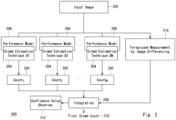
- a diagram 200 depicts a system for crowd estimation in accordance with an example.
- the system includes an input module 202 for receiving an image of the crowd 102.
- a plurality of crowd estimation technique calculators 204 receive the image of the crowd 102 from the input module 202 and estimate crowd counts 205 therefrom.
- An equal plurality of performance modeling modules 206 are coupled to each of the crowd estimation technique calculators 204 for modeling each of the plurality of crowd estimation techniques based on an accuracy thereof at different crowd levels and/or at different locations.
- a crowd estimation technique integration module 208 selects one or more of the plurality of crowd estimation techniques in response to the performance modeling thereof and an estimated crowd level and/or an estimated location. The crowd estimation technique integration module 208 then estimates the crowd count of the crowd in the received image in accordance with the selected one or more of the plurality of crowd estimation techniques and outputs a final crowd count 210.
- performance models of individual crowd estimation techniques are created at different crowd levels by using incoming image frames to generate the estimated crowd counts for the different crowd estimation techniques. Then, a crowd level estimation method determines which estimated crowd count to select or assign a high confidence value.
- the input module 202 can receive the image of the crowd and determine a region of interest within the image of the crowd.
- the crowd estimation technique integration module 208 estimates one or both of the crowd level of the crowd in the region of interest within the image of the crowd or the location of the crowd in the region of interest within the image of the crowd.
- the input module 202 receives the image of the crowd and divides the image into a plurality of sub-regions.
- the input module could divide the image of the crowd into the plurality of sub-regions in consideration of a view point of the camera 106 which has captured the image or in respect of other criteria.
- the crowd estimation technique integration module 208 selects one or more of the plurality of crowd estimation technique calculators 204 for each of the plurality of sub-regions in response to the performance modeling of the one or more of the plurality of crowd estimation techniques by the corresponding one of the plurality of performance modeling modules 206 and an estimated crowd level and/or an estimated location for the one of the plurality of sub-regions.
- the crowd estimation technique integration module 208 then estimates the crowd count of the crowd in each of the plurality of sub-regions in accordance with the selected one or more of the plurality of crowd estimation techniques for that one of the plurality of sub-regions. Finally, the crowd estimation technique integration module 208 combines the estimated crowd counts for each of the plurality of sub-regions to obtain the final crowd count 210 of the crowd in the received image.
- the plurality of performance modeling modules 206 could assign a real-time confidence value to each of the plurality of crowd estimation techniques in accordance with the performance modeling thereof.
- the system may then include a confidence value observer 212 coupled to the crowd estimation technique integration module 208 for removing one of the plurality of crowd estimation technique calculators 204 from selection when the real-time confidence value of the one of the plurality of crowd estimation techniques falls below a confidence value threshold.
- the crowd estimation technique integration module 208 could further select multiple ones of the plurality of crowd estimation technique calculators 204 and combine the crowd estimation results (crowd counts) 205 from the multiple crowd estimation technique calculators 204 to estimate the crowd count of the crowd in the received image.
- the crowd estimation technique integration module 208 can dynamically combine the crowd estimation results 205 from the multiple crowd estimation technique calculators 204 in accordance with the real-time confidence value thereof to estimate the final crowd count 210 of the crowd in the received image of the crowd 102.
- the crowd estimation results 205 can be combined in accordance with an inverted weighted sum approach or in accordance with a normalized weighted sum approach.
- a further enhancement of the system depicted in the diagram 200 could involve adding a foreground measurement module 214 coupled between the input module 202 and the crowd estimation technique integration module 208 to measure a crowd level in a foreground of the image of the crowd to provide an estimated crowd level for use by the crowd estimation technique integration module 208 when selecting the one or more of the plurality of crowd estimation technique calculators 204.
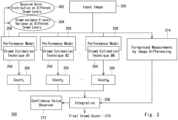
- a diagram 300 depicts a system for crowd level estimation in accordance with a second aspect of the present embodiment.
- the system depicted in the diagram 300 implements performance modeling of crowd estimation techniques by the performance modeling modules 206 for each of the one or more crowd estimation technique calculators 204 determining a plurality of performances of the corresponding crowd estimation technique calculator 204 at multiple crowd levels (e.g., HIGH crowd levels, LOW crowd levels) and modeling the performance of the crowd estimation technique calculator 204 in response to the plurality of performances of the crowd estimation technique calculator 204 at the multiple crowd levels.
- crowd levels e.g., HIGH crowd levels, LOW crowd levels
- This performance modeling operation of the performance modeling modules 206 is shown in a flowchart 400 of Fig. 4 .
- Each of the performance modeling modules 206 collect images at different crowd levels (Step 402) and categorize those images into low crowd images and high crowd images (Step 404).
- Each performance modeling module 206 then models the performance of the corresponding crowd estimation technique calculator 204 in response to the plurality of performances of the crowd estimation technique calculator 204 at the different crowd levels (Step 406).
- the performance modeling modules 206 can also determine a plurality of performances of the corresponding crowd estimation technique calculator 204 at locations of interest and model the performance of the crowd estimation technique calculator 204 in response to the plurality of performances of the crowd estimation technique calculator 204 at the locations of interest.
- a performance modeling module 206 may model the performance of a corresponding crowd estimation technique calculator 204 by determining an error distribution 302 of the plurality of performances of the crowd estimation technique, such as by determining an error of crowd counting for each of the plurality of performances and/or by determining a standard deviation of the error distribution for each of the plurality of performances of the crowd estimation technique, as an indicator of performance of the crowd estimation technique calculator 204.
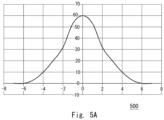
- graphs 500, 550 depict error distribution for crowd estimation in accordance with the second aspect of the present embodiment.
- the graph 500 depicts a graph of error distribution for crowd estimation of high crowd level crowds and the graph 550 depicts a graph of error distribution for crowd estimation of low crowd level crowds.
- Validation of an accuracy of the crowd estimation technique calculator 204 with image samples at different crowd levels is used by the performance modeling module 206 in accordance with the present embodiment to generate the error distribution 302 at the considered crowd levels, the error referring to the deviation in the crowd estimation from the actual number of people.
- the standard deviation ( ⁇ ) of the error distribution 302 indicates the suitability of the crowd estimation technique calculator 204.
- ⁇ is small.
- the error distribution indicates the crowd estimation technique calculator 204 has less error for low crowd levels as compared to high crowd levels (i.e., as shown in the distribution graph 500).
- the calculation of the standard deviation is shown in Equation (1) below.
- Equation (1) shows that if ⁇ low « ⁇ high, the particular crowd estimation technique calculator 204 being performance modeled by the corresponding performance modeling module 206 is suitable for low crowd level estimation.
- the performance modeling module 206 may alternatively model the performance of the corresponding crowd estimation technique calculator 204 by determining an accuracy metric for the plurality of performances of the crowd estimation technique, wherein the accuracy metric may include a F-score and wherein the performance modeling module 206 determines the accuracy metric for the plurality of performances of the corresponding crowd estimation technique calculator 204 by determining a variance of the F-score 304 for the plurality of performances of the crowd estimation technique.
- F-score is a measure of performance based on the number of humans not detected and other regions falsely detected as humans.
- the performance modeling module 206 may determine the variance of the F-score (F-score distribution) 304 with respect to a mean of F-scores for the multiple performances of the crowd estimation technique calculator 204 and then determine an indicator of performance of the crowd estimation technique calculator 204 in response to both the variance of the F-score for the multiple performances of the crowd estimation technique calculator 204 and the F-score distribution with respect to the mean of F-scores for the multiple performances of the crowd estimation technique calculator 204.
- F-score F-score distribution
- Fig. 6 depicts a graph 600 showing F-score variance at a first crowd level 602 and a second crowd level 604.
- the F-score for samples at different crowd levels is used to find the F-Score variance at these crowd levels.
- the variance V(Fcr) of F-scores at a particular crowd level can be calculated from Equation (2) below.
- a diagram 700 depicts an exemplary system for crowd level estimation in accordance with a third aspect of the present embodiment.
- a crowd level estimation module 702 provides an estimated crowd level to the crowd estimation technique integration module 208 for use in selecting a most appropriate one of the crowd estimation technique calculators 204.
- the crowd level estimation module 702 can estimate a crowd level of the crowd in the input image received by the input module 202 in response to a crowd density level. This could be accomplished by focusing on a region of interest within the image.
- the input module 202 could receive the input image of the crowd and determine the region of interest within the input image of the crowd. Then, the crowd level estimation module 702 could estimate the crowd level of the crowd within the region of interest of the input image in response to the crowd density level at that region of interest.
- the crowd level estimation module 702 may include a spatial pixel variation model building unit 704 for modeling spatial variations of each of a plurality of crowd levels in response to pixel density variations thereof to generate multiple models of crowd level spatial variations.
- the crowd level estimation module 702 can then estimate the crowd level for automatic crowd estimation technique switching 706 by determining a similarity of the input image of the crowd to each of the models of crowd level spatial variations built by the spatial pixel variation model building unit 704 and estimating the crowd level of the crowd in the input image in response to a most similar one of the models of crowd level spatial variations.
- the crowd level estimation module 702 can estimate the crowd level of the crowd in the input image in response to a probability density function of a similarity of the input image of the crowd and each of the plurality of models of crowd level spatial variations. More specifically, the crowd level estimation module estimates the crowd level of the crowd in the input image in response to a best fit model of the plurality of models of crowd level spatial variations as determined by the probability density function of the similarity of the input image of the crowd and each of the plurality of models of crowd level spatial variations.
- the spatial pixel variation model building unit 704 can generate the plurality of models of crowd level spatial variations in response to one or more of a grayscale crowd histogram or a red-green-blue (RGB) crowd histogram 708, a crowd local binary pattern 710 or a crowd texture 712.
- the automatic crowd estimation technique switching 706 of the crowd level estimation module 702 can switch crowd estimation techniques in response to an estimated discrete level of the crowd in the input image.
- crowd levels such as low crowd levels and high crowd levels are estimated to select or to assign higher confidence values to crowd estimation technique calculators 204 which perform better at the estimated crowd level.
- the crowd level estimation module 702 is accomplished by first spatial pixel variation model building by the spatial pixel variation model building unit 704 and then automatic crowd estimation technique switching 706.
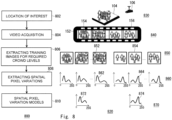
- a flow chart 800 and illustrations 820 depict the operation of the crowd level estimation module 702 where estimation is based on modeling spatial variations of crowd levels by the spatial pixel variation model building unit 704.
- the flowchart 800 depicts the spatial variation modeling process in accordance with the present embodiment.
- the camera 106 acquires images of the crowd 102 (Step 804).
- Training images of the crowd are extracted for required crowd levels (e.g., high crowd level or low crowd level) (Step 806).
- the spatial pixel variations are then extracted from the training images (Step 808) and spatial pixel variation models are developed for the required crowd levels (Step 810).
- each of the steps of the flowchart is shown pictorially.
- the camera 106 monitoring the location (location of interest) 104 is selected.
- the video (media 152) is recorded from the location of interest 104 covering different crowd levels ranging from high crowd levels in images 154 to low crowd levels in images 156.
- the illustrations 850 correspond to Step 806 in the flowchart 800 where training images 852 for high crowd levels and training images 854 for low crowd levels are extracted.
- training images (image frames) 852, 854 with different crowd levels covering a 'no person case' to 'a fully crowded case' are extracted from the video (video clip) 152 recorded at Step 804 in the flowchart 800.
- a histogram approach for extracting spatial pixel variation is provided as an example in the illustration 860.
- a grey scale histogram of an image is a frequency representation of the pixel intensities grouped at discrete pixel intensity levels called bins.
- Grey scale histograms 862, 864 of all the extracted image frames 852, 854 are recorded with 256 bins.
- the image-histogram pairs are grouped into high crowd level image frames 852 and histograms 862 and low crowd level images 854 and histograms 864 based on the number of humans in the images 852, 854.
- a bin-wise frequency averaging is performed considering all the image-histogram pairs.
- the averaging forms histogram models 872, 874 for each crowd level as pictured in the illustration 870.
- incoming image images (imageframes) 154, 156 are compared against these histogram models 872, 874 to estimate a crowd level for each image frame.
- a flow chart 900 and illustrations 920 depict the operation of the crowd level estimation module 702 where estimation is based on automatic crowd estimation technique switching by the automatic crowd estimation technique switching 706 ( Fig. 7 ).
- the flowchart 900 depicts the automatic crowd estimation technique switching process in accordance with the present embodiment.
- the camera 106 acquires a live stream video of images of the crowd 102 (Step 904).
- the spatial pixel variations are then extracted from the acquired images (Step 906) and crowd level estimation is performed by probability calculation based on similarity determination (Step 908). Processing then selects or integrates the appropriate crowd estimation technique calculator 204 (Step 910).
- the camera 106 initiates a live video stream of the location of interest 104.
- the automatic periodic capture of image frames of the crowd 942 is initiated for the location of interest 104.
- the user can define an appropriate time interval for image frame capture 944.
- An exemplary histogram approach for extracting spatial pixel variation 950 extracts a grey scale histogram 952 of an image as a frequency representation of the pixel intensities grouped at discrete pixel intensity levels.
- the histogram 952 is compared against all the histogram models 872, 874 generated in the illustration (model building stage) 870 ( Fig. 8 ).
- the histogram 952 is compared to the histogram model 872 at the illustration 962 and compared to the histogram model 874 at the illustration 964.
- the comparison is performed by calculating similarity scores between the histogram 952 of the incoming image frame and the histogram models 872, 874. Examples of the similarity calculation methods include the correlation method, the Bhattacharya distance method, the Chi-square method and the intersection method.
- the similarity calculation results in each similarity method acting as a classifier on whether the incoming image frame resembles a high crowd level (the illustration 962) or a low crowd level (the illustration 964).
- PDF Probability Density Function
- an incoming image frame 942 is classified to a particular crowd level based on the highest probability calculated at step 908.
- the crowd estimation technique calculator 204 with the lowest ⁇ or V ( Fcr ) with a high Fcr at the estimated crowd level is selected.
- the final count estimate (F count ) is calculated using Equation (5).
- Z ri is a re-weighted confidence value calculated by Equation (6).
- Z ri 1 ⁇ Z normi where Z normi is the normalized confidence value in the range [0,1] calculated using Equation (7).
- Z normi z i ⁇ min z max z ⁇ min z where, Z can either be a set of ⁇ or a set of V ( Fcr ) generated for all the crowd estimation technique calculators 204.
- Equation (8) shows mean averaging of the confidence values.
- a flowchart 1000 depicts a method for crowd level estimation in accordance with the present embodiment.
- each crowd estimation technique is applied to the image (Step 1004) and crowd counts are calculated for each of the crowd estimation techniques (Step 1006).
- spatial pixel variations are extracted from the received input image (Step 1008).
- the extracted spatial pixel variations are compared against spatial pixel models to find the highest similarity as described above (Step 1010).
- the crowd level is determined from the comparisons in Step1010 and confidence values are assigned (Step 1012).
- the counts calculated for each of the crowd estimation techniques in Step 1006 are then integrated with the crowd level/confidence values determined/assigned in Step 1012 (Step 1014) to estimate the final crowd count (Step 1016).
- Methods in accordance with the present embodiment can also be used to select the best performing crowd estimation technique.
- the incoming image frame is not processed by all crowd estimation techniques; only the selected techniques will process the incoming image frame.
- a flowchart 1100 depicts this selection process.
- the input image is received (Step 1102) and spatial pixel variations are extracted (Step 1104).
- the spatial pixel variations are compared against all spatial pixel models (Step 1106) to determine the crowd level and select the crowd estimation technique for that crowd level (Step 1108).
- the selected crowd estimation technique is applied (Step 1110) to estimate the final crowd count (Step 1112).
- the present embodiment provides methods and systems for real time robust and optimized crowd estimation.
- a current crowd level low crowd level, high crowd level
- other parameters tap these advantages to provide optimized real time crowd estimation with improved accuracy in a variety of crowd conditions and crowd locations.
- the functions of the system for crowd estimation depicted as the diagrams 200, 300, and 700 may be implemented, for example, by a processor included in a computer device operating in accordance with a program.
- Fig. 12 depicts a configuration example of the computer device according to the present embodiment.
- the computer device 110 includes a processor 120 and a memory 121.
- the memory 121 includes a volatile memory and/or a non-volatile memory.
- the memory 121 stores a software (computer program) to be executed on the processor 120 in, for example, the non-volatile memory.
- the processor 120 is, for example, a Central Processing Unit (CPU) or the like, and the control and the operations executed by the computer device 110 are achieved by, for example, the processor 120 operating in accordance with the computer program loaded from the memory 121.
- the processor 120 may load the computer program from an external memory of the computer device 110 and execute the loaded computer program instead of loading the computer program from the memory 121 in the computer device 110.
- Non-transitory computer readable media include any type of tangible storage media.
- Examples of non-transitory computer readable media include magnetic storage media (such as floppy disks, magnetic tapes, hard disk drives, etc.), optical magnetic storage media (e.g. magneto-optical disks), CD-ROM (compact disc read only memory), CD-R (compact disc recordable), CD-R/W (compact disc rewritable), and semiconductor memories (such as mask ROM, PROM (programmable ROM), EPROM (erasable PROM), flash ROM, RAM (random access memory), etc.).
- magnetic storage media such as floppy disks, magnetic tapes, hard disk drives, etc.
- optical magnetic storage media e.g. magneto-optical disks
- CD-ROM compact disc read only memory
- CD-R compact disc recordable
- CD-R/W compact disc rewritable
- semiconductor memories such as mask ROM, PROM (programmable ROM), EPROM (erasable PROM), flash ROM
- the program may be provided to a computer using any type of transitory computer readable media.
- Examples of transitory computer readable media include electric signals, optical signals, and electromagnetic waves.
- Transitory computer readable media can provide the program to a computer via a wired communication line (e.g. electric wires, and optical fibers) or a wireless communication line.
Landscapes
- Engineering & Computer Science (AREA)
- Physics & Mathematics (AREA)
- General Physics & Mathematics (AREA)
- Theoretical Computer Science (AREA)
- Computer Vision & Pattern Recognition (AREA)
- Evolutionary Biology (AREA)
- Life Sciences & Earth Sciences (AREA)
- Bioinformatics & Cheminformatics (AREA)
- Bioinformatics & Computational Biology (AREA)
- Probability & Statistics with Applications (AREA)
- Multimedia (AREA)
- Image Analysis (AREA)
- Image Processing (AREA)
Description
- The present disclosure generally relates to methods and systems for crowd estimation, and more particularly relates to methods and systems for utilizing multiple crowd estimation techniques which are integrated for automatic switching between the techniques.
- Many security systems observe areas where crowds form and it is necessary in many circumstances to estimate the size of the crowd for monitoring foot-traffic through the area or for providing services to the area to accommodate the crowd or for other reasons. There are numerous techniques that estimate crowd levels to discover the number of humans in the crowd. The techniques range from simple pixel level techniques such as background subtraction based blob counting to complex pattern recognition techniques such as body part detection and combined head pattern generation. Each technique has its own advantages and disadvantages.
- Document D1 :
JP 2018 022340 A (CANON KK) 8 February 2018 2018-02-08 - A single crowd estimation technique may not be suitable for all environmental and crowd conditions. For example, background subtraction techniques have inferior performance when there is an overlap of humans (i.e., an occlusion). Similarly, body part recognition is also affected in cases of occlusions at high crowd densities, thereby reducing the accuracy of the technique. However, combined head pattern techniques are observed to perform better at high crowd densities due to the underlying concept of learning combined head patterns, yet they tend to have lower accuracies at sparse crowd levels or low crowd densities.
- Thus, what is needed is a method and system for real-time crowd estimation which provides improved accuracy in a variety of crowd conditions and crowd locations. Furthermore, other desirable features and characteristics will become apparent from the subsequent detailed description and the appended claims, taken in conjunction with the accompanying drawings and this background of the disclosure.
- According to at least one embodiment of the present disclosure, a method for crowd level estimation is provided. The method is defined by
claim 1. - According to another embodiment of the present disclosure, a system for crowd level estimation is provided. The system is defined by claim 7.
- In accordance with a further embodiment of the present disclosure, a computer readable medium is provided. The computer readable medium is defined by
claim 8 . - The accompanying figures, where like reference numerals refer to identical or functionally similar elements throughout the separate views and which together with the detailed description below are incorporated in and form part of the specification, serve to illustrate various embodiments and to explain various principles and advantages in accordance with a present embodiment.
-
- [
Fig. 1A ]
Fig. 1A depicts illustrations of front end crowd level estimation in accordance with a present embodiment, whereinFig. 1A depicts a camera arranged to capture images of a crowd. - [
Fig. 1B ]
Fig. 1B depicts illustrations of front end crowd level estimation in accordance with a present embodiment, whereinFig. 1B depicts images of the crowd captured by the camera. - [
Fig. 2 ]
Fig. 2 depicts a diagram of a system for crowd level estimation in accordance with a first aspect of the present embodiment. - [
Fig. 3 ]
Fig. 3 depicts a diagram of a system for crowd level estimation in accordance with a second aspect of the present embodiment. - [
Fig. 4 ]
Fig. 4 depicts a flowchart of performance modelling in accordance with the second aspect of the present embodiment. - [
Fig. 5A ]
Fig. 5A depicts graphs of error distribution for crowd estimation in accordance with the second aspect of the present embodiment, whereinFig. 5A depicts a graph of error distribution for crowd estimation of high crowd level crowds. - [
Fig. 5B ]
Fig. 5B depicts graphs of error distribution for crowd estimation in accordance with the second aspect of the present embodiment, whereinFig. 5B depicts a graph of error distribution for crowd estimation of low crowd level crowds. - [
Fig. 6 ]
Fig. 6 depicts a graph of F-score variance for two crowd levels in accordance with the present embodiment. - [
Fig. 7 ]
Fig. 7 depicts a diagram of a system for crowd level estimation in accordance with a third aspect of the present embodiment. - [
Fig. 8 ]
Fig. 8 depicts a spatial pixel variation crowd estimation technique in accordance with the present embodiment. - [
Fig. 9 ]
Fig. 9 depicts automatic crowd estimation technique switching in accordance with the present embodiment. - [
Fig. 10 ]
Fig. 10 depicts a flowchart of a method for crowd level estimation in accordance with the present embodiment. - [
Fig. 11 ]
Fig. 11 depicts a flowchart for selecting the best performing crowd estimation technique in accordance with the present embodiment. - [
Fig. 12 ]
Fig. 12 depicts a configuration example of the computer device according to the present embodiment. - Skilled artisans will appreciate that elements in the figures are illustrated for simplicity and clarity and have not necessarily been depicted to scale.
- Referring to
Fig. 1A , anillustration 100 depicts acrowd 102 at alocation 104 and acamera 106 arranged to capture images of thecrowd 102 at thelocation 104.Fig. 1B depicts anillustration 150 ofmedia 152 capturingimages images 154 are images of a high crowd level and theimages 156 are images of a low crowd level. - Referring to
Fig. 2 , a diagram 200 depicts a system for crowd estimation in accordance with an example. The system includes aninput module 202 for receiving an image of thecrowd 102. In accordance with the example a plurality of crowdestimation technique calculators 204 receive the image of thecrowd 102 from theinput module 202 and estimate crowd counts 205 therefrom. An equal plurality ofperformance modeling modules 206 are coupled to each of the crowdestimation technique calculators 204 for modeling each of the plurality of crowd estimation techniques based on an accuracy thereof at different crowd levels and/or at different locations. - A crowd estimation
technique integration module 208 selects one or more of the plurality of crowd estimation techniques in response to the performance modeling thereof and an estimated crowd level and/or an estimated location. The crowd estimationtechnique integration module 208 then estimates the crowd count of the crowd in the received image in accordance with the selected one or more of the plurality of crowd estimation techniques and outputs afinal crowd count 210. - Accordingly, performance models of individual crowd estimation techniques are created at different crowd levels by using incoming image frames to generate the estimated crowd counts for the different crowd estimation techniques. Then, a crowd level estimation method determines which estimated crowd count to select or assign a high confidence value. In accordance with one example the
input module 202 can receive the image of the crowd and determine a region of interest within the image of the crowd. The crowd estimationtechnique integration module 208 then estimates one or both of the crowd level of the crowd in the region of interest within the image of the crowd or the location of the crowd in the region of interest within the image of the crowd. - In the invention, the
input module 202 receives the image of the crowd and divides the image into a plurality of sub-regions. The input module could divide the image of the crowd into the plurality of sub-regions in consideration of a view point of thecamera 106 which has captured the image or in respect of other criteria. The crowd estimationtechnique integration module 208 then selects one or more of the plurality of crowdestimation technique calculators 204 for each of the plurality of sub-regions in response to the performance modeling of the one or more of the plurality of crowd estimation techniques by the corresponding one of the plurality ofperformance modeling modules 206 and an estimated crowd level and/or an estimated location for the one of the plurality of sub-regions. The crowd estimationtechnique integration module 208 then estimates the crowd count of the crowd in each of the plurality of sub-regions in accordance with the selected one or more of the plurality of crowd estimation techniques for that one of the plurality of sub-regions. Finally, the crowd estimationtechnique integration module 208 combines the estimated crowd counts for each of the plurality of sub-regions to obtain thefinal crowd count 210 of the crowd in the received image. - In accordance with the invention the plurality of
performance modeling modules 206 could assign a real-time confidence value to each of the plurality of crowd estimation techniques in accordance with the performance modeling thereof. The system may then include aconfidence value observer 212 coupled to the crowd estimationtechnique integration module 208 for removing one of the plurality of crowdestimation technique calculators 204 from selection when the real-time confidence value of the one of the plurality of crowd estimation techniques falls below a confidence value threshold. - The crowd estimation
technique integration module 208 could further select multiple ones of the plurality of crowdestimation technique calculators 204 and combine the crowd estimation results (crowd counts) 205 from the multiple crowdestimation technique calculators 204 to estimate the crowd count of the crowd in the received image. In accordance with the present embodiment, the crowd estimationtechnique integration module 208 can dynamically combine the crowd estimation results 205 from the multiple crowdestimation technique calculators 204 in accordance with the real-time confidence value thereof to estimate thefinal crowd count 210 of the crowd in the received image of thecrowd 102. The crowd estimation results 205 can be combined in accordance with an inverted weighted sum approach or in accordance with a normalized weighted sum approach. - A further enhancement of the system depicted in the diagram 200 could involve adding a
foreground measurement module 214 coupled between theinput module 202 and the crowd estimationtechnique integration module 208 to measure a crowd level in a foreground of the image of the crowd to provide an estimated crowd level for use by the crowd estimationtechnique integration module 208 when selecting the one or more of the plurality of crowdestimation technique calculators 204. - Referring to
Fig. 3 , a diagram 300 depicts a system for crowd level estimation in accordance with a second aspect of the present embodiment. The system depicted in the diagram 300 implements performance modeling of crowd estimation techniques by theperformance modeling modules 206 for each of the one or more crowdestimation technique calculators 204 determining a plurality of performances of the corresponding crowdestimation technique calculator 204 at multiple crowd levels (e.g., HIGH crowd levels, LOW crowd levels) and modeling the performance of the crowdestimation technique calculator 204 in response to the plurality of performances of the crowdestimation technique calculator 204 at the multiple crowd levels. - This performance modeling operation of the
performance modeling modules 206 is shown in aflowchart 400 ofFig. 4 . Each of theperformance modeling modules 206 collect images at different crowd levels (Step 402) and categorize those images into low crowd images and high crowd images (Step 404). Eachperformance modeling module 206 then models the performance of the corresponding crowdestimation technique calculator 204 in response to the plurality of performances of the crowdestimation technique calculator 204 at the different crowd levels (Step 406). - Referring back to
Fig. 3 , theperformance modeling modules 206 can also determine a plurality of performances of the corresponding crowdestimation technique calculator 204 at locations of interest and model the performance of the crowdestimation technique calculator 204 in response to the plurality of performances of the crowdestimation technique calculator 204 at the locations of interest. - In accordance with the present embodiment, a
performance modeling module 206 may model the performance of a corresponding crowdestimation technique calculator 204 by determining anerror distribution 302 of the plurality of performances of the crowd estimation technique, such as by determining an error of crowd counting for each of the plurality of performances and/or by determining a standard deviation of the error distribution for each of the plurality of performances of the crowd estimation technique, as an indicator of performance of the crowdestimation technique calculator 204. - Referring to
Figs. 5A and5B ,graphs graph 500 depicts a graph of error distribution for crowd estimation of high crowd level crowds and thegraph 550 depicts a graph of error distribution for crowd estimation of low crowd level crowds. Validation of an accuracy of the crowdestimation technique calculator 204 with image samples at different crowd levels is used by theperformance modeling module 206 in accordance with the present embodiment to generate theerror distribution 302 at the considered crowd levels, the error referring to the deviation in the crowd estimation from the actual number of people. - The standard deviation (σ) of the
error distribution 302 indicates the suitability of the crowdestimation technique calculator 204. When the count estimate error is less, σ is small. For low crowd level σ as shown in thegraph 550, the error distribution indicates the crowdestimation technique calculator 204 has less error for low crowd levels as compared to high crowd levels (i.e., as shown in the distribution graph 500). The calculation of the standard deviation is shown in Equation (1) below.
estimation technique calculator 204 being performance modeled by the correspondingperformance modeling module 206 is suitable for low crowd level estimation. - Referring back to
Fig. 3 , theperformance modeling module 206 may alternatively model the performance of the corresponding crowdestimation technique calculator 204 by determining an accuracy metric for the plurality of performances of the crowd estimation technique, wherein the accuracy metric may include a F-score and wherein theperformance modeling module 206 determines the accuracy metric for the plurality of performances of the corresponding crowdestimation technique calculator 204 by determining a variance of the F-score 304 for the plurality of performances of the crowd estimation technique. F-score is a measure of performance based on the number of humans not detected and other regions falsely detected as humans. Theperformance modeling module 206 may determine the variance of the F-score (F-score distribution) 304 with respect to a mean of F-scores for the multiple performances of the crowdestimation technique calculator 204 and then determine an indicator of performance of the crowdestimation technique calculator 204 in response to both the variance of the F-score for the multiple performances of the crowdestimation technique calculator 204 and the F-score distribution with respect to the mean of F-scores for the multiple performances of the crowdestimation technique calculator 204. -
Fig. 6 depicts agraph 600 showing F-score variance at afirst crowd level 602 and asecond crowd level 604. The F-score for samples at different crowd levels is used to find the F-Score variance at these crowd levels. The variance V(Fcr) of F-scores at a particular crowd level can be calculated from Equation (2) below.

estimation technique calculator 204 being performance modeled by the correspondingperformance modeling module 206 is suitable for low crowd level estimation. - Referring to
Fig. 7 , a diagram 700 depicts an exemplary system for crowd level estimation in accordance with a third aspect of the present embodiment. In accordance with this third aspect, a crowdlevel estimation module 702 provides an estimated crowd level to the crowd estimationtechnique integration module 208 for use in selecting a most appropriate one of the crowdestimation technique calculators 204. The crowdlevel estimation module 702 can estimate a crowd level of the crowd in the input image received by theinput module 202 in response to a crowd density level. This could be accomplished by focusing on a region of interest within the image. Theinput module 202 could receive the input image of the crowd and determine the region of interest within the input image of the crowd. Then, the crowdlevel estimation module 702 could estimate the crowd level of the crowd within the region of interest of the input image in response to the crowd density level at that region of interest. - The crowd
level estimation module 702 may include a spatial pixel variationmodel building unit 704 for modeling spatial variations of each of a plurality of crowd levels in response to pixel density variations thereof to generate multiple models of crowd level spatial variations. The crowdlevel estimation module 702 can then estimate the crowd level for automatic crowd estimation technique switching 706 by determining a similarity of the input image of the crowd to each of the models of crowd level spatial variations built by the spatial pixel variationmodel building unit 704 and estimating the crowd level of the crowd in the input image in response to a most similar one of the models of crowd level spatial variations. - In regards to determining the most similar one of the models of crowd level spatial variations, the crowd
level estimation module 702 can estimate the crowd level of the crowd in the input image in response to a probability density function of a similarity of the input image of the crowd and each of the plurality of models of crowd level spatial variations. More specifically, the crowd level estimation module estimates the crowd level of the crowd in the input image in response to a best fit model of the plurality of models of crowd level spatial variations as determined by the probability density function of the similarity of the input image of the crowd and each of the plurality of models of crowd level spatial variations. - The spatial pixel variation
model building unit 704 can generate the plurality of models of crowd level spatial variations in response to one or more of a grayscale crowd histogram or a red-green-blue (RGB)crowd histogram 708, a crowd localbinary pattern 710 or acrowd texture 712. The automatic crowd estimation technique switching 706 of the crowdlevel estimation module 702 can switch crowd estimation techniques in response to an estimated discrete level of the crowd in the input image. - Thus, crowd levels such as low crowd levels and high crowd levels are estimated to select or to assign higher confidence values to crowd
estimation technique calculators 204 which perform better at the estimated crowd level. The crowdlevel estimation module 702 is accomplished by first spatial pixel variation model building by the spatial pixel variationmodel building unit 704 and then automatic crowd estimation technique switching 706. - Referring to
Fig. 8 , aflow chart 800 andillustrations 820 depict the operation of the crowdlevel estimation module 702 where estimation is based on modeling spatial variations of crowd levels by the spatial pixel variationmodel building unit 704. Theflowchart 800 depicts the spatial variation modeling process in accordance with the present embodiment. At a location of interest (Step 802), thecamera 106 acquires images of the crowd 102 (Step 804). Training images of the crowd are extracted for required crowd levels (e.g., high crowd level or low crowd level) (Step 806). The spatial pixel variations are then extracted from the training images (Step 808) and spatial pixel variation models are developed for the required crowd levels (Step 810). - Turning to the
illustrations 820, each of the steps of the flowchart is shown pictorially. At anillustration 830, thecamera 106 monitoring the location (location of interest) 104 is selected. In anillustration 840, the video (media 152) is recorded from the location ofinterest 104 covering different crowd levels ranging from high crowd levels inimages 154 to low crowd levels inimages 156. - The
illustrations 850 correspond to Step 806 in theflowchart 800 wheretraining images 852 for high crowd levels andtraining images 854 for low crowd levels are extracted. In this manner, training images (image frames) 852, 854 with different crowd levels covering a 'no person case' to 'a fully crowded case' are extracted from the video (video clip) 152 recorded atStep 804 in theflowchart 800. - At the
next Step 808, spatial pixel variations are extracted. A histogram approach for extracting spatial pixel variation is provided as an example in theillustration 860. A grey scale histogram of an image is a frequency representation of the pixel intensities grouped at discrete pixel intensity levels called bins.Grey scale histograms histograms 862 and lowcrowd level images 854 andhistograms 864 based on the number of humans in theimages - At each crowd level, a bin-wise frequency averaging is performed considering all the image-histogram pairs. The averaging forms
histogram models illustration 870. In operation, incoming image images (imageframes) 154, 156 are compared against thesehistogram models - Referring to
Fig. 9 , aflow chart 900 andillustrations 920 depict the operation of the crowdlevel estimation module 702 where estimation is based on automatic crowd estimation technique switching by the automatic crowd estimation technique switching 706 (Fig. 7 ). Theflowchart 900 depicts the automatic crowd estimation technique switching process in accordance with the present embodiment. At a location of interest (Step 902), thecamera 106 acquires a live stream video of images of the crowd 102 (Step 904). The spatial pixel variations are then extracted from the acquired images (Step 906) and crowd level estimation is performed by probability calculation based on similarity determination (Step 908). Processing then selects or integrates the appropriate crowd estimation technique calculator 204 (Step 910). - Turning to the
illustrations 920, each of the steps of the flowchart are shown pictorially. At anillustration 930, thecamera 106 initiates a live video stream of the location ofinterest 104. In anillustration 940, the automatic periodic capture of image frames of thecrowd 942 is initiated for the location ofinterest 104. The user can define an appropriate time interval forimage frame capture 944. - At the
next Step 906, spatial pixel variations are extracted. An exemplary histogram approach for extractingspatial pixel variation 950 extracts agrey scale histogram 952 of an image as a frequency representation of the pixel intensities grouped at discrete pixel intensity levels. - At the
next Step 908, thehistogram 952 is compared against all thehistogram models Fig. 8 ). Thehistogram 952 is compared to thehistogram model 872 at theillustration 962 and compared to thehistogram model 874 at theillustration 964. The comparison is performed by calculating similarity scores between thehistogram 952 of the incoming image frame and thehistogram models - For example, using four different pixel variation modeling methods with each method outputs
histogram model incoming image frame 942 by four different similarity calculations would result in sixteen classifications. A Probability Density Function (PDF) can be constructed based on these sixteen classifications as shown in Equations (3) and (4).

- At
Step 910, anincoming image frame 942 is classified to a particular crowd level based on the highest probability calculated atstep 908. For crowd estimation technique selection atStep 910, the crowdestimation technique calculator 204 with the lowest σ or V(Fcr) with a high Fcr at the estimated crowd level is selected. - For crowd estimation technique integration at
Step 910, the final count estimate (Fcount) is calculated using Equation (5).


estimation technique calculators 204. For example, where results from a first crowd estimation technique calculator 204 (e.g., a combined head pattern estimation technique) and a second crowd estimation technique calculator 204 (e.g., an individual head pattern estimation technique) can be represented as Count1 and Count2, Equation (8) shows mean averaging of the confidence values.
- Referring to
Fig. 10 , aflowchart 1000 depicts a method for crowd level estimation in accordance with the present embodiment. When an input image of a crowd is received (Step 1002), each crowd estimation technique is applied to the image (Step 1004) and crowd counts are calculated for each of the crowd estimation techniques (Step 1006). At the same time, spatial pixel variations are extracted from the received input image (Step 1008). The extracted spatial pixel variations are compared against spatial pixel models to find the highest similarity as described above (Step 1010). The crowd level is determined from the comparisons in Step1010 and confidence values are assigned (Step 1012). The counts calculated for each of the crowd estimation techniques inStep 1006 are then integrated with the crowd level/confidence values determined/assigned in Step 1012 (Step 1014) to estimate the final crowd count (Step 1016). - Methods in accordance with the present embodiment can also be used to select the best performing crowd estimation technique. In this case, the incoming image frame is not processed by all crowd estimation techniques; only the selected techniques will process the incoming image frame. Referring to
Fig. 11 , aflowchart 1100 depicts this selection process. The input image is received (Step 1102) and spatial pixel variations are extracted (Step 1104). The spatial pixel variations are compared against all spatial pixel models (Step 1106) to determine the crowd level and select the crowd estimation technique for that crowd level (Step 1108). The selected crowd estimation technique is applied (Step 1110) to estimate the final crowd count (Step 1112). - Thus, it can be seen that the present embodiment provides methods and systems for real time robust and optimized crowd estimation. When analyzed closely, it is possible to identify and/or model multiple techniques which can complement each other. In accordance with present embodiments, methods and systems to automatically switch between these crowd estimation techniques depending on a current crowd level (low crowd level, high crowd level) and other parameters tap these advantages to provide optimized real time crowd estimation with improved accuracy in a variety of crowd conditions and crowd locations.
- In the aforementioned embodiment, the functions of the system for crowd estimation depicted as the diagrams 200, 300, and 700 may be implemented, for example, by a processor included in a computer device operating in accordance with a program.
Fig. 12 depicts a configuration example of the computer device according to the present embodiment. Thecomputer device 110 includes aprocessor 120 and amemory 121. Thememory 121 includes a volatile memory and/or a non-volatile memory. Thememory 121 stores a software (computer program) to be executed on theprocessor 120 in, for example, the non-volatile memory. Theprocessor 120 is, for example, a Central Processing Unit (CPU) or the like, and the control and the operations executed by thecomputer device 110 are achieved by, for example, theprocessor 120 operating in accordance with the computer program loaded from thememory 121. Theprocessor 120 may load the computer program from an external memory of thecomputer device 110 and execute the loaded computer program instead of loading the computer program from thememory 121 in thecomputer device 110. - The above computer program can be stored and provided to the computer device using any type of non-transitory computer readable media. Non-transitory computer readable media include any type of tangible storage media. Examples of non-transitory computer readable media include magnetic storage media (such as floppy disks, magnetic tapes, hard disk drives, etc.), optical magnetic storage media (e.g. magneto-optical disks), CD-ROM (compact disc read only memory), CD-R (compact disc recordable), CD-R/W (compact disc rewritable), and semiconductor memories (such as mask ROM, PROM (programmable ROM), EPROM (erasable PROM), flash ROM, RAM (random access memory), etc.). The program may be provided to a computer using any type of transitory computer readable media. Examples of transitory computer readable media include electric signals, optical signals, and electromagnetic waves. Transitory computer readable media can provide the program to a computer via a wired communication line (e.g. electric wires, and optical fibers) or a wireless communication line.
- This application is based upon and claims the benefit of priority from
Singapore patent application No. 10201802673V, filed on March 29, 2018 -
- 200
- System
- 202
- Input module
- 204
- Crowd estimation technique calculator
- 206
- Performance modeling module
- 208
- Crowd estimation technique integration module
Claims (8)
- A method for estimating a crowd count of a crowd comprising:modeling performance of each of a plurality of crowd estimation techniques at different crowd levels and/or at different locations, by determining at least one of an error of crowd counting and a standard deviation of an error distribution of crowd counting, the plurality of crowd estimation techniques being techniques for estimating a crowd density of the crowd and discovering the number of humans in the crowd;receiving an image of the crowd;dividing the image of the crowd into a plurality of sub-regions,selecting one or more of the plurality of crowd estimation techniques in response to the performance modeling of the one or more of the plurality of crowd estimation techniques and an estimated crowd level and/or an estimated location,wherein selecting one or more of the plurality of crowd estimation techniques comprises selecting one or more of the plurality of crowd estimation techniques for each of the plurality of sub-regions in response to the performance modeling of the one or more of the plurality of crowd estimation techniques and an estimated crowd level and/or an estimated location for the one of the plurality of sub-regions; andestimating a crowd count of the crowd in the received image in accordance with the selected one or more of the plurality of crowd estimation techniques,wherein estimating the crowd count of the crowd in the received image comprises:estimating the crowd count of the crowd in each of the plurality of sub-regions in accordance with the selected one or more of the plurality of crowd estimation techniques for that one of the plurality of sub-regions; andcombining the estimated crowd counts for each of the plurality of sub-regions to obtain the estimated crowd count of the crowd in the received image.
- The method according to Claim 1 further comprising assigning a real-time confidence value to each of the plurality of crowd estimation techniques in accordance with the performance modeling thereof.
- The method according to Claim 2 further comprising removing one of the plurality of crowd estimation techniques from selection during the selection step when the real-time confidence value of the one of the plurality of crowd estimation techniques falls below a confidence value threshold.
- The method according to Claim 1 wherein the selected one or more of the plurality of crowd estimation techniques comprises multiple ones of the plurality of crowd estimation techniques, and
wherein estimating the crowd count comprises combining crowd count estimation results from the multiple ones of the plurality of crowd estimation techniques to estimate the crowd count of the crowd in the received image. - The method according to Claim 4,further comprising assigning a real-time confidence value to each of the plurality of crowd estimation techniques in accordance with the performance modeling thereof,wherein combining the crowd count estimation results comprises combining the crowd count estimation results from the multiple ones of the plurality of crowd estimation techniques in accordance with the real-time confidence value of the multiple ones of the plurality of crowd estimation techniques to estimate the crowd count of the crowd in the received image, andwherein combining the crowd count estimation results comprises combining the crowd count estimation results from the multiple ones of the plurality of crowd estimation techniques in accordance with an inverted weighted sum approach or a normalized weighted sum approach.
- The method according to any one of Claims 1 to 5 further comprising measuring a crowd density in a foreground of the image of the crowd to provide the estimated crowd level utilized in the selecting step.
- A system for estimating a crowd count of a crowd comprising:a plurality of performance modeling modules for modeling performance of each of a plurality of crowd estimation techniques at different crowd levels and/or at different locations, by determining at least one of an error of crowd counting and a standard deviation of an error distribution of crowd counting, the plurality of crowd estimation techniques being techniques for estimating a crowd density of the crowd and discovering the number of humans in the crowd;an input module for receiving an image of the crowd and dividing the image of the crowd into a plurality of sub-regions;a crowd estimation technique integration module for selecting one or more of the plurality of crowd estimation techniques in response to the performance modeling of the one or more of the plurality of crowd estimation techniques and an estimated crowd level and/or an estimated location and estimating a crowd count of the crowd in the received image in accordance with the selected one or more of the plurality of crowd estimation techniques,wherein the crowd estimation technique integration module is configured to:select one or more of the plurality of crowd estimation techniques for each of the plurality of sub-regions in response to the performance modeling of the one or more of the plurality of crowd estimation techniques and an estimated crowd level and/or an estimated location for the one of the plurality of sub-regions,estimate the crowd count of the crowd in each of the plurality of sub-regions in accordance with the selected one or more of the plurality of crowd estimation techniques for that one of the plurality of sub-regions, andcombine the estimated crowd counts for each of the plurality of sub-regions to obtain the estimated crowd count of the crowd in the received image.
- A program for causing a computer to perform the method according to claim 1.
Applications Claiming Priority (2)
| Application Number | Priority Date | Filing Date | Title |
|---|---|---|---|
| SG10201802673V SG10201802673VA (en) | 2018-03-29 | 2018-03-29 | Method and system for integration and automatic switching of crowd estimation techniques |
| PCT/JP2019/008724 WO2019188053A1 (en) | 2018-03-29 | 2019-02-27 | Method, system and computer readable medium for integration and automatic switching of crowd estimation techniques |
Publications (3)
| Publication Number | Publication Date |
|---|---|
| EP3776464A1 EP3776464A1 (en) | 2021-02-17 |
| EP3776464A4 EP3776464A4 (en) | 2021-04-28 |
| EP3776464B1 true EP3776464B1 (en) | 2025-06-11 |
Family
ID=68060064
Family Applications (1)
| Application Number | Title | Priority Date | Filing Date |
|---|---|---|---|
| EP19775258.7A Active EP3776464B1 (en) | 2018-03-29 | 2019-02-27 | Method, system and computer readable medium for integration and automatic switching of crowd estimation techniques |
Country Status (6)
| Country | Link |
|---|---|
| US (1) | US11651493B2 (en) |
| EP (1) | EP3776464B1 (en) |
| JP (1) | JP7040634B2 (en) |
| CN (1) | CN111937003A (en) |
| SG (1) | SG10201802673VA (en) |
| WO (1) | WO2019188053A1 (en) |
Families Citing this family (6)
| Publication number | Priority date | Publication date | Assignee | Title |
|---|---|---|---|---|
| SG10201802668QA (en) * | 2018-03-29 | 2019-10-30 | Nec Asia Pacific Pte Ltd | Method and system for crowd level estimation |
| CN111783589B (en) * | 2020-06-23 | 2022-03-15 | 西北工业大学 | A crowd counting method for complex scenes based on scene classification and multi-scale feature fusion |
| US20220067862A1 (en) * | 2020-08-28 | 2022-03-03 | Here Global B.V. | Method, apparatus, and computer program product for dynamic population estimation |
| US11670089B2 (en) * | 2021-06-03 | 2023-06-06 | Not A Satellite Labs, LLC | Image modifications for crowdsourced surveillance |
| CN113536996B (en) * | 2021-06-30 | 2022-04-15 | 大连海事大学 | Crowd motion simulation method based on large amount of real crowd motion videos |
| JP7797447B2 (en) * | 2023-08-03 | 2026-01-13 | 株式会社東芝 | Target number estimation system, target number estimation method, and program |
Family Cites Families (20)
| Publication number | Priority date | Publication date | Assignee | Title |
|---|---|---|---|---|
| US20150297949A1 (en) * | 2007-06-12 | 2015-10-22 | Intheplay, Inc. | Automatic sports broadcasting system |
| JP2005025328A (en) * | 2003-06-30 | 2005-01-27 | Ntt Data Corp | Congestion monitoring system and congestion monitoring program |
| US8116564B2 (en) * | 2006-11-22 | 2012-02-14 | Regents Of The University Of Minnesota | Crowd counting and monitoring |
| EP2093698A1 (en) * | 2008-02-19 | 2009-08-26 | British Telecommunications Public Limited Company | Crowd congestion analysis |
| US9183512B2 (en) | 2011-12-15 | 2015-11-10 | Northeastern University | Real-time anomaly detection of crowd behavior using multi-sensor information |
| JP2014006586A (en) | 2012-06-21 | 2014-01-16 | Canon Inc | Information processor, and control method and computer program thereof |
| US9165190B2 (en) * | 2012-09-12 | 2015-10-20 | Avigilon Fortress Corporation | 3D human pose and shape modeling |
| CN105593901B (en) * | 2013-06-28 | 2020-06-12 | 日本电气株式会社 | Training data generation device, method, and program, and crowd state recognition device, method, and program |
| WO2015068854A1 (en) * | 2013-11-11 | 2015-05-14 | 日本電気株式会社 | Avoidance-behavior detection device, avoidance-reason processing device, and methods for same |
| CN110460821A (en) * | 2014-06-30 | 2019-11-15 | 日本电气株式会社 | Guide processing unit and bootstrap technique |
| US10133937B2 (en) * | 2014-12-24 | 2018-11-20 | Hitachi Kokusai Electric Inc. | Crowd monitoring system |
| US10325160B2 (en) * | 2015-01-14 | 2019-06-18 | Nec Corporation | Movement state estimation device, movement state estimation method and program recording medium |
| US10380431B2 (en) * | 2015-06-01 | 2019-08-13 | Placemeter LLC | Systems and methods for processing video streams |
| KR102453858B1 (en) * | 2015-12-23 | 2022-10-14 | 한화테크윈 주식회사 | Apparatus and method for image processing |
| US10789484B2 (en) * | 2016-03-07 | 2020-09-29 | Nec Corporation | Crowd type classification system, crowd type classification method and storage medium for storing crowd type classification program |
| JP6779699B2 (en) * | 2016-08-03 | 2020-11-04 | キヤノン株式会社 | Image processing equipment, information processing methods and programs |
| US10769855B2 (en) * | 2017-07-21 | 2020-09-08 | Accenture Global Solutions Limited | Personnel movement simulation and control |
| SG10201802670TA (en) * | 2018-03-29 | 2019-10-30 | Nec Asia Pacific Pte Ltd | Method and system for performance modeling of crowd estimation techniques |
| SG10201802668QA (en) * | 2018-03-29 | 2019-10-30 | Nec Asia Pacific Pte Ltd | Method and system for crowd level estimation |
| US11417106B1 (en) * | 2022-02-04 | 2022-08-16 | King Abdulaziz University | Crowd evacuation system based on real time perception, simulation, and warning |
-
2018
- 2018-03-29 SG SG10201802673V patent/SG10201802673VA/en unknown
-
2019
- 2019-02-27 US US16/980,726 patent/US11651493B2/en active Active
- 2019-02-27 WO PCT/JP2019/008724 patent/WO2019188053A1/en not_active Ceased
- 2019-02-27 EP EP19775258.7A patent/EP3776464B1/en active Active
- 2019-02-27 JP JP2020551447A patent/JP7040634B2/en active Active
- 2019-02-27 CN CN201980021975.3A patent/CN111937003A/en active Pending
Also Published As
| Publication number | Publication date |
|---|---|
| EP3776464A4 (en) | 2021-04-28 |
| EP3776464A1 (en) | 2021-02-17 |
| US20210012506A1 (en) | 2021-01-14 |
| WO2019188053A1 (en) | 2019-10-03 |
| JP7040634B2 (en) | 2022-03-23 |
| CN111937003A (en) | 2020-11-13 |
| SG10201802673VA (en) | 2019-10-30 |
| US11651493B2 (en) | 2023-05-16 |
| JP2021516825A (en) | 2021-07-08 |
Similar Documents
| Publication | Publication Date | Title |
|---|---|---|
| US11893798B2 (en) | Method, system and computer readable medium of deriving crowd information | |
| US11651493B2 (en) | Method, system and computer readable medium for integration and automatic switching of crowd estimation techniques | |
| US12002259B2 (en) | Image processing apparatus, training apparatus, image processing method, training method, and storage medium | |
| EP3333768B1 (en) | Method and apparatus for detecting target | |
| Pless et al. | Evaluation of local models of dynamic backgrounds | |
| US9619708B2 (en) | Method of detecting a main subject in an image | |
| JP6032921B2 (en) | Object detection apparatus and method, and program | |
| JP6494253B2 (en) | Object detection apparatus, object detection method, image recognition apparatus, and computer program | |
| EP2919162A1 (en) | Image processing apparatus and image processing method | |
| KR20180065889A (en) | Method and apparatus for detecting target | |
| US20210027202A1 (en) | Method, system, and computer readable medium for performance modeling of crowd estimation techniques | |
| KR100957716B1 (en) | Skin color area detection method using variable skin color model | |
| KR20140028809A (en) | Adaptive image processing apparatus and method in image pyramid | |
| Cuevas et al. | Efficient moving object detection for lightweight applications on smart cameras | |
| US20080175447A1 (en) | Face view determining apparatus and method, and face detection apparatus and method employing the same | |
| CN103475800A (en) | Method and device for detecting foreground in image sequence | |
| CN111967314A (en) | Pedestrian re-identification method and device, electronic equipment and storage medium | |
| JP2014021602A (en) | Image processor and image processing method | |
| JP2016224821A (en) | Learning device, control method of learning device, and program | |
| CN111079797B (en) | Image classification method and device and storage medium | |
| Pece | From cluster tracking to people counting | |
| KR101690050B1 (en) | Intelligent video security system | |
| JP5389723B2 (en) | Object detection device and learning device thereof | |
| JP5002575B2 (en) | Unsteady degree estimation device, unsteady degree estimation method, unsteady degree estimation program | |
| KR20180089976A (en) | Multiple object tracking system and method using object detection area |
Legal Events
| Date | Code | Title | Description |
|---|---|---|---|
| STAA | Information on the status of an ep patent application or granted ep patent |
Free format text: STATUS: THE INTERNATIONAL PUBLICATION HAS BEEN MADE |
|
| PUAI | Public reference made under article 153(3) epc to a published international application that has entered the european phase |
Free format text: ORIGINAL CODE: 0009012 |
|
| STAA | Information on the status of an ep patent application or granted ep patent |
Free format text: STATUS: REQUEST FOR EXAMINATION WAS MADE |
|
| 17P | Request for examination filed |
Effective date: 20201029 |
|
| AK | Designated contracting states |
Kind code of ref document: A1 Designated state(s): AL AT BE BG CH CY CZ DE DK EE ES FI FR GB GR HR HU IE IS IT LI LT LU LV MC MK MT NL NO PL PT RO RS SE SI SK SM TR |
|
| AX | Request for extension of the european patent |
Extension state: BA ME |
|
| REG | Reference to a national code |
Ref country code: DE Ref legal event code: R079 Free format text: PREVIOUS MAIN CLASS: G06T0007000000 Ref document number: 602019071054 Country of ref document: DE Ipc: G06K0009000000 |
|
| A4 | Supplementary search report drawn up and despatched |
Effective date: 20210330 |
|
| RIC1 | Information provided on ipc code assigned before grant |
Ipc: G06K 9/00 20060101AFI20210324BHEP |
|
| DAV | Request for validation of the european patent (deleted) | ||
| DAX | Request for extension of the european patent (deleted) | ||
| STAA | Information on the status of an ep patent application or granted ep patent |
Free format text: STATUS: EXAMINATION IS IN PROGRESS |
|
| 17Q | First examination report despatched |
Effective date: 20230609 |
|
| REG | Reference to a national code |
Ref country code: DE Ref legal event code: R079 Free format text: PREVIOUS MAIN CLASS: G06K0009000000 Ipc: G06V0020520000 Ref country code: DE Ref legal event code: R079 Ref document number: 602019071054 Country of ref document: DE Free format text: PREVIOUS MAIN CLASS: G06K0009000000 Ipc: G06V0020520000 |
|
| GRAP | Despatch of communication of intention to grant a patent |
Free format text: ORIGINAL CODE: EPIDOSNIGR1 |
|
| STAA | Information on the status of an ep patent application or granted ep patent |
Free format text: STATUS: GRANT OF PATENT IS INTENDED |
|
| INTG | Intention to grant announced |
Effective date: 20250408 |
|
| RIC1 | Information provided on ipc code assigned before grant |
Ipc: G06V 20/52 20220101AFI20250331BHEP |
|
| GRAS | Grant fee paid |
Free format text: ORIGINAL CODE: EPIDOSNIGR3 |
|
| GRAA | (expected) grant |
Free format text: ORIGINAL CODE: 0009210 |
|
| STAA | Information on the status of an ep patent application or granted ep patent |
Free format text: STATUS: THE PATENT HAS BEEN GRANTED |
|
| AK | Designated contracting states |
Kind code of ref document: B1 Designated state(s): AL AT BE BG CH CY CZ DE DK EE ES FI FR GB GR HR HU IE IS IT LI LT LU LV MC MK MT NL NO PL PT RO RS SE SI SK SM TR |
|
| REG | Reference to a national code |
Ref country code: GB Ref legal event code: FG4D |
|
| REG | Reference to a national code |
Ref country code: CH Ref legal event code: EP |
|
| REG | Reference to a national code |
Ref country code: DE Ref legal event code: R096 Ref document number: 602019071054 Country of ref document: DE |
|
| REG | Reference to a national code |
Ref country code: IE Ref legal event code: FG4D |
|
| PG25 | Lapsed in a contracting state [announced via postgrant information from national office to epo] |
Ref country code: ES Free format text: LAPSE BECAUSE OF FAILURE TO SUBMIT A TRANSLATION OF THE DESCRIPTION OR TO PAY THE FEE WITHIN THE PRESCRIBED TIME-LIMIT Effective date: 20250611 Ref country code: FI Free format text: LAPSE BECAUSE OF FAILURE TO SUBMIT A TRANSLATION OF THE DESCRIPTION OR TO PAY THE FEE WITHIN THE PRESCRIBED TIME-LIMIT Effective date: 20250611 |
|
| REG | Reference to a national code |
Ref country code: LT Ref legal event code: MG9D |
|
| PG25 | Lapsed in a contracting state [announced via postgrant information from national office to epo] |
Ref country code: NO Free format text: LAPSE BECAUSE OF FAILURE TO SUBMIT A TRANSLATION OF THE DESCRIPTION OR TO PAY THE FEE WITHIN THE PRESCRIBED TIME-LIMIT Effective date: 20250911 Ref country code: GR Free format text: LAPSE BECAUSE OF FAILURE TO SUBMIT A TRANSLATION OF THE DESCRIPTION OR TO PAY THE FEE WITHIN THE PRESCRIBED TIME-LIMIT Effective date: 20250912 |
|
| REG | Reference to a national code |
Ref country code: NL Ref legal event code: MP Effective date: 20250611 |
|
| PG25 | Lapsed in a contracting state [announced via postgrant information from national office to epo] |
Ref country code: BG Free format text: LAPSE BECAUSE OF FAILURE TO SUBMIT A TRANSLATION OF THE DESCRIPTION OR TO PAY THE FEE WITHIN THE PRESCRIBED TIME-LIMIT Effective date: 20250611 |
|
| PG25 | Lapsed in a contracting state [announced via postgrant information from national office to epo] |
Ref country code: HR Free format text: LAPSE BECAUSE OF FAILURE TO SUBMIT A TRANSLATION OF THE DESCRIPTION OR TO PAY THE FEE WITHIN THE PRESCRIBED TIME-LIMIT Effective date: 20250611 |
|
| PG25 | Lapsed in a contracting state [announced via postgrant information from national office to epo] |
Ref country code: RS Free format text: LAPSE BECAUSE OF FAILURE TO SUBMIT A TRANSLATION OF THE DESCRIPTION OR TO PAY THE FEE WITHIN THE PRESCRIBED TIME-LIMIT Effective date: 20250911 |
|
| PG25 | Lapsed in a contracting state [announced via postgrant information from national office to epo] |
Ref country code: LV Free format text: LAPSE BECAUSE OF FAILURE TO SUBMIT A TRANSLATION OF THE DESCRIPTION OR TO PAY THE FEE WITHIN THE PRESCRIBED TIME-LIMIT Effective date: 20250611 |
|
| PG25 | Lapsed in a contracting state [announced via postgrant information from national office to epo] |
Ref country code: NL Free format text: LAPSE BECAUSE OF FAILURE TO SUBMIT A TRANSLATION OF THE DESCRIPTION OR TO PAY THE FEE WITHIN THE PRESCRIBED TIME-LIMIT Effective date: 20250611 |
|
| PG25 | Lapsed in a contracting state [announced via postgrant information from national office to epo] |
Ref country code: PT Free format text: LAPSE BECAUSE OF FAILURE TO SUBMIT A TRANSLATION OF THE DESCRIPTION OR TO PAY THE FEE WITHIN THE PRESCRIBED TIME-LIMIT Effective date: 20251013 |
|
| REG | Reference to a national code |
Ref country code: AT Ref legal event code: MK05 Ref document number: 1802896 Country of ref document: AT Kind code of ref document: T Effective date: 20250611 |
|
| PG25 | Lapsed in a contracting state [announced via postgrant information from national office to epo] |
Ref country code: IS Free format text: LAPSE BECAUSE OF FAILURE TO SUBMIT A TRANSLATION OF THE DESCRIPTION OR TO PAY THE FEE WITHIN THE PRESCRIBED TIME-LIMIT Effective date: 20251011 |
|
| PG25 | Lapsed in a contracting state [announced via postgrant information from national office to epo] |
Ref country code: AT Free format text: LAPSE BECAUSE OF FAILURE TO SUBMIT A TRANSLATION OF THE DESCRIPTION OR TO PAY THE FEE WITHIN THE PRESCRIBED TIME-LIMIT Effective date: 20250611 Ref country code: SM Free format text: LAPSE BECAUSE OF FAILURE TO SUBMIT A TRANSLATION OF THE DESCRIPTION OR TO PAY THE FEE WITHIN THE PRESCRIBED TIME-LIMIT Effective date: 20250611 |
|
| PG25 | Lapsed in a contracting state [announced via postgrant information from national office to epo] |
Ref country code: CZ Free format text: LAPSE BECAUSE OF FAILURE TO SUBMIT A TRANSLATION OF THE DESCRIPTION OR TO PAY THE FEE WITHIN THE PRESCRIBED TIME-LIMIT Effective date: 20250611 |
|
| PG25 | Lapsed in a contracting state [announced via postgrant information from national office to epo] |
Ref country code: PL Free format text: LAPSE BECAUSE OF FAILURE TO SUBMIT A TRANSLATION OF THE DESCRIPTION OR TO PAY THE FEE WITHIN THE PRESCRIBED TIME-LIMIT Effective date: 20250611 |
|
| PG25 | Lapsed in a contracting state [announced via postgrant information from national office to epo] |
Ref country code: EE Free format text: LAPSE BECAUSE OF FAILURE TO SUBMIT A TRANSLATION OF THE DESCRIPTION OR TO PAY THE FEE WITHIN THE PRESCRIBED TIME-LIMIT Effective date: 20250611 |
|
| PG25 | Lapsed in a contracting state [announced via postgrant information from national office to epo] |
Ref country code: SK Free format text: LAPSE BECAUSE OF FAILURE TO SUBMIT A TRANSLATION OF THE DESCRIPTION OR TO PAY THE FEE WITHIN THE PRESCRIBED TIME-LIMIT Effective date: 20250611 Ref country code: RO Free format text: LAPSE BECAUSE OF FAILURE TO SUBMIT A TRANSLATION OF THE DESCRIPTION OR TO PAY THE FEE WITHIN THE PRESCRIBED TIME-LIMIT Effective date: 20250611 |
|
| REG | Reference to a national code |
Ref country code: DE Ref legal event code: R097 Ref document number: 602019071054 Country of ref document: DE |
|
| PGFP | Annual fee paid to national office [announced via postgrant information from national office to epo] |
Ref country code: GB Payment date: 20260220 Year of fee payment: 8 |
|
| PG25 | Lapsed in a contracting state [announced via postgrant information from national office to epo] |
Ref country code: DK Free format text: LAPSE BECAUSE OF FAILURE TO SUBMIT A TRANSLATION OF THE DESCRIPTION OR TO PAY THE FEE WITHIN THE PRESCRIBED TIME-LIMIT Effective date: 20250611 |
|
| PGFP | Annual fee paid to national office [announced via postgrant information from national office to epo] |
Ref country code: DE Payment date: 20260218 Year of fee payment: 8 |
|
| PG25 | Lapsed in a contracting state [announced via postgrant information from national office to epo] |
Ref country code: IT Free format text: LAPSE BECAUSE OF FAILURE TO SUBMIT A TRANSLATION OF THE DESCRIPTION OR TO PAY THE FEE WITHIN THE PRESCRIBED TIME-LIMIT Effective date: 20250611 |
|
| PLBE | No opposition filed within time limit |
Free format text: ORIGINAL CODE: 0009261 |
|
| STAA | Information on the status of an ep patent application or granted ep patent |
Free format text: STATUS: NO OPPOSITION FILED WITHIN TIME LIMIT |
|
| REG | Reference to a national code |
Ref country code: CH Ref legal event code: L10 Free format text: ST27 STATUS EVENT CODE: U-0-0-L10-L00 (AS PROVIDED BY THE NATIONAL OFFICE) Effective date: 20260423 |