EP3775948B1 - Method and system for estimating battery properties in a vehicle drive system - Google Patents
Method and system for estimating battery properties in a vehicle drive system Download PDFInfo
- Publication number
- EP3775948B1 EP3775948B1 EP18719041.8A EP18719041A EP3775948B1 EP 3775948 B1 EP3775948 B1 EP 3775948B1 EP 18719041 A EP18719041 A EP 18719041A EP 3775948 B1 EP3775948 B1 EP 3775948B1
- Authority
- EP
- European Patent Office
- Prior art keywords
- battery
- measured
- parameter values
- cell
- function
- Prior art date
- Legal status (The legal status is an assumption and is not a legal conclusion. Google has not performed a legal analysis and makes no representation as to the accuracy of the status listed.)
- Active
Links
Images


Classifications
-
- B—PERFORMING OPERATIONS; TRANSPORTING
- B60—VEHICLES IN GENERAL
- B60L—PROPULSION OF ELECTRICALLY-PROPELLED VEHICLES; SUPPLYING ELECTRIC POWER FOR AUXILIARY EQUIPMENT OF ELECTRICALLY-PROPELLED VEHICLES; ELECTRODYNAMIC BRAKE SYSTEMS FOR VEHICLES IN GENERAL; MAGNETIC SUSPENSION OR LEVITATION FOR VEHICLES; MONITORING OPERATING VARIABLES OF ELECTRICALLY-PROPELLED VEHICLES; ELECTRIC SAFETY DEVICES FOR ELECTRICALLY-PROPELLED VEHICLES
- B60L58/00—Methods or circuit arrangements for monitoring or controlling batteries or fuel cells, specially adapted for electric vehicles
- B60L58/10—Methods or circuit arrangements for monitoring or controlling batteries or fuel cells, specially adapted for electric vehicles for monitoring or controlling batteries
-
- G—PHYSICS
- G01—MEASURING; TESTING
- G01R—MEASURING ELECTRIC VARIABLES; MEASURING MAGNETIC VARIABLES
- G01R31/00—Arrangements for testing electric properties; Arrangements for locating electric faults; Arrangements for electrical testing characterised by what is being tested not provided for elsewhere
- G01R31/36—Arrangements for testing, measuring or monitoring the electrical condition of accumulators or electric batteries, e.g. capacity or state of charge [SoC]
- G01R31/367—Software therefor, e.g. for battery testing using modelling or look-up tables
-
- B—PERFORMING OPERATIONS; TRANSPORTING
- B60—VEHICLES IN GENERAL
- B60K—ARRANGEMENT OR MOUNTING OF PROPULSION UNITS OR OF TRANSMISSIONS IN VEHICLES; ARRANGEMENT OR MOUNTING OF PLURAL DIVERSE PRIME-MOVERS IN VEHICLES; AUXILIARY DRIVES FOR VEHICLES; INSTRUMENTATION OR DASHBOARDS FOR VEHICLES; ARRANGEMENTS IN CONNECTION WITH COOLING, AIR INTAKE, GAS EXHAUST OR FUEL SUPPLY OF PROPULSION UNITS IN VEHICLES
- B60K1/00—Arrangement or mounting of electrical propulsion units
- B60K1/04—Arrangement or mounting of electrical propulsion units of the electric storage means for propulsion
-
- B—PERFORMING OPERATIONS; TRANSPORTING
- B60—VEHICLES IN GENERAL
- B60L—PROPULSION OF ELECTRICALLY-PROPELLED VEHICLES; SUPPLYING ELECTRIC POWER FOR AUXILIARY EQUIPMENT OF ELECTRICALLY-PROPELLED VEHICLES; ELECTRODYNAMIC BRAKE SYSTEMS FOR VEHICLES IN GENERAL; MAGNETIC SUSPENSION OR LEVITATION FOR VEHICLES; MONITORING OPERATING VARIABLES OF ELECTRICALLY-PROPELLED VEHICLES; ELECTRIC SAFETY DEVICES FOR ELECTRICALLY-PROPELLED VEHICLES
- B60L3/00—Electric devices on electrically-propelled vehicles for safety purposes; Monitoring operating variables, e.g. speed, deceleration or energy consumption
- B60L3/12—Recording operating variables ; Monitoring of operating variables
-
- G—PHYSICS
- G01—MEASURING; TESTING
- G01R—MEASURING ELECTRIC VARIABLES; MEASURING MAGNETIC VARIABLES
- G01R31/00—Arrangements for testing electric properties; Arrangements for locating electric faults; Arrangements for electrical testing characterised by what is being tested not provided for elsewhere
- G01R31/36—Arrangements for testing, measuring or monitoring the electrical condition of accumulators or electric batteries, e.g. capacity or state of charge [SoC]
- G01R31/374—Arrangements for testing, measuring or monitoring the electrical condition of accumulators or electric batteries, e.g. capacity or state of charge [SoC] with means for correcting the measurement for temperature or ageing
-
- G—PHYSICS
- G01—MEASURING; TESTING
- G01R—MEASURING ELECTRIC VARIABLES; MEASURING MAGNETIC VARIABLES
- G01R31/00—Arrangements for testing electric properties; Arrangements for locating electric faults; Arrangements for electrical testing characterised by what is being tested not provided for elsewhere
- G01R31/36—Arrangements for testing, measuring or monitoring the electrical condition of accumulators or electric batteries, e.g. capacity or state of charge [SoC]
- G01R31/382—Arrangements for monitoring battery or accumulator variables, e.g. SoC
- G01R31/3842—Arrangements for monitoring battery or accumulator variables, e.g. SoC combining voltage and current measurements
-
- B—PERFORMING OPERATIONS; TRANSPORTING
- B60—VEHICLES IN GENERAL
- B60L—PROPULSION OF ELECTRICALLY-PROPELLED VEHICLES; SUPPLYING ELECTRIC POWER FOR AUXILIARY EQUIPMENT OF ELECTRICALLY-PROPELLED VEHICLES; ELECTRODYNAMIC BRAKE SYSTEMS FOR VEHICLES IN GENERAL; MAGNETIC SUSPENSION OR LEVITATION FOR VEHICLES; MONITORING OPERATING VARIABLES OF ELECTRICALLY-PROPELLED VEHICLES; ELECTRIC SAFETY DEVICES FOR ELECTRICALLY-PROPELLED VEHICLES
- B60L2240/00—Control parameters of input or output; Target parameters
- B60L2240/40—Drive Train control parameters
- B60L2240/54—Drive Train control parameters related to batteries
-
- B—PERFORMING OPERATIONS; TRANSPORTING
- B60—VEHICLES IN GENERAL
- B60L—PROPULSION OF ELECTRICALLY-PROPELLED VEHICLES; SUPPLYING ELECTRIC POWER FOR AUXILIARY EQUIPMENT OF ELECTRICALLY-PROPELLED VEHICLES; ELECTRODYNAMIC BRAKE SYSTEMS FOR VEHICLES IN GENERAL; MAGNETIC SUSPENSION OR LEVITATION FOR VEHICLES; MONITORING OPERATING VARIABLES OF ELECTRICALLY-PROPELLED VEHICLES; ELECTRIC SAFETY DEVICES FOR ELECTRICALLY-PROPELLED VEHICLES
- B60L2260/00—Operating Modes
- B60L2260/40—Control modes
- B60L2260/44—Control modes by parameter estimation
-
- B—PERFORMING OPERATIONS; TRANSPORTING
- B60—VEHICLES IN GENERAL
- B60L—PROPULSION OF ELECTRICALLY-PROPELLED VEHICLES; SUPPLYING ELECTRIC POWER FOR AUXILIARY EQUIPMENT OF ELECTRICALLY-PROPELLED VEHICLES; ELECTRODYNAMIC BRAKE SYSTEMS FOR VEHICLES IN GENERAL; MAGNETIC SUSPENSION OR LEVITATION FOR VEHICLES; MONITORING OPERATING VARIABLES OF ELECTRICALLY-PROPELLED VEHICLES; ELECTRIC SAFETY DEVICES FOR ELECTRICALLY-PROPELLED VEHICLES
- B60L2260/00—Operating Modes
- B60L2260/40—Control modes
- B60L2260/46—Control modes by self learning
-
- Y—GENERAL TAGGING OF NEW TECHNOLOGICAL DEVELOPMENTS; GENERAL TAGGING OF CROSS-SECTIONAL TECHNOLOGIES SPANNING OVER SEVERAL SECTIONS OF THE IPC; TECHNICAL SUBJECTS COVERED BY FORMER USPC CROSS-REFERENCE ART COLLECTIONS [XRACs] AND DIGESTS
- Y02—TECHNOLOGIES OR APPLICATIONS FOR MITIGATION OR ADAPTATION AGAINST CLIMATE CHANGE
- Y02T—CLIMATE CHANGE MITIGATION TECHNOLOGIES RELATED TO TRANSPORTATION
- Y02T10/00—Road transport of goods or passengers
- Y02T10/60—Other road transportation technologies with climate change mitigation effect
- Y02T10/70—Energy storage systems for electromobility, e.g. batteries
Definitions
- the invention relates to a method and a system for estimating battery parameters in a hybrid or electrical drive system for a vehicle.
- the invention can be applied in heavy-duty vehicles, such as trucks, buses and construction equipment. Although the invention will be described with respect to a truck, the invention is not restricted to this particular vehicle, but may also be used in other vehicles.
- an electric vehicle In a hybrid or electric vehicle, it is important to have a good knowledge of battery properties for various operating conditions. To achieve that, an electric vehicle often comprises a battery management system tasked with monitoring the status of the battery.
- US 2010/324848 A1 describes an apparatus and method for estimating a state of charge (SOC) in a battery, in which the battery SOC is estimated using a fusion type soft computing algorithm, thereby accurately estimating the battery SOC in a high C-rate environment.
- the apparatus includes a detector unit for detecting current, voltage and temperature of a battery cell; and soft computing unit for outputting a battery SOC estimation value of processing the current, the voltage and the temperature detected by the detector unit using a radial function based on a neural network algorithm.
- An object of the invention is to provide an improved method and system for estimating battery parameters in a vehicle comprising an electrical drive system, such as a hybrid vehicle.
- the object is achieved by a method according to claim 1.
- An advantage of the described invention is that the behavior of a slowly changing battery property can be described by the function approximator. This allows for a better prediction of the battery behavior for a given operating condition. Moreover the function approximator is capable of predicting the battery property behavior also outside of the range of battery parameter values for which it has been trained. Thereby, a tool for estimation of slowly varying battery parameters is provided.
- the function approximator may for example advantageously be used when performing a cold start, i.e. when the battery is at a low temperature. Even if there is no or little prior information of the battery behavior at a temperature which is outside of normal operating temperatures, the function approximator can provide a reasonable estimation of battery properties for a given operating point.
- the method may further comprise: if each of the plurality of determined conditions are fulfilled, determining a battery property value using the cell model based on the stream of measured battery parameter values; and updating the function approximator based on the battery property value determined by the cell model. Accordingly, it may be required that all of the above discussed conditions are fulfilled before the function approximator is updated. Thereby, it can be ensured that the battery system is excited when the function approximator is updated. Measured battery parameters acquired during a steady condition of the battery may provide less information compared to battery parameters measured during a change in e.g. load of the battery. Thereby, it is advantageous to update the function approximator when the battery system is in an excited state as defined by the above conditions.
- the determined battery property is at least one of R 0 , R 1 and C in an equivalent circuit representing the battery cell.
- R 0 is the internal resistance of the battery
- R 1 can be seen as a polarization resistance
- C is the battery cell capacitance.
- providing the function approximator comprises training the function approximator for a specific battery type prior to applying the function approximator in the drive system in a vehicle. Accordingly, the function approximator may be pre-conditioned for a specific battery type. The training of the function approximator allows it to provided an initial function describing the battery properties. Thereby, adjustments of the model during operation can be reduced such that the function approximator can provide more reliable estimates from the start.
- the selected portion of the stream of measured battery parameter values may advantageously be selected using a moving time window.
- the selected portion is always of the same length. Accordingly, for each selected window, it is determined if the predetermined conditions are fulfilled or not, and if an update of the function approximator is to be performed.
- the method may further comprise determining a state of charge based on the measured battery parameter values.
- the open circuit voltage is derived.
- the open circuit voltage is in turn related to the state of charge, hence an estimated state of charge is also a result.
- the function approximator may advantageously utilizes a tile coding model, the tile coding model comprising a plurality of at least partially overlapping layers having predetermined relative layer offsets and layer weights based on an expected behavior of the battery property for a known battery type.
- Tile coding is a single- or multiple-input, single-output function approximator originating from the field of artificial intelligence.
- the plurality of at layers in the tile coding model are advantageously arranged so that there are more overlapping layers in a region where the battery property is expected to exhibit higher variability compared to in a region where the battery property is expected to exhibit lower variability. This provides a higher resolution in the region where higher variability is expected.
- the layers are advantageously arranged so that a layer at one extreme of a parameter value range does not reach the opposite extreme of the parameter value range.
- updating the function approximator may comprise modifying a layer offset of at least one layer of the tile coding model.
- updating the function approximator may advantageously comprise modifying a weight of a layer of at least one layer of the tile coding model.
- the function approximator is adapting to the updated battery property value for an expanded range of parameter values. It should be noted that when a tile coding model is used, the position and weight of the layers may be trained in an offline environment for a given battery type prior to being used in a vehicle.
- a computer program comprising program code means for performing the steps of any the aforementioned embodiments when the program is run on a computer
- a computer readable medium carrying a computer program comprising program code means for performing the steps of any of the embodiments when the computer program is run on a computer
- the object is achieved by a system according to claim 15.
- the second aspect of the invention relates to an electrical drive system for a vehicle.
- the drive system comprises: an electrical motor arranged to power to a propulsion system of a vehicle; at least one battery connected to the electrical motor to provide power to the electrical motor; a drive system control unit configured to: provide a stream of measured battery parameter values as a function of time for a predetermined period to a predetermined battery cell model describing the relationship between the measured battery parameter and the battery property; determine a battery property value using the cell model based on a selected portion of the stream of measured battery parameter values; determine if a predetermined condition for the selected portion of the stream of measured battery parameter values is fulfilled; and if the predetermined condition is fulfilled, update a function approximator estimating a battery property as a function of two or more measured battery parameters based on the battery property value determined by the cell model.
- Fig. 1 is a flow chart outlining the general steps of a method of determining a model for estimating battery properties in a hybrid or electrical drive system for a vehicle according to an embodiment of the invention. The method will be described with further reference to Fig. 2 illustrating a cell model comprising an equivalent circuit of a battery cell for analytically describing the relation between the measured battery parameters i cell , T and, u cell and the battery properties R 0 , R 1 and C .
- the inner resistance R 0 is important since it determines how the battery responds to a current request.
- the method comprises providing S1 a function approximator estimating a battery property as a function of two or more measured battery parameters.
- the function approximator is here a tile coding model comprising a plurality of at least partially overlapping layers having predetermined relative layer offsets and layer weights based on an expected behavior of the battery property for a known battery type.
- the tile coding model will thus describe a selected battery property as a function of at least two of the measured battery parameters. Accordingly, at least three separate tile coding models are required for describing the three battery properties of interest R 0 , R 1 and C .
- Fig. 3 schematically illustrates the battery current i cell , battery temperature T and battery voltage u cell as a function of time. It should however be noted that also other properties may be modelled and other parameters may be measured, and that the described method is not limited to the examples provided in the present description. Further details describing the tile coding model will be discussed in the following.
- the method comprises providing S2 a stream of measured battery parameter values as a function of time for a predetermined period to the predetermined battery cell model describing the relationship between the measured battery parameter and the battery property.
- a battery property value can be determined determining S3 based on a selected portion of the stream of measured battery parameter values.
- Fig. 4 schematically illustrates a first selected portion 400 and a second selected portion 402.
- the selected portions may also be referred to as time windows. If S5 the predetermined condition is fulfilled, the function approximator is updated S6 based on the battery property value determined by the cell model.
- the time window may for example cover the last minute. If it is determined that the predetermined condition is fulfilled, the measured battery parameter values are provided to the cell model where a so called system identification is performed.
- the measured battery parameters may be current and voltage, where the measured current for the time window is provided to the cell model.
- the cell model may then estimate the voltage, compare the estimated voltage with the measured voltage and adjust the cell model parameters to achieve the best fit between the calculated and measured voltage. Once a good fit is achieved, it can be assumed that the cell model accurately describes the battery for the given time window. Thereby, a battery property value of interest, such as R 0 , can be extracted from the cell model and the function approximator can be updated using the battery property value.
- the step of determining if the predetermined condition is fulfilled here comprises determining if a number of conditions are fulfilled for a selected portion.
- the conditions that need to be fulfilled for the function approximator to be updated include:
- threshold values are defined which determine if the conditions are fulfilled or not.
- the threshold values determining if the conditions are fulfilled or not may for example be derived empirically for a certain battery type and drive system so that the function approximator is updated with sufficient frequency to maintain an accurate approximation.
- the function approximator i.e. how the tile coding model is set.
- the task at hand is schematically described in Fig. 6 wherein an initial estimation of the function, f init , is known. From three data points, illustrated by the filled circles, information is available from an updated version of the function f new . Next, the updated function f new is evaluated by three evaluation points illustrated by the non-filled circles. The distance between the evaluation points and f new is a measure of how well the function is trained. If the function is properly expressed, f new shall correlate well with the evaluation points. Another way to express this is that a function approximator that converges quickly from a small training set is desired.
- Tile coding is a single- or multiple-input, single-output function approximator. The technique originates from the field artificial intelligence and is described further in for example. Central in tile coding is tiles and layers (sometimes referred to as tilings). A illustrative example follows to explain the terms used, as defined in the table below.
- Term Setting Description n dim 2 Number of dimensions n tilesdim [2 2] Number of tiles per dimension n layers 2 Number of layers 01 [00] Offset of layer 1 02 [0.25 0.25] Offset of layer 2 x [0.6 0.6] X value
- Fig. 6 illustrates a first layer 600, layer 1, and a second layer 602, layer 2, which has an offset with respect to layer 1.
- the question at hand is: which tiles are "active" for a specific x-value, here illustrated by X in Fig. 6 .
- sidx is the indexes of the active segments, i.e. sections in a specific dimension.
- tile number for x in Fig. 6 It is now possible to define the tile number for x in Fig. 6 .
- this tile code setting b is [1 2].
- the x-value is located in different tiles for the two layers. The reason is that the second layer 602 has an offset in both dimensions.
- the weight defines the "value contribution" from every active tile in every layer. It resembles the parameters to be identified in traditional regression analysis.
- the offset of layers are restricted by a specific distance.
- the distance is the length of the dimension divided by the number of tiles on that dimension. The more layers the smaller is the offset.
- the weights need to be updated so that the function output from tile coding f(x) approaches f ref (x). This can be achieved by utilizing gradient based search and the fact that it is possible to define the partial derivate of f(x) with respect to w .
- the step-size parameter ⁇ determines how far the function's output should be shifted towards the training data point.
- the binary vector ⁇ ( x, li ) permits updates only to tiles active at x.
- Fig. 7 illustrates the original function
- Fig. 8B illustrates the layer offsets provided by setting A are adequate for the original function 800 function to be presented by the tile coding model 802. From Fig. 7 , it can further be seen that many layers are overlapping where the function has high values, i.e. for x-values between -10 and 10. Furthermore, only one layer 702 is covering the region where the function has low values. One consequence of this is that a training point with an x-value lower than 20 will not affect how the tile coding presents points with x-values exceeding 20.
- Fig. 8B and 8C presents the result for the proposed settings A and setting B presented in the table above.
- tile setting A outperforms tile setting B since tile setting A gives a more accurate representation of the original function.
- the reason is generalization.
- tile setting B a training point only influences a small sub-region in the xy-plane, whereas in tile setting A single training point influences the entire xy-plane defined (-50,0.1) to (40,0.7).
- the layer offset can be seen as representing the inner structure/correlation of the function to be estimated. If the offset is properly defined, the tile code representation will converge to the reference function with only few iterations.
- tile coding is used since it is understandable, and more controllable in comparison to e.g. neural networks.
- the properties of a tile coding model can be defined for a specific battery cell to provide a function approximator estimating a battery property as a function of two or more measured battery parameters.
- the cell model gives the battery property such as R 0 for a given temperature which is then used to train the function approximator.
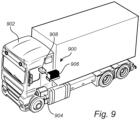
- Fig. 9 schematically illustrates an electrical drive system 900 for a vehicle 902.
- the drive system comprises: an electrical motor 904 arranged to power to a propulsion system of a vehicle; at least one battery 906 connected to the electrical motor to provide power to the electrical motor; and a drive system control unit 908 configured to: provide a stream of measured battery parameter values as a function of time for a predetermined period to a predetermined battery cell model describing the relationship between the measured battery parameter and the battery property; determine a battery property value using the cell model based on a selected portion of the stream of measured battery parameter values; determine if a predetermined condition for the selected portion of the stream of measured battery parameter values is fulfilled; and if the predetermined condition is fulfilled, update a function approximator estimating a battery property as a function of two or more measured battery parameters based on the battery property value determined by the cell model.
- the control unit 908 may include a microprocessor, microcontroller, programmable digital signal processor or another programmable device.
- the control unit may also, or instead, include an application specific integrated circuit, a programmable gate array or programmable array logic, a programmable logic device, or a digital signal processor.
- the control unit includes a programmable device such as the microprocessor, microcontroller or programmable digital signal processor mentioned above, the processor may further include computer executable code that controls operation of the programmable device.
Landscapes
- Engineering & Computer Science (AREA)
- Physics & Mathematics (AREA)
- General Physics & Mathematics (AREA)
- Transportation (AREA)
- Mechanical Engineering (AREA)
- Life Sciences & Earth Sciences (AREA)
- Sustainable Development (AREA)
- Sustainable Energy (AREA)
- Power Engineering (AREA)
- Chemical & Material Sciences (AREA)
- Combustion & Propulsion (AREA)
- Secondary Cells (AREA)
- Electric Propulsion And Braking For Vehicles (AREA)
Description
- The invention relates to a method and a system for estimating battery parameters in a hybrid or electrical drive system for a vehicle.
- The invention can be applied in heavy-duty vehicles, such as trucks, buses and construction equipment. Although the invention will be described with respect to a truck, the invention is not restricted to this particular vehicle, but may also be used in other vehicles.
- In a hybrid or electric vehicle, it is important to have a good knowledge of battery properties for various operating conditions. To achieve that, an electric vehicle often comprises a battery management system tasked with monitoring the status of the battery.
- In particular, objectives of the battery management system are (1), energy level state monitoring, i.e. state of charge estimation (2), power capacity state monitoring (3), maintaining of safe operation of the battery pack (4), state of health estimation and (5) ensuring that the cells in the battery pack are balanced. Sensor signals, such as voltage, current and temperature, are combined with mathematical models to achieve the previously listed objectives. The mathematical models include parameters describing cell properties such as for example resistance, capacity and open circuit voltage. Setting of these parameters is essential for efficient state monitoring. Typically the cell parameter setting is performed in a laboratory enabling good control of cell load, temperature etc.
- However, the properties of battery cells vary between cells and also over time. The reasons for the variation may be production related and the cell properties change over time due to degradation of the battery cell, where the change may be different in different battery cells.
- In particular parameters such as the battery impedance depends on multiple operating conditions. Accordingly, the cell resistance cannot be assumed to be constant because it varies highly on for example temperature. Impedance is valuable to keep track of also when the battery is in use of a vehicle. One reason is that state-of-charge (SoC) estimation accuracy is improved if the battery impedance is known. Another reason is that the battery impedance may indicate battery cell degradation. Typically, resistance increases and capacity decreases as the cell ages.
- Accordingly, there is a need for a system and a method for estimating and predicting slowly varying battery parameters of battery cells used in vehicles.
-
WO 2013/016188 discloses a method, system, and apparatus for optimizing a set of equivalent circuit model parameters of a battery. The method includes measuring and/or receiving a terminal voltage, a current, and a temperature from the battery. The measured and/or received terminal voltage, measured current, measured temperature and a current time stamp is stored in a memory. An equivalent circuit and a set of equivalent circuit model parameters is determined for the battery. A set of estimated state variables based on at least one of the equivalent circuit model parameters is calculated. The set of equivalent circuit model parameters is optimized based on at least one of the estimated state variables. -
US 2010/324848 A1 describes an apparatus and method for estimating a state of charge (SOC) in a battery, in which the battery SOC is estimated using a fusion type soft computing algorithm, thereby accurately estimating the battery SOC in a high C-rate environment. The apparatus includes a detector unit for detecting current, voltage and temperature of a battery cell; and soft computing unit for outputting a battery SOC estimation value of processing the current, the voltage and the temperature detected by the detector unit using a radial function based on a neural network algorithm. - An object of the invention is to provide an improved method and system for estimating battery parameters in a vehicle comprising an electrical drive system, such as a hybrid vehicle.
- According to a first aspect of the invention, the object is achieved by a method according to
claim 1. - The first aspect of the invention relates to a method of determining a model for estimating battery properties in a hybrid or electrical drive system for a vehicle. The method comprises: providing a function approximator estimating a battery property as a function of two or more measured battery parameters; providing a stream of measured battery parameter values as a function of time for a predetermined period to a predetermined battery cell model describing the relationship between the measured battery parameter and the battery property, determining a battery property value using the cell model based on a selected portion of the stream of measured battery parameter values; determining if a predetermined condition for the selected portion of the stream of measured battery parameter values is fulfilled; and if the predetermined condition is fulfilled, updating the function approximator based on the battery property value determined by the cell model.
- The function approximator is here defined as a module approximating a function based on an input comprising a number of measured values. Accordingly, the target function for the function approximator is not known, the target function is instead the function best describing the behavior of a variable as a function of the measured values. In the present context, the measured values are battery parameter values and the function approximator approximates a function describing a relationship between a battery property and the measured battery parameter values.
- The predetermined battery cell can be assumed to describe the relationship between the measured battery parameter and the battery property for a cell type of a battery for which it has been trained. Thereby, the function approximator is updated using a battery property value determined by the cell model if a predetermined condition describing the selected portion of the stream of measured battery parameter values is fulfilled. Accordingly, the function is subject to training in the vehicle and is adapting to changing properties of the battery resulting occurring as the battery is aging. Moreover, the cell model contains variable parameters that depends on the operating point of the battery, where the operating point for example is dependent on the temperature, which are taken into account when determining the battery property values. Thereby, the cell model can be used to train and update the function approximator as the battery ages and for different operating conditions.
- An advantage of the described invention is that the behavior of a slowly changing battery property can be described by the function approximator. This allows for a better prediction of the battery behavior for a given operating condition. Moreover the function approximator is capable of predicting the battery property behavior also outside of the range of battery parameter values for which it has been trained. Thereby, a tool for estimation of slowly varying battery parameters is provided. The function approximator may for example advantageously be used when performing a cold start, i.e. when the battery is at a low temperature. Even if there is no or little prior information of the battery behavior at a temperature which is outside of normal operating temperatures, the function approximator can provide a reasonable estimation of battery properties for a given operating point.
- According to one embodiment of the invention, determining if a predetermined condition is fulfilled comprises, for the selected portion of the stream of measured battery parameter values: determining if a predetermined time period has passed since the most recent update of the function approximator; determining if a standard deviation of a measured current exceeds a predetermined threshold; determining if a maximum current derivative occurs before the middle of the selected portion; and/or determining if a maximum current derivative exceeds a predetermined threshold.
- According to one embodiment of the invention, the method may further comprise: if each of the plurality of determined conditions are fulfilled, determining a battery property value using the cell model based on the stream of measured battery parameter values; and updating the function approximator based on the battery property value determined by the cell model. Accordingly, it may be required that all of the above discussed conditions are fulfilled before the function approximator is updated. Thereby, it can be ensured that the battery system is excited when the function approximator is updated. Measured battery parameters acquired during a steady condition of the battery may provide less information compared to battery parameters measured during a change in e.g. load of the battery. Thereby, it is advantageous to update the function approximator when the battery system is in an excited state as defined by the above conditions.
- According to one embodiment of the invention the measured battery parameters comprises at least two of icell, T and, ucell. Here, icell is the current from the battery, T is the temperature of the battery, ucell is the voltage over the battery cell.
- According to one embodiment of the invention, the determined battery property is at least one of R0, R1 and C in an equivalent circuit representing the battery cell. In the present context, R0 is the internal resistance of the battery, R1 can be seen as a polarization resistance and C is the battery cell capacitance. By measuring the above mentioned battery parameters, and providing the battery parameter values to a cell model, values for the described battery properties can be calculated.
- According to one embodiment of the invention, providing the function approximator comprises training the function approximator for a specific battery type prior to applying the function approximator in the drive system in a vehicle. Accordingly, the function approximator may be pre-conditioned for a specific battery type. The training of the function approximator allows it to provided an initial function describing the battery properties. Thereby, adjustments of the model during operation can be reduced such that the function approximator can provide more reliable estimates from the start.
- According to one embodiment of the invention, the selected portion of the stream of measured battery parameter values may advantageously be selected using a moving time window. Thereby, the selected portion is always of the same length. Accordingly, for each selected window, it is determined if the predetermined conditions are fulfilled or not, and if an update of the function approximator is to be performed.
- According to one embodiment of the invention, the method the method may further comprise determining a state of charge based on the measured battery parameter values. When determining properties in the cell model, the open circuit voltage is derived. The open circuit voltage is in turn related to the state of charge, hence an estimated state of charge is also a result.
- According to one embodiment of the invention, the function approximator may advantageously utilizes a tile coding model, the tile coding model comprising a plurality of at least partially overlapping layers having predetermined relative layer offsets and layer weights based on an expected behavior of the battery property for a known battery type. Tile coding is a single- or multiple-input, single-output function approximator originating from the field of artificial intelligence. An advantage of using a function approximator based on a tile coding model is that it is more easily understandable and can thereby be understood intuitively and modified to fit to a certain battery type. However, it is also possible to use other types of function approximators, such as a neural network.
- According to one embodiment of the invention, the plurality of at layers in the tile coding model are advantageously arranged so that there are more overlapping layers in a region where the battery property is expected to exhibit higher variability compared to in a region where the battery property is expected to exhibit lower variability. This provides a higher resolution in the region where higher variability is expected. Moreover, the layers are advantageously arranged so that a layer at one extreme of a parameter value range does not reach the opposite extreme of the parameter value range.
- According to one embodiment of the invention, updating the function approximator may comprise modifying a layer offset of at least one layer of the tile coding model. Thereby, by changing the relative position of the layer the model changes for the entire parameter range covered by the specific layer to provide a form of generalization. This is advantageous since the model learns also for parameter values outside of the measured values.
- According to one embodiment of the invention, updating the function approximator may advantageously comprise modifying a weight of a layer of at least one layer of the tile coding model. Thereby, as discussed above, the function approximator is adapting to the updated battery property value for an expanded range of parameter values. It should be noted that when a tile coding model is used, the position and weight of the layers may be trained in an offline environment for a given battery type prior to being used in a vehicle.
- According to the invention as defined in claim 13 and claim 14, respectively, there is also provided a computer program comprising program code means for performing the steps of any the aforementioned embodiments when the program is run on a computer, and a computer readable medium carrying a computer program comprising program code means for performing the steps of any of the embodiments when the computer program is run on a computer.
- According to a second aspect of the invention, the object is achieved by a system according to claim 15.
- The second aspect of the invention relates to an electrical drive system for a vehicle. The drive system comprises: an electrical motor arranged to power to a propulsion system of a vehicle; at least one battery connected to the electrical motor to provide power to the electrical motor; a drive system control unit configured to: provide a stream of measured battery parameter values as a function of time for a predetermined period to a predetermined battery cell model describing the relationship between the measured battery parameter and the battery property; determine a battery property value using the cell model based on a selected portion of the stream of measured battery parameter values; determine if a predetermined condition for the selected portion of the stream of measured battery parameter values is fulfilled; and if the predetermined condition is fulfilled, update a function approximator estimating a battery property as a function of two or more measured battery parameters based on the battery property value determined by the cell model.
- Effects and features of this second aspect of the present invention are largely analogous to those described above in connection with the first aspect of the invention.
- Further advantages and advantageous features of the invention are disclosed in the following description and in the dependent claims.
- With reference to the appended drawings, below follows a more detailed description of embodiments of the invention cited as examples.
- In the drawings:
-
Fig. 1 is a flow chart outlining the steps of a method according to an embodiment of the invention, -
Fig. 2 is a cell model describing a battery cell, -
Fig. 3 schematically illustrates measured battery parameter values used by a method according to an embodiment of the invention, -
Fig. 4 schematically illustrates measured battery parameter values used by a method according to an embodiment of the invention, -
Fig. 5 schematically illustrates features of a model used in a method according to an embodiment of the invention, -
Fig. 6 schematically illustrates features of a model used in a method according to an embodiment of the invention, -
Fig. 7 schematically illustrates features of a model used in a method according to an embodiment of the invention, -
Figs. 8A-C schematically illustrate features of a model used in a method according to an embodiment of the invention, and -
Fig. 9 schematically illustrates anelectrical drive system 900 for a vehicle according to an embodiment of the invention. - In the present detailed description, various embodiments of a method and system according to the present invention are mainly discussed with reference to a method of determining a model for estimating battery properties in a hybrid or electrical drive system for a vehicle, where the a function approximator in the form of a tile coding model is used.
-
Fig. 1 is a flow chart outlining the general steps of a method of determining a model for estimating battery properties in a hybrid or electrical drive system for a vehicle according to an embodiment of the invention. The method will be described with further reference toFig. 2 illustrating a cell model comprising an equivalent circuit of a battery cell for analytically describing the relation between the measured battery parameters icell, T and, ucell and the battery properties R0, R1 and C. Here, the inner resistance R0 is important since it determines how the battery responds to a current request. - The method comprises providing S1 a function approximator estimating a battery property as a function of two or more measured battery parameters. The function approximator is here a tile coding model comprising a plurality of at least partially overlapping layers having predetermined relative layer offsets and layer weights based on an expected behavior of the battery property for a known battery type. The tile coding model will thus describe a selected battery property as a function of at least two of the measured battery parameters. Accordingly, at least three separate tile coding models are required for describing the three battery properties of interest R0, R1 and C.
-
Fig. 3 schematically illustrates the battery current icell, battery temperature T and battery voltage ucell as a function of time. It should however be noted that also other properties may be modelled and other parameters may be measured, and that the described method is not limited to the examples provided in the present description. Further details describing the tile coding model will be discussed in the following. - Next, the method comprises providing S2 a stream of measured battery parameter values as a function of time for a predetermined period to the predetermined battery cell model describing the relationship between the measured battery parameter and the battery property. Using the cell model, a battery property value can be determined determining S3 based on a selected portion of the stream of measured battery parameter values.
- In the following step, it is determined S4 if a predetermined condition for the selected portion of the stream of measured battery parameter values is fulfilled, where
Fig. 4 schematically illustrates a first selectedportion 400 and a second selectedportion 402. The selected portions may also be referred to as time windows. If S5 the predetermined condition is fulfilled, the function approximator is updated S6 based on the battery property value determined by the cell model. - The time window may for example cover the last minute. If it is determined that the predetermined condition is fulfilled, the measured battery parameter values are provided to the cell model where a so called system identification is performed. As an example, the measured battery parameters may be current and voltage, where the measured current for the time window is provided to the cell model. The cell model may then estimate the voltage, compare the estimated voltage with the measured voltage and adjust the cell model parameters to achieve the best fit between the calculated and measured voltage. Once a good fit is achieved, it can be assumed that the cell model accurately describes the battery for the given time window. Thereby, a battery property value of interest, such as R0, can be extracted from the cell model and the function approximator can be updated using the battery property value.
- The step of determining if the predetermined condition is fulfilled here comprises determining if a number of conditions are fulfilled for a selected portion. The conditions that need to be fulfilled for the function approximator to be updated include:
- determining if a predetermined time period has passed since the most recent update of the function approximator;
- determining if a standard deviation of a measured current exceeds a predetermined threshold;
- determining if a maximum current derivative occurs before the middle of the selected portion; and
- determining if a maximum current derivative exceeds a predetermined threshold.
- When comparing the first selected
portion 400 and the second selectedportion 402, it can be seen that both the standard deviation of the current and the maximum current derivative is larger in thesecond portion 402. Accordingly, thesecond time window 402 is more likely to trigger an update of the function approximator than thefirst time window 400. As described above, threshold values are defined which determine if the conditions are fulfilled or not. The threshold values determining if the conditions are fulfilled or not may for example be derived empirically for a certain battery type and drive system so that the function approximator is updated with sufficient frequency to maintain an accurate approximation. - In the following, it will be described how the function approximator, i.e. how the tile coding model is set. The task at hand is schematically described in
Fig. 6 wherein an initial estimation of the function, finit, is known. From three data points, illustrated by the filled circles, information is available from an updated version of the function fnew . Next, the updated function fnew is evaluated by three evaluation points illustrated by the non-filled circles. The distance between the evaluation points and fnew is a measure of how well the function is trained. If the function is properly expressed, fnew shall correlate well with the evaluation points. Another way to express this is that a function approximator that converges quickly from a small training set is desired. The problem is relevant for battery parameter estimation because the battery may in practice only operate in specific temperature/SoC/etc. regions. The concept of generalization is thus relevant here. Generalization here means that experience in specific regions "spills over" to other regions. A simple look-up table is not good enough since it has a minimal amount of generalization. - Tile coding is a single- or multiple-input, single-output function approximator. The technique originates from the field artificial intelligence and is described further in for example. Central in tile coding is tiles and layers (sometimes referred to as tilings). A illustrative example follows to explain the terms used, as defined in the table below.
Term Setting Description ndim 2 Number of dimensions ntilesdim [2 2] Number of tiles per dimension nlayers 2 Number of layers 01 [00] Offset of layer 102 [0.25 0.25] Offset of layer 2 x [0.6 0.6] X value -
Fig. 6 illustrates a first layer 600,layer 1, and asecond layer 602, layer 2, which has an offset with respect tolayer 1. The question at hand is: which tiles are "active" for a specific x-value, here illustrated by X inFig. 6 . The tile number tn is defined as:
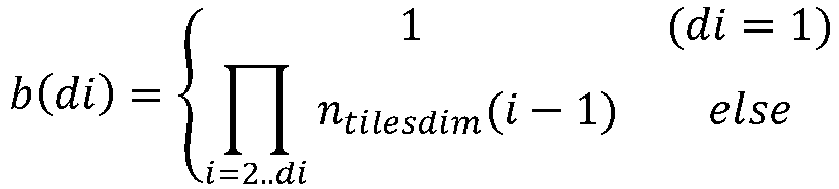
- Where sidx is the indexes of the active segments, i.e. sections in a specific dimension.
- It is now possible to define the tile number for x in
Fig. 6 . For this tile code setting b is [1 2]. One reflection is that the x-value is located in different tiles for the two layers. The reason is that thesecond layer 602 has an offset in both dimensions. Imagine now instead a x-value value of [0.1 0.1]. This would trigger a tile in the first layer 600, which happens to havenumber 1. No tile in layer 2 is active by this x-value. Accordingly, an x-value activates one or zero tiles in a specific layer. - For a specific data point x the output function f(x) is defined as:

- Where the vector w is the weight. The weight defines the "value contribution" from every active tile in every layer. It resembles the parameters to be identified in traditional regression analysis. The phi vector φ can be regarded as a binary string presenting the tiles activated for a specific x-state. A specific element in the phi vector is defined as:

- For the example, the function φ for x=[0.6 0.6] is defined by the following table:
Layer/ Tile 1 2 3 4 1 0 0 0 1 2 1 0 0 0 - The offset of layers are restricted by a specific distance. The distance is the length of the dimension divided by the number of tiles on that dimension. The more layers the smaller is the offset. The matrix onorm contains elements with values in [0,1] according to

- Assuming that the reference target function value is fref, the weights need to be updated so that the function output from tile coding f(x) approaches fref (x). This can be achieved by utilizing gradient based search and the fact that it is possible to define the partial derivate of f(x) with respect to w. The weights corresponding to each layer li is updated according to


- The step-size parameter α determines how far the function's output should be shifted towards the training data point. The binary vector φ(x, li) permits updates only to tiles active at x.
- Next, generalization occurs to states other than the one trained if those states fall within any of the same layers. The number of layers and offset of the layers from each other affects generalization. In the following example, the effect and importance of generalization will be illustrated. Two proposed settings are presented in the table below
Term Setting A Setting B Description ndim 2 2 Number of dimensions ntilesdim [1 1] [4 4] Number of tiles per dimension n layers 5 1 Number of layers - The placement of the layers is illustrated in
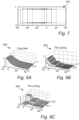
Fig. 7. Fig. 8A illustrates the original function, and as illustrated inFig. 8B , the layer offsets provided by setting A are adequate for theoriginal function 800 function to be presented by thetile coding model 802. FromFig. 7 , it can further be seen that many layers are overlapping where the function has high values, i.e. for x-values between -10 and 10. Furthermore, only onelayer 702 is covering the region where the function has low values. One consequence of this is that a training point with an x-value lower than 20 will not affect how the tile coding presents points with x-values exceeding 20. -
Fig. 8B and 8C presents the result for the proposed settings A and setting B presented in the table above. Here it can be seen that tile setting A outperforms tile setting B since tile setting A gives a more accurate representation of the original function. The reason is generalization. In tile setting B a training point only influences a small sub-region in the xy-plane, whereas in tile setting A single training point influences the entire xy-plane defined (-50,0.1) to (40,0.7). The layer offset can be seen as representing the inner structure/correlation of the function to be estimated. If the offset is properly defined, the tile code representation will converge to the reference function with only few iterations. - Accordingly, as can be seen from the illustrated examples, tile coding is used since it is understandable, and more controllable in comparison to e.g. neural networks.
- Thereby, based on the above described features of a tile coding model, the properties of a tile coding model can be defined for a specific battery cell to provide a function approximator estimating a battery property as a function of two or more measured battery parameters. In an online application where the model is employed in a vehicle, the cell model gives the battery property such as R0 for a given temperature which is then used to train the function approximator.
-
Fig. 9 schematically illustrates anelectrical drive system 900 for avehicle 902. The drive system comprises: anelectrical motor 904 arranged to power to a propulsion system of a vehicle; at least onebattery 906 connected to the electrical motor to provide power to the electrical motor; and a drivesystem control unit 908 configured to: provide a stream of measured battery parameter values as a function of time for a predetermined period to a predetermined battery cell model describing the relationship between the measured battery parameter and the battery property; determine a battery property value using the cell model based on a selected portion of the stream of measured battery parameter values; determine if a predetermined condition for the selected portion of the stream of measured battery parameter values is fulfilled; and if the predetermined condition is fulfilled, update a function approximator estimating a battery property as a function of two or more measured battery parameters based on the battery property value determined by the cell model. - The
control unit 908 may include a microprocessor, microcontroller, programmable digital signal processor or another programmable device. The control unit may also, or instead, include an application specific integrated circuit, a programmable gate array or programmable array logic, a programmable logic device, or a digital signal processor. Where the control unit includes a programmable device such as the microprocessor, microcontroller or programmable digital signal processor mentioned above, the processor may further include computer executable code that controls operation of the programmable device. - It is to be understood that the present invention is not limited to the embodiments described above and illustrated in the drawings; rather, the skilled person will recognize that many changes and modifications may be made within the scope of the appended claims.
Claims (18)
- A computer-implemented method of determining a model for estimating battery properties in a hybrid or electrical drive system (900) of a vehicle (902), the method comprising:providing (S1) a function approximator estimating a battery property as a function of two or more measured battery parameters;providing (S2) a stream of measured battery parameter values as a function of time for a predetermined period to a predetermined battery cell model describing the relationship between the measured battery parameter values and the battery property;determining (S3) a battery property value using the cell model based on a selected portion of the stream of measured battery parameter values;determining (S4) if a predetermined condition for the selected portion of the stream of measured battery parameter values is fulfilled; andif (S5) the predetermined condition is fulfilled, updating (S6) the function approximator based on the battery property value determined by the cell model;characterized in that
the function approximator is in the form of a tile coding model. - The method according to claim 1, wherein determining if a predetermined condition is fulfilled comprises, for the selected portion of the stream of measured battery parameter values:determining if a predetermined time period has passed since the most recent update of the function approximator;determining if a standard deviation of a measured current exceeds a predetermined threshold;determining if a maximum current derivative occurs before the middle of the selected portion; and/ordetermining if a maximum current derivative exceeds a predetermined threshold.
- The method according to claim 2, further comprising:if each of the plurality of predetermined conditions are fulfilled, determining the battery property value using the cell model based on the stream of measured battery parameter values; andupdating the function approximator based on the battery property value determined by the cell model.
- The method according to any one of the preceding claims, wherein the measured battery parameters comprise at least two of icell, T and, ucell, wherein icell is the current from the battery, T is the temperature of the battery, ucell is the voltage over the battery cell.
- The method according to any one of the preceding claims, wherein the determined battery property is at least one of R0, R1 and C in an equivalent circuit representing the battery cell, wherein R0 is the internal resistance of the battery, R1 is a polarization resistance and C is the battery cell capacitance.
- The method according to any one of the preceding claims, wherein providing the function approximator comprises training the function approximator for a specific battery type prior to applying the function approximator in the drive system of a vehicle.
- The method according to any one of the preceding claims, wherein the selected portion of the stream of measured battery parameter values is selected using a moving time window.
- The method according to any one of the preceding claims, further comprising determining a state of charge based on the measured battery parameter values.
- The method according to any one of the preceding claims, wherein the function approximator utilizes the tile coding model, the tile coding model comprising a plurality of at least partially overlapping layers (600, 602) having predetermined relative layer offsets and layer weights based on an expected behavior of the battery property for a known battery type.
- The method according to claim 9, where the plurality of layers (600, 602) are arranged so that there are more overlapping layers in a region where the battery property is expected to exhibit higher variability compared to in a region where the battery property is expected to exhibit lower variability.
- The method according to claim 9 or 10, wherein updating the function approximator comprises modifying a layer offset of at least one layer (600, 602) of the tile coding model.
- The method according to claim 10 or 11, wherein updating the function approximator comprises modifying a weight of a layer of at least one layer (600, 602) of the tile coding model.
- A computer program comprising program code means which cause a computer to carry out the steps of any of claims 1 to 12 when the program is run on the e computer.
- A computer readable medium carrying a computer program comprising program code means which cause a computer to carry out the steps of any of claims 1 to 12 when the computer program is run on the computer.
- An electrical drive system (900) for a vehicle (902), the drive system comprising:an electrical motor (904) arranged to power to a propulsion system of a vehicle;at least one battery (906) connected to the electrical motor (904) to provide power to the electrical motor (904);a drive system control unit (908) configured to:provide a stream of measured battery parameter values as a function of time for a predetermined period to a predetermined battery cell model describing the relationship between the measured battery parameter values and a battery property;determine a battery property value using the cell model based on a selected portion of the stream of measured battery parameter values;determine if a predetermined condition for the selected portion of the stream of measured battery parameter values is fulfilled; andif the predetermined condition is fulfilled, update a function approximator estimating the battery property as a function of two or more measured battery parameters, based on the battery property value determined by the cell model; characterized in that the function approximator is in the form of a tile coding model.
- The drive system according to claim 15, wherein the drive system control unit is further configured to, for the selected portion of the stream of measured battery parameter values:determine if a predetermined time period has passed since the most recent update of the function approximator;determine if a standard deviation of a measured current exceeds a predetermined threshold;determine if a maximum current derivative occurs before the middle of the selected portion; and/ordetermine if a maximum current derivative exceeds a predetermined threshold.
- The drive system according to claim 16, wherein the drive system control unit is further configured to, if each of the plurality of predetermined conditions are fulfilled:determine the battery property value using the cell model based on the stream of measured battery parameter values; andupdate the function approximator based on the battery property value determined by the cell model.
- A vehicle (902) comprising an electrical drive system (900) according to any one of claims 15 to 17.
Applications Claiming Priority (1)
| Application Number | Priority Date | Filing Date | Title |
|---|---|---|---|
| PCT/EP2018/025096 WO2019192670A1 (en) | 2018-04-06 | 2018-04-06 | A method and system for estimating battery properties in a vehicle drive system |
Publications (3)
| Publication Number | Publication Date |
|---|---|
| EP3775948A1 EP3775948A1 (en) | 2021-02-17 |
| EP3775948C0 EP3775948C0 (en) | 2024-05-22 |
| EP3775948B1 true EP3775948B1 (en) | 2024-05-22 |
Family
ID=62027928
Family Applications (1)
| Application Number | Title | Priority Date | Filing Date |
|---|---|---|---|
| EP18719041.8A Active EP3775948B1 (en) | 2018-04-06 | 2018-04-06 | Method and system for estimating battery properties in a vehicle drive system |
Country Status (4)
| Country | Link |
|---|---|
| US (1) | US11975629B2 (en) |
| EP (1) | EP3775948B1 (en) |
| CN (1) | CN111936876A (en) |
| WO (1) | WO2019192670A1 (en) |
Families Citing this family (4)
| Publication number | Priority date | Publication date | Assignee | Title |
|---|---|---|---|---|
| CN116039446B (en) * | 2023-01-17 | 2025-09-23 | 星河智联汽车科技有限公司 | Method and device for controlling battery status of electric vehicle |
| CN116345677B (en) * | 2023-02-20 | 2025-04-01 | 深圳市周励电子科技有限公司 | A low-power power supply monitoring method and system based on artificial intelligence |
| US12570175B2 (en) | 2024-06-21 | 2026-03-10 | Jayantha S. Mallikarachchi | Alternative recharge and distribution system for electric vehicles |
| CN118818314B (en) * | 2024-07-09 | 2025-12-30 | 重庆邮电大学 | A method for estimating the lifetime of solid-state batteries based on online parameter identification of generalized systems |
Family Cites Families (10)
| Publication number | Priority date | Publication date | Assignee | Title |
|---|---|---|---|---|
| KR100793616B1 (en) * | 2005-06-13 | 2008-01-10 | 주식회사 엘지화학 | Apparatus and method for testing state of charge in battery |
| KR100927541B1 (en) | 2008-08-14 | 2009-11-17 | 주식회사 엘지화학 | Apparatus and method for estimating battery resistance characteristics using battery voltage behavior |
| JP5331493B2 (en) | 2009-01-13 | 2013-10-30 | 日立ビークルエナジー株式会社 | Battery control device |
| DE102009036083A1 (en) | 2009-08-04 | 2011-02-10 | Li-Tec Battery Gmbh | Method for controlling a battery and device for carrying out the method |
| WO2013016188A1 (en) * | 2011-07-22 | 2013-01-31 | Navitas Solutions, Inc. | Method, system, and apparatus for battery equivalent circuit model parameter estimation |
| FR3010532B1 (en) * | 2013-09-11 | 2017-06-09 | Commissariat Energie Atomique | METHOD, DEVICE AND SYSTEM FOR ESTIMATING THE CHARGE STATE OF A BATTERY |
| US9381825B2 (en) * | 2014-02-20 | 2016-07-05 | Ford Global Technologies, Llc | State of charge quality based cell balancing control |
| US9440552B2 (en) * | 2014-06-09 | 2016-09-13 | Ford Global Technologies, Llc | Estimation and compensation of battery measurement |
| KR101558780B1 (en) | 2014-06-10 | 2015-10-12 | 현대자동차주식회사 | Method for estimating residual energy of battery |
| JP2016090330A (en) | 2014-10-31 | 2016-05-23 | カルソニックカンセイ株式会社 | Battery parameter estimation device |
-
2018
- 2018-04-06 CN CN201880092017.0A patent/CN111936876A/en active Pending
- 2018-04-06 US US17/040,791 patent/US11975629B2/en active Active
- 2018-04-06 WO PCT/EP2018/025096 patent/WO2019192670A1/en not_active Ceased
- 2018-04-06 EP EP18719041.8A patent/EP3775948B1/en active Active
Also Published As
| Publication number | Publication date |
|---|---|
| CN111936876A (en) | 2020-11-13 |
| EP3775948C0 (en) | 2024-05-22 |
| WO2019192670A1 (en) | 2019-10-10 |
| US20210009002A1 (en) | 2021-01-14 |
| US11975629B2 (en) | 2024-05-07 |
| EP3775948A1 (en) | 2021-02-17 |
Similar Documents
| Publication | Publication Date | Title |
|---|---|---|
| EP3775948B1 (en) | Method and system for estimating battery properties in a vehicle drive system | |
| US12366610B2 (en) | Method and apparatus for operating a system for providing predicted confidence intervals for states of health of electrical energy stores for at least one device with the aid of machine learning methods | |
| US10649035B2 (en) | Method for estimating the current and the state of charge of a battery pack or cell, without direct detection of current under operating conditions | |
| US11215674B2 (en) | Determining a state of health of a battery and providing an alert | |
| US20190187212A1 (en) | Systems and methods for estimation and prediction of battery health and performance | |
| US9205755B2 (en) | Receding horizon regression analysis for battery impedance parameter estimation | |
| US8855954B1 (en) | System and method for prognosticating capacity life and cycle life of a battery asset | |
| US20240010100A1 (en) | Processing of status data of a battery for aging estimation | |
| JP6495469B2 (en) | Battery parameter estimation | |
| CN113853524B (en) | Method for estimating battery state | |
| US12560654B2 (en) | Method and system for efficiently monitoring battery cells of a device battery in an external central processing unit using a digital twin | |
| US11320491B2 (en) | Battery cell state of charge estimation method and a battery state monitoring system | |
| US10605845B2 (en) | Estimation of the insulation resistance between a motor vehicle battery and the earth | |
| WO2014054259A1 (en) | Device for estimating parameters of battery, and estimation method | |
| CN114578248A (en) | Method and device for predicting the aging state of a device battery in a battery-operated device | |
| CN115146525B (en) | Secondary battery degradation state estimation system, secondary battery degradation state estimation method, and storage medium | |
| CN113826019A (en) | Method for estimating battery state | |
| EP3862766B1 (en) | Battery degradation evaluation system, battery degradation evaluation method, and non-transitory storage medium storing battery degradation evaluation program | |
| CN114636947A (en) | Method and device for predicting the aging state of an energy storage system | |
| US20250110179A1 (en) | Method for the Model-Based Estimation of the Impedance of a Galvanic Cell of a Secondary Battery and Its Use, as Well as a Battery Cell Monitoring Device and Vehicle | |
| CN116381498A (en) | Method and apparatus for learning the parameterization of an aging model and providing a state of health of a battery pack of a device based on an open circuit voltage characteristic curve | |
| EP3853625B1 (en) | A method and system for estimating the state-of-health of a battery | |
| CN120327268B (en) | Method and system for monitoring battery state of electric vehicle in real time | |
| EP4249929B1 (en) | Determination of open circuit voltage curve for rechargeable batteries | |
| CN115684970A (en) | Method and apparatus for providing a total trace of aging status |
Legal Events
| Date | Code | Title | Description |
|---|---|---|---|
| STAA | Information on the status of an ep patent application or granted ep patent |
Free format text: STATUS: UNKNOWN |
|
| STAA | Information on the status of an ep patent application or granted ep patent |
Free format text: STATUS: THE INTERNATIONAL PUBLICATION HAS BEEN MADE |
|
| PUAI | Public reference made under article 153(3) epc to a published international application that has entered the european phase |
Free format text: ORIGINAL CODE: 0009012 |
|
| STAA | Information on the status of an ep patent application or granted ep patent |
Free format text: STATUS: REQUEST FOR EXAMINATION WAS MADE |
|
| 17P | Request for examination filed |
Effective date: 20201005 |
|
| AK | Designated contracting states |
Kind code of ref document: A1 Designated state(s): AL AT BE BG CH CY CZ DE DK EE ES FI FR GB GR HR HU IE IS IT LI LT LU LV MC MK MT NL NO PL PT RO RS SE SI SK SM TR |
|
| AX | Request for extension of the european patent |
Extension state: BA ME |
|
| DAV | Request for validation of the european patent (deleted) | ||
| DAX | Request for extension of the european patent (deleted) | ||
| STAA | Information on the status of an ep patent application or granted ep patent |
Free format text: STATUS: EXAMINATION IS IN PROGRESS |
|
| 17Q | First examination report despatched |
Effective date: 20211203 |
|
| REG | Reference to a national code |
Ref country code: DE Ref legal event code: R079 Free format text: PREVIOUS MAIN CLASS: G01R0031360000 Ipc: G01R0031367000 Ref document number: 602018069748 Country of ref document: DE |
|
| GRAP | Despatch of communication of intention to grant a patent |
Free format text: ORIGINAL CODE: EPIDOSNIGR1 |
|
| STAA | Information on the status of an ep patent application or granted ep patent |
Free format text: STATUS: GRANT OF PATENT IS INTENDED |
|
| RIC1 | Information provided on ipc code assigned before grant |
Ipc: G01R 31/3842 20190101ALI20231103BHEP Ipc: G01R 31/367 20190101AFI20231103BHEP |
|
| INTG | Intention to grant announced |
Effective date: 20231121 |
|
| GRAS | Grant fee paid |
Free format text: ORIGINAL CODE: EPIDOSNIGR3 |
|
| GRAA | (expected) grant |
Free format text: ORIGINAL CODE: 0009210 |
|
| STAA | Information on the status of an ep patent application or granted ep patent |
Free format text: STATUS: THE PATENT HAS BEEN GRANTED |
|
| AK | Designated contracting states |
Kind code of ref document: B1 Designated state(s): AL AT BE BG CH CY CZ DE DK EE ES FI FR GB GR HR HU IE IS IT LI LT LU LV MC MK MT NL NO PL PT RO RS SE SI SK SM TR |
|
| REG | Reference to a national code |
Ref country code: GB Ref legal event code: FG4D |
|
| REG | Reference to a national code |
Ref country code: CH Ref legal event code: EP |
|
| REG | Reference to a national code |
Ref country code: DE Ref legal event code: R096 Ref document number: 602018069748 Country of ref document: DE |
|
| REG | Reference to a national code |
Ref country code: IE Ref legal event code: FG4D |
|
| U01 | Request for unitary effect filed |
Effective date: 20240604 |
|
| U07 | Unitary effect registered |
Designated state(s): AT BE BG DE DK EE FI FR IT LT LU LV MT NL PT SE SI Effective date: 20240612 |
|
| PG25 | Lapsed in a contracting state [announced via postgrant information from national office to epo] |
Ref country code: IS Free format text: LAPSE BECAUSE OF FAILURE TO SUBMIT A TRANSLATION OF THE DESCRIPTION OR TO PAY THE FEE WITHIN THE PRESCRIBED TIME-LIMIT Effective date: 20240922 |
|
| PG25 | Lapsed in a contracting state [announced via postgrant information from national office to epo] |
Ref country code: HR Free format text: LAPSE BECAUSE OF FAILURE TO SUBMIT A TRANSLATION OF THE DESCRIPTION OR TO PAY THE FEE WITHIN THE PRESCRIBED TIME-LIMIT Effective date: 20240522 |
|
| PG25 | Lapsed in a contracting state [announced via postgrant information from national office to epo] |
Ref country code: GR Free format text: LAPSE BECAUSE OF FAILURE TO SUBMIT A TRANSLATION OF THE DESCRIPTION OR TO PAY THE FEE WITHIN THE PRESCRIBED TIME-LIMIT Effective date: 20240823 |
|
| PG25 | Lapsed in a contracting state [announced via postgrant information from national office to epo] |
Ref country code: ES Free format text: LAPSE BECAUSE OF FAILURE TO SUBMIT A TRANSLATION OF THE DESCRIPTION OR TO PAY THE FEE WITHIN THE PRESCRIBED TIME-LIMIT Effective date: 20240522 |
|
| PG25 | Lapsed in a contracting state [announced via postgrant information from national office to epo] |
Ref country code: PL Free format text: LAPSE BECAUSE OF FAILURE TO SUBMIT A TRANSLATION OF THE DESCRIPTION OR TO PAY THE FEE WITHIN THE PRESCRIBED TIME-LIMIT Effective date: 20240522 |
|
| PG25 | Lapsed in a contracting state [announced via postgrant information from national office to epo] |
Ref country code: PL Free format text: LAPSE BECAUSE OF FAILURE TO SUBMIT A TRANSLATION OF THE DESCRIPTION OR TO PAY THE FEE WITHIN THE PRESCRIBED TIME-LIMIT Effective date: 20240522 Ref country code: NO Free format text: LAPSE BECAUSE OF FAILURE TO SUBMIT A TRANSLATION OF THE DESCRIPTION OR TO PAY THE FEE WITHIN THE PRESCRIBED TIME-LIMIT Effective date: 20240822 Ref country code: IS Free format text: LAPSE BECAUSE OF FAILURE TO SUBMIT A TRANSLATION OF THE DESCRIPTION OR TO PAY THE FEE WITHIN THE PRESCRIBED TIME-LIMIT Effective date: 20240922 Ref country code: HR Free format text: LAPSE BECAUSE OF FAILURE TO SUBMIT A TRANSLATION OF THE DESCRIPTION OR TO PAY THE FEE WITHIN THE PRESCRIBED TIME-LIMIT Effective date: 20240522 Ref country code: GR Free format text: LAPSE BECAUSE OF FAILURE TO SUBMIT A TRANSLATION OF THE DESCRIPTION OR TO PAY THE FEE WITHIN THE PRESCRIBED TIME-LIMIT Effective date: 20240823 Ref country code: ES Free format text: LAPSE BECAUSE OF FAILURE TO SUBMIT A TRANSLATION OF THE DESCRIPTION OR TO PAY THE FEE WITHIN THE PRESCRIBED TIME-LIMIT Effective date: 20240522 Ref country code: RS Free format text: LAPSE BECAUSE OF FAILURE TO SUBMIT A TRANSLATION OF THE DESCRIPTION OR TO PAY THE FEE WITHIN THE PRESCRIBED TIME-LIMIT Effective date: 20240822 |
|
| PG25 | Lapsed in a contracting state [announced via postgrant information from national office to epo] |
Ref country code: CZ Free format text: LAPSE BECAUSE OF FAILURE TO SUBMIT A TRANSLATION OF THE DESCRIPTION OR TO PAY THE FEE WITHIN THE PRESCRIBED TIME-LIMIT Effective date: 20240522 |
|
| PG25 | Lapsed in a contracting state [announced via postgrant information from national office to epo] |
Ref country code: RO Free format text: LAPSE BECAUSE OF FAILURE TO SUBMIT A TRANSLATION OF THE DESCRIPTION OR TO PAY THE FEE WITHIN THE PRESCRIBED TIME-LIMIT Effective date: 20240522 Ref country code: SK Free format text: LAPSE BECAUSE OF FAILURE TO SUBMIT A TRANSLATION OF THE DESCRIPTION OR TO PAY THE FEE WITHIN THE PRESCRIBED TIME-LIMIT Effective date: 20240522 |
|
| PG25 | Lapsed in a contracting state [announced via postgrant information from national office to epo] |
Ref country code: SM Free format text: LAPSE BECAUSE OF FAILURE TO SUBMIT A TRANSLATION OF THE DESCRIPTION OR TO PAY THE FEE WITHIN THE PRESCRIBED TIME-LIMIT Effective date: 20240522 |
|
| PG25 | Lapsed in a contracting state [announced via postgrant information from national office to epo] |
Ref country code: SM Free format text: LAPSE BECAUSE OF FAILURE TO SUBMIT A TRANSLATION OF THE DESCRIPTION OR TO PAY THE FEE WITHIN THE PRESCRIBED TIME-LIMIT Effective date: 20240522 Ref country code: SK Free format text: LAPSE BECAUSE OF FAILURE TO SUBMIT A TRANSLATION OF THE DESCRIPTION OR TO PAY THE FEE WITHIN THE PRESCRIBED TIME-LIMIT Effective date: 20240522 Ref country code: RO Free format text: LAPSE BECAUSE OF FAILURE TO SUBMIT A TRANSLATION OF THE DESCRIPTION OR TO PAY THE FEE WITHIN THE PRESCRIBED TIME-LIMIT Effective date: 20240522 Ref country code: CZ Free format text: LAPSE BECAUSE OF FAILURE TO SUBMIT A TRANSLATION OF THE DESCRIPTION OR TO PAY THE FEE WITHIN THE PRESCRIBED TIME-LIMIT Effective date: 20240522 |
|
| REG | Reference to a national code |
Ref country code: DE Ref legal event code: R097 Ref document number: 602018069748 Country of ref document: DE |
|
| PLBE | No opposition filed within time limit |
Free format text: ORIGINAL CODE: 0009261 |
|
| STAA | Information on the status of an ep patent application or granted ep patent |
Free format text: STATUS: NO OPPOSITION FILED WITHIN TIME LIMIT |
|
| 26N | No opposition filed |
Effective date: 20250225 |
|
| U20 | Renewal fee for the european patent with unitary effect paid |
Year of fee payment: 8 Effective date: 20250424 |
|
| REG | Reference to a national code |
Ref country code: CH Ref legal event code: H13 Free format text: ST27 STATUS EVENT CODE: U-0-0-H10-H13 (AS PROVIDED BY THE NATIONAL OFFICE) Effective date: 20251125 |
|
| PG25 | Lapsed in a contracting state [announced via postgrant information from national office to epo] |
Ref country code: MC Free format text: LAPSE BECAUSE OF FAILURE TO SUBMIT A TRANSLATION OF THE DESCRIPTION OR TO PAY THE FEE WITHIN THE PRESCRIBED TIME-LIMIT Effective date: 20240522 |
|
| GBPC | Gb: european patent ceased through non-payment of renewal fee |
Effective date: 20250406 |
|
| PG25 | Lapsed in a contracting state [announced via postgrant information from national office to epo] |
Ref country code: GB Free format text: LAPSE BECAUSE OF NON-PAYMENT OF DUE FEES Effective date: 20250406 |
|
| PG25 | Lapsed in a contracting state [announced via postgrant information from national office to epo] |
Ref country code: CH Free format text: LAPSE BECAUSE OF NON-PAYMENT OF DUE FEES Effective date: 20250430 |
|
| PG25 | Lapsed in a contracting state [announced via postgrant information from national office to epo] |
Ref country code: IE Free format text: LAPSE BECAUSE OF NON-PAYMENT OF DUE FEES Effective date: 20250406 |