EP3774944B1 - A novel polymer, a composition, a method and a kit for whitening teeth - Google Patents
A novel polymer, a composition, a method and a kit for whitening teeth Download PDFInfo
- Publication number
- EP3774944B1 EP3774944B1 EP19724525.1A EP19724525A EP3774944B1 EP 3774944 B1 EP3774944 B1 EP 3774944B1 EP 19724525 A EP19724525 A EP 19724525A EP 3774944 B1 EP3774944 B1 EP 3774944B1
- Authority
- EP
- European Patent Office
- Prior art keywords
- polymer
- composition
- eosin
- dye
- teeth
- Prior art date
- Legal status (The legal status is an assumption and is not a legal conclusion. Google has not performed a legal analysis and makes no representation as to the accuracy of the status listed.)
- Active
Links
Classifications
-
- C—CHEMISTRY; METALLURGY
- C09—DYES; PAINTS; POLISHES; NATURAL RESINS; ADHESIVES; COMPOSITIONS NOT OTHERWISE PROVIDED FOR; APPLICATIONS OF MATERIALS NOT OTHERWISE PROVIDED FOR
- C09B—ORGANIC DYES OR CLOSELY-RELATED COMPOUNDS FOR PRODUCING DYES, e.g. PIGMENTS; MORDANTS; LAKES
- C09B69/00—Dyes not provided for by a single group of this subclass
- C09B69/10—Polymeric dyes; Reaction products of dyes with monomers or with macromolecular compounds
- C09B69/103—Polymeric dyes; Reaction products of dyes with monomers or with macromolecular compounds containing a diaryl- or triarylmethane dye
-
- A—HUMAN NECESSITIES
- A61—MEDICAL OR VETERINARY SCIENCE; HYGIENE
- A61C—DENTISTRY; APPARATUS OR METHODS FOR ORAL OR DENTAL HYGIENE
- A61C19/00—Dental auxiliary appliances
- A61C19/06—Implements for therapeutic treatment
- A61C19/063—Medicament applicators for teeth or gums, e.g. treatment with fluorides
- A61C19/066—Bleaching devices; Whitening agent applicators for teeth, e.g. trays or strips
-
- A—HUMAN NECESSITIES
- A61—MEDICAL OR VETERINARY SCIENCE; HYGIENE
- A61K—PREPARATIONS FOR MEDICAL, DENTAL OR TOILETRY PURPOSES
- A61K6/00—Preparations for dentistry
- A61K6/60—Preparations for dentistry comprising organic or organo-metallic additives
- A61K6/65—Dyes
-
- A—HUMAN NECESSITIES
- A61—MEDICAL OR VETERINARY SCIENCE; HYGIENE
- A61K—PREPARATIONS FOR MEDICAL, DENTAL OR TOILETRY PURPOSES
- A61K8/00—Cosmetics or similar toiletry preparations
- A61K8/18—Cosmetics or similar toiletry preparations characterised by the composition
- A61K8/72—Cosmetics or similar toiletry preparations characterised by the composition containing organic macromolecular compounds
- A61K8/81—Cosmetics or similar toiletry preparations characterised by the composition containing organic macromolecular compounds obtained by reactions involving only carbon-to-carbon unsaturated bonds
- A61K8/8141—Compositions of homopolymers or copolymers of compounds having one or more unsaturated aliphatic radicals, each having only one carbon-to-carbon double bond, and at least one being terminated by only one carboxyl radical, or of salts, anhydrides, esters, amides, imides or nitriles thereof; Compositions of derivatives of such polymers
- A61K8/8152—Homopolymers or copolymers of esters, e.g. (meth)acrylic acid esters; Compositions of derivatives of such polymers
-
- A—HUMAN NECESSITIES
- A61—MEDICAL OR VETERINARY SCIENCE; HYGIENE
- A61Q—SPECIFIC USE OF COSMETICS OR SIMILAR TOILETRY PREPARATIONS
- A61Q11/00—Preparations for care of the teeth, of the oral cavity or of dentures; Dentifrices, e.g. toothpastes; Mouth rinses
-
- C—CHEMISTRY; METALLURGY
- C08—ORGANIC MACROMOLECULAR COMPOUNDS; THEIR PREPARATION OR CHEMICAL WORKING-UP; COMPOSITIONS BASED THEREON
- C08F—MACROMOLECULAR COMPOUNDS OBTAINED BY REACTIONS ONLY INVOLVING CARBON-TO-CARBON UNSATURATED BONDS
- C08F212/00—Copolymers of compounds having one or more unsaturated aliphatic radicals, each having only one carbon-to-carbon double bond, and at least one being terminated by an aromatic carbocyclic ring
- C08F212/02—Monomers containing only one unsaturated aliphatic radical
- C08F212/04—Monomers containing only one unsaturated aliphatic radical containing one ring
- C08F212/14—Monomers containing only one unsaturated aliphatic radical containing one ring substituted by heteroatoms or groups containing heteroatoms
- C08F212/16—Halogens
- C08F212/21—Bromine
-
- C—CHEMISTRY; METALLURGY
- C08—ORGANIC MACROMOLECULAR COMPOUNDS; THEIR PREPARATION OR CHEMICAL WORKING-UP; COMPOSITIONS BASED THEREON
- C08L—COMPOSITIONS OF MACROMOLECULAR COMPOUNDS
- C08L33/00—Compositions of homopolymers or copolymers of compounds having one or more unsaturated aliphatic radicals, each having only one carbon-to-carbon double bond, and only one being terminated by only one carboxyl radical, or of salts, anhydrides, esters, amides, imides or nitriles thereof; Compositions of derivatives of such polymers
- C08L33/04—Homopolymers or copolymers of esters
- C08L33/06—Homopolymers or copolymers of esters of esters containing only carbon, hydrogen and oxygen, which oxygen atoms are present only as part of the carboxyl radical
-
- C—CHEMISTRY; METALLURGY
- C09—DYES; PAINTS; POLISHES; NATURAL RESINS; ADHESIVES; COMPOSITIONS NOT OTHERWISE PROVIDED FOR; APPLICATIONS OF MATERIALS NOT OTHERWISE PROVIDED FOR
- C09D—COATING COMPOSITIONS, e.g. PAINTS, VARNISHES OR LACQUERS; FILLING PASTES; CHEMICAL PAINT OR INK REMOVERS; INKS; CORRECTING FLUIDS; WOODSTAINS; PASTES OR SOLIDS FOR COLOURING OR PRINTING; USE OF MATERIALS THEREFOR
- C09D133/00—Coating compositions based on homopolymers or copolymers of compounds having one or more unsaturated aliphatic radicals, each having only one carbon-to-carbon double bond, and at least one being terminated by only one carboxyl radical, or of salts, anhydrides, esters, amides, imides, or nitriles thereof; Coating compositions based on derivatives of such polymers
- C09D133/04—Homopolymers or copolymers of esters
- C09D133/06—Homopolymers or copolymers of esters of esters containing only carbon, hydrogen and oxygen, the oxygen atom being present only as part of the carboxyl radical
-
- A—HUMAN NECESSITIES
- A61—MEDICAL OR VETERINARY SCIENCE; HYGIENE
- A61K—PREPARATIONS FOR MEDICAL, DENTAL OR TOILETRY PURPOSES
- A61K2800/00—Properties of cosmetic compositions or active ingredients thereof or formulation aids used therein and process related aspects
- A61K2800/40—Chemical, physico-chemical or functional or structural properties of particular ingredients
- A61K2800/42—Colour properties
- A61K2800/43—Pigments; Dyes
- A61K2800/434—Luminescent, Fluorescent; Optical brighteners; Photosensitizers
-
- A—HUMAN NECESSITIES
- A61—MEDICAL OR VETERINARY SCIENCE; HYGIENE
- A61K—PREPARATIONS FOR MEDICAL, DENTAL OR TOILETRY PURPOSES
- A61K2800/00—Properties of cosmetic compositions or active ingredients thereof or formulation aids used therein and process related aspects
- A61K2800/80—Process related aspects concerning the preparation of the cosmetic composition or the storage or application thereof
- A61K2800/88—Two- or multipart kits
-
- C—CHEMISTRY; METALLURGY
- C08—ORGANIC MACROMOLECULAR COMPOUNDS; THEIR PREPARATION OR CHEMICAL WORKING-UP; COMPOSITIONS BASED THEREON
- C08F—MACROMOLECULAR COMPOUNDS OBTAINED BY REACTIONS ONLY INVOLVING CARBON-TO-CARBON UNSATURATED BONDS
- C08F12/00—Homopolymers and copolymers of compounds having one or more unsaturated aliphatic radicals, each having only one carbon-to-carbon double bond, and at least one being terminated by an aromatic carbocyclic ring
- C08F12/02—Monomers containing only one unsaturated aliphatic radical
- C08F12/04—Monomers containing only one unsaturated aliphatic radical containing one ring
- C08F12/14—Monomers containing only one unsaturated aliphatic radical containing one ring substituted by hetero atoms or groups containing heteroatoms
- C08F12/16—Halogens
- C08F12/21—Bromine
-
- C—CHEMISTRY; METALLURGY
- C08—ORGANIC MACROMOLECULAR COMPOUNDS; THEIR PREPARATION OR CHEMICAL WORKING-UP; COMPOSITIONS BASED THEREON
- C08F—MACROMOLECULAR COMPOUNDS OBTAINED BY REACTIONS ONLY INVOLVING CARBON-TO-CARBON UNSATURATED BONDS
- C08F12/00—Homopolymers and copolymers of compounds having one or more unsaturated aliphatic radicals, each having only one carbon-to-carbon double bond, and at least one being terminated by an aromatic carbocyclic ring
- C08F12/02—Monomers containing only one unsaturated aliphatic radical
- C08F12/04—Monomers containing only one unsaturated aliphatic radical containing one ring
- C08F12/14—Monomers containing only one unsaturated aliphatic radical containing one ring substituted by hetero atoms or groups containing heteroatoms
- C08F12/22—Oxygen
-
- C—CHEMISTRY; METALLURGY
- C08—ORGANIC MACROMOLECULAR COMPOUNDS; THEIR PREPARATION OR CHEMICAL WORKING-UP; COMPOSITIONS BASED THEREON
- C08F—MACROMOLECULAR COMPOUNDS OBTAINED BY REACTIONS ONLY INVOLVING CARBON-TO-CARBON UNSATURATED BONDS
- C08F12/00—Homopolymers and copolymers of compounds having one or more unsaturated aliphatic radicals, each having only one carbon-to-carbon double bond, and at least one being terminated by an aromatic carbocyclic ring
- C08F12/02—Monomers containing only one unsaturated aliphatic radical
- C08F12/04—Monomers containing only one unsaturated aliphatic radical containing one ring
- C08F12/14—Monomers containing only one unsaturated aliphatic radical containing one ring substituted by hetero atoms or groups containing heteroatoms
- C08F12/22—Oxygen
- C08F12/24—Phenols or alcohols
-
- C—CHEMISTRY; METALLURGY
- C08—ORGANIC MACROMOLECULAR COMPOUNDS; THEIR PREPARATION OR CHEMICAL WORKING-UP; COMPOSITIONS BASED THEREON
- C08F—MACROMOLECULAR COMPOUNDS OBTAINED BY REACTIONS ONLY INVOLVING CARBON-TO-CARBON UNSATURATED BONDS
- C08F220/00—Copolymers of compounds having one or more unsaturated aliphatic radicals, each having only one carbon-to-carbon double bond, and only one being terminated by only one carboxyl radical or a salt, anhydride ester, amide, imide or nitrile thereof
- C08F220/02—Monocarboxylic acids having less than ten carbon atoms; Derivatives thereof
- C08F220/10—Esters
- C08F220/26—Esters containing oxygen in addition to the carboxy oxygen
- C08F220/28—Esters containing oxygen in addition to the carboxy oxygen containing no aromatic rings in the alcohol moiety
- C08F220/285—Esters containing oxygen in addition to the carboxy oxygen containing no aromatic rings in the alcohol moiety and containing a polyether chain in the alcohol moiety
- C08F220/286—Esters containing oxygen in addition to the carboxy oxygen containing no aromatic rings in the alcohol moiety and containing a polyether chain in the alcohol moiety and containing polyethylene oxide in the alcohol moiety, e.g. methoxy polyethylene glycol (meth)acrylate
Definitions
- the present invention relates to a novel polymer for use in an oral care composition for whitening teeth. More specifically, the invention relates to such a composition and a kit that contains the composition and a source of light.
- the colour of our teeth is influenced by a combination of their intrinsic colour and the presence of any extrinsic stains that may form thereon. Staining is linked to the adsorption of materials into the pellicle on the surface of enamel. Factors that influence extrinsic stain formation include poor brushing techniques, smoking, dietary intake of coloured foods (e.g. red wine), age and the use of certain cationic agents such as chlorhexidine or metallic salts of tin and iron. Consumers have strong desire for whiter teeth and some individuals are dissatisfied with the inherent colour of their teeth or with the stains. This desire for whiter teeth has given rise to a growing trend of whitening products which range from toothpastes to mouthwashes and chewing gums.
- Toothpastes meant for whitening rely on an optimization of abrasive and chemical components for removal of stains. During brushing, these abrasive particles get temporarily trapped between the toothbrush and the stained surface (of teeth) to abrade away the stains.
- Chemical components may also be used, usually in conjunction with abrasive particles, and these include calcium chelators, polymers, surfactants, enzymes and oxidising agents.
- One of the more prevalent methods involves the use of dentifrices which contain a bleaching agent such as hydrogen peroxide with one or more other bleaching agents as disclosed in US2002122776 A and WO0018366 A1 (Both Unilever ).
- EP 1935395 A1 (Unilever ) describes a novel optical approach to tooth whitening in which the toothpaste contains a blue pigment (in particular Blue Covarine) which gets deposited on the surface of teeth. Here it is able to alter the optical effects of surface which leads to a perception of whiter teeth. Deposition is aided by GANTREZ ® type of polymers.
- US2009238778 AA discloses tooth whitening compositions that are capable of being activated by light energy.
- the compositions contain riboflavin or a derivative of riboflavin, a bleaching agent and a water-soluble liquid phase.
- the present invention is directed to a novel polymer for inclusion in an oral care composition that provides enhanced tooth whitening over that provided by compositions disclosed hitherto while not depending on bleaching agents.
- the present inventors have tried to achieve this by tagging a photosensitive dye on to a polymer and then activating the dye by shining light on to the teeth coated with said polymer. They found that certain dyes of the xanthene class when bonded to polymers of a specific class are capable of whitening teeth better than known compositions when light is incident on the teeth coated with said polymers.
- WO2010149534 discloses an oral care composition comprising a dye polymer for modifying the colour of teeth, which primarily comprises anthraquinone moieties. They work through direct action of the dye on the teeth and do not provide enhanced whiteness when light is shone on it.
- It is another object of the present invention to provide for an oral care composition comprising the novel polymeric dye that exhibits enhanced tooth whitening when light is shone on the teeth coated with said composition.
- the first aspect of the present invention relates to a polymer having the structure
- the xanthene dye is one of Rose Bengal, Eosin, Phloxine B, Fluorescin, or Erythrosine.
- the second aspect relates to an oral care composition
- an oral care composition comprising a polymer of the first aspect and a cosmetically acceptable carrier.
- a process to prepare the polymer of the first aspect of the present invention comprising the steps of first synthesizing the dye monomer and then synthesizing the dye polymer.
- the generalized process comprises the steps of:
- kit-of-parts comprising:
- Yet another aspect of the present invention relates to a method of whitening teeth comprising applying the oral care composition of the second aspect on to a tooth surface and exposing said composition, so applied, to a source of actinic/ Visible/LED.
- Yet another aspect of the present invention relates to use of the oral care composition of the second aspect for whitening teeth.
- Yet another aspect of the present invention relates to a packaged product comprising the oral care composition of the second aspect of the present invention.
- actinic light is intended to mean light energy emitted from a specific light source (e.g. visible, UV, lamp, LED, or laser) and capable of being absorbed by matter (e.g. the chromophore or photoactivator defined below). It is preferred that the actinic light is visible light.
- a specific light source e.g. visible, UV, lamp, LED, or laser
- matter e.g. the chromophore or photoactivator defined below. It is preferred that the actinic light is visible light.
- photosensitizer refers to any agent capable of absorbing the actinic light.
- the photosensitive agent undergoes photoexcitation and transfers its energy. This may be in the form of emitted light (e.g. fluorescence) and/or energy transferred to molecules. This energy may initiate chemical reactions.
- Photosensitizers may enhance and/or accelerate the dispersion of light energy, or otherwise enhance and/or activate the decomposition of an oxidizing agent.
- the pH of the aqueous gel composition is measured when 1 part by weight of the composition is uniformly dispersed and/or dissolved in 20 parts by weight pure water at 25 °C.
- the pH may be measured by manually mixing 1 g composition with 20 ml water for 30 seconds, then immediately testing the pH with indicator paper or a pH meter.
- Stained teeth could become troublesome, whether the cause for it is intrinsic or an extrinsic factor or agent like certain beverages chlorhexidine.
- the accumulation of stains on teeth poses an aesthetic problem for some individuals. Stains are usually extrinsic in nature and generally represent discoloration of the pellicle and/or plaque. The exact mechanisms involved in stain formation may not be fully understood. It is suggested that pigments produced by chromagenic bacteria, colored products from the chemical transformation of pellicle components and adsorption/retention of dietary constituents contribute to extrinsic stains.
- the dietary factors which appear to contribute heavily towards staining include coffee, tea, and red wines, as well as smoking.
- staining is promoted by other cationic antimicrobial agents such as hexetidine or quaternary ammonium compounds.
- WIO Whiteness Index Observed
- the polymeric dye of the present invention has the general structure as follows:
- n preferably has a value from 1 to 5.
- the most preferred value of n is 1.
- R 1 is most preferably CH 3 .
- R 2 is a diheterofunctional group selected from -O-,or COO- more preferably -O-.
- the polymer chain can be very long with x having a value from 1 to 10,000 and y having a value from 1 to 10,000, x preferably has a value from 1 to 500, more preferably from 5 to 100. Similarly y preferably has a value from 1 to 500, more preferably from 5 to 100.
- the group P in the above general structure is preferably a polyethylene glycol chain having the structure
- n has a value from 1 to 10.
- z has a value from 1 to 10.
- the dye group D is one that comprises a Xanthene group.
- R 1 , R 2 , R 3 , R 4 , R 5 and R 6 are functional groups such as -OH, H, Br, I, CI, amines, ketones, O - M + (where M is metal ion) and R 7 is organic moiety / derivative such as substituted aromatic or benzofuran.
- the photosensitizer is selected from a xanthene class of dye selected from one of Acid Red 52, Acid Red 289, Gallein, Bromopyrogallol Red, 2',7'-Dichlorofluorescein Sodium Salt, 9-(4'-Dimethylaminophenyl)-2,6,7-trihydroxyfluorone Sulfate Hydrate, Dibromofluorescein, Uranine K, Fluorescein, Uranine, Pyrogallol Red, Sulfonfluorescein, Tetrabromofluorescein Potassium Salt, Acid Red 91 ( Eosin Bluish), Acid Red 94 (Rose Bengal), Acid Red 87( Eosin), Acid Red 92 (Phloxine B ), 3,4,5,6-Tetrachlorofluorescein, Tetraiodofluorescein (Erythrosin B or Erythrosine B) and Phenylfluorone.
- the photosensitizer is at least one of Rose Bengal, Eosin, Phloxine B, Fluorescein or Erythrosine.
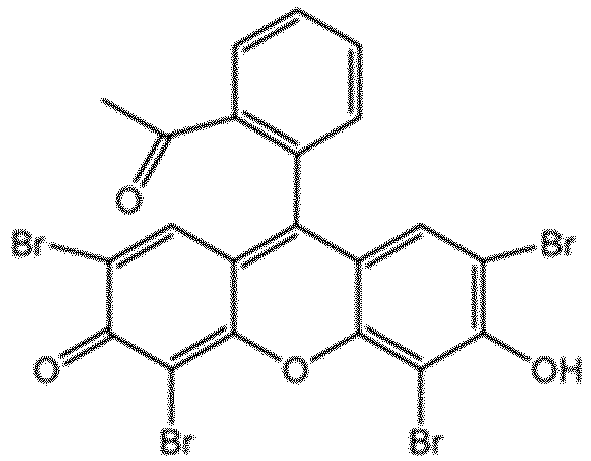
- An especially preferred aspect of the present invention relates to polymer of the first aspect wherein D is an eosin group having the chemical structure: Eosin
- Eosin is the dye
- the monomer reacts and binds to the COOH group of Eosin.
- composition of the invention is meant for whitening teeth which implies that it is useful for maintaining the whiteness of teeth.
- composition of the invention is useful for removing or lightening, at least partly, some of the common stains such as tea or coffee stain.
- an oral care composition comprising a polymer as of the first aspect and a cosmetically acceptable carrier.
- the oral care composition preferably comprises 0.1 to 10, more preferably 0.1 to 5 wt% of the polymer, by weight of the composition.
- the pH of the aqueous gel composition of the invention is preferably from 3 to 11, and more preferably from 6 to 8.
- composition according to the invention may optionally include further ingredients to enhance performance and/or consumer acceptability, which are briefly discussed hereinafter.
- Suitable surfactants include anionic surfactants, such as the sodium, magnesium, ammonium or ethanolamine salts of C8 to C18 alkyl sulphates (for example sodium lauryl sulphate), C8 to C18 alkyl sulphosuccinates (for example dioctyl sodium sulphosuccinate), C8 to C18 alkyl sulphoacetates (such as sodium lauryl sulphoacetate), C8 to C18 alkyl sarcosinates (such as sodium lauryl sarcosinate), C8 to C18 alkyl phosphates (which can optionally comprise up to 10 ethylene oxide and/or propylene oxide units) and sulphated monoglycerides.
- anionic surfactants such as the sodium, magnesium, ammonium or ethanolamine salts of C8 to C18 alkyl sulphates (for example sodium lauryl sulphate), C8 to C18 alkyl sulphosuccinates (
- Suitable surfactants include nonionic surfactants, such as optionally polyethoxylated fatty acid sorbitan esters, ethoxylated fatty acids, esters of polyethylene glycol, ethoxylates of fatty acid monoglycerides and diglycerides, and ethylene oxide/propylene oxide block polymers.
- suitable surfactants include amphoteric surfactants, such as betaines or sulphobetaines. Mixtures of any of the above described materials may also be used.
- the level of surfactant may generally range from 0.2 to 15% by total weight surfactant based on the total weight of the composition.
- a gelling agent is preferably included along with the polymer to obtain the desired viscosity.
- Preferred gelling agents are a copolymer of ammonium acryloyldimethyltaurate and vinylpyrrolidone, a modified, gelatin or polyvinylalcohol or combinations thereof. Gelling agents may be included in 0.1 to 10%, more preferably 0.1 to 2% by weight of the composition.
- fluoride sources such as sodium fluoride, stannous fluoride, sodium monofluorophosphate, zinc ammonium fluoride, tin ammonium fluoride, calcium fluoride, cobalt ammonium fluoride and mixtures thereof; plant-derivable antioxidants such as flavonoid, catechin, polyphenol, and tannin compounds and mixtures thereof; antioxidant vitamins such as tocopherols and/or derivatives thereof, ascorbic acid and/or derivatives thereof and mixtures thereof.
- Further optional ingredients customary in the art such as buffers, flavouring agents, sweetening agents, colouring agents, opacifying agents and preservatives, may also be included.
- a process to prepare the polymer of the first aspect of the present invention comprising the steps of first synthesizing the dye monomer and then synthesizing the polymer.
- the generalized process comprises the steps of:
- More details on the general process includes two parts (i) To synthesize the dye monomer and (ii) to synthesize the polymer
- OEGMA oligo(ethylene glycol) methyl ether acrylate
- dye monomer oligo(ethylene glycol) methyl ether acrylate
- AIBN Azobisisobutyronitrile
- dioxane dioxane
- composition of the invention is preferably a gel. It is preferred that viscosity of the gel is from 200 to 100,000 cps, more preferably 2000 to 50,000 cps.
- kit-of-parts comprising:
- composition in accordance with the invention needs to be used in conjunction with a suitable source of actinic light.
- Any suitable source of actinic light can be used so long as the light is able to activate the photosensitizer belonging to the xanthene group.
- the primary characteristic of suitable sources of actinic light will be that they emit light in a wavelength (or wavelengths) appropriate for photosensitization of the photosensitizer present in the composition.
- the source of actinic light is halogen bulb, LED or plasma arc lamp, or laser such as an argon laser, potassium-titanyl phosphate (KTP) laser, LED photocuring device.
- the radiation is preferably of the visible range but it may be UV or IR. It is preferred that the actinic light has a wavelength in the range from about 400 nm to about 700 nm. In another embodiment, the actinic light has wavelength in the range from about 420 nm to about 560 nm, more preferably 435 nm to about 550 nm.
- the applicator is preferably the one which is disclosed in US 20030194383 A (Unilever).
- This applicator or tray comprises a U-shaped dental tray fittable over a person's teeth which permits contact of the composition of the invention with all possible surfaces surrounding the teeth.
- the applicator is any other suitable applicator known in the art.
- the set of instructions is preferably in the form of a pamphlet containing useful information about the contents and step-by-step instructions for use of the compositions of the invention.
- the inventors believe that with the polymer of the first aspect of the present invention where the photosensitizer is bound to the polymer there is better deposition of the polymer on the teeth and thereby the photosensitizer moiety; so that when it is exposed to preferably visible white light, it produces reactive oxygen species which in turn interact with the stains chromophores present on teeth breaking it down to small colorless molecules which get washed off thereby removing/lightening the stains. The result is whiter teeth.
- the device for whitening teeth comprises:
- the device comprises a switch or button to switch on and off the light source.
- the device preferably also includes a battery for supplying energy to the source of light. In such a case it is preferred that the device is easy to use.
- a packaged product comprising the oral care composition of the invention.
- the composition is preferably packaged in a collapsible tube such that it becomes easy to dispense a small amount without much dexterity.
- the composition is packaged in another type of container, such as a bottle or a jar, preferably with suitable means for dispensing a known quantity of the composition.
- the pack may be further packed in a suitable secondary package like a carton or a box, preferably with useful information about the contents and instructions for use.
- a method of whitening teeth comprising:
- the composition is applied using the applicator as disclosed earlier.
- the teeth are exposed to visible light preferably for 5 to 45 minutes, more preferably for less than 10 minutes. Alternatively, the exposure lasts less than 5 minutes, such as 4, 3, 2, or 1 minute.
- the application may be repeated as often as desired, e.g. 2 to 3 times a day and 3 to 4 days in a fortnight.
- the method preferably results in at least one unit of shade difference on the Vita ® Shade card, preferably at least 2 units and more preferably at least 3-5 units.
- the method is relatively free of post-treatment sensitivity. In some other cases, there is minimal or acceptable level of post-treatment sensitivity. The whitening effect may diminish over time following a treatment. In that case, repeat of the treatment is advisable.
- the method for whitening the teeth may be performed in a dentist's office or clinic under ordinary or supervised conditions. Alternatively, and more preferably the method is performed by an informed user at home or in other words, without any medical supervision when the method is non-therapeutic.
- composition and method of the invention is useful to whiten teeth. This means that the composition is useful to preserve the white appearance of teeth or to restore the appearance periodically. Alternatively, the composition and the method is useful to lighten the teeth which are discoloured due to extrinsic or intrinsic stains (e.g., tobacco, coffee, tea and/or food or wine stains), fluorosis, developmental disturbances, bacteria, genetics, tetracycline antibiotics, trauma, blood decomposition, and pigments present during development of teeth.
- extrinsic or intrinsic stains e.g., tobacco, coffee, tea and/or food or wine stains
- fluorosis e.g., tobacco, coffee, tea and/or food or wine stains
- developmental disturbances e.g., bacteria, genetics, tetracycline antibiotics, trauma, blood decomposition, and pigments present during development of teeth.
- the method is non-therapeutic.
- a method is a cosmetic method.
- a therapeutic treatment starts from a pathological state, whereas a non-therapeutic treatment starts from a normal, healthy state.
- Application of such a method to a person is to improve his bodily appearance (cosmetic treatment).
- Treatment by therapy is defined as any treatment which is designed to cure, alleviate, remove or lessen the symptoms of, or prevent or reduce the possibility of contracting any disorder or malfunction of the human body, in this case it is teeth.
- an oral care composition of the second aspect for whitening teeth is disclosed.
- the use is for non-therapeutic purpose.
- the use is for therapeutic purpose.
- the part of the description related to the method of the invention is also applicable mutatis mutandis to this aspect of the invention.
- Eosin Y (647 mg, 1 mmol), chloromethylstyrene (152 mg, 1 mmol), potassium carbonate (275 mg, 2 mmol), and dimethyl formamide (DMF) (5 ml) were charged into a reaction flask, the mixture was reflux for 6 h. After evaporating all the solvents, the residues were dissolved in methylene dichloride (CH 2 Cl 2 ), successively washed with saturated aqueous sodium chlloride and water, dried over anhydrous magnesium sulphate, filtered, and then concentrated on a rotary evaporator.
- CH 2 Cl 2 methylene dichloride
- Example - 1 Synthesis of Poly(OEGMA-co-EoS). OEGMA- oligo(ethylene glycol) methyl ether acrylate
- OEGMA (9.5 g, 20 mmol), EoS (0.015 g, 0.2 mmol), AIBN Azobisisobutyronitrile (0.008 g, 0.05 mmol), and dioxane (19 mL) were charged into a reaction flask.
- the mixture was degassed by three freeze-pump-thaw cycles and backfilled with nitrogen. After stirring for 5 h at 70°C, the reaction tube was quenched into liquid N 2 , opened and exposed to air, and precipitated into an excess of ether. The above dissolution-precipitation cycle was repeated for three times.
- the final product was dried in a vacuum oven overnight at room temperature, yielding a red solid (6.6 g, yield: 69 %).
- the molecular weight and molecular weight distribution of Poly(OEGMA-co-EoS) were determined by GPC using DMF as the eluent, revealing an M n of 22,300 and M w / M n of 1.84.
- the polymer as prepared above (with eosin content equivalent to 0.02% Eosin) was formulated as a gel with 1% of Aristoflex ® AVC.
- Example 2 A gel was formulated with 0.02% Eosin in 1% of Aristoflex ® AVC
- Example - 3 A control gel with 1% of Aristoflex ® AVC with no Eosin was prepared.
- Example 1 Gel compositions containing Eosin polymers (Example 1) and free eosin (Example 2) showed photobleach efficacy. Gel samples of Example 1 showed superior photobleaching as compared to that of Example 2.
- WIO measure confirms a trend similar to that obtained with ⁇ L measurement as well as visual observation where the polymeric dye was found to be superior to the other samples.
Landscapes
- Health & Medical Sciences (AREA)
- Chemical & Material Sciences (AREA)
- Life Sciences & Earth Sciences (AREA)
- Organic Chemistry (AREA)
- Veterinary Medicine (AREA)
- Animal Behavior & Ethology (AREA)
- Public Health (AREA)
- General Health & Medical Sciences (AREA)
- Medicinal Chemistry (AREA)
- Polymers & Plastics (AREA)
- Epidemiology (AREA)
- Oral & Maxillofacial Surgery (AREA)
- Chemical Kinetics & Catalysis (AREA)
- Engineering & Computer Science (AREA)
- Materials Engineering (AREA)
- Wood Science & Technology (AREA)
- Dentistry (AREA)
- Birds (AREA)
- Cosmetics (AREA)
Description
- The present invention relates to a novel polymer for use in an oral care composition for whitening teeth. More specifically, the invention relates to such a composition and a kit that contains the composition and a source of light.
- The colour of our teeth is influenced by a combination of their intrinsic colour and the presence of any extrinsic stains that may form thereon. Staining is linked to the adsorption of materials into the pellicle on the surface of enamel. Factors that influence extrinsic stain formation include poor brushing techniques, smoking, dietary intake of coloured foods (e.g. red wine), age and the use of certain cationic agents such as chlorhexidine or metallic salts of tin and iron. Consumers have strong desire for whiter teeth and some individuals are dissatisfied with the inherent colour of their teeth or with the stains. This desire for whiter teeth has given rise to a growing trend of whitening products which range from toothpastes to mouthwashes and chewing gums.
- Toothpastes meant for whitening rely on an optimization of abrasive and
chemical components for removal of stains. During brushing, these abrasive particles get temporarily trapped between the toothbrush and the stained surface (of teeth) to abrade away the stains. Chemical components may also be used, usually in conjunction with abrasive particles, and these include calcium chelators, polymers, surfactants, enzymes and oxidising agents. - One of the more prevalent methods involves the use of dentifrices which contain a bleaching agent such as hydrogen peroxide with one or more other bleaching agents as disclosed in
US2002122776 A andWO0018366 A1 (Both Unilever -
EP 1935395 A1 (Unilever ) describes a novel optical approach to tooth whitening in which the toothpaste contains a blue pigment (in particular Blue Covarine) which gets deposited on the surface of teeth. Here it is able to alter the optical effects of surface which leads to a perception of whiter teeth. Deposition is aided by GANTREZ® type of polymers. -
US2009238778 AA (MCNEIL PPC - The present invention is directed to a novel polymer for inclusion in an oral care composition that provides enhanced tooth whitening over that provided by compositions disclosed hitherto while not depending on bleaching agents. The present inventors have tried to achieve this by tagging a photosensitive dye on to a polymer and then activating the dye by shining light on to the teeth coated with said polymer. They found that certain dyes of the xanthene class when bonded to polymers of a specific class are capable of whitening teeth better than known compositions when light is incident on the teeth coated with said polymers.
-
WO2010149534 discloses an oral care composition comprising a dye polymer for modifying the colour of teeth, which primarily comprises anthraquinone moieties. They work through direct action of the dye on the teeth and do not provide enhanced whiteness when light is shone on it. - It is thus an object of the present invention to provide for a novel polymeric dye that could be incorporated in an oral care composition to provide enhanced tooth whitening.
- It is another object of the present invention to provide for an oral care composition comprising the novel polymeric dye that exhibits enhanced tooth whitening when light is shone on the teeth coated with said composition.
- The first aspect of the present invention relates to a polymer having the structure

- R1 is Cn H2n+1
- R2 is a diheterofunctional group
- n has a value from 1 to 10
- x has a value from 1 to 10,000
- y has a value from 1 to 10,000
- P is a polyether chain; and
- D is a Xanthene dye
- selected from at least one of Acid Red 52, Acid Red 289, Gallein, Bromopyrogallol Red, 2',7'-Dichlorofluorescein Sodium Salt, 9-(4'-Dimethylaminophenyl)-2,6,7-trihydroxyfluorone Sulfate Hydrate, Dibromofluorescein, Uranine K, Fluorescein, Uranine, Pyrogallol Red, Sulfonfluorescein, Tetrabromofluorescein Potassium Salt, Acid Red 91 ( Eosin Bluish), Acid Red 94 (Rose Bengal), Acid Red 87( Eosin), Acid Red 92 (Phloxine B ), 3,4,5,6-Tetrachlorofluorescein, Tetraiodofluorescein (Erythrosin B or Erythrosine B) and Phenylfluorone.
- It is particularly preferred that the xanthene dye is one of Rose Bengal, Eosin, Phloxine B, Fluorescin, or Erythrosine.
- The second aspect relates to an oral care composition comprising a polymer of the first aspect and a cosmetically acceptable carrier.
- According to a third aspect of the present invention there is provided a process to prepare the polymer of the first aspect of the present invention comprising the steps of first synthesizing the dye monomer and then synthesizing the dye polymer. The generalized process comprises the steps of:
- (a) synthesizing the dye monomer by refluxing a mixture of the dye, chloromethylstyrene, potassium carbonate, and dimethyl formamide for six to ten hours; washing with salt solution, drying, filtering and concentrating to prepare the dye monomer; and
- (b) synthesizing the dye polymer by repeated cycles of reacting OEGMA (oligo(ethylene glycol) methyl ether acrylate), dye monomer, AIBN (Azobisisobutyronitrile) and dioxane under an inert atmosphere for 1-10 hours at a temperature in the range of 20 to 70 °C, and precipitating in excess ether; followed by drying under vacuum at low temperature in the range of 20 to 40°C.
- Another aspect of the present invention relates to a kit-of-parts comprising:
- (i) An oral care composition of the second aspect;
- (ii) a source of actinic/ Visible/LED light;
- (iii) optionally, an applicator for applying said composition to teeth; and,
- (iv) further optionally, a set of instructions for use of said kit-of-parts.
- Yet another aspect of the present invention relates to a method of whitening teeth comprising applying the oral care composition of the second aspect on to a tooth surface and exposing said composition, so applied, to a source of actinic/ Visible/LED.
- Yet another aspect of the present invention relates to use of the oral care composition of the second aspect for whitening teeth.
- Yet another aspect of the present invention relates to a packaged product comprising the oral care composition of the second aspect of the present invention.
- Any feature of one aspect of the present invention may be utilized in any other aspect of the invention. The word "comprising" is intended to mean "including" but not necessarily "consisting of' or "composed of." In other words, the listed steps or options need not be exhaustive. Except in the operating and comparative examples, or where otherwise explicitly indicated, all numbers in this description indicating amounts of material or conditions of reaction, physical properties of materials and/or use are to be understood as modified by the word "about". Numerical ranges expressed in the format "from x to y" are understood to include x and y. When for a specific feature multiple preferred ranges are described in the format "from x to y", it is understood that all ranges combining the different endpoints are also contemplated.
- All references to the terms wt% or % by weight shall be construed as referring to the % of the concerned ingredient by weight of the composition, unless indicated to the contrary.
- The term "actinic light" is intended to mean light energy emitted from a specific light source (e.g. visible, UV, lamp, LED, or laser) and capable of being absorbed by matter (e.g. the chromophore or photoactivator defined below). It is preferred that the actinic light is visible light.
- The term "photosensitizer" refers to any agent capable of absorbing the actinic light. The photosensitive agent undergoes photoexcitation and transfers its energy. This may be in the form of emitted light (e.g. fluorescence) and/or energy transferred to molecules. This energy may initiate chemical reactions. Photosensitizers may enhance and/or accelerate the dispersion of light energy, or otherwise enhance and/or activate the decomposition of an oxidizing agent.
- When referring to the pH of the aqueous gel composition, the pH is measured when 1 part by weight of the composition is uniformly dispersed and/or dissolved in 20 parts by weight pure water at 25 °C. In particular, the pH may be measured by manually mixing 1 g composition with 20 ml water for 30 seconds, then immediately testing the pH with indicator paper or a pH meter.
- Viscosity of the composition is the value observed and recorded at room temperature (25 °C) with a Brookfield Viscometer, Spindle No. 4 and at a speed of 5 rpm. Values are quoted in centipoises (cP = mPa.s) unless otherwise specified.
- Stained teeth could become troublesome, whether the cause for it is intrinsic or an extrinsic factor or agent like certain beverages chlorhexidine. The accumulation of stains on teeth poses an aesthetic problem for some individuals. Stains are usually extrinsic in nature and generally represent discoloration of the pellicle and/or plaque. The exact mechanisms involved in stain formation may not be fully understood. It is suggested that pigments produced by chromagenic bacteria, colored products from the chemical transformation of pellicle components and adsorption/retention of dietary constituents contribute to extrinsic stains. The dietary factors which appear to contribute heavily towards staining include coffee, tea, and red wines, as well as smoking. In addition to chlorhexidine, staining is promoted by other cationic antimicrobial agents such as hexetidine or quaternary ammonium compounds.
- The efficacy of such compositions and kits can be measured and assessed by a term known as Whiteness Index Observed (WIO). The index proposed by Luo et al (known as WIO) has the same functional form as some of the previous whiteness indices but the parameters are different and are optimized specifically for the evaluation of whiteness in teeth. It is regarded as most appropriate for assessing changes in teeth whiteness.
- Luo et al. proposed a modified version of the CIE whiteness index in Garcia JA, Rubino M, Romero J, Hita E. Measuring The Whiteness Of Human Teeth. Color Research and Application 1993; 18: 349 - 52. It is based directly on observers scoring of the Vita@ 3D Shade Guide and is defined as:

- The polymeric dye of the present invention has the general structure as follows:

- R1 is Cn H2n+1
- R2 is a diheterofunctional group
- n has a value from 1 to 10
- x has a value from 1 to 10,000
- y has a value from 1 to 10,000
- P is a polyether chain; and
- D is a Xanthene dye selected from at least one of Acid Red 52, Acid Red 289, Gallein, Bromopyrogallol Red, 2',7'-Dichlorofluorescein Sodium Salt, 9-(4'-Dimethylaminophenyl)-2,6,7-trihydroxyfluorone Sulfate Hydrate, Dibromofluorescein, Uranine K, Fluorescein, Uranine, Pyrogallol Red, Sulfonfluorescein, Tetrabromofluorescein Potassium Salt, Acid Red 91 ( Eosin Bluish), Acid Red 94 (Rose Bengal), Acid Red 87( Eosin), Acid Red 92 (Phloxine B ), 3,4,5,6-Tetrachlorofluorescein, Tetraiodofluorescein (Erythrosin B or Erythrosine B) and Phenylfluorone.
- In the above structure, n preferably has a value from 1 to 5. The most preferred value of n is 1. In such a case, R1 is most preferably CH3. R2 is a diheterofunctional group selected from -O-,or COO- more preferably -O-.
- Although the polymer chain can be very long with x having a value from 1 to 10,000 and y having a value from 1 to 10,000, x preferably has a value from 1 to 500, more preferably from 5 to 100. Similarly y preferably has a value from 1 to 500, more preferably from 5 to 100.
- The group P in the above general structure is preferably a polyethylene glycol chain having the structure
- P = Polyethylene glycol chain

- R3 = H or Phosphate or -CnH2n+l
- In the above polyethylene glycol group it is preferred that n has a value from 1 to 10. In the above polyethylene glycol group it is preferred that z has a value from 1 to 10.
- In the dye polymer of the first aspect of the present invention, the dye group D is one that comprises a Xanthene group.
- One of the general structures of xanthene class of dye is as follows:

- Where R1, R2, R3, R4, R5 and R6 are functional groups such as -OH, H, Br, I, CI, amines, ketones, O-M+( where M is metal ion) and R7 is organic moiety / derivative such as substituted aromatic or benzofuran.
- As per a preferred aspect of the invention the photosensitizer is selected from a xanthene class of dye selected from one of Acid Red 52, Acid Red 289, Gallein, Bromopyrogallol Red, 2',7'-Dichlorofluorescein Sodium Salt, 9-(4'-Dimethylaminophenyl)-2,6,7-trihydroxyfluorone Sulfate Hydrate, Dibromofluorescein, Uranine K, Fluorescein, Uranine, Pyrogallol Red, Sulfonfluorescein, Tetrabromofluorescein Potassium Salt, Acid Red 91 ( Eosin Bluish), Acid Red 94 (Rose Bengal), Acid Red 87( Eosin), Acid Red 92 (Phloxine B ), 3,4,5,6-Tetrachlorofluorescein, Tetraiodofluorescein (Erythrosin B or Erythrosine B) and Phenylfluorone.
- However, it is particularly preferred that the photosensitizer is at least one of Rose Bengal, Eosin, Phloxine B, Fluorescein or Erythrosine.
- General structure of a preferred form of xanthene dye is shown below:

- Referring to the chemical structure indicated above, in Fluorescein the X=H and Y=H; in Eosin the X-Br and Y=H; in Erythrosine the X=I and Y=H and in Rose Bengal the X=I and Y=CI.
- An especially preferred aspect of the present invention relates to polymer of the first aspect wherein D is an eosin group having the chemical structure:

- When Eosin is the dye, the monomer reacts and binds to the COOH group of Eosin.
- The composition of the invention is meant for whitening teeth which implies that it is useful for maintaining the whiteness of teeth. Alternatively, the composition of the invention is useful for removing or lightening, at least partly, some of the common stains such as tea or coffee stain.
- According to a second aspect of the invention there is provided an oral care composition comprising a polymer as of the first aspect and a cosmetically acceptable carrier.
- The oral care composition preferably comprises 0.1 to 10, more preferably 0.1 to 5 wt% of the polymer, by weight of the composition.
- The pH of the aqueous gel composition of the invention is preferably from 3 to 11, and more preferably from 6 to 8.
- The composition according to the invention may optionally include further ingredients to enhance performance and/or consumer acceptability, which are briefly discussed hereinafter.
- Suitable surfactants include anionic surfactants, such as the sodium, magnesium, ammonium or ethanolamine salts of C8 to C18 alkyl sulphates (for example sodium lauryl sulphate), C8 to C18 alkyl sulphosuccinates (for example dioctyl sodium sulphosuccinate), C8 to C18 alkyl sulphoacetates (such as sodium lauryl sulphoacetate), C8 to C18 alkyl sarcosinates (such as sodium lauryl sarcosinate), C8 to C18 alkyl phosphates (which can optionally comprise up to 10 ethylene oxide and/or propylene oxide units) and sulphated monoglycerides. Other suitable surfactants include nonionic surfactants, such as optionally polyethoxylated fatty acid sorbitan esters, ethoxylated fatty acids, esters of polyethylene glycol, ethoxylates of fatty acid monoglycerides and diglycerides, and ethylene oxide/propylene oxide block polymers. Other suitable surfactants include amphoteric surfactants, such as betaines or sulphobetaines. Mixtures of any of the above described materials may also be used.
- The level of surfactant may generally range from 0.2 to 15% by total weight surfactant based on the total weight of the composition.
- A gelling agent is preferably included along with the polymer to obtain the desired viscosity. Preferred gelling agents are a copolymer of ammonium acryloyldimethyltaurate and vinylpyrrolidone, a modified, gelatin or polyvinylalcohol or combinations thereof. Gelling agents may be included in 0.1 to 10%, more preferably 0.1 to 2% by weight of the composition.
- Also suitable are fluoride sources such as sodium fluoride, stannous fluoride, sodium monofluorophosphate, zinc ammonium fluoride, tin ammonium fluoride, calcium fluoride, cobalt ammonium fluoride and mixtures thereof; plant-derivable antioxidants such as flavonoid, catechin, polyphenol, and tannin compounds and mixtures thereof; antioxidant vitamins such as tocopherols and/or derivatives thereof, ascorbic acid and/or derivatives thereof and mixtures thereof. Further optional ingredients customary in the art such as buffers, flavouring agents, sweetening agents, colouring agents, opacifying agents and preservatives, may also be included.
- According to a third aspect of the present invention there is provided a process to prepare the polymer of the first aspect of the present invention comprising the steps of first synthesizing the dye monomer and then synthesizing the polymer. The generalized process comprises the steps of:
- (a) synthesizing the dye monomer by refluxing a mixture of the dye, chloromethylstyrene, potassium carbonate, and dimethyl formamide for six to ten hours; washing with salt solution, drying, filtering and concentrating to prepare the dye monomer; and
- (b) synthesizing the dye polymer by repeated cycles of reacting OEGMA (oligo(ethylene glycol) methyl ether acrylate), dye monomer, AIBN (Azobisisobutyronitrile) and dioxane under an inert atmosphere for 1-10 hours at a temperature in the range of 20 to 70 °C, and precipitating in excess ether; followed by drying under vacuum at low temperature in the range of 20 to 40°C.
- More details on the general process includes two parts (i) To synthesize the dye monomer and (ii) to synthesize the polymer
- Dye, chloromethylstyrene, potassium carbonate, and dimethyl formamide were charged into a reaction flask, the mixture was reflux for 6-10 h. After evaporating all the solvents, the residues were dissolved in methylene dichloride (CH2Cl2), successively washed with saturated aqueous sodium chloride and water, dried over anhydrous magnesium sulphate, filtered, and then concentrated on a rotary evaporator.
- OEGMA ( oligo(ethylene glycol) methyl ether acrylate), dye monomer, AIBN (Azobisisobutyronitrile) and dioxane were charged into a reaction flask. The mixture was degassed by three freeze-pump-thaw cycles and backfilled with nitrogen. After stirring for 5-10 h at 70°C, the reaction tube was quenched into liquid N2, opened and exposed to air, and precipitated into an excess of ether. The above dissolution-precipitation cycle was repeated for three times. The final product was dried in a vacuum oven overnight at room temperature, yielding a red solid.
- The composition of the invention is preferably a gel. It is preferred that viscosity of the gel is from 200 to 100,000 cps, more preferably 2000 to 50,000 cps.
- In accordance with a further aspect, the invention relates to a kit-of-parts comprising:
- (i) an oral care composition of the second aspect;
- (ii) a source of actinic/ Visible/LED light;
- (iii) optionally, an applicator for applying said composition to teeth; and,
- (iv) further optionally, a set of instructions for use of said kit-of-parts.
- The composition in accordance with the invention needs to be used in conjunction with a suitable source of actinic light.
- Any suitable source of actinic light can be used so long as the light is able to activate the photosensitizer belonging to the xanthene group. The primary characteristic of suitable sources of actinic light will be that they emit light in a wavelength (or wavelengths) appropriate for photosensitization of the photosensitizer present in the composition.
- Preferably the source of actinic light is halogen bulb, LED or plasma arc lamp, or laser such as an argon laser, potassium-titanyl phosphate (KTP) laser, LED photocuring device. The radiation is preferably of the visible range but it may be UV or IR. It is preferred that the actinic light has a wavelength in the range from about 400 nm to about 700 nm. In another embodiment, the actinic light has wavelength in the range from about 420 nm to about 560 nm, more preferably 435 nm to about 550 nm.
- The applicator is preferably the one which is disclosed in
US 20030194383 A (Unilever). This applicator or tray comprises a U-shaped dental tray fittable over a person's teeth which permits contact of the composition of the invention with all possible surfaces surrounding the teeth. Alternatively, the applicator is any other suitable applicator known in the art. - The set of instructions is preferably in the form of a pamphlet containing useful information about the contents and step-by-step instructions for use of the compositions of the invention.
- Without wishing to be bound by theory the inventors believe that with the polymer of the first aspect of the present invention where the photosensitizer is bound to the polymer there is better deposition of the polymer on the teeth and thereby the photosensitizer moiety; so that when it is exposed to preferably visible white light, it produces reactive oxygen species which in turn interact with the stains chromophores present on teeth breaking it down to small colorless molecules which get washed off thereby removing/lightening the stains. The result is whiter teeth.
- The device for whitening teeth comprises:
- (i) an applicator for applying to the teeth an oral care composition of the second aspect; and,
- (ii) a source of actinic light integral with said device.
- As an example, reference may be made to the fittable tray disclosed earlier, with provision for flashing visible light. In such a case it is preferred that the device comprises a switch or button to switch on and off the light source. The device preferably also includes a battery for supplying energy to the source of light. In such a case it is preferred that the device is easy to use.
- In accordance with another aspect is disclosed a packaged product comprising the oral care composition of the invention. The composition is preferably packaged in a collapsible tube such that it becomes easy to dispense a small amount without much dexterity. Alternatively, the composition is packaged in another type of container, such as a bottle or a jar, preferably with suitable means for dispensing a known quantity of the composition. The pack may be further packed in a suitable secondary package like a carton or a box, preferably with useful information about the contents and instructions for use.
- In accordance with another aspect is disclosed a method of whitening teeth comprising:
- (i) applying the oral care composition of the second aspect on to a tooth surface; and
- (ii) exposing said composition, so applied, to a source of actinic/ Visible/LED light.
- Preferably the composition is applied using the applicator as disclosed earlier. After application, the teeth are exposed to visible light preferably for 5 to 45 minutes, more preferably for less than 10 minutes. Alternatively, the exposure lasts less than 5 minutes, such as 4, 3, 2, or 1 minute. The application may be repeated as often as desired, e.g. 2 to 3 times a day and 3 to 4 days in a fortnight. The method preferably results in at least one unit of shade difference on the Vita® Shade card, preferably at least 2 units and more preferably at least 3-5 units. The method is relatively free of post-treatment sensitivity. In some other cases, there is minimal or acceptable level of post-treatment sensitivity. The whitening effect may diminish over time following a treatment. In that case, repeat of the treatment is advisable.
- The method for whitening the teeth may be performed in a dentist's office or clinic under ordinary or supervised conditions. Alternatively, and more preferably the method is performed by an informed user at home or in other words, without any medical supervision when the method is non-therapeutic.
- The composition and method of the invention is useful to whiten teeth. This means that the composition is useful to preserve the white appearance of teeth or to restore the appearance periodically. Alternatively, the composition and the method is useful to lighten the teeth which are discoloured due to extrinsic or intrinsic stains (e.g., tobacco, coffee, tea and/or food or wine stains), fluorosis, developmental disturbances, bacteria, genetics, tetracycline antibiotics, trauma, blood decomposition, and pigments present during development of teeth.
- In one aspect the method is non-therapeutic. Preferably such a method is a cosmetic method. A therapeutic treatment starts from a pathological state, whereas a non-therapeutic treatment starts from a normal, healthy state. Application of such a method to a person is to improve his bodily appearance (cosmetic treatment).
- In another aspect the method is therapeutic in nature. Treatment by therapy is defined as any treatment which is designed to cure, alleviate, remove or lessen the symptoms of, or prevent or reduce the possibility of contracting any disorder or malfunction of the human body, in this case it is teeth.
- In accordance with yet another aspect is disclosed an oral care composition of the second aspect for whitening teeth.
- In one aspect the use is for non-therapeutic purpose. Alternatively, the use is for therapeutic purpose. The part of the description related to the method of the invention is also applicable mutatis mutandis to this aspect of the invention.
- The following examples will more fully illustrate the embodiments of this invention. All parts, percentages and proportions referred to herein and in the appended claims are by weight unless otherwise illustrated.
- Eosin Y (647 mg, 1 mmol), chloromethylstyrene (152 mg, 1 mmol), potassium carbonate (275 mg, 2 mmol), and dimethyl formamide (DMF) (5 ml) were charged into a reaction flask, the mixture was reflux for 6 h. After evaporating all the solvents, the residues were dissolved in methylene dichloride (CH2Cl2), successively washed with saturated aqueous sodium chlloride and water, dried over anhydrous magnesium sulphate, filtered, and then concentrated on a rotary evaporator. The crude product was subjected to further purification by silica gel column chromatography using CH2Cl2/methanol (98/2 v/v) as the eluent, affording 4-vinylbenzyl 2-(2,4,5,7-tetrabromo-6-hydroxy-3-oxo-3H-xanthen-9-yl) benzoate (EoS) as a residual solid (540 mg, 67 % yield).1H NMR (DMSO-d6, δ, ppm, TMS): 8.22 (d, 1H, aromatic protons), 7.92 (m, 2H, aromatic protons), 7.42 (d, 1H, aromatic protons), 7.25 (d, 2H, aromatic protons), 6.95 (s, 2H, aromatic protons), 6.82 (d, 2H, aromatic protons), 6.62 (q, 1H, -CH=CH2), 5.76 (d, 1H, -CH=CHH), 5.28 (d, 1H, -CH=CHH), 4.96 (s, 2H, COO-CH 2-).
- OEGMA (9.5 g, 20 mmol), EoS (0.015 g, 0.2 mmol), AIBN Azobisisobutyronitrile (0.008 g, 0.05 mmol), and dioxane (19 mL) were charged into a reaction flask. The mixture was degassed by three freeze-pump-thaw cycles and backfilled with nitrogen. After stirring for 5 h at 70°C, the reaction tube was quenched into liquid N2, opened and exposed to air, and precipitated into an excess of ether. The above dissolution-precipitation cycle was repeated for three times. The final product was dried in a vacuum oven overnight at room temperature, yielding a red solid (6.6 g, yield: 69 %). The molecular weight and molecular weight distribution of Poly(OEGMA-co-EoS) were determined by GPC using DMF as the eluent, revealing an M n of 22,300 and M w/M n of 1.84.
- The polymer as prepared above (with eosin content equivalent to 0.02% Eosin) was formulated as a gel with 1% of Aristoflex® AVC.
- All the gel samples were prepared in demineralized water.
- Amount = 70-80 mg of gel per HAP disc
- Light source = Spectrum LED lamp 14 B 22
- Distance between plate and lamp - 1.5 cm
- Exposure time = 30 mins
- Number of cycles: Four
- Brushed with regular toothpaste after every cycle to removes excess gel A photograph to determine visual impact of the samples was taken and the and L*, a* and b* were measured after 4 cycles.
- Visual images of stained HAP disks after the treatment with samples of Examples 1 to 3 were observed followed by light exposure
Number of cycles = 4 - Gel compositions containing Eosin polymers (Example 1) and free eosin (Example 2) showed photobleach efficacy. Gel samples of Example 1 showed superior photobleaching as compared to that of Example 2.
- The ΔL values of stained HAP disks after treatment with the above gels was measured and the data is summarised in the table below:
Examples Sample ΔL 1 0.5% polymer effective concentration of eosin 0.02% 40 2 0.02% Eosin in gel 34 3 Control -10 - The data in the above table indicates superior photobleaching of HAP disks with the composition of the invention (Example -1) as compared to a composition where the dye is simply formulated in a gel.
- WIO values for the same samples were measured and the data is summarized in the table below:
Examples Sample WIO 1 0.5% polymer effective concentration of eosin 0.02% Eosin 78 2 0.02% Eosin in gel 65 3 Control -20 - WIO measure confirms a trend similar to that obtained with ΔL measurement as well as visual observation where the polymeric dye was found to be superior to the other samples.
Claims (13)
- A polymer having the structure:
 R1 is Cn H2n+1R2 is a diheterofunctional groupn has a value from 1 to 10x has a value from 1 to 10,000y has a value from 1 to 10,000P is a polyether chain; andD is a Xanthene dye selected from at least one of Acid Red 52, Acid Red 289, Gallein, Bromopyrogallol Red, 2',7'-Dichlorofluorescein Sodium Salt, 9-(4'-Dimethylaminophenyl)-2,6,7-trihydroxyfluorone Sulfate Hydrate, Dibromofluorescein, Uranine K, Fluorescein, Uranine, Pyrogallol Red, Sulfonfluorescein, Tetrabromofluorescein Potassium Salt, Acid Red 91 ( Eosin Bluish), Acid Red 94 (Rose Bengal), Acid Red 87( Eosin), Acid Red 92 (Phloxine B ), 3,4,5,6-Tetrachlorofluorescein, Tetraiodofluorescein (Erythrosin B or Erythrosine B) and Phenylfluorone
 - A polymer as claimed in claim 1 wherein said R1 is CH3.
- A polymer as claimed in claim 1 or 2 wherein said R2 is an -O- group.
- A polymer as claimed in any one of the preceding claims wherein x has a value from 5 to 100.
- A polymer as claimed in any one of the preceding claims wherein y has a value from 5 to 100.
- A polymer as claimed in any one of the preceding claims where P is a polyethylene glycol chain having the structureP = Polyethylene glycol chain
 R3 = H or Phosphate or -CnH2n+1And z has a value from 1 to 10.
 - A polymer as claimed in any one of the preceding claims wherein D is at least one of Rose Bengal, Eosin, Phloxine B, Fluorescien or Erythrosine.
- A polymer as claimed in claim 7 wherein D is an eosin group having the chemical structure:
- An oral care composition comprising:(i) a polymer as claimed in any one of the preceding claims; and(ii) a cosmetically acceptable carrier.
- A process to prepare a polymer as claimed in claim 1 comprising the steps of(a) synthesizing the dye monomer by refluxing a mixture of the dye, chloromethylstyrene, potassium carbonate, and dimethyl formamide for six to ten hours; washing with salt solution, drying, filtering and concentrating to prepare the dye monomer; and(b) synthesizing the dye polymer by repeated cycles of reacting OEGMA (oligo(ethylene glycol) methyl ether acrylate), dye monomer, AIBN (Azobisisobutyronitrile) and dioxane under an inert atmosphere for 1-10 hours at a temperature in the range of 20 to 70 °C, and precipitating in excess ether; followed by drying under vacuum at low temperature in the range of 20 to 40 °C.
- A kit-of-parts comprising:(i) A composition as claimed in claim 9;(ii) a source of actinic/ Visible/LED light;(iii) optionally, an applicator for applying said composition to teeth; and,(iv) further optionally, a set of instructions for use of said kit-of-parts.
- A method of whitening teeth comprising:(i) Applying the composition as claimed in claim 9 on to a tooth surface; and(ii) exposing said composition, so applied, to a source of actinic/ Visible/LED.
- Use of a composition as claimed in claim 9 for whitening teeth.
Applications Claiming Priority (3)
| Application Number | Priority Date | Filing Date | Title |
|---|---|---|---|
| CN2018092902 | 2018-06-26 | ||
| EP18185765 | 2018-07-26 | ||
| PCT/EP2019/063074 WO2020001864A1 (en) | 2018-06-26 | 2019-05-21 | A novel polymer, a composition, a method and a kit for whitening teeth |
Publications (2)
| Publication Number | Publication Date |
|---|---|
| EP3774944A1 EP3774944A1 (en) | 2021-02-17 |
| EP3774944B1 true EP3774944B1 (en) | 2022-04-13 |
Family
ID=66554428
Family Applications (1)
| Application Number | Title | Priority Date | Filing Date |
|---|---|---|---|
| EP19724525.1A Active EP3774944B1 (en) | 2018-06-26 | 2019-05-21 | A novel polymer, a composition, a method and a kit for whitening teeth |
Country Status (4)
| Country | Link |
|---|---|
| EP (1) | EP3774944B1 (en) |
| CN (1) | CN112154165A (en) |
| BR (1) | BR112020023733A2 (en) |
| WO (1) | WO2020001864A1 (en) |
Families Citing this family (2)
| Publication number | Priority date | Publication date | Assignee | Title |
|---|---|---|---|---|
| EP4299699A1 (en) | 2022-06-29 | 2024-01-03 | Henkel AG & Co. KGaA | Detergent containing a photoactivated stain removal ingredient |
| GB2623090A (en) | 2022-10-04 | 2024-04-10 | Sublino Ltd | Method of colouring |
Family Cites Families (18)
| Publication number | Priority date | Publication date | Assignee | Title |
|---|---|---|---|---|
| JPS496939A (en) * | 1972-05-08 | 1974-01-22 | ||
| JPH09268204A (en) * | 1996-02-01 | 1997-10-14 | Tokuyama Corp | Polymerization initiator by visible rays and polymerizable composition by visible rays |
| CA2342976A1 (en) | 1998-09-23 | 2000-03-30 | Unilever Plc | Oral care compositions |
| CN1262265C (en) | 2000-12-15 | 2006-07-05 | 荷兰联合利华有限公司 | Oral bleaching compsn |
| US20070032598A1 (en) * | 2001-07-24 | 2007-02-08 | Cyr Michael J | Thermally stable, anthraquinone colorants containing copolymerizable vinyl groups |
| US6774249B2 (en) * | 2001-09-27 | 2004-08-10 | Lumigen, Inc. | Uses of improved polymer-supported photosensitizers in the generation of singlet oxygen |
| US20030194383A1 (en) | 2002-04-15 | 2003-10-16 | Unilever Home & Personal Care Usa, Division Of Conopco, Inc. | Teeth whitening system |
| AU2003239890A1 (en) * | 2002-05-23 | 2003-12-12 | Brij Pal Giri | POLYMERIC AMMONIUM AND OR PHOSPHONIUM SALTS HAVING ADDED Pi-ELECTRONS AND HIGHER MOLECULAR WEIGHT AS ENHANCERS FOR CHEMILUMINESCENT SYSTEMS |
| US8153706B2 (en) * | 2004-10-25 | 2012-04-10 | Hewlett-Packard Development Company, L.P. | Polymeric colorants having pigment and dye components and corresponding ink compositions |
| FR2891276B1 (en) * | 2005-09-28 | 2007-12-21 | Corneal Ind Soc Par Actions Si | COMPOUNDS SUITABLE FOR YELLOW POLYMERIZABLE COLORANTS; POLYMERIZABLE AND / OR CROSS - LINKABLE COMPOSITIONS, POLYMERIC MATRICES AND INTRAOCULAR LENSES REFLECTING THEREOF. |
| EP1935395B1 (en) | 2006-12-20 | 2013-06-05 | Unilever PLC | Oral composition |
| US20090238778A1 (en) | 2008-03-19 | 2009-09-24 | Mordas Carolyn J | Tooth whitening compositions, delivery systems and methods |
| US8344041B2 (en) * | 2008-04-01 | 2013-01-01 | University Of Kansas | Monomer for dental compositions |
| WO2010148624A1 (en) * | 2009-06-26 | 2010-12-29 | Unilever Plc | Dye polymers |
| CN102516988B (en) * | 2011-11-28 | 2014-04-09 | 大连理工大学 | A kind of polymerizable fluorescent dye, its preparation method and application |
| KR101361679B1 (en) * | 2012-03-30 | 2014-02-12 | (주)경인양행 | Xanthene dye compounds, colored resin composition comprising the same for color filter and color filter using the same |
| AU2013408265B2 (en) * | 2013-12-20 | 2016-12-15 | Colgate-Palmolive Company | Oral care compositions and methods |
| CN106661342B (en) * | 2014-08-29 | 2019-07-16 | 富士胶片株式会社 | Composition, cured film, pattern forming method, chromatic filter and its manufacturing method, solid state photo element and image display device |
-
2019
- 2019-05-21 CN CN201980033937.XA patent/CN112154165A/en active Pending
- 2019-05-21 BR BR112020023733-7A patent/BR112020023733A2/en not_active Application Discontinuation
- 2019-05-21 WO PCT/EP2019/063074 patent/WO2020001864A1/en not_active Ceased
- 2019-05-21 EP EP19724525.1A patent/EP3774944B1/en active Active
Also Published As
| Publication number | Publication date |
|---|---|
| CN112154165A (en) | 2020-12-29 |
| EP3774944A1 (en) | 2021-02-17 |
| BR112020023733A2 (en) | 2021-02-09 |
| WO2020001864A1 (en) | 2020-01-02 |
Similar Documents
| Publication | Publication Date | Title |
|---|---|---|
| US8580232B2 (en) | Compositions for enhancing effects of other oral care compositions | |
| EP2600938B1 (en) | Oral care compositions | |
| KR20150082189A (en) | Compositions and methods for teeth whitening | |
| EP4125780A1 (en) | Improving the fastness to washing of pigment-containing dyes by using an oxidative pretreatment agent | |
| WO2013047594A1 (en) | Tooth whitening composition containing colloidal platinum | |
| EP3774944A1 (en) | A novel polymer, a composition, a method and a kit for whitening teeth | |
| AU2024201800B2 (en) | Dentifrice compositions for treatment of dental biofilm | |
| EP3634366B1 (en) | A composition, method and kit for whitening teeth | |
| EP4054519B1 (en) | Oral care composition for whitening teeth | |
| WO2021013512A1 (en) | Method for dyeing keratinous material, comprising the use of an organosilicon compound, a colored effect pigment and a sealing reagent iii | |
| Vilhena et al. | Effectiveness of experimental whitening toothpastes containing colorants on the optical properties of enamel | |
| EP3435961B1 (en) | Polyelectrolyte dental adhesives for whitening teeth and teeth components | |
| WO2004028497A1 (en) | Method for improving or enhancing the appearance of teeth | |
| WO2023020817A1 (en) | Oral care composition comprising iota carrageenan and kappa carrageenan | |
| EP3820435B1 (en) | Oral care composition | |
| WO2023198317A1 (en) | Method for dyeing human hair, comprising the application of a dye having aminosilicone and pigment and subsequent irradiation with uv/vis radiation | |
| WO2019034346A1 (en) | A composition for whitening the teeth | |
| WO2021094156A1 (en) | A film and a kit for whitening teeth | |
| Espinoza et al. | Effect of whitening mouthwashes on color change and enamel mineralization: an in vitro study | |
| JP7414973B2 (en) | Dentifrice composition for the treatment of dental biofilms | |
| US11083674B2 (en) | Oral care compositions | |
| EP4387581A1 (en) | Oral care composition comprising fenugreek gum | |
| WO2020035269A1 (en) | Oral care composition | |
| EP4065236A1 (en) | Method for the decolorization of keratin material that has been dyed using a pigment | |
| BR112022004332B1 (en) | Toothpaste compositions for the treatment of dental biofilm |
Legal Events
| Date | Code | Title | Description |
|---|---|---|---|
| STAA | Information on the status of an ep patent application or granted ep patent |
Free format text: STATUS: UNKNOWN |
|
| STAA | Information on the status of an ep patent application or granted ep patent |
Free format text: STATUS: THE INTERNATIONAL PUBLICATION HAS BEEN MADE |
|
| PUAI | Public reference made under article 153(3) epc to a published international application that has entered the european phase |
Free format text: ORIGINAL CODE: 0009012 |
|
| STAA | Information on the status of an ep patent application or granted ep patent |
Free format text: STATUS: REQUEST FOR EXAMINATION WAS MADE |
|
| 17P | Request for examination filed |
Effective date: 20201027 |
|
| AK | Designated contracting states |
Kind code of ref document: A1 Designated state(s): AL AT BE BG CH CY CZ DE DK EE ES FI FR GB GR HR HU IE IS IT LI LT LU LV MC MK MT NL NO PL PT RO RS SE SI SK SM TR |
|
| AX | Request for extension of the european patent |
Extension state: BA ME |
|
| STAA | Information on the status of an ep patent application or granted ep patent |
Free format text: STATUS: EXAMINATION IS IN PROGRESS |
|
| 17Q | First examination report despatched |
Effective date: 20210604 |
|
| DAV | Request for validation of the european patent (deleted) | ||
| DAX | Request for extension of the european patent (deleted) | ||
| RAP1 | Party data changed (applicant data changed or rights of an application transferred) |
Owner name: UNILEVER IP HOLDINGS B.V. Owner name: UNILEVER GLOBAL IP LIMITED |
|
| GRAP | Despatch of communication of intention to grant a patent |
Free format text: ORIGINAL CODE: EPIDOSNIGR1 |
|
| STAA | Information on the status of an ep patent application or granted ep patent |
Free format text: STATUS: GRANT OF PATENT IS INTENDED |
|
| RIC1 | Information provided on ipc code assigned before grant |
Ipc: A61K 8/81 20060101ALI20211214BHEP Ipc: A61C 19/06 20060101ALI20211214BHEP Ipc: A61Q 11/00 20060101ALI20211214BHEP Ipc: A61K 6/65 20200101ALI20211214BHEP Ipc: C09B 69/10 20060101ALI20211214BHEP Ipc: C09D 133/06 20060101ALI20211214BHEP Ipc: C08L 33/06 20060101ALI20211214BHEP Ipc: C08F 220/28 20060101ALI20211214BHEP Ipc: C08F 212/14 20060101AFI20211214BHEP |
|
| INTG | Intention to grant announced |
Effective date: 20220105 |
|
| RAP3 | Party data changed (applicant data changed or rights of an application transferred) |
Owner name: UNILEVER IP HOLDINGS B.V. Owner name: UNILEVER GLOBAL IP LIMITED |
|
| GRAS | Grant fee paid |
Free format text: ORIGINAL CODE: EPIDOSNIGR3 |
|
| GRAA | (expected) grant |
Free format text: ORIGINAL CODE: 0009210 |
|
| STAA | Information on the status of an ep patent application or granted ep patent |
Free format text: STATUS: THE PATENT HAS BEEN GRANTED |
|
| AK | Designated contracting states |
Kind code of ref document: B1 Designated state(s): AL AT BE BG CH CY CZ DE DK EE ES FI FR GB GR HR HU IE IS IT LI LT LU LV MC MK MT NL NO PL PT RO RS SE SI SK SM TR |
|
| REG | Reference to a national code |
Ref country code: GB Ref legal event code: FG4D |
|
| REG | Reference to a national code |
Ref country code: CH Ref legal event code: EP |
|
| REG | Reference to a national code |
Ref country code: DE Ref legal event code: R096 Ref document number: 602019013703 Country of ref document: DE |
|
| REG | Reference to a national code |
Ref country code: IE Ref legal event code: FG4D |
|
| REG | Reference to a national code |
Ref country code: AT Ref legal event code: REF Ref document number: 1483383 Country of ref document: AT Kind code of ref document: T Effective date: 20220515 |
|
| REG | Reference to a national code |
Ref country code: LT Ref legal event code: MG9D |
|
| REG | Reference to a national code |
Ref country code: NL Ref legal event code: MP Effective date: 20220413 |
|
| REG | Reference to a national code |
Ref country code: AT Ref legal event code: MK05 Ref document number: 1483383 Country of ref document: AT Kind code of ref document: T Effective date: 20220413 |
|
| PG25 | Lapsed in a contracting state [announced via postgrant information from national office to epo] |
Ref country code: NL Free format text: LAPSE BECAUSE OF FAILURE TO SUBMIT A TRANSLATION OF THE DESCRIPTION OR TO PAY THE FEE WITHIN THE PRESCRIBED TIME-LIMIT Effective date: 20220413 |
|
| PG25 | Lapsed in a contracting state [announced via postgrant information from national office to epo] |
Ref country code: SE Free format text: LAPSE BECAUSE OF FAILURE TO SUBMIT A TRANSLATION OF THE DESCRIPTION OR TO PAY THE FEE WITHIN THE PRESCRIBED TIME-LIMIT Effective date: 20220413 Ref country code: PT Free format text: LAPSE BECAUSE OF FAILURE TO SUBMIT A TRANSLATION OF THE DESCRIPTION OR TO PAY THE FEE WITHIN THE PRESCRIBED TIME-LIMIT Effective date: 20220816 Ref country code: NO Free format text: LAPSE BECAUSE OF FAILURE TO SUBMIT A TRANSLATION OF THE DESCRIPTION OR TO PAY THE FEE WITHIN THE PRESCRIBED TIME-LIMIT Effective date: 20220713 Ref country code: LT Free format text: LAPSE BECAUSE OF FAILURE TO SUBMIT A TRANSLATION OF THE DESCRIPTION OR TO PAY THE FEE WITHIN THE PRESCRIBED TIME-LIMIT Effective date: 20220413 Ref country code: HR Free format text: LAPSE BECAUSE OF FAILURE TO SUBMIT A TRANSLATION OF THE DESCRIPTION OR TO PAY THE FEE WITHIN THE PRESCRIBED TIME-LIMIT Effective date: 20220413 Ref country code: GR Free format text: LAPSE BECAUSE OF FAILURE TO SUBMIT A TRANSLATION OF THE DESCRIPTION OR TO PAY THE FEE WITHIN THE PRESCRIBED TIME-LIMIT Effective date: 20220714 Ref country code: FI Free format text: LAPSE BECAUSE OF FAILURE TO SUBMIT A TRANSLATION OF THE DESCRIPTION OR TO PAY THE FEE WITHIN THE PRESCRIBED TIME-LIMIT Effective date: 20220413 Ref country code: ES Free format text: LAPSE BECAUSE OF FAILURE TO SUBMIT A TRANSLATION OF THE DESCRIPTION OR TO PAY THE FEE WITHIN THE PRESCRIBED TIME-LIMIT Effective date: 20220413 Ref country code: BG Free format text: LAPSE BECAUSE OF FAILURE TO SUBMIT A TRANSLATION OF THE DESCRIPTION OR TO PAY THE FEE WITHIN THE PRESCRIBED TIME-LIMIT Effective date: 20220713 Ref country code: AT Free format text: LAPSE BECAUSE OF FAILURE TO SUBMIT A TRANSLATION OF THE DESCRIPTION OR TO PAY THE FEE WITHIN THE PRESCRIBED TIME-LIMIT Effective date: 20220413 |
|
| PGFP | Annual fee paid to national office [announced via postgrant information from national office to epo] |
Ref country code: IT Payment date: 20220531 Year of fee payment: 4 |
|
| PG25 | Lapsed in a contracting state [announced via postgrant information from national office to epo] |
Ref country code: RS Free format text: LAPSE BECAUSE OF FAILURE TO SUBMIT A TRANSLATION OF THE DESCRIPTION OR TO PAY THE FEE WITHIN THE PRESCRIBED TIME-LIMIT Effective date: 20220413 Ref country code: PL Free format text: LAPSE BECAUSE OF FAILURE TO SUBMIT A TRANSLATION OF THE DESCRIPTION OR TO PAY THE FEE WITHIN THE PRESCRIBED TIME-LIMIT Effective date: 20220413 Ref country code: LV Free format text: LAPSE BECAUSE OF FAILURE TO SUBMIT A TRANSLATION OF THE DESCRIPTION OR TO PAY THE FEE WITHIN THE PRESCRIBED TIME-LIMIT Effective date: 20220413 Ref country code: IS Free format text: LAPSE BECAUSE OF FAILURE TO SUBMIT A TRANSLATION OF THE DESCRIPTION OR TO PAY THE FEE WITHIN THE PRESCRIBED TIME-LIMIT Effective date: 20220813 |
|
| REG | Reference to a national code |
Ref country code: DE Ref legal event code: R119 Ref document number: 602019013703 Country of ref document: DE |
|
| REG | Reference to a national code |
Ref country code: CH Ref legal event code: PL |
|
| REG | Reference to a national code |
Ref country code: BE Ref legal event code: MM Effective date: 20220531 |
|
| PG25 | Lapsed in a contracting state [announced via postgrant information from national office to epo] |
Ref country code: SM Free format text: LAPSE BECAUSE OF FAILURE TO SUBMIT A TRANSLATION OF THE DESCRIPTION OR TO PAY THE FEE WITHIN THE PRESCRIBED TIME-LIMIT Effective date: 20220413 Ref country code: SK Free format text: LAPSE BECAUSE OF FAILURE TO SUBMIT A TRANSLATION OF THE DESCRIPTION OR TO PAY THE FEE WITHIN THE PRESCRIBED TIME-LIMIT Effective date: 20220413 Ref country code: RO Free format text: LAPSE BECAUSE OF FAILURE TO SUBMIT A TRANSLATION OF THE DESCRIPTION OR TO PAY THE FEE WITHIN THE PRESCRIBED TIME-LIMIT Effective date: 20220413 Ref country code: MC Free format text: LAPSE BECAUSE OF FAILURE TO SUBMIT A TRANSLATION OF THE DESCRIPTION OR TO PAY THE FEE WITHIN THE PRESCRIBED TIME-LIMIT Effective date: 20220413 Ref country code: LU Free format text: LAPSE BECAUSE OF NON-PAYMENT OF DUE FEES Effective date: 20220521 Ref country code: LI Free format text: LAPSE BECAUSE OF NON-PAYMENT OF DUE FEES Effective date: 20220531 Ref country code: EE Free format text: LAPSE BECAUSE OF FAILURE TO SUBMIT A TRANSLATION OF THE DESCRIPTION OR TO PAY THE FEE WITHIN THE PRESCRIBED TIME-LIMIT Effective date: 20220413 Ref country code: DK Free format text: LAPSE BECAUSE OF FAILURE TO SUBMIT A TRANSLATION OF THE DESCRIPTION OR TO PAY THE FEE WITHIN THE PRESCRIBED TIME-LIMIT Effective date: 20220413 Ref country code: CZ Free format text: LAPSE BECAUSE OF FAILURE TO SUBMIT A TRANSLATION OF THE DESCRIPTION OR TO PAY THE FEE WITHIN THE PRESCRIBED TIME-LIMIT Effective date: 20220413 Ref country code: CH Free format text: LAPSE BECAUSE OF NON-PAYMENT OF DUE FEES Effective date: 20220531 |
|
| PLBE | No opposition filed within time limit |
Free format text: ORIGINAL CODE: 0009261 |
|
| STAA | Information on the status of an ep patent application or granted ep patent |
Free format text: STATUS: NO OPPOSITION FILED WITHIN TIME LIMIT |
|
| 26N | No opposition filed |
Effective date: 20230116 |
|
| PG25 | Lapsed in a contracting state [announced via postgrant information from national office to epo] |
Ref country code: AL Free format text: LAPSE BECAUSE OF FAILURE TO SUBMIT A TRANSLATION OF THE DESCRIPTION OR TO PAY THE FEE WITHIN THE PRESCRIBED TIME-LIMIT Effective date: 20220413 |
|
| PG25 | Lapsed in a contracting state [announced via postgrant information from national office to epo] |
Ref country code: IE Free format text: LAPSE BECAUSE OF NON-PAYMENT OF DUE FEES Effective date: 20220521 Ref country code: FR Free format text: LAPSE BECAUSE OF NON-PAYMENT OF DUE FEES Effective date: 20220613 |
|
| PG25 | Lapsed in a contracting state [announced via postgrant information from national office to epo] |
Ref country code: SI Free format text: LAPSE BECAUSE OF FAILURE TO SUBMIT A TRANSLATION OF THE DESCRIPTION OR TO PAY THE FEE WITHIN THE PRESCRIBED TIME-LIMIT Effective date: 20220413 Ref country code: DE Free format text: LAPSE BECAUSE OF NON-PAYMENT OF DUE FEES Effective date: 20221201 Ref country code: BE Free format text: LAPSE BECAUSE OF NON-PAYMENT OF DUE FEES Effective date: 20220531 |
|
| GBPC | Gb: european patent ceased through non-payment of renewal fee |
Effective date: 20230521 |
|
| PG25 | Lapsed in a contracting state [announced via postgrant information from national office to epo] |
Ref country code: MK Free format text: LAPSE BECAUSE OF FAILURE TO SUBMIT A TRANSLATION OF THE DESCRIPTION OR TO PAY THE FEE WITHIN THE PRESCRIBED TIME-LIMIT Effective date: 20220413 Ref country code: IT Free format text: LAPSE BECAUSE OF NON-PAYMENT OF DUE FEES Effective date: 20230521 Ref country code: CY Free format text: LAPSE BECAUSE OF FAILURE TO SUBMIT A TRANSLATION OF THE DESCRIPTION OR TO PAY THE FEE WITHIN THE PRESCRIBED TIME-LIMIT Effective date: 20220413 Ref country code: GB Free format text: LAPSE BECAUSE OF NON-PAYMENT OF DUE FEES Effective date: 20230521 |
|
| PG25 | Lapsed in a contracting state [announced via postgrant information from national office to epo] |
Ref country code: HU Free format text: LAPSE BECAUSE OF FAILURE TO SUBMIT A TRANSLATION OF THE DESCRIPTION OR TO PAY THE FEE WITHIN THE PRESCRIBED TIME-LIMIT; INVALID AB INITIO Effective date: 20190521 |
|
| PG25 | Lapsed in a contracting state [announced via postgrant information from national office to epo] |
Ref country code: MT Free format text: LAPSE BECAUSE OF FAILURE TO SUBMIT A TRANSLATION OF THE DESCRIPTION OR TO PAY THE FEE WITHIN THE PRESCRIBED TIME-LIMIT Effective date: 20220413 |
|
| PG25 | Lapsed in a contracting state [announced via postgrant information from national office to epo] |
Ref country code: BG Free format text: LAPSE BECAUSE OF FAILURE TO SUBMIT A TRANSLATION OF THE DESCRIPTION OR TO PAY THE FEE WITHIN THE PRESCRIBED TIME-LIMIT Effective date: 20220413 |
|
| PG25 | Lapsed in a contracting state [announced via postgrant information from national office to epo] |
Ref country code: BG Free format text: LAPSE BECAUSE OF FAILURE TO SUBMIT A TRANSLATION OF THE DESCRIPTION OR TO PAY THE FEE WITHIN THE PRESCRIBED TIME-LIMIT Effective date: 20220413 |