EP3774378B1 - Security ink system - Google Patents
Security ink system Download PDFInfo
- Publication number
- EP3774378B1 EP3774378B1 EP19740032.8A EP19740032A EP3774378B1 EP 3774378 B1 EP3774378 B1 EP 3774378B1 EP 19740032 A EP19740032 A EP 19740032A EP 3774378 B1 EP3774378 B1 EP 3774378B1
- Authority
- EP
- European Patent Office
- Prior art keywords
- ink
- luminescent
- pigment
- emission
- dye
- Prior art date
- Legal status (The legal status is an assumption and is not a legal conclusion. Google has not performed a legal analysis and makes no representation as to the accuracy of the status listed.)
- Active
Links
- 0 C*(N)=C(C(*)=C(*)c1c2ccc(*)c1)C2=*C(*)* Chemical compound C*(N)=C(C(*)=C(*)c1c2ccc(*)c1)C2=*C(*)* 0.000 description 2
Images

Classifications
-
- B—PERFORMING OPERATIONS; TRANSPORTING
- B42—BOOKBINDING; ALBUMS; FILES; SPECIAL PRINTED MATTER
- B42D—BOOKS; BOOK COVERS; LOOSE LEAVES; PRINTED MATTER CHARACTERISED BY IDENTIFICATION OR SECURITY FEATURES; PRINTED MATTER OF SPECIAL FORMAT OR STYLE NOT OTHERWISE PROVIDED FOR; DEVICES FOR USE THEREWITH AND NOT OTHERWISE PROVIDED FOR; MOVABLE-STRIP WRITING OR READING APPARATUS
- B42D25/00—Information-bearing cards or sheet-like structures characterised by identification or security features; Manufacture thereof
- B42D25/20—Information-bearing cards or sheet-like structures characterised by identification or security features; Manufacture thereof characterised by a particular use or purpose
- B42D25/24—Passports
-
- B—PERFORMING OPERATIONS; TRANSPORTING
- B42—BOOKBINDING; ALBUMS; FILES; SPECIAL PRINTED MATTER
- B42D—BOOKS; BOOK COVERS; LOOSE LEAVES; PRINTED MATTER CHARACTERISED BY IDENTIFICATION OR SECURITY FEATURES; PRINTED MATTER OF SPECIAL FORMAT OR STYLE NOT OTHERWISE PROVIDED FOR; DEVICES FOR USE THEREWITH AND NOT OTHERWISE PROVIDED FOR; MOVABLE-STRIP WRITING OR READING APPARATUS
- B42D25/00—Information-bearing cards or sheet-like structures characterised by identification or security features; Manufacture thereof
- B42D25/20—Information-bearing cards or sheet-like structures characterised by identification or security features; Manufacture thereof characterised by a particular use or purpose
- B42D25/21—Information-bearing cards or sheet-like structures characterised by identification or security features; Manufacture thereof characterised by a particular use or purpose for multiple purposes
-
- B—PERFORMING OPERATIONS; TRANSPORTING
- B42—BOOKBINDING; ALBUMS; FILES; SPECIAL PRINTED MATTER
- B42D—BOOKS; BOOK COVERS; LOOSE LEAVES; PRINTED MATTER CHARACTERISED BY IDENTIFICATION OR SECURITY FEATURES; PRINTED MATTER OF SPECIAL FORMAT OR STYLE NOT OTHERWISE PROVIDED FOR; DEVICES FOR USE THEREWITH AND NOT OTHERWISE PROVIDED FOR; MOVABLE-STRIP WRITING OR READING APPARATUS
- B42D25/00—Information-bearing cards or sheet-like structures characterised by identification or security features; Manufacture thereof
- B42D25/20—Information-bearing cards or sheet-like structures characterised by identification or security features; Manufacture thereof characterised by a particular use or purpose
- B42D25/29—Securities; Bank notes
-
- B—PERFORMING OPERATIONS; TRANSPORTING
- B42—BOOKBINDING; ALBUMS; FILES; SPECIAL PRINTED MATTER
- B42D—BOOKS; BOOK COVERS; LOOSE LEAVES; PRINTED MATTER CHARACTERISED BY IDENTIFICATION OR SECURITY FEATURES; PRINTED MATTER OF SPECIAL FORMAT OR STYLE NOT OTHERWISE PROVIDED FOR; DEVICES FOR USE THEREWITH AND NOT OTHERWISE PROVIDED FOR; MOVABLE-STRIP WRITING OR READING APPARATUS
- B42D25/00—Information-bearing cards or sheet-like structures characterised by identification or security features; Manufacture thereof
- B42D25/30—Identification or security features, e.g. for preventing forgery
- B42D25/36—Identification or security features, e.g. for preventing forgery comprising special materials
- B42D25/373—Metallic materials
-
- B—PERFORMING OPERATIONS; TRANSPORTING
- B42—BOOKBINDING; ALBUMS; FILES; SPECIAL PRINTED MATTER
- B42D—BOOKS; BOOK COVERS; LOOSE LEAVES; PRINTED MATTER CHARACTERISED BY IDENTIFICATION OR SECURITY FEATURES; PRINTED MATTER OF SPECIAL FORMAT OR STYLE NOT OTHERWISE PROVIDED FOR; DEVICES FOR USE THEREWITH AND NOT OTHERWISE PROVIDED FOR; MOVABLE-STRIP WRITING OR READING APPARATUS
- B42D25/00—Information-bearing cards or sheet-like structures characterised by identification or security features; Manufacture thereof
- B42D25/30—Identification or security features, e.g. for preventing forgery
- B42D25/36—Identification or security features, e.g. for preventing forgery comprising special materials
- B42D25/378—Special inks
- B42D25/382—Special inks absorbing or reflecting infrared light
-
- B—PERFORMING OPERATIONS; TRANSPORTING
- B42—BOOKBINDING; ALBUMS; FILES; SPECIAL PRINTED MATTER
- B42D—BOOKS; BOOK COVERS; LOOSE LEAVES; PRINTED MATTER CHARACTERISED BY IDENTIFICATION OR SECURITY FEATURES; PRINTED MATTER OF SPECIAL FORMAT OR STYLE NOT OTHERWISE PROVIDED FOR; DEVICES FOR USE THEREWITH AND NOT OTHERWISE PROVIDED FOR; MOVABLE-STRIP WRITING OR READING APPARATUS
- B42D25/00—Information-bearing cards or sheet-like structures characterised by identification or security features; Manufacture thereof
- B42D25/40—Manufacture
- B42D25/405—Marking
-
- C—CHEMISTRY; METALLURGY
- C09—DYES; PAINTS; POLISHES; NATURAL RESINS; ADHESIVES; COMPOSITIONS NOT OTHERWISE PROVIDED FOR; APPLICATIONS OF MATERIALS NOT OTHERWISE PROVIDED FOR
- C09D—COATING COMPOSITIONS, e.g. PAINTS, VARNISHES OR LACQUERS; FILLING PASTES; CHEMICAL PAINT OR INK REMOVERS; INKS; CORRECTING FLUIDS; WOODSTAINS; PASTES OR SOLIDS FOR COLOURING OR PRINTING; USE OF MATERIALS THEREFOR
- C09D11/00—Inks
- C09D11/02—Printing inks
- C09D11/03—Printing inks characterised by features other than the chemical nature of the binder
- C09D11/037—Printing inks characterised by features other than the chemical nature of the binder characterised by the pigment
-
- C—CHEMISTRY; METALLURGY
- C09—DYES; PAINTS; POLISHES; NATURAL RESINS; ADHESIVES; COMPOSITIONS NOT OTHERWISE PROVIDED FOR; APPLICATIONS OF MATERIALS NOT OTHERWISE PROVIDED FOR
- C09D—COATING COMPOSITIONS, e.g. PAINTS, VARNISHES OR LACQUERS; FILLING PASTES; CHEMICAL PAINT OR INK REMOVERS; INKS; CORRECTING FLUIDS; WOODSTAINS; PASTES OR SOLIDS FOR COLOURING OR PRINTING; USE OF MATERIALS THEREFOR
- C09D11/00—Inks
- C09D11/50—Sympathetic, colour changing or similar inks
-
- C—CHEMISTRY; METALLURGY
- C09—DYES; PAINTS; POLISHES; NATURAL RESINS; ADHESIVES; COMPOSITIONS NOT OTHERWISE PROVIDED FOR; APPLICATIONS OF MATERIALS NOT OTHERWISE PROVIDED FOR
- C09K—MATERIALS FOR MISCELLANEOUS APPLICATIONS, NOT PROVIDED FOR ELSEWHERE
- C09K11/00—Luminescent materials, e.g. electroluminescent or chemiluminescent
-
- C—CHEMISTRY; METALLURGY
- C09—DYES; PAINTS; POLISHES; NATURAL RESINS; ADHESIVES; COMPOSITIONS NOT OTHERWISE PROVIDED FOR; APPLICATIONS OF MATERIALS NOT OTHERWISE PROVIDED FOR
- C09K—MATERIALS FOR MISCELLANEOUS APPLICATIONS, NOT PROVIDED FOR ELSEWHERE
- C09K11/00—Luminescent materials, e.g. electroluminescent or chemiluminescent
- C09K11/08—Luminescent materials, e.g. electroluminescent or chemiluminescent containing inorganic luminescent materials
-
- G—PHYSICS
- G07—CHECKING-DEVICES
- G07D—HANDLING OF COINS OR VALUABLE PAPERS, e.g. TESTING, SORTING BY DENOMINATIONS, COUNTING, DISPENSING, CHANGING OR DEPOSITING
- G07D7/00—Testing specially adapted to determine the identity or genuineness of valuable papers or for segregating those which are unacceptable, e.g. banknotes that are alien to a currency
- G07D7/06—Testing specially adapted to determine the identity or genuineness of valuable papers or for segregating those which are unacceptable, e.g. banknotes that are alien to a currency using wave or particle radiation
- G07D7/12—Visible light, infrared or ultraviolet radiation
-
- G—PHYSICS
- G07—CHECKING-DEVICES
- G07D—HANDLING OF COINS OR VALUABLE PAPERS, e.g. TESTING, SORTING BY DENOMINATIONS, COUNTING, DISPENSING, CHANGING OR DEPOSITING
- G07D7/00—Testing specially adapted to determine the identity or genuineness of valuable papers or for segregating those which are unacceptable, e.g. banknotes that are alien to a currency
- G07D7/06—Testing specially adapted to determine the identity or genuineness of valuable papers or for segregating those which are unacceptable, e.g. banknotes that are alien to a currency using wave or particle radiation
- G07D7/12—Visible light, infrared or ultraviolet radiation
- G07D7/1205—Testing spectral properties
-
- B—PERFORMING OPERATIONS; TRANSPORTING
- B42—BOOKBINDING; ALBUMS; FILES; SPECIAL PRINTED MATTER
- B42D—BOOKS; BOOK COVERS; LOOSE LEAVES; PRINTED MATTER CHARACTERISED BY IDENTIFICATION OR SECURITY FEATURES; PRINTED MATTER OF SPECIAL FORMAT OR STYLE NOT OTHERWISE PROVIDED FOR; DEVICES FOR USE THEREWITH AND NOT OTHERWISE PROVIDED FOR; MOVABLE-STRIP WRITING OR READING APPARATUS
- B42D25/00—Information-bearing cards or sheet-like structures characterised by identification or security features; Manufacture thereof
- B42D25/20—Information-bearing cards or sheet-like structures characterised by identification or security features; Manufacture thereof characterised by a particular use or purpose
- B42D25/23—Identity cards
-
- B—PERFORMING OPERATIONS; TRANSPORTING
- B42—BOOKBINDING; ALBUMS; FILES; SPECIAL PRINTED MATTER
- B42D—BOOKS; BOOK COVERS; LOOSE LEAVES; PRINTED MATTER CHARACTERISED BY IDENTIFICATION OR SECURITY FEATURES; PRINTED MATTER OF SPECIAL FORMAT OR STYLE NOT OTHERWISE PROVIDED FOR; DEVICES FOR USE THEREWITH AND NOT OTHERWISE PROVIDED FOR; MOVABLE-STRIP WRITING OR READING APPARATUS
- B42D25/00—Information-bearing cards or sheet-like structures characterised by identification or security features; Manufacture thereof
- B42D25/20—Information-bearing cards or sheet-like structures characterised by identification or security features; Manufacture thereof characterised by a particular use or purpose
- B42D25/25—Public transport tickets
-
- B—PERFORMING OPERATIONS; TRANSPORTING
- B42—BOOKBINDING; ALBUMS; FILES; SPECIAL PRINTED MATTER
- B42D—BOOKS; BOOK COVERS; LOOSE LEAVES; PRINTED MATTER CHARACTERISED BY IDENTIFICATION OR SECURITY FEATURES; PRINTED MATTER OF SPECIAL FORMAT OR STYLE NOT OTHERWISE PROVIDED FOR; DEVICES FOR USE THEREWITH AND NOT OTHERWISE PROVIDED FOR; MOVABLE-STRIP WRITING OR READING APPARATUS
- B42D25/00—Information-bearing cards or sheet-like structures characterised by identification or security features; Manufacture thereof
- B42D25/20—Information-bearing cards or sheet-like structures characterised by identification or security features; Manufacture thereof characterised by a particular use or purpose
- B42D25/26—Entrance cards; Admission tickets
-
- C—CHEMISTRY; METALLURGY
- C08—ORGANIC MACROMOLECULAR COMPOUNDS; THEIR PREPARATION OR CHEMICAL WORKING-UP; COMPOSITIONS BASED THEREON
- C08K—Use of inorganic or non-macromolecular organic substances as compounding ingredients
- C08K2201/00—Specific properties of additives
- C08K2201/002—Physical properties
- C08K2201/005—Additives being defined by their particle size in general
-
- C—CHEMISTRY; METALLURGY
- C08—ORGANIC MACROMOLECULAR COMPOUNDS; THEIR PREPARATION OR CHEMICAL WORKING-UP; COMPOSITIONS BASED THEREON
- C08K—Use of inorganic or non-macromolecular organic substances as compounding ingredients
- C08K3/00—Use of inorganic substances as compounding ingredients
- C08K3/10—Metal compounds
- C08K3/11—Compounds containing metals of Groups 4 to 10 or of Groups 14 to 16 of the Periodic Table
-
- C—CHEMISTRY; METALLURGY
- C08—ORGANIC MACROMOLECULAR COMPOUNDS; THEIR PREPARATION OR CHEMICAL WORKING-UP; COMPOSITIONS BASED THEREON
- C08K—Use of inorganic or non-macromolecular organic substances as compounding ingredients
- C08K5/00—Use of organic ingredients
- C08K5/56—Organo-metallic compounds, i.e. organic compounds containing a metal-to-carbon bond
-
- G—PHYSICS
- G07—CHECKING-DEVICES
- G07D—HANDLING OF COINS OR VALUABLE PAPERS, e.g. TESTING, SORTING BY DENOMINATIONS, COUNTING, DISPENSING, CHANGING OR DEPOSITING
- G07D2207/00—Paper-money testing devices
Definitions
- the present invention relates to security ink system or to a security article, respectively, i.e. to a system comprising at least one security substrate, such as a banknote paper, onto which at least one security ink is printed.
- Security articles such as banknotes, bank cards, credit cards, driving licences and the like, must comprise one or more security features, so that any skilled person is able to reliably determine, whether it is genuine or forged. This is a prerequisite for allowing a recipient of for instance a banknote, such as a cashier at a supermarket, to decide, whether he accepts it or not. In addition, it allows employees of a bank to evaluate the genuineness of banknotes, before filling it into a cash machine or transfer it into the cash desk. Moreover, the existence of such security features avoids or at least significantly hinders unauthorized persons to copy or reengineering the respective article. Furthermore, security features even allow a cash machine or a banknote counting machine to assure that the banknotes are properly aligned during their transport through the machine, which is a prerequisite for reliably counting the number of banknotes.
- Particular valuable security articles such as banknotes, are required to have several different security features and it is preferred that they have as many of different security features as possible.
- security features are security images, which comprise an image being invisible or otherwise undetectable under ambient conditions, but which are rendered visible or detectable upon application of e.g. UV radiation.
- the image on the banknote or credit card may have a first color under ambient conditions, which is changed into a second color being different from the first color upon application of e.g. UV radiation.
- An often used security feature is the application of a printing ink onto a part of the surface of a security banknote paper, wherein the printing ink has certain characteristics under infrared (IR) radiation.
- the specific IR active ink is applied onto a part of the surface of the security banknote paper in the form of a small pattern, of a barcode, of a single line, of one dot or of several dots.
- ink which absorbs IR radiation, so that it reduces the IR radiation reflectance of the part of the surface of the banknote, where the specific IR active ink is applied, compared to those areas of the surface of the banknote, where the specific IR active ink is not applied.
- IR active inks with other security inks, in order to improve the level of protection against forgery.
- combining IR active inks on certain areas of the security article with other inks, such as UV active inks, on other areas of the security article requires that the security article is analyzed with different measuring methods, such as by measuring IR reflectance on the one hand and a UV characteristic on the other hand.
- WO 2017/102723 A1 discloses a security element comprising a first material MAT1 and a second material MAT2 formed in or on a substrate, in such a manner that areas occupied by MAT1 and MAT2 overlap partially or fully, wherein the first material MAT1 comprises a phosphorescent pigment (donor) and the second material MAT2 comprises a fluorescent dye or pigment (acceptor).
- the first material MAT1 comprises a phosphorescent pigment (donor)
- the second material MAT2 comprises a fluorescent dye or pigment (acceptor).
- the phosphorescent pigment present in MAT1 is capable of emitting phosphorescence radiation in at least one first phosphorescence emission wavelength range ⁇ 1e upon excitation by electromagnetic radiation falling within a phosphorescence excitation wavelength range and the fluorescent dye or pigment present in MAT2 is capable of emitting fluorescence radiation in at least one second fluorescence emission wavelength range ⁇ 2e upon excitation by electromagnetic radiation falling within an fluorescence excitation wavelength range ⁇ 2a of the fluorescent dye or pigment.
- the first phosphorescence emission wavelength range ⁇ 1e of the phosphorescent pigment present in MAT1 overlaps with the excitation wavelength range ⁇ 2a of the fluorescent dye or pigment present in MAT2, so that after irradiation of the security element with electromagnetic radiation within the phosphorescence excitation wavelength range ⁇ 1a the emission of fluorescence radiation in the emission wavelength range ⁇ 2e is observable.
- WO 2017/102722 A1 relates to a security element comprising a first and a second pattern PAT1 and PAT2 formed in or on a substrate, wherein the first pattern PAT1 is formed by a first material INK1 applied to a first region of the substrate, the second pattern PAT2 is formed by a second material INK2 applied to a second region of the substrate, wherein the first and second regions of the substrate overlap.
- the first material INK1 comprises a first luminescent dye or pigment DYE1, which upon excitation by electromagnetic radiation falling within an excitation wavelength range ⁇ 1a of the first luminescent dye or pigment DYE1 is capable of emitting electromagnetic radiation in at least one first emission wavelength range ⁇ 1e
- the second material INK2 comprises a second luminescent dye or pigment DYE2, which upon excitation by electromagnetic radiation falling within an excitation wavelength range ⁇ 2a of the second luminescent dye or pigment DYE2 is capable of emitting electromagnetic radiation in at least one second emission wavelength range ⁇ 2e.
- the first emission wavelength range ⁇ 1e of the first luminescent dye or pigment DYE1 overlaps with the excitation wavelength range ⁇ 2a of the second luminescent dye or pigment DYE2, so that upon irradiation with electromagnetic radiation within the excitation wavelength range ⁇ 1a of the first luminescent dye or pigment DYE1 the second luminescent dye or pigment DYE2 is excited in the area of overlap of the patterns, to emit electromagnetic radiation in the emission wavelength range ⁇ 2e.
- US 2015/376422 A2 discloses an intaglio ink composition
- a first component A) comprises a plurality of first particles having a modal particle diameter between about 1 nm and about 3 ⁇ m
- the second component B) comprises a plurality of second particles having a modal particle diameter between 6 ⁇ m and 25 ⁇ m.
- WO 2010/077600 A1 discloses a method of authenticating an article comprising the steps of providing an electromagnetic absorbing substance capable of absorbing at least one narrow absorption line, providing an electromagnetic emitter substance capable of emitting a broad emission bandwidth and creating an emission spectral signature in response to excitation of the emitter substance that overlaps the at least one narrow absorption line of the absorbing substance.
- WO 2004/111951 A1 describes a security document comprising a machine-readable authenticity mark, which is provided with a luminescent marking agent and a marking agent that absorbs in the infrared spectral range.
- the object underlying the present invention is to provide a security article, such as a printed security paper, such as a banknote or a verification certificate, which has an improved level of protection against forgery, but which can be nevertheless evaluated as genuine or forged in a simple manner and by preferably only requiring one measuring method.
- a security article such as a printed security paper, such as a banknote or a verification certificate
- this objective is achieved by providing a system as defined in claim 1.
- the security article is provided with two different security features (in addition to the other typical security features present in banknotes, such as a security thread, a clear window, a shadow image or the like), thus significantly improving the level of protection against forgery thereof.
- the two different security features can be reliably identified with one measuring method. It is in particular not necessary to measure the emission characteristics of the first ink and the absorption characteristics of the second ink (i.e. to apply two different measuring methods).
- the emission detected above the overlapping area of both inks is the difference of the IR radiation emitted by the lower first ink and the part thereof absorbed by the upper second ink. Since in the non-luminescent second ink a non-luminescent IR absorbing pigment and/or non-luminescent IR absorbing dye is used, i.e. since the second ink is not luminescent and thus does not emit any luminescence radiation after having been excited, the difference of the IR radiation emitted by the lower first ink and the part thereof absorbed by the upper second ink is not falsified by any further radiation.
- the spectrum detected above the overlapping area corresponds to the emission spectrum of the lower first ink respectfully reduced in the 950 to 1,000 nm wavelength range by the portion of IR radiation absorbed by the upper second ink.
- a characteristic spectrum is measured above the overlapping area of both inks which is significantly different from the emission spectrum of the lower first ink so that the presence of both layers can be simply and reliably concluded.
- the emission at, for instance, at three different wavelengths of e.g. in this exemplary case at 950 nm, at 970 nm and at 1,000 nm. Since the IR radiation emitted at these wavelengths is differently reduced at each of these three wavelengths due to the upper second ink absorbing different amounts of IR radiation at these three wavelengths, three characteristic emission values are measured at the three different wavelengths, which allow to simply and reliably conclude, whether the measured system includes both security features or not. Still alternatively, it is possible to measure the emission at one wavelength at one or more locations above the overlapping area at, for instance, two or three different excitation wavelengths.
- the first layer Since the emission spectrum of the first ink depends on the excitation wavelength, the first layer will emit at the different excitation wavelengths different emission spectra so that the total emission influenced by the IR absorbance of the second ink measured above the overlapping area of both inks will differ. It is even simply possible with the present invention to identify both security features space-resolved. For instance, the lower first ink as well as the upper second ink are applied onto the substrate in form of the squares, which are not shifted in the width direction, but which are shifted in the longitudinal direction of for example a banknote paper (with the upper second ink square being shifted to the right side).
- the second ink is non-luminescent and thus in particular non-fluorescent as well as non-phosphorescent.
- the emission spectrum of the first ink and the absorption spectrum of the second ink at least partially overlap.
- the emission spectrum of the first ink and the absorption spectrum of the second ink at least partially overlap in the infrared region and more preferably in the near infrared region, such as between 780 and 2,500 nm.
- Particular good results are obtained, when the emission spectrum of the first ink and the absorption spectrum of the second ink at least partially overlap in a wavelength range of between 780 and 1,500 nm, more preferably of between 800 and 1,200 nm, even more preferably of between 900 and 1,100 nm and most preferably of between 950 and 1,050 nm.
- the emission spectrum of the first ink has at least one peak between 780 and 2,500 nm, more preferably between 780 and 1,500 nm, still more preferably between 800 and 1,200 nm, even more preferably between 900 and 1,100 nm and most preferably between 950 and 1,050 nm.
- the emission spectrum of the first ink is at least mainly influenced and preferably only influenced by the at least one IR luminescent dye and/or at least one IR luminescent pigment, since it is preferred that all other components of the first ink except the at least one IR luminescent dye and/or at least one IR luminescent pigment do not emit radiation in this wavelength range, i.e. that they are IR transparent.
- the other components since it cannot be excluded that one or more of the other components at least slightly emit in a specific part of this wavelength range, it is subsequently referred to the emission of the first ink, even if that of the at least one IR luminescent dye and/or at least one IR luminescent pigment included therein is meant.
- the emission spectrum or at least one peak of the emission spectrum of the first ink, respectively is broader than the absorption spectrum or at least one peak of the second ink, respectively.
- the emission of the peak of the emission spectrum of the first ink would be reduced over its complete width, if the peak of the emission spectrum of the first ink would be more narrow than the peak of the IR absorption spectrum of the second ink and if both spectrum would completely overlap.
- the emission spectrum of the first ink has at least one peak, wherein the at least one peak of the emission spectrum of the first ink has a width at half-height of at least 75, preferably of at least 100 nm and more preferably of at least 120 nm.
- the width at half-height is defined or determined, respectively, in this connection by measuring the height of the peak crest above the baseline, dividing it by two, and then measuring the span between the rising and falling sides of the peak where a line crosses the half-height points of the rising and falling sides of the peak.
- the at least one IR luminescent dye and/or at least one IR luminescent pigment included in the first ink must be excited by applying an appropriate excitation spectrum or excitation wavelength, respectively.
- the wavelength(s) of the excitation radiation is sufficiently different from the emission wavelength(s) of the at least one IR luminescent dye and/or at least one IR luminescent pigment included in the first ink and sufficiently different from the absorption wavelength(s) of the at least one non-luminescent IR absorbing pigment and/or at least one non-luminescent IR absorbing dye of the second ink.
- the at least one IR luminescent dye and/or the at least one IR luminescent pigment of the first ink has an excitation wavelength of 200 to 700 nm, preferably of 400 to 600 nm and more preferably of 430 to 520 nm, which is sufficiently distant from the IR wavelength range.
- the emission spectrum of the first ink and the absorption spectrum of the second non-luminescent ink at least partially overlap. Therefore, it is preferable that the absorption spectrum of the second ink has at least one peak between 780 and 2,500 nm, preferably between 780 and 1,500 nm, more preferably between 800 and 1,200 nm, even more preferably between 875 and 1,075 nm and most preferably between 925 and 1,025 nm.
- the absorption spectrum of the second non-luminescent ink is at least mainly influenced and preferably only influenced by the at least one non-luminescent IR absorbing pigment and/or a least one non-luminescent IR absorbing dye, since it is preferred that all other components of the second ink except the at least one IR absorbing pigment and/or a least one IR absorbing dye do not absorb radiation in this wavelength range, i.e. that they are IR transparent.
- the emission spectrum or at least one peak, respectively, of the emission spectrum of the first ink is broader than the absorption spectrum or at least one peak, respectively, of the second ink in accordance with a particular preferred embodiment of the present invention.
- the at least one peak of the absorption spectrum of the second ink has a width at half-height of less than 75 nm, more preferably of at less than 60 nm and most preferably of less than 50 nm.
- the width at half-height is defined or determined, respectively, in this connection by measuring the height of the peak crest above the baseline, dividing it by two, and then measuring the span between the rising and falling sides of the peak where a line crosses the half-height points of the rising and falling sides of the peak.
- the crest of the at least one peak of the absorption spectrum of the second ink is shifted in relation to the crest of the at least one peak of the emission spectrum of the first ink by 10 to 400 nm, preferably by 10 to 100 nm, more preferably by 15 to 50 nm and most preferably by 20 to 40 nm.
- Each of the first ink and of the second ink may be independently from each other applied onto the substrate in any two-dimensional form, such as for example in the form of a line, of a dot, of a raster or of a pattern.
- Both, the first ink and the second ink may be applied onto the surface of the substrate in the same form and completely overlapping each other.
- both inks only partial overlap so as to allow to space-resolved detect both security features. Therefore, it is preferred that the first ink and the second ink only partially overlap each other, wherein both inks may be applied onto the surface of the substrate in the same form or in a different form.
- the present invention is not limited concerning the kind of substrate, as long as the first and second ink are formulated so that they can be applied onto the surface of the substrate.
- the substrate may be a paper, a polymer foil or a composite comprising at least one paper layer and at least one polymer foil.
- the substrate may be selected from the group consisting of security papers, polycarbonate foils, polyethylene terephthalate foils, composites of a lower security paper and an upper polymer foil, composites of a lower polymer foil and an upper security paper, composites of a lower security paper, an intermediate polymer foil and an upper security paper, composites of a lower polymer foil, an intermediate security paper and an upper polymer foil and hybrids of a security paper, in which a part of the security paper is replaced by a polymer foil.
- the substrate does not emit radiation at a wavelength between at least 950 and 1,050 nm, preferably at a wavelength between at least 900 and 1,100 nm, more preferably at a wavelength between at least 800 and 1,200 nm, even more preferably at a wavelength between at least 780 and 1,500 nm and most more preferably at a wavelength between at least 780 and 2,500 nm. This assures that the emission spectrum measured for identifying the security features is not negatively influenced by the substrate.
- the present invention is not particularly restricted.
- any dye may be used which emits - upon excitation - radiation in the IR region.
- the IR luminescent dye may be an IR fluorescent dye or an IR phosphorescent dye.
- IR luminescent dyes being selected from the group consisting of coumarin, coumarin derivatives, [1,3]dioxolo[4,5-f][1,3]benzodioxol, [1,3]dioxolo[4,5-f][1,3]benzodioxol derivatives, cyanine dyes and arbitrary combinations of two or more of the aforementioned dyes.
- Suitable examples for cyanine dyes are in particular cyanine dyes Cy7 and Cy7.5.
- the present invention is not particularly limited with regard to the kind of IR luminescent pigment so that any pigment may be used which emits - upon excitation - radiation in the IR region.
- the first ink may include an IR luminescent pigment, which is a lanthanoid complex, preferably calcium sulfide doped with one or more rare earth metals or calcium sulfide doped with or with one or more lanthanoids and more preferably calcium sulfide doped with europium und thallium.
- Good results are in particular achieved, when the IR luminescent pigment has an average particle size of 10 nm to 2 ⁇ m and more preferably of 50 to 500 nm.
- the total concentration of IR luminescent dye and IR luminescent pigment in the first ink is 1 to 40% by weight and more preferably 5 to 20% by weight.
- the first ink may be formulated as printing ink, such as one being selected from the group consisting of offset inks, intaglio inks, gravure inks, flexographic inks and screen inks.
- the first ink includes a binder.
- the first ink may include a binder, which is selected from the group consisting of polyesters, polyethers, polyurethanes, polyamides, polyacrylates, maleinate resins, collophonium resins, ketone resins, alkyd resins, collophonium modified phenolic resins, hydrocarbon resins, silicates, silicones, silanes, phenolic resins, urea resins, melamine resins, polyterpene resins, polyvinylalcohols, polyvinylacetates, polyvinylchloride, polyvinylethers, polyvinylpropionates, polymethacrylates, polystyrenes, polyolefines, coumarone-indene resins, aromatic formaldehydre resins, carbamide acid resins, sulfonamide resins, chlorinated resins,
- a binder which is selected from the group consisting of polyesters, polyethers, polyurethane
- the first ink comprises:
- the thickness of the first ink depends on the application technique or printing technique, respectively.
- the thickness of the first ink may be 1 to 3 ⁇ m in the case of an offset printing ink, 1 to 10 ⁇ m in the case of an intaglio or gravure printing ink, 1 to 8 ⁇ m for a flexographic printing ink and 1 to 10 ⁇ m for a screen printing ink.
- the second ink is non-luminescent, i.e. it does not contain any luminescent component and thus neither a fluorescent nor phosphorescent component.
- the present invention is not particularly limited concerning the kind of the at least one non-luminescent IR absorbing pigment included in the second ink.
- any pigment may be used which absorbs radiation in the IR region, but which is non-luminescent.
- the non-luminescent IR absorbing pigment may be a transition metal compound, such as a transition metal salt.
- the at least one non-luminescent IR absorbing pigment is a transition metal salt with an anion being selected from the group consisting of Ti anions, V anions, Cr anions, Mn anions, Fe anions, Co anions, Ni anions, Co anions, La anions, Zr anions, Ce anions, Y anions and Mo anions and even more preferably a transition metal salt with an cation being selected from the group consisting of borides, phosphates, hydrogenophosphates, pyrophosphates, metaphosphates, polyphosphates, silicates, condensed polysilicates, titanates, condensed polytitanates, carbonates, fluorides, oxides and hydroxides, wherein the non-luminescent IR luminescent pigment preferably has an average particle size of 10 nm to 10 ⁇ m and more preferably of 50 nm to 2 ⁇ m.
- non-luminescent IR absorbing pigments are those selected from the group consisting of indium tin oxide, titanium nitride, zirconium nitride, molybdenum metal, copper chromate, lanthanum hexaboride, neodymium oxide, neodymium chloride, dysprosium oxide and praseodymium oxide, copper (II) fluoride, copper hydroxyfluoride, copper hydroxide, copper phosphate, anhydrous copper phosphate, the basic copper (II) phosphates, cornetite, pseudomalachite, turquoise, copper (II) pyrophosphate, anhydrous copper(II) pyrophosphate, copper(II) metaphosphate, iron (II) fluoride, anhydrous iron (II) fluoride, iron (II) phosphate, lithium iron (II) phosphate, sodium iron (II) phosphate, iron (II) silicates,
- the non-luminescent IR luminescent pigment preferably has an average particle size of 10 nm to 10 ⁇ m and more preferably of 50 nm to 2 ⁇ m.
- the second ink further may include an at least one non-luminescent IR absorbing dye.
- the non-luminescent IR absorbing dye may be selected from the following compounds: wherein
- the total concentration of non-luminescent IR absorbing pigment(s) and non-luminescent IR absorbing dye(s) in the second ink is 1 to 60% by weight and preferably 5 to 20% by weight.
- the second ink may be formulated as printing ink, such as one being selected from the group consisting of offset inks, intaglio inks, gravure inks, numbering inks, flexographic inks and screen inks.
- the second ink includes a binder.
- the second ink may include a binder, which is selected from the group consisting of polyesters, polyethers, polyurethanes, polyamides, polyacrylates, maleinate resins, collophonium resins, ketone resins, alkyd resins, collophonium modified phenolic resins, hydrocarbon resins, silicates, silicones, silanes, phenolic resins, urea resins, melamine resins, polyterpene resins, polyvinylalcohols, polyvinylacetates, polyvinylchloride, polyvinylethers, polyvinylpropionates, polymethacrylates, polystyrenes, polyolefines, coumarone-indene resins, aromatic formaldehydre resins, carbamide acid resins, sulfonamide resin
- the second ink comprises:
- the thickness of the second ink depends on the application technique or printing technique, respectively.
- the thickness of the second ink may be 1 to 3 ⁇ m in the case of an offset printing ink, 1 to 10 ⁇ m in the case of an intaglio or gravure printing ink, 1 to 8 ⁇ m for a flexographic printing ink and 1 to 10 ⁇ m for a screen printing ink.
- the system in accordance with the present invention may comprise a varnish, which is applied at least in the overlapping area of the first and second inks on the second ink.
- the second ink comprises as a further security feature an embossing on its surface.
- the system in accordance with the present invention may be used for any security article. Suitable examples therefore are those selected from the group consisting of banknotes, checks, bank and credit cards, check cards, passports, chip cards, driving licences, verification certificates, entrance tickets, stamps, train and airplane tickets, telephone carts and seals.
- the present invention relates to a method for preparing a system as defined in claim 12.
- Another aspect of the present invention is the provision of a method for evaluating the genuineness of a security document as defined in claim 13.
- At least a part of the measurement of the emission of the system is measured during at least a part of the time period, during which the security document is irradiated. This allows to quickly perform the measurement, because it has not to be waited until the irradiation is stopped.
- Measuring the emission of the system at least during a part of the time period, during which the security document is irradiated means that at least 50%, preferably at least 75% and more preferably at least 90% of the emission measurement time period falls within the time period, during which the security document is irradiated. Most preferably, the whole measurement of the emission is made during the time period, during which the security document is irradiated.
- the emission of the system is measured at two to ten different wavelengths, preferably at three to five different wavelengths, wherein at all of these wavelengths the at least one IR luminescent dye and/or the at least one IR luminescent pigment included in the first ink emits IR radiation, and wherein at at least one of these wavelengths the non-luminescent IR absorbing pigment and/or a least one non-luminescent IR absorbing dye absorbs IR radiation.
- the non-luminescent IR absorbing pigment and/or a least one non-luminescent IR absorbing dye does not absorb IR radiation at at least one of the wavelengths at which the emission is measured or that the absorption of the IR absorbing pigment and/or a least one IR absorbing dye is sufficiently lower, preferably 50 % or more lower than the IR emission of the IR luminescent pigment.
- an emission spectrum is measured for a wavelength range of at least 950 to 1,050 nm, preferably of at least 900 to 1,100 nm, more preferably of at least 800 to 1,200 nm, even more preferably of at least 780 to 1,500 nm and most more preferably of at least 780 to 2,500 nm.
- the security document may be irradiated with at least two different excitation wavelengths and preferably with at least three different excitation wavelengths each of which being able to excite the IR luminescent dye and/or IR luminescent pigment included in the first ink and the emission of the system is measured at one wavelength, at which the IR luminescent dye and/or IR luminescent pigment included in the first ink emits IR radiation. Since the emission spectrum of the first ink depends on the excitation wavelength, the first layer will emit at the different excitation wavelengths different emission spectra so that the total emission influenced by the IR absorbance of the second ink measured above the overlapping area of both inks will differ.
- Figure 1a shows the emission spectrum of a first ink including an IR luminescent dye after having been excited at a wavelength of for instance 580 nm.
- the emission spectrum has a peak with a crest at about 1,000 nm and a width at half-height of about 175 nm.
- the IR absorption spectrum of a second ink including a non-luminescent IR absorbing pigment shown in figure 1b has a peak with a crest at about 980 nm and a width at half-height of about 40 nm.
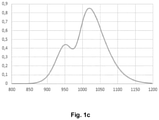
- the system comprising onto a substrate the first ink and above the first ink the second ink with the spectra as shown in figures 1a and 1b shows, if measured from above the second ink, an emission spectrum as shown in figure 1c .
- This spectrum is the difference between the spectra shown in figures 1a and 1b , since the non-luminescent IR absorbing pigment of the second layer absorbs IR light (but does not emit any light, which may interfere with the emission spectrum of the IR luminescent dye of the first ink) and thus reduces at the absorbed wavelengths a respective part of the emission spectrum of the IR luminescent dye of the first ink and thus subtracts the respective amount of emission at the respective wavelengths from the emission spectrum of the IR luminescent dye of the first ink.
- a genuine system of this embodiment would have above the second ink at 980 nm an emission corresponding to 0.5 relative units as shown in figure 1c .
- a forged system only comprising the first ink would have at 980 nm a respective emission corresponding to 0.9 relative units.
- a forged system only comprising the second ink or none of the first and second ink would have no emission at all at 980 nm.
- both inks would be applied onto each other so as to only partially overlap, above the area of only the first ink at 980 nm a respective emission corresponding to 0.9 relative units would be measured, above the area of the first and second ink at 980 nm a respective emission corresponding to 0.5 relative units would be measured and above the area of only the second ink at 980 nm no emission would be measured.
- the system in accordance with the present invention allows to reliably differ a genuine from a forged system.
Landscapes
- Chemical & Material Sciences (AREA)
- Engineering & Computer Science (AREA)
- Toxicology (AREA)
- Health & Medical Sciences (AREA)
- General Health & Medical Sciences (AREA)
- Physics & Mathematics (AREA)
- Organic Chemistry (AREA)
- Materials Engineering (AREA)
- Life Sciences & Earth Sciences (AREA)
- Wood Science & Technology (AREA)
- General Physics & Mathematics (AREA)
- Chemical Kinetics & Catalysis (AREA)
- Spectroscopy & Molecular Physics (AREA)
- Manufacturing & Machinery (AREA)
- General Chemical & Material Sciences (AREA)
- Finance (AREA)
- Accounting & Taxation (AREA)
- Business, Economics & Management (AREA)
- Inorganic Chemistry (AREA)
- Inks, Pencil-Leads, Or Crayons (AREA)
- Printing Methods (AREA)
- Credit Cards Or The Like (AREA)
Description
- The present invention relates to security ink system or to a security article, respectively, i.e. to a system comprising at least one security substrate, such as a banknote paper, onto which at least one security ink is printed.
- Security articles, such as banknotes, bank cards, credit cards, driving licences and the like, must comprise one or more security features, so that any skilled person is able to reliably determine, whether it is genuine or forged. This is a prerequisite for allowing a recipient of for instance a banknote, such as a cashier at a supermarket, to decide, whether he accepts it or not. In addition, it allows employees of a bank to evaluate the genuineness of banknotes, before filling it into a cash machine or transfer it into the cash desk. Moreover, the existence of such security features avoids or at least significantly hinders unauthorized persons to copy or reengineering the respective article. Furthermore, security features even allow a cash machine or a banknote counting machine to assure that the banknotes are properly aligned during their transport through the machine, which is a prerequisite for reliably counting the number of banknotes.
- Particular valuable security articles, such as banknotes, are required to have several different security features and it is preferred that they have as many of different security features as possible.
- Examples for security features are security images, which comprise an image being invisible or otherwise undetectable under ambient conditions, but which are rendered visible or detectable upon application of e.g. UV radiation. Alternatively, the image on the banknote or credit card may have a first color under ambient conditions, which is changed into a second color being different from the first color upon application of e.g. UV radiation.
- An often used security feature is the application of a printing ink onto a part of the surface of a security banknote paper, wherein the printing ink has certain characteristics under infrared (IR) radiation. For instance, the specific IR active ink is applied onto a part of the surface of the security banknote paper in the form of a small pattern, of a barcode, of a single line, of one dot or of several dots. In particular, for this purpose ink is used, which absorbs IR radiation, so that it reduces the IR radiation reflectance of the part of the surface of the banknote, where the specific IR active ink is applied, compared to those areas of the surface of the banknote, where the specific IR active ink is not applied. By measuring the IR reflectance at a wavelength, at which the specific ink absorbs IR radiation, at different locations of the banknote surface, some of which being in the area where the security image is supposed to be and some of which being outside this area, it can be reliably decided, whether this security feature is present on the evaluated banknote or not. In the case of the absence of the specific ink, the locations in the area where the security image is supposed to be and those locations outside this area would have the same or at least essentially the same IR radiation reflectance, whereas in the case of the presence of the specific ink, the locations in the area where the security image is supposed to be would have a significantly lower IR radiation reflectance as those locations outside this area. This kind of security feature is quite helpful, but not completely satisfying, when a high standard of protection against forgery is required.
- Therefore, it has ben already supposed to combine such IR active inks with other security inks, in order to improve the level of protection against forgery. However, combining IR active inks on certain areas of the security article with other inks, such as UV active inks, on other areas of the security article requires that the security article is analyzed with different measuring methods, such as by measuring IR reflectance on the one hand and a UV characteristic on the other hand.
-
WO 2017/102723 A1 discloses a security element comprising a first material MAT1 and a second material MAT2 formed in or on a substrate, in such a manner that areas occupied by MAT1 and MAT2 overlap partially or fully, wherein the first material MAT1 comprises a phosphorescent pigment (donor) and the second material MAT2 comprises a fluorescent dye or pigment (acceptor). The phosphorescent pigment present in MAT1 is capable of emitting phosphorescence radiation in at least one first phosphorescence emission wavelength range λ1e upon excitation by electromagnetic radiation falling within a phosphorescence excitation wavelength range and the fluorescent dye or pigment present in MAT2 is capable of emitting fluorescence radiation in at least one second fluorescence emission wavelength range λ2e upon excitation by electromagnetic radiation falling within an fluorescence excitation wavelength range λ2a of the fluorescent dye or pigment. Moreover, the first phosphorescence emission wavelength range λ1e of the phosphorescent pigment present in MAT1 overlaps with the excitation wavelength range λ2a of the fluorescent dye or pigment present in MAT2, so that after irradiation of the security element with electromagnetic radiation within the phosphorescence excitation wavelength range λ1a the emission of fluorescence radiation in the emission wavelength range λ2e is observable. -
WO 2017/102722 A1 relates to a security element comprising a first and a second pattern PAT1 and PAT2 formed in or on a substrate, wherein the first pattern PAT1 is formed by a first material INK1 applied to a first region of the substrate, the second pattern PAT2 is formed by a second material INK2 applied to a second region of the substrate, wherein the first and second regions of the substrate overlap. The first material INK1 comprises a first luminescent dye or pigment DYE1, which upon excitation by electromagnetic radiation falling within an excitation wavelength range λ1a of the first luminescent dye or pigment DYE1 is capable of emitting electromagnetic radiation in at least one first emission wavelength range λ1e, and the second material INK2 comprises a second luminescent dye or pigment DYE2, which upon excitation by electromagnetic radiation falling within an excitation wavelength range λ2a of the second luminescent dye or pigment DYE2 is capable of emitting electromagnetic radiation in at least one second emission wavelength range λ2e. The first emission wavelength range λ1e of the first luminescent dye or pigment DYE1 overlaps with the excitation wavelength range λ2a of the second luminescent dye or pigment DYE2, so that upon irradiation with electromagnetic radiation within the excitation wavelength range λ1a of the first luminescent dye or pigment DYE1 the second luminescent dye or pigment DYE2 is excited in the area of overlap of the patterns, to emit electromagnetic radiation in the emission wavelength range λ2e. -
US 2015/376422 A2 discloses an intaglio ink composition comprising a first component A) and a second component B), wherein the first component A) comprises a plurality of first particles having a modal particle diameter between about 1 nm and about 3 µm and the second component B) comprises a plurality of second particles having a modal particle diameter between 6 µm and 25 µm. -
WO 2010/077600 A1 discloses a method of authenticating an article comprising the steps of providing an electromagnetic absorbing substance capable of absorbing at least one narrow absorption line, providing an electromagnetic emitter substance capable of emitting a broad emission bandwidth and creating an emission spectral signature in response to excitation of the emitter substance that overlaps the at least one narrow absorption line of the absorbing substance. -
WO 2004/111951 A1 describes a security document comprising a machine-readable authenticity mark, which is provided with a luminescent marking agent and a marking agent that absorbs in the infrared spectral range. - In view of this, the object underlying the present invention is to provide a security article, such as a printed security paper, such as a banknote or a verification certificate, which has an improved level of protection against forgery, but which can be nevertheless evaluated as genuine or forged in a simple manner and by preferably only requiring one measuring method.
- In accordance with the present invention, this objective is achieved by providing a system as defined in claim 1.
- By applying two different inks onto the surface of a substrate, one of which including at least one IR luminescent dye and/or at least one IR luminescent pigment, i.e. an IR emitting dye and/or pigment, such as an IR fluorescent dye and/or pigment, and the other non-luminescent ink including at least one non-luminescent IR absorbing pigment and/or non-luminescent IR at least one absorbing dye, the security article is provided with two different security features (in addition to the other typical security features present in banknotes, such as a security thread, a clear window, a shadow image or the like), thus significantly improving the level of protection against forgery thereof. In addition, by applying the first ink and the second ink so that they at least partially overlap on the at least one surface of the substrate, by applying the second ink in the overlapping area onto the first ink and by selecting the pigments and/or dyes of the first and second ink so that the emission spectrum of the first ink and the absorption spectrum of the second ink at least partially overlap in the IR range, it is achieved that the two different security features can be reliably identified with one measuring method. It is in particular not necessary to measure the emission characteristics of the first ink and the absorption characteristics of the second ink (i.e. to apply two different measuring methods). On the contrary, it is sufficient for reliably identifying both security features to measure the emission characteristics of the system at a location above the overlap area of the first ink and the second ink. This is due to the fact that the emission spectrum of the lower first ink and the absorption spectrum of the upper second ink influence each other. In the overlapping area of both inks, the lower first ink emits, when appropriately excited, IR radiation, whereas the upper second ink absorbs a part of the IR radiation emitted by the lower layer, because the emission spectrum of the first ink and the absorption spectrum of the second ink at least partially overlap in the IR wavelength range. Therefore, the emission detected above the overlapping area of both inks is the difference of the IR radiation emitted by the lower first ink and the part thereof absorbed by the upper second ink. Since in the non-luminescent second ink a non-luminescent IR absorbing pigment and/or non-luminescent IR absorbing dye is used, i.e. since the second ink is not luminescent and thus does not emit any luminescence radiation after having been excited, the difference of the IR radiation emitted by the lower first ink and the part thereof absorbed by the upper second ink is not falsified by any further radiation. For instance, if the lower first ink emits IR radiation in a range of 900 to 1,100 nm, whereas the upper higher second in absorbs light at 950 to 1,000 nm, the spectrum detected above the overlapping area (for instance measured between 800 and 1,500 nm) corresponds to the emission spectrum of the lower first ink respectfully reduced in the 950 to 1,000 nm wavelength range by the portion of IR radiation absorbed by the upper second ink. Thus, a characteristic spectrum is measured above the overlapping area of both inks which is significantly different from the emission spectrum of the lower first ink so that the presence of both layers can be simply and reliably concluded. Alternatively, to measuring a spectrum, it is sufficient to measure at one or more locations above the overlapping area the emission at, for instance, at three different wavelengths of e.g. in this exemplary case at 950 nm, at 970 nm and at 1,000 nm. Since the IR radiation emitted at these wavelengths is differently reduced at each of these three wavelengths due to the upper second ink absorbing different amounts of IR radiation at these three wavelengths, three characteristic emission values are measured at the three different wavelengths, which allow to simply and reliably conclude, whether the measured system includes both security features or not. Still alternatively, it is possible to measure the emission at one wavelength at one or more locations above the overlapping area at, for instance, two or three different excitation wavelengths. Since the emission spectrum of the first ink depends on the excitation wavelength, the first layer will emit at the different excitation wavelengths different emission spectra so that the total emission influenced by the IR absorbance of the second ink measured above the overlapping area of both inks will differ. It is even simply possible with the present invention to identify both security features space-resolved. For instance, the lower first ink as well as the upper second ink are applied onto the substrate in form of the squares, which are not shifted in the width direction, but which are shifted in the longitudinal direction of for example a banknote paper (with the upper second ink square being shifted to the right side). Then, from left to right the following sections exist on the substrate: a left first section without first ink and without second ink, right therefrom a second section with only first ink, but without second ink, right therefrom a third section with first ink and with second ink, right therefrom a fourth section with only second ink, but without first ink, and right therefrom a fifth section without first ink and without second ink. By measuring the IR emission at one or more specific IR wavelengths in each of these sections, a space-resolved detection of both security features is simply and reliably possible. All in all, a security system in accordance with the present invention does not only has a high level of protection against forgery, but can be also evaluated as genuine or forged in a simple manner and by preferably only requiring one measurement.
- As set out above, the second ink is non-luminescent and thus in particular non-fluorescent as well as non-phosphorescent.
- In accordance with the present invention, the emission spectrum of the first ink and the absorption spectrum of the second ink at least partially overlap. Preferably, the emission spectrum of the first ink and the absorption spectrum of the second ink at least partially overlap in the infrared region and more preferably in the near infrared region, such as between 780 and 2,500 nm. Particular good results are obtained, when the emission spectrum of the first ink and the absorption spectrum of the second ink at least partially overlap in a wavelength range of between 780 and 1,500 nm, more preferably of between 800 and 1,200 nm, even more preferably of between 900 and 1,100 nm and most preferably of between 950 and 1,050 nm.
- Therefore, it is in particular preferred that the emission spectrum of the first ink has at least one peak between 780 and 2,500 nm, more preferably between 780 and 1,500 nm, still more preferably between 800 and 1,200 nm, even more preferably between 900 and 1,100 nm and most preferably between 950 and 1,050 nm. The emission spectrum of the first ink is at least mainly influenced and preferably only influenced by the at least one IR luminescent dye and/or at least one IR luminescent pigment, since it is preferred that all other components of the first ink except the at least one IR luminescent dye and/or at least one IR luminescent pigment do not emit radiation in this wavelength range, i.e. that they are IR transparent. However, since it cannot be excluded that one or more of the other components at least slightly emit in a specific part of this wavelength range, it is subsequently referred to the emission of the first ink, even if that of the at least one IR luminescent dye and/or at least one IR luminescent pigment included therein is meant.
- In accordance with a particular preferred embodiment of the present invention, the emission spectrum or at least one peak of the emission spectrum of the first ink, respectively, is broader than the absorption spectrum or at least one peak of the second ink, respectively. This allows to significantly reduce the emission of only a part of the peak of the first ink by the overlaying second ink, whereas the remaining part of the peak is not influenced. This allows to get a strong contrast. In contrast thereto, the emission of the peak of the emission spectrum of the first ink would be reduced over its complete width, if the peak of the emission spectrum of the first ink would be more narrow than the peak of the IR absorption spectrum of the second ink and if both spectrum would completely overlap. Preferably, the emission spectrum of the first ink has at least one peak, wherein the at least one peak of the emission spectrum of the first ink has a width at half-height of at least 75, preferably of at least 100 nm and more preferably of at least 120 nm. The width at half-height is defined or determined, respectively, in this connection by measuring the height of the peak crest above the baseline, dividing it by two, and then measuring the span between the rising and falling sides of the peak where a line crosses the half-height points of the rising and falling sides of the peak.
- For measuring the emission of the ink layers, the at least one IR luminescent dye and/or at least one IR luminescent pigment included in the first ink must be excited by applying an appropriate excitation spectrum or excitation wavelength, respectively. In order to avoid that the measurement of the emission of the ink layers is interfered by the excitation radiation, it is suggested in a further development of the idea of the present invention that the wavelength(s) of the excitation radiation is sufficiently different from the emission wavelength(s) of the at least one IR luminescent dye and/or at least one IR luminescent pigment included in the first ink and sufficiently different from the absorption wavelength(s) of the at least one non-luminescent IR absorbing pigment and/or at least one non-luminescent IR absorbing dye of the second ink. On account of these reasons, it is preferred that the at least one IR luminescent dye and/or the at least one IR luminescent pigment of the first ink has an excitation wavelength of 200 to 700 nm, preferably of 400 to 600 nm and more preferably of 430 to 520 nm, which is sufficiently distant from the IR wavelength range.
- In accordance with the present invention, the emission spectrum of the first ink and the absorption spectrum of the second non-luminescent ink at least partially overlap. Therefore, it is preferable that the absorption spectrum of the second ink has at least one peak between 780 and 2,500 nm, preferably between 780 and 1,500 nm, more preferably between 800 and 1,200 nm, even more preferably between 875 and 1,075 nm and most preferably between 925 and 1,025 nm. The absorption spectrum of the second non-luminescent ink is at least mainly influenced and preferably only influenced by the at least one non-luminescent IR absorbing pigment and/or a least one non-luminescent IR absorbing dye, since it is preferred that all other components of the second ink except the at least one IR absorbing pigment and/or a least one IR absorbing dye do not absorb radiation in this wavelength range, i.e. that they are IR transparent. However, since it cannot be excluded that one or more of the other components at least slightly absorb in a specific part of this wavelength range, it is subsequently referred to the absorption of the second ink, even if that of the at least one IR absorbing pigment and/or a least one IR absorbing dye included therein is meant.
- As set out above, the emission spectrum or at least one peak, respectively, of the emission spectrum of the first ink is broader than the absorption spectrum or at least one peak, respectively, of the second ink in accordance with a particular preferred embodiment of the present invention. In view of this, it is preferred that the at least one peak of the absorption spectrum of the second ink has a width at half-height of less than 75 nm, more preferably of at less than 60 nm and most preferably of less than 50 nm. Again, the width at half-height is defined or determined, respectively, in this connection by measuring the height of the peak crest above the baseline, dividing it by two, and then measuring the span between the rising and falling sides of the peak where a line crosses the half-height points of the rising and falling sides of the peak.
- In order to particularly characteristically influence the emission spectrum of the first ink, it is suggested in a further development of the idea of the present invention that the crest of the at least one peak of the absorption spectrum of the second ink is shifted in relation to the crest of the at least one peak of the emission spectrum of the first ink by 10 to 400 nm, preferably by 10 to 100 nm, more preferably by 15 to 50 nm and most preferably by 20 to 40 nm.
- Each of the first ink and of the second ink may be independently from each other applied onto the substrate in any two-dimensional form, such as for example in the form of a line, of a dot, of a raster or of a pattern.
- Both, the first ink and the second ink may be applied onto the surface of the substrate in the same form and completely overlapping each other.
- However, as set out above it is preferred that both inks only partial overlap so as to allow to space-resolved detect both security features. Therefore, it is preferred that the first ink and the second ink only partially overlap each other, wherein both inks may be applied onto the surface of the substrate in the same form or in a different form.
- In principle, the present invention is not limited concerning the kind of substrate, as long as the first and second ink are formulated so that they can be applied onto the surface of the substrate. For instance, the substrate may be a paper, a polymer foil or a composite comprising at least one paper layer and at least one polymer foil. More specifically, the substrate may be selected from the group consisting of security papers, polycarbonate foils, polyethylene terephthalate foils, composites of a lower security paper and an upper polymer foil, composites of a lower polymer foil and an upper security paper, composites of a lower security paper, an intermediate polymer foil and an upper security paper, composites of a lower polymer foil, an intermediate security paper and an upper polymer foil and hybrids of a security paper, in which a part of the security paper is replaced by a polymer foil.
- In accordance with a further preferred embodiment of the present invention, the substrate does not emit radiation at a wavelength between at least 950 and 1,050 nm, preferably at a wavelength between at least 900 and 1,100 nm, more preferably at a wavelength between at least 800 and 1,200 nm, even more preferably at a wavelength between at least 780 and 1,500 nm and most more preferably at a wavelength between at least 780 and 2,500 nm. This assures that the emission spectrum measured for identifying the security features is not negatively influenced by the substrate.
- Concerning the kind of IR luminescent dye, the present invention is not particularly restricted. Thus, any dye may be used which emits - upon excitation - radiation in the IR region. More specifically, the IR luminescent dye may be an IR fluorescent dye or an IR phosphorescent dye. Examples therefore are IR luminescent dyes being selected from the group consisting of coumarin, coumarin derivatives, [1,3]dioxolo[4,5-f][1,3]benzodioxol, [1,3]dioxolo[4,5-f][1,3]benzodioxol derivatives, cyanine dyes and arbitrary combinations of two or more of the aforementioned dyes. Suitable examples for cyanine dyes are in particular cyanine dyes Cy7 and Cy7.5.
- Likewise to this, the present invention is not particularly limited with regard to the kind of IR luminescent pigment so that any pigment may be used which emits - upon excitation - radiation in the IR region. For instance, the first ink may include an IR luminescent pigment, which is a lanthanoid complex, preferably calcium sulfide doped with one or more rare earth metals or calcium sulfide doped with or with one or more lanthanoids and more preferably calcium sulfide doped with europium und thallium. Good results are in particular achieved, when the IR luminescent pigment has an average particle size of 10 nm to 2 µm and more preferably of 50 to 500 nm.
- Preferably, the total concentration of IR luminescent dye and IR luminescent pigment in the first ink is 1 to 40% by weight and more preferably 5 to 20% by weight.
- In dependency from the substrate, the first ink may be formulated as printing ink, such as one being selected from the group consisting of offset inks, intaglio inks, gravure inks, flexographic inks and screen inks.
- In addition to the at least one IR luminescent dye and/or at least one IR luminescent pigment, the first ink includes a binder. For instance, the first ink may include a binder, which is selected from the group consisting of polyesters, polyethers, polyurethanes, polyamides, polyacrylates, maleinate resins, collophonium resins, ketone resins, alkyd resins, collophonium modified phenolic resins, hydrocarbon resins, silicates, silicones, silanes, phenolic resins, urea resins, melamine resins, polyterpene resins, polyvinylalcohols, polyvinylacetates, polyvinylchloride, polyvinylethers, polyvinylpropionates, polymethacrylates, polystyrenes, polyolefines, coumarone-indene resins, aromatic formaldehydre resins, carbamide acid resins, sulfonamide resins, chlorinated resins, nitrocellulose, CAB (cellulose acetate butyrate), CAP (cellulose acetate propionate), cellulose compounds, rubbers, radiation curing resins and arbitrary combinations of two or more of the aforementioned binders.
- In accordance with a particular preferred embodiment of the present invention, the first ink comprises:
- i) 1 to 40% by weight and preferably 5 to 20% by weight of IR luminescent dye(s) and/or IR luminescent pigment(s),
- ii) 10 to 40% by weight and preferably 20 to 30% by weight of one or more binders,
- iii) 20 to 60% by weight and preferably 30 to 40% by weight of one or more solvents, wherein the solvent is preferably selected from the group of vegetable oils, mineral oils, wood oils and arbitrary combinations of two or more of the aforementioned solvents, and
- iv) optionally 1 to 10% by weight of one or more additives being selected from the selected from the group consisting of rheological additives, adhesives, defoamers, slip additives, anti-corrosion additives, gloss additives, waxes, wetting agents, curing agents, chelating agents, photoinitiators, inhibitors, desiccants, stabilizers, emulsifiers, pH adjustment additives, abrasion resistance additives, plasticizers, antistatic additives, preservatives, light protection agents, matting agents and arbitrary combinations of two or more of the aforementioned additives,
- The thickness of the first ink depends on the application technique or printing technique, respectively. Thus, the thickness of the first ink may be 1 to 3 µm in the case of an offset printing ink, 1 to 10 µm in the case of an intaglio or gravure printing ink, 1 to 8 µm for a flexographic printing ink and 1 to 10 µm for a screen printing ink.
- As set out above, the second ink is non-luminescent, i.e. it does not contain any luminescent component and thus neither a fluorescent nor phosphorescent component.
- The present invention is not particularly limited concerning the kind of the at least one non-luminescent IR absorbing pigment included in the second ink. Thus, any pigment may be used which absorbs radiation in the IR region, but which is non-luminescent. More specifically, the non-luminescent IR absorbing pigment may be a transition metal compound, such as a transition metal salt. More preferably, the at least one non-luminescent IR absorbing pigment is a transition metal salt with an anion being selected from the group consisting of Ti anions, V anions, Cr anions, Mn anions, Fe anions, Co anions, Ni anions, Co anions, La anions, Zr anions, Ce anions, Y anions and Mo anions and even more preferably a transition metal salt with an cation being selected from the group consisting of borides, phosphates, hydrogenophosphates, pyrophosphates, metaphosphates, polyphosphates, silicates, condensed polysilicates, titanates, condensed polytitanates, carbonates, fluorides, oxides and hydroxides, wherein the non-luminescent IR luminescent pigment preferably has an average particle size of 10 nm to 10 µm and more preferably of 50 nm to 2 µm.
- Particularly preferred examples for non-luminescent IR absorbing pigments are those selected from the group consisting of indium tin oxide, titanium nitride, zirconium nitride, molybdenum metal, copper chromate, lanthanum hexaboride, neodymium oxide, neodymium chloride, dysprosium oxide and praseodymium oxide, copper (II) fluoride, copper hydroxyfluoride, copper hydroxide, copper phosphate, anhydrous copper phosphate, the basic copper (II) phosphates, cornetite, pseudomalachite, turquoise, copper (II) pyrophosphate, anhydrous copper(II) pyrophosphate, copper(II) metaphosphate, iron (II) fluoride, anhydrous iron (II) fluoride, iron (II) phosphate, lithium iron (II) phosphate, sodium iron (II) phosphate, iron (II) silicates, iron(II) carbonate, nickel(II) phosphate, titanium(III) metaphosphate anapaite, wagnerite, lanthan hexaboride, cerium hexaborid, yttrium hexaboride, molybdenum boride, zirconium diboride, titaniumboride, vanadium boride, chromium diboride and arbitrary combinations of two or more of the aforementioned compounds.
- Preferably, the non-luminescent IR luminescent pigment preferably has an average particle size of 10 nm to 10 µm and more preferably of 50 nm to 2 µm.
- As set out above, alternatively to or in addition to the at least one non-luminescent IR absorbing pigment, the second ink further may include an at least one non-luminescent IR absorbing dye. The non-luminescent IR absorbing dye may be selected from the following compounds:

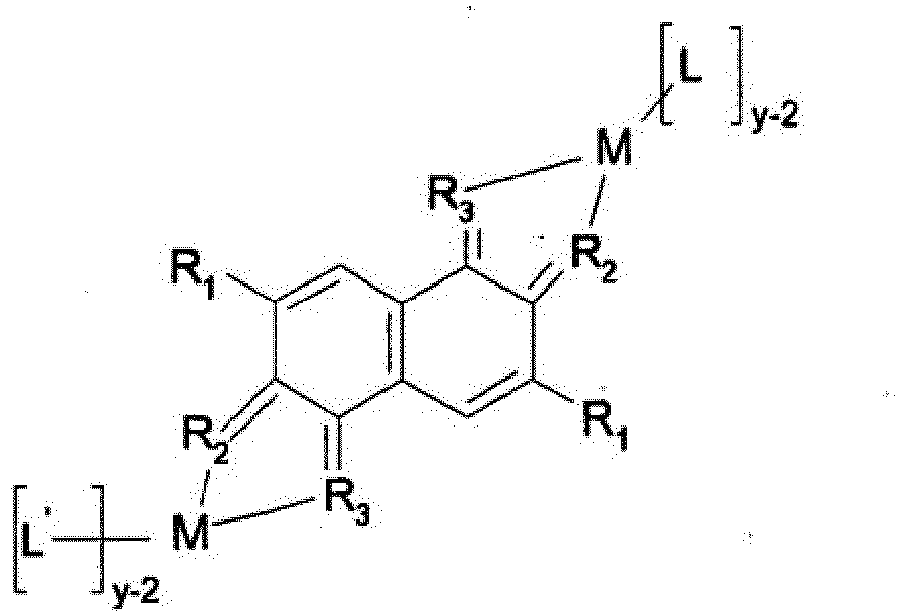
- M is a metal selected from a group 3-10 (Group IIIB - VIII) element or a lanthanide,
- R1 is selected from hydrogen, phosphonate, sulphonate, nitro, halo, cyano, thiocyano, thioalkyl, thioaryl, alkyl, alkoxy, aryl, aryloxy, amines, substituted amines and substituted aryl,
- one of R2 and R3 is oxygen and the other of R2 and R3 is NO,
- n is a number corresponding to half the co-ordination number of the metal M,
- each L and L' is independently a ligand complexed to the metal M and
- y is a number corresponding to the co-ordination number of the metal M.
- Preferably, the total concentration of non-luminescent IR absorbing pigment(s) and non-luminescent IR absorbing dye(s) in the second ink is 1 to 60% by weight and preferably 5 to 20% by weight.
- In dependency from the substrate, the second ink may be formulated as printing ink, such as one being selected from the group consisting of offset inks, intaglio inks, gravure inks, numbering inks, flexographic inks and screen inks.
- In addition to the at least one non-luminescent IR absorbing and/or a least one non-luminescent IR absorbing dye, the second ink includes a binder. For instance, the second ink may include a binder, which is selected from the group consisting of polyesters, polyethers, polyurethanes, polyamides, polyacrylates, maleinate resins, collophonium resins, ketone resins, alkyd resins, collophonium modified phenolic resins, hydrocarbon resins, silicates, silicones, silanes, phenolic resins, urea resins, melamine resins, polyterpene resins, polyvinylalcohols, polyvinylacetates, polyvinylchloride, polyvinylethers, polyvinylpropionates, polymethacrylates, polystyrenes, polyolefines, coumarone-indene resins, aromatic formaldehydre resins, carbamide acid resins, sulfonamide resins, chlorinated resins, nitrocellulose, CAB (cellulose acetate butyrate), CAP (cellulose acetate propionate), cellulose compounds, rubbers, radiation curing resins and arbitrary combinations of two or more of the aforementioned binders.
- In accordance with a particular preferred embodiment of the present invention, the second ink comprises:
- i) 1 to 60% by weight and preferably 5 to 20% by weight of non-luminescent IR absorbing pigment(s) and/or non-luminescent IR absorbing dye(s),
- ii) 10 to 40% by weight and preferably 20 to 30% by weight of one or more binders,
- iii) 20 to 60% by weight and preferably 30 to 40% by weight of one or more solvents, wherein the solvent is preferably selected from the group of vegetable oils, mineral oils, wood oils and arbitrary combinations of two or more of the aforementioned solvents, and
- iv) optionally 1 to 10% by weight of additive(s) selected from the selected from the group consisting of rheological additives, adhesives, defoamers, slip additives, anti-corrosion additives, gloss additives, waxes, wetting agents, curing agents, chelating agents, photoinitiators, inhibitors, desiccants, stabilizers, emulsifiers, pH adjustment additives, abrasion resistance additives, plasticizers, antistatic additives, preservatives, light protection agents, matting agents and arbitrary combinations of two or more of the aforementioned additives,
- The thickness of the second ink depends on the application technique or printing technique, respectively. Thus, the thickness of the second ink may be 1 to 3 µm in the case of an offset printing ink, 1 to 10 µm in the case of an intaglio or gravure printing ink, 1 to 8 µm for a flexographic printing ink and 1 to 10 µm for a screen printing ink.
- If necessary, the system in accordance with the present invention may comprise a varnish, which is applied at least in the overlapping area of the first and second inks on the second ink.
- Particular preferred examples for systems in accordance with the present invention are:
- the first ink is formulated as offset ink and the second ink is formulated as intaglio ink or
- the first ink is formulated as offset ink and the second ink is formulated as intaglio ink, wherein the system further comprises a varnish, which is applied at least in the overlapping area of the first and second inks on the second ink, or
- the first ink is formulated as offset ink and the second ink is formulated as die screen ink or
- the first ink is formulated as offset ink and the second ink is formulated as die screen ink, wherein the system further comprises a varnish, which is applied at least in the overlapping area of the first and second inks on the second ink, or
- the first ink is formulated as screen ink and the second ink is formulated as offset ink or
- the first ink is formulated as screen ink and the second ink is formulated as offset ink, wherein the system further comprises a varnish, which is applied at least in the overlapping area of the first and second inks on the second ink.
- In a further development of the idea of the present invention, it is suggested that the second ink comprises as a further security feature an embossing on its surface.
- The system in accordance with the present invention may be used for any security article. Suitable examples therefore are those selected from the group consisting of banknotes, checks, bank and credit cards, check cards, passports, chip cards, driving licences, verification certificates, entrance tickets, stamps, train and airplane tickets, telephone carts and seals.
- In accordance with a further aspect, the present invention relates to a method for preparing a system as defined in
claim 12. - Another aspect of the present invention is the provision of a method for evaluating the genuineness of a security document as defined in claim 13.
- Preferably, at least a part of the measurement of the emission of the system is measured during at least a part of the time period, during which the security document is irradiated. This allows to quickly perform the measurement, because it has not to be waited until the irradiation is stopped. Measuring the emission of the system at least during a part of the time period, during which the security document is irradiated, means that at least 50%, preferably at least 75% and more preferably at least 90% of the emission measurement time period falls within the time period, during which the security document is irradiated. Most preferably, the whole measurement of the emission is made during the time period, during which the security document is irradiated.
- Preferably, the emission of the system is measured at two to ten different wavelengths, preferably at three to five different wavelengths, wherein at all of these wavelengths the at least one IR luminescent dye and/or the at least one IR luminescent pigment included in the first ink emits IR radiation, and wherein at at least one of these wavelengths the non-luminescent IR absorbing pigment and/or a least one non-luminescent IR absorbing dye absorbs IR radiation.
- In order to allow a large difference in the emission measured for the system at the different wavelengths it is further preferred that the non-luminescent IR absorbing pigment and/or a least one non-luminescent IR absorbing dye does not absorb IR radiation at at least one of the wavelengths at which the emission is measured or that the absorption of the IR absorbing pigment and/or a least one IR absorbing dye is sufficiently lower, preferably 50 % or more lower than the IR emission of the IR luminescent pigment.
- In accordance with an alternative embodiment of the present invention, for measuring the emission of the system an emission spectrum is measured for a wavelength range of at least 950 to 1,050 nm, preferably of at least 900 to 1,100 nm, more preferably of at least 800 to 1,200 nm, even more preferably of at least 780 to 1,500 nm and most more preferably of at least 780 to 2,500 nm.
- In accordance with an alternative embodiment of the present invention, the security document may be irradiated with at least two different excitation wavelengths and preferably with at least three different excitation wavelengths each of which being able to excite the IR luminescent dye and/or IR luminescent pigment included in the first ink and the emission of the system is measured at one wavelength, at which the IR luminescent dye and/or IR luminescent pigment included in the first ink emits IR radiation. Since the emission spectrum of the first ink depends on the excitation wavelength, the first layer will emit at the different excitation wavelengths different emission spectra so that the total emission influenced by the IR absorbance of the second ink measured above the overlapping area of both inks will differ.
- Subsequently, the present invention is described with reference to the appended figures.
- Fig. 1a
- shows the emission spectrum of a first ink including an IR luminescent dye.
- Fig. 1b
- shows the IR absorption spectrum of a second ink including an IR absorbing pigment.
- Fig. 1c
- shows the emission spectrum measured of a system in accordance with one embodiment of the present including the first ink of
figure 1a and the second ink offigure 1b above the first ink. -
Figure 1a shows the emission spectrum of a first ink including an IR luminescent dye after having been excited at a wavelength of for instance 580 nm. The emission spectrum has a peak with a crest at about 1,000 nm and a width at half-height of about 175 nm. - The IR absorption spectrum of a second ink including a non-luminescent IR absorbing pigment shown in
figure 1b has a peak with a crest at about 980 nm and a width at half-height of about 40 nm. - The system comprising onto a substrate the first ink and above the first ink the second ink with the spectra as shown in
figures 1a and 1b shows, if measured from above the second ink, an emission spectrum as shown infigure 1c . This spectrum is the difference between the spectra shown infigures 1a and 1b , since the non-luminescent IR absorbing pigment of the second layer absorbs IR light (but does not emit any light, which may interfere with the emission spectrum of the IR luminescent dye of the first ink) and thus reduces at the absorbed wavelengths a respective part of the emission spectrum of the IR luminescent dye of the first ink and thus subtracts the respective amount of emission at the respective wavelengths from the emission spectrum of the IR luminescent dye of the first ink. Thus, a genuine system of this embodiment would have above the second ink at 980 nm an emission corresponding to 0.5 relative units as shown infigure 1c . However, a forged system only comprising the first ink would have at 980 nm a respective emission corresponding to 0.9 relative units. In turn, a forged system only comprising the second ink or none of the first and second ink would have no emission at all at 980 nm. - If both inks would be applied onto each other so as to only partially overlap, above the area of only the first ink at 980 nm a respective emission corresponding to 0.9 relative units would be measured, above the area of the first and second ink at 980 nm a respective emission corresponding to 0.5 relative units would be measured and above the area of only the second ink at 980 nm no emission would be measured.
- All in all, the system in accordance with the present invention allows to reliably differ a genuine from a forged system.
Claims (15)
- A system comprising:i) a substrate,ii) a first ink, which is applied on at least a part of at least one surface of the substrate, wherein the first ink includes at least one IR luminescent dye and/or at least one IR luminescent pigment, andiii) a second non-luminescent ink, which is applied on at least a part of at least one surface of the substrate onto which the first ink is/are applied, wherein the second ink includes at least one non-luminescent IR absorbing pigment and/or a least one non-luminescent IR absorbing dye,wherein the first ink and the second ink at least partially overlap on the at least one surface of the substrate, wherein the second ink is applied in the overlapping area onto the first ink, and wherein the emission spectrum of the first ink and the absorption spectrum of the second ink at least partially overlap.
- The system in accordance with claim 1, wherein the emission spectrum of the first ink has at least one peak between 780 and 2,500 nm, preferably between 780 and 1,500 nm, more preferably between 800 and 1,200 nm, even more preferably between 900 and 1,100 nm and most preferably between 950 and 1,050 nm, wherein preferably the at least one peak of the emission spectrum of the first ink has a width at half-height of at least 75, preferably of at least 100 nm and more preferably of at least 120 nm.
- The system in accordance with claim 1 or 2, wherein the absorption spectrum of the second ink has at least one peak between 780 and 2,500 nm, preferably between 780 and 1,500 nm, more preferably between 800 and 1,200 nm, even more preferably between 875 and 1,075 nm and most preferably between 925 and 1,025 nm, wherein preferably the at least one peak of the absorption spectrum of the second ink has a width at half-height of less than 75 nm, preferably of at less than 60 nm and more preferably of less than 50 nm.
- The system in accordance with any of the preceding claims, wherein the crest of the at least one peak of the absorption spectrum of the second ink is shifted in relation to the crest of the at least one peak of the emission spectrum of the first ink by 10 to 400 nm, preferably by 10 to 100 nm, more preferably by 15 to 50 nm and most preferably by 20 to 40 nm.
- The system in accordance with any of the preceding claims, wherein the first ink includes an IR luminescent dye, which is selected from the group consisting of coumarin, coumarin derivatives, [1,3]dioxolo[4,5-f][1,3]benzodioxol, [1,3]dioxolo[4,5-f][1,3]benzodioxol derivatives, cyanine dyes and arbitrary combinations of two or more of the aforementioned dyes.
- The system in accordance with any of the preceding claims, wherein the first ink includes an IR luminescent pigment, which is a lanthanoid complex, preferably calcium sulfide doped with one or more rare earth metals or calcium sulfide doped with or with one or more lanthanoids and more preferably calcium sulfide doped with europium und thallium, wherein the IR luminescent pigment preferably has an average particle size of 10 nm to 2 µm and more preferably of 50 to 500 nm.
- The system in accordance with any of the preceding claims, wherein the total concentration of IR luminescent dye and IR luminescent pigment in the first ink is 1 to 40% by weight and preferably 5 to 20% by weight.
- The system in accordance with any of the preceding claims, wherein the second ink includes a non-luminescent IR absorbing pigment, which is a transition metal compound, preferably a transition metal salt, more preferably a transition metal salt with an anion being selected from the group consisting of Ti anions, V anions, Cr anions, Mn anions, Fe anions, Co anions, Ni anions, Co anions, La anions, Zr anions, Ce anions, Y anions and Mo anions and even more preferably a transition metal salt with an cation being selected from the group consisting of borides, phosphates, hydrogenophosphates, pyrophosphates, metaphosphates, polyphosphates, silicates, condensed polysilicates, titanates, condensed polytitanates, carbonates, fluorides, oxides and hydroxides, wherein the IR luminescent pigment preferably has an average particle size of 10 nm to 10 µm and more preferably of 50 nm to 2 µm.
- The system in accordance with any of the preceding claims, wherein the second ink includes a non-luminescent IR absorbing dye, which is selected from the following compounds:

 - M is a metal selected from a group 3-10 (Group IIIB - VIII) element or a lanthanide,- R1 is selected from hydrogen, phosphonate, sulphonate, nitro, halo, cyano, thiocyano, thioalkyl, thioaryl, alkyl, alkoxy, aryl, aryloxy, amines, substituted amines and substituted aryl,- one of R2 and R3 is oxygen and the other of R2 and R3 is NO,- n is a number corresponding to half the co-ordination number of the metal M,- each L and L' is independently a ligand complexed to the metal M and- y is a number corresponding to the co-ordination number of the metal M.
 - The system in accordance with any of the preceding claims, wherein second ink comprises:i) 1 to 60% by weight and preferably 5 to 20% by weight of non-luminescent IR absorbing pigment(s) and/or non-luminescent IR absorbing dye(s),ii) 10 to 40% by weight and preferably 20 to 30% by weight of one or more binders,iii) 20 to 60% by weight and preferably 30 to 40% by weight of one or more solvents, wherein the solvent is preferably selected from the group of vegetable oils, mineral oils, wood oils and arbitrary combinations of two or more of the aforementioned solvents, andiv) optionally 1 to 10% by weight of additive(s) selected from the selected from the group consisting of rheological additives, adhesives, defoamers, slip additives, anti-corrosion additives, gloss additives, waxes, wetting agents, curing agents, chelating agents, photoinitiators, inhibitors, desiccants, stabilizers, emulsifiers, pH adjustment additives, abrasion resistance additives, plasticizers, antistatic additives, preservatives, light protection agents, matting agents and arbitrary combinations of two or more of the aforementioned additives.
- The system in accordance with any of the preceding claims, wherein the system is a security article selected from the group consisting of banknotes, checks, bank and credit cards, check cards, passports, chip cards, driving licences, verification certificates, entrance tickets, stamps, train and airplane tickets, telephone carts and seals.
- A method for preparing a system in accordance with any of the preceding claims, which comprises the following steps:a) providing a substrate,b) applying a first ink on at least a part of at least one surface of the substrate, wherein the first ink includes at least one IR luminescent dye and/or at least one IR luminescent pigment, andc) applying a second non-luminescent ink on at least a part of at least one surface of the substrate, wherein the second ink includes at least one non-luminescent IR absorbing pigment and/or a least one non-luminescent IR absorbing dye, wherein the IR emission spectrum of the first ink and the absorption spectrum of the second ink at least partially overlap,wherein the first and second inks are applied in steps b) and c) so that the first ink and the second ink at least partially overlap, wherein the second ink is applied in the overlapping area onto the first ink.
- A method for evaluating the genuineness of a security document comprising a system in accordance with any of claims 1 to 11 comprising the steps of irradiating the security document with at least one wavelength being able to excite the IR luminescent dye and/or IR luminescent pigment included in the first ink and measuring the emission of the system at at least one wavelength, at which the IR luminescent dye and/or IR luminescent pigment included in the first ink emits IR radiation.
- The method in accordance with claim 13, wherein at least a part of the measurement of the emission of the system is made during at least a part of the time period, during which the security document is irradiated, and preferably the whole measurement of the emission is made during the time period, during which the security document is irradiated.
- The method in accordance with claim 13, wherein for measuring the emission of the system either:- the emission is measured at two to ten different wavelengths, preferably at three to five different wavelengths, wherein at all of these wavelengths the at least one IR luminescent dye and/or the at least one IR luminescent pigment included in the first ink emits IR radiation, and wherein at at least one of these wavelengths the non-luminescent IR absorbing pigment and/or a least one non-luminescent IR absorbing dye absorbs IR radiation, or- an emission spectrum is measured for a wavelength range of at least 950 to 1,050 nm, preferably of at least 900 to 1,100 nm, more preferably of at least 800 to 1,200 nm, even more preferably of at least 780 to 1,500 nm and most more preferably of at least 780 to 2,500 nm, or- the security document is irradiated with at least two different excitation wavelengths and preferably with at least three different excitation wavelengths each of which being able to excite the IR luminescent dye and/or IR luminescent pigment included in the first ink and wherein the emission of the system is measured at one wavelength, at which the IR luminescent dye and/or IR luminescent pigment included in the first ink emits IR radiation.
Priority Applications (1)
| Application Number | Priority Date | Filing Date | Title |
|---|---|---|---|
| PL19740032T PL3774378T3 (en) | 2018-08-10 | 2019-07-19 | Security ink system |
Applications Claiming Priority (2)
| Application Number | Priority Date | Filing Date | Title |
|---|---|---|---|
| EP18188419.8A EP3608120A1 (en) | 2018-08-10 | 2018-08-10 | Security ink system |
| PCT/EP2019/069594 WO2020030413A1 (en) | 2018-08-10 | 2019-07-19 | Security ink system |
Publications (2)
| Publication Number | Publication Date |
|---|---|
| EP3774378A1 EP3774378A1 (en) | 2021-02-17 |
| EP3774378B1 true EP3774378B1 (en) | 2022-02-23 |
Family
ID=63209245
Family Applications (2)
| Application Number | Title | Priority Date | Filing Date |
|---|---|---|---|
| EP18188419.8A Withdrawn EP3608120A1 (en) | 2018-08-10 | 2018-08-10 | Security ink system |
| EP19740032.8A Active EP3774378B1 (en) | 2018-08-10 | 2019-07-19 | Security ink system |
Family Applications Before (1)
| Application Number | Title | Priority Date | Filing Date |
|---|---|---|---|
| EP18188419.8A Withdrawn EP3608120A1 (en) | 2018-08-10 | 2018-08-10 | Security ink system |
Country Status (8)
| Country | Link |
|---|---|
| US (1) | US11524516B2 (en) |
| EP (2) | EP3608120A1 (en) |
| MX (1) | MX2020012052A (en) |
| MY (1) | MY202995A (en) |
| PH (1) | PH12020552085A1 (en) |
| PL (1) | PL3774378T3 (en) |
| RU (1) | RU2769394C1 (en) |
| WO (1) | WO2020030413A1 (en) |
Families Citing this family (2)
| Publication number | Priority date | Publication date | Assignee | Title |
|---|---|---|---|---|
| EP3855162A1 (en) * | 2020-01-21 | 2021-07-28 | Omya International AG | Lwir imaging system for detecting an amorphous and/or crystalline structure of phosphate and/or sulphate salts on the surface of a substrate or within a substrate and use of the lwir imaging system |
| EP4324658A1 (en) * | 2022-08-19 | 2024-02-21 | Gleitsmann Security Inks GmbH | A method for generating at least one security feature on a banknote and/or on a tax stamp using laser writing |
Family Cites Families (6)
| Publication number | Priority date | Publication date | Assignee | Title |
|---|---|---|---|---|
| DE10326983A1 (en) | 2003-06-12 | 2004-12-30 | Giesecke & Devrient Gmbh | Document of value with a machine-readable authenticity mark |
| US8530863B2 (en) * | 2008-12-08 | 2013-09-10 | Spectra Systems Corporation | Fluorescence notch coding and authentication |
| KR102177340B1 (en) * | 2013-02-14 | 2020-11-11 | 시크파 홀딩 에스에이 | Method for printing multi-characteristic intaglio features |
| MX373619B (en) * | 2013-05-21 | 2020-04-20 | Basf Se | SAFETY ELEMENTS AND MANUFACTURING METHOD. |
| EP3390066B1 (en) * | 2015-12-17 | 2021-03-10 | Sicpa Holding Sa | Security element formed from at least two materials present in partially overlapping areas, articles carrying the security element, and authentication methods |
| EP3390065B1 (en) | 2015-12-17 | 2021-06-16 | Sicpa Holding Sa | Security element formed from at least two inks applied in overlapping patterns, articles carrying the security element, and authentication methods |
-
2018
- 2018-08-10 EP EP18188419.8A patent/EP3608120A1/en not_active Withdrawn
-
2019
- 2019-07-19 PL PL19740032T patent/PL3774378T3/en unknown
- 2019-07-19 MY MYPI2020005988A patent/MY202995A/en unknown
- 2019-07-19 EP EP19740032.8A patent/EP3774378B1/en active Active
- 2019-07-19 WO PCT/EP2019/069594 patent/WO2020030413A1/en not_active Ceased
- 2019-07-19 MX MX2020012052A patent/MX2020012052A/en unknown
- 2019-07-19 US US16/957,919 patent/US11524516B2/en active Active
- 2019-07-19 RU RU2020137725A patent/RU2769394C1/en active
-
2020
- 2020-12-04 PH PH12020552085A patent/PH12020552085A1/en unknown
Also Published As
| Publication number | Publication date |
|---|---|
| WO2020030413A1 (en) | 2020-02-13 |
| MX2020012052A (en) | 2021-01-29 |
| US11524516B2 (en) | 2022-12-13 |
| US20200316982A1 (en) | 2020-10-08 |
| MY202995A (en) | 2024-05-31 |
| RU2769394C1 (en) | 2022-03-31 |
| PL3774378T3 (en) | 2022-06-13 |
| EP3774378A1 (en) | 2021-02-17 |
| PH12020552085A1 (en) | 2021-08-02 |
| EP3608120A1 (en) | 2020-02-12 |
Similar Documents
| Publication | Publication Date | Title |
|---|---|---|
| EP1636765B1 (en) | Value document comprising a machine-readable authenticity mark | |
| EP3390066B1 (en) | Security element formed from at least two materials present in partially overlapping areas, articles carrying the security element, and authentication methods | |
| US10926574B2 (en) | Security element formed from at least two inks applied in overlapping patterns, articles carrying the security element, and authentication methods | |
| EP2805288B1 (en) | Multi wavelength excitation/emission authentication and detection scheme | |
| EP1805727B1 (en) | Luminescent security feature and method of producing the luminescent security feature | |
| US8759794B2 (en) | Articles, methods of validating the same, and validation systems employing decay constant modulation | |
| US6686074B2 (en) | Secured documents identified with anti-stokes fluorescent compositions | |
| CN110446761B (en) | Photoluminescent iron-doped barium stannate material, security ink composition and security features thereof | |
| CN112689857B (en) | Value document system | |
| US11524516B2 (en) | Security ink system | |
| EP2928697B1 (en) | Non-periodic tiling document security element | |
| JP2013196165A (en) | Identification medium and ink for identification | |
| JP4178630B2 (en) | Securities with verification function and verification method | |
| RU2793581C2 (en) | Valuable document system | |
| HK40009473B (en) | Photoluminescent iron-doped barium stannate material, security ink composition and security feature thereof | |
| HK40009473A (en) | Photoluminescent iron-doped barium stannate material, security ink composition and security feature thereof | |
| HK1163026A (en) | Counterfeit-proof value document and a method for verifying the authenticity thereof |
Legal Events
| Date | Code | Title | Description |
|---|---|---|---|
| STAA | Information on the status of an ep patent application or granted ep patent |
Free format text: STATUS: UNKNOWN |
|
| STAA | Information on the status of an ep patent application or granted ep patent |
Free format text: STATUS: THE INTERNATIONAL PUBLICATION HAS BEEN MADE |
|
| PUAI | Public reference made under article 153(3) epc to a published international application that has entered the european phase |
Free format text: ORIGINAL CODE: 0009012 |
|
| STAA | Information on the status of an ep patent application or granted ep patent |
Free format text: STATUS: REQUEST FOR EXAMINATION WAS MADE |
|
| 17P | Request for examination filed |
Effective date: 20201110 |
|
| AK | Designated contracting states |
Kind code of ref document: A1 Designated state(s): AL AT BE BG CH CY CZ DE DK EE ES FI FR GB GR HR HU IE IS IT LI LT LU LV MC MK MT NL NO PL PT RO RS SE SI SK SM TR |
|
| AX | Request for extension of the european patent |
Extension state: BA ME |
|
| DAV | Request for validation of the european patent (deleted) | ||
| DAX | Request for extension of the european patent (deleted) | ||
| GRAP | Despatch of communication of intention to grant a patent |
Free format text: ORIGINAL CODE: EPIDOSNIGR1 |
|
| STAA | Information on the status of an ep patent application or granted ep patent |
Free format text: STATUS: GRANT OF PATENT IS INTENDED |
|
| INTG | Intention to grant announced |
Effective date: 20211126 |
|
| GRAS | Grant fee paid |
Free format text: ORIGINAL CODE: EPIDOSNIGR3 |
|
| GRAA | (expected) grant |
Free format text: ORIGINAL CODE: 0009210 |
|
| STAA | Information on the status of an ep patent application or granted ep patent |
Free format text: STATUS: THE PATENT HAS BEEN GRANTED |
|
| AK | Designated contracting states |
Kind code of ref document: B1 Designated state(s): AL AT BE BG CH CY CZ DE DK EE ES FI FR GB GR HR HU IE IS IT LI LT LU LV MC MK MT NL NO PL PT RO RS SE SI SK SM TR |
|
| REG | Reference to a national code |
Ref country code: GB Ref legal event code: FG4D |
|
| REG | Reference to a national code |
Ref country code: CH Ref legal event code: EP |
|
| REG | Reference to a national code |
Ref country code: AT Ref legal event code: REF Ref document number: 1470165 Country of ref document: AT Kind code of ref document: T Effective date: 20220315 |
|
| REG | Reference to a national code |
Ref country code: IE Ref legal event code: FG4D |
|
| REG | Reference to a national code |
Ref country code: DE Ref legal event code: R096 Ref document number: 602019011930 Country of ref document: DE |
|
| REG | Reference to a national code |
Ref country code: LT Ref legal event code: MG9D |
|
| REG | Reference to a national code |
Ref country code: NL Ref legal event code: MP Effective date: 20220223 |
|
| PG25 | Lapsed in a contracting state [announced via postgrant information from national office to epo] |
Ref country code: SE Free format text: LAPSE BECAUSE OF FAILURE TO SUBMIT A TRANSLATION OF THE DESCRIPTION OR TO PAY THE FEE WITHIN THE PRESCRIBED TIME-LIMIT Effective date: 20220223 Ref country code: RS Free format text: LAPSE BECAUSE OF FAILURE TO SUBMIT A TRANSLATION OF THE DESCRIPTION OR TO PAY THE FEE WITHIN THE PRESCRIBED TIME-LIMIT Effective date: 20220223 Ref country code: PT Free format text: LAPSE BECAUSE OF FAILURE TO SUBMIT A TRANSLATION OF THE DESCRIPTION OR TO PAY THE FEE WITHIN THE PRESCRIBED TIME-LIMIT Effective date: 20220623 Ref country code: NO Free format text: LAPSE BECAUSE OF FAILURE TO SUBMIT A TRANSLATION OF THE DESCRIPTION OR TO PAY THE FEE WITHIN THE PRESCRIBED TIME-LIMIT Effective date: 20220523 Ref country code: NL Free format text: LAPSE BECAUSE OF FAILURE TO SUBMIT A TRANSLATION OF THE DESCRIPTION OR TO PAY THE FEE WITHIN THE PRESCRIBED TIME-LIMIT Effective date: 20220223 Ref country code: LT Free format text: LAPSE BECAUSE OF FAILURE TO SUBMIT A TRANSLATION OF THE DESCRIPTION OR TO PAY THE FEE WITHIN THE PRESCRIBED TIME-LIMIT Effective date: 20220223 Ref country code: HR Free format text: LAPSE BECAUSE OF FAILURE TO SUBMIT A TRANSLATION OF THE DESCRIPTION OR TO PAY THE FEE WITHIN THE PRESCRIBED TIME-LIMIT Effective date: 20220223 Ref country code: ES Free format text: LAPSE BECAUSE OF FAILURE TO SUBMIT A TRANSLATION OF THE DESCRIPTION OR TO PAY THE FEE WITHIN THE PRESCRIBED TIME-LIMIT Effective date: 20220223 Ref country code: BG Free format text: LAPSE BECAUSE OF FAILURE TO SUBMIT A TRANSLATION OF THE DESCRIPTION OR TO PAY THE FEE WITHIN THE PRESCRIBED TIME-LIMIT Effective date: 20220523 |
|
| PG25 | Lapsed in a contracting state [announced via postgrant information from national office to epo] |
Ref country code: LV Free format text: LAPSE BECAUSE OF FAILURE TO SUBMIT A TRANSLATION OF THE DESCRIPTION OR TO PAY THE FEE WITHIN THE PRESCRIBED TIME-LIMIT Effective date: 20220223 Ref country code: GR Free format text: LAPSE BECAUSE OF FAILURE TO SUBMIT A TRANSLATION OF THE DESCRIPTION OR TO PAY THE FEE WITHIN THE PRESCRIBED TIME-LIMIT Effective date: 20220524 Ref country code: FI Free format text: LAPSE BECAUSE OF FAILURE TO SUBMIT A TRANSLATION OF THE DESCRIPTION OR TO PAY THE FEE WITHIN THE PRESCRIBED TIME-LIMIT Effective date: 20220223 |
|
| PG25 | Lapsed in a contracting state [announced via postgrant information from national office to epo] |
Ref country code: IS Free format text: LAPSE BECAUSE OF FAILURE TO SUBMIT A TRANSLATION OF THE DESCRIPTION OR TO PAY THE FEE WITHIN THE PRESCRIBED TIME-LIMIT Effective date: 20220623 |
|
| PG25 | Lapsed in a contracting state [announced via postgrant information from national office to epo] |
Ref country code: SM Free format text: LAPSE BECAUSE OF FAILURE TO SUBMIT A TRANSLATION OF THE DESCRIPTION OR TO PAY THE FEE WITHIN THE PRESCRIBED TIME-LIMIT Effective date: 20220223 Ref country code: SK Free format text: LAPSE BECAUSE OF FAILURE TO SUBMIT A TRANSLATION OF THE DESCRIPTION OR TO PAY THE FEE WITHIN THE PRESCRIBED TIME-LIMIT Effective date: 20220223 Ref country code: RO Free format text: LAPSE BECAUSE OF FAILURE TO SUBMIT A TRANSLATION OF THE DESCRIPTION OR TO PAY THE FEE WITHIN THE PRESCRIBED TIME-LIMIT Effective date: 20220223 Ref country code: EE Free format text: LAPSE BECAUSE OF FAILURE TO SUBMIT A TRANSLATION OF THE DESCRIPTION OR TO PAY THE FEE WITHIN THE PRESCRIBED TIME-LIMIT Effective date: 20220223 Ref country code: DK Free format text: LAPSE BECAUSE OF FAILURE TO SUBMIT A TRANSLATION OF THE DESCRIPTION OR TO PAY THE FEE WITHIN THE PRESCRIBED TIME-LIMIT Effective date: 20220223 |
|
| REG | Reference to a national code |
Ref country code: DE Ref legal event code: R097 Ref document number: 602019011930 Country of ref document: DE |
|
| PG25 | Lapsed in a contracting state [announced via postgrant information from national office to epo] |
Ref country code: AL Free format text: LAPSE BECAUSE OF FAILURE TO SUBMIT A TRANSLATION OF THE DESCRIPTION OR TO PAY THE FEE WITHIN THE PRESCRIBED TIME-LIMIT Effective date: 20220223 |
|
| PLBE | No opposition filed within time limit |
Free format text: ORIGINAL CODE: 0009261 |
|
| STAA | Information on the status of an ep patent application or granted ep patent |
Free format text: STATUS: NO OPPOSITION FILED WITHIN TIME LIMIT |
|
| 26N | No opposition filed |
Effective date: 20221124 |
|
| PG25 | Lapsed in a contracting state [announced via postgrant information from national office to epo] |
Ref country code: SI Free format text: LAPSE BECAUSE OF FAILURE TO SUBMIT A TRANSLATION OF THE DESCRIPTION OR TO PAY THE FEE WITHIN THE PRESCRIBED TIME-LIMIT Effective date: 20220223 Ref country code: MC Free format text: LAPSE BECAUSE OF FAILURE TO SUBMIT A TRANSLATION OF THE DESCRIPTION OR TO PAY THE FEE WITHIN THE PRESCRIBED TIME-LIMIT Effective date: 20220223 |
|
| REG | Reference to a national code |
Ref country code: CH Ref legal event code: PL |
|
| REG | Reference to a national code |
Ref country code: AT Ref legal event code: UEP Ref document number: 1470165 Country of ref document: AT Kind code of ref document: T Effective date: 20220223 |
|
| REG | Reference to a national code |
Ref country code: BE Ref legal event code: MM Effective date: 20220731 |
|
| PG25 | Lapsed in a contracting state [announced via postgrant information from national office to epo] |
Ref country code: LU Free format text: LAPSE BECAUSE OF NON-PAYMENT OF DUE FEES Effective date: 20220719 Ref country code: LI Free format text: LAPSE BECAUSE OF NON-PAYMENT OF DUE FEES Effective date: 20220731 Ref country code: CH Free format text: LAPSE BECAUSE OF NON-PAYMENT OF DUE FEES Effective date: 20220731 |
|
| PG25 | Lapsed in a contracting state [announced via postgrant information from national office to epo] |
Ref country code: BE Free format text: LAPSE BECAUSE OF NON-PAYMENT OF DUE FEES Effective date: 20220731 |
|
| PG25 | Lapsed in a contracting state [announced via postgrant information from national office to epo] |
Ref country code: IE Free format text: LAPSE BECAUSE OF NON-PAYMENT OF DUE FEES Effective date: 20220719 |
|
| REG | Reference to a national code |
Ref country code: DE Ref legal event code: R082 Ref document number: 602019011930 Country of ref document: DE |
|
| PG25 | Lapsed in a contracting state [announced via postgrant information from national office to epo] |
Ref country code: MK Free format text: LAPSE BECAUSE OF FAILURE TO SUBMIT A TRANSLATION OF THE DESCRIPTION OR TO PAY THE FEE WITHIN THE PRESCRIBED TIME-LIMIT Effective date: 20220223 Ref country code: CY Free format text: LAPSE BECAUSE OF FAILURE TO SUBMIT A TRANSLATION OF THE DESCRIPTION OR TO PAY THE FEE WITHIN THE PRESCRIBED TIME-LIMIT Effective date: 20220223 |
|
| PG25 | Lapsed in a contracting state [announced via postgrant information from national office to epo] |
Ref country code: HU Free format text: LAPSE BECAUSE OF FAILURE TO SUBMIT A TRANSLATION OF THE DESCRIPTION OR TO PAY THE FEE WITHIN THE PRESCRIBED TIME-LIMIT; INVALID AB INITIO Effective date: 20190719 |
|
| PG25 | Lapsed in a contracting state [announced via postgrant information from national office to epo] |
Ref country code: TR Free format text: LAPSE BECAUSE OF FAILURE TO SUBMIT A TRANSLATION OF THE DESCRIPTION OR TO PAY THE FEE WITHIN THE PRESCRIBED TIME-LIMIT Effective date: 20220223 |
|
| PGFP | Annual fee paid to national office [announced via postgrant information from national office to epo] |
Ref country code: GB Payment date: 20240620 Year of fee payment: 6 |
|
| PGFP | Annual fee paid to national office [announced via postgrant information from national office to epo] |
Ref country code: CZ Payment date: 20240625 Year of fee payment: 6 |
|
| PGFP | Annual fee paid to national office [announced via postgrant information from national office to epo] |
Ref country code: FR Payment date: 20240619 Year of fee payment: 6 |
|
| PGFP | Annual fee paid to national office [announced via postgrant information from national office to epo] |
Ref country code: PL Payment date: 20240619 Year of fee payment: 6 |
|
| PG25 | Lapsed in a contracting state [announced via postgrant information from national office to epo] |
Ref country code: MT Free format text: LAPSE BECAUSE OF FAILURE TO SUBMIT A TRANSLATION OF THE DESCRIPTION OR TO PAY THE FEE WITHIN THE PRESCRIBED TIME-LIMIT Effective date: 20220223 |
|
| PGFP | Annual fee paid to national office [announced via postgrant information from national office to epo] |
Ref country code: IT Payment date: 20240619 Year of fee payment: 6 |
|
| PGFP | Annual fee paid to national office [announced via postgrant information from national office to epo] |
Ref country code: AT Payment date: 20240620 Year of fee payment: 6 |
|
| PGFP | Annual fee paid to national office [announced via postgrant information from national office to epo] |
Ref country code: DE Payment date: 20250620 Year of fee payment: 7 |
|
| REG | Reference to a national code |
Ref country code: AT Ref legal event code: MM01 Ref document number: 1470165 Country of ref document: AT Kind code of ref document: T Effective date: 20250719 |
|
| GBPC | Gb: european patent ceased through non-payment of renewal fee |
Effective date: 20250719 |
|
| PG25 | Lapsed in a contracting state [announced via postgrant information from national office to epo] |
Ref country code: GB Free format text: LAPSE BECAUSE OF NON-PAYMENT OF DUE FEES Effective date: 20250719 |
|
| PG25 | Lapsed in a contracting state [announced via postgrant information from national office to epo] |
Ref country code: AT Free format text: LAPSE BECAUSE OF NON-PAYMENT OF DUE FEES Effective date: 20250719 |
|
| PG25 | Lapsed in a contracting state [announced via postgrant information from national office to epo] |
Ref country code: FR Free format text: LAPSE BECAUSE OF NON-PAYMENT OF DUE FEES Effective date: 20250731 |
|
| PG25 | Lapsed in a contracting state [announced via postgrant information from national office to epo] |
Ref country code: CZ Free format text: LAPSE BECAUSE OF NON-PAYMENT OF DUE FEES Effective date: 20250719 |