EP3773577B1 - Tricyclic ask1 inhibitors - Google Patents
Tricyclic ask1 inhibitors Download PDFInfo
- Publication number
- EP3773577B1 EP3773577B1 EP19786244.4A EP19786244A EP3773577B1 EP 3773577 B1 EP3773577 B1 EP 3773577B1 EP 19786244 A EP19786244 A EP 19786244A EP 3773577 B1 EP3773577 B1 EP 3773577B1
- Authority
- EP
- European Patent Office
- Prior art keywords
- substituted
- alkyl
- halo
- optionally substituted
- cycloalkyl
- Prior art date
- Legal status (The legal status is an assumption and is not a legal conclusion. Google has not performed a legal analysis and makes no representation as to the accuracy of the status listed.)
- Active
Links
Classifications
-
- A—HUMAN NECESSITIES
- A61—MEDICAL OR VETERINARY SCIENCE; HYGIENE
- A61P—SPECIFIC THERAPEUTIC ACTIVITY OF CHEMICAL COMPOUNDS OR MEDICINAL PREPARATIONS
- A61P1/00—Drugs for disorders of the alimentary tract or the digestive system
- A61P1/16—Drugs for disorders of the alimentary tract or the digestive system for liver or gallbladder disorders, e.g. hepatoprotective agents, cholagogues, litholytics
-
- A—HUMAN NECESSITIES
- A61—MEDICAL OR VETERINARY SCIENCE; HYGIENE
- A61P—SPECIFIC THERAPEUTIC ACTIVITY OF CHEMICAL COMPOUNDS OR MEDICINAL PREPARATIONS
- A61P13/00—Drugs for disorders of the urinary system
- A61P13/12—Drugs for disorders of the urinary system of the kidneys
-
- A—HUMAN NECESSITIES
- A61—MEDICAL OR VETERINARY SCIENCE; HYGIENE
- A61P—SPECIFIC THERAPEUTIC ACTIVITY OF CHEMICAL COMPOUNDS OR MEDICINAL PREPARATIONS
- A61P25/00—Drugs for disorders of the nervous system
- A61P25/28—Drugs for disorders of the nervous system for treating neurodegenerative disorders of the central nervous system, e.g. nootropic agents, cognition enhancers, drugs for treating Alzheimer's disease or other forms of dementia
-
- A—HUMAN NECESSITIES
- A61—MEDICAL OR VETERINARY SCIENCE; HYGIENE
- A61P—SPECIFIC THERAPEUTIC ACTIVITY OF CHEMICAL COMPOUNDS OR MEDICINAL PREPARATIONS
- A61P29/00—Non-central analgesic, antipyretic or antiinflammatory agents, e.g. antirheumatic agents; Non-steroidal antiinflammatory drugs [NSAID]
-
- A—HUMAN NECESSITIES
- A61—MEDICAL OR VETERINARY SCIENCE; HYGIENE
- A61P—SPECIFIC THERAPEUTIC ACTIVITY OF CHEMICAL COMPOUNDS OR MEDICINAL PREPARATIONS
- A61P9/00—Drugs for disorders of the cardiovascular system
- A61P9/04—Inotropic agents, i.e. stimulants of cardiac contraction; Drugs for heart failure
-
- A—HUMAN NECESSITIES
- A61—MEDICAL OR VETERINARY SCIENCE; HYGIENE
- A61P—SPECIFIC THERAPEUTIC ACTIVITY OF CHEMICAL COMPOUNDS OR MEDICINAL PREPARATIONS
- A61P9/00—Drugs for disorders of the cardiovascular system
- A61P9/12—Antihypertensives
-
- C—CHEMISTRY; METALLURGY
- C07—ORGANIC CHEMISTRY
- C07D—HETEROCYCLIC COMPOUNDS
- C07D498/00—Heterocyclic compounds containing in the condensed system at least one hetero ring having nitrogen and oxygen atoms as the only ring hetero atoms
- C07D498/02—Heterocyclic compounds containing in the condensed system at least one hetero ring having nitrogen and oxygen atoms as the only ring hetero atoms in which the condensed system contains two hetero rings
- C07D498/04—Ortho-condensed systems
-
- C—CHEMISTRY; METALLURGY
- C07—ORGANIC CHEMISTRY
- C07D—HETEROCYCLIC COMPOUNDS
- C07D498/00—Heterocyclic compounds containing in the condensed system at least one hetero ring having nitrogen and oxygen atoms as the only ring hetero atoms
- C07D498/02—Heterocyclic compounds containing in the condensed system at least one hetero ring having nitrogen and oxygen atoms as the only ring hetero atoms in which the condensed system contains two hetero rings
- C07D498/10—Spiro-condensed systems
-
- C—CHEMISTRY; METALLURGY
- C07—ORGANIC CHEMISTRY
- C07D—HETEROCYCLIC COMPOUNDS
- C07D519/00—Heterocyclic compounds containing more than one system of two or more relevant hetero rings condensed among themselves or condensed with a common carbocyclic ring system not provided for in groups C07D453/00 or C07D455/00
Definitions
- This invention relates to compounds, preferably apoptosis signal-regulating kinase 1 (ASK1) inhibitor compounds, compositions thereof, and methods of their preparation, and to said compounds for use in methods of inhibiting ASK1 and treating disorders mediated by ASK1.
- ASK1 apoptosis signal-regulating kinase 1
- ASK1 also known as mitogen-activated protein kinase kinase kinase 5 (MAP3K5), is a member of the MAP kinase kinase kinase (“MAP3K”) family and, as such, a part of the mitogen-activated protein kinase pathway.
- ASK1 can play an important role in many stress-related disorders, including cardiovascular and neurodegenerative disorders.
- the MAP3K family activates c-Jun N-terminal protein kinase ("JNK”) and p38 MAP kinase ( Ichijo et al. (1997) Science, 275, 90-94 ).
- ASK1 is activated by a variety of stimuli including oxidative stress, reactive oxygen species (ROS), LPS, TNF- ⁇ , FasL, ER stress, and increased intracellular calcium concentrations ( Hattori et al. (2009) Cell Comm. Signal. 7:1-10 ; Takeda et al. (2007) Annu. Rev. Pharmacol. Toxicol. 48: 1-8.27 ; Nagai et al. (2007) J. Biochem. Mol .
- ASK1 activation and signaling have been reported to play an important role in a broad range of diseases including neurodegenerative, cardiovascular, inflammatory, autoimmune, and metabolic disorders.
- ASK1 has been implicated in mediating organ damage following ischemia and reperfusion of the heart, brain, and kidney ( Watanabe et al. (2005) BBRC 333, 562-567 ; Zhang et al. (2014) Cell Death Dis. 5(10): e1467 ; Terada et al. (2007) BBRC 364: 1043-49 ).
- ROS are reported be associated with increases of inflammatory cytokine production, fibrosis, apoptosis, and necrosis in the kidney ( Singh et al. (2011) Nat. Rev. Endocrinol. 7(3):176-184 ; Brownlee M. (2001) Nature 414(6865):813-820 ; Mimura et al. (2010) Nat. Rev. Nephrol. 6(11):667-678 ).
- oxidative stress facilitates the formation of advanced glycation end-products (AGEs) that cause further renal injury and production of ROS ( Hung et al. (2009) Am. J. Nephrol. 29(3):192-202 ).
- AGEs advanced glycation end-products
- ASK1 inhibitors have the potential to remedy or improve the lives of patients in need of treatment for diseases or conditions such as neurodegenerative, cardiovascular, inflammatory, autoimmune, and metabolic disorders.
- ASK1 inhibitors have the potential to treat cardio-renal diseases, including kidney disease, diabetic kidney disease, chronic kidney disease, fibrotic diseases (including lung and kidney fibrosis), respiratory diseases (including chronic obstructive pulmonary disease (COPD) and acute lung injury), acute and chronic liver diseases (including nonalcoholic steatohepatitis (NASH)).
- COPD chronic obstructive pulmonary disease
- NASH nonalcoholic steatohepatitis
- US2012/004267 A1 relates to novel compounds having enzyme inhibitory activity, and to their use in the treatment of ASK1-mediated conditions, including autoimmune disorders, inflammatory diseases, including chronic kidney disease, cardiovascular diseases and neurodegenerative diseases.
- US 2017/0196844 A1 - relates to compounds that have apoptosis signal-regulating kinase ("ASK1") inhibitory activity, and are thus useful in the treatment of ASK1-mediated conditions, including autoimmune disorders, inflammatory diseases, cardiovascular diseases and neurodegenerative diseases.
- ASK1 apoptosis signal-regulating kinase
- US 2014/0228411 A1 - relates to compounds with apoptosis signal-regulating kinase ("ASK1") inhibitory activity, and is thus useful in the treatment of diseases such as kidney disease, diabetic nephropathy and kidney fibrosis.
- ASK1 apoptosis signal-regulating kinase
- US 2016/0304523 A1 - relates to a series of tricyclic benzimidazole derivatives, in particular dihydro-1H-imidazo [1,2-a]benzimidazole, dihydro-1H-pyrrolo [1,2-a]benzimidazole, dihydro-1H-pyrazino[1,2-a]benzimidazole, dihydro-1H-[1,4]oxazino[4,3-a]benzimidazole and dihydrothia-zolo[3,4-a]benzimidazolem, and analogues thereof, being potent modulators of human TNFa activity, which are accordingly of benefit in the treatment and/or prevention of various human ailments, including autoimmune and inflammatory disorders; neurological and neurodegenerative disorders; pain and nociceptive disorders; cardiovascular disorders; metabolic disorders; ocular disorders; and oncological disorders.
- ring B is phenyl
- L 1 is -O-CH 2 -CH 2 -, -O-CH 2 -CH(Me)-, -O-CH 2 -C(Me) 2 -, -O-CH(Me)-CH 2 -, -O-CH 2 -CH(CH 2 OH)-, -O-CH 2 -CH(CH 2 F)-, or
- L 2 is -CO-NH-.
- R 1 is:
- X 1 is N or CR 2 ; and R 2 is halo.
- X 2 is CH.
- X 3 is CR 2 ;
- X 3 is CR 2 ; and R 2 is H, -CH 3 , -OCH(CH 3 ) 2 , -N(CH 3 ) 2 ,
- Also disclosed herein is a compound selected from Table 1 or a pharmaceutically acceptable salt thereof.
- composition comprising any compound disclosed herein, or a pharmaceutically acceptable salt thereof, and at least one pharmaceutically acceptable excipient.
- Also disclosed herein is a compound according to formula (IA) for use in the treatment of a disorder which is mediated by ASK1, comprising administering to a patient in need thereof a therapeutically effective amount of any compound disclosed herein, or a pharmaceutically acceptable salt thereof, or a pharmaceutical composition thereof.
- the disorder which is mediated by ASK1 is pulmonary arterial hypertension (PAH), diabetic kidney disease, heart failure, a vascular disease, a neurodegenerative disorder, an inflammatory disease, or liver disease.
- PAH pulmonary arterial hypertension
- the disorder is liver disease.
- the liver disease is a chronic liver disease.
- the liver disease is nonalcoholic steatohepatitis (NASH).
- references in the description to methods of treatment refer to the compounds or compositions of the invention for use in a method of treatment of the human (or animal) body by therapy.
- compositions and methods include the recited elements, but not excluding others.
- Consisting essentially of when used to define compositions and methods, shall mean excluding other elements of any essential significance to the combination. For example, a composition consisting essentially of the elements as defined herein would not exclude other elements that do not materially affect the basic and novel characteristic(s) of the claimed invention.
- Consisting of shall mean excluding more than trace amount of, e.g., other ingredients and substantial method steps recited. Embodiments defined by each of these transition terms are within the scope of this invention.
- “Disorder mediated by ASKl” includes without limitation non-alcoholic steatohepatitis (NASH); a liver disease, including chronic liver disease; pulmonary arterial hypertension (PAH); diabetic kidney disease; heart failure; vascular diseases such as ischemia/reperfusion injury (cardiac muscle), ischemia/reperfusion injury (kidney), ischemia/reperfusion injury (other tissues), cardiac remodeling, vascular injury, atherosclerosis, and brain ischemia; neurodegenerative disorders such as polyQ disease, amyotrophic lateral sclerosis (ALS), Alzheimer's disease (AD), Parkinson's disorder (PD), normal tension glaucoma, mesial temporal lobe epilepsy, progressive cervical cord compression, and sensorineural deafness/retinal dystrophy; inflammatory diseases such as multiple sclerosis, rheumatoid arthritis (RA); cancers/tumors such as skin cancer, colon cancer, gastric cancer, breast cancer, liver cancer, melanoma and the like.
- Effective amount refers to that amount of the compound or the composition that results in an intended result as desired based on the disclosure herein. Effective amounts can be determined by standard pharmaceutical procedures in cell cultures or experimental animals, e.g., and without limitation, by determining the LD 50 (the dose lethal to 50 % of the population) and the ED 50 (the dose therapeutically effective in 50 % of the population).
- excipient means an inert or inactive substance that may be used in the production of a drug or pharmaceutical, such as a tablet containing a compound of the invention as an active ingredient.
- Various substances may be embraced by the term excipient, including without limitation any substance used as a binder, disintegrant, coating, compression/encapsulation aid, cream or lotion, lubricant, solutions for parenteral administration, materials for chewable tablets, sweetener or flavoring, suspending/gelling agent, or wet granulation agent.
- Binders include, e.g., carbomers, povidone, xanthan gum, etc.
- coatings include, e.g.
- Patient refers to mammals and includes humans and non-human mammals. Examples of patients include, but are not limited to mice, rats, hamsters, guinea pigs, pigs, rabbits, cats, dogs, goats, sheep, cows, and humans. In some embodiments, patient refers to a human. “Pharmaceutically acceptable” refers to safe and non-toxic, preferably for in vivo , more preferably, for human administration.
- “Pharmaceutically acceptable salt” refers to a salt that is pharmaceutically acceptable. A compound described herein may be administered as a pharmaceutically acceptable salt.
- “Prodrug” refers to a compound that, after administration, is metabolized or otherwise converted to a biologically active or more active compound (or drug) with respect to at least one property.
- a prodrug, relative to the drug, is modified chemically in a manner that renders it, relative to the drug, less active or inactive, but the chemical modification is such that the corresponding drug is generated by metabolic or other biological processes after the prodrug is administered.
- a prodrug may have, relative to the active drug, altered metabolic stability or transport characteristics, fewer side effects or lower toxicity, or improved flavor (for example, see the reference Nogrady, 1985, Medicinal Chemistry A Biochemical Approach, Oxford University Press, New York, pages 388-392 ).
- a prodrug may be synthesized using reactants other than employing the corresponding drug.
- Salt refers to an ionic compound formed between an acid and a base.
- such salts include, without limitation, alkali metal, alkaline earth metal, and ammonium salts.
- ammonium salts include, salts containing protonated nitrogen bases and alkylated nitrogen bases.
- Exemplary and non-limiting cations useful in pharmaceutically acceptable salts include Na, K, Rb, Cs, NH 4 , Ca, Ba, imidazolium, and ammonium cations based on naturally occurring amino acids.
- salts include, without limitation, salts of organic acids, such as carboxylic acids and sulfonic acids, and mineral acids, such as hydrogen halides, sulfuric acid, phosphoric acid, and the like.
- exemplary and non-limiting anions useful in pharmaceutically acceptable salts include oxalate, maleate, acetate, propionate, succinate, tartrate, chloride, sulfate, bisulfate, mono-, di-, and tribasic phosphate, mesylate, tosylate, and the like.
- “Therapeutically effective amount” or dose of a compound or a composition refers to that amount of the compound or the composition that results in reduction or inhibition of symptoms or a prolongation of survival in a patient. The results may require multiple doses of the compound or the composition.
- Treating” or “treatment” of a disease in a patient refers to 1) preventing the disease from occurring in a patient that is predisposed or does not yet display symptoms of the disease; 2) inhibiting the disease or arresting its development; or 3) ameliorating or causing regression of the disease.
- treatment or “treating” is an approach for obtaining beneficial or desired results including clinical results.
- beneficial or desired results include, but are not limited to, one or more of the following: decreasing one more symptoms resulting from the disease or disorder, diminishing the extent of the disease or disorder, stabilizing the disease or disorder (e.g., preventing or delaying the worsening of the disease or disorder), delaying the occurrence or recurrence of the disease or disorder, delay or slowing the progression of the disease or disorder, ameliorating the disease or disorder state, providing a remission (whether partial or total) of the disease or disorder, decreasing the dose of one or more other medications required to treat the disease or disorder, enhancing the effect of another medication used to treat the disease or disorder, delaying the progression of the disease or disorder, increasing the quality of life, and/or prolonging survival of a patient.
- treatment is a reduction of pathological consequence of the disease or disorder.
- the methods of the invention contemplate any one or more of these aspects of treatment.
- an “isotopomer” of a compound is a compound in which one or more atoms of the compound have been replaced with isotopes of those same atoms.
- replacement of with D can in some instances lead to reduced rates of metabolism and therefore longer half-lives.
- Replacement of H with T can provide radioligands potentially useful in binding studies.
- Replacement of 12 C with the short-lived isotope 11 C can provide ligands useful in Positron Emission Tomography (PET) scanning.
- PET Positron Emission Tomography
- Replacement of 14 N with 15 N provides compounds that can be detected/monitored by 15 N NMR spectroscopy.
- an isotopomer of a compound containing -CH 2 CH 3 is that compound but containing -CD 2 CD 3 instead of the -CH 2 CH 3 .
- Stereoisomer or “stereoisomers” refer to compounds that differ in the stereogenicity of the constituent atoms such as, without limitation, in the chirality of one or more stereocenters or related to the cis or trans configuration of a carbon-carbon or carbon-nitrogen double bond.
- Stereoisomers include enantiomers and diastereomers.
- Alkyl refers to monovalent saturated aliphatic hydrocarbyl groups having from 1 to 12 carbon atoms, preferably from 1 to 10 carbon atoms, and more preferably from 1 to 6 carbon atoms. This term includes, by way of example, linear and branched hydrocarbyl groups such as methyl (CH 3 -), ethyl (CH 3 CH 2 -), n -propyl (CH 3 CH 2 CH 2 -), isopropyl ((CH 3 ) 2 CH-), n-butyl (CH 3 CH 2 CH 2 CH 2 -), isobutyl ((CH 3 ) 2 CHCH 2 -), sec-butyl ((CH 3 )(CH 3 CH 2 )CH-), t-butyl ((CH 3 ) 3 C-), n -pentyl (CH 3 CH 2 CH 2 CH 2 CH 2 -), and neopentyl ((CH 3 ) 3 CCH 2 -).
- C x alkyl refers to an
- Alkylene refers to a divalent saturated aliphatic hydrocarbyl group having from 1 to 12 carbon atoms, preferably from 1 to 10 carbon atoms, and more preferably from 1 to 6 carbon atoms. This term includes, by way of example, linear and branched hydrocarbyl groups such as methylene (-CH 2 -), ethylene (-CH 2 CH 2 - or -CH(Me)-), propylene (-CH 2 CH 2 CH 2 - or -CH(Me)CH 2 -, or -CH(Et)-) and the like.
- C x alkenyl refers to an alkenyl group having x number of carbon atoms.
- Substituted alkyl refers to an alkyl group having from 1 to 5, preferably 1 to 3, or more preferably 1 to 2 substituents selected from the group consisting of alkoxy, substituted alkoxy, acyl, acylamino, acyloxy, amino, substituted amino, aminocarbonyl, aminothiocarbonyl, aminocarbonylamino, aminothiocarbonylamino, aminocarbonyloxy, aminosulfonyl, aminosulfonyloxy, aminosulfonylamino, amidino, aryl, substituted aryl, aryloxy, substituted aryloxy, arylthio, substituted arylthio, arylamino, substituted arylamino, heteroarylamino, substituted heteroarylamino, cycloalkylamino, substituted cycloalkylamino, heterocycloalkylamino, substituted heterocyclylamino, carboxyl, carboxyl ester, (car
- Substituted alkenyl refers to alkenyl groups having from 1 to 3 substituents, and preferably 1 to 2 substituents, selected from the group consisting of alkoxy, substituted alkoxy, acyl, acylamino, acyloxy, amino, substituted amino, aminocarbonyl, aminothiocarbonyl, aminocarbonylamino, aminothiocarbonylamino, aminocarbonyloxy, aminosulfonyl, aminosulfonyloxy, aminosulfonylamino, amidino, aryl, substituted aryl, aryloxy, substituted aryloxy, arylthio, substituted arylthio, arylamino, substituted arylamino, heteroarylamino, substituted heteroarylamino, cycloalkylamino, substituted cycloalkylamino, heterocycloalkylamino, substituted heterocyclylamino, carboxyl, carboxyl ester, (car
- Substituted alkynyl refers to alkynyl groups having from 1 to 3 substituents, and preferably 1 to 2 substituents, selected from the group consisting of alkoxy, substituted alkoxy, acyl, acylamino, acyloxy, amino, substituted amino, aminocarbonyl, aminothiocarbonyl, aminocarbonylamino, aminothiocarbonylamino, aminocarbonyloxy, aminosulfonyl, aminosulfonyloxy, aminosulfonylamino, amidino, aryl, substituted aryl, aryloxy, substituted aryloxy, arylthio, substituted arylthio, arylamino, substituted arylamino, heteroarylamino, substituted heteroarylamino, cycloalkylamino, substituted cycloalkylamino, heterocycloalkylamino, substituted heterocyclylamino, carboxyl, carboxyl ester,
- Alkoxy refers to the group -O-alkyl wherein alkyl is defined herein. Alkoxy includes, by way of example, methoxy, ethoxy, n -propoxy, isopropoxy, n -butoxy, t -butoxy, sec -butoxy, and n -pentoxy.
- Substituted alkoxy refers to the group -O-(substituted alkyl) wherein substituted alkyl is defined herein.
- Preferred substituted alkyl groups in -O-(substituted alkyl) include halogenated alkyl groups and particularly halogenated methyl groups such as trifluoromethyl, difluromethyl, fluoromethyl and the like.
- Acyl refers to the groups H-C(O)-, alkyl-C(O)-, substituted alkyl-C(O)-, alkenyl-C(O)-, substituted alkenyl-C(O)-, alkynyl-C(O)-, substituted alkynyl-C(O)-, cycloalkyl-C(O)-, substituted cycloalkyl-C(O)-, aryl-C(O)-, substituted aryl-C(O)-, heteroaryl-C(O)-, substituted heteroaryl-C(O)-, heterocyclic-C(O)-, and substituted heterocyclic-C(O)-, wherein alkyl, substituted alkyl, alkenyl, substituted alkenyl, alkoxy, substituted alkoxy, alkynyl, substituted alkynyl, cycloalkyl, substituted cycloalkyl, aryl, substituted
- Acylamino refers to the groups -NR 30 C(O)alkyl, -NR 30 C(O)substituted alkyl, -NR 30 C(O)cycloalkyl, -NR 30 C(O)substituted cycloalkyl, -NR 30 C(O)alkenyl, -NR 30 C(O)substituted alkenyl, alkoxy, substituted alkoxy-NR 30 C(O)alkynyl, -NR 30 C(O)substituted alkynyl, -NR 30 C(O)aryl, -NR 30 C(O)substituted aryl, -NR 30 C(O)heteroaryl, -NR 30 C(O)substituted heteroaryl, -NR 30 C(O)heterocyclic, and -NR 30 C(O)substituted heterocyclic wherein R 30 is hydrogen, alkyl, substituted alkyl,
- Acyloxy refers to the groups alkyl-C(O)O-, substituted alkyl-C(O)O-, alkenyl-C(O)O-, substituted alkenyl-C(O)O-, alkynyl-C(O)O-, substituted alkynyl-C(O)O-, aryl-C(O)O-, substituted aryl-C(O)O-, cycloalkyl-C(O)O-, substituted cycloalkyl-C(O)O-, heteroaryl-C(O)O-, substituted heteroaryl-C(O)O-, heterocyclic-C(O)O-, and substituted heterocyclic-C(O)O- wherein alkyl, substituted alkyl, alkenyl, substituted alkenyl, alkynyl, substituted alkynyl, cycloalkyl, substituted cycloalkyl, aryl, substituted aryl
- Substituted amino refers to the group -NR 31 R 32 where R 31 and R 32 are independently selected from the group consisting of hydrogen, alkyl, substituted alkyl, alkenyl, substituted alkenyl, alkoxy, substituted alkoxy, alkynyl, substituted alkynyl, aryl, substituted aryl, cycloalkyl, substituted cycloalkyl, heteroaryl, substituted heteroaryl, heterocyclic, substituted heterocyclic, arylamino, substituted arylamino, heteroarylamino, substituted heteroarylamino, cycloalkylamino, substituted cycloalkylamino, heterocycloalkylamino, substituted heterocyclylamino, sulfonylamino, and substituted sulfonyl and wherein R 31 and R 32 are optionally joined, together with the nitrogen bound thereto to form a heterocyclic or substituted heterocyclic group, provided that R 31 and R 32
- R 31 is hydrogen and R 32 is alkyl
- the substituted amino group is sometimes referred to herein as alkylamino.
- R 31 and R 32 are alkyl
- the substituted amino group is sometimes referred to herein as dialkylamino.
- a monosubstituted amino it is meant that either R 31 or R 32 is hydrogen but not both.
- a disubstituted amino it is meant that neither R 31 nor R 32 are hydrogen.
- Aminocarbonyl refers to the group -C(O)NR 33 R 34 where R 33 and R 34 are independently selected from the group consisting of hydrogen, alkyl, substituted alkyl, alkenyl, substituted alkenyl, alkoxy, substituted alkoxy, alkynyl, substituted alkynyl, aryl, substituted aryl, cycloalkyl, substituted cycloalkyl heteroaryl, substituted heteroaryl, heterocyclic, and substituted heterocyclic and where R 33 and R 34 are optionally joined together with the nitrogen bound thereto to form a heterocyclic or substituted heterocyclic group, and wherein alkyl, substituted alkyl, alkenyl, substituted alkenyl, alkoxy, substituted alkoxy, alkynyl, substituted alkynyl, cycloalkyl, substituted cycloalkyl, aryl, substituted aryl, heteroaryl, substituted heteroaryl, heterocyclic and substituted
- Aminothiocarbonyl refers to the group -C(S)NR 33 R 34 where R 33 and R 34 are independently selected from the group consisting of hydrogen, alkyl, substituted alkyl, alkenyl, substituted alkenyl, alkoxy, substituted alkoxy, alkynyl, substituted alkynyl, aryl, substituted aryl, cycloalkyl, substituted cycloalkyl, heteroaryl, substituted heteroaryl, heterocyclic, and substituted heterocyclic and where R 33 and R 34 are optionally joined together with the nitrogen bound thereto to form a heterocyclic or substituted heterocyclic group, and wherein alkyl, substituted alkyl, alkenyl, substituted alkenyl, alkoxy, substituted alkoxy, alkynyl, substituted alkynyl, cycloalkyl, substituted cycloalkyl, aryl, substituted aryl, heteroaryl, substituted heteroaryl, heterocyclic
- Aminocarbonylamino refers to the group -NR 30 C(O)NR 33 R 34 where R 30 is hydrogen, alkyl, substituted alkyl, aryl, substituted aryl, heteroaryl, substituted heteroaryl, cycloalkyl, or substituted cycloalkyl, and R 33 and R 34 are independently selected from the group consisting of hydrogen, alkyl, substituted alkyl, alkenyl, substituted alkenyl, alkoxy, substituted alkoxy, alkynyl, substituted alkynyl, aryl, substituted aryl, cycloalkyl, substituted cycloalkyl, heteroaryl, substituted heteroaryl, heterocyclic, and substituted heterocyclic and where R 33 and R 34 are optionally joined together with the nitrogen bound thereto to form a heterocyclic or substituted heterocyclic group, and wherein alkyl, substituted alkyl, alkenyl, substituted alkenyl, alkoxy, substituted alk
- Aminothiocarbonylamino refers to the group -NR 30 C(S)NR 33 R 34 where R 30 is hydrogen, alkyl, substituted alkyl, aryl, substituted aryl, heteroaryl, substituted heteroaryl, cycloalkyl, or substituted cycloalkyl, and R 33 and R 34 are independently selected from the group consisting of hydrogen, alkyl, substituted alkyl, alkenyl, substituted alkenyl, alkoxy, substituted alkoxy, alkynyl, substituted alkynyl, aryl, substituted aryl, cycloalkyl, substituted cycloalkyl, heteroaryl, substituted heteroaryl, heterocyclic, and substituted heterocyclic and where R 33 and R 34 are optionally joined together with the nitrogen bound thereto to form a heterocyclic or substituted heterocyclic group, and wherein alkyl, substituted alkyl, alkenyl, substituted alkenyl, alkoxy, substituted al
- Aminocarbonyloxy refers to the group -O-C(O)NR 33 R 34 where R 33 and R 34 are independently selected from the group consisting of hydrogen, alkyl, substituted alkyl, alkenyl, substituted alkenyl, alkoxy, substituted alkoxy, alkynyl, substituted alkynyl, aryl, substituted aryl, cycloalkyl, substituted cycloalkyl, heteroaryl, substituted heteroaryl, heterocyclic, and substituted heterocyclic and where R 33 and R 34 are optionally joined together with the nitrogen bound thereto to form a heterocyclic or substituted heterocyclic group, and wherein alkyl, substituted alkyl, alkenyl, substituted alkenyl, alkoxy, substituted alkoxy, alkynyl, substituted alkynyl, cycloalkyl, substituted cycloalkyl, aryl, substituted aryl, heteroaryl, substituted heteroaryl, heterocycl
- Aminosulfonyl refers to the group -SO 2 NR 33 R 34 where R 33 and R 34 are independently selected from the group consisting of hydrogen, alkyl, substituted alkyl, alkenyl, substituted alkenyl, alkoxy, substituted alkoxy, alkynyl, substituted alkynyl, aryl, substituted aryl, cycloalkyl, substituted cycloalkyl, heteroaryl, substituted heteroaryl, heterocyclic, and substituted heterocyclic and where R 33 and R 34 are optionally joined together with the nitrogen bound thereto to form a heterocyclic or substituted heterocyclic group, and wherein alkyl, substituted alkyl, alkenyl, substituted alkenyl, alkoxy, substituted alkoxy, alkynyl, substituted alkynyl, cycloalkyl, substituted cycloalkyl, aryl, substituted aryl, heteroaryl, substituted heteroaryl, heterocyclic
- Aminosulfonyloxy refers to the group -O-SO 2 NR 33 R 34 where R 33 and R 34 are independently selected from the group consisting of hydrogen, alkyl, substituted alkyl, alkenyl, substituted alkenyl, alkoxy, substituted alkoxy, alkynyl, substituted alkynyl, aryl, substituted aryl, cycloalkyl, substituted cycloalkyl, heteroaryl, substituted heteroaryl, heterocyclic, and substituted heterocyclic and where R 33 and R 34 are optionally joined together with the nitrogen bound thereto to form a heterocyclic or substituted heterocyclic group, and wherein alkyl, substituted alkyl, alkenyl, substituted alkenyl, alkoxy, substituted alkoxy, alkynyl, substituted alkynyl, cycloalkyl, substituted cycloalkyl, aryl, substituted aryl, heteroaryl, substituted heteroaryl, substitute
- Aminosulfonylamino refers to the group -NR 30 -SO 2 NR 33 R 34 where R 30 is hydrogen, alkyl, substituted alkyl, aryl, substituted aryl, heteroaryl, substituted heteroaryl, cycloalkyl, or substituted cycloalkyl, and R 33 and R 34 are independently selected from the group consisting of hydrogen, alkyl, substituted alkyl, alkenyl, substituted alkenyl, alkoxy, substituted alkoxy, alkynyl, substituted alkynyl, aryl, substituted aryl, cycloalkyl, substituted cycloalkyl, heteroaryl, substituted heteroaryl, heterocyclic, and substituted heterocyclic and where R 33 and R 34 are optionally joined together with the nitrogen bound thereto to form a heterocyclic or substituted heterocyclic group, and wherein alkyl, substituted alkyl, alkenyl, substituted alkenyl, alkoxy, and
- Aryl or “Ar” refers to a monovalent aromatic carbocyclic group of from 6 to 14 carbon atoms having a single ring (e.g. , phenyl (Ph)) or multiple condensed rings (e.g. , naphthyl or anthryl) which condensed rings may or may not be aromatic (e.g., 2-benzoxazolinone, 2H-1,4-benzoxazin-3(4H)-one-7-yl, and the like) provided that the point of attachment is at an aromatic carbon atom.
- Preferred aryl groups include phenyl and naphthyl.
- Substituted aryl refers to aryl groups which are substituted with 1 to 5, preferably 1 to 3, or more preferably 1 to 2 substituents selected from the group consisting of alkyl, substituted alkyl, alkenyl, substituted alkenyl, alkynyl, substituted alkynyl, alkoxy, substituted alkoxy, acyl, acylamino, acyloxy, amino, substituted amino, aminocarbonyl, aminothiocarbonyl, aminocarbonylamino, aminothiocarbonylamino, aminocarbonyloxy, aminosulfonyl, aminosulfonyloxy, aminosulfonylamino, amidino, aryl, substituted aryl, aryloxy, substituted aryloxy, arylthio, substituted arylthio, arylamino, substituted arylamino, heteroarylamino, substituted heteroarylamino, cycloalkylamino, substituted substituted
- Aryloxy refers to the group -O-aryl, where aryl is as defined herein, that includes, by way of example, phenoxy and naphthoxy.
- Substituted aryloxy refers to the group -O-(substituted aryl) where substituted aryl is as defined herein.
- Arylthio refers to the group -S-aryl, where aryl is as defined herein.
- Substituted arylthio refers to the group -S-(substituted aryl), where substituted aryl is as defined herein.
- Arylamino refers to the group -NR 37 (aryl), where aryl is as defined herein and R 37 is hydrogen, alkyl, or substituted alkyl.
- Substituted arylamino refers to the group -NR 37 (substituted aryl), where R 37 is hydrogen, alkyl, or substituted alkyl where substituted aryl is as defined herein.
- Carboxy or “carboxyl” refers to -COOH or salts thereof.
- Carboxyl ester or “carboxy ester” refers to the groups -C(O)O alkyl, -C(O)O-substituted alkyl, -C(O)O-alkenyl, -C(O)O-substituted alkenyl, -C(O)O-alkynyl, -C(O)O-substituted alkynyl, -C(O)O-aryl, -C(O)O-substituted aryl, -C(O)O-cycloalkyl, -C(O)O-substituted cycloalkyl, -C(O)O-heteroaryl, -C(O)O-substituted heteroaryl, -C(O)O-heterocyclic, and -C(O)O-substituted heterocyclic wherein alkyl, substituted alkyl, alkenyl, substituted
- (Carboxyl ester)amino refers to the group -NR 30 -C(O)O-alkyl, -NR 30 -C(O)O-substituted alkyl, -NR 30 -C(O)O-alkenyl, -NR 30 -C(O)O-substituted alkenyl, -NR 30 -C(O)O-alkynyl, -NR 30 -C(O)O-substituted alkynyl, -NR 30 -C(O)O-aryl, -NR 30 -C(O)O-substituted aryl, -NR 30 -C(O)O-cycloalkyl, -NR 30 -C(O)O-substituted cycloalkyl, -NR 30 -C(O)O-heteroaryl, -NR 30 -C(O)O-substituted heteroaryl, -NR
- (Carboxyl ester)oxy refers to the group -O-C(O)O-alkyl, -O-C(O)O-substituted alkyl, -O-C(O)O-alkenyl, -O-C(O)O-substituted alkenyl, -O-C(O)O-alkynyl, -O-C(O)O-substituted alkynyl, -O-C(O)O-aryl, -O-C(O)O-substituted aryl, -O-C(O)O-cycloalkyl, -O-C(O)O-substituted cycloalkyl, -O-C(O)O-heteroaryl, -O-C(O)O-substituted heteroaryl, -O-C(O)O-heterocyclic, and -O-C(O)O-substi
- Cycloalkyl refers to saturated or unsaturated but nonaromatic cyclic alkyl groups of from 3 to 10 carbon atoms, preferably from 3 to 8 carbon atoms, and more preferably from 3 to 6 carbon atoms, having single or multiple cyclic rings including fused, bridged, and spiro ring systems.
- C x cycloalkyl refers to a cycloalkyl group having x number of ring carbon atoms. Examples of suitable cycloalkyl groups include, for instance, adamantyl, cyclopropyl, cyclobutyl, cyclopentyl, and cyclooctyl.
- One or more the rings can be aryl, heteroaryl, or heterocyclic provided that the point of attachment is through the non-aromatic, non-heterocyclic ring saturated carbocyclic ring.
- “Substituted cycloalkyl” refers to a cycloalkyl group having from 1 to 5 or preferably 1 to 3 substituents selected from the group consisting of oxo, thione, alkyl, substituted alkyl, alkenyl, substituted alkenyl, alkynyl, substituted alkynyl, alkoxy, substituted alkoxy, acyl, acylamino, acyloxy, amino, substituted amino, aminocarbonyl, aminothiocarbonyl, aminocarbonylamino, aminothiocarbonylamino, aminocarbonyloxy, aminosulfonyl, aminosulfonyloxy, aminosulfonylamino, amidino, aryl, substituted aryl, aryloxy
- Cycloalkyloxy refers to -O-cycloalkyl.
- Substituted cycloalkyloxy refers to -O-(substituted cycloalkyl).
- Cycloalkylamino refers to the group -NR 37 (cycloalkyl) where R 37 is hydrogen, alkyl, or substituted alkyl.
- Substituted cycloalkylamino refers to the group -NR 37 (substituted cycloalkyl) where R 37 is hydrogen, alkyl, or substituted alkyl and substituted cycloalkyl is as defined herein.
- Cycloalkylthio refers to -S-cycloalkyl.
- Substituted cycloalkylthio refers to -S-(substituted cycloalkyl).
- Halo or “halogen” refers to fluoro, chloro, bromo and iodo and preferably is fluoro or chloro.
- Haldroxy or “hydroxyl” refers to the group -OH.
- Heteroalkylene refers to an alkylene group wherein one or more carbons is replaced with -O-, - S-, SO 2 , -NR Q -, moieties where R Q is H or C 1 -C 6 alkyl.
- Substituted heteroalkylene refers to heteroalkylene groups having from 1 to 3 substituents, and preferably 1 to 2 substituents, selected from the substituents disclosed for substituted alkylene.
- C x heteroalkylene refers to a heteroalkylene group having x number of atoms in the alkylene chain including the heteroatoms in the chain.
- C 3 heteroalkylene includes
- Heteroaryl refers to an aromatic group of from 1 to 10 carbon atoms and 1 to 4 heteroatoms selected from the group consisting of oxygen, nitrogen and sulfur within the ring.
- Such heteroaryl groups can have a single ring (e.g., pyridinyl or furyl) or multiple condensed rings (e.g., indolizinyl or benzothienyl) wherein the condensed rings may or may not be aromatic and/or contain a heteroatom provided that the point of attachment is through an atom of the aromatic heteroaryl group.
- the nitrogen and/or the sulfur ring atom(s) of the heteroaryl group are optionally oxidized to provide for the N-oxide (N ⁇ O), sulfinyl, or sulfonyl moieties.
- Preferred heteroaryls include 5 or 6 membered heteroaryls such as pyridinyl, pyrrolyl, thiophenyl, and furanyl.
- Other preferred heteroaryls include 9 or 10 membered heteroaryls, such as indolyl, quinolinyl, quinolonyl, isoquinolinyl, and isoquinolonyl.
- Substituted heteroaryl refers to heteroaryl groups that are substituted with from 1 to 5, preferably 1 to 3, or more preferably 1 to 2 substituents selected from the group consisting of the same group of substituents defined for substituted aryl.
- Heteroaryloxy refers to -O-heteroaryl.
- Substituted heteroaryloxy refers to the group -O-(substituted heteroaryl).
- Heteroarylthio refers to the group -S-heteroaryl.
- Substituted heteroarylthio refers to the group -S-(substituted heteroaryl).
- Heteroarylamino refers to the group -NR 37 (heteroaryl) where R 37 is hydrogen, alkyl, or substituted alkyl.
- Substituted heteroarylamino refers to the group -NR 37 (substituted heteroaryl), where R 37 is hydrogen, alkyl, or substituted alkyl and substituted heteroaryl is defined as herein.
- Heterocycle or “heterocyclic” or “heterocycloalkyl” or “heterocyclyl” refers to a saturated or partially saturated, but not aromatic, group having from 1 to 10 ring carbon atoms, preferably from 1 to 8 carbon atoms, and more preferably from 1 to 6 carbon atoms, and from 1 to 4 ring heteroatoms, preferably from 1 to 3 heteroatoms, and more preferably from 1 to 2 heteroatoms selected from the group consisting of nitrogen, sulfur, or oxygen.
- C x heterocycloalkyl refers to a heterocycloalkyl group having x number of ring atoms including the ring heteroatoms.
- Heterocycle encompasses single ring or multiple condensed rings, including fused bridged and spiro ring systems.
- fused ring systems one or more the rings can be cycloalkyl, aryl or heteroaryl provided that the point of attachment is through the non-aromatic ring.
- the nitrogen and/or sulfur atom(s) of the heterocyclic group are optionally oxidized to provide for the N-oxide, sulfinyl, or sulfonyl moieties.
- Heterocyclylene refers to a divalent saturated or partially saturated, but not aromatic, group having from 1 to 10 ring carbon atoms and from 1 to 4 ring heteroatoms selected from the group consisting of nitrogen, sulfur, or oxygen.
- Substituted heterocyclylene refers to heterocyclylene groups that are substituted with from 1 to 5 or preferably 1 to 3 of the same substituents as defined for substituted cycloalkyl
- Substituted heterocyclic or “substituted heterocycloalkyl” or “substituted heterocyclyl” refers to heterocyclyl groups that are substituted with from 1 to 5 or preferably 1 to 3 of the same substituents as defined for substituted cycloalkyl.
- Heterocyclyloxy refers to the group -O-heterocycyl.
- Substituted heterocyclyloxy refers to the group -O-(substituted heterocycyl).
- Heterocyclylthio refers to the group -S-heterocycyl.
- Substituted heterocyclylthio refers to the group -S-(substituted heterocycyl).
- Heterocyclylamino refers to the group -NR 37 (heterocyclyl) where R 37 is hydrogen, alkyl, or substituted alkyl.
- Substituted heterocyclylamino refers to the group -NR 37 (substituted heterocyclyl), where R 37 is hydrogen, alkyl, or substituted alkyl and substituted heterocyclyl is defined as herein.
- heterocyclyl and heteroaryl include, but are not limited to, azetidinyl, pyrrolyl, imidazolyl, pyrazolyl, pyridyl, pyrazyl, pyrimidyl, pyridazyl, indolizyl, isoindolyl, indolyl, dihydroindolyl, indazolyl, purinyl, quinolizinyl, isoquinolinyl, quinolinyl, phthalazinyl, naphthylpyridinyl, quinoxalinyl, quinazolinyl, cinnolinyl, pteridinyl, carbazolyl, carbolinyl, phenanthridinyl, acridinyl, phenanthrolinyl, isothiazolyl, phenazinyl, isoxazolyl, phenoxazinyl, phenothiaziny
- Niro refers to the group -NO 2 .
- “Spiro ring systems” refers to bicyclic ring systems that have a single ring carbon atom common to both rings.
- Substituted sulfonyl refers to the group -SO 2 -alkyl, -SO 2 -substituted alkyl, -SO 2 -OH, -SO 2 -alkenyl, -SO 2 -substituted alkenyl, -SO 2 -cycloalkyl, -SO 2 -substituted cylcoalkyl, -SO 2 -aryl, -SO 2 -substituted aryl, -SO 2 -heteroaryl, -SO 2 -substituted heteroaryl, -SO 2 -heterocyclic, -SO 2 -substituted heterocyclic, wherein alkyl, substituted alkyl, alkenyl, substituted alkenyl, alkynyl, substituted alkynyl, cycloalkyl, substituted cycloalkyl, aryl, substituted aryl, heteroaryl
- Substituted sulfonyl includes groups such as methyl-SO 2 -, phenyl-SO 2 -, and 4-methylphenyl-SO 2 -.
- Preferred substituted alkyl groups on the substituted alkyl-SO 2 - include halogenated alkyl groups and particularly halogenated methyl groups such as trifluoromethyl, difluromethyl, fluoromethyl and the like.
- Substituted sulfinyl refers to the group -SO-alkyl, -SO-substituted alkyl, -SO-alkenyl, -SO-substituted alkenyl, -SO-cycloalkyl, -SO-substituted cylcoalkyl, -SO-aryl, -SO-substituted aryl, -SO-heteroaryl, -SO-substituted heteroaryl, -SO-heterocyclic, -SO-substituted heterocyclic, wherein alkyl, substituted alkyl, alkenyl, substituted alkenyl, alkynyl, substituted alkynyl, cycloalkyl, substituted cycloalkyl, aryl, substituted aryl, heteroaryl, substituted heteroaryl, heterocyclic and substituted heterocyclic are as defined herein.
- Substituted sulfinyl includes groups such as methyl-SO-, phenyl-SO-, and 4-methylphenyl-SO-.
- Preferred substituted alkyl groups on the substituted alkyl-SO- include halogenated alkyl groups and particularly halogenated methyl groups such as trifluoromethyl, difluromethyl, fluoromethyl and the like.
- “Sulfonyloxy” or “substituted sulfonyloxy” refers to the group -OSO 2 -alkyl, -OSO 2 -substituted alkyl, -OSO 2 -OH, -OSO 2 -alkenyl, -OSO 2 -substituted alkenyl, -OSO 2 -cycloalkyl, -OSO 2 -substituted cylcoalkyl, -OSO 2 -aryl, -OSO 2 -substituted aryl, -OSO 2 -heteroaryl, -OSO 2 -substituted heteroaryl, -OSO 2 -heterocyclic, -OSO 2 -substituted heterocyclic, wherein alkyl, substituted alkyl, alkenyl, substituted alkenyl, alkynyl, substituted alkynyl, cyclo
- “Sulfonylamino” refers to the group -NR 37 (substituted sulfonyl) where R 37 is hydrogen, alkyl, or substituted alkyl and substituted sulfonyl is as defined here.
- Thioacyl refers to the groups H-C(S)-, alkyl-C(S)-, substituted alkyl-C(S)-, alkenyl-C(S)-, substituted alkenyl-C(S)-, alkynyl-C(S)-, substituted alkynyl-C(S)-, cycloalkyl-C(S)-, substituted cycloalkyl-C(S)-, aryl-C(S)-, substituted aryl-C(S)-, heteroaryl-C(S)-, substituted heteroaryl-C(S)-, heterocyclic-C(S)-, and substituted heterocyclic-C(S)-, wherein alkyl, substituted alkyl, alkenyl, substituted alkenyl, alkynyl, substituted alkynyl, cycloalkyl, substituted cycloalkyl, aryl, substituted aryl, heteroaryl, substituted
- Forml refers to the group -C(O)H.
- Alkylthio refers to the group -S-alkyl wherein alkyl is as defined herein.
- Substituted alkylthio refers to the group -S-(substituted alkyl) wherein substituted alkyl is as defined herein.
- Preferred substituted alkyl groups on -S-(substituted alkyl) include halogenated alkyl groups and particularly halogenated methyl groups such as trifluoromethyl, difluromethyl, fluoromethyl and the like.
- the terms “optional” or “optionally” as used throughout the specification means that the subsequently described event or circumstance may but need not occur, and that the description includes instances where the event or circumstance occurs and instances in which it does not.
- “the nitrogen atom is optionally oxidized to provide for the N-oxide (N ⁇ O) moiety” means that the nitrogen atom may but need not be oxidized, and the description includes situations where the nitrogen atom is not oxidized and situations where the nitrogen atom is oxidized.
- substituted refers to a substituted or unsubstituted group.
- the substituted group may be substituted with one or more substituents, such as e.g., 1, 2, 3, 4 or 5 substituents.
- substituents are selected from the functional groups provided herein.
- the substituents are selected from the group consisting of chloro, fluoro, -OCH 3 , methyl, ethyl, iso-propyl, cyclopropyl, -OCF 3 , -CF 3 and -OCHF 2 .
- alkoxycarbonylalkyl refers to the group (alkoxy)-C(O)-(alkyl)-.
- the moiety is substituted with a group that may also be substituted with a further group, but the further group cannot be additionally substituted.
- the alkyl moiety is substituted with a group that may be further substituted (e.g., substituted alkoxy, substituted amino, substituted aryl, substituted aryloxy, substituted arylthio, substituted arylamino, substituted heteroarylamino, substituted cycloalkylamino, substituted heterocyclylamino, substituted cycloalkyl, substituted cycloalkyloxy, substituted cycloalkylthio, substituted guanidino, substituted heteroaryl, substituted heteroaryloxy, substituted heteroarylthio, substituted heterocyclic, substituted heterocyclyloxy, substituted heterocyclylthio, substituted sulfonyl, substituted alkylthio), but
- substituted alkyl is an alkyl moiety substituted with one or more, and in some aspects, 1 or 2 or 3 or 4 or 5 moieties independently selected from the group consisting of alkoxy, acyl, acylamino, acyloxy, amino, aminocarbonyl, aminothiocarbonyl, aminocarbonylamino, aminothiocarbonylamino, aminocarbonyloxy, aminosulfonyl, aminosulfonyloxy, aminosulfonylamino, amidino, aryl, aryloxy, arylthio, arylamino, heteroarylamino, cycloalkylamino, heterocycloalkylamino, carboxyl, carboxyl ester, (carboxyl ester)amino, (carboxyl ester)oxy, cyano, cyclo
- impermissible substitution patterns e.g., methyl substituted with 4 fluoro groups.
- impermissible substitution patterns are well known to the skilled artisan.
- the compound provided is of formula (IB):
- the compound provided is of formula (IC):
- the compound provided is of formula (4A), (4B), (4C), (4D), (4E), or (4F):
- the compound provided is of formula (4A). In another embodiment, the compound provided is of formula (4B). In another embodiment, the compound provided is of formula (4C). In another embodiment, the compound provided is of formula (4D). In another embodiment, the compound provided is of formula (4E). In another embodiment, the compound provided is of formula (4F).
- the compound provided is of formula (4G), (4H), (41), (4J), (4K), or (4L):
- the compound provided is of formula (4G). In another embodiment, the compound provided is of formula (4H). In another embodiment, the compound provided is of formula (4I). In another embodiment, the compound provided is of formula (4J). In another embodiment, the compound provided is of formula (4K). In another embodiment, the compound provided is of formula (4L).
- the compound provided is of formula (4M), (4N), (40), or (4P):
- the compound provided is of formula (4M). In another embodiment, the compound provided is of formula (4N). In another embodiment, the compound provided is of formula (40). In another embodiment, the compound provided is of formula (4P).
- the compound provided is of formula (4Q), (4R), (4S), or (4T):
- the compound provided is of formula (4Q). In another embodiment, the compound provided is of formula (4R). In another embodiment, the compound provided is of formula (4S). In another embodiment, the compound provided is of formula (4T).
- the compound provided is of formula (5A), (5B), (5C), (5D), (5E), or (5F):
- the compound provided is of formula (5A). In another embodiment, the compound provided is of formula (5B). In another embodiment, the compound provided is of formula (5C). In another embodiment, the compound provided is of formula (5D). In another embodiment, the compound provided is of formula (5E). In another embodiment, the compound provided is of formula (5F).
- the compound provided is of formula (5G), (5H), (5I), (5J), (SK), or (5L):
- the compound provided is of formula (5G). In another embodiment, the compound provided is of formula (5H). In another embodiment, the compound provided is of formula (5I). In another embodiment, the compound provided is of formula (5J). In another embodiment, the compound provided is of formula (SK). In another embodiment, the compound provided is of formula (5L).
- the compound provided is of formula (5M), (5N), (50), (5P), (5Q), (SR), (5S),or (5T):
- the compound provided is of formula (5M). In another embodiment, the compound provided is of formula (5N). In another embodiment, the compound provided is of formula (50). In another embodiment, the compound provided is of formula (5P). In another embodiment, the compound provided is of formula (SQ). In another embodiment, the compound provided is of formula (5R). In another embodiment, the compound provided is of formula (5S). In another embodiment, the compound provided is of formula (5T).
- Ring A is selected from the group consisting of: In some embodiments, ring A is In some embodiments, ring A is In some embodiments, ring A is In some embodiments, ring A is in some embodiments, ring A is selected from the group consisting of: In some embodiments, ring A is In some embodiments, ring A is In some embodiments, ring A is selected from the group consisting of: In some embodiments, ring A is In some embodiments, ring A is In some embodiments, ring A is In some embodiments, ring A is
- ring B is phenyl. In another embodiment, ring B is pyridyl.
- L 1 is: wherein R 100 and R 101 are defined as herein.
- -L 1 - is: -O-CH 2 -CH 2 -. In another embodiment, -L 1 - is: -O-CH 2 -CH(Me)-. In another embodiment, -L 1 - is: -O-CH 2 -C(Me) 2 -. In another embodiment, -L 1 - is: -O-CH(Me)-CH 2 -. In another embodiment, -L 1 - is: -O-CH 2 -CH(CH 2 OH)-. In another embodiment, -L 1 - is -O-CH 2 -CH(CH 2 F)-. In another embodiment, -L 1 - is: In another embodiment, -L 1 - is: In another embodiment, -L 1 - is: In another embodiment, -L 1 - is: In another embodiment, -L 1 - is: In another embodiment, -L 1 - is: In another embodiment, -L 1 - is: In another embodiment, -L 1 -
- L 2 is -CO-NH-. In another embodiment, L 2 is -NH-CO-. In another embodiment, L 2 is -SO 2 -NH-. In another embodiment, L 2 is -NH-SO 2 -.
- X 1 is CR 2 , wherein R 2 is as defined herein. In some embodiments, X 1 is C-F. In another embodiment, X 1 is N.
- X 2 is CR 2 , wherein R 2 is as defined herein. In another embodiment, X 2 is N.
- X 3 is CR 2 , wherein R 2 is as defined herein. In another embodiment, X 3 is N.
- X 2 is C-H, X 1 is N and X 3 is C-(optionally substituted 4- to 7-membered heterocyclyl).
- X 2 is C-H, X 1 is N and X 3 is optionally substituted C-morpholinyl, C-piperazinyl, C-(2-oxa-5-azabicyclo[2.2.1]heptanyl), C-pyrrolidinyl, or C-azetidinyl.
- X 2 is C-H
- X 1 is N and X 3 is C-morpholinyl, C-piperazinyl, C-(2-oxa-5-azabicyclo[2.2.1]heptanyl), C-pyrrolidinyl, or C-azetidinyl, the heterocyclyl of each of which is optionally substituted by 1-2 substituents independently selected from the group consisting of C 1 -C 6 alkyl and hydroxyl.
- X 2 is C-H
- X 1 is N and X 3 is -N(C 1 -C 6 alkyl) 2 .
- X 2 is C-H, X 1 is N and X 3 is -N(CH 3 ) 2 . In some embodiments, X 2 is C-H, X 1 is N and X 3 is -O(C 1 -C 6 alkyl). In some embodiments, X 2 is C-H, X 1 is N and X 3 is -OCH(CH 3 ) 2 .
- R 1 is C 3 -C 8 cycloalkyl optionally substituted with 1-2 C 1 -C 6 alkyl or with one C 3 -C 6 cycloalkyl which is optionally substituted with 1-2 substituents selected from the group consisting of C 1 -C 6 alkyl, C 2 -C 6 alkenyl, and C 2 -C 6 alkynyl.
- the C 3 -C 8 cycloalkyl is unsubstituted.
- the C 3 -C 8 cycloalkyl is substituted with a C 3 -C 6 cycloalkyl.
- the C 3 -C 8 cycloalkyl is substituted with a C 3 -C 6 cycloalkyl substituted with one or more, preferably 1-2 substituents selected from: C 1 -C 6 alkyl, C 2 -C 6 alkenyl, and C 2 -C 6 alkynyl.
- R 1 is 6-membered aryl optionally substituted with 1-2 C 1 -C 6 alkyl or with one C 3 -C 6 cycloalkyl which is optionally substituted with 1-2 substituents selected from the group consisting of C 1 -C 6 alkyl, C 2 -C 6 alkenyl, and C 2 -C 6 alkynyl.
- the 6-membered aryl is unsubstituted.
- the 6-membered aryl is substituted with a C 3 -C 6 cycloalkyl.
- the 6-membered aryl is substituted with a C 3 -C 6 cycloalkyl, which cycloalkyl is substituted with one or more, preferably 1-2 substituents selected from: C 1 -C 6 alkyl, C 2 -C 6 alkenyl, and C 2 -C 6 alkynyl.
- R 1 is 5-6 membered heteroaryl optionally substituted with 1-2 C 1 -C 6 alkyl or with one C 3 -C 6 cycloalkyl which is optionally substituted with 1-2 substituents selected from the group consisting of C 1 -C 6 alkyl, C 2 -C 6 alkenyl, and C 2 -C 6 alkynyl.
- the 5-6 membered heteroaryl is unsubstituted.
- the 5-6 membered heteroaryl is substituted with a C 3 -C 6 cycloalkyl.
- the 5-6 membered heteroaryl is substituted with a C 1 -C 6 alkyl.
- the 5-6 membered heteroaryl is substituted with a methyl.
- the 5-6 membered heteroaryl is substituted with a C 3 -C 6 cycloalkyl, which cycloalkyl is substituted with one or more, preferably 1-2 substituents selected from: C 1 -C 6 alkyl, C 2 -C 6 alkenyl, and C 2 -C 6 alkynyl.
- R 1 is a 4-6 membered heterocyclyl optionally substituted with 1-2 C 1 -C 6 alkyl or with one C 3 -C 6 cycloalkyl which is optionally substituted with 1-2 substituents selected from the group consisting of C 1 -C 6 alkyl, C 2 -C 6 alkenyl, and C 2 -C 6 alkynyl.
- the 4-6 membered heterocyclyl is unsubstituted.
- the 4-6 membered heterocyclyl is substituted with a C 3 -C 6 cycloalkyl.
- the 4-6 membered heterocyclyl is substituted with a C 3 -C 6 cycloalkyl, which cycloalkyl is substituted with one or more, preferably 1-2 substituents selected from: C 1 -C 6 alkyl, C 2 -C 6 alkenyl, or C 2 -C 6 alkynyl.
- a functional group composed of two functional groups such as, e.g. and without limitation, cycloalkylalkyl refers to alkyl substituted with cycloalkyl, or arylalkyl refers to alkyl substituted with aryl, and the like.
- R 1 is 5-6 membered heteroaryl, wherein the heteroaryl is optionally substituted with a substituent selected from a C 3 -C 5 cycloalkyl, preferably cyclopropyl; .
- R 1 is phenyl, wherein the phenyl is optionally substituted with a substituent selected from a C 3 -C 5 cycloalkyl, preferably cyclopropyl; .
- R 1 is 4-6 membered heterocyclyl, wherein the heterocyclyl is optionally substituted with a substituent selected from a C 3 -C 5 cycloalkyl, preferably cyclopropyl; .
- R 1 is;
- R 1 is:
- R 1 is:
- R 1 is wherein ring C is a 5-6 membered heteroaryl, preferably a 5 membered heteroaryl, or a phenyl; and R 20 is C 3 -C 5 cycloalkyl, preferably, cyclobutyl or cyclopropyl, more preferably, cyclopropyl; C 1 -C 6 alkyl, preferably C 1 -C 3 alkyl; or hydrogen.
- ring C is a 5-6 membered heteroaryl. In another embodiment, ring C is a 5 membered heteroaryl. In another embodiment, ring C is pyridyl. In another embodiment, ring C is imidazolyl. In another embodiment, ring C is phenyl.
- R 20 is C 3 -C 5 cycloalkyl. In another embodiment, R 20 is cyclobutyl. In another embodiment, R 20 is cyclopropyl. In another embodiment, R 20 is C 1 -C 6 alkyl. In another embodiment, R 20 is C 1 -C 3 alkyl. In another embodiment, R 20 is methyl. In another embodiment, R 20 is hydrogen.
- R 1 is wherein ring C is a 5-6 membered heteroaryl, preferably a 5 membered heteroaryl, or a phenyl.
- R 1 is: wherein R 20 is C 3 -C 5 cycloalkyl. In one embodiment, R 20 is cyclobutyl. In one embodiment, R 20 is cyclopropyl.
- R 1 is:
- R 1 is:
- R 1 is:
- R 1 is -CONR 11 R 12 or -SO 2 NR 11 R 12 , wherein each of R 11 and R 12 is independently selected from hydrogen, optionally substituted C 1 -C 6 alkyl, and optionally substituted C 3 -C 8 cycloalkyl, preferably optionally substituted C 3 -C 5 cycloalkyl.
- R 1 is -CONR 11 R 12 or -SO 2 NR 11 R 12 , wherein R 11 and R 12 together with the nitrogen atom they are attached to forms a heterocycle, preferably a 4-6 membered heterocycle.
- R 1 is -CONR 11 R 12 .
- R 1 is or -SO 2 NR 11 R 12 .
- R 11 is hydrogen. In another embodiment, R 11 is optionally substituted C 1 -C 6 alkyl. In another embodiment, R 11 is substituted C 1 -C 6 alkyl. In another embodiment, R 11 is C 1 -C 6 alkyl. In another embodiment, R 11 is methyl. In another embodiment, R 11 is optionally substituted C 3 -C 8 cycloalkyl. In another embodiment, R 11 is C 3 -C 8 cycloalkyl. In another embodiment, R 11 is substituted C 3 -C 8 cycloalkyl. In another embodiment, R 11 is optionally substituted C 3 -C 5 cycloalkyl. In another embodiment, R 11 is C 3 -C 5 cycloalkyl. In another embodiment, R 11 is substituted C 3 -C 5 cycloalkyl. In another embodiment, R 11 is cyclopropyl.
- R 12 is hydrogen. In another embodiment, R 12 is optionally substituted C 1 -C 6 alkyl. In another embodiment, R 12 is substituted C 1 -C 6 alkyl. In another embodiment, R 12 is C 1 -C 6 alkyl. In another embodiment, R 12 is methyl. In another embodiment, R 12 is optionally substituted C 3 -C 8 cycloalkyl. In another embodiment, R 12 is C 3 -C 8 cycloalkyl. In another embodiment, R 12 is substituted C 3 -C 8 cycloalkyl. In another embodiment, R 12 is optionally substituted C 3 -C 5 cycloalkyl. In another embodiment, R 12 is C 3 -C 5 cycloalkyl. In another embodiment, R 12 is substituted C 3 -C 5 cycloalkyl. In another embodiment, R 12 is cyclopropyl.
- R 1 is -CONH 2 . In one embodiment, R 1 is CONHMe. In one embodiment, R 1 is CONMe 2 . In one embodiment, R 1 is:
- R 2 is hydrogen
- R 2 is hydrogen; C 1 -C 6 alkyl optionally substituted with 1-3 halo, -CF 3 , -OCF 3 , hydroxy, -CN or -N(R 3 )(R 4 ); C 1 -C 6 alkoxy optionally substituted with 1-3 halo, -CF 3 , -OCF 3 , hydroxy, -CN or -N(R 3 )(R 4 ); C 3 -C 8 cycloalkyl optionally substituted with 1-3 halo, C 1 -C 6 alkyl, -CF 3 , -OCF 3 , hydroxy, -CN or -N(R 3 )(R 4 ); 6-membered aryl optionally substituted with 1-3 halo, C 1 -C 6 alkyl, -CF 3 , -OCF 3 , hydroxy, -CN or -N(R 3 )(R 4 ); 5- to 10-membered heteroaryl optionally substituted with 1-3
- R 2 is an optionally substituted 4- to 7-membered heterocyclyl. In some embodiments, R 2 is a 4- to 7-membered heterocyclyl optionally substituted with 1-2 substituents which are selected from the group consisting of C 1 -C 6 alkyl and hydroxyl. In some embodiments, R 2 is a 4- to 7-membered heterocyclyl optionally substituted with 1-2 substituents which are independently selected from the group consisting of C 1 -C 3 alkyl and hydroxyl. In some embodiments, R 2 is an unsubstituted 4- to 7-membered heterocyclyl. In some embodiments, R 2 is selected from the group consisting of: In one embodiment, R 2 is halo.
- R 2 is fluoro. In one embodiment, R 2 is haloalkyl. In one embodiment, R 2 is haloalkoxy. In some embodiments, R 2 is -O-R 3 , wherein R 3 is C 1 -C 6 alkyl. In some embodiments, R 2 is -O-R 3 , where in R 3 is C 1 -C 3 alkyl. In some embodiments, R 2 is -O-R 3 , where in R 3 is methyl, ethyl, n-propyl, or isopropyl. In some embodiments, R 2 is -O-R 3 , where in R 3 is isopropyl.
- R 2 is -N(R 3 )(R 4 ). In some embodiments, R 2 is -N(R 3 )(R 4 ), wherein R 3 and R 4 are independently H or C 1 -C 6 alkyl. In some embodiments, R 2 is -N(R 3 )(R 4 ), wherein R 3 and R 4 are independently H or C 1 -C 3 alkyl. In some embodiments, R 2 is -N(R 3 )(R 4 ), wherein R 3 and R 4 are independently H or methyl. In some embodiments, R 2 is -N(R 3 )(R 4 ), wherein R 3 and R 4 are both H.
- R 2 is -N(R 3 )(R 4 ), wherein R 3 and R 4 are both methyl. In some embodiments, R 2 is -N(R 3 )(R 4 ), wherein R 3 is H and R 4 is methyl.
- R 3 and R 4 are independently H or C 1 -C 6 alkyl. In some embodiments, R 3 and R 4 are independently H or C 1 -C 3 alkyl. In some embodiments, R 3 and R 4 are both H. In some embodiments, one of R 3 and R 4 is H, and the other is C 1 -C 6 alkyl. In some embodiments, R 3 and R 4 are both independently C 1 -C 6 alkyl. In some embodiments, R 3 and R 4 are independently methyl, ethyl, n-propyl, or isopropyl. In some embodiments, R 3 and R 4 are independently H, methyl, or isopropyl.
- R 3 and R 4 are independently selected from the group consisting of hydrogen; C 1 -C 6 alkyl optionally substituted with 1-3 halo, -CF 3 , -OCF 3 , hydroxyl, or -CN; C 3 -C 8 cycloalkyl optionally substituted with 1-3 halo, C 1 -C 6 alkyl, -CF 3 , -OCF 3 , hydroxy, or -CN; 6-membered aryl optionally substituted with 1-3 halo, C 1 -C 6 alkyl, -CF 3 , -OCF 3 , hydroxyl, or -CN; 5-10 membered heteroaryl optionally substituted with 1-3 halo, C 1 -C 6 alkyl, -CF 3 , -OCF 3 , hydroxyl, or -CN; or 5-10 membered heterocyclyl optionally substituted with 1-3 halo, C 1 -C 6 alkyl, -CF 3 ,
- R 3 and R 4 are taken together with the nitrogen, or with the intervening atoms to which they are attached to form a 4- to 10-membered heterocycle optionally substituted with 1-3 halo, C 1 -C 6 alkyl, -CF 3 , -OCF 3 , hydroxyl, or -CN.
- R 2 is -N(R 3 )(R 4 ).
- R 3 and R 4 are independently selected from the group consisting of H and C 1 -C 6 alkyl.
- R 3 is H
- R 4 is C 1 -C 6 alkyl.
- R 3 and R 4 are independently C 1 -C 6 alkyl.
- R 3 and R 4 are both methyl.
- R 3 and R 4 are taken together with the nitrogen atom to which they are attached to form a 4- to 7-membered heterocycle optionally independently substituted with 1-2 C 1 -C 6 alkyl or hydroxyl.
- R 3 and R 4 are taken together with the nitrogen atom to which they are attached to form:
- Y 1 is CH. In another embodiment, Y 1 is N. In another embodiment, Y 2 is CH. In another embodiment, Y 2 is N. In another embodiment, Y 3 is CH. In another embodiment, Y 3 is N. In another embodiment, Y 1 , Y 2 , and Y 3 are CH. In another embodiment, one of Y 1 , Y 2 , and Y 3 is N.
- R 100 is C 1 -C 6 alkyl optionally substituted with 1-3 hydroxyl or halo. In another embodiment, R 100 is halo. In another embodiment, R 100 is C 3 -C 5 cycloalkyl optionally substituted with 1-3 C 1 -C 6 alkyl, hydroxy, or halo In another embodiment, R 100 is 4-5 membered heterocyclyl optionally substituted with 1-3 C 1 -C 6 alkyl, hydroxyl, or halo In another embodiment, R 100 is 5 membered heteroaryl optionally substituted with 1-3 C 1 -C 6 alkyl, hydroxyl, or halo.
- R 101 is C 1 -C 6 alkyl optionally substituted with 1-3 hydroxyl or halo. In another embodiment, R 101 is halo. In another embodiment, R 101 is C 3 -C 5 cycloalkyl optionally substituted with 1-3 C 1 -C 6 alkyl, hydroxy, or halo. In another embodiment, R 101 is 4-5 membered heterocyclyl optionally substituted with 1-3 C 1 -C 6 alkyl, hydroxyl, or halo In another embodiment, R 101 is 5 membered heteroaryl optionally substituted with 1-3 C 1 -C 6 alkyl, hydroxyl, or halo.
- R 100 and R 101 together with the carbon atom or carbon atoms they are attached to form a C 3 -C 5 cycloalkyl. In some embodiments, R 100 and R 101 together with the carbon atom or carbon atoms they are attached to form cyclopropyl or cyclobutyl.
- R 100 is H. In another embodiment, R 100 is C 1 -C 6 alkyl optionally substituted with 1-3 hydroxy or halo, such as fluoro. In another embodiment, R 100 is C 1 -C 3 alkyl optionally substituted with 1-3 hydroxy or halo, such as fluoro, or is C 3 -C 5 cycloalkyl group. In another embodiment, R 100 is C 3 -C 5 cycloalkyl optionally substituted with 1-3 C 1 -C 6 alkyl, halo, or hydroxyl groups. In some embodiments, R 100 is methyl, ethyl, n-propyl, or isopropyl. In some embodiments, R 100 is methyl. In some embodiments, R 100 is -CH(OH)-CH 3 .
- R 101 is H. In another embodiment, R 101 is C 1 -C 6 alkyl optionally substituted with 1-3 hydroxy or halo, such as fluoro. In another embodiment, R 101 is C 1 -C 3 alkyl optionally substituted with 1-3 hydroxy or halo, such as fluoro, or is C 3 -C 5 cycloalkyl group. In another embodiment, R 101 is C 3 -C 5 cycloalkyl optionally substituted with 1-3 C 1 -C 6 alkyl, halo, or hydroxyl groups. In some embodiments, R 101 is methyl, ethyl, n-propyl, or isopropyl. In some embodiments, R 101 is methyl. In some embodiments, R 101 is -CH(OH)-CH 3 .
- R 100 is H, and R 101 is C 1 -C 3 alkyl optionally substituted with 1-3 hydroxy or halo, such as fluoro, or is C 3 -C 5 cycloalkyl group.
- R 100 is H, and R 101 is C 1 -C 3 alkyl optionally substituted with 1-3 hydroxy or halo, such as fluoro, or is C 3 -C 5 cycloalkyl group optionally substituted with 1-3 C 1 -C 6 alkyl, hydroxy, or halo.
- each R 100 and R 101 are independently C 1 -C 3 alkyl.
- R 100 and R 101 together with the carbon atom they are attached to form a C 3 -C 5 cycloalkyl group. In some embodiments, R 100 and R 101 together with the carbon atom or carbon atoms they are attached to form cyclopropyl or cyclobutyl.
- R 100 is H, and R 101 is methyl, hydroxymethyl, fluoromethyl, or cyclopropyl. In another embodiment, each R 100 and R 101 are independently methyl or ethyl. In another embodiment, R 100 and R 101 together with the carbon atom they are attached to form a cyclopropyl group. In another embodiment, R 100 and R 100 together with the carbon atom they are attached to form a cyclobutyl group.
- - is: -O-CH 2 -CH 2 -, -O-CH 2 -CH(Me)-, -O-CH(Me)-CH 2 -, -O-CH 2 -C(Me) 2 -, -O-CH 2 -CH(CH 2 OH)-, -O-CH 2 -CH(CH 2 F)-,
- - is:
- R 200 and R 201 are independently C 1 -C 6 alkyl. In some embodiments, R 200 and R 201 are independently C 1 -C 3 alkyl. In some embodiments, R 200 and R 201 are independently methyl, ethyl, n -propyl, or isopropyl. In some embodiments, R 200 and R 201 are both methyl.
- R 200 and R 201 are taken together with the nitrogen atom to which they are attached to form an optionally substituted 4- to 7-membered heterocyclyl.
- the optionally substituted 4- to 7-membered heterocyclyl is a monocyclic heterocyclyl.
- the optionally substituted 4- to 7-membered heterocyclyl is a bicyclic heterocyclyl.
- the optionally substituted 4- to 7-membered heterocyclyl further contains a heteroatom selected from the group consisting of nitrogen and oxygen.
- the optionally substituted 4- to 7-membered heterocyclyl contains a second nitrogen atom.
- the optionally substituted 4- to 7-membered heterocyclyl further contains an oxygen atom.
- the 4- to 7-membered heterocyclyl is unsubstituted.
- the 4- to 7-membered heterocyclyl is substituted by 1-2 substituents selected from the group consisting of C 1 -C 3 alkyl and -OH.
- the 4- to 7-membered heterocyclyl is substituted by 1-2 substituents selected from the group consisting of methyl and -OH.
- the optionally substituted 4- to 7-membered heterocyclyl is selected from the group consisting of:
- R 202 is C 1 -C 6 alkyl. In some embodiments, R 202 is methyl, ethyl, n -propyl, or isopropyl. In some embodiments, R 202 is isopropyl.
- R 40 is H. In some embodiments, R 40 is halo, such as chloro, fluoro or bromo. In some embodiments, R 40 is bromo. In some embodiments, R 40 is C 1 -C 6 alkyl. In some embodiments, R 40 is methyl, ethyl, n -propyl, or isopropyl. In some embodiments, R 40 is methyl.
- the compound of formula (IA) disclosed herein excludes the compound 5-(4-cyclopropyl-1H-imidazol-1-yl)-2-ffuoro-4-methyl-N-(5-methyl-5,6-dihydrobenzo[f][1,2,4]triazolo[4,3-d][1,4]oxazepin-8-yl)benzamide, or a pharmaceutically acceptable salt thereof.
- (I) applies. In one variation, (II) applies. In one variation, (III) applies. In one variation, (IV) applies. In one variation, (V) applies. In one variation, (VI) applies. In one variation, (VII) applies. In one variation, (VIII) applies. In one aspect of this variation, (I), (II), (III), (IV), (V), (VI), (VII), and (VIII) apply. In one variation, (i), (v), and (vii) apply. In one variation, (ii), (v), and (vii) apply. In one variation, (iii), (v), and (vii) apply. In one variation, (i), (iv), and (viii) apply. In one variation, (i), (iv), and (viii) apply.
- (ii), (iv), and (vi) apply. In one variation, (i), (iv), and (vi) apply. In one variation, (ii), (iv), and (viii) apply. In one variation, (ii), (iv), and (ix) apply. In one variation, (ii), (iv), and (x) apply. In one variation, (ii), (iv), and (ix) apply. In one variation, (i), (iv), and (x) apply.
- Y 1 , Y 2 , Y 3 , R 100 , and R 100 are as defined herein for any embodiment or variation of the compound of formula (IA).
- Reaction Scheme I shows the synthesis of compounds of general formula 4A.
- a metal catalyst for example a palladium-based catalyst such as Pd 2 (dba) 3 with Xantphos and a base such as t-BuOK in an aprotic solvent such as dioxane under elevated temperature, provides compounds of general formula 4A which can be isolated by conventional means.
- Scheme 1A outlines a synthesis of compound 1b.
- Metal-catalyzed cross-coupling for example with Cu 2 O, CsCO 3 and 8-hydroxyquinoline in a solvent such as DMSO, of compounds (a) and (b) under elevated temperature affords compound la.
- Compounds la and 1b can be isolated by conventional means.
- Y 1 , Y 2 , Y 3 , R 100 , and R 101 are as defined herein for any embodiment or variation of the compound of formula (IA), and R is an alkyl group such as a methyl group.
- Scheme 1B shows a synthesis of compounds of general formula (2).
- Esters of general formula (g) are reacted with hydrazine in a solvent, for example methanol, to form compounds of formula (h).
- Subsequent conversion of the compounds of formula (g) to triazoles of formula (i), for example by treating (g) stepwise with DMF-DMA and then condensation with optionally substituted ethyl amine under elevated temperature, followed by intramolecular cyclization of (i) with treatment of a base such as NaH in an inert solvent affords compounds of formula (2) which can be isolated by conventional means.
- Y 1 , Y 2 , Y 3 , R 100 , and R 101 are as defined herein for any embodiment or variation of the compound of formula (IA).
- Reaction Scheme II provides a synthesis of compounds of general formula 4B.
- Metal-catalyzed cross-coupling of compound (1b) with compounds of general formula (4), for example with a palladium-based catalyst such as Pd 2 (dba) 3 with Xantphos and a base such as t-BuOK in an aprotic solvent such as dioxane under elevated temperature provides compounds of general formula 4B which can be isolated by conventional means.
- Y 1 , Y 2 , Y 3 , R 100 , and R 101 are as defined herein for any embodiment or variation of the compound of formula (IA), and R is an alkyl group such as a methyl group.
- Scheme IIA provides a general synthesis for compounds of general formula (4).
- Esters of formula (g) are converted to carboxylic acids of formula (j), for example by ester hydrolysis with a base such as LiOH in the presence of H 2 O, which are then converted to tetrazoles of formula (k), for example by treatment of (j) with oxalyl chloride with a catalytic amount of DMF in an inert solvent such as DCM, to form acid chloride intermediates.
- the intermediates then react with optionally substituted ethyl amines followed by reaction with an azide such as NaN 3 or TMSN 3 .
- Reaction Scheme III outlines a synthesis for compounds of general formula 4C.
- Metal-catalyzed cross-coupling for example with a palladium-based catalyst such as Pd 2 (dba) 3 with Xantphos and a base such as t-BuOK in an aprotic solvent such as dioxane under elevated temperature, of compound 4c with halides of formula (2) affords compounds of formula 4C which can be isolated by conventional means.
- Scheme IIIA outlines a synthesis of compound (4c).
- Metal-catalyzed cross-coupling for example with Cu 2 O in a solvent such as MeOH under O 2 , of (a) and (d) affords compound (e) which can be isolated by conventional methods.
- a second metal-catalyzed cross-coupling reaction for example with Pd(OAc) 2 and DPPF in MeOH with CO, converts compound (e) to compound (f), which is then converted to 4c under conditions such as NH 3 ⁇ H 2 O in a solvent such as MeOH.
- Y 1 , Y 2 , Y 3 , R 100 , and R 101 are as defined herein for any embodiment or variation of the compound of formula (IA).
- Reaction Scheme IV shows a general synthesis for compounds of formula 4D.
- Metal-catalyzed cross-coupling for example with a palladium-based catalyst such as Pd 2 (dba) 3 with Xantphos and a base such as t-BuOK in an aprotic solvent such as dioxane under elevated temperature, of compound 4c with compounds of formula (4) yields compounds of formula 4D which can be isolated by conventional means.
- Y 1 , Y 2 , Y 3 , R 100 , and R 101 are as defined herein for any embodiment or variation of the compound of formula (IA).
- Reaction Scheme V shows an alternative general synthesis for compounds of formula 4A.
- Amide coupling for example using coupling reagents such as HATU with a base such as NMM in solvents such as DMF, of la with compounds of formula (6) yields compounds of formula 4A.
- Y 1 , Y 2 , Y 3 , R 100 , and R 101 are as defined herein for any embodiment or variation of the compound of formula (IA).
- Scheme VA outlines a synthesis of compounds of general formula (6).
- Y 1 , Y 2 , Y 3 , R 100 , and R 101 are as defined herein for any embodiment or variation of the compound of formula (IA), and Pg is a suitable protecting group.
- Scheme VB outlines a synthesis of compounds of general formula (q).
- Acids of general formula (l) can be treated with a base such as NaH in an aprotic solvent such as DME and an optionally substituted N-protected amino alcohol to form compounds of general formula (p).
- a lactam forms through intramolecular amide bond formation with coupling reagents such as HATU with NMM in an aprotic solvent such as DMF to form compounds of general formula (q) .
- coupling reagents such as HATU with NMM in an aprotic solvent such as DMF
- Scheme VC outlines an alternative synthesis of compounds of general formula (q).
- Acids of general formula (l) can form amide (t) by reaction with an optionally substituted amino alcohol under coupling conditions, for example with HATU and DIPEA in an aprotic solvent such as DMF.
- the resulting alcohol of general formula (t) can undergo intramolecular cyclization in the presence of a base such as t-BuOK to form compounds of general formula (q) which can be isolated by conventional means.
- Y 1 , Y 2 , Y 3 , R 100 , and R 101 are as defined herein for any embodiment or variation of the compound of formula (IA).
- Scheme VD outlines an alternative synthesis of compounds of general formula (6).
- Compounds of general formula (q) can be transformed to triazole (r) through activation using reagents such as PCl 5 followed by cyclization with reagents such as formohydrazide under elevated temperature.
- Reduction of (r) with reducing agents such as Fe, NH 4 Cl or H 2 in the presence of a catalyst such as Pd/C affords compounds of general formula (6) which can be isolated by conventional methods.
- Y 1 , Y 2 , Y 3 , R 100 , and R 101 are as defined herein for any embodiment or variation of the compound of formula (IA).
- Reaction Scheme VI shows an alternative general synthesis for compounds of formula 4B.
- Amide coupling for example using coupling reagents such as HATU with a base such as NMM in a solvent such as DMF, of 1a with compounds of formula (8) yields compounds of formula 4B.
- Y 1 , Y 2 , Y 3 , R 100 , and R 101 are as defined herein for any embodiment or variation of the compound of formula (IA).
- Scheme VIA outlines the synthesis of compounds of general formula (8).
- Compounds of general formula (q) can be transformed to tetrazole (o) through activation with reagents such as PCl 5 or Lawesson's reagent followed by cyclization with reagents such as NaN 3 or TMSN 3 .
- Reduction of (o) with reducing agents such as Fe, NH 4 Cl or H 2 in the presence of a catalyst such as Pd/C affords compounds of general formula (8) which can be isolated by conventional methods.
- Y 1 , Y 2 , Y 3 , R 100 , and R 101 are as defined herein for any embodiment or variation of the compound of formula (IA), and Pg is a suitable protecting group.
- Scheme VIB shows an alternative synthesis of compounds of general formula (8).
- Acids of general formula (l) react with an optionally substituted O-protected amino alcohol using amide coupling reagents such as HATU with a base such as DIPEA in an aprotic solvent such as DMF to afford compounds of general formula (m).
- amide coupling reagents such as HATU
- a base such as DIPEA
- aprotic solvent such as DMF
- (m) can be transformed to tetrazole (n).
- intramolecular cyclization can occur spontaneously or by use of a base such as NaH or t-BuOK.
- Compounds of general formula (o) can be reduced to (8) in the same manner as shown in Scheme VIA. wherein Y 1 , Y 2 , Y 3 , R 2 , R 100 , and R 101 are as defined herein for any embodiment or variation of the compound of formula (IA).
- Scheme VII shows a synthesis of compounds of general formula 4U.
- Compounds of formula 4U can be assembled from acid (7) and amine (6) through amide coupling, for example with HATU, NMM in DMF.
- R is a suitable protecting group, and R 2 is defined herein for any embodiment or variation of the compound of formula (IA).
- Scheme VIIA shows a synthesis of compounds of general formula (7).
- 2-chloro-5-fluoro-4-iodopyridine reacts with 4-cyclopropyl-1H-imidazole under cross coupling conditions, for example with Cu 2 O, Cs 2 CO 3 , and 8-hydroxyquinoline in PEG-3350 and butyronitrile under elevated temperature, to afford 19b.
- Compound 19b can be converted to esters of general formula (s) using, for example, Pd(dppf)Cl 2 and CO under elevated temperature.
- Compounds of general formula (s) react with R 2 H, for example amines or alcohols, under elevated temperature to afford (f).
- Ester (f) can be transformed to acid (7) by reagents such as LiOH in the presence of H 2 O.
- reagents such as LiOH in the presence of H 2 O.
- Reaction Scheme VIII shows a synthesis of compounds of general formula 4V.
- Compounds of formula 4V can be assembled from acid (7) and amine (8) through amide coupling, for example with HATU, NMM in DMF.
- Y 1 , Y 2 , Y 3 , R 100 , and R 101 are as defined herein for any embodiment or variation of the compound of formula (IA).
- Reaction Scheme IX shows a synthesis of compounds of general formula 4G.
- Compounds of formula 4G can be assembled from 1a and amine (10) through amide coupling, for example with HATU, NMM in DMF.
- Y 1 , Y 2 , Y 3 , R 100 , and R 100 are as defined herein for any embodiment or variation of the compound of formula (IA), and X 1 is a suitable leaving group.
- Scheme IXA shows a synthesis of compounds of general formula (10).
- Compounds of general formula (t) can undergo a coupling reaction with trimethylsilylacetylene using reagents such as Pd(PPh 3 ) 2 Cl 2 , CuI and TEA to afford (x).
- Compounds of formula (x) can react with an optionally substituted alcohol to afford compounds of general formula (y), followed by triazole formation using reagents such as CuI, TMSN 3 in solvents such as MeOH and DMF under elevated temperature to make trizoles of general formula (z), where X 1 is a suitable leaving group such as Cl.
- Reaction Scheme X shows a synthesis of compounds of general formula 4H.
- Compounds of formula 4H can be assembled from acid la and amine (9) through amide coupling, for example with HATU, NMM in DMF.
- Y 1 , Y 2 , Y 3 , R 40 , R 100 , and R 101 are as defined herein for any embodiment or variation of the compound of formula (IA).
- Scheme XA shows a synthesis of compounds of general formula (9).
- Compounds of general formula (t) can be coupled with 4,4,5,5-tetramethyl-2-(4,4,5,5-tetramethyl-1,3,2-dioxaborolan-2-yl)-1,3,2-dioxaborolane using reagents such as Pd(dppf)Cl 2 and KOAc under elevated temperature to afford compounds of general formula (u), which can then be coupled with optionally substituted imidazoles in the presence of Boc 2 O and reagents such as Pd(dppf)Cl 2 CH 2 Cl 2 and KOAc to afford compounds of general formula (v).
- Reaction Scheme XI shows a synthesis of compounds of general formula 4W.
- Compounds of formula 4W can be assembled from acid (7) and amine (10) through amide coupling, for example with HATU, NMM in DMF.
- Y 1 , Y 2 , Y 3 , R 2 , R 40 , R 100 , and R 101 are as defined herein for any embodiment or variation of the compound of formula (IA).
- Reaction Scheme XII shows a synthesis of compounds of general formula 4X.
- Compounds of formula 4X can be assembled from acid (7) and amine (9) through amide coupling, for example with HATU, NMM in DMF.
- enantiomer of a compound may be accomplished from a corresponding mixture of enantiomers using any suitable conventional procedure for separating or resolving enantiomers.
- diastereomeric derivatives may be produced by reaction of a mixture of enantiomers, e.g ., a racemate, and an appropriate chiral compound. The diastereomers may then be separated by any convenient means, for example by crystallization, and the desired enantiomer recovered. In another resolution process, a racemate may be separated using chiral High Performance Liquid Chromatography. Alternatively, if desired a particular enantiomer may be obtained by using an appropriate chiral intermediate in one of the processes described.
- Chromatography, recrystallization and other conventional separation procedures may also be used with intermediates or final products where it is desired to obtain a particular isomer of a compound or to otherwise purify a product of a reaction.
- Solvates and/or polymorphs of a compound provided herein or a pharmaceutically acceptable salt thereof are also contemplated.
- Solvates contain either stoichiometric or non-stoichiometric amounts of a solvent, and are often formed during the process of crystallization. Hydrates are formed when the solvent is water, or alcoholates are formed when the solvent is alcohol.
- Polymorphs include the different crystal packing arrangements of the same elemental composition of a compound. Polymorphs usually have different X-ray diffraction patterns, infrared spectra, melting points, density, hardness, crystal shape, optical and electrical properties, stability, and/or solubility. Various factors such as the recrystallization solvent, rate of crystallization, and storage temperature may cause a single crystal form to dominate.
- This disclosure also includes all salts, such as pharmaceutically acceptable salts, of compounds referred to herein.
- This disclosure also includes any or all of the stereochemical forms, including any enantiomeric or diastereomeric forms, and any tautomers or other forms, such as N-oxides, solvates, prodrugs, or isotopomers, of the compounds described. Prodrugs and N-oxides however do not form part of the invention. Unless stereochemistry is explicitly indicated in a chemical structure or name, the structure or name is intended to embrace all possible stereoisomers of a compound depicted. In addition, where a specific stereochemical form is depicted, it is understood that other stereochemical forms are also embraced by the invention.
- compositions comprising a compound of the invention are also intended, such as a composition of substantially pure compound, including a specific stereochemical form thereof.
- compositions comprising a mixture of compounds of the invention in any ratio are also embraced by the invention, including mixtures of two or more stereochemical forms of a compound of the invention in any ratio, such that racemic, non-racemic, enantioenriched and scalemic mixtures of a compound are embraced.
- every description, variation, embodiment, or aspect of a moiety can be combined with every description, variation, embodiment, or aspect of other moieties the same as if each and every combination of descriptions is specifically and individually listed.
- every description, variation, embodiment, or aspect provided herein with respect to R 1 of formula (IA) may be combined with every description, variation, embodiment, or aspect of ring A, ring B, L 1 , L 2 , R 2 , R 3 , R 4 , R 11 , R 12 , R 40 , R 100 , R 101 , R 200 , R 201 , R 202 , X 1 , X 2 , and/or X 3 the same as if each and every combination were specifically and individually listed.
- compositions of any of the compounds detailed herein are embraced by this invention.
- the invention includes pharmaceutical compositions comprising a compound of the invention or a pharmaceutically acceptable salt thereof and a pharmaceutically acceptable carrier or excipient.
- the pharmaceutically acceptable salt is an acid addition salt, such as a salt formed with an inorganic or organic acid.
- Pharmaceutical compositions according to the invention may take a form suitable for oral, buccal, parenteral, nasal, topical or rectal administration or a form suitable for administration by inhalation.
- compositions comprising a compound as detailed herein are provided, such as compositions of substantially pure compounds.
- a composition containing a compound as detailed herein or a salt thereof is in substantially pure form.
- substantially pure intends a composition that contains no more than 35% impurity, wherein the impurity denotes a compound other than the compound comprising the majority of the composition or a salt thereof.
- a composition of a substantially pure compound selected from a compound of Table 1 intends a composition that contains no more than 35% impurity, wherein the impurity denotes a compound other than the compound or a salt thereof.
- a composition of substantially pure compound or a salt thereof is provided wherein the composition contains no more than 25% impurity.
- a composition of substantially pure compound or a salt thereof is provided wherein the composition contains or no more than 20% impurity.
- a composition of substantially pure compound or a salt thereof is provided wherein the composition contains or no more than 10% impurity.
- a composition of substantially pure compound or a salt thereof wherein the composition contains or no more than 5% impurity. In another variation, a composition of substantially pure compound or a salt thereof is provided wherein the composition contains or no more than 3% impurity. In still another variation, a composition of substantially pure compound or a salt thereof is provided wherein the composition contains or no more than 1% impurity. In a further variation, a composition of substantially pure compound or a salt thereof is provided wherein the composition contains or no more than 0.5% impurity.
- a composition of substantially pure compound means that the composition contains no more than 15% or preferably no more than 10% or more preferably no more than 5% or even more preferably no more than 3% and most preferably no more than 1% impurity, which impurity may be the compound in a different stereochemical form.
- a composition of substantially pure (S) compound means that the composition contains no more than 15% or no more than 10% or no more than 5% or no more than 3% or no more than 1% of the (R) form of the compound.
- the compounds herein are synthetic compounds prepared for administration to an individual such as a human.
- compositions are provided containing a compound in substantially pure form.
- the invention embraces pharmaceutical compositions comprising a compound detailed herein and a pharmaceutically acceptable carrier or excipient.
- methods of administering a compound are provided. The purified forms, pharmaceutical compositions and methods of administering the compounds are suitable for any compound or form thereof detailed herein.
- the compound may be formulated for any available delivery route, including an oral, mucosal (e.g., nasal, sublingual, vaginal, buccal or rectal), parenteral (e.g., intramuscular, subcutaneous or intravenous), topical or transdermal delivery form.
- oral e.g., nasal, sublingual, vaginal, buccal or rectal
- parenteral e.g., intramuscular, subcutaneous or intravenous
- topical or transdermal delivery form e.g., topical or transdermal delivery form.
- a compound may be formulated with suitable carriers to provide delivery forms that include, but are not limited to, tablets, caplets, capsules (such as hard gelatin capsules or soft elastic gelatin capsules), cachets, troches, lozenges, gums, dispersions, suppositories, ointments, cataplasms (poultices), pastes, powders, dressings, creams, solutions, patches, aerosols ( e.g ., nasal spray or inhalers), gels, suspensions ( e.g ., aqueous or non-aqueous liquid suspensions, oil-in-water emulsions or water-in-oil liquid emulsions), solutions and elixirs.
- suitable carriers include, but are not limited to, tablets, caplets, capsules (such as hard gelatin capsules or soft elastic gelatin capsules), cachets, troches, lozenges, gums, dispersions, suppositories, ointments, cataplasms (poul
- One or several compounds described herein can be used in the preparation of a formulation, such as a pharmaceutical formulation, by combining the compound or compounds as an active ingredient with a pharmaceutically acceptable carrier, such as those mentioned above.
- a pharmaceutically acceptable carrier such as those mentioned above.
- the carrier may be in various forms.
- pharmaceutical formulations may contain preservatives, solubilizers, stabilizers, re-wetting agents, emulgators, sweeteners, dyes, adjusters, and salts for the adjustment of osmotic pressure, buffers, coating agents or antioxidants.
- Formulations comprising the compound may also contain other substances which have valuable therapeutic properties.
- Pharmaceutical formulations may be prepared by known pharmaceutical methods. Suitable formulations can be found, e.g., in Remington: The Science and Practice of Pharmacy, Lippincott Williams & Wilkins, 21st ed. (2005 ).
- Compounds as described herein may be administered to individuals (e.g ., a human) in a form of generally accepted oral compositions, such as tablets, coated tablets, and gel capsules in a hard or in soft shell, emulsions or suspensions.
- oral compositions such as tablets, coated tablets, and gel capsules in a hard or in soft shell, emulsions or suspensions.
- carriers which may be used for the preparation of such compositions, are lactose, corn starch or its derivatives, talc, stearate or its salts, etc.
- Acceptable carriers for gel capsules with soft shell are, for instance, plant oils, wax, fats, semisolid and liquid polyols, and so on.
- pharmaceutical formulations may contain preservatives, solubilizers, stabilizers, re-wetting agents, emulgators, sweeteners, dyes, adjusters, and salts for the adjustment of osmotic pressure, buffers, coating agents or antioxidants.
- Any of the compounds described herein can be formulated in a tablet in any dosage form described.
- compositions comprising a compound provided herein are also described.
- the composition comprises a compound and a pharmaceutically acceptable carrier or excipient.
- a composition of substantially pure compound is provided.
- Compounds and compositions detailed herein such as a pharmaceutical composition containing a compound of any formula provided herein, or a pharmaceutically acceptable salt thereof, and a pharmaceutically acceptable carrier or excipient, may be used in methods of administration and treatment as provided herein.
- the compounds and compositions may also be used in in vitro methods, such as in vitro methods of administering a compound or composition to cells for screening purposes and/or for conducting quality control assays.
- a compound according to formula (IA) for use in the treatment of a disease or disorder in an individual in need thereof comprising administering a compound described herein or any embodiment, variation, or aspect thereof, or a pharmaceutically acceptable salt thereof.
- the compound, pharmaceutically acceptable salt thereof, or composition is administered to the individual according to a dosage and/or method of administration described herein.
- Compounds and compositions detailed herein can inhibit the activity of ASK1.
- the compounds of the disclosure can be used to inhibit activity of ASK1 in a cell or in an individual or patient in need thereof by administering an effective amount of a compound of the disclosure to the cell, individual, or patient.
- the compound according to formula (IA) for use in the treatment of a condition mediated by ASK1 activity comprising administering to a mammal in need of treatment an effective amount of a compound of formula (IA) or any variation thereof, or a pharmaceutically acceptable salt thereof.
- the condition mediated by ASK1 activity is a neurodegenerative, cardiovascular, inflammatory, autoimmune, or metabolic disease or disorder.
- the condition mediated by ASK1 activity is a cardio-renal disease such as a kidney disease, diabetic kidney disease, chronic kidney disease, fibrotic disease, lung fibrosis, kidney fibrosis, respiratory disease, chronic obstructive pulmonary disease (COPD), acute lung injury, acute liver disease, or chronic liver disease.
- a cardio-renal disease such as a kidney disease, diabetic kidney disease, chronic kidney disease, fibrotic disease, lung fibrosis, kidney fibrosis, respiratory disease, chronic obstructive pulmonary disease (COPD), acute lung injury, acute liver disease, or chronic liver disease.
- COPD chronic obstructive pulmonary disease
- a compound according to formula (IA) for use in the treatment of liver disease comprising administering to a mammal in need thereof an effective amount of a compound of formula (IA) or any variation thereof, or a pharmaceutically acceptable salt thereof.
- the liver disease is a chronic liver disease.
- the liver disease is nonalcoholic steatohepatitis (NASH).
- NASH nonalcoholic steatohepatitis
- a method for treating nonalcoholic steatohepatitis (NASH) comprising administering to a mammal in need thereof an effective amount of a compound of formula (IA) or any variation thereof, or a pharmaceutically acceptable salt thereof.
- a compound according to formula (IA) for use in delaying the onset and/or development of liver disease in a patient in need thereof, comprising administering to the patient a therapeutically effective amount of a compound or composition provided herein.
- a compound according to formula (IA) for use in delaying the onset and/or development of chronic liver disease in a patient in need thereof, comprising administering to the patient a therapeutically effective amount of a compound or composition provided herein.
- a compound according to formula (IA) for use in delaying the onset and/or development of NASH in a patient in need thereof, comprising administering to the patient a therapeutically effective amount of a compound or composition provided herein.
- a compound of formula (IA) or any variation thereof, or a pharmaceutically acceptable salt thereof, for use in therapy is provided herein.
- the medicament is for the treatment of NASH.
- the individual or patient is a mammal.
- the patient is a primate, dog, cat, rabbit, or rodent.
- the patient is a primate.
- the patient is a human.
- the human is at least about or is about any of 18, 21, 30, 50, 60, 65, 70, 75, 80, or 85 years old.
- the human is a child.
- the human is less than about or about any of 21, 18, 15, 10, 5, 4, 3, 2, or 1 years old.
- the patient has an underlying condition, such as obesity, diabetes, or metabolic syndrome, that is associated with an increased likelihood of developing the disease, such as NASH.
- the dose of a compound described herein, or a pharmaceutically acceptable salt thereof, administered to an individual may vary with the particular compound or pharmaceutically acceptable salt thereof, the method of administration, and the particular disease, such as type and stage of NASH, being treated.
- the amount of the compound, or a pharmaceutically acceptable salt thereof is a therapeutically effective amount.
- the compounds provided herein, or a pharmaceutically acceptable salt thereof, may be administered to a patient via various routes, including, e.g., intravenous, intramuscular, subcutaneous, oral and transdermal.
- the effective amount of the compound may in one aspect be a dose of between about 0.01 and about 100 mg/kg.
- Effective amounts or doses of the compounds of the present disclosure may be ascertained by routine methods, such as modeling, dose escalation, or clinical trials, taking into account routine factors, e.g., the mode or route of administration or drug delivery, the pharmacokinetics of the agent, the severity and course of the disease to be treated, the subject's health status, condition, and weight.
- An exemplary dose is in the range of about from about 0.7 mg to 7 g daily, or about 7 mg to 350 mg daily, or about 350 mg to 1.75 g daily, or about 1.75 to 7 g daily.
- Any of the methods provided herein may in one aspect comprise administering to an individual a pharmaceutical composition that contains an effective amount of a compound provided herein, or a pharmaceutically acceptable salt thereof, and a pharmaceutically acceptable excipient.
- a compound or composition provided herein may be administered to an individual in accordance with an effective dosing regimen for a desired period of time or duration, such as at least about one month, at least about 2 months, at least about 3 months, at least about 6 months, or at least about 12 months or longer, which in some variations may be for the duration of the individual's life.
- the compound is administered on a daily or intermittent schedule.
- the compound can be administered to an individual continuously (for example, at least once daily) over a period of time.
- the dosing frequency can also be less than once daily, e.g. , about a once weekly dosing.
- the dosing frequency can be more than once daily, e.g. , twice or three times daily.
- the dosing frequency can also be intermittent, including a 'drug holiday' (e.g. , once daily dosing for 7 days followed by no doses for 7 days, repeated for any 14 day time period, such as about 2 months, about 4 months, about 6 months or more). Any of the dosing frequencies can employ any of the compounds described herein together with any of the dosages described herein.
- a 'drug holiday' e.g. , once daily dosing for 7 days followed by no doses for 7 days, repeated for any 14 day time period, such as about 2 months, about 4 months, about 6 months or more.
- the present disclosure further provides articles of manufacture comprising a compound described herein, or a pharmaceutically acceptable salt thereof, a composition described herein, or one or more unit dosages described herein in suitable packaging.
- the article of manufacture is for use in any of the methods described herein.
- suitable packaging is known in the art and includes, for example, vials, vessels, ampules, bottles, jars, flexible packaging and the like.
- An article of manufacture may further be sterilized and/or sealed.
- kits for carrying out the methods of the present disclosure which comprises one or more compounds described herein or a composition comprising a compound described herein.
- the kits may employ any of the compounds disclosed herein.
- the kit employs a compound described herein or pharmaceutically acceptable salt thereof.
- the kits may be used for any one or more of the uses described herein, and, accordingly, may contain instructions for the treatment of any disease or described herein, for example for the treatment of NASH.
- Kits generally comprise suitable packaging.
- the kits may comprise one or more containers comprising any compound described herein.
- Each component if there is more than one component
- kits may be in unit dosage forms, bulk packages (e . g ., multi-dose packages) or subunit doses.
- kits may be provided that contain sufficient dosages of a compound as disclosed herein and/or an additional pharmaceutically active compound useful for a disease detailed herein to provide effective treatment of an individual for an extended period, such as any of a week, 2 weeks, 3 weeks, 4 weeks, 6 weeks, 8 weeks, 3 months, 4 months, 5 months, 7 months, 8 months, 9 months, or more.
- Kits may also include multiple unit doses of the compounds and instructions for use and be packaged in quantities sufficient for storage and use in pharmacies ( e . g ., hospital pharmacies and compounding pharmacies).
- kits may optionally include a set of instructions, generally written instructions, although electronic storage media (e . g ., magnetic diskette or optical disk) containing instructions are also acceptable, relating to the use of component(s) of the methods of the present disclosure.
- the instructions included with the kit generally include information as to the components and their administration to an individual.
- Example 1 The mixture was degassed and purged with N 2 for 3 times and was stirred at 110°C for 16 hrs. LCMS showed If was consumed completely and desired mass was detected. The mixture was filtered and the filtrate was concentrated to give a residue. The residue was purified by prep-HPLC (neutral condition) to give Example 1 .
- Example 2 The reaction mixture was then stirred at 110°C for 12 hrs. LCMS showed one peak with desired MS detected.
- the reaction mixture was diluted with methanol (30 mL) and filtered, the filtrate was concentrated. The residue was purified by prep-HPLC (column: Agela Durashell C18 150*25 5u; mobile phase: [water (10 mM NH 4 HCO 3 )-ACN]; B%: 25%-55%, 10 min) to give Example 2 .
- Example 9 The reaction mixture was filtered through a Celite pad and the Celite pad was washed with MeOH (20 mL), the filtrate was collected and concentrated. The residue was purified by prep-HPLC (column: YMC-Actus Triart C18 100*30 mm*5 um; mobile phase: [water (10 mM NH 4 HCO 3 )-ACN]; B%: 35%-55%, 12 min) and lyophilized to give Example 9 .
- Example 5 The mixture was stirred for 12 hrs at 110°C. LCMS showed one peak with desired MS.
- the reaction mixture was diluted with MeOH (5 mL) and filtered, the filtrate was concentrated to a residue. The residue was purified by prep-HPLC (column: Phenomenex Synergi C18 100*21.2 mm*4 um; mobile phase: [water (0.1%TFA)-ACN]; B%: 15%-40%, 10 min) to give Example 5 .
- Example 79 was made in a similar manner as Example 3 and Example 5 .
- Example 12 was synthesized according to the schemes and procedures outlined below.
- Example 11 The mixture was stirred for 10 min, and then 11z (10 mg, 46.25umol) was added at 25°C under N 2 . The mixture was stirred at 25°C for 1 h. LCMS showed desired MS was detected. The reaction mixture was poured into H 2 O (10 mL) at 25°C, the mixture was filtered. The filter cake was washed with MeOH (0.5 mL * 2), the filter cake was collected to give Example 11 .
- Example 80 (S)-4-(4-cyclopropyl-1H-imidazol-1-yl)-N-(5-methyl-5,6-dihydrobenzo[f][1,2,4]triazolo[4,3-d][1,4]oxazepin-8-yl)picolinamide (Example 80) was made in a similar manner as Example 11 by using 2f .
- reaction solution was diluted with water (5 mL) and extracted with EtOAc (10 mL*2), the combined organic layers were washed with NaHCO 3 (5 mL), brine (10 mL), dried over Na 2 SO 4 , filtered and concentrated. The residue was dissolved with DCM (3 mL), then MTBE (10 mL) was added, solid precipitated and the mixture was filtered, the filter cake was washed with MBTE (5 mL), water (5 mL) and collected and was dried in vacuo to afford Example 13 .
- Example 15 The organic phase was washed with brine (3 mL*2), dried with anhydrous Na 2 SO 4 , filtered and the filtrate was concentrated in vacuo to a residue. The residue was purified by prep-HPLC (neutral condition) to give Example 15 .
- Example 16 The reaction mixture was filtered, the filtrate was concentrated to a solid. The solid was triturate with ethyl acetate (1 mL) and filtered; the filter cake was washed with ethyl acetate (0.5 mL) and dried in vacuo to give Example 16 .
- Butyl 4-(4-cyclopropyl-1H-imidazol-1-yl)-5-fluoropicolinate (19b).
- 2-chloro-4-(4-cyclopropyl-1H-imidazol-1-yl)-5-fluoropyridine (19a) (1 g, 4.21 mmol) in n-BuOH (50 mL) was added Pd(dppf)Cl 2 (615.76 mg, 841.54 umol) and TEA (2.13 g, 21.04 mmol, 2.93 mL) under N 2 .
- the suspension was degassed under vacuum and purged with CO several times.
- the mixture was stirred under carbon monoxide balloon at 80°C for 3 hours.
- Butyl 4-(4-cyclopropyl-1H-imidazol-1-yl)-5-morpholinopicolinate (19c) A solution of butyl 4-(4-cyclopropyl-1H-imidazol-1-yl)-5-fluoropicolinate (19b) (0.65 g, 2.14 mmol) in dry morpholine (30 mL) was heated to 80°C for 8 hrs. TLC indicated the reaction was competed. The mixture was concentrated in vacuo.
- Example 21 The mixture was then stirred at 30°C for 12hrs. TLC indicated the reaction was completed.
- the reaction mixture was quenched with water (10 mL) and extracted with ethyl acetate (10 mL*3), the combined organic layers were washed with brine, dried over Na 2 SO 4 and filtered, and the filtrate was concentrated to a residue. The residue was purified by prep-TLC to give Example 21 .
- Example 22 The reaction mixture was diluted with ethyl acetate (20 mL), washed with sat. sodium bicarbonate solution (5 mL), and brine(5 mL). The organic layer was dried over sodium sulfate, filtered and concentrated. The resicue was purified by prep-TLC to give Example 22 .
- Example 28 The reaction mixture was diluted with water (5 mL) and extracted with EtOAc (10 mL*2), the combined organic layers were washed with brine (5 mL*2), dried over Na 2 SO 4 , filtered and concentrated. The residue was purified by prep-TLC to give Example 28.
- Example 30 The reaction mixture was diluted with water (5 mL) and extracted with EtOAc (10 mL*2), the combined organic layers were washed with brine (5 mL*2), dried over Na 2 SO 4 , filtered and concentrated. The residue was purified by prep-TLC, then resulting product was diluted with water (3 mL) and stirred for 10 min and filtered, the solid was collected and dried in vacuo to afford Example 30.
- the mixture was degassed and purged with N 2 three times, and stirred at 100°C for 16 hours.
- K 2 CO 3 (49.00 mg, 354.57 umol) was added to the above solution and stirred for another 5 hours.
- the reaction mixture was filtered through a Celite pad and the filter cake was rinsed with EtOAc (20 mL). The filtrate was concentrated in vacuo.
- the residue was diluted with water (8 mL) and extracted with EtOAc (10 mL*3). The combined organic layers were washed with brine (5 mL*2), dried over anhydrous Na 2 SO 4 , filtered and concentrated.
- reaction mixture was concentrated in vacuo, and then diluted with water, extracted with EtOAc, the organic phase was collected and washed with brine, dried over Na 2 SO 4 , filtered and concentrated to give b (crude) that was used in the next step without further purification.
- HATU 74.85 mg, 196.85 umol
- 5,6-dihydrobenzo[f]tetrazolo[1,5-d][1,4]oxazepin-8-amine 21q (20 mg, 98.43 umol) were added at 20°C under N 2 .
- the mixture was stirred at 20°C for 12hr.
- the mixture was poured into water (5 mL), extracted with ethlyacetate (10 mL*3).
- the combined organic layers were washed with brine (5 mL), dried over Na 2 SO 4 , and filtered, the filtrate was concentrated.
- the reaction mixture was diluted with ethyl acetate and H 2 O and the phases were separated. , The aqueous layer was extracted with ethyl acetate.
- the combined organic layers were washed with brine, dried over with NaSO 4 , filtered and concentrated under reduced pressure to give a residue.
- Example 68 4-(4-cyclopropyl-1H-imidazol-1-yl)-N-(5,6-dihydrobenzo[f]tetrazolo[1,5-d][1,4]oxazepin-8-yl)-5-isopropoxypicolinamide (Example 68) was prepared according to the schemes provided below.
- Example 73 4-(4-cyclopropyl-1H-imidazol-1-yl)-N-(5,6-dihydrobenzo[f][1,2,4]triazolo[4,3-d][1,4]oxazepin-8-yl)-5-isopropoxypicolinamide (Example 73) was synthesized according to the scheme provided below.
- Example 76 4-(4-cyclopropyl-1H-imidazol-1-yl)-N-((S)-5-methyl-5,6-dihydrobenzo[f]tetrazolo[1,5-d][1,4]oxazepin-8-yl)-5-((R)-2-methylmorpholino)picolinamide (Example 76) was synthesized according to the scheme provided below.
- Example 77 4-(4-cyclopropyl-1H-imidazol-1-yl)-5-((R)-3-hydroxypyrrolidin-1-yl)-N-((R)-5-methyl-5,6-dihydrobenzo[fJtetrazolo[1,5-d][1,4]oxazepin-8-yl)picolinamide (Example 77) was synthesized according to the scheme provided below.
- Example 77 The mixture was stirred at 40°C for 5 hours.
- the reaction mixture was diluted with ethyl acetate (10 mL) and washed with water (10 mL*2).
- the organic phase was washed with brine (10 mL*2), dried with anhydrous Na 2 SO 4 , filtered and concentrated in vacuo.
- Example 78 4-(4-cyclopropyl-1H-imidazol-1-yl)-5-((R)-3-hydroxypyrrolidin-1-yl)-N-((S)-5-methyl-5,6-dihydrobenzo[fJtetrazolo[1,5-d][1,4]oxazepin-8-yl)picolinamide (Example 78) was synthesized according to the scheme provided below.
- Base Reaction buffer 20 mM Hepes (pH 7.5), 10 mM MgC12, 1 mM EGTA, 0.02% Brij35, 0.02 mg/ml BSA, 0.1 mM Na3VO4, 2 mM DTT, and 1% DMSO were used for the assay.
- Myelin base protein (MPB) was prepared in freshly prepared Base Reaction Buffer. 20 ng of ASK1 kinase was delivered into the substrate solution and gently mixed. Compounds in DMSO were delivered into the kinase reaction mixture (final DMSO concentration 1%). Commercially available 33P-ATP was delivered into the reaction mixture to initiate the reaction. The kinase reaction was incubated for 120 min. at room temperature. Reactions were spotted onto P81 ion exchange paper (Whatman # 3698-915). Filters were washed extensively in 0.75% Phosphoric acid. Radioactivity on filters was read, and IC 50 values were determined. The IC 50 values of certain compounds are provided in the table below (Table 2). Table 2.
- Example IC50 (uM) 1 0.0058 2 0.0091 3 0.0057 4 0.0057 5 0.0058 6 0.0077 7 0.0085 8 0.0117 9 0.0056 10 0.0005 11 0.0054 12 0.0047 13 0.0052 14 0.0042 15 0.0058 16 0.0052 17 0.0109 18 0.0116 19 0.0022 20 0.0060 21 0.0060 22 0.0006 23 0.0009 24 0.0062 25 0.0033 26 0.0080 27 0.0068 28 0.0045 29 0.0041 30 0.0045 31 0.0057 32 0.0031 33 0.0041 34 0.0041 35 0.0025 36 0.0056 37 0.0005 38 0.0006 39 0.0055 40 0.0005 41 0.0057 42 0.0168 43 0.0009 44 0.0156 45 0.0053 46 0.0151 47 0.0068 48 0.0051 49 0.0247 50 0.0039 51 0.3070 52 0.0059 53 0.0064 54 0.0059 55 0.0021 56 0.0352 57 0.0047 58 0.0032 59 0.0042 60 0.0069 61
Landscapes
- Health & Medical Sciences (AREA)
- Organic Chemistry (AREA)
- Chemical & Material Sciences (AREA)
- Bioinformatics & Cheminformatics (AREA)
- Engineering & Computer Science (AREA)
- Veterinary Medicine (AREA)
- Nuclear Medicine, Radiotherapy & Molecular Imaging (AREA)
- General Chemical & Material Sciences (AREA)
- Pharmacology & Pharmacy (AREA)
- Life Sciences & Earth Sciences (AREA)
- Animal Behavior & Ethology (AREA)
- General Health & Medical Sciences (AREA)
- Public Health (AREA)
- Chemical Kinetics & Catalysis (AREA)
- Medicinal Chemistry (AREA)
- Cardiology (AREA)
- Biomedical Technology (AREA)
- Hospice & Palliative Care (AREA)
- Heart & Thoracic Surgery (AREA)
- Neurology (AREA)
- Neurosurgery (AREA)
- Pain & Pain Management (AREA)
- Urology & Nephrology (AREA)
- Rheumatology (AREA)
- Psychiatry (AREA)
- Gastroenterology & Hepatology (AREA)
- Pharmaceuticals Containing Other Organic And Inorganic Compounds (AREA)
- Nitrogen Condensed Heterocyclic Rings (AREA)
- Nitrogen And Oxygen Or Sulfur-Condensed Heterocyclic Ring Systems (AREA)
Description
- This application claims priority to
U.S. Provisional Application No. 62/656,764, filed April 12, 2018 U.S. Provisional Application No. 62/720,863, filed August 21, 2018 - This invention relates to compounds, preferably apoptosis signal-regulating kinase 1 (ASK1) inhibitor compounds, compositions thereof, and methods of their preparation, and to said compounds for use in methods of inhibiting ASK1 and treating disorders mediated by ASK1.
- ASK1, also known as mitogen-activated protein kinase kinase kinase 5 (MAP3K5), is a member of the MAP kinase kinase kinase ("MAP3K") family and, as such, a part of the mitogen-activated protein kinase pathway. ASK1 can play an important role in many stress-related disorders, including cardiovascular and neurodegenerative disorders.
- The MAP3K family activates c-Jun N-terminal protein kinase ("JNK") and p38 MAP kinase (Ichijo et al. (1997) Science, 275, 90-94). ASK1 is activated by a variety of stimuli including oxidative stress, reactive oxygen species (ROS), LPS, TNF-α, FasL, ER stress, and increased intracellular calcium concentrations (Hattori et al. (2009) Cell Comm. Signal. 7:1-10; Takeda et al. (2007) Annu. Rev. Pharmacol. Toxicol. 48: 1-8.27; Nagai et al. (2007) J. Biochem. Mol .
- Biol. 40:1-6). Phosphorylation of ASK1 can lead to apoptosis or other cellular responses depending on the cell type. ASK1 activation and signaling have been reported to play an important role in a broad range of diseases including neurodegenerative, cardiovascular, inflammatory, autoimmune, and metabolic disorders. In addition, ASK1 has been implicated in mediating organ damage following ischemia and reperfusion of the heart, brain, and kidney (Watanabe et al. (2005) BBRC 333, 562-567; Zhang et al. (2014) Cell Death Dis. 5(10): e1467; Terada et al. (2007) BBRC 364: 1043-49).
- ROS are reported be associated with increases of inflammatory cytokine production, fibrosis, apoptosis, and necrosis in the kidney (Singh et al. (2011) Nat. Rev. Endocrinol. 7(3):176-184; Brownlee M. (2001) Nature 414(6865):813-820; Mimura et al. (2010) Nat. Rev. Nephrol. 6(11):667-678). Moreover, oxidative stress facilitates the formation of advanced glycation end-products (AGEs) that cause further renal injury and production of ROS (Hung et al. (2009) Am. J. Nephrol. 29(3):192-202).
- Thus, therapeutic agents that function as inhibitors of ASK1 signaling have the potential to remedy or improve the lives of patients in need of treatment for diseases or conditions such as neurodegenerative, cardiovascular, inflammatory, autoimmune, and metabolic disorders. In particular, ASK1 inhibitors have the potential to treat cardio-renal diseases, including kidney disease, diabetic kidney disease, chronic kidney disease, fibrotic diseases (including lung and kidney fibrosis), respiratory diseases (including chronic obstructive pulmonary disease (COPD) and acute lung injury), acute and chronic liver diseases (including nonalcoholic steatohepatitis (NASH)).
- Provided herein are compounds and compositions that inhibit ASK1 and are useful for treating disorders mediated by ASK1.
-
US2012/004267 A1 relates to novel compounds having enzyme inhibitory activity, and to their use in the treatment of ASK1-mediated conditions, including autoimmune disorders, inflammatory diseases, including chronic kidney disease, cardiovascular diseases and neurodegenerative diseases. -
US 2017/0196844 A1 - relates to compounds that have apoptosis signal-regulating kinase ("ASK1") inhibitory activity, and are thus useful in the treatment of ASK1-mediated conditions, including autoimmune disorders, inflammatory diseases, cardiovascular diseases and neurodegenerative diseases. -
US 2014/0228411 A1 - relates to compounds with apoptosis signal-regulating kinase ("ASK1") inhibitory activity, and is thus useful in the treatment of diseases such as kidney disease, diabetic nephropathy and kidney fibrosis. -
US 2016/0304523 A1 - relates to a series of tricyclic benzimidazole derivatives, in particular dihydro-1H-imidazo [1,2-a]benzimidazole, dihydro-1H-pyrrolo [1,2-a]benzimidazole, dihydro-1H-pyrazino[1,2-a]benzimidazole, dihydro-1H-[1,4]oxazino[4,3-a]benzimidazole and dihydrothia-zolo[3,4-a]benzimidazolem, and analogues thereof, being potent modulators of human TNFa activity, which are accordingly of benefit in the treatment and/or prevention of various human ailments, including autoimmune and inflammatory disorders; neurological and neurodegenerative disorders; pain and nociceptive disorders; cardiovascular disorders; metabolic disorders; ocular disorders; and oncological disorders. - Disclosed herein is a compound of formula (IA):

- ring A is selected from:

- R40 is H, C1-C6 alkyl, or halo;
- ring B is C6-C10 aryl or 5- to 10-membered heteroaryl;
- L1 is

- R100 and R101 are independently H; C1-C6 alkyl optionally substituted with 1-3 hydroxyl or halo; halo; C3-C5 cycloalkyl optionally substituted with 1-3 C1-C6 alkyl, hydroxyl, or halo; 4- to 5-membered heterocyclyl optionally substituted with 1-3 C1-C6 alkyl, hydroxyl, or halo; or 5-membered heteroaryl optionally substituted with 1-3 C1-C6 alkyl, hydroxyl, or halo; or R100 and R101 are taken together with the carbon atom or carbon atoms to which they are attached to form a C3-C5 cycloalkyl;
- L2 is -CO-NH-, -NH-CO-, -SO2-NH-, or -NH-SO2-;
- R1 is C3-C8 cycloalkyl, 6-membered aryl, 5- to 6-membered heteroaryl, 4- to 6-membered heterocyclyl, -CONR11R12 or-SO2NR11R12, wherein each C3-C8 cycloalkyl, 6-membered aryl, 5- to 6-membered heteroaryl, or 4- to 6-membered heterocyclyl of R1 is optionally substituted with 1-2 C1-C6 alkyl or with one C3-C6 cycloalkyl which is optionally substituted with 1-2 substituents selected from the group consisting of C1-C6 alkyl, C2-C6 alkenyl, and C2-C6 alkynyl;
- R11 and R12 are independently selected from the group consisting of hydrogen, optionally substituted C1-C6 alkyl, and optionally substituted C3-C8 cycloalkyl;
- or R11 and R12 are taken together with the nitrogen atom to which they are attached to form a 4-to 7-membered heterocyclyl;
- X1, X2, and X3 are independently CR2 or N;
- each R2 is independently hydrogen; C1-C6 alkyl optionally substituted with 1-3 halo, -CF3, - OCF3, hydroxyl, -CN or -N(R3)(R4); C1-C6 alkoxy optionally substituted with 1-3 halo, -CF3, -OCF3, hydroxyl, -CN or -N(R3)(R4); C3-C8 cycloalkyl optionally substituted with 1-3 halo, C1-C6 alkyl, -CF3, -OCF3, hydroxyl, -CN or -N(R3)(R4); 6-membered aryl optionally substituted with 1-3 halo, C1-C6 alkyl, -CF3, -OCF3, hydroxy, -CN or -N(R3)(R4); 5- to 10-membered heteroaryl optionally substituted with 1-3 halo, C1-C6 alkyl, -CF3, -OCF3, hydroxyl, -CN or -N(R3)(R4); 5- to 10-membered heterocyclyl optionally substituted with 1-3 halo, C1-C6 alkyl, -CF3, -OCF3, hydroxyl, -CN or -N(R3)(R4); -N(R3)(R4); or halo; and
- R3 and R4 are independently selected from the group consisting of hydrogen; C1-C6 alkyl optionally substituted with 1-3 halo, -CF3, -OCF3, hydroxyl, or -CN; C3-C8 cycloalkyl optionally substituted with 1-3 halo, C1-C6 alkyl, -CF3, -OCF3, hydroxyl, or -CN; 6-membered aryl optionally substituted with 1-3 halo, C1-C6 alkyl, -CF3, -OCF3, hydroxyl, or -CN; 5- to 10-membered heteroaryl optionally substituted with 1-3 halo, C1-C6 alkyl, -CF3, -OCF3, hydroxyl, or -CN; or 5- to 10-membered heterocyclyl optionally substituted with 1-3 halo, C1-C6 alkyl, -CF3, -OCF3, hydroxyl, or -CN;
- or R3 and R4 are taken together with the nitrogen atom or with the intervening atoms to which they are attached to form a 4- to 10-membered heterocyclyl optionally substituted with 1-3 halo, C1-C6 alkyl, -CF3, -OCF3, hydroxyl, or -CN.
- In some embodiments, ring B is phenyl.
- In some embodiments, L1 is -O-CH2-CH2-, -O-CH2-CH(Me)-, -O-CH2-C(Me)2-, -O-CH(Me)-CH2-, -O-CH2-CH(CH2OH)-, -O-CH2-CH(CH2F)-,


- In some embodiments, L2 is -CO-NH-.
- In some embodiments, R1 is:

- In some embodiments, X1 is N or CR2; and R2 is halo.
- In some embodiments, X2 is CH.
- In some embodiments, X3 is CR2;
- R2 is hydrogen; C1-C6 alkyl optionally substituted with 1-2 halo or hydroxyl; C1-C6 alkoxy optionally substituted with 1-2 halo or hydroxyl; 4-10 membered heterocyclyl optionally substituted with 1-2 C1-C6 alkyl or hydroxyl;or -N(R3)(R4); andR3 and R4 are independently hydrogen or C1-C6 alkyl;
- or R3 and R4 are taken together with the nitrogen atom or with the intervening atoms to which they are attached to form a 4- to 7-membered heterocyclyl optionally substituted with 1-2 C1-C6 alkyl or hydroxyl.
- In some embodiments, X3 is CR2; and
R2 is H, -CH3, -OCH(CH3)2, -N(CH3)2,
- In some embodiments, disclosed herein is a compound of formula (5A) or (5B):


- R100 and R101 are independently H; C1-C6 alkyl optionally substituted with 1-3 hydroxyl or halo; halo; C3-C5 cycloalkyl optionally substituted with 1-3 C1-C6 alkyl, hydroxyl, or halo; 4- to 5-membered heterocyclyl optionally substituted with 1-3 C1-C6 alkyl, hydroxyl, or halo; or 5-membered heteroaryl optionally substituted with 1-3 C1-C6 alkyl, hydroxyl, or halo;
- or R100 and R101 are taken together with the carbon atom or carbon atoms to which they are attached to form a C3-C5 cycloalkyl.
- Also disclosed herein is a compound selected from Table 1 or a pharmaceutically acceptable salt thereof.
- In addition, disclosed herein is a pharmaceutical composition comprising any compound disclosed herein, or a pharmaceutically acceptable salt thereof, and at least one pharmaceutically acceptable excipient.
- Also disclosed herein is a compound according to formula (IA) for use in therapy.
- Also disclosed herein is a compound according to formula (IA) for use in the treatment of a disorder which is mediated by ASK1, comprising administering to a patient in need thereof a therapeutically effective amount of any compound disclosed herein, or a pharmaceutically acceptable salt thereof, or a pharmaceutical composition thereof.
- The disorder which is mediated by ASK1 is pulmonary arterial hypertension (PAH), diabetic kidney disease, heart failure, a vascular disease, a neurodegenerative disorder, an inflammatory disease, or liver disease. In some embodiments, the disorder is liver disease. In some embodiments, the liver disease is a chronic liver disease. In some embodiments, the liver disease is nonalcoholic steatohepatitis (NASH).
- The foregoing is a summary of the disclosure and thus by necessity contains simplifications, generalizations, and omissions of detail. Consequently, those skilled in the art will appreciate that the summary is illustrative only and is not intended to be in any way limiting. Other aspects, features, and advantages of the compounds, compositions, treatment methods, and/or processes described herein, as defined by the claims, will become apparent in the detailed description set forth herein.
- Any references in the description to methods of treatment refer to the compounds or compositions of the invention for use in a method of treatment of the human (or animal) body by therapy.
- As used herein, the following definitions shall apply unless otherwise indicated. Further, if any term or symbol used herein is not defined as set forth below, it shall have its ordinary meaning in the art.
- "Comprising" is intended to mean that the compositions and methods include the recited elements, but not excluding others. "Consisting essentially of" when used to define compositions and methods, shall mean excluding other elements of any essential significance to the combination. For example, a composition consisting essentially of the elements as defined herein would not exclude other elements that do not materially affect the basic and novel characteristic(s) of the claimed invention. "Consisting of" shall mean excluding more than trace amount of, e.g., other ingredients and substantial method steps recited. Embodiments defined by each of these transition terms are within the scope of this invention.
- "Disorder mediated by ASKl" includes without limitation non-alcoholic steatohepatitis (NASH); a liver disease, including chronic liver disease; pulmonary arterial hypertension (PAH); diabetic kidney disease; heart failure; vascular diseases such as ischemia/reperfusion injury (cardiac muscle), ischemia/reperfusion injury (kidney), ischemia/reperfusion injury (other tissues), cardiac remodeling, vascular injury, atherosclerosis, and brain ischemia; neurodegenerative disorders such as polyQ disease, amyotrophic lateral sclerosis (ALS), Alzheimer's disease (AD), Parkinson's disorder (PD), normal tension glaucoma, mesial temporal lobe epilepsy, progressive cervical cord compression, and sensorineural deafness/retinal dystrophy; inflammatory diseases such as multiple sclerosis, rheumatoid arthritis (RA); cancers/tumors such as skin cancer, colon cancer, gastric cancer, breast cancer, liver cancer, melanoma and the like.
- "Effective amount" or dose of a compound or a composition, refers to that amount of the compound or the composition that results in an intended result as desired based on the disclosure herein. Effective amounts can be determined by standard pharmaceutical procedures in cell cultures or experimental animals, e.g., and without limitation, by determining the LD50 (the dose lethal to 50 % of the population) and the ED50 (the dose therapeutically effective in 50 % of the population).
- The term "excipient" as used herein means an inert or inactive substance that may be used in the production of a drug or pharmaceutical, such as a tablet containing a compound of the invention as an active ingredient. Various substances may be embraced by the term excipient, including without limitation any substance used as a binder, disintegrant, coating, compression/encapsulation aid, cream or lotion, lubricant, solutions for parenteral administration, materials for chewable tablets, sweetener or flavoring, suspending/gelling agent, or wet granulation agent. Binders include, e.g., carbomers, povidone, xanthan gum, etc.; coatings include, e.g., cellulose acetate phthalate, ethylcellulose, gellan gum, maltodextrin, enteric coatings, etc.; compression/encapsulation aids include, e.g., calcium carbonate, dextrose, fructose dc (dc = "directly compressible"), honey dc, lactose (anhydrate or monohydrate; optionally in combination with aspartame, cellulose, or microcrystalline cellulose), starch de, sucrose, etc.; disintegrants include, e.g., croscarmellose sodium, gellan gum, sodium starch glycolate, etc.; creams or lotions include, e.g., maltodextrin, carrageenans, etc.; lubricants include, e.g., magnesium stearate, stearic acid, sodium stearyl fumarate, etc.; materials for chewable tablets include, e.g., dextrose, fructose dc, lactose (monohydrate, optionally in combination with aspartame or cellulose), etc.; suspending/gelling agents include, e.g., carrageenan, sodium starch glycolate, xanthan gum, etc.; sweeteners include, e.g., aspartame, dextrose, fructose dc, sorbitol, sucrose dc, etc.; and wet granulation agents include, e.g., calcium carbonate, maltodextrin, microcrystalline cellulose, etc.
- "Patient" refers to mammals and includes humans and non-human mammals. Examples of patients include, but are not limited to mice, rats, hamsters, guinea pigs, pigs, rabbits, cats, dogs, goats, sheep, cows, and humans. In some embodiments, patient refers to a human. "Pharmaceutically acceptable" refers to safe and non-toxic, preferably for in vivo, more preferably, for human administration.
- "Pharmaceutically acceptable salt" refers to a salt that is pharmaceutically acceptable. A compound described herein may be administered as a pharmaceutically acceptable salt. "Prodrug" refers to a compound that, after administration, is metabolized or otherwise converted to a biologically active or more active compound (or drug) with respect to at least one property.
- A prodrug, relative to the drug, is modified chemically in a manner that renders it, relative to the drug, less active or inactive, but the chemical modification is such that the corresponding drug is generated by metabolic or other biological processes after the prodrug is administered. A prodrug may have, relative to the active drug, altered metabolic stability or transport characteristics, fewer side effects or lower toxicity, or improved flavor (for example, see the reference Nogrady, 1985, Medicinal Chemistry A Biochemical Approach, Oxford University Press, New York, pages 388-392). A prodrug may be synthesized using reactants other than employing the corresponding drug.
- "Salt" refers to an ionic compound formed between an acid and a base. When the compound provided herein contains an acidic functionality, such salts include, without limitation, alkali metal, alkaline earth metal, and ammonium salts. As used herein, ammonium salts include, salts containing protonated nitrogen bases and alkylated nitrogen bases. Exemplary and non-limiting cations useful in pharmaceutically acceptable salts include Na, K, Rb, Cs, NH4, Ca, Ba, imidazolium, and ammonium cations based on naturally occurring amino acids. When the compounds utilized herein contain basic functionality, such salts include, without limitation, salts of organic acids, such as carboxylic acids and sulfonic acids, and mineral acids, such as hydrogen halides, sulfuric acid, phosphoric acid, and the like. Exemplary and non-limiting anions useful in pharmaceutically acceptable salts include oxalate, maleate, acetate, propionate, succinate, tartrate, chloride, sulfate, bisulfate, mono-, di-, and tribasic phosphate, mesylate, tosylate, and the like.
- "Therapeutically effective amount" or dose of a compound or a composition refers to that amount of the compound or the composition that results in reduction or inhibition of symptoms or a prolongation of survival in a patient. The results may require multiple doses of the compound or the composition.
- "Treating" or "treatment" of a disease in a patient refers to 1) preventing the disease from occurring in a patient that is predisposed or does not yet display symptoms of the disease; 2) inhibiting the disease or arresting its development; or 3) ameliorating or causing regression of the disease. As used herein, "treatment" or "treating" is an approach for obtaining beneficial or desired results including clinical results. For purposes of this disclosure, beneficial or desired results include, but are not limited to, one or more of the following: decreasing one more symptoms resulting from the disease or disorder, diminishing the extent of the disease or disorder, stabilizing the disease or disorder (e.g., preventing or delaying the worsening of the disease or disorder), delaying the occurrence or recurrence of the disease or disorder, delay or slowing the progression of the disease or disorder, ameliorating the disease or disorder state, providing a remission (whether partial or total) of the disease or disorder, decreasing the dose of one or more other medications required to treat the disease or disorder, enhancing the effect of another medication used to treat the disease or disorder, delaying the progression of the disease or disorder, increasing the quality of life, and/or prolonging survival of a patient. Also encompassed by "treatment" is a reduction of pathological consequence of the disease or disorder. The methods of the invention contemplate any one or more of these aspects of treatment.
- An "isotopomer" of a compound is a compound in which one or more atoms of the compound have been replaced with isotopes of those same atoms. For example, where H has been replaced by D or T, or 12C has been replaced by 11C or 14N has been replaced by 15N. For example, and without limitation, replacement of with D can in some instances lead to reduced rates of metabolism and therefore longer half-lives. Replacement of H with T can provide radioligands potentially useful in binding studies. Replacement of 12C with the short-lived isotope 11C can provide ligands useful in Positron Emission Tomography (PET) scanning. Replacement of 14N with 15N provides compounds that can be detected/monitored by 15N NMR spectroscopy. For example, and without limitation, an isotopomer of a compound containing -CH2CH3 is that compound but containing -CD2CD3 instead of the -CH2CH3.
- "Stereoisomer" or "stereoisomers" refer to compounds that differ in the stereogenicity of the constituent atoms such as, without limitation, in the chirality of one or more stereocenters or related to the cis or trans configuration of a carbon-carbon or carbon-nitrogen double bond. Stereoisomers include enantiomers and diastereomers.
- "Tautomer" refer to alternate forms of a compound that differ in the position of a proton, such as enol-keto and imine-enamine tautomers, or the tautomeric forms of heteroaryl groups containing a ring atom attached to both a ring -NH- moiety and a ring =N- moiety such as pyrazoles, imidazoles, benzimidazoles, triazoles, and tetrazoles.
- "Alkyl" refers to monovalent saturated aliphatic hydrocarbyl groups having from 1 to 12 carbon atoms, preferably from 1 to 10 carbon atoms, and more preferably from 1 to 6 carbon atoms. This term includes, by way of example, linear and branched hydrocarbyl groups such as methyl (CH3-), ethyl (CH3CH2-), n-propyl (CH3CH2CH2-), isopropyl ((CH3)2CH-), n-butyl (CH3CH2CH2CH2-), isobutyl ((CH3)2CHCH2-), sec-butyl ((CH3)(CH3CH2)CH-), t-butyl ((CH3)3C-), n-pentyl (CH3CH2CH2CH2CH2-), and neopentyl ((CH3)3CCH2-). Cx alkyl refers to an alkyl group having x number of carbon atoms.
- "Alkylene" refers to a divalent saturated aliphatic hydrocarbyl group having from 1 to 12 carbon atoms, preferably from 1 to 10 carbon atoms, and more preferably from 1 to 6 carbon atoms. This term includes, by way of example, linear and branched hydrocarbyl groups such as methylene (-CH2-), ethylene (-CH2CH2- or -CH(Me)-), propylene (-CH2CH2CH2- or -CH(Me)CH2-, or -CH(Et)-) and the like.
- "Alkenyl" refers to straight or branched monovalent hydrocarbyl groups having from 2 to 6 carbon atoms and preferably 2 to 4 carbon atoms and having at least 1 and preferably from 1 to 2 sites of vinyl (>C=C<) unsaturation. Such groups are exemplified, for example, by vinyl, allyl, and but-3-en-1-yl. Included within this term are the cis and trans isomers or mixtures of these isomers. Cx alkenyl refers to an alkenyl group having x number of carbon atoms.
- "Alkynyl" refers to straight or branched monovalent hydrocarbyl groups having from 2 to 6 carbon atoms and preferably 2 to 3 carbon atoms and having at least 1 and preferably from 1 to 2 sites of acetylenic (-C=C-) unsaturation. Examples of such alkynyl groups include acetylenyl (-C=CH), and propargyl (-CH2C=CH). Cx alkynyl refers to an alkynyl group having x number of carbon atoms.
- "Substituted alkyl" refers to an alkyl group having from 1 to 5, preferably 1 to 3, or more preferably 1 to 2 substituents selected from the group consisting of alkoxy, substituted alkoxy, acyl, acylamino, acyloxy, amino, substituted amino, aminocarbonyl, aminothiocarbonyl, aminocarbonylamino, aminothiocarbonylamino, aminocarbonyloxy, aminosulfonyl, aminosulfonyloxy, aminosulfonylamino, amidino, aryl, substituted aryl, aryloxy, substituted aryloxy, arylthio, substituted arylthio, arylamino, substituted arylamino, heteroarylamino, substituted heteroarylamino, cycloalkylamino, substituted cycloalkylamino, heterocycloalkylamino, substituted heterocyclylamino, carboxyl, carboxyl ester, (carboxyl ester)amino, (carboxyl ester)oxy, cyano, cycloalkyl, substituted cycloalkyl, cycloalkyloxy, substituted cycloalkyloxy, cycloalkylthio, substituted cycloalkylthio, guanidino, substituted guanidino, halo, hydroxy, heteroaryl, substituted heteroaryl, heteroaryloxy, substituted heteroaryloxy, heteroarylthio, substituted heteroarylthio, heterocyclic, substituted heterocyclic, heterocyclyloxy, substituted heterocyclyloxy, heterocyclylthio, substituted heterocyclylthio, nitro, SO3H, substituted sulfonyl, sulfonyloxy, sulfonylamino, thioacyl, thiol, alkylthio, and substituted alkylthio, wherein said substituents are defined herein.
- "Substituted alkenyl" refers to alkenyl groups having from 1 to 3 substituents, and preferably 1 to 2 substituents, selected from the group consisting of alkoxy, substituted alkoxy, acyl, acylamino, acyloxy, amino, substituted amino, aminocarbonyl, aminothiocarbonyl, aminocarbonylamino, aminothiocarbonylamino, aminocarbonyloxy, aminosulfonyl, aminosulfonyloxy, aminosulfonylamino, amidino, aryl, substituted aryl, aryloxy, substituted aryloxy, arylthio, substituted arylthio, arylamino, substituted arylamino, heteroarylamino, substituted heteroarylamino, cycloalkylamino, substituted cycloalkylamino, heterocycloalkylamino, substituted heterocyclylamino, carboxyl, carboxyl ester, (carboxyl ester)amino, (carboxyl ester)oxy, cyano, cycloalkyl, substituted cycloalkyl, cycloalkyloxy, substituted cycloalkyloxy, cycloalkylthio, substituted cycloalkylthio, guanidino, substituted guanidino, halo, hydroxy, heteroaryl, substituted heteroaryl, heteroaryloxy, substituted heteroaryloxy, heteroarylthio, substituted heteroarylthio, heterocyclic, substituted heterocyclic, heterocyclyloxy, substituted heterocyclyloxy, heterocyclylthio, substituted heterocyclylthio, nitro, SO3H, substituted sulfonyl, sulfonyloxy, sulfonylamino, thioacyl, thiol, alkylthio, and substituted alkylthio, wherein said substituents are defined herein and with the proviso that any hydroxy or thiol substitution is not attached to a vinyl (unsaturated) carbon atom.
- "Substituted alkynyl" refers to alkynyl groups having from 1 to 3 substituents, and preferably 1 to 2 substituents, selected from the group consisting of alkoxy, substituted alkoxy, acyl, acylamino, acyloxy, amino, substituted amino, aminocarbonyl, aminothiocarbonyl, aminocarbonylamino, aminothiocarbonylamino, aminocarbonyloxy, aminosulfonyl, aminosulfonyloxy, aminosulfonylamino, amidino, aryl, substituted aryl, aryloxy, substituted aryloxy, arylthio, substituted arylthio, arylamino, substituted arylamino, heteroarylamino, substituted heteroarylamino, cycloalkylamino, substituted cycloalkylamino, heterocycloalkylamino, substituted heterocyclylamino, carboxyl, carboxyl ester, (carboxyl ester)amino, (carboxyl ester)oxy, cyano, cycloalkyl, substituted cycloalkyl, cycloalkyloxy, substituted cycloalkyloxy, cycloalkylthio, substituted cycloalkylthio, guanidino, substituted guanidino, halo, hydroxy, heteroaryl, substituted heteroaryl, heteroaryloxy, substituted heteroaryloxy, heteroarylthio, substituted heteroarylthio, heterocyclic, substituted heterocyclic, heterocyclyloxy, substituted heterocyclyloxy, heterocyclylthio, substituted heterocyclylthio, nitro, SO3H, substituted sulfonyl, sulfonyloxy, sulfonylamino, thioacyl, thiol, alkylthio, and substituted alkylthio, wherein said substituents are defined herein and with the proviso that any hydroxyl or thiol substitution is not attached to an acetylenic carbon atom.
- "Alkoxy" refers to the group -O-alkyl wherein alkyl is defined herein. Alkoxy includes, by way of example, methoxy, ethoxy, n-propoxy, isopropoxy, n-butoxy, t-butoxy, sec-butoxy, and n-pentoxy.
- "Substituted alkoxy" refers to the group -O-(substituted alkyl) wherein substituted alkyl is defined herein. Preferred substituted alkyl groups in -O-(substituted alkyl) include halogenated alkyl groups and particularly halogenated methyl groups such as trifluoromethyl, difluromethyl, fluoromethyl and the like.
- "Acyl" refers to the groups H-C(O)-, alkyl-C(O)-, substituted alkyl-C(O)-, alkenyl-C(O)-, substituted alkenyl-C(O)-, alkynyl-C(O)-, substituted alkynyl-C(O)-, cycloalkyl-C(O)-, substituted cycloalkyl-C(O)-, aryl-C(O)-, substituted aryl-C(O)-, heteroaryl-C(O)-, substituted heteroaryl-C(O)-, heterocyclic-C(O)-, and substituted heterocyclic-C(O)-, wherein alkyl, substituted alkyl, alkenyl, substituted alkenyl, alkoxy, substituted alkoxy, alkynyl, substituted alkynyl, cycloalkyl, substituted cycloalkyl, aryl, substituted aryl, heteroaryl, substituted heteroaryl, heterocyclic and substituted heterocyclic are as defined herein. Acyl includes the "acetyl" group CH3C(O)-.
- "Acylamino" refers to the groups -NR30C(O)alkyl, -NR30C(O)substituted alkyl, -NR30C(O)cycloalkyl, -NR30C(O)substituted cycloalkyl, -NR30C(O)alkenyl, -NR30C(O)substituted alkenyl, alkoxy, substituted alkoxy-NR30C(O)alkynyl, -NR30C(O)substituted alkynyl, -NR30C(O)aryl, -NR30C(O)substituted aryl, -NR30C(O)heteroaryl, -NR30C(O)substituted heteroaryl, -NR30C(O)heterocyclic, and -NR30C(O)substituted heterocyclic wherein R30 is hydrogen, alkyl, substituted alkyl, aryl, substituted aryl, heteroaryl, substituted heteroaryl, cycloalkyl, or substituted cycloalkyl; and wherein alkyl, substituted alkyl, alkenyl, substituted alkenyl, alkynyl, substituted alkynyl, cycloalkyl, substituted cycloalkyl, aryl, substituted aryl, heteroaryl, substituted heteroaryl, heterocyclic and substituted heterocyclic are as defined herein.
- "Acyloxy" refers to the groups alkyl-C(O)O-, substituted alkyl-C(O)O-, alkenyl-C(O)O-, substituted alkenyl-C(O)O-, alkynyl-C(O)O-, substituted alkynyl-C(O)O-, aryl-C(O)O-, substituted aryl-C(O)O-, cycloalkyl-C(O)O-, substituted cycloalkyl-C(O)O-, heteroaryl-C(O)O-, substituted heteroaryl-C(O)O-, heterocyclic-C(O)O-, and substituted heterocyclic-C(O)O- wherein alkyl, substituted alkyl, alkenyl, substituted alkenyl, alkynyl, substituted alkynyl, cycloalkyl, substituted cycloalkyl, aryl, substituted aryl, heteroaryl, substituted heteroaryl, heterocyclic, and substituted heterocyclic are as defined herein. "Amino" refers to the group -NH2.
- "Substituted amino" refers to the group -NR31R32 where R31 and R32 are independently selected from the group consisting of hydrogen, alkyl, substituted alkyl, alkenyl, substituted alkenyl, alkoxy, substituted alkoxy, alkynyl, substituted alkynyl, aryl, substituted aryl, cycloalkyl, substituted cycloalkyl, heteroaryl, substituted heteroaryl, heterocyclic, substituted heterocyclic, arylamino, substituted arylamino, heteroarylamino, substituted heteroarylamino, cycloalkylamino, substituted cycloalkylamino, heterocycloalkylamino, substituted heterocyclylamino, sulfonylamino, and substituted sulfonyl and wherein R31 and R32 are optionally joined, together with the nitrogen bound thereto to form a heterocyclic or substituted heterocyclic group, provided that R31 and R32 are both not hydrogen, and wherein alkyl, substituted alkyl, alkenyl, substituted alkenyl, alkoxy, substituted alkoxy, alkynyl, substituted alkynyl, cycloalkyl, substituted cycloalkyl, aryl, substituted aryl, heteroaryl, substituted heteroaryl, heterocyclic, and substituted heterocyclic are as defined herein. When R31 is hydrogen and R32 is alkyl, the substituted amino group is sometimes referred to herein as alkylamino. When R31 and R32 are alkyl, the substituted amino group is sometimes referred to herein as dialkylamino. When referring to a monosubstituted amino, it is meant that either R31 or R32 is hydrogen but not both. When referring to a disubstituted amino, it is meant that neither R31 nor R32 are hydrogen.
- "Aminocarbonyl" refers to the group -C(O)NR33R34 where R33 and R34 are independently selected from the group consisting of hydrogen, alkyl, substituted alkyl, alkenyl, substituted alkenyl, alkoxy, substituted alkoxy, alkynyl, substituted alkynyl, aryl, substituted aryl, cycloalkyl, substituted cycloalkyl heteroaryl, substituted heteroaryl, heterocyclic, and substituted heterocyclic and where R33 and R34 are optionally joined together with the nitrogen bound thereto to form a heterocyclic or substituted heterocyclic group, and wherein alkyl, substituted alkyl, alkenyl, substituted alkenyl, alkoxy, substituted alkoxy, alkynyl, substituted alkynyl, cycloalkyl, substituted cycloalkyl, aryl, substituted aryl, heteroaryl, substituted heteroaryl, heterocyclic and substituted heterocyclic are as defined herein.
- "Aminothiocarbonyl" refers to the group -C(S)NR33R34 where R33 and R34 are independently selected from the group consisting of hydrogen, alkyl, substituted alkyl, alkenyl, substituted alkenyl, alkoxy, substituted alkoxy, alkynyl, substituted alkynyl, aryl, substituted aryl, cycloalkyl, substituted cycloalkyl, heteroaryl, substituted heteroaryl, heterocyclic, and substituted heterocyclic and where R33 and R34 are optionally joined together with the nitrogen bound thereto to form a heterocyclic or substituted heterocyclic group, and wherein alkyl, substituted alkyl, alkenyl, substituted alkenyl, alkoxy, substituted alkoxy, alkynyl, substituted alkynyl, cycloalkyl, substituted cycloalkyl, aryl, substituted aryl, heteroaryl, substituted heteroaryl, heterocyclic and substituted heterocyclic are as defined herein. "Aminocarbonylamino" refers to the group -NR30C(O)NR33R34 where R30 is hydrogen, alkyl, substituted alkyl, aryl, substituted aryl, heteroaryl, substituted heteroaryl, cycloalkyl, or substituted cycloalkyl, and R33 and R34 are independently selected from the group consisting of hydrogen, alkyl, substituted alkyl, alkenyl, substituted alkenyl, alkoxy, substituted alkoxy, alkynyl, substituted alkynyl, aryl, substituted aryl, cycloalkyl, substituted cycloalkyl, heteroaryl, substituted heteroaryl, heterocyclic, and substituted heterocyclic and where R33 and R34 are optionally joined together with the nitrogen bound thereto to form a heterocyclic or substituted heterocyclic group, and wherein alkyl, substituted alkyl, alkenyl, substituted alkenyl, alkoxy, substituted alkoxy, alkynyl, substituted alkynyl, cycloalkyl, substituted cycloalkyl, aryl, substituted aryl, heteroaryl, substituted heteroaryl, heterocyclic and substituted heterocyclic are as defined herein.
- "Aminothiocarbonylamino" refers to the group -NR30C(S)NR33R34 where R30 is hydrogen, alkyl, substituted alkyl, aryl, substituted aryl, heteroaryl, substituted heteroaryl, cycloalkyl, or substituted cycloalkyl, and R33 and R34 are independently selected from the group consisting of hydrogen, alkyl, substituted alkyl, alkenyl, substituted alkenyl, alkoxy, substituted alkoxy, alkynyl, substituted alkynyl, aryl, substituted aryl, cycloalkyl, substituted cycloalkyl, heteroaryl, substituted heteroaryl, heterocyclic, and substituted heterocyclic and where R33 and R34 are optionally joined together with the nitrogen bound thereto to form a heterocyclic or substituted heterocyclic group, and wherein alkyl, substituted alkyl, alkenyl, substituted alkenyl, alkoxy, substituted alkoxy, alkynyl, substituted alkynyl, cycloalkyl, substituted cycloalkyl, aryl, substituted aryl, heteroaryl, substituted heteroaryl, heterocyclic and substituted heterocyclic are as defined herein.
- "Aminocarbonyloxy" refers to the group -O-C(O)NR33R34 where R33 and R34 are independently selected from the group consisting of hydrogen, alkyl, substituted alkyl, alkenyl, substituted alkenyl, alkoxy, substituted alkoxy, alkynyl, substituted alkynyl, aryl, substituted aryl, cycloalkyl, substituted cycloalkyl, heteroaryl, substituted heteroaryl, heterocyclic, and substituted heterocyclic and where R33 and R34 are optionally joined together with the nitrogen bound thereto to form a heterocyclic or substituted heterocyclic group, and wherein alkyl, substituted alkyl, alkenyl, substituted alkenyl, alkoxy, substituted alkoxy, alkynyl, substituted alkynyl, cycloalkyl, substituted cycloalkyl, aryl, substituted aryl, heteroaryl, substituted heteroaryl, heterocyclic and substituted heterocyclic are as defined herein.
- "Aminosulfonyl" refers to the group -SO2NR33R34 where R33 and R34 are independently selected from the group consisting of hydrogen, alkyl, substituted alkyl, alkenyl, substituted alkenyl, alkoxy, substituted alkoxy, alkynyl, substituted alkynyl, aryl, substituted aryl, cycloalkyl, substituted cycloalkyl, heteroaryl, substituted heteroaryl, heterocyclic, and substituted heterocyclic and where R33 and R34 are optionally joined together with the nitrogen bound thereto to form a heterocyclic or substituted heterocyclic group, and wherein alkyl, substituted alkyl, alkenyl, substituted alkenyl, alkoxy, substituted alkoxy, alkynyl, substituted alkynyl, cycloalkyl, substituted cycloalkyl, aryl, substituted aryl, heteroaryl, substituted heteroaryl, heterocyclic and substituted heterocyclic are as defined herein.
- "Aminosulfonyloxy" refers to the group -O-SO2NR33R34 where R33 and R34 are independently selected from the group consisting of hydrogen, alkyl, substituted alkyl, alkenyl, substituted alkenyl, alkoxy, substituted alkoxy, alkynyl, substituted alkynyl, aryl, substituted aryl, cycloalkyl, substituted cycloalkyl, heteroaryl, substituted heteroaryl, heterocyclic, and substituted heterocyclic and where R33 and R34 are optionally joined together with the nitrogen bound thereto to form a heterocyclic or substituted heterocyclic group, and wherein alkyl, substituted alkyl, alkenyl, substituted alkenyl, alkoxy, substituted alkoxy, alkynyl, substituted alkynyl, cycloalkyl, substituted cycloalkyl, aryl, substituted aryl, heteroaryl, substituted heteroaryl, heterocyclic and substituted heterocyclic are as defined herein. "Aminosulfonylamino" refers to the group -NR30-SO2NR33R34 where R30 is hydrogen, alkyl, substituted alkyl, aryl, substituted aryl, heteroaryl, substituted heteroaryl, cycloalkyl, or substituted cycloalkyl, and R33 and R34 are independently selected from the group consisting of hydrogen, alkyl, substituted alkyl, alkenyl, substituted alkenyl, alkoxy, substituted alkoxy, alkynyl, substituted alkynyl, aryl, substituted aryl, cycloalkyl, substituted cycloalkyl, heteroaryl, substituted heteroaryl, heterocyclic, and substituted heterocyclic and where R33 and R34 are optionally joined together with the nitrogen bound thereto to form a heterocyclic or substituted heterocyclic group, and wherein alkyl, substituted alkyl, alkenyl, substituted alkenyl, alkoxy, substituted alkoxy, alkynyl, substituted alkynyl, cycloalkyl, substituted cycloalkyl, aryl, substituted aryl, heteroaryl, substituted heteroaryl, heterocyclic and substituted heterocyclic are as defined herein.
- "Amidino" refers to the group -C(=NR35)NR33R34 where R33, R34, and R35 are independently selected from the group consisting of hydrogen, alkyl, substituted alkyl, alkenyl, substituted alkenyl, alkoxy, substituted alkoxy, alkynyl, substituted alkynyl, aryl, substituted aryl, cycloalkyl, substituted cycloalkyl, heteroaryl, substituted heteroaryl, heterocyclic, and substituted heterocyclic and where R33 and R34 are optionally joined together with the nitrogen bound thereto to form a heterocyclic or substituted heterocyclic group, and wherein alkyl, substituted alkyl, alkenyl, substituted alkenyl, alkoxy, substituted alkoxy, alkynyl, substituted alkynyl, cycloalkyl, substituted cycloalkyl, aryl, substituted aryl, heteroaryl, substituted heteroaryl, heterocyclic and substituted heterocyclic are as defined herein.
- "Aryl" or "Ar" refers to a monovalent aromatic carbocyclic group of from 6 to 14 carbon atoms having a single ring (e.g., phenyl (Ph)) or multiple condensed rings (e.g., naphthyl or anthryl) which condensed rings may or may not be aromatic (e.g., 2-benzoxazolinone, 2H-1,4-benzoxazin-3(4H)-one-7-yl, and the like) provided that the point of attachment is at an aromatic carbon atom. Preferred aryl groups include phenyl and naphthyl.
- "Substituted aryl" refers to aryl groups which are substituted with 1 to 5, preferably 1 to 3, or more preferably 1 to 2 substituents selected from the group consisting of alkyl, substituted alkyl, alkenyl, substituted alkenyl, alkynyl, substituted alkynyl, alkoxy, substituted alkoxy, acyl, acylamino, acyloxy, amino, substituted amino, aminocarbonyl, aminothiocarbonyl, aminocarbonylamino, aminothiocarbonylamino, aminocarbonyloxy, aminosulfonyl, aminosulfonyloxy, aminosulfonylamino, amidino, aryl, substituted aryl, aryloxy, substituted aryloxy, arylthio, substituted arylthio, arylamino, substituted arylamino, heteroarylamino, substituted heteroarylamino, cycloalkylamino, substituted cycloalkylamino, heterocycloalkylamino, substituted heterocyclylamino carboxyl, carboxyl ester, (carboxyl ester)amino, (carboxyl ester)oxy, cyano, cycloalkyl, substituted cycloalkyl, cycloalkyloxy, substituted cycloalkyloxy, cycloalkylthio, substituted cycloalkylthio, guanidino, substituted guanidino, halo, hydroxy, heteroaryl, substituted heteroaryl, heteroaryloxy, substituted heteroaryloxy, heteroarylthio, substituted heteroarylthio, heterocyclic, substituted heterocyclic, heterocyclyloxy, substituted heterocyclyloxy, heterocyclylthio, substituted heterocyclylthio, nitro, SO3H, substituted sulfonyl, sulfonyloxy, sulfonylamino, thioacyl, thiol, alkylthio, and substituted alkylthio, wherein said substituents are defined herein.
- "Aryloxy" refers to the group -O-aryl, where aryl is as defined herein, that includes, by way of example, phenoxy and naphthoxy.
- "Substituted aryloxy" refers to the group -O-(substituted aryl) where substituted aryl is as defined herein.
- "Arylthio" refers to the group -S-aryl, where aryl is as defined herein.
- "Substituted arylthio" refers to the group -S-(substituted aryl), where substituted aryl is as defined herein.
- "Arylamino" refers to the group -NR37(aryl), where aryl is as defined herein and R37 is hydrogen, alkyl, or substituted alkyl.
- "Substituted arylamino" refers to the group -NR37(substituted aryl), where R37 is hydrogen, alkyl, or substituted alkyl where substituted aryl is as defined herein.
- "Carbonyl" refers to the divalent group -C(O)- which is equivalent to -C(=O)-.
- "Carboxy" or "carboxyl" refers to -COOH or salts thereof.
- "Carboxyl ester" or "carboxy ester" refers to the groups -C(O)O alkyl, -C(O)O-substituted alkyl, -C(O)O-alkenyl, -C(O)O-substituted alkenyl, -C(O)O-alkynyl, -C(O)O-substituted alkynyl, -C(O)O-aryl, -C(O)O-substituted aryl, -C(O)O-cycloalkyl, -C(O)O-substituted cycloalkyl, -C(O)O-heteroaryl, -C(O)O-substituted heteroaryl, -C(O)O-heterocyclic, and -C(O)O-substituted heterocyclic wherein alkyl, substituted alkyl, alkenyl, substituted alkenyl, alkynyl, substituted alkynyl, cycloalkyl, substituted cycloalkyl, aryl, substituted aryl, heteroaryl, substituted heteroaryl, heterocyclic, and substituted heterocyclic are as defined herein.
- "(Carboxyl ester)amino" refers to the group -NR30-C(O)O-alkyl, -NR30-C(O)O-substituted alkyl, -NR30-C(O)O-alkenyl, -NR30-C(O)O-substituted alkenyl, -NR30-C(O)O-alkynyl, -NR30-C(O)O-substituted alkynyl, -NR30-C(O)O-aryl, -NR30-C(O)O-substituted aryl, -NR30-C(O)O-cycloalkyl, -NR30-C(O)O-substituted cycloalkyl, -NR30-C(O)O-heteroaryl, -NR30-C(O)O-substituted heteroaryl, -NR30-C(O)O-heterocyclic, and -NR30-C(O)O-substituted heterocyclic wherein R30 is alkyl or hydrogen, and wherein alkyl, substituted alkyl, alkenyl, substituted alkenyl, alkynyl, substituted alkynyl, cycloalkyl, substituted cycloalkyl, aryl, substituted aryl, heteroaryl, substituted heteroaryl, heterocyclic, and substituted heterocyclic are as defined herein.
- "(Carboxyl ester)oxy" refers to the group -O-C(O)O-alkyl, -O-C(O)O-substituted alkyl, -O-C(O)O-alkenyl, -O-C(O)O-substituted alkenyl, -O-C(O)O-alkynyl, -O-C(O)O-substituted alkynyl, -O-C(O)O-aryl, -O-C(O)O-substituted aryl, -O-C(O)O-cycloalkyl, -O-C(O)O-substituted cycloalkyl, -O-C(O)O-heteroaryl, -O-C(O)O-substituted heteroaryl, -O-C(O)O-heterocyclic, and -O-C(O)O-substituted heterocyclic wherein alkyl, substituted alkyl, alkenyl, substituted alkenyl, alkynyl, substituted alkynyl, cycloalkyl, substituted cycloalkyl, aryl, substituted aryl, heteroaryl, substituted heteroaryl, heterocyclic, and substituted heterocyclic are as defined herein.
- "Cyano" refers to the group -C=N.
- "Cycloalkyl" refers to saturated or unsaturated but nonaromatic cyclic alkyl groups of from 3 to 10 carbon atoms, preferably from 3 to 8 carbon atoms, and more preferably from 3 to 6 carbon atoms, having single or multiple cyclic rings including fused, bridged, and spiro ring systems. Cx cycloalkyl refers to a cycloalkyl group having x number of ring carbon atoms. Examples of suitable cycloalkyl groups include, for instance, adamantyl, cyclopropyl, cyclobutyl, cyclopentyl, and cyclooctyl. One or more the rings can be aryl, heteroaryl, or heterocyclic provided that the point of attachment is through the non-aromatic, non-heterocyclic ring saturated carbocyclic ring. "Substituted cycloalkyl" refers to a cycloalkyl group having from 1 to 5 or preferably 1 to 3 substituents selected from the group consisting of oxo, thione, alkyl, substituted alkyl, alkenyl, substituted alkenyl, alkynyl, substituted alkynyl, alkoxy, substituted alkoxy, acyl, acylamino, acyloxy, amino, substituted amino, aminocarbonyl, aminothiocarbonyl, aminocarbonylamino, aminothiocarbonylamino, aminocarbonyloxy, aminosulfonyl, aminosulfonyloxy, aminosulfonylamino, amidino, aryl, substituted aryl, aryloxy, substituted aryloxy, arylthio, substituted arylthio, carboxyl, carboxyl ester, (carboxyl ester)amino, (carboxyl ester)oxy, cyano, cycloalkyl, substituted cycloalkyl, cycloalkyloxy, substituted cycloalkyloxy, cycloalkylthio, substituted cycloalkylthio, guanidino, substituted guanidino, halo, hydroxy, heteroaryl, substituted heteroaryl, heteroaryloxy, substituted heteroaryloxy, heteroarylthio, substituted heteroarylthio, heterocyclic, substituted heterocyclic, heterocyclyloxy, substituted heterocyclyloxy, heterocyclylthio, substituted heterocyclylthio, nitro, SO3H, substituted sulfonyl, sulfonyloxy, thioacyl, thiol, alkylthio, and substituted alkylthio, wherein said substituents are defined herein.
- "Cycloalkyloxy" refers to -O-cycloalkyl.
- "Substituted cycloalkyloxy" refers to -O-(substituted cycloalkyl).
- "Cycloalkylamino" refers to the group -NR37(cycloalkyl) where R37 is hydrogen, alkyl, or substituted alkyl.
- "Substituted cycloalkylamino" refers to the group -NR37(substituted cycloalkyl) where R37 is hydrogen, alkyl, or substituted alkyl and substituted cycloalkyl is as defined herein. "Cycloalkylthio" refers to -S-cycloalkyl.
- "Substituted cycloalkylthio" refers to -S-(substituted cycloalkyl).
- "Guanidino" refers to the group -NHC(=NH)NH2.
- "Substituted guanidino" refers to -NR36C(=NR36)N(R36)2 where each R36 is independently selected from the group consisting of hydrogen, alkyl, substituted alkyl, aryl, substituted aryl, heteroaryl, substituted heteroaryl, heterocyclic, and substituted heterocyclic and two R36 groups attached to a common guanidino nitrogen atom are optionally joined together with the nitrogen bound thereto to form a heterocyclic or substituted heterocyclic group, provided that at least one R36 is not hydrogen, and wherein said substituents are as defined herein.
- "Halo" or "halogen" refers to fluoro, chloro, bromo and iodo and preferably is fluoro or chloro. "Hydroxy" or "hydroxyl" refers to the group -OH.
- "Heteroalkylene" refers to an alkylene group wherein one or more carbons is replaced with -O-, - S-, SO2, -NRQ-,

- For exmple, C3 heteroalkylene includes

- "Heteroaryl" refers to an aromatic group of from 1 to 10 carbon atoms and 1 to 4 heteroatoms selected from the group consisting of oxygen, nitrogen and sulfur within the ring. Such heteroaryl groups can have a single ring (e.g., pyridinyl or furyl) or multiple condensed rings (e.g., indolizinyl or benzothienyl) wherein the condensed rings may or may not be aromatic and/or contain a heteroatom provided that the point of attachment is through an atom of the aromatic heteroaryl group. In one embodiment, the nitrogen and/or the sulfur ring atom(s) of the heteroaryl group are optionally oxidized to provide for the N-oxide (N→O), sulfinyl, or sulfonyl moieties. Preferred heteroaryls include 5 or 6 membered heteroaryls such as pyridinyl, pyrrolyl, thiophenyl, and furanyl. Other preferred heteroaryls include 9 or 10 membered heteroaryls, such as indolyl, quinolinyl, quinolonyl, isoquinolinyl, and isoquinolonyl.
- "Substituted heteroaryl" refers to heteroaryl groups that are substituted with from 1 to 5, preferably 1 to 3, or more preferably 1 to 2 substituents selected from the group consisting of the same group of substituents defined for substituted aryl.
- "Heteroaryloxy" refers to -O-heteroaryl.
- "Substituted heteroaryloxy" refers to the group -O-(substituted heteroaryl).
- "Heteroarylthio" refers to the group -S-heteroaryl.
- "Substituted heteroarylthio" refers to the group -S-(substituted heteroaryl).
- "Heteroarylamino" refers to the group -NR37(heteroaryl) where R37 is hydrogen, alkyl, or substituted alkyl.
- "Substituted heteroarylamino" refers to the group -NR37(substituted heteroaryl), where R37 is hydrogen, alkyl, or substituted alkyl and substituted heteroaryl is defined as herein.
- "Heterocycle" or "heterocyclic" or "heterocycloalkyl" or "heterocyclyl" refers to a saturated or partially saturated, but not aromatic, group having from 1 to 10 ring carbon atoms, preferably from 1 to 8 carbon atoms, and more preferably from 1 to 6 carbon atoms, and from 1 to 4 ring heteroatoms, preferably from 1 to 3 heteroatoms, and more preferably from 1 to 2 heteroatoms selected from the group consisting of nitrogen, sulfur, or oxygen. "Cx heterocycloalkyl" refers to a heterocycloalkyl group having x number of ring atoms including the ring heteroatoms. Heterocycle encompasses single ring or multiple condensed rings, including fused bridged and spiro ring systems. In fused ring systems, one or more the rings can be cycloalkyl, aryl or heteroaryl provided that the point of attachment is through the non-aromatic ring. In one embodiment, the nitrogen and/or sulfur atom(s) of the heterocyclic group are optionally oxidized to provide for the N-oxide, sulfinyl, or sulfonyl moieties.
- "Heterocyclylene" refers to a divalent saturated or partially saturated, but not aromatic, group having from 1 to 10 ring carbon atoms and from 1 to 4 ring heteroatoms selected from the group consisting of nitrogen, sulfur, or oxygen. "Substituted heterocyclylene" refers to heterocyclylene groups that are substituted with from 1 to 5 or preferably 1 to 3 of the same substituents as defined for substituted cycloalkyl
"Substituted heterocyclic" or "substituted heterocycloalkyl" or "substituted heterocyclyl" refers to heterocyclyl groups that are substituted with from 1 to 5 or preferably 1 to 3 of the same substituents as defined for substituted cycloalkyl. - "Heterocyclyloxy" refers to the group -O-heterocycyl.
- "Substituted heterocyclyloxy" refers to the group -O-(substituted heterocycyl).
- "Heterocyclylthio" refers to the group -S-heterocycyl.
- "Substituted heterocyclylthio" refers to the group -S-(substituted heterocycyl).
- "Heterocyclylamino" refers to the group -NR37(heterocyclyl) where R37 is hydrogen, alkyl, or substituted alkyl.
- "Substituted heterocyclylamino" refers to the group -NR37(substituted heterocyclyl), where R37 is hydrogen, alkyl, or substituted alkyl and substituted heterocyclyl is defined as herein.
- Examples of heterocyclyl and heteroaryl include, but are not limited to, azetidinyl, pyrrolyl, imidazolyl, pyrazolyl, pyridyl, pyrazyl, pyrimidyl, pyridazyl, indolizyl, isoindolyl, indolyl, dihydroindolyl, indazolyl, purinyl, quinolizinyl, isoquinolinyl, quinolinyl, phthalazinyl, naphthylpyridinyl, quinoxalinyl, quinazolinyl, cinnolinyl, pteridinyl, carbazolyl, carbolinyl, phenanthridinyl, acridinyl, phenanthrolinyl, isothiazolyl, phenazinyl, isoxazolyl, phenoxazinyl, phenothiazinyl, imidazolidinyl, imidazolinyl, piperidinyl, piperazinyl, indolinyl, phthalimidyl, 1,2,3,4-tetrahydroisoquinolinyl, 4,5,6,7-tetrahydrobenzo[b]thiophenyl, thiazolyl, thiazolidinyl, thiophenyl, benzo[b]thiophenyl, morpholinyl, thiomorpholinyl (also referred to as thiamorpholinyl), 1,1-dioxothiomorpholinyl, piperidinyl, pyrrolidinyl, and tetrahydrofuranyl.
- "Nitro" refers to the group -NO2.
- "Oxo" refers to the atom (=O) or (O).
- "Spiro ring systems" refers to bicyclic ring systems that have a single ring carbon atom common to both rings.
- "Sulfinyl" refers to the divalent group -S(O)- or -S(=O)-.
- "Sulfonyl" refers to the divalent group -S(O)2- or -S(=O)2-.
- "Substituted sulfonyl" refers to the group -SO2-alkyl, -SO2-substituted
alkyl, -SO2-OH, -SO2-alkenyl, -SO2-substituted alkenyl, -SO2-cycloalkyl, -SO2-substituted cylcoalkyl, -SO2-aryl, -SO2-substituted aryl, -SO2-heteroaryl, -SO2-substituted heteroaryl, -SO2-heterocyclic, -SO2-substituted heterocyclic, wherein alkyl, substituted alkyl, alkenyl, substituted alkenyl, alkynyl, substituted alkynyl, cycloalkyl, substituted cycloalkyl, aryl, substituted aryl, heteroaryl, substituted heteroaryl, heterocyclic and substituted heterocyclic are as defined herein. Substituted sulfonyl includes groups such as methyl-SO2-, phenyl-SO2-, and 4-methylphenyl-SO2-. Preferred substituted alkyl groups on the substituted alkyl-SO2- include halogenated alkyl groups and particularly halogenated methyl groups such as trifluoromethyl, difluromethyl, fluoromethyl and the like. - "Substituted sulfinyl" refers to the group -SO-alkyl, -SO-substituted
alkyl, -SO-alkenyl, -SO-substituted alkenyl, -SO-cycloalkyl, -SO-substituted cylcoalkyl, -SO-aryl, -SO-substituted aryl, -SO-heteroaryl, -SO-substituted heteroaryl, -SO-heterocyclic, -SO-substituted heterocyclic, wherein alkyl, substituted alkyl, alkenyl, substituted alkenyl, alkynyl, substituted alkynyl, cycloalkyl, substituted cycloalkyl, aryl, substituted aryl, heteroaryl, substituted heteroaryl, heterocyclic and substituted heterocyclic are as defined herein. Substituted sulfinyl includes groups such as methyl-SO-, phenyl-SO-, and 4-methylphenyl-SO-. Preferred substituted alkyl groups on the substituted alkyl-SO- include halogenated alkyl groups and particularly halogenated methyl groups such as trifluoromethyl, difluromethyl, fluoromethyl and the like. - "Sulfonyloxy" or "substituted sulfonyloxy" refers to the
group -OSO2-alkyl, -OSO2-substituted alkyl, -OSO2-OH, -OSO2-alkenyl, -OSO2-substituted alkenyl, -OSO2-cycloalkyl, -OSO2-substituted cylcoalkyl, -OSO2-aryl, -OSO2-substituted aryl, -OSO2-heteroaryl, -OSO2-substituted heteroaryl, -OSO2-heterocyclic, -OSO2-substituted heterocyclic, wherein alkyl, substituted alkyl, alkenyl, substituted alkenyl, alkynyl, substituted alkynyl, cycloalkyl, substituted cycloalkyl, aryl, substituted aryl, heteroaryl, substituted heteroaryl, heterocyclic and substituted heterocyclic are as defined herein. - "Sulfonylamino" refers to the group -NR37(substituted sulfonyl) where R37 is hydrogen, alkyl, or substituted alkyl and substituted sulfonyl is as defined here.
- "Thioacyl" refers to the groups H-C(S)-, alkyl-C(S)-, substituted alkyl-C(S)-, alkenyl-C(S)-, substituted alkenyl-C(S)-, alkynyl-C(S)-, substituted alkynyl-C(S)-, cycloalkyl-C(S)-, substituted cycloalkyl-C(S)-, aryl-C(S)-, substituted aryl-C(S)-, heteroaryl-C(S)-, substituted heteroaryl-C(S)-, heterocyclic-C(S)-, and substituted heterocyclic-C(S)-, wherein alkyl, substituted alkyl, alkenyl, substituted alkenyl, alkynyl, substituted alkynyl, cycloalkyl, substituted cycloalkyl, aryl, substituted aryl, heteroaryl, substituted heteroaryl, heterocyclic and substituted heterocyclic are as defined herein.
- "Mercapto" or "thiol" refers to the group -SH.
- "Formyl" refers to the group -C(O)H.
- "Thiocarbonyl" refers to the divalent group -C(S)- which is equivalent to -C(=S)-.
- "Thione" refers to the atom (=S).
- "Alkylthio" refers to the group -S-alkyl wherein alkyl is as defined herein.
- "Substituted alkylthio" refers to the group -S-(substituted alkyl) wherein substituted alkyl is as defined herein. Preferred substituted alkyl groups on -S-(substituted alkyl) include halogenated alkyl groups and particularly halogenated methyl groups such as trifluoromethyl, difluromethyl, fluoromethyl and the like.
- "Vinyl" refers to unsaturated hydrocarbon radical -CH=CH2, derived from ethylene.
- The terms "optional" or "optionally" as used throughout the specification means that the subsequently described event or circumstance may but need not occur, and that the description includes instances where the event or circumstance occurs and instances in which it does not. For example, "the nitrogen atom is optionally oxidized to provide for the N-oxide (N→O) moiety" means that the nitrogen atom may but need not be oxidized, and the description includes situations where the nitrogen atom is not oxidized and situations where the nitrogen atom is oxidized.
- The term "optionally substituted" refers to a substituted or unsubstituted group. The substituted group may be substituted with one or more substituents, such as e.g., 1, 2, 3, 4 or 5 substituents. Preferably, the substituents are selected from the functional groups provided herein. In certain more preferred embodiments, the substituents are selected from oxo, halo, -CN, NO2, -CO2R50, -OR50, -SR50, -SOR50, -SO2R50, -NR51R52, -CONR51R52, -SO2NR51R52, C1-C6 alkyl, C1-C6 alkoxy, -CR50=C(R50)2, -CCR50, C3-C10 cycloalkyl, C4-C10 heterocyclyl, C6-C14aryl and C5-C12 heteroaryl, wherein each R50 independently is hydrogen or C1-C8 alkyl; C3-C12 cycloalkyl; C4-C10 heterocyclyl; C6-C14 aryl; or C2-C12 heteroaryl; wherein each alkyl, cycloalkyl, heterocyclyl, aryl, or heteroaryl is optionally substituted with 1-3 halo, 1-3 C1-C6 alkyl, 1-3 C1-C6 haloalkyl or 1-3 C1-C6 alkoxy groups. More preferably, the substituents are selected from the group consisting of chloro, fluoro, -OCH3, methyl, ethyl, iso-propyl, cyclopropyl, -OCF3, -CF3 and -OCHF2.
- R51 and R52 independently are hydrogen; C1-C8 alkyl, optionally substituted with -CO2H or an ester thereof, C1-C6 alkoxy, oxo, -CR53=C(R53)2, -CCR, C3-C10 cycloalkyl, C3-C10 heterocyclyl, C6-C14 aryl, or C2-C12 heteroaryl, wherein each R53 independently is hydrogen or C1-C8 alkyl; C3-C12 cycloalkyl; C4-C10 heterocyclyl; C6-C14 aryl; or C2-C12 heteroaryl; wherein each cycloalkyl, heterocyclyl, aryl, or heteroaryl is optionally substituted with 1-3 alkyl groups or 1-3 halo groups, or R51 and R52 together with the nitrogen atom they are attached to form a 5-7 membered heterocycle.
- Unless indicated otherwise, the nomenclature of substituents that are not explicitly defined herein are arrived at by naming the terminal portion of the functionality followed by the adjacent functionality toward the point of attachment. For example, the substituent "alkoxycarbonylalkyl" refers to the group (alkoxy)-C(O)-(alkyl)-.
- It is understood that in all substituted groups defined above, polymers arrived at by defining substituents with further substituents to themselves (e.g., substituted aryl having a substituted aryl group as a substituent which is itself substituted with a substituted aryl group, etc.) are not intended for inclusion herein. In such cases, the maximum number of such substituents is three. That is to say that each of the above definitions is constrained by a limitation that, for example, substituted aryl groups are limited to -substituted aryl-(substituted aryl)-substituted aryl.
- In some embodiments of a substituted moiety, the moiety is substituted with a group that may also be substituted with a further group, but the further group cannot be additionally substituted. For example, in some embodiments of "substituted alkyl", the alkyl moiety is substituted with a group that may be further substituted (e.g., substituted alkoxy, substituted amino, substituted aryl, substituted aryloxy, substituted arylthio, substituted arylamino, substituted heteroarylamino, substituted cycloalkylamino, substituted heterocyclylamino, substituted cycloalkyl, substituted cycloalkyloxy, substituted cycloalkylthio, substituted guanidino, substituted heteroaryl, substituted heteroaryloxy, substituted heteroarylthio, substituted heterocyclic, substituted heterocyclyloxy, substituted heterocyclylthio, substituted sulfonyl, substituted alkylthio), but the substituted alkoxy, substituted amino, substituted aryl, substituted aryloxy, substituted arylthio, substituted arylamino, substituted heteroarylamino, substituted cycloalkylamino, substituted heterocyclylamino, substituted cycloalkyl, substituted cycloalkyloxy, substituted cycloalkylthio, substituted guanidino, substituted heteroaryl, substituted heteroaryloxy, substituted heteroarylthio, substituted heterocyclic, substituted heterocyclyloxy, substituted heterocyclylthio, substituted sulfonyl or substituted alkylthio on the alkyl moiety is not substituted with a moiety that is itself further substituted. Although "substituted alkyl" is provided as an example, such an embodiment is intended for each substituted moiety described herein.
- In some embodiments of a substituted moiety, the moiety is substituted with a group that is not further substituted. Thus, in some embodiments, "substituted alkyl" is an alkyl moiety substituted with one or more, and in some aspects, 1 or 2 or 3 or 4 or 5 moieties independently selected from the group consisting of alkoxy, acyl, acylamino, acyloxy, amino, aminocarbonyl, aminothiocarbonyl, aminocarbonylamino, aminothiocarbonylamino, aminocarbonyloxy, aminosulfonyl, aminosulfonyloxy, aminosulfonylamino, amidino, aryl, aryloxy, arylthio, arylamino, heteroarylamino, cycloalkylamino, heterocycloalkylamino, carboxyl, carboxyl ester, (carboxyl ester)amino, (carboxyl ester)oxy, cyano, cycloalkyl, cycloalkyloxy, cycloalkylthio, guanidino, halo, hydroxy, heteroaryl, heteroaryloxy, heteroarylthio, heterocyclic, heterocyclyloxy, heterocyclylthio, nitro, SO3H, sulfonyloxy, sulfonylamino, thioacyl, thiol, and alkylthio. Although "substituted alkyl" is provided as an example, such an embodiment is intended for each substituted moiety described herein.
- It is understood that the above definitions are not intended to include impermissible substitution patterns (e.g., methyl substituted with 4 fluoro groups). Such impermissible substitution patterns are well known to the skilled artisan.
- It is appreciated that certain features of the invention, which are, for clarity, described in the context of separate embodiments, may also be provided in combination in a single embodiment. Conversely, various features of the invention, which are, for brevity, described in the context of a single embodiment, may also be provided separately or in any suitable subcombination. All combinations of the embodiments pertaining to the chemical groups represented by the variables are specifically embraced by the present invention and are disclosed herein just as if each and every combination was individually and explicitly disclosed, to the extent that such combinations embrace compounds that are stable compounds (i.e., compounds that can be isolated, characterized, and tested for biological activity). In addition, all subcombinations of the chemical groups listed in the embodiments describing such variables are also specifically embraced by the present invention and are disclosed herein just as if each and every such sub-combination of chemical groups was individually and explicitly disclosed herein.
- The invention is as defined in the claims.
In one aspect, provided herein are compounds of formula (IA):
- ring A is selected from:

- R40 is H, C1-C6 alkyl, or halo;
- ring B is C6-C10 aryl or 5- to 10-membered heteroaryl;
- L1 is

- R100 and R101 are independently H; C1-C6 alkyl optionally substituted with 1-3 hydroxyl or halo; halo; C3-C5 cycloalkyl optionally substituted with 1-3 C1-C6 alkyl, hydroxyl, or halo; 4- to 5-membered heterocyclyl optionally substituted with 1-3 C1-C6 alkyl, hydroxyl, or halo; or 5-membered heteroaryl optionally substituted with 1-3 C1-C6 alkyl, hydroxyl, or halo; or R100 and R101 are taken together with the carbon atom or carbon atoms to which they are attached to form a C3-C5 cycloalkyl;
- L2 is -CO-NH-, -NH-CO-, -SO2-NH-, or -NH-SO2-;
- R1 is C3-C8 cycloalkyl, 6-membered aryl, 5- to 6-membered heteroaryl, 4- to 6-membered heterocyclyl, -CONR11R12 or -SO2NR11R12, wherein each C3-C8 cycloalkyl, 6-membered aryl, 5- to 6-membered heteroaryl, or 4- to 6-membered heterocyclyl of R1 is optionally substituted with 1-2 C1-C6 alkyl or with one C3-C6 cycloalkyl which is optionally substituted with 1-2 substituents selected from the group consisting of C1-C6 alkyl, C2-C6 alkenyl, and C2-C6 alkynyl;
- R11 and R12 are independently selected from the group consisting of hydrogen, optionally substituted C1-C6 alkyl, and optionally substituted C3-C8 cycloalkyl;
- or R11 and R12 are taken together with the nitrogen atom to which they are attached to form a 4-to 7-membered heterocyclyl;
- X1, X2, and X3 are independently CR2 or N;
- each R2 is independently hydrogen; C1-C6 alkyl optionally substituted with 1-3 halo, -CF3, - OCF3, hydroxyl, -CN or -N(R3)(R4); C1-C6 alkoxy optionally substituted with 1-3 halo, -CF3, -OCF3, hydroxyl, -CN or -N(R3)(R4); C3-C8 cycloalkyl optionally substituted with 1-3 halo, C1-C6 alkyl, -CF3, -OCF3, hydroxyl, -CN or -N(R3)(R4); 6-membered aryl optionally substituted with 1-3 halo, C1-C6 alkyl, -CF3, -OCF3, hydroxy, -CN or -N(R3)(R4); 5- to 10-membered heteroaryl optionally substituted with 1-3 halo, C1-C6 alkyl, -CF3, -OCF3, hydroxyl, -CN or -N(R3)(R4); 5- to 10-membered heterocyclyl optionally substituted with 1-3 halo, C1-C6 alkyl, -CF3, -OCF3, hydroxyl, -CN or -N(R3)(R4); -N(R3)(R4); or halo; and
- R3 and R4 are independently selected from the group consisting of hydrogen; C1-C6 alkyl optionally substituted with 1-3 halo, -CF3, -OCF3, hydroxyl, or -CN; C3-C8 cycloalkyl optionally substituted with 1-3 halo, C1-C6 alkyl, -CF3, -OCF3, hydroxyl, or -CN; 6-membered aryl optionally substituted with 1-3 halo, C1-C6 alkyl, -CF3, -OCF3, hydroxyl, or -CN; 5- to 10-membered heteroaryl optionally substituted with 1-3 halo, C1-C6 alkyl, -CF3, -OCF3, hydroxyl, or -CN; or 5- to 10-membered heterocyclyl optionally substituted with 1-3 halo, C1-C6 alkyl, -CF3, -OCF3, hydroxyl, or -CN;
- or R3 and R4 are taken together with the nitrogen atom or with the intervening atoms to which they are attached to form a 4- to 10-membered heterocyclyl optionally substituted with 1-3 halo, C1-C6 alkyl, -CF3, -OCF3, hydroxyl, or -CN; wherein ring B is optionally phenyl
- In one embodiment, the compound provided is of formula (IB):

- or a pharmaceutically acceptable salt thereof,
- wherein the variables are defined as herein.
- In another embodiment, the compound provided is of formula (IC):

- or a pharmaceutically acceptable salt thereof,
- wherein Y1, Y2, and Y3 independently are CH or N; and
- the remaining variables are defined as herein.
- In another embodiment, the compound provided is of formula (4A), (4B), (4C), (4D), (4E), or (4F):


- or a pharmaceutically acceptable salt thereof,
- wherein Y1, Y2, and Y3 independently are CH or N; and
- R100 and R101 are independently H, C1-C6 alkyl optionally substituted with 1-3 hydroxyl or halo; halo; C3-C5 cycloalkyl optionally substituted with 1-3 C1-C6 alkyl, hydroxyl, or halo; 4- to 5-membered heterocyclyl optionally substituted with 1-3 C1-C6 alkyl, hydroxyl, or halo; or 5-membered heteroaryl optionally substituted with 1-3 C1-C6 alkyl, hydroxyl, or halo; or R100 and R101 are taken together with the carbon atom or carbon atoms to which they are attached to form a C3-C5 cycloalkyl;
- In another embodiment, the compound provided is of formula (4A). In another embodiment, the compound provided is of formula (4B). In another embodiment, the compound provided is of formula (4C). In another embodiment, the compound provided is of formula (4D). In another embodiment, the compound provided is of formula (4E). In another embodiment, the compound provided is of formula (4F).
- In another embodiment, the compound provided is of formula (4G), (4H), (41), (4J), (4K), or (4L):


- or a pharmaceutically acceptable salt thereof,
- wherein Y1, Y2, and Y3 independently are CH or N;
- R100 and R101 are independently H; C1-C6 alkyl optionally substituted with 1-3 hydroxyl or halo; halo; C3-C5 cycloalkyl optionally substituted with 1-3 C1-C6 alkyl, hydroxyl, or halo; 4- to 5-membered heterocyclyl optionally substituted with 1-3 C1-C6 alkyl, hydroxyl, or halo; or 5-membered heteroaryl optionally substituted with 1-3 C1-C6 alkyl, hydroxyl, or halo; or R100 and R101 are taken together with the carbon atom or carbon atoms to which they are attached to form a C3-C5 cycloalkyl;
and - R40 is H, C1-C6 alkyl, or halo.
- In another embodiment, the compound provided is of formula (4G). In another embodiment, the compound provided is of formula (4H). In another embodiment, the compound provided is of formula (4I). In another embodiment, the compound provided is of formula (4J). In another embodiment, the compound provided is of formula (4K). In another embodiment, the compound provided is of formula (4L).
- In another embodiment, the compound provided is of formula (4M), (4N), (40), or (4P):


- or a pharmaceutically acceptable salt thereof,
- wherein Y1, Y2, and Y3 independently are CH or N;
- R100 and R101 are independently H; C1-C6 alkyl optionally substituted with 1-3 hydroxyl or halo; halo; C3-C5 cycloalkyl optionally substituted with 1-3 C1-C6 alkyl, hydroxyl, or halo; 4- to 5-membered heterocyclyl optionally substituted with 1-3 C1-C6 alkyl, hydroxyl, or halo; or 5-membered heteroaryl optionally substituted with 1-3 C1-C6 alkyl, hydroxyl, or halo; or R100 and R101 are taken together with the carbon atom or carbon atoms to which they are attached to form a C3-C5 cycloalkyl;
- R40 is H, C1-C6 alkyl, or halo; and
- R200 and R201 are independently H or C1-C6 alkyl; or R200 and R201 are taken together with the nitrogen atom to which they are attached to form an optionally substituted 4- to 7-membered heterocyclyl.
- In another embodiment, the compound provided is of formula (4M). In another embodiment, the compound provided is of formula (4N). In another embodiment, the compound provided is of formula (40). In another embodiment, the compound provided is of formula (4P).
- In another embodiment, the compound provided is of formula (4Q), (4R), (4S), or (4T):


- or a pharmaceutically acceptable salt thereof,
- wherein Y1, Y2, and Y3 independently are CH or N; and
- R100 and R101 are independently H; C1-C6 alkyl optionally substituted with 1-3 hydroxyl or halo; halo; C3-C5 cycloalkyl optionally substituted with 1-3 C1-C6 alkyl, hydroxyl, or halo; 4- to 5-membered heterocyclyl optionally substituted with 1-3 C1-C6 alkyl, hydroxyl, or halo; or 5-membered heteroaryl optionally substituted with 1-3 C1-C6 alkyl, hydroxyl, or halo; or R100 and R101 are taken together with the carbon atom or carbon atoms to which they are attached to form a C3-C5 cycloalkyl;
- R40 is H, C1-C6 alkyl, or halo; and
- R202 is C1-C6 alkyl.
- In another embodiment, the compound provided is of formula (4Q). In another embodiment, the compound provided is of formula (4R). In another embodiment, the compound provided is of formula (4S). In another embodiment, the compound provided is of formula (4T).
- In another embodiment, the compound provided is of formula (4U):

- or a pharmaceutically acceptable salt thereof,
- wherein the variables are defined as herein.
- In another embodiment, the compound provided is of formula (5A), (5B), (5C), (5D), (5E), or (5F):

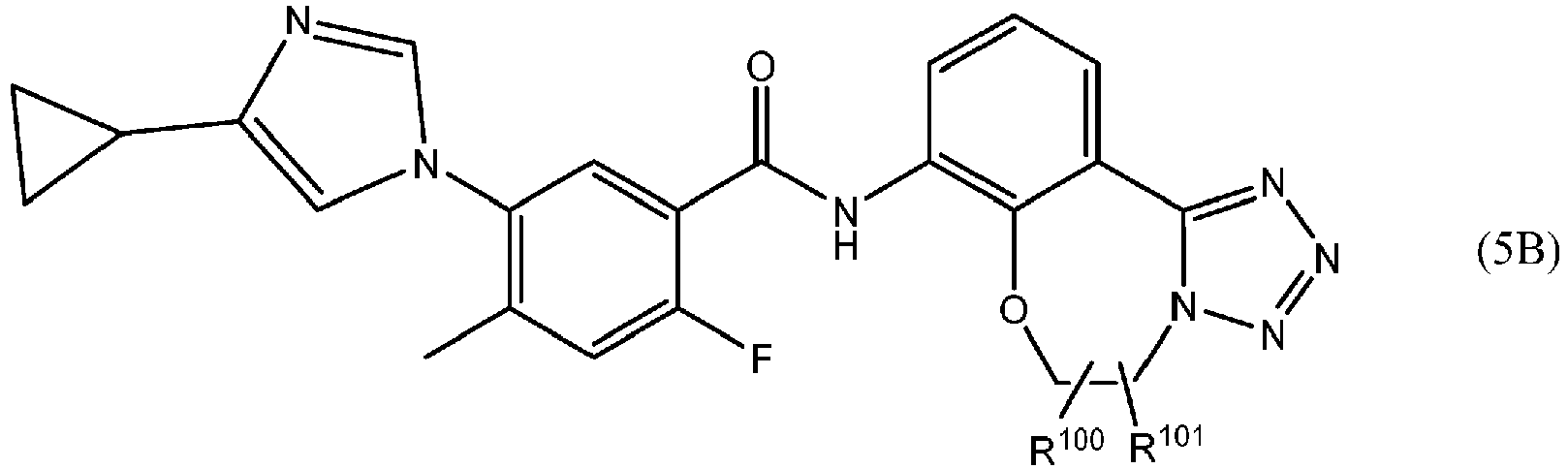


- or a pharmaceutically acceptable salt thereof,
- wherein R100 and R101 are independently H; C1-C6 alkyl optionally substituted with 1-3 hydroxyl or halo; halo; C3-C5 cycloalkyl optionally substituted with 1-3 C1-C6 alkyl, hydroxyl, or halo; 4-to 5-membered heterocyclyl optionally substituted with 1-3 C1-C6 alkyl, hydroxyl, or halo; or 5-membered heteroaryl optionally substituted with 1-3 C1-C6 alkyl, hydroxyl, or halo; or R100 and R101 are taken together with the carbon atom or carbon atoms to which they are attached to form a C3-C5 cycloalkyl.
- In another embodiment, the compound provided is of formula (5A). In another embodiment, the compound provided is of formula (5B). In another embodiment, the compound provided is of formula (5C). In another embodiment, the compound provided is of formula (5D). In another embodiment, the compound provided is of formula (5E). In another embodiment, the compound provided is of formula (5F).
- In another embodiment, the compound provided is of formula (5G), (5H), (5I), (5J), (SK), or (5L):


- or a pharmaceutically acceptable salt thereof,
- wherein R100 and R101 are independently H, C1-C6 alkyl optionally substituted with 1-3 hydroxyl or halo; halo; C3-C5 cycloalkyl optionally substituted with 1-3 Ci-Ce alkyl, hydroxyl, or halo; 4-to 5-membered heterocyclyl optionally substituted with 1-3 C1-C6 alkyl, hydroxyl, or halo; or 5-membered heteroaryl optionally substituted with 1-3 C1-C6 alkyl, hydroxyl, or halo; or R100 and R101 are taken together with the carbon atom or carbon atoms to which they are attached to form a C3-C5 cycloalkyl;and
- R40 is H, C1-C6 alkyl, or halo.
- In another embodiment, the compound provided is of formula (5G). In another embodiment, the compound provided is of formula (5H). In another embodiment, the compound provided is of formula (5I). In another embodiment, the compound provided is of formula (5J). In another embodiment, the compound provided is of formula (SK). In another embodiment, the compound provided is of formula (5L).
- In another embodiment, the compound provided is of formula (5M), (5N), (50), (5P), (5Q), (SR), (5S),or (5T):


- or a pharmaceutically acceptable salt thereof,
- wherein R100 and R101 are independently H, C1-C6 alkyl optionally substituted with 1-3 hydroxyl or halo; halo; C3-C5 cycloalkyl optionally substituted with 1-3 C1-C6 alkyl, hydroxyl, or halo; 4-to 5-membered heterocyclyl optionally substituted with 1-3 C1-C6 alkyl, hydroxyl, or halo; or 5-membered heteroaryl optionally substituted with 1-3 C1-C6 alkyl, hydroxyl, or halo; or R100 and R101 are taken together with the carbon atom or carbon atoms to which they are attached to form a C3-C5 cycloalkyl;
- R40 is H, C1-C6 alkyl, or halo; and
- R200 and R201 are independently H or C1-C6 alkyl; or R200 and R201 are taken together with the nitrogen atom to which they are attached to form an optionally substituted 4- to 7-membered heterocyclyl; and
- R202 is C1-C6 alkyl.
- In another embodiment, the compound provided is of formula (5M). In another embodiment, the compound provided is of formula (5N). In another embodiment, the compound provided is of formula (50). In another embodiment, the compound provided is of formula (5P). In another embodiment, the compound provided is of formula (SQ). In another embodiment, the compound provided is of formula (5R). In another embodiment, the compound provided is of formula (5S). In another embodiment, the compound provided is of formula (5T).
- Ring A is selected from the group consisting of:


- In another embodiment, ring B is phenyl. In another embodiment, ring B is pyridyl.
- L1 is:
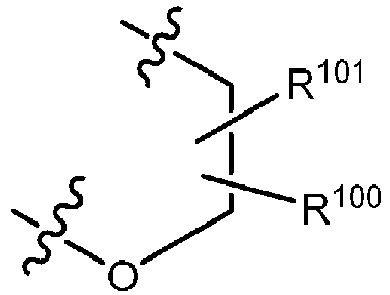
- In another embodiment, -L1- is: -O-CH2-CH2-. In another embodiment, -L1- is: -O-CH2-CH(Me)-. In another embodiment, -L1- is: -O-CH2-C(Me)2-. In another embodiment, -L1- is: -O-CH(Me)-CH2-. In another embodiment, -L1- is: -O-CH2-CH(CH2OH)-. In another embodiment, -L1- is -O-CH2-CH(CH2F)-. In another embodiment, -L1- is: In another embodiment, -L1- is:


- In another embodiment, L2 is -CO-NH-. In another embodiment, L2 is -NH-CO-. In another embodiment, L2 is -SO2-NH-. In another embodiment, L2 is -NH-SO2-.
- In another embodiment, X1 is CR2, wherein R2 is as defined herein. In some embodiments, X1 is C-F. In another embodiment, X1 is N.
- In another embodiment, X2 is CR2, wherein R2 is as defined herein. In another embodiment, X2 is N.
- In another embodiment, X3 is CR2, wherein R2 is as defined herein. In another embodiment, X3 is N.
- In another embodiment, X2 is C-H, X1 is C-F, and X3 is C-Me. In another embodiment, X2 is C-H, X1 is C-F, and X3 is C-H. In another embodiment, X2 is C-H, X1 is -N=, and X3 is C-H. In another embodiment, X2 is C-H, X1 is N and X3 is C-Me. In another embodiment, X2 is C-H, X1 is N and X3 is C-morpholinyl, preferably, C-morpholin-1-yl. In another embodiment, X2 is C-H, X1 is N and X3 is C-(optionally substituted 4- to 7-membered heterocyclyl). In some embodiments, X2 is C-H, X1 is N and X3 is optionally substituted C-morpholinyl, C-piperazinyl, C-(2-oxa-5-azabicyclo[2.2.1]heptanyl), C-pyrrolidinyl, or C-azetidinyl. In some embodiments, X2 is C-H, X1 is N and X3 is C-morpholinyl, C-piperazinyl, C-(2-oxa-5-azabicyclo[2.2.1]heptanyl), C-pyrrolidinyl, or C-azetidinyl, the heterocyclyl of each of which is optionally substituted by 1-2 substituents independently selected from the group consisting of C1-C6 alkyl and hydroxyl. In some embodiments, X2 is C-H, X1 is N and X3 is -N(C1-C6 alkyl)2. In some embodiments, X2 is C-H, X1 is N and X3 is -N(CH3)2. In some embodiments, X2 is C-H, X1 is N and X3 is -O(C1-C6 alkyl). In some embodiments, X2 is C-H, X1 is N and X3 is -OCH(CH3)2.
- In another embodiment, R1 is C3-C8 cycloalkyl optionally substituted with 1-2 C1-C6 alkyl or with one C3-C6 cycloalkyl which is optionally substituted with 1-2 substituents selected from the group consisting of C1-C6 alkyl, C2-C6 alkenyl, and C2-C6 alkynyl. In another embodiment, the C3-C8 cycloalkyl is unsubstituted. In another embodiment, the C3-C8 cycloalkyl is substituted with a C3-C6 cycloalkyl. In another embodiment, the C3-C8 cycloalkyl is substituted with a C3-C6 cycloalkyl substituted with one or more, preferably 1-2 substituents selected from: C1-C6 alkyl, C2-C6 alkenyl, and C2-C6 alkynyl.
- In another embodiment, R1 is 6-membered aryl optionally substituted with 1-2 C1-C6 alkyl or with one C3-C6 cycloalkyl which is optionally substituted with 1-2 substituents selected from the group consisting of C1-C6 alkyl, C2-C6 alkenyl, and C2-C6 alkynyl. In another embodiment, the 6-membered aryl is unsubstituted. In another embodiment, the 6-membered aryl is substituted with a C3-C6 cycloalkyl. In another embodiment, the 6-membered aryl is substituted with a C3-C6 cycloalkyl, which cycloalkyl is substituted with one or more, preferably 1-2 substituents selected from: C1-C6 alkyl, C2-C6 alkenyl, and C2-C6 alkynyl.
- In another embodiment, R1 is 5-6 membered heteroaryl optionally substituted with 1-2 C1-C6 alkyl or with one C3-C6 cycloalkyl which is optionally substituted with 1-2 substituents selected from the group consisting of C1-C6 alkyl, C2-C6 alkenyl, and C2-C6 alkynyl. In another embodiment, the 5-6 membered heteroaryl is unsubstituted. In another embodiment, the 5-6 membered heteroaryl is substituted with a C3-C6 cycloalkyl. In another embodiment, the 5-6 membered heteroaryl is substituted with a C1-C6 alkyl. In another embodiment, the 5-6 membered heteroaryl is substituted with a methyl. In another embodiment, the 5-6 membered heteroaryl is substituted with a C3-C6 cycloalkyl, which cycloalkyl is substituted with one or more, preferably 1-2 substituents selected from: C1-C6 alkyl, C2-C6 alkenyl, and C2-C6 alkynyl.
- In another embodiment, R1 is a 4-6 membered heterocyclyl optionally substituted with 1-2 C1-C6 alkyl or with one C3-C6 cycloalkyl which is optionally substituted with 1-2 substituents selected from the group consisting of C1-C6 alkyl, C2-C6 alkenyl, and C2-C6 alkynyl. In another embodiment, the 4-6 membered heterocyclyl is unsubstituted. In another embodiment, the 4-6 membered heterocyclyl is substituted with a C3-C6 cycloalkyl. In another embodiment, the 4-6 membered heterocyclyl is substituted with a C3-C6 cycloalkyl, which cycloalkyl is substituted with one or more, preferably 1-2 substituents selected from: C1-C6 alkyl, C2-C6 alkenyl, or C2-C6 alkynyl.
- As used herein, a functional group composed of two functional groups, such as, e.g. and without limitation, cycloalkylalkyl refers to alkyl substituted with cycloalkyl, or arylalkyl refers to alkyl substituted with aryl, and the like.
- In another embodiment, R1 is 5-6 membered heteroaryl, wherein the heteroaryl is optionally substituted with a substituent selected from a C3-C5 cycloalkyl, preferably cyclopropyl; .
- In another embodiment, R1 is phenyl, wherein the phenyl is optionally substituted with a substituent selected from a C3-C5 cycloalkyl, preferably cyclopropyl; .
- In another embodiment, R1 is 4-6 membered heterocyclyl, wherein the heterocyclyl is optionally substituted with a substituent selected from a C3-C5 cycloalkyl, preferably cyclopropyl; .
- In one embodiment, R1 is;

- In another embodiment, R1 is:

- In one embodiment, R1 is:

- In one embodiment, R1 is
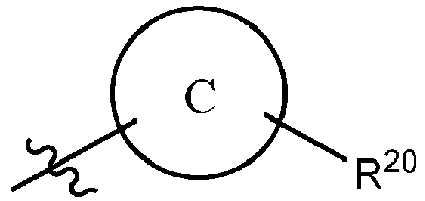
- In another embodiment, ring C is a 5-6 membered heteroaryl. In another embodiment, ring C is a 5 membered heteroaryl. In another embodiment, ring C is pyridyl. In another embodiment, ring C is imidazolyl. In another embodiment, ring C is phenyl.
- In another embodiment, R20 is C3-C5 cycloalkyl. In another embodiment, R20 is cyclobutyl. In another embodiment, R20 is cyclopropyl. In another embodiment, R20 is C1-C6 alkyl. In another embodiment, R20 is C1-C3 alkyl. In another embodiment, R20 is methyl. In another embodiment, R20 is hydrogen.
- In one embodiment, R1 is

- In one embodiment, R1 is:

- In one embodiment, R1 is:

- In one embodiment, R1 is:
- In one embodiment, R1 is:


- In one embodiment, R1 is -CONR11R12 or -SO2NR11R12, wherein each of R11 and R12 is independently selected from hydrogen, optionally substituted C1-C6 alkyl, and optionally substituted C3-C8 cycloalkyl, preferably optionally substituted C3-C5 cycloalkyl. In another embodiment, R1 is -CONR11R12 or -SO2NR11R12, wherein R11 and R12 together with the nitrogen atom they are attached to forms a heterocycle, preferably a 4-6 membered heterocycle. In one embodiment, R1 is -CONR11R12. In another embodiment, R1 is or -SO2NR11R12.
- In one embodiment, R11 is hydrogen. In another embodiment, R11 is optionally substituted C1-C6 alkyl. In another embodiment, R11 is substituted C1-C6 alkyl. In another embodiment, R11 is C1-C6 alkyl. In another embodiment, R11 is methyl. In another embodiment, R11 is optionally substituted C3-C8 cycloalkyl. In another embodiment, R11 is C3-C8 cycloalkyl. In another embodiment, R11 is substituted C3-C8 cycloalkyl. In another embodiment, R11 is optionally substituted C3-C5 cycloalkyl. In another embodiment, R11 is C3-C5 cycloalkyl. In another embodiment, R11 is substituted C3-C5 cycloalkyl. In another embodiment, R11 is cyclopropyl.
- In one embodiment, R12 is hydrogen. In another embodiment, R12 is optionally substituted C1-C6 alkyl. In another embodiment, R12 is substituted C1-C6 alkyl. In another embodiment, R12 is C1-C6 alkyl. In another embodiment, R12 is methyl. In another embodiment, R12 is optionally substituted C3-C8 cycloalkyl. In another embodiment, R12 is C3-C8 cycloalkyl. In another embodiment, R12 is substituted C3-C8 cycloalkyl. In another embodiment, R12 is optionally substituted C3-C5 cycloalkyl. In another embodiment, R12 is C3-C5 cycloalkyl. In another embodiment, R12 is substituted C3-C5 cycloalkyl. In another embodiment, R12 is cyclopropyl.
- In one embodiment, R1 is -CONH2. In one embodiment, R1 is CONHMe. In one embodiment, R1 is CONMe2. In one embodiment, R1 is:

- In one embodiment, R2 is hydrogen.
- In some embodiments, R2 is hydrogen; C1-C6 alkyl optionally substituted with 1-3 halo, -CF3, -OCF3, hydroxy, -CN or -N(R3)(R4); C1-C6alkoxy optionally substituted with 1-3 halo, -CF3, -OCF3, hydroxy, -CN or -N(R3)(R4); C3-C8 cycloalkyl optionally substituted with 1-3 halo, C1-C6 alkyl, -CF3, -OCF3, hydroxy, -CN or -N(R3)(R4); 6-membered aryl optionally substituted with 1-3 halo, C1-C6 alkyl, -CF3, -OCF3, hydroxy, -CN or -N(R3)(R4); 5- to 10-membered heteroaryl optionally substituted with 1-3 halo, C1-C6 alkyl, -CF3, -OCF3, hydroxy, -CN or -N(R3)(R4); 5-10 membered heterocyclyl optionally substituted with 1-3 halo, C1-C6 alkyl, -CF3, -OCF3, hydroxy, -CN or -N(R3)(R4); or halo.
- In some embodiments, R2 is an optionally substituted 4- to 7-membered heterocyclyl. In some embodiments, R2 is a 4- to 7-membered heterocyclyl optionally substituted with 1-2 substituents which are selected from the group consisting of C1-C6 alkyl and hydroxyl. In some embodiments, R2 is a 4- to 7-membered heterocyclyl optionally substituted with 1-2 substituents which are independently selected from the group consisting of C1-C3 alkyl and hydroxyl. In some embodiments, R2 is an unsubstituted 4- to 7-membered heterocyclyl. In some embodiments, R2 is selected from the group consisting of:

- In some embodiments, R3 and R4 are independently H or C1-C6 alkyl. In some embodiments, R3 and R4 are independently H or C1-C3 alkyl. In some embodiments, R3 and R4 are both H. In some embodiments, one of R3 and R4 is H, and the other is C1-C6 alkyl. In some embodiments, R3 and R4 are both independently C1-C6 alkyl. In some embodiments, R3 and R4 are independently methyl, ethyl, n-propyl, or isopropyl. In some embodiments, R3 and R4 are independently H, methyl, or isopropyl.
- In some embodiments, R3 and R4 are independently selected from the group consisting of hydrogen; C1-C6 alkyl optionally substituted with 1-3 halo, -CF3, -OCF3, hydroxyl, or -CN; C3-C8 cycloalkyl optionally substituted with 1-3 halo, C1-C6 alkyl, -CF3, -OCF3, hydroxy, or -CN; 6-membered aryl optionally substituted with 1-3 halo, C1-C6 alkyl, -CF3, -OCF3, hydroxyl, or -CN; 5-10 membered heteroaryl optionally substituted with 1-3 halo, C1-C6 alkyl, -CF3, -OCF3, hydroxyl, or -CN; or 5-10 membered heterocyclyl optionally substituted with 1-3 halo, C1-C6 alkyl, -CF3, -OCF3, hydroxyl, or -CN. In some embodiments, R3 and R4 are taken together with the nitrogen, or with the intervening atoms to which they are attached to form a 4- to 10-membered heterocycle optionally substituted with 1-3 halo, C1-C6 alkyl, -CF3, -OCF3, hydroxyl, or -CN.
- In some embodiments, R2 is -N(R3)(R4). In some embodiments, R3 and R4 are independently selected from the group consisting of H and C1-C6 alkyl. In some embodiments, R3 is H, and R4 is C1-C6 alkyl. In some embodiments, R3 and R4 are independently C1-C6 alkyl. In some embodiments, R3 and R4 are both methyl. In some embodiments, R3 and R4 are taken together with the nitrogen atom to which they are attached to form a 4- to 7-membered heterocycle optionally independently substituted with 1-2 C1-C6 alkyl or hydroxyl. In some embodiments, R3 and R4 are taken together with the nitrogen atom to which they are attached to form:

- In another embodiment, Y1 is CH. In another embodiment, Y1 is N. In another embodiment, Y2 is CH. In another embodiment, Y2 is N. In another embodiment, Y3 is CH. In another embodiment, Y3 is N. In another embodiment, Y1, Y2, and Y3 are CH. In another embodiment, one of Y1, Y2, and Y3 is N.
- In another embodiment, R100 is C1-C6 alkyl optionally substituted with 1-3 hydroxyl or halo. In another embodiment, R100 is halo. In another embodiment, R100 is C3-C5 cycloalkyl optionally substituted with 1-3 C1-C6 alkyl, hydroxy, or halo In another embodiment, R100 is 4-5 membered heterocyclyl optionally substituted with 1-3 C1-C6 alkyl, hydroxyl, or halo In another embodiment, R100 is 5 membered heteroaryl optionally substituted with 1-3 C1-C6 alkyl, hydroxyl, or halo.
- In another embodiment, R101 is C1-C6 alkyl optionally substituted with 1-3 hydroxyl or halo. In another embodiment, R101 is halo. In another embodiment, R101 is C3-C5 cycloalkyl optionally substituted with 1-3 C1-C6 alkyl, hydroxy, or halo. In another embodiment, R101 is 4-5 membered heterocyclyl optionally substituted with 1-3 C1-C6 alkyl, hydroxyl, or halo In another embodiment, R101 is 5 membered heteroaryl optionally substituted with 1-3 C1-C6 alkyl, hydroxyl, or halo.
- In another embodiment, R100 and R101 together with the carbon atom or carbon atoms they are attached to form a C3-C5 cycloalkyl. In some embodiments, R100 and R101 together with the carbon atom or carbon atoms they are attached to form cyclopropyl or cyclobutyl.
- In another embodiment, R100 is H. In another embodiment, R100 is C1-C6 alkyl optionally substituted with 1-3 hydroxy or halo, such as fluoro. In another embodiment, R100 is C1-C3 alkyl optionally substituted with 1-3 hydroxy or halo, such as fluoro, or is C3-C5 cycloalkyl group. In another embodiment, R100 is C3-C5 cycloalkyl optionally substituted with 1-3 C1-C6 alkyl, halo, or hydroxyl groups. In some embodiments, R100 is methyl, ethyl, n-propyl, or isopropyl. In some embodiments, R100 is methyl. In some embodiments, R100 is -CH(OH)-CH3.
- In another embodiment, R101 is H. In another embodiment, R101 is C1-C6 alkyl optionally substituted with 1-3 hydroxy or halo, such as fluoro. In another embodiment, R101 is C1-C3 alkyl optionally substituted with 1-3 hydroxy or halo, such as fluoro, or is C3-C5 cycloalkyl group. In another embodiment, R101 is C3-C5 cycloalkyl optionally substituted with 1-3 C1-C6 alkyl, halo, or hydroxyl groups. In some embodiments, R101 is methyl, ethyl, n-propyl, or isopropyl. In some embodiments, R101 is methyl. In some embodiments, R101 is -CH(OH)-CH3.
- In another embodiment, R100 is H, and R101 is C1-C3 alkyl optionally substituted with 1-3 hydroxy or halo, such as fluoro, or is C3-C5 cycloalkyl group. In another embodiment, R100 is H, and R101 is C1-C3 alkyl optionally substituted with 1-3 hydroxy or halo, such as fluoro, or is C3-C5 cycloalkyl group optionally substituted with 1-3 C1-C6 alkyl, hydroxy, or halo. In another embodiment, each R100 and R101 are independently C1-C3 alkyl. In another embodiment, R100 and R101 together with the carbon atom they are attached to form a C3-C5 cycloalkyl group. In some embodiments, R100 and R101 together with the carbon atom or carbon atoms they are attached to form cyclopropyl or cyclobutyl.
- In another embodiment, R100 is H, and R101 is methyl, hydroxymethyl, fluoromethyl, or cyclopropyl. In another embodiment, each R100 and R101 are independently methyl or ethyl. In another embodiment, R100 and R101 together with the carbon atom they are attached to form a cyclopropyl group. In another embodiment, R100 and R100 together with the carbon atom they are attached to form a cyclobutyl group.
- In another embodiment,

- is -CH2-CH2-. In another embodiment,

- is: -CH2-CH(Me)-. In another embodiment,

- is: -CH2-C(Me)2-. In another embodiment,

- is: -CH(Me)-CH2-. In another embodiment,

- is: -CH2-CH(CH2OH)-. In another embodiment,

- is -CH2-CH(CH2F)-. In another embodiment,

- is:

- In another embodiment


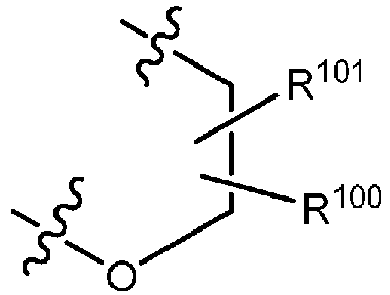

- In some embodiments, R200 and R201 are independently C1-C6 alkyl. In some embodiments, R200 and R201 are independently C1-C3 alkyl. In some embodiments, R200 and R201 are independently methyl, ethyl, n-propyl, or isopropyl. In some embodiments, R200 and R201 are both methyl.
- In some embodiments, R200 and R201 are taken together with the nitrogen atom to which they are attached to form an optionally substituted 4- to 7-membered heterocyclyl. In some embodiments, the optionally substituted 4- to 7-membered heterocyclyl is a monocyclic heterocyclyl. In some embodiments, the optionally substituted 4- to 7-membered heterocyclyl is a bicyclic heterocyclyl. In some embodiments, the optionally substituted 4- to 7-membered heterocyclyl further contains a heteroatom selected from the group consisting of nitrogen and oxygen. In some embodiments, the optionally substituted 4- to 7-membered heterocyclyl contains a second nitrogen atom. In some embodiments, the optionally substituted 4- to 7-membered heterocyclyl further contains an oxygen atom. In some embodiments, the 4- to 7-membered heterocyclyl is unsubstituted. In some embodiments, the 4- to 7-membered heterocyclyl is substituted by 1-2 substituents selected from the group consisting of C1-C3 alkyl and -OH. In some embodiments, the 4- to 7-membered heterocyclyl is substituted by 1-2 substituents selected from the group consisting of methyl and -OH. In some embodiments, the optionally substituted 4- to 7-membered heterocyclyl is selected from the group consisting of:

- In some embodiments, R202 is C1-C6 alkyl. In some embodiments, R202 is methyl, ethyl, n-propyl, or isopropyl. In some embodiments, R202 is isopropyl.
- In some embodiments, R40 is H. In some embodiments, R40 is halo, such as chloro, fluoro or bromo. In some embodiments, R40 is bromo. In some embodiments, R40 is C1-C6 alkyl. In some embodiments, R40 is methyl, ethyl, n-propyl, or isopropyl. In some embodiments, R40 is methyl.
- In some embodiments, the compound of formula (IA) disclosed herein, or any embodiment, variation, or aspect thereof, excludes the compound 5-(4-cyclopropyl-1H-imidazol-1-yl)-2-ffuoro-4-methyl-N-(5-methyl-5,6-dihydrobenzo[f][1,2,4]triazolo[4,3-d][1,4]oxazepin-8-yl)benzamide, or a pharmaceutically acceptable salt thereof.
- In one aspect, provided is a compound of formula (IA), wherein the compound has one or more of the following features:
- (1) Ring A is selected from:
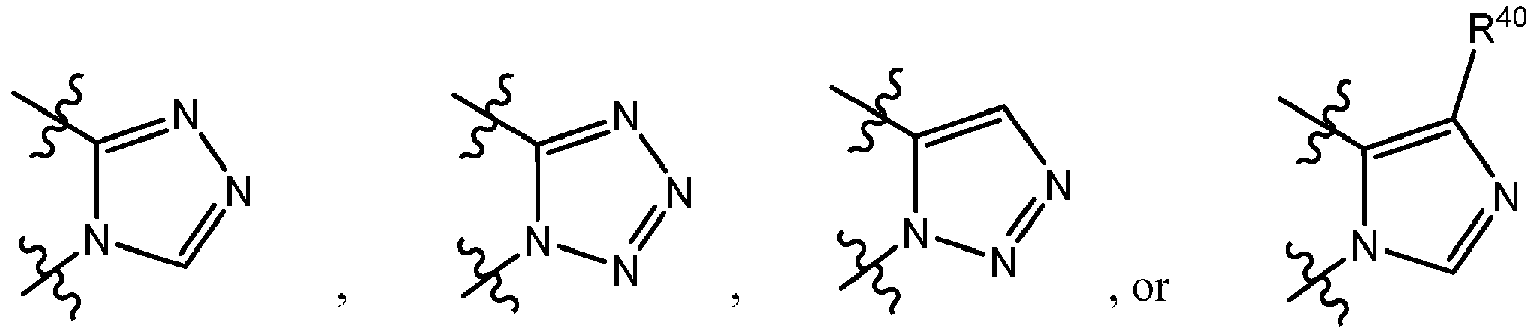
- (i) (II) Ring B is phenyl;
- (III) L2 is -C(O)-NH-;
- (IV) R1 is:

- (V) X1 is:
- (iv) N; or
- (v) C-F;
- (VI) X2 is CH;
- (VII) X3 is CR2, wherein R2 is:
- (vi) H;
- (vii) C1-C6 alkyl;
- (viii) 4- to 7-membered heterocyclyl optionally substituted by 1-2 substituents selected from the group consisting of C1-C6 alkyl and hydroxyl;
- (ix) -N(C1-C6 alkyl)2;
- (x) -O-(C1-C6 alkyl);
- (VIII) L1 is:

- (i) (II) Ring B is phenyl;
- In one variation, (I) applies. In one variation, (II) applies. In one variation, (III) applies. In one variation, (IV) applies. In one variation, (V) applies. In one variation, (VI) applies. In one variation, (VII) applies. In one variation, (VIII) applies. In one aspect of this variation, (I), (II), (III), (IV), (V), (VI), (VII), and (VIII) apply. In one variation, (i), (v), and (vii) apply. In one variation, (ii), (v), and (vii) apply. In one variation, (iii), (v), and (vii) apply. In one variation, (i), (iv), and (viii) apply. In one variation, (ii), (iv), and (vi) apply. In one variation, (i), (iv), and (vi) apply. In one variation, (ii), (iv), and (viii) apply. In one variation, (ii), (iv), and (ix) apply. In one variation, (ii), (iv), and (x) apply. In one variation, (ii), (iv), and (ix) apply. In one variation, (i), (iv), and (x) apply.
- In another aspect, provided herein are compounds selected from Table 1.
Table 1. Example Structure 1 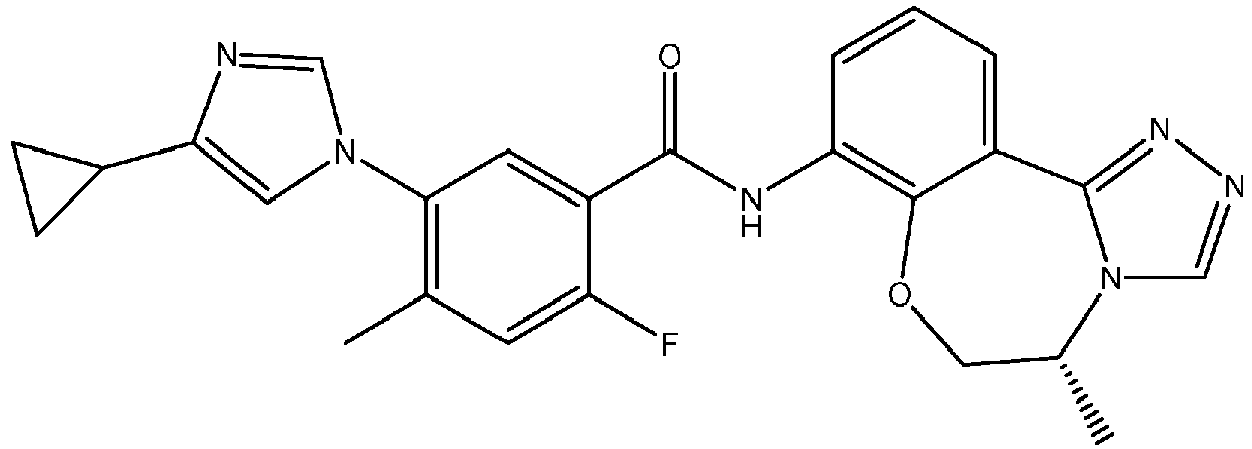
2 
3 
4 
5 
6 
7 
8 
9 
10 
11 
12 
13 
14 
15 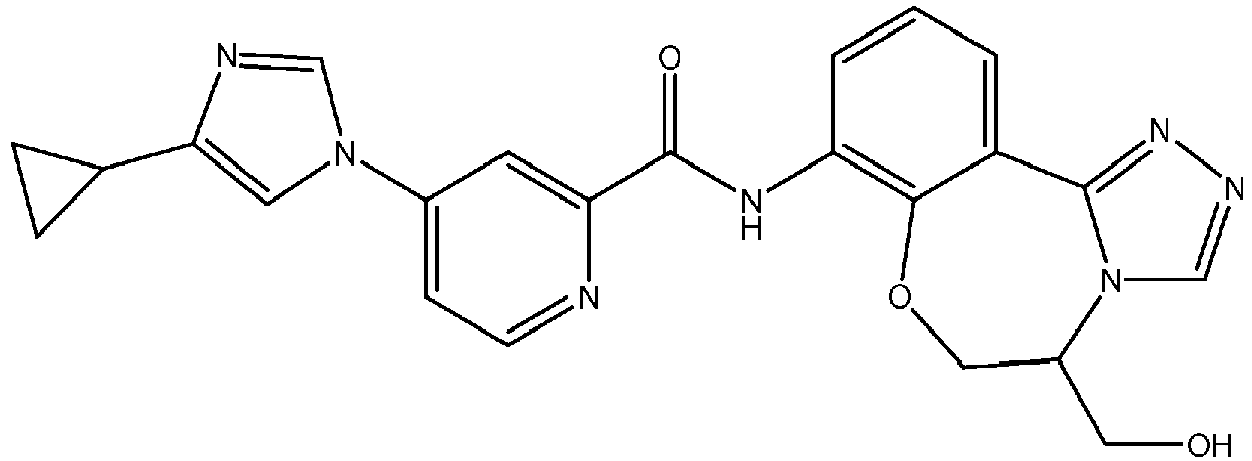
16 
17 
18 
19 
20 
21 
22 
23 
24 
25 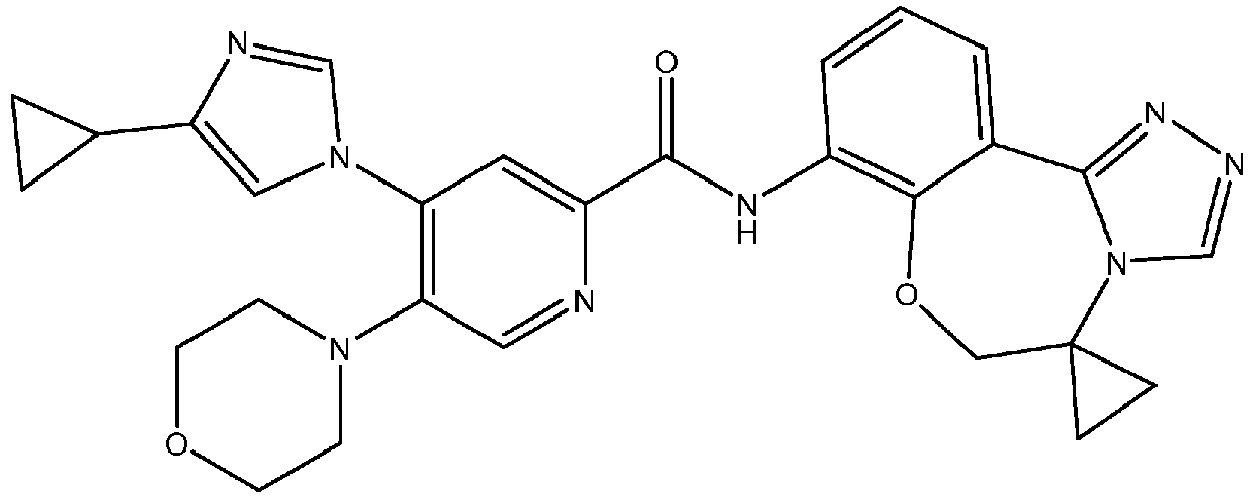
26 
27 
28 
29 
30 
31 
32 
33 
34 
35 
36 
37 
38 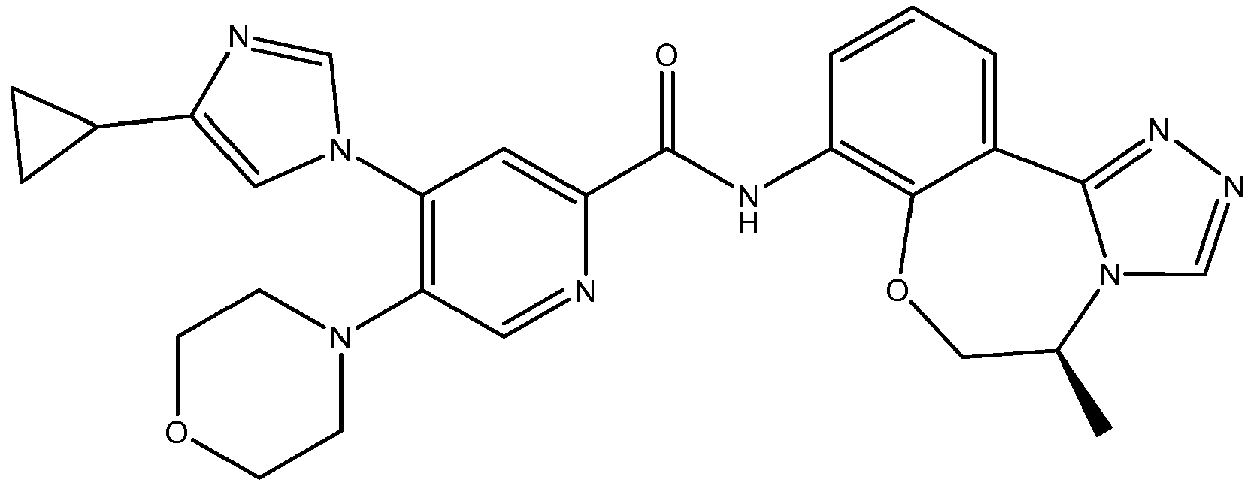
39 
40 
41 
42 
43 
44 
45 
46 
47 
48 
49 
50 
51 
52 
53 
54 
55 
56 
57 
58 
59 
60 
61 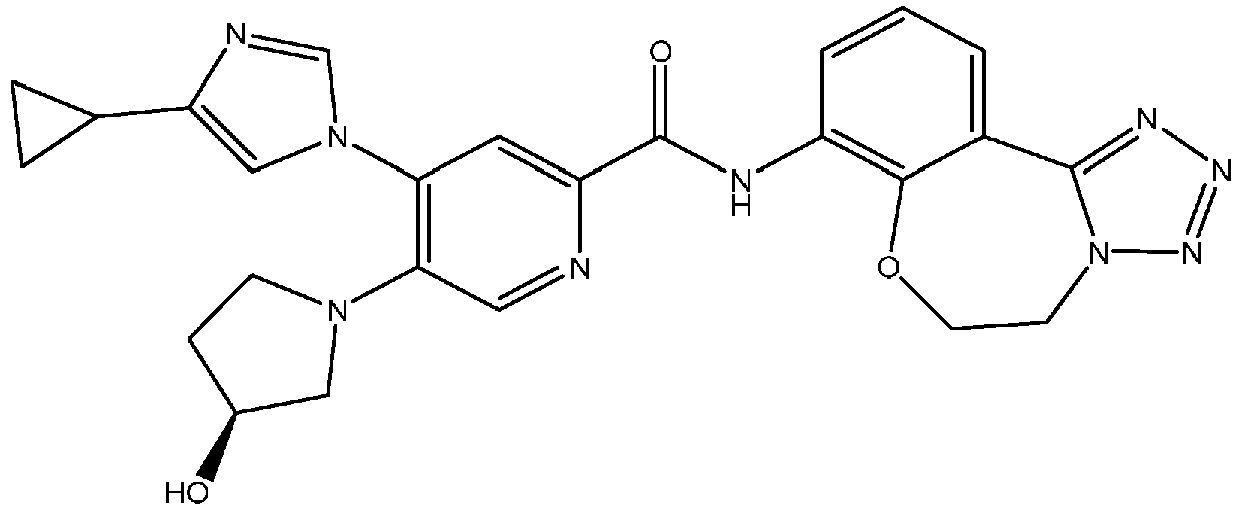
62 
63 
64 
65 
66 
67 
68 
69 
70 
71 
72 
73 
74 
75 
76 
77 
78 
79 
80 
81 
82 
83 
84 
85 
86 
87 
-

- Reaction Scheme I shows the synthesis of compounds of general formula 4A. Coupling of compound 1b with compounds of formula (2) using a metal catalyst, for example a palladium-based catalyst such as Pd2(dba)3 with Xantphos and a base such as t-BuOK in an aprotic solvent such as dioxane under elevated temperature, provides compounds of general formula 4A which can be isolated by conventional means.

- Scheme 1A outlines a synthesis of compound 1b. Metal-catalyzed cross-coupling, for example with Cu2O, CsCO3 and 8-hydroxyquinoline in a solvent such as DMSO, of compounds (a) and (b) under elevated temperature affords compound la. Subsequent treatment of la under conditions such as reaction of compound la with thionyl chloride followed by ammonia affords compound 1b. Compounds la and 1b can be isolated by conventional means.

- Scheme 1B shows a synthesis of compounds of general formula (2). Esters of general formula (g) are reacted with hydrazine in a solvent, for example methanol, to form compounds of formula (h). Subsequent conversion of the compounds of formula (g) to triazoles of formula (i), for example by treating (g) stepwise with DMF-DMA and then condensation with optionally substituted ethyl amine under elevated temperature, followed by intramolecular cyclization of (i) with treatment of a base such as NaH in an inert solvent affords compounds of formula (2) which can be isolated by conventional means.

- Reaction Scheme II provides a synthesis of compounds of general formula 4B. Metal-catalyzed cross-coupling of compound (1b) with compounds of general formula (4), for example with a palladium-based catalyst such as Pd2(dba)3 with Xantphos and a base such as t-BuOK in an aprotic solvent such as dioxane under elevated temperature, provides compounds of general formula 4B which can be isolated by conventional means.

- Scheme IIA provides a general synthesis for compounds of general formula (4). Esters of formula (g) are converted to carboxylic acids of formula (j), for example by ester hydrolysis with a base such as LiOH in the presence of H2O, which are then converted to tetrazoles of formula (k), for example by treatment of (j) with oxalyl chloride with a catalytic amount of DMF in an inert solvent such as DCM, to form acid chloride intermediates. The intermediates then react with optionally substituted ethyl amines followed by reaction with an azide such as NaN3 or TMSN3. Subsequent intramolecular cyclization of (k), for example with a base such as NaH in an inert solvent such as THF, affords compounds of formula (4) which can be isolated by conventional methods.

- Reaction Scheme III outlines a synthesis for compounds of general formula 4C. Metal-catalyzed cross-coupling, for example with a palladium-based catalyst such as Pd2(dba)3 with Xantphos and a base such as t-BuOK in an aprotic solvent such as dioxane under elevated temperature, of compound 4c with halides of formula (2) affords compounds of formula 4C which can be isolated by conventional means.

- Scheme IIIA outlines a synthesis of compound (4c). Metal-catalyzed cross-coupling, for example with Cu2O in a solvent such as MeOH under O2, of (a) and (d) affords compound (e) which can be isolated by conventional methods. A second metal-catalyzed cross-coupling reaction, for example with Pd(OAc)2 and DPPF in MeOH with CO, converts compound (e) to compound (f), which is then converted to 4c under conditions such as NH3·H2O in a solvent such as MeOH.
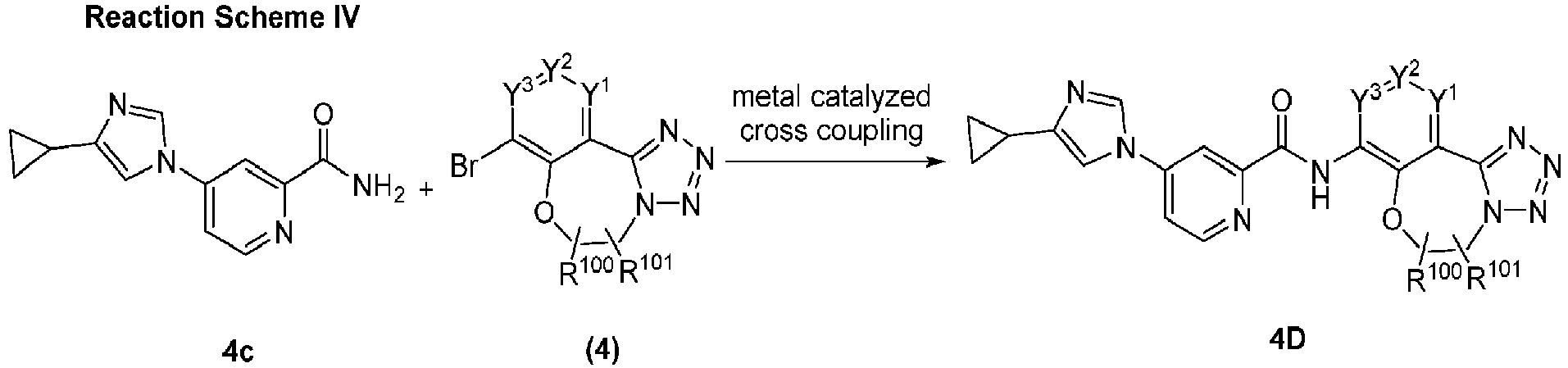
- Reaction Scheme IV shows a general synthesis for compounds of formula 4D. Metal-catalyzed cross-coupling, for example with a palladium-based catalyst such as Pd2(dba)3 with Xantphos and a base such as t-BuOK in an aprotic solvent such as dioxane under elevated temperature, of compound 4c with compounds of formula (4) yields compounds of formula 4D which can be isolated by conventional means.

- Reaction Scheme V shows an alternative general synthesis for compounds of formula 4A. Amide coupling, for example using coupling reagents such as HATU with a base such as NMM in solvents such as DMF, of la with compounds of formula (6) yields compounds of formula 4A.
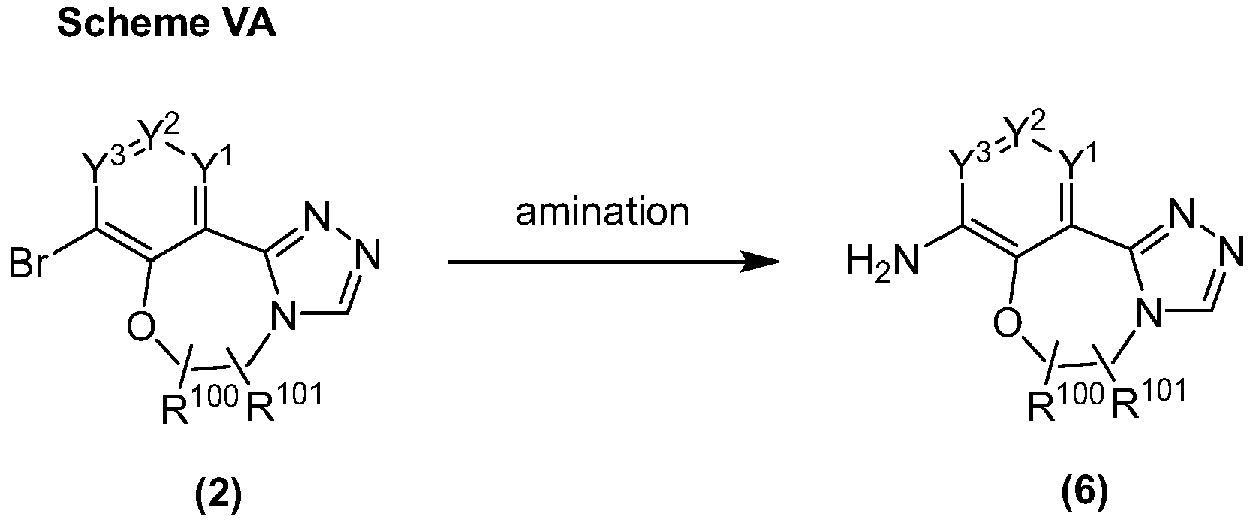
- Scheme VA outlines a synthesis of compounds of general formula (6). Amination of compounds of general formula (2), for example with CuI, L-proline and NH3·H2O in a solvent such as DMSO under elevated temperature, affords (6) which can be isolated by conventional means.

- Scheme VB outlines a synthesis of compounds of general formula (q). Acids of general formula (l) can be treated with a base such as NaH in an aprotic solvent such as DME and an optionally substituted N-protected amino alcohol to form compounds of general formula (p). After deprotection of (p), a lactam forms through intramolecular amide bond formation with coupling reagents such as HATU with NMM in an aprotic solvent such as DMF to form compounds of general formula (q).

- Scheme VC outlines an alternative synthesis of compounds of general formula (q). Acids of general formula (l) can form amide (t) by reaction with an optionally substituted amino alcohol under coupling conditions, for example with HATU and DIPEA in an aprotic solvent such as DMF. The resulting alcohol of general formula (t) can undergo intramolecular cyclization in the presence of a base such as t-BuOK to form compounds of general formula (q) which can be isolated by conventional means.

- Scheme VD outlines an alternative synthesis of compounds of general formula (6). Compounds of general formula (q) can be transformed to triazole (r) through activation using reagents such as PCl5 followed by cyclization with reagents such as formohydrazide under elevated temperature. Reduction of (r) with reducing agents such as Fe, NH4Cl or H2 in the presence of a catalyst such as Pd/C affords compounds of general formula (6) which can be isolated by conventional methods.

- Reaction Scheme VI shows an alternative general synthesis for compounds of formula 4B. Amide coupling, for example using coupling reagents such as HATU with a base such as NMM in a solvent such as DMF, of 1a with compounds of formula (8) yields compounds of formula 4B.

- Scheme VIA outlines the synthesis of compounds of general formula (8). Compounds of general formula (q) can be transformed to tetrazole (o) through activation with reagents such as PCl5 or Lawesson's reagent followed by cyclization with reagents such as NaN3 or TMSN3. Reduction of (o) with reducing agents such as Fe, NH4Cl or H2 in the presence of a catalyst such as Pd/C affords compounds of general formula (8) which can be isolated by conventional methods.

- Scheme VIB shows an alternative synthesis of compounds of general formula (8). Acids of general formula (l) react with an optionally substituted O-protected amino alcohol using amide coupling reagents such as HATU with a base such as DIPEA in an aprotic solvent such as DMF to afford compounds of general formula (m). Using similar reactions as outlined above for conversion of (q) to (o) (Scheme VIA), (m) can be transformed to tetrazole (n). After deprotection of (n), intramolecular cyclization can occur spontaneously or by use of a base such as NaH or t-BuOK. Compounds of general formula (o) can be reduced to (8) in the same manner as shown in Scheme VIA.

- Scheme VII shows a synthesis of compounds of general formula 4U. Compounds of formula 4U can be assembled from acid (7) and amine (6) through amide coupling, for example with HATU, NMM in DMF.

- Scheme VIIA shows a synthesis of compounds of general formula (7). 2-chloro-5-fluoro-4-iodopyridine reacts with 4-cyclopropyl-1H-imidazole under cross coupling conditions, for example with Cu2O, Cs2CO3, and 8-hydroxyquinoline in PEG-3350 and butyronitrile under elevated temperature, to afford 19b. Compound 19b can be converted to esters of general formula (s) using, for example, Pd(dppf)Cl2 and CO under elevated temperature. Compounds of general formula (s) react with R2H, for example amines or alcohols, under elevated temperature to afford (f). Ester (f) can be transformed to acid (7) by reagents such as LiOH in the presence of H2O.

- Reaction Scheme VIII shows a synthesis of compounds of general formula 4V. Compounds of formula 4V can be assembled from acid (7) and amine (8) through amide coupling, for example with HATU, NMM in DMF.

- Reaction Scheme IX shows a synthesis of compounds of general formula 4G. Compounds of formula 4G can be assembled from 1a and amine (10) through amide coupling, for example with HATU, NMM in DMF.

- Scheme IXA shows a synthesis of compounds of general formula (10). Compounds of general formula (t) can undergo a coupling reaction with trimethylsilylacetylene using reagents such as Pd(PPh3)2Cl2, CuI and TEA to afford (x). Compounds of formula (x) can react with an optionally substituted alcohol to afford compounds of general formula (y), followed by triazole formation using reagents such as CuI, TMSN3 in solvents such as MeOH and DMF under elevated temperature to make trizoles of general formula (z), where X1 is a suitable leaving group such as Cl. Intramolecular cyclization of (z) in the presence of a base, for example K2CO3 in a solvent such as DMF under elevated temperature, affords compounds of general formula (c), which can be reduced to compounds of general formula (10) in a similar maner as outlined above for (o) to (8).

- Reaction Scheme X shows a synthesis of compounds of general formula 4H. Compounds of formula 4H can be assembled from acid la and amine (9) through amide coupling, for example with HATU, NMM in DMF.

- Scheme XA shows a synthesis of compounds of general formula (9). Compounds of general formula (t) can be coupled with 4,4,5,5-tetramethyl-2-(4,4,5,5-tetramethyl-1,3,2-dioxaborolan-2-yl)-1,3,2-dioxaborolane using reagents such as Pd(dppf)Cl2 and KOAc under elevated temperature to afford compounds of general formula (u), which can then be coupled with optionally substituted imidazoles in the presence of Boc2O and reagents such as Pd(dppf)Cl2CH2Cl2 and KOAc to afford compounds of general formula (v). Compounds of general formula (v) can react with an optionally substituted alcohol in the presence of a base such as NaH to afford compounds of general formula (w). Compounds of formula (w) can be reduced to compounds of general formula (9) in a similar manner as outlined above for (o) to (8).

- Reaction Scheme XI shows a synthesis of compounds of general formula 4W. Compounds of formula 4W can be assembled from acid (7) and amine (10) through amide coupling, for example with HATU, NMM in DMF.

- Reaction Scheme XII shows a synthesis of compounds of general formula 4X. Compounds of formula 4X can be assembled from acid (7) and amine (9) through amide coupling, for example with HATU, NMM in DMF.
- Synthesis of certain compounds provided herein are schematically illustrated above, and provided in the Examples section below. Synthesis of other compounds provided herein will be apparent to the skilled artisan based on the guidance provided herein and based on synthetic methods well known to the skilled artisan.
- Where it is desired to obtain a particular enantiomer of a compound, this may be accomplished from a corresponding mixture of enantiomers using any suitable conventional procedure for separating or resolving enantiomers. Thus, for example, diastereomeric derivatives may be produced by reaction of a mixture of enantiomers, e.g., a racemate, and an appropriate chiral compound. The diastereomers may then be separated by any convenient means, for example by crystallization, and the desired enantiomer recovered. In another resolution process, a racemate may be separated using chiral High Performance Liquid Chromatography. Alternatively, if desired a particular enantiomer may be obtained by using an appropriate chiral intermediate in one of the processes described.
- Chromatography, recrystallization and other conventional separation procedures may also be used with intermediates or final products where it is desired to obtain a particular isomer of a compound or to otherwise purify a product of a reaction.
- Solvates and/or polymorphs of a compound provided herein or a pharmaceutically acceptable salt thereof are also contemplated. Solvates contain either stoichiometric or non-stoichiometric amounts of a solvent, and are often formed during the process of crystallization. Hydrates are formed when the solvent is water, or alcoholates are formed when the solvent is alcohol. Polymorphs include the different crystal packing arrangements of the same elemental composition of a compound. Polymorphs usually have different X-ray diffraction patterns, infrared spectra, melting points, density, hardness, crystal shape, optical and electrical properties, stability, and/or solubility. Various factors such as the recrystallization solvent, rate of crystallization, and storage temperature may cause a single crystal form to dominate.
- It is understood that the synthetic process disclosed here may be modified to arrive at various compounds of the invention by selection of appropriate reagents and starting materials. It is also understood that where protection of certain active or incompatible groups (e.g., an amine or a carboxylic acid) is required, the formulae in e.g., the scheme(s) provided here intend and include compounds where such active or incompatible groups are in appropriate protected forms. For a general description of protecting groups and their use, see P.G.M. Wuts and T.W. Greene, Greene's Protective Groups in Organic Synthesis 4th edition, Wiley-Interscience, New York, 2006.
- This disclosure also includes all salts, such as pharmaceutically acceptable salts, of compounds referred to herein. This disclosure also includes any or all of the stereochemical forms, including any enantiomeric or diastereomeric forms, and any tautomers or other forms, such as N-oxides, solvates, prodrugs, or isotopomers, of the compounds described. Prodrugs and N-oxides however do not form part of the invention. Unless stereochemistry is explicitly indicated in a chemical structure or name, the structure or name is intended to embrace all possible stereoisomers of a compound depicted. In addition, where a specific stereochemical form is depicted, it is understood that other stereochemical forms are also embraced by the invention. All forms of the compounds are also embraced by the invention, such as crystalline or non-crystalline forms of the compounds. Compositions comprising a compound of the invention are also intended, such as a composition of substantially pure compound, including a specific stereochemical form thereof. Compositions comprising a mixture of compounds of the invention in any ratio are also embraced by the invention, including mixtures of two or more stereochemical forms of a compound of the invention in any ratio, such that racemic, non-racemic, enantioenriched and scalemic mixtures of a compound are embraced.
- In the descriptions herein, it is understood that every description, variation, embodiment, or aspect of a moiety can be combined with every description, variation, embodiment, or aspect of other moieties the same as if each and every combination of descriptions is specifically and individually listed. For example, every description, variation, embodiment, or aspect provided herein with respect to R1 of formula (IA) may be combined with every description, variation, embodiment, or aspect of ring A, ring B, L1, L2, R2, R3, R4, R11, R12, R40 , R100, R101 , R200, R201, R202, X1, X2, and/or X3 the same as if each and every combination were specifically and individually listed. It is also understood that all descriptions, variations, embodiments or aspects of formula (IA), where applicable, apply equally to other formulae detailed herein, and are equally described, the same as if each and every description, variation, embodiment or aspect were separately and individually listed for all formulae. For example, all descriptions, variations, embodiments, or aspects of formula (IA), where applicable, apply equally to any of formulae (IB), (IC), (ID), (IE), (IF), (IG), (IH), (2A), (2B), (2C), (2D), (2E), (2F), (2G), (2H), (3A), (3B), (3C), (3D), (3E), (3F), (3G), (3H), (3I), (3J), (3K), (3L), (3M), (3N), (3O), (3P), (3Q), (3R), (4A), (4B), (4C), (4D), (4E), (4F), (4G), (4H), (4I), (4J), (4K), (4L), (4M), (4N), (4O), (4P), (4Q), (4R), (4S), (4T), (4U), (5A), (5B), (5C), (5D), (5E), (5F), (5G), (5H), (5I), (5J), (5K), (5L), (5M), (5N), (5O), (5P), (5Q), (5R), (5S), and (5T) detailed herein, and are equally described, the same as if each and every description, variation, embodiment or aspect were separately and individually listed for all formulae.
- Pharmaceutical compositions of any of the compounds detailed herein are embraced by this invention. Thus, the invention includes pharmaceutical compositions comprising a compound of the invention or a pharmaceutically acceptable salt thereof and a pharmaceutically acceptable carrier or excipient. In one aspect, the pharmaceutically acceptable salt is an acid addition salt, such as a salt formed with an inorganic or organic acid. Pharmaceutical compositions according to the invention may take a form suitable for oral, buccal, parenteral, nasal, topical or rectal administration or a form suitable for administration by inhalation.
- A compound as detailed herein may in one aspect be in a purified form and compositions comprising a compound in purified forms are detailed herein. Compositions comprising a compound as detailed herein or a salt thereof are provided, such as compositions of substantially pure compounds. In some embodiments, a composition containing a compound as detailed herein or a salt thereof is in substantially pure form. In one variation, "substantially pure" intends a composition that contains no more than 35% impurity, wherein the impurity denotes a compound other than the compound comprising the majority of the composition or a salt thereof. For example, a composition of a substantially pure compound selected from a compound of Table 1 (A, B, etc.) intends a composition that contains no more than 35% impurity, wherein the impurity denotes a compound other than the compound or a salt thereof. In one variation, a composition of substantially pure compound or a salt thereof is provided wherein the composition contains no more than 25% impurity. In another variation, a composition of substantially pure compound or a salt thereof is provided wherein the composition contains or no more than 20% impurity. In still another variation, a composition of substantially pure compound or a salt thereof is provided wherein the composition contains or no more than 10% impurity. In a further variation, a composition of substantially pure compound or a salt thereof is provided wherein the composition contains or no more than 5% impurity. In another variation, a composition of substantially pure compound or a salt thereof is provided wherein the composition contains or no more than 3% impurity. In still another variation, a composition of substantially pure compound or a salt thereof is provided wherein the composition contains or no more than 1% impurity. In a further variation, a composition of substantially pure compound or a salt thereof is provided wherein the composition contains or no more than 0.5% impurity. In yet other variations, a composition of substantially pure compound means that the composition contains no more than 15% or preferably no more than 10% or more preferably no more than 5% or even more preferably no more than 3% and most preferably no more than 1% impurity, which impurity may be the compound in a different stereochemical form. For instance, and without limitation, a composition of substantially pure (S) compound means that the composition contains no more than 15% or no more than 10% or no more than 5% or no more than 3% or no more than 1% of the (R) form of the compound.
- In one variation, the compounds herein are synthetic compounds prepared for administration to an individual such as a human. In another variation, compositions are provided containing a compound in substantially pure form. In another variation, the invention embraces pharmaceutical compositions comprising a compound detailed herein and a pharmaceutically acceptable carrier or excipient. In another variation, methods of administering a compound are provided. The purified forms, pharmaceutical compositions and methods of administering the compounds are suitable for any compound or form thereof detailed herein.
- The compound may be formulated for any available delivery route, including an oral, mucosal (e.g., nasal, sublingual, vaginal, buccal or rectal), parenteral (e.g., intramuscular, subcutaneous or intravenous), topical or transdermal delivery form. A compound may be formulated with suitable carriers to provide delivery forms that include, but are not limited to, tablets, caplets, capsules (such as hard gelatin capsules or soft elastic gelatin capsules), cachets, troches, lozenges, gums, dispersions, suppositories, ointments, cataplasms (poultices), pastes, powders, dressings, creams, solutions, patches, aerosols (e.g., nasal spray or inhalers), gels, suspensions (e.g., aqueous or non-aqueous liquid suspensions, oil-in-water emulsions or water-in-oil liquid emulsions), solutions and elixirs.
- One or several compounds described herein can be used in the preparation of a formulation, such as a pharmaceutical formulation, by combining the compound or compounds as an active ingredient with a pharmaceutically acceptable carrier, such as those mentioned above. Depending on the therapeutic form of the system (e.g., transdermal patch vs. oral tablet), the carrier may be in various forms. In addition, pharmaceutical formulations may contain preservatives, solubilizers, stabilizers, re-wetting agents, emulgators, sweeteners, dyes, adjusters, and salts for the adjustment of osmotic pressure, buffers, coating agents or antioxidants. Formulations comprising the compound may also contain other substances which have valuable therapeutic properties. Pharmaceutical formulations may be prepared by known pharmaceutical methods. Suitable formulations can be found, e.g., in Remington: The Science and Practice of Pharmacy, Lippincott Williams & Wilkins, 21st ed. (2005).
- Compounds as described herein may be administered to individuals (e.g., a human) in a form of generally accepted oral compositions, such as tablets, coated tablets, and gel capsules in a hard or in soft shell, emulsions or suspensions. Examples of carriers, which may be used for the preparation of such compositions, are lactose, corn starch or its derivatives, talc, stearate or its salts, etc. Acceptable carriers for gel capsules with soft shell are, for instance, plant oils, wax, fats, semisolid and liquid polyols, and so on. In addition, pharmaceutical formulations may contain preservatives, solubilizers, stabilizers, re-wetting agents, emulgators, sweeteners, dyes, adjusters, and salts for the adjustment of osmotic pressure, buffers, coating agents or antioxidants.
- Any of the compounds described herein can be formulated in a tablet in any dosage form described.
- Compositions comprising a compound provided herein are also described. In one variation, the composition comprises a compound and a pharmaceutically acceptable carrier or excipient. In another variation, a composition of substantially pure compound is provided.
- The compound according to formula (IA) for use in treating a disorder, which is mediated by ASK1, selected from NASH, diabetic kidney disease or PAH.
- Compounds and compositions detailed herein, such as a pharmaceutical composition containing a compound of any formula provided herein, or a pharmaceutically acceptable salt thereof, and a pharmaceutically acceptable carrier or excipient, may be used in methods of administration and treatment as provided herein. The compounds and compositions may also be used in in vitro methods, such as in vitro methods of administering a compound or composition to cells for screening purposes and/or for conducting quality control assays.
- Provided herein is a compound according to formula (IA) for use in the treatment of a disease or disorder in an individual in need thereof comprising administering a compound described herein or any embodiment, variation, or aspect thereof, or a pharmaceutically acceptable salt thereof. In some embodiments, the compound, pharmaceutically acceptable salt thereof, or composition is administered to the individual according to a dosage and/or method of administration described herein.
- Compounds and compositions detailed herein can inhibit the activity of ASK1. For example, the compounds of the disclosure can be used to inhibit activity of ASK1 in a cell or in an individual or patient in need thereof by administering an effective amount of a compound of the disclosure to the cell, individual, or patient.
- In some embodiments, provided herein is the compound according to formula (IA) for use in the treatment of a condition mediated by ASK1 activity comprising administering to a mammal in need of treatment an effective amount of a compound of formula (IA) or any variation thereof, or a pharmaceutically acceptable salt thereof. In some embodiments, the condition mediated by ASK1 activity is a neurodegenerative, cardiovascular, inflammatory, autoimmune, or metabolic disease or disorder. In some embodiments, the condition mediated by ASK1 activity is a cardio-renal disease such as a kidney disease, diabetic kidney disease, chronic kidney disease, fibrotic disease, lung fibrosis, kidney fibrosis, respiratory disease, chronic obstructive pulmonary disease (COPD), acute lung injury, acute liver disease, or chronic liver disease.
- In some embodiments, provided herein is a compound according to formula (IA) for use in the treatment of liver disease, comprising administering to a mammal in need thereof an effective amount of a compound of formula (IA) or any variation thereof, or a pharmaceutically acceptable salt thereof. In some embodiments, the liver disease is a chronic liver disease. In some embodiments, the liver disease is nonalcoholic steatohepatitis (NASH). In some embodiments, provided herein is a method for treating nonalcoholic steatohepatitis (NASH), comprising administering to a mammal in need thereof an effective amount of a compound of formula (IA) or any variation thereof, or a pharmaceutically acceptable salt thereof.
- In one aspect, provided herein is a compound according to formula (IA) for use in delaying the onset and/or development of liver disease in a patient in need thereof, comprising administering to the patient a therapeutically effective amount of a compound or composition provided herein. In one variation, provided herein is a compound according to formula (IA) for use in delaying the onset and/or development of chronic liver disease in a patient in need thereof, comprising administering to the patient a therapeutically effective amount of a compound or composition provided herein. In one variation, provided herein is a compound according to formula (IA) for use in delaying the onset and/or development of NASH in a patient in need thereof, comprising administering to the patient a therapeutically effective amount of a compound or composition provided herein.
- In one aspect, provided herein is a compound of formula (IA) or any variation thereof, or a pharmaceutically acceptable salt thereof, for use in therapy. In some embodiments, provided herein is a compound of formula (IA) or any variation thereof, or a pharmaceutically acceptable salt thereof or pharmaceutical composition comprising such compound or a pharmaceutically acceptable salt thereof, for use in the treatment of liver disease. In some embodiments, provided is a compound of formula (IA) or any variation thereof, or a pharmaceutically acceptable salt thereof, or a pharmaceutical composition comprising such compound or a pharmaceutically acceptable salt thereof, for use in the treatment of NASH.
- In another embodiment, provided herein is a compound of formula (IA) or any variation thereof, or a pharmaceutically acceptable salt thereof, for use in the manufacture of a medicament for the treatment of liver disease. In some embodiments, the medicament is for the treatment of NASH.
- In some embodiments, the individual or patient is a mammal. In some embodiments, the patient is a primate, dog, cat, rabbit, or rodent. In some embodiments, the patient is a primate. In some embodiments, the patient is a human. In some embodiments, the human is at least about or is about any of 18, 21, 30, 50, 60, 65, 70, 75, 80, or 85 years old. In some embodiments, the human is a child. In some embodiments, the human is less than about or about any of 21, 18, 15, 10, 5, 4, 3, 2, or 1 years old. In some embodiments, the patient has an underlying condition, such as obesity, diabetes, or metabolic syndrome, that is associated with an increased likelihood of developing the disease, such as NASH.
- The dose of a compound described herein, or a pharmaceutically acceptable salt thereof, administered to an individual (such as a human) may vary with the particular compound or pharmaceutically acceptable salt thereof, the method of administration, and the particular disease, such as type and stage of NASH, being treated. In some embodiments, the amount of the compound, or a pharmaceutically acceptable salt thereof, is a therapeutically effective amount.
- The compounds provided herein, or a pharmaceutically acceptable salt thereof, may be administered to a patient via various routes, including, e.g., intravenous, intramuscular, subcutaneous, oral and transdermal.
- The effective amount of the compound may in one aspect be a dose of between about 0.01 and about 100 mg/kg. Effective amounts or doses of the compounds of the present disclosure may be ascertained by routine methods, such as modeling, dose escalation, or clinical trials, taking into account routine factors, e.g., the mode or route of administration or drug delivery, the pharmacokinetics of the agent, the severity and course of the disease to be treated, the subject's health status, condition, and weight. An exemplary dose is in the range of about from about 0.7 mg to 7 g daily, or about 7 mg to 350 mg daily, or about 350 mg to 1.75 g daily, or about 1.75 to 7 g daily.
- Any of the methods provided herein may in one aspect comprise administering to an individual a pharmaceutical composition that contains an effective amount of a compound provided herein, or a pharmaceutically acceptable salt thereof, and a pharmaceutically acceptable excipient.
- A compound or composition provided herein may be administered to an individual in accordance with an effective dosing regimen for a desired period of time or duration, such as at least about one month, at least about 2 months, at least about 3 months, at least about 6 months, or at least about 12 months or longer, which in some variations may be for the duration of the individual's life. In one variation, the compound is administered on a daily or intermittent schedule. The compound can be administered to an individual continuously (for example, at least once daily) over a period of time. The dosing frequency can also be less than once daily, e.g., about a once weekly dosing. The dosing frequency can be more than once daily, e.g., twice or three times daily. The dosing frequency can also be intermittent, including a 'drug holiday' (e.g., once daily dosing for 7 days followed by no doses for 7 days, repeated for any 14 day time period, such as about 2 months, about 4 months, about 6 months or more). Any of the dosing frequencies can employ any of the compounds described herein together with any of the dosages described herein.
- The present disclosure further provides articles of manufacture comprising a compound described herein, or a pharmaceutically acceptable salt thereof, a composition described herein, or one or more unit dosages described herein in suitable packaging. In certain embodiments, the article of manufacture is for use in any of the methods described herein. Suitable packaging is known in the art and includes, for example, vials, vessels, ampules, bottles, jars, flexible packaging and the like. An article of manufacture may further be sterilized and/or sealed.
- The present disclosure further provides kits for carrying out the methods of the present disclosure, which comprises one or more compounds described herein or a composition comprising a compound described herein. The kits may employ any of the compounds disclosed herein. In one variation, the kit employs a compound described herein or pharmaceutically acceptable salt thereof. The kits may be used for any one or more of the uses described herein, and, accordingly, may contain instructions for the treatment of any disease or described herein, for example for the treatment of NASH.
- Kits generally comprise suitable packaging. The kits may comprise one or more containers comprising any compound described herein. Each component (if there is more than one component) can be packaged in separate containers or some components can be combined in one container where cross-reactivity and shelf life permit.
- The kits may be in unit dosage forms, bulk packages (e.g., multi-dose packages) or subunit doses. For example, kits may be provided that contain sufficient dosages of a compound as disclosed herein and/or an additional pharmaceutically active compound useful for a disease detailed herein to provide effective treatment of an individual for an extended period, such as any of a week, 2 weeks, 3 weeks, 4 weeks, 6 weeks, 8 weeks, 3 months, 4 months, 5 months, 7 months, 8 months, 9 months, or more. Kits may also include multiple unit doses of the compounds and instructions for use and be packaged in quantities sufficient for storage and use in pharmacies (e.g., hospital pharmacies and compounding pharmacies).
- The kits may optionally include a set of instructions, generally written instructions, although electronic storage media (e.g., magnetic diskette or optical disk) containing instructions are also acceptable, relating to the use of component(s) of the methods of the present disclosure. The instructions included with the kit generally include information as to the components and their administration to an individual.
- (R)-5-(4-cyclopropyl-1H-imidazol-1-yl)-2-fluoro-4-methyl-N-(5-methyl-5,6-dihydrobenzo[f][1,2,4]triazolo[4,3-d][1,4]oxazepin-8-yl)benzamide (Example 1), (S)-5-(4-cyclopropyl-1H-imidazol-1-yl)-2-fluoro-4-methyl-N-(5-methyl-5,6-dihydrobenzo[f][1,2,4]triazolo[4,3-d][1,4]oxazepin-8-yl)benzamide (Example 2), 5-(4-cyclopropyl-1H-imidazol-1-yl)-N-(5,6-dihydrobenzo[f][1,2,4]triazolo[4,3-d][1,4]oxazepin-8-yl)-2-fluoro-4-methylbenzamide (Example 7), (R)-5-(4-cyclopropyl-1H-imidazol-1-yl)-N-(5-cyclopropyl-5,6-dihydrobenzo[f][1,2,4]triazolo[4,3-d][1,4]oxazepin-8-yl)-2-fluoro-4-methylbenzamide (Example 8), 5-(4-cyclopropyl-1H-imidazol-1-yl)-N-(5,5-dimethyl-5,6-dihydrobenzo[f][1,2,4]triazolo[4,3-d][1,4]oxazepin-8-yl)-2-fluoro-4-methylbenzamide (Example 9), and 5-(4-cyclopropyl-1H-imidazol-1-yl)-2-fluoro-4-methyl-N-(6H-spiro[benzo[f][1,2,4]triazolo[4,3-d][1,4]oxazepine-5,1'-cyclopropan]-8-yl)benzamide (Example 10) were synthesized according the schemes provided below.


- Synthesis of (1a). To a mixture of 4-cyclopropyl-1H-imidazole (4g, 37 mmol) and 2-fluoro-5-iodo-4-methyl-benzoic acid (1 eq) in DMSO (200 mL) was added Cu2O (0.05 eq), Cs2CO3 (5 eq) and 8-hydroxyquinioline (0.2 eq) in one portion at 20°C under N2. The mixture was stirred at 20°C for 5 min, then heated to 100°C and stirred for 6 hours. LC-MS showed one main peak with the desired MS. The mixture was concentrated in vacuo. The residue was purified by silica gel column chromatography (SiO2, EtOAc: MeOH: AcOH = 1:0:0 to 5:1:0.005) to give 5-(4-cyclopropylimidazol-1-yl)-2-fluoro-4-methyl-benzoic acid (1a). MS mass calculated for [M+1]+ (C14H13FN2O2) requires m/z 261.1, LCMS found m/z 261.1; 1H NMR (400MHz, DMSO-d6) δ 13.47 (br s, 1H), 8.03 - 6.96 (m, 4H), 2.20 (s, 3H), 1.94 - 1.77 (m, 1H), 0.80 (br s, 2H), 0.70 (br s, 2H).
- Synthesis of (1b). 5-(4-cyclopropylimidazol-1-yl)-2-fluoro-4-methyl-benzoic acid (1a) (0.2 g, 768.45 umol) was added into SOCl2 (2 mL) at 20°C and the mixture was stirred at 80°C for 1 hour. TLC showed the reaction was completed. The mixture was concentrated in vacuo to give 5-(4-cyclopropylimidazol-1-yl)-2-fluoro-4-methyl-benzoyl chloride, and then it was dissolved in DCM and cooled to 0°C under N2. A solution of NH3/THF (4 M) was added into the above mixture. The mixture was stirred at 0°C for 10 min, then warmed to 20°C and stirred for another 2 hours. LC-MS showed one main peak with desired MS detected. The mixture was concentrated in vacuo. The residue was purified by column chromatography (SiO2, petroleum ether: ethyl acetate: NH3.H2O = 1:2:0 to 0:1:0.005) to give 5-(4-cyclopropyl-1H-imidazol-1-yl)-2-fluoro-4-methylbenzamide (1b). MS mass calculated for [M+1]+ (C14H14FN3O) requires m/z 260.1, LCMS found m/z 259.1; 1H NMR (400MHz, DMSO-d6) δ 7.78 - 7.61 (m, 3H), 7.52 (d, J = 7.1 Hz, 1H), 7.37 (d, J = 11.2 Hz, 1H), 7.16 (br s, 1H), 2.19 (s, 3H), 1.84 (br s, 1H), 0.79 (br d, J = 5.7 Hz, 2H), 0.69 (br s, 2H).
- Synthesis of (1c). To a solution of methyl 3-bromo-2-fluoro-benzoate (2g, 8.6 mmol) in MeOH (50 mL) was added N2H4.H2O (3 eq) at 20°C. The mixture was then stirred at 40°C for 4 hrs, white solid precipitated from the reaction mixture. TLC (petroleum ether: ethyl acetate = 1:1, Rf = 0.07) showed the starting material was consumed completely and one new spot with higher polarity was formed. The reaction mixture was concentrated to give a solid. The solid was triturated with EtOH (20 mL) and filtered; the filter cake was concentrated to give 3-bromo-2-fluorobenzohydrazide (1c) which was used directly in the next step.
- Synthesis of (1d). To a solution of 3-bromo-2-fluorobenzohydrazide (1c) (0.5 g, 2.15 mmol) in CH3CN (10 mL) was added DMF-DMA (4 eq) at 15°C. The reaction mixture was heated to 90°C for 4 hrs. LCMS showed one main peak with desired MS. The reaction mixture was concentratedandthe residue was diluted with EtOH (20 mL) and filtered. The filter cake was collected to give (E)-N'-(3-bromo-2-fluorobenzoyl)-N, N-dimethylformohydrazonamide (1d).
- Synthesis of (e). A solution of (E)-N'-(3-bromo-2-fluorobenzoyl)-N, N-dimethylformohydrazonamide (1d) (0.2 g, 0.69 mmol) and RNH2 (5 eq) in CH3CN (5 mL) was added AcOH (2 eq) at 15°C. The mixture was heated to 100°C for 3 hrs. LCMS showed one peak with desired MS detected. The reaction mixture was concentrated. The residue was purified by prep-TLC (Dichloromethane: Methanol = 0.5) to give e.
- Synthesis of (f). A solution of e (0.28 mmol) in THF (20 mL) was cooled to 0°C, then NaH (1.2 eq) was added to the mixture at 0°C. The mixture was then stirred at 20°C for 1 hr. LCMS showed one main peak with desired MS detected. The reaction mixture was quenched with sat. ammonium chloride solution (5 mL) and water (20 mL) and concentrated to remove most of the THF, then extracted with ethyl acetate (30 mL*3). The combined organic layer was washed with brine (20 mL), dried over sodium sulfate, filtered and concentrated. The residue was purified by prep-TLC (Dichloromethane: Methanol = 0.5) to give f.
-

-

-

-

-

-

- (S)-5-(4-cyclopropyl-1H-imidazol-1-yl)-2-fluoro-4-methyl-N-(5-methyl-5,6-dihydrobenzo[f]tetrazolo[1,5-d][1,4]oxazepin-8-yl)benzamide (Example 3), (R)-5-(4-cyclopropyl-1H-imidazol-1-yl)-2-fluoro-4-methyl-N-(5-methyl-5,6-dihydrobenzo[f]tetrazolo[1,5-d][1,4]oxazepin-8-yl)benzamide (Example 5), and (R)-5-(4-cyclopropyl-1H-imidazol-1-yl)-N-(5-cyclopropyl-5,6-dihydrobenzo[f]tetrazolo[1,5-d][1,4]oxazepin-8-yl)-2-fluoro-4-methylbenzamide (Example 12) and 5-(4-cyclopropyl-1H-imidazol-1-yl)-N-(5,6-dihydrobenzo[f]tetrazolo[1,5-d][1,4]oxazepin-8-yl)-2-fluoro-4-methylbenzamide (Example 79) were synthesized according to the schemes provided below.

- Synthesis of (g). To a solution of alcohol ba (13.3 mmol) in DCM (20 mL) was added imidazole (2 eq) and TBDPSC1 (1.05 eq) at 25°C under N2. The mixture was stirred at 40°C for 1.5 h. LC-MS showed one main peak with desired MS. The reaction mixture was diluted with DCM (50 mL), and washed with H2O (15 mL * 3). The combined organic layers were combined and washed with brine (15 mL *1), dried over Na2SO4, filtered and concentrated under reduced pressure to give g which was used directly in the next step without purification.
- Synthesis of (3a). To a solution of methyl 3-bromo-2-fluorobenzoate (4.78 g, 20.51 mmol) in THF (20 mL) and MeOH (10 mL) was added LiOH (1.47 g, 61.54 mmol) at 25°C under N2. The mixture was stirred at 40°C for 1.5 hrs. TLC indicated 3-bromo-2-fluorobenzoate was consumed completely and one new spot formed. The reaction was poured into water (30 mL), then the pH of the mixture was adjusted to 5-6 with 1 M HCl solution. The reaction mixture was then extracted with ethyl acetate (20 mL*4). the combined organic layers were combined and washed with brine (10 mL), dried over Na2SO4, filtered and concentrated under reduced pressure to give 3-bromo-2-fluorobenzoic acid (3a) which was used directly in the next step without further purification. 1H NMR (400MHz, MeOD) δ 7.90 (ddd, J = 1.7, 6.5, 7.9 Hz, 1H), 7.83 (ddd, J = 1.7, 6.3, 8.0 Hz, 1H), 7.19 (dt, J = 0.9, 7.9 Hz, 1H), 3.31 (td, J = 1.6, 3.3 Hz, 2H).
- Synthesis of (3b). To a solution of 3-bromo-2-fluorobenzoic acid (3a) (2.5 g, 11.42 mmol) in DCM (10 mL) were added DMF (83.44 mg, 1.14 mmol, 87.83 uL) and oxalyl dichloride (2.90 g, 22.83 mmol, 2.00 mL) at 0°C under N2. After addition, the mixture was stirred at 25°C under N2 for 2 hrs. The reaction mixture was concentrated under reduced pressure to give 3-bromo-2-fluorobenzoyl chloride (3b) which was used directly in the next step.
- Synthesis of (h). To a solution of g (10.7 mmol) and TEA (2 eq) in DCM (10 mL) was added 3-bromo-2-fluorobenzoyl chloride (3b) (1 eq) at 25°C under N2. The mixture was stirred at 25°C for 2 hrs. LC-MS showed one main peak with desired MS. The reaction mixture was diluted with DCM (30 mL), washed with H2O (12 mL * 3) and brine (10 mL *1). The organic layer was dried over Na2SO4, filtered and concentrated under reduced pressure to give a residue. The residue was purified by column chromatography (SiO2, Petroleum ether: Ethyl acetate = 5:1) to give h.
- Synthesis of (i). To a solution of h (0.97 mmol) in toluene (10 mL) was added PCl5 (1.1 eq) at 25°C under N2. The mixture was stirred at 90°C for 1 h. The reaction was concentrated under reduced pressure to give i, which was used directly in the next step without further purification.
- Synthesis of (j). To a solution of i (0.98 mmol) in DMF (10 mL) was added NaN3 (2 eq) at 0°C under N2. The mixture was stirred at 25°C for 16 hrs. LC-MS showed one main peak with desired MS. The residue was diluted with ethyl acetate (30 mL) and washed with H2O (8 mL * 3). The organic layers were combined and dried over Na2SO4, filtered and concentrated under reduced pressure to give a residue. The residue was purified by column chromatography (SiO2, Petroleum ether: Ethyl acetate = 5:1) to give j.
- Synthesis of (k). To a solution of j (0.7 mmol) in THF (5 mL) was added TBAF (1 M, 1 eq) at 25°C under N2. The mixture was stirred at 25°C for 2 hrs. LC-MS showed j was consumed completely and desired MS was detected. The reaction mixture was added ethyl acetate (30 mL), and then washed with H2O (8 mL * 3). The combined organic layers were washed with brine (5 mL *1), dried over Na2SO4, filtered and concentrated under reduced pressure to give a residue. The residue was purified by prep-TLC (SiO2, Petroleum ether: Ethyl acetate = 3:1) to give k.
- Synthesis of (l). To a solution of k (0.5 mmol) in THF (20 mL) was added NaH (60% purity, 1.1 eq) at 0°C under N2. The mixture was stirred at 25°C under N2 for 12 h. LC-MS showed starting material was consumed completely and one new peak with desired MS was detected. The reaction mixture was quenched with sat. ammonium chloride solution (10 mL) and water (10 mL), then extracted with EtOAc (20 mL*3). The combined organic layers were washed with brine (10 mL), dried over Na2SO4, filtered and concentrated under reduced pressure to give a residue. The residue was purified by prep-TLC (SiO2, Petroleum ether: Ethyl acetate = 1:1) to give l.
-

-

- Synthesis of Example 79. Example 79 was made in a similar manner as Example 3 and Example 5. MS mass calculated for [M+1]+ (C23H20FN7O2) requires m/z 446.2, LCMS found m/z 446.1; 1H NMR (400MHz, METHANOL-d4) δ = 8.47 (br d, J = 7.5 Hz, 1H), 8.27 (dd, J = 1.3, 8.2 Hz, 1H), 7.86 (d, J = 6.8 Hz, 1H), 7.69 (s, 1H), 7.38 (d, J = 12.1 Hz, 1H), 7.29 (t, J = 8.2 Hz, 1H), 7.05 (s, 1H), 5.04 - 4.97 (m, 2H), 4.74 - 4.68 (m, 2H), 2.27 (s, 3H), 1.96 - 1.86 (m, 1H), 0.93 - 0.85 (m, 2H), 0.79 - 0.72 (m, 2H).
- Example 12 was synthesized according to the schemes and procedures outlined below.

- Synthesis of (12q). A solution of (R)-8-bromo-5-cyclopropyl-5,6-dihydrobenzo[f]tetrazolo[1,5-d][1,4]oxazepine (12l) (0.03 g, 97.67 umol), CuI (18.60 mg, 97.67 umol) and L-proline (44.98 mg, 390.69 umol) in DMSO (3 mL) and NH3·H2O (3 mL) was stirred in a 30 mL of sealed tube at 100°C for 18 hrs. The reaction mixture was concentrated to remove NH3·H2O, then it was extracted with DCM (5 mL), the organic phase was washed with brine (3 mL*3), dried over Na2SO4, filtered and concentrated. The residue was purified by prep-TLC to afford (R)-5-cyclopropyl-5,6-dihydrobenzo[f]tetrazolo[1,5-d][1,4]oxazepin-8-amine (12q). 1H NMR (400MHz, METHANOL-d4) δ = 7.75 (dd, J = 2.0, 7.7 Hz, 1H), 7.07 - 6.91 (m, 2H), 4.93 (d, J = 3.5 Hz, 1H), 4.37 (br d, J = 9.6 Hz, 1H), 4.29 (d, J = 12.7 Hz, 1H), 1.46 - 1.38 (m, 1H), 0.92 - 0.83 (m, 1H), 0.91 - 0.64 (m, 3H).

- Synthesis of (R)-5-(4-cyclopropyl-1H-imidazol-1-yl)-N-(5-cyclopropyl-5,6-dihydrobenzo[fJtetrazolo[1,5-d][1,4]oxazepin-8-yl)-2-fluoro-4-methylbenzamide (Example 12). To a solution of 5-(4-cyclopropyl-1H-imidazol-1-yl)-2-fluoro-4-methylbenzoic acid (6 mg, 18.44 umol) in DMF (1 mL) was added HATU (10.52 mg, 27.66 umol) and NMM (3.73 mg, 36.88 umol, 4.06 uL) at 15°C and stirred for 10 min, then (R)-5-cyclopropyl-5,6-dihydrobenzo[f]tetrazolo[1,5-d][1,4]oxazepin-8-amine (12q) (4.49 mg, 18.44 umol) dissolved in DMF (1 mL) was added and the mixture was stirred for another 2 hours at 30°C. The reaction mixture was diluted with water (5 mL) and extracted with EtOAc (10 mL). The organic phase was washed with brine (5 mL*2), dried over Na2SO4, filtered and concentrated. The residue was purified by prep-HPLC (TFA condition, column: Luna C18 100*30 5u; mobile phase: [water (0.1%TFA)-ACN];B%: 15%-45%,10min)to afford Example 12. MS mass calculated for [M+1]+ (C26H24FN7O2) requires m/z 486.2, LCMS found m/z 486.2; 1H NMR (400MHz, METHANOL-d4) δ = 9.05 (s, 1H), 8.48 (br d, J = 8.3 Hz, 1H), 8.33 (d, J = 7.9 Hz, 1H), 8.09 (d, J = 6.6 Hz, 1H), 7.57 (s, 1H), 7.52 (d, J = 11.8 Hz, 1H), 7.32 (t, J = 8.1 Hz, 1H),4.89(m, 1H) 4.48 - 4.40 (m, 2H), 2.34 (s, 3H), 2.06 (s, 1H), 1.42 (s, 1H), 1.17 - 1.09 (m, 2H), 0.94 - 0.86 (m, 3H), 0.81 - 0.69 (m, 3H)
- (R)-4-(4-cyclopropyl-1H-imidazol-1-yl)-N-(5-methyl-5,6-dihydrobenzo[f]tetrazolo[1,5-d][1,4]oxazepin-8-yl)picolinamide (Example 4) and (S)-4-(4-cyclopropyl-1H-imidazol-1-yl)-N-(5-methyl-5,6-dihydrobenzo[f]tetrazolo[1,5-d][1,4]oxazepin-8-yl)picolinamide (Example 6) were synthesized according to the schemes provided below.

- 2-bromo-4-(4-cyclopropyl-1H-imidazol-1-yl)pyridine (4a). To a mixture of 4-cyclopropyl-1H-imidazole (3.5 g, 32.37 mmol) and (2-bromopyridin-4-yl)boronic acid (7.18 g, 35.60 mmol) in MeOH (50 mL) was added Cu2O (463.12 mg, 3.24 mmol) in one portion at 20°C under O2. The mixture was stirred at 20°C for 10 min, then heated to 50°C and stirred for 16 hours. LCMS showed one new peak with desired MS. The mixture was filtered and the filtrate was concentrated in vacuo. The residue was purified by flash silica gel chromatography (ISCO®; 10 g SepaFlash® Silica Flash Column, Eluent of 100% Ethyl acetate gradient @ 200 mL/min) to give 2-bromo-4-(4-cyclopropyl-1H-imidazol-1-yl)pyridine (4a). MS mass calculated for [M+1]+ (C11H10BrN3) requires m/z 264.0, LCMS found m/z 264.0; 1H NMR (400MHz, MeOD) δ 8.39 (d, J = 5.6 Hz, 1H), 8.32 (s, 1H), 7.94 (d, J = 1.8 Hz, 1H), 7.66 (dd, J = 2.0, 5.6 Hz, 1H), 7.53 (s, 1H), 1.93 - 1.85 (m, 1H), 0.93 - 0.84 (m, 2H), 0.82 - 0.71 (m, 2H).
- Methyl 4-(4-cyclopropyl-1H-imidazol-1-yl)picolinate (4b). To a solution of 2-bromo-4-(4-cyclopropylimidazol-1-yl)pyridine (4a) (0.6 g, 2.27 mmol) in MeOH (30 mL) was added TEA (1.15 g, 11.36 mmol), Pd(OAc)2 (204.00 mg, 908.68 umol) and DPPF (251.88 mg, 454.34 umol) under N2. The solution was degassed under vacuum and purged with CO several times. The mixture was stirred under CO (50 psi) at 80°C for 16 hours. LC-MS showed one main peak with desired MSdetected. The mixture was concentrated in vacuo. The residue was purified by prep-TLC (SiO2, Ethyl acetate: Methanol = 10:1) to give methyl 4-(4-cyclopropyl-1H-imidazol-1-yl)picolinate (4b). MS mass calculated for [M+1]+ (C13H13N3O2) requires m/z 244.1, LCMS found m/z 244.2; 1H NMR (400MHz, MeOD) δ 8.72 (d, J = 5.5 Hz, 1H), 8.39 (d, J = 1.1 Hz, 1H), 8.34 (d, J = 1.8 Hz, 1H), 7.87 (dd, J = 2.4, 5.5 Hz, 1H), 7.59 (d, J = 1.1 Hz, 1H), 4.02 (s, 3H), 1.97 - 1.86 (m, 1H), 0.96 - 0.86 (m, 2H), 0.81 - 0.73 (m, 2H).
- 4-(4-cyclopropyl-1H-imidazol-1-yl)picolinamide (4c). To a mixture of methyl 4-(4-cyclopropylimidazol-1-yl)pyridine-2-carboxylate (4b) (474 mg, 1.95 mmol) in MeOH (4 mL) was added NH3.H2O (4 mL) in one portion at 20°C. The mixture was stirred at 20°C for 5 min, then heated to 30°C and stirred for 2 hours. LC-MS showed one main peak with desired MS. The mixture was concentrated in vacuo. The residue was purified by column chromatography (SiO2, ethyl acetate: methanol = 50:1 to 1:1) to give 4-(4-cyclopropyl-1H-imidazol-1-yl)picolinamide (4c). MS mass calculated for [M+1]+ (C12H12N4O) requires m/z 229.1, LCMS found m/z 229.1; 1H NMR (400MHz, MeOD) δ 8.69 (d, J = 5.4 Hz, 1H), 8.34 (s, 1H), 8.27 (d, J = 2.1 Hz, 1H), 7.78 (dd, J = 2.1, 5.4 Hz, 1H), 7.55 (s, 1H), 1.97 - 1.85 (m, 1H), 0.96 - 0.87 (m, 2H), 0.83 - 0.74 (m, 2H).
-

-

- (R)-4-(4-cyclopropyl-1H-imidazol-1-yl)-N-(5-methyl-5,6-dihydrobenzo[f][1,2,4]triazolo[4,3-d][1,4]oxazepin-8-yl)picolinamide (Example 11) was synthesized according to the schemes provided below.

- (R)-5-methyl-5,6-dihydrobenzo[f][1,2,4]triazolo[4,3-d][1,4]oxazepin-8-amine (11z). To a solution of (R)-8-bromo-5-methyl-5,6-dihydrobenzo[f][1,2,4]triazolo[4,3-d][1,4]oxazepine (1f) (15 mg, 53.55umol) in DMSO (1 mL) and NH3.H2O (1 mL) was added L-proline (24.66 mg, 214.19umol) and CuI (10.20 mg, 53.55umol) at 25°C. The mixture was stirred at 100°C for 36 h. LCMS showed If was consumed completely. The reaction mixture was concentrated under reduced pressure, and diluted with H2O (8 mL) and extracted with (DCM: isopropyl alcohol = 9:1) (10 mL * 10). The combined organic layers were washed with brine (8mL * 1), dried over Na2SO4, filtered and concentrated under reduced pressure to give a residue. The residue was purified by prep-TLC (DCM: MeOH = 10:1) to give (R)-5-methyl-5,6-dihydrobenzo[f][1,2,4]triazolo[4,3-d][1,4]oxazepin-8-amine (11z). MS mass calculated for [M+1]+ (C11H12N4O) requires m/z 217.1, LCMS found m/z 217.1; 1H NMR (400MHz, CDCl3) δ 8.26 (s, 1H), 8.02 (dd, J = 1.6, 8.1 Hz, 1H), 7.27 (s, 3H), 7.02 - 6.97 (m, 1H), 6.82 (dd, J = 1.6, 7.7 Hz, 1H), 4.74 - 4.65 (m, 1H), 4.54 - 4.48 (m, 1H), 4.33 (dd, J = 1.5, 12.9 Hz, 1H), 3.98 (br s, 2H), 1.64 (d, J = 6.8 Hz, 3H).
- (4-(4-cyclopropyl-1H-imidazol-1-yl)picolinic acid (11a). To a solution of methyl 4-(4-cyclopropyl-1H-imidazol-1-yl)picolinate (4b) (500 mg, 2.06 mmol) in THF (2 mL) and MeOH (2 mL) and H2O (0.4 mL) was added LiOH.H2O (86.52 mg,) at 25°C and the mixture was stirred for 2hrs. The pH of the mixture was adjusted to 5 with 0.5 M HCl solution. The mixture was concentrated under reduced pressure to give 4-(4-cyclopropyl-1H-imidazol-1-yl)picolinic acid (11a), which was used directly without further purification.
- Synthesis of (R)-4-(4-cyclopropyl-1H-imidazol-1-yl)-N-(5-methyl-5,6-dihydrobenzo[f][1,2,4]triazolo[4,3-d][1,4]oxazepin-8-yl)picolinamide (Example 11). To a solution of 4-(4-cyclopropyl-1H-imidazol-1-yl)picolinic acid (11a) (21.20 mg, 92.49umol), HATU (26.38 mg, 69.37umol) and NMM (9.36 mg, 92.49 umol, 10.17uL) in DMF (1 mL) at 25°C under N2. The mixture was stirred for 10 min, and then 11z (10 mg, 46.25umol) was added at 25°C under N2. The mixture was stirred at 25°C for 1 h. LCMS showed desired MS was detected. The reaction mixture was poured into H2O (10 mL) at 25°C, the mixture was filtered. The filter cake was washed with MeOH (0.5 mL * 2), the filter cake was collected to give Example 11. MS mass calculated for [M+1]+ (C23H21N7O2) requires m/z 428.2, LCMS found m/z 428.2; 1H NMR (400MHz, DMSO) δ 10.69 (s, 1H), 9.33 (br s, 1H), 8.93 (d, J = 5.5 Hz, 1H), 8.85 (s, 1H), 8.56 - 8.51 (m, 2H), 8.27 (dd, J = 1.6, 8.2 Hz, 1H), 8.16 (s, 1H), 8.09 (dd, J = 2.3, 5.5 Hz, 1H), 7.28 (t, J = 8.1 Hz, 1H), 4.99 - 4.89 (m, 1H), 4.70 (dd, J = 4.5, 13.1 Hz, 1H), 4.51 (d, J = 11.5 Hz, 1H), 2.03 - 1.91 (m, 1H), 1.55 (d, J = 6.8 Hz, 3H), 1.02 - 0.94 (m, 2H), 0.86 - 0.78 (m, 2H).
- (S)-4-(4-cyclopropyl-1H-imidazol-1-yl)-N-(5-methyl-5,6-dihydrobenzo[f][1,2,4]triazolo[4,3-d][1,4]oxazepin-8-yl)picolinamide (Example 80) was made in a similar manner as Example 11 by using 2f. MS mass calculated for [M+1]+ (C23H21N7O2) requires m/z 428.2, LCMS found m/z 428.2; 1H NMR (400MHz, DMSO-d6) δ =10.68 (s, 1H), 9.04 (br s, 1H), 8.87 (d, J = 5.5 Hz, 1H), 8.81 (s, 1H), 8.52 (dd, J = 1.6, 7.9 Hz, 1H), 8.49 (d, J = 2.0 Hz, 1H), 8.26 (dd, J = 1.6, 8.2 Hz, 1H), 8.07 - 8.03 (m, 2H), 7.26 (t, J = 8.1 Hz, 1H), 4.95 - 4.88 (m, 1H), 4.68 (dd, J = 4.5, 13.0 Hz, 1H), 4.49 (d, J = 12.3 Hz, 1H), 2.54 - 2.45 (m, 1H), 1.98 - 1.86 (m, 1H), 1.54 (d, J = 6.8 Hz, 3H), 0.95 - 0.88 (m, 2H), 0.82 - 0.75 (m, 2H).
- 5-(4-cyclopropyl-1H-imidazol-1-yl)-N-(5,5-dimethyl-5,6-dihydrobenzo[f]tetrazolo[1,5-d][1,4]oxazepin-8-yl)-2-fluoro-4-methylbenzamide (Example 13) and 5-(4-cyclopropyl-1H-imidazol-1-yl)-2-fluoro-4-methyl-N-(6H-spiro[benzo[f]tetrazolo[1,5-d][1,4]oxazepine-5,1'-cyclopropan]-8-yl)benzamide (Example 14) were synthesized according to the schemes provided below.

- Synthesis of (m). A solution of 2-fluoro-3-nitrobenzoic acid (3.3 mmol), HATU (1.2 eq) and DIPEA (2 eq) in DMF (5 mL) at 25°C under N2 was stirredfor 10 min at 25°C, then RNH2 (1 eq) was added to the mixture at 25°C under N2. The mixture was stirred at 25°C for 16 h. LCMS showed desired MS was detected. The reaction mixture was added ethyl acetate (80 mL), and washed with H2O (20 mL * 3). The combined organic layers were washed with sat. NH4Cl (5 ml*3) and NaCl (5 mL), dried over Na2SO4, filtered and concentrated under reduced pressure to give a residue. The residue was purified by column chromatography (SiO2, Petroleum ether/Ethyl acetate = 7:1 to 2:1) to give (m).
- Synthesis of (n). To a solution of (m) (0.81 mmol) in DCM (5 mL) was added PCl5 (1.5 eq) at 25°C under N2. The mixture was stirred at 25°C under N2 for 2 h. (n) in DCM was used directly in the next step.
- Synthesis of (o). To a solution of (n) (0.81 mmol) in DCM (2 mL) was added TMSN3 (8 eq) at 25°C under N2. The mixture was stirred at 25°C under N2 for 16 h. TLC indicated the reaction was completed. The reaction mixture was quenched by addition of sat. NaHCO3 (2 mL) at 25°C, the mixture was diluted with H2O (10 mL) and extracted with ethyl acetate 75 mL (25 mL * 3). The combined organic layers were washed with brine (8 mL * 1), dried over Na2SO4, filtered and concentrated under reduced pressure to give a residue. The residue was purified by prep-TLC (SiO2, Petroleum ether: Ethyl acetate = 3:1) to give (o).
- Synthesis of (p). To a solution of (o) (0.68 mmol) in THF (10 mL) was added TBAF (1 eq) at 25°C under N2. The mixture was stirred at 25°C for 16 h. LCMS showed desired MS was detected. The reaction mixture was diluted with ethyl acetate (50 mL) and washed with H2O (5 mL * 3). The combined organic layers were washed with brine (8 mL), dried over Na2SO4, filtered and concentrated under reduced pressure to give a solid. The solid was washed with DCM (0.5 mL * 3)and collected togive (p).
- Synthesis of (q). To a solution of (p) (0.19 mmol) in EtOH (5 mL) and H2O (1 mL) were added Fe (5 eq) and NH4Cl (10 eq) at 25°C under N2. The mixture was stirred at 70°C for 2 h. TLC indicated the reaction was completed. The reaction mixture was filtered and concentrated under reduced pressure to give a residue, and then diluted with H2O (10 mL) and extracted with Ethyl acetate (25 mL * 3). The combined organic layers were washed with brine (8 mL), dried over Na2SO4, filtered and the filtrate was concentrated under reduced pressure to give (q).
- Synthesis of 5-(4-cyclopropyl-1H-imidazol-1-yl)-N-(5,5-dimethyl-5,6-dihydrobenzo[f]tetrazolo[1,5-d][1,4]oxazepin-8-yl)-2-fluoro-4-methylbenzamide (Example 13). To a solution of 1a (40 mg, 153.69 umol) in DMF (1 mL) was added HATU (70.13 mg, 184.43 umol) and NMM (31.09 mg, 307.38 umol, 33.79 uL) at 15°C and stirred for 10 min, then 5,5-dimethyl-5,6-dihydrobenzo[f]tetrazolo[1,5-d][1,4]oxazepin-8-amine (13q) (42.65 mg, 184.43 umol) in DMF (1 mL) was added and stirred for another 18 hours at 40°C. The reaction solution was diluted with water (5 mL) and extracted with EtOAc (10 mL*2), the combined organic layers were washed with NaHCO3 (5 mL), brine (10 mL), dried over Na2SO4, filtered and concentrated. The residue was dissolved with DCM (3 mL), then MTBE (10 mL) was added, solid precipitated and the mixture was filtered, the filter cake was washed with MBTE (5 mL), water (5 mL) and collected and was dried in vacuo to afford Example 13. MS mass calculated for [M+1]+ (C25H24FN7O2) requires m/z 474.2, LCMS found m/z 474.2; 1H NMR (400MHz, CHLOROFORM-d) δ = 9.37 (br d, J = 16.7 Hz, 1H), 8.71 (d, J = 7.9 Hz, 1H), 8.35 (d, J = 8.3 Hz, 1H), 8.09 (d, J = 7.5 Hz, 1H), 7.46 (s, 1H), 7.32 (t, J = 7.9 Hz, 1H), 7.19 (d, J = 12.3 Hz, 1H), 6.81 (s, 1H), 4.40 (s, 2H), 2.31 (s, 3H), 1.92 (s, 1H), 1.85 (s, 6H), 0.96 - 0.88 (m, 2H), 0.84 (br d, J = 3.1 Hz, 2H).
- Synthesis of 5-(4-cyclopropyl-1H-imidazol-1-yl)-2-fluoro-4-methyl-N-(6H-spiro[benzo[f]tetrazolo[1,5-d][1,4] oxazepine-5,1'-cyclopropanl-8-yl)benzamide (Example 14). To a solution (1a) (22.71 mg, 87.25 umol), HATU (49.76 mg, 130.87 umol) and NMM (17.65 mg, 174.49 umol, 19.18 uL) in DMF (1.5 mL) was added 6H-spiro[benzo[f]tetrazolo[1,5-d][1,4]oxazepine-5,1'-cyclopropan]-8-amine (20 mg, 87.25 umol) at 25°C under N2, The mixture was stirred at 25°C for 16 h. LCMS showed desired MS was detected. The reaction mixture was diluted with ethyl acetate (50 mL), and then washed with H2O (8 mL * 3) and brine (5 mL *1), dried over Na2SO4, filtered and concentrated under reduced pressure to give a residue. The residue was purified by prep-TLC (SiO2, DCM: MeOH = 10:1) to give Example 14. MS mass calculated for [M+1]+ (C25H22FN7O2) requires m/z 472.2, LCMS found m/z 472.2; 1H NMR (400MHz, MeOD) δ 8.47 (br d, J = 7.7 Hz, 1H), 8.28 (dd, J = 1.6, 8.2 Hz, 1H), 7.87 (d, J = 7.0 Hz, 1H), 7.68 (d, J = 1.3 Hz, 1H), 7.37 (d, J=12.0 Hz, 1H), 7.30 (t, J=8.1 Hz, 1H), 7.04 (d, J = 1.0 Hz, 1H), 4.59 (s, 2H), 3.31 (td, J = 1.6, 3.2 Hz, 23H), 2.27 (s, 3H), 1.96 - 1.90 (m, 3H), 1.56 - 1.49 (m, 2H), 0.93 - 0.84 (m, 2H), 0.79 - 0.71 (m, 2H).
- 4-(4-cyclopropyl-1H-imidazol-l-yl)-N-(5-(hydroxymethyl)-5,6-dihydrobenzo[f][1,2,4]triazolo[4,3-d][1,4]oxazepin-8-yl)picolinamide (Example 15) was synthesized according to the schemes provided below.

- (8-amino-5,6-dihydrobenzo[f][1,2,4]triazolo[4,3-d][1,4]oxazepin-5-yl)methanol (15a). To a mixture of 8-bromo-5-(((tert-butyldiphenylsilyl)oxy)methyl)-5,6-dihydrobenzo[f][1,2,4]triazolo[4,3-d][1,4] oxazepine (15f) (100 mg, 187.08 umol) in DMSO (2 mL) and NH3.H2O (4 mL) was added L-proline (86.16 mg, 748.34 umol) and CuI (35.63 mg, 187.08 umol) in one portion at 20°C. The mixture was stirred at 20°C for 5 min, then heated to 100°C and stirred for 16 hours. TLC indicated the reaction was completed. The mixture was cooled to 20°C and concentrated in reduced pressure at 80°C to remove most of DMSO. The residue was dissolved in DCM (10 mL) and water (3 mL) was added, the mixture was stirred for 5 min and the phases were separated. The aqueous phase was extracted with DCM (10 mL*10). The combined organic layers were washed with brine (3mL), dried with anhydrous Na2SO4, filtered and the filtrate was concentrated in vacuo. The residue was purified by prep-TLC (SiO2, DCM: MeOH = 5:1) to give (8-amino-5,6-dihydrobenzo[f][1,2,4]triazolo[4,3-d][1,4]oxazepin-5-yl)methanol (15a). 1H NMR (400MHz, DMSO-d6) δ 8.57 (s, 1H), 7.62 (dd, J = 1.6, 7.9 Hz, 1H), 6.86 (t, J = 7.8 Hz, 1H), 6.73 (dd, J = 1.7, 7.8 Hz, 1H), 5.30 (t, J = 5.3 Hz, 1H), 5.04 (s, 2H), 4.72 (dd, J = 3.7, 13.0 Hz, 1H), 4.66 - 4.57 (m, 1H), 4.15 (dd, J = 1.7, 13.0 Hz, 1H), 3.81 (td, J = 5.6, 10.7 Hz, 1H), 3.60 (ddd, J = 5.7, 7.3, 11.0 Hz, 1H).
- Synthesis of 4-(4-cyclopropyl-1H-imidazol-1-yl)-N-(5-(hydroxymethyl)-5,6-dihydrobenzo[f][1,2,4]triazolo[4,3-d][1,4]oxazepin-8-yl)picolinamide (Example 15). To a mixture of 4-(4-cyclopropyl-1H-imidazol-1-yl) picolinic acid (11b) (10 mg, 43.62 umol) in DMF (0.5 mL) was added HATU (11.61 mg, 30.54 umol) and DIEA (5.64 mg, 43.62 umol, 7.60 uL) in one portion at 20°C under N2. The mixture was stirred at 20°C for 10 min, then (8-amino-5,6-dihydrobenzo[f][1,2,4]triazolo[4,3-d][1,4]oxazepin-5-yl)methanol (15a) (5.07 mg, 21.81 umol) was added. The mixture was stirred at 20°C for 16 hours. LCMS showed one main peak with desired MS. Ethyl acetate (50 mL) was added into the mixture and the mixture was stirred for 5 mins and was washed with sat. NaHCO3 (3 mL*3). The organic phase was washed with brine (3 mL*2), dried with anhydrous Na2SO4, filtered and the filtrate was concentrated in vacuo to a residue. The residue was purified by prep-HPLC (neutral condition) to give Example 15. MS mass calculated for [M+H]+ (C23H21N7O3) requires m/z 444.2, LCMS found m/z 444.1; 1H NMR (400MHz, DMSO-d6) δ 10.66 (s, 1H), 8.81 (d, J = 5.5 Hz, 1H), 8.66 (s, 1H), 8.61 - 8.48 (m, 2H), 8.41 (d, J = 2.2 Hz, 1H), 8.29 (dd, J = 1.6, 8.2 Hz, 1H), 8.01 (dd, J = 2.3, 5.6 Hz, 1H), 7.87 (d, J = 1.1 Hz, 1H), 7.26 (t, J = 8.1 Hz, 1H), 5.39 (t, J = 5.1 Hz, 1H), 4.93 (dd, J = 3.5, 13.2 Hz, 1H), 4.74 (br s, 1H), 4.42 (d, J = 12.1 Hz, 1H), 3.89 (td, J = 5.5, 10.9 Hz, 1H), 3.73 - 3.62 (m, 1H), 1.93 - 1.81 (m, 1H), 0.91 - 0.80 (m, 2H), 0.77 - 0.69 (m, 2H).
- 5-(4-cyclopropyl-1H-imidazol-1-yl)-2-fluoro-N-(5-(hydroxymethyl)-5,6-dihydrobenzo[f][1,2,4]triazolo [4,3-d][1,4]oxazepin-8-yl)-4-methylbenzamide (Example 81) was made in a similar manner as Example 15 by using 1a for the amide coupling reaction: MS mass calculated for [M+H]+ (C25H23FN6O3) requires m/z 475.2, LCMS found m/z 475.1; 1H NMR (400MHz, METHANOL-d4) δ = 8.66 (s, 1H), 8.37 (br d, J = 8.4 Hz, 1H), 8.29 (d, J = 8.2 Hz, 1H), 8.05 (s, 1H), 7.92 (d, J = 6.6 Hz, 1H), 7.41 (d, J=11.7 Hz, 1H), 7.27 - 7.16 (m, 2H), 4.97 (dd, J = 3.4, 13.3 Hz, 1H), 4.78 (br s, 1H), 4.38 (d, J = 12.8 Hz, 1H), 4.03 (dd, J = 5.4, 11.4 Hz, 1H), 3.82 (dd, J = 7.9, 11.2 Hz, 1H), 2.29 (s, 3H), 2.00 - 1.91 (m, 1H), 0.99 - 0.92 (m, 2H), 0.81 - 0.77 (m, 2H).
- (S)-5-(4-cyclopropyl-1H-imidazol-1-yl)-2-fluoro-N-(5-(hydroxymethyl)-5,6-dihydrobenzo[f][1,2,4]triazolo[4,3-d][1,4]oxazepin-8-yl)-4-methylbenzamide (Example 16) was synthesized according to the schemes provided below.

- ((S)-5-((benzyloxy)methyl)-5,6-dihydrobenzo[f][1,2,4]triazolo[4,3-d] [1,4]oxazepin-8-amine (16z). To a solution of (S)-5-((benzyloxy)methyl)-8-bromo-5,6-dihydrobenzo[f][1,2,4]triazolo[4,3-d][1,4]oxazepine (16f) (100 mg, 258.91 umol) in DMSO (2 mL) and NH3.H2O (4 mL) was added L-proline (119.23 mg, 1.04 mmol) and CuI (49.31 mg, 258.91 umol) at 20°C, the mixture was heated to 100°C in a sealed tube for 16 hrs. TLC indicated the reaction was completed. The reaction mixture was concentrated to remove most of the ammonium hydroxide, and was poured into water (10 mL) and extracted with a solution of DCM:i-PrOH(9:1)(20 mL*4), the combined organic layers were washed with brine(5 mL), dried over sodium sulfate and filtered, the filtrate was concentrated to a residue. The residue was purified by prep-TLC to give ((S)-5-((benzyloxy)methyl)-5,6-dihydrobenzo[f][1,2,4]triazolo[4,3-d][1,4]oxazepin-8-amine 16z was obtained. 1H NMR (CHLOROFORM-d, 400MHz): δ (ppm) 8.35 (s, 1H), 8.08 (dd, J = 8.2, 1.3 Hz, 1H), 7.29-7.41 (m, 5H), 7.01 (t, J = 7.9 Hz, 1H), 6.82 (dd, J = 7.7, 1.3 Hz, 1H), 4.84 (dd, J = 13.0, 3.2 Hz, 1H), 4.62-4.71 (m, 1H), 4.49-4.61 (m, 2H), 4.24 (dd, J = 13.0, 1.2 Hz, 1H), 3.90-3.99 (m, 3H), 3.72 (dd, J = 9.7, 8.3 Hz, 1H).
- (S)-N-(5-((benzyloxy)methyl)-5,6-dihydrobenzo[f][1,2,4]triazolo[4,3-d][1,4]oxazepin-8-yl)-5-(4-cyclopropyl-1H-imidazol-1-yl)-2-fluoro-4-methylbenzamide (16a). To a solution of 1a (24.22 mg, 93.06 umol) in DMF (2 mL) was added HATU (35.39 mg, 93.06 umol) and NMM (9.41 mg, 93.06 umol, 10.23 uL) at 20°C. After stirring for 10 min, ((S)-5-((benzyloxy)methyl)-5,6-dihydrobenzo[t][1,2,4]triazolo[4,3-d][1,4]oxazepin-8-amine (16z) (15 mg, 46.53 umol) was added to the mixture. The reaction mixture was stirred at 20°C for 2hrs. LCMS showed the reaction was completed. The reaction mixture was diluted with ethyl acetate (10 mL) and washed with water (5 mL) and brine (5 mL). The organic layer was dried over sodium sulfate and filtered, and the filtrate was concentrated. The residue was purified by prep-TLC to give 16a. MS mass calculated for [M+1]+ (C32H29FN6O3) requires m/z 565.2, LCMS found m/z 565.0.
- Synthesis of (S)-5-(4-cyclopropyl-1H-imidazol-1-yl)-2-fluoro-N-(5-(hydroxymethyl)5,6dihydrobenzo[f][1,2,4]triazolo[4,3-d][1,4]oxazepin-8-yl)-4-methylbenzamide (Example 16). To a solution of compound (S)-N-(5-((benzyloxy)methyl)-5,6-dihydrobenzo[f][1,2,4]triazolo[4,3-d][1,4]oxazepin-8-yl)-5-(4-cyclopropyl-1H-imidazol-1-yl)-2-fluoro-4-methylbenzamide (16a) (15 mg, 26.57 umol) in MeOH (10 mL) and HCl (0.1 mL) was added Pd/C (10 mg, 26.57 umol, 10% purity) under argon. The mixture was then stirred at 25°C for 3 hrs under hydrogen atmosphere at 50 psi. LCMS showed the reaction was completed. The reaction mixture was filtered, the filtrate was concentrated to a solid. The solid was triturate with ethyl acetate (1 mL) and filtered; the filter cake was washed with ethyl acetate (0.5 mL) and dried in vacuo to give Example 16. MS mass calculated for [M+1]+ (C25H23FN6O3) requires m/z 475.2, LCMS found m/z 475.2; 1H NMR (METHANOL-d4, 400MHz): δ (ppm) 9.12 (s, 1H), 9.04 (br s, 1H), 8.42 (br d, J = 7.7 Hz, 1H), 8.26 (d, J = 7.1 Hz, 1H), 8.09 (d, J = 6.8 Hz, 1H), 7.59 (s, 1H), 7.50 (d, J = 11.2 Hz, 1H), 7.28 (t, J = 8.2 Hz, 1H), 5.00 (br d, J = 10.1 Hz, 1H), 4.64-4.77 (m, 1H), 4.44 (br d, J = 13.5 Hz, 1H), 4.06 (br dd, J = 11.8, 4.5 Hz, 1H), 3.84 (dd, J = 11.6, 7.6 Hz, 1H), 2.33 (s, 3H), 1.99-2.13 (m, 1H), 1.07-1.20 (m, 2H), 0.83-0.98 (m, 2H).
- (R)-5-(4-cyclopropyl-1H-imidazol-1-yl)-2-fluoro-N-(5-(hydroxymethyl)-5,6-dihydrobenzo[f]tetrazolo[1,5-d][1,4]oxazepin-8-yl)-4-methylbenzamide (Example 17) was synthesized according to the schemes provided below.

- (S)-N-(1-((tert-butyldiphenylsilyl)oxy)-3-hydroxypropan-2-yl)-2-fluoro-3-nitrobenzamide (17m). To a mixture of 2-fluoro-3-nitrobenzoic acid (617.95 mg, 3.34 mmol) and (S)-2-amino-3-((tert-butyldiphenylsilyl)oxy)propan-1-ol (1.1 g, 3.34 mmol) in DMF (10 mL), HATU (1.52 g, 4.01 mmol) and DIEA (1.73 g, 13.35 mmol, 2.33 mL) were added at 20°C under N2. The mixture was stirred at 20°C for 16 hours. LCMS showed one main peak with desired MS. Ethyl acetate (100 mL) was added to the mixture and the mixture was stirred for 5 min. The mixture was washed by H2O (10 mL*5). The organic phase was washed with brine (10 mL*2), dried with anhydrous Na2SO4, filtered and the filtrate was concentrated in vacuo. The residue was purified by column chromatography (SiO2, Petroleum ether: Ethyl acetate=10:1 to 2:1) to give (S)-N-(1-((tert-butyldiphenylsilyl)oxy)-3-hydroxypropan-2-yl)-2-fluoro-3-nitrobenzamide (17m). MS mass calculated for [M+H]+ (C26H29FN2O5Si) requires m/z 496.1, LCMS found m/z 496.1; 1H NMR (400MHz, CHLOROFORM-d) δ 8.38 - 8.29 (m, 1H), 8.21 - 8.14 (m, 1H), 7.65 (dd, J = 1.5, 6.2 Hz, 4H), 7.46 - 7.33 (m, 7H), 4.27 (br s, 1H), 4.03 - 3.94 (m, 2H), 3.94 - 3.88 (m, 1H), 3.84 - 3.75 (m, 1H), 1.10 (s, 9H).
- (S)-3-(((tert-butyldiphenylsilyl)oxy)methyl)-9-nitro-3,4-dihydrobenzo[f][1,4]oxazepin-5(2H)-one (17r). To a mixture of (S)-N-(1-((tert-butyldiphenylsilyl)oxy)-3-hydroxypropan-2-yl)-2-fluoro-3-nitrobenzamide (17m) (617.95 mg, 3.34 mmol) in DCM (300 mL) was added t-BuOK (1 M in THF, 664.52 uL) in one portion at 45°C and stirred for 16 hour. TLC indiated the reaction was completed. The mixture was concentrated in vacuo. The residue was purified by prep-TLC (SiO2, Petroleum ether: Ethyl acetate = 2:1) to give (S)-3-(((tert-butyldiphenylsilyl)oxy)methyl)-9-nitro-3,4-dihydrobenzo[f][1,4]oxazepin-5(2H)-one (17r). 1H NMR (400MHz, METHANOL-d4) δ 8.12 (dd, J = 1.7, 7.9 Hz, 1H), 7.93 (dd, J = 1.7, 7.9 Hz, 1H), 7.64 (dd, J = 1.5, 7.9 Hz, 4H), 7.47 - 7.36 (m, 6H), 7.31 (t, J = 8.0 Hz, 1H), 4.58 (dd, J = 8.4, 11.3 Hz, 1H), 4.43 (dd, J = 2.9, 11.4 Hz, 1H), 3.83 - 3.77 (m, 2H), 3.75 - 3.67 (m, 1H), 1.04 (s, 9H).
- (S)-3-(((tert-butyldiphenylsilyl)oxy)methyl)-5-chloro-9-nitro-2,3-dihydrobenzo[f][1,4]oxazepine (17s). To a mixture of (S)-3-(((tert-butyldiphenylsilyl)oxy)methyl)-9-nitro-3,4-dihydrobenzo[f][1,4]oxazepin-5(2H)-one (17r) (55 mg, 115.40 umol) in DCM (1 mL) was added PCl5 (26.43 mg, 126.94 umol) in one portion at 20°C under N2. The mixture was stirred at 20°C for 3 hours. to afford (S)-3-(((tert-butyldiphenylsilyl)oxy)methyl)-5-chloro-9-nitro-2,3-dihydrobenzo[f][1,4]oxazepine (17s) in DCM solution which was used directly in the next step.
- (S)-5-(((tert-butyldiphenylsilyl)oxy)methyl)-8-nitro-5,6-dihydrobenzo[f]tetrazolo[1,5-d][1,4]oxazepine (17p). To a mixture of (S)-3-(((tert-butyldiphenylsilyl)oxy)methyl)-5-chloro-9-nitro-2,3-dihydrobenzo[f][1,4]oxazepine (17s) (57 mg, 115.14 umol) in DCM (1 mL) was added TMSN3 (26.53 mg, 230.28 umol, 30.29 uL) in one portion at 20°C under N2. The mixture was stirred at 20°C for 16 hours. LCMS indicated the reaction mixture was H2O (5 mL) and DCM (10 mL) were added to the mixture and the phases were separated. The aqueous phase was extracted with DCM (10 mL*3). The combined organic layers were washed with brine (3 mL*2), dried with anhydrous Na2SO4, filtered and concentrated in vacuo. The residue was purified by prep-TLC (SiO2, Petroleum ether: Ethyl acetate = 2:1) to give (S)-5-(((tert-butyldiphenylsilyl)oxy)methyl)-8-nitro-5,6-dihydrobenzo[f]tetrazolo[1,5-d][1,4]oxazepine (17p). MS mass calculated for [M+H]+ (C26H27N5O4Si) requires m/z 501.1, LCMS found m/z 501.1; 1H NMR (400MHz, METHANOL-d4) δ 8.26 (d, J = 7.7 Hz, 1H), 8.07 (t, J = 7.9 Hz, 1H), 7.68 (d, J = 8.2 Hz, 1H), 6.17 - 6.03 (m, 1H), 4.99 - 4.93 (m, 1H), 4.89 (d, J = 4.2 Hz, 1H), 4.85 - 4.81 (m, 1H), 4.79 - 4.73 (m, 1H), 1.70 (dd, J = 1.4, 6.9 Hz, 3H).
- (S)-5-(((tert-butyldiphenylsilyl)oxy)methyl)-5,6-dihydrobenzo[f]tetrazolo[1,5-d] [1,4]oxazepin-8-amine (17q). To a mixture of (S)-5-(((tert-butyldiphenylsilyl)oxy)methyl)-8-nitro-5,6-dihydrobenzo[f]tetrazolo[1,5-d][1,4]oxazepine (17p) (19 mg, 37.88 umol) in EtOH (4 mL) and H2O (0.8 mL) was added Fe (10.58 mg, 189.39 umol) and NH4Cl (20.26 mg, 378.78 umol, 13.24 uL) in one portion at 20°C under N2. The mixture was heated to 70°C for 16 hours. LCMS indicated the reaction was completed. The mixture was extracted with ethyl acetate (10 mL*3). The combined organic phase was washed with brine (5 mL*2), dried with anhydrous Na2SO4, filtered and the filtrate was concentrated in vacuo. The residue was purified by prep-TLC (SiO2, Petroleum ether: Ethyl acetate=1 :1) to give (S)-5-(((tert-butyldiphenylsilyl)oxy)methyl)-5,6-dihydrobenzo[f]tetrazolo[1,5-d][1,4]oxazepin-8-amine (17q). MS mass calculated for [M+H]+ (C26H29N5O2Si) requires m/z 471.2, LCMS found m/z 471.2; 1H NMR (400MHz, CHLOROFORM-d) δ 7.92 (dd, J = 1.6, 8.1 Hz, 1H), 7.64 (ddd, J = 1.5, 7.9, 9.3 Hz, 4H), 7.48 - 7.36 (m, 6H), 7.07 - 7.00 (m, 1H), 6.89 (dd, J = 1.5, 7.8 Hz, 1H), 5.15 - 5.08 (m, 1H), 5.03 (dd, J = 4.0, 13.0 Hz, 1H), 4.30 (dd, J = 1.6, 13.0 Hz, 1H), 4.23 - 4.12 (m, 2H), 4.01 (s, 2H), 1.07 (s, 9H).
- (S)-N-(5-(((tert-butyldiphenylsilyl)oxy)methyl)-5,6-dihydrobenzo[f]tetrazolo[1,5-d][1,4]oxazepin-8-yl)-5-(4-cyclopropyl-1H-imidazol-1-yl)-2-fluoro-4-methylbenzamide (17a). To a mixture of 5-(4-cyclopropyl-1H-imidazol-1-yl)-2-fluoro-4-methylbenzoic acid (1a) (15 mg, 57.63 umol) in DMF (1 mL) was added HATU (24.11 mg, 63.40 umol) and NMM (11.66 mg, 115.27 umol, 12.67 uL) in one portion at 20°C under N2. The mixture was stirred at 20°C for 30 min, then (S)-5-(((tert-butyldiphenylsilyl)oxy)methyl)-5,6-dihydrobenzo[f]tetrazolo[1,5-d][1,4]oxazepin-8-amine (17q) (13.59 mg, 28.82 umol) was added into the mixture. Once LCMS indicated the reaction was completed ethyl acetate (30 mL) and sat. NaHCO3 (3 mL) were added into the mixture, the mixture was stirred for 5 min andwas washed with the saturated NaHCO3 solution (3 mL*3). The organic phase was washed with brine (3 mL*2), dried with anhydrous Na2SO4, filtered and the filtrate was concentrated in vacuo to give (S)-N-(5-(((tert-butyldiphenylsilyl)oxy)methyl)-5,6-dihydrobenzo[f]tetrazolo[1,5-d][1,4]oxazepin-8-yl)-5-(4-cyclopropyl-1H-imidazol-1-yl)-2-fluoro-4-methylbenzamide (17a). MS mass calculated for [M+H] + (C40H40FN7O3Si) requires m/z 714.2, LCMS found m/z 714.2.
- Synthesis of (R)-5-(4-cyclopropyl-1H-imidazol-1-yl)-2-fluoro-N-(5-(hydroxymethyl)-5,6dihydrobenzo[f]tetrazolo[1,5-d][1,4]oxazepin-8-yl)-4-methylbenzamide (Example 17). To a mixture of (S)-N-(5-(((tert-butyldiphenylsilyl)oxy)methyl)-5,6-dihydrobenzo[f]tetrazolo[1,5-d][1,4]oxazepin-8-yl)-5-(4-cyclopropyl-1H-imidazol-1-yl)-2-fluoro-4-methylbenzamide (17a) (42 mg, 58.83 umol) in THF (2 mL) was added TBAF (1 M in THF, 58.83 uL) in one portion at 20°C under N2. The mixture was stirred at 20°C for 2 hours. LCMS indicated the reaction was completed. Ethyl acetate (50 mL) and H2O (5 mL) was added into the mixture, the mixture was stirred at 20°C for 5 min and the phases were separated. The organic phase was washed with H2O (5 mL*5) and brine (5 mL*2), dried with anhydrous Na2SO4, filtered and the filtrate was concentrated in vacuo. The residue was purified by prep-TLC (SiO2, DCM: MeOH = 10:1) to give Example 17. MS mass calculated for [M+H]+ (C24H22FN7O3) requires m/z 476.1, LCMS found m/z 476.1; 1H NMR (400MHz, DMSO-d6) δ 9.92 (br d, J = 4.9 Hz, 1H), 8.29 - 8.17 (m, 2H), 7.80 - 7.64 (m, 2H), 7.50 (br d, J = 11.2 Hz, 1H), 7.32 (t, J = 8.0 Hz, 1H), 7.19 (br s, 1H), 5.34 (t, J = 5.7 Hz, 1H), 5.12 (br d, J =4.4 Hz, 1H), 4.83 (br dd, J = 4.3, 13.4 Hz, 1H), 4.50 (br d, J = 13.2 Hz, 1H), 4.00 - 3.85 (m, 2H), 2.24 (s, 3H), 1.85 (br s, 1H), 0.85 - 0.77 (m, 2H), 0.74 - 0.68 (m, 2H).
- (R)-4-(4-cyclopropyl-1H-imidazol-1-yl)-N-(5-(hydroxymethyl)-5,6-dihydrobenzo[f]tetrazolo[1,5-d][1,4]oxazepin-8-yl)picolinamide (Example 18) was synthesized according to the schemes provided below.

- (S)-N-(5-(((tert-butyldiphenylsilyl)oxy)methyl)-5,6-dihydrobenzo[f]tetrazolo[1,5-d] [1,4]oxazepin-8-yl)-4-(4-cyclopropyl-1H-imidazol-1-yl)picolinamide (18a). To a mixture of 4-(4-cyclopropyl-1H-imidazol-1-yl)picolinic acid (11a) (12 mg, 52.35 umol) in DMF (1 mL) was added HATU (21.89 mg, 57.58 umol) and NMM (5.29 mg, 52.35 umol, 5.76 uL)at 20°C under N2. The mixture was stirred at 20°C for 30 min, then (S)-5-(((tert-butyldiphenylsilyl)oxy)methyl)-5,6-dihydrobenzo[f]tetrazolo[1,5-d][1,4]oxazepin-8-amine (17q) (12.34 mg, 26.17 umol) was added into the mixture. The mixture was stirred at 20°C for 3 hours. LCMS showed one main peak with desired MS. Ethyl acetate (50 mL) was added into the mixture and stirred for 5 mins. The mixture was washed with saturated NaHCO3 solution (3 mL*3), brine (3 mL*2), dried with anhydrous Na2SO4, filtered and the filtrate was concentrated in vacuo to give (S)-N-(5-(((tert-butyldiphenylsilyl)oxy)methyl)-5,6-dihydrobenzo[f]tetrazolo[1,5-d][1,4]oxazepin-8-yl)-4-(4-cyclopropyl-1H-imidazol-1-yl)picolinamide (18a) and it was used directly. MS mass calculated for [M+H]+ (C38H38N8O3Si) requires m/z 683.3, LCMS found m/z 683.2.
- Synthesis of (R)-4-(4-cyclopropyl-1H-imidazol-1-yl)-N-(5-(hydroxymethyl)-5,6-dihydrobenzo[f]tetrazolo[1,5-d][1,4]oxazepin-8-yl)picolinamide (Example 18). To a mixture of (S)-N-(5-(((tert-butyldiphenylsilyl)oxy)methyl)-5,6-dihydrobenzo[f]tetrazolo[1,5-d][1,4]oxazepin-8-yl)-4-(4-cyclopropyl-1H-imidazol-1-yl)picolinamide (18a) (61 mg, 89.33 umol) in THF (1 mL) was added TBAF (1 M in THF, 89.33 uL)at 20°C under N2. The mixture was stirred at 20°C for 2 hours. LCMS showed one main peak with desired MS. Ethyl acetate (50 mL) and H2O (5 mL) was added into the mixture, the mixture was stirred at 20°C for 5 min and the phases were separated. The organic phase was washed with H2O (5 mL*5), brine (5 mL*2), dried with anhydrous Na2SO4, filtered and the filtrate was concentrated in vacuo. The residue was purified by prep-TLC (SiO2, DCM: MeOH = 10:1) to give Example 18. MS mass calculated for [M+H]+ (C22H20N8O3) requires m/z 445.1, LCMS found m/z 445.1; 1H NMR (400MHz, DMSO-d6) δ 10.70 (s, 1H), 8.83 (d, J = 5.5 Hz, 1H), 8.62 (br d, J = 7.9 Hz, 1H), 8.56 (s, 1H), 8.41 (d, J = 2.0 Hz, 1H), 8.27 - 8.21 (m, 1H), 8.01 (dd, J = 2.2, 5.5 Hz, 1H), 7.87 (s, 1H), 7.37 (t, J = 8.1 Hz, 1H), 5.42 (t, J = 5.7 Hz, 1H), 5.18 (br s, 1H), 4.97 (dd, J = 4.1, 13.4 Hz, 1H), 4.61 (br d, J = 13.0 Hz, 1H), 4.06 - 3.90 (m, 2H), 1.93 - 1.83 (m, 1H), 0.87 - 0.81 (m, 2H), 0.76 - 0.71 (m, 2H).
- (R)-4-(4-cyclopropyl-1H-imidazol-1-yl)-N-(5-methyl-5,6-dihydrobenzo[f]tetrazolo[1,5-d][1,4]oxazepin-8-yl)-5-morpholinopicolinamide (Example 19), 4-(4-cyclopropyl-1H-imidazol-1-yl)-5-morpholino-N-(6H-spiro[benzo[f]tetrazolo[1,5-d][1,4]oxazepine-5,1'-cyclopropan]-8-yl)picolinamide (Example 20), and 4-(4-cyclopropyl-1H-imidazol-1-yl)-N-(5,6-dihydrobenzo[f]tetrazolo[1,5-d][1,4]oxazepin-8-yl)-5-morpholinopicolinamide (Example 21) were synthesized according to the scheme provided below.

- 2-chloro-4-(4-cyclopropyl-1H-imidazol-1-yl)-5-fluoropyridine (19a). To a mixture of 4-cyclopropyl-1H-imidazole (1.4 g, 12.95 mmol) and 2-chloro-5-fluoro-4-iodopyridine (3.50 g, 13.59 mmol) in butyronitrile (210 mL) was added Cu2O (185.25 mg, 1.29 mmol), 8-hydroxyquinoline (281.88 mg, 1.94 mmol), Cs2CO3 (8.44 g, 25.89 mmol) and PEG-3350 (1.09 g, 12.95 mmol) at 20°C under N2. The mixture was stirred at 20°C for 10 min, then heated to 70°C and stirred for 16 hours. LCMS showed one new peak with desired MS. The mixture was cooled to 25°C and filtered and concentrated in vacuo. The residue was dissolved in DCM (50 mL) and H2O (40 mL) was added, the mixture was extracted with DCM (30 mL*3). The combined organic layers were washed with brine (20 mL*2), dried with anhydrous Na2SO4, filtered and concentrated in vacuo. The residue was purified by column chromatography (SiO2, Petroleum ether:Ethyl acetate=100:1 to 30:1) to give 2-chloro-4-(4-cyclopropyl-1H-imidazol-1-yl)-5-fluoropyridine (19a). 1H NMR (400MHz, CHLOROFORM-d) δ 8.41 (d, J = 2.7 Hz, 1H), 7.90 (s, 1H), 7.37 (d, J = 5.4 Hz, 1H), 7.10 (s, 1H), 1.95 - 1.86 (m, 1H), 0.95 - 0.89 (m, 2H), 0.87 - 0.81 (m, 2H).
- Butyl 4-(4-cyclopropyl-1H-imidazol-1-yl)-5-fluoropicolinate (19b). To a solution of 2-chloro-4-(4-cyclopropyl-1H-imidazol-1-yl)-5-fluoropyridine (19a) (1 g, 4.21 mmol) in n-BuOH (50 mL) was added Pd(dppf)Cl2 (615.76 mg, 841.54 umol) and TEA (2.13 g, 21.04 mmol, 2.93 mL) under N2. The suspension was degassed under vacuum and purged with CO several times. The mixture was stirred under carbon monoxide balloon at 80°C for 3 hours. TLC indicated the reaction was completed. The reaction mixture was filtered and the filtrate was concentrated. The residue was purified by column chromatography (SiO2, Petroleum ether: Ethyl acetate=50:1 to 4:1) to give butyl 4-(4-cyclopropyl-1H-imidazol-1-yl)-5-fluoropicolinate (19b). 1H NMR (400MHz, CHLOROFORM-d) δ 8.73 (d, J = 2.8 Hz, 1H), 8.19 (d, J = 6.2 Hz, 1H), 7.97 (s, 1H), 7.19 (s, 1H), 4.46 (t, J = 6.8 Hz, 2H), 2.00 - 1.89 (m, 1H), 1.83 (quin, J = 7.2 Hz, 2H), 1.54 - 1.41 (m, 2H), 0.99 (t, J = 7.4 Hz, 3H), 0.96 - 0.90 (m, 2H), 0.89 - 0.83 (m, 2H).
- Butyl 4-(4-cyclopropyl-1H-imidazol-1-yl)-5-morpholinopicolinate (19c). A solution of butyl 4-(4-cyclopropyl-1H-imidazol-1-yl)-5-fluoropicolinate (19b) (0.65 g, 2.14 mmol) in dry morpholine (30 mL) was heated to 80°C for 8 hrs. TLC indicated the reaction was competed. The mixture was concentrated in vacuo. The residue was purified by column chromatography (SiO2, Petroleum ether: Ethyl acetate = 5:1 to 1:1) to give butyl 4-(4-cyclopropyl-1H-imidazol-1-yl)-5-morpholinopicolinate (19c). 1H NMR (400MHz, CHLOROFORM-d) δ 8.47 (s, 1H), 7.95 - 7.89 (m, 2H), 7.14 - 7.10 (m, 1H), 7.13 (d, J = 1.1 Hz, 1H), 4.42 (t, J = 6.8 Hz, 2H), 3.82 - 3.71 (m, 4H), 2.94 - 2.83 (m, 4H), 1.99 - 1.88 (m, 1H), 1.86 - 1.76 (m, 2H), 1.47 (qd, J = 7.5, 15.0 Hz, 2H), 0.98 (t, J = 7.3 Hz, 3H), 0.92 (td, J = 2.9, 8.3 Hz, 2H), 0.85 - 0.79 (m, 2H).
- 4-(4-cyclopropyl-1H-imidazol-1-yl)-5-morpholinopicolinic acid (19d). To a mixture of butyl 4-(4-cyclopropyl-1H-imidazol-1-yl)-5-morpholinopicolinate (19c) (0.776 g, 2.09 mmol) in MeOH (5 mL), THF (5 mL) and H2O (0.5 mL) was added LiOH.H2O (87.90 mg, 2.09 mmol)at 25°C under N2. The mixture was stirred at 25°C for 1 hour. LCMS indicated the reaction was completed. The pH of the mixture was adjusted to 5 with 1 M HCl solution. The mixture was concentrated in vacuo to give 4-(4-cyclopropyl-1H-imidazol-1-yl)-5-morpholinopicolinic acid (19d). 1H NMR (400MHz, METHANOL-d4) δ 8.44 (s, 1H), 8.14 (d, J = 1.2 Hz, 1H), 7.98 (s, 1H), 8.03 - 7.91 (m, 1H), 7.38 (d, J = 1.0 Hz, 1H), 3.77 - 3.69 (m, 4H), 2.92 - 2.84 (m, 4H), 1.97 - 1.87 (m, 1H), 0.95 - 0.87 (m, 2H), 0.81 - 0.72 (m, 2H).
- Synthesis of (R)-4-(4-cyclopropyl-1H-imidazol-1-yl)-N-(5-methyl-5,6-dihydrobenzo[f]tetrazolo[1,5-d][1,4]oxazepin-8-yl)-5-morpholinopicolinamide (Example 19). To a mixture of 4-(4-cyclopropyl-1H-imidazol-1-yl)-5-morpholinopicolinic acid (19d) (10 mg, 31.81 umol) in DMF (1 mL) was added HATU (24.19 mg, 63.63 umol) and NMM (12.87 mg, 127.25 umol, 13.99 uL) in one portion at 20°C under N2. The mixture was stirred at 20°C for 30 min, then 19q (6.91 mg, 31.81 umol) was added into the mixture. The mixture was stirred at 20°C for 16 hours. LCMS showed one main peak with desired MS. Ethyl acetate (50 mL) was added into the mixture and the mixture was stirred for 5 mins and washed with saturated NaHCO3 solution (10 mL*3). The organic phase was washed with brine (10 mL*2), dried with anhydrous Na2SO4, filtered and concentrated in vacuo. The residue was purified by prep-TLC (SiO2, DCM: MeOH = 10:1) to give Example 19. MS mass calculated for [M+H]+ (C26H27N9O3) requires m/z 514.2, LCMS found m/z 514.2; 1H NMR (400MHz, CHLOROFORM-d) δ 10.54 (s, 1H), 8.79 (d, J = 7.9 Hz, 1H), 8.42 (s, 1H), 8.36 (d, J = 8.2 Hz, 1H), 8.17 - 7.96 (m, 2H), 7.32 (t, J = 8.2 Hz, 1H), 7.21 (br s, 1H), 5.29 - 5.19 (m, 1H), 4.71 (dd,J = 4.3, 13.1 Hz, 1H), 4.51 (br d, J = 12.1 Hz, 1H), 3.81 (br s, 4H), 2.94 (br s, 4H), 1.95 (br s, 1H), 1.83 (d, J = 6.8 Hz, 3H), 0.95 (br s, 2H), 0.84 (br s, 2H).
- Synthesis of 4-(4-cyclopropyl-1H-imidazol-1-yl)-5-morpholino-N-(6H-spiro[benzo[f]tetrazolo[1,5-d][1,4]oxazepine-5,1'-cyclopropan]-8-yl)picolinamide (Example 20). To a mixture of 4-(4-cyclopropyl-1H-imidazol-1-yl)-5-morpholinopicolinic acid (20d) (10 mg, 31.81 umol) in DMF (1 mL) was added HATU (24.19 mg, 63.63 umol) and NMM (12.87 mg, 127.25 umol, 13.99 uL) at 20°C under N2. The mixture was stirred at 20°C for 30 min, then 6H-spiro[benzo[f]tetrazolo[1,5-d][1,4]oxazepine-5,1'-cyclopropan]-8-amine (14q) (7.29 mg, 31.81 umol) was added. The mixture was stirred at 20°C for 16 hours. LCMS showed one main peak with desired MS. Ethyl acetate (50 mL) was added into the mixture and the mixture was stirred for 5 mins, the mixture was washed with saturated NaHCO3 solution (10 mL*3). The organic phase was washed with brine (10 mL*2), dried with anhydrous Na2SO4, filtered and the filtrate was concentrated in vacuo. The residue was purified by prep-TLC (SiO2, DCM: MeOH = 10:1) to give Example 20. MS mass calculated for [M+H]+ (C27H27N9O3) requires m/z 526.2, LCMS found m/z 526.3; 1H NMR (400MHz, CHLOROFORM-d) δ 10.53 (s, 1H), 8.80 (d, J = 7.1 Hz, 1H), 8.47 - 8.32 (m, 2H), 8.11 (s, 1H), 8.02 (br s, 1H), 7.32 (t, J = 8.2 Hz, 1H), 7.19 (br s, 1H), 4.53 (s, 2H), 3.80 (br s, 4H), 2.92 (br s, 4H), 2.11 - 2.02 (m, 2H), 1.94 (br s, 1H), 1.51 - 1.45 (m, 2H), 0.94 (br d, J = 5.5 Hz, 2H), 0.84 (br s, 2H).
- Synthesis of 4-(4-cyclopropyl-1H-imidazol-1-yl)-N-(5,6-dihydrobenzo[fJtetrazolo[1,5-d][1,4]oxazepin-8-yl)-5-morpholinopicolinamide (Example 21). To a solution of 19d (10 mg, 31.81 umol) in DMF (1 mL) was added HATU (24.19 mg, 63.63 umol) and NMM (12.87 mg, 127.25 umol, 13.99 uL) at 30°C, after 10 min, 21q (7.11 mg, 34.99 umol, 1.1 eq) was added to the mixture. The mixture was then stirred at 30°C for 12hrs. TLC indicated the reaction was completed. The reaction mixture was quenched with water (10 mL) and extracted with ethyl acetate (10 mL*3), the combined organic layers were washed with brine, dried over Na2SO4 and filtered, and the filtrate was concentrated to a residue. The residue was purified by prep-TLC to give Example 21. MS mass calculated for [M+H]+ (C25H25N9O3) requires m/z 500.2, LCMS found m/z 500.3; 1H NMR (CHLOROFORM-d, 400MHz): δ (ppm) 10.53 (s, 1H), 8.79 (d, J = 8.4 Hz, 1H), 8.38 (s, 1H), 8.35 (d, J = 8.2 Hz, 1H), 8.10 (s, 1H), 8.00 (s, 1H), 7.31 (t, J = 8.0 Hz, 1H), 7.17 (s, 1H), 4.98 (br d, J = 4.6 Hz, 2H), 4.63-4.79 (m, 2H), 3.79 (br d, J = 4.2 Hz, 4H), 2.92 (br s, 4H), 1.85-2.01 (m, 1H), 0.93 (br d, J = 8.6 Hz, 2H), 0.83 (br s, 2H).
- (S)-4-(4-cyclopropyl-1H-imidazol-1-yl)-N-(5-methyl-5,6-dihydrobenzo[f]tetrazolo[1,5-d][1,4]oxazepin-8-yl)-5-morpholinopicolinamide (Example 22), (R)-5-(4-cyclopropyl-1H-imidazol-1-yl)-2-fluoro-N-(5-(fluoromethyl)-5,6-dihydrobenzo[fltetrazolo[1,5-d][1,4]oxazepin-8-yl)-4-methylbenzamide (Example 26), and 4-(4-cyclopropyl-1H-imidazol-1-yl)-N-(5,5-dimethyl-5,6-dihydrobenzo[fltetrazolo[1,5-d][1,4]oxazepin-8-yl)-5-morpholinopicolinamide (Example 37) were synthesized according to the schemes provided below.


- Synthesis of (t). To a solution of 2-fluoro-3-nitrobenzoic acid (28 mmol) in DME (90 mL) was added NaH (2.5 eq) at 0°C and stirred for 10 min, then alcohol (1 eq) dissolved in DME (10 mL) was added at this temperature and stirred for 2 hours. The reaction mixture was cooled to 0°C and acidified to pH 5 with 0.5M HCl solution. The reaction mixture was diluted with water (20 mL) and extracted with EtOAc (20 mL*3), the organic phase layers were combined and dried over Na2SO4, filtered and concentrated to give crude t which was used directly in the next step.
- Synthesis of (u). A solution of t (3.3 mmol) in HCl/EtOAc (20 mL, 4M) was stirred at 10°C for 2 hours while solid precipitated. The reaction mixture was filtered; the filter cake was rinsed with EtOAc (10 mL) and dried in vacuo to give u.
- Synthesis of (v). To a solution of u (6.7 mmol, HCl salt) in DMF (120 mL) was added HATU (1.5 eq) and NMM (4 eq) at 25°C and stirred for 18 hours. The reaction mixture was concentrated in vacuo, then diluted with water (10 mL) and extracted with EtOAc (15 mL*3), the organic layers were combined and washed with brine (10 mL), dried over Na2SO4, filtered and concentrated. The residue was purified by column chromatography (SiO2, Petroleum ether/Ethyl acetate=10/1 to 1:1) to give v.
- Synthesis of (w). To a solution of v (0.33 mmol) in DCM (3 mL) was added PCl5 (1.2 eq) at 25°C and stirred for 4 hours. TLC indicated the reaction was completed. w in DCM was used directly in the the next step.
- Synthesis of (p). To a solution of w (0.33 mmol) in DCM (3 mL) was added TMSN3 (3 eq) at 25°C and stirred for 20 hours. The reaction mixture was diluted with DCM (10 mL) and washed with water (5 mL), brine (5 mL), dried over Na2SO4, filtered and concentrated. The residue was purified by prep-TLC to afford p.
- Synthesis of (q). To a solution of p (0.16 mmol) in EtOH (5 mL) and H2O (1 mL) was added Fe (5 eq.) and NH4Cl (10 eq) at 25°C, then heated to 70°C and stirred for 2 hours. The reaction mixture was filtered through a Celite pad, the Celite pad was rinsed with EtOH (10 mL) and EtOAc (10 mL), and the filtrate was concentrated. The residue was diluted with water (8 mL) and extracted with DCM (10 mL*2), the combined organic layers were washed with brine (5 mL) and dried with Na2SO4 and concentrated in vacuo to give q.
- Synthesis of (S)-4-(4-cyclopropyl-1H-imidazol-1-yl)-N-(5-methyl-5,6-dihydrobenzo[f]tetrazolo[1,5-d][1,4]oxazepin-8-yl)-5-morpholinopicolinamide (Example 22). To a solution of 4-(4-cyclopropyl-1H-imidazol-1-yl)-5-morpholinopicolinic acid (19d) (7.96 mg, 25.32 umol) in DMF (1 mL) was added NMM (9.31 mg, 92.07 umol, 10.12 uL) and HATU (17.50 mg, 46.03 umol) at 25°C, after stirring for 10 min, (S)-5-methyl-5,6 dihydrobenzo [f]tetrazolo[1,5-d][1,4]oxazepin-8-amine (22q) (5 mg, 23.02 umol) was added to the mixture at 25°C and stirred for another 2hrs. LCMS showed one main peak with desired MS. The reaction mixture was diluted with ethyl acetate (20 mL), washed with sat. sodium bicarbonate solution (5 mL), and brine(5 mL). The organic layer was dried over sodium sulfate, filtered and concentrated. The resicue was purified by prep-TLC to give Example 22. MS mass calculated for [M+1]+ (C26H27N9O3) requires m/z 514.2, LCMS found m/z 514.3; 1H NMR (CHLOROFORM-d, 400MHz): δ (ppm) 10.47 (s, 1H), 8.72 (dd, J= 8.0, 1.7 Hz, 1H), 8.34 (s, 1H), 8.28 (dd, J = 8.0, 1.7 Hz, 1H), 8.04 (s, 1H), 7.94 (d, J = 1.1 Hz, 1H), 7.25 (t, J = 8.0 Hz, 1H), 7.11 (d, J = 1.1 Hz, 1H), 5.07-5.22 (m, 1H), 4.63 (dd, J = 13.0, 4.6 Hz, 1H), 4.43 (dd, J = 13.1, 1.7 Hz, 1H), 3.66-3.78 (m, 4H), 2.73-2.93 (m, 4H), 1.82-1.91 (m, 1H), 1.75 (d, J = 6.8 Hz, 3H), 0.82-0.93 (m, 2H), 0.70-0.80 (m, 2H).
- Synthesis of (R)-5-(4-cyclopropyl-1H-imidazol-1-yl)-2-fluoro-N-(5-(fluoromethyl)-5,6-dihydrobenzo[f]tetrazolo[1,5-d][1,4]oxazepin-8-yl)-4-methylbenzamide (Example 26). To a mixture of 5-(4-cyclopropyl-1H-imidazol-1-yl)-2-fluoro-4-methylbenzoic acid (19d) (4.65 mg, 17.86 umol) in DMF (1 mL) was added HATU (8.73 mg, 22.96 umol) and NMM (3.87 mg, 38.26 umol, 4.21 uL) at 20°C under N2. The mixture was stirred at 20°C for 10 min, then (R)-5-(fluoromethyl)-5,6-dihydrobenzo[f]tetrazolo[1,5-d][1,4]oxazepin-8-amine (26q) (3 mg, 12.75 umol) was added into the mixture. The mixture was stirred at 20°C for 16 hours. LCMS showed the reaction was completed. The mixture was concentrated in vacuo. The residue was diluted with Ethyl acetate (40 mL), then washed with the saturated NaHCO3 solution (5 mL*5), brine (5 mL*2), dried with anhydrous Na2SO4, filtered and the filtrate was concentrated in vacuo. The residue was purified by prep-TLC (SiO2, ethyl acetate: methanol=10:1) to give a product, which was repurified by re-crystallization from MTBE (1 mL) at 25°C to give Example 26. MS mass calculated for [M+1]+ (C24H21F2N7O2) requires m/z 477.2, LCMS found m/z 478.2;1H NMR (400MHz, METHANOL-d4) δ 8.45 (br d, J = 8.2 Hz, 1H), 8.31 (br d, J = 8.2 Hz, 1H), 7.92 - 7.67 (m, 2H), 7.45 - 7.27 (m, 2H), 7.08 (s, 1H), 5.47 (br dd, J = 4.7, 11.6 Hz, 1H), 5.17 (br dd, J = 5.6, 9.8 Hz, 1H), 5.08 - 4.96 (m, 2H), 4.91 (br d, J = 4.9 Hz, 1H), 4.61 (br d, J = 13.7 Hz, 1H), 2.28 (s, 3H), 1.98 - 1.89 (m, 1H), 0.93 - 0.88 (m, 2H), 0.79 - 0.73 (m, 2H).
- Synthesis of 4-(4-cyclopropyl-1H-imidazol-1-yl)-N-(5,5-dimethyl-5,6-dihydrobenzo[f]tetrazolo[1,5-d][1,4]oxazepin-8-yl)-5-morpholinopicolinamide (Example 37). To a solution of 4-(4-cyclopropyl-1H-imidazol-1-yl)-5-morpholinopicolinic acid (19d) (30 mg, 95.44 umol) in DMF (1 mL) was added HATU (72.58 mg, 190.88 umol) and NMM (38.61 mg, 381.75 umol, 41.97 uL) at 25°C, then 5,5-dimethyl-5,6-dihydrobenzo[f]tetrazolo[1,5-d][1,4]oxazepin-8-amine (13q) (22.07 mg, 95.44 umol) was added and stirred for 4 hours under 40°C while solid precipitated out. The reaction mixture was filtered. The filter cake was washed with MTBE (10 mL), H2O (10 mL), then dried in vacuo to afford Example 37. MS mass calculated for [M+1]+ (C27H29N9O3) requires m/z 528.2, LCMS found m/z 528.2; 1H NMR (400MHz, CHLOROFORM-d) δ = 10.52 (s, 1H), 8.77 (dd, J = 1.5, 8.3 Hz, 1H), 8.42 (s, 1H), 8.34 (dd, J = 1.7, 8.1 Hz, 1H), 8.11 (s, 1H), 8.01 (d, J = 1.5 Hz, 1H), 7.32 (t, J = 8.1 Hz, 1H), 7.18 (d, J = 1.0 Hz, 1H), 4.44 (s, 2H), 3.86 - 3.75 (m, 4H), 3.00 - 2.86 (m, 4H), 1.99 - 1.90 (m, 1H), 1.86 (s, 6H), 0.99 - 0.91 (m, 2H), 0.87 - 0.79 (m, 2H).
- (S)-5-(4-cyclopropyl-1H-imidazol-1-yl)-2-fluoro-N-(5-(hydroxymethyl)-5,6-dihydrobenzo[f]tetrazolo[1,5-d][1,4]oxazepin-8-yl)-4-methylbenzamide (Example 23) was synthesized according to the schemes provided below.

- (S)-N-(1-(benzyloxy)-3-((tert-butyldiphenylsilyl)oxy)propan-2-yl)-2-fluoro-3-nitrobenzothioamide (23x). To a mixture of (S)-N-(1-(benzyloxy)-3-((tert-butyldiphenylsilyl)oxy)propan-2-yl)-2-fluoro-3-nitrobenzamide (23m) (320 mg, 545.40 umol) in toluene (10 mL) was added 2,4-bis(4-methoxyphenyl)-2,4-dithioxo-1,3,2,4dithiadiphosphetane (154.42 mg, 381.78 umol) under N2. The mixture was stirred at 110°C for 16 hours. LCMS showed the desired MS was detected. The mixture was poured into water (5 mL) and the phases were separated. The aqueous phase was extracted with ethyl acetate (10 mL*3), the combined organic layers were washed with brine (10 mL), dried with anhydrous Na2SO4, filtered and the filtrate was concentrated in vacuo. The residue was purified by prep-TLC (SiO2, Petroleum ether : Ethyl acetate= 10:1) to give (S)-N-(1-(benzyloxy)-3-((tert-butyldiphenylsilyl)oxy)propan-2-yl)-2-fluoro-3-nitrobenzothioamide 23x. MS mass calculated for [M+1]+ (C33H35FN2O4SSi) requires m/z 603.2, LCMS found m/z 603.2; 1H NMR (400MHz, CDCl3) δ 8.19 (br t, J = 7.5 Hz, 1H), 8.12 - 8.02 (m, 2H), 7.66 (br t, J = 6.2 Hz, 4H), 7.42 - 7.30 (m, 11H), 5.02 (br s, 1H), 4.59 (s, 2H), 4.11 (dd, J = 3.9, 10.1 Hz, 1H), 4.01 - 3.89 (m, 2H), 3.78 (dd, J = 5.8, 9.2 Hz, 1H), 1.08 (s, 9H).
- (S)-1-(1-(benzyloxy)-3-((tert-butyldiphenylsilyl)oxy)propan-2-yl)-5-(2-fluoro-3-nitrophenyl)-1H-tetrazole (23o). To a mixture of (S)-N-(1-(benzyloxy)-3-(tert-butyldiphenylsilyl)oxy)propan-2-yl)-2-fluoro-3-nitrobenzothioamide (23x) (250 mg, 414.74 umol) in THF (2 mL) was added Hg(OAc)2 (264.34 mg, 829.48 umol) and TMSN3 (334.47 mg, 2.90 mmol, 381.82 uL) at 0°C. The mixture was stirred at 0°C for 30 min, then heated to 30 °C and stirred for 16 hours. LCMS showed desired MS was detected. The residue was poured into ice-water (5 mL) and the phases were separated. The aqueous phase was extracted with ethyl acetate (10 mL*3). The combined organic layers were washed with brine (5 mL*2), dried with anhydrous Na2SO4, filtered and the filtrate was concentrated in vacuo. The residue was purified by prep-TLC (SiO2, Petroleum ether: Ethyl acetate=3:1) to give (S)-1-(1-(benzyloxy)-3-((tert-butyldiphenylsilyl)oxy)propan-2-yl)-5-(2-fluoro-3-nitrophenyl)-1H-tetrazole (23o). MS mass calculated for [M+1]+ (C33H34FN5O4Si) requires m/z 612.2, LCMS found m/z 612.1; 1H NMR (400MHz, CDCl3) δ 8.29 - 8.22 (m, 1H), 7.71 (br t, J = 6.0 Hz, 1H), 7.52 - 7.41 (m, 6H), 7.40 - 7.34 (m, 4H), 7.34 - 7.28 (m, 4H), 7.12 - 7.05 (m, 2H), 4.66 - 4.54 (m, 1H), 4.43 - 4.32 (m, 2H), 4.25 - 4.15 (m, 1H), 4.13 - 4.04 (m, 1H), 3.95 - 3.80 (m, 2H), 0.94 (s, 9H).
- (S)-5-((benzyloxy)methyl)-8-nitro-5,6-dihydrobenzo[f]tetrazolo[1,5-d] [1,4]oxazepine (23p). To a mixture of (S)-1-(1-(benzyloxy)-3-((tert-butyldiphenylsilyl)oxy)propan-2-yl)-5-(2-fluoro-3-nitrophenyl)-1H-tetrazole (23o) (145 mg, 237.03 umol) in THF (10 mL) was added TBAF (1 M in THF, 237.03 uL) at 40 °C under N2. The mixture was stirred at 40 °C for 16h. LCMS showed desired MS was detected. The mixture was poured into water (10 mL) and stirred for 10 min and the phases were separated. The aqueous phase was extracted with ethyl acetate (10 mL*3). The combined organic layers were washed with brine (10 mL*2), dried with anhydrous Na2SO4, filtered and the filtrate was concentrated in vacuo. The residue was purified by prep-TLC (SiO2, petroleum ether : ethyl acetate = 3:1) to give (S)-5-((benzyloxy)methyl)-8-nitro-5,6-dihydrobenzo[f]tetrazolo[1,5-d][1,4]oxazepine (23p). MS mass calculated for [M+1]+ (C17H15N5O4) requires m/z 354.1, LCMS found m/z 354.1; 1H NMR (400MHz, CDC13) δ 8.82 (dd, J = 1.6, 8.1 Hz, 1H), 7.90 (dd, J = 1.6, 7.9 Hz, 1H), 7.42 - 7.27 (m, 6H), 5.22 (dtd, J = 2.1, 4.9, 7.1 Hz, 1H), 4.96 (dd, J = 4.9, 13.3 Hz, 1H), 4.59 (s, 2H), 4.51 (dd, J = 2.0, 13.3 Hz, 1H), 4.15 - 4.06 (m, 2H).
- (S)-5-((benzyloxy)methyl)-5,6-dihydrobenzo[f]tetrazolo[1,5-d][1,4]oxazepin-8-amine (23q). To a mixture of (S)-5-((benzyloxy)methyl)-8-nitro-5,6-dihydrobenzo[f]tetrazolo[1,5-d][1,4]oxazepine (23p) (45 mg, 127.36 umol) in EtOH (5 mL) and H2O (1 mL) was added Fe (35.56 mg, 636.80 umol) and NH4Cl (68.13 mg, 1.27 mmol) in one portion at 25 °C under N2. The mixture was stirred at 70 °C for 3 hours. LCMS indicated the reaction was completed. The reaction mixture was filtered and the filtrate was concentrated under reduced pressure to remove most of the EtOH and H2O. The residue was poured into ice-water (5 mL) and was extracted with ethyl acetate (10 mL*3). The organic phase was washed with brine (5 mL), dried with anhydrous Na2SO4, filtered and concentrated in vacuo to afford (S)-5-((benzyloxy)methyl)-5,6-dihydrobenzo[f]tetrazolo[1,5-d][1,4]oxazepin-8-amine (23q). MS mass calculated for [M+1]+ (C17H17N5O2) requires m/z 324.1, LCMS found m/z 324.1; 1H NMR (400MHz, CDCl3) δ 7.94 (dd, J = 1.2, 8.0 Hz, 1H), 7.42 - 7.30 (m, 5H), 7.04 (t, J = 7.9 Hz, 1H), 6.89 (dd, J = 1.2, 7.7 Hz, 1H), 5.21 - 5.13 (m, 1H), 4.94 (dd, J = 4.2, 13.1 Hz, 1H), 4.62 (s, 2H), 4.31 (dd, J = 1.6, 13.1 Hz, 1H), 4.06 - 4.02 (m, 2H).
- (S)-N-(5-((benzyloxy)methyl)-5,6-dihydrobenzo[f]tetrazolo[1,5-d][1,4]oxazepin-8-yl)-5-(4-cyclopropyl-1H-imidazol-1-yl)-2-fluoro-4-methylbenzamide (23a). To a mixture of 1a (12.07 mg, 46.39 umol) and HATU (23.52 mg, 61.85 umol) in DMF (1 mL) was added NMM (6.26 mg, 61.85 umol, 6.80 uL) and (S)-5-((benzyloxy)methyl)-5,6-dihydrobenzo[f]tetrazolo[1,5-d][1,4]oxazepin-8-amine (23q) (10 mg, 30.93 umol) under N2. The mixture was stirred at 25 °C for 16 hours. LCMS showed desired mass was detected. The reaction mixture was concentrated under reduced pressure. The residue was purified by prep-TLC (SiO2, DCM: MeOH = 10:1) to give (S)-N-(5-((benzyloxy)methyl)-5,6-dihydrobenzo[f]tetrazolo[1,5-d][1,4]oxazepin-8-yl)-5-(4-cyclopropyl-1H-imidazol-1-yl)-2-fluoro-4-methylbenzamide (23a). MS mass calculated for [M+1]+ (C31H28FN7O3) requires m/z 566.2, LCMS found m/z 566.2; 1H NMR (400MHz, CDCl3)8 9.41 (br d, J = 17.2 Hz, 1H), 8.75 (dd, J = 1.6, 8.1 Hz, 1H), 8.37 (dd, J = 1.5, 8.1 Hz, 1H), 8.11 (d, J = 7.3 Hz, 1H), 7.48 (d, J = 1.3 Hz, 1H), 7.38 - 7.34 (m, 5H), 7.22 (d, J = 12.0 Hz, 1H), 6.82 (d, J = 1.3 Hz, 1H), 5.25 (br s, 1H), 5.05 (dd, J = 4.6, 13.1 Hz, 1H), 4.68 - 4.61 (m, 2H), 4.48 (br d, J = 13.2 Hz, 1H), 4.12 - 4.04 (m, 2H), 2.33 (s, 3H), 1.99 - 1.90 (m, 1H), 0.93 (td, J = 2.8, 8.3 Hz, 2H), 0.88 - 0.82 (m, 2H).
- Synthesis of (S)-5-(4-cyclopropyl-1H-imidazol-1-yl)-2-fluoro-N-(5-(hydroxymethyl)-5,6dihydrobenzo[f]tetrazolo[1,5-d][1,4]oxazepin-8-yl)-4-methylbenzamide (Example 23). To a solution of (S)-N-(5-((benzyloxy)methyl)-5,6-dihydrobenzo[f]tetrazolo[1,5-d][1,4]oxazepin-8-yl)-5-(4-cyclopropyl-1H-imidazol-1-yl)-2-fluoro-4-methylbenzamide (23a) (10 mg, 17.68 umol) in MeOH (1 mL) was added Pd/C (6 mg, 17.68 umol, 10% purity) and HCl (0.05 mL) under N2. The suspension was degassed under vacuum and purged with H2 several times. The mixture was stirred under hydrogen balloon at 25 °C for 12 hr. LCMS showed desired MS was detected. The reaction mixture was filtered and the filtrate was concentrated under reduced pressure. The residue was purified by prep-TLC (SiO2, DCM: MeOH = 10:1) to give Example 23. MS mass calculated for [M+H]+ (C24H22FN7O3) requires m/z 476.2, LCMS found m/z 476.2; 1H NMR (400MHz, DMSO) δ 9.94 (br s, 1H), 8.24 (br d, J = 8.2 Hz, 2H), 7.81 - 7.64 (m, 2H), 7.50 (br d, J = 11.2 Hz, 1H), 7.32 (t, J = 7.9 Hz, 1H), 7.19 (s, 1H), 5.38 (br s, 1H), 5.12 (br s, 1H), 4.83 (br dd, J = 4.4, 13.5 Hz, 1H), 4.49 (br d, J = 13.2 Hz, 1H), 3.92 (br s, 2H), 2.24 (s, 3H), 1.89 - 1.81 (m, 1H), 0.84 - 0.78 (m, 2H), 0.73 - 0.66 (m, 2H).
- (S)-4-(4-cyclopropyl-1H-imidazol-1-yl)-N-(5-(hydroxymethyl)-5,6-dihydrobenzo[f]tetrazolo[1,5-d][1,4]oxazepin-8-yl)picolinamide (Example 24) was synthesized according to the schemes provided below.

- (S)-N-(5-((benzyloxy)methyl)-5,6-dihydrobenzo[f]tetrazolo[1,5-d][1,4]oxazepin-8-yl)-4-(4-cyclopropyl-1H-imidazol-1-yl)picolinamide (24a). To a mixture of (S)-5-((benzyloxy)methyl)-5,6-dihydrobenzo[f]tetrazolo[1,5-d][1,4]oxazepin-8-amine (23q) (10 mg, 30.93 umol) and NMM (6.26 mg, 61.85 umol, 6.80 uL) in DMF (1.5 mL) was added HATU (29.40 mg, 77.32 umol) and 11a (14.18 mg, 61.85 umol) under N2. The mixture was stirred at 25 °C for 16 hr. LCMS showed one main peak with desired MS. The residue was poured into water (5 mL) and the phases were separated, the aqueous phase was extracted with ethyl acetate (10 mL*3). The combined organic layers were washed with brine (5 mL), dried with anhydrous Na2SO4, filtered and concentrated in vacuo. The residue was used directly in the next step without further purification. (S)-N-(5-((benzyloxy)methyl)-5,6-dihydrobenzo[f]tetrazolo[1,5-d][1,4]oxazepin-8-yl)-4-(4-cyclopropyl-1Himidazol-1-yl)picolinamide (24a). MS mass calculated for [M+H]+ (C29H26N8O3) requires m/z 535.2, LCMS found m/z 535.2; 1H NMR (400MHz, CDCl3) δ 10.74 (s, 1H), 8.85 - 8.78 (m, 1H), 8.75 (d, J = 5.4 Hz, 1H), 8.37 (dd, J = 1.4, 8.1 Hz, 1H), 8.32 (d, J = 2.1 Hz, 1H), 8.20 (s, 1H), 7.54 (dd, J = 2.3, 5.4 Hz, 1H), 7.41 (dd, J = 4.6, 8.4 Hz, 1H), 7.36 - 7.31 (m, 5H), 7.24 (s, 1H), 5.29 - 5.22 (m, 1H), 5.08 (dd, J = 4.6, 13.2 Hz, 1H), 4.70 - 4.60 (m, 2H), 4.53 (br d, J = 11.5 Hz, 1H), 4.10 (d, J = 6.5 Hz, 2H), 1.98 - 1.90 (m, 1H), 0.99 - 0.92 (m, 2H), 0.88 - 0.80 (m, 2H).
- Synthesis of (S)-4-(4-cyclopropyl-1H-imidazol-1-yl)-N-(5-(hydroxymethyl)-5,6-dihydrobenzo[f]tetrazolo[1,5-d][1,4]oxazepin-8-yl)picolinamide (Example 24). To a mixture of (S)-N-(5-((benzyloxy)methyl)-5,6-dihydrobenzo[f]tetrazolo[1,5-d][1,4]oxazepin-8-yl)-4-(4-cyclopropyl-1H-imidazol-1-yl)picolinamide (24a) (10 mg, 18.71 umol) in MeOH (1 mL) was added Pd/C (10 mg, 18.71 umol, 10% purity) and HCl (0.05 mL). The suspension was degassed under vacuum and purged with H2 several times. The mixture was stirred under hydrogen balloon at 25 °C for 12 hr. LCMS showed desired mass was detected. The reaction mixture was filtered and the filtrate was concentrated under reduced pressure. The residue was purified by prep-HPLC (TFA condition) to give Example 24. MS mass calculated for [M+H]+ (C22H20N8O3) requires m/z 445.2, LCMS found m/z 445.2; 1H NMR (400MHz, MeOD) δ 9.22 (br s, 1H), 8.90 (d, J = 5.4 Hz, 1H), 8.73 (dd, J = 1.5, 7.9 Hz, 1H), 8.53 (d, J = 2.1 Hz, 1H), 8.29 (d, J = 8.1 Hz, 1H), 7.97 (dd, J = 2.2, 5.4 Hz, 1H), 7.93 (s, 1H), 7.34 (t, J = 8.1 Hz, 1H), 5.23 - 5.18 (m, 1H), 5.12 (dd, J = 4.2, 13.3 Hz, 1H), 4.61 - 4.55 (m, 1H), 4.22 - 4.08 (m, 2H), 2.06 - 1.97 (m, 1H), 1.11 - 1.05 (m, 2H), 0.93 - 0.85 (m, 2H).
- 4-(4-cyclopropyl-1H-imidazol-1-yl)-5-morpholino-N-(6H-spiro[benzo[f][1,2,4]triazolo[4,3-d][1,4]oxazepine-5,1'-cyclopropan]-8-yl)plcolinamide (Example 25), 4-(4-cyclopropyl-1H-imidazol-1-yl)-N-(5,5-dimethyl-5,6-dihydrobenzo[f][1,2,4]triazolo[4,3-d][1,4]oxazepin-8-yl)-5-morpholinopicolinamide (Example 36), (S)-4-(4-cyclopropyl-1H-imidazol-1-yl)-N-(5-methyl-5,6-dihydrobenzo[f][1,2,4]triazolo[4,3-d][1,4]oxazepin-8-yl)-5-morpholinopicolinamide (Example 38), and (R)-4-(4-cyclopropyl-1H-imidazol-1-yl)-N-(5-methyl-5,6-dihydrobenzo[f][1,2,4]triazolo[4,3-d][1,4]oxazepin-8-yl)-5-morpholinopicolinamide (Example 39) were synthesized according to the schemes provided below.

- (y). The mixture of w (0.2 mmol) in DCM (3 mL) was concentrated in vacuo, and then formohydrazide (3 eq) in DMF (3 mL) was added at 25°C. The mixture was then heated to 70°C and stirred for 20 hours under N2. The reaction mixture was concentrated in vacuo to remove DMF, then diluted with water (8 mL) and extracted with DCM (10 mL*2), the organic layers were combined and washed with brine (10 mL) and dried over Na2SO4, filtered and the filtrate was concentrated. The residue was purified by prep-TLC to give y.
- (z). To a solution of y (0.24 mmol) in EtOH (5 mL) and H2O (1 mL) was added Fe (5 eq) and NH4Cl (10 eq) at 25°C, then heated to 70°C and stirred for 2 hours. The reaction mixture was filtered through a Celite pad, the Celite pad was rinsed with EtOH (10 mL) and EtOAc (10 mL), and the filtrate was concentrated. The residue was diluted with water (8 mL) and extracted with DCM (10 mL*2), the combined organic layers were washed with brine (5 mL) and dried in vacuo to give crude z.
- Synthesis of 4-(4-cyclopropyl-1H-imidazol-1-yl)-5-morpholino-N-(6H-spiro[benzo[f][1,2,4]triazolo[4,3-d][1,4]oxazepine-5,1'-cyclopropan]-8-yl)picolinamide (Example 25). A solution of (19d) (0.03 mmol), HATU (1.5 eq) and NMM (2 eq) in DMF (2 mL) was stirred at 25°C for 10 min, then 6H-spiro[benzo[f][1,2,4]triazolo[4,3-d][1,4]oxazepine-5,1'-cyclopropan]-8-amine (25z) (1 eq) was added and the mixture was stirred at 25°C for 1 h. LCMS indicated the reaction was completed. Ethyl acetate (50 mL) was added to the reaction mixture, and the mixture was washed with H2O (8 mL * 3), NaHCO3 (8ml* 3) and brine (5 mL *1), dried over Na2SO4, filtered and the filtrate concentrated under reduced pressure to give a residue. The residue was purified by prep-TLC (SiO2, Ethyl acetate: Methanol = 10:1) to give Example 25. MS mass calculated for [M+H]+ (C28H28N8O3) requires m/z 525.2, LCMS found m/z 525.2; 1H NMR (400MHz, CDCl3) δ 10.41 (s, 1H), 8.64 (dd, J = 1.7, 8.0 Hz, 1H), 8.30 (s, 1H), 8.20 (dd, J = 1.5, 8.2 Hz, 1H), 8.03 (s, 1H), 7.99 - 7.92 (m, 2H), 7.18 - 7.15 (m, 1H), 7.10 (d, J = 1.1 Hz, 1H), 4.41 (s, 2H), 3.75 - 3.68 (m, 4H), 2.87 - 2.81 (m, 4H), 1.91 - 1.82 (m, 1H), 1.44 - 1.36 (m, 2H), 1.34 - 1.27 (m, 2H), 0.90 - 0.82 (m, 2H), 0.79 - 0.73 (m, 2H).
- Synthesis of 4-(4-cyclopropyl-1H-imidazol-1-yl)-N-(5,5-dimethyl-5,6-dihydrobenzo[f][1,2,4]triazolo[4,3-d][1,4]oxazepin-8-yl)-5-morpholinopicolinamide (Example 36). To a solution of 4-(4-cyclopropyl-1H-imidazol-1-yl)-5-morpholinopicolinic acid (19d) (36.56 mg, 104.23 umol, HCl) in DMF (1 mL) was added HATU (49.54 mg, 130.28 umol) and NMM (35.14 mg, 347.43 umol, 38.20 uL) at 25°C, then 5,5-dimethyl-5,6-dihydrobenzo[f][1,2,4]triazolo[4,3-d][1,4]oxazepin-8-amine (36z) (0.02 g, 86.86 umol) dissolved in DMF (1 mL) was added at this temperature and stirred for 18 hours. The mixture was purified by prep-HPLC (basic condition) to give Example 36. MS mass calculated for [M+1]+ (C28H30N8O3) requires m/z 527.2, LCMS found m/z 527.2; 1H NMR (400MHz, CHLOROFORM-d) δ = 10.49 (s, 1H), 8.67 (dd, J = 1.5, 8.1 Hz, 1H), 8.42 - 8.41 (m, 1H), 8.40 (s, 1H), 8.37 (s, 1H), 8.11 (s, 1H), 8.02 (d, J = 0.9 Hz, 1H), 7.26 - 7.16 (m, 2H), 4.39 (s, 2H), 3.83 - 3.77 (m, 4H), 2.95 - 2.89 (m, 4H), 1.99 - 1.87 (m, 1H), 1.73 (s, 6H), 0.94 (dd, J= 2.2, 8.3 Hz, 2H), 0.83 (dd, J = 2.0, 5.0 Hz, 2H).
- Synthesis of (S)-4-(4-cyclopropyl-1H-imidazol-1-yl)-N-(5-methyl-5,6-dihydrobenzo[f][1,2,4]triazolo[4,3-d][1,4] oxazepin-8-yl)-5-morpholinopicolinamide (Example 38). To a solution of (S)-5-methyl-5,6-dihydrobenzo[f][1,2,4]triazolo[4,3-d][1,4]oxazepin-8-amine (38z) (10 mg, 40.61 umol) and 4-(4-cyclopropyl-1H-imidazol-1-yl)-5-morpholinopicolinic acid (19d) (12.77 mg, 40.61 umol, 1 eq) in DMF (0.5 mL) was added HATU (30.89 mg, 81.23 umol) and NMM (16.43 mg, 162.46 umol) at 20°C. The mixture was then stirred at 20°C for 2h. LCMS showed the reaction was completed. The reaction mixture was concentrated, the residue was purified by prep-HPLC (column: Phenomenex Synergi C18 100*30mm*4um; mobile phase: [water (0.1%TFA)-ACN]; B%: 10%-35%, 12min) to give Example 38. MS mass calculated for [M+1]+ (C27H28N8O3) requires m/z 512.2, LCMS found m/z 513.2;1H NMR (DMSO-d6, 400MHz): δ (ppm) 10.53 (s, 1H), 8.93 (br s, 1H), 8.82 (s, 1H), 8.63 (s, 1H), 8.51 (dd, J = 7.9, 1.5 Hz, 1H), 8.24 (dd, J = 8.2, 1.6 Hz, 1H), 8.16 (s, 1H), 7.80 (s, 1H), 7.25 (t, J = 8.1 Hz, 1H), 4.87-4.98 (m, 1H), 4.68 (dd, J = 13.1, 4.3 Hz, 1H), 4.49 (br d, J = 12.0 Hz, 1H), 3.61-3.74 (m, 4H), 2.91 (br d, J = 4.0 Hz, 4H), 1.92-2.06 (m, 1H), 1.55 (d, J = 6.7 Hz, 3H), 0.92-1.02 (m, 2H), 0.76-0.85 (m, 2H).
- Synthesis of (R)-4-(4-cyclopropyl-1H-imidazol-1-yl)-N-(5-methyl-5,6-dihydrobenzo[f][1,2,4]triazolo[4,3-d][1,4]oxazepin-8-yl)-5-morpholinopicolinamide (Example 39). To a solution of 4-(4-cyclopropyl-1H-imidazol-1-yl)-5-morpholinopicolinic acid (19d) (24.33 mg, 69.37 umol, HCl) in DMF (1 mL) was added HATU (39.56 mg, 104.05 umol) and NMM (21.05 mg, 208.10 umol, 22.88 uL) at 25°C, then (R)-5-methyl-5,6-dihydrobenzo[f][1,2,4]triazolo[4,3-d][1,4]oxazepin-8-amine (39z) (0.015 g, 69.37 umol) was added in and stirred for 4 hours at 40°C. The reaction mixture was poured into water (2 mL) andfiltered. The filter cake was washed with water (5 mL), dried in vacuo to give Example 39. MS mass calculated for [M+1]+ (C27H28N8O3) requires m/z 513.2, LCMS found m/z 513.2; 1H NMR (400MHz, CHLOROFORM-d) δ = 10.51 (s, 1H), 8.69 (dd, J = 1.5, 8.3 Hz, 1H), 8.46 - 8.38 (m, 2H), 8.29 (s, 1H), 8.11 (s, 1H), 8.01 (s, 1H), 7.27 - 7.22 (m, 1H), 7.18 (d, J = 1.0 Hz, 1H), 4.83 - 4.71 (m, 1H), 4.69 - 4.59 (m, 1H), 4.47 (d, J = 11.7 Hz, 1H), 3.88 - 3.72 (m, 4H), 2.99 - 2.86 (m, 4H), 1.98 - 1.88 (m, 1H), 1.70 (d, J = 6.8 Hz, 3H), 0.97 - 0.90 (m, 2H), 0.87 - 0.81 (m, 2H).
- (R)-4-(4-cyclopropyl-1H-imidazol-1-yl)-N-(5-(fluoromethyl)-5,6-dihydrobenzo[f]tetrazolo[1,5-d][1,4]oxazepin-8-yl)picolinamide (Example 27) was synthesized according to the scheme provided below.

- Synthesis of (R)-4-(4-cyclopropyl-1H-imidazol-1-yl)-N-(5-(fluoromethyl)-5,6-dihydrobenzo[f]tetrazolo[1,5-d][1,4] oxazepin-8-yl)picolinamide (Example 27). To a mixture of 4-(4-cyclopropyl-1H-imidazol-1-yl)picolinic acid (11a) (4.09 mg, 17.86 umol) in DMF (1 mL) was added HATU (8.73 mg, 22.96 umol,) and NMM (3.87 mg, 38.26 umol, 4.21 uL) at 20°C under N2. The mixture was stirred at 20°C for 10 min, then (R)-5-(fluoromethyl)-5,6-dihydrobenzo[f]tetrazolo[l,5-d][l,4]oxazepin-8-amine (26q) (3 mg, 12.75 umol) was added into the mixture. The mixture was stirred at 20°C for 16 hours. LCMS showed the reaction was completed. The mixture was concentrated in vacuo. The residue was diluted with Ethyl acetate (40 mL), then was washed with the saturated NaHCO3 solution (5 mL*5), brine (5 mL*2), dried with anhydrous Na2SO4, filtered and the filtrate was concentrated in vacuo. MeOH (1 mL) was added into the residue and the mixture was stirred for 10 mins. The solid was collected by filtrationto give Example 27. MS mass calculated for [M+1]+ (C22H19FN8O2) requires m/z 447.2, LCMS found m/z 447.2; 1H NMR (400MHz, DMSO-d6) δ 10.68 (s, 1H), 8.81 (d, J = 5.5 Hz, 1H), 8.67 - 8.54 (m, 2H), 8.41 (d, J=2.0 Hz, 1H), 8.27 (dd, J = 1.3, 8.2 Hz, 1H), 8.02 (dd, J = 2.3, 5.5 Hz, 1H), 7.88 (s, 1H), 7.39 (t, J = 8.1 Hz, 1H), 5.58 (br d, J = 16.1 Hz, 1H), 5.21 (dd, J = 4.5, 10.0 Hz, 1H), 5.12 - 4.99 (m, 2H), 4.93 (dd, J = 5.3, 10.1 Hz, 1H), 4.73 (br d, J = 13.8 Hz, 1H), 1.93 - 1.80 (m, 1H), 0.91 - 0.80 (m, 2H), 0.79 - 0.67 (m, 2H).
- (S)-5-(4-cyclopropyl-1H-imidazol-1-yl)-2-fluoro-N-(5-(fluoromethyl)-5,6-dihydrobenzo[f][1,2,4]triazolo[4,3-d][1,4]oxazepin-8-yl)-4-methylbenzamide (Example 28) was synthesized according to the scheme provided below.
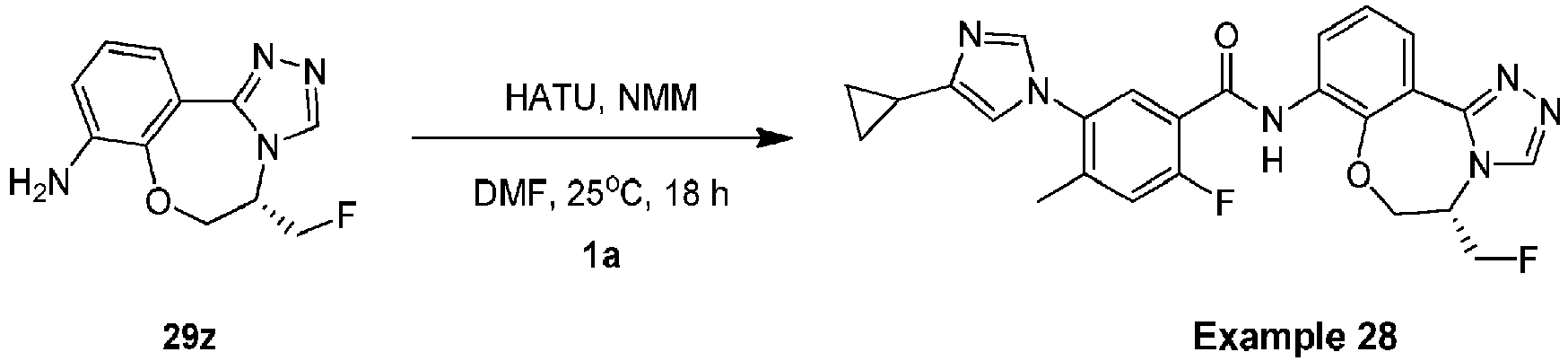
- Synthesis of (S)-5-(4-cyclopropyl-1H-imidazol-1-yl)-2-fluoro-N-(5-(fluoromethyl)-5,6-dihydrobenzo[f] [1,2,4]triazolo [4,3-d] [1,4]oxazepin-8-yl)-4-methylbenzamide (Example 28). To a solution of 1a (10.00 mg, 38.42 umol) in DMF (1.5 mL) was added HATU (21.91 mg, 57.64 umol) and NMM (15.55 mg, 153.70 umol, 16.90 uL) and stirred for 5 min Then (S)-5-(fluoromethyl)-5,6-dihydrobenzo[f][1,2,4]triazolo[4,3-d][1,4]oxazepin-8-amine (29z) (0.009 g, 38.42 umol) was added at 25°C and the mixture was stirred for 18 hours. The reaction mixture was diluted with water (5 mL) and extracted with EtOAc (10 mL*2), the combined organic layers were washed with brine (5 mL*2), dried over Na2SO4, filtered and concentrated. The residue was purified by prep-TLC to give Example 28. MS mass calculated for [M+1]+ (C25H22F2N6O2) requires m/z 477.2, LCMS found m/z 477.2; 1H NMR (400MHz, DMSO-d6) δ= 9.84 (d, J = 4.8 Hz, 1H), 8.73 (s, 1H), 8.36 - 8.27 (m, 1H), 8.13 (br d, J = 7.0 Hz, 1H), 7.75-7.65 (m, 2H), 7.50 (d, J = 11.8 Hz, 1H), 7.23 (t, J = 7.9 Hz, 1H), 7.19 (s, 1H), 5.17 - 4.80 (m, 3H), 4.78 - 4.60 (m, 1H), 4.38 (br d, J = 12.3 Hz, 1H), 2.24 (s, 3H), 1.89 - 1.81 (m, 1H), 0.83-0.77 (m, 2H), 0.75 - 0.66 (m, 2H).
- (S)-4-(4-cyclopropyl-1H-imidazol-1-yl)-N-(5-(fluoromethyl)-5,6-dihydrobenzo[f][1,2,4]triazolo[4,3-d][1,4]oxazepin-8-yl)picolinamide (Example 29) was synthesized according to the scheme provided below.

- Synthesis of (S)-4-(4-cyclopropyl-1H-imidazol-1-yl)-N-(5-(fluoromethyl)-5,6-dihydrobenzo[f] [1,2,4]triazolo[4,3-d] [1,4]oxazepin-8-yl)picolinamide (Example 29). To a solution of 11b (13.70 mg, 59.77 umol) in DMF (1 mL) was added HATU (25.97 mg, 68.31 umol) and NMM (12.95 mg, 128.08 umol, 14.08 uL) and the mixture was stirred for 5 min, then (S)-5-(fluoromethyl)-5,6-dihydrobenzo[t][1,2,4]triazolo[4,3-d][1,4]oxazepin-8-amine (29z) (10 mg, 42.69 umol) was added at 25°C and stirred for 18 hours. The reaction mixture was diluted with water (5 mL) and extracted with EtOAc (10 mL*2), the combined organic layers were washed with brine (5 mL*2), dried over Na2SO4, filtered and concentrated. The residue was purified by prep-TLC to give Example 29. MS mass calculated for [M+1]+ (C23H20FN7O2) requires m/z 446.1, LCMS found m/z 446.1; 1H NMR (400MHz, DMSO-d6) δ= 10.65 (s, 1H), 8.81 (d, J = 5.7 Hz, 1H), 8.75 (s, 1H), 8.58 (d, J = 1.3 Hz, 1H), 8.53 (dd, J = 1.8, 7.9 Hz, 1H), 8.41 (d, J = 2.2 Hz, 1H), 8.32 (dd, J = 1.8, 8.3 Hz, 1H), 8.01 (dd, J = 2.4, 5.5 Hz, 1H), 7.88 (s, 1H), 7.29 (t, J = 7.9 Hz, 1H), 5.17 (br s, 1H), 5.10 - 4.92 (m, 2H), 4.87 - 4.65 (m, 1H), 4.52 (br d, J = 13.2 Hz, 1H), 1.92 - 1.82 (m, 1H), 0.88 - 0.82 (m, 2H), 0.79 - 0.71 (m, 2H).
- (S)-5-(4-cyclopropyl-1H-imidazol-1-yl)-2-fluoro-N-(5-(fluoromethyl)-5,6-dihydrobenzo[f]tetrazolo[l,5-d][l,4]oxazepin-8-yl)-4-methylbenzamide (Example 30) was synthesized according to the scheme provided below.

- Synthesis of (S)-5-(4-cyclopropyl-1H-imidazol-1-yl)-2-fluoro-N-(5-(fluoromethyl)-5,6-dihydrobenzo[f]tetrazolo[1,5-d][1,4]oxazepin-8-yl)-4-methylbenzamide (Example 30). To a solution of 1a (15.49 mg, 59.52 umol) in DMF (2 mL) was added HATU (25.86 mg, 68.02 umol) and NMM (12.90 mg, 127.54 umol, 14.02 uL) and the mixture was stirred for 5 min, then (S)-5-(fluoromethyl)-5,6-dihydrobenzo[f]tetrazolo[1,5-d][1,4]oxazepin-8-amine (30q) (10 mg, 42.51 umol) was added at 25°C and the mixture was stirred for 18 hours. The reaction mixture was diluted with water (5 mL) and extracted with EtOAc (10 mL*2), the combined organic layers were washed with brine (5 mL*2), dried over Na2SO4, filtered and concentrated. The residue was purified by prep-TLC, then resulting product was diluted with water (3 mL) and stirred for 10 min and filtered, the solid was collected and dried in vacuo to afford Example 30. MS mass calculated for [M+1]+ (C24H21F2N7O2) requires m/z 478.2, LCMS found m/z 478.1; 1H NMR (400MHz, CHLOROFORM-d) δ= 9.37 (br d, J = 16.1 Hz, 1H), 8.80 - 8.72 (m, 1H), 8.37 (dd, J = 1.5, 8.3 Hz, 1H), 8.09 (d, J = 7.3 Hz, 1H), 7.46 (s, 1H), 7.35 (t, J = 8.3 Hz, 1H), 7.21 (d, J = 12.2 Hz, 1H), 6.81 (s, 1H), 5.44 - 5.29 (m, 1H), 5.13 - 4.95 (m, 3H), 4.54 (br d, J = 13.7 Hz, 1H), 2.31 (s, 3H), 1.98 - 1.86 (m, 1H), 0.94 - 0.88 (m, 2H), 0.88 - 0.81 (m, 2H).
- (S)-4-(4-cyclopropyl-1H-imidazol-1-yl)-N-(5-(fluoromethyl)-5,6-dihydrobenzo[t]tetrazolo[1,5-d][1,4]oxazepin-8-yl)picolinamide (Example 31) was synthesized according to the scheme provided below.

- Synthesis of (S)-4-(4-cyclopropyl-1H-imidazol-1-yl)-N-(5-(fluoromethyl)-5,6-dihydrobenzo[fJtetrazolo[1,5-d] [1,4]oxazepin-8-yl)picolinamide (Example 31). To a solution of 11a (13.64 mg, 59.52 umol) in DMF (1 mL) was added HATU (25.86 mg, 68.02 umol) and NMM (12.90 mg, 127.54 umol, 14.02 uL) and the mixture was stirred for 5 min, then (S)-5-(fluoromethyl)-5,6-dihydrobenzo[f]tetrazolo[1,5-d][1,4]oxazepin-8-amine (30 q) (10 mg, 42.51 umol) was added at 25°C and the mixture was stirred for 18 hours The reaction mixture was diluted with water (5 mL) and extracted with EtOAc (10 mL*2), the combined organic layers were washed with brine (5 mL*2), dried over Na2SO4, filtered and concentrated. The residue was purified by prep-TLC to give Example 31. MS mass calculated for [M+1]+ (C22H19FN8O2) requires m/z 447.1, LCMS found m/z 447.1; 1H NMR (400MHz, DMSO-d6) δ= 10.69 (s, 1H), 8.82 (d, J = 5.7 Hz, 1H), 8.62 (d, J = 9.2 Hz, 1H), 8.57 (s, 1H), 8.41 (s, 1H), 8.27 (d, J = 6.6 Hz, 1H), 8.04 - 8.00 (m, 1H), 7.88 (s, 1H), 7.39 (t, J = 8.3 Hz, 1H), 5.63 - 5.53 (m, 1H), 5.26 - 4.87 (m, 3H), 4.72 (br d, J = 12.7 Hz, 1H), 1.86 (br d, J = 4.8 Hz, 1H), 0.87 - 0.81 (m, 2H), 0.74 (br d, J = 4.8 Hz, 2H).
- (R)-5-(4-cyclopropyl-1H-imidazol-1-yl)-2-fluoro-N-(5-(fluoromethyl)-5,6-dlhydrobenzo[f][1,2,4]triazolo[4,3-d][1,4]oxazepin-8-yl)-4-methylbenzamide (Example 32) was synthesized according to the scheme provided below.

- Synthesis of (R)-5-(4-cyclopropyl-1H-imidazol-1-yl)-2-fluoro-N-(5-(fluoromethyl)-5,6-dihydrobenzo[f][1,2,4]triazolo[4,3-d][1,4]oxazepin-8-yl)-4-methylbenzamide (Example 32). To a mixture of 5-(4-cyclopropyl-1H-imidazol-1-yl)-2-fluoro-4-methylbenzoic acid (1a) (14.00 mg, 53.79 umol,) in DMF (1 mL) was added HATU (29.22 mg, 76.85 umol) and NMM (15.55 mg, 153.70 umol, 16.90 uL)at 25°C under N2. The mixture was stirred at 25°C for 10 min, then (R)-5-(fluoromethyl)-5,6-dihydrobenzo[f][1,2,4]triazolo[4,3-d][1,4]oxazepin-8-amine (33z) (9 mg, 38.42 umol) was added into the mixture. The mixture was stirred at 25°C for 16 hours. LCMS showed the reaction was completed. Ethyl acetate (40 mL) was added and the mixture was washed with the saturated solution of NaHCO3 (5 mL*3), brine (5 mL*2), dried with anhydrous Na2SO4, filtered and concentrated in vacuo. The residue was purified by prep-TLC (SiO2, DCM: MeOH = 10:1) to give Example 32. MS mass calculated for [M+1]+ (C25H22F2N6O2) requires m/z 447.2, LCMS found m/z 447.1; 1H NMR (400MHz, ACETONITRILE-d3) δ 9.28 (br d, J = 10.1 Hz, 1H), 8.50 (d, J = 7.9 Hz, 1H), 8.43 - 8.35 (m, 2H), 7.87 (d, J = 7.3 Hz, 1H), 7.46 (s, 1H), 7.32 (d, J = 12.3 Hz, 1H), 7.23 (t, J = 8.2 Hz, 1H), 6.95 (d, J = 1.1 Hz, 1H), 5.02 - 4.93 (m, 2H), 4.92 - 4.82 (m, 1H), 4.79 - 4.70 (m, 1H), 4.67-4.59 (m, 1H), 4.35 (dd, J = 3.2, 12.7 Hz, 1H), 2.23 (s, 3H), 1.91 - 1.83 (m, 1H), 0.89 - 0.80 (m, 2H), 0.77 - 0.69 (m, 2H).
- (R)-4-(4-cyclopropyl-1H-imidazol-1-yl)-N-(5-(fluoromethyl)-5,6-dihydrobenzo[f][1,2,4]triazolo[4,3-d][1,4]oxazepin-8-yl)picolinamide (Example 33) was synthesized according to the scheme provided below.

- Synthesis of (R)-4-(4-cyclopropyl-1H-imidazol-1-yl)-N-(5-(fluoromethyl)-5,6-dihydrobenzo[f][1,2,4]triazolo[4,3-d][1,4]oxazepin-8-yl)picolinamide (Example 33). To a mixture of 4-(4-cyclopropyl-1H-imidazol-1-yl)picolinic acid (1b) (12.33 mg, 53.79 umol) in DMF (1 mL) was added HATU (29.22 mg, 76.85 umol) and NMM (15.55 mg, 153.70 umol, 16.90 uL) at 25°C under N2. After stirring at 25°C for 10 min, then (R)-5-(fluoromethyl)-5,6-dihydrobenzo[f][1,2,4]triazolo[4,3-d][1,4]oxazepin-8-amine (33z) (9 mg, 38.42 umol) was added into the mixture. The mixture was stirred at 25°C for 16 hours. LCMS showed the reaction was completed. The mixture was diluted with ethyl acetate (40 mL), then was washed with the saturated solution of NaHCO3 (5 mL*3), NH4Cl (5 mL*3), brine (5 mL*2), dried with anhydrous Na2SO4, filtered and the filtrate was concentrated in vacuo. The residue was purified by prep-TLC (SiO2, DCM: MeOH = 10:1) to give Example 33. MS mass calculated for [M+1]+ (C23H20FN7O2) requires m/z 446.2, LCMS found m/z 446.1; 1H NMR (400MHz, ACETONITRILE-d3) δ 10.68 (s, 1H), 8.72 (d, J = 5.5 Hz, 1H), 8.68 - 8.62 (m, 1H), 8.43 - 8.36 (m, 2H), 8.32 (d, J = 2.0 Hz, 1H), 8.14 (s, 1H), 7.69 (dd, J = 2.2, 5.5 Hz, 1H), 7.47 (s, 1H), 7.25 (t, J = 8.2 Hz, 1H), 5.05 - 4.95 (m, 2H), 4.90 (dd, J = 4.6, 9.7 Hz, 1H), 4.83 - 4.76 (m, 1H), 4.71-4.64 (m, 1H), 4.42 (dd, J = 3.4, 12.0 Hz, 1H), 1.92 - 1.87 (m, 1H), 0.90 - 0.84 (m, 2H), 0.80-0.74 (m, 2H).
- (R)-5-(4-cyclopropyl-1H-imidazol-1-yl)-2-fluoro-4-methyl-N-(6-methyl-5,6-dihydrobenzo[f][1,2,4]triazolo[4,3-d][1,4]oxazepin-8-yl)benzamide (Example 34) and (S)-5-(4-cyclopropyl-1H-imidazol-1-yl)-2-fluoro-4-methyl-N-(6-methyl-5,6-dihydrobenzo[f][1,2,4]triazolo[4,3-d][1,4]oxazepin-8-yl)benzamide (Example 35) were synthesized according to the schemes provided below.

- Synthesis of (aa). To a solution of alcohol (1 mmol) in DME (5 mL) was added NaH (2.5 eq) at 0°C under N2, the mixture was stirred at 0°C for 10 min, then 2-fluoro-3-nitrobenzoic acid (1 eq) dissolved in DME (2 mL) was added in drop-wise at 0°C under N2, the mixture was stirred at 25°C for 2 hours. LCMS showed the reaction was completed. The reaction mixture was cooled to 0°C and quenched with water (10 mL), washed with EtOAc (20 mL), the aqueous phase was acidified with 0.5N HCl to pH=5, then extracted with EtOAc (10 mL*3), the combined organic layers were washed with brine (5 mL), dried over Na2SO4, filtered and concentrated to give aa.
- Synthesis of (ab). A solution of aa (1.2 mmol) in HCl/ EtOAc (10 mL, 4 M) was stirred at 25°C for 2 hours. LCMS showed the reaction was completed. The reaction mixture was filtered, the filter cake was washed with EtOAc (5 mL), and then dried in vacuo to give ab.
- Synthesis of (ac). To a solution of ab (HCl salt, 0.36 mmol) in DMF (30 mL) was added NMM (3 eq) and HATU (1.2 eq). The mixture was stirred at 25°C for 2 h. LCMS show the reaction was completed. The mixture was poured into water (100 mL) andwas extracted with ethyl acetate (10 mL*2). The combined organic layers were washed with brine (20 mL*3), dried with anhydrous Na2SO4, filtered and concentrated in vacuo. The crude product was purified by prep-TLC to give ac.
- Synthesis of (ad). To a solution of ac (0.18 mmol) in DCM (2 mL) was added PCl5 (1.1 eq). The mixture was stirred at 25°C for 2 h. TLC show the reaction was completed. The mixture was concentrated to give ad.
- Synthesis of (ae). To a solution of ad (0.17 mmol) in DMF (1 mL) was added formohydrazide (2 eq). The mixture was stirred at 70°C for 12 h. LCMS showed the reaction was completed. The residue was poured into water (5 mL) and extracted with ethyl acetate (2 mL*2). The combined organic layers were washed with brine (1 mL), dried with anhydrous Na2SO4, filtered and concentrated in vacuo. The crude product was purified by prep-TLC to give ae.
- Synthesis of (af) To a solution of ae (0.16 mmol) in EtOH (2 mL) and H2O (0.4 mL) was added Fe (5 eq) and NH4Cl (10 eq). The mixture was stirred at 70°C for 3 h. LCMS show the reaction was completed. The residue was poured into water (2 mL) and wasextracted with ethyl acetate (2 mL*2). The combined organic layers were washed with brine (1 mL*2), dried with anhydrous Na2SO4, filtered and concentrated in vacuo to give af.
- Synthesis of (R)-5-(4-cyclopropyl-1H-imidazol-1-yl)-2-fluoro-4-methyl-N-(6-methyl-5,6-dihydrobenzo[f] [1,2,4]triazolo[4,3-d] [1,4]oxazepin-8-yl)benzamide (Example 34). To a solution of 5-(4-cyclopropyl-1H-imidazol-1-yl)-2-fluoro-4-methylbenzoic acid (15 mg, 69.37 umol) in DMF (1 mL) was added HATU (39.56 mg, 104.05 umol), NMM (21.05 mg, 208.10 umol) and (R)-6-methyl-5,6-dihydrobenzo[f][1,2,4]triazolo[4,3-d][1,4]oxazepin-8-amine (34af) (19.86 mg, 76.30 umol). The mixture was stirred at 25°C for 12 h. LCMS show the reaction was completed. The residue was poured into water (2 mL) and was extracted with ethyl acetate (2 mL*2). The combined organic layers were washed with brine (2 mL*2), dried with anhydrous Na2SO4, filtered and concentrated in vacuo. The residue was purified by prep-TLC (DCM: Methanol=10/l, Rf=0.4) followed by prep-HPLC (column: Nano-micro Kromasil C18 100*30mm 5um; mobile phase: [water (0.1%TFA)-ACN];B%: 15%-45%,10min) to give Example 34. MS mass calculated for [M+1]+ (C25H23FN6O2) requires m/z 458.4, LCMS found m/z 459.1; 1H NMR (400 MHz, CHLOROFORM-d) δ ppm 9.47 (d, J = 16.1 Hz, 1 H) 8.65 (d, J = 8.2 Hz, 1 H) 8.49 (s, 1 H) 8.37 (d, J = 9.5 Hz, 1 H) 8.26 (s, 1 H) 8.19 (d, J = 7.1 Hz, 1 H) 7.30 (s, 1 H) 7.22 - 7.26 (m, 1 H) 6.89 (s, 1 H) 4.45 - 4.60 (m, 2 H) 4.32 - 4.40 (m, 1 H) 2.32 (s, 3 H) 2.01 - 2.09 (m, 2 H) 1.73 (d, J = 6.6 Hz, 3 H) 1.14 (q, J = 6.5 Hz, 2 H) 0.92 - 0.99 (m, 2 H).
- Synthesis of (S)-5-(4-cyclopropyl-1H-imidazol-1-yl)-2-fluoro-4-methyl-N-(6-methyl-5,6-dihydrobenzo[f][1,2,4] triazolo[4,3-d][1,4]oxazepin-8-yl)benzamide (Example 35). To a mixture of (S)-6-methyl-5,6-dihydrobenzo[f][1,2,4]triazolo[4,3-d][1,4]oxazepin-8-amine (35af) (30 mg, 138.74 umol) and (1a) (50.55 mg, 194.23 umol) in DMF (2 mL) was added HATU (105.50 mg, 277.47 umol) and NMM (28.07 mg, 277.47 umol, 30.51 uL) under N2. The mixture was stirred at 25°C for 16 hours. LCMS showed desired MS was detected. The mixture was poured into saturated aqueous NaHCO3 (5 mL) andwas extracted with ethyl acetate (10 mL*2). The combined organic layers were washed with brine (10 mL), dried with anhydrous Na2SO4, filtered and the filtrate was concentrated in vacuo. The residue was purified by prep-TLC (SiO2, Ethyl acetate : Methanol= 10:1) to give Example 35. MS mass calculated for [M+H]+ (C25H23FN6O2) requires m/z 459.2, LCMS found m/z 459.2; 1H NMR (400MHz, CDCl3) δ 9.48 (br d, J = 16.7 Hz, 1H), 8.66 (d, J = 6.6 Hz, 1H), 8.44 - 8.30 (m, 1H), 8.22 (s, 1H), 8.10 (d, J = 7.0 Hz, 1H), 7.50 (br s, 1H), 7.25 - 7.21 (m, 1H), 7.19 (d, J = 12.7 Hz, 1H), 6.79 (br s, 1H), 4.54 (br t, J = 6.8 Hz, 1H), 4.50 - 4.42 (m, 1H), 4.39 - 4.29 (m, 1H), 2.28 (s, 3H), 1.91 (br s, 1H), 1.71 (d, J = 6.6 Hz, 3H), 0.94 - 0.86 (m, 2H), 0.82 (br d, J = 4.4 Hz, 2H).
- 5-(4-cyclopropyl-1H-imidazol-1-yl)-N-(5,6-dihydrobenzo[f][1,2,3]triazolo[1,5-d][1,4]oxazepin-8-yl)-2-fluoro-4-methylbenzamide (Example 40) was synthesized according to the schemes provided below.

- ((2-fluoro-3-nitrophenyl)ethynyl)trimethylsilane (40a). To a solution of 1-bromo-2-fluoro-3-nitrobenzene (200 mg, 909.11 umol) in TEA (2 mL) was added trimethylsilylacetylene (357.16 mg, 3.64 mmol, 503.76 uL), Pd(PPh3)2Cl2 (63.81 mg, 90.91 umol) and Cul (17.31 mg, 90.91 umol)at 20°C under N2, then the mixture was degassed and purged with N2 three times, the resulting mixture was heated to 60°C and stirred for 18 hours. TLC (Petroleum ether: Ethyl acetate=10:1) showed starting material was consumed. The reaction mixture was filtered through a Celite pad and the filter cake was rinsed with EtOAc (20 mL). The filtrate was concentrated in vacuo, then diluted with water (10 mL) and extracted with EtOAc (20 mL*2), the combined organic layers were washed with brine (10 mL), dried over anhydrous Na2SO4, filtered and concentrated. The residue was purified by prep-TLC (SiO2, Petroleum ether: Ethyl acetate= 10:1, product Rf=0.47) to afford 40a. 1H NMR (400MHz, CHLOROFORM-d) δ = 7.98 (ddd, J = 1.8, 6.7, 8.3 Hz, 1H), 7.72 (ddd, J = 1.8, 6.0, 7.7 Hz, 1H), 7.23 (dt, J = 1.1, 8.0 Hz, 1H), 0.31 - 0.27 (m, 9H).
- 2-(2-chloroethoxy)-1-ethynyl-3-nitrobenzene (40b). To a solution of ((2-fluoro-3-nitrophenyl)ethynyl)-trimethylsilane (40a) (100.00 mg, 421.40 umol) in THF (2 mL), NaH (33.71 mg, 842.81 umol, 60% purity) was addedat 0°C and the mixture was stirred for 10 min. 2-chloroethanol (50.89 mg, 632.11 umol, 42.41 uL) was added at this temperature and the mixture was stirred for another 20 min. TLC (Petroleum ether: Ethyl acetate=10:1) showed starting material was consumed. The reaction mixture was quenched with saturated NH4Cl solution (5 mL), and then extracted with EtOAc (10 mL*2). The combined organic layers were washed with brine (10 mL), dried over anhydrous Na2SO4, filtered and concentrated. The residue was purified by prep-TLC (SiO2, Petroleum ether: Ethyl acetate = 10:1, Product Rf= 0.33) to afford 40b. 1H NMR (400MHz, CHLOROFORM-d) δ = 7.80 (dd, J = 1.8, 8.2 Hz, 1H), 7.70 (dd, J = 1.5, 7.7 Hz, 1H), 7.21 (t, J = 7.9 Hz, 1H), 4.54 (t, J = 6.2 Hz, 2H), 3.88 (t, J = 6.2 Hz, 2H), 3.46 (s, 1H).
- 4-(2-(2-chloroethoxy)-3-nitrophenyl)-1H-1,2,3-triazole (40c) and 8-nitro-5,6-dihydrobenzo[f][1,2,3]triazolo[1,5-d][1,4]oxazepine (40d). To a solution of 2-(2-chloroethoxy)-1-ethynyl-3-nitrobenzene (40b) (80 mg, 354.57 umol) and TMSN3 (61.27 mg, 531.85 umol, 69.95 uL) in DMF (1.8 mL) and MeOH (0.2 mL) was added Cul (6.75 mg, 35.46 umol) at 25°C under N2. The mixture was degassed and purged with N2 three times, and stirred at 100°C for 16 hours. K2CO3 (49.00 mg, 354.57 umol) was added to the above solution and stirred for another 5 hours. The reaction mixture was filtered through a Celite pad and the filter cake was rinsed with EtOAc (20 mL). The filtrate was concentrated in vacuo. The residue was diluted with water (8 mL) and extracted with EtOAc (10 mL*3). The combined organic layers were washed with brine (5 mL*2), dried over anhydrous Na2SO4, filtered and concentrated. The residue was purified by prep-TLC (SiO2, Petroleum ether: Ethyl acetate= 1:1, product Rf=0.43) to afford 40d. MS mass calculated for [M+1]+ (C10H8N4O3) requires m/z 233.1, LCMS found m/z 233.0; 1H NMR (400MHz, CHLOROFORM-d) δ = 8.09 (s, 1H), 7.97 - 7.90 (m, 1H), 7.76-7.69 (m, 1H), 7.27 (t, 1H), 5.03 - 4.97 (m, 2H), 4.71 - 4.64 (m, 2H).
- 5,6-dihydrobenzo[f][1,2,3]triazolo[1,5-d][1,4]oxazepin-8-amine (40e). To a solution of 8-nitro-5,6-dihydrobenzo[f][1,2,3]triazolo[1,5-d][1,4]oxazepine (40d) (0.045 g, 193.80 umol) in EtOH (5 mL) and H2O (1 mL) was added Fe (54.11 mg, 969.01 umol) and NH4Cl (103.67 mg, 1.94 mmol) at 25°C and the mixture was stirred for 3 hours at 70°C. TLC (Petroleum ether: Ethyl acetate=1:1) showed the reaction was completed and a product was detected. The reaction mixture was filtered through a Celite pad, the filter cake was rinsed with EtOH (30 mL) and the filtrate was concentrated. The residue was diluted with water (10 mL) and extracted with DCM (15 mL*3). The combined organic layers were collected and washed with water (10 mL), brine (10 mL), dried over anhydrous Na2SO4, filtered and concentrated to give 40e. MS mass calculated for [M+1]+ (C10H10N4O) requires m/z 203.1, LCMS found m/z 203.0; 1H NMR (400MHz, CHLOROFORM-d) δ= 8.02 (s, 1H), 7.11 (dd, J = 1.7, 8.1 Hz, 1H), 6.94 (t, J = 8.1 Hz, 1H), 6.76 (dd, J = 1.7, 7.6 Hz, 1H), 5.04 - 4.79 (m, 2H), 4.62 - 4.48 (m, 2H), 4.12 - 3.92 (m, 2H).
- Synthesis of 5-(4-cyclopropyl-1H-imidazol-1-yl)-N-(5,6-dihydrobenzo[f][1,2,3]triazolo[1,5-d][1,4]oxazepin-8-yl)-2-fluoro-4-methylbenzamide (Example 40). To a solution of 5-(4-cyclopropyl-1H-imidazol-1-yl)-2-fluoro-4-methylbenzoic acid (1b) (58.56 mg, 225.01 umol) in DMF (2 mL) was added HATU (98.72 mg, 259.63 umol) and NMM (52.52 mg, 519.26 umol, 57.09 uL) at 25°C, then 5,6-dihydrobenzo[f][1,2,3]triazolo[1,5-d][1,4]oxazepin-8-amine (40e) (0.035 g, 173.09 umol) was added and the mixture was stirred for 18 hours. LCMS showed a main peak with desired MS. The mixture was concentrated in vacuo and purified by prep-HPLC (basic condition) to afford Example 40. MS mass calculated for [M+1]+ (C24H21FN6O2) requires m/z 445.2 LCMS found m/z 445.1; 1H NMR (400MHz, CHLOROFORM-d) δ = 9.43 (br d, J = 16.1 Hz, 1H), 8.61 (d, J = 8.2 Hz, 1H), 8.08 (t, J= 3.5 Hz, 2H), 7.52 (d, J= 8.2 Hz, 1H), 7.47 - 7.39 (m, 1H), 7.24 - 7.14 (m, 2H), 6.80 (br s, 1H), 5.11 - 4.92 (m, 2H), 4.77 - 4.59 (m, 2H), 2.29 (s, 3H), 1.99 - 1.85 (m, 1H), 0.96 - 0.80 (m, 4H).
- 5-(4-cyclopropyl-1H-imidazol-1-yl)-N-(5,6-dihydrobenzo[f]imidazo[1,5-d][1,4]oxazepin-8-yl)-2-fluoro-4-methylbenzamide (Example 41), (S)-5-(4-cyclopropyl-1H-imidazol-1-yl)-2-fluoro-4-methyl-N-(5-methyl-5,6-dihydrobenzo[f]imidazo[1,5-d][1,4]oxazepin-8-yl)benzamide (Example 46), and (R)-5-(4-cyclopropyl-1H-imidazol-1-yl)-2-fluoro-4-methyl-N-(5-methyl-5,6-dihydrobenzo[f]imidazo[1,5-d][1,4]oxazepin-8-yl)benzamide (Example 47) were synthesized according to the schemes provided below.

- Synthesis of (41a). To a mixture of 1-bromo-2-fluoro-3-nitrobenzene (1.4 mmol) in dioxane (10 mL) was added 4,4,5,5-tetramethyl-2-(4,4,5,5-tetramethyl-1,3,2-dioxaborolan-2-yl)-1,3,2-dioxaborolane (1.5 eq) and KOAc (2 eq), and Pd(dppf)Cl2 (0.1 eq). The mixture was degassed and purged with N2 for 3 times. The mixture was stirred at 80 °C for 16 hours and was poured into water and extracted with ethyl acetate 3 times. The combined organic layers were washed with brine, dried with anhydrous Na2SO4, filtered and concentrated in vacuo. The residue was purified by column chromatography (SiO2, Petroleum ether/Ethyl acetate = 15:1 to 10:1) to give 2-(2-fluoro-3-nitrophenyl)-4,4,5,5-tetramethyl-1,3,2-dioxaborolane (41a). 1H NMR (400MHz, DMSO) δ 13.47 (br s, 1H), 8.03 - 6.96 (m, 4H), 2.20 (s, 3H), 1.94 - 1.77 (m, 1H), 0.80 (br s, 2H), 0.70 (br s, 2H).
- Synthesis of (41b). To a mixture of 2-(2-fluoro-3-nitrophenyl)-4,4,5,5-tetramethyl-1,3,2-dioxaborolane (41a) (0.86 mmol) and 5-bromo-1H-imidazole (1.5 eq) in dioxane (10 mL) was added Pd(dppf)Cl2.CH2Cl2 (0.1 eq), (Boc)2O (2 eq) and KOAc (3 eq) at 25°C under N2. The mixture was stirred at 80°C for 16 hours. LC-MS showed desired MS was detected. The residue was poured into water and the mixture was extracted with ethyl acetate. The organic phase was washed with brine, dried with anhydrous Na2SO4, filtered and concentrated in vacuo. The residue was purified by prep-TLC (SiO2, Petroleum ether: Ethyl acetate = 3:1) to give tert-butyl 5-(2-fluoro-3-nitrophenyl)-1H-imidazole-1-carboxylate (41b). MS mass calculated for [M+1]+ (C14H14FN3O4) requires m/z 306.1, LCMS found m/z 207.9.
- Synthesis of (c). To a mixture of tert-butyl 5-(2-fluoro-3-nitrophenyl)-1H-imidazole-1-carboxylate (41b) (0.11 mmol) and alcohol (2 eq) in THF (3 mL) was added NaH (2 eq) at 0°C under N2. The mixture was stirred at 25 °C for 2 hours. LCMS showed desired MS was detected. The residue was poured into ice-water and extracted with ethyl acetate. The organic phase was washed with brine (10 mL), dried with anhydrous Na2SO4, filtered and concentrated in vacuo to give compound c.
- Synthesis of (d). To a mixture of c (0.11 mmol) in EtOH/H2O (5 mL/1 mL) was added Fe (5 eq) and NH4Cl (10 eq) at 25°C under N2. The mixture was stirred at 70°C for 2 hours. TLC (Dichloromethane: Methanol=10:1) indicated reactant was consumed completely and one new spot formed. The reaction mixture was filtered and the filtrate was concentrated under reduced pressure. The residue was poured into water and was extracted with ethyl acetate 3 times. The combined organic layers were washed with brine, dried with anhydrous Na2SO4, filtered and concentrated in vacuo. The residue was purified by prep-TLC (SiO2, DCM: MeOH = 10:1) to give compound d.
- Synthesis of 5-(4-cyclopropyl-1H-imidazol-1-yl)-N-(5,6-dihydrobenzo[f]imidazo[1,5-d][1,41oxazepin-8-yl)-2-fluoro-4-methylbenzamide (Example 41). To a mixture of 5,6-dihydrobenzo[f]imidazo[1,5-d][1,4]oxazepin-8-amine (41d) (12 mg, 59.64 umol, 1 eq) and 5-(4-cyclopropyl-1H-imidazol-1-yl)-2-fluoro-4-methylbenzoic acid (1b) (23.28 mg, 89.45 umol, 1.5 eq) in DMF (1 mL) was added HATU (34.01 mg, 89.45 umol, 1.5 eq) and NMM (24.13 mg, 238.54 umol, 26.23 uL, 4 eq) under N2. The mixture was stirred at 25°C for 12 hours. LCMS showed one main peak with desired MS. The reaction mixture was poured into water (10 mL) and wasextracted with ethyl acetate (10 mL*3). The combined organic layers were washed with brine (10 mL*2), dried with anhydrous Na2SO4, filtered and concentrated in vacuo. The residue was purified by prep-TLC (SiO2, DCM: MeOH = 10:1) to give Example 41. MS mass calculated for [M+1]+ (C25H22FN5O2) requires m/z 444.2, LCMS found m/z 444.1; 1H NMR (400MHz, CHLOROFORM-d) δ 9.40 (br d, J = 15.5 Hz, 1H), 8.47 (dd, J = 1.2, 8.1 Hz, 1H), 8.08 (d, J = 7.3 Hz, 1H), 7.60 (s, 1H), 7.52 (br s, 1H), 7.49 (dd, J = 1.5, 8.1 Hz, 1H), 7.45 (d, J = 1.2 Hz, 1H), 7.20 - 7.15 (m, 1H), 7.14 - 7.11 (m, 1H), 6.79 (d, J = 1.2 Hz, 1H), 4.64 - 4.58 (m, 2H), 4.53 - 4.47 (m, 2H), 2.28 (s, 3H), 1.92 (tt, J = 5.2, 8.3 Hz, 1H), 0.94 - 0.87 (m, 2H), 0.86 - 0.80 (m, 2H).
- Synthesis of (S)-5-(4-cyclopropyl-1H-imidazol-1-yl)-2-fluoro-4-methyl-N-(5-methyl-5,6-dihydrobenzo[f]imidazo[1,5-d][1,4]oxazepin-8-yl)benzamide (Example 46). To a mixture of (S)-5-methyl-5,6-dihydrobenzo[f]imidazo[1,5-d][1,4]oxazepin-8-amine (46d) (3 mg, 13.94 umol, 1 eq) and 5-(4-cyclopropyl-1H-imidazol-1-yl)-2-fluoro-4-methylbenzoic acid (1b) (3.99 mg, 15.33 umol, 1.1 eq) in DMF (1 mL) was added HATU (6.36 mg, 16.72 umol, 1.2 eq) and NMM (5.64 mg, 55.75 umol, 6.13 uL, 4 eq) under N2. The mixture was stirred at 25°C for 12 hours. LCMS showed one main peak with desired MS. The reaction mixture was concentrated under reduced pressure. The residue was purified by prep-HPLC (basic condition) to give Example 46. MS mass calculated for [M+1]+ (C26H24FN5O2) requires m/z 458.1, LCMS found m/z 458.1; 1H NMR (400MHz, CHLOROFORM-d) δ 9.43 (br d, J = 15.5 Hz, 1H), 8.48 (dd, J = 1.3, 8.0 Hz, 1H), 8.10 (d, J = 7.3 Hz, 1H), 7.66 (s, 1H), 7.53 (d, J = 1.5 Hz, 1H), 7.51 (s, 1H), 7.47 (d, J = 1.2 Hz, 1H), 7.19 (d, J = 13.4 Hz, 1H), 7.16 - 7.11 (m, 1H), 6.81 (d, J = 1.2 Hz, 1H), 4.75 - 4.68 (m, 1H), 4.58 - 4.52 (m, 1H), 4.51 - 4.43 (m, 1H), 2.30 (s, 3H), 1.97 - 1.90 (m, 1H), 1.67 (d, J= 6.8 Hz, 3H), 0.94 - 0.90 (m, 2H), 0.87 - 0.83 (m, 2H).
- Synthesis of (R)-5-(4-cyclopropyl-1H-imidazol-1-yl)-2-fluoro-4-methyl-N-(5-methyl-5,6-dihydrobenzo[f]imidazo[1,5-d][1,4]oxazepin-8-yl)benzamide (Example 47). To a mixture of (S)-5-methyl-5,6-dihydrobenzo[f]imidazo[1,5-d][1,4]oxazepin-8-amine (47d) (8 mg, 37.17 umol, 1 eq) and 5-(4-cyclopropyl-1H-imidazol-1-yl)-2-fluoro-4-methylbenzoic acid (1b) (13.23 mg, 44.60 umol, 1.2 eq, HCl) in DMF (1 mL) was added HATU (16.96 mg, 44.60 umol, 1.2 eq) and NMM (15.04 mg, 148.66 umol, 16.34 uL, 4 eq) under N2. The mixture was stirred at 25°C for 12 hours. LCMS showed one main peak with desired MS was detected. The reaction mixture was concentrated under reduced pressure. The residue was purified by prep-HPLC (basic condition) to give Example 47. MS mass calculated for [M+1]+ (C26H24FN5O2) requires m/z 458.1, LCMS found m/z 458.1; 1H NMR (400MHz, CHLOROFORM-d) δ 9.41 (br d, J = 15.7 Hz, 1H), 8.46 (d, J = 7.9 Hz, 1H), 8.08 (d, J = 7.3 Hz, 1H), 7.64 (s, 1H), 7.52 - 7.48 (m, 2H), 7.45 (d, J = 1.2 Hz, 1H), 7.17 (d, J = 13.3 Hz, 1H), 7.14 - 7.09 (m, 1H), 6.80 (d, J = 1.1 Hz, 1H), 4.75 - 4.66 (m, 1H), 4.57 - 4.51 (m, 1H), 4.49 - 4.42 (m, 1H), 2.29 (s, 3H), 1.96 - 1.88 (m, 1H), 1.66 (d, J = 6.8 Hz, 3H), 0.94 - 0.87 (m, 2H), 0.86 - 0.81 (m, 2H).
- 8-nitro-5,6-dihydrobenzo[f]imidazo[1,5-d][1,4]oxazepine (41c): MS mass calculated for [M+1]+ (C11H9N3O3) requires m/z 232.1, LCMS found m/z 232.3; 1H NMR (400MHz, CHLOROFORM-d) δ 7.85 (d, J = 8.2 Hz, 1H), 7.70 (br s, 1H), 7.64 (d, J = 7.7 Hz, 1H), 7.52 (s, 1H), 7.21 (t, J = 8.0 Hz, 1H), 4.67 - 4.62 (m, 2H), 4.49 - 4.44 (m, 2H).
- (R)-5-methyl-8-nitro-5,6-dihydrobenzo[f]imidazo[1,5-d][1,4]oxazepine (46c): MS mass calculated for [M+1]+ (C12H11N3O3) requires m/z 246.1, LCMS found m/z 246.2.
- (S)-5-methyl-8-nitro-5,6-dihydrobenzo[f]imidazo[1,5-d][1,4]oxazepine (47c): MS mass calculated for [M+1]+ (C12H11N3O3) requires m/z 246.1, LCMS found m/z 246.2.
- 5,6-dihydrobenzo[f]imidazo[1,5-d][1,4]oxazepin-8-amine (41d): 1H NMR (400MHz, CHLOROFORM-d) δ 7.56 (br s, 1H), 7.44 (br s, 1H), 7.15 - 7.02 (m, 1H), 6.89 (dt, J = 5.0, 7.8 Hz, 1H), 6.74 - 6.60 (m, 1H), 4.51 (br d, J = 2.6 Hz, 2H), 4.42 (br d, J = 3.7 Hz, 2H).
- (R)-5-methyl-5,6-dihydrobenzo[f]imidazo[1,5-d][1,4]oxazepin-8-amine (46d): MS mass calculated for [M+1]+ (C12H13N3O) requires m/z 216.1, LCMS found m/z 216.1.
- (S)-5-methyl-5,6-dihydrobenzo[f]imidazo[1,5-d][1,4]oxazepin-8-amine (47d): MS mass calculated for [M+1]+ (C12H13N3O) requires m/z 216.1, LCMS found m/z 216.1.
- (S)-5-(4-cyclopropyl-1H-imidazol-1-yl)-2-fluoro-4-methyl-N-(6-methyl-5,6-dihydrobenzo[f]tetrazolo[1,5-d][1,4]oxazepin-8-yl)benzamide (Example 42), (R)-5-(4-cyclopropyl-1H-imidazol-1-yl)-2-fluoro-4-methyl-N-(6-methyl-5,6-dihydrobenzo[f]tetrazolo[1,5-d][1,4]oxazepin-8-yl)benzamide (Example 43), and 5-(4-cyclopropyl-IH-imidazol-1-yl)-2-fluoro-4-methyl-N-(5H-spiro[benzo[t]tetrazolo[l,5-d][1,4]oxazepine-6,1'-cyclopropan]-8-yl)benzamide (Example 59) were synthesized according to the schemes provided below.

- Synthesis of (a). To a solution of ac (0.73 mmol) in toluene (2 mL) was added Lawesson's reagent (0.6 eq) at 25°C, then heated to 110°C and stirred for 2 hours. TLC (Petroleum ether: Ethyl acetate=1:1) showed starting material was consumed and a main spot with lower polarity was detected. The reaction mixture was concentrated, then diluted with water and extracted with EtOAc. The organic phase was washed with brine, dried over Na2SO4, filtered and concentrated under reduced pressure to give a residue which was purified by prep-TLC (SiO2, Petroleum ether : Ethyl acetate = 1:1) to give compound a.
- Synthesis of (b). To a solution of a (0.52 mmol) in THF (2 mL) was added Hg(OAc)2 (2 eq) and TMSN3 (7 eq) at 0°C. Then the mixture was warmed to 25°C and stirred for 2 hours. TLC (Petroleum ether: Ethyl acetate=3:1) showed starting material was consumed and a main spot with lower polarity was detected. LCMS showed a main peak with desired MS. The reaction mixture was concentrated in vacuo, and then diluted with water, extracted with EtOAc, the organic phase was collected and washed with brine, dried over Na2SO4, filtered and concentrated to give b (crude) that was used in the next step without further purification.
- Synthesis of (c). To a solution of b (0.46 mmol) in EtOH/H2O (10 mL/2 mL) was added Fe (5 eq) and NH4Cl (10 eq) at 25°C, then heated to 70°C and the nmixture was stirred for 2 hours. TLC (Petroleum ether: Ethyl acetate=1:1) showed starting material was consumed and a main spot was detected. The reaction mixture was filtered through a Celite pad and rinsed with EtOH, the filtrate was concentrated. The residue was diluted with DCM and filtered, the filtrate was concentrated and purified by prep-TLC (SiO2, Dichloromethane : Methanol=10:l) to give c.
- Synthesis of (S)-5-(4-cyclopropyl-1H-imidazol-1-yl)-2-fluoro-4-methyl-N-(6-methyl-5,6-dihydrobenzo[f]tetrazolo-[1,5-d][1,4]oxazepin-8-yl)benzamide (Example 42). To a mixture of 5-(4-cyclopropyl-1H-imidazol-1-yl)-2-fluoro-4-methylbenzoic acid (1b) (35.94 mg, 138.10 umol, 1.2 eq) and HATU (65.64 mg, 172.63 umol, 1.5 eq) and NMM (46.56 mg, 460.35 umol, 50.61 uL, 4 eq) in DMF (5 mL) was added (6S)-6-methyl-5,6-dihydrotetrazolo[1,5-d][1,4]benzoxazepin-8-amine (42c) (25 mg, 115.09 umol, 1 eq) at 25 °C under N2. The mixture was stirred at 25°C for 16 hours. LCMS showed desired MS was detected. The reaction mixture was poured into water (5 mL) and was extracted with ethyl acetate (10 mL*2). The combined organic layers were washed with brine (10 mL), dried with anhydrous Na2SO4, filtered and concentrated in vacuo. The residue was purified by prep-TLC (SiO2, DCM: MeOH = 10:1) to give Example 42. MS mass calculated for [M+1]+ (C24H22FN7O2) requires m/z 460.2, LCMS found m/z 460.2; 1H NMR (400MHz, CHLOROFORM-d) δ 9.49 (br d, J = 16.8 Hz, 1H), 8.78 (dd, J = 1.5, 8.1 Hz, 1H), 8.32 (dd, J = 1.6, 8.2 Hz, 1H), 8.12 (d, J = 7.5 Hz, 1H), 7.46 (s, 1H), 7.31 (t, J = 8.1 Hz, 1H), 7.21 (d, J = 12.5 Hz, 1H), 6.81 (s, 1H), 5.03 (dd, J = 1.2, 14.5 Hz, 1H), 4.72 - 4.64 (m, 1H), 4.57 - 4.49 (m, 1H), 2.30 (s, 3H), 1.97 - 1.88 (m, 1H), 1.79 (d, J = 6.4 Hz, 3H), 0.94 - 0.89 (m, 2H), 0.86 - 0.81 (m, 2H).
- Synthesis of (R)-5-(4-cyclopropyl-1H-imidazol-1-yl)-2-fluoro-4-methyl-N-(6-methyl-5,6-dihydrobenzo[f]tetrazolo[1,5-d][1,4]oxazepin-8-yl)benzamide (Example 43). To a solution of 5-(4-cyclopropyl-1H-imidazol-1-yl)-2-fluoro-4-methylbenzoic acid (1b) (26.96 mg, 103.58 umol) in DMF (1 mL) was added HATU (52.51 mg, 138.10 umol) and NMM (34.92 mg, 345.26 umol, 37.96 uL) at 25°C. Then (R)-6-methyl-5,6-dihydrobenzo[f]tetrazolo[1,5-d][1,4]oxazepin-8-amine (43c) (0.015 g, 69.05 umol) was added and the mixture was stirred for 24 hours. The reaction mixture was concentrated in vacuo, then diluted with water (5 mL), extracted with EtOAc (10 mL*3). The combined organic layers were washed with brine (10 mL), dried over Na2SO4, filtered and concentrated. The residue was purified by prep-TLC (SiO2, DCM: MeOH = 10:1, product Rf=0.50) to afford Example 43. MS mass calculated for [M+1]+ (C24H22FN7O2) requires m/z 460.2 LCMS found m/z 460.2; 1H NMR (400MHz, CHLOROFORM-d) δ = 9.48 (br d, J = 16.6 Hz, 1H), 8.78 (dd, J = 1.7, 8.1 Hz, 1H), 8.33 (dd, J = 1.7, 8.1 Hz, 1H), 8.12 (d, J = 7.3 Hz, 1H), 7.46 (s, 1H), 7.31 (t, J =8.1 Hz, 1H), 7.21 (d, J = 12.7 Hz, 1H), 6.80 (s, 1H), 5.03 (dd, J = 1.2, 14.4 Hz, 1H), 4.68 (dd, J = 9.5, 14.4 Hz, 1H), 4.59 - 4.48 (m, 1H), 2.30 (s, 3H), 1.99 - 1.86 (m, 1H), 1.79 (d, J = 6.4 Hz, 3H), 0.95 - 0.87 (m, 2H), 0.87-0.82 (m, 2H).
- Synthesis of 5-(4-cyclopropyl-1H-imidazol-1-yl)-2-fluoro-4-methyl-N-(5H-spiro[benzo[f]tetrazolo[1,5-d][1,4]oxazepine-6,1'-cyclopropan]-8-yl)benzamide (Example 59). To a solution of 5-(4-cyclopropyl-1H-imidazol-1-yl)-2-fluoro-4-methylbenzoic acid (1b) (13.80 mg, 53.01 umol) in DMF (2 mL) was added HATU (27.49 mg, 72.29 umol) and NMM (19.50 mg, 192.77 umol, 21.19 uL) at 25°C, then 5H-spiro[benzo[f]tetrazolo[l,5-d][1,4]oxazepine-6,1'-cyclopropan]-8-amine (59c) (11 mg, 48.19 umol) was added and the mixture was stirred for 18 hours. The reaction mixture was concentrated. The residue was purified by prep-HPLC (basic condition, column: Kromasil 150*25mm*10um; mobile phase: [water(0.04%NH3H2O+10mM NH4HCO3)-ACN]; B%: 25%-45%,10min) and lyophilized to afford Example 59. MS mass calculated for [M+1]+ (C25H22FN7O2) requires m/z 472.2, LCMS found m/z 472.1; 1H NMR (400MHz, CHLOROFORM-d) δ= 9.16 (br d, J = 16.6 Hz, 1H), 8.74 (dd, J = 1.5, 8.3 Hz, 1H), 8.40 (dd, J = 1.5, 8.3 Hz, 1H), 8.09 (d, J = 7.3 Hz, 1H), 7.45 (d, J = 1.5 Hz, 1H), 7.32 (t, J = 8.1 Hz, 1H), 7.20 (d, J = 12.7 Hz, 1H), 6.80 (d, J = 1.5 Hz, 1H), 4.92 (s, 2H), 2.30 (s, 3H), 1.98 - 1.85 (m, 1H), 1.33 - 1.25 (m, 2H), 1.10 - 1.01 (m, 2H), 0.94 - 0.87 (m, 2H), 0.87 - 0.80 (m, 2H).
- (S)-2-methyl-9-nitro-3,4-dihydrobenzo[fl[1,4]oxazepine-5(2H)-thione (42a): MS mass calculated for [M+1]+ (C10H10N2O3S) requires m/z 239.0, LCMS found m/z 239.2.
- (R)-2-methyl-9-nitro-3,4-dihydrobenzo[f][1,4]oxazepine-5(2H)-thione (43a): MS mass calculated for [M+1]+ (C10H10N2O3S) requires m/z 239.0 LCMS found m/z 238.9; 1H NMR (400MHz, CHLOROFORM-d) δ = 8.83 (br s, 1H), 8.23 (dd, J = 1.8, 7.9 Hz, 1H), 7.89 (dd, J = 1.8, 7.9 Hz, 1H), 7.30 (t, J = 7.9 Hz, 1H), 5.10 - 4.77 (m, 1H), 3.82 - 3.59 (m, 1H), 3.30 (ddd, J = 3.7, 6.6, 15.1 Hz, 1H), 1.48 (d, J = 6.6 Hz, 3H).
- MS mass calculated for [M+1]+ (C11H10N2O3S) requires m/z 251.0, LCMS found m/z 251.0; 1H NMR (400MHz, CHLOROFORM-d) δ = 8.72 (br s, 1H), 8.28 (dd, J = 2.0, 7.8 Hz, 1H), 7.86 (dd, J = 1.7, 8.1 Hz, 1H), 7.32 - 7.28 (m, 1H), 3.58 (d, J = 6.4 Hz, 2H), 1.42 - 1.31 (m, 2H), 0.76 - 0.69 (m, 2H).
- (S)-6-methyl-8-nitro-5,6-dihydrobenzo[f]tetrazolo[1,5-d][1,4]oxazepine (42b): MS mass calculated for [M+1]+ (C10H9N5O3) requires m/z 248.1, LCMS found m/z 248.3.
- (R)-6-methyl-8-nitro-5,6-dihydrobenzo[f]tetrazolo[1,5-d][1,4]oxazepine (43b): MS mass calculated for [M+1]+ (C10H9N5O3) requires m/z 248.1 LCMS found m/z 247.9; 1H NMR (400MHz, CHLOROFORM-d) δ = 8.85 - 8.74 (m, 1H), 7.89 (dd, J = 1.7, 8.1 Hz, 1H), 7.37 (t, J = 8.1 Hz, 1H), 5.00 (dd, J = 1.5, 14.7 Hz, 1H), 4.72 (dd, J = 9.5, 14.4 Hz, 1H), 4.63 - 4.53 (m, 1H), 1.71 (d, J = 6.4 Hz, 3H).
- 8-nitro-5H-spiro[benzo[f]tetrazolo[1,5-d][1,4]oxazepine-6,1'-cyclopropane] (59b): MS mass calculated for [M+1]+ (C11H9N5O3) requires m/z 260.1, LCMS found m/z 260.0; 1H NMR (400MHz, CHLOROFORM-d) δ = 9.02 - 8.66 (m, 1H), 7.89 - 7.80 (m, 1H), 7.39 (dt, J = 1.0, 8.1 Hz, 1H), 4.93 (s, 2H), 1.50 - 1.33 (m, 2H), 1.11 - 0.93 (m, 2H).
- (S)-6-methyl-5,6-dihydrobenzo[f]tetrazolo[1,5-d][1,4]oxazepin-8-amine (42c): MS mass calculated for [M+1]+ (C10H11N5O3) requires m/z 218.1, LCMS found m/z 218.3; 1H NMR (400MHz, CHLOROFORM-d) δ = 7.89 (dd, J = 1.3, 7.9 Hz, 1H), 7.02 (t, J = 7.8 Hz, 1H), 6.89 (dd, J = 1.4, 7.8 Hz, 1H), 4.93 (dd, J = 1.1, 14.3 Hz, 1H), 4.64 - 4.55 (m, 1H), 4.47 - 4.38 (m, 1H), 4.00 (br s, 2H), 1.67 (d, J = 6.4 Hz, 3H).
- (R)-6-methyl-5,6-dihydrobenzo[f]tetrazolo[1,5-d][1,4]oxazepin-8-amine (43c): MS mass calculated for [M+1]+ (C10H11N5O) requires m/z 218.1 LCMS found m/z 218.0; 1H NMR (400MHz, CHLOROFORM-d) δ = 7.95 - 7.85 (m, 1H), 7.04 (t, J = 7.8 Hz, 1H), 6.94 - 6.85 (m, 1H), 4.94 (dd, J = 1.5, 14.2 Hz, 1H), 4.61 (dd, J = 9.3, 14.7 Hz, 1H), 4.51 - 4.37 (m, 1H), 4.01 (br s, 2H), 1.68 (d, J = 6.4 Hz, 3H).
- 5H-spiro[benzo[f]tetrazolo[1,5-d] [1,4]oxazepine-6,1'-cyclopropan]-8-amine (59c): MS mass calculated for [M+1]+ (C11H11N5O) requires m/z 230.1, LCMS found m/z 230.0; 1H NMR (400MHz, CHLOROFORM-d) δ = 7.96 (dd, J = 1.4, 8.0 Hz, 1H), 7.03 (t, J = 7.9 Hz, 1H), 6.85 (dd, J = 1.4, 7.8 Hz, 1H), 4.83 (s, 2H), 3.81 (br s, 2H), 1.22 - 1.15 (m, 2H), 0.98 - 0.92 (m, 2H).
- 4-(4-cyclopropyl-1H-imidazol-1-yl)-N-(5,6-dihydrobenzo[t][1,2,4]triazolo[4,3-d][1,4]oxazepin-8-yl)-5-morpholinopicolinamide (Example 44) was synthesized according to the schemes provided below.

- 9-nitro-3,4-dihydrobenzo[f] [1,4]oxazepine-5(2H)-thione (44a). To a solution of 9-nitro-3,4-dihydro-benzo[f][1,4]oxazepin-5(2H)-one (44v) (65 mg, 312.24 umol) in toluene (2 mL) was added Lawesson's reagent (88.40 mg, 218.57 umol). The mixture was stirred at 110°C for 2h. TLC (Petroleum ether/Ethyl acetate = 1:1, Rf = 0.75) showed the reaction was completed. The mixture was concentrated in vacuo. The residue was purified by prep-TLC (Petroleum ether/Ethyl acetate = 1:1, Rf= 0.75) to give 44a. MS mass calculated for [M+1]+ (C9H8N2O3S) requires m/z 225.2, LCMS found m/z 224.9.
- (Z)-5-hydrazono-9-nitro-2,3,4,5-tetrahydrobenzo[f][1,4]oxazepine (44b). To a solution of 9-nitro-3,4-dihydro-2H-1,4-benzoxazepine-5-thione (44a) (50 mg, 222.98 umol) in toluene (2 mL) was added N2H4.H2O (111.62 mg, 2.23 mmol). The mixture was stirred at 100°C for 12 h. LCMS show the reaction was completed. The mixture was concentrated in vacuo to give 44b (crude) without any purification. MS mass calculated for [M+1]+ (C9H10N4O3) requires m/z 223.2, LCMS found m/z 223.0.
- 8-nitro-5,6-dihydrobenzo[f] [1,2,4]triazolo [4,3-d] [1,4]oxazepine (44c). The solution of (Z)-5-hydrazono-9-nitro-2,3,4,5-tetrahydrobenzo[f][1,4]oxazepine (44b) (50 mg, 225.02 umol) in formic acid (2 mL) was stirred at 100°C for 12 h. LCMS showed the reaction was completed. The mixture was concentrated in vacuo. The crude product was purified by prep-TLC (Dichloromethane: Methanol=10:1: Rf=0.8) to give 44c. MS mass calculated for [M+1]+ (C10H8N4O3) requires m/z 233.2, LCMS found m/z 233.0.
- 5,6-dihydrobenzo[f][1,2,4]triazolo[4,3-d][1,4]oxazepin-8-amine (44d). To a solution of 8-nitro-5,6-dihydrobenzo[f][1,2,4]triazolo[4,3-d][1,4]oxazepine (44c) (40 mg, 172.27 umol) in EtOH (2 mL) was added Fe (48.10 mg, 861.34 umol), NH4Cl (92.15 mg, 1.72 mmol) and H2O (0.5 mL). The mixture was stirred at 70°C for 2 h. LCMS showed the reaction was completed. The residue was poured into water (1 mL) and the mixture was extracted with ethyl acetate (2 mL*3). The combined organic layers were washed with brine (1 mL*1), dried with anhydrous Na2SO4, filtered and concentrated in vacuo. The residue was purified by prep-TLC (Dichloromethane: Methanol = 10:1, Rf = 0.25) to give 44d. MS mass calculated for [M+1]+ (C10H10N4O) requires m/z 203.2, LCMS found m/z 203.0. 1H NMR (400 MHz, CHLOROFORM-d) δ ppm 8.22 (s, 1 H) 8.00 (d, J = 8.3 Hz, 1 H) 6.97 - 7.04 (m, 1 H) 6.80-6.85 (m, 1 H) 4.53 (s, 2 H) 4.48 (s, 2 H).
- Synthesis of 4-(4-cyclopropyl-1H-imidazol-1-yl)-N-(5,6-dihydrobenzo [f][1,2,4]triazolo[4,3-d][1,4]oxazepin-8-yl)-5-morp holinopicolinamide (Example 44). To a solution of 19d (15.54 mg, 49.45 umol) in DMF (1 mL) was added DIEA (12.78 mg, 98.91 umol), HATU (22.56 mg, 59.34 umol) and 5,6-dihydrobenzo[f][1,2,4]triazolo[4,3-d][1,4]oxazepin-8-amine (44d) (10 mg, 49.45 umol). The mixture was stirred at 25°C for 12 h. LCMS showed the reaction was completed. The residue was poured into water (2 mL). The mixture was extracted with ethyl acetate (1 mL*2). The combined organic layers were washed with brine (1 mL*1), dried with anhydrous Na2SO4, filtered and concentrated in vacuo. The crude product was purified by prep-TLC (Methanol: Dichloromethane = 10: 1, Rf = 0.5) to give Example 44. MS mass calculated for [M+1]+ (C26H26N8O3) requires m/z 499.5, LCMS found m/z 499.2. 1H NMR (400 MHz, DMSO-d6) δ ppm 9.97 (s, 1 H) 8.13 (s, 1 H) 8.03 (d, J = 9.2 Hz, 1 H) 7.92 (d, J = 7.8 Hz, 1 H) 7.66 (d, J = 7.6 Hz, 1 H) 7.58 (dd, J = 9.0, 2.8 Hz, 1 H) 7.09 (t, J = 8.4 Hz, 1 H) 5.19 (s, 2 H) 3.98 - 4.03 (m, 2 H) 3.89 (s, 6 H) 2.97 (d, J = 6.2 Hz, 3 H) 1.96 (s, 2 H).
- 5-(4-cyclopropyl-1H-imidazol-1-yl)-2-fluoro-4-methyl-N-(5H-spiro[benzo[f][1,2,4]triazolo[4,3-d][1,4]oxazepine-6,1'-cyclopropan]-8-yl)benzamide (Example 45) was synthesized according to the schemes provided below.

- 9-nitro-3H-spiro[benzo[f][1,4]oxazepine-2,1'-cyclopropane]-5(4H)-thione (45a). To a solution of 9-nitro-3H-spiro[benzo[f][1,4]oxazepine-2,1'-cyclopropan]-5(4H)-one (45ac) (130 mg, 555.06 umol) in toluene (6 mL) was added Lawesson's reagent (157.15 mg, 388.54 umol) at 25°C under N2. The mixture was heated to 110°C and stirred for 20 hours. TLC (petroleum ether: ethyl acetate=1:1) showed starting material was consumed and a main spot with lower polarity (Rf=0.56) was detected. The reaction mixture was concentrated in vacuo, then diluted with water (5 mL) and extracted with DCM (10 mL). The organic phase was washed with brine (5 mL), dried over anhydrous Na2SO4, filtered and concentrated. The residue was purified by prep-TLC (SiO2, Petroleum ether: Ethyl acetate = 1:1, Rf=0.56) to afford 45a. MS mass calculated for [M+1]+ (C11H10N2O3S) requires m/z 251.0 LCMS found m/z 251.1; 1H NMR (400MHz, CHLOROFORM-d) δ = 8.69 (br s, 1H), 8.28 (dd, J = 1.7, 7.8 Hz, 1H), 7.86 (dd, J = 1.7, 8.0 Hz, 1H), 7.30 (t, J = 7.9 Hz, 1H), 3.58 (d, J = 6.4 Hz, 2H), 1.41 - 1.31 (m, 2H), 0.80-0.65 (m, 2H).
- 5-hydrazmyl-9-nitro-3H-spiro[benzo[f][1,4]oxazepine-2,1'-cyclopropane] (45b). To a solution of 9-nitro-3H-spiro[benzo[t][1,4]oxazepine-2,1'-cyclopropane]-5(4H)-thione (45a) (83 mg, 331.64 umol) in toluene (5 mL) was added NH2NH2H2O (332.04 mg, 6.63 mmol) at 25°C. The mixture was heated to 110°C and stirred for 2 hours. TLC (petroleum ether: ethyl acetate=1:1) showed starting material was consumed and one main spot (Rf= 0.02) was detected. The reaction mixture was concentrated to give 45b (crude), which was used in the next step without further purification. MS mass calculated for [M+1]+ (C11H12N4O3) requires m/z 249.1 LCMS found m/z 248.9.
- 8-nitro-5H-spiro[benzo[f][1,2,4]triazolo[4,3-d][1,4]oxazepine-6,1'-cyclopropane] (45c). A solution of 5-hydrazinyl-9-nitro-3H-spiro[benzo[f][1,4]oxazepine-2,1'-cyclopropane] (45b) (82 mg, 330.33 umol) in HCOOH (2 mL) was heated to 110°C and stirred for 18 hours. TLC (dichloromethane: methanol=10:1) showed two main spots formed. The reaction mixture was dried in vacuo. The residue was purified by prep-TLC (SiO2, DCM: MeOH = 10:1, product Rf=0.68) to afford 45c. MS mass calculated for [M+1]+ (C12H10N4O3) requires m/z 259.1, LCMS found m/z 259.0; 1H NMR (400MHz, CHLOROFORM-d) δ = 8.94 (dd, J = 1.5, 8.2 Hz, 1H), 8.26 (s, 1H), 7.73 (dd, J = 1.8, 7.9 Hz, 1H), 7.31 (t, J = 8.0 Hz, 1H), 4.51 (s, 2H), 1.44 - 1.31 (m, 2H), 1.03 - 0.88 (m, 2H).
- 5H-spiro[benzo[f][1,2,4]triazolo[4,3-d][1,4]oxazepine-6,1'-cyclopropan]-8-amine (45d). To a solution of 8-nitro-5H-spiro[benzo[f][1,2,4]triazolo[4,3-d][1,4]oxazepine-6,1'-cyclopropane] (45c) (26 mg, 100.68 umol) in EtOH (5 mL) and H2O (1 mL) was added Fe (28.11 mg, 503.42 umol) and NH4Cl (53.86 mg, 1.01 mmol) at 25°C, then the mixture was heated to 70°C and stirred for 3 hours. TLC (dichloromethane: methanol = 10:1) showed the starting material was consumed and a main spot was detected. The reaction mixture was filtered with Celite pad, the Celite pad was rinsed with EtOH (10 mL) and EtOAc (10 mL) and the filtrate was concentrated. The residue was purified by prep-TLC (SiO2, DCM: MeOH = 10:1, product Rf= 0.51) to afford 45d. 1H NMR (400MHz, CHLOROFORM-d) δ = 8.18 (s, 1H), 8.04 (dd, J = 1.5, 7.9 Hz, 1H), 6.99 (t, J = 7.9 Hz, 1H), 6.78 (dd, J = 1.5, 7.7 Hz, 1H), 4.44 (s, 2H), 1.23 - 1.14 (m, 2H), 0.94 - 0.88 (m, 2H).
- Synthesis of 5-(4-cyclopropyl-1H-imidazol-1-yl)-2-fluoro-4-methyl-N-(5H-spiro[benzo[f][1,2,4]triazolo[4,3-d][1,4]oxazepine-6,1'-cyclopropan]-8-yl)benzamide (Example 45). To a solution of 5-(4-cyclopropyl-1H-imidazol-1-yl)-2-fluoro-4-methylbenzoic acid (1b) (13.80 mg, 53.01 umol) in DMF (2 mL) was added HATU (27.49 mg, 72.29 umol) and NMM (19.50 mg, 192.77 umol, 21.19 uL) at 25°C, then 5H-spiro[benzo[f][1,2,4]triazolo[4,3-d][1,4]oxazepine-6,1'-cyclopropan]-8-amine (45d) (11 mg, 48.19 umol) was added and the mixture was stirred for 18 hours. The reaction mixture was concentrated. The residue was purified by prep-HPLC (basic condition, column: Kromasil 150*25mm*10um; mobile phase: [water(0.04%NH3H2O+10mM NH4HCO3)-ACN]; B%: 25%-45%,10min) and lyophilized to afford Example 45. MS mass calculated for [M+1]+ (C26H23FN6O2) requires m/z 471.2, LCMS found m/z 471.2; 1H NMR (400MHz, CHLOROFORM-d) δ = 9.17 (br d, J = 17.0 Hz, 1H), 8.63 (d, J = 7.9 Hz, 1H), 8.47 (dd, J = 1.5, 8.2 Hz, 1H), 8.21 (s, 1H), 8.09 (d, J = 7.5 Hz, 1H), 7.45 (s, 1H), 7.26 - 7.15 (m, 2H), 6.85 - 6.75 (m, 1H), 4.51 (s, 2H), 2.29 (s, 3H), 1.97 - 1.88 (m, 1H), 1.29 - 1.23 (m, 2H), 1.03 - 0.95 (m, 2H), 0.95 - 0.88 (m, 2H), 0.87 - 0.80 (m, 2H).
- 5-(4-cyclopropyl-1H-imidazol-1-yl)-2-fluoro-N-((S)-5-((S)-1-hydroxyethyl)-5,6-dihydrobenzo[f]tetrazolo[l,5-d][l,4]oxazepin-8-yl)-4-methylbenzamide (Example 48) and 5-(4-cyclopropyl-1H-imidazol-1-yl)-2-fluoro-N-((S)-5-((R)-1-hydroxyethyl)-5,6-dihydrobenzo[f]tetrazolo[l,5-d][l,4]oxazepin-8-yl)-4-methylbenzamide (Example 53) were synthesized according to the schemes provided below.

- (S)-1-((S)-9-nitro-5-oxo-2,3,4,5-tetrahydrobenzo[f][1,4]oxazepin-3-yl)ethyl acetate (48a). To a solution of (S)-3-((S)-1-hydroxyethyl)-9-nitro-3,4-dihydrobenzo[f][1,4]oxazepin-5(2H)-one (48v) (187 mg, 741.41 umol) and TEA (375.12 mg, 3.71 mmol) in DCM (5 mL) at 0°C was added acetyl chloride (215.34 mg, 2.74 mmol) dropwised under N2. The mixture was stirred at 20°C for 12hr. TLC indicated one major new spot. The mixture was poured into water (10 mL), extracted with DCM (20 mL*3). The combined organic layers were washed with brine (10 mL), dried over Na2SO4, and filtered, the filtrate was concentrated. The residue was purified by prep-TLC to give 48a. MS mass calculated for [M+1]+ (C13H14N2O6) requires m/z 295.1, LCMS found m/z 295.1.
- (S)-1-((S)-5-chloro-9-nitro-2,3-dihydrobenzo[f][1,4]oxazepin-3-yl)ethyl acetate (48b). To a solution of (S)-1-((S)-9-nitro-5-oxo-2,3,4,5-tetrahydrobenzo[f][1,4]oxazepin-3-yl)ethyl acetate (48a) (50 mg, 169.92 umol) in DCM (2 mL) was added PCl5 (42.46 mg, 203.90 umol) at 20°C. The mixture was stirred at 20°C for 2hr. TLC (quenched by methanol, PE: LA = 1:1) indicated one major new spot. The reaction mixture of 48b was used directly in the next step.
- (S)-1-((S)-8-nitro-5,6-dihydrobenzo[f]tetrazolo[1,5-d][1,4]oxazepin-5-yl)ethyl acetate (48c). To a solution of (S)-1-((S)-5-chloro-9-nitro-2,3-dihydrobenzo[f][1,4]oxazepin-3-yl)ethyl acetate (48b) in DCM (2 mL) was added TMSN3 (78.11 mg, 677.95 umol, 89.16 uL) at 20°C. The mixture was stirred at 20°C for 12hr. LCMS showed one main peak with desired MS. The mixture was poured into NaHCO3 (5 mL), and then water (10 mL) was added to the mixture. The mixture was extracted with dichloromethane (20mL*3). The combined organic layers were washed with brine (10 mL), dried over Na2SO4, and filtered, the filtrate was concentrated. The residue was purified by prep-TLC to give 48c. 1H NMR (400MHz, CHLOROFORM-d) δ = 8.91 (dd, J = 1.7, 8.2 Hz, 1H), 7.89 (dd, J = 1.7, 7.9 Hz, 1H), 7.38 (t, J = 8.1 Hz, 1H), 5.48 (quin, J = 6.6 Hz, 1H), 5.10 (dd, J = 2.9, 6.5 Hz, 1H), 5.07 - 5.01 (m, 1H), 4.33 (dd, J = 1.2, 13.6 Hz, 1H), 1.93 (s, 3H), 1.49 (d, J = 6.5 Hz, 3H).
- (S)-1-((S)-8-amino-5,6-dihydrobenzo[f]tetrazolo[1,5-d][1,4]oxazepin-5-yl)ethyl acetate (48d). A mixture of (S)-1-((S)-8-nitro-5,6-dihydrobenzo[f]tetrazolo[1,5-d][1,4]oxazepin-5-yl)ethyl acetate (48c) (30 mg, 93.96 umol), Fe (26.24 mg, 469.82 umol) and NH4Cl (50.26 mg, 939.64 umol) in EtOH (5 mL) and H2O (1 mL) was heated to 70°C for 3h. LCMS showed one main peak with desired MS. The suspension was filtered through a Celite Pad, the Celite pad was rinsed with EtOH (10 mL), and the filtrate was concentrated. The residue was diluted with ethlyacetate (40 mL) and washed with water (10 mL*2). The organic layer was washed with brine (10 mL), dried over Na2SO4, and filtered, and the filtrate was concentrated. The residue was purified by prep-TLC to give 48d. 1H NMR (400MHz, CHLOROFORM-d) δ = 8.91 (dd, J = 1.7, 8.2 Hz, 1H), 7.89 (dd, J = 1.7, 7.9 Hz, 1H), 7.38 (t, J = 8.1 Hz, 1H), 5.48 (quin, J = 6.6 Hz, 1H), 5.10 (dd, J = 2.9, 6.5 Hz, 1H), 5.07 - 5.01 (m, 1H), 4.33 (dd, J = 1.2, 13.6 Hz, 1H), 1.93 (s, 3H), 1.49 (d, J = 6.5 Hz, 3H).
- (S)-1-((S)-8-(5-(4-cyclopropyl-1H-imidazol-1-yl)-2-fluoro-4-methylbenzamido)-5,6dihydrobenz-o[f]tetrazolo[1,5-d][1,4]oxazepin-5-yl)ethyl acetate (48e). To a solution of 1b (14.84 mg, 57.04 umol) in DMF (0.5 mL) was added NMM (15.73 mg, 155.55 umol, 17.10 uL) and HATU (29.57 mg, 77.78 umol), followed by addition (S)-1-((S)-8-amino-5,6-dihydrobenzo[f]tetrazolo[1,5-d][1,4]oxazepin-5-yl)ethyl acetate (48d) (15 mg, 51.85 umol). The mixture was stirred at 40°C for 2hr. TLC indicated one major new spot. The mixture was poured into water (5 mL), extracted with ethlyacetate (10 mL*3). The combined organic layers were washed with brine (5 mL), dried over Na2SO4, and filtered, the filtrate was concentrated. The residue was purified by prep-TLC to give 48e (crude).
- Synthesis of 5-(4-cyclopropyl-1H-imidazol-1-yl)-2-fluoro-N-((S)-5-((S)-1-hydroxyethyl)-5,6-dihydrobenzo-[f]tetrazolo[1,5-d][1,4]oxazepin-8-yl)-4-methylbenzamide (Example 48). To a solution of (S)-1-((S)-8-(5-(4-cyclopropyl-1H-imidazol-1-yl)-2-fluoro-4-methylbenzamido)-5,6dihydrobenz-o[f]tet-razolo[1,5-d][1,4]oxazepin-5-yl)ethyl acetate (48e) (40 mg, 75.25 umol) in MeOH (20 mL) and H2O (1 mL) was added LiOH.H2O (6.32 mg, 150.51 umol) at 20°C under N2. The mixture was stirred at 20°C for 2hr. TLC indicated the starting material was consumed and one new spot formed. The mixture was concentrated under reduced pressure. The residue was purified by prep-TLC to give Example 48. MS mass calculated for [M+1]+ (C25H24FN7O3) requires m/z 490.2, LCMS found m/z 490.2; 1H NMR (400MHz, CHLOROFORM-d) δ = 9.28 (br d, J = 15.9 Hz, 1H), 8.62 (br d, J = 7.9 Hz, 1H), 8.33 (br d, J = 7.9 Hz, 1H), 8.01 (br d, J = 7.3 Hz, 1H), 7.40 (br s, 1H), 7.24 (br t, J = 7.9 Hz, 1H), 7.13 (br d, J = 12.6 Hz, 1H), 6.73 (s, 1H), 4.97 (br d, J = 13.7 Hz, 1H), 4.89 (br s, 1H), 4.43 - 4.28 (m, 2H), 2.23 (s, 3H), 1.84 (br s, 1H), 1.41 (br d, J = 6.0 Hz, 3H), 0.84 (br d, J = 6.6 Hz, 2H), 0.77 (br s, 2H).

- 1-((S)-8-nitro-5,6-dihydrobenzo[f]tetrazolo[1,5-d][1,4]oxazepin-5-yl)ethanol (53a). To a solution of (S)-1-((S)-8-nitro-5,6-dihydrobenzo[f]tetrazolo[1,5-d][1,4]oxazepin-5-yl)ethyl acetate (48c) (30 mg, 93.96 umol) in MeOH (5 mL) and H2O (1 mL) was added LiOH.H2O (7 mg, 166.80 umol) at 20°C under N2. The mixture was stirred at 20°C for 2hr. LCMS showed two peaks with desired MS. The mixture was concentrated under reduced pressure at 30°C andwas extracted with ethyl acetate (10 mL*3). The combined organic layers were dried over sodium sulfate, filtered, the filtrate was concentrated to give 53a. 1H NMR (400MHz, CHLOROFORM-d) δ = 8.84 - 8.56 (m, 1H), 7.83 (br d, J = 7.7 Hz, 1H), 7.39 - 7.19 (m, 1H), 5.06 - 4.80 (m, 2H), 4.66 - 4.23 (m, 1H), 4.03 (br d, J = 12.1 Hz, 1H), 3.00 - 1.92 (m, 2H), 1.68-1.16 (m, 3H).
- 1-((S)-8-amino-5,6-dihydrobenzo[f]tetrazolo[1,5-d][1,4]oxazepin-5-yl)ethanol (53b). To a solution of 1-((S)-8-nitro-5,6-dihydrobenzo[f]tetrazolo[1,5-d][1,4]oxazepin-5-yl)ethanol (53a) (20.00 mg, 72.14 umol, 1 eq) in MeOH (2 mL) and HCl (0.05 mL) was added Pd/c (10 mg, 72.14 umol, 10% purity) at 20°C under H2. The mixture was stirred at 20°C for 1hr. LCMS showed the reaction mixture was completed. The suspension was filtered through a Celite Pad, the Celite pad was rinsed with ethyl acetate (10 mL), and the filtrate was concentrated. The residue was diluted with ethyl acetate (20 mL) and washed with water (10 mL). The organic layer was washed with brine (10 mL), dried over Na2SO4, and filtered, the filtrate was concentrated. The residue was purified by prep-TLC (SiO2, DCM:MeOH=10:1) to give 53b. MS mass calculated for [M+1] + (C11H13N5O2) requires m/z 248.1, LCMS found m/z 248.1.
- Synthesis of 5-(4-cyclopropyl-1H-imidazol-1-yl)-2-fluoro-N-((S)-5-((R)-1-hydroxyethyl)-5,6-dihydrobenzolfitetrazolo [1,5-d] [1,4] oxazepin-8-yl)-4-methylbenzamide (Example 53). To a solution of 1b (15.52 mg, 59.62 umol) in DMF (2 mL) was added in NMM (16.45 mg, 162.59 umol, 17.88 uL) and HATU (30.91 mg, 81.29 umol) at 20°C under N2. After stirring for 5 min, and 53b (13.40 mg, 54.20 umol) was added at 20°C under N2. The mixture was stirred at 20°C for 2hr. LCMS showed the reaction was completed. The mixture was poured into water (5 mL), extracted with ethlyacetate (10 mL*3). The combined organic layers were washed with brine (5 mL), dried over Na2SO4, and filtered, the filtrate was concentrated. The residue was purified by prep-HPLC to give Example 53 and Example 48. Example 53: MS mass calculated for [M+1]+ (C25H24FN7O3) requires m/z 490.3, LCMS found m/z 490.3; 1H NMR (400MHz, CHLOROFORM-d) δ = 9.41 (br d, J = 15.3 Hz, 1H), 8.76 - 8.67 (m, 2H), 8.30 - 8.23 (m, 1H), 8.17 (d, J = 7.2 Hz, 1H), 7.33 - 7.29 (m, 2H), 6.91 (s, 1H), 4.92 - 4.80 (m, 2H), 4.71 - 4.45 (m, 1H), 4.23 - 4.09 (m, 1H), 2.34 (s, 3H), 2.12 - 2.03 (m, 1H), 1.66 (d, J = 6.0 Hz, 3H), 1.20 - 1.14 (m, 2H), 1.00 - 0.93 (m, 2H).
- (R)-4-(4-cyclopropyl-1H-imidazol-1-yl)-N-(6-methyl-5,6-dihydrobenzo[fJtetrazolo[1,5-d][1,4]oxazepin-8-yl)picolinamide (Example 49) was synthesized according to the scheme provided below.

- Synthesis of (R)-4-(4-cyclopropyl-1H-imidazol-1-yl)-N-(6-methyl-5,6-dihydrobenzo[f]tetrazolo[l,5-d][l,4]oxazepin-8-yl)picolinamide (Example 49). To a mixture of 11a (31.66 mg, 138.10 umol) in DMF (1 mL) was added NMM (37.25 mg, 368.28 umol), HATU (70.02 mg, 184.14 umol) and (R)-6-methyl-5,6-dihydrobenzo[f]tetrazolo[1,5-d][1,4]oxazepin-8-amine (43c) (20 mg, 92.07 umol) at 25°C under N2. The mixture was stirred at 25°C for 1 h. LCMS showed the reaction was completed. The residue was poured into water (5 mL) and the mixture was extracted with DCM (2 mL*2). The combined organic layers were washed with brine (2 mL*2), dried with anhydrous Na2SO4, filtered and concentrated in vacuo. The residue was purified by prep-TLC (Petroleum ether/Ethyl acetate = 3/1, Rf = 0.5) to give Example 49. MS mass calculated for [M+H]+ (C22H20N8O2) requires m/z 428.2, LCMS found m/z 429.2. 1H NMR (400 MHz, DMSO-d6) δ ppm 10.90 (s, 1 H) 8.80 (d, J = 5.73 Hz, 1 H) 8.63 (d, J = 8.16 Hz, 1 H) 8.58 (s, 1 H) 8.41 (s, 1 H) 8.15 (d, J = 8.38 Hz, 1 H) 8.01 (d, J = 5.73 Hz, 1 H) 7.89 (s, 1 H) 7.33 - 7.39 (m, 1 H) 5.15 (d, J = 13.89 Hz, 1 H) 4.82 (dd, J= 14.22, 9.15 Hz, 1 H) 4.66 - 4.75 (m, 1 H) 1.87 (s, 1 H) 1.69 (d, J = 6.17 Hz, 1 H) 1.62 - 1.73 (m, 1 H) 0.84 (d, J = 7.72 Hz, 2 H) 0.73 (d, J = 2.87 Hz, 2 H).
- 4-(4-cyclopropyl-1H-imidazol-1-yl)-N-(5,6-dihydrobenzo[f]tetrazolo[1,5-d][1,4]oxazepin-8-yl)picolinamide (Example 50) was synthesized according to the scheme provided below.

- Synthesis of 4-(4-cyclopropyl-1H-imidazol-1-yl)-N-(5,6-dihydrobenzo[f]tetrazolo[1,5-d][1,4]oxazepin-8-yl)picolinamide (Example 50). To a solution of 4-(4-cyclopropyl-1H-imidazol-1-yl)picolinic acid (11a) (33.84 mg, 147.64 umol) in DMF (2 mL) was added NMM (39.82 mg, 393.70 umol) and stirred for 5 min. Then HATU (74.85 mg, 196.85 umol) and 5,6-dihydrobenzo[f]tetrazolo[1,5-d][1,4]oxazepin-8-amine (21q) (20 mg, 98.43 umol) were added at 20°C under N2. The mixture was stirred at 20°C for 12hr. The mixture was poured into water (5 mL), extracted with ethlyacetate (10 mL*3). The combined organic layers were washed with brine (5 mL), dried over Na2SO4, and filtered, the filtrate was concentrated. The residue was purified by prep-HPLC (TFA condition column: Nano-micro Kromasil C 18 100*30 mm 5 um; mobile phase: [water (0.1%TFA)-ACN]; B%: 20%-40%, 10min) to give Example 50. MS mass calculated for [M+1]+ (C21H18N8O2) requires m/z 415.1, LCMS found m/z 415.1. 1H NMR (400MHz, DMSO-d6) δ = 10.74 (s, 1H), 9.18 (br s, 1H), 8.90 (d, J = 5.4 Hz, 1H), 8.62 (d, J = 6.8 Hz, 1H), 8.51 (d, J = 2.0 Hz, 1H), 8.23 (dd, J = 1.2, 8.1 Hz, 1H), 8.09 (td, J = 3.0, 5.7 Hz, 2H), 7.36 (t, J = 8.1 Hz, 1H), 5.05 - 4.99 (m, 2H), 4.81 - 4.76 (m, 2H), 1.97 - 1.89 (m, 1H), 0.98 - 0.90 (m, 2H), 0.84 - 0.76 (m, 2H).
- 5-(4-cyclopropyl-1H-imidazol-1-yl)-2-fluoro-4-methyl-N-(1-methyl-5,6-dihydrobenzo[f]imidazo[1,5-d][1,4]oxazepin-8-yl)benzamide (Example 51) was synthesized according to the schemes provided below.

- 2-(2-fluoro-3-nitrophenyl)-4,4,5,5-tetramethyl-1,3,2-dioxaborolane (51a). To a mixture of 1-bromo-2-fluoro-3-nitrobenzene (1.36 mmol) in dioxane (10 mL) was added 4,4,5,5-tetramethyl-2-(4,4,5,5-tetramethyl-1,3,2-dioxaborolan-2-yl)-1,3,2-dioxaborolane (1.5 eq) and KOAc (2 eq), then Pd(dppf)Cl2 (0.1 eq) under N2. The mixture was stirred at 80 °C for 16 hours. The residue was poured into ice-water (10 mL) and the mixturewas extracted with ethyl acetate (10 mL*2). The combined organic layers were washed with brine (10 mL), dried with anhydrous Na2SO4, filtered and concentrated in vacuo. The residue was purified by column chromatography (SiO2, Petroleum ether/Ethyl acetate=15:1 to 10:1) to give 2-(2-fluoro-3-nitrophenyl)-4,4,5,5-tetramethyl-1,3,2-dioxaborolane (51a); 1H NMR (400MHz, DMSO) δ 13.47 (br s, 1H), 8.03 - 6.96 (m, 4H), 2.20 (s, 3H), 1.94 - 1.77 (m, 1H), 0.80 (br s, 2H), 0.70 (br s, 2H).
- Tert-butyl 5-(2-fluoro-3-nitrophenyl)-4-methyl-1H-imidazole-1-carboxylate (51b). To a mixture of 5-bromo-4-methyl-1H-imidazole (200 mg, 1.24 mmol), 2-(2-fluoro-3-nitrophenyl)-4,4,5,5-tetramethyl-1,3,2-dioxaborolane (663.51 mg, 2.48 mmol) (51a) and Boc2O (1.08 g, 4.97 mmol, 1.14 mL) in 1,4-dioxane (10 mL) was added Pd(dppf)Cl2·CH2Cl2 (101.45 mg, 124.22 umol) and K2CO3 (343.37 mg, 2.48 mmol) at 25°C under N2. The mixture was stirred at 110°C for 12 hours. The reaction mixture was filtered and the filtrate was concentrated in vacuo. The residue was diluted with H2O (10 mL) and extracted with ethyl acetate (10 mL). The organic layer was washed with brine (8mL*2), dried with anhydrous Na2SO4, filtered and concentrated under reduced pressure. The crude product was purified by prep-TLC (SiO2, DCM: MeOH = 10:1) to give tert-butyl 5-(2-fluoro-3-nitrophenyl)-4-methyl-1H-imidazole-1-carboxylate (51b). 1H NMR (400 MHz, CHLOROFORM-d) δ = 8.21 - 8.13 (m, 1H), 8.06 - 7.98 (m, 1H), 7.89 - 7.81 (m, 1H), 7.40 - 7.29 (m, 1H), 2.51 - 2.41 (m, 3H), 1.66 (s, 9H).
- Methyl-8-nitro-5,6-dihydrobenzo[f]imidazo[l,5-d][l,4]oxazepine (51c). To a mixture of tert-butyl 5-(2-fluoro-3-nitrophenyl)-4-methyl-1H-imidazole-1-carboxylate (51b) (30 mg, 93.37 umol) and 2-chloroethanol (15.04 mg, 186.74 umol, 12.53 uL) in THF (2 mL) was added NaH (9.34 mg, 233.42 umol, 60% purity) at 0°C under N2. The mixture was stirred at 25°C for 12 hours. LC-MS showed one main peak with desired mass. The reaction mixture was quenched by saturated NH4Cl (10mL) at 0°C and poured into water (10 mL). Then the mixture was extracted with ethyl acetate (10 mL*2), the combined organic layers were washed with brine (10 mL), dried with anhydrous Na2SO4, filtered and concentrated in vacuo. The crude product was purified by prep-TLC (SiO2, dichloromethane: methanol=10:l) to give 1-methyl-8-nitro-5,6-dihydrobenzo[f]imidazo[1,5-d][1,4]oxazepine (51c). MS mass calculated for [M+1]+ (C12H11N3O3) requires m/z 246.1, LCMS found m/z 246.0. 1H NMR (400 MHz, CHLOROFORM-d) δ = 7.81 - 7.76 (m, 1H), 7.75 - 7.69 (m, 1H), 7.63 - 7.59 (m, 1H), 7.37 - 7.31 (m, 1H), 4.75 - 4.71 (m, 2H), 4.24 (t, J = 5.7 Hz, 2H), 2.41 (s, 3H).
- Methyl-5,6-dihydrobenzo[f]imidazo[1,5-d][1,4]oxazepin-8-amine (51d). To a mixture of 1-methyl-8-nitro-5,6-dihydrobenzo[f]imidazo[1,5-d][1,4]oxazepine (51c) (25 mg, 101.94 umol) in EtOH (5 mL) and H2O (1 mL) was added Fe (28.47 mg, 509.72 umol) and NH4Cl (54.53 mg, 1.02 mmol). The mixture was stirred at 70°C for 2 hours. The reaction mixture was filtered and the filtrate was concentrated in vacuo. The crude product was purified by prep-TLC (SiO2, DCM: MeOH = 10:1) to give l-Methyl-5,6-dihydrobenzo[f]imidazo[l,5-d][1,4]oxazepin-8-amine (51d); 1H NMR (400 MHz, CHLOROFORM-d) δ ppm 7.57 - 7.52 (m, 1H), 7.03 - 6.98 (m, 1H), 6.80 - 6.74 (m, 2H), 4.53 - 4.48 (m, 2H), 4.15 - 4.10 (m, 2H), 2.40-2.38 (m, 3H).
- Synthesis of 5-(4-cyclopropyl-1H-imidazol-1-yl)-2-fluoro-4-methyl-N-(1-methyl-5,6-dihydrobenzo[f]imidazo[1,5-d][1,4]oxazepin-8-yl)benzamide (Example 51). To a mixture of methyl-5,6-dihydrobenzo[f]imidazo[l,5-d][l,4]oxazepin-8-amine (51d) (5 mg, 23.23 umol) and 5-(4-cyclopropyl-1H-imidazol-1-yl)-2-fluoro-4-methylbenzoic acid (1b) (9.07 mg, 34.84 umol) in 1,4-dioxane (3 mL) was added HATU (13.25 mg, 34.84 umol) and NMM (9.40 mg, 92.91 umol, 10.22 uL) under N2. The mixture was stirred at 25°C for 24 hours. LCMS showed one main peak with desired mass. The reaction mixture was diluted with H2O (8 mL) and extracted with Ethyl acetate (10 mL*2). The combined organic layers were washed with brine (10 mL*2), dried over anhydrous Na2SO4, filtered and concentrated under reduced pressure. The crude product was triturated with ethyl acetate (3 mL) at 25°C and filtered, the filter cake was collected and dried in vacuo to give Example 51. MS mass calculated for [M+1]+ (C26H24FN5O2) requires m/z 458.1, LCMS found m/z 458.1. 1H NMR (400 MHz, CHLOROFORM-d) δ = 9.38 - 9.29 (m, 1H), 8.55 - 8.49 (m, 1H), 8.08 (d, J = 7.3 Hz, 1H), 7.60-7.55 (m, 1H), 7.46 (s, 1H), 7.22 - 7.15 (m, 2H), 6.80 (s, 1H), 4.63 (t, J = 5.5 Hz, 2H), 4.21 (t, J = 5.5 Hz, 2H), 2.42 (s, 3H), 2.29 (s, 3H), 1.96 - 1.88 (m, 1H), 1.30 - 1.25 (m, 1H), 0.95 - 0.88 (m, 2H), 0.88 - 0.81 (m, 2H).
- (R)-4-(4-cyclopropyl-1H-imidazol-1-yl)-N-(6-methyl-5,6-dihydrobenzo[f][1,2,4]triazolo[4,3-d][1,4]oxazepin-8-yl)picolinamide (Example 52) was synthesized according to the scheme provided below.

- Synthesis of (R)-4-(4-cyclopropyl-1H-imidazol-1-yl)-N-(6-methyl-5,6-dihydrobenzo[f][1,2,4]triazolo[4,3-d][1,4]oxazepin-8-yl)picolinamide (Example 52). To a solution of 4-(4-cyclopropyl-1H-imidazol-1-yl)picolinic acid (11a) (7.00 mg, 30.52 umol) in DMF (1 mL) was added HATU (13.72 mg, 36.07 umol) and NMM (5.61 mg, 55.49 umol, 6.10 uL). Then (R)-6-methyl-5,6-dihydrobenzo[f][1,2,4]triazolo[4,3-d][1,4]oxazepin-8-amine (34af) (6 mg, 27.75 umol) was added to the mixture. The mixture was stirred at 20°C for 16 hr. LCMS showed one main peak with desired MS. The mixture was purified by prep-HPLC (column: Nano-micro Kromasil C18 100*30mm 5um; mobile phase: [water (0.1%TFA)-ACN]; B%: 10%-40%, 10min) to give Example 52. MS mass calculated for [M+H]+ (C23H21N7O2) requires m/z 428.2, LCMS found m/z 428.2. 1H NMR (400 MHz, METHANOL-d 4) δ ppm 9.41 (s, 1 H) 8.88 (d, J = 5.38 Hz, 1 H) 8.61 - 8.70 (m, 2 H) 8.51 (d, J = 1.96 Hz, 1 H) 8.06 (dd, J = 8.19, 1.59 Hz, 1 H) 7.94 - 8.02 (m, 2 H) 7.25 (t, J = 1.00 Hz, 1 H) 4.61 - 4.76 (m, 2 H) 4.39 (q, J = 1.00 Hz, 1 H) 1.98 - 2.10 (m, 1 H) 1.72 (d, J = 1.00 Hz, 3 H) 1.07 - 1.20 (m, 2 H) 0.87 - 0.96 (m, 2 H).
- 4-(4-cyclopropyl-1H-imidazol-1-yl)-N-(5,6-dihydrobenzo[f]tetrazolo[1,5-d][1,4]oxazepin-8-yl)-5-(4-methylpiperazin-1-yl)picolinamide (Example 54), (R)-4-(4-cyclopropyl-1H-imidazol-1-yl)-N-(5,6-dihydrobenzo[f]tetrazolo[1,5-d][1,4]oxazepin-8-yl)-5-(2-methylmorpholino)picolinamide (Example 55), (R)-4-(4-cyclopropyl-1H-imidazol-1-yl)-N-(5,6-dihydrobenzo[f]tetrazolo[1,5-d][1,4]oxazepin-8-yl)-5-(3-hydroxypyrrolidin-1-yl)picolinamide (Example 57), 5-(azetidin-1-yl)-4-(4-cyclopropyl-1H-imidazol-1-yl)-N-(5,6-dihydrobenzo[f]tetrazolo[1,5-d][1,4]oxazepin-8-yl)picolinamide (Example 58), 4-(4-cyclopropyl-1H-imidazol-1-yl)-N-(5,6-dihydrobenzo[f]tetrazolo[1,5-d][1,4]oxazepin-8-yl)-5-(dimethylamino)picolinamide (Example 60), (S)-4-(4-cyclopropyl-1H-imidazol-1-yl)-N-(5,6-dihydrobenzo[f]tetrazolo[1,5-d][1,4]oxazepin-8-yl)-5-(3-hydroxypyrrolidin-1-yl)picolinamide (Example 61), 5-((1R,4R)-2-oxa-5-azabicyclo[2.2.1]heptan-5-yl)-4-(4-cyclopropyl-1H-imidazol-1-yl)-N-(5,6-dihydrobenzo[f]tetrazolo[1,5-d][1,4]oxazepin-8-yl)picolinamide (Example 62), 4-(4-cyclopropyl-1H-imidazol-1-yl)-N-(5,6-dihydrobenzo[f]tetrazolo[1,5-d][1,4]oxazepin-8-yl)-5-(3-hydroxy-3-methylpyrrolidin-1-yl)picolinamide (Example 63), 5-((1S,4S)-2-oxa-5-azabicyclo[2.2.1]heptan-5-yl)-4-(4-cyclopropyl-1H-imidazol-1-yl)-N-(5,6-dihydrobenzo[f]tetrazolo[l,5-d][l,4]oxazepin-8-yl)picolinamide (Example 64), (S)-4-(4-cyclopropyl-1H-imidazol-1-yl)-N-(5,6-dihydrobenzo[f]tetrazolo[1,5-d][1,4]oxazepin-8-yl)-5-(3-methylmorpholino)picolinamide (Example 65), (S)-4-(4-cyclopropyl-1H-imidazol-1-yl)-N-(5,6-dihydrobenzo[f]tetrazolo[1,5-d][1,4]oxazepin-8-yl)-5-(2-methylmorpholino)picolinamide (Example 66), 4-(4-cyclopropyl-1H-imidazol-1-yl)-N-(5,6-dihydrobenzo[f]tetrazolo[1,5-d][1,4]oxazepin-8-yl)-5-(3-hydroxy-3-methylazetidin-1-yl)picolinamide (Example 67), and (R)-4-(4-cyclopropyl-1H-imidazol-1-yl)-N-(5,6-dihydrobenzo[f]tetrazolo[1,5-d][1,4]oxazepin-8-yl)-5-(3-methylmorpholino)picolinamide (Example 70) were synthesized according to the schemes provided below.


- To a mixture of butyl 4-(4-cyclopropyl-1H-imidazol-1-yl)-5-fluoropicolinate (19b) (100 mg, 329.67 umol) and amine (308.43 mg, 3.30 mmol) in CH3CN (5v) was added DIPEA (127.82 mg, 989.02 umol) at 25°C under N2. The mixture was stirred at 90°C for 12 hours. The residue was poured into water and the mixture was extracted with ethyl acetate. The combined organic layers were washed with brine, dried with anhydrous Na2SO4, filtered and concentrated in vacuo. The residue was purified by prep-TLC (Petroleum ether/Ethyl acetate) to give a.
- A mixture of butyl 4-(4-cyclopropyl-1H-imidazol-1-yl)-5-fluoropicolinate (19b) (100 mg, 329.67 umol), amine (223.50 mg, 1.65 mmol, HCl salt) and K2CO3 (318.94 mg, 2.31 mmol) in a sealed tube in DMF (5v) was stirred at 100 °C for 24h. The residue was diluted with EtOAc and H2O, and the phases were separated. The aqueous phase was extracted with EtOAc. The combined organic layers were washed with brine, dried over with NaSO4, filtered and concentrated under reduced pressure to give a residue. The residue was purified by prep-TLC (Dichloromethane: Methanol = 10:1) to give a.
- Butyl 4-(4-cyclopropyl-1H-imidazol-1-yl)-5-fluoropicolinate (19b) (100 mg, 329.67 umol) and amine (500.18 mg, 4.95 mmol, 15 eq) were sealed in a glass tube, and stirred at 130 °C for 14hr. The reaction mixture was diluted with ethyl acetate and H2O and the phases were separated. , The aqueous layer was extracted with ethyl acetate. The combined organic layers were washed with brine, dried over with NaSO4, filtered and concentrated under reduced pressure to give a residue. The residue was purified by prep-TLC (Petroleum ether: Ethyl acetate = 0:1) to give a.
- (b). A mixture of a (0.096 mmol) and LiOH.H2O (1.1 eq) in THF/MeOH/H2O (0.5 mL/0.5 mL/0.1 mL) was stirred at 20 °C for 4hr. LCMS showed the reaction was completed and one main peak with desired m/z was detected. The mixture was concentrated under reduced pressure to give lithium salt b or the mixture was adjusted to pH 5-6 with 0.5M HCl solution and then concentrated to give b.
- Synthesis of 4-(4-cyclopropyl-1H-imidazol-1-yl)-N-(5,6-dihydrobenzo[f]tetrazolo[1,5-d][1,4]oxazepin-8-yl)-5-(4-methylpiperazin-1-yl)picolinamide (Example 54). To a solution of 4-(4-cyclopropyl-1H-imidazol-1-yl)-5-(4-methylpiperazin-1-yl)picolinic acid (54b) (50 mg, 152.73 umol) in DMF (3.5 mL) was added NMM (30.90 mg, 305.46 umol) and HATU (87.11 mg, 229.09 umol). After stirring for 5min, 5,6-dihydrobenzo[f]tetrazolo[l,5-d][l,4]oxazepin-8-amine (21q) (46.55 mg, 229.09 umol, 1.5 eq) was added at 20°C under N2. The mixture was stirred at 20°C for 12hr. The reaction mixture was poured into water (4 mL), the nixture was filtered and the filter cake was washed with H2O (5 mL*2) and collected. The solid was dried in vacuo to give Example 54. MS mass calculated for [M+1]+ (C26H28N10O2) requires m/z 513.3, LCMS found m/z 513.3. 1H NMR (400MHz, DMSO-d6) δ = 10.57 (s, 1H), 8.62 (dd, J = 1.5, 8.0 Hz, 1H), 8.54 (s, 1H), 8.19 (dd, J = 1.6, 8.2 Hz, 1H), 8.13 (d, J = 1.1 Hz, 1H), 7.98 (s, 1H), 7.47 (d, J = 1.1 Hz, 1H), 7.33 (t, J = 8.1 Hz, 1H), 5.06 - 4.98 (m, 2H), 4.80 - 4.74 (m, 2H), 3.34 - 3.30 (m, 1 1H), 2.90 - 2.83 (m, 4H), 2.39 (br s, 4H), 2.20 (s, 3H), 1.93 - 1.85 (m, 1H), 0.87 - 0.80 (m, 2H), 0.75 - 0.68 (m, 2H).
- Synthesis of (R)-4-(4-cyclopropyl-1H-imidazol-1-yl)-N-(5,6-dihydrobenzo[f]tetrazolo[1,5-d][1,4]oxazepin-8-yl)-5-(2-methylmorpholino)picolinamide (Example 55). To a solution of (R)-4-(4-cyclopropyl-1H-imidazol-1-yl)-5-(2-methylmorpholino)picolinic acid (55b) (64 mg, 194.91 umol) in DMF (3 mL) was added NMM (39.43 mg, 389.81 umol) and HATU (111.16 mg, 292.36 umol). After stirring for 5min, 5,6-dihydrobenzo[f]tetrazolo[1,5-d][1,4]oxazepin-8-amine (21q) (59.41 mg, 292.36 umol) was added at 20°C under N2. The mixture was stirring at 20°C for 4h. The reaction mixture was poured into water (4 mL), and the mixture was filtered and the filter cake was washed with H2O (5 mL*2). The solid was collected and dried in vacuo to give Example 55. MS mass calculated for [M+1]+ (C26H27N9O3) requires m/z 514.3, LCMS found m/z 514.3. 1H NMR (400MHz, DMSO-d6) δ = 10.56 (s, 1H), 8.61 (dd, J = 1.3, 7.9 Hz, 1H), 8.51 (s, 1H), 8.18 (dd, J = 1.3, 8.2 Hz, 1H), 8.12 (s, 1H), 7.98 (s, 1H), 7.49 (s, 1H), 7.32 (t, J = 8.0 Hz, 1H), 5.07 - 4.98 (m, 2H), 4.81 - 4.73 (m, 2H), 3.79 (br d, J = 11.0 Hz, 1H), 3.69 - 3.55 (m, 2H), 2.92 - 2.71 (m, 3H), 2.56 (br d, J = 10.4 Hz, 1H), 1.95 - 1.84 (m, 1H), 1.02 (d, J = 6.2 Hz, 3H), 0.88 - 0.79 (m, 2H), 0.74-0.67 (m, 2H).
- Synthesis of (R)-4-(4-cyclopropyl-1H-imidazol-1-yl)-N-(5,6-dihydrobenzo[f]tetrazolo[1,5-d][1,4]oxazepin-8-yl)-5-(3-hydroxypyrrolidin-1-yl)picolinamide (Example 57). To a mixture of (R)-4-(4-cyclopropyl-1H-imidazol-1-yl)-5-(3-hydroxypyrrolidin-1-yl)picolinic acid (47b) (33 mg, 104.98 umol, 1 eq) and HATU (59.88 mg, 157.47 umol, 1.5 eq) in DMF (2 mL) was added NMM (53.09 mg, 524.91 umol, 57.71 uL, 5 eq) and 5,6-dihydrobenzo[f]tetrazolo[1,5-d][1,4]oxazepin-8-amine (21q) (23.47 mg, 115.48 umol, 1.1 eq) under N2. The mixture was stirred at 25°C for 16 hours. LCMS showed desired mass was detected. The residue was poured into ethyl acetate (10 mL) and the mixture was washed with water (5 mL*3). The organic phase was washed with brine (10 mL), dried with anhydrous Na2SO4, filtered and concentrated in vacuo. The crude product was triturated with MeOH at 25 °C for 30 min and filtered, the filter cake was dried in vacuo to give (R)-4-(4-cyclopropyl-1H-imidazol-1-yl)-N-(5,6-dihydrobenzo[f]tetrazolo[1,5-d][1,4]oxazepin-8-yl)-5-(3-hydroxy pyrrolidin-1-yl)picolinamide (Example 57). MS mass calculated for [M+1]+ (C25H25N9O3) requires m/z 500.2, LCMS found m/z 500.1; 1H NMR (400MHz, DMSO-d6) δ 10.51 (s, 1H), 8.70 (dd, J = 1.6, 8.1 Hz, 1H), 8.38 (s, 1H), 8.22 (dd, J = 1.7, 8.1 Hz, 1H), 7.83 - 7.80 (m, 2H), 7.37 (t, J = 8.1 Hz, 1H), 7.29 (d, J = 1.2 Hz, 1H), 5.11 - 5.06 (m, 2H), 5.03 (d, J = 3.7 Hz, 1H), 4.87 - 4.81 (m, 2H), 4.32 (br s, 1H), 3.30 - 3.20 (m, 2H), 2.89 (br d, J= 10.5 Hz, 1H), 2.00 - 1.81 (m, 3H), 0.90 - 0.83 (m, 2H), 0.80 - 0.72 (m, 2H).
- Synthesis of 5-(azetidin-1-yl)-4-(4-cyclopropyl-1H-imidazol-1-yl)-N-(5,6-dihydrobenzolfjtetrazolo[1,5-dj[1,4]oxaze-pin-8-yl)picolinamide (Example 58). To a mixture of 5-(azetidin-1-yl)-4-(4-cyclopropyl-1H-imidazol-1-yl)picolinic acid (58b) (25 mg, 87.93 umol) in DMF (1 mL) was added HATU (40.12 mg, 105.52 umol), NMM (26.68 mg, 263.79 umol) and 5,6-dihydrobenzo[f]tetrazolo[l,5-d][l,4]oxazepin-8-amine (21q) (17.87 mg, 87.93 umol) at 25°C under N2. The mixture was stirred at 30°C for 2 hours. LCMS showed the reaction was completed. The residue was poured into water (2 mL) and solid precipitated and the solid was collected by filtration. The solid was further triturated with MeOH (1 mL) at 25°C for 10 min and filtered, the solid was dried in vacuo to give Example 58. MS mass calculated for [M+H]+ (C24H23N9O2) requires m/z 469.20, LCMS found m/z 470.2. 1H NMR (400 MHz, DMSO-d6) δ ppm 10.46 (s, 1 H) 8.63 (d, J= 6.84 Hz, 1 H) 8.16 (dd, J= 8.16, 1.32 Hz, 1 H) 8.07 (s, 1 H) 7.76 (d, J= 14.55 Hz, 1 H) 7.29 - 7.35 (m, 1 H) 7.21 (s, 1 H) 4.97 - 5.05 (m, 2 H) 4.77 (d, J = 3.75 Hz, 2 H) 3.75 (t, J= 7.39 Hz, 2 H) 2.23 (dt, J = 14.99, 7.50 Hz, 2 H) 1.86 (td, J= 8.60, 4.19 Hz, 1 H) 0.76 - 0.86 (m, 2 H) 0.65 - 0.73 (m, 2 H).
- Synthesis of 4-(4-cyclopropyl-1H-imidazol-1-yl)-N-(5,6-dihydrobenzo[fJtetrazolo[1,5-d] [1,4]oxazepin-8-yl)-5-(dimethylamino)picolinamide (Example 60). To a mixture of 4-(4-cyclopropyl-1H-imidazol-1-yl)-5-(dimethylamino)picolinic acid (60b) (28 mg, 102.83 umol) and 5,6-dihydrobenzo[f]tetrazolo[1,5-d][1,4]oxazepin-8-amine (21q) (20.89 mg, 102.83 umol,) in DMF (1 mL) was added HATU (46.92 mg, 123.39 umol) and NMM (31.20 mg, 308.48 umol) in one portion at 30°C under N2. The mixture was stirred at 30°C for 2 hours. LCMS showed the reaction was completed. The residue was poured into water (2 mL) and the solid was collected by filtration, then triturated with MeOH (1 mL) for 10 min and filtered again. The filter cake was dried in vacuo to give Example 60. MS mass calculated for [M+H]+ (C23H23N9O2) requires m/z 458.5, LCMS found m/z 458.2. 1H NMR (400 MHz, DMSO-d 6) δ ppm 10.52 (s, 1 H) 8.62 (d, J = 7.94 Hz, 1 H) 8.48 (s, 1 H) 8.13 - 8.18 (m, 1 H) 7.96 (s, 1 H) 7.89 (s, 1 H) 7.35 (s, 1 H) 7.31 (t, J= 8.16 Hz, 1 H) 4.98 - 5.03 (m, 2 H) 4.74 - 4.78 (m, 2 H) 2.64 (s, 6 H) 1.87 (ddd, J = 13.01, 8.27, 4.96 Hz, 2 H) 0.78 - 0.83 (m, 2 H) 0.67 - 0.72 (m, 2 H).
- Synthesis of (S)-4-(4-cyclopropyl-1H-imidazol-1-yl)-N-(5,6-dihydrobenzo[f]tetrazolo[1,5-d][1,4] oxazepin-8-yl)-5-(3-hydroxypyrrolidin-1-yl)picolinamide (Example 61). To a mixture of (S)-4-(4-cyclopropyl-1H-imidazol-1-yl)-5-(3-hydroxypyrrolidin-1-yl)picolinic acid (61b) (39 mg, 124.07 umol) in DMF (2 mL) was added HATU (70.76 mg, 186.11 umol), NMM (62.75 mg, 620.35 umol, 68.20 uL) and 5,6-dihydrobenzo[f]tetrazolo[l,5-d][l,4]oxazepin-8-amine (21q) (27.73 mg, 136.48 umol) under N2. The mixture was stirred at 25°C for 16 hours. LCMS showed the starting material was consumed completely and desired mass was detected. TLC (Dichloromethane: Methanol = 10:1,RF = 0.4) indicated one new spot formed. The reaction mixture was filtered and the filter cake was triturated with Methanol (2 mL) at 25°C for 0.5 h.; The filter cake was washed with methanol (1 mL*2) and the solid was dried in vacuo to give Example 61. MS mass calculated for [M+1]+ (C25H25N9O3) requires m/z, 499.21, LCMS found m/z 500.3 501.3; 1H NMR (400 MHz, DMSO-d 6) δ 10.52 - 10.39 (s, 1H) 8.69 - 8.59 (d, 1H) 8.37 - 8.28 (s, 1H) 8.23 - 8.14 (d, 1H) 7.81 - 7.71 (s, 2H) 7.36 - 7.29 (t, 1H) 7.26 - 7.21 (s, 1H) 5.07 - 5.00 (m, 2H) 5.00 - 4.96 (m, 1H) 4.82 - 4.75 (m, 2H) 4.31 - 4.25 (s, 1H) 3.24 - 3.15 (m, 2H) 2.86 - 2.81 (d, 1H) 1.95 - 1.77 (m, 3H) 0.86 - 0.79 (m, 2H) 0.74 - 0.67 (m, 2H).
- Synthesis of 5-((1R,4R)-2-oxa-5-azabicyclo[2.2.1]heptan-5-yl)-4-(4-cyclopropyl-1H-imidazol-1-yl)-N-(5,6-dihydro-benzo[fJtetrazolo[1,5-d] [1,4]oxazepin-8-yl)picolinamide (Example 62). To a solution of 5-((1R,4R)-2-oxa-5-azabicyclo[2.2.1]heptan-5-yl)-4-(4-cyclopropyl-1H-imidazol-1-yl)picolinic acid (62b) (17 mg, 52.09 umol) in DMF (1.5 mL) was added NMM (10.54 mg, 104.18 umol) and HATU (29.71 mg, 78.14 umol). After stirring for 5min, 5,6-dihydrobenzo[f]tetrazolo[1,5-d][1,4]oxazepin-8-amine (21q) (15.88 mg, 78.14 umol) was added at 20°C under N2. The mixture was stirred at 20°C for 12hr. The reaction mixture was poured into water (4 mL) and the mixture filtered. The filter cake was washed with H2O (5 mL*2), the solid was collected and dried in vacuo to give Example 62. MS mass calculated for [M+1]+ (C26H25N9O3) requires m/z 512.1, LCMS found m/z 512.1. 1H NMR (400MHz, DMSO-d6) δ = 8.65 (dd, J= 1.5, 8.1 Hz, 1H), 8.45 (s, 1H), 8.17 (dd, J= 1.6, 8.1 Hz, 1H), 7.84 - 7.77 (m, 2H), 7.32 (t, J= 8.1 Hz, 1H), 7.24 (d, J = 1.2 Hz, 1H), 5.07 - 4.98 (m, 2H), 4.82 - 4.74 (m, 2H), 4.55 (s, 1H), 4.34 (s, 1H), 3.84 (d, J= 7.9 Hz, 1H), 3.72 (d, J= 7.1 Hz, 1H), 2.95 (d, J= 8.6 Hz, 1H), 2.79 - 2.72 (m, 1H), 1.91 - 1.80 (m, 3H), 0.87 - 0.78 (m, 2H), 0.74 - 0.66 (m, 2H).
- Synthesis of 4-(4-cyclopropyl-1H-imidazol-1-yl)-N-(5,6-dihydrobenzo[f]tetrazolo[1,5-d][1,4]oxazepin-8-yl)-5-(3-hydroxy-3-methylpyrrolidin-1-yl)picolinamide (Example 63). To a solution of 4-(4-cyclopropyl-1H-imidazol-1-yl)-5-(3-hydroxy-3-methylpyrrolidin-1-yl)picolinic acid (63b) (10 mg, 30.45 umol) in DMF (1 mL) was added NMM (6.16 mg, 60.91 umol) and HATU (17.37 mg, 45.68 umol). After stirring for 5min, 5,6-dihydrobenzo[f]tetrazolo[l,5-d][l,4]oxazepin-8-amine (21q) (9.28 mg, 45.68 umol) was added at 20°C under N2. The mixture was stirred at 20°C for 12hr. The reaction mixture was poured into water (4 mL), the mixture was filtered and the filter cake was washed with H2O (5 mL*2). The solid was collected and dried in vacuo to give Example 63. MS mass calculated for [M+1]+ (C26H25N9O3) requires m/z 514.1, LCMS found m/z 514.1. 1H NMR (400MHz, DMSO-d6) δ = 10.44 (s, 1H), 8.63 (dd, J = 1.5, 8.1 Hz, 1H), 8.29 (s, 1H), 8.15 (dd, J = 1.5, 8.1 Hz, 1H), 7.74 (s, 2H), 7.30 (t, J = 8.1 Hz, 1H), 7.22 (d, J= 1.1 Hz, 1H), 5.01 (br d, J= 4.5 Hz, 2H), 4.81 (s, 1H), 4.77 (br d, J=3.7 Hz, 2H), 3.22 - 3.15 (m, 1H), 3.01 - 2.93 (m, 2H), 2.92 - 2.85 (m, 2H), 1.90 - 1.70 (m, 4H), 1.23 (s, 3H), 0.81 (br dd, J = 2.8, 8.3 Hz, 2H), 0.69 (br d, J = 1.8 Hz, 2H).
- Synthesis of 5-((1S,4S)-2-oxa-5-azabicyclo[2.2.1]heptan-5-yl)-4-(4-cyclopropyl-1H-imidazol-1-yl)-N-(5,6-dihydro-benzo[fJtetrazolo[1,5-d] [1,4]oxazepin-8-yl)picolinamide (Example 64). To a solution of lithium 5-((1S,4S)-2-oxa-5-azabicyclo[2.2.1]heptan-5-yl)-4-(4-cyclopropyl-1H-imidazol-1-yl)picolinate (64b) (25 mg, 76.61 umol) in DMF (1 mL) was added HATU (43.69 mg, 114.91 umol) and NMM (15.50 mg, 153.21 umol, 16.84 uL), then 5,6-dihydrobenzo[f]tetrazolo[1,5-d][1,4]oxazepin-8-amine (21q) (15.57 mg, 76.61 umol) was added to the mixture. The mixture was stirred at 20°C for 16hr. LCMS showed the reaction was completed and one main peak with desired m/z (RT = 1.065, m/z, 512.3, M+H) was detected. The mixture was added to H2O (3 mL) dropwised with stirring. Then the mixture was filtered, the filter cake was washed with H2O (20 mL) and dried in vacuo to give Example 64. MS mass calculated for [M+H]+ (C26H25N9O3) requires m/z 512.2, LCMS found m/z 512.3. 1H NMR (400 MHz, CHLOROFORM-d) δ ppm 10.43 (s, 1 H) 8.80 (d, J= 6.85 Hz, 1 H) 8.30 - 8.40 (m, 1 H) 8.18 (s, 1 H) 8.03 (s, 1 H) 7.58 (s, 1 H) 7.31 (t, J = 8.13 Hz, 1 H) 7.28 - 7.28 (m, 1 H) 6.90 (s, 1 H) 4.95 - 5.06 (m, 2 H) 4.70 - 4.81 (m, 2 H) 4.52 - 4.60 (m, 1 H) 4.12 (s, 1 H) 3.96 - 4.05 (m, 1 H) 3.81 - 3.91 (m, 1 H) 3.07 (br d, J= 9.29 Hz, 1 H) 2.92 - 2.92 (m, 1 H) 2.88 - 2.94 (m, 1 H) 1.93 - 2.03 (m, 1 H) 1.86 - 1.93 (m, 1 H) 0.88 - 0.97 (m, 2 H) 0.79 - 0.84 (m, 2 H).
- Synthesis of (S)-4-(4-cyclopropyl-1H-imidazol-1-yl)-N-(5,6-dihydrobenzo [f]tetrazolo[1,5-d][1,4]oxazepin-8-yl)-5-(3-methylmorpholino)picolinamide (Example 65). To a solution of lithium (S)-4-(4-cyclopropyl-1H-imidazol-1-yl)-5-(3-methylmorpholino)picolinate (65b) (35 mg, 104.70 umol) in DMF (1 mL) was added HATU (59.71 mg, 157.05 umol) and NMM (21.18 mg, 209.39 umol, 23.02 uL), then 5,6-dihydrobenzo[f]tetrazolo[l,5-d][l,4]oxazepin-8-amine (21q) (21.27 mg, 104.70 umol) was added to the mixture. The mixture was stirred at 20°C for 16hr. LCMS showed the reaction was completed and one main peak with desired MS was detected. The mixture was added dropwise into H2O (3 mL) with stirring and the mixture was filtered. The filter cake was washed with H2O (20 mL) and MeOH (2 mL), then was dried in vacuo to give Example 65. MS mass calculated for [M+H]+ (C26H27N9O3) requires m/z 514.2, LCMS found m/z 514.3. 1H NMR (400 MHz, CHLOROFORM-d) δ ppm 10.56 - 10.69 (m, 1 H) 8.84 (br d, J= 7.58 Hz, 1 H) 8.45 - 8.57 (m, 1 H) 8.33 - 8.42 (m, 1 H) 8.12 - 8.26 (m, 2 H) 7.30 - 7.43 (m, 2 H) 4.98 - 5.13 (m, 2 H) 4.80 (br s, 2 H) 3.74 - 4.00 (m, 3 H) 3.52 (br dd, J = 10.76, 4.89 Hz, 1 H) 3.17 (br d, J = 6.97 Hz, 2 H) 2.94 (br s, 1 H) 1.91 - 2.04 (m, 1 H) 1.08 (br d, J= 5.87 Hz, 3 H) 0.94 - 1.03 (m, 2 H) 0.90 (br s, 2 H).
- Synthesis of (S)-4-(4-cyclopropyl-1H-imidazol-1-yl)-N-(5,6-dihydrobenzo[f]tetrazolo[1,5-d][1,4]oxazepin-8-yl)-5-(2-methylmorpholino)picolinamide (Example 66). To a solution of (S)-4-(4-cyclopropyl-1H-imidazol-1-yl)-5-(2-methylmorpholino)picolinic acid (66b) (30 mg, 89.74 umol) in DMF (1 mL) was added HATU (46.53 mg, 122.37 umol) and NMM (16.50 mg, 163.16 umol, 17.94 uL). After stirring for 5 minutes, 5,6-dihydrobenzo[f]tetrazolo[1,5-d][1,4]oxazepin-8-amine (21q) (16.58 mg, 81.58 umol) was added at 20°C under N2. The mixture was stirring at 20°C for 8 hours. LCMS showed starting material was consumed completely and one main peak with desired mass was detected. The reaction mixture was poured into deionized water (5 mL) and the mixture was filtered and the filter cake was collected and dried in vacuo. The filter cake was further triturated with deionized water (5 mL) at 20°C for 5 minutes, then filtered, the filter cake was dried in vacuo to give Example 66. MS mass calculated for [M+1]+ (C26H27N9O3) requires m/z 514.5, LCMS found m/z 514.1. 1H NMR (400 MHz, CHLOROFORM-d) δ = 10.59 - 10.52 (m, 1H), 8.84 - 8.77 (m, 1H), 8.38 (s, 1H), 8.35 (br d, J= 7.8 Hz, 1H), 8.10 (s, 1H), 7.98 (s, 1H), 7.32 (br t, J= 8.1 Hz, 1H), 7.19 - 7.13 (m, 1H), 5.04 - 4.97 (m, 2H), 4.78 - 4.71 (m, 2H), 3.96 - 3.89 (m, 1H), 3.80 - 3.68 (m, 2H), 2.97 - 2.87 (m, 1H), 2.87 - 2.79 (m, 2H), 2.64 - 2.56 (m, 1H), 1.98 - 1.89 (m, 1H), 1.21 - 1.12 (m, 3H), 0.97 - 0.90 (m, 2H), 0.87 - 0.79 (m, 2H).
- Synthesis of 4-(4-cyclopropyl-1H-imidazol-1-yl)-N-(5,6-dihydrobenzo[f]tetrazolo[1,5-d][1,4]oxazepin-8-yl)-5-(3-hydroxy-3-methylazetidin-1-yl)picolinamide (Example 67). To a solution of 4-(4-cyclopropyl-1H-imidazol-1-yl)-5-(3-hydroxy-3-methylazetidin-1-yl)picolinic acid (67b) (40 mg, 124.89 umol) in DMF (1 mL) was added HATU (64.76 mg, 170.31 umol), NMM (22.97 mg, 227.08 umol, 24.97 uL). After stirring for 5 minutes, 5,6-dihydrobenzo[f]tetrazolo[l,5-d][l,4]oxazepin-8-amine (21q) (23.07 mg, 113.54 umol) was added at 20°C under N2. The mixture was stirred at 20°C for 6 hours. LC-MS showed one main peak with desired MS was detected. The reaction was concentrated in vacuo. The residue was purified by prep-HPLC (neutral condition, column: Waters Xbridge 150*25 5u; mobile phase: [water (10 mM NH4HCO3)-ACN]; B%: 20%-50%,10 min) to give Example 67. MS mass calculated for [M+1]+ (C25H25N9O3) requires m/z 500.2, LCMS found m/z 500.3. 1H NMR (400 MHz, DMSO-d6) δ = 10.48 - 10.45 (m, 1H), 8.65 - 8.61 (m, 1H), 8.19 - 8.14 (m, 1H), 8.13 - 8.09 (m, 1H), 7.81 - 7.78 (m, 1H), 7.76 - 7.73 (m, 1H), 7.34 - 7.28 (m, 1H), 7.23 - 7.20 (m, 1H), 5.59 - 5.56 (m, 1H), 5.04 - 4.99 (m, 2H), 4.80 (s, 2H), 3.64 - 3.60 (m, 2H), 3.59 - 3.55 (m, 2H), 1.90 - 1.82 (m, 1H), 1.40 - 1.32 (m, 3H), 0.81 (br s, 2H), 0.74 - 0.66 (m, 2H).
- Synthesis of (R)-4-(4-cyclopropyl-1H-imidazol-1-yl)-N-(5,6-dihydrobenzo[fJtetrazolo[1,5-d] [1,4]oxazepin-8-yl)-5-(3-methylmorpholino)picolinamide (Example 70). To a solution of (R)-4-(4-cyclopropyl-1H-imidazol-1-yl)-5-(3-methylmorpholino)picolinic acid (70b) (30 mg, 89.74 umol) in DMF (2 mL) was added HATU (51.18 mg, 134.61 umol) and NMM (18.15 mg, 179.48 umol, 19.73 uL), and then 5,6-dihydrobenzo[f]tetrazolo[1,5-d][1,4]oxazepin-8-amine (21q) (18.24 mg, 89.74 umol). The mixture was stirred at 20°C for 4 hr. LCMS showed one main peak with desired MS was detected. The reaction mixture was concentrated under reduced pressure. The residue was diluted with water (5 mL) and extracted with EtOAc (5 mL * 3). The combined organic layers were washed with brine (10 mL * 2), dried over sodium sulfate, filtered and concentrated under reduced pressure to give crude product. The crude was purified by prep-HPLC (TFA condition: column: Nano-Micro UniSil 5-100 C18 ULTRA 100*250mm 5um; mobile phase: [water (0.1%TFA)-ACN]; B%: 28%-43%, 10min) to give Example 70; MS mass calculated for [M+H]+ (C26H27N9O3) requires m/z 514.22, MS found m/z 514.2; 1H NMR (400 MHz, CHLOROFORM-d) δ ppm 10.51 (s, 1H), 9.14 (br s, 1H), 8.77 (br d, J= 7.9 Hz, 1H), 8.58 (s, 1H), 8.33 (br d, J= 8.2 Hz, 1H), 8.18 (s, 1H), 7.31 (t, J = 8.2 Hz, 1H), 7.24 (s, 1H), 5.28 (br s, 3H), 5.00 (br d, J= 4.2 Hz, 2H), 4.78 - 4.72 (m, 2H), 3.83 (br d, J = 7.5 Hz, 3H), 3.50 (br dd, J= 5.7, 11.5 Hz, 1H), 3.16 - 3.04 (m, 2H), 3.01 - 2.90 (m, 1H), 2.12 - 2.02 (m, 1H), 1.19 - 1.12 (m, 2H), 1.02 (d, J = 6.4 Hz, 3H), 0.94 (br d, J = 4.4 Hz, 2H).
- (R)-butyl 4-(4-cyclopropyl-1H-imidazol-1-yl)-5-(2-methylmorpholino)picolinate (55a): 1H NMR (400 MHz, METHANOL-d4) δ = 8.43 (s, 1H), 8.08 (d, J= 1.3 Hz, 1H), 7.97 (s, 1H), 7.34 (d, J= 0.9 Hz, 1H), 4.38 (t, J= 6.7 Hz, 2H), 3.87 - 3.62 (m, 3H), 2.94 - 2.77 (m, 3H), 2.55 (dd, J= 10.0, 12.0 Hz, 1H), 1.97 - 1.73 (m, 3H), 1.47 (qd, J = 7.5, 15.0 Hz, 2H), 1.08 (d, J = 6.2 Hz, 3H), 0.98 (t, J= 7.4 Hz, 2H), 0.94 - 0.88 (m, 2H), 0.77 - 0.72 (m, 2H).
- (R)-butyl 4-(4-cyclopropyl-1H-imidazol-1-yl)-5-(3-hydroxypyrrolidin-1-yl)picolinate (57a): MS mass calculated for [M+1]+ (C20H26N4O3) requires m/z 371.2, LCMS found m/z 371.3.
- Butyl 4-(4-cyclopropyl-1H-imidazol-1-yl)-5-(dimethylamino)picolinate (60a): 1H NMR (400 MHz, CHLOROFORM-d) δ ppm 8.44 (s, 1 H) 7.87 (s, 1 H) 7.75 (d, J= 1.32 Hz, 1 H) 7.01 (d,J= 1.32 Hz, 1 H) 4.40 (t, J = 6.84 Hz, 2 H) 2.70 (s, 6 H) 1.88 - 1.97 (m, 1 H) 1.75 - 1.84 (m, 2 H) 1.42 - 1.52 (m, 2 H) 0.98 (t, J = 7.39 Hz, 3 H) 0.88 - 0.95 (m, 2 H) 0.81 - 0.87 (m, 2 H).
- (S)-butyl 4-(4-cyclopropyl-1H-imidazol-1-yl)-5-(3-hydroxypyrrolidin-1-yl)picolinate (61a): MS mass calculated for [M+1]+ (C20H26N4O3) requires m/z, 370.2, LCMS found m/z 371.3 372.2; 1H NMR (400 MHz, CHLOROFORM-d) δ 8.37 - 8.25 (s, 1 H) 7.88 - 7.80 (s, 1 H) 7.61 - 7.49 (s, 1 H) 6.95 - 6.85 (s, 1 H) 4.57 - 4.48 (s, 1 H) 4.42 - 4.30 (s, 2 H) 3.55 - 3.41 (t, 1 H) 3.32 - 3.19 (m, 2 H) 2.03 - 3.94 (m, 1 H) 1.06 - 2.06 (m, 2 H) 1.86 - 1.95 (m, 2 H) 1.74 - 1.82 (m, 2 H) 1.50 - 1.61 (m, 1 H) 1.40 - 1.49 (m, 2 H) 1.22 - 1.36 (m, 2 H) 0.94 - 1.01 (m, 3 H) 0.88 - 0.93 (m, 2 H) 0.79 - 0.85 (m, 2 H).
- Butyl 5-((1R,4R)-2-oxa-5-azabicyclo[2.2.1]heptan-5-yl)-4-(4-cyclopropyl-1H-imidazol-1-yl)picolinate (62a): 1H NMR (400MHz, CHLOROFORM-d) δ = 8.27 (s, 1H), 7.86 (s, 1H), 7.53 (d, J = 1.2 Hz, 1H), 6.86 (d, J = 1.2 Hz, 1H), 4.52 (s, 1H), 4.44 - 4.33 (m, 2H), 4.11 (s, 1H), 3.95 (d, J= 8.1 Hz, 1H), 3.83 (dd, J = 1.3, 8.1 Hz, 1H), 3.03 (dd, J = 1.6, 9.9 Hz, 1H), 2.89 (d, J = 9.9 Hz, 1H), 1.98 - 1.86 (m, 3H), 1.83 - 1.74 (m, 2H), 1.46 (qd, J= 7.5, 15.1 Hz, 2H), 0.97 (t, J= 7.4 Hz, 3H), 0.95 - 0.89 (m, 2H), 0.83 - 0.78 (m, 2H).
- Butyl 4-(4-cyclopropyl-1H-imidazol-1-yl)-5-(3-hydroxy-3-methylpyrrolidin-1-yl)picolinate (63a): 1H NMR (400MHz, CHLOROFORM-d) δ = 8.27 (s, 1H), 7.81 (s, 1H), 7.52 (d, J= 1.2 Hz, 1H), 6.86 (d, J = 1.2 Hz, 1H), 4.37 (t, J= 6.8 Hz, 2H), 3.47 (dt, J = 7.0, 9.8 Hz, 1H), 3.20 (dt, J = 2.6, 9.0 Hz, 1H), 3.12 - 2.98 (m, 2H), 2.00 - 1.83 (m, 4H), 1.82 - 1.73 (m, 2H), 1.50 - 1.39 (m, 5H), 0.97 (t, J= 7.4 Hz, 3H), 0.93 - 0.87 (m, 2H), 0.82 - 0.77 (m, 2H).
- Butyl S-((1S,4S)-2-oxa-5-azabicyclo[2.2.1]heptan-5-yl)-4-(4-cyclopropyl-1H-imidazol-1-yl)picolinate (64a): MS mass calculated for [M+1]+ (C21H26N4O3) requires m/z 383.2, LCMS found m/z 383.0; 1H NMR (400 MHz, CHLOROFORM-d) δ ppm 8.26 (s, 1 H) 7.87 (s, 1 H) 7.52 (s, 1 H) 6.81 - 6.91 (m, 1 H) 4.52 (s, 1 H) 4.39 (t, J = 1.00 Hz, 2 H) 4.11 (s, 1 H) 4.12 (s, 1 H) 3.95 (d, J = 8.16 Hz, 1 H) 3.83 (dd, J = 7.94, 1.10 Hz, 1 H) 3.02 (dd, J = 9.92, 1.54 Hz, 1 H) 2.89 (d, J = 1.00 Hz, 1 H) 1.85 - 2.01 (m, 3 H) 1.72 - 1.83 (m, 2 H) 1.58 - 1.66 (m, 1 H) 1.39 - 1.53 (m, 2 H) 0.99 (t,J = 1.00 Hz, 3 H) 0.88 - 0.94 (m, 2 H) 0.78 - 0.84 (m, 2 H).
- (S)-butyl 4-(4-cyclopropyl-1H-imidazol-1-yl)-5-(3-methylmorpholino)picolinate (65a): MS mass calculated for [M+H]+ (C16H18FN3O2) requires m/z 385.2, LCMS found m/z 385.1; 1H NMR (400 MHz, CHLOROFORM-d) δ ppm 8.51 (s, 1 H) 8.01 (s, 1 H) 7.95 (s, 1 H) 7.15 (s, 1 H) 4.38 - 4.49 (m, 2 H) 3.69 - 3.88 (m, 3 H) 3.39 - 3.51 (m, 1 H) 3.11 - 3.20 (m, 1 H) 3.00 - 3.08 (m, 1 H) 2.80 - 2.89 (m, 1 H) 1.88 - 1.98 (m, 1 H) 1.81 (m, 2 H) 1.41 - 1.51 (m, 2 H) 1.22 - 1.31 (m, 1 H) 1.19 - 1.26 (m, 1 H) 1.10 - 1.10 (m, 1 H) 0.96 - 1.05 (m, 6 H) 0.91 - 0.95 (m, 1 H) 0.90 - 0.96 (m, 1 H) 0.89 - 0.95 (m, 1 H) 0.79 - 0.88 (m, 2 H).
- (S)-butyl 4-(4-cyclopropyl-1H-imidazol-1-yl)-5-(2-methylmorpholino)picolinate (66a): 1H NMR (400 MHz, CHLOROFORM-d) δ = 8.47 - 8.44 (m, 1H), 7.94 - 7.91 (m, 1H), 7.90 - 7.88 (m, 1H), 7.11 (d, J = 0.9 Hz, 1H), 4.45 - 4.39 (m, 2H), 3.90 (dd, J = 1.7, 11.8 Hz, 1H), 3.75 - 3.64 (m, 2H), 2.93 - 2.85 (m, 1H), 2.81 - 2.76 (m, 2H), 2.61 - 2.53 (m, 1H), 1.96 - 1.89 (m, 1H), 1.80 (quin, J = 7.3 Hz, 2H), 1.52 - 1.41 (m, 2H), 1.15 (d, J = 6.4 Hz, 3H), 1.01 - 0.95 (m, 3H), 0.94 - 0.90 (m, 2H), 0.84 - 0.79 (m, 2H).
- Butyl 4-(4-cyclopropyl-1H-imidazol-1-yl)-5-(3-hydroxy-3-methylazetidin-1-yl)picolinate (67a): 1H NMR (400 MHz, CHLOROFORM-d) δ = 8.05 - 8.00 (m, 1H), 7.81 (s, 1H), 7.49 (d, J= 0.9 Hz, 1H), 6.84 (d, J= 1.1 Hz, 1H), 4.37 (t, J = 6.8 Hz, 2H), 3.76 (d, J= 8.4 Hz, 2H), 3.66 (d, J= 8.8 Hz, 2H), 1.93 - 1.85 (m, 1H), 1.81 - 1.73 (m, 2H), 1.54 (s, 3H), 1.45 (qd, J= 7.5, 15.1 Hz, 2H), 0.96 (t, J= 7.4 Hz, 3H), 0.93 - 0.87 (m, 2H), 0.81 - 0.76 (m, 2H).
- (R)-butyl 4-(4-cyclopropyl-1H-imidazol-1-yl)-5-(3-methylmorpholino)picolinate (70a): MS mass calculated for [M+H]+ (C21H28N4O3) requires m/z 385.22, MS found m/z 385.2; 1H NMR (400 MHz, CHLOROFORM-d) δ ppm 8.50 (s, 1H), 8.03 - 7.92 (m, 2H), 7.15 (s, 1H), 4.48 - 4.36 (m, 2H), 3.86 - 3.69 (m, 3H), 3.44 (dd, J = 5.2, 11.4 Hz, 1H), 3.18 - 2.99 (m, 2H), 2.84 (ddd, J= 2.9, 5.7, 11.9 Hz, 1H), 1.97 - 1.89 (m, 1H), 1.81 (quin, J = 7.2 Hz, 2H), 1.62 (s, 1H), 1.47 (sxt, J= 7.5 Hz, 2H), 1.02 - 0.96 (m, 6H), 0.95 - 0.90 (m, 2H), 0.85 - 0.81 (m, 2H).
- 4-(4-cyclopropyl-1H-imidazol-1-yl)-5-(4-methylpiperazin-1-yl)picolinic acid (54b): MS mass calculated for [M+1]+ (C17H21N5O2) requires m/z, 328.2, LCMS found m/z 328.2.
- (R)-4-(4-cyclopropyl-1H-imidazol-1-yl)-5-(2-methylmorpholino)picolinic acid (55b): MS mass calculated for [M+1]+ (C17H20N4O3) requires m/z, 329.2, LCMS found m/z 329.2.
- (R)-4-(4-cyclopropyl-1H-imidazol-1-yl)-5-(3-hydroxypyrrolidin-1-yl)picolinic acid (57b): MS mass calculated for [M+1]+ (C16H18N4O3) requires m/z 315.1, LCMS found m/z 315.2; 1H NMR (400MHz, DMSO-d6) δ 7.99 (br s, 1H), 7.70 (s, 1H), 7.59 (s, 1H), 7.17 (s, 1H), 4.22 (br s, 1H), 3.19 (br d, J = 8.9 Hz, 1H), 3.04 (br s, 2H), 2.74 - 2.65 (m, 1H), 1.91 - 1.80 (m, 2H), 1.76 (br s, 1H), 0.84 - 0.77 (m, 2H), 0.73 - 0.64 (m, 2H).
- 5-(azetidin-1-yl)-4-(4-cyclopropyl-1H-imidazol-1-yl)picolinic acid (58b): 1H NMR (400 MHz, DMSO-d 6) δ ppm 7.75 (s, 1 H) 7.67 (s, 1 H) 7.58 (s, 1 H) 7.13 (s, 1 H) 3.50 - 3.63 (m, 1 H) 3.57 (t, J = 7.28 Hz, 3 H) 2.15 (quin, J = 7.33 Hz, 2 H) 1.83 (ddd, J = 13.45, 8.49, 5.18 Hz, 1 H) 0.75 - 0.82 (m, 2 H) 0.59 - 0.70 (m, 2 H).
- 5-((1R,4R)-2-oxa-5-azabicyclo[2.2.1]heptan-5-yl)-4-(4-cyclopropyl-1H-imidazol-1-yl)picolinic acid (62b): MS mass calculated for [M+1]+ (C17H18N4O3) requires m/z, 327.2, LCMS found m/z 327.2.
- 4-(4-cyclopropyl-1H-imidazol-1-yl)-5-(3-hydroxy-3-methylpyrrolidin-1-yl)picolinic acid (63b): MS mass calculated for [M+1]+ (C17H20N4O3) requires m/z, 329.2, LCMS found m/z 329.2.
- Lithium 5-((1S,4S)-2-oxa-5-azabicyclo[2.2.1]heptan-5-yl)-4-(4-cyclopropyl-1H-imidazol-1-yl)picolinate (64b): MS mass calculated for [M+H]+ (C17H17LiN4O3) requires m/z 327.1, LCMS found m/z 327.2.
- Lithium (S)-4-(4-cyclopropyl-1H-imidazol-1-yl)-5-(3-methylmorpholino)picolinate (65b): MS mass calculated for [M+H]+ (C17H19LiN4O3) requires m/z 329.1, LCMS found m/z 329.2.
- (S)-4-(4-cyclopropyl-1H-imidazol-1-yl)-5-(2-methylmorpholino)picolinic acid (66b): MS mass calculated for [M+1]+ (C17H20N4O3) requires m/z 329.4, LCMS found m/z 329.1.
- (R)-4-(4-cyclopropyl-1H-imidazol-1-yl)-5-(3-methylmorpholino)picolinic acid (70b): MS mass calculated for [M-Li-H]+ (C17H20N4O3) requires m/z 327.15, MS found m/z 327.0.
- 4-(4-cyclopropyl-1H-imidazol-1-yl)-N-(5,6-dihydrobenzo[f][1,2,4]triazolo[4,3-d][1,4]oxazepin-8-yl)picolinamide (Example 56) was synthesized according to the scheme provided below.

- Synthesis of 4-(4-cyclopropyl-1H-imidazol-1-yl)-N-(5,6-dihydrobenzo[f][1,2,4]triazolo[4,3-d][1,4]oxazepin-8-yl)picolinamide (Example 56). To a solution of 11a (23 mg, 100.33 umol) in DMF (1 mL) was added HATU (45.78 mg, 120.40 umol), NMM (30.45 mg, 301.00 umol) and 5,6-dihydrobenzo[f][1,2,4]triazolo[4,3-d][1,4]oxazepin-8-amine (44d) (20.29 mg, 100.33 umol) at 25°C. The mixture was stirred at 25°C for 2 h. LCMS showed the reaction was completed. To the mixture was added H2O (1 mL). Solid precipitated and the mixture was filtered to give crude product. The crude product was purified by prep-HPLC (column: Welch Ultimate AQ-C18 150*30mm*5um;mobile phase: [water(0.1%TFA)-ACN];B%: 15%-45%,12min) to give Example 56. MS mass calculated for [M+H]+ (C22H19N7O2) requires m/z 414.4, LCMS found m/z 414.1. 1H NMR (400 MHz, DMSO-d6) δ ppm 10.70 (s, 1 H) 10.66 - 10.74 (m, 1 H) 9.02 (s, 1 H) 8.84 (d, J = 5.5 Hz, 1 H) 8.68 (s, 1 H) 8.53 (dd, J = 7.8, 1.4 Hz, 1 H) 8.47 (d, J = 2.2 Hz, 1 H) 8.23 (dd, J = 8.3, 1.7 Hz, 1 H) 8.03 (dd, J= 5.7, 2.4 Hz, 1 H) 7.23 (t, J= 8.0 Hz, 1 H) 4.65 (dd, J= 5.0, 2.8 Hz, 2 H) 4.54 - 4.62 (m, 2 H) 1.91 (ddd, J= 13.2, 8.2, 4.9 Hz, 1 H) 0.86 - 0.94 (m, 2 H) 0.70 - 0.82 (m, 2 H).
- 4-(4-cyclopropyl-1H-imidazol-1-yl)-N-(5,6-dihydrobenzo[f]tetrazolo[1,5-d][1,4]oxazepin-8-yl)-5-isopropoxypicolinamide (Example 68) was prepared according to the schemes provided below.

- Sodium 4-(4-cyclopropyl-1H-imidazol-1-yl)-5-isopropoxypicolinate (68a). To a solution of butyl 4-(4-cyclopropyl-1H-imidazol-1-yl)-5-fluoropicolinate (19b) (500 mg, 1.65 mmol) in i-PrOH (16 mL) was added the solution of isopropoxysodium (0.3 M, 24.73 mL) in THF/i-PrOH (2:1). The mixture was stirred at 60°C for 14hr. LCMS showed the reaction was completed and one main peak with desired MS was detected. The reaction mixture was concentrated under reduced pressure and then purified by prep-HPLC (column: Xtimate C18 10µ 250 mm *50mm; mobile phase: [water (0.04%HCl)-ACN]; B%: 1%-20%, 20min) to give 68a. MS mass calculated for [M+H]+ (C15H16NaN3O3) requires m/z 288.1, LCMS found m/z 287.9. 1H NMR (400 MHz, METHANOL-d 4) δ ppm 9.38 (d, J= 1.00 Hz, 1 H) 8.79 (d, J= 1.00 Hz, 1 H) 8.45 (d, J= 1.00 Hz, 1 H) 7.81 (d, J= 1.00 Hz, 1 H) 5.11 - 5.23 (m, 1 H) 2.00 - 2.15 (m, 1 H) 1.41 - 1.52 (m, 6 H) 1.09 - 1.23 (m, 2 H) 0.83 - 1.00 (m, 2 H).
- Synthesis of 4-(4-cyclopropyl-1H-imidazol-1-yl)-N-(5,6-dihydrobenzo[fJtetrazolo[1,5-d][1,4]oxazepin-8-yl)-5-isopropoxypicolinamide (Example 68). To a solution of sodium 4-(4-cyclopropyl-1H-imidazol-1-yl)-5-isopropoxypicolinate (68a) (45.66 mg, 147.64 umol) in DMF (1 mL) was added HATU (42.10 mg, 110.73 umol) and NMM (29.87 mg, 295.28 umol, 32.46 uL). Then 5,6-dihydrobenzo[t]tetrazolo[1,5-d][1,4]oxazepin-8-amine (21q) (15 mg, 73.82 umol) was added. The mixture was stirred at 40°C for 16 h. TLC indicated the reaction was completed and one main spot formed. The residue was diluted with EtOAc (10 mL) and H2O (10 mL) and then extracted with EtOAc (10 mL * 2). The combined organic layers were washed with brine (10 mL), dried over Na2SO4, filtered and concentrated under reduced pressure to give a residue. The residue was purified by prep-TLC (SiO2, ethyl acetate: methanol = 10:1) to give 4-(4-cyclopropyl-1H-imidazol-1-yl)-N-(5,6-dihydrobenzo[fJtetrazolo[1,5-d][1,4]oxazepin-8-yl)-5-isopropoxypicolinamide (Example 68). MS mass calculated for [M+H]+ (C24H24N8O3) requires m/z 473.2, LCMS found m/z 473.1; 1H NMR (400 MHz, CHLOROFORM-d) δ ppm 10.55 (br s, 1 H) 8.81 (dd, J = 7.95, 1.47 Hz, 1 H) 8.43 (s, 1 H) 8.36 (dd, J= 8.13, 1.53 Hz, 1 H) 8.24 (s, 1 H) 8.13 (d, J= 0.98 Hz, 1 H) 7.33 (t, J = 1.00 Hz, 1 H) 7.20 (d, J = 0.86 Hz, 1 H) 5.01 (t, J = 1.00 Hz, 2 H) 4.83 - 4.91 (m, 1 H) 4.75 (t, J = 1.00 Hz, 2 H) 1.90 - 1.98 (m, 1 H) 1.49 (d, J= 5.99 Hz, 6 H) 0.89 - 0.95 (m, 2 H) 0.84 - 0.89 (m, 2 H).
- (R)-4-(4-cyclopropyl-1H-imidazol-1-yl)-5-isopropoxy-N-(5-methyl-5,6-dihydrobenzo[f]tetrazolo[1,5-d][1,4]oxazepin-8-yl)picolinamide (Example 69) was synthesized according to the scheme provided below.

- Synthesis of (R)-4-(4-cyclopropyl-1H-imidazol-1-yl)-5-isopropoxy-N-(5-methyl-5,6-dihydrobenzo[f]tetrazolo[1,5-d][1,4]oxazepin-8-yl)picolinamide (Example 69). To a solution of sodium 4-(4-cyclopropyl-1H-imidazol-1-yl)-5-isopropoxypicolinate (68a) (32.30 mg, 104.42 umol) in DMF (1 mL) was added HATU (43.31 mg, 113.91 umol) and NMM (38.40 mg, 379.69 umol, 41.74 uL). Then (R)-5-methyl-5,6-dihydrobenzo[f]tetrazolo[1,5-d][1,4]oxazepin-8-amine (19q) (20.62 mg, 94.92 umol) was added. The mixture was stirred at 40°C for 6h. TLC indicated the reaction was completed and one new spot formed. The residue was diluted with EtOAc (10 mL) and H2O (10 mL) and then extracted with EtOAc (10 mL * 2). The combined organic layers were washed with brine (10 mL), dried over Na2SO4, filtered and concentrated under reduced pressure to give a residue. The residue was purified by prep-TLC (SiO2, petroleum ether: ethyl acetate = 0:1) to give (R)-4-(4-cyclopropyl-1H-imidazol-1-yl)-5-isopropoxy-N-(5-methyl-5,6-dihydrobenzo[f]tetrazolo[1,5-d][1,4]oxazepin-8-yl)-picolinamide (Example 69). MS mass calculated for [M+H]+ (C25H26N8O3) requires m/z 487.2, LCMS found m/z 487.3; 1H NMR (400 MHz, CHLOROFORM-d) δ ppm 10.43 (s, 1 H) 8.80 (d, J= 6.85 Hz, 1 H) 8.30 - 8.40 (m, 1 H) 8.18 (s, 1 H) 8.03 (s, 1 H) 7.58 (s, 1 H) 7.31 (t, J= 8.13 Hz, 1 H) 7.28 - 7.28 (m, 1 H) 6.90 (s, 1 H) 4.95 - 5.06 (m, 2 H) 4.70 - 4.81 (m, 2 H) 4.52 - 4.60 (m, 1 H) 4.12 (s, 1 H) 3.96 - 4.05 (m, 1 H) 3.81 - 3.91 (m, 1 H) 3.07 (br d, J= 9.29 Hz, 1 H) 2.92 - 2.92 (m, 1 H) 2.88 - 2.94 (m, 1 H) 1.93 - 2.03 (m, 1 H) 1.86 - 1.93 (m, 1 H) 0.88 - 0.97 (m, 2 H) 0.79 - 0.84 (m, 2 H).
- (S)-4-(4-cyclopropyl-1H-imidazol-1-yl)-5-isopropoxy-N-(5-methyl-5,6-dihydrobenzo[f]tetrazolo[1,5-d][1,4]oxazepin-8-yl)picolinamide (Example 71) was synthesized according to the schemes provided below.

- (S)-5-methyl-5,6-dihydrobenzo[f][1,2,4]triazolo[4,3-d][1,4]oxazepin-8-amine (71a). A mixture of (S)-5-methyl-8-nitro-5,6-dihydrobenzo[f][1,2,4]triazolo[4,3-d][1,4]oxazepine (71p) (100 mg, 404.51 umol), Pd/C (499.36 mg, 469.24 umol, 10%) and HCl (12 M, 3.37 uL) in THF (3 mL) was degassed and purged with H2 for 3 times, and then the mixture was stirred at 20°C for 6 hours under H2 (15psi). LCMS showed one main peak with desired MS was detected. The reaction mixture was filtered and the filtrate was concentrated under reduced pressure to give crude (S)-5-methyl-5,6-dihydrobenzo[f][1,2,4]triazolo[4,3-d][1,4]oxazepin-8-amine (71a) which was used directly without further purification. MS mass calculated for [M+1]+ (C11H12N4O) requires m/z 217.2, LCMS found m/z 217.9; 1H NMR (400 MHz, CHLOROFORM-d) δ = 7.99 - 7.92 (m, 1H), 7.09 - 7.01 (m, 1H), 6.93 - 6.85 (m, 1H), 5.22 - 5.12 (m, 1H), 4.61 - 4.53 (m, 1H), 4.38 - 4.30 (m, 1H), 1.76 (d, J = 6.8 Hz, 3H).
- Synthesis of (S)-4-(4-cyclopropyl-1H-imidazol-1-yl)-5-isopropoxy-N-(5-methyl-5,6-dihydrobenzo[f] [1,2,4]triazolo [4,3-d] [1,4]oxazepin-8-yl)picolinamide (Example 71). To a solution of (S)-5-methyl-5,6-dihydrobenzo[f][1,2,4]triazolo[4,3-d][1,4]oxazepin-8-amine (71a) (13.23 mg, 60.90 umol) in DMF (2 mL) was added HATU (34.74 mg, 91.35 umol) and NMM (24.64 mg, 243.60 umol, 26.78 uL). After stirring for 5 minutes, 4-(4-cyclopropyl-1H-imidazol-1-yl)-5-isopropoxypicolinic acid (68a) (37.67 mg, 121.80 umol) was added at 40°C. The resulting mixture was stirred at 40°C for 6 hours. The reaction mixture was diluted with H2O (5 mL) and extracted with ethyl acetate (10 mL). The organic layer was washed with brine (5 mL*2), dried over anhydrous Na2SO4, filtered and concentrated under reduced pressure to give a residue. The residue was purified by prep-TLC (SiO2, Ethyl acetate: Methanol = 10:1) to give Example 71. 1H NMR (400 MHz, CHLOROFORM-d) δ = 10.63 - 10.60 (m, 1H), 8.88 - 8.85 (m, 1H), 8.51 (s, 1H), 8.43 - 8.39 (m, 1H), 8.32 - 8.29 (m, 1H), 8.22 - 8.18 (m, 1H), 7.44 - 7.33 (m, 1H), 5.37 - 5.27 (m, 1H), 5.01 - 4.75 (m, 2H), 4.64 - 4.55 (m, 1H), 2.04 - 1.96 (m, 1H), 1.92 - 1.88 (m, 3H), 1.59 - 1.53 (m, 6H), 1.05 - 0.97 (m, 2H), 0.96 - 0.89 (m, 2H).
- 5-(4-cyclopropyl-1H-imidazol-1-yl)-2-fluoro-4-methyl-N-(5H-spiro[benzo[f]tetrazolo[1,5-d][1,4]oxazepine-6,1'-cyclobutan]-8-yl)benzamide (Example 72) was synthesized according to the schemes provided below.

- 9-nitro-3H-spirolbenzo[f][1,4]oxazepine-2,1'-cyclobutane]-5(4H)-thione (72a). To a solution of 9-nitro-3H-spiro[benzo[f][1,4]oxazepine-2,1'-cyclobutan]-5(4H)-one (72ac) (380 mg, 1.53 mmol) in toluene (20 mL) was added Lawesson's reagent (371.50 mg, 918.49 umol) at 20°C under N2. The mixture was heated to 110°C and stirred for 6 hours. TLC (petroleum ether: ethyl acetate=1:1, Rf= 0.5) showed the starting material was consumed and one main spot with lower polarity was detected. LCMS showed one main peak with desired MS. The reaction mixture was concentrated in vacuo. The residue was diluted with water (5 mL) and extracted with EtOAc (5 mL * 3), and the combined organic layers were washed with brine (10 mL * 2), dried over Na2SO4, filtered and concentrated. The residue was purified by flash silica gel chromatography (SiO2, Petroleum ether: Ethyl acetate from 40:1 to 3:1) to give 72a. 1H NMR (400MHz, CHLOROFORM-d) δ = 8.76 (br s, 1H), 8.25 (dd, J = 1.7, 7.9 Hz, 1H), 7.80 (dd, J = 1.7, 8.1 Hz, 1H), 7.25 - 7.22 (m, 1H), 3.58 (d, J= 6.4 Hz, 2H), 2.65 - 2.56 (m, 2H), 2.17 (tdd, J = 2.9, 8.2, 10.7 Hz, 2H), 1.97 - 1.87 (m, 1H), 1.54 - 1.47 (m, 1H).
- 8-nitro-5H-spiro[benzo[f]tetrazolo[1,5-d][1,4]oxazepine-6,1'-cyclobutane] (72b). To a solution of 9-nitro-3H-spiro[benzo[f][1,4]oxazepine-2,1'-cyclobutane]-5(4H)-thione (72a) (100 mg, 378.36 umol) in THF (5 mL) was added Hg(OAc)2 (144.69 mg, 454.03 umol) and TMSN3 (87.18 mg, 756.72 umol) at 20°C and the mixture was stirred for 4 hours. TLC (Petroleum ether: Ethyl acetate=3:1, Rr= 0.5) showed starting material was consumed and one main spot was detected. Saturated NaHCO3 solution was added into the reaction mixture. The mixture was concentrated under reduced pressure to remove solvent. The residue was diluted with water (5 mL) and extracted with EtOAc (5 mL * 3). The combined organic layers were washed with brine (10 mL * 2), dried over sodium sulfate, filtered and concentrated under reduced pressure to give 8-nitro-5H-spiro[benzo[f]tetrazolo[1,5-d][1,4]oxazepine-6,1'-cyclobutane] (72b). 1H NMR (400MHz, CHLOROFORM-d) δ = 8.78 (dd, J = 1.5, 8.1 Hz, 1H), 7.91 - 7.85 (m, 1H), 7.36 (t, J= 8.0 Hz, 1H), 4.98 (s, 2H), 2.55 - 2.42 (m, 2H), 2.14 - 2.09 (m, 2H), 1.89 - 1.83 (m, 2H).
- 5H-spiro[benzo[fJtetrazolo[1,5-d] [1,4]oxazepine-6,1'-cyclobutan]-8-amine (72c). To a solution of 8-nitro-5H-spiro[benzo[f]tetrazolo[1,5-d][1,4]oxazepine-6,1'-cyclobutane] (72b) (20 mg, 73.19 umol) in EtOH (5 mL) and H2O (1 mL) was added Fe (20.44 mg, 365.97 umol) and NH4Cl (39.15 mg, 731.94 umol) at 20°C. Then the mixture was heated to 70°C and stirred for 2 hours. The reaction mixture was filtered through a Celite pad, the Celite pad was rinsed with EtOH (10 mL) and EtOAc (10 mL). The filtrate was concentratedand the residue was purified by prep-TLC (SiO2, PE:EtOAc=1:2,Rf=0.4) to give 5H-spiro[benzo[f]tetrazolo[1,5-d][1,4]oxazepine-6,1'-cyclobutan]-8-amine (72c).
- Synthesis of 5-(4-cyclopropyl-1H-imidazol-1-yl)-2-fluoro-4-methyl-N-(5H-spiro[benzo[f]tetrazolo[1,5-d][1,4] oxazepine-6,1'-cyclobutan]-8-yl)benzamide (Example 72). To a solution of 5-(4-cyclopropyl-1H-imidazol-1-yl)-2-fluoro-4-methylbenzoic acid (1b) (23.08 mg, 61.66 umol, TFA) in DMF (4 mL) was added HATU (35.17 mg, 92.49 umol) and NMM (24.95 mg, 246.65 umol, 27.12 uL) at 30°C. Then 5H-spiro[benzo[f]tetrazolo[1,5-d][1,4]oxazepine-6,1'-cyclobutan]-8-amine (72c) (15 mg, 61.66 umol) was added and the mixture was stirred for 12 hours. LCMS showed one main peak with desired MS. TLC (DCM: MeOH =10:1, Rf = 0.7) indicated one main new spot with lower polarity. The reaction mixture was concentrated. The residue was diluted with water (5 mL) and extracted with EtOAc (5 mL * 3). The combined organic layers were washed with brine (3 mL * 2), dried over sodium sulfate, filtered and concentrated under reduced pressure to give a residue. The residue was purified by prep-HPLC (neutral condition: column: Waters Xbridge 150*25 5u; mobile phase: [water (10mM NH4HCO3)-ACN]; B%: 35%-65%, 7min) and lyophilized to afford Example 72. MS mass calculated for [M+1]+ (C26H24FN7O2) requires m/z 486.20, LCMS found m/z 486.3; 1H NMR (400MHz, CHLOROFORM-d) δ = 9.54 (br d, J= 16.5 Hz, 1H), 8.81 (d, J= 7.9 Hz, 1H), 8.30 (d, .7= 8.2 Hz, 1H), 8.13 (d, J = 7.5 Hz, 1H), 7.46 (s, 1H), 7.32 - 7.28 (m, 1H), 7.23 (d, J= 12.8 Hz, 1H), 6.81 (s, 1H), 4.97 (s, 2H), 2.45 - 2.34 (m, 2H), 2.31 (s, 3H), 2.21 - 2.01 (m, 4H), 1.97 - 1.87 (m, 2H), 0.94 - 0.88 (m, 2H), 0.87 - 0.82 (m, 2H).
- 4-(4-cyclopropyl-1H-imidazol-1-yl)-N-(5,6-dihydrobenzo[f][1,2,4]triazolo[4,3-d][1,4]oxazepin-8-yl)-5-isopropoxypicolinamide (Example 73) was synthesized according to the scheme provided below.

- Synthesis of 4-(4-cyclopropyl-1H-imidazol-1-yl)-N-(5,6-dihydrobenzo [f][1,2,4]triazolo[4,3-d][1,4]oxazepin-8-yl)-5-isopropoxypicolinamide (Example 73). To a solution of 4-(4-cyclopropyl-1H-imidazol-1-yl)-5-isopropoxypicolinic acid (68a) (23.55 mg, 76.15 umol) in DMF (1.5 mL) was added HATU (39.49 mg, 103.85 umol) and NMM (28.01 mg, 276.92 umol, 30.45 uL). Then 5,6-dihydrobenzo[t][1,2,4]triazolo[4,3-d][1,4]oxazepin-8-amine (44d) (14 mg, 69.23 umol) was added to the mixture. The mixture was stirred at 40°C for 6 hours. LCMS showed one main peak with desired mass was detected. The reaction mixture was diluted with H2O (5 mL) and extracted with ethyl acetate (10 mL). The combined organic layers were washed with brine (5 mL*2), dried over anhydrous Na2SO4, filtered and concentrated under reduced pressure to give a residue. The residue was purified by prep-HPLC (neutral condition, column: Xamide 150*30mm 5um; mobile phase: [water (10mM NH4HCO3)-ACN]; B%: 30%-50%, 7min) to give Example 73. MS mass calculated for [M+1]+ (C25H25N7O3) requires m/z 472.5, LCMS found m/z 472.3. 1H NMR (400 MHz, CHLOROFORM-d) δ = 10.52 (s, 1H), 8.70 (br d, J = 7.9 Hz, 1H), 8.45 - 8.39 (m, 2H), 8.25 (d, J = 10.4 Hz, 2H), 8.12 (s, 1H), 7.25 - 7.18 (m, 1H), 7.05 - 7.05 (m, 1H), 4.91 - 4.80 (m, 1H), 4.73 - 4.67 (m, 2H), 4.57 (br d, J = 4.0 Hz, 2H), 1.98 - 1.89 (m, 1H), 1.48 (d, J = 6.2 Hz, 6H), 0.96 - 0.89 (m, 2H), 0.88 - 0.82 (m, 2H).
- N-(-bromo-5,6-dihydrobenzo[f]imidazo[1,5-d][1,4]oxazepin-8-yl)-5-(4-cyclopropyl-1H-imidazol-1-yl)-2-fluoro-4-methylbenzamide (Example 74) was synthesized according to the schemes provided below.
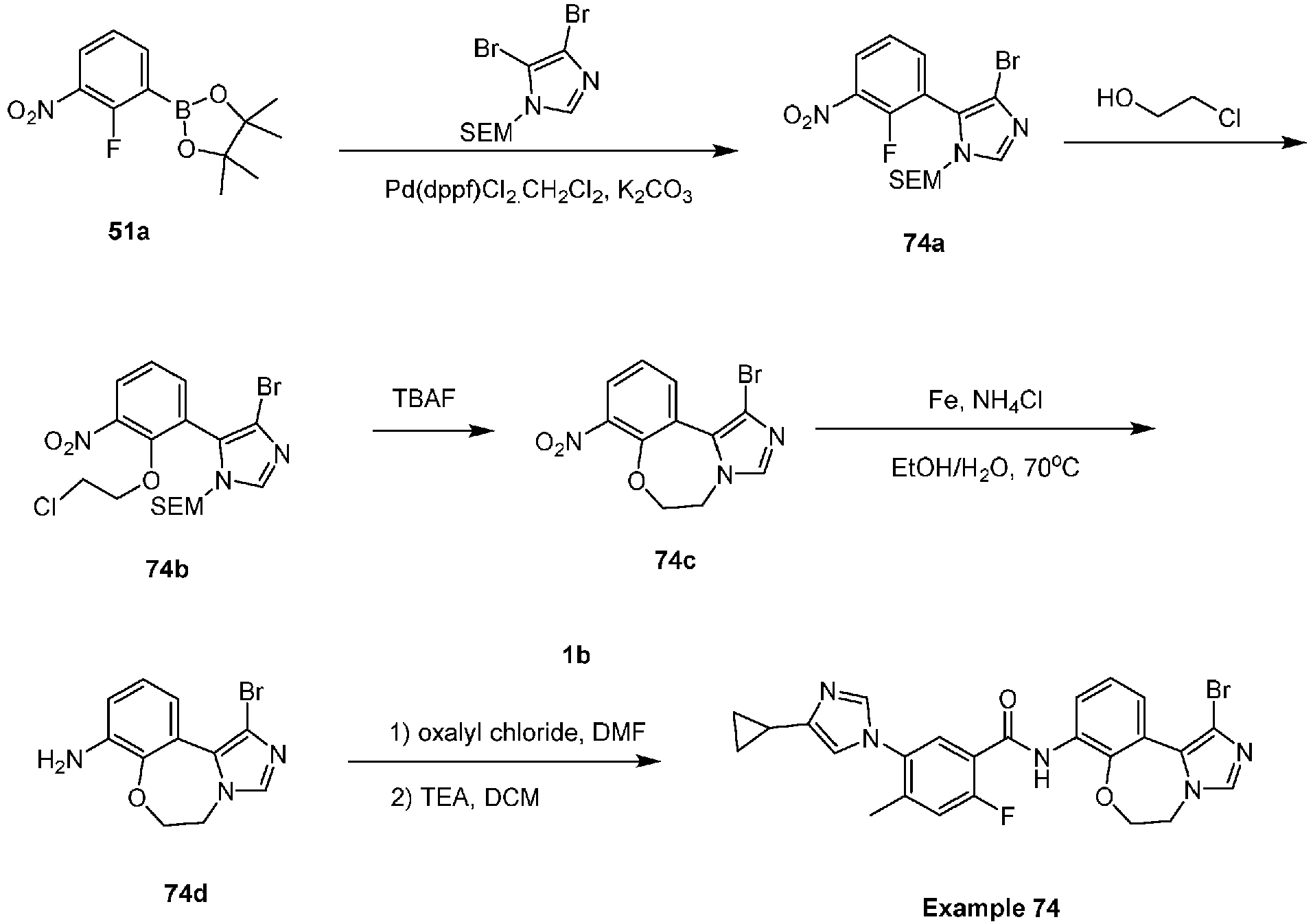
- 4-bromo-5-(2-fluoro-3-nitrophenyl)-1-((2-(trimethylsilyl)ethoxy)methyl)-1H-imidazole (74a). To a mixture of 2-(2-fluoro-3-nitrophenyl)-4,4,5,5-tetramethyl-1,3,2-dioxaborolane (51a) (476.94 mg, 1.79 mmol) and 4,5-dibromo-1-((2-(trimethylsilyl)ethoxy)methyl)-1H-imidazole (530 mg, 1.49 mmol) in dioxane (12 mL) was added K2CO3 (617.06 mg, 4.46 mmol) and Pd(dppf)Cl2 CH2Cl2 (121.53 mg, 148.82 umol) under N2. The mixture was stirred at 90°C for 16 hours. The reaction mixture was concentrated under reduced pressure to remove most of the dioxane, the residue was poured into water (10 mL) and extracted with ethyl acetate (20 mL*3). The combined organic layers were washed with brine (15 mL*2), and dried with anhydrous Na2SO4, filtered and concentrated in vacuo. The residue was purified by column chromatography (SiO2, Petroleum ether: Ethyl acetate = 50:1 to 5:1) to give 74a. MS mass calculated for [M+1]+ (C15H19BrFN3O3Si) requires m/z, 415.1/417.1, LCMS found m/z 416.1/418. 1.
- 4-bromo-5-(2-(2-chloroethoxy)-3-nitrophenyl)-1-((2-(trimethylsilyl)ethoxy)methyl)-1H-imidazole (74b). To a mixture of 4-bromo-5-(2-fluoro-3-nitrophenyl)-1-((2-(trimethylsilyl)ethoxy)methyl)-1H-imidazole (74a) (100 mg, 240.20 umol) and NaH (24.02 mg, 600.50 umol, 60% purity) in THF (4 mL) was added 4-bromo-5-(2-(2-chloroethoxy)-3-nitrophenyl)-1-((2-(trimethylsilyl)ethoxy)methyl)-1H-imidazole (29.01 mg, 360.30 umol) under N2. The mixture was stirred at 0°C for 30 min, then warmed to 25°C and stirred for 2.5h. LCMS showed the starting material was consumed completely and desired mass was detected. The reaction mixture was quenched by addition of H2O (2 mL). Then the reaction mixture was diluted with water (5 mL) and extracted with ethyl acetate (15 mL*3). The combined organic layers were washed with brine (15 mL*3), dried with anhydrous Na2SO4, filtered and concentrated in vacuo. The residue was purified by prep-TLC (petroleum ether: ethyl acetate= 1:1 Rf = 0.6) to give 74b. MS mass calculated for [M+1]+ (C17H23BrClN3O4Si) requires m/z, 475.03, LCMS found m/z 476.1 478.1; 1H NMR (400 MHz, CHLOROFORM-d) δ 7.97 (d, J= 8.31 Hz, 1 H) 7.71 (s, 1 H) 7.65 (d, J = 7.82 Hz, 1 H) 7.41 (t, J = 7.83 Hz, 1 H) 5.30 - 5.17 (m, 2 H) 4.26 - 4.19 (m, 1 H) 3.72 - 3.64 (m, 2 H) 3.53 - 3.46 (m, 1 H) 3.36 - 3.24 (m, 2 H) 0.77 - 0.69 (m, 2 H) -0.08 (s, 9 H).
- 1-bromo-8-nitro-5,6-dihydrobenzo[f]imidazo[1,5-d][1,4]oxazepine (74c). To a mixture of 4-bromo-5-(2-(2-chloroethoxy)-3-nitrophenyl)-1-((2-(trimethylsilyl)ethoxy)methyl)-1H-imidazole (74b) (100 mg, 209.72 umol) in THF (2 mL) was added TBAF (1 M, 1.26 mL) under N2. The mixture was stirred at 50°C for 16 hr. The reaction mixture was poured into water (5 mL) and extracted with ethyl acetate (10 mL*3). The combined organic layers were washed with brine (10 mL*2), dried with anhydrous Na2SO4, filtered and concentrated in vacuo. The residue was purified by prep-TLC (Dichloromethane: Methanol = 10:1) to give 74c. 1H NMR (400 MHz, CHLOROFORM-d) δ 7.99 (d, J= 7.89 Hz, 1 H) 7.85 (d, J = 8.33 Hz, 1 H) 7.64 (s, 1 H) 7.41 - 7.35 (m, 1 H) 4.77 (t, J = 5.92 Hz, 2 H) 4.27 (t, J= 5.92 Hz, 2 H).
- 1-bromo-5,6-dihydrobenzo[flimidazo[1,5-d][1,4]oxazepin-8-amine (74d). To a mixture of 1-bromo-8-nitro-5,6-dihydrobenzo[f]imidazo[1,5-d][1,4]oxazepine (74c) (15 mg, 48.37 umol) in EtOH (1 mL) and H2O (0.2 mL) was added NH4Cl (25.87 mg, 483.71 umol) and Fe (13.51 mg, 241.85 umol) under N2. The mixture was stirred at 70°C for 2 hours. LCMS showed desired MS. The reaction mixture was filtered, and the filtrate was added water (2 mL) and extracted with ethyl acetate (5 mL*3). The combined organic layers were washed with water (5 mL*2), brine (5 mL*2), dried with anhydrous Na2SO4 and concentrated in vacuo. The residue was purified by prep-TLC (SiO2, dichloromethane: methanol = 10:1) to give 74d. MS mass calculated for [M+1] + (C11H10BrN3O) requires m/z, 279.00, LCMS found m/z 280.1 282.1.
- Synthesis of N-(1-bromo-5,6-dihydrobenzo [f]imidazo[1,5-d] [1,4]oxazepin-8-yl)-5-(4-cyclopropyl-1H-imidazol-1-yl)-2-fluoro-4-methylbenzamide (Example 74). To a mixture of 5-(4-cyclopropyl-1H-imidazol-1-yl)-2-fluoro-4-methylbenzoic acid (1b) (50 mg, 192.11 umol) in DCM (2 mL) was added DMF (1.68 mg, 23.05 umol, 1.77 uL) and oxalyl chloride (29.26 mg, 230.54 umol, 20.18 uL) under N2. The mixture was stirred at 25°C for 2 hours. The reaction mixture was concentrated under reduced pressureto give a solid.. To a mixture of 1-bromo-5,6-dihydrobenzo[f]imidazo[l,5-d][l,4]oxazepin-8-amine (74d) (9.5 mg, 33.91 umol, 1 eq) and TEA (10.30 mg, 101.74 umol, 14.16 uL, 3 eq) in DCM (0.7 mL) was added the prepared above acyl chloride (37.81 mg, 135.66 umol, 4 eq) in portions under N2. The mixture was stirred at 25°C for 4 hours The reaction mixture was washed with saturated sodium bicarbonate solution (2 mL), the aqueous phase was extracted with ethyl acetate (5 mL*3). The combined organic layers were washed with water (5 mL*2), brine (5 mL*2), dried with anhydrous Na2SO4 and concentrated in vacuo. The residue was purified by prep-TLC (SiO2, DCM: MeOH = 10:1) to give Example 74. MS mass calculated for [M+1]+ (C25H21BrFN5O2) requires m/z, 521.1/523.1, LCMS found m/z 522.1/524.1 1H NMR (400 MHz, CHLOROFORM-d) δ 9.29 (br d, J = 15.66 Hz, 1 H) 8.56 (d, J = 8.38 Hz, 1 H) 8.08 (d, J = 7.28 Hz, 1 H) 7.59 (s, 1 H) 7.54 (dd, J = 7.83, 1.43 Hz, 1 H) 7.45 (s, 1 H) 7.30 (t, J = 8.05 Hz, 1 H) 7.18 (d, J = 12.13 Hz, 1 H) 6.80 (s, 1 H) 4.66 (t, J= 5.73 Hz, 2 H) 4.24 (t, J= 5.73 Hz, 2 H) 2.29 (s, 3 H) 1.95 - 1.88 (m, 1 H) 0.94 - 0.88 (m, 2 H) 0.86 - 0.82 (m, 2 H).
- 4-(4-cyclopropyl-1H-imidazol-1-yl)-N-((R)-5-methyl-5,6-dihydrobenzo[fJtetrazolo[1,5-d][1,4]oxazepin-8-yl)-5-((R)-2-methylmorpholino)picolinamide (Example 75) was synthesized according to the scheme provided below.

- Synthesis of 4-(4-cyclopropyl-1H-imidazol-1-yl)-N-((R)-5-methyl-5,6-dihydrobenzo[f]tetrazolo[1,5-d][1,4]oxazepin-8-yl)-5-((R)-2-methylmorpholino)picolinamide (Example 75). To a solution of lithium (R)-4-(4-cyclopropyl-IH-imidazol-1-yl)-5-(2-methylmorpholino)picolinate (55b) (36.93 mg, 110.48 umol) in DMF (1 mL) was added HATU (42.01 mg, 110.48 umol) and NMM (18.63 mg, 184.14 umol, 20.25 uL). Then (R)-5-methyl-5,6-dihydrobenzo[f]tetrazolo[1,5-d][1,4]oxazepin-8-amine (19q) (20 mg, 92.07 umol) was added to the mixture. The mixture was stirred at 40°C for 4 hr. LCMS showed one main peak with desired MS. The reaction mixture was concentrated under reduced pressure. The residue was diluted with water (5 mL) and extracted with EtOAc (5 mL * 3). The combined organic layers were washed with brine (10 mL * 2), dried over Na2SO4, filtered and concentrated under reduced pressure to give a residue which was purified by prep-HPLC (TFA condition: column: Welch Ultimate AQ-C18 150*30mm*5um; mobile phase: [water (0.1%TFA)-ACN]; B%: 25%-55%, 12min) to give Example 75. MS mass calculated for [M+H]+ (C27H29N9O3) requires m/z 528.24, MS found m/z 528.30; 1H NMR (400 MHz, CHLOROFORM-d) δ = 10.47 (s, 1H), 9.08 (br s, 1H), 8.74 (br d, J= 7.7 Hz, 1H), 8.53 (s, 1H), 8.31 (d, J = 8.2 Hz, 1H), 8.13 (br s, 1H), 7.33 - 7.28 (m, 1H), 7.25 (s, 1H), 5.28 - 5.20 (m, 1H), 4.71 (dd, J= 4.3, 13.1 Hz, 1H), 4.51 (br d, J= 12.6 Hz, 1H), 3.93 (br d, J = 11.0 Hz, 1H), 3.78 - 3.69 (m, 2H), 3.04 - 2.95 (m, 1H), 2.86 (br d, J = 11.5 Hz, 1H), 2.79 - 2.68 (m, 2H), 2.07 (br s, 1H), 1.82 (d, J = 6.8 Hz, 3H), 1.22 - 1.12 (m, 5H), 0.93 (br d, J = 4.6 Hz, 2H).
- 4-(4-cyclopropyl-1H-imidazol-1-yl)-N-((S)-5-methyl-5,6-dihydrobenzo[f]tetrazolo[1,5-d][1,4]oxazepin-8-yl)-5-((R)-2-methylmorpholino)picolinamide (Example 76) was synthesized according to the scheme provided below.

- Synthesis of 4-(4-cyclopropyl-1H-imidazol-1-yl)-N-((S)-5-methyl-5,6-dihydrobenzo [f] tetrazolo [1,5-d] [1,4]oxazepin-8-yl)-5-((R)-2-methylmorpholino)picolinamide (Example 76). To a solution of (R)-4-(4-cyclopropyl-1H-imidazol-1-yl)-5-(2-methylmorpholino)picolinic acid (55b) (20 mg, 92.07 umol) in DMF (1 mL) was added HATU (52.51 mg, 138.10 umol) and NMM (18.63 mg, 184.14 umol, 20.24 uL). After that, (S)-5-methyl-5,6-dihydrobenzo[f][1,2,4]triazolo[4,3-d][1,4]oxazepin-8-amine (71a) (36.93 mg, 110.48 umol) was added to the mixture. The mixture was stirred at 40°C for 6 hours. LCMS showed one main peak with desired mass. The reaction was concentrated in vacuo. The residue was purified by prep-HPLC (TFA condition, column: Nano-Micro UniSil 5-100 C18 ULTRA 100*250mm 5um; mobile phase: [water (0.1%TFA)-ACN]; B%: 20%-50%, 10min) to give Example 76. MS mass calculated for [M+1]+ (C27H29N9O3) requires m/z 528.6, LCMS found m/z 528.3. 1H NMR (400 MHz, CHLOROFORM-d)δ = 10.48 (s, 1H), 9.04 (s, 1H), 8.78 - 8.73 (m, 1H), 8.53 (s, 1H), 8.33 (dd, J= 1.4, 8.0 Hz, 1H), 8.16 (s, 1H), 7.30 (t, J = 8.2 Hz, 1H), 7.24 (s, 1H), 5.29 - 5.20 (m, 1H), 4.70 (dd, J= 4.5, 13.1 Hz, 1H), 4.55 - 4.48 (m, 1H), 3.93 (br d, J = 10.4 Hz, 1H), 3.79 - 3.68 (m, 2H), 2.99 (dt, J= 2.8, 11.6 Hz, 1H), 2.86 (br d, J = 11.2 Hz, 1H), 2.79 - 2.66 (m, 2H), 2.11 - 2.02 (m, 1H), 1.83 (d, J= 6.8 Hz, 3H), 1.22 - 1.17 (m, 3H), 1.17 - 1.17 (m, 1H), 1.17 - 1.12 (m, 1H), 0.96 - 0.90 (m, 2H).
- 4-(4-cyclopropyl-1H-imidazol-1-yl)-5-((R)-3-hydroxypyrrolidin-1-yl)-N-((R)-5-methyl-5,6-dihydrobenzo[fJtetrazolo[1,5-d][1,4]oxazepin-8-yl)picolinamide (Example 77) was synthesized according to the scheme provided below.

- Synthesis of 4-(4-cyclopropyl-1H-imidazol-1-yl)-5-((R)-3-hydroxypyrrolidin-1-yl)-N-((R)-5-methyl-5,6-dihydrobenzo [f]tetrazolo[1,5-d][1,4]oxazepin-8-yl)picolinamide (Example 77). To a mixture of (R)-4-(4-cyclopropyl-1H-imidazol-1-yl)-5-(3-hydroxypyrrolidin-1-yl)picolinic acid (57b) (47.03 mg, 149.61 umol) and HATU (87.52 mg, 230.17 umol) in DMF (1 mL) was added NMM (58.20 mg, 575.44 umol, 63.26 uL) and (R)-5-methyl-5,6-dihydrobenzo[t]tetrazolo[1,5-d][1,4]oxazepin-8-amine (19q) (25 mg, 115.09 umol) under N2. The mixture was stirred at 40°C for 5 hours. The reaction mixture was diluted with ethyl acetate (10 mL) and washed with water (10 mL*2). The organic phase was washed with brine (10 mL*2), dried with anhydrous Na2SO4, filtered and concentrated in vacuo. The residue was purified by prep-TLC (SiO2, DCM: MeOH = 10:1) to give Example 77. MS mass calculated for [M+1]+ (C26H27N9O3) requires m/z 514.2, LCMS found m/z 514.2; 1H NMR (400MHz, DMSO-d6) δ 10.42 (s, 1H), 8.64 (dd, J = 1.5, 8.1 Hz, 1H), 8.33 (s, 1H), 8.17 (dd, J = 1.5, 8.1 Hz, 1H), 7.76 (s, 2H), 7.32 (t, J = 8.1 Hz, 1H), 7.24 (d, J= 1.1 Hz, 1H), 5.39 - 5.26 (m, 1H), 5.00 (br s, 1H), 4.81 - 4.72 (m, 1H), 4.68 - 4.61 (m, 1H), 4.27 (br s, 1H), 3.25 - 3.15 (m, 3H), 2.83 (br d, J = 11.0 Hz, 1H), 1.95 - 1.77 (m, 3H), 1.67 (d, J = 6.8 Hz, 3H), 0.87 - 0.79 (m, 2H), 0.75 - 0.65 (m, 2H).
- 4-(4-cyclopropyl-1H-imidazol-1-yl)-5-((R)-3-hydroxypyrrolidin-1-yl)-N-((S)-5-methyl-5,6-dihydrobenzo[fJtetrazolo[1,5-d][1,4]oxazepin-8-yl)picolinamide (Example 78) was synthesized according to the scheme provided below.

- Synthesis of 4-(4-cyclopropyl-1H-imidazol-1-yl)-5-((R)-3-hydroxypyrrolidin-1-yl)-N-((S)-5-methyl-5,6-dihydrobenzo[f]tetrazolo[1,5-d][1,4]oxazepin-8-yl)picolinamide (Example 78). To a mixture of (R)-4-(4-cyclopropyl-1H-imidazol-1-yl)-5-(3-hydroxypyrrolidin-1-yl)picolinic acid (57b) (65.12 mg, 207.16 umol) in DMF (1 mL) was added HATU (105.02 mg, 276.21 umol), NMM (69.85 mg, 690.52 umol) and (S)-5-methyl-5,6-dihydrobenzo[f]tetrazolo[1,5-d][1,4]oxazepin-8-amine (71a) (30 mg, 138.10 umol) under N2. The mixture was stirred at 40°C for 2 hours. LCMS showed desired mass. The reaction mixture was poured into water (5 mL) and the mixturewas extracted with ethyl acetate (10 mL*3). The combined organic layers were washed with water (10 mL*2), brine (10 mL*2), dried with anhydrous Na2SO4, filtered and concentrated in vacuo. The residue was purified by prep-TLC (SiO2, Dichloromethane: Methanol= 10:1) to give Example 78. MS mass calculated for [M+1]+ (C26H27N9O3) requires m/z, 513.22, LCMS found m/z 514.2 1H NMR (400 MHz, DMSO-d6 ) δ 10.41 (s, 1 H) 8.63 (dd, J = 7.82, 1.47 Hz, 1 H) 8.32 (s, 1 H) 8.16 (dd, J= 8.07, 1.71 Hz, 1 H) 7.75 (s, 2 H) 7.31 (t, J = 8.31 Hz, 1 H) 7.23 (d, J = 0.98 Hz, 1 H) 5.35 - 5.24 (m, 1 H) 4.97 (d, J = 3.91 Hz, 1 H) 4.78 - 4.70 (m, 1 H) 4.67 - 4.60 (m, 1 H) 4.26 (br s, 1 H) 3.23 - 3.14 (m, 2 H) 2.82 (br d, J = 10.76 Hz, 1 H) 1.91 - 1.76 (m, 3 H) 1.66 (d, J = 6.85 Hz, 3 H) 0.79 - 0.84 (m, 2 H) 0.74 - 0.65 (m, 2 H).
- Base Reaction buffer: 20 mM Hepes (pH 7.5), 10 mM MgC12, 1 mM EGTA, 0.02% Brij35, 0.02 mg/ml BSA, 0.1 mM Na3VO4, 2 mM DTT, and 1% DMSO were used for the assay.
- Myelin base protein (MPB) was prepared in freshly prepared Base Reaction Buffer. 20 ng of ASK1 kinase was delivered into the substrate solution and gently mixed. Compounds in DMSO were delivered into the kinase reaction mixture (final DMSO concentration 1%). Commercially available 33P-ATP was delivered into the reaction mixture to initiate the reaction. The kinase reaction was incubated for 120 min. at room temperature. Reactions were spotted onto P81 ion exchange paper (Whatman # 3698-915). Filters were washed extensively in 0.75% Phosphoric acid. Radioactivity on filters was read, and IC50 values were determined. The IC50 values of certain compounds are provided in the table below (Table 2).
Table 2. Example IC50 (uM) 1 0.0058 2 0.0091 3 0.0057 4 0.0057 5 0.0058 6 0.0077 7 0.0085 8 0.0117 9 0.0056 10 0.0005 11 0.0054 12 0.0047 13 0.0052 14 0.0042 15 0.0058 16 0.0052 17 0.0109 18 0.0116 19 0.0022 20 0.0060 21 0.0060 22 0.0006 23 0.0009 24 0.0062 25 0.0033 26 0.0080 27 0.0068 28 0.0045 29 0.0041 30 0.0045 31 0.0057 32 0.0031 33 0.0041 34 0.0041 35 0.0025 36 0.0056 37 0.0005 38 0.0006 39 0.0055 40 0.0005 41 0.0057 42 0.0168 43 0.0009 44 0.0156 45 0.0053 46 0.0151 47 0.0068 48 0.0051 49 0.0247 50 0.0039 51 0.3070 52 0.0059 53 0.0064 54 0.0059 55 0.0021 56 0.0352 57 0.0047 58 0.0032 59 0.0042 60 0.0069 61 0.0035 62 0.0051 63 0.0027 64 0.0039 65 0.0033 66 0.0060 67 0.0026 68 0.0018 69 0.0041 70 0.0022 71 0.0053 72 0.0116 73 0.0058 74 0.0398 75 0.0040 76 0.0032 77 0.0047 78 0.0047 79 0.0066 80 0.0057 81 0.0057


Claims (13)
- A compound of formula (IA):
 ring A is selected from:
 R40 is H, C1-C6 alkyl, or halo;ring B is C6-C10 aryl or 5- to 10-membered heteroaryl;L1 is
 R100 and R101 are independently H; C1-C6 alkyl optionally substituted with 1-3 hydroxyl or halo; halo; C3-C5 cycloalkyl optionally substituted with 1-3 C1-C6 alkyl, hydroxyl, or halo; 4- to 5-membered heterocyclyl optionally substituted with 1-3 C1-C6 alkyl, hydroxyl, or halo; or 5-membered heteroaryl optionally substituted with 1-3 C1-C6 alkyl, hydroxyl, or halo; or R100 and R101 are taken together with the carbon atom or carbon atoms to which they are attached to form a C3-C5 cycloalkyl;L2 is -CO-NH-, -NH-CO-, -SO2-NH-, or -NH-SO2-;R1 is C3-C8 cycloalkyl, 6-membered aryl, 5- to 6-membered heteroaryl, 4- to 6-membered heterocyclyl, -CONR11R12 or -SO2NR11R12, wherein each C3-C8 cycloalkyl, 6-membered aryl, 5- to 6-membered heteroaryl, or 4- to 6-membered heterocyclyl of R1 is optionally substituted with 1-2 C1-C6 alkyl or with one C3-C6 cycloalkyl which is optionally substituted with 1-2 substituents selected from the group consisting of C1-C6 alkyl, C2-C6 alkenyl, and C2-C6 alkynyl;R11 and R12 are independently selected from the group consisting of hydrogen, optionally substituted C1-C6 alkyl, and optionally substituted C3-C8 cycloalkyl;or R11 and R12 are taken together with the nitrogen atom to which they are attached to form a 4-to 7-membered heterocyclyl;X1, X2, and X3 are independently CR2 or N;each R2 is independently hydrogen; C1-C6 alkyl optionally substituted with 1-3 halo, -CF3, - OCF3, hydroxyl, -CN or -N(R3)(R4); C1-C6 alkoxy optionally substituted with 1-3 halo, -CF3, -OCF3, hydroxyl, -CN or -N(R3)(R4); C3-C8 cycloalkyl optionally substituted with 1-3 halo, C1-C6 alkyl, -CF3, -OCF3, hydroxyl, -CN or -N(R3)(R4); 6-membered aryl optionally substituted with 1-3 halo, C1-C6 alkyl, -CF3, -OCF3, hydroxy, -CN or -N(R3)(R4); 5- to 10-membered heteroaryl optionally substituted with 1-3 halo, C1-C6 alkyl, -CF3, -OCF3, hydroxyl, -CN or -N(R3)(R4); 5- to 10-membered heterocyclyl optionally substituted with 1-3 halo, C1-C6 alkyl, -CF3, -OCF3, hydroxyl, -CN or -N(R3)(R4); -N(R3)(R4); or halo; andR3 and R4 are independently selected from the group consisting of hydrogen; C1-C6 alkyl optionally substituted with 1-3 halo, -CF3, -OCF3, hydroxyl, or -CN; C3-C8 cycloalkyl optionally substituted with 1-3 halo, C1-C6 alkyl, -CF3, -OCF3, hydroxyl, or -CN; 6-membered aryl optionally substituted with 1-3 halo, C1-C6 alkyl, -CF3, -OCF3, hydroxyl, or -CN; 5- to 10-membered heteroaryl optionally substituted with 1-3 halo, C1-C6 alkyl, -CF3, -OCF3, hydroxyl, or -CN; or 5- to 10-membered heterocyclyl optionally substituted with 1-3 halo, C1-C6 alkyl, -CF3, -OCF3, hydroxyl, or -CN;or R3 and R4 are taken together with the nitrogen atom or with the intervening atoms to which they are attached to form a 4- to 10-membered heterocyclyl optionally substituted with 1-3 halo, C1-C6 alkyl, -CF3, -OCF3, hydroxyl, or -CN; wherein:ring B is optionally phenyl.
 - The compound of claim 1, or a pharmaceutically acceptable salt thereof, wherein:L1 is -O-CH2-CH2-, -O-CH2-CH(Me)-, -O-CH2-C(Me)2-, -O-CH(Me)-CH2-, -O-CH2-CH(CH2OH)-, -O-CH2-CH(CH2F)-,


- The compound of claim 1 or claim 2, or a pharmaceutically acceptable salt thereof, wherein:L2 is -CO-NH-.
- The compound of any one of claims 1-3, or a pharmaceutically acceptable salt thereof, wherein:R1 is

- The compound of any one of claims 1-4, or a pharmaceutically acceptable salt thereof, wherein:X1 is N or CR2; andR2 is halo;
and/orX2 is CH. - The compound of any one of claims 1-5, or a pharmaceutically acceptable salt thereof, wherein:X3 is CR2; andR2 is hydrogen; C1-C6 alkyl optionally substituted with 1-2 halo or hydroxyl; C1-C6 alkoxy optionally substituted with 1-2 halo or hydroxyl; 4-10 membered heterocyclyl optionally substituted with 1-2 C1-C6 alkyl or hydroxyl; -O-R3; or -N(R3)(R4); andR3 and R4 are independently hydrogen or C1-C6 alkyl;or R3 and R4 are taken together with the nitrogen atom or with the intervening atoms to which they are attached to form a 4- to 7-membered heterocyclyl optionally substituted with 1-2 C1-C6 alkyl or hydroxyl;optionally wherein:R2 is H, -CH3, -OCH(CH3)2, -N(CH3)2,

- The compound of claim 1, or a pharmaceutically acceptable salt thereof, which is of formula (5A) or (5B):

 R100 and R101 are independently H; C1-C6 alkyl optionally substituted with 1-3 hydroxyl or halo; halo; C3-C5 cycloalkyl optionally substituted with 1-3 C1-C6 alkyl, hydroxyl, or halo; 4- to 5-membered heterocyclyl optionally substituted with 1-3 C1-C6 alkyl, hydroxyl, or halo; or 5-membered heteroaryl optionally substituted with 1-3 C1-C6 alkyl, hydroxyl, or halo;or R100 and R101 are taken together with the carbon atom or carbon atoms to which they are attached to form a C3-C5 cycloalkyl.
 - The compound of claim 1, wherein the compound is selected from any one of the following compounds:


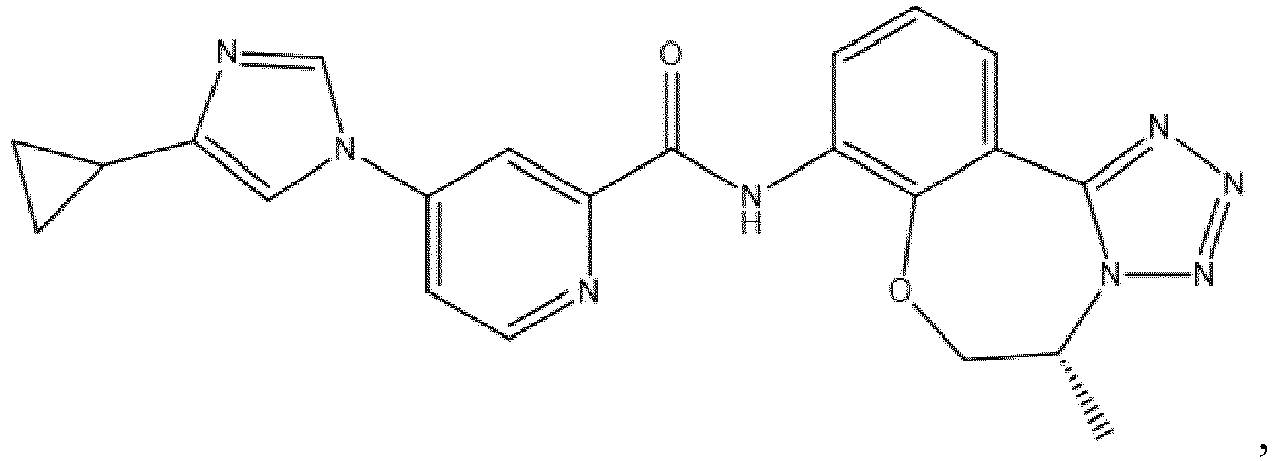


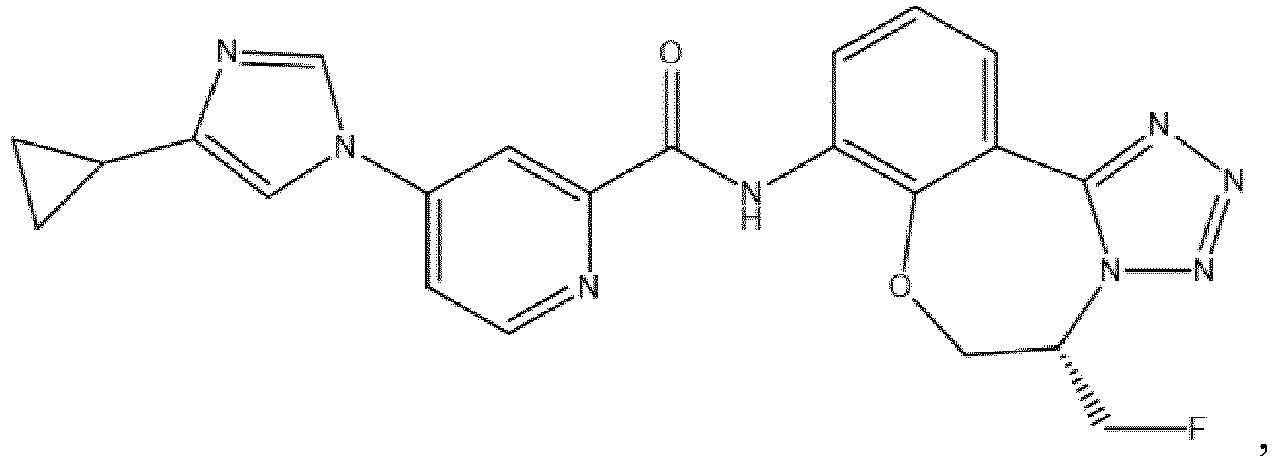


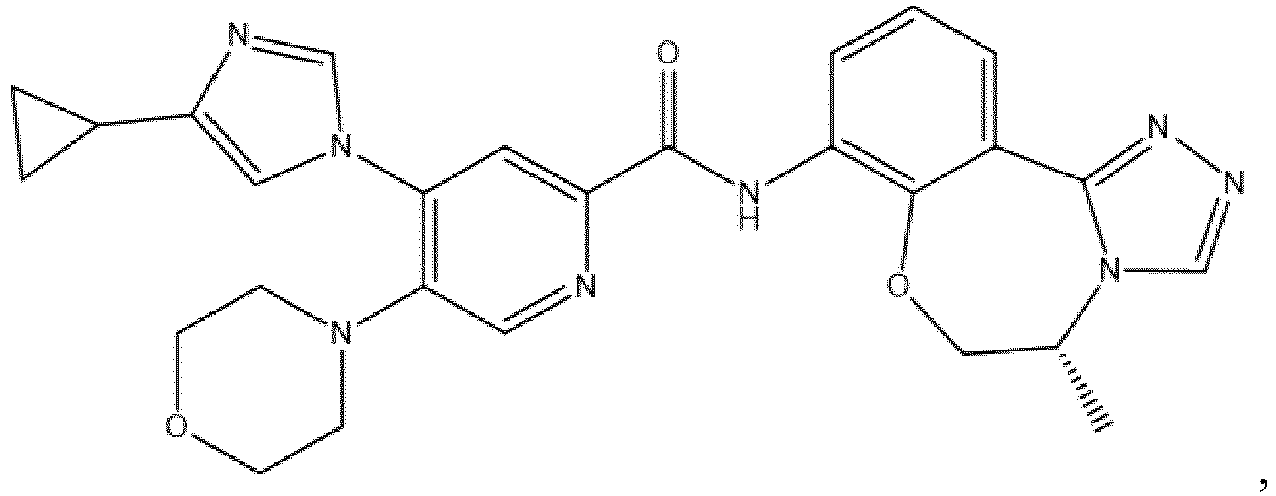


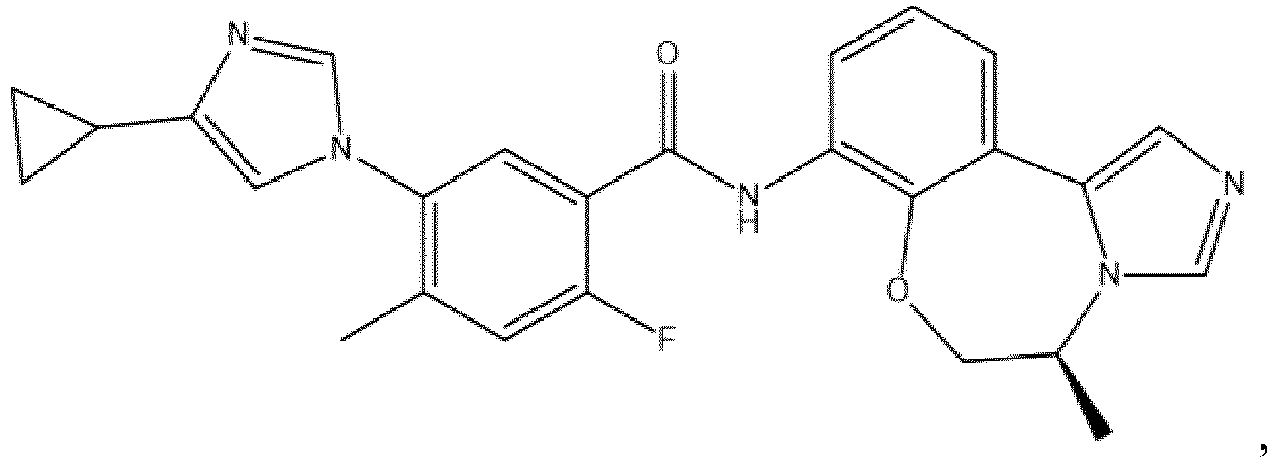
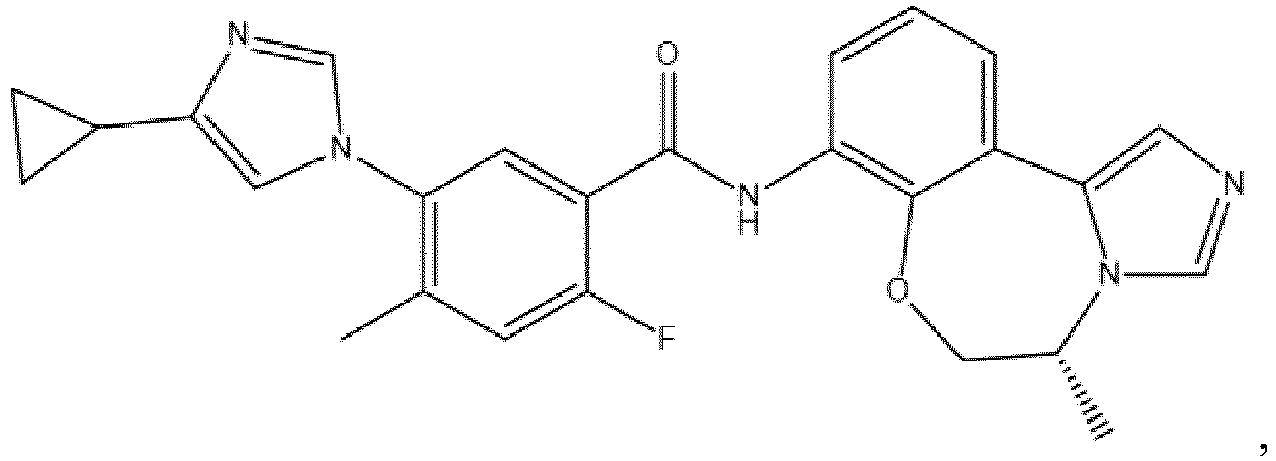


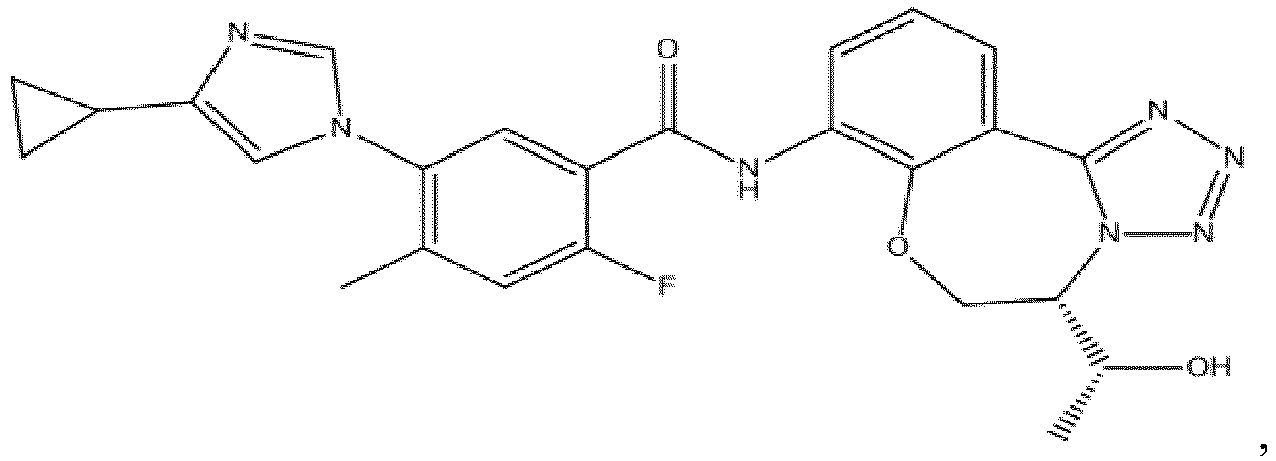


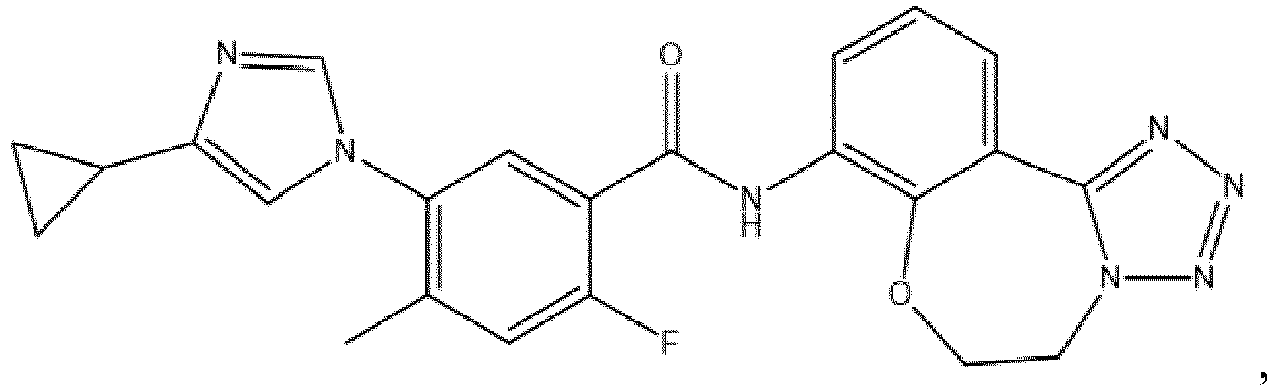

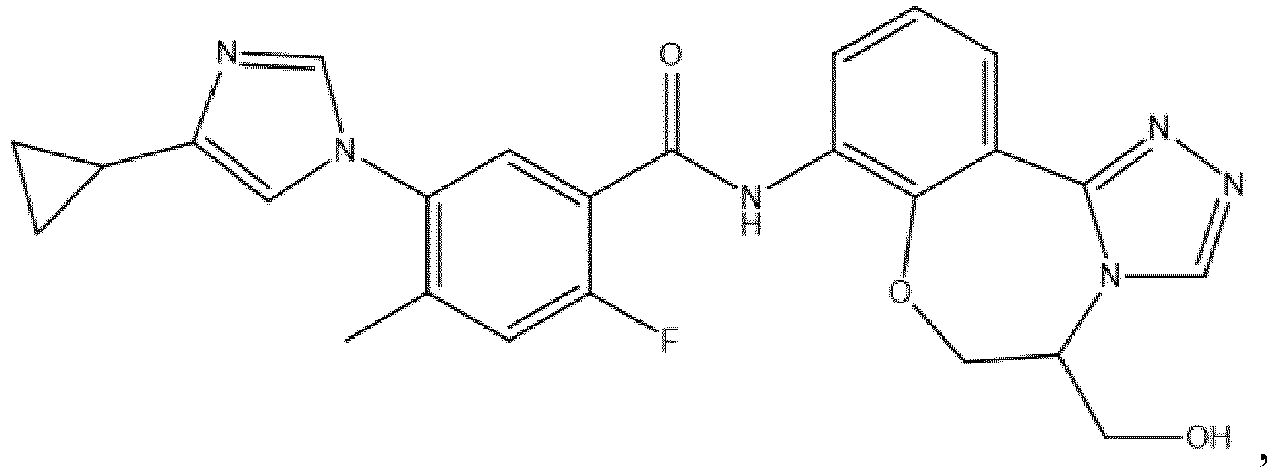


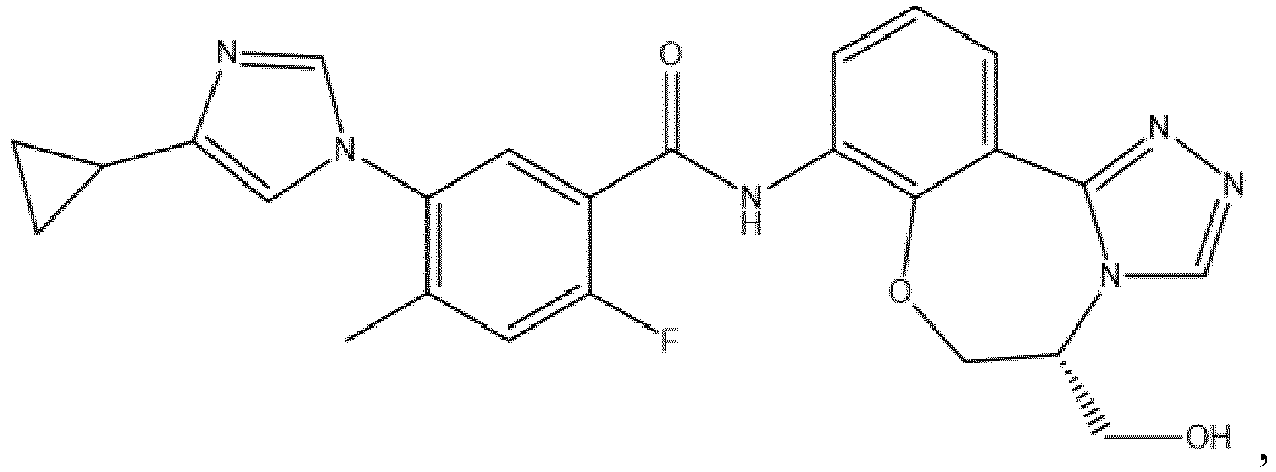

- A pharmaceutical composition comprising the compound of any one of claims 1-8, or a pharmaceutically acceptable salt thereof, and at least one pharmaceutically acceptable excipient.
- A compound according to any one of claims 1-8, or a pharmaceutically acceptable salt thereof, or a composition according to claim 9, for use in therapy.
- A compound according to any one of claims 1-8, or a pharmaceutically acceptable salt thereof, or a composition according to claim 9, for use in a method of treating a disorder selected from pulmonary arterial hypertension (PAH), diabetic kidney disease, heart failure, a vascular disease, a neurodegenerative disorder, an inflammatory disease, and liver disease.
- The compound or composition for use according to claim 11, wherein the disorder is a chronic liver disease.
- The compound or composition for use according to claim 11, wherein the disorder is nonalcoholic steatohepatitis (NASH).
Priority Applications (1)
| Application Number | Priority Date | Filing Date | Title |
|---|---|---|---|
| EP24213715.6A EP4537902A3 (en) | 2018-04-12 | 2019-04-12 | Tricyclic ask1 inhibitors |
Applications Claiming Priority (3)
| Application Number | Priority Date | Filing Date | Title |
|---|---|---|---|
| US201862656764P | 2018-04-12 | 2018-04-12 | |
| US201862720863P | 2018-08-21 | 2018-08-21 | |
| PCT/US2019/027236 WO2019200267A1 (en) | 2018-04-12 | 2019-04-12 | Tricyclic ask1 inhibitors |
Related Child Applications (1)
| Application Number | Title | Priority Date | Filing Date |
|---|---|---|---|
| EP24213715.6A Division EP4537902A3 (en) | 2018-04-12 | 2019-04-12 | Tricyclic ask1 inhibitors |
Publications (3)
| Publication Number | Publication Date |
|---|---|
| EP3773577A1 EP3773577A1 (en) | 2021-02-17 |
| EP3773577A4 EP3773577A4 (en) | 2021-12-01 |
| EP3773577B1 true EP3773577B1 (en) | 2024-11-20 |
Family
ID=68161037
Family Applications (2)
| Application Number | Title | Priority Date | Filing Date |
|---|---|---|---|
| EP24213715.6A Withdrawn EP4537902A3 (en) | 2018-04-12 | 2019-04-12 | Tricyclic ask1 inhibitors |
| EP19786244.4A Active EP3773577B1 (en) | 2018-04-12 | 2019-04-12 | Tricyclic ask1 inhibitors |
Family Applications Before (1)
| Application Number | Title | Priority Date | Filing Date |
|---|---|---|---|
| EP24213715.6A Withdrawn EP4537902A3 (en) | 2018-04-12 | 2019-04-12 | Tricyclic ask1 inhibitors |
Country Status (5)
| Country | Link |
|---|---|
| US (1) | US10919911B2 (en) |
| EP (2) | EP4537902A3 (en) |
| ES (1) | ES3010138T3 (en) |
| TW (1) | TW202012414A (en) |
| WO (1) | WO2019200267A1 (en) |
Families Citing this family (3)
| Publication number | Priority date | Publication date | Assignee | Title |
|---|---|---|---|---|
| CN112384508B (en) * | 2018-09-30 | 2022-08-02 | 山东轩竹医药科技有限公司 | Tricyclic ASK1 inhibitor and application thereof |
| US20220332700A1 (en) * | 2019-06-26 | 2022-10-20 | Mankind Pharma Ltd | Novel apoptosis signal-regulating kinase 1 inhibitors |
| WO2026090190A1 (en) * | 2024-10-22 | 2026-04-30 | Aeovian Pharmaceuticals, Inc. | Cd38 modulators and uses thereof |
Family Cites Families (13)
| Publication number | Priority date | Publication date | Assignee | Title |
|---|---|---|---|---|
| AUPP285898A0 (en) * | 1998-04-07 | 1998-04-30 | Fujisawa Pharmaceutical Co., Ltd. | Amido derivatives |
| CA2744893A1 (en) | 2002-06-27 | 2004-01-08 | Novo Nordisk A/S | Aryl carbonyl derivatives as glucokinase activators |
| US20070032488A1 (en) | 2005-08-05 | 2007-02-08 | Genelabs Technologies, Inc. | 6-Membered aryl and heteroaryl derivatives for treating viruses |
| TWI625121B (en) | 2009-07-13 | 2018-06-01 | 基利科學股份有限公司 | Inhibitor of kinases that regulate apoptosis signaling |
| US8440665B2 (en) | 2010-07-02 | 2013-05-14 | Gilead Sciences, Inc. | Apoptosis signal-regulating kinase inhibitors |
| WO2012129562A2 (en) | 2011-03-24 | 2012-09-27 | The Scripps Research Institute | Compounds and methods for inducing chondrogenesis |
| UY34573A (en) | 2012-01-27 | 2013-06-28 | Gilead Sciences Inc | QUINASE INHIBITOR REGULATING THE APOPTOSIS SIGNAL |
| GB201321728D0 (en) | 2013-12-09 | 2014-01-22 | Ucb Pharma Sa | Therapeutic agents |
| WO2017161028A1 (en) | 2016-03-16 | 2017-09-21 | Kura Oncology, Inc. | Substituted inhibitors of menin-mll and methods of use |
| WO2018106818A1 (en) | 2016-12-07 | 2018-06-14 | Kura Oncology, Inc. | Methods of promoting beta cell proliferation |
| WO2018106820A1 (en) | 2016-12-07 | 2018-06-14 | Kura Oncology, Inc. | Methods of promoting beta cell proliferation |
| WO2018157857A1 (en) | 2017-03-03 | 2018-09-07 | 江苏豪森药业集团有限公司 | Apoptotic signal regulation kinase inhibitor, preparation method and application thereof |
| CN109265443B (en) | 2017-07-18 | 2022-11-29 | 南京圣和药业股份有限公司 | Heterocyclic compounds as ASK inhibitors and uses thereof |
-
2019
- 2019-04-12 TW TW108112893A patent/TW202012414A/en unknown
- 2019-04-12 ES ES19786244T patent/ES3010138T3/en active Active
- 2019-04-12 WO PCT/US2019/027236 patent/WO2019200267A1/en not_active Ceased
- 2019-04-12 EP EP24213715.6A patent/EP4537902A3/en not_active Withdrawn
- 2019-04-12 EP EP19786244.4A patent/EP3773577B1/en active Active
- 2019-04-12 US US16/382,936 patent/US10919911B2/en active Active
Also Published As
| Publication number | Publication date |
|---|---|
| ES3010138T3 (en) | 2025-04-01 |
| EP3773577A4 (en) | 2021-12-01 |
| US20190315767A1 (en) | 2019-10-17 |
| WO2019200267A1 (en) | 2019-10-17 |
| EP3773577A1 (en) | 2021-02-17 |
| EP4537902A2 (en) | 2025-04-16 |
| TW202012414A (en) | 2020-04-01 |
| EP4537902A3 (en) | 2025-06-11 |
| US10919911B2 (en) | 2021-02-16 |
Similar Documents
| Publication | Publication Date | Title |
|---|---|---|
| JP7850663B2 (en) | Spiro ring-containing quinazoline compounds | |
| AU2020213376B2 (en) | Compounds and methods for the targeted degradation of the androgen receptor | |
| TWI843372B (en) | Compounds for mutant kras protein degradation and uses thereof | |
| AU2020267169B2 (en) | Processes of making and crystalline forms of a MDM2 inhibitor | |
| KR102821964B1 (en) | Substituted pyrrolopyrimidine JAK inhibitors and methods for their manufacture and use | |
| CN111655682B (en) | A highly active STING protein agonist compound | |
| EP3571192B1 (en) | Jak1 selective inhibitors | |
| ES2744636T3 (en) | 4,5,6,7-Tetrahydropyrazolo [1,5-a] pyrazine derivatives substituted as casein kinase 1 D / E inhibitors | |
| EP3848367A1 (en) | Tricyclic compounds acting on crbn proteins | |
| TW202024037A (en) | Compounds for treating certain leukemias | |
| EP3497096B1 (en) | An antimicrobial compound | |
| CA3122872A1 (en) | Benzamides of pyrazolyl-amino-pyrimidinyl derivatives, and compositions and methods thereof | |
| EP4236937B1 (en) | Pyrimidine derivatives as modulators of the 5-ht2a serotonin receptor useful for the treatment of disorders related thereto | |
| US20200317660A1 (en) | Quinazolinone Compound and Application Thereof | |
| US10919911B2 (en) | Tricyclic ASK1 inhibitors | |
| EP3492465B1 (en) | S1p1 agonist and application thereof | |
| EP4083032A1 (en) | Pd-l1 antagonist compound | |
| KR20250073137A (en) | EGFR inhibitors and their uses | |
| TWI810547B (en) | Pd-l1 antagonist compound | |
| WO2026006527A1 (en) | Covalent inhibitors of jak2 jh2 domain | |
| TW202547514A (en) | Inhibitors of human immunodeficiency virus replication | |
| CA3297363A1 (en) | Novel compound sensitive to nitrogen monoxide and pharmaceutical composition comprising same | |
| HK40048031A (en) | Highly active sting protein agonist compound | |
| HK40050580A (en) | Crystalline synthetic intermediate useful in processes for making a mdm2 inhibitor | |
| BR122024013977A2 (en) | PYRAZOLYL-AMINO-PYRIMIDINYL DERIVATIVE BENZAMID COMPOUNDS AND THEIR USES, PHARMACEUTICAL COMPOSITION THEREOF, AND UNITARY DOSAGE FORM COMPRISING THE SAME |
Legal Events
| Date | Code | Title | Description |
|---|---|---|---|
| STAA | Information on the status of an ep patent application or granted ep patent |
Free format text: STATUS: THE INTERNATIONAL PUBLICATION HAS BEEN MADE |
|
| PUAI | Public reference made under article 153(3) epc to a published international application that has entered the european phase |
Free format text: ORIGINAL CODE: 0009012 |
|
| STAA | Information on the status of an ep patent application or granted ep patent |
Free format text: STATUS: REQUEST FOR EXAMINATION WAS MADE |
|
| 17P | Request for examination filed |
Effective date: 20201111 |
|
| AK | Designated contracting states |
Kind code of ref document: A1 Designated state(s): AL AT BE BG CH CY CZ DE DK EE ES FI FR GB GR HR HU IE IS IT LI LT LU LV MC MK MT NL NO PL PT RO RS SE SI SK SM TR |
|
| AX | Request for extension of the european patent |
Extension state: BA ME |
|
| DAV | Request for validation of the european patent (deleted) | ||
| DAX | Request for extension of the european patent (deleted) | ||
| REG | Reference to a national code |
Ref country code: DE Ref legal event code: R079 Free format text: PREVIOUS MAIN CLASS: A61K0031444000 Ipc: C07D0498040000 Ref country code: DE Ref legal event code: R079 Ref document number: 602019062276 Country of ref document: DE Free format text: PREVIOUS MAIN CLASS: A61K0031444000 Ipc: C07D0498040000 |
|
| A4 | Supplementary search report drawn up and despatched |
Effective date: 20211103 |
|
| RIC1 | Information provided on ipc code assigned before grant |
Ipc: A61K 31/506 20060101ALI20211027BHEP Ipc: A61K 31/444 20060101ALI20211027BHEP Ipc: C07D 519/00 20060101ALI20211027BHEP Ipc: C07D 498/10 20060101ALI20211027BHEP Ipc: C07D 498/04 20060101AFI20211027BHEP |
|
| STAA | Information on the status of an ep patent application or granted ep patent |
Free format text: STATUS: EXAMINATION IS IN PROGRESS |
|
| 17Q | First examination report despatched |
Effective date: 20230426 |
|
| GRAP | Despatch of communication of intention to grant a patent |
Free format text: ORIGINAL CODE: EPIDOSNIGR1 |
|
| STAA | Information on the status of an ep patent application or granted ep patent |
Free format text: STATUS: GRANT OF PATENT IS INTENDED |
|
| RIC1 | Information provided on ipc code assigned before grant |
Ipc: A61P 29/00 20060101ALI20240603BHEP Ipc: A61P 25/28 20060101ALI20240603BHEP Ipc: A61P 13/12 20060101ALI20240603BHEP Ipc: A61P 9/12 20060101ALI20240603BHEP Ipc: A61P 9/04 20060101ALI20240603BHEP Ipc: A61P 1/16 20060101ALI20240603BHEP Ipc: A61K 31/506 20060101ALI20240603BHEP Ipc: A61K 31/444 20060101ALI20240603BHEP Ipc: C07D 519/00 20060101ALI20240603BHEP Ipc: C07D 498/10 20060101ALI20240603BHEP Ipc: C07D 498/04 20060101AFI20240603BHEP |
|
| INTG | Intention to grant announced |
Effective date: 20240618 |
|
| GRAS | Grant fee paid |
Free format text: ORIGINAL CODE: EPIDOSNIGR3 |
|
| GRAA | (expected) grant |
Free format text: ORIGINAL CODE: 0009210 |
|
| STAA | Information on the status of an ep patent application or granted ep patent |
Free format text: STATUS: THE PATENT HAS BEEN GRANTED |
|
| AK | Designated contracting states |
Kind code of ref document: B1 Designated state(s): AL AT BE BG CH CY CZ DE DK EE ES FI FR GB GR HR HU IE IS IT LI LT LU LV MC MK MT NL NO PL PT RO RS SE SI SK SM TR |
|
| REG | Reference to a national code |
Ref country code: GB Ref legal event code: FG4D |
|
| REG | Reference to a national code |
Ref country code: CH Ref legal event code: EP |
|
| REG | Reference to a national code |
Ref country code: DE Ref legal event code: R096 Ref document number: 602019062276 Country of ref document: DE |
|
| REG | Reference to a national code |
Ref country code: IE Ref legal event code: FG4D |
|
| P01 | Opt-out of the competence of the unified patent court (upc) registered |
Free format text: CASE NUMBER: APP_63742/2024 Effective date: 20241202 |
|
| REG | Reference to a national code |
Ref country code: NL Ref legal event code: FP |
|
| REG | Reference to a national code |
Ref country code: LT Ref legal event code: MG9D |
|
| REG | Reference to a national code |
Ref country code: ES Ref legal event code: FG2A Ref document number: 3010138 Country of ref document: ES Kind code of ref document: T3 Effective date: 20250401 |
|
| PG25 | Lapsed in a contracting state [announced via postgrant information from national office to epo] |
Ref country code: PT Free format text: LAPSE BECAUSE OF FAILURE TO SUBMIT A TRANSLATION OF THE DESCRIPTION OR TO PAY THE FEE WITHIN THE PRESCRIBED TIME-LIMIT Effective date: 20250320 Ref country code: HR Free format text: LAPSE BECAUSE OF FAILURE TO SUBMIT A TRANSLATION OF THE DESCRIPTION OR TO PAY THE FEE WITHIN THE PRESCRIBED TIME-LIMIT Effective date: 20241120 Ref country code: IS Free format text: LAPSE BECAUSE OF FAILURE TO SUBMIT A TRANSLATION OF THE DESCRIPTION OR TO PAY THE FEE WITHIN THE PRESCRIBED TIME-LIMIT Effective date: 20250320 |
|
| PG25 | Lapsed in a contracting state [announced via postgrant information from national office to epo] |
Ref country code: FI Free format text: LAPSE BECAUSE OF FAILURE TO SUBMIT A TRANSLATION OF THE DESCRIPTION OR TO PAY THE FEE WITHIN THE PRESCRIBED TIME-LIMIT Effective date: 20241120 |
|
| REG | Reference to a national code |
Ref country code: AT Ref legal event code: MK05 Ref document number: 1743495 Country of ref document: AT Kind code of ref document: T Effective date: 20241120 |
|
| PG25 | Lapsed in a contracting state [announced via postgrant information from national office to epo] |
Ref country code: BG Free format text: LAPSE BECAUSE OF FAILURE TO SUBMIT A TRANSLATION OF THE DESCRIPTION OR TO PAY THE FEE WITHIN THE PRESCRIBED TIME-LIMIT Effective date: 20241120 |
|
| PG25 | Lapsed in a contracting state [announced via postgrant information from national office to epo] |
Ref country code: NO Free format text: LAPSE BECAUSE OF FAILURE TO SUBMIT A TRANSLATION OF THE DESCRIPTION OR TO PAY THE FEE WITHIN THE PRESCRIBED TIME-LIMIT Effective date: 20250220 |
|
| PG25 | Lapsed in a contracting state [announced via postgrant information from national office to epo] |
Ref country code: LV Free format text: LAPSE BECAUSE OF FAILURE TO SUBMIT A TRANSLATION OF THE DESCRIPTION OR TO PAY THE FEE WITHIN THE PRESCRIBED TIME-LIMIT Effective date: 20241120 Ref country code: GR Free format text: LAPSE BECAUSE OF FAILURE TO SUBMIT A TRANSLATION OF THE DESCRIPTION OR TO PAY THE FEE WITHIN THE PRESCRIBED TIME-LIMIT Effective date: 20250221 Ref country code: AT Free format text: LAPSE BECAUSE OF FAILURE TO SUBMIT A TRANSLATION OF THE DESCRIPTION OR TO PAY THE FEE WITHIN THE PRESCRIBED TIME-LIMIT Effective date: 20241120 |
|
| PG25 | Lapsed in a contracting state [announced via postgrant information from national office to epo] |
Ref country code: PL Free format text: LAPSE BECAUSE OF FAILURE TO SUBMIT A TRANSLATION OF THE DESCRIPTION OR TO PAY THE FEE WITHIN THE PRESCRIBED TIME-LIMIT Effective date: 20241120 |
|
| PG25 | Lapsed in a contracting state [announced via postgrant information from national office to epo] |
Ref country code: RS Free format text: LAPSE BECAUSE OF FAILURE TO SUBMIT A TRANSLATION OF THE DESCRIPTION OR TO PAY THE FEE WITHIN THE PRESCRIBED TIME-LIMIT Effective date: 20250220 |
|
| PG25 | Lapsed in a contracting state [announced via postgrant information from national office to epo] |
Ref country code: SM Free format text: LAPSE BECAUSE OF FAILURE TO SUBMIT A TRANSLATION OF THE DESCRIPTION OR TO PAY THE FEE WITHIN THE PRESCRIBED TIME-LIMIT Effective date: 20241120 |
|
| PG25 | Lapsed in a contracting state [announced via postgrant information from national office to epo] |
Ref country code: DK Free format text: LAPSE BECAUSE OF FAILURE TO SUBMIT A TRANSLATION OF THE DESCRIPTION OR TO PAY THE FEE WITHIN THE PRESCRIBED TIME-LIMIT Effective date: 20241120 |
|
| PG25 | Lapsed in a contracting state [announced via postgrant information from national office to epo] |
Ref country code: EE Free format text: LAPSE BECAUSE OF FAILURE TO SUBMIT A TRANSLATION OF THE DESCRIPTION OR TO PAY THE FEE WITHIN THE PRESCRIBED TIME-LIMIT Effective date: 20241120 |
|
| PG25 | Lapsed in a contracting state [announced via postgrant information from national office to epo] |
Ref country code: RO Free format text: LAPSE BECAUSE OF FAILURE TO SUBMIT A TRANSLATION OF THE DESCRIPTION OR TO PAY THE FEE WITHIN THE PRESCRIBED TIME-LIMIT Effective date: 20241120 |
|
| PG25 | Lapsed in a contracting state [announced via postgrant information from national office to epo] |
Ref country code: SK Free format text: LAPSE BECAUSE OF FAILURE TO SUBMIT A TRANSLATION OF THE DESCRIPTION OR TO PAY THE FEE WITHIN THE PRESCRIBED TIME-LIMIT Effective date: 20241120 |
|
| PG25 | Lapsed in a contracting state [announced via postgrant information from national office to epo] |
Ref country code: CZ Free format text: LAPSE BECAUSE OF FAILURE TO SUBMIT A TRANSLATION OF THE DESCRIPTION OR TO PAY THE FEE WITHIN THE PRESCRIBED TIME-LIMIT Effective date: 20241120 |
|
| REG | Reference to a national code |
Ref country code: DE Ref legal event code: R097 Ref document number: 602019062276 Country of ref document: DE |
|
| PG25 | Lapsed in a contracting state [announced via postgrant information from national office to epo] |
Ref country code: SE Free format text: LAPSE BECAUSE OF FAILURE TO SUBMIT A TRANSLATION OF THE DESCRIPTION OR TO PAY THE FEE WITHIN THE PRESCRIBED TIME-LIMIT Effective date: 20241120 |
|
| PLBE | No opposition filed within time limit |
Free format text: ORIGINAL CODE: 0009261 |
|
| STAA | Information on the status of an ep patent application or granted ep patent |
Free format text: STATUS: NO OPPOSITION FILED WITHIN TIME LIMIT |
|
| 26N | No opposition filed |
Effective date: 20250821 |
|
| PG25 | Lapsed in a contracting state [announced via postgrant information from national office to epo] |
Ref country code: LU Free format text: LAPSE BECAUSE OF NON-PAYMENT OF DUE FEES Effective date: 20250412 |
|
| PG25 | Lapsed in a contracting state [announced via postgrant information from national office to epo] |
Ref country code: MC Free format text: LAPSE BECAUSE OF FAILURE TO SUBMIT A TRANSLATION OF THE DESCRIPTION OR TO PAY THE FEE WITHIN THE PRESCRIBED TIME-LIMIT Effective date: 20241120 |
|
| REG | Reference to a national code |
Ref country code: CH Ref legal event code: U11 Free format text: ST27 STATUS EVENT CODE: U-0-0-U10-U11 (AS PROVIDED BY THE NATIONAL OFFICE) Effective date: 20260501 |
|
| PGFP | Annual fee paid to national office [announced via postgrant information from national office to epo] |
Ref country code: NL Payment date: 20260423 Year of fee payment: 8 |
|
| PG25 | Lapsed in a contracting state [announced via postgrant information from national office to epo] |
Ref country code: CY Free format text: LAPSE BECAUSE OF FAILURE TO SUBMIT A TRANSLATION OF THE DESCRIPTION OR TO PAY THE FEE WITHIN THE PRESCRIBED TIME-LIMIT Effective date: 20241120 |
|
| PG25 | Lapsed in a contracting state [announced via postgrant information from national office to epo] |
Ref country code: LT Free format text: LAPSE BECAUSE OF FAILURE TO SUBMIT A TRANSLATION OF THE DESCRIPTION OR TO PAY THE FEE WITHIN THE PRESCRIBED TIME-LIMIT Effective date: 20241120 |
|
| PGFP | Annual fee paid to national office [announced via postgrant information from national office to epo] |
Ref country code: ES Payment date: 20260508 Year of fee payment: 8 |
|
| PGFP | Annual fee paid to national office [announced via postgrant information from national office to epo] |
Ref country code: GB Payment date: 20260421 Year of fee payment: 8 |
|
| PGFP | Annual fee paid to national office [announced via postgrant information from national office to epo] |
Ref country code: IT Payment date: 20260422 Year of fee payment: 8 |
|
| PGFP | Annual fee paid to national office [announced via postgrant information from national office to epo] |
Ref country code: DE Payment date: 20260421 Year of fee payment: 8 |
|
| PGFP | Annual fee paid to national office [announced via postgrant information from national office to epo] |
Ref country code: CH Payment date: 20260501 Year of fee payment: 8 Ref country code: BE Payment date: 20260420 Year of fee payment: 8 Ref country code: IE Payment date: 20260417 Year of fee payment: 8 |
|
| PGFP | Annual fee paid to national office [announced via postgrant information from national office to epo] |
Ref country code: FR Payment date: 20260423 Year of fee payment: 8 |