EP3772545A1 - Fiber having integral weak interface coating, method of making and composite incorporating the fiber - Google Patents
Fiber having integral weak interface coating, method of making and composite incorporating the fiber Download PDFInfo
- Publication number
- EP3772545A1 EP3772545A1 EP20188050.7A EP20188050A EP3772545A1 EP 3772545 A1 EP3772545 A1 EP 3772545A1 EP 20188050 A EP20188050 A EP 20188050A EP 3772545 A1 EP3772545 A1 EP 3772545A1
- Authority
- EP
- European Patent Office
- Prior art keywords
- high temperature
- intermediate material
- fiber
- temperature fiber
- precursor
- Prior art date
- Legal status (The legal status is an assumption and is not a legal conclusion. Google has not performed a legal analysis and makes no representation as to the accuracy of the status listed.)
- Pending
Links
- 239000000835 fiber Substances 0.000 title claims abstract description 86
- 238000000576 coating method Methods 0.000 title claims abstract description 28
- 239000011248 coating agent Substances 0.000 title claims abstract description 26
- 239000002131 composite material Substances 0.000 title claims abstract description 18
- 238000004519 manufacturing process Methods 0.000 title 1
- 239000000463 material Substances 0.000 claims abstract description 210
- 239000002243 precursor Substances 0.000 claims abstract description 43
- 238000000151 deposition Methods 0.000 claims abstract description 26
- 230000007847 structural defect Effects 0.000 claims abstract description 24
- 238000000034 method Methods 0.000 claims abstract description 21
- 238000000231 atomic layer deposition Methods 0.000 claims abstract description 16
- 230000008021 deposition Effects 0.000 claims abstract description 10
- 239000002052 molecular layer Substances 0.000 claims abstract description 9
- 238000010438 heat treatment Methods 0.000 claims description 12
- 239000011159 matrix material Substances 0.000 claims description 12
- -1 carbide Chemical class 0.000 claims description 10
- 239000011148 porous material Substances 0.000 claims description 8
- 239000011368 organic material Substances 0.000 claims description 7
- 229910044991 metal oxide Inorganic materials 0.000 claims description 5
- 150000004706 metal oxides Chemical class 0.000 claims description 5
- 150000004767 nitrides Chemical class 0.000 claims description 5
- 229910010272 inorganic material Inorganic materials 0.000 claims description 4
- 239000011147 inorganic material Substances 0.000 claims description 4
- LYCAIKOWRPUZTN-UHFFFAOYSA-N ethylene glycol Natural products OCCO LYCAIKOWRPUZTN-UHFFFAOYSA-N 0.000 description 7
- 239000000203 mixture Substances 0.000 description 7
- XUIMIQQOPSSXEZ-UHFFFAOYSA-N Silicon Chemical compound [Si] XUIMIQQOPSSXEZ-UHFFFAOYSA-N 0.000 description 6
- 239000010703 silicon Substances 0.000 description 6
- 229910052710 silicon Inorganic materials 0.000 description 6
- 229910010271 silicon carbide Inorganic materials 0.000 description 6
- 239000003870 refractory metal Substances 0.000 description 5
- 239000011153 ceramic matrix composite Substances 0.000 description 4
- HBMJWWWQQXIZIP-UHFFFAOYSA-N silicon carbide Chemical compound [Si+]#[C-] HBMJWWWQQXIZIP-UHFFFAOYSA-N 0.000 description 4
- 239000000758 substrate Substances 0.000 description 4
- PEDCQBHIVMGVHV-UHFFFAOYSA-N Glycerine Chemical compound OCC(O)CO PEDCQBHIVMGVHV-UHFFFAOYSA-N 0.000 description 3
- 238000006243 chemical reaction Methods 0.000 description 3
- 229910052735 hafnium Inorganic materials 0.000 description 3
- 229910052751 metal Inorganic materials 0.000 description 3
- 239000002184 metal Substances 0.000 description 3
- ZVWKZXLXHLZXLS-UHFFFAOYSA-N zirconium nitride Chemical compound [Zr]#N ZVWKZXLXHLZXLS-UHFFFAOYSA-N 0.000 description 3
- HZAXFHJVJLSVMW-UHFFFAOYSA-N 2-Aminoethan-1-ol Chemical compound NCCO HZAXFHJVJLSVMW-UHFFFAOYSA-N 0.000 description 2
- XKRFYHLGVUSROY-UHFFFAOYSA-N Argon Chemical compound [Ar] XKRFYHLGVUSROY-UHFFFAOYSA-N 0.000 description 2
- IJGRMHOSHXDMSA-UHFFFAOYSA-N Atomic nitrogen Chemical compound N#N IJGRMHOSHXDMSA-UHFFFAOYSA-N 0.000 description 2
- 229910052582 BN Inorganic materials 0.000 description 2
- PZNSFCLAULLKQX-UHFFFAOYSA-N Boron nitride Chemical compound N#B PZNSFCLAULLKQX-UHFFFAOYSA-N 0.000 description 2
- OKTJSMMVPCPJKN-UHFFFAOYSA-N Carbon Chemical compound [C] OKTJSMMVPCPJKN-UHFFFAOYSA-N 0.000 description 2
- QIGBRXMKCJKVMJ-UHFFFAOYSA-N Hydroquinone Chemical compound OC1=CC=C(O)C=C1 QIGBRXMKCJKVMJ-UHFFFAOYSA-N 0.000 description 2
- 239000004642 Polyimide Substances 0.000 description 2
- VYPSYNLAJGMNEJ-UHFFFAOYSA-N Silicium dioxide Chemical compound O=[Si]=O VYPSYNLAJGMNEJ-UHFFFAOYSA-N 0.000 description 2
- KKEYFWRCBNTPAC-UHFFFAOYSA-N Terephthalic acid Chemical compound OC(=O)C1=CC=C(C(O)=O)C=C1 KKEYFWRCBNTPAC-UHFFFAOYSA-N 0.000 description 2
- 229910007948 ZrB2 Inorganic materials 0.000 description 2
- 229910026551 ZrC Inorganic materials 0.000 description 2
- OTCHGXYCWNXDOA-UHFFFAOYSA-N [C].[Zr] Chemical compound [C].[Zr] OTCHGXYCWNXDOA-UHFFFAOYSA-N 0.000 description 2
- VWZIXVXBCBBRGP-UHFFFAOYSA-N boron;zirconium Chemical compound B#[Zr]#B VWZIXVXBCBBRGP-UHFFFAOYSA-N 0.000 description 2
- WERYXYBDKMZEQL-UHFFFAOYSA-N butane-1,4-diol Chemical compound OCCCCO WERYXYBDKMZEQL-UHFFFAOYSA-N 0.000 description 2
- 229910052799 carbon Inorganic materials 0.000 description 2
- 238000005336 cracking Methods 0.000 description 2
- 238000000354 decomposition reaction Methods 0.000 description 2
- KZHJGOXRZJKJNY-UHFFFAOYSA-N dioxosilane;oxo(oxoalumanyloxy)alumane Chemical compound O=[Si]=O.O=[Si]=O.O=[Al]O[Al]=O.O=[Al]O[Al]=O.O=[Al]O[Al]=O KZHJGOXRZJKJNY-UHFFFAOYSA-N 0.000 description 2
- 239000011521 glass Substances 0.000 description 2
- MELCCCHYSRGEEL-UHFFFAOYSA-N hafnium diboride Chemical compound [Hf]1B=B1 MELCCCHYSRGEEL-UHFFFAOYSA-N 0.000 description 2
- 229910000449 hafnium oxide Inorganic materials 0.000 description 2
- WIHZLLGSGQNAGK-UHFFFAOYSA-N hafnium(4+);oxygen(2-) Chemical compound [O-2].[O-2].[Hf+4] WIHZLLGSGQNAGK-UHFFFAOYSA-N 0.000 description 2
- WHJFNYXPKGDKBB-UHFFFAOYSA-N hafnium;methane Chemical compound C.[Hf] WHJFNYXPKGDKBB-UHFFFAOYSA-N 0.000 description 2
- JVTAAEKCZFNVCJ-UHFFFAOYSA-N lactic acid Chemical compound CC(O)C(O)=O JVTAAEKCZFNVCJ-UHFFFAOYSA-N 0.000 description 2
- NFFIWVVINABMKP-UHFFFAOYSA-N methylidynetantalum Chemical compound [Ta]#C NFFIWVVINABMKP-UHFFFAOYSA-N 0.000 description 2
- 229910052863 mullite Inorganic materials 0.000 description 2
- TWNQGVIAIRXVLR-UHFFFAOYSA-N oxo(oxoalumanyloxy)alumane Chemical compound O=[Al]O[Al]=O TWNQGVIAIRXVLR-UHFFFAOYSA-N 0.000 description 2
- RVTZCBVAJQQJTK-UHFFFAOYSA-N oxygen(2-);zirconium(4+) Chemical compound [O-2].[O-2].[Zr+4] RVTZCBVAJQQJTK-UHFFFAOYSA-N 0.000 description 2
- 229920002239 polyacrylonitrile Polymers 0.000 description 2
- 229920001721 polyimide Polymers 0.000 description 2
- 229920000642 polymer Polymers 0.000 description 2
- 239000000376 reactant Substances 0.000 description 2
- 229910003468 tantalcarbide Inorganic materials 0.000 description 2
- 229910001928 zirconium oxide Inorganic materials 0.000 description 2
- CBCKQZAAMUWICA-UHFFFAOYSA-N 1,4-phenylenediamine Chemical compound NC1=CC=C(N)C=C1 CBCKQZAAMUWICA-UHFFFAOYSA-N 0.000 description 1
- VLGDSNWNOFYURG-UHFFFAOYSA-N 4-propyloxetan-2-one Chemical compound CCCC1CC(=O)O1 VLGDSNWNOFYURG-UHFFFAOYSA-N 0.000 description 1
- QYEXBYZXHDUPRC-UHFFFAOYSA-N B#[Ti]#B Chemical compound B#[Ti]#B QYEXBYZXHDUPRC-UHFFFAOYSA-N 0.000 description 1
- 229910052580 B4C Inorganic materials 0.000 description 1
- 229920000049 Carbon (fiber) Polymers 0.000 description 1
- PIICEJLVQHRZGT-UHFFFAOYSA-N Ethylenediamine Chemical compound NCCN PIICEJLVQHRZGT-UHFFFAOYSA-N 0.000 description 1
- CTKINSOISVBQLD-UHFFFAOYSA-N Glycidol Chemical compound OCC1CO1 CTKINSOISVBQLD-UHFFFAOYSA-N 0.000 description 1
- BPQQTUXANYXVAA-UHFFFAOYSA-N Orthosilicate Chemical compound [O-][Si]([O-])([O-])[O-] BPQQTUXANYXVAA-UHFFFAOYSA-N 0.000 description 1
- CBENFWSGALASAD-UHFFFAOYSA-N Ozone Chemical compound [O-][O+]=O CBENFWSGALASAD-UHFFFAOYSA-N 0.000 description 1
- 229920000297 Rayon Polymers 0.000 description 1
- 229910052581 Si3N4 Inorganic materials 0.000 description 1
- 229910033181 TiB2 Inorganic materials 0.000 description 1
- ATJFFYVFTNAWJD-UHFFFAOYSA-N Tin Chemical compound [Sn] ATJFFYVFTNAWJD-UHFFFAOYSA-N 0.000 description 1
- NRTOMJZYCJJWKI-UHFFFAOYSA-N Titanium nitride Chemical compound [Ti]#N NRTOMJZYCJJWKI-UHFFFAOYSA-N 0.000 description 1
- GSEJCLTVZPLZKY-UHFFFAOYSA-N Triethanolamine Chemical compound OCCN(CCO)CCO GSEJCLTVZPLZKY-UHFFFAOYSA-N 0.000 description 1
- QCWXUUIWCKQGHC-UHFFFAOYSA-N Zirconium Chemical compound [Zr] QCWXUUIWCKQGHC-UHFFFAOYSA-N 0.000 description 1
- PNEYBMLMFCGWSK-UHFFFAOYSA-N aluminium oxide Inorganic materials [O-2].[O-2].[O-2].[Al+3].[Al+3] PNEYBMLMFCGWSK-UHFFFAOYSA-N 0.000 description 1
- 229910000323 aluminium silicate Inorganic materials 0.000 description 1
- 229910052786 argon Inorganic materials 0.000 description 1
- QVGXLLKOCUKJST-UHFFFAOYSA-N atomic oxygen Chemical compound [O] QVGXLLKOCUKJST-UHFFFAOYSA-N 0.000 description 1
- INAHAJYZKVIDIZ-UHFFFAOYSA-N boron carbide Chemical compound B12B3B4C32B41 INAHAJYZKVIDIZ-UHFFFAOYSA-N 0.000 description 1
- 239000004917 carbon fiber Substances 0.000 description 1
- 239000000919 ceramic Substances 0.000 description 1
- 238000004320 controlled atmosphere Methods 0.000 description 1
- PMHQVHHXPFUNSP-UHFFFAOYSA-M copper(1+);methylsulfanylmethane;bromide Chemical compound Br[Cu].CSC PMHQVHHXPFUNSP-UHFFFAOYSA-M 0.000 description 1
- 238000000280 densification Methods 0.000 description 1
- HNPSIPDUKPIQMN-UHFFFAOYSA-N dioxosilane;oxo(oxoalumanyloxy)alumane Chemical compound O=[Si]=O.O=[Al]O[Al]=O HNPSIPDUKPIQMN-UHFFFAOYSA-N 0.000 description 1
- 239000003733 fiber-reinforced composite Substances 0.000 description 1
- 239000007789 gas Substances 0.000 description 1
- 239000002241 glass-ceramic Substances 0.000 description 1
- 150000002334 glycols Chemical class 0.000 description 1
- VBJZVLUMGGDVMO-UHFFFAOYSA-N hafnium atom Chemical compound [Hf] VBJZVLUMGGDVMO-UHFFFAOYSA-N 0.000 description 1
- 239000001307 helium Substances 0.000 description 1
- 229910052734 helium Inorganic materials 0.000 description 1
- SWQJXJOGLNCZEY-UHFFFAOYSA-N helium atom Chemical compound [He] SWQJXJOGLNCZEY-UHFFFAOYSA-N 0.000 description 1
- XXMIOPMDWAUFGU-UHFFFAOYSA-N hexane-1,6-diol Chemical compound OCCCCCCO XXMIOPMDWAUFGU-UHFFFAOYSA-N 0.000 description 1
- WGCNASOHLSPBMP-UHFFFAOYSA-N hydroxyacetaldehyde Natural products OCC=O WGCNASOHLSPBMP-UHFFFAOYSA-N 0.000 description 1
- 235000014655 lactic acid Nutrition 0.000 description 1
- 239000004310 lactic acid Substances 0.000 description 1
- LQFNMFDUAPEJRY-UHFFFAOYSA-K lanthanum(3+);phosphate Chemical compound [La+3].[O-]P([O-])([O-])=O LQFNMFDUAPEJRY-UHFFFAOYSA-K 0.000 description 1
- 229920005610 lignin Polymers 0.000 description 1
- FPYJFEHAWHCUMM-UHFFFAOYSA-N maleic anhydride Chemical compound O=C1OC(=O)C=C1 FPYJFEHAWHCUMM-UHFFFAOYSA-N 0.000 description 1
- 239000011302 mesophase pitch Substances 0.000 description 1
- 229910001507 metal halide Inorganic materials 0.000 description 1
- 150000005309 metal halides Chemical class 0.000 description 1
- VNWKTOKETHGBQD-UHFFFAOYSA-N methane Chemical compound C VNWKTOKETHGBQD-UHFFFAOYSA-N 0.000 description 1
- UNASZPQZIFZUSI-UHFFFAOYSA-N methylidyneniobium Chemical compound [Nb]#C UNASZPQZIFZUSI-UHFFFAOYSA-N 0.000 description 1
- 238000012986 modification Methods 0.000 description 1
- 230000004048 modification Effects 0.000 description 1
- 229910003465 moissanite Inorganic materials 0.000 description 1
- 229910052757 nitrogen Inorganic materials 0.000 description 1
- 239000004745 nonwoven fabric Substances 0.000 description 1
- 125000002524 organometallic group Chemical group 0.000 description 1
- JMANVNJQNLATNU-UHFFFAOYSA-N oxalonitrile Chemical compound N#CC#N JMANVNJQNLATNU-UHFFFAOYSA-N 0.000 description 1
- 230000003647 oxidation Effects 0.000 description 1
- 238000007254 oxidation reaction Methods 0.000 description 1
- SIWVEOZUMHYXCS-UHFFFAOYSA-N oxo(oxoyttriooxy)yttrium Chemical compound O=[Y]O[Y]=O SIWVEOZUMHYXCS-UHFFFAOYSA-N 0.000 description 1
- 239000001301 oxygen Substances 0.000 description 1
- 229910052760 oxygen Inorganic materials 0.000 description 1
- 210000002381 plasma Anatomy 0.000 description 1
- 229920000098 polyolefin Polymers 0.000 description 1
- 230000001902 propagating effect Effects 0.000 description 1
- 239000002964 rayon Substances 0.000 description 1
- 230000002787 reinforcement Effects 0.000 description 1
- 229910052702 rhenium Inorganic materials 0.000 description 1
- WUAPFZMCVAUBPE-UHFFFAOYSA-N rhenium atom Chemical compound [Re] WUAPFZMCVAUBPE-UHFFFAOYSA-N 0.000 description 1
- 235000012239 silicon dioxide Nutrition 0.000 description 1
- 239000000377 silicon dioxide Substances 0.000 description 1
- LIVNPJMFVYWSIS-UHFFFAOYSA-N silicon monoxide Chemical compound [Si-]#[O+] LIVNPJMFVYWSIS-UHFFFAOYSA-N 0.000 description 1
- HQVNEWCFYHHQES-UHFFFAOYSA-N silicon nitride Chemical compound N12[Si]34N5[Si]62N3[Si]51N64 HQVNEWCFYHHQES-UHFFFAOYSA-N 0.000 description 1
- 239000006104 solid solution Substances 0.000 description 1
- 229910052715 tantalum Inorganic materials 0.000 description 1
- GUVRBAGPIYLISA-UHFFFAOYSA-N tantalum atom Chemical compound [Ta] GUVRBAGPIYLISA-UHFFFAOYSA-N 0.000 description 1
- MZLGASXMSKOWSE-UHFFFAOYSA-N tantalum nitride Chemical compound [Ta]#N MZLGASXMSKOWSE-UHFFFAOYSA-N 0.000 description 1
- XOLBLPGZBRYERU-UHFFFAOYSA-N tin dioxide Chemical compound O=[Sn]=O XOLBLPGZBRYERU-UHFFFAOYSA-N 0.000 description 1
- 229910001887 tin oxide Inorganic materials 0.000 description 1
- MTPVUVINMAGMJL-UHFFFAOYSA-N trimethyl(1,1,2,2,2-pentafluoroethyl)silane Chemical compound C[Si](C)(C)C(F)(F)C(F)(F)F MTPVUVINMAGMJL-UHFFFAOYSA-N 0.000 description 1
- JLTRXTDYQLMHGR-UHFFFAOYSA-N trimethylaluminium Chemical compound C[Al](C)C JLTRXTDYQLMHGR-UHFFFAOYSA-N 0.000 description 1
- 239000002759 woven fabric Substances 0.000 description 1
- 229910052727 yttrium Inorganic materials 0.000 description 1
- VWQVUPCCIRVNHF-UHFFFAOYSA-N yttrium atom Chemical compound [Y] VWQVUPCCIRVNHF-UHFFFAOYSA-N 0.000 description 1
- 229910052726 zirconium Inorganic materials 0.000 description 1
Images
Classifications
-
- C—CHEMISTRY; METALLURGY
- C23—COATING METALLIC MATERIAL; COATING MATERIAL WITH METALLIC MATERIAL; CHEMICAL SURFACE TREATMENT; DIFFUSION TREATMENT OF METALLIC MATERIAL; COATING BY VACUUM EVAPORATION, BY SPUTTERING, BY ION IMPLANTATION OR BY CHEMICAL VAPOUR DEPOSITION, IN GENERAL; INHIBITING CORROSION OF METALLIC MATERIAL OR INCRUSTATION IN GENERAL
- C23C—COATING METALLIC MATERIAL; COATING MATERIAL WITH METALLIC MATERIAL; SURFACE TREATMENT OF METALLIC MATERIAL BY DIFFUSION INTO THE SURFACE, BY CHEMICAL CONVERSION OR SUBSTITUTION; COATING BY VACUUM EVAPORATION, BY SPUTTERING, BY ION IMPLANTATION OR BY CHEMICAL VAPOUR DEPOSITION, IN GENERAL
- C23C16/00—Chemical coating by decomposition of gaseous compounds, without leaving reaction products of surface material in the coating, i.e. chemical vapour deposition [CVD] processes
- C23C16/44—Chemical coating by decomposition of gaseous compounds, without leaving reaction products of surface material in the coating, i.e. chemical vapour deposition [CVD] processes characterised by the method of coating
- C23C16/455—Chemical coating by decomposition of gaseous compounds, without leaving reaction products of surface material in the coating, i.e. chemical vapour deposition [CVD] processes characterised by the method of coating characterised by the method used for introducing gases into reaction chamber or for modifying gas flows in reaction chamber
- C23C16/45523—Pulsed gas flow or change of composition over time
- C23C16/45525—Atomic layer deposition [ALD]
- C23C16/45555—Atomic layer deposition [ALD] applied in non-semiconductor technology
-
- D—TEXTILES; PAPER
- D01—NATURAL OR MAN-MADE THREADS OR FIBRES; SPINNING
- D01F—CHEMICAL FEATURES IN THE MANUFACTURE OF ARTIFICIAL FILAMENTS, THREADS, FIBRES, BRISTLES OR RIBBONS; APPARATUS SPECIALLY ADAPTED FOR THE MANUFACTURE OF CARBON FILAMENTS
- D01F11/00—Chemical after-treatment of artificial filaments or the like during manufacture
-
- C—CHEMISTRY; METALLURGY
- C03—GLASS; MINERAL OR SLAG WOOL
- C03C—CHEMICAL COMPOSITION OF GLASSES, GLAZES OR VITREOUS ENAMELS; SURFACE TREATMENT OF GLASS; SURFACE TREATMENT OF FIBRES OR FILAMENTS MADE FROM GLASS, MINERALS OR SLAGS; JOINING GLASS TO GLASS OR OTHER MATERIALS
- C03C14/00—Glass compositions containing a non-glass component, e.g. compositions containing fibres, filaments, whiskers, platelets, or the like, dispersed in a glass matrix
- C03C14/002—Glass compositions containing a non-glass component, e.g. compositions containing fibres, filaments, whiskers, platelets, or the like, dispersed in a glass matrix the non-glass component being in the form of fibres, filaments, yarns, felts or woven material
-
- C—CHEMISTRY; METALLURGY
- C04—CEMENTS; CONCRETE; ARTIFICIAL STONE; CERAMICS; REFRACTORIES
- C04B—LIME, MAGNESIA; SLAG; CEMENTS; COMPOSITIONS THEREOF, e.g. MORTARS, CONCRETE OR LIKE BUILDING MATERIALS; ARTIFICIAL STONE; CERAMICS; REFRACTORIES; TREATMENT OF NATURAL STONE
- C04B35/00—Shaped ceramic products characterised by their composition; Ceramics compositions; Processing powders of inorganic compounds preparatory to the manufacturing of ceramic products
- C04B35/622—Forming processes; Processing powders of inorganic compounds preparatory to the manufacturing of ceramic products
- C04B35/626—Preparing or treating the powders individually or as batches ; preparing or treating macroscopic reinforcing agents for ceramic products, e.g. fibres; mechanical aspects section B
- C04B35/628—Coating the powders or the macroscopic reinforcing agents
- C04B35/62844—Coating fibres
- C04B35/62857—Coating fibres with non-oxide ceramics
- C04B35/6286—Carbides
-
- C—CHEMISTRY; METALLURGY
- C04—CEMENTS; CONCRETE; ARTIFICIAL STONE; CERAMICS; REFRACTORIES
- C04B—LIME, MAGNESIA; SLAG; CEMENTS; COMPOSITIONS THEREOF, e.g. MORTARS, CONCRETE OR LIKE BUILDING MATERIALS; ARTIFICIAL STONE; CERAMICS; REFRACTORIES; TREATMENT OF NATURAL STONE
- C04B35/00—Shaped ceramic products characterised by their composition; Ceramics compositions; Processing powders of inorganic compounds preparatory to the manufacturing of ceramic products
- C04B35/622—Forming processes; Processing powders of inorganic compounds preparatory to the manufacturing of ceramic products
- C04B35/626—Preparing or treating the powders individually or as batches ; preparing or treating macroscopic reinforcing agents for ceramic products, e.g. fibres; mechanical aspects section B
- C04B35/628—Coating the powders or the macroscopic reinforcing agents
- C04B35/62844—Coating fibres
- C04B35/62857—Coating fibres with non-oxide ceramics
- C04B35/6286—Carbides
- C04B35/62863—Silicon carbide
-
- C—CHEMISTRY; METALLURGY
- C04—CEMENTS; CONCRETE; ARTIFICIAL STONE; CERAMICS; REFRACTORIES
- C04B—LIME, MAGNESIA; SLAG; CEMENTS; COMPOSITIONS THEREOF, e.g. MORTARS, CONCRETE OR LIKE BUILDING MATERIALS; ARTIFICIAL STONE; CERAMICS; REFRACTORIES; TREATMENT OF NATURAL STONE
- C04B35/00—Shaped ceramic products characterised by their composition; Ceramics compositions; Processing powders of inorganic compounds preparatory to the manufacturing of ceramic products
- C04B35/622—Forming processes; Processing powders of inorganic compounds preparatory to the manufacturing of ceramic products
- C04B35/626—Preparing or treating the powders individually or as batches ; preparing or treating macroscopic reinforcing agents for ceramic products, e.g. fibres; mechanical aspects section B
- C04B35/628—Coating the powders or the macroscopic reinforcing agents
- C04B35/62844—Coating fibres
- C04B35/62857—Coating fibres with non-oxide ceramics
- C04B35/62865—Nitrides
-
- C—CHEMISTRY; METALLURGY
- C04—CEMENTS; CONCRETE; ARTIFICIAL STONE; CERAMICS; REFRACTORIES
- C04B—LIME, MAGNESIA; SLAG; CEMENTS; COMPOSITIONS THEREOF, e.g. MORTARS, CONCRETE OR LIKE BUILDING MATERIALS; ARTIFICIAL STONE; CERAMICS; REFRACTORIES; TREATMENT OF NATURAL STONE
- C04B35/00—Shaped ceramic products characterised by their composition; Ceramics compositions; Processing powders of inorganic compounds preparatory to the manufacturing of ceramic products
- C04B35/622—Forming processes; Processing powders of inorganic compounds preparatory to the manufacturing of ceramic products
- C04B35/626—Preparing or treating the powders individually or as batches ; preparing or treating macroscopic reinforcing agents for ceramic products, e.g. fibres; mechanical aspects section B
- C04B35/628—Coating the powders or the macroscopic reinforcing agents
- C04B35/62844—Coating fibres
- C04B35/62857—Coating fibres with non-oxide ceramics
- C04B35/62865—Nitrides
- C04B35/62868—Boron nitride
-
- C—CHEMISTRY; METALLURGY
- C04—CEMENTS; CONCRETE; ARTIFICIAL STONE; CERAMICS; REFRACTORIES
- C04B—LIME, MAGNESIA; SLAG; CEMENTS; COMPOSITIONS THEREOF, e.g. MORTARS, CONCRETE OR LIKE BUILDING MATERIALS; ARTIFICIAL STONE; CERAMICS; REFRACTORIES; TREATMENT OF NATURAL STONE
- C04B35/00—Shaped ceramic products characterised by their composition; Ceramics compositions; Processing powders of inorganic compounds preparatory to the manufacturing of ceramic products
- C04B35/622—Forming processes; Processing powders of inorganic compounds preparatory to the manufacturing of ceramic products
- C04B35/626—Preparing or treating the powders individually or as batches ; preparing or treating macroscopic reinforcing agents for ceramic products, e.g. fibres; mechanical aspects section B
- C04B35/628—Coating the powders or the macroscopic reinforcing agents
- C04B35/62884—Coating the powders or the macroscopic reinforcing agents by gas phase techniques
-
- C—CHEMISTRY; METALLURGY
- C04—CEMENTS; CONCRETE; ARTIFICIAL STONE; CERAMICS; REFRACTORIES
- C04B—LIME, MAGNESIA; SLAG; CEMENTS; COMPOSITIONS THEREOF, e.g. MORTARS, CONCRETE OR LIKE BUILDING MATERIALS; ARTIFICIAL STONE; CERAMICS; REFRACTORIES; TREATMENT OF NATURAL STONE
- C04B35/00—Shaped ceramic products characterised by their composition; Ceramics compositions; Processing powders of inorganic compounds preparatory to the manufacturing of ceramic products
- C04B35/622—Forming processes; Processing powders of inorganic compounds preparatory to the manufacturing of ceramic products
- C04B35/626—Preparing or treating the powders individually or as batches ; preparing or treating macroscopic reinforcing agents for ceramic products, e.g. fibres; mechanical aspects section B
- C04B35/628—Coating the powders or the macroscopic reinforcing agents
- C04B35/62894—Coating the powders or the macroscopic reinforcing agents with more than one coating layer
-
- C—CHEMISTRY; METALLURGY
- C04—CEMENTS; CONCRETE; ARTIFICIAL STONE; CERAMICS; REFRACTORIES
- C04B—LIME, MAGNESIA; SLAG; CEMENTS; COMPOSITIONS THEREOF, e.g. MORTARS, CONCRETE OR LIKE BUILDING MATERIALS; ARTIFICIAL STONE; CERAMICS; REFRACTORIES; TREATMENT OF NATURAL STONE
- C04B35/00—Shaped ceramic products characterised by their composition; Ceramics compositions; Processing powders of inorganic compounds preparatory to the manufacturing of ceramic products
- C04B35/622—Forming processes; Processing powders of inorganic compounds preparatory to the manufacturing of ceramic products
- C04B35/626—Preparing or treating the powders individually or as batches ; preparing or treating macroscopic reinforcing agents for ceramic products, e.g. fibres; mechanical aspects section B
- C04B35/628—Coating the powders or the macroscopic reinforcing agents
- C04B35/62897—Coatings characterised by their thickness
-
- C—CHEMISTRY; METALLURGY
- C04—CEMENTS; CONCRETE; ARTIFICIAL STONE; CERAMICS; REFRACTORIES
- C04B—LIME, MAGNESIA; SLAG; CEMENTS; COMPOSITIONS THEREOF, e.g. MORTARS, CONCRETE OR LIKE BUILDING MATERIALS; ARTIFICIAL STONE; CERAMICS; REFRACTORIES; TREATMENT OF NATURAL STONE
- C04B35/00—Shaped ceramic products characterised by their composition; Ceramics compositions; Processing powders of inorganic compounds preparatory to the manufacturing of ceramic products
- C04B35/71—Ceramic products containing macroscopic reinforcing agents
- C04B35/78—Ceramic products containing macroscopic reinforcing agents containing non-metallic materials
- C04B35/80—Fibres, filaments, whiskers, platelets, or the like
-
- C—CHEMISTRY; METALLURGY
- C08—ORGANIC MACROMOLECULAR COMPOUNDS; THEIR PREPARATION OR CHEMICAL WORKING-UP; COMPOSITIONS BASED THEREON
- C08K—Use of inorganic or non-macromolecular organic substances as compounding ingredients
- C08K3/00—Use of inorganic substances as compounding ingredients
- C08K3/02—Elements
- C08K3/04—Carbon
-
- C—CHEMISTRY; METALLURGY
- C08—ORGANIC MACROMOLECULAR COMPOUNDS; THEIR PREPARATION OR CHEMICAL WORKING-UP; COMPOSITIONS BASED THEREON
- C08K—Use of inorganic or non-macromolecular organic substances as compounding ingredients
- C08K3/00—Use of inorganic substances as compounding ingredients
- C08K3/18—Oxygen-containing compounds, e.g. metal carbonyls
- C08K3/20—Oxides; Hydroxides
-
- C—CHEMISTRY; METALLURGY
- C08—ORGANIC MACROMOLECULAR COMPOUNDS; THEIR PREPARATION OR CHEMICAL WORKING-UP; COMPOSITIONS BASED THEREON
- C08K—Use of inorganic or non-macromolecular organic substances as compounding ingredients
- C08K3/00—Use of inorganic substances as compounding ingredients
- C08K3/34—Silicon-containing compounds
-
- C—CHEMISTRY; METALLURGY
- C08—ORGANIC MACROMOLECULAR COMPOUNDS; THEIR PREPARATION OR CHEMICAL WORKING-UP; COMPOSITIONS BASED THEREON
- C08K—Use of inorganic or non-macromolecular organic substances as compounding ingredients
- C08K7/00—Use of ingredients characterised by shape
- C08K7/02—Fibres or whiskers
- C08K7/04—Fibres or whiskers inorganic
- C08K7/06—Elements
-
- C—CHEMISTRY; METALLURGY
- C08—ORGANIC MACROMOLECULAR COMPOUNDS; THEIR PREPARATION OR CHEMICAL WORKING-UP; COMPOSITIONS BASED THEREON
- C08K—Use of inorganic or non-macromolecular organic substances as compounding ingredients
- C08K7/00—Use of ingredients characterised by shape
- C08K7/02—Fibres or whiskers
- C08K7/04—Fibres or whiskers inorganic
- C08K7/08—Oxygen-containing compounds
-
- C—CHEMISTRY; METALLURGY
- C08—ORGANIC MACROMOLECULAR COMPOUNDS; THEIR PREPARATION OR CHEMICAL WORKING-UP; COMPOSITIONS BASED THEREON
- C08K—Use of inorganic or non-macromolecular organic substances as compounding ingredients
- C08K7/00—Use of ingredients characterised by shape
- C08K7/02—Fibres or whiskers
- C08K7/04—Fibres or whiskers inorganic
- C08K7/10—Silicon-containing compounds
-
- C—CHEMISTRY; METALLURGY
- C08—ORGANIC MACROMOLECULAR COMPOUNDS; THEIR PREPARATION OR CHEMICAL WORKING-UP; COMPOSITIONS BASED THEREON
- C08K—Use of inorganic or non-macromolecular organic substances as compounding ingredients
- C08K9/00—Use of pretreated ingredients
- C08K9/02—Ingredients treated with inorganic substances
-
- C—CHEMISTRY; METALLURGY
- C23—COATING METALLIC MATERIAL; COATING MATERIAL WITH METALLIC MATERIAL; CHEMICAL SURFACE TREATMENT; DIFFUSION TREATMENT OF METALLIC MATERIAL; COATING BY VACUUM EVAPORATION, BY SPUTTERING, BY ION IMPLANTATION OR BY CHEMICAL VAPOUR DEPOSITION, IN GENERAL; INHIBITING CORROSION OF METALLIC MATERIAL OR INCRUSTATION IN GENERAL
- C23C—COATING METALLIC MATERIAL; COATING MATERIAL WITH METALLIC MATERIAL; SURFACE TREATMENT OF METALLIC MATERIAL BY DIFFUSION INTO THE SURFACE, BY CHEMICAL CONVERSION OR SUBSTITUTION; COATING BY VACUUM EVAPORATION, BY SPUTTERING, BY ION IMPLANTATION OR BY CHEMICAL VAPOUR DEPOSITION, IN GENERAL
- C23C16/00—Chemical coating by decomposition of gaseous compounds, without leaving reaction products of surface material in the coating, i.e. chemical vapour deposition [CVD] processes
- C23C16/44—Chemical coating by decomposition of gaseous compounds, without leaving reaction products of surface material in the coating, i.e. chemical vapour deposition [CVD] processes characterised by the method of coating
- C23C16/455—Chemical coating by decomposition of gaseous compounds, without leaving reaction products of surface material in the coating, i.e. chemical vapour deposition [CVD] processes characterised by the method of coating characterised by the method used for introducing gases into reaction chamber or for modifying gas flows in reaction chamber
- C23C16/45523—Pulsed gas flow or change of composition over time
- C23C16/45525—Atomic layer deposition [ALD]
-
- C—CHEMISTRY; METALLURGY
- C23—COATING METALLIC MATERIAL; COATING MATERIAL WITH METALLIC MATERIAL; CHEMICAL SURFACE TREATMENT; DIFFUSION TREATMENT OF METALLIC MATERIAL; COATING BY VACUUM EVAPORATION, BY SPUTTERING, BY ION IMPLANTATION OR BY CHEMICAL VAPOUR DEPOSITION, IN GENERAL; INHIBITING CORROSION OF METALLIC MATERIAL OR INCRUSTATION IN GENERAL
- C23C—COATING METALLIC MATERIAL; COATING MATERIAL WITH METALLIC MATERIAL; SURFACE TREATMENT OF METALLIC MATERIAL BY DIFFUSION INTO THE SURFACE, BY CHEMICAL CONVERSION OR SUBSTITUTION; COATING BY VACUUM EVAPORATION, BY SPUTTERING, BY ION IMPLANTATION OR BY CHEMICAL VAPOUR DEPOSITION, IN GENERAL
- C23C16/00—Chemical coating by decomposition of gaseous compounds, without leaving reaction products of surface material in the coating, i.e. chemical vapour deposition [CVD] processes
- C23C16/56—After-treatment
-
- C—CHEMISTRY; METALLURGY
- C03—GLASS; MINERAL OR SLAG WOOL
- C03C—CHEMICAL COMPOSITION OF GLASSES, GLAZES OR VITREOUS ENAMELS; SURFACE TREATMENT OF GLASS; SURFACE TREATMENT OF FIBRES OR FILAMENTS MADE FROM GLASS, MINERALS OR SLAGS; JOINING GLASS TO GLASS OR OTHER MATERIALS
- C03C2214/00—Nature of the non-vitreous component
- C03C2214/02—Fibres; Filaments; Yarns; Felts; Woven material
- C03C2214/03—Fibres; Filaments; Yarns; Felts; Woven material surface treated, e.g. coated
-
- C—CHEMISTRY; METALLURGY
- C04—CEMENTS; CONCRETE; ARTIFICIAL STONE; CERAMICS; REFRACTORIES
- C04B—LIME, MAGNESIA; SLAG; CEMENTS; COMPOSITIONS THEREOF, e.g. MORTARS, CONCRETE OR LIKE BUILDING MATERIALS; ARTIFICIAL STONE; CERAMICS; REFRACTORIES; TREATMENT OF NATURAL STONE
- C04B2235/00—Aspects relating to ceramic starting mixtures or sintered ceramic products
- C04B2235/02—Composition of constituents of the starting material or of secondary phases of the final product
- C04B2235/50—Constituents or additives of the starting mixture chosen for their shape or used because of their shape or their physical appearance
- C04B2235/52—Constituents or additives characterised by their shapes
- C04B2235/5208—Fibers
- C04B2235/5216—Inorganic
-
- C—CHEMISTRY; METALLURGY
- C04—CEMENTS; CONCRETE; ARTIFICIAL STONE; CERAMICS; REFRACTORIES
- C04B—LIME, MAGNESIA; SLAG; CEMENTS; COMPOSITIONS THEREOF, e.g. MORTARS, CONCRETE OR LIKE BUILDING MATERIALS; ARTIFICIAL STONE; CERAMICS; REFRACTORIES; TREATMENT OF NATURAL STONE
- C04B2235/00—Aspects relating to ceramic starting mixtures or sintered ceramic products
- C04B2235/02—Composition of constituents of the starting material or of secondary phases of the final product
- C04B2235/50—Constituents or additives of the starting mixture chosen for their shape or used because of their shape or their physical appearance
- C04B2235/52—Constituents or additives characterised by their shapes
- C04B2235/5208—Fibers
- C04B2235/5216—Inorganic
- C04B2235/522—Oxidic
- C04B2235/5224—Alumina or aluminates
-
- C—CHEMISTRY; METALLURGY
- C04—CEMENTS; CONCRETE; ARTIFICIAL STONE; CERAMICS; REFRACTORIES
- C04B—LIME, MAGNESIA; SLAG; CEMENTS; COMPOSITIONS THEREOF, e.g. MORTARS, CONCRETE OR LIKE BUILDING MATERIALS; ARTIFICIAL STONE; CERAMICS; REFRACTORIES; TREATMENT OF NATURAL STONE
- C04B2235/00—Aspects relating to ceramic starting mixtures or sintered ceramic products
- C04B2235/02—Composition of constituents of the starting material or of secondary phases of the final product
- C04B2235/50—Constituents or additives of the starting mixture chosen for their shape or used because of their shape or their physical appearance
- C04B2235/52—Constituents or additives characterised by their shapes
- C04B2235/5208—Fibers
- C04B2235/5216—Inorganic
- C04B2235/522—Oxidic
- C04B2235/5228—Silica and alumina, including aluminosilicates, e.g. mullite
-
- C—CHEMISTRY; METALLURGY
- C04—CEMENTS; CONCRETE; ARTIFICIAL STONE; CERAMICS; REFRACTORIES
- C04B—LIME, MAGNESIA; SLAG; CEMENTS; COMPOSITIONS THEREOF, e.g. MORTARS, CONCRETE OR LIKE BUILDING MATERIALS; ARTIFICIAL STONE; CERAMICS; REFRACTORIES; TREATMENT OF NATURAL STONE
- C04B2235/00—Aspects relating to ceramic starting mixtures or sintered ceramic products
- C04B2235/02—Composition of constituents of the starting material or of secondary phases of the final product
- C04B2235/50—Constituents or additives of the starting mixture chosen for their shape or used because of their shape or their physical appearance
- C04B2235/52—Constituents or additives characterised by their shapes
- C04B2235/5208—Fibers
- C04B2235/5216—Inorganic
- C04B2235/522—Oxidic
- C04B2235/5232—Silica or silicates other than aluminosilicates, e.g. quartz
-
- C—CHEMISTRY; METALLURGY
- C04—CEMENTS; CONCRETE; ARTIFICIAL STONE; CERAMICS; REFRACTORIES
- C04B—LIME, MAGNESIA; SLAG; CEMENTS; COMPOSITIONS THEREOF, e.g. MORTARS, CONCRETE OR LIKE BUILDING MATERIALS; ARTIFICIAL STONE; CERAMICS; REFRACTORIES; TREATMENT OF NATURAL STONE
- C04B2235/00—Aspects relating to ceramic starting mixtures or sintered ceramic products
- C04B2235/02—Composition of constituents of the starting material or of secondary phases of the final product
- C04B2235/50—Constituents or additives of the starting mixture chosen for their shape or used because of their shape or their physical appearance
- C04B2235/52—Constituents or additives characterised by their shapes
- C04B2235/5208—Fibers
- C04B2235/5216—Inorganic
- C04B2235/524—Non-oxidic, e.g. borides, carbides, silicides or nitrides
-
- C—CHEMISTRY; METALLURGY
- C04—CEMENTS; CONCRETE; ARTIFICIAL STONE; CERAMICS; REFRACTORIES
- C04B—LIME, MAGNESIA; SLAG; CEMENTS; COMPOSITIONS THEREOF, e.g. MORTARS, CONCRETE OR LIKE BUILDING MATERIALS; ARTIFICIAL STONE; CERAMICS; REFRACTORIES; TREATMENT OF NATURAL STONE
- C04B2235/00—Aspects relating to ceramic starting mixtures or sintered ceramic products
- C04B2235/02—Composition of constituents of the starting material or of secondary phases of the final product
- C04B2235/50—Constituents or additives of the starting mixture chosen for their shape or used because of their shape or their physical appearance
- C04B2235/52—Constituents or additives characterised by their shapes
- C04B2235/5208—Fibers
- C04B2235/5216—Inorganic
- C04B2235/524—Non-oxidic, e.g. borides, carbides, silicides or nitrides
- C04B2235/5244—Silicon carbide
-
- C—CHEMISTRY; METALLURGY
- C04—CEMENTS; CONCRETE; ARTIFICIAL STONE; CERAMICS; REFRACTORIES
- C04B—LIME, MAGNESIA; SLAG; CEMENTS; COMPOSITIONS THEREOF, e.g. MORTARS, CONCRETE OR LIKE BUILDING MATERIALS; ARTIFICIAL STONE; CERAMICS; REFRACTORIES; TREATMENT OF NATURAL STONE
- C04B2235/00—Aspects relating to ceramic starting mixtures or sintered ceramic products
- C04B2235/02—Composition of constituents of the starting material or of secondary phases of the final product
- C04B2235/50—Constituents or additives of the starting mixture chosen for their shape or used because of their shape or their physical appearance
- C04B2235/52—Constituents or additives characterised by their shapes
- C04B2235/5208—Fibers
- C04B2235/5216—Inorganic
- C04B2235/524—Non-oxidic, e.g. borides, carbides, silicides or nitrides
- C04B2235/5248—Carbon, e.g. graphite
Definitions
- Exemplary embodiments pertain to the art of composites, particularly ceramic matrix composites (CMC).
- CMC ceramic matrix composites
- Fiber-reinforced composites particularly ceramic matrix composites, require a weak fiber-to-matrix interfacial bond to prevent catastrophic failure from propagating matrix cracks through the fiber reinforcement.
- the interface needs to provide sufficient fiber/matrix bonding for effective load transfer but must be weak enough to de-bond and slip in the wake of matrix cracking while leaving the fibers substantially intact to bridge the crack and support the far-field applied load.
- the interface material provides "crack stopping" by allowing the fiber to slide in the interface coating at the fiber-coating interface or by allowing the coated fiber to move in the matrix by sliding at the coating-matrix interface.
- Currently available coating materials are limited in composition and there is a desire for a broader range of interface coatings.
- a method of coating a high temperature fiber including depositing a base material on the high temperature fiber using atomic layer deposition, depositing an intermediate material precursor (or an intermediate layer precursor) on the base material using molecular layer deposition, depositing a top material on the intermediate material precursor or the intermediate material (or the intermediate layer precursor or the intermediate layer) using atomic layer deposition, and heat treating the intermediate material precursor, e.g. to form the intermediate material, or heat treating the intermediate layer precursor, e.g. to form the intermediate layer.
- the intermediate material or the intermediate layer in the final coating includes a structural defect, has a lower density than the top material, or a combination thereof.
- the intermediate material or the intermediate layer has a structural defect.
- the structural defect may include, or may be selected from the group consisting of, pores, cracks, voids, gaps, dislocations, shear bands and combinations thereof.
- the intermediate material or the intermediate layer has a thickness of 0.02 to 50 nanometers (nm).
- the intermediate material precursor or the intermediate layer precursor includes a hybrid organic/inorganic material.
- the intermediate material precursor or the intermediate layer precursor includes an organic material.
- the intermediate material or the intermediate layer in the final coating has a porosity of 1% to 75%, or, 1 to 50%, based on the volume of the intermediate material or the intermediate layer, respectively.
- heat treating comprises heating at a temperature greater than 200°C.
- a coated high temperature fiber including a multi-material coating on the high temperature fiber wherein the multi-material coating has a base material in contact with the high temperature fiber, an intermediate material or an intermediate layer in contact with the base material and a top material in contact with the intermediate material or intermediate layer and further wherein the intermediate material or intermediate layer includes a structural defect, has a lower density than the top material, or a combination thereof.
- the intermediate material or intermediate layer has a structural defect.
- the structural defect may include, or may be selected from the group consisting of, pores, cracks, voids, gaps, dislocations, shear bands, and combinations thereof.
- the base material has a thickness of 1 to 10,000 nm, or 10 to 1000 nm.
- the intermediate material or intermediate layer includes a metal oxide, carbide, nitride, boride or combination thereof, e.g. a metal oxide, carbide, nitride, or boride material and combinations thereof.
- the intermediate material or intermediate layer has a porosity of 1 to 75%, or 1 to 50%, based on the volume of the intermediate material or the intermediate layer, respectively.
- the intermediate material or intermediate layer has a thickness of 0.02 to 50 nm.
- the top material has a thickness of 1 to 10,000 nm, or, 10 to 1000 nm.
- a composite including a coated high temperature fiber (e.g. as disclosed herein) in, e.g. disposed in, a matrix wherein the coated high temperature fiber has a multi-material coating on the high temperature fiber and the multi-material coating has a base material in contact with the high temperature fiber, an intermediate material or intermediate layer in contact with the base material and a top material in contact with the intermediate material or intermediate layer and further wherein the intermediate material or intermediate layer includes a structural defect, has lower density than the top material, or a combination thereof.
- a coated high temperature fiber e.g. as disclosed herein
- the multi-material coating has a base material in contact with the high temperature fiber, an intermediate material or intermediate layer in contact with the base material and a top material in contact with the intermediate material or intermediate layer and further wherein the intermediate material or intermediate layer includes a structural defect, has lower density than the top material, or a combination thereof.
- the intermediate material or intermediate layer has a structural defect.
- the structural defect may include, or may be selected from the group consisting of pores, cracks, voids, gaps, dislocations, shear bands, and combinations thereof.
- the base material has a thickness of 1 to 10,000 nm, or, 10 to 1000 nm.
- the intermediate material or intermediate layer has a thickness of 0.02 to 50 nm.
- the top material has a thickness of 1 to 10000 nm, or 10 to 1000 nm.
- the intermediate material or intermediate layer has a porosity of 1% to 75%, or 1 to 50%, based on the volume of the intermediate material or the intermediate layer, respectively.
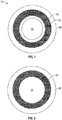
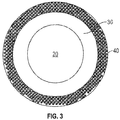
- FIGS. 1-3 are cross sections of exemplary coated high temperature fiber embodiments.
- a high temperature fiber refers to a fiber which maintains shape and integrity at temperatures greater than or equal to 800°C.
- a high temperature material is a material that is suitable for use at temperatures greater than or equal to 800°C.
- a coated high temperature fiber useful in composites, particularly ceramic matrix composites.
- composites rely on a relatively weak interface to allow the fiber to move and reduce or prevent cracks in the matrix from extending across the fiber.
- the interface coating described herein specifically locates the debonding area by creating an intermediate layer having a structural defect, lower density than an adjoining layer, or a combination thereof.
- the interface coating described herein also provides access to a wide range of compositions with improved oxidation resistance compared to typical boron nitride coatings.
- FIG. 1 shows a cross section of a coated high temperature fiber 10.
- the high temperature fiber 20 is surrounded by base material 30.
- Intermediate material 40 is in contact with base material 30.
- Top material 50 is in contact with intermediate material 40. While FIG 1 shows each material (base, intermediate, and top) completely surrounding the underlying material this representation should not be construed as limiting and partial layering is specifically contemplated.
- FIG. 2 shows another embodiment of the coated high temperature fiber.
- the high temperature fiber 20 is surrounded by intermediate material 40.
- Top material 50 is in contact with intermediate material 40.
- additional layers may be present between the intermediate material and the top material. While FIG 2 shows each material completely surrounding the underlying material this representation should not be construed as limiting and partial layering is specifically contemplated.
- FIG. 3 shows another embodiment of the coated high temperature fiber.
- the high temperature fiber 20 is surrounded by base material 30 and intermediate material 40 is in contact with the base material. No additional material is disposed on the intermediate material 40 and when the coated high temperature fiber is used in a composite the intermediate material 40 is in contact with the matrix. Additional layers may be present between the intermediate material and the base material. While FIG 3 shows each material completely surrounding the underlying material this representation should not be construed as limiting and partial layering is specifically contemplated.
- the intermediate material may have structural defects and/or lower density which is localized to one or more specific areas, distributed along the length of the fiber, localized by depth within the thickness of the intermediate material, distributed through the depth of the intermediate material or any combination thereof.
- Exemplary high temperature fibers 20 include carbon fiber (e.g. polyacrylonitrile (PAN), mesophase pitch, rayon, lignin, or polyolefin based), silicon carbide fiber, near-silicon carbide fiber, silicon borocarbide fiber, silicon carbonitride fiber, silicon nitrocarbide fiber, silicon oxycarbide fiber, silicon oxynitride fiber, refractory metal fiber such as rhenium or tantalum, refractory metal carbide fiber such as zirconium carbide, hafnium carbide or tantalum carbide, refractory metal boride fiber such as hafnium diboride or zirconium diboride, refractory metal nitride such as tantalum nitride, zirconium nitride or hafnium nitride, refractory metal oxide fiber such as zirconium oxycarbide, hafnium oxycarbide, zirconium oxide, or hafnium
- the fibers are not limited by diameter or aspect ratio. Additionally the fibers may be continuous, discontinuous, chopped fibers or filaments. They may be arranged in multiple fiber tows, yarns, rovings, non-woven or woven fabrics, or braids.
- the base material 30 is deposited by atomic layer deposition.
- Atomic layer deposition is a method by which ultrathin layers of materials can be deposited onto a variety of substrates. The layers are produced by sequentially conducting a series of half-reactions at the surface of a substrate. Each set of half-reactions deposits a layer that is typically 0.2 to 5 ⁇ ngstroms thick and which conforms to the surface of the underlying substrate. By repeating the reaction sequence, a material of any desired thickness can be deposited onto the substrate surface.
- Exemplary base materials include boron nitride, aluminum nitride, carbon, silicon carbide, silicon nitride, silicon oxycarbide, hafnium carbide, hafnium nitride, zirconium nitride, boron carbide, zirconium carbide, titanium carbide, tantalum carbide, niobium carbide, zirconium nitride, titanium nitride, titanium diboride, zirconium diboride, hafnium diboride, aluminum oxide, silicon dioxide, zirconium oxide, hafnium oxide, yttrium oxide, yttrium silicate, mullite, lanthanum phosphate, and combinations thereof.
- the base material may be a composite, a mixed phase or a solid solution.
- the base material may have a thickness of 1 to 10,000 nm, or, 10 to 1000 nm.
- the intermediate material precursor is deposited by molecular layer deposition.
- the intermediate material precursor may include a hybrid organic/inorganic material and can be formed as described in U.S. Patent No 10,092,927 .
- Exemplary intermediate material precursors include alucones such as poly(aluminum ethylene glycol), and titanicones such as poly(titanium ethylene glycol), as well as other metal substituted glycol polymers.
- Other intermediate material precursors may be formed using a two-step MLD process (e.g. ABAB), utilizing typical ALD metal-bearing precursors (e.g. metal halides, organometallics, etc.) and a homobifunctional or heterobifunctional organic precursor (e.g.
- the intermediate material precursor may have a thickness of 0.02 to 50 nm, or, 0.1 to 5 nm.
- the intermediate material precursor forms structural defects, has a lower density than the adjoining material, or a combination thereof after being heat treated and converts fully or substantially to an inorganic composition.
- a hybrid organic/inorganic alucone intermediate material precursor deposited using molecular layer deposition using trimethyl aluminum and ethylene glycol precursors may decompose fully or substantially upon heat treatment to result in an intermediate material comprising aluminum oxide.
- the intermediate material precursor may be a fully organic composition deposited by molecular layer deposition which is fully or substantially decomposed during heat treatment or subsequent composite processing, leaving no inorganic based intermediate material between the base and top materials. In some embodiments the decomposition of the fully organic composition leaves no remaining material.
- the top material 50 is deposited by atomic layer deposition similar to the base material.
- the top material may be the same as or different from the base material but is generally chosen from the same types of materials as described above with regard to base materials.
- the top material may have a thickness of 1 to 10,000 nm, or 10 to 1000 nm.
- the base material and top material may be deposited nominally dense and pinhole-free with respect to the intermediate material and may typically exhibit a porosity that is less than 1% by volume. After heat treatment the base material and/or top material may exhibit shrinkage, cracking, increased crystallinity or a combination thereof.
- the coated high temperature fiber is made by depositing a base material on the high temperature fiber using atomic layer deposition, depositing an intermediate material precursor on the base material by molecular layer deposition, and depositing a top material on the intermediate material precursor or on the intermediate material by atomic layer deposition.
- Conditions for the atomic layer deposition and molecular layer deposition are typically dictated by the reactants and desired products.
- the intermediate material precursor is subjected to a heat treatment to modify the intermediate material precursor to form structural defects, typically by decomposition, which may include local densification of the structure.
- the base material and top material may be subjected to the same heat treatment by depositing the materials to form a precursor coating, and heat treating the precursor coating to form a final coating on the high temperature fiber. It is also contemplated that the intermediate material precursor may be heat treated before the top material is deposited. It is further contemplated that the base material may be subjected to a heat treatment prior to deposition of the intermediate material precursor.
- Exemplary heat treatment temperatures are greater than 200°C, or greater than or equal to 600°C, or, greater than or equal to 1200°C.
- the heat treatment may be performed for select times (minutes to hours) and under controlled atmospheres including inert atmospheres such as argon, nitrogen, helium, mixtures thereof or reactive atmospheres such as oxygen, ozone, SiO, CO, NH 3 , H 2 , and mixtures thereof. Additionally, heat treatment may include contact with reactive or non-reactive plasmas for any of the foregoing gases.
- Exemplary combinations of fibers, base materials, intermediate materials/intermediate material precursors and top materials are shown in the table below.
- the coated high temperature fiber may be incorporated in a matrix to form a composite.
- exemplary matrices include polymer, metal, glass, glass-ceramic and ceramic.
Landscapes
- Chemical & Material Sciences (AREA)
- Engineering & Computer Science (AREA)
- Ceramic Engineering (AREA)
- Organic Chemistry (AREA)
- Manufacturing & Machinery (AREA)
- Materials Engineering (AREA)
- Chemical Kinetics & Catalysis (AREA)
- Structural Engineering (AREA)
- Inorganic Chemistry (AREA)
- Polymers & Plastics (AREA)
- Medicinal Chemistry (AREA)
- Health & Medical Sciences (AREA)
- General Chemical & Material Sciences (AREA)
- Mechanical Engineering (AREA)
- Metallurgy (AREA)
- Dispersion Chemistry (AREA)
- Life Sciences & Earth Sciences (AREA)
- Geochemistry & Mineralogy (AREA)
- Textile Engineering (AREA)
- Chemical Vapour Deposition (AREA)
- Chemical Or Physical Treatment Of Fibers (AREA)
Abstract
Description
- Exemplary embodiments pertain to the art of composites, particularly ceramic matrix composites (CMC).
- Fiber-reinforced composites, particularly ceramic matrix composites, require a weak fiber-to-matrix interfacial bond to prevent catastrophic failure from propagating matrix cracks through the fiber reinforcement. In particular, the interface needs to provide sufficient fiber/matrix bonding for effective load transfer but must be weak enough to de-bond and slip in the wake of matrix cracking while leaving the fibers substantially intact to bridge the crack and support the far-field applied load. In other words, the interface material provides "crack stopping" by allowing the fiber to slide in the interface coating at the fiber-coating interface or by allowing the coated fiber to move in the matrix by sliding at the coating-matrix interface. Currently available coating materials are limited in composition and there is a desire for a broader range of interface coatings.
- Disclosed is a method of coating a high temperature fiber (e.g. a coated high temperature fiber as described herein) including depositing a base material on the high temperature fiber using atomic layer deposition, depositing an intermediate material precursor (or an intermediate layer precursor) on the base material using molecular layer deposition, depositing a top material on the intermediate material precursor or the intermediate material (or the intermediate layer precursor or the intermediate layer) using atomic layer deposition, and heat treating the intermediate material precursor, e.g. to form the intermediate material, or heat treating the intermediate layer precursor, e.g. to form the intermediate layer. The intermediate material or the intermediate layer in the final coating includes a structural defect, has a lower density than the top material, or a combination thereof.
- In addition to one or more of the features described above, or as an alternative to any of the foregoing embodiments, the intermediate material or the intermediate layer has a structural defect. The structural defect may include, or may be selected from the group consisting of, pores, cracks, voids, gaps, dislocations, shear bands and combinations thereof.
- In addition to one or more of the features described above, or as an alternative to any of the foregoing embodiments, the intermediate material or the intermediate layer has a thickness of 0.02 to 50 nanometers (nm).
- In addition to one or more of the features described above, or as an alternative to any of the foregoing embodiments, the intermediate material precursor or the intermediate layer precursor includes a hybrid organic/inorganic material.
- In addition to one or more of the features described above, or as an alternative to any of the foregoing embodiments, the intermediate material precursor or the intermediate layer precursor includes an organic material.
- In addition to one or more of the features described above, or as an alternative to any of the foregoing embodiments, the intermediate material or the intermediate layer in the final coating has a porosity of 1% to 75%, or, 1 to 50%, based on the volume of the intermediate material or the intermediate layer, respectively.
- In addition to one or more of the feature described above, or as an alternative to any of the foregoing embodiments, heat treating comprises heating at a temperature greater than 200°C.
- Also disclosed is a coated high temperature fiber (e.g. obtained by the method disclosed herein) including a multi-material coating on the high temperature fiber wherein the multi-material coating has a base material in contact with the high temperature fiber, an intermediate material or an intermediate layer in contact with the base material and a top material in contact with the intermediate material or intermediate layer and further wherein the intermediate material or intermediate layer includes a structural defect, has a lower density than the top material, or a combination thereof.
- In addition to one or more of the features described above, or as an alternative to any of the foregoing embodiments, the intermediate material or intermediate layer has a structural defect. The structural defect may include, or may be selected from the group consisting of, pores, cracks, voids, gaps, dislocations, shear bands, and combinations thereof.
- In addition to one or more of the features described above, or as an alternative to any of the foregoing embodiments, the base material has a thickness of 1 to 10,000 nm, or 10 to 1000 nm.
- In addition to one or more of the features described above, or as an alternative to any of the foregoing embodiments, the intermediate material or intermediate layer includes a metal oxide, carbide, nitride, boride or combination thereof, e.g. a metal oxide, carbide, nitride, or boride material and combinations thereof.
- In addition to one or more of the features described above, or as an alternative to any of the foregoing embodiments, the intermediate material or intermediate layer has a porosity of 1 to 75%, or 1 to 50%, based on the volume of the intermediate material or the intermediate layer, respectively.
- In addition to one or more of the features described above, or as an alternative to any of the foregoing embodiments, the intermediate material or intermediate layer has a thickness of 0.02 to 50 nm.
- In addition to one or more of the features described above, or as an alternative to any of the foregoing embodiments, the top material has a thickness of 1 to 10,000 nm, or, 10 to 1000 nm.
- Also disclosed is a composite including a coated high temperature fiber (e.g. as disclosed herein) in, e.g. disposed in, a matrix wherein the coated high temperature fiber has a multi-material coating on the high temperature fiber and the multi-material coating has a base material in contact with the high temperature fiber, an intermediate material or intermediate layer in contact with the base material and a top material in contact with the intermediate material or intermediate layer and further wherein the intermediate material or intermediate layer includes a structural defect, has lower density than the top material, or a combination thereof.
- In addition to one or more of the features described above, or as an alternative to any of the foregoing embodiments, the intermediate material or intermediate layer has a structural defect. The structural defect may include, or may be selected from the group consisting of pores, cracks, voids, gaps, dislocations, shear bands, and combinations thereof.
- In addition to one or more of the features described above, or as an alternative to any of the foregoing embodiments, the base material has a thickness of 1 to 10,000 nm, or, 10 to 1000 nm.
- In addition to one or more of the features described above, or as an alternative to any of the foregoing embodiments, the intermediate material or intermediate layer has a thickness of 0.02 to 50 nm.
- In addition to one or more of the features described above, or as an alternative to any of the foregoing embodiments, the top material has a thickness of 1 to 10000 nm, or 10 to 1000 nm.
- In addition to one or more of the features described above, or as an alternative to any of the foregoing embodiments, the intermediate material or intermediate layer has a porosity of 1% to 75%, or 1 to 50%, based on the volume of the intermediate material or the intermediate layer, respectively.
- The following descriptions should not be considered limiting in any way. With reference to the accompanying drawings, like elements are numbered alike:
FIGS. 1-3 are cross sections of exemplary coated high temperature fiber embodiments. - A detailed description of one or more embodiments of the disclosed fiber, composite and method are presented herein by way of exemplification and not limitation with reference to the Figures.
- A high temperature fiber, as used herein, refers to a fiber which maintains shape and integrity at temperatures greater than or equal to 800°C. A high temperature material is a material that is suitable for use at temperatures greater than or equal to 800°C.
- Disclosed herein is a coated high temperature fiber useful in composites, particularly ceramic matrix composites. As discussed above, composites rely on a relatively weak interface to allow the fiber to move and reduce or prevent cracks in the matrix from extending across the fiber. The interface coating described herein specifically locates the debonding area by creating an intermediate layer having a structural defect, lower density than an adjoining layer, or a combination thereof. The interface coating described herein also provides access to a wide range of compositions with improved oxidation resistance compared to typical boron nitride coatings.
-
FIG. 1 shows a cross section of a coatedhigh temperature fiber 10. Thehigh temperature fiber 20 is surrounded bybase material 30.Intermediate material 40 is in contact withbase material 30.Top material 50 is in contact withintermediate material 40. WhileFIG 1 shows each material (base, intermediate, and top) completely surrounding the underlying material this representation should not be construed as limiting and partial layering is specifically contemplated. -
FIG. 2 shows another embodiment of the coated high temperature fiber. Thehigh temperature fiber 20 is surrounded byintermediate material 40.Top material 50 is in contact withintermediate material 40. In this embodiment additional layers may be present between the intermediate material and the top material. WhileFIG 2 shows each material completely surrounding the underlying material this representation should not be construed as limiting and partial layering is specifically contemplated. -
FIG. 3 shows another embodiment of the coated high temperature fiber. Thehigh temperature fiber 20 is surrounded bybase material 30 andintermediate material 40 is in contact with the base material. No additional material is disposed on theintermediate material 40 and when the coated high temperature fiber is used in a composite theintermediate material 40 is in contact with the matrix. Additional layers may be present between the intermediate material and the base material. WhileFIG 3 shows each material completely surrounding the underlying material this representation should not be construed as limiting and partial layering is specifically contemplated. - It is further contemplated that the intermediate material may have structural defects and/or lower density which is localized to one or more specific areas, distributed along the length of the fiber, localized by depth within the thickness of the intermediate material, distributed through the depth of the intermediate material or any combination thereof.
- Exemplary
high temperature fibers 20 include carbon fiber (e.g. polyacrylonitrile (PAN), mesophase pitch, rayon, lignin, or polyolefin based), silicon carbide fiber, near-silicon carbide fiber, silicon borocarbide fiber, silicon carbonitride fiber, silicon nitrocarbide fiber, silicon oxycarbide fiber, silicon oxynitride fiber, refractory metal fiber such as rhenium or tantalum, refractory metal carbide fiber such as zirconium carbide, hafnium carbide or tantalum carbide, refractory metal boride fiber such as hafnium diboride or zirconium diboride, refractory metal nitride such as tantalum nitride, zirconium nitride or hafnium nitride, refractory metal oxide fiber such as zirconium oxycarbide, hafnium oxycarbide, zirconium oxide, or hafnium oxide, oxide fiber such as alumina, mullite, borosilicate, or aluminosilicate, glass, and combinations of the foregoing. - The fibers are not limited by diameter or aspect ratio. Additionally the fibers may be continuous, discontinuous, chopped fibers or filaments. They may be arranged in multiple fiber tows, yarns, rovings, non-woven or woven fabrics, or braids.
- The
base material 30 is deposited by atomic layer deposition. Atomic layer deposition (ALD) is a method by which ultrathin layers of materials can be deposited onto a variety of substrates. The layers are produced by sequentially conducting a series of half-reactions at the surface of a substrate. Each set of half-reactions deposits a layer that is typically 0.2 to 5 Ångstroms thick and which conforms to the surface of the underlying substrate. By repeating the reaction sequence, a material of any desired thickness can be deposited onto the substrate surface. Exemplary base materials include boron nitride, aluminum nitride, carbon, silicon carbide, silicon nitride, silicon oxycarbide, hafnium carbide, hafnium nitride, zirconium nitride, boron carbide, zirconium carbide, titanium carbide, tantalum carbide, niobium carbide, zirconium nitride, titanium nitride, titanium diboride, zirconium diboride, hafnium diboride, aluminum oxide, silicon dioxide, zirconium oxide, hafnium oxide, yttrium oxide, yttrium silicate, mullite, lanthanum phosphate, and combinations thereof. The base material may be a composite, a mixed phase or a solid solution. The base material may have a thickness of 1 to 10,000 nm, or, 10 to 1000 nm. - The intermediate material precursor is deposited by molecular layer deposition. The intermediate material precursor may include a hybrid organic/inorganic material and can be formed as described in
U.S. Patent No 10,092,927 - The
top material 50 is deposited by atomic layer deposition similar to the base material. The top material may be the same as or different from the base material but is generally chosen from the same types of materials as described above with regard to base materials. The top material may have a thickness of 1 to 10,000 nm, or 10 to 1000 nm. The base material and top material may be deposited nominally dense and pinhole-free with respect to the intermediate material and may typically exhibit a porosity that is less than 1% by volume. After heat treatment the base material and/or top material may exhibit shrinkage, cracking, increased crystallinity or a combination thereof. - The coated high temperature fiber is made by depositing a base material on the high temperature fiber using atomic layer deposition, depositing an intermediate material precursor on the base material by molecular layer deposition, and depositing a top material on the intermediate material precursor or on the intermediate material by atomic layer deposition. Conditions for the atomic layer deposition and molecular layer deposition are typically dictated by the reactants and desired products.
- The intermediate material precursor is subjected to a heat treatment to modify the intermediate material precursor to form structural defects, typically by decomposition, which may include local densification of the structure. The base material and top material may be subjected to the same heat treatment by depositing the materials to form a precursor coating, and heat treating the precursor coating to form a final coating on the high temperature fiber. It is also contemplated that the intermediate material precursor may be heat treated before the top material is deposited. It is further contemplated that the base material may be subjected to a heat treatment prior to deposition of the intermediate material precursor.
- Exemplary heat treatment temperatures are greater than 200°C, or greater than or equal to 600°C, or, greater than or equal to 1200°C. The heat treatment may be performed for select times (minutes to hours) and under controlled atmospheres including inert atmospheres such as argon, nitrogen, helium, mixtures thereof or reactive atmospheres such as oxygen, ozone, SiO, CO, NH3, H2, and mixtures thereof. Additionally, heat treatment may include contact with reactive or non-reactive plasmas for any of the foregoing gases.
- Exemplary combinations of fibers, base materials, intermediate materials/intermediate material precursors and top materials are shown in the table below.
FIBER BASE INTERMEDIATE TOP SiC Nitride (BN or AlN) Alucone or titanicone Carbide (SiC) Carbon Nitride (AlN or HfN) Alucone or titanicone Carbide (HfC) Carbon AlN Alucone or polyimide AlN Si based BN Alucone, titanicone, or polyimide SiC or TiN Oxide based AlN or BN Alucone or titanicone AlN or TiN - The coated high temperature fiber may be incorporated in a matrix to form a composite. Exemplary matrices include polymer, metal, glass, glass-ceramic and ceramic.
- The terminology used herein is for the purpose of describing particular embodiments only and is not intended to be limiting of the present disclosure. As used herein, the singular forms "a", "an" and "the" are intended to include the plural forms as well, unless the context clearly indicates otherwise. It will be further understood that the terms "comprises" and/or "comprising," when used in this specification, specify the presence of stated features, integers, steps, operations, elements, and/or components, but do not preclude the presence or addition of one or more other features, integers, steps, operations, element components, and/or groups thereof.
- While the disclosure has been described with reference to an exemplary embodiment or embodiments, it will be understood by those skilled in the art that various changes may be made and equivalents may be substituted for elements thereof without departing from the scope of the disclosure. In addition, many modifications may be made to adapt a particular situation or material to the teachings of the disclosure without departing from the essential scope thereof. Therefore, it is intended that the disclosure not be limited to the particular embodiment disclosed as the best mode contemplated for carrying out this present disclosure, but that the disclosure will include all embodiments falling within the scope of the claims.
- Certain embodiments of the present disclosure include:
- 1. A method of coating a high temperature fiber comprising depositing a base material on the high temperature fiber using atomic layer deposition, depositing an intermediate material precursor on the base material by molecular layer deposition, depositing a top material on the intermediate material precursor or intermediate material by atomic layer deposition, and heat treating the intermediate layer precursor, wherein the intermediate layer comprises a structural defect, has a lower density than the top material or a combination thereof.
- 2. The method of embodiment 1, wherein the intermediate material has a structural defect selected from the group consisting of pores, cracks, voids, gaps, dislocations, shear bands and combinations thereof.
- 3. The method of embodiment 1, wherein the intermediate material has a thickness of 0.02 to 50 nm.
- 4. The method of embodiment 1, wherein the intermediate material precursor comprises a hybrid organic/inorganic material.
- 5. The method of embodiment 1, wherein the intermediate material precursor comprises an organic material.
- 6. The method of embodiment 1, wherein the intermediate material has a porosity of 1 to 75%.
- 7. The method of embodiment 1, wherein heat treating comprises heating at a temperature greater than 200°C.
- 8. A coated high temperature fiber comprising a multi-material coating on the high temperature fiber wherein the multi-material coating has a base material in contact with the high temperature fiber, an intermediate material in contact with the base material and a top material in contact with the intermediate material and further wherein the intermediate material comprises a structural defect, has a lower density than the top material or a combination thereof.
- 9. The coated high temperature fiber of embodiment 8, wherein the intermediate material has a structural defect selected from the group consisting of pores, cracks, voids, gaps, dislocations, shear bands, and combinations thereof.
- 10. The coated high temperature fiber of embodiment 8, wherein the base material has a thickness of 1 to 10,000 nm.
- 11. The coated high temperature fiber of embodiment 8, wherein the intermediate material comprises a metal oxide, carbide, nitride, or boride material and combinations thereof.
- 12. The coated high temperature fiber of embodiment 8, wherein the intermediate material has a porosity of 1 to 75%.
- 13. The coated high temperature fiber of embodiment 8, wherein the intermediate material has a thickness of 0.02 to 50 nm.
- 14. The coated high temperature fiber of embodiment 8, wherein the top material has a thickness of 1 to 10,000 nm.
- 15. A composite comprising a coated high temperature fiber disposed in a matrix wherein the coated high temperature fiber has a multi-material coating on the high temperature fiber and the multi-material coating has a base material in contact with the high temperature fiber, an intermediate material in contact with the base material and a top material in contact with the intermediate material and further wherein the intermediate material has a structural defect, has lower density than the top material, or a combination thereof.
- 16. The composite of embodiment 15, wherein the intermediate material has a structural defect selected from the group consisting of pores, cracks, voids, gaps, dislocations, shear bands, and combinations thereof.
- 17. The composite of embodiment 15, wherein the base material has a thickness of 1 to 10,000 nm.
- 18. The composite of embodiment 15, wherein the intermediate material has a thickness of 0.02 to 50 nm.
- 19. The composite of embodiment 15, wherein the top material has a thickness of 1 to 10,000 nm.
- 20. The composite of embodiment 15, wherein the intermediate material has a porosity of 1 to 75%.
Claims (15)
- A method of coating a high temperature fiber comprising depositing a base material on the high temperature fiber using atomic layer deposition, depositing an intermediate material precursor on the base material by molecular layer deposition, depositing a top material on the intermediate material precursor or intermediate material by atomic layer deposition, and heat treating the intermediate material precursor, wherein the intermediate material comprises a structural defect, has a lower density than the top material or a combination thereof.
- The method of claim 1, wherein the intermediate material has a structural defect selected from the group consisting of pores, cracks, voids, gaps, dislocations, shear bands and combinations thereof.
- The method of claim 1 or claim 2, wherein the intermediate material has a thickness of 0.02 to 50 nm.
- The method of any preceding claim, wherein the intermediate material precursor comprises a hybrid organic/inorganic material.
- The method of any preceding claim, wherein the intermediate material precursor comprises an organic material.
- The method of any preceding claim, wherein the intermediate material has a porosity of 1 to 75%.
- The method of any preceding claim, wherein heat treating comprises heating at a temperature greater than 200°C.
- A coated high temperature fiber comprising a multi-material coating on the high temperature fiber wherein the multi-material coating has a base material in contact with the high temperature fiber, an intermediate material in contact with the base material and a top material in contact with the intermediate material and further wherein the intermediate material comprises a structural defect, has a lower density than the top material or a combination thereof.
- The coated high temperature fiber of claim 8, wherein the intermediate material has a structural defect selected from the group consisting of pores, cracks, voids, gaps, dislocations, shear bands, and combinations thereof.
- The coated high temperature fiber of claim 8 or claim 9, wherein the base material has a thickness of 1 to 10,000 nm.
- The coated high temperature fiber of any one of claims 8 to 10, wherein the intermediate material comprises a metal oxide, carbide, nitride, or boride material and combinations thereof.
- The coated high temperature fiber of any one of claims 8 to 11, wherein the intermediate material has a porosity of 1 to 75%.
- The coated high temperature fiber of any one of claims 8 to 12, wherein the intermediate material has a thickness of 0.02 to 50 nm.
- The coated high temperature fiber of any one of claims 8 to 13, wherein the top material has a thickness of 1 to 10,000 nm.
- A composite comprising the coated high temperature fiber of any one of claims 8 to 14, disposed in a matrix.
Applications Claiming Priority (1)
| Application Number | Priority Date | Filing Date | Title |
|---|---|---|---|
| US16/536,688 US11535958B2 (en) | 2019-08-09 | 2019-08-09 | Fiber having integral weak interface coating, method of making and composite incorporating the fiber |
Publications (1)
| Publication Number | Publication Date |
|---|---|
| EP3772545A1 true EP3772545A1 (en) | 2021-02-10 |
Family
ID=71842539
Family Applications (1)
| Application Number | Title | Priority Date | Filing Date |
|---|---|---|---|
| EP20188050.7A Pending EP3772545A1 (en) | 2019-08-09 | 2020-07-28 | Fiber having integral weak interface coating, method of making and composite incorporating the fiber |
Country Status (2)
| Country | Link |
|---|---|
| US (2) | US11535958B2 (en) |
| EP (1) | EP3772545A1 (en) |
Cited By (1)
| Publication number | Priority date | Publication date | Assignee | Title |
|---|---|---|---|---|
| CN118390196A (en) * | 2024-05-23 | 2024-07-26 | 快尚时装(广州)有限公司 | Cold sun-proof anti-wrinkle fabric and preparation process thereof |
Families Citing this family (5)
| Publication number | Priority date | Publication date | Assignee | Title |
|---|---|---|---|---|
| US12030820B2 (en) | 2019-08-09 | 2024-07-09 | Rtx Corporation | High temperature fiber, method of making and high temperature fiber composites |
| US12071378B2 (en) | 2019-08-09 | 2024-08-27 | Rtx Corporation | High temperature fiber and method of making |
| US20220359332A1 (en) * | 2021-05-09 | 2022-11-10 | Spts Technologies Limited | Temporary passivation layer on a substrate |
| US20230382811A1 (en) * | 2022-05-25 | 2023-11-30 | Raytheon Technologies Corporation | Multilayer coating for oxidation protection |
| CN115215668B (en) * | 2022-08-29 | 2023-05-12 | 广东省科学院新材料研究所 | A sandwich structure anti-high temperature water oxygen corrosion fiber composite coating and its preparation method and application |
Citations (5)
| Publication number | Priority date | Publication date | Assignee | Title |
|---|---|---|---|---|
| US6322889B1 (en) * | 1998-04-23 | 2001-11-27 | The United States Of America As Represented By The United States Department Of Energy | Oxidation-resistant interfacial coating for fiber-reinforced ceramic |
| US20040138046A1 (en) * | 2003-01-10 | 2004-07-15 | Sherwood Walter J. | Ceramic forming polymer derived ceramic composite and methods |
| US20160159694A1 (en) * | 2013-03-13 | 2016-06-09 | Rolls-Royce Corporation | Reactive fiber interface coatings for improved environmental stability |
| US20170141383A1 (en) * | 2015-11-18 | 2017-05-18 | GM Global Technology Operations LLC | Forming electrode active materials |
| US10092927B2 (en) | 2006-11-13 | 2018-10-09 | The Regents Of The University Of Colorado, A Body Corporate | Molecular layer deposition process for making organic or organic-inorganic polymers |
Family Cites Families (29)
| Publication number | Priority date | Publication date | Assignee | Title |
|---|---|---|---|---|
| US4942011A (en) | 1988-05-03 | 1990-07-17 | E. I. Du Pont De Nemours And Company | Process for preparing silicon carbide fibers |
| US5783139A (en) | 1990-04-18 | 1998-07-21 | Curran; Dennis John Gerard | Ceramic materials |
| US5480707A (en) | 1993-10-06 | 1996-01-02 | Hyper-Thern High-Temperature Composites, Inc. | Toughened ceramic composite materials comprising coated refractory fibers in a ceramic matrix wherein the fibers are coated with carbon and an additional coating of ceramic material and carbon mixture |
| US6299988B1 (en) * | 1998-04-27 | 2001-10-09 | General Electric Company | Ceramic with preferential oxygen reactive layer |
| US6979490B2 (en) | 2001-01-16 | 2005-12-27 | Steffier Wayne S | Fiber-reinforced ceramic composite material comprising a matrix with a nanolayered microstructure |
| US9376750B2 (en) | 2001-07-18 | 2016-06-28 | Regents Of The University Of Colorado, A Body Corporate | Method of depositing an inorganic film on an organic polymer |
| US20080119098A1 (en) | 2006-11-21 | 2008-05-22 | Igor Palley | Atomic layer deposition on fibrous materials |
| WO2009070574A2 (en) | 2007-11-27 | 2009-06-04 | North Carolina State University | Methods for modification of polymers, fibers and textile media |
| GB2467928A (en) | 2009-02-19 | 2010-08-25 | Amit Kumar Roy | Inorganic Fibre Coating by Atomic Layer Deposition |
| DE102009015226A1 (en) | 2009-04-01 | 2010-10-14 | Kim, Gyeong-Man, Dr. | Template-based patterning process of nanofibers in the electrospinning process and its applications |
| JP5396264B2 (en) * | 2009-12-25 | 2014-01-22 | 東京エレクトロン株式会社 | Deposition equipment |
| US9803296B2 (en) | 2014-02-18 | 2017-10-31 | Advanced Ceramic Fibers, Llc | Metal carbide fibers and methods for their manufacture |
| US20130022658A1 (en) | 2011-07-23 | 2013-01-24 | Synos Technology, Inc. | Depositing material with antimicrobial properties on permeable substrate using atomic layer deposition |
| US8771404B2 (en) | 2011-07-31 | 2014-07-08 | L'air Liquide, Societe Anonyme Pour L'etude Et L'exploitation Des Procedes Georges Claude | Hollow ceramic fibers, precursors for manufacture thereof utilizing nanoparticles, methods of making the same, and methods of using the same |
| WO2013142344A1 (en) | 2012-03-20 | 2013-09-26 | North Carolina State University | Methods and apparatus for atmospheric pressure atomic layer deposition |
| GB2509335A (en) | 2012-12-31 | 2014-07-02 | Univ Tartu | Double-structured corrosion resistant coatings and methods of application |
| US9708226B2 (en) * | 2013-03-15 | 2017-07-18 | Rolls-Royce Corporation | Method for producing high strength ceramic matrix composites |
| US20160326672A1 (en) | 2014-01-08 | 2016-11-10 | The University Of Tokyo | Pan-based carbon fiber and production method therefor |
| JP2017515771A (en) | 2014-03-27 | 2017-06-15 | ブルー キューブ アイピー エルエルシー | Method for producing carbon / carbon composite material |
| US20150291473A1 (en) | 2014-04-09 | 2015-10-15 | United Technologies Corporation | Energy preparation of ceramic fiber for coating |
| CN104213099A (en) | 2014-09-24 | 2014-12-17 | 中国人民解放军国防科学技术大学 | Preparation method of oxide ceramic coating layer on surface of silicon carbide fiber |
| US9896763B2 (en) | 2016-05-13 | 2018-02-20 | GM Global Technology Operations LLC | Particle reactor for atomic layer deposition (ALD) and chemical vapor deposition (CVD) processes |
| US20170342844A1 (en) | 2016-05-31 | 2017-11-30 | United Technologies Corporation | High Temperature Composites With Enhanced Matrix |
| KR101855718B1 (en) | 2016-12-07 | 2018-05-10 | 한국세라믹기술원 | Preparation method of crystalline ceramic fiber reinforced by different crystal and crystalline ceramic fiber prepared therefrom |
| JP6917770B2 (en) * | 2017-05-15 | 2021-08-11 | 株式会社東芝 | Long fiber reinforced silicon carbide member, its manufacturing method, and reactor structural member |
| KR102277734B1 (en) * | 2018-02-26 | 2021-07-16 | 주식회사 엘지에너지솔루션 | Negative electrode active material for lithium secondary battery, negative electrode for lithium secondry battery and lithium secondary battery comprising the same |
| US12410107B2 (en) | 2018-04-20 | 2025-09-09 | Rtx Corporation | Nanolaminate fiber interface coatings for composites |
| US12071378B2 (en) | 2019-08-09 | 2024-08-27 | Rtx Corporation | High temperature fiber and method of making |
| US12030820B2 (en) | 2019-08-09 | 2024-07-09 | Rtx Corporation | High temperature fiber, method of making and high temperature fiber composites |
-
2019
- 2019-08-09 US US16/536,688 patent/US11535958B2/en active Active
-
2020
- 2020-07-28 EP EP20188050.7A patent/EP3772545A1/en active Pending
-
2022
- 2022-12-19 US US18/083,817 patent/US20230304194A1/en active Pending
Patent Citations (5)
| Publication number | Priority date | Publication date | Assignee | Title |
|---|---|---|---|---|
| US6322889B1 (en) * | 1998-04-23 | 2001-11-27 | The United States Of America As Represented By The United States Department Of Energy | Oxidation-resistant interfacial coating for fiber-reinforced ceramic |
| US20040138046A1 (en) * | 2003-01-10 | 2004-07-15 | Sherwood Walter J. | Ceramic forming polymer derived ceramic composite and methods |
| US10092927B2 (en) | 2006-11-13 | 2018-10-09 | The Regents Of The University Of Colorado, A Body Corporate | Molecular layer deposition process for making organic or organic-inorganic polymers |
| US20160159694A1 (en) * | 2013-03-13 | 2016-06-09 | Rolls-Royce Corporation | Reactive fiber interface coatings for improved environmental stability |
| US20170141383A1 (en) * | 2015-11-18 | 2017-05-18 | GM Global Technology Operations LLC | Forming electrode active materials |
Non-Patent Citations (1)
| Title |
|---|
| MILITZER CHRISTIAN ET AL: "Deposition of an organic-inorganic hybrid material onto carbon fibers via the introduction of furfuryl alcohol into the atomic layer deposition process of titania and subsequent pyrolysis", JOURNAL OF VACUUM SCIENCE AND TECHNOLOGY: PART A, AVS /AIP, MELVILLE, NY., US, vol. 35, no. 1, 9 November 2016 (2016-11-09), XP012213509, ISSN: 0734-2101, [retrieved on 20161109], DOI: 10.1116/1.4965699 * |
Cited By (1)
| Publication number | Priority date | Publication date | Assignee | Title |
|---|---|---|---|---|
| CN118390196A (en) * | 2024-05-23 | 2024-07-26 | 快尚时装(广州)有限公司 | Cold sun-proof anti-wrinkle fabric and preparation process thereof |
Also Published As
| Publication number | Publication date |
|---|---|
| US11535958B2 (en) | 2022-12-27 |
| US20210040651A1 (en) | 2021-02-11 |
| US20230304194A1 (en) | 2023-09-28 |
Similar Documents
| Publication | Publication Date | Title |
|---|---|---|
| US20230304194A1 (en) | Fiber having integral weak interface coating, method of making and composite incorporating the fiber | |
| US4837230A (en) | Structural ceramic materials having refractory interface layers | |
| CA2275130C (en) | Composite material with ceramic matrix and sic fiber reinforcement, method for making same | |
| Xu et al. | Carbon/silicon carbide composites prepared by chemical vapor infiltration combined with silicon melt infiltration | |
| EP2210868B1 (en) | Composite material | |
| WO1994012448A1 (en) | Process for producing ceramic product | |
| US6217997B1 (en) | Ceramic fiber reinforced ceramic matrix composite material and method of producing the same | |
| KR101547199B1 (en) | SiC coated graphite substrate with stress releasing layer and preparation method thereof | |
| CN108947588A (en) | A kind of C/SiC composite material and the antioxidant coating for the material and preparation method thereof | |
| CN113321510A (en) | High-entropy ceramic matrix composite and preparation method thereof | |
| CN110776339B (en) | A kind of anti-oxidation coating for C/ZrC-SiC composite material and preparation method thereof | |
| JPH05254965A (en) | Ceramic matrix composite and production thereof | |
| JPH0585841A (en) | Process for producing precrack fiber coating for reinforcing ceramic fiber matrix composite material | |
| JPH07197264A (en) | Fiber surface treatment method, reinforcing fiber and application | |
| US5395648A (en) | Ceramic-ceramic composite prepregs and methods for their use and preparation | |
| KR100776252B1 (en) | Method of forming oxidation resistant multilayer coating on carbon material | |
| JP3422515B2 (en) | Method for forming oxidation-resistant coating on carbonaceous substrate | |
| JPH06345571A (en) | Production of high-temperature oxidation resistant c/c composite material | |
| KR102844836B1 (en) | Surface coating method of Carbon fiber composite | |
| JPH06172033A (en) | Surface-coated carbon-fiber reinforced composite material and its production | |
| KR101138440B1 (en) | Porous body with silicon carbide enhancement layer and fabrication method thereof | |
| JPH0789777A (en) | Improvement of oxidation stability of composite material containing fibrous reinforcement and glass, glass-ceramic or ceramic matrix | |
| JPH06345570A (en) | Productiom of oxidation resistant c/c composite material | |
| KR102732783B1 (en) | METHOD FOR MANUFACTURING SiC-COATED SiC FIBER BY ONE-POT PROCESS | |
| JP3076914B2 (en) | Method for producing fiber-reinforced ceramic composite material |
Legal Events
| Date | Code | Title | Description |
|---|---|---|---|
| PUAI | Public reference made under article 153(3) epc to a published international application that has entered the european phase |
Free format text: ORIGINAL CODE: 0009012 |
|
| STAA | Information on the status of an ep patent application or granted ep patent |
Free format text: STATUS: THE APPLICATION HAS BEEN PUBLISHED |
|
| AK | Designated contracting states |
Kind code of ref document: A1 Designated state(s): AL AT BE BG CH CY CZ DE DK EE ES FI FR GB GR HR HU IE IS IT LI LT LU LV MC MK MT NL NO PL PT RO RS SE SI SK SM TR |
|
| AX | Request for extension of the european patent |
Extension state: BA ME |
|
| STAA | Information on the status of an ep patent application or granted ep patent |
Free format text: STATUS: REQUEST FOR EXAMINATION WAS MADE |
|
| 17P | Request for examination filed |
Effective date: 20210810 |
|
| RBV | Designated contracting states (corrected) |
Designated state(s): AL AT BE BG CH CY CZ DE DK EE ES FI FR GB GR HR HU IE IS IT LI LT LU LV MC MK MT NL NO PL PT RO RS SE SI SK SM TR |
|
| STAA | Information on the status of an ep patent application or granted ep patent |
Free format text: STATUS: EXAMINATION IS IN PROGRESS |
|
| 17Q | First examination report despatched |
Effective date: 20230223 |
|
| RAP3 | Party data changed (applicant data changed or rights of an application transferred) |
Owner name: RTX CORPORATION |