EP3771970B1 - Inertial measurement system with smart power mode management and corresponding smart power mode management method - Google Patents
Inertial measurement system with smart power mode management and corresponding smart power mode management method Download PDFInfo
- Publication number
- EP3771970B1 EP3771970B1 EP20188663.7A EP20188663A EP3771970B1 EP 3771970 B1 EP3771970 B1 EP 3771970B1 EP 20188663 A EP20188663 A EP 20188663A EP 3771970 B1 EP3771970 B1 EP 3771970B1
- Authority
- EP
- European Patent Office
- Prior art keywords
- phase
- odr
- motion
- measurement
- data
- Prior art date
- Legal status (The legal status is an assumption and is not a legal conclusion. Google has not performed a legal analysis and makes no representation as to the accuracy of the status listed.)
- Active
Links
Images


Classifications
-
- G—PHYSICS
- G01—MEASURING; TESTING
- G01C—MEASURING DISTANCES, LEVELS OR BEARINGS; SURVEYING; NAVIGATION; GYROSCOPIC INSTRUMENTS; PHOTOGRAMMETRY OR VIDEOGRAMMETRY
- G01C21/00—Navigation; Navigational instruments not provided for in groups G01C1/00 - G01C19/00
- G01C21/10—Navigation; Navigational instruments not provided for in groups G01C1/00 - G01C19/00 by using measurements of speed or acceleration
- G01C21/12—Navigation; Navigational instruments not provided for in groups G01C1/00 - G01C19/00 by using measurements of speed or acceleration executed aboard the object being navigated; Dead reckoning
- G01C21/16—Navigation; Navigational instruments not provided for in groups G01C1/00 - G01C19/00 by using measurements of speed or acceleration executed aboard the object being navigated; Dead reckoning by integrating acceleration or speed, i.e. inertial navigation
- G01C21/18—Stabilised platforms, e.g. by gyroscope
-
- G—PHYSICS
- G06—COMPUTING OR CALCULATING; COUNTING
- G06F—ELECTRIC DIGITAL DATA PROCESSING
- G06F3/00—Input arrangements for transferring data to be processed into a form capable of being handled by the computer; Output arrangements for transferring data from processing unit to output unit, e.g. interface arrangements
- G06F3/01—Input arrangements or combined input and output arrangements for interaction between user and computer
- G06F3/03—Arrangements for converting the position or the displacement of a member into a coded form
- G06F3/033—Pointing devices displaced or positioned by the user, e.g. mice, trackballs, pens or joysticks; Accessories therefor
- G06F3/0354—Pointing devices displaced or positioned by the user, e.g. mice, trackballs, pens or joysticks; Accessories therefor with detection of two-dimensional [2D] relative movements between the device, or an operating part thereof, and a plane or surface, e.g. 2D mice, trackballs, pens or pucks
- G06F3/03545—Pens or stylus
-
- G—PHYSICS
- G01—MEASURING; TESTING
- G01C—MEASURING DISTANCES, LEVELS OR BEARINGS; SURVEYING; NAVIGATION; GYROSCOPIC INSTRUMENTS; PHOTOGRAMMETRY OR VIDEOGRAMMETRY
- G01C21/00—Navigation; Navigational instruments not provided for in groups G01C1/00 - G01C19/00
- G01C21/10—Navigation; Navigational instruments not provided for in groups G01C1/00 - G01C19/00 by using measurements of speed or acceleration
- G01C21/12—Navigation; Navigational instruments not provided for in groups G01C1/00 - G01C19/00 by using measurements of speed or acceleration executed aboard the object being navigated; Dead reckoning
- G01C21/16—Navigation; Navigational instruments not provided for in groups G01C1/00 - G01C19/00 by using measurements of speed or acceleration executed aboard the object being navigated; Dead reckoning by integrating acceleration or speed, i.e. inertial navigation
-
- G—PHYSICS
- G06—COMPUTING OR CALCULATING; COUNTING
- G06F—ELECTRIC DIGITAL DATA PROCESSING
- G06F1/00—Details not covered by groups G06F3/00 - G06F13/00 and G06F21/00
- G06F1/26—Power supply means, e.g. regulation thereof
- G06F1/32—Means for saving power
- G06F1/3203—Power management, i.e. event-based initiation of a power-saving mode
- G06F1/3206—Monitoring of events, devices or parameters that trigger a change in power modality
-
- G—PHYSICS
- G06—COMPUTING OR CALCULATING; COUNTING
- G06F—ELECTRIC DIGITAL DATA PROCESSING
- G06F1/00—Details not covered by groups G06F3/00 - G06F13/00 and G06F21/00
- G06F1/26—Power supply means, e.g. regulation thereof
- G06F1/32—Means for saving power
- G06F1/3203—Power management, i.e. event-based initiation of a power-saving mode
- G06F1/3234—Power saving characterised by the action undertaken
- G06F1/325—Power saving in peripheral device
- G06F1/3259—Power saving in cursor control device, e.g. mouse, joystick, trackball
-
- G—PHYSICS
- G06—COMPUTING OR CALCULATING; COUNTING
- G06F—ELECTRIC DIGITAL DATA PROCESSING
- G06F3/00—Input arrangements for transferring data to be processed into a form capable of being handled by the computer; Output arrangements for transferring data from processing unit to output unit, e.g. interface arrangements
- G06F3/01—Input arrangements or combined input and output arrangements for interaction between user and computer
- G06F3/017—Gesture based interaction, e.g. based on a set of recognized hand gestures
-
- G—PHYSICS
- G06—COMPUTING OR CALCULATING; COUNTING
- G06F—ELECTRIC DIGITAL DATA PROCESSING
- G06F3/00—Input arrangements for transferring data to be processed into a form capable of being handled by the computer; Output arrangements for transferring data from processing unit to output unit, e.g. interface arrangements
- G06F3/01—Input arrangements or combined input and output arrangements for interaction between user and computer
- G06F3/03—Arrangements for converting the position or the displacement of a member into a coded form
- G06F3/033—Pointing devices displaced or positioned by the user, e.g. mice, trackballs, pens or joysticks; Accessories therefor
- G06F3/0346—Pointing devices displaced or positioned by the user, e.g. mice, trackballs, pens or joysticks; Accessories therefor with detection of the device orientation or free movement in a three-dimensional [3D] space, e.g. 3D mice, 6-DOF [six degrees of freedom] pointers using gyroscopes, accelerometers or tilt-sensors
-
- G—PHYSICS
- G06—COMPUTING OR CALCULATING; COUNTING
- G06F—ELECTRIC DIGITAL DATA PROCESSING
- G06F3/00—Input arrangements for transferring data to be processed into a form capable of being handled by the computer; Output arrangements for transferring data from processing unit to output unit, e.g. interface arrangements
- G06F3/01—Input arrangements or combined input and output arrangements for interaction between user and computer
- G06F3/03—Arrangements for converting the position or the displacement of a member into a coded form
- G06F3/033—Pointing devices displaced or positioned by the user, e.g. mice, trackballs, pens or joysticks; Accessories therefor
- G06F3/038—Control and interface arrangements therefor, e.g. drivers or device-embedded control circuitry
- G06F3/0383—Signal control means within the pointing device
-
- G—PHYSICS
- G01—MEASURING; TESTING
- G01P—MEASURING LINEAR OR ANGULAR SPEED, ACCELERATION, DECELERATION, OR SHOCK; INDICATING PRESENCE, ABSENCE, OR DIRECTION, OF MOVEMENT
- G01P15/00—Measuring acceleration; Measuring deceleration; Measuring shock, i.e. sudden change of acceleration
-
- Y—GENERAL TAGGING OF NEW TECHNOLOGICAL DEVELOPMENTS; GENERAL TAGGING OF CROSS-SECTIONAL TECHNOLOGIES SPANNING OVER SEVERAL SECTIONS OF THE IPC; TECHNICAL SUBJECTS COVERED BY FORMER USPC CROSS-REFERENCE ART COLLECTIONS [XRACs] AND DIGESTS
- Y02—TECHNOLOGIES OR APPLICATIONS FOR MITIGATION OR ADAPTATION AGAINST CLIMATE CHANGE
- Y02D—CLIMATE CHANGE MITIGATION TECHNOLOGIES IN INFORMATION AND COMMUNICATION TECHNOLOGIES [ICT], I.E. INFORMATION AND COMMUNICATION TECHNOLOGIES AIMING AT THE REDUCTION OF THEIR OWN ENERGY USE
- Y02D10/00—Energy efficient computing, e.g. low power processors, power management or thermal management
Definitions
- the present solution relates to an inertial measurement system with smart power mode management and to a corresponding smart power mode management method.
- Inertial measurement systems including one or more inertial, or motion, sensors (for example a tri-axial accelerometer and a tri-axial gyroscope, in the case of so-called 6x, or 6 degrees of freedom - dof, inertial measurement systems) and an associated control unit, controlling operation of the inertial sensors and interfacing with an associated external electronic device (for example a portable or wearable electronic device).
- sensors for example a tri-axial accelerometer and a tri-axial gyroscope, in the case of so-called 6x, or 6 degrees of freedom - dof, inertial measurement systems
- an associated control unit controlling operation of the inertial sensors and interfacing with an associated external electronic device (for example a portable or wearable electronic device).
- inertial measurement systems are known where the inertial sensors are made with MEMS (Micro Electro Mechanical System) technology, comprising: a micromechanical structure including at least one inertial mass, a detection arrangement, e.g. formed by detection electrodes, coupled to the inertial mass to generate at least one motion quantity in response to movements of the inertial mass, e.g. along three axes of an associated reference system (in the case of tri-axial sensors), and possibly an actuation arrangement (in case of active micromechanical structures, like in gyroscope sensors), e.g.
- MEMS Micro Electro Mechanical System
- ASIC Application Specific Integrated Circuit
- the micromechanical structure may be made in a first die of semiconductor material, and the associated electronic processing circuit may be made in a second die of semiconductor material, and both the first and second dies may be housed in a same package of the inertial sensor.
- Inertial measurement systems are frequently used in electronic devices, for example of the portable (or hand-held) or wearable type, due to their reduced size occupation and power consumption.
- digital (or smart) pen or pencil or stylus
- a host apparatus e.g. a tablet, a phablet, a smartphone, a laptop, a smart TV, a monitor, or the like
- a host apparatus e.g. a tablet, a phablet, a smartphone, a laptop, a smart TV, a monitor, or the like
- a host apparatus e.g. a tablet, a phablet, a smartphone, a laptop, a smart TV, a monitor, or the like
- pointing function the digital-pen-like device in this case acting as an "air pointer", designed to implement a HID (Human Interface Device) pointer (or mouse) interface, or protocol, in order to generate displacement data (in particular, information associated with a displacements between a current and a previous position of the same digital-pen-like device) and send the displacement data to the host apparatus, to be translated in terms of screen-frame coordinates in a display of the same host apparatus.
- the host apparatus is thus able to move a displayed object (e.g. a cursor or similar element) on the screen-frame of the corresponding display based on the received displacement data.
- a displayed object e.g. a cursor or similar element
- Digital-pen-like devices may therefore include an inertial measurement system, e.g. comprising an accelerometer and a gyroscope sensors, to monitor the movements of the same devices and allow implementation of the above defined "air-pointer" function and possibly of additional functions (such as gesture-recognition functions).
- an inertial measurement system e.g. comprising an accelerometer and a gyroscope sensors, to monitor the movements of the same devices and allow implementation of the above defined "air-pointer" function and possibly of additional functions (such as gesture-recognition functions).
- new generation hand-held devices such as the above-discussed digital-pen-like devices, are required to have very small dimensions (with a so called ultra-slim design) with very stringent size constraints, and consequently have limited capabilities in terms of battery (a very low-power consumption is therefore required).
- these devices have to meet desired requirements in terms of the user experience, including high accuracy and precision, reduced latency, smoothness, etc., in particular in case of implementation of the above discussed air-pointer function or of further advanced functions.
- inertial measurement systems are known to implement a low power operating mode for the corresponding inertial sensors, with so-called power mode switching.
- each output-data-rate (ODR) period i.e. the time interval between two consecutive outputs of inertial data from the inertial measurement system
- ODR output-data-rate
- each output-data-rate (ODR) period is divided according to a time frame division approach in consecutive operating intervals or phases: a first time interval, during which the inertial sensor is operated with a reduced power consumption; a second time interval, so called “settling interval”; and a third time interval, so called “measuring interval", during which (after the system has suitably settled) measurement of the quantities to be detected is performed in order to generate the inertial data to be provided at the output (in a known manner, measurement may imply averaging a certain number of measures or samples to generate the measured data).
- the first time interval may correspond to an 'OFF' interval, where the inertial sensor is not powered (i.e. both the micromechanical structure and at least part of the associated electronic circuitry are not supplied) with near-zero current consumption (i.e. power consumption being limited only to leakage currents), such as in accelerometer sensors (or other sensors with passive micromechanical structures); or may correspond to a 'SLEEP' interval, with reduced power consumption (at least part of the micromechanical structure being biased in order to maintain its movement, while in the electronic circuitry the reading part being not supplied and the driving part being, at least partially, supplied), such as in gyroscope sensors (or other sensors where the micromechanical structure includes active parts, which are biased to perform an actuation movement, e.g. a resonant oscillating movement required for angular-rate detection in the case of gyroscope sensors).
- near-zero current consumption i.e. power consumption being limited only to leakage currents
- accelerometer sensors or other sensors with passive micromechanical structures
- the above-discussed sleep interval is required in order to reduce the power consumption and at the same time have a fast turn-on and settling time (due to the fact that both the driving part of the electronic circuitry and the active part of the micromechanical structure (e.g. an oscillating mass) are kept on, while the reading part of the same electronic circuitry is turned off.
- the settling interval requires a power consumption that is higher than the OFF or SLEEP intervals, due to the fact that at least part of the micromechanical structure and/or the electronic circuitry is turned-on, in order to allow settling towards a regime condition.
- the measurement interval is performed with all the micromechanical structure and the electronic circuitry turned-on; this could require, in turn, a higher consumption than the settling interval.
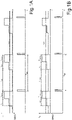
- Figure 1A shows the plot of the current consumption I c in an inertial system due to an accelerometer sensor, where, during each ODR period (denoted with T ODR ), the following consecutive intervals are present: a first 'OFF' interval (denoted with T OFF ), a subsequent settling interval (denoted with T SET ) and a final measurement interval (denoted with T MEAS ), after which motion data are ready at the output (as denoted by the corresponding data ready interrupt signal DRDY).
- Figure 1B shows the plot of the current consumption in the inertial system due to a gyroscope sensor, where, during each ODR period T ODR , the following consecutive intervals are present: a first 'SLEEP' interval (denoted with T SLEEP ), the subsequent settling interval (denoted again with T SET ) and the final measurement interval (denoted again with T MEAS ).
- the duration of the above discussed time intervals is set by design, according to the characteristics of the sensors and the application, so that also the output data rate interval (T ODR ) is fixed and set by design.
- DERUNGS Adrian et al. "Motion-adaptive duty-cycling to estimate orientation using inertial sensors", 2014 IEEE International Conference on Pervasive Computing and Communication Workshops (PERCOM WORKSHOPS), pages 47 - 54, DOI: 10.1109/PerComW.2014.6815163 , discloses a motion-adaptive duty-cycling approach to estimate orientation using inertial sensors.
- a proportional forward-controller adjusts the duty-cycle of inertial sensing units (IMU) and the orientation estimation update rate of an extended Kalman filter (EKF).
- IMU inertial sensing units
- EKF extended Kalman filter
- inertial measurement system allowing to generate inertial data (e.g. for implementing a pointer function in a digital-pen-like device) minimizing current consumption preserving data accuracy and reliability and thus the user experience.
- the aim of the present solution is to satisfy, at least in part, the above need.
- Figure 2 shows an inertial measurement system 1, comprising at least one inertial sensor 2, e.g. a MEMS accelerometer or a gyroscope tri-axial sensor (or both accelerometer and gyroscope sensors, in case of a 6x inertial measurement system) and an associated control unit 4, e.g. a microcontroller unit (or a microprocessor unit or any other suitable computing or processing unit).
- inertial sensor 2 e.g. a MEMS accelerometer or a gyroscope tri-axial sensor (or both accelerometer and gyroscope sensors, in case of a 6x inertial measurement system)
- control unit 4 e.g. a microcontroller unit (or a microprocessor unit or any other suitable computing or processing unit).
- the inertial sensor 2 comprises:
- the micromechanical structure 2a and the associated electronic circuitry 2b receive a biasing signal Val, e.g. from a power supply source, e.g. a battery (here not shown); in particular, the biasing signal is provided to the detection and actuation arrangements of the micromechanical structure 2a and to the reading and driving parts of the electronic circuit 2b.
- a biasing signal Val e.g. from a power supply source, e.g. a battery (here not shown)
- the biasing signal is provided to the detection and actuation arrangements of the micromechanical structure 2a and to the reading and driving parts of the electronic circuit 2b.
- the control unit 4 is configured to activate a power-down mode, with reduced power consumption, wherein biasing of the micromechanical structure 2a and of at least part of the associated electronic circuitry 2b is turned off.
- control unit 4 is configured to implement an automatic power mode switching of the inertial sensor 2 of the same inertial measurement system 1.
- a time frame division of each output-data-rate (ODR) period is not fixed by design, as in known solutions, but is instead determined by the control unit 4 during operation of the inertial measurement system 1, dynamically and adaptively based on checks performed related to the measured motion data.
- the output-data-rate (ODR) period is again divided in distinct phases or time intervals, namely: a first phase, during which the inertial sensor 2 is operated with a reduced power consumption (as will be discussed hereinafter, however, in this case, this first phase is always an 'OFF' phase, for any kind of inertial sensor 2, i.e. both for passive and for active sensors); a second phase, the "settling" phase; and a third phase, the "measuring" phase, during which measurement of the quantities to be detected is performed in order to generate motion data to be provided at the output.
- a fourth phase is introduced, after the "measurement” phase, a so-called “check” phase, during which the control unit 4 performs one or more checks related to the quality and reliability of the measured data (these checks are denoted, in general, as a “sanity check” in the following).
- the control unit 4 dynamically and adaptively adjust the output data rate of the inertial measurement system 1.
- a further measurement phase is performed, followed by a further "check" phase, where the sanity check related to the further measured data is performed. This process is iteratively repeated, until the sanity check is passed (i.e. is determined to be satisfactory), so that the measurement data are provided at the output.
- Figure 3A shows a time frame division of the ODR period of an inertial sensor 2 (e.g. an accelerometer or a gyroscope sensor) of the inertial measurement system 1, in the case in which the sanity check performed by the control unit 4 is successful, and particularly the corresponding current consumption I c for the inertial measurement system 1.
- an inertial sensor 2 e.g. an accelerometer or a gyroscope sensor
- the ODR period is in this case divided in the following consecutive intervals: a first 'OFF' interval (denoted again with T OFF ); a subsequent settling interval (denoted again with T SET ); a measurement interval (denoted again with T MEAS ); and a subsequent check interval (denoted with T CHECK ), during which the sanity of the measured data is checked.
- the sanity check is successful, so that motion data are provided at the output of the inertial measurement system 1 (e.g. a "data-ready" interrupt signal is generated); the 'check' interval is therefore immediately followed by a subsequent 'OFF' interval of a next ODR period.
- Figure 3B shows a time frame division of the ODR period (and the corresponding current consumption I C for the inertial measurement system 1), in the case in which a first sanity check performed by the control unit 4 is not successful.
- the second sanity check is successful, so that the measured motion data are provided at the output of the inertial measurement system 1; the second 'check' interval is therefore immediately followed by a subsequent 'OFF' interval of the next ODR period.
- the control unit 4 has therefore adaptively adjusted the output data rate period (T ODR ) based on the measured data, in particular increasing the duration of the same output data rate period T ODR to account for the further measurement and check intervals.
- the discussed adaptive ODR period approach merges the need to reduce device current consumption with the capability to maximize quality of the user experience (e.g. in terms of the accuracy and reliability of the measured data).
- the first phase of the ODR period corresponds to an 'OFF' phase (with minimum power consumption, due substantially only to leakage effects) independently of the type of inertial sensor 2, i.e. both in the case of inertial sensors 2 having a passive micromechanical structure 2a (e.g. accelerometer sensors) and in the case of inertial sensors 2 having an active micromechanical structure 2a (e.g. gyroscope sensors).
- the micromechanical structure 2a e.g. the oscillating resonant mass of a gyroscope sensor
- the associated electronic circuitry 2b of the inertial sensor 2 are turned off.
- the present Applicant has realized, with tests and simulations, that, on average, two, at most three, consecutive measurement and check phases are required to pass the sanity check and provide reliable data at the output of the inertial measurement system 1.
- the ODR period is in any case generally much lower than the time interval required for the active parts of the micromechanical structure 2a (e.g. the resonant oscillating mass of a gyroscope sensor) to completely stop the corresponding movements after turn off.
- the time required to the micromechanical structure 2a to return to the desired motion state is generally small, thanks to the residual movement in any case present at the end of the 'OFF' phase.
- the above discussed sanity check is a control procedure implemented by the control unit 4 able to guarantee that motion data are generated when the following conditions are satisfied:
- Passing of the sanity check which directly controls the adaptive adjustment of the ODR period (as previously discussed), thus allows to guarantee that the motion data (e.g. to be used for pointer calculations) are generated with minimum current consumption but also with the correct and desired integrity level.
- control unit 4 is further configured to evaluate a motion quantity detected by the inertial sensor(s) 2 of the inertial measurement system 1 and, based on the evaluated motion quantity, to adaptively and dynamically adjust the duration of the 'OFF' phase (i.e. of the first interval of the ODR period).
- control unit 4 is configured to evaluate the motion quantity based on the motion data that have passed the above discussed sanity check (in a current and in one or more of the previous ODR periods) and to implement: a first duration of the 'OFF' phase (of a next ODR period), in case the motion quantity is lower than a certain threshold (e.g. being indicative of a quiet condition for the inertial measurement system 1 and the associated electronic device); or a second duration, lower than the first duration, in case the motion quantity is higher than a respective threshold (that may or may not be equal than the above certain threshold).
- a certain threshold e.g. being indicative of a quiet condition for the inertial measurement system 1 and the associated electronic device
- second duration lower than the first duration, in case the motion quantity is higher than a respective threshold (that may or may not be equal than the above certain threshold).
- Adaptive adjustment of the 'OFF' phase therefore allows in the first case to further reduce the current consumption, and in the second case to more closely follow the movements to be detected, thereby preserving the desired detection quality and user experience.
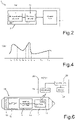
- Figure 4 shows a plot indicative of the detected motion quantity (i.e. of the variation of the detected motion data over time or, in other words, of the detection signal S det ), where t i denotes the times at which motion data that have passed the sanity check are provided at the output, at the end of respective ODR periods.
- a first duration of the 'OFF' phase is applied, since the motion quantity is determined to be higher than the threshold; instead, in the interval from t9 to t11, the duration of the 'OFF' phase is adaptively increased by the control unit 4, due to the fact that the motion quantity is determined to be lower than the threshold, thus determining a corresponding increase of the ODR period.
- the ODR period is adaptively adjusted by the control unit 4 in the intervals from t1 to t2 and from t3 to t4 (i.e. for motion data generated at times t2 and t4), in this case due to the above discussed sanity check determining one further measurement phase to output the motion data.
- control unit 4 is configured to compare the motion data (that have passed the sanity check) at each time t(i) with the motion data outputted at the previous time t(i-1), in order to evaluate the motion quantity, e.g. according to the following expression: Data t i ⁇ Data t i ⁇ 1 > Th where Th is a desired motion threshold.
- the first duration of the 'OFF' phase is applied; instead, if the above expression is not verified, the duration of the 'OFF' phase is suitably increased.
- control unit 4 determines the motion quantity, e.g. envisaging evaluation of the variance of the detected motion data, the average, the maximum or minimum of the same motion data in a given time interval and so on.
- Figure 5A shows a time frame division of the ODR period, in the case in which the control unit 4 determines that the motion quantity is higher than the threshold, thereby implementing a first duration for the 'OFF' phase (again denoted as T OFF ), after the motion data have passed the sanity check at time t2 and therefore are provided at the output of the inertial measurement system 1 (it should be noted that the example refers to a situation in which the detected motion data pass the sanity check, so that no further measurement phases are required).
- the same duration for the 'OFF' phase is implemented for motion data generated at time t3, as the one applied for generation of the motion data at previous times t1 and t2.
- Figure 5B shows instead a time frame division of the ODR period, in the case in which the control unit 4 determines that the motion quantity is lower than the threshold, e.g. being indicative of a quiet motion, thereby implementing an increased duration for the 'OFF' phase (here denoted as T OFF_quiet ), higher than the first duration T OFF , after the motion data have passed the sanity check at time t2 (also in this example, the detected motion data pass the sanity check, so that no further measurement phases are required).
- T OFF_quiet an increased duration for the 'OFF' phase
- an increased duration for the 'OFF' phase (T OFF-quiet > T OFF ) is implemented for motion data generated at time t3, with respect to the one applied for generation of the motion data at previous times t1 and t2.
- Figure 6 schematically shows a portable or wearable electronic device 10, in particular a digital-pen-like device, which comprises, within a case or housing 10' thereof, the inertial measurement system 1, including, as previously discussed, the inertial sensor 2 and the associated control unit 4.
- the electronic device 10 further comprises: a management module 12, e.g. including a microcontroller, a microprocessor or any other suitable computing unit, coupled to the inertial measurement system 1 to receive the generated motion-detection signal S det indicative of the detected motion and configured to process the motion-detection signal S det e.g. for determining displacement of the same electronic device 10 between a current and a previous position and generate corresponding displacement data; and a data transmission module 14, e.g. a Bluetooth Low-Energy (BLE) module, coupled to the management module 12 and operable to send wirelessly data packet, e.g. including the displacement data, to a host apparatus, here shown schematically and denoted with 20, to which the electronic device 1 is communicatively coupled.
- a management module 12 e.g. including a microcontroller, a microprocessor or any other suitable computing unit, coupled to the inertial measurement system 1 to receive the generated motion-detection signal S det indicative of the detected motion and configured to
- the electronic device 10 further comprises a battery unit 16, configured to provide a power supply to all components of the same electronic device 10, namely the inertial measurement system 1 (in particular providing the biasing signal Val to the micromechanical structure 2a and the associated electronic circuitry 2b of the same inertial sensor 2), the management module 12 and the transmission module 14.
- the inertial measurement system 1 in particular providing the biasing signal Val to the micromechanical structure 2a and the associated electronic circuitry 2b of the same inertial sensor 2
- the management module 12 the transmission module 14.
- the above components of the electronic device 1 may be coupled to a same circuit board (e.g. a PCB - Printed Circuit Board) 18, housed within the casing 10' of the electronic device 10.
- a same circuit board e.g. a PCB - Printed Circuit Board
- management module 12 of the electronic device 10 may also implement the above discussed control unit 4 of the inertial measurement system 1, or may be distinct and operatively coupled to the same control unit 4.
- the inertial measurement system 1 may be entirely implemented in the ASIC circuit.
- the host apparatus 20 may comprise: a respective communication interface 24, designed to communicate with the data transmission module 14 of the electronic device 10, e.g. via the Bluetooth Low Energy data communication; a main controller 26, e.g. a microprocessor unit; and a display 28, defining a screen frame, on which movement of a cursor or other similar displayed element is controlled by the main controller 26.
- a respective communication interface 24 designed to communicate with the data transmission module 14 of the electronic device 10, e.g. via the Bluetooth Low Energy data communication
- a main controller 26 e.g. a microprocessor unit
- a display 28 defining a screen frame, on which movement of a cursor or other similar displayed element is controlled by the main controller 26.
- the electronic device 10 may provide displacement information to the main controller 26 of the host apparatus 20, which is configured to control the movement of the cursor or other similar displayed element on the display 28 according to the same displacement information (the electronic device 1 implementing an "air pointer" device).
- the inertial measurement system 1 allows to achieve a very low power consumption, in particular implementing adaptive adjustment of output data rates while maintaining a desired performance in terms of motion detection.
- the inertial measurement system 1 provides a high flexibility and configurability in terms of power mode switching of the inertial sensor 2 and checks related to the detected motion data, leading to an improved user experience with respect to known solutions.
- the present solution may be advantageously applied not only to digital-pen-like devices, but to any kind of electronic device where both requirements of low power consumption and improved user experience have to be satisfied.
Landscapes
- Engineering & Computer Science (AREA)
- Theoretical Computer Science (AREA)
- General Engineering & Computer Science (AREA)
- Physics & Mathematics (AREA)
- General Physics & Mathematics (AREA)
- Radar, Positioning & Navigation (AREA)
- Remote Sensing (AREA)
- Human Computer Interaction (AREA)
- Automation & Control Theory (AREA)
- Gyroscopes (AREA)
- Telephone Function (AREA)
Description
- The present solution relates to an inertial measurement system with smart power mode management and to a corresponding smart power mode management method.
- Inertial measurement systems are known, including one or more inertial, or motion, sensors (for example a tri-axial accelerometer and a tri-axial gyroscope, in the case of so-called 6x, or 6 degrees of freedom - dof, inertial measurement systems) and an associated control unit, controlling operation of the inertial sensors and interfacing with an associated external electronic device (for example a portable or wearable electronic device).
- In particular, inertial measurement systems are known where the inertial sensors are made with MEMS (Micro Electro Mechanical System) technology, comprising: a micromechanical structure including at least one inertial mass, a detection arrangement, e.g. formed by detection electrodes, coupled to the inertial mass to generate at least one motion quantity in response to movements of the inertial mass, e.g. along three axes of an associated reference system (in the case of tri-axial sensors), and possibly an actuation arrangement (in case of active micromechanical structures, like in gyroscope sensors), e.g. including actuation electrodes; and an associated electronic circuitry (so called ASIC - Application Specific Integrated Circuit), coupled to the micromechanical structure and including a reading or processing part configured to process the motion quantity generated by the same micromechanical structure and generate at the output a detection signal indicative of the detected motion (e.g. an acceleration signal in the case of an accelerometer sensor, or an angular-rate signal in the case of a gyroscope sensor), and possibly (in case of active micromechanical structures) an actuation or driving part to provide suitable actuation signals to the actuation arrangement.
- The micromechanical structure may be made in a first die of semiconductor material, and the associated electronic processing circuit may be made in a second die of semiconductor material, and both the first and second dies may be housed in a same package of the inertial sensor.
- Inertial measurement systems are frequently used in electronic devices, for example of the portable (or hand-held) or wearable type, due to their reduced size occupation and power consumption.
- For example, digital (or smart) pen (or pencil or stylus) are portable digital-pen-like devices that are designed to be coupled to an electronic apparatus acting as a host apparatus (e.g. a tablet, a phablet, a smartphone, a laptop, a smart TV, a monitor, or the like) and may have several functions in addition to that of taking notes and making drawings.
- Those additional functions may include a pointing function, the digital-pen-like device in this case acting as an "air pointer", designed to implement a HID (Human Interface Device) pointer (or mouse) interface, or protocol, in order to generate displacement data (in particular, information associated with a displacements between a current and a previous position of the same digital-pen-like device) and send the displacement data to the host apparatus, to be translated in terms of screen-frame coordinates in a display of the same host apparatus. The host apparatus is thus able to move a displayed object (e.g. a cursor or similar element) on the screen-frame of the corresponding display based on the received displacement data.
- Digital-pen-like devices may therefore include an inertial measurement system, e.g. comprising an accelerometer and a gyroscope sensors, to monitor the movements of the same devices and allow implementation of the above defined "air-pointer" function and possibly of additional functions (such as gesture-recognition functions).
- As it is known, new generation hand-held devices, such as the above-discussed digital-pen-like devices, are required to have very small dimensions (with a so called ultra-slim design) with very stringent size constraints, and consequently have limited capabilities in terms of battery (a very low-power consumption is therefore required). Moreover, these devices have to meet desired requirements in terms of the user experience, including high accuracy and precision, reduced latency, smoothness, etc., in particular in case of implementation of the above discussed air-pointer function or of further advanced functions.
- In order to reduce power consumption, inertial measurement systems are known to implement a low power operating mode for the corresponding inertial sensors, with so-called power mode switching.
- In particular, each output-data-rate (ODR) period (i.e. the time interval between two consecutive outputs of inertial data from the inertial measurement system) is divided according to a time frame division approach in consecutive operating intervals or phases: a first time interval, during which the inertial sensor is operated with a reduced power consumption; a second time interval, so called "settling interval"; and a third time interval, so called "measuring interval", during which (after the system has suitably settled) measurement of the quantities to be detected is performed in order to generate the inertial data to be provided at the output (in a known manner, measurement may imply averaging a certain number of measures or samples to generate the measured data).
- In detail, in known solutions, the first time interval may correspond to an 'OFF' interval, where the inertial sensor is not powered (i.e. both the micromechanical structure and at least part of the associated electronic circuitry are not supplied) with near-zero current consumption (i.e. power consumption being limited only to leakage currents), such as in accelerometer sensors (or other sensors with passive micromechanical structures); or may correspond to a 'SLEEP' interval, with reduced power consumption (at least part of the micromechanical structure being biased in order to maintain its movement, while in the electronic circuitry the reading part being not supplied and the driving part being, at least partially, supplied), such as in gyroscope sensors (or other sensors where the micromechanical structure includes active parts, which are biased to perform an actuation movement, e.g. a resonant oscillating movement required for angular-rate detection in the case of gyroscope sensors).
- It is noted that the above-discussed sleep interval is required in order to reduce the power consumption and at the same time have a fast turn-on and settling time (due to the fact that both the driving part of the electronic circuitry and the active part of the micromechanical structure (e.g. an oscillating mass) are kept on, while the reading part of the same electronic circuitry is turned off.
- Moreover, the settling interval requires a power consumption that is higher than the OFF or SLEEP intervals, due to the fact that at least part of the micromechanical structure and/or the electronic circuitry is turned-on, in order to allow settling towards a regime condition.
- The measurement interval is performed with all the micromechanical structure and the electronic circuitry turned-on; this could require, in turn, a higher consumption than the settling interval.
- In this regard,
Figure 1A shows the plot of the current consumption Ic in an inertial system due to an accelerometer sensor, where, during each ODR period (denoted with TODR), the following consecutive intervals are present: a first 'OFF' interval (denoted with TOFF), a subsequent settling interval (denoted with TSET) and a final measurement interval (denoted with TMEAS), after which motion data are ready at the output (as denoted by the corresponding data ready interrupt signal DRDY). - In a corresponding manner,
Figure 1B shows the plot of the current consumption in the inertial system due to a gyroscope sensor, where, during each ODR period TODR, the following consecutive intervals are present: a first 'SLEEP' interval (denoted with TSLEEP), the subsequent settling interval (denoted again with TSET) and the final measurement interval (denoted again with TMEAS). - In the known inertial measurement systems, the duration of the above discussed time intervals is set by design, according to the characteristics of the sensors and the application, so that also the output data rate interval (TODR) is fixed and set by design.
- The present Applicant has realized that these known solutions may not be sufficient to guarantee the desired power consumption and user experience requirements of inertial measurement systems for next-generation portable or wearable devices, such as the above-discussed digital-pen-like devices.
- DERUNGS Adrian et al., "Motion-adaptive duty-cycling to estimate orientation using inertial sensors", 2014 IEEE International Conference on Pervasive Computing and Communication Workshops (PERCOM WORKSHOPS), pages 47 - 54, DOI: 10.1109/PerComW.2014.6815163, discloses a motion-adaptive duty-cycling approach to estimate orientation using inertial sensors. In particular, a proportional forward-controller adjusts the duty-cycle of inertial sensing units (IMU) and the orientation estimation update rate of an extended Kalman filter (EKF). During phases with low or no rotation motion, the disclosed approach can dynamically reduce the IMU operation to 20% of the regular rate.
- The need is therefore felt for an improved inertial measurement system, allowing to generate inertial data (e.g. for implementing a pointer function in a digital-pen-like device) minimizing current consumption preserving data accuracy and reliability and thus the user experience.
- The aim of the present solution is to satisfy, at least in part, the above need.
- According to the present solution, an inertial measurement system and a corresponding method are consequently provided, as defined in the appended claims.
- For a better understanding of the present invention,
- preferred embodiments thereof are now described, purely by way of non-limiting examples and with reference to the attached drawings, wherein:
-
Figures 1A-1B show plots of quantities related to a known inertial measurement system; -
Figure 2 is a schematic block diagram of an inertial measurement system, according to an embodiment of the present solution; -
Figures 3A-3B show plots of quantities related to the current consumption of the inertial measurement system ofFigure 2 ; -
Figure 4 shows a plot indicative of a detected quantity of motion (or motion quantity) in the inertial measurement system ofFigure 2 and of a corresponding data generation interval; -
Figures 5A-5B show further plots of quantities related to the current consumption of the inertial measurement system ofFigure 2 , according to a further embodiment thereof; and -
Figure 6 is a schematic block diagram of a system comprising an electronic device, e.g. a digital-pen-like device, incorporating the inertial measurement system ofFigure 2 and an associated host electronic apparatus. -
Figure 2 shows aninertial measurement system 1, comprising at least oneinertial sensor 2, e.g. a MEMS accelerometer or a gyroscope tri-axial sensor (or both accelerometer and gyroscope sensors, in case of a 6x inertial measurement system) and an associated control unit 4, e.g. a microcontroller unit (or a microprocessor unit or any other suitable computing or processing unit). - In particular, and as previously discussed, the
inertial sensor 2 comprises: - a
micromechanical structure 2a including, in case of "passive" structures, at least one inertial mass and an associated detection arrangement coupled to the inertial mass to generate at least one motion quantity in response to movements of the inertial mass; and, moreover, in case of "active" structures, an actuation arrangement coupled to the same inertial mass (or to a further mass or element) to cause its movement according to the received driving signals; and - an associated
electronic circuitry 2b (ASIC), coupled to themicromechanical structure 2a and including a reading part configured to process the motion quantity generated by themicromechanical structure 2a and generate at the output at least one detection signal Sdet indicative of the detected motion, and moreover, in case of active structures, a driving part to provide suitable driving signals Sdr to the actuation arrangement of the samemicromechanical structure 2a. - As shown schematically, the
micromechanical structure 2a and the associatedelectronic circuitry 2b receive a biasing signal Val, e.g. from a power supply source, e.g. a battery (here not shown); in particular, the biasing signal is provided to the detection and actuation arrangements of themicromechanical structure 2a and to the reading and driving parts of theelectronic circuit 2b. - The control unit 4 is configured to activate a power-down mode, with reduced power consumption, wherein biasing of the
micromechanical structure 2a and of at least part of the associatedelectronic circuitry 2b is turned off. - As will be discussed in detail in the following, according to an aspect of the present solution, the control unit 4 is configured to implement an automatic power mode switching of the
inertial sensor 2 of the sameinertial measurement system 1. In other words, a time frame division of each output-data-rate (ODR) period is not fixed by design, as in known solutions, but is instead determined by the control unit 4 during operation of theinertial measurement system 1, dynamically and adaptively based on checks performed related to the measured motion data. - In particular, the output-data-rate (ODR) period is again divided in distinct phases or time intervals, namely: a first phase, during which the
inertial sensor 2 is operated with a reduced power consumption (as will be discussed hereinafter, however, in this case, this first phase is always an 'OFF' phase, for any kind ofinertial sensor 2, i.e. both for passive and for active sensors); a second phase, the "settling" phase; and a third phase, the "measuring" phase, during which measurement of the quantities to be detected is performed in order to generate motion data to be provided at the output. - According to an aspect of the present solution, a fourth phase is introduced, after the "measurement" phase, a so-called "check" phase, during which the control unit 4 performs one or more checks related to the quality and reliability of the measured data (these checks are denoted, in general, as a "sanity check" in the following).
- Based on the sanity check, the control unit 4 dynamically and adaptively adjust the output data rate of the
inertial measurement system 1. In particular, in case the sanity check is not passed (or is not satisfactory), a further measurement phase is performed, followed by a further "check" phase, where the sanity check related to the further measured data is performed. This process is iteratively repeated, until the sanity check is passed (i.e. is determined to be satisfactory), so that the measurement data are provided at the output. -
Figure 3A shows a time frame division of the ODR period of an inertial sensor 2 (e.g. an accelerometer or a gyroscope sensor) of theinertial measurement system 1, in the case in which the sanity check performed by the control unit 4 is successful, and particularly the corresponding current consumption Ic for theinertial measurement system 1. - In detail, the ODR period is in this case divided in the following consecutive intervals: a first 'OFF' interval (denoted again with TOFF); a subsequent settling interval (denoted again with TSET); a measurement interval (denoted again with TMEAS); and a subsequent check interval (denoted with TCHECK), during which the sanity of the measured data is checked.
- In this example, the sanity check is successful, so that motion data are provided at the output of the inertial measurement system 1 (e.g. a "data-ready" interrupt signal is generated); the 'check' interval is therefore immediately followed by a subsequent 'OFF' interval of a next ODR period.
- In this case, the current consumption during the 'OFF' interval is nearly zero, being due substantially to leakage effects.
-
Figure 3B shows a time frame division of the ODR period (and the corresponding current consumption IC for the inertial measurement system 1), in the case in which a first sanity check performed by the control unit 4 is not successful. - In this case, after the first 'check' interval, the following further phases are implemented: a further 'measurement' phase; and a subsequent further 'check' phase, during which the sanity of the new measured data is checked.
- In this case, the second sanity check is successful, so that the measured motion data are provided at the output of the
inertial measurement system 1; the second 'check' interval is therefore immediately followed by a subsequent 'OFF' interval of the next ODR period. - The control unit 4 has therefore adaptively adjusted the output data rate period (TODR) based on the measured data, in particular increasing the duration of the same output data rate period TODR to account for the further measurement and check intervals.
- The discussed adaptive ODR period approach merges the need to reduce device current consumption with the capability to maximize quality of the user experience (e.g. in terms of the accuracy and reliability of the measured data).
- It is again underlined that, according to an aspect of the present solution, the first phase of the ODR period corresponds to an 'OFF' phase (with minimum power consumption, due substantially only to leakage effects) independently of the type of
inertial sensor 2, i.e. both in the case ofinertial sensors 2 having a passivemicromechanical structure 2a (e.g. accelerometer sensors) and in the case ofinertial sensors 2 having an activemicromechanical structure 2a (e.g. gyroscope sensors). In particular, during the 'OFF' phase, themicromechanical structure 2a (e.g. the oscillating resonant mass of a gyroscope sensor) and the associatedelectronic circuitry 2b of theinertial sensor 2 are turned off. - It is underlined that the above feature is possible due to the presence of the discussed sanity check, that allows discarding measurements in case the settling phase is not sufficient for the
micromechanical structure 2a andelectronic circuitry 2b to settle to a regime condition, after turn-off. - The present Applicant has realized, with tests and simulations, that, on average, two, at most three, consecutive measurement and check phases are required to pass the sanity check and provide reliable data at the output of the
inertial measurement system 1. - Indeed, this is due to the fact that the ODR period is in any case generally much lower than the time interval required for the active parts of the
micromechanical structure 2a (e.g. the resonant oscillating mass of a gyroscope sensor) to completely stop the corresponding movements after turn off. In other words, the time required to themicromechanical structure 2a to return to the desired motion state is generally small, thanks to the residual movement in any case present at the end of the 'OFF' phase. - In more details, the above discussed sanity check is a control procedure implemented by the control unit 4 able to guarantee that motion data are generated when the following conditions are satisfied:
- the
micromechanical structure 2a of theinertial sensor 2 is correctly operating, at a regime condition (for example, the resonant oscillating movement of the gyroscope mass has the expected properties); and - the
electronic circuitry 2b and the related signal processing and driving chains are settled to the desired operating conditions. - Passing of the sanity check, which directly controls the adaptive adjustment of the ODR period (as previously discussed), thus allows to guarantee that the motion data (e.g. to be used for pointer calculations) are generated with minimum current consumption but also with the correct and desired integrity level.
- According to a further aspect of the present solution, the control unit 4 is further configured to evaluate a motion quantity detected by the inertial sensor(s) 2 of the
inertial measurement system 1 and, based on the evaluated motion quantity, to adaptively and dynamically adjust the duration of the 'OFF' phase (i.e. of the first interval of the ODR period). - In particular, the control unit 4 is configured to evaluate the motion quantity based on the motion data that have passed the above discussed sanity check (in a current and in one or more of the previous ODR periods) and to implement: a first duration of the 'OFF' phase (of a next ODR period), in case the motion quantity is lower than a certain threshold (e.g. being indicative of a quiet condition for the
inertial measurement system 1 and the associated electronic device); or a second duration, lower than the first duration, in case the motion quantity is higher than a respective threshold (that may or may not be equal than the above certain threshold). - It is noted that it may be possible to implement more durations with respective associated thresholds, or even a continuous function providing the duration of the 'OFF' phase based on the detected motion quantity.
- Adaptive adjustment of the 'OFF' phase therefore allows in the first case to further reduce the current consumption, and in the second case to more closely follow the movements to be detected, thereby preserving the desired detection quality and user experience.
- In this regard,
Figure 4 shows a plot indicative of the detected motion quantity (i.e. of the variation of the detected motion data over time or, in other words, of the detection signal Sdet), where ti denotes the times at which motion data that have passed the sanity check are provided at the output, at the end of respective ODR periods. - In the interval from t1 to t9, a first duration of the 'OFF' phase is applied, since the motion quantity is determined to be higher than the threshold; instead, in the interval from t9 to t11, the duration of the 'OFF' phase is adaptively increased by the control unit 4, due to the fact that the motion quantity is determined to be lower than the threshold, thus determining a corresponding increase of the ODR period.
- It is also noted in the same plot that the ODR period is adaptively adjusted by the control unit 4 in the intervals from t1 to t2 and from t3 to t4 (i.e. for motion data generated at times t2 and t4), in this case due to the above discussed sanity check determining one further measurement phase to output the motion data.
- In a possible embodiment, the control unit 4 is configured to compare the motion data (that have passed the sanity check) at each time t(i) with the motion data outputted at the previous time t(i-1), in order to evaluate the motion quantity, e.g. according to the following expression:

- If the above expression is verified, the first duration of the 'OFF' phase is applied; instead, if the above expression is not verified, the duration of the 'OFF' phase is suitably increased.
- It is underlined, however, that other possible solutions may be implemented by the control unit 4 to determine the motion quantity, e.g. envisaging evaluation of the variance of the detected motion data, the average, the maximum or minimum of the same motion data in a given time interval and so on.
-
Figure 5A shows a time frame division of the ODR period, in the case in which the control unit 4 determines that the motion quantity is higher than the threshold, thereby implementing a first duration for the 'OFF' phase (again denoted as TOFF), after the motion data have passed the sanity check at time t2 and therefore are provided at the output of the inertial measurement system 1 (it should be noted that the example refers to a situation in which the detected motion data pass the sanity check, so that no further measurement phases are required). - In other words, in the example, the same duration for the 'OFF' phase is implemented for motion data generated at time t3, as the one applied for generation of the motion data at previous times t1 and t2.
-
Figure 5B shows instead a time frame division of the ODR period, in the case in which the control unit 4 determines that the motion quantity is lower than the threshold, e.g. being indicative of a quiet motion, thereby implementing an increased duration for the 'OFF' phase (here denoted as TOFF_quiet), higher than the first duration TOFF, after the motion data have passed the sanity check at time t2 (also in this example, the detected motion data pass the sanity check, so that no further measurement phases are required). - In other words, in the example, an increased duration for the 'OFF' phase (TOFF-quiet > TOFF) is implemented for motion data generated at time t3, with respect to the one applied for generation of the motion data at previous times t1 and t2.
- As previously discussed, increasing the 'OFF' time allows to obtain a reduced average current consumption IAVG2 (with respect to the average current consumption denoted with IAVG1 in
Figure 5A ), due to the longer duration of the turn-off condition of theinertial sensor 2. Decreasing instead the 'OFF' time allows to more closely monitor the motion data and thus increase the accuracy of detection. -
Figure 6 schematically shows a portable or wearableelectronic device 10, in particular a digital-pen-like device, which comprises, within a case or housing 10' thereof, theinertial measurement system 1, including, as previously discussed, theinertial sensor 2 and the associated control unit 4. - The
electronic device 10 further comprises: amanagement module 12, e.g. including a microcontroller, a microprocessor or any other suitable computing unit, coupled to theinertial measurement system 1 to receive the generated motion-detection signal Sdet indicative of the detected motion and configured to process the motion-detection signal Sdet e.g. for determining displacement of the sameelectronic device 10 between a current and a previous position and generate corresponding displacement data; and adata transmission module 14, e.g. a Bluetooth Low-Energy (BLE) module, coupled to themanagement module 12 and operable to send wirelessly data packet, e.g. including the displacement data, to a host apparatus, here shown schematically and denoted with 20, to which theelectronic device 1 is communicatively coupled. - The
electronic device 10 further comprises abattery unit 16, configured to provide a power supply to all components of the sameelectronic device 10, namely the inertial measurement system 1 (in particular providing the biasing signal Val to themicromechanical structure 2a and the associatedelectronic circuitry 2b of the same inertial sensor 2), themanagement module 12 and thetransmission module 14. - As shown schematically, the above components of the
electronic device 1 may be coupled to a same circuit board (e.g. a PCB - Printed Circuit Board) 18, housed within the casing 10' of theelectronic device 10. - It is noted that the
management module 12 of theelectronic device 10 may also implement the above discussed control unit 4 of theinertial measurement system 1, or may be distinct and operatively coupled to the same control unit 4. - According to a possible embodiment, the
inertial measurement system 1 may be entirely implemented in the ASIC circuit. - As shown in the same
Figure 6 thehost apparatus 20, for example a smartphone, a phablet or a tablet, may comprise: arespective communication interface 24, designed to communicate with thedata transmission module 14 of theelectronic device 10, e.g. via the Bluetooth Low Energy data communication; amain controller 26, e.g. a microprocessor unit; and adisplay 28, defining a screen frame, on which movement of a cursor or other similar displayed element is controlled by themain controller 26. - The
electronic device 10 may provide displacement information to themain controller 26 of thehost apparatus 20, which is configured to control the movement of the cursor or other similar displayed element on thedisplay 28 according to the same displacement information (theelectronic device 1 implementing an "air pointer" device). - The advantages of the disclosed solution are clear from the foregoing description.
- In any case, it is again underlined that the
inertial measurement system 1 allows to achieve a very low power consumption, in particular implementing adaptive adjustment of output data rates while maintaining a desired performance in terms of motion detection. - The
inertial measurement system 1 provides a high flexibility and configurability in terms of power mode switching of theinertial sensor 2 and checks related to the detected motion data, leading to an improved user experience with respect to known solutions. - It is thus possible to meet power consumption and performance requirements for portable or wearable electronic devices 10 (e.g. digital-pen-like devices implementing air pointer functions and/or additional functions, e.g. gesture recognition functions) that incorporate the same
inertial measurement system 1. - Finally, it is clear that modifications and variations may be made to what has been described and illustrated herein, without thereby departing from the scope of the present invention, as defined in the annexed claims.
- In particular, it is again underlined that different and/or further motion sensors can be included in the
inertial measurement system 1, to generate at the output the detection signals Sdet. - Moreover, it is again underlined that the present solution may be advantageously applied not only to digital-pen-like devices, but to any kind of electronic device where both requirements of low power consumption and improved user experience have to be satisfied.
Claims (18)
- An inertial measurement system (1), comprising:at least one motion sensor (2) configured to output motion data with an output data rate - ODR - period (TODR) ; anda control unit (4) coupled to the motion sensor (2) and configured to control operation thereof based on a power mode switching, according to which each ODR period (TODR) comprises: a first phase (TOFF), in which the motion sensor (2) is controlled in a condition of low power consumption; and a subsequent measurement phase (TMEAS), in which the motion sensor (2) is controlled to perform measurements for generation of measurement data,characterized in that the control unit (4) is configured to adaptively adjust the duration of the ODR period (TODR) based on at least one check related to the measurement data generated during the measurement phase (TMEAS),and wherein each ODR period (TODR) further comprises: at least one check phase (TCHK) subsequent to the measurement phase (TMEAS) and designed to perform the at least one check related to the measurement data generated during said measurement phase; and at least one further measurement phase (TCHK) following the check phase (TCHK), in case the check phase (TCHK) is not successful.
- The inertial measurement system according to claim 1, wherein the control unit (4) is configured to control the motion sensor (2) to output, as the motion data, and thus end the ODR period (TODR), the measurement data generated in the measurement phase (TMEAS) if the check phase (TCHK) is successful; or the measurement data generated in the at least one further measurement phase (TMEAS), if a further check phase (TCHK) subsequent to the further measurement phase (TMEAS) is successful.
- The inertial measurement system according to claim 1 or 2, wherein, during the check phase (TCHK) the control unit (4) is configured to perform one or more checks related to the quality and reliability of the generated measurement data.
- The inertial measurement system according to claim 3, wherein the motion sensor (2) comprises a micromechanical structure (2a) and an associated electronic circuitry (2b); and wherein the one or more checks implemented by the control unit (4) are configured to guarantee that motion data are generated when the following conditions are satisfied:the micromechanical structure (2a) is correctly operating, at a regime condition; andthe electronic circuitry (2b) is settled to desired operating conditions.
- The inertial measurement system according to any of the preceding claims, wherein the control unit (4) is configured to adaptively adjust the duration of the first phase (TOFF) of the ODR period (TODR) based on evaluation of a motion quantity associated to the generated motion data.
- The inertial measurement system according to claim 5, wherein the control unit (4) is configured to: increase the duration of the first phase (TOFF) in case the evaluated motion quantity is below a motion threshold; and decrease the duration of the first phase (TOFF) in case the evaluated motion quantity is above a respective motion threshold.
- The inertial measurement system according to claim 5 or 6, wherein the control unit (4) is configured to evaluate the motion quantity based on processing of the motion data outputted at the end of a current ODR period and the motion data outputted at the end of at least one previous ODR period.
- The inertial measurement system according to any of the preceding claims, wherein the control unit (4) is configured to activate a power-down mode of the motion sensor (2) during the first phase (TOFF) of the ODR period (TODR), and to deactivate the power-down mode of the motion sensor (2) during the measurement phase (TMEAS) .
- The inertial system according to any of the preceding claims, wherein each ODR period (TODR) further comprises a settling phase (TSET), intermediate between the first phase (TOFF) and the measurement phase (TMEAS), in which the motion sensor (2) is controlled so as to settle towards a regime condition.
- The inertial system according to any of the preceding claims, wherein the motion sensor (2) is a gyroscope sensor; and
further comprising at least one further motion sensor (2) being an accelerometer sensor. - A portable or wearable electronic device (10) comprising: an inertial measurement system (1) according to any of the preceding claims; and a management module (12), coupled to the inertial measurement system (1) configured to receive and process the motion data generated at output of the inertial measurement system (1).
- The electronic device according to claim 11, being a digital-pen-like device, wherein the management module (12) is configured to process the motion data generated at output of the inertial measurement system (1) for determining displacement of the electronic device (10) between a current and a previous positions and generate corresponding displacement data; and
further comprising a data transmission module (14), coupled to the management module (12) and operable to send wirelessly the displacement data to a host apparatus (20). - An electronic system comprising the electronic device (10) according to claim 12 and a coupled host apparatus (20), wherein the host apparatus (20) comprises a communication interface (24), configured to communicate with the electronic device (10) and receive the displacement data; a main controller (26); and a display (28), defining a screen frame; wherein the main controller (26) is configured to control movement of a displayed element in the screen frame according to the displacement data received from the electronic device (10).
- A power mode management method in an inertial measurement system (1) comprising at least one motion sensor (2) configured to output motion data with an output data rate - ODR - period (TODR), the method comprising:controlling operation of the motion sensor (2) based on a power mode switching, according to which each ODR period (TODR) comprises: a first phase (TOFF), in which the motion sensor (2) is controlled in a condition of low power consumption; and a subsequent measurement phase (TMEAS), in which the motion sensor (2) is controlled to perform measurements for generation of measurement data,characterized by adaptively adjusting the duration of the ODR period (TODR) based on at least one check related to the measurement data generated during the measurement phase (TMEAS),wherein each ODR period (TODR) further comprises: at least one check phase (TCHK) subsequent to the measurement phase (TMEAS) and designed to perform the at least one check related to the measurement data generated during the measurement phase (TMEAS) ; and at least one further measurement phase (TMEAS) following the check phase (TCHK), in case the check phase (TCHK) is not successful.
- The method according to claim 14, wherein adaptively adjusting the duration of the ODR period (TODR) comprises controlling the motion sensor (2) to output, as the motion data, and thus end the ODR period (TODR), the measurement data generated in the measurement phase (TMEAS), if the check phase (TCHK) is successful; or the measurement data generated in the at least one further measurement phase (TMEAS), if a further check phase (TCHK) subsequent to the further measurement phase (TMEAS) is successful.
- The method according to claim 14 or 15, further comprising, during the check phase (TCHK), performing one or more checks related to the quality and reliability of the generated measurement data.
- The method according to any of claims 14-16, wherein adaptively adjusting the duration of the ODR period (TODR) comprises adjusting the duration of the first phase (TOFF) of the ODR period (TODR) based on evaluation of a motion quantity associated to the generated motion data.
- The method according to claim 17, wherein adjusting the duration comprises: increasing the duration of the first phase (TOFF) in case the evaluated motion quantity is below a motion threshold, and decreasing the duration of the first phase (TOFF) in case the evaluated motion quantity is above a respective motion threshold.
Applications Claiming Priority (1)
| Application Number | Priority Date | Filing Date | Title |
|---|---|---|---|
| IT102019000013434A IT201900013434A1 (en) | 2019-07-31 | 2019-07-31 | INERTIAL MEASURING SYSTEM WITH INTELLIGENT MANAGEMENT OF THE POWER MODE AND RELATIVE METHOD OF INTELLIGENT MANAGEMENT OF THE POWER MODE |
Publications (2)
| Publication Number | Publication Date |
|---|---|
| EP3771970A1 EP3771970A1 (en) | 2021-02-03 |
| EP3771970B1 true EP3771970B1 (en) | 2022-12-14 |
Family
ID=68988131
Family Applications (1)
| Application Number | Title | Priority Date | Filing Date |
|---|---|---|---|
| EP20188663.7A Active EP3771970B1 (en) | 2019-07-31 | 2020-07-30 | Inertial measurement system with smart power mode management and corresponding smart power mode management method |
Country Status (4)
| Country | Link |
|---|---|
| US (1) | US11543248B2 (en) |
| EP (1) | EP3771970B1 (en) |
| CN (1) | CN112394821B (en) |
| IT (1) | IT201900013434A1 (en) |
Families Citing this family (2)
| Publication number | Priority date | Publication date | Assignee | Title |
|---|---|---|---|---|
| IT202000001933A1 (en) | 2020-01-31 | 2021-07-31 | St Microelectronics Srl | ELECTRONIC POINTING DEVICE WITH RAPID RECOVERY IN START-UP AND CORRESPONDING METHOD |
| CN114185512B (en) * | 2021-11-01 | 2022-11-15 | 荣耀终端有限公司 | Sensor data processing method, electronic device and readable storage medium |
Family Cites Families (6)
| Publication number | Priority date | Publication date | Assignee | Title |
|---|---|---|---|---|
| JP2012026825A (en) * | 2010-07-22 | 2012-02-09 | Seiko Epson Corp | Sensing device and electronic apparatus |
| US20140351560A1 (en) * | 2013-05-24 | 2014-11-27 | Motorola Mobility Llc | Low Power Management of Multiple Sensor Integrated Chip Architecture |
| US9274644B2 (en) * | 2013-08-26 | 2016-03-01 | Atmel Corporation | Synchronization of active stylus and touch sensor |
| US9733731B2 (en) * | 2014-05-12 | 2017-08-15 | Atmel Corporation | Timing synchronization of active stylus and touch sensor |
| US9483129B1 (en) * | 2015-05-12 | 2016-11-01 | Atmel Corporation | Active stylus with fractional clock-cycle timing |
| US9696826B2 (en) * | 2015-06-30 | 2017-07-04 | Atmel Corporation | Stylus with low-power detector |
-
2019
- 2019-07-31 IT IT102019000013434A patent/IT201900013434A1/en unknown
-
2020
- 2020-07-17 US US16/932,526 patent/US11543248B2/en active Active
- 2020-07-30 EP EP20188663.7A patent/EP3771970B1/en active Active
- 2020-07-30 CN CN202010749633.8A patent/CN112394821B/en active Active
Also Published As
| Publication number | Publication date |
|---|---|
| EP3771970A1 (en) | 2021-02-03 |
| US20210033402A1 (en) | 2021-02-04 |
| IT201900013434A1 (en) | 2021-01-31 |
| US11543248B2 (en) | 2023-01-03 |
| CN112394821B (en) | 2025-11-07 |
| CN112394821A (en) | 2021-02-23 |
Similar Documents
| Publication | Publication Date | Title |
|---|---|---|
| KR102358217B1 (en) | Stylus tilt detection based on bidirectional communication between stylus and stylus sensor controller | |
| EP3318962B1 (en) | Stylus having variable transmit signal strength | |
| JP2025014065A (en) | pen | |
| KR102311051B1 (en) | Wearable watch and display method thereof | |
| US10194124B2 (en) | Projection type video display device and projection type video display method | |
| US10310593B2 (en) | Electronic mobile device | |
| EP3420437B1 (en) | Wireless positioning pen with pressure-sensitive tip | |
| EP3771970B1 (en) | Inertial measurement system with smart power mode management and corresponding smart power mode management method | |
| EP2887188A1 (en) | Control system for a gesture sensing arrangement and method for controlling a gesture sensing arrangement | |
| US11054917B2 (en) | Wearable device and control method, and smart control system | |
| US11249562B2 (en) | Pointing electronic device with fast start-up recovery and corresponding method | |
| JP6039588B2 (en) | Pointing method, device and system therefor | |
| US20230093866A1 (en) | Information processing device, information processing method, and program | |
| US20170160859A1 (en) | Dual-mode touch sensing method and stylus and touch panel for the same | |
| WO2017056891A1 (en) | Information processing device, electronic instrument, method of controlling information processing device, and control program | |
| EP2631742A2 (en) | Electronic device with a remote control | |
| US20170308190A1 (en) | Capacitive stylus with power saving apparatus | |
| CN116147756B (en) | Detection method and detection device for resonant frequency of linear motor | |
| CN111917959B (en) | Camera control method and device, storage medium and smart watch | |
| WO2025147571A1 (en) | Stylus three-dimensional trajectory prediction | |
| CN119718094A (en) | Accurate positioning method and device for spaced mouse | |
| KR20230037364A (en) | Electronic device including flexible display and method thereof | |
| KR20140147465A (en) | Circuit and method for controling of touch system | |
| KR20180102940A (en) | System for controlling remote based motion recognition |
Legal Events
| Date | Code | Title | Description |
|---|---|---|---|
| PUAI | Public reference made under article 153(3) epc to a published international application that has entered the european phase |
Free format text: ORIGINAL CODE: 0009012 |
|
| STAA | Information on the status of an ep patent application or granted ep patent |
Free format text: STATUS: THE APPLICATION HAS BEEN PUBLISHED |
|
| AK | Designated contracting states |
Kind code of ref document: A1 Designated state(s): AL AT BE BG CH CY CZ DE DK EE ES FI FR GB GR HR HU IE IS IT LI LT LU LV MC MK MT NL NO PL PT RO RS SE SI SK SM TR |
|
| AX | Request for extension of the european patent |
Extension state: BA ME |
|
| STAA | Information on the status of an ep patent application or granted ep patent |
Free format text: STATUS: REQUEST FOR EXAMINATION WAS MADE |
|
| 17P | Request for examination filed |
Effective date: 20210728 |
|
| RBV | Designated contracting states (corrected) |
Designated state(s): AL AT BE BG CH CY CZ DE DK EE ES FI FR GB GR HR HU IE IS IT LI LT LU LV MC MK MT NL NO PL PT RO RS SE SI SK SM TR |
|
| RIC1 | Information provided on ipc code assigned before grant |
Ipc: G01P 15/00 20060101ALI20220525BHEP Ipc: G01C 21/16 20060101ALI20220525BHEP Ipc: G06F 1/3234 20190101ALI20220525BHEP Ipc: G06F 1/3206 20190101ALI20220525BHEP Ipc: G06F 3/0346 20130101ALI20220525BHEP Ipc: G06F 3/0354 20130101AFI20220525BHEP |
|
| GRAP | Despatch of communication of intention to grant a patent |
Free format text: ORIGINAL CODE: EPIDOSNIGR1 |
|
| STAA | Information on the status of an ep patent application or granted ep patent |
Free format text: STATUS: GRANT OF PATENT IS INTENDED |
|
| INTG | Intention to grant announced |
Effective date: 20220706 |
|
| GRAS | Grant fee paid |
Free format text: ORIGINAL CODE: EPIDOSNIGR3 |
|
| GRAA | (expected) grant |
Free format text: ORIGINAL CODE: 0009210 |
|
| STAA | Information on the status of an ep patent application or granted ep patent |
Free format text: STATUS: THE PATENT HAS BEEN GRANTED |
|
| AK | Designated contracting states |
Kind code of ref document: B1 Designated state(s): AL AT BE BG CH CY CZ DE DK EE ES FI FR GB GR HR HU IE IS IT LI LT LU LV MC MK MT NL NO PL PT RO RS SE SI SK SM TR |
|
| REG | Reference to a national code |
Ref country code: GB Ref legal event code: FG4D |
|
| REG | Reference to a national code |
Ref country code: CH Ref legal event code: EP |
|
| REG | Reference to a national code |
Ref country code: IE Ref legal event code: FG4D |
|
| REG | Reference to a national code |
Ref country code: DE Ref legal event code: R096 Ref document number: 602020006891 Country of ref document: DE |
|
| REG | Reference to a national code |
Ref country code: AT Ref legal event code: REF Ref document number: 1538084 Country of ref document: AT Kind code of ref document: T Effective date: 20230115 |
|
| REG | Reference to a national code |
Ref country code: LT Ref legal event code: MG9D |
|
| REG | Reference to a national code |
Ref country code: NL Ref legal event code: MP Effective date: 20221214 |
|
| PG25 | Lapsed in a contracting state [announced via postgrant information from national office to epo] |
Ref country code: SE Free format text: LAPSE BECAUSE OF FAILURE TO SUBMIT A TRANSLATION OF THE DESCRIPTION OR TO PAY THE FEE WITHIN THE PRESCRIBED TIME-LIMIT Effective date: 20221214 Ref country code: NO Free format text: LAPSE BECAUSE OF FAILURE TO SUBMIT A TRANSLATION OF THE DESCRIPTION OR TO PAY THE FEE WITHIN THE PRESCRIBED TIME-LIMIT Effective date: 20230314 Ref country code: LT Free format text: LAPSE BECAUSE OF FAILURE TO SUBMIT A TRANSLATION OF THE DESCRIPTION OR TO PAY THE FEE WITHIN THE PRESCRIBED TIME-LIMIT Effective date: 20221214 Ref country code: FI Free format text: LAPSE BECAUSE OF FAILURE TO SUBMIT A TRANSLATION OF THE DESCRIPTION OR TO PAY THE FEE WITHIN THE PRESCRIBED TIME-LIMIT Effective date: 20221214 |
|
| REG | Reference to a national code |
Ref country code: AT Ref legal event code: MK05 Ref document number: 1538084 Country of ref document: AT Kind code of ref document: T Effective date: 20221214 |
|
| PG25 | Lapsed in a contracting state [announced via postgrant information from national office to epo] |
Ref country code: RS Free format text: LAPSE BECAUSE OF FAILURE TO SUBMIT A TRANSLATION OF THE DESCRIPTION OR TO PAY THE FEE WITHIN THE PRESCRIBED TIME-LIMIT Effective date: 20221214 Ref country code: LV Free format text: LAPSE BECAUSE OF FAILURE TO SUBMIT A TRANSLATION OF THE DESCRIPTION OR TO PAY THE FEE WITHIN THE PRESCRIBED TIME-LIMIT Effective date: 20221214 Ref country code: HR Free format text: LAPSE BECAUSE OF FAILURE TO SUBMIT A TRANSLATION OF THE DESCRIPTION OR TO PAY THE FEE WITHIN THE PRESCRIBED TIME-LIMIT Effective date: 20221214 Ref country code: GR Free format text: LAPSE BECAUSE OF FAILURE TO SUBMIT A TRANSLATION OF THE DESCRIPTION OR TO PAY THE FEE WITHIN THE PRESCRIBED TIME-LIMIT Effective date: 20230315 |
|
| PG25 | Lapsed in a contracting state [announced via postgrant information from national office to epo] |
Ref country code: NL Free format text: LAPSE BECAUSE OF FAILURE TO SUBMIT A TRANSLATION OF THE DESCRIPTION OR TO PAY THE FEE WITHIN THE PRESCRIBED TIME-LIMIT Effective date: 20221214 |
|
| PG25 | Lapsed in a contracting state [announced via postgrant information from national office to epo] |
Ref country code: SM Free format text: LAPSE BECAUSE OF FAILURE TO SUBMIT A TRANSLATION OF THE DESCRIPTION OR TO PAY THE FEE WITHIN THE PRESCRIBED TIME-LIMIT Effective date: 20221214 Ref country code: RO Free format text: LAPSE BECAUSE OF FAILURE TO SUBMIT A TRANSLATION OF THE DESCRIPTION OR TO PAY THE FEE WITHIN THE PRESCRIBED TIME-LIMIT Effective date: 20221214 Ref country code: PT Free format text: LAPSE BECAUSE OF FAILURE TO SUBMIT A TRANSLATION OF THE DESCRIPTION OR TO PAY THE FEE WITHIN THE PRESCRIBED TIME-LIMIT Effective date: 20230414 Ref country code: ES Free format text: LAPSE BECAUSE OF FAILURE TO SUBMIT A TRANSLATION OF THE DESCRIPTION OR TO PAY THE FEE WITHIN THE PRESCRIBED TIME-LIMIT Effective date: 20221214 Ref country code: EE Free format text: LAPSE BECAUSE OF FAILURE TO SUBMIT A TRANSLATION OF THE DESCRIPTION OR TO PAY THE FEE WITHIN THE PRESCRIBED TIME-LIMIT Effective date: 20221214 Ref country code: CZ Free format text: LAPSE BECAUSE OF FAILURE TO SUBMIT A TRANSLATION OF THE DESCRIPTION OR TO PAY THE FEE WITHIN THE PRESCRIBED TIME-LIMIT Effective date: 20221214 Ref country code: AT Free format text: LAPSE BECAUSE OF FAILURE TO SUBMIT A TRANSLATION OF THE DESCRIPTION OR TO PAY THE FEE WITHIN THE PRESCRIBED TIME-LIMIT Effective date: 20221214 |
|
| PG25 | Lapsed in a contracting state [announced via postgrant information from national office to epo] |
Ref country code: SK Free format text: LAPSE BECAUSE OF FAILURE TO SUBMIT A TRANSLATION OF THE DESCRIPTION OR TO PAY THE FEE WITHIN THE PRESCRIBED TIME-LIMIT Effective date: 20221214 Ref country code: PL Free format text: LAPSE BECAUSE OF FAILURE TO SUBMIT A TRANSLATION OF THE DESCRIPTION OR TO PAY THE FEE WITHIN THE PRESCRIBED TIME-LIMIT Effective date: 20221214 Ref country code: IS Free format text: LAPSE BECAUSE OF FAILURE TO SUBMIT A TRANSLATION OF THE DESCRIPTION OR TO PAY THE FEE WITHIN THE PRESCRIBED TIME-LIMIT Effective date: 20230414 Ref country code: AL Free format text: LAPSE BECAUSE OF FAILURE TO SUBMIT A TRANSLATION OF THE DESCRIPTION OR TO PAY THE FEE WITHIN THE PRESCRIBED TIME-LIMIT Effective date: 20221214 |
|
| REG | Reference to a national code |
Ref country code: DE Ref legal event code: R097 Ref document number: 602020006891 Country of ref document: DE |
|
| PLBE | No opposition filed within time limit |
Free format text: ORIGINAL CODE: 0009261 |
|
| STAA | Information on the status of an ep patent application or granted ep patent |
Free format text: STATUS: NO OPPOSITION FILED WITHIN TIME LIMIT |
|
| PG25 | Lapsed in a contracting state [announced via postgrant information from national office to epo] |
Ref country code: DK Free format text: LAPSE BECAUSE OF FAILURE TO SUBMIT A TRANSLATION OF THE DESCRIPTION OR TO PAY THE FEE WITHIN THE PRESCRIBED TIME-LIMIT Effective date: 20221214 |
|
| 26N | No opposition filed |
Effective date: 20230915 |
|
| PG25 | Lapsed in a contracting state [announced via postgrant information from national office to epo] |
Ref country code: SI Free format text: LAPSE BECAUSE OF FAILURE TO SUBMIT A TRANSLATION OF THE DESCRIPTION OR TO PAY THE FEE WITHIN THE PRESCRIBED TIME-LIMIT Effective date: 20221214 |
|
| PG25 | Lapsed in a contracting state [announced via postgrant information from national office to epo] |
Ref country code: MC Free format text: LAPSE BECAUSE OF FAILURE TO SUBMIT A TRANSLATION OF THE DESCRIPTION OR TO PAY THE FEE WITHIN THE PRESCRIBED TIME-LIMIT Effective date: 20221214 |
|
| PG25 | Lapsed in a contracting state [announced via postgrant information from national office to epo] |
Ref country code: MC Free format text: LAPSE BECAUSE OF FAILURE TO SUBMIT A TRANSLATION OF THE DESCRIPTION OR TO PAY THE FEE WITHIN THE PRESCRIBED TIME-LIMIT Effective date: 20221214 |
|
| REG | Reference to a national code |
Ref country code: CH Ref legal event code: PL |
|
| REG | Reference to a national code |
Ref country code: BE Ref legal event code: MM Effective date: 20230731 |
|
| PG25 | Lapsed in a contracting state [announced via postgrant information from national office to epo] |
Ref country code: LU Free format text: LAPSE BECAUSE OF NON-PAYMENT OF DUE FEES Effective date: 20230730 |
|
| PG25 | Lapsed in a contracting state [announced via postgrant information from national office to epo] |
Ref country code: LU Free format text: LAPSE BECAUSE OF NON-PAYMENT OF DUE FEES Effective date: 20230730 |
|
| REG | Reference to a national code |
Ref country code: IE Ref legal event code: MM4A |
|
| PG25 | Lapsed in a contracting state [announced via postgrant information from national office to epo] |
Ref country code: CH Free format text: LAPSE BECAUSE OF NON-PAYMENT OF DUE FEES Effective date: 20230731 |
|
| PG25 | Lapsed in a contracting state [announced via postgrant information from national office to epo] |
Ref country code: IT Free format text: LAPSE BECAUSE OF FAILURE TO SUBMIT A TRANSLATION OF THE DESCRIPTION OR TO PAY THE FEE WITHIN THE PRESCRIBED TIME-LIMIT Effective date: 20221214 Ref country code: FR Free format text: LAPSE BECAUSE OF NON-PAYMENT OF DUE FEES Effective date: 20230731 Ref country code: BE Free format text: LAPSE BECAUSE OF NON-PAYMENT OF DUE FEES Effective date: 20230731 |
|
| PG25 | Lapsed in a contracting state [announced via postgrant information from national office to epo] |
Ref country code: IE Free format text: LAPSE BECAUSE OF NON-PAYMENT OF DUE FEES Effective date: 20230730 |
|
| PG25 | Lapsed in a contracting state [announced via postgrant information from national office to epo] |
Ref country code: IE Free format text: LAPSE BECAUSE OF NON-PAYMENT OF DUE FEES Effective date: 20230730 |
|
| PG25 | Lapsed in a contracting state [announced via postgrant information from national office to epo] |
Ref country code: BG Free format text: LAPSE BECAUSE OF FAILURE TO SUBMIT A TRANSLATION OF THE DESCRIPTION OR TO PAY THE FEE WITHIN THE PRESCRIBED TIME-LIMIT Effective date: 20221214 |
|
| PG25 | Lapsed in a contracting state [announced via postgrant information from national office to epo] |
Ref country code: BG Free format text: LAPSE BECAUSE OF FAILURE TO SUBMIT A TRANSLATION OF THE DESCRIPTION OR TO PAY THE FEE WITHIN THE PRESCRIBED TIME-LIMIT Effective date: 20221214 |
|
| GBPC | Gb: european patent ceased through non-payment of renewal fee |
Effective date: 20240730 |
|
| PG25 | Lapsed in a contracting state [announced via postgrant information from national office to epo] |
Ref country code: GB Free format text: LAPSE BECAUSE OF NON-PAYMENT OF DUE FEES Effective date: 20240730 |
|
| PG25 | Lapsed in a contracting state [announced via postgrant information from national office to epo] |
Ref country code: CY Free format text: LAPSE BECAUSE OF FAILURE TO SUBMIT A TRANSLATION OF THE DESCRIPTION OR TO PAY THE FEE WITHIN THE PRESCRIBED TIME-LIMIT; INVALID AB INITIO Effective date: 20200730 |
|
| PG25 | Lapsed in a contracting state [announced via postgrant information from national office to epo] |
Ref country code: HU Free format text: LAPSE BECAUSE OF FAILURE TO SUBMIT A TRANSLATION OF THE DESCRIPTION OR TO PAY THE FEE WITHIN THE PRESCRIBED TIME-LIMIT; INVALID AB INITIO Effective date: 20200730 |
|
| PGFP | Annual fee paid to national office [announced via postgrant information from national office to epo] |
Ref country code: DE Payment date: 20250620 Year of fee payment: 6 |
|
| PG25 | Lapsed in a contracting state [announced via postgrant information from national office to epo] |
Ref country code: TR Free format text: LAPSE BECAUSE OF FAILURE TO SUBMIT A TRANSLATION OF THE DESCRIPTION OR TO PAY THE FEE WITHIN THE PRESCRIBED TIME-LIMIT Effective date: 20221214 |