EP3771023A1 - Carbon dioxide utilization system, and complex power generation system comprising same - Google Patents
Carbon dioxide utilization system, and complex power generation system comprising same Download PDFInfo
- Publication number
- EP3771023A1 EP3771023A1 EP19772080.8A EP19772080A EP3771023A1 EP 3771023 A1 EP3771023 A1 EP 3771023A1 EP 19772080 A EP19772080 A EP 19772080A EP 3771023 A1 EP3771023 A1 EP 3771023A1
- Authority
- EP
- European Patent Office
- Prior art keywords
- carbon dioxide
- aqueous solution
- utilization system
- hydrogen
- treatment unit
- Prior art date
- Legal status (The legal status is an assumption and is not a legal conclusion. Google has not performed a legal analysis and makes no representation as to the accuracy of the status listed.)
- Withdrawn
Links
Images



Classifications
-
- C—CHEMISTRY; METALLURGY
- C25—ELECTROLYTIC OR ELECTROPHORETIC PROCESSES; APPARATUS THEREFOR
- C25B—ELECTROLYTIC OR ELECTROPHORETIC PROCESSES FOR THE PRODUCTION OF COMPOUNDS OR NON-METALS; APPARATUS THEREFOR
- C25B1/00—Electrolytic production of inorganic compounds or non-metals
- C25B1/01—Products
- C25B1/22—Inorganic acids
-
- H—ELECTRICITY
- H01—ELECTRIC ELEMENTS
- H01M—PROCESSES OR MEANS, e.g. BATTERIES, FOR THE DIRECT CONVERSION OF CHEMICAL ENERGY INTO ELECTRICAL ENERGY
- H01M8/00—Fuel cells; Manufacture thereof
- H01M8/06—Combination of fuel cells with means for production of reactants or for treatment of residues
- H01M8/0662—Treatment of gaseous reactants or gaseous residues, e.g. cleaning
-
- C—CHEMISTRY; METALLURGY
- C01—INORGANIC CHEMISTRY
- C01B—NON-METALLIC ELEMENTS; COMPOUNDS THEREOF; METALLOIDS OR COMPOUNDS THEREOF NOT COVERED BY SUBCLASS C01C
- C01B3/00—Hydrogen; Gaseous mixtures containing hydrogen; Separation of hydrogen from mixtures containing it; Purification of hydrogen; Reversible storage of hydrogen
- C01B3/02—Production of hydrogen; Production of gaseous mixtures containing hydrogen
- C01B3/32—Production of hydrogen; Production of gaseous mixtures containing hydrogen by reaction of gaseous or liquid organic compounds with gasifying agents, e.g. water, carbon dioxide or air
- C01B3/34—Production of hydrogen; Production of gaseous mixtures containing hydrogen by reaction of gaseous or liquid organic compounds with gasifying agents, e.g. water, carbon dioxide or air by reaction of hydrocarbons with gasifying agents
- C01B3/38—Production of hydrogen; Production of gaseous mixtures containing hydrogen by reaction of gaseous or liquid organic compounds with gasifying agents, e.g. water, carbon dioxide or air by reaction of hydrocarbons with gasifying agents using catalysts
-
- C—CHEMISTRY; METALLURGY
- C25—ELECTROLYTIC OR ELECTROPHORETIC PROCESSES; APPARATUS THEREFOR
- C25B—ELECTROLYTIC OR ELECTROPHORETIC PROCESSES FOR THE PRODUCTION OF COMPOUNDS OR NON-METALS; APPARATUS THEREFOR
- C25B1/00—Electrolytic production of inorganic compounds or non-metals
- C25B1/01—Products
- C25B1/02—Hydrogen or oxygen
-
- C—CHEMISTRY; METALLURGY
- C25—ELECTROLYTIC OR ELECTROPHORETIC PROCESSES; APPARATUS THEREFOR
- C25B—ELECTROLYTIC OR ELECTROPHORETIC PROCESSES FOR THE PRODUCTION OF COMPOUNDS OR NON-METALS; APPARATUS THEREFOR
- C25B1/00—Electrolytic production of inorganic compounds or non-metals
- C25B1/01—Products
- C25B1/02—Hydrogen or oxygen
- C25B1/04—Hydrogen or oxygen by electrolysis of water
-
- C—CHEMISTRY; METALLURGY
- C25—ELECTROLYTIC OR ELECTROPHORETIC PROCESSES; APPARATUS THEREFOR
- C25B—ELECTROLYTIC OR ELECTROPHORETIC PROCESSES FOR THE PRODUCTION OF COMPOUNDS OR NON-METALS; APPARATUS THEREFOR
- C25B11/00—Electrodes; Manufacture thereof not otherwise provided for
- C25B11/04—Electrodes; Manufacture thereof not otherwise provided for characterised by the material
- C25B11/042—Electrodes formed of a single material
-
- C—CHEMISTRY; METALLURGY
- C25—ELECTROLYTIC OR ELECTROPHORETIC PROCESSES; APPARATUS THEREFOR
- C25B—ELECTROLYTIC OR ELECTROPHORETIC PROCESSES FOR THE PRODUCTION OF COMPOUNDS OR NON-METALS; APPARATUS THEREFOR
- C25B11/00—Electrodes; Manufacture thereof not otherwise provided for
- C25B11/04—Electrodes; Manufacture thereof not otherwise provided for characterised by the material
- C25B11/051—Electrodes formed of electrocatalysts on a substrate or carrier
- C25B11/055—Electrodes formed of electrocatalysts on a substrate or carrier characterised by the substrate or carrier material
- C25B11/057—Electrodes formed of electrocatalysts on a substrate or carrier characterised by the substrate or carrier material consisting of a single element or compound
-
- C—CHEMISTRY; METALLURGY
- C25—ELECTROLYTIC OR ELECTROPHORETIC PROCESSES; APPARATUS THEREFOR
- C25B—ELECTROLYTIC OR ELECTROPHORETIC PROCESSES FOR THE PRODUCTION OF COMPOUNDS OR NON-METALS; APPARATUS THEREFOR
- C25B9/00—Cells or assemblies of cells; Constructional parts of cells; Assemblies of constructional parts, e.g. electrode-diaphragm assemblies; Process-related cell features
- C25B9/17—Cells comprising dimensionally-stable non-movable electrodes; Assemblies of constructional parts thereof
- C25B9/19—Cells comprising dimensionally-stable non-movable electrodes; Assemblies of constructional parts thereof with diaphragms
-
- H—ELECTRICITY
- H01—ELECTRIC ELEMENTS
- H01M—PROCESSES OR MEANS, e.g. BATTERIES, FOR THE DIRECT CONVERSION OF CHEMICAL ENERGY INTO ELECTRICAL ENERGY
- H01M16/00—Structural combinations of different types of electrochemical generators
- H01M16/003—Structural combinations of different types of electrochemical generators of fuel cells with other electrochemical devices, e.g. capacitors, electrolysers
-
- H—ELECTRICITY
- H01—ELECTRIC ELEMENTS
- H01M—PROCESSES OR MEANS, e.g. BATTERIES, FOR THE DIRECT CONVERSION OF CHEMICAL ENERGY INTO ELECTRICAL ENERGY
- H01M8/00—Fuel cells; Manufacture thereof
- H01M8/06—Combination of fuel cells with means for production of reactants or for treatment of residues
- H01M8/0606—Combination of fuel cells with means for production of reactants or for treatment of residues with means for production of gaseous reactants
- H01M8/0612—Combination of fuel cells with means for production of reactants or for treatment of residues with means for production of gaseous reactants from carbon-containing material
-
- H—ELECTRICITY
- H01—ELECTRIC ELEMENTS
- H01M—PROCESSES OR MEANS, e.g. BATTERIES, FOR THE DIRECT CONVERSION OF CHEMICAL ENERGY INTO ELECTRICAL ENERGY
- H01M8/00—Fuel cells; Manufacture thereof
- H01M8/06—Combination of fuel cells with means for production of reactants or for treatment of residues
- H01M8/0662—Treatment of gaseous reactants or gaseous residues, e.g. cleaning
- H01M8/0668—Removal of carbon monoxide or carbon dioxide
-
- H—ELECTRICITY
- H01—ELECTRIC ELEMENTS
- H01M—PROCESSES OR MEANS, e.g. BATTERIES, FOR THE DIRECT CONVERSION OF CHEMICAL ENERGY INTO ELECTRICAL ENERGY
- H01M8/00—Fuel cells; Manufacture thereof
- H01M8/24—Grouping of fuel cells, e.g. stacking of fuel cells
- H01M8/241—Grouping of fuel cells, e.g. stacking of fuel cells with solid or matrix-supported electrolytes
- H01M8/2425—High-temperature cells with solid electrolytes
-
- H—ELECTRICITY
- H01—ELECTRIC ELEMENTS
- H01M—PROCESSES OR MEANS, e.g. BATTERIES, FOR THE DIRECT CONVERSION OF CHEMICAL ENERGY INTO ELECTRICAL ENERGY
- H01M8/00—Fuel cells; Manufacture thereof
- H01M8/24—Grouping of fuel cells, e.g. stacking of fuel cells
- H01M8/2457—Grouping of fuel cells, e.g. stacking of fuel cells with both reactants being gaseous or vaporised
-
- C—CHEMISTRY; METALLURGY
- C01—INORGANIC CHEMISTRY
- C01B—NON-METALLIC ELEMENTS; COMPOUNDS THEREOF; METALLOIDS OR COMPOUNDS THEREOF NOT COVERED BY SUBCLASS C01C
- C01B2203/00—Integrated processes for the production of hydrogen or synthesis gas
- C01B2203/02—Processes for making hydrogen or synthesis gas
- C01B2203/0205—Processes for making hydrogen or synthesis gas containing a reforming step
- C01B2203/0227—Processes for making hydrogen or synthesis gas containing a reforming step containing a catalytic reforming step
- C01B2203/0233—Processes for making hydrogen or synthesis gas containing a reforming step containing a catalytic reforming step the reforming step being a steam reforming step
-
- C—CHEMISTRY; METALLURGY
- C01—INORGANIC CHEMISTRY
- C01B—NON-METALLIC ELEMENTS; COMPOUNDS THEREOF; METALLOIDS OR COMPOUNDS THEREOF NOT COVERED BY SUBCLASS C01C
- C01B2203/00—Integrated processes for the production of hydrogen or synthesis gas
- C01B2203/06—Integration with other chemical processes
- C01B2203/066—Integration with other chemical processes with fuel cells
-
- C—CHEMISTRY; METALLURGY
- C01—INORGANIC CHEMISTRY
- C01B—NON-METALLIC ELEMENTS; COMPOUNDS THEREOF; METALLOIDS OR COMPOUNDS THEREOF NOT COVERED BY SUBCLASS C01C
- C01B2203/00—Integrated processes for the production of hydrogen or synthesis gas
- C01B2203/12—Feeding the process for making hydrogen or synthesis gas
- C01B2203/1205—Composition of the feed
- C01B2203/1211—Organic compounds or organic mixtures used in the process for making hydrogen or synthesis gas
- C01B2203/1235—Hydrocarbons
- C01B2203/1241—Natural gas or methane
-
- H—ELECTRICITY
- H01—ELECTRIC ELEMENTS
- H01M—PROCESSES OR MEANS, e.g. BATTERIES, FOR THE DIRECT CONVERSION OF CHEMICAL ENERGY INTO ELECTRICAL ENERGY
- H01M8/00—Fuel cells; Manufacture thereof
- H01M8/10—Fuel cells with solid electrolytes
- H01M8/12—Fuel cells with solid electrolytes operating at high temperature, e.g. with stabilised ZrO2 electrolyte
- H01M2008/1293—Fuel cells with solid oxide electrolytes
-
- H—ELECTRICITY
- H01—ELECTRIC ELEMENTS
- H01M—PROCESSES OR MEANS, e.g. BATTERIES, FOR THE DIRECT CONVERSION OF CHEMICAL ENERGY INTO ELECTRICAL ENERGY
- H01M8/00—Fuel cells; Manufacture thereof
- H01M8/06—Combination of fuel cells with means for production of reactants or for treatment of residues
- H01M8/0606—Combination of fuel cells with means for production of reactants or for treatment of residues with means for production of gaseous reactants
- H01M8/0612—Combination of fuel cells with means for production of reactants or for treatment of residues with means for production of gaseous reactants from carbon-containing material
- H01M8/0618—Reforming processes, e.g. autothermal, partial oxidation or steam reforming
-
- Y—GENERAL TAGGING OF NEW TECHNOLOGICAL DEVELOPMENTS; GENERAL TAGGING OF CROSS-SECTIONAL TECHNOLOGIES SPANNING OVER SEVERAL SECTIONS OF THE IPC; TECHNICAL SUBJECTS COVERED BY FORMER USPC CROSS-REFERENCE ART COLLECTIONS [XRACs] AND DIGESTS
- Y02—TECHNOLOGIES OR APPLICATIONS FOR MITIGATION OR ADAPTATION AGAINST CLIMATE CHANGE
- Y02E—REDUCTION OF GREENHOUSE GAS [GHG] EMISSIONS, RELATED TO ENERGY GENERATION, TRANSMISSION OR DISTRIBUTION
- Y02E60/00—Enabling technologies; Technologies with a potential or indirect contribution to GHG emissions mitigation
- Y02E60/30—Hydrogen technology
- Y02E60/36—Hydrogen production from non-carbon containing sources, e.g. by water electrolysis
-
- Y—GENERAL TAGGING OF NEW TECHNOLOGICAL DEVELOPMENTS; GENERAL TAGGING OF CROSS-SECTIONAL TECHNOLOGIES SPANNING OVER SEVERAL SECTIONS OF THE IPC; TECHNICAL SUBJECTS COVERED BY FORMER USPC CROSS-REFERENCE ART COLLECTIONS [XRACs] AND DIGESTS
- Y02—TECHNOLOGIES OR APPLICATIONS FOR MITIGATION OR ADAPTATION AGAINST CLIMATE CHANGE
- Y02E—REDUCTION OF GREENHOUSE GAS [GHG] EMISSIONS, RELATED TO ENERGY GENERATION, TRANSMISSION OR DISTRIBUTION
- Y02E60/00—Enabling technologies; Technologies with a potential or indirect contribution to GHG emissions mitigation
- Y02E60/30—Hydrogen technology
- Y02E60/50—Fuel cells
Definitions
- the present invention relates to a carbon dioxide utilization system and a complex power generation system including the same.
- carbon dioxide accounts for the largest proportion of greenhouse gases.
- the emission of carbon dioxide is highest in energy supply sources such as power plants and the like, and carbon dioxide generated in the cement/steel/refining industries, including power generation, accounts for half of the world's carbon dioxide generation.
- the conversion/utilization fields of carbon dioxide are roughly classified into chemical conversion, biological conversion, and direct utilization, and the technical categories can be classified into catalysts, electrochemical processes, bioprocesses, light utilization, mineralization (carbonation), polymers, and the like. Since carbon dioxide is generated in various industries and processes, and it is not possible to achieve carbon dioxide reduction with one technology, various approaches for reducing carbon dioxide are required.
- CCUS carbon capture & storage
- CCU carbon capture & utilization
- the CCUS technology is recognized as an effective greenhouse gas reduction method, it faces the problems of high investment costs, the possibility of emission of harmful capturing agents to the atmosphere, and low technology readiness level.
- the CCUS technology provides a means to substantially reduce the emission of greenhouse gases, but there are many supplementary points for realizing the technology. Therefore, there is a need to develop a new concept of breakthrough technology for more efficiently capturing, storing, and utilizing carbon dioxide.
- Korean Laid-Open Patent Publication No. 10-2015-0091834 discloses a carbon dioxide utilization system which captures carbon dioxide using sodium.
- the present invention is directed to providing a system that utilizes carbon dioxide, which is a greenhouse gas, through a spontaneous electrochemical reaction without using a separate power source.
- the present invention is also directed to providing a carbon dioxide utilization system capable of producing high purity hydrogen, which is an environmentally friendly fuel, by utilizing carbon dioxide.
- the present invention is also directed to providing a carbon dioxide utilization system capable of capturing carbon dioxide as bicarbonate ions.
- the present invention is also directed to providing a complex power generation system including the above-described carbon dioxide utilization system.
- One aspect of the present invention provides a carbon dioxide utilization system which includes: a cathode unit including a first accommodation space, a first aqueous solution, and a cathode at least partially submerged in the first aqueous solution; an anode unit including a second accommodation space, a second aqueous solution which is basic, and a metal anode at least partially submerged in the second aqueous solution; and a connection unit configured to connect the cathode unit and the anode unit, wherein carbon dioxide introduced into the first aqueous solution is captured as a bicarbonate ion and produces a hydrogen ion, and the hydrogen ion reacts with an electron of the cathode to produce hydrogen.
- a carbon dioxide utilization system which includes: a reaction space which accommodates an aqueous solution; a cathode at least partially submerged in the aqueous solution in the reaction space; and a metal anode at least partially submerged in the aqueous solution in the reaction space, wherein carbon dioxide introduced into the aqueous solution is captured as a bicarbonate ion and produces a hydrogen ion, and the hydrogen ion reacts with an electron of the cathode to produce hydrogen.
- Still another aspect of the present invention provides a complex power generation system which includes: a carbon dioxide utilization system which generates hydrogen by using carbon dioxide as a fuel; a reformer which produces hydrogen-rich reformed gas from a hydrogen-containing fuel and generates carbon dioxide as a by-product; a fuel cell which receives the reformed gas produced in the reformer as a fuel; and a carbon dioxide supply unit configured to supply the carbon dioxide generated in the reformer to the carbon dioxide utilization system.
- Yet another aspect of the present invention provides a complex power generation system which includes: a carbon dioxide utilization system which generates hydrogen by using carbon dioxide as a fuel; a reformer which produces hydrogen-rich reformed gas from a hydrogen-containing fuel; a fuel cell which receives the reformed gas produced in the reformer as a fuel; and a hydrogen supply unit configured to additionally supply the hydrogen generated in the carbon dioxide utilization system as a fuel of the fuel cell.
- Yet another aspect of the present invention provides a complex power generation system which includes: a carbon dioxide utilization system which generates hydrogen by using carbon dioxide as a fuel; a reformer which produces hydrogen-rich reformed gas from a hydrogen-containing fuel and generates carbon dioxide as a by-product; a fuel cell which receives the reformed gas produced in the reformer as a fuel; a carbon dioxide supply unit configured to supply the carbon dioxide generated in the reformer to the carbon dioxide utilization system; and a hydrogen supply unit configured to additionally supply the hydrogen generated in the carbon dioxide utilization system as a fuel of the fuel cell.
- electricity, hydrogen, and bicarbonate ions can be produced by using various metals and utilizing carbon dioxide through a spontaneous electrochemical reaction without using a separate external power source.
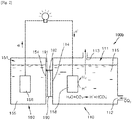
- FIG. 1 shows the configuration of a carbon dioxide utilization system according to an embodiment of the present invention.
- a carbon dioxide utilization system 100a according to an embodiment of the present invention includes a cathode unit 110, an anode unit 150, and a connection unit 190 configured to connect the cathode unit 110 and the anode unit 150.
- the connection unit 190 may be a salt bridge.
- the carbon dioxide utilization system 100a uses carbon dioxide gas (CO2), which is a greenhouse gas, as a raw material in a spontaneous oxidation and reduction reaction and produces hydrogen (H 2 ) which is an environmentally friendly fuel.
- CO2 carbon dioxide gas
- H 2 hydrogen
- the cathode unit 110 includes a first aqueous solution 115 contained in a first accommodation space 111 and a cathode 118 at least partially submerged in the first aqueous solution 115.
- aqueous solution 115 an alkaline aqueous solution (in an embodiment of the present invention, one obtained by eluting CO 2 in a strong basic solution of 1 M KOH is used), seawater, tap water, distilled water, and the like may be used.
- the cathode 118 is an electrode for forming an electric circuit and may be carbon paper, a carbon fiber, carbon felt, carbon cloth, metal foam, a metal thin film, or a combination thereof, and a platinum catalyst may also be used.
- a catalyst in addition to a platinum catalyst, all other catalysts that are generally usable as a catalyst for a hydrogen evolution reaction (HER), such as carbon-based catalysts, carbon-metal-based complex catalysts, and perovskite oxide catalysts, and the like, may also be used.
- HER hydrogen evolution reaction
- carbon-based catalysts carbon-metal-based complex catalysts
- perovskite oxide catalysts and the like.
- the first inlet 112 is positioned at a lower part of the first accommodation space 111 so that it is positioned below a water surface of the first aqueous solution 115.
- the first outlet 113 is positioned at an upper part of the first accommodation space 111 so that it is positioned above a water surface of the first aqueous solution 115.
- carbon dioxide to be used as a fuel in a reaction process is introduced into the first accommodation space 111, and, as necessary, the first aqueous solution 115 may also be introduced.
- the gas produced in a reaction process is discharged to the outside.
- a valve or the like is provided so that the inlet 112 and the outlet 113 may be selectively opened and closed by the valve or the like during charging and a reaction in a timely manner.
- an elution reaction of carbon dioxide occurs during a reaction process.
- the anode unit 150 includes a second aqueous solution 155 contained in a second accommodation space 151 and an anode 158 at least partially submerged in the second aqueous solution 155.
- a high concentration alkaline solution is used, and, for example, 1 M KOH or 6 M KOH may be used.
- the anode 158 is a metal electrode for forming an electric circuit, and, in an embodiment, it is described that zinc (Zn) or aluminum (Al) is used as the anode 158.
- a Zn- or Al-containing alloy may be used as the anode 158.
- Both ends of the salt bridge are submerged in the first aqueous solution 115 and the second aqueous solution 155, respectively.
- a solution inside the salt bridge a solution that is typically used as a solution inside a salt bridge, such as potassium chloride (KCl), sodium chloride (NaCl), and the like, may be used.
- FIG. 1 also shows the reaction process of the carbon dioxide utilization system 100a.
- carbon dioxide is injected into the first aqueous solution 115 through the inlet 112, and a chemical elution reaction of carbon dioxide occurs in the cathode unit 110 as shown in the following Reaction Scheme 1.
- Reaction Scheme 1 H 2 O (1) + CO 2 (g) ⁇ H + (aq) + HCO 3 - (aq)
- the carbon dioxide (CO 2 ) supplied to the cathode unit 110 is subjected to a spontaneous chemical reaction with water (H 2 O) of the first aqueous solution 115 to produce a hydrogen cation (H + ) and bicarbonate (HCO 3 - ).
- the hydrogen cation (H + ) receives an electron (e - ) to generate hydrogen (H 2 ) gas.
- the generated hydrogen (H 2 ) gas is discharged to the outside through the first outlet 113.
- a solution inside the salt bridge contains sodium ions (Na + ) (e.g., includes sodium chloride (NaCl))
- Na + sodium ions
- NaCl sodium chloride
- the sodium ions are diffused from the salt bridge to balance ions, and thus the ions are present in the form of an aqueous sodium hydrogen carbonate (NaHCO 3 ) solution.
- a solid sodium carbonate product in the form of baking soda may be additionally obtained.
- FIG. 2 shows the configuration of a carbon dioxide utilization system 100b according to another embodiment of the present invention.
- the carbon dioxide utilization system 100b according to another embodiment of the present invention includes a connection unit 190 configured to connect a cathode unit 110 and an anode unit 150, and the connection unit 190 is disposed between a first accommodation space and a second accommodation space and is a porous ion transfer member which blocks the movement of a first aqueous solution and a second aqueous solution and allows the movement of ionic materials dissolved in the aqueous solutions.
- the carbon dioxide utilization system 100b according to another embodiment of the present invention as shown in FIG. 2 has the same configuration as described in detail with reference to FIG. 1 , except for a difference in structure of the connection unit 190 to be described below.
- the carbon dioxide utilization system 100b uses carbon dioxide gas as a fuel and generates hydrogen gas in a reaction process in the same manner.
- a first inlet 112, a first outlet 113, and a first connection hole 114 are formed in the cathode unit 110.
- the first connection hole 114 is positioned below a water surface of the first aqueous solution 115, and the connection unit 190 is connected to the first connection hole 114.
- an elution reaction of carbon dioxide occurs during a reaction process.
- a second connection hole 154 which communicates with the second accommodation space 151 is formed.
- the second connection hole 154 is positioned below a water surface of the second aqueous solution 155, and the connection unit 190 is connected to the second connection hole 154.
- connection unit 190 is a porous ion transfer member and includes a connection passage 191 which connects the cathode unit 110 and the anode unit 150 and an ion transfer member 192 provided inside the connection passage 191.
- connection passage 191 is disposed between the first connection hole 114 formed in the cathode unit 110 and the second connection hole 154 formed in the anode unit 150 and allows the first accommodation space 111 of the cathode unit 110 and the second accommodation space 151 of the anode unit 150 to communicate with each other.
- the ion transfer member 192 is provided inside the connection passage 191.
- the ion transfer member 192 generally has a disk shape and is provided in a form which blocks the inside of the connection passage 191.
- the ion transfer member 192 allows the movement of ions between the cathode unit 110 and the anode unit 150 and blocks the movement of the aqueous solutions 115, 155 therebetween due to having a porous structure.
- the ion transfer member is described as being made of glass, but the present invention is not limited thereto, and other materials with a porous structure may also be used and are included in the scope of the present invention.
- porous glass with a pore size of 40 to 90 microns corresponding to a G2 grade, 15 to 40 microns corresponding to a G3 grade, 5 to 15 microns corresponding to a G4 grade, or 1 to 2 microns corresponding to a G5 grade may be used. Since the ion transfer member 192 transfers only ions, ionic imbalance generated in a reaction process may be solved.
- an ion transfer member 192 which blocks the movement of the first aqueous solution 115 and the second aqueous solution 155 and allows the movement of potassium ions (K + ) may be provided.
- potassium ions (K + ) contained in the second aqueous solution 155 move to the first aqueous solution 115 by the ion transfer member 192.
- Nafion which is a fluororesin-based cation exchange membrane
- K + potassium ions
- potassium ions (K + ) contained in the second aqueous solution 155 of the anode unit 150 pass through the ion transfer member 192 and move to the first aqueous solution 115 of the cathode unit 110 during the operation of the carbon dioxide utilization system 100b, so that a change in KOH concentration due to supply of carbon dioxide may be prevented.
- an ion transfer member 192 which blocks the movement of the first aqueous solution 115 and the second aqueous solution 155 and allows the movement of hydroxyl ions (OH - ) may be provided.
- hydroxyl ions (OH - ) contained in the first aqueous solution 115 move to the second aqueous solution 155 by the ion transfer member 192.
- Nafion which is a fluororesin-based cation exchange membrane
- the present invention is not limited thereto, and any one that allows only the movement of hydroxyl ions (OH - ) may be used. Since the ion transfer member 192 transfers only the ions, ionic imbalance generated in a discharging process may be solved.
- hydroxyl ions (OH - ) contained in the first aqueous solution 115 of the cathode unit 110 pass through the ion transfer member 192 and move to the second aqueous solution 155 of the anode unit 150 during the operation of the carbon dioxide utilization system 100b, so that a change in KOH concentration due to supply of carbon dioxide may be prevented.
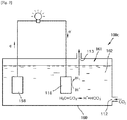
- FIG. 3 shows the configuration of a carbon dioxide utilization system 100c according to still another embodiment of the present invention.
- the carbon dioxide utilization system 100c according to still another embodiment of the present invention includes a reaction space 161 which accommodates an aqueous solution 162, a cathode 118 at least partially submerged in the aqueous solution 162 in the reaction space 161, and a metal anode 158 at least partially submerged in the aqueous solution 162 in the reaction space 161.
- a reaction vessel 160 provides the reaction space 161 which contains the aqueous solution 162 and accommodates the cathode 118 and the anode 158.
- a first inlet 112 and a first outlet 113 both of which communicate with the reaction space 161, are formed.
- the first inlet 112 is positioned at a lower part of the reaction space 161 so that it is positioned below a water surface of the aqueous solution 162.
- the first outlet 113 is positioned at an upper part of the reaction space 161 so that it is positioned above a water surface of the aqueous solution 162.
- first inlet 112 carbon dioxide gas to be used as a fuel in a reaction process is introduced into the reaction space 161, and, as necessary, the aqueous solution 162 may also be introduced.
- the first outlet 113 the gas produced in a reaction process is discharged to the outside.
- a valve or the like is provided so that the first inlet 112 and the first outlet 113 may be selectively opened and closed by the valve or the like during charging and a reaction in a timely manner.
- an elution reaction of carbon dioxide occurs during a reaction process.
- the aqueous solution 162 is contained in the reaction space 161, and at least a part of the cathode 118 and at least a part of the anode 158 are submerged in the aqueous solution 162.
- a basic solution or seawater is used as the aqueous solution 162.
- the aqueous solution 162 becomes weakly acidic due to the carbon dioxide gas introduced through the first inlet 112 in a reaction process.
- the cathode 118 is at least partially submerged in the aqueous solution 162 in the reaction space 161.
- the cathode 118 is positioned relatively closer to the first inlet 112 than the anode 158 in the reaction space 161.
- the cathode 118 is an electrode for forming an electric circuit and may be carbon paper, a carbon fiber, carbon felt, carbon cloth, metal foam, a metal thin film, or a combination thereof, and a platinum catalyst may also be used.
- a catalyst in addition to a platinum catalyst, all other catalysts that are generally usable as a catalyst for a hydrogen evolution reaction (HER), such as carbon-based catalysts, carbon-metal-based complex catalysts, and perovskite oxide catalysts, and the like, may also be used.
- HER hydrogen evolution reaction
- carbon-based catalysts carbon-metal-based complex catalysts
- perovskite oxide catalysts and the like.
- the anode 158 is at least partially submerged in the aqueous solution 162 in the reaction space 161.
- the anode 158 is positioned relatively farther from the first inlet 112 than the cathode 118 in the reaction space 161.
- the anode 158 is a metal electrode for forming an electric circuit, and, in an embodiment, it is described that vanadium (V), chromium (Cr), manganese (Mn), iron (Fe), cobalt (Co), nickel (Ni), copper (Cu), aluminum (Al), or zinc (Zn) is used as the anode 158.
- vanadium (V), chromium (Cr), manganese (Mn), iron (Fe), cobalt (Co), nickel (Ni), copper (Cu), aluminum (Al), or zinc (Zn) is used as the anode 158.
- an oxidation reaction occurs in the anode 158 due to a weakly acidic environment.
- FIG. 3 also shows the reaction process of the carbon dioxide utilization system 100c.
- carbon dioxide gas is injected into the aqueous solution 162 through the first inlet 112, and a chemical elution reaction of carbon dioxide occurs in the reaction space 161 as shown in the following Reaction Scheme 1.
- Reaction Scheme 1 H 2 O (1) + CO 2 (g) ⁇ H + (aq) + HCO 3 - (aq)
- the carbon dioxide (CO 2 ) supplied to the reaction space 161 is subjected to a spontaneous chemical reaction with water (H 2 O) of the aqueous solution 162 to produce a hydrogen cation (H + ) and bicarbonate (HCO 3 - ).
- the hydrogen cation (H + ) receives an electron (e - ) around the cathode 118 to generate hydrogen (H 2 ) gas.
- the generated hydrogen (H 2 ) gas is discharged to the outside through the first outlet 113.
- FIG. 4 is a schematic diagram illustrating the reaction process of a carbon dioxide utilization system including a carbon dioxide treatment unit 200 according to an embodiment of the present invention.
- a carbon dioxide utilization system 100a, 100b, 100c may further include a carbon dioxide treatment unit 200.
- the carbon dioxide treatment unit 200 contains the same aqueous solution as the first aqueous solution 115 of the cathode unit 110 or the aqueous solution 162 of the reaction space 161.
- the carbon dioxide treatment unit 200 may include: a connection pipe 210 which allows the cathode unit 110 or the reaction space 161 and the carbon dioxide treatment unit 200 to communicate with each other; a second inlet 220 through which carbon dioxide is introduced; a second outlet 230 positioned at an upper part thereof; and a carbon dioxide circulation supply unit 240. Since the carbon dioxide utilization system 100a, 100b, 100c is the same as those described in the embodiments shown in FIGS. 1 to 3 , the detailed description thereof will be omitted.
- the second inlet 220 is positioned above the connection pipe 210 and below the second outlet 230 and the water surface of the first aqueous solution 115 or the aqueous solution 162 in the carbon dioxide treatment unit 200. Through the second inlet 220, carbon dioxide gas to be used as a fuel in a reaction process is introduced into the carbon dioxide treatment unit 200. Through the second inlet 220, the first aqueous solution 115 or the aqueous solution 162 may also be supplied as necessary. The second inlet 220 and the first outlet 113 may be selectively opened and closed by a valve or the like during a reaction in a timely manner.
- connection pipe 210 is positioned below the second inlet 220 in the carbon dioxide treatment unit 200, and the carbon dioxide treatment unit 200 communicates with the first accommodation space 111 or the reaction space 161 by the connection pipe 210.
- the second outlet 230 is positioned above the second inlet 220 and the water surface of the first aqueous solution 115 or the aqueous solution 162 in the carbon dioxide treatment unit 200. Through the second outlet 230, non-ionized carbon dioxide gas, which has not been dissolved in the first aqueous solution 115 or the aqueous solution 162, is discharged from the carbon dioxide treatment unit 200 to the outside. The carbon dioxide gas discharged through the second outlet 230 is supplied to the second inlet 220 by the carbon dioxide circulation supply unit 240.
- the carbon dioxide circulation supply unit 240 is configured to circulate and resupply the carbon dioxide gas discharged through the second outlet 230 to the second inlet 220.
- connection pipe 210 is connected to the first inlet 112 of the first accommodation space 111 or the reaction space 161. Through the connection pipe 210, the first accommodation space 111 or the reaction space 161 and the carbon dioxide treatment unit 200 communicate with each other.
- Non-ionized carbon dioxide gas which has not been dissolved in the first aqueous solution 115 or the aqueous solution 162, of the carbon dioxide introduced into the carbon dioxide treatment unit 200 through the second inlet 220 does not move to the first accommodation space 111 or the reaction space 161, rises, and is collected in a space provided above the water surface of the first aqueous solution 115 or the aqueous solution 162 in the carbon dioxide treatment unit 200. Then, the collected carbon dioxide gas is discharged through the second outlet 230, and the carbon dioxide gas discharged through the second outlet 230 is supplied to the carbon dioxide treatment unit 200 through the second inlet 220 and recycled by the carbon dioxide circulation supply unit 240.
- FIG. 5 is a block diagram schematically illustrating the configuration of a complex power generation system including a carbon dioxide utilization system according to an embodiment of the present invention.
- the complex power generation system 1000 includes: a carbon dioxide utilization system 100 which produces electrical energy and generates hydrogen by using carbon dioxide as a raw material in a discharge process; a hydrocarbon fuel cell 300 which produces electrical energy and additionally generates carbon dioxide by using a hydrocarbon as a fuel; a reformer 400 which produces hydrogen-rich reformed gas from a hydrocarbon and additionally generates carbon dioxide; a hydrogen fuel cell 500 which produces electrical energy by using hydrogen as a fuel; a first carbon dioxide supply unit 600 configured to supply the carbon dioxide generated in the hydrocarbon fuel cell 300 to the carbon dioxide utilization system 100; a second carbon dioxide supply unit 700 configured to supply the carbon dioxide generated in the reformer 400 to the carbon dioxide utilization system 100; a hydrogen supply unit 800 configured to supply the hydrogen generated in the carbon dioxide utilization system 100 to the hydrogen fuel cell 500; and a reformed gas supply
- the hydrocarbon fuel cell 300 produces electrical energy and generates carbon dioxide as a by-product by using a hydrocarbon as a fuel.
- the fuel cell 300 may be a solid oxide fuel cell (SOFC).
- SOFC solid oxide fuel cell
- the carbon dioxide generated in the hydrocarbon fuel cell 300 is supplied to the carbon dioxide utilization system 100 by the first carbon dioxide supply unit 600.
- a hydrocarbon which is a fuel of the hydrocarbon fuel cell 300 may be any one of methane (CH 4 ), ethane (C 2 H 6 ), propane (C 3 H 8 ), butane (C 4 H 10 ), hexane (C 6 H 14 ), heptane (C 7 H 16 ), octane (C 8 H 18 ), nonane (C 9 H 20 ), and decane (C 10 H 22 ).
- the reformer 400 produces hydrogen-rich reformed gas from a hydrocarbon and additionally generates carbon dioxide gas.
- a hydrocarbon to be reformed by the reformer 400 may be any one of methane (CH 4 ), ethane (C 2 H 6 ), propane (C 3 H 8 ), butane (C 4 H 10 ), hexane (C 6 H 14 ), heptane (C 7 H 16 ), octane (C 8 H 18 ), nonane (C 9 H 20 ), and decane (C 10 H 22 ), and the same as that used as a fuel of the hydrocarbon fuel cell 300 is preferred.
- the reformer 400 is described as a methane-water vapor reformer which produces hydrogen (H 2 ) through a reformation reaction of methane (CH 4 ) and water vapor (H 2 O).
- the methane-water vapor reformer 400 occupies a significant portion of the hydrogen production process due to the advantages of inexpensive process costs and enabling mass production.
- the following Reaction Scheme 8 and Reaction Scheme 9 relate to the reformation reaction in the methane-water vapor reformer 400.
- Reaction Scheme 8 CH 4 + H 2 O -> CO + 3H 2
- Reaction Scheme 9 CO + H 2 O -> CO 2 + H 2
- methane and water vapor may be chemically reacted to produce carbon monoxide (CO) and hydrogen, and successively, carbon monoxide and water vapor may be chemically reacted to finally produce hydrogen.
- the hydrogen produced in the methane-water vapor reformer 400 is supplied as a fuel of the hydrogen fuel cell 500 by the reformed gas supply unit 900.
- the methane-water vapor reformer 400 has the above-described many advantages, as shown in Reaction Scheme 8 and Reaction Scheme 9, water vapor needs to be supplied from the outside for proceeding the process, and carbon dioxide which is the main cause of global warming is inevitably generated as a by-product in the hydrogen production.
- the carbon dioxide generated in the methane-water vapor reformer 400 is not discharged into the atmosphere or transferred for a separate process of capturing and storing carbon dioxide but transferred to the carbon dioxide utilization system 100 by the second carbon dioxide supply unit 700 for operating the carbon dioxide utilization system 100.
- the hydrogen fuel cell 500 produces water by a chemical reaction of hydrogen and oxygen and also generates electrical energy.
- the hydrogen fuel cell 500 is described as a solid oxide fuel cell (SOFC).
- SOFC solid oxide fuel cell
- the hydrogen fuel cell 500 needs to receive hydrogen produced in the methane-water vapor reformer 400 and the like.
- the hydrogen fuel cell 500 since the hydrogen fuel cell 500 is established as one system with the carbon dioxide utilization system 100, the hydrogen fuel cell 500 may receive, as a fuel, hydrogen generated during the discharging process of the carbon dioxide utilization system 100, and thus efficiency may be significantly improved.
- the first carbon dioxide supply unit 600 is configured to supply the carbon dioxide, which is generated in the hydrocarbon fuel cell 300, as a raw material for producing hydrogen to the carbon dioxide utilization system 100.
- the second carbon dioxide supply unit 700 is configured to supply the carbon dioxide, which is generated as a by-product in the reformer 400, as a raw material for producing hydrogen to the carbon dioxide utilization system 100.
- the hydrogen supply unit 800 is configured to supply the hydrogen gas, which is generated as a by-product during the discharging process of the carbon dioxide utilization system 100, as a fuel of the hydrogen fuel cell 500.
- the reformed gas supply unit 900 is configured to supply the hydrogen-rich reformed gas, which is produced in the reformer 400, as a fuel of the hydrogen fuel cell 500.
- the complex power generation system 1000 is described as having a configuration in which the hydrogen generated in the carbon dioxide utilization system 100 is supplied to the fuel cell 500, but this is merely an embodiment of the present invention.
- the hydrogen may be supplied to various other devices that use hydrogen in addition to the fuel cell, and this is also included in the scope of the present invention.
- the complex power generation system 1000 is described as including the reformer 400, but the reformer 400 may not be included, and this is also included in the scope of the present invention.
- carbon dioxide can be removed, and hydrogen and sodium hydrogen carbonate can be produced. Therefore, the carbon dioxide utilization system and complex power generation system can be applied to a carbon dioxide-capturing apparatus, a hydrogen generator, a complex power generator, and the like.
Landscapes
- Chemical & Material Sciences (AREA)
- Chemical Kinetics & Catalysis (AREA)
- Engineering & Computer Science (AREA)
- Electrochemistry (AREA)
- Organic Chemistry (AREA)
- Sustainable Energy (AREA)
- Life Sciences & Earth Sciences (AREA)
- Sustainable Development (AREA)
- General Chemical & Material Sciences (AREA)
- Materials Engineering (AREA)
- Metallurgy (AREA)
- Manufacturing & Machinery (AREA)
- Inorganic Chemistry (AREA)
- Health & Medical Sciences (AREA)
- General Health & Medical Sciences (AREA)
- Combustion & Propulsion (AREA)
- Fuel Cell (AREA)
- Electrolytic Production Of Non-Metals, Compounds, Apparatuses Therefor (AREA)
Abstract
Description
- The present invention relates to a carbon dioxide utilization system and a complex power generation system including the same.
- Recently, the emission of greenhouse gases is continuously increasing with industrialization, and carbon dioxide accounts for the largest proportion of greenhouse gases. According to the type of industry, the emission of carbon dioxide is highest in energy supply sources such as power plants and the like, and carbon dioxide generated in the cement/steel/refining industries, including power generation, accounts for half of the world's carbon dioxide generation. The conversion/utilization fields of carbon dioxide are roughly classified into chemical conversion, biological conversion, and direct utilization, and the technical categories can be classified into catalysts, electrochemical processes, bioprocesses, light utilization, mineralization (carbonation), polymers, and the like. Since carbon dioxide is generated in various industries and processes, and it is not possible to achieve carbon dioxide reduction with one technology, various approaches for reducing carbon dioxide are required.
- Currently, the Department of Energy (DOE) of the United States is pursuing the development of diversified technology with interest in CCUS technology that is a combination of carbon capture & storage (CCS) and carbon capture & utilization (CCU) as a technology of reducing carbon dioxide. Although the CCUS technology is recognized as an effective greenhouse gas reduction method, it faces the problems of high investment costs, the possibility of emission of harmful capturing agents to the atmosphere, and low technology readiness level. In addition, in view of energy and climate policies, the CCUS technology provides a means to substantially reduce the emission of greenhouse gases, but there are many supplementary points for realizing the technology. Therefore, there is a need to develop a new concept of breakthrough technology for more efficiently capturing, storing, and utilizing carbon dioxide.
- As a prior patent document related to the technical field of the present invention, Korean Laid-Open Patent Publication No.
10-2015-0091834 - The present invention is directed to providing a system that utilizes carbon dioxide, which is a greenhouse gas, through a spontaneous electrochemical reaction without using a separate power source.
- The present invention is also directed to providing a carbon dioxide utilization system capable of producing high purity hydrogen, which is an environmentally friendly fuel, by utilizing carbon dioxide.
- The present invention is also directed to providing a carbon dioxide utilization system capable of capturing carbon dioxide as bicarbonate ions.
- The present invention is also directed to providing a complex power generation system including the above-described carbon dioxide utilization system.
- One aspect of the present invention provides a carbon dioxide utilization system which includes: a cathode unit including a first accommodation space, a first aqueous solution, and a cathode at least partially submerged in the first aqueous solution; an anode unit including a second accommodation space, a second aqueous solution which is basic, and a metal anode at least partially submerged in the second aqueous solution; and a connection unit configured to connect the cathode unit and the anode unit, wherein carbon dioxide introduced into the first aqueous solution is captured as a bicarbonate ion and produces a hydrogen ion, and the hydrogen ion reacts with an electron of the cathode to produce hydrogen.
- Another aspect of the present invention provides a carbon dioxide utilization system which includes: a reaction space which accommodates an aqueous solution; a cathode at least partially submerged in the aqueous solution in the reaction space; and a metal anode at least partially submerged in the aqueous solution in the reaction space, wherein carbon dioxide introduced into the aqueous solution is captured as a bicarbonate ion and produces a hydrogen ion, and the hydrogen ion reacts with an electron of the cathode to produce hydrogen.
- Still another aspect of the present invention provides a complex power generation system which includes: a carbon dioxide utilization system which generates hydrogen by using carbon dioxide as a fuel; a reformer which produces hydrogen-rich reformed gas from a hydrogen-containing fuel and generates carbon dioxide as a by-product; a fuel cell which receives the reformed gas produced in the reformer as a fuel; and a carbon dioxide supply unit configured to supply the carbon dioxide generated in the reformer to the carbon dioxide utilization system.
- Yet another aspect of the present invention provides a complex power generation system which includes: a carbon dioxide utilization system which generates hydrogen by using carbon dioxide as a fuel; a reformer which produces hydrogen-rich reformed gas from a hydrogen-containing fuel; a fuel cell which receives the reformed gas produced in the reformer as a fuel; and a hydrogen supply unit configured to additionally supply the hydrogen generated in the carbon dioxide utilization system as a fuel of the fuel cell.
- Yet another aspect of the present invention provides a complex power generation system which includes: a carbon dioxide utilization system which generates hydrogen by using carbon dioxide as a fuel; a reformer which produces hydrogen-rich reformed gas from a hydrogen-containing fuel and generates carbon dioxide as a by-product; a fuel cell which receives the reformed gas produced in the reformer as a fuel; a carbon dioxide supply unit configured to supply the carbon dioxide generated in the reformer to the carbon dioxide utilization system; and a hydrogen supply unit configured to additionally supply the hydrogen generated in the carbon dioxide utilization system as a fuel of the fuel cell.
- According to the present invention, all the above-described objectives of the present invention can be achieved. Specifically, electricity, hydrogen, and bicarbonate ions can be produced by using various metals and utilizing carbon dioxide through a spontaneous electrochemical reaction without using a separate external power source.
- In addition, since a carbon dioxide treatment unit configured to prevent carbon dioxide not dissolved in an aqueous solution from being supplied to a cathode unit is provided, high purity hydrogen can be produced in the cathode unit during discharging.
- Additionally, since a carbon dioxide utilization system which generates hydrogen by using carbon dioxide generated in a hydrocarbon fuel cell as a raw material and a hydrogen fuel cell which uses hydrogen generated in a secondary battery as a fuel are combined, electrical energy can be efficiently produced by utilizing carbon dioxide.
-
-
FIG. 1 is a schematic diagram illustrating the operation process of a carbon dioxide utilization system according to an embodiment of the present invention. -
FIG. 2 is a schematic diagram illustrating the operation process of a carbon dioxide utilization system according to another embodiment of the present invention. -
FIG. 3 is a schematic diagram illustrating the operation process of a carbon dioxide utilization system according to still another embodiment of the present invention. -
FIG. 4 is a schematic diagram illustrating the operation process of a carbon dioxide utilization system including a carbon dioxide treatment unit according to an embodiment of the present invention. -
FIG. 5 is a block diagram schematically illustrating the configuration of a complex power generation system including a carbon dioxide utilization system according to an embodiment of the present invention. - Hereinafter, the configuration and operation process of embodiments of the present invention will be described in detail with reference to the accompanying drawings.
-
FIG. 1 shows the configuration of a carbon dioxide utilization system according to an embodiment of the present invention. Referring toFIG. 1 , a carbondioxide utilization system 100a according to an embodiment of the present invention includes acathode unit 110, ananode unit 150, and aconnection unit 190 configured to connect thecathode unit 110 and theanode unit 150. Theconnection unit 190 may be a salt bridge. The carbondioxide utilization system 100a uses carbon dioxide gas (CO2), which is a greenhouse gas, as a raw material in a spontaneous oxidation and reduction reaction and produces hydrogen (H2) which is an environmentally friendly fuel. - The
cathode unit 110 includes a firstaqueous solution 115 contained in afirst accommodation space 111 and acathode 118 at least partially submerged in the firstaqueous solution 115. As the firstaqueous solution 115, an alkaline aqueous solution (in an embodiment of the present invention, one obtained by eluting CO2 in a strong basic solution of 1 M KOH is used), seawater, tap water, distilled water, and the like may be used. Thecathode 118 is an electrode for forming an electric circuit and may be carbon paper, a carbon fiber, carbon felt, carbon cloth, metal foam, a metal thin film, or a combination thereof, and a platinum catalyst may also be used. In the case of a catalyst, in addition to a platinum catalyst, all other catalysts that are generally usable as a catalyst for a hydrogen evolution reaction (HER), such as carbon-based catalysts, carbon-metal-based complex catalysts, and perovskite oxide catalysts, and the like, may also be used. In thecathode unit 110, afirst inlet 112 and afirst outlet 113, both of which communicate with thefirst accommodation space 111, are formed. Thefirst inlet 112 is positioned at a lower part of thefirst accommodation space 111 so that it is positioned below a water surface of the firstaqueous solution 115. Thefirst outlet 113 is positioned at an upper part of thefirst accommodation space 111 so that it is positioned above a water surface of the firstaqueous solution 115. Through thefirst inlet 112, carbon dioxide to be used as a fuel in a reaction process is introduced into thefirst accommodation space 111, and, as necessary, the firstaqueous solution 115 may also be introduced. Through thefirst outlet 113, the gas produced in a reaction process is discharged to the outside. Although not shown, a valve or the like is provided so that theinlet 112 and theoutlet 113 may be selectively opened and closed by the valve or the like during charging and a reaction in a timely manner. In thecathode unit 110, an elution reaction of carbon dioxide occurs during a reaction process. - The
anode unit 150 includes a secondaqueous solution 155 contained in asecond accommodation space 151 and ananode 158 at least partially submerged in the secondaqueous solution 155. As the secondaqueous solution 155, a high concentration alkaline solution is used, and, for example, 1 M KOH or 6 M KOH may be used. Theanode 158 is a metal electrode for forming an electric circuit, and, in an embodiment, it is described that zinc (Zn) or aluminum (Al) is used as theanode 158. In addition, a Zn- or Al-containing alloy may be used as theanode 158. - Both ends of the salt bridge (connection unit 190) are submerged in the first
aqueous solution 115 and the secondaqueous solution 155, respectively. As a solution inside the salt bridge, a solution that is typically used as a solution inside a salt bridge, such as potassium chloride (KCl), sodium chloride (NaCl), and the like, may be used. - Hereinafter, the reaction process of the carbon
dioxide utilization system 100a, the configuration of which has been described above, will be described in detail.FIG. 1 also shows the reaction process of the carbondioxide utilization system 100a. Referring toFIG. 1 , carbon dioxide is injected into the firstaqueous solution 115 through theinlet 112, and a chemical elution reaction of carbon dioxide occurs in thecathode unit 110 as shown in the followingReaction Scheme 1.
[Reaction Scheme 1] H2O (1) + CO2 (g) → H+ (aq) + HCO3 - (aq)
- That is, in the
cathode unit 110, the carbon dioxide (CO2) supplied to thecathode unit 110 is subjected to a spontaneous chemical reaction with water (H2O) of the firstaqueous solution 115 to produce a hydrogen cation (H+) and bicarbonate (HCO3 -). - In addition, an electrical reaction occurs in the
cathode unit 110 as shown in the following Reaction Scheme 2.
[Reaction Scheme 2] 2H+ (aq) + 2e- → H2 (g)
- That is, in the
cathode unit 110, the hydrogen cation (H+) receives an electron (e-) to generate hydrogen (H2) gas. The generated hydrogen (H2) gas is discharged to the outside through thefirst outlet 113. - In addition, a complex hydrogen generation reaction occurs in the
cathode unit 110 as shown in the following Reaction Scheme 3.
[Reaction Scheme 3] 2H2O (1) + 2CO2 (g) + 2e- → H2 (g) + 2HCO3 - (aq)
- In addition, when the
anode 158 is made of zinc (Zn), an oxidation reaction occurs in theanode unit 150 as shown in the following Reaction Scheme 4.
[Reaction Scheme 4] Zn + 4OH- → Zn(OH)4 2- + 2e- (E° = -1.25 V) Zn(OH)4 2- → ZnO + H2O + 2OH-
- Therefore, when the
anode 158 is made of zinc (Zn), the reaction scheme of the overall reaction occurring in a reaction process is the same as the following Reaction Scheme 5.
[Reaction Scheme 5] Zn + 2CO2 + 2H2O + 2OH- → ZnO + 2HCO3 - (aq) + H2 (g) (E0 = 1.25 V)
- In addition, when the
anode 158 is made of aluminum (Al), an oxidation reaction occurs in theanode unit 150 as shown in the following Reaction Scheme 6.
[Reaction Scheme 6] Al + 3OH- → Al(OH)3 + 3e- (E0 = -2.31 V)
- Therefore, when the
anode 158 is made of aluminum (Al), the reaction scheme of the overall reaction occurring in a reaction process is the same as the following Reaction Scheme 7.
[Reaction Scheme 7] 2Al + 6CO2 + 6H2O + 6OH- → 2Al(OH)3 + 6HCO3 - (aq) + 3H2 (g) (E0 = 2.31 V)
- In conclusion, as shown in Reaction Scheme 5 and Reaction Scheme 7, the hydrogen ions produced by the elution of carbon dioxide in the first
aqueous solution 115 during the reaction receive electrons from thecathode 118 and are thus reduced to hydrogen gas, the hydrogen gas is discharged through thefirst outlet 113, and themetal anode 158 is changed into an oxide form. As the reaction proceeds, bicarbonate ions (HCO3 -) are produced in the firstaqueous solution 115. When a solution inside the salt bridge contains sodium ions (Na+) (e.g., includes sodium chloride (NaCl)), the sodium ions are diffused from the salt bridge to balance ions, and thus the ions are present in the form of an aqueous sodium hydrogen carbonate (NaHCO3) solution. Then, by drying the solution, a solid sodium carbonate product in the form of baking soda may be additionally obtained. -
FIG. 2 shows the configuration of a carbondioxide utilization system 100b according to another embodiment of the present invention. Referring toFIG. 2 , the carbondioxide utilization system 100b according to another embodiment of the present invention includes aconnection unit 190 configured to connect acathode unit 110 and ananode unit 150, and theconnection unit 190 is disposed between a first accommodation space and a second accommodation space and is a porous ion transfer member which blocks the movement of a first aqueous solution and a second aqueous solution and allows the movement of ionic materials dissolved in the aqueous solutions. - The carbon
dioxide utilization system 100b according to another embodiment of the present invention as shown inFIG. 2 has the same configuration as described in detail with reference toFIG. 1 , except for a difference in structure of theconnection unit 190 to be described below. In addition, the carbondioxide utilization system 100b uses carbon dioxide gas as a fuel and generates hydrogen gas in a reaction process in the same manner. - In the
cathode unit 110, afirst inlet 112, afirst outlet 113, and afirst connection hole 114, all of which communicate with thefirst accommodation space 111, are formed. Thefirst connection hole 114 is positioned below a water surface of the firstaqueous solution 115, and theconnection unit 190 is connected to thefirst connection hole 114. In thecathode unit 110, an elution reaction of carbon dioxide occurs during a reaction process. - In the
anode unit 150, asecond connection hole 154 which communicates with thesecond accommodation space 151 is formed. Thesecond connection hole 154 is positioned below a water surface of the secondaqueous solution 155, and theconnection unit 190 is connected to thesecond connection hole 154. - The
connection unit 190 according to an embodiment of the present invention is a porous ion transfer member and includes aconnection passage 191 which connects thecathode unit 110 and theanode unit 150 and anion transfer member 192 provided inside theconnection passage 191. - The
connection passage 191 is disposed between thefirst connection hole 114 formed in thecathode unit 110 and thesecond connection hole 154 formed in theanode unit 150 and allows thefirst accommodation space 111 of thecathode unit 110 and thesecond accommodation space 151 of theanode unit 150 to communicate with each other. Inside theconnection passage 191, theion transfer member 192 is provided. - The
ion transfer member 192 generally has a disk shape and is provided in a form which blocks the inside of theconnection passage 191. Theion transfer member 192 allows the movement of ions between thecathode unit 110 and theanode unit 150 and blocks the movement of theaqueous solutions ion transfer member 192, porous glass with a pore size of 40 to 90 microns corresponding to a G2 grade, 15 to 40 microns corresponding to a G3 grade, 5 to 15 microns corresponding to a G4 grade, or 1 to 2 microns corresponding to a G5 grade may be used. Since theion transfer member 192 transfers only ions, ionic imbalance generated in a reaction process may be solved. - Meanwhile, when an aqueous potassium hydroxide solution is used as the first
aqueous solution 115 and the secondaqueous solution 155, anion transfer member 192 which blocks the movement of the firstaqueous solution 115 and the secondaqueous solution 155 and allows the movement of potassium ions (K+) may be provided. When such anion transfer member 192 is provided, potassium ions (K+) contained in the secondaqueous solution 155 move to the firstaqueous solution 115 by theion transfer member 192. As theion transfer member 192, Nafion, which is a fluororesin-based cation exchange membrane, may be used, but the present invention is not limited thereto, and any one that allows only the movement of potassium ions (K+) may be used. Since theion transfer member 192 transfers only the ions, ionic imbalance generated in a discharging process may be solved. When theion transfer member 192 that allows only the movement of potassium ions (K+) is used as described above, potassium ions (K+) contained in the secondaqueous solution 155 of theanode unit 150 pass through theion transfer member 192 and move to the firstaqueous solution 115 of thecathode unit 110 during the operation of the carbondioxide utilization system 100b, so that a change in KOH concentration due to supply of carbon dioxide may be prevented. - In addition, when an aqueous potassium hydroxide solution is used as the first
aqueous solution 115 and the secondaqueous solution 155, anion transfer member 192 which blocks the movement of the firstaqueous solution 115 and the secondaqueous solution 155 and allows the movement of hydroxyl ions (OH-) may be provided. When such anion transfer member 192 is provided, hydroxyl ions (OH-) contained in the firstaqueous solution 115 move to the secondaqueous solution 155 by theion transfer member 192. As theion transfer member 192, Nafion, which is a fluororesin-based cation exchange membrane may be used, but the present invention is not limited thereto, and any one that allows only the movement of hydroxyl ions (OH-) may be used. Since theion transfer member 192 transfers only the ions, ionic imbalance generated in a discharging process may be solved. When theion transfer member 192 that allows only the movement of hydroxyl ions (OH-) is used as described above, hydroxyl ions (OH-) contained in the firstaqueous solution 115 of thecathode unit 110 pass through theion transfer member 192 and move to the secondaqueous solution 155 of theanode unit 150 during the operation of the carbondioxide utilization system 100b, so that a change in KOH concentration due to supply of carbon dioxide may be prevented. -
FIG. 3 shows the configuration of a carbondioxide utilization system 100c according to still another embodiment of the present invention. Referring toFIG. 3 , the carbondioxide utilization system 100c according to still another embodiment of the present invention includes areaction space 161 which accommodates anaqueous solution 162, acathode 118 at least partially submerged in theaqueous solution 162 in thereaction space 161, and ametal anode 158 at least partially submerged in theaqueous solution 162 in thereaction space 161. - A
reaction vessel 160 provides thereaction space 161 which contains theaqueous solution 162 and accommodates thecathode 118 and theanode 158. In thereaction vessel 160, afirst inlet 112 and afirst outlet 113, both of which communicate with thereaction space 161, are formed. Thefirst inlet 112 is positioned at a lower part of thereaction space 161 so that it is positioned below a water surface of theaqueous solution 162. Thefirst outlet 113 is positioned at an upper part of thereaction space 161 so that it is positioned above a water surface of theaqueous solution 162. Through thefirst inlet 112, carbon dioxide gas to be used as a fuel in a reaction process is introduced into thereaction space 161, and, as necessary, theaqueous solution 162 may also be introduced. Through thefirst outlet 113, the gas produced in a reaction process is discharged to the outside. Although not shown, a valve or the like is provided so that thefirst inlet 112 and thefirst outlet 113 may be selectively opened and closed by the valve or the like during charging and a reaction in a timely manner. In thereaction space 161, an elution reaction of carbon dioxide occurs during a reaction process. - The
aqueous solution 162 is contained in thereaction space 161, and at least a part of thecathode 118 and at least a part of theanode 158 are submerged in theaqueous solution 162. In an embodiment, it is described that a basic solution or seawater is used as theaqueous solution 162. Theaqueous solution 162 becomes weakly acidic due to the carbon dioxide gas introduced through thefirst inlet 112 in a reaction process. - The
cathode 118 is at least partially submerged in theaqueous solution 162 in thereaction space 161. Thecathode 118 is positioned relatively closer to thefirst inlet 112 than theanode 158 in thereaction space 161. Thecathode 118 is an electrode for forming an electric circuit and may be carbon paper, a carbon fiber, carbon felt, carbon cloth, metal foam, a metal thin film, or a combination thereof, and a platinum catalyst may also be used. In the case of a catalyst, in addition to a platinum catalyst, all other catalysts that are generally usable as a catalyst for a hydrogen evolution reaction (HER), such as carbon-based catalysts, carbon-metal-based complex catalysts, and perovskite oxide catalysts, and the like, may also be used. During a reaction, a reduction reaction occurs in thecathode 118, and accordingly, hydrogen is generated. - The
anode 158 is at least partially submerged in theaqueous solution 162 in thereaction space 161. Theanode 158 is positioned relatively farther from thefirst inlet 112 than thecathode 118 in thereaction space 161. Theanode 158 is a metal electrode for forming an electric circuit, and, in an embodiment, it is described that vanadium (V), chromium (Cr), manganese (Mn), iron (Fe), cobalt (Co), nickel (Ni), copper (Cu), aluminum (Al), or zinc (Zn) is used as theanode 158. During a reaction, an oxidation reaction occurs in theanode 158 due to a weakly acidic environment. - Hereinafter, the reaction process of the carbon
dioxide utilization system 100c, the configuration of which has been described above, will be described in detail.FIG. 3 also shows the reaction process of the carbondioxide utilization system 100c. Referring toFIG. 3 , carbon dioxide gas is injected into theaqueous solution 162 through thefirst inlet 112, and a chemical elution reaction of carbon dioxide occurs in thereaction space 161 as shown in the followingReaction Scheme 1.
[Reaction Scheme 1] H2O (1) + CO2 (g) → H+ (aq) + HCO3 - (aq)
- That is, the carbon dioxide (CO2) supplied to the
reaction space 161 is subjected to a spontaneous chemical reaction with water (H2O) of theaqueous solution 162 to produce a hydrogen cation (H+) and bicarbonate (HCO3 -). - In addition, an electrical reaction occurs in the
cathode 118 as shown in the following Reaction Scheme 2.
[Reaction Scheme 2] 2H+ (aq) + 2e- → H2 (g)
- That is, the hydrogen cation (H+) receives an electron (e-) around the
cathode 118 to generate hydrogen (H2) gas. The generated hydrogen (H2) gas is discharged to the outside through thefirst outlet 113. - In addition, a complex hydrogen generation reaction occurs around the
cathode 118 as shown in the following Reaction Scheme 3.
[Reaction Scheme 3] 2H2O (1) + 2CO2 (g) + 2e- → H2 (g) + 2HCO3 - (aq)
- In addition, when the
anode 158 is made of zinc (Zn), an oxidation reaction occurs in theanode 158 as shown in the following Reaction Scheme 4.
[Reaction Scheme 4] Zn + 4OH- → Zn(OH)4 2- + 2e- (E0 = -1.25 V) Zn(OH)4 2- → ZnO + H2O + 2OH-
- Therefore, when the
anode 158 is made of zinc (Zn), the reaction scheme of the overall reaction occurring in a reaction process is the same as the following Reaction Scheme 5.
[Reaction Scheme 5] Zn + 2CO2 + 2H2O + 2OH- → ZnO + 2HCO3 - (aq) + H2 (g) (E0 = 1.25 V)
- In addition, when the
anode 158 is made of aluminum (Al), an oxidation reaction occurs in theanode 158 as shown in the following Reaction Scheme 6.
[Reaction Scheme 6] Al + 3OH- → Al(OH)3 + 3e- (E0 = -2.31 V)
- Therefore, when the
anode 158 is made of aluminum (Al), the reaction scheme of the overall reaction occurring in a reaction process is the same as the following Reaction Scheme 7.
[Reaction Scheme 7] 2Al + 6CO2 + 6H2O + 6OH- → 2Al(OH)3 + 6HCO3 - (aq) + 3H2 (g) (E0 = 2.31 V)
- In conclusion, as shown in Reaction Scheme 5 and Reaction Scheme 7, the hydrogen ions produced by the elution of carbon dioxide in the
aqueous solution 162 during the reaction receive electrons from thecathode 118 and are thus reduced to hydrogen gas, the hydrogen gas is discharged through thefirst outlet 113, and themetal anode 158 is changed into an oxide form. As the reaction proceeds, bicarbonate ions (HCO3 -) are produced in theaqueous solution 162. -
FIG. 4 is a schematic diagram illustrating the reaction process of a carbon dioxide utilization system including a carbondioxide treatment unit 200 according to an embodiment of the present invention. Referring toFIG. 4 , a carbondioxide utilization system dioxide treatment unit 200. The carbondioxide treatment unit 200 contains the same aqueous solution as the firstaqueous solution 115 of thecathode unit 110 or theaqueous solution 162 of thereaction space 161. The carbondioxide treatment unit 200 may include: aconnection pipe 210 which allows thecathode unit 110 or thereaction space 161 and the carbondioxide treatment unit 200 to communicate with each other; asecond inlet 220 through which carbon dioxide is introduced; asecond outlet 230 positioned at an upper part thereof; and a carbon dioxidecirculation supply unit 240. Since the carbondioxide utilization system FIGS. 1 to 3 , the detailed description thereof will be omitted. - The
second inlet 220 is positioned above theconnection pipe 210 and below thesecond outlet 230 and the water surface of the firstaqueous solution 115 or theaqueous solution 162 in the carbondioxide treatment unit 200. Through thesecond inlet 220, carbon dioxide gas to be used as a fuel in a reaction process is introduced into the carbondioxide treatment unit 200. Through thesecond inlet 220, the firstaqueous solution 115 or theaqueous solution 162 may also be supplied as necessary. Thesecond inlet 220 and thefirst outlet 113 may be selectively opened and closed by a valve or the like during a reaction in a timely manner. - The
connection pipe 210 is positioned below thesecond inlet 220 in the carbondioxide treatment unit 200, and the carbondioxide treatment unit 200 communicates with thefirst accommodation space 111 or thereaction space 161 by theconnection pipe 210. - The
second outlet 230 is positioned above thesecond inlet 220 and the water surface of the firstaqueous solution 115 or theaqueous solution 162 in the carbondioxide treatment unit 200. Through thesecond outlet 230, non-ionized carbon dioxide gas, which has not been dissolved in the firstaqueous solution 115 or theaqueous solution 162, is discharged from the carbondioxide treatment unit 200 to the outside. The carbon dioxide gas discharged through thesecond outlet 230 is supplied to thesecond inlet 220 by the carbon dioxidecirculation supply unit 240. - The carbon dioxide
circulation supply unit 240 is configured to circulate and resupply the carbon dioxide gas discharged through thesecond outlet 230 to thesecond inlet 220. - The
connection pipe 210 is connected to thefirst inlet 112 of thefirst accommodation space 111 or thereaction space 161. Through theconnection pipe 210, thefirst accommodation space 111 or thereaction space 161 and the carbondioxide treatment unit 200 communicate with each other. - Non-ionized carbon dioxide gas, which has not been dissolved in the first
aqueous solution 115 or theaqueous solution 162, of the carbon dioxide introduced into the carbondioxide treatment unit 200 through thesecond inlet 220 does not move to thefirst accommodation space 111 or thereaction space 161, rises, and is collected in a space provided above the water surface of the firstaqueous solution 115 or theaqueous solution 162 in the carbondioxide treatment unit 200. Then, the collected carbon dioxide gas is discharged through thesecond outlet 230, and the carbon dioxide gas discharged through thesecond outlet 230 is supplied to the carbondioxide treatment unit 200 through thesecond inlet 220 and recycled by the carbon dioxidecirculation supply unit 240. In addition, since non-ionized carbon dioxide gas, which has not been dissolved in the firstaqueous solution 115 or theaqueous solution 162, of the carbon dioxide introduced into the carbondioxide treatment unit 200 does not move to thefirst accommodation space 111 or thereaction space 161, high purity hydrogen, which is not mixed with carbon dioxide, may be discharged through thefirst outlet 113. -
FIG. 5 is a block diagram schematically illustrating the configuration of a complex power generation system including a carbon dioxide utilization system according to an embodiment of the present invention. Referring toFIG. 5 , the complexpower generation system 1000 according to an embodiment of the present invention includes: a carbondioxide utilization system 100 which produces electrical energy and generates hydrogen by using carbon dioxide as a raw material in a discharge process; ahydrocarbon fuel cell 300 which produces electrical energy and additionally generates carbon dioxide by using a hydrocarbon as a fuel; areformer 400 which produces hydrogen-rich reformed gas from a hydrocarbon and additionally generates carbon dioxide; ahydrogen fuel cell 500 which produces electrical energy by using hydrogen as a fuel; a first carbondioxide supply unit 600 configured to supply the carbon dioxide generated in thehydrocarbon fuel cell 300 to the carbondioxide utilization system 100; a second carbondioxide supply unit 700 configured to supply the carbon dioxide generated in thereformer 400 to the carbondioxide utilization system 100; ahydrogen supply unit 800 configured to supply the hydrogen generated in the carbondioxide utilization system 100 to thehydrogen fuel cell 500; and a reformedgas supply unit 900 configured to supply the reformed gas produced in thereformer 400 to thehydrogen fuel cell 500. - The
hydrocarbon fuel cell 300 produces electrical energy and generates carbon dioxide as a by-product by using a hydrocarbon as a fuel. Thefuel cell 300 may be a solid oxide fuel cell (SOFC). The carbon dioxide generated in thehydrocarbon fuel cell 300 is supplied to the carbondioxide utilization system 100 by the first carbondioxide supply unit 600. A hydrocarbon which is a fuel of thehydrocarbon fuel cell 300 may be any one of methane (CH4), ethane (C2H6), propane (C3H8), butane (C4H10), hexane (C6H14), heptane (C7H16), octane (C8H18), nonane (C9H20), and decane (C10H22). - The
reformer 400 produces hydrogen-rich reformed gas from a hydrocarbon and additionally generates carbon dioxide gas. A hydrocarbon to be reformed by thereformer 400 may be any one of methane (CH4), ethane (C2H6), propane (C3H8), butane (C4H10), hexane (C6H14), heptane (C7H16), octane (C8H18), nonane (C9H20), and decane (C10H22), and the same as that used as a fuel of thehydrocarbon fuel cell 300 is preferred. In an embodiment, thereformer 400 is described as a methane-water vapor reformer which produces hydrogen (H2) through a reformation reaction of methane (CH4) and water vapor (H2O). - The methane-
water vapor reformer 400 occupies a significant portion of the hydrogen production process due to the advantages of inexpensive process costs and enabling mass production. The following Reaction Scheme 8 and Reaction Scheme 9 relate to the reformation reaction in the methane-water vapor reformer 400.
[Reaction Scheme 8] CH4 + H2O -> CO + 3H2
[Reaction Scheme 9] CO + H2O -> CO2+ H2
- That is, methane and water vapor may be chemically reacted to produce carbon monoxide (CO) and hydrogen, and successively, carbon monoxide and water vapor may be chemically reacted to finally produce hydrogen. The hydrogen produced in the methane-
water vapor reformer 400 is supplied as a fuel of thehydrogen fuel cell 500 by the reformedgas supply unit 900. - Although the methane-
water vapor reformer 400 has the above-described many advantages, as shown in Reaction Scheme 8 and Reaction Scheme 9, water vapor needs to be supplied from the outside for proceeding the process, and carbon dioxide which is the main cause of global warming is inevitably generated as a by-product in the hydrogen production. However, in the case of the present invention, the carbon dioxide generated in the methane-water vapor reformer 400 is not discharged into the atmosphere or transferred for a separate process of capturing and storing carbon dioxide but transferred to the carbondioxide utilization system 100 by the second carbondioxide supply unit 700 for operating the carbondioxide utilization system 100. Therefore, not only the problem of carbon dioxide generation, which is a necessary evil in the operation of the methane-water vapor reformer 400, may be solved, but also a redundant process may be omitted by establishing a system in which the carbondioxide utilization system 100 and the methane-water vapor reformer 400 are linked. Since the methane-water vapor reformer 400 is a known technology, the detailed description thereof will be omitted. - The
hydrogen fuel cell 500 produces water by a chemical reaction of hydrogen and oxygen and also generates electrical energy. In an embodiment, thehydrogen fuel cell 500 is described as a solid oxide fuel cell (SOFC). Despite having many advantages in terms of environmental friendliness, thehydrogen fuel cell 500 needs to receive hydrogen produced in the methane-water vapor reformer 400 and the like. However, in the case of the present invention, since thehydrogen fuel cell 500 is established as one system with the carbondioxide utilization system 100, thehydrogen fuel cell 500 may receive, as a fuel, hydrogen generated during the discharging process of the carbondioxide utilization system 100, and thus efficiency may be significantly improved. - The first carbon
dioxide supply unit 600 is configured to supply the carbon dioxide, which is generated in thehydrocarbon fuel cell 300, as a raw material for producing hydrogen to the carbondioxide utilization system 100. - The second carbon
dioxide supply unit 700 is configured to supply the carbon dioxide, which is generated as a by-product in thereformer 400, as a raw material for producing hydrogen to the carbondioxide utilization system 100. - The
hydrogen supply unit 800 is configured to supply the hydrogen gas, which is generated as a by-product during the discharging process of the carbondioxide utilization system 100, as a fuel of thehydrogen fuel cell 500. - The reformed
gas supply unit 900 is configured to supply the hydrogen-rich reformed gas, which is produced in thereformer 400, as a fuel of thehydrogen fuel cell 500. - In the embodiment described with reference to
FIG. 5 , the complexpower generation system 1000 is described as having a configuration in which the hydrogen generated in the carbondioxide utilization system 100 is supplied to thefuel cell 500, but this is merely an embodiment of the present invention. The hydrogen may be supplied to various other devices that use hydrogen in addition to the fuel cell, and this is also included in the scope of the present invention. - In addition, in the embodiment described with reference to
FIG. 5 , the complexpower generation system 1000 is described as including thereformer 400, but thereformer 400 may not be included, and this is also included in the scope of the present invention. - While the present invention has been described above with reference to the exemplary embodiments, the present invention is not limited thereto. It is clear that various modifications may be made without departing from the scope and spirit of the present invention. Therefore, it will be understood by those skilled in the art that these modifications are also included in the scope of the present invention.
- According to a carbon dioxide utilization system using carbon dioxide as a fuel and a complex power generation system including the same according to embodiments of the present invention, carbon dioxide can be removed, and hydrogen and sodium hydrogen carbonate can be produced. Therefore, the carbon dioxide utilization system and complex power generation system can be applied to a carbon dioxide-capturing apparatus, a hydrogen generator, a complex power generator, and the like.
Claims (32)
- A carbon dioxide utilization system comprising:a cathode unit including a first accommodation space, a first aqueous solution, and a cathode at least partially submerged in the first aqueous solution;an anode unit including a second accommodation space, a second aqueous solution which is basic, and a metal anode at least partially submerged in the second aqueous solution; anda connection unit configured to connect the cathode unit and the anode unit,wherein carbon dioxide introduced into the first aqueous solution is captured as a bicarbonate ion and produces a hydrogen ion, and the hydrogen ion reacts with an electron of the cathode to produce hydrogen.
- The carbon dioxide utilization system of claim 1, wherein the anode is made of aluminum (Al) or zinc (Zn).
- The carbon dioxide utilization system of claim 1, wherein the connection unit is a salt bridge.
- The carbon dioxide utilization system of claim 3, wherein a solution inside the salt bridge contains sodium ions.
- The carbon dioxide utilization system of claim 1, wherein the connection unit is disposed between the first accommodation space and the second accommodation space and is a porous ion transfer member which blocks the movement of the first aqueous solution and the second aqueous solution and allows the movement of ions.
- The carbon dioxide utilization system of claim 5, wherein the ion transfer member is made of glass.
- The carbon dioxide utilization system of claim 5, wherein a pore formed in the ion transfer member has a size of 40 to 90 microns, 15 to 40 microns, 5 to 15 microns, or 1 to 2 microns.
- The carbon dioxide utilization system of claim 1, wherein the first aqueous solution and the second aqueous solution are aqueous potassium hydroxide solutions, and the connection unit is disposed between the first accommodation space and the second accommodation space and is an ion transfer member which blocks the movement of the first aqueous solution and the second aqueous solution and allows the movement of potassium ions.
- The carbon dioxide utilization system of claim 1, wherein the first aqueous solution and the second aqueous solution are aqueous potassium hydroxide solutions, and the connection unit is disposed between the first accommodation space and the second accommodation space and is an ion transfer member which blocks the movement of the first aqueous solution and the second aqueous solution and allows the movement of hydroxyl ions.
- The carbon dioxide utilization system of claim 1, wherein the cathode unit includes a first outlet configured to discharge the produced hydrogen, and the first outlet is positioned above a water surface of the first aqueous solution.
- The carbon dioxide utilization system of claim 1, further comprising a carbon dioxide treatment unit in communication with the first accommodation space and the first aqueous solution and including a first connection pipe,
wherein the carbon dioxide treatment unit does not allow non-ionized carbon dioxide of the introduced carbon dioxide to be supplied to the cathode unit. - The carbon dioxide utilization system of claim 11, wherein the carbon dioxide treatment unit allows the non-ionized carbon dioxide to be separated using a difference in specific gravity with the first aqueous solution in the carbon dioxide treatment unit.
- The carbon dioxide utilization system of claim 11, wherein the carbon dioxide treatment unit allows the non-ionized carbon dioxide to be collected above a water surface of the first aqueous solution in the carbon dioxide treatment unit.
- The carbon dioxide utilization system of claim 11, wherein the carbon dioxide treatment unit includes an inlet positioned below a water surface of the first aqueous solution in the carbon dioxide treatment unit and configured to introduce carbon dioxide, and
the first connection pipe is positioned below the inlet. - The carbon dioxide utilization system of claim 11, wherein the carbon dioxide treatment unit includes a second outlet positioned above a water surface of the first aqueous solution in the carbon dioxide treatment unit and configured to discharge the non-ionized carbon dioxide.
- The carbon dioxide utilization system of claim 11, wherein the carbon dioxide treatment unit further includes a carbon dioxide circulation supply unit configured to supply the non-ionized carbon dioxide separated from the first aqueous solution of the first accommodation space to the first aqueous solution in the carbon dioxide treatment unit.
- A carbon dioxide utilization system comprising:a reaction space which accommodates an aqueous solution;a cathode at least partially submerged in the aqueous solution in the reaction space; anda metal anode at least partially submerged in the aqueous solution in the reaction space,wherein carbon dioxide introduced into the aqueous solution is captured as a bicarbonate ion and produces a hydrogen ion, and the hydrogen ion reacts with an electron of the cathode to produce hydrogen.
- The carbon dioxide utilization system of claim 17, wherein the anode is made of vanadium (V), chromium (Cr), manganese (Mn), iron (Fe), cobalt (Co), nickel (Ni), copper (Cu), aluminum (Al), or zinc (Zn).
- The carbon dioxide utilization system of claim 17, wherein the reaction space includes a first outlet configured to discharge the produced hydrogen, and the first outlet is positioned above a water surface of the aqueous solution.
- The carbon dioxide utilization system of claim 17, further comprising a carbon dioxide treatment unit in communication with the reaction space and the aqueous solution and including a first connection pipe,
wherein the carbon dioxide treatment unit does not allow non-ionized carbon dioxide of the introduced carbon dioxide to be supplied to the reaction space. - The carbon dioxide utilization system of claim 20, wherein the carbon dioxide treatment unit allows the non-ionized carbon dioxide to be separated using a difference in specific gravity with the aqueous solution in the carbon dioxide treatment unit.
- The carbon dioxide utilization system of claim 20, wherein the carbon dioxide treatment unit allows the non-ionized carbon dioxide to be collected above a water surface of the aqueous solution in the carbon dioxide treatment unit.
- The carbon dioxide utilization system of claim 20, wherein the carbon dioxide treatment unit includes an inlet positioned below a water surface of the aqueous solution in the carbon dioxide treatment unit and configured to introduce carbon dioxide, and
the first connection pipe is positioned below the inlet. - The carbon dioxide utilization system of claim 20, wherein the carbon dioxide treatment unit includes a second outlet positioned above a water surface of the aqueous solution in the carbon dioxide treatment unit and configured to discharge the non-ionized carbon dioxide.
- The carbon dioxide utilization system of claim 20, wherein the carbon dioxide treatment unit further includes a carbon dioxide circulation supply unit configured to supply the non-ionized carbon dioxide separated from the aqueous solution of the reaction space to the aqueous solution in the carbon dioxide treatment unit.
- A complex power generation system comprising:the carbon dioxide utilization system according to any one of claim 1 to claim 25; anda hydrocarbon fuel cell which produces electrical energy and generates carbon dioxide as a by-product by using a hydrocarbon as a fuel,wherein the carbon dioxide utilization system receives the carbon dioxide generated in the hydrocarbon fuel cell to produce hydrogen and a bicarbonate ion.
- The complex power generation system of claim 26, further comprising a hydrogen-using device which receives the hydrogen produced in the carbon dioxide utilization system.
- The complex power generation system of claim 27, further comprising a reformer which produces hydrogen-rich reformed gas from a hydrocarbon and additionally generates carbon dioxide,
wherein the reformed gas is supplied to the hydrogen-using device, and the carbon dioxide generated in the reformer is supplied to the carbon dioxide utilization system. - The complex power generation system of claim 28, wherein the reformer is a methane-water vapor reformer which produces hydrogen through a reformation reaction of methane (CH4) and water vapor (H2O).
- The complex power generation system of claim 27, wherein the hydrogen-using device is a hydrogen fuel cell which produces electrical energy by using hydrogen as a fuel.
- The complex power generation system of claim 30, wherein the hydrogen fuel cell is a solid oxide fuel cell (SOFC).
- The complex power generation system of claim 26, wherein the hydrocarbon fuel cell is a solid oxide fuel cell (SOFC).
Applications Claiming Priority (7)
| Application Number | Priority Date | Filing Date | Title |
|---|---|---|---|
| KR1020180031433A KR101955695B1 (en) | 2018-03-19 | 2018-03-19 | Secondary battery using carbon dioxide and complex electric power generation system having the same |
| KR1020180053240A KR101955696B1 (en) | 2018-05-09 | 2018-05-09 | Secondary battery using carbon dioxide and complex electric power generation system having the same |
| KR1020180064189A KR101955697B1 (en) | 2018-06-04 | 2018-06-04 | Secondary battery using carbon dioxide and complex electric power generation system having the same |
| KR1020180096113A KR101955698B1 (en) | 2018-08-17 | 2018-08-17 | Complex electric power generation system using carbon dioxide |
| KR1020180142495A KR101997781B1 (en) | 2018-11-19 | 2018-11-19 | Secondary battery using carbon dioxide and complex electric power generation system having the same |
| KR1020180142494A KR101997780B1 (en) | 2018-11-19 | 2018-11-19 | Secondary battery using carbon dioxide and complex electric power generation system having the same |
| PCT/KR2019/002896 WO2019182284A1 (en) | 2018-03-19 | 2019-03-13 | Carbon dioxide utilization system, and complex power generation system comprising same |
Publications (2)
| Publication Number | Publication Date |
|---|---|
| EP3771023A1 true EP3771023A1 (en) | 2021-01-27 |
| EP3771023A4 EP3771023A4 (en) | 2021-12-15 |
Family
ID=67986328
Family Applications (1)
| Application Number | Title | Priority Date | Filing Date |
|---|---|---|---|
| EP19772080.8A Withdrawn EP3771023A4 (en) | 2018-03-19 | 2019-03-13 | CARBON DIOXIDE USE SYSTEM AND COMPLEX ENERGY GENERATION SYSTEM WITH IT |
Country Status (4)
| Country | Link |
|---|---|
| US (1) | US11710840B2 (en) |
| EP (1) | EP3771023A4 (en) |
| CN (1) | CN112119536B (en) |
| WO (1) | WO2019182284A1 (en) |
Cited By (1)
| Publication number | Priority date | Publication date | Assignee | Title |
|---|---|---|---|---|
| EP3950094A4 (en) * | 2019-03-29 | 2022-12-21 | GT Co., Ltd. | EXHAUST GAS PURIFICATION SYSTEM ALLOWING FINE DUST REDUCTION |
Families Citing this family (6)
| Publication number | Priority date | Publication date | Assignee | Title |
|---|---|---|---|---|
| JP2021009820A (en) * | 2019-07-02 | 2021-01-28 | 株式会社デンソー | Energy management system |
| CN111180835A (en) * | 2020-01-06 | 2020-05-19 | 南京二向箔新材料科技有限公司 | CO based on zinc or aluminum air battery system2Hydrogen production and power generation method |
| US12074294B2 (en) * | 2020-08-18 | 2024-08-27 | China Glaze Co., Ltd. | Solid-state sodium-carbon dioxide battery |
| JP7530321B2 (en) * | 2021-03-19 | 2024-08-07 | 株式会社東芝 | Carbon dioxide fixation method and carbon dioxide fixation system |
| US20230120484A1 (en) * | 2021-10-15 | 2023-04-20 | Gt Co., Ltd. | Carbon dioxide utilization system |
| CN114335633B (en) * | 2021-12-21 | 2025-03-11 | 深圳大学 | A near-zero carbon emission direct coal fuel cell stack power generation device and power generation method |
Family Cites Families (14)
| Publication number | Priority date | Publication date | Assignee | Title |
|---|---|---|---|---|
| KR100339795B1 (en) | 2000-01-25 | 2002-06-07 | 박호군 | Direct Internal Reforming Molten Carbonate Fuel Cell with Membrane for Intercepting Carbonate Vapor |
| CA2392950A1 (en) * | 2001-07-12 | 2003-01-12 | Co2 Solution Inc. | A process for generating electricity with a hydrogen fuel cell |
| RU2569093C2 (en) | 2004-09-23 | 2015-11-20 | Джо Дэвид Джоунс | Removing carbon dioxide from waste streams through combined production of carbonate and/or bicarbonate minerals |
| EP2245214B1 (en) * | 2008-07-16 | 2014-10-15 | Calera Corporation | Electrochemical system and method for co2 utilization |
| KR20110114816A (en) * | 2010-04-14 | 2011-10-20 | 삼성중공업 주식회사 | CO2 capture device and method using fuel cell power generation system |
| JP2011228162A (en) * | 2010-04-21 | 2011-11-10 | National Institute Of Advanced Industrial & Technology | Combination of hydrogen production by lithium-water battery and fuel cell |
| US9067087B2 (en) * | 2012-08-30 | 2015-06-30 | Oceaneering International, Inc. | Membrane-enabled reverse lung |
| KR101616309B1 (en) | 2013-08-16 | 2016-04-29 | 삼성중공업 주식회사 | Fuel cell apparatus |
| EP3033790A1 (en) | 2013-08-18 | 2016-06-22 | FTorion, Inc. | Flow battery and regeneration system with improved safety |
| RU2016132971A (en) * | 2014-01-17 | 2018-02-21 | ЭйчТиСЕРАМИКС С.А. | METHOD AND SYSTEM FOR PRODUCING CARBON DIOXIDE AND ELECTRIC POWER FROM GAS-HYDROCARBON HYDROCARBON |
| KR20150091834A (en) | 2014-02-04 | 2015-08-12 | 국립대학법인 울산과학기술대학교 산학협력단 | Carbon dioxide capture secondary battery |
| CN104131311B (en) * | 2014-07-07 | 2016-10-19 | 四川大学 | Method for producing sodium bicarbonate or sodium carbonate by mineralizing CO2 and exporting electric energy |
| KR20160136703A (en) | 2015-05-20 | 2016-11-30 | 울산과학기술원 | Hybrid battery system |
| CN107437629B (en) * | 2017-07-31 | 2018-06-01 | 四川大学 | Make the CO of basic nature agent with sodium acid carbonate2Mineralising electricity-generating method |
-
2019
- 2019-03-13 EP EP19772080.8A patent/EP3771023A4/en not_active Withdrawn
- 2019-03-13 US US16/976,604 patent/US11710840B2/en active Active
- 2019-03-13 CN CN201980031525.2A patent/CN112119536B/en active Active
- 2019-03-13 WO PCT/KR2019/002896 patent/WO2019182284A1/en not_active Ceased
Cited By (1)
| Publication number | Priority date | Publication date | Assignee | Title |
|---|---|---|---|---|
| EP3950094A4 (en) * | 2019-03-29 | 2022-12-21 | GT Co., Ltd. | EXHAUST GAS PURIFICATION SYSTEM ALLOWING FINE DUST REDUCTION |
Also Published As
| Publication number | Publication date |
|---|---|
| EP3771023A4 (en) | 2021-12-15 |
| CN112119536B (en) | 2024-05-03 |
| US20210005911A1 (en) | 2021-01-07 |
| US11710840B2 (en) | 2023-07-25 |
| CN112119536A (en) | 2020-12-22 |
| WO2019182284A1 (en) | 2019-09-26 |
Similar Documents
| Publication | Publication Date | Title |
|---|---|---|
| US11710840B2 (en) | Carbon dioxide utilization system, and complex power generation system using the same | |
| KR101955696B1 (en) | Secondary battery using carbon dioxide and complex electric power generation system having the same | |
| KR101955693B1 (en) | Aqueous secondary battery using carbon dioxide and complex battery system having the same | |
| KR102045956B1 (en) | Combined power generation system using boil off gas | |
| KR102025920B1 (en) | Carbon dioxide utilization system | |
| KR102093169B1 (en) | Propulsion power producing system for ship using carbon dioxide | |
| KR102205629B1 (en) | Secondary battery using carbon dioxide and complex electric power generation system having the same | |
| KR102032676B1 (en) | Carbon dioxide utilization system | |
| KR101997780B1 (en) | Secondary battery using carbon dioxide and complex electric power generation system having the same | |
| KR102553922B1 (en) | Secondary battery using carbon dioxide and complex electric power generation system having the same | |
| KR101997781B1 (en) | Secondary battery using carbon dioxide and complex electric power generation system having the same | |
| KR102042683B1 (en) | Carbon dioxide utilization system | |
| KR101986642B1 (en) | Fuel cell systme having hydrogen generation apparatus using carbon dioxide | |
| KR102163935B1 (en) | Secondary battery using carbon dioxide and complex electric power generation system having the same | |
| KR102171288B1 (en) | Power producing system for submarine using fuel cell | |
| KR102001213B1 (en) | Fuel cell system having hydrogen generating and carbon dioxide removing apparatus using carbon dioxide | |
| KR101955697B1 (en) | Secondary battery using carbon dioxide and complex electric power generation system having the same | |
| EP4517889A1 (en) | Carbon dioxide capture and carbon resource utilization system, for fuel cell, using boil-off gas generated from liquefied natural gas | |
| RU2775271C1 (en) | Carbon dioxide utilization system and integrated power generation system using it | |
| US20250313964A1 (en) | System and method for producing blue hydrogen, capturing carbon dioxide and sulfur oxide, recycling carbon and storing reactants, generating power by using fuel cell, and creating artificial forest | |
| KR20210044453A (en) | Carbon dioxide utilization system | |
| KR102263566B1 (en) | Secondary battery using carbon dioxide and complex electric power generation system having the same | |
| KR101955698B1 (en) | Complex electric power generation system using carbon dioxide | |
| KR20210077249A (en) | Carbon dioxide utilization system | |
| EP4556436A1 (en) | System for generation of blue hydrogen through natural gas reforming, carbon dioxide capture, carbon resource utilization, and reaction product storage, and method therefor |
Legal Events
| Date | Code | Title | Description |
|---|---|---|---|
| STAA | Information on the status of an ep patent application or granted ep patent |
Free format text: STATUS: THE INTERNATIONAL PUBLICATION HAS BEEN MADE |
|
| PUAI | Public reference made under article 153(3) epc to a published international application that has entered the european phase |
Free format text: ORIGINAL CODE: 0009012 |
|
| STAA | Information on the status of an ep patent application or granted ep patent |
Free format text: STATUS: REQUEST FOR EXAMINATION WAS MADE |
|
| 17P | Request for examination filed |
Effective date: 20201013 |
|
| AK | Designated contracting states |
Kind code of ref document: A1 Designated state(s): AL AT BE BG CH CY CZ DE DK EE ES FI FR GB GR HR HU IE IS IT LI LT LU LV MC MK MT NL NO PL PT RO RS SE SI SK SM TR |
|
| AX | Request for extension of the european patent |
Extension state: BA ME |
|
| DAV | Request for validation of the european patent (deleted) | ||
| DAX | Request for extension of the european patent (deleted) | ||
| RAP1 | Party data changed (applicant data changed or rights of an application transferred) |
Owner name: GT CO., LTD. |
|
| A4 | Supplementary search report drawn up and despatched |
Effective date: 20211111 |
|
| RIC1 | Information provided on ipc code assigned before grant |
Ipc: H01M 8/124 20160101ALI20211105BHEP Ipc: C25B 11/042 20210101ALI20211105BHEP Ipc: C25B 9/19 20210101ALI20211105BHEP Ipc: C25B 1/22 20060101ALI20211105BHEP Ipc: H01M 16/00 20060101ALI20211105BHEP Ipc: H01M 8/0612 20160101ALI20211105BHEP Ipc: H01M 8/0668 20160101ALI20211105BHEP Ipc: H01M 8/04089 20160101ALI20211105BHEP Ipc: C25B 1/04 20210101ALI20211105BHEP Ipc: H01M 12/08 20060101AFI20211105BHEP |
|
| P01 | Opt-out of the competence of the unified patent court (upc) registered |
Effective date: 20230613 |
|
| STAA | Information on the status of an ep patent application or granted ep patent |
Free format text: STATUS: EXAMINATION IS IN PROGRESS |
|
| 17Q | First examination report despatched |
Effective date: 20250124 |
|
| STAA | Information on the status of an ep patent application or granted ep patent |
Free format text: STATUS: THE APPLICATION IS DEEMED TO BE WITHDRAWN |
|
| 18D | Application deemed to be withdrawn |
Effective date: 20250527 |