EP3770189A1 - Olefin-based copolymer and preparation method therefor - Google Patents
Olefin-based copolymer and preparation method therefor Download PDFInfo
- Publication number
- EP3770189A1 EP3770189A1 EP19797145.0A EP19797145A EP3770189A1 EP 3770189 A1 EP3770189 A1 EP 3770189A1 EP 19797145 A EP19797145 A EP 19797145A EP 3770189 A1 EP3770189 A1 EP 3770189A1
- Authority
- EP
- European Patent Office
- Prior art keywords
- carbon atoms
- olefin
- based copolymer
- alkyl
- alkenyl
- Prior art date
- Legal status (The legal status is an assumption and is not a legal conclusion. Google has not performed a legal analysis and makes no representation as to the accuracy of the status listed.)
- Pending
Links
- 229920001577 copolymer Polymers 0.000 title claims abstract description 100
- JRZJOMJEPLMPRA-UHFFFAOYSA-N olefin Natural products CCCCCCCC=C JRZJOMJEPLMPRA-UHFFFAOYSA-N 0.000 title claims abstract description 100
- 150000001336 alkenes Chemical class 0.000 title claims abstract description 97
- 238000002360 preparation method Methods 0.000 title description 22
- 239000004711 α-olefin Substances 0.000 claims abstract description 15
- 239000000155 melt Substances 0.000 claims abstract description 6
- 125000004432 carbon atom Chemical group C* 0.000 claims description 257
- 125000000217 alkyl group Chemical group 0.000 claims description 52
- 229910052739 hydrogen Inorganic materials 0.000 claims description 49
- 239000001257 hydrogen Substances 0.000 claims description 49
- 125000003118 aryl group Chemical group 0.000 claims description 43
- 239000003054 catalyst Substances 0.000 claims description 39
- 125000003342 alkenyl group Chemical group 0.000 claims description 37
- 125000000753 cycloalkyl group Chemical group 0.000 claims description 35
- UFHFLCQGNIYNRP-UHFFFAOYSA-N Hydrogen Chemical compound [H][H] UFHFLCQGNIYNRP-UHFFFAOYSA-N 0.000 claims description 33
- VXNZUUAINFGPBY-UHFFFAOYSA-N 1-Butene Chemical compound CCC=C VXNZUUAINFGPBY-UHFFFAOYSA-N 0.000 claims description 32
- KWKAKUADMBZCLK-UHFFFAOYSA-N 1-octene Chemical compound CCCCCCC=C KWKAKUADMBZCLK-UHFFFAOYSA-N 0.000 claims description 32
- 150000003623 transition metal compounds Chemical class 0.000 claims description 32
- 238000000034 method Methods 0.000 claims description 30
- 229910052736 halogen Inorganic materials 0.000 claims description 29
- 150000002367 halogens Chemical class 0.000 claims description 28
- 150000001875 compounds Chemical class 0.000 claims description 27
- 239000000203 mixture Substances 0.000 claims description 27
- 239000000178 monomer Substances 0.000 claims description 27
- 125000002877 alkyl aryl group Chemical group 0.000 claims description 25
- 125000003710 aryl alkyl group Chemical group 0.000 claims description 25
- 125000001997 phenyl group Chemical group [H]C1=C([H])C([H])=C(*)C([H])=C1[H] 0.000 claims description 21
- 125000003545 alkoxy group Chemical group 0.000 claims description 20
- 238000009826 distribution Methods 0.000 claims description 18
- 125000004435 hydrogen atom Chemical group [H]* 0.000 claims description 18
- TVMXDCGIABBOFY-UHFFFAOYSA-N n-Octanol Natural products CCCCCCCC TVMXDCGIABBOFY-UHFFFAOYSA-N 0.000 claims description 16
- VGGSQFUCUMXWEO-UHFFFAOYSA-N Ethene Chemical compound C=C VGGSQFUCUMXWEO-UHFFFAOYSA-N 0.000 claims description 15
- 239000005977 Ethylene Substances 0.000 claims description 15
- 230000000379 polymerizing effect Effects 0.000 claims description 14
- 238000006116 polymerization reaction Methods 0.000 claims description 13
- LIKMAJRDDDTEIG-UHFFFAOYSA-N 1-hexene Chemical compound CCCCC=C LIKMAJRDDDTEIG-UHFFFAOYSA-N 0.000 claims description 10
- 125000001183 hydrocarbyl group Chemical group 0.000 claims description 8
- 125000001931 aliphatic group Chemical group 0.000 claims description 7
- 125000001118 alkylidene group Chemical group 0.000 claims description 7
- WSSSPWUEQFSQQG-UHFFFAOYSA-N 4-methyl-1-pentene Chemical compound CC(C)CC=C WSSSPWUEQFSQQG-UHFFFAOYSA-N 0.000 claims description 6
- PPBRXRYQALVLMV-UHFFFAOYSA-N Styrene Chemical compound C=CC1=CC=CC=C1 PPBRXRYQALVLMV-UHFFFAOYSA-N 0.000 claims description 6
- 125000002102 aryl alkyloxo group Chemical group 0.000 claims description 6
- 125000003282 alkyl amino group Chemical group 0.000 claims description 5
- 229910052751 metal Inorganic materials 0.000 claims description 5
- 239000002184 metal Substances 0.000 claims description 5
- MYRTYDVEIRVNKP-UHFFFAOYSA-N 1,2-Divinylbenzene Chemical compound C=CC1=CC=CC=C1C=C MYRTYDVEIRVNKP-UHFFFAOYSA-N 0.000 claims description 4
- ZGEGCLOFRBLKSE-UHFFFAOYSA-N 1-Heptene Chemical compound CCCCCC=C ZGEGCLOFRBLKSE-UHFFFAOYSA-N 0.000 claims description 4
- AFFLGGQVNFXPEV-UHFFFAOYSA-N 1-decene Chemical compound CCCCCCCCC=C AFFLGGQVNFXPEV-UHFFFAOYSA-N 0.000 claims description 4
- CRSBERNSMYQZNG-UHFFFAOYSA-N 1-dodecene Chemical compound CCCCCCCCCCC=C CRSBERNSMYQZNG-UHFFFAOYSA-N 0.000 claims description 4
- GQEZCXVZFLOKMC-UHFFFAOYSA-N 1-hexadecene Chemical compound CCCCCCCCCCCCCCC=C GQEZCXVZFLOKMC-UHFFFAOYSA-N 0.000 claims description 4
- HFDVRLIODXPAHB-UHFFFAOYSA-N 1-tetradecene Chemical compound CCCCCCCCCCCCC=C HFDVRLIODXPAHB-UHFFFAOYSA-N 0.000 claims description 4
- DCTOHCCUXLBQMS-UHFFFAOYSA-N 1-undecene Chemical compound CCCCCCCCCC=C DCTOHCCUXLBQMS-UHFFFAOYSA-N 0.000 claims description 4
- 125000001769 aryl amino group Chemical group 0.000 claims description 4
- 229910052799 carbon Inorganic materials 0.000 claims description 4
- 229910052757 nitrogen Inorganic materials 0.000 claims description 4
- YWAKXRMUMFPDSH-UHFFFAOYSA-N pentene Chemical compound CCCC=C YWAKXRMUMFPDSH-UHFFFAOYSA-N 0.000 claims description 4
- 238000004611 spectroscopical analysis Methods 0.000 claims description 4
- 229910052752 metalloid Inorganic materials 0.000 claims description 3
- 125000001181 organosilyl group Chemical group [SiH3]* 0.000 claims description 3
- 229910052698 phosphorus Inorganic materials 0.000 claims description 3
- 229910052710 silicon Inorganic materials 0.000 claims description 3
- 229910052717 sulfur Inorganic materials 0.000 claims description 3
- 229910052723 transition metal Inorganic materials 0.000 claims description 3
- 150000003624 transition metals Chemical class 0.000 claims description 3
- OJOWICOBYCXEKR-KRXBUXKQSA-N (5e)-5-ethylidenebicyclo[2.2.1]hept-2-ene Chemical compound C1C2C(=C/C)/CC1C=C2 OJOWICOBYCXEKR-KRXBUXKQSA-N 0.000 claims description 2
- HMDQPBSDHHTRNI-UHFFFAOYSA-N 1-(chloromethyl)-3-ethenylbenzene Chemical compound ClCC1=CC=CC(C=C)=C1 HMDQPBSDHHTRNI-UHFFFAOYSA-N 0.000 claims description 2
- HECLRDQVFMWTQS-RGOKHQFPSA-N 1755-01-7 Chemical compound C1[C@H]2[C@@H]3CC=C[C@@H]3[C@@H]1C=C2 HECLRDQVFMWTQS-RGOKHQFPSA-N 0.000 claims description 2
- UDMMZSJNHAWYKX-UHFFFAOYSA-N 4-phenylbicyclo[2.2.1]hept-2-ene Chemical compound C1C(C=C2)CCC21C1=CC=CC=C1 UDMMZSJNHAWYKX-UHFFFAOYSA-N 0.000 claims description 2
- INYHZQLKOKTDAI-UHFFFAOYSA-N 5-ethenylbicyclo[2.2.1]hept-2-ene Chemical compound C1C2C(C=C)CC1C=C2 INYHZQLKOKTDAI-UHFFFAOYSA-N 0.000 claims description 2
- XYLMUPLGERFSHI-UHFFFAOYSA-N alpha-Methylstyrene Chemical compound CC(=C)C1=CC=CC=C1 XYLMUPLGERFSHI-UHFFFAOYSA-N 0.000 claims description 2
- 229940069096 dodecene Drugs 0.000 claims description 2
- SJYNFBVQFBRSIB-UHFFFAOYSA-N norbornadiene Chemical compound C1=CC2C=CC1C2 SJYNFBVQFBRSIB-UHFFFAOYSA-N 0.000 claims description 2
- JFNLZVQOOSMTJK-KNVOCYPGSA-N norbornene Chemical compound C1[C@@H]2CC[C@H]1C=C2 JFNLZVQOOSMTJK-KNVOCYPGSA-N 0.000 claims description 2
- QQONPFPTGQHPMA-UHFFFAOYSA-N propylene Natural products CC=C QQONPFPTGQHPMA-UHFFFAOYSA-N 0.000 claims description 2
- 125000004805 propylene group Chemical group [H]C([H])([H])C([H])([*:1])C([H])([H])[*:2] 0.000 claims description 2
- 125000005843 halogen group Chemical group 0.000 claims 1
- 230000000704 physical effect Effects 0.000 abstract description 13
- 230000001976 improved effect Effects 0.000 abstract description 11
- 238000005481 NMR spectroscopy Methods 0.000 abstract description 4
- 230000000052 comparative effect Effects 0.000 description 44
- VLKZOEOYAKHREP-UHFFFAOYSA-N n-Hexane Chemical compound CCCCCC VLKZOEOYAKHREP-UHFFFAOYSA-N 0.000 description 32
- 229920000642 polymer Polymers 0.000 description 32
- -1 polyethylene Polymers 0.000 description 18
- YXFVVABEGXRONW-UHFFFAOYSA-N Toluene Chemical compound CC1=CC=CC=C1 YXFVVABEGXRONW-UHFFFAOYSA-N 0.000 description 15
- 238000001035 drying Methods 0.000 description 13
- VYPSYNLAJGMNEJ-UHFFFAOYSA-N Silicium dioxide Chemical compound O=[Si]=O VYPSYNLAJGMNEJ-UHFFFAOYSA-N 0.000 description 11
- 239000002904 solvent Substances 0.000 description 11
- 238000003756 stirring Methods 0.000 description 11
- 238000006243 chemical reaction Methods 0.000 description 9
- 239000012968 metallocene catalyst Substances 0.000 description 9
- ZOXJGFHDIHLPTG-UHFFFAOYSA-N Boron Chemical compound [B] ZOXJGFHDIHLPTG-UHFFFAOYSA-N 0.000 description 8
- HEDRZPFGACZZDS-MICDWDOJSA-N Trichloro(2H)methane Chemical compound [2H]C(Cl)(Cl)Cl HEDRZPFGACZZDS-MICDWDOJSA-N 0.000 description 8
- 229910052796 boron Inorganic materials 0.000 description 8
- 150000002736 metal compounds Chemical class 0.000 description 8
- 229910052782 aluminium Inorganic materials 0.000 description 7
- XAGFODPZIPBFFR-UHFFFAOYSA-N aluminium Chemical compound [Al] XAGFODPZIPBFFR-UHFFFAOYSA-N 0.000 description 7
- LBUJPTNKIBCYBY-UHFFFAOYSA-N 1,2,3,4-tetrahydroquinoline Chemical compound C1=CC=C2CCCNC2=C1 LBUJPTNKIBCYBY-UHFFFAOYSA-N 0.000 description 6
- UHOVQNZJYSORNB-UHFFFAOYSA-N Benzene Chemical compound C1=CC=CC=C1 UHOVQNZJYSORNB-UHFFFAOYSA-N 0.000 description 6
- RTZKZFJDLAIYFH-UHFFFAOYSA-N Diethyl ether Chemical compound CCOCC RTZKZFJDLAIYFH-UHFFFAOYSA-N 0.000 description 6
- 230000003213 activating effect Effects 0.000 description 6
- 230000004913 activation Effects 0.000 description 6
- 238000005160 1H NMR spectroscopy Methods 0.000 description 5
- 239000004698 Polyethylene Substances 0.000 description 5
- 239000003795 chemical substances by application Substances 0.000 description 5
- 239000003446 ligand Substances 0.000 description 5
- CPOFMOWDMVWCLF-UHFFFAOYSA-N methyl(oxo)alumane Chemical compound C[Al]=O CPOFMOWDMVWCLF-UHFFFAOYSA-N 0.000 description 5
- 229920000573 polyethylene Polymers 0.000 description 5
- 239000000377 silicon dioxide Substances 0.000 description 5
- IMNFDUFMRHMDMM-UHFFFAOYSA-N N-Heptane Chemical compound CCCCCCC IMNFDUFMRHMDMM-UHFFFAOYSA-N 0.000 description 4
- 230000000694 effects Effects 0.000 description 4
- 238000000605 extraction Methods 0.000 description 4
- 238000005227 gel permeation chromatography Methods 0.000 description 4
- 239000000463 material Substances 0.000 description 4
- 238000005259 measurement Methods 0.000 description 4
- 230000008569 process Effects 0.000 description 4
- 239000000243 solution Substances 0.000 description 4
- OKKJLVBELUTLKV-UHFFFAOYSA-N Methanol Chemical compound OC OKKJLVBELUTLKV-UHFFFAOYSA-N 0.000 description 3
- 238000007334 copolymerization reaction Methods 0.000 description 3
- 125000002887 hydroxy group Chemical group [H]O* 0.000 description 3
- 238000002347 injection Methods 0.000 description 3
- 239000007924 injection Substances 0.000 description 3
- 229920000092 linear low density polyethylene Polymers 0.000 description 3
- 239000004707 linear low-density polyethylene Substances 0.000 description 3
- 239000002245 particle Substances 0.000 description 3
- 239000000047 product Substances 0.000 description 3
- 239000007787 solid Substances 0.000 description 3
- 125000001424 substituent group Chemical group 0.000 description 3
- MCULRUJILOGHCJ-UHFFFAOYSA-N triisobutylaluminium Chemical compound CC(C)C[Al](CC(C)C)CC(C)C MCULRUJILOGHCJ-UHFFFAOYSA-N 0.000 description 3
- QPFMBZIOSGYJDE-QDNHWIQGSA-N 1,1,2,2-tetrachlorethane-d2 Chemical compound [2H]C(Cl)(Cl)C([2H])(Cl)Cl QPFMBZIOSGYJDE-QDNHWIQGSA-N 0.000 description 2
- IJGRMHOSHXDMSA-UHFFFAOYSA-N Atomic nitrogen Chemical compound N#N IJGRMHOSHXDMSA-UHFFFAOYSA-N 0.000 description 2
- BTBUEUYNUDRHOZ-UHFFFAOYSA-N Borate Chemical compound [O-]B([O-])[O-] BTBUEUYNUDRHOZ-UHFFFAOYSA-N 0.000 description 2
- 239000004215 Carbon black (E152) Substances 0.000 description 2
- HEDRZPFGACZZDS-UHFFFAOYSA-N Chloroform Chemical compound ClC(Cl)Cl HEDRZPFGACZZDS-UHFFFAOYSA-N 0.000 description 2
- 229910002651 NO3 Inorganic materials 0.000 description 2
- NHNBFGGVMKEFGY-UHFFFAOYSA-N Nitrate Chemical compound [O-][N+]([O-])=O NHNBFGGVMKEFGY-UHFFFAOYSA-N 0.000 description 2
- OFBQJSOFQDEBGM-UHFFFAOYSA-N Pentane Chemical compound CCCCC OFBQJSOFQDEBGM-UHFFFAOYSA-N 0.000 description 2
- 239000004793 Polystyrene Substances 0.000 description 2
- 229910003074 TiCl4 Inorganic materials 0.000 description 2
- 239000011954 Ziegler–Natta catalyst Substances 0.000 description 2
- 229940100198 alkylating agent Drugs 0.000 description 2
- 239000002168 alkylating agent Substances 0.000 description 2
- 230000029936 alkylation Effects 0.000 description 2
- 238000005804 alkylation reaction Methods 0.000 description 2
- PNEYBMLMFCGWSK-UHFFFAOYSA-N aluminium oxide Inorganic materials [O-2].[O-2].[O-2].[Al+3].[Al+3] PNEYBMLMFCGWSK-UHFFFAOYSA-N 0.000 description 2
- 125000002178 anthracenyl group Chemical group C1(=CC=CC2=CC3=CC=CC=C3C=C12)* 0.000 description 2
- TZCXTZWJZNENPQ-UHFFFAOYSA-L barium sulfate Chemical compound [Ba+2].[O-]S([O-])(=O)=O TZCXTZWJZNENPQ-UHFFFAOYSA-L 0.000 description 2
- 238000000071 blow moulding Methods 0.000 description 2
- RWGFKTVRMDUZSP-UHFFFAOYSA-N cumene Chemical compound CC(C)C1=CC=CC=C1 RWGFKTVRMDUZSP-UHFFFAOYSA-N 0.000 description 2
- 238000005516 engineering process Methods 0.000 description 2
- 238000001125 extrusion Methods 0.000 description 2
- 125000000623 heterocyclic group Chemical group 0.000 description 2
- 229930195733 hydrocarbon Natural products 0.000 description 2
- 150000002430 hydrocarbons Chemical class 0.000 description 2
- 150000002431 hydrogen Chemical class 0.000 description 2
- 239000012442 inert solvent Substances 0.000 description 2
- 230000010354 integration Effects 0.000 description 2
- DLEDOFVPSDKWEF-UHFFFAOYSA-N lithium butane Chemical compound [Li+].CCC[CH2-] DLEDOFVPSDKWEF-UHFFFAOYSA-N 0.000 description 2
- 229920001684 low density polyethylene Polymers 0.000 description 2
- 239000004702 low-density polyethylene Substances 0.000 description 2
- NXPHGHWWQRMDIA-UHFFFAOYSA-M magnesium;carbanide;bromide Chemical compound [CH3-].[Mg+2].[Br-] NXPHGHWWQRMDIA-UHFFFAOYSA-M 0.000 description 2
- UAEPNZWRGJTJPN-UHFFFAOYSA-N methylcyclohexane Chemical compound CC1CCCCC1 UAEPNZWRGJTJPN-UHFFFAOYSA-N 0.000 description 2
- GDOPTJXRTPNYNR-UHFFFAOYSA-N methylcyclopentane Chemical compound CC1CCCC1 GDOPTJXRTPNYNR-UHFFFAOYSA-N 0.000 description 2
- 238000002156 mixing Methods 0.000 description 2
- MZRVEZGGRBJDDB-UHFFFAOYSA-N n-Butyllithium Substances [Li]CCCC MZRVEZGGRBJDDB-UHFFFAOYSA-N 0.000 description 2
- 125000001624 naphthyl group Chemical group 0.000 description 2
- 125000001037 p-tolyl group Chemical group [H]C1=C([H])C(=C([H])C([H])=C1*)C([H])([H])[H] 0.000 description 2
- NFHFRUOZVGFOOS-UHFFFAOYSA-N palladium;triphenylphosphane Chemical compound [Pd].C1=CC=CC=C1P(C=1C=CC=CC=1)C1=CC=CC=C1.C1=CC=CC=C1P(C=1C=CC=CC=1)C1=CC=CC=C1.C1=CC=CC=C1P(C=1C=CC=CC=1)C1=CC=CC=C1.C1=CC=CC=C1P(C=1C=CC=CC=1)C1=CC=CC=C1 NFHFRUOZVGFOOS-UHFFFAOYSA-N 0.000 description 2
- 125000000538 pentafluorophenyl group Chemical group FC1=C(F)C(F)=C(*)C(F)=C1F 0.000 description 2
- 239000002685 polymerization catalyst Substances 0.000 description 2
- 229920002223 polystyrene Polymers 0.000 description 2
- BWHMMNNQKKPAPP-UHFFFAOYSA-L potassium carbonate Chemical compound [K+].[K+].[O-]C([O-])=O BWHMMNNQKKPAPP-UHFFFAOYSA-L 0.000 description 2
- 125000004076 pyridyl group Chemical group 0.000 description 2
- 229920005604 random copolymer Polymers 0.000 description 2
- 125000005373 siloxane group Chemical group [SiH2](O*)* 0.000 description 2
- 229920001897 terpolymer Polymers 0.000 description 2
- YBRBMKDOPFTVDT-UHFFFAOYSA-N tert-butylamine Chemical compound CC(C)(C)N YBRBMKDOPFTVDT-UHFFFAOYSA-N 0.000 description 2
- XJDNKRIXUMDJCW-UHFFFAOYSA-J titanium tetrachloride Chemical compound Cl[Ti](Cl)(Cl)Cl XJDNKRIXUMDJCW-UHFFFAOYSA-J 0.000 description 2
- VOITXYVAKOUIBA-UHFFFAOYSA-N triethylaluminium Chemical compound CC[Al](CC)CC VOITXYVAKOUIBA-UHFFFAOYSA-N 0.000 description 2
- JLTRXTDYQLMHGR-UHFFFAOYSA-N trimethylaluminium Chemical compound C[Al](C)C JLTRXTDYQLMHGR-UHFFFAOYSA-N 0.000 description 2
- WCFQIFDACWBNJT-UHFFFAOYSA-N $l^{1}-alumanyloxy(2-methylpropyl)aluminum Chemical compound CC(C)C[Al]O[Al] WCFQIFDACWBNJT-UHFFFAOYSA-N 0.000 description 1
- RELMFMZEBKVZJC-UHFFFAOYSA-N 1,2,3-trichlorobenzene Chemical compound ClC1=CC=CC(Cl)=C1Cl RELMFMZEBKVZJC-UHFFFAOYSA-N 0.000 description 1
- YVSMQHYREUQGRX-UHFFFAOYSA-N 2-ethyloxaluminane Chemical compound CC[Al]1CCCCO1 YVSMQHYREUQGRX-UHFFFAOYSA-N 0.000 description 1
- WKBOTKDWSSQWDR-UHFFFAOYSA-N Bromine atom Chemical compound [Br] WKBOTKDWSSQWDR-UHFFFAOYSA-N 0.000 description 1
- QQPVHTMPKWDLRM-UHFFFAOYSA-N C(C)(C)(C)N[Si](C)(C)C1C(=C(C=2C3=C(SC=21)C=CC=C3)C)C Chemical compound C(C)(C)(C)N[Si](C)(C)C1C(=C(C=2C3=C(SC=21)C=CC=C3)C)C QQPVHTMPKWDLRM-UHFFFAOYSA-N 0.000 description 1
- JZJDQBZDSBCARL-UHFFFAOYSA-N CC1=C(CC2=C1C1=C(S2)C=CC=C1)C Chemical compound CC1=C(CC2=C1C1=C(S2)C=CC=C1)C JZJDQBZDSBCARL-UHFFFAOYSA-N 0.000 description 1
- OKTJSMMVPCPJKN-UHFFFAOYSA-N Carbon Chemical compound [C] OKTJSMMVPCPJKN-UHFFFAOYSA-N 0.000 description 1
- BVKZGUZCCUSVTD-UHFFFAOYSA-L Carbonate Chemical compound [O-]C([O-])=O BVKZGUZCCUSVTD-UHFFFAOYSA-L 0.000 description 1
- ZAMOUSCENKQFHK-UHFFFAOYSA-N Chlorine atom Chemical compound [Cl] ZAMOUSCENKQFHK-UHFFFAOYSA-N 0.000 description 1
- HSONOXYFJRIVOJ-UHFFFAOYSA-N Cl[Si](C)(C)C1C(=C(C=2C3=C(SC=21)C=CC=C3)C)C Chemical compound Cl[Si](C)(C)C1C(=C(C=2C3=C(SC=21)C=CC=C3)C)C HSONOXYFJRIVOJ-UHFFFAOYSA-N 0.000 description 1
- 229920000089 Cyclic olefin copolymer Polymers 0.000 description 1
- XDTMQSROBMDMFD-UHFFFAOYSA-N Cyclohexane Chemical compound C1CCCCC1 XDTMQSROBMDMFD-UHFFFAOYSA-N 0.000 description 1
- PXGOKWXKJXAPGV-UHFFFAOYSA-N Fluorine Chemical compound FF PXGOKWXKJXAPGV-UHFFFAOYSA-N 0.000 description 1
- SIKJAQJRHWYJAI-UHFFFAOYSA-N Indole Chemical compound C1=CC=C2NC=CC2=C1 SIKJAQJRHWYJAI-UHFFFAOYSA-N 0.000 description 1
- 239000002841 Lewis acid Substances 0.000 description 1
- BZLVMXJERCGZMT-UHFFFAOYSA-N Methyl tert-butyl ether Chemical compound COC(C)(C)C BZLVMXJERCGZMT-UHFFFAOYSA-N 0.000 description 1
- KKCBUQHMOMHUOY-UHFFFAOYSA-N Na2O Inorganic materials [O-2].[Na+].[Na+] KKCBUQHMOMHUOY-UHFFFAOYSA-N 0.000 description 1
- CTQNGGLPUBDAKN-UHFFFAOYSA-N O-Xylene Chemical compound CC1=CC=CC=C1C CTQNGGLPUBDAKN-UHFFFAOYSA-N 0.000 description 1
- BLRPTPMANUNPDV-UHFFFAOYSA-N Silane Chemical compound [SiH4] BLRPTPMANUNPDV-UHFFFAOYSA-N 0.000 description 1
- QAOWNCQODCNURD-UHFFFAOYSA-L Sulfate Chemical compound [O-]S([O-])(=O)=O QAOWNCQODCNURD-UHFFFAOYSA-L 0.000 description 1
- 239000012190 activator Substances 0.000 description 1
- 125000000304 alkynyl group Chemical group 0.000 description 1
- 229920005603 alternating copolymer Polymers 0.000 description 1
- 125000003277 amino group Chemical group 0.000 description 1
- 238000013459 approach Methods 0.000 description 1
- 125000002029 aromatic hydrocarbon group Chemical group 0.000 description 1
- 239000003849 aromatic solvent Substances 0.000 description 1
- 125000004104 aryloxy group Chemical group 0.000 description 1
- 125000004429 atom Chemical group 0.000 description 1
- 230000008901 benefit Effects 0.000 description 1
- 230000002902 bimodal effect Effects 0.000 description 1
- 230000015572 biosynthetic process Effects 0.000 description 1
- 229920001400 block copolymer Polymers 0.000 description 1
- 229910052795 boron group element Inorganic materials 0.000 description 1
- GDTBXPJZTBHREO-UHFFFAOYSA-N bromine Substances BrBr GDTBXPJZTBHREO-UHFFFAOYSA-N 0.000 description 1
- 229910052794 bromium Inorganic materials 0.000 description 1
- 239000007810 chemical reaction solvent Substances 0.000 description 1
- 229910052801 chlorine Inorganic materials 0.000 description 1
- 239000000460 chlorine Substances 0.000 description 1
- 238000010960 commercial process Methods 0.000 description 1
- 229940125904 compound 1 Drugs 0.000 description 1
- 229940125782 compound 2 Drugs 0.000 description 1
- 238000010924 continuous production Methods 0.000 description 1
- 238000012888 cubic function Methods 0.000 description 1
- 125000000058 cyclopentadienyl group Chemical group C1(=CC=CC1)* 0.000 description 1
- GNEPOXWQWFSSOU-UHFFFAOYSA-N dichloro-methyl-phenylsilane Chemical compound C[Si](Cl)(Cl)C1=CC=CC=C1 GNEPOXWQWFSSOU-UHFFFAOYSA-N 0.000 description 1
- MYBJXSAXGLILJD-UHFFFAOYSA-N diethyl(methyl)alumane Chemical compound CC[Al](C)CC MYBJXSAXGLILJD-UHFFFAOYSA-N 0.000 description 1
- JGHYBJVUQGTEEB-UHFFFAOYSA-M dimethylalumanylium;chloride Chemical compound C[Al](C)Cl JGHYBJVUQGTEEB-UHFFFAOYSA-M 0.000 description 1
- 239000006185 dispersion Substances 0.000 description 1
- ZSWFCLXCOIISFI-UHFFFAOYSA-N endo-cyclopentadiene Natural products C1C=CC=C1 ZSWFCLXCOIISFI-UHFFFAOYSA-N 0.000 description 1
- SHGOGDWTZKFNSC-UHFFFAOYSA-N ethyl(dimethyl)alumane Chemical compound CC[Al](C)C SHGOGDWTZKFNSC-UHFFFAOYSA-N 0.000 description 1
- 238000002474 experimental method Methods 0.000 description 1
- 239000000835 fiber Substances 0.000 description 1
- 238000001914 filtration Methods 0.000 description 1
- 230000009969 flowable effect Effects 0.000 description 1
- 229910052731 fluorine Inorganic materials 0.000 description 1
- 239000011737 fluorine Substances 0.000 description 1
- 239000006260 foam Substances 0.000 description 1
- 238000010528 free radical solution polymerization reaction Methods 0.000 description 1
- 125000000524 functional group Chemical group 0.000 description 1
- 239000007789 gas Substances 0.000 description 1
- 229920000578 graft copolymer Polymers 0.000 description 1
- 125000005842 heteroatom Chemical group 0.000 description 1
- AQXQIUZAGYLHQA-UHFFFAOYSA-N hexane silane Chemical compound [SiH4].CCCCCC AQXQIUZAGYLHQA-UHFFFAOYSA-N 0.000 description 1
- 229920001903 high density polyethylene Polymers 0.000 description 1
- 239000004700 high-density polyethylene Substances 0.000 description 1
- 229920001519 homopolymer Polymers 0.000 description 1
- 230000001939 inductive effect Effects 0.000 description 1
- PNDPGZBMCMUPRI-UHFFFAOYSA-N iodine Chemical compound II PNDPGZBMCMUPRI-UHFFFAOYSA-N 0.000 description 1
- 239000007788 liquid Substances 0.000 description 1
- 229920002521 macromolecule Polymers 0.000 description 1
- 239000000395 magnesium oxide Substances 0.000 description 1
- CPLXHLVBOLITMK-UHFFFAOYSA-N magnesium oxide Inorganic materials [Mg]=O CPLXHLVBOLITMK-UHFFFAOYSA-N 0.000 description 1
- 238000004519 manufacturing process Methods 0.000 description 1
- BQBCXNQILNPAPX-UHFFFAOYSA-N methoxy(dimethyl)alumane Chemical compound [O-]C.C[Al+]C BQBCXNQILNPAPX-UHFFFAOYSA-N 0.000 description 1
- 125000002496 methyl group Chemical group [H]C([H])([H])* 0.000 description 1
- GYNNXHKOJHMOHS-UHFFFAOYSA-N methyl-cycloheptane Natural products CC1CCCCCC1 GYNNXHKOJHMOHS-UHFFFAOYSA-N 0.000 description 1
- 230000004048 modification Effects 0.000 description 1
- 238000012986 modification Methods 0.000 description 1
- 230000007935 neutral effect Effects 0.000 description 1
- 239000004745 nonwoven fabric Substances 0.000 description 1
- 239000008188 pellet Substances 0.000 description 1
- 229920000098 polyolefin Polymers 0.000 description 1
- 239000011148 porous material Substances 0.000 description 1
- 229910000027 potassium carbonate Inorganic materials 0.000 description 1
- 239000002244 precipitate Substances 0.000 description 1
- 239000011541 reaction mixture Substances 0.000 description 1
- 239000011347 resin Substances 0.000 description 1
- 229920005989 resin Polymers 0.000 description 1
- 238000007086 side reaction Methods 0.000 description 1
- 229910000077 silane Inorganic materials 0.000 description 1
- 239000002002 slurry Substances 0.000 description 1
- 238000001694 spray drying Methods 0.000 description 1
- 229920006302 stretch film Polymers 0.000 description 1
- 239000000126 substance Substances 0.000 description 1
- 230000008093 supporting effect Effects 0.000 description 1
- 238000003786 synthesis reaction Methods 0.000 description 1
- NDUUEFPGQBSFPV-UHFFFAOYSA-N tri(butan-2-yl)alumane Chemical compound CCC(C)[Al](C(C)CC)C(C)CC NDUUEFPGQBSFPV-UHFFFAOYSA-N 0.000 description 1
- SQBBHCOIQXKPHL-UHFFFAOYSA-N tributylalumane Chemical compound CCCC[Al](CCCC)CCCC SQBBHCOIQXKPHL-UHFFFAOYSA-N 0.000 description 1
- CMHHITPYCHHOGT-UHFFFAOYSA-N tributylborane Chemical compound CCCCB(CCCC)CCCC CMHHITPYCHHOGT-UHFFFAOYSA-N 0.000 description 1
- PYLGJXLKFZZEBJ-UHFFFAOYSA-N tricyclopentylalumane Chemical compound C1CCCC1[Al](C1CCCC1)C1CCCC1 PYLGJXLKFZZEBJ-UHFFFAOYSA-N 0.000 description 1
- ZMANZCXQSJIPKH-UHFFFAOYSA-O triethylammonium ion Chemical compound CC[NH+](CC)CC ZMANZCXQSJIPKH-UHFFFAOYSA-O 0.000 description 1
- LALRXNPLTWZJIJ-UHFFFAOYSA-N triethylborane Chemical compound CCB(CC)CC LALRXNPLTWZJIJ-UHFFFAOYSA-N 0.000 description 1
- ORYGRKHDLWYTKX-UHFFFAOYSA-N trihexylalumane Chemical compound CCCCCC[Al](CCCCCC)CCCCCC ORYGRKHDLWYTKX-UHFFFAOYSA-N 0.000 description 1
- WXRGABKACDFXMG-UHFFFAOYSA-N trimethylborane Chemical compound CB(C)C WXRGABKACDFXMG-UHFFFAOYSA-N 0.000 description 1
- LFXVBWRMVZPLFK-UHFFFAOYSA-N trioctylalumane Chemical compound CCCCCCCC[Al](CCCCCCCC)CCCCCCCC LFXVBWRMVZPLFK-UHFFFAOYSA-N 0.000 description 1
- JOJQVUCWSDRWJE-UHFFFAOYSA-N tripentylalumane Chemical compound CCCCC[Al](CCCCC)CCCCC JOJQVUCWSDRWJE-UHFFFAOYSA-N 0.000 description 1
- JQPMDTQDAXRDGS-UHFFFAOYSA-N triphenylalumane Chemical compound C1=CC=CC=C1[Al](C=1C=CC=CC=1)C1=CC=CC=C1 JQPMDTQDAXRDGS-UHFFFAOYSA-N 0.000 description 1
- CNWZYDSEVLFSMS-UHFFFAOYSA-N tripropylalumane Chemical compound CCC[Al](CCC)CCC CNWZYDSEVLFSMS-UHFFFAOYSA-N 0.000 description 1
- ZMPKTELQGVLZTD-UHFFFAOYSA-N tripropylborane Chemical compound CCCB(CCC)CCC ZMPKTELQGVLZTD-UHFFFAOYSA-N 0.000 description 1
- XDSSGQHOYWGIKC-UHFFFAOYSA-N tris(2-methylpropyl)borane Chemical compound CC(C)CB(CC(C)C)CC(C)C XDSSGQHOYWGIKC-UHFFFAOYSA-N 0.000 description 1
- WSITXTIRYQMZHM-UHFFFAOYSA-N tris(4-methylphenyl)alumane Chemical compound C1=CC(C)=CC=C1[Al](C=1C=CC(C)=CC=1)C1=CC=C(C)C=C1 WSITXTIRYQMZHM-UHFFFAOYSA-N 0.000 description 1
- OBAJXDYVZBHCGT-UHFFFAOYSA-N tris(pentafluorophenyl)borane Chemical compound FC1=C(F)C(F)=C(F)C(F)=C1B(C=1C(=C(F)C(F)=C(F)C=1F)F)C1=C(F)C(F)=C(F)C(F)=C1F OBAJXDYVZBHCGT-UHFFFAOYSA-N 0.000 description 1
- 238000001291 vacuum drying Methods 0.000 description 1
- XLYOFNOQVPJJNP-UHFFFAOYSA-N water Substances O XLYOFNOQVPJJNP-UHFFFAOYSA-N 0.000 description 1
- 239000008096 xylene Substances 0.000 description 1
Classifications
-
- C—CHEMISTRY; METALLURGY
- C08—ORGANIC MACROMOLECULAR COMPOUNDS; THEIR PREPARATION OR CHEMICAL WORKING-UP; COMPOSITIONS BASED THEREON
- C08F—MACROMOLECULAR COMPOUNDS OBTAINED BY REACTIONS ONLY INVOLVING CARBON-TO-CARBON UNSATURATED BONDS
- C08F210/00—Copolymers of unsaturated aliphatic hydrocarbons having only one carbon-to-carbon double bond
- C08F210/16—Copolymers of ethene with alpha-alkenes, e.g. EP rubbers
-
- C—CHEMISTRY; METALLURGY
- C08—ORGANIC MACROMOLECULAR COMPOUNDS; THEIR PREPARATION OR CHEMICAL WORKING-UP; COMPOSITIONS BASED THEREON
- C08F—MACROMOLECULAR COMPOUNDS OBTAINED BY REACTIONS ONLY INVOLVING CARBON-TO-CARBON UNSATURATED BONDS
- C08F2/00—Processes of polymerisation
- C08F2/38—Polymerisation using regulators, e.g. chain terminating agents, e.g. telomerisation
-
- C—CHEMISTRY; METALLURGY
- C08—ORGANIC MACROMOLECULAR COMPOUNDS; THEIR PREPARATION OR CHEMICAL WORKING-UP; COMPOSITIONS BASED THEREON
- C08F—MACROMOLECULAR COMPOUNDS OBTAINED BY REACTIONS ONLY INVOLVING CARBON-TO-CARBON UNSATURATED BONDS
- C08F210/00—Copolymers of unsaturated aliphatic hydrocarbons having only one carbon-to-carbon double bond
- C08F210/14—Monomers containing five or more carbon atoms
-
- C—CHEMISTRY; METALLURGY
- C08—ORGANIC MACROMOLECULAR COMPOUNDS; THEIR PREPARATION OR CHEMICAL WORKING-UP; COMPOSITIONS BASED THEREON
- C08F—MACROMOLECULAR COMPOUNDS OBTAINED BY REACTIONS ONLY INVOLVING CARBON-TO-CARBON UNSATURATED BONDS
- C08F4/00—Polymerisation catalysts
- C08F4/42—Metals; Metal hydrides; Metallo-organic compounds; Use thereof as catalyst precursors
- C08F4/44—Metals; Metal hydrides; Metallo-organic compounds; Use thereof as catalyst precursors selected from light metals, zinc, cadmium, mercury, copper, silver, gold, boron, gallium, indium, thallium, rare earths or actinides
- C08F4/60—Metals; Metal hydrides; Metallo-organic compounds; Use thereof as catalyst precursors selected from light metals, zinc, cadmium, mercury, copper, silver, gold, boron, gallium, indium, thallium, rare earths or actinides together with refractory metals, iron group metals, platinum group metals, manganese, rhenium technetium or compounds thereof
- C08F4/62—Refractory metals or compounds thereof
- C08F4/64—Titanium, zirconium, hafnium or compounds thereof
- C08F4/647—Catalysts containing a specific non-metal or metal-free compound
- C08F4/649—Catalysts containing a specific non-metal or metal-free compound organic
- C08F4/6495—Catalysts containing a specific non-metal or metal-free compound organic containing nitrogen
-
- C—CHEMISTRY; METALLURGY
- C08—ORGANIC MACROMOLECULAR COMPOUNDS; THEIR PREPARATION OR CHEMICAL WORKING-UP; COMPOSITIONS BASED THEREON
- C08F—MACROMOLECULAR COMPOUNDS OBTAINED BY REACTIONS ONLY INVOLVING CARBON-TO-CARBON UNSATURATED BONDS
- C08F4/00—Polymerisation catalysts
- C08F4/42—Metals; Metal hydrides; Metallo-organic compounds; Use thereof as catalyst precursors
- C08F4/44—Metals; Metal hydrides; Metallo-organic compounds; Use thereof as catalyst precursors selected from light metals, zinc, cadmium, mercury, copper, silver, gold, boron, gallium, indium, thallium, rare earths or actinides
- C08F4/60—Metals; Metal hydrides; Metallo-organic compounds; Use thereof as catalyst precursors selected from light metals, zinc, cadmium, mercury, copper, silver, gold, boron, gallium, indium, thallium, rare earths or actinides together with refractory metals, iron group metals, platinum group metals, manganese, rhenium technetium or compounds thereof
- C08F4/62—Refractory metals or compounds thereof
- C08F4/64—Titanium, zirconium, hafnium or compounds thereof
- C08F4/647—Catalysts containing a specific non-metal or metal-free compound
- C08F4/649—Catalysts containing a specific non-metal or metal-free compound organic
- C08F4/6496—Catalysts containing a specific non-metal or metal-free compound organic containing sulfur
-
- C—CHEMISTRY; METALLURGY
- C08—ORGANIC MACROMOLECULAR COMPOUNDS; THEIR PREPARATION OR CHEMICAL WORKING-UP; COMPOSITIONS BASED THEREON
- C08F—MACROMOLECULAR COMPOUNDS OBTAINED BY REACTIONS ONLY INVOLVING CARBON-TO-CARBON UNSATURATED BONDS
- C08F4/00—Polymerisation catalysts
- C08F4/42—Metals; Metal hydrides; Metallo-organic compounds; Use thereof as catalyst precursors
- C08F4/44—Metals; Metal hydrides; Metallo-organic compounds; Use thereof as catalyst precursors selected from light metals, zinc, cadmium, mercury, copper, silver, gold, boron, gallium, indium, thallium, rare earths or actinides
- C08F4/60—Metals; Metal hydrides; Metallo-organic compounds; Use thereof as catalyst precursors selected from light metals, zinc, cadmium, mercury, copper, silver, gold, boron, gallium, indium, thallium, rare earths or actinides together with refractory metals, iron group metals, platinum group metals, manganese, rhenium technetium or compounds thereof
- C08F4/62—Refractory metals or compounds thereof
- C08F4/64—Titanium, zirconium, hafnium or compounds thereof
- C08F4/659—Component covered by group C08F4/64 containing a transition metal-carbon bond
- C08F4/6592—Component covered by group C08F4/64 containing a transition metal-carbon bond containing at least one cyclopentadienyl ring, condensed or not, e.g. an indenyl or a fluorenyl ring
-
- C—CHEMISTRY; METALLURGY
- C08—ORGANIC MACROMOLECULAR COMPOUNDS; THEIR PREPARATION OR CHEMICAL WORKING-UP; COMPOSITIONS BASED THEREON
- C08F—MACROMOLECULAR COMPOUNDS OBTAINED BY REACTIONS ONLY INVOLVING CARBON-TO-CARBON UNSATURATED BONDS
- C08F2420/00—Metallocene catalysts
- C08F2420/02—Cp or analog bridged to a non-Cp X anionic donor
-
- C—CHEMISTRY; METALLURGY
- C08—ORGANIC MACROMOLECULAR COMPOUNDS; THEIR PREPARATION OR CHEMICAL WORKING-UP; COMPOSITIONS BASED THEREON
- C08F—MACROMOLECULAR COMPOUNDS OBTAINED BY REACTIONS ONLY INVOLVING CARBON-TO-CARBON UNSATURATED BONDS
- C08F2420/00—Metallocene catalysts
- C08F2420/06—Cp analog where at least one of the carbon atoms of the non-coordinating part of the condensed ring is replaced by a heteroatom
-
- C—CHEMISTRY; METALLURGY
- C08—ORGANIC MACROMOLECULAR COMPOUNDS; THEIR PREPARATION OR CHEMICAL WORKING-UP; COMPOSITIONS BASED THEREON
- C08F—MACROMOLECULAR COMPOUNDS OBTAINED BY REACTIONS ONLY INVOLVING CARBON-TO-CARBON UNSATURATED BONDS
- C08F2500/00—Characteristics or properties of obtained polyolefins; Use thereof
- C08F2500/12—Melt flow index or melt flow ratio
-
- C—CHEMISTRY; METALLURGY
- C08—ORGANIC MACROMOLECULAR COMPOUNDS; THEIR PREPARATION OR CHEMICAL WORKING-UP; COMPOSITIONS BASED THEREON
- C08F—MACROMOLECULAR COMPOUNDS OBTAINED BY REACTIONS ONLY INVOLVING CARBON-TO-CARBON UNSATURATED BONDS
- C08F2500/00—Characteristics or properties of obtained polyolefins; Use thereof
- C08F2500/18—Bulk density
-
- C—CHEMISTRY; METALLURGY
- C08—ORGANIC MACROMOLECULAR COMPOUNDS; THEIR PREPARATION OR CHEMICAL WORKING-UP; COMPOSITIONS BASED THEREON
- C08F—MACROMOLECULAR COMPOUNDS OBTAINED BY REACTIONS ONLY INVOLVING CARBON-TO-CARBON UNSATURATED BONDS
- C08F4/00—Polymerisation catalysts
- C08F4/42—Metals; Metal hydrides; Metallo-organic compounds; Use thereof as catalyst precursors
- C08F4/44—Metals; Metal hydrides; Metallo-organic compounds; Use thereof as catalyst precursors selected from light metals, zinc, cadmium, mercury, copper, silver, gold, boron, gallium, indium, thallium, rare earths or actinides
- C08F4/60—Metals; Metal hydrides; Metallo-organic compounds; Use thereof as catalyst precursors selected from light metals, zinc, cadmium, mercury, copper, silver, gold, boron, gallium, indium, thallium, rare earths or actinides together with refractory metals, iron group metals, platinum group metals, manganese, rhenium technetium or compounds thereof
- C08F4/62—Refractory metals or compounds thereof
- C08F4/64—Titanium, zirconium, hafnium or compounds thereof
- C08F4/659—Component covered by group C08F4/64 containing a transition metal-carbon bond
- C08F4/65908—Component covered by group C08F4/64 containing a transition metal-carbon bond in combination with an ionising compound other than alumoxane, e.g. (C6F5)4B-X+
-
- C—CHEMISTRY; METALLURGY
- C08—ORGANIC MACROMOLECULAR COMPOUNDS; THEIR PREPARATION OR CHEMICAL WORKING-UP; COMPOSITIONS BASED THEREON
- C08F—MACROMOLECULAR COMPOUNDS OBTAINED BY REACTIONS ONLY INVOLVING CARBON-TO-CARBON UNSATURATED BONDS
- C08F4/00—Polymerisation catalysts
- C08F4/42—Metals; Metal hydrides; Metallo-organic compounds; Use thereof as catalyst precursors
- C08F4/44—Metals; Metal hydrides; Metallo-organic compounds; Use thereof as catalyst precursors selected from light metals, zinc, cadmium, mercury, copper, silver, gold, boron, gallium, indium, thallium, rare earths or actinides
- C08F4/60—Metals; Metal hydrides; Metallo-organic compounds; Use thereof as catalyst precursors selected from light metals, zinc, cadmium, mercury, copper, silver, gold, boron, gallium, indium, thallium, rare earths or actinides together with refractory metals, iron group metals, platinum group metals, manganese, rhenium technetium or compounds thereof
- C08F4/62—Refractory metals or compounds thereof
- C08F4/64—Titanium, zirconium, hafnium or compounds thereof
- C08F4/659—Component covered by group C08F4/64 containing a transition metal-carbon bond
- C08F4/65912—Component covered by group C08F4/64 containing a transition metal-carbon bond in combination with an organoaluminium compound
Definitions
- the present invention relates to an olefin-based copolymer and a method for preparing the same, and particularly, to an olefin-based copolymer having high flowability and improved physical properties such as hardness, flexural strength and tensile strength, and a method for preparing the same.
- Olefin polymerization catalyst systems may be classified into Ziegler-Natta and metallocene catalyst systems, and these two highly active catalyst systems have been developed in accordance with the characteristics of each.
- the Ziegler-Natta catalyst has been widely applied in a commercial process since its invention in the 1950s, but is a multi-site catalyst in which many active sites are coexist and has the characteristics of broad molecular weight distribution of a polymer; in addition, since the composition distribution of a comonomer is nonuniform, there are limitations in securing desired physical properties.
- the metallocene catalyst is composed of the combination of a main catalyst having a transition metal compound as a main component and a cocatalyst which is an organometal compound having aluminum as a main component, and such a catalyst is a homogeneous complex catalyst and is a single site catalyst.
- a polymer having narrow molecular weight distribution and uniform composition distribution of a comonomer is obtained, and according to the structural deformation of the ligand of a catalyst and polymerization conditions, the steric regularity, copolymerization properties, a molecular weight, crystallinity, etc. of a polymer may be changed.
- US Patent No. 5,914,289 discloses a method of controlling the molecular weight and molecular weight distribution of a polymer using metallocene catalysts supported by individual supports, but the amount of a solvent used for preparing a supported catalyst and preparation time are consumed a lot, and there is inconvenience to support the metallocene catalysts used on individual supports.
- Korean Patent Application No. 10-2003-0012308 discloses a method of controlling molecular weight distribution by supporting a dinuclear metallocene catalyst and a mononuclear metallocene catalyst together with an activator on a support and polymerizing while changing the combination of the catalysts in a reactor.
- such method has limitations in accomplishing the properties of individual catalysts at the same time, and a metallocene catalyst part is separated from a support component of a completed catalyst, thereby inducing fouling in a reactor.
- a linear low-density polyethylene is prepared by copolymerizing ethylene and alpha olefin using a polymerization catalyst at a low pressure, and is a resin having narrow molecular weight distribution and a short chain branch with a certain length without a long chain branch.
- a linear low-density polyethylene film has the properties of a common polyethylene, high breaking strength and elongation rate, and excellent tensile strength and falling weight impact strength, and thus, is increasingly used in a stretch film, an overlap film, etc., to which the conventional low-density polyethylene or high-density polyethylene is difficult to apply.
- US Patent No. 4,935,474 reports a method of preparing polyethylene having broad molecular weight distribution by using two or more metallocene compounds.
- US Patent No. 6,828,394 reports a method of preparing polyethylene having excellent processability and which is particularly suitable as a film, by mixing a comonomer having good bonding properties and a comonomer without them.
- US Patent No. 6,841,631 and US Patent No. 6,894,128 indicate that polyethylene having bimodal or multimodal molecular weight distribution is prepared when a metallocene catalyst c omprising at least two kinds of metal compounds is used, and is applicable to the use of a film, a blow molding, a pipe, etc.
- such products have improved processability but a nonuniform dispersion state by the molecular weight in a unit particle, and extrusion appearance is rough and physical properties are unstable though under relatively good extrusion conditions.
- the task to solve in the present invention is to provide a low-density olefin-based copolymer having high flowability and improved physical properties such as hardness, flexural strength and tensile strength.
- Another task to solve in the present invention is to provide a method for preparing the olefin-based copolymer.
- the present invention provides a method for preparing the olefin-based copolymer including a step of polymerizing an olefin-based monomer by injecting hydrogen in 10 to 100 cc/min in the presence of a catalyst composition for polymerizing olefin, including a transition metal compound represented by the following Formula 1: in Formula 1,
- the olefin-based copolymer according to the present invention has improved hardness and is highly flowable, and may show improved physical properties of tensile strength, elongation rate and flexural modulus when compared with a copolymer having an equivalent degree of density.
- polymer used in the present disclosure means a polymer compound prepared by polymerizing monomers which are the same or different types.
- the common term, "polymer” includes a term, “interpolymer” as well as “homopolymer”, “copolymer” and “terpolymer”.
- the term “interpolymer” means a polymer prepared by polymerizing two or more different types of monomers.
- the common term “interpolymer” includes a term “copolymer” (commonly used to refer a polymer prepared from two different monomers) and a term “terpolymer” (commonly used to refer a polymer prepared from three different monomers).
- the term “interpolymer” includes a polymer prepared by polymerizing four or more types of monomers.
- the olefin-based copolymer according to the present invention satisfies the following conditions (1) to (4):
- the olefin-based copolymer according to the present invention shows a low density of 0.85 g/cc to 0.89 g/cc, particularly, 0.855 to 0.89 g/cc, more particularly, 0.86 to 0.89 g/cc.
- the olefin-based copolymer according to the present invention shows low density in the above-described range.
- the melt index (MI) may be controlled by controlling the amount used of a catalyst used in a process of polymerizing an olefin-based copolymer with respect to a comonomer, and influences the mechanical properties, impact strength, and moldability of the olefin-based copolymer.
- the melt index is measured in low-density conditions of 0.85 to 0.89 g/cc, and measured under 190°C and 2.16 kg load conditions according to ASTM D1238, and may be 15 g/10 min to 100 g/10 min, particularly, 15 g/10 min to 80 g/10 min, more particularly, 16 g/10 min to 70 g/10 min.
- the olefin-based copolymer of the present invention may include (4) a repeating unit derived from alpha olefin, if measured through nuclear magnetic spectroscopic analysis, in amounts from 15 wt% to 45 wt%, particularly, 20 wt% to 45 wt%, more particularly, 20 wt% to 40 wt%.
- the olefin-based copolymer according to an embodiment of the present invention may further satisfy (5) a weight average molecular weight (Mw) of 10,000 to 80,000 g/mol, and the weight average molecular weight (Mw) may be particularly, 20,000 g/mol to 70,000 g/mol, more particularly, 30,000 g/mol to 65,000 g/mol.
- Mw weight average molecular weight
- the olefin-based copolymer according to an embodiment of the present invention may further satisfy a ratio (Mw/Mn) of a weight average molecular weight (Mw) and a number average molecular weight (Mn), i.e., (6) molecular weight distribution (MWD) of 1.5 to 3.0, and the molecular weight distribution may particularly be 1.5 to 2.5, more particularly, 1.9 to 2.15.
- Mw/Mn weight average molecular weight
- Mn number average molecular weight distribution
- the weight average molecular weight (Mw) and number average molecular weight (Mn) are polystyrene conversion molecular weights which are analyzed by gel permeation chromatography (GPC).
- the density of an olefin-based polymer is influenced by the kind and amount of a monomer used during polymerization, a polymerization degree, etc., and a copolymer may be largely influenced by the amount of a comonomer.
- the olefin-based copolymer of the present invention is copolymerized by injecting hydrogen (H 2 ) into a catalyst composition including a transition metal compound having a characteristic structure, and a large amount of comonomer may be introduced to achieve a low density in the above-described range, and thus, hardness may be increased when compared with the conventional copolymer having the same density, and as a result, further improved physical properties such as tensile strength, elongation rate, and flexural modulus when compared with the conventional copolymer may be achieved.
- the olefin-based copolymer according to the present invention may show narrow molecular weight distribution in the above-described range by injecting an optimal amount of hydrogen during polymerization reaction for preparing thereof and controlling molecular weight distribution.
- the olefin-based polymer according to an embodiment of the present invention may have hardness (shore A) of 30 to 80, particularly, 40 to 80, more particularly, 50 to 80.
- the olefin-based polymer may show higher hardness (shore A) with the equivalent degrees of density and melt index values when compared with a commonly used conventional olefin-based polymer, and accordingly, may have improved tensile strength, elongation rate and flexural modulus.
- the olefin-based copolymer may be a copolymer of an olefin-based monomer, particularly, two or more selected among an alpha-olefin-based monomer, a cyclic olefin-based monomer, a diene olefin-based monomer, a triene olefin-based monomer and a styrene-based monomer.
- the alpha-olefin monomer may include any one selected from the group consisting of propylene, 1-butene, 1-pentene, 4-methyl-1-pentene, 1-hexene, 1-heptene, 1-octene, 1-decene, 1-undecene, 1-dodecene, 1-tetradecene, 1-hexadecene, 1-eicocene, norbornene, norbornadiene, ethylidene norbornene, phenyl norbornene, vinyl norbornene, dicyclopentadiene, 1,4-butadiene, 1,5-pentadiene, 1,6-hexadiene, styrene, alphamethylstyrene, divinylbenzene and 3-chloromethylstyrene, or a mixture of two or more thereof.
- the olefin-based copolymer may be a copolymer of ethylene and an alpha-olefin-based monomer of 3 to 12 carbon atoms, particularly, a copolymer of ethylene and an alpha-olefin-based monomer of 3 to 10 carbon atoms.
- the olefin copolymer according to an embodiment of the present invention may be a copolymer of ethylene with propylene, ethylene with 1-butene, ethylene with 1-hexene, ethylene with 4-methyl-1-pentene or ethylene with 1-octene.
- the olefin-based copolymer may be a copolymer of ethylene and 1-octene, and may have tensile elongation of 500% or more, and tensile strength of 20 kgf/cm 2 or more, measured based on ASTM D638 (50 mm/min), and flexural modulus (Secant 1%) of 10 kgf/cm 2 or more, measured based on ASTM D790.
- the olefin-based copolymer may be a copolymer of ethylene and 1-octene, and may have tensile elongation of 1,000% or more, and tensile strength of 25 kgf/cm 2 to 40 kgf/cm 2 , measured based on ASTM D638 (50 mm/min), and flexural modulus (Secant 1%) of 10.0 kgf/cm 2 to 30.0 kgf/cm 2 , measured based on ASTM D790.
- the olefin-based copolymer may be a copolymer of ethylene and 1-butene, and may have tensile elongation of 500% or more, and tensile strength of 20 kgf/cm 2 to 50 kgf/cm 2 , measured based on ASTM D638 (50 mm/min), and flexural modulus (Secant 1%) of 10.0 kgf/cm 2 or more, measured based on ASTM D790.
- the olefin-based copolymer may be a copolymer of ethylene and 1-butene, and may have tensile elongation of 500% to 1,000%, and tensile strength of 20 kgf/cm 2 to 40 kgf/cm 2 , measured based on ASTM D638 (50 mm/min), and flexural modulus (Secant 1%) of 10.0 kgf/cm 2 to 30.0 kgf/cm 2 , measured based on ASTM D790.
- the olefin-based copolymer according to an embodiment of the present invention having the above-described physical properties and configurational characteristics may be prepared by continuous solution polymerization reaction by which an olefin-based monomer is polymerized by continuously injecting hydrogen in the presence of a metallocene catalyst composition including one or more transition metal compounds in a single reactor.
- a block formed by linearly connecting two or more repeating units derived from any one monomer among the monomers constituting a polymer is not formed in the polymer. That is, the olefin-based copolymer according to the present invention does not include a block copolymer but may be selected from the group consisting of a random copolymer, an alternating copolymer and a graft copolymer, and more particularly, may be a random copolymer.
- the olefin-based copolymer of the present invention may be obtained by a preparation method including a step of polymerizing an olefin-based monomer by injecting hydrogen in 10 to 100 cc/min in the presence of a catalyst composition for polymerizing olefin, including a transition metal compound of Formula 1 below.
- the structure range of the transition metal compound is not limited to a specifically shown type, but it should be understood that all modifications, equivalents and replacements, included in the spirit and technical scope of the present invention are included.
- Formula 1
- the compound represented by Formula 1 may be any one among the compounds represented by the following Formula 1-1 to Formula 1-10:
- a metal site is connected by a cyclopentadienyl ligand introducing tetrahydroquinoline, and the structure thereof has a narrow Cp-M-N angle and a wide Q 3 -M-Q 4 angle to which a monomer may approach.
- Cp, tetrahydroquinoline, nitrogen and the metal site are connected in order, and more stable and rigid pentagonal ring structure may be formed.
- an olefin-based copolymer having properties of high activity, high molecular weight and high copolymerization degree may be produced at a high polymerization temperature.
- hydrocarbyl group used in this disclosure means a monovalent hydrocarbon group of 1 to 20 carbon atoms, which is composed of only carbon and hydrogen irrespective of its structure, such as alkyl, aryl, alkenyl, alkynyl, cycloalkyl, alkylaryl and arylalkyl, unless otherwise referred to.
- halogen used in this disclosure means fluorine, chlorine, bromine or iodine, unless otherwise referred to.
- alkyl used in this disclosure means a linear chain or branch chain of a hydrocarbon residual group, unless otherwise referred to.
- alkenyl used in this disclosure means a linear chain or branch chain of an alkenyl group, unless otherwise referred to.
- the branched chain may be alkyl of 1 to 20 carbon atoms; alkenyl of 2 to 20 carbon atoms; aryl of 6 to 20 carbon atoms; alkylaryl of 7 to 20 carbon atoms; or arylalkyl of 7 to 20 carbon atoms.
- the aryl group may preferably have 6 to 20 carbon atoms, and may particularly be phenyl, naphthyl, anthracenyl, pyridyl, dimethylanilinyl, anisolyl, etc., without limitation.
- the alkylaryl group means an aryl group substituted by the alkyl group.
- the arylalkyl group means an alkyl group substituted by the aryl group.
- the ring means a monovalent aliphatic or aromatic hydrocarbon group having 5 to 20 ring-forming atoms and including one or more heteroatoms, and may be a monocycle or a condensed ring of two or more rings.
- the heterocycle may be substituted or unsubstituted with an alkyl group. Examples of the ring may include indoline, tetrahydroquinoline, etc., without limitation.
- the alkylamino group means an amino group substituted by the alkyl group, and may be dimethylamino, diethylamino, etc., without limitation.
- the aryl group may preferably have 6 to 20 carbon atoms, and may particularly be phenyl, naphthyl, anthracenyl, pyridyl, dimethylanilinyl, anisolyl, etc., without limitation.
- the transition metal compound of Formula 1 is capable of introducing a large amount of alpha-olefin as well as a low-density polyethylene due to the structural characteristics thereof, and the preparation of a low-density polyolefin copolymer having a density degree of 0.89 g/cc or less, more particularly, 0.85 to 0.89 g/cc may be possible.
- the transition metal compound of Formula 1 may be used solely, or as a composition type including one or more cocatalyst compounds represented by Formula 2, Formula 3 and Formula 4 below in addition to the transition metal compound of Formula 1, as a catalyst of polymerization reaction.
- the cocatalyst compound may assist the activation of the transition metal compound of Formula 1 above.
- Examples of the compound represented by Formula 2 may be an alkylaluminoxane such as methylaluminoxane (MAO), ethylaluminoxane, isobutylaluminoxane and butylalminoxane, and a modified alkylaluminoxane obtained by mixing two or more kinds of the alkylaluminoxane, particularly, methylaluminoxane, modified methylaluminoxane (MMAO).
- MAO methylaluminoxane
- ethylaluminoxane ethylaluminoxane
- isobutylaluminoxane and butylalminoxane a modified alkylaluminoxane obtained by mixing two or more kinds of the alkylaluminoxane, particularly, methylaluminoxane, modified methylaluminoxane (MMAO).
- MMAO modified methylaluminoxane
- Examples of the compound represented by Formula 3 may include trimethylaluminum, triethylaluminum, triisobutylaluminum, tripropylaluminum, tributylaluminum, dimethylchloroaluminum, triisopropylaluminum, tri-s-butylaluminum, tricyclopentylaluminum, tripentylaluminum, triisopentylaluminum, trihexylaluminum, trioctylaluminum, ethyldimethylaluminum, methyldiethylaluminum, triphenylaluminum, tri-p-tolylaluminum, dimethylaluminummethoxide, dimethylaluminumethoxide, trimethylboron, triethylboron, triisobutylboron, tripropylboron, tributylboron, etc. and particularly, may be selected from trimethylaluminum, triethylalumin
- Examples of the compound represented by Formula 4 may include triethylammonium tetraphenylboron, tributylammoniumtetraphenylboron, trimethylammoniumtetraphenylboron, tripropylammoniumtetraphenylboron, trimethylammoniumtetra(p-tolyl)boron, trimethylammoniumtetra(o,p-dimethylphenyl)boron, tributylammoniumtetra(p-trifluoromethylphenyl)boron, trimethylammoniumtetra(p-trifluoromethylphenyl)boron, tributylammoniumtetrapentafluorophenylboron, N,N-diethylaniliumtetraphenylboron, N,N-diethylaniliumtetrapentafluorophenylboron, diethylammoniumtetrapentafluorophenylboron, tripheny
- the catalyst composition may be prepared by a method including 1) a step of obtaining a mixture by contacting the transition metal compound represented by Formula 1 with the compound represented by Formula 2 or Formula 3; and 2) a step of adding the compound represented by Formula 4 to the mixture, as the first method.
- the catalyst composition may be prepared by a method of contacting the transition metal compound represented by Formula 1 with the compound represented by Formula 2, as the second method.
- the molar ratio of the transition metal compound represented by Formula 1/the compound represented by Formula 2 or Formula 3 may be 1/5,000 to 1/2, particularly, 1/1,000 to 1/10, more particularly, 1/500 to 1/20.
- the molar ratio of the transition metal compound represented by Formula 1/the compound represented by Formula 2 or Formula 3 is greater than 1/2, the amount of an alkylating agent is too small, and the alkylation of a metal compound may be incompletely carried out, and if the molar ratio is less than 1/5,000, the alkylation of the metal compound may be achieved, but the activation of the alkylated metal compound may be incompletely carried out due to the side reactions between an excessive amount of the alkylating agent remained and an activating agent of the compound represented by Formula 4.
- the molar ratio of the transition metal compound represented by Formula 1/the compound represented by Formula 4 may be 1/25 to 1, particularly, 1/10 to 1, more particularly, 1/5 to 1.
- the molar ratio of the transition metal compound represented by Formula 1/the compound represented by Formula 4 is greater than 1, the amount of an activating agent is relatively small, and the activation of the metal compound is incompletely carried out, and thus, the activity of the catalyst composition may be deteriorated. If the molar ratio is less than 1/25, the activation of the metal compound may be completely carried out, but due to the excessive amount of the activating agent remained, it would not be economical considering the unit cost of the catalyst composition, or the purity of a polymer produced may be degraded.
- the molar ratio of the transition metal compound represented by Formula 1/the compound represented by Formula 2 may be 1/10,000 to 1/10, particularly, 1/5,000 to 1/100, more particularly, 1/3,000 to 1/500. If the molar ratio is greater than 1/10, the amount of an activating agent is relatively small, and the activation of a metal compound may be incompletely carried out and the activity of the catalyst composition thus produced may be degraded, and if the molar ratio is less than 1/10,000, the activation of the metal compound may be completely carried out, but due to the excessive amount of the activating agent remained, it would not be economical considering the unit cost of the catalyst composition, or the purity of a polymer produced may be degraded.
- a hydrocarbon-based solvent such as pentane, hexane, and heptane, or an aromatic solvent such as benzene and toluene may be used.
- the catalyst composition may include the transition metal compound and the cocatalyst compound in a supported type on a support.
- any supports used in a metallocene-based catalyst may be used as the support without specific limitation.
- the support may be silica, silica-alumina or silica-magnesia, and any one among them or a mixture of two or more thereof may be used.
- the support is silica among them, since a silica support and the functional group of the metallocene compound of Formula 1 form a chemical bond, there is no catalyst separated from the surface during an olefin polymerization process. As a result, the generation of fouling, by which polymer particles are agglomerated on the wall side of a reactor or from each other during the preparation process of an olefin-based copolymer, may be prevented. In addition, the particle shape and apparent density of a polymer in the olefin-based copolymer prepared in the presence of a catalyst including the silica support are excellent.
- the support may be silica or silica-alumina, including a highly reactive siloxane group and dried at a high temperature through a method of drying at a high temperature, etc.
- the support may further include an oxide, a carbonate, a sulfate, or a nitrate component, for example, Na 2 O, K 2 CO 3 , BaSO 4 and Mg (NO 3 ) 2 .
- the drying temperature of the support is preferably, from 200 to 800°C, more preferably, from 300 to 600°C, most preferably, from 300 to 400°C. If the drying temperature of the support is less than 200°C, humidity is too high and water at the surface may react with the cocatalyst, and if the temperature is greater than 800°C, the pores at the surface of the support may be combined to decrease the surface area, and a large amount of the hydroxyl groups at the surface may be removed to remain only siloxane groups to decrease reaction sites with the cocatalyst, undesirably.
- the amount of the hydroxyl group at the surface of the support may preferably be 0.1 to 10 mmol/g, and more preferably, 0.5 to 5 mmol/g.
- the amount of the hydroxyl group at the surface of the support may be controlled by the preparation method and conditions of the support, or drying conditions such as temperature, time, vacuum and spray drying.
- the polymerization reaction of the olefin-based copolymer may be performed by continuously injecting hydrogen and continuously polymerizing an olefin-based monomer in the presence of the catalyst composition.
- the polymerization reaction of the olefin monomer may be performed in an inert solvent, and as the inert solvent, benzene, toluene, xylene, cumene, heptane, cyclohexane, methylcyclohexane, methylcyclopentane, n-hexane, 1-hexene, and 1-octene may be used, without limitation.
- the polymerization of the olefin-based copolymer may be performed at about 25 to about 500°C under a pressure of about 1 to about 100 kgf/cm 2 .
- the polymerization of the olefin-based copolymer may be performed at a temperature of about 25 to about 500°C, particularly, 80 to 250°C, more preferably, 100 to 200°C.
- the reaction pressure during polymerization may be 1 kgf/cm 2 to 150 kgf/cm 2 , preferably, 1 kgf/cm 2 to 120 kgf/cm 2 , more preferably, 5 kgf/cm 2 to 100 kgf/cm 2 .
- the olefin-based copolymer may be usefully used for manufacturing a molded article.
- the molded article may particularly include a blow molding molded article, an inflation molded article, a cast molded article, an extruded laminate molded article, an extruded molded article, a foam molded article, an injection molded article, a sheet, a film, a fiber, a monofilament, or a non-woven fabric.
- N-tert-butyl-1-(1,2-dimethyl-3H-benzo[b]cyclopenta[d]thiophene-3-yl)-1,1-dimethylsilaneamine (1.06 g, 3.22 mmol/1.0 eq) prepared above and 16.0 mL (0.2 M) of MTBE were put and stirred first.
- N-BuLi (2.64 ml, 6.60 mmol/2.05 eq, 2.5 M in THF) was added thereto at -40°C, and the reaction was performed at room temperature overnight.
- MeMgBr (2.68 mL, 8.05 mmol/2.5 eq, 3.0 M in diethyl ether) was slowly added thereto dropwisely at -40°C, and TiCl4 (2.68 mL, 3.22 mmol/1.0 eq, 1.0 M in toluene) was added thereto in order, and the reaction was performed at room temperature overnight. Then, the reaction mixture was passed through celite using hexane for filtering. After drying the solvent, 1.07 g (82%) of a brown solid was obtained.
- a hexane solvent (5 kg/h) and 1-octene (2 kg/h) were charged, and the top of the reactor was pre-heated to a temperature of 136°C.
- a triisobutylaluminum compound (0.05 mmol/min), the transition metal compound (0.45 ⁇ mol/min) prepared in Preparation Example 1 as a catalyst, a dimethylanilium tetrakis(pentafluorophenyl) borate cocatalyst (1.35 ⁇ mol/min) were injected into the reactor at the same time.
- Copolymers were prepared by carrying out the same method as in Example 1 except for changing the amount of each material as shown in Table 1 below.
- Solumer 8730L (SK innovation Co.) was purchased and used as Comparative Example 1
- DF7350 (Mitsui Co.) was purchased and used as Comparative Example 3
- LC875 (LG Chem,) was purchased and used as Comparative Example 4.
- the transition metal compound obtained in Preparation Example 2 was used, and copolymers were prepared by carrying out the same method as in Example 1 except for changing the amount of each material as shown in Table 1 below.
- the transition metal compound obtained in Preparation Example 1 was used, and a copolymer was prepared by carrying out the same method as in Example 1 except for not injecting a hydrogen gas and changing the amount of each material as shown in Table 1 below.
- Example 1 [Table 1] catalyst ( ⁇ mol/min ) cocatalys t ( ⁇ mol/min ) TiBAl (mmol/min ) ethylene (kg/h) hydrogen (cc/min) Alpha olefin monomer Reaction temperat ure (°C) 1-octene (kg/h) 1-butene (kg/h)
- Example 1 0.45 1.35 0.05 0.87 28 2.00 - 136
- Example 2 0.60 1.80 0.05 0.87 20 2.00 150
- Example 3 0.60 1.80 0.05 0.87 35 2.00 - 149
- Example 4 0.25 0.75 0.05 0.87 30 - 0.80 135
- Example 5 0.27 0.81 0.05 0.87 34 0.90 135
- Example 6 0.38 1.14 0.05 0.87 19 0.91 151
- Example 8 0.40 2.40 0.05 0.87 30 - 1.00 150 Comparative Example 2 0.70 2.10 0.05 0.87 0 2.20 150 Comparative Example 5 0.37 1.
- Mn Number average molecular weight
- Mw weight average molecular weight
- Hardness was measured according to ASTM D2240 using GC610 STAND for Durometer of TECLOCK Co. and a Shore hardness tester Type A of Mitutoyo Co.
- Example 1 Density (g/mL) MI (g/10 min) Mw MWD % [1-C8] (wt%) % [1-C4] (wt%) Hardness
- Example 1 0.869 33.7 46000 2.05 35.8 0 66.2
- Example 2 0.873 17.0 55000 1.99 34.6 0 74.7
- Example 3 0.874 45.0 42000 1.98 33.9 0 65.7
- Example 4 0.875 20.0 53000 2.03 0 25.2 71.1
- Example 5 0.871 32.4 47000 2.01 0 27.0 67.1
- Example 6 0.868 34.3 46000 2.00 0 27.9 66.5
- Example 7 0.872 62.0 32000 2.02 0 27.6 64.5
- Example 8 0.865 58.2 35000 2.04 0 30.0 62.1 Comparative Example 1 0.869 29.2 48000 2.34 37.9 0 61.4 Comparative Example 2 0.870 33.4 46000 2.30 36.1 0 64.1 Comparative Example 3 0.870 29.5 48
- Example 1 1-octene 0.869 33.7 33.5 1,000 or mor e 12.0 Comparative Example 1 1-octene 0.869 29.2 32.6 1,000 or mor e 10.9 Comparative Example 2 1-octene 0.870 33.4 29.1 1,000 or mor e 10.5
- Example 5 1-butene 0.871 32.4 26.7 700 16.2
- Example 7 1-butene 0.868 34.3 28.6 550 15.7 Comparative Example 3 1-butene 0.870 29.5 25.6 500 15.6 Comparative Example 4 1-butene 0.869 30.0 21.3 700 12.3 Comparative Example 5 1-butene 0.870 30.3 23.8 600 14.9 Comparative Example 6 1-butene 0.870 3
- the olefin-based copolymer according to the present invention is a low-density olefin-based copolymer and may show increased tensile strength, elongation rate and flexural modulus with equivalent density and melt index as the conventional olefin-based copolymer.
- the olefin-based copolymer of the Examples showed improved hardness and satisfied Equation 1, and as a result, equivalent or better elongation rate and higher tensile strength and flexural modulus were shown when compared with those of the olefin-based copolymers of the Comparative Examples.
- Example 1 satisfied the conditions of Equation 1 but Comparative Example 1 and Comparative Example 2 did not reach the lower limit range of A values, respectively, and did not satisfy Equation 1. Accordingly, the olefin-based copolymer of Example 1 showed higher tensile strength and flexural modulus than the olefin-based copolymers of Comparative Example 1 and Comparative Example 2. In addition, the olefin-based copolymer of Example 1 also showed a smaller molecular weight distribution (MWD) value than the olefin-based copolymers of Comparative Example 1 and Comparative Example 2.
- MWD molecular weight distribution
- Example 5 if comparing Example 5 with Comparative Examples 4 and 5, as compared above, the olefin-based copolymer of Example 5 satisfied the conditions of Equation 1 but Comparative Examples 4 and 5 did not satisfy the conditions of Equation 1. Accordingly, the olefin-based copolymer of Example 5 showed higher tensile strength and flexural modulus than the olefin-based copolymers of Comparative Examples 4 and 5.
- the olefin-based copolymer according to the present invention satisfied the conditions of Equation 1 and showed higher tensile strength, elongation rate and flexural modulus than the conventional olefin-based copolymers such as Comparative Example 1, Comparative Example 3 and Comparative Example 4.
- the olefin-based copolymer according to the present invention is prepared by polymerizing an olefin-based monomer by injecting hydrogen in 10 to 100 cc/min in the presence of a catalyst composition for polymerizing olefin, including the transition metal compound of Formula 1, the hydrogen improves the hardness of the olefin-based copolymer to improve the tensile strength, flexural modulus and elongation rate.
- the olefin-based copolymers of Comparative Examples 2 and 5 to 7, which were polymerized without injecting hydrogen could not satisfy the conditions of Equation 1 and showed relatively inferior physical properties such as hardness, tensile strength, flexural modulus, elongation rate, etc.
- the olefin-based copolymers of Example 8 and Comparative Example 7 showed different physical properties according to the injection or not of hydrogen even though the amount of each material was the same in the presence of the same catalyst composition.
- the olefin-based copolymer of Comparative Example 7 showed low MI and could not satisfy the conditions of Equation 1.
Landscapes
- Chemical & Material Sciences (AREA)
- Health & Medical Sciences (AREA)
- Chemical Kinetics & Catalysis (AREA)
- Medicinal Chemistry (AREA)
- Polymers & Plastics (AREA)
- Organic Chemistry (AREA)
- Engineering & Computer Science (AREA)
- Materials Engineering (AREA)
- Crystallography & Structural Chemistry (AREA)
- Transition And Organic Metals Composition Catalysts For Addition Polymerization (AREA)
- Addition Polymer Or Copolymer, Post-Treatments, Or Chemical Modifications (AREA)
- Polymerization Catalysts (AREA)
Abstract
Description
- This application claims the benefit of Korean Patent Application No.
10-2018-0052044, filed on May 4, 2018 - The present invention relates to an olefin-based copolymer and a method for preparing the same, and particularly, to an olefin-based copolymer having high flowability and improved physical properties such as hardness, flexural strength and tensile strength, and a method for preparing the same.
- Olefin polymerization catalyst systems may be classified into Ziegler-Natta and metallocene catalyst systems, and these two highly active catalyst systems have been developed in accordance with the characteristics of each. The Ziegler-Natta catalyst has been widely applied in a commercial process since its invention in the 1950s, but is a multi-site catalyst in which many active sites are coexist and has the characteristics of broad molecular weight distribution of a polymer; in addition, since the composition distribution of a comonomer is nonuniform, there are limitations in securing desired physical properties.
- Meanwhile, the metallocene catalyst is composed of the combination of a main catalyst having a transition metal compound as a main component and a cocatalyst which is an organometal compound having aluminum as a main component, and such a catalyst is a homogeneous complex catalyst and is a single site catalyst. According to the single site properties, a polymer having narrow molecular weight distribution and uniform composition distribution of a comonomer is obtained, and according to the structural deformation of the ligand of a catalyst and polymerization conditions, the steric regularity, copolymerization properties, a molecular weight, crystallinity, etc. of a polymer may be changed.
-
US Patent No. 5,914,289 discloses a method of controlling the molecular weight and molecular weight distribution of a polymer using metallocene catalysts supported by individual supports, but the amount of a solvent used for preparing a supported catalyst and preparation time are consumed a lot, and there is inconvenience to support the metallocene catalysts used on individual supports. - Korean Patent Application No.
10-2003-0012308 - Meanwhile, a linear low-density polyethylene is prepared by copolymerizing ethylene and alpha olefin using a polymerization catalyst at a low pressure, and is a resin having narrow molecular weight distribution and a short chain branch with a certain length without a long chain branch. A linear low-density polyethylene film has the properties of a common polyethylene, high breaking strength and elongation rate, and excellent tensile strength and falling weight impact strength, and thus, is increasingly used in a stretch film, an overlap film, etc., to which the conventional low-density polyethylene or high-density polyethylene is difficult to apply.
- However, most linear low-density polyethylene using 1-butene or 1-hexene as a comonomer is prepared in a single gas phase reactor or a single loop slurry reactor, and has higher productivity when compared with a process using a 1-octene comonomer. However, the properties of such a product also are greatly inferior to a case using a 1-octene comonomer due to the limitations of catalyst technology used and process technology used, and the molecular weight distribution thereof is narrow, and thus, processability is poor.
-
US Patent No. 4,935,474 reports a method of preparing polyethylene having broad molecular weight distribution by using two or more metallocene compounds.US Patent No. 6,828,394 reports a method of preparing polyethylene having excellent processability and which is particularly suitable as a film, by mixing a comonomer having good bonding properties and a comonomer without them. In addition,US Patent No. 6,841,631 andUS Patent No. 6,894,128 indicate that polyethylene having bimodal or multimodal molecular weight distribution is prepared when a metallocene catalyst c omprising at least two kinds of metal compounds is used, and is applicable to the use of a film, a blow molding, a pipe, etc. However, such products have improved processability but a nonuniform dispersion state by the molecular weight in a unit particle, and extrusion appearance is rough and physical properties are unstable though under relatively good extrusion conditions. - In such a background, the preparation of an excellent product making balance between physical properties and processability is continuously required, and particularly, a polyethylene copolymer having excellent processability is increasingly required.
- The task to solve in the present invention is to provide a low-density olefin-based copolymer having high flowability and improved physical properties such as hardness, flexural strength and tensile strength.
- In addition, another task to solve in the present invention is to provide a method for preparing the olefin-based copolymer.
- In order to solve the task, the present invention provides an olefin-based copolymer, wherein (1) a density (d) is 0.85 to 0.89 g/cc, (2) a melt index (MI, 190°C, 2.16 kg load conditions) is 15 g/10 min to 100 g/10 min, (3) hardness, density and MI satisfy the following Equation 1, and (4) a repeating unit derived from alpha olefin measured through nuclear magnetic spectroscopic analysis is from 15 wt% to 45 wt%:

(in Equation 1, A satisfies 97 x density < A < 101 x density). - In addition, in order to solve another task, the present invention provides a method for preparing the olefin-based copolymer including a step of polymerizing an olefin-based monomer by injecting hydrogen in 10 to 100 cc/min in the presence of a catalyst composition for polymerizing olefin, including a transition metal compound represented by the following Formula 1:
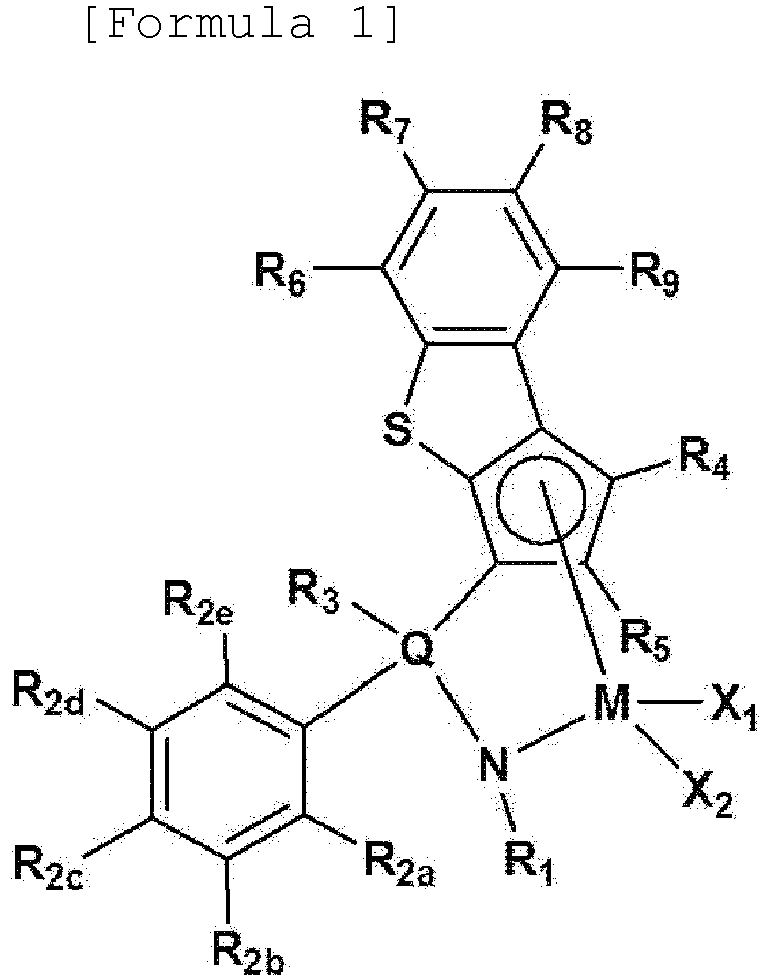
- R1 is hydrogen; alkyl of 1 to 20 carbon atoms; cycloalkyl of 3 to 20 carbon atoms; alkenyl of 2 to 20 carbon atoms; alkoxy of 1 to 20 carbon atoms; aryl of 6 to 20 carbon atoms; arylalkoxy of 7 to 20 carbon atoms; alkylaryl of 7 to 20 carbon atoms; or arylalkyl of 7 to 20 carbon atoms,
- R2a to R2e are each independently hydrogen; halogen; alkyl of 1 to 20 carbon atoms; cycloalkyl of 3 to 20 carbon atoms; alkenyl of 2 to 20 carbon atoms; alkoxy of 1 to 20 carbon atoms; or aryl of 6 to 20 carbon atoms,
- R3 is hydrogen; halogen; alkyl of 1 to 20 carbon atoms; cycloalkyl of 3 to 20 carbon atoms; alkenyl of 2 to 20 carbon atoms; aryl of 6 to 20 carbon atoms; alkylaryl of 6 to 20 carbon atoms; arylalkyl of 7 to 20 carbon atoms; alkyl amido of 1 to 20 carbon atoms; aryl amido of 6 to 20 carbon atoms; alkylidene of 1 to 20 carbon atoms; or phenyl which is substituted with one or more selected from the group consisting of halogen, alkyl of 1 to 20 carbon atoms, cycloalkyl of 3 to 20 carbon atoms, alkenyl of 2 to 20 carbon atoms, alkoxy of 1 to 20 carbon atoms and aryl of 6 to 20 carbon atoms,
- R4 to R9 are each independently hydrogen; silyl; alkyl of 1 to 20 carbon atoms; cycloalkyl of 3 to 20 carbon atoms; alkenyl of 2 to 20 carbon atoms; aryl of 6 to 20 carbon atoms; alkylaryl of 7 to 20 carbon atoms; arylalkyl of 7 to 20 carbon atoms; or a metalloid radical of a metal in group 14, which is substituted with hydrocarbyl of 1 to 20 carbon atoms; where among the R6 to Rg, adjacent two or more may be connected with each other to form a ring,
- Q is Si, C, N, P or S,
- M is a transition metal in group 4, and
- X1 and X2 are each independently hydrogen; halogen; alkyl of 1 to 20 carbon atoms; cycloalkyl of 3 to 20 carbon atoms; alkenyl of 2 to 20 carbon atoms; aryl of 6 to 20 carbon atoms; alkylaryl of 7 to 20 carbon atoms; arylalkyl of 7 to 20 carbon atoms; alkylamino of 1 to 20 carbon atoms; arylamino of 6 to 20 carbon atoms; or alkylidene of 1 to 20 carbon atoms.
- The olefin-based copolymer according to the present invention has improved hardness and is highly flowable, and may show improved physical properties of tensile strength, elongation rate and flexural modulus when compared with a copolymer having an equivalent degree of density.
- Hereinafter, the present invention will be described in more detail to assist the understanding of the present invention.
- It will be understood that words or terms used in the specification and claims shall not be interpreted as the meaning defined in commonly used dictionaries. It will be further understood that the words or terms should be interpreted as having a meaning that is consistent with their meaning in the context of the relevant art and the technical idea of the invention, based on the principle that an inventor may properly define the meaning of the words or terms to best explain the invention.
- The term "polymer" used in the present disclosure means a polymer compound prepared by polymerizing monomers which are the same or different types. The common term, "polymer" includes a term, "interpolymer" as well as "homopolymer", "copolymer" and "terpolymer". The term "interpolymer" means a polymer prepared by polymerizing two or more different types of monomers. The common term "interpolymer" includes a term "copolymer" (commonly used to refer a polymer prepared from two different monomers) and a term "terpolymer" (commonly used to refer a polymer prepared from three different monomers). The term "interpolymer" includes a polymer prepared by polymerizing four or more types of monomers.
- The olefin-based copolymer according to the present invention satisfies the following conditions (1) to (4):
- (1) a density (d) is 0.85 to 0.89 g/cc,
- (2) a melt index (MI, 190°C, 2.16 kg load conditions) is 15 g/10 min to 100 g/10 min,
- (3) hardness, density and MI satisfy the following Equation 1, and
- (4) a repeating unit derived from alpha olefin measured through nuclear magnetic spectroscopic analysis is from 15 wt% to 45 wt%:
- If measured according to ASTM D-792, the olefin-based copolymer according to the present invention shows a low density of 0.85 g/cc to 0.89 g/cc, particularly, 0.855 to 0.89 g/cc, more particularly, 0.86 to 0.89 g/cc. The olefin-based copolymer according to the present invention shows low density in the above-described range.
- The melt index (MI) may be controlled by controlling the amount used of a catalyst used in a process of polymerizing an olefin-based copolymer with respect to a comonomer, and influences the mechanical properties, impact strength, and moldability of the olefin-based copolymer. In this disclosure, the melt index is measured in low-density conditions of 0.85 to 0.89 g/cc, and measured under 190°C and 2.16 kg load conditions according to ASTM D1238, and may be 15 g/10 min to 100 g/10 min, particularly, 15 g/10 min to 80 g/10 min, more particularly, 16 g/10 min to 70 g/10 min.
- The (3) hardness, density and melt index (MI) of the olefin-based copolymer of the present invention, satisfy the following Equation 1, and according to the satisfaction of Equation 1, the olefin-based copolymer of the present invention may show improved hardness, tensile strength, elongation rate and flexural modulus when compared with the conventional copolymer which has equivalent density and melt index:

(in Equation 1, A satisfies 97 x density < A < 101 x density) - In addition, the olefin-based copolymer of the present invention may include (4) a repeating unit derived from alpha olefin, if measured through nuclear magnetic spectroscopic analysis, in amounts from 15 wt% to 45 wt%, particularly, 20 wt% to 45 wt%, more particularly, 20 wt% to 40 wt%.
- The olefin-based copolymer according to an embodiment of the present invention may further satisfy (5) a weight average molecular weight (Mw) of 10,000 to 80,000 g/mol, and the weight average molecular weight (Mw) may be particularly, 20,000 g/mol to 70,000 g/mol, more particularly, 30,000 g/mol to 65,000 g/mol.
- In addition, the olefin-based copolymer according to an embodiment of the present invention may further satisfy a ratio (Mw/Mn) of a weight average molecular weight (Mw) and a number average molecular weight (Mn), i.e., (6) molecular weight distribution (MWD) of 1.5 to 3.0, and the molecular weight distribution may particularly be 1.5 to 2.5, more particularly, 1.9 to 2.15.
- In the present invention, the weight average molecular weight (Mw) and number average molecular weight (Mn) are polystyrene conversion molecular weights which are analyzed by gel permeation chromatography (GPC).
- Generally, the density of an olefin-based polymer is influenced by the kind and amount of a monomer used during polymerization, a polymerization degree, etc., and a copolymer may be largely influenced by the amount of a comonomer. The olefin-based copolymer of the present invention is copolymerized by injecting hydrogen (H2) into a catalyst composition including a transition metal compound having a characteristic structure, and a large amount of comonomer may be introduced to achieve a low density in the above-described range, and thus, hardness may be increased when compared with the conventional copolymer having the same density, and as a result, further improved physical properties such as tensile strength, elongation rate, and flexural modulus when compared with the conventional copolymer may be achieved.
- In addition, the olefin-based copolymer according to the present invention may show narrow molecular weight distribution in the above-described range by injecting an optimal amount of hydrogen during polymerization reaction for preparing thereof and controlling molecular weight distribution.
- In addition, the olefin-based polymer according to an embodiment of the present invention may have hardness (shore A) of 30 to 80, particularly, 40 to 80, more particularly, 50 to 80. The olefin-based polymer may show higher hardness (shore A) with the equivalent degrees of density and melt index values when compared with a commonly used conventional olefin-based polymer, and accordingly, may have improved tensile strength, elongation rate and flexural modulus.
- The olefin-based copolymer may be a copolymer of an olefin-based monomer, particularly, two or more selected among an alpha-olefin-based monomer, a cyclic olefin-based monomer, a diene olefin-based monomer, a triene olefin-based monomer and a styrene-based monomer.
- The alpha-olefin monomer may include any one selected from the group consisting of propylene, 1-butene, 1-pentene, 4-methyl-1-pentene, 1-hexene, 1-heptene, 1-octene, 1-decene, 1-undecene, 1-dodecene, 1-tetradecene, 1-hexadecene, 1-eicocene, norbornene, norbornadiene, ethylidene norbornene, phenyl norbornene, vinyl norbornene, dicyclopentadiene, 1,4-butadiene, 1,5-pentadiene, 1,6-hexadiene, styrene, alphamethylstyrene, divinylbenzene and 3-chloromethylstyrene, or a mixture of two or more thereof.
- Particularly, the olefin-based copolymer may be a copolymer of ethylene and an alpha-olefin-based monomer of 3 to 12 carbon atoms, particularly, a copolymer of ethylene and an alpha-olefin-based monomer of 3 to 10 carbon atoms.
- More particularly, the olefin copolymer according to an embodiment of the present invention may be a copolymer of ethylene with propylene, ethylene with 1-butene, ethylene with 1-hexene, ethylene with 4-methyl-1-pentene or ethylene with 1-octene.
- In an embodiment of the present invention, the olefin-based copolymer may be a copolymer of ethylene and 1-octene, and may have tensile elongation of 500% or more, and tensile strength of 20 kgf/cm2 or more, measured based on ASTM D638 (50 mm/min), and flexural modulus (Secant 1%) of 10 kgf/cm2 or more, measured based on ASTM D790. Particularly, the olefin-based copolymer may be a copolymer of ethylene and 1-octene, and may have tensile elongation of 1,000% or more, and tensile strength of 25 kgf/cm2 to 40 kgf/cm2, measured based on ASTM D638 (50 mm/min), and flexural modulus (Secant 1%) of 10.0 kgf/cm2 to 30.0 kgf/cm2, measured based on ASTM D790.
- In addition, in an embodiment of the present invention, the olefin-based copolymer may be a copolymer of ethylene and 1-butene, and may have tensile elongation of 500% or more, and tensile strength of 20 kgf/cm2 to 50 kgf/cm2, measured based on ASTM D638 (50 mm/min), and flexural modulus (Secant 1%) of 10.0 kgf/cm2 or more, measured based on ASTM D790. Particularly, the olefin-based copolymer may be a copolymer of ethylene and 1-butene, and may have tensile elongation of 500% to 1,000%, and tensile strength of 20 kgf/cm2 to 40 kgf/cm2, measured based on ASTM D638 (50 mm/min), and flexural modulus (Secant 1%) of 10.0 kgf/cm2 to 30.0 kgf/cm2, measured based on ASTM D790.
- The olefin-based copolymer according to an embodiment of the present invention, having the above-described physical properties and configurational characteristics may be prepared by continuous solution polymerization reaction by which an olefin-based monomer is polymerized by continuously injecting hydrogen in the presence of a metallocene catalyst composition including one or more transition metal compounds in a single reactor.
- Accordingly, in the olefin-based copolymer according to an embodiment of the present invention, a block formed by linearly connecting two or more repeating units derived from any one monomer among the monomers constituting a polymer is not formed in the polymer. That is, the olefin-based copolymer according to the present invention does not include a block copolymer but may be selected from the group consisting of a random copolymer, an alternating copolymer and a graft copolymer, and more particularly, may be a random copolymer.
- Particularly, the olefin-based copolymer of the present invention may be obtained by a preparation method including a step of polymerizing an olefin-based monomer by injecting hydrogen in 10 to 100 cc/min in the presence of a catalyst composition for polymerizing olefin, including a transition metal compound of Formula 1 below.
- However, in preparing the olefin-based copolymer according to an embodiment of the present invention, the structure range of the transition metal compound is not limited to a specifically shown type, but it should be understood that all modifications, equivalents and replacements, included in the spirit and technical scope of the present invention are included.

- R1 is hydrogen; alkyl of 1 to 20 carbon atoms; cycloalkyl of 3 to 20 carbon atoms; alkenyl of 2 to 20 carbon atoms; alkoxy of 1 to 20 carbon atoms; aryl of 6 to 20 carbon atoms; arylalkoxy of 7 to 20 carbon atoms; alkylaryl of 7 to 20 carbon atoms; or arylalkyl of 7 to 20 carbon atoms,
- R2a to R2e are each independently hydrogen; halogen; alkyl of 1 to 20 carbon atoms; cycloalkyl of 3 to 20 carbon atoms; alkenyl of 2 to 20 carbon atoms; alkoxy of 1 to 20 carbon atoms; or aryl of 6 to 20 carbon atoms,
- R3 is hydrogen; halogen; alkyl of 1 to 20 carbon atoms; cycloalkyl of 3 to 20 carbon atoms; alkenyl of 2 to 20 carbon atoms; aryl of 6 to 20 carbon atoms; alkylaryl of 6 to 20 carbon atoms; arylalkyl of 7 to 20 carbon atoms; alkyl amido of 1 to 20 carbon atoms; aryl amido of 6 to 20 carbon atoms; alkylidene of 1 to 20 carbon atoms; or phenyl which is substituted with one or more selected from the group consisting of halogen, alkyl of 1 to 20 carbon atoms, cycloalkyl of 3 to 20 carbon atoms, alkenyl of 2 to 20 carbon atoms, alkoxy of 1 to 20 carbon atoms and aryl of 6 to 20 carbon atoms,
- R4 to R9 are each independently hydrogen; silyl; alkyl of 1 to 20 carbon atoms; cycloalkyl of 3 to 20 carbon atoms; alkenyl of 2 to 20 carbon atoms; aryl of 6 to 20 carbon atoms; alkylaryl of 7 to 20 carbon atoms; arylalkyl of 7 to 20 carbon atoms; or a metalloid radical of a metal in group 14, which is substituted with hydrocarbyl of 1 to 20 carbon atoms; among the R6 to Rg, adjacent two or more may being connected with each other to form a ring,
- Q is Si, C, N, P or S,
- M is a transition metal in group 4, and
- X1 and X2 are each independently hydrogen; halogen; alkyl of 1 to 20 carbon atoms; cycloalkyl of 3 to 20 carbon atoms; alkenyl of 2 to 20 carbon atoms; aryl of 6 to 20 carbon atoms; alkylaryl of 7 to 20 carbon atoms; arylalkyl of 7 to 20 carbon atoms; alkylamino of 1 to 20 carbon atoms; arylamino of 6 to 20 carbon atoms; or alkylidene of 1 to 20 carbon atoms.
- In an embodiment of the present invention, in the transition metal compound of Formula 1 above,
- R1 may be hydrogen; alkyl of 1 to 20 carbon atoms; cycloalkyl of 3 to 20 carbon atoms; alkoxy of 1 to 20 carbon atoms; aryl of 6 to 20 carbon atoms; arylalkoxy of 7 to 20 carbon atoms; alkylaryl of 7 to 20 carbon atoms; or arylalkyl of 7 to 20 carbon atoms,
- R2a to R2e may be each independently hydrogen; halogen; alkyl of 1 to 12 carbon atoms; cycloalkyl of 3 to 12 carbon atoms; alkenyl of 2 to 12 carbon atoms; alkoxy of 1 to 12 carbon atoms; or phenyl,
- R3 may be hydrogen; halogen; alkyl of 1 to 12 carbon atoms; cycloalkyl of 3 to 12 carbon atoms; alkenyl of 2 to 12 carbon atoms; aryl of 6 to 20 carbon atoms; alkylaryl of 7 to 13 carbon atoms; arylalkyl of 7 to 13 carbon atoms; or phenyl which is substituted with one or more selected from the group consisting of halogen, alkyl of 1 to 12 carbon atoms, cycloalkyl of 3 to 12 carbon atoms, alkenyl of 2 to 12 carbon atoms, alkoxy of 1 to 12 carbon atoms and phenyl,
- R4 to R9 may be each independently hydrogen; alkyl of 1 to 20 carbon atoms; cycloalkyl of 3 to 20 carbon atoms; aryl of 6 to 20 carbon atoms; alkylaryl of 7 to 20 carbon atoms; or arylalkyl of 7 to 20 carbon atoms,
- among the R6 to Rg, adjacent two or more may be connected with each other to form an aliphatic ring of 5 to 20 carbon atoms or an aromatic ring of 6 to 20 carbon atoms; where the aliphatic ring or the aromatic ring may be substituted with alkyl of 1 to 20 carbon atoms, alkenyl of 2 to 12 carbon atoms, or aryl of 6 to 12 carbon atoms,
- Q may be Si,
- M may be Ti, and
- X1 and X2 may be each independently hydrogen; halogen; alkyl of 1 to 12 carbon atoms; cycloalkyl of 3 to 12 carbon atoms; alkenyl of 2 to 12 carbon atoms; aryl of 6 to 12 carbon atoms; alkylaryl of 7 to 13 carbon atoms; arylalkyl of 7 to 13 carbon atoms; alkylamino of 1 to 13 carbon atoms; arylamino of 6 to 12 carbon atoms; or alkylidene of 1 to 12 carbon atoms.
- In another embodiment of the present invention, in the transition metal compound of Formula 1 above,
- R1 may be hydrogen; alkyl of 1 to 12 carbon atoms; cycloalkyl of 3 to 12 carbon atoms; alkoxy of 1 to 12 carbon atoms; aryl of 6 to 12 carbon atoms; arylalkoxy of 7 to 13 carbon atoms; alkylaryl of 7 to 13 carbon atoms; or arylalkyl of 7 to 13 carbon atoms,
- R2a to R2e may be each independently hydrogen; halogen; alkyl of 1 to 12 carbon atoms; cycloalkyl of 3 to 12 carbon atoms; alkenyl of 2 to 12 carbon atoms; alkoxy of 1 to 12 carbon atoms; or phenyl,
- R3 may be hydrogen; halogen; alkyl of 1 to 12 carbon atoms; cycloalkyl of 3 to 12 carbon atoms; alkenyl of 2 to 12 carbon atoms; alkylaryl of 7 to 13 carbon atoms; arylalkyl of 7 to 13 carbon atoms; phenyl; or phenyl which is substituted with one or more selected from the group consisting of halogen, alkyl of 1 to 12 carbon atoms, cycloalkyl of 3 to 12 carbon atoms, alkenyl of 2 to 12 carbon atoms, alkoxy of 1 to 12 carbon atoms and phenyl,
- R4 to R9 may be each independently hydrogen; alkyl of 1 to 12 carbon atoms; cycloalkyl of 3 to 12 carbon atoms; aryl of 6 to 12 carbon atoms; alkylaryl of 7 to 13 carbon atoms; or arylalkyl of 7 to 13 carbon atoms,
- among the R6 to Rg, adjacent two or more may be connected with each other to form an aliphatic ring of 5 to 12 carbon atoms or an aromatic ring of 6 to 12 carbon atoms;
- the aliphatic ring or the aromatic ring may be substituted with halogen, alkyl of 1 to 12 carbon atoms, alkenyl of 2 to 12 carbon atoms, or aryl of 6 to 12 carbon atoms,
- Q may be Si,
- M may be Ti, and
- X1 and X2 may be each independently hydrogen; halogen; alkyl of 1 to 12 carbon atoms; or alkenyl of 2 to 12 carbon atoms.
- In addition, in another embodiment of the present invention, in the transition metal compound of Formula 1 above,
- R1 may be hydrogen or alkyl of 1 to 12 carbon atoms,
- R2a to R2e may be each independently hydrogen; alkyl of 1 to 12 carbon atoms; or alkoxy of 1 to 12 carbon atoms,
- R3 may be hydrogen; alkyl of 1 to 12 carbon atoms; or phenyl,
- R4 and R5 may be each independently hydrogen; or alkyl of 1 to 12 carbon atoms,
- R6 to R9 may be each independently hydrogen or methyl,
- Q may be Si,
- M may be Ti, and
- X1 and X2 may be each independently hydrogen or alkyl of 1 to 12 carbon atoms.
- The compound represented by Formula 1 may be any one among the compounds represented by the following Formula 1-1 to Formula 1-10:


- Additionally, compounds having various structures within the defined range by Formula 1 may be used.
- In the transition metal compound represented by Formula 1, a metal site is connected by a cyclopentadienyl ligand introducing tetrahydroquinoline, and the structure thereof has a narrow Cp-M-N angle and a wide Q3-M-Q4 angle to which a monomer may approach. In addition, due to a ring-type bond, Cp, tetrahydroquinoline, nitrogen and the metal site are connected in order, and more stable and rigid pentagonal ring structure may be formed. Accordingly, if the compounds are applied after reacting with a cocatalyst such as methyl aluminoxane and B(C6F5)3 and activating, an olefin-based copolymer having properties of high activity, high molecular weight and high copolymerization degree may be produced at a high polymerization temperature.
- Each substituent defined in this disclosure will be explained in detail as follows.
- The term "hydrocarbyl group" used in this disclosure means a monovalent hydrocarbon group of 1 to 20 carbon atoms, which is composed of only carbon and hydrogen irrespective of its structure, such as alkyl, aryl, alkenyl, alkynyl, cycloalkyl, alkylaryl and arylalkyl, unless otherwise referred to.
- The term "halogen" used in this disclosure means fluorine, chlorine, bromine or iodine, unless otherwise referred to.
- The term "alkyl" used in this disclosure means a linear chain or branch chain of a hydrocarbon residual group, unless otherwise referred to.
- The term "alkenyl" used in this disclosure means a linear chain or branch chain of an alkenyl group, unless otherwise referred to.
- The branched chain may be alkyl of 1 to 20 carbon atoms; alkenyl of 2 to 20 carbon atoms; aryl of 6 to 20 carbon atoms; alkylaryl of 7 to 20 carbon atoms; or arylalkyl of 7 to 20 carbon atoms.
- According to an embodiment of the present invention, the aryl group may preferably have 6 to 20 carbon atoms, and may particularly be phenyl, naphthyl, anthracenyl, pyridyl, dimethylanilinyl, anisolyl, etc., without limitation.
- The alkylaryl group means an aryl group substituted by the alkyl group.
- The arylalkyl group means an alkyl group substituted by the aryl group.
- The ring (or heterocycle) means a monovalent aliphatic or aromatic hydrocarbon group having 5 to 20 ring-forming atoms and including one or more heteroatoms, and may be a monocycle or a condensed ring of two or more rings. In addition, the heterocycle may be substituted or unsubstituted with an alkyl group. Examples of the ring may include indoline, tetrahydroquinoline, etc., without limitation.
- The alkylamino group means an amino group substituted by the alkyl group, and may be dimethylamino, diethylamino, etc., without limitation.
- According to an embodiment of the present invention, the aryl group may preferably have 6 to 20 carbon atoms, and may particularly be phenyl, naphthyl, anthracenyl, pyridyl, dimethylanilinyl, anisolyl, etc., without limitation.
- The transition metal compound of Formula 1 is capable of introducing a large amount of alpha-olefin as well as a low-density polyethylene due to the structural characteristics thereof, and the preparation of a low-density polyolefin copolymer having a density degree of 0.89 g/cc or less, more particularly, 0.85 to 0.89 g/cc may be possible.
- The transition metal compound of Formula 1 may be used solely, or as a composition type including one or more cocatalyst compounds represented by Formula 2, Formula 3 and Formula 4 below in addition to the transition metal compound of Formula 1, as a catalyst of polymerization reaction. The cocatalyst compound may assist the activation of the transition metal compound of Formula 1 above.
[Formula 2] - [Al (R10) -O]a -
[Formula 3] A(R10)3
[Formula 4] [L-H]+[W(D)4]- or [L]+[W(D)4]-
- In Formulae 2 to 4,
- R10 groups may be the same or different from each other and each independently selected from the group consisting of halogen, hydrocarbyl of 1 to 20 carbon atoms, and halogen-substituted hydrocarbyl of 1 to 20 carbon atoms,
- A is aluminum or boron,
- D is each independently aryl of 6 to 20 carbon atoms or alkyl of 1 to 20 carbon atoms, of which one or more hydrogen atoms may be substituted with substituents, wherein the substituent is at least any one selected from the group consisting of halogen, hydrocarbyl of 1 to 20 carbon atoms, alkoxy of 1 to 20 carbon atoms and aryloxy of 6 to 20 carbon atoms,
- H is a hydrogen atom,
- L is a neutral or cationic Lewis acid,
- W is an element in group 13, and
- a is an integer of 2 or more.
- Examples of the compound represented by Formula 2 may be an alkylaluminoxane such as methylaluminoxane (MAO), ethylaluminoxane, isobutylaluminoxane and butylalminoxane, and a modified alkylaluminoxane obtained by mixing two or more kinds of the alkylaluminoxane, particularly, methylaluminoxane, modified methylaluminoxane (MMAO).
- Examples of the compound represented by Formula 3 may include trimethylaluminum, triethylaluminum, triisobutylaluminum, tripropylaluminum, tributylaluminum, dimethylchloroaluminum, triisopropylaluminum, tri-s-butylaluminum, tricyclopentylaluminum, tripentylaluminum, triisopentylaluminum, trihexylaluminum, trioctylaluminum, ethyldimethylaluminum, methyldiethylaluminum, triphenylaluminum, tri-p-tolylaluminum, dimethylaluminummethoxide, dimethylaluminumethoxide, trimethylboron, triethylboron, triisobutylboron, tripropylboron, tributylboron, etc. and particularly, may be selected from trimethylaluminum, triethylaluminum and triisobutylaluminum.
- Examples of the compound represented by Formula 4 may include triethylammonium tetraphenylboron, tributylammoniumtetraphenylboron, trimethylammoniumtetraphenylboron, tripropylammoniumtetraphenylboron, trimethylammoniumtetra(p-tolyl)boron, trimethylammoniumtetra(o,p-dimethylphenyl)boron, tributylammoniumtetra(p-trifluoromethylphenyl)boron, trimethylammoniumtetra(p-trifluoromethylphenyl)boron, tributylammoniumtetrapentafluorophenylboron, N,N-diethylaniliumtetraphenylboron, N,N-diethylaniliumtetrapentafluorophenylboron, diethylammoniumtetrapentafluorophenylboron, triphenylphosphoniumtetraphenylboron, trimethylphosphoniumtetraphenylboron, dimethylanilium tetrakis(pentafluorophenyl) borate, triethylammoniumtetraphenylaluminum, tributylammoniumtetraphenylaluminum, trimethylammoniumtetraphenylaluminum, tripropylammoniumtetraphenylaluminum, trimethylammoniumtetra(p-tolyl) aluminum, tripropylammoniumtetra(p-tolyl) aluminum, triethylammoniumtetra(o,p-dimethylphenyl) aluminum, tributylammoniumtetra(p-trifluoromethylphenyl) aluminum, trimethylammoniumtetra(p-trifluoromethylphenyl) aluminum, tributylammoniumtetrapentafluorophenylaluminum, N,N-diethylaniliniumtetraphenylaluminum, N,N-diethylaniliumtetrapentafluorophenylaluminum, diethylammoniumtetrapentafluorophenylaluminum, triphenylphosphoniumtetraphenylaluminum, trimethylphosphoniumtetraphenylaluminum, tripropylammoniumtetra(p-tolyl)boron, triethylammoniumtetra(o,p-dimethylphenyl)boron, triphenylcarboniumtetra(p-trifluoromethylphenyl)boron, or triphenylcarboniumtetrapentafluorophenylboron.
- The catalyst composition may be prepared by a method including 1) a step of obtaining a mixture by contacting the transition metal compound represented by Formula 1 with the compound represented by Formula 2 or Formula 3; and 2) a step of adding the compound represented by Formula 4 to the mixture, as the first method.
- In addition, the catalyst composition may be prepared by a method of contacting the transition metal compound represented by Formula 1 with the compound represented by Formula 2, as the second method.
- In case of the first method among the preparation methods of the catalyst composition, the molar ratio of the transition metal compound represented by Formula 1/the compound represented by Formula 2 or Formula 3 may be 1/5,000 to 1/2, particularly, 1/1,000 to 1/10, more particularly, 1/500 to 1/20. If the molar ratio of the transition metal compound represented by Formula 1/the compound represented by Formula 2 or Formula 3 is greater than 1/2, the amount of an alkylating agent is too small, and the alkylation of a metal compound may be incompletely carried out, and if the molar ratio is less than 1/5,000, the alkylation of the metal compound may be achieved, but the activation of the alkylated metal compound may be incompletely carried out due to the side reactions between an excessive amount of the alkylating agent remained and an activating agent of the compound represented by Formula 4. In addition, the molar ratio of the transition metal compound represented by Formula 1/the compound represented by Formula 4 may be 1/25 to 1, particularly, 1/10 to 1, more particularly, 1/5 to 1. If the molar ratio of the transition metal compound represented by Formula 1/the compound represented by Formula 4 is greater than 1, the amount of an activating agent is relatively small, and the activation of the metal compound is incompletely carried out, and thus, the activity of the catalyst composition may be deteriorated. If the molar ratio is less than 1/25, the activation of the metal compound may be completely carried out, but due to the excessive amount of the activating agent remained, it would not be economical considering the unit cost of the catalyst composition, or the purity of a polymer produced may be degraded.
- In case of the second method among the preparation methods of the catalyst composition, the molar ratio of the transition metal compound represented by Formula 1/the compound represented by Formula 2 may be 1/10,000 to 1/10, particularly, 1/5,000 to 1/100, more particularly, 1/3,000 to 1/500. If the molar ratio is greater than 1/10, the amount of an activating agent is relatively small, and the activation of a metal compound may be incompletely carried out and the activity of the catalyst composition thus produced may be degraded, and if the molar ratio is less than 1/10,000, the activation of the metal compound may be completely carried out, but due to the excessive amount of the activating agent remained, it would not be economical considering the unit cost of the catalyst composition, or the purity of a polymer produced may be degraded.
- As the reaction solvent during preparing the catalyst composition, a hydrocarbon-based solvent such as pentane, hexane, and heptane, or an aromatic solvent such as benzene and toluene may be used.
- In addition, the catalyst composition may include the transition metal compound and the cocatalyst compound in a supported type on a support.
- Any supports used in a metallocene-based catalyst may be used as the support without specific limitation. Particularly, the support may be silica, silica-alumina or silica-magnesia, and any one among them or a mixture of two or more thereof may be used.
- In case where the support is silica among them, since a silica support and the functional group of the metallocene compound of Formula 1 form a chemical bond, there is no catalyst separated from the surface during an olefin polymerization process. As a result, the generation of fouling, by which polymer particles are agglomerated on the wall side of a reactor or from each other during the preparation process of an olefin-based copolymer, may be prevented. In addition, the particle shape and apparent density of a polymer in the olefin-based copolymer prepared in the presence of a catalyst including the silica support are excellent.
- More particularly, the support may be silica or silica-alumina, including a highly reactive siloxane group and dried at a high temperature through a method of drying at a high temperature, etc.
- The support may further include an oxide, a carbonate, a sulfate, or a nitrate component, for example, Na2O, K2CO3, BaSO4 and Mg (NO3)2.
- The drying temperature of the support is preferably, from 200 to 800°C, more preferably, from 300 to 600°C, most preferably, from 300 to 400°C. If the drying temperature of the support is less than 200°C, humidity is too high and water at the surface may react with the cocatalyst, and if the temperature is greater than 800°C, the pores at the surface of the support may be combined to decrease the surface area, and a large amount of the hydroxyl groups at the surface may be removed to remain only siloxane groups to decrease reaction sites with the cocatalyst, undesirably.
- In addition, the amount of the hydroxyl group at the surface of the support may preferably be 0.1 to 10 mmol/g, and more preferably, 0.5 to 5 mmol/g. The amount of the hydroxyl group at the surface of the support may be controlled by the preparation method and conditions of the support, or drying conditions such as temperature, time, vacuum and spray drying.
- Meanwhile, the polymerization reaction of the olefin-based copolymer may be performed by continuously injecting hydrogen and continuously polymerizing an olefin-based monomer in the presence of the catalyst composition.
- The polymerization reaction of the olefin monomer may be performed in an inert solvent, and as the inert solvent, benzene, toluene, xylene, cumene, heptane, cyclohexane, methylcyclohexane, methylcyclopentane, n-hexane, 1-hexene, and 1-octene may be used, without limitation.
- The polymerization of the olefin-based copolymer may be performed at about 25 to about 500°C under a pressure of about 1 to about 100 kgf/cm2.
- Particularly, the polymerization of the olefin-based copolymer may be performed at a temperature of about 25 to about 500°C, particularly, 80 to 250°C, more preferably, 100 to 200°C. In addition, the reaction pressure during polymerization may be 1 kgf/cm2 to 150 kgf/cm2, preferably, 1 kgf/cm2 to 120 kgf/cm2, more preferably, 5 kgf/cm2 to 100 kgf/cm2.
- The olefin-based copolymer may be usefully used for manufacturing a molded article.
- The molded article may particularly include a blow molding molded article, an inflation molded article, a cast molded article, an extruded laminate molded article, an extruded molded article, a foam molded article, an injection molded article, a sheet, a film, a fiber, a monofilament, or a non-woven fabric.
- Hereinafter, preferred embodiments will be suggested to assist the understanding of the present invention. However, the embodiments are provided only for easy understanding of the present invention, and the contents of the present invention is not limited thereto.
-

- To a 250 ml schlenk flask, 10 g (1.0 eq, 49.925 mmol) of 1,2-dimethyl-3H-benzo[b]cyclopenta[d]thiophene and 100 ml of THF were put, and 22 mL (1.1 eq, 54.918 mmol, 2.5 M in hexane) of n-BuLi was added thereto dropwisely at -30°C, followed by stirring at room temperature for 3 hours. A stirred Li-complex THF solution was cannulated into a schlenk flask containing 8.1 mL (1.0 eq, 49.925 mmol) of dichloro (methyl) (phenyl) silane and 70 mL of THF at -78°C, followed by stirring at room temperature overnight. After stirring, drying in vacuum was carried out and extraction with 100 ml of hexane was carried out.
- To 100 ml of an extracted chloro-1-(1,2-dimethyl-3H-benzo[b]cyclopenta[d]thiophene-3-yl)-1,1-(methyl)(phenyl)silane hexane solution, 42 ml (8 eq, 399.4 mmol) of t-BuNH2 was injected at room temperature, followed by stirring at room temperature overnight. After stirring, drying in vacuum was carried out and extraction with 150 ml of hexane was carried out. After drying the solvents, 13.36 g (68%, dr = 1:1) of a yellow solid was obtained.
1H NMR (CDCl3, 500 MHz): δ 7.93 (t, 2H), 7.79 (d, 1H), 7.71 (d, 1H), 7.60 (d, 2H), 7.48 (d, 2H), 7.40-7.10 (m, 10H, aromatic), 3.62 (s, 1H), 3.60 (s, 1H), 2.28 (s, 6H), 2.09 (s, 3H), 1.76 (s, 3H), 1.12 (s, 18H), 0.23 (s, 3H), 0.13 (s, 3H)
- To a 100 ml schlenk flask, 4.93 g (12.575 mmol, 1.0 eq) of a ligand compound of Formula 2-4 and 50 mL (0.2 M) of toluene were put and 10.3 ml (25.779 mmol, 2.05 eq, 2.5M in hexane) of n-BuLi was added thereto dropwisely at -30°C, followed by stirring at room temperature overnight. After stirring, 12.6 mL (37.725 mmol, 3.0 eq, 3.0 M in diethyl ether) of MeMgBr was added thereto dropwisely, 13.2 ml (13.204 mmol, 1.05 eq, 1.0 M in toluene) of TiCl4 was put in order, followed by stirring at room temperature overnight. After stirring, drying in vacuum and extraction with 150 ml of hexane were carried out, the solvent was removed to 50 ml, and 4 ml (37.725 mmol, 3.0 eq) of DME was added dropwisely, followed by stirring at room temperature overnight. Again, drying in vacuum and extraction with 150 ml of hexane were carried out. After drying the solvents, 2.23 g (38%, dr = 1:0.5) of a brown solid was obtained.
1H NMR (CDCl3, 500 MHz): δ 7.98 (d, 1H), 7.94 (d, 1H), 7.71 (t, 6H), 7.50-7.30 (10H), 2.66 (s, 3H), 2.61 (s, 3H), 2.15 (s, 3H), 1.62 (s, 9H), 1.56 (s, 9H), 1.53 (s, 3H), 0.93 (s, 3H), 0.31 (s, 3H), 0.58 (s, 3H), 0.51 (s, 3H), -0.26 (s, 3H), -0.39 (s, 3H) -

- To a 100 ml, schlenk flask, 4.65 g (15.88 mmol) of chloro-1-(1,2-dimethyl-3H-benzo[b]cyclopenta[d]thiophene-3-yl)-1,1-dimethylsilane was weighed and added, and 80 mL of THF was injected thereto. tBuNH2 (4 eq, 6.68 mL) was injected thereto at room temperature, and the reaction was performed at room temperature for three days. After finishing the reaction, THF was removed and the residue was filtered with hexane. After drying the solvent, 4.50 g (86%) of a yellow liquid was obtained.
1H-NMR (in CDCl3, 500 MHz): 7.99(d, 1H), 7.83(d, 1H), 7.35(dd, 1H), 7.24(dd, 1H), 3.49(s, 1H), 2.37(s, 3H), 2.17(s, 3H), 1.27(s, 9H), 0.19(s, 3H), -0.17(s, 3H) -

- To a 50 ml, schlenk flask, N-tert-butyl-1-(1,2-dimethyl-3H-benzo[b]cyclopenta[d]thiophene-3-yl)-1,1-dimethylsilaneamine (1.06 g, 3.22 mmol/1.0 eq) prepared above and 16.0 mL (0.2 M) of MTBE were put and stirred first. N-BuLi (2.64 ml, 6.60 mmol/2.05 eq, 2.5 M in THF) was added thereto at -40°C, and the reaction was performed at room temperature overnight. Then, MeMgBr (2.68 mL, 8.05 mmol/2.5 eq, 3.0 M in diethyl ether) was slowly added thereto dropwisely at -40°C, and TiCl4 (2.68 mL, 3.22 mmol/1.0 eq, 1.0 M in toluene) was added thereto in order, and the reaction was performed at room temperature overnight. Then, the reaction mixture was passed through celite using hexane for filtering. After drying the solvent, 1.07 g (82%) of a brown solid was obtained.
1H-NMR (in CDCl3, 500 MHz): 7.99 (d, 1H), 7.68 (d, 1H), 7.40 (dd, 1H), 7.30 (dd, 1H), 3.22 (s, 1H), 2.67 (s, 3H), 2.05 (s, 3H), 1.54 (s, 9H), 0.58 (s, 3H), 0.57 (s, 3H), 0.40 (s, 3H), -0.45 (s, 3H) - Into a 1.5 L autoclave continuous process reactor, a hexane solvent (5 kg/h) and 1-octene (2 kg/h) were charged, and the top of the reactor was pre-heated to a temperature of 136°C. A triisobutylaluminum compound (0.05 mmol/min), the transition metal compound (0.45 µmol/min) prepared in Preparation Example 1 as a catalyst, a dimethylanilium tetrakis(pentafluorophenyl) borate cocatalyst (1.35 µmol/min) were injected into the reactor at the same time. Then, into the autoclave reactor, ethylene (0.87 kg/h) and a hydrogen gas (28 cc/min) were injected and a copolymerization reaction was continuously carried out while maintaining a pressure of 89 bar and 136°C for 30 minutes or more to prepare a copolymer. After drying for 12 hours or more, the physical properties were measured.
- Copolymers were prepared by carrying out the same method as in Example 1 except for changing the amount of each material as shown in Table 1 below.
- Solumer 8730L (SK innovation Co.) was purchased and used as Comparative Example 1, DF7350 (Mitsui Co.) was purchased and used as Comparative Example 3, and LC875 (LG Chem,) was purchased and used as Comparative Example 4.
- As the catalysts of Comparative Examples 2, 5 and 6, the transition metal compound obtained in Preparation Example 2 was used, and copolymers were prepared by carrying out the same method as in Example 1 except for changing the amount of each material as shown in Table 1 below.
- As the catalyst of Comparative Example 7, the transition metal compound obtained in Preparation Example 1 was used, and a copolymer was prepared by carrying out the same method as in Example 1 except for not injecting a hydrogen gas and changing the amount of each material as shown in Table 1 below.
[Table 1] catalyst (µmol/min ) cocatalys t (µmol/min ) TiBAl (mmol/min ) ethylene (kg/h) hydrogen (cc/min) Alpha olefin monomer Reaction temperat ure (°C) 1-octene (kg/h) 1-butene (kg/h) Example 1 0.45 1.35 0.05 0.87 28 2.00 - 136 Example 2 0.60 1.80 0.05 0.87 20 2.00 150 Example 3 0.60 1.80 0.05 0.87 35 2.00 - 149 Example 4 0.25 0.75 0.05 0.87 30 - 0.80 135 Example 5 0.27 0.81 0.05 0.87 34 0.90 135 Example 6 0.38 1.14 0.05 0.87 19 0.91 151 Example 7 0.25 0.75 0.05 0.87 45 0.90 135 Example 8 0.40 2.40 0.05 0.87 30 - 1.00 150 Comparative Example 2 0.70 2.10 0.05 0.87 0 2.20 150 Comparative Example 5 0.37 1.11 0.05 0.87 0 1.00 150 Comparative Example 6 0.38 1.14 0.05 0.87 0 1.00 151 Comparative Example 7 0.40 2.40 0.05 0.87 0 - 1.00 151 - With respect to the copolymers of Examples 1 to 8, and Comparative Examples 1 to 7, physical properties were evaluated according to the methods below and are shown in Table 2 below.
- Measured according to ASTM D-792.
- Measured according to ASTM D-1238 (condition E, 190°C, 2.16 kg load).
- Number average molecular weight (Mn) and weight average molecular weight (Mw) were measured respectively, using gel permeation chromatography (GPC), and molecular weight distribution was calculated through dividing the weight average molecular weight by the number average molecular weight.
- column: PL Olexis
- solvent: trichlorobenzene (TCB)
- flow rate: 1.0 ml/min
- specimen concentration: 1.0 mg/ml
- injection amount: 200 µl
- column temperature: 160°C
- Detector: Agilent High Temperature RI detector
- Standard: Polystyrene (calibrated by cubic function)
- Hardness was measured according to ASTM D2240 using GC610 STAND for Durometer of TECLOCK Co. and a Shore hardness tester Type A of Mitutoyo Co.
- 50 mg of a specimen was taken and put in a vial, 1 ml of a TCE-d2 solvent was added thereto, and the specimen was completely dissolved using a heat gun and was transferred to a NMR tube. 1H NMR was measured with number of scan (ns) = 2048 (3h 30 min), and measurement temperature of 393K. In order to remove 1-octene or 1-butene which may remain in the specimen, a polymer was reprecipitated and prepared prior to conducting the NMR analysis. In detail, 1g of the polymer was completely dissolved in chloroform at 70°C, and the polymer solution thus obtained was slowly poured into 300 ml of methanol while stirring to re-precipitate the polymer. The re-precipitated polymer was dried in vacuum at room temperature. The above-described process was repeated one more to obtain a polymer from which 1-octene and 1-butene were removed.
- 50 mg of the specimen of the polymer thus obtained was dissolved in 1 ml of TCE-d2 solvent. Measurement was conducted with an acquisition time of three seconds and a pulse angle of 30° for 2048 times at room temperature using a Bruker AVANCEIII 500 MHz NMR equipment. The comonomer content was calculated using integration values of ethylene, 1-butene and 1-octene peaks in a region of 0.5-1.5 ppm. The number of double bonds was calculated based on the integration value of double bonds in a region of 4.5-6.0 ppm. Macromolecules 2014, 47, 3782-3790 was referred to.
[Table 2] Density (g/mL) MI (g/10 min) Mw MWD % [1-C8] (wt%) % [1-C4] (wt%) Hardness Example 1 0.869 33.7 46000 2.05 35.8 0 66.2 Example 2 0.873 17.0 55000 1.99 34.6 0 74.7 Example 3 0.874 45.0 42000 1.98 33.9 0 65.7 Example 4 0.875 20.0 53000 2.03 0 25.2 71.1 Example 5 0.871 32.4 47000 2.01 0 27.0 67.1 Example 6 0.868 34.3 46000 2.00 0 27.9 66.5 Example 7 0.872 62.0 32000 2.02 0 27.6 64.5 Example 8 0.865 58.2 35000 2.04 0 30.0 62.1 Comparative Example 1 0.869 29.2 48000 2.34 37.9 0 61.4 Comparative Example 2 0.870 33.4 46000 2.30 36.1 0 64.1 Comparative Example 3 0.870 29.5 48000 1.93 0 26.8 65.8 Comparative Example 4 0.869 30.0 47000 2.33 0 28.8 61.2 Comparative Example 5 0.870 30.3 47000 2.16 0 28.2 64.7 Comparative Example 6 0.870 34.0 46000 2.35 0 28.8 63.6 Comparative Example 7 0.864 5.4 69000 2.18 0 29.1 48.9 - Tensile strength, elongation rate, and flexural modulus were measured for the olefin-based copolymers of Examples 1, 5 and 7, and Comparative Examples 1 to 6 according to the methods below and are shown in Table 3 below.
- Each of the olefin-based copolymers of Examples 1, 5 and 7, and Comparative Examples 1 to 6 were extruded to form a pellet, and the tensile strength and tensile elongation when braking were measured based on ASTM D638 (50 mm/min).
- The flexural modulus (Secant 1%) was measured according to ASTM D790.
[Table 3] Kind of comonomer density (g/mL) MI (g/10 min) Tensile strength (kgf/cm2) Elongation rate (%) Flexural modulus (Secant 1%) (kgf/cm2) Example 1 1-octene 0.869 33.7 33.5 1,000 or mor e 12.0 Comparative Example 1 1-octene 0.869 29.2 32.6 1,000 or mor e 10.9 Comparative Example 2 1-octene 0.870 33.4 29.1 1,000 or mor e 10.5 Example 5 1-butene 0.871 32.4 26.7 700 16.2 Example 7 1-butene 0.868 34.3 28.6 550 15.7 Comparative Example 3 1-butene 0.870 29.5 25.6 500 15.6 Comparative Example 4 1-butene 0.869 30.0 21.3 700 12.3 Comparative Example 5 1-butene 0.870 30.3 23.8 600 14.9 Comparative Example 6 1-butene 0.870 34.0 27.5 436 14.5 - The olefin-based copolymer according to the present invention is a low-density olefin-based copolymer and may show increased tensile strength, elongation rate and flexural modulus with equivalent density and melt index as the conventional olefin-based copolymer. Particularly, if pairing up the olefin-based copolymers prepared using the same comonomer (alpha-olefin monomer) and showing equivalent density and MI and comparing in Table 3, the olefin-based copolymer of the Examples showed improved hardness and satisfied Equation 1, and as a result, equivalent or better elongation rate and higher tensile strength and flexural modulus were shown when compared with those of the olefin-based copolymers of the Comparative Examples.
- If the hardness, density and MI of the olefin-based copolymers of Example 1 and Comparative Examples 1 and 2 were put into Equation 1, Example 1 satisfied the conditions of Equation 1 but Comparative Example 1 and Comparative Example 2 did not reach the lower limit range of A values, respectively, and did not satisfy Equation 1. Accordingly, the olefin-based copolymer of Example 1 showed higher tensile strength and flexural modulus than the olefin-based copolymers of Comparative Example 1 and Comparative Example 2. In addition, the olefin-based copolymer of Example 1 also showed a smaller molecular weight distribution (MWD) value than the olefin-based copolymers of Comparative Example 1 and Comparative Example 2.
- In addition, if comparing Example 5 with Comparative Examples 4 and 5, as compared above, the olefin-based copolymer of Example 5 satisfied the conditions of Equation 1 but Comparative Examples 4 and 5 did not satisfy the conditions of Equation 1. Accordingly, the olefin-based copolymer of Example 5 showed higher tensile strength and flexural modulus than the olefin-based copolymers of Comparative Examples 4 and 5.
- In addition, if comparing the olefin-based copolymer of Example 7 with the olefin-based copolymer of Comparative Example 6, better elongation rate, tensile strength and flexural strength were found to be achieved.
- Through such experiments, it could be confirmed that the olefin-based copolymer according to the present invention satisfied the conditions of Equation 1 and showed higher tensile strength, elongation rate and flexural modulus than the conventional olefin-based copolymers such as Comparative Example 1, Comparative Example 3 and Comparative Example 4.
- In addition, since the olefin-based copolymer according to the present invention is prepared by polymerizing an olefin-based monomer by injecting hydrogen in 10 to 100 cc/min in the presence of a catalyst composition for polymerizing olefin, including the transition metal compound of Formula 1, the hydrogen improves the hardness of the olefin-based copolymer to improve the tensile strength, flexural modulus and elongation rate. However, the olefin-based copolymers of Comparative Examples 2 and 5 to 7, which were polymerized without injecting hydrogen, could not satisfy the conditions of Equation 1 and showed relatively inferior physical properties such as hardness, tensile strength, flexural modulus, elongation rate, etc.
- Particularly, the olefin-based copolymers of Example 8 and Comparative Example 7 showed different physical properties according to the injection or not of hydrogen even though the amount of each material was the same in the presence of the same catalyst composition. Particularly, the olefin-based copolymer of Comparative Example 7 showed low MI and could not satisfy the conditions of Equation 1.

(in Equation 1, A satisfies 97 x density < A < 101 x density).
Claims (10)
- An olefin-based copolymer, wherein(1) a density (d) is 0.85 to 0.89 g/cc,(2) a melt index (MI), measured under 190°C, 2.16 kg load conditions is 15 g/10 min to 100 g/10 min,(3) hardness, density and MI satisfy the following Equation 1, and(4) a repeating unit derived from alpha olefin measured through nuclear magnetic spectroscopic analysis is from 15 wt% to 45 wt%:

- The olefin-based copolymer according to claim 1, wherein the olefin-based copolymer further satisfies (5) a weight average molecular weight (Mw) of 10,000 g/mol to 80,000 g/mol.
- The olefin-based copolymer according to claim 1, wherein the olefin-based copolymer further satisfies (6) molecular weight distribution (MWD) of 1.5 to 3.0.
- The olefin-based copolymer according to claim 1, wherein the olefin-based copolymer has the hardness shore A of 30 to 80.
- The olefin-based copolymer according to claim 1, wherein the olefin-based copolymer is a copolymer of ethylene and an alpha-olefin comonomer of 3 to 12 carbon atoms.
- The olefin-based copolymer according to claim 5, wherein the alpha-olefin comonomer comprises any one selected from the group consisting of propylene, 1-butene, 1-pentene, 4-methyl-1-pentene, 1-hexene, 1-heptene, 1-octene, 1-decene, 1-undecene, 1-dodecene, 1-tetradecene, 1-hexadecene, 1-eicocene, norbornene, norbornadiene, ethylidene norbornene, phenyl norbornene, vinyl norbornene, dicyclopentadiene, 1,4-butadiene, 1,5-pentadiene, 1,6-hexadiene, styrene, alphamethylstyrene, divinylbenzene and 3-chloromethylstyrene, or a mixture of two or more thereof.
- A method for preparing the olefin-based copolymer of claim 1, the method comprising:
a step of polymerizing an olefin-based monomer by injecting hydrogen in 10 to 100 cc/min in the presence of a catalyst composition for polymerizing olefin, the catalyst composition comprising a transition metal compound represented by the following Formula 1: R1 is hydrogen; alkyl of 1 to 20 carbon atoms; cycloalkyl of 3 to 20 carbon atoms; alkenyl of 2 to 20 carbon atoms; alkoxy of 1 to 20 carbon atoms; aryl of 6 to 20 carbon atoms; arylalkoxy of 7 to 20 carbon atoms; alkylaryl of 7 to 20 carbon atoms; or arylalkyl of 7 to 20 carbon atoms,R2a to R2e are each independently hydrogen; halogen; alkyl of 1 to 20 carbon atoms; cycloalkyl of 3 to 20 carbon atoms; alkenyl of 2 to 20 carbon atoms; alkoxy of 1 to 20 carbon atoms; or aryl of 6 to 20 carbon atoms,R3 is hydrogen; halogen; alkyl of 1 to 20 carbon atoms; cycloalkyl of 3 to 20 carbon atoms; alkenyl of 2 to 20 carbon atoms; aryl of 6 to 20 carbon atoms; alkylaryl of 6 to 20 carbon atoms; arylalkyl of 7 to 20 carbon atoms; alkyl amido of 1 to 20 carbon atoms; aryl amido of 6 to 20 carbon atoms; alkylidene of 1 to 20 carbon atoms; or phenyl which is substituted with one or more selected from the group consisting of halogen, alkyl of 1 to 20 carbon atoms, cycloalkyl of 3 to 20 carbon atoms, alkenyl of 2 to 20 carbon atoms, alkoxy of 1 to 20 carbon atoms and aryl of 6 to 20 carbon atoms,R4 to R9 are each independently hydrogen; silyl; alkyl of 1 to 20 carbon atoms; cycloalkyl of 3 to 20 carbon atoms; alkenyl of 2 to 20 carbon atoms; aryl of 6 to 20 carbon atoms; alkylaryl of 7 to 20 carbon atoms; arylalkyl of 7 to 20 carbon atoms; or a metalloid radical of a metal in group 14, which is substituted with hydrocarbyl of 1 to 20 carbon atoms; among the R6 to R9, adjacent two or more may being connected with each other to form a ring,Q is Si, C, N, P or S,M is a transition metal in group 4, andX1 and X2 are each independently hydrogen; halogen; alkyl of 1 to 20 carbon atoms; cycloalkyl of 3 to 20 carbon atoms; alkenyl of 2 to 20 carbon atoms; aryl of 6 to 20 carbon atoms; alkylaryl of 7 to 20 carbon atoms; arylalkyl of 7 to 20 carbon atoms; alkylamino of 1 to 20 carbon atoms; arylamino of 6 to 20 carbon atoms; or alkylidene of 1 to 20 carbon atoms.
 - The method for preparing the olefin-based copolymer according to claim 7, whereinR1 is hydrogen; alkyl of 1 to 12 carbon atoms; cycloalkyl of 3 to 12 carbon atoms; alkoxy of 1 to 12 carbon atoms; aryl of 6 to 12 carbon atoms; arylalkoxy of 7 to 13 carbon atoms; alkylaryl of 7 to 13 carbon atoms; or arylalkyl of 7 to 13 carbon atoms,R2a to R2e are each independently hydrogen; halogen; alkyl of 1 to 12 carbon atoms; cycloalkyl of 3 to 12 carbon atoms; alkenyl of 2 to 12 carbon atoms; alkoxy of 1 to 12 carbon atoms; or phenyl,R3 is hydrogen; halogen; alkyl of 1 to 12 carbon atoms; cycloalkyl of 3 to 12 carbon atoms; alkenyl of 2 to 12 carbon atoms; alkylaryl of 7 to 13 carbon atoms; arylalkyl of 7 to 13 carbon atoms; phenyl; or phenyl which is substituted with one or more selected from the group consisting of halogen, alkyl of 1 to 12 carbon atoms, cycloalkyl of 3 to 12 carbon atoms, alkenyl of 2 to 12 carbon atoms, alkoxy of 1 to 12 carbon atoms and phenyl,R4 to R9 are each independently hydrogen; alkyl of 1 to 12 carbon atoms; cycloalkyl of 3 to 12 carbon atoms; aryl of 6 to 12 carbon atoms; alkylaryl of 7 to 13 carbon atoms; or arylalkyl of 7 to 13 carbon atoms,among the R6 to R9, adjacent two or more may be connected with each other to form an aliphatic ring of 5 to 12 carbon atoms or an aromatic ring of 6 to 12 carbon atoms;the aliphatic ring or the aromatic ring may be substituted with halogen, alkyl of 1 to 12 carbon atoms, alkenyl of 2 to 12 carbon atoms, or aryl of 6 to 12 carbon atoms,Q is Si,M is Ti, andX1 and X2 are each independently hydrogen; halogen; alkyl of 1 to 12 carbon atoms; or alkenyl of 2 to 12 carbon atoms.
- The method for preparing the olefin-based copolymer according to claim 7, wherein the transition metal compound is one selected from the group consisting of compounds of the following Formula 1-1 to Formula 1-10:


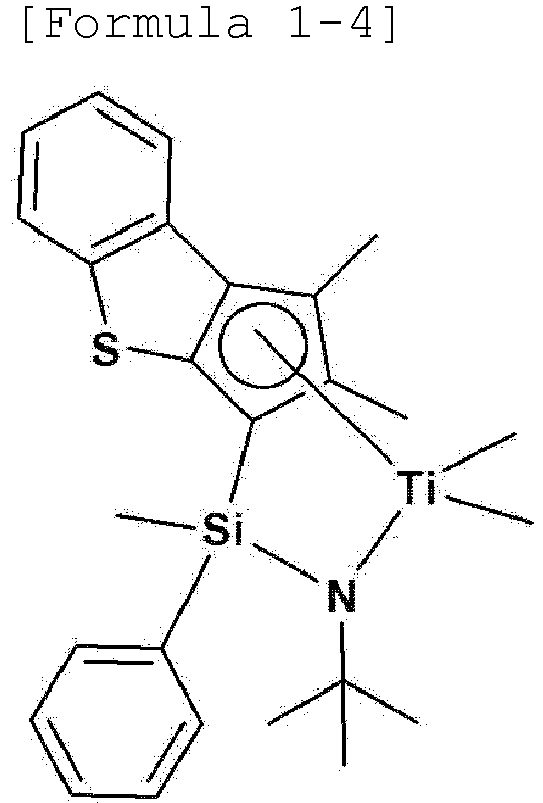


- The method for preparing the olefin-based copolymer according to claim 7, wherein the polymerization is carried out at 110°C to 160°C.
Applications Claiming Priority (2)
| Application Number | Priority Date | Filing Date | Title |
|---|---|---|---|
| KR20180052044 | 2018-05-04 | ||
| PCT/KR2019/005366 WO2019212306A1 (en) | 2018-05-04 | 2019-05-03 | Olefin-based copolymer and preparation method therefor |
Publications (2)
| Publication Number | Publication Date |
|---|---|
| EP3770189A1 true EP3770189A1 (en) | 2021-01-27 |
| EP3770189A4 EP3770189A4 (en) | 2021-06-02 |
Family
ID=68386082
Family Applications (1)
| Application Number | Title | Priority Date | Filing Date |
|---|---|---|---|
| EP19797145.0A Pending EP3770189A4 (en) | 2018-05-04 | 2019-05-03 | Olefin-based copolymer and preparation method therefor |
Country Status (6)
| Country | Link |
|---|---|
| US (1) | US11732071B2 (en) |
| EP (1) | EP3770189A4 (en) |
| JP (1) | JP7130301B2 (en) |
| KR (1) | KR102117624B1 (en) |
| CN (1) | CN111989350B (en) |
| WO (1) | WO2019212306A1 (en) |
Families Citing this family (1)
| Publication number | Priority date | Publication date | Assignee | Title |
|---|---|---|---|---|
| KR20240072510A (en) * | 2022-11-17 | 2024-05-24 | 롯데케미칼 주식회사 | Catalyst for polymerization of ethylene alpha-olefin copolymer, ethylene alpha-olefin copolymer using same and method for preparing same |
Family Cites Families (37)
| Publication number | Priority date | Publication date | Assignee | Title |
|---|---|---|---|---|
| US4935474A (en) | 1983-06-06 | 1990-06-19 | Exxon Research & Engineering Company | Process and catalyst for producing polyethylene having a broad molecular weight distribution |
| JP3355534B2 (en) | 1992-09-10 | 2002-12-09 | 住友化学工業株式会社 | Ethylene-α-olefin copolymer and molded article molded using the copolymer |
| US5914289A (en) | 1996-02-19 | 1999-06-22 | Fina Research, S.A. | Supported metallocene-alumoxane catalysts for the preparation of polyethylene having a broad monomodal molecular weight distribution |
| JP3660066B2 (en) | 1996-09-02 | 2005-06-15 | 新日本石油化学株式会社 | Method for producing polyethylene composition with improved melt tension |
| EP0989140A1 (en) | 1998-09-25 | 2000-03-29 | Fina Research S.A. | Production of multimodal polyethylene |
| US6274684B1 (en) | 1999-10-22 | 2001-08-14 | Univation Technologies, Llc | Catalyst composition, method of polymerization, and polymer therefrom |
| JP4020862B2 (en) | 2001-07-19 | 2007-12-12 | ユニベーション・テクノロジーズ・エルエルシー | Mixed metallocene catalyst system containing comonomer minor incorporation catalyst and comonomer major incorporation catalyst |
| KR20030012308A (en) | 2001-07-31 | 2003-02-12 | 주식회사 예스아이비 | Batting-type lottery system and batting method |
| JP4062929B2 (en) | 2002-02-08 | 2008-03-19 | 住友化学株式会社 | Transition metal complex, ligand, catalyst for olefin polymerization, and method for producing olefin polymer |
| EP1359192A1 (en) * | 2002-04-30 | 2003-11-05 | Solvay Polyolefins Europe-Belgium (Société Anonyme) | Polyethylene pipe resins |
| KR20040076965A (en) | 2003-02-27 | 2004-09-04 | 호남석유화학 주식회사 | A supported multinuclear metallocene catalysts for olefin polymerization and a process for preparing the same |
| BRPI0609843B1 (en) | 2005-03-17 | 2023-01-10 | Dow Global Technologies Inc | CHARGED POLYMER COMPOSITION, SOUND DAMPING ARTICLE, AUTOMOTIVE CARPET AND COVERING MATERIAL |
| US7868197B2 (en) | 2005-12-14 | 2011-01-11 | Exxonmobil Chemical Patents Inc. | Halogen substituted heteroatom-containing metallocene compounds for olefin polymerization |
| EP2113521B1 (en) * | 2007-02-19 | 2013-04-10 | Idemitsu Kosan Co., Ltd. | Alpha-olefin polymer and process for production thereof |
| KR100994252B1 (en) | 2007-05-09 | 2010-11-12 | 주식회사 엘지화학 | Ethylene Alpha-olefin Copolymer |
| US8921491B2 (en) * | 2008-01-30 | 2014-12-30 | Dow Global Technologies Llc | Polymer blends with ethylene/α-olefin interpolymers |
| KR101167082B1 (en) | 2008-11-05 | 2012-07-20 | 에스케이이노베이션 주식회사 | Method for preparing elastomeric copolymers of ethylene and a-olefins |
| US8674027B2 (en) | 2009-09-18 | 2014-03-18 | Dow Global Technologies Llc | Powdered thermoplastic polyolefin elastomer composition for slush molding processes |
| EP2497789B1 (en) | 2009-11-06 | 2014-04-02 | Mitsui Chemicals, Inc. | 4-methyl-1-pentene/ -olefin copolymer, composition comprising the copolymer and 4-methyl-1-pentene copolymer composition |
| MY181149A (en) | 2010-02-26 | 2020-12-19 | Grace W R & Co | Amide ester internal electron donor and process |
| WO2012002772A2 (en) | 2010-07-01 | 2012-01-05 | 주식회사 엘지화학 | Olefin-based polymer and method for preparing same |
| MX340497B (en) * | 2010-10-08 | 2016-07-11 | Mitsui Chemicals Inc | ENCAPSULATING MATERIAL FOR SOLAR CELL AND SOLAR CELL MODULE. |
| PH12013500834B1 (en) * | 2010-11-02 | 2017-10-25 | 50% Of The Rights Of Mitsui Chemicals Inc Has Been Transferred To Mitsui Chemicals Tohcello Inc | Encapsulating material for solar cell and solar cell module |
| EP2631271A1 (en) * | 2012-02-24 | 2013-08-28 | Basell Poliolefine Italia S.r.l. | 1-butene copolymers compositions for extruded profiles |
| TWI598365B (en) * | 2012-06-26 | 2017-09-11 | 三井化學東賽璐股份有限公司 | Solar cell encapsulation sheet, solar cell module and manufacturing method thereof |
| KR102090071B1 (en) | 2012-06-29 | 2020-03-17 | 다우 글로벌 테크놀로지스 엘엘씨 | Stain resistant article with olefin block copolymer and process |
| CN103554461A (en) | 2013-09-27 | 2014-02-05 | 中科院广州化学有限公司 | Epoxy modified alkyd resin and its high hardness fast reaction coating |
| JP5800053B2 (en) | 2014-04-28 | 2015-10-28 | 日本ポリエチレン株式会社 | Resin composition for solar cell encapsulant, and solar cell encapsulant and solar cell module using the same |
| KR101637982B1 (en) * | 2014-11-07 | 2016-07-11 | 주식회사 엘지화학 | Ligand compound, transition metal compound, and catalystic composition comprising the same |
| KR101719064B1 (en) | 2014-11-13 | 2017-03-22 | 주식회사 엘지화학 | Ligand compound, transition metal compound, and catalyst composition comprising the same |
| KR101889598B1 (en) | 2015-12-08 | 2018-08-17 | 주식회사 엘지화학 | Olefin based polymer |
| KR20170073385A (en) * | 2015-12-18 | 2017-06-28 | 주식회사 엘지화학 | Polyolefin having excellent processibility |
| EP3257879A1 (en) | 2016-06-17 | 2017-12-20 | Borealis AG | Bi- or multimodal polyethylene with low unsaturation level |
| KR102086056B1 (en) * | 2016-09-23 | 2020-03-06 | 주식회사 엘지화학 | Polypropylene-based resin composition |
| KR102140690B1 (en) * | 2016-11-14 | 2020-08-04 | 주식회사 엘지화학 | Ligand compound, transition metal compound, and catalystic composition comprising the same |
| CN117430740A (en) * | 2017-12-22 | 2024-01-23 | Lg化学株式会社 | Olefin-based polymers |
| KR102420366B1 (en) * | 2017-12-26 | 2022-07-14 | 주식회사 엘지화학 | Olefin based polymer |
-
2019
- 2019-05-03 KR KR1020190052266A patent/KR102117624B1/en active Active
- 2019-05-03 WO PCT/KR2019/005366 patent/WO2019212306A1/en not_active Ceased
- 2019-05-03 EP EP19797145.0A patent/EP3770189A4/en active Pending
- 2019-05-03 US US17/050,089 patent/US11732071B2/en active Active
- 2019-05-03 JP JP2020559428A patent/JP7130301B2/en active Active
- 2019-05-03 CN CN201980026311.6A patent/CN111989350B/en active Active
Also Published As
| Publication number | Publication date |
|---|---|
| CN111989350A (en) | 2020-11-24 |
| CN111989350B (en) | 2023-06-23 |
| US20210230326A1 (en) | 2021-07-29 |
| WO2019212306A1 (en) | 2019-11-07 |
| JP7130301B2 (en) | 2022-09-05 |
| US11732071B2 (en) | 2023-08-22 |
| JP2021519854A (en) | 2021-08-12 |
| EP3770189A4 (en) | 2021-06-02 |
| KR20190127593A (en) | 2019-11-13 |
| KR102117624B1 (en) | 2020-06-02 |
Similar Documents
| Publication | Publication Date | Title |
|---|---|---|
| US12037426B2 (en) | Olefin-based copolymer and method for preparing the same | |
| KR102058069B1 (en) | Olefin based polymer | |
| KR101066969B1 (en) | Method for producing olefin polymer using transition metal catalyst having excellent copolymerization | |
| EP3705504A1 (en) | Olefin-based polymer | |
| US12162967B2 (en) | Olefin-based polymer | |
| EP3778665A1 (en) | Polyethylene and chlorinated polyethylene thereof | |
| EP3705503A1 (en) | Olefin-based polymer | |
| KR20010015729A (en) | Process for the production of heterophasic polymer compositions, and compositions thus obtained | |
| EP4019559A1 (en) | Olefin-based polymer | |
| EP4201970A1 (en) | Catalyst containing hybrid transition metal compound, olefin-based polymer produced by using same, and methods for producing catalyst and polymer | |
| JP2020505480A (en) | Olefin polymer, method for producing the same, and film using the same | |
| US11732071B2 (en) | Olefin-based copolymer and method for preparing the same | |
| US11629208B2 (en) | Olefin-based copolymer and method for preparing the same | |
| EP3950740A1 (en) | Olefin-based polymer | |
| EP4249532A1 (en) | Olefin-based polymer and method for preparing same | |
| KR20210038234A (en) | Olefin based polymer | |
| EP4215555A1 (en) | Olefin-based polymer |
Legal Events
| Date | Code | Title | Description |
|---|---|---|---|
| STAA | Information on the status of an ep patent application or granted ep patent |
Free format text: STATUS: THE INTERNATIONAL PUBLICATION HAS BEEN MADE |
|
| PUAI | Public reference made under article 153(3) epc to a published international application that has entered the european phase |
Free format text: ORIGINAL CODE: 0009012 |
|
| STAA | Information on the status of an ep patent application or granted ep patent |
Free format text: STATUS: REQUEST FOR EXAMINATION WAS MADE |
|
| 17P | Request for examination filed |
Effective date: 20201019 |
|
| AK | Designated contracting states |
Kind code of ref document: A1 Designated state(s): AL AT BE BG CH CY CZ DE DK EE ES FI FR GB GR HR HU IE IS IT LI LT LU LV MC MK MT NL NO PL PT RO RS SE SI SK SM TR |
|
| AX | Request for extension of the european patent |
Extension state: BA ME |
|
| A4 | Supplementary search report drawn up and despatched |
Effective date: 20210506 |
|
| RIC1 | Information provided on ipc code assigned before grant |
Ipc: C08F 210/16 20060101AFI20210429BHEP Ipc: C08F 210/14 20060101ALI20210429BHEP Ipc: C08F 210/08 20060101ALI20210429BHEP Ipc: C08F 4/6592 20060101ALI20210429BHEP Ipc: C08F 4/649 20060101ALI20210429BHEP |
|
| DAV | Request for validation of the european patent (deleted) | ||
| DAX | Request for extension of the european patent (deleted) | ||
| STAA | Information on the status of an ep patent application or granted ep patent |
Free format text: STATUS: EXAMINATION IS IN PROGRESS |
|
| 17Q | First examination report despatched |
Effective date: 20230614 |