EP3770148B1 - Receptor inhibitor, pharmaceutical composition comprising same, and use thereof - Google Patents
Receptor inhibitor, pharmaceutical composition comprising same, and use thereof Download PDFInfo
- Publication number
- EP3770148B1 EP3770148B1 EP19771519.6A EP19771519A EP3770148B1 EP 3770148 B1 EP3770148 B1 EP 3770148B1 EP 19771519 A EP19771519 A EP 19771519A EP 3770148 B1 EP3770148 B1 EP 3770148B1
- Authority
- EP
- European Patent Office
- Prior art keywords
- group
- alkylene
- optionally substituted
- alkyl
- compound
- Prior art date
- Legal status (The legal status is an assumption and is not a legal conclusion. Google has not performed a legal analysis and makes no representation as to the accuracy of the status listed.)
- Active
Links
Classifications
-
- C—CHEMISTRY; METALLURGY
- C07—ORGANIC CHEMISTRY
- C07D—HETEROCYCLIC COMPOUNDS
- C07D241/00—Heterocyclic compounds containing 1,4-diazine or hydrogenated 1,4-diazine rings
- C07D241/36—Heterocyclic compounds containing 1,4-diazine or hydrogenated 1,4-diazine rings condensed with carbocyclic rings or ring systems
- C07D241/38—Heterocyclic compounds containing 1,4-diazine or hydrogenated 1,4-diazine rings condensed with carbocyclic rings or ring systems with only hydrogen or carbon atoms directly attached to the ring nitrogen atoms
-
- A—HUMAN NECESSITIES
- A61—MEDICAL OR VETERINARY SCIENCE; HYGIENE
- A61K—PREPARATIONS FOR MEDICAL, DENTAL OR TOILETRY PURPOSES
- A61K31/00—Medicinal preparations containing organic active ingredients
- A61K31/33—Heterocyclic compounds
- A61K31/395—Heterocyclic compounds having nitrogen as a ring hetero atom, e.g. guanethidine or rifamycins
- A61K31/495—Heterocyclic compounds having nitrogen as a ring hetero atom, e.g. guanethidine or rifamycins having six-membered rings with two or more nitrogen atoms as the only ring heteroatoms, e.g. piperazine or tetrazines
- A61K31/4995—Pyrazines or piperazines forming part of bridged ring systems
-
- A—HUMAN NECESSITIES
- A61—MEDICAL OR VETERINARY SCIENCE; HYGIENE
- A61K—PREPARATIONS FOR MEDICAL, DENTAL OR TOILETRY PURPOSES
- A61K31/00—Medicinal preparations containing organic active ingredients
- A61K31/33—Heterocyclic compounds
- A61K31/395—Heterocyclic compounds having nitrogen as a ring hetero atom, e.g. guanethidine or rifamycins
- A61K31/55—Heterocyclic compounds having nitrogen as a ring hetero atom, e.g. guanethidine or rifamycins having seven-membered rings, e.g. azelastine, pentylenetetrazole
-
- A—HUMAN NECESSITIES
- A61—MEDICAL OR VETERINARY SCIENCE; HYGIENE
- A61K—PREPARATIONS FOR MEDICAL, DENTAL OR TOILETRY PURPOSES
- A61K31/00—Medicinal preparations containing organic active ingredients
- A61K31/33—Heterocyclic compounds
- A61K31/395—Heterocyclic compounds having nitrogen as a ring hetero atom, e.g. guanethidine or rifamycins
- A61K31/55—Heterocyclic compounds having nitrogen as a ring hetero atom, e.g. guanethidine or rifamycins having seven-membered rings, e.g. azelastine, pentylenetetrazole
- A61K31/551—Heterocyclic compounds having nitrogen as a ring hetero atom, e.g. guanethidine or rifamycins having seven-membered rings, e.g. azelastine, pentylenetetrazole having two nitrogen atoms, e.g. dilazep
-
- A—HUMAN NECESSITIES
- A61—MEDICAL OR VETERINARY SCIENCE; HYGIENE
- A61K—PREPARATIONS FOR MEDICAL, DENTAL OR TOILETRY PURPOSES
- A61K31/00—Medicinal preparations containing organic active ingredients
- A61K31/33—Heterocyclic compounds
- A61K31/395—Heterocyclic compounds having nitrogen as a ring hetero atom, e.g. guanethidine or rifamycins
- A61K31/55—Heterocyclic compounds having nitrogen as a ring hetero atom, e.g. guanethidine or rifamycins having seven-membered rings, e.g. azelastine, pentylenetetrazole
- A61K31/553—Heterocyclic compounds having nitrogen as a ring hetero atom, e.g. guanethidine or rifamycins having seven-membered rings, e.g. azelastine, pentylenetetrazole having at least one nitrogen and one oxygen as ring hetero atoms, e.g. loxapine, staurosporine
-
- A—HUMAN NECESSITIES
- A61—MEDICAL OR VETERINARY SCIENCE; HYGIENE
- A61K—PREPARATIONS FOR MEDICAL, DENTAL OR TOILETRY PURPOSES
- A61K31/00—Medicinal preparations containing organic active ingredients
- A61K31/33—Heterocyclic compounds
- A61K31/395—Heterocyclic compounds having nitrogen as a ring hetero atom, e.g. guanethidine or rifamycins
- A61K31/55—Heterocyclic compounds having nitrogen as a ring hetero atom, e.g. guanethidine or rifamycins having seven-membered rings, e.g. azelastine, pentylenetetrazole
- A61K31/554—Heterocyclic compounds having nitrogen as a ring hetero atom, e.g. guanethidine or rifamycins having seven-membered rings, e.g. azelastine, pentylenetetrazole having at least one nitrogen and one sulfur as ring hetero atoms, e.g. clothiapine, diltiazem
-
- A—HUMAN NECESSITIES
- A61—MEDICAL OR VETERINARY SCIENCE; HYGIENE
- A61P—SPECIFIC THERAPEUTIC ACTIVITY OF CHEMICAL COMPOUNDS OR MEDICINAL PREPARATIONS
- A61P1/00—Drugs for disorders of the alimentary tract or the digestive system
-
- A—HUMAN NECESSITIES
- A61—MEDICAL OR VETERINARY SCIENCE; HYGIENE
- A61P—SPECIFIC THERAPEUTIC ACTIVITY OF CHEMICAL COMPOUNDS OR MEDICINAL PREPARATIONS
- A61P1/00—Drugs for disorders of the alimentary tract or the digestive system
- A61P1/04—Drugs for disorders of the alimentary tract or the digestive system for ulcers, gastritis or reflux esophagitis, e.g. antacids, inhibitors of acid secretion, mucosal protectants
-
- A—HUMAN NECESSITIES
- A61—MEDICAL OR VETERINARY SCIENCE; HYGIENE
- A61P—SPECIFIC THERAPEUTIC ACTIVITY OF CHEMICAL COMPOUNDS OR MEDICINAL PREPARATIONS
- A61P11/00—Drugs for disorders of the respiratory system
-
- A—HUMAN NECESSITIES
- A61—MEDICAL OR VETERINARY SCIENCE; HYGIENE
- A61P—SPECIFIC THERAPEUTIC ACTIVITY OF CHEMICAL COMPOUNDS OR MEDICINAL PREPARATIONS
- A61P17/00—Drugs for dermatological disorders
- A61P17/06—Antipsoriatics
-
- A—HUMAN NECESSITIES
- A61—MEDICAL OR VETERINARY SCIENCE; HYGIENE
- A61P—SPECIFIC THERAPEUTIC ACTIVITY OF CHEMICAL COMPOUNDS OR MEDICINAL PREPARATIONS
- A61P19/00—Drugs for skeletal disorders
- A61P19/02—Drugs for skeletal disorders for joint disorders, e.g. arthritis, arthrosis
-
- A—HUMAN NECESSITIES
- A61—MEDICAL OR VETERINARY SCIENCE; HYGIENE
- A61P—SPECIFIC THERAPEUTIC ACTIVITY OF CHEMICAL COMPOUNDS OR MEDICINAL PREPARATIONS
- A61P25/00—Drugs for disorders of the nervous system
-
- A—HUMAN NECESSITIES
- A61—MEDICAL OR VETERINARY SCIENCE; HYGIENE
- A61P—SPECIFIC THERAPEUTIC ACTIVITY OF CHEMICAL COMPOUNDS OR MEDICINAL PREPARATIONS
- A61P25/00—Drugs for disorders of the nervous system
- A61P25/02—Drugs for disorders of the nervous system for peripheral neuropathies
-
- A—HUMAN NECESSITIES
- A61—MEDICAL OR VETERINARY SCIENCE; HYGIENE
- A61P—SPECIFIC THERAPEUTIC ACTIVITY OF CHEMICAL COMPOUNDS OR MEDICINAL PREPARATIONS
- A61P25/00—Drugs for disorders of the nervous system
- A61P25/04—Centrally acting analgesics, e.g. opioids
-
- A—HUMAN NECESSITIES
- A61—MEDICAL OR VETERINARY SCIENCE; HYGIENE
- A61P—SPECIFIC THERAPEUTIC ACTIVITY OF CHEMICAL COMPOUNDS OR MEDICINAL PREPARATIONS
- A61P25/00—Drugs for disorders of the nervous system
- A61P25/14—Drugs for disorders of the nervous system for treating abnormal movements, e.g. chorea, dyskinesia
-
- A—HUMAN NECESSITIES
- A61—MEDICAL OR VETERINARY SCIENCE; HYGIENE
- A61P—SPECIFIC THERAPEUTIC ACTIVITY OF CHEMICAL COMPOUNDS OR MEDICINAL PREPARATIONS
- A61P25/00—Drugs for disorders of the nervous system
- A61P25/14—Drugs for disorders of the nervous system for treating abnormal movements, e.g. chorea, dyskinesia
- A61P25/16—Anti-Parkinson drugs
-
- A—HUMAN NECESSITIES
- A61—MEDICAL OR VETERINARY SCIENCE; HYGIENE
- A61P—SPECIFIC THERAPEUTIC ACTIVITY OF CHEMICAL COMPOUNDS OR MEDICINAL PREPARATIONS
- A61P25/00—Drugs for disorders of the nervous system
- A61P25/18—Antipsychotics, i.e. neuroleptics; Drugs for mania or schizophrenia
-
- A—HUMAN NECESSITIES
- A61—MEDICAL OR VETERINARY SCIENCE; HYGIENE
- A61P—SPECIFIC THERAPEUTIC ACTIVITY OF CHEMICAL COMPOUNDS OR MEDICINAL PREPARATIONS
- A61P25/00—Drugs for disorders of the nervous system
- A61P25/20—Hypnotics; Sedatives
-
- A—HUMAN NECESSITIES
- A61—MEDICAL OR VETERINARY SCIENCE; HYGIENE
- A61P—SPECIFIC THERAPEUTIC ACTIVITY OF CHEMICAL COMPOUNDS OR MEDICINAL PREPARATIONS
- A61P25/00—Drugs for disorders of the nervous system
- A61P25/28—Drugs for disorders of the nervous system for treating neurodegenerative disorders of the central nervous system, e.g. nootropic agents, cognition enhancers, drugs for treating Alzheimer's disease or other forms of dementia
-
- A—HUMAN NECESSITIES
- A61—MEDICAL OR VETERINARY SCIENCE; HYGIENE
- A61P—SPECIFIC THERAPEUTIC ACTIVITY OF CHEMICAL COMPOUNDS OR MEDICINAL PREPARATIONS
- A61P29/00—Non-central analgesic, antipyretic or antiinflammatory agents, e.g. antirheumatic agents; Non-steroidal antiinflammatory drugs [NSAID]
-
- A—HUMAN NECESSITIES
- A61—MEDICAL OR VETERINARY SCIENCE; HYGIENE
- A61P—SPECIFIC THERAPEUTIC ACTIVITY OF CHEMICAL COMPOUNDS OR MEDICINAL PREPARATIONS
- A61P35/00—Antineoplastic agents
-
- A—HUMAN NECESSITIES
- A61—MEDICAL OR VETERINARY SCIENCE; HYGIENE
- A61P—SPECIFIC THERAPEUTIC ACTIVITY OF CHEMICAL COMPOUNDS OR MEDICINAL PREPARATIONS
- A61P35/00—Antineoplastic agents
- A61P35/02—Antineoplastic agents specific for leukemia
-
- A—HUMAN NECESSITIES
- A61—MEDICAL OR VETERINARY SCIENCE; HYGIENE
- A61P—SPECIFIC THERAPEUTIC ACTIVITY OF CHEMICAL COMPOUNDS OR MEDICINAL PREPARATIONS
- A61P37/00—Drugs for immunological or allergic disorders
- A61P37/02—Immunomodulators
- A61P37/06—Immunosuppressants, e.g. drugs for graft rejection
-
- A—HUMAN NECESSITIES
- A61—MEDICAL OR VETERINARY SCIENCE; HYGIENE
- A61P—SPECIFIC THERAPEUTIC ACTIVITY OF CHEMICAL COMPOUNDS OR MEDICINAL PREPARATIONS
- A61P37/00—Drugs for immunological or allergic disorders
- A61P37/08—Antiallergic agents
-
- A—HUMAN NECESSITIES
- A61—MEDICAL OR VETERINARY SCIENCE; HYGIENE
- A61P—SPECIFIC THERAPEUTIC ACTIVITY OF CHEMICAL COMPOUNDS OR MEDICINAL PREPARATIONS
- A61P7/00—Drugs for disorders of the blood or the extracellular fluid
-
- A—HUMAN NECESSITIES
- A61—MEDICAL OR VETERINARY SCIENCE; HYGIENE
- A61P—SPECIFIC THERAPEUTIC ACTIVITY OF CHEMICAL COMPOUNDS OR MEDICINAL PREPARATIONS
- A61P9/00—Drugs for disorders of the cardiovascular system
-
- C—CHEMISTRY; METALLURGY
- C07—ORGANIC CHEMISTRY
- C07D—HETEROCYCLIC COMPOUNDS
- C07D403/00—Heterocyclic compounds containing two or more hetero rings, having nitrogen atoms as the only ring hetero atoms, not provided for by group C07D401/00
- C07D403/02—Heterocyclic compounds containing two or more hetero rings, having nitrogen atoms as the only ring hetero atoms, not provided for by group C07D401/00 containing two hetero rings
- C07D403/06—Heterocyclic compounds containing two or more hetero rings, having nitrogen atoms as the only ring hetero atoms, not provided for by group C07D401/00 containing two hetero rings linked by a carbon chain containing only aliphatic carbon atoms
-
- C—CHEMISTRY; METALLURGY
- C07—ORGANIC CHEMISTRY
- C07D—HETEROCYCLIC COMPOUNDS
- C07D413/00—Heterocyclic compounds containing two or more hetero rings, at least one ring having nitrogen and oxygen atoms as the only ring hetero atoms
- C07D413/02—Heterocyclic compounds containing two or more hetero rings, at least one ring having nitrogen and oxygen atoms as the only ring hetero atoms containing two hetero rings
- C07D413/06—Heterocyclic compounds containing two or more hetero rings, at least one ring having nitrogen and oxygen atoms as the only ring hetero atoms containing two hetero rings linked by a carbon chain containing only aliphatic carbon atoms
-
- C—CHEMISTRY; METALLURGY
- C07—ORGANIC CHEMISTRY
- C07D—HETEROCYCLIC COMPOUNDS
- C07D417/00—Heterocyclic compounds containing two or more hetero rings, at least one ring having nitrogen and sulfur atoms as the only ring hetero atoms, not provided for by group C07D415/00
- C07D417/02—Heterocyclic compounds containing two or more hetero rings, at least one ring having nitrogen and sulfur atoms as the only ring hetero atoms, not provided for by group C07D415/00 containing two hetero rings
- C07D417/06—Heterocyclic compounds containing two or more hetero rings, at least one ring having nitrogen and sulfur atoms as the only ring hetero atoms, not provided for by group C07D415/00 containing two hetero rings linked by a carbon chain containing only aliphatic carbon atoms
-
- C—CHEMISTRY; METALLURGY
- C07—ORGANIC CHEMISTRY
- C07D—HETEROCYCLIC COMPOUNDS
- C07D471/00—Heterocyclic compounds containing nitrogen atoms as the only ring hetero atoms in the condensed system, at least one ring being a six-membered ring with one nitrogen atom, not provided for by groups C07D451/00 - C07D463/00
- C07D471/02—Heterocyclic compounds containing nitrogen atoms as the only ring hetero atoms in the condensed system, at least one ring being a six-membered ring with one nitrogen atom, not provided for by groups C07D451/00 - C07D463/00 in which the condensed system contains two hetero rings
- C07D471/08—Bridged systems
-
- C—CHEMISTRY; METALLURGY
- C07—ORGANIC CHEMISTRY
- C07D—HETEROCYCLIC COMPOUNDS
- C07D487/00—Heterocyclic compounds containing nitrogen atoms as the only ring hetero atoms in the condensed system, not provided for by groups C07D451/00 - C07D477/00
- C07D487/02—Heterocyclic compounds containing nitrogen atoms as the only ring hetero atoms in the condensed system, not provided for by groups C07D451/00 - C07D477/00 in which the condensed system contains two hetero rings
- C07D487/08—Bridged systems
-
- C—CHEMISTRY; METALLURGY
- C07—ORGANIC CHEMISTRY
- C07D—HETEROCYCLIC COMPOUNDS
- C07D519/00—Heterocyclic compounds containing more than one system of two or more relevant hetero rings condensed among themselves or condensed with a common carbocyclic ring system not provided for in groups C07D453/00 or C07D455/00
-
- C—CHEMISTRY; METALLURGY
- C07—ORGANIC CHEMISTRY
- C07F—ACYCLIC, CARBOCYCLIC OR HETEROCYCLIC COMPOUNDS CONTAINING ELEMENTS OTHER THAN CARBON, HYDROGEN, HALOGEN, OXYGEN, NITROGEN, SULFUR, SELENIUM OR TELLURIUM
- C07F9/00—Compounds containing elements of Groups 5 or 15 of the Periodic Table
- C07F9/02—Phosphorus compounds
- C07F9/547—Heterocyclic compounds, e.g. containing phosphorus as a ring hetero atom
- C07F9/6561—Heterocyclic compounds, e.g. containing phosphorus as a ring hetero atom containing systems of two or more relevant hetero rings condensed among themselves or condensed with a common carbocyclic ring or ring system, with or without other non-condensed hetero rings
Definitions
- the present invention relates to an angiotensin II type 2 (AT 2 ) receptor inhibitor, a pharmaceutical composition comprising the same, and its use for the prophylaxis or the treatment of an AT 2 receptor-mediated disorder or a symptom associated therewith.
- AT 2 angiotensin II type 2
- A-II receptors There are two known subtypes of angiotensin II (A-II) receptors, namely AT 1 and AT 2 subtypes.
- A-II receptors are mainly of AT 2 subtypes.
- AT 2 -specific inhibitors are valuable in the treatment of various cerebrovascular, cognitive, and central nervous system (CNS) diseases.
- CNS central nervous system
- AT 2 receptors are found in neuronal tumor cells and transformed human nerve cells.
- AT 2 receptors have also been implicated in the differentiation and regeneration of neuronal tissue, and the maintenance of bone mass.
- AT 2 receptor antagonism is associated with the treatment of pain, particularly inflammatory pain and neuropathic pain, two types of pain which are difficult to treat or relieve.
- Impaired nerve conduction velocity is also associated with nerve damage and has been implicated in peripheral neuropathies, Carpal Tunnel Syndrome, ulnar neuropathy, Guillain-Barré Syndrome, fascioscapulohumeral muscle dystrophy and spinal disc herniation. Impaired nerve conduction velocity may lead to diminished reflex responses and altered peripheral sensation, such as parathesia and in some cases pain.
- AT 2 receptor inhibitors have been shown to restore nerve conduction velocity.
- AT 2 receptor inhibitors have been shown to have anti-proliferative activity.
- Osteoporosis is a significant problem in older populations, especially in postmenopausal women.
- the current therapies for osteoporosis rely on calcium supplementation.
- the control the bone formation and bone resorption is complex.
- AT 2 receptor inhibitors have been shown to increase bone mass.
- AT 2 receptor inhibitors may be useful therapeutics in diseases characterized by aberrant nerve regeneration.
- AT 2 receptors are also found in the reproductive organs of female mammals, including uterus and ovaries. The role of angiotensin II in the processes leading to ovulation has been reported.
- WO 9220661 discloses certain diacylpiperazines defined by a general structure (1) which are: angiotensin II (A-II) antagonists selective for the type 2 (AT2) subtype useful in the treatment of cerebrovascular, cognitive, and CNS disorders; tachykinin receptor antagonists useful in the treatment of inflammatory diseases and pain or migraine; and calcium channel blockers useful in the treatment of cardiovascular conditions such as angina, hypertension or ischemia.
- A-II angiotensin II
- AT2 type 2
- tachykinin receptor antagonists useful in the treatment of inflammatory diseases and pain or migraine
- calcium channel blockers useful in the treatment of cardiovascular conditions such as angina, hypertension or ischemia.
- L-159,686 [(S)-1,4-bis(N,N-diphenylcarbamoyl)piperazine-2-carboxylic acid; AT2 IC50 1.5 nM, AT1 IC50 >100,000 nM] is reported to have sufficient oral bioavailability and half-life in rats for use as an in vivo pharmacological tool.
- the present invention provides a compound for use as an AT 2 receptor inhibitor, which exhibits excellent inhibitory activity on AT 2 receptors and excellent properties such as better physicochemical properties (e.g., solubility, physical and/or chemical stability), improved pharmacokinetic properties (e.g., improved bioavailability, proper half-life and duration of action), and improved safety (low toxicity and/or less side effects, wide therapeutic window). More particularly, the compound of the present invention has selective inhibitory activity on AT 2 receptors, compared to AT 1 receptors.
- An aspect of the present invention provides a compound or a pharmaceutically acceptable salt, ester, stereoisomer, polymorph, solvate, N-oxide, isotopically labeled compound thereof, wherein the compound has a structure of formula (IV) or formula (V): wherein:
- Another aspect of the present invention provides a pharmaceutical composition
- a pharmaceutical composition comprising a prophylactically or therapeutically effective amount of the compound of the present invention or a pharmaceutically acceptable salt, ester, stereoisomer, polymorph, solvate, N-oxide, or isotopically labeled compound thereof, and one or more pharmaceutically acceptable carriers, and the pharmaceutical composition is preferably in the form of a solid, semi-solid, liquid, or gas preparation.
- Another aspect of the present invention provides use of the compound of the present invention or a pharmaceutically acceptable salt, ester, stereoisomer, polymorph, solvate, N-oxide, or isotopically labeled compound thereof, or the pharmaceutical composition of the present invention in the manufacture of a medicament for use as an AT 2 receptor inhibitor.
- Another aspect of the present invention provides the compound of the present invention or a pharmaceutically acceptable salt, ester, stereoisomer, polymorph, solvate, N-oxide, or isotopically labeled compound thereof, or the pharmaceutical composition of the present invention for use as an AT 2 receptor inhibitor.
- the present invention enables the prophylaxis or the treatment of an AT 2 receptor-mediated disorder or a symptom associated therewith, comprising administering to a subject in need thereof an effective amount of the compound of the present invention or a pharmaceutically acceptable salt, ester, stereoisomer, polymorph, solvate, N-oxide, or isotopically labeled compound thereof, or the pharmaceutical composition of the present invention.
- the present invention enables a method for regulating a reproductive function associated with AT 2 receptors in a female patient, comprising administering to a subject in need thereof an effective amount of the compound of the present invention or a pharmaceutically acceptable salt, ester, stereoisomer, polymorph, solvate, N-oxide, or isotopically labeled compound thereof, or the pharmaceutical composition of the present invention.
- alkylene refers to a saturated divalent hydrocarbyl, preferably refers to a saturated divalent hydrocarbyl having 1, 2, 3, 4, 5 or 6 carbon atoms, e.g., methylene, ethylene, propylene or butylene.
- alkyl is defined as a linear or branched saturated aliphatic hydrocarbon. In some embodiments, alkyl has 1-12, particularly 1-8 (“C 1-8 alkyl”) carbon atoms, e.g., 1-6 ("C 1-6 alkyl”), 1-4 (“C 1-4 alkyl”) carbon atoms, more particularly, 1, 2, 3, 4, 5, 6, 7 or 8 carbon atoms.
- C 1-8 alkyl refers to a linear or branched group having 1-8 carbon atoms (such as methyl, ethyl, n-propyl, isopropyl, n-butyl, isobutyl, sec-butyl, tert -butyl, n-pentyl, isopentyl, neopentyl, or 1-hexyl, 2-hexyl, 3-hexyl, 2-methyl-2-pentyl, 3-methyl-2-pentyl, 4-methyl-2-pentyl, 3-methyl-3-pentyl, 2-methyl-3-pentyl, 2,3-dimethyl-2-butyl, 3,3-dimethyl-2-butyl, 1-heptyl, 1-octyl), which is optionally substituted with one or more (e.g., 1 to 3) suitable substituents such as halogen (in which case the group may be referred to as "halogen (in which case the group may be referred
- C 1-4 alkyl refers to a linear or branched aliphatic hydrocarbon chain having 1-4 carbon atoms (i.e., methyl, ethyl, n-propyl, isopropyl, n-butyl, isobutyl, sec-butyl or tert-butyl).
- alkenyl refers to a linear or branched monovalent hydrocarbyl having a double bond and 2-8 carbon atoms (“C 2-8 alkenyl", such as "C 2-6 alkenyl”).
- the alkenyl is e.g., vinyl, 1-propenyl, 2-propenyl, 2-butenyl, 3-butenyl, 2-pentenyl, 3-pentenyl, 4-pentenyl, 2-hexenyl, 3-hexenyl, 4-hexenyl, 5-hexenyl, 2-methyl-2-propenyl, 4-methyl-3-pentenyl, heptenyl and octenyl.
- the compound of the present invention contains an alkenylene group, the compound may exist as the pure E (enthafen) form, the pure Z (zusammen) form, or any mixture thereof.
- alkynyl refers to a monovalent hydrocarbyl containing one or more triple bond, and preferably having 2, 3, 4, 5, 6, 7 or 8 carbon atoms, e.g., ethynyl, 1-propynyl, 2-propynyl, 2-butynyl, 3-butynyl, 2-pentynyl, 3-pentynyl, 4-pentynyl, 2-hexynyl, 3-hexynyl.
- cyclic hydrocarbylene refers to a saturated (i.e., “cycloalkylene” and “cycloalkyl”) or unsaturated (i.e., having one or more double and/or triple bonds in the ring) monocyclic or polycyclic hydrocarbon ring having e.g., 3-10 (suitably having 3-8, and more suitably having 3-6, such as 5-6 or 5-7) ring carbon atoms, including but not limited to cyclopropyl(ene) (ring), cyclobutyl(ene) (ring), cyclopentyl(ene) (ring), cyclohexyl(ene) (ring), cycloheptyl(ene) (ring), cyclooctyl(ene) (ring), cyclononyl(ene) (ring), cyclohexenyl(ene) (ring), and the like.
- heterocyclyl refers to a saturated (i.e., heterocycloalkyl) or partially unsaturated (i.e., having one or more double and/or triple bonds in the ring) monocyclic or bicyclic group having e.g. 3-10 (suitably having 3-8, and more suitably having 3-6; or suitably having 8-10, and more suitably having 9 or 10) ring atoms, wherein at least one ring atom is a heteroatom selected from the group consisting of N, O and S, and the remaining ring atoms are C.
- 3- to 10-membered heterocyclyl(ene) of “3- to 10-membered heterocycle” refers to saturated or partially unsaturated monocyclic or bicyclic heterocyclyl(ene) or heterocycle having 2-9 (e.g., 2, 3, 4, 5, 6, 7, 8 or 9) ring carbon atoms and one or more (e.g., 1, 2, 3, or 4) heteroatoms independently selected from the group consisting of N, O and S.
- Examples of monocyclic heterocyclylene, heterocyclyl and heterocycle include, but are not limited to oxiranyl(ene), aziridinyl(ene), azetidinyl(ene), oxetanyl(ene), tetrahydrofuranyl(ene), dioxolinyl(ene), pyrrolidinyl(ene), pyrrolidonyl(ene), imidazolidinyl(ene), pyrazolidinyl(ene), pyrrolinyl(ene), tetrahydropyranyl(ene), piperidinyl(ene), morpholinyl(ene), dithianyl(ene), thiomorpholinyl(ene), piperazinyl(ene) or trithianyl(ene).
- monocyclic heterocycle and heterocyclyl include but are not limited to: tetrahydrofuranyl, tetrahydrothienyl, pyrrolidinyl (e.g. pyrrolidin-1-yl), oxazolidinyl, thiazolidinyl, imidazolidinyl, 1,3-dioxolanyl, 1,3-oxathiolanyl, piperidinyl, piperazinyl, morpholinyl (such as morpholino)), thiomorpholinyl, tetrahydro-2H-pyranyl, tetrahydro-2H-thiopyranyl, 1,3-oxazinanyl (1,3-oxazinane), 1,3-thiazinanyl (1,3-thiazinane), hexahydropyrimidyl, 1,3-oxathianyl (1,3-oxathiane), 1,4-oxathianyl (1,4-o
- Bicyclic heterocyclylene, heterocyclyl and heterocycle include spiro ring systems, fused (e.g., benzo-fused) systems, or bridged systems.
- the benzo-fused heterocyclylene, heterocyclyl and heterocycle refer to the above-mentioned monocyclic heterocyclylene, heterocyclyl and heterocycle fused to benzene, for example, a benzo derivative of a saturated or partially unsaturated monocyclic group with 3-6 (suitably with 4-6, more suitably 5-6) ring atoms, in which 1, 2, 3 or 4 ring atoms are heteroatoms selected from N, O and S and the remaining ring atoms are C (i.e., "7- to 10-membered benzo fused heterocyclylene, heterocyclyl and heterocycle"), including, for example, 2,3-dihydrobenzofuranyl(ene) 1,3-dihydroisobenzofuranyl(ene) 2,3-dihydrobenzo [c
- aryl(ene) and aromatic ring refer to an all-carbon monocyclic or fusedring polycyclic aromatic group having a conjugated ⁇ electron system.
- C 6-10 aryl(ene) and C 6-10 aromatic ring refer to an aromatic group containing 6 to 10 carbon atoms, such as phenyl(ene) (benzene ring) or naphthyl(ene) (naphthalene ring).
- Aryl(ene) or aromatic ring is optionally substituted with one or more (such as 1 to 3) suitable substituents (e.g., halogen, -OH, -CN, -NOz, and C 1-6 alkyl, etc .) .
- suitable substituents e.g., halogen, -OH, -CN, -NOz, and C 1-6 alkyl, etc .
- heteroaryl(ene) and “heteroaromatic ring” refer to a monocyclic, bicyclic or tricyclic aromatic ring system having 5, 6, 8, 9, 10, 11, 12, 13 or 14 ring atoms, particularly 1 or 2 or 3 or 4 or 5 or 6 or 9 or 10 carbon atoms, and containing at least one heteroatom (such as O, N, or S), which can be same to different. Moreover, in each case, it can be benzo-fused.
- heteroaryl(ene) or “heteroaromatic ring” is selected from the group consisting of thienyl(ene), furyl(ene), pyrrolyl(ene), oxazolyl(ene), thiazolyl(ene), imidazolyl(ene), pyrazolyl(ene) (e.g., 1-pyrazolyl, 3-pyrazolyl, 4-pyrazolyl and 5-pyrazolyl), isoxazolyl(ene), isothiazolyl(ene), oxadiazolyl(ene), triazolyl(ene), tetrazolyl(ene) (e.g.
- heteroaryl(ene) or “heteroaromatic ring” also include pyrrolopyrimidinyl, pyrrolopyridyl, pyrazolopyrimidinyl, pyrazolopyridyl, imidazopyridyl, purinyl, and the like.
- aralkyl preferably means aryl or heteroaryl substituted alkyl, wherein aryl, heteroaryl and alkyl are as defined herein. Normally, the aryl group may have 6-14 carbon atoms, the heteroaryl group may have 5-14 ring atoms, and the alkyl group may have 1-6 carbon atoms. Exemplary aralkyl group includes, but is not limited to, benzyl, phenylethyl, phenylpropyl, phenylbutyl.
- halo or halogen are defined to include F, Cl, Br, or I.
- the nitrogen containing heterocycle is attached to the rest of the molecule through the nitrogen atom and any other ring atom in said nitrogen containing heterocycle.
- the nitrogen containing heterocycle is optionally benzo-fused, and is preferably attached to the rest of the molecule through the nitrogen atom in said nitrogen containing heterocycle and any carbon atom in the fused benzene ring.
- substituted means that one or more (e.g., one, two, three, or four) hydrogens on the designated atom is replaced with a selection from the indicated group, provided that the designated atom's normal valency under the existing circumstances is not exceeded, and that the substitution results in a stable compound. Combinations of substituents and/or variables are permissible only if such combinations result in stable compounds.
- substituent may be either (1) not substituted, or (2) substituted. If a carbon of a substituent is described as being optionally substituted with one or more of a list of substituents, one or more of the hydrogens on the carbon (to the extent there are any) may separately and/or together be replaced with an independently selected optional substituent. If a nitrogen of a substituent is described as being optionally substituted with one or more from a list of substituents, one or more of the hydrogens on the nitrogen (to the extent there are any) may each be replaced with an independently selected optional substituent.
- each substituent is selected independent of the other(s). Each substituent therefore may be identical to or different from the other substituent(s).
- one or more means one or more than one (e.g., 2, 3, 4, 5 or 10) as reasonable.
- the point of attachment of a substituent can be from any suitable position of the substituent.
- the present invention also includes all pharmaceutically acceptable isotopically labeled compounds, which are identical to those of the present invention except that one or more atoms are replaced with an atom having the same atomic number, but an atomic mass or mass number different from the atomic mass or mass number which predominates in nature.
- isotopes suitable for inclusion in the compound of the present invention include, but are not limited to, isotopes of hydrogen, such as 2 H, 3 H; carbon, such as 11 C, 13 C, and 14 C; chlorine, such as 36 Cl; fluorine, such as 18 F; iodine, such as 123 I and 125 I; nitrogen, such as 13 N and 15 N; oxygen, such as 15 O, 17 O, and 18 O; phosphorus, such as 32 P; and sulfur, such as 35 S.
- isotopically labeled compounds of the present invention for example those incorporating a radioactive isotope, are useful in drug and/or substrate tissue distribution studies (e.g., assays).
- the radioactive isotopes tritium, i.e., 3 H, and carbon-14, i.e., 14 C, are particularly useful for this purpose in view of their ease of incorporation and ready means of detection. Substitution with positron-emitting isotopes, such as 11 C, 18 F, 15 O and 13 N, can be useful in positron emission tomography (PET) studies for examining substrate receptor occupancy.
- Isotopically labeled compounds of the present invention can generally be prepared by processes analogous to those described in the accompanying Schemes and/or in the Examples and Preparations, by using an appropriate isotopically labeled reagent in place of the non-labeled reagent previously employed.
- Pharmaceutically acceptable solvates in accordance with the invention include those wherein the solvent of crystallization may be isotopically substituted, e.g., D 2 O, acetone- d 6 , or DMSO- d 6 .
- stereoisomer refers to isomers with at least one asymmetric center.
- a compound having one or more (e.g., one, two, three or four) asymmetric centers can give rise to a racemic mixture, single enantiomer, diastereomer mixture and individual diastereomer.
- Certain individual molecules may exist as geometric isomers (cis/trans).
- the compound of the present invention may exist as a mixture of two or more structurally different forms in rapid equilibrium (generally referred to as tautomer).
- Typical examples of a tautomer include a keto-enol tautomer, phenol-keto tautomer, nitroso-oxime tautomer, imine-enamine tautomer and the like.
- the carbon-carbon bonds of the compound of the present invention may be depicted herein using a solid line ( ), a solid wedge ( ), or a dotted wedge ( ).
- a solid line to depict bonds to asymmetric carbon atoms is meant to indicate that all possible stereoisomers (e.g., specific enantiomers, racemic mixtures, etc .) at that carbon atom are included.
- the use of either a solid or dotted wedge to depict bonds to asymmetric carbon atoms is meant to indicate that the stereoisomer shown is present.
- solid and dotted wedges are used to define relative stereochemistry, rather than absolute stereochemistry.
- the compound of the present invention can exist as stereoisomers, which include cis and trans isomers, optical isomers such as R and S enantiomers, diastereomers, geometric isomers, rotational isomers, conformational isomers, atropisomers, and mixtures thereof.
- the compound of the present invention may exhibit more than one type of isomerism, and consist of mixtures thereof (such as racemates and diastereomeric pairs).
- the present invention includes all possible crystalline forms or polymorphs of the compound of the present invention, either as a single polymorph, or as a mixture of more than one polymorphs, in any ratio.
- certain compounds of the present invention can be used for the treatment in a free from, or where appropriate, in a form of a pharmaceutically acceptable derivative.
- the pharmaceutically acceptable derivative includes, but is not limited to a pharmaceutically acceptable salt, ester, solvate, N-oxide, metabolite or prodrug, which can directly or indirectly provide the compound of the present invention or a metabolite or residue thereof after being administered to a patient in need thereof. Therefore, "the compound of the present invention” mentioned herein also means to encompass various derivative forms of the compound as mentioned above.
- a pharmaceutically acceptable salt of the compound of the present invention includes an acid addition salt and a base addition salt thereof.
- a suitable acid addition salt is formed from an acid which forms a pharmaceutically acceptable salt.
- Specific examples include acetate, adipate, aspartate, benzoate, besylate, bicarbonate/carbonate, bisulfate/sulfate, borate, camphorsulfonate, citrate, cyclamate, edisylate, esylate, formate, fumarate, gluceptate, gluconate, glucuronate, hexafluorophosphate, hibenzate, hydrochloride/chloride, hydrobromide/bromide, hydroiodide/iodide, isethionate, lactate, malate, maleate, malonate, mesylate, methylsulfate, naphthylate, 2-napsylate, nicotinate, nitrate, orotate, oxalate, palmitate, pamoate, phosphate/hydrogen phosphate/dihydrogen phosphate, pyrog
- a suitable base addition salt is formed from a base which forms a pharmaceutically acceptable salt.
- Specific examples include aluminum, arginine, benzathine, calcium, choline, diethylamine, diolamine, glycine, lysine, magnesium, meglumine, olamine, potassium, sodium, tromethamine and zinc salts.
- esters refers to those derived from the compounds of the various formulae in the present application, which include physiologically-hydrolyzable esters (which may be hydrolyzed under physiological conditions to release the compounds of the present invention in the form of free acids or alcohols).
- the compound of the present invention itself may be an ester as well.
- the compound of the present invention can exist as a solvate (preferably a hydrate), wherein the compound of the present invention contains a polar solvent, in particular water, methanol or ethanol for example, as a structural element of the crystal lattice of the compound.
- a polar solvent in particular water, methanol or ethanol for example, as a structural element of the crystal lattice of the compound.
- the amount of the polar solvent, in particular water may exist in a stoichiometric or non-stoichiometric ratio.
- N-oxides of heterocycles and tertiary amines are well known to a person skilled in the art, and they include the oxidation of heterocycles and tertiary amines with peroxy acids such as peracetic acid and m-chloroperbenzoic acid (MCPBA), hydrogen peroxide, alkyl hydroperoxides such as tert -butyl hydroperoxide, sodium perborate, and dioxiranes such as dimethyldioxirane.
- MCPBA m-chloroperbenzoic acid
- alkyl hydroperoxides such as tert -butyl hydroperoxide
- sodium perborate sodium perborate
- dioxiranes such as dimethyldioxirane
- metabolite of the compound of the present invention namely a substance formed in vivo upon administration of the compound of the present invention.
- Such a product may result e.g., from the oxidation, reduction, hydrolysis, amidation, de-amidation, esterification, enzymolysis, and the like, of the administered compound.
- a prodrug of the compound of the invention which is certain derivative of the compound of the invention that may have little or no pharmacological activity itself, but can, when administered into or onto the body, be converted into the compound of the invention having the desired activity, for example, by hydrolytic cleavage.
- such prodrug will be a functional derivative of the compound which is readily converted in vivo into the compound with desired therapeutic activity. Further information on the use of the prodrug may be found in " Pro-drugs as Novel Delivery Systems", Vol. 14, ACS Symposium Series (T. Higuchi and V. Stella ).
- the prodrug can, for example, be produced by replacing appropriate functionalities present in the compound of the present invention with certain moieties known to those skilled in the art as “pro-moieties” as described, for example, in “ Design of Prodrugs” by H. Bundgaard (Elsevier, 1985 ).
- any of the processes for preparation of the compound of the present invention it may be necessary and/or desirable to protect sensitive or reactive groups on any of the molecules concerned, thereby resulting in the chemically protected form of the compound of the present invention.
- This may be achieved by means of conventional protecting groups, e.g., those described in T.W. Greene & P.G.M. Wuts, Protective Groups in Organic Synthesis, John Wiley & Sons, 1991 .
- the protecting groups may be removed at a convenient subsequent stage using methods known from the art.
- the present invention provides a compound of formula (1) or a pharmaceutically acceptable salt, ester, stereoisomer, polymorph, solvate, N-oxide, isotopically labeled compound thereof as described below.
- the compound of the present invention has selective inhibitory activity on AT 2 receptors, compared to AT 1 receptors.
- the present invention provides a pharmaceutical composition
- a pharmaceutical composition comprising a prophylactically or therapeutically effective amount of the compound of the present invention or a pharmaceutically acceptable salt, ester, stereoisomer, polymorph, solvate, N-oxide, or isotopically labeled compound thereof, and one or more pharmaceutically acceptable carriers, and the pharmaceutical composition is preferably in the form of a solid, semi-solid, liquid, or gas preparation.
- the pharmaceutical composition can further comprise one or more additional therapeutic agents.
- the present invention provides the compound of the present invention or a pharmaceutically acceptable salt, ester, stereoisomer, polymorph, solvate, N-oxide, or isotopically labeled compound thereof, or the pharmaceutical composition of the present invention, for use as an angiotensin II type 2 (AT 2 ) receptor inhibitor.
- AT 2 angiotensin II type 2
- the present invention provides the compound of the present invention or a pharmaceutically acceptable salt, ester, stereoisomer, polymorph, solvate, N-oxide, or isotopically labeled compound thereof, or the pharmaceutical composition of the present invention for use as an angiotensin II type 2 (AT 2 ) receptor inhibitor.
- AT 2 angiotensin II type 2
- the present invention enables a method for the prophylaxis or the treatment of an AT 2 receptor-mediated disorder or a symptom associated therewith, comprising administering to a subject in need thereof an effective amount of the compound of the present invention or a pharmaceutically acceptable salt, ester, stereoisomer, polymorph, solvate, N-oxide, or isotopically labeled compound thereof, or the pharmaceutical composition of the present invention.
- the AT2 receptor-mediated disorder is selected from cerebrovascular disorders (including cerebrovascular spasm and cerebral ischemia); cognitive disorders (including amnesia, senile dementia, AIDS related dementia and Down's syndrome); central nervous system diseases or disorders (including addiction such as alcholism, anxiety, depression or dysthymic disorders, epilepsy, hyperactivity, pain, Parkinson's disease, psychosis, sleep disorders, irregular autonomic function, and tardive dyskinesia, schizophrenia, demyelinating diseases such as multiple sclerosis and amyotrophic lateral sclerosis); respiratory diseases (including bronchospasm, asthma, chronic obstructive airways disease), neural tumors; inflammatory diseases (including inflammatory bowel disease and osteoarthritis); gastrointestinal (GI) diseases or disorders (including ulcerative colitis, Crohn's disease and incontinence); disorders of blood flow caused by vasodilation; hypersensitivity disorders (including allergies such as eczema, rhinitis and contact dermatitis); vasodil
- the AT2 receptor-mediated disorder is selected from
- the present invention enables a method for regulating a reproductive function associated with AT 2 receptors in a female patient, comprising administering to a subject in need thereof an effective amount of the compound of the present invention or a pharmaceutically acceptable salt, ester, stereoisomer, polymorph, solvate, N-oxide, or isotopically labeled compound thereof, or the pharmaceutical composition of the present invention.
- the reproductive function is selected from the menstrual cycle, fertility, and hormonal balances of the estrus cycle.
- pharmaceutically acceptable carrier refers to a diluent, auxiliary material, excipient, or vehicle with which a therapeutic is administered, and it is, within the scope of sound medical judgment, suitable for contact with the tissues of human beings and animals without excessive toxicity, irritation, allergic response, or other problem or complication, commensurate with a reasonable benefit/risk ratio.
- the pharmaceutically acceptable carrier which can be employed in the pharmaceutical composition of the present invention includes, but is not limited to sterile liquids, such as water and oils, including those of petroleum, animal, vegetable or synthetic origin, such as peanut oil, soybean oil, mineral oil, sesame oil and the like. Water is an exemplary carrier when the pharmaceutical composition is administered intravenously. Physiological salines as well as aqueous dextrose and glycerol solutions can also be employed as liquid carriers, particularly for injectable solutions.
- Suitable pharmaceutical excipients include starch, glucose, lactose, sucrose, gelatin, maltose, chalk, silica gel, sodium stearate, glycerol monostearate, talc, sodium chloride, dried skim milk, glycerol, propylene glycol, water, ethanol and the like.
- the pharmaceutical composition if desired, can also contain minor amounts of wetting or emulsifying agents, or pH buffering agents.
- Oral formulations can include standard carriers such as pharmaceutical grades of mannitol, lactose, starch, magnesium stearate, sodium saccharine, cellulose, magnesium carbonate, etc. Examples of suitable pharmaceutical carriers are described in e.g. Remington's Pharmaceutical Sciences (1990 ).
- the pharmaceutical composition of the present invention can act systemically and/or topically. To this end, it can be administered through a suitable route, such as through injection, (intravenous, intraarterial, subcutaneous, intraperitoneal, intramuscular injection, including dripping), or transdermal administration, or administered via oral, buccal, nasal, transmucosal, topical, as an ophthalmic formulation, or via inhalation.
- a suitable route such as through injection, (intravenous, intraarterial, subcutaneous, intraperitoneal, intramuscular injection, including dripping), or transdermal administration, or administered via oral, buccal, nasal, transmucosal, topical, as an ophthalmic formulation, or via inhalation.
- the pharmaceutical composition of the present invention can be administered in a suitable dosage form.
- Such dosage forms include, but are not limited to tablets, capsules, lozenges, hard candies, powders, sprays, creams, salves, suppositories, gels, pastes, lotions, ointments, aqueous suspensions, injectable solutions, elixirs, and syrups.
- the term "effective amount” refers to the amount of a compound being administered which will relieve to some extent one or more of the symptoms of the disorder being treated.
- Dosage regimens may be adjusted to provide the optimum desired response. For example, a single bolus may be administered, several divided doses may be administered over time, or the dose may be proportionally reduced or increased as indicated by the exigencies of the therapeutic situation. It is to be noted that dosage values may vary with the type and severity of the condition to be alleviated, and may include single or multiple doses. It is to be further understood that for any particular subject, specific dosage regimens should be adjusted over time according to the individual need and the professional judgment of the person administering or supervising the administration of the composition.
- an effective dosage is in the range of about 0.0001 to about 50 mg per kg body weight per day, for example about 0.01 to about 10 mg/kg/day, in single or divided doses. For a 70 kg human, this would amount to about 0.007 mg to about 3500 mg/day, for example about 0.7 mg to about 700 mg/day.
- dosage levels below the lower limit of the aforesaid range may be more than adequate, while in other cases, still larger doses may be employed without causing any harmful side effect, provided that such larger doses are first divided into several small doses for administration throughout the day.
- the content or dosage of the compound of the present invention in the pharmaceutical composition is about 0.01 mg to about 1000 mg, suitably 0.1-500 mg, preferably 0.5-300 mg, more preferably 1-150 mg, particularly preferably 1-50 mg, e.g., 1.5 mg, 2 mg, 4 mg, 10 mg, 25 mg, etc.
- treating means reversing, alleviating, inhibiting the progress of, or preventing the disorder or condition to which such term applies, or one or more symptoms of such disorder or condition.
- the term "subject” includes a human or non-human animal.
- An exemplary human subject includes a human subject having a disease (such as one described herein) (referred to as a patient), or a normal subject.
- non-human animal as used herein includes all vertebrates, such as non-mammals (e.g. birds, amphibians, reptiles) and mammals, such as non-human primates, livestock and/or domesticated animals (such as sheep, dog, cat, cow, pig and the like).
- the pharmaceutical composition of the present invention can further comprise one or more additional therapeutic agents or prophylactic agents.
- the LC-MS assay was conducted on Agilent LC-MS-1110 liquid chromatography-mass spectrometer, Agilent LC-MS-6110 liquid chromatography-mass spectrometer, Agilent LC-MS-6120 liquid chromatography-mass spectrometer (Manufacturer: Agilent) or Shimadzu LC-MS-2020.
- Thin layer chromatography was performed with Huanghai HSGF 254 (5 ⁇ 20 cm) silica gel plates, and preparative thin layer chromatography was performed with GF 254 (0.4 ⁇ 0.5 nm) silica gel plates produced in Yantai.
- reaction was monitored by thin layer chromatography (TLC) or LC-MS, the developing solvent system included dichloromethane and methanol system, n-hexane and ethyl acetate system, as well as petroleum ether and ethyl acetate system, and was adjusted (by adjusting the volume ratio of the solvents, or by adding triethylamine, etc. ) according to the polarity of the compound to be separated.
- the microwave reaction was conducted by CEM Discovery Sp (400 W, RT ⁇ 300 °C) microwave reactor.
- Silica gel (200-300 mesh) produced by Yucheng Chemical Co., Ltd was normally employed as a stationary phase in column chromatography.
- the eluent system included dichloromethane and methanol system, as well as n-hexane and ethyl acetate system, and was adjusted (by adjusting the volume ratio of the solvents, or by adding triethylamine, etc. ) according to the polarity of the compound to be separated.
- reaction temperature was room temperature (20°C ⁇ 30°C).
- the reagents employed in the Examples were purchased from companies such as Aldrich Chemical Company, Shanghai Bide Pharmatech Co. Ltd., Beijing Greenchem Co. Ltd., Shanghai Shaoyuan Co. Ltd. or Ables Technology Co. Ltd. etc.
- Table 2 The intermediates in Table 2 were prepared by methods similar to that described in the Intermediate Preparation Example 2.
- Table 2 Compound Structure Compound Name Starting material or reaction condition different from that in Intermediate Preparation Example 2 Characterization data (1S,2R,SR)-ethyl 3,8-diazabicyclo[3.2.]octa ne-2-carboxylate Compound 5 of Intermediate Preparation Example 2 was replaced with Compound 5 *.
- the filtrate was concentrated under reduced pressure, and the crude product was subjected to separation by reversed phase chromatography (acetonitrile/water (0.1% trifluoroacetic acid solution) 60/40-70/30) to obtain the target compound C1 (15 mg, a light yellow solid, yield: 31 %).
- Table 3 The compounds in Table 3 were prepared by methods similar to that described in Example 1.
- Table 4 The compounds in Table 4 were prepared by methods similar to that described in Example 2.
- step 2 Compound 7 of Example 2 was replaced with the reaction time was 48 hours, and the reaction temperature was 40°C. Compound 11 in step 4 was replaced with benzyl chloroformate.
- step 2 of Example 2 4-dimethylaminopyridine was added, Compound 7 was replaced with and the reaction time was 48 hours and the reaction temperature was 40°C. Compound 11 in step 4 was replaced with Di-pentyl amine.
- Table 5 The compounds in Table 5 were prepared by methods similar to that described in Example 3.
- Compound 6 # in step 1 of Example 3 was replaced with compound 5 .
- Example 5 preparation of (1R,2S,SS)-3-(2,2-diphenylacetyl)-8-(phenoxycarbonyl)-3,8-diazabicyclo[3.2.1]octane-2-carboxylic acid (C79) and (1R,2S,SS)-8-(benzyl(methyl)carbamoyl)-3-(2,2-diphenylacetyl)-3,8-diazabicyclo[3.2.1]octane-2-carboxylic acid (C82)
- Table 7 The compounds in Table 7 were prepared by methods similar to that described in Example 5.
- Compound 16 in step 5b of Example 5 was replaced with benzylamine. The reaction in step 5a did not take place.
- step 1 of Example 5 was replaced with compound 5 # .
- step 5a the phenyl chloroformate was replaced with benzyl chloroformate; the reaction temperature was 50°C and the reaction time was 48 hours. The reaction time in step 6 was 16 hours. The reaction in step 5b did not take place.
- step 5a of Example 5 Compound 20 was replaced with Compound 23, phenyl chloroformate was replaced with 2-chloropyrimidine, TEA was replaced with DIPEA, and DCM was replaced with NMP; and the reaction condition was changed to reacting at 130°C for 16 hours. The reaction in step 5b did not take place.
- step 5a of Example 5 Compound 20 was replaced with Compound 23, phenyl chloroformate was replaced with TEA was replaced with DIPEA and DCM was replaced with NMP; and the reaction condition was changed to reacting at 130°C for 16 hours. The reaction in step 5b did not take place.
- Example 7 preparation of (1R,2R,5S)-ethyl 8-((R)-2-(dimethylamino)-3-phenylpropanoyl)-3-(diphenylcarbamoyl)-3,8-diazabicyclo[3.2.1]octane-2-carboxylate (C270-1) and (1R,2R,5S)-ethyl 8-((S)-2-(dimethylamino)-3-phenylpropanoyl)-3-(diphenylcarbamoyl)-3,8-diazabicyclo[3.2.1]octane-2-carboxylate (C269-1)
- Table 8 The compounds in Table 8 were prepared by methods similar to that described in Example 9.
- the benzyl bromide in step 6 of Example 9 was replaced with 3-chlorobenzyl bromide.
- Example 10 preparation of (1S,3S,4R)-5-(benzylamino)-2-(2,2-diphenylacetyl)-2-azabicyclo[2.2. 2]octane-3-carboxylic acid (C28S) and (1S,3S,4R)-5-(benzyl(methyl)amino)-2-(2,2-diphenylacetyl)-2-azabicyclo[2.2.2]octane-3-carboxylic acid (C295)
- Table 9 The compound in Table 9 was prepared by a method similar to that described in Example 10.
- Example 12 preparation of (1S,3S,4R)-5-benzamido-2-(2,2-diphenylacetyl)-2-azabicyclo[2.2.2] octane-3-carboxylic acid (C286)
- Example 13 preparation of (1S,3S,4R)-5-((4,4-dimethylpenta-2-alkyne-1-yl)(methyl)amino)-2-(2,2-diphenyl)-2-azabicyclo[2.2.2]octane-3-carboxylic acid (C298)
- Example 14 preparation of (1S,3S,4R)-2-(2,2-diphenylacetyl)-5-((3-(4-fluorophenyl)prop-2-yn-1-yl)(methyl)amino)-2-azabicyclo[2.2.2]octane-3-carboxylic acid (C299)
- Example 16 preparation of (1R,2S,SS)-8-((4-allylbenzyl)(methyl)carbamoyl)-3-(diphenylcarbam oyl)-3,8-diazabicyclo[3.2.1]octane-2-carboxylic acid (C235) and (1R,2S,SS)-3-(diphenylcarbamoyl)-8-(methyl(4-propylbenzyl)carbamoyl)-3,8-diazabicyclo[3.2.1]octane-2-carboxylic acid (C236)
Landscapes
- Health & Medical Sciences (AREA)
- Chemical & Material Sciences (AREA)
- Organic Chemistry (AREA)
- General Health & Medical Sciences (AREA)
- Life Sciences & Earth Sciences (AREA)
- Medicinal Chemistry (AREA)
- Pharmacology & Pharmacy (AREA)
- Animal Behavior & Ethology (AREA)
- Public Health (AREA)
- Veterinary Medicine (AREA)
- Engineering & Computer Science (AREA)
- Bioinformatics & Cheminformatics (AREA)
- Nuclear Medicine, Radiotherapy & Molecular Imaging (AREA)
- General Chemical & Material Sciences (AREA)
- Chemical Kinetics & Catalysis (AREA)
- Neurology (AREA)
- Biomedical Technology (AREA)
- Neurosurgery (AREA)
- Epidemiology (AREA)
- Immunology (AREA)
- Heart & Thoracic Surgery (AREA)
- Cardiology (AREA)
- Molecular Biology (AREA)
- Biochemistry (AREA)
- Hematology (AREA)
- Psychology (AREA)
- Pain & Pain Management (AREA)
- Pulmonology (AREA)
- Rheumatology (AREA)
- Psychiatry (AREA)
- Dermatology (AREA)
- Anesthesiology (AREA)
- Transplantation (AREA)
- Diabetes (AREA)
- Hospice & Palliative Care (AREA)
- Oncology (AREA)
- Physical Education & Sports Medicine (AREA)
- Orthopedic Medicine & Surgery (AREA)
- Pharmaceuticals Containing Other Organic And Inorganic Compounds (AREA)
- Nitrogen Condensed Heterocyclic Rings (AREA)
Description
- The present invention relates to an angiotensin II type 2 (AT2) receptor inhibitor, a pharmaceutical composition comprising the same, and its use for the prophylaxis or the treatment of an AT2 receptor-mediated disorder or a symptom associated therewith.
- There are two known subtypes of angiotensin II (A-II) receptors, namely AT1 and AT2 subtypes. In rat brain, A-II receptors are mainly of AT2 subtypes. AT2-specific inhibitors are valuable in the treatment of various cerebrovascular, cognitive, and central nervous system (CNS) diseases. In addition, AT2 receptors are found in neuronal tumor cells and transformed human nerve cells.
- AT2 receptors have also been implicated in the differentiation and regeneration of neuronal tissue, and the maintenance of bone mass.
- In some studies, AT2 receptor antagonism is associated with the treatment of pain, particularly inflammatory pain and neuropathic pain, two types of pain which are difficult to treat or relieve. Impaired nerve conduction velocity is also associated with nerve damage and has been implicated in peripheral neuropathies, Carpal Tunnel Syndrome, ulnar neuropathy, Guillain-Barré Syndrome, fascioscapulohumeral muscle dystrophy and spinal disc herniation. Impaired nerve conduction velocity may lead to diminished reflex responses and altered peripheral sensation, such as parathesia and in some cases pain. AT2 receptor inhibitors have been shown to restore nerve conduction velocity.
- Cell proliferation and angiogenesis are important biological functions in normal tissue. However, uncontrolled cell proliferation and angiogenesis may lead to a tumor and other proliferative disorders. AT2 receptor inhibitors have been shown to have anti-proliferative activity.
- Osteoporosis is a significant problem in older populations, especially in postmenopausal women. The current therapies for osteoporosis rely on calcium supplementation. However, the control the bone formation and bone resorption is complex. AT2 receptor inhibitors have been shown to increase bone mass.
- The role of the AT2 receptors in modulating neuronal outgrowth and the associated effects of AT2 receptor inhibitors on reducing neuronal outgrowth, indicates that AT2 receptor inhibitors may be useful therapeutics in diseases characterized by aberrant nerve regeneration.
- AT2 receptors are also found in the reproductive organs of female mammals, including uterus and ovaries. The role of angiotensin II in the processes leading to ovulation has been reported.
-
WO 9220661 - WU, M.T. et al., in "Synthesis and Structure-Activity Relationships of a Novel Series of Non- Peptide AT 2-Selective Angiotensin II Receptor Antagonists", Bioorganic & Medicinal Chemistry Letters, (19931231), vol. 3, no. 10, pages 2023 - 2028, describes a series of 1,4-disubstituted-piperazine-2-carboxylic acids as AT2-selective non-peptide angiotensin II receptor antagonists with nanomolar or subnanomolar potency. L-159,686 [(S)-1,4-bis(N,N-diphenylcarbamoyl)piperazine-2-carboxylic acid; AT2 IC50 1.5 nM, AT1 IC50 >100,000 nM] is reported to have sufficient oral bioavailability and half-life in rats for use as an in vivo pharmacological tool.
- BERELLINI, G. et al., in "Pharmacophore, Drug Metabolism, and Pharmacokinetics Models on Non-Peptide ATI, AT 2, and AT 1/ AT 2 Angiotensin II Receptor Antagonists", J. Med. Chem., vol. 48, no. 13, pages 4389 - 4399, relates to non-peptide angiotensin II receptor antagonists, and a partial least squares discriminant analysis is applied to derive the chemical features guiding AT1 and AT2 selectivity or mixed AT1/AT2 receptor binding. Some pharmacokinetics and metabolic properties of certain compounds are also described.
- The subject-matter for which protection is sought is as defined by the claims. Any reference to a "disclosure" or an "embodiment" not falling within the scope of the claims is present for explanatory purposes only and does not form part of the invention.
- The present invention provides a compound for use as an AT2 receptor inhibitor, which exhibits excellent inhibitory activity on AT2 receptors and excellent properties such as better physicochemical properties (e.g., solubility, physical and/or chemical stability), improved pharmacokinetic properties (e.g., improved bioavailability, proper half-life and duration of action), and improved safety (low toxicity and/or less side effects, wide therapeutic window). More particularly, the compound of the present invention has selective inhibitory activity on AT2 receptors, compared to AT1 receptors.
- An aspect of the present invention provides a compound or a pharmaceutically acceptable salt, ester, stereoisomer, polymorph, solvate, N-oxide, isotopically labeled compound thereof, wherein the compound has a structure of formula (IV) or formula (V):

- U is selected from the group consisting of a single bond; C1-3 alkylene, in which 1 or 2 CH2 moieties are optionally replaced with a group independently selected from the group consisting of O, S, and NR10; and C2-3 alkenylene, in which any one of the CH moieties forming a C=C double bond is optionally replaced with N;
- R1a, R1b, X1 and X4 are defined as follows:
- 1) R1a, R1b together with X1 to which they are attached form a saturated or partially unsaturated C3-10 cyclic hydrocarbyl group, a saturated or partially unsaturated 3- to 10-membered heterocyclic group, a C6-10 aryl or a 5- to 14-membered heteroaryl; and
X4 is a direct bond;
or - 2) R1a is selected from the group consisting of C1-8 alkyl, C2-8 alkenyl and C2-8 alkynyl, wherein any one of the CH2 moieties in the C1-8 alkyl, C2-8 alkenyl and C2-8 alkynyl is optionally replaced with O or S; a saturated or partially unsaturated C3-10 cyclic hydrocarbyl group; a saturated or partially unsaturated 3- to 10-membered heterocyclic group; C6-10 aryl, 5- to 14-membered heteroaryl; -C1-6 alkylene-saturated or partially unsaturated C3-10 cyclic hydrocarbyl group; -C1-6 alkylene-saturated or partially unsaturated 3- to 10-membered heterocyclic group; -C1-6 alkylene-C6-10 aryl; and -C1-6 alkylene-(5- to 14-membered heteroaryl);
- R1b does not exist, or is selected from the group consisting of H and R1a;
- X1 does not exist, or is CR10 or N;
- or
- R1b and X1 together form a saturated or partially unsaturated bivalent C3-10 cyclic hydrocarbyl group or a saturated or partially unsaturated bivalent 3- to 10-membered heterocyclic group;
- X4 is selected from the group consisting of a direct bond; C(=O); S(=O)y; O; S; NR10; and -OC(=O)-, - SC(=O)-, -O-S(=O)y-, -NR10-C(=O)- and -NR10-S(=O)y-, wherein O, S, NR10 are connected to X1; preferably is a direct bond, C(=O), S(=O)y, -OC(=O)-, -O-S(=O)y-, -NR10-C(=O)- or -NR10-S(=O)y-;
- provided that: when X4 is a direct bond, X1 is CR10 or N;
- or
- 3) R1a and R1b are each independently C3-10 cyclic hydrocarbyl group; 3- to 10-membered heterocyclic group, C6-10 aryl, or 5- to 14-membered heteroaryl, and an available ring atom on R1a is connected to an available ring atom on R1b through Y group, such that R1a and R1b together with X1 to which they are attached form an optionally substituted saturated or partially unsaturated fused ring system containing 3 or more rings;
- X1 is CR10 or N;
- X4 is selected from the group consisting of C(=O); S(=O)y; O; S; NR10; and -OC(=O)-, -SC(=O)-, -O-S(=O)y-, -NR10-C(=O)- and -NR10-S(=O)y-, wherein O, S, NR10 are connected to X1; preferably is C(=O) or S(=O)y; and
- Y is selected from the group consisting of a single bond; C1-3 alkylene, in which 1 or 2 CH2 moieties are optionally replaced with a group independently selected from the group consisting of O, S, and NR10; and C2-3 alkenylene, in which any one of the CH moieties forming a C=C double bond is optionally replaced with N;
- R2a, R2b and X2 are defined as follows:
- (2) R2a is selected from the group consisting of C1-8 alkyl, C2-8 alkenyl and C2-8 alkynyl; a saturated or partially unsaturated C3-10 cyclic hydrocarbyl group; a saturated or partially unsaturated 3- to 10-membered heterocyclic group; C6-10 aryl; 5- to 14-membered heteroaryl; -C1-6 alkylene-saturated or partially unsaturated C3-10 cyclic hydrocarbyl group; -C1-6 alkylene-saturated or partially unsaturated 3- to 10-membered heterocyclic group; -C1-6 alkylene-C6-10 aryl; and -C1-6 alkylene-(5- to 14-membered heteroaryl);
- R2b does not exist, or is selected from the group consisting of H; C1-8 alkyl, C2-8 alkenyl and C2-8 alkynyl, wherein any one of the CH2 moieties in the C1-8 alkyl, C2-8 alkenyl and C2-8 alkynyl is optionally replaced with O or S; a saturated or partially unsaturated C3-10 cyclic hydrocarbyl group; a saturated or partially unsaturated 3- to 10-membered heterocyclic group; C6-10 aryl; 5- to 14-membered heteroaryl; -C1-6 alkylene-saturated or partially unsaturated C3-10 cyclic hydrocarbyl group; -C1-6 alkylene-saturated or partially unsaturated 3- to 10-membered heterocyclic group; -C1-6 alkylene-C6-10 aryl; and -C1-6 alkylene-(5- to 14-membered heteroaryl);
- X2 does not exist, or is CR10 or N;
- or
- R2b and X2 together form a saturated or partially unsaturated bivalent C3-10 cyclic hydrocarbyl group or a saturated or partially unsaturated bivalent 3- to 10-membered heterocyclic group;
- or
- (3) R2a and R2b are each independently C3-10 cyclic hydrocarbyl group; 3- to 10-membered heterocyclic group, C6-10 aryl, or 5- to 14-membered heteroaryl, and an available ring atom on R2a is connected to an available ring atom on R2b through Z group, such that R2a and R2b together with X2 to which they are attached form an optionally substituted saturated or partially unsaturated fused ring system containing 3 or more rings;
- X2 is CR10 or N; and
- Z is selected from the group consisting of a single bond; C1-3 alkylene, in which 1 or 2 CH2 moieties are optionally replaced with a group independently selected from the group consisting of O, S, and NR10; and C2-3 alkenylene, in which any one of the CH moieties forming a C=C double bond is optionally replaced with N;
- R3 is selected from the group consisting of 5- to 14-membered heteroaryl, -P(O)(OR11)(OR12), and - C(=O)OR11;
- R4 and R10 are each independently selected from the group consisting of H, halogen, cyano, nitro, C1-6 alkyl, C2-6 alkenyl, C2-6 alkynyl, C3-10 cyclic hydrocarbyl group, 3- to 10-membered heterocyclic group, C6-10 aryl, 5- to 14-membered heteroaryl, C6-12 aralkyl, -OR11, -SR11, -P(O)(OR11)(OR12), -OC(=O)R11, - C(=O)R11, -C(=O)OR11, -C(=O)NR11R12, -C(=O)NR11S(=O)yNR11R12, -C(=O)NR11S(=O)yR12, -S(=O)yR11, - S(=O)yOR11, -S(=O)yNR11R12, -S(=O)yNR11S(=O)zOR12, -S(=O)yNR11C(=O)R12, -S(=O)yNR11C(=O)OR12, - NR11R12, -NR11-C(=O)R12, -NR11-C(=O)OR12, -NR11-S(=O)y-R12, -NR11-C(=O)-NR11R12, -C1-6 alkylene-R11, -C1-6 alkylene-OR11, -C1-6 alkylene-OC(=O)R11, -C1-6 alkylene -C(=O)OR11, -C1-6 alkylene-S(=O)xR11, -C1-6 alkylene-S(=O)yOR11, -C1-6 alkylene-OC(=O)NR11R12, -C1-6 alkylene-C(=O)NR11R12, -C1-6 alkylene-C(=O)NR11-S(=O)yR12, -C1-6 alkylene-NR11-C(=O)NR11R12, -C1-6 alkylene-OS(=O)yR11, -C1-6 alkylene-OS(=O)yNR11R12, -C1-6 alkylene-S(=O)yNR11R12, -C1-6 alkylene-NR11-S(=O)yNR11R12, -C1-6 alkylene-NR11R12 and -O-C1-6 alkylene-NR11R12;
- R11 and R12, at each occurrence, are each independently selected from the group consisting of H, C1-6 alkyl, C2-6 alkenyl, C2-6 alkynyl, C1-6 alkyl-O-, C1-6 alkyl-S-, C3-10 cyclic hydrocarbyl group, 3- to 10-membered heterocyclic group, C6-10 aryl, 5- to 14-membered heteroaryl and C6-12 aralkyl;
- h and k are each independently 1, 2, 3, 4, 5 or 6;
- the above alkyl, alkylene, alkenyl, alkenylene, alkynyl, cyclic hydrocarbyl group, heterocyclic group, aryl, heteroaryl and aralkyl, at each occurrence, are each optionally substituted by 1, 2, 3 or more R13, wherein the R13, at each occurrence, is independently selected from the group consisting of halogen, cyano, nitro, C1-6 alkyl, C2-6 alkenyl, C2-6 alkynyl, C3-10 cyclic hydrocarbyl group, 3- to 10-membered heterocyclic group, C6-10 aryl, 5- to 14-membered heteroaryl, C6-12 aralkyl, -OR11, -SR11, -P(O)R11R12, -OC(=O)R11, -C(=O)R11, - C(=O)OR11, -C(=O)NR11R12, -C(=O)NR11S(=O)yNR11R12, -C(=O)NR11S(=O)yR12, -S(=O)yR11, -S(=O)yOR11, -S(=O)yNR11R12, -S(=O)yNR11S(=O)zOR12, -S(=O)yNR11C(=O)R12, -S(=O)yNR11C(=O)OR12, -NR11R12, - NR11-C(=O)R12, -NR11-C(=O)OR12, -NR11-S(=O)y-R12, -NR11-C(=O)-NR11R12, -C1-6 alkylene-R11, -C1-6 alkylene-OR11, -C1-6 alkylene-OC(=O)R11, -C1-6 alkylene-C(=O)OR11, -C1-6 alkylene-S(=O)xR11, -C1-6 alkylene-S(=O)yOR11, -C1-6 alkylene-OC(=O)NR11R12, -C1-6 alkylene-C(=O)NR11R12, -C1-6 alkylene-C(=O)NR11-S(=O)yR12, -C1-6 alkylene-NR11-C(=O)NR11R12, -C1-6 alkylene-OS(=O)yR11, -C1-6 alkylene-OS(=O)yNR11R12, -C1-6 alkylene-S(=O)yNR11R12, -C1-6 alkylene-NR11-S(=O)yNR11R12, -C1-6 alkylene-NR11R12, and -O-C1-6 alkylene-NR11R12, and wherein the alkyl, alkylene, cyclic hydrocarbyl group, heterocyclic group, aryl, heteroaryl and aralkyl recited for the substituent R13 are optionally further substituted by 1, 2, 3 or more substituents independently selected from the group consisting of halogen, OH, oxo, amino, cyano, nitro, C1-6 alkyl, halogenated C1-6 alkyl, hydroxy C1-6 alkyl, C3-6 cyclic hydrocarbyl group, 3- to 10-membered heterocyclic group, C6-10 aryl, 5- to 14-membered heteroaryl and C6-12 aralkyl; and wherein the heterocyclic group, aryl or heteroaryl when being a substituent is connected to the rest of the molecule through a ring C atom, or where possible, through a ring N atom;
- x, at each occurrence, is independently 0, 1 or 2;
- y and z, at each occurrence, are each independently 1 or 2.
- 1) R1a, R1b together with X1 to which they are attached form a saturated or partially unsaturated C3-10 cyclic hydrocarbyl group, a saturated or partially unsaturated 3- to 10-membered heterocyclic group, a C6-10 aryl or a 5- to 14-membered heteroaryl; and
- Those skilled in the art understands that the above expression "X1 does not exist" is intended to mean that R1a and R1b (when present) are directly connected to X4, and the above expression "X2 does not exist" is intended to mean that R2a and R2b (when present) are directly connected to X5.
- Another aspect of the present invention provides a pharmaceutical composition comprising a prophylactically or therapeutically effective amount of the compound of the present invention or a pharmaceutically acceptable salt, ester, stereoisomer, polymorph, solvate, N-oxide, or isotopically labeled compound thereof, and one or more pharmaceutically acceptable carriers, and the pharmaceutical composition is preferably in the form of a solid, semi-solid, liquid, or gas preparation.
- Another aspect of the present invention provides use of the compound of the present invention or a pharmaceutically acceptable salt, ester, stereoisomer, polymorph, solvate, N-oxide, or isotopically labeled compound thereof, or the pharmaceutical composition of the present invention in the manufacture of a medicament for use as an AT2 receptor inhibitor.
- Another aspect of the present invention provides the compound of the present invention or a pharmaceutically acceptable salt, ester, stereoisomer, polymorph, solvate, N-oxide, or isotopically labeled compound thereof, or the pharmaceutical composition of the present invention for use as an AT2 receptor inhibitor.
- The present invention enables the prophylaxis or the treatment of an AT2 receptor-mediated disorder or a symptom associated therewith, comprising administering to a subject in need thereof an effective amount of the compound of the present invention or a pharmaceutically acceptable salt, ester, stereoisomer, polymorph, solvate, N-oxide, or isotopically labeled compound thereof, or the pharmaceutical composition of the present invention.
- The present invention enables a method for regulating a reproductive function associated with AT2 receptors in a female patient, comprising administering to a subject in need thereof an effective amount of the compound of the present invention or a pharmaceutically acceptable salt, ester, stereoisomer, polymorph, solvate, N-oxide, or isotopically labeled compound thereof, or the pharmaceutical composition of the present invention.
- Unless otherwise defined in the context, all technical and scientific terms used herein are intended to have the same meaning as commonly understood by a person skilled in the art. References to techniques employed herein are intended to refer to the techniques as commonly understood in the art, including variations on those techniques or substitutions of equivalent techniques which would be apparent to a person skilled in the art. While it is believed that the following terms will be readily understood by a person skilled in the art, the following definitions are nevertheless put forth to better illustrate the present invention.
- The terms "contain", "include", "comprise", "have", or "relate to", as well as other variations used herein are inclusive or open-ended, and do not exclude additional, unrecited elements or method steps.
- As used herein, the term "alkylene" refers to a saturated divalent hydrocarbyl, preferably refers to a saturated divalent hydrocarbyl having 1, 2, 3, 4, 5 or 6 carbon atoms, e.g., methylene, ethylene, propylene or butylene.
- As used herein, the term "alkyl" is defined as a linear or branched saturated aliphatic hydrocarbon. In some embodiments, alkyl has 1-12, particularly 1-8 ("C1-8 alkyl") carbon atoms, e.g., 1-6 ("C1-6 alkyl"), 1-4 ("C1-4 alkyl") carbon atoms, more particularly, 1, 2, 3, 4, 5, 6, 7 or 8 carbon atoms. For example, as used herein, the term "C1-8 alkyl" refers to a linear or branched group having 1-8 carbon atoms (such as methyl, ethyl, n-propyl, isopropyl, n-butyl, isobutyl, sec-butyl, tert-butyl, n-pentyl, isopentyl, neopentyl, or 1-hexyl, 2-hexyl, 3-hexyl, 2-methyl-2-pentyl, 3-methyl-2-pentyl, 4-methyl-2-pentyl, 3-methyl-3-pentyl, 2-methyl-3-pentyl, 2,3-dimethyl-2-butyl, 3,3-dimethyl-2-butyl, 1-heptyl, 1-octyl), which is optionally substituted with one or more (e.g., 1 to 3) suitable substituents such as halogen (in which case the group may be referred to as "halogenated alkyl") (e.g., CH2F, CHF2, CF3, CCl3, C2F5, C2Cl5, CH2CF3, CH2Cl or -CH2CH2CF3 etc.). The term "C1-4 alkyl" refers to a linear or branched aliphatic hydrocarbon chain having 1-4 carbon atoms (i.e., methyl, ethyl, n-propyl, isopropyl, n-butyl, isobutyl, sec-butyl or tert-butyl).
- As used herein, the term "alkenyl" refers to a linear or branched monovalent hydrocarbyl having a double bond and 2-8 carbon atoms ("C2-8 alkenyl", such as "C2-6 alkenyl"). The alkenyl is e.g., vinyl, 1-propenyl, 2-propenyl, 2-butenyl, 3-butenyl, 2-pentenyl, 3-pentenyl, 4-pentenyl, 2-hexenyl, 3-hexenyl, 4-hexenyl, 5-hexenyl, 2-methyl-2-propenyl, 4-methyl-3-pentenyl, heptenyl and octenyl. When the compound of the present invention contains an alkenylene group, the compound may exist as the pure E (entgegen) form, the pure Z (zusammen) form, or any mixture thereof.
- As used herein, the term "alkynyl" refers to a monovalent hydrocarbyl containing one or more triple bond, and preferably having 2, 3, 4, 5, 6, 7 or 8 carbon atoms, e.g., ethynyl, 1-propynyl, 2-propynyl, 2-butynyl, 3-butynyl, 2-pentynyl, 3-pentynyl, 4-pentynyl, 2-hexynyl, 3-hexynyl.
- As used herein, the terms "cyclic hydrocarbylene", "cyclic hydrocarbyl" and "hydrocarbon ring" refer to a saturated (i.e., "cycloalkylene" and "cycloalkyl") or unsaturated (i.e., having one or more double and/or triple bonds in the ring) monocyclic or polycyclic hydrocarbon ring having e.g., 3-10 (suitably having 3-8, and more suitably having 3-6, such as 5-6 or 5-7) ring carbon atoms, including but not limited to cyclopropyl(ene) (ring), cyclobutyl(ene) (ring), cyclopentyl(ene) (ring), cyclohexyl(ene) (ring), cycloheptyl(ene) (ring), cyclooctyl(ene) (ring), cyclononyl(ene) (ring), cyclohexenyl(ene) (ring), and the like.
- As used herein, the terms "heterocyclyl", "heterocyclylene" and "heterocycle" refer to a saturated (i.e., heterocycloalkyl) or partially unsaturated (i.e., having one or more double and/or triple bonds in the ring) monocyclic or bicyclic group having e.g. 3-10 (suitably having 3-8, and more suitably having 3-6; or suitably having 8-10, and more suitably having 9 or 10) ring atoms, wherein at least one ring atom is a heteroatom selected from the group consisting of N, O and S, and the remaining ring atoms are C. For example, "3- to 10-membered heterocyclyl(ene)" of "3- to 10-membered heterocycle" refers to saturated or partially unsaturated monocyclic or bicyclic heterocyclyl(ene) or heterocycle having 2-9 (e.g., 2, 3, 4, 5, 6, 7, 8 or 9) ring carbon atoms and one or more (e.g., 1, 2, 3, or 4) heteroatoms independently selected from the group consisting of N, O and S. Examples of monocyclic heterocyclylene, heterocyclyl and heterocycle include, but are not limited to oxiranyl(ene), aziridinyl(ene), azetidinyl(ene), oxetanyl(ene), tetrahydrofuranyl(ene), dioxolinyl(ene), pyrrolidinyl(ene), pyrrolidonyl(ene), imidazolidinyl(ene), pyrazolidinyl(ene), pyrrolinyl(ene), tetrahydropyranyl(ene), piperidinyl(ene), morpholinyl(ene), dithianyl(ene), thiomorpholinyl(ene), piperazinyl(ene) or trithianyl(ene). Other examples of monocyclic heterocycle and heterocyclyl include but are not limited to: tetrahydrofuranyl, tetrahydrothienyl, pyrrolidinyl (e.g. pyrrolidin-1-yl), oxazolidinyl, thiazolidinyl, imidazolidinyl, 1,3-dioxolanyl, 1,3-oxathiolanyl, piperidinyl, piperazinyl, morpholinyl (such as morpholino)), thiomorpholinyl, tetrahydro-2H-pyranyl, tetrahydro-2H-thiopyranyl, 1,3-oxazinanyl (1,3-oxazinane), 1,3-thiazinanyl (1,3-thiazinane), hexahydropyrimidyl, 1,3-oxathianyl (1,3-oxathiane), 1,4-oxathianyl (1,4-oxathiane), 1,3-diazepanyl (1,3-diazepane), 1,4-diazepanyl (1,4-diazepane), 1,3-oxazepanyl (1,3-oxazepane), 1,3-thiazepanyl (1,3-thiazepane). Bicyclic heterocyclylene, heterocyclyl and heterocycle include spiro ring systems, fused (e.g., benzo-fused) systems, or bridged systems. The benzo-fused heterocyclylene, heterocyclyl and heterocycle refer to the above-mentioned monocyclic heterocyclylene, heterocyclyl and heterocycle fused to benzene, for example, a benzo derivative of a saturated or partially unsaturated monocyclic group with 3-6 (suitably with 4-6, more suitably 5-6) ring atoms, in which 1, 2, 3 or 4 ring atoms are heteroatoms selected from N, O and S and the remaining ring atoms are C (i.e., "7- to 10-membered benzo fused heterocyclylene, heterocyclyl and heterocycle"), including, for example, 2,3-dihydrobenzofuranyl(ene)


- As used herein, the terms "aryl(ene)" and "aromatic ring" refer to an all-carbon monocyclic or fusedring polycyclic aromatic group having a conjugated π electron system. For example, as used herein, the terms "C6-10 aryl(ene)" and "C6-10 aromatic ring" refer to an aromatic group containing 6 to 10 carbon atoms, such as phenyl(ene) (benzene ring) or naphthyl(ene) (naphthalene ring). Aryl(ene) or aromatic ring is optionally substituted with one or more (such as 1 to 3) suitable substituents (e.g., halogen, -OH, -CN, -NOz, and C1-6 alkyl, etc.) .
- As used herein, the terms "heteroaryl(ene)" and "heteroaromatic ring" refer to a monocyclic, bicyclic or tricyclic aromatic ring system having 5, 6, 8, 9, 10, 11, 12, 13 or 14 ring atoms, particularly 1 or 2 or 3 or 4 or 5 or 6 or 9 or 10 carbon atoms, and containing at least one heteroatom (such as O, N, or S), which can be same to different. Moreover, in each case, it can be benzo-fused. In particular, "heteroaryl(ene)" or "heteroaromatic ring" is selected from the group consisting of thienyl(ene), furyl(ene), pyrrolyl(ene), oxazolyl(ene), thiazolyl(ene), imidazolyl(ene), pyrazolyl(ene) (e.g., 1-pyrazolyl, 3-pyrazolyl, 4-pyrazolyl and 5-pyrazolyl), isoxazolyl(ene), isothiazolyl(ene), oxadiazolyl(ene), triazolyl(ene), tetrazolyl(ene) (e.g. 1-tetrazolyl or 5-tetrazolyl), thiadiazolyl(ene) etc., and benzo derivatives thereof; or pyridinyl(ene), pyridazinyl(ene), pyrimidinyl(ene), pyrazinyl(ene), triazinyl(ene), etc., and benzo derivatives thereof. Other examples of "heteroaryl(ene)" or "heteroaromatic ring" also include pyrrolopyrimidinyl, pyrrolopyridyl, pyrazolopyrimidinyl, pyrazolopyridyl, imidazopyridyl, purinyl, and the like.
- As used herein, the term "aralkyl" preferably means aryl or heteroaryl substituted alkyl, wherein aryl, heteroaryl and alkyl are as defined herein. Normally, the aryl group may have 6-14 carbon atoms, the heteroaryl group may have 5-14 ring atoms, and the alkyl group may have 1-6 carbon atoms. Exemplary aralkyl group includes, but is not limited to, benzyl, phenylethyl, phenylpropyl, phenylbutyl.
- As used herein, the term "halo" or "halogen" are defined to include F, Cl, Br, or I.
- As used herein, the term "nitrogen containing heterocycle" refers to a saturated or unsaturated monocyclic or bicyclic group having 2, 3, 4, 5, 6, 7, 8, 9, 10, 11, 12 or 13 carbon atoms and at least one nitrogen atom in the ring, which may optionally further comprise one or more (e.g., one, two, three or four) ring members selected from the group consisting of N, O, C=O, S, S=O and S(=O)z. The nitrogen containing heterocycle is attached to the rest of the molecule through the nitrogen atom and any other ring atom in said nitrogen containing heterocycle. The nitrogen containing heterocycle is optionally benzo-fused, and is preferably attached to the rest of the molecule through the nitrogen atom in said nitrogen containing heterocycle and any carbon atom in the fused benzene ring.
- The term "substituted" means that one or more (e.g., one, two, three, or four) hydrogens on the designated atom is replaced with a selection from the indicated group, provided that the designated atom's normal valency under the existing circumstances is not exceeded, and that the substitution results in a stable compound. Combinations of substituents and/or variables are permissible only if such combinations result in stable compounds.
- If a substituent is described as being "optionally substituted", the substituent may be either (1) not substituted, or (2) substituted. If a carbon of a substituent is described as being optionally substituted with one or more of a list of substituents, one or more of the hydrogens on the carbon (to the extent there are any) may separately and/or together be replaced with an independently selected optional substituent. If a nitrogen of a substituent is described as being optionally substituted with one or more from a list of substituents, one or more of the hydrogens on the nitrogen (to the extent there are any) may each be replaced with an independently selected optional substituent.
- If substituents are described as being "independently selected" from a group, each substituent is selected independent of the other(s). Each substituent therefore may be identical to or different from the other substituent(s).
- As used herein, the term "one or more" means one or more than one (e.g., 2, 3, 4, 5 or 10) as reasonable.
- As used herein, unless specified, the point of attachment of a substituent can be from any suitable position of the substituent.
- When a bond to a substituent is shown to cross a bond connecting two atoms in a ring, then such substituent may be bonded to any of the ring-forming atoms in that ring that are substitutable, including the available atoms in the bridge when the substitutable ring is a bridged ring.
- The present invention also includes all pharmaceutically acceptable isotopically labeled compounds, which are identical to those of the present invention except that one or more atoms are replaced with an atom having the same atomic number, but an atomic mass or mass number different from the atomic mass or mass number which predominates in nature. Examples of isotopes suitable for inclusion in the compound of the present invention include, but are not limited to, isotopes of hydrogen, such as 2H, 3H; carbon, such as 11C, 13C, and 14C; chlorine, such as 36Cl; fluorine, such as 18F; iodine, such as 123I and 125I; nitrogen, such as 13N and 15N; oxygen, such as 15O, 17O, and 18O; phosphorus, such as 32P; and sulfur, such as 35S. Certain isotopically labeled compounds of the present invention, for example those incorporating a radioactive isotope, are useful in drug and/or substrate tissue distribution studies (e.g., assays). The radioactive isotopes tritium, i.e., 3H, and carbon-14, i.e., 14C, are particularly useful for this purpose in view of their ease of incorporation and ready means of detection. Substitution with positron-emitting isotopes, such as 11C, 18F, 15O and 13N, can be useful in positron emission tomography (PET) studies for examining substrate receptor occupancy. Isotopically labeled compounds of the present invention can generally be prepared by processes analogous to those described in the accompanying Schemes and/or in the Examples and Preparations, by using an appropriate isotopically labeled reagent in place of the non-labeled reagent previously employed. Pharmaceutically acceptable solvates in accordance with the invention include those wherein the solvent of crystallization may be isotopically substituted, e.g., D2O, acetone-d6 , or DMSO-d6 .
- The term "stereoisomer" refers to isomers with at least one asymmetric center. A compound having one or more (e.g., one, two, three or four) asymmetric centers can give rise to a racemic mixture, single enantiomer, diastereomer mixture and individual diastereomer. Certain individual molecules may exist as geometric isomers (cis/trans). Similarly, the compound of the present invention may exist as a mixture of two or more structurally different forms in rapid equilibrium (generally referred to as tautomer). Typical examples of a tautomer include a keto-enol tautomer, phenol-keto tautomer, nitroso-oxime tautomer, imine-enamine tautomer and the like. It is to be understood that all such isomers and mixtures thereof in any proportion (such as 60%, 65%, 70%, 75%, 80%, 85%, 90%, 95%, 96%, 97%, 98%, and 99%) are encompassed within the scope of the present invention.
- The carbon-carbon bonds of the compound of the present invention may be depicted herein using a solid line (), a solid wedge (
 ), or a dotted wedge (
 ). The use of a solid line to depict bonds to asymmetric carbon atoms is meant to indicate that all possible stereoisomers (e.g., specific enantiomers, racemic mixtures, etc.) at that carbon atom are included. The use of either a solid or dotted wedge to depict bonds to asymmetric carbon atoms is meant to indicate that the stereoisomer shown is present. When present in racemic compounds, solid and dotted wedges are used to define relative stereochemistry, rather than absolute stereochemistry. Unless stated otherwise, it is intended that the compound of the present invention can exist as stereoisomers, which include cis and trans isomers, optical isomers such as R and S enantiomers, diastereomers, geometric isomers, rotational isomers, conformational isomers, atropisomers, and mixtures thereof. The compound of the present invention may exhibit more than one type of isomerism, and consist of mixtures thereof (such as racemates and diastereomeric pairs).
- The present invention includes all possible crystalline forms or polymorphs of the compound of the present invention, either as a single polymorph, or as a mixture of more than one polymorphs, in any ratio.
- It also should be understood that, certain compounds of the present invention can be used for the treatment in a free from, or where appropriate, in a form of a pharmaceutically acceptable derivative. In the present invention, the pharmaceutically acceptable derivative includes, but is not limited to a pharmaceutically acceptable salt, ester, solvate, N-oxide, metabolite or prodrug, which can directly or indirectly provide the compound of the present invention or a metabolite or residue thereof after being administered to a patient in need thereof. Therefore, "the compound of the present invention" mentioned herein also means to encompass various derivative forms of the compound as mentioned above.
- A pharmaceutically acceptable salt of the compound of the present invention includes an acid addition salt and a base addition salt thereof.
- A suitable acid addition salt is formed from an acid which forms a pharmaceutically acceptable salt. Specific examples include acetate, adipate, aspartate, benzoate, besylate, bicarbonate/carbonate, bisulfate/sulfate, borate, camphorsulfonate, citrate, cyclamate, edisylate, esylate, formate, fumarate, gluceptate, gluconate, glucuronate, hexafluorophosphate, hibenzate, hydrochloride/chloride, hydrobromide/bromide, hydroiodide/iodide, isethionate, lactate, malate, maleate, malonate, mesylate, methylsulfate, naphthylate, 2-napsylate, nicotinate, nitrate, orotate, oxalate, palmitate, pamoate, phosphate/hydrogen phosphate/dihydrogen phosphate, pyroglutamate, saccharate, stearate, succinate, tannate, tartrate, tosylate, trifluoroacetate and xinofoate salts.
- A suitable base addition salt is formed from a base which forms a pharmaceutically acceptable salt. Specific examples include aluminum, arginine, benzathine, calcium, choline, diethylamine, diolamine, glycine, lysine, magnesium, meglumine, olamine, potassium, sodium, tromethamine and zinc salts.
- For a review on suitable salts, see "Handbook of Pharmaceutical Salts: Properties, Selection, and Use" by Stahl and Wermuth (Wiley-VCH, 2002). The method for preparing a pharmaceutically acceptable salt of the compound of the present invention is known to a person skilled in the art.
- As used herein, the term "ester" refers to those derived from the compounds of the various formulae in the present application, which include physiologically-hydrolyzable esters (which may be hydrolyzed under physiological conditions to release the compounds of the present invention in the form of free acids or alcohols). The compound of the present invention itself may be an ester as well.
- The compound of the present invention can exist as a solvate (preferably a hydrate), wherein the compound of the present invention contains a polar solvent, in particular water, methanol or ethanol for example, as a structural element of the crystal lattice of the compound. The amount of the polar solvent, in particular water, may exist in a stoichiometric or non-stoichiometric ratio.
- As can be appreciated by a person skilled in the art, not all nitrogen containing heterocycles can form N-oxides since the nitrogen requires an available lone-pair electron for oxidation to the oxide; a person skilled in the art will recognize those nitrogen containing heterocycles which can form N-oxides. A person skilled in the art will also recognize that tertiary amines can form N-oxides. Synthetic methods for the preparation of N-oxides of heterocycles and tertiary amines are well known to a person skilled in the art, and they include the oxidation of heterocycles and tertiary amines with peroxy acids such as peracetic acid and m-chloroperbenzoic acid (MCPBA), hydrogen peroxide, alkyl hydroperoxides such as tert-butyl hydroperoxide, sodium perborate, and dioxiranes such as dimethyldioxirane. These methods for the preparation of N-oxides have been extensively described and reviewed in literatures, see e.g., T. L. Gilchrist, Comprehensive Organic Synthesis, vol. 7, pp 748-750; A. R. Katritzky and A. J. Boulton, Eds., Academic Press; and G. W H. Cheeseman and E. S. G. Werstiuk, Advances in Heterocyclic Chemistry, vol. 22, pp 390-392, A. R. Katritzky and A. J. Boulton, Eds., Academic Press.
- Also disclosed is the metabolite of the compound of the present invention, namely a substance formed in vivo upon administration of the compound of the present invention.
- Such a product may result e.g., from the oxidation, reduction, hydrolysis, amidation, de-amidation, esterification, enzymolysis, and the like, of the administered compound.
- A prodrug of the compound of the invention, which is certain derivative of the compound of the invention that may have little or no pharmacological activity itself, but can, when administered into or onto the body, be converted into the compound of the invention having the desired activity, for example, by hydrolytic cleavage. In general, such prodrug will be a functional derivative of the compound which is readily converted in vivo into the compound with desired therapeutic activity. Further information on the use of the prodrug may be found in "Pro-drugs as Novel Delivery Systems", Vol. 14, ACS Symposium Series (T. Higuchi and V. Stella). The prodrug can, for example, be produced by replacing appropriate functionalities present in the compound of the present invention with certain moieties known to those skilled in the art as "pro-moieties" as described, for example, in "Design of Prodrugs" by H. Bundgaard (Elsevier, 1985).
- During any of the processes for preparation of the compound of the present invention, it may be necessary and/or desirable to protect sensitive or reactive groups on any of the molecules concerned, thereby resulting in the chemically protected form of the compound of the present invention. This may be achieved by means of conventional protecting groups, e.g., those described in T.W. Greene & P.G.M. Wuts, Protective Groups in Organic Synthesis, John Wiley & Sons, 1991. The protecting groups may be removed at a convenient subsequent stage using methods known from the art.
- The term "about" refers to a range within ±10%, preferably within ±5%, and more preferably within ±2% of the specified value.
- In an aspect, the present invention provides a compound of formula (1) or a pharmaceutically acceptable salt, ester, stereoisomer, polymorph, solvate, N-oxide, isotopically labeled compound thereof as described below.
- 1. A compound or a pharmaceutically acceptable salt, ester, stereoisomer, polymorph, solvate, N-oxide, isotopically labeled compound thereof, wherein the compound has a structure of formula (IV) or formula (V):

- U is selected from the group consisting of a single bond; C1-3 alkylene, in which 1 or 2 CH2 moieties are optionally replaced with a group independently selected from the group consisting of O, S, and NR10; and C2-3 alkenylene, in which any one of the CH moieties forming a C=C double bond is optionally replaced with N;
- R1a, R1b, X1 and X4 are defined as follows:
- 1) R1a, R1b together with X1 to which they are attached form a saturated or partially unsaturated C3-10 cyclic hydrocarbyl group, a saturated or partially unsaturated 3- to 10-membered heterocyclic group, a C6-10 aryl or a 5- to 14-membered heteroaryl; and
- X4 is a direct bond;
- or
- 1) R1a, R1b together with X1 to which they are attached form a saturated or partially unsaturated C3-10 cyclic hydrocarbyl group, a saturated or partially unsaturated 3- to 10-membered heterocyclic group, a C6-10 aryl or a 5- to 14-membered heteroaryl; and
- 2) R1a is selected from the group consisting of C1-8 alkyl, C2-8 alkenyl and C2-8 alkynyl, wherein any one of the CH2 moieties in the C1-8 alkyl, C2-8 alkenyl and C2-8 alkynyl is optionally replaced with O or S; a saturated or partially unsaturated C3-10 cyclic hydrocarbyl group; a saturated or partially unsaturated 3- to 10-membered heterocyclic group; C6-10 aryl; 5- to 14-membered heteroaryl; -C1-6 alkylene-saturated or partially unsaturated C3-10 cyclic hydrocarbyl group; -C1-6 alkylene-saturated or partially unsaturated 3- to 10-membered heterocyclic group; -C1-6 alkylene-C6-10 aryl; and -C1-6 alkylene-(5- to 14-membered heteroaryl);
- R1b does not exist, or is selected from the group consisting of H and R1a;
- X1 does not exist, or is CR10 or N;
- or
- R1b and X1 together form a saturated or partially unsaturated bivalent C3-10 cyclic hydrocarbyl group or a saturated or partially unsaturated bivalent 3- to 10-membered heterocyclic group;
- X4 is selected from the group consisting of a direct bond; C(=O); S(=O)y; O; S; NR10; and -OC(=O)-, - SC(=O)-, -O-S(=O)y-, -NR10-C(=O)- and -NR10-S(=O)y-, wherein O, S, NR10 are connected to X1; preferably is a direct bond, C(=O), S(=O)y, -OC(=O)-, -O-S(=O)y-, -NR10-C(=O)- or -NR10-S(=O)y-;
- provided that: when X4 is a direct bond, X1 is CR10 or N;
- or
- 3) R1a and R1b are each independently C3-10 cyclic hydrocarbyl group; 3- to 10-membered heterocyclic group, C6-10 aryl, or 5- to 14-membered heteroaryl, and an available ring atom on R1a is connected to an available ring atom on R1b through Y group, such that R1a and R1b together with X1 to which they are attached form an optionally substituted saturated or partially unsaturated fused ring system containing 3 or more rings;
- X1 is CR10 or N;
- X4 is selected from the group consisting of C(=O); S(=O)y; O; S; NR10; and -OC(=O)-, -SC(=O)-, -O-S(=O)y-, -NR10-C(=O)- and -NR10-S(=O)y-, wherein O, S, NR10 are connected to X1; preferably is C(=O) or S(=O)y; and
- Y is selected from the group consisting of a single bond; C1-3 alkylene, in which 1 or 2 CH2 moieties are optionally replaced with a group independently selected from the group consisting of O, S, and NR10; and C2-3 alkenylene, in which any one of the CH moieties forming a C=C double bond is optionally replaced with N;
- R2a, R2b and X2 are defined as follows:
- (2) R2a is selected from the group consisting of C1-8 alkyl, C2-8 alkenyl and C2-8 alkynyl; a saturated or partially unsaturated C3-10 cyclic hydrocarbyl group; a saturated or partially unsaturated 3- to 10-membered heterocyclic group; C6-10 aryl; 5- to 14-membered heteroaryl; -C1-6 alkylene-saturated or partially unsaturated C3-10 cyclic hydrocarbyl group; -C1-6 alkylene-saturated or partially unsaturated 3- to 10-membered heterocyclic group; -C1-6 alkylene-C6-10 aryl; and -C1-6 alkylene-(5- to 14-membered heteroaryl);
- R2b does not exist, or is selected from the group consisting of H; C1-8 alkyl, C2-8 alkenyl and C2-8 alkynyl, wherein any one of the CH2 moieties in the C1-8 alkyl, C2-8 alkenyl and C2-8 alkynyl is optionally replaced with O or S; a saturated or partially unsaturated C3-10 cyclic hydrocarbyl group; a saturated or partially unsaturated 3- to 10-membered heterocyclic group; C6-10 aryl; 5- to 14-membered heteroaryl; -C1-6 alkylene-saturated or partially unsaturated C3-10 cyclic hydrocarbyl group; -C1-6 alkylene-saturated or partially unsaturated 3- to 10-membered heterocyclic group; -C1-6 alkylene-C6-10 aryl; and -C1-6 alkylene-(5- to 14-membered heteroaryl);
- X2 does not exist, or is CR10 or N;
- or
- R2b and X2 together form a saturated or partially unsaturated bivalent C3-10 cyclic hydrocarbyl group or a saturated or partially unsaturated bivalent 3- to 10-membered heterocyclic group;
- or
- (3) R2a and R2b are each independently C3-10 cyclic hydrocarbyl group; 3- to 10-membered heterocyclic group, C6-10 aryl, or 5- to 14-membered heteroaryl, and an available ring atom on R2a is connected to an available ring atom on R2b through Z group, such that R2a and R2b together with X2 to which they are attached form an optionally substituted saturated or partially unsaturated fused ring system containing 3 or more rings;
- X2 is CR10 or N; and
- Z is selected from the group consisting of a single bond; C1-3 alkylene, in which 1 or 2 CH2 moieties are optionally replaced with a group independently selected from the group consisting of O, S, and NR10; and C2-3 alkenylene, in which any one of the CH moieties forming a C=C double bond is optionally replaced with N;
- R3 is selected from the group consisting of 5- to 14-membered heteroaryl, -P(O)(OR11)(OR12), and - C(=O)OR11;
- R4 and R10 are each independently selected from the group consisting of H, halogen, cyano, nitro, C1-6 alkyl, C2-6 alkenyl, C2-6 alkynyl, C3-10 cyclic hydrocarbyl group, 3- to 10-membered heterocyclic group, C6-10 aryl, 5- to 14-membered heteroaryl, C6-12 aralkyl, -OR11, -SR11, -P(O)(OR11)(OR12), -OC(=O)R11, - C(=O)R11, -C(=O)OR11, -C(=O)NR11R12, -C(=O)NR11S(=O)yNR11R12, -C(=O)NR11S(=O)yR12, -S(=O)yR11, - S(=O)yOR11, -S(=O)yNR11R12, -S(=O)yNR11S(=O)zOR12, -S(=O)yNR11C(=O)R12, -S(=O)yNR11C(=O)OR12, - NR11R12, -NR11-C(=O)R12, -NR11-C(=O)OR12, -NR11-S(=O)y-R12, -NR11-C(=O)-NR11R12, -C1-6 alkylene-R11, -C1-6 alkylene-OR11, -C1-6 alkylene-OC(=O)R11, -C1-6 alkylene -C(=O)OR11, -C1-6 alkylene-S(=O)xR11, -C1-6 alkylene-S(=O)yOR11, -C1-6 alkylene-OC(=O)NR11R12, -C1-6 alkylene-C(=O)NR11R12, -C1-6 alkylene-C(=O)NR11-S(=O)yR12, -C1-6 alkylene-NR11-C(=O)NR11R12, -C1-6 alkylene-OS(=O)yR11, -C1-6 alkylene-OS(=O)yNR11R12, -C1-6 alkylene-S(=O)yNR11R12, -C1-6 alkylene-NR11-S(=O)yNR11R12, -C1-6 alkylene-NR11R12 and -O-C1-6 alkylene-NR11R12;
- R11 and R12, at each occurrence, are each independently selected from the group consisting of H, C1-6 alkyl, C2-6 alkenyl, C2-6 alkynyl, C1-6 alkyl-O-, C1-6 alkyl-S-, C3-10 cyclic hydrocarbyl group, 3- to 10-membered heterocyclic group, C6-10 aryl, 5- to 14-membered heteroaryl and C6-12 aralkyl;
- h and k are each independently 1, 2, 3, 4, 5 or 6;
- the above alkyl, alkylene, alkenyl, alkenylene, alkynyl, cyclic hydrocarbyl group, heterocyclic group, aryl, heteroaryl and aralkyl, at each occurrence, are each optionally substituted by 1, 2, 3 or more R13, wherein the R13, at each occurrence, is independently selected from the group consisting of halogen, cyano, nitro, C1-6 alkyl, C2-6 alkenyl, C2-6 alkynyl, C3-10 cyclic hydrocarbyl group, 3- to 10-membered heterocyclic group, C6-10 aryl, 5- to 14-membered heteroaryl, C6-12 aralkyl, -OR11, -SR11, -P(O)R11R12, -OC(=O)R11, -C(=O)R11, - C(=O)OR11, -C(=O)NR11R12, -C(=O)NR11S(=O)yNR11R12, -C(=O)NR11S(=O)yR12, -S(=O)yR11, -S(=O)yOR11, -S(=O)yNR11R12, -S(=O)yNR11S(=O)zOR12, -S(=O)yNR11C(=O)R12, -S(=O)yNR11C(=O)OR12, -NR11R12, - NR11-C(=O)R12, -NR11-C(=O)OR12, -NR11-S(=O)y-R12, -NR11-C(=O)-NR11R12, -C1-6 alkylene-R11, -C1-6 alkylene-OR11, -C1-6 alkylene-OC(=O)R11, -C1-6 alkylene-C(=O)OR11, -C1-6 alkylene-S(=O)xR11, -C1-6 alkylene-S(=O)yOR11, -C1-6 alkylene-OC(=O)NR11R12, -C1-6 alkylene-C(=O)NR11R12, -C1-6 alkylene-C(=O)NR11-S(=O)yR12, -C1-6 alkylene-NR11-C(=O)NR11R12, -C1-6 alkylene-OS(=O)yR11, -C1-6 alkylene-OS(=O)yNR11R12, -C1-6 alkylene-S(=O)yNR11R12, -C1-6 alkylene-NR11-S(=O)yNR11R12, -C1-6 alkylene-NR11R12, and -O-C1-6 alkylene-NR11R12, and wherein the alkyl, alkylene, cyclic hydrocarbyl group, heterocyclic group, aryl, heteroaryl and aralkyl recited for the substituent R13 are optionally further substituted by 1, 2, 3 or more substituents independently selected from the group consisting of halogen, OH, oxo, amino, cyano, nitro, C1-6 alkyl, halogenated C1-6 alkyl, hydroxy C1-6 alkyl, C3-6 cyclic hydrocarbyl group, 3- to 10-membered heterocyclic group, C6-10 aryl, 5- to 14-membered heteroaryl and C6-12 aralkyl; and wherein the heterocyclic group, aryl or heteroaryl when being a substituent is connected to the rest of the molecule through a ring C atom, or where possible, through a ring N atom;
- x, at each occurrence, is independently 0, 1 or 2;
- y and z, at each occurrence, are each independently 1 or 2.
- 2. The compound according to item 1, or a pharmaceutically acceptable salt, ester, stereoisomer, polymorph, solvate, N-oxide, isotopically labeled compound thereof, wherein:
- R4 and R10 are each independently selected from the group consisting of H, halogen, cyano, nitro, C1-6 alkyl, C2-6 alkenyl, C2-6 alkynyl, C3-10 cyclic hydrocarbyl group, 3- to 10-membered heterocyclic group, C6-10 aryl, 5- to 14-membered heteroaryl, C6-12 aralkyl, -OR11, -SR11, -OC(=O)R11, -C(=O)R11, -C(=O)OR11, - C(=O)NR11R12, -C(=O)NR11S(=O)yNR11R12, -C(=O)NR11S(=O)yR12, -S(=O)yR11, -S(=O)yOR11, - S(=O)yNR11R12, -S(=O)yNR11S(=O)zOR12, -S(=O)yNR11C(=O)R12, -S(=O)yNR11C(=O)OR12, -NR11R12, - NR11-C(=O)R12, -NR11-C(=O)OR12, -NR11-S(=O)y-R12, -NR11-C(=O)-NR11R12, -C1-6 alkylene-R11, -C1-6 alkylene-OR11, -C1-6 alkylene-OC(=O)R11, -C1-6 alkylene-C(=O)OR11, -C1-6 alkylene-S(=O)xR11, -C1-6 alkylene-S(=O)yOR11, -C1-6 alkylene-OC(=O)NR11R12, -C1-6 alkylene-C(=O)NR11R12, -C1-6 alkylene-C(=O)NR11-S(=O)yR12, -C1-6 alkylene-NR11-C(=O)NR11R12, -C1-6 alkylene-OS(=O)yR11, -C1-6 alkylene-OS(=O)yNR11R12, -C1-6 alkylene-S(=O)yNR11R12, -C1-6 alkylene NR11-S(=O)yNR11R12, -C1-6 alkylene-NR11R12, and -O-C1-6 alkylene-NR11R12; and
- R13, at each occurrence, is independently selected from the group consisting of halogen, cyano, nitro, C1-6 alkyl, C3-10 cyclic hydrocarbyl group, 3- to 10-membered heterocyclic group, C6-10 aryl, 5- to 14-membered heteroaryl, C6-12 aralkyl, -OR11, -SR11, -OC(=O)R11, -C(=O)R11, -C(=O)OR11, -C(=O)NR11R12, - C(=O)NR11S(=O)yNR11R12, -C(=O)NR11S(=O)yR12, -S(=O)yR11, -S(=O)yOR11, -S(=O)yNR11R12, - S(=O)yNR11S(=O)zOR12, -S(=O)yNR11C(=O)R12, -S(=O)yNR11C(=O)OR12, -NR11R12, -NR11-C(=O)R12, - NR11-C(=O)OR12, -NR11-S(=O)y-R12, -NR11-C(=O)-NR11R12, -C1-6 alkylene-R11, -C1-6 alkylene-OR11, -C1-6 alkylene-OC(=O)R11, -C1-6 alkylene-C(=O)OR11, -C1-6 alkylene-S(=O)xR11, -C1-6 alkylene-S(=O)yOR11, -C1-6 alkylene-OC(=O)NR11R12, -C1-6 alkylene-C(=O)NR11R12, -C1-6 alkylene-C(=O)NR11-S(=O)yR12, -C1-6 alkylene-NR11-C(=O)NR11R12, -C1-6 alkylene-OS(=O)yR11, -C1-6 alkylene-OS(=O)yNR11R12, -C1-6 alkyleneS(=O)yNR11R12, -C1-6 alkylene-NR11-S(=O)yNR11R12, -C1-6 alkylene-NR11R12, and -O-C1-6 alkylene-NR11R12, and wherein the alkyl, alkylene, cyclic hydrocarbyl group, heterocyclic group, aryl, heteroaryl and aralkyl recited for the substituent R13 are optionally further substituted by 1, 2, 3 or more substituents independently selected from the group consisting of halogen, OH, oxo, amino, cyano, nitro, C1-6 alkyl, halogenated C1-6 alkyl, C3-6 cyclic hydrocarbyl group, 3- to 10-membered heterocyclic group, C6-10 aryl, 5- to 14-membered heteroaryl and C6-12 aralkyl; and wherein the heterocyclic group, aryl or heteroaryl when being a substituent is connected to the rest of the molecule through a ring C atom, or where possible, through a ring N atom.
- 3. The compound according to item 1 or 2, or a pharmaceutically acceptable salt, ester, stereoisomer, polymorph, solvate, N-oxide, isotopically labeled compound thereof, wherein U is a single bond, NR10, O, S, methylene, ethylene, -CH2-O-, -O-CH2-, -CH2-S-, -S-CH2-, -CH2-NR10-, -NR10-CH2-, -CH=CH-, -CH=Nor -N=CH-; preferably, U is a single bond, methylene or ethylene; and/or
- R3 is 5- to 7-membered heteroaryl, or -C(=O)OR11; preferably is 5- to 6-membered heteroaryl, or - C(=O)OR11; more preferably is 5- to 6-membered heteroaryl (such as thienyl , furyl, pyrrolyl, oxazolyl, thiazolyl, imidazolyl, pyrazolyl, isoxazolyl, isothiazolyl, oxadiazolyl, triazolyl, tetrazolyl, thiadiazolyl, pyridyl, pyridazinyl, pyrimidinyl, pyrazinyl or triazinyl), or -C(=O)OR11; even more preferably is tetrazolyl such as 1-tetrazolyl or 5-tetrazolyl, or COOH, COOCH3 or COOCH2CH3; or
- R3 is -P(O)(OR11)(OR12), preferably -P(O)(OH)2, -P(O)(OH)(OC1-6 alkyl) or -P(O)(OC1-6 alkyl)2, preferably -P(O)(OH)2, -P(O)(OH)(OC1-3 alkyl) or -P(O)(OC1-3 alkyl)2, more preferably -P(O)(OH)2, - P(O)(OH)(OCH3) or -P(O)(OH)(OCH2CH3); and/or
- R4 and R10, at each occurrence, are each independently H, F, Cl, Br, I, amino, cyano, nitro, C1-4 alkyl, C5-7 cyclic hydrocarbyl group, 5- to 7-membered monocyclic heterocyclic group, phenyl, 5- to 6-membered heteroaryl, -OR11, -SR11, -OC(=O)R11, -C(=O)OR11, -C(=O)NR11R12, -C(=O)NR11S(=O)yNR11R12, - C(=O)NR11S(=O)yR12, -S(=O)yOR11, -S(=O)yNR11R12, -S(=O)yNR11C(=O)R12, -S(=O)yNR11C(=O)OR12, - C1-4 alkylene-OR11, -C1-4 alkylene-OC(=O)R11, -C1-4 alkylene-C(=O)OR11, -C1-4 alkylene-S(=O)yOR11, -C1-4 alkylene-OC(=O)NR11R12, -C1-4 alkylene-C(=O)NR11R12, -C1-4 alkylene-OS(=O)yR11 or -C1-4 alkyleneS(=O)yNR11R12; preferably H, F, Cl, Br, I, OH, amino, cyano, nitro or C1-4 alkyl (e.g. methyl); and/or
- R11 and R12 at each occurrence are each independently selected from the group consisting of H, C1-4 alkyl, C5-7 cyclic hydrocarbyl group, 5- to 7-membered monocyclic heterocyclic group, phenyl, 5- to 6-membered heteroaryl; preferably selected from the group consisting of H and C1-4 alkyl; the alkyl, cyclic hydrocarbyl group, heterocyclic group, phenyl and heteroaryl are each optionally substituted by 1, 2, 3 or more R13.
- 4. The compound according to any one of items 1 to 3, or a pharmaceutically acceptable salt, ester, stereoisomer, polymorph, solvate, N-oxide, isotopically labeled compound thereof, wherein
- R13, at each occurrence, is independently selected from the group consisting of F, Cl, Br, I, amino, cyano, nitro, C1-4 alkyl, C5-7 cyclic hydrocarbyl group, 5- to 7-membered monocyclic heterocyclic group, phenyl, 5-to 6-membered heteroaryl, C6-12 aralkyl, -OR11, -SR11, -OC(=O)R11, -C(=O)OR11, -C(=O)NR11R12, - C(=O)NR11S(=O)yNR11R12, -C(=O)NR11S(=O)yR12, -S(=O)yOR11, -S(=O)yNR11R12, -S(=O)yNR11C(=O)R12, -S(=O)yNR11C(=O)OR12, -C1-4 alkylene-R11, -C1-4 alkylene-OR11, -C1-4 alkylene-OC(=O)R11, -C1-4 alkylene-C(=O)OR11, -C1-4 alkylene-S(=O)yOR11, -C1-4 alkylene-OC(=O)NR11R12, -C1-4 alkylene-C(=O)NR11R12, -C1-4 alkylene-OS(=O)yR11 or -C1-4 alkylene-S(=O)yNR11R12; preferably is F, Cl, Br, I, amino, cyano, nitro, C1-4 alkyl, -OR11 (preferably, R11 is a C1-6 alkyl optionally substituted by 1, 2, 3 or more halogens, more preferably a C1-3 alkyl optionally substituted by 1, 2 or 3 F or Cl), -SR11 (preferably, R11 is C1-6 alkyl optionally substituted by 1, 2, 3 or more halogens), more preferably C1-3 alkyl optionally substituted by 1, 2 or 3 For Cl), or phenyl; and
- preferably, wherein the alkyl, alkylene, cyclic hydrocarbyl group, heterocyclic group, phenyl and heteroaryl are optionally further substituted by 1, 2, 3 or more substitutes independently selected from the group consisting of F, Cl, Br, I, OH, oxo, amino, cyano, nitro,C1-4 alkyl, halogenated C1-4 alkyl, C5-6 cyclic hydrocarbyl group, 5- to 7-membered monocyclic heterocyclic group, phenyl, 5- to 6-membered heteroaryl; preferably F, Cl, OH, amino, cyano, nitro, C1-4 alkyl and halogenated C1-4 alkyl; or
- R13, at each occurrence, is independently selected from the group consisting of
- -P(O)R11R12, wherein preferably, R11 and R12, at each occurrence, are each independently a C1-6 alkyl optionally substituted by 1, 2, 3 or more halogens, preferably a C1-3 alkyl optionally substituted by 1, 2 or 3 F or Cl, more preferably methyl, ethyl, propyl or isopropyl, more preferably methyl; and
- C3-10 cyclic hydrocarbyl group or 3- to 10-membered heterocyclic group, which is substituted by C1-6 alkyl, preferably C3-7 cyclic hydrocarbyl group or 4- to 7-membered heterocyclic group, which is substituted by C1-6 alkyl, preferably C5-7 cyclic hydrocarbyl group or 5- to 7-membered monocyclic heterocyclic group, which is substituted by C1-3 alkyl, wherein the alkyl is optionally substituted by 1, 2, 3 or more OH or halogens, preferably optionally substituted by 1, 2 or 3 OH, F or Cl.
- 5. The compound according to any one of items 1 to 4, or a pharmaceutically acceptable salt, ester, stereoisomer, polymorph, solvate, N-oxide, isotopically labeled compound thereof, wherein
- R1a, R1b together with X1 to which they are attached form a group which is optionally substituted by 1, 2, 3 or more R13 and is selected from the group consisting of C5-7 cyclic hydrocarbyl group; 5- to 10-membered heterocyclic group; C6-10 aryl; and 5- to 10-membered heteroaryl; and
- X4 is a direct bond.
- 6. The compound according to item 5, or a pharmaceutically acceptable salt, ester, stereoisomer, polymorph, solvate, N-oxide, isotopically labeled compound thereof, wherein
- R1a, R1b together with X1 to which they are attached form a group which is optionally substituted by 1, 2, 3 or more R13 and is selected from the group consisting of C5-7 cyclic hydrocarbyl group; 5-, 6- or 7-membered monocyclic heterocyclic group; and phenyl; or
- R1a, R1b together with X1 to which they are attached form a group which is optionally substituted by 1, 2, 3 or more R13 and is selected from the group consisting of 5- to 10-membered heteroaryl (such as 5- to 6-membered heteroaryl), preferably, the heteroaryl being selected from the group consisting of pyrrolyl, pyrazolyl, imidazolyl, triazolyl, pyridyl, pyrimidinyl, pyrazinyl, pyridazinyl, triazinyl, indolyl, isoindolyl, indazolyl, benzimidazolyl, benzotriazolyl, quinolinyl, isoquinolinyl, quinazolinyl, quinoxalinyl, pyrrolopyrimidinyl, pyrrolopyridyl, pyrazolopyrimidinyl, pyrazolopyridyl, imidazopyridyl, purinyl; preferably selected from the group consisting of pyrazolyl, pyrimidinyl, quinazolinyl and pyrazolopyrimidinyl; more preferably selected from the group consisting of


- preferably, wherein
- R13 is a C1-4 alkyl, C6-10 aryl or -C1-4 alkylene-R11, which is optionally substituted by 1, 2 or 3 substituents independently selected from the group consisting of halogen, OH, amino, cyano, C1-4 alkyl and phenyl; and wherein R11 is selected from the group consisting of a C5-7 cyclic hydrocarbyl group, 5- to 7-membered monocyclic heterocyclic group, phenyl and 5- to 6-membered heteroaryl;
- preferably, R13 is a C1-4 alkyl, phenyl or -C1-4-alkylene-phenyl, which is optionally substituted by 1, 2 or 3 substituents independently selected from the group consisting of F, Cl, Br, C1-4 alkyl and phenyl; or
- R13 is a phenyl optionally substituted by 1, 2 or 3 substituents independently selected from the group consisting of F, Cl, Br and C1-4 alkyl;
- preferably, R13 is a phenyl or fluorophenyl (preferably

- R13 is a C1-4 alkyl or -C1-4-alkylene-phenyl, which is optionally substituted by 1, 2 or 3 substituents independently selected from the group consisting of C1-4 alkyl and phenyl;
- preferably, R13 is methyl or -CH2-phenyl; or
- R1a, R1b together with X1 to which they are attached form a group selected from the group consisting of phenyl,

- 7. The compound according to any one of items 1 to 4, or a pharmaceutically acceptable salt, ester, stereoisomer, polymorph, solvate, N-oxide, isotopically labeled compound thereof, wherein
- R1a is a group which is optionally substituted by 1, 2, 3 or more R13 and is selected from the group consisting of C1-6 alkyl, C2-6 alkenyl, C2-6 alkynyl, C3-7 cyclic hydrocarbyl group, 4- to 7-membered monocyclic heterocyclic group, 8- to 10-membered benzo-fused heterocyclic group, phenyl, 5- to 10-membered heteroaryl, -C1-3 alkylene-C3-7 cyclic hydrocarbyl group, -C1-3 alkylene-(5- to 7-membered monocyclic heterocyclic group), -C1-3 alkylene-(8- to 10-membered benzo-fused heterocyclic group), -C1-3 alkylenephenyl and -C1-3 alkylene-(5- to 10-membered heteroaryl); preferably, from the group consisting of C1-6 alkyl, C2-6 alkenyl, C2-6 alkynyl, C5-7 cyclic hydrocarbyl group, 4- to 7-membered monocyclic heterocyclic group (including 5-, 6- or 7-membered monocyclic heterocyclic group), 8- to 10-membered benzo-fused heterocyclic group, phenyl, 5- to 10-membered heteroaryl (including 5- to 6-membered heteroaryl), -C1-3 alkylene-C3-7 cyclic hydrocarbyl group, -C1-3 alkylene-(5- to 7-membered monocyclic heterocyclic group), -C1-3 alkylenephenyl and -C1-3 alkylene-(5- to 6-membered heteroaryl);
- preferably, wherein R13 is selected from the group consisting of C1-4 alkyl-O-; halogen (including F, Cl, Br and 1); and C1-4 alkyl or phenyl, which is optionally substituted by 1, 2 or 3 substituents independently selected from halogen; and
- R1b does not exist or is selected from the group consisting of H and R1a.
- 8. The compound according to any one of items 1 to 4 and 7, or a pharmaceutically acceptable salt, ester, stereoisomer, polymorph, solvate, N-oxide, isotopically labeled compound thereof, wherein R1b does not exist, and X1 does not exist.
- 9. The compound according to item 8, or a pharmaceutically acceptable salt, ester, stereoisomer, polymorph, solvate, N-oxide, isotopically labeled compound thereof, wherein X4 is selected from the group consisting of C(=O), S(=O)y, -O-C(=O)-, -S-C(=O)-, -O-S(=O)y-, -NR10-C(=O)- and -NR10-S(=O)y-, preferably is C(=O), -O-C(=O)- or -NR10-C(=O)-.
- 10. The compound according to any one of items 7 to 9, or a pharmaceutically acceptable salt, ester, stereoisomer, polymorph, solvate, N-oxide, isotopically labeled compound thereof, wherein
- R1a is a group selected from the group consisting of optionally substituted C3-7 cyclic hydrocarbyl group, optionally substituted 4- to 7-membered monocyclic heterocyclic group, optionally substituted 8- to 10-membered benzo-fused heterocyclic group, optionally substituted phenyl, optionally substituted 5- to 10-membered heteroaryl, -optionally substituted C1-3 alkylene-(optionally substituted C3-7 cyclic hydrocarbyl group), -optionally substituted C1-3 alkylene-(optionally substituted 5- to 7-membered monocyclic heterocyclic group), -optionally substituted C1-3 alkylene-(optionally substituted 8- to 10-membered benzo-fused heterocyclic group), -optionally substituted C1-3 alkylene-optionally substituted phenyl, and -optionally substituted C1-3 alkylene-(optionally substituted 5- to 10-membered heteroaryl);
- preferably, R1a is a group selected from the group consisting of optionally substituted C3-7 cyclic hydrocarbyl group, optionally substituted 4- to 7-membered monocyclic heterocyclic group, optionally substituted 8- to 10-membered benzo-fused heterocyclic group, optionally substituted phenyl, optionally substituted 5- to 10-membered heteroaryl, -C1-3 alkylene- (optionally substituted C3-7 cyclic hydrocarbyl group), -C1-3 alkylene-(optionally substituted 5- to 7-membered monocyclic heterocyclic group), -C1-3 alkylene-(optionally substituted 8- to 10-membered benzo-fused heterocyclic group), -optionally substituted C1-3 alkylene-optionally substituted phenyl, and -C1-3 alkylene-(optionally substituted 5- to 10-membered heteroaryl);
- wherein the term "optionally substituted" means being substituted by 1, 2, 3 or more R13;
- R1b does not exist;
- X1 does not exist; and
- X4 is selected from the group consisting of C(=O), S(=O)y, -OC(=O)- and -NR10-C(=O)- and -NR10-S(=O)y-, wherein R10 is preferably H or C1-6 alkylene; preferably, X4 is selected from the group consisting of C(=O), S(=O)y and -O-C(=O)-, and wherein y is preferably 2.
- 11. The compound according to items 9, or a pharmaceutically acceptable salt, ester, stereoisomer, polymorph, solvate, N-oxide, isotopically labeled compound thereof, wherein
- R1a is a group selected from the group consisting of an optionally substituted 5-, 6- or 7-membered monocyclic heterocyclic group, an optionally substituted phenyl, and -optionally substituted C1-3 alkylene-optionally substituted phenyl;
- preferably a group selected from the group consisting of an optionally substituted 5-, 6- or 7-membered monocyclic heterocyclic group, an optionally substituted phenyl, and -C1-3 alkylene-optionally substituted phenyl; or
- R1a is a group selected from the group consisting of
- an optionally substituted C3-7 cyclic hydrocarbyl group, wherein the cyclic hydrocarbyl group is, for example, cyclopropyl, cyclobutyl, cyclopentyl, or cyclohexyl;
- an optionally substituted 4- to 7-membered monocyclic heterocyclic group, wherein the heterocyclic group is, for example,


- an optionally substituted 8- to 10-membered benzo-fused heterocyclic group, wherein the heterocyclic group is, for example,

- an optionally substituted phenyl;
- optionally substituted C1-3 alkylene-optionally substituted phenyl;
- an optionally substituted 5- to 10-membered heteroaryl, and -C1-3 alkylene-(optionally substituted 5- to 10-membered heteroaryl), wherein the heteroaryl is, for example,


- wherein the term "optionally substituted" means being substituted by 1, 2, 3 or more R13,
- preferably, wherein R13 is selected from the group consisting of halogen, OH, -NR11R12, cyano and C1-4 alkyl; and phenyl, 5-, 6- or 7-membered monocyclic heterocyclic group and 5- to 6-membered heteroaryl, which are optionally substituted by 1, 2 or 3 substituents independently selected from the group consisting of halogen, OH, -NR11R12, cyano and C1-4 alkyl, and wherein R11 and R12 are each independently selected from the group consisting of H and C1-4 alkyl (preferably methyl);
- preferably, R13 is selected from the group consisting of F, Cl, Br, -N(CH3)2, and C1-4 alkyl; and phenyl, 5- to 7-membered monocyclic heterocyclic group (such as


- more preferably, R1a is selected from the group consisting of
- cyclopropyl, cyclobutyl, cyclopentyl, cyclohexyl, phenyl,


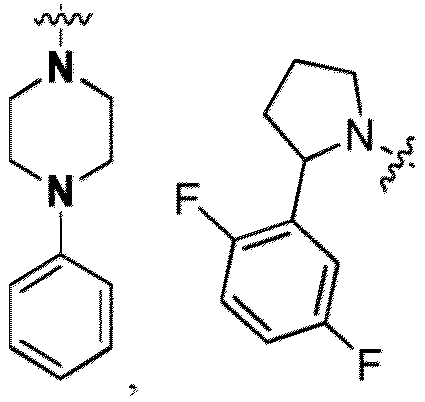


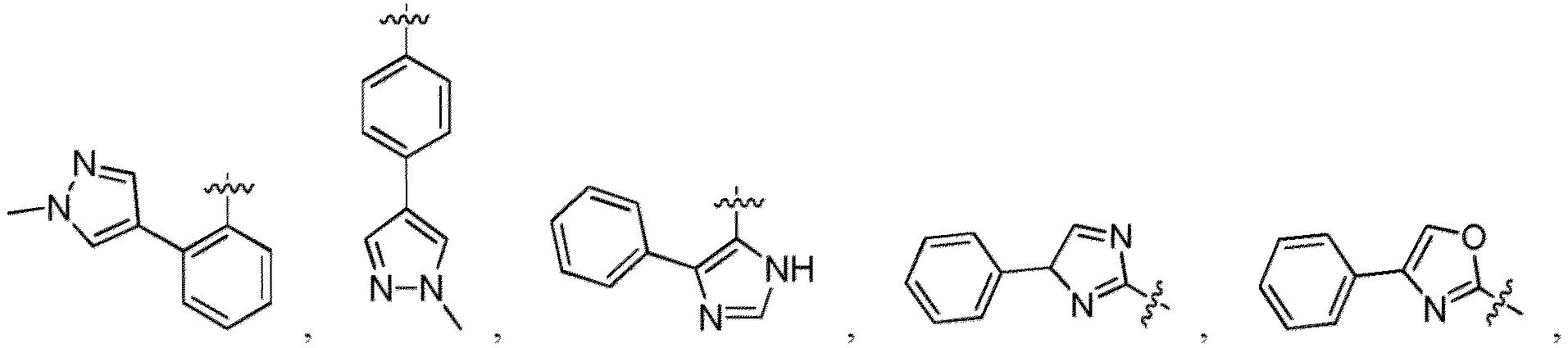


- X4 is selected from the group consisting of C(=O), S(=O)y and -O-C(=O)-, and wherein y is preferably 2; and/or
- R3 is COOH, or

- 12. The compound according to item 8, or a pharmaceutically acceptable salt, ester, stereoisomer, polymorph, solvate, N-oxide, isotopically labeled compound thereof, wherein X4 is a direct bond; and
preferably, in this case, R1a is -C1-3 alkylenephenyl, preferably -CH2-phenyl. - 13. The compound according to item 9, or a pharmaceutically acceptable salt, ester, stereoisomer, polymorph, solvate, N-oxide, isotopically labeled compound thereof, wherein:
- R1a is selected from the group consisting of C2-6 alkenyl (preferably vinyl, 1-propenyl or 2-propenyl) and C2-6 alkynyl (preferably ethynyl, 1-propynyl or 2-propynyl), which are optionally substituted by 1, 2, 3 or more R13; preferably, wherein R13 is selected from the group consisting of phenyl and 5- to 6-membered heteroaryl, which are optionally substituted by 1, 2 or 3 substituents independently selected from the group consisting of halogen, OH, amino, cyano and C1-4 alkyl;
- preferably, R13 is a phenyl or pyridyl, which is optionally substituted by 1, 2 or 3 substituents independently selected from the group consisting of F, Cl and Br; and
- X4 is C(=O) or -O-C(=O)-; or
- preferably, R1a is selected from the group consisting of


- 14. The compound according to any one of items 1-4 and 7, or a pharmaceutically acceptable salt, ester, stereoisomer, polymorph, solvate, N-oxide, isotopically labeled compound thereof, wherein X1 is CR10 or N.
- 15. The compound according to item 14, or a pharmaceutically acceptable salt, ester, stereoisomer, polymorph, solvate, N-oxide, isotopically labeled compound thereof, wherein X4 is a direct bond;
- preferably, in this case,
- R1a is selected from the group consisting of C2-6 alkenyl (such as vinyl, 1-propenyl or 2-propenyl) and C2-6 alkynyl (such as ethynyl, 1-propynyl or 2-propynyl) which are optionally substituted by 1, 2, 3 or more R13; and/or
- R1b is selected from the group consisting of C1-4 alkyl optionally substituted by 1, 2, 3 or more R13;
- preferably, wherein R13 is selected from the group consisting of C1-4 alkyl, phenyl and 5- to 6-membered heteroaryl, which are optionally substituted by 1, 2 or 3 substituents independently selected from the group consisting of halogen, OH, amino, cyano and C1-4 alkyl;
- preferably, R13 is a C1-4 alkyl or phenyl, which is optionally substituted by 1, 2 or 3 substituents independently selected from the group consisting of F, Cl and Br;
- more preferably, R13 is a C1-4 alkyl (such as methyl, ethyl, propyl, isopropyl or tert-butyl); or a phenyl optionally substituted by 1, 2 or 3 substituents independently selected from the group consisting of F, Cl and Br;
- more preferably, R1a is

- R1b is methyl, ethyl, n-propyl or isopropyl; and/or
- X1 is CH or N, preferably CH.
- 16. The compound according to item 14, or a pharmaceutically acceptable salt, ester, stereoisomer, polymorph, solvate, N-oxide, isotopically labeled compound thereof, wherein X4 is selected from the group consisting of C(=O), S(=O)y, -O-C(=O)-, -S-C(=O)-, -O-S(=O)y-, -NR10-C(=O)- or -NR10-S(=O)y-, preferably is C(=O), -O-C(=O)- or -NR10-C(=O)-.
- 17. The compound according to any one of items 14 to 16, or a pharmaceutically acceptable salt, ester, stereoisomer, polymorph, solvate, N-oxide, isotopically labeled compound thereof, wherein R1b is selected from the group consisting of H and R1a, and preferably, X1 is CH.
- 18. The compound according to item 16, or a pharmaceutically acceptable salt, ester, stereoisomer, polymorph, solvate, N-oxide, isotopically labeled compound thereof, wherein:
- R1a is a group selected from the group consisting of an optionally substituted C3-7 cyclic hydrocarbyl group, an optionally substituted 4- to 7-membered monocyclic heterocyclic group, an optionally substituted 8- to 10-membered benzo-fused heterocyclic group, an optionally substituted phenyl, an optionally substituted 5- to 10-membered heteroaryl, -optionally substituted C1-3 alkylene-(optionally substituted C3-7 cyclic hydrocarbyl group), -optionally substituted C1-3 alkylene-(optionally substituted 5- to 7-membered monocyclic heterocyclic group), -optionally substituted C1-3 alkylene-(optionally substituted 8- to 10-membered benzo-fused heterocyclic group), -optionally substituted C1-3 alkylene-optionally substituted phenyl, and -optionally substituted C1-3 alkylene-(optionally substituted 5- to 10-membered heteroaryl);
- preferably, R1a is a group selected from the group consisting of an optionally substituted C3-7 cyclic hydrocarbyl group, an optionally substituted 4- to 7-membered monocyclic heterocyclic group, an optionally substituted 8- to 10-membered benzo-fused heterocyclic group, an optionally substituted phenyl, an optionally substituted 5- to 10-membered heteroaryl, -C1-3 alkylene-(optionally substituted C3-7 cyclic hydrocarbyl group), -C1-3 alkylene-(optionally substituted 5- to 7-membered monocyclic heterocyclic group), -C1-3 alkylene-(optionally substituted 8- to 10-membered benzo-fused heterocyclic group), -C1-3 alkylene-optionally substituted phenyl, and -C1-3 alkylene-(optionally substituted 5- to 10-membered heteroaryl); or
- R1a is a group selected from the group consisting of
- an optionally substituted phenyl;
- -C1-3 alkylene-(optionally substituted C3-7 cyclic hydrocarbyl group), the cyclic hydrocarbyl group being, for example, cyclopropyl, cyclobutyl, cyclopentyl, or cyclohexyl;
- -C1-3 alkylene-(optionally substituted 8- to 10-membered benzo-fused heterocyclic group), the heterocyclic group being, for example,

- -C1-3 alkylene-optionally substituted phenyl;
- an optionally substituted 5- to 10-membered heteroaryl and -C1-3 alkylene-(optionally substituted 5- to 10-membered heteroaryl), the heteroaryl being, for example,


- wherein the term "optionally substituted" means being substituted by 1, 2, 3 or more R13;
- preferably, wherein R13 is selected from the group consisting of halogen, -OR11 (preferably, R11 is C1-6 alkyl optionally substituted by 1, 2, 3 or more halogens, more preferably C1-3 alkyl optionally substituted by 1, 2 or 3 F or Cl), -NR11R12, cyano and C3-7 cyclic hydrocarbyl group; and C1-4 alkyl, C2-4 alkenyl and C2-4 alkynyl which are optionally substituted by 1, 2, 3 or more halogens, and wherein R11 and R12 are each independently selected from the group consisting of H and C1-4 alkyl (preferably methyl);
- preferably, R13 is selected from the group consisting of F, Cl, Br, OH, -OC1-4 alkyl, -N(C1-4 alkyl)2, cyano, C3-7 cyclic hydrocarbyl group, C2-4 alkenyl and C2-4 alkynyl; and C1-4alkyl optionally substituted by 1, 2, 3 or more F, Cl or Br;
- more preferably, R13 is selected from the group consisting of F, Cl, Br, -OCH3, -N(CH3)2, cyano, cyclopropyl, vinyl, 1-propenyl, 2-propenyl, ethynyl, 1-propenyl, 2-propynyl, methyl, ethyl, n-propyl, isopropyl, tert-butyl and CF3; or
- R13, at each occurrence, is independently selected from the group consisting of
- -P(O)R11R12, wherein preferably, R11 and R12, at each occurrence, are each independently a C1-6 alkyl optionally substituted by 1, 2, 3 or more halogens, preferably a C1-3 alkyl optionally substituted by 1, 2 or 3 F or Cl, more preferably methyl, ethyl, propyl or isopropyl, more preferably methyl; and
- C3-10 cyclic hydrocarbyl group or 3- to 10-membered heterocyclic group, which is substituted by C1-6 alkyl, preferably C3-7 cyclic hydrocarbyl group or 4- to 7-membered heterocyclic group, which is substituted by C1-6 alkyl, preferably C5-7 cyclic hydrocarbyl group or 5- to 7-membered monocyclic heterocyclic group, which is substituted by C1-3 alkyl, wherein the alkyl is optionally substituted by 1, 2, 3 or more OH or halogens, preferably optionally substituted by 1, 2 or 3 OH, F or Cl; or.
- R1a is selected from the group consisting of


- 19. The compound according to any one of item 18, or a pharmaceutically acceptable salt, ester, stereoisomer, polymorph, solvate, N-oxide, isotopically labeled compound thereof, wherein R1b is a group selected from the group consisting of H, an optionally substituted C1-4 alkyl, an optionally substituted C3-7 cyclic hydrocarbyl group, an optionally substituted phenyl, -optionally substituted C1-3 alkylene-(optionally substituted C3-7 cyclic hydrocarbyl group), and -optionally substituted C1-3 alkylene-optionally substituted phenyl;
- preferably, R1b is a group selected from the group consisting of H, an optionally substituted C1-4 alkyl, an optionally substituted C3-7 cyclic hydrocarbyl group, an optionally substituted phenyl, -C1-3 alkylene-(optionally substituted C3-7 cyclic hydrocarbyl group), and -C1-3 alkylene-optionally substituted phenyl;
- more preferably, R1b is a group selected from the group consisting of
- H, phenyl;
- an optionally substituted C1-4 alkyl, the alkyl being, for example, methyl, ethyl or isopropyl;
- an optionally substituted C3-7 cyclic hydrocarbyl group and -C1-3 alkylene-(C3-7 cyclic hydrocarbyl group), the cyclic hydrocarbyl group being, for example, cyclopropyl, cyclobutyl, cyclopentyl, or cyclohexyl; and
- -C1-3 alkylene-phenyl; and
- wherein the term "optionally substituted" means being substituted by 1, 2, 3 or more R13;
- wherein R13 is preferably selected from the group consisting of halogen and C1-4 alkyl, more preferably selected from the group consisting of F, Cl, Br and methyl;preferably, R1b is selected from the group consisting of H, methyl, ethyl, isopropyl, CF3CH2, cyclopropyl,


- 20. The compound according to any one of items 18 to 19, or a pharmaceutically acceptable salt, ester, stereoisomer, polymorph, solvate, N-oxide, isotopically labeled compound thereof, wherein X1 is CH or N, preferably N; and/or X4 is selected from the group consisting of C(=O) and S(=O)y, and wherein y is preferably 2; and/or
R3 is COOH or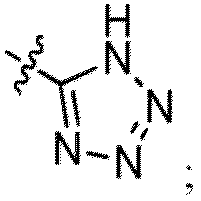
- 21. The compound according to any one of items 1 to 20, or a pharmaceutically acceptable salt, ester, stereoisomer, polymorph, solvate, N-oxide, isotopically labeled compound thereof, wherein:
- R2a is selected from the group consisting of an optionally substituted phenyl, and -optionally substituted C1-3 alkylene-optionally substituted phenyl;
- preferably, R2a is selected from the group consisting of an optionally substituted phenyl, and -C1-3 alkylene-optionally substituted phenyl; and/or
- R2b is selected from the group consisting of an optionally substituted C1-4 alkyl, an optionally substituted phenyl, and -optionally substituted C1-3 alkylene-optionally substituted phenyl;
- preferably, R2b is selected from the group consisting of C1-4 alkyl, an optionally substituted phenyl, and -C1-3 alkylene-optionally substituted phenyl;
- wherein the term "optionally substituted" means being substituted by 1, 2, 3 or more R13;
- preferably, wherein R13 is selected from the group consisting of halogen and -OR11, and wherein R11 is selected from C1-4 alkyl (preferably methyl);
- preferably, R13 is selected from the group consisting of F, Cl, Br and -OCH3;
- more preferably, R2a is selected from the group consisting of phenyl,


- R2b is selected from the group consisting of methyl, phenyl,

- 22. The compound according to any one of items 18 to 21, or a pharmaceutically acceptable salt, ester, stereoisomer, polymorph, solvate, N-oxide, isotopically labeled compound thereof, wherein the compound has a structure of formula (II) or formula (III):

- 23. The compound according to any one of items 1 to 4, or a pharmaceutically acceptable salt, ester, stereoisomer, polymorph, solvate, N-oxide, isotopically labeled compound thereof, wherein
- R1a is a group which is optionally substituted by 1, 2, 3 or more R13 and is selected from the group consisting of C1-6 alkyl, C2-6 alkenyl, C2-6 alkynyl, C5-7 cyclic hydrocarbyl group, 5-, 6- or 7- membered monocyclic heterocyclic group, 8- to 10-membered benzo-fused heterocyclic group, phenyl, 5- to 6-membered heteroaryl, -C1-3 alkylene-C3-7 cyclic hydrocarbyl group, -C1-3 alkylene-(5- to 7-membered monocyclic heterocyclic group), -C1-3 alkylenephenyl and -C1-3 alkylene-(5- to 6-membered heteroaryl),
- preferably, wherein R13 is selected from the group consisting of C1-4 alkyl-O-; halogen (including F, Cl, Br and 1); and C1-4 alkyl or phenyl, which is optionally substituted by 1, 2 or 3 substituents independently selected from halogen, and
- R1b and X1 together form a bivalent C5-7 cyclic hydrocarbyl group or a bivalent 5-, 6- or 7- membered monocyclic heterocyclic group,
- wherein:
- the C1-6 alkyl is preferably selected from the group consisting of methyl, ethyl, n-propyl, isopropyl, n-butyl, isobutyl, sec-butyl, tert-butyl, n-pentyl, isopentyl, neopentyl, and 1-hexyl;
- the C2-6 alkenyl is preferably selected from the group consisting of vinyl, 1-propenyl, 2-propenyl, 2-butenyl, 3-butenyl, 2-pentenyl, 3-pentenyl, 4-pentenyl and 2-hexenyl;
- the C2-6 alkynyl is preferably seleted from the group consisting of ethynyl, 1-propynyl, 2-propynyl, 2-butynyl, 3-butynyl, 2-pentynyl, 3-pentynyl, 4-pentynyl, 2-hexynyl and 3-hexynyl;
- the -C1-3 alkylenephenyl is preferably selected from the group consisting of benzyl and phenethyl;
- the C5-7 cyclic hydrocarbyl group is preferably selected from the group consisting of cyclopropyl, cyclobutyl, cyclopentyl, cyclohexyl or cycloheptyl;
- the 5-, 6- or 7- membered monocyclic heterocyclic group is preferably selected from the group consisting of tetrahydrofuranyl, tetrahydrothienyl, pyrrolidinyl (e.g. pyrrolidin-1-yl), oxazolidinyl, thiazolidinyl, imidazolidinyl, 1,3-dioxolanyl, 1,3-oxathiolanyl, piperidinyl, piperazinyl, morpholinyl (such as morpholino)), thiomorpholinyl, tetrahydro-2H-pyranyl, tetrahydro-2H-thiopyranyl, 1,3-oxazinanyl (1,3-oxazinane), 1,3-thiazinanyl (1,3-thiazinane), hexahydropyrimidyl, 1,3-oxathianyl (1,3-oxathiane), 1,4-oxathianyl (1,4-oxathiane), 1,3-diazepanyl (1,3-diazepane), 1,4-diazepanyl (1,4-diazepane), 1,3-oxazepanyl (1,3-oxazepane), 1,3-thiazepanyl (1,3-thiazepane);
- the 5- to 6-membered heteroaryl is preferably selected from the group consisting of thienyl, furyl, pyrrolyl, oxazolyl, thiazolyl, imidazolyl, pyrazolyl (such as 1-pyrazolyl, 3-pyrazolyl, 4-pyrazolyl, 5-pryazolyl), isoxazolyl, isothiazolyl, oxadiazolyl, triazolyl, thiadiazolyl, pyridyl, pyridazinyl, pyrimidinyl, pyrazinyl and triazinyl; and/or
- the 8- to 10-membered benzo-fused heterocyclic group is preferably selected from the group consisting of


- preferably, R1a is phenyl; and
- R1b and X1 together form

- X4 is selected from the group consisting of C(=O) and S(=O)y.
- 24. The compound according to any one of items 1 to 23, or a pharmaceutically acceptable salt, ester, stereoisomer, polymorph, solvate, N-oxide, isotopically labeled compound thereof, wherein





- 25. The compound according to any one of items 1 to 4, or a pharmaceutically acceptable salt, ester, stereoisomer, polymorph, solvate, N-oxide, isotopically labeled compound thereof, wherein Y is a single bond, NR10, O, S, methylene, ethylene, -CH2-O-, -O-CH2-, -CH2-S-, -S-CH2-, -CH2-NR10-, -NR10-CH2-, - CH=CH-, -CH=N- or -N=CH-; and/or
- the optionally substituted saturated or partially unsaturated fused ring system comprising 3 or more rings which is formed by R1a and R1b together with X1 to which they are attached has a structure of formula (a):

- wherein:
- ring A and ring B are each independently C3-10 cyclic hydrocarbyl group, 3- to 10-membered heterocyclic group, C6-10 aryl, or 5- to 14-membered heteroaryl, preferably C5-7 cyclic hydrocarbyl group (such as, cyclopentyl or cyclohexyl), 5- to 7-membered monocyclic heterocyclic group, phenyl, or 5- to 6-membered heteroaryl;
- "------" represents a single bond or a double bond;
- preferably, the fused ring system has a structure of formula (1) or formula (2):
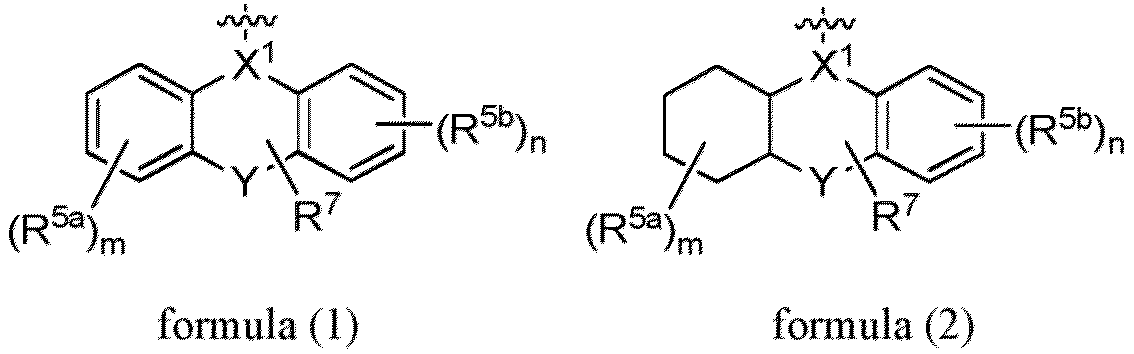
- wherein
- R5a and R5b, at each occurrence, are each independently R10;
- R7 does not exist or is R10; and
- m and n, at each occurrence, are each independently 0, 1, 2 or 3;
- more preferably, X1 as defined in formula (a), (1) or (2) is CH or N;
- further more preferably, the group of formula (1) has a structure selected from the group consisting of




- the group of formula (2) has a structure selected from the group consisting of


- the optionally substituted saturated or partially unsaturated fused ring system comprising 3 or more rings which is formed by R1a and R1b together with X1 to which they are attached has a structure of formula (a):
- 26. The compound according to any one of items 1 to 20 and 23 to 25, or a pharmaceutically acceptable salt, ester, stereoisomer, polymorph, solvate, N-oxide, isotopically labeled compound thereof, wherein
- R2a is a group which is optionally substituted by 1, 2, 3 or more R13 and is selected from the group consisting of C1-6 alkyl, C2-6 alkenyl, C2-6 alkynyl, C5-7 cyclic hydrocarbyl group, 5-, 6- or 7- membered monocyclic heterocyclic group, 8- to 10-membered benzo-fused heterocyclic group, phenyl, 5- to 6-membered heteroaryl, -C1-3 alkylene-C3-7 cyclic hydrocarbyl group, -C1-3 alkylene-(5- to 7-membered monocyclic heterocyclic group), -C1-3 alkylenephenyl and -C1-3 alkylene-(5- to 6-membered heteroaryl),
- preferably, wherein R13 is selected from the group consisting of C1-4 alkyl-O-; halogen (including F, Cl, Br, and 1); and C1-4 alkyl or phenyl, which is optionally substituted by 1, 2 or 3 substituents independently selected from halogen; and
- R2b does not exist or is selected from the group consisting of H and R2a.
- 27. The compound according to any one of items 1 to 20, 23 to 26, or a pharmaceutically acceptable salt, ester, stereoisomer, polymorph, solvate, N-oxide, isotopically labeled compound thereof, wherein R2b does not exist, and X2 does not exist.
- 28. The compound according to any one of items 26 to 27, or a pharmaceutically acceptable salt, ester, stereoisomer, polymorph, solvate, N-oxide, isotopically labeled compound thereof, wherein
- R2a is a group selected from the group consisting of an optionally substituted 5-, 6- or 7-membered monocyclic heterocyclic group, an optionally substituted phenyl, and -optionally substituted C1-3 alkylene-optionally substituted phenyl, wherein the term "optionally substituted" means being substituted by 1, 2, 3 or more R13;
- R2b does not exist; and
- X2 does not exist.
- 29. The compound according to any one of items 1 to 26, or a pharmaceutically acceptable salt, ester, stereoisomer, polymorph, solvate, N-oxide, isotopically labeled compound thereof, wherein X2 is CR10 or N, and wherein R10 is preferably H, OH or C1-4 alkyl (such as methyl); and/or
R2b is selected from the group consisting of H and R2a, and preferably, X2 is CH. - 30. The compound according to any one of items 1 to 20 and 23 to 25, or a pharmaceutically acceptable salt, ester, stereoisomer, polymorph, solvate, N-oxide, isotopically labeled compound thereof, wherein
- R2a is a group which is optionally substituted by 1, 2, 3 or more R13 and is selected from the group consisting of C1-6 alkyl, C2-6 alkenyl, C2-6 alkynyl, C5-7 cyclic hydrocarbyl group, 5-, 6- or 7- membered monocyclic heterocyclic group, 8- to 10-membered benzo-fused heterocyclic group, phenyl, 5- to 6-membered heteroaryl, -C1-3 alkylene-C3-7 cyclic hydrocarbyl group, -C1-3 alkylene-(5- to 7-membered monocyclic heterocyclic group), -C1-3 alkylenephenyl and -C1-3 alkylene-(5- to 6-membered heteroaryl),
- preferably, wherein R13 is selected from the group consisting of C1-4 alkyl-O-; halogen (including F, Cl, Br, and 1); and C1-4 alkyl or phenyl, which is optionally substituted by 1, 2 or 3 substituents independently selected from halogen; and
- R2b and X2 together form a bivalent C5-7 cyclic hydrocarbyl group or a bivalent 5-, 6- or 7- membered monocyclic heterocyclic group.
- 31. The compound according to any one of items 1 to 20 and 23 to 30, or the pharmaceutically acceptable salt, ester, stereoisomer, polymorph, solvate, N-oxide, isotopically labeled compound thereof, wherein





- 32. The compound according to any one of items 1 to 20 and claims 23 to 25, or the pharmaceutically acceptable salt, ester, stereoisomer, polymorph, solvate, N-oxide, isotopically labeled compound thereof, wherein Z is a single bond, NR10, O, S, methylene, ethylene, -CH2-O-, -O-CH2-, -CH2-S-, -S-CH2-, -CH2-NR10-, -NR10-CH2-, -CH=CH-, -CH=N- or -N=CH-; and/or
- the optionally substituted saturated or partially unsaturated fused ring system comprising 3 or more rings which is formed by R2a and R2b together with X2 to which they are attached has a structure of formula (b):

- wherein:
- ring C and ring D are each independently C3-10 cyclic hydrocarbyl group, 3- to 10-membered heterocyclic group, C6-10 aryl or 5- to 14-membered heteroaryl, preferably C5-7 cyclic hydrocarbyl group, 5-to 7-membered monocyclic heterocyclic group, phenyl or 5- to 6-membered heteroaryl;
- "------" represents a single bond or a double bond;
- preferably, the fused ring system has a structure of formula (3) or formula (4):

- wherein
- R6a and R6b, at each occurrence, are each independently R10;
- R8 does not exist or is R10; and
- p and q, at each occurrence, are each independently 0, 1, 2 or 3.
- the optionally substituted saturated or partially unsaturated fused ring system comprising 3 or more rings which is formed by R2a and R2b together with X2 to which they are attached has a structure of formula (b):
- 33. The compound according to any one of items 1 to 25 and 32, or a pharmaceutically acceptable salt, ester, stereoisomer, polymorph, solvate, N-oxide, isotopically labeled compound thereof, wherein X2, at each occurrence, is independently CR10 or N, and wherein R10 is H, OH, amino or C1-4 alkyl (such as methyl);
- preferably, in this case, the group of formula (3) has a structure selected from the group consisting of


- the group of formula (4) has a structure selected from the group consisting of





- preferably, in this case, the group of formula (3) has a structure selected from the group consisting of
- 34. The compound according to any one of items 1 to 21 and 23 to 33, or a pharmaceutically acceptable salt, ester, stereoisomer, polymorph, solvate, N-oxide, isotopically labeled compound thereof, wherein the compound has a structure of formula (a-1), (a-2), (a-3), (a-4), (a-5), (a-6), (a-7) or (a-8):


- 35. A compound having a structure of
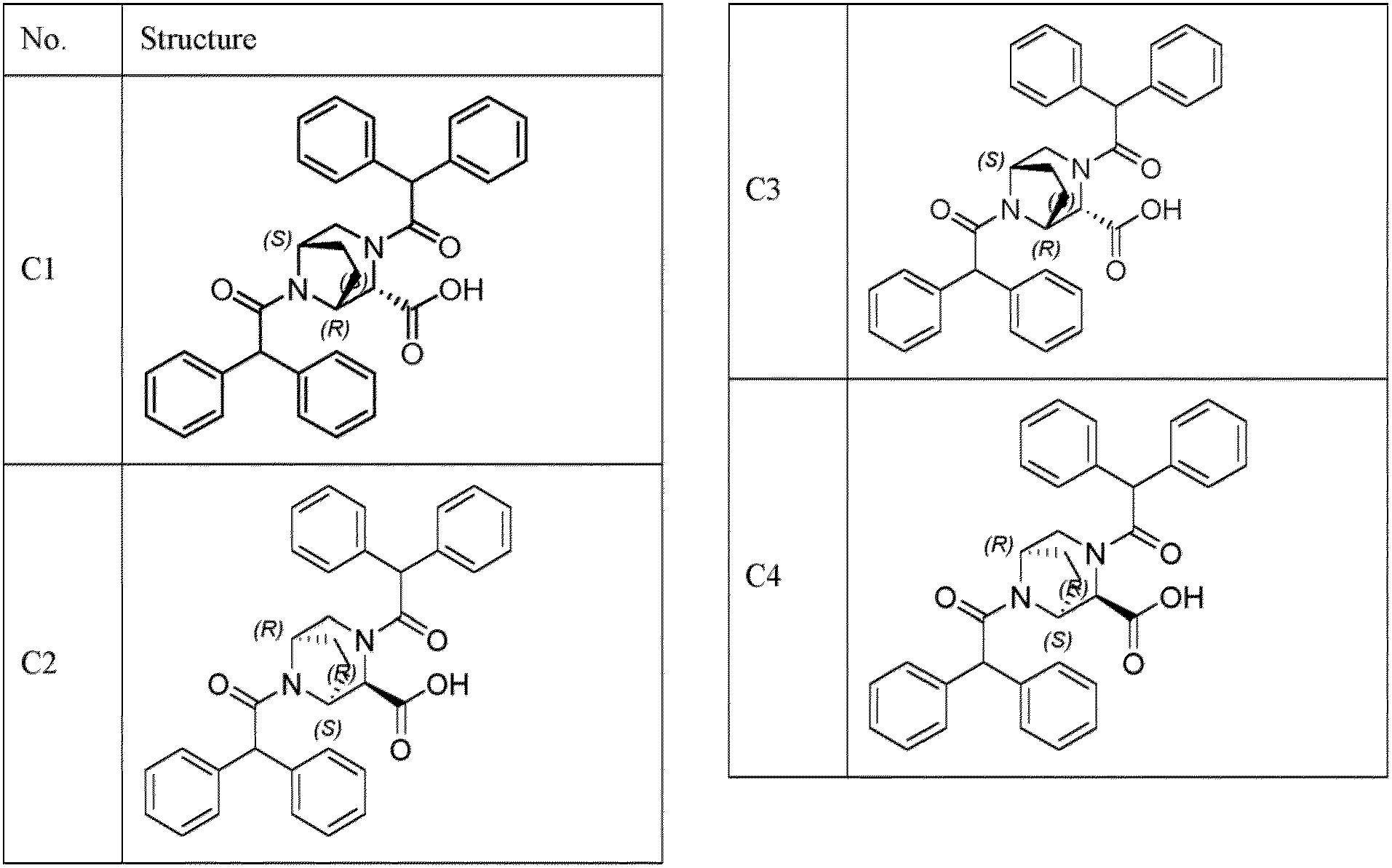


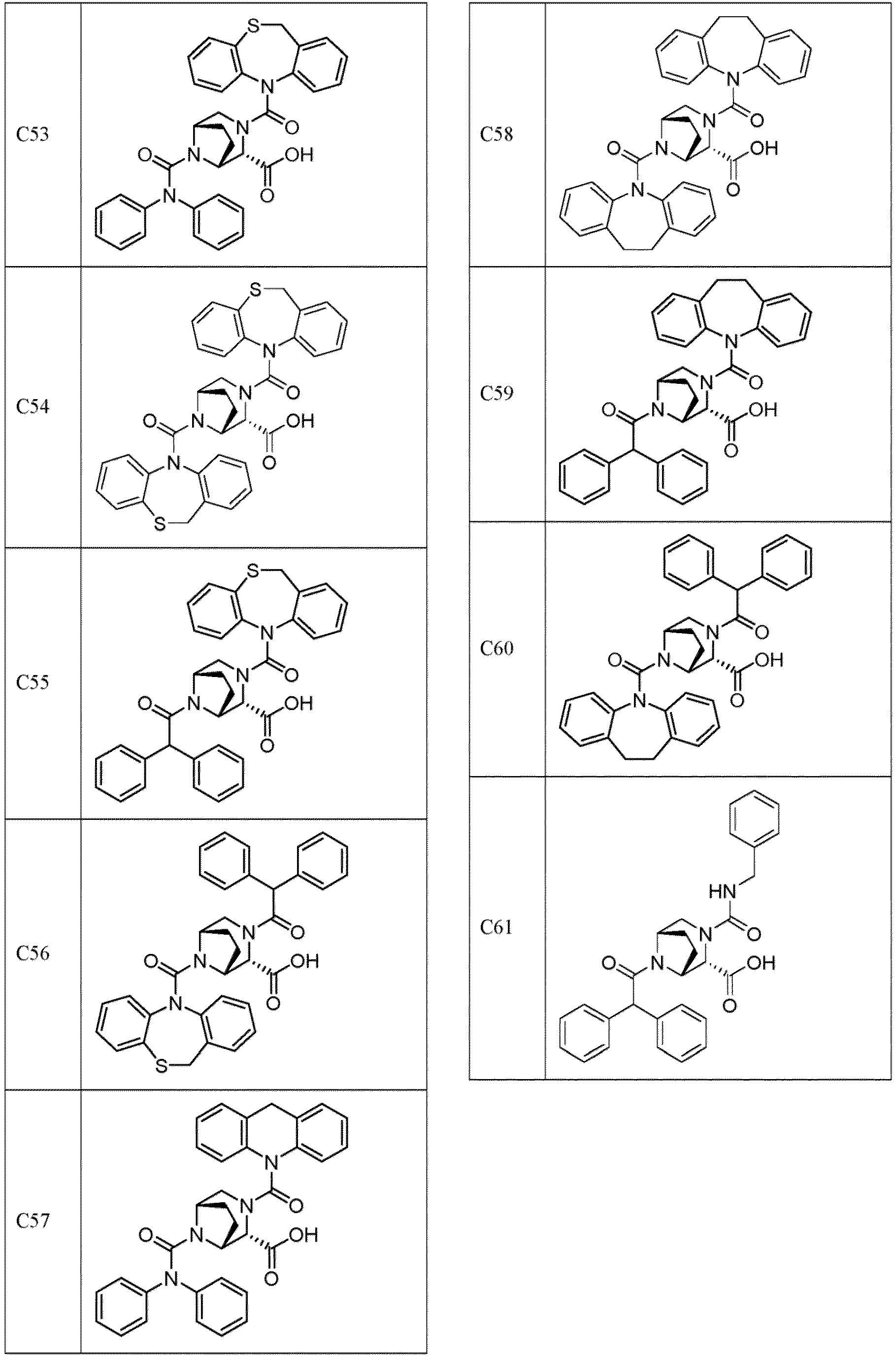


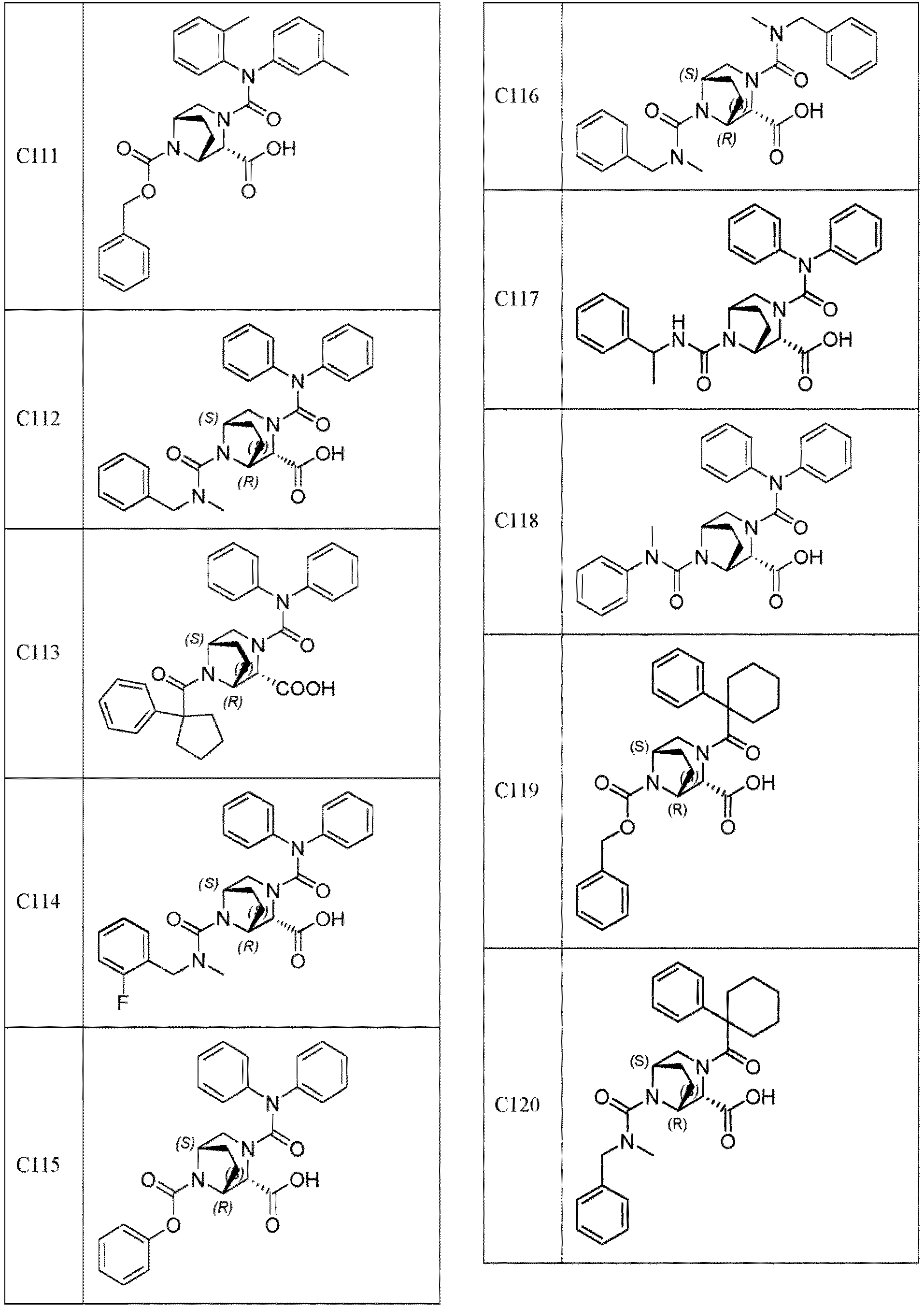
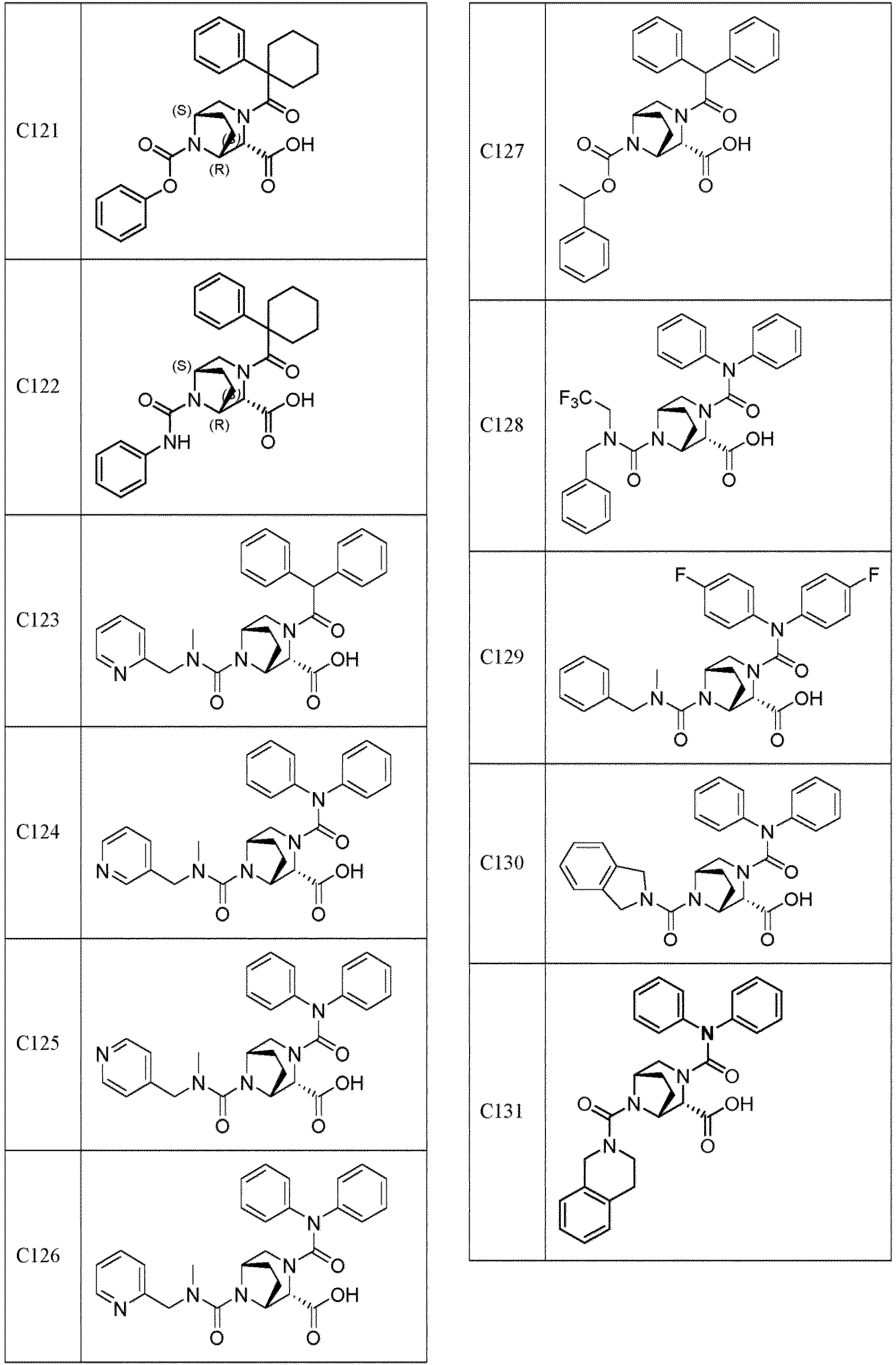


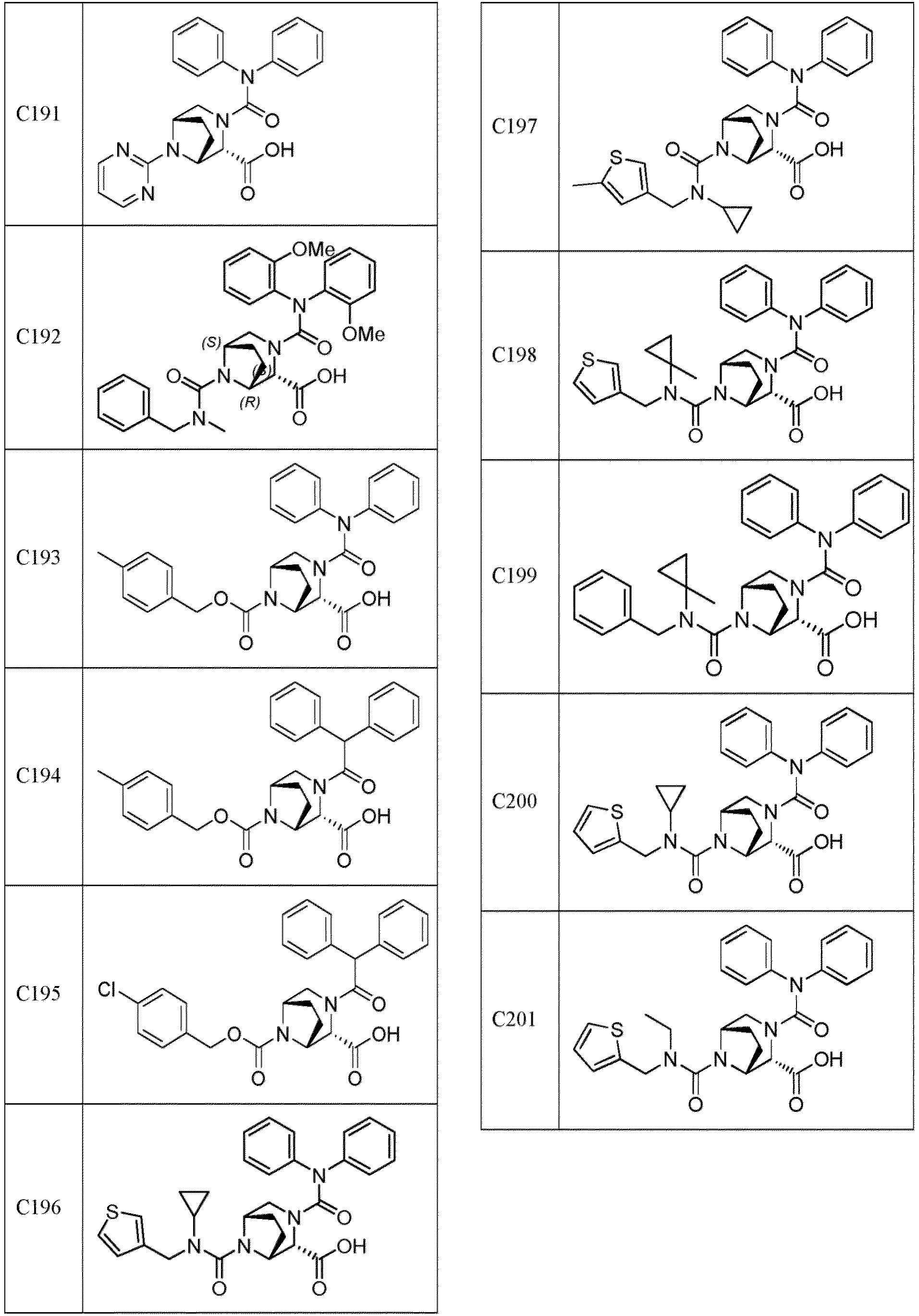


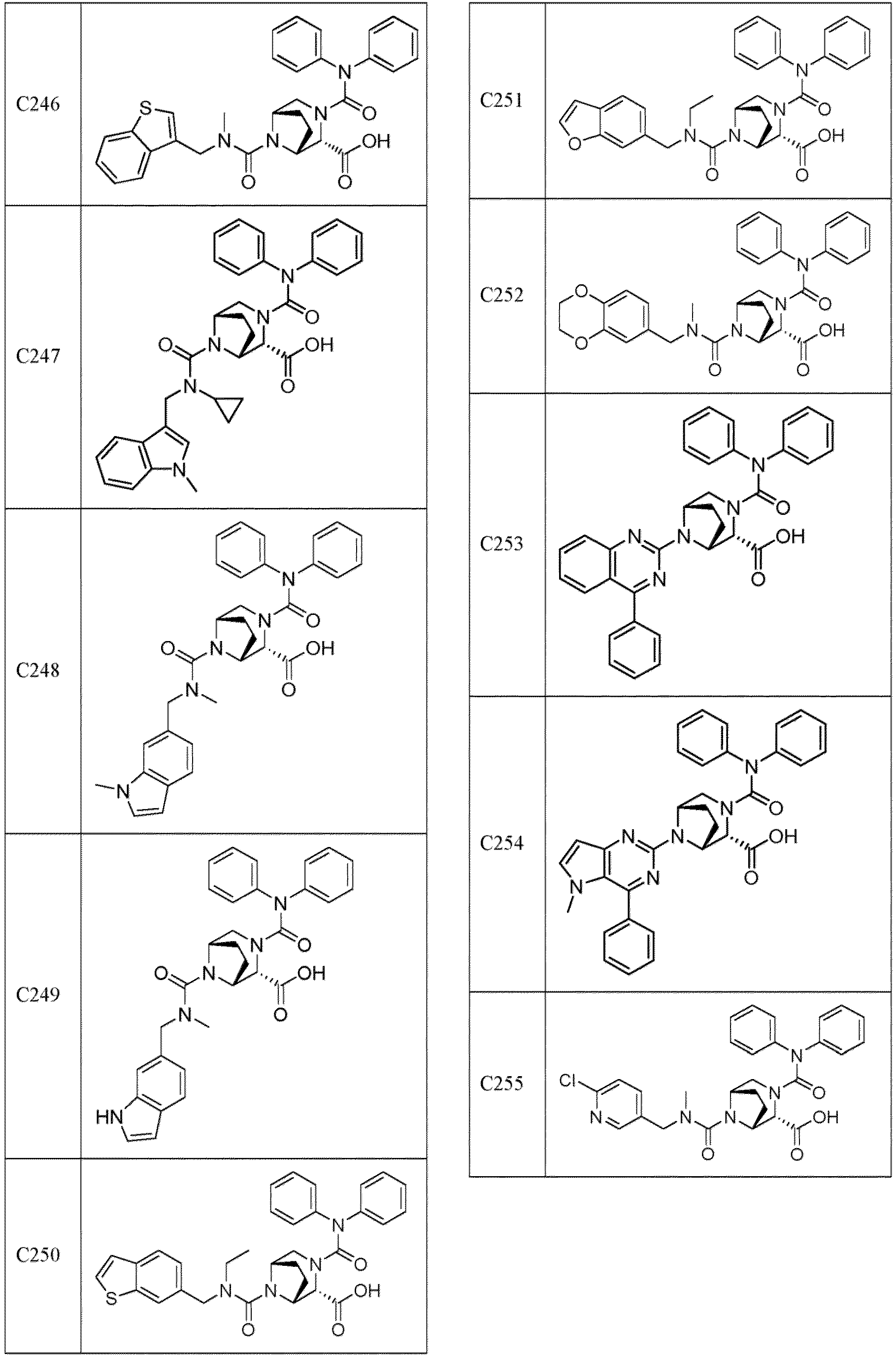


 or a pharmaceutically acceptable salt, ester, stereoisomer, polymorph, solvate, N-oxide, isotopically labeled compound thereof.
- In some embodiments, the compound of the present invention has selective inhibitory activity on AT2 receptors, compared to AT1 receptors.
- In some embodiments, the present invention provides a pharmaceutical composition comprising a prophylactically or therapeutically effective amount of the compound of the present invention or a pharmaceutically acceptable salt, ester, stereoisomer, polymorph, solvate, N-oxide, or isotopically labeled compound thereof, and one or more pharmaceutically acceptable carriers, and the pharmaceutical composition is preferably in the form of a solid, semi-solid, liquid, or gas preparation. In some embodiments, the pharmaceutical composition can further comprise one or more additional therapeutic agents.
- In some embodiments, the present invention provides the compound of the present invention or a pharmaceutically acceptable salt, ester, stereoisomer, polymorph, solvate, N-oxide, or isotopically labeled compound thereof, or the pharmaceutical composition of the present invention, for use as an angiotensin II type 2 (AT2) receptor inhibitor.
- In some embodiments, the present invention provides the compound of the present invention or a pharmaceutically acceptable salt, ester, stereoisomer, polymorph, solvate, N-oxide, or isotopically labeled compound thereof, or the pharmaceutical composition of the present invention for use as an angiotensin II type 2 (AT2) receptor inhibitor.
- The present invention enables a method for the prophylaxis or the treatment of an AT2 receptor-mediated disorder or a symptom associated therewith, comprising administering to a subject in need thereof an effective amount of the compound of the present invention or a pharmaceutically acceptable salt, ester, stereoisomer, polymorph, solvate, N-oxide, or isotopically labeled compound thereof, or the pharmaceutical composition of the present invention.
- In some embodiments, the AT2 receptor-mediated disorder is selected from cerebrovascular disorders (including cerebrovascular spasm and cerebral ischemia); cognitive disorders (including amnesia, senile dementia, AIDS related dementia and Down's syndrome); central nervous system diseases or disorders (including addiction such as alcholism, anxiety, depression or dysthymic disorders, epilepsy, hyperactivity, pain, Parkinson's disease, psychosis, sleep disorders, irregular autonomic function, and tardive dyskinesia, schizophrenia, demyelinating diseases such as multiple sclerosis and amyotrophic lateral sclerosis); respiratory diseases (including bronchospasm, asthma, chronic obstructive airways disease), neural tumors; inflammatory diseases (including inflammatory bowel disease and osteoarthritis); gastrointestinal (GI) diseases or disorders (including ulcerative colitis, Crohn's disease and incontinence); disorders of blood flow caused by vasodilation; hypersensitivity disorders (including allergies such as eczema, rhinitis and contact dermatitis); vasospastic diseases (including angina, migraine and Reynaud's disease); fibrosing and collagen diseases (including scleroderma and eosinophilic fascioliasis); reflex sympathetic dystrophy (including shoulder/hand syndrome); stress related somatic disorders; peripheral neuropathy; neuralgia; autoimmune disease (including systemic lupus erythematosus, rheumatoid arthritis, psoriasis and graft versus host disease); and rheumatic diseases (including fibrositis).
- In some embodiments, the AT2 receptor-mediated disorder is selected from
- neuropathic conditions (including primary neuropathy and secondary neuropathy, such as peripheral neuropathy) or symptoms associated with the same (including hyperesthesia, hyperalgesia, allodynia, spontaneous burning pain, numbness, weakness, burning pain, shooting pain, and loss of reflexes), preferably neuropathic pain; wherein the secondary neuropathy includes diabetic neuropathy; Herpes Zoster-related neuropathy; uremia-associated neuropathy; amyloidosis neuropathy; HIV sensory neuropathies; hereditary motor and sensory neuropathies; hereditary sensory neuropathies; hereditary sensory and autonomic neuropathies; hereditary neuropathies with ulcero-mutilation; nitrofurantoin neuropathy; tomaculous neuropathy; neuropathy caused by nutritional deficiency; neuropathy caused by kidney failure and complex regional pain syndrome; neuropathes caused by repetitive activities (such as typing or working on an assembly line); peripheral neuropathies caused by antiretroviral drugs (such as zalcitabine and didanosine), antibiotics (such metronidazole and isoniazid), gold compounds, chemotherapy drugs (such as vincristine), alcohol, lead, arsenic, mercury and organophosphate pesticides; peripheral neuropathies associated with infectious processes (such as Guillian-Barre syndrome);
- a condition characterized by neuronal hypersensitivity, including a hyperalgesic condition such as fibromyalgia and irritable bowel syndrome;
- a disorder associated with aberrant nerve regeneration, including neuronal hypersensitivity, breast pain, interstitial cystitis, vulvodynia, a cancer chemotherapy-induced neuropathy;
- inflammatory pain that can be due to conditions that are characterized by inflammation (including burns such as chemical, frictional or thermal burns; autoimmune diseases such as rheumatoid arthritis; inflammatory bowel disease such as Crohn's disease and colitis; osteoarthritis, carditis, dermatitis, myositis, neuritis and collagen vascular diseases);
- impaired nerve conduction velocity which may be associated with a neuropathic condition as described above (such as a peripheral neuropathy) as well as Carpel Tunnel Syndrome, ulnar neuropathy, Guillian-Barre Syndrome, fascioscapulohumeral muscular dystrophy and spinal disc herneation;
- a cell proliferative disorder, including a cancer (including leukaemia, melanoma, prostate cancer, breast cancer, ovarian cancer, basal cell carcinoma, squamous cell carcinoma, sarcoma, fibrosarcoma, colon cancer, lung cancer); and a non-cancerous proliferative disorder (including dermatological disorders such as warts, keloids, psoriasis, proud flesh disorder and also the reduction in scar tissue and cosmetic remodelling);
- a disorder associated with an imbalance between bone resorption and bone formation, including osteoporosis.
- The present invention enables a method for regulating a reproductive function associated with AT2 receptors in a female patient, comprising administering to a subject in need thereof an effective amount of the compound of the present invention or a pharmaceutically acceptable salt, ester, stereoisomer, polymorph, solvate, N-oxide, or isotopically labeled compound thereof, or the pharmaceutical composition of the present invention. In some embodiments, the reproductive function is selected from the menstrual cycle, fertility, and hormonal balances of the estrus cycle.
- The term "pharmaceutically acceptable carrier" in the present invention refers to a diluent, auxiliary material, excipient, or vehicle with which a therapeutic is administered, and it is, within the scope of sound medical judgment, suitable for contact with the tissues of human beings and animals without excessive toxicity, irritation, allergic response, or other problem or complication, commensurate with a reasonable benefit/risk ratio.
- The pharmaceutically acceptable carrier which can be employed in the pharmaceutical composition of the present invention includes, but is not limited to sterile liquids, such as water and oils, including those of petroleum, animal, vegetable or synthetic origin, such as peanut oil, soybean oil, mineral oil, sesame oil and the like. Water is an exemplary carrier when the pharmaceutical composition is administered intravenously. Physiological salines as well as aqueous dextrose and glycerol solutions can also be employed as liquid carriers, particularly for injectable solutions. Suitable pharmaceutical excipients include starch, glucose, lactose, sucrose, gelatin, maltose, chalk, silica gel, sodium stearate, glycerol monostearate, talc, sodium chloride, dried skim milk, glycerol, propylene glycol, water, ethanol and the like. The pharmaceutical composition, if desired, can also contain minor amounts of wetting or emulsifying agents, or pH buffering agents. Oral formulations can include standard carriers such as pharmaceutical grades of mannitol, lactose, starch, magnesium stearate, sodium saccharine, cellulose, magnesium carbonate, etc. Examples of suitable pharmaceutical carriers are described in e.g. Remington's Pharmaceutical Sciences (1990).
- The pharmaceutical composition of the present invention can act systemically and/or topically. To this end, it can be administered through a suitable route, such as through injection, (intravenous, intraarterial, subcutaneous, intraperitoneal, intramuscular injection, including dripping), or transdermal administration, or administered via oral, buccal, nasal, transmucosal, topical, as an ophthalmic formulation, or via inhalation.
- For these routes of administration, the pharmaceutical composition of the present invention can be administered in a suitable dosage form.
- Such dosage forms include, but are not limited to tablets, capsules, lozenges, hard candies, powders, sprays, creams, salves, suppositories, gels, pastes, lotions, ointments, aqueous suspensions, injectable solutions, elixirs, and syrups.
- As used herein, the term "effective amount" refers to the amount of a compound being administered which will relieve to some extent one or more of the symptoms of the disorder being treated.
- Dosage regimens may be adjusted to provide the optimum desired response. For example, a single bolus may be administered, several divided doses may be administered over time, or the dose may be proportionally reduced or increased as indicated by the exigencies of the therapeutic situation. It is to be noted that dosage values may vary with the type and severity of the condition to be alleviated, and may include single or multiple doses. It is to be further understood that for any particular subject, specific dosage regimens should be adjusted over time according to the individual need and the professional judgment of the person administering or supervising the administration of the composition.
- The amount of the compound of the present invention administered will be dependent on the subject being treated, the severity of the disorder or condition, the rate of administration, the disposition of the compound and the discretion of the prescribing physician. Generally, an effective dosage is in the range of about 0.0001 to about 50 mg per kg body weight per day, for example about 0.01 to about 10 mg/kg/day, in single or divided doses. For a 70 kg human, this would amount to about 0.007 mg to about 3500 mg/day, for example about 0.7 mg to about 700 mg/day. In some instances, dosage levels below the lower limit of the aforesaid range may be more than adequate, while in other cases, still larger doses may be employed without causing any harmful side effect, provided that such larger doses are first divided into several small doses for administration throughout the day.
- The content or dosage of the compound of the present invention in the pharmaceutical composition is about 0.01 mg to about 1000 mg, suitably 0.1-500 mg, preferably 0.5-300 mg, more preferably 1-150 mg, particularly preferably 1-50 mg, e.g., 1.5 mg, 2 mg, 4 mg, 10 mg, 25 mg, etc.
- Unless otherwise indicated, the term "treating" or "treatment", as used herein, means reversing, alleviating, inhibiting the progress of, or preventing the disorder or condition to which such term applies, or one or more symptoms of such disorder or condition.
- As used herein, the term "subject" includes a human or non-human animal. An exemplary human subject includes a human subject having a disease (such as one described herein) (referred to as a patient), or a normal subject. The term "non-human animal" as used herein includes all vertebrates, such as non-mammals (e.g. birds, amphibians, reptiles) and mammals, such as non-human primates, livestock and/or domesticated animals (such as sheep, dog, cat, cow, pig and the like).
- In some embodiments, the pharmaceutical composition of the present invention can further comprise one or more additional therapeutic agents or prophylactic agents.
- The present invention is further described with reference to the following examples, which are not provided to limit the scope of the present invention.
- The structure of the compound was confirmed by nuclear magnetic resonance spectrum (1H NMR) or mass spectrum (MS).
- Chemical shifts (δ) are expressed in parts per million (ppm). 1H NMR was recorded on a Bruker 400 spectrometer, the test solvent was deuterated methanol (CD3OD), deuterated chloroform (CDCl3) or hexadeuterated dimethyl sulfoxide (DMSO-d 6), and the internal standard was tetramethylsilane (TMS).
- The LC-MS assay was conducted on Agilent LC-MS-1110 liquid chromatography-mass spectrometer, Agilent LC-MS-6110 liquid chromatography-mass spectrometer, Agilent LC-MS-6120 liquid chromatography-mass spectrometer (Manufacturer: Agilent) or Shimadzu LC-MS-2020.
- Preparative high-performance liquid chromatography was conducted on MS induced AutoPurification system (Waters), Gilson GX-281 (Gilson), or semi-preparative liquid chromatograph (Tong Heng Innovation Technology Co., Ltd., LC3000 (Ddlsogel, C18, 30 mm × 250 mm 10 µm).
- Thin layer chromatography (TLC) was performed with Huanghai HSGF 254 (5 × 20 cm) silica gel plates, and preparative thin layer chromatography was performed with GF 254 (0.4 ~ 0.5 nm) silica gel plates produced in Yantai.
- The reaction was monitored by thin layer chromatography (TLC) or LC-MS, the developing solvent system included dichloromethane and methanol system, n-hexane and ethyl acetate system, as well as petroleum ether and ethyl acetate system, and was adjusted (by adjusting the volume ratio of the solvents, or by adding triethylamine, etc.) according to the polarity of the compound to be separated.
- The microwave reaction was conducted by CEM Discovery Sp (400 W, RT ~ 300 °C) microwave reactor.
- Silica gel (200-300 mesh) produced by Yucheng Chemical Co., Ltd was normally employed as a stationary phase in column chromatography. The eluent system included dichloromethane and methanol system, as well as n-hexane and ethyl acetate system, and was adjusted (by adjusting the volume ratio of the solvents, or by adding triethylamine, etc.) according to the polarity of the compound to be separated.
- In the following examples, unless otherwise specified, the reaction temperature was room temperature (20°C~30°C).
- The reagents employed in the Examples were purchased from companies such as Aldrich Chemical Company, Shanghai Bide Pharmatech Co. Ltd., Beijing Greenchem Co. Ltd., Shanghai Shaoyuan Co. Ltd. or Ables Technology Co. Ltd. etc.
- The abbreviations as used in the present invention have the following meanings:
Abbreviation Meaning CH3CN acetonitrile (Boc)2O di-tert-butyl dicarbonate BTC triphosgene DCM dichloromethane DMSO dimethyl sulfoxide TEA triethylamine HCl hydrochloric acid H2O water AcOH acetic acid MeOH methanol EtOH ethanol Na2CO3 sodium carbonate NaOH sodium hydroxide SOCl2 thionyl chloride TFA trifluoroacetic acid THF tetrahydrofuran Me3O+ BF4 - trimethyloxonium tetrafluoroborate BF3Et2O boron trifluoride etherate PdCl2(PPh3)2 bis(triphenylphosphine)dichloropalladium Pd/C Palladium on carbon -

- Compound 1 (14.3 g, 0.1 mol) was dissolved in dichloromethane (150 mL). The starting material, trimethyloxonium tetrafluoroborate (16.3 g, 0.11 mol), was added in portions, and the reaction solution was reacted at room temperature for 16 hours. The reaction solution was cooled in an ice-water bath, adjusted to pH 8.0 with saturated sodium bicarbonate solution, and extracted with dichloromethane (200 mL × 2). The combined organic phase was dried with anhydrous sodium sulfate (100 g) for 30 min, and then filtered and concentrated under reduced pressure. The resulting crude product was separated and purified by column chromatography (dichloromethane:methanol =9:1) to obtain Compound 2 (8.5 g, a yellow oily matter, yield: 54%).
- MS m/z (ESI): 158.0 [M+H]+.
- A mixture of Compound 2 (8.5 g, 0.054 mol) and Compound 3 (21.6 g, 0.162 mmol) was reacted at 60°C for 16 hours. LC-MS indicated that the reaction of the starting materials was complete. To the reaction solution, 50 g of silica gel was added, and it was separated and purified by column chromatography (petroleum ether:ethyl acetate =3:2) to obtain Compound 4 (4 g, a yellow oily matter, yield: 29%).
- 1H NMR (400 MHz, DMSO-d 6): δ 10.21 (brs, 1H), 4.64 (dd, J = 3.6 Hz, J = 8.8 Hz, 1H), 4.20 (q, J = 6.8 Hz, 2H), 3.72 (s, 3H), 3.20 - 2.90 (m, 2H), 2.50 - 2.30 (m, 1H), 2.10 - 2.00 (m, 1H), 1.23 (t, J = 6.8 Hz, 3H).
- MS m/z (ESI): 259.0 [M+H]+.
- Compound 4 (12 g, 46.47 mmol) was dissolved in ethanol (1.2 L), and 12 g 10% wet palladium on carbon was added. The reaction solution was purged with hydrogen 5 times in an enclosed tank, and then reacted under the hydrogen atmosphere (0.4 MPa) at room temperature for 72 hours. After completing reaction, it was filtered, and concentrated. The resulting crude product was separated and purified by column chromatography (dichloromethane:methanol =10:1) to obtain two isomers: Compound 5 (3 g, a yellow solid, yield: 32.6%) and Compound 5' (1.5 g, a brown yellow solid, 16.3%).
- 1H NMR (400 MHz, DMSO-d 6): δ 7.25 (s, 1H), 4.25 (d, J = 4.4 Hz, 1H), 4.20 - 4.10 (m, 2H), 3.75 - 3.7 (m, 1H), 3.39 (d, J = 6.4 Hz, 1H), 1.80 - 1.60 (m, 3H), 1.50 - 1.40 (m, 1 H), 1.21 (t, J = 9.2 Hz, 3H).
- MS m/z (ESI): 199.0 [M+H]+.
- 1H NMR (400 MHz, DMSO-d 6): δ 7.38 (s, 1H), 4.20 - 4.05 (m, 2H), 3.84 (d, J = 6.8 Hz, 1H), 3.68 (s, 1H), 3.42 (d, J = 6.0 Hz, 1H), 1.95 - 1.65 (m, 4H), 1.20 (t, J = 6.4 Hz, 3H).
- MS m/z (ESI): 199.0 [M+H]+.
- The intermediate compounds in Table 1 were prepared by methods similar to that described in the Intermediate Preparation Example 1.
Table 1: Compound Structure Compound Name Starting material or reaction condition different from that in Intermediate Preparation Example 1 Characterization data 
(1S,2R,SR)-ethyl 4-oxo-3,8-diazabicyclo[3.2.1] octane-2-carboxylate; Compound 1 in step 1 of Intermediate Preparation Example 1 was replaced with 
1H NMR (400 MHz, DMSO-d 6): δ 7.38 (s, 1H), 4.20 - 4.05 (m, 2H), 3.84 (d, J = 6.8 Hz, 1H), 3.68 (s, 1H), 3.42 (d, J = 6.0 Hz, 1H), 1.95 - 1.65 (m, 4H), 1.20 (t, J = 6.4 Hz, 3H). MS m/z (ESI): 199.0 [M+H]+. 
(1S,2S,SR)-ethyl 4-oxo-3,8-diazabicyclo[3.2.1] octane-2-carboxylate Compound 1 in step 1 of Intermediate Preparation Example 1 was replaced with 
1H NMR (400 MHz, DMSO-d 6): δ 7.25 (s, 1H), 4.25 (d, J = 4.4 Hz, 1H), 4.20 - 4.10 (m, 2H), 3.75 - 3.70 (m, 1H), 3.39 (d, J = 6.4 Hz, 1H), 1.80 - 1.60 (m, 3H), 1.50 - 1.40 (m, 1 H), 1.21 (t, J = 9.2 Hz, 3H). MS m/z (ESI): 199.0 [M+H]+. -

- Compound 5 (3 g, 15.13 mmol) obtained from Intermediate Preparation Example 1 was dissolved in a solution of borane dimethylsulfide in tetrahydrofuran (2M, 20 mL), purged with nitrogen for 5 times, and reacted at room temperature in a nitrogen atmosphere for 16 hours. After the reaction was complete, the reaction solution was slowly poured into methanol and stirred at 50°C for 16 hours, and then the reaction was quenched. The resulting crude product was separated and purified by column chromatography (dichloromethane:methanol =20:1) to obtain Compound 6 (1.5 g, a brown yellow oily matter, yield: 54%).
- 1H NMR (400 MHz, DMSO-d 6): δ 6.42 (s, 1H), 4.10 (q, J = 7.2 Hz, 2H), 3.78 (s, 1H), 3.30 (d, J = 5.2 Hz, 1H), 3.13 (d, J = 6.4 Hz, 1H), 2.90 (d, J = 12.4 Hz, 1H), 2.70 - 2.50 (m, 2H), 2.05 - 1.85 (m, 2H), 1.80 - 1.60 (m, 1H), 1.50 - 1.40 (m, 1 H), 1.19 (t, J = 7.2 Hz, 3H).
- MS m/z (ESI): 185.0 [M+H]+.
- The intermediates in Table 2 were prepared by methods similar to that described in the Intermediate Preparation Example 2.
Table 2: Compound Structure Compound Name Starting material or reaction condition different from that in Intermediate Preparation Example 2 Characterization data 
(1S,2R,SR)-ethyl 3,8-diazabicyclo[3.2.]octa ne-2-carboxylate Compound 5 of Intermediate Preparation Example 2 was replaced with Compound 5*. 1H NMR (400 MHz, DMSO-d 6): δ 5.65 (s, 1H), 4.10 (q, J = 9.6 Hz, 2H), 3.50 (d, J = 7.2 Hz, 1H), 3.34 (s, 1H), 3.28 (s, 1H), 3.11 (d, J = 8.4 Hz, 1H), 2.99 (d, J = 16.4 Hz, 1H), 2.22 - 1.60 (m, 4H), 1.19 (t, J = 9.2 Hz, 3H). MS m/z (ESI): 185.0 [M+H]+. 
(1S,2S,SR)-ethyl 3,8-diazabicyclo[3.2.1]octa ne-2-carboxylate Compound 5 of Intermediate Preparation Example 2 was replaced with compound 5# . 1H NMR (400 MHz, DMSO-d 6): δ 6.42 (s, 1H), 4.10 (q, J = 7.2 Hz, 2H), 3.78 (s, 1H), 3.30 (d, J = 5.2 Hz, 1H), 3.13 (d, J = 6.4 Hz, 1H), 2.90 (d, J = 12.4 Hz, 1H), 2.70 - 2.50 (m, 2H), 2.05 - 1.85 (m, 2H), 1.80 - 1.60 (m, 1H), 1.50 - 1.40 (m, 1 H), 1.19 (t, J = 7.2 Hz, 3H). MS m/z (ESI): 185.0 [M+H]+. -

- By a method similar to Intermediate Preparation Example 2, Compound 6' (0.16 g, a brown yellow oily liquid, 11%) was obtained from Compound 5' (1.5 g, 7.57 mmol) obtained in Intermediate Preparation Example 1.
- 1H NMR (400 MHz, DMSO-d 6): δ 5.65 (s, 1H), 4.10 (q, J = 9.6 Hz, 2H), 3.50 (d, J = 7.2 Hz, 1H), 3.34 (s, 1H), 3.28 (s, 1H), 3.11 (d, J = 8.4 Hz, 1H), 2.99 (d, J = 16.4 Hz, 1H), 2.22 - 1.60 (m, 4H), 1.19 (t, J = 9.2 Hz, 3H).
- MS m/z (ESI): 185.0 [M+H]+.
-

- Compound 6 (0.15 g, 0.81 mmol) obtained from Intermediate Preparation Example 2 was dissolved in dichloromethane (30 mL). triethylamine (0.267 g, 2.64 mmol) and Compound 7 (0.203 g, 0.81 mmol) were added and reacted at room temperature for 4 hours. LC-MS indicated that the reaction of the starting materials was complete. The solution was then quenched by adding water (30 mL), and extracted with ethyl acetate (20 mL×3). The combined organic phases were washed with saturated brine (50 mL × 3). After that, the organic phases were dried by adding anhydrous sodium sulfate for 30 min, and then filtered. The filtrate was concentrated under reduced pressure. The resulting crude product was subjected to separation by column chromatography (petroleum ether:methyl tert-butyl ether=3:7) to obtain Compound C1-1 (50 mg, a dark yellow solid, yield: 11 %).
- MS m/z (ESI): 573.0 [M+H]+.
- Compound C1-1 (50 mg, 0.087 mmol) was dissolved in a mixed solution of tetrahydrofuran, methanol and water (5mL/5mL/5mL). Sodium hydroxide (35 mg, 0.87 mmol) was added and stirred at room temperature for 3 hours. After concentrated, a crude product was obtained. The crude product was adjusted to pH 5.0 with 3N hydrochloric acid solution, and then extracted with ethyl acetate (20 mL × 3). The combined organic phases were washed with saturated brine (50 mL × 3). After that, the organic phases were dried by adding anhydrous sodium sulfate for 30 min and then filtered. The filtrate was concentrated under reduced pressure, and the crude product was subjected to separation by reversed phase chromatography (acetonitrile/water (0.1% trifluoroacetic acid solution) 60/40-70/30) to obtain the target compound C1 (15 mg, a light yellow solid, yield: 31 %).
- 1H NMR (400 MHz, DMSO-d 6): δ 7.50 - 7.00 (m, 20 H), 5.50 - 5.30 (m, 2H), 5.02 (s, 1H), 4.90 - 4.60 (m, 2H), 3.90 - 3.40 (m, 2H), 1.70 - 1.00 (m, 4H).
- MS m/z (ESI): 545.0 [M+H]+.
- The compounds in Table 3 were prepared by methods similar to that described in Example 1.
Table 3: No. Compound Structure Compound Name Starting material or reaction condition different from that in Example 1 Characterization data C3 
(1R,2S,5S)-3,8-bis(2,2-diphenylacetyl)-3,8-diazabicyclo[3.2. 1]octane-2-carboxylic acid Compound 6 in step 1 of Example 1 was replaced with compound 6'. 1H NMR (400 MHz, DMSO-d 6): δ 7.35 - 7.00 (m, 20 H), 5.49 (s, 1H), 5.37 (s, 1H), 5.14 (s, 1H), 4.73 (s, 1H), 4.57 (s, 1H), 3.75 - 3.45 (m, 2H), 2.25 - 2.00 (m, 1H), 1.95 - 1.50 (m, 3H). MS m/z (ESI): 544.9 [M+H]+. C5 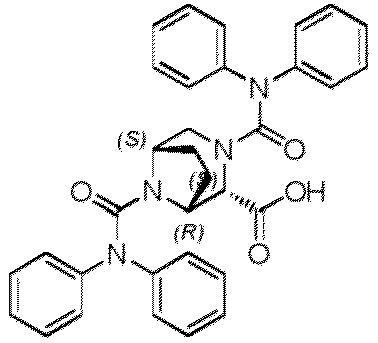
(1R,2S,5S)-3,8-bis(diphenylcarba moyl)-3,8-diazabicyclo[3.2. 1]octane-2-carboxylic acid Compound 7 in step 1 of Example 1 was replaced with 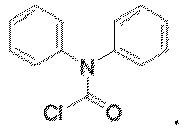
1H NMR (400 MHz, DMSO-d 6): δ 7.40 - 7.30 (m, 8H), 7.25 - 7.15 (m, 4H), 7.10 - 7.00 (m, 8H), 4.44 (s, 2H), 4.11 (s, 1H), 3.25 - 3.05 (m, 2H), 1.85 - 1.60 (m, 2H), 1.55 -1.45 (m, 1H), 1.35 - 1.30 (m, 1H). MS m/z (ESI): 547.0 [M+H]+. C4 
(1S,2R,5R)-3,8-bis(2,2-diphenylacetyl)-3,8-diazabicyclo[3.2. 1]octane-2-carboxylic acid Compound 6 in step 1 of Example 1 was replaced with compound 6# . 1H NMR (400 MHz, CD3OD): δ 7.57 - 7.03 (m, 20H), 5.50 (d, J = 6.5 Hz, 1H), 5.35 (d, J = 8.5 Hz, 1H), 4.67 (s, 1H), 4.33 (d, J = 20.2 Hz, 1H), 3.86 (d, J = 14.7 Hz, 1H), 3.65 (d, J = 21.2 Hz, 1H), 3.48 (d, J = 13.3 Hz, 1H), 1.62 (m, 2H), 1.50 (m, 1H), 1.11 (m, 1H). MS m/z (ESI): 544.9 [M+H]+. C14 
(1S,2R,SR)-3,8-bis(diphenylcarba moyl)-3,8-diazabicyclo[3.2. 1]octane-2-carboxylic acid Compound 6 in step 1 of Example 1 was replaced with compound 6# , and Compound 7 was replaced with 
1H NMR (400 MHz, DMSO-d 6): δ 13.19 (s, 1H), 7.33 (dd, J = 15.9, 8.1 Hz, 8H), 7.16 (t, J = 7.3 Hz, 4H), 7.09 - 6.86 (m, 8H), 4.27 (m, 2H), 3.96 (m, 1H), 3.16 (d, J = 13.5 Hz, 1H), 2.99 - 2.87 (m, 1H), 1.64 (m, 1H), 1.53 (m, 1H), 1.29 (d, J = 37.9 Hz, 1H), 1.14 (m, 1H). MS m/z (ESI): 546.8 [M+H]+. C8 
(1R,2S,5S)-3,8-bis(5H-dibenzo[b,f] azepi ne-5-carbonyl)-3,8-diazabicyclo[3.2. 1]octane-2-carboxylic acid Compound 7 in step 1 of Example 1 was replaced with 
1H NMR (400 MHz, DMSO-d 6): δ 12.76 (s, 1H), 7.56 - 6.99(m, 20H), 4.38 (m, 1H), 3.92 (s, 1H), 3.18 (s, 1H), 2.02 (m, 1H), 1.46 (s, 1H), 1.24 (s, 2H), 1.12 - 0.96 (m, 2H). MS m/z (ESI): 595.0 [M+H]+. C41 
(1R,2S,5S)-3,8-bis(diphenylcarba moyl)-3,8-diazabicyclo[3.2. 1]octane-2-carboxylic acid Compound 6 in step 1 of Example 1 was replaced with compound 6', and Compound 7 was replaced with 
1H NMR (400 MHz, CD3OD): δ 7.40 - 7.30 (m, 8H), 7.25 - 7.15 (m, 4H), 7.10 - 7.00 (m, 8H), 4.48 (s, 2H), 4.1 (s, 1H), 3.30 - 3.10 (m, 2H), 1.85 - 1.40 (m, 4H). MS m/z (ESI): 547.0 [M+H]+. C2 
(1S,2R,SR)-3,8-bis(2,2-diphenylacetyl)-3,8-diazabicyclo[3.2. 1]octane-2-carboxylic acid Compound 6 in step 1 of Example 1 was replaced with compound 6* and reacted at room temperature for 16 hours. The reaction time in step 2 was 16 hours, and the condition of the reverse phase chromatography was acetonitrile/water =55/75. 1H NMR (400 MHz, DMSO-d 6): δ 7.41 - 7.03 (m, 20H), 5.46 (dd, J = 29.9, 16.6 Hz, 2H), 5.16 (dd, J = 97.5, 9.8 Hz, 1H), 4.75 - 4.64 (m, 1H), 4.56 (s, 1H), 4.39 (s, 1H), 3.22 - 3.11 (m, 1H), 1.39 (d, J = 6.7 Hz, 2H), 1.07 (s, 1H), 0.87 (t, J = 7.3 Hz, 1H). MS m/z (ESI): 544.8 [M+H]+. C13 
(1S,2R,SR)-3,8-bis(diphenylcarba moyl)-3,8-diazabicyclo[3.2. 1]octane-2-carboxylic acid Compound 6 in step 1 of Example 1 was replaced with compound 6*, and Compound 7 was replaced with 
1H NMR (400 MHz, DMSO-d 6): δ 13.23 (s, 1H), 7.32 (dd, J = 15.8 Hz, J = 8.0 Hz, 8H), 7.15 (t, J = 7.2 Hz, 4H), 7.05 - 6.89 (m, 8H), 4.27 (s, 2H), 3.96 (s, 1H), 3.15 (d, J = 12.8 Hz, 1H), 2.96 (s, 1H), 1.64 (s, 1H), 1.51 (s, 1H), 1.29 (d, J = 40.5 Hz, 2H). MS m/z (ESI): 546.8 [M+H]+. -

- Compound 6 (2.3 g, 12.48 mmol) obtained from Intermediate Preparation Example 2 was dissolved in a dichloromethane solution (50 mL), cooled with an ice-water bath, followed by sequential addition of di-tert-butyl dicarbonate (2.7 g, 12.48 mmol) and triethylamine (3.78 g, 37.45 mmol) and reaction at room temperature for 16 hours. After the reaction was complete, 50 mL water was added to the reaction solution and extracted with dichloromethane (50 mL × 2). The combined organic phases were dried over anhydrous sodium sulfate (100 g) for 30 min and then filtered. The filtrate was concentrated under reduced pressure. The resulting crude product was separated and purified by column chromatography (petroleum ether:ethyl acetate =3:7) to obtain Compound 8 (1.4 g, a yellow oily matter, crude product).
- 1H NMR (400 MHz, DMSO-d 6): δ 6.80 (s, 1H), 4.20 - 4.00 (m, 3H), 3.45 - 3.40 (m, 2H), 3.30 - 3.20 (m, 2H), 2.20 - 2.10 (m, 1H), 2.00 - 1.85 (m, 2H), 1.65 - 1.55 (m, 1H), 1.38 (s, 9H), 1.20 (t, J = 7.2 Hz, 3H).
- MS m/z (ESI): 307.0 [M+Na]+.
- Compound 8 (1.4 g, 4.92 mmol) was dissolved in dichloromethane (20 mL). To the resulting solution, triethylamine (1.49 g, 14.77 mmol) and then a solution of Compound 7 (1.14 g, 4.92 mmol) in dichloromethane (10 mL) were added. After reacting at room temperature for 3 hours, LC-MS indicated that the reaction of the starting materials was complete. The solution was quenched by adding water (30 mL) and extracted with dichloromethane (20 mL × 3). The combined organic phases were washed with saturated brine (50 mL × 3). After that, the organic phases were dried by adding anhydrous sodium sulfate for 30 min, and then filtered and concentrated under reduced pressure. The resulting crude product was subjected to separation by column chromatography (petroleum ether:methyl tert-butyl ether=3:2) to obtain Compound 9 (0.8 g, a dark yellow solid, crude product).
- MS m/z (ESI): 479.0 [M+H]+.
- Compound 9 (0.8 g, 1.67 mmol) was dissolved in a hydrochloric acid solution in ethanol (8M, 10 mL), and reacted at room temperature for 2 hours. After the reaction was complete, a crude product of compound 10 was obtained by concentration (0.5 g, a dark yellow solid, crude product).
- MS m/z (ESI): 379.0 [M+H]+.
- Compound 10 (0.25 g, 0.6 mmol) was dissolved in dichloromethane (20 mL), followed by sequential addition of Compound 11 (85 mg, 0.6 mmol) and triethylamine (0.183 g, 1.8 mmol) and reaction at room temperature for 16 hours. After the reaction was complete, 50 mL water was added to the reaction solution and extracted with dichloromethane (50 mL × 2). The combined organic phases were dried with anhydrous sodium sulfate (100 g) for 30 min, then filtered and concentrated under reduced pressure. The resulting crude product was separated and purified by column chromatography (petroleum ether:ethyl acetate =3:2) to obtain Compound C31-1 (0.2 g, a yellow oily matter, 69%).
- MS m/z (ESI): 483.0 [M+H]+.
- Compound C31-1 (0.2 g, 0.41 mmol) was dissolved in a mixed solution of tetrahydrofuran, methanol and water (5mL/5mL/5mL), followed by adding sodium hydroxide (83 mg, 2.07 mmol) and stirring at room temperature for 3 hours. After concentration, the obtained crude product was adjusted to pH 5.0 with 3N hydrochloric acid solution. A solid was filtered and washed with 10 mL water, and then dried to obtain Compound C31 (130 mg, a light yellow solid, yield: 70%)
- 1H NMR (400 MHz, DMSO-d 6): δ 7.50 - 7.00 (m, 15H), 5.50 - 5.30 (m, 1H), 5.20 - 4.90 (m, 1H), 4.70 - 4.40 (m, 2H), 4.25 - 3.80 (m, 1H), 3.25 - 3.00 (m, 1H), 1.8 - 1.25 (m, 4H).
- MS m/z (ESI): 455.0 [M+H]+.
- The compounds in Table 4 were prepared by methods similar to that described in Example 2.
Table 4: No. Compound Structure Compound Name Starting material or reaction condition different from that in Example 2 Characterization data C7 
(1R,2S,5S)-3-(5H-dibenzo[b,f]aze pine-5-carbonyl)-8-(diphenylcarba moyl)-3,8-diazabicyclo [3. 2.1]octane-2-carboxylic acid Compound 7 in step 2 of Example 2 was replaced with 

1H NMR (400 MHz, CD3OD): δ 7.70 - 6.90 (m, 20H), 4.32 (s, 1H), 4.20 (s, 1H), 3.98 (d, J = 5.6 Hz, 1H), 2.93 (s, 2H), 1.80 - 1.50 (m, 2H), 1.425 - 1.40 (m, 2H). MS m/z (ESI): 571.0 [M+H]+. C6 
(1R,2S,5S)-8-(5H-dibenzo[b,f]aze pine-5-carbonyl)-3-(diphenylcarba moyl)-3,8-diazabicyclo [3. 2.1]octane-2-carboxylic acid Compound 7 in step 2 of Example 2 was replaced with 

1H NMR (400 MHz, CD3OD): δ 7.59 - 6.96 (m, 20H), 4.90 (s, 1H), 4.41 (s, 1H), 3.50 - 3.33 (m, 1H), 3.15 (s, 1H), 2.88 (d, J = 12.8 Hz, 1H), 2.37 (s, 2H), 2.00 - 1.96 (m, 2H), 1.70 - 1.31 (m, 3H). MS m/z (ESI): 571.0 [M+H]+. C9 
(1R,2S,5S)-8-(5H-dibenzo[b,f]aze pine-5-carbonyl)-3-(2,2-diphenylacetyl) -3,8-diazabicyclo [3. 2.1]octane-2-carboxylic acid Compound 7 in step 2 of Example 2 was replaced with 
1H NMR (400 MHz, CD3OD): δ 7.27 - 6.96 (m, 20H), 5.19 (d, J = 20.0 Hz, 1H), 4.90 - 4.77 (m, 2H), 4.40 (s, 1H), 3.53 (d , J = 16 Hz, 1H), 3.41 (d, J = 4.0 Hz, 1H), 3.18 (d, J = 12.0 Hz, 1H), 2.60 (d, J = 12.0 Hz, 1H), 2.20 (d, J = 12.0 Hz, 1H), 1.84 - 1.81 (m, 1H), 1.49 - 1.31(m, 2H). MS m/z (ESI): 570.0 [M+H]+. C10 
(1R,2S,5S)-3-(5H-dibenzo[b,f]aze pine-5-carbonyl)-8-(2,2-diphenylacetyl) -3,8-diazabicyclo [3. 2.1]octane-2-carboxylic acid Compound 11 in step 4 of Example 2 was replaced with 1H NMR (400 MHz, DMSO-d 6): δ 7.70 - 6.90 (m, 20H), 5.34 - 5.21 (m, 1H), 4.83 - 4.43 (m, , 1H), 4.23 - 4.16 (m,1H), 3.97 - 3.31(m, 1H), 3.10 - 2.70 (m,2H), 1.60 - 0.80 (m, 4H). 
MS m/z (ESI): 570.0 [M+H]+. C12 
(1R,2S,5S)-8-(2,2-diphenylacetyl) -3-(diphenylcarba moyl)-3,8-diazabicyclo [3. 2.1]octane-2-carboxylic acid Compound 11 in step 4 of Example 2 was replaced with 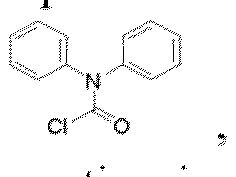
1H NMR (400 MHz, CD3OD): δ 7.50 - 7.00 (m, 20H), 5.49 - 5.34 (m, 1H), 5.14 - 4.67 (m, 2H), 4.37 (s, 1H), 3.65 - 3.35 (m, 2H), 1.60 - 0.80 (m, 4H). MS m/z (ESI): 546.0 [M+H]+. C28 
(1R,2S,5S)-8-(2,2-diphenylacetyl) -3-(10H-phenothiazine-10-carbonyl)-3,8-diazabicyclo [3. 2.1]octane-2-carboxylic acid Compound 11 in step 4 of Example 2 was replaced with 
1H NMR (400 MHz, DMSO-d 6): δ 7.60 - 7.00 (m, 18H), 5.39 - 5.28 (s, 1H), 4.97 (s, 1H), 4.60 (s, 1H), 4.39 (s, 1H), 3.20 -2.80 (m, 2H), 1.70 - 1.10 (m, 4H). MS m/z (ESI): 575.9 [M+H]+. C63 
(1R,2S,5S)-8-(2,2-diphenylacetyl) -3-(pyrrolidine-1-carbonyl)-3,8-diazabicyclo [3. 2.1]octane-2-carboxylic acid Compound 11 in step 4 of Example 2 was replaced with 
1H NMR (400 MHz, DMSO-d 6): δ 7.50 - 6.90 (m, 10H), 5.52 - 5.43 (m, 1H), 5.10 - 4.20 (m, 3H), 3.50 - 3.10 (m, 6H), 1.78 (m, 4H), 1.75 - 1.00 (m, 4H). MS m/z (ESI): 448.0 [M+H]+. C68 
(1R,2S,5S)-8-(2,2-diphenylacetyl) -3-(phenoxycarbo nyl)-3,8-diazabicyclo [3. 2.1]octane-2-carboxylic acid Compound 11 in step 4 of Example 2 was replaced with phenyl chloroformate. 1H NMR (400 MHz, DMSO-d 6): δ 7.70 - 6.90 (m, 15H), 5.50 - 5.30 (m, 1H), 5.10 - 4.50 (m, 3H), 4.00 - 3.00 (m, 2H), 1.90 - 1.50 (m, 4H). MS m/z (ESI): 570.9 [M+H]+. C70 
(1R,2S,5S)-8-(2,2-diphenylacetyl) -3-(3-phenylpropiony l)-3,8-diazabicyclo [3. 2.1]octane-2-carboxylic acid Compound 11 in step 4 of Example 2 was replaced with 
1H NMR (400 MHz, DMSO-d 6): δ 7.50 - 6.90 (m, 15H), 5.50 - 5.20 (m, 1H), 5.10 - 4.50 (m, 4H), 3.60 - 3.20 (m, 2H), 2.80 - 2.50 (m, 3H), 1.80 - 1.20 (m, 4H). MS m/z (ESI): 483.0 [M+H]+. C71 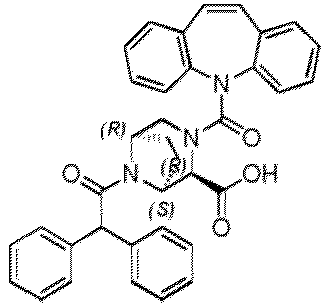
(1S,2R,5R)-3-(5H-dibenzo[b,f]aze pine-5-carbonyl)-8-(2,2-diphenylacetyl) -3,8-diazabicyclo [3. 2.1]octane-2-carboxylic acid Compound 6 in step 1 of Example 2 was replaced with compound 6# . The reaction time in step 2 was 16 hours. In step 4, Compound 11 was replaced with 
1H NMR (300 MHz, CD3OD): δ 7.60 - 6.94 (m, 20H), 5.31 (d, J = 42.0 Hz, 1H), 4.99 (s, 1H), 4.62 - 4.50 (m, 1H), 4.30 (d, J = 37.8 Hz, 1H), 3.16 - 2.85 (m, 2H), 1.71 - 0.93 (m, 4H). MS m/z (ESI): 569.8 [M+H]+. C72 
(1S,2R,5R)-8-(5H-dibenzo[b,f]aze pine-5-carbonyl)-3-(2,2-diphenylacetyl) -3,8-diazabicyclo [3. 2.1]octane-2-carboxylic acid Compound 6 in step 1 of Example 2 was replaced with compound 6# . In step 2, Compound 7 was replaced with 
1H NMR (400 MHz, CD3OD): δ 7.61 (d, J = 8.3 Hz, 1H), 7.47 - 6.90 (m, 19H), 5.22 (d, J = 7.9 Hz, 1H), 4.80 (d, J = 7.4 Hz, 1H), 3.57 (d, J = 11.3 Hz, 1H), 3.51 - 3.43 (m, 1H), 3.25 - 3.12 (m, 1H), 2.53 (d, J = 11.1 Hz, 1H), 1.88 - 1.77 (m, 1H), 1.52 - 1.34 (m, 2H), 0.99 (d, J = 9.2 Hz, 1H). MS m/z (ESI): 569.9 [M+H]+. C73 
(1R,2S,5S)-3-((benzyloxy)ca rbonyl)-8-(5H-dibenzo[b,f]aze pine-5-carbonyl)-3,8-diazabicyclo [3. 2.1]octane-2-carboxylic acid In step 2, Compound 7 of Example 2 was replaced with 
1H NMR (300 MHz, CD3OD) δ 7.70 - 7.18 (m, 13H), 7.01 (s, 2H), 5.21 - 4.99 (m, 2H), 4.77 (s, 1H), 4.44 (s, 1H), 4.20 - 3.76 (m, 1H), 3.59 (s, 1H), 3.21 - 3.04 (m, 1H), 2.35 (dd, J = 22.2, 11.7 Hz, 1H), 1.85 (s, 1H), 1.59 (s, 3H), 1.28 (s, 1H). MS m/z (ESI): 510.0 [M+H]+. C77 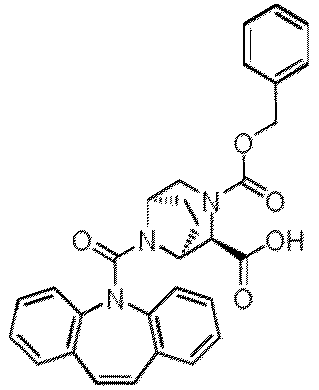
(1S,2R,5R)-3-((benzyloxy)ca rbonyl)-8-(5H-dibenzo[b,f]aze pine-5-carbonyl)-3,8-diazabicyclo [3. 2.1]octane-2-carboxylic acid Compound 6 in step 1 of Example 2 was replaced with compound 6# . In step 2, 4-Dimethylaminopyridin e was added and Compound 7 was replaced with 
1H NMR (400 MHz, DMSO-d 6): δ 13.04 (s, 1H), 7.66 - 7.00 (m, 15H), 5.01 (dt, J = 12.9 Hz, J = 10.9 Hz, 2H), 4.63 (t, J = 7.7 Hz, 1H), 4.34 (dd, J = 17.1, J = 2.5 Hz, 1H), 3.48 (s, 1H), 3.06 (dd, J = 25.2, J = 9.8 Hz, 1H), 2.18 (dd, J = 47.4 Hz, J = 10.4 Hz, 1H), 1.73 (s, 1H), 1.64 - 1.36 (m, 3H). MS m/z (ESI): 509.9 [M+H]+. C75 
(1S,2R,5R)-3-((benzyloxy)ca rbonyl)-8-(2,2-diphenylacetyl) -3,8-diazabicyclo [3. 2.1]octane-2-carboxylic acid Compound 6 in step 1 of Example 2 was replaced with compound 6# . The reaction time in step 2 was 16 hours. In step 4, Compound 11 was replaced with benzyl chloroformate, 4-dimethylaminopyridine was added, and the reaction temperature was 40°C, and the reaction time was 48 hours. The reaction time in step 5 was 16 hours. 1H NMR (400 MHz, DMSO-d 6): δ 13.30 (dd, J = 286.6, 29.9 Hz, 1H), 7.50 - 7.03 (m, 15H), 5.50 - 5.26 (m, 1H), 5.19 - 4.98 (m, 2H), 4.78 - 4.63 (m, 1H), 4.52 (t, J = 27.1 Hz, 1H), 4.35 (dd, J = 23.9 Hz, J = 1.9 Hz, 1H), 3.80 - 3.45 (m, 1H), 3.22 2.93 (m, 1H), 1.83 - 1.43 (m, 4H). MS m/z (ESI): 484.9 [M+H]+. C20 
(1R,2S,5S)-8-(5H-dibenzo[b,f]aze pine-5-carbonyl)-3-(diphenylcarba moyl)-3,8-diazabicyclo [3. 2.1]octane-2-carboxylic acid In step 2 of Example 2, 4-dimethylaminopyridine was added, Compound 7 was replaced with 
1H NMR (400 MHz, CD3OD): δ 7.64 (d, J = 8.0 Hz, 1H), 7.46 - 7.42 (m, 3H), 7.35 - 7.29 (m, 3H), 7.09 - 7.02 (m, 2H), 4.84 (s, 1H), 4.48 (s, 1H),3.52 (s, 2H), 3.15 - 3.03 (s, 2H), 3.01 - 2.78 (m, 4H), 2.69 - 2.64 (m, 2H), 1.88 - 1.84 (m, 1H), 1.80 - 1.66 (m, 1H), 1.66 - 1.57 (m, 2H), 1.56 - 1.44 (m, 3H), 1.40 - 1.29 (m, 3H), 1.27 - 1.15 (m, 2H), 0.94 - 0.86 (m, 6H), 0.82 - 0.78 (m, 2H). MS m/z (ESI): 559.1 [M+H]+. C45 
(1R,2S,5S)-3-(10,11-dihydro-5H-dibenzo[b,f]aze pine-5-carbonyl)-8-(diphenylcarba moyl)-3,8-diazabicyclo [3. 2.1]octane-2-carboxylic acid Compound 7 in step 2 of Example 2 was renlaced with 

1H NMR (400 MHz, CD3OD) δ 7.43 (d, J = 5.6 Hz, 2H), 7.32 (d, J = 7.6 Hz, 4H), 7.24 - 7.15 (m, 8H), 7.06 (d, J = 7.6 Hz, 4H), 4.42 - 4.30 (m, 3H), 4.12 - 4.05 (m, 1H), 3.25 - 3.05 (m, 6H), 1.80 - 1.30 (m, 4H). MS m/z (ESI): 572.8 [M+H]+. C69 
(1R,2S,5S)-8-(diphenylcarba moyl)-3-(phenoxycarbo nyl)-3,8-diazabicyclo [3. 2.1]octane-2-carboxylic acid Compound 7 in step 2 of Example 2 was replaced with 
1H NMR (400 MHz, DMSO-d 6 ) δ 7.42 - 7.31 (m, 6H), 7.25 - 7.15 (m, 3H), 7.12 - 7.01 (m, 6H), 4.60 - 4.35 (m, 2H), 4.17 - 4.10 (m, 1H), 3.60 - 3.50 (m, 2H), 1.90 - 1.60 (m, 4H). MS m/z (ESI): 472.1 [M+H]+. -

- Compound 6# (36.8 mg, 0.2 mmol) was dissolved in dichloromethane (20 mL), and Compound 13 (51.2 mg, 0.2 mmol) and triethylamine (60.6 mg, 0.6 mmol) were then added sequentially. The mixture was reacted in a sealed tube at 50°C for 16 hours. After the reaction was complete, 20 mL water was added to the reaction solution and extracted with dichloromethane (20 mL × 3). The combined organic phases were washed with saturated brine (20 mL × 2) and dried by adding anhydrous sodium sulfate for 30min, then filtered and concentrated under reduced pressure to obtain a crude product. The resulting crude product was separated and purified by column chromatography (petroleum ether:ethyl acetate =1:1) to obtain Compound 14 (40.3 mg, a yellow solid, 50%).
- 1H NMR (400 MHz, DMSO-d 6): δ 7.65 - 7.25 (m, 8H), 7.05 (d, J = 7.5 Hz, 2H), 4.15 (m, 2H), 4.03 (dd, J = 14.2, 7.1 Hz, 2H), 3.76 (d, J = 4.6 Hz, 1H), 3.55 (d, J = 6.3 Hz, 1H), 3.02 (dd, J = 14.1, 6.8 Hz, 1H), 1.82 (m, 1H), 1.60 (m, 1H), 1.53 - 1.34 (m, 2H), 1.24 - 1.14 (t, J = 7.1 Hz, 3H).
- MS m/z (ESI): 404.0 [M+H]+.
- Compound 14 (40.3 mg, 0.1 mmol) was dissolved in dichloromethane (5 mL), and Compound 15 (51 mg, 0.3 mmol) and triethylamine (0.05 g, 0.5 mmol) was added sequentially. The reaction was carred out at 50°C for 16 hours. After the reaction was complete, 20 mL water was adde to the reaction solution and extracted with dichloromethane (20 mL × 2). The combined organic phases were dried with anhydrous sodium sulfate (50 g) for 30 min, then filtered and concentrated under reduced pressure. The resulting crude product was separated and purified by column chromatography (petroleum ether:ethyl acetate =10:1) to obtain Compound C81-1 (25 mg, a yellow solid, 46%).
- 1H NMR (400 MHz, CD3OD): δ 7.55 (d, J = 8.0 Hz, 1H), 7.49 - 7.39 (m, 4H), 7.34 (ddd, J = 14.1, 10.6, 4.3 Hz, 8H), 7.06 (d, J = 1.6 Hz, 2H), 5.04 (s, 2H), 4.12 (q, J = 7.1 Hz, 2H), 3.91 (s, 1H), 3.86 - 3.76 (m, 1H), 3.37 (m, 1H), 3.26 (s, 2H), 1.94 - 1.74 (m, 1H), 1.70 - 1.57 (m, 1H), 1.34 (dd, J = 7.4, 2.6 Hz, 2H), 1.26 (t, J = 7.1 Hz, 3H).
- MS m/z (ESI): 538.0 [M+H]+.
- Compound C81-1 (25mg, 0.0466 mmol) was dissolved in a mixed solution of tetrahydrofuran, methanol and water (5mL/5mL/5mL), followed by adding sodium hydroxide (5.6 mg, 0.14 mmol) and stirring at room temperature for 16 hours. After concentration, the obtained crude product was adjusted to pH 5.0 with 3N hydrochloric acid solution, and filtered. The obtained solid was washed with 10 mL water, and then dried. The obtained crude product of the compound was subjected to separation by reversed phase chromatography (acetonitrile/water (0.1% trifluoroacetic acid solution) 55/45-85/15) to obtain the target compound C81 (3.41 mg, a white solid, yield: 14.4 %).
- 1H NMR (300 MHz, DMSO-d 6): δ 7.29 (dd, J = 40.7, 31.1 Hz, 15H), 5.01 (dd, J = 15.4, 9.5 Hz, 2H), 4.60 (s, 1H), 4.32 (d, J = 11.5 Hz, 1H), 3.45 (s, 1H), 3.08 - 2.92 (m, 2H), 1.57 (d, J = 79.4 Hz, 3H), 1.22 - 1.17 (m, 1H).
- MS m/z (ESI): 510.1 [M+H]+.
- The compounds in Table 5 were prepared by methods similar to that described in Example 3.
Table 5: No. Compound Structure Compound Name Starting material or reaction condition different from that in Example 3 Characterization data C80 
(1R,2S,5S)-8-((benzyloxy)carbo nyl)-3-(5H-dibenzo[b,f]azepin e-5-carbonyl)-3,8-diazabicyclo[3.2.1 ]octane-2-carboxylic acid Compound 6# in step 1 of Example 3 was replaced with compound 5. 1H NMR (400 MHz, DMSO-d6 ) δ 7.59 (s, 2H), 7.47 - 7.24 (m, 10H), 7.05 (s, 2H), 5.07 - 5.00 (m, 1H), 4.92 (s, 1H), 4.48 (d, J = 6.8 Hz, 1H), 4.06 (s, 1H), 4.01 (d, J = 2.4 Hz, 1H), 3.15 - 2.97 (m, 2H), 1.75 - 1.62 (m, 1H), 1.60 - 1.47 (m, 1H), 1.33 - 1.20 (m, 1H), 1.15 - 1.05 (m, 1H). MS m/z (ESI): 510.2 [M+H]+. -

- Compound 10 (0.1g, 0.264 mmol) was dissolved in a dichloromethane solution (15 mL), cooled to 0°C with an ice-water bath. Triphosgene (118 mg, 0.396 mmol) and triethylamine (82 mg, 0.792 mmol) were added to the solution and reacted at 0°C for 2 hours. Compound 16 (48 mg, 0.396 mmol) was then added to the reaction solution, and was slowly heated up to room temperature and reacted at room temperature for 16 hours. After the reaction was complete, 50 mL water was added to the reaction solution and extracted with dichloromethane (50 mL×2). The combined organic phases were then dried by adding anhydrous sodium sulfate (30 g) for 30 min, then filtered and concentrated under reduced pressure. The resulting crude product was separated and purified by column chromatography (petroleum ether:ethyl acetate =2:3) to obtain Compound C62-1 (50 mg, a yellow oily matter, 36%).
- MS m/z (ESI): 526 [M+H]+.
- Compound C62-1 (50 mg, 0.095 mmol) was dissolved in a mixed solution of tetrahydrofuran, methanol and water (5mL/5mL/5mL), followed by adding sodium hydroxide (38 mg, 0.95 mmol) and stirring at room temperature for 2 hours. After concentration, the obtained crude product was adjusted to pH 5.0 with 3N hydrochloric acid solution, and extracted with ethyl acetate (20 mL×3). The combined organic phases were washed with saturated brine (20 mL × 3). After that, the organic phases were dried by adding anhydrous sodium sulfate for 30 min, and then filtered. The filtrate was concentrated under reduced pressure. The resulting crude product was subjected to separation by reversed phase preparative chromatography (acetonitrile/water (0.1% trifluoroacetic acid solution) 25/75-50/50) to obtain Compound C62 (12 mg, light yellow solid, yield: 25%).
- 1H NMR (400 MHz, CD3OD): δ 7.50 - 6.90 (m, 15H), 5.58 - 5.40 (m, 1H), 5.00 - 4.20 (m, 5H), 3.60 - 3.30 (m, 2H), 2.80 - 2.70 (m, 3H), 2.00 - 1.10 (m, 4H).
- MS m/z (ESI): 498.0 [M+H]+.
- The compounds in Table 6 were prepared by methods similar to that described in Example 4.
Table 6: No. Compound Structure Compound Name Starting material or reaction condition different from that in Example 4 Characterization data C64 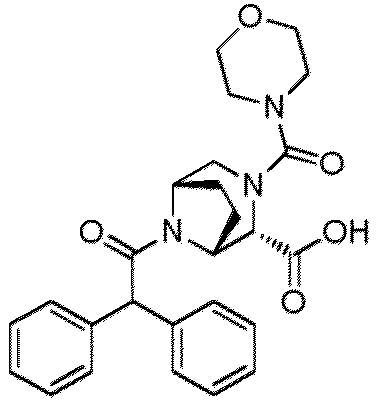
(1R,2S,5S)-8-(2,2-diphenylacetyl)-3-(morpholine-4-carbonyl)-3,8-diazabicyclo[3.2.1] octane-2-carboxylic acid Compound 16 in step 1 of Example 4 was replaced with morpholine. 1H NMR (400 MHz, DMSO-d 6): δ 7.50 - 7.00 (m, 10H), 5.43 - 4.84 (m, 1H), 5.00 - 4.20 (m, 3H), 3.60 - 2.80 (m, 10H), 2.00 - 1.10 (m, 4H). MS m/z (ESI): 464.1 [M+H]+. C19 
(1R,2S,5S)-3-(dipentylcarbamoyl) -8-(2,2-diphenylacetyl)-3,8-diazabicyclo[3.2.1] octane-2-carboxylic acid Compound 16 in step 1 of Example 4 was replaced with Di-pentyl amine. 1H NMR (400 MHz, CD3OD): δ 7.42 - 7.12 (m, 10H), 5.57 - 5.41 (m, 1H), 4.83 (s, 1H), 4.76 - 4.73 (m, 1H), 4.58 - 4.46 (m, 1H), 3.62 - 3.49 (m, 3H), 3.31 - 3.14 (m, 2H), 3.09 - 3.00 (m, 2H), 2.79 - 2.72 (m, 1H), 1.96 - 1.89 (m, 1H), 1.80 - 1.70 (m, 3H), 1.53 - 1.49 (m, 4H), 1.43 - 1.23 (m, 8H), 0.96 - 0.90 (m, 8H). MS m/z (ESI): 534.1 [M+H]+. C61 
(1R,2S,5S)-3-(benzylcarbamoyl)-8-(2,2-diphenylacetyl)-3,8-diazabicyclo[3.2.1] octane-2-carboxylic acid Compound 16 in step 1 of Example 4 was replaced with benzylamine. 1H NMR (400 MHz, CD3OD) δ 7.45 - 7.11 (m, 16H), 5.62 (s, 1H), 5.47 (d, J = 46.9 Hz, 1H), 4.83 (s, 2H), 4.45 - 4.33 (m, 2H), 4.31 - 4.25 (m, 1H), 3.60 (s, 1H), 1.95 - 1.82 (m, 1H), 1.79 - 1.62 (m, 2H), 1.38 - 1.26 (m, 1H). MS m/z (ESI): 484.0 [M+H]+. C11 6 
(1R,2S,5S)-3,8-bis(benzyl(methyl)c arbamoyl)-3,8-diazabicyclo[3.2.1] octane-2-carboxylic acid Compound 10 in step 1 of Example 4 was replaced with compound 6. The amout of compound 16 was increased from 1.5 times in Example 4 to 2.5 times higher than compound 6. 1H NMR (400 MHz, CD3OD) δ 7.38 - 7.32 (m, 4H), 7.31 - 7.23 (m, 6H), 4.73 - 4.66 (m, 2H), 4.59 (d, J = 14.8 Hz, 1H), 4.51 (d, J = 15.2 Hz, 1H), 4.40 (d, J = 15.2 Hz, 1H), 4.29 (d, J = 15.2 Hz, 1H), 4.06 (d, J = 6.0 Hz, 1H), 3.77 (d, J = 10.4 Hz, 1H), 3.49 (dd, J = 12.4, 2.0 Hz, 1H), 2.84 (s, 3H), 2.76 (s, 3H), 2.10 - 2.00 (m, 1H), 1.96 - 1.70 (m, 3H). MS m/z (ESI): 451.0 [M+H]+. -

- Compound 5 (1.98 g, 10 mmol) was dissolved in a dichloromethane solution (40 mL) and cooled in an ice-water bath. Di-tert-butyl dicarbonate (2.18 g, 10 mmol) and triethylamine (3.03 g, 30 mmol) were sequentially added and reacted at room temperature for 16 hours. After the reaction was complete, 50 mL water was added to the reaction solution and extracted with dichloromethane (50 mL×2). The combined organic phases were then dried by adding anhydrous sodium sulfate (100 g) for 30min, then filtered and concentrated under reduced pressure. The resulting crude product was separated and purified by column chromatography (petroleum ether:ethyl acetate =1:1) to obtain Compound 17 (2.3 g, a yellow oily matter, 77%).
- 1H NMR (400 MHz, CD3OD): δ 7.65 (brs, 1H), 4.50 - 4.40 (m, 2H), 4.25 - 4.15 (m, 2H), 4.15 - 4.05 (m, 1H), 2.10 - 1.90 (m, 2H), 1.85 - 1.75 (m, 1H), 1.60 - 1.50 (m, 1H), 1.42 (s, 9H), 1.23 (t, J = 7.2 Hz, 3H).
- MS m/z (ESI): 321.0 [M+Na]+.
- Compound 17 (2.3 g, 7.71 mmol) was dissolved in a solution of borane dimethylsulfide in tetrahydrofuran (2M, 20 mL), purged with nitrogen for 5 times, and reacted at room temperature in a nitrogen atmosphere for 16 hours. After the reaction was complete, the reaction was slowly quenched with methanol and stirred at 50°C for 16 hours. A crude product of compound 18 was obtained by concentration, and was separated and purified by column chromatography (petroleum ether:ethyl acetate =3:7) to obtain Compound 18 (1.1 g, a yellow oily matter, crude product).
- 1H NMR (400 MHz, DMSO-d 6): δ 4.2 - 4.15 (m, 1H), 4.11 (q, J = 7.2 Hz, 2H), 3.93 (s, 1H), 3.52 (s, 1H), 2.80 - 2.55 (m, 2H), 1.80 - 1.55 (m, 4H), 1.42 (s, 9H), 1.20 (t, J = 7.2 Hz, 3H).
- MS m/z (ESI): 285.1 [M+Na]+.
- Compound 18 (0.55 g, 1.934 mmol) was dissolved in dichloromethane (20 mL). To the solution, Compound 7 (0.446 g, 1.934 mmol) and triethylamine (0.586 g, 5.80 mmol) was then added sequentially and reacted at room temperature for 48 hours. LC-MS indicated that the reaction of the starting materials was complete. The solution was then quenched by adding water (30 mL), and extracted with dichloromethane (20 mL×3). The combined organic phases were washed with saturated brine (50 mL × 3). The organic phases were dried by adding anhydrous sodium sulfate for 30 min, and then filtered. The filtrate was concentrated under reduced pressure. The resulting crude product was subjected to separation by column chromatography (petroleum ether:methyl tert-butyl ether=2:3) to obtain Compound 19 (0.55 g, a dark yellow solid, crude product).
- 1H NMR (400 MHz, CD3OD): δ 7.35 - 7.10 (m, 10H), 5.43 (s, 1H), 4.20 - 4.00 (m, 5H), 3.60 - 3.40 (m, 2H), 2.00 - 1.50 (m, 4H), 1.34 (s, 9H), 1.19 (t, J = 7.2 Hz, 3H).
- MS m/z (ESI): 479.0 [M+H]+.
- Compound 19 (0.55 g, 1.15 mmol) was dissolved in a solution of hydrochloric acid in ethanol (8M, 10 mL), and reacted at room temperature for 2 hours. After the reaction was complete, a crude product of compound 20 was obtained by concentration (0.35 g, a yellow solid, 81%).
- MS m/z (ESI): 379.0 [M+H]+.
- Compound 20 (50 mg, 0.132 mmol) was dissolved in a dichloromethane solution (20 mL). Phenyl chloroformate (42 mg, 0.264 mmol) and triethylamine (0.133 g, 1.32 mmol) were added sequentially, and reacted at room temperature for 16 hours. After the reaction was complete, 50 mL water was added to the reaction solution and extracted with dichloromethane (50 mL × 2). The combined organic phases were dried with anhydrous sodium sulfate (100 g) for 30 min, then filtered and concentrated under reduced pressure. The resulting crude product was separated and purified by column chromatography (petroleum ether: ethyl acetate =3:2) to obtain Compound C79-1 (50 g, a yellow solid, 76%).
- MS m/z (ESI): 499.0 [M+H]+.
- Compound 20 (50 mg, 0.132 mmol) was dissolved in dichloromethane (15 mL), cooled to 0°C in an ice-water bath. To the solution, triphosgene (59 mg, 0.198 mmol) and triethylamine (41 mg, 0.396 mmol) were added and reacted at 0°C for 2 hours. Compound 16 (24 mg, 0.198 mmol) was then added to the reaction solution, and was slowly heated up to room temperature for further reaction at room temperature for 16 hours. After the reaction was complete, 50 mL water was added to the reaction solution and extracted with dichloromethane (50 mL×2). The combined organic phases were then dried by adding anhydrous sodium sulfate (30 g) for 30min, then filtered and concentrated under reduced pressure. The resulting crude product was separated and purified by column chromatography (petroleum ether:ethyl acetate =2:3) to obtain Compound C82-1 (50 mg, a yellow oily matter, 72%).
- MS m/z (ESI): 526.0 [M+H]+.
- Compound C79-1 (50 mg, 0.1 mmol) was dissolved in a mixed solution of tetrahydrofuran, methanol and water (5mL/5mL/5mL). Sodium hydroxide (40 mg, 1 mmol) was added, stirred at room temperature for 3 hours and then concentrated. The obtained crude product was adjusted to pH 5.0 with 3N hydrochloric acid solution, and extracted with ethyl acetate (20 mL×3). The combined organic phases were washed with saturated brine (50 mL × 3). The organic phases were dried by adding anhydrous sodium sulfate for 30 min, and then filtered The filtrate was concentrated under reduced pressure. The resulting crude product was subjected to separation by reversed phase preparative chromatography (acetonitrile/water (0.1% trifluoroacetic acid solution) 40/60-20/80) to obtain Compound C79 (25 mg, a light yellow solid, yield: 53 %).
- 1H NMR (400 MHz, CD3OD): δ 12.995 (brs, 1H), 7.50 - 6.90 (m, 15H), 5.60 - 5.30 (m, 1H), 4.80 - 4.60 (m, 2H), 4.20 - 4.10 (m, 1H), 3.70 - 3.40 (m, 2H), 2.10 - 1.40 (m, 4H).
- MS m/z (ESI): 471.0 [M+H]+.
- Compound C82-1 (50 mg, 0.095 mmol) was dissolved in a mixed solution of tetrahydrofuran, methanol and water (5mL/5mL/5mL). Sodium hydroxide (38 mg, 0.95 mmol) was added, stirred at room temperature for 2 hours, and then concentrated. The obtained crude product was adjusted to pH 5.0 with 3N hydrochloric acid solution, and extracted with ethyl acetate (20 mL×3). The combined organic phases were washed with saturated brine (20 mL × 3). The organic phases were dried by adding anhydrous sodium sulfate for 30 min and then filtered. The filtrate was concentrated under reduced pressure. The resulting crude product was subjected to separation by reversed phase preparative chromatography (acetonitrile/water (0.1% trifluoroacetic acid solution) 25/75-50/50) to obtain Compound C82 (30 mg, a light yellow solid, yield: 63%).
- 1H NMR (400 MHz, CD3OD): δ 7.50 - 6.90 (m, 15H), 5.46 - 5.38(m, 1H), 4.70 - 4.20 (m, 4H), 4.20 - 4.05 (m, 1H), 3.80 - 3.60 (m, 2H), 2.85 - 2.75 (m, 3H), 2.05 - 1.45(m, 4H).
- MS m/z (ESI): 498.1 [M+H]+.
- The compounds in Table 7 were prepared by methods similar to that described in Example 5.
Table 7: No. Compound Structure Compound Name Starting material or reagent different from that in Example 5 Characterization data C78 
(1R,2S,5S)-8-(benzylcarbam oyl)-3-(2,2-diphenylacetyl) -3,8-diazabicyclo [3. 2.1]octane-2-carboxylic acid Compound 16 in step 5b of Example 5 was replaced with benzylamine. The reaction in step 5a did not take place. 1H NMR (400 MHz, CD3OD) δ 7.44 - 7.08 (m, 15H), 5.46 (s, 1H), 5.23 (s, 1H), 4.52 - 4.49 (m, 1H), 4.45 - 4.21 (m, 3H), 4.17 (s, 1H), 3.75 (s, 1H), 3.58 - 3.55 (m, 1H), 2.23 - 2.19 (m, 1H), 2.05 (s, 1H), 1.95 - 1.91 (m, 2H). MS m/z (ESI): 484.0 [M+H]+. C76 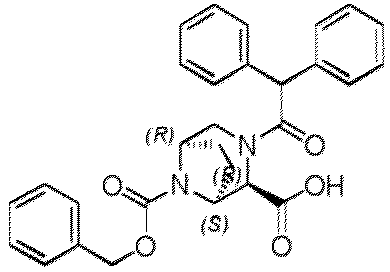
(1S,2R,5R)-8-((benzyloxy)ca rbonyl)-3-(2,2-diphenylacetyl) -3,8-diazabicyclo [3. 2.1]octane-2-carboxylic acid Compound 5 in step 1 of Example 5 was replaced with compound 5# . In step 5a, the phenyl chloroformate was replaced with benzyl chloroformate; the reaction temperature was 50°C and the reaction time was 48 hours. The reaction time in step 6 was 16 hours. The reaction in step 5b did not take place. 1H NMR (400 MHz, DMSO-d 6): δ 12.88 (s, 1H), 7.43 - 7.07 (m, 15H), 5.51 (s, 1H), 5.14 - 4.90 (m, 3H), 4.69 (d, J = 6.0 Hz, 2H), 4.20 (s, 1H), 3.73 (d, J = 11.2 Hz, 1H), 1.85 (s, 1H), 1.70 - 1.52 (m, 2H), 1.12 (s, 1H). MS m/z (ESI): 485.1 [M+H]+. C15 7 
(1R,2S,5S)-8-((benzyloxy)ca rbonyl)-3-(2,2-diphenylacetyl) -3,8-diazabicyclo [3. 2.1]octane-2-carboxylic acid Compound 7 in step 3 of Example 5 was replaced with 
1H NMR (400 MHz, CD3OD) δ 7.60 -7.50 (m, 4H), 7.47 - 7.19 (m, 11H), 5.11 (d, J = 12.4 Hz, 1H), 4.98 (d, J = 12.8 Hz, 1H), 4.84 (s, 1H), 4.80 (d, J = 6.8 Hz, 1H), 3.85 (s, 1H), 3.40 - 3.35 (m, 1H), 3.19 (d, J = 12.4 Hz, 1H), 1.90 - 1.75 (m, 4H), 1.50 - 1.35 (m, 1H), 1.32 - 1.16 (m, 2H). MS m/z (ESI): 498.8 [M+H]+. C22 2 
(1R,2S,5S)-3-(2,2-diphenylacetyl) -8-(3-phenylpropion yl)-3,8-diazabicyclo [3. 2.1]octane-2-carboxylic acid 
1H NMR (400 MHz, DMSO-d 6) δ 7.50 - 7.00 (m, 15H), 5.55 - 5.40 (m, 1H), 4.90 - 4.25 (m, 3H), 3.75 - 3.55 (m, 1H), 3.40 - 3.00 (m, 1H), 2.85 - 2.40 (m, 4H), 1.75 - 1.00 (m, 6H). MS m/z (ESI): 483.0 [M+H]+. C22 3 
(1R,2S,5S)-3-(2,2-diphenylacetyl) -8-(3-phenylbutyryl) -3,8-diazabicyclo [3. 2.1]octane-2-carboxylic acid 
1H NMR (400 MHz, DMSO-d 6) δ 7.50 - 7.00 (m, 15H), 5.55 - 5.40 (m, 1H), 4.87 - 4.25 (m, 3H), 3.75 - 3.60 (m, 1H), 3.30 - 3.00 (m, 2H), 2.75 - 2.51 (m, 1H), 2.49 - 2.25 (m, 1H), 1.75 - 1.00 (m, 7H). MS m/z (ESI): 497.1 [M+H]+. C23 0 
(1R,2S,5S)-3-(2,2-diphenylacetyl) -8-(2-methyl-3-phenylpropion yl)-3,8-diazabicyclo [3. 2.1]octane-2-carboxylic acid 
1HNMR (400 MHz, DMSO-d6) δ 7.41 - 7.02 (m, 15H), 5.56 - 5.40 (m, 1H), 4.96 - 4.78 (m, 1H), 4.61 (d, J = 20.7 Hz, 1H), 4.50 (s, 1H), 4.42 - 4.28 (m, 1H), 4.25 (s, 1H), 4.12 - 3.97 (m, 1H), 3.63 (dd, J = 26.0, 11.9 Hz, 1H), 3.03 - 2.86 (m, 2H), 2.61 (s, 1H), 1.36 (s, 1H), 1.26 - 1.15 (m, 1H), 1.09 - 0.95 (m, 3H), 0.92 - 0.85(m, 1H), 0.80 (s, 1H). MS m/z (ESI): 496.8 [M+H]+. C23 1 
(1R,2S,5S)-3-(2,2-diphenylacetyl) -8-((E)-2-methyl-3-phenylacryloyl )-3,8-diazabicyclo [3. 2.1]octane-2-carboxylic acid 
1H NMR (400 MHz, DMSO-d 6) δ 7.50 - 7.00 (m, 15H), 6.54 (s, 1H), 5.55 - 5.30 (m, 1H), 4.87 - 4.25 (m, 3H), 3.77 (d, J = 10.8 Hz, 1H), 3.50 (d, J = 10.8 Hz, 1H), 1.93 (s, 3H), 1.75 - 1.00 (m, 4H). MS m/z (ESI): 495.0 [M+H]+. C19 4 
(1R,2S,5S)-3-(2,2-diphenylacetyl) -8-(((4-methylbenzyl) oxy)carbonyl)-3,8-diazabicyclo [3. 2.1]octane-2-carboxylic acid 
1H NMR (400 MHz, DMSO-d 6) δ 7.42 - 7.07 (m, 14H), 5.70 - 5.30 (m, 1H), 5.10 - 5.01 (m, 1H), 4.70 - 4.55 (m, 2H), 4.32 - 4.07 (m, 2H), 3.72 (d, J = 10.4 Hz, 1H), 3.55 - 3.30 (m, 1H), 2.30 (s, 3H), 1.85 - 1.30 (m, 4H). MS m/z (ESI): 499.1 [M+H]+. C83 
(1R,2S,5S)-3-(2,2-diphenylacetyl) -8-(phenylcarbam oyl)-3,8-diazabicyclo [3. 2.1]octane-2-carboxylic acid Compound 16 in step 5b of Example 5 was replaced with phenylamine. The reaction in step 5a did not take place. 1H NMR (400 MHz, CD3OD): δ 7.50 - 6.90 (m, 15H), 5.49 - 5.27 (s, 1H), 5.08 (d, J = 7.2Hz, 1H), 4.97 (s, 1H), 4.60 - 4.50 (m, 1H), 4.40 - 4.20 (m, 1H), 3.81 (d, J = 12.4 Hz, 1H), 3.66 (d, J = 12.4 Hz, 1H), 2.10 - 1.50 (m, 4H). MS m/z (ESI): 470.1 [M+H]+. C12 3 
(1R,2S,5S)-3-(2,2-diphenylacetyl) -8-(methyl(pyridi ne-2-ylmethyl)carba moyl)-3,8-diazabicyclo [3. 2.1]octane-2-carboxylic acid 
1H NMR (400 MHz, DMSO-d 6) δ 8.62 (d, J = 4.4 Hz, 1H), 8.03 (s, 1H), 7.55 - 7.07 (m, 13H), 5.55 - 5.30 (m, 1H), 4.80 - 4.40 (m, 3H), 4.25 - 3.95 (m, 2H), 3.75 - 3.45 (m, 2H), 2.95 - 2.85 (m, 3H), 1.85 - 1.30 (m, 4H). MS m/z (ESI): 499.1 [M+H]+. C18 8 
(1R,2S,5S)-3-(2,2-diphenylacetyl) -8-(ethyl(thiophen e-3-ylmethyl)carba moyl)-3,8-diazabicyclo [3. 2.1]octane-2-carboxylic acid 
1H NMR (400 MHz, DMSO-d6 ) δ 7.54 - 6.91 (m, 13H), 5.56 - 5.30 (m, 1H), 4.83 - 4.55 (m, 1H), 4.48 - 4.32 (m, 2H), 4.29 - 4.19 (m, 1H), 4.15 - 3.96 (m, 1H), 3.87 (d, J = 5.7 Hz, 1H), 3.70 (d, J = 11.3 Hz, 1H), 3.49(d, J = 11.9 Hz, 1H), 3.28 - 2.95 (m, 2H), 1.86 - 1.73 (m, 1H), 1.59 (s, 1H), 1.52 - 1.40 (m, 1H), 1.35 (s, 1H), 1.00 (dt, J = 13.8, 7.1 Hz, 3H). MS m/z (ESI): 518.1 [M+H]+. C18 9 
(1R,2S,5S)-8-(cyclopropyl(th iophene-3-yl-methyl)carbam oyl)-3-(2,2-diphenylacetyl) -3,8-diazabicyclo [3. 2.1]octane-2-carboxylic acid 
1H NMR (400 MHz, DMSO-d6 ) δ 7.50 - 7.45 (m, 1H), 7.40 - 7.10 (m, 11H), 6.93 - 6.89 (m, 1H), 5.45 - 5.35 (m, 1H), 4.60 (d, J = 14.7 Hz, 1H), 4.37 (s, 1H), 4.31 (s, 1H), 4.21 (s, 1H), 4.10 (s, 1H), 3.48 - 3.38 (m, 2H), 2.46 - 2.40 (m, 1H), 2.00 (s, 1H), 1.76 (s, 1H), 1.60 (s, 1H), 1.39 (s, 2H), 0.84 (d, J = 92.5 Hz, 2H), 0.58 (s, 2H). MS m/z (ESI): 529.6 [M+H] +. C27 7 
(1R,2S,5S)-3-(2,2-diphenylacetyl) -8-(methyl((5-methylthiophe n-3-yl)methyl)carb amoyl)-3,8-diazabicyclo [3. 2.1]octane-2-carboxylic acid 
1H NMR (400 MHz, DMSO-d6 ) δ 12.87 (s, 1H), 7.40 - 7.23 (m, 6H), 7.23 - 7.10 (m, 3H), 7.01 (d, J = 16.0 Hz, 1H), 6.64 (s, 1H), 5.45 (s, 1H), 4.60 - 4.40 (m, 2H), 4.31 - 4.11 (m, 3H), 3.71 (s, 1H), 3.50 (d, J = 12.4 Hz, 1H), 2.77 - 2.66 (m, 3H), 2.40 (s, 3H), 2.09 - 1.74 (m, 1H), 1.66 - 1.40 (m, 2H). MS m/z (ESI): 518.1 [M+H]+. C27 8 
(1R,2S,5S)-3-(2,2-diphenylacetyl) -8-(ethyl((5-methylthiophe n-2-yl)methyl)carb amoyl)-3,8-diazabicyclo [3. 2.1]octane-2-carboxylic acid 
1HNMR (400 MHz, DMSO-d6 ) δ 7.40 - 7.05 (m, 10H), 6.78 - 6.73 (m, 1H), 6.63 - 6.59 (m, 1H), 5.51 - 5.37 (m, 1H), 4.75 - 4.32 (m, 4H), 4.13 - 3.84 (m, 2H), 3.74 - 3.44 (m, 2H), 3.16 - 3.02 (m, 2H), 2.37 (s, 3H), 1.85 - 1.25 (m, 4H), 1.02 (t, J = 7.2 Hz, 3H). MS m/z (ESI): 554.1 [M+Na]+. C27 9 
(1R,2S,5S)-8-(benzo [b]thiop hene-3-ylmethyl)(meth yl)carbamoyl)-3-(2,2-diphenylacetyl) -3,8-diazabicyclo [3. 2.1]octane-2-carboxylic acid 
1HNMR (400 MHz, DMSO-d6 ) δ 8.02 - 7.97 (m, 1H), 7.76 - 7.68 (m, 1H), 7.61 - 7.54 (m, 1H), 7.44 - 7.07 (m, 12H), 5.48 - 5.32 (m, 1H), 4.90 - 4.75 (m, 1H), 4.64 - 4.47 (m, 2H), 4.25 - 3.90 (m, 2H), 3.86 - 3.45 (m, 2H), 2.80 - 2.70 (m, 3H), 1.90 - 1.10 (m, 4H). MS m/z (ESI): 554.1 [M+H]+. 23 
(1R,2R,5S)-3-(diphenylcarba moyl)-3,8-diazabicyclo [3. 2.1]octane-2-carboxylic acid 
1H NMR (400 MHz, DMSO-d6 ) δ 7.39 (t, J = 8.0 Hz, 4H), 7.21 (t, J = 7.6 Hz, 2H), 7.07 (dd, J = 8.8, 0.8 Hz, 4H), 4.80 (s, 1H), 4.33 - 4.15 (m, 4H), 3.90 (s, 1H), 3.57 (d, J = 12.4 Hz, 1H), 3.14 (d, J = 13.2 Hz, 1H), 2.13 - 1.87 (m, 3H), 1.70 - 1.45 (m, 1H), 1.29 (t, J = 7.2 Hz, 3H). m/z (ESI): 380.1 [M+H]+. C11 5 
(1R,2S,5S)-3-(diphenylcarba moyl)-8-(phenoxycarbo nyl)-3,8-diazabicyclo [3. 2.1]octane-2-carboxylic acid Compound 20 in step 5a of Example 5 was replaced with Compound 23. The reaction in step 5b did not take place. 1H NMR (400 MHz, DMSO-d6 ) δ 7.45 - 7.32 (m, 6H), 7.31 - 7.15 (m, 4H), 7.12 - 7.05 (m, 2H), 7.05 - 6.96 (m, 3H), 4.80 - 4.10 (m, 3H), 3.50 - 3.30 (m, 2H), 2.0 - 1.70 (m, 3H), 1.50 - 1.30 (m, 1H). MS m/z (ESI): 472.2 [M+H]+. C11 2 
(1R,2S,5S)-8-(benzyl(methyl )carbamoyl)-3-(diphenylcarba moyl)-3,8-diazabicyclo [3. 2.1]octane-2-carboxylic acid Compound 20 in step 5b of Example 5 was replaced with Compound 23. The reaction in step 5a did not take place. 1H NMR (400 MHz, DMSO-d 6) δ 7.50 - 6.89 (m, 15H), 4.51 - 4.13 (m, 4H), 3.91 (s, 1H), 3.45 - 3.25 (m, 2H), 2.70 (s, 3H), 1.75 - 1.20 (m, 4H). MS m/z (ESI): 499.1 [M+H]+. C84 
(1R,2S,5S)-3-(diphenylcarba moyl)-8-(phenylcarbam oyl)-3,8-diazabicyclo [3. 2.1]octane-2-carboxylic acid Compound 20 in step 5b of Example 5 was replaced with Compound 23. Compound 16 was replaced with phenylamine. The reaction in step 5a did not take place. 1H NMR (400 MHz, DMSO-d 6) δ 8.57 (s, 1H), 7.55 - 7.30 (m, 7H), 7.25 - 7.15 (m, 2H), 7.03 (d, J = 7.6 Hz, 3H), 6.93 (t, J = 7.6 Hz, 1H), 4.85 (s, 1H), 4.37 (s, 2H), 3.43(d, J = 12.0 Hz, 1H), 3.30 (d, J = 13.2 Hz, 1H), 1.85 - 1.30 (m, 4H). MS m/z (ESI): 471.2 [M+H]+. C11 7 
(1R,2S,5S)-3-(diphenylcarba moyl)-8-((1-phenylethyl)ca rbamoyl)-3,8-diazabicyclo [3. 2.1]octane-2-carboxylic acid 
1H NMR (400 MHz, CD3OD) δ 7.37 (t, J = 8.0 Hz, 4H), 7.33 - 7.25 (m, 5H), 7.24 - 7.17 (m, 3H), 7.13 -7.08 (m, 3H), 4.87 - 4.80 (m, 2H), 4.60 - 4.50 (m, 1H), 4.35 - 4.25 (m, 1H), 3.60 - 3.45 (m, 2H), 1.85 - 1.50 (m, 4H), 1.42 (d, J = 6.8 Hz, 3H). MS m/z (ESI): 499.1 [M+H]+. C11 8 
(1R,2S,5S)-3-(diphenylcarba moyl)-8-(methyl(phenyl )carbamoyl)-3,8-diazabicyclo [3. 2.1]octane-2-carboxylic acid 
1H NMR (400 MHz, DMSO-d 6) δ 7.4 - 7.25 (m, 6H), 7.20 - 7.10 (m, 5H), 7.0 - 6.90 (m, 4H), 4.35 - 4.10 (m, 2H), 3.69 (s, 1H), 3.08 (s, 3H), 3.01 (d, J = 11.2 Hz, 1H), 2.8 (d, J = 11.6 Hz, 1H), 1.60 - 1.10 (m, 4H). MS m/z (ESI): 484.8 [M+H]+. C12 4 
(1R,2S,5S)-3-(diphenylcarba moyl)-8-(methyl(pyridi ne-3-ylmethyl)carba moyl)-3,8-diazabicyclo [3. 2.1]octane-2-carboxylic acid 
1H NMR (400 MHz, DMSO-d 6) δ 8.80 (d, J = 5.2 Hz, 1H), 8.74 (s, 1H), 8.30 (d, J = 8.0 Hz, 1H), 8.00 - 7.90 (m, 1H), 7.36 (t, J = 8.0 Hz, 4H), 7.17 (t, J = 7.2 Hz, 2H), 7.01 (d, J = 7.6 Hz, 4H), 4.56 (d, J = 15.6 Hz, 1H), 4.45 - 4.20 (m, 3H), 3.99 (s, 1H), 3.45 - 3.30 (m, 2H), 2.84 (s, 3H), 1.80 - 1.20 (m, 4H). MS m/z (ESI): 500.1 [M+H]+. C12 5 
(1R,2S,5S)-3-(diphenylcarba moyl)-8-(methyl(pyridi ne-4-ylmethyl)carba moyl)-3,8-diazabicyclo [3. 2.1]octane-2-carboxylic acid 
1H NMR (400 MHz, DMSO-d 6) δ 8.76 (d, J = 6.0 Hz, 2H), 7.65 (d, J = 5.6 Hz, 2H), 7.36 (t, J = 7.6 Hz, 4H), 7.16 (t, J = 7.6 Hz, 2H), 7.02 (d, J = 8.0 Hz, 4H), 4.64 (d, J = 17.2 Hz, 1H), 4.49 (d, J = 16.8 Hz, 1H), 4.45 - 4.20 (m, 2H), 4.01 (s, 1H), 3.50 - 3.30 (m, 2H), 2.87 (s, 3H), 1.80 - 1.20 (m, 4H). MS m/z (ESI): 500.1 [M+H]+. C12 6 
(1R,2S,5S)-3-(diphenylcarba moyl)-8-(methyl(pyridi ne-2-ylmethyl)carba moyl)-3,8-diazabicyclo [3. 2.1]octane-2-carboxylic acid 
1HNMR (400 MHz, DMSO-d 6 ) δ 8.68 (d, J = 4.8 Hz, 1H), 8.17 (s, 1H), 7.63 (s, 1H), 7.53 (d, J = 7.2 Hz, 1H), 7.36 (t, J = 7.6 Hz, 4H), 7.17 (t, J = 7.4 Hz, 2H), 7.01 (d, J = 7.9 Hz, 4H), 4.65 (d, J = 16.3 Hz, 1H), 4.48 (d, J = 16.2 Hz, 2H), 4.38 (s, 2H), 4.03 (s, 2H), 3.47 - 3.33 (m, 2H), 2.90 (s, 3H), 1.67 (s, 1H), 1.55 (s, 1H), 1.37 (s, 1H), 1.27 - 1.10 (m, 1H). MS m/z (ESI): 500.1 [M+H]+. C12 8 
(1R,2S,5S)-8-(benzyl(2,2,2-trifluoroethyl)c arbamoyl)-3-(diphenylcarba moyl)-3,8-diazabicyclo [3.2.1]octane-2-carboxylic acid Compound 20 in step 5b of Example 5 was replaced with Compound 23. Compound 16 was replaced with 1HNMR (400 MHz, DMSO-d 6 ) δ 13.13 (s, 1H), 7.50 - 6.93 (m, 15H), 4.70 (d, J = 15.3 Hz, 1H), 4.42 (s, 1H), 4.29 (d, J = 15.2 Hz, 1H), 4.13 (dd, J = 15.7, 9.9 Hz, 1H), 4.04 (s, 1H), 3.58 - 3.44 (m, 2H), 3.40 (s, 1H), 1.68 (s, 1H), 1.47 (s, 2H), 1.34 - 1.11 (m, 1H). MS m/z (ESI): 567.2 [M+H]+. 
C12 9 
(1R,2S,5S)-8-(benzyl(methyl )carbamoyl)-3-(bis(4-fluorophenyl)c arbamoyl)-3,8-diazabicyclo [3. 2.1]octane-2-carboxylic acid 
1HNMR (400 MHz, DMSO-d 6 ) δ 12.97 (s, 1H), 7.62 - 6.95 (m, 13H), 4.45 (d, J = 15.4 Hz, 1H), 4.42 - 4.30 (m, 2H), 4.26 (d, J = 15.2 Hz, 1H), 3.93 (s, 1H), 3.42 (d, J = 12.1 Hz, 2H), 2.70 (s, 3H), 1.76 (s, 1H), 1.66 - 1.53 (m, 1H), 1.46 (s, 1H), 1.37 - 1.22 (m, 1H). MS m/z (ESI): 535.0 [M+H]+. C13 0 
(1R,2S,5S)-3-(diphenylcarba moyl)-8-(isoindoline-2-carbonyl)-3,8-diazabicyclo[3. 2.1]octane-2-carboxylic acid Compound 20 in step 5b of Example 5 was replaced with Compound 23. Compound 16 was replaced with isoindoline. The reaction in step Sa did not take place. 1HNMR (400 MHz, DMSO-d6 ) δ 12.97 (s, 1H), 7.46 - 6.98 (m, 14H), 4.87 - 4.76 (m, 2H), 4.54 (d, J = 14.2 Hz, 3H), 4.34 (s, 1H), 4.15 (s, 1H), 3.47 (s, 2H), 1.74 (s, 1H), 1.67 - 1.51 (m, 1H), 1.41 (s, 1H), 1.33 - 1.21 (m, 1H). MS m/z (ESI): 497.2 [M+H]+. C13 1 
(1R,2S,5S)-3-(diphenylcarba moyl)-8-(1,2,3,4-tetrahydroisoq uinoline-2-carbonyl)-3,8-diazabicyclo [3. 2.1]octane-2-carboxylic acid Compound 20 in step 5b of Example 5 was replaced with Compound 23. Compound 16 was replaced with tetrahydroisoquinoline. The reaction in step Sa did not take place. 1HNMR (400 MHz, DMSO-d6 ) δ 13.02 (s, 1H), 7.50 - 6.91 (m, 14H), 4.51 - 4.25 (m, 4H), 3.95 (s, 1H), 3.61 - 3.51 (m, 1H), 3.51 - 3.35 (m, 3H), 2.88 - 2.65 (m, 2H), 1.68 (s, 1H), 1.56 (s, 1H), 1.37 (s, 1H), 1.27 - 1.10 (m, 1H). MS m/z (ESI): 511.1 [M+H]+. C13 2 
(1R,2S,5S)-3-(diphenylcarba moyl)-8-(4-phenylpiperazi ne-1-carbonyl)-3,8-diazabicyclo [3. 2.1]octane-2-carboxylic acid Compound 20 in step 5b of Example 5 was replaced with Compound 23. Compound 16 was replaced with 1-phenylpiperazine. The reaction in step 5a did not take place. 1HNMR (400 MHz, DMSO-d6 ) δ 7.36 (t, J = 7.7 Hz, 4H), 7.20 (dt, J = 14.7, 7.7 Hz, 4H), 6.98 (dd, J = 27.6, 8.0 Hz, 6H), 6.82 (t, J = 7.2 Hz, 1H), 4.46 - 4.23 (m, 2H), 3.91 (s, 1H), 3.56 - 3.28 (m, 6H), 3.22 - 3.00 (m, 4H), 1.70 (s, 1H), 1.55 (s, 1H), 1.46 - 1.09 (m, 2H). MS m/z (ESI): 540.1 [M+H]+. C13 3 
(1R,2S,5S)-8-(dibenzylcarba moyl)-3-(diphenylcarba moyl)-3,8-diazabicyclo [3. 2.1]octane-2-carboxylic acid Compound 20 in step 5b of Example 5 was replaced with Compound 23; Compound 16 was replaced with dibenzylamine; and the reaction condition was changed to reacting in a sealed tube at 50°C for 50 hours. The reaction in step 5a did not take place. 1HNMR (400 MHz, DMSO-d6 ) δ 13.1 (s, 1H), 7.45 - 7.25(m, 10H), 7.20 -7.10 (m, 6H), 7.05 - 6.95 (m, 4H), 4.55 - 4.30 (m, 4H), 4.10 - 3.95 (m, 3H), 3.45 - 3.35 (m, 2H), 1.80 - 1.20 (m, 4H). MS m/z (ESI): 575.0 [M+H]+. C13 4 
(1R,2S,5S)-8-(benzyl(phenyl )carbamoyl)-3-(diphenylcarba moyl)-3,8-diazabicyclo [3. 2.1]octane-2-carboxylic acid 
1H NMR (400 MHz, DMSO-d6 ) δ 7.35 - 7.28 (m, 5H), 7.27 - 7.20 (m, 4H), 7.20 - 7.10 (m, 4H), 7.11 -7.02 (m, 3H), 7.00 - 6.90 (m, 4H), 4.85 - 4.70 (m, 2H), 4.40 (s, 1H), 4.20 (s, 1H), 3.71 (s, 1H), 2.98 (d, J = 12.8 Hz, 1H), 2.75 (d, J = 12.0 Hz, 1H), 1.70 - 1.20 (m, 4H). MS m/z (ESI): 561.0 [M+H]+. C13 5 
(1R,2S,5S)-3-(diphenylcarba moyl)-8-(3-phenylazetidin e-1-carbonyl)-3,8-diazabicyclo [3. 2.1]octane-2-carboxylic acid 
1HNMR (400 MHz, DMSO-d6 ) δ 12.97 (s, 1H), 7.43 - 6.95 (m, 15H), 4.46 (s, 1H), 4.36 - 4.20 (m, 3H), 4.10 (s, 1H), 3.95 - 3.72 (m, 4H), 3.42 (d, J = 11.9 Hz, 1H), 1.68 - 1.50 (m, 2H), 1.41 - 1.20 (m, 2H). MS m/z (ESI): 510.6 [M+H]+. C13 6 
(1R,2S,5S)-3-(diphenylcarba moyl)-8-(3-phenylpiperidi ne-1-carbonyl)-3,8-diazabicyclo [3. 2.1]octane-2-carboxylic acid 
1HNMR (400 MHz, DMSO-d6 ) δ 12.95 (s, 1H), 7.50 - 6.93 (m, 15H), 4.34 (s, 2H), 3.91 - 3.68 (m, 3H), 3.50 - 3.27 (m, 2H), 2.90 - 2.77 (m, 1H), 2.76 - 2.64 (m, 2H), 1.88 (d, J = 11.1 Hz, 1H), 1.75 - 1.62 (m, 3H), 1.59 - 1.47 (m, 2H), 1.46 - 1.31 (m, 2H). MS m/z (ESI): 539.1 [M+H]+. C13 7 
(1R,2S,5S)-3-(diphenylcarba moyl)-8-(3-phenylpyrrolidi ne-1-carbonyl)-3,8-diazabicyclo [3. 2.1]octane-2-carboxylic acid 
1HNMR (400 MHz, DMSO-d6 ) δ 13.00 (s, 1H), 7.62 - 6.87 (m, 15H), 4.44 (d, J = 18.7 Hz, 1H), 4.30 (s, 1H), 4.11 - 3.96 (m, 1H), 3.80 - 3.67 (m, 1H), 3.60 - 3.52 (m, 1H), 3.52 - 3.42 (m, 2H), 3.41 - 3.32 (m, 2H), 3.29 - 3.21 (m, 1H), 2.22 - 2.12 (m, 1H), 1.96 - 1.79 (m, 1H), 1.71 (s, 1H), 1.62 (s, 1H), 1.57 - 1.46 (m, 1H), 1.36 (s, 1H). MS m/z (ESI): 524.6 [M+H]+. C13 8 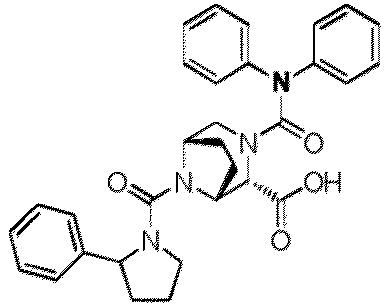
(1R,2S,5S)-3-(diphenylcarba moyl)-8-(2-phenylpyrrolidi ne-1-carbonyl)-3,8-diazabicyclo [3. 2.1]octane-2-carboxylic acid 
1HNMR (400 MHz, DMSO-d6 ) δ 13.08 (s, 1H), 7.59 - 6.96 (m, 15H), 4.88 - 4.78 (m, 1H), 4.51 - 4.11 (m, 2H), 3.95 (s, 1H), 3.71 - 3.52 (m, 2H), 3.51 - 3.44 (m, 1H), 3.43 - 3.36 (m, 2H), 2.31 - 2.18 (m, 1H), 1.98 - 1.64 (m, 3H), 1.59 - 1.49 (m, 2H), 1.47 - 1.07 (m, 3H). MS m/z (ESI): 525.1 [M+H]+. C14 5 
(1R,2S,5S)-8-(bis(4-fluorophenyl)c arbamoyl)-3-(diphenylcarba moyl)-3,8-diazabicyclo [3. 2.1]octane-2-carboxylic acid 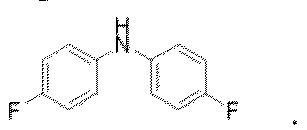
1HNMR (400 MHz, DMSO-d6 ) δ 13.22 (s, 1H), 7.64 - 6.89 (m, 18H), 4.35 - 4.15 (m, 2H), 3.97 (s, 1H), 3.56 (s, 2H), 3.19 (d, J = 9.1 Hz, 1H), 2.94 (d, J = 12.0 Hz, 1H), 1.72 - 1.61 (m, 1H), 1.54 (s, 1H), 1.35 (s, 1H), 1.26 - 1.06 (m, 1H). MS m/z (ESI): 583.1 [M+H]+. C14 7 
(1R,2S,5S)-8-((cyclohexylm ethyl)(methyl)c arbamoyl)-3-(diphenylcarba moyl)-3,8-diazabicyclo [3. 2.1]octane-2-carboxylic acid 
1H NMR (400 MHz, DMSO-d 6) δ 7.36 (t, J = 7.6 Hz, 4H), 7.17 (t, J = 7.2 Hz, 2H), 7.01 (t, J = 7.6 Hz, 4H), 4.35 - 4.15 (m, 2H), 3.85 (s, 1H), 3.45 - 3.30 (m, 2H), 3.29 - 3.15(m, 1H), 2.85 - 2.70 (m, 4H), 1.70 - 1.35 (m, 9H), 1.25 - 1.05 (m, 4H), 0.85 - 0.7 (m, 2H). MS m/z (ESI): 505.2 [M+H]+. C14 9 
(1R,2S,5S)-8-((2-chlorobenzyl)( methyl)carbam oyl)-3-(diphenylcarba moyl)-3,8-diazabicyclo[3.2.1]octane-2-carboxylic acid 
1H NMR (400 MHz, DMSO-d 6) δ 8.10 - 7.95 (m, 1H), 7.70 - 7.29 (m, 6H), 7.27 - 7.12 (m, 3H), 7.07 - 6.95 (m, 3H), 6.80 - 6.65 (m, 2H), 4.80 - 4.20 (m, 4H), 3.91 (s, 1H), 3.50 - 3.30 (m, 2H), 2.76 (s, 3H), 1.80 - 1.20 (m, 4H). MS m/z (ESI): 533.0 [M+H]+. C15 1 
(1R,2S,5S)-8-((3-chlorobenzyl)( methyl)carbam oyl)-3-(diphenylcarba moyl)-3,8-diazabicyclo [3. 2.1]octane-2-carboxylic acid 
1HNMR (400 MHz, DMSO-d6 ) δ 12.99 (s, 1H), 7.42 - 6.98 (m, 14H), 4.42 (d, J = 15.3 Hz, 2H), 4.37 (s, 1H), 4.27 (d, J = 15.4 Hz, 1H), 3.94 (s, 1H), 3.48 - 3.36 (m, 2H), 2.74 (s, 3H), 1.72 (s, 1H), 1.56 (s, 1H), 1.46 - 1.33 (m, 1H), 1.32 - 1.13 (m, 1H). MS m/z (ESI): 533.1 [M+H]+. C15 0 
(1R,2S,5S)-8-((4-chlorobenzyl)( methyl)carbam oyl)-3-(diphenylcarba moyl)-3,8-diazabicyclo [3. 2.1]octane-2-carboxylic acid 
1HNMR (400 MHz, DMSO-d6 ) δ 13.38 (s, 1H), 7.45 - 6.94 (m, 14H), 4.47 - 4.32 (m, 2H), 4.29 - 4.07 (m, 2H), 3.92 (s, 1H), 3.42 (d, J= 12.0 Hz, 2H), 2.71 (s, 3H), 1.67 (s, 1H), 1.56 (s, 1H), 1.39 (s, 1H), 1.29 - 1.14 (m, 1H). MS m/z (ESI): 532.8 [M+H]+. C17 9 
(1R,2S,5S)-3-(diphenylcarba moyl)-8-(2-phenylazetidin e-1-carbonyl)-3,8-diazabicyclo [3. 2.1]octane-2-carboxylic acid 
1H NMR (400 MHz, DMSO-d 6) δ 7.35 - 7.20 (m, 10H), 7.15 - 7.00 (m, 5H), 5.25 - 5.05 (m, 1H), 4.50 - 4.35 (m, 1H), 4.15 - 3.95 (m, 3H), 3.85 - 3.75 (m, 1H), 3.30 - 3.15 (m, 2H), 2.05 - 1.85 (m, 2H), 1.60 - 1.15 (m, 4H). MS m/z (ESI): 511.1 [M+H]+. C15 2 
(1R,2S,5S)-8-(benzyl(isopro pyl)carbamoyl) -3-(diphenylcarba moyl)-3,8-diazabicyclo [3. 2.1]octane-2-carboxylic acid 
1HNMR (400 MHz, DMSO-d6 ) δ 13.03 (s, 1H), 7.45 - 6.89 (m, 15H), 4.40 (d, J = 15.9 Hz, 1H), 4.35 - 4.20 (m, 2H), 4.14 (d, J= 16.0 Hz, 1H), 4.09 - 4.01 (m, 1H), 3.91 (s, 1H), 3.56 - 3.45 (m, 2H), 1.57 (s, 1H), 1.44 (s, 1H), 1.38 - 1.28 (m, 1H), 1.27 - 1.16 (m, 1H), 1.07 (dd, J = 14.6, 6.5 Hz, 6H). MS m/z (ESI): 526.8 [M+H]+. C15 3 
(1R,2S,5S)-8-(benzyl(cyclop ropyl)carbamo yl)-3-(diphenylcarba Compound 20 in step 5b of Example 5 was replaced with Compound 23. Compound 16 was 1H NMR (400 MHz, DMSO-d6 ) δ 13.00 (s, 1H), 7.45 - 6.93 (m, 15H), 4.68 (d, J = 15.0 Hz, 1H), 4.48 (s, 1H), 4.41 - 4.26 (m, 1H), 4.15 (s, 1H), 4.04 (d, J = 15.1 Hz, 1H), 3.51 - 3.42 (m, moyl)-3,8-diazabicyclo [3. 2.1]octane-2-carboxylic acid 
2H), 2.45 - 2.32 (m, 1H), 1.69 (s, 1H), 1.57 - 1.28(m, 3H), 0.79 - 0.68 (m, 1H), 0.67 - 0.58 (m, 1H), 0.57 - 0.46 (m, 2H). MS m/z (ESI): 524.8 [M+H]+. C15 4 
(1R,2S,5S)-8-(benzyl(cyclop ropylmethyl)ca rbamoyl)-3-(diphenylcarba moyl)-3,8-diazabicyclo [3. 2.1]octane-2-carboxylic acid 
1H NMR (400 MHz, DMSO-d6 ) δ 13.04 (s, 1H), 7.41 - 6.96 (m, 15H), 4.65 (d, J = 15.5 Hz, 1H), 4.38 - 4.12 (m, 3H), 3.90 (s, 1H), 3.43 (d, J = 12.1 Hz, 2H), 3.06 - 2.86 (m, 2H), 1.70 (s, 1H), 1.53 (s, 1H), 1.41-1.31 (m, 1H), 1.28 - 1.15 (m, 1H), 0.99 - 0.87 (m, 1H), 0.47 - 0.30 (m, 2H), 0.06 (d, J = 4.7 Hz, 2H). MS m/z (ESI): 538.9 [M+H]+. C15 5 
(1R,2S,5S)-8-(benzyl(ethyl)c arbamoyl)-3-(diphenylcarba moyl)-3,8-diazabicyclo [3. 2.1]octane-2-carboxylic acid 
1H NMR (400 MHz, DMSO-d6 ) δ 13.17 (s, 1H), 7.43 - 6.89 (m, 15H), 4.51 (d, J = 15.6 Hz, 1H), 4.36 - 4.20 (m, 2H), 3.90 (s, 1H), 3.39 (dd, J = 32.0, 11.7 Hz, 3H), 3.24 - 3.13 (m, 1H), 3.05 - 2.93 (m, 1H), 1.68 (s, 1H), 1.62 - 1.49 (m, 1H), 1.47 - 1.32 (m, 1H), 1.29 - 1.10 (m, 1H), 0.98 (t, J = 7.0 Hz, 3H). MS m/z (ESI): 512.8 [M+H]+. C18 2 
(1R,2S,5S)-3-(diphenylcarba moyl)-8-(phenylsulfuryl )-3,8-diazabicyclo [3. 2.1]octane-2-carboxylic acid 
1H NMR (400 MHz, DMSO-d 6) δ 7.82 (d, J = 7.6 Hz, 2H), 7.68 (t, J = 6.4 Hz, 1H), 7.57 (t, J = 7.2 Hz, 2H), 7.33 (t, J = 7.6 Hz, 4H), 7.15 (t, J = 7.2 Hz, 2H), 6.99 (d, J = 8.0 Hz, 4H), 4.52 (s, 1H), 4.37 - 4.27 (m, 1H), 4.14 (s, 1H), 3.39 - 3.34 (m, 1H), 3.16 (d, J = 12.0 Hz, 1H), 1.35 - 1.00 (m, 4H). MS m/z (ESI): 492.0 [M+H]+. C15 9 
(1S,2R,5R)-8-(benzyl(methyl )carbamoyl)-3-(diphenylcarba moyl)-3,8-diazabicyclo [3. 2.1]octane-2-carboxylic acid 
1H NMR (400 MHz, DMSO-d 6) δ 7.45 - 7.30 (m, 6H), 7.29 - 7.12 (m, 5H), 7.05 - 6.95 (m, 4H), 4.45 (d, J = 15.6 Hz, 1H), 4.40 - 4.30 (m, 2H), 4.26 (d, J= 15.6 Hz, 1H), 3.93 (s, 1H), 3.50 - 3.42 (m, 2H), 2.70 (s, 3H), 1.80 - 1.20 (m, 4H). MS m/z (ESI): 498.9 [M+H]+. C13 9 
(1R,2S,5S)-3-(diphenylcarba moyl)-8-((S)-2-phenylpyrrolidi ne-1-carbonyl)-3,8-diazabicyclo [3. 2.1]octane-2-carboxylic acid 
1H NMR (300 MHz, DMSO-d6 ) δ 13.11 (s, 1H), 7.45 - 6.84 (m, 15H), 4.82 (t, J = 7.2 Hz, 1H), 4.44 (s, 1H), 4.22 (s, 1H), 3.92 (s, 1H), 3.61 - 3.48 (m, 2H), 3.20 (d, J = 11.9 Hz, 1H), 2.27 - 2.13 (m, 1H), 1.85 - 1.67 (m, 2H), 1.58 - 1.46 (m, 1H), 1.45 - 1.34 (m, 2H), 1.28 - 1.06 (m, 2H). MS m/z (ESI): 525.1 [M+H]+. C14 0 
(1R,2S,5S)-3-(diphenylcarba moyl)-8-((R)-2-phenylpyrrolidi ne-1-carbonyl)-3,8-diazabicyclo [3. 2.1]octane-2-carboxylic acid 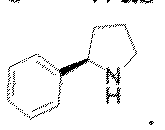
1H NMR (400 MHz, DMSO-d6 ) δ 12.89 (s, 1H), 7.56 - 6.93 (m, 15H), 4.85 (t, J = 7.6 Hz, 1H), 4.42 - 4.22 (m, 2H), 4.18 (s, 1H), 3.72 - 3.60 (m, 1H), 3.54 - 3.46 (m, 2H), 2.39 - 2.21 (m, 2H), 1.84 (s, 1H), 1.79 - 1.67 (m, 1H), 1.62 - 1.45 (m, 2H), 1.42 - 1.26 (m, 2H). MS m/z (ESI): 525.2 [M+H]+. C16 1 
(1R,2S,5S)-3-(diphenylcarba moyl)-8-((4-fluorobenzyl)( methyl)carbam oyl)-3,8-diazabicyclo [3. 2.1]octane-2-carboxylic acid 
1H NMR (400 MHz, DMSO-d6 ) δ 13.01 (s, 1H), 7.41 - 6.96 (m, 14H), 4.43 - 4.22 (m, 4H), 3.92 (s, 1H), 3.47 - 3.33 (m, 2H), 2.70 (s, 3H), 1.77 - 1.35 (m, 4H). MS m/z (ESI): 517.1 [M+H]+. C16 2 
(1R,2S,5S)-3-(diphenylcarba moyl)-8-(methyl(4-methylbenzyl)c arbamoyl)-3,8-diazabicyclo [3. 2.1]octane-2-carboxylic acid 
1H NMR (400 MHz, DMSO-d 6) δ 7.35 (t, J = 8.0 Hz, 4H), 7.20 -7.10 (m, 4H), 7.07 (d, J = 8.0 Hz, 2H), 7.02 (d, J = 7.6 Hz, 4H), 4.45 - 4.25 (m, 3H), 4.21 (d, J = 15.2 Hz, 1H), 3.91 (s, 1H), 3.45 - 3.35 (m, 2H), 2.68 (s, 3H), 2.28 (s, 3H), 1.75 - 1.30 (m, 4H). MS m/z (ESI): 513.1 [M+H]+. C16 5 
(1R,2S,5S)-8-((4-bromobenzyl)( methyl)carbam oyl)-3-(diphenylcarbamoyl)-3,8-diazabicyclo [3. 2.1]octane-2-carboxylic acid Compound 20 in step 5b of Example 5 was replaced with Compound 23. Compound 16 was replaced with 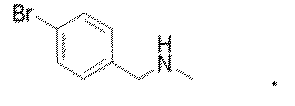
1H NMR (400 MHz, DMSO-d6 ) δ 12.97 (s, 1H), 7.57 - 6.97 (m, 14H), 4.45 - 4.19 (m, 4H), 3.93 (s, 1H), 3.48 - 3.36 (m, 2H), 2.71 (s, 3H), 1.77 - 1.32 (m, 4H). MS m/z (ESI): 576.7 [M+H]+. C16 5-1 
(1R,2R,5S)-ethyl 8-((4-bromobenzyl)( methyl)carbam oyl)-3-(diphenylcarba moyl)-3,8-diazabicyclo [3. 2.1]octane-2-carboxylate 
MS m/z (ESI): 604.6 [M+H]+. C16 6 
(1R,2S,5S)-3-(diphenylcarba moyl)-8-(4-methoxylbenzy 1)(methyl)carba moyl)-3,8-diazabicyclo [3. 2.1]octane-2-carboxylic acid 
1H NMR (400 MHz, DMSO-d6 ) δ 12.99 (s, 1H), 7.41 - 6.85 (m, 14H), 4.36 (d, J = 14.6 Hz, 2H), 4.18 (d, J = 14.8 Hz, 1H), 3.90 (s, 1H), 3.73 (s, 3H), 3.62 - 3.47 (m, 3H), 2.66 (s, 3H), 1.72 (s, 1H), 1.62 - 1.46 (m, 1H), 1.45 - 1.12 (m, 2H). MS m/z (ESI): 528.8 [M+H]+. C19 1 
(1R,2S,5S)-3-(diphenylcarba moyl)-8-(pyrimidine-2-yl)-3,8-diazabicyclo [3. 2.1]octane-2-carboxylic acid In step 5a of Example 5, Compound 20 was replaced with Compound 23, phenyl chloroformate was replaced with 2-chloropyrimidine, TEA was replaced with DIPEA, and DCM was replaced with NMP; and the reaction condition was changed to reacting at 130°C for 16 hours. The reaction in step 5b did not take place. 1H NMR (400 MHz, CD3OD) δ 8.58 (s, 2H), 7.39 (t, J = 7.2 Hz, 4H), 7.24 (t, J = 7.2 Hz, 2H), 7.13 (d, J = 8.0 Hz, 4H), 7.00 (s, 1H), 5.34 (s, 1H), 4.8 - 4.7 (m, 2H), 3.72 (d, J = 12.4 Hz, 1H), 3.39 (d, J= 12.4 Hz, 1H), 2.15 - 1.95 (m, 2H), 1.90 - 1.70 (m, 2H). MS m/z (ESI): 430.0 [M+H]+. C18 4 
(1R,2S,5S)-3-(diphenylcarba moyl)-8-(methyl(thioph ene-3-ylmethyl)carba moyl)-3,8-diazabicyclo [3. 2. 1]octane-2-carboxylic acid 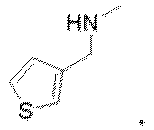
1H NMR (400 MHz, DMSO-d6 ) δ 12.99 (s, 1H), 7.49 (dd, J = 4.9, 2.9 Hz, 1H), 7.41 - 7.28 (m, 5H), 7.17 (t, J = 7.4 Hz, 2H), 7.05 - 6.92 (m, 5H), 4.42 - 4.20 (m, 4H), 3.92 (s, 1H), 3.39 (dd, J = 24.8, 11.6 Hz, 2H), 2.70 (d, J = 3.0 Hz, 3H), 1.77 - 1.63 (m, 1H), 1.60 - 1.47 (m, 1H), 1.44 - 1.15 (m, 2H). MS m/z (ESI): 504.6 [M+H]+. C16 9 
(1R,2S,5S)-3-(diphenylcarba moyl)-8-(methyl(4-trifluoromethyl )benzyl)carba moyl)-3,8-diazabicyclo [3. 2.1]octane-2-carboxylic acid 
1H NMR (400 MHz, DMSO-d 6) δ 7.70 (d, J = 8.0 Hz, 2H), 7.41 (d, J = 8.0 Hz, 2H), 7.36 (t, J = 8.0 Hz, 4H), 7.17 (t, J = 7.6 Hz, 2H), 7.01 (d, J = 7.6 Hz, 4H), 4.51 (d, J = 16.0 Hz, 1H), 4.45 - 4.30 (m, 3H), 3.95 (s, 1H), 3.45 - 3.20 (m, 2H), 2.75 (s, 3H), 1.80 - 1.30 (m, 4H). MS m/z (ESI): 566.8 [M+H]+. C14 6 
(1R,2S,5S)-3-(diphenylcarba moyl)-8-(2-phenylpiperidi ne-1-carbonyl)-3,8-diazabicyclo [3. 2.1]octane-2-carboxylic acid 
1H NMR (400 MHz, DMSO-d6 ) δ 13.05 (s, 1H), 7.54 - 6.90 (m, 12H), 5.13 (d, J = 32.5 Hz, 1H), 4.44 - 4.17 (m, 2H), 3.98 (s, 1H), 3.80 (s, 1H), 3.71 - 3.58 (m, 1H), 3.41 - 3.53 (m, 2H), 2.90 - 2.69 (m, 1H), 2.36 - 2.21 (m, 1H), 1.85 - 1.66 (m, 2H), 1.63 - 1.41 (m, 3H), 1.39 - 1.14 (m, 3H). MS m/z (ESI): 538.8 [M+H]+. C14 3 
(1R,2S,5S)-3-(diphenylcarba moyl)-8-((R)-2-(p-tolyl)pyrrolidin e-1-carbonyl)-3,8-diazabicyclo [3. 2.1]octane-2-carboxylic acid 
1H NMR (400 MHz, DMSO-d 6) δ 7.40 - 7.32 (m, 4H), 7.20 - 7.12 (m, 2H), 7.10 - 6.95 (m, 8H), 4.85 - 4.75 (m, 1H), 4.47 - 4.32 (m, 1H), 4.27 - 4.02 (m, 1H), 3.92 (s, 1H), 3.65 - 3.52 (m, 2H), 3.40 - 3.15 (m, 2H), 2.27 - 2.12 (m, 4H), 1.87 - 1.65 (m, 3H), 1.60 - 1.20 (m, 4H). MS m/z (ESI): 538.6 [M+H]+. C21 3 
(1R,2S,5S)-8-((4-cyclopropylben zyl)(methyl)car bamoyl)-3-(diphenylcarba moyl)-3,8-diazabicyclo [3. 2.1]octane-2-carboxylic acid 
1H NMR (400 MHz, DMSO-d6 ) δ 13.40 - 12.85 (m, 1H), 7.34 (t, J = 7.8 Hz, 4H), 7.15 (t, J = 7.4 Hz, 2H), 7.06 - 6.97 (m, 8H), 4.37 (d, J = 15.1 Hz, 2H), 4.20 (d, J = 15.1 Hz, 1H), 3.90 (s, 1H), 3.50 - 3.37 (m, 2H), 2.67 (s, 3H), 1.95 - 1.83 (m, 1H), 1.68 (s, 1H), 1.55 (s, 1H), 1.46 - 1.32 (m, 1H), 1.27 - 1.09 (m, 2H), 0.95 - 0.89 (m, 2H), 0.67 - 0.58 (m, 2H). MS m/z (ESI): 538.7 [M+H]+. C21 4 
(1R,2S,5S)-3-(diphenylcarba moyl)-8-((4-isopropylbenzy l)(methyl)carba moyl)-3,8-diazabicyclo [3. 2.1]octane-2-carboxylic acid 
1H NMR (400 MHz, DMSO-d6 ) δ 7.33 (t, J = 7.6 Hz, 4H), 7.19 (d, J = 8.0 Hz, 2H), 7.17 - 7.06 (m, 4H), 7.03 (d, J = 7.6 Hz, 4H), 4.39 (d, J = 14.8 Hz, 2H), 4.25 (d, J = 15.2 Hz, 2H), 3.92 (s, 1H), 3.37 (s, 2H), 2.90 - 2.80 (m, 1H), 2.70 (s, 3H), 1.57 (s, 2H), 1.42 (s, 2H), 1.18 (d, J = 6.9 Hz, 6H). MS m/z (ESI): 541.3 [M+H]+. C14 4 
(1R,2S,5S)-8-((R)-2-(4-chlorphenyl)py rrolidine-1-carbonyl)-3-(diphenylcarba moyl)-3,8-diazabicyclo [3. 2.1]octane-2-carboxylic acid 
1H NMR (400 MHz, DMSO-d 6) δ 7.42 - 7.26 (m, 6H), 7.23 - 7.12 (m, 4H), 7.05 - 6.95 (m, 4H), 4.82 (t, J = 7.2 Hz, 1H), 4.50 - 3.90 (m, 3H), 3.70 - 3.53 (m, 2H), 3.45 - 3.35 (m, 1H), 3.23 (d, J = 10.8 Hz, 1H), 2.30 - 2.15 (m, 1H), 1.90 - 1.65 (m, 2H), 1.55 - 1.20 (m, 5H). MS m/z (ESI): 559.1 [M+H]+. C21 6 
(1R,2S,5S)-3-(diphenylcarba moyl)-8-(ethyl(4-methylbenzyl)c arbamoyl)-3,8-diazabicyclo [3. 2.1]octane-2-carboxylic acid 
1H NMR (400 MHz, DMSO-d 6) δ 12.996 (brs, 1H), 7.35 (t, J = 8.0 Hz, 4H), 7.17 (t, J = 7.2 Hz, 2H), 7.13 (d, J = 8.0 Hz, 2H), 7.08 (d, J = 8.0 Hz, 2H), 7.01 (d, J = 7.6 Hz, 4H), 4.46 (d, J = 15.2 Hz, 1H), 4.41- 4.22 (m, 2H), 4.19 (d, J = 15.2 Hz, 1H), 3.88 (s, 1H), 3.52 - 3.33 (m, 2H), 3.22 - 3.12 (m, 1H), 3.01 - 2.90 (m, 1H), 2.28 (s, 3H), 1.75 - 1.25 (m, 4H), 0.97 (t, J = 6.8 Hz, 3H). MS m/z (ESI): 526.7 [M+H]+. C21 7 
(1R,2S,5S)-8-((4-chlorobenzyl)( ethyl)carbamo yl)-3-(diphenylcarba moyl)-3,8-diazabicyclo [3. 2.1]octane-2-carboxylic acid 
1H NMR (400 MHz, DMSO-d 6) δ 7.42 - 7.30 (m, 6H), 7.22 (d, J = 8.4 Hz, 2H), 7.16 (t, J = 7.2 Hz, 2H), 7.01 (d, J = 7.6 Hz, 4H), 4.48 (d, J = 16.0 Hz, 1H), 4.41 - 4.26 (m, 2H), 4.25 (d, J = 15.6 Hz, 1H), 3.90 (s, 1H), 3.42 (d, J = 12.0 Hz, 1H), 3.30 - 3.15 (m, 2H), 3.05 - 2.90 (m, 1H), 1.70 - 1.28 (m, 4H), 0.98 (t, J = 7.2 Hz, 3H). MS m/z (ESI): 546.8 [M+H]+. C21 9 
(1R,2S,5S)-3-(diphenylcarba moyl)-8-(ethyl(2-methylbenzyl)c arbamoyl)-3,8-diazabicyclo [3. 2.1]octane-2-carboxylic acid 
1H NMR (400 MHz, DMSO-d6 ) δ 13.02 (s, 1H), 7.35 (t, J = 7.9 Hz, 4H), 7.21 - 7.06 (m, 6H), 7.01 (d, J = 7.5 Hz, 4H), 4.55 (d, J = 15.6 Hz, 1H), 4.33 (s, 1H), 4.18 (d, J = 15.6 Hz, 1H), 3.89 (s, 1H), 3.41 - 3.28 (m, 3H), 3.25 - 3.14 (m, 1H), 2.96 - 2.85 (m, 1H), 2.17 (s, 3H), 1.77 - 1.64 (m, 1H), 1.58 - 1.46 (s, 1H), 1.45 - 1.33 (m, 1H), 1.29 - 1.22 (m, 1H), 0.94 (t, J = 7.0 Hz, 3H). MS m/z (ESI): 526.7 [M+H]+. C21 2 
(1R,2S,5S)-8-((2-chlorobenzyl)( ethyl)carbamo yl)-3-(diphenylcarba moyl)-3,8-diazabicyclo [3. 2.1]octane-2-carboxylic acid 
1H NMR (400 MHz, DMSO-d6 ) δ 13.03 (s, 1H), 7.46 - 7.14 (m, 10H), 7.04 - 6.98 (m, 4H), 4.61 (d, J = 16.0 Hz, 1H), 4.33 (s, 1H), 4.26 (d, J = 16.0 Hz, 2H), 3.90 (s, 1H), 3.42 (d, J = 12.9 Hz, 2H), 3.26 (dd, J = 14.1, 7.1 Hz, 1H), 3.02 (dd, J = 14.2, 7.0 Hz, 1H), 1.74 - 1.61 (m, 1H), 1.59 - 1.47 (m, 1H), 1.44 - 1.32 (m, 1H), 1.28 - 1.16 (m, 1H), 0.99 (t, J = 7.0 Hz, 3H). MS m/z (ESI): 546.7 [M+H]+. C21 0 
(1R,2S,5S)-3-(diphenylcarba moyl)-8-(4-phenylpyrimidi ne-2-yl)-3,8-diazabicyclo [3. 2.1]octane-2-carboxylic acid 
1H NMR (400 MHz, DMSO-d 6) δ 8.42 (d, J = 5.2 Hz, 1H), 8.17 - 8.10 (m, 2H), 7.55 - 7.45 (m, 3H), 7.37 (t, J = 8.0 Hz, 4H), 7.28 (d, J = 5.2 Hz, 1H), 7.18 (t, J = 7.2 Hz, 2H), 7.07 - 7.00 (m, 4H), 5.33 (s, 1H), 4.88 (s, 1H), 4.38 (s, 1H), 3.56 (d, J = 12.0 Hz, 1H), 3.41 (d, J = 11.6 Hz, 1H), 1.81 - 1.61 (m, 2H), 1.50 - 1.30 (m, 2H). MS m/z (ESI): 505.8 [M+H]+. C25 3 
(1R,2S,5S)-3-(diphenylcarba moyl)-8-(4-phenylquinazol ine-2-yl)-3,8-diazabicyclo [3. 2.1]octane-2-carboxylic acid In step 5a of Example 5, Compound 20 was replaced with Compound 23, phenyl chloroformate was replaced with 1H NMR (400 MHz, DMSO-d6 ) δ 7.86 - 7.74 (m, 4H), 7.66 - 7.56 (m, 4H), 7.40 - 7.30 (m, 5H), 7.19 (t, J = 7.2 Hz, 2H), 7.03 (d, J = 7.2 Hz, 4H), 5.42 (s, 1H), 4.97 (s, 1H), 4.42 (s, 1H), 3.60 (d, J = 13.2 Hz, 1H), 3.50 - 3.40 (m, 1H), 1.86 - 1.65 (m, 2H), 1.61 - 1.40 (m, 2H). 
MS m/z (ESI): 556.1 [M+H]+. C17 3 
(1R,2S,5S)-8-(benzyl(methyl )carbamoyl)-3-(2,2-diphenylpropio nyl)-3,8-diazabicyclo [3. 2.1]octane-2-carboxylic acid 
1H NMR (400 MHz, DMSO-d6 ) δ 7.52 (d, J = 7.26 Hz, 2H), 7.45 -7.10 (m, 13H), 4.77 (d, J = 2.8 Hz, 1H), 4.45 - 4.05 (m, 3H), 3.52 (d, J = 5.6 Hz, 1H), 3.20 - 3.05 (m, 2H), 2.72 - 2.57 (m, 3H), 1.85 - 1.51 (m, 4H), 1.30 - 1.00 (m, 3H). MS m/z (ESI): 511.8 [M+H]+. C19 2 
(1R,2S,5S)-8-(benzyl(methyl )carbamoyl)-3-(bis(2-methoxylpheny 1)carbamoyl)-3,8-diazabicyclo [3. 2.1]octane-2-carboxylic acid 
1H NMR (400 MHz, DMSO-d 6) δ 12.53 (brs, 1H), 7.33 (t, J = 7.2 Hz, 2H), 7.28 - 7.22 (m, 1H), 7.21 -7.11 (m, 4H), 7.07 - 7.00 (m, 2H), 6.85 (t, J = 7.6 Hz, 2H), 6.82 - 6.75 (m, 2H), 4.49 - 4.38 (m, 2H), 4.37 - 4.31 (m, 1H), 4.23 (d, J = 15.2 Hz, 1H), 3.87 (s, 1H), 3.70 (s, 6H), 3.41 (d, J = 11.6 Hz, 1H), 3.25 (d, J = 11.2 Hz, 1H), 2.68 (s, 3H), 1.85 - 1.71 (m, 1H), 1.61 - 1.31 (m, 3H). MS m/z (ESI): 558.7 [M+H]+. C17 1 
(1R,2S,5S)-3-(diphenylcarba moyl)-8-((4-ethynylbenzyl) (methyl)carba moyl)-3,8-diazabicyclo [3. 2.1]octane-2-carboxylic acid 
1H NMR (400 MHz, DMSO-d6 ) δ 7.44 (d, J = 8.0 Hz, 2H), 7.35 (t, J = 8.0 Hz, 4H), 7.25 - 7.05 (m, 4H), 7.01 (d, J = 7.6 Hz, 4H), 4.45 (d, J = 15.6 Hz, 1H), 4.38 - 4.30 (m, 2H), 4.27 (d, J = 15.6 Hz, 1H), 4.17 (s, 1H), 3.93 (s, 1H), 3.45 - 3.34 (m, 2H), 2.71 (s, 3H), 1.77 - 1.65 (m, 1H), 1.60 - 1.46 (m, 1H), 1.45 - 1.20 (m, 1H). MS m/z (ESI): 523.0 [M+H]+. C22 0 
(1R,2S,5S)-8-((2,4-dichlorobenzyl )(ethyl)carbam oyl)-3-(diphenylcarba moyl)-3,8-diazabicyclo [3. 2.1]octane-2-carboxylic acid Compound 20 in step 5b of Example 5 was replaced with Compound 23. Compound 16 was 1H NMR (400 MHz, DMSO-d6 ) δ 7.35 - 7.0 (m, 20H), 5.49 (s, 1H), 5.37 (s, 1H), 5.14 (s, 1H), 4.73 (s, 1H), 4.57 (s, 1H), 3.75 - 3.45 (m, 2H), 2.25 - 2.0 (m, 1H), 1.95 - 1.50 (m, 3H). 
MS m/z (ESI): 544.9 [M+H]+. C19 6 
(1R,2S,5S)-8-(cyclopropyl(th iophene-3-yl-methyl)carbam oyl)-3-(diphenylcarba moyl)-3,8-diazabicyclo [3. 2.1]octane-2-carboxylic acid 
1H NMR (400 MHz, DMSO-d6 ) δ 12.99 (s, 1H), 7.60 - 6.89 (m, 13H), 4.61 (d, J = 15.1 Hz, 1H), 4.46 (s, 1H), 4.31 (s, 1H), 4.18 - 4.04 (m, 2H), 3.43 (s, 2H), 2.43 (s, 1H), 1.68 (s, 1H), 1.54 - 1.33 (m, 2H), 1.26 - 1.14 (m, 1H), 0.78 - 0.66 (m, 1H), 0.64 - 0.42 (m, 3H). MS m/z (ESI): 531.0 [M+H]+. C20 5 
(1R,2S,5S)-8-((cyclopropylm ethyl)(thiophen e-3-ylmethyl)carba moyl)-3-(diphenylcarba moyl)-3,8-diazabicyclo [3. 2.1]octane-2-carboxylic acid 
1H NMR (400 MHz, DMSO-d6 ) δ 13.04 (s, 1H), 7.48 (dd, J = 4.9, 2.9 Hz, 1H), 7.41 - 7.27 (m, 5H), 7.17 (t, J = 7.4 Hz, 2H), 7.01 (d, J = 7.6 Hz, 4H), 6.94 (d, J = 4.9 Hz, 1H), 4.58 (d, J = 15.4 Hz, 1H), 4.33 (d, J = 15.3 Hz, 3H), 3.89 (s, 1H), 3.48 - 3.27 (m, 2H), 3.04 - 2.87 (m, 2H), 1.69 (s, 1H), 1.53 (s, 1H), 1.43 - 1.31 (m, 1H), 1.27 - 1.15 (m, 1H), 0.95 (s, 1H), 0.45 - 0.30 (m, 2H), 0.09 (d, J = 4.6 Hz, 2H) . MS m/z (ESI): 544.6 [M+H]+. C25 5 
(1R,2S,5S)-8-((6-chloropyridine-3-yl)methyl)(met hyl)carbamoyl) -3-(diphenylcarba moyl)-3,8-diazabicyclo [3. 2.1]octane-2-carboxylic acid 
1H NMR (400 MHz, DMSO-d6 ) δ 13.00 (s, 1H), 8.26 (s, 1H), 7.68 (d, J = 7.6 Hz, 1H), 7.48 (d, J = 8.0 Hz, 1H), 7.35 (t, J = 7.6 Hz, 4H), 7.16 (t, J = 7.2 Hz, 2H), 7.01 (d, J = 7.6 Hz, 4H), 4.42 (d, J = 15.6 Hz, 1H), 4.35 (s, 1H), 4.28 (d, J = 15.2 Hz, 1H), 3.94 (s, 2H), 3.44 - 3.34 (m, 3H), 2.74 (s, 3H), 1.69 (s, 1H), 1.54 (s, 1H), 1.37 (s, 1H), 1.24 (s, 1H). MS m/z (ESI): 534.1 [M+H]+. C20 6 
(1R,2S,5S)-8-(cyclopropyl(th iazole-4-ylmethyl)carba moyl)-3-(diphenylcarba Compound 20 in step 5b of Example 5 was replaced with Compound 23. Compound 16 was replaced with 1H NMR (400 MHz, DMSO-d6 ) δ 9.03 (d, J = 2.0 Hz, 1H), 7.45 - 7.31 (m, 5H), 7.17 (t, J = 7.2 Hz, 2H), 7.01 (d, J = 7.6 Hz, 4H), 4.80 (d, J = 15.6 Hz, 1H), 4.50 - 4.25 (m, 2H), 4.22 (d, J = 15.6 Hz, 1H), 3.50 - 3.30 (m, moyl)-3,8-diazabicyclo [3. 2.1]octane-2-carboxylic acid 
2H), 2.6 - 2.51 (m, 1H), 1.75 - 1.20 (m, 4H), 0.75 - 0.50 (m, 4H). MS m/z (ESI): 520.0 [M+H]+. C20 7 
(1R,2S,5S)-3-(diphenylcarba moyl)-8-(ethyl(thiophen e-3-ylmethyl)carba moyl)-3,8-diazabicyclo [3. 2.1]octane-2-carboxylic acid 
1H NMR (400 MHz, DMSO-d6 ) δ 13.05 (s, 1H), 7.48 (dd, J = 4.8 Hz, 2.8 Hz, 1H), 7.35 (t, J = 8.0 Hz, 4H), 7.30 (d, J = 1.6 Hz, 1H), 7.16 (t, J = 7.2 Hz, 2H), 7.01 (d, J = 7.6 Hz, 4H), 6.95 (dd, J = 4.8, 1.2 Hz, 1H), 4.43 (d, J = 15.2 Hz, 1H), 4.40 - 4.26 (m, 2H), 4.23 (d, J = 15.2 Hz, 1H), 3.89 (s, 1H), 3.49 - 3.34 (m, 2H), 3.25 - 3.12 (m, 1H), 3.05 - 2.94 (m, 1H), 1.75 - 1.19 (m, 4H), 0.98 (t, J = 6.8 Hz, 3H). MS m/z (ESI): 519.0 [M+H]+. C21 8 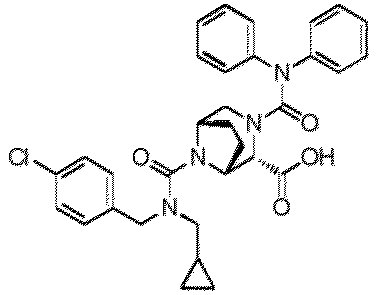
(1R,2S,5S)-8-((4-chlorobenzyl)( cyclopropylme thyl)carbamoyl )-3-(diphenylcarba moyl)-3,8-diazabicyclo [3. 2.1]octane-2-carboxylic acid 
1H NMR (400 MHz, DMSO-d6 ) δ 13.04 (s, 1H), 7.41 - 7.30 (m, 6H), 7.25 - 7.11 (m, 4H), 7.05 - 6.98 (m, 4H), 4.61 (d, J = 15.7 Hz, 1H), 4.38 - 4.22 (m, 3H), 3.91 (s, 1H), 3.39 (dd, J = 39.5, 11.8 Hz, 2H), 3.07 - 2.89 (m, 2H), 1.69 (s, 1H), 1.52 (s, 1H), 1.37 (s, 1H), 1.24 (s, 1H), 0.92 (s, 1H), 0.44 - 0.31 (m, 2H), 0.12 - 0.04 (m, 2H). MS m/z (ESI): 573.1 [M+H]+. C20 9 
(1R,2S,5S)-3-(diphenylcarba moyl)-8-(ethyl(thiazole-4-ylmethyl)carba moyl)-3,8-diazabicyclo [3. 2.1]octane-2-carboxylic acid 
1H NMR (400 MHz, DMSO-d6 ) δ 9.06 (d, J = 2.0 Hz, 1H), 7.46 (d, J = 2.0 Hz, 1H), 7.35 (t, J = 8.0 Hz, 4H), 7.17 (t, J = 7.2 Hz, 2H), 7.01 (d, J =7.2 Hz, 4H), 4.57 (d, J = 15.6 Hz, 1H), 4.41 (d, J = 15.6 Hz, 1H), 4.39 - 4.20 (m, 2H), 4.04 (s, 1H), 3.45 - 3.30 (m, 2H), 3.25 - 3.16 (m, 1H), 3.13 - 3.04 (m, 1H), 1.80 - 1.20 (m, 4H), 0.99 (t, J = 7.2 Hz, 3H). MS m/z (ESI): 520.1 [M+H]+. C18 0 
(1R,2S,5S)-8-(N-benzyl-N-methylsulpham oyl)-3-(diphenylcarba moyl)-3,8-diazabicyclo [3. 2.1]octane-2-carboxylic acid 
1H NMR (400 MHz, DMSO-d6 ) δ 7.45 - 7.25 (m, 9H), 7.24 - 7.12 (m, 2H), 7.08 - 6.92 (m, 4H), 4.37 (s, 1H), 4.22 (s, 2H), 4.05 - 3.95 (m, 2H), 3.50 (d, J = 11.2 Hz, 1H), 3.26 (d, J = 12.8 Hz, 1H), 2.59 (s, 3H), 1.90 - 1.70 (m, 2H), 1.55 - 1.25 (m, 2H). MS m/z (ESI): 534.6 [M+H]+. C26 0 
(1R,2S,5S)-3-(diphenylcarba moyl)-8-(ethyl(furan-3-ylmethyl)carba moyl)-3,8-diazabicyclo [3. 2.1]octane-2-carboxylic acid 
1H NMR (400 MHz, DMSO-d6 ) δ 13.02 (s, 1H), 7.60 - 7.56 (m, 2H), 7.35 (t, J = 7.9 Hz, 4H), 7.17 (t, J = 7.4 Hz, 2H), 7.01 (d, J = 7.6 Hz, 4H), 6.35 (s, 1H), 4.35 - 4.20 (m, 3H), 4.07 (d, J = 15.4 Hz, 1H), 3.88 (s, 1H), 3.42 (s, 1H), 3.36 (s, 1H), 3.22 - 3.14 (m, 1H), 3.05 - 2.95 (m, 1H), 1.68 (s, 1H), 1.53 (s, 1H), 1.30 (d, J = 42.4 Hz, 2H), 0.99 (t, J = 7.0 Hz, 3H). MS m/z (ESI): 503.1 [M+H]+. C22 5 
(1R,2S,5S)-3-(diphenylcarba moyl)-8-(methyl(1-phenylethyl)ca rbamoyl)-3,8-diazabicyclo [3. 2.1]octane-2-carboxylic acid 
1H NMR (400 MHz, DMSO-d6 ) δ 13.02 (s, 1H), 7.48 - 7.30 (m, 6H), 7.30 - 7.20 (m, 3H), 7.17 (t, J = 8.0 Hz, 2H), 7.01 (d, J = 8.0 Hz, 4H), 5.24 - 5.16 (m, 1H), 4.41 - 4.28 (m, 2H), 3.40 - 3.80 (m, 1H), 3.50 - 3.39 (m, 2H), 2.53 (s, 1H), 2.43 (s, 1H), 1.76 (s, 1H), 1.58 (s, 1H), 1.49 - 1.39 (m, 3H), 1.33 - 1.16 (m, 2H). MS m/z (ESI): 513.1 [M+H]+. C22 9 
(1R,2S,5S)-3-(diphenylcarba moyl)-8-(methyl(1-(thiophene-3-yl)ethyl)carba moyl)-3,8-diazabicyclo [3. 2.1]octane-2-carboxylic acid 
1H NMR (400 MHz, DMSO-d6 ) δ 13.03 (s, 1H), 7.53 - 7.47 (m, 1H), 7.45 - 7.28 (m, 5H), 7.25 - 7.15 (m, 2H), 7.10 - 6.98 (m, 4H), 6.97 - 6.88 (m, 1H), 5.20 - 5.05 (m, 1H), 4.40 - 4.15 (m, 2H), 3.89 (d, J = 22.4 Hz, 1H), 3.45 - 3.35 (m, 2H), 2.50 - 2.40 (m, 3H), 1.80 - 1.48 (m, 2H), 1.48 - 1.27 (m, 5H). MS m/z (ESI): 541.0 [M+Na]+. C21 5 
(1R,2S,5S)-3-(diphenylcarba moyl)-8-(Methyl(4-(prop-1-ene-2-yl)benzyl))carb amoyl)-3,8-diazabicyclo [3. 2.1]octane-2-carboxylic acid 
1H NMR (400 MHz, DMSO-d6 ) δ 7.47 (d, J = 8.4 Hz, 2H), 7.36 (t, J = 8.0 Hz, 4H), 7.20 - 7.10 (m, 4H), 7.01 (d, J = 7.6 Hz, 4H), 5.42 (s, 1H), 5.08 (s, 1H), 4.42 (d, J = 15.2 Hz, 1H), 4.40 - 4.28 (m, 2H), 4.27 (d, J = 15.6 Hz, 1H), 3.93 (s, 1H), 3.45 - 3.34 (m, 2H), 2.70 (s, 3H), 2.10 (s, 3H), 1.80 - 1.65 (m, 1H), 1.62 - 1.50 (m, 1H), 1.45 - 1.20 (m, 1H). MS m/z (ESI): 539.0 [M+H]+. C20 0 
(1R,2S,5S)-8-(cyclopropyl(th iophene-2-ylmethyl)carba moyl)-3-(diphenylcarba moyl)-3,8-diazabicyclo [3. 2.1]octane-2-carboxylic acid 
1H NMR (400 MHz, DMSO-d6 ) δ 12.76 (s, 1H), 7.47 - 7.34 (m, 3H), 7.22 (d, J = 8.4 Hz, 3H), 7.03 - 6.95 (m, 1H), 4.59 (s, 1H), 4.27 (s, 1H), 4.15 - 4.05 (m, 1H), 3.20 - 3.09 (m, 1H), 2.55 (s, 1H), 1.92 - 1.80 (m, 1H), 1.52 (s, 2H), 0.76 - 0.64 (m, 2H). MS m/z (ESI): 531.1 [M+H]+. C26 5 
(1R,2S,5S)-3-(diphenylcarba moyl)-8-(methyl(quinol ine-2-ylmethyl)carba moyl)-3,8-diazabicyclo [3. 2.1]octane-2-carboxylic acid 
1H NMR (400 MHz, DMSO-d6 ) δ 8.72 (s, 1H), 8.15 (d, J = 7.6 Hz, 2H), 7.94 (d, J = 7.6 Hz, 1H), 7.76 (t, J = 7.2 Hz, 1H), 7.61 (d, J = 7.6 Hz, 1H), 7.36 (t, J = 8.0 Hz, 4H), 7.17 (t, J = 7.6 Hz, 2H), 7.02 (d, J = 7.2 Hz, 4H), 4.86 (d, J = 16.4 Hz, 1H), 4.66 (d, J = 16.4 Hz, 1H), 4.44 - 4.20 (m, 2H), 4.09 (s, 1H), 3.50 - 3.30 (m, 2H), 2.97 (s, 3H), 1.75 - 1.20 (m, 4H). MS m/z (ESI): 549.8 [M+H]+. C26 6 
(1R,2S,5S)-3-(diphenylcarba moyl)-8-(methyl(quinol ine-6-ylmethyl)carba moyl)-3,8-diazabicyclo [3. 2.1]octane-2-carboxylic acid 
1H NMR (400 MHz, DMSO-d6 ) δ 9.03 (s, 1H), 8.64 (s, 1H), 8.10 (d, J = 8.8 Hz, 1H), 7.90 (s, 1H), 7.72 (d, J = 8.0 Hz, 2H), 7.36 (t, J = 8.0 Hz, 4H), 7.17 (t, J = 7.2 Hz, 2H), 7.01 (d, J = 7.2 Hz, 4H), 4.68 (d, J = 16.0 Hz, 1H), 4.48 (d, J = 16.0 Hz, 1H), 4.44 - 4.25 (m, 2H), 3.99 (s, 1H), 3.48 - 3.32 (m, 2H), 2.79 (s, 3H), 1.79 - 1.20 (m, 4H). MS m/z (ESI): 549.8 [M+H]+. C18 7 
(1R,2S,5S)-3-(2,2-diphenylacetyl) -8-(methyl(thioph ene-3-ylmethyl)carba moyl)-3,8-diazabicyclo [3. 2.1]octane-2-carboxylic acid 
1H NMR (400 MHz, DMSO-d6 ) δ 7.50 - 6.95 (m, 13H), 5.50 - 5.35 (m, 1H), 4.80 - 4.00 (m, 5H), 4.00 - 3.50 (m, 2H), 2.80 - 2.60 (m, 3H), 1.80 - 1.00 (m, 4H). MS m/z (ESI): 504.1 [M+H]+. C23 7 
(1R,2S,5S)-8-((4-(tert-butyl)benzyl)( methyl)carbam oyl)-3-(diphenylcarba moyl)-3,8-diazabicyclo [3. 2.1]octane-2-carboxylic acid 
1H NMR (400 MHz, DMSO-d6 ) δ 13.12 (s, 1H), 7.45 - 6.89 (m, 14H), 4.40 (d, J = 15.2 Hz, 2H), 4.22 (d, J = 15.2 Hz, 1H), 3.94 (s, 1H), 3.42 (d, J = 12.5 Hz, 2H), 2.71 (s, 3H), 1.69 (s, 1H), 1.57 (s, 1H), 1.41 (d, J = 6.1 Hz, 1H), 1.25 (s, 9H), 1.21 - 1.07 (m, 1H). MS m/z (ESI): 554.7 [M+H]+. C14 8 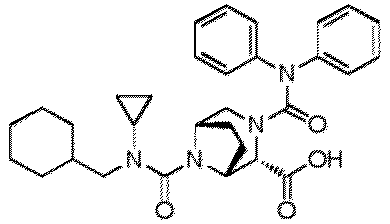
(1R,2S,5S)-8-((cyclohexylm ethyl)(cyclopro pyl)carbamoyl) -3-(diphenylcarba moyl)-3,8-diazabicyclo [3. 2.1]octane-2-carboxylic acid 
1H NMR (400 MHz, DMSO-d6 ) δ 12.93 (s, 1H), 7.36 (t, J = 7.9 Hz, 4H), 7.17 (t, J = 7.4 Hz, 2H), 7.02 (d, J = 7.6 Hz, 4H), 4.48 - 4.18 (m, 2H), 4.08 (s, 1H), 3.34 (dd, J = 13.4, 8.7 Hz, 1H), 2.68 (dd, J = 13.4, 5.5 Hz, H), 2.58 (s, 1H), 1.73 - 1.48 (m, 7H), 1.42 (s, 2H), 1.29 - 1.05 (m, 4H), 0.92 - 0.67 (m, 3H), 0.65 - 0.57 (m, 1H), 0.55 - 0.40 (m, 2H). MS m/z (ESI): 530.7 [M+H]+. C20 1 
(1R,2S,5S)-3-(diphenylcarba moyl)-8-(ethyl(thiophen e-2-ylmethyl)carba moyl)-3,8-diazabicyclo [3. 2.1]octane-2-carboxylic acid 
1H NMR (400 MHz, CD3OD) δ 7.40 - 7.33 (m, 4H), 7.30 (dd, J = 5.2, 1.2 Hz, 1H), 7.24 - 7.18 (m, 2H), 7.15 - 7.05 (m, 4H), 7.00 - 6.92 (m, 2H), 4.70 (d, J = 15.6 Hz, 1H), 4.58 - 4.45 (m, 3H), 3.99 (s, 1H), 3.58 - 3.45 (m, 2H), 3.40 - 3.34 (m, 1H), 3.23 - 3.14 (m, 1H), 1.95 - 1.53 (m, 4H), 1.11 (t, J = 7.2 Hz, 3H). MS m/z (ESI): 518.8 [M+H]+. C24 5 
(1R,2S,5S)-8-((benzo [b]thio phene-3-ylmethyl)(ethyl )carbamoyl)-3-(diphenylcarba moyl)-3,8-diazabicyclo [3. 2.1]octane-2-carboxylic acid 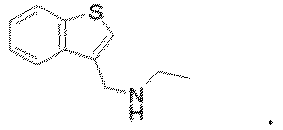
1H NMR (400 MHz, DMSO-d6 ) δ 13.04 (s, 1H), 8.02 - 7.95 (m, 1H), 7.69 (dd, J = 6.1, 2.8 Hz, 1H), 7.60 (s, 1H), 7.44 - 7.31 (m, 6H), 7.16 (t, J = 7.4 Hz, 2H), 7.01 (d, J = 7.5 Hz, 4H), 4.82 (d, J = 15.4 Hz, 1H), 4.44 (d, J = 15.4 Hz, 1H), 4.41 - 4.27 (m, 2H), 3.88 (s, 1H), 3.38 (dd, J = 29.8, 12.4 Hz, 2H), 3.29 - 3.18 (m, 1H), 3.03 - 2.91 (m, 1H), 1.83 - 1.68 (m, 1H), 1.63 - 1.50 (m, 1H), 1.46 - 1.31 (m, 1H), 1.24 (s, 1H), 0.98 (t, J = 7.0 Hz, 3H) . MS m/z (ESI): 569.1 [M+H]+. C24 6 
(1R,2S,5S)-8-(benzo [b]thiop hene-3-ylmethyl)(meth yl)carbamoyl)-3-(diphenylcarba moyl)-3,8-diazabicyclo [3. 2.1]octane-2-carboxylic acid 
1H NMR (400 MHz, DMSO-d6 ) δ 8.00 - 7.97 (m, 1H), 7.72 - 7.65 (m, 1H), 7.60 (s, 1H), 7.40 - 7.30 (m, 6H), 7.16 (t, J = 7.2 Hz, 2H), 7.00 (d, J = 6.0 Hz, 4H), 4.82 (d, J = 15.0 Hz, 1H), 4.44 (d, J = 15.1 Hz, 1H), 4.39 (s, 1H), 3.84 (s, 1H), 3.43 - 3.35 (m, 2H), 2.72 (s, 3H), 1.77 (s, 1H), 1.54 (s, 1H), 1.33 (d, J = 14.4 Hz, 1H), 1.31 - 1.24 (m, 1H). MS m/z (ESI): 555.0 [M+H]+. C15 6 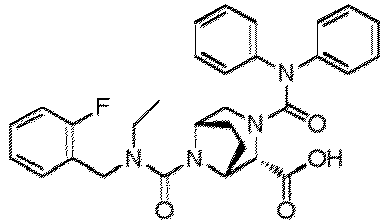
(1R,2S,5S)-3-(diphenylcarba moyl)-8-(ethyl(2-fluorobenzyl)c arbamoyl)-3,8-diazabicyclo [3. 2.1]octane-2-carboxylic acid 
1H NMR (400 MHz, DMSO-d6 ) δ 13.04 (s, 1H), 7.43 - 7.32 (m, 4H), 7.31 - 7.21 (m, 2H), 7.21 - 7.11 (m, 4H), 7.01 (d, J = 7.6 Hz, 4H), 4.57 (d, J = 15.6 Hz, 1H), 4.31 (s, 1H), 4.25 (d, J = 15.6 Hz, 1H), 3.89 (s, 1H), 3.43 (d, J = 12.0 Hz, 1H), 3.35 (d, J = 12.2 Hz, 1H), 3.29 - 3.21 (m, 1H), 3.05 - 2.96 (m, 1H), 2.49 - 2.44 (m, 1H), 1.66 (s, 1H), 1.52 (s, 1H), 1.44 - 1.17 (m, 2H), 1.00 (t, J = 6.8 Hz, 3H). MS m/z (ESI): 531.1 [M+H]+. C19 8 
(1R,2S,5S)-3-(diphenylcarba moyl)-8-((1-methylcyclopr opyl(thiophene -3-ylmethyl)carba moyl)-3,8-diazabicyclo [3. 2.1]octane-2-carboxylic acid 
1H NMR (400 MHz, DMSO-d6 ) δ 13.05 (s, 1H), 7.50 - 7.44 (m, 1H), 7.35 (t, J = 8.0 Hz, 4H), 7.28 (d, J = 2.0 Hz, 1H), 7.23 - 7.13 (m, 2H), 7.01 (d, J = 7.6 Hz, 4H), 6.96 (d, J = 4.6 Hz, 1H), 4.55 (d, J = 15.2 Hz, 1H), 4.44 - 4.25 (m, 2H), 4.19 (d, J = 15.2 Hz, 1H), 3.94 (s, 1H), 3.42 - 3.36 (m, 2H), 1.70 - 1.20 (m, 4H), 0.97 (s, 3H), 0.75 - 0.65 (m, 2H), 0.59 - 0.56 (m, 1H), 0.48 - 0.44 (m, 1H). MS m/z (ESI): 545.1 [M+H]+. C11 4 
(1R,2S,5S)-3-(diphenylcarba moyl)-8-((2-fluorobenzyl)( methyl)carbam oyl)-3,8-diazabicyclo [3. 2.1]octane-2-carboxylic acid 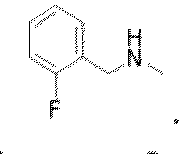
1H NMR (400 MHz, DMSO-d6 ) δ 12.96 (s, 1H), 7.37 - 7.33 (m, 4H), 7.33 - 7.21 (m, 2H), 7.21 - 7.19 (m, 4H), 7.01 (d, J = 7.6 Hz, 4H), 4.56 (d, J = 15.6 Hz, 1H), 4.34 (s, 1H), 4.27 (d, J = 15.6 Hz, 1H), 3.90 (s, 1H), 3.46 - 3.35 (m, 2H), 3.33 - 3.27 (m, 1H), 2.75 (s, 3H), 1.69 (s, 1H), 1.53 (s, 1H), 1.30 (d, J = 47.7 Hz, 2H). MS m/z (ESI): 517.2 [M+H]+. C14 2 
(1R,2S,5S)-8-((S)-2-(2,5-difluorophenyl )pyrrolidine-1-carbonyl)-3-(diphenylcarba moyl)-3,8-diazabicyclo [3. 2.1]octane-2-carboxylic acid 
1H NMR (400 MHz, DMSO-d6 ) δ 13.23 (s, 1H), 7.43 - 6.94 (m, 13H), 5.01 (t, J = 7.8 Hz, 1H), 4.56 (s, 1H), 4.32 - 4.06 (m, 1H), 4.00 (s, 1H), 3.72 - 3.60 (m, 1H), 3.52 (t, J = 7.2 Hz, 1H), 3.41 (d, J = 11.4 Hz, 1H), 3.24 (d, J = 11.7 Hz, 1H), 2.33 - 2.19 (m, 1H), 1.91 - 1.71 (m, 2H), 1.59 - 1.16 (m, 5H). MS m/z (ESI): 560.7 [M+H]+. C14 1 
(1R,2S,5S)-8-((R)-2-(2,5-difluorophenyl )pyrrolidine-1-carbonyl)-3-(diphenylcarba moyl)-3,8-diazabicyclo [3. 2.1]octane-2-carboxylic acid 
1H NMR (400 MHz, DMSO-d6 ) δ 13.23 (s, 1H), 7.44 - 6.95 (m, 13H), 5.01 (t, J = 7.8 Hz, 1H), 4.56 (s, 1H), 4.32 - 4.09 (m, 1H), 4.00 (s, 1H), 3.71 - 3.58 (m, 1H), 3.57 - 3.48 (m, 1H), 3.41 (d, J = 11.4 Hz, 1H), 3.24 (d, J = 11.7 Hz, 1H), 2.35 - 2.21 (m, 1H), 1.91 - 1.72 (m, 2H), 1.62 - 1.11 (m, 5H). MS m/z (ESI): 560.7 [M+H]+. C20 2 
(1R,2S,5S)-3-(diphenylcarba moyl)-8-(ethyl((5-methylthiophe n-2-yl)methyl)carb amoyl)-3,8-diazabicyclo [3. 2.1]octane-2-carboxylic acid 
1H NMR (400 MHz, DMSO-d6 ) δ 7.35 (t, J = 7.6 Hz, 4H), 7.16 (t, J = 7.2 Hz, 2H), 7.01 (d, J = 8.0 Hz, 4H), 6.75 (s, 1H), 6.60 (s, 1H), 4.51 - 4.42 (m, 1H), 4.37 - 4.10 (m, 3H), 3.88 (s, 1H), 3.44 (d, J = 12.0 Hz, 1H), 3.34 (d, J = 12.0 Hz, 1H), 3.29 - 3.13 (m, 1H), 3.09 - 2.98 (m, 1H), 2.37 (s, 3H), 1.74 - 1.21 (m, 4H), 1.01 (t, J = 6.8 Hz, 3H). MS m/z (ESI): 533.1 [M+H]+. C24 9 
(1R,2S,5S)-8-(((1H-indole-6-yl)methyl)(met hyl)carbamoyl) -3-(diphenylcarba moyl)-3,8-diazabicyclo [3. 2.1]octane-2-carboxylic acid 
1H NMR (400 MHz, , DMSO-d6 ) δ 11.02 (s, 1H), 7.48 (d, J = 8.4 Hz, 1H), 7.41 - 7.28 (m, 5H), 7.23 (s, 1H), 7.17 (t, J = 7.2 Hz, 2H), 7.01 (d, J = 7.6 Hz, 4H), 6.83 (d, J = 8.0 Hz, 1H), 6.39 (s, 1H), 4.51 (d, J = 14.8 Hz, 1H), 4.35 (d, J = 14.8 Hz, 3H), 3.91 (s, 1H), 2.72 - 2.66 (m, 3H), 1.76 (s, 1H), 1.57 (s, 2H), 1.39 (s, 1H). MS m/z (ESI): 537.7 [M+H]+. C20 4 
(1R,2S,5S)-8-(cyclopropyl(5 methylthiophe n-2-yl)methyl)carb amoyl)-3-(diphenylcarba moyl)-3,8-diazabicyclo [3. 2.1]octane-2-carboxylic acid 
1H NMR (400 MHz, DMSO-d6 ) δ 13.00 (s, 1H), 7.36 (t, J = 7.6 Hz, 4H), 7.21 - 7.11 (m, 2H), 7.02 (d, J = 8.0 Hz, 4H), 6.79 - 6.69 (m, 1H), 6.62 (s, 1H), 4.72 (d, J = 15.2 Hz, 1H), 4.52 - 4.22 (s, 2H), 4.19 - 4.04 (m, 2H), 3.93 - 3.59 (m, 2H), 2.38 (s, 4H), 1.69 (s, 1H), 1.49 (s, 3H), 0.74 (s, 1H), 0.61 (d, J = 5.2 Hz, 2H), 0.53 (s, 1H). MS m/z (ESI): 545.1 [M+H]+. C25 2 
(1R,2S,5S)-8-(((2,3-dihydrobenzo[ b][1,4]dioxin-6-yl)methyl)(met hyl)carbamoyl) -3-(diphenylcarba moyl)-3,8-diazabicyclo [3. 2.1]octane-2-carboxylic acid 
1H NMR (400 MHz, DMSO-d6 ) δ 13.06 (s, 1H), 7.35 (t, J = 7.7 Hz, 4H), 7.17 (t, J = 7.4 Hz, 2H), 7.01 (d, J = 7.9 Hz, 4H), 6.79 (d, J = 8.1 Hz, 1H), 6.72 - 6.57 (m, 2H), 4.35 (s, 1H), 4.28 (d, J = 15.0 Hz, 2H), 4.21 (s, 4H), 4.15 (d, J = 14.9 Hz, 1H), 3.90 (s, 1H), 3.39 (dd, J = 30.2, 12.1 Hz, 2H), 2.67 (s, 3H), 1.73 (s, 1H), 1.54 (s, 1H), 1.40 (s, 1H), 1.28 - 1.16 (m, 1H). MS m/z (ESI): 556.6 [M+H]+. C22 6 
(1R,2S,5S)-3-(diphenylcarba moyl)-8-(methyl((R)-1-phenylethyl)ca rbamoyl)-3,8-diazabicyclo [3. 2.1]octane-2-carboxylic acid 
1H NMR (400 MHz, , DMSO-d6 ) δ 7.39 - 7.31 (m, 6H), 7.29 - 7.21 (m, 3H), 7.20 - 7.14 (m, 2H), 7.03 - 7.00 (m, 4H), 5.21 - 5.15 (m, 1H), 4.37 - 4.25 (m, 2H), 3.86 (s, 1H), 3.46 - 3.36 (m, 2H), 2.43 (s, 3H), 1.80 - 1.51 (m, 3H), 1.46 (d, J = 7.2 Hz, 3H), 1.40 -1.30 (m, 1H). MS m/z (ESI): 513.2 [M+H]+. C22 7 
(1R,2S,5S)-3-(diphenylcarba moyl)-8-(methyl((S)-1-phenylethyl)ca rbamoyl)-3,8-diazabicyclo [3. 2.1]octane-2-carboxylic acid 
1H NMR (400 MHz, , DMSO-d6 ) δ 13.00 (s, 1H), 7.39 - 7.32 (m, 6H), 7.29 - 7.23 (m, 3H), 7.20 - 7.14 (m, 2H), 7.01 (d, J = 7.6 Hz, 4H), 5.27 - 5.19 (m, 1H), 4.32 (s, 2H), 3.93 (s, 1H), 3.46 - 3.36 (m, 2H), 2.55 (d, J = 14.2 Hz, 3H), 1.71 (s, 1H), 1.65 - 1.53 (m, 1H), 1.53 - 1.26 (m, 5H). MS m/z (ESI): 513.1 [M+H]+. C20 3 
(1R,2S,5S)-3-(diphenylcarba moyl)-8-(methyl((5-methylthiophe n-2-yl)methyl)carb amoyl)-3,8-diazabicyclo [3. 2.1]octane-2-carboxylic acid 
1H NMR (400 MHz, DMSO-d6 ) δ 7.36 (t, J = 7.6 Hz, 4H), 7.17 (t, J = 7.6 Hz, 2H), 7.01 (d, J = 7.6 Hz, 4H), 6.76 (d, J = 3.2 Hz, 1H), 6.63 - 6.15 (m, 1H), 4.43 - 4.31 (m, 4H), 3.89 (s, 1H), 3.44 - 3.32 (m, 2H), 2.73 (s, 3H), 2.38 (s, 3H), 1.75 - 1.30 (m, 4H). MS m/z (ESI): 518.8 [M+H]+. C18 5 
(1R,2S,5S)-3-(diphenylcarba moyl)-8-(methyl(5-methylthiophe n-3-yl)methyl)carb amoyl)-3,8-diazabicyclo [3. 2.1]octane-2-carboxylic acid 
1H NMR (400 MHz, DMSO-d6 ) δ 7.36 (t, J = 8.0 Hz, 4H), 7.17 (t, J = 7.2 Hz, 2H), 7.05 - 6.96 (m, 5H), 6.64 (s, 1H), 4.39 - 4.23 (m, 3H), 4.15 (d, J = 14.8 Hz, 1H), 3.91 (s, 1H), 3.45 - 3.35 (m, 2H), 2.70 (s, 3H), 2.40 (s, 3H), 1.80 - 1.45 (m, 4H). MS m/z (ESI): 519.1 [M+H]+. C18 6 
(1R,2S,5S)-8-(((5-chlorothiophen e-3-yl)methyl)(met hyl)carbamoyl) -3-(diphenylcarba moyl)-3,8-diazabicyclo [3. 2.1]octane-2-carboxylic acid 
1H NMR (400 MHz, DMSO-d6 ) δ 13.15 (s, 1H), 7.35 (t, J = 7.6 Hz, 4H), 7.22 (s, 1H), 7.16 (t, J = 7.2 Hz, 2H), 7.02 (d, J = 7.6 Hz, 4H), 6.95 (d, J = 1.6 Hz, 1H), 4.36 (s, 1H), 4.28 (d, J = 15.2 Hz, 2H), 4.22 - 4.11 (m, 1H), 3.93 (s, 1H), 3.50 - 3.36 (m, 2H), 2.73 (s, 3H), 1.67 (s, 1H), 1.60 - 1.50 (m, 1H), 1.46 - 1.23 (m, 2H). MS m/z (ESI): 539.0 [M+H]+. C20 8 
(1R,2S,5S)-3-(diphenylcarba moyl)-8-(ethyl((5-methylthiophe n-3-yl)methyl)carb amoyl)-3,8-diazabicyclo [3. 2.1]octane-2-carboxylic acid 
1H NMR (400 MHz, DMSO-d6 ) δ 7.36 (t, J = 7.2 Hz, 4H), 7.17 (t, J = 7.2 Hz, 2H), 7.03 - 7.00 (m, 5H), 6.63 (s, 1H), 4.36 - 4.20 (m, 3H), 4.13 (d, J = 15.6 Hz, 1H), 3.88 (s, 1H), 3.45 - 3.30 (m, 2H), 3.21 - 3.15 (m, 1H), 3.02 - 2.96 (m, 1H), 2.40 (s, 3H), 1.70 - 1.49 (m, 2H), 1.45 - 1.24 (m, 2H), 0.98 (t, J = 7.2 Hz, 3H). MS m/z (ESI): 532.8 [M+H]+. C27 4 
(1R,2S,5S)-8-(((5-chlorothiophen e-3-yl)methyl)(eth yl)carbamoyl)-3-(diphenylcarba moyl)-3,8-diazabicyclo [3. 2.1]octane-2-carboxylic acid 
1H NMR (400 MHz DMSO-d6 ) δ 13.10 (s, 1H), 7.35 (t, J = 8.0 Hz, 4H), 7.21 (d, J = 1.2 Hz, 1H), 7.16 (t, J = 7.2 Hz, 2H), 7.02 (d, J = 7.6 Hz, 4H), 6.94 (d, J = 1.6 Hz, 1H), 4.34 (d, J = 15.6 Hz, 2H), 4.16 (d, J = 15.6 Hz, 1H), 3.90 (s, 1H), 3.45 - 3.35 (m, 2H), 3.25 - 3.15 (m, 1H), 3.07 - 2.98 (m, 1H), 1.66 (s, 1H), 1.55 (s, 1H), 1.45 - 1.19 (m, 2H), 0.99 (t, J = 7.0 Hz, 3H). MS m/z (ESI): 552.7 [M+H]+. C27 1 
(1R,2S,5S)-8-(benzo [b]thiop hene-2-ylmethyl)(meth yl)carbamoyl)-3-(diphenylcarba moyl)-3,8-diazabicyclo [3. 2.1]octane-2-carboxylic acid 
1H NMR (400 MHz, DMSO-d6 ) δ 13.01 (s, 1 H), 7.90 (d, J = 7.6 Hz, 1H), 7.81 - 7.75 (m, 1H), 7.39 - 7.29 (m, 7H), 7.17 (t, J = 7.2 Hz, 2H), 7.02 (d, J = 7.2 Hz, 4H), 4.65 (d, J = 15.6 Hz, 1H), 4.54 (d, J = 15.6 Hz, 1H), 4.45 - 4.20 (m, 2H), 3.96 (s, 1H), 3.50 - 3.33 (m, 2H), 2.83 (s, 3H), 1.80 - 1.30 (m, 4H). MS m/z (ESI): 555.1 [M+H]+. C27 3 
(1R,2S,5S)-3-(diphenylcarba moyl)-8-(ethyl((4-methylthiophe n-2-yl)methyl)carb amoyl)-3,8-diazabicyclo [3. 2.1]octane-2-carboxylic acid 
1H NMR (400 MHz DMSO-d6 ) δ 7.35 (t, J = 8.0 Hz, 4H), 7.16 (t, J = 7.2 Hz, 2H), 7.07 - 6.90 (m, 5H), 6.79 (s, 1H), 4.52 (d, J = 15.6 Hz, 1H), 4.35 (d, J = 15.6 Hz, 2H), 3.88 (s, 1H), 3.44 (d, J = 12.8 Hz, 1H), 3.34 (d, J = 12.0 Hz, 2H), 3.25 - 3.16 (m, 1H), 3.11 - 3.02 (m, 1H), 2.18 - 2.11 (m, 3H), 1.67 (s, 1H), 1.55 (s, 1H), 1.49 - 1.24 (m, 2H), 1.02 (t, J = 7.0 Hz, 3H). MS m/z (ESI): 532.9 [M+H]+. C27 2 
(1R,2S,5S)-3-(diphenylcarba moyl)-8-(ethyl((3-methylthiophe n-2-yl)methyl)carb amoyl)-3,8-diazabicyclo [3. 2.1]octane-2-carboxylic acid 
1H NMR (400 MHz, DMSO-d6 ) δ 13.02 (s, 1H), 7.36 (t, J = 7.6 Hz, 4H), 7.28 (d, J = 5.2 Hz, 1H), 7.17 (t, J = 7.2 Hz, 2H), 6.99 (d, J = 7.6 Hz, 4H), 6.81 (t, J = 8.0 Hz, 1H), 4.57 (d, J = 15.6 Hz, 1H), 4.42 - 4.16 (m, 3H), 3.88 (s, 1H), 3.45 (d, J = 12.0 Hz, 1H), 3.36 (s, 1H), 3.27 - 3.16 (m, 1H), 3.07 - 2.96 (m, 1H), 2.16 - 2.08 (m, 3H), 1.70 (s, 1H), 1.54 (s, 1H), 1.45 - 1.20 (m, 2H), 1.04 - 0.96 (m, 3H). MS m/z (ESI): 533.2 [M+H]+. C19 7 
(1R,2S,5S)-8-(cyclopropyl(5 methylthiophe n-3-yl)methyl)carb amoyl)-3-(diphenylcarba moyl)-3,8-diazabicyclo [3. 2.1]octane-2-carboxylic acid 
1H NMR (400 MHz, DMSO-d6 ) δ 12.96 (s, 1H), 7.36 (t, J = 8.0 Hz, 4H), 7.17 (t, J = 7.2 Hz, 2H), 7.02 (d, J = 7.6 Hz, 4H), 6.98 (s, 1H), 6.62 (s, 1H), 4.52 (d, J = 15.2 Hz, 1H), 4.46 (s, 1H), 4.38 - 4.21 (m, 1H), 4.17 - 4.05 (m, 1H), 3.96 (d, J = 14.8 Hz, 1H), 3.45 - 3.35 (m, 2H), 2.45 - 2.35 (m, 4H), 1.75 - 1.20 (m, 4H), 0.75 - 0.40 (m, 4H). MS m/z (ESI): 544.6 [M+H]+. C28 1 
(1R,2S,5S)-8-(((5-chlorothiophen e-2-yl)methyl)(eth yl)carbamoyl)-3-(diphenylcarba moyl)-3,8-diazabicyclo [3. 2.1]octane-2-carboxylic acid 
1H NMR (400 MHz, DMSO-d6 ) δ 13.07 (s, 1H), 7.35 (t, J = 7.6 Hz, 4H), 7.17 (t, J = 7.6 Hz, 2H), 7.02 (d, J = 7.6 Hz, 4H), 6.93 (d, J = 4.0 Hz, 1H), 6.90 (d, J = 4.0 Hz, 1H), 4.43 (d, J = 15.6 Hz, 1H), 4.37 - 4.20 (m, 3H), 3.90 (s, 1H), 3.45 (d, J = 11.6 Hz, 1H), 3.36 (s, 1H), 3.25 - 3.15 (m, 6.7 Hz, 1H), 3.12 - 3.04 (m, 1H), 1.65 (s, 1H), 1.55 (s, 1H), 1.41 (s, 2H), 1.03 (t, J = 7.0 Hz, 3H). MS m/z (ESI): 553.2 [M+H]+. C16 3 
(1R,2S,5S)-3-(diphenylcarba moyl)-8-(methyl(2-methylbenzyl)c arbamoyl)-3,8-diazabicyclo [3. 2.1]octane-2-carboxylic acid 
1H NMR (400 MHz, DMSO-d6 ) δ 7.51 - 6.86 (m, 14H), 4.50 - 4.20 (m, 4H), 3.91 (s, 1H), 3.51 - 3.45 (m, 1H), 2.71 (s, 3H), 2.16 (s, 3H), 1.70 - 1.10 (m, 4H). MS m/z (ESI): 513.1 [M+H]+. C11 9 
(1R,2S,5S)-8-((benzyloxy)ca rbonyl)-3-(1-phenylcyclohe xane-1-carbonyl)-3,8-diazabicyclo [3. 2.1]octane-2-carboxylic acid 
1H NMR (400 MHz, DMSO-d6 ) δ 7.40 - 7.24 (m, 10H), 5.03 (d, J = 13.2 Hz, 1H), 5.00 - 4.80 (m, 1H), 4.72 (s, 1H), 4.64 (d, J = 6.0 Hz, 1H), 3.92 (s, 1H), 3.19 (d, J = 12.0 Hz, 1H), 3.03 (d, J = 12.0 Hz, 1H), 2.36 - 2.25 (m, 2H), 1.86 - 1.29 (m, 12H). MS m/z (ESI): 477.2 [M+H]+. C12 0 
(1R,2S,5S)-8-(benzyl(methyl )carbamoyl)-3-(1-phenylcyclohe xane-1-carbonyl)-3,8-diazabicyclo [3. 2.1]octane-2-carboxylic acid 
1H NMR (400 MHz, DMSO-d6 ) δ 7.39 - 7.23 (m, 8H), 7.14 (d, J = 7.2 Hz, 2H), 4.84 (s, 1H), 4.45 - 4.36 (m, 2H), 4.25 - 4.15 (m, 1H), 3.62 (s, 1H), 3.30 - 3.10 (m, 2H), 2.64 (s, 3H), 2.35 - 220 (m, 2H), 1.85 - 1.70 (m, 3H), 1.69 - 1.47 (m, 5H), 1.40 - 1.20 (m, 4H). MS m/z (ESI): 490.1 [M+H]+. C12 2 
(1R,2S,5S)-8-(phenylcarbam oyl)-3-(1-phenylcyclohe xane-1-carbonyl)-3,8-diazabicyclo [3. 2.1]octane-2-carboxylic acid 
1H NMR (400 MHz, DMSO-d6 ) δ 8.49 (brs, 1H), 7.46 - 7.14 (m, 9H), 6.95 - 6.85 (s, 1H), 4.89 (d, J = 6.4 Hz, 1H), 4.74 (s, 1H), 4.06 (s, 1H), 3.2 - 3.05 (m, 2H), 2.35 - 220 (m, 2H), 1.90 - 1.50 (m, 8H), 1.50 - 1.33 (m, 2H), 1.3 - 1.15 (m, 2H). MS m/z (ESI): 462.1 [M+H]+. C37 
(1R,2S,5S)-8-((benzyloxy)ca rbonyl)-3-(diphenylcarba moyl)-3,8-diazabicyclo [3. 2.1]octane-2-carboxylic acid Compound 20 in step 5a of Example 5 was replaced with Compound 23. The phenyl chloroformate was replaced with benzyl chloroformate. The reaction in step 5b did not take place. 1H NMR (400 MHz, DMSO-d6 ) δ 13.03 (s, 1H), 7.40 - 7.26 (m, 8H), 7.17 (t, J = 7.4 Hz, 2H), 7.01 (d, J = 7.5 Hz, 4H), 5.08 (d, J = 12.8 Hz, 1H), 4.98 (s, 1H), 4.58 (s, 1H), 4.25 (d, J = 22.0 Hz, 2H), 3.44 (d, J = 12.1 Hz, 1H), 3.27 (d, J= 10.9 Hz, 1H), 1.77 - 1.62 (m, 2H), 1.45 - 1.23 (m, 2H). MS m/z (ESI): 486.0 [M+H]+. C17 4 
(1R,2S,5S)-8-cinnamoyl-3-(diphenylcarba moyl)-3,8-diazabicyclo [3. 2.1]octane-2-carboxylic acid Compound 20 in step 5a of Example 5 was replaced with Compound 23. The phenyl chloroformate was replaced with cinnamoyl chloride. The reaction in step 5b did not take place. 1H NMR (400 MHz, DMSO-d6 ) δ 13.27 (s, 1H), 7.67 (d, J = 16.8 Hz, 2H), 7.52 - 7.29 (m, 7H), 7.18 (t, J = 7.4 Hz, 2H), 7.02 (d, J = 7.6 Hz, 4H), 5.03 (d, J = 28.3 Hz, 1H), 4.66 (d, J = 47.4 Hz, 1H), 4.35 (s, 1H), 3.47 (s, 1H), 3.19 (s, 1H), 1.93 - 1.62 (m, 2H), 1.58 - 1.35 (m, 2H). MS m/z (ESI): 481.8 [M+H]+. C19 3 
(1R,2S,5S)-3-(diphenylcarba moyl)-8-(((4-methylbenzyl) oxy)carbonyl)-3,8-diazabicyclo [3. 2.1]octane-2-carboxylic acid 
1H NMR (400 MHz, DMSO-d6 ) δ 13.01 (brs, 1H), 7.36 (t, J = 8.0 Hz, 4H), 7.24 - 7.12 (m, 6H), 7.00 (d, J = 7.6 Hz, 4H), 5.05 - 4.85 (m, 2H), 4.57 (d, J = 5.6 Hz, 1H), 4.25 (s, 1H), 4.20 (s, 1H), 3.43 (d, J = 11.6 Hz, 1H), 3.26 (d, J = 11.2 Hz, 1H), 2.29 (s, 3H), 1.80 - 1.58 (m, 2H), 1.45 - 1.25 (m, 2H). MS m/z (ESI): 499.8 [M+H]+. C22 1 
(1R,2S,5S)-3-(diphenylcarba moyl)-8-(3-phenylpropion yl)-3,8-diazabicyclo [3. 2.1]octane-2-carboxylic acid Compound 20 in step 5a of Example 5 was replaced with Compound 23. The phenyl chloroformate was replaced with phenyl propionyl chloride. The reaction in step 5b did not take place. 1H NMR (400 MHz, DMSO-d6 ) δ 7.35 (t, J = 8.0 Hz, 4H), 7.30 - 7.14 (m, 7H), 7.00 (t, J = 7.2 Hz, 4H), 4.90 - 4.30 (m, 2H), 4.25 (s, 1H), 3.45 - 3.25 (m, 2H), 3.05 (d, J = 12 Hz, 1H), 2.75 (t, J = 8.0 Hz, 2H), 2.65 - 2.30 (m, 2H), 1.60 - 1.40 (m, 2H), 1.39 - 1.20 (m, 2H). MS m/z (ESI): 484.1 [M+H]+. C23 8 
(1R,2S,5S)-3-(diphenylcarba moyl)-8-(4-phenyl-1H-iminazole-5-carbonyl)-3,8-diazabicyclo [3. 2.1]octane-2-carboxylic acid 
1H NMR (400 MHz, CDCl3) δ 7.74 - 6.82 (m, 15H), 4.64 (s, 1H), 4.27 (s, 1H), 4.05 (s, 1H), 3.66 (s, 1H), 3.50 (d, J = 9.1 Hz, 1H), 1.71 (s, 1H), 1.45 (s, 1H), 1.22 (s, 1H), 0.95 - 0.75 (m, 1H). MS m/z (ESI): 522.0 [M+H]+. C24 0 
(1R,2S,5S)-8-([1,1'-biphenyl]-2-carbonyl)-3-(diphenylcarba moyl)-3,8-diazabicyclo [3. 2.1]octane-2-carboxylic acid 
1H NMR (400 MHz, DMSO-d6 ) δ 13.01 (s, 1H), 7.60 - 7.05 (m, 15H), 6.92 (d, J = 7.7 Hz, 4H), 4.81 (s, 1H), 4.46 (s, 1H), 4.21 (s, 1H), 3.96 (s, 1H), 3.58 (s, 1H), 1.24 (m, 2H), 0.89 (m, 2H). MS m/z (ESI): 531.8 [M+H]+. C23 9 
(1R,2S,5S)-8-(2-(4-bromophenyl)c yclopropane-1-carbonyl)-3-(diphenylcarba moyl)-3,8-diazabicyclo [3. 2.1]octane-2-carboxylic acid 
1H NMR (400 MHz, DMSO-d6 ) δ 7.50 - 7.00 (m, 14H), 5.00 - 4.75 (m, 1H), 4.70 - 4.20 (m, 2H), 3.40 - 3.00 (m, 2H), 2.30 - 2.00 (m, 2H), 1.75 - 1.50 (m, 2H), 1.49 - 1.00 (m, 4H). MS m/z (ESI): 575.7 [M+H]+. C25 9 
(1R,2S,5S)-8-(2-(1H-indole-3-yl)acetyl)-3-(diphenylcarba moyl)-3,8-diazabicyclo [3. 2.1]octane-2-carboxylic acid 
1H NMR (400 MHz, DMSO-d6 ) δ 10.87 (s, 1H), 7.58 - 7.25 (m, 6H), 7.26 - 7.11 (m, 3H), 7.11 - 6.84 (m, 6H), 4.83 (d, J = 39.7 Hz, 1H), 4.45 (d, J = 38.5 Hz, 1H), 4.23 (s, 1H), 3.77 (d, J = 49.0 Hz, 1H), 3.64 (s, 1H), 3.53 - 3.42 (m, 1H), 3.11 (d, J = 12.9 Hz, 1H), 1.50 (s, 2H), 1.35 (s, 2H). MS m/z (ESI): 509.1 [M+H]+. C22 4 
(1R,2S,5S)-3-(diphenylcarba moyl)-8-(3-phenylbutyryl) -3,8-diazabicyclo [3. 2.1]octane-2-carboxylic acid 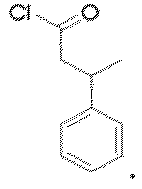
1H NMR (400 MHz, DMSO-d6 ) δ 7.39 - 7.30 (m, 4H), 7.29 - 7.21 (m, 3H), 7.20 - 7.11 (m, 4H), 7.01 (dd, J = 7.8, 7.6 Hz, 4H), 4.83 (s, 1H), 4.53 - 4.09 (m, 2H), 3.39 (s, 1H), 3.15 - 2.99 (m, 2H), 2.72 - 2.56 (m, 1H), 2.42 - 2.30 (m, 1H), 1.61 (s, 1H), 1.39 (s, 1H), 1.31 - 1.21 (m, 2H), 1.21 - 1.13 (m, 3H). MS m/z (ESI): 498.1 [M+H]+. C26 4 
(1R,2S,5S)-3-(diphenylcarba moyl)-8-(4-oxo-4H-benzopyran-2-carbonyl)-3,8-diazabicyclo [3. 2.1]octane-2-carboxylic acid 
1H NMR (400 MHz, CD3OD) δ 8.17 (d, J = 6.8 Hz, 1H), 7.90 - 7.77 (m, 1H), 7.61 - 7.51 (m, 1H), 7.50 - 7.30 (m, 5H), 7.28 - 7.18 (m, 2H), 7.11 (t, J = 8.4, 8.8 Hz, 4H), 5.21 (s, 1H), 4.57 (d, J = 48.4 Hz, 2H), 3.62 (dd, J = 47.1, 27.4 Hz, 3H), 1.97 (s, 1H), 1.72 (s, 3H). MS m/z (ESI): 524.0 [M+H]+. C25 6 
(1R,2S,5S)-3-(diphenylcarba moyl)-8-(3-phenylpropiolo yl)-3,8-diazabicyclo [3. 2.1]octane-2-carboxylic acid 
1H NMR (400 MHz, DMSO-d6 ) δ 13.26 (s, 1H), 7.70 - 6.98 (m, 15H), 4.93 - 4.85 (m, 1H), 4.63 - 4.49 (m, 1H), 4.38 (d, J = 35.6 Hz, 1H), 3.41 (d, J = 10.4 Hz, 1H), 3.28 - 3.16 (m, 1H), 1.96 - 1.85 (m, 1H), 1.84 - 1.75 (m, 1H), 1.74 - 1.63 (m, 1H), 1.46 - 1.38 (m, 2H). MS m/z (ESI): 480.1 [M+H]+. C25 7 
(1R,2S,5S)-8-(3-(4-chlorophenyl)p ropioloyl)-3-(diphenylcarba moyl)-3,8-diazabicyclo [3. 2.1]octane-2-carboxylic acid 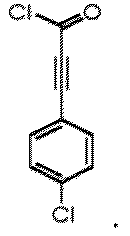
1H NMR (400 MHz, DMSO-d6 ) δ 13.15 (s, 1H), 7.72 - 7.50 (m, 4H), 7.35 (t, J = 7.6, 8.0 Hz, 4H), 7.21 (t, J = 7.6, 7.2 Hz, 2H), 7.01 (d, J = 8.0 Hz, 4H), 4.92 - 4.85 (m, 1H), 4.60 - 4.50 (m, 1H), 4.45 - 4.30 (m, 1H), 3.45 - 3.32 (m, 1H), 3.23 (d, J = 24.0 Hz, 1H), 1.90 - 1.62 (m, 2H), 1.44 (s, 2H). MS m/z (ESI): 514.0 [M+H]+. C35 
(1R,2S,5S)-3-(2,2-diphenylacetyl) -8-(((2-fluorobenzyl)o xy)carbonyl)-3,8-diazabicyclo [3. 2.1]octane-2-carboxylic acid 
1H NMR (400 MHz, DMSO-d6 ) δ 7.45 - 7.05 (m, 14H), 5.55 - 5.30 (m, 1H), 5.20 - 4.60 (m, 2H), 4.30 - 4.00 (m, 2H), 3.71 - 3.50 (m, 1H), 3.45 - 3.37 (m, 2H), 1.90 - 1.00 (m, 4H). MS m/z (ESI): 502.8 [M+H]+. C24 1 
(1R,2S,5S)-3-(diphenylcarba moyl)-8-(2-(1-methyl-1H-pyrazole-4-yl)benzoyl)-3,8-diazabicyclo [3. 2.1]octane-2-carboxylic acid 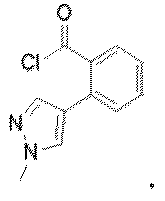
1H NMR (400 MHz, DMSO-d6 ) δ 7.75 - 7.65 (m, 1H), 7.55 - 7.45 (m, 2H), 7.44 - 7.36 (m, 1H), 7.35 -7.22 (m, 5H), 7.19 - 7.08 (m, 3H), 6.95 (d, J = 8.0 Hz, 4H), 4.99 (s, 1H), 4.63 (s, 1H), 4.27 (s, 1H), 3.83 (s, 3H), 3.30 - 3.14 (m, 2H), 1.65 - 0.95 (m, 4H). MS m/z (ESI): 536.1 [M+H]+. C36 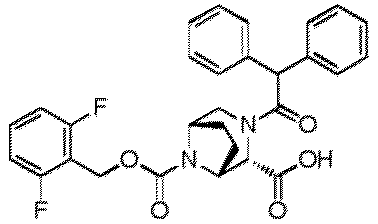
(1R,2S,5S)-8-(((2,6-diflurorbenzyl) oxy)carbonyl)-3-(2,2-diphenylacetyl) -3,8-diazabicyclo [3. 2.1]octane-2-carboxylic acid 
1H NMR (400 MHz, DMSO-d6 ) δ 13.00 - 12.50 (m, 1H), 7.55 - 7.41 (m, 1H), 7.40 - 7.06 (m, 12H), 5.51 - 5.29 (m, 1H), 5.20 - 5.00 (m, 2H), 4.65 - 4.50 (m, 1H), 4.27 - 4.00 (m, 2H), 3.73 - 3.30 (m, 2H), 2.10 - 1.30 (m, 4H). MS m/z (ESI): 521.0 [M+H]+. C11 3 
(1R,2S,5S)-3-(diphenylcarba moyl)-8-(1-phenylcyclope ntane-1-carbonyl)-3,8-diazabicyclo [3. 2.1]octane-2-carboxylic acid 
1H NMR (400 MHz, DMSO-d6 ) δ 12.97 (s, 1H), 7.39 - 7.22 (m, 6H), 7.21 - 7.09 (m, 5H), 6.92 (d, J = 7.6 Hz, 4H), 4.94 (s, 1H), 4.18 (s, 1H), 3.72 (s, 1H), 3.03 (s, 1H), 2.87 (s, 1H), 2.20 (s, 2H), 1.99 (s, 2H), 1.79 - 1.41 (m, 6H), 1.30 - 1.11 (m, 2H). MS m/z (ESI): 524.1 [M+H]+. C24 3 
(1R,2S,5S)-3-(diphenylcarba moyl)-8-(2-(4-methylpiperazi ne-1-yl)benzoyl)-3,8-diazabicyclo [3. 2.1]octane-2-carboxylic acid 
1H NMR (400 MHz, DMSO-d6 ) δ 7.45 (t, J = 7.2 Hz, 1H), 7.36 (t, J = 7.2 Hz, 4H), 7.30 - 7.12 (m, 5H), 7.07 (d, J = 7.6 Hz, 4H), 5.22 (s, 1H), 4.80 - 4.25 (m, 2H), 3.62 - 3.36 (m, 5H), 3.28 - 3.06 (m, 3H), 3.05 - 2.97 (s, 3H), 2.96 - 2.75 (m, 2H), 2.05 - 1.50 (m, 4H). MS m/z (ESI): 554.2 [M+H]+. C24 2 
(1R,2S,5S)-3-(diphenylcarba moyl)-8-(4-(1-methyl-1H-pyrazole-4-yl)benzoyl)-3,8-diazabicyclo [3. 2.1]octane-2-carboxylic acid 
1H NMR (400 MHz, , CD3OD) δ 8.04 (s, 1H), 7.89 (s, 1H), 7.63 (d, J = 8.0 Hz, 2H), 7.48 - 7.34 (m, 6H), 7.22 (t, J = 7.2 Hz, 2H), 7.10 (d, J = 7.6 Hz, 4H), 4.54 (s, 2H), 3.95 (s, 3H), 3.60 (s, 2H), 2.00 (d, J = 33.5 Hz, 1H), 1.89 (s, 1H), 1.62 (s, 2H). MS m/z (ESI): 535.7 [M+H]+. C27 0 
(1R,2S,5S)-8-((R)-2-(dimethylamin o)-3-phenylpropion yl)-3-(diphenylcarba moyl)-3,8-diazabicyclo [3. 2.1]octane-2-carboxylic acid C79-1 in step 6 of Example 5 was replaced with C270-1. 1H NMR (400 MHz, CD3OD) δ 7.41 - 7.25 (m, 9H), 7.24 - 7.16 (m, 2H), 7.05 (d, J = 7.6 Hz, 4H), 4.60 - 4.41 (m, 3H), 4.14 (s, 1H), 3.59 - 3.48 (m, 2H), 3.10 - 2.83 (m, 8H), 1.43 - 1.29 (m, 2H), 1.29 - 1.15 (m, 1H), 1.02 (s, 2H). MS m/z (ESI): 526.9 [M+H]+. C26 9 
(1R,2S,5S)-8-((S)-2-(dimethylamin o)-3-phenylpropion yl)-3-(diphenylcarba moyl)-3,8-diazabicyclo[3. 2.1]octane-2-carboxylic acid C79-1 in step 6 of Example 5 was replaced with C269-1. 1H NMR (400 MHz, , DMSO-d6 ) δ 7.39 - 7.30 (m, 4H), 7.27 - 7.18 (m, 3H), 7.17 -7.10 (m, 4H), 7.03 (d, J = 7.6Hz, 1H), 6.96 (d, J = 7.6 Hz, 3H), 4.90 - 4.75 (m, 1H), ), 4.55 - 4.35 (m, 1H), 4.20 - 4.00 (m, 2H), 3.75 - 3.55 (m, 1H), 3.35 - 3.25 (m, 2H), 2.90 - 2.70 (m, 2H), 2.27 - 2.19 (m, 6H), 1.75 - 0.90 (m, 4H). MS m/z (ESI): 527.1 [M+H]+. C16 7 
(1R,2R,5S)-8-((4-cyanobenzyl)( methyl)carbam oyl)-3-(diphenylcarba moyl)-3,8-diazabicyclo[3. 2.1]octane-2-carboxylic acid Compound C82-1 in step 6 of Example 5 was replaced with C167-1. 1H NMR (400 MHz, DMSO-d6 ) δ 13.06 (s, 1H), 7.81 - 6.95 (m, 14H), 4.51 (s, 1H), 4.43 - 4.28(m, 3H), 3.95 (s, 1H), 3.46 - 3.36 (m, 2H), 2.75 (s, 3H), 1.75 - 1.40 (m, 4H). MS m/z (ESI): 523.8 [M+H]+. -

- Compound C165-1 (60 mg, 0.1 mmol) was dissolved in N,N-dimethylformamide (20 mL), and Zn(CN)2 (24 mg, 0.2 mmol), Pd2(dba)3 (92 mg, 0.1 mmol), dppf (56mg, 0.1mmol), and Zn (7mg, 0.1mmol) were added sequentially. The reaction solution was allowed to react for 16 hours at 100°C under nitrogen protection. LC-MS indicated that the reaction of the starting materials was substantially complete. The reaction solution was concentrated under reduced pressure to evaporate off N,N-dimethylformamide. Saturated sodium chloride solution (10 mL) was then added and extracted with ethyl acetate (20 mL×2), and dried by adding anhydrous sodium sulfate (5 g) for 30 min, filtered and concentrated under reduced pressure. The resulting crude product was subjected to separation by preparative plate chromatography to obtain Compound C167-1 (50mg, white solid, yield: 90%).
- MS m/z (ESI): 551.8 [M+H]+.
-

- Compound 23 (90 mg, 0.466 mmol) was dissolved in a dichloromethane solution (20 mL), followed by sequential additon of HATU (265 mg, 0.699 mmol) and diisopropylethylamine (0.3 g, 2.33 mmol), and reaction at room temperature for 1 hour. Compound SM2 (88 mg, 0.233 mmol) was then added to the reaction solution, and was reacted at 50°C for 16 hours. After the reaction was complete, 50 mL water was added to the reaction solution, followed by extraction with dichloromethane (20 mL × 2). The combined organic phases were dried by adding anhydrous sodium sulfate (20 g) for 30 min, filtered and concentrated under reduced pressure to obtain a crude product. The crude product was separated and purified by column chromatography (petroleum ether:ethyl acetate =3:7) to obtain Compound C269-1 (90 mg, a yellow solid, crude product).
- MS m/z (ESI): 555.2 [M+H]+.
- Except replacing SM2 with SM3, by the above reaction process, Compound C270-1 was prepared.
- MS m/z (ESI): 555.2 [M+H]+.
-

- Compound 5 (1 g, 5.04 mmol) was dissolved in a tetrahydrofuran solution (30 mL). Phenyl chloroformate (0.86 g, 5.04 mmol) and potassium carbonate (2.1 g, 15.13 mmol) were added sequentially, and reacted at room temperature for 16 hours. After the reaction was complete, 50 mL water was added to the reaction solution and extracted with ethyl acetate (50 mL × 2). The combined organic phases were dried by adding anhydrous sodium sulfate (100 g) for 30 min., filtered and concentrated under reduced pressure to obtain a crude product. The crude product was separated and purified by column chromatography on silica gel (petroleum ether: ethyl acetate =3:2) to obtain Compound 21 (1 g, a yellow oily matter, crude product).
- MS m/z (ESI): 333.1 [M+H]+.
- Compound 21 (1 g, 3 mmol) was dissolved in a solution of borane dimethylsulfide in tetrahydrofuran (2M, 10 mL), purged with nitrogen for 5 times, and reacted at room temperature in a nitrogen atmosphere for 3 hours. After the reaction was complete, the reaction was quenched with methanol slowly and then concentrated to obtain a crude product of compound 22 (0.35 g, a brownish-yellow oily liquid, crude product).
- MS m/z (ESI): 319.0 [M+H]+.
- Compound 22 (0.35 g, 1.1 mmol) was dissolved in dichloromethane (20 mL). To the solution, triethylamine (0.33 g, 3.3 mmol) was then added. Compound 7 (0.25g, 1.1 mmol) was dissolved in 10 mL dichloromethane, and added dropwise to the above reaction solution and allowed to react at room temperature for 4 hours. LC-MS indicated that the reaction of the starting materials was complete. It was then quenched by adding water (30 mL), and extracted with ethyl acetate (20 mL×3). The combined organic phases were washed with saturated brine (20 mL × 3). The organic phases were dried by adding anhydrous sodium sulfate for half an hour, and filtered. The filtrate was concentrated under reduced pressure. The resulting crude product was subjected to separation by column chromatography on silica gel (petroleum ether:methyl tert-butyl ether=1.5:1) to obtain Compound C34-1 (0.12 g, a dark yellow solid, crude product).
- MS m/z (ESI): 513.0 [M+H]+.
- Compound C34-1 (0.12 g, 0.234 mmol) was dissolved in a mixed solution of tetrahydrofuran, methanol and water (5mL/5mL/5mL). After adding sodium hydroxide (47 mg, 1.17 mmol) and stirring at room temperature for 5 hours, it was concentrated to obtain a crude product. Then, it was adjusted to pH 5.0 with 3N hydrochloric acid solution, and extracted with ethyl acetate (50 mL×3). The combined organic phases were washed with saturated brine (50 mL×3). The organic phases were dried by adding anhydrous sodium sulfate for half an hour, and filtered. The filtrate was concentrated under reduced pressure, and the resulting crude product was purified by preparative high-performance liquid chromatography (acetonitrile/water (0.1% trifluoroacetic acid solution) 40/60-20/80) to obtain Compound C34 (30 mg, a light yellow solid, yield: 26%).
- 1H NMR (400 MHz, DMSO-d6 ) δ 7.50 - 7.00 (m, 15H), 5.50 - 5.30 (m, 1H), 5.15 - 5.00 (m, 1H), 4.60 (s, 1H), 4.45 - 4.00 (m, 3H), 3.75 - 3.25 (m, 2H), 2.10 - 1.75 (m, 2H), 1.65 - 1.25 (m, 2H).
- MS m/z (ESI): 485.0 [M+H]+.
-

- Compound C283-1 (10 g, 82.6 mmol) was dissolved in toluene (100 mL). Anhydrous sodium sulfate (35 g, 0.25 mol) and a 50% solution of ethyl glyoxylate in toluene (16.8 g, 82.6 mmol) were added sequentially, and the reaction solution was allowed to react at room temperature for 18 hours. After filtration, the filter cake was washed with toluene (100 mL), and the filtrate was concentrated under reduced pressure to remove toluene, obtaining Compound C283-2 (16 g, a colorless oily liquid, yield: 94%).
- 1H NMR (400 MHz, CDCl3): δ 7.72 (s, 1H), 7.36 - 7.24 (m, 5 H), 4.61 (q, J= 6.8 Hz, 1H), 4.35 (q, J = 7.2 Hz, 2H), 1.62 (d, J= 6.8 Hz, 3H), 1.34 (t, J= 7.2 Hz, 3H).
- Compound C283-2 (16 g, 78 mmol) was dissolved in dry dichloromethane (100 mL). Under nitrogen protection, it was cooled to -15°C to -20°C, and trifluoroacetic acid (8.3 g, 86 mmol), boron trifluoride etherate (12.2 g, 86 mmol) and 1,3-cyclohexadiene (6.9 g, 86 mmol) were added sequentially. The reaction solution was allowed to react at -10°C for 2 hours. LC-MS indicated that the reaction of the starting materials was complete. It was then quenched by adding a saturated NaHCO3 solution, and extracted with dichloromethane (100 mL × 3). The combined organic phases were washed once with saturated brine (300 mL), and then dried over anhydrous sodium sulfate for 30 min, filtered and concentrated to obtain a crude product. The crude product was subjected to separation by column chromatography (petroleum ether:ethyl acetate=50:1 to 30:1) to obtain Compound C283-3 (7.4 g, a light yellow oily liquid, yield: 33.6%).
- 1H NMR (400MHz, CDCl3) : δ 7.42 - 7.31 (m, 2H), 7.27 - 7.16 (m, 3H), 6.41 - 6.37 (m, 1H), 6.27 - 6.24 (m, 1H), 3.97 ( q, J = 7.2 Hz, 2H), 3.64 - 3.60 (m, 1H), 3.43 (q, J = 6.8 Hz, 1H), 2.89 (brs, 1H), 2.76 - 2.71 (m, 1H), 2.06 - 2.00 (m, 1H), 1.62 - 1.54 (m, 1H), 1.30 (d, J = 6.8 Hz, 3H), 1.31 - 1.24 (m, 1H), 1.12 (t, J = 7.2 Hz, 3H,), 1.05 - 0.99 (m, 1H).
- MS m/z (ESI): 304.1 [M+H]+.
- Compound C283-3 (4 g, 14 mmol) was dissolved in tetrahydrofuran (50 mL) and cooled to 0°C under nitrogen protection. 1 M/L BH3THF (15.4 mL, 15.4 mmol) was slowly added dropwise. After the addition was complete, the reaction solution was stirred at room temperature for 3 hours, and then 3N NaOH (10 mL, 30 mmol) and 30% H2O2 solution (20 mL) were slowly added dropwise at 0°C. After the addition was completed, the reaction solution was stirred at room temperature for 0.5 hour, followed by addition of saturated brine (100 mL) and extraction with tetrahydrofuran (50 mL × 3). The combined organic phases were dried with anhydrous sodium sulfate for 30 min, then filtered and concentrated to obtain a crude product. The crude product was subjected to separation by column chromatography (petroleum ether:ethyl acetate=8:1) to obtain Compound C283-4 (1.3 g, a colorless oily liquid, yield: 30%).
- 1H NMR (400 MHz, CDCl3): δ 7.41 - 7.36 (m, 2H), 7.31 - 7.19 (m, 3H), 4.11 - 4.05 (m, 1H), 3.89 (q, J = 7.2 Hz 2H), 3.59 - 3.54 (m, 1H), 3.17 (brs, 1H), 3.10 (brs, 1H), 2.45 - 2.38(m, 1H), 1.33 (d, J = 6.4 Hz, 3H), 2.05 - 1.18 (m, 6H), 1.06 (t, J = 7.2 Hz, 3H).
- MS m/z (ESI): 229.9 [M+H]+.
- Compound C283-4 (800 mg, 2.64 mmol) and 10% wet Pd/C (80 mg) were dissolved in absolute ethanol (20 mL), reacted at room temperature in hydrogen atmosphere for 18 hours, and filtered. The filter cake was washed twice with ethanol (10 mL), and the filtrate was concentrated under reduced pressure to obtain Compound C283-5 (500 mg, a colorless oily liquid, yield: 95%).
- MS m/z (ESI): 200.1 [M+H]+.
- Compound C283-5 (200 mg, 1 mmol) and potassium carbonate (276 mg, 2 mmol) were dissolved in tetrahydrofuran (5 mL) and water (5 mL), and di-tert-butyl dicarbonate (327 mg, 1.5 mmol) was added while stirring, and was stirred at room temperature for 16 hours. LC-MS indicated that the reaction of the starting materials was complete. Ethyl acetate (50 mL) was added and washed with saturated brine (40 mL×3). The organic phase was dried with anhydrous sodium sulfate for 30 min, and filtered. The filtrate was concentrated under reduced pressure to obtain a crude product of Compound C283-6 (300 mg, a colorless oily liquid, yield: 100%).
- MS m/z (ESI): 322.2 [M+Na]+.
- Compound C283-6 (120 mg, 0.4 mmol) was dissolved in DMF (5 mL). Under nitrogen protection, after added NaH (60%, 24 mg, 0.4 mmol) and stirring for 1 h, benzyl bromide (82 mg, 0.48 mmol) was added and then stirred at room tempearture for 16 hours. It was quenched by adding water (10 mL), adjusted to pH 5 with 1N acetic acid solution, and then extracted with ethyl acetate (20 mL × 3). The combined organic phases were washed with saturated brine (50 mL × 3), dried with anhydrous sodium sulfate for 30 min and filtered. The filtrate was concentrated under reduced pressure to obtain a crude product of Compound C283-7 (60 mg, a light yellow oily liquid, yield: 38 %).
- MS m/z (ESI): 411.9 [M+Na]+.
- Compound C283-7 (60 mg, 0.17 mmol) was dissolved in methanol (5 mL). After cooling to 0°C, thionyl chloride (1 mL) was added, and heated up to 40°C, and stirred for 16 hours. LC-MS indicated that the reaction of the starting materials was complete. The reaction solution was cooled to room temperature and concentrated under reduced pressure to obtain a crude product. The crude product was subjected to separation by preparative high-performance liquid chromatography (CH3CN:H2O (0.1%TFA) = 20%-50%) to obtain Compound C283-8 (40 mg, a colorless oily liquid, yield: 87%).
- 1H NMR (400 MHz, CDCl3): δ 7.38 - 7.31 (m, 6H), 4.53 (s, 2H), 4.37 - 4.35 (m, 3H), 4.06 (brs, 1H), 3.77 - 3.73 (m, 1H), 2.58 (brs, 1H), 2.16 - 2.10 (m, 1H), 1.97 - 1.90 (m, 1H), 1.83 - 1.67 (m, 2H), 1.36 - 1.33 (m, 2H).
- MS m/z (ESI): 275.9 [M+H]+.
- 2,2-diphenylacetic acid (37 mg, 0.17 mmol) and DMF (1 drop) were added to dry dichloromethane (10 mL). After cooling to 0 °C, oxalyl chloride (27 mg, 0.21 mmol) was added, stirred at room temperature for 1 hour, and then concentrated under reduced pressure. The residue was dissolved in dichloromethane (2 mL) to obtain a 2,2-diphenylacetyl chloride solution. C283-8 (40 mg, 0.14 mmol) and triethylamine (28 mg, 0.28 mmol) were dissolved in dichloromethane (5 mL) and cooled to 0 °C. The previous 2,2-diphenylacetyl chloride solution was then slowly added. The reaction solution was allowed to react at room temperature for 5 hours. LC-MS indicated that the reaction of the starting materials was complete. Dichloromethane (30 mL) was added, washed with saturated brine (20 mL × 3), dried over anhydrous sodium sulfate for 30 min and then filtered. The filtrate was concentrated under reduced pressure to obtain a crude compound. The crude product was subjected to separation by thin layer chromatography (petroleum ether:ethyl acetate=2:1) to obtain Compound C283-9 (30 mg, a colorless oily liquid, yield: 44%).
- MS m/z (ESI): 470.0 [M+H]+.
- C283-9 (30 mg, 0.06 mmol) was dissolved in tetrahydrofuran (1 mL) and water (1 mL). Sodium hydroxide (13 mg, 0.32 mmol) was added at room temperature, stirred at room temperature for 16 hours, and then concentrated under reduced pressure. The residue was dissolved in water (10 mL), adjusted to pH 5 with 1N dilute hydrochloric acid, and then extracted with ethyl acetate (20 mL × 3). The combined organic phases were washed with saturated brine (30 mL × 2), dried over anhydrous sodium sulfate for 30 min, and then filtered. The filtrate was concentrated under reduced pressure to obtain a crude product. The crude product was subjected to separation by preparative high-performance liquid chromatography (CH3CN:H2O (0.1%TFA) = 20%-70%) to obtain Compound C283 (12 mg, a white solid, yield: 41%).
- 1H NMR (400 MHz, DMSO-d 6): δ 12.51 (brs, 1H), 7.33 - 7.19 (m, 15H), 5.47 - 5.43 (m, 1H), 4.48 - 4.37 (m, 2H), 4.10 - 4.02 (m, 2H), 3.75 - 3.73 (m, 1H), 3.11 - 3.07 (m, 1H), 1.80 - 1.74 (m, 1H), 1.63 (m, 1H), 1.51 - 1.23 (m, 4H).
- MS m/z (ESI): 455.8 [M+H]+.
- The compounds in Table 8 were prepared by methods similar to that described in Example 9.
Table 8: No. Compound Structure Compound Name Starting material or reagent different from that in Example 9 Characteriazation data C29 1 
(1S,3S,4S)-5-((3-chlorobenzyl)oxy)-2-(2,2-diphenylacetyl)-2-azabicyclo[2.2.2]oct ane-3-carboxylic acid The benzyl bromide in step 6 of Example 9 was replaced with 3-chlorobenzyl bromide. 1H NMR (400 MHz, CD3OD): δ 7.35 - 7.23 (m, 14H), 5.41 (s, 1H), 4.56 - 4.45 (m, 2H), 4.29 - 4.23 (m, 1H), 4.15 - 4.04 (m, 1H), 3.79 (s, 1H), 2.63 - 2.49 (m, 1H), 2.15 - 1.80 (m, 3H), 1.69 - 1.41 (m, 4H). MS m/z (ESI): 490.2 [M+H]+. C29 3 
(1S,3S,4S)-5-((4-chlorobenzyl)oxy)-2-(2,2-diphenylacetyl)-2-azabicyclo[2.2.2]oct ane-3-carboxylic acid The benzyl bromide in step 6 of Example 9 was replaced with 4-chlorobenzyl bromide. 1H NMR (400 MHz, CD3OD): δ 7.45 - 7.16 (m, 14H), 5.40 (d, J = 7.1 Hz, 1H), 4.56 - 4.45 (m, 2H), 4.31 - 4.16 (m, 1H), 4.12 - 4.01 (m, 1H), 3.79 (d, J = 9.4 Hz, 1H), 2.51 (s, 1H), 2.06 - 1.78 (m, 3H), 1.68 - 1.38 (m, 4H). MS m/z (ESI): 489.8 [M+H]+. C29 4 
(1S,3S,4S)-5-((2-chlorobenzyl)oxy)-2-(2,2-diphenylacetyl)-2-azabicyclo[2.2.2]oct ane-3-carboxylic acid The benzyl bromide in step 6 of Example 9 was replaced with 2-chlorobenzyl bromide. 1H NMR (400 MHz, CD3OD): δ 7.50 - 7.10 (m, 14H), 5.44 (d, J = 16.8 Hz, 1H), 4.68 - 4.48 (m, 2H), 4.32 - 4.16 (m, 1H), 4.12 (d, J = 12.4 Hz, 1H), 3.85 (d, J = 9.3 Hz, 1H), 2.54 (s, 1H), 2.06 - 1.78 (m, 3H), 1.62 - 1.44 (m, 4H). MS m/z (ESI): 489.8 [M+H]+. C29 0 
(1S,3S,4S)-2-(2,2-diphenylacetyl)-5-(4-nitrophenoxy)-2-azabicyclo[2.2.2]oct ane-3-carboxylic acid The benzyl bromide in step 6 of Example 9 was replaced with 4-fluoronitrobenze ne, and DMF was replaced with tetrahydrofuran. 1H NMR (400 MHz, CD3OD): δ 8.22 (d, J = 9.6 Hz, 2H), 7.50 - 7.20 (m, 10H), 7.0 (d, J = 6.8 Hz, 2H), 5.46 (s, 1H), 4.72 (d, J = 9.6 Hz, 1H), 4.52 (d, J = 2.8 Hz, 1H), 4.24 (s, 1H), 2.70 (s, 1H), 2.50 - 2.40 (m, 1H), 2.30 - 220 (m, 1H), 1.70 - 1.50 (m, 4H). MS m/z (ESI): 486.9 [M+H]+. C29 6 
(1S,3S,4S)-5-(benzyloxy)-2-(diphenylcarbamoyl )-2-azabicyclo[2.2.2]oct ane-3-carboxylic acid The process of preparing 2,2-diphenylacetyl chloride in step 8 of Example 9 was completely replaced with 1H NMR (400 MHz, DMSO-d 6): δ 12.79 (brs, 1H), 7.36 - 7.05 (m, 15H), 4.55 - 4.31 (m, 3H), 3.80 (brs, 2H), 3.61 - 3.59 (m, 1H), 2.13 (brs, 1H), 1.75 - 1.70 (m, 1H), 1.46 - 1.24 (m, 4H). 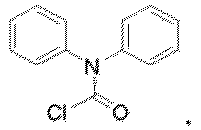
MS m/z (ESI): 456.9 [M+H]+. C29 7 
(1R,3S,4R)-5-(benzyloxy)-2-(2,2-diphenylacetyl)-2-azabicyclo[2.2.2]oct ane-3-carboxylic acid It was prepared from the isomer 1H NMR (400 MHz, DMSO-d6 ): δ 12.52 (brs, 1H), 7.33 - 7.19 (m, 15H), 5.47 - 5.44 (m, 1H), 4.49 - 4.35 (m, 2H), 4.24 - 4.21 (m, 1H), 4.10 - 4.00 (m, 2H), 3.75 - 3.62 (m, 1H), 1.80 - 1.60 (m, 2H), 1.43 - 1.24 (m, 
separated in step 2 of Example 9. 4H). MS m/z (ESI): 455.9 [M+H]+. C30 2 
(1S,3S,4S)-5-(benzyloxy)-2-(5H-dibenzo[b,f]azepine -5-carbonyl)-2-azabicyclo[2.2.2]oct ane-3-carboxylic The process of preparing 2,2-diphenylacetyl chloride in step 8 of Example 9 was completely 1H NMR (400 MHz, CD3OD): δ 7.71 (d, J = 6.8 Hz, 1H), 7.39 - 7.25 (m, 11H), 6.99 (d, J = 12.4 Hz, 2H), 4.44 (t, J = 12.0 Hz, 2H), 4.36 - 4.30 (m, 1H), 4.13 (s, 1H), 3.76 - 3.73 (m, 1H), 2.44 (s, acid replaced with 1H), 2.73 - 2.03 (m, 2H), 1.51 - 1.29 (m, 2H), 1.05 (s, 1H). 
MS m/z (ESI): 480.8 [M+H]+. -

- 2,2-diphenylacetic acid (383 mg, 1.8 mmol) and DMF (1 drop) were added to dry dichloromethane (10 mL). After cooling to 0 °C, oxalyl chloride (286 mg, 2.2 mmol) was added, stirred at room temperature for 1 hour, and then concentrated under reduced pressure. The residue was dissolved in ethyl acetate (2 mL) to obtain a 2,2-diphenylacetyl chloride solution. C283-5 (40 mg, 0.14 mmol) and potassium carbonate (414 mg, 3 mmol) were dissolved in ethyl acetate (10 mL) and water (10 mL), and cooled to 0 °C. The previous 2,2-diphenylacetyl chloride solution was then slowly added. The reaction solution was allowed to react at room temperature for 16 hours. LC-MS indicated that the reaction of the starting materials was complete. Ethyl acetate (30 mL) was added, washed with saturated brine (20 mL × 2), dried over anhydrous sodium sulfate for 30 min, and then filtered. The filtrate was concentrated under reduced pressure to obtain a crude compound. The crude product was subjected to separation by column chromatography (petroleum ether: ethyl acetate=2: 1) to obtain Compound C295-1 (350 mg, a white solid, yield: 59%).
- 1H NMR (400 MHz, CDCl3): δ 7.32 - 7.18 (m, 10H), 5.10 (s, 1 H), 4.36 (s, 1H), 4.27 - 4.20 (m, 2H), 4.12 (q, J = 7.2 Hz, 2H), 3.92 (brs, 1H), 2.24 (s, 1H), 1.99 - 1.91 (m, 1H), 1.85 - 1.76 (m, 1H), 1.55 - 1.50 (m, 1H), 1.46 - 1.39 (m, 1H), 1.29 - 1.24 (m, 2H), 1.26 (t, J= 7.2 Hz, 3H).
- MS m/z (ESI): 394.0 [M+H]+.
- Compound C295-1 (320 mg, 0.81 mmol) was dissolved in dry dichloromethane (20 mL) and Dess-Martin periodinane (690 mg, 1.62 mmol) was added. The reaction solution was allowed to react at room temperature for 16 hours. LC-MS indicated that the reaction of the starting materials was complete. It was then filtered. Dichloromethane (30 mL) was added to the filtrate, washed with a saturated NaHCO3 solution (50 mL × 2) and then saturated brine (50 mL × 1). After that, it was dried over anhydrous sodium sulfate for 30 min, filtered, and concentrated under reduced pressure to obtain a crude compound. The crude product was subjected to separation by column chromatography (petroleum ether: ethyl acetate=50:1 to 30:1) to obtain Compound C295-2 (300 mg, a white solid, yield: 93%).
- 1H-NMR (400MHz, CDCl3): δ 7.37 - 7.17 (m, 10H), 5.16 (s, 1H), 4.63 (s, 1H), 4.38 (s, 1H), 4.24 (q, J = 6.4Hz, 2H), 2.82 (s, 1H), 2.22 - 2.15 (m, 2H), 2.10 - 2.05 (m, 1H), 1.97 - 1.91 (m, 1H), 1.77 - 1.63 (m, 2H), 1.28 (t, J = 6.4 Hz, 3H).
- MS m/z (ESI): 391.8 [M+H]+.
- Compound C295-2 (30 mg, 0.077 mmol) was dissolved in methanol (10 mL), and benzylamine (10 mg, 0.092 mmol) and acetic acid (0.1 mL) were sequentially added. After stirring at room temperature for 1 hour, sodium cyanoborohydride (10 mg, 0.154 mmol) was added, stirred at room temperature for 16 hours and then concentrated to obtain Compound C295-3 (30 mg, a light yellow oily liquid, yield 83%).
- MS m/z (ESI): 483.0 [M+H]+.
- C295-3 (100 mg, 0.2 mmol) was dissolved in methanol (10 mL) and water (3 mL). Sodium hydroxide (20 mg, 0.5 mmol) was added at room temperature and stirred at 50°C for 16 hours while heating, and then concentrated under reduced pressure. The residue was dissolved in water (10 mL), and adjusted to pH 5 with 1N diluted hydrochloric acid, followed by extraction with ethyl acetate (20 mL × 3). The organic phases were washed with saturated brine (30 mL × 2), dried over anhydrous sodium sulfate for 30 min, and then filtered. The filtrate was concentrated under reduced pressure to obtain a crude product. The crude product was subjected to separation by preparative high-performance liquid chromatography (CH3CN:H2O (0.1%TFA) = 20%-50%) to obtain Compound C285 (70 mg, a white solid, yield: 74%).
- 1H NMR (400 MHz, DMSO-d 6): δ 12.64 (brs, 1H), 7.52 - 7.45 (m, 5H), 7.35 - 7.19 (m, 10H), 5.44 (s, 1H), 4.44 (s, 1H), 4.14 - 4.11 (m, 3H), 2.10 (t, J = 12.0 Hz, 1H), 1.66 - 1.58 (m, 2H), 1.53 - 1.35 (m, 4H).
- MS m/z (ESI): 455.0 [M+H]+.
- Compound C285 (30 mg, 0.07 mmol) and 30% aqueous formaldehyde solution (12 mg, 0.7 mmol) were dissolved in methanol (3 mL). Acetic acid (0.1 mL) and 2N hydrochloric acid (0.2 mL) were then sequentially added and stirred at room temperature for 1 hour. Sodium cyanoborohydride (9 mg, 0.14 mmol) was added, and then stirred at room temperature for 16 hour. LC-MS indicated that the reaction of the starting materials was complete. After concentration under reduced pressure, a crude product was obtained. The crude product was subjected to separation by preparative high-performance liquid chromatography (CH3CN:H2O (0.1%TFA) = 20%-50%) to obtain Compound C295 (10 mg, a white solid, yield: 32%).
- 1H NMR (400 MHz, DMSO-d 6): δ 12.78 (brs, 1H), 7.52 - 7.26 (m, 15H), 5.50 (s, 1H), 4.58 - 4.51 (m, 1H), 4.44 - 4.39 (m, 2H), 4.19 (brs, 1H), 4.08 - 4.03 (m, 1H), 2.70 - 2.63 (m, 3H), 2.38 - 2.33 (m, 1H), 1.80 - 1.41 (m, 6H).
- MS m/z (ESI): 468.8 [M+H]+.
- The compound in Table 9 was prepared by a method similar to that described in Example 10.
Table 9: No. Compound Structure Compound Name Starting material or regent different from that in Example 10 Charaterization data C28 7 
(3S)-2-(2,2-diphenylacetyl)-5-(phenoxyamino)-2-azabicyclo[2.2.2]oct ane-3-carboxylic acid Benzylamine in step 3 of Example 10 was replaced with phenethylami ne. 1H NMR (400 MHz, DMSO-d 6): δ 7.35 - 7.21 (m, 15H), 5.45 (d, J = 6.0 Hz, 1H), 4.44 (s, 1H), 4.26 (s, 1H), 4.13 (s, 1H), 4.10 (s, 1H), 3.51 (brs, 1H), 3.13 (s, 1H), 2.94 - 2.88 (m, 2H), 2.14 - 2.06 (m, 1H), 1.91 - 1.34 (m, 5H). MS m/z (ESI): 468.8 [M+H]+. -

- C295-1 (30 mg, 0.08 mmol) was dissolved in tetrahydrofuran (3 mL) and water (2 mL). Lithium hydroxide (10 mg, 0.38 mmol) was added at room temperature, stirred at room temperature for 16 hours, and then concentrated under reduced pressure. The residue was dissolved in water (10 mL), adjusted to pH 5 with 1N diluted hydrochloric acid, and then extracted with ethyl acetate (10 mL × 3). The organic phases were washed with saturated brine (20 mL × 2), and then dried over anhydrous sodium sulfate for 30 min and filtered. The filtrate was concentrated under reduced pressure to obtain a crude product. The crude product was subjected to separation by preparative high-performance liquid chromatography (CH3CN:H2O (0.1%TFA) = 20%-60%) to obtain Compound C288 (16 mg, a white solid, yield: 57%).
- 1H NMR (400 MHz, DMSO-d 6): δ 12.38 (brs, 1H), 7.28 - 7.20 (m, 10H), 5.41 (s, 1H), 4.09 (s, 1H), 3.96 (s, 1H), 3.81 - 4.77 (m, 1H), 2.10 (s, 1H), 1.87 - 1.79 (m, 1H), 1.87 - 1.79 (m, 1H), 1.73 - 1.58 (m, 2H), 1.47 - 1.41 (m, 1H), 1.27 - 1.21 (m, 1H), 1.13 - 1.08 (m, 1H).
- MS m/z (ESI): 365.9 [M+H]+.
-

- C295-3 (60 mg, 0.12 mmol) and Pd(OH)2 (20%, 12 mg) were added to ethanol (10 mL), hydrogenated in a hydrogen atmosphere for 16 hours, and then filtered. The filtrate was concentrated under reduced pressure to obtain a curde Compound C286-1 (40 mg, a white solid, yield: 83%).
- 1H NMR (400 MHz, DMSO-d 6): δ 7.97 (brs, 2H), 7.34 - 7.20 (m, 10H), 5.47 (s, 1 H), 4.40 (s, 1H), 4.17 - 4.08 (m, 3H), 2.94 (s, 1H), 1.92 - 1.86 (m, 1H), 1.73 (m, 1H), 1.62 - 1.45 (m, 2H), 1.35 - 1.28 (m, 2H), 1.20 (t, J = 7.2 Hz, 3H).
- MS m/z (ESI): 393.2 [M+H]+.
- Compound C286-1 (25 mg, 0.064 mmol) and triethylamine (19 mg, 0.192 mmol) were dissolved in dry dichloromethane (5 mL) and then benzoyl chloride (10 mg, 0.07 mmol) was added. The reaction solution was reacted at room temperature for 16 hours. LC-MS indicated that the reaction of the starting materials was complete. After that, dichloromethane (20 mL) was added, washed with saturated brine (20 mL × 2), and then dried over anhydrous sodium sulfate for 30 min. It was then filtered, and concentrated to obtain a crude product. The crude product was subjected to separation by preparative thin layer chromatography (petroleum ether:ethyl acetate=2:1) to obtain Compound C286-2 (25 mg, a colorless solid, yield: 80%).
- MS m/z (ESI): 496.7 [M+H]+.
- C286-2 (25 mg, 0.05 mmol) was dissolved in methanol (10 mL) and water (3 mL). Sodium hydroxide (20 mg, 0.5 mmol) was added at room temperature and stirred at 50°C for 16 hours while heating, and then concentrated under reduced pressure. The residue was dissolved in water (10 mL), adjusted to pH 5 with 1N diluted hydrochloric acid, and then extracted with ethyl acetate (10 mL × 3). The organic phases were washed with saturated brine (30 mL × 2), dried over anhydrous sodium sulfate for 30 min and then filtered. The filtrate was concentrated under reduced pressure to obtain a crude product. The crude product was subjected to separation by preparative high-performance liquid chromatography (CH3CN:H2O (0.1%TFA) = 30%-60%) to obtain Compound C286 (6 mg, a white solid, yield: 25%).
- 1H NMR (400 MHz, CD3OD): δ 8.39 (d, J= 6.0 Hz, 1H), 7.83 - 7.79 (m, 2H), 7.57 - 7.53 (m, 1H), 7.49 - 7.45 (m, 2H), 7.37 - 7.25 (m, 10H), 5.45 (s, 1H), 4.53 (s, 1H), 4.20 - 4.15 (m, 2H), 2.50 (s, 1H), 1.99 - 1.50 (m, 6H).
- MS m/z (ESI): 468.8 [M+H]+.
-


- Compound C298-1 (2.5 g, 30.4 mmol) was dissolved in tetrahydrofuran (50 mL), and purged with nitrogen for 3 times. After that, the reaction solution was cooled to -78°C under nitrogen protection. n-butyllithium was added dropwise (18 ml, 30.4 mmol) and reacted for 2 hours at a temperature not higher than -30 °C. After cooling to -78°C again, paraformaldehyde (1.1 g, 36.7 mmol) was added. After 16 hours of reaction, the reaction was quenched with saturated aqueous ammonium chloride solution (50 ml) and extracted with ethyl acetate (100 mL×3). The combined organic phases were dried with anhydrous sodium sulfate (100 g) for 30 min, then filtered and concentrated under reduced pressure to obtain Compound C298-2 (2.4 g, a yellow oily liquid, yield: 70.59%).
- 1H NMR (400 MHz, DMSO-d 6): δ 5.02 (t, J= 6.0 Hz, 1H), 4.01 (d, J= 4.0 Hz, 2H), 1.18 (s, 9H).
- Compound C298-2 (2.0 g, 17.8 mmol) was dissolved in tetrahydrofuran (50 mL).Tosyl chloride (6.8 g, 35.6 mmol) and potassium hydroxide (3.0 g, 53.4 mmol) were added and allowed to react at room temperature for 16 hours, and then filtered. The filtrate was concentrated under reduced pressure to obtain a crude product. The crude product was dissolved in ethyl acetate (100 ml), and washed with saturated brine (100 ml × 2). The combined organic phases were dried with anhydrous sodium sulfate (50 g) for 30 min, and then filtered. The filtrate was concentrated under reduced pressure to obtain Compound C298-3 (1 g, an oragne oily liquid, yield: 43.5%).
- MS m/z (ESI): 267.1 [M+H]+.
- Compound C298-4 (400 mg, 0.83 mmol) was dissolved in dry dichloromethane (40 mL). An aqueous formaldehyde solution (2 ml) and acetic acid (1 mL) were added, and stirred at room temperature for 4 hours. After that, sodium triacetoxyborohydride (703.6 mg, 3.32 mmol) was added, and stirring was continued for 16 hours. LC-MS indicated that the reaction of the starting materials was complete. It was then washed with saturated brine (20 ml×3), dried over anhydrous sodium sulfate (10 g) for 30 min, filtered and then concentrated to obtain a crude product. The crude product was subjected to separation by column chromatography (petroleum ether:ethyl acetate=1:1) to obtain Compound C298-5 (200 mg, a light yellow oily liquid, yield: 48.66%).
- MS m/z (ESI): 497.1[M+H]+.
- Compound C298-5 (200 mg, 0.4 mmol) was dissolved in isopropyl alcohol (50 mL), and palladium hydroxide/carbon (50 mg) was added. It was purged with hydrogen for 3 times, and stirred at room temperature for 4 hours. LC-MS indicated that the reaction of starting materials was complete. It was then filtered, and the filtrate was concentrated to obtain Compound C298-6 (60 mg, a light yellow oily liquid, yield 36.8%).
- MS m/z (ESI): 407.2 [M+H]+.
- Compound C298-6 (60 mg, 0.15 mmol) was dissolved in tetrahydrofuran (20 mL), and anhydrous potassium carbonate (61.2 mg, 0.44 mmol) and C298-3 (80 mg, 0.3 mmol) were added. After stirring for 8 hours at room temperature, LC-MS indicated that a product was produced. It was filtered, and the filtrate was concentrated. The residue was subjected to separation by preparative high performance liquid chromatography, and lyophilized to obtain Compound C298-7 (8 mg, a white solid, yield: 11.0%).
- MS m/z (ESI): 501.1 [M+H]+.
- Compound C298-7 (8 mg, 0.016 mmol) was dissolved in methanol (10 mL), and water (3 mL), sodium hydroxide (5.12 mg, 0.13 mmol) were added and stirred at 50°C for 16 hours. The reaction solution was concentrated, subjected to separation by preparative high performance liquid chromatography (water:acetonitrile=60:40), and lyophilized to obtain Compound C298 (4.4 mg, a white solid, yield: 58.3%).
- 1H NMR (400 MHz, CD3OD): δ 7.29 (m, 10H), 5.40 (s, 1H), 4.41 (s, 1H), 4.10 (s, 1H), 3.80 (d, J = 16.8 Hz, 1H), 3.59 (d, J= 17.1 Hz, 1H), 2.90 (s, 1H), 2.50 (s, 3H), 2.07 - 2.01 (m, 2H), 1.86 - 1.83 (m, 2H), 1.43 (m, 2H), 1.30 - 1.18 (m, 9H).
- MS m/z (ESI): 473.1 [M+H]+.
-

- Compound C299-1 (1.0 g, 4.5 mmol) was dissolved in tetrahydrofuran (50 mL), and Copper iodide (85.7 mg, 0.45 mmol), bis(triphenylphosphine)palladium dichloride (315.9 mg, 0.45 mmol) and propynol (378.4 mg, 6.75 mmol) were added, purged with nitrogen for 3 times, and stirred at room temperature for 16 hours under nitrogen protection. Water (50 mL) was added and extracted with ethyl acetate (50 mL × 3). The combined organic phases were washed with saturated brine (20 mL × 2), dried with anhydrous sodium sulfate (30 g) for 30 min and then filtered. The filtrate was concentrated under reduced pressure, and subjected to separation by column chromatography (petroleum ether:ethyl acetate=70:30) to obtain Compound C299-2 (642 mg, a yellow oily liquid, yield: 95.0%).
- 1H NMR (400 MHz, CDCl3): δ 7.43 (dd, J = 5.6, 8.4 Hz, 2H),7.05 - 6.95 (m, 2H), 4.51 (s, 2H).
- Compound C299-2 (642 mg, 4.27 mmol) was dissolved in tetrahydrofuran (50 mL), and tosyl chloride (1.63g, 8.55 mmol) and potassium hydroxide (956.5 mg, 17.8 mmol) were added. The reaction was carried out at room temperature for 16 hours. and then filtered. The filtrate was concentrated under reduced pressure to obtain a crude product. The crude product was dissolved in ethyl acetate (100ml). The organic phase was washed with saturated brine (100 ml × 2), dried with anhydrous sodium sulfate (50g) for 30 min and then filtered. The filtrate was concentrated under reduced pressure to obtain Compound C299-3 (360 mg, an orange oily liquid, yield: 27.7%).
- MS m/z (ESI): 305.3 [M+H]+.
- Compound C298-6 (100 mg, 0.25 mmol) prepared according to Step 3 and Step 4 of Example 10 was dissolved in tetrahydrofuran (20 mL), and anhydrous potassium carbonate (101.8 mg, 0.74 mmol) and C299-3 (115 mg, 0.37 mmol) were added and stirred for 8 hours at room temperature. LC-MS indicated that a product is produced. After filtration, the filtrate was concentrated and subjected to separation by column chromatography (petroleum ether:ethyl acetate=60:40) to obtain Compound C299-4 (28 mg, a transparency liquid, yield: 21.2%).
- MS m/z (ESI): 538.9 [M+H]+.
- Compound C299-4 (28 mg, 0.052 mmol) was dissolved in methanol (10 mL), and water (3 mL) and sodium hydroxide (5.12 mg, 0.13 mmol) were added and stirred at 50°C for 16 hours. The reaction solution was concentrated and subjected to separation by preparative high performance liquid chromatography (water:acetonitrile=60:40), and then lyophilized to obtain Compound C299 (6.5 mg, a white solid, yield: 25.0%).
- 1H NMR (400 MHz, CD3OD): δ 8.00 (s, 1H), 7.63 - 7.54 (m, 2H), 7.36 - 7.14 (m, 12H), 5.46 (s, 1H), 4.50 (s, 1H), 4.30 - 4.24 (m, 1H), 3.51 (s, 1H), 3.01 (s, 2H), 2.95 (s, 2H), 2.88 (s, 2H), 2.23 - 2.21 (m, 1H), 1.96 - 1.87 (m, 2H), 1.77 - 1.71 (m, 2H), 1.60 - 1.46 (m, 2H).
- MS m/z (ESI): 510.9 [M+H]+.
-

- Compound C34 (130 mg, 0.26 mmol) was dissolved in a dichloromethane solution (20 mL). N,N-dimethylsulfamoylamide (49 mg, 0.4 mmol), DCC (82 mg, 0.4 mmol) and DMAP (15 mg, 0.13 mmol) were added to the solution sequentially, and reacted at room temperature for 16 hours. After the reaction was complete, 20 mL water was added to the reaction solution and extracted with dichloromethane (20 mL × 2). The organic phases were combined, dried with anhydrous sodium sulfate (10 g) for 30 min, filtered, and concentrated under reduced pressure to obtain a crude product. The crude product was purified by preparative high-performance liquid chromatography (acetonitrile/water (0.1% trifluoroacetic acid solution), 50/50 to 90/10) to obtain Compound C233 (50 mg, a light yellow solid, yield: 32%).
- 1H NMR (400 MHz, DMSO-d6 ) δ 11.71 (brs, 1H), 7.49 - 7.11 (m, 15H), 5.52 (s, 1H), 5.20 - 5.05 (m, 1H), 5.02 - 4.80 (m, 1H), 4.66 (s, 2H), 4.23 (s, 1H), 3.80 - 3.65 (m, 1H), 3.47 - 3.42 (m, 1H), 2.75 (s, 6H), 1.95 - 1.80 (m, 1H), 1.72 - 1.60 (m, 1H), 1.55 - 1.40 (m, 1H), 1.25 - 1.05 (m, 1H).
- MS m/z (ESI): 591.0 [M+H]+.
-

- Compound C165-1 (121 mg, 0.13 mmol) was dissolved in dry toluene (20 mL). SM1 (100 mg, 0.3 mmol) and tetrakis(triphenylphosphine)palladium (26 mg, 0.02 mmol) were sequentially added and allowed to react at 100°C for 16 hours under nitrogen protection. LC-MS indicated that the reaction of the starting materials was complete. The reaction solution was concentrated under reduced pressure to evaporate off toluene, then dissolved in ethyl acetate (30 mL) and washed once with saturated brine (30 mL). After that, the organic phase wase dried over anhydrous sodium sulfate (20 g) for half an hour, filtered, and concentrated. The resulting crude product was subjected to separation by preparative plate chromatography (ethyl acetate:petroleum ether =1:2) to obtain Compound C235-1 (70 mg, a white solid, yield: 61%).
- MS m/z (ESI): 566.8 [M+H]+.
- Compound C235-1 (70 mg, 0.13 mmol) was dissolved in dry methanol (30 mL) and water (10 mL), and sodium hydroxide (21 mg, 0.52 mmol) was added. The reaction solution was allowed to react at 40 °C for 16 hours. LC-MS indicated that the reaction of starting materials was complete. The reaction solution was concentrated under reduced pressure to remove the solvent, dissolved in water (30 mL) and adjusted to pH=4 to 5 with 2N HCl solution, leading to a white precipitate. The reaction solution was filtered, and the white solid was rinsed with water (10 mL). After that, it was concentrated under reduced pressure, and the white solid was dried by rotary vaporization to remove water therein, obtaining compound C235 (60 mg, a white solid, yield: 90%).
- 1H NMR (400 MHz, DMSO-d6 ) δ 12.98 (s, 1H), 7.38 - 7.32 (m, 4H), 7.19 - 7.11 (m, 6H), 7.04 - 6.96 (m, 4H), 5.95 (s, 1H), 5.12 - 4.98 (m, 2H), 4.43 - 4.19 (m, 4H), 3.91 (s, 1H), 3.46 - 3.34 (m, 4H), 2.68 (s, 3H), 1.78 - 1.22 (m, 4H).
- MS m/z (ESI): 538.8 [M+H]+.
- Compound C235 (53 mg, 0.1 mmol) was dissolved in ethyl acetate (20 mL). Pd/C catalyst (10 mg) was added, and the reaction was carried out at room temperature under the protection of H2 for 0.5 hour. LC-MS indicated that the reaction of the starting materials was complete. The reaction solution was filtered, concentrated to obtain Compound C236 (30 mg, a white solid, yield: 57%).
- 1H NMR (400 MHz, DMSO-d6 ) δ 13.02 (s, 1H), 7.37 - 7.31 (m, 4H), 7.18 - 7.12 (m, 6H), 7.04 - 6.96 (m, 4H), 4.40 - 4.20 (m, 3H), 3.91 (s, 1H), 3.46 - 3.34 (m, 3H), 2.68 (s, 3H), 2.56 - 2.52 (m, 2H), 1.78 - 1.22 (m, 6H), 0.88 (t, J = 7.2 Hz, 3H).
- MS m/z (ESI): 540.8 [M+H]+.
- The compounds in Table 10 were prepared by methods similar to that described in Example 16.
Table 10: No. Compound Structure Compound Name Starting material or reagent different from that in Example 16 Characterization data C17 0 
(1R,2S,5S)-3-(diphenylcarbamo yl)-8-(methyl(4-vinylbenzyl)carba moyl)-3,8-diazabicyclo[3.2.1 ]octane-2-carboxylic acid SM1 in step 1 was replaced with tributyl(vinyl)s tannane. The reaction in step 3 did not take place. 1H NMR (400 MHz, DMSO-d6 ) δ 12.98 (s, 1H), 7.45 - 7.32 (m, 6H), 7.22 - 7.14 (m, 4H), 7.06 - 6.98 (m, 4H), 6.72 (dd, J = 17.6, 11.0 Hz, 1H), 5.81 (d, J = 17.6 Hz, 1H), 5.24 (d, J = 10.8 Hz, 1H), 4.46 - 4.20 (m 4H), 3.92 (s, 1H), 3.39 (dd, J = 26.1, 11.8 Hz, 2H), 2.70 (s, 3H), 1.77 - 1.27 (m, 4H). MS m/z (ESI): 524.8 [M+H]+. C16 4 
(1R,2S,5S)-3-(diphenylcarbamo yl)-8-((4-ethylbenzyl)(meth yl)carbamoyl)-3,8-diazabicyclo[3.2.1 ]octane-2-carboxylic acid SM1 in step 1 was replaced with tributyl(vinyl)s tannane. 1H NMR (400 MHz, DMSO-d6 ) δ 13.00 (s, 1H), 7.38 - 7.34 (m, 4H), 7.18 - 7.08 (m, 6H), 7.04 - 6.96 (m, 4H), 4.44 - 4.18 (m, 4H), 3.91 (s, 1H), 3.49 - 3.36 (m, 2H), 2.68 (s, 3H), 2.58 (dd, J = 15.0, 7.5 Hz, 2H), 1.74 - 1.24 (m, 4H), 1.17 (t, J = 7.5 Hz, 3H). MS m/z (ESI): 526.8 [M+H]+. - Through the following steps, the inhibitory activity of the compound on AT1R/AT2R (IC50 value) was determined:
- 1) An appropriate amount of 1X TLB (Tag-lite Buffer) was prepared and well mixed for use.
- 2) The compound was diluted by 10 times with ddHzO or DMSO. The compound was then dilute to 4 times of the working concentration with 1X TLB and mixed well for use.
- 3) 8600 nM Tag-lite angiotensin receptor red agonist was diluted to 12 nM (4X Kd) with 1X TLB.
- 4) 5 ml 1X TLB was taken into a 15 ml centrifuge tube.
- 5) After thawing 1 tube of Tb-labeled AT1R/AT2R cells in a 37 °C water bath, the cells were quickly transferred to the 1X TLB in step 4), mixed gently, and centrifuged at 1200 g for 5 minutes at room temperature.
- 6) The supernatant was aspirated gently, and the cells were resuspended and mixed in 2.7 ml 1X TLB, and then placed at room temperature until use.
- 7) 10 µl cells were added to all test wells, and 5 µl 4X working solution of the compound from step 2) was added to the corresponding test wells. 5 µl 4X Tag-lite angiotensin receptor red agonist well diluted in step 3) was added to all test wells.
- 8) After leaving the reaction plate at room temperature for 1 h, data were measured and analyzed using Envision HTRF Reader, and the half inhibitory concentration (IC50) of the compound on AT1R/AT2R was calculated with the GraphPad Prism four-parameter equation.
- The measured IC50 values of the compounds are shown in Table 11 below.
Table 11: No. AT2R IC50 (nM) AT1R IC50 (nM) C1 6.67 >10000 C2 9.11 NA C3 13.86 NA C4 9.82 NA C5 15.26 >10000 C7 82.71 NA C9 107.4 NA C10 58.77 >10000 C12 17.11 >10000 C13 22.25 NA C14 29.39 >10000 C28 473.30 NA C34 35.19 >10000 C35 36.60 NA C36 20.66 NA C37 55.33 >10000 C41 9.765 NA C45 84.69 NA C62 104.00 NA C68 58.12 >10000 C69 169.80 NA C71 50.44 >10000 C72 19.07 NA C75 54.03 NA C76 69.65 NA C78 55.01 >10000 C79 24.63 >10000 C82 3.98 >10000 C83 18.10 >10000 C112 21.51 >10000 C113 12.1 NA C114 26.39 NA C115 431.1 NA C117 61.26 NA C120 349.90 NA C123 11.73 >10000 C124 37.83 NA C125 19.00 NA C126 78.03 NA C128 21.46 NA C129 147.80 NA C131 495.10 NA C132 481.50 NA C133 243.2 NA C134 322.10 NA C138 11.66 NA C140 5.49 NA C141 7.99 NA C142 653.5 NA C143 9.97 NA C144 21.57 NA C145 110.00 NA C146 14.04 NA C147 111.10 NA C148 7.26 NA C149 16.58 >10000 C150 9.82 >10000 C151 74.32 NA C152 47.37 NA C153 2.78 NA C154 19.83 NA C155 9.03 >10000 C156 10.14 NA C157 27.06 >10000 C161 30.49 NA C162 4.04 >10000 C163 65.60 NA C164 4.35 NA C165 14.00 NA C166 4.42 >10000 C167 18.9 >10000 C169 7.26 NA C170 3.87 NA C171 19.16 NA C173 5.57 NA C174 225.7 NA C182 431.9 NA C184 41.67 NA C185 38.75 NA C186 64.56 NA C187 3.75 NA C188 7.11 NA C189 4.04 NA C194 129.20 NA C196 1.63 NA C197 5.52 NA C198 10.19 NA C200 3.25 NA C201 18.43 NA C202 3.866 NA C203 13.68 NA C204 4.931 NA C205 42.84 NA C206 10.08 NA C207 10.36 NA C208 11.84 NA C209 81.39 NA C210 49.55 NA C212 9.038 NA C213 5.92 NA C214 11.33 NA C215 26.47 NA C216 3.22 NA C217 9.13 NA C218 11.48 NA C219 19.79 NA C220 12.49 NA C221 76.67 NA C222 11.67 NA C223 7.87 NA C224 23.84 NA C225 11.68 NA C226 12.67 NA C227 18.27 NA C229 10.07 NA C230 50.24 NA C231 103.2 NA C233 102.50 NA C235 6.78 NA C236 6.13 NA C237 37.60 NA C239 160.8 NA C240 113.30 NA C241 155.50 NA C245 10.52 NA C246 10.05 NA C249 10.88 NA C252 16.18 NA C255 13.77 NA C256 39.97 NA C259 244.80 NA C260 29.59 NA C265 27.25 NA C266 1.63 NA C269 68.22 NA C271 14.53 NA C272 16.60 NA C273 20.93 NA C274 19.77 NA C277 10.46 NA C278 10.56 NA C279 24.19 NA C281 20.29 NA C283 46.30 >10000 C286 760.20 NA C290 560.90 NA C291 765.20 NA C294 665.90 NA Note: NA means Not Assayed.
Claims (37)
- A compound or a pharmaceutically acceptable salt, ester, stereoisomer, polymorph, solvate, N-oxide, isotopically labeled compound thereof, wherein the compound has a structure of formula (IV) or formula (V):
 U is selected from the group consisting of a single bond; C1-3 alkylene, in which 1 or 2 CH2 moieties are optionally replaced with a group independently selected from the group consisting of O, S, and NR10; and C2-3 alkenylene, in which any one of the CH moieties forming a C=C double bond is optionally replaced with N;R1a, R1b, X1 and X4 are defined as follows:1) R1a, R1b together with X1 to which they are attached form a saturated or partially unsaturated C3-10 cyclic hydrocarbyl group, a saturated or partially unsaturated 3- to 10-membered heterocyclic group, a C6-10 aryl or a 5- to 14-membered heteroaryl; and
X4 is a direct bond;
or2) R1a is selected from the group consisting of C1-8 alkyl, C2-8 alkenyl and C2-8 alkynyl, wherein any one of the CH2 moieties in the C1-8 alkyl, C2-8 alkenyl and C2-8 alkynyl is optionally replaced with O or S; a saturated or partially unsaturated C3-10 cyclic hydrocarbyl group; a saturated or partially unsaturated 3- to 10-membered heterocyclic group; C6-10 aryl; 5- to 14-membered heteroaryl; -C1-6 alkylene-saturated or partially unsaturated C3-10 cyclic hydrocarbyl group; -C1-6 alkylene-saturated or partially unsaturated 3- to 10-membered heterocyclic group; -C1-6 alkylene-C6-10 aryl; and -C1-6 alkylene-(5- to 14-membered heteroaryl);R1b does not exist, or is selected from the group consisting of H and R1a;X1 does not exist, or is CR10 or N;orR1b and X1 together form a saturated or partially unsaturated bivalent C3-10 cyclic hydrocarbyl group or a saturated or partially unsaturated bivalent 3- to 10-membered heterocyclic group;X4 is selected from the group consisting of a direct bond; C(=O); S(=O)y; O; S; NR10; and -OC(=O)-, -SC(=O)-, -O-S(=O)y-, -NR10-C(=O)- and -NR10-S(=O)y-, wherein O, S, NR10 are connected to X'; preferably is a direct bond, C(=O), S(=O)y, -OC(=O)-, -O-S(=O)y-, -NR10-C(=O)- or -NR10-S(=O)y-;provided that: when X4 is a direct bond, X1 is CR10 or N;or3) R1a and R1b are each independently C3-10 cyclic hydrocarbyl group; 3- to 10-membered heterocyclic group, C6-10 aryl, or 5- to 14-membered heteroaryl, and an available ring atom on R1a is connected to an available ring atom on R1b through Y group, such that R1a and R1b together with X1 to which they are attached form an optionally substituted saturated or partially unsaturated fused ring system containing 3 or more rings;X1 is CR10 orN;X4 is selected from the group consisting of C(=O); S(=O)y; O; S; NR10; and -OC(=O)-, -SC(=O)-, -O-S(=O)y-, -NR10-C(=O)- and -NR10-S(=O)y-, wherein O, S, NR10 are connected to X'; preferably is C(=O) or S(=O)y; andY is selected from the group consisting of a single bond; C1-3 alkylene, in which 1 or 2 CH2 moieties are optionally replaced with a group independently selected from the group consisting of O, S, and NR10; and C2-3 alkenylene, in which any one of the CH moieties forming a C=C double bond is optionally replaced with N;R2a, R2b and X2 are defined as follows:(2) R2a is selected from the group consisting of C1-8 alkyl, C2-8 alkenyl and C2-8 alkynyl; a saturated or partially unsaturated C3-10 cyclic hydrocarbyl group; a saturated or partially unsaturated 3-to 10-membered heterocyclic group; C6-10 aryl; 5- to 14-membered heteroaryl; -C1-6 alkylene-saturated or partially unsaturated C3-10 cyclic hydrocarbyl group; -C1-6 alkylene-saturated or partially unsaturated 3- to 10-membered heterocyclic group; -C1-6 alkylene-C6-10 aryl; and -C1-6 alkylene-(5- to 14-membered heteroaryl);R2b does not exist, or is selected from the group consisting of H; C1-8 alkyl, C2-8 alkenyl and C2-8 alkynyl, wherein any one of the CH2 moieties in the C1-8 alkyl, C2-8 alkenyl and C2-8 alkynyl is optionally replaced with O or S; a saturated or partially unsaturated C3-10 cyclic hydrocarbyl group; a saturated or partially unsaturated 3- to 10-membered heterocyclic group; C6-10 aryl; 5- to 14-membered heteroaryl; -C1-6 alkylene-saturated or partially unsaturated C3-10 cyclic hydrocarbyl group; -C1-6 alkylene-saturated or partially unsaturated 3- to 10-membered heterocyclic group; -C1-6 alkylene-C6-10 aryl; and -C1-6 alkylene-(5- to 14-membered heteroaryl);X2 does not exist, or is CR10 or N;orR2b and X2 together form a saturated or partially unsaturated bivalent C3-10 cyclic hydrocarbyl group or a saturated or partially unsaturated bivalent 3- to 10-membered heterocyclic group;or(3) R2a and R2b are each independently C3-10 cyclic hydrocarbyl group; 3- to 10-membered heterocyclic group, C6-10 aryl, or 5- to 14-membered heteroaryl, and an available ring atom on R2a is connected to an available ring atom on R2b through Z group, such that R2a and R2b together with X2 to which they are attached form an optionally substituted saturated or partially unsaturated fused ring system containing 3 or more rings;X2 is CR10 or N; andZ is selected from the group consisting of a single bond; C1-3 alkylene, in which 1 or 2 CH2 moieties are optionally replaced with a group independently selected from the group consisting of O, S, and NR10; and C2-3 alkenylene, in which any one of the CH moieties forming a C=C double bond is optionally replaced with N;R3 is selected from the group consisting of 5- to 14-membered heteroaryl, -P(O)(OR11)(OR12), and -C(=O)OR11;R4 and R10 are each independently selected from the group consisting of H, halogen, cyano, nitro, C1-6 alkyl, C2-6 alkenyl, C2-6 alkynyl, C3-10 cyclic hydrocarbyl group, 3- to 10-membered heterocyclic group, C6-10 aryl, 5- to 14-membered heteroaryl, C6-12 aralkyl, -OR11, -SR11, -P(O)(OR11)(OR12), -OC(=O)R11, -C(=O)R11, -C(=O)OR11, -C(=O)NR11R12, -C(=O)NR11S(=O)yNR11R12, -C(=O)NR11S(=O)yR12, -S(=O)yR11, -S(=O)yOR11, -S(=O)yNR11R12, -S(=O)yNR11S(=O)zOR12, -S(=O)yNR11C(=O)R12, -S(=O)yNR11C(=O)OR12, -NR11R12, -NR11-C(=O)R12, -NR11-C(=O)OR12, -NR11-S(=O)y-R12, -NR11-C(=O)-NR11R12, -C1-6 alkylene-R11, -C1-6 alkylene-OR", -C1-6 alkylene-OC(=O)R11, -C1-6 alkylene -C(=O)OR11, -C1-6 alkylene-S(=O)xR11, -C1-6 alkylene-S(=O)yOR11, -C1-6 alkylene-OC(=O)NR11R12, -C1-6 alkylene-C(=O)NR11R12, -C1-6 alkylene-C(=O)NR11-S(=O)yR12, -C1-6 alkylene-NR11-C(=O)NR11R12, -C1-6 alkylene-OS(=O)yR11, -C1-6 alkylene-OS(=O)yNR11R12, -C1-6 alkylene-S(=O)yNR11R12, -C1-6 alkylene-NR11-S(=O)yNR11R12, -C1-6 alkylene-NR11R12 and -O-C1-6 alkylene-NR11R12;R11 and R12, at each occurrence, are each independently selected from the group consisting of H, C1-6 alkyl, C2-6 alkenyl, C2-6 alkynyl, C1-6 alkyl-O-, C1-6 alkyl-S-, C3-10 cyclic hydrocarbyl group, 3- to 10-membered heterocyclic group, C6-10 aryl, 5- to 14-membered heteroaryl and C6-12 aralkyl;h and k are each independently 1, 2, 3, 4, 5 or 6;the above alkyl, alkylene, alkenyl, alkenylene, alkynyl, cyclic hydrocarbyl group, heterocyclic group, aryl, heteroaryl and aralkyl, at each occurrence, are each optionally substituted by 1, 2, 3 or more R13, wherein the R13, at each occurrence, is independently selected from the group consisting of halogen, cyano, nitro, C1-6 alkyl, C2-6 alkenyl, C2-6 alkynyl, C3-10 cyclic hydrocarbyl group, 3- to 10-membered heterocyclic group, C6-10 aryl, 5- to 14-membered heteroaryl, C6-12 aralkyl, -OR11, -SR11, -P(O)R11R12, -OC(=O)R11, -C(=O)R11, -C(=O)OR11, -C(=O)NR11R12, -C(=O)NR11S(=O)yNR11R12, -C(=O)NR11S(=O)yR12, -S(=O)yR11, -S(=O)yOR11, -S(=O)yNR11R12, -S(=O)yNR11S(=O)zOR12, -S(=O)yNR11C(=O)R12, -S(=O)yNR11C(=O)OR12, -NR11R12, -NR11-C(=O)R12, -NR11-C(=O)OR12, -NR11-S(=O)y-R12, -NR11-C(=O)-NR11R12, -C1-6 alkylene-R11, -C1-6 alkylene-OR", -C1-6 alkylene-OC(=O)R11, -C1-6 alkylene-C(=O)OR11, -C1-6 alkylene-S(=O)xR11, -C1-6 alkylene-S(=O)yOR11, -C1-6 alkylene-OC(=O)NR11R12, -C1-6 alkylene-C(=O)NR11R12, -C1-6 alkylene-C(=O)NR11-S(=O)yR12, -C1-6 alkylene-NR11-C(=O)NR11R12, -C1-6 alkylene-OS(=O)yR11, -C1-6 alkylene-OS(=O)yNR11R12, -C1-6 alkylene-S(=O)yNR11R12, -C1-6 alkylene-NR11-S(=O)yNR11R12, -C1-6 alkylene-NR11R12, and -O-C1-6 alkylene-NR11R12, and wherein the alkyl, alkylene, cyclic hydrocarbyl group, heterocyclic group, aryl, heteroaryl and aralkyl recited for the substituent R13 are optionally further substituted by 1, 2, 3 or more substituents independently selected from the group consisting of halogen, OH, oxo, amino, cyano, nitro, C1-6 alkyl, halogenated C1-6 alkyl, hydroxy C1-6 alkyl, C3-6 cyclic hydrocarbyl group, 3- to 10-membered heterocyclic group, C6-10 aryl, 5- to 14-membered heteroaryl and C6-12 aralkyl; and wherein the heterocyclic group, aryl or heteroaryl when being a substituent is connected to the rest of the molecule through a ring C atom, or where possible, through a ring N atom;x, at each occurrence, is independently 0, 1 or 2;y and z, at each occurrence, are each independently 1 or 2. - The compound according to claim 1, or a pharmaceutically acceptable salt, ester, stereoisomer, polymorph, solvate, N-oxide, isotopically labeled compound thereof, wherein:R4 and R10 are each independently selected from the group consisting of H, halogen, cyano, nitro, C1-6 alkyl, C2-6 alkenyl, C2-6 alkynyl, C3-10 cyclic hydrocarbyl group, 3- to 10-membered heterocyclic group, C6-10 aryl, 5- to 14-membered heteroaryl, C6-12 aralkyl, -OR11, -SR11, -OC(=O)R11, -C(=O)R11, -C(=O)OR11, -C(=O)NR11R12, -C(=O)NR11S(=O)yNR11R12, -C(=O)NR11S(=O)yR12, -S(=O)yR11, -S(=O)yOR11, -S(=O)yNR11R12, -S(=O)yNR11S(=O)zOR12, -S(=O)yNR11C(=O)R12, -S(=O)yNR11C(=O)OR12, -NR11R12, -NR11-C(=O)R12, -NR11-C(=O)OR12, -NR11-S(=O)y-R12, -NR11-C(=O)-NR11R12, -C1-6 alkylene-R11, -C1-6 alkylene-OR", -C1-6 alkylene-OC(=O)R11, -C1-6 alkylene-C(=O)OR11, -C1-6 alkylene-S(=O)xR11, -C1-6 alkylene-S(=O)yOR11, -C1-6 alkylene-OC(=O)NR11R12, -C1-6 alkylene-C(=O)NR11R12, -C1-6 alkylene-C(=O)NR11-S(=O)yR12, -C1-6 alkylene-NR11-C(=O)NR11R12, -C1-6 alkylene-OS(=O)yR11, -C1-6 alkylene-OS(=O)yNR11R12, -C1-6 alkylene-S(=O)yNR11R12, -C1-6 alkylene NR11-S(=O)yNR11R12, -C1-6 alkylene-NR11R12, and -O-C1-6 alkylene-NR11R12; andR13, at each occurrence, is independently selected from the group consisting of halogen, cyano, nitro, C1-6alkyl, C3-10 cyclic hydrocarbyl group, 3- to 10-membered heterocyclic group, C6-10 aryl, 5- to 14-membered heteroaryl, C6-12 aralkyl, -OR11, -SR11, -OC(=O)R11, -C(=O)R11, -C(=O)OR11, -C(=O)NR11R12, -C(=O)NR11S(=O)yNR11R12, -C(=O)NR11S(=O)yR12, -S(=O)yR11, -S(=O)yOR11, -S(=O)yNR11R12, -S(=O)yNR11S(=O)zOR12, -S(=O)yNR11C(=O)R12, -S(=O)yNR11C(=O)OR12, -NR11R12, -NR11-C(=O)R12, -NR11-C(=O)OR12, -NR11-S(=O)y-R12, -NR11-C(=O)-NR11R12, -C1-6 alkylene-R11, -C1-6 alkylene-OR", -C1-6 alkylene-OC(=O)R11, -C1-6 alkylene-C(=O)OR11, -C1-6 alkylene-S(=O)xR11, -C1-6 alkylene-S(=O)yOR11, -C1-6 alkylene-OC(=O)NR11R12, -C1-6 alkylene-C(=O)NR11R12, -C1-6 alkylene-C(=O)NR11-S(=O)yR12, -C1-6 alkylene-NR11-C(=O)NR11R12, -C1-6 alkylene-OS(=O)yR11, -C1-6 alkylene-OS(=O)yNR11R12, -C1-6 alkylene-S(=O)yNR11R12, -C1-6 alkylene-NR11-S(=O)yNR11R12, -C1-6 alkylene-NR11R12, and -O-C1-6 alkylene-NR11R12, and wherein the alkyl, alkylene, cyclic hydrocarbyl group, heterocyclic group, aryl, heteroaryl and aralkyl recited for the substituent R13 are optionally further substituted by 1, 2, 3 or more substituents independently selected from the group consisting of halogen, OH, oxo, amino, cyano, nitro, C1-6 alkyl, halogenated C1-6 alkyl, C3-6 cyclic hydrocarbyl group, 3- to 10-membered heterocyclic group, C6-10 aryl, 5- to 14-membered heteroaryl and C6-12 aralkyl; and wherein the heterocyclic group, aryl or heteroaryl when being a substituent is connected to the rest of the molecule through a ring C atom, or where possible, through a ring N atom.
- The compound according to claim 1 or 2, or a pharmaceutically acceptable salt, ester, stereoisomer, polymorph, solvate, N-oxide, isotopically labeled compound thereof, wherein U is a single bond, NR10, O, S, methylene, ethylene, -CH2-O-, -O-CH2-, -CH2-S-, -S-CH2-, -CH2-NR10-, -NR10-CH2-, -CH=CH-, -CH=N- or -N=CH-; preferably, U is a single bond, methylene or ethylene; and/orR3 is 5- to 7-membered heteroaryl, or -C(=O)OR11; preferably is 5- to 6-membered heteroaryl, or -C(=O)OR11; more preferably is 5- to 6-membered heteroaryl (such as thienyl , furyl, pyrrolyl, oxazolyl, thiazolyl, imidazolyl, pyrazolyl, isoxazolyl, isothiazolyl, oxadiazolyl, triazolyl, tetrazolyl, thiadiazolyl, pyridyl, pyridazinyl, pyrimidinyl, pyrazinyl or triazinyl), or -C(=O)OR11; even more preferably is tetrazolyl such as 1-tetrazolyl or 5-tetrazolyl, or COOH, COOCH3 or COOCH2CH3; orR3 is -P(O)(OR11)(OR12), preferably -P(O)(OH)2, -P(O)(OH)(OC1-6 alkyl) or -P(O)(OC1-6 alkyl)2, preferably -P(O)(OH)2, -P(O)(OH)(OC1-3 alkyl) or -P(O)(OC1-3 alkyl)2, more preferably -P(O)(OH)2, -P(O)(OH)(OCH3) or -P(O)(OH)(OCH2CH3); and/orR4 and R10, at each occurrence, are each independently H, F, Cl, Br, I, amino, cyano, nitro, C1-4 alkyl, C5-7 cyclic hydrocarbyl group, 5- to 7-membered monocyclic heterocyclic group, phenyl, 5- to 6-membered heteroaryl, -OR11, -SR11, -OC(=O)R11, -C(=O)OR11, -C(=O)NR11R12, -C(=O)NR11S(=O)yNR11R12, -C(=O)NR11S(=O)yR12, -S(=O)yOR11, -S(=O)yNR11R12, -S(=O)yNR11C(=O)R12, -S(=O)yNR11C(=O)OR12, -C1-4 alkylene-OR", -C1-4 alkylene-OC(=O)R11, -C1-4 alkylene-C(=O)OR11, -C1-4 alkylene-S(=O)yOR11, -C1-4 alkylene-OC(=O)NR11R12, -C1-4 alkylene-C(=O)NR11R12, -C1-4 alkylene-OS(=O)yR11 or -C1-4 alkylene-S(=O)yNR11R12; preferably H, F, Cl, Br, I, OH, amino, cyano, nitro or C1-4 alkyl (e.g. methyl); and/orR11 and R12 at each occurrence are each independently selected from the group consisting of H, C1-4 alkyl, C5-7 cyclic hydrocarbyl group, 5- to 7-membered monocyclic heterocyclic group, phenyl, 5- to 6-membered heteroaryl; preferably selected from the group consisting of H and C1-4 alkyl; the alkyl, cyclic hydrocarbyl group, heterocyclic group, phenyl and heteroaryl are each optionally substituted by 1, 2, 3 or more R13.
- The compound according to any one of claims 1 to 3, or a pharmaceutically acceptable salt, ester, stereoisomer, polymorph, solvate, N-oxide, isotopically labeled compound thereof, whereinR13, at each occurrence, is independently selected from the group consisting of F, Cl, Br, I, amino, cyano, nitro, C1-4 alkyl, C5-7 cyclic hydrocarbyl group, 5- to 7-membered monocyclic heterocyclic group, phenyl, 5- to 6-membered heteroaryl, C6-12 aralkyl, -OR11, -SR11, -OC(=O)R11, -C(=O)OR11, -C(=O)NR11R12, -C(=O)NR11S(=O)yNR11R12, -C(=O)NR11S(=O)yR12, -S(=O)yOR11, -S(=O)yNR11R12, -S(=O)yNR11C(=O)R12, -S(=O)yNR11C(=O)OR12, -C1-4 alkylene-R11, -C1-4 alkylene-OR", -C1-4 alkylene-OC(=O)R11, -C1-4 alkylene-C(=O)OR11, -C1-4 alkylene-S(=O)yOR11, -C1-4 alkylene-OC(=O)NR11R12, -C1-4 alkylene-C(=O)NR11R12, -C1-4 alkylene-OS(=O)yR11 or -C1-4 alkylene-S(=O)yNR11R12; preferably is F, Cl, Br, I, amino, cyano, nitro, C1-4 alkyl, -OR11 (preferably, R11 is a C1-6 alkyl optionally substituted by 1, 2, 3 or more halogens, more preferably a C1-3 alkyl optionally substituted by 1, 2 or 3 For Cl), -SR11 (preferably, R11 is C1-6 alkyl optionally substituted by 1, 2, 3 or more halogens), more preferably C1-3 alkyl optionally substituted by 1, 2 or 3 For Cl), or phenyl; and
preferably, wherein the alkyl, alkylene, cyclic hydrocarbyl group, heterocyclic group, phenyl and heteroaryl are optionally further substituted by 1, 2, 3 or more substitutes independently selected from the group consisting of F, Cl, Br, I, OH, oxo, amino, cyano, nitro,C1-4 alkyl, halogenated C1-4 alkyl, C5-6 cyclic hydrocarbyl group, 5- to 7-membered monocyclic heterocyclic group, phenyl, 5- to 6-membered heteroaryl; preferably F, Cl, OH, amino, cyano, nitro, C1-4 alkyl and halogenated C1-4 alkyl; orR13, at each occurrence, is independently selected from the group consisting of-P(O)R11R12, wherein preferably, R11 and R12, at each occurrence, are each independently a C1-6 alkyl optionally substituted by 1, 2, 3 or more halogens, preferably a C1-3 alkyl optionally substituted by 1, 2 or 3 F or Cl, more preferably methyl, ethyl, propyl or isopropyl, more preferably methyl; andC3-10 cyclic hydrocarbyl group or 3- to 10-membered heterocyclic group, which is substituted by C1-6 alkyl, preferably C3-7 cyclic hydrocarbyl group or 4- to 7-membered heterocyclic group, which is substituted by C1-6 alkyl, preferably C5-7 cyclic hydrocarbyl group or 5- to 7-membered monocyclic heterocyclic group, which is substituted by C1-3 alkyl, wherein the alkyl is optionally substituted by 1, 2, 3 or more OH or halogens, preferably optionally substituted by 1, 2 or 3 OH, F or Cl. - The compound according to any one of claims 1 to 4, or a pharmaceutically acceptable salt, ester, stereoisomer, polymorph, solvate, N-oxide, isotopically labeled compound thereof, whereinR1a, R1b together with X1 to which they are attached form a group which is optionally substituted by 1, 2, 3 or more R13 and is selected from the group consisting of C5-7 cyclic hydrocarbyl group; 5- to 10-membered heterocyclic group; C6-10 aryl; and 5- to 10-membered heteroaryl; andX4 is a direct bond.
- The compound according to claim 5, or a pharmaceutically acceptable salt, ester, stereoisomer, polymorph, solvate, N-oxide, isotopically labeled compound thereof, whereinR1a, R1b together with X1 to which they are attached form a group which is optionally substituted by 1, 2, 3 or more R13 and is selected from the group consisting of C5-7 cyclic hydrocarbyl group; 5-, 6- or 7-membered monocyclic heterocyclic group; and phenyl; orR1a, R1b together with X1 to which they are attached form a group which is optionally substituted by 1, 2, 3 or more R13 and is selected from the group consisting of 5- to 10-membered heteroaryl (such as 5- to 6-membered heteroaryl), preferably, the heteroaryl being selected from the group consisting of pyrrolyl, pyrazolyl, imidazolyl, triazolyl, pyridyl, pyrimidinyl, pyrazinyl, pyridazinyl, triazinyl, indolyl, isoindolyl, indazolyl, benzimidazolyl, benzotriazolyl, quinolinyl, isoquinolinyl, quinazolinyl, quinoxalinyl, pyrrolopyrimidinyl, pyrrolopyridyl, pyrazolopyrimidinyl, pyrazolopyridyl, imidazopyridyl, purinyl; preferably selected from the group consisting of pyrazolyl, pyrimidinyl, quinazolinyl and pyrazolopyrimidinyl; more preferably selected from the group consisting of

 preferably, whereinR13 is a C1-4 alkyl, C6-10 aryl or -C1-4 alkylene-R11, which is optionally substituted by 1, 2 or 3 substituents independently selected from the group consisting of halogen, OH, amino, cyano, C1-4 alkyl and phenyl; and wherein R11 is selected from the group consisting of a C5-7 cyclic hydrocarbyl group, 5- to 7-membered monocyclic heterocyclic group, phenyl and 5- to 6-membered heteroaryl;
preferably, R13 is a C1-4 alkyl, phenyl or -C1-4-alkylene-phenyl, which is optionally substituted by 1, 2 or 3 substituents independently selected from the group consisting of F, Cl, Br, C1-4 alkyl and phenyl; orR13 is a phenyl optionally substituted by 1, 2 or 3 substituents independently selected from the group consisting of F, Cl, Br and C1-4 alkyl;
preferably, R13 is a phenyl or fluorophenyl (preferably R13 is a C1-4 alkyl or -C1-4-alkylene-phenyl, which is optionally substituted by 1, 2 or 3 substituents independently selected from the group consisting of C1-4 alkyl and phenyl;
preferably, R13 is methyl or -CH2-phenyl; orR1a, R1b together with X1 to which they are attached form a group selected from the group consisting of phenyl,
- The compound according to any one of claims 1 to 4, or a pharmaceutically acceptable salt, ester, stereoisomer, polymorph, solvate, N-oxide, isotopically labeled compound thereof, whereinR1a is a group which is optionally substituted by 1, 2, 3 or more R13 and is selected from the group consisting of C1-6 alkyl, C2-6 alkenyl, C2-6 alkynyl, C3-7 cyclic hydrocarbyl group, 4- to 7-membered monocyclic heterocyclic group, 8- to 10-membered benzo-fused heterocyclic group, phenyl, 5- to 10-membered heteroaryl, -C1-3 alkylene-C3-7 cyclic hydrocarbyl group, -C1-3 alkylene-(5- to 7-membered monocyclic heterocyclic group), -C1-3 alkylene-(8- to 10-membered benzo-fused heterocyclic group), -C1-3 alkylenephenyl and -C1-3 alkylene-(5- to 10-membered heteroaryl); preferably, from the group consisting of C1-6 alkyl, C2-6 alkenyl, C2-6 alkynyl, C5-7 cyclic hydrocarbyl group, 4- to 7-membered monocyclic heterocyclic group (including 5-, 6- or 7-membered monocyclic heterocyclic group), 8- to 10-membered benzo-fused heterocyclic group, phenyl, 5- to 10-membered heteroaryl (including 5- to 6-membered heteroaryl), -C1-3 alkylene-C3-7 cyclic hydrocarbyl group, -C1-3 alkylene-(5- to 7-membered monocyclic heterocyclic group), -C1-3 alkylenephenyl and -C1-3 alkylene-(5- to 6-membered heteroaryl);
preferably, wherein R13 is selected from the group consisting of C1-4 alkyl-O-; halogen (including F, Cl, Br and I); and C1-4 alkyl or phenyl, which is optionally substituted by 1, 2 or 3 substituents independently selected from halogen; andR1b does not exist or is selected from the group consisting of H and R1a. - The compound according to any one of claims 1 to 4 and 7, or a pharmaceutically acceptable salt, ester, stereoisomer, polymorph, solvate, N-oxide, isotopically labeled compound thereof, wherein R1b does not exist, and X1 does not exist.
- The compound according to claim 8, or a pharmaceutically acceptable salt, ester, stereoisomer, polymorph, solvate, N-oxide, isotopically labeled compound thereof, wherein X4 is selected from the group consisting of C(=O), S(=O)y, -O-C(=O)-, -S-C(=O)-, -O-S(=O)y-, -NR10-C(=O)- and -NR10-S(=O)y-, preferably is C(=O), -O-C(=O)- or -NR10-C(=O)-.
- The compound according to any one of claims 7 to 9, or a pharmaceutically acceptable salt, ester, stereoisomer, polymorph, solvate, N-oxide, isotopically labeled compound thereof, whereinR1a is a group selected from the group consisting of optionally substituted C3-7 cyclic hydrocarbyl group, optionally substituted 4- to 7-membered monocyclic heterocyclic group, optionally substituted 8- to 10-membered benzo-fused heterocyclic group, optionally substituted phenyl, optionally substituted 5- to 10-membered heteroaryl, -optionally substituted C1-3 alkylene-(optionally substituted C3-7 cyclic hydrocarbyl group), -optionally substituted C1-3 alkylene-(optionally substituted 5- to 7-membered monocyclic heterocyclic group), -optionally substituted C1-3 alkylene-(optionally substituted 8- to 10-membered benzo-fused heterocyclic group), -optionally substituted C1-3 alkylene-optionally substituted phenyl, and -optionally substituted C1-3 alkylene-(optionally substituted 5- to 10-membered heteroaryl);preferably, R1a is a group selected from the group consisting of optionally substituted C3-7 cyclic hydrocarbyl group, optionally substituted 4- to 7-membered monocyclic heterocyclic group, optionally substituted 8- to 10-membered benzo-fused heterocyclic group, optionally substituted phenyl, optionally substituted 5- to 10-membered heteroaryl, -C1-3 alkylene- (optionally substituted C3-7 cyclic hydrocarbyl group), -C1-3 alkylene-(optionally substituted 5- to 7-membered monocyclic heterocyclic group), -C1-3 alkylene-(optionally substituted 8- to 10-membered benzo-fused heterocyclic group), -optionally substituted C1-3 alkylene-optionally substituted phenyl, and -C1-3 alkylene-(optionally substituted 5- to 10-membered heteroaryl);wherein the term "optionally substituted" means being substituted by 1, 2, 3 or more R13;R1b does not exist;X1 does not exist; andX4 is selected from the group consisting of C(=O), S(=O)y, -OC(=O)- and -NR10-C(=O)- and -NR10-S(=O)y-, wherein R10 is preferably H or C1-6 alkylene; preferably, X4 is selected from the group consisting of C(=O), S(=O)y and -O-C(=O)-, and wherein y is preferably 2.
- The compound according to claim 9, or a pharmaceutically acceptable salt, ester, stereoisomer, polymorph, solvate, N-oxide, isotopically labeled compound thereof, whereinR1a is a group selected from the group consisting of an optionally substituted 5-, 6- or 7-membered monocyclic heterocyclic group, an optionally substituted phenyl, and -optionally substituted C1-3 alkylene-optionally substituted phenyl;preferably a group selected from the group consisting of an optionally substituted 5-, 6- or 7-membered monocyclic heterocyclic group, an optionally substituted phenyl, and -C1-3 alkylene-optionally substituted phenyl; orR1a is a group selected from the group consisting ofan optionally substituted C3-7 cyclic hydrocarbyl group, wherein the cyclic hydrocarbyl group is, for example, cyclopropyl, cyclobutyl, cyclopentyl, or cyclohexyl;an optionally substituted 4- to 7-membered monocyclic heterocyclic group, wherein the heterocyclic group is, for example,


 an optionally substituted 8- to 10-membered benzo-fused heterocyclic group, wherein the heterocyclic group is, for example,
 an optionally substituted phenyl;- optionally substituted C1-3 alkylene-optionally substituted phenyl;an optionally substituted 5- to 10-membered heteroaryl, and -C1-3 alkylene-(optionally substituted 5- to 10-membered heteroaryl), wherein the heteroaryl is, for example,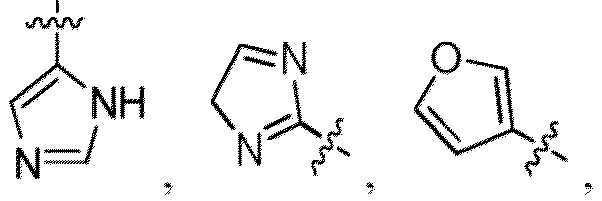


 wherein the term "optionally substituted" means being substituted by 1, 2, 3 or more R13,preferably, wherein R13 is selected from the group consisting of halogen, OH, -NR11R12, cyano and C1-4 alkyl; and phenyl, 5-, 6- or 7-membered monocyclic heterocyclic group and 5- to 6-membered heteroaryl, which are optionally substituted by 1, 2 or 3 substituents independently selected from the group consisting of halogen, OH, -NR11R12, cyano and C1-4 alkyl, and wherein R11 and R12 are each independently selected from the group consisting of H and C1-4 alkyl (preferably methyl);preferably, R13 is selected from the group consisting of F, Cl, Br, -N(CH3)2, and C1-4 alkyl; and phenyl, 5- to 7-membered monocyclic heterocyclic group (such as


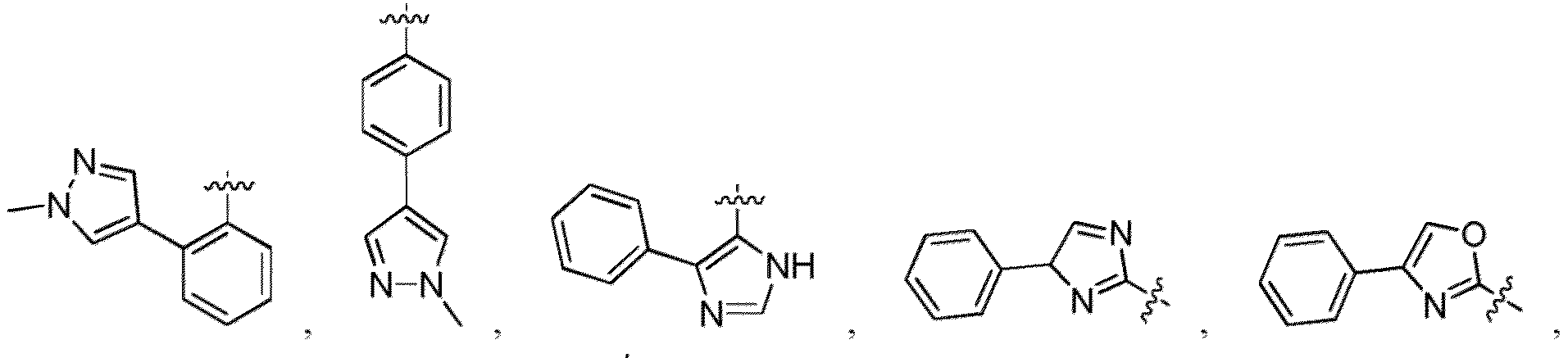


 X4 is selected from the group consisting of C(=O), S(=O)y and -O-C(=O)-, and wherein y is preferably 2; and/orR3 is COOH, or
- The compound according to claim 8, or a pharmaceutically acceptable salt, ester, stereoisomer, polymorph, solvate, N-oxide, isotopically labeled compound thereof, wherein X4 is a direct bond; and
preferably, in this case, R1a is -C1-3 alkylenephenyl, preferably -CH2-phenyl. - The compound according to claim 9, or a pharmaceutically acceptable salt, ester, stereoisomer, polymorph, solvate, N-oxide, isotopically labeled compound thereof, wherein:R1a is selected from the group consisting of C2-6 alkenyl (preferably vinyl, 1-propenyl or 2-propenyl) and C2-6 alkynyl (preferably ethynyl, 1-propynyl or 2-propynyl), which are optionally substituted by 1, 2, 3 or more R13; preferably, wherein R13 is selected from the group consisting of phenyl and 5- to 6-membered heteroaryl, which are optionally substituted by 1, 2 or 3 substituents independently selected from the group consisting of halogen, OH, amino, cyano and C1-4 alkyl;preferably, R13 is a phenyl or pyridyl, which is optionally substituted by 1, 2 or 3 substituents independently selected from the group consisting of F, Cl and Br; andX4 is C(=O) or -O-C(=O)-; orpreferably, R1a is selected from the group consisting of


- The compound according to any one of claims 1-4 and 7, or a pharmaceutically acceptable salt, ester, stereoisomer, polymorph, solvate, N-oxide, isotopically labeled compound thereof, wherein X1 is CR10 or N.
- The compound according to claim 14, or a pharmaceutically acceptable salt, ester, stereoisomer, polymorph, solvate, N-oxide, isotopically labeled compound thereof, wherein X4 is a direct bond;preferably, in this case,R1a is selected from the group consisting of C2-6 alkenyl (such as vinyl, 1-propenyl or 2-propenyl) and C2-6 alkynyl (such as ethynyl, 1-propynyl or 2-propynyl) which are optionally substituted by 1, 2, 3 or more R13; and/orR1b is selected from the group consisting of C1-4 alkyl optionally substituted by 1, 2, 3 or more R13;preferably, wherein R13 is selected from the group consisting of C1-4 alkyl, phenyl and 5- to 6-membered heteroaryl, which are optionally substituted by 1, 2 or 3 substituents independently selected from the group consisting of halogen, OH, amino, cyano and C1-4 alkyl;preferably, R13 is a C1-4 alkyl or phenyl, which is optionally substituted by 1, 2 or 3 substituents independently selected from the group consisting of F, Cl and Br;more preferably, R13 is a C1-4 alkyl (such as methyl, ethyl, propyl, isopropyl or tert-butyl); or a phenyl optionally substituted by 1, 2 or 3 substituents independently selected from the group consisting of F, Cl and Br;more preferably, R1a is
 R1b is methyl, ethyl, n-propyl or isopropyl;
and/orX1 is CH or N, preferably CH. - The compound according to claim 14, or a pharmaceutically acceptable salt, ester, stereoisomer, polymorph, solvate, N-oxide, isotopically labeled compound thereof, wherein X4 is selected from the group consisting of C(=O), S(=O)y, -O-C(=O)-, -S-C(=O)-, -O-S(=O)y-, -NR10-C(=O)- or -NR10-S(=O)y-, preferably is C(=O), -O-C(=O)- or -NR10-C(=O)-.
- The compound according to any one of claims 14 to 16, or a pharmaceutically acceptable salt, ester, stereoisomer, polymorph, solvate, N-oxide, isotopically labeled compound thereof, wherein R1b is selected from the group consisting of H and R1a, and preferably, X1 is CH.
- The compound according to claim 16, or a pharmaceutically acceptable salt, ester, stereoisomer, polymorph, solvate, N-oxide, isotopically labeled compound thereof, wherein:R1a is a group selected from the group consisting of an optionally substituted C3-7 cyclic hydrocarbyl group, an optionally substituted 4- to 7-membered monocyclic heterocyclic group, an optionally substituted 8- to 10-membered benzo-fused heterocyclic group, an optionally substituted phenyl, an optionally substituted 5- to 10-membered heteroaryl, -optionally substituted C1-3 alkylene-(optionally substituted C3-7 cyclic hydrocarbyl group), -optionally substituted C1-3 alkylene-(optionally substituted 5- to 7-membered monocyclic heterocyclic group), -optionally substituted C1-3 alkylene-(optionally substituted 8- to 10-membered benzo-fused heterocyclic group), -optionally substituted C1-3 alkylene-optionally substituted phenyl, and -optionally substituted C1-3 alkylene-(optionally substituted 5- to 10-membered heteroaryl);preferably, R1a is a group selected from the group consisting of an optionally substituted C3-7 cyclic hydrocarbyl group, an optionally substituted 4- to 7-membered monocyclic heterocyclic group, an optionally substituted 8- to 10-membered benzo-fused heterocyclic group, an optionally substituted phenyl, an optionally substituted 5- to 10-membered heteroaryl, -C1-3 alkylene-(optionally substituted C3-7 cyclic hydrocarbyl group), -C1-3 alkylene-(optionally substituted 5- to 7-membered monocyclic heterocyclic group), -C1-3 alkylene-(optionally substituted 8- to 10-membered benzo-fused heterocyclic group), -C1-3 alkylene-optionally substituted phenyl, and -C1-3 alkylene-(optionally substituted 5- to 10-membered heteroaryl); orR1a is a group selected from the group consisting ofan optionally substituted phenyl;-C1-3 alkylene-(optionally substituted C3-7 cyclic hydrocarbyl group), the cyclic hydrocarbyl group being, for example, cyclopropyl, cyclobutyl, cyclopentyl, or cyclohexyl;-C1-3 alkylene-(optionally substituted 8- to 10-membered benzo-fused heterocyclic group), the heterocyclic group being, for example,
 -C1-3 alkylene-optionally substituted phenyl;an optionally substituted 5- to 10-membered heteroaryl and -C1-3 alkylene-(optionally substituted 5- to 10-membered heteroaryl), the heteroaryl being, for example,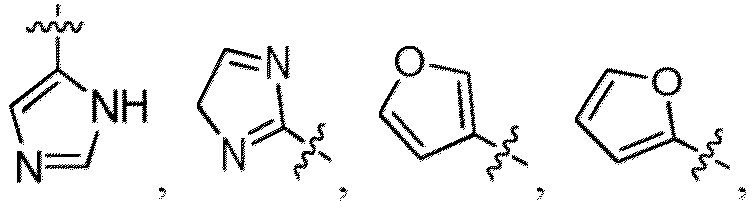


 wherein the term "optionally substituted" means being substituted by 1, 2, 3 or more R13;preferably, wherein R13 is selected from the group consisting of halogen, -OR11 (preferably, R11 is C1-6 alkyl optionally substituted by 1, 2, 3 or more halogens, more preferably C1-3 alkyl optionally substituted by 1, 2 or 3 F or Cl), -NR11R12, cyano and C3-7 cyclic hydrocarbyl group; and C1-4 alkyl, C2-4 alkenyl and C2-4 alkynyl which are optionally substituted by 1, 2, 3 or more halogens, and wherein R11 and R12 are each independently selected from the group consisting of H and C1-4 alkyl (preferably methyl);preferably, R13 is selected from the group consisting of F, Cl, Br, OH, -OC1-4 alkyl, -N(C1-4 alkyl)2, cyano, C3-7 cyclic hydrocarbyl group, C2-4 alkenyl and C2-4 alkynyl; and C1-4alkyl optionally substituted by 1, 2, 3 or more F, Cl or Br;more preferably, R13 is selected from the group consisting of F, Cl, Br, -OCH3, -N(CH3)2, cyano, cyclopropyl, vinyl, 1-propenyl, 2-propenyl, ethynyl, 1-propenyl, 2-propynyl, methyl, ethyl, n-propyl, isopropyl, tert-butyl and CF3; orR13, at each occurrence, is independently selected from the group consisting of-P(O)R11R12, wherein preferably, R11 and R12, at each occurrence, are each independently a C1-6 alkyl optionally substituted by 1, 2, 3 or more halogens, preferably a C1-3 alkyl optionally substituted by 1, 2 or 3 F or Cl, more preferably methyl, ethyl, propyl or isopropyl, more preferably methyl; and
C3-10 cyclic hydrocarbyl group or 3- to 10-membered heterocyclic group, which is substituted by C1-6 alkyl, preferably C3-7 cyclic hydrocarbyl group or 4- to 7-membered heterocyclic group, which is substituted by C1-6 alkyl, preferably C5-7 cyclic hydrocarbyl group or 5- to 7-membered monocyclic heterocyclic group, which is substituted by C1-3 alkyl, wherein the alkyl is optionally substituted by 1, 2, 3 or more OH or halogens, preferably optionally substituted by 1, 2 or 3 OH, F or Cl; or.R1a is selected from the group consisting of




- The compound according to any one of claims 18, or a pharmaceutically acceptable salt, ester, stereoisomer, polymorph, solvate, N-oxide, isotopically labeled compound thereof, wherein R1b is a group selected from the group consisting of H, an optionally substituted C1-4 alkyl, an optionally substituted C3-7 cyclic hydrocarbyl group, an optionally substituted phenyl, -optionally substituted C1-3 alkylene-(optionally substituted C3-7 cyclic hydrocarbyl group), and -optionally substituted C1-3 alkylene-optionally substituted phenyl;preferably, R1b is a group selected from the group consisting of H, an optionally substituted C1-4 alkyl, an optionally substituted C3-7 cyclic hydrocarbyl group, an optionally substituted phenyl, -C1-3 alkylene-(optionally substituted C3-7 cyclic hydrocarbyl group), and -C1-3 alkylene-optionally substituted phenyl;more preferably, R1b is a group selected from the group consisting ofH, phenyl;an optionally substituted C1-4 alkyl, the alkyl being, for example, methyl, ethyl or isopropyl;an optionally substituted C3-7 cyclic hydrocarbyl group and -C1-3 alkylene-(C3-7 cyclic hydrocarbyl group), the cyclic hydrocarbyl group being, for example, cyclopropyl, cyclobutyl, cyclopentyl, or cyclohexyl; and-C1-3 alkylene-phenyl; andwherein the term "optionally substituted" means being substituted by 1, 2, 3 or more R13;wherein R13 is preferably selected from the group consisting of halogen and C1-4 alkyl, more preferably selected from the group consisting of F, Cl, Br and methyl;preferably, R1b is selected from the group consisting of H, methyl, ethyl, isopropyl, CF3CH2, cyclopropyl,


- The compound according to any one of claims 18 to 19, or a pharmaceutically acceptable salt, ester, stereoisomer, polymorph, solvate, N-oxide, isotopically labeled compound thereof, wherein X1 is CH or N, preferably N; and/or X4 is selected from the group consisting of C(=O) and S(=O)y, and wherein y is preferably 2; and/or
R3 is COOH or
- The compound according to any one of claims 1 to 20, or a pharmaceutically acceptable salt, ester, stereoisomer, polymorph, solvate, N-oxide, isotopically labeled compound thereof, wherein:R2a is selected from the group consisting of an optionally substituted phenyl, and -optionally substituted C1-3 alkylene-optionally substituted phenyl;preferably, R2a is selected from the group consisting of an optionally substituted phenyl, and -C1-3 alkylene-optionally substituted phenyl; and/orR2b is selected from the group consisting of an optionally substituted C1-4 alkyl, an optionally substituted phenyl, and -optionally substituted C1-3 alkylene-optionally substituted phenyl;preferably, R2b is selected from the group consisting of C1-4 alkyl, an optionally substituted phenyl, and -C1-3 alkylene-optionally substituted phenyl;wherein the term "optionally substituted" means being substituted by 1, 2, 3 or more R13;preferably, wherein R13 is selected from the group consisting of halogen and -OR11, and wherein R11 is selected from C1-4 alkyl (preferably methyl);preferably, R13 is selected from the group consisting of F, Cl, Br and -OCH3;more preferably, R2a is selected from the group consisting of phenyl,

 R2b is selected from the group consisting of methyl, phenyl,
- The compound according to any one of claims 18 to 21, or a pharmaceutically acceptable salt, ester, stereoisomer, polymorph, solvate, N-oxide, isotopically labeled compound thereof, wherein the compound has a structure of formula (II) or formula (III):

- The compound according to any one of claims 1 to 4, or a pharmaceutically acceptable salt, ester, stereoisomer, polymorph, solvate, N-oxide, isotopically labeled compound thereof, whereinR1a is a group which is optionally substituted by 1, 2, 3 or more R13 and is selected from the group consisting of C1-6 alkyl, C2-6 alkenyl, C2-6 alkynyl, C5-7 cyclic hydrocarbyl group, 5-, 6- or 7- membered monocyclic heterocyclic group, 8- to 10-membered benzo-fused heterocyclic group, phenyl, 5- to 6-membered heteroaryl, -C1-3 alkylene-C3-7 cyclic hydrocarbyl group, -C1-3 alkylene-(5- to 7-membered monocyclic heterocyclic group), -C1-3 alkylenephenyl and -C1-3 alkylene-(5- to 6-membered heteroaryl),
preferably, wherein R13 is selected from the group consisting of C1-4 alkyl-O-; halogen (including F, Cl, Br and I); and C1-4 alkyl or phenyl, which is optionally substituted by 1, 2 or 3 substituents independently selected from halogen; and;R1b and X1 together form a bivalent C5-7 cyclic hydrocarbyl group or a bivalent 5-, 6- or 7- membered monocyclic heterocyclic group; orpreferably, R1a is phenyl; andR1b and X1 together form X4 is selected from the group consisting of C(=O) and S(=O)y.
 - The compound according to any one of claims 1 to 23, or a pharmaceutically acceptable salt, ester, stereoisomer, polymorph, solvate, N-oxide, isotopically labeled compound thereof, wherein





- The compound according to any one of claims 1 to 4, or a pharmaceutically acceptable salt, ester, stereoisomer, polymorph, solvate, N-oxide, isotopically labeled compound thereof, wherein Y is a single bond, NR10, O, S, methylene, ethylene, -CH2-O-, -O-CH2-, -CH2-S-, -S-CH2-, -CH2-NR10-, -NR10-CH2-, -CH=CH-, -CH=N- or -N=CH-; and/orthe optionally substituted saturated or partially unsaturated fused ring system comprising 3 or more rings which is formed by R1a and R1b together with X1 to which they are attached has a structure of formula (a):
 wherein:ring A and ring B are each independently C3-10 cyclic hydrocarbyl group, 3- to 10-membered heterocyclic group, C6-10 aryl, or 5- to 14-membered heteroaryl, preferably C5-7 cyclic hydrocarbyl group (such as, cyclopentyl or cyclohexyl), 5- to 7-membered monocyclic heterocyclic group, phenyl, or 5- to 6-membered heteroaryl;"- - - - - -" represents a single bond or a double bond;preferably, the fused ring system has a structure of formula (1) or formula (2):
 whereinR5a and R5b, at each occurrence, are each independently R10;R7 does not exist or is R10; andm and n, at each occurrence, are each independently 0, 1, 2 or 3;more preferably, the group of formula (1) has a structure selected from the group consisting of


 the group of formula (2) has a structure selected from the group consisting of


- The compound according to any one of claims 1 to 20 and 23 to 25, or a pharmaceutically acceptable salt, ester, stereoisomer, polymorph, solvate, N-oxide, isotopically labeled compound thereof, whereinR2a is a group which is optionally substituted by 1, 2, 3 or more R13 and is selected from the group consisting of C1-6 alkyl, C2-6 alkenyl, C2-6 alkynyl, C5-7 cyclic hydrocarbyl group, 5-, 6- or 7- membered monocyclic heterocyclic group, 8- to 10-membered benzo-fused heterocyclic group, phenyl, 5- to 6-membered heteroaryl, -C1-3 alkylene-C3-7 cyclic hydrocarbyl group, -C1-3 alkylene-(5- to 7-membered monocyclic heterocyclic group), -C1-3 alkylenephenyl and -C1-3 alkylene-(5- to 6-membered heteroaryl),preferably, wherein R13 is selected from the group consisting of C1-4 alkyl-O-; halogen (including F, Cl, Br, and I); and C1-4 alkyl or phenyl, which is optionally substituted by 1, 2 or 3 substituents independently selected from halogen; andR2b does not exist or is selected from the group consisting of H and R2a.
- The compound according to any one of claims 1 to 20, 23 to 26, or a pharmaceutically acceptable salt, ester, stereoisomer, polymorph, solvate, N-oxide, isotopically labeled compound thereof, wherein R2b does not exist, and X2 does not exist.
- The compound according to any one of claims 26 to 27, or a pharmaceutically acceptable salt, ester, stereoisomer, polymorph, solvate, N-oxide, isotopically labeled compound thereof, whereinR2a is a group selected from the group consisting of an optionally substituted 5-, 6- or 7-membered monocyclic heterocyclic group, an optionally substituted phenyl, and -optionally substituted C1-3 alkylene-optionally substituted phenyl, wherein the term "optionally substituted" means being substituted by 1, 2, 3 or more R13;R2b does not exist; andX2 does not exist.
- The compound according to any one of claims 1 to 26, or a pharmaceutically acceptable salt, ester, stereoisomer, polymorph, solvate, N-oxide, isotopically labeled compound thereof, wherein X2 is CR10 or N, and wherein R10 is preferably H, OH or C1-4 alkyl (such as methyl); and/or
R2b is selected from the group consisting of H and R2a, and preferably, X2 is CH. - The compound according to any one of claims 1 to 20 and 23 to 25, or a pharmaceutically acceptable salt, ester, stereoisomer, polymorph, solvate, N-oxide, isotopically labeled compound thereof, whereinR2a is a group which is optionally substituted by 1, 2, 3 or more R13 and is selected from the group consisting of C1-6 alkyl, C2-6 alkenyl, C2-6 alkynyl, C5-7 cyclic hydrocarbyl group, 5-, 6- or 7- membered monocyclic heterocyclic group, 8- to 10-membered benzo-fused heterocyclic group, phenyl, 5- to 6-membered heteroaryl, -C1-3 alkylene-C3-7 cyclic hydrocarbyl group, -C1-3 alkylene-(5- to 7-membered monocyclic heterocyclic group), -C1-3 alkylenephenyl and -C1-3 alkylene-(5- to 6-membered heteroaryl),
preferably, wherein R13 is selected from the group consisting of C1-4 alkyl-O-; halogen (including F, Cl, Br, and I); and C1-4 alkyl or phenyl, which is optionally substituted by 1, 2 or 3 substituents independently selected from halogen; andR2b and X2 together form a bivalent C5-7 cyclic hydrocarbyl group or a bivalent 5-, 6- or 7- membered monocyclic heterocyclic group. - The compound according to any one of claims 1 to 20 and 23 to 30, or the pharmaceutically acceptable salt, ester, stereoisomer, polymorph, solvate, N-oxide, isotopically labeled compound thereof, wherein


- The compound according to any one of claims 1 to 20 and claims 23 to 25, or the pharmaceutically acceptable salt, ester, stereoisomer, polymorph, solvate, N-oxide, isotopically labeled compound thereof, wherein Z is a single bond, NR10, O, S, methylene, ethylene, -CH2-O-, -O-CH2-, -CH2-S-, -S-CH2-, -CH2-NR10-, -NR10-CH2-, -CH=CH-, -CH=N- or -N=CH-; and/orthe optionally substituted saturated or partially unsaturated fused ring system comprising 3 or more rings which is formed by R2a and R2b together with X2 to which they are attached has a structure of formula (b):
 wherein:ring C and ring D are each independently C3-10 cyclic hydrocarbyl group, 3- to 10-membered heterocyclic group, C6-10 aryl or 5- to 14-membered heteroaryl, preferably C5-7 cyclic hydrocarbyl group, 5-to 7-membered monocyclic heterocyclic group, phenyl or 5- to 6-membered heteroaryl;"- - - - - -" represents a single bond or a double bond;preferably, the fused ring system has a structure of formula (3) or formula (4):
 whereinR6a and R6b, at each occurrence, are each independently R10;R8 does not exist or is R10; andp and q, at each occurrence, are each independently 0, 1, 2 or 3.
 - The compound according to any one of claims 1 to 25 and 32, or a pharmaceutically acceptable salt, ester, stereoisomer, polymorph, solvate, N-oxide, isotopically labeled compound thereof, wherein X2, at each occurrence, is independently CR10 or N, and wherein R10 is H, OH, amino or C1-4 alkyl (such as methyl);preferably, in this case, the group of formula (3) has a structure selected from the group consisting of


 the group of formula (4) has a structure selected from the group consisting of


- The compound according to any one of claims 1 to 21 and 23 to 33, or a pharmaceutically acceptable salt, ester, stereoisomer, polymorph, solvate, N-oxide, isotopically labeled compound thereof, wherein the compound has a structure of formula (a-1), (a-2), (a-3), (a-4), (a-5), (a-6), (a-7) or (a-8):


- A compound having a structure of


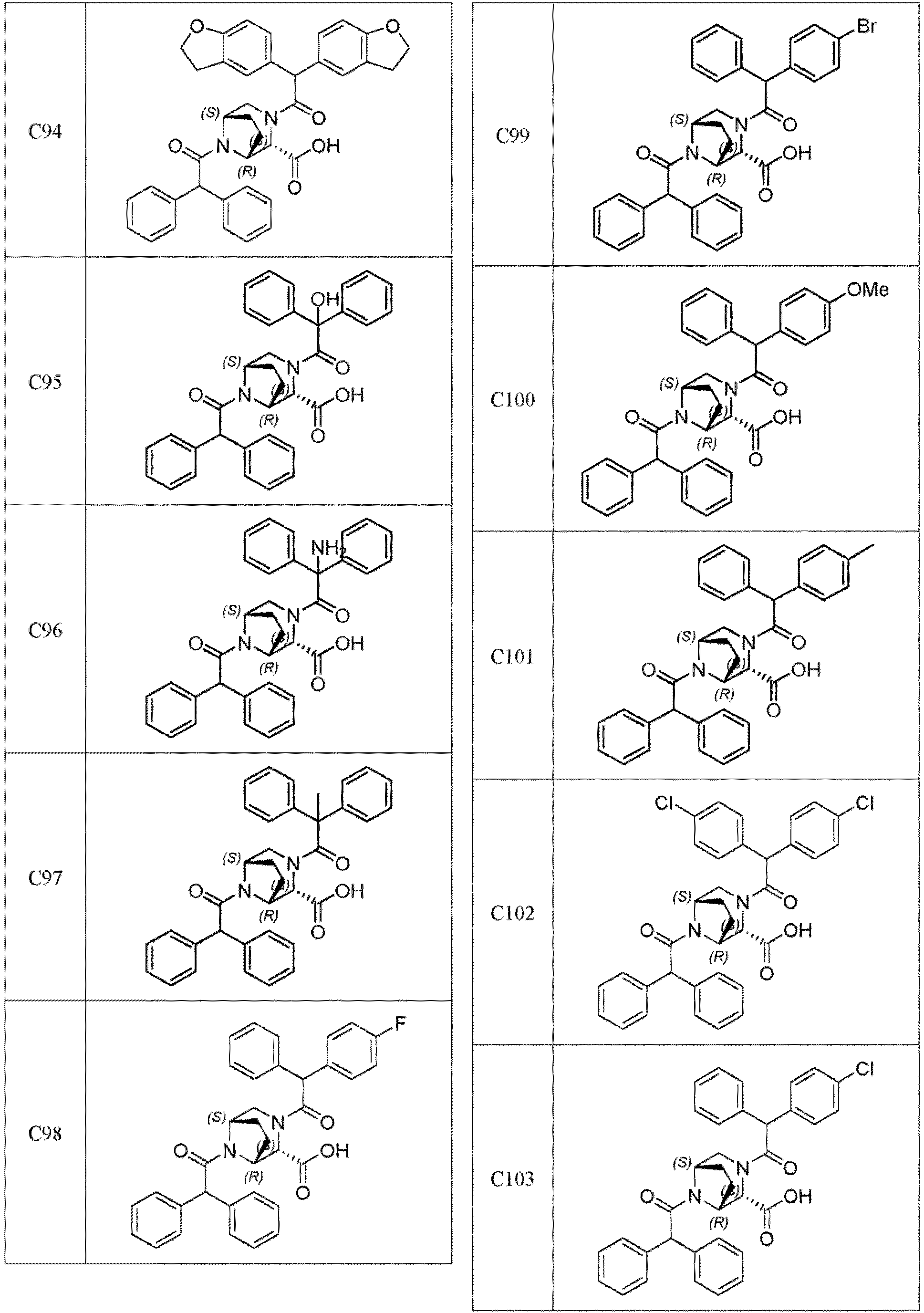


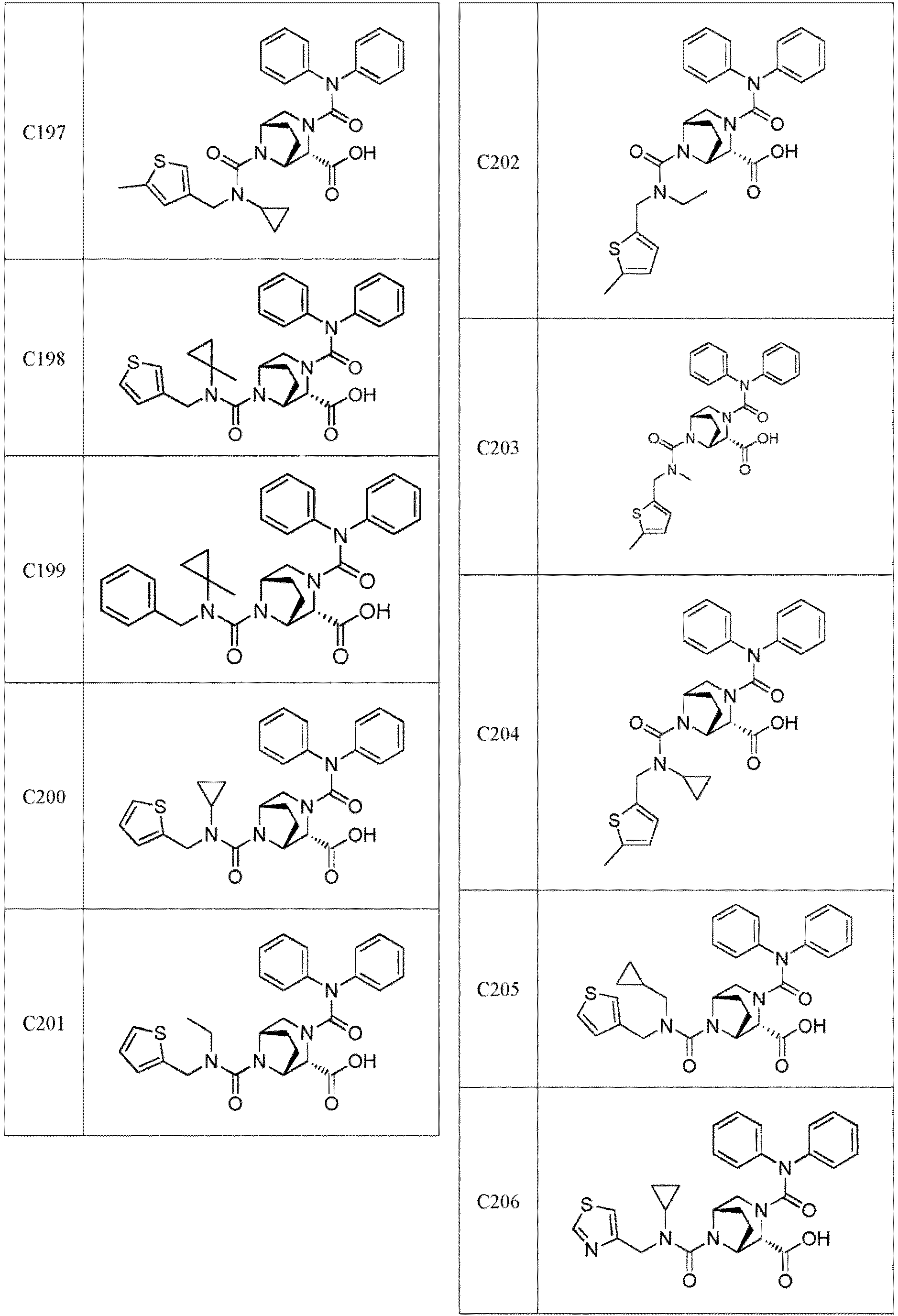


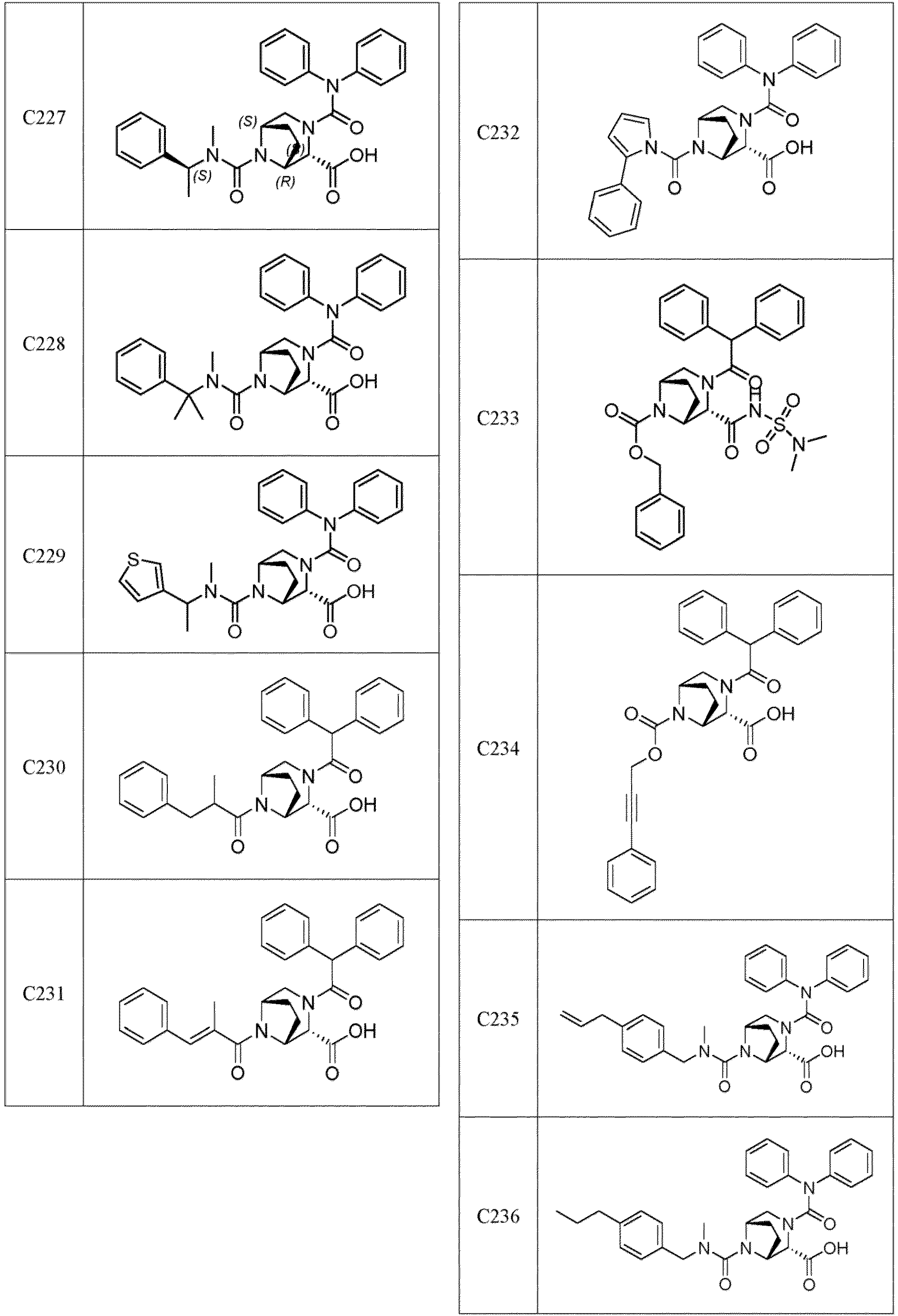


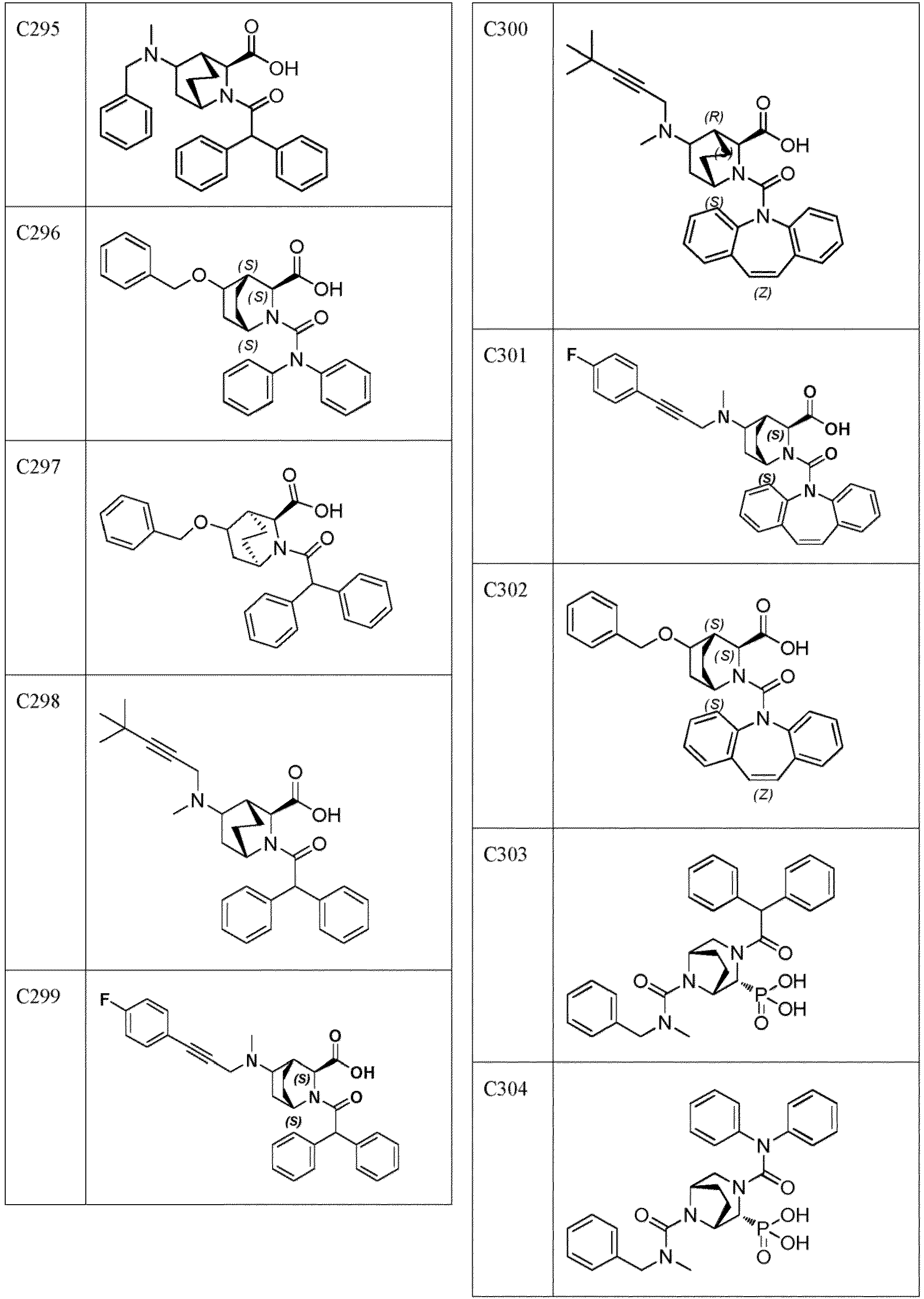
 or a pharmaceutically acceptable salt, ester, stereoisomer, polymorph, solvate, N-oxide, isotopically labeled compound thereof.
- A pharmaceutical composition comprising a prophylactically or therapeutically effective amount of a compound according to any one of claims 1 to 35 or a pharmaceutically acceptable salt, ester, stereoisomer, polymorph, solvate, N-oxide, isotopically labeled compound thereof, and a pharmaceutically acceptable carrier, and the pharmaceutical composition is preferably in the form of a solid, semi-solid, liquid, or gas preparation.
- The compound of any one of claims 1 to 35 or a pharmaceutically acceptable salt, ester, stereoisomer, polymorph, solvate, N-oxide, isotopically labeled compound thereof, or the pharmaceutical composition according to claim 36 for use in the regulation of a reproductive function associated with AT2 receptors (including menstrual cycle, fertility, and hormonal balances of the estrus cycle) in a female patient in need thereof; orfor use as an angiotensin II type 2 (AT2) receptor inhibitor, preferably a selective AT2 receptor inhibitor; orfor use in the prophylaxis or the treatment of an AT2 receptor-mediated disorder or a symptom associated therewith,preferably the AT2 receptor-mediated disorder being selected fromcerobrovascular disorders (including cerebrovascular spasm and cerebral ischemia); cognitive disorders (including amnesia, senile dementia, AIDS related dementia and Down's syndrome); central nervous system diseases or disorders (including addiction such as alcholism, anxiety, depression or dysthymic disorders, epilepsy, hyperactivity, pain, Parkinson's disease, psychosis, sleep disorders, irregular autonomic function, and tardive dyskinesia, schizophrenia, demyelinating diseases such as multiple sclerosis and amyotrophic lateral sclerosis); respiratory diseases (including bronchospasm, asthma, chronic obstructive airways disease), neural tumors; inflammatory diseases (including inflammatory bowel disease and osteoarthritis); gastrointestinal (GI) diseases or disorders (including ulcerative colitis, Crohn's disease and incontinence); disorders of blood flow caused by vasodilation; hypersensitivity disorders (including allergies such as eczema, rhinitis and contact dermatitis); vasospastic diseases (including angina, migraine and Reynaud's disease); fibrosing and collagen diseases (including scleroderma and eosinophilic fascioliasis); reflex sympathetic dystrophy (including shoulder/hand syndrome); stress related somatic disorders; peripheral neuropathy; neuralgia; autoimmune disease (including systemic lupus erythematosus, rheumatoid arthritis, psoriasis and graft versus host disease); and rheumatic diseases (including fibrositis);neuropathic conditions (including primary neuropathy and secondary neuropathy, such as peripheral neuropathy) or symptoms associated with the same (including hyperesthesia, hyperalgesia, allodynia, spontaneous burning pain, numbness, weakness, burning pain, shooting pain, and loss of reflexes), preferably neuropathic pain; wherein the secondary neuropathy includes diabetic neuropathy; Herpes Zoster-related neuropathy; uremia-associated neuropathy; amyloidosis neuropathy; HIV sensory neuropathies; hereditary motor and sensory neuropathies; hereditary sensory neuropathies; hereditary sensory and autonomic neuropathies; hereditary neuropathies with ulcero-mutilation; nitrofurantoin neuropathy; tomaculous neuropathy; neuropathy caused by nutritional deficiency; neuropathy caused by kidney failure and complex regional pain syndrome; neuropathes caused by repetitive activities (such as typing or working on an assembly line); peripheral neuropathies caused by antiretroviral drugs (such as zalcitabine and didanosine), antibiotics (such metronidazole and isoniazid), gold compounds, chemotherapy drugs (such as vincristine), alcohol, lead, arsenic, mercury and organophosphate pesticides; peripheral neuropathies associated with infectious processes (such as Guillian-Barre syndrome);a condition characterized by neuronal hypersensitivity, including a hyperalgesic condition, such as fibromyalgia and irritable bowel syndrome;a disorder associated with aberrant nerve regeneration, including neuronal hypersensitivity, breast pain, interstitial cystitis, vulvodynia, a cancer chemotherapy-induced neuropathy;inflammatory pain that can be due to conditions that are characterized by inflammation (including burns such as chemical, frictional or thermal burns; autoimmune diseases such as rheumatoid arthritis; inflammatory bowel disease such as Crohn's disease and colitis; osteoarthritis, carditis, dermatitis, myositis, neuritis and collagen vascular diseases);impaired nerve conduction velocity which may be associated with a neuropathic condition as described above (such as a peripheral neuropathy) as well as Carpel Tunnel Syndrome, ulnar neuropathy, Guillian-Barre Syndrome, fascioscapulohumeral muscular dystrophy and spinal disc herneation;a cell proliferative disorder, including a cancer (including leukaemia, melanoma, prostate cancer, breast cancer, ovarian cancer, basal cell carcinoma, squamous cell carcinoma, sarcoma, fibrosarcoma, colon cancer, lung cancer); and a non-cancerous proliferative disorder (including dermatological disorders such as warts, keloids, psoriasis, proud flesh disorder and also the reduction in scar tissue and cosmetic remodelling); anda disorder associated with an imbalance between bone resorption and bone formation, including osteoporosis.
Applications Claiming Priority (2)
| Application Number | Priority Date | Filing Date | Title |
|---|---|---|---|
| CN201810244703 | 2018-03-23 | ||
| PCT/CN2019/079226 WO2019179515A1 (en) | 2018-03-23 | 2019-03-22 | Receptor inhibitor, pharmaceutical composition comprising same, and use thereof |
Publications (4)
| Publication Number | Publication Date |
|---|---|
| EP3770148A1 EP3770148A1 (en) | 2021-01-27 |
| EP3770148A4 EP3770148A4 (en) | 2022-01-05 |
| EP3770148B1 true EP3770148B1 (en) | 2024-10-02 |
| EP3770148C0 EP3770148C0 (en) | 2024-10-02 |
Family
ID=67988152
Family Applications (1)
| Application Number | Title | Priority Date | Filing Date |
|---|---|---|---|
| EP19771519.6A Active EP3770148B1 (en) | 2018-03-23 | 2019-03-22 | Receptor inhibitor, pharmaceutical composition comprising same, and use thereof |
Country Status (9)
| Country | Link |
|---|---|
| US (3) | US11453690B2 (en) |
| EP (1) | EP3770148B1 (en) |
| JP (1) | JP7438962B2 (en) |
| KR (1) | KR102875747B1 (en) |
| CN (2) | CN111801318B (en) |
| AU (2) | AU2019236882B2 (en) |
| CA (1) | CA3094001C (en) |
| ES (1) | ES2989550T3 (en) |
| WO (1) | WO2019179515A1 (en) |
Families Citing this family (10)
| Publication number | Priority date | Publication date | Assignee | Title |
|---|---|---|---|---|
| US9730677B2 (en) | 2011-05-17 | 2017-08-15 | Koninklijke Philips Electronics N.V. | Matrix ultrasound probe with passive heat dissipation |
| CA3094001C (en) * | 2018-03-23 | 2024-01-23 | Beijing Tide Pharmaceutical Co., Ltd. | Receptor inhibitor, pharmaceutical composition comprising same, and use thereof |
| IL326597A (en) | 2019-10-07 | 2026-04-01 | Contineum Therapeutics Inc | Muscarinic acetylcholine m1 receptor antagonists |
| US11752149B2 (en) | 2019-12-02 | 2023-09-12 | Pipeline Therapeutics, Inc. | Muscarinic acetylcholine M1 receptor antagonists |
| KR20240029051A (en) | 2021-07-02 | 2024-03-05 | 상하이 드 노보 파마테크 컴퍼니 리미티드 | KRAS G12D inhibitors and uses thereof |
| US20240368133A1 (en) | 2021-07-30 | 2024-11-07 | Confo Therapeutics N.V. | Compounds for the Treatment of Pain, in Particular, Neuropathic Pain, and/or Other Diseases or Disorders that are Associated with AT2R and/or AT2R Mediated Signaling |
| EP4471037A1 (en) | 2022-01-30 | 2024-12-04 | Shanghai Pharmaceuticals Holding Co., Ltd. | Quinoline compound and use thereof |
| WO2025153011A1 (en) * | 2024-01-17 | 2025-07-24 | 北京泰德制药股份有限公司 | Angiotensin ii receptor antagonist and use thereof in treatment of peripherally-induced neuropathic pain |
| TW202543628A (en) * | 2024-04-03 | 2025-11-16 | 大陸商北京泰德製藥股份有限公司 | Angiotensin II type 2 receptor antagonists and their use in the treatment of cancer pain. |
| WO2026086860A1 (en) * | 2024-10-24 | 2026-04-30 | 北京泰德制药股份有限公司 | Salt of at2 receptor inhibitor, solid form thereof, preparation method therefor and use thereof |
Family Cites Families (11)
| Publication number | Priority date | Publication date | Assignee | Title |
|---|---|---|---|---|
| WO1992020661A1 (en) * | 1991-05-22 | 1992-11-26 | Merck & Co., Inc. | N, n-diacylpiperazines |
| US5348955A (en) * | 1993-06-22 | 1994-09-20 | Merck & Co., Inc. | N,N-diacylpiperazines |
| WO2006066361A1 (en) | 2004-12-24 | 2006-06-29 | The University Of Queensland | Method of treatment or prophylaxis |
| AU2007229322B2 (en) * | 2006-03-20 | 2012-04-05 | Novartis Ag | Method of treatment or prophylaxis inflammatory pain |
| CN102311439B (en) * | 2010-07-02 | 2015-11-25 | 上海药明康德新药开发有限公司 | 1-replaces-3,8-diazabicyclos [3.2.1] Octane derivatives and preparation method |
| CN102875556B (en) * | 2011-07-12 | 2016-03-30 | 天津药明康德新药开发有限公司 | (4S)-1-replaces-2,5-diazabicyclos [2,2,1] heptane derivative and preparation method |
| PL2800738T3 (en) | 2012-01-06 | 2020-10-19 | Novartis Ag | Heterocyclic compounds and methods for their use |
| WO2013110135A1 (en) | 2012-01-25 | 2013-08-01 | Spinifex Pharmaceuticals Pty Ltd | Heterocyclic compounds and methods for their use |
| CN106831787B (en) | 2017-01-20 | 2018-10-23 | 成都倍特药业有限公司 | Compound and its preparation method and application as bruton's tyrosine kinase inhibitor |
| EP3768256A4 (en) * | 2018-03-19 | 2021-11-24 | Emory University | PANTROPIC ENTRY INHIBITORS |
| CA3094001C (en) * | 2018-03-23 | 2024-01-23 | Beijing Tide Pharmaceutical Co., Ltd. | Receptor inhibitor, pharmaceutical composition comprising same, and use thereof |
-
2019
- 2019-03-22 CA CA3094001A patent/CA3094001C/en active Active
- 2019-03-22 EP EP19771519.6A patent/EP3770148B1/en active Active
- 2019-03-22 ES ES19771519T patent/ES2989550T3/en active Active
- 2019-03-22 US US17/040,569 patent/US11453690B2/en active Active
- 2019-03-22 AU AU2019236882A patent/AU2019236882B2/en active Active
- 2019-03-22 WO PCT/CN2019/079226 patent/WO2019179515A1/en not_active Ceased
- 2019-03-22 CN CN201980016552.2A patent/CN111801318B/en active Active
- 2019-03-22 CN CN202311688389.9A patent/CN117645606A/en active Pending
- 2019-03-22 KR KR1020207030718A patent/KR102875747B1/en active Active
- 2019-03-22 JP JP2020549744A patent/JP7438962B2/en active Active
-
2022
- 2022-05-25 US US17/752,960 patent/US12180243B2/en active Active
-
2023
- 2023-10-25 AU AU2023254923A patent/AU2023254923B2/en active Active
-
2024
- 2024-10-31 US US18/932,687 patent/US20250066398A1/en active Pending
Also Published As
| Publication number | Publication date |
|---|---|
| JP7438962B2 (en) | 2024-02-27 |
| CN111801318B (en) | 2024-01-02 |
| WO2019179515A1 (en) | 2019-09-26 |
| EP3770148A4 (en) | 2022-01-05 |
| EP3770148C0 (en) | 2024-10-02 |
| CA3094001C (en) | 2024-01-23 |
| AU2019236882A1 (en) | 2020-10-15 |
| US20230106958A1 (en) | 2023-04-06 |
| JP2021518368A (en) | 2021-08-02 |
| EP3770148A1 (en) | 2021-01-27 |
| AU2023254923B2 (en) | 2025-11-27 |
| CA3094001A1 (en) | 2019-09-26 |
| US20250066398A1 (en) | 2025-02-27 |
| CN111801318A (en) | 2020-10-20 |
| KR102875747B1 (en) | 2025-10-22 |
| US11453690B2 (en) | 2022-09-27 |
| KR20210010444A (en) | 2021-01-27 |
| US12180243B2 (en) | 2024-12-31 |
| AU2023254923A1 (en) | 2023-11-16 |
| AU2019236882B2 (en) | 2023-08-10 |
| ES2989550T3 (en) | 2024-11-27 |
| CN117645606A (en) | 2024-03-05 |
| US20210054007A1 (en) | 2021-02-25 |
Similar Documents
| Publication | Publication Date | Title |
|---|---|---|
| KR102875747B1 (en) | Receptor inhibitors, pharmaceutical compositions containing the same, and uses thereof | |
| AU2020394444B2 (en) | Substituted macrocyclic compounds and related methods of treatment | |
| EP3634404B1 (en) | Pyrazole magl inhibitors | |
| AU2021409403A1 (en) | Substituted macrocyclic compounds and related methods of treatment | |
| EP3712144B1 (en) | P2x3 and/or p2x2/3 receptor antagonist, pharmaceutical composition comprising same, and use thereof | |
| EP4423068B1 (en) | Rxfp1 agonists | |
| JP7814359B2 (en) | Receptor inhibitors, pharmaceutical compositions containing the inhibitors and uses thereof | |
| CA3260221A1 (en) | Substituted fused bicyclic compounds and related methods of treatment | |
| HK40029777A (en) | Receptor inhibitor, pharmaceutical composition comprising same, and use thereof | |
| CN117659022A (en) | Ureido-substituted pyridine compounds, pharmaceutical compositions containing them and their medicinal uses | |
| HK40029777B (en) | Receptor inhibitor, pharmaceutical composition comprising same, and use thereof | |
| HK40032239A (en) | Receptor inhibitors, pharmaceutical compositions comprising the same and use thereof | |
| HK40032239B (en) | Receptor inhibitors, pharmaceutical compositions comprising the same and use thereof | |
| HK40079910A (en) | Arylmethylene heterocyclic compounds as kv1.3 potassium shaker channel blockers |
Legal Events
| Date | Code | Title | Description |
|---|---|---|---|
| STAA | Information on the status of an ep patent application or granted ep patent |
Free format text: STATUS: THE INTERNATIONAL PUBLICATION HAS BEEN MADE |
|
| PUAI | Public reference made under article 153(3) epc to a published international application that has entered the european phase |
Free format text: ORIGINAL CODE: 0009012 |
|
| STAA | Information on the status of an ep patent application or granted ep patent |
Free format text: STATUS: REQUEST FOR EXAMINATION WAS MADE |
|
| 17P | Request for examination filed |
Effective date: 20201016 |
|
| AK | Designated contracting states |
Kind code of ref document: A1 Designated state(s): AL AT BE BG CH CY CZ DE DK EE ES FI FR GB GR HR HU IE IS IT LI LT LU LV MC MK MT NL NO PL PT RO RS SE SI SK SM TR |
|
| AX | Request for extension of the european patent |
Extension state: BA ME |
|
| DAV | Request for validation of the european patent (deleted) | ||
| DAX | Request for extension of the european patent (deleted) | ||
| REG | Reference to a national code |
Ref country code: DE Ref legal event code: R079 Free format text: PREVIOUS MAIN CLASS: C07D0241380000 Ipc: C07D0471080000 Ref document number: 602019059758 Country of ref document: DE |
|
| A4 | Supplementary search report drawn up and despatched |
Effective date: 20211206 |
|
| RIC1 | Information provided on ipc code assigned before grant |
Ipc: A61P 25/00 20060101ALI20211130BHEP Ipc: A61P 9/00 20060101ALI20211130BHEP Ipc: A61K 31/498 20060101ALI20211130BHEP Ipc: C07F 9/6561 20060101ALI20211130BHEP Ipc: C07D 487/08 20060101ALI20211130BHEP Ipc: C07D 471/08 20060101AFI20211130BHEP |
|
| STAA | Information on the status of an ep patent application or granted ep patent |
Free format text: STATUS: EXAMINATION IS IN PROGRESS |
|
| 17Q | First examination report despatched |
Effective date: 20231103 |
|
| GRAP | Despatch of communication of intention to grant a patent |
Free format text: ORIGINAL CODE: EPIDOSNIGR1 |
|
| STAA | Information on the status of an ep patent application or granted ep patent |
Free format text: STATUS: GRANT OF PATENT IS INTENDED |
|
| INTG | Intention to grant announced |
Effective date: 20240425 |
|
| GRAS | Grant fee paid |
Free format text: ORIGINAL CODE: EPIDOSNIGR3 |
|
| GRAA | (expected) grant |
Free format text: ORIGINAL CODE: 0009210 |
|
| STAA | Information on the status of an ep patent application or granted ep patent |
Free format text: STATUS: THE PATENT HAS BEEN GRANTED |
|
| AK | Designated contracting states |
Kind code of ref document: B1 Designated state(s): AL AT BE BG CH CY CZ DE DK EE ES FI FR GB GR HR HU IE IS IT LI LT LU LV MC MK MT NL NO PL PT RO RS SE SI SK SM TR |
|
| REG | Reference to a national code |
Ref country code: GB Ref legal event code: FG4D |
|
| REG | Reference to a national code |
Ref country code: CH Ref legal event code: EP |
|
| REG | Reference to a national code |
Ref country code: IE Ref legal event code: FG4D |
|
| REG | Reference to a national code |
Ref country code: DE Ref legal event code: R096 Ref document number: 602019059758 Country of ref document: DE |
|
| U01 | Request for unitary effect filed |
Effective date: 20241009 |
|
| REG | Reference to a national code |
Ref country code: ES Ref legal event code: FG2A Ref document number: 2989550 Country of ref document: ES Kind code of ref document: T3 Effective date: 20241127 |
|
| U07 | Unitary effect registered |
Designated state(s): AT BE BG DE DK EE FI FR IT LT LU LV MT NL PT RO SE SI Effective date: 20241029 |
|
| U20 | Renewal fee for the european patent with unitary effect paid |
Year of fee payment: 7 Effective date: 20250205 |
|
| PG25 | Lapsed in a contracting state [announced via postgrant information from national office to epo] |
Ref country code: HR Free format text: LAPSE BECAUSE OF FAILURE TO SUBMIT A TRANSLATION OF THE DESCRIPTION OR TO PAY THE FEE WITHIN THE PRESCRIBED TIME-LIMIT Effective date: 20241002 Ref country code: IS Free format text: LAPSE BECAUSE OF FAILURE TO SUBMIT A TRANSLATION OF THE DESCRIPTION OR TO PAY THE FEE WITHIN THE PRESCRIBED TIME-LIMIT Effective date: 20250202 |
|
| PG25 | Lapsed in a contracting state [announced via postgrant information from national office to epo] |
Ref country code: NO Free format text: LAPSE BECAUSE OF FAILURE TO SUBMIT A TRANSLATION OF THE DESCRIPTION OR TO PAY THE FEE WITHIN THE PRESCRIBED TIME-LIMIT Effective date: 20250102 |
|
| PG25 | Lapsed in a contracting state [announced via postgrant information from national office to epo] |
Ref country code: GR Free format text: LAPSE BECAUSE OF FAILURE TO SUBMIT A TRANSLATION OF THE DESCRIPTION OR TO PAY THE FEE WITHIN THE PRESCRIBED TIME-LIMIT Effective date: 20250103 |
|
| PG25 | Lapsed in a contracting state [announced via postgrant information from national office to epo] |
Ref country code: CZ Free format text: LAPSE BECAUSE OF FAILURE TO SUBMIT A TRANSLATION OF THE DESCRIPTION OR TO PAY THE FEE WITHIN THE PRESCRIBED TIME-LIMIT Effective date: 20241002 Ref country code: PL Free format text: LAPSE BECAUSE OF FAILURE TO SUBMIT A TRANSLATION OF THE DESCRIPTION OR TO PAY THE FEE WITHIN THE PRESCRIBED TIME-LIMIT Effective date: 20241002 |
|
| PG25 | Lapsed in a contracting state [announced via postgrant information from national office to epo] |
Ref country code: RS Free format text: LAPSE BECAUSE OF FAILURE TO SUBMIT A TRANSLATION OF THE DESCRIPTION OR TO PAY THE FEE WITHIN THE PRESCRIBED TIME-LIMIT Effective date: 20250102 |
|
| PG25 | Lapsed in a contracting state [announced via postgrant information from national office to epo] |
Ref country code: SM Free format text: LAPSE BECAUSE OF FAILURE TO SUBMIT A TRANSLATION OF THE DESCRIPTION OR TO PAY THE FEE WITHIN THE PRESCRIBED TIME-LIMIT Effective date: 20241002 |
|
| PGFP | Annual fee paid to national office [announced via postgrant information from national office to epo] |
Ref country code: ES Payment date: 20250411 Year of fee payment: 7 |
|
| PGFP | Annual fee paid to national office [announced via postgrant information from national office to epo] |
Ref country code: CH Payment date: 20250401 Year of fee payment: 7 |
|
| PG25 | Lapsed in a contracting state [announced via postgrant information from national office to epo] |
Ref country code: SK Free format text: LAPSE BECAUSE OF FAILURE TO SUBMIT A TRANSLATION OF THE DESCRIPTION OR TO PAY THE FEE WITHIN THE PRESCRIBED TIME-LIMIT Effective date: 20241002 |
|
| PLBE | No opposition filed within time limit |
Free format text: ORIGINAL CODE: 0009261 |
|
| STAA | Information on the status of an ep patent application or granted ep patent |
Free format text: STATUS: NO OPPOSITION FILED WITHIN TIME LIMIT |
|
| 26N | No opposition filed |
Effective date: 20250703 |
|
| PG25 | Lapsed in a contracting state [announced via postgrant information from national office to epo] |
Ref country code: MC Free format text: LAPSE BECAUSE OF FAILURE TO SUBMIT A TRANSLATION OF THE DESCRIPTION OR TO PAY THE FEE WITHIN THE PRESCRIBED TIME-LIMIT Effective date: 20241002 |
|
| U20 | Renewal fee for the european patent with unitary effect paid |
Year of fee payment: 8 Effective date: 20260209 |
|
| REG | Reference to a national code |
Ref country code: CH Ref legal event code: U11 Free format text: ST27 STATUS EVENT CODE: U-0-0-U10-U11 (AS PROVIDED BY THE NATIONAL OFFICE) Effective date: 20260401 |
|
| PGFP | Annual fee paid to national office [announced via postgrant information from national office to epo] |
Ref country code: GB Payment date: 20260106 Year of fee payment: 8 |
|
| PGFP | Annual fee paid to national office [announced via postgrant information from national office to epo] |
Ref country code: IE Payment date: 20260102 Year of fee payment: 8 |