EP3770143A1 - Branched monodispersed polyethylene glycol, intermediate, and method for producing same - Google Patents
Branched monodispersed polyethylene glycol, intermediate, and method for producing same Download PDFInfo
- Publication number
- EP3770143A1 EP3770143A1 EP19770451.3A EP19770451A EP3770143A1 EP 3770143 A1 EP3770143 A1 EP 3770143A1 EP 19770451 A EP19770451 A EP 19770451A EP 3770143 A1 EP3770143 A1 EP 3770143A1
- Authority
- EP
- European Patent Office
- Prior art keywords
- group
- formula
- polyethylene glycol
- integer
- bond
- Prior art date
- Legal status (The legal status is an assumption and is not a legal conclusion. Google has not performed a legal analysis and makes no representation as to the accuracy of the status listed.)
- Pending
Links
- 229920001223 polyethylene glycol Polymers 0.000 title claims abstract description 75
- 239000002202 Polyethylene glycol Substances 0.000 title claims abstract description 73
- 238000004519 manufacturing process Methods 0.000 title claims description 21
- 125000000524 functional group Chemical group 0.000 claims abstract description 38
- IAYPIBMASNFSPL-UHFFFAOYSA-N Ethylene oxide Chemical group C1CO1 IAYPIBMASNFSPL-UHFFFAOYSA-N 0.000 claims abstract description 15
- RTZKZFJDLAIYFH-UHFFFAOYSA-N ether Substances CCOCC RTZKZFJDLAIYFH-UHFFFAOYSA-N 0.000 claims abstract description 9
- 150000001875 compounds Chemical class 0.000 claims description 87
- 238000006243 chemical reaction Methods 0.000 claims description 49
- 229910052757 nitrogen Inorganic materials 0.000 claims description 29
- 238000000034 method Methods 0.000 claims description 22
- -1 acryl group Chemical group 0.000 claims description 20
- 125000003277 amino group Chemical group 0.000 claims description 19
- XLYOFNOQVPJJNP-UHFFFAOYSA-N water Substances O XLYOFNOQVPJJNP-UHFFFAOYSA-N 0.000 claims description 19
- 238000000746 purification Methods 0.000 claims description 16
- 238000005859 coupling reaction Methods 0.000 claims description 15
- 125000004433 nitrogen atom Chemical group N* 0.000 claims description 13
- 125000003178 carboxy group Chemical group [H]OC(*)=O 0.000 claims description 12
- 125000002887 hydroxy group Chemical group [H]O* 0.000 claims description 12
- 125000004430 oxygen atom Chemical group O* 0.000 claims description 12
- 125000002496 methyl group Chemical group [H]C([H])([H])* 0.000 claims description 11
- 239000003960 organic solvent Substances 0.000 claims description 10
- 125000003396 thiol group Chemical group [H]S* 0.000 claims description 10
- 125000000304 alkynyl group Chemical group 0.000 claims description 9
- 125000005587 carbonate group Chemical group 0.000 claims description 9
- 125000004185 ester group Chemical group 0.000 claims description 9
- 238000000605 extraction Methods 0.000 claims description 9
- 125000005439 maleimidyl group Chemical group C1(C=CC(N1*)=O)=O 0.000 claims description 9
- 125000003172 aldehyde group Chemical group 0.000 claims description 8
- IVRMZWNICZWHMI-UHFFFAOYSA-N azide group Chemical group [N-]=[N+]=[N-] IVRMZWNICZWHMI-UHFFFAOYSA-N 0.000 claims description 8
- 125000001797 benzyl group Chemical group [H]C1=C([H])C([H])=C(C([H])=C1[H])C([H])([H])* 0.000 claims description 5
- AFOSIXZFDONLBT-UHFFFAOYSA-N divinyl sulfone Chemical group C=CS(=O)(=O)C=C AFOSIXZFDONLBT-UHFFFAOYSA-N 0.000 claims description 5
- 125000003700 epoxy group Chemical group 0.000 claims description 5
- IQPQWNKOIGAROB-UHFFFAOYSA-N isocyanate group Chemical group [N-]=C=O IQPQWNKOIGAROB-UHFFFAOYSA-N 0.000 claims description 5
- ZBKFYXZXZJPWNQ-UHFFFAOYSA-N isothiocyanate group Chemical group [N-]=C=S ZBKFYXZXZJPWNQ-UHFFFAOYSA-N 0.000 claims description 5
- 125000003903 2-propenyl group Chemical group [H]C([*])([H])C([H])=C([H])[H] 0.000 claims description 4
- 125000000391 vinyl group Chemical group [H]C([*])=C([H])[H] 0.000 claims description 4
- 230000008878 coupling Effects 0.000 claims description 3
- 238000010168 coupling process Methods 0.000 claims description 3
- 150000002334 glycols Chemical class 0.000 claims description 3
- UFHFLCQGNIYNRP-UHFFFAOYSA-N Hydrogen Chemical compound [H][H] UFHFLCQGNIYNRP-UHFFFAOYSA-N 0.000 claims description 2
- 230000003197 catalytic effect Effects 0.000 claims description 2
- 125000005414 dithiopyridyl group Chemical group 0.000 claims description 2
- 239000001257 hydrogen Substances 0.000 claims description 2
- 229910052739 hydrogen Inorganic materials 0.000 claims description 2
- 230000009467 reduction Effects 0.000 claims description 2
- YMWUJEATGCHHMB-UHFFFAOYSA-N Dichloromethane Chemical compound ClCCl YMWUJEATGCHHMB-UHFFFAOYSA-N 0.000 description 63
- FAPWRFPIFSIZLT-UHFFFAOYSA-M Sodium chloride Chemical compound [Na+].[Cl-] FAPWRFPIFSIZLT-UHFFFAOYSA-M 0.000 description 40
- 229940079593 drug Drugs 0.000 description 39
- 239000003814 drug Substances 0.000 description 39
- ZMANZCXQSJIPKH-UHFFFAOYSA-N Triethylamine Chemical compound CCN(CC)CC ZMANZCXQSJIPKH-UHFFFAOYSA-N 0.000 description 33
- IJGRMHOSHXDMSA-UHFFFAOYSA-N Atomic nitrogen Chemical compound N#N IJGRMHOSHXDMSA-UHFFFAOYSA-N 0.000 description 32
- HEDRZPFGACZZDS-MICDWDOJSA-N Trichloro(2H)methane Chemical compound [2H]C(Cl)(Cl)Cl HEDRZPFGACZZDS-MICDWDOJSA-N 0.000 description 32
- 239000002904 solvent Substances 0.000 description 32
- KWYUFKZDYYNOTN-UHFFFAOYSA-M Potassium hydroxide Chemical compound [OH-].[K+] KWYUFKZDYYNOTN-UHFFFAOYSA-M 0.000 description 30
- YXFVVABEGXRONW-UHFFFAOYSA-N Toluene Chemical compound CC1=CC=CC=C1 YXFVVABEGXRONW-UHFFFAOYSA-N 0.000 description 30
- 239000000243 solution Substances 0.000 description 24
- 229940049595 antibody-drug conjugate Drugs 0.000 description 21
- 235000002639 sodium chloride Nutrition 0.000 description 21
- 239000011780 sodium chloride Substances 0.000 description 20
- OKKJLVBELUTLKV-UHFFFAOYSA-N Methanol Chemical compound OC OKKJLVBELUTLKV-UHFFFAOYSA-N 0.000 description 18
- 239000012044 organic layer Substances 0.000 description 17
- 238000005160 1H NMR spectroscopy Methods 0.000 description 16
- HEDRZPFGACZZDS-UHFFFAOYSA-N Chloroform Chemical compound ClC(Cl)Cl HEDRZPFGACZZDS-UHFFFAOYSA-N 0.000 description 16
- 125000005647 linker group Chemical group 0.000 description 16
- 239000006227 byproduct Substances 0.000 description 14
- 239000003054 catalyst Substances 0.000 description 13
- 239000000203 mixture Substances 0.000 description 13
- 125000003827 glycol group Chemical group 0.000 description 11
- 230000004048 modification Effects 0.000 description 11
- 238000012986 modification Methods 0.000 description 11
- 239000007864 aqueous solution Substances 0.000 description 10
- XEKOWRVHYACXOJ-UHFFFAOYSA-N Ethyl acetate Chemical compound CCOC(C)=O XEKOWRVHYACXOJ-UHFFFAOYSA-N 0.000 description 9
- NLXLAEXVIDQMFP-UHFFFAOYSA-N Ammonia chloride Chemical compound [NH4+].[Cl-] NLXLAEXVIDQMFP-UHFFFAOYSA-N 0.000 description 8
- PMZURENOXWZQFD-UHFFFAOYSA-L Sodium Sulfate Chemical compound [Na+].[Na+].[O-]S([O-])(=O)=O PMZURENOXWZQFD-UHFFFAOYSA-L 0.000 description 8
- WYURNTSHIVDZCO-UHFFFAOYSA-N Tetrahydrofuran Chemical compound C1CCOC1 WYURNTSHIVDZCO-UHFFFAOYSA-N 0.000 description 7
- PEDCQBHIVMGVHV-UHFFFAOYSA-N glycerol group Chemical group OCC(O)CO PEDCQBHIVMGVHV-UHFFFAOYSA-N 0.000 description 7
- 238000005406 washing Methods 0.000 description 7
- FPQQSJJWHUJYPU-UHFFFAOYSA-N 3-(dimethylamino)propyliminomethylidene-ethylazanium;chloride Chemical compound Cl.CCN=C=NCCCN(C)C FPQQSJJWHUJYPU-UHFFFAOYSA-N 0.000 description 6
- WEVYAHXRMPXWCK-UHFFFAOYSA-N Acetonitrile Chemical compound CC#N WEVYAHXRMPXWCK-UHFFFAOYSA-N 0.000 description 6
- NLZUEZXRPGMBCV-UHFFFAOYSA-N Butylhydroxytoluene Chemical compound CC1=CC(C(C)(C)C)=C(O)C(C(C)(C)C)=C1 NLZUEZXRPGMBCV-UHFFFAOYSA-N 0.000 description 6
- VEXZGXHMUGYJMC-UHFFFAOYSA-N Hydrochloric acid Chemical compound Cl VEXZGXHMUGYJMC-UHFFFAOYSA-N 0.000 description 6
- HEMHJVSKTPXQMS-UHFFFAOYSA-M Sodium hydroxide Chemical compound [OH-].[Na+] HEMHJVSKTPXQMS-UHFFFAOYSA-M 0.000 description 6
- 230000015572 biosynthetic process Effects 0.000 description 6
- 235000010354 butylated hydroxytoluene Nutrition 0.000 description 6
- HGCIXCUEYOPUTN-UHFFFAOYSA-N cyclohexene Chemical compound C1CCC=CC1 HGCIXCUEYOPUTN-UHFFFAOYSA-N 0.000 description 6
- 230000007423 decrease Effects 0.000 description 6
- VLKZOEOYAKHREP-UHFFFAOYSA-N n-Hexane Chemical compound CCCCCC VLKZOEOYAKHREP-UHFFFAOYSA-N 0.000 description 6
- 239000011541 reaction mixture Substances 0.000 description 6
- 238000003786 synthesis reaction Methods 0.000 description 6
- GETQZCLCWQTVFV-UHFFFAOYSA-N trimethylamine Chemical compound CN(C)C GETQZCLCWQTVFV-UHFFFAOYSA-N 0.000 description 6
- GHCZTIFQWKKGSB-UHFFFAOYSA-N 2-hydroxypropane-1,2,3-tricarboxylic acid;phosphoric acid Chemical compound OP(O)(O)=O.OC(=O)CC(O)(C(O)=O)CC(O)=O GHCZTIFQWKKGSB-UHFFFAOYSA-N 0.000 description 5
- ZUHQCDZJPTXVCU-UHFFFAOYSA-N C1#CCCC2=CC=CC=C2C2=CC=CC=C21 Chemical compound C1#CCCC2=CC=CC=C2C2=CC=CC=C21 ZUHQCDZJPTXVCU-UHFFFAOYSA-N 0.000 description 5
- LYCAIKOWRPUZTN-UHFFFAOYSA-N Ethylene glycol Chemical group OCCO LYCAIKOWRPUZTN-UHFFFAOYSA-N 0.000 description 5
- CSNNHWWHGAXBCP-UHFFFAOYSA-L Magnesium sulfate Chemical compound [Mg+2].[O-][S+2]([O-])([O-])[O-] CSNNHWWHGAXBCP-UHFFFAOYSA-L 0.000 description 5
- 238000009903 catalytic hydrogenation reaction Methods 0.000 description 5
- 238000001914 filtration Methods 0.000 description 5
- 230000002209 hydrophobic effect Effects 0.000 description 5
- 239000010410 layer Substances 0.000 description 5
- UKVIEHSSVKSQBA-UHFFFAOYSA-N methane;palladium Chemical compound C.[Pd] UKVIEHSSVKSQBA-UHFFFAOYSA-N 0.000 description 5
- LWCIBYRXSHRIAP-UHFFFAOYSA-N 3-phenylmethoxypropane-1,2-diol Chemical compound OCC(O)COCC1=CC=CC=C1 LWCIBYRXSHRIAP-UHFFFAOYSA-N 0.000 description 4
- ZMXDDKWLCZADIW-UHFFFAOYSA-N N,N-Dimethylformamide Chemical compound CN(C)C=O ZMXDDKWLCZADIW-UHFFFAOYSA-N 0.000 description 4
- WQDUMFSSJAZKTM-UHFFFAOYSA-N Sodium methoxide Chemical compound [Na+].[O-]C WQDUMFSSJAZKTM-UHFFFAOYSA-N 0.000 description 4
- 239000002253 acid Substances 0.000 description 4
- 235000019270 ammonium chloride Nutrition 0.000 description 4
- 229910052799 carbon Inorganic materials 0.000 description 4
- 239000007795 chemical reaction product Substances 0.000 description 4
- 150000002148 esters Chemical class 0.000 description 4
- 125000001997 phenyl group Chemical group [H]C1=C([H])C([H])=C(*)C([H])=C1[H] 0.000 description 4
- 239000008055 phosphate buffer solution Substances 0.000 description 4
- NKUZQMZWTZAPSN-UHFFFAOYSA-N (2,5-dioxopyrrolidin-1-yl) 2-bromoacetate Chemical compound BrCC(=O)ON1C(=O)CCC1=O NKUZQMZWTZAPSN-UHFFFAOYSA-N 0.000 description 3
- JKHVDAUOODACDU-UHFFFAOYSA-N (2,5-dioxopyrrolidin-1-yl) 3-(2,5-dioxopyrrol-1-yl)propanoate Chemical compound O=C1CCC(=O)N1OC(=O)CCN1C(=O)C=CC1=O JKHVDAUOODACDU-UHFFFAOYSA-N 0.000 description 3
- SBZDIRMBQJDCLB-UHFFFAOYSA-N 5-azidopentanoic acid Chemical compound OC(=O)CCCCN=[N+]=[N-] SBZDIRMBQJDCLB-UHFFFAOYSA-N 0.000 description 3
- QTBSBXVTEAMEQO-UHFFFAOYSA-N Acetic acid Chemical compound CC(O)=O QTBSBXVTEAMEQO-UHFFFAOYSA-N 0.000 description 3
- OKTJSMMVPCPJKN-UHFFFAOYSA-N Carbon Chemical compound [C] OKTJSMMVPCPJKN-UHFFFAOYSA-N 0.000 description 3
- LFQSCWFLJHTTHZ-UHFFFAOYSA-N Ethanol Chemical compound CCO LFQSCWFLJHTTHZ-UHFFFAOYSA-N 0.000 description 3
- AFVFQIVMOAPDHO-UHFFFAOYSA-N Methanesulfonic acid Chemical group CS(O)(=O)=O AFVFQIVMOAPDHO-UHFFFAOYSA-N 0.000 description 3
- 239000012359 Methanesulfonyl chloride Substances 0.000 description 3
- 230000002776 aggregation Effects 0.000 description 3
- 238000004220 aggregation Methods 0.000 description 3
- 125000000217 alkyl group Chemical group 0.000 description 3
- 125000002947 alkylene group Chemical group 0.000 description 3
- PFYXSUNOLOJMDX-UHFFFAOYSA-N bis(2,5-dioxopyrrolidin-1-yl) carbonate Chemical compound O=C1CCC(=O)N1OC(=O)ON1C(=O)CCC1=O PFYXSUNOLOJMDX-UHFFFAOYSA-N 0.000 description 3
- 239000008280 blood Substances 0.000 description 3
- 210000004369 blood Anatomy 0.000 description 3
- 239000003795 chemical substances by application Substances 0.000 description 3
- 238000004440 column chromatography Methods 0.000 description 3
- 150000002430 hydrocarbons Chemical group 0.000 description 3
- QARBMVPHQWIHKH-UHFFFAOYSA-N methanesulfonyl chloride Chemical compound CS(Cl)(=O)=O QARBMVPHQWIHKH-UHFFFAOYSA-N 0.000 description 3
- 108090000765 processed proteins & peptides Proteins 0.000 description 3
- 239000000047 product Substances 0.000 description 3
- 108090000623 proteins and genes Proteins 0.000 description 3
- 102000004169 proteins and genes Human genes 0.000 description 3
- 238000007086 side reaction Methods 0.000 description 3
- JUIKUQOUMZUFQT-UHFFFAOYSA-N 2-bromoacetamide Chemical group NC(=O)CBr JUIKUQOUMZUFQT-UHFFFAOYSA-N 0.000 description 2
- NQTADLQHYWFPDB-UHFFFAOYSA-N N-Hydroxysuccinimide Chemical compound ON1C(=O)CCC1=O NQTADLQHYWFPDB-UHFFFAOYSA-N 0.000 description 2
- WCUXLLCKKVVCTQ-UHFFFAOYSA-M Potassium chloride Chemical compound [Cl-].[K+] WCUXLLCKKVVCTQ-UHFFFAOYSA-M 0.000 description 2
- UIIMBOGNXHQVGW-UHFFFAOYSA-M Sodium bicarbonate Chemical compound [Na+].OC([O-])=O UIIMBOGNXHQVGW-UHFFFAOYSA-M 0.000 description 2
- 229940125644 antibody drug Drugs 0.000 description 2
- 239000000611 antibody drug conjugate Substances 0.000 description 2
- 125000000852 azido group Chemical group *N=[N+]=[N-] 0.000 description 2
- 125000001246 bromo group Chemical group Br* 0.000 description 2
- 125000001309 chloro group Chemical group Cl* 0.000 description 2
- HMPHJJBZKIZRHG-UHFFFAOYSA-N chloromethanesulfonic acid Chemical group OS(=O)(=O)CCl HMPHJJBZKIZRHG-UHFFFAOYSA-N 0.000 description 2
- 230000003111 delayed effect Effects 0.000 description 2
- 239000003937 drug carrier Substances 0.000 description 2
- 238000012377 drug delivery Methods 0.000 description 2
- 230000000694 effects Effects 0.000 description 2
- 235000011187 glycerol Nutrition 0.000 description 2
- 239000012535 impurity Substances 0.000 description 2
- 238000004949 mass spectrometry Methods 0.000 description 2
- 239000000463 material Substances 0.000 description 2
- 125000000956 methoxy group Chemical group [H]C([H])([H])O* 0.000 description 2
- 108020004707 nucleic acids Proteins 0.000 description 2
- 102000039446 nucleic acids Human genes 0.000 description 2
- 150000007523 nucleic acids Chemical class 0.000 description 2
- 229920000642 polymer Polymers 0.000 description 2
- 125000004805 propylene group Chemical group [H]C([H])([H])C([H])([*:1])C([H])([H])[*:2] 0.000 description 2
- 230000035484 reaction time Effects 0.000 description 2
- QDRKDTQENPPHOJ-UHFFFAOYSA-N sodium ethoxide Chemical compound [Na+].CC[O-] QDRKDTQENPPHOJ-UHFFFAOYSA-N 0.000 description 2
- 238000003756 stirring Methods 0.000 description 2
- 229960002317 succinimide Drugs 0.000 description 2
- ISXSCDLOGDJUNJ-UHFFFAOYSA-N tert-butyl prop-2-enoate Chemical compound CC(C)(C)OC(=O)C=C ISXSCDLOGDJUNJ-UHFFFAOYSA-N 0.000 description 2
- YLQBMQCUIZJEEH-UHFFFAOYSA-N tetrahydrofuran Natural products C=1C=COC=1 YLQBMQCUIZJEEH-UHFFFAOYSA-N 0.000 description 2
- 125000000383 tetramethylene group Chemical group [H]C([H])([*:1])C([H])([H])C([H])([H])C([H])([H])[*:2] 0.000 description 2
- 230000001225 therapeutic effect Effects 0.000 description 2
- 125000005490 tosylate group Chemical group 0.000 description 2
- RIOQSEWOXXDEQQ-UHFFFAOYSA-N triphenylphosphine Chemical compound C1=CC=CC=C1P(C=1C=CC=CC=1)C1=CC=CC=C1 RIOQSEWOXXDEQQ-UHFFFAOYSA-N 0.000 description 2
- NAWXUBYGYWOOIX-SFHVURJKSA-N (2s)-2-[[4-[2-(2,4-diaminoquinazolin-6-yl)ethyl]benzoyl]amino]-4-methylidenepentanedioic acid Chemical compound C1=CC2=NC(N)=NC(N)=C2C=C1CCC1=CC=C(C(=O)N[C@@H](CC(=C)C(O)=O)C(O)=O)C=C1 NAWXUBYGYWOOIX-SFHVURJKSA-N 0.000 description 1
- NXLNNXIXOYSCMB-UHFFFAOYSA-N (4-nitrophenyl) carbonochloridate Chemical compound [O-][N+](=O)C1=CC=C(OC(Cl)=O)C=C1 NXLNNXIXOYSCMB-UHFFFAOYSA-N 0.000 description 1
- BWKIBIZZLRPKFY-UHFFFAOYSA-N 1,2,3-benzothiadiazole-5-carbaldehyde Chemical compound O=CC1=CC=C2SN=NC2=C1 BWKIBIZZLRPKFY-UHFFFAOYSA-N 0.000 description 1
- QWJIUYWHYILJMQ-UHFFFAOYSA-N 2-(2,5-dioxopyrrol-1-yl)butanoic acid Chemical compound CCC(C(O)=O)N1C(=O)C=CC1=O QWJIUYWHYILJMQ-UHFFFAOYSA-N 0.000 description 1
- XNWFRZJHXBZDAG-UHFFFAOYSA-N 2-METHOXYETHANOL Chemical compound COCCO XNWFRZJHXBZDAG-UHFFFAOYSA-N 0.000 description 1
- SZGNWRSFHADOMY-UHFFFAOYSA-N 2-[2-[2-[2-[2-[2-[2-(2-methoxyethoxy)ethoxy]ethoxy]ethoxy]ethoxy]ethoxy]ethoxy]ethanol Chemical compound COCCOCCOCCOCCOCCOCCOCCOCCO SZGNWRSFHADOMY-UHFFFAOYSA-N 0.000 description 1
- PLQZJIIDLZRWBG-UHFFFAOYSA-N 2-[2-[2-[2-[2-[2-[2-[2-[2-[2-[2-(2-methoxyethoxy)ethoxy]ethoxy]ethoxy]ethoxy]ethoxy]ethoxy]ethoxy]ethoxy]ethoxy]ethoxy]ethanol Chemical compound COCCOCCOCCOCCOCCOCCOCCOCCOCCOCCOCCOCCO PLQZJIIDLZRWBG-UHFFFAOYSA-N 0.000 description 1
- IUTPJBLLJJNPAJ-UHFFFAOYSA-N 3-(2,5-dioxopyrrol-1-yl)propanoic acid Chemical compound OC(=O)CCN1C(=O)C=CC1=O IUTPJBLLJJNPAJ-UHFFFAOYSA-N 0.000 description 1
- KQIGMPWTAHJUMN-UHFFFAOYSA-N 3-aminopropane-1,2-diol Chemical compound NCC(O)CO KQIGMPWTAHJUMN-UHFFFAOYSA-N 0.000 description 1
- ZCYVEMRRCGMTRW-UHFFFAOYSA-N 7553-56-2 Chemical group [I] ZCYVEMRRCGMTRW-UHFFFAOYSA-N 0.000 description 1
- BTBUEUYNUDRHOZ-UHFFFAOYSA-N Borate Chemical compound [O-]B([O-])[O-] BTBUEUYNUDRHOZ-UHFFFAOYSA-N 0.000 description 1
- WKBOTKDWSSQWDR-UHFFFAOYSA-N Bromine atom Chemical group [Br] WKBOTKDWSSQWDR-UHFFFAOYSA-N 0.000 description 1
- 0 C*(C)OC[*+]*(N(C(CC1)=O)C1=O)=O Chemical compound C*(C)OC[*+]*(N(C(CC1)=O)C1=O)=O 0.000 description 1
- BVKZGUZCCUSVTD-UHFFFAOYSA-L Carbonate Chemical compound [O-]C([O-])=O BVKZGUZCCUSVTD-UHFFFAOYSA-L 0.000 description 1
- VQTUBCCKSQIDNK-UHFFFAOYSA-N Isobutene Chemical group CC(C)=C VQTUBCCKSQIDNK-UHFFFAOYSA-N 0.000 description 1
- KDXKERNSBIXSRK-UHFFFAOYSA-N Lysine Natural products NCCCCC(N)C(O)=O KDXKERNSBIXSRK-UHFFFAOYSA-N 0.000 description 1
- 239000004472 Lysine Substances 0.000 description 1
- 206010028980 Neoplasm Diseases 0.000 description 1
- 108091006006 PEGylated Proteins Proteins 0.000 description 1
- 239000003377 acid catalyst Substances 0.000 description 1
- 150000001413 amino acids Chemical class 0.000 description 1
- 238000004458 analytical method Methods 0.000 description 1
- 239000000427 antigen Substances 0.000 description 1
- 102000036639 antigens Human genes 0.000 description 1
- 108091007433 antigens Proteins 0.000 description 1
- QVGXLLKOCUKJST-UHFFFAOYSA-N atomic oxygen Chemical compound [O] QVGXLLKOCUKJST-UHFFFAOYSA-N 0.000 description 1
- 239000000872 buffer Substances 0.000 description 1
- 125000000484 butyl group Chemical group [H]C([*])([H])C([H])([H])C([H])([H])C([H])([H])[H] 0.000 description 1
- 201000011510 cancer Diseases 0.000 description 1
- 125000004432 carbon atom Chemical group C* 0.000 description 1
- 229910052801 chlorine Inorganic materials 0.000 description 1
- 238000012790 confirmation Methods 0.000 description 1
- 238000001816 cooling Methods 0.000 description 1
- XCEBOJWFQSQZKR-UHFFFAOYSA-N dbco-nhs Chemical compound C1C2=CC=CC=C2C#CC2=CC=CC=C2N1C(=O)CCC(=O)ON1C(=O)CCC1=O XCEBOJWFQSQZKR-UHFFFAOYSA-N 0.000 description 1
- 230000007547 defect Effects 0.000 description 1
- 238000010790 dilution Methods 0.000 description 1
- 239000012895 dilution Substances 0.000 description 1
- 201000010099 disease Diseases 0.000 description 1
- 208000037265 diseases, disorders, signs and symptoms Diseases 0.000 description 1
- 238000004821 distillation Methods 0.000 description 1
- 125000001301 ethoxy group Chemical group [H]C([H])([H])C([H])([H])O* 0.000 description 1
- 125000001495 ethyl group Chemical group [H]C([H])([H])C([H])([H])* 0.000 description 1
- 125000000816 ethylene group Chemical group [H]C([H])([*:1])C([H])([H])[*:2] 0.000 description 1
- 239000000706 filtrate Substances 0.000 description 1
- 125000005843 halogen group Chemical group 0.000 description 1
- 125000004836 hexamethylene group Chemical group [H]C([H])([*:2])C([H])([H])C([H])([H])C([H])([H])C([H])([H])C([H])([H])[*:1] 0.000 description 1
- 238000004128 high performance liquid chromatography Methods 0.000 description 1
- 125000004435 hydrogen atom Chemical group [H]* 0.000 description 1
- 230000007062 hydrolysis Effects 0.000 description 1
- 238000006460 hydrolysis reaction Methods 0.000 description 1
- 230000003301 hydrolyzing effect Effects 0.000 description 1
- 229910052740 iodine Inorganic materials 0.000 description 1
- 125000002346 iodo group Chemical group I* 0.000 description 1
- 125000001449 isopropyl group Chemical group [H]C([H])([H])C([H])(*)C([H])([H])[H] 0.000 description 1
- 125000000468 ketone group Chemical group 0.000 description 1
- 239000002502 liposome Substances 0.000 description 1
- 230000000873 masking effect Effects 0.000 description 1
- 238000005259 measurement Methods 0.000 description 1
- 230000007721 medicinal effect Effects 0.000 description 1
- 125000001570 methylene group Chemical group [H]C([H])([*:1])[*:2] 0.000 description 1
- 239000000693 micelle Substances 0.000 description 1
- 229910000403 monosodium phosphate Inorganic materials 0.000 description 1
- 235000019799 monosodium phosphate Nutrition 0.000 description 1
- 239000001301 oxygen Substances 0.000 description 1
- 229910052760 oxygen Inorganic materials 0.000 description 1
- NXJCBFBQEVOTOW-UHFFFAOYSA-L palladium(2+);dihydroxide Chemical compound O[Pd]O NXJCBFBQEVOTOW-UHFFFAOYSA-L 0.000 description 1
- 125000004817 pentamethylene group Chemical group [H]C([H])([*:2])C([H])([H])C([H])([H])C([H])([H])C([H])([H])[*:1] 0.000 description 1
- 125000001147 pentyl group Chemical group C(CCCC)* 0.000 description 1
- 239000008363 phosphate buffer Substances 0.000 description 1
- XKJCHHZQLQNZHY-UHFFFAOYSA-N phthalimide Chemical compound C1=CC=C2C(=O)NC(=O)C2=C1 XKJCHHZQLQNZHY-UHFFFAOYSA-N 0.000 description 1
- 230000001766 physiological effect Effects 0.000 description 1
- 239000002798 polar solvent Substances 0.000 description 1
- 238000006116 polymerization reaction Methods 0.000 description 1
- 239000001103 potassium chloride Substances 0.000 description 1
- 235000011164 potassium chloride Nutrition 0.000 description 1
- VVWRJUBEIPHGQF-UHFFFAOYSA-N propan-2-yl n-propan-2-yloxycarbonyliminocarbamate Chemical compound CC(C)OC(=O)N=NC(=O)OC(C)C VVWRJUBEIPHGQF-UHFFFAOYSA-N 0.000 description 1
- 125000001436 propyl group Chemical group [H]C([*])([H])C([H])([H])C([H])([H])[H] 0.000 description 1
- 230000009257 reactivity Effects 0.000 description 1
- 238000001953 recrystallisation Methods 0.000 description 1
- 150000003839 salts Chemical class 0.000 description 1
- 229920006395 saturated elastomer Polymers 0.000 description 1
- 235000017557 sodium bicarbonate Nutrition 0.000 description 1
- 229910000030 sodium bicarbonate Inorganic materials 0.000 description 1
- AJPJDKMHJJGVTQ-UHFFFAOYSA-M sodium dihydrogen phosphate Chemical compound [Na+].OP(O)([O-])=O AJPJDKMHJJGVTQ-UHFFFAOYSA-M 0.000 description 1
- 239000000126 substance Substances 0.000 description 1
- 238000001308 synthesis method Methods 0.000 description 1
- 125000000999 tert-butyl group Chemical group [H]C([H])([H])C(*)(C([H])([H])[H])C([H])([H])[H] 0.000 description 1
- 238000012360 testing method Methods 0.000 description 1
- 238000004809 thin layer chromatography Methods 0.000 description 1
- 125000002827 triflate group Chemical group FC(S(=O)(=O)O*)(F)F 0.000 description 1
- 125000003258 trimethylene group Chemical group [H]C([H])([*:2])C([H])([H])C([H])([H])[*:1] 0.000 description 1
- LENZDBCJOHFCAS-UHFFFAOYSA-N tris Chemical compound OCC(N)(CO)CO LENZDBCJOHFCAS-UHFFFAOYSA-N 0.000 description 1
- 239000002699 waste material Substances 0.000 description 1
Classifications
-
- C—CHEMISTRY; METALLURGY
- C07—ORGANIC CHEMISTRY
- C07D—HETEROCYCLIC COMPOUNDS
- C07D207/00—Heterocyclic compounds containing five-membered rings not condensed with other rings, with one nitrogen atom as the only ring hetero atom
- C07D207/46—Heterocyclic compounds containing five-membered rings not condensed with other rings, with one nitrogen atom as the only ring hetero atom with hetero atoms directly attached to the ring nitrogen atom
-
- C—CHEMISTRY; METALLURGY
- C07—ORGANIC CHEMISTRY
- C07C—ACYCLIC OR CARBOCYCLIC COMPOUNDS
- C07C205/00—Compounds containing nitro groups bound to a carbon skeleton
- C07C205/39—Compounds containing nitro groups bound to a carbon skeleton the carbon skeleton being further substituted by esterified hydroxy groups
- C07C205/42—Compounds containing nitro groups bound to a carbon skeleton the carbon skeleton being further substituted by esterified hydroxy groups having nitro groups or esterified hydroxy groups bound to carbon atoms of six-membered aromatic rings of the carbon skeleton
- C07C205/43—Compounds containing nitro groups bound to a carbon skeleton the carbon skeleton being further substituted by esterified hydroxy groups having nitro groups or esterified hydroxy groups bound to carbon atoms of six-membered aromatic rings of the carbon skeleton to carbon atoms of the same non-condensed six-membered aromatic ring or to carbon atoms of six-membered aromatic rings being part of the same condensed ring system
-
- C—CHEMISTRY; METALLURGY
- C07—ORGANIC CHEMISTRY
- C07C—ACYCLIC OR CARBOCYCLIC COMPOUNDS
- C07C205/00—Compounds containing nitro groups bound to a carbon skeleton
- C07C205/39—Compounds containing nitro groups bound to a carbon skeleton the carbon skeleton being further substituted by esterified hydroxy groups
- C07C205/42—Compounds containing nitro groups bound to a carbon skeleton the carbon skeleton being further substituted by esterified hydroxy groups having nitro groups or esterified hydroxy groups bound to carbon atoms of six-membered aromatic rings of the carbon skeleton
-
- C—CHEMISTRY; METALLURGY
- C07—ORGANIC CHEMISTRY
- C07C—ACYCLIC OR CARBOCYCLIC COMPOUNDS
- C07C213/00—Preparation of compounds containing amino and hydroxy, amino and etherified hydroxy or amino and esterified hydroxy groups bound to the same carbon skeleton
- C07C213/02—Preparation of compounds containing amino and hydroxy, amino and etherified hydroxy or amino and esterified hydroxy groups bound to the same carbon skeleton by reactions involving the formation of amino groups from compounds containing hydroxy groups or etherified or esterified hydroxy groups
-
- C—CHEMISTRY; METALLURGY
- C07—ORGANIC CHEMISTRY
- C07C—ACYCLIC OR CARBOCYCLIC COMPOUNDS
- C07C213/00—Preparation of compounds containing amino and hydroxy, amino and etherified hydroxy or amino and esterified hydroxy groups bound to the same carbon skeleton
- C07C213/10—Separation; Purification; Stabilisation; Use of additives
-
- C—CHEMISTRY; METALLURGY
- C07—ORGANIC CHEMISTRY
- C07C—ACYCLIC OR CARBOCYCLIC COMPOUNDS
- C07C217/00—Compounds containing amino and etherified hydroxy groups bound to the same carbon skeleton
- C07C217/02—Compounds containing amino and etherified hydroxy groups bound to the same carbon skeleton having etherified hydroxy groups and amino groups bound to acyclic carbon atoms of the same carbon skeleton
- C07C217/04—Compounds containing amino and etherified hydroxy groups bound to the same carbon skeleton having etherified hydroxy groups and amino groups bound to acyclic carbon atoms of the same carbon skeleton the carbon skeleton being acyclic and saturated
- C07C217/06—Compounds containing amino and etherified hydroxy groups bound to the same carbon skeleton having etherified hydroxy groups and amino groups bound to acyclic carbon atoms of the same carbon skeleton the carbon skeleton being acyclic and saturated having only one etherified hydroxy group and one amino group bound to the carbon skeleton, which is not further substituted
- C07C217/08—Compounds containing amino and etherified hydroxy groups bound to the same carbon skeleton having etherified hydroxy groups and amino groups bound to acyclic carbon atoms of the same carbon skeleton the carbon skeleton being acyclic and saturated having only one etherified hydroxy group and one amino group bound to the carbon skeleton, which is not further substituted the oxygen atom of the etherified hydroxy group being further bound to an acyclic carbon atom
-
- C—CHEMISTRY; METALLURGY
- C07—ORGANIC CHEMISTRY
- C07C—ACYCLIC OR CARBOCYCLIC COMPOUNDS
- C07C217/00—Compounds containing amino and etherified hydroxy groups bound to the same carbon skeleton
- C07C217/02—Compounds containing amino and etherified hydroxy groups bound to the same carbon skeleton having etherified hydroxy groups and amino groups bound to acyclic carbon atoms of the same carbon skeleton
- C07C217/04—Compounds containing amino and etherified hydroxy groups bound to the same carbon skeleton having etherified hydroxy groups and amino groups bound to acyclic carbon atoms of the same carbon skeleton the carbon skeleton being acyclic and saturated
- C07C217/26—Compounds containing amino and etherified hydroxy groups bound to the same carbon skeleton having etherified hydroxy groups and amino groups bound to acyclic carbon atoms of the same carbon skeleton the carbon skeleton being acyclic and saturated having only one etherified hydroxy group and one amino group bound to the carbon skeleton, which is further substituted by halogen atoms or by nitro or nitroso groups
-
- C—CHEMISTRY; METALLURGY
- C07—ORGANIC CHEMISTRY
- C07C—ACYCLIC OR CARBOCYCLIC COMPOUNDS
- C07C217/00—Compounds containing amino and etherified hydroxy groups bound to the same carbon skeleton
- C07C217/02—Compounds containing amino and etherified hydroxy groups bound to the same carbon skeleton having etherified hydroxy groups and amino groups bound to acyclic carbon atoms of the same carbon skeleton
- C07C217/04—Compounds containing amino and etherified hydroxy groups bound to the same carbon skeleton having etherified hydroxy groups and amino groups bound to acyclic carbon atoms of the same carbon skeleton the carbon skeleton being acyclic and saturated
- C07C217/28—Compounds containing amino and etherified hydroxy groups bound to the same carbon skeleton having etherified hydroxy groups and amino groups bound to acyclic carbon atoms of the same carbon skeleton the carbon skeleton being acyclic and saturated having one amino group and at least two singly-bound oxygen atoms, with at least one being part of an etherified hydroxy group, bound to the carbon skeleton, e.g. ethers of polyhydroxy amines
-
- C—CHEMISTRY; METALLURGY
- C07—ORGANIC CHEMISTRY
- C07C—ACYCLIC OR CARBOCYCLIC COMPOUNDS
- C07C233/00—Carboxylic acid amides
- C07C233/01—Carboxylic acid amides having carbon atoms of carboxamide groups bound to hydrogen atoms or to acyclic carbon atoms
- C07C233/16—Carboxylic acid amides having carbon atoms of carboxamide groups bound to hydrogen atoms or to acyclic carbon atoms having the nitrogen atom of at least one of the carboxamide groups bound to a carbon atom of a hydrocarbon radical substituted by singly-bound oxygen atoms
- C07C233/17—Carboxylic acid amides having carbon atoms of carboxamide groups bound to hydrogen atoms or to acyclic carbon atoms having the nitrogen atom of at least one of the carboxamide groups bound to a carbon atom of a hydrocarbon radical substituted by singly-bound oxygen atoms with the substituted hydrocarbon radical bound to the nitrogen atom of the carboxamide group by an acyclic carbon atom
- C07C233/18—Carboxylic acid amides having carbon atoms of carboxamide groups bound to hydrogen atoms or to acyclic carbon atoms having the nitrogen atom of at least one of the carboxamide groups bound to a carbon atom of a hydrocarbon radical substituted by singly-bound oxygen atoms with the substituted hydrocarbon radical bound to the nitrogen atom of the carboxamide group by an acyclic carbon atom having the carbon atom of the carboxamide group bound to a hydrogen atom or to a carbon atom of an acyclic saturated carbon skeleton
-
- C—CHEMISTRY; METALLURGY
- C07—ORGANIC CHEMISTRY
- C07C—ACYCLIC OR CARBOCYCLIC COMPOUNDS
- C07C247/00—Compounds containing azido groups
- C07C247/02—Compounds containing azido groups with azido groups bound to acyclic carbon atoms of a carbon skeleton
- C07C247/04—Compounds containing azido groups with azido groups bound to acyclic carbon atoms of a carbon skeleton being saturated
-
- C—CHEMISTRY; METALLURGY
- C07—ORGANIC CHEMISTRY
- C07C—ACYCLIC OR CARBOCYCLIC COMPOUNDS
- C07C247/00—Compounds containing azido groups
- C07C247/02—Compounds containing azido groups with azido groups bound to acyclic carbon atoms of a carbon skeleton
- C07C247/12—Compounds containing azido groups with azido groups bound to acyclic carbon atoms of a carbon skeleton being further substituted by carboxyl groups
-
- C—CHEMISTRY; METALLURGY
- C07—ORGANIC CHEMISTRY
- C07C—ACYCLIC OR CARBOCYCLIC COMPOUNDS
- C07C41/00—Preparation of ethers; Preparation of compounds having groups, groups or groups
- C07C41/01—Preparation of ethers
- C07C41/18—Preparation of ethers by reactions not forming ether-oxygen bonds
-
- C—CHEMISTRY; METALLURGY
- C07—ORGANIC CHEMISTRY
- C07C—ACYCLIC OR CARBOCYCLIC COMPOUNDS
- C07C43/00—Ethers; Compounds having groups, groups or groups
- C07C43/02—Ethers
- C07C43/03—Ethers having all ether-oxygen atoms bound to acyclic carbon atoms
- C07C43/04—Saturated ethers
- C07C43/10—Saturated ethers of polyhydroxy compounds
- C07C43/11—Polyethers containing —O—(C—C—O—)n units with ≤ 2 n≤ 10
-
- C—CHEMISTRY; METALLURGY
- C07—ORGANIC CHEMISTRY
- C07C—ACYCLIC OR CARBOCYCLIC COMPOUNDS
- C07C43/00—Ethers; Compounds having groups, groups or groups
- C07C43/02—Ethers
- C07C43/03—Ethers having all ether-oxygen atoms bound to acyclic carbon atoms
- C07C43/04—Saturated ethers
- C07C43/13—Saturated ethers containing hydroxy or O-metal groups
-
- C—CHEMISTRY; METALLURGY
- C07—ORGANIC CHEMISTRY
- C07C—ACYCLIC OR CARBOCYCLIC COMPOUNDS
- C07C43/00—Ethers; Compounds having groups, groups or groups
- C07C43/02—Ethers
- C07C43/03—Ethers having all ether-oxygen atoms bound to acyclic carbon atoms
- C07C43/14—Unsaturated ethers
- C07C43/164—Unsaturated ethers containing six-membered aromatic rings
-
- C—CHEMISTRY; METALLURGY
- C07—ORGANIC CHEMISTRY
- C07D—HETEROCYCLIC COMPOUNDS
- C07D207/00—Heterocyclic compounds containing five-membered rings not condensed with other rings, with one nitrogen atom as the only ring hetero atom
-
- C—CHEMISTRY; METALLURGY
- C07—ORGANIC CHEMISTRY
- C07D—HETEROCYCLIC COMPOUNDS
- C07D207/00—Heterocyclic compounds containing five-membered rings not condensed with other rings, with one nitrogen atom as the only ring hetero atom
- C07D207/02—Heterocyclic compounds containing five-membered rings not condensed with other rings, with one nitrogen atom as the only ring hetero atom with only hydrogen or carbon atoms directly attached to the ring nitrogen atom
- C07D207/44—Heterocyclic compounds containing five-membered rings not condensed with other rings, with one nitrogen atom as the only ring hetero atom with only hydrogen or carbon atoms directly attached to the ring nitrogen atom having three double bonds between ring members or between ring members and non-ring members
- C07D207/444—Heterocyclic compounds containing five-membered rings not condensed with other rings, with one nitrogen atom as the only ring hetero atom with only hydrogen or carbon atoms directly attached to the ring nitrogen atom having three double bonds between ring members or between ring members and non-ring members having two doubly-bound oxygen atoms directly attached in positions 2 and 5
- C07D207/448—Heterocyclic compounds containing five-membered rings not condensed with other rings, with one nitrogen atom as the only ring hetero atom with only hydrogen or carbon atoms directly attached to the ring nitrogen atom having three double bonds between ring members or between ring members and non-ring members having two doubly-bound oxygen atoms directly attached in positions 2 and 5 with only hydrogen atoms or radicals containing only hydrogen and carbon atoms directly attached to other ring carbon atoms, e.g. maleimide
- C07D207/452—Heterocyclic compounds containing five-membered rings not condensed with other rings, with one nitrogen atom as the only ring hetero atom with only hydrogen or carbon atoms directly attached to the ring nitrogen atom having three double bonds between ring members or between ring members and non-ring members having two doubly-bound oxygen atoms directly attached in positions 2 and 5 with only hydrogen atoms or radicals containing only hydrogen and carbon atoms directly attached to other ring carbon atoms, e.g. maleimide with hydrocarbon radicals, substituted by hetero atoms, directly attached to the ring nitrogen atom
-
- C—CHEMISTRY; METALLURGY
- C07—ORGANIC CHEMISTRY
- C07D—HETEROCYCLIC COMPOUNDS
- C07D225/00—Heterocyclic compounds containing rings of more than seven members having one nitrogen atom as the only ring hetero atom
- C07D225/04—Heterocyclic compounds containing rings of more than seven members having one nitrogen atom as the only ring hetero atom condensed with carbocyclic rings or ring systems
- C07D225/08—Heterocyclic compounds containing rings of more than seven members having one nitrogen atom as the only ring hetero atom condensed with carbocyclic rings or ring systems condensed with two six-membered rings
-
- C—CHEMISTRY; METALLURGY
- C08—ORGANIC MACROMOLECULAR COMPOUNDS; THEIR PREPARATION OR CHEMICAL WORKING-UP; COMPOSITIONS BASED THEREON
- C08G—MACROMOLECULAR COMPOUNDS OBTAINED OTHERWISE THAN BY REACTIONS ONLY INVOLVING UNSATURATED CARBON-TO-CARBON BONDS
- C08G65/00—Macromolecular compounds obtained by reactions forming an ether link in the main chain of the macromolecule
- C08G65/02—Macromolecular compounds obtained by reactions forming an ether link in the main chain of the macromolecule from cyclic ethers by opening of the heterocyclic ring
- C08G65/32—Polymers modified by chemical after-treatment
- C08G65/329—Polymers modified by chemical after-treatment with organic compounds
- C08G65/331—Polymers modified by chemical after-treatment with organic compounds containing oxygen
- C08G65/3311—Polymers modified by chemical after-treatment with organic compounds containing oxygen containing a hydroxy group
-
- C—CHEMISTRY; METALLURGY
- C08—ORGANIC MACROMOLECULAR COMPOUNDS; THEIR PREPARATION OR CHEMICAL WORKING-UP; COMPOSITIONS BASED THEREON
- C08G—MACROMOLECULAR COMPOUNDS OBTAINED OTHERWISE THAN BY REACTIONS ONLY INVOLVING UNSATURATED CARBON-TO-CARBON BONDS
- C08G65/00—Macromolecular compounds obtained by reactions forming an ether link in the main chain of the macromolecule
- C08G65/02—Macromolecular compounds obtained by reactions forming an ether link in the main chain of the macromolecule from cyclic ethers by opening of the heterocyclic ring
- C08G65/32—Polymers modified by chemical after-treatment
- C08G65/329—Polymers modified by chemical after-treatment with organic compounds
- C08G65/331—Polymers modified by chemical after-treatment with organic compounds containing oxygen
- C08G65/3311—Polymers modified by chemical after-treatment with organic compounds containing oxygen containing a hydroxy group
- C08G65/3314—Polymers modified by chemical after-treatment with organic compounds containing oxygen containing a hydroxy group cyclic
- C08G65/3315—Polymers modified by chemical after-treatment with organic compounds containing oxygen containing a hydroxy group cyclic aromatic
- C08G65/3317—Polymers modified by chemical after-treatment with organic compounds containing oxygen containing a hydroxy group cyclic aromatic phenolic
-
- C—CHEMISTRY; METALLURGY
- C08—ORGANIC MACROMOLECULAR COMPOUNDS; THEIR PREPARATION OR CHEMICAL WORKING-UP; COMPOSITIONS BASED THEREON
- C08G—MACROMOLECULAR COMPOUNDS OBTAINED OTHERWISE THAN BY REACTIONS ONLY INVOLVING UNSATURATED CARBON-TO-CARBON BONDS
- C08G65/00—Macromolecular compounds obtained by reactions forming an ether link in the main chain of the macromolecule
- C08G65/02—Macromolecular compounds obtained by reactions forming an ether link in the main chain of the macromolecule from cyclic ethers by opening of the heterocyclic ring
- C08G65/32—Polymers modified by chemical after-treatment
- C08G65/329—Polymers modified by chemical after-treatment with organic compounds
- C08G65/333—Polymers modified by chemical after-treatment with organic compounds containing nitrogen
- C08G65/33303—Polymers modified by chemical after-treatment with organic compounds containing nitrogen containing amino group
-
- C—CHEMISTRY; METALLURGY
- C08—ORGANIC MACROMOLECULAR COMPOUNDS; THEIR PREPARATION OR CHEMICAL WORKING-UP; COMPOSITIONS BASED THEREON
- C08G—MACROMOLECULAR COMPOUNDS OBTAINED OTHERWISE THAN BY REACTIONS ONLY INVOLVING UNSATURATED CARBON-TO-CARBON BONDS
- C08G65/00—Macromolecular compounds obtained by reactions forming an ether link in the main chain of the macromolecule
- C08G65/02—Macromolecular compounds obtained by reactions forming an ether link in the main chain of the macromolecule from cyclic ethers by opening of the heterocyclic ring
- C08G65/32—Polymers modified by chemical after-treatment
- C08G65/329—Polymers modified by chemical after-treatment with organic compounds
- C08G65/333—Polymers modified by chemical after-treatment with organic compounds containing nitrogen
- C08G65/3332—Polymers modified by chemical after-treatment with organic compounds containing nitrogen containing carboxamide group
-
- C—CHEMISTRY; METALLURGY
- C08—ORGANIC MACROMOLECULAR COMPOUNDS; THEIR PREPARATION OR CHEMICAL WORKING-UP; COMPOSITIONS BASED THEREON
- C08G—MACROMOLECULAR COMPOUNDS OBTAINED OTHERWISE THAN BY REACTIONS ONLY INVOLVING UNSATURATED CARBON-TO-CARBON BONDS
- C08G65/00—Macromolecular compounds obtained by reactions forming an ether link in the main chain of the macromolecule
- C08G65/02—Macromolecular compounds obtained by reactions forming an ether link in the main chain of the macromolecule from cyclic ethers by opening of the heterocyclic ring
- C08G65/32—Polymers modified by chemical after-treatment
- C08G65/329—Polymers modified by chemical after-treatment with organic compounds
- C08G65/333—Polymers modified by chemical after-treatment with organic compounds containing nitrogen
- C08G65/33331—Polymers modified by chemical after-treatment with organic compounds containing nitrogen containing imide group
- C08G65/33337—Polymers modified by chemical after-treatment with organic compounds containing nitrogen containing imide group cyclic
-
- C—CHEMISTRY; METALLURGY
- C08—ORGANIC MACROMOLECULAR COMPOUNDS; THEIR PREPARATION OR CHEMICAL WORKING-UP; COMPOSITIONS BASED THEREON
- C08G—MACROMOLECULAR COMPOUNDS OBTAINED OTHERWISE THAN BY REACTIONS ONLY INVOLVING UNSATURATED CARBON-TO-CARBON BONDS
- C08G65/00—Macromolecular compounds obtained by reactions forming an ether link in the main chain of the macromolecule
- C08G65/02—Macromolecular compounds obtained by reactions forming an ether link in the main chain of the macromolecule from cyclic ethers by opening of the heterocyclic ring
- C08G65/32—Polymers modified by chemical after-treatment
- C08G65/329—Polymers modified by chemical after-treatment with organic compounds
- C08G65/334—Polymers modified by chemical after-treatment with organic compounds containing sulfur
- C08G65/3344—Polymers modified by chemical after-treatment with organic compounds containing sulfur containing oxygen in addition to sulfur
- C08G65/3346—Polymers modified by chemical after-treatment with organic compounds containing sulfur containing oxygen in addition to sulfur having sulfur bound to carbon and oxygen
Definitions
- the present invention relates to a highly pure branched monodispersed polyethylene glycol having a chemically reactive functional groups, an intermediate of the branched monodispersed polyethylene glycol, and methods for producing them. More particularly, it relates to a branched monodispersed polyethylene glycol, which is used for modification of a biofunctional molecule such as a physiologically active protein, a peptide, an antibody, a nucleic acid or a low-molecular weight drug, a drug carrier in a drug delivery system, a diagnostic material, a medical device or the like and which is particularly useful for modification of a drug in an antibody drug.
- a biofunctional molecule such as a physiologically active protein, a peptide, an antibody, a nucleic acid or a low-molecular weight drug, a drug carrier in a drug delivery system, a diagnostic material, a medical device or the like and which is particularly useful for modification of a drug in an antibody drug.
- an antibody-drug conjugate As one of delivery techniques of the low-molecule weight drug, an antibody-drug conjugate (Antibody-Drug Conjugate: ADC) may be exemplified, and ADC is an antibody drug in which a drug is bonded to an antibody and which aims to actively carry the drug to a disease site by utilizing the antigen specificity of the antibody. In recent years, it is one of the most rapidly growing techniques in the field of cancer treatment. ADC is composed of each part of an antibody, a drug and a linker for linking the antibody and the drug.
- hydrophilic linker polyethylene glycol, a hydrophilic peptide, a sugar chain and the like are used.
- polyethylene glycol since polyethylene glycol has a low antigenicity and a high biocompatibility, it is used in a plurality of ADC in clinical trial and preclinical trial stages.
- a compound containing 90% or more of a component having a specific ethylene glycol chain length is used.
- Such a compound is referred to as a monodispersed polyethylene glycol.
- ADC in which a monodispersed polyethylene glycol is not used as a linker main chain that links an antibody and a drug but a monodispersed polyethylene glycol is introduced as a side chain into a linker that links an antibody and a drug.
- Non Patent Literature 1 the pharmacokinetics and therapeutic effect are compared between ADC in which monodispersed polyethylene glycol is used as a linker main chain that links an antibody and a drug and ADC in which monodispersed polyethylene glycol is used as a side chain of a linker that links an antibody and a drug, and it is reported that the latter ADC has a high effect of masking the hydrophobicity of the drug and exhibits excellent pharmacokinetics and therapeutic effect.
- ADC in which a monodispersed polyethylene glycol is used as a linker main chain, since the drug is bonded to a terminal of the monodispersed polyethylene glycol, when a long linker is used, the hydrophobic drug is exposed to the outside of the antibody, the hydrophobicity of ADC increases, and the stability in blood decreases.
- the drug in which a monodispersed polyethylene glycol is used as a side chain of the linker, the drug is adjacent to the antibody owing to the use of a short linker and the monodispersed polyethylene glycol chain of the side chain is arranged so as to cover the drug, so that it is presumed that the hydrophobicity of the drug is effectively masked.
- the hydrophobicity of the drug can be more effectively masked when the monodispersed polyethylene glycol to be bonded to the drug has a branched structure having a plurality of polyethylene glycol chains per one reaction point as compared with a structure having one polyethylene glycol chain per one reaction point.
- Patent Literature 1 discloses a branched polyethylene glycol capable of effective modification with polyethylene glycol due to introduction of two polyethylene glycol chains per one reaction point, which has a functional group that forms a covalent bond upon a reaction with a functional group present in a biofunctional molecule on the primary carbon at the 1-position of a glycerin backbone and polyethylene glycol chains at the 2- and 3-positions.
- the branched polyethylene glycol described in Patent Literature 1 is a so-called polydispersed polymer in which the polyethylene glycol chains are bonded by a polymerization reaction, and the molecular weight is not monodispersed.
- Patent Literature 2 discloses a branched monodispersed polyethylene glycol in which three or four monodispersed ethylene glycol chains are introduced by bonding monodispersed polyethylene glycols to a branched site composed of trishydroxymethylaminomethane or an amino acid such as lysine.
- the method for purifying the branched monodispersed polyethylene glycol for example, recrystallization and column purification are exemplified.
- the monodispersed polyethylene glycol added in excess at the time of the reaction is removed by column chromatography.
- the purification method by column chromatography has a problem that it is not suitable for industrial mass production because the operation is complicated and causes a decrease in yield.
- Non Patent Literature 1 Nature Biotechnology, 2015, 33, 733-735
- An object of the present invention is to provide a highly pure branched monodispersed polyethylene glycol that effectively masks the hydrophobicity of a drug, an intermediate of the branched monodispersed polyethylene glycol, and production methods capable of easily obtaining the branched monodispersed polyethylene glycol and the intermediate.
- the inventors have found that, when an intermediate for producing the branched monodispersed polyethylene glycol is synthesized using a specific functional group at the terminal, the highly pure branched monodispersed polyethylene glycol can be obtained by only simple extraction without using a purification method by column chromatography, and thus have accomplished the present invention.
- a highly purified branched monodispersed polyethylene glycol that effectively masks the hydrophobicity of a drug, an intermediate of the branched monodispersed polyethylene glycol, and production methods capable of conveniently obtaining the branched monodispersed polyethylene glycol and the intermediate.
- the branched monodispersed polyethylene glycol in the invention is a compound which has a reactive functional group on the primary carbon at the 1-possition of a glycerin backbone and in which a monodispersed polyethylene glycol chain whose terminal is capped with a methoxy group is bonded to the 2- and 3-positions.
- a monodispersed polyethylene glycol referrers to a compound in which the purity of a component having a specific ethylene glycol chain length (hereinafter referred to as chain length purity) is 90% or more.
- the branched monodispersed polyethylene glycol is represented by the formula (1).
- X 1 in the formula (1) is not particularly limited as far as it is an atomic group containing at least a functional group that forms a covalent bond upon a reaction with a functional group present in a biofunctional molecule (for example, a physiologically active protein, a peptide, an antibody, a nucleic acid or a low-molecular weight drug), which is a target for modification with the branched monodispersed polyethylene glycol.
- a functional group include functional groups described, for example, in " Hermanson, G. T. Bioconjugate Techniques, 2nd ed.; Academic Press: San Diego, CA, 2008 ", “ Harris, J. M.
- the functional group contained in X 1 in the formula (1) is preferably a functional group capable of reacting under mild conditions and with a high reaction efficiency with a functional group (for example, an amino group, a thiol group, an aldehyde group or a carboxyl group) present in a naturally occurring biofunctional molecule represented by a protein or a functional group (for example, a maleimide group, a ketone group, an azide group or an alkynyl group) capable of being artificially introduced into the biofunctional molecule described above.
- a functional group for example, an amino group, a thiol group, an aldehyde group or a carboxyl group
- a functional group for example, an amino group, a thiol group, an aldehyde group or a carboxyl group
- a functional group for example, an amino group, a thiol group, an aldehyde group or a carboxyl group
- a functional group for example, an amino group,
- an active ester group an active carbonate group, an aldehyde group, an isocyanate group, an isothiocyanate group, an epoxy group, a maleimide group, a vinyl sulfone group, an acryl group, a sulfonyloxy group, a carboxy group, a thiol group, a 2-pyridyldithio group, an ⁇ -haloacetyl group, an alkynyl group, an allyl group, a vinyl group, an amino group, an oxyamino group, a hydrazide group, an azide group or a dibenzocyclooctyne (DBCO) group.
- DBCO dibenzocyclooctyne
- reaction efficiency it is preferably an active ester group, an active carbonate group, a maleimide group, an ⁇ -haloacetyl group, an alkynyl group, an azide group or a dibenzocyclooctyne (DBCO) group.
- active ester group an active carbonate group, a maleimide group, an ⁇ -haloacetyl group, an alkynyl group, an azide group or a dibenzocyclooctyne (DBCO) group.
- the functional group contained in X 1 in the formula (1) is preferably an active ester group, an active carbonate group, an aldehyde group, an isocyanate group, an isothiocyanate group, an epoxy group, a maleimide group, a vinyl sulfone group, an acryl group, an ⁇ -haloacetyl group, a sulfonyloxy group or a carboxy group in the case where the functional group present in the biofunctional molecule as the target for modification is an amino group; preferably an active ester group, an active carbonate group, an aldehyde group, an isocyanate group, an isothiocyanate group, an epoxy group, a maleimide group, a vinyl sulfone group, an acryl group, a sulfonyloxy group, a carboxy group, a thiol group, a 2-pyridyldithio group, an ⁇ -haloacetyl group, an alkyn
- the leaving group represented by D includes a succinimidyloxy group, a phthalimidyloxy group, a 4-nitrophenoxy group, a 1-imidazolyl group, a pentafluorophenoxy group, a benzotriazol-1-yloxy group, a 7-azabenzotriazol-1-yloxy group and the like.
- X 1 is a group represented by Group (I), Group (II), Group (III), Group (IV), Group (V) or Group (VI).
- Group (I) A functional group capable of forming a covalent bond upon a reaction with an amino group of the biofunctional molecule
- R 1 and R 3 are each a hydrogen atom or a hydrocarbon group having from 1 to 5 carbon atoms, and example of the hydrocarbon group include an alkyl group, and specific hydrocarbon group includes a methyl group, an ethyl group, a propyl group, an isopropyl group, a butyl group, a tert-butyl group and a pentyl group.
- R 2 is a halogen atom selected from a chlorine atom, a bromine atom and an iodine atom.
- L 1 in the formula (1) is a linker between glycerin and X 1 , and is constituted with a covalent bond.
- L 1 represents a single bond, -NH-, -L 2 -(CH 2 ) m1 - or -L 2 -(CH 2 ) m1 -L 3 -(CH 2 ) m2 -
- L 2 represents an ether bond, an amide bond, an urethane bond or a single bond
- L 3 represents an ether bond, an amide bond or an urethane bond
- m1 and m2 represent each independently an integer of 1 to 5.
- L 1 in the formula (1) is a linker between glycerin and a reactive functional group and is not particularly limited as far as it is a covalent bond, but L 1 is preferably a single bond, -NH-, an alkylene group, and an alkylene group containing at least one selected from a urethane bond, an amide bond, and an ether bond.
- the alkylene group preferably exemplified are a methylene group, an ethylene group, a trimethylene group, a propylene group, an isopropylene group, a tetramethylene group, a butylene group, an isobutylene group, a pentamethylene group, a hexamethylene group, and the like.
- n in the formula (1) is an integer of 4 to 50, which represents the number of repeating units of ethylene oxide units, more preferably an integer of 6 to 48, and particularly preferably an integer of 8 to 24.
- the intermediate of the branched monodispersed polyethylene glycol in the invention is represented by the formula (2):
- Y 1 in the formula (2) represents a hydroxyl group or an amino group.
- n is an integer of 4 to 50, which represents the number of repeating units of ethylene oxide units.
- n in the formula (2) is an integer of 4 to 50, which represents the number of repeating units of ethylene oxide units, more preferably an integer of 6 to 48, and particularly preferably an integer of 8 to 24.
- the intermediate of the invention can be obtained by the following production method.
- the method for producing the intermediate of the branched monodispersed polyethylene glycol comprises the step (A), the step (B) and the step (C).
- the step (A) according to the invention is a step of subjecting a monodispersed polyethylene glycol derivative represented by the following formula (3): A-(CH 2 CH 2 O) n -CH 3 (3) and a compound represented by the following formula (4): to a coupling reaction preferably in an anhydrous solvent in the presence of a strong base to obtain a compound represented by the following formula (5). Further, the compound represented by the above formula (3) added in excess is converted into a by-product represented by the following formula (6) in the step (A).
- a in the formula (3) is a leaving group and is not particularly limited as far as it is a leaving group having a reactivity in the above coupling reaction, but examples thereof include a chloro group, a bromo group, an iodo group, a mesylate group, a tosylate group, a chloromethanesulfonate group and a trifluoromethanesulfonate group. From the viewpoint of synthetic easiness, A is preferably a bromo group, a mesylate group, a tosylate group or a chloromethanesulfonate group, and more preferably a mesylate group.
- n in the formula (3) is an integer of 4 to 50, which represents the number of repeating units of ethylene oxide units, more preferably an integer of 6 to 48, and particularly preferably an integer of 8 to 24.
- Y 2 in the formula (4) is an oxygen atom or a nitrogen atom.
- k in the formula (4) represents an integer of 1 or 2, and k is 1 when Y 2 is an oxygen atom and is 2 when Y 2 is a nitrogen atom.
- the compound in which Y 2 in the formula (4) is an oxygen is 3-benzyloxy-1,2-propane-diol.
- Y 2 in the formula (4) is a nitrogen atom
- the compound in which Y 2 in the formula (4) is a nitrogen atom can be synthesized from 3-amino-1,2-propanediol suitably according known methods.
- Y 2 in the formula (5) is an oxygen atom or a nitrogen atom.
- k in the formula (5) is an integer of 1 or 2, and k is 1 when Y 2 is an oxygen atom and is 2 when Y 2 is a nitrogen atom.
- n in the formula (5) is an integer of 4 to 50, which represents the number of repeating units of ethylene oxide units, more preferably an integer of 6 to 48, and particularly preferably an integer of 8 to 24.
- B in the formula (6) is a functional group derived from the base catalyst used.
- B is a hydroxyl group
- B is a methoxy group
- B is an ethoxy group
- n in the formula (6) is an integer of 4 to 50, which represents the number of repeating units of ethylene oxide units, more preferably an integer of 6 to 48, and particularly preferably an integer of 8 to 24.
- the base catalyst in the coupling reaction is not particularly limited as far as it is a base catalyst with which the reaction proceeds.
- the by-product represented by the formula (6) is preferably one having a high solubility in an aqueous solution, and examples of the base catalyst include potassium hydroxide, sodium hydroxide, sodium methoxide, sodium ethoxide, and the like.
- the amount of the base catalyst to be used is not particularly limited as far as the reaction proceeds, but is usually from 2.0 to 20 times, preferably from 2.1 to 10 times, relative to the compound represented by the formula (4), in molar ratio.
- the amount of the base catalyst to be used is less than the lower limit, the reaction does not completely proceed and there is a tendency that the monodispersed polyethylene glycol chain is not introduced into the hydroxyl group of the compound represented by the formula (4) and the hydroxyl group remains.
- the amount exceeds the upper limit, a side reaction may proceed due to the excess base.
- the coupling reaction can be performed in a solvent.
- the solvent is not particularly limited as far as it is a solvent which does not react with the compounds represented by the formulae (3) and (4), and examples of the solvent include aprotic polar solvents such as tetrahydrofuran, acetonitrile, DMF (dimethylformamide), dichloromethane and chloroform, and mixtures thereof.
- the amount of the solvent to be used is usually from 1.0 to 100 times, preferably from 2 to 50 times, and most preferably from 3 to 30 times, relative to the compound represented by the formula (3), in mass ratio. In the case where the amount of the solvent exceeds the upper limit, there is a tendency that the progress of the coupling becomes slow.
- the reaction temperature of the coupling reaction varies depending on the solvent to be used or the like but is usually from 0 to 100°C. In the case where the reaction temperature is lower than the lower limit, the progress of the coupling reaction may become slow. On the other hand, in the case where the reaction temperature exceeds the upper limit, a side reaction may proceed due to the excessive temperature. Moreover, the reaction time of the coupling reaction varies depending on the conditions such as the reaction temperature but is usually preferably from about 1 to 48 hours.
- the amount of the compound represented by the formula (3) to be used in the coupling reaction is usually from 2.0 to 10 times, preferably 2 to 4 times, relative to the compound represented by the formula (4), in molar ratio.
- the amount of the compound represented by the formula (3) to be used is less than the lower limit, the reaction does not completely proceed and there is a tendency that the hydroxyl group remains without introducing the monodispersed polyethylene glycol chain into the hydroxyl group of the compound represented by the formula (4).
- the excess compound represented by the formula (3) becomes a waste and thus the production cost increases.
- the step (B) according to the invention is a step of subjecting the compound represented by the above formula (5) (typically, a reaction product containing the compound represented by the formula (5)) to extraction purification.
- the compound represented by the above formula (5) typically, a reaction product containing the compound represented by the formula (5)
- step (A) the compound represented by the formula (3) added in excess is converted into the by-product, the compound represented by the formula (6), by the reaction with a base catalyst, and remains in the compound represented by the formula (5), which is a reaction product.
- the step (B) is a step of extraction purification in which the by-product represented by the formula (6) contained in the target compound represented by the formula (5) dissolved in an organic solvent is removed into water (water may be provided as an aqueous solution).
- the step (B) since the target compound represented by the formula (5) has a hydrophobic benzyl group, it is easily distributed in an organic solvent, and since the by-product represented by the formula (6) does not contain a hydrophobic portion, it is easily distributed in water or an aqueous solution.
- the step is a step of extraction purification characterized in that only the by-product represented by the formula (6) is selectively separated.
- the organic solvent used in the step (B) ethyl acetate, toluene, chloroform, dichloromethane and the like may be exemplified, and from the viewpoint of solubility of the target compound represented by the formula (5), toluene, chloroform, dichloromethane and mixtures thereof are preferred.
- the amount of the organic solvent to be used is usually 2 to 30 times, preferably 3 to 20 times, relative to the reaction product containing the compound represented by the formula (5) and the by-product represented by the formula (6), in mass ratio.
- the amount of the organic solvent to be used is less than the lower limit, the compound represented by the formula (5) may be dissolved in water or an aqueous solution.
- the amount exceeds the upper limit the washing efficiency of the by-product represented by the formula (6) tends to decrease.
- the water or aqueous solution used in the step (B) is not particularly limited as far as it can dissolve the by-product represented by the formula (6), and examples thereof include ion-exchanged water and an aqueous solution of sodium chloride, potassium chloride or ammonium chloride, the salt concentration being from 0 to 25%.
- the amount of the water or the aqueous solution to be used is usually 2 to 30 times, preferably 3 to 20 times, relative to the reaction product containing the compound represented by the formula (5) and the by-product represented by the formula (6) in mass ratio. In the case where the amount of the water or the aqueous solution used is less than the lower limit, the washing efficiency of the by-product represented by the formula (6) decreases. On the other hand, in the case where the amount exceeds the upper limit, the compound represented by the formula (5) may dissolve in the aqueous layer.
- the value of the organic solvent/water or the aqueous solution is from 0.2 to 3.0 in mass ratio, and the value is preferably from 0.5 to 2.0.
- the preferable range of the temperature in the step (B) depends on n.
- n is from 6 to 10
- the temperature is preferably from 1 to 25°C, more preferably from 5 to 20°C.
- n is from 11 to 50
- the temperature is preferably from 1 to 15°C, more preferably from 1 to 10°C.
- the by-product represented by the formula (6) dissolves in the organic layer and hence cannot be removed.
- the number of times of the extraction purification is not particularly limited, and it is preferable to carry out the purification plural times while checking the by-product represented by the formula (6) contained in the organic solvent by TLC (thin layer chromatography) or MS (mass spectrometry) measurement, for example.
- the step (C) according to the present invention is a step of performing a treatment of cleaving the benzyl group contained in the compound represented by the formula (5) to obtain the intermediate of the branched monodispersed polyethylene glycol represented by the formula (2), and preferably a step of subjecting the compound represented by the formula (5) to a catalytic hydrogenation treatment to obtain the branched monodispersed polyethylene glycol represented by the formula (2).
- the catalyst for the catalytic hydrogenation treatment palladium carbon and palladium hydroxide carbon may be exemplified.
- the equivalent of the catalyst is usually 0.01 to 1 time, preferably 0.05 to 0.2 times, relative to the compound represented by the formula (5), in weight ratio.
- the catalytic hydrogenation can be carried out in a solvent.
- the solvent include water, methanol, ethanol, tetrahydrofuran, ethyl acetate, DMF and mixtures thereof.
- the amount of the solvent to be used is usually 1 to 100 times, preferably 2 to 50 times, and most preferably 3 to 30 times, relative to the compound represented by the formula (5), in mass ratio.
- the reaction temperature of the catalytic hydrogenation varies depending on the solvent to be used and the like, but is usually 0 to 100°C. In the case where the reaction temperature is lower than the lower limit, the progress of the reaction may be delayed. On the other hand, in the case where the reaction temperature is higher than the upper limit, an excessive temperature may cause the progress of a side reaction.
- the reaction time for the hydrolysis varies depending on conditions such as the reaction temperature, but is usually preferably about from 1 to 48 hours.
- the branched monodispersed polyethylene glycol of the invention can be obtained by the production method of the present invention.
- a known synthesis method can be appropriately used and is represented as a step (D).
- a method for introducing an active carbonate group there may be exemplified a method of allowing disuccinimidyl carbonate to react with the hydroxyl group (Y 1 ) of the intermediate represented by the formula (2) in the presence of a base such as triethylamine.
- a method for introducing an active ester group there may be exemplified a method of allowing tert-butyl acrylate to react with the hydroxyl group (Y 1 ) of the intermediate represented by the formula (2) in the presence of a base such as potassium hydroxide, hydrolyzing the resultant in the presence of an acid catalyst such as hydrochloric acid to form a carboxy group, and subsequently allowing the resultant to react with N-hydroxysuccinimide in the presence of a condensing agent such as 1-(3-dimethylaminopropyl)-3-ethylcarbodiimide hydrochloride.
- a base such as potassium hydroxide
- a method for introducing a maleimide group there may be exemplified a method of allowing 3-maleimidopropionic acid, maleimidobutyric acid or the like to react with a condensing agent such as 1-(3-dimethylaminopropyl)-3-ethylcarbodiimide hydrochloride and subsequently allowing the resultant to react with the amino group (Y 1 ) of the intermediate represented by the formula (2) and a method of allowing N-succinimidyl 3-maleimidopropionate or N-succinimidyl maleimidobutyrate to react with the amino group (Y 1 ) of the intermediate represented by the formula (2) in the presence of a base such as triethylamine.
- a condensing agent such as 1-(3-dimethylaminopropyl)-3-ethylcarbodiimide hydrochloride
- a method for introducing a bromoacetamide group there may be exemplified a method of allowing N-succinimidyl bromoacetate or the like to react with the amino group (Y 1 ) of the intermediate represented by the formula (2) in the presence of a base such as triethylamine.
- a method for introducing an azido group there may be exemplified a method of allowing 5-azidopentanoic acid to react with a condensing agent such as 1-(3-dimethylaminopropyl)-3-ethylcarbodiimide hydrochloride and subsequently allowing the resultant to react with the amino group (Y 1 ) of the intermediate represented by the formula (2).
- a condensing agent such as 1-(3-dimethylaminopropyl)-3-ethylcarbodiimide hydrochloride
- L 1 of the formula (1) in a preferred embodiment of the invention and a typical synthesis example of the branched monodispersed polyethylene glycol having the X 1 will be described below, but the invention is not limited thereto.
- the hydroxyl group (Y 1 ) of the intermediate represented by the above formula (2) is allowed to react with N,N'-disuccinimidyl carbonate in a dichloromethane solvent in the presence of trimethylamine to obtain a compound represented by the following formula (7).
- the hydroxyl group (Y 1 ) of the intermediate represented by the above formula (2) is allowed to react with tert-butyl acrylate in dichloromethane in the presence of potassium hydroxide, the resultant is hydrolyzed in the presence of hydrochloric acid to form a carboxy group, and subsequently allowing the resultant to react with N-hydroxysuccinimide in the presence of 1-(3-dimethylaminopropyl)-3-ethylcarbodiimide hydrochloride to obtain a compound represented by the following formula (8).
- the amino group (Y 1 ) of the intermediate represented by the formula (2) is allowed to react with 5-azidopentanoic acid in dichloromethane in the presence of 1-(3-dimethylaminopropyl)-3-ethylcarbodiimide hydrochloride to obtain a compound represented by the following formula (11).
- a highly pure branched monodispersed polyethylene glycol that effectively masks the hydrophobicity of a drug, an intermediate of the branched monodispersed polyethylene glycol, and production methods capable of easily obtaining the branched monodispersed polyethylene glycol and the intermediate.
Landscapes
- Chemical & Material Sciences (AREA)
- Organic Chemistry (AREA)
- Chemical Kinetics & Catalysis (AREA)
- General Chemical & Material Sciences (AREA)
- Health & Medical Sciences (AREA)
- Medicinal Chemistry (AREA)
- Polymers & Plastics (AREA)
- Polyethers (AREA)
Abstract
Description
- The present invention relates to a highly pure branched monodispersed polyethylene glycol having a chemically reactive functional groups, an intermediate of the branched monodispersed polyethylene glycol, and methods for producing them. More particularly, it relates to a branched monodispersed polyethylene glycol, which is used for modification of a biofunctional molecule such as a physiologically active protein, a peptide, an antibody, a nucleic acid or a low-molecular weight drug, a drug carrier in a drug delivery system, a diagnostic material, a medical device or the like and which is particularly useful for modification of a drug in an antibody drug.
- In the drug field, since many of the low-molecular weight drugs excellent in physiological effects are hydrophobic substances, there is a defect that it is difficult to utilize them in a living body owing to low solubility and aggregation thereof. Thus, there have been developed utilization of a solubilizing agent and a drug delivery technique using a drug carrier such as liposome or polymer micelle.
- As one of delivery techniques of the low-molecule weight drug, an antibody-drug conjugate (Antibody-Drug Conjugate: ADC) may be exemplified, and ADC is an antibody drug in which a drug is bonded to an antibody and which aims to actively carry the drug to a disease site by utilizing the antigen specificity of the antibody. In recent years, it is one of the most rapidly growing techniques in the field of cancer treatment. ADC is composed of each part of an antibody, a drug and a linker for linking the antibody and the drug.
- Many of the drugs used in ADC are hydrophobic and when a plurality of these hydrophilic drugs are bonded to an antibody to prepare ADC, there is a problem of occurrence of aggregation or decrease in stability of the antibody in blood, which are caused by the hydrophobicity of the drugs. Accordingly, the number of the drugs which can be mounted per antibody is restricted and as a result, the medicinal effect of ADC cannot be sufficiently obtained in some cases.
- One of the solutions to be investigated for the problem is the use of a hydrophilic linker. As the hydrophilic linker, polyethylene glycol, a hydrophilic peptide, a sugar chain and the like are used. In particular, since polyethylene glycol has a low antigenicity and a high biocompatibility, it is used in a plurality of ADC in clinical trial and preclinical trial stages.
- Moreover, in the field of ADC, for the purpose of guaranteeing the uniformity of ADC and simplifying purification, analysis and application for drug approval, a compound containing 90% or more of a component having a specific ethylene glycol chain length is used. Such a compound is referred to as a monodispersed polyethylene glycol.
- In recent years, there has been reported ADC in which a monodispersed polyethylene glycol is not used as a linker main chain that links an antibody and a drug but a monodispersed polyethylene glycol is introduced as a side chain into a linker that links an antibody and a drug.
- In Non Patent Literature 1, the pharmacokinetics and therapeutic effect are compared between ADC in which monodispersed polyethylene glycol is used as a linker main chain that links an antibody and a drug and ADC in which monodispersed polyethylene glycol is used as a side chain of a linker that links an antibody and a drug, and it is reported that the latter ADC has a high effect of masking the hydrophobicity of the drug and exhibits excellent pharmacokinetics and therapeutic effect. In ADC in which a monodispersed polyethylene glycol is used as a linker main chain, since the drug is bonded to a terminal of the monodispersed polyethylene glycol, when a long linker is used, the hydrophobic drug is exposed to the outside of the antibody, the hydrophobicity of ADC increases, and the stability in blood decreases. In ADC in which a monodispersed polyethylene glycol is used as a side chain of the linker, the drug is adjacent to the antibody owing to the use of a short linker and the monodispersed polyethylene glycol chain of the side chain is arranged so as to cover the drug, so that it is presumed that the hydrophobicity of the drug is effectively masked.
- As mentioned above, in the ADC field, how much degree of the hydrophobicity of the drug can be masked is important. In the literatures reported hitherto, it is common to suppress the generation of aggregation and the decrease in stability of the antibody in blood resulting from the hydrophobicity of the drug by using a hydrophilic linker. However, it becomes possible to effectively mask the hydrophobicity of the drug by directly bonding the monodispersed polyethylene glycol not to a linker but to the drug. In addition, it is considered that the hydrophobicity of the drug can be more effectively masked when the monodispersed polyethylene glycol to be bonded to the drug has a branched structure having a plurality of polyethylene glycol chains per one reaction point as compared with a structure having one polyethylene glycol chain per one reaction point.
- Patent Literature 1 discloses a branched polyethylene glycol capable of effective modification with polyethylene glycol due to introduction of two polyethylene glycol chains per one reaction point, which has a functional group that forms a covalent bond upon a reaction with a functional group present in a biofunctional molecule on the primary carbon at the 1-position of a glycerin backbone and polyethylene glycol chains at the 2- and 3-positions. However, the branched polyethylene glycol described in Patent Literature 1 is a so-called polydispersed polymer in which the polyethylene glycol chains are bonded by a polymerization reaction, and the molecular weight is not monodispersed. At the production of ADC, since the number of the bonded drugs is usually confirmed using a mass spectrometer or HPLC, there is a problem in the production that the confirmation thereof becomes difficult when a compound having a different ethylene glycol chain length is present as an impurity in a linker material. In addition, since equivalents of the antibody and the drug to be added at the production of ADC become unclear when the compound having a different ethylene glycol chain length is present as an impurity, there arise a problem that it becomes necessary to excessively use expensive antibody and drug and a problem that compounds having a plurality of molecular weights are occurred at the application for drug and the identification of compounds and performance of various tests become complex.
- Moreover, Patent Literature 2 discloses a branched monodispersed polyethylene glycol in which three or four monodispersed ethylene glycol chains are introduced by bonding monodispersed polyethylene glycols to a branched site composed of trishydroxymethylaminomethane or an amino acid such as lysine. As the method for purifying the branched monodispersed polyethylene glycol, for example, recrystallization and column purification are exemplified. In Patent Literature 2, the monodispersed polyethylene glycol added in excess at the time of the reaction is removed by column chromatography. However, the purification method by column chromatography has a problem that it is not suitable for industrial mass production because the operation is complicated and causes a decrease in yield.
- Therefore, there are desired a highly pure branched monodispersed polyethylene glycol having a functional group that forms a covalent bond upon a reaction with a biofunctional molecule and a plurality of monodispersed polyethylene glycol chains, and a production method which is simple and suitable for mass production thereof.
- Non Patent Literature 1: Nature Biotechnology, 2015, 33, 733-735
-
- Patent Literature 1:
JP-A-2004-197077 - Patent Literature 2:
US20130052130A1 - An object of the present invention is to provide a highly pure branched monodispersed polyethylene glycol that effectively masks the hydrophobicity of a drug, an intermediate of the branched monodispersed polyethylene glycol, and production methods capable of easily obtaining the branched monodispersed polyethylene glycol and the intermediate.
- As a result of the intensive studies to solve the problem described above, the present inventors have found that, as shown in the formula (1), there is obtained a branched monodispersed polyethylene glycol which has a functional group that forms a covalent bond upon a reaction with a functional group present in a biofunctional molecule on the primary carbon at the 1-position of a glycerin backbone and monodispersed polyethylene glycol chains at the 2- and 3-positions. Furthermore, the inventors have found that, when an intermediate for producing the branched monodispersed polyethylene glycol is synthesized using a specific functional group at the terminal, the highly pure branched monodispersed polyethylene glycol can be obtained by only simple extraction without using a purification method by column chromatography, and thus have accomplished the present invention.
- [1] A branched monodispersed polyethylene glycol represented by formula (1):

- [2] The branched monodispersed polyethylene glycol of [1], wherein X1 is selected from the group consisting of an active ester group, an active carbonate group, an aldehyde group, an isocyanate group, an isothiocyanate group, an epoxy group, a maleimide group, a vinyl sulfone group, an acryl group, a sulfonyloxy group, a carboxy group, a thiol group, a dithiopyridyl group, an α-haloacetyl group, an alkynyl group, an allyl group, a vinyl group, an amino group, an oxyamino group, a hydrazide group and an azide group.
- [3] An intermediate of a branched monodispersed polyethylene glycol, which is represented by formula (2):

- [4] A method for producing the intermediate of [3], wherein the following three steps:
a step (A) of coupling a monodispersed polyethylene glycol derivative represented by following formula (3) and a compound represented by following formula (4) to obtain a compound represented by following formula (5):
A-(CH2CH2O)n-CH3 (3)
(in the formula (3), A is a leaving group; and n is an integer of 4 to 50, which represents number of repeating units of ethylene oxide units.);

- (in the formula (5), Y2 is an oxygen atom or a nitrogen atom; n is an integer of 4 to 50, which represents number of repeating units of ethylene oxide units, k is an integer of 1 or 2, and k is 1 when Y2 is an oxygen atom, and k is 2 when Y2 is a nitrogen atom.); a step (B) of subjecting the compound represented by the formula (5) to extraction purification with water and an organic solvent, and
- a step (C) of performing a treatment of cleaving the benzyl group contained in the compound represented by the formula (5) to obtain the intermediate of the branched monodispersed polyethylene glycol represented by the formula (2),
- are performed in the order of the step (A), the step (B) and the step (C).
- [5] The method of [4], wherein the step (C) is effected by performing a catalytic hydrogen reduction treatment.
- [6] A method for producing the branched monodispersed polyethylene glycol of [1], comprising a step (D) of converting Y1 of the intermediate of [3] into L1-X1.
- According to the present invention, there can be provided a highly purified branched monodispersed polyethylene glycol that effectively masks the hydrophobicity of a drug, an intermediate of the branched monodispersed polyethylene glycol, and production methods capable of conveniently obtaining the branched monodispersed polyethylene glycol and the intermediate.
- The present invention will be described in detail below.
- The branched monodispersed polyethylene glycol in the invention is a compound which has a reactive functional group on the primary carbon at the 1-possition of a glycerin backbone and in which a monodispersed polyethylene glycol chain whose terminal is capped with a methoxy group is bonded to the 2- and 3-positions. A monodispersed polyethylene glycol referrers to a compound in which the purity of a component having a specific ethylene glycol chain length (hereinafter referred to as chain length purity) is 90% or more.
- The branched monodispersed polyethylene glycol is represented by the formula (1).

- X1 in the formula (1) is not particularly limited as far as it is an atomic group containing at least a functional group that forms a covalent bond upon a reaction with a functional group present in a biofunctional molecule (for example, a physiologically active protein, a peptide, an antibody, a nucleic acid or a low-molecular weight drug), which is a target for modification with the branched monodispersed polyethylene glycol. Examples of the functional group include functional groups described, for example, in "Hermanson, G. T. Bioconjugate Techniques, 2nd ed.; Academic Press: San Diego, CA, 2008", "Harris, J. M. Poly(Ethylene Glycol) Chemistry; Plenum Press: New York, 1992", and "PEGylated Protein Drugs: Basic Science and Clinical Applications; Veronese, F. M., Ed.; Birkhauser: Basel, Switzerland, 2009".
- Among them, the functional group contained in X1 in the formula (1) is preferably a functional group capable of reacting under mild conditions and with a high reaction efficiency with a functional group (for example, an amino group, a thiol group, an aldehyde group or a carboxyl group) present in a naturally occurring biofunctional molecule represented by a protein or a functional group (for example, a maleimide group, a ketone group, an azide group or an alkynyl group) capable of being artificially introduced into the biofunctional molecule described above. More specifically, it is preferably an active ester group, an active carbonate group, an aldehyde group, an isocyanate group, an isothiocyanate group, an epoxy group, a maleimide group, a vinyl sulfone group, an acryl group, a sulfonyloxy group, a carboxy group, a thiol group, a 2-pyridyldithio group, an α-haloacetyl group, an alkynyl group, an allyl group, a vinyl group, an amino group, an oxyamino group, a hydrazide group, an azide group or a dibenzocyclooctyne (DBCO) group. Further, taking the reaction efficiency into consideration, it is preferably an active ester group, an active carbonate group, a maleimide group, an α-haloacetyl group, an alkynyl group, an azide group or a dibenzocyclooctyne (DBCO) group.
- In still more specifically, the functional group contained in X1 in the formula (1) is preferably an active ester group, an active carbonate group, an aldehyde group, an isocyanate group, an isothiocyanate group, an epoxy group, a maleimide group, a vinyl sulfone group, an acryl group, an α-haloacetyl group, a sulfonyloxy group or a carboxy group in the case where the functional group present in the biofunctional molecule as the target for modification is an amino group; preferably an active ester group, an active carbonate group, an aldehyde group, an isocyanate group, an isothiocyanate group, an epoxy group, a maleimide group, a vinyl sulfone group, an acryl group, a sulfonyloxy group, a carboxy group, a thiol group, a 2-pyridyldithio group, an α-haloacetyl group, an alkynyl group, an allyl group or a vinyl group in the case where the functional group present in the biofunctional molecule as the target for modification is a thiol group; preferably a thiol group, an amino group, an oxyamino group or a hydrazide group in the case where the functional group present in the biofunctional molecule as the target for modification is an aldehyde group or a carboxy group; preferably a thiol group, an amino group, an oxyamino group,, a hydrazide group or an azide group in the case where the functional group present in the biofunctional molecule as the target for modification is an alkynyl group; preferably an alkynyl group or a dibenzocyclooctyne group in the case where the functional group present in the biofunctional molecule as the target for modification is an azide group; and preferably a thiol group or an amino group in the case where the functional group present in the biofunctional molecule as the target for modification is a halogenated alkyl group, an alkylsulfonic acid ester or an arylsulfonic acid ester.
- Here, the "active ester group" indicates an activated carboxy group represented by the formula: -C(=O)-D, wherein D represents a leaving group. The leaving group represented by D includes a succinimidyloxy group, a phthalimidyloxy group, a 4-nitrophenoxy group, a 1-imidazolyl group, a pentafluorophenoxy group, a benzotriazol-1-yloxy group, a 7-azabenzotriazol-1-yloxy group and the like. The "active carbonate" indicates an activated carbonate group represented by the formula: -O-C(=O)-D, wherein D represents a leaving group the same as that described above.
- In a preferred embodiment of the invention, X1 is a group represented by Group (I), Group (II), Group (III), Group (IV), Group (V) or Group (VI).
Group (I): A functional group capable of forming a covalent bond upon a reaction with an amino group of the biofunctional molecule - The following (a), (b-1), (b-2), (c), (d), (e) and (f):
Group (II): A functional group capable of forming a covalent bond upon a reaction with a thiol group of the biofunctional molecule - The following (a), (b-1), (b-2), (c), (d), (e), (f), (g), (h) and (1):
Group (III): A functional group capable of forming a covalent bond upon a reaction with an aldehyde group or a carboxy group of the biofunctional molecule - The following (g), (i), (j) and (k):
Group (IV): A functional group capable of forming a covalent bond upon a reaction with an alkynyl group of the biofunctional molecule - The following (g), (i), (j), (k) and (n):
Group (V): A functional group capable of forming a covalent bond upon a reaction with an azide group of the biofunctional molecule - The following (1) and (m):
Group (VI): A functional group capable of forming a covalent bond upon a reaction with a halogenated alkyl group, an alkylsulfonic acid ester or an arylsulfonic acid ester of the biofunctional molecule - The following (g) and (i).

-COOH (f) -SH (g)

-NH2 (i) -O-NH2 (j)

-C≡C-R3 (I)

-N3 (n)
- In the above formulae, R1 and R3 are each a hydrogen atom or a hydrocarbon group having from 1 to 5 carbon atoms, and example of the hydrocarbon group include an alkyl group, and specific hydrocarbon group includes a methyl group, an ethyl group, a propyl group, an isopropyl group, a butyl group, a tert-butyl group and a pentyl group. R2 is a halogen atom selected from a chlorine atom, a bromine atom and an iodine atom.
- L1 in the formula (1) is a linker between glycerin and X1, and is constituted with a covalent bond. Specifically, L1 represents a single bond, -NH-, -L2-(CH2)m1- or -L2-(CH2)m1-L3-(CH2)m2-, L2 represents an ether bond, an amide bond, an urethane bond or a single bond, L3 represents an ether bond, an amide bond or an urethane bond, and m1 and m2 represent each independently an integer of 1 to 5.
- L1 in the formula (1) is a linker between glycerin and a reactive functional group and is not particularly limited as far as it is a covalent bond, but L1 is preferably a single bond, -NH-, an alkylene group, and an alkylene group containing at least one selected from a urethane bond, an amide bond, and an ether bond. As the alkylene group, preferably exemplified are a methylene group, an ethylene group, a trimethylene group, a propylene group, an isopropylene group, a tetramethylene group, a butylene group, an isobutylene group, a pentamethylene group, a hexamethylene group, and the like.
- n in the formula (1) is an integer of 4 to 50, which represents the number of repeating units of ethylene oxide units, more preferably an integer of 6 to 48, and particularly preferably an integer of 8 to 24.
- The intermediate of the branched monodispersed polyethylene glycol in the invention is represented by the formula (2):

- Y1 in the formula (2) represents a hydroxyl group or an amino group. n is an integer of 4 to 50, which represents the number of repeating units of ethylene oxide units.
- n in the formula (2) is an integer of 4 to 50, which represents the number of repeating units of ethylene oxide units, more preferably an integer of 6 to 48, and particularly preferably an integer of 8 to 24.
- The intermediate of the invention can be obtained by the following production method. The method for producing the intermediate of the branched monodispersed polyethylene glycol comprises the step (A), the step (B) and the step (C).
- The step (A) according to the invention is a step of subjecting a monodispersed polyethylene glycol derivative represented by the following formula (3):
A-(CH2CH2O)n-CH3 (3)
and a compound represented by the following formula (4):

B-(CH2CH2O)n-CH3 (6)
- A in the formula (3) is a leaving group and is not particularly limited as far as it is a leaving group having a reactivity in the above coupling reaction, but examples thereof include a chloro group, a bromo group, an iodo group, a mesylate group, a tosylate group, a chloromethanesulfonate group and a trifluoromethanesulfonate group. From the viewpoint of synthetic easiness, A is preferably a bromo group, a mesylate group, a tosylate group or a chloromethanesulfonate group, and more preferably a mesylate group.
- n in the formula (3) is an integer of 4 to 50, which represents the number of repeating units of ethylene oxide units, more preferably an integer of 6 to 48, and particularly preferably an integer of 8 to 24.
- Y2 in the formula (4) is an oxygen atom or a nitrogen atom.
- k in the formula (4) represents an integer of 1 or 2, and k is 1 when Y2 is an oxygen atom and is 2 when Y2 is a nitrogen atom.
- The compound in which Y2 in the formula (4) is an oxygen is 3-benzyloxy-1,2-propane-diol.
- The compound in which Y2 in the formula (4) is a nitrogen atom can be synthesized from 3-amino-1,2-propanediol suitably according known methods.
- Y2 in the formula (5) is an oxygen atom or a nitrogen atom.
- k in the formula (5) is an integer of 1 or 2, and k is 1 when Y2 is an oxygen atom and is 2 when Y2 is a nitrogen atom.
- n in the formula (5) is an integer of 4 to 50, which represents the number of repeating units of ethylene oxide units, more preferably an integer of 6 to 48, and particularly preferably an integer of 8 to 24.
- B in the formula (6) is a functional group derived from the base catalyst used. For example, when the base catalyst in the coupling reaction is potassium hydroxide or sodium hydroxide, B is a hydroxyl group, when the base catalyst in the coupling reaction is sodium methoxide, B is a methoxy group, and when the base catalyst in the coupling reaction is sodium ethoxide, B is an ethoxy group.
- n in the formula (6) is an integer of 4 to 50, which represents the number of repeating units of ethylene oxide units, more preferably an integer of 6 to 48, and particularly preferably an integer of 8 to 24.
- The base catalyst in the coupling reaction is not particularly limited as far as it is a base catalyst with which the reaction proceeds. From the viewpoint of react the excessively added compound represented by the formula (3) with the base catalyst to convert the compound into the by-product represented by the formula (6) after the coupling reaction and then removing it into an aqueous layer by the extraction purification in the step (B), the by-product represented by the formula (6) is preferably one having a high solubility in an aqueous solution, and examples of the base catalyst include potassium hydroxide, sodium hydroxide, sodium methoxide, sodium ethoxide, and the like. Moreover, the amount of the base catalyst to be used is not particularly limited as far as the reaction proceeds, but is usually from 2.0 to 20 times, preferably from 2.1 to 10 times, relative to the compound represented by the formula (4), in molar ratio. In the case where the amount of the base catalyst to be used is less than the lower limit, the reaction does not completely proceed and there is a tendency that the monodispersed polyethylene glycol chain is not introduced into the hydroxyl group of the compound represented by the formula (4) and the hydroxyl group remains. On the other hand, in the case where the amount exceeds the upper limit, a side reaction may proceed due to the excess base.
- The coupling reaction can be performed in a solvent. The solvent is not particularly limited as far as it is a solvent which does not react with the compounds represented by the formulae (3) and (4), and examples of the solvent include aprotic polar solvents such as tetrahydrofuran, acetonitrile, DMF (dimethylformamide), dichloromethane and chloroform, and mixtures thereof. The amount of the solvent to be used is usually from 1.0 to 100 times, preferably from 2 to 50 times, and most preferably from 3 to 30 times, relative to the compound represented by the formula (3), in mass ratio. In the case where the amount of the solvent exceeds the upper limit, there is a tendency that the progress of the coupling becomes slow.
- The reaction temperature of the coupling reaction varies depending on the solvent to be used or the like but is usually from 0 to 100°C. In the case where the reaction temperature is lower than the lower limit, the progress of the coupling reaction may become slow. On the other hand, in the case where the reaction temperature exceeds the upper limit, a side reaction may proceed due to the excessive temperature. Moreover, the reaction time of the coupling reaction varies depending on the conditions such as the reaction temperature but is usually preferably from about 1 to 48 hours.
- The amount of the compound represented by the formula (3) to be used in the coupling reaction is usually from 2.0 to 10 times, preferably 2 to 4 times, relative to the compound represented by the formula (4), in molar ratio. In the case where the amount of the compound represented by the formula (3) to be used is less than the lower limit, the reaction does not completely proceed and there is a tendency that the hydroxyl group remains without introducing the monodispersed polyethylene glycol chain into the hydroxyl group of the compound represented by the formula (4). On the other hand, in the case where the amount exceeds the upper limit, the excess compound represented by the formula (3) becomes a waste and thus the production cost increases.
- The step (B) according to the invention is a step of subjecting the compound represented by the above formula (5) (typically, a reaction product containing the compound represented by the formula (5)) to extraction purification.
- In the step (A), the compound represented by the formula (3) added in excess is converted into the by-product, the compound represented by the formula (6), by the reaction with a base catalyst, and remains in the compound represented by the formula (5), which is a reaction product.
- The step (B) is a step of extraction purification in which the by-product represented by the formula (6) contained in the target compound represented by the formula (5) dissolved in an organic solvent is removed into water (water may be provided as an aqueous solution).
- In the step (B), since the target compound represented by the formula (5) has a hydrophobic benzyl group, it is easily distributed in an organic solvent, and since the by-product represented by the formula (6) does not contain a hydrophobic portion, it is easily distributed in water or an aqueous solution. In this way, the step is a step of extraction purification characterized in that only the by-product represented by the formula (6) is selectively separated.
- As the organic solvent used in the step (B), ethyl acetate, toluene, chloroform, dichloromethane and the like may be exemplified, and from the viewpoint of solubility of the target compound represented by the formula (5), toluene, chloroform, dichloromethane and mixtures thereof are preferred. The amount of the organic solvent to be used is usually 2 to 30 times, preferably 3 to 20 times, relative to the reaction product containing the compound represented by the formula (5) and the by-product represented by the formula (6), in mass ratio. In the case where the amount of the organic solvent to be used is less than the lower limit, the compound represented by the formula (5) may be dissolved in water or an aqueous solution. On the other hand, in the case where the amount exceeds the upper limit, the washing efficiency of the by-product represented by the formula (6) tends to decrease.
- The water or aqueous solution used in the step (B) is not particularly limited as far as it can dissolve the by-product represented by the formula (6), and examples thereof include ion-exchanged water and an aqueous solution of sodium chloride, potassium chloride or ammonium chloride, the salt concentration being from 0 to 25%. The amount of the water or the aqueous solution to be used is usually 2 to 30 times, preferably 3 to 20 times, relative to the reaction product containing the compound represented by the formula (5) and the by-product represented by the formula (6) in mass ratio. In the case where the amount of the water or the aqueous solution used is less than the lower limit, the washing efficiency of the by-product represented by the formula (6) decreases. On the other hand, in the case where the amount exceeds the upper limit, the compound represented by the formula (5) may dissolve in the aqueous layer.
- In the step (B), as the ratio of the organic solvent to the water or the aqueous solution, the value of the organic solvent/water or the aqueous solution is from 0.2 to 3.0 in mass ratio, and the value is preferably from 0.5 to 2.0.
- The preferable range of the temperature in the step (B) depends on n. In the case where n is from 6 to 10, the temperature is preferably from 1 to 25°C, more preferably from 5 to 20°C. In the case where n is from 11 to 50, the temperature is preferably from 1 to 15°C, more preferably from 1 to 10°C. In the case where the temperature exceeds the upper limit, the by-product represented by the formula (6) dissolves in the organic layer and hence cannot be removed. The number of times of the extraction purification is not particularly limited, and it is preferable to carry out the purification plural times while checking the by-product represented by the formula (6) contained in the organic solvent by TLC (thin layer chromatography) or MS (mass spectrometry) measurement, for example.
- The step (C) according to the present invention is a step of performing a treatment of cleaving the benzyl group contained in the compound represented by the formula (5) to obtain the intermediate of the branched monodispersed polyethylene glycol represented by the formula (2), and preferably a step of subjecting the compound represented by the formula (5) to a catalytic hydrogenation treatment to obtain the branched monodispersed polyethylene glycol represented by the formula (2).
- As the catalyst for the catalytic hydrogenation treatment, palladium carbon and palladium hydroxide carbon may be exemplified. The equivalent of the catalyst is usually 0.01 to 1 time, preferably 0.05 to 0.2 times, relative to the compound represented by the formula (5), in weight ratio. The catalytic hydrogenation can be carried out in a solvent. Examples of the solvent include water, methanol, ethanol, tetrahydrofuran, ethyl acetate, DMF and mixtures thereof. The amount of the solvent to be used is usually 1 to 100 times, preferably 2 to 50 times, and most preferably 3 to 30 times, relative to the compound represented by the formula (5), in mass ratio. In the case where the amount of the solvent to be used exceeds the upper limit, the progress of the catalytic hydrogenation tends to be delayed. The reaction temperature of the catalytic hydrogenation varies depending on the solvent to be used and the like, but is usually 0 to 100°C. In the case where the reaction temperature is lower than the lower limit, the progress of the reaction may be delayed. On the other hand, in the case where the reaction temperature is higher than the upper limit, an excessive temperature may cause the progress of a side reaction. The reaction time for the hydrolysis varies depending on conditions such as the reaction temperature, but is usually preferably about from 1 to 48 hours.
- The branched monodispersed polyethylene glycol of the invention can be obtained by the production method of the present invention. In particular, as the method for producing the branched monodispersed polyethylene glycol represented by the formula (1) by converting the functional group Y1 of the formula (2) into L1-X1 using the intermediate of the branched monodispersed polyethylene glycol represented by the formula (2), a known synthesis method can be appropriately used and is represented as a step (D).
- For example, as a method for introducing an active carbonate group, there may be exemplified a method of allowing disuccinimidyl carbonate to react with the hydroxyl group (Y1) of the intermediate represented by the formula (2) in the presence of a base such as triethylamine.
- For example, as a method for introducing an active ester group, there may be exemplified a method of allowing tert-butyl acrylate to react with the hydroxyl group (Y1) of the intermediate represented by the formula (2) in the presence of a base such as potassium hydroxide, hydrolyzing the resultant in the presence of an acid catalyst such as hydrochloric acid to form a carboxy group, and subsequently allowing the resultant to react with N-hydroxysuccinimide in the presence of a condensing agent such as 1-(3-dimethylaminopropyl)-3-ethylcarbodiimide hydrochloride.
- For example, as a method for introducing a maleimide group, there may be exemplified a method of allowing 3-maleimidopropionic acid, maleimidobutyric acid or the like to react with a condensing agent such as 1-(3-dimethylaminopropyl)-3-ethylcarbodiimide hydrochloride and subsequently allowing the resultant to react with the amino group (Y1) of the intermediate represented by the formula (2) and a method of allowing N-succinimidyl 3-maleimidopropionate or N-succinimidyl maleimidobutyrate to react with the amino group (Y1) of the intermediate represented by the formula (2) in the presence of a base such as triethylamine.
- For example, as a method for introducing a bromoacetamide group, there may be exemplified a method of allowing N-succinimidyl bromoacetate or the like to react with the amino group (Y1) of the intermediate represented by the formula (2) in the presence of a base such as triethylamine.
- For example, as a method for introducing an azido group, there may be exemplified a method of allowing 5-azidopentanoic acid to react with a condensing agent such as 1-(3-dimethylaminopropyl)-3-ethylcarbodiimide hydrochloride and subsequently allowing the resultant to react with the amino group (Y1) of the intermediate represented by the formula (2).
- A specific structure of L1 of the formula (1) in a preferred embodiment of the invention and a typical synthesis example of the branched monodispersed polyethylene glycol having the X1 will be described below, but the invention is not limited thereto.
- The hydroxyl group (Y1) of the intermediate represented by the above formula (2) is allowed to react with N,N'-disuccinimidyl carbonate in a dichloromethane solvent in the presence of trimethylamine to obtain a compound represented by the following formula (7).

- The hydroxyl group (Y1) of the intermediate represented by the above formula (2) is allowed to react with tert-butyl acrylate in dichloromethane in the presence of potassium hydroxide, the resultant is hydrolyzed in the presence of hydrochloric acid to form a carboxy group, and subsequently allowing the resultant to react with N-hydroxysuccinimide in the presence of 1-(3-dimethylaminopropyl)-3-ethylcarbodiimide hydrochloride to obtain a compound represented by the following formula (8).

- The amino group (Y1) of the intermediate represented by the formula (2) is allowed to react with N-succinimidyl 3-maleimidopropionate in dichloromethane in the presence of trimethylamine to obtain a compound represented by the following formula (9).

- The amino group (Y1) of the intermediate represented by the formula (2) is allowed to react with N-succinimidyl bromoacetate in dichloromethane in the presence of trimethylamine to obtain a compound represented by the following formula (10).

- The amino group (Y1) of the intermediate represented by the formula (2) is allowed to react with 5-azidopentanoic acid in dichloromethane in the presence of 1-(3-dimethylaminopropyl)-3-ethylcarbodiimide hydrochloride to obtain a compound represented by the following formula (11).

- The present invention will be described more specifically with reference to Examples, but the invention should not be construed as being limited to the following Examples.
- Into a 500 mL four-necked flask equipped with a thermometer, a nitrogen inlet tube, a stirrer, a Dean-stark tube and a condenser tube were charged octaethylene glycol monomethyl ether (55.0 g, 143 mmol), toluene (275 g), triethylamine (18.8g, 186 mmol) and methanesulfonyl chloride (18.0g, 157 mmol), and the reaction was performed at 40°C for 3 hours. Dichloromethane was added to dilute the mixture and then the resultant was washed with water, and the organic layer was dried over anhydrous magnesium sulfate. After filtration, the solvent was distilled off under reduced pressure to obtain a compound of the formula (12).
1H-NMR (CDCl3, internal standard TMS); δ (ppm): - 3.08 (3H, s, -O-SO2-CH 3 ),
- 3.38 (3H, s, -O-CH 3 ),
- 3.45-3.85 (30H, m, CH3-O-(CH 2 CH 2 O)7-CH 2 CH2-O-SO2-CH3),
- 4.38 (2H, m, -CH 2 -O-SO2-CH3)
- Into a 500 mL four-necked flask equipped with a thermometer, a nitrogen inlet tube, a stirrer, a Dean-stark tube and a condenser tube were charged 3-benzyloxy-1,2-propanediol (3.43 g, 18.8 mmol), dehydrated THF (tetrahydrofuran) (67.5 g), the compound of the formula (12) (26.8 g, 48.9 mmol) and powdered potassium hydroxide (6.86 g, 122 mmol), and the reaction was performed at 50°C for 8 hours. Powdered potassium hydroxide (0.951 g, 16.9 mmol) was added thereto and the mixture was stirred for a while. After the solvent was distilled off under reduced pressure, the mixture was diluted by adding dichloromethane (268 g). The organic layer was washed with a 25% aqueous ammonium chloride solution (268 g), a 25% aqueous sodium chloride solution (268 g) and ion-exchanged water (268 g) at 20°C and then dried over anhydrous sodium sulfate. After filtration, the solvent was distilled off under reduced pressure to obtain a compound of the formula (13).
1H-NMR (CDCl3, internal standard TMS); δ (ppm): - 3.38 (6H, s, -O-CH 3 ),
- 3.40-3.80 (69H, m, -CH 2 -(OCH 2 CH 2 )8-, -CH-(OCH 2 CH 2 )8, -CH 2 O-CH 2 Ph),
- 4.54 (2H, s, -CH2O- CH 2 Ph),
- 7.27-7.38 (5H, m, arom. H) (Ph means a phenyl group)
- Into a 500 mL four-necked flask equipped with a thermometer, a nitrogen inlet tube, a stirrer, a Dean-stark tube and a condenser tube were charged 5% palladium carbon (50% hydrous product) (11.1 g), the compound of the formula (13) (22.2 g, 24.3 mmol), methanol (702 g) and cyclohexene (34.0 g, 574 mmol), and the reaction was performed at 50°C for 2 hours. After the palladium carbon was filtered off, the solvent was distilled off under reduced pressure, and the residue was dissolved in a 2.5% aqueous sodium chloride solution. After washing the aqueous layer with toluene, sodium chloride was dissolved so as to be a 20% aqueous sodium chloride solution, and extraction was performed using toluene. The organic layer was dried over anhydrous sodium sulfate, filtered, and then the solvent was evaporated under reduced pressure to obtain a compound of the formula (14).
1H-NMR (CDCl3, internal standard TMS); δ (ppm): - 3.38 (6H, s, -O-CH 3 ),
- 3.40-3.80 (69H, m, -CH 2 -(OCH 2 CH 2 )8, -CH-(OCH 2 CH 2 )8, -CH 2 OH),
- Into a 100 mL three-necked flask equipped with a thermometer, a nitrogen inlet tube, a stirrer, a Dean-stark tube and a condenser tube were charged the compound of the formula (14) (3.53 g, 4.28 mmol), dichloromethane (101 g), 2,6-di-tert-butyl-p-cresol (0.7 mg) and N,N-disuccinimidyl carbonate (3.29 g, 12.8 mmol), and then triethylamine (1.38 g, 13.7 mmol) prepared in a dropping funnel was gradually added dropwise. After the dropwise addition was completed, the reaction was carried out at 25°C for 6 hours. After washing with a 0.2 M citrate phosphate buffer solution (pH 2.5) to which sodium chloride was added so as to be a 15% aqueous sodium chloride solution, acetonitrile and hexane were added to the organic layer, and the resultant was washed with a 0.2 M citrate phosphate buffer solution (pH 7.0) and a 0.2 M citrate phosphate buffer (pH 3.0). The organic layer was dried over anhydrous sodium sulfate, filtered, and then the solvent was distilled off under reduced pressure to obtain a compound of the formula (15).
1H-NMR (CDCl3, internal standard TMS); δ (ppm): - 2.84 (4H, s, -succinimide),
- 3.38 (6H, s, -O-CH 3 ),
- 3.40-3.80 (67H, m, -CH 2 -(OCH 2 CH 2 )8, -CH-(OCH 2 CH 2 )8),
- 4.35-4.50 (2H, m, -CH 2 -OCOO-succinimide)
- Into a 500 mL four-necked flask equipped with a thermometer, a nitrogen inlet tube, a stirrer, a Dean-stark tube and a condenser tube were charged tetracosaethylene glycol monomethyl ether (55.0 g, 50.5 mmol), toluene (275 g), triethylamine (6.64 g, 65.6 mmol) and methanesulfonyl chloride (6.36 g, 55.5 mmol), and the reaction and purification were performed in the same manner as in Example 1 to obtain a compound of the formula (16).
1H-NMR (CDCl3, internal standard TMS); δ (ppm): - 3.08 (3H, s, -O-SO2-CH 3 ),
- 3.38 (3H, s, -O-CH 3 ),
- 3.45-3.85 (94H, m, CH3-O-(CH 2 CH 2 O)23-CH 2 CH2-O-SO2-CH3),
- 4.38 (2H, m, -CH 2 -O-SO2-CH3)
- Into a 500 mL four-necked flask equipped with a thermometer, a nitrogen inlet tube, a stirrer, a Dean-stark tube and a condenser tube were charged 3-benzyloxy-1,2-propanediol (3.43 g, 18.8 mmol), dehydrated THF (155 g), the compound of the formula (16) (61.3 g, 48.9 mmol) and powdered potassium hydroxide (6.86 g, 122 mmol), and the reaction was performed in the same manner as in Example 2. Powdered potassium hydroxide (0.951 g, 16.9 mmol) was added thereto and the mixture was stirred for a while. After the solvent was distilled off under reduced pressure, the mixture was diluted by adding dichloromethane (613 g). The organic layer was washed with a 25% aqueous ammonium chloride solution (613 g), a 25% aqueous sodium chloride solution (613 g) and ion-exchanged water (613 g) at 5°C and then dried over anhydrous sodium sulfate. After filtration, the solvent was distilled off under reduced pressure to obtain a compound of the formula (17).
1H-NMR (CDCl3, internal standard TMS); δ (ppm): - 3.38 (6H, s, -O-CH 3 ),
- 3.40-3.80 (197H, m, -CH 2 -(OCH 2 CH 2 )24-, -CH-(OCH 2 CH 2 )24, -CH 2 O-CH2Ph),
- 4.54 (2H, s, -CH2O-CH 2 Ph),
- 7.27-7.38 (5H, m, arom. H) (Ph means a phenyl group)
- Into a 500 mL four-necked flask equipped with a thermometer, a nitrogen inlet tube, a stirrer, a Dean-stark tube and a condenser tube were charged 5% palladium carbon (50% hydrous product) (11.1 g), the compound of the formula (17) (22.2 g, 9.55 mmol), methanol (702 g) and cyclohexene (18.5 g, 226 mmol), and the reaction and purification were performed in the same manner as in Example 3 to obtain a compound of the formula (18).
1H-NMR (CDCl3, internal standard TMS); δ (ppm): - 3.38 (6H, s, -O-CH 3 ),
- 3.40-3.80 (197H, m, -CH 2 -(OCH 2 CH 2 )24, -CH-(OCH 2 CH 2 )24, -CH 2 OH),
- Into a 100 mL three-necked flask equipped with a thermometer, a nitrogen inlet tube, a stirrer, a Dean-stark tube and a condenser tube were charged the compound of the formula (18) (3.53 g, 1.58 mmol), dichloromethane (39.8 g), 2,6-di-tert-butyl-p-cresol (0.7 mg), triethylamine (0.400 g, 3.95 mmol) and p-nitrophenyl chloroformate (0.637 g, 3.16 mmol), the reaction was carried out at 25°C for 2 hours. After ion-exchanged water (171 mg, 9.48 mmol) was added thereto and the mixture was stirred for a while, hexane was added to the reaction mixture for dilution. After washing with a 25% aqueous sodium chloride solution, washing with a 0.2 M borate buffer (pH 10) and a 10% aqueous sodium chloride solution was further performed. The organic layer was dried over anhydrous sodium sulfate, filtered, and then the solvent was distilled off under reduced pressure to obtain a compound of the formula (19).
1H-NMR (CDCl3, internal standard TMS); δ (ppm): - 3.38 (6H, s, -O-CH 3 ),
- 3.40-3.80 (195H, m, -CH 2 -(OCH 2 CH 2 )24, -CH-(OCH 2 CH 2 )24),
- 4.30-4.50 (2H, m, -CH 2 -OCOOPhNO2),
- 7.37-8.33 (4H, m, -arom. H) (Ph means a phenyl group)
- Into a 500 mL four-necked flask equipped with a thermometer, a nitrogen inlet tube, a stirrer, a Dean-stark tube and a condenser tube were charged dodecaethylene glycol monomethyl ether (55.0 g, 98.1 mmol), toluene (275 g), triethylamine (12.9 g, 127 mmol) and methanesulfonyl chloride (12.4 g, 108 mmol), and the reaction and purification were performed in the same manner as in Example 1 to obtain a compound of the formula (20).
1H-NMR (CDCl3, internal standard TMS); δ (ppm): - 3.08 (3H, s, -O-SO2-CH 3 ),
- 3.38 (3H, s, -O-CH 3 ),
- 3.45-3.85 (46H, m, CH3-O-(CH 2 CH 2 O)11-CH 2 CH2-O-SO2-CH3),
- 4.38 (2H, m, -CH 2 -O-SO2-CH3)
- Into a 500 mL four-necked flask equipped with a thermometer, a nitrogen inlet tube, a stirrer, a Dean-stark tube and a condenser tube were charged 3-benzyloxy-1,2-propanediol (3.43 g, 18.8 mmol), dehydrated THF (89.2 g), the compound of the formula (20) (35.4 g, 48.9mmol) and powdered potassium hydroxide (6.86g, 122mmol), and the reaction was performed in the same manner as in Example 2. Powdered potassium hydroxide (0.951 g, 16.9 mmol) was added thereto and the mixture was stirred for a while. After the solvent was distilled off under reduced pressure, dichloromethane (354 g) was added to dilute the mixture. The organic layer was washed with a 25% aqueous ammonium chloride solution (354 g), a 25% aqueous sodium chloride solution (354 g) and ion-exchanged water (354 g) at 5°C and then dried over anhydrous sodium sulfate. After filtration, the solvent was distilled off under reduced pressure to obtain a compound of the formula (21).
1H-NMR (CDCl3, internal standard TMS); δ (ppm): - 3.38 (6H, s, -O-CH 3 ),
- 3.40-3.80 (101H, m, -CH 2 -(OCH 2 CH 2 )12-, -CH-(OCH 2 CH 2 )12, -CH2O-CH 2 Ph),
- 4.54 (2H, s, -CH2O-CH 2 Ph),
- 7.27-7.38 (5H, m, arom. H) (Ph means a phenyl group)
- Into a 500 mL four-necked flask equipped with a thermometer, a nitrogen inlet tube, a stirrer, a Dean-stark tube and a condenser tube were charged 5% palladium carbon (50% hydrous product) (11.1 g), the compound of the formula (21) (22.2g, 17.5 mmol), methanol (702g) and cyclohexene (34.0 g, 414 mmol), and the reaction and purification were performed in the same manner as in Example 3 to obtain a compound of the formula (22).
1H-NMR (CDCl3, internal standard TMS); δ (ppm): - 3.38 (6H, s, -O-CH 3 ),
- 3.40-3.80 (101H, m, -CH 2 -(OCH 2 CH 2 )12, -CH-(OCH 2 CH 2 )12, -CH 2 OH),
- Into a 100 mL three-necked flask equipped with a thermometer, a nitrogen inlet tube, a stirrer, a Dean-stark tube and a condenser tube were charged the compound of the formula (22) (10.6 g, 9.00 mmol), dichloromethane (70.5 g), phthalimide (1.85 g, 12.6 mmol) and triphenylphosphine (3.30 g, 12.6 mmol), and then diisopropyl azodicarboxylate (2.18 g, 10.8 mmol) prepared in a dropping funnel was gradually added dropwise thereto. After the dropwise addition was completed, the reaction was carried out at 25°C for 1 hour. After adding methanol (0.346 g, 10.8 mmol) and stirring for a while, dichloromethane was distilled off under reduced pressure. The residue was dissolved in methanol (28.2 g), then ethylenediamine monohydrate (10.5 g, 135 mmol) was charged thereto, and the reaction was carried out at 40°C for 1 hour. Toluene was added to the reaction mixture, and the mixture was washed with a 20% aqueous sodium chloride solution. After the organic layer was subjected to distillation under reduced pressure, the residue was dissolved in ion-exchanged water, the resultant was filtered, and then, while cooling to 10°C, the solution was adjusted to pH 6.0 with a 5% aqueous sodium dihydrogen phosphate solution and washed with ethyl acetate. Sodium chloride was added to the aqueous layer so as to be a 25% aqueous sodium chloride solution, and the mixture was extracted with chloroform. The organic layer was dried over anhydrous sodium sulfate and filtered, and then the solvent was distilled off under reduced pressure to obtain a compound of the formula (23).
1H-NMR (CDCl3, internal standard TMS); δ (ppm): - 3.38 (6H, s, -O-CH 3 ),
- 2.93-3.11 (2H, m, -CH 2 -NH2),
- 3.40-3.80 (99H, m, -CH 2 -(OCH 2 CH 2 )12, -CH-(OCH 2 CH 2 )12),
- Into a 100 mL three-necked flask equipped with a thermometer, a nitrogen inlet tube, a stirrer, a Dean-stark tube and a condenser tube were charged the compound of the formula (23) (3.53 g, 3.00 mmol), dichloromethane (177 g), 2,6-di-tert-butyl-p-cresol (1.06 mg) and N-succinimidyl 3-maleimidopropionate (0.958 g, 3.60 mmol), and then a dichloromethane solution of triethylamine (0.395 g, 3.90 mmol) prepared in a dropping funnel was gradually added dropwise. After the dropwise addition was completed, the reaction was carried out at 25°C for 2 hours. After washing the reaction mixture with a 0.2 M citrate phosphate buffer solution (pH 2.5) to which sodium chloride was dissolved in a ratio of 15%, the organic layer was distilled off under reduced pressure. The residue was dissolved in a 0.2 M citrate phosphate buffer solution (pH 3.0) and, after the resulting solution was washed with adding toluene and dichloromethane, it was extracted with dichloromethane. The organic layer was washed with a 20% aqueous sodium chloride solution and then dried over anhydrous sodium sulfate. After filtration, the solvent was distilled off under reduced pressure to obtain a compound of the formula (24).
1H-NMR (CDCl3, internal standard TMS); δ (ppm): - 2.51 (2H, t, -NHCO-CH 2 CH2-),
- 3.38 (6H, s, -O-CH 3 ),
- 3.40-3.80 (99H, m, -CH 2 -(OCH 2 CH 2 )12, -CH-(OCH 2 CH 2 )12, -CH 2 -NHCO-CH2CH 2 -),
- 6.69 (2H, s, -maleimide),
- 6.86 (1H, t, -CH2-NHCO-)
- Into a 100 mL three-necked flask equipped with a thermometer, a nitrogen inlet tube, a stirrer, a Dean-stark tube and a condenser tube were charged the compound of the formula (23) (2.35 g, 2.00 mmol), dichloromethane (120 g), 2,6-di-tert-butyl-p-cresol (0.7 mg) and N-succinimidyl bromoacetate (0.566 g, 2.40 mmol), and triethylamine (0.263 g, 2.60 mmol) prepared in a dropping funnel was gradually added dropwise thereto. After the dropwise addition was completed, the reaction was carried out at 25°C for 1 hour. After adding acetic acid (0.312 g, 5.20 mmol) and stirring for a while, the reaction mixture was washed with a 20% aqueous sodium chloride solution adjusted to pH 2.0. The organic layer was dried over anhydrous magnesium sulfate, filtered, and then the solvent was distilled off under reduced pressure. The residue was again dissolved in a 20% aqueous sodium chloride solution adjusted to pH 2.0, and the aqueous layer was washed with toluene and then extracted with chloroform. The organic layer was dried over anhydrous magnesium sulfate, filtered, and then the solvent was distilled off under reduced pressure to obtain a compound of the formula (25).
1H-NMR (CDCl3, internal standard TMS); δ (ppm): - 3.38 (6H, s, -O-CH 3 ),
- 3.40-3.80 (99H, m, -CH 2 -(OCH 2 CH 2 )12-, -CH-(OCH 2 CH 2 )12, -CH 2 -NHCO-),
- 4.10 (2H, s, -NHCO-CH 2 Br),
- 7.20 (2H, s, -NHCO-),
- Into a 100 mL three-necked flask equipped with a thermometer, a nitrogen inlet tube, a stirrer, a Dean-stark tube and a condenser tube were charged the compound of the formula (23) (2.35 g, 2.00 mmol), chloroform (14.0 g), Dibenzocyclooctyne-N-hydroxysuccinimidyl ester (0.877 g, 2.18 mmol) and 2,6-di-tert-butyl-p-cresol (0.5mg), and then a chloroform solution (7.00 g) of triethylamine (0.239 g, 2.36 mmol) prepared in a dropping funnel was gradually added dropwise. After the dropwise addition was completed, the reaction was carried out at 25°C for 4 hours. The reaction mixture was washed with 1M hydrochloric acid and a 25% aqueous sodium chloride solution, the organic layer was dried over anhydrous magnesium sulfate, filtered, and the solvent was distilled off under reduced pressure to obtain a compound of the formula (26).
1H-NMR (CDCl3, internal standard TMS); δ (ppm): - 1.93-2.80 (4H, m, -CH 2 CH 2 -NCO-),
- 3.38 (6H, s, -O-CH 3 ),
- 3.40-3.80 (102H, m, -CH 2 -(OCH 2 CH 2 )12, -CH-(OCH 2 CH 2 )12, -CH 2 -NHCO-, -NCO-CH 2 -(1H)),
- 5.13 (1H, d, -NCO-CH 2 - (1H)),
- 6.84 (1H, s, -CH2-NHCO-),
- 7.25-7.45 (8H, m, -arom. H)
- Into a 100 mL three-necked flask equipped with a thermometer, a nitrogen inlet tube, a stirrer, a Dean-stark tube and a condenser tube were charged the compound of the formula (23) (2.35 g, 2.00 mmol), chloroform (17.5 g) , 2,6-Di-tert-butyl-p-cresol (0.5 mg), 5-azidopentanoic acid (0.312 g, 2.18 mmol), 1-(3-dimethylaminopropyl)-3-ethylcarbodiimide hydrochloride (0.373 g, 2.40 mmol), and the reaction was carried out at 25°C for 4 hours. After the reaction mixture was filtered, the filtrate was washed with saturated aqueous sodium hydrogen carbonate and a 25% aqueous sodium chloride solution. The organic layer was dried over anhydrous magnesium sulfate, filtered, and then the solvent was distilled off under reduced pressure to obtain a compound of the formula (27).
1H-NMR (CDCl3, internal standard TMS); δ (ppm): - 1.63-1.78 (4H, m, -NHCO-CH2CH 2 CH 2 CH2-N3),
- 2.41 (2H, t, -NHCO-CH 2 -),
- 3.31 (2H, t, -CH 2 -N3),
- 3.38 (6H, s, -O-CH 3 ),
- 3.40-3.80 (101H, m, -CH 2 -(OCH 2 CH 2 )12, -CH-(OCH 2 CH 2 )12, -CH 2 -NHCO-)
- According to the present invention, there can be provided a highly pure branched monodispersed polyethylene glycol that effectively masks the hydrophobicity of a drug, an intermediate of the branched monodispersed polyethylene glycol, and production methods capable of easily obtaining the branched monodispersed polyethylene glycol and the intermediate.
- While the present invention has been described in detail and with reference to specific embodiments thereof, it will be apparent to those skilled in the art that various changes and modifications can be made therein without departing from the spirit and scope of the invention.
- The present application is based on a Japanese patent application filed on March 20, 2018 (Japanese Patent Application No.
2018-52365


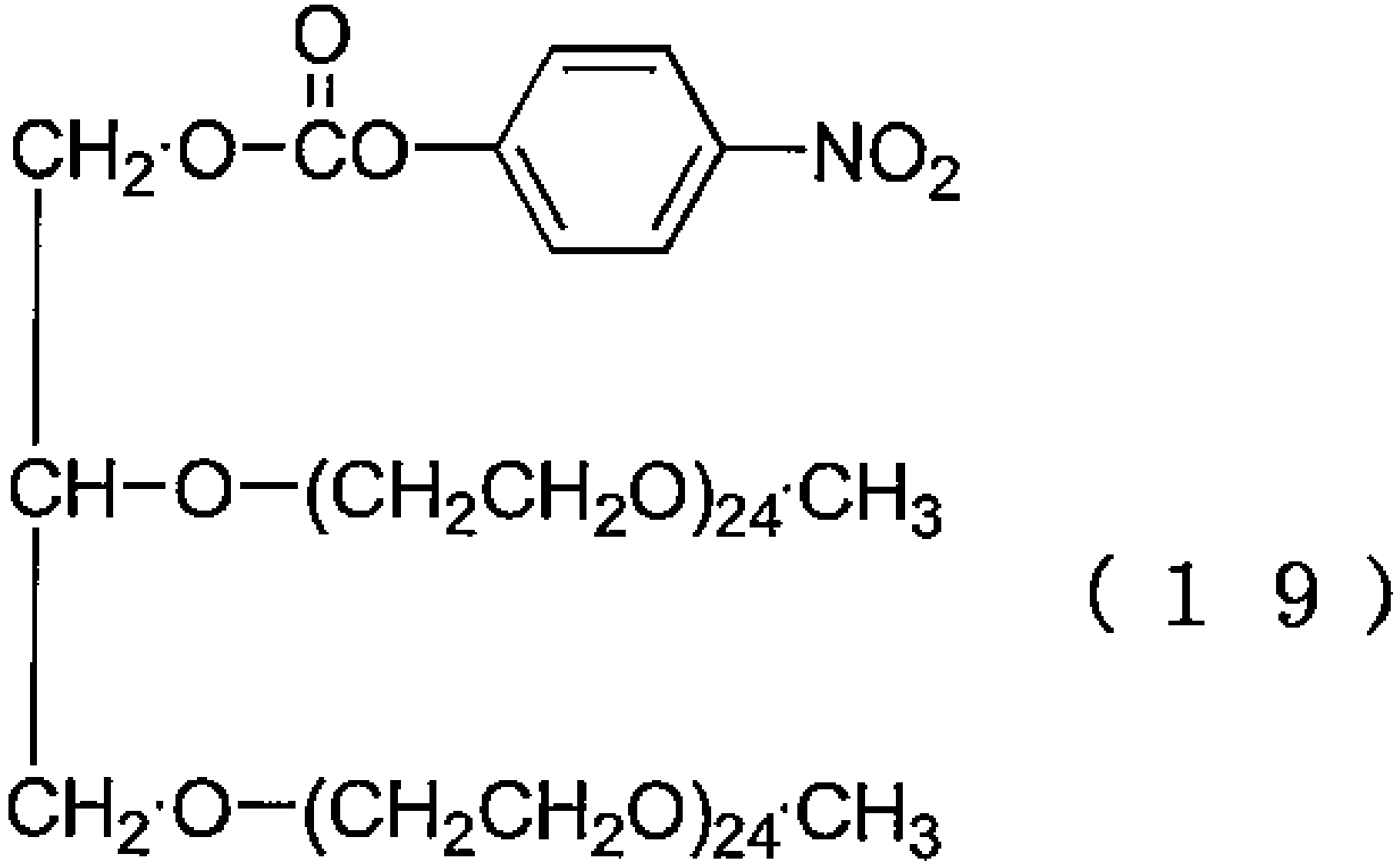


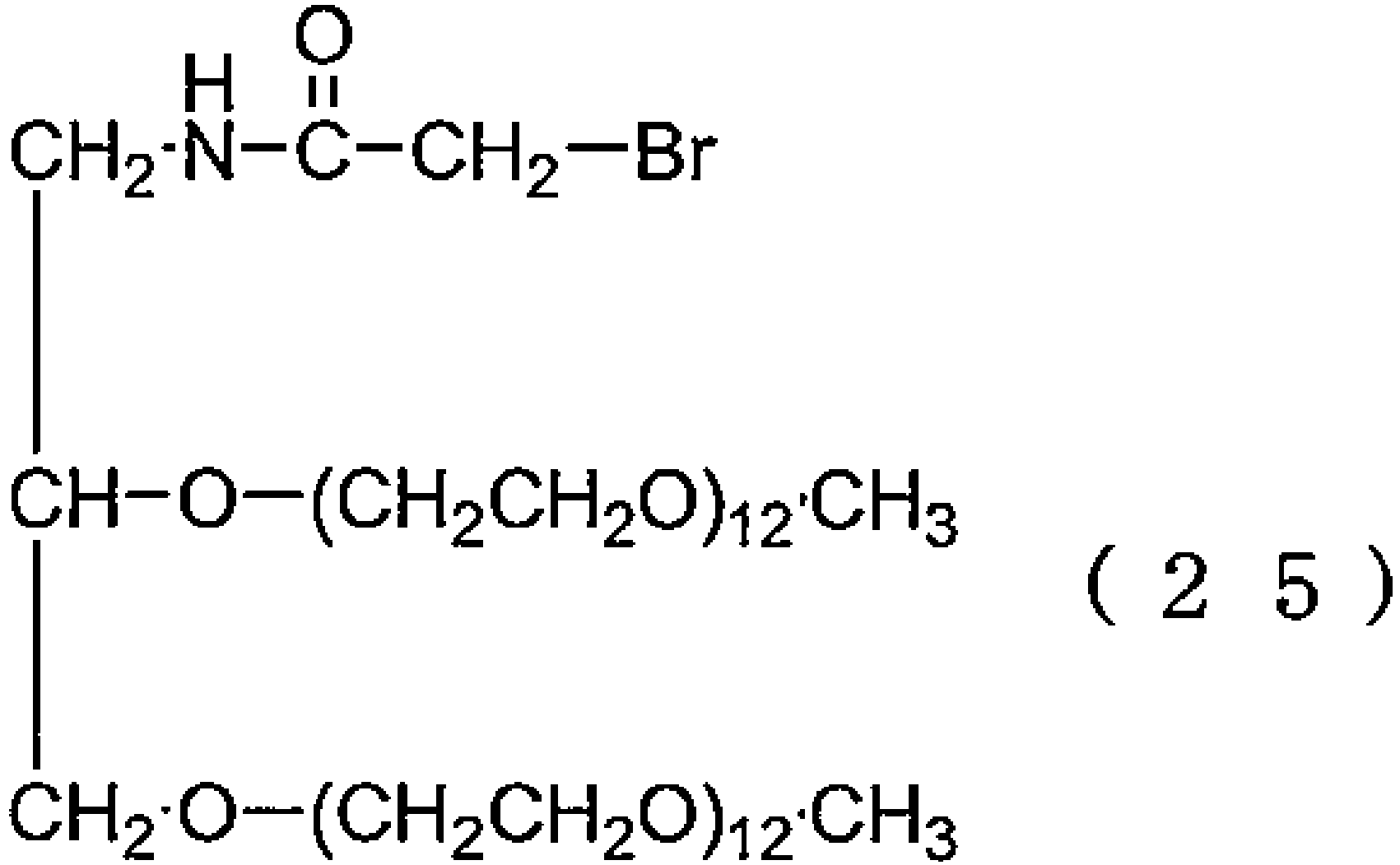


Claims (6)
- A branched monodispersed polyethylene glycol represented by formula (1):
 X1 is a functional group that forms a covalent bond upon a reaction with a functional group present in a biofunctional molecule;n is an integer of 4 to 50, which represents number of repeating units of ethylene oxide units; andL1 represents a single bond, -NH-, -L2-(CH2)m1- or -L2-(CH2)m1-L3-(CH2)m2-, L2 represents an ether bond, an amide bond, an urethane bond or a single bond, L3 represents an ether bond, an amide bond or an urethane bond, and m1 and m2 represent each independently an integer of 1 to 5.
 - The branched monodispersed polyethylene glycol according to claim 1, wherein X1 is selected from the group consisting of an active ester group, an active carbonate group, an aldehyde group, an isocyanate group, an isothiocyanate group, an epoxy group, a maleimide group, a vinyl sulfone group, an acryl group, a sulfonyloxy group, a carboxy group, a thiol group, a dithiopyridyl group, an α-haloacetyl group, an alkynyl group, an allyl group, a vinyl group, an amino group, an oxyamino group, a hydrazide group and an azide group.
- An intermediate of a branched monodispersed polyethylene glycol, which is represented by formula (2):
 Y1 is a hydroxyl group or an amino group; andn is an integer of 4 to 50, which represents number of repeating units of ethylene oxide units.
 - A method for producing the intermediate according to claim 3, wherein the following three steps:
a step (A) of coupling a monodispersed polyethylene glycol derivative represented by following formula (3) and a compound represented by following formula (4) to obtain a compound represented by following formula (5):
A-(CH2CH2O)n-CH3 (3)
wherein, in the formula (3),A is a leaving group; andn is an integer of 4 to 50, which represents number of repeating units of ethylene oxide units, Y2 is an oxygen atom or a nitrogen atom; andk is an integer of 1 or 2, and k is 1 when Y2 is an oxygen atom, and k is 2 when Y2 is a nitrogen atom,
 Y2 is an oxygen atom or a nitrogen atom;n is an integer of 4 to 50, which represents number of repeating units of ethylene oxide units,k is an integer of 1 or 2, and k is 1 when Y2 is an oxygen atom, and k is 2 when Y2 is a nitrogen atom,a step (B) of subjecting the compound represented by the formula (5) to extraction purification with water and an organic solvent, anda step (C) of performing a treatment of cleaving the benzyl group contained in the compound represented by the formula (5) to obtain the intermediate of the branched monodispersed polyethylene glycol represented by the formula (2),are performed in the order of the step (A), the step (B) and the step (C).
 - The method according to claim 4, wherein the step (C) is effected by performing a catalytic hydrogen reduction treatment.
- A method for producing the branched monodispersed polyethylene glycol according to claim 1, comprising a step (D) of converting Y1 of the intermediate according to claim 3 into L1-X1.
Applications Claiming Priority (2)
| Application Number | Priority Date | Filing Date | Title |
|---|---|---|---|
| JP2018052365 | 2018-03-20 | ||
| PCT/JP2019/011594 WO2019181984A1 (en) | 2018-03-20 | 2019-03-19 | Branched monodispersed polyethylene glycol, intermediate, and method for producing same |
Publications (2)
| Publication Number | Publication Date |
|---|---|
| EP3770143A1 true EP3770143A1 (en) | 2021-01-27 |
| EP3770143A4 EP3770143A4 (en) | 2021-12-22 |
Family
ID=67987214
Family Applications (1)
| Application Number | Title | Priority Date | Filing Date |
|---|---|---|---|
| EP19770451.3A Pending EP3770143A4 (en) | 2018-03-20 | 2019-03-19 | BRANCHED MONODISPERSE POLYETHYLENE GLYCOL, INTERMEDIATE AND METHOD OF ITS MANUFACTURING |
Country Status (7)
| Country | Link |
|---|---|
| US (1) | US11905367B2 (en) |
| EP (1) | EP3770143A4 (en) |
| JP (1) | JP7216332B2 (en) |
| KR (1) | KR102546103B1 (en) |
| CN (1) | CN111868021A (en) |
| CA (1) | CA3094055A1 (en) |
| WO (1) | WO2019181984A1 (en) |
Families Citing this family (3)
| Publication number | Priority date | Publication date | Assignee | Title |
|---|---|---|---|---|
| US11510994B2 (en) * | 2021-01-29 | 2022-11-29 | EqIP, LLC | Linkers for improving the stability of bioconjugates and the selectivity of payload release |
| EP4491655A4 (en) * | 2022-03-09 | 2026-03-18 | Nof Corp | METHOD FOR THE PREPARATION OF ACTIVE CARBON ACID ESTERS OF POLYETHYLENE GLYCOL AND ACTIVE CARBON ACID ESTERS OF POLYETHYLENE GLYCOL |
| WO2024203596A1 (en) * | 2023-03-28 | 2024-10-03 | 日油株式会社 | Method for producing activated polyethylene glycol derivative |
Family Cites Families (13)
| Publication number | Priority date | Publication date | Assignee | Title |
|---|---|---|---|---|
| JP4412461B2 (en) | 2002-11-20 | 2010-02-10 | 日油株式会社 | Modified bio-related substance, production method thereof and intermediate |
| US8003117B2 (en) | 2002-11-20 | 2011-08-23 | Nof Corporation | Polyalkylene glycol derivative and modified bio-related substance |
| US8828373B2 (en) | 2002-11-20 | 2014-09-09 | Nof Corporation | Polyalkylene glycol derivative and modified bio-related substance |
| BR0316560A (en) | 2002-11-26 | 2005-10-04 | Nobex Corp | Natriuretic Compound Conjugate, Pharmaceutical Formulation, Method of Treating a Condition, Method of Preparing the Natriuretic Compound Conjugate, Modified Pro-Polynatriuretic Peptide Conjugate, Natriuretic Peptide Analog, hbnp Analogue, Compound, and Method of Preparing a Compound |
| US7648962B2 (en) | 2002-11-26 | 2010-01-19 | Biocon Limited | Natriuretic compounds, conjugates, and uses thereof |
| WO2010141068A1 (en) | 2009-06-02 | 2010-12-09 | Wu Nian | Opthalmic compositions of cyclosporin |
| AU2010257181A1 (en) * | 2009-06-02 | 2012-01-12 | Brian Charles Keller | Pure PEG-lipid conjugates |
| JP5825507B2 (en) * | 2010-06-25 | 2015-12-02 | 日油株式会社 | Branched heteropolyethylene glycol |
| WO2012122144A1 (en) | 2011-03-07 | 2012-09-13 | Wu Nian | Highly monodisperse branched peg-lipid conjugates |
| US20130052130A1 (en) | 2011-08-30 | 2013-02-28 | University Of Washington | Branched Discreet PEG Constructs |
| EP3357514B1 (en) * | 2015-09-30 | 2021-04-14 | NOF Corporation | Lipid derivative in which hydrophilic polymer is bound via cyclic benzylidene acetal linkers |
| CN106905120B (en) * | 2015-12-21 | 2020-04-28 | 北京键凯科技股份有限公司 | Y-type polyethylene glycol derivative and preparation method thereof |
| JP2018052365A (en) | 2016-09-29 | 2018-04-05 | 株式会社オートネットワーク技術研究所 | Control system, in-vehicle control device, and computer program |
-
2019
- 2019-03-19 US US16/981,395 patent/US11905367B2/en active Active
- 2019-03-19 CN CN201980020565.7A patent/CN111868021A/en active Pending
- 2019-03-19 JP JP2019051107A patent/JP7216332B2/en active Active
- 2019-03-19 CA CA3094055A patent/CA3094055A1/en active Pending
- 2019-03-19 KR KR1020207027023A patent/KR102546103B1/en active Active
- 2019-03-19 EP EP19770451.3A patent/EP3770143A4/en active Pending
- 2019-03-19 WO PCT/JP2019/011594 patent/WO2019181984A1/en not_active Ceased
Also Published As
| Publication number | Publication date |
|---|---|
| EP3770143A4 (en) | 2021-12-22 |
| JP7216332B2 (en) | 2023-02-01 |
| KR20200132878A (en) | 2020-11-25 |
| US20210009757A1 (en) | 2021-01-14 |
| CA3094055A1 (en) | 2019-09-26 |
| US11905367B2 (en) | 2024-02-20 |
| CN111868021A (en) | 2020-10-30 |
| KR102546103B1 (en) | 2023-06-21 |
| WO2019181984A1 (en) | 2019-09-26 |
| JP2019167532A (en) | 2019-10-03 |
Similar Documents
| Publication | Publication Date | Title |
|---|---|---|
| EP2692771B1 (en) | Polyoxyethylene derivative having a plurality of hydroxyl groups at end | |
| JP5589503B2 (en) | Multi-branched polyoxyalkylene compound, production method thereof and intermediate | |
| KR102498068B1 (en) | Branched hetero monodisperse polyethylene glycol, manufacturing method thereof, and conjugate thereof | |
| CA2861601A1 (en) | Poly (ethylene glycol) containing chemically disparate endgroups | |
| EP3318591B1 (en) | Hetero type monodispersed polyethylene glycol, intermediate for production of hetero type monodispersed polyethylene glycol, methods for producing same, and hetero type monodispersed polyethylene glycol conjugate | |
| JP6784932B2 (en) | Biodegradable polyethylene glycol derivative for chemical modification of biofunctional molecules or drug carriers | |
| US11905367B2 (en) | Branched monodispersed polyethylene glycol, intermediate and methods for producing same | |
| US9029568B2 (en) | Branched hetero polyfunctional polyoxyalkylene compound and intermediate thereof | |
| EP2554565B1 (en) | Multifunctional polyoxyalkylene compound, method for producing same and intermediate of same | |
| EP3604383B1 (en) | Production method of polyoxyethylene derivative having plurality of hydroxyl groups at terminal |
Legal Events
| Date | Code | Title | Description |
|---|---|---|---|
| STAA | Information on the status of an ep patent application or granted ep patent |
Free format text: STATUS: THE INTERNATIONAL PUBLICATION HAS BEEN MADE |
|
| PUAI | Public reference made under article 153(3) epc to a published international application that has entered the european phase |
Free format text: ORIGINAL CODE: 0009012 |
|
| STAA | Information on the status of an ep patent application or granted ep patent |
Free format text: STATUS: REQUEST FOR EXAMINATION WAS MADE |
|
| 17P | Request for examination filed |
Effective date: 20200915 |
|
| AK | Designated contracting states |
Kind code of ref document: A1 Designated state(s): AL AT BE BG CH CY CZ DE DK EE ES FI FR GB GR HR HU IE IS IT LI LT LU LV MC MK MT NL NO PL PT RO RS SE SI SK SM TR |
|
| AX | Request for extension of the european patent |
Extension state: BA ME |
|
| DAV | Request for validation of the european patent (deleted) | ||
| DAX | Request for extension of the european patent (deleted) | ||
| A4 | Supplementary search report drawn up and despatched |
Effective date: 20211118 |
|
| RIC1 | Information provided on ipc code assigned before grant |
Ipc: A61K 47/50 20170101ALI20211112BHEP Ipc: C08G 65/329 20060101ALI20211112BHEP Ipc: C07D 207/46 20060101ALI20211112BHEP Ipc: C07C 247/12 20060101ALI20211112BHEP Ipc: C07C 233/18 20060101ALI20211112BHEP Ipc: C07C 217/28 20060101ALI20211112BHEP Ipc: C07C 43/13 20060101ALI20211112BHEP Ipc: C07C 41/18 20060101AFI20211112BHEP |