EP3769975A1 - Multicompound tread for tyres for road vehicles - Google Patents
Multicompound tread for tyres for road vehicles Download PDFInfo
- Publication number
- EP3769975A1 EP3769975A1 EP20187190.2A EP20187190A EP3769975A1 EP 3769975 A1 EP3769975 A1 EP 3769975A1 EP 20187190 A EP20187190 A EP 20187190A EP 3769975 A1 EP3769975 A1 EP 3769975A1
- Authority
- EP
- European Patent Office
- Prior art keywords
- compound
- tand
- hysteresis loss
- ranging
- tread portion
- Prior art date
- Legal status (The legal status is an assumption and is not a legal conclusion. Google has not performed a legal analysis and makes no representation as to the accuracy of the status listed.)
- Granted
Links
Images

Classifications
-
- B—PERFORMING OPERATIONS; TRANSPORTING
- B60—VEHICLES IN GENERAL
- B60C—VEHICLE TYRES; TYRE INFLATION; TYRE CHANGING; CONNECTING VALVES TO INFLATABLE ELASTIC BODIES IN GENERAL; DEVICES OR ARRANGEMENTS RELATED TO TYRES
- B60C11/00—Tyre tread bands; Tread patterns; Anti-skid inserts
- B60C11/0041—Tyre tread bands; Tread patterns; Anti-skid inserts comprising different tread rubber layers
- B60C11/005—Tyre tread bands; Tread patterns; Anti-skid inserts comprising different tread rubber layers with cap and base layers
- B60C11/0058—Tyre tread bands; Tread patterns; Anti-skid inserts comprising different tread rubber layers with cap and base layers with different cap rubber layers in the axial direction
-
- B—PERFORMING OPERATIONS; TRANSPORTING
- B60—VEHICLES IN GENERAL
- B60C—VEHICLE TYRES; TYRE INFLATION; TYRE CHANGING; CONNECTING VALVES TO INFLATABLE ELASTIC BODIES IN GENERAL; DEVICES OR ARRANGEMENTS RELATED TO TYRES
- B60C11/00—Tyre tread bands; Tread patterns; Anti-skid inserts
- B60C11/0041—Tyre tread bands; Tread patterns; Anti-skid inserts comprising different tread rubber layers
-
- B—PERFORMING OPERATIONS; TRANSPORTING
- B60—VEHICLES IN GENERAL
- B60C—VEHICLE TYRES; TYRE INFLATION; TYRE CHANGING; CONNECTING VALVES TO INFLATABLE ELASTIC BODIES IN GENERAL; DEVICES OR ARRANGEMENTS RELATED TO TYRES
- B60C11/00—Tyre tread bands; Tread patterns; Anti-skid inserts
- B60C11/0008—Tyre tread bands; Tread patterns; Anti-skid inserts characterised by the tread rubber
- B60C2011/0016—Physical properties or dimensions
- B60C2011/0025—Modulus or tan delta
Definitions
- the invention relates to a tyre for road vehicles.
- an ideal tread compound in order to simultaneously exalt all dynamic responses, should have opposite hysteresis features, at least beyond certain limits of required performances.
- the tread consists of a plurality of blocks, which are elements delimited by a plurality of grooves made in the tread.
- These grooves can have different dimensions depending on the function to be fulfilled. For example, when the grooves are small-sized, they are called sipes and fulfil the aim of ensuring a greater grip on snow and ice.
- a block of a tread is a solid rubber portion delimited by a plurality of grooves, regardless of the dimensions of said grooves.
- the inventors of this invention found out that, in case the blocks of the tread consist of different portions made of respective compounds with a different hysteresis loss, a synergistic effect can be obtained, which leads to significant improvements in terms of wet grip, without for this reason negatively affecting the rolling resistance.
- the subject-matter of the invention is a tread portion for tyres for road vehicles comprising a plurality of blocks; at least part of said blocks each comprising a plurality of high hysteresis loss portions, which are made of a first compound, and a plurality of low hysteresis loss portions, which are made of a second compound; said first and second compound having different dynamic properties in terms of: dynamic modulus at 30°C, tand at 0°C, tand at 30°C and tand at 60°C; said high hysteresis loss portions and said low hysteresis loss portions having a respective contact portion, which is designed to define a portion of a global contact surface of the block in contact with the ground; said tyre being characterized in that said first compound has a dynamic modulus at 30° ranging from 11.0 to 17.0 MPa, a tand at 0°C ranging from 0.85 to 1.1, a tand at 30°C ranging from
- all the blocks of the tread portion each comprises said high hysteresis loss portions and said low hysteresis loss portions.
- said high hysteresis loss portions and said low hysteresis loss portions are arranged in an alternated position relative to one another.
- each one of the contact surfaces is shaped like a strip.
- each one of the contact surfaces has a width ranging from 0.5 to 10 mm.
- said contact surfaces all have the same width.
- said high hysteresis loss portions or said low hysteresis loss portions have a contact surface with a circular shape, with a diameter ranging from 1 to 20 mm.
- the contact surfaces have a casual arrangement.
- Another subject-matter of the invention is a tyre comprising an tread portion according to the invention.
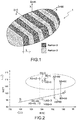
- sample 1 indicates a sample manufactured to analyse the behaviour of a block of the tread according to the invention.
- Sample 1 comprises an alternation of linear portions 2 and 3, each made of a respective compound A and B, as shown in Table I.
- Table I shows the compositions of the compounds used in the samples.
- E-SBR is a polymer base obtained by means of an emulsion polymerization process with an average molecular weight ranging from 800-1500x10 3 to 500-900x10 3 , with a styrene content ranging from 20 to 45% and used with an oil content ranging from 0 to 30%.
- S-SBR is a polymer base obtained by means of a solution polymerization process with an average molecular weight ranging from 800-1500x10 3 to 500-900x10 3 and with a styrene content ranging from 20 to 45%.
- the silica used is sold with the name ULTRASIL VN3 by DEGUSSA.
- the carbon black used is sold with the name Vulcan 7H (N234) by CABOT.
- the silane used is sold with the name SI 69 by DEGUSSA.
- MBTS is an abbreviation for the chemical known as mercapto benzothiazole disulphide and works as vulcanization accelerator
- DPG is an abbreviation for the chemical known as diphenyl guanidine and works as vulcanization accelerator.
- the first and the second compound have a dynamic modulus at 30°C of 14.4 and 9.4 MPa, respectively, a tand at 0°C of 0.980 and 0.810, respectively, a tand at 30°C of 0.532 and 0.238, respectively, and a tand at 60°C of 0.220 and 0.124, respectively.
- sample A Two samples (A and B) of the type shown in figure 1 were manufactured and the difference between them lies in the width L of the linear portions.
- sample B the portions 2 and 3 have a width equal to 1 mm, whereas in sample B the portions 2 and 3 have a width equal to 2 mm.
- the wet grip performances were assessed by comparing the friction coefficient of the compounds, which is obtained with a linear friction measuring device at the speed of 500 mm/s, at the temperature of 5°C under wet conditions. The results were obtained by comparing the respective friction coefficients: the greater the index, the greater the friction coefficient and, hence, the wet grip.
- the tests were repeated at a different angle ⁇ defined (as shown in figure 1 ) between the direction of movement of the sample X and the extension of the portions 2 and 3.
- the tests were carried out with an angle ⁇ of 0°, 45° and 90°.
- the diagram of figure 2 clearly shows how the two samples (A and B) of the block of the tread according to the invention have wet grip properties that are remarkably better than the ones of the comparison samples (C and D).
- the diagram of figure 2 shows both the values theoretically calculated based on the combination of the two compounds and the values actually detected (comprised in a closed curve).
- the difference between the calculated values and the actually detected values is highlighted with a broken arrow joining them.
- tread blocks comprising different portions made of respective compounds with different dynamic properties ensures important improving effects in terms of wet grip, though without jeopardizing, at the same time, the advantages obtained in terms of rolling resistance.
- Figure 3 shows eight more possible block solutions.
- the models of figure 3 indicate how different compounds (light grey and dark grey) can physically be located in a tread block in order to obtain different geometries on the surface.
- the model indicated with number 3 could be examined to manufacture a sort of "multi-pin tread" in winter/all season applications.
- a stiffer compound dark grey dots
- a softer compound light grey
Landscapes
- Engineering & Computer Science (AREA)
- Mechanical Engineering (AREA)
- Tires In General (AREA)
Abstract
Description
- The invention relates to a tyre for road vehicles.
- In the field of tyres for road vehicles it is known that a low rolling resistance and a good wet grip are features that can hardly be found together in the same tread. Indeed, whereas, in order to have a tyre with a good rolling resistance, it is necessary to manufacture a tread with a compound having a low hysteresis loss, in order to have a tyre with a good wet grip, it is necessary to manufacture a tread with a compound having a relatively higher hysteresis loss.
- As a consequence, an ideal tread compound, in order to simultaneously exalt all dynamic responses, should have opposite hysteresis features, at least beyond certain limits of required performances.
- It is known that the properties of the aforesaid rubber compound affect not only the wet grip/rolling resistance balance, but also other performances of the tyre, such as for example winter performances/wet grip.
- As it is known, the tread consists of a plurality of blocks, which are elements delimited by a plurality of grooves made in the tread. These grooves can have different dimensions depending on the function to be fulfilled. For example, when the grooves are small-sized, they are called sipes and fulfil the aim of ensuring a greater grip on snow and ice.
- In other words, a block of a tread is a solid rubber portion delimited by a plurality of grooves, regardless of the dimensions of said grooves.
- The inventors of this invention found out that, in case the blocks of the tread consist of different portions made of respective compounds with a different hysteresis loss, a synergistic effect can be obtained, which leads to significant improvements in terms of wet grip, without for this reason negatively affecting the rolling resistance.
- The subject-matter of the invention is a tread portion for tyres for road vehicles comprising a plurality of blocks; at least part of said blocks each comprising a plurality of high hysteresis loss portions, which are made of a first compound, and a plurality of low hysteresis loss portions, which are made of a second compound; said first and second compound having different dynamic properties in terms of: dynamic modulus at 30°C, tand at 0°C, tand at 30°C and tand at 60°C; said high hysteresis loss portions and said low hysteresis loss portions having a respective contact portion, which is designed to define a portion of a global contact surface of the block in contact with the ground; said tyre being characterized in that said first compound has a dynamic modulus at 30° ranging from 11.0 to 17.0 MPa, a tand at 0°C ranging from 0.85 to 1.1, a tand at 30°C ranging from 0.45 to 0.65 and a tand at 60°C ranging from 0.19 to 0.30; said second compound having a dynamic modulus at 30°C ranging from 5.5 to 15 MPa and smaller than the one of said first compound by at least 2 MPa, a tand at 0°C raning from 0.70 to 0.99 and smaller than the one of said first compound by at least 0.02, a tand at 30°C ranging from 0.21 to 0.63 and smaller than the one of said first compound by at least 0.02, a tand at 60°C ranging from 0.10 to 0.28 and smaller than the one of said first compound by at least 0.02.
- The dynamic features were measured according to standard ISO 4664. As a person skilled in the art knows, the values of tanδ at 60°C are strictly correlated with rolling resistance properties: the smaller the value of tanδ at 60°C, the better the rolling resistance.
- Preferably, all the blocks of the tread portion each comprises said high hysteresis loss portions and said low hysteresis loss portions.
- Preferably, said high hysteresis loss portions and said low hysteresis loss portions are arranged in an alternated position relative to one another.
- Preferably, each one of the contact surfaces is shaped like a strip.
- Preferably, each one of the contact surfaces has a width ranging from 0.5 to 10 mm.
- Preferably, said contact surfaces all have the same width.
- Preferably, said high hysteresis loss portions or said low hysteresis loss portions have a contact surface with a circular shape, with a diameter ranging from 1 to 20 mm.
- Preferably, the contact surfaces have a casual arrangement.
- Another subject-matter of the invention is a tyre comprising an tread portion according to the invention.
- The invention will now be described with reference to the accompanying drawings, wherein:
-
figure 1 shows a sample manufactured to analyse one single block of the tread according to the invention; -
figure 2 is a diagram showing the results - in terms of rolling resistance and wet grip - of the different tests carried out; -
figure 3 shows eight more possible block models according to the invention. - With reference to the figure, number 1 indicates a sample manufactured to analyse the behaviour of a block of the tread according to the invention. Sample 1 comprises an alternation of
linear portions - Table I shows the compositions of the compounds used in the samples.
TABLE I FIRST COMPOUND SECOND COMPOUND POLYMER BASE WITH OIL S-SBR 100.0 80.0 E-SBR 0 20.0 FILLER SILICA 70.0 80.0 CARBON BLACK 10.0 5.0 BONDING AGENT SILANE 7.0 7.0 MICROCRYSTALLINE WAX 8.0 8.0 STEARIC ACID 1.0 1.0 AROMATIC OIL 4.0 4.0 Vulcanizing agents ZINC OXIDE 2.0 2.0 SULPHUR 1.0 1.5 MBTS 1.0 1.2 DPG 1.5 1.8 DRY POLYMER BASE 100 100 - E-SBR is a polymer base obtained by means of an emulsion polymerization process with an average molecular weight ranging from 800-1500x103 to 500-900x103, with a styrene content ranging from 20 to 45% and used with an oil content ranging from 0 to 30%.
- S-SBR is a polymer base obtained by means of a solution polymerization process with an average molecular weight ranging from 800-1500x103 to 500-900x103 and with a styrene content ranging from 20 to 45%.
- The silica used is sold with the name ULTRASIL VN3 by DEGUSSA.
- The carbon black used is sold with the name Vulcan 7H (N234) by CABOT.
- The silane used is sold with the name SI 69 by DEGUSSA.
- MBTS is an abbreviation for the chemical known as mercapto benzothiazole disulphide and works as vulcanization accelerator; DPG is an abbreviation for the chemical known as diphenyl guanidine and works as vulcanization accelerator.
- The first and the second compound have a dynamic modulus at 30°C of 14.4 and 9.4 MPa, respectively, a tand at 0°C of 0.980 and 0.810, respectively, a tand at 30°C of 0.532 and 0.238, respectively, and a tand at 60°C of 0.220 and 0.124, respectively.
- Two samples (A and B) of the type shown in
figure 1 were manufactured and the difference between them lies in the width L of the linear portions. In sample A theportions portions - The two aforesaid samples were subjected to tests in compliance with standard ISO 4664, so as to assess their dynamic properties. In particular, the performances in terms of rolling resistance were correlated with the values of Tanδ at 60°C.
- The wet grip performances were assessed by comparing the friction coefficient of the compounds, which is obtained with a linear friction measuring device at the speed of 500 mm/s, at the temperature of 5°C under wet conditions. The results were obtained by comparing the respective friction coefficients: the greater the index, the greater the friction coefficient and, hence, the wet grip.
- In order to complete the analysis, taking into account the particular composition of the two samples A and B (alternation of linear portions), the tests were repeated at a different angle ϑ defined (as shown in
figure 1 ) between the direction of movement of the sample X and the extension of theportions - In order to have a comparison, the same tests were also carried out on two comparison samples (C and D), each manufactured with the sole compound of the portion 2 (C) and with the sole compound of the portion 3 (D), respectively.
- The diagram of
figure 2 clearly shows how the two samples (A and B) of the block of the tread according to the invention have wet grip properties that are remarkably better than the ones of the comparison samples (C and D). - In order to better show the effects achieved in terms of wet grip and rolling resistance, the values were indexed to the values obtained with sample C.
- In particular, the diagram of
figure 2 shows both the values theoretically calculated based on the combination of the two compounds and the values actually detected (comprised in a closed curve). In the diagram offigure 2 , the difference between the calculated values and the actually detected values is highlighted with a broken arrow joining them. - A comparison between the calculated values and the actually detected values clearly points out how the use of the block comprising different portions made of respective compounds with different dynamic properties produces a synergistic effect in terms of wet grip, whereas the expected advantages in terms of rolling resistance are maintained and, hence, not worsened.
- In other words, the solution involving the use of tread blocks comprising different portions made of respective compounds with different dynamic properties ensures important improving effects in terms of wet grip, though without jeopardizing, at the same time, the advantages obtained in terms of rolling resistance.
-
Figure 3 shows eight more possible block solutions. The models offigure 3 indicate how different compounds (light grey and dark grey) can physically be located in a tread block in order to obtain different geometries on the surface. By way of example of a synergy concept, the model indicated withnumber 3 could be examined to manufacture a sort of "multi-pin tread" in winter/all season applications. Inmodel 3, a stiffer compound (dark grey dots) is embedded in a softer compound (light grey), acting like spikes when driving on roads with ice or snow.
Claims (10)
- A tread portion for tyres for road vehicles comprising a plurality of blocks; at least part of said blocks each comprising a plurality of high hysteresis loss portions (2), which are made of a first compound, and a plurality of low hysteresis loss portions (3), which are made of a second compound; said first and second compounds having different dynamic properties in terms of: modulo dynamic modulus at 30°C, tand at 0°C, tand at 30°C and tand at 60°C; said high hysteresis loss portions (2) and said low hysteresis loss portions (3) having a respective contact portion, which is designed to define a portion of a global contact surface of the block in contact with the ground; said tread portion being characterized in that said first compound has a dynamic modulus at 30° ranging from 11.0 to 17.0 MPa, a tand at 0°C ranging from 0.85 to 1.1, a tand at 30°C ranging from 0.45 to 0.65 and a tand at 60°C ranging from 0.19 to 0.30; said second compound having a dynamic modulus at 30°C ranging from 5.5 to 15 MPa and smaller than the one of said first compound by at least 2 MPa, a tand at 0°C raning from 0.70 to 0.99 and smaller than the one of said first compound by at least 0.02, a tand at 30°C ranging from 0.21 to 0.63 and smaller than the one of said first compound by at least 0.02, a tand at 60°C ranging from 0.10 to 0.28 and smaller than the one of said first compound by at least 0.02.
- A tread portion according to claim 1, characterized in that all blocks each comprises said high hysteresis loss portions (2) and said low hysteresis loss portions (3).
- A tread portion according to claim 1 or 2, characterized in that said high hysteresis loss portions (2) and said low hysteresis loss portions (3) are arranged in an alternated position relative to one another.
- A tread portion according to one of the preceding claims, characterized in that each one of the contact surfaces is shaped like a strip.
- A tread portion according to claim 4, characterized in that each one of the contact surfaces has a width ranging from 0.5 to 10 mm.
- A tread portion according to claim 5, characterized in that said contact surfaces all have the same width.
- A tread portion according to claim 1 or 2, characterized in that said high hysteresis loss portions or said low hysteresis loss portions have a contact surface with a circular shape.
- A tread portion according to claim 7, characterized in that each one of the contact surfaces with a circular shape have a diameter ranging from 1 to 20 mm.
- A tread portion according to claim 1 or 2, characterized in that said contact surfaces have a casual arrangement.
- A tyre comprising a tread portion according to one of the preceding claims.
Applications Claiming Priority (1)
| Application Number | Priority Date | Filing Date | Title |
|---|---|---|---|
| IT102019000012765A IT201900012765A1 (en) | 2019-07-24 | 2019-07-24 | MULTI-COMPOUND TREAD FOR ROAD VEHICLE TIRE |
Publications (2)
| Publication Number | Publication Date |
|---|---|
| EP3769975A1 true EP3769975A1 (en) | 2021-01-27 |
| EP3769975B1 EP3769975B1 (en) | 2022-03-30 |
Family
ID=68582272
Family Applications (1)
| Application Number | Title | Priority Date | Filing Date |
|---|---|---|---|
| EP20187190.2A Active EP3769975B1 (en) | 2019-07-24 | 2020-07-22 | Multicompound tread for tyres for road vehicles |
Country Status (2)
| Country | Link |
|---|---|
| EP (1) | EP3769975B1 (en) |
| IT (1) | IT201900012765A1 (en) |
Cited By (1)
| Publication number | Priority date | Publication date | Assignee | Title |
|---|---|---|---|---|
| US20220063343A1 (en) * | 2020-09-01 | 2022-03-03 | The Goodyear Tire & Rubber Company | Tire with asymmetrical tread with reduced shoulder heat generation |
Citations (5)
| Publication number | Priority date | Publication date | Assignee | Title |
|---|---|---|---|---|
| JP2003226114A (en) * | 2002-02-01 | 2003-08-12 | Bridgestone Corp | Pneumatic tire and manufacturing method therefor |
| DE112013001701T5 (en) * | 2012-03-23 | 2014-12-04 | The Yokohama Rubber Co., Ltd. | tire |
| WO2015032601A1 (en) * | 2013-09-06 | 2015-03-12 | Compagnie Generale Des Etablissements Michelin | Tyre comprising an improved tread |
| WO2016173728A1 (en) * | 2015-04-29 | 2016-11-03 | Continental Reifen Deutschland Gmbh | Pneumatic vehicle tire having a tread |
| EP3208110A1 (en) * | 2016-02-17 | 2017-08-23 | Nexen Tire Corporation | Tire tread and pneumatic tire |
-
2019
- 2019-07-24 IT IT102019000012765A patent/IT201900012765A1/en unknown
-
2020
- 2020-07-22 EP EP20187190.2A patent/EP3769975B1/en active Active
Patent Citations (5)
| Publication number | Priority date | Publication date | Assignee | Title |
|---|---|---|---|---|
| JP2003226114A (en) * | 2002-02-01 | 2003-08-12 | Bridgestone Corp | Pneumatic tire and manufacturing method therefor |
| DE112013001701T5 (en) * | 2012-03-23 | 2014-12-04 | The Yokohama Rubber Co., Ltd. | tire |
| WO2015032601A1 (en) * | 2013-09-06 | 2015-03-12 | Compagnie Generale Des Etablissements Michelin | Tyre comprising an improved tread |
| WO2016173728A1 (en) * | 2015-04-29 | 2016-11-03 | Continental Reifen Deutschland Gmbh | Pneumatic vehicle tire having a tread |
| EP3208110A1 (en) * | 2016-02-17 | 2017-08-23 | Nexen Tire Corporation | Tire tread and pneumatic tire |
Cited By (1)
| Publication number | Priority date | Publication date | Assignee | Title |
|---|---|---|---|---|
| US20220063343A1 (en) * | 2020-09-01 | 2022-03-03 | The Goodyear Tire & Rubber Company | Tire with asymmetrical tread with reduced shoulder heat generation |
Also Published As
| Publication number | Publication date |
|---|---|
| IT201900012765A1 (en) | 2021-01-24 |
| EP3769975B1 (en) | 2022-03-30 |
Similar Documents
| Publication | Publication Date | Title |
|---|---|---|
| EP0067111A2 (en) | Tire with dual tread compound | |
| DE60014263T2 (en) | Rubber compound and tires with the same mixture | |
| EP2452834A2 (en) | Passenger tire having low rolling resistance with improved wet traction and treadwear | |
| EP2202269A1 (en) | Rubber composition for tire | |
| US12508845B2 (en) | Vehicle pneumatic tyre and rubber mixture for a tread | |
| JP5091587B2 (en) | Evaluation method of tire grip characteristics | |
| EP0216588B1 (en) | Pneumatic tire | |
| EP3769975B1 (en) | Multicompound tread for tyres for road vehicles | |
| KR102267701B1 (en) | Rubber composition for tire tread and tire manufactured by using the same | |
| JPS6392659A (en) | Pneumatic tire | |
| EP3774395B1 (en) | Pneumatic tyre for road vehicles | |
| KR100432128B1 (en) | Rubber Composition for Studless Tire Tread | |
| JP2002309038A (en) | Studless compound rubber composition and pneumatic tire | |
| EP4438340A1 (en) | Tire with improved rubber compound | |
| JP2000016028A (en) | Pneumatic tire | |
| DE112021002763B4 (en) | Rubber composition for tires and tires containing the rubber composition | |
| KR102526786B1 (en) | Rubber composition for tire-tread and tire using it | |
| RU2817545C1 (en) | Rubber composition for tires | |
| JP2915532B2 (en) | Rubber composition for tire tread | |
| KR101073117B1 (en) | Rubber composition for tire tread | |
| JPH02279743A (en) | Pneumatic tire | |
| WO2026068704A1 (en) | Rubber composition for pneumatic tyre and pneumatic tyre produced therefrom | |
| JP2902056B2 (en) | Pneumatic tire | |
| KR950005080B1 (en) | Tread rubber composition for studless tires | |
| KR100337544B1 (en) | tire tread for off-road |
Legal Events
| Date | Code | Title | Description |
|---|---|---|---|
| PUAI | Public reference made under article 153(3) epc to a published international application that has entered the european phase |
Free format text: ORIGINAL CODE: 0009012 |
|
| STAA | Information on the status of an ep patent application or granted ep patent |
Free format text: STATUS: THE APPLICATION HAS BEEN PUBLISHED |
|
| AK | Designated contracting states |
Kind code of ref document: A1 Designated state(s): AL AT BE BG CH CY CZ DE DK EE ES FI FR GB GR HR HU IE IS IT LI LT LU LV MC MK MT NL NO PL PT RO RS SE SI SK SM TR |
|
| AX | Request for extension of the european patent |
Extension state: BA ME |
|
| STAA | Information on the status of an ep patent application or granted ep patent |
Free format text: STATUS: REQUEST FOR EXAMINATION WAS MADE |
|
| 17P | Request for examination filed |
Effective date: 20210722 |
|
| RBV | Designated contracting states (corrected) |
Designated state(s): AL AT BE BG CH CY CZ DE DK EE ES FI FR GB GR HR HU IE IS IT LI LT LU LV MC MK MT NL NO PL PT RO RS SE SI SK SM TR |
|
| RIC1 | Information provided on ipc code assigned before grant |
Ipc: B60C 11/00 20060101AFI20210901BHEP |
|
| GRAP | Despatch of communication of intention to grant a patent |
Free format text: ORIGINAL CODE: EPIDOSNIGR1 |
|
| STAA | Information on the status of an ep patent application or granted ep patent |
Free format text: STATUS: GRANT OF PATENT IS INTENDED |
|
| INTG | Intention to grant announced |
Effective date: 20211025 |
|
| GRAS | Grant fee paid |
Free format text: ORIGINAL CODE: EPIDOSNIGR3 |
|
| GRAA | (expected) grant |
Free format text: ORIGINAL CODE: 0009210 |
|
| STAA | Information on the status of an ep patent application or granted ep patent |
Free format text: STATUS: THE PATENT HAS BEEN GRANTED |
|
| AK | Designated contracting states |
Kind code of ref document: B1 Designated state(s): AL AT BE BG CH CY CZ DE DK EE ES FI FR GB GR HR HU IE IS IT LI LT LU LV MC MK MT NL NO PL PT RO RS SE SI SK SM TR |
|
| REG | Reference to a national code |
Ref country code: GB Ref legal event code: FG4D |
|
| REG | Reference to a national code |
Ref country code: CH Ref legal event code: EP |
|
| REG | Reference to a national code |
Ref country code: AT Ref legal event code: REF Ref document number: 1478845 Country of ref document: AT Kind code of ref document: T Effective date: 20220415 |
|
| REG | Reference to a national code |
Ref country code: DE Ref legal event code: R096 Ref document number: 602020002434 Country of ref document: DE |
|
| REG | Reference to a national code |
Ref country code: IE Ref legal event code: FG4D |
|
| REG | Reference to a national code |
Ref country code: LT Ref legal event code: MG9D |
|
| PG25 | Lapsed in a contracting state [announced via postgrant information from national office to epo] |
Ref country code: SE Free format text: LAPSE BECAUSE OF FAILURE TO SUBMIT A TRANSLATION OF THE DESCRIPTION OR TO PAY THE FEE WITHIN THE PRESCRIBED TIME-LIMIT Effective date: 20220330 Ref country code: RS Free format text: LAPSE BECAUSE OF FAILURE TO SUBMIT A TRANSLATION OF THE DESCRIPTION OR TO PAY THE FEE WITHIN THE PRESCRIBED TIME-LIMIT Effective date: 20220330 Ref country code: NO Free format text: LAPSE BECAUSE OF FAILURE TO SUBMIT A TRANSLATION OF THE DESCRIPTION OR TO PAY THE FEE WITHIN THE PRESCRIBED TIME-LIMIT Effective date: 20220630 Ref country code: LT Free format text: LAPSE BECAUSE OF FAILURE TO SUBMIT A TRANSLATION OF THE DESCRIPTION OR TO PAY THE FEE WITHIN THE PRESCRIBED TIME-LIMIT Effective date: 20220330 Ref country code: HR Free format text: LAPSE BECAUSE OF FAILURE TO SUBMIT A TRANSLATION OF THE DESCRIPTION OR TO PAY THE FEE WITHIN THE PRESCRIBED TIME-LIMIT Effective date: 20220330 Ref country code: BG Free format text: LAPSE BECAUSE OF FAILURE TO SUBMIT A TRANSLATION OF THE DESCRIPTION OR TO PAY THE FEE WITHIN THE PRESCRIBED TIME-LIMIT Effective date: 20220630 |
|
| REG | Reference to a national code |
Ref country code: NL Ref legal event code: MP Effective date: 20220330 |
|
| REG | Reference to a national code |
Ref country code: AT Ref legal event code: MK05 Ref document number: 1478845 Country of ref document: AT Kind code of ref document: T Effective date: 20220330 |
|
| PG25 | Lapsed in a contracting state [announced via postgrant information from national office to epo] |
Ref country code: LV Free format text: LAPSE BECAUSE OF FAILURE TO SUBMIT A TRANSLATION OF THE DESCRIPTION OR TO PAY THE FEE WITHIN THE PRESCRIBED TIME-LIMIT Effective date: 20220330 Ref country code: GR Free format text: LAPSE BECAUSE OF FAILURE TO SUBMIT A TRANSLATION OF THE DESCRIPTION OR TO PAY THE FEE WITHIN THE PRESCRIBED TIME-LIMIT Effective date: 20220701 Ref country code: FI Free format text: LAPSE BECAUSE OF FAILURE TO SUBMIT A TRANSLATION OF THE DESCRIPTION OR TO PAY THE FEE WITHIN THE PRESCRIBED TIME-LIMIT Effective date: 20220330 |
|
| PG25 | Lapsed in a contracting state [announced via postgrant information from national office to epo] |
Ref country code: NL Free format text: LAPSE BECAUSE OF FAILURE TO SUBMIT A TRANSLATION OF THE DESCRIPTION OR TO PAY THE FEE WITHIN THE PRESCRIBED TIME-LIMIT Effective date: 20220330 |
|
| PG25 | Lapsed in a contracting state [announced via postgrant information from national office to epo] |
Ref country code: SM Free format text: LAPSE BECAUSE OF FAILURE TO SUBMIT A TRANSLATION OF THE DESCRIPTION OR TO PAY THE FEE WITHIN THE PRESCRIBED TIME-LIMIT Effective date: 20220330 Ref country code: SK Free format text: LAPSE BECAUSE OF FAILURE TO SUBMIT A TRANSLATION OF THE DESCRIPTION OR TO PAY THE FEE WITHIN THE PRESCRIBED TIME-LIMIT Effective date: 20220330 Ref country code: RO Free format text: LAPSE BECAUSE OF FAILURE TO SUBMIT A TRANSLATION OF THE DESCRIPTION OR TO PAY THE FEE WITHIN THE PRESCRIBED TIME-LIMIT Effective date: 20220330 Ref country code: PT Free format text: LAPSE BECAUSE OF FAILURE TO SUBMIT A TRANSLATION OF THE DESCRIPTION OR TO PAY THE FEE WITHIN THE PRESCRIBED TIME-LIMIT Effective date: 20220801 Ref country code: ES Free format text: LAPSE BECAUSE OF FAILURE TO SUBMIT A TRANSLATION OF THE DESCRIPTION OR TO PAY THE FEE WITHIN THE PRESCRIBED TIME-LIMIT Effective date: 20220330 Ref country code: EE Free format text: LAPSE BECAUSE OF FAILURE TO SUBMIT A TRANSLATION OF THE DESCRIPTION OR TO PAY THE FEE WITHIN THE PRESCRIBED TIME-LIMIT Effective date: 20220330 Ref country code: CZ Free format text: LAPSE BECAUSE OF FAILURE TO SUBMIT A TRANSLATION OF THE DESCRIPTION OR TO PAY THE FEE WITHIN THE PRESCRIBED TIME-LIMIT Effective date: 20220330 Ref country code: AT Free format text: LAPSE BECAUSE OF FAILURE TO SUBMIT A TRANSLATION OF THE DESCRIPTION OR TO PAY THE FEE WITHIN THE PRESCRIBED TIME-LIMIT Effective date: 20220330 |
|
| PG25 | Lapsed in a contracting state [announced via postgrant information from national office to epo] |
Ref country code: PL Free format text: LAPSE BECAUSE OF FAILURE TO SUBMIT A TRANSLATION OF THE DESCRIPTION OR TO PAY THE FEE WITHIN THE PRESCRIBED TIME-LIMIT Effective date: 20220330 Ref country code: IS Free format text: LAPSE BECAUSE OF FAILURE TO SUBMIT A TRANSLATION OF THE DESCRIPTION OR TO PAY THE FEE WITHIN THE PRESCRIBED TIME-LIMIT Effective date: 20220730 Ref country code: AL Free format text: LAPSE BECAUSE OF FAILURE TO SUBMIT A TRANSLATION OF THE DESCRIPTION OR TO PAY THE FEE WITHIN THE PRESCRIBED TIME-LIMIT Effective date: 20220330 |
|
| REG | Reference to a national code |
Ref country code: DE Ref legal event code: R097 Ref document number: 602020002434 Country of ref document: DE |
|
| PG25 | Lapsed in a contracting state [announced via postgrant information from national office to epo] |
Ref country code: DK Free format text: LAPSE BECAUSE OF FAILURE TO SUBMIT A TRANSLATION OF THE DESCRIPTION OR TO PAY THE FEE WITHIN THE PRESCRIBED TIME-LIMIT Effective date: 20220330 |
|
| PLBE | No opposition filed within time limit |
Free format text: ORIGINAL CODE: 0009261 |
|
| STAA | Information on the status of an ep patent application or granted ep patent |
Free format text: STATUS: NO OPPOSITION FILED WITHIN TIME LIMIT |
|
| PG25 | Lapsed in a contracting state [announced via postgrant information from national office to epo] |
Ref country code: MC Free format text: LAPSE BECAUSE OF FAILURE TO SUBMIT A TRANSLATION OF THE DESCRIPTION OR TO PAY THE FEE WITHIN THE PRESCRIBED TIME-LIMIT Effective date: 20220330 |
|
| 26N | No opposition filed |
Effective date: 20230103 |
|
| REG | Reference to a national code |
Ref country code: BE Ref legal event code: MM Effective date: 20220731 |
|
| PG25 | Lapsed in a contracting state [announced via postgrant information from national office to epo] |
Ref country code: LU Free format text: LAPSE BECAUSE OF NON-PAYMENT OF DUE FEES Effective date: 20220722 |
|
| PG25 | Lapsed in a contracting state [announced via postgrant information from national office to epo] |
Ref country code: SI Free format text: LAPSE BECAUSE OF FAILURE TO SUBMIT A TRANSLATION OF THE DESCRIPTION OR TO PAY THE FEE WITHIN THE PRESCRIBED TIME-LIMIT Effective date: 20220330 Ref country code: BE Free format text: LAPSE BECAUSE OF NON-PAYMENT OF DUE FEES Effective date: 20220731 |
|
| PG25 | Lapsed in a contracting state [announced via postgrant information from national office to epo] |
Ref country code: IE Free format text: LAPSE BECAUSE OF NON-PAYMENT OF DUE FEES Effective date: 20220722 |
|
| REG | Reference to a national code |
Ref country code: CH Ref legal event code: PL |
|
| PG25 | Lapsed in a contracting state [announced via postgrant information from national office to epo] |
Ref country code: MK Free format text: LAPSE BECAUSE OF FAILURE TO SUBMIT A TRANSLATION OF THE DESCRIPTION OR TO PAY THE FEE WITHIN THE PRESCRIBED TIME-LIMIT Effective date: 20220330 Ref country code: CY Free format text: LAPSE BECAUSE OF FAILURE TO SUBMIT A TRANSLATION OF THE DESCRIPTION OR TO PAY THE FEE WITHIN THE PRESCRIBED TIME-LIMIT Effective date: 20220330 Ref country code: CH Free format text: LAPSE BECAUSE OF NON-PAYMENT OF DUE FEES Effective date: 20230731 |
|
| PG25 | Lapsed in a contracting state [announced via postgrant information from national office to epo] |
Ref country code: HU Free format text: LAPSE BECAUSE OF FAILURE TO SUBMIT A TRANSLATION OF THE DESCRIPTION OR TO PAY THE FEE WITHIN THE PRESCRIBED TIME-LIMIT; INVALID AB INITIO Effective date: 20200722 |
|
| PG25 | Lapsed in a contracting state [announced via postgrant information from national office to epo] |
Ref country code: TR Free format text: LAPSE BECAUSE OF FAILURE TO SUBMIT A TRANSLATION OF THE DESCRIPTION OR TO PAY THE FEE WITHIN THE PRESCRIBED TIME-LIMIT Effective date: 20220330 |
|
| PG25 | Lapsed in a contracting state [announced via postgrant information from national office to epo] |
Ref country code: MT Free format text: LAPSE BECAUSE OF FAILURE TO SUBMIT A TRANSLATION OF THE DESCRIPTION OR TO PAY THE FEE WITHIN THE PRESCRIBED TIME-LIMIT Effective date: 20220330 |
|
| GBPC | Gb: european patent ceased through non-payment of renewal fee |
Effective date: 20240722 |
|
| PG25 | Lapsed in a contracting state [announced via postgrant information from national office to epo] |
Ref country code: GB Free format text: LAPSE BECAUSE OF NON-PAYMENT OF DUE FEES Effective date: 20240722 |
|
| PGFP | Annual fee paid to national office [announced via postgrant information from national office to epo] |
Ref country code: FR Payment date: 20250620 Year of fee payment: 6 |
|
| PGFP | Annual fee paid to national office [announced via postgrant information from national office to epo] |
Ref country code: DE Payment date: 20250620 Year of fee payment: 6 |
|
| PGFP | Annual fee paid to national office [announced via postgrant information from national office to epo] |
Ref country code: IT Payment date: 20250619 Year of fee payment: 6 |