EP3768676B1 - Luminescent compounds - Google Patents
Luminescent compounds Download PDFInfo
- Publication number
- EP3768676B1 EP3768676B1 EP19714752.3A EP19714752A EP3768676B1 EP 3768676 B1 EP3768676 B1 EP 3768676B1 EP 19714752 A EP19714752 A EP 19714752A EP 3768676 B1 EP3768676 B1 EP 3768676B1
- Authority
- EP
- European Patent Office
- Prior art keywords
- group
- atom
- reagent
- triphenylene
- compound
- Prior art date
- Legal status (The legal status is an assumption and is not a legal conclusion. Google has not performed a legal analysis and makes no representation as to the accuracy of the status listed.)
- Active
Links
Images





Classifications
-
- C—CHEMISTRY; METALLURGY
- C07—ORGANIC CHEMISTRY
- C07D—HETEROCYCLIC COMPOUNDS
- C07D263/00—Heterocyclic compounds containing 1,3-oxazole or hydrogenated 1,3-oxazole rings
- C07D263/52—Heterocyclic compounds containing 1,3-oxazole or hydrogenated 1,3-oxazole rings condensed with carbocyclic rings or ring systems
-
- C—CHEMISTRY; METALLURGY
- C07—ORGANIC CHEMISTRY
- C07C—ACYCLIC OR CARBOCYCLIC COMPOUNDS
- C07C217/00—Compounds containing amino and etherified hydroxy groups bound to the same carbon skeleton
- C07C217/78—Compounds containing amino and etherified hydroxy groups bound to the same carbon skeleton having amino groups and etherified hydroxy groups bound to carbon atoms of six-membered aromatic rings of the same carbon skeleton
- C07C217/94—Compounds containing amino and etherified hydroxy groups bound to the same carbon skeleton having amino groups and etherified hydroxy groups bound to carbon atoms of six-membered aromatic rings of the same carbon skeleton having amino groups bound to carbon atoms of six-membered aromatic rings being part of condensed ring systems and etherified hydroxy groups bound to carbon atoms of six-membered aromatic rings of the same carbon skeleton
-
- C—CHEMISTRY; METALLURGY
- C07—ORGANIC CHEMISTRY
- C07D—HETEROCYCLIC COMPOUNDS
- C07D409/00—Heterocyclic compounds containing two or more hetero rings, at least one ring having sulfur atoms as the only ring hetero atoms
- C07D409/02—Heterocyclic compounds containing two or more hetero rings, at least one ring having sulfur atoms as the only ring hetero atoms containing two hetero rings
- C07D409/04—Heterocyclic compounds containing two or more hetero rings, at least one ring having sulfur atoms as the only ring hetero atoms containing two hetero rings directly linked by a ring-member-to-ring-member bond
-
- C—CHEMISTRY; METALLURGY
- C07—ORGANIC CHEMISTRY
- C07D—HETEROCYCLIC COMPOUNDS
- C07D413/00—Heterocyclic compounds containing two or more hetero rings, at least one ring having nitrogen and oxygen atoms as the only ring hetero atoms
- C07D413/02—Heterocyclic compounds containing two or more hetero rings, at least one ring having nitrogen and oxygen atoms as the only ring hetero atoms containing two hetero rings
- C07D413/04—Heterocyclic compounds containing two or more hetero rings, at least one ring having nitrogen and oxygen atoms as the only ring hetero atoms containing two hetero rings directly linked by a ring-member-to-ring-member bond
-
- C—CHEMISTRY; METALLURGY
- C09—DYES; PAINTS; POLISHES; NATURAL RESINS; ADHESIVES; COMPOSITIONS NOT OTHERWISE PROVIDED FOR; APPLICATIONS OF MATERIALS NOT OTHERWISE PROVIDED FOR
- C09K—MATERIALS FOR MISCELLANEOUS APPLICATIONS, NOT PROVIDED FOR ELSEWHERE
- C09K11/00—Luminescent materials, e.g. electroluminescent or chemiluminescent
- C09K11/06—Luminescent materials, e.g. electroluminescent or chemiluminescent containing organic luminescent materials
-
- G—PHYSICS
- G01—MEASURING; TESTING
- G01N—INVESTIGATING OR ANALYSING MATERIALS BY DETERMINING THEIR CHEMICAL OR PHYSICAL PROPERTIES
- G01N21/00—Investigating or analysing materials by the use of optical means, i.e. using sub-millimetre waves, infrared, visible or ultraviolet light
- G01N21/62—Systems in which the material investigated is excited whereby it emits light or causes a change in wavelength of the incident light
- G01N21/63—Systems in which the material investigated is excited whereby it emits light or causes a change in wavelength of the incident light optically excited
- G01N21/64—Fluorescence; Phosphorescence
- G01N21/6428—Measuring fluorescence of fluorescent products of reactions or of fluorochrome labelled reactive substances, e.g. measuring quenching effects, using measuring "optrodes"
-
- H—ELECTRICITY
- H10—SEMICONDUCTOR DEVICES; ELECTRIC SOLID-STATE DEVICES NOT OTHERWISE PROVIDED FOR
- H10K—ORGANIC ELECTRIC SOLID-STATE DEVICES
- H10K50/00—Organic light-emitting devices
- H10K50/10—OLEDs or polymer light-emitting diodes [PLED]
- H10K50/11—OLEDs or polymer light-emitting diodes [PLED] characterised by the electroluminescent [EL] layers
-
- H—ELECTRICITY
- H10—SEMICONDUCTOR DEVICES; ELECTRIC SOLID-STATE DEVICES NOT OTHERWISE PROVIDED FOR
- H10K—ORGANIC ELECTRIC SOLID-STATE DEVICES
- H10K85/00—Organic materials used in the body or electrodes of devices covered by this subclass
- H10K85/60—Organic compounds having low molecular weight
- H10K85/615—Polycyclic condensed aromatic hydrocarbons, e.g. anthracene
-
- H—ELECTRICITY
- H10—SEMICONDUCTOR DEVICES; ELECTRIC SOLID-STATE DEVICES NOT OTHERWISE PROVIDED FOR
- H10K—ORGANIC ELECTRIC SOLID-STATE DEVICES
- H10K85/00—Organic materials used in the body or electrodes of devices covered by this subclass
- H10K85/60—Organic compounds having low molecular weight
- H10K85/649—Aromatic compounds comprising a hetero atom
- H10K85/655—Aromatic compounds comprising a hetero atom comprising only sulfur as heteroatom
-
- H—ELECTRICITY
- H10—SEMICONDUCTOR DEVICES; ELECTRIC SOLID-STATE DEVICES NOT OTHERWISE PROVIDED FOR
- H10K—ORGANIC ELECTRIC SOLID-STATE DEVICES
- H10K85/00—Organic materials used in the body or electrodes of devices covered by this subclass
- H10K85/60—Organic compounds having low molecular weight
- H10K85/649—Aromatic compounds comprising a hetero atom
- H10K85/657—Polycyclic condensed heteroaromatic hydrocarbons
-
- H—ELECTRICITY
- H10—SEMICONDUCTOR DEVICES; ELECTRIC SOLID-STATE DEVICES NOT OTHERWISE PROVIDED FOR
- H10K—ORGANIC ELECTRIC SOLID-STATE DEVICES
- H10K85/00—Organic materials used in the body or electrodes of devices covered by this subclass
- H10K85/60—Organic compounds having low molecular weight
- H10K85/649—Aromatic compounds comprising a hetero atom
- H10K85/657—Polycyclic condensed heteroaromatic hydrocarbons
- H10K85/6574—Polycyclic condensed heteroaromatic hydrocarbons comprising only oxygen in the heteroaromatic polycondensed ring system, e.g. cumarine dyes
-
- C—CHEMISTRY; METALLURGY
- C07—ORGANIC CHEMISTRY
- C07C—ACYCLIC OR CARBOCYCLIC COMPOUNDS
- C07C2603/00—Systems containing at least three condensed rings
- C07C2603/02—Ortho- or ortho- and peri-condensed systems
- C07C2603/40—Ortho- or ortho- and peri-condensed systems containing four condensed rings
- C07C2603/42—Ortho- or ortho- and peri-condensed systems containing four condensed rings containing only six-membered rings
-
- C—CHEMISTRY; METALLURGY
- C09—DYES; PAINTS; POLISHES; NATURAL RESINS; ADHESIVES; COMPOSITIONS NOT OTHERWISE PROVIDED FOR; APPLICATIONS OF MATERIALS NOT OTHERWISE PROVIDED FOR
- C09K—MATERIALS FOR MISCELLANEOUS APPLICATIONS, NOT PROVIDED FOR ELSEWHERE
- C09K2211/00—Chemical nature of organic luminescent or tenebrescent compounds
- C09K2211/10—Non-macromolecular compounds
- C09K2211/1018—Heterocyclic compounds
-
- C—CHEMISTRY; METALLURGY
- C09—DYES; PAINTS; POLISHES; NATURAL RESINS; ADHESIVES; COMPOSITIONS NOT OTHERWISE PROVIDED FOR; APPLICATIONS OF MATERIALS NOT OTHERWISE PROVIDED FOR
- C09K—MATERIALS FOR MISCELLANEOUS APPLICATIONS, NOT PROVIDED FOR ELSEWHERE
- C09K2211/00—Chemical nature of organic luminescent or tenebrescent compounds
- C09K2211/10—Non-macromolecular compounds
- C09K2211/1018—Heterocyclic compounds
- C09K2211/1025—Heterocyclic compounds characterised by ligands
- C09K2211/1029—Heterocyclic compounds characterised by ligands containing one nitrogen atom as the heteroatom
- C09K2211/1033—Heterocyclic compounds characterised by ligands containing one nitrogen atom as the heteroatom with oxygen
-
- G—PHYSICS
- G01—MEASURING; TESTING
- G01N—INVESTIGATING OR ANALYSING MATERIALS BY DETERMINING THEIR CHEMICAL OR PHYSICAL PROPERTIES
- G01N21/00—Investigating or analysing materials by the use of optical means, i.e. using sub-millimetre waves, infrared, visible or ultraviolet light
- G01N21/62—Systems in which the material investigated is excited whereby it emits light or causes a change in wavelength of the incident light
- G01N21/63—Systems in which the material investigated is excited whereby it emits light or causes a change in wavelength of the incident light optically excited
- G01N21/64—Fluorescence; Phosphorescence
- G01N21/6428—Measuring fluorescence of fluorescent products of reactions or of fluorochrome labelled reactive substances, e.g. measuring quenching effects, using measuring "optrodes"
- G01N2021/6439—Measuring fluorescence of fluorescent products of reactions or of fluorochrome labelled reactive substances, e.g. measuring quenching effects, using measuring "optrodes" with indicators, stains, dyes, tags, labels, marks
-
- H—ELECTRICITY
- H10—SEMICONDUCTOR DEVICES; ELECTRIC SOLID-STATE DEVICES NOT OTHERWISE PROVIDED FOR
- H10K—ORGANIC ELECTRIC SOLID-STATE DEVICES
- H10K50/00—Organic light-emitting devices
- H10K50/10—OLEDs or polymer light-emitting diodes [PLED]
- H10K50/11—OLEDs or polymer light-emitting diodes [PLED] characterised by the electroluminescent [EL] layers
- H10K50/125—OLEDs or polymer light-emitting diodes [PLED] characterised by the electroluminescent [EL] layers specially adapted for multicolour light emission, e.g. for emitting white light
-
- Y—GENERAL TAGGING OF NEW TECHNOLOGICAL DEVELOPMENTS; GENERAL TAGGING OF CROSS-SECTIONAL TECHNOLOGIES SPANNING OVER SEVERAL SECTIONS OF THE IPC; TECHNICAL SUBJECTS COVERED BY FORMER USPC CROSS-REFERENCE ART COLLECTIONS [XRACs] AND DIGESTS
- Y02—TECHNOLOGIES OR APPLICATIONS FOR MITIGATION OR ADAPTATION AGAINST CLIMATE CHANGE
- Y02E—REDUCTION OF GREENHOUSE GAS [GHG] EMISSIONS, RELATED TO ENERGY GENERATION, TRANSMISSION OR DISTRIBUTION
- Y02E10/00—Energy generation through renewable energy sources
- Y02E10/50—Photovoltaic [PV] energy
- Y02E10/549—Organic PV cells
Definitions
- This invention relates generally to organic luminescent compounds. More specifically, although not exclusively, this invention relates to novel luminescent polycyclic aromatic hydrocarbon, e.g. triphenylene, derivatives, methods of synthesising the same, uses of the same, and devices comprising the same.
- novel luminescent polycyclic aromatic hydrocarbon e.g. triphenylene, derivatives, methods of synthesising the same, uses of the same, and devices comprising the same.
- Luminescent compounds are widely used in industrial and research applications as, for example, dyes, probes, sensors, and in electronic devices. These molecules emit light under external energy excitation from sources such as light and/or electrical current.
- a luminescent compound In photoluminescence, under light irradiation a luminescent compound will absorb light of a specific wavelength and re-emit light of a different wavelength. The type of photoemission observed depends on the molecular structure of the compound.
- the difference between the maximum excitation wavelength and the emission wavelength of a luminescent compound is known as the Stokes shift.
- luminescent compounds For use as dyes, probes and/or sensors in industrial applications, it is advantageous for luminescent compounds to possess a large Stokes shift, often defined as greater than 8000 cm -1 i.e. a comparatively large difference between the excitation wavelength and emission wavelength. This is advantageous because it minimises the reabsorption of light from the emission of the molecule.
- Organometallic complexes that are luminescent often have a large Stokes shift. However, these contain metal centres, e.g. osmium, ruthenium, iridium, rhenium and so on, which are rare, expensive, the complexes are often difficult to synthesise and often toxic. Luminescent organic molecules are often easier to synthesise, but usually exhibit a Stokes shift of relatively smaller magnitude.
- a luminescent compound In contrast, in electroluminescence, a luminescent compound will emit light in response to an electric current.
- OLEDs Organic Light Emitting Diodes
- the OLED material is a layer of a luminescent organic compound, which is situated between two electrodes, one of which is typically transparent. This technology is used in digital displays in electronic devices such as televisions screens, computer monitors, mobile phones, electroluminescent lighting panels and so on.
- luminescent compounds for use in electroluminescent applications to exhibit high brightness. Brightness is defined as the product of the molar extinction coefficient (E) and fluorescence quantum yield ( ⁇ ) divided by 1000. Consequently, it is advantageous for luminescent compounds to exhibit a high molar extinction coefficient (E) (defined by the Beer-Lambert law, in which A is absorbance, c is the molar concentration of the luminescent compound, and I is the path length), and also a high quantum yield ( ⁇ ) as a measure of efficiency.
- E molar extinction coefficient
- ⁇ quantum yield
- polycyclic aromatic hydrocarbons exhibit luminescent properties.
- triphenylene may be functionalised with alkoxy chains appended to the periphery of the molecule.
- these derivatives exhibit discotic liquid crystalline (DLC) behaviour ( J. Nabar and A. Chodkowska, J. Luminescence, 1975, 11, 215 ).
- DLC discotic liquid crystalline
- Discotic liquid crystalline behaviour is characterised in that disc-shaped molecules form stacks or columns in a mesophase, which allows charge transfer through ⁇ stacking, enabling the material to be electrically semiconductive in the stacking direction.
- This DLC behaviour combined with the luminescent properties, is particularly useful for application in technologies such as electronic devices using OLEDs (Organic Light Emitting Diodes), LEDs (Light Emitting Diodes), and for use in solar cells.
- luminescent compounds it is also known for luminescent compounds to exhibit photoconductivity, in which compounds exhibit increased electrical conductivity in the presence of light by converting the light energy into current. It is known to utilise compounds with good photoconductivity in devices such as solar cells.
- EP0847228A2 discloses triphenylene derivatives for use as a hole injection layer in an electroluminescence device.
- US2016/0322569 discloses organic materials as a fluorescent emitting guests in emitting layers in a light emitting diode.
- the invention provides polycyclic aromatic hydrocarbon derivatives according to appended Claims 1-15.
- polycyclic aromatic hydrocarbon derivatives represented by the following general formula: wherein R independently represents an aromatic group and/or an aliphatic group;
- Q may represent C 6 H 4 .
- Q is a polycyclic aromatic hydrocarbon
- Q may be one of naphthalene, anthracene, phenanthrene, tetracene, chrysene, triphenylene, pyrene, pentacene, benzo[a]pyrene, corannulene, benzo[ghi]perylene, coronene, ovalene, fullerene, and/or benzo[c]fluorene.
- Q may be any isomer of the polycyclic aromatic hydrocarbons described, for example, 1-napthalene, 2-napthalene, 2-anthracene, 9-anthracene.
- the polycyclic aromatic hydrocarbon group may be substituted with other moieties such as aryl groups, alkyl groups, heteroatoms, and/or other electron withdrawing or electron donating groups.
- Q is bonded to other six membered rings, e.g. aromatic six membered rings, and/or substituted aromatic six membered rings.
- the number of six membered rings bonded to Q is represented by the integer x wherein x is 0, 1, 2, 3, 4, 5, 6, 7, 8, 9, 10 or more.
- Q may be an aromatic six-membered ring, and x an integer of 2 or above, e.g. 2, 3, 4, 5 or above 5.
- polycyclic aromatic hydrocarbon e.g. triphenylene, derivatives
- triphenylene derivatives
- D may be a linear or branched alkyl chain, an aryl group, or a combination thereof.
- polycyclic aromatic hydrocarbon e.g. the triphenylene, derivatives
- triphenylene derivatives
- D may be a linear or branched alkyl chain, an aryl group, or a combination thereof.
- Y 1 , Y 2 , and Y 3 may comprise a carboxylic acid group, a glycol, an alkoxy, a thioalkoxy, an amino, an acetate, an amide, a thioamide, a thioester, an azo, and/or a silyl group. Additionally or alternatively, Y 1 , Y 2 , and Y 3 may comprise an alkyl group. The alkyl group(s) may be a straight chain, or may comprise a branched chain, and/or may be further functionalised. Additionally or alternatively, Y 1 , Y 2 , and Y 3 may comprise an aryl group. The aryl group(s) may be unsubstituted or may be further functionalised.
- One aspect of the invention provides polycyclic aromatic hydrocarbon derivatives, according to Claim 1.
- polycyclic aromatic hydrocarbon derivatives may be triphenylene derivatives, represented by the following general formula:
- A may be C 5 H 11 and/or C 4 H 9 .
- A represents a polyethylene glycol (PEG) group (e.g. C 2 H 4 OC 2 H 4 OC 2 H 4 OCH 3 .
- the triphenylene derivative may not be the compound wherein A is C 5 H 11 , J is H and R is C 4 H 9 .
- a further aspect of the invention is as set out in Claim 4.
- polycyclic aromatic hydrocarbons are triphenylene derivatives represented by the following general formula:
- A may be C 5 H 11 and/or C 4 H 9 .
- A represents a polyethylene glycol (PEG) group (e.g. C 2 H 4 OC 2 H 4 OC 2 H 4 OCH 3 .
- A comprises further functionality, for example, A may further comprise fluorine atoms, chlorine atoms, cyano groups, nitro groups, glycol, alkoxy, thioalkoxy, polyethylene glycol, amino, acetate, carboxylic acid, amide, thioamide, thioester, azo, and/or silyl groups.
- J comprises or represents an aryl group, e.g. a phenol group. Additionally or alternatively, J comprises a halogen atom, e.g. fluorine, chlorine, bromine, or iodine.
- aryl group e.g. a phenol group.
- J comprises a halogen atom, e.g. fluorine, chlorine, bromine, or iodine.
- R, R 1 , R 2 , or R 3 may be an alkyl group, for example, a straight or branched alkyl chain. In embodiments, at least one of R, R 1 , R 2 , R 3 may be a methyl, ethyl, propyl, butyl group.
- R, R 1 , R 2 , or R 3 is an aromatic group
- the aromatic group may be one of, or a combination of, an aromatic hydrocarbon group, and/or an aromatic heterocyclic group.
- the aromatic hydrocarbon group may comprise one of, or a combination of, a phenyl ring and/or a substituted phenyl ring. There may be one, two, three, four, or five additional substituents on the phenyl ring.
- the substituents are bonded directly to the phenyl ring, and may be one of, or a combination of, fluorine, chlorine, bromine, iodine, a hydroxyl group, an amine group, a nitro group, an alkoxy group, a carboxylic acid, an amide, a cyano group, a trifluoromethyl, an ester, an alkene an alkyne, an azide, an azo, an isocyanate, a ketone, an aldehyde, an alkyl group consisting of a hydrocarbon chain, or a hydrocarbon ring, an alkyl group consisting of other heteroatoms such as fluorine, chlorine, bromine, iodine, oxygen, nitrogen, and/or sulphur.
- the heterocyclic group may be a three membered ring, a four membered ring, a five membered ring, a six membered ring, a seven membered ring, an eight membered ring, a nine membered ring, a ten membered ring, or a fused ring.
- the aliphatic group may be one of, or a combination of, an n-alkyl chain, a branched alkyl chain, an alkyl chain comprising unsaturated moieties, an alkyl chain comprising heteroatoms, for example, fluorine, chlorine, bromine, iodine, oxygen, sulphur, nitrogen.
- the alkyl chain may comprise unsaturated portions, comprising alkenes, or aromatic moieties.
- the alkyl chain may comprise functional groups for further derivatisation of the polycyclic aromatic hydrocarbon, e.g. triphenylene, derivative.
- the functional groups may be one or more of an azide, a carbonyl group, an alcohol, a halogen, or an alkene.
- R, R 1 , R 2 , or R 3 comprise a crown ether.
- a further aspect of the invention provides a device comprising the polycyclic aromatic hydrocarbon derivatives, e.g. the triphenylene derivatives.
- the device may be an electronic device, for example, an organic electroluminescent device, a thin-film transistor and/or an OPV (organic photovoltaic) device.
- the electronic device may comprise a digital display, the digital display comprising the polycyclic aromatic hydrocarbon derivatives, e.g. the triphenylene derivatives, of the present invention, for example, a liquid crystal display.
- the digital display may be in a television screen, a computer monitor, a mobile phone screen, a games console, for example.
- the organic electroluminescent device may comprise a pair of electrodes and one or more layers interposed therebetween, wherein the one or more layers comprise one or more of the polycyclic aromatic hydrocarbon derivatives, e.g. the triphenylene derivatives.
- the LED illumination may be specific to a specific species that is bound to the polycyclic aromatic hydrocarbon derivatives, e.g. the triphenylene derivative, i.e. a specific wavelength of light, wavelength A, is emitted by the LED upon binding to a specific species, species A, and a different wavelength of light, wavelength B, is emitted by the LED upon binding to a specific species, species B.
- the device may be used in biofluorescent microscopy techniques.
- the device may comprise the polycyclic aromatic hydrocarbon derivatives, e.g. the triphenylene derivatives, as a luminescent dye that may be used to label or tag biological, or non-biological samples, which may include DNA or proteins or antigens or biomarkers.
- the polycyclic aromatic hydrocarbon derivatives, e.g. the triphenylene derivative(s), of the device may emit light in the visible spectrum, i.e. between 380 nm and 750 nm.
- the polycyclic aromatic hydrocarbon derivatives, e.g. the triphenylene derivative(s), of the device may exhibit a Stokes shift of between 8000 cm -1 to 25,000cm -1 , for example, between 15,000 cm -1 to 25,000 cm -1 .
- A independently represents a hydrogen atom, an aryl group, an alkyl group comprising 1 to 20 carbons (e.g. 1 to 15 carbons, or 1 to 10 carbons, or 10, 9, 8, 7, 6, 5, 4, 3, 2 or 1 carbons) or an alkyl ether.
- A represents an alkyl chain, for example, comprising between 1 to 10 carbon atoms, e.g. 1, 2, 3, 4, 5, 6, 7, 8, 9, or 10 carbon atoms, e.g. A is C 5 H 11 .
- (SM1) represents the polycyclic aromatic hydrocarbon core and (P1) represents a triphenylene derivative.
- A' represents an alkyl chain comprising between 3 to 20 carbons, e.g. 4, 5, 6, 7, 8, 9, 10, 11, 12, 13, 14, 15, 16, 17, 18, 19, or 20 carbons.
- R represents an alkyl chain with one fewer carbon atoms to that of A'.
- A' comprises a linear alkyl chain comprising five carbons, i.e. C 5 H 11 and R comprises a linear alkyl chain comprising four carbons, i.e. C 4 H 9 .
- the method may involve the polycyclic aromatic hydrocarbon, e.g. triphenylene, core (SM1) undergoing an intramolecular rearrangement to produce polycyclic aromatic hydrocarbon, e.g. triphenylene, derivative (P1).
- the method may comprise the use of a solvent, for example, an inert solvent.
- the method may comprise heating the polycyclic aromatic core (SM1) under pressure to produce the polycyclic aromatic hydrocarbon derivative (P1).
- the method may comprise a catalyst, for example, a transition metal catalyst.
- the transition metal catalyst may be a rhodium catalyst, e.g. [[CH 3 (CH 2 ) 6 CO 2 ] 2 Rh] 2 .
- the method may comprise heating to reflux in the presence of a transition metal catalyst, for example, a rhodium catalyst, e.g. [[CH 3 (CH 2 ) 6 CO 2 ] 2 Rh] 2 using toluene as the solvent.
- the nitrogen atom may be an amine (NH 2 ) wherein B comprises two hydrogen atoms.
- (E) represents the reagent, wherein R is an aromatic group and/or an aliphatic group, and group Z may be one of a derivatised oxygen atom e.g. an OH group; a chlorine atom, or a bromine atom, or any good leaving group.
- Reagent (E) may be an acyl chloride or a carboxylic acid.
- the method may involve the polycyclic aromatic hydrocarbon core (SM3) and the reagent (E) undergoing an intermolecular coupling reaction to produce the polycyclic aromatic hydrocarbon derivative (P3).
- the method may comprise synthesising triphenylene derivatives (P9) comprising the general formula:
- the method may further comprise a transition metal catalyst.
- the transition metal catalyst may be a rhodium based catalyst. Additionally or alternatively, the transition metal catalyst may be a palladium Pd(ll) catalyst, for example, palladium acetate.
- the method may further comprise a reagent to replace, in situ, group Z with a good leaving group.
- the reagent (E) may be a carboxylic acid, for example, benzoic acid or a substituted benzoic acid.
- the reagent (E) may be an acyl chloride, for example, benzyl chloride or a substituted benzyl chloride.
- the method may comprise heating the triphenylene core in a solvent, e.g. toluene, to reflux, in the presence of a palladium catalyst, e.g. Pd(OAc) 2 , wherein Compound (E) is a carboxylic acid, i.e. Z is an OH group.
- a solvent e.g. toluene
- a palladium catalyst e.g. Pd(OAc) 2
- Compound (E) is a carboxylic acid, i.e. Z is an OH group.
- the method may further comprise a species to replace group Z with a good leaving group, for example, the species may be (diacetoxyiodo)benzene).
- the method may comprise heating the polycyclic aromatic hydrocarbon core, e.g. the triphenylene core, in a solvent, e.g. toluene, to reflux, wherein Compound (E) is an acyl chloride, i.e. Z is a chlorine atom.
- the method may further comprise heating the reaction mixture to 240 °C.
- the polycyclic aromatic derivatives may be further functionalised to produce analogues.
- the polycyclic aromatic hydrocarbon derivatives e.g. the triphenylene derivatives
- the bromine atom may act as a functional group to undergo further chemical transformations, e.g. to functionalise the polycyclic aromatic hydrocarbon derivatives with a phenol group.
- J may represent a bromine atom and/or a phenol group.
- the bromine atom and/or phenyl group may be used to further functionalise the polycyclic aromatic hydrocarbon derivative.
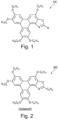
- FIG. 1 there is shown a representative structure of a triphenylene derivative series 100 according to some embodiments of the invention.
- the R group is changed to provide analogues of the triphenylene derivative series 100.
- the R group may be selected to alter the luminescent and/or other advantageous properties of the triphenylene derivative series 100.
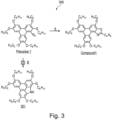
- a triphenylene derivative 200 Compound 1, according to an embodiment of the invention.
- the R group is an alkyl group of the formula C 4 H 9 .
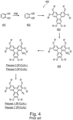
- Pathway A and Pathway B for a rearrangement reaction of Precursor 1, which is an azide (1-azido-2,3,6,7,10,11-hexakis(pentyloxy)triphenylene), under the reaction conditions of heating in xylene under nitrogen at 175 °C for 16 h.
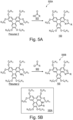
- FIG. 4 there is shown a schematic synthetic route 400 of the prior art ( N. Boden et. al. J. Mater. Chem., 1995, 5, 2275 ) to produce Precursor 1, and in addition Precursor 2, which is an amine (2,3,6,7,10,11-hexakis(pentyloxy)-1-triphenylenylamine), and Precursor 3, which is an amine (2,3,6,7,10,11-hexabutoxy-1-triphenylenylamine).
- Precursor 1 is an amine (2,3,6,7,10,11-hexakis(pentyloxy)-1-triphenylenylamine
- Precursor 3 which is an amine (2,3,6,7,10,11-hexabutoxy-1-triphenylenylamine.
- FIG. 5A there is shown a schematic synthetic route 500A for the formation of the triphenylene derivative series 100 of the present invention.
- Precursor 2 a carboxylic acid 501, and the triphenylene derivative series 100.
- the carboxylic acid 501 comprises an R group, which is incorporated into the oxazole moiety of the triphenylene derivative series 100.
- the R group may be an alkyl group, or an aryl group, i.e. the carbon atom bonded to the oxazole moiety in the triphenylene derivative series 100 may be either sp 2 or sp 3 hybridised.
- the organic phase was washed with aqueous NaOH (1M; 2 ⁇ 20 mL), separated and the organic phase was dried in vacuo.
- the crude black solid was purified by flash column chromatography (silica; 40 % CH 2 Cl 2 : 60 % n-hexane) to afford the triphenylene derivative series 100.
- FIG. 5B there is shown a schematic synthetic route 500B for the formation of the triphenylene derivative series 100 of the present invention.
- Precursor 2 an acyl chloride 502, and the triphenylene derivative series 100.
- an intermediate amide 100A the acyl chloride 502 comprises the R group, which is incorporated into the oxazole moiety of the triphenylene derivative series 100.
- the R group may be an alkyl group, or an aryl group, i.e. the carbon atom bonded to the oxazole moiety in the triphenylene derivative series 100 may be either sp 2 or sp 3 hybridised.
- the inventors believe that the acyl chloride 502 forms an intermediate amide (shown in Figure 5B as intermediate amide 100A) with the Precursor 2 in situ, which subsequently undergoes a ring closure to form the triphenylene derivative series 100.
- the reactions of both method 500A and method 500B are intermolecular coupling reactions of the carboxylic acid or the acyl chloride with the Precursor 2.
- the methods of Figure 5A and Figure 5B enable a huge number of analogues of the triphenylene derivate 100 to be synthesised by varying the R group of the carboxylic acid 501 in the method 500A of Figure 5A , or the acyl chloride 502 in the method 500B of Figure 5B .
- the triphenylene derivative series 100 of the present invention exhibit a number of desirable properties, in particular desirable luminescent characteristics.
- the R group may be altered to 'tune' these properties. More advantageously, within the known parameters of this invention, the R group may be specifically selected to enable the 'tuning' of the desirable luminescent characteristics. This is demonstrated in detail in the section below.
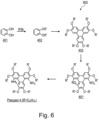
- Precursor 4 is 2,3,6,7,10,11-hexakis(pentyloxy)-1,8-triphenylenediamine.
- Precursor 4 is synthesised from di-nitro triphenylene 601.
- Di-nitro triphenylene 601 is formed as a side product in the prior art method that was used to synthesis the mono-nitro intermediate 404 (shown in Figure 4 ).
- Di-nitro triphenylene 601 may be isolated using flash column chromatography in an earlier fraction than the mono-nitro intermediate 404.
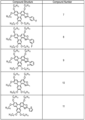
- Compound 1 The name for Compound 1 is 8-butyl-2,3,6,11,12-pentakis(pentyloxy)triphenyleno[1,2-d]oxazole.
- Compound 2 is 2,3,6,11,12-pentakis(pentyloxy)-8-phenyltriphenyleno[1,2-d]oxazole.
- Compound 3 The name for Compound 3 is 8-(naphthalen-2-yl)-2,3,6,11,12-pentakis(pentyloxy)triphenyleno[1,2-d]oxazole.
- Compound 4 was synthesised using the following method.
- a solution of 1-naphthalene carboxylic acid (225 mg, 1.31 mmol), palladium diacetate (0.005 mmol) and iodobenzene diacetate (0.157 mmol) in PhMe (5 mL) was heated at 70 °C under N 2 for 20 min.
- a solution of Precursor 2 (100mg; 0.131 mmol) in PhMe (2 mL) was added and heated under reflux for 48-72 h, whilst stirring. The solution was cooled to room temperature and diluted with CH 2 Cl 2 (20 mL).
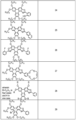
- Compound 4 The name for Compound 4 is 8-(naphthalen-1-yl)-2,3,6,11,12-pentakis(pentyloxy)triphenyleno[1,2-d]oxazole.
- Compound 5 was synthesised using the following method.
- a solution of 2-anthracene carboxylic acid (290 mg, 1.31 mmol), palladium diacetate (0.005 mmol) and iodobenzene diacetate (0.157 mmol) in PhMe (5 mL) was heated at 70 °C under N 2 for 20 min.
- a solution of Precursor 2 (100mg; 0.131 mmol) in PhMe (2 mL) was added and heated under reflux for 48-72 h, whilst stirring. The solution was cooled to room temperature and diluted with CH 2 Cl 2 (20 mL).
- Compound 5 The name for Compound 5 is 8-(anthracen-2-yl)-2,3,6,11,12-pentakis(pentyloxy)triphenyleno[1,2-d]oxazole.
- Compound 6 The name for Compound 6 is 8-(anthracen-9-yl)-2,3,6,11,12-pentakis(pentyloxy)triphenyleno[1,2-d]oxazole.
- Compound 7 The name for Compound 7 is 8-(4-fluorophenyl)-2,3,6,11,12-pentakis(pentyloxy)triphenyleno[1,2-d]oxazole.
- Compound 8 is 8-(3-fluorophenyl)-2,3,6,11,12-pentakis(pentyloxy)triphenyleno[1,2-d]oxazole.
- Compound 9 The name for Compound 9 is 8-(2-fluorophenyl)-2,3,6,11,12-pentakis(pentyloxy)triphenyleno[1,2-d]oxazole.
- Compound 10 is 8-methyl-2,3,6,11,12-pentakis(pentyloxy)triphenyleno[1,2-d]oxazole.
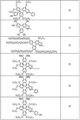
- Compound 12 is 4-(2,3,6,11,12-pentakis(pentyloxy)triphenyleno[1,2-d]oxazol-8-yl)benzonitrile.
- Compound 13 is 2,3,6,11,12-pentakis(pentyloxy)-8-(4-(trifluoromethyl)phenyl)triphenyleno[1,2-d]oxazole.
- Compound 14 The name for Compound 14 is 8-(2-iodophenyl)-2,3,6,11,12-pentakis(pentyloxy)triphenyleno[1,2-d]oxazole.
- Compound 15 is 8-(2-chlorophenyl)-2,3,6,11,12-pentakis(pentyloxy)triphenyleno[1,2-d]oxazole.
- Compound 18 was synthesised using the following method. A solution of Compound 17 (66 mg, 0.079 mmol) in acetone (10 mL) was heated to 50 °C and stirred under N 2 , to this was added a solution of sodium azide (7 mg, 0.111 mmol) in water (5 mL) and left stirring under N 2 for 4 h. After this time a precipitate had formed and the solvent was removed under reduced pressure, the precipitate was then filtered under vacumm and dried to give Compound 18 as an off white solid (59 mg, 94 %)
- Compound 19 is S-(4-(2,3,6,11,12-pentakis(pentyloxy)triphenyleno[1,2-d]oxazol-8-yl)butyl) ethanethioate.
- Compound 22 was synthesised using the following method.
- a solution of Compound 17 (260 mg, 0.311 mmol), Sodium Tert-butoxide (90 mg, 0.934 mmol), Potassium Iodide (40 mg, 0.311 mmol) and Ethylene Glycol (193 mg, 3.11 mmol) in MeCN (15 mL) was heated to and held at reflux for 48 h under N 2 .
- the reaction was cooled to room temperature and then evaporated to dryness in vacuo.
- the crude solid was dissolved with CH 2 Cl 2 (20 mL).
- Compound 20 had the following characterisation data: 1 H NMR ⁇ H: (300 MHz, CDCl 3 ) 10.00 (1H, s), 7.92 (1H, s), 7.90 (1H, s), 7.89 (1H, s), 7.84 (1H, s), 6.14-6.00 (1H, ddt, J 16.95, 10.20, 6.45), 5.22 (1H, dd, J 16.95, 1.60), 5.10 (1H, dd, J 10.20, 1.60), 4.43-4.35 (4H, m), 4.30-4.24 (6H, m), 3.22-3.17 (2H, t, J 7.55), 3.17-3.12 (2H, t, J 7.11), 2.86-2.78 (2H, m), 2.08-1.94 (10H, m), 1.62-1.45 (20H, m), 1.03-0.97 (15H, m) ppm.
- Compound 21 is 8-nonyl-2,3,6,11,12-pentakis(pentyloxy)triphenyleno[1,2-d]oxazole.
- Compound 23 was synthesised using the following method.
- a solution of 4-nitrobenzoic acid (1 g, 6 mmol), palladium diacetate (0.005 mmol) and (diacetoxyiodo)benzene (51 mg, 0.157 mmol) in PhMe (10 mL) was heated at 70 °C under N 2 for 20 min.
- a solution of Precursor 2 (100 mg; 0.132 mmol) in PhMe (10 mL) was added and heated under reflux for 48-72 h, whilst stirring. The solution was cooled to room temperature and diluted with CH 2 Cl 2 (20 mL).
- Compound 23 is 8-(4-nitrophenyl)-2,3,6,11,12-pentakis(pentyloxy)triphenyleno[1,2-d]oxazole.
- Compound 24 was synthesised using the following method. A solution of (diacetoxyiodo)benzene (51 mg, 0.157 mmol) and acetylsalicylic acid (550 mg, 3.031 mmol) in toluene (4 mL) was heated to 80 °C and stirred for 10 mins under N 2 . Then Precursor 2 (100 mg, 0.131 mmol) was added to form a black solution which was then stirred for a further 10 mins.
- Precursor 2 100 mg, 0.131 mmol
- Compound 24 is 2-(2,3,6,11,12-pentakis(pentyloxy)triphenyleno[1,2-d]oxazol-8-yl)phenol.
- Compound 25 was synthesised using the following method.
- Precursor 3 was synthesised using the following method. A solution of 2,3,6,7,10,11-hexabutoxy-1-nitrotriphenylene (1.70 g, 2.79 mmol), Sodium borohydride (1.70 g, 45.1. mmol) and Nickel(II) chloride hexahydrate (4.45 g, 18.7 mmol) in a 50/50 mix of MeOH and THF (40 mL) was stirred at room temperature for 5 h under N 2 . The crude black solid was then filtered and washed with CHCl 3 and the filtrate evaporated to dryness in vacuo to afford Precursor 3 as a brown solid (1.6 g, 85 %).
- Precursor 3 is 2,3,6,7,10,11-hexabutoxytriphenylen-1-amine
- Precursor 3 had the following characterization data: 1 H NMR ⁇ H: (300 MHz, CDCl 3 ) 8.82 (1 H, s), 7.83 (1 H, s), 7.80 (1 H, s), 7.78 (1 H, s), 7.37 (1 H, s), 4.57 (2 H, s), 4.29-4.09 (12 H, m), 2.01-1.81 (12 H, m), 1.67-1.52 (12 H, m), 1.13-0.94 (18 H, m) ppm.
- Compound 25 is 2,3,6,11,12-pentabutoxy-8-(naphthalen-2-yl)triphenyleno[1,2-d]oxazole.
- Compound 26 was synthesised using the following method. A solution of Precursor 4 (135 mg, 0.174 mmol) and palladium diacetate (0.0005 mmol) in PhMe (7 mL) was heated at reflux under N 2 for 10 min. 2-flourobenzoyl chloride (0.02 mL, 0.174 mmol) was added and heated under reflux for 40 h. The solution was cooled to room temperature and dried in vacuo and the resultant black solid was heated at 240 °C for 10 minutes before being cooled to room temperature. The crude black solid was purified by flash column chromatography (silica; 40 % CH 2 Cl 2 : 60 % n-hexane) to afford Compound 26 as an off-white solid (6 mg; 4 %).
- Compound 26 is 2,9-bis(2-fluorophenyl)-4,7,12,13-tetrakis(pentyloxy)triphenyleno[1,2-d:8,7-d']bis(oxazole).
- Compound 27 was synthesised using the following method.
- a solution of 4'-Carboxybenzo-15-crown-5 (600 mg, 1.92 mmol), Oxalyl chloride (2.0 mL, 23.6 mmol) and Dimethylformamide (0.01 ml, 0.129 mmol) was heated and held at reflux for 10 minutes under N 2 .
- the reaction was cooled to room temperature and then evaporated to dryness in vacuo.
- a solution of Precursor 2 100 mg, 0.132 mmol
- Compound 27 The name for Compound 27 is 8-(2,3,5,6,8,9,11,12-octahydrobenzo[b][1,4,7,10,13]pentaoxacyclopentadecin-15-yl)-2,3,6,11,12-pentakis(pentyloxy)triphenyleno[1,2-d]oxazole.
- Compound 28 was synthesised using the following method.
- a solution of Compound 2 (60 mg, 0.077 mmol) in degassed dichloromethane (5 mL) was stirred in a nitrogen purged 2 neck flask under nitrogen atmosphere at -20 °C.
- Boron tribromide (1M solution in dichloromethane, 387 ⁇ L, 0.385 mmol, 5 eq) was added via syringe through a Suba-Seal(RTM) and the dark yellow solution was stirred for at room temperature for 24 h.
- Compound 28 is 2,3,11,12-tetrakis(pentyloxy)-8-phenyltriphenyleno[1,2-d]oxazol-6-ol.
- Compound 29 was synthesised using the following method.
- Compound 2 250 mg, 0.322 mmol was disolved in dry dichloromethane (10 mL) and stirred at 0 °C under a nitrogen atmosphere.
- 0.01M solution of Br 2 in dichloromethane (144 mL, 1.449 mmol) was then added over 2 hours (4 ⁇ 36 mL) and monitered by TLC.
- the reaction was quenched by addition of saturated sodium metabisulfate solution (100 mL).
- the product was extracted with dichloromethane (30 mL) washed with water (3 ⁇ 30 mL), dried over MgSO 4 and evaporated to dryness.
- the crude product was then purified by column chromatography (Silica 40 % dichloromethane : hexane) to yield Compound 29 as a yellow solid (170 mg, 62 %).
- Compound 29 is 1-bromo-2,3,6,11,12-pentakis(pentyloxy)-8-phenyltriphenyleno[1,2-d]oxazole.
- Compound 30 was synthesised using the following method.
- Compound 29 (170 mg, 0.199 mmol), K 2 CO 3 (410 mg, 2.97 mmol) and Pd(PPh 3 ) 4 (30 mg, 0.026 mmol) were dissolved in degassed 5 : 1 tertahydrofuran : Water mix (4 mL) under nitrogen atmosphere.
- (4-hydroxyphenyl)boronic acid 140 mg, 1.02 mmol
- the product was extracted with dichloromethane (30 mL), washed with water (3 ⁇ 30 mL) and evaporated to dryness.
- the crude product was purified by column cromatography (Silica DCM : Hexane) to yield impure Compound 30 as a brown solid.
- Compound 31 was synthesised using the following method.
- Compound 10 (50.7 mg, 0.071 mmol) was added to a 2 neck round bottom flask, which was purged with nitrogen for 15 minutes.
- Dry dichloromethane (20 mL) was then added via syringe through a Suba-Seal(RTM) and the brown stirring solution was cooled to -78 °C.
- Boron tribromide (1M solution in dichloromethane, 391 ⁇ L, 0.391 mmol, 5.5 equivalents) was added via syringe through a Suba-Seal(RTM) and the reaction was stirred for 4 h.
- reaction mixture was poured over crushed ice and stirred until the ice had fully melted, 4 drops of hydrochloric acid (1M) were added and the product was extracted with ethyl acetate, washed with water (2 ⁇ 20 mL), and dried over MgSO 4 and evaporated to dryness. The crude product was used without further purification.
- Compound 31 is 8-methyltriphenyleno[1,2-d]oxazole-2,3,6,11,12-pentaol.
- Compound 32 is 2,3,6,12-tetrakis(2-(2-(2-methoxyethoxy)ethoxy)ethoxy)-8-methyl-11-(pentyloxy)triphenyleno[1,2-d]oxazole.
- Compound 32 had the following characterisation data: ES + MS m/z: 1017.51 ([M] + 100 %).
- Compound 32 is water soluble.
- Compound 33 was synthesised from Precursor 5 in the following method.
- the starting material to form Precursor 5 was obtained using the method described in J. Mater. Chem. C, 2017,5, 669-682 (DOI: 10.1039/C6TC04530H ).
- Precursor 5 was synthesised in the following method. 5,6-dimethoxy-2,3,8,9,12,13-hexakis(pentyloxy)dibenzo[fg,op]tetracene (681mg, 0.775 mmol) was dissolved in diethyl ether (20 ml) and then acetic acid (1.33 ml, 23.24 mmol, 30 eqiv) was added and the mixture stirred at room temperature in a nitrogen atmosphere for 10 minutes before the addition of fuming nitric acid (65 ⁇ L, 1.55 mmol, 2 equiv) was added.
- the reaction mixture was stirred under nitrogen for 20 minutes before the further addition of nitric acid (30 ⁇ L, 0.715 mmol, 0.92 equiv) and the reaction mixture was left for 20 minutes stirring at room temperature.
- the mixture was then quenched with water (10 ml) and the organic phase was washed with NaOH (1 M, 2 ⁇ 30 mL) and then dried in vacuo to provide Precursor 5 as a black solid (680 mg, 95 %). This was used in the next step with no further purification.
- Precursor 5 is 5,6-dimethoxy-1-nitro-2,3,8,9,12,13-hexakis(pentyloxy)dibenzo[fg,op]tetracene.
- Precursor 6 was synthesised in the following method. Precursor 5 (680 mg, 0.736 mmol) and NiCl 2 . 6H 2 O (552 mg, 2.33 mmol, 3 equivalents) were dissolved in THF:MeOH (20 mL, 5:4 ratio), to make a yellow solution, and then NaBH 4 (586 mg, 15.5 mmol, 20 equivalents) was added over 15 minutes. The black reaction mixture was left stirring under a nitrogen atmosphere for40 minutes after which time it was diluted with chloroform and the precipitate was gravity filters to leave a brown organic phase, which was then dried in vacuo to provide Precursor 6 as brown solid (614 mg, 93 %).
- Precursor 6 is 5,6-dimethoxy-2,3,8,9,12,13-hexakis(pentyloxy)dibenzo[fg,op]tetracen-1-amine.
- Precursor 7 was synthesised in the following method.
- Precursor 6 (147 mg, 0.181 mmol) was dissolved in dry dichloromethane (20 mL) and dry acetonitrile (20 mL). The solution was cooled to 0 °C under a nitrogen atmosphere then tert-butyl nitrite (34 ⁇ L, 0.309 mmol, 1.7 equivalents) and TMSN 3 (36 ⁇ L, 0.273 mmol, 1.5 equivalents) were added and the reaction mixture stirred 0 °C for 10 minutes and then at room temperature for 20 minutes. The solution was then dried in vacuo and purified via flash column chromatography (silica,30 % DCM, 70 % n-hexane) to provide Precursor 7 as a while solid (120 mg, 72 %).
- Compound 33 was synthesised using the following method. Precursor 7 (100 mg; 0.13 mmol) was dissolved in dry toluene (5 mL) was added to a flask containing rhodium octanoate dimer (5 mg; 0.01 mmol), under a nitrogen atmosphere. This mixture was then heated to reflux and stirred for 20 hours. The reaction was cooled to room temperature and then dried in vacuo, the solid was then purified via flash column chromatography (silica; 95 % n-hexane: 5 % ethyl acetate) to provide Compound 33 as a white solid (58 mg, 50 %).
- Compound 33 is 2-butyl-12,13-dimethoxy-5,6,9,10,15-pentakis(pentyloxy)dibenzo[4,5:9,10]pyreno[1,2-d]oxazole.
- Precursor 6 (47 mg; 0.053 mmol), benzoyl chloride (30 ⁇ L, 0.265 mmol, 5 equivalents), and diisopropylehtylamine (46 ⁇ L, 0.265 mmol, 5 equiv) were dissolved in dry toluene (5 mL) and the mixture was heated to reflux under a nitrogen atmosphere. The reaction mixture was stirred for 1 hour at which point the mixture was dried in vacuo then the solid was heated to 240 °C for 10 minutes. The reaction was cooled to room temperature and the solid was then purified via flash column chromatography (silica; 40 % DCM, 60 % n-hexane) to afford Compound 34 a white solid (16 mg, 33 %).
- Compound 34 is12,13-dimethoxy-5,6,9,10,15-pentakis(pentyloxy)-2-phenyldibenzo[4,5:9,10]pyreno[1,2-d]oxazole.
- Precursor 6 (100 mg; 0.111 mmol) 4-cyanobenzoyl chloride (92 mg, 0.555 mmol, 5 equiv), and diisopropylehtylamine (90 ⁇ L, 0.555 mmol, 5 equiv) were dissolved in dry toluene (5 mL) and the mixture was heated reflux under a nitrogen atmosphere. The reaction mixture was stirred for 1 hour at which point the mixture was dried in vaccuo then the solid was heated to 240 °C for 10 minutes. The reaction was cooled to room temperature and the solid was then purified via flash column chromatography (silica; 40 % DCM, 60 % n-hexane) to afford Compound 35 as a white solid (17 mg, 16 %).
- Compound 35 is 4-(12,13-dimethoxy-5,6,9,10,15-pentakis(pentyloxy)dibenzo[4,5:9,10]pyreno[1,2-d]oxazol-2-yl)benzonitrile.
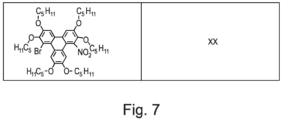
- Compound XX was synthesised using the following method.
- Compound XX is 1-bromo-8-nitro-2,3,6,7,10,11-hexakis(pentyloxy)triphenylene.
- the triphenylene derivative series 100 of the present invention exhibits a number of advantageous properties that are useful in many applications. Some of these advantageous properties are demonstrated below in a non-limiting way.
- FIG. 8 there is shown the normalised absorption and emission spectra 800 for Compounds 1 to 6 of Examples 1 to 6, and for compound 403.
- the solvent used to record the spectra was acetonitrile.
- Table 1 there is shown luminescent data for the Compounds 1 to 6. There is shown the maximum absorption values ⁇ max (nm), the maximum emission values ⁇ max (nm), the pseudo Stokes shift pSS (cm -1 ), the quantum yield ⁇ , and the brightness (M -1 cm -1 ). The luminescent data shown in Table 1 was recorded for each of the Compounds 1 to 6 individually in ethyl acetate, octan-1-ol, and acetonitrile.
- Compounds 1 to 6 exhibit large Stokes shifts in comparison with many commercially available dyes, e.g. the Alexa Fluor series ( J Histochem Cytochem. Vol. 51(12): 1699-1712, 2003 ). It is believed that the Stokes shifts of Compounds 1 to 6 (Compound 6 in particular) are some of the largest Stokes shifts observed for known luminescent organic compounds.
- the advantageous luminescent properties such as the Stokes shift may be altered or 'tuned' by variation of the R group within the triphenylene derivative series 100.
- the maximum absorption wavelength remains relatively constant for each of the Compounds 1 to 6.
- This 'tunable' characteristic is not observed with many other commercially available dyes.
- the triphenylene derivative series 100 of the present invention are push-pull twisted internal charge transfer systems, wherein the triphenylene moiety when substituted with five electron-donating alkoxy groups (shown in Figure 1 as C 5 H 11 ), provides a 'push' moiety.
- the R group provide a 'pull' moiety when conjugatively coupled to the triphenylene moiety by the oxazole unit. Therefore, further stabilisation of the excited state may be achieved by increasing the electron withdrawing nature of the R group. As the energy of the excited state is lowered, this increases the Stokes shift.
- the triphenylene derivative series 100 of the present invention may be tuned to provide this characteristic, as required depending upon the application.
- the emission spectra of Compounds 1 to 6 span a large portion of the visible spectrum.
- the R group need not be limited to those disclosed, and may be any alkyl or aryl group.
- variation of the R group with, for example, a different aromatic hydrocarbon group has been shown to result in a shift in the emission spectra.
- the shift in emission, and consequently the resulting visible colour of a specific triphenylene derivative, within the triphenylene derivative series 100, may be predicted with a good level of certainty for variation of the R group.
- this provides a huge number of analogues, for example wherein R is an aryl group, so that the emission is a colour within the visible spectrum, and this visible colour may be 'tuned' by slight structural alteration to the R group of the triphenylene derivative series 100 of the present invention.
- Compounds 1 to 6 exhibit very large molar extinction coefficients (E) of over 100,000 M -1 cm -1 . This is comparable to commercially available dyes, for example, the Alexa Fluor series, e.g. Alexa Fluor 635 has a molar extinction coefficient of 140,000 M -1 cm -1 .
- Compounds 1 to 6 also advantageously exhibit high quantum yields ⁇ and high brightness values.
- the quantum yield ⁇ in this case is defined as the ratio of the number of photons emitted to the number of photons absorbed.
- the Compounds 1 to 6 exhibit high brightness values, the brightness being defined as the product of the molar extinction coefficient and fluorescence quantum yield.
- FIG. 9 there is shown a graph of the normalised photoemission 900 of Compounds 1 to 6 in the solid state. There is shown the photoemission in the solid state (designated with the prefix ES) for Compounds 1 to 6 (ES1, ES2, ES3, ES4, ES5, ES6).
- the photoemission does not substantially change when Compounds 2 to 6 are dissolved in ethyl acetate in comparison to in the solid state. This demonstrates predictability and stability of photo-emissive behaviour.
- FIG. 10 there is shown a DSC (Differential scanning calorimetry) thermal analysis plot 1000 of phase type of Compounds 1 to 6, shown for both heating and cooling.
- the crystalline phase, the unknown solid phase, the columnar hexagonal phase, and the unknown liquid crystal phase are shown.
- Compounds 1 to 6 show an increase in conductivity, i.e. the photoconductivity values, upon light irradiation.
- the conductivity and the photoconductivity is much higher for the triphenylene derivatives comprising an oxazole moiety, when compared to reference compound 403, which does not comprise an oxazole moiety.
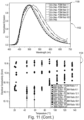
- FIG. 11 there is shown a photoconductivity experiment 1100 for Compound 3 in comparison with the reference compound 403 (shown in Figure 4 ).
- the absorbance spectra 1101 and emission spectra 1102 of Compound 3 was measured in the presence of phenyl-C61-butyric acid methyl ester (PCBM) at different ratios.
- the graph 1103 shows measurements of the electrical conductivity at different temperatures with light irradiation at 350nm for the reference compound 403.
- the graph 1104 shows measurements of the electrical conductivity at different temperatures with light irradiation at 350nm for Compound 3.
- Compound 3 displays improved conductivity, and photoconductivity, when the oxazole moiety is introduced. This is in comparison with the conductivity and photoconductivity of reference compound 403, which does not comprise an oxazole moiety substituted with an R group, as is characteristic of the triphenylene derivative series 100 of the present invention.
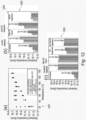
- FIG. 12 there is shown a photoconductivity experiment 1200 for Compound 22. There is shown a graph 1201, a graph 1202, and a graph 1203.
- the graph 1201 shows the electrical conductivity measurements for Compound 22 at different temperatures. Electrical conductivity measurements were recorded for Compound 22 in the presence and absence of irradiating UV light at 350nm, and after treatment with HCl in the presence and absence of irradiating UV light at 350 nm.
- the graph 1203 shows the electrical conductivity measurements for Compound 22 at different pH values.
- the electrical conductivity was measured for Compound 22: (i) untreated; (ii) after a first treatment with NaOH; (iii) after 20 hours; (iv) after treatment with HCl; (v) after a second treatment with NaOH.
- FIG. 13 there is shown a photoconductivity experiment 1300 for Compound 22.
- the electrical conductivity was measured for Compound 22: (i) untreated; (ii) untreated in the presence of UV light at 350 nm; (iii) after treatment with NaOH (2M for 15 minutes); (iv) after treatment with NaOH (2M for 15 minutes) in the presence of UV light at 350 nm.
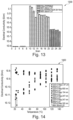
- FIG 14 there is shown a photoconductivity experiment 1400 for Compound 3. The electrical conductivity was measured at different temperatures.
- triphenylene derivatives of the present invention may also be used in a functional layer of an OLED (Organic Light Emitting Diode). It has been shown that the triphenylene derivatives of the present invention may exhibit excellent emitting, charge transporting, and/or charge blocking abilities.
- OLED Organic Light Emitting Diode
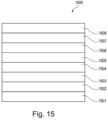
- the OLED 1500 comprises the following successive layers: a substrate 1501, an anode 1502, an optional hole transport layer 1503, an optional electron blocking layer 1504, an emissive layer 1505, an optional hole blocking layer 1506, an optional electron transport layer 1507, and a cathode 1508.
- the hole blocking layer 1506 may comprise 2,9-dimethyl-4,7-dipphenyl-1,10-phenanthroline (bathocuproine, BCP).
- the electron transport layer 1507 may comprise, for example, metal chelates such as, for example, aluminium tris(8-hydroxyquinoline).
- the cathode 1508 may comprise any metal, for example, aluminium, lithium, magnesium, and/or calcium.
- the emissive layer 1505 comprises the triphenylene derivatives of the present invention, e.g. the triphenylene derivative series 100.
- An OLED 1500 may be fabricated in the following manner:
- the R group of the triphenylene derivative series 100 and Precursors 1 and 2 need not be restricted to C 5 H 11 , and may be any stable alkyl or aryl group capable of alkylating the phenol moiety of the triphenylene moiety.
- the triphenylene derivative series 100 of the present invention may be further functionalised, for example, by derivatisation of functional groups within the R group.
- This provides the possibility of using the triphenylene derivative of the present invention as biotags or probes, for example.
Landscapes
- Chemical & Material Sciences (AREA)
- Organic Chemistry (AREA)
- Physics & Mathematics (AREA)
- Engineering & Computer Science (AREA)
- Materials Engineering (AREA)
- Spectroscopy & Molecular Physics (AREA)
- Health & Medical Sciences (AREA)
- Immunology (AREA)
- Optics & Photonics (AREA)
- Chemical Kinetics & Catalysis (AREA)
- Nuclear Medicine, Radiotherapy & Molecular Imaging (AREA)
- Life Sciences & Earth Sciences (AREA)
- Analytical Chemistry (AREA)
- Biochemistry (AREA)
- General Health & Medical Sciences (AREA)
- General Physics & Mathematics (AREA)
- Pathology (AREA)
- Electroluminescent Light Sources (AREA)
- Organic Low-Molecular-Weight Compounds And Preparation Thereof (AREA)
Description
- This invention relates generally to organic luminescent compounds. More specifically, although not exclusively, this invention relates to novel luminescent polycyclic aromatic hydrocarbon, e.g. triphenylene, derivatives, methods of synthesising the same, uses of the same, and devices comprising the same.
- Luminescent compounds are widely used in industrial and research applications as, for example, dyes, probes, sensors, and in electronic devices. These molecules emit light under external energy excitation from sources such as light and/or electrical current.
- In photoluminescence, under light irradiation a luminescent compound will absorb light of a specific wavelength and re-emit light of a different wavelength. The type of photoemission observed depends on the molecular structure of the compound.
- The difference between the maximum excitation wavelength and the emission wavelength of a luminescent compound is known as the Stokes shift. For use as dyes, probes and/or sensors in industrial applications, it is advantageous for luminescent compounds to possess a large Stokes shift, often defined as greater than 8000 cm-1 i.e. a comparatively large difference between the excitation wavelength and emission wavelength. This is advantageous because it minimises the reabsorption of light from the emission of the molecule.
- A drawback of many fluorescent dyes with large Stokes shifts is their relatively low brightness, this being defined as the product of the molar extinction coefficient and fluorescence quantum yield. Additionally, dyes with large Stokes shifts often suffer from poor photostability (Methods Appl. Fluoresc. 3 (2015) 042004).
- Organometallic complexes that are luminescent often have a large Stokes shift. However, these contain metal centres, e.g. osmium, ruthenium, iridium, rhenium and so on, which are rare, expensive, the complexes are often difficult to synthesise and often toxic. Luminescent organic molecules are often easier to synthesise, but usually exhibit a Stokes shift of relatively smaller magnitude.
- In contrast, in electroluminescence, a luminescent compound will emit light in response to an electric current. One of the main applications for this phenomenon is in electronic devices containing OLEDs (Organic Light Emitting Diodes). The OLED material is a layer of a luminescent organic compound, which is situated between two electrodes, one of which is typically transparent. This technology is used in digital displays in electronic devices such as televisions screens, computer monitors, mobile phones, electroluminescent lighting panels and so on.
- It is advantageous for luminescent compounds for use in electroluminescent applications to exhibit high brightness. Brightness is defined as the product of the molar extinction coefficient (E) and fluorescence quantum yield (Φ) divided by 1000. Consequently, it is advantageous for luminescent compounds to exhibit a high molar extinction coefficient (E) (defined by the Beer-Lambert law, in which A is absorbance, c is the molar concentration of the luminescent compound, and I is the path length), and also a high quantum yield (Φ) as a measure of efficiency.
- It is well known that polycyclic aromatic hydrocarbons exhibit luminescent properties. One such class of compound is triphenylene and its derivatives. For example, triphenylene may be functionalised with alkoxy chains appended to the periphery of the molecule. In addition, these derivatives exhibit discotic liquid crystalline (DLC) behaviour (J. Nabar and A. Chodkowska, J. Luminescence, 1975, 11, 215). Discotic liquid crystalline behaviour is characterised in that disc-shaped molecules form stacks or columns in a mesophase, which allows charge transfer through π stacking, enabling the material to be electrically semiconductive in the stacking direction. This DLC behaviour, combined with the luminescent properties, is particularly useful for application in technologies such as electronic devices using OLEDs (Organic Light Emitting Diodes), LEDs (Light Emitting Diodes), and for use in solar cells.
- It is also known for luminescent compounds to exhibit photoconductivity, in which compounds exhibit increased electrical conductivity in the presence of light by converting the light energy into current. It is known to utilise compounds with good photoconductivity in devices such as solar cells.
- Although many luminescent triphenylene derivatives have been synthesised and characterised (Levell et. al. J. Phys. Chem. A., 2010, 114, 13291, for example), it remains a challenge to provide triphenylene derivatives with the advantageous properties described above, i.e. large Stokes shift, high brightness, high molar extinction coefficient, and high quantum yield. Furthermore, it remains a challenge to provide a range of luminescent compounds that emit wavelengths throughout the visible spectrum. Specifically, blue emitters are a particular challenge to provide (Chem Soc Rev. 2013 Jun 21;42(12):4963-76).
- Furthermore, it remains a challenge to provide luminescent triphenylene derivatives wherein the absorption and the emission energies can be predicted and tuned by design and synthesis to result in specific and desired visible colours (Methods Appl. Fluoresc. 3 (2015) 042004).
-
EP0847228A2 discloses triphenylene derivatives for use as a hole injection layer in an electroluminescence device. -
US2016/0322569 discloses organic materials as a fluorescent emitting guests in emitting layers in a light emitting diode. - The invention provides polycyclic aromatic hydrocarbon derivatives according to appended Claims 1-15.
- Also described (but not claimed) are polycyclic aromatic hydrocarbon derivatives represented by the following general formula:

- Q is one of a cyclic aliphatic hydrocarbon, a cyclic aromatic hydrocarbon, a polycyclic hydrocarbon, a polycyclic aromatic hydrocarbon, and/or a fused polycyclic aromatic hydrocarbon; wherein the substituents independently comprise one or more of a hydrogen atom, a deuterium atom, a fluorine atom, a chlorine atom, a bromine atom,
- a carbon atom, an oxygen atom (e.g. an alkylated oxygen atom), a nitrogen atom (e.g. an alkylated nitrogen atom), a cyano group, a nitro group, an alkyl group and/or an aryl group;
- p is an integer of 1 to 2;
- q is an integer of 1 to 4;
- Y1 and Y2 independently represent one or more of a hydrogen atom, a deuterium atom, a fluorine atom, a chlorine atom, a bromine atom, a carbon atom, an oxygen atom (e.g. an alkylated oxygen atom), a nitrogen atom (e.g. an alkylated nitrogen atom), a cyano group, a nitro group, an alkyl group and/or an aryl group;
- and x is an integer of 0, 1, 2, 3, 4, 5, 6, 7, 8, 9, 10 or more.
- In embodiments, Q may represent C6H4. In embodiments, Q is a polycyclic aromatic hydrocarbon, for example, Q may be one of naphthalene, anthracene, phenanthrene, tetracene, chrysene, triphenylene, pyrene, pentacene, benzo[a]pyrene, corannulene, benzo[ghi]perylene, coronene, ovalene, fullerene, and/or benzo[c]fluorene. Q may be any isomer of the polycyclic aromatic hydrocarbons described, for example, 1-napthalene, 2-napthalene, 2-anthracene, 9-anthracene. The polycyclic aromatic hydrocarbon group may be substituted with other moieties such as aryl groups, alkyl groups, heteroatoms, and/or other electron withdrawing or electron donating groups.
- Q is bonded to other six membered rings, e.g. aromatic six membered rings, and/or substituted aromatic six membered rings. The number of six membered rings bonded to Q is represented by the integer x wherein x is 0, 1, 2, 3, 4, 5, 6, 7, 8, 9, 10 or more.
- Q may be an aromatic six-membered ring, and x an integer of 2 or above, e.g. 2, 3, 4, 5 or above 5.
- The described (but not claimed) polycyclic aromatic hydrocarbon, e.g. triphenylene, derivatives may be represented by the following general formula:

- wherein D is a hydrogen atom, a deuterium atom, a silicon atom, or a carbon atom;
- p is an integer of 1 to 2;
- q is an integer of 1 to 2;
- Y1 and Y2 independently represent one or more of a hydrogen atom, a deuterium atom, a fluorine atom, a chlorine atom, a bromine atom, a carbon atom, an oxygen atom (e.g. an alkylated oxygen atom), a nitrogen atom (e.g. an alkylated nitrogen atom), a cyano group, a nitro group, an alkyl group and/or an aryl group;
- and x is an integer of 0, 1, 2, 3, 4, 5, 6, 7, 8, 9, 10 or more.
- For example, D may be a linear or branched alkyl chain, an aryl group, or a combination thereof.
- The described (but not claimed) polycyclic aromatic hydrocarbon, e.g. the triphenylene, derivatives may be represented by the following general formula:

- wherein D is a hydrogen atom, a deuterium atom, a silicon atom, or a carbon atom
- p is an integer of 1 to 2;
- q is an integer of 1;
- Y1 and Y2 independently represent one or more of a hydrogen atom, a deuterium atom, a fluorine atom, a chlorine atom, a bromine atom, a carbon atom, an oxygen atom (e.g. an alkylated oxygen atom), a nitrogen atom (e.g. an alkylated nitrogen atom), a cyano group, a nitro group, an alkyl group and/or an aryl group;
- and x is an integer of 0, 1, 2, 3, 4, 5, 6, 7, 8, 9, 10 or more.
- For example, D may be a linear or branched alkyl chain, an aryl group, or a combination thereof.
- Y1, Y2, and Y3 may comprise a carboxylic acid group, a glycol, an alkoxy, a thioalkoxy, an amino, an acetate, an amide, a thioamide, a thioester, an azo, and/or a silyl group. Additionally or alternatively, Y1, Y2, and Y3 may comprise an alkyl group. The alkyl group(s) may be a straight chain, or may comprise a branched chain, and/or may be further functionalised. Additionally or alternatively, Y1, Y2, and Y3 may comprise an aryl group. The aryl group(s) may be unsubstituted or may be further functionalised.
- One aspect of the invention provides polycyclic aromatic hydrocarbon derivatives, according to
Claim 1. - It is also described that the polycyclic aromatic hydrocarbon derivatives may be triphenylene derivatives, represented by the following general formula:

- wherein R independently represents an aromatic group and/or an aliphatic group;
- A independently represents a hydrogen atom, an aryl group, an alkyl group comprising 1 to 20 carbons (e.g. 1 to 15 carbons, or 1 to 10 carbons, or 10, 9, 8, 7, 6, 5, 4, 3, 2 or 1 carbons) or an alkyl ether;
- J independently represent a hydrogen atom, a deuterium atom, a fluorine atom, a chlorine atom, a bromine atom, an alkylated oxygen atom, an alkylated nitrogen atom, a cyano group, a nitro group, an alkyl group and/or an aryl group (e.g. a phenol group).
- In embodiments, A may be C5H11 and/or C4H9. In embodiments, A represents a polyethylene glycol (PEG) group (e.g. C2H4OC2H4OC2H4OCH3.
- In embodiments, the triphenylene derivative may not be the compound wherein A is C5H11, J is H and R is C4H9.
- A further aspect of the invention is as set out in
Claim 4. - In embodiments, the polycyclic aromatic hydrocarbons are triphenylene derivatives represented by the following general formula:

- wherein R1 and R2 independently represents an aromatic group and/or an aliphatic group;
- A independently represents a hydrogen atom, an aryl group, an alkyl group comprising 1 to 20 carbons (e.g. 1 to 15 carbons, or 1 to 10 carbons, or 10, 9, 8, 7, 6, 5, 4, 3, 2 or 1 carbons) or an alkyl ether;
- J independently represent a hydrogen atom, a deuterium atom, a fluorine atom, a chlorine atom, a bromine atom, an alkylated oxygen atom, an alkylated nitrogen atom, a cyano group, a nitro group, an alkyl group and/or an aryl group.
- In embodiments, A may be C5H11 and/or C4H9. In embodiments, A represents a polyethylene glycol (PEG) group (e.g. C2H4OC2H4OC2H4OCH3.
- A further aspect of the invention provides polycyclic aromatic hydrocarbons as set out in
Claim 5. - In embodiments, the polycyclic aromatic hydrocarbons are triphenylene derivatives represented by the following general formula:

- wherein R1, R2, R3 independently represent an aromatic group and/or an aliphatic group;
- A independently represents a hydrogen atom, an aryl group, an alkyl group comprising 1 to 20 carbons (e.g. 1 to 15 carbons, or 1 to 10 carbons, or 10, 9, 8, 7, 6, 5, 4, 3, 2 or 1 carbons) or an alkyl ether;
- J independently represent a hydrogen atom, a deuterium atom, a fluorine atom, a chlorine atom, a bromine atom, a carbon atom, an alkylated oxygen atom, an alkylated nitrogen atom, a cyano group, a nitro group, an alkyl group and/or an aryl group.
- In non-claimed embodiments, A comprises further functionality, for example, A may further comprise fluorine atoms, chlorine atoms, cyano groups, nitro groups, glycol, alkoxy, thioalkoxy, polyethylene glycol, amino, acetate, carboxylic acid, amide, thioamide, thioester, azo, and/or silyl groups.
- In embodiments, J comprises or represents an aryl group, e.g. a phenol group. Additionally or alternatively, J comprises a halogen atom, e.g. fluorine, chlorine, bromine, or iodine.
- In embodiments, R, R1, R2, or R3 may be an alkyl group, for example, a straight or branched alkyl chain. In embodiments, at least one of R, R1, R2, R3 may be a methyl, ethyl, propyl, butyl group.
- In embodiments wherein R, R1, R2, or R3 is an aromatic group, the aromatic group may be one of, or a combination of, an aromatic hydrocarbon group, and/or an aromatic heterocyclic group.
- In embodiments wherein R, R1, R2, or R3 is an aromatic hydrocarbon group, the aromatic hydrocarbon group may comprise one of, or a combination of, a phenyl ring and/or a substituted phenyl ring. There may be one, two, three, four, or five additional substituents on the phenyl ring. The substituents are bonded directly to the phenyl ring, and may be one of, or a combination of, fluorine, chlorine, bromine, iodine, a hydroxyl group, an amine group, a nitro group, an alkoxy group, a carboxylic acid, an amide, a cyano group, a trifluoromethyl, an ester, an alkene an alkyne, an azide, an azo, an isocyanate, a ketone, an aldehyde, an alkyl group consisting of a hydrocarbon chain, or a hydrocarbon ring, an alkyl group consisting of other heteroatoms such as fluorine, chlorine, bromine, iodine, oxygen, nitrogen, and/or sulphur. The alkyl group may comprise a hydroxyl group, an amine group, a nitro group, an ether group, a carboxylic acid, an amide, a cyano group, trifluoromethyl, an ester, an alkene an alkyne, an azide, an azo, an isocyanate, a ketone, an aldehyde, for example. The substituents may be another aromatic group, for example, R may comprise a phenyl substituted with a further phenyl ring. In embodiments, the R group may be a phenyl ring, substituted with a second phenyl ring, which in turn is substituted with a third phenyl ring.
- In embodiments wherein R, R1, R2, or R3 is an aromatic group, the aromatic group may be a polycyclic aromatic hydrocarbon, for example, naphthalene, anthracene, phenanthrene, tetracene, chrysene, triphenylene, pyrene, pentacene, benzo[a]pyrene, corannulene, benzo[ghi]perylene, coronene, ovalene, fullerene, and/or benzo[c]fluorene. The R group may be bonded to the triphenylene derivative by any isomer of the polycyclic aromatic hydrocarbons described, for example, 1-napthalene, 2-napthalene, 2-anthracene, 9-anthracene. The polycyclic aromatic hydrocarbon group may be substituted with other moieties such as aryl groups, alkyl groups, heteroatoms, and/or other electron withdrawing or electron donating groups.
- In embodiments wherein R, R1, R2, or R3 is an aromatic heterocyclic group, the heterocyclic group may be a three membered ring, a four membered ring, a five membered ring, a six membered ring, a seven membered ring, an eight membered ring, a nine membered ring, a ten membered ring, or a fused ring. In embodiments, the heterocyclic group may be furan, benzofuran, isobenzofuran, pyrrole, indole, isoindole, thiophene, benzothiophene, benzo[c]thiophene, imidazole, benzimidazole, purine, pyrazole, indazole, oxazole, benzoxazole, isoxazole, benzisoxazole, thiazole, benzothiazole, pyridine, quinoline, isoquinoline, pyrazine, quinoxaline, acridine, pyrimidine, quinozoline, pyridazine, cinnoline, phthalazine, 1,2,3-triazine, 1,2,4-triazine, 1,3,5-triazine.pyridine or thiophene.
- In embodiments wherein R, R1, R2, or R3 is an aliphatic group, the aliphatic group may be one of, or a combination of, an n-alkyl chain, a branched alkyl chain, an alkyl chain comprising unsaturated moieties, an alkyl chain comprising heteroatoms, for example, fluorine, chlorine, bromine, iodine, oxygen, sulphur, nitrogen. The alkyl chain may comprise unsaturated portions, comprising alkenes, or aromatic moieties. The alkyl chain may comprise functional groups for further derivatisation of the polycyclic aromatic hydrocarbon, e.g. triphenylene, derivative. For example, the functional groups may be one or more of an azide, a carbonyl group, an alcohol, a halogen, or an alkene.
- In embodiments, In embodiments wherein R, R1, R2, or R3 comprise a crown ether.
- The polycyclic aromatic hydrocarbon, e.g. triphenylene, derivatives may be used, for example, as luminescent dyes for use in devices.
- A further aspect of the invention provides a device comprising the polycyclic aromatic hydrocarbon derivatives, e.g. the triphenylene derivatives. The device may be an electronic device, for example, an organic electroluminescent device, a thin-film transistor and/or an OPV (organic photovoltaic) device. The electronic device may comprise a digital display, the digital display comprising the polycyclic aromatic hydrocarbon derivatives, e.g. the triphenylene derivatives, of the present invention, for example, a liquid crystal display. The digital display may be in a television screen, a computer monitor, a mobile phone screen, a games console, for example. The organic electroluminescent device may comprise a pair of electrodes and one or more layers interposed therebetween, wherein the one or more layers comprise one or more of the polycyclic aromatic hydrocarbon derivatives, e.g. the triphenylene derivatives.
- The device may be for the use of detecting species, for example, ions, e.g. metal ions. For example, the polycyclic aromatic hydrocarbon derivative, e.g. the triphenylene derivative, may comprise a moiety that is capable of binding to a species, e.g. an ion. The moiety may be tagged to or integrated into, i.e. covalently bonded to, the polycyclic aromatic hydrocarbon derivatives, e.g. the triphenylene derivative. Binding of a species to a polycyclic aromatic hydrocarbon derivative, e.g. a triphenylene derivative, may elicit a luminescent response. The luminescent response may be recorded to quantitatively or qualitatively measure the presence of the species, e.g. in solution. The moiety may be one or more of a crown ether, a multidentate ligand, a bidentate ligand or a monodentate ligand. The moiety may be the R group of the polycyclic aromatic hydrocarbon, e.g. triphenylene, derivatives. The polycyclic aromatic hydrocarbon, e.g. triphenylene, derivative, e.g. comprising a moiety that is capable of binding to a species, e.g. metal ions. The triphenylene derivatives may be spin coated onto a dipstick. The dipstick may comprise a UV LED (light emitting diode). The LED may be illuminated in the presence of specific species upon binding to the polycyclic aromatic hydrocarbon derivatives, e.g. the triphenylene derivative, e.g. ions, metal ions. The LED illumination may be specific to a specific species that is bound to the polycyclic aromatic hydrocarbon derivatives, e.g. the triphenylene derivative, i.e. a specific wavelength of light, wavelength A, is emitted by the LED upon binding to a specific species, species A, and a different wavelength of light, wavelength B, is emitted by the LED upon binding to a specific species, species B.
- The device may be used in biofluorescent microscopy techniques. The device may comprise the polycyclic aromatic hydrocarbon derivatives, e.g. the triphenylene derivatives, as a luminescent dye that may be used to label or tag biological, or non-biological samples, which may include DNA or proteins or antigens or biomarkers.
- The device may comprise a polymer, or a pre-polymer, and/or a resin composition for use in printing, for example, for use in 3D printing plastic products comprising the polycyclic aromatic hydrocarbon derivatives, e.g. the triphenylene derivatives. The polycyclic aromatic hydrocarbon, e.g. triphenylene, derivatives may be used as a dopant in the device.
- The polycyclic aromatic hydrocarbon derivatives, e.g. the triphenylene derivative(s), of the device may emit light in the visible spectrum, i.e. between 380 nm and 750 nm. The polycyclic aromatic hydrocarbon derivatives, e.g. the triphenylene derivative(s), of the device may exhibit a Stokes shift of between 8000 cm-1 to 25,000cm-1, for example, between 15,000 cm-1 to 25,000 cm-1. The polycyclic aromatic hydrocarbon derivatives, e.g. the triphenylene derivative(s), of the device may exhibit a conductivity value of 5.0 × 10⁻¹³ S cm-1 and 1.5 × 10⁻¹¹ S cm-1, for example, between 6 × 10-12 S cm-1 and 1.5 × 10⁻¹¹ S cm-1. The polycyclic aromatic hydrocarbon derivative, e.g. the triphenylene derivative(s), of the device may) exhibit a photoconductivity when irradiated at 350 nm of between 1.5 × 10⁻¹⁰ S cm-1 and 1 × 10⁻³ S cm-1 , for example, between 1 × 10⁻⁸ S cm-1 and 1 × 10⁻³ cm-1 .
- There is further disclosed a compound for the fabrication of the triphenylene derivatives of
claim 4 comprising the structure:
- Preferably, in this embodiment A represents an alkyl chain, for example, comprising between 1 to 10 carbon atoms, e.g. 1, 2, 3, 4, 5, 6, 7, 8, 9, or 10 carbon atoms, e.g. A is C5H11.
- A yet further aspect of the invention provides a method of synthesising polycyclic aromatic hydrocarbon derivatives according to
Claim 10. - In this embodiment, (SM1) represents the polycyclic aromatic hydrocarbon core and (P1) represents a triphenylene derivative. In this embodiment, A' represents an alkyl chain comprising between 3 to 20 carbons, e.g. 4, 5, 6, 7, 8, 9, 10, 11, 12, 13, 14, 15, 16, 17, 18, 19, or 20 carbons. In this embodiment, R represents an alkyl chain with one fewer carbon atoms to that of A'. For example, preferably, A' comprises a linear alkyl chain comprising five carbons, i.e. C5H11 and R comprises a linear alkyl chain comprising four carbons, i.e. C4H9. The method may involve the polycyclic aromatic hydrocarbon, e.g. triphenylene, core (SM1) undergoing an intramolecular rearrangement to produce polycyclic aromatic hydrocarbon, e.g. triphenylene, derivative (P1).
- The method may comprise the use of a solvent, for example, an inert solvent. The method may comprise heating the polycyclic aromatic core (SM1) under pressure to produce the polycyclic aromatic hydrocarbon derivative (P1).
- In embodiments, the method may comprise a catalyst, for example, a transition metal catalyst. The transition metal catalyst may be a rhodium catalyst, e.g. [[CH3(CH2)6CO2]2Rh]2. The method may comprise heating to reflux in the presence of a transition metal catalyst, for example, a rhodium catalyst, e.g. [[CH3(CH2)6CO2]2Rh]2 using toluene as the solvent.
- Also described (but not claimed) is a method of synthesising polycyclic aromatic hydrocarbon derivatives (P2), the method comprising the general formula:

- wherein (SM2) represents the polycyclic aromatic hydrocarbon core, (P2) represents the polycyclic aromatic hydrocarbon derivative;
- Q is one of a substituted or unsubstituted cyclic aliphatic hydrocarbon, a substituted or unsubstituted cyclic aromatic hydrocarbon, a substituted or unsubstituted polycyclic hydrocarbon, a substituted or unsubstituted polycyclic aromatic hydrocarbon, and/or a substituted or unsubstituted fused polycyclic aromatic hydrocarbon; wherein the substituents comprise one or more of a hydrogen atom, a deuterium atom, a fluorine atom, a chlorine atom, a bromine atom, a carbon atom, an oxygen atom (e.g. an alkylated oxygen atom), a nitrogen atom (e.g. an alkylated nitrogen atom), a cyano group, a nitro group, an alkyl group and/or an aryl group;
- p is an integer of 1 to 2;
- q is an integer of 1 to 4;
- Y1 and Y2 independently represent one or more of a hydrogen atom, a deuterium atom, a fluorine atom, a chlorine atom, a bromine atom, a carbon atom, an oxygen atom (e.g. an alkylated oxygen atom), a nitrogen atom (e.g. an alkylated nitrogen atom), a cyano group, a nitro group, an alkyl group and/or an aryl group;
- and x is an integer of 0, 1, 2, 3, 4, 5, 6, 7, 8, 9, 10 or more;
- G is a carbon atom;
- N is a nitrogen atom;
- B is one or more hydrogen atoms; and
- wherein (E) represents the reagent;
- R independently represents an aromatic group and/or an aliphatic group;
- Z is one of an oxygen atom, a derivatised oxygen atom, a chlorine atom, or a bromine atom, or any good leaving group.
- The nitrogen atom may be an amine (NH2) wherein B comprises two hydrogen atoms.
- In embodiments, the method of synthesising polycyclic aromatic hydrocarbon derivatives (P3) comprises the general formula:

- wherein (SM3) represents the polycyclic aromatic hydrocarbon core, (P3) represents the polycyclic aromatic hydrocarbon derivative,
- p is an integer of 1 to 2;
- q and s are integers of 1 to 4;
- Y1, Y2, and Y3 independently represent one or more of a hydrogen atom, a deuterium atom, a fluorine atom, a chlorine atom, a bromine atom, an alkylated oxygen atom, an alkylated nitrogen atom, a cyano group, a nitro group, an alkyl group and/or an aryl group;
- G is a substituted carbon atom;
- N is a nitrogen atom;
- B is two hydrogen atoms;
- (E) represents the reagent;
- R independently represents an aromatic group and/or an aliphatic group ;
- Z is one of a derivatised oxygen atom, a chlorine atom, or a bromine atom, or any good leaving group;
- and wherein the polycyclic aromatic hydrocarbon core (SM3) and the reagent (E) undergo an intermolecular coupling reaction to produce the polycyclic aromatic hydrocarbon derivative (P3).
- In embodiments, (E) represents the reagent, wherein R is an aromatic group and/or an aliphatic group, and group Z may be one of a derivatised oxygen atom e.g. an OH group; a chlorine atom, or a bromine atom, or any good leaving group. Reagent (E) may be an acyl chloride or a carboxylic acid. The method may involve the polycyclic aromatic hydrocarbon core (SM3) and the reagent (E) undergoing an intermolecular coupling reaction to produce the polycyclic aromatic hydrocarbon derivative (P3).
- In embodiments, the method of synthesising polycyclic aromatic hydrocarbon derivatives (P4) comprises the general formula:

- wherein (SM4) represents a triphenylene core, (P4) represents a triphenylene derivative;
- A independently represents a hydrogen atom, an aryl group, an alkyl group comprising 1 to 20 carbons (e.g. 1 to 15 carbons, or 1 to 10 carbons, or 10, 9, 8, 7, 6, 5, 4, 3, 2 or 1 carbons);
- J independently represent a hydrogen atom, a deuterium atom, a fluorine atom, a chlorine atom, a bromine atom, OH, an alkylated oxygen atom, an alkylated nitrogen atom, a cyano group, a nitro group, an alkyl group and/or an aryl group.
- G is a substituted carbon atom;
- (E) represents the reagent;
- R independently represents an aromatic group and/or an aliphatic group;
- Z is one of a derivatised oxygen atom, a chlorine atom, or a bromine atom, or any good leaving group;
- and wherein the triphenylene core (SM4) and the reagent (E) undergo an intermolecular coupling reaction to produce the triphenylene derivative (P4).
- In embodiments, the method of synthesising triphenylene derivatives (100) comprises the general formula:
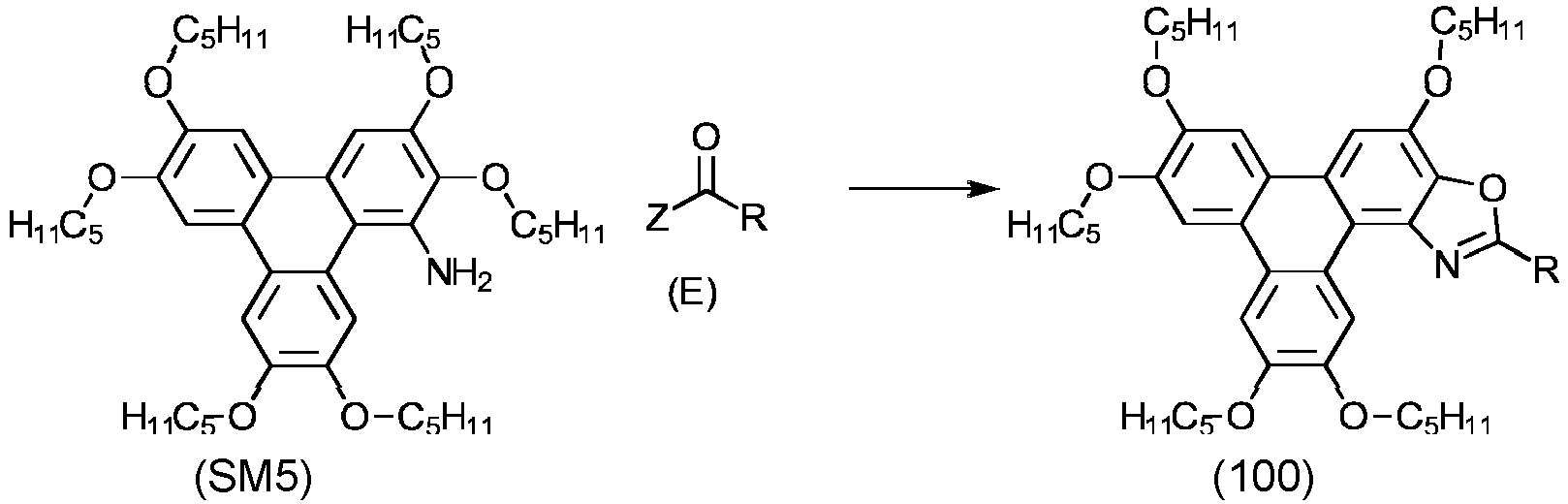
- There is also described a method of synthesising polycyclic aromatic hydrocarbon derivatives (P6), comprising the general formula:

- wherein (SM6) represents a polycyclic aromatic hydrocarbon core, (P6) represents a polycyclic aromatic hydrocarbon derivative;
- p is an integer of 1 to 2;
- q is an integer of 1 to 2;
- s is an integer of 1 to 4;
- Y1, Y2, and Y3 independently represent one or more of a hydrogen atom, a deuterium atom, a fluorine atom, a chlorine atom, a bromine atom, an alkylated oxygen atom, an alkylated nitrogen atom, a cyano group, a nitro group, an alkyl group and/or an aryl group;
- G independently represents a substituted carbon atom;
- N is a nitrogen atom;
- B is two hydrogen atoms;
- (E) represents the reagent;
- R independently represents an aromatic group and/or an aliphatic group;
- Z is one of a derivatised oxygen atom, a chlorine atom, or a bromine atom, or any good leaving group;
- and wherein the polycyclic aromatic hydrocarbon core (SM6) and the reagent (E) undergo an intermolecular coupling reaction to produce the polycyclic aromatic hydrocarbon derivative (P6).
- In another aspect of the invention there is provided a method of synthesising polycyclic aromatic hydrocarbon derivatives (P7) in accordance with
Claim 13. - The method may comprise synthesising triphenylene derivatives, wherein the triphenylene core starting material comprises the formula:

- A yet further aspect of the invention provides a method of synthesising polycyclic aromatic hydrocarbon derivatives (P8) in accordance with
claim 14. - The method may comprise synthesising triphenylene derivatives (P9) comprising the general formula:
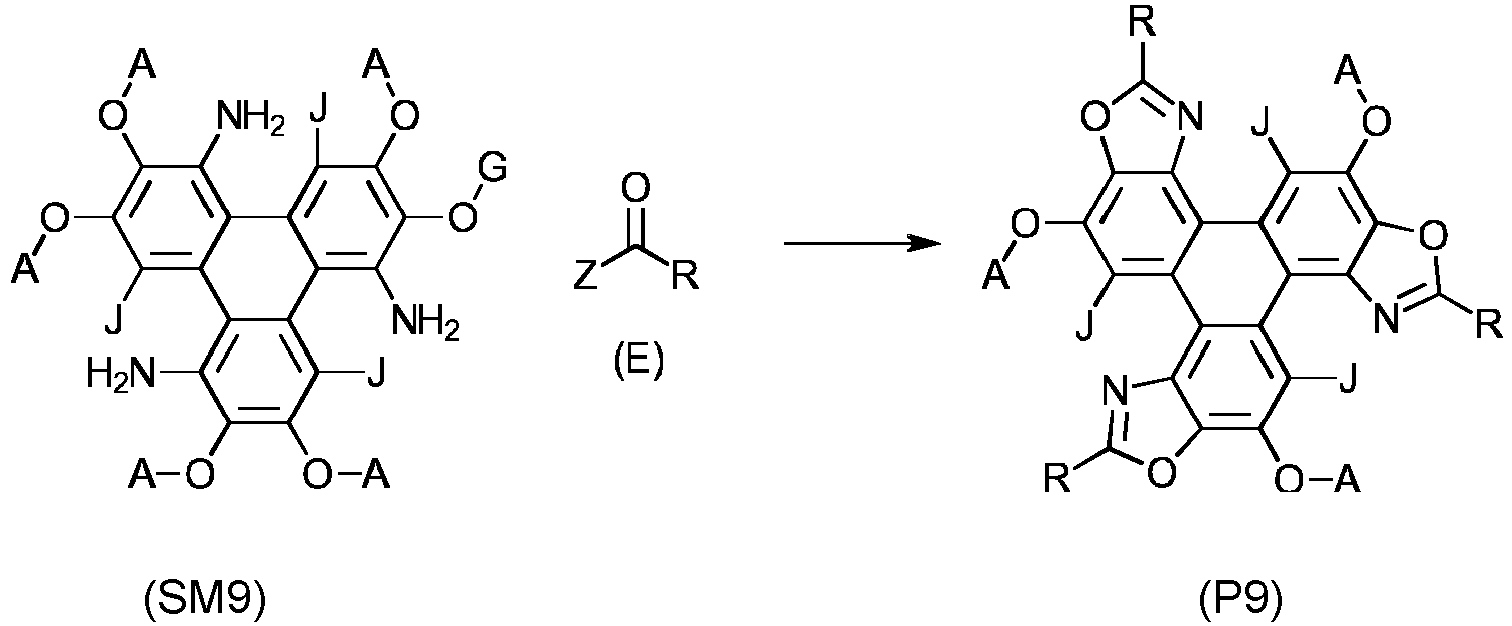
- wherein (SM9) represents a triphenylene core, (P9) represents a triphenylene derivative;
- A independently represents a hydrogen atom, an aryl group, an alkyl group comprising 1 to 20 carbons (e.g. 1 to 15 carbons, or 1 to 10 carbons, or 10, 9, 8, 7, 6, 5, 4, 3, 2 or 1 carbons);
- J independently represent a hydrogen atom, a deuterium atom, a fluorine atom, a chlorine atom, a bromine atom, an alkylated oxygen atom, an alkylated nitrogen atom, a cyano group, a nitro group, an alkyl group and/or an aryl group (e.g. a phenol group).
- G independently represents a substituted carbon atom;
- (E) represents the reagent;
- R independently represents an aromatic group and/or an aliphatic group;
- Z is one of a derivatised oxygen atom, a chlorine atom, or a bromine atom;
- and wherein the triphenylene core (SM9) and the reagent (E) undergo an intermolecular coupling reaction to produce triphenylene derivative (P9).
- The method of synthesising triphenylene derivatives may comprise use of the starting material with the formula:

- The method may further comprise a transition metal catalyst. The transition metal catalyst may be a rhodium based catalyst. Additionally or alternatively, the transition metal catalyst may be a palladium Pd(ll) catalyst, for example, palladium acetate.
- The method may further comprise a reagent to replace, in situ, group Z with a good leaving group.
- The reagent (E) may be a carboxylic acid, for example, benzoic acid or a substituted benzoic acid. Alternatively, the reagent (E) may be an acyl chloride, for example, benzyl chloride or a substituted benzyl chloride.
- The method may comprise heating the triphenylene core in a solvent, e.g. toluene, to reflux, in the presence of a palladium catalyst, e.g. Pd(OAc)2, wherein Compound (E) is a carboxylic acid, i.e. Z is an OH group.
- The method may further comprise a species to replace group Z with a good leaving group, for example, the species may be (diacetoxyiodo)benzene).
- Alternatively, the method may comprise heating the polycyclic aromatic hydrocarbon core, e.g. the triphenylene core, in a solvent, e.g. toluene, to reflux, wherein Compound (E) is an acyl chloride, i.e. Z is a chlorine atom. The method may further comprise heating the reaction mixture to 240 °C.
- It is to be understood that the polycyclic aromatic derivatives may be further functionalised to produce analogues. For example, the polycyclic aromatic hydrocarbon derivatives, e.g. the triphenylene derivatives, may undergo bromination, e.g. using Br2, to add a bromine atom to one or more aromatic carbon atoms. The bromine atom may act as a functional group to undergo further chemical transformations, e.g. to functionalise the polycyclic aromatic hydrocarbon derivatives with a phenol group. In embodiments, J may represent a bromine atom and/or a phenol group. The bromine atom and/or phenyl group may be used to further functionalise the polycyclic aromatic hydrocarbon derivative.
- Additionally or alternatively, the alkyl groups of one or more of the alkoxy groups (e.g. the OC5H11 groups) may be de-alkylated to form hydroxyl (e.g. phenol) groups (e.g. using boron tribromide).
- The polycyclic aromatic hydrocarbon derivatives may act as bio-labels or bio-probes.
- Within the scope of this application it is expressly intended that the various aspects, embodiments, examples and alternatives set out in the preceding paragraphs, in the claims and/or in the following description and drawings, and in particular the individual features thereof, may be taken independently or in any combination. That is, all embodiments and/or features of any embodiment can be combined in any way and/or combination, unless such features are incompatible. For the avoidance of doubt, the terms "may", "and/or", "e.g.", "for example" and any similar term as used herein should be interpreted as non-limiting such that any feature so-described need not be present. Indeed, any combination of optional features is expressly envisaged without departing from the scope of the invention, whether or not these are expressly claimed. The applicant reserves the right to change any originally filed claim or file any new claim accordingly, including the right to amend any originally filed claim to depend from and/or incorporate any feature of any other claim although not originally claimed in that manner.
- Embodiments of the invention will now be described by way of example only with reference to the accompanying drawings in which:
-
Figure 1 is a representative structure of a series of triphenylene derivatives according to some embodiments of the invention; -
Figure 2 is a triphenylene derivative according to a first example of the invention; -
Figure 3 is a method of synthesising a triphenylene derivative of the first embodiment of the invention, as shown inFigure 2 ; -
Figure 4 is a schematic synthetic route of the prior art to the precursors of the triphenylene derivatives according to embodiments of the invention; -
Figure 5A is a schematic synthetic route for the synthesis of triphenylene derivatives according to embodiments of the invention, as shown inFigure 1 ; -
Figure 5B is an alternative schematic synthetic route for the synthesis of triphenylene derivatives according to embodiments of the invention, as shown inFigure 1 ; -
Figure 6 is a schematic synthetic route to the precursor of the triphenylene derivatives according to further embodiments of the invention; -
Figures 7 are examples of polycyclic aromatic hydrocarbon derivatives according to examples of the invention; -
Figure 8 is a normalised absorption and emission spectra for the triphenylene derivatives according to examples of the invention; -
Figure 9 is a photoemission of the triphenylene derivatives in the solid state according to some examples of the invention; -
Figure 10 is a graph showing DSC (Differential scanning calorimetry) thermal analysis data for the triphenylene derivatives according to some examples of the invention; -
Figure 11 is data from photoconductivity experiments performed on the triphenylene derivatives according to some examples of the invention; -
Figure 12 is graphical data showing the electrical conductivity of a triphenylene derivative according to an example of the invention; -
Figure 13 is a graph showing the electrical conductivity of triphenylene derivative according to an example of the invention; -
Figure 14 is a graph showing the electrical conductivity of triphenylene derivative according to an example of the invention; -
Figure 15 is an OLED according to a further aspect of the invention; -
Figure 16 is a synthetic route to Example 33 of the invention. - Referring now to
Figure 1 , there is shown a representative structure of a triphenylenederivative series 100 according to some embodiments of the invention. In this series, the R group is changed to provide analogues of the triphenylenederivative series 100. As is described in more detail below, the R group may be selected to alter the luminescent and/or other advantageous properties of the triphenylenederivative series 100. - Referring now to
Figure 2 , there is shown atriphenylene derivative 200,Compound 1, according to an embodiment of the invention. In this embodiment, the R group is an alkyl group of the formula C4H9. Referring also toFigure 3 , there is shown a schematicsynthetic route 300 toCompound 1. There is shown two pathways, Pathway A and Pathway B, for a rearrangement reaction ofPrecursor 1, which is an azide (1-azido-2,3,6,7,10,11-hexakis(pentyloxy)triphenylene), under the reaction conditions of heating in xylene under nitrogen at 175 °C for 16 h. Pathway B, whereinPrecursor 1 rearranges to produce acarbazole 301, was expected by the inventors to be successful. However, this is not observed. Instead, and unexpectedly, Pathway A, whereinPrecursor 1 rearranges to produceCompound 1, was observed. - Without wishing to be bound by theory, it is thought that the
reaction Precursor 1 in Pathway A proceeds via an intramolecular ring closure mechanism to lead to the formation ofCompound 1 in quantitative yield. Thecarbazole 301 product was not observed. The method of synthesisingCompound 1 is described in Example 1 below. It should be noted thatCompound 1 is synthesised using the intramolecular route. We have found that other alkyl analogues (e.g. C7, C8 analogues) can be made in a similar fashion. Other embodiments of the invention require a different method of synthesis, which proceeds via a different chemical mechanism. - Referring now to
Figure 4 , there is shown a schematicsynthetic route 400 of the prior art (N. Boden et. al. J. Mater. Chem., 1995, 5, 2275) to producePrecursor 1, and inaddition Precursor 2, which is an amine (2,3,6,7,10,11-hexakis(pentyloxy)-1-triphenylenylamine), andPrecursor 3, which is an amine (2,3,6,7,10,11-hexabutoxy-1-triphenylenylamine). The full procedures to synthesisePrecursor 1,Precursor 2, andPrecursor 3, starting fromcatechol 401, are found in the prior art and are incorporated herein by reference. - Referring now to
Figure 5A , there is shown a schematicsynthetic route 500A for the formation of the triphenylenederivative series 100 of the present invention. There is shownPrecursor 2, acarboxylic acid 501, and the triphenylenederivative series 100. Thecarboxylic acid 501 comprises an R group, which is incorporated into the oxazole moiety of the triphenylenederivative series 100. The R group may be an alkyl group, or an aryl group, i.e. the carbon atom bonded to the oxazole moiety in the triphenylenederivative series 100 may be either sp2 or sp3 hybridised. - The following general procedure may be followed to synthesise the triphenylene
derivative series 100 using themethod 500A ofFigure 5A . A solution of the appropriate carboxylic acid (1.31 mmol), palladium diacetate (0.005 mmol) and iodobenzene diacetate (0.157 mmol) in PhMe (5 mL) was heated at 70 °C under N2 for 20 min. A solution of Precursor 2 (100mg; 0.131 mmol) in PhMe (2 mL) was added and heated under reflux for 48-72 h, whilst stirring. The solution was cooled to room temperature and diluted with CH2Cl2 (20 mL). The organic phase was washed with aqueous NaOH (1M; 2 × 20 mL), separated and the organic phase was dried in vacuo. The crude black solid was purified by flash column chromatography (silica; 40 % CH2Cl2: 60 % n-hexane) to afford the triphenylenederivative series 100. - This method was based on a prior art method for the formation of a carbazole (J. A. Jordan-Hore, C. C. C. Johansson, M. Gulias, E. M. Beck, M. J. Gaunt, J. Am. Chem. Soc., 2008, 130, 16184-16186.) and, as previously stated, was surprisingly able to form the triphenyl
derivative series 100, i.e. the triphenylene oxazole. - Referring also to
Figure 5B there is shown a schematicsynthetic route 500B for the formation of the triphenylenederivative series 100 of the present invention. There is shownPrecursor 2, anacyl chloride 502, and the triphenylenederivative series 100. There is further shown an intermediate amide 100A. In this method, theacyl chloride 502 comprises the R group, which is incorporated into the oxazole moiety of the triphenylenederivative series 100. As with themethod 500A ofFigure 5A , the R group may be an alkyl group, or an aryl group, i.e. the carbon atom bonded to the oxazole moiety in the triphenylenederivative series 100 may be either sp2 or sp3 hybridised. - The following general procedure may be followed to synthesise the triphenylene
derivative series 100 using themethod 500B ofFigure 5B . A solution ofPrecursor 2 or Precursor 3 (100 mg; 0.132 mmol), the appropriate acyl chloride (0.658 mmol), and triethylamine (0.574 mmol) in PhMe (5 mL) was heated at reflux under N2 for 18 hours whilst stirring. The resulting solution was further heated at 240 °C for 15 minutes. The solution was cooled to room temperature and diluted with CH2Cl2 (20 mL). The organic phase was washed with aqueous NaOH (1M; 2 × 20 mL), separated and the organic phase was dried in vacuo. The crude black solid was purified by flash column chromatography (silica; 40 % CH2Cl2: 60 % n-hexane) to afford the triphenylenederivative series 100. - Without wishing to be bound by theory, the inventors believe that the
acyl chloride 502 forms an intermediate amide (shown inFigure 5B as intermediate amide 100A) with thePrecursor 2 in situ, which subsequently undergoes a ring closure to form the triphenylenederivative series 100. In contrast to that observed inFigure 3 forCompound 1, the reactions of bothmethod 500A andmethod 500B are intermolecular coupling reactions of the carboxylic acid or the acyl chloride with thePrecursor 2. The intermediate amide 100A has been isolated for the method shown inFigure 5B when R = Ph. - Advantageously, the methods of
Figure 5A and Figure 5B enable a huge number of analogues of thetriphenylene derivate 100 to be synthesised by varying the R group of thecarboxylic acid 501 in themethod 500A ofFigure 5A , or theacyl chloride 502 in themethod 500B ofFigure 5B . The triphenylenederivative series 100 of the present invention exhibit a number of desirable properties, in particular desirable luminescent characteristics. Advantageously, the R group may be altered to 'tune' these properties. More advantageously, within the known parameters of this invention, the R group may be specifically selected to enable the 'tuning' of the desirable luminescent characteristics. This is demonstrated in detail in the section below. - Referring now to
Figure 6 , there is shown a schematicsynthetic route 600 to producePrecursor 4, which is an amine. When R' = C5H11 thenPrecursor 4 is 2,3,6,7,10,11-hexakis(pentyloxy)-1,8-triphenylenediamine.Precursor 4 is synthesised from di-nitro triphenylene 601. Di-nitro triphenylene 601 is formed as a side product in the prior art method that was used to synthesis the mono-nitro intermediate 404 (shown inFigure 4 ). Di-nitro triphenylene 601 may be isolated using flash column chromatography in an earlier fraction than the mono-nitro intermediate 404. - To further exemplify the invention, reference is also made to the following non-limiting Examples.
- All compound names were generated using ChemDraw (RTM) software.
- Referring to
Figure 7 there is shown Examples (Compounds 2-26) of the triphenylenederivative series 100. The methods for synthesising Compounds 2-26 are described below. -
Compound 1 was synthesised using the following method. A solution of Precursor 1 (100 mg; 0.13 mmol) in o-xylene (8 mL) was added to a flask. This was then heated and held at 175 °C for 16 h to afford Compound 1 (51% yield). - In the alternative,
Compound 1 was synthesised using the following method. A solution of Precursor 1 (100 mg; 0.13 mmol) in dry PhMe (8 mL) was added to a flask containing rhodium octanoate dimer (8 mg; 0.01 mmol), under a N2 atmosphere. This was then heated and held at reflux for 20 h. The reaction was cooled to room temperature and then evaporated to dryness in vacuo, the solid was then purified via flash column chromatography (silica; 95 % n- hexane: 5 % ethyl acetate) to affordCompound 1 as a white solid (96 mg; 99 %). - The name for
Compound 1 is 8-butyl-2,3,6,11,12-pentakis(pentyloxy)triphenyleno[1,2-d]oxazole. -
Compound 1 had the following characterisation data: 1H NMR (300 MHz, CDCl3) δH: 10.01 (1 H, s), 7.94 (1 H, s), 7.90 (1 H, s), 7.88 (1 H, s), 7.85 (1 H, s), 4.42 (2 H, t, J 6.7 Hz), 4.37 (2H, t, J 6.7 Hz) 4.29 - 4.23 (6 H, m), 3.09 (2 H, t, J 7.5 Hz), 2.05- 1.92 (10 H, m), 1.62 - 1.43 (24 H, m), 1.06 - 0.96 (18 H, m) ppm. 13C NMR (100 MHz, CDCl3) δC: 165.6, 149.5, 149.1, 148.7, 148.3, 142.9, 140.1, 139.8, 124.6, 123.9, 123.5, 123.3, 116.3, 111.0, 108.3, 106.9, 106.8, 102.6, 69.9, 69.6, 69.5, 68.8, 29.2, 29.0, 28.8, 28.4, 28.3, 22.6, 22.4, 14.2, 13.9 ppm. ES+MS m/z: 756.5 ([M+ H]+ 15 %), 778.5 ([M+ Na]+ 100 %). IR λ-1 (neat): 3112w (C-H), 2953m (C-H), 1617w (C=N), 1517w (benzene ring), 1259s (C-O), 1177s (C-O), 1159s (C-O) cm-1. Elemental analysis Found: C, 76.09; H, 9.17; N, 1.95. C48H69NO6 requires C, 76.25; H, 9.20; N, 1.85 %. -
Compound 2 was synthesised using the following method. A slurry of benzoic acid (160 mg; 1.31 mmol), palladium diacetate (0.005 mmol) and iodobenzene diacetate (0.16 mmol) in PhMe (5 mL) was heated at 70 °C under N2 for 20 min. Precursor 2 (100mg, 0.13 mmol) in PhMe (2 mL) was added and the reaction was heated and held at reflux for 72 h. The mixture was cooled to room temperature and diluted with CH2Cl2 (20 mL). The mixture was washed with 1M NaOH (2 × 20 mL) and the organic phase was dried in vacuo. The crude black solid was purified via flash column chromatography (60 % n-hexane: 40% CH2Cl2) to affordCompound 2 as a white solid (35 mg; 34 %). - The name for
Compound 2 is 2,3,6,11,12-pentakis(pentyloxy)-8-phenyltriphenyleno[1,2-d]oxazole. -
Compound 2 had the following characterisation data: 1H NMR (300 MHz, CDCl3) δH: 10.13 (1 H, s), 8.40 - 8.37 (2 H, m), 7.92 (1H, s), 7.88 (1H, s), 7.87 (1H,s), 7.77 (1H, s), 7.57-7.55 (1H, m), 4.48 - 4.43 (4 H, m), 4.30 - 4.23 (6 H, m), 2.12 - 1.92 (10H, m), 1.69 - 1.54 (12 H, m), 1.53 - 1.45 (12 H, m), 1.04 - 0.96 (18 H, m) ppm. 13C NMR (100 MHz, CDCl3) δC: 161.4, 149.5, 149.0, 148.7, 148.3, 142.9, 140.5, 140.2, 131.2, 128.9, 127.5, 127.1, 124.7, 123.8, 123.4, 123.3, 116.4, 110.9, 108.2, 106.8, 106.6, 103.8, 69.8, 69.5, 68.9, 29.2, 29.0, 28.4, 28.3, 22.6, 22.6, 14.1 ppm. ES+MS m/z: 775.5 ([M]+ 22 %), 776.5 ([M+H]+ 37 %), 798.5 ([M+Na]+ 100 %). Elemental analysis Found: C, 77.46; H, 8.44; N, 1.75 %. C50H65NO6 requires C, 77.38; H, 8.44; N, 1.80 %. -
Compound 3 was synthesised using the following method. A solution of 2-naphthalene carboxylic acid (225 mg, 1.31 mmol), palladium diacetate (0.005 mmol) and iodobenzene diacetate (0.157 mmol) in PhMe (5 mL) was heated at 70 °C under N2 for 20 min. A solution of Precursor 2 (100mg; 0.131 mmol) in PhMe (2 mL) was added and heated under reflux for 48-72 h, whilst stirring. The solution was cooled to room temperature and diluted with CH2Cl2 (20 mL). The organic phase was washed with aqueous NaOH (1M; 2 × 20 mL), separated and the organic phase was dried in vacuo. The crude black solid was purified by flash column chromatography (silica; 40 % CH2Cl2: 60 % n-hexane) to affordCompound 3 as a yellow solid (35 mg; 32 %). - The name for
Compound 3 is 8-(naphthalen-2-yl)-2,3,6,11,12-pentakis(pentyloxy)triphenyleno[1,2-d]oxazole. -
Compound 3 had the following characterisation data: 1H NMR (300 MHz, CDCl3) δH: 10.22 (1 H, s), 8.89 (1 H, s), 8.49 (1 H, dd, J 8.6, 1.7), 8.05 - 7.99 (2 H, m), 7.96-7.91 (5 H, m), 7.62 - 7.59 (2 H, m), 4.54 (2 H, t, J 6.8), 4.51 (2 H, t, J 6.8), 4.32 - 4.25 (6 H, m), 2.17 - 1.93 (10 H, m), 1.76 - 1.42 (20 H, m), 1.06 - 0.97 (15 H, m) ppm. 13C NMR (100 MHz, CDCl3) δC: 161.7, 149.8, 149.3, 149.0, 148.6, 143.2, 140.9, 140.6, 135.0, 133.4, 129.3, 128.9, 128.3, 128.0, 127.9, 127.4, 127.2, 125.0, 125.0, 124.4, 124.2, 123.7, 123.6, 116.7, 111.2, 108.5, 107.1, 107.0, 103.9, 70.2, 70.1, 69.8, 69.2, 29.6, 29.5, 28.9, 28.8, 28.7, 23.1, 23.0, 14.6, 14.5 ppm. MALDI+ m/z: 825.5 ([M]+ 100%). IR λ-1 (neat): Elemental analysis Found: C, 78.95; H, 8.02; N, 1.83 %. C54H67NO6 requires C, 78.51; H, 8.17; N, 1.70 %. -
Compound 4 was synthesised using the following method. A solution of 1-naphthalene carboxylic acid (225 mg, 1.31 mmol), palladium diacetate (0.005 mmol) and iodobenzene diacetate (0.157 mmol) in PhMe (5 mL) was heated at 70 °C under N2 for 20 min. A solution of Precursor 2 (100mg; 0.131 mmol) in PhMe (2 mL) was added and heated under reflux for 48-72 h, whilst stirring. The solution was cooled to room temperature and diluted with CH2Cl2 (20 mL). The organic phase was washed with aqueous NaOH (1M; 2 × 20 mL), separated and the organic phase was dried in vacuo. The crude black solid was purified by flash column chromatography (silica; 40 % CH2Cl2: 60 % n-hexane) to affordCompound 4 as a yellow solid (24 mg; 22 %). - The name for
Compound 4 is 8-(naphthalen-1-yl)-2,3,6,11,12-pentakis(pentyloxy)triphenyleno[1,2-d]oxazole. -
Compound 4 had the following characterisation data: 1H NMR (300 MHz, CDCl3) δH: 10.15 (1 H, s), 9.82 (1 H, d, J 8.3 Hz), 8.59 (1 H, dd, J 7.3, 1.2 Hz), 8.08 (1 H, d, J 8.3 Hz), 8.01-7.98 (3 H, m), 7.94 (2 H, m), 7.71-7.61 (3 H, m), 4.54-4.45 (4 H, m), 4.32-4.26 (6 H, m), 2.10-1.94 (10 H, m), 1.70-1.35(20 H, m), 1.04 - 0.87 (15 H, m) ppm. 13C NMR (100 MHz, CDCl3) δC: 161.3, 149.9, 149.6, 149.1, 148.8, 143.2, 141.0, 139.9, 134.5, 132.4, 131.0, 129.6, 129.2, 127.8, 127.5, 126.9, 126.7, 125.5, 125.0, 124.2, 124.1, 123.8, 117.0, 111.0, 108.6, 107.3, 107.2, 104.4, 70.2, 69.9, 69.1, 29.6, 29.5, 29.0, 28.8, 28.7, 23.0, 14.5 ppm. MALDI+ m/z: 826.7 ([M+H]+ 100%). Elemental analysis Found: C, 78.49; H, 8.23; N, 1.73 %. C54H67NO6 requires C, 78.51; H, 8.17; N, 1.70 %. -
Compound 5 was synthesised using the following method. A solution of 2-anthracene carboxylic acid (290 mg, 1.31 mmol), palladium diacetate (0.005 mmol) and iodobenzene diacetate (0.157 mmol) in PhMe (5 mL) was heated at 70 °C under N2 for 20 min. A solution of Precursor 2 (100mg; 0.131 mmol) in PhMe (2 mL) was added and heated under reflux for 48-72 h, whilst stirring. The solution was cooled to room temperature and diluted with CH2Cl2 (20 mL). The organic phase was washed with aqueous NaOH (1M; 2 × 20 mL), separated and the organic phase was dried in vacuo. The crude black solid was purified by flash column chromatography (silica; 40 % CH2Cl2: 60 % n-hexane) to affordCompound 5 as a yellow solid (22 mg; 20 %). - The name for
Compound 5 is 8-(anthracen-2-yl)-2,3,6,11,12-pentakis(pentyloxy)triphenyleno[1,2-d]oxazole. -
Compound 5 had the following characterisation data: 1H NMR (300 MHz, CDCl3) δH: 10.20 (1 H, s), 9.00 (1 H, s), 8.58 (1 H, s), 8.47 (1 H, s), 8.39 (1 H, dd, J 8.9, 1.6 Hz) 8.13-8.10 (2 H, m), 8.07-8.02 (2 H, m), 7.93 (1 H, s), 7.90-7.89 (3 H, m), 4.57-4.47 (4 H, m), 4.31-4.24 (6 H, m), 2.19-1.96 (10 H, m), 1.76-1.44(20 H, m), 1.08-0.97 (15 H, m) ppm.13C NMR (100 MHz, CDCl3) δC: 161.8, 149.8, 149.4, 149.0, 148.6, 143.2, 141.0, 140.6, 133.1, 132.6, 132.3, 131.2, 129.2, 128.7 128.6, 128.2 127.4, 126.8, 126.6, 126.3, 125.0, 124.4, 124.2, 123.8, 123.6, 116.7, 111.3, 108.5, 107.1, 107.0, 104.0, 70.2, 70.1, 69.8, 69.2, 30.1, 29.6, 29.5, 28.9, 28.8, 28.7, 23.1, 23.0, 14.7, 14.5 ppm. MALDI+ m/z: 876.5 ([M+H]+ 100%). Elemental analysis Found: C, 79.49; H, 7.88; N, 1.51. C58H69NO6 requires C, 79.51; H, 7.94; N, 1.60 %. -
Compound 6 was synthesised using the following method. A solution of 9-anthracene carboxylic acid (290 mg; 1.31 mmol), palladium diacetate (0.005 mmol) and iodobenzene diacetate (0.157 mmol) in o-xylene (5 mL) was heated to 70 °C under N2 for 20 min. A solution of Precursor 2 (100mg, 0.131 mmol) in o-xylene (2 mL) was added and heated to 140 °C for 72 h. The mixture was cooled to room temperature and diluted with CH2Cl2 (20 mL). The mixture was washed with 1M NaOH (2 × 20 mL) and the organic phase was dried in vacuo. The crude black solid was purified by flash column chromatography (silica; 40 % CH2Cl2: 60 % n- hexane) to affordCompound 6 as a yellow solid (13 mg; 11 %). - The name for
Compound 6 is 8-(anthracen-9-yl)-2,3,6,11,12-pentakis(pentyloxy)triphenyleno[1,2-d]oxazole. - Compound 6 had the following characterisation data: 1H NMR (300 MHz, CDCl3) δH: 10.18 (1 H, s), 8.70 (1 H, s), 8.49-8.44 (2 H, m), 8.15-8.09 (2 H, m), 8.03 (1H, s) 8.02 (1 H, s) 7.95 (1 H, s), 7.94 (1 H,s) 7.58-7.52 (4 H, m), 4.50 (2 H, t, J6.7 Hz), 4.33-4.27 (6 H, m), 4.17 (2 H, t, J 6.7 Hz), 2.05-1.93 (8 H, m), 1.79 (2 H, p, J 6.7, 1.0 Hz) 1.66-1.37 (20 H, m), 1.03-0.92 (15 H, m) ppm.13C NMR δC: (100 MHz, CDCl3) 160.6, 150.0, 149.6, 149.2, 148.8, 143.5, 141.0, 140.7, 131.9, 131.7, 131.3, 129.1, 127.7, 127.6, 126.4, 125.9 124.2, 123.8, 121.1, 117.1, 111.3, 108.7, 107.3, 107.2, 104.6, 70.4, 70.3, 69.9, 69.2, 29.6, 29.5, 29.0, 28.8, 28.7, 28.6, 28.5, 23.0, 22.9, 22.6, 14.5, 14.4, 14.3 ppm. MALDI+ m/z: 876.5 ([M+H]+ 100%). Elemental analysis Found: C, 79.13; H, 7.83; N, 1.77 %. C58H69NO6 requires C, 79.51; H, 7.94; N, 1.60 %.
-
Compound 7 was synthesised using the following method. A solution of 4-fluorobenzoic acid (187 mg; 1.31 mmol), palladium diacetate (0.005 mmol) and iodobenzene diacetate (0.157 mmol) in o-xylene (5 mL) was heated to 70 °C under N2 for 20 min. A solution of Precursor 2 (100mg, 0.131 mmol) in o-xylene (2 mL) was added and heated to 140 °C for 72 h. The mixture was cooled to room temperature and diluted with CH2Cl2 (20 mL). The mixture was washed with 1M NaOH (2 × 20 mL) and the organic phase was dried in vacuo. The crude black solid was purified by flash column chromatography (silica; 40 % CH2Cl2: 60 % n- hexane) to affordCompound 7 as a yellow solid (13 mg; 9 %). - The name for
Compound 7 is 8-(4-fluorophenyl)-2,3,6,11,12-pentakis(pentyloxy)triphenyleno[1,2-d]oxazole. -
Compound 7 had the following characterisation data: 1H NMR (300 MHz; CDCl3) δH: 10.03 (s, 1H), 8.36 - 8.30 (m, 2H), 7.97 - 7.75 (m, 4H), 7.28 - 7.15 (m, 3H), 4.41 (t, J = 6.6 Hz, 4H), 4.26 (m, 6H), 2.06 - 1.90 (m, 9H), 1.55 (m, 22H), 1.05 - 0.95 (m, 15H) ppm. 13C NMR (100 MHz; CDCl3) δC: 166.0, 163.5, 160.6, 149.7, 149.1, 148.9, 148.5, 143.0, 140.5, 140.3, 129.8, 129.7, 127.3, 124.8, 123.9, 123.8, 123.5, 116.5, 116.3, 116.1, 111.1, 108.4, 107.0, 106.8, 103.7, 69.9, 69.8, 69.7, 69.5, 68.9, 29.7, 29.2, 29.0, 28.5, 28.4, 28.3, 22.6, 14.2, 14.1 ppm. 19F NMR (282 MHz, CDCl3) δF: -108.0 ppm. MALDI+ m/z: 795.6 ([M+H+1]+ 15 %), 794.6 ([M+H]+ 55 %), 793.6 ([M]+ 100 %). IR λ-1 (neat): 2952m (C-H), 2926m (C- H), 2858m (C-H), 1616w (C=N), 1517s (benzene ring), 1499m (benzene ring), 1433m (benzene ring), 1261m (C-O), 1174s (C-O) cm-1. -
Compound 8 was synthesised using the following method. A solution of 3-fluorobenzoic acid (182 mg; 1.30 mmol), palladium diacetate (0.005 mmol) and iodobenzene diacetate (0.157 mmol) in o-xylene (5 mL) was heated to 70 °C under N2 for 20 min. A solution of Precursor 2 (100mg, 0.131 mmol) in o-xylene (2 mL) was added and heated to 140 °C for 72 h. The mixture was cooled to room temperature and diluted with CH2Cl2 (20 mL). The mixture was washed with 1M NaOH (2 × 20 mL) and the organic phase was dried in vacuo. The crude black solid was purified by flash column chromatography (silica; 40 % CH2Cl2: 60 % n- hexane) to affordCompound 8 as a yellow solid (13 mg; 11 %). - The name for
Compound 8 is 8-(3-fluorophenyl)-2,3,6,11,12-pentakis(pentyloxy)triphenyleno[1,2-d]oxazole. -
Compound 8 had the following characterisation data: 1H NMR (300 MHz; CDCl3) δH: 10.06 (s, 1H), 8.15 (d, J = 7.9 Hz, 1H), 8.05 (dd, J = 9.0, 1.9 Hz, 1H), 7.89 (m, 4H), 7.53 (m, 1H), 7.36 - 7.16 (m, 4H), 4.45 (m, 4H), 4.33 - 4.21 (m, 6H), 2.16 - 1.90 (m, 11H), 1.71 - 1.39 (m, 24H), 1.06 - 0.93 (m, 15H) ppm.13C NMR (100 MHz; CDCl3) δC: 164.3, 161.8, 160.1, 160.1, 149.6, 149.1, 148.8, 148.4, 142.9, 140.3, 140.3, 130.6, 130.5, 129.6, 129.6, 127.3, 124.8, 123.7, 123.4, 123.4, 123.2, 123.2, 118.3, 118.1, 116.4, 114.6, 114.3, 110.9, 108.2, 106.8, 106.7, 103.9, 69.9, 69.8, 69.6, 69.0, 29.4, 29.3, 29.2, 28.6, 28.5, 28.4, 22.8, 14.3 ppm. 19F NMR (282 MHz; CDCl3) δF: -111.8 ppm. ES+MS m/z: 817.5 ([M+H+Na]+ 50%), 816.5 ([M+Na]+ 100%), 794.5 ([M]+ 55%). IR λ-1 (neat): 2952m (C-H), 2925m (C-H), 2856m (C-H), 1617w (C=N), 1518s (benzene ring), 1434s (benzene ring), 1262s (C-O), 1174s (C-O) cm-1. Elemental analysis Found: C, 75.62; H, 8.25; N, 1.78 %. C50H64FNO6 requires C, 75.63; H, 8.12; N, 1.76 %. -
Compound 9 was synthesised using the following method. A solution of 2-fluorobenzoic acid (41.86 mg; 0.26 mmol), palladium diacetate (0.005 mmol) and iodobenzene diacetate (0.157 mmol) in o-xylene (5 mL) was heated to 70 °C under N2 for 20 min. A solution of Precursor 2 (100mg, 0.131 mmol) in o-xylene (2 mL) was added and heated to 140 °C for 72 h. The mixture was cooled to room temperature and diluted with CH2Cl2 (20 mL). The mixture was washed with 1M NaOH (2 × 20 mL) and the organic phase was dried in vacuo. The crude black solid was purified by flash column chromatography (silica; 40 % CH2Cl2: 60 % n- hexane) to affordCompound 9 as a yellow solid (7 mg; 10 %). - The name for
Compound 9 is 8-(2-fluorophenyl)-2,3,6,11,12-pentakis(pentyloxy)triphenyleno[1,2-d]oxazole. -
Compound 9 had the following characterisation data: 1H NMR (300 MHz; CDCl3) δH: 10.16 (s, 1H), 8.38 (m, 1H), 7.92 (m, 4H), 7.63 - 7.47 (m, 1H), 7.43- 7.28 (m, 2H), 4.47 (m, 4H), 4.27 (m, 5H), 2.13-1.91 (m, 9H), 1.69 - 1.39 (m, 21H), 1.00 (m,14H) ppm. 13C NMR (100 MHz; CDCl3) δC: 162.4, 159.8, 157.6, 157.5, 149.7, 149.3, 148.8, 148.4,142.9, 140.6, 140.5, 139.9, 132.9, 132.8, 130.3, 127.3, 124.8, 124.5, 123.9, 123.4, 123.4, 117.4,117.2, 116.7, 116.0, 115.9, 110.9, 108.3, 107.0, 106.9, 104.4, 69.8, 69.5, 68.9, 29.2, 29.0, 28.4,28.3, 22.6, 22.6, 14.1 ppm. 19F NMR (282 MHz; CDCl3) δF: -109.1 ppm. MALDI+ m/z: 795.6 ([M+1+H]+ 20 %), 794.6 ([M+H]+ 65 %), 793.6 ([M]+ 100 %). IR λ-1 (neat): 2952m (C-H), 2925m (C- H), 2856m (C-H), 1617w (C=N), 1518m (benzene ring), 1434m (benzene ring), 1261s (C-O), 1176s (C-O) cm-1. Elemental analysis Found: C, 75.92; H, 8.26; N, 1.74 %. C50H64FNO6 requires C, 75.63; H, 8.12; N, 1.76 %. -
Compound 10 was synthesised using the following method. A slurry of Precursor 2 (100mg; 0.01 mmol), iodobenzene diacetate (51 mg; 0.16 mmol) and palladium diacetate (1 mg; 0.005 mmol) in a mixture of PhMe (5 mL) and acetic acid (1 mL) in PhMe (5 mL) under an N2 atmosphere was heated and held at reflux for 72 h. The reaction was then cooled to room temperature and washed with 1M NaOH (1M; 2x10mL). The organic phase was evaporated to dryness in vacuo. The solid was then purified via flash column chromatography (60 % n-hexane: 40 % CH2Cl2) to affordCompound 10 as a white solid (64 mg; 66 %). - The name for
Compound 10 is 8-methyl-2,3,6,11,12-pentakis(pentyloxy)triphenyleno[1,2-d]oxazole. -
Compound 10 had the following characterisation data: 1H NMR δH: (400 MHz, CDCl3) 9.94 (1H, s), 7.94 (1H, s), 7.90 (1H, s), 7.89 (1H, s), 7.85 (1H, s), 4.42 (2H, t, J 6.7), 4.38 (2H, t, J 6.8), 4.30 - 4.24 (6H, m), 2.81 (3H, s), 1.99 (10H, m), 1.65 - 1.53 (10H, m), 1.52 - 1.44 (10H, m), 1.03 - 0.96 (15H, m) ppm. 13C NMR δC: (100 MHz, CDCl3) 162.4, 149.9, 149.4, 149.1, 148.8, 143.2, 140.8, 140.2, 127.2, 125.0, 124.2, 123.9, 123.7, 116.7, 111.6, 108.8, 107.3, 107.2, 102.9, 70.3, 70.2, 69.88, 69.40, 29.60, 29.5, 29.3, 28.8, 28.8, 28.6, 23.0, 15.2, 14.5 ppm. MALDI m/z: 714.5 ([M]+ 100%). -
Compound 11 was synthesised using the following method. A solution of Precursor 2 (200 mg, 0.263 mmol) and trimethylamine (0.2 mL, 1.44 mmol) in PhMe (7 mL) was heated at reflux under N2 for 10 min. 2-Thiophenecarbonyl chloride (0.3 mL, 2.62 mmol) was added and heated under reflux for 90 min. The solution was cooled to room temperature and washed with 1 M HCl (30 mL) and the organic phase extracted with EtOAc (2 × 30 mL). The organic phase was dried in vacuo and the resultant black solid was heated at 240 °C for 10 mins before being cooled to room temperature. The crude black solid was purified by flash column chromatography (silica; 40 % CH2Cl2: 60 % n-hexane) to affordCompound 11 as a yellow solid (136 mg; 64 %). - The name for
Compound 11 is 2,3,6,11,12-pentakis(pentyloxy)-8-(thiophen-2-yl)triphenyleno[1,2-d]oxazole. -
Compound 11 had the following characterisation data: 1H NMR δH: (300 MHz, CDCl3) 10.03 (1H, s), 7.99 (1H, dd, J 3.7,1.2), 7.92 (1H, s), 7.89 (1H, s), 7.88 (1H, s), 7.88 (1H, s), 7.58 (1H, dd J 5.0, 1.2), 7.25-7.22 (1H, dd, J 5.0, 3.7), 4.48-4.43 (4H, m), 4.31-4.23 (6H, m), 2.14-1.93 (10H, m), 1.71-1.42 (20H, m), 1.04-0.97 (15H, m) ppm. 13C NMR δC: (100 MHz, CDCl3) 157.8, 149.8, 149.4, 149.0, 148.6, 143.0, 140.7, 140.1, 130.6, 130.1, 129.7, 128.5, 127.5, 125.0, 124.1, 123.7, 123.6, 116.6, 111.1, 108.5, 107.1, 107.1, 104.0, 70.2, 70.2, 70.1, 69.8, 69.1, 29.6, 29.5, 29.4, 28.9, 28.8, 28.8, 28.6, 23.0, 23.0, 14.6, 14.5, 14.5 ppm. MALDI m/z: 781.5 ([M]+ 100%). -
Compound 12 was synthesised using the following method. A solution of Precursor 2 (100 mg, 0.132 mmol), 4-Cyanobenzoyl chloride (109 mg, 0.658 mmol) and N,N-Diisopropylethylamine (0.1 mL, 0.574 mmol) in PhMe (5 mL) was heated to and held at reflux for 18 h under N2. The reaction was cooled to room temperature and then evaporated to dryness in vacuo. The solid was then heated and held at 240 °C for 15 mins under N2. The crude black solid was then cooled to room temperature and purified via flash column chromatography (silica, 40 % CH2Cl2: 60 % n- hexane) to affordCompound 12 as a yellow solid (40 mg, 38 %). - The name for
Compound 12 is 4-(2,3,6,11,12-pentakis(pentyloxy)triphenyleno[1,2-d]oxazol-8-yl)benzonitrile. -
Compound 12 had the following characterisation data: 1H NMR δH: (300 MHz, CDCl3) 9.96 (1H, s), 8.43-8.40 (2H, d, J 8.55), 7.90 (1H, s), 7.89 (1H, s), 7.88 (1H, s), 7.87 (1H, s), 7.83-7.80 (2H, d, J 8.55), 4.43-4.38 (4H, m), 4.30-4.23 (6H, m), 2.12-1.93 (10H, m), 1.67-1.42 (20H, m), 1.04-0.97 (15H, m) ppm. 13C NMR δC: (100 MHz, CDCl3) 159.3, 150.0, 149.3, 149.1, 148.8, 143.1, 140.6, 140.4, 132.7, 131.4, 127.8, 127.6, 125.0, 123.7, 123.7, 123.4, 118.7, 116.6, 114.4, 111.0, 108.4, 106.9, 106.7, 104.4, 70.2, 70.0, 69.9, 69.8, 69.2, 29.6, 29.5, 29.4, 28.8, 28.8, 28.8, 28.7, 23.0, 14.6, 14.5 ppm. MALDI m/z: 800.4 ([M]+ 100%). -
Compound 13 was synthesised using the following method. A solution of 4-(trifluoromethyl)benzoic acid carboxylic acid (248 mg, 1.31 mmol), palladium diacetate (0.005 mmol) and iodobenzene diacetate (0.157 mmol) in PhMe (5 mL) was heated at 60 °C under N2 for 30 min. A solution of Precursor 2 (100mg; 0.132 mmol) in PhMe (2 mL) was added and heated under reflux for 48-72 h, whilst stirring. The solution was cooled to room temperature and diluted with CH2Cl2 (20 mL). The organic phase was washed with aqueous NaOH (1M; 2 × 20 mL), separated and the organic phase was dried in vacuo. The crude black solid was purified by flash column chromatography (silica; 40 % CH2Cl2: 60 % n-hexane) to affordCompound 13 as a yellow solid (6 mg; 5 %). - The name for
Compound 13 is 2,3,6,11,12-pentakis(pentyloxy)-8-(4-(trifluoromethyl)phenyl)triphenyleno[1,2-d]oxazole. -
Compound 13 had the following characterisation data: 1H NMR δH: (300 MHz, CDCl3) 10.04 (1H, s), 8.48-8.46 (2H, d, J 8.50), 7.92 (1H, s), 7.90 (1H, s), 7.89 (1H, s), 7.88 (1H, s), 7.83-7.80 (2H, d, J8.50), 4.47-4.45 (4H, t, J6.74), 4.31-4.24 (6H, m), 2.14-1.94 (10H, m), 1.70-1.43 (20H, m), 1.05-0.98 (15H, m) ppm. 19F NMR δF: (300 MHz, CDCl3) 62.9 (s) ppm. 13C NMR δC: (100 MHz, CDCl3) 159.3, 150.0, 149.3, 149.1, 148.8, 143.1, 140.6, 140.4, 132.7, 131.4, 127.8, 127.6, 125.0, 123.7, 123.7, 123.4, 118.7, 116.6, 114.4, 111.0, 108.4, 106.9, 106.7, 104.4, 70.2, 70.0, 69.9, 69.8, 69.2, 29.6, 29.5, 29.4, 28.8, 28.8, 28.8, 28.7, 23.0, 14.6, 14.5 ppm. MALDI m/z: 844.5 ([M+H]+ 100%). -
Compound 14 was synthesised using the following method. A solution of Precursor 2 (100 mg, 0.132 mmol), 2-iodobenzoyl chloride (175 mg, 0.658 mmol) and N,N-Diisopropylethylamine (0.1 mL, 0.574 mmol) in PhMe (5 mL) was heated to and held at reflux for 18 h under N2. The reaction was cooled to room temperature and then evaporated to dryness in vacuo. The solid was then heated and held at 240 °C for 15 mins under N2. The crude black solid was then cooled to room temperature and purified via flash column chromatography (silica, 40 % CH2Cl2: 60 % n- hexane) to affordCompound 14 as a yellow solid (39.9 mg, 35 %). - The name for
Compound 14 is 8-(2-iodophenyl)-2,3,6,11,12-pentakis(pentyloxy)triphenyleno[1,2-d]oxazole. -
Compound 14 had the following characterisation data: 1H NMR δH: (300 MHz, CDCl3) 10.07 (1H, s), 8.20-8.16 (1H, dd, J 7.90, 1.60), 8.18-8.15 (1H, dd, J 7.90, 1.25), 7.95 (1H, s), 7.94 (1H, s), 7.91 (2H, m), 7.58-7.53 (1H, td, J 7.66, 7.63, 1.25), 7.26-7.20 (1H, td, J 7.66, 7.63, 1.60), 4.52-4.44 (4H, m), 4.31-4.25 (6H, m), 2.06-1.94 (10H, m), 1.67-1.41 (20H, m), 1.03-0.92 (15H, m) ppm. 13C NMR δC: (100 MHz, CDCl3) 160.9, 149.9, 149.6, 149.2, 149.1, 143.3, 142.0, 140.6, 140.4, 132.5, 132.1, 132.1, 128.5, 127.6, 125.1, 124.1, 124.0, 123.7, 117.2, 111.9, 108.6, 107.3, 107.1, 104.9, 95.0, 70.4, 70.2, 70.2, 70.1, 69.9, 29.6, 29.6, 29.5, 29.5, 28.9, 28.8, 28.7, 23.0, 23.0, 14.5 ppm. MALDI m/z: 901.6 ([M]+ 14 %) -
Compound 15 was synthesised using the following method. A solution of Precursor 2 (100 mg, 0.132 mmol), 2-chlorobenzoyl chloride (175 mg, 0.658 mmol) and N,N-Diisopropylethylamine (0.1 mL, 0.574 mmol) in PhMe (5 mL) was heated to and held at reflux for 18 h under N2. The reaction was cooled to room temperature and then evaporated to dryness in vacuo. The solid was then heated and held at 240 °C for 15 mins under N2. The crude black solid was then cooled to room temperature and purified via flash column chromatography (silica, 40 % CH2Cl2: 60 % n- hexane) to affordCompound 15 as a yellow solid (52.4 mg, 49 %). - The name for
Compound 15 is 8-(2-chlorophenyl)-2,3,6,11,12-pentakis(pentyloxy)triphenyleno[1,2-d]oxazole. -
Compound 15 had the following characterisation data: 1H NMR δH: (300 MHz, CDCl3) 10.06 (1H, s), 8.39-8.34 (1H, m), 7.92-7.90 (4H, m), 7.66 (1H, m), 7.51-7.44 (2H, m), 4.49-4.41 (4H, m), 4.30-4.25 (6H, m), 2.06-1.95 (10H, m), 1.67-1.43 (20H, m), 1.03-0.92 (15H, m) ppm. 13C NMR δC: (100 MHz, CDCl3) 158.8, 149.6, 149.4, 148.9, 148.5, 142.9, 140.4, 139.9, 133.5, 131.7, 131.6, 127.3, 127.0, 126.2, 124.8, 123.9, 123.4, 116.8, 110.9, 108.2, 106.9, 104.6, 70.1, 70.0, 69.9, 69.6, 69.1, 29.8, 29.3, 29.3, 29.2, 28.5, 28.4, 22.7, 14.3 ppm. MALDI m/z: 809.7 ([M]+ 95 %) -
Compound 16 was synthesised using the following method. A solution of Precursor 2 (100 mg, 0.132 mmol), 2-bromobenzoyl chloride (144 mg, 0.658 mmol) and N,N-Diisopropylethylamine (0.1 mL, 0.574 mmol) in PhMe (5 mL) was heated to and held at reflux for 18 h under N2. The reaction was cooled to room temperature and then evaporated to dryness in vacuo. The solid was then heated and held at 240 °C for 15 mins under N2. The crude black solid was then cooled to room temperature and purified via flash column chromatography (silica, 40 % CH2Cl2: 60 % n- hexane) to affordCompound 16 as a yellow solid (25.8 mg, 21 %). - The name for
Compound 16 is 8-(2-bromophenyl)-2,3,6,11,12-pentakis(pentyloxy)triphenyleno[1,2-d]oxazole. -
Compound 16 had the following characterisation data: 1H NMR δH: (300 MHz, CDCl3) 10.03 (1H, s), 8.31-8.28 (1H, dd, J 7.91, 1.75), 7.91-7.89 (4H, m), 7.86-7.83 (1H, dd, J 7.91, 1.23), 7.54-7.49 (1H, td, J 7.70, 7.60, 1.23), 7.42-7.37 (1H, td, J 7.70, 7.57, 1.75) 4.49-4.39 (4H, m), 4.31-4.23 (6H, m), 2.06-1.95 (10H, m), 1.64-1.43 (20H, m), 1.03-0.95 (15H, m) ppm. 13C NMR δC: (100 MHz, CDCl3) : 159.5, 149.7, 149.4, 148.9, 148.6, 142.9, 140.3, 135.0, 132.2, 131.8, 128.3, 127.6, 127.4, 124.8, 123.9, 123.6, 123.5, 122.0, 116.9, 111.1, 108.2, 107.0, 104.7, 70.1, 70.0, 69.9, 69.6, 69.4, 29.3, 29.3, 29.2, 28.6, 28.5, 28.4, 22.7, 14.3 ppm. MALDI m/z: 855.7 ([M]+ 31 %) -
Compound 17 was synthesised using the following method. A solution of 5-bromovaleric acid (773 mg, 4.27 mmol), palladium diacetate (0.005 mmol) and iodobenzene diacetate (0.512 mmol) in PhMe (10 mL) was heated at 70 °C under N2 for 20 min. A solution of Precursor 2 (325mg; 0.428 mmol) in PhMe (10 mL) was added and heated under reflux for 48-72 h, whilst stirring. The solution was cooled to room temperature and diluted with CH2Cl2 (20 mL). The organic phase was washed with aqueous NaOH (1M; 2 × 20 mL), separated and the organic phase was dried in vacuo. The crude black solid was purified by flash column chromatography (silica; 40 % CH2Cl2: 60 % n-hexane) to affordCompound 17 as a white solid (109 mg; 31 %). - The name for
Compound 17 is 8-(4-bromobutyl)-2,3,6,11,12-pentakis(pentyloxy)triphenyleno[1,2-d]oxazole. -
Compound 17 had the following characterisation data: 1H NMR δH: (300 MHz, CDCl3) 9.95 (1H, s), 7.92 (1H, s), 7.90 (1H, s), 7.89 (1H, s), 7.84 (1H, s), 4.43-4.34 (4H, m), 4.30-4.24 (6H, m), 3.55-3.50 (2H, t, J 6.29), 3.15-3.10 (2H, t, J 7.05), 2.35 (3H, s), 2.25-1.94 (12H, m), 1.64-1.45 (24H, m), 1.03-0.97 (15H, m) ppm. 13C NMR δC: (100 MHz, CDCl3) 164.6, 149.6, 149.1, 148.8, 148.4, 142.9, 140.1, 139.7, 127.0, 124.7, 123.8, 123.5, 123.4, 116.3, 111.0, 108.4, 107.0, 102.7, 70.0, 69.9, 69.6, 69.6, 68.9, 33.0, 31.9, 29.3, 29.2, 29.2, 29.1, 28.6, 28.5, 28.4, 28.3, 22.7, 25.3, 22.7, 22.6, 14.2, 14.2, 14.1 ppm. ES+ m/z: 834.4 ([M+H]+ 95%), 836.4 ([M+H]+ 100%). -
Compound 18 was synthesised using the following method. A solution of Compound 17 (66 mg, 0.079 mmol) in acetone (10 mL) was heated to 50 °C and stirred under N2, to this was added a solution of sodium azide (7 mg, 0.111 mmol) in water (5 mL) and left stirring under N2 for 4 h. After this time a precipitate had formed and the solvent was removed under reduced pressure, the precipitate was then filtered under vacumm and dried to giveCompound 18 as an off white solid (59 mg, 94 %) - The name for
Compound 18 is 8-(4-azidobutyl)-2,3,6,11,12-pentakis(pentyloxy)triphenyleno[1,2-d]oxazole. -
Compound 18 had the following characterisation data: 1H NMR δH: (300 MHz, CDCl3) 9.96 (1H, s), 7.94 (1H, s), 7.90 (1H, s), 7.90 (1H, s), 7.87 (1H, s), 4.45-4.40 (2H, t, J 6.70), 4.39-4.35 (2H, t, J 6.67), 4.30-4.24 (6H, m), 3.55-3.51 (2H, t, J 6.31), 3.17-3.12 (2H, t, J 7.11), 2.28-1.93 (12H, m), 1.65-1.41 (24H, m), 1.03-0.97 (15H, m) ppm. 13C NMR δC: (100 MHz, CDCl3) 165.0, 149.6, 149.9, 149.4, 149.1, 148.7, 143.2, 140.4, 140.0, 127.3, 125.0, 124.1, 123.8, 123.7, 116.7, 111.3, 108.7, 107.3, 103.0, 70.3, 70.3, 69.9, 69.9, 69.2, 33.3, 32.3, 29.6, 29.5, 29.5, 29.4, 28.9, 28.8, 28.7, 28.6, 28.0, 25.6, 23.0, 23.0, 14.6, 14.5, 14.5 ppm. ES+ m/z: 819.5 ([M+Na]+ 100%). -
Compound 19 was synthesised using the following method. Compound 17 (21 mg, 0.025 mmol) was dissolved in anhydrous THF (4 mL) to this mixture potassium thioacetate (12 mg, 0.1 mmol) was added and stirred under N2 for 6 h. The organic phase was then extracted with DCM (10 mL) and washed with water (2 × 10 mL). The organic phase was then dried in vacuo and the solid recrystalised with DCM:methanol (1 mL : 5 mL). The resultant precipitate was filtered under suction and the solid washed with methanol to giveCompound 19 as an off white solid (4 mg, 19 %) - The name for
Compound 19 is S-(4-(2,3,6,11,12-pentakis(pentyloxy)triphenyleno[1,2-d]oxazol-8-yl)butyl) ethanethioate. -
Compound 19 had the following characterisation data: 1H NMR δH: (300 MHz, CDCl3) 9.97 (1H, s), 7.94 (1H, s), 7.90 (1H, s), 7.89 (1H, s), 7.86 (1H, s), 4.45-4.35 (4H, m), 4.30-4.24 (6H, m), 3.14-3.09 (2H, t, J 7.44), 3.02-2.97 (2H, t, J 7.21), 2.35 (3H, s), 2.18-1.80 (12H, m), 1.65-1.42 (24H, m), 1.03-0.97 (15H, m) ppm. 13C NMR δC: (100 MHz, CDCl3) 196.0, 165.2, 149.9, 149.4, 149.1, 148.7, 143.2, 140.4, 140.0, 127.2, 125.0, 124.2, 123.8, 123.6, 116.7, 111.4, 108.7, 107.3, 103.1, 70.3, 70.2, 69.9, 69.9, 69.2, 31.0, 30.1, 29.6, 29.5, 29.5, 29.4, 29.4, 29.1, 28.9, 28.8, 28.7, 28.6, 28.5, 26.2, 23.0, 23.0, 14.6, 14.5, 14.5, 14.5 ppm. MALDI m/z: 829.5 ([M]+ 100%). -
Compound 22 was synthesised using the following method. A solution of Compound 17 (260 mg, 0.311 mmol), Sodium Tert-butoxide (90 mg, 0.934 mmol), Potassium Iodide (40 mg, 0.311 mmol) and Ethylene Glycol (193 mg, 3.11 mmol) in MeCN (15 mL) was heated to and held at reflux for 48 h under N2. The reaction was cooled to room temperature and then evaporated to dryness in vacuo. The crude solid was dissolved with CH2Cl2 (20 mL). The organic phase was washed with aqueous NaOH (1M; 2 × 20 mL) and then HCl (1M, 2 × 20 mL), separated and the organic phase was dried in vacuo. The crude black solid was then cooled to room temperature and purified via flash column chromatography (silica, 40 % CH2Cl2: 60 % n- hexane) to affordCompound 16 as a yellow solid (84 mg, 36 %). - The name for
Compound 20 is 8-(but-3-en-1-yl)-2,3,6,11,12-pentakis(pentyloxy)triphenyleno[1,2-d]oxazole. - Compound 20 had the following characterisation data: 1H NMR δH: (300 MHz, CDCl3) 10.00 (1H, s), 7.92 (1H, s), 7.90 (1H, s), 7.89 (1H, s), 7.84 (1H, s), 6.14-6.00 (1H, ddt, J 16.95, 10.20, 6.45), 5.22 (1H, dd, J 16.95, 1.60), 5.10 (1H, dd, J 10.20, 1.60), 4.43-4.35 (4H, m), 4.30-4.24 (6H, m), 3.22-3.17 (2H, t, J 7.55), 3.17-3.12 (2H, t, J 7.11), 2.86-2.78 (2H, m), 2.08-1.94 (10H, m), 1.62-1.45 (20H, m), 1.03-0.97 (15H, m) ppm. 13C NMR δC: (100 MHz, CDCl3) 165.0, 149.8, 149.4, 149.1, 148.7, 143.2, 140.4, 140.0, 137.0, 127.2, 125.0, 124.2, 123.8, 123.6, 116.7, 116.3, 111.4, 108.7, 107.3, 107.2, 103.0, 70.3, 70.2, 69.9, 69.9, 69.2, 30.9, 29.6, 29.5, 29.5, 29.3, 28.8, 28.8, 28.7, 28.6, 28.5, 23.0, 22.9, 14.5, 14.5, 14.5 ppm. ES+ m/z: 754.5 ([M+H]+ 100%).
-
Compound 21 was synthesised using the following method. A solution of decanoic acid (0.132 mg, 0.236 mmol), palladium diacetate (0.005 mmol) and iodobenzene didecanoate (0.235 mmol) in PhMe (10 mL) was heated at 70 °C under N2 for 20 min. A solution of Precursor 2 (100 mg; 0.132 mmol) in PhMe (10 mL) was added and heated under reflux for 48-72 h, whilst stirring. The solution was cooled to room temperature and diluted with CH2Cl2 (20 mL). The organic phase was washed with aqueous NaOH (1M; 2 × 20 mL), separated and the organic phase was dried in vacuo. The crude black solid was purified by flash column chromatography (silica; 40 % CH2Cl2: 60 % n-hexane) to affordCompound 21 as a white solid (42 mg; 39 %). - The name for
Compound 21 is 8-nonyl-2,3,6,11,12-pentakis(pentyloxy)triphenyleno[1,2-d]oxazole. -
Compound 21 had the following characterisation data: 1H NMR δH: (300 MHz, CDCl3) 10.02 (1H, s), 7.93 (1H, s), 7.90 (1H, s), 7.89 (1H, s), 7.84 (1H, s), 4.43-4.36 (4H, m), 4.30-4.24 (6H, m), 3.11-3.06 (2H, t, J 7.52), 2.10-1.94 (12H, m), 1.63-1.29 (32H, m), 1.02-0.97 (15H, m) 0.91-0.87 (3H, m) ppm. 13C NMR δC: (100 MHz, CDCl3) 165.9, 149.8, 149.3, 149.0, 148.6, 143.2, 140.4, 140.1, 127.1, 124.9, 124.2, 123.8, 123.6, 123.6, 116.6, 111.3, 108.6, 107.2, 107.1, 102.9, 70.2, 69.9, 69.8, 69.1, 32.3, 29.9, 29.8, 29.7, 29.6, 29.5, 29.4, 29.0 28.9, 28.8, 28.6, 27.1 23.1, 23.0, 14.5, 14.5 ppm. ES+ m/z: 826.6 ([M+H]+ 100%). -
Compound 22 was synthesised using the following method. A solution of Precursor 2 (100 mg, 0.132 mmol), 4-(dimethylamino)benzoyl chloride (175 mg, 0.658 mmol) and N,N-Diisopropylethylamine (0.1 mL, 0.574 mmol) in PhMe (5 mL) was heated to and held at reflux for 18 h under N2. The reaction was cooled to room temperature and then evaporated to dryness in vacuo. The solid was then heated and held at 240 °C for 15 mins under N2. The crude black solid was then cooled to room temperature and purified via flash column chromatography (silica, 40 % CH2Cl2: 60 % n- hexane) to affordCompound 22 as a yellow solid (19 mg, 18 %). - The name for
Compound 22 is N,N-dimethyl-4-(2,3,6,11,12-pentakis(pentyloxy)triphenyleno[1,2-d]oxazol-8-yl)aniline. -
Compound 22 had the following characterisation data: 1H NMR δH: (300 MHz, CDCl3) 10.20 (1H, s), 8.27-8.24 (2H, d, J 8.60), 7.94 (1H, s), 7.90-7.85 (3H, m), 6.89-6.86 (2H, d, J 8.60), 4.56-4.45 (4H, m), 4.31-4.24 (6H, m), 3.11 (6H, s), 2.16-1.94 (10H, m), 1.71-1.42 (20H, m), 1.04-0.97 (15H, m) ppm. 13C NMR δC: (100 MHz, CDCl3) 162.8, 152.2, 149.7, 149.3, 148.5, 143.1, 141.4, 140.2, 129.3, 127.4, 124.9, 124.5, 124.0, 123.6, 116.5, 112.4, 111.5, 108.6, 107.3, 107.2, 103.4, 70.2, 70.2, 69.9, 69.2, 40.9, 29.6, 29.6, 29.5, 29.4, 29.0, 28.8, 28.8, 28.7, 23.0, 23.0, 14.7, 14.5 ppm. ES+ m/z: 819.7 ([M]+ 100%). -
Compound 23 was synthesised using the following method. A solution of 4-nitrobenzoic acid (1 g, 6 mmol), palladium diacetate (0.005 mmol) and (diacetoxyiodo)benzene (51 mg, 0.157 mmol) in PhMe (10 mL) was heated at 70 °C under N2 for 20 min. A solution of Precursor 2 (100 mg; 0.132 mmol) in PhMe (10 mL) was added and heated under reflux for 48-72 h, whilst stirring. The solution was cooled to room temperature and diluted with CH2Cl2 (20 mL). The organic phase was washed with aqueous NaOH (1M; 2 × 20 mL), separated and the organic phase was dried in vacuo. The crude black solid was purified by flash column chromatography (silica; 40 % CH2Cl2: 60 % n-hexane) to affordCompound 23 as an off-white solid (74 mg; 69 %). - The name for
Compound 23 is 8-(4-nitrophenyl)-2,3,6,11,12-pentakis(pentyloxy)triphenyleno[1,2-d]oxazole. -
Compound 23 had the following characterisation data: 1H NMR δH: (300 MHz, CDCl3) 9.66 (1H, s), 8.14-8.05 (4H, m), 7.74 (1H, s), 7.73 (1H,s), 7.70 (1H, s), 7.67 (1H, s), 4.30-4.19 (10H, m), 2.04-1.94 (10H, m), 1.63-1.47 (20H, m), 1.05-1.00 (15H, m) ppm. 13C NMR δC: (100 MHz, CDCl3) 158.9, 150.0, 149.3, 149.1, 148.8, 143.0, 140.6, 140.4, 132.8, 127.8, 127.5, 125.0, 124.0, 123.6, 123.5, 123.3, 116.5, 110.8, 108.3, 106.8, 106.4, 104.3, 70.2, 69.9, 69.8, 69.7, 69.1, 29.6, 29.6, 29.5, 29.4, 28.9, 28.8, 28.8, 28.7, 23.0, 14.6, 14.5 ppm. MALDI m/z: 820.5 ([M]+ 100%). -
Compound 24 was synthesised using the following method. A solution of (diacetoxyiodo)benzene (51 mg, 0.157 mmol) and acetylsalicylic acid (550 mg, 3.031 mmol) in toluene (4 mL) was heated to 80 °C and stirred for 10 mins under N2. Then Precursor 2 (100 mg, 0.131 mmol) was added to form a black solution which was then stirred for a further 10 mins. A solution of palladium diacetate (1 mg, 5 mol %) and acetylsalicyclic acid (553 mg, 3.197 mmol) in toluene (4 mL) was heated to 110 °C and stirred for 10 mins under N2 before being combined with the black solution. The resultant solution was left stirring at 110 °C for 72 h under N2. The crude black solution was dried in vaccuo and purified by flash column chromatography (silica; 40 % CH2Cl2: 60 % n-hexane). The crude material was then evaporated to dryness in vacuo and then dissolved in a mixture of MeCN (10 mL) and 1M NaOH (10 mL). The solution was heated to 80 °C for 2 h. After cooling to room temperature the product was acidified using 1M HCl (20 mL) and extracted into CH2Cl2 (3 × 10 mL). The combined organic layer was evaporated to dryness in vacuo to affordCompound 24 as a white solid (2 mg. 2 %) - The name for
Compound 24 is 2-(2,3,6,11,12-pentakis(pentyloxy)triphenyleno[1,2-d]oxazol-8-yl)phenol. -
Compound 24 had the following characterisation data: 1H NMR δH: (300 MHz, CDCl3) 11.42 (1H, s), 9.35 (1H, s), 8.20-8.17 (1H, dd, J8.01, 1.67), 7.90 (1H, s), 7.89 (1H, s), 7.88 (1H, s), 7.87 (1H, s), 7.52-7.46 (1H, ddd, J 8.51, 7.22, 1.67), 7.18-7.14 (1H, dd, J 8.51, 1.08), 7.08-7.05 (1H, ddd, J 8.01, 7.22, 1.08), 4.47-4.42 (2H, t, J 6.65), 4.39-4.35 (2H, t, J 6.71), 4.30-4.19 (6H, m), 2.09-1.94 (10H, m), 1.71-1.43 (20H, m), 1.05-0.98 (15H, m) ppm. MALDI m/z: 791 ([M]+ 100%). -
Compound 25 was synthesised using the following method. -
Precursor 3 was synthesised using the following method. A solution of 2,3,6,7,10,11-hexabutoxy-1-nitrotriphenylene (1.70 g, 2.79 mmol), Sodium borohydride (1.70 g, 45.1. mmol) and Nickel(II) chloride hexahydrate (4.45 g, 18.7 mmol) in a 50/50 mix of MeOH and THF (40 mL) was stirred at room temperature for 5 h under N2. The crude black solid was then filtered and washed with CHCl3 and the filtrate evaporated to dryness in vacuo to affordPrecursor 3 as a brown solid (1.6 g, 85 %). -
Precursor 3 had the following characterization data: 1H NMR δH: (300 MHz, CDCl3) 8.82 (1 H, s), 7.83 (1 H, s), 7.80 (1 H, s), 7.78 (1 H, s), 7.37 (1 H, s), 4.57 (2 H, s), 4.29-4.09 (12 H, m), 2.01-1.81 (12 H, m), 1.67-1.52 (12 H, m), 1.13-0.94 (18 H, m) ppm. 13C NMR δC: (100 MHz, CDCl3) 151.0, 149.5, 148.9, 148.0, 147.6, 138.4, 135.6, 127.0, 124.7, 124.5, 124.1, 124.0, 114.0, 110.3, 108.5, 108.2, 107.1, 97.4, 72.9, 69.7, 69.4, 69.1, 68.4, 32.7, 31.7, 31.7, 31.6, 31.6, 19.6, 19.6, 19.5, 19.5, 14.1 ppm. MALDI m/z: 675.8 ([M]+ 100%). - A solution of Precursor 3 (100 mg, 0.148 mmol), 2-napthoyl chloride (141 mg, 0.658 mmol) and N,N-Diisopropylethylamine (0.1 mL, 0.574 mmol) in PhMe (5 mL) was heated to and held at reflux for 18 h under N2. The reaction was cooled to room temperature and then evaporated to dryness in vacuo. The solid was then heated and held at 240 °C for 15 mins under N2. The crude black solid was then cooled to room temperature and purified via flash column chromatography (silica, 40 % CH2Cl2: 60 % n- hexane) to afford
Compound 25 as a yellow solid (21 mg, 19 %). - The name for
Compound 25 is 2,3,6,11,12-pentabutoxy-8-(naphthalen-2-yl)triphenyleno[1,2-d]oxazole. -
Compound 25 had the following characterisation data: 1H NMR δH: (300 MHz, CDCl3) 10.01 (1H, s), 8.68 (1H, s), 8.31-8.27 (1H, dd, J 8.57, 1.65), 7.96-7.87 (3H, m), 7.80-7.79 (3H, m), 7.70 (1H, s), 7.58-7.55 (2H, m), 4.45-4.40 (2H, t, J 7.01), 4.38-4.34 (2H, t, J6.67), 4.28-4.19 (6H, m), 2.15-1.91 (10H, m), 1.79-1.59 (10H, m), 1.18-1.07 (15H, m) ppm. 13C NMR δC: (100 MHz, CDCl3) 161.6, 149.7, 149.3, 149.0, 148.5, 143.1, 140.8, 140.4, 134.9, 133.4, 129.2, 128.3, 127.8, 127.3, 127.1, 125.0, 124.9, 124.4, 124.1, 123.7, 123.6, 116.6, 111.3, 108.4, 107.1, 106.9, 103.7, 69.8, 69.6, 69.5, 68.9, 31.9, 31.9, 19.9, 19.8, 19.8, 14.5, 14.4, 14.4 ppm. MALDI m/z: 755.1 ([M]+ 100%). -
Compound 26 was synthesised using the following method. A solution of Precursor 4 (135 mg, 0.174 mmol) and palladium diacetate (0.0005 mmol) in PhMe (7 mL) was heated at reflux under N2 for 10 min. 2-flourobenzoyl chloride (0.02 mL, 0.174 mmol) was added and heated under reflux for 40 h. The solution was cooled to room temperature and dried in vacuo and the resultant black solid was heated at 240 °C for 10 minutes before being cooled to room temperature. The crude black solid was purified by flash column chromatography (silica; 40 % CH2Cl2: 60 % n-hexane) to affordCompound 26 as an off-white solid (6 mg; 4 %). - The name for
Compound 26 is 2,9-bis(2-fluorophenyl)-4,7,12,13-tetrakis(pentyloxy)triphenyleno[1,2-d:8,7-d']bis(oxazole). -
Compound 26 had the following characterisation data: 1H NMR δH: (300 MHz, CDCl3) 10.09 (2H, s), 8.38-8.32 (2H, td, J 7.56, 7.52, 1.78), 7.82 (2H, m), 7.58 (2H, m), 7.36-7.31 (2H, m), 7.29-7.25 (2H, m), 4.48-4.39 (8H,m), 2.16-1.96 (8H, m), 1.70-1.44 (16H, m), 1.05-1.00 (12H, m) ppm. 19F NMR δF: (300 MHz, CDCl3) 108.9 (s) ppm. MALDI m/z: 842.5 ([M]+ 100%). -
Compound 27 was synthesised using the following method. A solution of 4'-Carboxybenzo-15-crown-5 (600 mg, 1.92 mmol), Oxalyl chloride (2.0 mL, 23.6 mmol) and Dimethylformamide (0.01 ml, 0.129 mmol) was heated and held at reflux for 10 minutes under N2. The reaction was cooled to room temperature and then evaporated to dryness in vacuo. A solution of Precursor 2 (100 mg, 0.132 mmol) and N,N-Diisopropylethylamine (0.1 mL, 0.574 mmol) in PhMe (5 mL) was added. The reaction was then heated and held at reflux for 72 h under N2. The reaction was cooled to room temperature and then evaporated to dryness in vacuo. The solid was then heated and held at 240 °C for 15 mins under N2. The crude black solid was then cooled to room temperature and purified via flash column chromatography (silica, 10 % EtOAc: 90 % n-hexane) to affordcompound 27 as a brown solid (22 mg, 17 %). - The name for
Compound 27 is 8-(2,3,5,6,8,9,11,12-octahydrobenzo[b][1,4,7,10,13]pentaoxacyclopentadecin-15-yl)-2,3,6,11,12-pentakis(pentyloxy)triphenyleno[1,2-d]oxazole. -
Compound 27 had the following characterisation data: 1H NMR δH: (300 MHz, CDCl3) 10.10 (1 H, s), 8.04-7.80 (6 H, m), 6.99 (1 H, d, J 8.35), 4.53-4.38 (4 H, m), 4.33-4.17 (10 H, m), 4.06-3.90 (4 H, m), 3.89-3.73 (8 H, m), 2.10-1.88 (10 H, m), 1.69-1.44 (20 H, m), 1.07-0.92 (15 H, m) ppm. 13C NMR δC: (100 MHz, CDCl3) 161.6, 152.1, 149.6, 149.1, 148.9, 148.4, 142.9, 140.7, 140.1, 127.2, 124.7, 124.0, 123.6, 123.4, 121.7, 120.5, 116.4, 113.2, 112.9, 111.1, 108.3, 107.0, 103.4, 71.3, 70.6, 70.5, 70.0, 70.0, 69.9, 69.6, 69.5, 69.2, 68.9, 68.7, 29.8, 29.4, 29.3, 29.3, 28.7, 28.5, 28.4, 22.8, 22.7, 14.3, 14.3 ppm. MALDI m/z: 965.9 ([M]+ 100%). -
Compound 28 was synthesised using the following method. A solution of Compound 2 (60 mg, 0.077 mmol) in degassed dichloromethane (5 mL) was stirred in a nitrogen purged 2 neck flask under nitrogen atmosphere at -20 °C. Boron tribromide (1M solution in dichloromethane, 387 µL, 0.385 mmol, 5 eq) was added via syringe through a Suba-Seal(RTM) and the dark yellow solution was stirred for at room temperature for 24 h. Water (40 mL) was added to quench the reaction and the product was extracted with dichloromethane (10 mL), washed with water (2 × 20 mL) and dried over MgSO4. The organic phase was evaporated to dryness and purified by column chromatography (Silica: 5% Ethyl acetate : Hexane) to affordCompound 28 as a brown solid (10 mg, 6 %). - The name for
Compound 28 is 2,3,11,12-tetrakis(pentyloxy)-8-phenyltriphenyleno[1,2-d]oxazol-6-ol. -
Compound 28 had the following characterisation data: 1H NMR (300 MHz, CDCl3) δH: 10.09 (1H, s), 8.48 (2H, dd, J 6.86, 2.85 Hz), 7.94 (1H, s), 7.90 (1H, s), 7.88 (1H, s), 7.83 (1H, s), 7.59 - 7.56 (3H, m), 5.95 (1H, s br), 4.48 (2H, t, J 6.60 Hz), 4.33 (2H, t, J 6.51 Hz), 4.26 - 4.24 (4H, m), 2.06 - 1.93 (8H, m), 1.64 - 1.43 (16H, m), 1.01 - 0.97 (12H, m) ppm. ES+MS m/z: 728.39 ([M+Na]+ 25 %), 707.41 ([M+H+1]+ 30 %), 706.41 ([M+H]+ 85 %). -
Compound 29 was synthesised using the following method. Compound 2 (250 mg, 0.322 mmol) was disolved in dry dichloromethane (10 mL) and stirred at 0 °C under a nitrogen atmosphere. 0.01M solution of Br2 in dichloromethane (144 mL, 1.449 mmol) was then added over 2 hours (4 × 36 mL) and monitered by TLC. The reaction was quenched by addition of saturated sodium metabisulfate solution (100 mL). The product was extracted with dichloromethane (30 mL) washed with water (3 × 30 mL), dried over MgSO4 and evaporated to dryness. The crude product was then purified by column chromatography (Silica 40 % dichloromethane : hexane) to yieldCompound 29 as a yellow solid (170 mg, 62 %). - The name for
Compound 29 is 1-bromo-2,3,6,11,12-pentakis(pentyloxy)-8-phenyltriphenyleno[1,2-d]oxazole. -
Compound 29 had the following characterisaton data: 1H NMR (300 MHz, CDCl3) δH: 10.06 (1H, s), 8.71 (1H, s), 8.56 (1H, s), 8.34 - 8.31 (2H, m), 7.60 - 7.58 (4H, m), 4.59 (2H, t J 6.5 Hz), 4.41 (2H, t J 6.8 Hz), 4.26 - 4.20 (6H, m), 2.06 - 1.90 (10H, m), 1.64 - 1.42 (20H, m), 1.02 - 0.94 (15H, m) ppm. -
Compound 30 was synthesised using the following method. Compound 29 (170 mg, 0.199 mmol), K2CO3 (410 mg, 2.97 mmol) and Pd(PPh3)4 (30 mg, 0.026 mmol) were dissolved in degassed 5 : 1 tertahydrofuran : Water mix (4 mL) under nitrogen atmosphere. (4-hydroxyphenyl)boronic acid (140 mg, 1.02 mmol) was then added and the reaction was heated to reflux under N2 for 24 h. The product was extracted with dichloromethane (30 mL), washed with water (3 × 30 mL) and evaporated to dryness. The crude product was purified by column cromatography (Silica DCM : Hexane) to yieldimpure Compound 30 as a brown solid. - The name for
Compound 30 is 4-(2,3,6,11,12-pentakis(pentyloxy)-8-phenyltriphenyleno[1,2-d]oxazol-1-yl)phenol. -
Compound 30 had the following characterisation data: TOF LD+ m/z: 869.49 ([M+1]+ 70 %), 868.52 ([M]+ 70 %). -
Compound 31 was synthesised using the following method. Compound 10 (50.7 mg, 0.071 mmol) was added to a 2 neck round bottom flask, which was purged with nitrogen for 15 minutes. Dry dichloromethane (20 mL) was then added via syringe through a Suba-Seal(RTM) and the brown stirring solution was cooled to -78 °C. Boron tribromide (1M solution in dichloromethane, 391 µL, 0.391 mmol, 5.5 equivalents) was added via syringe through a Suba-Seal(RTM) and the reaction was stirred for 4 h. The reaction mixture was poured over crushed ice and stirred until the ice had fully melted, 4 drops of hydrochloric acid (1M) were added and the product was extracted with ethyl acetate, washed with water (2 × 20 mL), and dried over MgSO4 and evaporated to dryness. The crude product was used without further purification. - The name for
Compound 31 is 8-methyltriphenyleno[1,2-d]oxazole-2,3,6,11,12-pentaol. -
Compound 31 had the following characterisation data: ES+MS m/z: 503.26 ([M+2(OC5H11)]+ 50 %), 433.17 ([M+( OC5H11)]+ 100 %), 363.08 ([M]+ 10 %). - Crude Compound 31 (26 mg, 0.071 mmol), potassium carbonate (74 mg, 0.533 mmol), potassium iodide (6 mg, 0.036 mmol) was dissolved in dry acetonitrile (35 mL). 1(-2-Bromoethoxy)-2-(2-methoxyethoxy)ethane (132 µL, 0.533 mmol) was then added via pipette and the reaction was heated to reflux and stirred under a CaCl2 drying tube for 20 hours. The reaction was cooled to room temperature and the product was extracted with ethyl acetate (20 mL), washed with water (3 × 20 mL), brine (2 × 20 mL) and dried over MgSO4 to yield
crude Compound 32 as a brown solid. - The name for
Compound 32 is 2,3,6,12-tetrakis(2-(2-(2-methoxyethoxy)ethoxy)ethoxy)-8-methyl-11-(pentyloxy)triphenyleno[1,2-d]oxazole. -
Compound 32 had the following characterisation data: ES+MS m/z: 1017.51 ([M]+ 100 %). - Advantageously,
Compound 32 is water soluble. - Referring now to
Figure 16 , there is shown asynthetic route 16 to Compound 33. -
Compound 33 was synthesised fromPrecursor 5 in the following method. The starting material to formPrecursor 5 was obtained using the method described in J. Mater. Chem. C, 2017,5, 669-682 (DOI: 10.1039/C6TC04530H). -
Precursor 5 was synthesised in the following method. 5,6-dimethoxy-2,3,8,9,12,13-hexakis(pentyloxy)dibenzo[fg,op]tetracene (681mg, 0.775 mmol) was dissolved in diethyl ether (20 ml) and then acetic acid (1.33 ml, 23.24 mmol, 30 eqiv) was added and the mixture stirred at room temperature in a nitrogen atmosphere for 10 minutes before the addition of fuming nitric acid (65 µL, 1.55 mmol, 2 equiv) was added. The reaction mixture was stirred under nitrogen for 20 minutes before the further addition of nitric acid (30 µL, 0.715 mmol, 0.92 equiv) and the reaction mixture was left for 20 minutes stirring at room temperature. The mixture was then quenched with water (10 ml) and the organic phase was washed with NaOH (1 M, 2 × 30 mL) and then dried in vacuo to providePrecursor 5 as a black solid (680 mg, 95 %). This was used in the next step with no further purification. - The name for
Precursor 5 is 5,6-dimethoxy-1-nitro-2,3,8,9,12,13-hexakis(pentyloxy)dibenzo[fg,op]tetracene. -
Precursor 5 had the following characterisation data: 1H NMR (400 MHz, CDCl3) δ 9.16 (s, 1H), 9.01 (s, 1H), 7.95 (s, 1H), 7.84 (s, 1H), 7.58 (s, 1H), 4.53 (t, J = 6.7 Hz, 2H), 4.32 (t, J = 5.1 Hz, 2H), 4.29 (t, J = 5.3 Hz, 2H), 4.18 - 4.14 (m, 2H), 4.14 (s, 3H), 4.13 (s, 3H), 3.95 (t, J = 6.8 Hz, 2H), 3.95 (t, J = 7.0 Hz, 2H), 2.11 - 1.82 (m, 12H), 1.69 - 1.29 (m, 24H), 1.08 - 0.84 (m, 18H). 13C NMR (101 MHz, CDCl3) δ 151.9, 149.6, 149.3, 148.7, 148.1, 147.9, 144.4, 143.2, 141.5, 124.9, 124.8, 124.7, 124.4, 123.1, 123.1, 122.3, 119.4, 118.6, 116.0, 109.5, 109.3, 107.6, 107.3, 104.9, 76.3, 74.5, 74.0, 69.5, 68.9, 68.8, 55.8, 30.3, 30.3, 29.9, 29.2, 29.0, 28.8, 28.4, 28.3, 28.2, 28.1, 22.6, 22.6, 22.6, 14.1, 14.0, 14.0. MALDI+ m/z: 924.82 ([M+H]+ 30 %). -
Precursor 6 was synthesised in the following method. Precursor 5 (680 mg, 0.736 mmol) and NiCl2. 6H2O (552 mg, 2.33 mmol, 3 equivalents) were dissolved in THF:MeOH (20 mL, 5:4 ratio), to make a yellow solution, and then NaBH4 (586 mg, 15.5 mmol, 20 equivalents) was added over 15 minutes. The black reaction mixture was left stirring under a nitrogen atmosphere for40 minutes after which time it was diluted with chloroform and the precipitate was gravity filters to leave a brown organic phase, which was then dried in vacuo to providePrecursor 6 as brown solid (614 mg, 93 %). - The name for
Precursor 6 is 5,6-dimethoxy-2,3,8,9,12,13-hexakis(pentyloxy)dibenzo[fg,op]tetracen-1-amine. -
Precursor 6 had the following characterisation data: 1H NMR (300 MHz, CDCl3) δ 9.09 (s, 1H), 8.98 (s, 1H), 8.67 (s, 1H), 7.97 (s, 1H), 7.90 (s, 1H), 4.76 (s, 2H), 4.40 (t, J = 6.8 Hz, 2H), 4.34 (t, J = 6.5 Hz, 2H), 4.28 (t, J = 6.6 Hz, 2H), 4.20 (t, J = 6.6 Hz, 2H), 4.11 (s, 3H), 4.08 (s, 3H), 3.99 (t, J = 7.0 Hz, 2H), 3.93 (t, J = 7.0 Hz, 2H), 2.07 - 1.88 (m, 12H), 1.66 - 1.34 (m, 24H), 1.06 - 0.88 (m, J = 22.0, 12.0, 7.1 Hz, 18H). 13C NMR (101 MHz, CDCl3) δ 151.2, 148.5, 148.2, 148.0, 146.8, 143.8, 139.8, 136.9, 125.4, 125.0, 124.5, 124.4, 123.6, 123.5, 122.6, 120.5, 113.9, 111.8, 110.0, 109.4, 108.6, 108.4, 104.3, 73.9, 73.8, 69.7, 69.2, 69.0, 55.7, 30.4, 30.3, 29.7, 29.3, 29.1, 29.0, 28.5, 28.4, 28.3, 22.7, 22.6, 22.6, 14.1, 14.0. MALDI+ m/z: 893.79 ([M+H]+ 100%). -
Precursor 7 was synthesised in the following method. Precursor 6 (147 mg, 0.181 mmol) was dissolved in dry dichloromethane (20 mL) and dry acetonitrile (20 mL). The solution was cooled to 0 °C under a nitrogen atmosphere then tert-butyl nitrite (34 µL, 0.309 mmol, 1.7 equivalents) and TMSN3 (36 µL, 0.273 mmol, 1.5 equivalents) were added and the reaction mixture stirred 0 °C for 10 minutes and then at room temperature for 20 minutes. The solution was then dried in vacuo and purified via flash column chromatography (silica,30 % DCM, 70 % n-hexane) to providePrecursor 7 as a while solid (120 mg, 72 %). - The name for
Precursor 7 is 1-azido-5,6-dimethoxy-2,3,8,9,12,13-hexakis(pentyloxy)dibenzo[fg,op]tetracene. -
Precursor 7 had the following characterisation data: 1H NMR (300 MHz, CDCl3) δ 9.12 (s, 1H), 9.03 (s, 1H), 8.98 (s, 1H), 8.01 (s, 1H), 7.89 (s, 1H), 4.45 (t, J = 6.7 Hz, 2H), 4.38 - 4.32 (m, 2H), 4.29 (t, J = 6.0 Hz, 2H), 4.11 (s, 3H), 4.09 (s, 3H), 4.01 (t, 2H), 3.94 (t, J = 6.6 Hz, 2H), 2.13 - 1.84 (m, 12H), 1.69 - 1.32 (m, 24H), 1.04 - 0.87 (m, 18H). 13C NMR (101 MHz, CDCl3) δ 151.57, 148.85, 148.03, 147.99, 147.89, 147.88, 146.27, 144.06, 127.30, 125.39, 124.82, 123.99, 123.85, 123.33, 123.17, 122.79, 120.18, 119.39, 117.58, 112.56, 109.38, 109.10, 107.51, 104.74, 75.30, 74.36, 73.97, 69.64, 69.14, 69.01, 55.81, 30.39, 30.32, 29.53, 29.25, 29.08, 28.94, 28.45, 28.33, 28.23, 28.22, 22.70, 22.62, 22.57, 14.10, 14.01. -
Compound 33 was synthesised using the following method. Precursor 7 (100 mg; 0.13 mmol) was dissolved in dry toluene (5 mL) was added to a flask containing rhodium octanoate dimer (5 mg; 0.01 mmol), under a nitrogen atmosphere. This mixture was then heated to reflux and stirred for 20 hours. The reaction was cooled to room temperature and then dried in vacuo, the solid was then purified via flash column chromatography (silica; 95 % n-hexane: 5 % ethyl acetate) to provideCompound 33 as a white solid (58 mg, 50 %). - The name of
Compound 33 is 2-butyl-12,13-dimethoxy-5,6,9,10,15-pentakis(pentyloxy)dibenzo[4,5:9,10]pyreno[1,2-d]oxazole. -
Compound 33 had the following characterisation data: 1H NMR (300 MHz, CDCl3) δ 10.08 (s, 1H), 9.28 (s, 1H), 9.15 (s, 1H), 8.16 (s, 1H), 8.02 (s, 1H), 4.42 (t, J = 6.0 Hz, 2H), 4.37 (d, J = 5.8 Hz, 2H), 4.35 - 4.29 (m, J = 6.7, 3.3 Hz, 4H), 4.12 (s, 3H), 4.11 (s, 3H), 3.98 (t, J = 6.9 Hz, 2H), 3.18 (t, J = 7.5 Hz, 2H), 2.09 - 1.92 (m, 10H), 1.67 - 1.36 (m, 24H), 1.07 - 0.90 (m, 18H). 13C NMR (101 MHz, CDCl3) δ 166.1, 151.3, 149.5, 148.8, 147.8, 147.7, 144.0, 142.4, 138.4, 137.1, 125.5, 124.9, 124.1, 124.0, 123.7, 123.5, 123.0, 119.9, 118.8, 116.1, 111.3, 109.6, 109.4, 107.1, 104.8, 74.5, 74.0, 69.8, 69.0, 68.8, 55.8, 55.7, 30.3, 30.1, 29.3, 29.1, 28.9, 28.7, 28.5, 28.4, 28.3, 28.2, 22.6, 22.5, 22.3, 14.1, 14.0, 13.8. MALDI+ m/z: 889.16 ([M+H]+ 100%). - Precursor 6 (47 mg; 0.053 mmol), benzoyl chloride (30 µL, 0.265 mmol, 5 equivalents), and diisopropylehtylamine (46 µL, 0.265 mmol, 5 equiv) were dissolved in dry toluene (5 mL) and the mixture was heated to reflux under a nitrogen atmosphere. The reaction mixture was stirred for 1 hour at which point the mixture was dried in vacuo then the solid was heated to 240 °C for 10 minutes. The reaction was cooled to room temperature and the solid was then purified via flash column chromatography (silica; 40 % DCM, 60 % n-hexane) to afford Compound 34 a white solid (16 mg, 33 %).
- The name of
Compound 34 is12,13-dimethoxy-5,6,9,10,15-pentakis(pentyloxy)-2-phenyldibenzo[4,5:9,10]pyreno[1,2-d]oxazole. -
Compound 34 had the following characterisation data: 1H NMR (300 MHz, CDCl3) δ 9.29 (s, 1H), 9.19 (s, 1H), 8.48 - 8.43 (m, 2H), 8.17 (s, 1H), 8.03 (s, 1H), 7.65 - 7.59 (m, 3H), 4.53 (t, J = 6.9 Hz, 2H), 4.44 - 4.33 (m, 6H), 4.14 (s, 3H), 4.12 (s, 3H), 3.99 (t, J = 6.9 Hz, 2H), 2.15 - 1.90 (m, 10H), 1.71 - 1.36 (m, 24H), 1.06 - 0.80 (m, 18H). 13C NMR (101 MHz, CDCl3) δ 166.6, 161.8, 151.4, 149.5, 148.9, 147.9, 147.9, 144.1, 142.5, 138.5, 137.7, 132.9, 131.5, 129.5, 129.0, 128.4, 127.6, 127.4, 125.6, 124.8, 124.3, 124.0, 123.8, 123.5, 123.3, 119.8, 119.7, 116.4, 111.3, 109.7, 109.4, 106.9, 104.8, 74.7, 74.1, 69.8, 69.0, 64.5, 55.8, 55.7, 30.4, 30.2, 29.7, 29.3, 29.1, 28.9, 28.5, 28.5, 28.4, 25.6, 22.6, 22.5, 14.2, 14.1, 14.1, 14.1, 14.0. ES+ m/z: 910.54 ([M+H]+ 100%). - Precursor 6 (100 mg; 0.111 mmol) 4-cyanobenzoyl chloride (92 mg, 0.555 mmol, 5 equiv), and diisopropylehtylamine (90 µL, 0.555 mmol, 5 equiv) were dissolved in dry toluene (5 mL) and the mixture was heated reflux under a nitrogen atmosphere. The reaction mixture was stirred for 1 hour at which point the mixture was dried in vaccuo then the solid was heated to 240 °C for 10 minutes. The reaction was cooled to room temperature and the solid was then purified via flash column chromatography (silica; 40 % DCM, 60 % n-hexane) to afford
Compound 35 as a white solid (17 mg, 16 %). - The name of
Compound 35 is 4-(12,13-dimethoxy-5,6,9,10,15-pentakis(pentyloxy)dibenzo[4,5:9,10]pyreno[1,2-d]oxazol-2-yl)benzonitrile. -
Compound 35 had the following characterisation data: 1H NMR (300 MHz, CDCl3) δ 10.02 (s, 1H), 9.27 (s, 1H), 9.15 (s, 1H), 8.43 (d, J = 8.3 Hz, 2H), 8.13 (s, 1H), 7.99 (s, 1H), 7.84 (d, J = 8.3 Hz, 2H), 4.45 (t, J = 6.8 Hz, 2H), 4.36 (dt, J = 13.0, 6.4 Hz, 6H), 4.14 (s, 3H), 4.12 (s, 3H), 3.97 (t, J = 6.9 Hz, 2H), 2.12 - 1.90 (m, 10H), 1.65 - 1.38 (m, 24H), 1.06 - 0.88 (m, 18H). 13C NMR (100 MHz, CDCl3) δ 159.8, 151.9, 149.9, 149.5, 148.5, 148.3, 144.6, 143.0, 138.6, 137.6, 133.0, 131.5, 128.0, 125.8, 124.8, 124.4, 123.9, 123.8, 123.8, 121.1, 119.9, 118.6, 117.0, 114.7, 111.5, 110.1, 109.8, 107.1, 105.2, 75.1, 74.4, 70.1, 69.3, 56.2, 56.1, 30.7, 30.5, 30.0, 29.6, 29.5, 29.3, 28.9, 28.8, 28.7, 28.7, 23.0, 22.9, 22.9, 14.6, 14.5, 14.4. MALDI+ m/z: 934.55 ([M+H]+ 100%). - Compound XX was synthesised using the following method. Compound 404 (wherein R'=C5H11) shown in
Figure 4 (550 mg, 0.632 mmol) was dissolved in dry dichloromethane under a nitrogen atmosphere at 0 °C. 0.01 M solution of Br2 in dichloromethane (256 mL, 2.528 mmol) was then added over 1h (4 × 64 mL) and monitered by TLC. The reaction was stired overnight and then quenched by addition of saturated sodium metabisulfate solution (100 mL). The product was extracted with dichloromethane (30 mL), washed with water (3 × 30 mL), dried over MgSO4 and evaporated to dryness. The crude product was then purified by column chromatography (Silica 40 % dichloromethane : hexane) to yield Compound XX as a yellow solid (220 mg, 36 %). - The name for Compound XX is 1-bromo-8-nitro-2,3,6,7,10,11-hexakis(pentyloxy)triphenylene.
- Compound XX had the following characterisation data: 1H NMR (300 MHz, CDCl3) δH: 8.78 (1H, s), 7.79 (1H, s), 7.69 (1H, s), 7.42 (1H, s), 4.25 - 4.17 (8H, m), 4.12 - 4.06 (4H, m), 1.97 - 1.77 (12H, m), 1.57 - 1.40 (24H, m), 1.00 - 0.93 (18H, m) ppm. ES+MS m/z: 867.43 ([M]+ 25 %).
- It is understood that the method of brominating Compound XX may be applied to the phenoxazoles of the invention, for example, to add further functionality to the molecules.
- The triphenylene
derivative series 100 of the present invention exhibits a number of advantageous properties that are useful in many applications. Some of these advantageous properties are demonstrated below in a non-limiting way. - Referring to
Figure 8 , there is shown the normalised absorption andemission spectra 800 forCompounds 1 to 6 of Examples 1 to 6, and forcompound 403. The solvent used to record the spectra was acetonitrile. - There is shown the absorption spectra (designated with the prefix A) for
Compounds 1 to 6 (A1, A2, A3, A4, A5, A6) and the emission spectra (designated with the prefix E) forCompounds 1 to 6 (E1, E2, E3, E4, E5, E6). The full emission spectrum E6 forCompound 6 could not be detected due to equipment limitations. - The absorption spectra A403 and emission spectra E403 of
intermediate compound 403 shown inFigure 4 (2,3,6,7,10,11-hexakis(pentyloxy)triphenylene) was also recorded and used as a reference. - Referring also to Table 1, there is shown luminescent data for the
Compounds 1 to 6. There is shown the maximum absorption values λmax (nm), the maximum emission values λmax (nm), the pseudo Stokes shift pSS (cm-1), the quantum yield Φ, and the brightness (M-1 cm-1). The luminescent data shown in Table 1 was recorded for each of theCompounds 1 to 6 individually in ethyl acetate, octan-1-ol, and acetonitrile.Table 1 Luminescent data for Compounds 1 to 6 Solvent εr Viscosity (cP) Compound 1 Compound 2 Compound 3 Compound 4 Compound 5 Compound 6 Ethyl acetate 6.0 0.45 Absorption λmax (nm) 281 270 272 275 272 253 Emission λmax (nm) 367 467 494 510 536 594 pSS (cm-1) 8300 15600 16500 16800 18100 22700 Φ 0.18 ± 0.01 0.46 ± 0.04 0.55 ± 0.05 0.48 ± 0.04 0.51 ± 0.04 † Brightness (M-1 cm-1) 29 ± 5 51 ± 5 92 ± 9 56 ± 5 53 ± 5 † Octan-1-ol 10.3 7.36 Absorption λmax (nm) 281 271 272 275 270 255 Emission λmax (nm) 367 473 497 515 526 384 pSS (cm-1) 8300 15800 16600 17000 18000 13200 Φ 0.30 ± 0.03 0.61 ± 0.06 0.71 ± 0.07 0.55 ± 0.05 0.56 ± 0.05 † Brightness (M-1 cm-1) 36 ± 7 64 ± 6 91 ± 9 67 ± 7 50 ± 5 † Acetonitrile 37.5 0.38 Absorption λmax (nm) 281 270 273 275 270 253 Emission λmax (nm) 367 492 524 543 592 630 pSS (cm-1) 8300 16700 17600 18000 20200 23650 Φ 0.20 ± 0.02 0.46 ± 0.04 0.51 ± 0.05 0.36 ± 0.04 0.21 ± 0.02 † Brightness (M-1 cm-1) 12 ± 2 38 ± 4 44 ± 4 30 ± 3 † † + No value could be obtained ‡ No value could be obtained due to poor solubility and therefore no e data. - Referring also to Table 2, there is shown further luminescent data for
Compounds 1 to 6. There is shown the molar extinction coefficients (E x 103) (M-1 cm-1) alongside the maximum absorption values λmax (nm), recorded at a concentration of 1 x 10⁻⁷ mol dm-3 individually in ethyl acetate, octan-1-ol, and acetonitrile.Table 2 Luminescent Absorption data for Compounds 1 to 6Ethyl acetate Octan-1-ol Acetonitrile ε x 103 (M-1 cm-1) λmax (nm) ε x 103 (M-1 cm-1) λmax (nm) ε x 103 (M-1 cm-1) λmax (nm) Compound 1160 ± 15 278 120 ± 12 278 58 ± 6 278 Compound 2110 ± 11 270 105 ± 10 271 66 ± 6 271 Compound 3117 ± 12 275 122 ± 12 275 84 ± 8 275 Compound 4164 ± 16 272 128 ± 13 272 85 ± 9 273 Compound 5105 ± 10 272 106 ± 11 270 † 270 Compound 6158 ± 10 253 152 ± 15 255 106 ± 11 253 † No value could be obtained because of Compound 5 poor solubility in acetonitrile - The triphenylene
derivative series 100, which are exemplified asCompounds 1 to 6, exhibit many advantageous luminescent properties (as demonstrated by the data in Tables 1 and 2, andFigure 8 ) which are discussed below. -
Compounds 1 to 6 exhibit large Stokes shifts in comparison with many commercially available dyes, e.g. the Alexa Fluor series (J Histochem Cytochem. Vol. 51(12): 1699-1712, 2003). It is believed that the Stokes shifts ofCompounds 1 to 6 (Compound 6 in particular) are some of the largest Stokes shifts observed for known luminescent organic compounds. - Additionally, the advantageous luminescent properties such as the Stokes shift may be altered or 'tuned' by variation of the R group within the triphenylene
derivative series 100. - For example, as shown in Table 1 and
Figure 8 , the maximum absorption wavelength remains relatively constant for each of theCompounds 1 to 6. However, the maximum emission wavelength undergoes a red shift as the R group is varied, i.e. the R group is changed from an alkyl group (Compound 1, wherein R=C4H9) to a phenyl group (Compound 2, wherein R=Ph) or a polycyclic aromatic hydrocarbon (Compounds 3 to 6, wherein R=naphthalene or anthracene). This 'tunable' characteristic is not observed with many other commercially available dyes. - It should be noted that by Stokes shift, we also mean a 'pseudo' Stokes shift. The IUPAC definition of the Stokes shift requires that the difference in the band maxima of the absorption and luminescence arise from the same electronic transition. However, it is widely referred to in the literature in general terms to mean the difference in excitation and emission wavelengths, regardless of electronic transition.
- Without wishing to be bound by theory, we believe that the triphenylene
derivative series 100 of the present invention are push-pull twisted internal charge transfer systems, wherein the triphenylene moiety when substituted with five electron-donating alkoxy groups (shown inFigure 1 as C5H11), provides a 'push' moiety. The R group provide a 'pull' moiety when conjugatively coupled to the triphenylene moiety by the oxazole unit. Therefore, further stabilisation of the excited state may be achieved by increasing the electron withdrawing nature of the R group. As the energy of the excited state is lowered, this increases the Stokes shift. Advantageously, the triphenylenederivative series 100 of the present invention may be tuned to provide this characteristic, as required depending upon the application. - Advantageously, the emission spectra of
Compounds 1 to 6 span a large portion of the visible spectrum. The R group need not be limited to those disclosed, and may be any alkyl or aryl group. In particular, variation of the R group with, for example, a different aromatic hydrocarbon group has been shown to result in a shift in the emission spectra. The shift in emission, and consequently the resulting visible colour of a specific triphenylene derivative, within the triphenylenederivative series 100, may be predicted with a good level of certainty for variation of the R group. Advantageously, this provides a huge number of analogues, for example wherein R is an aryl group, so that the emission is a colour within the visible spectrum, and this visible colour may be 'tuned' by slight structural alteration to the R group of the triphenylenederivative series 100 of the present invention. -
Compounds 1 to 6 exhibit very large molar extinction coefficients (E) of over 100,000 M-1 cm-1. This is comparable to commercially available dyes, for example, the Alexa Fluor series, e.g. Alexa Fluor 635 has a molar extinction coefficient of 140,000 M-1 cm-1. -
Compounds 1 to 6 also advantageously exhibit high quantum yields Φ and high brightness values. The quantum yield Φ in this case is defined as the ratio of the number of photons emitted to the number of photons absorbed. - Consequently, the
Compounds 1 to 6 exhibit high brightness values, the brightness being defined as the product of the molar extinction coefficient and fluorescence quantum yield. - Additionally, it has surprisingly been found that
Compound 22 has a quantum yield of 93%. - Referring now to
Figure 9 , there is shown a graph of the normalisedphotoemission 900 ofCompounds 1 to 6 in the solid state. There is shown the photoemission in the solid state (designated with the prefix ES) forCompounds 1 to 6 (ES1, ES2, ES3, ES4, ES5, ES6). - Referring also to Table 3, there is shown a comparison of the photoemission of the
Compounds 2 to 6 in the solid state and in ethyl acetate, and the difference between these values Δ.Table 3 Photoemission data for Compounds 2 to 6Compound 2 Emission Max (nm)Compound 3 Emission Max (nm)Compound 4 Emission Max (nm)Compound 5 Emission Max (nm)Compound 6 Emission Max (nm)Ethyl acetate 467 508 492 537 594 Solid state 467 520 509 533 575 Δ 0 +12 +17 -7 -19 - Advantageously, the photoemission does not substantially change when
Compounds 2 to 6 are dissolved in ethyl acetate in comparison to in the solid state. This demonstrates predictability and stability of photo-emissive behaviour. - Referring to Table 4 there is shown the DSC (Differential scanning calorimetry) thermal analysis for
Compounds 1 to 6.Table 4 DSC properties of Compounds 1 to 6Compound Phase Heating (°C) Cooling (°C) Cr-X X-Colh Colh-I I-Colh Colh- Cr Compound 1 95 99 141 137 59 Compound 2103 110 189 185 78 Compound 386 96 168 161 43 Compound 488 96 197 196 152* Compound 5162 185 151 83 Compound 6†172 182 151 134 Cr-Colx Colx-I I-Colx Colx-Cr † Compound 6 phase changes displayed in bold underneath the temperature - There is shown the phase transition for each of the
Compounds 1 to 6, wherein Cr means crystalline, X means an unknown endothermic event, Colh means hexagonal columnar phase, and Colx means unknown liquid crystalline state. This shows thatCompounds 1 to 6 are mesogenic, i.e. have liquid crystallinity. - Referring also to
Figure 10 there is shown a DSC (Differential scanning calorimetry)thermal analysis plot 1000 of phase type ofCompounds 1 to 6, shown for both heating and cooling. The crystalline phase, the unknown solid phase, the columnar hexagonal phase, and the unknown liquid crystal phase are shown. - Referring to Table 5 there is shown the values for the average conductivity and the average photoconductivity of
Compounds 1 to 6, when irradiated at 350 nm at room temperature. The molar absorptivity constant (E350nm) at 350 nm in ethyl acetate is also provided. The conductivity and photoconductivity were also recorded forcompound 403 shown inFigure 4 , which is used as a reference.Table 5 Conductivity and photoconductivity for Compounds 1 to 6Compound (ε350nm) × 103 in ethyl acetate M-1 cm-1 Average Conductivity (S cm-1) Average Photoconductivity (S cm-1) Reference 4033.6 2.4 × 10⁻¹³ 1.98 × 10⁻¹¹ Compound 16.4 5.3 × 10⁻¹³ 2.0 × 10⁻¹⁰ Compound 219 6.6 × 10⁻¹² 3.1 × 10⁻⁹ Compound 326 4.1 × 10⁻¹² 6.9 × 10⁻⁹ Compound 416 1.7 × 10⁻¹¹ 2.3 × 10⁻⁹ Compound 519 9.3 × 10⁻¹² 1.5 × 10⁻⁹ Compound 611 2.0 × 10⁻¹² 1.1 × 10⁻¹⁰ - Advantageously, Compounds 1 to 6 show an increase in conductivity, i.e. the photoconductivity values, upon light irradiation. The conductivity and the photoconductivity is much higher for the triphenylene derivatives comprising an oxazole moiety, when compared to
reference compound 403, which does not comprise an oxazole moiety. More advantageously, the photoconductivity increases significantly when the R group is a polycyclic aromatic hydrocarbon, i.e. forCompound 2, wherein R=Ph, and forCompounds - Referring also to
Figure 11 there is shown aphotoconductivity experiment 1100 forCompound 3 in comparison with the reference compound 403 (shown inFigure 4 ). Theabsorbance spectra 1101 andemission spectra 1102 ofCompound 3 was measured in the presence of phenyl-C61-butyric acid methyl ester (PCBM) at different ratios. Thegraph 1103 shows measurements of the electrical conductivity at different temperatures with light irradiation at 350nm for thereference compound 403. Thegraph 1104 shows measurements of the electrical conductivity at different temperatures with light irradiation at 350nm forCompound 3. - Surprisingly,
Compound 3 displays improved conductivity, and photoconductivity, when the oxazole moiety is introduced. This is in comparison with the conductivity and photoconductivity ofreference compound 403, which does not comprise an oxazole moiety substituted with an R group, as is characteristic of the triphenylenederivative series 100 of the present invention. - It has also been shown that compounds within the triphenylene
derivative series 100 of the present invention do not undergo any appreciable photobleaching. The aforementioned properties make the triphenylene derivatives of the present invention highly suitable for use in solar cells. - Referring now to
Figure 12 , there is shown aphotoconductivity experiment 1200 forCompound 22. There is shown agraph 1201, agraph 1202, and agraph 1203. - The
graph 1201 shows the electrical conductivity measurements forCompound 22 at different temperatures. Electrical conductivity measurements were recorded forCompound 22 in the presence and absence of irradiating UV light at 350nm, and after treatment with HCl in the presence and absence of irradiating UV light at 350 nm. - The
graph 1202 shows the electrical conductivity measurements forCompound 22 at different pH values. The electrical conductivity was measured for Compound 22: (i) untreated; (ii) after a first treatment with HCl; (iii) after 20 hours; (iv) after a second treatment with HCl; (v) and after treatment with NaOH. - The
graph 1203 shows the electrical conductivity measurements forCompound 22 at different pH values. The electrical conductivity was measured for Compound 22: (i) untreated; (ii) after a first treatment with NaOH; (iii) after 20 hours; (iv) after treatment with HCl; (v) after a second treatment with NaOH. - Referring now to
Figure 13 , there is shown aphotoconductivity experiment 1300 forCompound 22. The electrical conductivity was measured for Compound 22: (i) untreated; (ii) untreated in the presence of UV light at 350 nm; (iii) after treatment with NaOH (2M for 15 minutes); (iv) after treatment with NaOH (2M for 15 minutes) in the presence of UV light at 350 nm. - Referring now to
Figure 14 , there is shown aphotoconductivity experiment 1400 forCompound 3. The electrical conductivity was measured at different temperatures. - The triphenylene derivatives of the present invention may also be used in a functional layer of an OLED (Organic Light Emitting Diode). It has been shown that the triphenylene derivatives of the present invention may exhibit excellent emitting, charge transporting, and/or charge blocking abilities.
- Referring now to
Figure 15 , there is shown anOLED 1500. TheOLED 1500 comprises the following successive layers: asubstrate 1501, ananode 1502, an optionalhole transport layer 1503, an optionalelectron blocking layer 1504, anemissive layer 1505, an optionalhole blocking layer 1506, an optionalelectron transport layer 1507, and acathode 1508. - Each layer described above may comprise any suitable material known to those skilled in the art, and may comprise more than one type of material or layer. For example, the
substrate 1501 may comprise glass, quartz, polymers, and so on. The thickness is not critical and may be, for example, between 25 to 1000 microns depending on the application of the device. Theanode 1502 may comprise any electrically conductive material, e.g. metal, or a conductive metal oxide such as ITO (indium tin oxide). Thehole transport layer 1503 may comprise, for example, 1,4-bis[(1-naphthyphenyl)-amino]biphenyl (NPD). Theemissive layer 1505 may comprise aluminium tris(8-hydroxyquinoline). Thehole blocking layer 1506 may comprise 2,9-dimethyl-4,7-dipphenyl-1,10-phenanthroline (bathocuproine, BCP). Theelectron transport layer 1507 may comprise, for example, metal chelates such as, for example, aluminium tris(8-hydroxyquinoline). Thecathode 1508 may comprise any metal, for example, aluminium, lithium, magnesium, and/or calcium. - The
emissive layer 1505 comprises the triphenylene derivatives of the present invention, e.g. the triphenylenederivative series 100. - An
OLED 1500 may be fabricated in the following manner: - The
anode 1502 is patterned upon theclean substrate 1501. - The
substrate 1501, which is patterned with theanode 1502, is treated with oxygen for 1 to 5 minutes. - The
substrate 1501, which is patterned with theanode 1502, is placed in a thermal evaporator and the pressure is reduced to below 6×10⁻⁶ torr. - The
hole transport layer 1503, theelectron blocking layer 1504, theemissive layer 1505, thehole blocking layer 1506, theelectron transport layer 1507, and thecathode 1508 are successively formed in the listed order by thermal evaporation. - It will be appreciated by those skilled in the art that several variations to the aforementioned embodiments are envisaged without departing from the scope of the invention as defined in the appended claims. For example, the R group of the triphenylene
derivative series 100 andPrecursors - Advantageously, the triphenylene
derivative series 100 of the present invention may be further functionalised, for example, by derivatisation of functional groups within the R group. This provides the possibility of using the triphenylene derivative of the present invention as biotags or probes, for example. - It will also be appreciated by those skilled in the art that any number of combinations of the aforementioned features and/or those shown in the appended drawings provide clear advantages over the prior art and are therefore within the scope of the invention described in the claims.
Claims (15)
- Polycyclic aromatic hydrocarbon derivatives represented by the following general formula:
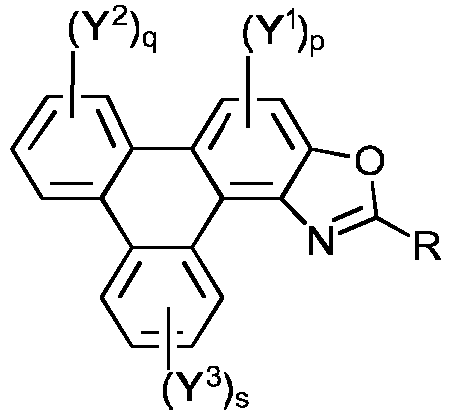 wherein R independently represents an aromatic group and/or an aliphatic group; p is an integer of 1 to 2;q and s are independently integers of 1 to 4;Y1, Y2, and Y3 independently represent a hydrogen atom, a deuterium atom, a fluorine atom, a chlorine atom, a bromine atom, OH, a carboxylic acid group, a glycol, an alkoxy, a thioalkoxy, an amino, an acetate, an amide, a thioamide, a thioester, an azo, a silyl group, an alkylated nitrogen atom, a cyano group, a nitro group, an alkyl group (e.g. branched or straight chain alkyl group) and/or an aryl group (e.g. a phenol group).
 - Triphenylene 2derivatives represented by the following general formula:
 wherein R independently represents an aromatic group and/or an aliphatic group;A independently represents a hydrogen atom, an aryl group, an alkyl group comprising 1 to 20 carbons (e.g. 1 to 15 carbons, or 1 to 10 carbons, or 10, 9, 8, 7, 6, 5, 4, 3, 2 or 1 carbons) or an alkyl ether group, such as a polyethylene glycol group; J independently represent a hydrogen atom, a deuterium atom, a fluorine atom, a chlorine atom, a bromine atom, an alkylated oxygen atom, an alkylated nitrogen atom, a cyano group, a nitro group, an alkyl group and/or an aryl group.
 - Polycyclic aromatic hydrocarbon derivatives, represented by the following general formula:
 wherein R independently represents an aromatic group and/or an aliphatic group;q is independently an integer of 1 to 3;s is independently an integer of 1 to 4;t is independently an integer of 1 to 4;Y2, Y3 , and Y4 and Jindependently represent a hydrogen atom, a deuterium atom, a fluorine atom, a chlorine atom, a bromine atom, OH, an alkylated oxygen atom, an alkylated nitrogen atom, a cyano group, a nitro group, an alkyl group and/or an aryl group (e.g. a phenol
 - The polycyclic aromatic hydrocarbon derivatives, represented by the following general formula:
 wherein R1 and R2 independently represents an aromatic group and/or an aliphatic group;p and q are independently an integer of 1 to 2;s is an integer of 1 to 4;Y1, Y2, and Y3 independently represent a hydrogen atom, a deuterium atom, a fluorine atom, a chlorine atom, a bromine atom, OH, a carboxylic acid group, a glycol, an alkoxy, a thioalkoxy, an amino, an acetate, an amide, a thioamide, a thioester, an azo, a silyl group, an alkylated nitrogen atom, a cyano group, a nitro group, an alkyl group (e.g. branched or straight chain alkyl group) and/or an aryl group,for example, triphenylene derivatives represented by the following general formula:
 wherein R1 and R2 independently represents an aromatic group and/or an aliphatic group;A independently represents a hydrogen atom, an alkyl group comprising 1 to 20 carbons (e.g. 1 to 15 carbons, or 1 to 10 carbons, or 10, 9, 8, 7, 6, 5, 4, 3, 2 or 1 carbons) or an alkyl ether (e.g. a polyethylene glycol group);J independently represent a hydrogen atom, a deuterium atom, a fluorine atom, a chlorine atom, a bromine atom, an alkylated oxygen atom, an alkylated nitrogen atom, a cyano group, a nitro group, an alkyl group and/or an aryl group.
 - The polycyclic aromatic hydrocarbon derivatives, represented by the following general formula:
 wherein R1, R2, R3 independently represent an aromatic group and/or an aliphatic group;p, q, and s are each independently an integer of 1 to 2;Y1, Y2, and Y3 independently represent a hydrogen atom, a deuterium atom, a fluorine atom, a chlorine atom, a bromine atom, OH, a carboxylic acid group, a glycol, an alkoxy, a thioalkoxy, an amino, an acetate, an amide, a thioamide, a thioester, an azo, a silyl group, an alkylated nitrogen atom, a cyano group, a nitro group, an alkyl group (e.g. branched or straight chain alkyl group) and/or an aryl group;for example, triphenylene derivatives represented by the following general formula (C3):
 wherein R1, R2, R3 independently represent an aromatic group and/or an aliphatic group;A independently represents a hydrogen atom, an alkyl group comprising 1 to 20 carbons (e.g. 1 to 15 carbons, or 1 to 10 carbons, or 10, 9, 8, 7, 6, 5, 4, 3, 2 or 1 carbons) or an alkyl ether;J independently represent a hydrogen atom, a deuterium atom, a fluorine atom, a chlorine atom, a bromine atom, an alkylated oxygen atom, an alkylated nitrogen atom, a cyano group, a nitro group, an alkyl group and/or an aryl group (e.g. a phenol group).
 - The polycyclic aromatic hydrocarbon derivatives according to any of Claims 1 to 5, wherein at least one of R, R1, R2, R3 where present is an alkyl group or at least one of R, R1, R2, R3 where present is an aromatic group (e.g. a phenyl group, a substituted phenyl group, or naphthalene, anthracene, or pyrene) or at least one of R, R1, R2, R3 where present is a heterocyclic aromatic group, for example, pyridine or thiophene or at least one of R, R1, R2, R3 where present is a polycyclic aromatic hydrocarbon, e.g. a fused polycyclic aromatic hydrocarbon.
- The polycyclic aromatic hydrocarbon derivatives, e.g. the triphenylene derivatives, according to any one of Claims 1 to 6 selected from the following structures i.e. Compounds 1 to 36.
Compound Structure Compound Number 
1 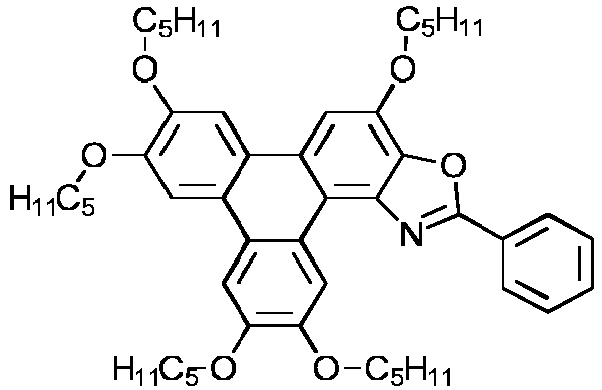
2 
3 
4 
5 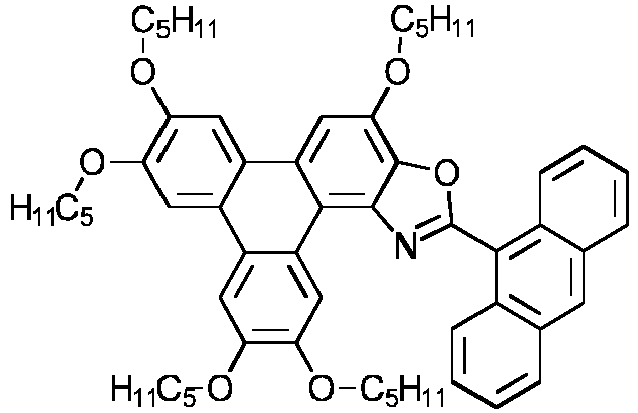
6 
7 
8 
9 
10 
11 
12 
13 
14 
15 
16 
17 
18 
19 
20 
21 
22 
23 
24 
25 
26 
27 
28 
29 
30 
31 
32 
33 
34 
35 - A device comprising a polycyclic aromatic hydrocarbon according to any preceding Claim, for example wherein the device is an organic electroluminescent device, an OPV (organic photovoltaic) device, a thin-film transistor, or a liquid crystal display.
- A compound for the fabrication of the triphenylene derivatives of Claim 4 comprising the structure:

- A method of synthesising polycyclic aromatic hydrocarbon derivatives (P3) comprises the general formula:
 wherein (SM3) represents the polycyclic aromatic hydrocarbon core, (P3) represents the polycyclic aromatic hydrocarbon derivative,p is an integer of 1 to 2;q and s are integers of 1 to 4;Y1, Y2, and Y3 independently represent a hydrogen atom, a deuterium atom, a fluorine atom, a chlorine atom, a bromine atom, OH, a carboxylic acid group, a glycol, an alkoxy, a thioalkoxy, an amino, an acetate, an amide, a thioamide, a thioester, an azo, a silyl group, an alkylated nitrogen atom, a cyano group, a nitro group, an alkyl group (e.g. branched or straight chain alkyl group) and/or an aryl group (e.g. a phenol group);G is a substituted carbon atom;N is a nitrogen atom;B is two hydrogen atoms;(E) represents the reagent;R independently represents an aromatic group and/or an aliphatic group ;Z is one of a derivatised oxygen atom, a chlorine atom, or a bromine atom, or any good leaving group;optionally further comprising a catalyst, e.g. a transition metal catalyst, e.g. a palladium Pd(ll) catalyst for example palladium acetate Pd(OAc)2;optionally wherein the reagent (E) is a carboxylic acid, for example, benzoic acid or a substituted benzoic acid, or wherein the reagent (E) is an acyl chloride, for example, benzyl chloride or a substituted benzyl chloride;optionally wherein the method further comprises adding a further reagent to replace the Z group of the reagent (E) with a good leaving group, for example, the further reagent may be (diacetoxyiodo)benzene;and wherein the polycyclic aromatic hydrocarbon core (SM3) and the reagent (E) undergo an intermolecular coupling reaction to produce the polycyclic aromatic hydrocarbon derivative (P3).
 - A method of synthesising triphenylene derivatives (P4) according to Claim 10, comprising the general formula:
 wherein (SM4) represents a triphenylene core, (P4) represents a triphenylene derivative;A independently represents a hydrogen atom, an aryl group, an alkyl group comprising 1 to 20 carbons (e.g. 1 to 15 carbons, or 1 to 10 carbons, or 10, 9, 8, 7, 6, 5, 4, 3, 2 or 1 carbons);J independently represent a hydrogen atom, a deuterium atom, a fluorine atom, a chlorine atom, a bromine atom, an alkylated oxygen atom, an alkylated nitrogen atom, a cyano group, a nitro group, an alkyl group and/or an aryl group.G is a substituted carbon atom;(E) represents the reagent;R independently represents an aromatic group and/or an aliphatic group;Z is one of a derivatised oxygen atom, a chlorine atom, or a bromine atom, or any good leaving group;optionally further comprising a catalyst, e.g. a transition metal catalyst, e.g. a palladium Pd(ll) catalyst for example palladium acetate Pd(OAc)2;optionally wherein the reagent (E) is a carboxylic acid, for example, benzoic acid or a substituted benzoic acid, or wherein the reagent (E) is an acyl chloride, for example, benzyl chloride or a substituted benzyl chloride;optionally wherein the method further comprises adding a further reagent to replace the Z group of the reagent (E) with a good leaving group, for example, the further reagent may be (diacetoxyiodo)benzene;and wherein the triphenylene core (SM4) and the reagent (E) undergo an intermolecular coupling reaction to produce the triphenylene derivative (P4);for example, a method of synthesising triphenylene derivatives (100), comprising the general formula:
 wherein R independently represents an aromatic group and/or an aliphatic group.
 - A method of synthesising polycyclic aromatic hydrocarbon derivatives (P6), comprising the general formula:
 wherein (SM6) represents a polycyclic aromatic hydrocarbon core, (P6) represents a polycyclic aromatic hydrocarbon derivative;p is an integer of 1 to 2;q is an integer of 1 to 2;s is an integer of 1 to 4;Y1, Y2, and Y3 independently represent a hydrogen atom, a deuterium atom, a fluorine atom, a chlorine atom, a bromine atom, OH, a carboxylic acid group, a glycol, an alkoxy, a thioalkoxy, an amino, an acetate, an amide, a thioamide, a thioester, an azo, a silyl group, an alkylated nitrogen atom, a cyano group, a nitro group, an alkyl group (e.g. branched or straight chain alkyl group) and/or an aryl group;G independently represents a substituted carbon atom;N is a nitrogen atom;B is two hydrogen atoms;(E) represents the reagent;R independently represents an aromatic group and/or an aliphatic group;Z is one of a derivatised oxygen atom, a chlorine atom, or a bromine atom, or any good leaving group;optionally further comprising a catalyst, e.g. a transition metal catalyst, e.g. a palladium Pd(ll) catalyst for example palladium acetate Pd(OAc)2;optionally wherein the reagent (E) is a carboxylic acid, for example, benzoic acid or a substituted benzoic acid, or wherein the reagent (E) is an acyl chloride, for example, benzyl chloride or a substituted benzyl chloride;optionally wherein the method further comprises adding a further reagent to replace the Z group of the reagent (E) with a good leaving group, for example, the further reagent may be (diacetoxyiodo)benzene;and wherein the polycyclic aromatic hydrocarbon core (SM6) and the reagent (E) undergo an intermolecular coupling reaction to produce the polycyclic aromatic hydrocarbon derivative (P6).
 - A method of synthesising triphenylene derivatives (P7) comprising the general formula:
 wherein (SM7) represents a triphenylene core, (P7) represents a triphenylene derivative;A independently represents a hydrogen atom, an aryl group, an alkyl group comprising 1 to 20 carbons (e.g. 1 to 15 carbons, or 1 to 10 carbons, or 10, 9, 8, 7, 6, 5, 4, 3, 2 or 1 carbons);J independently represent a hydrogen atom, a deuterium atom, a fluorine atom, a chlorine atom, a bromine atom, an alkylated oxygen atom, an alkylated nitrogen atom, a cyano group, a nitro group, an alkyl group and/or an aryl group (e.g. a phenol group);G independently represents a substituted carbon atom;(E) represents the reagent;R independently represents an aromatic group and/or an aliphatic group ;Z is one of a derivatised oxygen atom, a chlorine atom, or a bromine atom;optionally further comprising a catalyst, e.g. a transition metal catalyst, e.g. a palladium Pd(ll) catalyst for example palladium acetate Pd(OAc)2;optionally wherein the reagent (E) is a carboxylic acid, for example, benzoic acid or a substituted benzoic acid, or wherein the reagent (E) is an acyl chloride, for example, benzyl chloride or a substituted benzyl chloride;optionally wherein the method further comprises adding a further reagent to replace the Z group of the reagent (E) with a good leaving group, for example, the further reagent may be (diacetoxyiodo)benzene;and wherein the triphenylene core (SM7) and the reagent (E) undergo an intermolecular coupling reaction to produce triphenylene derivative (P7).for example, wherein the triphenylene core (SM7) comprises the formula:
- A method of synthesising polycyclic aromatic hydrocarbon derivatives (P8), comprising the general formula:
 wherein (SM8) represents a polycyclic aromatic hydrocarbon core, (P8) represents a polycyclic aromatic hydrocarbon derivative;p, q, and s are independently an integer of 1 to 2;Y1, Y2, and Y3 independently represent a hydrogen atom, a deuterium atom, a fluorine atom, a chlorine atom, a bromine atom, OH, a carboxylic acid group, a glycol, an alkoxy, a thioalkoxy, an amino, an acetate, an amide, a thioamide, a thioester, an azo, a silyl group, an alkylated nitrogen atom, a cyano group, a nitro group, an alkyl group (e.g. branched or straight chain alkyl group) and/or an aryl group (e.g. a phenol group);G independently represents a substituted carbon atom;N is a nitrogen atom;B is two hydrogen atoms;(E) represents the reagent;R independently represents an aromatic group and/or an aliphatic group;Z is one of a derivatised oxygen atom, a chlorine atom, or a bromine atom, or any good leaving group;optionally further comprising a catalyst, e.g. a transition metal catalyst, e.g. a palladium Pd(ll) catalyst for example palladium acetate Pd(OAc)2;optionally wherein the reagent (E) is a carboxylic acid, for example, benzoic acid or a substituted benzoic acid, or wherein the reagent (E) is an acyl chloride, for example, benzyl chloride or a substituted benzyl chloride;optionally wherein the method further comprises adding a further reagent to replace the Z group of the reagent (E) with a good leaving group, for example, the further reagent may be (diacetoxyiodo)benzene;and wherein the polycyclic aromatic hydrocarbon core (SM8) and the reagent (E) undergo an intermolecular coupling reaction to produce the polycyclic aromatic hydrocarbon derivative (P8).for example a method comprising synthesising triphenylene derivatives (P9) comprising the general formula:
 wherein (SM9) represents a triphenylene core, (P9) represents a triphenylene derivative;A independently represents a hydrogen atom, an aryl group, an alkyl group comprising 1 to 20 carbons (e.g. 1 to 15 carbons, or 1 to 10 carbons, or 10, 9, 8, 7, 6, 5, 4, 3, 2 or 1 carbons);J independently represent a hydrogen atom, a deuterium atom, a fluorine atom, a chlorine atom, a bromine atom, OH, an alkylated oxygen atom, an alkylated nitrogen atom, a cyano group, a nitro group, an alkyl group and/or an aryl group (e.g. a phenol group).G independently represents a substituted carbon atom;(E) represents the reagent;R independently represents an aromatic group and/or an aliphatic group;Z is one of a derivatised oxygen atom, a chlorine atom, or a bromine atom;optionally further comprising a catalyst, e.g. a transition metal catalyst, e.g. a palladium Pd(ll) catalyst for example palladium acetate Pd(OAc)2;optionally wherein the reagent (E) is a carboxylic acid, for example, benzoic acid or a substituted benzoic acid, or wherein the reagent (E) is an acyl chloride, for example, benzyl chloride or a substituted benzyl chloride;optionally wherein the method further comprises adding a further reagent to replace the Z group of the reagent (E) with a good leaving group, for example, the further reagent may be (diacetoxyiodo)benzene;and wherein the triphenylene core (SM9) and the reagent (E) undergo an intermolecular coupling reaction to produce triphenylene derivative (P9).for example, wherein the triphenylene core (SM9) comprises the formula:
- A bio-label or bio-tag comprising the polycyclic aromatic hydrocarbon or triphenylene derivative according to any of Claims 1 to 7.
Applications Claiming Priority (2)
| Application Number | Priority Date | Filing Date | Title |
|---|---|---|---|
| GBGB1804511.2A GB201804511D0 (en) | 2018-03-21 | 2018-03-21 | Luminescent compounds |
| PCT/GB2019/050809 WO2019180445A1 (en) | 2018-03-21 | 2019-03-21 | Luminescent compounds |
Publications (3)
| Publication Number | Publication Date |
|---|---|
| EP3768676A1 EP3768676A1 (en) | 2021-01-27 |
| EP3768676B1 true EP3768676B1 (en) | 2025-01-01 |
| EP3768676C0 EP3768676C0 (en) | 2025-01-01 |
Family
ID=62017872
Family Applications (1)
| Application Number | Title | Priority Date | Filing Date |
|---|---|---|---|
| EP19714752.3A Active EP3768676B1 (en) | 2018-03-21 | 2019-03-21 | Luminescent compounds |
Country Status (6)
| Country | Link |
|---|---|
| US (1) | US12041850B2 (en) |
| EP (1) | EP3768676B1 (en) |
| CN (2) | CN112135823A (en) |
| ES (1) | ES3010063T3 (en) |
| GB (1) | GB201804511D0 (en) |
| WO (1) | WO2019180445A1 (en) |
Families Citing this family (5)
| Publication number | Priority date | Publication date | Assignee | Title |
|---|---|---|---|---|
| GB201913756D0 (en) * | 2019-09-24 | 2019-11-06 | Chromatwist Ltd | Contrast agent |
| GB201913767D0 (en) | 2019-09-24 | 2019-11-06 | Chromatwist Ltd | Luminescent compounds |
| GB201913762D0 (en) * | 2019-09-24 | 2019-11-06 | Chromatwist Ltd | Polymers |
| CN113528124B (en) * | 2021-09-16 | 2022-01-11 | 浙江华显光电科技有限公司 | Host material and organic electroluminescent device comprising same |
| CN113528125B (en) * | 2021-09-16 | 2021-12-21 | 浙江华显光电科技有限公司 | Host material and organic electroluminescent device comprising same |
Family Cites Families (14)
| Publication number | Priority date | Publication date | Assignee | Title |
|---|---|---|---|---|
| GB9405793D0 (en) | 1994-03-23 | 1994-05-11 | Cammidge Andrew N | Functionalised discotic liquid crystals mesogens through structural modification of triphenylenes |
| US6150042A (en) * | 1996-12-09 | 2000-11-21 | Toyo Ink Manufacturing Co., Ltd. | Material for organoelectro-luminescence device and use thereof |
| JP2003068469A (en) | 2000-08-11 | 2003-03-07 | Canon Inc | Organic electroluminescence device and method of manufacturing the same |
| US6960607B2 (en) | 2001-12-13 | 2005-11-01 | Wyeth | Naphthyl benzoxazoles and benzisoxazoles as estrogenic agents |
| CN101967147B (en) | 2010-09-15 | 2012-07-04 | 陕西师范大学 | S-triazacoronene compound and synthesis method and application thereof |
| CN103384671B (en) * | 2011-02-22 | 2016-03-23 | 保土谷化学工业株式会社 | There is compound and the organic electroluminescence device of indolocarbazole ring structure |
| WO2012148360A1 (en) * | 2011-04-29 | 2012-11-01 | National University Of Singapore | Cardo-polybenzoxazole polymer/copolymer membranes for improved permeability and method for fabricating the same |
| JP5731346B2 (en) | 2011-09-28 | 2015-06-10 | 富士フイルムファインケミカルズ株式会社 | Method for producing triphenylene compound |
| CN104672226B (en) * | 2015-01-23 | 2017-12-22 | 固安鼎材科技有限公司 | A kind of new compound, its preparation method and its application |
| US9698351B2 (en) * | 2015-04-29 | 2017-07-04 | Feng-wen Yen | Organic material for electroluminescent device |
| KR20170030427A (en) * | 2015-09-09 | 2017-03-17 | 주식회사 엘지화학 | Organoluminescent device |
| CN105713003B (en) | 2016-01-21 | 2018-03-06 | 陕西师范大学 | π extends equal San Dan Za guans derivatives and its synthetic method |
| CN105503897B (en) | 2016-01-28 | 2017-12-08 | 华东师范大学 | Three furans of asymmetric benzo phenanthro-/thiophene and derivatives and preparation method |
| CN107573328B (en) * | 2017-09-20 | 2020-06-02 | 石家庄诚志永华显示材料有限公司 | Indenimidazole-based compound, material containing the indenimidazole-based compound, and organic electroluminescent device |
-
2018
- 2018-03-21 GB GBGB1804511.2A patent/GB201804511D0/en not_active Ceased
-
2019
- 2019-03-21 CN CN201980033490.6A patent/CN112135823A/en active Pending
- 2019-03-21 WO PCT/GB2019/050809 patent/WO2019180445A1/en not_active Ceased
- 2019-03-21 EP EP19714752.3A patent/EP3768676B1/en active Active
- 2019-03-21 US US16/982,889 patent/US12041850B2/en active Active
- 2019-03-21 ES ES19714752T patent/ES3010063T3/en active Active
- 2019-03-21 CN CN202410983225.7A patent/CN118955418A/en active Pending
Also Published As
| Publication number | Publication date |
|---|---|
| CN118955418A (en) | 2024-11-15 |
| EP3768676A1 (en) | 2021-01-27 |
| CN112135823A (en) | 2020-12-25 |
| ES3010063T3 (en) | 2025-04-01 |
| GB201804511D0 (en) | 2018-05-02 |
| US20210005824A1 (en) | 2021-01-07 |
| WO2019180445A1 (en) | 2019-09-26 |
| EP3768676C0 (en) | 2025-01-01 |
| US12041850B2 (en) | 2024-07-16 |
Similar Documents
| Publication | Publication Date | Title |
|---|---|---|
| US12041850B2 (en) | Luminescent compounds | |
| JP5676579B2 (en) | Deuterium compounds for electronic applications | |
| Kim et al. | Exceedingly efficient deep-blue electroluminescence from new anthracenes obtained using rational molecular design | |
| KR101806464B1 (en) | Pyrimidine derivative substitued with pyridyl group, and organic electroluminescent device including the same | |
| JP6148271B2 (en) | Deuterium compounds for organic electronic devices and organic electronic devices having these deuterium compounds. | |
| CN112679548A (en) | Organic light-emitting material with auxiliary ligands of substituents partially substituted by fluorine | |
| Li et al. | Novel fluorene/carbazole hybrids with steric bulk as host materials for blue organic electrophosphorescent devices | |
| CN109575083A (en) | Organic light-emitting materials containing cycloalkyl auxiliary ligands | |
| US12162847B2 (en) | Luminescent compounds | |
| Thanh et al. | Synthesis of N, N, N′, N′-tetrasubstituted 1, 3-bis (4-aminophenyl) azulenes and their application to a hole-injecting material in organic electroluminescent devices | |
| CN102617466A (en) | Top-bottom asymmetrical tert-butyl spirobifluorene compound | |
| Kim et al. | New limb structured blue light emitting materials for OLEDs | |
| CN114907179B (en) | Anthracene derivative, and organic electroluminescent material, light-emitting device and consumer product using same | |
| JP2013515053A (en) | Deuterium compounds for luminescence applications | |
| CN113912636B (en) | Silicon-containing heterocyclic compound and organic electroluminescent element containing the same | |
| CN113410401B (en) | Organic electroluminescent devices containing deep LUMO hole-injecting materials and aromatic amine derivatives | |
| Park et al. | New blue emitting indenopyrazine derivatives for OLEDs: Improving the EL properties through substitution effects by using terphenyl side group | |
| Shi et al. | Novel dispirobifluorenes and indeno-spirobifluorenes: syntheses and properties | |
| CN117024430B (en) | Bipyrimidine fluorene compound, organic electroluminescent element and consumer product | |
| CN119285437B (en) | Preparation method and application of spirofluorenyl Grignard arene blue light material | |
| CN111825600A (en) | Organic photoelectric material containing C60 condensed ring and preparation method and application thereof | |
| TWI588132B (en) | Delayed fluorescence compound, and organic light emitting diode and display device using the same | |
| Shin et al. | Effect of the Length of Side Group Substitution on Optical and Electroluminescene Properties. | |
| KR20170072856A (en) | Pyrimidine derivative substitued with pyridyl group, and organic electroluminescent device including the same | |
| KR101546141B1 (en) | Luminescent organic compound containing fluorene group, and organic light emitting diode including the same |
Legal Events
| Date | Code | Title | Description |
|---|---|---|---|
| STAA | Information on the status of an ep patent application or granted ep patent |
Free format text: STATUS: UNKNOWN |
|
| STAA | Information on the status of an ep patent application or granted ep patent |
Free format text: STATUS: THE INTERNATIONAL PUBLICATION HAS BEEN MADE |
|
| PUAI | Public reference made under article 153(3) epc to a published international application that has entered the european phase |
Free format text: ORIGINAL CODE: 0009012 |
|
| STAA | Information on the status of an ep patent application or granted ep patent |
Free format text: STATUS: REQUEST FOR EXAMINATION WAS MADE |
|
| 17P | Request for examination filed |
Effective date: 20201014 |
|
| AK | Designated contracting states |
Kind code of ref document: A1 Designated state(s): AL AT BE BG CH CY CZ DE DK EE ES FI FR GB GR HR HU IE IS IT LI LT LU LV MC MK MT NL NO PL PT RO RS SE SI SK SM TR |
|
| AX | Request for extension of the european patent |
Extension state: BA ME |
|
| DAV | Request for validation of the european patent (deleted) | ||
| DAX | Request for extension of the european patent (deleted) | ||
| RAP1 | Party data changed (applicant data changed or rights of an application transferred) |
Owner name: CHROMATWIST LIMITED |
|
| STAA | Information on the status of an ep patent application or granted ep patent |
Free format text: STATUS: EXAMINATION IS IN PROGRESS |
|
| 17Q | First examination report despatched |
Effective date: 20220615 |
|
| RAP3 | Party data changed (applicant data changed or rights of an application transferred) |
Owner name: CHROMATWIST LIMITED |
|
| RIC1 | Information provided on ipc code assigned before grant |
Ipc: H10K 85/60 20230101ALI20240701BHEP Ipc: C07C 217/94 20060101ALI20240701BHEP Ipc: C07D 263/52 20060101ALI20240701BHEP Ipc: C07C 211/61 20060101ALI20240701BHEP Ipc: C07D 413/04 20060101AFI20240701BHEP |
|
| GRAP | Despatch of communication of intention to grant a patent |
Free format text: ORIGINAL CODE: EPIDOSNIGR1 |
|
| STAA | Information on the status of an ep patent application or granted ep patent |
Free format text: STATUS: GRANT OF PATENT IS INTENDED |
|
| INTG | Intention to grant announced |
Effective date: 20240903 |
|
| GRAJ | Information related to disapproval of communication of intention to grant by the applicant or resumption of examination proceedings by the epo deleted |
Free format text: ORIGINAL CODE: EPIDOSDIGR1 |
|
| STAA | Information on the status of an ep patent application or granted ep patent |
Free format text: STATUS: EXAMINATION IS IN PROGRESS |
|
| GRAP | Despatch of communication of intention to grant a patent |
Free format text: ORIGINAL CODE: EPIDOSNIGR1 |
|
| STAA | Information on the status of an ep patent application or granted ep patent |
Free format text: STATUS: GRANT OF PATENT IS INTENDED |
|
| INTC | Intention to grant announced (deleted) | ||
| GRAS | Grant fee paid |
Free format text: ORIGINAL CODE: EPIDOSNIGR3 |
|
| INTG | Intention to grant announced |
Effective date: 20241025 |
|
| GRAA | (expected) grant |
Free format text: ORIGINAL CODE: 0009210 |
|
| STAA | Information on the status of an ep patent application or granted ep patent |
Free format text: STATUS: THE PATENT HAS BEEN GRANTED |
|
| AK | Designated contracting states |
Kind code of ref document: B1 Designated state(s): AL AT BE BG CH CY CZ DE DK EE ES FI FR GB GR HR HU IE IS IT LI LT LU LV MC MK MT NL NO PL PT RO RS SE SI SK SM TR |
|
| REG | Reference to a national code |
Ref country code: GB Ref legal event code: FG4D |
|
| REG | Reference to a national code |
Ref country code: CH Ref legal event code: EP |
|
| REG | Reference to a national code |
Ref country code: DE Ref legal event code: R096 Ref document number: 602019064231 Country of ref document: DE |
|
| REG | Reference to a national code |
Ref country code: IE Ref legal event code: FG4D |
|
| U01 | Request for unitary effect filed |
Effective date: 20250127 |
|
| U07 | Unitary effect registered |
Designated state(s): AT BE BG DE DK EE FI FR IT LT LU LV MT NL PT RO SE SI Effective date: 20250131 |
|
| REG | Reference to a national code |
Ref country code: ES Ref legal event code: FG2A Ref document number: 3010063 Country of ref document: ES Kind code of ref document: T3 Effective date: 20250401 |
|
| U20 | Renewal fee for the european patent with unitary effect paid |
Year of fee payment: 7 Effective date: 20250221 |
|
| PG25 | Lapsed in a contracting state [announced via postgrant information from national office to epo] |
Ref country code: PL Free format text: LAPSE BECAUSE OF FAILURE TO SUBMIT A TRANSLATION OF THE DESCRIPTION OR TO PAY THE FEE WITHIN THE PRESCRIBED TIME-LIMIT Effective date: 20250101 |
|
| PGFP | Annual fee paid to national office [announced via postgrant information from national office to epo] |
Ref country code: ES Payment date: 20250402 Year of fee payment: 7 |
|
| PG25 | Lapsed in a contracting state [announced via postgrant information from national office to epo] |
Ref country code: NO Free format text: LAPSE BECAUSE OF FAILURE TO SUBMIT A TRANSLATION OF THE DESCRIPTION OR TO PAY THE FEE WITHIN THE PRESCRIBED TIME-LIMIT Effective date: 20250401 Ref country code: IS Free format text: LAPSE BECAUSE OF FAILURE TO SUBMIT A TRANSLATION OF THE DESCRIPTION OR TO PAY THE FEE WITHIN THE PRESCRIBED TIME-LIMIT Effective date: 20250501 |
|
| PG25 | Lapsed in a contracting state [announced via postgrant information from national office to epo] |
Ref country code: HR Free format text: LAPSE BECAUSE OF FAILURE TO SUBMIT A TRANSLATION OF THE DESCRIPTION OR TO PAY THE FEE WITHIN THE PRESCRIBED TIME-LIMIT Effective date: 20250101 |
|
| PG25 | Lapsed in a contracting state [announced via postgrant information from national office to epo] |
Ref country code: GR Free format text: LAPSE BECAUSE OF FAILURE TO SUBMIT A TRANSLATION OF THE DESCRIPTION OR TO PAY THE FEE WITHIN THE PRESCRIBED TIME-LIMIT Effective date: 20250402 |
|
| PGFP | Annual fee paid to national office [announced via postgrant information from national office to epo] |
Ref country code: CH Payment date: 20250416 Year of fee payment: 7 |
|
| PG25 | Lapsed in a contracting state [announced via postgrant information from national office to epo] |
Ref country code: CZ Free format text: LAPSE BECAUSE OF FAILURE TO SUBMIT A TRANSLATION OF THE DESCRIPTION OR TO PAY THE FEE WITHIN THE PRESCRIBED TIME-LIMIT Effective date: 20250101 |
|
| PG25 | Lapsed in a contracting state [announced via postgrant information from national office to epo] |
Ref country code: SM Free format text: LAPSE BECAUSE OF FAILURE TO SUBMIT A TRANSLATION OF THE DESCRIPTION OR TO PAY THE FEE WITHIN THE PRESCRIBED TIME-LIMIT Effective date: 20250101 |
|
| PG25 | Lapsed in a contracting state [announced via postgrant information from national office to epo] |
Ref country code: MC Free format text: LAPSE BECAUSE OF FAILURE TO SUBMIT A TRANSLATION OF THE DESCRIPTION OR TO PAY THE FEE WITHIN THE PRESCRIBED TIME-LIMIT Effective date: 20250101 |
|
| PG25 | Lapsed in a contracting state [announced via postgrant information from national office to epo] |
Ref country code: SK Free format text: LAPSE BECAUSE OF FAILURE TO SUBMIT A TRANSLATION OF THE DESCRIPTION OR TO PAY THE FEE WITHIN THE PRESCRIBED TIME-LIMIT Effective date: 20250101 |
|
| PLBE | No opposition filed within time limit |
Free format text: ORIGINAL CODE: 0009261 |
|
| STAA | Information on the status of an ep patent application or granted ep patent |
Free format text: STATUS: NO OPPOSITION FILED WITHIN TIME LIMIT |
|
| REG | Reference to a national code |
Ref country code: CH Ref legal event code: L10 Free format text: ST27 STATUS EVENT CODE: U-0-0-L10-L00 (AS PROVIDED BY THE NATIONAL OFFICE) Effective date: 20251112 |
|
| 26N | No opposition filed |
Effective date: 20251002 |
|
| PG25 | Lapsed in a contracting state [announced via postgrant information from national office to epo] |
Ref country code: IE Free format text: LAPSE BECAUSE OF NON-PAYMENT OF DUE FEES Effective date: 20250321 |
|
| REG | Reference to a national code |
Ref country code: CH Ref legal event code: U11 Free format text: ST27 STATUS EVENT CODE: U-0-0-U10-U11 (AS PROVIDED BY THE NATIONAL OFFICE) Effective date: 20260401 |
|
| U20 | Renewal fee for the european patent with unitary effect paid |
Year of fee payment: 8 Effective date: 20260305 |
|
| PGFP | Annual fee paid to national office [announced via postgrant information from national office to epo] |
Ref country code: GB Payment date: 20260217 Year of fee payment: 8 |