EP3768653B1 - A heating element containing molybdenum disilicide parts - Google Patents
A heating element containing molybdenum disilicide parts Download PDFInfo
- Publication number
- EP3768653B1 EP3768653B1 EP19709764.5A EP19709764A EP3768653B1 EP 3768653 B1 EP3768653 B1 EP 3768653B1 EP 19709764 A EP19709764 A EP 19709764A EP 3768653 B1 EP3768653 B1 EP 3768653B1
- Authority
- EP
- European Patent Office
- Prior art keywords
- heating element
- molybdenum disilicide
- parts
- composition
- equal
- Prior art date
- Legal status (The legal status is an assumption and is not a legal conclusion. Google has not performed a legal analysis and makes no representation as to the accuracy of the status listed.)
- Active
Links
Images

Classifications
-
- C—CHEMISTRY; METALLURGY
- C04—CEMENTS; CONCRETE; ARTIFICIAL STONE; CERAMICS; REFRACTORIES
- C04B—LIME, MAGNESIA; SLAG; CEMENTS; COMPOSITIONS THEREOF, e.g. MORTARS, CONCRETE OR LIKE BUILDING MATERIALS; ARTIFICIAL STONE; CERAMICS; REFRACTORIES; TREATMENT OF NATURAL STONE
- C04B35/00—Shaped ceramic products characterised by their composition; Ceramics compositions; Processing powders of inorganic compounds preparatory to the manufacturing of ceramic products
- C04B35/515—Shaped ceramic products characterised by their composition; Ceramics compositions; Processing powders of inorganic compounds preparatory to the manufacturing of ceramic products based on non-oxide ceramics
- C04B35/58—Shaped ceramic products characterised by their composition; Ceramics compositions; Processing powders of inorganic compounds preparatory to the manufacturing of ceramic products based on non-oxide ceramics based on borides, nitrides, i.e. nitrides, oxynitrides, carbonitrides or oxycarbonitrides or silicides
- C04B35/58085—Shaped ceramic products characterised by their composition; Ceramics compositions; Processing powders of inorganic compounds preparatory to the manufacturing of ceramic products based on non-oxide ceramics based on borides, nitrides, i.e. nitrides, oxynitrides, carbonitrides or oxycarbonitrides or silicides based on silicides
- C04B35/58092—Shaped ceramic products characterised by their composition; Ceramics compositions; Processing powders of inorganic compounds preparatory to the manufacturing of ceramic products based on non-oxide ceramics based on borides, nitrides, i.e. nitrides, oxynitrides, carbonitrides or oxycarbonitrides or silicides based on silicides based on refractory metal silicides
-
- C—CHEMISTRY; METALLURGY
- C04—CEMENTS; CONCRETE; ARTIFICIAL STONE; CERAMICS; REFRACTORIES
- C04B—LIME, MAGNESIA; SLAG; CEMENTS; COMPOSITIONS THEREOF, e.g. MORTARS, CONCRETE OR LIKE BUILDING MATERIALS; ARTIFICIAL STONE; CERAMICS; REFRACTORIES; TREATMENT OF NATURAL STONE
- C04B37/00—Joining burned ceramic articles with other burned ceramic articles or other articles by heating
- C04B37/001—Joining burned ceramic articles with other burned ceramic articles or other articles by heating directly with other burned ceramic articles
-
- C—CHEMISTRY; METALLURGY
- C04—CEMENTS; CONCRETE; ARTIFICIAL STONE; CERAMICS; REFRACTORIES
- C04B—LIME, MAGNESIA; SLAG; CEMENTS; COMPOSITIONS THEREOF, e.g. MORTARS, CONCRETE OR LIKE BUILDING MATERIALS; ARTIFICIAL STONE; CERAMICS; REFRACTORIES; TREATMENT OF NATURAL STONE
- C04B2235/00—Aspects relating to ceramic starting mixtures or sintered ceramic products
- C04B2235/02—Composition of constituents of the starting material or of secondary phases of the final product
- C04B2235/30—Constituents and secondary phases not being of a fibrous nature
- C04B2235/32—Metal oxides, mixed metal oxides, or oxide-forming salts thereof, e.g. carbonates, nitrates, (oxy)hydroxides, chlorides
- C04B2235/3217—Aluminum oxide or oxide forming salts thereof, e.g. bauxite, alpha-alumina
-
- C—CHEMISTRY; METALLURGY
- C04—CEMENTS; CONCRETE; ARTIFICIAL STONE; CERAMICS; REFRACTORIES
- C04B—LIME, MAGNESIA; SLAG; CEMENTS; COMPOSITIONS THEREOF, e.g. MORTARS, CONCRETE OR LIKE BUILDING MATERIALS; ARTIFICIAL STONE; CERAMICS; REFRACTORIES; TREATMENT OF NATURAL STONE
- C04B2235/00—Aspects relating to ceramic starting mixtures or sintered ceramic products
- C04B2235/02—Composition of constituents of the starting material or of secondary phases of the final product
- C04B2235/30—Constituents and secondary phases not being of a fibrous nature
- C04B2235/34—Non-metal oxides, non-metal mixed oxides, or salts thereof that form the non-metal oxides upon heating, e.g. carbonates, nitrates, (oxy)hydroxides, chlorides
- C04B2235/3418—Silicon oxide, silicic acids or oxide forming salts thereof, e.g. silica sol, fused silica, silica fume, cristobalite, quartz or flint
-
- C—CHEMISTRY; METALLURGY
- C04—CEMENTS; CONCRETE; ARTIFICIAL STONE; CERAMICS; REFRACTORIES
- C04B—LIME, MAGNESIA; SLAG; CEMENTS; COMPOSITIONS THEREOF, e.g. MORTARS, CONCRETE OR LIKE BUILDING MATERIALS; ARTIFICIAL STONE; CERAMICS; REFRACTORIES; TREATMENT OF NATURAL STONE
- C04B2235/00—Aspects relating to ceramic starting mixtures or sintered ceramic products
- C04B2235/02—Composition of constituents of the starting material or of secondary phases of the final product
- C04B2235/30—Constituents and secondary phases not being of a fibrous nature
- C04B2235/34—Non-metal oxides, non-metal mixed oxides, or salts thereof that form the non-metal oxides upon heating, e.g. carbonates, nitrates, (oxy)hydroxides, chlorides
- C04B2235/349—Clays, e.g. bentonites, smectites such as montmorillonite, vermiculites or kaolines, e.g. illite, talc or sepiolite
-
- C—CHEMISTRY; METALLURGY
- C04—CEMENTS; CONCRETE; ARTIFICIAL STONE; CERAMICS; REFRACTORIES
- C04B—LIME, MAGNESIA; SLAG; CEMENTS; COMPOSITIONS THEREOF, e.g. MORTARS, CONCRETE OR LIKE BUILDING MATERIALS; ARTIFICIAL STONE; CERAMICS; REFRACTORIES; TREATMENT OF NATURAL STONE
- C04B2235/00—Aspects relating to ceramic starting mixtures or sintered ceramic products
- C04B2235/02—Composition of constituents of the starting material or of secondary phases of the final product
- C04B2235/30—Constituents and secondary phases not being of a fibrous nature
- C04B2235/38—Non-oxide ceramic constituents or additives
- C04B2235/3804—Borides
- C04B2235/3813—Refractory metal borides
-
- C—CHEMISTRY; METALLURGY
- C04—CEMENTS; CONCRETE; ARTIFICIAL STONE; CERAMICS; REFRACTORIES
- C04B—LIME, MAGNESIA; SLAG; CEMENTS; COMPOSITIONS THEREOF, e.g. MORTARS, CONCRETE OR LIKE BUILDING MATERIALS; ARTIFICIAL STONE; CERAMICS; REFRACTORIES; TREATMENT OF NATURAL STONE
- C04B2235/00—Aspects relating to ceramic starting mixtures or sintered ceramic products
- C04B2235/02—Composition of constituents of the starting material or of secondary phases of the final product
- C04B2235/30—Constituents and secondary phases not being of a fibrous nature
- C04B2235/40—Metallic constituents or additives not added as binding phase
- C04B2235/402—Aluminium
-
- C—CHEMISTRY; METALLURGY
- C04—CEMENTS; CONCRETE; ARTIFICIAL STONE; CERAMICS; REFRACTORIES
- C04B—LIME, MAGNESIA; SLAG; CEMENTS; COMPOSITIONS THEREOF, e.g. MORTARS, CONCRETE OR LIKE BUILDING MATERIALS; ARTIFICIAL STONE; CERAMICS; REFRACTORIES; TREATMENT OF NATURAL STONE
- C04B2235/00—Aspects relating to ceramic starting mixtures or sintered ceramic products
- C04B2235/02—Composition of constituents of the starting material or of secondary phases of the final product
- C04B2235/30—Constituents and secondary phases not being of a fibrous nature
- C04B2235/40—Metallic constituents or additives not added as binding phase
- C04B2235/404—Refractory metals
-
- C—CHEMISTRY; METALLURGY
- C04—CEMENTS; CONCRETE; ARTIFICIAL STONE; CERAMICS; REFRACTORIES
- C04B—LIME, MAGNESIA; SLAG; CEMENTS; COMPOSITIONS THEREOF, e.g. MORTARS, CONCRETE OR LIKE BUILDING MATERIALS; ARTIFICIAL STONE; CERAMICS; REFRACTORIES; TREATMENT OF NATURAL STONE
- C04B2235/00—Aspects relating to ceramic starting mixtures or sintered ceramic products
- C04B2235/02—Composition of constituents of the starting material or of secondary phases of the final product
- C04B2235/30—Constituents and secondary phases not being of a fibrous nature
- C04B2235/42—Non metallic elements added as constituents or additives, e.g. sulfur, phosphor, selenium or tellurium
- C04B2235/428—Silicon
-
- C—CHEMISTRY; METALLURGY
- C04—CEMENTS; CONCRETE; ARTIFICIAL STONE; CERAMICS; REFRACTORIES
- C04B—LIME, MAGNESIA; SLAG; CEMENTS; COMPOSITIONS THEREOF, e.g. MORTARS, CONCRETE OR LIKE BUILDING MATERIALS; ARTIFICIAL STONE; CERAMICS; REFRACTORIES; TREATMENT OF NATURAL STONE
- C04B2235/00—Aspects relating to ceramic starting mixtures or sintered ceramic products
- C04B2235/60—Aspects relating to the preparation, properties or mechanical treatment of green bodies or pre-forms
- C04B2235/602—Making the green bodies or pre-forms by moulding
- C04B2235/6021—Extrusion moulding
-
- C—CHEMISTRY; METALLURGY
- C04—CEMENTS; CONCRETE; ARTIFICIAL STONE; CERAMICS; REFRACTORIES
- C04B—LIME, MAGNESIA; SLAG; CEMENTS; COMPOSITIONS THEREOF, e.g. MORTARS, CONCRETE OR LIKE BUILDING MATERIALS; ARTIFICIAL STONE; CERAMICS; REFRACTORIES; TREATMENT OF NATURAL STONE
- C04B2235/00—Aspects relating to ceramic starting mixtures or sintered ceramic products
- C04B2235/65—Aspects relating to heat treatments of ceramic bodies such as green ceramics or pre-sintered ceramics, e.g. burning, sintering or melting processes
- C04B2235/658—Atmosphere during thermal treatment
- C04B2235/6582—Hydrogen containing atmosphere
-
- C—CHEMISTRY; METALLURGY
- C04—CEMENTS; CONCRETE; ARTIFICIAL STONE; CERAMICS; REFRACTORIES
- C04B—LIME, MAGNESIA; SLAG; CEMENTS; COMPOSITIONS THEREOF, e.g. MORTARS, CONCRETE OR LIKE BUILDING MATERIALS; ARTIFICIAL STONE; CERAMICS; REFRACTORIES; TREATMENT OF NATURAL STONE
- C04B2235/00—Aspects relating to ceramic starting mixtures or sintered ceramic products
- C04B2235/70—Aspects relating to sintered or melt-casted ceramic products
- C04B2235/74—Physical characteristics
- C04B2235/77—Density
-
- C—CHEMISTRY; METALLURGY
- C04—CEMENTS; CONCRETE; ARTIFICIAL STONE; CERAMICS; REFRACTORIES
- C04B—LIME, MAGNESIA; SLAG; CEMENTS; COMPOSITIONS THEREOF, e.g. MORTARS, CONCRETE OR LIKE BUILDING MATERIALS; ARTIFICIAL STONE; CERAMICS; REFRACTORIES; TREATMENT OF NATURAL STONE
- C04B2235/00—Aspects relating to ceramic starting mixtures or sintered ceramic products
- C04B2235/70—Aspects relating to sintered or melt-casted ceramic products
- C04B2235/80—Phases present in the sintered or melt-cast ceramic products other than the main phase
-
- C—CHEMISTRY; METALLURGY
- C04—CEMENTS; CONCRETE; ARTIFICIAL STONE; CERAMICS; REFRACTORIES
- C04B—LIME, MAGNESIA; SLAG; CEMENTS; COMPOSITIONS THEREOF, e.g. MORTARS, CONCRETE OR LIKE BUILDING MATERIALS; ARTIFICIAL STONE; CERAMICS; REFRACTORIES; TREATMENT OF NATURAL STONE
- C04B2237/00—Aspects relating to ceramic laminates or to joining of ceramic articles with other articles by heating
- C04B2237/30—Composition of layers of ceramic laminates or of ceramic or metallic articles to be joined by heating, e.g. Si substrates
- C04B2237/32—Ceramic
- C04B2237/36—Non-oxidic
Definitions
- the present disclosure relates to a heating element composed at least two parts based on different molybdenum disilicide-based compositions, wherein at least one of the molybdenum disilicide-based parts is based on a chromium-alloyed based molybdenum disilicide composition and at least one part of the molybdenum disilicide-based parts is based on a molybdenum disilicide-based composition comprising more than or equal to 90 weight% Mo(Si,Al) 2 .
- the present disclosure also relates to the use of the heating element and to a furnace comprising said heating element.
- Molybdenum disilicide-based materials are well known in high temperature applications such as in furnaces. Heating elements made of these materials have good performance at high temperatures, such as above 1800°C, in air because of the formation of a protective silicon dioxide (SiO 2 ) layer, also known as silica glass.
- SiO 2 silicon dioxide
- furnaces In furnaces, especially in industrial furnaces, there is a problem with degradation of heating elements.
- Industrial furnaces have zones having high temperature (heat zones) and zones having low temperature (cold zones).
- heat zones In the heat zones, pesting is usually not an issue as a layer of protective silicon dioxide will be formed immediately.
- the parts of the heating element which are in the cold zones will have problems with pesting and thereby these parts will be exposed to corrosion and wear degradation, which eventually will lead to element failure.
- Yet another problem associated with pesting is contamination of the material being heated due to falling oxide flakes from the failed elements.
- US3051924 discloses an electric resistance heating element of high mechanical strength which is oxidation resistant at high temperatures consisting essentially of an incandescent heating zone and two terminal end portions, said incandescent zone consisting essentially of a sintered body having metallically conducting particles constituted by a silico-aluminide which forms a pure phase with crystals of the lattice structure C40 and is of the composition (Mo 1-y M y )(Si 1-x AI x ) 2 , in which x ranges from 0.1 to 0.6 and y ranges from 0.0 to 0.7 and M is at least one metal selected from the group consisting of titanium, zirconium, hafnium, tantalum, niobium, vanadium, chromium and tungsten, said terminal end portions consisting of metallically conducting tetragonal molybdenum disilicide.
- the silico-aluminide has an improved corrosion resistance.
- the aim of the present disclosure is to eliminate or at least to reduce the above-mentioned problems.
- the goal of the invention is therefore to provide a heating element which is suitable for use in a furnace, such as an industrial furnace, and which will withstand or at least reduce the above-mentioned problems.
- the present invention therefore provides a heating element comprising at least two molybdenum disilicide-based parts which parts are based on different molybdenum disilicide-based compositions, wherein at least one of the molybdenum disilicide-based parts is based on molybdenum disilicide-based composition having more than or equal to 90 weight% of (Mo 1-x Cr x )Si 2 where x is of from 0.05 to 0.25; and wherein at least one of molybdenum disilicide-based parts is based on a molybdenum disilicide-based composition comprising more than or equal to 90 weight% Mo(Si,Al) 2 .
- the obtained heating element will have a lower power loss due to unnecessary heating of the terminal especially during startup of the furnace. Additionally, the obtained heating element will have a high resistance against pest.
- the part(s) of the heating element based on the molybdenum disilicide-based composition comprising more than or equal to 90 weight% Mo(Si,Al) 2 is preferably to be used in the hot zones of the heating element, i.e. in zones having a temperature above 600°C.
- the present invention also relates to a fixed contact comprising a heating element as defined hereinabove or hereinafter.
- the present invention also relates to a furnace, such as an industrial furnace comprising a heating element as defined hereinabove or hereinafter.
- the present invention relates to a heating element comprising at least two molybdenum disilicide-based parts which parts are based on different molybdenum disilicide-based compositions, wherein at least one of the molybdenum disilicide-based parts is based on a molybdenum disilicide-based composition having more than or equal to 90 weight% (wt%) of (Mo 1-x Cr x )Si 2 wherein x is of from 0.05 to 0.25, and wherein at least one of molybdenum disilicide-based parts is based on a molybdenum disilicide-based composition comprising more than or equal to 90 weight% Mo(Si,Al) 2 .
- one part is based on one molybdenum disilicide-based composition and one part is based on another molybdenum disilicide-based composition.
- the design of the present heating element will provide for a decrease or even an elimination of pesting without compromising the high temperature performance of the heating element in the heating zone because the heating element has a combination of at least two parts wherein one part is based on one molybdenum disilicide-based and the other part is based on another molybdenum disilicide-based composition. Thus, the parts will have different properties. Additionally, the design of the heating element will provide for lower power loss due to unnecessary heating of the terminal.
- the part(s) of the heating element, which will be exposed to the cold zones (400 to 600 °C), of a furnace is based on the molybdenum disilicide-based composition comprising more than or equal to 90 wt% of (Mo 1-x Cr x )Si 2 wherein x is of from 0.05 to 0.25.
- the balance of the composition may be aluminosilicate clay and/or one or more inorganic oxides, such as SiO 2 .
- the aluminosilicate clay is of the montmorillonite type for example bentonite.
- the molybdenum disilicide-based composition wherein part of the molybdenum (Mo) is replaced by chromium (Cr), comprises more than or equal to 95 wt% of (Mol-xCrx)Si2 and the balance is aluminosilicate clay and/or one or more inorganic oxides.
- x is between 0.10 to 0.20, such as between 0.15 to 0.20.
- a chromium alloyed molybdenum disilicide-based composition will not form molybdenum oxides in the cold zones, which means that the silica dioxide layer formed will be continuous and therefore will not be exposed to degradation due to corrosion and/or wear.
- the terms "(Mo,Cr)Si2-based material” and "(Mo 1-x Cr x )Si 2 " and "a chromium-alloyed based molybdenum disilicide " and "chromium-alloyed molybdenum disilicide-based composition” are used interchangeably.
- the part(s) of the heating element exposed to the heat zones is (are) based on (manufactured from) a molybdenum disilicide based composition comprising more than or equal to 90 weight% Mo(Si,Al) 2 .
- the balance of the composition may be aluminosilicate clay and/or one or more inorganic oxides, such as SiO 2 .
- the aluminosilicate clay is of the montmorillonite type for example bentonite.
- the parts may, as mentioned above, also comprise less than or equal to 10 weight-% (wt%) of an aluminosilicate clay and/or one or more inorganic oxides, such as SiO 2 .
- the aluminosilicate clay is of the montmorillonite type for example bentonite. will function as extrusion aids and/or sintering aids.
- the at least one part based on a composition comprising more than or equal to 90 weight% Mo(Si,Al) 2 may comprise a Mo(Si,Al) 2 based matrix phase and up to 5 vol% Mo 5 (Si,Al) 3 and up to 15 vol% Al 2 O 3 , respectively.
- the heating element as defined hereinabove or hereinafter comprises or consists of two parts of different molybdenum disilicide-based compositions.
- the heating element as defined hereinabove or hereinafter comprises or consists of three parts, wherein two of the parts are composed of the same molybdenum disilicide-based composition.
- the heating element as defined hereinabove or hereinafter comprises or consists of four molybdenum disilicide-based parts wherein two parts are based on the chromium alloyed molybdenum disilicide composition as defined hereinabove or hereinafter.
- the heating element comprises or consist of two parts based on the (Mo 1-x Cr x )Si 2 composition and one part based on the Mo(Si,Al) 2 composition.
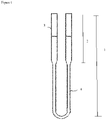
- a heating element comprises a section known as terminal(s) (see figure 1 ).
- the cold zone is usually located in this section.
- the terminal is preferably based on the part comprising the chromium alloyed molybdenum disilicide-based composition but a small section of the terminal could also be made from the material to be used in the heat zone.
- the heat zone section is preferably manufactured from the other molybdenium disilicide composition.
- the whole terminal may be composed of the chromium alloyed molybdenum disilicide-based composition.
- the terminal may have a larger diameter than the heating zone.
- the terminal may also be adapted to extend to the outside of the furnace through the furnace wall and to be electrically connected on the outside of the furnace.
- Figure 1 illustrates examples of a heating element according to the present disclosure.
- Figure 1 discloses a heating element 1.
- the heating element 1 has terminals 2.
- Parts 3 of the terminals are composed of chromium alloyed molybdenum disilicide composition and a part is composed of a molybdenum disilicide-based composition suitable for hot zone 4.
- FIG. 2 shows a joint between Mo(Si,Al) 2 -based material (left hand side) and Cr-alloyed MoSi 2 -based material wherein the joining has been performed by diffusion welding.
- the different parts of the heating element may be formed into rod or other forms and then connected. Furthermore, the parts may be shaped as U-elements but also as multi-shank, helical, diffusion cassettes, flat panels, etc. The different parts may thus be in the form of rods and may be bended or straight depending on the intended use of the heating element.
- the cross-section of the rod may typically be circular, but depending on the application, other geometrical shapes may also be possible such as elliptical or rectangular.
- the part(s) based on the (Mo,Cr)Si 2 -based material is (are) long enough to cover the zone(s) having a temperature range of 400-600°C during operation.
- said part(s) is (are) in the form of a rod having a diameter of 1 to 30 mm and a length of 1 to 40 cm.
- the expression "the part is based on a composition” is intended to mean that at least 70 weight% of the part is based on that composition.
- the rods were heated under protective gas using an induction coil.
- the rods were pushed together when the temperature reached 1550-1650°C, and a pressure of 400-600 N was applied for 15-60 s (diffusion bonding).
- Longitudinal sections of the joint were analyzed in a scanning electron microscope and successful bonding between the two materials was confirmed, see Figure 2A and B .
Landscapes
- Chemical & Material Sciences (AREA)
- Engineering & Computer Science (AREA)
- Ceramic Engineering (AREA)
- Materials Engineering (AREA)
- Structural Engineering (AREA)
- Organic Chemistry (AREA)
- Manufacturing & Machinery (AREA)
- Resistance Heating (AREA)
- Ceramic Products (AREA)
- Heat Treatment Of Articles (AREA)
- Road Paving Structures (AREA)
Description
- The present disclosure relates to a heating element composed at least two parts based on different molybdenum disilicide-based compositions, wherein at least one of the molybdenum disilicide-based parts is based on a chromium-alloyed based molybdenum disilicide composition and at least one part of the molybdenum disilicide-based parts is based on a molybdenum disilicide-based composition comprising more than or equal to 90 weight% Mo(Si,Al)2. The present disclosure also relates to the use of the heating element and to a furnace comprising said heating element.
- Molybdenum disilicide-based materials are well known in high temperature applications such as in furnaces. Heating elements made of these materials have good performance at high temperatures, such as above 1800°C, in air because of the formation of a protective silicon dioxide (SiO2) layer, also known as silica glass.
- When heating molybdenum disilicide-based materials in air, both the molybdenum and the silica will oxidize. The oxide formed from molybdenum will become volatile and evaporate and the oxide formed from silica will form a protective oxide layer on the heating element, which in turn will prevent the heating element from corroding and from being exposed to wear degradation. However, at low temperatures (400 to 600°C), molybdenum dioxide will remain in the silicon dioxide layer and disturbed the formation of a continuous SiO2 layer. This will lead to a continuous consumption of the material of the heating element and is a phenomenon known as "pesting" or "pest".
- In furnaces, especially in industrial furnaces, there is a problem with degradation of heating elements. Industrial furnaces have zones having high temperature (heat zones) and zones having low temperature (cold zones). In the heat zones, pesting is usually not an issue as a layer of protective silicon dioxide will be formed immediately. However, the parts of the heating element which are in the cold zones will have problems with pesting and thereby these parts will be exposed to corrosion and wear degradation, which eventually will lead to element failure. Yet another problem associated with pesting is contamination of the material being heated due to falling oxide flakes from the failed elements.
- Furthermore, it is known that additions of aluminium to MoSi2 containing compositions will dramatically improve the pest resistance of heating elements made thereof. However, the problem with aluminium is that it will form hexagonal Mo(Si,Al)2 and parts containing Mo(Si,Al)2 are very difficult to join by welding to parts comprising MoSi2 because of the difference in strength between these two materials at the high temperatures required for joining. Also, the power loss due to unnecessary heating of the terminal will increase because hexagonal Mo(Si,Al)2 has higher electrical resistivity than tetragonal (Mo,Cr)Si2.
-
US3051924 discloses an electric resistance heating element of high mechanical strength which is oxidation resistant at high temperatures consisting essentially of an incandescent heating zone and two terminal end portions, said incandescent zone consisting essentially of a sintered body having metallically conducting particles constituted by a silico-aluminide which forms a pure phase with crystals of the lattice structure C40 and is of the composition (Mo1-yMy)(Si1-xAIx)2, in which x ranges from 0.1 to 0.6 and y ranges from 0.0 to 0.7 and M is at least one metal selected from the group consisting of titanium, zirconium, hafnium, tantalum, niobium, vanadium, chromium and tungsten, said terminal end portions consisting of metallically conducting tetragonal molybdenum disilicide. The silico-aluminide has an improved corrosion resistance. - The aim of the present disclosure is to eliminate or at least to reduce the above-mentioned problems.
- The goal of the invention is therefore to provide a heating element which is suitable for use in a furnace, such as an industrial furnace, and which will withstand or at least reduce the above-mentioned problems.
- The present invention therefore provides a heating element comprising at least two molybdenum disilicide-based parts which parts are based on different molybdenum disilicide-based compositions, wherein at least one of the molybdenum disilicide-based parts is based on molybdenum disilicide-based composition having more than or equal to 90 weight% of (Mo1-xCrx)Si2 where x is of from 0.05 to 0.25; and wherein at least one of molybdenum disilicide-based parts is based on a molybdenum disilicide-based composition comprising more than or equal to 90 weight% Mo(Si,Al)2.
- The obtained heating element will have a lower power loss due to unnecessary heating of the terminal especially during startup of the furnace. Additionally, the obtained heating element will have a high resistance against pest.
- The part(s) of the heating element based on the molybdenum disilicide-based composition comprising more than or equal to 90 weight% Mo(Si,Al)2 is preferably to be used in the hot zones of the heating element, i.e. in zones having a temperature above 600°C.
- Furthermore, the present invention also relates to a fixed contact comprising a heating element as defined hereinabove or hereinafter.
- The present invention also relates to a furnace, such as an industrial furnace comprising a heating element as defined hereinabove or hereinafter.
-
- Figure 1
- illustrates a heating element according to one embodiment of the present invention;
- Figure 2A
- shows a joint between Mo(Si,Al)2-based material (left hand side) and Cr-alloyed MoSi2-based material. Lower part of the figure shows the joint in cross section;
- Figure 2B
- shows a scanning electron micrograph (backscattered mode) showing a joint between Mo(Si,Al)2-based material (left hand side) and (Mo,Cr)Si2-based material.
- The present invention relates to a heating element comprising at least two molybdenum disilicide-based parts which parts are based on different molybdenum disilicide-based compositions, wherein at least one of the molybdenum disilicide-based parts is based on a molybdenum disilicide-based composition having more than or equal to 90 weight% (wt%) of (Mo1-xCrx)Si2 wherein x is of from 0.05 to 0.25, and wherein at least one of molybdenum disilicide-based parts is based on a molybdenum disilicide-based composition comprising more than or equal to 90 weight% Mo(Si,Al)2. Thus, one part is based on one molybdenum disilicide-based composition and one part is based on another molybdenum disilicide-based composition.
- The design of the present heating element will provide for a decrease or even an elimination of pesting without compromising the high temperature performance of the heating element in the heating zone because the heating element has a combination of at least two parts wherein one part is based on one molybdenum disilicide-based and the other part is based on another molybdenum disilicide-based composition. Thus, the parts will have different properties. Additionally, the design of the heating element will provide for lower power loss due to unnecessary heating of the terminal.
- The part(s) of the heating element, which will be exposed to the cold zones (400 to 600 °C), of a furnace is based on the molybdenum disilicide-based composition comprising more than or equal to 90 wt% of (Mo1-xCrx)Si2 wherein x is of from 0.05 to 0.25. The balance of the composition may be aluminosilicate clay and/or one or more inorganic oxides, such as SiO2. According to one embodiment, the aluminosilicate clay is of the montmorillonite type for example bentonite.
- According to one embodiment, the molybdenum disilicide-based composition, wherein part of the molybdenum (Mo) is replaced by chromium (Cr), comprises more than or equal to 95 wt% of (Mol-xCrx)Si2 and the balance is aluminosilicate clay and/or one or more inorganic oxides.
- According to one embodiment, and in order to reduce the pesting even more, x is between 0.10 to 0.20, such as between 0.15 to 0.20.
- It has been showed that a chromium alloyed molybdenum disilicide-based composition will not form molybdenum oxides in the cold zones, which means that the silica dioxide layer formed will be continuous and therefore will not be exposed to degradation due to corrosion and/or wear. In the present disclosure, the terms "(Mo,Cr)Si2-based material" and "(Mo1-xCrx)Si2" and "a chromium-alloyed based molybdenum disilicide " and "chromium-alloyed molybdenum disilicide-based composition" are used interchangeably.
- Furthermore, the part(s) of the heating element exposed to the heat zones (i.e. above 600°C) is (are) based on (manufactured from) a molybdenum disilicide based composition comprising more than or equal to 90 weight% Mo(Si,Al)2. The balance of the composition may be aluminosilicate clay and/or one or more inorganic oxides, such as SiO2. According to one embodiment, the aluminosilicate clay is of the montmorillonite type for example bentonite.
- It has surprisingly been found that a (Mo1-xCrx)Si2 -based part will be readily joinable (connected) to a Mo(Si,Al)2 based part. Without being bond to any theory, it is believed that chromium is the key element. Additionally, not only pesting within the furnace will be reduced by joining parts of these two compositions, the amount of non-desirable heat formation will also be reduced because of the low resistivity of (Mo,Cr)Si2 compared to Mo(Si,Al)2. Thus, the joints will be less affected due to different thermal expansion of the materials.
- The parts may, as mentioned above, also comprise less than or equal to 10 weight-% (wt%) of an aluminosilicate clay and/or one or more inorganic oxides, such as SiO2. According to one embodiment, the aluminosilicate clay is of the montmorillonite type for example bentonite. will function as extrusion aids and/or sintering aids.
- The at least one part based on a composition comprising more than or equal to 90 weight% Mo(Si,Al)2 may comprise a Mo(Si,Al)2 based matrix phase and up to 5 vol% Mo5(Si,Al)3 and up to 15 vol% Al2O3, respectively.
- According to the invention, the heating element as defined hereinabove or hereinafter comprises or consists of two parts of different molybdenum disilicide-based compositions. According to another embodiment, the heating element as defined hereinabove or hereinafter comprises or consists of three parts, wherein two of the parts are composed of the same molybdenum disilicide-based composition. According to another embodiment, the heating element as defined hereinabove or hereinafter comprises or consists of four molybdenum disilicide-based parts wherein two parts are based on the chromium alloyed molybdenum disilicide composition as defined hereinabove or hereinafter. According to the invention, the heating element comprises or consist of two parts based on the (Mo1-xCrx)Si2 composition and one part based on the Mo(Si,Al)2 composition.
- Referring to the drawings, a heating element comprises a section known as terminal(s) (see
figure 1 ). The cold zone is usually located in this section. According to one embodiment, the terminal is preferably based on the part comprising the chromium alloyed molybdenum disilicide-based composition but a small section of the terminal could also be made from the material to be used in the heat zone. The heat zone section is preferably manufactured from the other molybdenium disilicide composition. The whole terminal may be composed of the chromium alloyed molybdenum disilicide-based composition. The terminal may have a larger diameter than the heating zone. The terminal may also be adapted to extend to the outside of the furnace through the furnace wall and to be electrically connected on the outside of the furnace. -
Figure 1 illustrates examples of a heating element according to the present disclosure.Figure 1 discloses aheating element 1. Theheating element 1 hasterminals 2.Parts 3 of the terminals are composed of chromium alloyed molybdenum disilicide composition and a part is composed of a molybdenum disilicide-based composition suitable forhot zone 4. - The parts of a heating element may be joined by using welding, such as diffusion welding or by using induction heating and then subsequently applying an external pressure perpendicular to the joint. Passing an electrical current through the joint and then simultaneously applying external pressure perpendicular to the joint may also be used.
Figure 2 shows a joint between Mo(Si,Al)2-based material (left hand side) and Cr-alloyed MoSi2-based material wherein the joining has been performed by diffusion welding. - The different parts of the heating element may be formed into rod or other forms and then connected. Furthermore, the parts may be shaped as U-elements but also as multi-shank, helical, diffusion cassettes, flat panels, etc. The different parts may thus be in the form of rods and may be bended or straight depending on the intended use of the heating element. The cross-section of the rod may typically be circular, but depending on the application, other geometrical shapes may also be possible such as elliptical or rectangular.
- According to one embodiment, the part(s) based on the (Mo,Cr)Si2-based material is (are) long enough to cover the zone(s) having a temperature range of 400-600°C during operation. According to one embodiment, said part(s) is (are) in the form of a rod having a diameter of 1 to 30 mm and a length of 1 to 40 cm.
- In the present description, the expression "the part is based on a composition" is intended to mean that at least 70 weight% of the part is based on that composition.
- The present disclosure is further described by the following non-limiting example.
- Two mixtures of molybdenum, silicon and chromium powders were prepared and heated in argon to form Mo0.85Cr0.15Si2. The obtained product was milled and subsequently mixed with 5 wt% aluminosilicate (bentonite clay of the montmorillonite type) and water to form a paste for extrusion. The formed paste was extruded into 9 mm diameter rods, which were subsequently dried and pre-sintered in hydrogen. Final sintering to achieve full density was then performed by resistance heating in air. The diameter end surfaces of the rods were ground.
- 9 mm rods of Mo(Si,Al)2-based materials were provided and the diameter end surfaces of the rods were ground.
- The rods were heated under protective gas using an induction coil. The rods were pushed together when the temperature reached 1550-1650°C, and a pressure of 400-600 N was applied for 15-60 s (diffusion bonding). Longitudinal sections of the joint were analyzed in a scanning electron microscope and successful bonding between the two materials was confirmed, see
Figure 2A and B .
Claims (12)
- A heating element composed of at least two molybdenum disilicide-based partswherein at least one of the molybdenum disilicide-based parts is based on a molybdenum disilicide-based composition having more than or equal to 90 weight% of (Mo1-xCrx)Si2 where x is of from 0.05 to 0.25; andwherein at least one of molybdenum disilicide-based parts is based on a molybdenum disilicide-based composition comprising more than or equal to 90 weight% Mo(Si,Al)2.
- The heating element according to claim 1, wherein the heating element consists of two molybdenum disilicide-based parts.
- The heating element according to claim 1, wherein the heating element consists of three molybdenum disilicide-based parts wherein two parts of the are based on the same molybdenum disilicide-based composition and one part is based on another molybdenum disilicide-based composition.
- The heating element according to claim 3, wherein two parts are based on a molybdenum disilicide-based composition having more than or equal to 90 weight% of (Mo1-xCrx)Si2 where x is of from 0.05 to 0.25; and one part is based on a molybdenum disilicide-based composition comprising more than or equal to 90 weight% Mo(Si,Al)2.
- The heating element according to claim 1, wherein the heating element consists of four molybdenum disilicide-based parts and wherein two parts of the heating element are based on a molybdenum disilicide-based composition having more than or equal to 90 weight% of (Mo1-xCrx)Si2 where x is of from 0.05 to 0.25 and two parts of the heating element are based on a molybdenum disilicide-based composition comprising more than or equal to 90 weight% Mo(Si, Al)2.
- The heating element according to any one of claims 1 to 5, wherein the molybdenum disilicide-based composition having more than or equal to 90 weight% of (Mo1-xCrx)Si2 where x is 0.05 to 0.25 also comprises less than or equal to 10 weight% aluminosilicate and/or one or more inorganic oxide.
- The heating element according to any one of claims 1 to 6, wherein x is between 0.10 and 0.20, such as between 0.15 to 0.20.
- The heating element according to any one of claims 1 to 7, wherein the molybdenum disilicide-based composition containing (Mo1-xCrx)Si2 comprises more than or equal to 95 weight% of (Mo1-xCrx)Si2.
- The heating element according to any one of claims 1 to 8, wherein the molybdenum disilicide-based composition based on more than or equal to 90 weight% Mo(Si,Al)2 also comprises less than or equal to 10 weight% aluminosilicate and/or one or more inorganic oxide.
- The heating element according to any one of claims 1 to 9, wherein the least one part composed of a composition based on more than or equal to 90 weight% Mo(Si,Al)2 also comprises a Mo(Si,Al)2 based matrix phase and up to 5 vol% Mo5(Si,Al)3 and up to 15 vol% Al2O3, respectively.
- A fixed contact comprising a heating element according to any one of claims 1 to 10.
- A furnace comprising a heating element according to any one of claims 1 to 10.
Priority Applications (1)
| Application Number | Priority Date | Filing Date | Title |
|---|---|---|---|
| PL19709764T PL3768653T3 (en) | 2018-03-18 | 2019-03-15 | A heating element containing molybdenum disilicide parts |
Applications Claiming Priority (2)
| Application Number | Priority Date | Filing Date | Title |
|---|---|---|---|
| EP2018056777 | 2018-03-18 | ||
| PCT/EP2019/056627 WO2019179903A1 (en) | 2018-03-18 | 2019-03-15 | A heating element |
Publications (2)
| Publication Number | Publication Date |
|---|---|
| EP3768653A1 EP3768653A1 (en) | 2021-01-27 |
| EP3768653B1 true EP3768653B1 (en) | 2022-03-30 |
Family
ID=61768275
Family Applications (1)
| Application Number | Title | Priority Date | Filing Date |
|---|---|---|---|
| EP19709764.5A Active EP3768653B1 (en) | 2018-03-18 | 2019-03-15 | A heating element containing molybdenum disilicide parts |
Country Status (9)
| Country | Link |
|---|---|
| US (1) | US10995036B2 (en) |
| EP (1) | EP3768653B1 (en) |
| JP (1) | JP6883151B2 (en) |
| KR (1) | KR102198655B1 (en) |
| CN (1) | CN111868009B (en) |
| CA (1) | CA3092938C (en) |
| ES (1) | ES2912404T3 (en) |
| PL (1) | PL3768653T3 (en) |
| WO (1) | WO2019179903A1 (en) |
Citations (1)
| Publication number | Priority date | Publication date | Assignee | Title |
|---|---|---|---|---|
| CN206472322U (en) * | 2017-01-19 | 2017-09-05 | 洛阳市谱瑞慷达耐热测试设备有限公司 | A kind of molybdenum disilicide heater |
Family Cites Families (12)
| Publication number | Priority date | Publication date | Assignee | Title |
|---|---|---|---|---|
| AT179100B (en) | 1951-08-24 | 1954-07-10 | Plansee Metallwerk | High temperature and scale resistant material for heating conductors and processes for their production |
| US3051924A (en) | 1958-07-05 | 1962-08-28 | Kanthal Ab | Sintered electric resistance heating elements and methods of producing such elements |
| US6265080B1 (en) * | 1999-12-22 | 2001-07-24 | United Technologies Corporation | Pest resistant molybdenum disilicide type materials |
| SE520149C2 (en) * | 2000-09-29 | 2003-06-03 | Sandvik Ab | Method for increasing the life of lower temperature molybdenum silicide type heaters |
| SE520148C3 (en) * | 2000-11-24 | 2003-07-16 | Sandvik Ab | Method for increasing the life of molybdenum disilicide type heaters in heat treatment of electronic ceramics |
| SE521796C2 (en) * | 2002-04-05 | 2003-12-09 | Sandvik Ab | Process for manufacturing a molybdenum silicon type heating element and a heating element |
| SE521794C2 (en) * | 2002-04-05 | 2003-12-09 | Sandvik Ab | Manufacturing process for a molybdenum silicon type heating element, as well as a heating element |
| EP1492740B1 (en) | 2002-04-05 | 2007-09-05 | Sandvik Intellectual Property AB | Method of making a heating element of molybdenum silicide type |
| CN100460111C (en) * | 2007-01-04 | 2009-02-11 | 北京科技大学 | A kind of high-strength molybdenum disilicide composite material and preparation method thereof |
| JP2012506365A (en) * | 2008-10-22 | 2012-03-15 | サンドビック インテレクチュアル プロパティー アクティエボラーグ | Molybdenum silicide composite material |
| CN102405198A (en) * | 2009-05-05 | 2012-04-04 | 山特维克知识产权股份有限公司 | Heating element |
| RU2724623C2 (en) | 2015-12-21 | 2020-06-25 | Сандвик Интеллекчуал Проперти Аб | Novel composition based on molybdenum silicide |
-
2019
- 2019-03-15 EP EP19709764.5A patent/EP3768653B1/en active Active
- 2019-03-15 CA CA3092938A patent/CA3092938C/en active Active
- 2019-03-15 KR KR1020207026672A patent/KR102198655B1/en active Active
- 2019-03-15 CN CN201980020018.9A patent/CN111868009B/en active Active
- 2019-03-15 ES ES19709764T patent/ES2912404T3/en active Active
- 2019-03-15 PL PL19709764T patent/PL3768653T3/en unknown
- 2019-03-15 WO PCT/EP2019/056627 patent/WO2019179903A1/en not_active Ceased
- 2019-03-15 US US16/981,318 patent/US10995036B2/en active Active
- 2019-03-15 JP JP2020550173A patent/JP6883151B2/en active Active
Patent Citations (1)
| Publication number | Priority date | Publication date | Assignee | Title |
|---|---|---|---|---|
| CN206472322U (en) * | 2017-01-19 | 2017-09-05 | 洛阳市谱瑞慷达耐热测试设备有限公司 | A kind of molybdenum disilicide heater |
Also Published As
| Publication number | Publication date |
|---|---|
| KR20200112995A (en) | 2020-10-05 |
| US20210009475A1 (en) | 2021-01-14 |
| JP6883151B2 (en) | 2021-06-09 |
| EP3768653A1 (en) | 2021-01-27 |
| KR102198655B1 (en) | 2021-01-06 |
| JP2021510004A (en) | 2021-04-08 |
| US10995036B2 (en) | 2021-05-04 |
| ES2912404T3 (en) | 2022-05-25 |
| CN111868009B (en) | 2021-12-28 |
| WO2019179903A1 (en) | 2019-09-26 |
| CA3092938A1 (en) | 2019-09-26 |
| CA3092938C (en) | 2021-05-04 |
| PL3768653T3 (en) | 2022-06-20 |
| CN111868009A (en) | 2020-10-30 |
Similar Documents
| Publication | Publication Date | Title |
|---|---|---|
| EP1260882B1 (en) | "refsicoat" heat resistant material and high-temperature electric heaters using said material | |
| US20120168431A1 (en) | Heating element | |
| EP2354704A1 (en) | Heating device for generating extremely hot gases | |
| US10995036B2 (en) | Heating element | |
| JP3949894B2 (en) | Resistance heating element | |
| KR102364910B1 (en) | Heating elements comprising chromium alloy molybdenum disilicide and uses thereof | |
| JP5780620B2 (en) | PTC thermistor member | |
| CN102119133B (en) | Moulded parts, heater and the method being used for manufacturing moulded parts | |
| US7164103B2 (en) | Electrical heating resistance element | |
| JP6703328B2 (en) | PTC thermistor member and PTC thermistor element | |
| JP2014099431A (en) | Composite ptc thermistor member | |
| JP2014099432A (en) | Inorganic ptc thermistor member | |
| CN105873253A (en) | High-thermal-conductivity ceramic membrane heating pipe | |
| JP3841238B2 (en) | Method for manufacturing positive thermistor material | |
| WO2016181655A1 (en) | Ptc thermistor element | |
| KR19980035133A (en) | Structure of Zirconia Heating Element for Ultra High Temperature Furnace |
Legal Events
| Date | Code | Title | Description |
|---|---|---|---|
| STAA | Information on the status of an ep patent application or granted ep patent |
Free format text: STATUS: UNKNOWN |
|
| STAA | Information on the status of an ep patent application or granted ep patent |
Free format text: STATUS: THE INTERNATIONAL PUBLICATION HAS BEEN MADE |
|
| PUAI | Public reference made under article 153(3) epc to a published international application that has entered the european phase |
Free format text: ORIGINAL CODE: 0009012 |
|
| STAA | Information on the status of an ep patent application or granted ep patent |
Free format text: STATUS: REQUEST FOR EXAMINATION WAS MADE |
|
| 17P | Request for examination filed |
Effective date: 20201019 |
|
| AK | Designated contracting states |
Kind code of ref document: A1 Designated state(s): AL AT BE BG CH CY CZ DE DK EE ES FI FR GB GR HR HU IE IS IT LI LT LU LV MC MK MT NL NO PL PT RO RS SE SI SK SM TR |
|
| AX | Request for extension of the european patent |
Extension state: BA ME |
|
| DAV | Request for validation of the european patent (deleted) | ||
| DAX | Request for extension of the european patent (deleted) | ||
| GRAP | Despatch of communication of intention to grant a patent |
Free format text: ORIGINAL CODE: EPIDOSNIGR1 |
|
| STAA | Information on the status of an ep patent application or granted ep patent |
Free format text: STATUS: GRANT OF PATENT IS INTENDED |
|
| RAP1 | Party data changed (applicant data changed or rights of an application transferred) |
Owner name: KANTHAL AB |
|
| INTG | Intention to grant announced |
Effective date: 20211124 |
|
| GRAS | Grant fee paid |
Free format text: ORIGINAL CODE: EPIDOSNIGR3 |
|
| GRAA | (expected) grant |
Free format text: ORIGINAL CODE: 0009210 |
|
| STAA | Information on the status of an ep patent application or granted ep patent |
Free format text: STATUS: THE PATENT HAS BEEN GRANTED |
|
| AK | Designated contracting states |
Kind code of ref document: B1 Designated state(s): AL AT BE BG CH CY CZ DE DK EE ES FI FR GB GR HR HU IE IS IT LI LT LU LV MC MK MT NL NO PL PT RO RS SE SI SK SM TR |
|
| REG | Reference to a national code |
Ref country code: GB Ref legal event code: FG4D |
|
| REG | Reference to a national code |
Ref country code: CH Ref legal event code: EP |
|
| REG | Reference to a national code |
Ref country code: DE Ref legal event code: R096 Ref document number: 602019013100 Country of ref document: DE |
|
| REG | Reference to a national code |
Ref country code: AT Ref legal event code: REF Ref document number: 1479067 Country of ref document: AT Kind code of ref document: T Effective date: 20220415 |
|
| REG | Reference to a national code |
Ref country code: IE Ref legal event code: FG4D |
|
| REG | Reference to a national code |
Ref country code: ES Ref legal event code: FG2A Ref document number: 2912404 Country of ref document: ES Kind code of ref document: T3 Effective date: 20220525 |
|
| REG | Reference to a national code |
Ref country code: NO Ref legal event code: T2 Effective date: 20220330 |
|
| REG | Reference to a national code |
Ref country code: SE Ref legal event code: TRGR |
|
| REG | Reference to a national code |
Ref country code: LT Ref legal event code: MG9D |
|
| PG25 | Lapsed in a contracting state [announced via postgrant information from national office to epo] |
Ref country code: RS Free format text: LAPSE BECAUSE OF FAILURE TO SUBMIT A TRANSLATION OF THE DESCRIPTION OR TO PAY THE FEE WITHIN THE PRESCRIBED TIME-LIMIT Effective date: 20220330 Ref country code: LT Free format text: LAPSE BECAUSE OF FAILURE TO SUBMIT A TRANSLATION OF THE DESCRIPTION OR TO PAY THE FEE WITHIN THE PRESCRIBED TIME-LIMIT Effective date: 20220330 Ref country code: HR Free format text: LAPSE BECAUSE OF FAILURE TO SUBMIT A TRANSLATION OF THE DESCRIPTION OR TO PAY THE FEE WITHIN THE PRESCRIBED TIME-LIMIT Effective date: 20220330 Ref country code: BG Free format text: LAPSE BECAUSE OF FAILURE TO SUBMIT A TRANSLATION OF THE DESCRIPTION OR TO PAY THE FEE WITHIN THE PRESCRIBED TIME-LIMIT Effective date: 20220630 |
|
| REG | Reference to a national code |
Ref country code: NL Ref legal event code: MP Effective date: 20220330 |
|
| REG | Reference to a national code |
Ref country code: AT Ref legal event code: MK05 Ref document number: 1479067 Country of ref document: AT Kind code of ref document: T Effective date: 20220330 |
|
| PG25 | Lapsed in a contracting state [announced via postgrant information from national office to epo] |
Ref country code: LV Free format text: LAPSE BECAUSE OF FAILURE TO SUBMIT A TRANSLATION OF THE DESCRIPTION OR TO PAY THE FEE WITHIN THE PRESCRIBED TIME-LIMIT Effective date: 20220330 Ref country code: GR Free format text: LAPSE BECAUSE OF FAILURE TO SUBMIT A TRANSLATION OF THE DESCRIPTION OR TO PAY THE FEE WITHIN THE PRESCRIBED TIME-LIMIT Effective date: 20220701 Ref country code: FI Free format text: LAPSE BECAUSE OF FAILURE TO SUBMIT A TRANSLATION OF THE DESCRIPTION OR TO PAY THE FEE WITHIN THE PRESCRIBED TIME-LIMIT Effective date: 20220330 |
|
| PG25 | Lapsed in a contracting state [announced via postgrant information from national office to epo] |
Ref country code: NL Free format text: LAPSE BECAUSE OF FAILURE TO SUBMIT A TRANSLATION OF THE DESCRIPTION OR TO PAY THE FEE WITHIN THE PRESCRIBED TIME-LIMIT Effective date: 20220330 |
|
| PG25 | Lapsed in a contracting state [announced via postgrant information from national office to epo] |
Ref country code: SM Free format text: LAPSE BECAUSE OF FAILURE TO SUBMIT A TRANSLATION OF THE DESCRIPTION OR TO PAY THE FEE WITHIN THE PRESCRIBED TIME-LIMIT Effective date: 20220330 Ref country code: SK Free format text: LAPSE BECAUSE OF FAILURE TO SUBMIT A TRANSLATION OF THE DESCRIPTION OR TO PAY THE FEE WITHIN THE PRESCRIBED TIME-LIMIT Effective date: 20220330 Ref country code: RO Free format text: LAPSE BECAUSE OF FAILURE TO SUBMIT A TRANSLATION OF THE DESCRIPTION OR TO PAY THE FEE WITHIN THE PRESCRIBED TIME-LIMIT Effective date: 20220330 Ref country code: PT Free format text: LAPSE BECAUSE OF FAILURE TO SUBMIT A TRANSLATION OF THE DESCRIPTION OR TO PAY THE FEE WITHIN THE PRESCRIBED TIME-LIMIT Effective date: 20220801 Ref country code: EE Free format text: LAPSE BECAUSE OF FAILURE TO SUBMIT A TRANSLATION OF THE DESCRIPTION OR TO PAY THE FEE WITHIN THE PRESCRIBED TIME-LIMIT Effective date: 20220330 Ref country code: AT Free format text: LAPSE BECAUSE OF FAILURE TO SUBMIT A TRANSLATION OF THE DESCRIPTION OR TO PAY THE FEE WITHIN THE PRESCRIBED TIME-LIMIT Effective date: 20220330 |
|
| PG25 | Lapsed in a contracting state [announced via postgrant information from national office to epo] |
Ref country code: AL Free format text: LAPSE BECAUSE OF FAILURE TO SUBMIT A TRANSLATION OF THE DESCRIPTION OR TO PAY THE FEE WITHIN THE PRESCRIBED TIME-LIMIT Effective date: 20220330 |
|
| REG | Reference to a national code |
Ref country code: DE Ref legal event code: R097 Ref document number: 602019013100 Country of ref document: DE |
|
| PG25 | Lapsed in a contracting state [announced via postgrant information from national office to epo] |
Ref country code: DK Free format text: LAPSE BECAUSE OF FAILURE TO SUBMIT A TRANSLATION OF THE DESCRIPTION OR TO PAY THE FEE WITHIN THE PRESCRIBED TIME-LIMIT Effective date: 20220330 |
|
| PLBE | No opposition filed within time limit |
Free format text: ORIGINAL CODE: 0009261 |
|
| STAA | Information on the status of an ep patent application or granted ep patent |
Free format text: STATUS: NO OPPOSITION FILED WITHIN TIME LIMIT |
|
| 26N | No opposition filed |
Effective date: 20230103 |
|
| PG25 | Lapsed in a contracting state [announced via postgrant information from national office to epo] |
Ref country code: SI Free format text: LAPSE BECAUSE OF FAILURE TO SUBMIT A TRANSLATION OF THE DESCRIPTION OR TO PAY THE FEE WITHIN THE PRESCRIBED TIME-LIMIT Effective date: 20220330 |
|
| P01 | Opt-out of the competence of the unified patent court (upc) registered |
Effective date: 20230525 |
|
| PG25 | Lapsed in a contracting state [announced via postgrant information from national office to epo] |
Ref country code: MC Free format text: LAPSE BECAUSE OF FAILURE TO SUBMIT A TRANSLATION OF THE DESCRIPTION OR TO PAY THE FEE WITHIN THE PRESCRIBED TIME-LIMIT Effective date: 20220330 |
|
| REG | Reference to a national code |
Ref country code: CH Ref legal event code: PL |
|
| REG | Reference to a national code |
Ref country code: BE Ref legal event code: MM Effective date: 20230331 |
|
| PG25 | Lapsed in a contracting state [announced via postgrant information from national office to epo] |
Ref country code: LU Free format text: LAPSE BECAUSE OF NON-PAYMENT OF DUE FEES Effective date: 20230315 |
|
| REG | Reference to a national code |
Ref country code: IE Ref legal event code: MM4A |
|
| PG25 | Lapsed in a contracting state [announced via postgrant information from national office to epo] |
Ref country code: LI Free format text: LAPSE BECAUSE OF NON-PAYMENT OF DUE FEES Effective date: 20230331 Ref country code: IE Free format text: LAPSE BECAUSE OF NON-PAYMENT OF DUE FEES Effective date: 20230315 Ref country code: CH Free format text: LAPSE BECAUSE OF NON-PAYMENT OF DUE FEES Effective date: 20230331 |
|
| PG25 | Lapsed in a contracting state [announced via postgrant information from national office to epo] |
Ref country code: BE Free format text: LAPSE BECAUSE OF NON-PAYMENT OF DUE FEES Effective date: 20230331 |
|
| PGFP | Annual fee paid to national office [announced via postgrant information from national office to epo] |
Ref country code: IS Payment date: 20250211 Year of fee payment: 7 |
|
| PGFP | Annual fee paid to national office [announced via postgrant information from national office to epo] |
Ref country code: NO Payment date: 20250312 Year of fee payment: 7 |
|
| PGFP | Annual fee paid to national office [announced via postgrant information from national office to epo] |
Ref country code: FR Payment date: 20250224 Year of fee payment: 7 Ref country code: CZ Payment date: 20250226 Year of fee payment: 7 Ref country code: PL Payment date: 20250213 Year of fee payment: 7 |
|
| PGFP | Annual fee paid to national office [announced via postgrant information from national office to epo] |
Ref country code: IT Payment date: 20250211 Year of fee payment: 7 Ref country code: GB Payment date: 20250206 Year of fee payment: 7 |
|
| PGFP | Annual fee paid to national office [announced via postgrant information from national office to epo] |
Ref country code: ES Payment date: 20250410 Year of fee payment: 7 |
|
| PG25 | Lapsed in a contracting state [announced via postgrant information from national office to epo] |
Ref country code: CY Free format text: LAPSE BECAUSE OF FAILURE TO SUBMIT A TRANSLATION OF THE DESCRIPTION OR TO PAY THE FEE WITHIN THE PRESCRIBED TIME-LIMIT; INVALID AB INITIO Effective date: 20190315 |
|
| PG25 | Lapsed in a contracting state [announced via postgrant information from national office to epo] |
Ref country code: HU Free format text: LAPSE BECAUSE OF FAILURE TO SUBMIT A TRANSLATION OF THE DESCRIPTION OR TO PAY THE FEE WITHIN THE PRESCRIBED TIME-LIMIT; INVALID AB INITIO Effective date: 20190315 |
|
| PG25 | Lapsed in a contracting state [announced via postgrant information from national office to epo] |
Ref country code: TR Free format text: LAPSE BECAUSE OF FAILURE TO SUBMIT A TRANSLATION OF THE DESCRIPTION OR TO PAY THE FEE WITHIN THE PRESCRIBED TIME-LIMIT Effective date: 20220330 |
|
| PGFP | Annual fee paid to national office [announced via postgrant information from national office to epo] |
Ref country code: SE Payment date: 20260319 Year of fee payment: 8 |
|
| PGFP | Annual fee paid to national office [announced via postgrant information from national office to epo] |
Ref country code: DE Payment date: 20260319 Year of fee payment: 8 |