EP3768021A1 - Timer-initiated fallback - Google Patents
Timer-initiated fallback Download PDFInfo
- Publication number
- EP3768021A1 EP3768021A1 EP20181636.0A EP20181636A EP3768021A1 EP 3768021 A1 EP3768021 A1 EP 3768021A1 EP 20181636 A EP20181636 A EP 20181636A EP 3768021 A1 EP3768021 A1 EP 3768021A1
- Authority
- EP
- European Patent Office
- Prior art keywords
- network
- core network
- services
- qos
- fallback
- Prior art date
- Legal status (The legal status is an assumption and is not a legal conclusion. Google has not performed a legal analysis and makes no representation as to the accuracy of the status listed.)
- Granted
Links
Images




Classifications
-
- H—ELECTRICITY
- H04—ELECTRIC COMMUNICATION TECHNIQUE
- H04L—TRANSMISSION OF DIGITAL INFORMATION, e.g. TELEGRAPHIC COMMUNICATION
- H04L65/00—Network arrangements, protocols or services for supporting real-time applications in data packet communication
- H04L65/80—Responding to QoS
-
- H—ELECTRICITY
- H04—ELECTRIC COMMUNICATION TECHNIQUE
- H04L—TRANSMISSION OF DIGITAL INFORMATION, e.g. TELEGRAPHIC COMMUNICATION
- H04L65/00—Network arrangements, protocols or services for supporting real-time applications in data packet communication
- H04L65/1066—Session management
- H04L65/1101—Session protocols
- H04L65/1104—Session initiation protocol [SIP]
-
- H—ELECTRICITY
- H04—ELECTRIC COMMUNICATION TECHNIQUE
- H04L—TRANSMISSION OF DIGITAL INFORMATION, e.g. TELEGRAPHIC COMMUNICATION
- H04L65/00—Network arrangements, protocols or services for supporting real-time applications in data packet communication
- H04L65/10—Architectures or entities
- H04L65/1016—IP multimedia subsystem [IMS]
-
- H—ELECTRICITY
- H04—ELECTRIC COMMUNICATION TECHNIQUE
- H04L—TRANSMISSION OF DIGITAL INFORMATION, e.g. TELEGRAPHIC COMMUNICATION
- H04L65/00—Network arrangements, protocols or services for supporting real-time applications in data packet communication
- H04L65/1066—Session management
- H04L65/1069—Session establishment or de-establishment
-
- H—ELECTRICITY
- H04—ELECTRIC COMMUNICATION TECHNIQUE
- H04W—WIRELESS COMMUNICATION NETWORKS
- H04W28/00—Network traffic management; Network resource management
- H04W28/02—Traffic management, e.g. flow control or congestion control
- H04W28/0231—Traffic management, e.g. flow control or congestion control based on communication conditions
- H04W28/0236—Traffic management, e.g. flow control or congestion control based on communication conditions radio quality, e.g. interference, losses or delay
-
- H—ELECTRICITY
- H04—ELECTRIC COMMUNICATION TECHNIQUE
- H04W—WIRELESS COMMUNICATION NETWORKS
- H04W28/00—Network traffic management; Network resource management
- H04W28/02—Traffic management, e.g. flow control or congestion control
- H04W28/0268—Traffic management, e.g. flow control or congestion control using specific QoS parameters for wireless networks, e.g. QoS class identifier [QCI] or guaranteed bit rate [GBR]
-
- H—ELECTRICITY
- H04—ELECTRIC COMMUNICATION TECHNIQUE
- H04W—WIRELESS COMMUNICATION NETWORKS
- H04W76/00—Connection management
- H04W76/10—Connection setup
- H04W76/12—Setup of transport tunnels
-
- H—ELECTRICITY
- H04—ELECTRIC COMMUNICATION TECHNIQUE
- H04W—WIRELESS COMMUNICATION NETWORKS
- H04W76/00—Connection management
- H04W76/10—Connection setup
- H04W76/18—Management of setup rejection or failure
-
- H—ELECTRICITY
- H04—ELECTRIC COMMUNICATION TECHNIQUE
- H04W—WIRELESS COMMUNICATION NETWORKS
- H04W28/00—Network traffic management; Network resource management
- H04W28/16—Central resource management; Negotiation of resources or communication parameters, e.g. negotiating bandwidth or QoS [Quality of Service]
- H04W28/24—Negotiating SLA [Service Level Agreement]; Negotiating QoS [Quality of Service]
Definitions
- Modern terrestrial telecommunication systems include heterogeneous mixtures of second, third, and fourth generation (2G, 3G, and 4G) cellular-wireless access technologies, which can be cross-compatible and can operate collectively to provide data communication services.
- Global Systems for Mobile (GSM) is an example of 2G telecommunications technologies; Universal Mobile Telecommunications System (UMTS) is an example of 3G telecommunications technologies; and Long Term Evolution (LTE), including LTE Advanced, and Evolved High-Speed Packet Access (HSPA+) are examples of 4G telecommunications technologies.
- future telecommunications systems may include fifth generation (5G) cellular-wireless access technologies, among other forthcoming technologies, to provide improved bandwidth and decreased response times to a multitude of devices that may be connected to a network.
- 5G fifth generation
- 5G fifth generation
- UE User Equipment
- QoS Quality of Service
- a QoS Class Identifier can be associated with a type of data traffic.
- the QCI can indicate whether the data traffic should be delivered via a Guaranteed Bit Rate (GBR), should be prioritized over other types of data traffic, should be delivered no more than a particular packet delay, should be delivered according to a maximum packet error loss rate, or the like.
- GRR Guaranteed Bit Rate
- a delivery network can enforce a particular QoS level associated with a type of data traffic by establishing a dedicated tunnel and delivering the data traffic via the dedicated tunnel.
- a dedicated tunnel can be a dedicated bearer.
- a dedicated tunnel can be a dedicated 5G Quality Indicator (5QI) data flow.
- a dedicated tunnel can be established "end to end" throughout one or more networks. For instance, when QoS-sensitive services are requested by a particular UE, a dedicated tunnel can be established through a radio network directly connected to the UE, an Internet Protocol (IP) Multimedia Subsystem (IMS) network providing the services, and a core network connected between the radio network and the IMS network.
- IP Internet Protocol
- IMS Internet Multimedia Subsystem
- a dedicated tunnel can be UE-initiated or network-initiated.
- the UE itself requests various features of the dedicated tunnel, such as a priority, packet delay budget, packet error loss rate, or the like, which are associated with the dedicated tunnel.
- the network may assign the features of the dedicated tunnel (e.g., the priority, packet delay budget, packet error loss rate, or the like) based on the type of services requested by the UE and various conditions of the network.
- Network-initiated dedicated tunnels can be advantageous, because the network can intelligently allocate network resources to different types of data traffic and can adjust allocations of network resources in cases where the network resources are limited.
- UE-initiated dedicated tunnels may be implemented in certain 3rd Generation Partnership Project (3GPP) standards.
- the establishment of UE-initiated and network-initiated dedicated tunnels can be delayed, interrupted, or can otherwise fail after initiation.
- the resources necessary to support a requested dedicated tunnel may be unavailable in a delivery network.
- a core network can be too congested to support a particular GBR associated with a requested type of data traffic.
- a node or an interface between two nodes involved in establishing the dedicated tunnel can be interrupted (e.g., misaligned, etc.).
- a User Plane Function (UPF) in a 5G core network selected to be part of the dedicated tunnel may fail.
- UPF User Plane Function
- a fallback solution may be initiated.
- the establishment of the dedicated tunnel can be abandoned in a first delivery network and, instead, the establishment of the dedicated tunnel can be initiated in a second delivery network.
- the second delivery network is a Circuit-Switched (CS) network (e.g., a 2G network or a 3G network)
- the fallback solution may be referred to as "CS-fallback.”
- the network initiates the fallback solution.
- the fallback solution may be unnecessarily delayed.
- a UE initiates a timer that, when expired, causes the UE to initiate a fallback solution.
- the timer may be initiated at a time based on whether the UE and/or the delivery network is implementing a policy in which the dedicated tunnel is UE-initiated or a policy in which the dedicated tunnel is network-initiated.
- the timer can start in response to the UE transmitting a request for the dedicated tunnel to a delivery network.
- the dedicated tunnel is network-initiated
- the timer can start in response to the UE receiving the service request acknowledgement from the network, which can be the first response message from the network that is an indication that the dedicated tunnel is being initiated by the delivery network.
- the fallback solution can include falling back to an alternative dedicated tunnel with less-stringent QoS requirements. For instance, if a dedicated tunnel is initially sought at a first QoS level and the timer expires, the UE may cause the establishment of an alternative dedicated tunnel at a second QoS level that requires fewer reserved resources than the first QoS level. In some cases, the UE may forward a "counter-offer" to the delivery network identifying that the second QoS level is acceptable. In some cases, the delivery network may be able to establish the dedicated tunnel at the second QoS level even though it cannot establish the dedicated tunnel at the first QoS level.
- the UE may be empowered to initiate the creation of a fallback dedicated tunnel.
- the UE can forward the counter-offer, and thereby have at least some control over the establishment of a subsequent dedicated tunnel, even when the UE and the delivery network are implementing a network-initiated dedicated tunnel policy.
- the UE and/or the delivery network can transition from a network-initiated default policy to a UE-initiated policy as a fallback to the default policy.
- the fallback solution can include falling back to a different network technology. For instance, if a dedicated tunnel is initially sought in a 5G network and the timer expires, the UE may cause the establishment of an alternative dedicated tunnel in an available fallback network, such as an available 4G network, an available 3G network, or an available 2G network. In some cases, the UE may forward a request for services to the fallback network.
- an available fallback network such as an available 4G network, an available 3G network, or an available 2G network.
- the UE may forward a request for services to the fallback network.
- a timer initiated by the UE can enable the UE to identify when there is a problem with a process of establishing a dedicated tunnel. Accordingly, the UE can initiate the fallback option, rather than relying entirely on the delivery network to initiate the fallback option. The UE can therefore successfully receive QoS-sensitive services via a fallback dedicated tunnel, even if the delivery network fails to successfully initiate fallback. Furthermore, the UE can more efficiently establish the dedicated tunnel, particularly when the delivery network is delayed in, or prevented from, establishing an initial dedicated tunnel.
- triggering events for the timers described herein can provide improvements to telecommunication networks.
- a timer may be initiated in response to the UE transmitting a tunnel setup request to the delivery network.
- a timer may be initiated in response to a triggering event at which the indication that a dedicated bearer will be established is received from the delivery network.
- these triggering events can make the UE more likely to identify that there is a problem with the establishment of the dedicated tunnel, rather than a fundamental problem associated with a radio access network or the delivery network itself.
- the timer can be shorter and therefore take up fewer computing resources on the part of the UE, as compared to situations in which the UE initiates the timer in response to the UE initially requesting services.
- the UE may initiate a fallback solution that uses the existing delivery network.
- the UE can cause a fallback dedicated tunnel to be established in the same delivery network that failed to establish a dedicated tunnel at a first QoS level, by indicating that a second QoS level is acceptable. Accordingly, fallback can be performed even when an alternative delivery network (e.g., a CS network) is unavailable.
- an alternative delivery network e.g., a CS network
- FIG. 1 illustrates an example network environment 100 for performing User Equipment (UE)-initiated fallback based on a timer.
- UE User Equipment
- a first User Equipment (UE) 102 may be connected to a radio network 104.
- the first UE 102 may be connected to the radio network 104 via a wireless interface.
- the terms "UE,” “user device,” “wireless communication device,” “wireless device,” “communication device,” “mobile device,” and “client device,” can be used interchangeably herein to describe any UE (e.g., the first UE 102) that is capable of transmitting/receiving data wirelessly using any suitable wireless communications/data technology, protocol, or standard, such as Global System for Mobile Communications (GSM), Time Division Multiple Access (TDMA), Universal Mobile Telecommunications System (UMTS), Evolution-Data Optimized (EVDO), Long Term Evolution (LTE), Advanced LTE (LTE+), New Radio (NR), Generic Access Network (GAN), Unlicensed Mobile Access (UMA), Code Division Multiple Access (CDMA), Orthogonal Frequency Division Multiple Access (OFDM), General Packet Radio Service (GPRS), Enhanced Data GSM Environment (EDGE),
- GSM Global
- the first UE 102 can be implemented as any suitable type of computing device configured to communicate over a wired or wireless network, including, without limitation, a mobile phone (e.g., a smart phone), a tablet computer, a laptop computer, a Portable Digital Assistant (PDA), a wearable computer (e.g., electronic/smart glasses, a smart watch, fitness trackers, etc.), an Internet-of-Things (IoT) device, an in-vehicle (e.g., in-car) computer, and/or any similar mobile device, as well as situated computing devices including, without limitation, a television (smart television), a Set-Top-Box (STB), a desktop computer, and the like.
- a mobile phone e.g., a smart phone
- PDA Portable Digital Assistant
- a wearable computer e.g., electronic/smart glasses, a smart watch, fitness trackers, etc.
- IoT Internet-of-Things
- IoT Internet-of-
- the first UE 102 may transmit and receive data wirelessly with the radio network 104 via one or more radio interfaces.
- the radio network 104 may be a Radio Access Network (RAN).
- RAN Radio Access Network
- the radio network 104 can include and/or be substituted for a 3GPP RAN, such a GSM/EDGE RAN (GERAN), a Universal Terrestrial RAN (UTRAN), or an Evolved UTRAN (E-UTRAN), or alternatively, via a "non-3GPP" RAN, such as a Wi-Fi RAN, or another type of wireless local area network (WLAN) that is based on the IEEE 802.11 standards.
- the radio network 104 can include a Wi-Fi Access Point (AP).
- AP Wi-Fi Access Point
- the environment 100 can further include any number and type of base stations representing any number and type of macrocells, microcells, picocells, or femtocells, for example, with any type or amount of overlapping coverage or mutually exclusive coverage compared to the radio network 104.
- the radio network 104 may be connected to an original core network 106, a first fallback core network 108-A, and a second fallback core network 108-B.
- one of the first fallback core network 108-A or the second fallback core network 108-B may be omitted from the environment 100.
- the original core network 106 and/or the first fallback core network 108-A may include a 4G core network.
- various components of a 4G core network can include, but are not limited to, a Mobility Management Entity (MME), a Serving Gateway (SGW), a Packet Data Network (PDN) Gateway (PGW), a Home Subscriber Server (HSS), an Access Network Discovery and Selection Function (ANDSF), and/or an evolved Packet Data Gateway (ePDG).
- An SGW can include a component that handles user-plane data (SGW-U) and a component that handles control-plane data (SGW-C).
- a PDN can include a component that handles user-plane data (PDN-U) and a component that handles control-plane data (PDN-C).
- the EPC may further include a Policy and Charging Rules Function (PCRF).
- PCRF Policy and Charging Rules Function
- Each entity, gateway, server, and function in the 4G core network can be implemented by specialized hardware (e.g., one or more devices), general hardware executing specialized software (e.g., at least one virtual machine executed on one or more devices), or the like.
- the original core network 106 and/or the first fallback core network 108-A may include a 5G core network.
- various components of a 5G core network can include, but are not limited to, a Network Exposure Function (NEF), a Network Resource Function (NRF), an Authentication Server Function (AUSF), an Access and Mobility management Function (AMF), a Policy Control Function (PCF), a Session Management Function (SMF), a Unified Data Management (UDM) function, a User Plane Function (UPF), and/or an Application Function (AF).
- NEF Network Exposure Function
- NRF Network Resource Function
- AUSF Authentication Server Function
- AMF Access and Mobility management Function
- PCF Policy Control Function
- SMF Session Management Function
- UDM Unified Data Management
- UPF User Plane Function
- AF Application Function
- Each entity, gateway, server, and function in the 5G core network can be implemented by specialized hardware (e.g., one or more devices), general hardware executing specialized software (e
- the NEF can be implemented as a network function including functionality to securely expose services and/or capabilities provided by and amongst the various network functions, as discussed herein.
- the NEF receives information from other network functions in the 5G core and can store the received information as structured data using an interface to a data storage network function.
- the AUSF can be implemented as a network function including functionality to provide authentication to various devices in the network.
- the AUSF can request device credentials (e.g., security key(s)), verify that the first UE 102 is authorized to connect to a network, and/or control access to the network based on the device credentials.
- device credentials e.g., security key(s)
- the NRF can be implemented as a network function including functionality to support service discovery (e.g., receive a network function discovery request and provide information associated with the discovered network function instances to a requesting entity).
- the NRF can receive utilization information, capability information, etc. from various network functions, such as the UPF, to provide such utilization information to the other components discussed herein.
- the NRF can select, assign, implement, or otherwise determine network functions to be used in a network based at least in part on utilization information, as discussed herein.
- the AMF can be implemented as a network function including functionality to provide UE-based authentication, authorization, mobility management, etc., to various UEs.
- the AMF can include functionality to terminate a RAN control plane interface between the first UE 102 and other functions on the network.
- the AMF can include functionality to perform registration management of the first UE 102 in the network, connection management, reachability management, mobility management, access authentication, access authorization, security anchor functionality (e.g., receiving and/or transmitting security keys during registration/authorization), and the like.
- the PCF can be implemented as a network function including functionality to support unified policy framework to govern network behavior, provide policy rules to control plane functions and/or enforce such rules, and/or implement a front end to access subscription information relevant for policy decisions in a data repository.
- the SMF can be implemented as a network function including functionality to manage communication sessions by and between UEs, and/or to provide Internet Protocol (IP) addresses to the UEs.
- IP Internet Protocol
- the SMF can select a UPF to provide services to the first UE 102 in response to receiving a request for services from the first UE 102.
- the UDM can be implemented as a network function including functionality to process authentication credentials, handle user identification processing, manage registration and/or mobility, manage subscriptions between the first UE 102 and a carrier, and/or manage Short Message Service (SMS) data.
- SMS Short Message Service
- the UPF can be implemented as a network function including functionality to control data transfer between the first UE 102 and the various components of the environment 100.
- the UPF can include functionality to act as an anchor point for radio access technology (RAT) handover (e.g., inter and intra), external protocol data unit (PDU) session point of interconnect to an external network (e.g., the Internet), packet routing and forwarding, packet inspection and user plane portion of policy rule enforcement, traffic usage reporting, traffic routing, Quality of Service (QoS) handling for user plane (e.g., packet filtering, gating, uplink/downlink rate enforcement), uplink traffic verification, transport level packet marking in the uplink and downlink, downlink packet buffering and downlink data notification triggering, and the like.
- RAT radio access technology
- PDU protocol data unit
- QoS Quality of Service
- user plane e.g., packet filtering, gating, uplink/downlink rate enforcement
- uplink traffic verification transport level packet marking in the uplink and downlink, downlink packet buffering
- the AF can be implemented as a network function including functionality to route traffic to/from applications operating on the network, facilitate accessing the NEF, and interact with the policy framework for policy control in connection with the PCF.
- the second fallback core network 108-B may include a Circuit Switched (CS) network.
- the second fallback core network 108-B may include a 2G core network or a 3G core network.
- the original core network 106, the first fallback core network 108-A, and the second fallback core network 108-B are associated with different types of network technology.
- the original core network 106 may be a 5G core network and the first fallback core network 108-A may be a 4G core network (e.g., an EPC).
- the original core network 106 may be associated with a more advanced technology than the first fallback core network 108-A and/or the second fallback core network 108-B.
- the original core network 106 may be associated with a more recently developed technology (e.g., 5G) than a technology of the first fallback core network 108-A (e.g., 4G) or the second fallback core network 108-B (e.g., 3G or 2G).
- a more recently developed technology e.g., 5G
- a technology of the first fallback core network 108-A e.g., 4G
- the second fallback core network 108-B e.g., 3G or 2G.
- the original core network 106 and the first fallback core network 108-A may be connected to an Internet Protocol (IP) Multimedia Subsystem (IMS) network 110.
- IP Internet Protocol
- IMS Internet Multimedia Subsystem
- the second fallback core network 108-B may be disconnected from the IMS network 110 and may be connected directly to the outside network(s) 112 and/or the WANs 116.
- the first fallback core network 108-A may be connected to the IMS network 110.
- the IMS network 110 may be referred to an "IMS core network," an "IMS CN Subsystem,” or the like.
- the IMS network 110 can be maintained and/or operated by one or more service providers, such as one or more wireless carriers ("carriers"), that provide IMS-based services to users who are associated with UEs, such as the first UE 102.
- a service provider can offer multimedia telephony services that allow a user to call or message other users via the IMS network 108 using his/her UE.
- a user can also utilize an associated UE to receive, provide, or otherwise interact with various different IMS-based services by accessing the IMS network 110. It is to be appreciated that any number of base stations and/or nodes can be included in the IMS network 110.
- an operator of the IMS network 110 can offer any type of IMS-based service, such as, telephony services, emergency services (e.g., E911), gaming services, instant messaging services, presence services, video conferencing services, social networking and sharing services, location-based services, push-to-talk services, and so on.
- emergency services e.g., E911
- gaming services e.g., E911
- gaming services e.g., E911
- gaming services e.g., E911
- gaming services e.g., E911
- gaming services e.g., E911
- gaming services e.g., E911
- gaming services e.g., E911
- gaming services e.g., E911
- gaming services e.g., E911
- gaming services e.g., E911
- gaming services e.g., E911
- gaming services e.g., E911
- gaming services e.g
- the radio network 104, the original core network 106, the first fallback core network 108-A, the second fallback core network 108-B, and/or the IMS network 110 may be managed by the same operator, in some cases.
- the first UE 102 may be associated with a subscriber account corresponding to an operator of at least one of the radio network 104, the original core network 106, the first fallback core network 108-A, the second fallback core network 108-B, or the IMS network 110.
- the IMS network 110 may be connected to at least one outside network 112.
- the outside network(s) 112 may be used to connect the IMS network 110 to a second UE 114.
- services exchanged in a communication session between the first UE 102 and the second UE 114 may traverse the radio network 104, the original core network 106, the IMS network 110, and the outside network(s) 112.
- services exchanged in a communication session between the first UE 102 and the second UE 114 may traverse a pathway including the radio network 104, the first fallback core network 108-A, the IMS network 110, and the outside network(s) 112.
- services exchanged in a communication session between the first UE 102 and the second UE 114 may traverse a pathway including the radio network 104, the second fallback core network 108-B, and the outside network(s) 112.
- a pathway carrying the services may correspond to a dedicated tunnel, in instances where the services are QoS-sensitive services.
- the outside network(s) 112 may include one or more outside IMS networks, one or more outside core networks, and/or one or more radio networks.
- the second UE 114 may be associated with a subscriber account corresponding to the outside network(s) 112. For instance, the second UE 114 may be associated with a subscriber account corresponding to a core network in the outside network(s) 112.
- the IMS network 110 may also be connected to at least one Wide Area Network (WAN) 116, such as the Internet.
- WAN Wide Area Network
- various multimedia services can be provided to the first UE 102 from one or more content servers in the WAN 116 via a pathway through the radio network 104, the original core network 106 and/or the first fallback core network 108-A, and the IMS network 110.
- the second fallback core network 108-B may be connected to the WAN 116, such that the second fallback core network 108-B may provide Internet-based services to the first UE 102.
- the first UE 102 may transmit a request, to the original core network 106, for services associated with a particular Quality of Service (QoS) level. These services may be requested as part of a communication session with the second UE 114, for example.
- QoS Quality of Service
- the terms "communication session,” “session,” and their equivalents, can refer to an exchange of data between two or more communicating nodes or devices.
- a call e.g., a voice call, a video call, or the like
- a communication session can be temporary, such that it is established at a first time and ceased at a second time.
- a communication session includes the transfer of user plane data between two or more nodes.
- a call can be established between a caller and a callee.
- a session can be established between a UE (e.g., the first UE 102) and a content server (e.g., a content server associated with the WAN 116).
- a call may be supported by a dedicated tunnel over which the services are delivered in the call.
- the term "caller,” and its equivalents can refer to a device initiating a session.
- the session may provide services to and from the caller.
- the session can be a communication session.
- the caller may initiate a session with a callee.
- the term "callee,” and its equivalents can refer to a device receiving a request to participate in a communication session with a caller.
- a node can refer to one or more devices that transmit and/or receive data in a network.
- a first node can transmit and/or receive data from a second node.
- a UE e.g., the first UE 102 receiving services from an IMS network (e.g., the IMS network 110) may be a node.
- a UPF e.g., in the original core network 106 through which services are exchanged between an IMS network and a UE can also be considered a node.
- the original core network 106 may establish a pathway through the original core network 106 and the IMS network 110 over which the services can be delivered to the first UE 102.
- the pathway may further include at least one of the radio network 104, the outside network(s) 112, or the WAN(s) 114.
- the terms "network path, "path,” and their equivalents can refer to a pathway over which data can be transferred between at least two terminal nodes or devices (e.g., a caller and a callee).
- a path may include one or more intermediary nodes and/or one or more interfaces between the terminal nodes.
- the first UE 102 may register with the IMS network 108 via an IMS registration process.
- the IMS registration process occurs in response to the initial request for services.
- the IMS registration process can occur prior to the first UE 102 transmitting the request for services.
- a path between the original core network 106 and the IMS network 110, by which the first UE 102 can be provided services may be established.
- various interfaces associated with the original core network 106 and/or the IMS network 110 can be allocated for multimedia services destined for or originating from the first UE 102.
- these interfaces can include, for instance, at least one of a Gx interface (e.g., an interface connecting the SGW or PGW to the PCRF), an Rx interface (e.g., an interface connecting the PCRF to the I/S-CSCF in the IMS network), an Sgi interface (e.g., an interface connecting the SGW or PGW to the P-CSCF in the IMS network), or the like.
- a Gx interface e.g., an interface connecting the SGW or PGW to the PCRF
- Rx interface e.g., an interface connecting the PCRF to the I/S-CSCF in the IMS network
- Sgi interface e.g., an interface connecting the SGW or PGW to the P-CSCF in the IMS network
- these interfaces can include, for instance, at least one of an N3 interface (e.g., an interface connecting the radio network 104 and a UPF) or an N5 interface (e.g., an interface connecting the UPF to another network, such as the IMS network 110).
- an N3 interface e.g., an interface connecting the radio network 104 and a UPF
- an N5 interface e.g., an interface connecting the UPF to another network, such as the IMS network 110.
- the first UE 102 and/or the original core network 106 may identify that a dedicated tunnel should be established through the original core network 106 and the IMS network 110 for the services requested by the first UE 102.
- At least one of the first UE 102, the radio network 104, the original core network 106, or the IMS network 110 may implement a policy indicating that the dedicated tunnel should be established via a UE-initiated process or a network-initiated process.
- the policy may be set by a carrier, in some cases.
- the policy may be implemented in software and/or hardware in at least one of the first UE 102, the radio network 104, the original core network 106, or the IMS network 110.
- a policy can indicate that a dedicated tunnel should be "UE-initiated” when the policy indicates that a UE specifies and/or sets the requirements (e.g., reserved network resources, a GBR, or the like) of the dedicated tunnel to an applicable delivery network.
- a policy can indicate that a dedicated tunnel should be "network-initiated” when the policy indicates that a delivery network specifies and/or sets the requirements (e.g., reserved network resources, a GBR, or the like) of the dedicated tunnel for the UE.
- the term “dedicated tunnel,” “dedicated bearer for service media,” and their equivalents, can refer to at least one of (i) a pathway through at least one network or (ii) reserved resources allocated to a particular session traversing the network(s).
- the policy implemented by the first UE 102, the radio network 104, the original core network 106, and/or the IMS network 110 may switch between a UE-initiated policy and a network-initiated policy in response to an implementation received from a carrier (e.g., a message distributed through the environment 100 from at least one server in the outside network(s) 112 and/or the WAN(s) 116).
- An applicable policy may affect how the first UE 102 and/or the original core network 106 initialize a dedicated bearer and initiate a fallback solution.
- the first UE 102 may identify that the services are associated with the particular QoS level.
- the original core network 106 may determine that the requested services should be delivered via the particular QoS level.
- the term "QoS level,” and its equivalents can refer to at least one required (e.g., a minimum or maximum) metric associated with a type of QoS-sensitive data traffic.
- the QoS level may be associated with a QoS Class Identifier (QCI).
- QCI QoS Class Identifier
- 5QI 5G QoS Identifier
- a type of services or data traffic associated with a QoS level may be referred to as "QoS-sensitive.”
- a QoS level can correspond to at least one of a priority of the services as they are transmitted through a delivery network (e.g., as compared to other services transmitted through a core network, the IMS network 110, or a combination thereof), a maximum packet delay budget of the services (e.g., maximum allowable delay(s) by one or more nodes and/or interfaces through the delivery network), or a maximum packet error loss rate of the services (e.g., a maximum rate of bit errors added to bits in data packets comprising the services after they are transmitted through the delivery network).
- a maximum packet delay budget of the services e.g., maximum allowable delay(s) by one or more nodes and/or interfaces through the delivery network
- a maximum packet error loss rate of the services e.g., a maximum rate of bit errors added to bits in data packets comprising the services after they are transmitted through the delivery network
- a QoS level may be associated with at least one of a priority of the type of data traffic through one or more networks, a maximum packet delay budget of the type of data traffic, a maximum packet delay budget of the type of data traffic, a Guaranteed Bit Rate (GBR) of the type of data traffic, or the like.
- a type of data traffic associated with a particular QoS level is delivered across one or more networks (e.g., the original core network 106, the first fallback core network 108-A, or the second fallback core network 108-B and/or the IMS network 110) via a dedicated tunnel.
- GBR can refer to a type of data traffic that may be transferred through at least one network by at least a minimum bit rate.
- GBR data traffic corresponds to the type of services associated with the data traffic.
- examples of GBR services can include conversational voice, conversational video (e.g., live streaming), real-time gaming, certain V2X messaging, non-conversational video (e.g., buffered streaming), mission critical user plane Push to Talk (PTT) voice, certain Mission Critical user plane Push to Talk Voice (MCPTT), non-mission-critical user plane, or the like.
- GBR services can include any predefined set of services that are sensitive to network delays and/or any other services that should be prioritized by at least one network (e.g., the radio network 104, the original core network 106, and/or the IMS network 110) delivering the services.
- at least one network e.g., the radio network 104, the original core network 106, and/or the IMS network 110
- the first UE 102 may request, to the original core network 106, that a dedicated tunnel should be established for the services. For instance, the UE 102 may transmit a request for the dedicated tunnel, which may specify a GBR of the dedicated tunnel, to the original core network 106. Pursuant to the UE-initiated policy, the original core network 106 may at least attempt to establish the dedicated tunnel based on the request from the first UE 102.
- the original core network 106 may identify that a dedicated tunnel should be established for the services. The original core network 106 may further attempt to establish the dedicated tunnel based on the particular QoS level associated with the services.
- the dedicated tunnel may be sought through nodes in one or more of the radio network 104, the original core network 106, the first fallback core network 108-A, and the IMS network 110.
- the original core network 106 may at least attempt to establish the dedicated tunnel through the original core network 106 and the IMS network 110.
- a dedicated tunnel may refer to a dedicated bearer (e.g., for data traffic traversing an EPC), a dedicated 5QI flow (e.g., for data traffic traversing a 5G core network), or the like.
- the original core network 106 may transmit, to the first UE 102 an indication that the dedicated tunnel is being established.
- the indication can be a SIP message.
- the first UE 102 may receive a SIP 100 Trying response indicating that the dedicated tunnel is being established.
- the original core network 106 may transmit a Bearer Setup Request to the radio network 104, and the radio network 104 may, in response, transmit a Radio Resource Control (RRC) Connection Reconfiguration corresponding to the Bearer Setup Request to the first UE 102.
- RRC Radio Resource Control
- the indication that the dedicated tunnel is being established may identify a minimum QoS level that the dedicated tunnel should guarantee.
- the first UE 102 may initiate a timer in response to transmitting the initial request for services and/or in response to transmitting a request for a dedicated tunnel.
- the first UE 102 may start a timer.
- the timer may be count down a wait time.
- wait time can refer to a time interval by which a device waits before causing a connection associated with at least one network to be reset. In various implementations, a wait time can be predetermined.
- the first UE 102 may prestore the wait time by the time the first UE 102 receives the indication that the dedicated tunnel is being established.
- a length of the wait time can depend on various temporary conditions of an associated network (e.g., a congestion level in the original core network 106 and/or the IMS network 108).
- the wait time can be between about 1 second and about 1 minute.
- the wait time can be between about 5 seconds and about 30 seconds.
- the wait time may be about 12 seconds.
- the term "about” can refer to a range of ⁇ 10% of an applicable base value.
- “about 1" can refer to a range of 0.9 to 1.1, inclusive.
- the first UE 102 may stop the timer and receive services via the established dedicated tunnel. However, if the first UE 102 does not receive information that the dedicated tunnel has been established when the timer expires, the first UE 102 may automatically initiate a fallback process. The first UE 102 may initiate the fallback process regardless of whether a UE-initiated policy or a network-initiated policy is implemented.
- the fallback process may include the first UE 102 transmitting a counter-offer to the original core network 106. This fallback process can be successful even when the first fallback core network 108-A and the second fallback core network 108-B are unavailable.
- the counter-offer may specify a less stringent QoS level for the services than the QoS level initially identified by first UE 102 (e.g., pursuant to a UE-initiated policy) or the original core network 106 (e.g., pursuant to a network-initiated policy) for the dedicated tunnel.
- the counter-offer may indicate that the first UE 102 will accept a packet delay budget of 150 ms for the dedicated tunnel even though the original core network 106 previously indicated that the dedicated tunnel should correspond to a packet delay budget of no more than 100 ms.
- the QoS level specified by the counter-offer can be determined by the first UE 102 according to one or more predefined rules, user preferences, or the like.
- the first UE 102 may generate the counter-offer based on the minimum QoS level identified in the indication that the dedicated tunnel is being established, as received from the original core network 106.
- a subscriber associated with the first UE 102 may identify that a particular latency level is acceptable for streaming video services, even if a delivery network (e.g., the original core network 106 and/or the IMS network 110) to which the subscriber is subscribed generally guarantees a lower latency level for streaming video services.
- the original core network 106 may be able to establish a dedicated tunnel at the less stringent QoS level even though the original core network 106 may be unable to establish a dedicated tunnel at the originally identified QoS level.
- the original core network 106 may be significantly congested, and cannot reserve the resources required to accommodate a dedicated tunnel at the originally identified QoS level identified for the services, but the original core network 106 may have enough free capacity to accommodate a dedicated tunnel at the less stringent QoS level.
- the fallback option includes transmitting the counter-offer specifying the less stringent QoS level
- the less stringent QoS level can be referred to as a "fallback QoS level.”
- the fallback process may include the first UE 102 transmitting a request for the services to the first fallback core network 108-A or the second fallback core network 108-B.
- This fallback process can be successful even when the original core network 106 is malfunctioning.
- the first fallback core network 108-A or the second fallback core network 108-B may be able to establish a dedicated tunnel for the services even when the original core network 106 cannot.
- At least one node in the original core network 106 may be malfunctioning, such that the original core network 106 may be unable to establish an appropriate dedicated tunnel for the services, but the first fallback core network 108-A or the second fallback core network 108-B may have enough free capacity to accommodate an appropriate dedicated tunnel for the services.
- the fallback process includes transmitting the request to the first fallback core network 108-A or the second fallback core network 108-B
- the first fallback core network 108-A or the second fallback core network 108-B can also be referred to as a "fallback network.”
- an appropriate dedicated tunnel may be established. Accordingly, the first UE 102 may be able to receive the requested services via the dedicated tunnel.
- FIGS. 2A to 2C illustrate signaling for performing timer-initiated fallback, according to various implementations of the present disclosure.
- FIGS. 2A and 2B represent example signaling in the context of certain network-initiated policies.
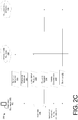
- FIG. 2C represents example signaling in the context of certain UE-initiated policies.
- FIG. 2A illustrates example signaling 200 for falling back to an alternative Quality of Service (QoS) level when a network-initiated dedicated tunnel is not established before a timer expires.
- the signaling 200 may include actions performed by the first User Equipment (UE) 102 and the original core network 106, which are described above with reference to FIG. 1 .
- UE User Equipment
- the first UE 102 may transmit a services request 202 to the original core network 106.
- the services request 202 may include a request for a type of QoS-sensitive services.
- the QoS-sensitive services may be Guaranteed Bit Rate (GBR) services.
- the original core network 106 may determine that a dedicated tunnel should be established for the QoS-sensitive services.
- the original core network 106 may identify a QoS level associated with the services.
- the original core network 106 may determine at least one resource within the first network 106 that should be allocated to the dedicated tunnel in order to accommodate the QoS level.
- the original core network 106 may transmit a response message 206 to the first UE 102.
- the response message 206 may indicate, to the first UE 102, that the original core network 106 is at least attempting to establish the dedicated tunnel for the services.
- the response message 206 may indicate one or more features of the dedicated tunnel.
- the response message 206 may indicate the QoS level associated with the services, which may be assigned by the first core network.
- the response message 206 is a SIP message.
- the response message may be a SIP 100 Trying response.
- the response message 206 may include a Bearer Setup Request and Radio Resource Control (RRC) Connection Reconfiguration, wherein the Bearer Setup Request is transmitted from a Mobility Management Entity (MME) to a radio network serving the first UE 102, and the radio network transmits, in response, the RRC Connection Reconfiguration corresponding to the Bearer Setup Request.
- RRC Radio Resource Control
- the first UE 102 may initiate a timer associated with a wait time 208.
- the wait time 208 may specify a time interval by which the first UE 102 waits for a confirmation that the dedicated tunnel has been established. If the first UE 102 receives the confirmation before the wait time 208 expires, the first UE 102 may stop the timer and proceed with receiving the services over the established dedicated tunnel. However, if the wait time 208 expires without the first UE 102 having received a confirmation that the dedicated tunnel has been established, the first UE 102 may initiate a fallback solution. In particular implementations, a length of the wait time 208 may be about 5 seconds to about 30 seconds.
- the first UE 102 may transmit a counter-offer 210 to the original core network 106.
- the counter-offer 210 may indicate a fallback QoS level that is less stringent (i.e., lower) than the QoS level initially associated with the services.
- the less-stringent QoS level can be determined based on one or more predetermined rules, user preferences, or the like.
- the first UE 102 may guess a less-stringent QoS level that the original core network 106 is likely to accept.
- the original core network 106 may nevertheless be capable of establishing a dedicated tunnel at the fallback QoS level.
- the original core network 106 may transmit a dedicated tunnel confirmation 212 to the first UE 102.
- the dedicated tunnel confirmation 212 may notify the first UE 102 that the dedicated tunnel has been established at the fallback QoS level.
- the dedicated tunnel confirmation 212 may include data indicating a context of the established dedicated tunnel.
- FIG. 2B illustrates example signaling 216 for falling back to an alternate core network when a network-initiated dedicated tunnel is not established before a timer expires.
- the signaling 200 may include actions performed by the first User Equipment (UE) 102, the original core network 106, and a fallback core network 108, such as the first fallback core network 108-A or the second fallback core network 108-B, which are described above with reference to FIG. 1 .
- FIG. 2B may represent a scenario in which the original core network 106 and/or the fallback core network 108 may implement a policy in which dedicated tunnels are network-initiated.
- the first UE 102 may transmit a services request 218 to the original core network 106.
- the services request 218 may include a request for a type of QoS-sensitive services.
- the QoS-sensitive services may be Guaranteed Bit Rate (GBR) services.
- the original core network 106 may determine that a dedicated tunnel should be established for the QoS-sensitive services.
- the original core network 106 may identify a QoS level associated with the services.
- the original core network 106 may determine at least one resource within the first network 106 that should be allocated to the dedicated tunnel in order to accommodate the QoS level.
- the original core network 106 may transmit a response message 220 to the first UE 102.
- the response message 220 may indicate, to the first UE 102, that the original core network 106 is at least attempting to establish the dedicated tunnel for the services.
- the response message 220 may indicate one or more features of the dedicated tunnel.
- the response message 220 may indicate the QoS level associated with the services, which may be assigned by the original core network 106.
- the QoS level may be pre-assigned by the original core network 106 to a type of the services, in various implementations.
- the original core network 106 may pre-assign a particular QoS level for voice services and may indicate the particular QoS level in the response message 220 when the response message 220 is a response to a request for voice services.
- the response message 220 is a SIP message.
- the response message may be a SIP 100 Trying response.
- the response message 206 may include a Bearer Setup Request and Radio Resource Control (RRC) Connection Reconfiguration, wherein the Bearer Setup Request is transmitted from a Mobility Management Entity (MME) to a radio network serving the first UE 102, and the radio network transmits, in response, the RRC Connection Reconfiguration corresponding to the Bearer Setup Request.
- RRC Radio Resource Control
- the first UE 102 may initiate a timer associated with a wait time 222.
- the wait time 222 may specify a time interval by which the first UE 102 waits for a confirmation that the dedicated tunnel has been established. If the first UE 102 receives the confirmation before the wait time 222 expires, the first UE 102 may stop the timer and proceed with receiving the services over the established dedicated tunnel. However, if the wait time 222 expires without the first UE 102 having received a confirmation that the dedicated tunnel has been established, the first UE 102 may initiate a fallback solution.
- the first UE 102 may transmit a fallback request 224 to the fallback core network 108.
- the fallback request 224 may be a request for the QoS-sensitive services directed to the fallback core network 108.
- the fallback request 224 can include any of the information provided in the services request 218 that was transmitted to the original core network 106
- the first core network 108 may be able to accommodate a tunnel for delivering the services in a timely manner in accordance with the QoS requirements of the services, unlike the original core network 106.
- the fallback core network 108 may establish an appropriate tunnel for delivery of the requested services. For instance, if the fallback core network 108 includes a 4G core network, the tunnel may include a dedicated bearer by which the QoS-sensitive services can be delivered. In some examples, if the fallback core network 108 includes a 2G or 3G core network, the tunnel may include a CS voice pathway by which the QoS-sensitive services can be delivered.
- the first fallback core network 108 may transmit a tunnel confirmation 226 to the first UE 102.
- the tunnel confirmation 226 may be received within a second wait time of transmission of the fallback request 224.
- the tunnel confirmation 226 may notify the first UE 102 that the tunnel (i.e., the dedicated tunnel if the fallback core network includes a 4G core network or the CS tunnel if the fallback core network 108 includes a 3G or 2G core network) has been established in the first fallback core network 108-A.
- the tunnel confirmation 226 may include data indicating a context of the established tunnel.
- services 228 may be delivered to the first UE 102 via the established tunnel.
- the delivery of the services 228 may include the transmission of uplink data from the first UE 102 to the fallback core network 108 (or at least one device separated from the first UE 102 by the fallback core network 108) over the established tunnel and/or the transmission of downlink data from the fallback core network 108 (or at least one device separated from the first UE 102 by the fallback core network 108) to the first UE 102 over the established tunnel.
- FIGS. 2A and 2B illustrate implementations in which dedicated tunnels are network-initiated
- dedicated tunnels may be UE-initiated.
- any of the first UE 102, the original core network 106, and/or the fallback core network 108 may identify that the first UE 102 is responsible for defining and/or requesting network resources (e.g., resources sufficient to satisfy a particular QoS policy associated with the services) to accommodate an appropriate dedicated tunnel.
- the first UE 102 may specify the resources in a services request (e.g., an equivalent of the services request 202 or the services request 218).
- the first UE 102 may specify a particular GBR level by which the services should be delivered in the services request.
- the first UE 102 may trigger a wait time (e.g., an equivalent of the wait time 208 or the wait time 222) in response to transmitting the services request, rather than receiving a response message. If the wait time expires without the first UE 102 having received a confirmation of the dedicated tunnel, the first UE 102 may transmit a counter-offer (e.g., an equivalent of the counter-offer 210) to the original core network 106 or a fallback request (e.g., an equivalent of the fallback request 224) to the fallback core network 108.
- the wait time in a UE-initiated dedicated tunnel scenario may be longer than the wait time in a network-initiated dedicated tunnel scenario.
- FIG. 2C illustrates example signaling 230 for falling back to an alternate core network when a UE-initiated dedicated tunnel is not established before a timer expires.
- the signaling 230 may include actions performed by the first User Equipment (UE) 102, the original core network 106, and a fallback network 108, such as the first fallback core network 108-A or the second fallback core network 108-B, which are described above with reference to FIG. 1 .
- FIG. 2C may represent a scenario in which the original core network 106 and/or the fallback core network 108 may implement a policy in which dedicated tunnels are UE-initiated.
- the first UE 102 may transmit a services request 232 to the original core network 106.
- the services request 232 may include a request for a type of QoS-sensitive services.
- the QoS-sensitive services may be Guaranteed Bit Rate (GBR) services.
- the original core network 106 may determine that the UE 102 will initiate the creation of a dedicated tunnel for the QoS-sensitive services.
- the original core network 106 may transmit a response message 234 to the first UE 102.
- the response message 234 may indicate, to the first UE 102, that the original core network 106 is expecting the first UE 102 to initiate the dedicated tunnel for the services.
- the first UE 102 may transmit a tunnel setup request 236 to the original core network 106.
- the tunnel setup request 236 may indicate one or more features of the dedicated tunnel.
- the tunnel setup request 236 may indicate a requested QoS level associated with the services.
- the QoS level may be pre-assigned by the first UE 102 to a type of the services, in various implementations.
- the first UE 102 may pre-assign a particular QoS level for voice services and may indicate the particular QoS level in the tunnel setup request 236 when the services request 232 is a request for voice services.
- the response message 234 and/or the tunnel setup request 236 include at least one SIP message.
- the response message 234 may be a SIP 100 Trying response.
- the tunnel setup request 236 is part of the services request 232.
- the first UE 102 may initiate a timer associated with a wait time 238.
- the wait time 238 may specify a time interval by which the first UE 102 waits for a confirmation that the dedicated tunnel has been established. If the first UE 102 receives the confirmation before the wait time 238 expires, the first UE 102 may stop the timer and proceed with receiving the services over the established dedicated tunnel. However, if the wait time 238 expires without the first UE 102 having received a confirmation that the dedicated tunnel has been established, the first UE 102 may initiate a fallback solution.
- the first UE 102 may transmit a fallback request 238 to the fallback core network 108.
- the fallback request 224 may be a request for the QoS-sensitive services directed to the fallback core network 108.
- the fallback request 224 can include any of the information provided in the services request 232 that was transmitted to the original core network 106.
- the fallback core network 108 may transmit a response message to the first UE 102 (e.g., similar to the response message 234), and the first UE 102 may transmit a tunnel setup request (e.g., at least similar to the tunnel setup request 236) to the fallback core network 108.
- the first UE 102 can initiate the creation of a dedicated tunnel in the fallback core network 108.
- the fallback request 238 may be sufficient to establish a suitable tunnel in the fallback core network 108.
- the fallback core network 108 may be able to accommodate a tunnel for delivering the services in a timely manner in accordance with the QoS requirements of the services, unlike the original core network 106.
- the fallback core network 108 may establish an appropriate tunnel for delivery of the requested services. For instance, if the fallback core network 108 includes a 4G core network, the tunnel may include a dedicated bearer by which the QoS-sensitive services can be delivered. In some examples, if the fallback core network 108 includes a 2G or 3G core network, the tunnel may include a CS voice pathway by which the QoS-sensitive services can be delivered.
- the fallback core network 108 may transmit a tunnel confirmation 240 to the first UE 102.
- the tunnel confirmation 240 may be received within a second wait time of transmission of the fallback request 238 (or, if the first UE 102 is initiated a dedicated tunnel with the fallback core network 108, within a second wait time of transmission of a tunnel setup request transmitted to the fallback core network 108).
- the tunnel confirmation 240 may notify the first UE 102 that the tunnel (i.e., the dedicated tunnel if the fallback core network includes a 4G core network or the CS tunnel if the fallback core network 108 includes a 3G or 2G core network) has been established in the first fallback core network 108-A.
- the tunnel confirmation 240 may include data indicating a context of the established tunnel.
- services 242 may be delivered to the first UE 102 via the established tunnel.
- the delivery of the services 242 may include the transmission of uplink data from the first UE 102 to the fallback core network 108 (or at least one device separated from the first UE 102 by the fallback core network 108) over the established tunnel and/or the transmission of downlink data from the fallback core network 108 (or at least one device separated from the first UE 102 by the fallback core network 108) to the first UE 102 over the established tunnel.
- FIGS. 3 through 5 illustrate example processes in accordance with embodiments of the disclosure. These processes are illustrated as logical flow graphs, each operation of which represents a sequence of operations that can be implemented in hardware, software, or a combination thereof.
- the operations represent computer-executable instructions stored on one or more computer-readable storage media that, when executed by one or more processors, perform the recited operations.
- computer-executable instructions include routines, programs, objects, components, data structures, and the like that perform particular functions or implement particular abstract data types.
- the order in which the operations are described is not intended to be construed as a limitation, and any number of the described operations can be combined in any order and/or in parallel to implement the processes.
- FIG. 3 illustrates an example process 300 for performing User Equipment (UE)-initiated fallback based on a timer.
- the process 300 can be performed by a User Equipment (UE), such as the first UE 102 described above with reference to FIGS. 1 to 2B .
- UE User Equipment
- a services request can be transmitted to a core network.
- the services request may be a request for Quality of Service (QoS)-sensitive services, such as voice services.
- the services can be Guaranteed Bit Rate (GBR) services.
- the services request can be, for example, a Session Initiation Protocol (SIP) message.
- the services request can be a request for services from the core network and an Internet Protocol (IP) Multimedia Subsystem (IMS) network.
- the core network may be at least one of a 2nd (2G) network, a 3rd (3G) network, a 4th (4G) network, a 5th (5G) network, or the like.
- the requested services are to be delivered via a dedicated tunnel.
- a dedicated tunnel can include, for example, a dedicated bearer, a dedicated 5G QoS Indicator (5QI) data flow, or the like.
- the dedicated tunnel can be a pathway through one or more delivery networks, as well as a reserved set of resources in the delivery network(s) that can be used to prioritize delivery of the services through the delivery network(s).
- the delivery network(s) can include at least one of the core network, a radio network configured to deliver data to and from the core network, or an Internet Protocol (IP) Multimedia Subsystem (IMS) network.
- IP Internet Protocol
- IMS Internet Multimedia Subsystem
- the services request can include a request for the core network and/or the IMS network to establish a dedicated tunnel in accordance with a QoS level (e.g., a GBR) associated with the QoS-sensitive services.
- a QoS level e.g., a GBR
- the request to establish the dedicated tunnel can be sent separately from the services request.
- a response message can be received from the core network.
- the response message may indicate that the core network is at least attempting to establish the dedicated tunnel through the core network and/or the IMS network, over which the requested services can be delivered.
- the response message may indicate the QoS level associated with the QoS-sensitive services.
- the response message may confirm that the services request was received and/or that the core network and/or the IMS network share the UE-initiated policy.
- the response message is a SIP message.
- the response message may be a SIP 100 Trying response.
- the core network may initiate the setup of a dedicated tunnel to carry the requested services.
- the response message can include a Bearer Setup Request and a Radio Resource Control (RRC) Connection Reconfiguration, wherein the core network may transmit the Bearer Setup Request to a radio network, and the radio network may, in response, transmit the RRC Connection Reconfiguration corresponding to the Bearer Setup Request to the entity performing the process 300.
- RRC Connection Reconfiguration may indicate that the core network is setting up the dedicated tunnel.
- a request for a dedicated tunnel may be transmitted to the core network.
- the request for the dedicated tunnel may be transmitted after the response message is received at 304.
- the request for the dedicated tunnel may specify an appropriate QoS policy for the dedicated tunnel, which may be set by a UE rather than a delivery network, such as the core network.
- a timer can be initiated.
- the timer may be initiated in response to receiving the response message at 304.
- the timer may be initiated in response to transmitting the services request at 302 and/or transmitting the request for the dedicated tunnel.
- the timer may count down from a wait time.
- a length of the wait time can be, in some cases, about 5 seconds to about 30 seconds.
- the process 300 includes determining whether a confirmation of the dedicated tunnel has been received. For instance, 308 may include determining whether information about a context of an established dedicated tunnel has been received.
- the process 300 proceeds to 310.
- the services can be received via the established dedicated tunnel.
- the received context information can be used to exchange services with a remote device (e.g., a UE, a content server, or the like) via the dedicated tunnel.
- a remote device e.g., a UE, a content server, or the like
- the process 300 proceeds to 312.
- the process 300 can include determining whether the timer has expired. If the timer is determined to have not expired at 312, the process 300 returns to 308. For instance, the process 300 includes waiting for the confirmation of the dedicated tunnel at least as long as the wait time.
- the process 300 continues to 314.
- the expiration of the timer may indicate that there was a problem with establishing the dedicated tunnel. For instance, a node or interface associated with the radio network, the core network, and/or the IMS network may be malfunctioning or may be interrupted.
- fallback can be initiated. In some cases, fallback may include transmitting a counter-offer to the core network that specifies a less-stringent, but acceptable, QoS level at which the services can be delivered. In certain examples, fallback may include requesting the services from an alternate core network.
- the process 300 may enable a UE to initialize fallback when there is a problem (e.g., causing prevention or delay) with establishing a dedicated tunnel through at least one delivery network.
- a problem e.g., causing prevention or delay
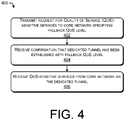
- FIG. 4 illustrates an example fallback process 400 for requesting services at a fallback Quality of Service (QoS) level.
- the process 500 can be performed by a User Equipment (UE), such as the first UE 102 described above with reference to FIGS. 1 to 2B .
- UE User Equipment
- the process 400 can be performed after the UE requested services from a core network at an original QoS level, and the core network failed to establish a dedicated tunnel with the original QoS level by which the services could be delivered.
- a request for QoS-sensitive services may be transmitted to a core network.
- the request may specify a fallback QoS level associated with the services.
- the fallback QoS level may be less stringent than the original QoS level associated with the QoS-sensitive services. For instance, if the services are Guaranteed Bit Rate (GBR) services originally associated with a predetermined maximum acceptable latency, the fallback QoS level may correspond to a longer maximum acceptable latency than the predetermined maximum acceptable latency.
- GLR Guaranteed Bit Rate
- the request can be, for example, a Session Initiation Protocol (SIP) message.
- the request can be a request for services from the core network and an Internet Protocol (IP) Multimedia Subsystem (IMS) network.
- IP Internet Protocol
- the core network may be at least one of a 2nd (2G) network, a 3rd (3G) network, a 4th (4G) network, a 5th (5G) network, or the like.
- the requested QoS-sensitive services are to be delivered via a dedicated tunnel.
- a dedicated tunnel can include, for example, a dedicated bearer, a dedicated 5G QoS Indicator (5QI) data flow, or the like.
- the dedicated tunnel can be a pathway through one or more delivery networks, as well as a reserved set of resources in the delivery network(s) that can be used to prioritize delivery of the services through the delivery network(s).
- the delivery network(s) can include at least one of the core network, a radio network configured to deliver data to and from the core network, or the IMS network.
- a confirmation can be received.
- the confirmation can be received within a wait time (e.g., a time interval between about 5 seconds and 30 seconds) of the transmission of the request at 402.
- the confirmation may indicate that a dedicated tunnel has been established with the fallback QoS level.
- the delivery network(s) may have enough resources to establish a dedicated tunnel at the fallback QoS level but may have lacked the resources to establish a dedicated tunnel at the original QoS level associated with the requested services. Accordingly, the fallback QoS level may enable the establishment of the dedicated tunnel.
- the QoS-sensitive services can be received from the core network via the dedicated tunnel. Because the dedicated tunnel has been established, even at the fallback QoS level, the QoS-sensitive services may be received from the delivery network(s).
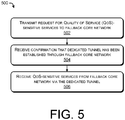
- FIG. 5 illustrates an example fallback process 500 for requesting services from a fallback core network.
- the process 500 can be performed by a User Equipment (UE), such as the first UE 102 described above with reference to FIGS. 1 to 2B .
- UE User Equipment
- the process 500 can be performed after the UE requested services from an original core network and the original core network failed to establish a dedicated tunnel by which the services could be delivered.
- a request for Quality of Service (QoS)-sensitive services can be transmitted to a fallback core network.
- the services request may be a request for Quality of Service (QoS)-sensitive services, such as voice services.
- the services can be Guaranteed Bit Rate (GBR) services.
- the services request can be, for example, a Session Initiation Protocol (SIP) message.
- the services request can be a request for services from the core network and an Internet Protocol (IP) Multimedia Subsystem (IMS) network.
- IP Internet Protocol
- IMS Internet Multimedia Subsystem
- the fallback core network may be at least one of a 2G network, a 3G network, a 4G network, a 5G network, or the like.
- the fallback core network is associated with a different network technology than the original core network.
- the fallback core network can be a 2G network, a 3G network, or a 4G network
- the original core network can be a 5G network.
- the requested services are to be delivered via a dedicated tunnel.
- a dedicated tunnel can include, for example, a dedicated bearer, a dedicated 5G QoS Indicator (5QI) data flow, or the like.
- the dedicated tunnel can be a pathway through one or more delivery networks, as well as a reserved set of resources in the delivery network(s) that can be used to prioritize delivery of the services through the delivery network(s).
- the delivery network(s) can include at least one of the fallback core network, a radio network configured to deliver data to and from the fallback core network, or an IMS network.
- a confirmation that a dedicated tunnel has been establish ed through the fallback core network can be received.
- the confirmation can be received within a wait time (e.g., a time interval between about 5 seconds and 30 seconds) of the transmission of the request at 502.
- the confirmation may indicate that a dedicated tunnel has been established by the fallback core network.
- the fallback core network may have enough resources to establish the dedicated tunnel, even though the original core network may have lacked the resources to establish the dedicated tunnel. Accordingly, the fallback core network may enable the establishment of the dedicated tunnel.
- the QoS-sensitive services can be received from the fallback core network via the dedicated tunnel. Because the dedicated tunnel has been established, even in the fallback core network, the QoS-sensitive services may be received from the delivery network(s).
- FIG. 6 illustrates example device(s) 600 configured to perform user-initiated fallback based on a timer.
- the device(s) 600 can be implemented as one or more server computers, a network element on a dedicated hardware, as a software instance running on a dedicated hardware, or as a virtualized function instantiated on an appropriate platform, such as a cloud infrastructure, and the like. It is to be understood in the context of this disclosure that the device(s) 600 can be implemented as a single device or as a plurality of devices with components and data distributed among them.
- the device(s) 600 comprise a memory 602.
- the memory 602 is volatile (including a component such as Random Access Memory (RAM)), non-volatile (including a component such as Read Only Memory (ROM), flash memory, etc.) or some combination of the two.
- RAM Random Access Memory
- ROM Read Only Memory
- flash memory any combination of the two.
- the memory 602 may include various components, such as at least one service request component 604 and at least one wait time component 606.
- the service request component 604 may include instructions for requesting services from a core network (e.g., an original core network or a fallback core network).
- the wait time component 606 may include instructions for determining that a wait time has expired without receiving confirmation that a dedicated tunnel has been established, as well as for taking certain actions based on the determination.
- the counter-offer component 608 may include instructions for generating and providing a counter-offer to a core network, for instance, after a dedicated tunnel was not established in the core network within the wait time.
- the service request component 604, the wait time component 606, the counter-offer component 608, and various other elements stored in the memory 602 can comprise methods, threads, processes, applications, or any other sort of executable instructions.
- the service request component 604, the wait time component 606, the counter-offer component 608, and various other elements stored in the memory 602 can also include files and databases.
- the memory 602 may include various instructions (e.g., instructions in the service request component 604, the wait time component 606, and/or the counter-offer component 608), which can be executed by at least one processor 608 to perform operations.
- the processor(s) 610 includes a Central Processing Unit (CPU), a Graphics Processing Unit (GPU), or both CPU and GPU, or other processing unit or component known in the art.
- the device(s) 600 can also include additional data storage devices (removable and/or non-removable) such as, for example, magnetic disks, optical disks, or tape. Such additional storage is illustrated in FIG. 6 by removable storage 612 and non-removable storage 614.
- Tangible computer-readable media can include volatile and nonvolatile, removable and non-removable media implemented in any method or technology for storage of information, such as computer readable instructions, data structures, program modules, or other data.
- the memory 602, removable storage 612, and non-removable storage 612 are all examples of computer-readable storage media.
- Computer-readable storage media include, but are not limited to, RAM, ROM, EEPROM, flash memory or other memory technology, CD-ROM, Digital Versatile Discs (DVDs), Content-Addressable Memory (CAM), or other optical storage, magnetic cassettes, magnetic tape, magnetic disk storage or other magnetic storage devices, or any other medium which can be used to store the desired information and which can be accessed by the device(s) 600. Any such tangible computer-readable media can be part of the device(s) 600.
- the device(s) 600 can also include one or more wired or wireless transceiver(s) 616.
- the transceiver(s) 616 can include a Network Interface Card (NIC), a network adapter, a Local Area Network (LAN) adapter, or a physical, virtual, or logical address to connect to the various base stations or networks contemplated herein, for example, or the various user devices and servers.
- NIC Network Interface Card
- LAN Local Area Network
- MIMO Multiple-Input/Multiple-Output
- the transceiver(s) 616 can include any sort of wireless transceivers capable of engaging in wireless, Radio Frequency (RF) communication.
- the transceiver(s) 616 can also include other wireless modems, such as a modem for engaging in Wi-Fi, WiMAX, Bluetooth, or infrared communication.
- the device(s) 600 also can include input device(s) 618, such as a keypad, a cursor control, a touch-sensitive display, voice input device, etc., and output device(s) 620 such as a display, speakers, printers, etc. These devices are well known in the art and need not be discussed at length here.
- input device(s) 618 such as a keypad, a cursor control, a touch-sensitive display, voice input device, etc.
- output device(s) 620 such as a display, speakers, printers, etc.
- a user can provide input to the device(s) 600 via a user interface associated with the input device(s) 618 and/or the output device(s) 620.
Landscapes
- Engineering & Computer Science (AREA)
- Computer Networks & Wireless Communication (AREA)
- Signal Processing (AREA)
- Multimedia (AREA)
- Business, Economics & Management (AREA)
- General Business, Economics & Management (AREA)
- Mobile Radio Communication Systems (AREA)
Abstract
Description
- Modern terrestrial telecommunication systems include heterogeneous mixtures of second, third, and fourth generation (2G, 3G, and 4G) cellular-wireless access technologies, which can be cross-compatible and can operate collectively to provide data communication services. Global Systems for Mobile (GSM) is an example of 2G telecommunications technologies; Universal Mobile Telecommunications System (UMTS) is an example of 3G telecommunications technologies; and Long Term Evolution (LTE), including LTE Advanced, and Evolved High-Speed Packet Access (HSPA+) are examples of 4G telecommunications technologies. Moving forward, future telecommunications systems may include fifth generation (5G) cellular-wireless access technologies, among other forthcoming technologies, to provide improved bandwidth and decreased response times to a multitude of devices that may be connected to a network.
- The detailed description is set forth with reference to the accompanying figures. In the figures, the left-most digit(s) of a reference number identifies the figure in which the reference number first appears. The use of the same reference numbers in different figures indicates similar or identical items or features.
-
FIG. 1 illustrates an example network environment for performing User Equipment (UE)-initiated fallback based on a timer. -
FIG. 2A illustrates example signaling for falling back to an alternative Quality of Service (QoS) level when a network-initiated dedicated tunnel is not established before a timer expires. -
FIG. 2B illustrates example signaling for falling back to an alternate core network when a network-initiated dedicated tunnel is not established before a timer expires. -
FIG. 2C illustrates example signaling for falling back to an alternate core network when a UE-initiated dedicated tunnel is not established before a timer expires. -
FIG. 3 illustrates an example process for performing UE-initiated fallback based on a timer. -
FIG. 4 illustrates an example fallback process for requesting services at a fallback QoS level. -
FIG. 5 illustrates an example fallback process for requesting services from a fallback core network. -
FIG. 6 illustrates example device(s) configured to perform user-initiated fallback based on a timer. - The systems, devices, and techniques described herein relate to timer-based fallback. Various implementations relate to User Equipment (UE)-initiated fallback solutions for the delivery of Quality of Service (QoS)-sensitive data traffic.
- Various types of data traffic can be allocated resources to maintain pre-determined minimum QoS levels. In particular examples, a QoS Class Identifier (QCI) can be associated with a type of data traffic. The QCI can indicate whether the data traffic should be delivered via a Guaranteed Bit Rate (GBR), should be prioritized over other types of data traffic, should be delivered no more than a particular packet delay, should be delivered according to a maximum packet error loss rate, or the like.
- A delivery network can enforce a particular QoS level associated with a type of data traffic by establishing a dedicated tunnel and delivering the data traffic via the dedicated tunnel. In certain 4th Generation (4G) environments, a dedicated tunnel can be a dedicated bearer. In certain 5th Generation (5G) environments, a dedicated tunnel can be a dedicated 5G Quality Indicator (5QI) data flow.
- In various implementations, a dedicated tunnel can be established "end to end" throughout one or more networks. For instance, when QoS-sensitive services are requested by a particular UE, a dedicated tunnel can be established through a radio network directly connected to the UE, an Internet Protocol (IP) Multimedia Subsystem (IMS) network providing the services, and a core network connected between the radio network and the IMS network.
- A dedicated tunnel can be UE-initiated or network-initiated. In a UE-initiated scenario, the UE itself requests various features of the dedicated tunnel, such as a priority, packet delay budget, packet error loss rate, or the like, which are associated with the dedicated tunnel. However, in the case of a network-initiated dedicated tunnel, the network may assign the features of the dedicated tunnel (e.g., the priority, packet delay budget, packet error loss rate, or the like) based on the type of services requested by the UE and various conditions of the network. Network-initiated dedicated tunnels can be advantageous, because the network can intelligently allocate network resources to different types of data traffic and can adjust allocations of network resources in cases where the network resources are limited. However, UE-initiated dedicated tunnels may be implemented in certain 3rd Generation Partnership Project (3GPP) standards.
- The establishment of UE-initiated and network-initiated dedicated tunnels can be delayed, interrupted, or can otherwise fail after initiation. In some cases, the resources necessary to support a requested dedicated tunnel may be unavailable in a delivery network. For example, a core network can be too congested to support a particular GBR associated with a requested type of data traffic. In particular examples, a node or an interface between two nodes involved in establishing the dedicated tunnel can be interrupted (e.g., misaligned, etc.). For instance, a User Plane Function (UPF) in a 5G core network selected to be part of the dedicated tunnel may fail.
- If the dedicated tunnel is not established, a fallback solution may be initiated. In some cases, the establishment of the dedicated tunnel can be abandoned in a first delivery network and, instead, the establishment of the dedicated tunnel can be initiated in a second delivery network. When the second delivery network is a Circuit-Switched (CS) network (e.g., a 2G network or a 3G network), the fallback solution may be referred to as "CS-fallback."
- In certain examples, the network initiates the fallback solution. However, when the problem preventing the establishment of the dedicated tunnel is a problem with the network itself, the fallback solution may be unnecessarily delayed.
- Various implementations of the present disclosure relate to UE-initiated fallback solutions. In particular implementations, a UE initiates a timer that, when expired, causes the UE to initiate a fallback solution. The timer may be initiated at a time based on whether the UE and/or the delivery network is implementing a policy in which the dedicated tunnel is UE-initiated or a policy in which the dedicated tunnel is network-initiated. In examples in which a dedicated tunnel is UE-initiated, the timer can start in response to the UE transmitting a request for the dedicated tunnel to a delivery network. In instances in which the dedicated tunnel is network-initiated, the timer can start in response to the UE receiving the service request acknowledgement from the network, which can be the first response message from the network that is an indication that the dedicated tunnel is being initiated by the delivery network.
- In some instances, the fallback solution can include falling back to an alternative dedicated tunnel with less-stringent QoS requirements. For instance, if a dedicated tunnel is initially sought at a first QoS level and the timer expires, the UE may cause the establishment of an alternative dedicated tunnel at a second QoS level that requires fewer reserved resources than the first QoS level. In some cases, the UE may forward a "counter-offer" to the delivery network identifying that the second QoS level is acceptable. In some cases, the delivery network may be able to establish the dedicated tunnel at the second QoS level even though it cannot establish the dedicated tunnel at the first QoS level. Thus, even if the UE and/or the delivery network initially require the dedicated tunnel to be network-initiated, the UE may be empowered to initiate the creation of a fallback dedicated tunnel. In some cases, the UE can forward the counter-offer, and thereby have at least some control over the establishment of a subsequent dedicated tunnel, even when the UE and the delivery network are implementing a network-initiated dedicated tunnel policy. Thus, in certain implementations, the UE and/or the delivery network can transition from a network-initiated default policy to a UE-initiated policy as a fallback to the default policy.
- In certain implementations, the fallback solution can include falling back to a different network technology. For instance, if a dedicated tunnel is initially sought in a 5G network and the timer expires, the UE may cause the establishment of an alternative dedicated tunnel in an available fallback network, such as an available 4G network, an available 3G network, or an available 2G network. In some cases, the UE may forward a request for services to the fallback network.
- Various implementations of the present disclosure provide solutions to various problems with telecommunication networks. A timer initiated by the UE can enable the UE to identify when there is a problem with a process of establishing a dedicated tunnel. Accordingly, the UE can initiate the fallback option, rather than relying entirely on the delivery network to initiate the fallback option. The UE can therefore successfully receive QoS-sensitive services via a fallback dedicated tunnel, even if the delivery network fails to successfully initiate fallback. Furthermore, the UE can more efficiently establish the dedicated tunnel, particularly when the delivery network is delayed in, or prevented from, establishing an initial dedicated tunnel.
- Various triggering events for the timers described herein can provide improvements to telecommunication networks. In the context of policies specifying that dedicated tunnels are UE-initiated, a timer may be initiated in response to the UE transmitting a tunnel setup request to the delivery network. In the context of policies specifying that dedicated tunnels are network-initiated, a timer may be initiated in response to a triggering event at which the indication that a dedicated bearer will be established is received from the delivery network. These triggering events can also allow the UE to specifically identify that there is a problem with establishing the dedicated tunnel, as opposed to some other problem. For instance, these triggering events can make the UE more likely to identify that there is a problem with the establishment of the dedicated tunnel, rather than a fundamental problem associated with a radio access network or the delivery network itself. In various examples, the timer can be shorter and therefore take up fewer computing resources on the part of the UE, as compared to situations in which the UE initiates the timer in response to the UE initially requesting services.
- Furthermore, certain fallback solutions described herein provide other improvements to telecommunication networks. In some examples, the UE may initiate a fallback solution that uses the existing delivery network. According to particular implementations, the UE can cause a fallback dedicated tunnel to be established in the same delivery network that failed to establish a dedicated tunnel at a first QoS level, by indicating that a second QoS level is acceptable. Accordingly, fallback can be performed even when an alternative delivery network (e.g., a CS network) is unavailable.
- Various implementations of the present disclosure will now be described with reference to the accompanying drawings.
-
FIG. 1 illustrates anexample network environment 100 for performing User Equipment (UE)-initiated fallback based on a timer. - A first User Equipment (UE) 102 may be connected to a
radio network 104. In some implementations, thefirst UE 102 may be connected to theradio network 104 via a wireless interface. As used herein, the terms "UE," "user device," "wireless communication device," "wireless device," "communication device," "mobile device," and "client device," can be used interchangeably herein to describe any UE (e.g., the first UE 102) that is capable of transmitting/receiving data wirelessly using any suitable wireless communications/data technology, protocol, or standard, such as Global System for Mobile Communications (GSM), Time Division Multiple Access (TDMA), Universal Mobile Telecommunications System (UMTS), Evolution-Data Optimized (EVDO), Long Term Evolution (LTE), Advanced LTE (LTE+), New Radio (NR), Generic Access Network (GAN), Unlicensed Mobile Access (UMA), Code Division Multiple Access (CDMA), Orthogonal Frequency Division Multiple Access (OFDM), General Packet Radio Service (GPRS), Enhanced Data GSM Environment (EDGE), Advanced Mobile Phone System (AMPS), High Speed Packet Access (HSPA), evolved HSPA (HSPA+), Voice over Internet Protocol (IP) (VoIP), VoLTE, Institute of Electrical and Electronics Engineers' (IEEE) 802.1x protocols, WiMAX, Wi-Fi, Data Over Cable Service Interface Specification (DOCSIS), digital subscriber line (DSL), and/or any future IP-based network technology or evolution of an existing IP-based network technology. - In general, the
first UE 102 can be implemented as any suitable type of computing device configured to communicate over a wired or wireless network, including, without limitation, a mobile phone (e.g., a smart phone), a tablet computer, a laptop computer, a Portable Digital Assistant (PDA), a wearable computer (e.g., electronic/smart glasses, a smart watch, fitness trackers, etc.), an Internet-of-Things (IoT) device, an in-vehicle (e.g., in-car) computer, and/or any similar mobile device, as well as situated computing devices including, without limitation, a television (smart television), a Set-Top-Box (STB), a desktop computer, and the like. - The
first UE 102 may transmit and receive data wirelessly with theradio network 104 via one or more radio interfaces. Theradio network 104 may be a Radio Access Network (RAN). In this manner, theradio network 104 can include and/or be substituted for a 3GPP RAN, such a GSM/EDGE RAN (GERAN), a Universal Terrestrial RAN (UTRAN), or an Evolved UTRAN (E-UTRAN), or alternatively, via a "non-3GPP" RAN, such as a Wi-Fi RAN, or another type of wireless local area network (WLAN) that is based on the IEEE 802.11 standards. In some instances, theradio network 104 can include a Wi-Fi Access Point (AP). Although not illustrated, theenvironment 100 can further include any number and type of base stations representing any number and type of macrocells, microcells, picocells, or femtocells, for example, with any type or amount of overlapping coverage or mutually exclusive coverage compared to theradio network 104. - The
radio network 104, in turn, may be connected to anoriginal core network 106, a first fallback core network 108-A, and a second fallback core network 108-B. In some cases, one of the first fallback core network 108-A or the second fallback core network 108-B may be omitted from theenvironment 100. Theoriginal core network 106 and/or the first fallback core network 108-A may include a 4G core network. In certain instances, various components of a 4G core network, such as an Evolved Packet Core (EPC), can include, but are not limited to, a Mobility Management Entity (MME), a Serving Gateway (SGW), a Packet Data Network (PDN) Gateway (PGW), a Home Subscriber Server (HSS), an Access Network Discovery and Selection Function (ANDSF), and/or an evolved Packet Data Gateway (ePDG). An SGW can include a component that handles user-plane data (SGW-U) and a component that handles control-plane data (SGW-C). A PDN can include a component that handles user-plane data (PDN-U) and a component that handles control-plane data (PDN-C). The EPC may further include a Policy and Charging Rules Function (PCRF). Each entity, gateway, server, and function in the 4G core network can be implemented by specialized hardware (e.g., one or more devices), general hardware executing specialized software (e.g., at least one virtual machine executed on one or more devices), or the like. - In some implementations, the
original core network 106 and/or the first fallback core network 108-A may include a 5G core network. In some examples, various components of a 5G core network can include, but are not limited to, a Network Exposure Function (NEF), a Network Resource Function (NRF), an Authentication Server Function (AUSF), an Access and Mobility management Function (AMF), a Policy Control Function (PCF), a Session Management Function (SMF), a Unified Data Management (UDM) function, a User Plane Function (UPF), and/or an Application Function (AF). Each entity, gateway, server, and function in the 5G core network can be implemented by specialized hardware (e.g., one or more devices), general hardware executing specialized software (e.g., at least one virtual machine executed on one or more devices), or the like. - In general, the NEF can be implemented as a network function including functionality to securely expose services and/or capabilities provided by and amongst the various network functions, as discussed herein. In some instances, the NEF receives information from other network functions in the 5G core and can store the received information as structured data using an interface to a data storage network function.
- In general, the AUSF can be implemented as a network function including functionality to provide authentication to various devices in the network. For example, the AUSF can request device credentials (e.g., security key(s)), verify that the
first UE 102 is authorized to connect to a network, and/or control access to the network based on the device credentials. - In general, the NRF can be implemented as a network function including functionality to support service discovery (e.g., receive a network function discovery request and provide information associated with the discovered network function instances to a requesting entity). In some instances, the NRF can receive utilization information, capability information, etc. from various network functions, such as the UPF, to provide such utilization information to the other components discussed herein. Further, the NRF can select, assign, implement, or otherwise determine network functions to be used in a network based at least in part on utilization information, as discussed herein.
- In general, the AMF can be implemented as a network function including functionality to provide UE-based authentication, authorization, mobility management, etc., to various UEs. In some instances, the AMF can include functionality to terminate a RAN control plane interface between the
first UE 102 and other functions on the network. In some instances, the AMF can include functionality to perform registration management of thefirst UE 102 in the network, connection management, reachability management, mobility management, access authentication, access authorization, security anchor functionality (e.g., receiving and/or transmitting security keys during registration/authorization), and the like. - In general, the PCF can be implemented as a network function including functionality to support unified policy framework to govern network behavior, provide policy rules to control plane functions and/or enforce such rules, and/or implement a front end to access subscription information relevant for policy decisions in a data repository.
- In general, the SMF can be implemented as a network function including functionality to manage communication sessions by and between UEs, and/or to provide Internet Protocol (IP) addresses to the UEs. In some instances, the SMF can select a UPF to provide services to the
first UE 102 in response to receiving a request for services from thefirst UE 102. - In general, the UDM can be implemented as a network function including functionality to process authentication credentials, handle user identification processing, manage registration and/or mobility, manage subscriptions between the
first UE 102 and a carrier, and/or manage Short Message Service (SMS) data. - In general, the UPF can be implemented as a network function including functionality to control data transfer between the
first UE 102 and the various components of theenvironment 100. In some instances, the UPF can include functionality to act as an anchor point for radio access technology (RAT) handover (e.g., inter and intra), external protocol data unit (PDU) session point of interconnect to an external network (e.g., the Internet), packet routing and forwarding, packet inspection and user plane portion of policy rule enforcement, traffic usage reporting, traffic routing, Quality of Service (QoS) handling for user plane (e.g., packet filtering, gating, uplink/downlink rate enforcement), uplink traffic verification, transport level packet marking in the uplink and downlink, downlink packet buffering and downlink data notification triggering, and the like. As can be understood in the context of this disclosure, there may be one or more UPFs, which are associated with thecore network 106 and/or with thefirst UE 102 - In general, the AF can be implemented as a network function including functionality to route traffic to/from applications operating on the network, facilitate accessing the NEF, and interact with the policy framework for policy control in connection with the PCF.
- In some implementations, the second fallback core network 108-B may include a Circuit Switched (CS) network. For instance, the second fallback core network 108-B may include a 2G core network or a 3G core network.
- In various examples, the
original core network 106, the first fallback core network 108-A, and the second fallback core network 108-B are associated with different types of network technology. For instance, theoriginal core network 106 may be a 5G core network and the first fallback core network 108-A may be a 4G core network (e.g., an EPC). In particular implementations, theoriginal core network 106 may be associated with a more advanced technology than the first fallback core network 108-A and/or the second fallback core network 108-B. That is, theoriginal core network 106 may be associated with a more recently developed technology (e.g., 5G) than a technology of the first fallback core network 108-A (e.g., 4G) or the second fallback core network 108-B (e.g., 3G or 2G). - The
original core network 106 and the first fallback core network 108-A may be connected to an Internet Protocol (IP) Multimedia Subsystem (IMS)network 110. In cases in which the second fallback core network 108-B is a CS network, the second fallback core network 108-B may be disconnected from theIMS network 110 and may be connected directly to the outside network(s) 112 and/or theWANs 116. However, in cases in which the first fallback core network 108-A is not a CS network, the first fallback core network 108-A may be connected to theIMS network 110. TheIMS network 110 may be referred to an "IMS core network," an "IMS CN Subsystem," or the like. IMS is an architectural framework defined by the 3rd Generation Partnership Project (3GPP) for delivering IP multimedia to a UE, such as thefirst UE 102. TheIMS network 110 can be maintained and/or operated by one or more service providers, such as one or more wireless carriers ("carriers"), that provide IMS-based services to users who are associated with UEs, such as thefirst UE 102. For example, a service provider can offer multimedia telephony services that allow a user to call or message other users via theIMS network 108 using his/her UE. A user can also utilize an associated UE to receive, provide, or otherwise interact with various different IMS-based services by accessing theIMS network 110. It is to be appreciated that any number of base stations and/or nodes can be included in theIMS network 110. - Accordingly, an operator of the
IMS network 110 can offer any type of IMS-based service, such as, telephony services, emergency services (e.g., E911), gaming services, instant messaging services, presence services, video conferencing services, social networking and sharing services, location-based services, push-to-talk services, and so on. In order for a UE (e.g., the first UE 102) to access these services (e.g., telephony services), the UE may be configured to request establishment of a communication session, or another UE (e.g., the second UE 114) may be configured to request establishment of the communication session. In the case of telephony services, the communication session can comprise a voice call (e.g., a voice-based communication session, such as a VoLTE call, or a Wi-Fi call), a video call, or the like. - The
radio network 104, theoriginal core network 106, the first fallback core network 108-A, the second fallback core network 108-B, and/or theIMS network 110 may be managed by the same operator, in some cases. According to various implementations, thefirst UE 102 may be associated with a subscriber account corresponding to an operator of at least one of theradio network 104, theoriginal core network 106, the first fallback core network 108-A, the second fallback core network 108-B, or theIMS network 110. - The
IMS network 110 may be connected to at least oneoutside network 112. The outside network(s) 112 may be used to connect theIMS network 110 to asecond UE 114. In some examples, services exchanged in a communication session between thefirst UE 102 and thesecond UE 114 may traverse theradio network 104, theoriginal core network 106, theIMS network 110, and the outside network(s) 112. According to certain examples, services exchanged in a communication session between thefirst UE 102 and thesecond UE 114 may traverse a pathway including theradio network 104, the first fallback core network 108-A, theIMS network 110, and the outside network(s) 112. In certain cases, services exchanged in a communication session between thefirst UE 102 and thesecond UE 114 may traverse a pathway including theradio network 104, the second fallback core network 108-B, and the outside network(s) 112. - A pathway carrying the services may correspond to a dedicated tunnel, in instances where the services are QoS-sensitive services. In some cases, the outside network(s) 112 may include one or more outside IMS networks, one or more outside core networks, and/or one or more radio networks. The
second UE 114 may be associated with a subscriber account corresponding to the outside network(s) 112. For instance, thesecond UE 114 may be associated with a subscriber account corresponding to a core network in the outside network(s) 112. - The
IMS network 110 may also be connected to at least one Wide Area Network (WAN) 116, such as the Internet. In various implementations, various multimedia services can be provided to thefirst UE 102 from one or more content servers in theWAN 116 via a pathway through theradio network 104, theoriginal core network 106 and/or the first fallback core network 108-A, and theIMS network 110. Although not illustrated, in some cases, the second fallback core network 108-B may be connected to theWAN 116, such that the second fallback core network 108-B may provide Internet-based services to thefirst UE 102. - In particular implementations, the
first UE 102 may transmit a request, to theoriginal core network 106, for services associated with a particular Quality of Service (QoS) level. These services may be requested as part of a communication session with thesecond UE 114, for example. As used herein, the terms "communication session," "session," and their equivalents, can refer to an exchange of data between two or more communicating nodes or devices. A call (e.g., a voice call, a video call, or the like) may be an example of a communication session. A communication session can be temporary, such that it is established at a first time and ceased at a second time. In various implementations, a communication session includes the transfer of user plane data between two or more nodes. In some examples, a call can be established between a caller and a callee. In certain cases, a session can be established between a UE (e.g., the first UE 102) and a content server (e.g., a content server associated with the WAN 116). According to particular implementations, a call may be supported by a dedicated tunnel over which the services are delivered in the call. As used herein, the term "caller," and its equivalents, can refer to a device initiating a session. According to some implementations, the session may provide services to and from the caller. The session can be a communication session. In some cases, the caller may initiate a session with a callee. As used herein, the term "callee," and its equivalents, can refer to a device receiving a request to participate in a communication session with a caller. - As used herein, the term "node," and its equivalents, can refer to one or more devices that transmit and/or receive data in a network. In some instances, a first node can transmit and/or receive data from a second node. For instance, a UE (e.g., the first UE 102) receiving services from an IMS network (e.g., the IMS network 110) may be a node. In some cases, a UPF (e.g., in the original core network 106) through which services are exchanged between an IMS network and a UE can also be considered a node.
- The
original core network 106 may establish a pathway through theoriginal core network 106 and theIMS network 110 over which the services can be delivered to thefirst UE 102. In some cases, the pathway may further include at least one of theradio network 104, the outside network(s) 112, or the WAN(s) 114. As used herein, the terms "network path, "path," and their equivalents, can refer to a pathway over which data can be transferred between at least two terminal nodes or devices (e.g., a caller and a callee). In some cases, a path may include one or more intermediary nodes and/or one or more interfaces between the terminal nodes. - In various implementations, the
first UE 102 may register with theIMS network 108 via an IMS registration process. In some cases, the IMS registration process occurs in response to the initial request for services. In certain cases, the IMS registration process can occur prior to thefirst UE 102 transmitting the request for services. During the IMS registration process, a path between theoriginal core network 106 and theIMS network 110, by which thefirst UE 102 can be provided services, may be established. In particular, various interfaces associated with theoriginal core network 106 and/or theIMS network 110 can be allocated for multimedia services destined for or originating from thefirst UE 102. In various examples in which theoriginal core network 106 is an EPC, these interfaces can include, for instance, at least one of a Gx interface (e.g., an interface connecting the SGW or PGW to the PCRF), an Rx interface (e.g., an interface connecting the PCRF to the I/S-CSCF in the IMS network), an Sgi interface (e.g., an interface connecting the SGW or PGW to the P-CSCF in the IMS network), or the like. In certain examples in which theoriginal core network 106 is a 5G core network, these interfaces can include, for instance, at least one of an N3 interface (e.g., an interface connecting theradio network 104 and a UPF) or an N5 interface (e.g., an interface connecting the UPF to another network, such as the IMS network 110). - In some cases, the
first UE 102 and/or theoriginal core network 106 may identify that a dedicated tunnel should be established through theoriginal core network 106 and theIMS network 110 for the services requested by thefirst UE 102. At least one of thefirst UE 102, theradio network 104, theoriginal core network 106, or theIMS network 110 may implement a policy indicating that the dedicated tunnel should be established via a UE-initiated process or a network-initiated process. The policy may be set by a carrier, in some cases. In particular implementations, the policy may be implemented in software and/or hardware in at least one of thefirst UE 102, theradio network 104, theoriginal core network 106, or theIMS network 110. A policy can indicate that a dedicated tunnel should be "UE-initiated" when the policy indicates that a UE specifies and/or sets the requirements (e.g., reserved network resources, a GBR, or the like) of the dedicated tunnel to an applicable delivery network. A policy can indicate that a dedicated tunnel should be "network-initiated" when the policy indicates that a delivery network specifies and/or sets the requirements (e.g., reserved network resources, a GBR, or the like) of the dedicated tunnel for the UE. As used herein, the term "dedicated tunnel," "dedicated bearer for service media," and their equivalents, can refer to at least one of (i) a pathway through at least one network or (ii) reserved resources allocated to a particular session traversing the network(s). In some cases, the policy implemented by thefirst UE 102, theradio network 104, theoriginal core network 106, and/or theIMS network 110 may switch between a UE-initiated policy and a network-initiated policy in response to an implementation received from a carrier (e.g., a message distributed through theenvironment 100 from at least one server in the outside network(s) 112 and/or the WAN(s) 116). An applicable policy may affect how thefirst UE 102 and/or theoriginal core network 106 initialize a dedicated bearer and initiate a fallback solution. - In some cases, the
first UE 102 may identify that the services are associated with the particular QoS level. In particular implementations, theoriginal core network 106 may determine that the requested services should be delivered via the particular QoS level. As used herein, the term "QoS level," and its equivalents, can refer to at least one required (e.g., a minimum or maximum) metric associated with a type of QoS-sensitive data traffic. In a 3GPP LTE network, the QoS level may be associated with a QoS Class Identifier (QCI). In some 5G core networks, the QoS level may be associated with a 5G QoS Identifier (5QI). A type of services or data traffic associated with a QoS level may be referred to as "QoS-sensitive." In various implementations, a QoS level can correspond to at least one of a priority of the services as they are transmitted through a delivery network (e.g., as compared to other services transmitted through a core network, theIMS network 110, or a combination thereof), a maximum packet delay budget of the services (e.g., maximum allowable delay(s) by one or more nodes and/or interfaces through the delivery network), or a maximum packet error loss rate of the services (e.g., a maximum rate of bit errors added to bits in data packets comprising the services after they are transmitted through the delivery network). - According to particular implementations, a QoS level may be associated with at least one of a priority of the type of data traffic through one or more networks, a maximum packet delay budget of the type of data traffic, a maximum packet delay budget of the type of data traffic, a Guaranteed Bit Rate (GBR) of the type of data traffic, or the like. In certain implementations, a type of data traffic associated with a particular QoS level is delivered across one or more networks (e.g., the
original core network 106, the first fallback core network 108-A, or the second fallback core network 108-B and/or the IMS network 110) via a dedicated tunnel. As used herein, the term "GBR," and its equivalents, can refer to a type of data traffic that may be transferred through at least one network by at least a minimum bit rate. In some cases, GBR data traffic corresponds to the type of services associated with the data traffic. According to 3GPP specifications, examples of GBR services can include conversational voice, conversational video (e.g., live streaming), real-time gaming, certain V2X messaging, non-conversational video (e.g., buffered streaming), mission critical user plane Push to Talk (PTT) voice, certain Mission Critical user plane Push to Talk Voice (MCPTT), non-mission-critical user plane, or the like. However, for the purposes of this disclosure, GBR services can include any predefined set of services that are sensitive to network delays and/or any other services that should be prioritized by at least one network (e.g., theradio network 104, theoriginal core network 106, and/or the IMS network 110) delivering the services. - In certain examples in which a UE-initiated policy is applicable, the
first UE 102 may request, to theoriginal core network 106, that a dedicated tunnel should be established for the services. For instance, theUE 102 may transmit a request for the dedicated tunnel, which may specify a GBR of the dedicated tunnel, to theoriginal core network 106. Pursuant to the UE-initiated policy, theoriginal core network 106 may at least attempt to establish the dedicated tunnel based on the request from thefirst UE 102. - In certain examples in which a network-initiated policy is applicable, the
original core network 106 may identify that a dedicated tunnel should be established for the services. Theoriginal core network 106 may further attempt to establish the dedicated tunnel based on the particular QoS level associated with the services. - Regardless of whether the dedicated tunnel is UE-initiated or network-initiated, the dedicated tunnel may be sought through nodes in one or more of the
radio network 104, theoriginal core network 106, the first fallback core network 108-A, and theIMS network 110. In particular implementations disclosed herein, theoriginal core network 106 may at least attempt to establish the dedicated tunnel through theoriginal core network 106 and theIMS network 110. According to some examples, a dedicated tunnel may refer to a dedicated bearer (e.g., for data traffic traversing an EPC), a dedicated 5QI flow (e.g., for data traffic traversing a 5G core network), or the like. - In various implementations, the
original core network 106 may transmit, to thefirst UE 102 an indication that the dedicated tunnel is being established. In some cases, the indication can be a SIP message. For instance, thefirst UE 102 may receive aSIP 100 Trying response indicating that the dedicated tunnel is being established. In some cases, theoriginal core network 106 may transmit a Bearer Setup Request to theradio network 104, and theradio network 104 may, in response, transmit a Radio Resource Control (RRC) Connection Reconfiguration corresponding to the Bearer Setup Request to thefirst UE 102. In some examples in which a network-initiated policy is implemented, the indication that the dedicated tunnel is being established may identify a minimum QoS level that the dedicated tunnel should guarantee. - In some UE-initiated policies, the
first UE 102 may initiate a timer in response to transmitting the initial request for services and/or in response to transmitting a request for a dedicated tunnel. Pursuant to certain network-initiated policies, upon receiving the indication that the dedicated tunnel is being established, thefirst UE 102 may start a timer. In various implementations, the timer may be count down a wait time. As used herein, the term "wait time," and its equivalents, can refer to a time interval by which a device waits before causing a connection associated with at least one network to be reset. In various implementations, a wait time can be predetermined. For instance, thefirst UE 102 may prestore the wait time by the time thefirst UE 102 receives the indication that the dedicated tunnel is being established. In some cases, a length of the wait time can depend on various temporary conditions of an associated network (e.g., a congestion level in theoriginal core network 106 and/or the IMS network 108). In some cases, the wait time can be between about 1 second and about 1 minute. In particular implementations, the wait time can be between about 5 seconds and about 30 seconds. In specific examples, the wait time may be about 12 seconds. As used herein, the term "about" can refer to a range of ±10% of an applicable base value. For example, "about 1" can refer to a range of 0.9 to 1.1, inclusive. - If the
first UE 102 receives information indicating that the dedicated tunnel has been established (e.g., context information about a dedicated tunnel established through theradio network 104, theoriginal core network 106, and the IMS network 110) before the timer expires, thefirst UE 102 may stop the timer and receive services via the established dedicated tunnel. However, if thefirst UE 102 does not receive information that the dedicated tunnel has been established when the timer expires, thefirst UE 102 may automatically initiate a fallback process. Thefirst UE 102 may initiate the fallback process regardless of whether a UE-initiated policy or a network-initiated policy is implemented. - In some instances, the fallback process may include the
first UE 102 transmitting a counter-offer to theoriginal core network 106. This fallback process can be successful even when the first fallback core network 108-A and the second fallback core network 108-B are unavailable. The counter-offer may specify a less stringent QoS level for the services than the QoS level initially identified by first UE 102 (e.g., pursuant to a UE-initiated policy) or the original core network 106 (e.g., pursuant to a network-initiated policy) for the dedicated tunnel. For example, the counter-offer may indicate that thefirst UE 102 will accept a packet delay budget of 150 ms for the dedicated tunnel even though theoriginal core network 106 previously indicated that the dedicated tunnel should correspond to a packet delay budget of no more than 100 ms. According to some implementations, the QoS level specified by the counter-offer can be determined by thefirst UE 102 according to one or more predefined rules, user preferences, or the like. In some cases, thefirst UE 102 may generate the counter-offer based on the minimum QoS level identified in the indication that the dedicated tunnel is being established, as received from theoriginal core network 106. For example, a subscriber associated with thefirst UE 102 may identify that a particular latency level is acceptable for streaming video services, even if a delivery network (e.g., theoriginal core network 106 and/or the IMS network 110) to which the subscriber is subscribed generally guarantees a lower latency level for streaming video services. In some cases, theoriginal core network 106 may be able to establish a dedicated tunnel at the less stringent QoS level even though theoriginal core network 106 may be unable to establish a dedicated tunnel at the originally identified QoS level. For example, theoriginal core network 106 may be significantly congested, and cannot reserve the resources required to accommodate a dedicated tunnel at the originally identified QoS level identified for the services, but theoriginal core network 106 may have enough free capacity to accommodate a dedicated tunnel at the less stringent QoS level. In particular implementations in which the fallback option includes transmitting the counter-offer specifying the less stringent QoS level, the less stringent QoS level can be referred to as a "fallback QoS level." - In particular instances, the fallback process may include the
first UE 102 transmitting a request for the services to the first fallback core network 108-A or the second fallback core network 108-B. This fallback process can be successful even when theoriginal core network 106 is malfunctioning. In some cases, the first fallback core network 108-A or the second fallback core network 108-B may be able to establish a dedicated tunnel for the services even when theoriginal core network 106 cannot. For example, at least one node in theoriginal core network 106 may be malfunctioning, such that theoriginal core network 106 may be unable to establish an appropriate dedicated tunnel for the services, but the first fallback core network 108-A or the second fallback core network 108-B may have enough free capacity to accommodate an appropriate dedicated tunnel for the services. In particular implementations in which the fallback process includes transmitting the request to the first fallback core network 108-A or the second fallback core network 108-B, the first fallback core network 108-A or the second fallback core network 108-B can also be referred to as a "fallback network." - Regardless of the type of fallback process performed, an appropriate dedicated tunnel may be established. Accordingly, the
first UE 102 may be able to receive the requested services via the dedicated tunnel. -
FIGS. 2A to 2C illustrate signaling for performing timer-initiated fallback, according to various implementations of the present disclosure. In particular,FIGS. 2A and2B represent example signaling in the context of certain network-initiated policies.FIG. 2C represents example signaling in the context of certain UE-initiated policies. -
FIG. 2A illustrates example signaling 200 for falling back to an alternative Quality of Service (QoS) level when a network-initiated dedicated tunnel is not established before a timer expires. The signaling 200 may include actions performed by the first User Equipment (UE) 102 and theoriginal core network 106, which are described above with reference toFIG. 1 . The - The
first UE 102 may transmit aservices request 202 to theoriginal core network 106. The services request 202 may include a request for a type of QoS-sensitive services. In some cases, the QoS-sensitive services may be Guaranteed Bit Rate (GBR) services. - In response to receiving the
services request 202, theoriginal core network 106 may determine that a dedicated tunnel should be established for the QoS-sensitive services. Theoriginal core network 106 may identify a QoS level associated with the services. Theoriginal core network 106 may determine at least one resource within thefirst network 106 that should be allocated to the dedicated tunnel in order to accommodate the QoS level. - The
original core network 106 may transmit aresponse message 206 to thefirst UE 102. Theresponse message 206 may indicate, to thefirst UE 102, that theoriginal core network 106 is at least attempting to establish the dedicated tunnel for the services. In some cases, theresponse message 206 may indicate one or more features of the dedicated tunnel. For instance, theresponse message 206 may indicate the QoS level associated with the services, which may be assigned by the first core network. In some cases, theresponse message 206 is a SIP message. For instance, the response message may be aSIP 100 Trying response. In particular implementations, theresponse message 206 may include a Bearer Setup Request and Radio Resource Control (RRC) Connection Reconfiguration, wherein the Bearer Setup Request is transmitted from a Mobility Management Entity (MME) to a radio network serving thefirst UE 102, and the radio network transmits, in response, the RRC Connection Reconfiguration corresponding to the Bearer Setup Request. - In response to receiving the
response message 206, thefirst UE 102 may initiate a timer associated with await time 208. Thewait time 208 may specify a time interval by which thefirst UE 102 waits for a confirmation that the dedicated tunnel has been established. If thefirst UE 102 receives the confirmation before thewait time 208 expires, thefirst UE 102 may stop the timer and proceed with receiving the services over the established dedicated tunnel. However, if thewait time 208 expires without thefirst UE 102 having received a confirmation that the dedicated tunnel has been established, thefirst UE 102 may initiate a fallback solution. In particular implementations, a length of thewait time 208 may be about 5 seconds to about 30 seconds. - As illustrated in
FIG. 2A , in response to the wait time expiring 208, thefirst UE 102 may transmit a counter-offer 210 to theoriginal core network 106. The counter-offer 210 may indicate a fallback QoS level that is less stringent (i.e., lower) than the QoS level initially associated with the services. In some cases, the less-stringent QoS level can be determined based on one or more predetermined rules, user preferences, or the like. In some cases, thefirst UE 102 may guess a less-stringent QoS level that theoriginal core network 106 is likely to accept. Accordingly, if theoriginal core network 106 could not establish the dedicated tunnel in a timely manner due to the inability of theoriginal core network 106 to accommodate the dedicated tunnel at the initial QoS level, theoriginal core network 106 may nevertheless be capable of establishing a dedicated tunnel at the fallback QoS level. - Once the
original core network 106 has established the dedicated tunnel at the fallback QoS level, theoriginal core network 106 may transmit a dedicated tunnel confirmation 212 to thefirst UE 102. The dedicated tunnel confirmation 212 may notify thefirst UE 102 that the dedicated tunnel has been established at the fallback QoS level. In particular implementations, the dedicated tunnel confirmation 212 may include data indicating a context of the established dedicated tunnel. - Once the dedicated tunnel has been established at the fallback QoS level and the
first UE 102 receives the dedicated tunnel confirmation 212,services 214 may be delivered to thefirst UE 102 via the established dedicated tunnel. The delivery of theservices 214 may include the transmission of uplink data from thefirst UE 102 to the original core network 106 (or at least one device separated from thefirst UE 102 by the original core network 106) over the dedicated bearer and/or the transmission of downlink data from the original core network 106 (or at least one device separated from thefirst UE 102 by the original core network 106) to thefirst UE 102. -
FIG. 2B illustrates example signaling 216 for falling back to an alternate core network when a network-initiated dedicated tunnel is not established before a timer expires. The signaling 200 may include actions performed by the first User Equipment (UE) 102, theoriginal core network 106, and afallback core network 108, such as the first fallback core network 108-A or the second fallback core network 108-B, which are described above with reference toFIG. 1 .FIG. 2B may represent a scenario in which theoriginal core network 106 and/or thefallback core network 108 may implement a policy in which dedicated tunnels are network-initiated. - The
first UE 102 may transmit a services request 218 to theoriginal core network 106. The services request 218 may include a request for a type of QoS-sensitive services. In some cases, the QoS-sensitive services may be Guaranteed Bit Rate (GBR) services. - In response to receiving the services request 218, the
original core network 106 may determine that a dedicated tunnel should be established for the QoS-sensitive services. Theoriginal core network 106 may identify a QoS level associated with the services. Theoriginal core network 106 may determine at least one resource within thefirst network 106 that should be allocated to the dedicated tunnel in order to accommodate the QoS level. - The
original core network 106 may transmit aresponse message 220 to thefirst UE 102. Theresponse message 220 may indicate, to thefirst UE 102, that theoriginal core network 106 is at least attempting to establish the dedicated tunnel for the services. In some cases, theresponse message 220 may indicate one or more features of the dedicated tunnel. For instance, theresponse message 220 may indicate the QoS level associated with the services, which may be assigned by theoriginal core network 106. The QoS level may be pre-assigned by theoriginal core network 106 to a type of the services, in various implementations. For example, theoriginal core network 106 may pre-assign a particular QoS level for voice services and may indicate the particular QoS level in theresponse message 220 when theresponse message 220 is a response to a request for voice services. In some cases, theresponse message 220 is a SIP message. For instance, the response message may be aSIP 100 Trying response. In particular implementations, theresponse message 206 may include a Bearer Setup Request and Radio Resource Control (RRC) Connection Reconfiguration, wherein the Bearer Setup Request is transmitted from a Mobility Management Entity (MME) to a radio network serving thefirst UE 102, and the radio network transmits, in response, the RRC Connection Reconfiguration corresponding to the Bearer Setup Request. - In response to receiving the
response message 220, thefirst UE 102 may initiate a timer associated with await time 222. Thewait time 222 may specify a time interval by which thefirst UE 102 waits for a confirmation that the dedicated tunnel has been established. If thefirst UE 102 receives the confirmation before thewait time 222 expires, thefirst UE 102 may stop the timer and proceed with receiving the services over the established dedicated tunnel. However, if thewait time 222 expires without thefirst UE 102 having received a confirmation that the dedicated tunnel has been established, thefirst UE 102 may initiate a fallback solution. - As illustrated in
FIG. 2B , in response to thewait time 222 expiring, thefirst UE 102 may transmit a fallback request 224 to thefallback core network 108. The fallback request 224 may be a request for the QoS-sensitive services directed to thefallback core network 108. In some cases, the fallback request 224 can include any of the information provided in the services request 218 that was transmitted to theoriginal core network 106 - In particular implementations, the
first core network 108 may be able to accommodate a tunnel for delivering the services in a timely manner in accordance with the QoS requirements of the services, unlike theoriginal core network 106. In response to receiving the fallback request 224, thefallback core network 108 may establish an appropriate tunnel for delivery of the requested services. For instance, if thefallback core network 108 includes a 4G core network, the tunnel may include a dedicated bearer by which the QoS-sensitive services can be delivered. In some examples, if thefallback core network 108 includes a 2G or 3G core network, the tunnel may include a CS voice pathway by which the QoS-sensitive services can be delivered. - Once the
fallback core network 108 has established the tunnel, the firstfallback core network 108 may transmit atunnel confirmation 226 to thefirst UE 102. In some cases, thetunnel confirmation 226 may be received within a second wait time of transmission of the fallback request 224. Thetunnel confirmation 226 may notify thefirst UE 102 that the tunnel (i.e., the dedicated tunnel if the fallback core network includes a 4G core network or the CS tunnel if thefallback core network 108 includes a 3G or 2G core network) has been established in the first fallback core network 108-A. In particular implementations, thetunnel confirmation 226 may include data indicating a context of the established tunnel. - Once the tunnel has been established in the
fallback core network 108 and thefirst UE 102 receives thetunnel confirmation 226,services 228 may be delivered to thefirst UE 102 via the established tunnel. The delivery of theservices 228 may include the transmission of uplink data from thefirst UE 102 to the fallback core network 108 (or at least one device separated from thefirst UE 102 by the fallback core network 108) over the established tunnel and/or the transmission of downlink data from the fallback core network 108 (or at least one device separated from thefirst UE 102 by the fallback core network 108) to thefirst UE 102 over the established tunnel. - Although
FIGS. 2A and2B illustrate implementations in which dedicated tunnels are network-initiated, in some examples, dedicated tunnels may be UE-initiated. For instance, any of thefirst UE 102, theoriginal core network 106, and/or thefallback core network 108 may identify that thefirst UE 102 is responsible for defining and/or requesting network resources (e.g., resources sufficient to satisfy a particular QoS policy associated with the services) to accommodate an appropriate dedicated tunnel. In these examples, thefirst UE 102 may specify the resources in a services request (e.g., an equivalent of theservices request 202 or the services request 218). For instance, thefirst UE 102 may specify a particular GBR level by which the services should be delivered in the services request. In these implementations, thefirst UE 102 may trigger a wait time (e.g., an equivalent of thewait time 208 or the wait time 222) in response to transmitting the services request, rather than receiving a response message. If the wait time expires without thefirst UE 102 having received a confirmation of the dedicated tunnel, thefirst UE 102 may transmit a counter-offer (e.g., an equivalent of the counter-offer 210) to theoriginal core network 106 or a fallback request (e.g., an equivalent of the fallback request 224) to thefallback core network 108. The wait time in a UE-initiated dedicated tunnel scenario may be longer than the wait time in a network-initiated dedicated tunnel scenario. -
FIG. 2C illustrates example signaling 230 for falling back to an alternate core network when a UE-initiated dedicated tunnel is not established before a timer expires. The signaling 230 may include actions performed by the first User Equipment (UE) 102, theoriginal core network 106, and afallback network 108, such as the first fallback core network 108-A or the second fallback core network 108-B, which are described above with reference toFIG. 1 .FIG. 2C may represent a scenario in which theoriginal core network 106 and/or thefallback core network 108 may implement a policy in which dedicated tunnels are UE-initiated. - The
first UE 102 may transmit aservices request 232 to theoriginal core network 106. The services request 232 may include a request for a type of QoS-sensitive services. In some cases, the QoS-sensitive services may be Guaranteed Bit Rate (GBR) services. - In response to receiving the
services request 232, theoriginal core network 106 may determine that theUE 102 will initiate the creation of a dedicated tunnel for the QoS-sensitive services. Theoriginal core network 106 may transmit aresponse message 234 to thefirst UE 102. Theresponse message 234 may indicate, to thefirst UE 102, that theoriginal core network 106 is expecting thefirst UE 102 to initiate the dedicated tunnel for the services. - In response to the
response message 234, thefirst UE 102 may transmit a tunnel setup request 236 to theoriginal core network 106. In some cases, the tunnel setup request 236 may indicate one or more features of the dedicated tunnel. For instance, the tunnel setup request 236 may indicate a requested QoS level associated with the services. The QoS level may be pre-assigned by thefirst UE 102 to a type of the services, in various implementations. For example, thefirst UE 102 may pre-assign a particular QoS level for voice services and may indicate the particular QoS level in the tunnel setup request 236 when theservices request 232 is a request for voice services. In some cases, theresponse message 234 and/or the tunnel setup request 236 include at least one SIP message. For instance, theresponse message 234 may be aSIP 100 Trying response. Although not illustrated, in some implementations, the tunnel setup request 236 is part of theservices request 232. - In response to transmitting the tunnel setup request 236, the
first UE 102 may initiate a timer associated with await time 238. Thewait time 238 may specify a time interval by which thefirst UE 102 waits for a confirmation that the dedicated tunnel has been established. If thefirst UE 102 receives the confirmation before thewait time 238 expires, thefirst UE 102 may stop the timer and proceed with receiving the services over the established dedicated tunnel. However, if thewait time 238 expires without thefirst UE 102 having received a confirmation that the dedicated tunnel has been established, thefirst UE 102 may initiate a fallback solution. - As illustrated in
FIG. 2C , in response to thewait time 238 expiring, thefirst UE 102 may transmit afallback request 238 to thefallback core network 108. The fallback request 224 may be a request for the QoS-sensitive services directed to thefallback core network 108. In some cases, the fallback request 224 can include any of the information provided in theservices request 232 that was transmitted to theoriginal core network 106. Although not illustrated, in some implementations, thefallback core network 108 may transmit a response message to the first UE 102 (e.g., similar to the response message 234), and thefirst UE 102 may transmit a tunnel setup request (e.g., at least similar to the tunnel setup request 236) to thefallback core network 108. Accordingly, in some cases, thefirst UE 102 can initiate the creation of a dedicated tunnel in thefallback core network 108. However, in some cases, thefallback request 238 may be sufficient to establish a suitable tunnel in thefallback core network 108. - In particular implementations, the
fallback core network 108 may be able to accommodate a tunnel for delivering the services in a timely manner in accordance with the QoS requirements of the services, unlike theoriginal core network 106. In response to receiving thefallback request 238, thefallback core network 108 may establish an appropriate tunnel for delivery of the requested services. For instance, if thefallback core network 108 includes a 4G core network, the tunnel may include a dedicated bearer by which the QoS-sensitive services can be delivered. In some examples, if thefallback core network 108 includes a 2G or 3G core network, the tunnel may include a CS voice pathway by which the QoS-sensitive services can be delivered. - Once the
fallback core network 108 has established the tunnel, thefallback core network 108 may transmit a tunnel confirmation 240 to thefirst UE 102. In some cases, the tunnel confirmation 240 may be received within a second wait time of transmission of the fallback request 238 (or, if thefirst UE 102 is initiated a dedicated tunnel with thefallback core network 108, within a second wait time of transmission of a tunnel setup request transmitted to the fallback core network 108). The tunnel confirmation 240 may notify thefirst UE 102 that the tunnel (i.e., the dedicated tunnel if the fallback core network includes a 4G core network or the CS tunnel if thefallback core network 108 includes a 3G or 2G core network) has been established in the first fallback core network 108-A. In particular implementations, the tunnel confirmation 240 may include data indicating a context of the established tunnel. - Once the tunnel has been established in the
fallback core network 108 and thefirst UE 102 receives the tunnel confirmation 240,services 242 may be delivered to thefirst UE 102 via the established tunnel. The delivery of theservices 242 may include the transmission of uplink data from thefirst UE 102 to the fallback core network 108 (or at least one device separated from thefirst UE 102 by the fallback core network 108) over the established tunnel and/or the transmission of downlink data from the fallback core network 108 (or at least one device separated from thefirst UE 102 by the fallback core network 108) to thefirst UE 102 over the established tunnel. -
FIGS. 3 through 5 illustrate example processes in accordance with embodiments of the disclosure. These processes are illustrated as logical flow graphs, each operation of which represents a sequence of operations that can be implemented in hardware, software, or a combination thereof. In the context of software, the operations represent computer-executable instructions stored on one or more computer-readable storage media that, when executed by one or more processors, perform the recited operations. Generally, computer-executable instructions include routines, programs, objects, components, data structures, and the like that perform particular functions or implement particular abstract data types. The order in which the operations are described is not intended to be construed as a limitation, and any number of the described operations can be combined in any order and/or in parallel to implement the processes. -
FIG. 3 illustrates anexample process 300 for performing User Equipment (UE)-initiated fallback based on a timer. In various implementations, theprocess 300 can be performed by a User Equipment (UE), such as thefirst UE 102 described above with reference toFIGS. 1 to 2B . - At 302, a services request can be transmitted to a core network. In various implementations, the services request may be a request for Quality of Service (QoS)-sensitive services, such as voice services. In some cases, the services can be Guaranteed Bit Rate (GBR) services. The services request can be, for example, a Session Initiation Protocol (SIP) message. In some cases, the services request can be a request for services from the core network and an Internet Protocol (IP) Multimedia Subsystem (IMS) network. The core network may be at least one of a 2nd (2G) network, a 3rd (3G) network, a 4th (4G) network, a 5th (5G) network, or the like.
- In particular implementations, the requested services are to be delivered via a dedicated tunnel. A dedicated tunnel can include, for example, a dedicated bearer, a dedicated 5G QoS Indicator (5QI) data flow, or the like. The dedicated tunnel can be a pathway through one or more delivery networks, as well as a reserved set of resources in the delivery network(s) that can be used to prioritize delivery of the services through the delivery network(s). In some cases, the delivery network(s) can include at least one of the core network, a radio network configured to deliver data to and from the core network, or an Internet Protocol (IP) Multimedia Subsystem (IMS) network.
- In some examples in which a UE-initiated policy is applicable, the services request can include a request for the core network and/or the IMS network to establish a dedicated tunnel in accordance with a QoS level (e.g., a GBR) associated with the QoS-sensitive services. Alternatively, the request to establish the dedicated tunnel can be sent separately from the services request.
- At 304, a response message can be received from the core network. In various implementations in which a network-initiated policy is applicable, the response message may indicate that the core network is at least attempting to establish the dedicated tunnel through the core network and/or the IMS network, over which the requested services can be delivered. The response message may indicate the QoS level associated with the QoS-sensitive services. In scenarios in which a UE-initiated policy is applicable to the entity performing the
process 300, the response message may confirm that the services request was received and/or that the core network and/or the IMS network share the UE-initiated policy. In some cases, the response message is a SIP message. For instance, the response message may be aSIP 100 Trying response. In particular implementations, the core network may initiate the setup of a dedicated tunnel to carry the requested services. For instance, the response message can include a Bearer Setup Request and a Radio Resource Control (RRC) Connection Reconfiguration, wherein the core network may transmit the Bearer Setup Request to a radio network, and the radio network may, in response, transmit the RRC Connection Reconfiguration corresponding to the Bearer Setup Request to the entity performing theprocess 300. The RRC Connection Reconfiguration may indicate that the core network is setting up the dedicated tunnel. - Although not illustrated in
FIG. 3 , in cases of some UE-initiated policies, a request for a dedicated tunnel may be transmitted to the core network. In certain examples, the request for the dedicated tunnel may be transmitted after the response message is received at 304. The request for the dedicated tunnel may specify an appropriate QoS policy for the dedicated tunnel, which may be set by a UE rather than a delivery network, such as the core network. - At 306, a timer can be initiated. According to various implementations in which a network-initiated policy is applicable, the timer may be initiated in response to receiving the response message at 304. In various implementations in which a UE-initiated policy is applicable, the timer may be initiated in response to transmitting the services request at 302 and/or transmitting the request for the dedicated tunnel. In particular implementations, the timer may count down from a wait time. A length of the wait time can be, in some cases, about 5 seconds to about 30 seconds.
- At 308, the
process 300 includes determining whether a confirmation of the dedicated tunnel has been received. For instance, 308 may include determining whether information about a context of an established dedicated tunnel has been received. - If the confirmation is determined to have been received at 308, the
process 300 proceeds to 310. At 310, the services can be received via the established dedicated tunnel. For instance, the received context information can be used to exchange services with a remote device (e.g., a UE, a content server, or the like) via the dedicated tunnel. - If the confirmation is determined to have not been received at 308, the
process 300 proceeds to 312. At 312, theprocess 300 can include determining whether the timer has expired. If the timer is determined to have not expired at 312, theprocess 300 returns to 308. For instance, theprocess 300 includes waiting for the confirmation of the dedicated tunnel at least as long as the wait time. - If, however, the timer is determined to have expired at 312, the
process 300 continues to 314. The expiration of the timer may indicate that there was a problem with establishing the dedicated tunnel. For instance, a node or interface associated with the radio network, the core network, and/or the IMS network may be malfunctioning or may be interrupted. At 314, fallback can be initiated. In some cases, fallback may include transmitting a counter-offer to the core network that specifies a less-stringent, but acceptable, QoS level at which the services can be delivered. In certain examples, fallback may include requesting the services from an alternate core network. - In various instances, the
process 300 may enable a UE to initialize fallback when there is a problem (e.g., causing prevention or delay) with establishing a dedicated tunnel through at least one delivery network. -
FIG. 4 illustrates anexample fallback process 400 for requesting services at a fallback Quality of Service (QoS) level. In various implementations, theprocess 500 can be performed by a User Equipment (UE), such as thefirst UE 102 described above with reference toFIGS. 1 to 2B . In some instances, theprocess 400 can be performed after the UE requested services from a core network at an original QoS level, and the core network failed to establish a dedicated tunnel with the original QoS level by which the services could be delivered. - At 402, a request for QoS-sensitive services may be transmitted to a core network. The request may specify a fallback QoS level associated with the services. In various implementations, the fallback QoS level may be less stringent than the original QoS level associated with the QoS-sensitive services. For instance, if the services are Guaranteed Bit Rate (GBR) services originally associated with a predetermined maximum acceptable latency, the fallback QoS level may correspond to a longer maximum acceptable latency than the predetermined maximum acceptable latency.
- The request can be, for example, a Session Initiation Protocol (SIP) message. In some cases, the request can be a request for services from the core network and an Internet Protocol (IP) Multimedia Subsystem (IMS) network. The core network may be at least one of a 2nd (2G) network, a 3rd (3G) network, a 4th (4G) network, a 5th (5G) network, or the like.
- In particular implementations, the requested QoS-sensitive services are to be delivered via a dedicated tunnel. A dedicated tunnel can include, for example, a dedicated bearer, a dedicated 5G QoS Indicator (5QI) data flow, or the like. The dedicated tunnel can be a pathway through one or more delivery networks, as well as a reserved set of resources in the delivery network(s) that can be used to prioritize delivery of the services through the delivery network(s). In some cases, the delivery network(s) can include at least one of the core network, a radio network configured to deliver data to and from the core network, or the IMS network.
- At 404, a confirmation can be received. In some cases, the confirmation can be received within a wait time (e.g., a time interval between about 5 seconds and 30 seconds) of the transmission of the request at 402. The confirmation may indicate that a dedicated tunnel has been established with the fallback QoS level. In some instances, the delivery network(s) may have enough resources to establish a dedicated tunnel at the fallback QoS level but may have lacked the resources to establish a dedicated tunnel at the original QoS level associated with the requested services. Accordingly, the fallback QoS level may enable the establishment of the dedicated tunnel.
- At 406, the QoS-sensitive services can be received from the core network via the dedicated tunnel. Because the dedicated tunnel has been established, even at the fallback QoS level, the QoS-sensitive services may be received from the delivery network(s).
-
FIG. 5 illustrates anexample fallback process 500 for requesting services from a fallback core network. In various implementations, theprocess 500 can be performed by a User Equipment (UE), such as thefirst UE 102 described above with reference toFIGS. 1 to 2B . In some instances, theprocess 500 can be performed after the UE requested services from an original core network and the original core network failed to establish a dedicated tunnel by which the services could be delivered. - At 502, a request for Quality of Service (QoS)-sensitive services can be transmitted to a fallback core network. In various implementations, the services request may be a request for Quality of Service (QoS)-sensitive services, such as voice services. In some cases, the services can be Guaranteed Bit Rate (GBR) services. The services request can be, for example, a Session Initiation Protocol (SIP) message. In some cases, the services request can be a request for services from the core network and an Internet Protocol (IP) Multimedia Subsystem (IMS) network. The fallback core network may be at least one of a 2G network, a 3G network, a 4G network, a 5G network, or the like. In some cases, the fallback core network is associated with a different network technology than the original core network. For instance, the fallback core network can be a 2G network, a 3G network, or a 4G network, and the original core network can be a 5G network.
- In particular implementations, the requested services are to be delivered via a dedicated tunnel. A dedicated tunnel can include, for example, a dedicated bearer, a dedicated 5G QoS Indicator (5QI) data flow, or the like. The dedicated tunnel can be a pathway through one or more delivery networks, as well as a reserved set of resources in the delivery network(s) that can be used to prioritize delivery of the services through the delivery network(s). In some cases, the delivery network(s) can include at least one of the fallback core network, a radio network configured to deliver data to and from the fallback core network, or an IMS network.
- At 504, a confirmation that a dedicated tunnel has been establish ed through the fallback core network can be received. In some cases, the confirmation can be received within a wait time (e.g., a time interval between about 5 seconds and 30 seconds) of the transmission of the request at 502. The confirmation may indicate that a dedicated tunnel has been established by the fallback core network. In some instances, the fallback core network may have enough resources to establish the dedicated tunnel, even though the original core network may have lacked the resources to establish the dedicated tunnel. Accordingly, the fallback core network may enable the establishment of the dedicated tunnel.
- At 506, the QoS-sensitive services can be received from the fallback core network via the dedicated tunnel. Because the dedicated tunnel has been established, even in the fallback core network, the QoS-sensitive services may be received from the delivery network(s).
-
FIG. 6 illustrates example device(s) 600 configured to perform user-initiated fallback based on a timer. In some embodiments, some or all of the functionality discussed in connection withFIGS. 1-5 can be implemented in the device(s) 600. Further, the device(s) 600 can be implemented as one or more server computers, a network element on a dedicated hardware, as a software instance running on a dedicated hardware, or as a virtualized function instantiated on an appropriate platform, such as a cloud infrastructure, and the like. It is to be understood in the context of this disclosure that the device(s) 600 can be implemented as a single device or as a plurality of devices with components and data distributed among them. - As illustrated, the device(s) 600 comprise a
memory 602. In various embodiments, thememory 602 is volatile (including a component such as Random Access Memory (RAM)), non-volatile (including a component such as Read Only Memory (ROM), flash memory, etc.) or some combination of the two. - The
memory 602 may include various components, such as at least oneservice request component 604 and at least onewait time component 606. Theservice request component 604 may include instructions for requesting services from a core network (e.g., an original core network or a fallback core network). Thewait time component 606 may include instructions for determining that a wait time has expired without receiving confirmation that a dedicated tunnel has been established, as well as for taking certain actions based on the determination. Thecounter-offer component 608 may include instructions for generating and providing a counter-offer to a core network, for instance, after a dedicated tunnel was not established in the core network within the wait time. Theservice request component 604, thewait time component 606, thecounter-offer component 608, and various other elements stored in thememory 602 can comprise methods, threads, processes, applications, or any other sort of executable instructions. Theservice request component 604, thewait time component 606, thecounter-offer component 608, and various other elements stored in thememory 602 can also include files and databases. - The
memory 602 may include various instructions (e.g., instructions in theservice request component 604, thewait time component 606, and/or the counter-offer component 608), which can be executed by at least oneprocessor 608 to perform operations. In some embodiments, the processor(s) 610 includes a Central Processing Unit (CPU), a Graphics Processing Unit (GPU), or both CPU and GPU, or other processing unit or component known in the art. - The device(s) 600 can also include additional data storage devices (removable and/or non-removable) such as, for example, magnetic disks, optical disks, or tape. Such additional storage is illustrated in
FIG. 6 by removable storage 612 andnon-removable storage 614. Tangible computer-readable media can include volatile and nonvolatile, removable and non-removable media implemented in any method or technology for storage of information, such as computer readable instructions, data structures, program modules, or other data. Thememory 602, removable storage 612, and non-removable storage 612 are all examples of computer-readable storage media. Computer-readable storage media include, but are not limited to, RAM, ROM, EEPROM, flash memory or other memory technology, CD-ROM, Digital Versatile Discs (DVDs), Content-Addressable Memory (CAM), or other optical storage, magnetic cassettes, magnetic tape, magnetic disk storage or other magnetic storage devices, or any other medium which can be used to store the desired information and which can be accessed by the device(s) 600. Any such tangible computer-readable media can be part of the device(s) 600. - As illustrated in
FIG. 6 , the device(s) 600 can also include one or more wired or wireless transceiver(s) 616. For example, the transceiver(s) 616 can include a Network Interface Card (NIC), a network adapter, a Local Area Network (LAN) adapter, or a physical, virtual, or logical address to connect to the various base stations or networks contemplated herein, for example, or the various user devices and servers. To increase throughput when exchanging wireless data, the transceiver(s) 616 can utilize Multiple-Input/Multiple-Output (MIMO) technology. The transceiver(s) 616 can include any sort of wireless transceivers capable of engaging in wireless, Radio Frequency (RF) communication. The transceiver(s) 616 can also include other wireless modems, such as a modem for engaging in Wi-Fi, WiMAX, Bluetooth, or infrared communication. - The device(s) 600 also can include input device(s) 618, such as a keypad, a cursor control, a touch-sensitive display, voice input device, etc., and output device(s) 620 such as a display, speakers, printers, etc. These devices are well known in the art and need not be discussed at length here. In particular implementations, a user can provide input to the device(s) 600 via a user interface associated with the input device(s) 618 and/or the output device(s) 620.
- Various implementations disclosed herein are indicated in the following example clauses. However, the scope of this application is not limited to any one of the example clauses recited below.
- A. A method performed by a User Equipment (UE), the method including: identifying a policy indicating a dedicated bearer is network-initiated; initiating a call by transmitting a first Session Initiation Protocol (SIP) message to a core network, the SIP message requesting voice services from the core network and an Internet Protocol (IP) Media Subsystem (IMS) network; receiving a second SIP message from the core network; in response to receiving the second SIP message, initiating a timer; determining the timer has expired without having received a confirmation of the dedicated bearer associated with delivery of the voice services through the core network and the IMS network having been established; and in response to determining that the timer has expired without receiving the confirmation, initiating a fallback option for the call.
- B. The method of clause A, wherein the dedicated bearer is a first dedicated bearer and the core network is a first core network associated with a first network technology, and wherein initiating the fallback option includes: transmitting, to a second core network associated with a second network technology, a request for a second dedicated bearer associated with delivery of the voice services; receiving a confirmation of the second dedicated bearer from the second core network; and receiving the voice services from the second core network via the second dedicated bearer.
- C. The method of clause A or B, the dedicated bearer being a first dedicated bearer associated with a first guaranteed Quality of Service (QoS) level, wherein initiating the fallback option includes: transmitting, to the core network, a request for a second dedicated bearer associated with a second guaranteed QoS level, the second guaranteed QoS level being lower than the first guaranteed QoS level; receiving a confirmation of the second dedicated bearer from the core network; and receiving the voice services from the core network via the second dedicated bearer.
- D. A method performed by a User Equipment (UE) implementing a network-initiated policy, the method including: receiving, from a first core network, a message associated with Quality of Service (QoS) sensitive services; in response to receiving the message, initiating a timer; determining that the timer has expired without having received a confirmation that a 5th Generation (5G) QoS Indicator (5QI) data flow associated with the QoS-sensitive services has been established in the first core network; and in response to determining that the timer has expired, initiating a fallback process.
- E. The method of clause D, further including: transmitting, to the first core network, a Session Initiation Protocol (SIP) INVITE message requesting the QoS-sensitive services, wherein the message associated with the QoS-sensitive services is a
SIP 100 Trying response. - F. The method of clause D or E, wherein the message indicates a Quality of Service (QoS) level of the 5QI data flow that is assigned by the core network.
- G. The method of clause F, wherein the QoS level includes at least one of a priority of the QoS-sensitive services, a maximum packet delay budget of the QoS-sensitive services, or a maximum packet error loss rate of the QoS-sensitive services.
- H. The method of any one of clauses D to G, wherein the timer expires about 5 seconds to about 30 seconds after initiating the timer.
- I. The method of any one of clauses D to H, wherein the first core network is associated with a first network technology, and wherein initiating the fallback process includes: transmitting, to a second core network associated with a second network technology, a request for the QoS-sensitive services; receiving, from the second core network, a confirmation that a dedicated bearer has been established through the second core network; and receiving, from the second core network, the QoS-sensitive services via the dedicated bearer.
- J. The method of clause I, wherein the first network technology is a 5G network technology and the second network technology is a 4th Generation (4G) network technology or a Circuit-Switched (CS) network technology.
- K. The method of any of clauses D to J, the 5QI data flow being a first 5QI data flow associated with a first guaranteed QoS level, wherein initiating the fallback option includes: transmitting, to the core network, a request for a second 5QI data flow associated with a second guaranteed QoS level, the second guaranteed QoS level being lower than the first guaranteed QoS level; receiving, from the core network, a confirmation that the second 5QI data flow has been established through the core network; and receiving, from the score network, the QoS-sensitive services via the second 5QI data flow.
- L. A device implementing a network-initiated policy, the device including: at least one processor; and memory storing instructions that, when executed by the at least one processor, cause the at least one processor to perform operations including: the method of any one of clauses A to K.
- Although the subject matter has been described in language specific to structural features and/or methodological acts, it is to be understood that the subject matter defined in the appended claims is not necessarily limited to the specific features or acts described. Rather, the specific features and acts are disclosed as exemplary forms of implementing the claims.
Claims (13)
wherein initiating the fallback process comprises:
wherein initiating the fallback option comprises:
Applications Claiming Priority (1)
| Application Number | Priority Date | Filing Date | Title |
|---|---|---|---|
| US16/513,579 US11665212B2 (en) | 2019-07-16 | 2019-07-16 | Timer-initiated fallback |
Publications (3)
| Publication Number | Publication Date |
|---|---|
| EP3768021A1 true EP3768021A1 (en) | 2021-01-20 |
| EP3768021C0 EP3768021C0 (en) | 2024-08-14 |
| EP3768021B1 EP3768021B1 (en) | 2024-08-14 |
Family
ID=71401565
Family Applications (1)
| Application Number | Title | Priority Date | Filing Date |
|---|---|---|---|
| EP20181636.0A Active EP3768021B1 (en) | 2019-07-16 | 2020-06-23 | Timer-initiated fallback |
Country Status (2)
| Country | Link |
|---|---|
| US (1) | US11665212B2 (en) |
| EP (1) | EP3768021B1 (en) |
Cited By (1)
| Publication number | Priority date | Publication date | Assignee | Title |
|---|---|---|---|---|
| US20250039758A1 (en) * | 2023-07-28 | 2025-01-30 | Samsung Electronics Co., Ltd. | Method and apparatus for enhancing quality of voice over wi-fi call in a wireless communication system |
Families Citing this family (12)
| Publication number | Priority date | Publication date | Assignee | Title |
|---|---|---|---|---|
| US11284463B2 (en) | 2019-07-16 | 2022-03-22 | T-Mobile Usa, Inc. | Automatically resetting interrupted network connections |
| US20220191889A1 (en) * | 2019-08-02 | 2022-06-16 | Samsung Electronics Co., Ltd. | Methods and systems for scheduling ranging and data sessions in a short-range communication system |
| US12004037B2 (en) * | 2019-10-30 | 2024-06-04 | Motorola Solutions, Inc. | Method and system for providing a fallback solution in a multi-tenant communication system |
| CN111246530B (en) * | 2020-02-06 | 2022-10-18 | 北京小米移动软件有限公司 | Network switching method and device and storage medium |
| US11902338B2 (en) * | 2020-02-13 | 2024-02-13 | Lg Electronics Inc. | Communication related to multi-access PDU sessions |
| KR102794668B1 (en) * | 2020-04-02 | 2025-04-15 | 삼성전자주식회사 | Electronic device and method for keeping a call function in electronic device |
| US11375409B2 (en) * | 2020-04-09 | 2022-06-28 | Dish Wireless L.L.C. | Cellular network capacity slicing systems and methods |
| US12238148B2 (en) * | 2020-12-22 | 2025-02-25 | Samsung Electronics Co., Ltd. | Terminal, wireless communication system including terminal, and method of operating terminal |
| US20220369197A1 (en) * | 2021-05-12 | 2022-11-17 | Mediatek Inc. | Enhanced call control using user equipment (ue)-triggered fallback procedure |
| US12231962B2 (en) * | 2021-12-28 | 2025-02-18 | T-Mobile Innovations Llc | Optimizing layer assignment based on QCI |
| CN116567760B (en) * | 2022-01-27 | 2025-11-11 | 中国移动通信集团安徽有限公司 | Network fallback method, device, base station, medium and product |
| CN117478512A (en) * | 2022-07-19 | 2024-01-30 | 中兴通讯股份有限公司 | Business assurance method, system, storage medium and electronic device |
Citations (1)
| Publication number | Priority date | Publication date | Assignee | Title |
|---|---|---|---|---|
| WO2019011107A1 (en) * | 2017-07-14 | 2019-01-17 | 华为技术有限公司 | Network switching method and apparatus |
Family Cites Families (15)
| Publication number | Priority date | Publication date | Assignee | Title |
|---|---|---|---|---|
| US9094943B2 (en) * | 2008-09-19 | 2015-07-28 | Qualcomm Incorporated | Network and mobile device initiated quality of service |
| US9491735B2 (en) | 2010-12-19 | 2016-11-08 | Motorola Solutions, Inc. | System and method in a communication network of dynamically assigning a multimedia broadcast/multicast service bearer to a multicast channel |
| US20140211619A1 (en) | 2013-01-29 | 2014-07-31 | Qualcomm Incorporated | Probabilistic retention of the quality of service (qos) bearer for voice over internet protocol (voip) service as voice over long term evolution (volte) |
| WO2016003224A1 (en) * | 2014-07-02 | 2016-01-07 | 엘지전자 주식회사 | Method for interworking performed by base station and base station using same |
| US10237802B2 (en) * | 2015-07-08 | 2019-03-19 | Telefonaktiebolaget L M Ericsson (Publ) | QoS configuration for a wireless device |
| US10306468B2 (en) | 2016-06-29 | 2019-05-28 | T-Mobile Usa, Inc. | Internet protocol multimedia system session resurrection |
| US11641381B2 (en) * | 2017-03-09 | 2023-05-02 | T-Mobile Usa, Inc. | Call setup timer triggered by network response |
| CN119172818A (en) | 2017-07-14 | 2024-12-20 | 华为技术有限公司 | Network switching method and device |
| US11006327B2 (en) * | 2017-10-18 | 2021-05-11 | Qualcomm Incorporated | Voice call management techniques in wireless communications |
| WO2019091489A1 (en) * | 2017-11-13 | 2019-05-16 | Mediatek Singapore Pte. Ltd. | Improvement for initial ims registration |
| CN111165065B (en) * | 2017-11-17 | 2023-12-15 | 英特尔公司 | Enhanced Internet Protocol Multimedia Subsystem call handling |
| EP3731569B1 (en) * | 2018-01-11 | 2025-02-19 | Ntt Docomo, Inc. | User device |
| US10893444B2 (en) * | 2019-01-28 | 2021-01-12 | Qualcomm Incorporated | Voice fallback in 5G NR |
| US11134419B2 (en) * | 2019-02-18 | 2021-09-28 | Mediatek Inc. | Interworking between fifth generation system (5GS) and evolved packet system (EPS) for session management |
| US11284463B2 (en) | 2019-07-16 | 2022-03-22 | T-Mobile Usa, Inc. | Automatically resetting interrupted network connections |
-
2019
- 2019-07-16 US US16/513,579 patent/US11665212B2/en active Active
-
2020
- 2020-06-23 EP EP20181636.0A patent/EP3768021B1/en active Active
Patent Citations (1)
| Publication number | Priority date | Publication date | Assignee | Title |
|---|---|---|---|---|
| WO2019011107A1 (en) * | 2017-07-14 | 2019-01-17 | 华为技术有限公司 | Network switching method and apparatus |
Non-Patent Citations (1)
| Title |
|---|
| "3rd Generation Partnership Project; Technical Specification Group Services and System Aspects; System Architecture for the 5G System; Stage 2 (Release 16)", 3GPP STANDARD; TECHNICAL SPECIFICATION; 3GPP TS 23.501, 3RD GENERATION PARTNERSHIP PROJECT (3GPP), MOBILE COMPETENCE CENTRE ; 650, ROUTE DES LUCIOLES ; F-06921 SOPHIA-ANTIPOLIS CEDEX ; FRANCE, vol. SA WG2, no. V16.1.0, 11 June 2019 (2019-06-11), pages 1 - 368, XP051753956 * |
Cited By (1)
| Publication number | Priority date | Publication date | Assignee | Title |
|---|---|---|---|---|
| US20250039758A1 (en) * | 2023-07-28 | 2025-01-30 | Samsung Electronics Co., Ltd. | Method and apparatus for enhancing quality of voice over wi-fi call in a wireless communication system |
Also Published As
| Publication number | Publication date |
|---|---|
| US11665212B2 (en) | 2023-05-30 |
| EP3768021C0 (en) | 2024-08-14 |
| EP3768021B1 (en) | 2024-08-14 |
| US20210021646A1 (en) | 2021-01-21 |
Similar Documents
| Publication | Publication Date | Title |
|---|---|---|
| EP3768021B1 (en) | Timer-initiated fallback | |
| US12231948B2 (en) | Intelligent allocation of network resources | |
| US12016070B2 (en) | Efficient evolved packet system (EPS) fallback | |
| EP3767995B1 (en) | Automatically resetting interrupted network connections | |
| EP3831165B1 (en) | User plane system selection based on latency | |
| US11871330B2 (en) | Transparent session migration between user plane functions | |
| EP3659360B1 (en) | Function selection based on utilization level in 5g environments | |
| US20220191758A1 (en) | Optimize release with redirection of user equipment back to fifth generation (5g) network after fallback | |
| US20150181459A1 (en) | End-to-end (e2e) tunneling for multi-radio access technology (multi-rat) | |
| US20250294363A1 (en) | Optimized security mode command procedure to reduce communication setup failures | |
| US12368653B2 (en) | SMF discoverability management based on connectivity to peer network functions | |
| EP4068843A1 (en) | Handling radio access technologies based on core network failures |
Legal Events
| Date | Code | Title | Description |
|---|---|---|---|
| PUAI | Public reference made under article 153(3) epc to a published international application that has entered the european phase |
Free format text: ORIGINAL CODE: 0009012 |
|
| STAA | Information on the status of an ep patent application or granted ep patent |
Free format text: STATUS: THE APPLICATION HAS BEEN PUBLISHED |
|
| AK | Designated contracting states |
Kind code of ref document: A1 Designated state(s): AL AT BE BG CH CY CZ DE DK EE ES FI FR GB GR HR HU IE IS IT LI LT LU LV MC MK MT NL NO PL PT RO RS SE SI SK SM TR |
|
| AX | Request for extension of the european patent |
Extension state: BA ME |
|
| STAA | Information on the status of an ep patent application or granted ep patent |
Free format text: STATUS: REQUEST FOR EXAMINATION WAS MADE |
|
| 17P | Request for examination filed |
Effective date: 20210719 |
|
| RBV | Designated contracting states (corrected) |
Designated state(s): AL AT BE BG CH CY CZ DE DK EE ES FI FR GB GR HR HU IE IS IT LI LT LU LV MC MK MT NL NO PL PT RO RS SE SI SK SM TR |
|
| STAA | Information on the status of an ep patent application or granted ep patent |
Free format text: STATUS: EXAMINATION IS IN PROGRESS |
|
| 17Q | First examination report despatched |
Effective date: 20230112 |
|
| REG | Reference to a national code |
Ref country code: DE Ref legal event code: R079 Free format text: PREVIOUS MAIN CLASS: H04W0072040000 Ipc: H04L0065800000 Ref country code: DE Ref legal event code: R079 Ref document number: 602020035635 Country of ref document: DE Free format text: PREVIOUS MAIN CLASS: H04W0072040000 Ipc: H04L0065800000 |
|
| GRAP | Despatch of communication of intention to grant a patent |
Free format text: ORIGINAL CODE: EPIDOSNIGR1 |
|
| STAA | Information on the status of an ep patent application or granted ep patent |
Free format text: STATUS: GRANT OF PATENT IS INTENDED |
|
| RIC1 | Information provided on ipc code assigned before grant |
Ipc: H04L 65/1104 20220101ALI20240308BHEP Ipc: H04L 65/1069 20220101ALI20240308BHEP Ipc: H04L 65/80 20220101AFI20240308BHEP |
|
| INTG | Intention to grant announced |
Effective date: 20240403 |
|
| GRAS | Grant fee paid |
Free format text: ORIGINAL CODE: EPIDOSNIGR3 |
|
| GRAA | (expected) grant |
Free format text: ORIGINAL CODE: 0009210 |
|
| STAA | Information on the status of an ep patent application or granted ep patent |
Free format text: STATUS: THE PATENT HAS BEEN GRANTED |
|
| AK | Designated contracting states |
Kind code of ref document: B1 Designated state(s): AL AT BE BG CH CY CZ DE DK EE ES FI FR GB GR HR HU IE IS IT LI LT LU LV MC MK MT NL NO PL PT RO RS SE SI SK SM TR |
|
| REG | Reference to a national code |
Ref country code: GB Ref legal event code: FG4D |
|
| REG | Reference to a national code |
Ref country code: CH Ref legal event code: EP |
|
| REG | Reference to a national code |
Ref country code: DE Ref legal event code: R096 Ref document number: 602020035635 Country of ref document: DE |
|
| REG | Reference to a national code |
Ref country code: IE Ref legal event code: FG4D |
|
| U01 | Request for unitary effect filed |
Effective date: 20240909 |
|
| U07 | Unitary effect registered |
Designated state(s): AT BE BG DE DK EE FI FR IT LT LU LV MT NL PT RO SE SI Effective date: 20240925 |
|
| PG25 | Lapsed in a contracting state [announced via postgrant information from national office to epo] |
Ref country code: NO Free format text: LAPSE BECAUSE OF FAILURE TO SUBMIT A TRANSLATION OF THE DESCRIPTION OR TO PAY THE FEE WITHIN THE PRESCRIBED TIME-LIMIT Effective date: 20241114 |
|
| PG25 | Lapsed in a contracting state [announced via postgrant information from national office to epo] |
Ref country code: PL Free format text: LAPSE BECAUSE OF FAILURE TO SUBMIT A TRANSLATION OF THE DESCRIPTION OR TO PAY THE FEE WITHIN THE PRESCRIBED TIME-LIMIT Effective date: 20240814 Ref country code: GR Free format text: LAPSE BECAUSE OF FAILURE TO SUBMIT A TRANSLATION OF THE DESCRIPTION OR TO PAY THE FEE WITHIN THE PRESCRIBED TIME-LIMIT Effective date: 20241115 |
|
| PG25 | Lapsed in a contracting state [announced via postgrant information from national office to epo] |
Ref country code: IS Free format text: LAPSE BECAUSE OF FAILURE TO SUBMIT A TRANSLATION OF THE DESCRIPTION OR TO PAY THE FEE WITHIN THE PRESCRIBED TIME-LIMIT Effective date: 20241214 |
|
| PG25 | Lapsed in a contracting state [announced via postgrant information from national office to epo] |
Ref country code: HR Free format text: LAPSE BECAUSE OF FAILURE TO SUBMIT A TRANSLATION OF THE DESCRIPTION OR TO PAY THE FEE WITHIN THE PRESCRIBED TIME-LIMIT Effective date: 20240814 |
|
| PG25 | Lapsed in a contracting state [announced via postgrant information from national office to epo] |
Ref country code: RS Free format text: LAPSE BECAUSE OF FAILURE TO SUBMIT A TRANSLATION OF THE DESCRIPTION OR TO PAY THE FEE WITHIN THE PRESCRIBED TIME-LIMIT Effective date: 20241114 Ref country code: ES Free format text: LAPSE BECAUSE OF FAILURE TO SUBMIT A TRANSLATION OF THE DESCRIPTION OR TO PAY THE FEE WITHIN THE PRESCRIBED TIME-LIMIT Effective date: 20240814 |
|
| PG25 | Lapsed in a contracting state [announced via postgrant information from national office to epo] |
Ref country code: RS Free format text: LAPSE BECAUSE OF FAILURE TO SUBMIT A TRANSLATION OF THE DESCRIPTION OR TO PAY THE FEE WITHIN THE PRESCRIBED TIME-LIMIT Effective date: 20241114 Ref country code: PL Free format text: LAPSE BECAUSE OF FAILURE TO SUBMIT A TRANSLATION OF THE DESCRIPTION OR TO PAY THE FEE WITHIN THE PRESCRIBED TIME-LIMIT Effective date: 20240814 Ref country code: NO Free format text: LAPSE BECAUSE OF FAILURE TO SUBMIT A TRANSLATION OF THE DESCRIPTION OR TO PAY THE FEE WITHIN THE PRESCRIBED TIME-LIMIT Effective date: 20241114 Ref country code: IS Free format text: LAPSE BECAUSE OF FAILURE TO SUBMIT A TRANSLATION OF THE DESCRIPTION OR TO PAY THE FEE WITHIN THE PRESCRIBED TIME-LIMIT Effective date: 20241214 Ref country code: HR Free format text: LAPSE BECAUSE OF FAILURE TO SUBMIT A TRANSLATION OF THE DESCRIPTION OR TO PAY THE FEE WITHIN THE PRESCRIBED TIME-LIMIT Effective date: 20240814 Ref country code: GR Free format text: LAPSE BECAUSE OF FAILURE TO SUBMIT A TRANSLATION OF THE DESCRIPTION OR TO PAY THE FEE WITHIN THE PRESCRIBED TIME-LIMIT Effective date: 20241115 Ref country code: ES Free format text: LAPSE BECAUSE OF FAILURE TO SUBMIT A TRANSLATION OF THE DESCRIPTION OR TO PAY THE FEE WITHIN THE PRESCRIBED TIME-LIMIT Effective date: 20240814 |
|
| PG25 | Lapsed in a contracting state [announced via postgrant information from national office to epo] |
Ref country code: SM Free format text: LAPSE BECAUSE OF FAILURE TO SUBMIT A TRANSLATION OF THE DESCRIPTION OR TO PAY THE FEE WITHIN THE PRESCRIBED TIME-LIMIT Effective date: 20240814 |
|
| PG25 | Lapsed in a contracting state [announced via postgrant information from national office to epo] |
Ref country code: CZ Free format text: LAPSE BECAUSE OF FAILURE TO SUBMIT A TRANSLATION OF THE DESCRIPTION OR TO PAY THE FEE WITHIN THE PRESCRIBED TIME-LIMIT Effective date: 20240814 |
|
| PG25 | Lapsed in a contracting state [announced via postgrant information from national office to epo] |
Ref country code: SK Free format text: LAPSE BECAUSE OF FAILURE TO SUBMIT A TRANSLATION OF THE DESCRIPTION OR TO PAY THE FEE WITHIN THE PRESCRIBED TIME-LIMIT Effective date: 20240814 |
|
| U20 | Renewal fee for the european patent with unitary effect paid |
Year of fee payment: 6 Effective date: 20250401 |
|
| PLBE | No opposition filed within time limit |
Free format text: ORIGINAL CODE: 0009261 |
|
| STAA | Information on the status of an ep patent application or granted ep patent |
Free format text: STATUS: NO OPPOSITION FILED WITHIN TIME LIMIT |
|
| 26N | No opposition filed |
Effective date: 20250515 |
|
| REG | Reference to a national code |
Ref country code: CH Ref legal event code: H13 Free format text: ST27 STATUS EVENT CODE: U-0-0-H10-H13 (AS PROVIDED BY THE NATIONAL OFFICE) Effective date: 20260127 |
|
| PG25 | Lapsed in a contracting state [announced via postgrant information from national office to epo] |
Ref country code: MC Free format text: LAPSE BECAUSE OF FAILURE TO SUBMIT A TRANSLATION OF THE DESCRIPTION OR TO PAY THE FEE WITHIN THE PRESCRIBED TIME-LIMIT Effective date: 20240814 |
|
| GBPC | Gb: european patent ceased through non-payment of renewal fee |
Effective date: 20250623 |
|
| PG25 | Lapsed in a contracting state [announced via postgrant information from national office to epo] |
Ref country code: GB Free format text: LAPSE BECAUSE OF NON-PAYMENT OF DUE FEES Effective date: 20250623 |
|
| PG25 | Lapsed in a contracting state [announced via postgrant information from national office to epo] |
Ref country code: IE Free format text: LAPSE BECAUSE OF NON-PAYMENT OF DUE FEES Effective date: 20250623 |
|
| PG25 | Lapsed in a contracting state [announced via postgrant information from national office to epo] |
Ref country code: CH Free format text: LAPSE BECAUSE OF NON-PAYMENT OF DUE FEES Effective date: 20250630 |