EP3767980A1 - Method for using an in-vehicle system in at least a first and a second country or geographic region within a country, and in-vehicle system - Google Patents
Method for using an in-vehicle system in at least a first and a second country or geographic region within a country, and in-vehicle system Download PDFInfo
- Publication number
- EP3767980A1 EP3767980A1 EP19186283.8A EP19186283A EP3767980A1 EP 3767980 A1 EP3767980 A1 EP 3767980A1 EP 19186283 A EP19186283 A EP 19186283A EP 3767980 A1 EP3767980 A1 EP 3767980A1
- Authority
- EP
- European Patent Office
- Prior art keywords
- vehicle system
- usim
- country
- emergency
- profile
- Prior art date
- Legal status (The legal status is an assumption and is not a legal conclusion. Google has not performed a legal analysis and makes no representation as to the accuracy of the status listed.)
- Granted
Links
Images

Classifications
-
- H—ELECTRICITY
- H04—ELECTRIC COMMUNICATION TECHNIQUE
- H04W—WIRELESS COMMUNICATION NETWORKS
- H04W4/00—Services specially adapted for wireless communication networks; Facilities therefor
- H04W4/90—Services for handling of emergency or hazardous situations, e.g. earthquake and tsunami warning systems [ETWS]
-
- H—ELECTRICITY
- H04—ELECTRIC COMMUNICATION TECHNIQUE
- H04W—WIRELESS COMMUNICATION NETWORKS
- H04W8/00—Network data management
- H04W8/18—Processing of user or subscriber data, e.g. subscribed services, user preferences or user profiles; Transfer of user or subscriber data
- H04W8/183—Processing at user equipment or user record carrier
-
- H—ELECTRICITY
- H04—ELECTRIC COMMUNICATION TECHNIQUE
- H04W—WIRELESS COMMUNICATION NETWORKS
- H04W4/00—Services specially adapted for wireless communication networks; Facilities therefor
- H04W4/30—Services specially adapted for particular environments, situations or purposes
- H04W4/40—Services specially adapted for particular environments, situations or purposes for vehicles, e.g. vehicle-to-pedestrians [V2P]
-
- H—ELECTRICITY
- H04—ELECTRIC COMMUNICATION TECHNIQUE
- H04W—WIRELESS COMMUNICATION NETWORKS
- H04W4/00—Services specially adapted for wireless communication networks; Facilities therefor
- H04W4/60—Subscription-based services using application servers or record carriers, e.g. SIM application toolkits
Definitions
- the present invention relates a method for using an in-vehicle system in at least a first and a second country or geographic region within a country, the in-vehicle system comprising at least one identity module with at least one secure element, the at least one secure element comprising one or a plurality of USIM profiles, each one of these USIM profiles being uniquely identified by one corresponding ICCID, integrated circuit card identifier, wherein the at least one secure element comprises at least a first USIM profile, universal subscriber identity module profile, wherein at least one USIM profile is used as an emergency USIM profile, this emergency USIM profile being used in case that an emergency call is initiated or has to be initiated by the in-vehicle system, to connect the in-vehicle system to an emergency handling instance or emergency handling node.
- the present invention relates to an in-vehicle system to be used in at least a first and a second country or geographic region within a country, wherein the in-vehicle system comprises at least one identity module with at least one secure element, the at least one secure element comprising one or a plurality of USIM profiles, each one of these USIM profiles being uniquely identified by one corresponding ICCID, integrated circuit card identifier, wherein the at least one secure element comprises at least a first USIM profile, universal subscriber identity module profile, wherein at least one USIM profile is used as an emergency USIM profile, this emergency USIM profile being used in case that an emergency call is initiated or has to be initiated by the in-vehicle system, to connect the in-vehicle system to an emergency handling instance or emergency handling node.
- the present invention relates to a user equipment being used in or in connection with a vehicle, both the user equipment together with the vehicle forming an in-vehicle system to be used in at least a first and a second country or geographic region within a country, wherein the in-vehicle system comprises at least one identity module with at least one secure element, the at least one secure element comprising one or a plurality of USIM profiles, each one of these USIM profiles being uniquely identified by one corresponding ICCID, integrated circuit card identifier, wherein the at least one secure element comprises at least a first USIM profile, universal subscriber identity module profile, wherein at least one USIM profile is used as an emergency USIM profile, this emergency USIM profile being used in case that an emergency call is initiated or has to be initiated by the in-vehicle system, to connect the in-vehicle system to an emergency handling instance or emergency handling node.
- the in-vehicle system comprises at least one identity module with at least one secure element, the at least one secure element comprising one or
- the present invention relates to a program and to a computer program product for using a mobile terminal in a mobile communication network.
- eCall refers to a European initiative intended to bring early assistance to road users especially involved in a collision anywhere in the European Union.
- eCall is a mandatory feature in all new cars sold in the European Union.
- local (national or regional) regulation requires that for certain communication services (e.g. emergency call, eCall, M2M) specific requirements are to be respected in view of SIM profiles used, especially such as that only local SIM profiles are allowed, i.e. the use of at least specific, typically foreign SIM profiles is not allowed. Additionally in several countries permanent roaming restrictions prohibit the long term use of foreign SIM profiles.
- emergency call eCall, M2M
- An object of the present invention is to provide an effective and simple solution such that an in-vehicle system (or a user equipment being used in or in connection with a vehicle such that the user equipment together with the vehicle are forming an in-vehicle system) is able to be built, provided as well as used in a more effective manner while nevertheless complying with all national or regional regulatory requirements, especially regarding the implementation of emergency-related or non-emergency-related communication needs, of either the road users or passengers of vehicles involved or regarding, e.g. configurations, updates and/or malfunctions of the vehicle itself.
- the object of the present invention is achieved by a method for using an in-vehicle system in at least a first and a second country or geographic region within a country, wherein the in-vehicle system comprises at least one identity module with at least one secure element, the at least one secure element comprising one or a plurality of USIM profiles, each one of these USIM profiles being uniquely identified by one corresponding ICCID, integrated circuit card identifier, wherein the at least one secure element comprises at least a first USIM profile, universal subscriber identity module profile, wherein at least one USIM profile is used as an emergency USIM profile, this emergency USIM profile being used in case that an emergency call is initiated or has to be initiated by the in-vehicle system, to connect the in-vehicle system to an emergency handling instance or emergency handling node, wherein - in case that the in-vehicle system is used in the first country or geographic region - the first USIM profile is initialized or prepared or activated to be used, by the in-vehicle system,
- Examples of regulatory restrictions or requirements especially include countries that require that vehicles enabled for eCall (i.e. to place, especially automatically, emergency calls or regulatory emergency calls) necessarily need to be equipped with local SIM profiles, i.e. SIM profiles of the respective country having such a requirement, like, e.g., in Brazil or Turkey.
- a mobile network operator in order to comply with such a requirement, might need to run or own or co-own or cooperate with a local mobile network operator in the respective country, or a mobile virtual network operator.
- a further example of such regulatory restrictions or requirements relates to the requirement that all backend platforms regarding emergency calls (such as eCall backend platforms) need to be located in the respective country (such as Turkey, for instance).
- TMSP Tekom M2M Service Platform
- a method for using an in-vehicle system which should be able to be used or usable in as many countries as possible worldwide and using, as much as possible, one single original configuration and/or software and/or hardware complying with as many national or regional regulatory requirements as possible.
- the in-vehicle system should be used in at least a first and a second country or geographic region within a country (but advantageously in many other countries or geographic regions.
- such an in-vehicle system is equipped with (or comprises) at least one identity module with at least one secure element.
- the at least one secure element comprises one or a plurality of USIM profiles, each one of these USIM profiles being uniquely identified by one corresponding ICCID, integrated circuit card identifier.
- the at least one secure element comprises at least a first USIM profile, universal subscriber identity module profile.
- At least one USIM profile is used as an emergency USIM profile, this emergency USIM profile being used in case that an emergency call is initiated or has to be initiated by the in-vehicle system, to connect the in-vehicle system to an emergency handling instance or emergency handling node. It is assumed according to the present invention that in a first country or geographic region a first USIM profile is able to be used (as the emergency USIM profile) and that - e.g.
- a second USIM profile needs to be used by the in-vehicle system (as the emergency USIM profile); hence, in case that the in-vehicle system is used in the first country or geographic region, the first USIM profile is initialized or prepared or activated to be used, by the in-vehicle system, as the emergency USIM profile. In case that the in-vehicle system is used in the second country or geographic region, the second USIM profile is initialized or prepared or activated to be used, by the in-vehicle system, as the emergency USIM profile.
- the method comprises that the fact (i.e.
- the determination or detection, by the vehicle or by the in-vehicle system or by any other sensor or data source) that the in-vehicle system is approaching to enter or entering the second country or geographic region is determined (in a first step), and; in a second step, subsequent to the first step, the second USIM profile is initialized or prepared or activated to be used, by the in-vehicle system, as the emergency USIM profile, and, accordingly, the first USIM profile is deactivated to be used as the emergency USIM profile.
- an automatic and non-static selection and switching of a SIM profile (or USIM profile) is provided, which is conditional to an analysis and assessment regarding especially the location of the in-vehicle system.
- the automatic and non-static selection and switching of USIM profile is provided conditional to the analysis and assessment of available credentials according to criteria and data available in the in-vehicle system (or mobile equipment) and according to the conditions in which the service is initiated.
- the term "switching of a USIM profile” or “switching of the emergency USIM profile” corresponds to a setting or a configuration that is primarily made or stored in the in-vehicle system; it is able to encompass a corresponding registration or attachment with a mobile communication network, but in any case it does not need to encompass that the considered USIM profile and/or emergency USIM profile is actually registered and/or attached and/or connected with a mobile communication network (or its respective access network); hence a USIM profile or emergency USIM profile might be "switched on” or activated (to be the default emergency USIM profile), within the in-vehicle system 20, while permanently (during a considered time interval) being unregistered or un-attached to the corresponding mobile communication network (e.g. because no emergency situation arose during the considered time interval).
- the first USIM profile is - in addition to being initialized or prepared or activated to be used, by the in-vehicle system, as the emergency USIM profile - also initialized or prepared or activated to be used, by the in-vehicle system, as a commercial USIM profile, this commercial USIM profile being used in case that especially a commercial exchange of data or a commercial call is initiated or has to be initiated by the in-vehicle system, to connect the in-vehicle system to a service provider instance or service provider node.
- the first USIM profile is able to be used as a commercial USIM profile.
- the at least one secure element either comprises a third USIM profile or is provisioned by or receives a third USIM profile, wherein the third USIM profile is initialized or prepared or activated to be used, by the in-vehicle system, as a commercial USIM profile, this commercial USIM profile being used in case that especially a commercial exchange of data or a commercial call is initiated or has to be initiated by the in-vehicle system, to connect the in-vehicle system to a service provider instance or service provider node.
- the third USIM profile used as the commercial USIM profile i.e. for example in order to provide the in-vehicle system to connect to a service center of either the mobile network operator or of the automotive original equipment manufacturer.
- the in-vehicle system especially the secure element of the in-vehicle system, comprises an information, especially in form of an assignment table, wherein a plurality of different USIM profiles, to be used as emergency USIM profiles, are assigned to a plurality of different countries or geographic regions within a country, wherein especially in this assignment, a USIM profile is assigned to a plurality of different countries or geographic regions, and a further USIM profile is assigned to a country or geographic region where it is regulatorily required to use the further USIM profile.
- the in-vehicle system can be provided in a very flexible and universally usable manner.
- a specific USIM profile such as the first USIM profile
- another specific (but different to the first USIM profile) USIM profile such as the second USIM profile
- the vehicle is used or brought into a country or geographic area where more strict regulatory requirements apply (necessitating the use of the other specific (or second) USIM profile.
- the choice of the second USIM profile among a plurality of different USIM profiles is dependent on a time stamp information.
- the use of the second USIM profile can be made dependent on a certain time of the day or a certain day of the week or any predefined period in time.
- the in-vehicle system uses the first USIM profile with the first local access network and the first mobile communication network while being located in the first country or geographic region, wherein the in-vehicle system is regulatorily required to use the second USIM profile with the second local access network and the second mobile communication network while being located in the second country or geographic region, and wherein, depending on its location, the in-vehicle system uses the third USIM profile with either the first local access network or the second local access network, and their respective first mobile communication network or second mobile communication network.
- the determination of either approaching to enter, or entering the second country or geographic region is based on at least one out of the following events or pieces of information:
- initializing or preparing or activating the second USIM profile, and deactivating the first USIM profile is triggered by the determination of the in-vehicle system approaching to enter or entering of the second country or geographic region, only, and especially does not require an emergency call to be actually initiated or to be required to be initiated, as it is especially the case if an accident occurs.
- the correct USIM profile upon entering the second country or geographic region the correct USIM profile is ready to be used, and - in an emergency situation such as in case of an accident - no additional delay is required or needed (in order to first select the correct USIM profile to use or to be applied in the current country or geographical area) prior to actually placing the emergency call.
- the decision of the in-vehicle system either approaching to enter, or entering the second country or geographic region is taken by either
- the detection of the in-vehicle system either approaching to enter, or entering the second country or geographic region is able to be independent from the network attachment status (or network registration status) of the in-vehicle system with regard to the local access network.
- the present invention relates to an in-vehicle system to be used in at least a first and a second country or geographic region within a country, wherein the in-vehicle system comprises at least one identity module with at least one secure element, the at least one secure element comprising one or a plurality of USIM profiles, each one of these USIM profiles being uniquely identified by one corresponding ICCID, integrated circuit card identifier, wherein the at least one secure element comprises at least a first USIM profile, universal subscriber identity module profile, wherein at least one USIM profile is used as an emergency USIM profile, this emergency USIM profile being used in case that an emergency call is initiated or has to be initiated by the in-vehicle system, to connect the in-vehicle system to an emergency handling instance or emergency handling node, wherein - in case that the in-vehicle system is used in the first country or geographic region - the first USIM profile is initialized or prepared or activated to be used, by the in-vehicle system, as the emergency USIM
- the present invention relates to a user equipment being used in or in connection with a vehicle, both the user equipment together with the vehicle forming an in-vehicle system to be used in at least a first and a second country or geographic region within a country, wherein the in-vehicle system comprises at least one identity module with at least one secure element, the at least one secure element comprising one or a plurality of USIM profiles, each one of these USIM profiles being uniquely identified by one corresponding ICCID, integrated circuit card identifier, wherein the at least one secure element comprises at least a first USIM profile, universal subscriber identity module profile, wherein at least one USIM profile is used as an emergency USIM profile, this emergency USIM profile being used in case that an emergency call is initiated or has to be initiated by the in-vehicle system, to connect the in-vehicle system to an emergency handling instance or emergency handling node, wherein - in case that the in-vehicle system is used in the first country or geographic region - the first USIM profile is
- the present invention relates to a program comprising a computer readable program code which, when executed on a computer or on an identity module and/or on a secure element of an in-vehicle system and/or on an in-vehicle system or its mobile equipment, or in part on the identity module and/or on the secure element and in part on the in-vehicle system or its mobile equipment, causes the computer or the identity module or the secure element or the in-vehicle system to perform the inventive method.
- the present invention relates to a computer program product for using an in-vehicle system in at least a first and a second country or geographic region within a country
- the computer program product comprising a computer program stored on a storage medium
- the computer program comprising program code which, when executed on a computer or on an identity module and/or on a secure element of an in-vehicle system and/or on an in-vehicle system or its mobile equipment, or in part on the identity module and/or on the secure element and in part on the in-vehicle system or its mobile equipment, causes the computer or the identity module or the secure element or the in-vehicle system to perform the inventive method.
- a first mobile communication network 100 such as a public land mobile network is schematically shown together with a second mobile communication network 200, likewise typically a public land mobile network.
- a border 10 between a first country (or geographic area) above the border 10 and a second country (or geographic area) below the border 10 is schematically indicated. Roughly, the first mobile communication network 100 covers or intends to cover the first country or geographic area (above the border 10), and the second mobile communication network 200 covers or intends to cover the second country or geographic area (below the border 10).
- the first mobile communication network 100 comprises a first access network 110 and a first core network 120, and likewise the second mobile communication network 200 comprises a second access network 210 and a second core network 220.
- Both mobile communication networks 100, 200 typically comprise a plurality of network cells or radio cells, one of which is only schematically represented in Figure 1 , a first radio cell 110' (having a base station entity 111) as part of the first mobile communication network 100, and a second radio cell 210' (having also a base station entity but which is not represented in Figure 1 ) as part of the second mobile communication network 200.
- the first mobile communication network 100 comprises a first emergency handling instance or emergency handling node 150 assigned to the first country or geographic region
- the second mobile communication network 200 comprises a second emergency handling instance or emergency handling node 250 assigned to the second country or geographic region.
- the first mobile communication network 100 comprises or is able to connect to a service provider instance or service provider node 160.
- An in-vehicle system 20 is schematically shown, in Figure 1 , being located in the coverage area of the first mobile communication network 100 (as well as being located in the first country or geographical area and in the coverage area of the first radio cell 110') and moving towards the second country (or at least towards the border between the first and second countries), indicated by an arrow in Figure 1 .
- the in-vehicle system 20 comprises an identity module 22 with a secure element 24.
- the in-vehicle system 20 might comprise further identity modules (besides the identity module 22) and/or further secure elements (besides the secure element 24).
- the secure element 24 comprises at least one USIM profile (or universal subscriber identity module profile), but preferably the secure element 24 comprises a plurality of USIM profiles. Whatever the number of USIM profiles, each one of these USIM profiles is uniquely identified by one corresponding ICCID or integrated circuit card identifier.
- the at least one secure element 24 comprises at least a first USIM profile 241.
- the secure element 24 is shown to have or to comprise also a second USIM profile 242, and a third USIM profile 243.
- At least one (and typically exactly one) USIM profile (of the plurality of the USIM profiles) is used (or defined) as an emergency USIM profile (or rather - as typically there is exactly one USIM defined or used as emergency USIM profile - the emergency USIM profile), this emergency USIM profile being defined or assigned to be used in case that an emergency call is initiated or has to be initiated, by the in-vehicle system 20, i.e. to connect the in-vehicle system 20 to an emergency handling instance or emergency handling node. While a plurality of USIM profiles might, in principle, be used as emergency USIM profiles, there is typically only one designated (or assigned) emergency USIM profile being used (as emergency USIM profile) in case that an emergency call needs to be placed, i.e.
- the in-vehicle system 20 is used in the first country or geographic region - the first USIM profile 241 is initialized or prepared or activated to be used, by the in-vehicle system 20, as the (defined or assigned) emergency USIM profile
- the second USIM profile 242 In case that, at the time of crossing the border 10 (or approaching the border 10) - from within the first country or geographic region towards the second country or geographic region, the second USIM profile 242 is already comprised by the secure element 24 then the designation or definition of the emergency USIM profile just needs to be switched to the second USIM profile 242. Otherwise, in case that (at the time of crossing the border 10 or approaching the border 10) the second USIM profile 242 is not comprised by the secure element 24, the second USIM profile 242 needs to be provisioned or received by (or otherwise transmitted) the in-vehicle system 20 upon the in-vehicle system 20 approaching or entering the second country or geographic region. Then, according to the present invention, in a first step, this situation (i.e.
- the in-vehicle system 20 approaching or entering the second country or geographic region is detected or determined, by the in-vehicle system 20 (or otherwise detected, e.g. by the vehicle, and communicated to the in-vehicle system 20), and in a second step, subsequent to the first step, the second USIM profile 242 is initialized or prepared or activated to be used, by the in-vehicle system 20, as the (assigned or defined) emergency USIM profile, and the first USIM profile 241 is deactivated to be used (i.e. de-assigned) as the emergency USIM profile.
- this switch (or change) of the emergency USIM profile occurs independently from whether an emergency situation applies or not.
- the emergency USIM profile i.e. the first USIM profile
- the emergency USIM profile is used to connect the in-vehicle system 20 to the first emergency handling instance or emergency handling node 150 (which is typically assigned to the first country or geographic region).
- the emergency USIM profile i.e. the second USIM profile
- the emergency USIM profile is used to connect the in-vehicle system 20 to the second emergency handling instance or emergency handling node 250 (which is typically assigned to the second country or geographic region).
- the first USIM profile 241 might also be initialized or prepared or activated to be used as a commercial USIM profile (in addition to being used as the emergency USIM profile), this commercial USIM profile being used in case that especially a commercial exchange of data or a commercial call is initiated or has to be initiated by the in-vehicle system 20 in order to connect to a service provider instance or service provider node 160.
- the secure element 24 has a third USIM profile 243 to be used, by the in-vehicle system 20, as the commercial USIM profile.
- the secure element 24 might either already comprise the third USIM profile 243, or the third USIM profile 243 is provisioned to the in-vehicle system 20 (i.e. the in-vehicle system 20 or the secure element 24 receives the third USIM profile (243).
- the secure element 24 or, more generally, the in-vehicle system 20 comprises an information, especially in form of an assignment table, such that a plurality of different USIM profiles (that are potentially used as emergency USIM profiles) are assigned to (or related to) a plurality of different countries or geographic regions within a country.
- the assignment or the definition of the emergency USIM profile is switched such in a manner analogous to the transision of the in-vehicle system 20 from the first country to the second country and the switch of the emergency USIM profile from the first USIM profile to the second USIM profile.
- a USIM profile (such as the first USIM profile) is assigned to a plurality of different countries or geographic regions, and a further USIM profile (such as the second USIM profile) is assigned to a specific country or geographic region (such as the second country) where it is regulatorily required to use the further USIM profile.
- the regulatory requirement within the second country of geographical area might require to use the second USIM profile as the emergency USIM profile (i.e. in case of an emergency situation, the second USIM profile (as the assigned or defined emergency USIM profile upon entering the second country) is used while the in-vehicle system 20 being located in the second country or geographic area), it might nevertheless be regulatorily possible (even while the in-vehicle system 20 being located in the second country or geographical area) to use the first USIM profile 241 or the third USIM profile 243 for commercial purposes, i.e. to connect the in-vehicle system 20 to the service provider instance or service provider node 160.
- an automatic non-static selection and switching of a SIM Profile (or, rather, USIM profile) is provided, conditional to an analysis and assessment of available credentials according to criteria and data available in the in-vehicle system 20 (or mobile equipment) and according to the conditions in which the service is initiated.
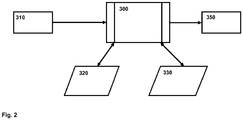
- FIG. 2 schematically illustrates the method and/or an in-vehicle system according to the present invention.
- a call trigger especially an emergency call trigger
- a manual emergency call trigger is detected (i.e. the emergency call button (or "eCall button") is pressed or activated by a passenger of the respective vehicle) or an automatic emergency call trigger is detected (i.e. triggered by, e.g. an airbag device is released in the vehicle and/or an acceleration above a certain threshold is detected.
- the respective USIM profile for the above mentioned call trigger of the first processing step 310) is activated dependent on the respective requirement, i.e.
- the emergency USIM profile is activated (i.e. the first or second USIM profile 241, 242, dependent, especially, on whether the in-vehicle system 20 is located in the first or second country), and, e.g., in case that the call trigger indicates that a commercial call should be placed or initiated by the in-vehicle system 20, then the commercial USIM profile is activated.
- the respective call is initiated.
- the determination in the second processing step 300 i.e.
- USIM profile to use or activate entails to take some information into consideration such as the location 320 (of the in-vehicle system 20) and/or profile information 330 (such as information on or about the available USIM profiles and/or the assignment table).
- location 320 of the in-vehicle system 20
- profile information 330 such as information on or about the available USIM profiles and/or the assignment table.
- the in-vehicle system 20 dynamically switches to the appropriate USIM profile.
- the in-vehicle system 20 might determine what type or method of emergency call is feasible and choose the most appropriate type (traditional voice emergency call, eCall).
- the in-vehicle system 20 is in dormant mode (i.e. not registered in the mobile communication network)
- the location data gained from the global navigation satellite system and contained in the MSD is assessed (the longitude and latitude contained in the MSD allows to identify the location).
- the PLMN ID of the network taking the call might be used to verify the location information and determine what type of emergency call is feasible (traditional voice emergency call, eCall) and choose the most appropriate profile.
- the PLMNID When registered to the mobile communication network, the PLMNID is permanently available to determine / doublecheck the location. To doublecheck the location information stemming from the MSD, the PLMNID of the serving network can be deployed as soon as it is available during a registration attempt when in limited service mode.
- emergency calls such as eCalls
- voice emergency calls can be configured such as to comply with local (regulatory) requirements while nevertheless allowing commercial services based on agreements amongst the MNOs (mobile network operators).
- the method may as well be beneficial, in order to allow to deploy a USIM profile that is eligible to fully register to the network and so enabling CLIP and thus Call-Back.
- the Mobile Terminal-based (i.e. in-vehicle system-based) analysis to perform a decision which USIM profile to use can either be run on: the eUICC and/or on the in-vehicle system (e.g.
- the analysis and assessment of the locally available data can, according to the present invention, be carried out either in dormant mode of the in-vehicle system 20, or in the active state (i.e. while registered to the network).
Landscapes
- Engineering & Computer Science (AREA)
- Computer Networks & Wireless Communication (AREA)
- Signal Processing (AREA)
- Business, Economics & Management (AREA)
- Health & Medical Sciences (AREA)
- Emergency Management (AREA)
- Environmental & Geological Engineering (AREA)
- Public Health (AREA)
- Databases & Information Systems (AREA)
- Mobile Radio Communication Systems (AREA)
Abstract
Description
- The present invention relates a method for using an in-vehicle system in at least a first and a second country or geographic region within a country, the in-vehicle system comprising at least one identity module with at least one secure element, the at least one secure element comprising one or a plurality of USIM profiles, each one of these USIM profiles being uniquely identified by one corresponding ICCID, integrated circuit card identifier, wherein the at least one secure element comprises at least a first USIM profile, universal subscriber identity module profile, wherein at least one USIM profile is used as an emergency USIM profile, this emergency USIM profile being used in case that an emergency call is initiated or has to be initiated by the in-vehicle system, to connect the in-vehicle system to an emergency handling instance or emergency handling node.
- Furthermore, the present invention relates to an in-vehicle system to be used in at least a first and a second country or geographic region within a country, wherein the in-vehicle system comprises at least one identity module with at least one secure element, the at least one secure element comprising one or a plurality of USIM profiles, each one of these USIM profiles being uniquely identified by one corresponding ICCID, integrated circuit card identifier, wherein the at least one secure element comprises at least a first USIM profile, universal subscriber identity module profile, wherein at least one USIM profile is used as an emergency USIM profile, this emergency USIM profile being used in case that an emergency call is initiated or has to be initiated by the in-vehicle system, to connect the in-vehicle system to an emergency handling instance or emergency handling node.
- Additionally, the present invention relates to a user equipment being used in or in connection with a vehicle, both the user equipment together with the vehicle forming an in-vehicle system to be used in at least a first and a second country or geographic region within a country, wherein the in-vehicle system comprises at least one identity module with at least one secure element, the at least one secure element comprising one or a plurality of USIM profiles, each one of these USIM profiles being uniquely identified by one corresponding ICCID, integrated circuit card identifier, wherein the at least one secure element comprises at least a first USIM profile, universal subscriber identity module profile, wherein at least one USIM profile is used as an emergency USIM profile, this emergency USIM profile being used in case that an emergency call is initiated or has to be initiated by the in-vehicle system, to connect the in-vehicle system to an emergency handling instance or emergency handling node.
- Furthermore, the present invention relates to a program and to a computer program product for using a mobile terminal in a mobile communication network.
- The term eCall refers to a European initiative intended to bring early assistance to road users especially involved in a collision anywhere in the European Union. Nowadays, eCall is a mandatory feature in all new cars sold in the European Union.
- In some geographic areas or countries, local (national or regional) regulation requires that for certain communication services (e.g. emergency call, eCall, M2M) specific requirements are to be respected in view of SIM profiles used, especially such as that only local SIM profiles are allowed, i.e. the use of at least specific, typically foreign SIM profiles is not allowed. Additionally in several countries permanent roaming restrictions prohibit the long term use of foreign SIM profiles.
- In order to comply with such regulatory restrictions, specific hardware and/or software solutions or specific configurations are typically required that are to be used in or for vehicles in or for the respective countries or geographic areas, which substantially increases costs in order to provide the original equipment components and software as well as the operational costs to provide corresponding services. Especially, in countries where the usage of a specific (e.g. local) SIM Profile is mandatory for certain services, or where other requirements apply, the conventionally known approach implies:
- -- substantially increased cost and complexity, especially for the respective mobile network operator, in order to comply with such regulatory requirements, thus, also increasing the respective costs for the automotive original equipment manufacturer;
- -- renders impossible or at least makes a lot more cumbersome to manage commercial services provided, e.g., by the automotive original equipment manufacturer and/or the mobile network operator;
- -- that an efficient deployment of global products and services, using only a dedicated preconfigured unique SIM profile, is either impossible or at least a lot more difficult.
- An object of the present invention is to provide an effective and simple solution such that an in-vehicle system (or a user equipment being used in or in connection with a vehicle such that the user equipment together with the vehicle are forming an in-vehicle system) is able to be built, provided as well as used in a more effective manner while nevertheless complying with all national or regional regulatory requirements, especially regarding the implementation of emergency-related or non-emergency-related communication needs, of either the road users or passengers of vehicles involved or regarding, e.g. configurations, updates and/or malfunctions of the vehicle itself.
- The object of the present invention is achieved by a method for using an in-vehicle system in at least a first and a second country or geographic region within a country,
wherein the in-vehicle system comprises at least one identity module with at least one secure element, the at least one secure element comprising one or a plurality of USIM profiles, each one of these USIM profiles being uniquely identified by one corresponding ICCID, integrated circuit card identifier, wherein the at least one secure element comprises at least a first USIM profile, universal subscriber identity module profile, wherein at least one USIM profile is used as an emergency USIM profile, this emergency USIM profile being used in case that an emergency call is initiated or has to be initiated by the in-vehicle system, to connect the in-vehicle system to an emergency handling instance or emergency handling node,
wherein - in case that the in-vehicle system is used in the first country or geographic region - the first USIM profile is initialized or prepared or activated to be used, by the in-vehicle system, as the emergency USIM profile,
wherein - in case that the in-vehicle system is used in the second country or geographic region - a second USIM profile is initialized or prepared or activated to be used, by the in-vehicle system, as the emergency USIM profile, the second USIM profile either being already comprised by the secure element, or provisioned or received upon the in-vehicle system approaching or entering the second country or geographic region,
the method comprising the following steps: - -- in a first step, approaching to enter or entering of the second country or geographic region by the in-vehicle system is determined,
- -- in a second step, subsequent to the first step, the second USIM profile is initialized or prepared or activated to be used, by the in-vehicle system, as the emergency USIM profile , and the first USIM profile is deactivated to be used as the emergency USIM profile.
- According to the present invention, it is advantageously possible that all regulatory restrictions or requirements (such as, e.g., the mandatory use of certain (especially only local) SIM profiles in certain countries, or restrictions regarding permanent roaming) are able to be complied with, while nevertheless providing the possibility to manage commercial services provided in a comparably easy and efficient manner (especially by the automotive original equipment manufacturer and/or the mobile network operator), and to allow for an efficient deployment of global products and services using a dedicated preconfigured unique SIM profile.
- Examples of regulatory restrictions or requirements especially include countries that require that vehicles enabled for eCall (i.e. to place, especially automatically, emergency calls or regulatory emergency calls) necessarily need to be equipped with local SIM profiles, i.e. SIM profiles of the respective country having such a requirement, like, e.g., in Brazil or Turkey. Hence, a mobile network operator, in order to comply with such a requirement, might need to run or own or co-own or cooperate with a local mobile network operator in the respective country, or a mobile virtual network operator. A further example of such regulatory restrictions or requirements relates to the requirement that all backend platforms regarding emergency calls (such as eCall backend platforms) need to be located in the respective country (such as Turkey, for instance). This in turn makes it impossible, e.g., to use a centralized service platform - such as, e.g., TMSP (Telekom M2M Service Platform) - for providing commercial services, and, hence, removing the possibility to provide (and to commercialize) a global "one stop shopping" approach covering almost all relevant markets and being able to provide an almost worldwide service.
- Historically, the design of regulatory emergency call systems, especially in vehicles, assumed (especially in case of the eCall system) that it is possible to comply with the regulatory requirements by deploying vehicles having a single SIM profile for both emergency calls and commercial services. As the examples show, this assumption no longer holds such that both the complexity and the costs of deploying and operating emergency call systems, such as eCall systems, will rise. Even though other emergency call systems, such as NIS ERA GLONAS, might have been designed assuming that a vehicle is equipped with two SIM profiles, it would not provide remedies (in view of a centralized service platform for providing commercial services and/or providing a global "one stop shopping" approach) in the mentioned situations of regulatory requirements.
- According to the present invention, a method for using an in-vehicle system is disclosed which should be able to be used or usable in as many countries as possible worldwide and using, as much as possible, one single original configuration and/or software and/or hardware complying with as many national or regional regulatory requirements as possible. Hence, this means that the in-vehicle system should be used in at least a first and a second country or geographic region within a country (but advantageously in many other countries or geographic regions. According to the present invention, such an in-vehicle system is equipped with (or comprises) at least one identity module with at least one secure element. The at least one secure element comprises one or a plurality of USIM profiles, each one of these USIM profiles being uniquely identified by one corresponding ICCID, integrated circuit card identifier. The at least one secure element comprises at least a first USIM profile, universal subscriber identity module profile. At least one USIM profile is used as an emergency USIM profile, this emergency USIM profile being used in case that an emergency call is initiated or has to be initiated by the in-vehicle system, to connect the in-vehicle system to an emergency handling instance or emergency handling node.
It is assumed according to the present invention that in a first country or geographic region a first USIM profile is able to be used (as the emergency USIM profile) and that - e.g. for regulatory reasons - in a second country or geographic region a second USIM profile needs to be used by the in-vehicle system (as the emergency USIM profile); hence, in case that the in-vehicle system is used in the first country or geographic region, the first USIM profile is initialized or prepared or activated to be used, by the in-vehicle system, as the emergency USIM profile. In case that the in-vehicle system is used in the second country or geographic region, the second USIM profile is initialized or prepared or activated to be used, by the in-vehicle system, as the emergency USIM profile. In case that the second USIM profile is already loaded or stored or comprised in the secure element of the in-vehicle system, it does not need to be retrieved or downloaded or otherwise transmitted or transferred to the in-vehicle system. However, in case that the second USIM profile is not yet loaded or stored or comprised in the secure element of the in-vehicle system, it needs to be retrieved or downloaded or provisioned or received upon the in-vehicle system approaching or entering the second country or geographic region. According to the present invention the method comprises that the fact (i.e. the determination or detection, by the vehicle or by the in-vehicle system or by any other sensor or data source) that the in-vehicle system is approaching to enter or entering the second country or geographic region is determined (in a first step), and; in a second step, subsequent to the first step, the second USIM profile is initialized or prepared or activated to be used, by the in-vehicle system, as the emergency USIM profile, and, accordingly, the first USIM profile is deactivated to be used as the emergency USIM profile. - Hence, according to the present invention, an automatic and non-static selection and switching of a SIM profile (or USIM profile) is provided, which is conditional to an analysis and assessment regarding especially the location of the in-vehicle system. Especially, the automatic and non-static selection and switching of USIM profile is provided conditional to the analysis and assessment of available credentials according to criteria and data available in the in-vehicle system (or mobile equipment) and according to the conditions in which the service is initiated. According to the present invention, the term "switching of a USIM profile" or "switching of the emergency USIM profile" corresponds to a setting or a configuration that is primarily made or stored in the in-vehicle system; it is able to encompass a corresponding registration or attachment with a mobile communication network, but in any case it does not need to encompass that the considered USIM profile and/or emergency USIM profile is actually registered and/or attached and/or connected with a mobile communication network (or its respective access network); hence a USIM profile or emergency USIM profile might be "switched on" or activated (to be the default emergency USIM profile), within the in-
vehicle system 20, while permanently (during a considered time interval) being unregistered or un-attached to the corresponding mobile communication network (e.g. because no emergency situation arose during the considered time interval). - According to the present invention, it is preferred that
- -- in case that the in-vehicle system is used in the first country or geographic region - the emergency USIM profile is used to connect the in-vehicle system to a first emergency handling instance or emergency handling node assigned to the first country or geographic region, and wherein, in case that the in-vehicle system is used in the second country or geographic region, the emergency USIM profile is used to connect the in-vehicle system to a second emergency handling instance or emergency handling node assigned to the second country or geographic region, and/or that
- -- the in-vehicle system - while being located in the second country or geographic region - is regulatorily required to use the second USIM profile in order to connect to the second emergency handling instance or emergency handling node.
- Thereby, it is advantageously possible to both efficiently contact the respective emergency handling instance or emergency handling node, especially a public safety answering point, and nevertheless comply with national or regional regulatory requirements.
- According to a further embodiment of the present invention, the first USIM profile is - in addition to being initialized or prepared or activated to be used, by the in-vehicle system, as the emergency USIM profile - also initialized or prepared or activated to be used, by the in-vehicle system, as a commercial USIM profile, this commercial USIM profile being used in case that especially a commercial exchange of data or a commercial call is initiated or has to be initiated by the in-vehicle system, to connect the in-vehicle system to a service provider instance or service provider node.
- Thereby, it is advantageously possible according to the present invention that the first USIM profile is able to be used as a commercial USIM profile.
- According to still a further embodiment of the present invention, the at least one secure element either comprises a third USIM profile or is provisioned by or receives a third USIM profile, wherein the third USIM profile is initialized or prepared or activated to be used, by the in-vehicle system, as a commercial USIM profile, this commercial USIM profile being used in case that especially a commercial exchange of data or a commercial call is initiated or has to be initiated by the in-vehicle system, to connect the in-vehicle system to a service provider instance or service provider node.
- According to the present invention, it is thereby advantageously possible that the third USIM profile used as the commercial USIM profile, i.e. for example in order to provide the in-vehicle system to connect to a service center of either the mobile network operator or of the automotive original equipment manufacturer.
- According to the present invention, it is preferred that the in-vehicle system, especially the secure element of the in-vehicle system, comprises an information, especially in form of an assignment table, wherein a plurality of different USIM profiles, to be used as emergency USIM profiles, are assigned to a plurality of different countries or geographic regions within a country, wherein especially in this assignment, a USIM profile is assigned to a plurality of different countries or geographic regions, and a further USIM profile is assigned to a country or geographic region where it is regulatorily required to use the further USIM profile.
- According to the present invention, it is thereby advantageously possible that the in-vehicle system can be provided in a very flexible and universally usable manner. Especially, it is possible that a specific USIM profile (such as the first USIM profile) might be used in a plurality of different countries having less special or less strict regulatory requirements, and that another specific (but different to the first USIM profile) USIM profile (such as the second USIM profile) is used in case that the vehicle is used or brought into a country or geographic area where more strict regulatory requirements apply (necessitating the use of the other specific (or second) USIM profile.
- According to a further embodiment of the present invention, the choice of the second USIM profile among a plurality of different USIM profiles is dependent on a time stamp information.
- Thereby, it is advantageously possible according to the present invention that, e.g., the use of the second USIM profile can be made dependent on a certain time of the day or a certain day of the week or any predefined period in time.
- According to the present invention, it is preferred that - while the in-vehicle system is located in the first country or geographic region - a first local access network of a first mobile communication network is available to the in-vehicle system, and wherein - while the in-vehicle system is located in the second country or geographic region - a second local access network of a second mobile communication network is available to the in-vehicle system, wherein the in-vehicle system uses the first USIM profile with the first local access network and the first mobile communication network while being located in the first country or geographic region, wherein the in-vehicle system is regulatorily required to use the second USIM profile with the second local access network and the second mobile communication network while being located in the second country or geographic region, and
wherein, depending on its location, the in-vehicle system uses the third USIM profile with either the first local access network or the second local access network, and their respective first mobile communication network or second mobile communication network. - According to the present invention, it is thereby advantageously possible to both comply with the regulatory requirement according to which specific USIM profiles and/or local access networks are to be used for emergency calls, and nevertheless be able to choose the USIM profile and/or the access network for commercial services.
- According to a further embodiment of the present invention, the determination of either approaching to enter, or entering the second country or geographic region is based on at least one out of the following events or pieces of information:
- -- the in-vehicle system detects the presence or availability of the second local access network or of the second mobile communication network, especially by means of the corresponding PLMN ID information, public land mobile network identity information,
- -- the in-vehicle system connects to the second local access network or of the second mobile communication network,
- -- the position of the in-vehicle system obtained by using a global navigation satellite system indicates that the in-vehicle system either approaches the second country or geographic region or that the in-vehicle system enters the second country or geographic region.
- Thereby, it is advantageously possible according to the present invention that different sources of information are able to be used in order to determine the in-vehicle system either approaching to enter or entering the second country or geographic region.
- According to the present invention, it is preferred that initializing or preparing or activating the second USIM profile, and deactivating the first USIM profile is triggered by the determination of the in-vehicle system approaching to enter or entering of the second country or geographic region, only, and especially does not require an emergency call to be actually initiated or to be required to be initiated, as it is especially the case if an accident occurs.
- According to the present invention, it is thereby advantageously possible that upon entering the second country or geographic region the correct USIM profile is ready to be used, and - in an emergency situation such as in case of an accident - no additional delay is required or needed (in order to first select the correct USIM profile to use or to be applied in the current country or geographical area) prior to actually placing the emergency call.
- According to the present invention, it is preferred that the decision of the in-vehicle system either approaching to enter, or entering the second country or geographic region is taken by either
- -- the identity module and/or the secure element, especially the eUICC, embedded universal integrated circuit card, of the in-vehicle system, and/or
- -- the in-vehicle system or its mobile equipment, and/or
- -- an application run on the in-vehicle system or its mobile equipment,
- According to the present invention, it is thereby advantageously possible that the detection of the in-vehicle system either approaching to enter, or entering the second country or geographic region is able to be independent from the network attachment status (or network registration status) of the in-vehicle system with regard to the local access network.
- Furthermore, the present invention relates to an in-vehicle system to be used in at least a first and a second country or geographic region within a country,
wherein the in-vehicle system comprises at least one identity module with at least one secure element, the at least one secure element comprising one or a plurality of USIM profiles, each one of these USIM profiles being uniquely identified by one corresponding ICCID, integrated circuit card identifier, wherein the at least one secure element comprises at least a first USIM profile, universal subscriber identity module profile, wherein at least one USIM profile is used as an emergency USIM profile, this emergency USIM profile being used in case that an emergency call is initiated or has to be initiated by the in-vehicle system, to connect the in-vehicle system to an emergency handling instance or emergency handling node, wherein - in case that the in-vehicle system is used in the first country or geographic region - the first USIM profile is initialized or prepared or activated to be used, by the in-vehicle system, as the emergency USIM profile,
wherein - in case that the in-vehicle system is used in the second country or geographic region - a second USIM profile is initialized or prepared or activated to be used, by the in-vehicle system, as the emergency USIM profile, the second USIM profile either being already comprised by the secure element, or provisioned or received upon the in-vehicle system approaching or entering the second country or geographic region,
wherein the in-vehicle system is configured such that: - -- approaching to enter or entering of the second country or geographic region by the in-vehicle system is determined,
- -- the second USIM profile is initialized or prepared or activated to be used, by the in-vehicle system, as the emergency USIM profile, and the first USIM profile is deactivated to be used as the emergency USIM profile.
- Thereby, it is advantageously possible to provide an in-vehicle system that is able to comply with all regulatory restrictions or requirements (such as, e.g., the mandatory use of certain (especially only local) SIM profiles in certain countries, or restrictions regarding permanent roaming), while nevertheless providing the possibility to manage commercial services provided in a comparably easy and efficient manner, and to allow for an efficient deployment of global products and services using a dedicated preconfigured unique SIM profile.
- Furthermore, the present invention relates to a user equipment being used in or in connection with a vehicle, both the user equipment together with the vehicle forming an in-vehicle system to be used in at least a first and a second country or geographic region within a country,
wherein the in-vehicle system comprises at least one identity module with at least one secure element, the at least one secure element comprising one or a plurality of USIM profiles, each one of these USIM profiles being uniquely identified by one corresponding ICCID, integrated circuit card identifier, wherein the at least one secure element comprises at least a first USIM profile, universal subscriber identity module profile, wherein at least one USIM profile is used as an emergency USIM profile, this emergency USIM profile being used in case that an emergency call is initiated or has to be initiated by the in-vehicle system, to connect the in-vehicle system to an emergency handling instance or emergency handling node, wherein - in case that the in-vehicle system is used in the first country or geographic region - the first USIM profile is initialized or prepared or activated to be used, by the in-vehicle system, as the emergency USIM profile,
wherein - in case that the in-vehicle system is used in the second country or geographic region - a second USIM profile is initialized or prepared or activated to be used, by the in-vehicle system, as the emergency USIM profile, the second USIM profile either being already comprised by the secure element, or provisioned or received upon the in-vehicle system approaching or entering the second country or geographic region,
wherein the user equipment or in-vehicle system is configured such that: - -- approaching to enter or entering of the second country or geographic region by the in-vehicle system is determined,
- -- the second USIM profile is initialized or prepared or activated to be used, by the in-vehicle system, as the emergency USIM profile, and the first USIM profile is deactivated to be used as the emergency USIM profile.
- Thereby, it is advantageously possible to provide a user equipment being used in or in connection with a vehicle that is able to comply with all regulatory restrictions or requirements (such as, e.g., the mandatory use of certain (especially only local) SIM profiles in certain countries, or restrictions regarding permanent roaming), while nevertheless providing the possibility to manage commercial services provided in a comparably easy and efficient manner, and to allow for an efficient deployment of global products and services using a dedicated preconfigured unique SIM profile.
- Additionally, the present invention relates to a program comprising a computer readable program code which, when executed on a computer or on an identity module and/or on a secure element of an in-vehicle system and/or on an in-vehicle system or its mobile equipment, or in part on the identity module and/or on the secure element and in part on the in-vehicle system or its mobile equipment, causes the computer or the identity module or the secure element or the in-vehicle system to perform the inventive method.
- Still additionally, the present invention relates to a computer program product for using an in-vehicle system in at least a first and a second country or geographic region within a country, the computer program product comprising a computer program stored on a storage medium, the computer program comprising program code which, when executed on a computer or on an identity module and/or on a secure element of an in-vehicle system and/or on an in-vehicle system or its mobile equipment, or in part on the identity module and/or on the secure element and in part on the in-vehicle system or its mobile equipment, causes the computer or the identity module or the secure element or the in-vehicle system to perform the inventive method.
- These and other characteristics, features and advantages of the present invention will become apparent from the following detailed description, taken in conjunction with the accompanying drawings, which illustrate, by way of example, the principles of the invention. The description is given for the sake of example only, without limiting the scope of the invention. The reference figures quoted below refer to the attached drawings.
-
-
Figure 1 schematically illustrate an in-vehicle system according to the present invention, being located in a coverage area of a first mobile communication network (of a first country or geographic area) and being potentially moving towards the coverage area of a second mobile communication network (of a second country or geographic area). -
Figure 2 schematically illustrates the method and an in-vehicle system according to the present invention. - The present invention will be described with respect to particular embodiments and with reference to certain drawings but the invention is not limited thereto but only by the claims. The drawings described are only schematic and are nonlimiting. In the drawings, the size of some of the elements may be exaggerated and not drawn on scale for illustrative purposes.
- Where an indefinite or definite article is used when referring to a singular noun, e.g. "a", "an", "the", this includes a plural of that noun unless something else is specifically stated.
- Furthermore, the terms first, second, third and the like in the description and in the claims are used for distinguishing between similar elements and not necessarily for describing a sequential or chronological order. It is to be understood that the terms so used are interchangeable under appropriate circumstances and that the embodiments of the invention described herein are capable of operation in other sequences than described or illustrated herein.
- In
Figure 1 , a firstmobile communication network 100 such as a public land mobile network is schematically shown together with a secondmobile communication network 200, likewise typically a public land mobile network. A border 10 between a first country (or geographic area) above the border 10 and a second country (or geographic area) below the border 10 is schematically indicated. Roughly, the firstmobile communication network 100 covers or intends to cover the first country or geographic area (above the border 10), and the secondmobile communication network 200 covers or intends to cover the second country or geographic area (below the border 10). The firstmobile communication network 100 comprises afirst access network 110 and afirst core network 120, and likewise the secondmobile communication network 200 comprises asecond access network 210 and asecond core network 220. Bothmobile communication networks Figure 1 , a first radio cell 110' (having a base station entity 111) as part of the firstmobile communication network 100, and a second radio cell 210' (having also a base station entity but which is not represented inFigure 1 ) as part of the secondmobile communication network 200. The firstmobile communication network 100 comprises a first emergency handling instance oremergency handling node 150 assigned to the first country or geographic region, and the secondmobile communication network 200 comprises a second emergency handling instance oremergency handling node 250 assigned to the second country or geographic region. Furthermore, the firstmobile communication network 100 comprises or is able to connect to a service provider instance orservice provider node 160. - An in-
vehicle system 20 is schematically shown, inFigure 1 , being located in the coverage area of the first mobile communication network 100 (as well as being located in the first country or geographical area and in the coverage area of the first radio cell 110') and moving towards the second country (or at least towards the border between the first and second countries), indicated by an arrow inFigure 1 . The in-vehicle system 20 comprises anidentity module 22 with asecure element 24. The in-vehicle system 20 might comprise further identity modules (besides the identity module 22) and/or further secure elements (besides the secure element 24). - The
secure element 24 comprises at least one USIM profile (or universal subscriber identity module profile), but preferably thesecure element 24 comprises a plurality of USIM profiles. Whatever the number of USIM profiles, each one of these USIM profiles is uniquely identified by one corresponding ICCID or integrated circuit card identifier. - In order to differentiate the possible plurality of USIM profiles (or the only one USIM profile) of the
secure element 24, these USIM profiles are labelled by "first", "second", etc. Hence, the at least onesecure element 24 comprises at least afirst USIM profile 241. In the exemplary embodiment shown inFigure 1 , thesecure element 24 is shown to have or to comprise also asecond USIM profile 242, and athird USIM profile 243. - At least one (and typically exactly one) USIM profile (of the plurality of the USIM profiles) is used (or defined) as an emergency USIM profile (or rather - as typically there is exactly one USIM defined or used as emergency USIM profile - the emergency USIM profile), this emergency USIM profile being defined or assigned to be used in case that an emergency call is initiated or has to be initiated, by the in-
vehicle system 20, i.e. to connect the in-vehicle system 20 to an emergency handling instance or emergency handling node. While a plurality of USIM profiles might, in principle, be used as emergency USIM profiles, there is typically only one designated (or assigned) emergency USIM profile being used (as emergency USIM profile) in case that an emergency call needs to be placed, i.e. which one (of a plurality of USIM profiles present in the secure element 24) is defined or assigned to be the emergency USIM profile (of thesecure element 24 and, hence, of the in-vehicle system 20) might change, but in any case one of the possibly plurality of USIM profiles is always designated or assigned to be the emergency USIM profile. According to the present invention, it is assumed that - in case that the in-vehicle system 20 is used in the first country or geographic region - thefirst USIM profile 241 is initialized or prepared or activated to be used, by the in-vehicle system 20, as the (defined or assigned) emergency USIM profile, whereas - in case that the in-vehicle system 20 is used in the second country or geographic region - thesecond USIM profile 242 is initialized or prepared or activated to be used, by the in-vehicle system (20), as the (defined or assigned) emergency USIM profile. In case that, at the time of crossing the border 10 (or approaching the border 10) - from within the first country or geographic region towards the second country or geographic region, thesecond USIM profile 242 is already comprised by thesecure element 24 then the designation or definition of the emergency USIM profile just needs to be switched to thesecond USIM profile 242. Otherwise, in case that (at the time of crossing the border 10 or approaching the border 10) thesecond USIM profile 242 is not comprised by thesecure element 24, thesecond USIM profile 242 needs to be provisioned or received by (or otherwise transmitted) the in-vehicle system 20 upon the in-vehicle system 20 approaching or entering the second country or geographic region. Then, according to the present invention, in a first step, this situation (i.e. the in-vehicle system 20 approaching or entering the second country or geographic region) is detected or determined, by the in-vehicle system 20 (or otherwise detected, e.g. by the vehicle, and communicated to the in-vehicle system 20), and in a second step, subsequent to the first step, thesecond USIM profile 242 is initialized or prepared or activated to be used, by the in-vehicle system 20, as the (assigned or defined) emergency USIM profile, and thefirst USIM profile 241 is deactivated to be used (i.e. de-assigned) as the emergency USIM profile. According to the present invention, this switch (or change) of the emergency USIM profile occurs independently from whether an emergency situation applies or not. Thereby, it is advantageously possible to comply with the regulatory requirement - within the second country or geographic area - to mandatorily use a specific USIM profile (i.e. the second USIM profile) as the emergency USIM profile (in case that an emergency situations requires the in-vehicle system 20 to place an emergency call or to trigger an emergency procedure), and nevertheless to use, in an emergency situation, the first USIM profile in the first country (and typically also in other countries other than the second country) as the designated or assigned emergency USIM profile. - In case that such an emergency situation applies and the in-
vehicle system 20 is used (or located) in the first country or geographic region, the emergency USIM profile (i.e. the first USIM profile) is used to connect the in-vehicle system 20 to the first emergency handling instance or emergency handling node 150 (which is typically assigned to the first country or geographic region). However, if such an emergency situation applies and the in-vehicle system 20 is used in the second country or geographic region, the emergency USIM profile (i.e. the second USIM profile) is used to connect the in-vehicle system 20 to the second emergency handling instance or emergency handling node 250 (which is typically assigned to the second country or geographic region). - According to a further variant of the present invention, the
first USIM profile 241 might also be initialized or prepared or activated to be used as a commercial USIM profile (in addition to being used as the emergency USIM profile), this commercial USIM profile being used in case that especially a commercial exchange of data or a commercial call is initiated or has to be initiated by the in-vehicle system 20 in order to connect to a service provider instance orservice provider node 160. However, according to still a further variant of the present invention thesecure element 24 has athird USIM profile 243 to be used, by the in-vehicle system 20, as the commercial USIM profile. In this case, thesecure element 24 might either already comprise thethird USIM profile 243, or thethird USIM profile 243 is provisioned to the in-vehicle system 20 (i.e. the in-vehicle system 20 or thesecure element 24 receives the third USIM profile (243). - According to a further variant of the present invention, the
secure element 24 or, more generally, the in-vehicle system 20, comprises an information, especially in form of an assignment table, such that a plurality of different USIM profiles (that are potentially used as emergency USIM profiles) are assigned to (or related to) a plurality of different countries or geographic regions within a country. In case that it is detected that the in-vehicle system 20 is located within a country (such as the second country) to which a different emergency USIM profile is assigned (in or according to the assignment table) than the currently defined or assigned USIM profile, the assignment or the definition of the emergency USIM profile is switched such in a manner analogous to the transision of the in-vehicle system 20 from the first country to the second country and the switch of the emergency USIM profile from the first USIM profile to the second USIM profile. Especially, in the assignment table, a USIM profile (such as the first USIM profile) is assigned to a plurality of different countries or geographic regions, and a further USIM profile (such as the second USIM profile) is assigned to a specific country or geographic region (such as the second country) where it is regulatorily required to use the further USIM profile. - According to still a further variant of the present invention, while the regulatory requirement within the second country of geographical area might require to use the second USIM profile as the emergency USIM profile (i.e. in case of an emergency situation, the second USIM profile (as the assigned or defined emergency USIM profile upon entering the second country) is used while the in-
vehicle system 20 being located in the second country or geographic area), it might nevertheless be regulatorily possible (even while the in-vehicle system 20 being located in the second country or geographical area) to use thefirst USIM profile 241 or thethird USIM profile 243 for commercial purposes, i.e. to connect the in-vehicle system 20 to the service provider instance orservice provider node 160. - Hence, according to the present invention, an automatic non-static selection and switching of a SIM Profile (or, rather, USIM profile) is provided, conditional to an analysis and assessment of available credentials according to criteria and data available in the in-vehicle system 20 (or mobile equipment) and according to the conditions in which the service is initiated.
-
Figure 2 schematically illustrates the method and/or an in-vehicle system according to the present invention. In afirst processing step 310, a call trigger, especially an emergency call trigger, is detected, e.g. either a manual emergency call trigger is detected (i.e. the emergency call button (or "eCall button") is pressed or activated by a passenger of the respective vehicle) or an automatic emergency call trigger is detected (i.e. triggered by, e.g. an airbag device is released in the vehicle and/or an acceleration above a certain threshold is detected. In asecond processing step 300, the respective USIM profile (for the above mentioned call trigger of the first processing step 310) is activated dependent on the respective requirement, i.e. in case that the call trigger indicates that an emergency call should be placed or initiated, then the emergency USIM profile is activated (i.e. the first orsecond USIM profile vehicle system 20 is located in the first or second country), and, e.g., in case that the call trigger indicates that a commercial call should be placed or initiated by the in-vehicle system 20, then the commercial USIM profile is activated. In athird processing step 330, the respective call is initiated. Especially according to the present invention, the determination in the second processing step 300 (i.e. which USIM profile to use or activate) entails to take some information into consideration such as the location 320 (of the in-vehicle system 20) and/or profile information 330 (such as information on or about the available USIM profiles and/or the assignment table).
This means, that especially the following applies according to the present invention:
In case a call is triggered (first processing step 310), a function determines thelocation 320, and the location information is assessed against parameters to determine whether the configured SIM Profile is appropriate to suit the local requirements (second processing step 300). In practice, the most appropriate SIM profile or USIM profile is able to depend from variables e.g. like time of day, region within the country and others. Lists (such as the assignment table) comprising data to determine the appropriate USIM profile are able to be consulted. In case that the in-vehicle system 20 is registered to the mobile communication network for commercial services, the PLMN ID of the mobile communication network (indicating the country in which the call is triggered) is assessed. In a second step location data gained from the GNSS (global navigation satellite system) and contained in the MSD (minimum set of data) might be used to verify the location information of the in-vehicle system 20. Provided the assessment in the in-vehicle system 20 determines that the in-vehicle system 20 is in a country which requires a specific (e.g. local) USIM profile, the in-vehicle system 20 dynamically switches to the appropriate USIM profile. In addition, the in-vehicle system 20 might determine what type or method of emergency call is feasible and choose the most appropriate type (traditional voice emergency call, eCall).
In case that the in-vehicle system 20 is in dormant mode (i.e. not registered in the mobile communication network), first the location data gained from the global navigation satellite system and contained in the MSD (minimum set of data) is assessed (the longitude and latitude contained in the MSD allows to identify the location). Secondly, the PLMN ID of the network taking the call might be used to verify the location information and determine what type of emergency call is feasible (traditional voice emergency call, eCall) and choose the most appropriate profile.
When registered to the mobile communication network, the PLMNID is permanently available to determine / doublecheck the location. To doublecheck the location information stemming from the MSD, the PLMNID of the serving network can be deployed as soon as it is available during a registration attempt when in limited service mode. - According to the present invention, the following benefits are able to be realized compared to conventionally known systems:
emergency calls (such as eCalls) and/or voice emergency calls can be configured such as to comply with local (regulatory) requirements while nevertheless allowing commercial services based on agreements amongst the MNOs (mobile network operators). The method may as well be beneficial, in order to allow to deploy a USIM profile that is eligible to fully register to the network and so enabling CLIP and thus Call-Back. Furthermore, the Mobile Terminal-based (i.e. in-vehicle system-based) analysis to perform a decision which USIM profile to use can either be run on: the eUICC and/or on the in-vehicle system (e.g. in the eCall-system in the vehicle) and/or on an app(lication) run on the mobile equipment or in-vehicle system 20. The analysis and assessment of the locally available data can, according to the present invention, be carried out either in dormant mode of the in-vehicle system 20, or in the active state (i.e. while registered to the network).
Claims (15)
- Method for using an in-vehicle system (20) in at least a first and a second country or geographic region within a country,
wherein the in-vehicle system (20) comprises at least one identity module (22) with at least one secure element (24), the at least one secure element (24) comprising one or a plurality of USIM profiles, each one of these USIM profiles being uniquely identified by one corresponding ICCID, integrated circuit card identifier, wherein the at least one secure element (24) comprises at least a first USIM profile (241), universal subscriber identity module profile,
wherein at least one USIM profile is used as an emergency USIM profile, this emergency USIM profile being used in case that an emergency call is initiated or has to be initiated by the in-vehicle system (20), to connect the in-vehicle system (20) to an emergency handling instance or emergency handling node, wherein - in case that the in-vehicle system (20) is used in the first country or geographic region - the first USIM profile (241) is initialized or prepared or activated to be used, by the in-vehicle system (20), as the emergency USIM profile,
wherein - in case that the in-vehicle system (20) is used in the second country or geographic region - a second USIM profile (242) is initialized or prepared or activated to be used, by the in-vehicle system (20), as the emergency USIM profile, the second USIM profile (242) either being already comprised by the secure element (24), or provisioned or received upon the in-vehicle system (20) approaching or entering the second country or geographic region,
the method comprising the following steps:-- in a first step, approaching to enter or entering of the second country or geographic region by the in-vehicle system (20) is determined,-- in a second step, subsequent to the first step, the second USIM profile (242) is initialized or prepared or activated to be used, by the in-vehicle system (20), as the emergency USIM profile , and the first USIM profile (241) is deactivated to be used as the emergency USIM profile. - Method according to claim 1, wherein, in case that the in-vehicle system (20) is used in the first country or geographic region, the emergency USIM profile is used to connect the in-vehicle system (20) to a first emergency handling instance or emergency handling node (150) assigned to the first country or geographic region, and wherein, in case that the in-vehicle system (20) is used in the second country or geographic region, the emergency USIM profile is used to connect the in-vehicle system (20) to a second emergency handling instance or emergency handling node (250) assigned to the second country or geographic region.
- Method according to one of the preceding claims, wherein the in-vehicle system (20) - while being located in the second country or geographic region - is regulatorily required to use the second USIM profile (242) in order to connect to the second emergency handling instance or emergency handling node (250).
- Method according to one of the preceding claims, wherein the first USIM profile (241) is - in addition to being initialized or prepared or activated to be used, by the in-vehicle system (20), as the emergency USIM profile - also initialized or prepared or activated to be used, by the in-vehicle system (20), as a commercial USIM profile, this commercial USIM profile being used in case that especially a commercial exchange of data or a commercial call is initiated or has to be initiated by the in-vehicle system (20), to connect the in-vehicle system (20) to a service provider instance or service provider node (160).
- Method according to one of the preceding claims, wherein the at least one secure element (24) either comprises a third USIM profile (243) or is provisioned by or receives a third USIM profile (243), wherein the third USIM profile (243) is initialized or prepared or activated to be used, by the in-vehicle system (20), as a commercial USIM profile, this commercial USIM profile being used in case that especially a commercial exchange of data or a commercial call is initiated or has to be initiated by the in-vehicle system (20), to connect the in-vehicle system (20) to a service provider instance or service provider node (160).
- Method according to one of the preceding claims, wherein the in-vehicle system (20), especially the secure element (24) of the in-vehicle system (20), comprises an information, especially in form of an assignment table, wherein a plurality of different USIM profiles, to be used as emergency USIM profiles, are assigned to a plurality of different countries or geographic regions within a country, wherein especially in this assignment table, a USIM profile is assigned to a plurality of different countries or geographic regions, and a further USIM profile is assigned to a country or geographic region where it is regulatorily required to use the further USIM profile.
- Method according to one of the preceding claims, wherein the choice of the second USIM profile (242) among a plurality of different USIM profiles is dependent on a time stamp information.
- Method according to one of the preceding claims, wherein - while the in-vehicle system (20) is located in the first country or geographic region - a first local access network (110) of a first mobile communication network (100) is available to the in-vehicle system (20), and wherein - while the in-vehicle system (20) is located in the second country or geographic region - a second local access network (210) of a second mobile communication network (200) is available to the in-vehicle system (20),
wherein the in-vehicle system (20) uses the first USIM profile (241) with the first local access network (110) and the first mobile communication network (100) while being located in the first country or geographic region,
wherein the in-vehicle system (20) is regulatorily required to use the second USIM profile (242) with the second local access network (210) and the second mobile communication network (200) while being located in the second country or geographic region, and
wherein, depending on its location, the in-vehicle system (20) uses the third USIM profile (243) with either the first local access network (110) or the second local access network (210), and their respective first mobile communication network (100) or second mobile communication network (200). - Method according to one of the preceding claims, wherein the determination of either approaching to enter, or entering the second country or geographic region is based on at least one out of the following events or pieces of information:-- the in-vehicle system (20) detects the presence or availability of the second local access network (210) or of the second mobile communication network (200), especially by means of the corresponding PLMN ID information, public land mobile network identity information,-- the in-vehicle system (20) connects to the second local access network (210) or of the second mobile communication network (200),-- the position of the in-vehicle system (20) obtained by using a global navigation satellite system indicates that the in-vehicle system (20) either approaches the second country or geographic region or that the in-vehicle system (20) enters the second country or geographic region.
- Method according to one of the preceding claims, wherein initializing or preparing or activating the second USIM profile (242), and deactivating the first USIM profile (241) is triggered by the determination of the in-vehicle system (20) approaching to enter or entering of the second country or geographic region, only, and especially does not require an emergency call to be actually initiated or to be required to be initiated, as it is especially the case if an accident occurs.
- Method according to one of the preceding claims, wherein the decision of the in-vehicle system (20) either approaching to enter, or entering the second country or geographic region is taken by either-- the identity module (22) and/or the secure element (24), especially the eUICC, embedded universal integrated circuit card, of the in-vehicle system (20), and/or-- the in-vehicle system (20) or its mobile equipment, and/or-- an application run on the in-vehicle system (20) or its mobile equipment, and wherein this decision of the in-vehicle system (20) either approaching to enter, or entering the second country or geographic region is able to be taken while the in-vehicle system (20) or its mobile equipment is either in dormant mode or in active state.
- In-vehicle system (20) to be used in at least a first and a second country or geographic region within a country,
wherein the in-vehicle system (20) comprises at least one identity module (22) with at least one secure element (24), the at least one secure element (24) comprising one or a plurality of USIM profiles, each one of these USIM profiles being uniquely identified by one corresponding ICCID, integrated circuit card identifier, wherein the at least one secure element (24) comprises at least a first USIM profile (241), universal subscriber identity module profile,
wherein at least one USIM profile is used as an emergency USIM profile, this emergency USIM profile being used in case that an emergency call is initiated or has to be initiated by the in-vehicle system (20), to connect the in-vehicle system (20) to an emergency handling instance or emergency handling node, wherein - in case that the in-vehicle system (20) is used in the first country or geographic region - the first USIM profile (241) is initialized or prepared or activated to be used, by the in-vehicle system (20), as the emergency USIM profile,
wherein - in case that the in-vehicle system (20) is used in the second country or geographic region - a second USIM profile (242) is initialized or prepared or activated to be used, by the in-vehicle system (20), as the emergency USIM profile, the second USIM profile (242) either being already comprised by the secure element (24), or provisioned or received upon the in-vehicle system (20) approaching or entering the second country or geographic region,
wherein the in-vehicle system (20) is configured such that:-- approaching to enter or entering of the second country or geographic region by the in-vehicle system (20) is determined,-- the second USIM profile (242) is initialized or prepared or activated to be used, by the in-vehicle system (20), as the emergency USIM profile, and the first USIM profile (241) is deactivated to be used as the emergency USIM profile. - User equipment being used in or in connection with a vehicle, both the user equipment or mobile terminal together with the vehicle forming an in-vehicle system (20) to be used in at least a first and a second country or geographic region within a country,
wherein the in-vehicle system (20) comprises at least one identity module (22) with at least one secure element (24), the at least one secure element (24) comprising one or a plurality of USIM profiles, each one of these USIM profiles being uniquely identified by one corresponding ICCID, integrated circuit card identifier, wherein the at least one secure element (24) comprises at least a first USIM profile (241), universal subscriber identity module profile,
wherein at least one USIM profile is used as an emergency USIM profile, this emergency USIM profile being used in case that an emergency call is initiated or has to be initiated by the in-vehicle system (20), to connect the in-vehicle system (20) to an emergency handling instance or emergency handling node, wherein - in case that the in-vehicle system (20) is used in the first country or geographic region - the first USIM profile (241) is initialized or prepared or activated to be used, by the in-vehicle system (20), as the emergency USIM profile,
wherein - in case that the in-vehicle system (20) is used in the second country or geographic region - a second USIM profile (242) is initialized or prepared or activated to be used, by the in-vehicle system (20), as the emergency USIM profile, the second USIM profile (242) either being already comprised by the secure element (24), or provisioned or received upon the in-vehicle system (20) approaching or entering the second country or geographic region, wherein the user equipment or in-vehicle system (20) is configured such that:-- approaching to enter or entering of the second country or geographic region by the in-vehicle system (20) is determined,-- the second USIM profile (242) is initialized or prepared or activated to be used, by the in-vehicle system (20), as the emergency USIM profile, and the first USIM profile (241) is deactivated to be used as the emergency USIM profile. - Program comprising a computer readable program code which, when executed on a computer or on an identity module (22) and/or on a secure element (24) of an in-vehicle system (20) and/or on an in-vehicle system (20) or its mobile equipment, or in part on the identity module (22) and/or on the secure element (24) and in part on the in-vehicle system (20) or its mobile equipment, causes the computer or the identity module (22) or the secure element (24) or the in-vehicle system (20) to perform a method according one of claims 1 to 11.
- Computer program product for using an in-vehicle system (20) in at least a first and a second country or geographic region within a country, the computer program product comprising a computer program stored on a storage medium, the computer program comprising program code which, when executed on a computer or on an identity module (22) and/or on a secure element (24) of an in-vehicle system (20) and/or on an in-vehicle system (20) or its mobile equipment, or in part on the identity module (22) and/or on the secure element (24) and in part on the in-vehicle system (20) or its mobile equipment, causes the computer or the identity module (22) or the secure element (24) or the in-vehicle system (20) to perform a method according one of claims 1 to 11.
Priority Applications (2)
| Application Number | Priority Date | Filing Date | Title |
|---|---|---|---|
| EP19186283.8A EP3767980B1 (en) | 2019-07-15 | 2019-07-15 | Method for using an in-vehicle system in at least a first and a second country or geographic region within a country, and in-vehicle system |
| PCT/EP2020/070010 WO2021009235A1 (en) | 2019-07-15 | 2020-07-15 | Method for using an in-vehicle system in at least a first and a second country or geographic region within a country, and in-vehicle system |
Applications Claiming Priority (1)
| Application Number | Priority Date | Filing Date | Title |
|---|---|---|---|
| EP19186283.8A EP3767980B1 (en) | 2019-07-15 | 2019-07-15 | Method for using an in-vehicle system in at least a first and a second country or geographic region within a country, and in-vehicle system |
Publications (2)
| Publication Number | Publication Date |
|---|---|
| EP3767980A1 true EP3767980A1 (en) | 2021-01-20 |
| EP3767980B1 EP3767980B1 (en) | 2021-09-22 |
Family
ID=67303369
Family Applications (1)
| Application Number | Title | Priority Date | Filing Date |
|---|---|---|---|
| EP19186283.8A Active EP3767980B1 (en) | 2019-07-15 | 2019-07-15 | Method for using an in-vehicle system in at least a first and a second country or geographic region within a country, and in-vehicle system |
Country Status (2)
| Country | Link |
|---|---|
| EP (1) | EP3767980B1 (en) |
| WO (1) | WO2021009235A1 (en) |
Families Citing this family (3)
| Publication number | Priority date | Publication date | Assignee | Title |
|---|---|---|---|---|
| CN112954650B (en) * | 2021-03-31 | 2022-11-22 | 东风汽车集团股份有限公司 | Tunnel-based network switching method and device, mobile carrier and storage medium |
| JP2026083460A (en) * | 2023-03-24 | 2026-05-20 | 日立建機株式会社 | Vehicle information management system, communication terminal, and server |
| CN116582851B (en) * | 2023-06-09 | 2025-12-05 | 交控科技股份有限公司 | Vehicle-to-ground LTE wireless network access method, apparatus, equipment and storage medium |
Citations (3)
| Publication number | Priority date | Publication date | Assignee | Title |
|---|---|---|---|---|
| EP2900015A1 (en) * | 2014-01-27 | 2015-07-29 | Deutsche Telekom AG | Dynamically influencing the choice of a mobile network operator profile used by a user equipment comprising an embedded identity module |
| EP2947856A1 (en) * | 2013-01-17 | 2015-11-25 | Clarion Co., Ltd. | Telematic s controller, vehicle, and telematics control method |
| US20170048713A1 (en) * | 2015-08-14 | 2017-02-16 | Microsoft Technology Licensing, Llc | Delegated profile and policy management |
-
2019
- 2019-07-15 EP EP19186283.8A patent/EP3767980B1/en active Active
-
2020
- 2020-07-15 WO PCT/EP2020/070010 patent/WO2021009235A1/en not_active Ceased
Patent Citations (3)
| Publication number | Priority date | Publication date | Assignee | Title |
|---|---|---|---|---|
| EP2947856A1 (en) * | 2013-01-17 | 2015-11-25 | Clarion Co., Ltd. | Telematic s controller, vehicle, and telematics control method |
| EP2900015A1 (en) * | 2014-01-27 | 2015-07-29 | Deutsche Telekom AG | Dynamically influencing the choice of a mobile network operator profile used by a user equipment comprising an embedded identity module |
| US20170048713A1 (en) * | 2015-08-14 | 2017-02-16 | Microsoft Technology Licensing, Llc | Delegated profile and policy management |
Also Published As
| Publication number | Publication date |
|---|---|
| WO2021009235A1 (en) | 2021-01-21 |
| EP3767980B1 (en) | 2021-09-22 |
Similar Documents
| Publication | Publication Date | Title |
|---|---|---|
| US8559910B2 (en) | OTA initiation method for telematics system in 2G GSM/3G WCDMA network | |
| US7894795B1 (en) | Network activation of a telematics unit for wireless communication | |
| EP3767980B1 (en) | Method for using an in-vehicle system in at least a first and a second country or geographic region within a country, and in-vehicle system | |
| CN102970668A (en) | Method and apparatus for supporting emergency calls (ecalls) | |
| JP4016383B2 (en) | Mobile phone and communication method in the mobile phone | |
| EP2424307B1 (en) | PLMN selection method and mobile communication device utilizing the same | |
| US8160547B2 (en) | Vehicle telematics unit activation with provisioning detection | |
| CN101815360B (en) | Vehicle originated cellular communication to a call center | |
| US8798623B2 (en) | Network selection and base station acquisition with OTA programming for a vehicle telematics unit | |
| US20110039559A1 (en) | Inter-country plmn reselection for a vehicle telematics unit | |
| EP3576464B1 (en) | Method, terminal, and network device for establishing local network connection | |
| KR20200028958A (en) | Systems and methods to improve mobility for mobile devices in eCall-only mode | |
| EP2735179A1 (en) | Wireless emergency call (ecall) devices and ecall service subscription management | |
| US8295816B2 (en) | Voice fallback strategy for vehicle originated cellular communication to a call center | |
| KR20180034419A (en) | Reducing call failure rate in multi-subscriber identity module capable devices | |
| US11503448B2 (en) | Radio communication equipment and control method thereof | |
| JP7217355B2 (en) | Wireless communication device, vehicle, and control method | |
| CN101287240B (en) | Data connection processing method and device for double-mode double-standby mobile terminal | |
| WO2015090795A1 (en) | Fast switching of imsis due to acquisition and storage of access info for second imsi while registered with first imsi | |
| EP3767978A1 (en) | Enhanced emergency call routing using an in-vehicle system | |
| EP3490279B1 (en) | User equipment and method of controlling subscriptions | |
| EP1974566B1 (en) | A method for mobile communications, a mobile communication device and a node in a mobile communications network for reducing the call setup delay | |
| EP2708049B1 (en) | Home network roaming management for ecall-only subscribers | |
| WO2017108344A1 (en) | Mobile communications | |
| US20250234324A1 (en) | Method and device for acquiring location of terminal, and storage medium |
Legal Events
| Date | Code | Title | Description |
|---|---|---|---|
| PUAI | Public reference made under article 153(3) epc to a published international application that has entered the european phase |
Free format text: ORIGINAL CODE: 0009012 |
|
| STAA | Information on the status of an ep patent application or granted ep patent |
Free format text: STATUS: EXAMINATION IS IN PROGRESS |
|
| 17P | Request for examination filed |
Effective date: 20200910 |
|
| AK | Designated contracting states |
Kind code of ref document: A1 Designated state(s): AL AT BE BG CH CY CZ DE DK EE ES FI FR GB GR HR HU IE IS IT LI LT LU LV MC MK MT NL NO PL PT RO RS SE SI SK SM TR |
|
| AX | Request for extension of the european patent |
Extension state: BA ME |
|
| GRAP | Despatch of communication of intention to grant a patent |
Free format text: ORIGINAL CODE: EPIDOSNIGR1 |
|
| STAA | Information on the status of an ep patent application or granted ep patent |
Free format text: STATUS: GRANT OF PATENT IS INTENDED |
|
| GRAJ | Information related to disapproval of communication of intention to grant by the applicant or resumption of examination proceedings by the epo deleted |
Free format text: ORIGINAL CODE: EPIDOSDIGR1 |
|
| STAA | Information on the status of an ep patent application or granted ep patent |
Free format text: STATUS: EXAMINATION IS IN PROGRESS |
|
| INTG | Intention to grant announced |
Effective date: 20210421 |
|
| GRAP | Despatch of communication of intention to grant a patent |
Free format text: ORIGINAL CODE: EPIDOSNIGR1 |
|
| STAA | Information on the status of an ep patent application or granted ep patent |
Free format text: STATUS: GRANT OF PATENT IS INTENDED |
|
| INTC | Intention to grant announced (deleted) | ||
| INTG | Intention to grant announced |
Effective date: 20210618 |
|
| GRAS | Grant fee paid |
Free format text: ORIGINAL CODE: EPIDOSNIGR3 |
|
| GRAA | (expected) grant |
Free format text: ORIGINAL CODE: 0009210 |
|
| STAA | Information on the status of an ep patent application or granted ep patent |
Free format text: STATUS: THE PATENT HAS BEEN GRANTED |
|
| AK | Designated contracting states |
Kind code of ref document: B1 Designated state(s): AL AT BE BG CH CY CZ DE DK EE ES FI FR GB GR HR HU IE IS IT LI LT LU LV MC MK MT NL NO PL PT RO RS SE SI SK SM TR |
|
| REG | Reference to a national code |
Ref country code: GB Ref legal event code: FG4D |
|
| REG | Reference to a national code |
Ref country code: DE Ref legal event code: R096 Ref document number: 602019007807 Country of ref document: DE |
|
| REG | Reference to a national code |
Ref country code: IE Ref legal event code: FG4D |
|
| REG | Reference to a national code |
Ref country code: CH Ref legal event code: EP Ref country code: AT Ref legal event code: REF Ref document number: 1433294 Country of ref document: AT Kind code of ref document: T Effective date: 20211015 |
|
| REG | Reference to a national code |
Ref country code: LT Ref legal event code: MG9D |
|
| REG | Reference to a national code |
Ref country code: NL Ref legal event code: MP Effective date: 20210922 |
|
| PG25 | Lapsed in a contracting state [announced via postgrant information from national office to epo] |
Ref country code: RS Free format text: LAPSE BECAUSE OF FAILURE TO SUBMIT A TRANSLATION OF THE DESCRIPTION OR TO PAY THE FEE WITHIN THE PRESCRIBED TIME-LIMIT Effective date: 20210922 Ref country code: SE Free format text: LAPSE BECAUSE OF FAILURE TO SUBMIT A TRANSLATION OF THE DESCRIPTION OR TO PAY THE FEE WITHIN THE PRESCRIBED TIME-LIMIT Effective date: 20210922 Ref country code: FI Free format text: LAPSE BECAUSE OF FAILURE TO SUBMIT A TRANSLATION OF THE DESCRIPTION OR TO PAY THE FEE WITHIN THE PRESCRIBED TIME-LIMIT Effective date: 20210922 Ref country code: HR Free format text: LAPSE BECAUSE OF FAILURE TO SUBMIT A TRANSLATION OF THE DESCRIPTION OR TO PAY THE FEE WITHIN THE PRESCRIBED TIME-LIMIT Effective date: 20210922 Ref country code: NO Free format text: LAPSE BECAUSE OF FAILURE TO SUBMIT A TRANSLATION OF THE DESCRIPTION OR TO PAY THE FEE WITHIN THE PRESCRIBED TIME-LIMIT Effective date: 20211222 Ref country code: LT Free format text: LAPSE BECAUSE OF FAILURE TO SUBMIT A TRANSLATION OF THE DESCRIPTION OR TO PAY THE FEE WITHIN THE PRESCRIBED TIME-LIMIT Effective date: 20210922 Ref country code: BG Free format text: LAPSE BECAUSE OF FAILURE TO SUBMIT A TRANSLATION OF THE DESCRIPTION OR TO PAY THE FEE WITHIN THE PRESCRIBED TIME-LIMIT Effective date: 20211222 |
|
| REG | Reference to a national code |
Ref country code: AT Ref legal event code: MK05 Ref document number: 1433294 Country of ref document: AT Kind code of ref document: T Effective date: 20210922 |
|
| PG25 | Lapsed in a contracting state [announced via postgrant information from national office to epo] |
Ref country code: LV Free format text: LAPSE BECAUSE OF FAILURE TO SUBMIT A TRANSLATION OF THE DESCRIPTION OR TO PAY THE FEE WITHIN THE PRESCRIBED TIME-LIMIT Effective date: 20210922 Ref country code: GR Free format text: LAPSE BECAUSE OF FAILURE TO SUBMIT A TRANSLATION OF THE DESCRIPTION OR TO PAY THE FEE WITHIN THE PRESCRIBED TIME-LIMIT Effective date: 20211223 |
|
| PG25 | Lapsed in a contracting state [announced via postgrant information from national office to epo] |
Ref country code: AT Free format text: LAPSE BECAUSE OF FAILURE TO SUBMIT A TRANSLATION OF THE DESCRIPTION OR TO PAY THE FEE WITHIN THE PRESCRIBED TIME-LIMIT Effective date: 20210922 |
|
| PG25 | Lapsed in a contracting state [announced via postgrant information from national office to epo] |
Ref country code: IS Free format text: LAPSE BECAUSE OF FAILURE TO SUBMIT A TRANSLATION OF THE DESCRIPTION OR TO PAY THE FEE WITHIN THE PRESCRIBED TIME-LIMIT Effective date: 20220122 Ref country code: SK Free format text: LAPSE BECAUSE OF FAILURE TO SUBMIT A TRANSLATION OF THE DESCRIPTION OR TO PAY THE FEE WITHIN THE PRESCRIBED TIME-LIMIT Effective date: 20210922 Ref country code: RO Free format text: LAPSE BECAUSE OF FAILURE TO SUBMIT A TRANSLATION OF THE DESCRIPTION OR TO PAY THE FEE WITHIN THE PRESCRIBED TIME-LIMIT Effective date: 20210922 Ref country code: PT Free format text: LAPSE BECAUSE OF FAILURE TO SUBMIT A TRANSLATION OF THE DESCRIPTION OR TO PAY THE FEE WITHIN THE PRESCRIBED TIME-LIMIT Effective date: 20220124 Ref country code: PL Free format text: LAPSE BECAUSE OF FAILURE TO SUBMIT A TRANSLATION OF THE DESCRIPTION OR TO PAY THE FEE WITHIN THE PRESCRIBED TIME-LIMIT Effective date: 20210922 Ref country code: NL Free format text: LAPSE BECAUSE OF FAILURE TO SUBMIT A TRANSLATION OF THE DESCRIPTION OR TO PAY THE FEE WITHIN THE PRESCRIBED TIME-LIMIT Effective date: 20210922 Ref country code: ES Free format text: LAPSE BECAUSE OF FAILURE TO SUBMIT A TRANSLATION OF THE DESCRIPTION OR TO PAY THE FEE WITHIN THE PRESCRIBED TIME-LIMIT Effective date: 20210922 Ref country code: EE Free format text: LAPSE BECAUSE OF FAILURE TO SUBMIT A TRANSLATION OF THE DESCRIPTION OR TO PAY THE FEE WITHIN THE PRESCRIBED TIME-LIMIT Effective date: 20210922 Ref country code: CZ Free format text: LAPSE BECAUSE OF FAILURE TO SUBMIT A TRANSLATION OF THE DESCRIPTION OR TO PAY THE FEE WITHIN THE PRESCRIBED TIME-LIMIT Effective date: 20210922 Ref country code: AL Free format text: LAPSE BECAUSE OF FAILURE TO SUBMIT A TRANSLATION OF THE DESCRIPTION OR TO PAY THE FEE WITHIN THE PRESCRIBED TIME-LIMIT Effective date: 20210922 |
|
| REG | Reference to a national code |
Ref country code: DE Ref legal event code: R097 Ref document number: 602019007807 Country of ref document: DE |
|
| PG25 | Lapsed in a contracting state [announced via postgrant information from national office to epo] |
Ref country code: DK Free format text: LAPSE BECAUSE OF FAILURE TO SUBMIT A TRANSLATION OF THE DESCRIPTION OR TO PAY THE FEE WITHIN THE PRESCRIBED TIME-LIMIT Effective date: 20210922 |
|
| PLBE | No opposition filed within time limit |
Free format text: ORIGINAL CODE: 0009261 |
|
| STAA | Information on the status of an ep patent application or granted ep patent |
Free format text: STATUS: NO OPPOSITION FILED WITHIN TIME LIMIT |
|
| 26N | No opposition filed |
Effective date: 20220623 |
|
| PG25 | Lapsed in a contracting state [announced via postgrant information from national office to epo] |
Ref country code: IT Free format text: LAPSE BECAUSE OF FAILURE TO SUBMIT A TRANSLATION OF THE DESCRIPTION OR TO PAY THE FEE WITHIN THE PRESCRIBED TIME-LIMIT Effective date: 20210922 |
|
| PG25 | Lapsed in a contracting state [announced via postgrant information from national office to epo] |
Ref country code: MC Free format text: LAPSE BECAUSE OF FAILURE TO SUBMIT A TRANSLATION OF THE DESCRIPTION OR TO PAY THE FEE WITHIN THE PRESCRIBED TIME-LIMIT Effective date: 20210922 |
|
| REG | Reference to a national code |
Ref country code: CH Ref legal event code: PL |
|
| REG | Reference to a national code |
Ref country code: BE Ref legal event code: MM Effective date: 20220731 |
|
| PG25 | Lapsed in a contracting state [announced via postgrant information from national office to epo] |
Ref country code: LU Free format text: LAPSE BECAUSE OF NON-PAYMENT OF DUE FEES Effective date: 20220715 Ref country code: LI Free format text: LAPSE BECAUSE OF NON-PAYMENT OF DUE FEES Effective date: 20220731 Ref country code: CH Free format text: LAPSE BECAUSE OF NON-PAYMENT OF DUE FEES Effective date: 20220731 |
|
| PG25 | Lapsed in a contracting state [announced via postgrant information from national office to epo] |
Ref country code: BE Free format text: LAPSE BECAUSE OF NON-PAYMENT OF DUE FEES Effective date: 20220731 |
|
| PG25 | Lapsed in a contracting state [announced via postgrant information from national office to epo] |
Ref country code: IE Free format text: LAPSE BECAUSE OF NON-PAYMENT OF DUE FEES Effective date: 20220715 |
|
| PG25 | Lapsed in a contracting state [announced via postgrant information from national office to epo] |
Ref country code: SM Free format text: LAPSE BECAUSE OF FAILURE TO SUBMIT A TRANSLATION OF THE DESCRIPTION OR TO PAY THE FEE WITHIN THE PRESCRIBED TIME-LIMIT Effective date: 20210922 Ref country code: MK Free format text: LAPSE BECAUSE OF FAILURE TO SUBMIT A TRANSLATION OF THE DESCRIPTION OR TO PAY THE FEE WITHIN THE PRESCRIBED TIME-LIMIT Effective date: 20210922 Ref country code: CY Free format text: LAPSE BECAUSE OF FAILURE TO SUBMIT A TRANSLATION OF THE DESCRIPTION OR TO PAY THE FEE WITHIN THE PRESCRIBED TIME-LIMIT Effective date: 20210922 |
|
| PG25 | Lapsed in a contracting state [announced via postgrant information from national office to epo] |
Ref country code: HU Free format text: LAPSE BECAUSE OF FAILURE TO SUBMIT A TRANSLATION OF THE DESCRIPTION OR TO PAY THE FEE WITHIN THE PRESCRIBED TIME-LIMIT; INVALID AB INITIO Effective date: 20190715 |
|
| PG25 | Lapsed in a contracting state [announced via postgrant information from national office to epo] |
Ref country code: MT Free format text: LAPSE BECAUSE OF FAILURE TO SUBMIT A TRANSLATION OF THE DESCRIPTION OR TO PAY THE FEE WITHIN THE PRESCRIBED TIME-LIMIT Effective date: 20210922 |
|
| PGFP | Annual fee paid to national office [announced via postgrant information from national office to epo] |
Ref country code: DE Payment date: 20250722 Year of fee payment: 7 |
|
| PGFP | Annual fee paid to national office [announced via postgrant information from national office to epo] |
Ref country code: GB Payment date: 20250724 Year of fee payment: 7 |
|
| PGFP | Annual fee paid to national office [announced via postgrant information from national office to epo] |
Ref country code: FR Payment date: 20250723 Year of fee payment: 7 |
|
| PG25 | Lapsed in a contracting state [announced via postgrant information from national office to epo] |
Ref country code: TR Free format text: LAPSE BECAUSE OF FAILURE TO SUBMIT A TRANSLATION OF THE DESCRIPTION OR TO PAY THE FEE WITHIN THE PRESCRIBED TIME-LIMIT Effective date: 20210922 |
|
| PG25 | Lapsed in a contracting state [announced via postgrant information from national office to epo] |
Ref country code: SI Free format text: LAPSE BECAUSE OF FAILURE TO SUBMIT A TRANSLATION OF THE DESCRIPTION OR TO PAY THE FEE WITHIN THE PRESCRIBED TIME-LIMIT Effective date: 20210922 |