EP3767963A1 - System and method for television channel zapping - Google Patents
System and method for television channel zapping Download PDFInfo
- Publication number
- EP3767963A1 EP3767963A1 EP19186301.8A EP19186301A EP3767963A1 EP 3767963 A1 EP3767963 A1 EP 3767963A1 EP 19186301 A EP19186301 A EP 19186301A EP 3767963 A1 EP3767963 A1 EP 3767963A1
- Authority
- EP
- European Patent Office
- Prior art keywords
- channel
- television
- computer
- current
- matrix
- Prior art date
- Legal status (The legal status is an assumption and is not a legal conclusion. Google has not performed a legal analysis and makes no representation as to the accuracy of the status listed.)
- Granted
Links
Images






Classifications
-
- H—ELECTRICITY
- H04—ELECTRIC COMMUNICATION TECHNIQUE
- H04N—PICTORIAL COMMUNICATION, e.g. TELEVISION
- H04N21/00—Selective content distribution, e.g. interactive television or video on demand [VOD]
- H04N21/40—Client devices specifically adapted for the reception of or interaction with content, e.g. set-top-box [STB]; Operations thereof
- H04N21/41—Structure of client; Structure of client peripherals
- H04N21/426—Internal components of the client ; Characteristics thereof
- H04N21/42607—Internal components of the client ; Characteristics thereof for processing the incoming bitstream
- H04N21/4263—Internal components of the client ; Characteristics thereof for processing the incoming bitstream involving specific tuning arrangements, e.g. two tuners
-
- H—ELECTRICITY
- H04—ELECTRIC COMMUNICATION TECHNIQUE
- H04N—PICTORIAL COMMUNICATION, e.g. TELEVISION
- H04N21/00—Selective content distribution, e.g. interactive television or video on demand [VOD]
- H04N21/40—Client devices specifically adapted for the reception of or interaction with content, e.g. set-top-box [STB]; Operations thereof
- H04N21/43—Processing of content or additional data, e.g. demultiplexing additional data from a digital video stream; Elementary client operations, e.g. monitoring of home network or synchronising decoder's clock; Client middleware
- H04N21/438—Interfacing the downstream path of the transmission network originating from a server, e.g. retrieving encoded video stream packets from an IP network
- H04N21/4383—Accessing a communication channel
- H04N21/4384—Accessing a communication channel involving operations to reduce the access time, e.g. fast-tuning for reducing channel switching latency
-
- H—ELECTRICITY
- H04—ELECTRIC COMMUNICATION TECHNIQUE
- H04N—PICTORIAL COMMUNICATION, e.g. TELEVISION
- H04N21/00—Selective content distribution, e.g. interactive television or video on demand [VOD]
- H04N21/40—Client devices specifically adapted for the reception of or interaction with content, e.g. set-top-box [STB]; Operations thereof
- H04N21/43—Processing of content or additional data, e.g. demultiplexing additional data from a digital video stream; Elementary client operations, e.g. monitoring of home network or synchronising decoder's clock; Client middleware
- H04N21/442—Monitoring of processes or resources, e.g. detecting the failure of a recording device, monitoring the downstream bandwidth, the number of times a movie has been viewed, the storage space available from the internal hard disk
- H04N21/44213—Monitoring of end-user related data
- H04N21/44222—Analytics of user selections, e.g. selection of programmes or purchase activity
-
- H—ELECTRICITY
- H04—ELECTRIC COMMUNICATION TECHNIQUE
- H04N—PICTORIAL COMMUNICATION, e.g. TELEVISION
- H04N21/00—Selective content distribution, e.g. interactive television or video on demand [VOD]
- H04N21/40—Client devices specifically adapted for the reception of or interaction with content, e.g. set-top-box [STB]; Operations thereof
- H04N21/45—Management operations performed by the client for facilitating the reception of or the interaction with the content or administrating data related to the end-user or to the client device itself, e.g. learning user preferences for recommending movies, resolving scheduling conflicts
- H04N21/466—Learning process for intelligent management, e.g. learning user preferences for recommending movies
- H04N21/4662—Learning process for intelligent management, e.g. learning user preferences for recommending movies characterized by learning algorithms
- H04N21/4663—Learning process for intelligent management, e.g. learning user preferences for recommending movies characterized by learning algorithms involving probabilistic networks, e.g. Bayesian networks
-
- H—ELECTRICITY
- H04—ELECTRIC COMMUNICATION TECHNIQUE
- H04N—PICTORIAL COMMUNICATION, e.g. TELEVISION
- H04N21/00—Selective content distribution, e.g. interactive television or video on demand [VOD]
- H04N21/40—Client devices specifically adapted for the reception of or interaction with content, e.g. set-top-box [STB]; Operations thereof
- H04N21/45—Management operations performed by the client for facilitating the reception of or the interaction with the content or administrating data related to the end-user or to the client device itself, e.g. learning user preferences for recommending movies, resolving scheduling conflicts
- H04N21/466—Learning process for intelligent management, e.g. learning user preferences for recommending movies
- H04N21/4667—Processing of monitored end-user data, e.g. trend analysis based on the log file of viewer selections
-
- H—ELECTRICITY
- H04—ELECTRIC COMMUNICATION TECHNIQUE
- H04N—PICTORIAL COMMUNICATION, e.g. TELEVISION
- H04N21/00—Selective content distribution, e.g. interactive television or video on demand [VOD]
- H04N21/40—Client devices specifically adapted for the reception of or interaction with content, e.g. set-top-box [STB]; Operations thereof
- H04N21/45—Management operations performed by the client for facilitating the reception of or the interaction with the content or administrating data related to the end-user or to the client device itself, e.g. learning user preferences for recommending movies, resolving scheduling conflicts
- H04N21/466—Learning process for intelligent management, e.g. learning user preferences for recommending movies
- H04N21/4668—Learning process for intelligent management, e.g. learning user preferences for recommending movies for recommending content, e.g. movies
Definitions
- the present invention relates to a system and method for television channel zapping.
- a television signal receiver such as a set-top box, comprising more than one front-end (or in general an ability to process more than one television channel), wherein front-ends other than the front-end processing the currently watched channel, may be used in order to facilitate faster channel zapping using a specified next channel prediction method.
- STBs having more than one physical or logical tuner have become common on the market. Owing to such capabilities, a user may watch one service/ channel and record another or share another with an external device such as a tablet/smartphone (second screen, multi-room technologies).
- an external device such as a tablet/smartphone (second screen, multi-room technologies).
- each channel/service change requires a change of a tuning frequency of a tuner as well as synchronization of the received video and audio, which is time consuming and may take for example 5 seconds.
- the aim of the development of the present invention is an improved system and method for television channel zapping.
- An object of the present invention is Method for television channel zapping in a system comprising more than one television data reception block capable of processing data of more than one television channel, the method comprising the steps of: determining a current channel and awaiting a channel change request; after a channel change updating channel transitions statistics in a channel changes register by adding a record of data identifying said transition from the current channel to a destination channel including an associated time and weekday; generating a channel transitions graph for the current channel wherein each vertex of the graph denotes a different channel and each edge of said graph comprises a matrix M comprising time windows as rows and weekdays as columns wherein each cell is representative of a number of transitions from a given source channel to a destination channel; calculating a transition probability score S from the current channel to the remaining channels in a current time window based on said matrices; determining a number of free television data reception blocks; selecting f best-matching channels having the highest probability score S; setting one or more free television data reception blocks to the one or more best-
- said calculating a transition probability score S is based on a weight matrix taking into account, based on a radius parameter R, the given cell as well as the cells being direct neighbors of the selected cell the matrix W.
- the method further comprises a step of bringing the results, of said transition probability score S to a selected range in case and obtaining a vector, items of which determine probabilities of selection of another channel, assuming a given time window on a given channel.
- each recommendation system determines its own probabilities or recommendations E vector related to channels, combining combined said vectors of each recommendation system by an ⁇ function thereby obtaining a final probability Q of a transition from a given channel to any channel.
- said method further comprises a step of periodically removing the oldest records and updating the respective edge matrices M in response to an expiry of a clock.
- deleting one or more of the oldest entries in said channel changes register and appropriately decrementing its corresponding matrix M.
- Another object of the present invention is a computer program comprising program code means for performing all the steps of the computer-implemented method according to the present invention when said program is run on a computer.
- Another object of the present invention is a computer readable medium storing computer-executable instructions performing all the steps of the computer-implemented method according to the present invention when executed on a computer.
- these quantities take the form of electrical or magnetic signals capable of being stored, transferred, combined, compared, and otherwise manipulated in a computer system.
- these signals are referred to as bits, packets, messages, values, elements, symbols, characters, terms, numbers, or the like.
- a computer-readable (storage) medium typically may be non-transitory and/or comprise a non-transitory device.
- a non-transitory storage medium may include a device that may be tangible, meaning that the device has a concrete physical form, although the device may change its physical state.
- non-transitory refers to a device remaining tangible despite a change in state.
- example means serving as a non-limiting example, instance, or illustration.
- terms "for example” and “e.g.” introduce a list of one or more non-limiting examples, instances, or illustrations.
- the present invention takes into account transitions between channels and maintains a statistical database comprising information on channel changes, including a source channel and a destination channel identification.
- a channel changes graph may be created, which also takes into account a particular weekday and/or time of channel changes.
- channel zapping habits may differ depending not only on time of day but also depending on weekday. Such information may be used to create more precise and dynamic prediction of at least one channel a user may select next in the current context i.e. current channel, current weekday, current time, current user.
- Fig. 1 presents a diagram of the system according to the present invention. It focuses on STB components.
- the invention is targeted for any device (100) compromising a Data reception block (120) such as a broadcast signal (102) reception block (e.g. terrestrial, satellite), External interfaces (130) (such as optional USB signal (103) interfaces), a Memory (140) and its types (FLASH (141), RAM (142), HDD (143)), an RCU controller (150) receiving signals (105) from a remote controller, an A/V block (160) (outputting signals (106) such as video and audio output), a Clock (170) providing a time reference.
- the elements are connected by a data bus (101).
- the aforementioned are typical components of a set-top box.
- a Controller (110) comprises several units (111 - 116), details of which will be provided in the following description. These modules are a weight function selection unit (111), a graph/matrix updating unit (112), a channel change statistics unit (113), a recommendation unit (114), a memory limit controller (115) and a channel prediction manager (116), which is aware of a number of available tuners in the Data Reception Block (120).
- a Data reception block (120) will be able to output a give television channel or content in general, where there is an available processing path usually comprising a tuner, a demodulator and a demultiplexer. Nevertheless, in case of Internet TV a tuner will be replaced by a suitable network interface. In some cases a single tuner may be used to supply data to a plurality of demultiplexers. In other words, more than one television signal processing paths may exist simultaneously in the Data reception block (120).
- the Memory (140) may store computer program or programs executed by the Controller (110) in order to execute steps of the method according to the present invention.
- Fig. 2 presents a detailed data structure of a channel change register (200), which is stored in the channel change statistics unit (113).
- This register comprises information (251) on time instants (211 - comprising date and time) when a channel change (220) occurred from a source channel (231) to a destination channel (241).
- the register may be divided into time windows (252, 253, 254), which influences precision of a matrix shown in Fig. 4 (i.e. 24h divided by the number of said time windows). Therefore, there may be current (253), previous (252) and next (254) time windows based on current time. For example, at a time instant (213) channel 1 (233) was changed to channel 5 (243).
- Figs. 3A-B present examples of two transitions graphs showing how, significantly different, they may be at different times of different weekdays.
- Fig. 3A shown a graph for a Monday at 4 p. m. (301) while Fig. 3B shows a graph for a Friday 7 p. m. (302).
- channel 2 is the current channel
- channels 4 and 6 will be considered while in case of Fig. 3B , channels 6 and 3 will be considered.
- Fig. 4A is a detailed view of a matrix associated with a single edge of a transitions graph (see Fig. 3A, 3B ). It comprises time windows as rows (250 - 258) and days of the week in columns (411 - 417) for a transition from a given source channel to a destination channel.
- the time windows (250 - 258) may be sorted in an ascending order i.e. according to increasing hours, minutes of a day.
- the cell (431) indicates a number of transitions (8) between the source channel and the destination channel as defined by vertices of the respective graph. Those 8 transitions have been recorded in the past at the same time of day and weekday (the time range of the past may be limited, for example to a month or quarter of a year or similar)
- the size of the matrix (451) is the number of the monitored time windows (250 - 258) multiplied by 7 (weekdays).
- each of the channel changes for example 6 in case of cell (421) is described in details in the channel change register (200).
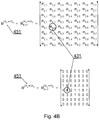
- Fig. 4B shows data representation of a matrix presented in Fig. 4A .
- Raw data are presented instead of an abstract representation shown in Fig. 4A .
- the time windows may be proportional i.e. 24 hours divided into 8 time windows of 3 hours each.
- Fig. 5A presents a method for including local neighborhood while calculating transition probability score S (610) for a cell of a matrix associated with a given transition from a channel C to a channel D (452) at a given time instant falling within a current time window (255) and weekday (414).
- Said neighborhood may have different sizes (511, 512, 513) so that more or less neighboring data are taken into account.
- the neighborhood is expressed by a radius factor expressed by a number of cells applied vertically and horizontally from a given center cell.
- the neighborhood factor may change depending on time of day or weekday. Thus, a square shape is applied.
- Fig. 5A it may also be observed how the weight matrix W (520) increases its size when said neighborhood factor increases.
- Fig. 5B presents examples of the weights matrix W (520) and in particular it shows weights applied to calculate the transition probability score S (610) i.e. which neighboring data are more relevant that other.
- the weight (531) does not influence the process, it is a scalar and may assume any value greater than 0.
- a user may wish to put more emphasis on neighboring weekdays in the same time window than on neighboring time windows on the same weekday.
- Fig. 6 is an equation (1) for calculating the transition probability score S (610) related to a given time instant (t) within a time window, while taking into account a weights matrix W (520), defining local neighborhood of a given cell as well as the matrix M (451) itself, associated with an edge of a graph defining a transition from channel A to channel B.
- Said equation (1) takes into account cells crossing weekdays, therefore it comprises the modulo operand as well as carry control (C) in cases when preceding or following weekday shall be taken into account.
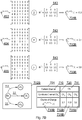
- Figs. 7A-B show examples of calculating the transition probability score S (610) for a cell associated with a given time window, depending on a definition of a weights matrix W (542, 543).
- a weighted sum S is the transition probability score S (610) of transitioning from the current channel (710) to other channels (720) i.e. from Ch 1 to Ch 5 (453), from Ch 1 to Ch 3 (454) or from Ch 1 to Ch 9 (455) is respectively 9,6 or 11,9 (731A, 731B), 2,5 or 3,1 (732A, 732B), 2,5 or 3,6 (733A, 733B).
- a difference between the (A) and (B) results are caused by the weights in said weights matrix W (542, 543), which also influences the resulting probability of channel selection. This is also illustrated on a section of a transitions graph (702A, 702B) as well as a table 701.
- An equation, shown in Fig. 8 allows for obtaining a channel selection probability (811) from the calculated transition probability score S (610).
- This channel selection probability is preferably a value in a range from 0 to 1 while 1 being the highest probability.
- This step is optional and allows to bring the results to a common range in case of for example one or more additional content recommendation system(s).
- a vector (821) is obtained, items of which determine probabilities of selection of another channel by a user, assuming a given time window on a given channel A.
- a probability of selecting channel B is defined by item (811), channel C (812) ... and channel Z (819).
- other vectors may be calculated for other channels and time windows.
- a probability of selecting the channel A is 0.
- Figs. 9A-B refer to calculations (730A) and (730B) and obtaining a vector of probabilities associated with a given channel, in this case Ch 1 (720) in a given time window.
- the calculations are executed for all remaining channels (candidates) a user may switch to (911, 912).
- the equation (2) is applied in order to obtain a vector P (921, 922 created from equations: (3.1) - (3.3) (821-823).
- Fig. 10 depicts a case where more than one recommendation system is present i.e. the system according to the present invention (recommending channels) as well as at least one other system, which based on other metrics determines its own probabilities / recommendations E vector related to channels, in this case a particular channel ChA (1010).
- both vectors may be combined by an ⁇ (1020) function, which will facilitate obtaining a final probability Q of a transition from a channel A (1021) to another channel.
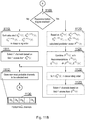
- Figs. 11A-B shows a method according to the present invention.
- step (1101) it is checked which channel is the current channel i.e. typically a currently tuned channel, which a user is watching.
- Such channel selection (1102) may also be executed due to switching a GUI window to foreground, starting a multiroom session, a multiscreen session or starting/stopping a recording.
- channel transitions statistics are updated i.e. the channel changes register is updated by adding a row of data identifying said transition from the source channel to a destination channel including an associated time.
- memory constraints may be verified at this stage. In case there is insufficient memory, one or more of the oldest entries may be deleted (appropriately decrementing its corresponding matrix M).
- An appropriate matrix on an edge of a transitions graph, related to a transition from channel A to channel B in a given time window, is incremented (by 1).
- Another, optional source of triggering an action according to the present method may be a clock (1104) reporting expiry of a threshold (1105) aimed at reducing storage memory requirements of the present method as well as reducing influence of statistics considered too old on the final result. Old statistics may be periodically removed at step (1106) and respective edge matrices M may be updated.
- a number of free tuners is determined, which may change to other arrangements operating in parallel i.e. recording, multi-room sessions, software update download sessions or the like. These free tuners are candidate tuners to be used in fast zapping process in the background.
- step (1109) there is determined presence of additional content recommendation system(s).
- step (1110) the calculated S values (610) are sorted and f best fits are selected wherein f matched the number of available tuners so that f best-matching channels may be selected (1111).
- step (1120) when there is/are additional recommendation source(s), at step (1120) the calculated S values (610) are brought to a common range, such as 0 ... 1 and a probability vector S is created as previously explained.
- step (1121) there are combined results from these additional recommendation source(s) with the results of the step (1107) into a Q result set using the ⁇ (1020) function.
- the Q result is subsequently sorted (1122) and f best fits are selected wherein f matched the number of available tuners so that f best-matching channels may be selected (1123).
- the present invention allows to decrease channel switching times in receivers requiring tuning, synchronization and data parsing prior to outputting audio/video signals. Therefore, the invention provides a useful, concrete and tangible result.
- the present invention may take the form of an entirely hardware embodiment, an entirely software embodiment (including firmware, resident software, micro-code, etc.) or an embodiment combining software and hardware aspects that may all generally be referred to herein as a "circuit", "module” or "system”.
- the present invention may take the form of a computer program product embodied in any tangible medium of expression having computer usable program code embodied in the medium.
- the aforementioned method for television channel zapping may be performed and/or controlled by one or more computer programs.
- Such computer programs are typically executed by utilizing the computing resources in a computing device.
- Applications are stored on a non-transitory medium.
- An example of a non-transitory medium is a nonvolatile memory, for example a flash memory while an example of a volatile memory is RAM.
- the computer instructions are executed by a processor.
- These memories are exemplary recording media for storing computer programs comprising computer-executable instructions performing all the steps of the computer-implemented method according the technical concept presented herein.
Landscapes
- Engineering & Computer Science (AREA)
- Databases & Information Systems (AREA)
- Multimedia (AREA)
- Signal Processing (AREA)
- Health & Medical Sciences (AREA)
- General Health & Medical Sciences (AREA)
- Social Psychology (AREA)
- Computer Networks & Wireless Communication (AREA)
- Physics & Mathematics (AREA)
- Probability & Statistics with Applications (AREA)
- Two-Way Televisions, Distribution Of Moving Picture Or The Like (AREA)
- Circuits Of Receivers In General (AREA)
Abstract
Description
- The present invention relates to a system and method for television channel zapping. In particular the present invention relates to a television signal receiver, such as a set-top box, comprising more than one front-end (or in general an ability to process more than one television channel), wherein front-ends other than the front-end processing the currently watched channel, may be used in order to facilitate faster channel zapping using a specified next channel prediction method.
- In recent years, STBs having more than one physical or logical tuner have become common on the market. Owing to such capabilities, a user may watch one service/ channel and record another or share another with an external device such as a tablet/smartphone (second screen, multi-room technologies).
- In a typical television system, based on tuning, demultiplexing and decoding, each channel/service change requires a change of a tuning frequency of a tuner as well as synchronization of the received video and audio, which is time consuming and may take for example 5 seconds.
- Systems using unallocated tuners to speed up channel zapping are known in general, for example such an unused tuner is pre-tuned to the next channel so as to anticipate channel change. Nevertheless, simply tuning to the next channel is not always beneficial. For example. It will not work when a user is zapping among channel categories instead of channels per se or when a user enters directly a channel number, which is more distant than the number of available tuners.
- In view of the above, it would be advantageous to provide channels zapping taking into account different scenarios of zapping applied by users.
- The aim of the development of the present invention is an improved system and method for television channel zapping.
- An object of the present invention is Method for television channel zapping in a system comprising more than one television data reception block capable of processing data of more than one television channel, the method comprising the steps of: determining a current channel and awaiting a channel change request; after a channel change updating channel transitions statistics in a channel changes register by adding a record of data identifying said transition from the current channel to a destination channel including an associated time and weekday; generating a channel transitions graph for the current channel wherein each vertex of the graph denotes a different channel and each edge of said graph comprises a matrix M comprising time windows as rows and weekdays as columns wherein each cell is representative of a number of transitions from a given source channel to a destination channel; calculating a transition probability score S from the current channel to the remaining channels in a current time window based on said matrices; determining a number of free television data reception blocks; selecting f best-matching channels having the highest probability score S; setting one or more free television data reception blocks to the one or more best-matching channels.
- Preferably, said calculating a transition probability score S is based on a weight matrix taking into account, based on a radius parameter R, the given cell as well as the cells being direct neighbors of the selected cell the matrix W.
- Preferably, the method further comprises a step of bringing the results, of said transition probability score S to a selected range in case and obtaining a vector, items of which determine probabilities of selection of another channel, assuming a given time window on a given channel.
- Preferably, in case when more than one recommendation system is present, wherein based on predefined metrics each recommendation system determines its own probabilities or recommendations E vector related to channels, combining combined said vectors of each recommendation system by an Φ function thereby obtaining a final probability Q of a transition from a given channel to any channel. Preferably, said method further comprises a step of periodically removing the oldest records and updating the respective edge matrices M in response to an expiry of a clock.
- Preferably, after a channel change verifying memory constraints and in case there is insufficient memory, deleting one or more of the oldest entries in said channel changes register and appropriately decrementing its corresponding matrix M.
- Another object of the present invention is a computer program comprising program code means for performing all the steps of the computer-implemented method according to the present invention when said program is run on a computer.
- Another object of the present invention is a computer readable medium storing computer-executable instructions performing all the steps of the computer-implemented method according to the present invention when executed on a computer.
- These and other objects of the invention presented herein, are accomplished by providing a system and method for television channel zapping. Further details and features of the present invention, its nature and various advantages will become more apparent from the following detailed description of the preferred embodiments shown in a drawing, in which:
-
Fig. 1 presents a diagram of a receiver implementing the method according to the present invention; -
Fig. 2 presents a detailed, channel changes data structure; -
Figs. 3A-B present examples of channel transitions graphs; -
Fig. 4A is a detailed view of a matrix associated with a single edge of a transitions graph; -
Fig. 4B shows data representation of a matrix presented inFig. 4A ; -
Fig. 5A presents a method for including local neighborhood while calculating transition probability score S; -
Fig. 5B presents examples of the weights matrix W; -
Fig. 6 is an equation for calculating the transition probability score S related to a given time instant within a time window; -
Figs. 7A-B show examples of calculating the transition probability score S for a cell associated with a given time window, depending on a definition of a weights matrix; -
Fig. 8 presents an equation for obtaining a channel selection probability from the calculated transition probability score; -
Figs. 9A-B refer to calculations of a vector of probabilities associated with a given channel; -
Fig. 10 depicts a case where more than one recommendation system is present; -
Figs. 11A-B show a method according to the present invention. - Some portions of the detailed description which follows are presented in terms of data processing procedures, steps or other symbolic representations of operations on data bits that can be performed on computer memory. Therefore, a computer executes such logical steps thus requiring physical manipulations of physical quantities.
- Usually these quantities take the form of electrical or magnetic signals capable of being stored, transferred, combined, compared, and otherwise manipulated in a computer system. For reasons of common usage, these signals are referred to as bits, packets, messages, values, elements, symbols, characters, terms, numbers, or the like.
- Additionally, all of these and similar terms are to be associated with the appropriate physical quantities and are merely convenient labels applied to these quantities. Terms such as "processing" or "creating" or "transferring" or "executing" or "determining" or "detecting" or "obtaining" or "selecting" or "calculating" or "generating" or the like, refer to the action and processes of a computer system that manipulates and transforms data represented as physical (electronic) quantities within the computer's registers and memories into other data similarly represented as physical quantities within the memories or registers or other such information storage.
- A computer-readable (storage) medium, such as referred to herein, typically may be non-transitory and/or comprise a non-transitory device. In this context, a non-transitory storage medium may include a device that may be tangible, meaning that the device has a concrete physical form, although the device may change its physical state. Thus, for example, non-transitory refers to a device remaining tangible despite a change in state.
- As utilized herein, the term "example" means serving as a non-limiting example, instance, or illustration. As utilized herein, the terms "for example" and "e.g." introduce a list of one or more non-limiting examples, instances, or illustrations.
- The present invention takes into account transitions between channels and maintains a statistical database comprising information on channel changes, including a source channel and a destination channel identification. A channel changes graph may be created, which also takes into account a particular weekday and/or time of channel changes.
- It has been observed that channel zapping habits may differ depending not only on time of day but also depending on weekday. Such information may be used to create more precise and dynamic prediction of at least one channel a user may select next in the current context i.e. current channel, current weekday, current time, current user.
-
Fig. 1 presents a diagram of the system according to the present invention. It focuses on STB components. The invention is targeted for any device (100) compromising a Data reception block (120) such as a broadcast signal (102) reception block (e.g. terrestrial, satellite), External interfaces (130) (such as optional USB signal (103) interfaces), a Memory (140) and its types (FLASH (141), RAM (142), HDD (143)), an RCU controller (150) receiving signals (105) from a remote controller, an A/V block (160) (outputting signals (106) such as video and audio output), a Clock (170) providing a time reference. The elements are connected by a data bus (101). The aforementioned are typical components of a set-top box. - A Controller (110) comprises several units (111 - 116), details of which will be provided in the following description. These modules are a weight function selection unit (111), a graph/matrix updating unit (112), a channel change statistics unit (113), a recommendation unit (114), a memory limit controller (115) and a channel prediction manager (116), which is aware of a number of available tuners in the Data Reception Block (120).
- Typically, a Data reception block (120) will be able to output a give television channel or content in general, where there is an available processing path usually comprising a tuner, a demodulator and a demultiplexer. Nevertheless, in case of Internet TV a tuner will be replaced by a suitable network interface. In some cases a single tuner may be used to supply data to a plurality of demultiplexers. In other words, more than one television signal processing paths may exist simultaneously in the Data reception block (120).
- The Memory (140) may store computer program or programs executed by the Controller (110) in order to execute steps of the method according to the present invention.
-
Fig. 2 presents a detailed data structure of a channel change register (200), which is stored in the channel change statistics unit (113). This register comprises information (251) on time instants (211 - comprising date and time) when a channel change (220) occurred from a source channel (231) to a destination channel (241). - The register may be divided into time windows (252, 253, 254), which influences precision of a matrix shown in
Fig. 4 (i.e. 24h divided by the number of said time windows). Therefore, there may be current (253), previous (252) and next (254) time windows based on current time. For example, at a time instant (213) channel 1 (233) was changed to channel 5 (243). -
Figs. 3A-B present examples of two transitions graphs showing how, significantly different, they may be at different times of different weekdays.Fig. 3A shown a graph for a Monday at 4 p. m. (301) whileFig. 3B shows a graph for aFriday 7 p. m. (302). - For example, when
channel 2 is the current channel, in case ofFig. 3A onlychannels Fig. 3B ,channels -
Fig. 4A is a detailed view of a matrix associated with a single edge of a transitions graph (seeFig. 3A, 3B ). It comprises time windows as rows (250 - 258) and days of the week in columns (411 - 417) for a transition from a given source channel to a destination channel. The time windows (250 - 258) may be sorted in an ascending order i.e. according to increasing hours, minutes of a day. - Assuming that the time window (255) is the current one and it's Tuesday (412), the cell (431) indicates a number of transitions (8) between the source channel and the destination channel as defined by vertices of the respective graph. Those 8 transitions have been recorded in the past at the same time of day and weekday (the time range of the past may be limited, for example to a month or quarter of a year or similar)
- In the preceding time window (254) on the same weekday (Tuesday) 6 transitions have been made in total (421).
- Therefore, the size of the matrix (451) is the number of the monitored time windows (250 - 258) multiplied by 7 (weekdays). Naturally, each of the channel changes (for example 6 in case of cell (421) is described in details in the channel change register (200).
-
Fig. 4B shows data representation of a matrix presented inFig. 4A . Raw data are presented instead of an abstract representation shown inFig. 4A . The time windows may be proportional i.e. 24 hours divided into 8 time windows of 3 hours each. -
Fig. 5A presents a method for including local neighborhood while calculating transition probability score S (610) for a cell of a matrix associated with a given transition from a channel C to a channel D (452) at a given time instant falling within a current time window (255) and weekday (414). - Said neighborhood may have different sizes (511, 512, 513) so that more or less neighboring data are taken into account. Preferably, the neighborhood is expressed by a radius factor expressed by a number of cells applied vertically and horizontally from a given center cell. The neighborhood factor may change depending on time of day or weekday. Thus, a square shape is applied.
- In
Fig. 5A it may also be observed how the weight matrix W (520) increases its size when said neighborhood factor increases. At R = 0 (511) only the given cell is taken into account (530, at R = 1 (512), the matrix W is 3x3 (540) and while calculating the transition probability score S (610) there are taken into account cells being direct neighbors of the selected cell, while at R=2 (513) the matrix W (550) is 5x5 (also including second degree neighbors) and so on so forth. -
Fig. 5B presents examples of the weights matrix W (520) and in particular it shows weights applied to calculate the transition probability score S (610) i.e. which neighboring data are more relevant that other. - At R = 0 (511), the weight (531) does not influence the process, it is a scalar and may assume any value greater than 0. At R >= 1 (512, 513) said neighborhood and its influence on the transition probability score S (610) may be influenced depending on user's preference. For example, the weights matrix W for R = 1 (512) may be formulated as shown in (541-544) while for R = 2 (513) it may be formulated as shown in (551-553).
- As a general rule, a user may wish to put more emphasis on neighboring weekdays in the same time window than on neighboring time windows on the same weekday.
-
Fig. 6 is an equation (1) for calculating the transition probability score S (610) related to a given time instant (t) within a time window, while taking into account a weights matrix W (520), defining local neighborhood of a given cell as well as the matrix M (451) itself, associated with an edge of a graph defining a transition from channel A to channel B. - Said equation (1) takes into account cells crossing weekdays, therefore it comprises the modulo operand as well as carry control (C) in cases when preceding or following weekday shall be taken into account.
-
Figs. 7A-B show examples of calculating the transition probability score S (610) for a cell associated with a given time window, depending on a definition of a weights matrix W (542, 543). - Assuming that a channel Ch1 is selected, a weighted sum S is the transition probability score S (610) of transitioning from the current channel (710) to other channels (720) i.e. from Ch1 to Ch5 (453), from Ch1 to Ch3 (454) or from Ch1 to Ch9 (455) is respectively 9,6 or 11,9 (731A, 731B), 2,5 or 3,1 (732A, 732B), 2,5 or 3,6 (733A, 733B). A difference between the (A) and (B) results are caused by the weights in said weights matrix W (542, 543), which also influences the resulting probability of channel selection. This is also illustrated on a section of a transitions graph (702A, 702B) as well as a table 701.
- An equation, shown in
Fig. 8 , allows for obtaining a channel selection probability (811) from the calculated transition probability score S (610). This channel selection probability is preferably a value in a range from 0 to 1 while 1 being the highest probability. - This step is optional and allows to bring the results to a common range in case of for example one or more additional content recommendation system(s).
- As a result of the foregoing calculations, a vector (821) is obtained, items of which determine probabilities of selection of another channel by a user, assuming a given time window on a given channel A. A probability of selecting channel B is defined by item (811), channel C (812) ... and channel Z (819). Similarly, other vectors may be calculated for other channels and time windows.
- Optionally it may be assumed, that a probability of selecting the channel A (i.e. the current channel) is 0.
-
Figs. 9A-B refer to calculations (730A) and (730B) and obtaining a vector of probabilities associated with a given channel, in this case Ch1 (720) in a given time window. The calculations are executed for all remaining channels (candidates) a user may switch to (911, 912). The equation (2) is applied in order to obtain a vector P (921, 922 created from equations: (3.1) - (3.3) (821-823). -
Fig. 10 depicts a case where more than one recommendation system is present i.e. the system according to the present invention (recommending channels) as well as at least one other system, which based on other metrics determines its own probabilities / recommendations E vector related to channels, in this case a particular channel ChA (1010). - As already explained, both vectors may be combined by an Φ (1020) function, which will facilitate obtaining a final probability Q of a transition from a channel A (1021) to another channel.
-
Figs. 11A-B shows a method according to the present invention. At step (1101) it is checked which channel is the current channel i.e. typically a currently tuned channel, which a user is watching. - At this point the system awaits a channel change (1102), which is caused by a user, for example by means of a remote control unit. Such channel selection (1102) may also be executed due to switching a GUI window to foreground, starting a multiroom session, a multiscreen session or starting/stopping a recording.
- After a channel change, at step (1103) channel transitions statistics are updated i.e. the channel changes register is updated by adding a row of data identifying said transition from the source channel to a destination channel including an associated time. Optionally, memory constraints may be verified at this stage. In case there is insufficient memory, one or more of the oldest entries may be deleted (appropriately decrementing its corresponding matrix M).
- An appropriate matrix on an edge of a transitions graph, related to a transition from channel A to channel B in a given time window, is incremented (by 1).
- Another, optional source of triggering an action according to the present method, may be a clock (1104) reporting expiry of a threshold (1105) aimed at reducing storage memory requirements of the present method as well as reducing influence of statistics considered too old on the final result. Old statistics may be periodically removed at step (1106) and respective edge matrices M may be updated.
- Subsequently, at step (1107) there is calculated a transition probability score S (610) from the current channel to the remaining channels in the current time window (t). Subsequently, at step (1108) a number of free tuners (signal reception blocks) is determined, which may change to other arrangements operating in parallel i.e. recording, multi-room sessions, software update download sessions or the like. These free tuners are candidate tuners to be used in fast zapping process in the background.
- Subsequently, optionally at step (1109) there is determined presence of additional content recommendation system(s).
- In case there is/are not any, at step (1110) the calculated S values (610) are sorted and f best fits are selected wherein f matched the number of available tuners so that f best-matching channels may be selected (1111).
- Otherwise, when there is/are additional recommendation source(s), at step (1120) the calculated S values (610) are brought to a common range, such as 0 ... 1 and a probability vector S is created as previously explained.
- Further, at step (1121), there are combined results from these additional recommendation source(s) with the results of the step (1107) into a Q result set using the Φ (1020) function. The Q result is subsequently sorted (1122) and f best fits are selected wherein f matched the number of available tuners so that f best-matching channels may be selected (1123).
- The "f" most probable channels to be selected next are stored in memory and this result (1112) is a basis for setting the available tuners (1130). After this step, the process returns to step (1101) in order to await further events.
- The present invention allows to decrease channel switching times in receivers requiring tuning, synchronization and data parsing prior to outputting audio/video signals. Therefore, the invention provides a useful, concrete and tangible result.
- At least parts of the methods according to the invention may be computer implemented. Accordingly, the present invention may take the form of an entirely hardware embodiment, an entirely software embodiment (including firmware, resident software, micro-code, etc.) or an embodiment combining software and hardware aspects that may all generally be referred to herein as a "circuit", "module" or "system".
- Furthermore, the present invention may take the form of a computer program product embodied in any tangible medium of expression having computer usable program code embodied in the medium.
- It can be easily recognized, by one skilled in the art, that the aforementioned method for television channel zapping may be performed and/or controlled by one or more computer programs. Such computer programs are typically executed by utilizing the computing resources in a computing device. Applications are stored on a non-transitory medium. An example of a non-transitory medium is a nonvolatile memory, for example a flash memory while an example of a volatile memory is RAM. The computer instructions are executed by a processor. These memories are exemplary recording media for storing computer programs comprising computer-executable instructions performing all the steps of the computer-implemented method according the technical concept presented herein.
- While the invention presented herein has been depicted, described, and has been defined with reference to particular preferred embodiments, such references and examples of implementation in the foregoing specification do not imply any limitation on the invention. It will, however, be evident that various modifications and changes may be made thereto without departing from the broader scope of the technical concept. The presented preferred embodiments are exemplary only, and are not exhaustive of the scope of the technical concept presented herein.
- Accordingly, the scope of protection is not limited to the preferred embodiments described in the specification, but is only limited by the claims that follow.
Claims (9)
- Method for television channel zapping in a system comprising more than one television data reception block (120) capable of processing data of more than one television channel, the method comprising the steps of:• determining a current channel (1101) and awaiting a channel change request;• after a channel change (1103) updating channel transitions statistics in a channel changes register by adding a record of data identifying said transition from the current channel to a destination channel including an associated time and weekday;• generating a channel transitions graph for the current channel wherein each vertex of the graph denotes a different channel and each edge of said graph comprises a matrix M comprising time windows as rows (250-258) and weekdays as columns (411-417) wherein each cell is representative of a number of transitions from a given source channel to a destination channel;• calculating a transition probability score S (610) from the current channel to the remaining channels in a current time window (t) based on said matrices;• determining (1108) a number of free television data reception blocks (120);• selecting f best-matching channels (1111) having the highest probability score S (610);• setting one or more free television data reception blocks (120) to the one or more best-matching channels.
- The method according to claim 1 wherein said calculating a transition probability score S (610) is based on a weight matrix (550) taking into account, based on a radius parameter R, the given cell as well as the cells being direct neighbors of the selected cell (512, 513) the matrix W.
- The method according to claim 1 wherein the method further comprises a step of bringing the results, of said probability scores S (610) to a selected range in case and obtaining a vector (821), items of which determine probabilities of selection of another channel, assuming a given time window on a given channel.
- The method according to claim 3 wherein in case when more than one recommendation system is present, wherein based on predefined metrics each recommendation system determines its own probabilities or recommendations E vector related to channels (1010), combining combined said vectors of each recommendation system by an Φ (1020) function thereby obtaining a final probability Q of a transition from a given channel (1021) to any channel (1021).
- The method according to claim 1 wherein said method further comprises a step of periodically removing (1106) the oldest records and updating the respective edge matrices M in response to an expiry (1105) of a clock (1104).
- The method according to claim 1 wherein after a channel change (1103) verifying memory constraints and in case there is insufficient memory, deleting one or more of the oldest entries in said channel changes register and appropriately decrementing its corresponding matrix M.
- A computer program comprising program code means for performing all the steps of the computer-implemented method according to claim 1 when said program is run on a computer.
- A computer readable medium storing computer-executable instructions performing all the steps of the computer-implemented method according to claim 1 when executed on a computer.
- A system for television channel zapping, said system comprising more than one television data reception block (120) capable of processing data of more than one television channel, the system being characterized in that it further comprises a controller configured to execute all steps of the method according to claim 1.
Priority Applications (1)
| Application Number | Priority Date | Filing Date | Title |
|---|---|---|---|
| EP19186301.8A EP3767963B1 (en) | 2019-07-15 | 2019-07-15 | System and method for television channel zapping |
Applications Claiming Priority (1)
| Application Number | Priority Date | Filing Date | Title |
|---|---|---|---|
| EP19186301.8A EP3767963B1 (en) | 2019-07-15 | 2019-07-15 | System and method for television channel zapping |
Publications (2)
| Publication Number | Publication Date |
|---|---|
| EP3767963A1 true EP3767963A1 (en) | 2021-01-20 |
| EP3767963B1 EP3767963B1 (en) | 2022-12-21 |
Family
ID=67303371
Family Applications (1)
| Application Number | Title | Priority Date | Filing Date |
|---|---|---|---|
| EP19186301.8A Active EP3767963B1 (en) | 2019-07-15 | 2019-07-15 | System and method for television channel zapping |
Country Status (1)
| Country | Link |
|---|---|
| EP (1) | EP3767963B1 (en) |
Citations (3)
| Publication number | Priority date | Publication date | Assignee | Title |
|---|---|---|---|---|
| US20030159157A1 (en) * | 2002-02-21 | 2003-08-21 | Peter Chan | Systems, methods and apparatuses for minimizing subscriber-perceived digital video channel tuning delay |
| WO2017145109A1 (en) * | 2016-02-24 | 2017-08-31 | Nos Inovação, S.A. | Predictive tuning system |
| US20180357567A1 (en) * | 2017-06-13 | 2018-12-13 | Opentv, Inc. | Channel change optimization using probabilistic modeling |
-
2019
- 2019-07-15 EP EP19186301.8A patent/EP3767963B1/en active Active
Patent Citations (3)
| Publication number | Priority date | Publication date | Assignee | Title |
|---|---|---|---|---|
| US20030159157A1 (en) * | 2002-02-21 | 2003-08-21 | Peter Chan | Systems, methods and apparatuses for minimizing subscriber-perceived digital video channel tuning delay |
| WO2017145109A1 (en) * | 2016-02-24 | 2017-08-31 | Nos Inovação, S.A. | Predictive tuning system |
| US20180357567A1 (en) * | 2017-06-13 | 2018-12-13 | Opentv, Inc. | Channel change optimization using probabilistic modeling |
Non-Patent Citations (2)
| Title |
|---|
| DISCLOSED ANONYMOUSLY: "ChannelRank: a method of ranking television channels", RESEARCH DISCLOSURE, KENNETH MASON PUBLICATIONS, HAMPSHIRE, UK, GB, vol. 514, no. 36, 1 February 2007 (2007-02-01), pages 180, XP007137084, ISSN: 0374-4353 * |
| XUN B ET AL: "Performances of Random IPTV Channel Change with Finite Duration Multi-Channel Delivery", COMMUNICATIONS (ICC), 2010 IEEE INTERNATIONAL CONFERENCE ON, IEEE, PISCATAWAY, NJ, USA, 23 May 2010 (2010-05-23), pages 1 - 5, XP031703453, ISBN: 978-1-4244-6402-9 * |
Also Published As
| Publication number | Publication date |
|---|---|
| EP3767963B1 (en) | 2022-12-21 |
Similar Documents
| Publication | Publication Date | Title |
|---|---|---|
| US7620964B2 (en) | Recommended program search device and recommended program search method | |
| US11064261B2 (en) | Electronic device and control method therefor | |
| US9148610B2 (en) | Video reception device and image recognition method for received video | |
| US20100211988A1 (en) | Managing resources to display media content | |
| CN102118639A (en) | Information processing apparatus, information processing method, and program | |
| CN109479160B (en) | Display apparatus and method for recommending content of display apparatus | |
| KR20040025369A (en) | Method and apparatus for preventing duplicate copy of broadcasting program | |
| US20170318350A1 (en) | List-type content presentation device and method | |
| MX2012009113A (en) | Systems and methods for automatically scheduling recordings of programming events. | |
| US20180041811A1 (en) | Display apparatus and method for providing channel list thereof | |
| US10575049B2 (en) | Broadcasting signal receiving apparatus and control method thereof | |
| EP3767963B1 (en) | System and method for television channel zapping | |
| US11601712B2 (en) | Predictive tuning system | |
| US9131184B2 (en) | Video reception device and image recognition method for received video | |
| JP2009065597A (en) | Preference information generation apparatus and preference information generation program | |
| TWI565313B (en) | Frequency point prediction method and image processing device using the same | |
| JP2007142492A (en) | Program information processing apparatus, program information processing method, program information processing program, and recording medium | |
| JP4799671B1 (en) | Broadcast receiving apparatus and broadcast receiving method | |
| KR100914808B1 (en) | Channel-tuning method in a DTV receiver | |
| KR100822436B1 (en) | How to limit watch time by genre of digital broadcasting receiver | |
| CN118891881A (en) | Display device and channel playing method | |
| WO2006098648A1 (en) | Device and method for forming and displaying a personal channel in a multichannel digital tv | |
| CN106550265A (en) | Frequency point prediction method and image processing device applying same | |
| EP3024246A1 (en) | System and method for configuring graphical user interface based on user's behavior | |
| CN101273626A (en) | Optimal selection of TV programs for recording and viewing |
Legal Events
| Date | Code | Title | Description |
|---|---|---|---|
| PUAI | Public reference made under article 153(3) epc to a published international application that has entered the european phase |
Free format text: ORIGINAL CODE: 0009012 |
|
| STAA | Information on the status of an ep patent application or granted ep patent |
Free format text: STATUS: THE APPLICATION HAS BEEN PUBLISHED |
|
| AK | Designated contracting states |
Kind code of ref document: A1 Designated state(s): AL AT BE BG CH CY CZ DE DK EE ES FI FR GB GR HR HU IE IS IT LI LT LU LV MC MK MT NL NO PL PT RO RS SE SI SK SM TR |
|
| AX | Request for extension of the european patent |
Extension state: BA ME |
|
| STAA | Information on the status of an ep patent application or granted ep patent |
Free format text: STATUS: REQUEST FOR EXAMINATION WAS MADE |
|
| 17P | Request for examination filed |
Effective date: 20210622 |
|
| RBV | Designated contracting states (corrected) |
Designated state(s): AL AT BE BG CH CY CZ DE DK EE ES FI FR GB GR HR HU IE IS IT LI LT LU LV MC MK MT NL NO PL PT RO RS SE SI SK SM TR |
|
| GRAP | Despatch of communication of intention to grant a patent |
Free format text: ORIGINAL CODE: EPIDOSNIGR1 |
|
| STAA | Information on the status of an ep patent application or granted ep patent |
Free format text: STATUS: GRANT OF PATENT IS INTENDED |
|
| INTG | Intention to grant announced |
Effective date: 20221004 |
|
| GRAS | Grant fee paid |
Free format text: ORIGINAL CODE: EPIDOSNIGR3 |
|
| GRAA | (expected) grant |
Free format text: ORIGINAL CODE: 0009210 |
|
| STAA | Information on the status of an ep patent application or granted ep patent |
Free format text: STATUS: THE PATENT HAS BEEN GRANTED |
|
| AK | Designated contracting states |
Kind code of ref document: B1 Designated state(s): AL AT BE BG CH CY CZ DE DK EE ES FI FR GB GR HR HU IE IS IT LI LT LU LV MC MK MT NL NO PL PT RO RS SE SI SK SM TR |
|
| REG | Reference to a national code |
Ref country code: GB Ref legal event code: FG4D |
|
| REG | Reference to a national code |
Ref country code: DE Ref legal event code: R096 Ref document number: 602019023320 Country of ref document: DE |
|
| REG | Reference to a national code |
Ref country code: CH Ref legal event code: EP |
|
| REG | Reference to a national code |
Ref country code: AT Ref legal event code: REF Ref document number: 1539755 Country of ref document: AT Kind code of ref document: T Effective date: 20230115 |
|
| REG | Reference to a national code |
Ref country code: IE Ref legal event code: FG4D |
|
| REG | Reference to a national code |
Ref country code: LT Ref legal event code: MG9D |
|
| REG | Reference to a national code |
Ref country code: NL Ref legal event code: MP Effective date: 20221221 |
|
| PG25 | Lapsed in a contracting state [announced via postgrant information from national office to epo] |
Ref country code: SE Free format text: LAPSE BECAUSE OF FAILURE TO SUBMIT A TRANSLATION OF THE DESCRIPTION OR TO PAY THE FEE WITHIN THE PRESCRIBED TIME-LIMIT Effective date: 20221221 Ref country code: NO Free format text: LAPSE BECAUSE OF FAILURE TO SUBMIT A TRANSLATION OF THE DESCRIPTION OR TO PAY THE FEE WITHIN THE PRESCRIBED TIME-LIMIT Effective date: 20230321 Ref country code: LT Free format text: LAPSE BECAUSE OF FAILURE TO SUBMIT A TRANSLATION OF THE DESCRIPTION OR TO PAY THE FEE WITHIN THE PRESCRIBED TIME-LIMIT Effective date: 20221221 Ref country code: FI Free format text: LAPSE BECAUSE OF FAILURE TO SUBMIT A TRANSLATION OF THE DESCRIPTION OR TO PAY THE FEE WITHIN THE PRESCRIBED TIME-LIMIT Effective date: 20221221 |
|
| REG | Reference to a national code |
Ref country code: AT Ref legal event code: MK05 Ref document number: 1539755 Country of ref document: AT Kind code of ref document: T Effective date: 20221221 |
|
| PG25 | Lapsed in a contracting state [announced via postgrant information from national office to epo] |
Ref country code: RS Free format text: LAPSE BECAUSE OF FAILURE TO SUBMIT A TRANSLATION OF THE DESCRIPTION OR TO PAY THE FEE WITHIN THE PRESCRIBED TIME-LIMIT Effective date: 20221221 Ref country code: LV Free format text: LAPSE BECAUSE OF FAILURE TO SUBMIT A TRANSLATION OF THE DESCRIPTION OR TO PAY THE FEE WITHIN THE PRESCRIBED TIME-LIMIT Effective date: 20221221 Ref country code: HR Free format text: LAPSE BECAUSE OF FAILURE TO SUBMIT A TRANSLATION OF THE DESCRIPTION OR TO PAY THE FEE WITHIN THE PRESCRIBED TIME-LIMIT Effective date: 20221221 Ref country code: GR Free format text: LAPSE BECAUSE OF FAILURE TO SUBMIT A TRANSLATION OF THE DESCRIPTION OR TO PAY THE FEE WITHIN THE PRESCRIBED TIME-LIMIT Effective date: 20230322 |
|
| PG25 | Lapsed in a contracting state [announced via postgrant information from national office to epo] |
Ref country code: NL Free format text: LAPSE BECAUSE OF FAILURE TO SUBMIT A TRANSLATION OF THE DESCRIPTION OR TO PAY THE FEE WITHIN THE PRESCRIBED TIME-LIMIT Effective date: 20221221 |
|
| PG25 | Lapsed in a contracting state [announced via postgrant information from national office to epo] |
Ref country code: SM Free format text: LAPSE BECAUSE OF FAILURE TO SUBMIT A TRANSLATION OF THE DESCRIPTION OR TO PAY THE FEE WITHIN THE PRESCRIBED TIME-LIMIT Effective date: 20221221 Ref country code: RO Free format text: LAPSE BECAUSE OF FAILURE TO SUBMIT A TRANSLATION OF THE DESCRIPTION OR TO PAY THE FEE WITHIN THE PRESCRIBED TIME-LIMIT Effective date: 20221221 Ref country code: PT Free format text: LAPSE BECAUSE OF FAILURE TO SUBMIT A TRANSLATION OF THE DESCRIPTION OR TO PAY THE FEE WITHIN THE PRESCRIBED TIME-LIMIT Effective date: 20230421 Ref country code: ES Free format text: LAPSE BECAUSE OF FAILURE TO SUBMIT A TRANSLATION OF THE DESCRIPTION OR TO PAY THE FEE WITHIN THE PRESCRIBED TIME-LIMIT Effective date: 20221221 Ref country code: EE Free format text: LAPSE BECAUSE OF FAILURE TO SUBMIT A TRANSLATION OF THE DESCRIPTION OR TO PAY THE FEE WITHIN THE PRESCRIBED TIME-LIMIT Effective date: 20221221 Ref country code: CZ Free format text: LAPSE BECAUSE OF FAILURE TO SUBMIT A TRANSLATION OF THE DESCRIPTION OR TO PAY THE FEE WITHIN THE PRESCRIBED TIME-LIMIT Effective date: 20221221 Ref country code: AT Free format text: LAPSE BECAUSE OF FAILURE TO SUBMIT A TRANSLATION OF THE DESCRIPTION OR TO PAY THE FEE WITHIN THE PRESCRIBED TIME-LIMIT Effective date: 20221221 |
|
| PG25 | Lapsed in a contracting state [announced via postgrant information from national office to epo] |
Ref country code: SK Free format text: LAPSE BECAUSE OF FAILURE TO SUBMIT A TRANSLATION OF THE DESCRIPTION OR TO PAY THE FEE WITHIN THE PRESCRIBED TIME-LIMIT Effective date: 20221221 Ref country code: PL Free format text: LAPSE BECAUSE OF FAILURE TO SUBMIT A TRANSLATION OF THE DESCRIPTION OR TO PAY THE FEE WITHIN THE PRESCRIBED TIME-LIMIT Effective date: 20221221 Ref country code: IS Free format text: LAPSE BECAUSE OF FAILURE TO SUBMIT A TRANSLATION OF THE DESCRIPTION OR TO PAY THE FEE WITHIN THE PRESCRIBED TIME-LIMIT Effective date: 20230421 Ref country code: AL Free format text: LAPSE BECAUSE OF FAILURE TO SUBMIT A TRANSLATION OF THE DESCRIPTION OR TO PAY THE FEE WITHIN THE PRESCRIBED TIME-LIMIT Effective date: 20221221 |
|
| REG | Reference to a national code |
Ref country code: DE Ref legal event code: R097 Ref document number: 602019023320 Country of ref document: DE |
|
| PLBE | No opposition filed within time limit |
Free format text: ORIGINAL CODE: 0009261 |
|
| STAA | Information on the status of an ep patent application or granted ep patent |
Free format text: STATUS: NO OPPOSITION FILED WITHIN TIME LIMIT |
|
| PG25 | Lapsed in a contracting state [announced via postgrant information from national office to epo] |
Ref country code: DK Free format text: LAPSE BECAUSE OF FAILURE TO SUBMIT A TRANSLATION OF THE DESCRIPTION OR TO PAY THE FEE WITHIN THE PRESCRIBED TIME-LIMIT Effective date: 20221221 |
|
| 26N | No opposition filed |
Effective date: 20230922 |
|
| PG25 | Lapsed in a contracting state [announced via postgrant information from national office to epo] |
Ref country code: SI Free format text: LAPSE BECAUSE OF FAILURE TO SUBMIT A TRANSLATION OF THE DESCRIPTION OR TO PAY THE FEE WITHIN THE PRESCRIBED TIME-LIMIT Effective date: 20221221 |
|
| PG25 | Lapsed in a contracting state [announced via postgrant information from national office to epo] |
Ref country code: MC Free format text: LAPSE BECAUSE OF FAILURE TO SUBMIT A TRANSLATION OF THE DESCRIPTION OR TO PAY THE FEE WITHIN THE PRESCRIBED TIME-LIMIT Effective date: 20221221 |
|
| PG25 | Lapsed in a contracting state [announced via postgrant information from national office to epo] |
Ref country code: MC Free format text: LAPSE BECAUSE OF FAILURE TO SUBMIT A TRANSLATION OF THE DESCRIPTION OR TO PAY THE FEE WITHIN THE PRESCRIBED TIME-LIMIT Effective date: 20221221 |
|
| REG | Reference to a national code |
Ref country code: CH Ref legal event code: PL |
|
| REG | Reference to a national code |
Ref country code: BE Ref legal event code: MM Effective date: 20230731 |
|
| PG25 | Lapsed in a contracting state [announced via postgrant information from national office to epo] |
Ref country code: LU Free format text: LAPSE BECAUSE OF NON-PAYMENT OF DUE FEES Effective date: 20230715 |
|
| PG25 | Lapsed in a contracting state [announced via postgrant information from national office to epo] |
Ref country code: LU Free format text: LAPSE BECAUSE OF NON-PAYMENT OF DUE FEES Effective date: 20230715 |
|
| REG | Reference to a national code |
Ref country code: IE Ref legal event code: MM4A |
|
| PG25 | Lapsed in a contracting state [announced via postgrant information from national office to epo] |
Ref country code: CH Free format text: LAPSE BECAUSE OF NON-PAYMENT OF DUE FEES Effective date: 20230731 |
|
| PG25 | Lapsed in a contracting state [announced via postgrant information from national office to epo] |
Ref country code: IT Free format text: LAPSE BECAUSE OF FAILURE TO SUBMIT A TRANSLATION OF THE DESCRIPTION OR TO PAY THE FEE WITHIN THE PRESCRIBED TIME-LIMIT Effective date: 20221221 Ref country code: BE Free format text: LAPSE BECAUSE OF NON-PAYMENT OF DUE FEES Effective date: 20230731 |
|
| PG25 | Lapsed in a contracting state [announced via postgrant information from national office to epo] |
Ref country code: IE Free format text: LAPSE BECAUSE OF NON-PAYMENT OF DUE FEES Effective date: 20230715 |
|
| PG25 | Lapsed in a contracting state [announced via postgrant information from national office to epo] |
Ref country code: IE Free format text: LAPSE BECAUSE OF NON-PAYMENT OF DUE FEES Effective date: 20230715 |
|
| PG25 | Lapsed in a contracting state [announced via postgrant information from national office to epo] |
Ref country code: BG Free format text: LAPSE BECAUSE OF FAILURE TO SUBMIT A TRANSLATION OF THE DESCRIPTION OR TO PAY THE FEE WITHIN THE PRESCRIBED TIME-LIMIT Effective date: 20221221 |
|
| PG25 | Lapsed in a contracting state [announced via postgrant information from national office to epo] |
Ref country code: BG Free format text: LAPSE BECAUSE OF FAILURE TO SUBMIT A TRANSLATION OF THE DESCRIPTION OR TO PAY THE FEE WITHIN THE PRESCRIBED TIME-LIMIT Effective date: 20221221 |
|
| PG25 | Lapsed in a contracting state [announced via postgrant information from national office to epo] |
Ref country code: CY Free format text: LAPSE BECAUSE OF FAILURE TO SUBMIT A TRANSLATION OF THE DESCRIPTION OR TO PAY THE FEE WITHIN THE PRESCRIBED TIME-LIMIT; INVALID AB INITIO Effective date: 20190715 |
|
| PG25 | Lapsed in a contracting state [announced via postgrant information from national office to epo] |
Ref country code: HU Free format text: LAPSE BECAUSE OF FAILURE TO SUBMIT A TRANSLATION OF THE DESCRIPTION OR TO PAY THE FEE WITHIN THE PRESCRIBED TIME-LIMIT; INVALID AB INITIO Effective date: 20190715 |
|
| PGFP | Annual fee paid to national office [announced via postgrant information from national office to epo] |
Ref country code: DE Payment date: 20250729 Year of fee payment: 7 |
|
| PGFP | Annual fee paid to national office [announced via postgrant information from national office to epo] |
Ref country code: GB Payment date: 20250728 Year of fee payment: 7 |
|
| PGFP | Annual fee paid to national office [announced via postgrant information from national office to epo] |
Ref country code: FR Payment date: 20250725 Year of fee payment: 7 |
|
| PG25 | Lapsed in a contracting state [announced via postgrant information from national office to epo] |
Ref country code: TR Free format text: LAPSE BECAUSE OF FAILURE TO SUBMIT A TRANSLATION OF THE DESCRIPTION OR TO PAY THE FEE WITHIN THE PRESCRIBED TIME-LIMIT Effective date: 20221221 |