EP3767916A1 - Tls fingerprinting for process identification - Google Patents
Tls fingerprinting for process identification Download PDFInfo
- Publication number
- EP3767916A1 EP3767916A1 EP20184913.0A EP20184913A EP3767916A1 EP 3767916 A1 EP3767916 A1 EP 3767916A1 EP 20184913 A EP20184913 A EP 20184913A EP 3767916 A1 EP3767916 A1 EP 3767916A1
- Authority
- EP
- European Patent Office
- Prior art keywords
- traffic session
- tls
- processes
- network
- traffic
- Prior art date
- Legal status (The legal status is an assumption and is not a legal conclusion. Google has not performed a legal analysis and makes no representation as to the accuracy of the status listed.)
- Granted
Links
Images



Classifications
-
- H—ELECTRICITY
- H04—ELECTRIC COMMUNICATION TECHNIQUE
- H04L—TRANSMISSION OF DIGITAL INFORMATION, e.g. TELEGRAPHIC COMMUNICATION
- H04L63/00—Network architectures or network communication protocols for network security
- H04L63/14—Network architectures or network communication protocols for network security for detecting or protecting against malicious traffic
- H04L63/1408—Network architectures or network communication protocols for network security for detecting or protecting against malicious traffic by monitoring network traffic
- H04L63/1416—Event detection, e.g. attack signature detection
-
- G—PHYSICS
- G06—COMPUTING OR CALCULATING; COUNTING
- G06F—ELECTRIC DIGITAL DATA PROCESSING
- G06F18/00—Pattern recognition
- G06F18/20—Analysing
- G06F18/24—Classification techniques
- G06F18/241—Classification techniques relating to the classification model, e.g. parametric or non-parametric approaches
- G06F18/2415—Classification techniques relating to the classification model, e.g. parametric or non-parametric approaches based on parametric or probabilistic models, e.g. based on likelihood ratio or false acceptance rate versus a false rejection rate
- G06F18/24155—Bayesian classification
-
- G—PHYSICS
- G06—COMPUTING OR CALCULATING; COUNTING
- G06F—ELECTRIC DIGITAL DATA PROCESSING
- G06F21/00—Security arrangements for protecting computers, components thereof, programs or data against unauthorised activity
- G06F21/50—Monitoring users, programs or devices to maintain the integrity of platforms, e.g. of processors, firmware or operating systems
- G06F21/55—Detecting local intrusion or implementing counter-measures
- G06F21/56—Computer malware detection or handling, e.g. anti-virus arrangements
- G06F21/566—Dynamic detection, i.e. detection performed at run-time, e.g. emulation, suspicious activities
-
- G—PHYSICS
- G06—COMPUTING OR CALCULATING; COUNTING
- G06N—COMPUTING ARRANGEMENTS BASED ON SPECIFIC COMPUTATIONAL MODELS
- G06N20/00—Machine learning
- G06N20/20—Ensemble learning
-
- G—PHYSICS
- G06—COMPUTING OR CALCULATING; COUNTING
- G06N—COMPUTING ARRANGEMENTS BASED ON SPECIFIC COMPUTATIONAL MODELS
- G06N7/00—Computing arrangements based on specific mathematical models
- G06N7/01—Probabilistic graphical models, e.g. probabilistic networks
-
- H—ELECTRICITY
- H04—ELECTRIC COMMUNICATION TECHNIQUE
- H04L—TRANSMISSION OF DIGITAL INFORMATION, e.g. TELEGRAPHIC COMMUNICATION
- H04L63/00—Network architectures or network communication protocols for network security
- H04L63/04—Network architectures or network communication protocols for network security for providing a confidential data exchange among entities communicating through data packet networks
- H04L63/0428—Network architectures or network communication protocols for network security for providing a confidential data exchange among entities communicating through data packet networks wherein the data content is protected, e.g. by encrypting or encapsulating the payload
-
- H—ELECTRICITY
- H04—ELECTRIC COMMUNICATION TECHNIQUE
- H04L—TRANSMISSION OF DIGITAL INFORMATION, e.g. TELEGRAPHIC COMMUNICATION
- H04L63/00—Network architectures or network communication protocols for network security
- H04L63/08—Network architectures or network communication protocols for network security for authentication of entities
- H04L63/0876—Network architectures or network communication protocols for network security for authentication of entities based on the identity of the terminal or configuration, e.g. MAC address, hardware or software configuration or device fingerprint
-
- H—ELECTRICITY
- H04—ELECTRIC COMMUNICATION TECHNIQUE
- H04L—TRANSMISSION OF DIGITAL INFORMATION, e.g. TELEGRAPHIC COMMUNICATION
- H04L63/00—Network architectures or network communication protocols for network security
- H04L63/14—Network architectures or network communication protocols for network security for detecting or protecting against malicious traffic
- H04L63/1441—Countermeasures against malicious traffic
-
- H—ELECTRICITY
- H04—ELECTRIC COMMUNICATION TECHNIQUE
- H04L—TRANSMISSION OF DIGITAL INFORMATION, e.g. TELEGRAPHIC COMMUNICATION
- H04L63/00—Network architectures or network communication protocols for network security
- H04L63/16—Implementing security features at a particular protocol layer
- H04L63/166—Implementing security features at a particular protocol layer at the transport layer
-
- H—ELECTRICITY
- H04—ELECTRIC COMMUNICATION TECHNIQUE
- H04W—WIRELESS COMMUNICATION NETWORKS
- H04W12/00—Security arrangements; Authentication; Protecting privacy or anonymity
- H04W12/03—Protecting confidentiality, e.g. by encryption
-
- G—PHYSICS
- G06—COMPUTING OR CALCULATING; COUNTING
- G06N—COMPUTING ARRANGEMENTS BASED ON SPECIFIC COMPUTATIONAL MODELS
- G06N20/00—Machine learning
- G06N20/10—Machine learning using kernel methods, e.g. support vector machines [SVM]
-
- G—PHYSICS
- G06—COMPUTING OR CALCULATING; COUNTING
- G06N—COMPUTING ARRANGEMENTS BASED ON SPECIFIC COMPUTATIONAL MODELS
- G06N3/00—Computing arrangements based on biological models
- G06N3/02—Neural networks
- G06N3/04—Architecture, e.g. interconnection topology
- G06N3/044—Recurrent networks, e.g. Hopfield networks
-
- G—PHYSICS
- G06—COMPUTING OR CALCULATING; COUNTING
- G06N—COMPUTING ARRANGEMENTS BASED ON SPECIFIC COMPUTATIONAL MODELS
- G06N3/00—Computing arrangements based on biological models
- G06N3/02—Neural networks
- G06N3/04—Architecture, e.g. interconnection topology
- G06N3/047—Probabilistic or stochastic networks
-
- G—PHYSICS
- G06—COMPUTING OR CALCULATING; COUNTING
- G06N—COMPUTING ARRANGEMENTS BASED ON SPECIFIC COMPUTATIONAL MODELS
- G06N3/00—Computing arrangements based on biological models
- G06N3/02—Neural networks
- G06N3/08—Learning methods
-
- G—PHYSICS
- G06—COMPUTING OR CALCULATING; COUNTING
- G06N—COMPUTING ARRANGEMENTS BASED ON SPECIFIC COMPUTATIONAL MODELS
- G06N5/00—Computing arrangements using knowledge-based models
- G06N5/01—Dynamic search techniques; Heuristics; Dynamic trees; Branch-and-bound
-
- H—ELECTRICITY
- H04—ELECTRIC COMMUNICATION TECHNIQUE
- H04L—TRANSMISSION OF DIGITAL INFORMATION, e.g. TELEGRAPHIC COMMUNICATION
- H04L41/00—Arrangements for maintenance, administration or management of data switching networks, e.g. of packet switching networks
- H04L41/16—Arrangements for maintenance, administration or management of data switching networks, e.g. of packet switching networks using machine learning or artificial intelligence
Definitions
- the present disclosure relates generally to computer networks, and, more particularly, to using Transport Layer Security (TLS) fingerprinting for process identification.
- TLS Transport Layer Security
- Network traffic is becoming increasingly encrypted. Indeed, some studies estimate that more than 70% of all network traffic is now encrypted, with this figure expected to continue to grow.
- process identification can be used to detect malware or vulnerable executables on an endpoint.
- routers and switches can use this information to prioritize traffic or aid in diagnostics, such as analyzing how processes communicate across different network segments.
- TLS Transport Layer Security
- a device obtains telemetry data regarding an encrypted traffic session in a network.
- the telemetry data includes Transport Layer Security (TLS) features of the traffic session and auxiliary information indicative of a destination address of the traffic session, a destination port of the traffic session, or a server name associated with the traffic session.
- TLS Transport Layer Security
- the device retrieves, using the obtained telemetry data, a plurality of candidate processes from a TLS fingerprint database that relates processes with telemetry data from encrypted traffic sessions initiated by those processes.
- the device uses a probabilistic model to assign probabilities to each of the plurality of candidate processes.
- the device identifies one of the plurality of candidate processes as having initiated the encrypted traffic session based on its assigned probability.
- a computer network is a geographically distributed collection of nodes interconnected by communication links and segments for transporting data between end nodes, such as personal computers and workstations, or other devices, such as sensors, etc.
- end nodes such as personal computers and workstations, or other devices, such as sensors, etc.
- LANs local area networks
- WANs wide area networks
- LANs typically connect the nodes over dedicated private communications links located in the same general physical location, such as a building or campus.
- WANs typically connect geographically dispersed nodes over long-distance communications links, such as common carrier telephone lines, optical lightpaths, synchronous optical networks (SONET), or synchronous digital hierarchy (SDH) links, or Powerline Communications (PLC) such as IEEE 61334, IEEE P1901.2, and others.
- PLC Powerline Communications
- the Internet is an example of a WAN that connects disparate networks throughout the world, providing global communication between nodes on various networks.
- the nodes typically communicate over the network by exchanging discrete frames or packets of data according to predefined protocols, such as the Transmission Control Protocol/Internet Protocol (TCP/IP).
- TCP/IP Transmission Control Protocol/Internet Protocol
- a protocol consists of a set of rules defining how the nodes interact with each other.
- Computer networks may further be interconnected by an intermediate network node, such as a router, to extend the effective "size" of each network.
- Smart object networks such as sensor networks, in particular, are a specific type of network having spatially distributed autonomous devices such as sensors, actuators, etc., that cooperatively monitor physical or environmental conditions at different locations, such as, e.g., energy/power consumption, resource consumption (e.g., water/gas/etc. for advanced metering infrastructure or "AMI" applications) temperature, pressure, vibration, sound, radiation, motion, pollutants, etc.
- Other types of smart objects include actuators, e.g., responsible for turning on/off an engine or perform any other actions.
- Sensor networks a type of smart object network, are typically shared-media networks, such as wireless networks.
- each sensor device (node) in a sensor network may generally be equipped with a radio transceiver or other communication port, a microcontroller, and an energy source, such as a battery.
- smart object networks are considered field area networks (FANs), neighborhood area networks (NANs), personal area networks (PANs), etc.
- FANs field area networks
- NANs neighborhood area networks
- PANs personal area networks
- size and cost constraints on smart object nodes result in corresponding constraints on resources such as energy, memory, computational speed and bandwidth.
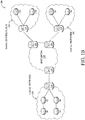
- FIG. 1A is a schematic block diagram of an example computer network 100 illustratively comprising nodes/devices, such as a plurality of routers/devices interconnected by links or networks, as shown.
- customer edge (CE) routers 110 may be interconnected with provider edge (PE) routers 120 (e.g., PE-1, PE-2, and PE-3) in order to communicate across a core network, such as an illustrative network backbone 130.
- PE provider edge
- routers 110, 120 may be interconnected by the public Internet, a multiprotocol label switching (MPLS) virtual private network (VPN), or the like.
- MPLS multiprotocol label switching
- VPN virtual private network
- Data packets 140 may be exchanged among the nodes/devices of the computer network 100 over links using predefined network communication protocols such as the Transmission Control Protocol/Internet Protocol (TCP/IP), User Datagram Protocol (UDP), Asynchronous Transfer Mode (ATM) protocol, Frame Relay protocol, or any other suitable protocol.
- TCP/IP Transmission Control Protocol/Internet Protocol
- UDP User Datagram Protocol
- ATM Asynchronous Transfer Mode
- Frame Relay protocol or any other suitable protocol.
- a router or a set of routers may be connected to a private network (e.g., dedicated leased lines, an optical network, etc.) or a virtual private network (VPN), such as an MPLS VPN, thanks to a carrier network, via one or more links exhibiting very different network and service level agreement characteristics.
- a private network e.g., dedicated leased lines, an optical network, etc.
- VPN virtual private network
- MPLS VPN MPLS VPN
- FIG. 1B illustrates an example of network 100 in greater detail, according to various embodiments.
- network backbone 130 may provide connectivity between devices located in different geographical areas and/or different types of local networks.
- network 100 may comprise local networks 160, 162 that include devices/nodes 10-16 and devices/nodes 18-20, respectively, as well as a data center/cloud environment 150 that includes servers 152-154.
- local networks 160-162 and data center/cloud environment 150 may be located in different geographic locations.
- Servers 152-154 may include, in various embodiments, a network management server (NMS), a dynamic host configuration protocol (DHCP) server, a constrained application protocol (CoAP) server, an outage management system (OMS), an application policy infrastructure controller (APIC), an application server, etc.
- NMS network management server
- DHCP dynamic host configuration protocol
- CoAP constrained application protocol
- OMS outage management system
- APIC application policy infrastructure controller
- network 100 may include any number of local networks, data centers, cloud environments, devices/nodes, servers, etc.
- network 100 may include one or more mesh networks, such as an Internet of Things network.
- Internet of Things or “IoT” refers to uniquely identifiable objects/things and their virtual representations in a network-based architecture.
- IoT Internet of Things
- the next frontier in the evolution of the Internet is the ability to connect more than just computers and communications devices, but rather the ability to connect "objects” in general, such as lights, appliances, vehicles, heating, ventilating, and air-conditioning (HVAC), windows and window shades and blinds, doors, locks, etc.
- HVAC heating, ventilating, and air-conditioning
- the "Internet of Things” thus generally refers to the interconnection of objects (e.g., smart objects), such as sensors and actuators, over a computer network (e.g., via IP), which may be the public Internet or a private network.
- LLCs Low-Power and Lossy Networks
- shared-media mesh networks such as wireless networks, etc.
- LLNs Low-Power and Lossy Networks
- LLN routers typically operate with highly constrained resources, e.g., processing power, memory, and/or energy (battery), and their interconnections are characterized by, illustratively, high loss rates, low data rates, and/or instability.
- LLNs are comprised of anything from a few dozen to thousands or even millions of LLN routers, and support point-to-point traffic (e.g., between devices inside the LLN), point-to-multipoint traffic (e.g., from a central control point such at the root node to a subset of devices inside the LLN), and multipoint-to-point traffic (e.g., from devices inside the LLN towards a central control point).
- an IoT network is implemented with an LLN-like architecture.
- local network 160 may be an LLN in which CE-2 operates as a root node for nodes/devices 10-16 in the local mesh, in some embodiments.
- FIG. 2 is a schematic block diagram of an example node/device 200 that may be used with one or more embodiments described herein, e.g., as any of the computing devices shown in FIGS. 1A-1B , particularly the PE routers 120, CE routers 110, nodes/device 10-20, servers 152-154 (e.g., a network controller located in a data center, etc.), any other computing device that supports the operations of network 100 (e.g., switches, etc.), or any of the other devices referenced below.
- the device 200 may also be any other suitable type of device depending upon the type of network architecture in place, such as IoT nodes, etc.
- Device 200 comprises one or more network interfaces 210, one or more processors 220, and a memory 240 interconnected by a system bus 250, and is powered by a power supply 260.
- the network interfaces 210 include the mechanical, electrical, and signaling circuitry for communicating data over physical links coupled to the network 100.
- the network interfaces may be configured to transmit and/or receive data using a variety of different communication protocols.
- a physical network interface 210 may also be used to implement one or more virtual network interfaces, such as for virtual private network (VPN) access, known to those skilled in the art.
- VPN virtual private network
- the memory 240 comprises a plurality of storage locations that are addressable by the processor(s) 220 and the network interfaces 210 for storing software programs and data structures associated with the embodiments described herein.
- the processor 220 may comprise necessary elements or logic adapted to execute the software programs and manipulate the data structures 245.
- An operating system 242 e.g., the Internetworking Operating System, or IOS®, of Cisco Systems, Inc., another operating system, etc.
- portions of which are typically resident in memory 240 and executed by the processor(s) functionally organizes the node by, inter alia, invoking network operations in support of software processors and/or services executing on the device.
- These software processors and/or services may comprise a process identifier 248.
- processor and memory types including various computer-readable media, may be used to store and execute program instructions pertaining to the techniques described herein.
- description illustrates various processes, it is expressly contemplated that various processes may be embodied as modules configured to operate in accordance with the techniques herein (e.g., according to the functionality of a similar process). Further, while processes may be shown and/or described separately, those skilled in the art will appreciate that processes may be routines or modules within other processes.
- process identifier 248 may execute one or more machine learning-based classifiers to identify the source process associated with encrypted traffic in the network for any number of purposes.
- process identifier 248 may assess captured telemetry data regarding one or more traffic flows, to determine whether a given traffic flow or set of flows are caused by malware in the network, such as a particular family of malware applications.
- Example forms of traffic that can be caused by malware may include, but are not limited to, traffic flows reporting exfiltrated data to a remote entity, spyware or ransomware-related flows, command and control (C2) traffic that oversees the operation of the deployed malware, traffic that is part of a network attack, such as a zero day attack or denial of service (DoS) attack, combinations thereof, or the like.
- C2 command and control
- process identifier 248 may identify the process associated with the encrypted traffic for purposes of determining whether the process represents a security vulnerability in the network and should be updated or removed from the endpoint. For example, use of an outdated version of a process could leave the client vulnerable to exploits and identification of the process enables updating of the version automatically or manually.
- Process identifier 248 may employ any number of machine learning techniques, to identify the process associated with encrypted traffic based on the observed telemetry data.
- machine learning is concerned with the design and the development of techniques that receive empirical data as input (e.g., telemetry data regarding traffic in the network) and recognize complex patterns in the input data.
- some machine learning techniques use an underlying model M, whose parameters are optimized for minimizing the cost function associated to M, given the input data.
- process identifier 248 can use the model M to classify new data points, such as information regarding new traffic flows and/or processes in the network.
- M is a statistical model, and the cost function is inversely proportional to the likelihood of M, given the input data.
- process identifier 248 may employ one or more supervised, unsupervised, or semi-supervised machine learning models.
- supervised learning entails the use of a training set of data, as noted above, that is used to train the model to apply labels to the input data.
- the training data may include sample telemetry data that has been labeled with an associated process, if known.
- unsupervised techniques that do not require a training set of labels.
- a supervised learning model may look for previously seen patterns that have been labeled as such, an unsupervised model may instead look to whether there are sudden changes in the behavior of the network traffic.
- Semi-supervised learning models take a middle ground approach that uses a greatly reduced set of labeled training data.
- Example machine learning techniques that process identifier 248 can employ may include, but are not limited to, nearest neighbor (NN) techniques (e.g., k-NN models, replicator NN models, etc.), statistical techniques (e.g., Bayesian networks, etc.), clustering techniques (e.g., k-means, mean-shift, etc.), neural networks (e.g., reservoir networks, artificial neural networks, etc.), support vector machines (SVMs), logistic or other regression, Markov models or chains, principal component analysis (PCA) (e.g., for linear models), multi-layer perceptron (MLP) ANNs (e.g., for non-linear models), replicating reservoir networks (e.g., for non-linear models, typically for time series), random forest classification, or the like.
- PCA principal component analysis
- MLP multi-layer perceptron
- ANNs e.g., for non-linear models
- replicating reservoir networks e.g., for non-linear models, typically
- process identifier 248 may assess the captured telemetry data on a per-flow basis. In other embodiments, process identifier 248 may assess telemetry data for a plurality of traffic flows based on any number of different conditions. For example, traffic flows may be grouped based on their sources, destinations, temporal characteristics (e.g., flows that occur around the same time, etc.), combinations thereof, or based on any other set of flow characteristics.
- various mechanisms can be leveraged to capture information about traffic in a network, such as telemetry data regarding an encrypted traffic flow.
- client node 10 initiates a traffic flow with remote server 154 that includes any number of packets 302.
- Any number of networking devices along the path of the flow may analyze and assess packet 302, to capture telemetry data regarding the traffic flow.
- router CE-2 through which the traffic between node 10 and server 154 flows may capture telemetry data regarding the traffic flow.
- a networking device may analyze packet headers, to capture feature information about the traffic flow.
- router CE-2 may capture the source address and/or port of host node 10, the destination address and/or port of server 154, the protocol(s) used by packet 302, or other header information by analyzing the header of a packet 302.
- Example captured features may include, but are not limited to, Transport Layer Security (TLS) information (e.g., from a TLS handshake), such as the ciphersuite offered, user agent, TLS extensions (e.g., type of encryption used, the encryption key exchange mechanism, the encryption authentication type, etc.), HTTP information (e.g., URI, etc.), Domain Name System (DNS) information, or any other data features that can be extracted from the observed traffic flow(s).
- TLS Transport Layer Security
- TLS extensions e.g., type of encryption used, the encryption key exchange mechanism, the encryption authentication type, etc.
- HTTP information e.g., URI, etc.
- DNS Domain Name System
- the device may also assess the payload of the packet to capture information about the traffic flow.
- router CE-2 or another device may perform deep packet inspection (DPI) on one or more of packets 302, to assess the contents of the packet. Doing so may, for example, yield additional information that can be used to determine the application associated with the traffic flow (e.g., packets 302 were sent by a web browser of node 10, packets 302 were sent by a videoconferencing application, etc.).
- DPI deep packet inspection
- a traffic flow may also be encrypted, thus preventing the device from assessing the actual payload of the packet. In such cases, the characteristics of the application can instead be inferred from the captured header information.
- the networking device that captures the flow telemetry data may also compute any number of statistics or metrics regarding the traffic flow. For example, CE-2 may determine the start time, end time, duration, packet size(s), the distribution of bytes within a flow, etc., associated with the traffic flow by observing packets 302.
- the capturing device may capture sequence of packet lengths and time (SPLT) data regarding the traffic flow, sequence of application lengths and time (SALT) data regarding the traffic flow, or byte distribution (BD) data regarding the traffic flow.
- SPLT packet lengths and time
- SALT application lengths and time
- BD byte distribution
- FIG. 4 illustrates an example encrypted session 400 between a client 402 and a server 404.
- client 402 may begin by initiating a handshake with server 404 in which cryptographic information is first exchanged. This cryptographic information can then be used by client 402 and server 404, to encrypt subsequent messages between the two.
- client 402 may send a ClientHello message 406 to server 404, thereby signifying that client 402 wishes to establish an encrypted session with server 404.
- client 402 and server 404 may first perform a SYN-ACK, to establish the TCP/IP connection via which ClientHello message 406 may be sent.
- ClientHello message 406 may include cryptographic keys for client 402 that can be used by server 404 to immediately begin encrypting the messages sent by server 404 back to client 402. This is the approach taken by some encryption mechanisms, such as TLS version 1.3. In prior versions of TLS, and in other schemes, the key exchange is performed only after an exchange of Hello messages.
- server 404 may generate and send a ServerHello message 408 back to client 402.
- a ServerHello message 408 may include the server key information for server 404, extensions, and the server certificate of server 404, which may be encrypted using the client keys sent by client 402 as part of ClientHello message 406.
- Client 402 can then use its own keys to decrypt ClientHello message 406 and begin encrypting its subsequent messages based on the information included in ServerHello message 408.
- client 402 may use the server certificate included in ServerHello message 408 to authenticate server 404 and the server keys and extensions included in ServerHello message 408 to control the encryption of a GET HTTP message 410 sent by client 402 to server 404.
- server 404 can use the information that it obtained from the handshake, to encrypt an HTTP response message 412 sent to client 402 in response to message 410.
- One or more intermediary networking devices located along the path between client 402 and service 404 may capture telemetry data from messages 406-412 of encrypted session 400.
- ClientHello message 406 may include information such as the version of TLS that client 402 wishes to use, a sessionID, the ciphersuite(s) offered, the compression method, TLS extensions such as Server Name Indication (SNI), Heartbeat, and the like.
- SNI Server Name Indication
- identifying the underlying process that creates a TLS connection can be useful from both a security standpoint and a networking standpoint.
- identification of the underlying process can be used to detect malware, vulnerable executables, and the like.
- knowledge of the process can also be used to prioritize traffic, aid in diagnostics (e.g., analyzing how the process communicates across different network segments, etc.), etc.
- One approach to identifying the process associated with encrypted traffic is to perform man-in-the-middle traffic inspection.
- an intermediate proxy between the communicating endpoints essentially acts as each endpoint from the standpoint of the other. More specifically, when one endpoint requests a secure connection with another endpoint, the proxy captures this request and sends its own request on to the other endpoint. In doing so, each endpoint essentially thinks that it is communicating securely with the other endpoint, but is actually communicating instead with the proxy. This allows the proxy to decrypt the traffic and perform packet inspection on the traffic.
- a man-in-the-middle proxy approach is not viable in all circumstances. Indeed, there are privacy considerations that may prevent the decryption of all encrypted traffic. Moreover, man-in-the-middle inspection of encrypted traffic becomes very hard with TLS 1.3, as the use of Diffie-Hellmann authenticated handshakes prevents the inspection for legitimate and malicious content alike. While this provides end-to-end confidentiality and integrity protection, it also prevents any effective security inspection of the content.
- the techniques herein allow for the identification of an executable process associated with an encrypted traffic session without actually decrypting the traffic.
- the techniques herein can be used to construct an enhanced TLS fingerprint database with process and contextual data captured in any number of networks and updated with fused telemetry data from the network and/or the endpoint.
- a model may be constructed on top of the fingerprint database that identifies the most probable process given a new TLS session or set of TLS sessions. Doing so allows a network operator to solve security and networking issues by providing enhanced visibility into the endpoint processes that create the TLS sessions.
- a device obtains telemetry data regarding an encrypted traffic session in a network.
- the telemetry data includes Transport Layer Security (TLS) features of the traffic session and auxiliary information indicative of a destination address of the traffic session, a destination port of the traffic session, or a server name associated with the traffic session.
- TLS Transport Layer Security
- the device retrieves, using the obtained telemetry data, a plurality of candidate processes from a TLS fingerprint database that relates processes with telemetry data from encrypted traffic sessions initiated by those processes.
- the device uses a probabilistic model to assign probabilities to each of the plurality of candidate processes.
- the device identifies one of the plurality of candidate processes as having initiated the encrypted traffic session based on its assigned probability.
- the techniques described herein may be performed by hardware, software, and/or firmware, such as in accordance with the process identifier 248, which may include computer executable instructions executed by the processor 220 (or independent processor of interfaces 210) to perform functions relating to the techniques described herein.
- a 'fingerprint' is a sequence of bytes formed by parsing (some of) the fields of a network session, selecting some bytes from some of those fields, and then optionally normalizing them.
- a 'signature' is a rule that is based on the fields of packet headers (including destination port) and patterns that can appear in the data stream of the session, or in a particular field.
- a 'watchlist' refers to a set of IP addresses that identifies compromised or malicious Internet servers, or other important categories of devices.
- FIG. 5 illustrates an example architecture 500 for identifying the process that initiated an encrypted traffic session in a network, according to various embodiments.
- process identifier 248 which may comprise the following components: a TLS fingerprint database 502 and a process classifier 504.
- These components 502-504 may be implemented in a distributed manner or implemented on a single device.
- some or all of components 502-504 may be implemented as part of a monitored network (e.g., at the network edge, internal to the network, etc.) or part of a cloud-based device classification service.
- a cloud-based device classification service may receive telemetry data captured from a network and return an indication of the identified process back to the network.
- the functionalities of the components 502-504 of architecture 500 may also be combined, omitted, or implemented as part of other processes, as desired.
- process identifier 248 may receive telemetry data 506a-506b from any number of devices in the network regarding an encrypted traffic session.
- process identifier 248 may receive telemetry data 506a-506b from any number of switches, routers, firewalls, or other intermediate networking devices located between endpoints of the traffic session.
- process identifier 248 may receive at least a portion of telemetry data 506a-506b directly from an endpoint of the encrypted session.
- process identifier 248 may construct and maintain a TLS fingerprint database 502 based on the received telemetry data 506a-506b.
- a fingerprint in TLS fingerprint database 502 may take the form of a string, such as an octet string, derived from observations of a single network session by extracting carefully selected substrings from that data stream in such a way that the fingerprint is identical across each session initiated by a particular process.
- TLS fingerprinting alone can help to identify the process associated with an encrypted traffic session, one observation is that two or more processes may have the same TLS fingerprint.
- a 'process family' refers to a set of related processes that all have the same fingerprint. More specifically, a process family includes distinct applications that share some software in common, or that are functionally equivalent. By way of example, Firefox version 68 for Linux, Mac, and Windows may all belong to the same process family. Additionally, there can also be more than one process family associated with a single fingerprint, leading to potential classification issues when relying on TLS telemetry data 506a alone.
- telemetry data 506b may include any or all of the following information:
- process identifier 248 may construct TLS fingerprint database 502 based on the obtained telemetry data 506a-506b.
- TLS fingerprint database 502 may be constructed from potentially billions of observed encrypted sessions across any number of different networks.
- database 502 may also include a set of contextual data observed for a given process/TLS fingerprint pair:
- process identifier 248 may construct database 502 by obtaining telemetry data 506a-506b regarding many network sessions. Then, for each session, process identifier 248 may extract the TLS fingerprint from TLS telemetry data 506a and then incrementing the frequency count of each destination address, destination port, and/or server name indicated by auxiliary telemetry data 506b regarding the encrypted session.
- the schema for TLS fingerprint database 502 may include four main sections: 1.) a set of metadata fields that provide some general information about the fingerprint, 2.) TLS features, 3.) process information, and 4.) OS information.
- An overview of an example schema for database 502 is as follows:
- the schema of TLS fingerprint database 502 may also include information captured from a malware and/or threat intelligence service, such as ThreatGrid by Cisco Systems, Inc.
- information may include the process objects or OS objects used by the service, allowing for greater integration between process identifier 248 and the service.
- the process information may be included in telemetry data 502b, may be captured and reported by an endpoint agent executed locally by the endpoint client.
- NVM Network Visibility Module
- Cisco Systems, Inc. or another suitable monitoring mechanism, may capture information about the process that initiates an encrypted traffic session in the network.
- An example of the schema for the process information in TLS fingerprint database 502 is as follows:
- process information can be further augmented with additional information.
- additional information For example, below shows an example of the schema for such process information:
- process identifier 248 may also include process classifier 504 configured output an indication of an identified process 508 for a particular encrypted traffic session. For example, for a given TLS ClientHello message observed in the network, the message may be transformed into a string representation that acts as a unique key that process classifier 504 can use to query TLS fingerprint database 502. This allows process classifier 504 to retrieve the list of probable process(es) associated with the key, along with their auxiliary/contextual information. For each of these processes, process classifier 504 may calculate a normalization factor that describes the prior probability of each process given the fingerprint, i.e., the probability of a process before the target session is considered. As a simple example, the normalization factor may be of the form: process["count_last_30_days"]/fingerprint["count_last_30_days"]
- process classifier 504 may use other models, to predict the probability of a process. For instance, instead of tracking the count of each process for each day, that distribution could be approximated as a Gaussian, a one-sided Gaussian, or another probability distribution.
- process classifier 504 may then extract session specific data, to increase the fidelity of the initial estimate. More specifically, process classifier 504 may extract three fields: destination IP address, destination port, and the server_name extension data. For each field, process classifier 504 may assign a probability to each process based on the observed session's data and the contextual data contained within the process's fingerprint entry in database 502 indicating how probable a process is given the observed data. From this, process classifier 504 may compute these values by dividing the occurrences of the process/field pair by the total count of the process.
- TLS fingerprint has been associated with both Microsoft Outlook and Firefox. Additionally, for this specific fingerprint, the contextual data indicates that Microsoft Outlook goes to "nexusrules.officeapps.live.com” in 30% of its sessions and Firefox goes to "nexusrules.officeapps.live.com” in less than 1% of its session.
- the per-process server name probabilities will thus lead to process classifier 504 preferring Microsoft Outlook, in this case.
- Process classifier 504 can then combine the above information, to assign a single value to each process. In turn, process classifier 504 may use these values to select the most likely process from the list of processes given by the fingerprint and output the result as identified process 508. To do so, process classifier 504 may, for each session-specific field, multiply the field by a field-specific weight, and then create a linear combination of the different fields for each process. A domain expert can assign the field-specific weights, or an optimization procedure can assign the weights based on the available data, in various embodiments. Finally, process classifier 504 may multiply the linear combination by the normalization factor and report the process with the maximum value as identified process 508.
- process classifier 504 for this such as, for example, a Boolean value that indicates whether the destination port is different than 443 (the standard TLS port).
- the computation by process classifier 504 to identify the most probable process can either be done online or can be pre-computed given the input data features.
- process classifier 504 may also take into account state information about previously seen connections, as well.
- state information about previously seen connections such as destination IP address, port, and server name.
- the contextual/auxiliary data for a process/fingerprint pair such as destination IP address, port, and server name, is often very informative. However, this is not always the case. For example, Chrome and Firefox will visit similar sites because a user is driving the majority of the generated traffic. But, both of these processes have a non-negligible set of control traffic, or indicators, that visits servers that are very informative for process identification (e.g., *.mozilla.org).
- process identifier 248 may also incorporate multiple sessions into its analysis, to build up an inventory of applications for a specific endpoint, and let that inventory inform future process identifications. For example, if process identifier 248 has seen many browser-related sessions from an endpoint, the smaller set of indicator flows can help to adjust the process-specific scores, so that they are more aligned with past observations.
- process classifier 504 can also incorporate the sequential nature of network traffic by modeling the TLS traffic from an endpoint as a Markov process.
- process classifier 504 can incorporate the probability of seeing two consecutive Firefox flows into is process identification decision, as opposed to a Firefox flow and then a googleupdate.exe flow.
- Equation (1) above simply defines the classifier c as the function that returns the most probable process for the feature list. Equation (2) applies Bayes' theorem and equation (3) removes the irrelevant denominator. Equation (4) then applies the 'naive Bayes' assumption that each observed feature is conditionally independent from all other observed features. Finally, equation (5) simplifies the computation by moving to sums of logarithms.
- the naive Bayes assumption is useful because it is far easier to accurately estimate the probability P(fi
- z) the probability of a set of observations.
- process classifier 504 can also use, in further embodiments.
- process classifier 504 must first estimate P(f i
- z a) is straight-forward. However, there is no direct way for process classifier 504 to estimate P(fi
- auxiliary telemetry data 506b may further include data obtained from the Domain Name System (DNS).
- DNS Domain Name System
- apple.com may be associated with the three addresses: 17.178.96.59, 17.142.160.59, and 17.172.224.47, as well as the server names: apple.by, appleid.org, carbonapi.com, carbontest.com, dar-wincode.com, appleiphone.com, and expertapple.com.
- process identifier 248 may use a function, yRDNS, that maps a server name to its Reverse DNS equivalence class.
- yRDNS maps a server name to its Reverse DNS equivalence class.
- Each equivalence relation partitions the set of features into distinct subsets.
- There may also be more than one useful equivalence relation for a feature since there are multiple ways that addresses, ports, and server names can be related. All of the addresses within a BGP Autonomous System (AS) are equivalent in some way, as are the addresses in a corporate offering such as Microsoft Office365, Azure, Amazon Web Services (AWS), or Cloudflare. The companies in these cases publish the address ranges of interest. Accordingly, process identifier 248 may also leverage equivalence functions ⁇ AS() and ⁇ owner() for these relations, in some embodiments.
- another useful equivalence relation is the prevalence with which a data feature, such as the rank of webservers.
- the classifier of equations (1)-(5) above can also be generalized beyond prior observations by using the assumption that the probability that an observable feature has a particular value depends only on its equivalence classes.
- ⁇ i J denote the j th equivalence function for the i th feature
- the assumption is that: P f i
- process identifier 248 can handle sessions bound to any destination on the Internet. While there is no guarantee that all classes will be represented, the DNS, RDNS, AS, and/or owner equivalence classes all greatly expand the coverage of the empirical estimates. Note that, if needed, process identifier 248 can also apply smoothing to empirical estimates to compensate for unobserved classes.
- auxiliary telemetry data 506b used to compute DNS, RDNS, AS, and/or owner equivalence classes being accurate and timely.
- this data 506b may need to be proactively obtained, in some cases, relying either on a mechanism that pushes data 506b to process identifier 248 or a pull mechanism whereby process identifier 248 proactively requests this information.
- Pseudocode for the computation of a generalized classifier g using equivalence classes is as follows, in one embodiment:
- the outer loop over z can be vectorized, since each operation inside that loop applies the same operations to the distinct z values.
- the inner loops can be unrolled, too.
- Computing the equivalence classes for a destination IP address involves finding all of the subnets associated with an equivalence class that match that address. Indeed, as subnets can be nested, an address can be associated with multiple subnets. The problem of finding all matching subnets is similar to the longest subnet prefix match problem. Accordingly, a natural approach would be to use a PATRICIA trie or radix trie, which can be extended to find all matching prefixes, as is needed here.
- Another important optimization would be to condition the probabilities on the TLS fingerprint, and organize the computation so that it performs computation only for the processes associated with a given fingerprint, in a further embodiment. Since the number of process associated with a typical fingerprint is orders of magnitude smaller than the overall number of processes, this optimization significantly reduces computational cost.
- the below pseudocode illustrates this approach and also unrolls the inner loops of the above (but does not vectorize the outer loop). It makes use of the function get_process_list() that takes a fingerprint as input and returns the list of processes associated with it.
- Each of the functions get_alexa_rank(), get_cloud_provider(), get_asn_info(), and get_port_category() takes as input a feature and returns the equivalence class for that feature.
- the function log_prob_fingerprint() returns the log of the probability of a process for the fingerprint provided as its input, and each of the functions log_prob_alexa() log_prob_cloud(), log_prob_asn(), log_prob_port_cat() take as input a process and an equivalence class and return the log of the probability for that pair of events.
- FIG. 5 illustrates an example simplified procedure for identifying a process that initiated an encrypted traffic session, in accordance with one or more embodiments described herein.
- a non-generic, specifically configured device may perform procedure 500 by executing stored instructions, such as process identifier 248.
- the procedure 500 may start at step 505, and continues to step 510, where, as described in greater detail above, the device may obtain telemetry data regarding an encrypted traffic session in a network.
- the telemetry data comprises TLS features of the traffic session and auxiliary information indicative of a destination address of the traffic session, a destination port of the traffic session, or a server name associated with the traffic session.
- the device may receive the telemetry data from any number of intermediary networking devices between the endpoints of the encrypted traffic session.
- the device may itself be an intermediary network device through which the session flows and capture the telemetry data.
- the telemetry data may be captured without actually decrypting the encrypted traffic.
- the device may retrieve, using the obtained telemetry data, a plurality of candidate processes from a TLS fingerprint database that relates processes with telemetry data from encrypted traffic sessions initiated by those processes. For example, the device may transform the telemetry data into a string representation and use this representation as a lookup key for the TLS fingerprint database.
- the fingerprint database may include entries that relate processes with the TLS and auxiliary telemetry data from their encrypted traffic sessions.
- the device may use a probabilistic model to assign probabilities to each of the plurality of candidate processes, as described in greater detail above.
- the model may take the form of a Bayesian classifier, such as a naive Bayesian classifier, a tree-augmented classifier, or a hidden naive Bayesian classifier.
- this may also entail the device assigning at least one of the destination address, port, or server name from the auxiliary information in the obtained telemetry data to an equivalence class.
- the equivalence class may associate addresses, ports, and/or server names that are related by belonging to the same owner (e.g., a business or other entity) or autonomous system.
- the device may identify one of the plurality of candidate processes as having initiated the encrypted traffic session based on its assigned probability. Notably, the device may determine that the process with the highest assigned probability is the process that initiated the encrypted traffic session. This information is quite useful and can be used, for example, to determine that the identified process comprises malware or represents a security threat, such as a version of software with a known vulnerability. Procedure 500 then ends at step 530.
- procedure 500 may be optional as described above, the steps shown in FIG. 5 are merely examples for illustration, and certain other steps may be included or excluded as desired. Further, while a particular order of the steps is shown, this ordering is merely illustrative, and any suitable arrangement of the steps may be utilized without departing from the scope of the embodiments herein.
- a device obtains telemetry data regarding an encrypted traffic session in a network.
- the telemetry data includes Transport Layer Security (TLS) features of the traffic session and auxiliary information indicative of a destination address of the traffic session, a destination port of the traffic session, or a server name associated with the traffic session.
- TLS Transport Layer Security
- the device retrieves, using the obtained telemetry data, a plurality of candidate processes from a TLS fingerprint database that relates processes with telemetry data from encrypted traffic sessions initiated by those processes.
- the device uses a probabilistic model to assign probabilities to each of the plurality of candidate processes.
- the device identifies one of the plurality of candidate processes as having initiated the encrypted traffic session based on its assigned probability.
- auxiliary information such as the destination address, port, or server name associated with the session can aid in better matching the session to a process (e.g., an application or other software component).
Landscapes
- Engineering & Computer Science (AREA)
- Computer Security & Cryptography (AREA)
- General Engineering & Computer Science (AREA)
- Computer Hardware Design (AREA)
- Computing Systems (AREA)
- Signal Processing (AREA)
- Computer Networks & Wireless Communication (AREA)
- Theoretical Computer Science (AREA)
- Physics & Mathematics (AREA)
- General Physics & Mathematics (AREA)
- Software Systems (AREA)
- Data Mining & Analysis (AREA)
- Artificial Intelligence (AREA)
- Evolutionary Computation (AREA)
- Computer Vision & Pattern Recognition (AREA)
- Mathematical Physics (AREA)
- Probability & Statistics with Applications (AREA)
- Power Engineering (AREA)
- Bioinformatics & Computational Biology (AREA)
- Evolutionary Biology (AREA)
- Algebra (AREA)
- Life Sciences & Earth Sciences (AREA)
- Bioinformatics & Cheminformatics (AREA)
- Mathematical Analysis (AREA)
- Pure & Applied Mathematics (AREA)
- Computational Mathematics (AREA)
- Mathematical Optimization (AREA)
- Health & Medical Sciences (AREA)
- General Health & Medical Sciences (AREA)
- Virology (AREA)
- Medical Informatics (AREA)
- Data Exchanges In Wide-Area Networks (AREA)
Abstract
Description
- The present disclosure relates generally to computer networks, and, more particularly, to using Transport Layer Security (TLS) fingerprinting for process identification.
- Network traffic is becoming increasingly encrypted. Indeed, some studies estimate that more than 70% of all network traffic is now encrypted, with this figure expected to continue to grow.
- Identifying the process associated with an encrypted traffic session can be quite useful. In the security domain, for example, process identification can be used to detect malware or vulnerable executables on an endpoint. Likewise, in the networking domain, routers and switches can use this information to prioritize traffic or aid in diagnostics, such as analyzing how processes communicate across different network segments.
- In some protocols, such as Secure Socket Layer (SSL) and the HyperText Transfer Protocol (HTTP), a clear-text/unencrypted description of the process is sent with the traffic, affording at least some degree of ground truth as to the sending process. However, the Transport Layer Security (TLS) protocol lacks this clear-text description of the source process. TLS fingerprinting offers one potential way to make inferences from the cryptographic parameters offered in the TLS ClientHello message. Unfortunately, though, experimentation has shown that a diverse set of executables/processes typically map to a single TLS fingerprint. For example, automatic software updates can often lead to multiple versions of a software process sharing the same TLS fingerprint, which can make it very difficult to perform tasks like identifying endpoints that are still executing processes that are vulnerable to security exploits.
- Aspects and examples of the present invention are set out in the appended claims.
- The embodiments herein may be better understood by referring to the following description in conjunction with the accompanying drawings in which like reference numerals indicate identically or functionally similar elements, of which:
-
FIGS. 1A-1B illustrate an example communication network; -
FIG. 2 illustrates an example network device/node; -
FIG. 3 illustrates an example of a device capturing traffic information; -
FIG. 4 illustrates an example encrypted session; -
FIG. 5 illustrates an example architecture for identifying the process that initiated an encrypted traffic session in a network; and -
FIG. 6 illustrates an example simplified procedure for identifying a process that initiated an encrypted traffic session. - According to one or more embodiments of the disclosure, a device obtains telemetry data regarding an encrypted traffic session in a network. The telemetry data includes Transport Layer Security (TLS) features of the traffic session and auxiliary information indicative of a destination address of the traffic session, a destination port of the traffic session, or a server name associated with the traffic session. The device retrieves, using the obtained telemetry data, a plurality of candidate processes from a TLS fingerprint database that relates processes with telemetry data from encrypted traffic sessions initiated by those processes. The device uses a probabilistic model to assign probabilities to each of the plurality of candidate processes. The device identifies one of the plurality of candidate processes as having initiated the encrypted traffic session based on its assigned probability.
- A computer network is a geographically distributed collection of nodes interconnected by communication links and segments for transporting data between end nodes, such as personal computers and workstations, or other devices, such as sensors, etc. Many types of networks are available, with the types ranging from local area networks (LANs) to wide area networks (WANs). LANs typically connect the nodes over dedicated private communications links located in the same general physical location, such as a building or campus. WANs, on the other hand, typically connect geographically dispersed nodes over long-distance communications links, such as common carrier telephone lines, optical lightpaths, synchronous optical networks (SONET), or synchronous digital hierarchy (SDH) links, or Powerline Communications (PLC) such as IEEE 61334, IEEE P1901.2, and others. The Internet is an example of a WAN that connects disparate networks throughout the world, providing global communication between nodes on various networks. The nodes typically communicate over the network by exchanging discrete frames or packets of data according to predefined protocols, such as the Transmission Control Protocol/Internet Protocol (TCP/IP). In this context, a protocol consists of a set of rules defining how the nodes interact with each other. Computer networks may further be interconnected by an intermediate network node, such as a router, to extend the effective "size" of each network.
- Smart object networks, such as sensor networks, in particular, are a specific type of network having spatially distributed autonomous devices such as sensors, actuators, etc., that cooperatively monitor physical or environmental conditions at different locations, such as, e.g., energy/power consumption, resource consumption (e.g., water/gas/etc. for advanced metering infrastructure or "AMI" applications) temperature, pressure, vibration, sound, radiation, motion, pollutants, etc. Other types of smart objects include actuators, e.g., responsible for turning on/off an engine or perform any other actions. Sensor networks, a type of smart object network, are typically shared-media networks, such as wireless networks. That is, in addition to one or more sensors, each sensor device (node) in a sensor network may generally be equipped with a radio transceiver or other communication port, a microcontroller, and an energy source, such as a battery. Often, smart object networks are considered field area networks (FANs), neighborhood area networks (NANs), personal area networks (PANs), etc. Generally, size and cost constraints on smart object nodes (e.g., sensors) result in corresponding constraints on resources such as energy, memory, computational speed and bandwidth.
-
FIG. 1A is a schematic block diagram of anexample computer network 100 illustratively comprising nodes/devices, such as a plurality of routers/devices interconnected by links or networks, as shown. For example, customer edge (CE)routers 110 may be interconnected with provider edge (PE) routers 120 (e.g., PE-1, PE-2, and PE-3) in order to communicate across a core network, such as anillustrative network backbone 130. For example,routers computer network 100 over links using predefined network communication protocols such as the Transmission Control Protocol/Internet Protocol (TCP/IP), User Datagram Protocol (UDP), Asynchronous Transfer Mode (ATM) protocol, Frame Relay protocol, or any other suitable protocol. Those skilled in the art will understand that any number of nodes, devices, links, etc. may be used in the computer network, and that the view shown herein is for simplicity. - In some implementations, a router or a set of routers may be connected to a private network (e.g., dedicated leased lines, an optical network, etc.) or a virtual private network (VPN), such as an MPLS VPN, thanks to a carrier network, via one or more links exhibiting very different network and service level agreement characteristics. For the sake of illustration, a given customer site may fall under any of the following categories:
- 1.) Site Type A: a site connected to the network (e.g., via a private or VPN link) using a single CE router and a single link, with potentially a backup link (e.g., a 3G/4G/5G/LTE backup connection). For example, a
particular CE router 110 shown innetwork 100 may support a given customer site, potentially also with a backup link, such as a wireless connection. - 2.) Site Type B: a site connected to the network using a CE router with two MPLS VPN links (e.g., from different service providers), with potentially a backup link (e.g., a 3G/4G/5G/LTE connection). A site of type B may itself be of different types:
- 2a.) Site Type B1: a site connected to the network using two MPLS VPN links (e.g., from different service providers), with potentially a backup link (e.g., a 3G/4G/5G/LTE connection).
- 2b.) Site Type B2: a site connected to the network using one MPLS VPN link and one link connected to the public Internet, with potentially a backup link (e.g., a 3G/4G/5G/LTE connection). For example, a particular customer site may be connected to
network 100 via PE-3 and via a separate Internet connection, potentially also with a wireless backup link. - 2c.) Site Type B3: a site connected to the network using two links connected to the public Internet, with potentially a backup link (e.g., a 3G/4G/5G/LTE connection).
Notably, MPLS VPN links are usually tied to a committed service level agreement, whereas Internet links may either have no service level agreement at all or a loose service level agreement (e.g., a "Gold Package" Internet service connection that guarantees a certain level of performance to a customer site). - 3.) Site Type C: a site of type B (e.g., types B1, B2 or B3) but with more than one CE router (e.g., a first CE router connected to one link while a second CE router is connected to the other link), and potentially a backup link (e.g., a wireless 3G/4G/LTE backup link). For example, a particular customer site may include a
first CE router 110 connected to PE-2 and asecond CE router 110 connected to PE-3. -
FIG. 1B illustrates an example ofnetwork 100 in greater detail, according to various embodiments. As shown,network backbone 130 may provide connectivity between devices located in different geographical areas and/or different types of local networks. For example,network 100 may compriselocal networks cloud environment 150 that includes servers 152-154. Notably, local networks 160-162 and data center/cloud environment 150 may be located in different geographic locations. - Servers 152-154 may include, in various embodiments, a network management server (NMS), a dynamic host configuration protocol (DHCP) server, a constrained application protocol (CoAP) server, an outage management system (OMS), an application policy infrastructure controller (APIC), an application server, etc. As would be appreciated,
network 100 may include any number of local networks, data centers, cloud environments, devices/nodes, servers, etc. - The techniques herein may also be applied to other network topologies and configurations. For example, the techniques herein may be applied to peering points with high-speed links, data centers, etc. Further, in various embodiments,
network 100 may include one or more mesh networks, such as an Internet of Things network. Loosely, the term "Internet of Things" or "IoT" refers to uniquely identifiable objects/things and their virtual representations in a network-based architecture. In particular, the next frontier in the evolution of the Internet is the ability to connect more than just computers and communications devices, but rather the ability to connect "objects" in general, such as lights, appliances, vehicles, heating, ventilating, and air-conditioning (HVAC), windows and window shades and blinds, doors, locks, etc. The "Internet of Things" thus generally refers to the interconnection of objects (e.g., smart objects), such as sensors and actuators, over a computer network (e.g., via IP), which may be the public Internet or a private network. - Notably, shared-media mesh networks, such as wireless networks, etc., are often on what is referred to as Low-Power and Lossy Networks (LLNs), which are a class of network in which both the routers and their interconnect are constrained. In particular, LLN routers typically operate with highly constrained resources, e.g., processing power, memory, and/or energy (battery), and their interconnections are characterized by, illustratively, high loss rates, low data rates, and/or instability. LLNs are comprised of anything from a few dozen to thousands or even millions of LLN routers, and support point-to-point traffic (e.g., between devices inside the LLN), point-to-multipoint traffic (e.g., from a central control point such at the root node to a subset of devices inside the LLN), and multipoint-to-point traffic (e.g., from devices inside the LLN towards a central control point). Often, an IoT network is implemented with an LLN-like architecture. For example, as shown,
local network 160 may be an LLN in which CE-2 operates as a root node for nodes/devices 10-16 in the local mesh, in some embodiments. -
FIG. 2 is a schematic block diagram of an example node/device 200 that may be used with one or more embodiments described herein, e.g., as any of the computing devices shown inFIGS. 1A-1B , particularly thePE routers 120,CE routers 110, nodes/device 10-20, servers 152-154 (e.g., a network controller located in a data center, etc.), any other computing device that supports the operations of network 100 (e.g., switches, etc.), or any of the other devices referenced below. The device 200 may also be any other suitable type of device depending upon the type of network architecture in place, such as IoT nodes, etc. Device 200 comprises one ormore network interfaces 210, one ormore processors 220, and amemory 240 interconnected by a system bus 250, and is powered by apower supply 260. - The network interfaces 210 include the mechanical, electrical, and signaling circuitry for communicating data over physical links coupled to the
network 100. The network interfaces may be configured to transmit and/or receive data using a variety of different communication protocols. Notably, aphysical network interface 210 may also be used to implement one or more virtual network interfaces, such as for virtual private network (VPN) access, known to those skilled in the art. - The
memory 240 comprises a plurality of storage locations that are addressable by the processor(s) 220 and the network interfaces 210 for storing software programs and data structures associated with the embodiments described herein. Theprocessor 220 may comprise necessary elements or logic adapted to execute the software programs and manipulate thedata structures 245. An operating system 242 (e.g., the Internetworking Operating System, or IOS®, of Cisco Systems, Inc., another operating system, etc.), portions of which are typically resident inmemory 240 and executed by the processor(s), functionally organizes the node by, inter alia, invoking network operations in support of software processors and/or services executing on the device. These software processors and/or services may comprise aprocess identifier 248. - It will be apparent to those skilled in the art that other processor and memory types, including various computer-readable media, may be used to store and execute program instructions pertaining to the techniques described herein. Also, while the description illustrates various processes, it is expressly contemplated that various processes may be embodied as modules configured to operate in accordance with the techniques herein (e.g., according to the functionality of a similar process). Further, while processes may be shown and/or described separately, those skilled in the art will appreciate that processes may be routines or modules within other processes.
- In general,
process identifier 248 may execute one or more machine learning-based classifiers to identify the source process associated with encrypted traffic in the network for any number of purposes. In one embodiment,process identifier 248 may assess captured telemetry data regarding one or more traffic flows, to determine whether a given traffic flow or set of flows are caused by malware in the network, such as a particular family of malware applications. Example forms of traffic that can be caused by malware may include, but are not limited to, traffic flows reporting exfiltrated data to a remote entity, spyware or ransomware-related flows, command and control (C2) traffic that oversees the operation of the deployed malware, traffic that is part of a network attack, such as a zero day attack or denial of service (DoS) attack, combinations thereof, or the like. In further embodiments,process identifier 248 may identify the process associated with the encrypted traffic for purposes of determining whether the process represents a security vulnerability in the network and should be updated or removed from the endpoint. For example, use of an outdated version of a process could leave the client vulnerable to exploits and identification of the process enables updating of the version automatically or manually. -
Process identifier 248 may employ any number of machine learning techniques, to identify the process associated with encrypted traffic based on the observed telemetry data. In general, machine learning is concerned with the design and the development of techniques that receive empirical data as input (e.g., telemetry data regarding traffic in the network) and recognize complex patterns in the input data. For example, some machine learning techniques use an underlying model M, whose parameters are optimized for minimizing the cost function associated to M, given the input data. For instance, in the context of classification, the model M may be a straight line that separates the data into two classes (e.g., labels) such that M = a∗x + b∗y + c and the cost function is a function of the number of misclassified points. The learning process then operates by adjusting the parameters a,b,c such that the number of misclassified points is minimal. After this optimization/learning phase,process identifier 248 can use the model M to classify new data points, such as information regarding new traffic flows and/or processes in the network. Often, M is a statistical model, and the cost function is inversely proportional to the likelihood of M, given the input data. - In various embodiments,
process identifier 248 may employ one or more supervised, unsupervised, or semi-supervised machine learning models. Generally, supervised learning entails the use of a training set of data, as noted above, that is used to train the model to apply labels to the input data. For example, the training data may include sample telemetry data that has been labeled with an associated process, if known. On the other end of the spectrum are unsupervised techniques that do not require a training set of labels. Notably, while a supervised learning model may look for previously seen patterns that have been labeled as such, an unsupervised model may instead look to whether there are sudden changes in the behavior of the network traffic. Semi-supervised learning models take a middle ground approach that uses a greatly reduced set of labeled training data. - Example machine learning techniques that process
identifier 248 can employ may include, but are not limited to, nearest neighbor (NN) techniques (e.g., k-NN models, replicator NN models, etc.), statistical techniques (e.g., Bayesian networks, etc.), clustering techniques (e.g., k-means, mean-shift, etc.), neural networks (e.g., reservoir networks, artificial neural networks, etc.), support vector machines (SVMs), logistic or other regression, Markov models or chains, principal component analysis (PCA) (e.g., for linear models), multi-layer perceptron (MLP) ANNs (e.g., for non-linear models), replicating reservoir networks (e.g., for non-linear models, typically for time series), random forest classification, or the like. - In some cases,
process identifier 248 may assess the captured telemetry data on a per-flow basis. In other embodiments,process identifier 248 may assess telemetry data for a plurality of traffic flows based on any number of different conditions. For example, traffic flows may be grouped based on their sources, destinations, temporal characteristics (e.g., flows that occur around the same time, etc.), combinations thereof, or based on any other set of flow characteristics. - As shown in
FIG. 3 , various mechanisms can be leveraged to capture information about traffic in a network, such as telemetry data regarding an encrypted traffic flow. For example, consider the case in whichclient node 10 initiates a traffic flow withremote server 154 that includes any number ofpackets 302. Any number of networking devices along the path of the flow may analyze and assesspacket 302, to capture telemetry data regarding the traffic flow. For example, as shown, router CE-2 through which the traffic betweennode 10 andserver 154 flows may capture telemetry data regarding the traffic flow. - In some embodiments, a networking device may analyze packet headers, to capture feature information about the traffic flow. For example, router CE-2 may capture the source address and/or port of
host node 10, the destination address and/or port ofserver 154, the protocol(s) used bypacket 302, or other header information by analyzing the header of apacket 302. Example captured features may include, but are not limited to, Transport Layer Security (TLS) information (e.g., from a TLS handshake), such as the ciphersuite offered, user agent, TLS extensions (e.g., type of encryption used, the encryption key exchange mechanism, the encryption authentication type, etc.), HTTP information (e.g., URI, etc.), Domain Name System (DNS) information, or any other data features that can be extracted from the observed traffic flow(s). - In further embodiments, the device may also assess the payload of the packet to capture information about the traffic flow. For example, router CE-2 or another device may perform deep packet inspection (DPI) on one or more of
packets 302, to assess the contents of the packet. Doing so may, for example, yield additional information that can be used to determine the application associated with the traffic flow (e.g.,packets 302 were sent by a web browser ofnode 10,packets 302 were sent by a videoconferencing application, etc.). However, as would be appreciated, a traffic flow may also be encrypted, thus preventing the device from assessing the actual payload of the packet. In such cases, the characteristics of the application can instead be inferred from the captured header information. - The networking device that captures the flow telemetry data may also compute any number of statistics or metrics regarding the traffic flow. For example, CE-2 may determine the start time, end time, duration, packet size(s), the distribution of bytes within a flow, etc., associated with the traffic flow by observing
packets 302. In further examples, the capturing device may capture sequence of packet lengths and time (SPLT) data regarding the traffic flow, sequence of application lengths and time (SALT) data regarding the traffic flow, or byte distribution (BD) data regarding the traffic flow. -
FIG. 4 illustrates an exampleencrypted session 400 between aclient 402 and aserver 404. As shown,client 402 may begin by initiating a handshake withserver 404 in which cryptographic information is first exchanged. This cryptographic information can then be used byclient 402 andserver 404, to encrypt subsequent messages between the two. In particular,client 402 may send aClientHello message 406 toserver 404, thereby signifying thatclient 402 wishes to establish an encrypted session withserver 404. Note that, in some cases,client 402 andserver 404 may first perform a SYN-ACK, to establish the TCP/IP connection via whichClientHello message 406 may be sent. - In various cases,
ClientHello message 406 may include cryptographic keys forclient 402 that can be used byserver 404 to immediately begin encrypting the messages sent byserver 404 back toclient 402. This is the approach taken by some encryption mechanisms, such as TLS version 1.3. In prior versions of TLS, and in other schemes, the key exchange is performed only after an exchange of Hello messages. - In response to receiving
ClientHello message 406,server 404 may generate and send aServerHello message 408 back toclient 402. Such aServerHello message 408 may include the server key information forserver 404, extensions, and the server certificate ofserver 404, which may be encrypted using the client keys sent byclient 402 as part ofClientHello message 406.Client 402 can then use its own keys to decryptClientHello message 406 and begin encrypting its subsequent messages based on the information included inServerHello message 408. For example,client 402 may use the server certificate included inServerHello message 408 to authenticateserver 404 and the server keys and extensions included inServerHello message 408 to control the encryption of aGET HTTP message 410 sent byclient 402 toserver 404. In turn,server 404 can use the information that it obtained from the handshake, to encrypt anHTTP response message 412 sent toclient 402 in response tomessage 410. - One or more intermediary networking devices (e.g., a switch, router, firewall, etc.) located along the path between
client 402 andservice 404 may capture telemetry data from messages 406-412 ofencrypted session 400. For example,ClientHello message 406 may include information such as the version of TLS thatclient 402 wishes to use, a sessionID, the ciphersuite(s) offered, the compression method, TLS extensions such as Server Name Indication (SNI), Heartbeat, and the like. - As noted above, identifying the underlying process that creates a TLS connection can be useful from both a security standpoint and a networking standpoint. Notably, identification of the underlying process can be used to detect malware, vulnerable executables, and the like. In addition, knowledge of the process can also be used to prioritize traffic, aid in diagnostics (e.g., analyzing how the process communicates across different network segments, etc.), etc.
- One approach to identifying the process associated with encrypted traffic is to perform man-in-the-middle traffic inspection. Under this approach, an intermediate proxy between the communicating endpoints essentially acts as each endpoint from the standpoint of the other. More specifically, when one endpoint requests a secure connection with another endpoint, the proxy captures this request and sends its own request on to the other endpoint. In doing so, each endpoint essentially thinks that it is communicating securely with the other endpoint, but is actually communicating instead with the proxy. This allows the proxy to decrypt the traffic and perform packet inspection on the traffic.
- A man-in-the-middle proxy approach is not viable in all circumstances. Indeed, there are privacy considerations that may prevent the decryption of all encrypted traffic. Moreover, man-in-the-middle inspection of encrypted traffic becomes very hard with TLS 1.3, as the use of Diffie-Hellmann authenticated handshakes prevents the inspection for legitimate and malicious content alike. While this provides end-to-end confidentiality and integrity protection, it also prevents any effective security inspection of the content.
- The techniques herein allow for the identification of an executable process associated with an encrypted traffic session without actually decrypting the traffic. In some aspects, the techniques herein can be used to construct an enhanced TLS fingerprint database with process and contextual data captured in any number of networks and updated with fused telemetry data from the network and/or the endpoint. In turn, a model may be constructed on top of the fingerprint database that identifies the most probable process given a new TLS session or set of TLS sessions. Doing so allows a network operator to solve security and networking issues by providing enhanced visibility into the endpoint processes that create the TLS sessions.
- Specifically, according to one or more embodiments of the disclosure as described in detail below, a device obtains telemetry data regarding an encrypted traffic session in a network. The telemetry data includes Transport Layer Security (TLS) features of the traffic session and auxiliary information indicative of a destination address of the traffic session, a destination port of the traffic session, or a server name associated with the traffic session. The device retrieves, using the obtained telemetry data, a plurality of candidate processes from a TLS fingerprint database that relates processes with telemetry data from encrypted traffic sessions initiated by those processes. The device uses a probabilistic model to assign probabilities to each of the plurality of candidate processes. The device identifies one of the plurality of candidate processes as having initiated the encrypted traffic session based on its assigned probability.
- Illustratively, the techniques described herein may be performed by hardware, software, and/or firmware, such as in accordance with the
process identifier 248, which may include computer executable instructions executed by the processor 220 (or independent processor of interfaces 210) to perform functions relating to the techniques described herein. - Operationally, the techniques herein leverage the concept of a TLS fingerprint, to identify the underlying process that initiates an encrypted TLS session in a network. In general, a 'fingerprint' is a sequence of bytes formed by parsing (some of) the fields of a network session, selecting some bytes from some of those fields, and then optionally normalizing them. Similarly, a 'signature' is a rule that is based on the fields of packet headers (including destination port) and patterns that can appear in the data stream of the session, or in a particular field. Likewise, a 'watchlist' refers to a set of IP addresses that identifies compromised or malicious Internet servers, or other important categories of devices.
-
FIG. 5 illustrates anexample architecture 500 for identifying the process that initiated an encrypted traffic session in a network, according to various embodiments. At the core ofarchitecture 500 isprocess identifier 248 which may comprise the following components: aTLS fingerprint database 502 and aprocess classifier 504. These components 502-504 may be implemented in a distributed manner or implemented on a single device. In addition, some or all of components 502-504 may be implemented as part of a monitored network (e.g., at the network edge, internal to the network, etc.) or part of a cloud-based device classification service. For example, in some implementations, a cloud-based device classification service may receive telemetry data captured from a network and return an indication of the identified process back to the network. The functionalities of the components 502-504 ofarchitecture 500 may also be combined, omitted, or implemented as part of other processes, as desired. - As shown,
process identifier 248 may receivetelemetry data 506a-506b from any number of devices in the network regarding an encrypted traffic session. For example,process identifier 248 may receivetelemetry data 506a-506b from any number of switches, routers, firewalls, or other intermediate networking devices located between endpoints of the traffic session. In further cases,process identifier 248 may receive at least a portion oftelemetry data 506a-506b directly from an endpoint of the encrypted session. - According to various embodiments,
process identifier 248 may construct and maintain aTLS fingerprint database 502 based on the receivedtelemetry data 506a-506b. In some embodiments, a fingerprint inTLS fingerprint database 502 may take the form of a string, such as an octet string, derived from observations of a single network session by extracting carefully selected substrings from that data stream in such a way that the fingerprint is identical across each session initiated by a particular process. - While TLS fingerprinting alone can help to identify the process associated with an encrypted traffic session, one observation is that two or more processes may have the same TLS fingerprint. As used herein, a 'process family' refers to a set of related processes that all have the same fingerprint. More specifically, a process family includes distinct applications that share some software in common, or that are functionally equivalent. By way of example, Firefox version 68 for Linux, Mac, and Windows may all belong to the same process family. Additionally, there can also be more than one process family associated with a single fingerprint, leading to potential classification issues when relying on
TLS telemetry data 506a alone. - According to various embodiments, the techniques herein address the above challenges by augmenting the captured TLS fingerprint data in
TLS telemetry data 506a for an encrypted session with auxiliary/contextual information inauxiliary telemetry data 506b regarding the destination and timing information for the session (e.g., time and/or date). For example,telemetry data 506b may include any or all of the following information: - The destination IP address of the encrypted session
- The destination port of the encrypted session
- The destination host/server name (e.g., from the SNI extension)
- Timing information for the session, such as the day and time of the session
- As shown,
process identifier 248 may constructTLS fingerprint database 502 based on the obtainedtelemetry data 506a-506b. When implemented as part of a cloud service,TLS fingerprint database 502 may be constructed from potentially billions of observed encrypted sessions across any number of different networks. In addition to the name and hash (e.g., SHA-256) of each process,database 502 may also include a set of contextual data observed for a given process/TLS fingerprint pair: - A list of destination IP addresses (with their frequency count)
- A list of destination ports (with their frequency count)
- A list of server names taken from the server_name extension (with their frequency count)
- Overall counts, and counts limited to recent time windows (e.g., last 30 days)
- In other words,
process identifier 248 may constructdatabase 502 by obtainingtelemetry data 506a-506b regarding many network sessions. Then, for each session,process identifier 248 may extract the TLS fingerprint fromTLS telemetry data 506a and then incrementing the frequency count of each destination address, destination port, and/or server name indicated byauxiliary telemetry data 506b regarding the encrypted session. - More specifically, in some embodiments, the schema for
TLS fingerprint database 502 may include four main sections: 1.) a set of metadata fields that provide some general information about the fingerprint, 2.) TLS features, 3.) process information, and 4.) OS information. An overview of an example schema fordatabase 502 is as follows:
      {
        "str_repr": "...", // Fingerprint metadata objects
        "md5_repr": "...",
        "source": ["..."], "count": z,
        "count_nvm": y,
        "count_dmz": x,
        "count_tg": w,
        "max_implementation_date": "...",
        "min_implementation_date": "...",
        "tls_features": {...}, //Human-readable description of TLS features
        "process_info": [...], //List of associated process information objects
        "os_info": [...], //List of associated OS information objects
        }
      {
        "str_repr": "(0301)(00390038003300320035002f00ff)((0000)(0023))",
        "md5_repr": "89f96e9f19fd8754d9965ede7937a7b3",
        "source": ["dmz","nvm","tg"],
        "count": 691285,
        "count_nvm": 124081,
        "count_dmz": 566208,
        "count_tg": 996,
        "max_implementation_date": "2010-02",
        "min_implementation_date": "2002-06",
      }
      {
        "tls_features":
        {
            "version": "TLS 1.0",
            "cipher_suites" :
              [
              "TLS_DHE_RSA_WITH_AES_256_CBC_SHA",
              "TLS_DHE_DSS_WITH_AES_256_CBC_SHA",
              "TLS_DHE_RSA_WITH_AES_128_CBC_SHA",
              "TLS_DHE_DSS_WITH_AES_128_CBC_SHA",
              "TLS_RSA_WITH_AES_256_CBC_SHA",
              "TLS_RSA_WITH_AES_128_CBC_SHA",
              "TLS_EMPTY_RENEGOTIATION_INFO_SCSV"
              ],
            "extensions":
              [ {"server_name": ""},
                {"session_ticket": ""}
              ]
        },
      }
      {
        "process info": [
          {
            "process": "Python",
            "application_category": "programming",
            "count": 82383,
            "prevalence": 0.664,
            "first_seen": "2018-05-07",
            "last_seen": "2018-05-18",
            "count_last_7_days": 0,
            "count_last_30_days": 0,
            "sha256" :
 "A45244F6DCF841A6C165438BB16D074487A3BB1E83D705CBFB24690C3E09D
 CAE",
            "sha_db":
            {
            "filename": "Python",
            "file_version": "2.7.10",
            "product_name": "Python",
            "product_version": "2.7.10",
            "CVE_info": [ "CVE-2017-1000158",
          }, ]
          "unique_hosts": 1,
          "hostnames" :
          {
            "foo.test": 49894,
            "coincheck.com": 18016,
          },
          "dst_ips":
            {
            "203.167.51.36": 49894,
            "52.222.206.238": 7638,
            },
          "dst_ports": {
          "443": 82383,
          }
        },
        ],
      }
        {
        "process info": [
         {
          "filename": "2361757781.exe",
          "sha1": "0ccaee90325287d4de4e3a73a2738bfadbe97692",
          "count": 4,
          "prevalence": 0.0046,
          "av_sigs": [
            "Riskware.Win32.Lazagne.esgdvk",
            ... ],
          "hostnames": {
            "www.python.org": 2,
            ... },
          "dst_ips": {"23.253.135.79": 2, ... },
          "dst_ports": { "443": 4 } }, ... ],
          ... }
        { ...
          "os_info": [
          {
            "os": "Mac OS X",
            "os_version": "10.11.6",
            "os_edition": "El Capitan",
            "count": 25202,
            "prevalence": 0.9889,
      },
      ...
     ]
     }
process["count_last_30_days"]/fingerprint["count_last_30_days"]


Claims (15)
- A method comprising:obtaining, by a device, telemetry data regarding an encrypted traffic session in a network, wherein the telemetry data comprises Transport Layer Security (TLS) features of the traffic session and auxiliary information indicative of a destination address of the traffic session, a destination port of the traffic session, or a server name associated with the traffic session;retrieving, by the device and using the obtained telemetry data, a plurality of candidate processes from a TLS fingerprint database that relates processes with telemetry data from encrypted traffic sessions initiated by those processes;using, by the device, a probabilistic model to assign probabilities to each of the plurality of candidate processes; andidentifying, by the device, one of the plurality of candidate processes as having initiated the encrypted traffic session based on its assigned probability.
- The method as in claim 1, wherein the TLS features of the traffic session comprise at least one of: a ciphersuite or TLS version.
- The method as in claim 1 or 2, wherein the probabilistic model comprises a Bayesian classifier.
- The method as in claim 1, 2 or 3, further comprising:
assigning the destination address of the traffic session, the destination port of the traffic session, or the server name associated with the traffic session with an equivalence class, based on its relationship to other addresses, ports, or server names in the TLS fingerprint database. - The method as in claim 4, wherein the equivalence class comprises addresses, ports, or server names associated with the same owner or autonomous system.
- The method as in claim 4 or 5, wherein the probabilistic model assigns probabilities to each of the plurality of processes based in part on the equivalence class.
- The method as in any preceding claim, further comprising:
determining that the identified process comprises malware or represents a security threat. - An apparatus, comprising:one or more network interfaces to communicate with a network;a processor coupled to the network interfaces and configured to execute one or more processes; anda memory configured to store a process executable by the processor, the process when executed configured to:obtain telemetry data regarding an encrypted traffic session in the network, wherein the telemetry data comprises Transport Layer Security (TLS) features of the traffic session and auxiliary information indicative of a destination address of the traffic session, a destination port of the traffic session, or a server name associated with the traffic session;retrieve, using the obtained telemetry data, a plurality of candidate processes from a TLS fingerprint database that relates processes with telemetry data from encrypted traffic sessions initiated by those processes;use a probabilistic model to assign probabilities to each of the plurality of candidate processes; andidentify one of the plurality of candidate processes as having initiated the encrypted traffic session based on its assigned probability.
- The apparatus as in claim 8, wherein the TLS features of the traffic session comprise at least one of: a ciphersuite or TLS version.
- The apparatus as in claim 8 or 9, wherein the probabilistic model comprises a Bayesian classifier.
- The apparatus as in claim 8, 9 or 10, wherein the process when executed is further configured to:
assign the destination address of the traffic session, the destination port of the traffic session, or the server name associated with the traffic session with an equivalence class, based on its relationship to other addresses, ports, or server names in the TLS fingerprint database. - The apparatus as in claim 11, wherein the equivalence class comprises addresses, ports, or server names associated with the same owner or autonomous system.
- The apparatus as in claim 11 or 12, wherein the probabilistic model assigns probabilities to each of the plurality of processes based in part on the equivalence class.
- The apparatus as in any of claims 8 to 13, wherein the process when executed is further configured to:
determine that the identified process comprises malware or represents a security threat. - A computer program product (such as a tangible, non-transitory, computer-readable medium) storing program instructions that cause a device in a network to execute a procedure comprising the method of any of claims 1 to 7.
Applications Claiming Priority (1)
| Application Number | Priority Date | Filing Date | Title |
|---|---|---|---|
| US16/512,474 US11223653B2 (en) | 2019-07-16 | 2019-07-16 | TLS fingerprinting for process identification |
Publications (2)
| Publication Number | Publication Date |
|---|---|
| EP3767916A1 true EP3767916A1 (en) | 2021-01-20 |
| EP3767916B1 EP3767916B1 (en) | 2023-09-13 |
Family
ID=71574986
Family Applications (1)
| Application Number | Title | Priority Date | Filing Date |
|---|---|---|---|
| EP20184913.0A Active EP3767916B1 (en) | 2019-07-16 | 2020-07-09 | Tls fingerprinting for process identification |
Country Status (2)
| Country | Link |
|---|---|
| US (1) | US11223653B2 (en) |
| EP (1) | EP3767916B1 (en) |
Cited By (2)
| Publication number | Priority date | Publication date | Assignee | Title |
|---|---|---|---|---|
| US12184694B2 (en) | 2019-07-16 | 2024-12-31 | Cisco Technology, Inc. | Multi-protocol / multi-session process identification |
| EP4531345A1 (en) * | 2023-09-27 | 2025-04-02 | F5, Inc. | Methods for generating client-executable actions through tls parameters and devices thereof |
Families Citing this family (10)
| Publication number | Priority date | Publication date | Assignee | Title |
|---|---|---|---|---|
| US11201897B1 (en) * | 2019-09-03 | 2021-12-14 | Rapid7, Inc. | Secure multiplexed routing |
| US11659026B2 (en) * | 2020-04-22 | 2023-05-23 | Vmware, Inc. | Service labeling using semi-supervised learning |
| US11528292B1 (en) * | 2020-07-17 | 2022-12-13 | NortonLifeLock Inc. | Systems and methods for deep packet inspection of vulnerable network devices |
| US20240291744A1 (en) * | 2021-01-14 | 2024-08-29 | Zscaler, Inc. | Systems and methods for optimized tracing in IPV6 environments |
| CN112906786A (en) * | 2021-02-07 | 2021-06-04 | 滁州职业技术学院 | Data classification improvement method based on naive Bayes model |
| US12457228B2 (en) * | 2022-05-26 | 2025-10-28 | Microsoft Technology Licensing, Llc | Malware activity detection for networked computing systems |
| CN116132117A (en) * | 2022-12-26 | 2023-05-16 | 北京百度网讯科技有限公司 | Interface attack detection method and device, electronic equipment and storage medium |
| CN116471060A (en) * | 2023-03-31 | 2023-07-21 | 南京烽火星空通信发展有限公司 | Recognition Method of Encrypted Traffic Overpassing Behavior Based on Random Forest Regression Algorithm |
| WO2024219591A1 (en) * | 2023-04-18 | 2024-10-24 | Samsung Electronics Co., Ltd. | Method and apparatus for network traffic management |
| US12414001B2 (en) * | 2023-04-18 | 2025-09-09 | Samsung Electronics Co., Ltd. | Method and apparatus for network traffic management |
Citations (3)
| Publication number | Priority date | Publication date | Assignee | Title |
|---|---|---|---|---|
| WO2015128609A1 (en) * | 2014-02-28 | 2015-09-03 | British Telecommunications Public Limited Company | Profiling for malicious encrypted network traffic identification |
| EP3429130A1 (en) * | 2017-07-13 | 2019-01-16 | Cisco Technology, Inc. | Os start event detection, os fingerprinting, and device tracking using enhanced data features |
| US20190020670A1 (en) * | 2017-07-13 | 2019-01-17 | Cisco Technology, Inc. | Bayesian tree aggregation in decision forests to increase detection of rare malware |
Family Cites Families (7)
| Publication number | Priority date | Publication date | Assignee | Title |
|---|---|---|---|---|
| US10382401B1 (en) * | 2013-02-26 | 2019-08-13 | Zentera Systems, Inc. | Cloud over IP for enterprise hybrid cloud network and security |
| US9813314B2 (en) * | 2014-07-21 | 2017-11-07 | Cisco Technology, Inc. | Mitigating reflection-based network attacks |
| US20200234582A1 (en) * | 2016-01-03 | 2020-07-23 | Yosef Mintz | Integrative system and methods to apply predictive dynamic city-traffic load balancing and perdictive parking control that may further contribute to cooperative safe driving |
| US10171495B1 (en) | 2016-06-09 | 2019-01-01 | Amazon Technologies, Inc. | Detection of modified requests |
| US10148664B2 (en) * | 2016-08-16 | 2018-12-04 | Paypal, Inc. | Utilizing transport layer security (TLS) fingerprints to determine agents and operating systems |
| US10721134B2 (en) * | 2017-08-30 | 2020-07-21 | Citrix Systems, Inc. | Inferring radio type from clustering algorithms |
| US10805320B1 (en) * | 2018-06-15 | 2020-10-13 | Trend Micro Incorporated | Methods and systems for inspecting encrypted network traffic |
-
2019
- 2019-07-16 US US16/512,474 patent/US11223653B2/en active Active
-
2020
- 2020-07-09 EP EP20184913.0A patent/EP3767916B1/en active Active
Patent Citations (3)
| Publication number | Priority date | Publication date | Assignee | Title |
|---|---|---|---|---|
| WO2015128609A1 (en) * | 2014-02-28 | 2015-09-03 | British Telecommunications Public Limited Company | Profiling for malicious encrypted network traffic identification |
| EP3429130A1 (en) * | 2017-07-13 | 2019-01-16 | Cisco Technology, Inc. | Os start event detection, os fingerprinting, and device tracking using enhanced data features |
| US20190020670A1 (en) * | 2017-07-13 | 2019-01-17 | Cisco Technology, Inc. | Bayesian tree aggregation in decision forests to increase detection of rare malware |
Cited By (2)
| Publication number | Priority date | Publication date | Assignee | Title |
|---|---|---|---|---|
| US12184694B2 (en) | 2019-07-16 | 2024-12-31 | Cisco Technology, Inc. | Multi-protocol / multi-session process identification |
| EP4531345A1 (en) * | 2023-09-27 | 2025-04-02 | F5, Inc. | Methods for generating client-executable actions through tls parameters and devices thereof |
Also Published As
| Publication number | Publication date |
|---|---|
| US20210021641A1 (en) | 2021-01-21 |
| EP3767916B1 (en) | 2023-09-13 |
| US11223653B2 (en) | 2022-01-11 |
Similar Documents
| Publication | Publication Date | Title |
|---|---|---|
| EP3767916B1 (en) | Tls fingerprinting for process identification | |
| US12506772B2 (en) | Malware classification and attribution through server fingerprinting using server certificate data | |
| US12184694B2 (en) | Multi-protocol / multi-session process identification | |
| USRE49684E1 (en) | Leveraging point inferences on HTTP transactions for HTTPS malware detection | |
| US11695792B2 (en) | Leveraging synthetic traffic data samples for flow classifier training | |
| US11245675B2 (en) | Device detection in network telemetry with TLS fingerprinting | |
| US12375505B2 (en) | Endpoint-assisted inspection of encrypted network traffic | |
| US12126653B2 (en) | Detecting targeted data exfiltration in encrypted traffic | |
| US11570166B2 (en) | Semi-active probing framework to gather threat intelligence for encrypted traffic and learn about devices | |
| US11936690B2 (en) | Automatically generating a fingerprint prevalence database without ground truth |
Legal Events
| Date | Code | Title | Description |
|---|---|---|---|
| PUAI | Public reference made under article 153(3) epc to a published international application that has entered the european phase |
Free format text: ORIGINAL CODE: 0009012 |
|
| STAA | Information on the status of an ep patent application or granted ep patent |
Free format text: STATUS: THE APPLICATION HAS BEEN PUBLISHED |
|
| AK | Designated contracting states |
Kind code of ref document: A1 Designated state(s): AL AT BE BG CH CY CZ DE DK EE ES FI FR GB GR HR HU IE IS IT LI LT LU LV MC MK MT NL NO PL PT RO RS SE SI SK SM TR |
|
| AX | Request for extension of the european patent |
Extension state: BA ME |
|
| STAA | Information on the status of an ep patent application or granted ep patent |
Free format text: STATUS: REQUEST FOR EXAMINATION WAS MADE |
|
| 17P | Request for examination filed |
Effective date: 20210707 |
|
| RBV | Designated contracting states (corrected) |
Designated state(s): AL AT BE BG CH CY CZ DE DK EE ES FI FR GB GR HR HU IE IS IT LI LT LU LV MC MK MT NL NO PL PT RO RS SE SI SK SM TR |
|
| REG | Reference to a national code |
Ref country code: DE Ref legal event code: R079 Free format text: PREVIOUS MAIN CLASS: H04L0029060000 Ipc: H04W0012120000 Ref country code: DE Ref legal event code: R079 Ref document number: 602020017520 Country of ref document: DE Free format text: PREVIOUS MAIN CLASS: H04L0029060000 Ipc: H04W0012120000 |
|
| GRAP | Despatch of communication of intention to grant a patent |
Free format text: ORIGINAL CODE: EPIDOSNIGR1 |
|
| STAA | Information on the status of an ep patent application or granted ep patent |
Free format text: STATUS: GRANT OF PATENT IS INTENDED |
|
| RIC1 | Information provided on ipc code assigned before grant |
Ipc: H04W 12/03 20210101ALI20230315BHEP Ipc: H04L 9/40 20220101ALI20230315BHEP Ipc: H04L 41/16 20220101ALI20230315BHEP Ipc: G06N 7/01 20230101ALI20230315BHEP Ipc: G06N 3/08 20060101ALI20230315BHEP Ipc: G06N 20/20 20190101ALI20230315BHEP Ipc: G06F 21/56 20130101ALI20230315BHEP Ipc: H04W 12/12 20210101AFI20230315BHEP |
|
| INTG | Intention to grant announced |
Effective date: 20230411 |
|
| GRAS | Grant fee paid |
Free format text: ORIGINAL CODE: EPIDOSNIGR3 |
|
| GRAA | (expected) grant |
Free format text: ORIGINAL CODE: 0009210 |
|
| STAA | Information on the status of an ep patent application or granted ep patent |
Free format text: STATUS: THE PATENT HAS BEEN GRANTED |
|
| AK | Designated contracting states |
Kind code of ref document: B1 Designated state(s): AL AT BE BG CH CY CZ DE DK EE ES FI FR GB GR HR HU IE IS IT LI LT LU LV MC MK MT NL NO PL PT RO RS SE SI SK SM TR |
|
| REG | Reference to a national code |
Ref country code: CH Ref legal event code: EP |
|
| REG | Reference to a national code |
Ref country code: DE Ref legal event code: R096 Ref document number: 602020017520 Country of ref document: DE |
|
| REG | Reference to a national code |
Ref country code: IE Ref legal event code: FG4D |
|
| REG | Reference to a national code |
Ref country code: LT Ref legal event code: MG9D |
|
| REG | Reference to a national code |
Ref country code: NL Ref legal event code: MP Effective date: 20230913 |
|
| PG25 | Lapsed in a contracting state [announced via postgrant information from national office to epo] |
Ref country code: GR Free format text: LAPSE BECAUSE OF FAILURE TO SUBMIT A TRANSLATION OF THE DESCRIPTION OR TO PAY THE FEE WITHIN THE PRESCRIBED TIME-LIMIT Effective date: 20231214 |
|
| PG25 | Lapsed in a contracting state [announced via postgrant information from national office to epo] |
Ref country code: SE Free format text: LAPSE BECAUSE OF FAILURE TO SUBMIT A TRANSLATION OF THE DESCRIPTION OR TO PAY THE FEE WITHIN THE PRESCRIBED TIME-LIMIT Effective date: 20230913 Ref country code: RS Free format text: LAPSE BECAUSE OF FAILURE TO SUBMIT A TRANSLATION OF THE DESCRIPTION OR TO PAY THE FEE WITHIN THE PRESCRIBED TIME-LIMIT Effective date: 20230913 Ref country code: NO Free format text: LAPSE BECAUSE OF FAILURE TO SUBMIT A TRANSLATION OF THE DESCRIPTION OR TO PAY THE FEE WITHIN THE PRESCRIBED TIME-LIMIT Effective date: 20231213 Ref country code: LV Free format text: LAPSE BECAUSE OF FAILURE TO SUBMIT A TRANSLATION OF THE DESCRIPTION OR TO PAY THE FEE WITHIN THE PRESCRIBED TIME-LIMIT Effective date: 20230913 Ref country code: LT Free format text: LAPSE BECAUSE OF FAILURE TO SUBMIT A TRANSLATION OF THE DESCRIPTION OR TO PAY THE FEE WITHIN THE PRESCRIBED TIME-LIMIT Effective date: 20230913 Ref country code: HR Free format text: LAPSE BECAUSE OF FAILURE TO SUBMIT A TRANSLATION OF THE DESCRIPTION OR TO PAY THE FEE WITHIN THE PRESCRIBED TIME-LIMIT Effective date: 20230913 Ref country code: GR Free format text: LAPSE BECAUSE OF FAILURE TO SUBMIT A TRANSLATION OF THE DESCRIPTION OR TO PAY THE FEE WITHIN THE PRESCRIBED TIME-LIMIT Effective date: 20231214 Ref country code: FI Free format text: LAPSE BECAUSE OF FAILURE TO SUBMIT A TRANSLATION OF THE DESCRIPTION OR TO PAY THE FEE WITHIN THE PRESCRIBED TIME-LIMIT Effective date: 20230913 |
|
| REG | Reference to a national code |
Ref country code: AT Ref legal event code: MK05 Ref document number: 1612534 Country of ref document: AT Kind code of ref document: T Effective date: 20230913 |
|
| PG25 | Lapsed in a contracting state [announced via postgrant information from national office to epo] |
Ref country code: NL Free format text: LAPSE BECAUSE OF FAILURE TO SUBMIT A TRANSLATION OF THE DESCRIPTION OR TO PAY THE FEE WITHIN THE PRESCRIBED TIME-LIMIT Effective date: 20230913 |
|
| PG25 | Lapsed in a contracting state [announced via postgrant information from national office to epo] |
Ref country code: IS Free format text: LAPSE BECAUSE OF FAILURE TO SUBMIT A TRANSLATION OF THE DESCRIPTION OR TO PAY THE FEE WITHIN THE PRESCRIBED TIME-LIMIT Effective date: 20240113 |
|
| PG25 | Lapsed in a contracting state [announced via postgrant information from national office to epo] |
Ref country code: AT Free format text: LAPSE BECAUSE OF FAILURE TO SUBMIT A TRANSLATION OF THE DESCRIPTION OR TO PAY THE FEE WITHIN THE PRESCRIBED TIME-LIMIT Effective date: 20230913 |
|
| PG25 | Lapsed in a contracting state [announced via postgrant information from national office to epo] |
Ref country code: ES Free format text: LAPSE BECAUSE OF FAILURE TO SUBMIT A TRANSLATION OF THE DESCRIPTION OR TO PAY THE FEE WITHIN THE PRESCRIBED TIME-LIMIT Effective date: 20230913 |
|
| PG25 | Lapsed in a contracting state [announced via postgrant information from national office to epo] |
Ref country code: SM Free format text: LAPSE BECAUSE OF FAILURE TO SUBMIT A TRANSLATION OF THE DESCRIPTION OR TO PAY THE FEE WITHIN THE PRESCRIBED TIME-LIMIT Effective date: 20230913 Ref country code: RO Free format text: LAPSE BECAUSE OF FAILURE TO SUBMIT A TRANSLATION OF THE DESCRIPTION OR TO PAY THE FEE WITHIN THE PRESCRIBED TIME-LIMIT Effective date: 20230913 Ref country code: IS Free format text: LAPSE BECAUSE OF FAILURE TO SUBMIT A TRANSLATION OF THE DESCRIPTION OR TO PAY THE FEE WITHIN THE PRESCRIBED TIME-LIMIT Effective date: 20240113 Ref country code: ES Free format text: LAPSE BECAUSE OF FAILURE TO SUBMIT A TRANSLATION OF THE DESCRIPTION OR TO PAY THE FEE WITHIN THE PRESCRIBED TIME-LIMIT Effective date: 20230913 Ref country code: EE Free format text: LAPSE BECAUSE OF FAILURE TO SUBMIT A TRANSLATION OF THE DESCRIPTION OR TO PAY THE FEE WITHIN THE PRESCRIBED TIME-LIMIT Effective date: 20230913 Ref country code: CZ Free format text: LAPSE BECAUSE OF FAILURE TO SUBMIT A TRANSLATION OF THE DESCRIPTION OR TO PAY THE FEE WITHIN THE PRESCRIBED TIME-LIMIT Effective date: 20230913 Ref country code: AT Free format text: LAPSE BECAUSE OF FAILURE TO SUBMIT A TRANSLATION OF THE DESCRIPTION OR TO PAY THE FEE WITHIN THE PRESCRIBED TIME-LIMIT Effective date: 20230913 Ref country code: SK Free format text: LAPSE BECAUSE OF FAILURE TO SUBMIT A TRANSLATION OF THE DESCRIPTION OR TO PAY THE FEE WITHIN THE PRESCRIBED TIME-LIMIT Effective date: 20230913 Ref country code: PT Free format text: LAPSE BECAUSE OF FAILURE TO SUBMIT A TRANSLATION OF THE DESCRIPTION OR TO PAY THE FEE WITHIN THE PRESCRIBED TIME-LIMIT Effective date: 20240115 |
|
| PG25 | Lapsed in a contracting state [announced via postgrant information from national office to epo] |
Ref country code: PL Free format text: LAPSE BECAUSE OF FAILURE TO SUBMIT A TRANSLATION OF THE DESCRIPTION OR TO PAY THE FEE WITHIN THE PRESCRIBED TIME-LIMIT Effective date: 20230913 Ref country code: IT Free format text: LAPSE BECAUSE OF FAILURE TO SUBMIT A TRANSLATION OF THE DESCRIPTION OR TO PAY THE FEE WITHIN THE PRESCRIBED TIME-LIMIT Effective date: 20230913 |
|
| REG | Reference to a national code |
Ref country code: DE Ref legal event code: R097 Ref document number: 602020017520 Country of ref document: DE |
|
| PG25 | Lapsed in a contracting state [announced via postgrant information from national office to epo] |
Ref country code: DK Free format text: LAPSE BECAUSE OF FAILURE TO SUBMIT A TRANSLATION OF THE DESCRIPTION OR TO PAY THE FEE WITHIN THE PRESCRIBED TIME-LIMIT Effective date: 20230913 |
|
| PLBE | No opposition filed within time limit |
Free format text: ORIGINAL CODE: 0009261 |
|
| STAA | Information on the status of an ep patent application or granted ep patent |
Free format text: STATUS: NO OPPOSITION FILED WITHIN TIME LIMIT |
|
| PG25 | Lapsed in a contracting state [announced via postgrant information from national office to epo] |
Ref country code: DK Free format text: LAPSE BECAUSE OF FAILURE TO SUBMIT A TRANSLATION OF THE DESCRIPTION OR TO PAY THE FEE WITHIN THE PRESCRIBED TIME-LIMIT Effective date: 20230913 |
|
| 26N | No opposition filed |
Effective date: 20240614 |
|
| PG25 | Lapsed in a contracting state [announced via postgrant information from national office to epo] |
Ref country code: SI Free format text: LAPSE BECAUSE OF FAILURE TO SUBMIT A TRANSLATION OF THE DESCRIPTION OR TO PAY THE FEE WITHIN THE PRESCRIBED TIME-LIMIT Effective date: 20230913 |
|
| PG25 | Lapsed in a contracting state [announced via postgrant information from national office to epo] |
Ref country code: SI Free format text: LAPSE BECAUSE OF FAILURE TO SUBMIT A TRANSLATION OF THE DESCRIPTION OR TO PAY THE FEE WITHIN THE PRESCRIBED TIME-LIMIT Effective date: 20230913 |
|
| PG25 | Lapsed in a contracting state [announced via postgrant information from national office to epo] |
Ref country code: BG Free format text: LAPSE BECAUSE OF FAILURE TO SUBMIT A TRANSLATION OF THE DESCRIPTION OR TO PAY THE FEE WITHIN THE PRESCRIBED TIME-LIMIT Effective date: 20230913 |
|
| PG25 | Lapsed in a contracting state [announced via postgrant information from national office to epo] |
Ref country code: BG Free format text: LAPSE BECAUSE OF FAILURE TO SUBMIT A TRANSLATION OF THE DESCRIPTION OR TO PAY THE FEE WITHIN THE PRESCRIBED TIME-LIMIT Effective date: 20230913 |
|
| PG25 | Lapsed in a contracting state [announced via postgrant information from national office to epo] |
Ref country code: MC Free format text: LAPSE BECAUSE OF FAILURE TO SUBMIT A TRANSLATION OF THE DESCRIPTION OR TO PAY THE FEE WITHIN THE PRESCRIBED TIME-LIMIT Effective date: 20230913 |
|
| REG | Reference to a national code |
Ref country code: CH Ref legal event code: PL |
|
| PG25 | Lapsed in a contracting state [announced via postgrant information from national office to epo] |
Ref country code: LU Free format text: LAPSE BECAUSE OF NON-PAYMENT OF DUE FEES Effective date: 20240709 |
|
| PG25 | Lapsed in a contracting state [announced via postgrant information from national office to epo] |
Ref country code: LU Free format text: LAPSE BECAUSE OF NON-PAYMENT OF DUE FEES Effective date: 20240709 |
|
| PG25 | Lapsed in a contracting state [announced via postgrant information from national office to epo] |
Ref country code: BE Free format text: LAPSE BECAUSE OF NON-PAYMENT OF DUE FEES Effective date: 20240731 Ref country code: CH Free format text: LAPSE BECAUSE OF NON-PAYMENT OF DUE FEES Effective date: 20240731 |
|
| REG | Reference to a national code |
Ref country code: BE Ref legal event code: MM Effective date: 20240731 |
|
| PG25 | Lapsed in a contracting state [announced via postgrant information from national office to epo] |
Ref country code: IE Free format text: LAPSE BECAUSE OF NON-PAYMENT OF DUE FEES Effective date: 20240709 |
|
| PGFP | Annual fee paid to national office [announced via postgrant information from national office to epo] |
Ref country code: DE Payment date: 20250618 Year of fee payment: 6 |
|
| PGFP | Annual fee paid to national office [announced via postgrant information from national office to epo] |
Ref country code: GB Payment date: 20250711 Year of fee payment: 6 |
|
| PGFP | Annual fee paid to national office [announced via postgrant information from national office to epo] |
Ref country code: FR Payment date: 20250716 Year of fee payment: 6 |
|
| PG25 | Lapsed in a contracting state [announced via postgrant information from national office to epo] |
Ref country code: CY Free format text: LAPSE BECAUSE OF FAILURE TO SUBMIT A TRANSLATION OF THE DESCRIPTION OR TO PAY THE FEE WITHIN THE PRESCRIBED TIME-LIMIT; INVALID AB INITIO Effective date: 20200709 |
|
| PG25 | Lapsed in a contracting state [announced via postgrant information from national office to epo] |
Ref country code: HU Free format text: LAPSE BECAUSE OF FAILURE TO SUBMIT A TRANSLATION OF THE DESCRIPTION OR TO PAY THE FEE WITHIN THE PRESCRIBED TIME-LIMIT; INVALID AB INITIO Effective date: 20200709 |