EP3767884A1 - Quality of service inspection method and system for cdn system - Google Patents
Quality of service inspection method and system for cdn system Download PDFInfo
- Publication number
- EP3767884A1 EP3767884A1 EP19880946.9A EP19880946A EP3767884A1 EP 3767884 A1 EP3767884 A1 EP 3767884A1 EP 19880946 A EP19880946 A EP 19880946A EP 3767884 A1 EP3767884 A1 EP 3767884A1
- Authority
- EP
- European Patent Office
- Prior art keywords
- request information
- edge node
- information
- response
- copy instruction
- Prior art date
- Legal status (The legal status is an assumption and is not a legal conclusion. Google has not performed a legal analysis and makes no representation as to the accuracy of the status listed.)
- Withdrawn
Links
- 238000000034 method Methods 0.000 title claims abstract description 45
- 238000007689 inspection Methods 0.000 title 1
- 230000004044 response Effects 0.000 claims abstract description 107
- 238000004590 computer program Methods 0.000 claims description 8
- 238000012360 testing method Methods 0.000 description 24
- 230000008569 process Effects 0.000 description 7
- 238000001514 detection method Methods 0.000 description 5
- 238000010586 diagram Methods 0.000 description 5
- 238000005516 engineering process Methods 0.000 description 5
- 238000010276 construction Methods 0.000 description 4
- 230000006870 function Effects 0.000 description 4
- 238000012545 processing Methods 0.000 description 4
- 238000010835 comparative analysis Methods 0.000 description 3
- 230000000694 effects Effects 0.000 description 3
- 238000007726 management method Methods 0.000 description 3
- 238000011161 development Methods 0.000 description 1
- 230000006872 improvement Effects 0.000 description 1
- 230000004048 modification Effects 0.000 description 1
- 238000012986 modification Methods 0.000 description 1
- 230000003287 optical effect Effects 0.000 description 1
- 230000002085 persistent effect Effects 0.000 description 1
- 238000011895 specific detection Methods 0.000 description 1
- 238000006467 substitution reaction Methods 0.000 description 1
Images


Classifications
-
- H—ELECTRICITY
- H04—ELECTRIC COMMUNICATION TECHNIQUE
- H04L—TRANSMISSION OF DIGITAL INFORMATION, e.g. TELEGRAPHIC COMMUNICATION
- H04L43/00—Arrangements for monitoring or testing data switching networks
- H04L43/08—Monitoring or testing based on specific metrics, e.g. QoS, energy consumption or environmental parameters
- H04L43/0852—Delays
- H04L43/0864—Round trip delays
-
- H—ELECTRICITY
- H04—ELECTRIC COMMUNICATION TECHNIQUE
- H04L—TRANSMISSION OF DIGITAL INFORMATION, e.g. TELEGRAPHIC COMMUNICATION
- H04L41/00—Arrangements for maintenance, administration or management of data switching networks, e.g. of packet switching networks
- H04L41/14—Network analysis or design
- H04L41/142—Network analysis or design using statistical or mathematical methods
-
- H—ELECTRICITY
- H04—ELECTRIC COMMUNICATION TECHNIQUE
- H04L—TRANSMISSION OF DIGITAL INFORMATION, e.g. TELEGRAPHIC COMMUNICATION
- H04L41/00—Arrangements for maintenance, administration or management of data switching networks, e.g. of packet switching networks
- H04L41/50—Network service management, e.g. ensuring proper service fulfilment according to agreements
- H04L41/5003—Managing SLA; Interaction between SLA and QoS
- H04L41/5009—Determining service level performance parameters or violations of service level contracts, e.g. violations of agreed response time or mean time between failures [MTBF]
-
- H—ELECTRICITY
- H04—ELECTRIC COMMUNICATION TECHNIQUE
- H04L—TRANSMISSION OF DIGITAL INFORMATION, e.g. TELEGRAPHIC COMMUNICATION
- H04L41/00—Arrangements for maintenance, administration or management of data switching networks, e.g. of packet switching networks
- H04L41/50—Network service management, e.g. ensuring proper service fulfilment according to agreements
- H04L41/5003—Managing SLA; Interaction between SLA and QoS
- H04L41/5019—Ensuring fulfilment of SLA
-
- H—ELECTRICITY
- H04—ELECTRIC COMMUNICATION TECHNIQUE
- H04L—TRANSMISSION OF DIGITAL INFORMATION, e.g. TELEGRAPHIC COMMUNICATION
- H04L43/00—Arrangements for monitoring or testing data switching networks
- H04L43/50—Testing arrangements
-
- H—ELECTRICITY
- H04—ELECTRIC COMMUNICATION TECHNIQUE
- H04L—TRANSMISSION OF DIGITAL INFORMATION, e.g. TELEGRAPHIC COMMUNICATION
- H04L65/00—Network arrangements, protocols or services for supporting real-time applications in data packet communication
- H04L65/60—Network streaming of media packets
- H04L65/61—Network streaming of media packets for supporting one-way streaming services, e.g. Internet radio
- H04L65/611—Network streaming of media packets for supporting one-way streaming services, e.g. Internet radio for multicast or broadcast
-
- H—ELECTRICITY
- H04—ELECTRIC COMMUNICATION TECHNIQUE
- H04L—TRANSMISSION OF DIGITAL INFORMATION, e.g. TELEGRAPHIC COMMUNICATION
- H04L65/00—Network arrangements, protocols or services for supporting real-time applications in data packet communication
- H04L65/60—Network streaming of media packets
- H04L65/61—Network streaming of media packets for supporting one-way streaming services, e.g. Internet radio
- H04L65/612—Network streaming of media packets for supporting one-way streaming services, e.g. Internet radio for unicast
-
- H—ELECTRICITY
- H04—ELECTRIC COMMUNICATION TECHNIQUE
- H04L—TRANSMISSION OF DIGITAL INFORMATION, e.g. TELEGRAPHIC COMMUNICATION
- H04L65/00—Network arrangements, protocols or services for supporting real-time applications in data packet communication
- H04L65/80—Responding to QoS
-
- H—ELECTRICITY
- H04—ELECTRIC COMMUNICATION TECHNIQUE
- H04L—TRANSMISSION OF DIGITAL INFORMATION, e.g. TELEGRAPHIC COMMUNICATION
- H04L67/00—Network arrangements or protocols for supporting network services or applications
- H04L67/01—Protocols
- H04L67/10—Protocols in which an application is distributed across nodes in the network
-
- H—ELECTRICITY
- H04—ELECTRIC COMMUNICATION TECHNIQUE
- H04N—PICTORIAL COMMUNICATION, e.g. TELEVISION
- H04N21/00—Selective content distribution, e.g. interactive television or video on demand [VOD]
- H04N21/60—Network structure or processes for video distribution between server and client or between remote clients; Control signalling between clients, server and network components; Transmission of management data between server and client, e.g. sending from server to client commands for recording incoming content stream; Communication details between server and client
- H04N21/63—Control signaling related to video distribution between client, server and network components; Network processes for video distribution between server and clients or between remote clients, e.g. transmitting basic layer and enhancement layers over different transmission paths, setting up a peer-to-peer communication via Internet between remote STB's; Communication protocols; Addressing
- H04N21/647—Control signaling between network components and server or clients; Network processes for video distribution between server and clients, e.g. controlling the quality of the video stream, by dropping packets, protecting content from unauthorised alteration within the network, monitoring of network load, bridging between two different networks, e.g. between IP and wireless
- H04N21/64723—Monitoring of network processes or resources, e.g. monitoring of network load
- H04N21/64738—Monitoring network characteristics, e.g. bandwidth, congestion level
-
- H—ELECTRICITY
- H04—ELECTRIC COMMUNICATION TECHNIQUE
- H04L—TRANSMISSION OF DIGITAL INFORMATION, e.g. TELEGRAPHIC COMMUNICATION
- H04L43/00—Arrangements for monitoring or testing data switching networks
- H04L43/10—Active monitoring, e.g. heartbeat, ping or trace-route
Definitions
- the present application relates to CDN technologies, and more particularly, to a method and a system for detecting service quality of a CDN system.
- CDN content delivery network
- a CDN system can direct a user's request to a node server closest to the user in real time according to comprehensive information such as network traffic, connections and load statuses of respective nodes, as well as a distance to the user and response time.
- the purpose is to enable the user to acquire a required content nearby, solve congestion of the Internet network, and improve a response speed of the user visiting a website.
- the converged CDN technology is a technology that provides network service by means of other CDN system, that is, a request received is switched to other CDN system, which can not only improve the response speed of the user visiting the website, but also greatly reduce costs of building its own node.
- embodiments of the present application provide a method and a system for detecting service quality of a CDN system.
- the technical solutions are as follows:
- a method for detecting service quality of a CDN system including:
- the copy instruction includes a target domain name.
- the step of copying, by the edge node, received first request information to generate second request information after receiving the copy instruction includes: receiving, by the edge node, the first request information after receiving the copy instruction, and if the first request information includes the target domain name, copying the first request information to generate the second request information.
- the copy instruction includes an indication of n-fold traffic magnification, where, n is a positive integer.
- the step of copying, by the edge node, received first request information to generate second request information after receiving the copy instruction includes: receiving, by the edge node, the first request information after receiving the copy instruction, and copying the first request information n times to acquire n pieces of second request information.
- the copy instruction includes an indication of m-fold traffic minification, where, m is a positive integer
- the step of copying, by the edge node, received first request information to generate second request information after receiving the copy instruction includes: receiving, by the edge node, the first request information after receiving the copy instruction, and copying once every m pieces of the first request information to acquire one piece of second request information.
- the method includes: marking, by the edge node, the second request information and the first request information corresponding to the second request information.
- the first response information and the second response information include a copy identifier.
- the step of comparing, by the detecting node, first response information of the first request information with second response information of the second request information to acquire service quality of the CDN system to be detected includes: acquiring the service quality of the CDN system to be detected by comparing response results and response time in the first response information and the second response information.
- a system for detecting service quality of a CDN system including: a detecting node and an edge node.
- the detecting node includes:
- the copy instruction includes a target domain name.
- the edge node is specifically configured to: receive the first request information after receiving the copy instruction, and if the first request information includes the target domain name, copy the first request information to generate the second request information.
- the copy instruction includes an indication of n-fold traffic magnification, where, n is a positive integer
- the edge node is further configured to: receive the first request information after receiving the copy instruction, and copy the first request information n times to acquire n pieces of second request information.
- the copy instruction includes an indication of m-fold traffic minification, where, m is a positive integer
- the edge node is further configured to: receive the first request information after receiving the copy instruction, and copy once every m pieces of the first request information to acquire one piece of second request information.
- the edge node is further configured to mark the second request information and the first request information corresponding to the second request information.
- the first response information and the second response information include a copy identifier.
- the comparing module is specifically configured to: acquire the service quality of the CDN system to be detected by comparing response results and response time in the first response information and the second response information.
- a node device including:
- a computer readable storage medium stored with a computer program, wherein, the computer program, when executed by the processor, implements the method for detecting the service quality of the CDN system according to the above-described first aspect.
- the edge node copies request information sent by a client to acquire testing traffic for testing the other CDN system; since the edge node receives a large amount of request information in a real scene, a large amount of diverse testing traffic will be acquired by copying traffic, which can also improve construction efficiency of the testing traffic, and can improve precision of the test with real request information.
- the entire testing process of the embodiment of the present application is implemented by automation, which, thus, reduces related management costs and labor costs, and improves efficiency and precision of the test.
- the service quality of the other CDN system to which the request is to be switched can be detected in advance, so as to ensure the service quality after switch, and reduce a back-switch condition caused by a problem of service quality after switch.
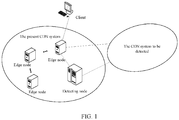
- An embodiment of the present application provides a method for detecting service quality of a CDN system, and the method may be applied to a network framework shown in Fig. 1 .
- the network framework includes a detecting node, an edge node and a CDN system to be detected.
- the detecting node and the edge node are located in the present CDN system, and the CDN system to be detected is a other CDN system.
- the detecting node is configured to send a copy instruction for copying traffic to the edge node.
- the edge node is usually configured to receive first request information sent by a client and to respond to the first request information. After receiving the copy instruction, the edge node further copies the received first request information to generate second request information, and sends the second request information to the CDN system that to be detected.
- the CDN system to be detected receives the second request information and responds to the second request information.
- the detecting node acquires first response information corresponding to the first request information, acquires second response information corresponding to the second request information from the CDN system to be detected, and compares the first response information and the second response information, so as to acquire service quality of the CDN system to be detected.
- the detecting node includes a processor, a memory and a transceiver.
- the processor may be configured to execute processing of detecting the service quality of the CDN system in a process below.
- the memory may be configured to store data required and data generated in a processing procedure below.
- the transceiver may be configured to receive and send relevant data in the processing procedure below, such as to acquire data that to be processed from other device and sending a data processing result to other device.
- Fig. 2 is a flow chart of a method for detecting service quality of a CDN system provided by an embodiment of the present application, the method specifically includes steps below.
- Step 201 a detecting node sends a copy instruction to an edge node.
- the detecting node may randomly select an edge node of the present CDN system in the target region, and send the copy instruction to the edge node, so as to enable a traffic copying function of the edge node.
- the copy instruction may include a target domain name corresponding to the website, so the edge node only copies request information of accessing the website, so that detection is more targeted and more precise.
- Step 202 the edge node copies received first request information to generate second request information after receiving the copy instruction.
- the edge node continuously receives request information sent by a client and responds to the request information.
- the edge node may copy the received request information by using a preset request copying tool, such as a TCPCopy tool.
- a preset request copying tool such as a TCPCopy tool.
- a real environment may be simulated more realistically by copying real traffic. Since the edge node receives a large amount of request information in a real scene, a large amount of diverse testing traffic will be acquired by copying traffic, which can also improve construction efficiency of the testing traffic, and can improve precision of the test with real request information.
- the edge node After receiving the copy instruction, the edge node parses the copy instruction. If the copy instruction includes the target domain name, the edge node judges whether the received first request information includes the target domain name; if yes, the edge node copies the first request information; otherwise, the edge node does not copy.
- the copy instruction may further include an indication of n-fold traffic magnification or an indication of m-fold traffic minification, so that the traffic may be magnified or minified according to specific detection requirements. For example, when the traffic for copying received by the edge node is relatively small, and is insufficient to precisely detect the service quality of the other CDN system, the traffic may be magnified; and when the traffic for copying received by the edge node is relatively large, the traffic may be appropriately minified in order to reduce traffic consumption and save costs, under the premise that precise detection of the service quality of the other CDN system can be guaranteed.
- the edge node When the copy instruction includes the indication of n-fold traffic magnification, where, n is a positive integer, the edge node receives the first request information after receiving the copy instruction, and copies the first request information n times to acquire n pieces of second request information, so as to magnify the traffic.
- the edge node receives the first request information after receiving the copy instruction, and copies once every m pieces of the first request information to acquire one piece of second request information, so as to minify the traffic. For example, when m is 3, a first piece of first request information, a fourth piece of first request information, a seventh piece of first request information,... received are sequentially copied.
- the edge node After copying the first request information to generate the second request information, the edge node marks the first request information copied and the second request information generated by copying, that is to say, marks the second request information and the first request information corresponding to the second request information, to acquire the first request information and the second request information respectively including a copy identifier.
- the edge node responds to the first request information including a copy identifier, to acquire first response information including a copy identifier.
- Step 203 the edge node sends the second request information to a CDN system to be detected.
- the CDN system to be detected receives the second request information sent by the edge node, and responds to the second request information, to acquire second response information.
- the second request information includes a copy identifier
- the acquired second response information also includes a copy identifier.
- Step 204 the detecting node acquires the first response information corresponding to the first request information, and acquires the second response information corresponding to the second request information from the CDN system to be detected.
- the edge node after responding to the request information, the edge node uploads the response information to a log storage system.
- the response information includes a response result and response time.
- Each piece of response information includes a status code to indicate whether the response is successful, so the response result may include the status code.
- the response time is time for responding to the request information.
- the log storage system includes response information of all the request information.
- the first response information and the second response information both include a copy identifier; and by looking up the response information including a copy identifier, the first response information may be looked up from a log storage system of the present CDN system, and the second response information may be looked up from a log storage system of the CDN system to be detected. Specifically, the second response information may be looked up from the log storage system of the CDN system to be detected through an interface.
- Step 205 the detecting node compares the first response information with the second response information, to acquire service quality of the CDN system to be detected.
- the second request information is copied from the first request information, and contents accessed by the two pieces of request information are the same, the present CDN system responds to a same request as the CDN system to be detected; and service quality of the present CDN system meets requirements by default, so the first response information acquired thereby also meets the requirements, and may serve as a reference value to judge quality of the second response information acquired by the CDN system to be detected. Further, the detecting node may judge the service quality of the CDN system to be detected by comparing the response results and the response time in the response information of the present CDN system and the CDN system to be detected.
- the detecting node may judge the service quality of the CDN system to be detected by comparing the response information generated by the present CDN system and the CDN system to be detected with respect to a same traffic. A plurality of pieces of first request information received by the edge node and second request information copied from these pieces of first request information are considered as a same traffic.
- the present CDN system and the CDN system to be detected respectively generate a piece of response information with respect to a same traffic; the piece of response information generated by the present CDN system includes a plurality of pieces of first response information, and the piece of response information generated by the CDN system to be detected includes a plurality of pieces of second response information.
- response results in the two pieces of response information are compared, and a specific process includes: judging whether a response result in each piece of first response information of the plurality of pieces of first response information is the same as a response result in second response information corresponding thereto; if it is the same, it indicates that the comparison succeeds; if it is not the same, it indicates that the comparison fails. If a ratio of results of successful comparisons to all the results of comparisons reaches a first preset ratio, it indicates that function implementation of the CDN system to be detected meets preset requirements.
- Response time in the two pieces of response information is compared, to judge the quality of the CDN system to be detected, and a specific process includes: calculating a difference between response time in each piece of first response information of the plurality of pieces of first response information and response time in second response information corresponding thereto; if a ratio of differences larger than a preset value to all differences reaches a second preset ratio, it indicates that the service quality of the CDN system to be detected meets the preset requirements.
- the edge node copies request information sent by a client to acquire testing traffic for testing the other CDN system; since the edge node receives a large amount of request information in a real scene, a large amount of diverse testing traffic will be acquired by copying traffic, which can also improve construction efficiency of the testing traffic, and can improve precision of the test with real request information;
- the entire testing process of the embodiment of the present application is implemented by automation, which, thus, reduces related management costs and labor costs, and improves efficiency and precision of the test;
- the service quality of the other CDN system to which the request is to be switched can be detected in advance, so as to ensure the service quality after switch, and reduce a back-switch condition caused by a problem of service quality after switch.
- an embodiment of the present application further provides a system for detecting service quality of a CDN system, the system including: a detecting node and an edge node.
- the detecting node includes:
- the copy instruction includes a target domain name.
- the edge node is specifically configured to: receive the first request information after receiving the copy instruction, and if the first request information includes the target domain name, copy the first request information to generate the second request information.
- the copy instruction includes an indication of n-fold traffic magnification, where, n is a positive integer
- the edge node is further configured to: receive the first request information after receiving the copy instruction, and copy the first request information n times to acquire n pieces of second request information.
- the copy instruction includes an indication of m-fold traffic minification, where, m is a positive integer
- the edge node is further configured to: receive the first request information after receiving the copy instruction, and copy once every m pieces of the first request information to acquire one piece of second request information.
- the edge node is further configured to mark the second request information and the first request information corresponding to the second request information.
- the first response information and the second response information both include a copy identifier.
- the comparing module 303 is specifically configured to: acquire the service quality of the CDN system to be detected by comparing response results and response time in the first response information and the second response information.
- the detecting node provided by the above-described embodiment may be implemented based on a computer program; when executing detection of CDN system service quality, it is illustrated only according to division of the above-described respective functional modules; and in actual application, the above-described function may be allocated to different functional modules according to requirements, that is, an internal structure of the detecting node is divided into different functional modules to complete all or part of the functions as described above.
- the system for detecting the service quality of the CDN system and the method for detecting the service quality of the CDN system provided by the above-described embodiments belong to a same concept, the method embodiment may be referred to for details of specific implementation process thereof, and no details will be repeated here.
- FIG. 4 is a structural block diagram of a node device provided by an embodiment of the present application.
- a node device 400 may vary greatly depending on configuration or performance, and may include one or more central processors 422 (e.g., one or more processors) and a memory 432, one or more storage applications 442 or a storage medium 430 for data 344 (e.g., one or more mass storage devices).
- the memory 432 and the storage medium 430 may be temporary storage or persistent storage.
- a program stored on the storage medium 430 may include one or more modules (not shown), and each module may include a series of instruction operations in the node device.
- the central processor 422 may be configured to communicate with storage medium 430, to execute a series of instruction operations in the storage medium 430 on the node device.
- the node device 400 may further include one or more power sources 424, one or more wired or wireless network interfaces 450, one or more input and output interfaces 458, one or more keyboards 454, and/or, one or more operating systems 441, such as Windows ServerTM, Mac OS XTM, UnixTM, LinuxTM and FreeBSDTM.
- one or more operating systems 441, such as Windows ServerTM, Mac OS XTM, UnixTM, LinuxTM and FreeBSDTM such as Windows ServerTM, Mac OS XTM, UnixTM, LinuxTM and FreeBSDTM.
- the node device 400 may include a memory, and one or more computer programs, wherein, the one or more computer programs are stored in the memory, and as configured, the one or more computer programs are executable by the one or more processors to implement the above-described method for detecting the service quality of the CDN system:
Landscapes
- Engineering & Computer Science (AREA)
- Computer Networks & Wireless Communication (AREA)
- Signal Processing (AREA)
- Multimedia (AREA)
- General Physics & Mathematics (AREA)
- Algebra (AREA)
- Physics & Mathematics (AREA)
- Mathematical Analysis (AREA)
- Mathematical Optimization (AREA)
- Mathematical Physics (AREA)
- Probability & Statistics with Applications (AREA)
- Pure & Applied Mathematics (AREA)
- Computer Security & Cryptography (AREA)
- Environmental & Geological Engineering (AREA)
- Data Exchanges In Wide-Area Networks (AREA)
Abstract
Description
- The present application claims priority of Chinese Patent Application No.
201910474788.2 - The present application relates to CDN technologies, and more particularly, to a method and a system for detecting service quality of a CDN system.
- The full name of CDN is content delivery network, which is a layer of intelligent virtual network built on a basis of the existing Internet by placing node servers throughout the network. A CDN system can direct a user's request to a node server closest to the user in real time according to comprehensive information such as network traffic, connections and load statuses of respective nodes, as well as a distance to the user and response time. The purpose is to enable the user to acquire a required content nearby, solve congestion of the Internet network, and improve a response speed of the user visiting a website.
- With rapid development of the Internet, especially popularization of multimedia applications such as on-demand and live broadcast, more node servers are needed to improve network service quality, and converged CDN emerges as the times require. The converged CDN technology is a technology that provides network service by means of other CDN system, that is, a request received is switched to other CDN system, which can not only improve the response speed of the user visiting the website, but also greatly reduce costs of building its own node.
- However, there are still some problems with the existing converged CDN technology. Service quality of other CDN system to which the request is to be switched may not meet requirements. If the request is switched to such other CDN system, user experience will be affected, so it is necessary to detect the service quality of other CDN system in advance. At present, a traditional detecting method is detecting by manually constructing traffic, but the method is time-consuming and laborious, with small traffic and monotonous data, which cannot guarantee precision of detection.
- In order to solve the problem of the existing technology, embodiments of the present application provide a method and a system for detecting service quality of a CDN system. The technical solutions are as follows:
- In a first aspect, there is provided a method for detecting service quality of a CDN system, the method including:
- sending, by a detecting node, a copy instruction to an edge node, thereby, copying, by the edge node, received first request information to generate second request information after receiving the copy instruction, and sending, by the edge node, the second request information to a CDN system to be detected;
- comparing, by the detecting node, first response information of the first request information with second response information of the second request information to acquire service quality of the CDN system to be detected.
- Optionally, the copy instruction includes a target domain name.
- Accordingly, the step of copying, by the edge node, received first request information to generate second request information after receiving the copy instruction, includes:
receiving, by the edge node, the first request information after receiving the copy instruction, and if the first request information includes the target domain name, copying the first request information to generate the second request information. - Optionally, the copy instruction includes an indication of n-fold traffic magnification, where, n is a positive integer.
- Accordingly, the step of copying, by the edge node, received first request information to generate second request information after receiving the copy instruction, includes:
receiving, by the edge node, the first request information after receiving the copy instruction, and copying the first request information n times to acquire n pieces of second request information. - Optionally, the copy instruction includes an indication of m-fold traffic minification, where, m is a positive integer;
- Accordingly, the step of copying, by the edge node, received first request information to generate second request information after receiving the copy instruction, includes:
receiving, by the edge node, the first request information after receiving the copy instruction, and copying once every m pieces of the first request information to acquire one piece of second request information. - Optionally, after the step of copying, by the edge node, received first request information to generate second request information after receiving the copy instruction, the method includes:
marking, by the edge node, the second request information and the first request information corresponding to the second request information. - Optionally, the first response information and the second response information include a copy identifier.
- Optionally, the step of comparing, by the detecting node, first response information of the first request information with second response information of the second request information to acquire service quality of the CDN system to be detected, includes:
acquiring the service quality of the CDN system to be detected by comparing response results and response time in the first response information and the second response information. - In a second aspect, there is provided a system for detecting service quality of a CDN system, the system including: a detecting node and an edge node.
- The detecting node includes:
- a sending module, configured to send a copy instruction to the edge node, to cause the edge node to copy received first request information to generate second request information after receiving the copy instruction, and to cause the edge node to send the second request information to a CDN system to be detected;
- a comparing module, configured to compare first response information of the first request information with second response information of the second request information to acquire service quality of the CDN system to be detected.
- Optionally, the copy instruction includes a target domain name.
- Accordingly, the edge node is specifically configured to:
receive the first request information after receiving the copy instruction, and if the first request information includes the target domain name, copy the first request information to generate the second request information. - Optionally, the copy instruction includes an indication of n-fold traffic magnification, where, n is a positive integer;
- Accordingly, the edge node is further configured to:
receive the first request information after receiving the copy instruction, and copy the first request information n times to acquire n pieces of second request information. - Optionally, the copy instruction includes an indication of m-fold traffic minification, where, m is a positive integer;
- Accordingly, the edge node is further configured to:
receive the first request information after receiving the copy instruction, and copy once every m pieces of the first request information to acquire one piece of second request information. - Optionally, the edge node is further configured to mark the second request information and the first request information corresponding to the second request information.
- Optionally, the first response information and the second response information include a copy identifier.
- Optionally, the comparing module is specifically configured to:
acquire the service quality of the CDN system to be detected by comparing response results and response time in the first response information and the second response information. - In a third aspect, there is provided a node device, including:
- at least one processor; and
- a memory communicating connected with the at least one processor; wherein,
- the memory is stored with instructions executable by the at least one processor, the instructions are executable by the at least one processor, to cause the at least one processor to execute the method for detecting the service quality of the CDN system according to the above-described first aspect.
- In a fourth aspect, there is provided a computer readable storage medium, stored with a computer program, wherein, the computer program, when executed by the processor, implements the method for detecting the service quality of the CDN system according to the above-described first aspect.
- Advantageous effects of the embodiments of the present application are as follows.
- Firstly, the edge node copies request information sent by a client to acquire testing traffic for testing the other CDN system; since the edge node receives a large amount of request information in a real scene, a large amount of diverse testing traffic will be acquired by copying traffic, which can also improve construction efficiency of the testing traffic, and can improve precision of the test with real request information.
- Secondly, the entire testing process of the embodiment of the present application, including comparative analysis of the response results, is implemented by automation, which, thus, reduces related management costs and labor costs, and improves efficiency and precision of the test.
- Thirdly, in the detecting method according to the embodiment of the present application, the service quality of the other CDN system to which the request is to be switched can be detected in advance, so as to ensure the service quality after switch, and reduce a back-switch condition caused by a problem of service quality after switch.
- In order to clearly illustrate the technical solution of the embodiments the present application, the drawings to be used in description of the embodiments will be briefly described in the following; it is obvious that the described drawings are only related to some embodiments of the present application. Based on the drawings, those ordinarily skilled in the art can acquire other drawings, without any inventive work.
-
Fig. 1 is a schematic diagram of a network framework provided by an embodiment of the present application; -
Fig. 2 is a flow chart of a method for detecting service quality of a CDN system provided by an embodiment of the present application; -
Fig. 3 is a structural block diagram of a detecting node provided by an embodiment of the present application; and -
Fig. 4 is a structural block diagram of a node device provided by an embodiment of the present application. - In order to make objects, technical details and advantages of the present application more apparent, hereinafter, embodiments of the present application will be further described in details in connection with the drawings.
- An embodiment of the present application provides a method for detecting service quality of a CDN system, and the method may be applied to a network framework shown in
Fig. 1 . The network framework includes a detecting node, an edge node and a CDN system to be detected. The detecting node and the edge node are located in the present CDN system, and the CDN system to be detected is a other CDN system. The detecting node is configured to send a copy instruction for copying traffic to the edge node. The edge node is usually configured to receive first request information sent by a client and to respond to the first request information. After receiving the copy instruction, the edge node further copies the received first request information to generate second request information, and sends the second request information to the CDN system that to be detected. The CDN system to be detected receives the second request information and responds to the second request information. The detecting node acquires first response information corresponding to the first request information, acquires second response information corresponding to the second request information from the CDN system to be detected, and compares the first response information and the second response information, so as to acquire service quality of the CDN system to be detected. - The detecting node includes a processor, a memory and a transceiver. The processor may be configured to execute processing of detecting the service quality of the CDN system in a process below. The memory may be configured to store data required and data generated in a processing procedure below. The transceiver may be configured to receive and send relevant data in the processing procedure below, such as to acquire data that to be processed from other device and sending a data processing result to other device.
- Refer to
Fig. 2 , which is a flow chart of a method for detecting service quality of a CDN system provided by an embodiment of the present application, the method specifically includes steps below. - Step 201: a detecting node sends a copy instruction to an edge node.
- In order to detect service quality of a other CDN system in a target region, the detecting node may randomly select an edge node of the present CDN system in the target region, and send the copy instruction to the edge node, so as to enable a traffic copying function of the edge node.
- In order to detect service quality of the other CDN system with respect to a specific website, the copy instruction may include a target domain name corresponding to the website, so the edge node only copies request information of accessing the website, so that detection is more targeted and more precise.
- Step 202: the edge node copies received first request information to generate second request information after receiving the copy instruction.
- In practical application, the edge node continuously receives request information sent by a client and responds to the request information. After receiving the copy instruction sent by the detecting node, the edge node may copy the received request information by using a preset request copying tool, such as a TCPCopy tool. A real environment may be simulated more realistically by copying real traffic. Since the edge node receives a large amount of request information in a real scene, a large amount of diverse testing traffic will be acquired by copying traffic, which can also improve construction efficiency of the testing traffic, and can improve precision of the test with real request information.
- After receiving the copy instruction, the edge node parses the copy instruction. If the copy instruction includes the target domain name, the edge node judges whether the received first request information includes the target domain name; if yes, the edge node copies the first request information; otherwise, the edge node does not copy.
- In order to conveniently adjust an amount of the traffic for detection, the copy instruction may further include an indication of n-fold traffic magnification or an indication of m-fold traffic minification, so that the traffic may be magnified or minified according to specific detection requirements. For example, when the traffic for copying received by the edge node is relatively small, and is insufficient to precisely detect the service quality of the other CDN system, the traffic may be magnified; and when the traffic for copying received by the edge node is relatively large, the traffic may be appropriately minified in order to reduce traffic consumption and save costs, under the premise that precise detection of the service quality of the other CDN system can be guaranteed.
- When the copy instruction includes the indication of n-fold traffic magnification, where, n is a positive integer, the edge node receives the first request information after receiving the copy instruction, and copies the first request information n times to acquire n pieces of second request information, so as to magnify the traffic.
- When the copy instruction includes the indication of m-fold traffic minification, where, m is a positive integer, the edge node receives the first request information after receiving the copy instruction, and copies once every m pieces of the first request information to acquire one piece of second request information, so as to minify the traffic. For example, when m is 3, a first piece of first request information, a fourth piece of first request information, a seventh piece of first request information,... received are sequentially copied.
- After copying the first request information to generate the second request information, the edge node marks the first request information copied and the second request information generated by copying, that is to say, marks the second request information and the first request information corresponding to the second request information, to acquire the first request information and the second request information respectively including a copy identifier.
- The edge node responds to the first request information including a copy identifier, to acquire first response information including a copy identifier.
- Step 203: the edge node sends the second request information to a CDN system to be detected.
- The CDN system to be detected receives the second request information sent by the edge node, and responds to the second request information, to acquire second response information. When the second request information includes a copy identifier, the acquired second response information also includes a copy identifier.
- Step 204: the detecting node acquires the first response information corresponding to the first request information, and acquires the second response information corresponding to the second request information from the CDN system to be detected.
- In specific application, after responding to the request information, the edge node uploads the response information to a log storage system. The response information includes a response result and response time. Each piece of response information includes a status code to indicate whether the response is successful, so the response result may include the status code. The response time is time for responding to the request information.
- The log storage system includes response information of all the request information. The first response information and the second response information both include a copy identifier; and by looking up the response information including a copy identifier, the first response information may be looked up from a log storage system of the present CDN system, and the second response information may be looked up from a log storage system of the CDN system to be detected. Specifically, the second response information may be looked up from the log storage system of the CDN system to be detected through an interface.
- Step 205: the detecting node compares the first response information with the second response information, to acquire service quality of the CDN system to be detected.
- The second request information is copied from the first request information, and contents accessed by the two pieces of request information are the same, the present CDN system responds to a same request as the CDN system to be detected; and service quality of the present CDN system meets requirements by default, so the first response information acquired thereby also meets the requirements, and may serve as a reference value to judge quality of the second response information acquired by the CDN system to be detected. Further, the detecting node may judge the service quality of the CDN system to be detected by comparing the response results and the response time in the response information of the present CDN system and the CDN system to be detected.
- During implementation, the detecting node may judge the service quality of the CDN system to be detected by comparing the response information generated by the present CDN system and the CDN system to be detected with respect to a same traffic. A plurality of pieces of first request information received by the edge node and second request information copied from these pieces of first request information are considered as a same traffic. The present CDN system and the CDN system to be detected respectively generate a piece of response information with respect to a same traffic; the piece of response information generated by the present CDN system includes a plurality of pieces of first response information, and the piece of response information generated by the CDN system to be detected includes a plurality of pieces of second response information. Firstly, response results in the two pieces of response information are compared, and a specific process includes: judging whether a response result in each piece of first response information of the plurality of pieces of first response information is the same as a response result in second response information corresponding thereto; if it is the same, it indicates that the comparison succeeds; if it is not the same, it indicates that the comparison fails. If a ratio of results of successful comparisons to all the results of comparisons reaches a first preset ratio, it indicates that function implementation of the CDN system to be detected meets preset requirements. Response time in the two pieces of response information is compared, to judge the quality of the CDN system to be detected, and a specific process includes: calculating a difference between response time in each piece of first response information of the plurality of pieces of first response information and response time in second response information corresponding thereto; if a ratio of differences larger than a preset value to all differences reaches a second preset ratio, it indicates that the service quality of the CDN system to be detected meets the preset requirements.
- Advantageous effects of the embodiment of the present application are as follows:
- Firstly, the edge node copies request information sent by a client to acquire testing traffic for testing the other CDN system; since the edge node receives a large amount of request information in a real scene, a large amount of diverse testing traffic will be acquired by copying traffic, which can also improve construction efficiency of the testing traffic, and can improve precision of the test with real request information;
- Secondly, the entire testing process of the embodiment of the present application, including comparative analysis of the response results, is implemented by automation, which, thus, reduces related management costs and labor costs, and improves efficiency and precision of the test;
- Thirdly, in the detecting method according to the embodiment of the present application, the service quality of the other CDN system to which the request is to be switched can be detected in advance, so as to ensure the service quality after switch, and reduce a back-switch condition caused by a problem of service quality after switch.
- Based on a same concept as the above-described embodiment of the method for detecting the service quality of the CDN system, an embodiment of the present application further provides a system for detecting service quality of a CDN system, the system including: a detecting node and an edge node.
- Refer to a structural block diagram of the detecting node shown in
Fig. 3 , the detecting node includes: - a sending
module 301, configured to send a copy instruction to the edge node, to cause the edge node to copy received first request information to generate second request information after receiving the copy instruction, and to cause the edge node to send the second request information to a CDN system to be detected; - an acquiring
module 302, configured to acquire first response information corresponding to the first request information, and acquire second response information corresponding to the second request information from the CDN system to be detected; - a comparing
module 303, configured to compare the first response information with the second response information to acquire service quality of the CDN system to be detected. - For example, the copy instruction includes a target domain name.
- Accordingly, the edge node is specifically configured to:
receive the first request information after receiving the copy instruction, and if the first request information includes the target domain name, copy the first request information to generate the second request information. - For example, the copy instruction includes an indication of n-fold traffic magnification, where, n is a positive integer;
- Accordingly, the edge node is further configured to:
receive the first request information after receiving the copy instruction, and copy the first request information n times to acquire n pieces of second request information. - For example, the copy instruction includes an indication of m-fold traffic minification, where, m is a positive integer;
- Accordingly, the edge node is further configured to:
receive the first request information after receiving the copy instruction, and copy once every m pieces of the first request information to acquire one piece of second request information. - For example, the edge node is further configured to mark the second request information and the first request information corresponding to the second request information.
- For example, the first response information and the second response information both include a copy identifier.
- For example, the comparing
module 303 is specifically configured to:
acquire the service quality of the CDN system to be detected by comparing response results and response time in the first response information and the second response information. - Advantageous effects of the embodiment of the present application are as follows:
- Firstly, the edge node copies request information sent by a client to acquire testing traffic for testing the other CDN system; since the edge node receives a large amount of request information in a real scene, a large amount of diverse testing traffic will be acquired by copying traffic, which can also improve construction efficiency of the testing traffic, and can improve precision of the test with real request information;
- Secondly, the entire testing process of the embodiment of the present application, including comparative analysis of the response results, is implemented by automation, which, thus, reduces related management costs and labor costs, and improves efficiency and precision of the test;
- Thirdly, in the detecting method according to the embodiment of the present application, the service quality of the other CDN system to which the request is to be switched can be detected in advance, so as to ensure the service quality after switch, and reduce a back-switch condition caused by a problem of service quality after switch.
- It should be noted that, the detecting node provided by the above-described embodiment may be implemented based on a computer program; when executing detection of CDN system service quality, it is illustrated only according to division of the above-described respective functional modules; and in actual application, the above-described function may be allocated to different functional modules according to requirements, that is, an internal structure of the detecting node is divided into different functional modules to complete all or part of the functions as described above. In addition, the system for detecting the service quality of the CDN system and the method for detecting the service quality of the CDN system provided by the above-described embodiments belong to a same concept, the method embodiment may be referred to for details of specific implementation process thereof, and no details will be repeated here.
-
Fig. 4 is a structural block diagram of a node device provided by an embodiment of the present application. Anode device 400 may vary greatly depending on configuration or performance, and may include one or more central processors 422 (e.g., one or more processors) and amemory 432, one ormore storage applications 442 or astorage medium 430 for data 344 (e.g., one or more mass storage devices). Thememory 432 and thestorage medium 430 may be temporary storage or persistent storage. A program stored on thestorage medium 430 may include one or more modules (not shown), and each module may include a series of instruction operations in the node device. Still further, thecentral processor 422 may be configured to communicate withstorage medium 430, to execute a series of instruction operations in thestorage medium 430 on the node device. - The
node device 400 may further include one ormore power sources 424, one or more wired or wireless network interfaces 450, one or more input andoutput interfaces 458, one ormore keyboards 454, and/or, one ormore operating systems 441, such as Windows ServerTM, Mac OS XTM, UnixTM, LinuxTM and FreeBSDTM. - The
node device 400 may include a memory, and one or more computer programs, wherein, the one or more computer programs are stored in the memory, and as configured, the one or more computer programs are executable by the one or more processors to implement the above-described method for detecting the service quality of the CDN system: - sending a copy instruction to an edge node, to cause the edge node to copy received first request information to generate second request information after receiving the copy instruction, and sending, by the edge node, the second request information to a CDN system to be detected;
- comparing first response information of the first request information with second response information of the second request information to acquire service quality of the CDN system to be detected.
- Those skilled in the art may understand that implementation of all or part of the steps of the above-described embodiments may be completed by hardware, or may also be completed by related hardware as instructed by a program; the program may be stored in a computer readable storage medium; and the above-mentioned storage medium may be a read only memory, a magnetic disk or an optical disk, and the like.
- The foregoing embodiments merely are preferred embodiments of the present application, and not intended to limit the present application. Any modification, equivalent substitution, improvement, and the like, made within the spirit and principles of the present disclosure should be covered within the protection scope of the present application.
Claims (12)
- A method for detecting service quality of a CDN system, wherein, the method comprises:sending, by a detecting node, a copy instruction to an edge node, thereby, copying, by the edge node, received first request information to generate second request information after receiving the copy instruction, and sending, by the edge node, the second request information to a CDN system to be detected;comparing, by the detecting node, first response information of the first request information with second response information of the second request information to acquire service quality of the CDN system to be detected.
- The method according to claim 1, wherein, the copy instruction comprises a target domain name;
the step of copying, by the edge node, received first request information to generate second request information after receiving the copy instruction, comprises:
receiving, by the edge node, the first request information after receiving the copy instruction, and if the first request information comprises the target domain name, copying the first request information to generate the second request information. - The method according to claim 1, wherein, the copy instruction comprises an indication of n-fold traffic magnification, where, n is a positive integer;
the step of copying, by the edge node, received first request information to generate second request information after receiving the copy instruction, comprises:
receiving, by the edge node, the first request information after receiving the copy instruction, and copying the first request information n times to acquire n pieces of second request information. - The method according to claim 1, wherein, the copy instruction comprises an indication of m-fold traffic minification, where, m is a positive integer;
the step of copying, by the edge node, received first request information to generate second request information after receiving the copy instruction, comprises:
receiving, by the edge node, the first request information after receiving the copy instruction, and copying once every m pieces of the first request information to acquire one piece of second request information. - The method according to claim 1, wherein, after the step of copying, by the edge node, received first request information to generate second request information after receiving the copy instruction, the method comprises:
marking, by the edge node, the second request information and the first request information corresponding to the second request information. - The method according to claim 1, wherein, the first response information and the second response information comprise a copy identifier.
- The method according to claim 1, wherein, the step of comparing, by the detecting node, first response information of the first request information with second response information of the second request information to acquire service quality of the CDN system to be detected, comprises:
acquiring the service quality of the CDN system to be detected by comparing response results and response time in the first response information and the second response information. - A system for detecting service quality of a CDN system, wherein, the system comprises a detecting node and an edge node;
the detecting node comprises:a sending module, configured to send a copy instruction to the edge node to cause the edge node to copy received first request information to generate second request information after receiving the copy instruction, and to cause the edge node to send the second request information to a CDN system to be detected;a comparing module, configured to compare first response information of the first request information with second response information of the second request information to acquire service quality of the CDN system to be detected. - The system according to claim 8, wherein, the copy instruction comprises a target domain name;
the edge node is configured to:
receive the first request information after receiving the copy instruction, and if the first request information comprises the target domain name, copy the first request information to generate the second request information. - The system according to claim 8, wherein, the comparing module is specifically configured to:
acquire the service quality of the CDN system to be detected by comparing response results and response time in the first response information and the second response information. - A node device, comprising:at least one processor; anda memory communicating connected with the at least one processor; wherein,the memory is stored with instructions executable by the at least one processor, the instructions are executable by the at least one processor, to cause the at least one processor to execute the method for detecting the service quality of the CDN system according to claims 1 to 7.
- A computer readable storage medium, stored with a computer program, wherein, the computer program, when executed by the processor, executes the method for detecting the service quality of the CDN system according to claims 1 to 7.
Applications Claiming Priority (2)
| Application Number | Priority Date | Filing Date | Title |
|---|---|---|---|
| CN201910474788.2A CN110380890B (en) | 2019-06-03 | 2019-06-03 | A kind of CDN system service quality detection method and system |
| PCT/CN2019/096171 WO2020244027A1 (en) | 2019-06-03 | 2019-07-16 | Quality of service inspection method and system for cdn system |
Publications (2)
| Publication Number | Publication Date |
|---|---|
| EP3767884A1 true EP3767884A1 (en) | 2021-01-20 |
| EP3767884A4 EP3767884A4 (en) | 2021-01-20 |
Family
ID=68249637
Family Applications (1)
| Application Number | Title | Priority Date | Filing Date |
|---|---|---|---|
| EP19880946.9A Withdrawn EP3767884A4 (en) | 2019-06-03 | 2019-07-16 | METHOD AND SYSTEM FOR DETERMINING THE QUALITY OF SERVICE OF A CDN SYSTEM |
Country Status (4)
| Country | Link |
|---|---|
| US (1) | US11303532B2 (en) |
| EP (1) | EP3767884A4 (en) |
| CN (1) | CN110380890B (en) |
| WO (1) | WO2020244027A1 (en) |
Families Citing this family (6)
| Publication number | Priority date | Publication date | Assignee | Title |
|---|---|---|---|---|
| CN110380890B (en) * | 2019-06-03 | 2021-04-02 | 网宿科技股份有限公司 | A kind of CDN system service quality detection method and system |
| CN112202643B (en) * | 2020-10-12 | 2022-03-29 | 成都知道创宇信息技术有限公司 | Network detection method, device, test host and storage medium |
| CN113438106B (en) | 2021-06-22 | 2023-02-21 | 北京百度网讯科技有限公司 | Content distribution network processing method, device and electronic equipment |
| CN115996179B (en) * | 2021-10-15 | 2025-08-05 | 北京字节跳动网络技术有限公司 | Service node testing method, device, readable medium and electronic device |
| CN115499450B (en) * | 2022-09-15 | 2026-02-13 | 北京百度网讯科技有限公司 | A data distribution method, apparatus, electronic device, and storage medium |
| US20250080787A1 (en) * | 2023-08-29 | 2025-03-06 | Bitmovin Gmbh | Adaptive Bitrate Ladder Optimization for Live Video Streaming |
Family Cites Families (22)
| Publication number | Priority date | Publication date | Assignee | Title |
|---|---|---|---|---|
| CN1981278B (en) * | 2004-03-12 | 2010-11-03 | 诺基亚公司 | Method and apparatus for providing quality of service support in a wireless communication system |
| US7558283B2 (en) * | 2004-03-12 | 2009-07-07 | Nokia Corporation | Method, apparatus and computer program product providing quality of service support in a wireless communications system |
| US8489724B2 (en) * | 2010-09-14 | 2013-07-16 | Cdnetworks Co., Ltd. | CNAME-based round-trip time measurement in a content delivery network |
| CN103746870A (en) * | 2013-12-24 | 2014-04-23 | 乐视网信息技术(北京)股份有限公司 | CDN delivery network analysis method, file delivery control center and system |
| US9444718B2 (en) * | 2014-07-28 | 2016-09-13 | Verizon Digital Media Services Inc. | Distributed platform test network |
| CN106375139B (en) * | 2015-07-23 | 2021-04-06 | 腾讯科技(北京)有限公司 | Method, apparatus and system for duplicating requests |
| US20170126538A1 (en) * | 2015-10-28 | 2017-05-04 | Fastly, Inc. | Testing in a content delivery network |
| CN105897822B (en) * | 2015-11-11 | 2019-07-26 | 法法汽车(中国)有限公司 | A kind of content distributing network CDN node selection method and its device |
| CN105897455A (en) * | 2015-11-16 | 2016-08-24 | 乐视云计算有限公司 | Function management configuration server operation detecting method, legitimate client, CDN node and system |
| CN106911511B (en) * | 2017-03-10 | 2019-09-13 | 网宿科技股份有限公司 | A method and system for protecting CDN client source site |
| CN108696399B (en) * | 2017-04-07 | 2020-12-29 | 腾讯科技(深圳)有限公司 | Test method and apparatus for business service |
| CN108234207B (en) * | 2017-12-29 | 2021-09-21 | 北京奇虎科技有限公司 | Fault positioning method and device based on Content Delivery Network (CDN) |
| CN109194706B (en) * | 2018-07-20 | 2021-11-16 | 网宿科技股份有限公司 | Network resource dial testing method and terminal |
| CN109067938B (en) * | 2018-10-15 | 2022-03-04 | 网宿科技股份有限公司 | A method and device for testing DNS server |
| CN109729397A (en) * | 2019-01-29 | 2019-05-07 | 网宿科技股份有限公司 | A kind of plug-flow method, system and server |
| CN110380890B (en) * | 2019-06-03 | 2021-04-02 | 网宿科技股份有限公司 | A kind of CDN system service quality detection method and system |
| CN110392094B (en) * | 2019-06-03 | 2021-03-19 | 网宿科技股份有限公司 | Method for acquiring service data and converged CDN system |
| CN110535930A (en) * | 2019-08-22 | 2019-12-03 | 网宿科技股份有限公司 | A kind of dispatching method and system of edge C DN node |
| US20210084382A1 (en) * | 2019-09-13 | 2021-03-18 | Wowza Media Systems, LLC | Video Stream Analytics |
| CN111212114B (en) * | 2019-12-19 | 2021-08-27 | 网宿科技股份有限公司 | Method and device for downloading resource file |
| US10972436B1 (en) * | 2020-10-24 | 2021-04-06 | 360 It, Uab | System and method for session affinity in proxy media routing |
| US12126592B2 (en) * | 2020-12-26 | 2024-10-22 | Intel Corporation | Neutral host edge services |
-
2019
- 2019-06-03 CN CN201910474788.2A patent/CN110380890B/en not_active Expired - Fee Related
- 2019-07-16 EP EP19880946.9A patent/EP3767884A4/en not_active Withdrawn
- 2019-07-16 WO PCT/CN2019/096171 patent/WO2020244027A1/en not_active Ceased
-
2020
- 2020-05-22 US US16/882,347 patent/US11303532B2/en not_active Expired - Fee Related
Also Published As
| Publication number | Publication date |
|---|---|
| US20200382382A1 (en) | 2020-12-03 |
| CN110380890A (en) | 2019-10-25 |
| CN110380890B (en) | 2021-04-02 |
| EP3767884A4 (en) | 2021-01-20 |
| WO2020244027A1 (en) | 2020-12-10 |
| US11303532B2 (en) | 2022-04-12 |
Similar Documents
| Publication | Publication Date | Title |
|---|---|---|
| US11303532B2 (en) | Method and system for detecting service quality of CDN system | |
| CN110413595B (en) | Data migration method applied to distributed database and related device | |
| EP1576487B1 (en) | Web server hit multiplier and redirector | |
| CN111262759A (en) | Internet of things platform testing method, device, equipment and storage medium | |
| US10284623B2 (en) | Optimized browser rendering service | |
| US20180176088A1 (en) | Virtualized network function monitoring | |
| EP3525422B1 (en) | Routing for large server deployments | |
| CN112087520B (en) | Data processing method, device, equipment and computer readable storage medium | |
| CN108989151B (en) | Flow collection method for network or application performance management | |
| WO2021164385A1 (en) | Virtualization method, apparatus and device for internet of things device system, and storage medium | |
| CN115563084B (en) | Data multiplexing methods, apparatuses, electronic devices and storage media | |
| US20170017574A1 (en) | Efficient cache warm up based on user requests | |
| CN115145806A (en) | Data acquisition method and device and computer readable storage medium | |
| CN114185792A (en) | Data isolation method, device and equipment for pressure measurement scene and storage medium | |
| CN112527453A (en) | Virtualization information simulation system, method and computer-readable storage medium | |
| CN112491974B (en) | Remote browsing method, device, storage medium, terminal equipment and server | |
| CN110929185A (en) | Website directory detection method and device, computer equipment and computer storage medium | |
| EP3481099B1 (en) | Load balancing method and associated device | |
| US11196766B2 (en) | Detecting denial of service attacks in serverless computing | |
| CN107046546A (en) | A kind of network safety control method and device | |
| CN114697378B (en) | Website access method, device, equipment and medium | |
| CN117176683A (en) | A network address obtaining method, device, electronic equipment and storage medium | |
| CN109547276B (en) | A problem location method, terminal and storage medium | |
| CN107317723A (en) | Data processing method and server | |
| CN110134547B (en) | Middleware-based repeated data deleting method and related device |
Legal Events
| Date | Code | Title | Description |
|---|---|---|---|
| STAA | Information on the status of an ep patent application or granted ep patent |
Free format text: STATUS: UNKNOWN |
|
| STAA | Information on the status of an ep patent application or granted ep patent |
Free format text: STATUS: THE INTERNATIONAL PUBLICATION HAS BEEN MADE |
|
| PUAI | Public reference made under article 153(3) epc to a published international application that has entered the european phase |
Free format text: ORIGINAL CODE: 0009012 |
|
| STAA | Information on the status of an ep patent application or granted ep patent |
Free format text: STATUS: REQUEST FOR EXAMINATION WAS MADE |
|
| 17P | Request for examination filed |
Effective date: 20200515 |
|
| A4 | Supplementary search report drawn up and despatched |
Effective date: 20201112 |
|
| AK | Designated contracting states |
Kind code of ref document: A1 Designated state(s): AL AT BE BG CH CY CZ DE DK EE ES FI FR GB GR HR HU IE IS IT LI LT LU LV MC MK MT NL NO PL PT RO RS SE SI SK SM TR |
|
| AX | Request for extension of the european patent |
Extension state: BA ME |
|
| STAA | Information on the status of an ep patent application or granted ep patent |
Free format text: STATUS: EXAMINATION IS IN PROGRESS |
|
| 17Q | First examination report despatched |
Effective date: 20210930 |
|
| DAV | Request for validation of the european patent (deleted) | ||
| DAX | Request for extension of the european patent (deleted) | ||
| STAA | Information on the status of an ep patent application or granted ep patent |
Free format text: STATUS: THE APPLICATION IS DEEMED TO BE WITHDRAWN |
|
| 18D | Application deemed to be withdrawn |
Effective date: 20220913 |