EP3767855B1 - Data transmission protection method, apparatus, system, computer program and computer readable storage medium - Google Patents
Data transmission protection method, apparatus, system, computer program and computer readable storage medium Download PDFInfo
- Publication number
- EP3767855B1 EP3767855B1 EP19792151.3A EP19792151A EP3767855B1 EP 3767855 B1 EP3767855 B1 EP 3767855B1 EP 19792151 A EP19792151 A EP 19792151A EP 3767855 B1 EP3767855 B1 EP 3767855B1
- Authority
- EP
- European Patent Office
- Prior art keywords
- data flow
- data
- flow
- encapsulated
- control word
- Prior art date
- Legal status (The legal status is an assumption and is not a legal conclusion. Google has not performed a legal analysis and makes no representation as to the accuracy of the status listed.)
- Active
Links
Images



Classifications
-
- H—ELECTRICITY
- H04—ELECTRIC COMMUNICATION TECHNIQUE
- H04L—TRANSMISSION OF DIGITAL INFORMATION, e.g. TELEGRAPHIC COMMUNICATION
- H04L49/00—Packet switching elements
- H04L49/20—Support for services
- H04L49/208—Port mirroring
-
- H—ELECTRICITY
- H04—ELECTRIC COMMUNICATION TECHNIQUE
- H04L—TRANSMISSION OF DIGITAL INFORMATION, e.g. TELEGRAPHIC COMMUNICATION
- H04L1/00—Arrangements for detecting or preventing errors in the information received
- H04L1/0001—Systems modifying transmission characteristics according to link quality, e.g. power backoff
- H04L1/0006—Systems modifying transmission characteristics according to link quality, e.g. power backoff by adapting the transmission format
- H04L1/0007—Systems modifying transmission characteristics according to link quality, e.g. power backoff by adapting the transmission format by modifying the frame length
-
- H—ELECTRICITY
- H04—ELECTRIC COMMUNICATION TECHNIQUE
- H04L—TRANSMISSION OF DIGITAL INFORMATION, e.g. TELEGRAPHIC COMMUNICATION
- H04L1/00—Arrangements for detecting or preventing errors in the information received
- H04L1/08—Arrangements for detecting or preventing errors in the information received by repeating transmission, e.g. Verdan system
-
- H—ELECTRICITY
- H04—ELECTRIC COMMUNICATION TECHNIQUE
- H04L—TRANSMISSION OF DIGITAL INFORMATION, e.g. TELEGRAPHIC COMMUNICATION
- H04L47/00—Traffic control in data switching networks
- H04L47/10—Flow control; Congestion control
- H04L47/32—Flow control; Congestion control by discarding or delaying data units, e.g. packets or frames
-
- H—ELECTRICITY
- H04—ELECTRIC COMMUNICATION TECHNIQUE
- H04L—TRANSMISSION OF DIGITAL INFORMATION, e.g. TELEGRAPHIC COMMUNICATION
- H04L49/00—Packet switching elements
- H04L49/55—Prevention, detection or correction of errors
-
- H—ELECTRICITY
- H04—ELECTRIC COMMUNICATION TECHNIQUE
- H04L—TRANSMISSION OF DIGITAL INFORMATION, e.g. TELEGRAPHIC COMMUNICATION
- H04L69/00—Network arrangements, protocols or services independent of the application payload and not provided for in the other groups of this subclass
- H04L69/04—Protocols for data compression, e.g. ROHC
-
- H—ELECTRICITY
- H04—ELECTRIC COMMUNICATION TECHNIQUE
- H04L—TRANSMISSION OF DIGITAL INFORMATION, e.g. TELEGRAPHIC COMMUNICATION
- H04L1/00—Arrangements for detecting or preventing errors in the information received
- H04L1/0001—Systems modifying transmission characteristics according to link quality, e.g. power backoff
- H04L1/0009—Systems modifying transmission characteristics according to link quality, e.g. power backoff by adapting the channel coding
-
- H—ELECTRICITY
- H04—ELECTRIC COMMUNICATION TECHNIQUE
- H04L—TRANSMISSION OF DIGITAL INFORMATION, e.g. TELEGRAPHIC COMMUNICATION
- H04L1/00—Arrangements for detecting or preventing errors in the information received
- H04L1/0078—Avoidance of errors by organising the transmitted data in a format specifically designed to deal with errors, e.g. location
- H04L1/0079—Formats for control data
-
- H—ELECTRICITY
- H04—ELECTRIC COMMUNICATION TECHNIQUE
- H04L—TRANSMISSION OF DIGITAL INFORMATION, e.g. TELEGRAPHIC COMMUNICATION
- H04L69/00—Network arrangements, protocols or services independent of the application payload and not provided for in the other groups of this subclass
- H04L69/22—Parsing or analysis of headers
Definitions
- the present disclosure relates to the field of communication technology, and in particular, to a data transmission protection method, a data transmission protection system, and a computer readable storage medium.
- the time delay and a packet loss rate of the services are conventionally guaranteed through a proprietary device/proprietary protocol (such as field bus)/proprietary line, and along with gradual fusion of IT and OT, an IT network must provide deterministic network services similar to OT to support seamless docking and migration of the services; some new services, such as a block chain, are more and more sensitive to the time delay due to applications supported by the new services, best effort services of current network cannot meet requirements, and the network is urgently required to provide services such as deterministic time delay/packet loss/jitter and the like.
- U.S. patent application US2013132789A1 provides video transmission systems and methods with video data flows transmitted over a Carrier Ethernet Network at Layer 2 with redundancy in order to provide hitless protection switching and uninterrupted video service delivery, such as during periods of asymmetric congestion or hard network failures.
- the video transmission systems and methods provide the redundancy in a manner similar to 1+1 linear protection with hit-less protection switching.
- the video transmission systems and methods provide encapsulated video signals over Ethernet using standardized Carrier Ethernet frames with additional sequencing information.
- the video transmission systems and methods may also include packet-based forward error correction information for additional resiliency.
- U.S. patent application US2007280217A1 provides a method and software solution to add robustness to real-time media streams such as voice, video and audio streams on a network.
- a robust mode is activated at an intermediate node of the end-to-end transmission for the media stream to the destination link.
- the robust mode of the present invention may be activated on specific network links that are experiencing the network problems and not necessarily on the end-to-end communication path.
- an intermediate network node may terminate robust mode in packets received from an upstream link when the network channel in question no longer experiences the adverse network condition.
- U.S. patent application US2006014330A1 provides a manufacturing method for an SOI wafer with a high productivity in which generation of a void is suppressed in manufacturing the SOI wafer.
- a manufacturing method for an SOI wafer of the present invention in which two starting wafers are prepared, an insulating layer is formed on at least one of the two starting wafers and the one wafer is adhered to the other wafer without using an adhesive agent, the starting wafers each with no line defect on a surface thereof are used.
- an insulating layer is formed on at least one of the two starting wafers and the one wafer is adhered to the other wafer without using an adhesive agent, the starting wafers are subjected to a high temperature heat treatment in advance.
- U.S. patent application US2012158990A1 provides a method which includes receiving a constant bit rate data stream, segmenting the constant bit rate data stream into fixed size blocks of data, generating a time stamp indicative of a system reference clock, the time stamp being in reference to a clock rate of the constant bit rate data stream, encapsulating, in an electronic communication protocol frame, a predetermined number of fixed blocks of data along with (i) a control word indicative of, at least, a relative sequence of the predetermined number of fixed blocks of data in the constant bit rate stream and (ii) the time stamp, and transmitting the electronic communication protocol frame to a packet switched network.
- U.S. patent application US2009178096A1 provides an intelligent multi-sending of data stream segments, comprising: monitoring one or more variable data transmission parameters, detecting one or more invariant media data segment parameters, assigning a value to the media data segment based upon the one or more invariant media data segment parameters and the one or more variable data transmission parameters, comparing the value to a threshold, and sending multiple copies of the media data segment over a network link to a media receiver if the value is above the threshold.
- an object of the present disclosure is to provide a method, and a system for protecting data transmission and a computer-readable storage medium, which reduce or even eliminate an influence of a packet loss event and reduce a time delay of service by performing a same-path redundant copying on a data flow of a low-speed deterministic network service.
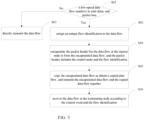
- the present disclosure provides a data transmission protection method, including steps S10 to S30.
- a packet header is encapsulated for a data flow to be transmitted at an ingress node to form an encapsulated data flow, where the packet header includes a control word and a flow identification.
- the encapsulated data flow is copied to obtain a copied data flow, and the encapsulated data flow and the copied data flow are transmitted together.
- step S30 the data flow is recovered at a terminating node according to the control word and the flow identification.
- a same-path redundant copying is performed on the data flow of a low-speed deterministic network service, so that an influence of a packet loss event is reduced or even eliminated, and the time delay of the service is reduced.
- each of copy and recovery processes of the data flow (also referred to as a service flow) is finished at an edge node of a network, where the ingress node is an edge node of the network at a transmitting terminal, and the data flow is encapsulated and copied at the ingress node, and the terminating node is an edge node of the network at a receiving terminal, and the data flow is recovered at the terminating node.
- At least one copied data flow (including four data packets ABCD shown in Fig. 2 ) is obtained by copying the data flow to be transmitted (including the four packets ABCD), and is transmitted together with an original data flow, even if there is a packet loss event in a transmission process, as shown in Fig. 2 , a packet B in the original data flow is lost, and a packet C in the copied data flow is lost, since there is the copied data flow, when finally recovering, the four packets ABCD may still be obtained, and the complete data flow is received.
- the method further includes steps S01 to S03.
- step S01 it is determined whether the data flow is a low-speed data steam sensitive to time delay and packet loss.
- step S02 in response to that the data flow is the low-speed data steam sensitive to time delay and packet loss, a unique flow identification is assigned to the data flow, and enter the step S10 to encapsulate the packet header for the data flow to be transmitted at the ingress node.
- step S03 in response to that the data flow is not the low-speed data steam sensitive to time delay and packet loss, directly transmit the data flow.
- a rate threshold for determining whether the data flow is the low-speed data flow sensitive to time delay and packet loss is recommended to be 100kbps, and when a transmission rate of the data flow is less than the rate threshold, the data flow is the low-speed data flow.
- the rate threshold may be flexibly configured by an upper layer application according to a capacity of the network.
- the packet header when the packet header is encapsulated for the data flow, the packet header includes a data payload, a control word, and a flow identification.
- Fig. 4 shows a schematic diagram of structure of the packet header, which includes two modes, one is an MPLS PW mode, and the other is an IPv6 mode, and with such structural design, it is easy to keep compatibility with a data plane design of a DetNet (deterministic network).
- DetNet deterministic network
- the flow identification is used to uniquely identify a specific data flow, in a network domain where the data flow is transmitted, for nodes of the network. For a same data flow or a same packet, the flow identification and the control word corresponding thereto are constant, and are irrelevant to whether the redundant copying is performed.
- a PW (Pseudowire) label identification and an identification combining a flow label and a source address in an IPv6 header structure may be used to identify the data flow.
- the control word mainly includes a packet sequence number.
- the control word may have a total of four bytes, two bytes for the packet sequence number, and two bytes for a reserved field, and such structural design is adopted to maintain compatibility with technical mechanisms related to multi-path service protection in TSN (time sensitive network) and DetNet (deterministic network).
- TSN time sensitive network
- DetNet deterministic network
- the step S20 specifically includes: copying the encapsulated data flow to obtain (1+n) encapsulated data flows, flow identifications and control words of the (1+n) encapsulated data flows are completely the same, and n is an integer greater than or equal to 1; and transmitting the (1+n) encapsulated data flows to a receiving terminal together.
- a value of n may be statically configured, or may be dynamically adjusted by a control plane according to network packet loss statistical data, where the value of n is configured to be relative large in response to that a current packet loss rate is relative high, and the value of n is configured to be relative small in response to that the current packet loss rate is relative low.
- a method for copying the encapsulated data flow includes: copying the encapsulated data flow according to a time slice and copying the encapsulated data flow according to a number of specific consecutive packets, specifically, in response to that the service is a time continuous service, data is extracted and copied according to the time slice, such as 1 millisecond; and in response to that the service is an intermittent burst short-time service, data is extracted and copied according to the number of packets, such as copying is performed every 1000 packets.
- the relay node if a relay node participates in the transmission of the data flow, the relay node performs indifferent forwarding on the data flow without identifying the copied redundant data or participating in a copying operation.
- the step S30 includes: receiving the data flow, determining whether the data flow reaches the terminating node for a first time according to the control word of the data flow, in response to that the data flow reaches the terminating node for the first time, recovering the data flow, and removing the packet header encapsulated for the data flow; and in response to that the control word of the data flow currently received is the same as the control word of the data flow previously received, discarding the data flow currently received.
- the terminating node when the terminating node (node 3 shown in the figure) receives the data flow ACDABD subjected to the packet loss, in response to that the data packet A is received for a first time, the data packet A is recovered, and the packet header previously encapsulated for the data packet A is removed, and in response to that the data packet A is received for a second time, since the data packet A is a copied data packet A, the control word of the copied data packet A is the same as the control word of the data packet A received for the first time, the copied data packet A is discarded.
- the present disclosure provides a data transmission protection device, including: an encapsulation module 10, configured to encapsulate a packet header for a data flow to be transmitted at an ingress node to form an encapsulated data flow, where the packet header includes a control word and a flow identification; a copying and transmitting module 20, configured to copy the encapsulated data flow to obtain a copied data flow and transmit the encapsulated data flow and the copied data flow together; and a recovery module 30, configured to recover the data flow at a terminating node according to the control word and the flow identification.
- a same-path redundant copying is performed on the data flow of a low-speed deterministic network service, so that an influence of a packet loss event is reduced or even eliminated, and the time delay of the service is reduced.
- each of copy and recovery processes of the data flow (also referred to as a service flow) is finished at an edge node of a network, where the ingress node is an edge node of the network at a transmitting terminal, and the data flow is encapsulated and copied at the ingress node, and the terminating node is an edge node of the network at a receiving terminal, and the data flow is recovered at the terminating node.
- At least one copied data flow (including four data packets ABCD shown in Fig. 2 ) is obtained by copying the data flow to be transmitted (including the four packets ABCD), and is transmitted together with an original data flow, even if there is a packet loss event in a transmission process, as shown in Fig. 2 , a packet B in the original data flow is lost, and a packet C in the copied data flow is lost, since there is the copied data flow, when finally recovering, the four packets ABCD may still be obtained, and the complete data flow is received.
- the data transmission protection device further includes: a determining module 40 configured to determine whether the data flow is a low-speed data flow sensitive to time delay and packet loss, in response to that the data flow is the low-speed data flow sensitive to time delay and packet loss, assign a unique flow identification to the data flow, and encapsulate the packet header for the data flow to be transmitted at the ingress node; and in response to that the data flow is not the low-speed data flow sensitive to time delay and packet loss, directly transmit the data flow.
- a determining module 40 configured to determine whether the data flow is a low-speed data flow sensitive to time delay and packet loss, in response to that the data flow is the low-speed data flow sensitive to time delay and packet loss, assign a unique flow identification to the data flow, and encapsulate the packet header for the data flow to be transmitted at the ingress node; and in response to that the data flow is not the low-speed data flow sensitive to time delay and packet loss, directly transmit the data flow.
- a rate threshold for determining whether the data flow is the low-speed data flow sensitive to time delay and packet loss is recommended to be 100kbps, and when a transmission rate of the data flow is less than the rate threshold, the data flow is the low-speed data flow.
- the rate threshold may be flexibly configured by an upper layer application according to a capacity of the network.
- the packet header when the packet header is encapsulated for the data flow, the packet header includes a data payload, a control word, and a flow identification.
- Fig. 4 shows a schematic diagram of structure of the packet header, which includes two modes, one is an MPLS PW mode, and the other is an IPv6 mode, and with such structural design, it is easy to keep compatibility with a data plane design of a DetNet (deterministic network).
- DetNet deterministic network
- the flow identification is used to uniquely identify a specific data flow, in a network domain where the data flow is transmitted, for nodes of the network. For a same data flow or a same packet, the flow identification and the control word corresponding thereto are constant, and are irrelevant to whether the redundant copying is performed.
- a PW (Pseudowire) label identification and an identification combining a flow label and a source address in an IPv6 header structure may be used to identify the data flow.
- the control word mainly includes a packet sequence number.
- the control word may have a total of four bytes, two bytes for the packet sequence number, and two bytes for a reserved field, and such structural design is adopted to maintain compatibility with technical mechanisms related to multi-path service protection in TSN (time sensitive network) and DetNet (deterministic network).
- TSN time sensitive network
- DetNet deterministic network
- the copying and transmitting module specifically is configured to: copy the encapsulated data flow to obtain (1+n) encapsulated data flows, where flow identifications and control words of the (1+n) encapsulated data flows are completely the same, and n is an integer greater than or equal to 1; and transmit the (1+n) encapsulated data flows to a receiving terminal together.
- a value of n may be statically configured, or may be dynamically adjusted by a control plane according to network packet loss statistical data, where the value of n is configured to be relative large in response to that a current packet loss rate is relative high, and the value of n is configured to be relative small in response to that the current packet loss rate is relative low.
- a method for copying the encapsulated data flow includes: copying the encapsulated data flow according to a time slice and copying the encapsulated data flow according to a number of specific consecutive packets, specifically, in response to that the service is a time continuous service, data is extracted and copied according to the time slice, such as 1 millisecond; and in response to that the service is an intermittent burst short-time service, data is extracted and copied according to the number of packets, such as copying is performed every 1000 packets.
- the relay node if a relay node participates in the transmission of the data flow, the relay node performs indifferent forwarding on the data flow without identifying the copied redundant data or participating in a copying operation.
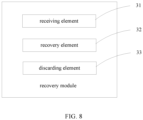
- the recovery module includes:
- the terminating node when the terminating node (node 3 shown in the figure) receives the data flow ACDABD subjected to the packet loss, in response to that the data packet A is received for a first time, the data packet A is recovered, and the packet header previously encapsulated for the data packet A is removed, and in response to that the data packet A is received for a second time, since the data packet A is a copied data packet A, the control word of the copied data packet A is the same as the control word of the data packet A received for the first time, the copied data packet A is discarded.
- the present disclosure provides a data transmission protection system, including a memory, a processor, and at least one application program stored in the memory and configured to be executed by the processor, the application program being configured to perform the data transmission protection method of the present disclosure described above.
- the present disclosure provides a computer-readable storage medium, on which a computer program is stored, and the program, when executed by a processor, implements the data transmission protection method of the present disclosure described above.
- the device, the system, and the computer-readable storage medium belong to the same concept as the method, and specific implementation processes thereof are described in detail in the method, and technical features in the method are all correspondingly applicable in the device, the system and the computer-readable storage medium, and are not described herein again.
- the present disclosure provides the data transmission protection method, the data transmission protection device, the data transmission protection system and the computer readable storage medium, the method includes: encapsulating a packet header for a data flow to be transmitted at an ingress node to form an encapsulated data flow, where the packet header includes a control word and a flow identification; copying the encapsulated data flow to obtain a copied data flow, and transmitting the encapsulated data flow and the copied data flow together; and recovering the data flow at a terminating node according to the control word and the flow identification, and thus reducing or even eliminating an influence of a packet loss event and reducing a time delay of service by performing same-path redundant copying on the data flow of the low-speed deterministic network service.
- the method of the present disclosure may be implemented by software plus a necessary general hardware platform, and certainly may also be implemented by hardware, but in many cases, the former is better.
- the technical solutions of the present disclosure may be embodied in the form of a software product, which is stored in a storage medium (such as a ROM/RAM, a magnetic disk, and an optical disk), and includes several instructions for enabling a terminal device (which may be a mobile phone, a computer, a server, an air conditioner, or a network device) to perform the method according to the present disclosure.
- the present disclosure is suitable for the technical field of communication, and is used for reducing or even eliminating an influence of a packet loss event and reducing a time delay of service by performing same-path redundant copying on the data flow of the low-speed deterministic network service.
Landscapes
- Engineering & Computer Science (AREA)
- Computer Networks & Wireless Communication (AREA)
- Signal Processing (AREA)
- Computer Security & Cryptography (AREA)
- Quality & Reliability (AREA)
- Data Exchanges In Wide-Area Networks (AREA)
Description
- The present disclosure relates to the field of communication technology, and in particular, to a data transmission protection method, a data transmission protection system, and a computer readable storage medium.
- In the communication field, for some communication services, such as industrial control, sensitive to time delay or packet loss, the time delay and a packet loss rate of the services are conventionally guaranteed through a proprietary device/proprietary protocol (such as field bus)/proprietary line, and along with gradual fusion of IT and OT, an IT network must provide deterministic network services similar to OT to support seamless docking and migration of the services; some new services, such as a block chain, are more and more sensitive to the time delay due to applications supported by the new services, best effort services of current network cannot meet requirements, and the network is urgently required to provide services such as deterministic time delay/packet loss/jitter and the like.
- U.S. patent application
US2013132789A1 provides video transmission systems and methods with video data flows transmitted over a Carrier Ethernet Network at Layer 2 with redundancy in order to provide hitless protection switching and uninterrupted video service delivery, such as during periods of asymmetric congestion or hard network failures. In an exemplary embodiment, the video transmission systems and methods provide the redundancy in a manner similar to 1+1 linear protection with hit-less protection switching. In another exemplary embodiment, the video transmission systems and methods provide encapsulated video signals over Ethernet using standardized Carrier Ethernet frames with additional sequencing information. Optionally, the video transmission systems and methods may also include packet-based forward error correction information for additional resiliency. These video transmission systems and methods provide uninterrupted and error-free video during broadcast despite network events such as fiber breaks, equipment failures, congestion, etc. - U.S. patent application
US2007280217A1 provides a method and software solution to add robustness to real-time media streams such as voice, video and audio streams on a network. When the network channel carrying the media stream experiences an adverse condition that affects the transmissions, such as high packet loss or corruption of packets, a robust mode is activated at an intermediate node of the end-to-end transmission for the media stream to the destination link. The robust mode of the present invention may be activated on specific network links that are experiencing the network problems and not necessarily on the end-to-end communication path. Under certain conditions, an intermediate network node may terminate robust mode in packets received from an upstream link when the network channel in question no longer experiences the adverse network condition. - U.S. patent application
US2006014330A1 provides a manufacturing method for an SOI wafer with a high productivity in which generation of a void is suppressed in manufacturing the SOI wafer. In a manufacturing method for an SOI wafer of the present invention in which two starting wafers are prepared, an insulating layer is formed on at least one of the two starting wafers and the one wafer is adhered to the other wafer without using an adhesive agent, the starting wafers each with no line defect on a surface thereof are used. In a manufacturing method for an SOI wafer of the present invention in which two starting wafers are prepared, an insulating layer is formed on at least one of the two starting wafers and the one wafer is adhered to the other wafer without using an adhesive agent, the starting wafers are subjected to a high temperature heat treatment in advance. - U.S. patent application
US2012158990A1 provides a method which includes receiving a constant bit rate data stream, segmenting the constant bit rate data stream into fixed size blocks of data, generating a time stamp indicative of a system reference clock, the time stamp being in reference to a clock rate of the constant bit rate data stream, encapsulating, in an electronic communication protocol frame, a predetermined number of fixed blocks of data along with (i) a control word indicative of, at least, a relative sequence of the predetermined number of fixed blocks of data in the constant bit rate stream and (ii) the time stamp, and transmitting the electronic communication protocol frame to a packet switched network. - U.S. patent application
US2009178096A1 provides an intelligent multi-sending of data stream segments, comprising: monitoring one or more variable data transmission parameters, detecting one or more invariant media data segment parameters, assigning a value to the media data segment based upon the one or more invariant media data segment parameters and the one or more variable data transmission parameters, comparing the value to a threshold, and sending multiple copies of the media data segment over a network link to a media receiver if the value is above the threshold. - In view of above, an object of the present disclosure is to provide a method, and a system for protecting data transmission and a computer-readable storage medium, which reduce or even eliminate an influence of a packet loss event and reduce a time delay of service by performing a same-path redundant copying on a data flow of a low-speed deterministic network service.
- The invention is set out in the appended set of claims.
-
-
Fig. 1 is a flowchart of a data transmission protection method according to the present disclosure; -
Fig. 2 is a schematic diagram of a data flow transmission according to the present disclosure; -
Fig. 3 is another flowchart of a data transmission protection method according to the present disclosure; -
Fig. 4 is a schematic diagram of structure of a packet header according to the present disclosure; -
Fig. 5 is a schematic diagram of structure of a control word according to the present disclosure; -
Fig. 6 is a block diagram of an exemplary structure of a data transmission protection device according to the present disclosure; -
Fig. 7 is a block diagram of another exemplary structure of a data transmission protection device according to the present disclosure; and -
Fig. 8 is a block diagram of an exemplary structure of a recovery module shown inFig. 6 . - Objects, features, and advantages of the present disclosure will be further explained with reference to the accompanying drawings.
- In order to make technical problems to be solved by the present disclosure, technical solutions and beneficial effects of the present disclosure clearer and more obvious, the present disclosure is further described in detail below with reference to the accompanying drawings. It should be understood that the specific descriptions herein are merely illustrative of the present disclosure and do not limit the present disclosure.
- As shown in
Fig. 1 , the present disclosure provides a data transmission protection method, including steps S10 to S30. - At step S10, a packet header is encapsulated for a data flow to be transmitted at an ingress node to form an encapsulated data flow, where the packet header includes a control word and a flow identification.
- At step S20, the encapsulated data flow is copied to obtain a copied data flow, and the encapsulated data flow and the copied data flow are transmitted together.
- At step S30, the data flow is recovered at a terminating node according to the control word and the flow identification.
- In the present disclosure, a same-path redundant copying is performed on the data flow of a low-speed deterministic network service, so that an influence of a packet loss event is reduced or even eliminated, and the time delay of the service is reduced.
- In the present disclosure, each of copy and recovery processes of the data flow (also referred to as a service flow) is finished at an edge node of a network, where the ingress node is an edge node of the network at a transmitting terminal, and the data flow is encapsulated and copied at the ingress node, and the terminating node is an edge node of the network at a receiving terminal, and the data flow is recovered at the terminating node.
- As shown in
Fig. 2 , in the present disclosure, at least one copied data flow (including four data packets ABCD shown inFig. 2 ) is obtained by copying the data flow to be transmitted (including the four packets ABCD), and is transmitted together with an original data flow, even if there is a packet loss event in a transmission process, as shown inFig. 2 , a packet B in the original data flow is lost, and a packet C in the copied data flow is lost, since there is the copied data flow, when finally recovering, the four packets ABCD may still be obtained, and the complete data flow is received. - As shown in
Fig. 3 , in the present disclosure, before the step S10, the method further includes steps S01 to S03. - At step S01, it is determined whether the data flow is a low-speed data steam sensitive to time delay and packet loss.
- At step S02, in response to that the data flow is the low-speed data steam sensitive to time delay and packet loss, a unique flow identification is assigned to the data flow, and enter the step S10 to encapsulate the packet header for the data flow to be transmitted at the ingress node.
- At step S03, in response to that the data flow is not the low-speed data steam sensitive to time delay and packet loss, directly transmit the data flow.
- In the present disclosure, a rate threshold for determining whether the data flow is the low-speed data flow sensitive to time delay and packet loss is recommended to be 100kbps, and when a transmission rate of the data flow is less than the rate threshold, the data flow is the low-speed data flow. The rate threshold may be flexibly configured by an upper layer application according to a capacity of the network.
- In the present disclosure, when the packet header is encapsulated for the data flow, the packet header includes a data payload, a control word, and a flow identification.
Fig. 4 shows a schematic diagram of structure of the packet header, which includes two modes, one is an MPLS PW mode, and the other is an IPv6 mode, and with such structural design, it is easy to keep compatibility with a data plane design of a DetNet (deterministic network). - In the present disclosure, the flow identification is used to uniquely identify a specific data flow, in a network domain where the data flow is transmitted, for nodes of the network. For a same data flow or a same packet, the flow identification and the control word corresponding thereto are constant, and are irrelevant to whether the redundant copying is performed. Specifically, a PW (Pseudowire) label identification, and an identification combining a flow label and a source address in an IPv6 header structure may be used to identify the data flow.
- As shown in
Fig. 5 , in the present disclosure, the control word mainly includes a packet sequence number. The control word may have a total of four bytes, two bytes for the packet sequence number, and two bytes for a reserved field, and such structural design is adopted to maintain compatibility with technical mechanisms related to multi-path service protection in TSN (time sensitive network) and DetNet (deterministic network). Control words corresponding to the same service flow data packets are the same, and no matter how many copies of an original data packet are, the control words are the same as that of the original data packet, so that the data flow may be identified and recovered at the edge node. - In the present disclosure, the step S20 specifically includes: copying the encapsulated data flow to obtain (1+n) encapsulated data flows, flow identifications and control words of the (1+n) encapsulated data flows are completely the same, and n is an integer greater than or equal to 1; and transmitting the (1+n) encapsulated data flows to a receiving terminal together.
- In the present disclosure, a value of n may be statically configured, or may be dynamically adjusted by a control plane according to network packet loss statistical data, where the value of n is configured to be relative large in response to that a current packet loss rate is relative high, and the value of n is configured to be relative small in response to that the current packet loss rate is relative low.
- In the present disclosure, a method for copying the encapsulated data flow includes: copying the encapsulated data flow according to a time slice and copying the encapsulated data flow according to a number of specific consecutive packets, specifically, in response to that the service is a time continuous service, data is extracted and copied according to the time slice, such as 1 millisecond; and in response to that the service is an intermittent burst short-time service, data is extracted and copied according to the number of packets, such as copying is performed every 1000 packets.
- In the present disclosure, if a relay node participates in the transmission of the data flow, the relay node performs indifferent forwarding on the data flow without identifying the copied redundant data or participating in a copying operation.
- In the present disclosure, the step S30 includes: receiving the data flow, determining whether the data flow reaches the terminating node for a first time according to the control word of the data flow, in response to that the data flow reaches the terminating node for the first time, recovering the data flow, and removing the packet header encapsulated for the data flow; and in response to that the control word of the data flow currently received is the same as the control word of the data flow previously received, discarding the data flow currently received.
- Taking
Fig. 2 as an example, when the terminating node (node 3 shown in the figure) receives the data flow ACDABD subjected to the packet loss, in response to that the data packet A is received for a first time, the data packet A is recovered, and the packet header previously encapsulated for the data packet A is removed, and in response to that the data packet A is received for a second time, since the data packet A is a copied data packet A, the control word of the copied data packet A is the same as the control word of the data packet A received for the first time, the copied data packet A is discarded. - In an application scenario of low-speed data flow, under a current or future IT network environment of services sensitive to time delay and packet loss, multiplication of the data flow caused by a redundant copying mechanism may be ignored to a certain extent for a capacity of the current IT network, but the packet loss and the time delay can be greatly reduced.
- As shown in
Fig. 6 , the present disclosure provides a data transmission protection device, including: anencapsulation module 10, configured to encapsulate a packet header for a data flow to be transmitted at an ingress node to form an encapsulated data flow, where the packet header includes a control word and a flow identification; a copying and transmittingmodule 20, configured to copy the encapsulated data flow to obtain a copied data flow and transmit the encapsulated data flow and the copied data flow together; and arecovery module 30, configured to recover the data flow at a terminating node according to the control word and the flow identification. - According to the current invention, a same-path redundant copying is performed on the data flow of a low-speed deterministic network service, so that an influence of a packet loss event is reduced or even eliminated, and the time delay of the service is reduced.
- In the present disclosure, each of copy and recovery processes of the data flow (also referred to as a service flow) is finished at an edge node of a network, where the ingress node is an edge node of the network at a transmitting terminal, and the data flow is encapsulated and copied at the ingress node, and the terminating node is an edge node of the network at a receiving terminal, and the data flow is recovered at the terminating node.
- As shown in
Fig. 2 , in the present disclosure, at least one copied data flow (including four data packets ABCD shown inFig. 2 ) is obtained by copying the data flow to be transmitted (including the four packets ABCD), and is transmitted together with an original data flow, even if there is a packet loss event in a transmission process, as shown inFig. 2 , a packet B in the original data flow is lost, and a packet C in the copied data flow is lost, since there is the copied data flow, when finally recovering, the four packets ABCD may still be obtained, and the complete data flow is received. - As shown in
Fig. 7 , according to the current invention, the data transmission protection device further includes: a determiningmodule 40 configured to determine whether the data flow is a low-speed data flow sensitive to time delay and packet loss, in response to that the data flow is the low-speed data flow sensitive to time delay and packet loss, assign a unique flow identification to the data flow, and encapsulate the packet header for the data flow to be transmitted at the ingress node; and in response to that the data flow is not the low-speed data flow sensitive to time delay and packet loss, directly transmit the data flow. - In the present disclosure, a rate threshold for determining whether the data flow is the low-speed data flow sensitive to time delay and packet loss is recommended to be 100kbps, and when a transmission rate of the data flow is less than the rate threshold, the data flow is the low-speed data flow. The rate threshold may be flexibly configured by an upper layer application according to a capacity of the network.
- In the present disclosure, when the packet header is encapsulated for the data flow, the packet header includes a data payload, a control word, and a flow identification.
Fig. 4 shows a schematic diagram of structure of the packet header, which includes two modes, one is an MPLS PW mode, and the other is an IPv6 mode, and with such structural design, it is easy to keep compatibility with a data plane design of a DetNet (deterministic network). - In the present disclosure, the flow identification is used to uniquely identify a specific data flow, in a network domain where the data flow is transmitted, for nodes of the network. For a same data flow or a same packet, the flow identification and the control word corresponding thereto are constant, and are irrelevant to whether the redundant copying is performed. Specifically, a PW (Pseudowire) label identification, and an identification combining a flow label and a source address in an IPv6 header structure may be used to identify the data flow.
- As shown in
Fig. 5 , in the present disclosure, the control word mainly includes a packet sequence number. The control word may have a total of four bytes, two bytes for the packet sequence number, and two bytes for a reserved field, and such structural design is adopted to maintain compatibility with technical mechanisms related to multi-path service protection in TSN (time sensitive network) and DetNet (deterministic network). Control words corresponding to the same service flow data packets are the same, and no matter how many copies of an original data packet are, the control words are the same as that of the original data packet, so that the data flow may be identified and recovered at the edge node. - In the present disclosure, the copying and transmitting module specifically is configured to: copy the encapsulated data flow to obtain (1+n) encapsulated data flows, where flow identifications and control words of the (1+n) encapsulated data flows are completely the same, and n is an integer greater than or equal to 1; and transmit the (1+n) encapsulated data flows to a receiving terminal together.
- In the present disclosure, a value of n may be statically configured, or may be dynamically adjusted by a control plane according to network packet loss statistical data, where the value of n is configured to be relative large in response to that a current packet loss rate is relative high, and the value of n is configured to be relative small in response to that the current packet loss rate is relative low.
- In the present disclosure, a method for copying the encapsulated data flow includes: copying the encapsulated data flow according to a time slice and copying the encapsulated data flow according to a number of specific consecutive packets, specifically, in response to that the service is a time continuous service, data is extracted and copied according to the time slice, such as 1 millisecond; and in response to that the service is an intermittent burst short-time service, data is extracted and copied according to the number of packets, such as copying is performed every 1000 packets.
- In the present disclosure, if a relay node participates in the transmission of the data flow, the relay node performs indifferent forwarding on the data flow without identifying the copied redundant data or participating in a copying operation.
- As shown in
Fig. 8 , in the present disclosure, the recovery module includes: - a receiving
element 31 configured to receive the data flow; - a
recovery element 32 configured to determine whether the data flow reaches the terminating node for a first time according to the control word of the data flow, and in response to that the data flow reaches the terminating node for the first time, recover the data flow and remove the packet header encapsulated for the data flow; and a discardingelement 33 configured to discard the data flow currently received in response to that the control word of the data flow currently received is the same as the control word of the data flow previously received. - Taking
Fig. 2 as an example, when the terminating node (node 3 shown in the figure) receives the data flow ACDABD subjected to the packet loss, in response to that the data packet A is received for a first time, the data packet A is recovered, and the packet header previously encapsulated for the data packet A is removed, and in response to that the data packet A is received for a second time, since the data packet A is a copied data packet A, the control word of the copied data packet A is the same as the control word of the data packet A received for the first time, the copied data packet A is discarded. - In an application scenario of low-speed data flow, under a current or future IT network environment of services sensitive to time delay and packet loss, multiplication of the data flow caused by a redundant copying mechanism may be ignored to a certain extent for a capacity of the current IT network, but the packet loss and the time delay can be greatly reduced.
- The present disclosure provides a data transmission protection system, including a memory, a processor, and at least one application program stored in the memory and configured to be executed by the processor, the application program being configured to perform the data transmission protection method of the present disclosure described above.
- The present disclosure provides a computer-readable storage medium, on which a computer program is stored, and the program, when executed by a processor, implements the data transmission protection method of the present disclosure described above.
- It should be noted that the device, the system, and the computer-readable storage medium belong to the same concept as the method, and specific implementation processes thereof are described in detail in the method, and technical features in the method are all correspondingly applicable in the device, the system and the computer-readable storage medium, and are not described herein again.
- The present disclosure provides the data transmission protection method, the data transmission protection device, the data transmission protection system and the computer readable storage medium, the method includes: encapsulating a packet header for a data flow to be transmitted at an ingress node to form an encapsulated data flow, where the packet header includes a control word and a flow identification; copying the encapsulated data flow to obtain a copied data flow, and transmitting the encapsulated data flow and the copied data flow together; and recovering the data flow at a terminating node according to the control word and the flow identification, and thus reducing or even eliminating an influence of a packet loss event and reducing a time delay of service by performing same-path redundant copying on the data flow of the low-speed deterministic network service.
- Through the foregoing description of the present disclosure, it is clear to those skilled in the art that the method of the present disclosure may be implemented by software plus a necessary general hardware platform, and certainly may also be implemented by hardware, but in many cases, the former is better. Based on such understanding, the technical solutions of the present disclosure may be embodied in the form of a software product, which is stored in a storage medium (such as a ROM/RAM, a magnetic disk, and an optical disk), and includes several instructions for enabling a terminal device (which may be a mobile phone, a computer, a server, an air conditioner, or a network device) to perform the method according to the present disclosure.
- The present disclosure has been described above with reference to the accompanying drawings, but the scope of the present disclosure is not limited thereto and is only limited by the appended claims.
- The present disclosure is suitable for the technical field of communication, and is used for reducing or even eliminating an influence of a packet loss event and reducing a time delay of service by performing same-path redundant copying on the data flow of the low-speed deterministic network service.
Claims (8)
- A data transmission protection method, comprising:encapsulating a packet header for a data flow to be transmitted at an ingress node to form an encapsulated data flow, wherein the packet header comprises a control word and a flow identification (S10);copying the encapsulated data flow to obtain a copied data flow, and transmitting the encapsulated data flow and the copied data flow through a same path (S20); andrecovering the data flow at a terminating node according to the control word and the flow identification (S30),wherein before encapsulating the packet header for the data flow to be transmitted at the ingress node, the method further comprises:determining whether the data flow is a low-speed data flow sensitive to time delay and packet loss (S01),in response to that the data flow is the low-speed data flow sensitive to time delay and packet loss, assigning a unique flow identification to the data flow for encapsulating the packet header for the data flow to be transmitted at the ingress node (S02); andin response to that the data flow is not the low-speed data flow sensitive to time delay and packet loss, directly transmitting the data flow (S03).
- The data transmission protection method according to claim 1, wherein the step of copying the encapsulated data flow to obtain the copied data flow, and transmitting the encapsulated data flow and the copied data flow together comprises:coping the encapsulated data flow to obtain (1+n) encapsulated data flows, wherein flow identifications and control words of the (1+n) encapsulated data flows are completely the same, and n is an integer greater than or equal to 1; andtransmitting the (1+n) encapsulated data flows to a receiving terminal together.
- The data transmission protection method according to claim 2, wherein the step of recovering the data flow at the terminating node according to the control word and the flow identification comprises:receiving the data flow, determining whether the data flow reaches the terminating node for a first time according to the control word of the data flow,in response to that the data flow reaches the terminating node for the first time, recovering the data flow, and removing the packet header encapsulated for the data flow; andin response to that the control word of the data flow currently received is the same as the control word of the data flow previously received, discarding the data flow currently received.
- A data transmission protection system, comprising:an ingress node configured to encapsulate a packet header for a data flow to be transmitted to form an encapsulated data flow, and copy the encapsulated data flow to obtain a copied data flow and transmit the encapsulated data flow and the copied data flow through a same path, wherein the packet header comprises a control word and a flow identification; anda terminating node configured to recover the data flow according to the control word and the flow identification,wherein the ingress node is configured to determine whether the data flow is a low-speed data flow sensitive to time delay and packet loss before encapsulating the packet header for the data flow to be transmitted, in response to that the data flow is the low-speed data flow sensitive to time delay and packet loss, assign a unique flow identification to the data flow, and encapsulate the packet header for the data flow to be transmitted; and in response to that the data flow is not the low-speed data flow sensitive to time delay and packet loss, directly transmit the data flow.
- The data transmission protection system according to claim 4, wherein the ingress node is configured to:copy the encapsulated data flow to obtain (1+n) encapsulated data flows, wherein flow identifications and control words of the (1+n) encapsulated data flows are completely the same, and n is an integer greater than or equal to 1; andtransmit the (1+n) encapsulated data flows to a receiving terminal together.
- The data transmission protection system according to claim 5, wherein the terminating node is configured to:receive the data flow;determine whether the data flow reaches the terminating node for a first time according to the control word of the data flow, and in response to that the data flow reaches the terminating node for the first time, recover the data flow and remove the packet header encapsulated for the data flow; anddiscard the data flow currently received in response to that the control word of the data flow currently received is the same as the control word of the data flow previously received.
- A computer program, comprising instructions which, when the program is executed by a computer, cause the computer to perform the data transmission protection method according to any one of claims 1 to 3.
- A computer-readable storage medium, storing a computer program, which, when executed by a processor, implements the data transmission protection method according to any one of claims 1 to 3.
Applications Claiming Priority (2)
| Application Number | Priority Date | Filing Date | Title |
|---|---|---|---|
| CN201810390063.0A CN110417707B (en) | 2018-04-27 | 2018-04-27 | Data transmission protection method, device, system and computer readable storage medium |
| PCT/CN2019/072731 WO2019205756A1 (en) | 2018-04-27 | 2019-01-22 | Data transmission protection method, apparatus, and system, and computer readable storage medium |
Publications (3)
| Publication Number | Publication Date |
|---|---|
| EP3767855A1 EP3767855A1 (en) | 2021-01-20 |
| EP3767855A4 EP3767855A4 (en) | 2022-01-05 |
| EP3767855B1 true EP3767855B1 (en) | 2025-03-26 |
Family
ID=68294849
Family Applications (1)
| Application Number | Title | Priority Date | Filing Date |
|---|---|---|---|
| EP19792151.3A Active EP3767855B1 (en) | 2018-04-27 | 2019-01-22 | Data transmission protection method, apparatus, system, computer program and computer readable storage medium |
Country Status (4)
| Country | Link |
|---|---|
| US (1) | US11330085B2 (en) |
| EP (1) | EP3767855B1 (en) |
| CN (1) | CN110417707B (en) |
| WO (1) | WO2019205756A1 (en) |
Families Citing this family (4)
| Publication number | Priority date | Publication date | Assignee | Title |
|---|---|---|---|---|
| CN112769738B (en) * | 2019-11-05 | 2023-09-12 | 中兴通讯股份有限公司 | DetNet data packet processing method and device |
| CN112787902B (en) * | 2019-11-08 | 2023-11-21 | 中兴通讯股份有限公司 | Message encapsulation method and device, message decapsulation method and device |
| CN114374617B (en) * | 2021-12-13 | 2024-06-25 | 中电信数智科技有限公司 | Fault-tolerant prefabrication method for deterministic network |
| CN120835024A (en) * | 2024-04-17 | 2025-10-24 | 中兴通讯股份有限公司 | A configuration sending and message processing method and device |
Family Cites Families (14)
| Publication number | Priority date | Publication date | Assignee | Title |
|---|---|---|---|---|
| US6483804B1 (en) * | 1999-03-01 | 2002-11-19 | Sun Microsystems, Inc. | Method and apparatus for dynamic packet batching with a high performance network interface |
| US7555562B2 (en) * | 2002-06-27 | 2009-06-30 | Alcatel Lucent | Method and apparatus for mirroring traffic over a network |
| JP2007060345A (en) * | 2005-08-25 | 2007-03-08 | Kazunori Nakamura | Network system |
| CN101030832B (en) * | 2006-03-03 | 2011-08-10 | 华为技术有限公司 | Method and system for realizing realtime transmission protocol message redundancy |
| US20070280217A1 (en) * | 2006-06-01 | 2007-12-06 | Texas Instruments Incorporated | Inter-nodal robust mode for real-time media streams in a network |
| CN100558028C (en) | 2006-08-11 | 2009-11-04 | 华为技术有限公司 | A method and system for implementing error correction and an access device for implementing error correction |
| US7995575B2 (en) * | 2008-01-02 | 2011-08-09 | Cisco Technology, Inc. | Packet error handling |
| US20090178096A1 (en) * | 2008-01-03 | 2009-07-09 | Microsoft Corporation | Intelligent over-transmission of media data segments |
| US8472438B2 (en) * | 2010-04-23 | 2013-06-25 | Telefonaktiebolaget L M Ericsson (Publ) | Efficient encapsulation of packets transmitted on a packet-pseudowire over a packet switched network |
| US20120158990A1 (en) * | 2010-12-17 | 2012-06-21 | Cisco Technology, Inc. | Transporting a CBR Data Stream Over a Packet Switched Network |
| CN102325009A (en) * | 2011-09-13 | 2012-01-18 | 北京邮电大学 | A Reliable Transmission Method of Network Coding Multicast Data Stream Based on Forward Error Correction |
| US8667374B2 (en) | 2011-11-21 | 2014-03-04 | Ciena Corporation | Video transmission systems and methods over carrier ethernet |
| US9686381B1 (en) * | 2013-09-30 | 2017-06-20 | Juniper Networks, Inc. | Control word decapsulation in a hybrid BGP-VPLS network |
| CN107231303A (en) * | 2016-03-24 | 2017-10-03 | 中兴通讯股份有限公司 | Data flow transmission method and device |
-
2018
- 2018-04-27 CN CN201810390063.0A patent/CN110417707B/en active Active
-
2019
- 2019-01-22 US US17/043,060 patent/US11330085B2/en active Active
- 2019-01-22 EP EP19792151.3A patent/EP3767855B1/en active Active
- 2019-01-22 WO PCT/CN2019/072731 patent/WO2019205756A1/en not_active Ceased
Also Published As
| Publication number | Publication date |
|---|---|
| EP3767855A4 (en) | 2022-01-05 |
| CN110417707A (en) | 2019-11-05 |
| WO2019205756A1 (en) | 2019-10-31 |
| CN110417707B (en) | 2021-11-09 |
| EP3767855A1 (en) | 2021-01-20 |
| US20210037121A1 (en) | 2021-02-04 |
| US11330085B2 (en) | 2022-05-10 |
Similar Documents
| Publication | Publication Date | Title |
|---|---|---|
| US12095657B2 (en) | Packet or frame replication and elimination with explict or implict notification to reset sequence number recovery | |
| US8565071B2 (en) | Protection method, system, and device in packet transport network | |
| US9160563B2 (en) | Failure recovery method in non revertive mode of Ethernet ring network | |
| CN102100039B (en) | Establishing Pseudowires in Packet Switched Networks | |
| US20030043736A1 (en) | Method for supporting SDH/SONET APS on ethernet | |
| CN100512292C (en) | Apparatus and method of real-time recovering service | |
| US7710864B2 (en) | Recovery mechanism for 10 GE optical transport network wavelength division multiplexing ring | |
| US11330085B2 (en) | Data transmission protection method, device, system, and computer readable storage medium | |
| WO2018059604A1 (en) | Information transmission method, device, and computer storage medium | |
| US11804982B2 (en) | Communication method and apparatus | |
| US9013977B2 (en) | Method and system for reducing traffic disturbance in a communication network caused by intermittent failure | |
| US20110228667A1 (en) | Address refreshing method and device of ethernet ring network | |
| WO2023197770A1 (en) | Fault notification method and apparatus | |
| CN103490921B (en) | Network protection method, device, lower link point and system | |
| RU2730390C1 (en) | Method and apparatus for automatic determination of inter-node communication topology in shared backup ring of transoceanic multiplex section | |
| JP7168286B2 (en) | Communication method and communication device | |
| CN102136865A (en) | Service recovering method, system and node device | |
| CN111200510B (en) | Service protection method and device | |
| JP2020205531A (en) | Network monitoring device, transmission device, and network monitoring method | |
| CN110740094B (en) | Network equipment, BFD message transmission method and device | |
| EP2573977A1 (en) | Subnet protection method and device for transport multi-protocol label switching (tmpls) network | |
| CN109039728B (en) | BFD-based flow congestion detection method and system | |
| CN111555976B (en) | A method and device for processing service flow in packet network | |
| CN118677718A (en) | A data processing method and device | |
| US20120140617A1 (en) | System and method for packet protection switching |
Legal Events
| Date | Code | Title | Description |
|---|---|---|---|
| STAA | Information on the status of an ep patent application or granted ep patent |
Free format text: STATUS: THE INTERNATIONAL PUBLICATION HAS BEEN MADE |
|
| PUAI | Public reference made under article 153(3) epc to a published international application that has entered the european phase |
Free format text: ORIGINAL CODE: 0009012 |
|
| STAA | Information on the status of an ep patent application or granted ep patent |
Free format text: STATUS: REQUEST FOR EXAMINATION WAS MADE |
|
| 17P | Request for examination filed |
Effective date: 20201014 |
|
| AK | Designated contracting states |
Kind code of ref document: A1 Designated state(s): AL AT BE BG CH CY CZ DE DK EE ES FI FR GB GR HR HU IE IS IT LI LT LU LV MC MK MT NL NO PL PT RO RS SE SI SK SM TR |
|
| AX | Request for extension of the european patent |
Extension state: BA ME |
|
| RIN1 | Information on inventor provided before grant (corrected) |
Inventor name: HUANG, GUANGPING |
|
| DAV | Request for validation of the european patent (deleted) | ||
| DAX | Request for extension of the european patent (deleted) | ||
| REG | Reference to a national code |
Free format text: PREVIOUS MAIN CLASS: H04L0001000000 Ipc: H04L0001080000 Ref country code: DE Ref legal event code: R079 Ref document number: 602019067819 Country of ref document: DE Free format text: PREVIOUS MAIN CLASS: H04L0001000000 Ipc: H04L0001080000 |
|
| A4 | Supplementary search report drawn up and despatched |
Effective date: 20211207 |
|
| RIC1 | Information provided on ipc code assigned before grant |
Ipc: H04L 1/00 20060101ALN20211201BHEP Ipc: H04L 29/06 20060101ALN20211201BHEP Ipc: H04L 12/939 20130101ALI20211201BHEP Ipc: H04L 12/931 20130101ALI20211201BHEP Ipc: H04L 1/08 20060101AFI20211201BHEP |
|
| STAA | Information on the status of an ep patent application or granted ep patent |
Free format text: STATUS: EXAMINATION IS IN PROGRESS |
|
| 17Q | First examination report despatched |
Effective date: 20240719 |
|
| REG | Reference to a national code |
Ipc: H04L0049200000 Ref country code: DE Ref legal event code: R079 Ref document number: 602019067819 Country of ref document: DE Free format text: PREVIOUS MAIN CLASS: H04L0001080000 Ipc: H04L0049200000 |
|
| GRAP | Despatch of communication of intention to grant a patent |
Free format text: ORIGINAL CODE: EPIDOSNIGR1 |
|
| RIC1 | Information provided on ipc code assigned before grant |
Ipc: H04L 69/22 20220101ALN20241128BHEP Ipc: H04L 1/00 20060101ALN20241128BHEP Ipc: H04L 1/08 20060101ALI20241128BHEP Ipc: H04L 49/55 20220101ALI20241128BHEP Ipc: H04L 49/20 20220101AFI20241128BHEP |
|
| STAA | Information on the status of an ep patent application or granted ep patent |
Free format text: STATUS: GRANT OF PATENT IS INTENDED |
|
| INTG | Intention to grant announced |
Effective date: 20250102 |
|
| GRAS | Grant fee paid |
Free format text: ORIGINAL CODE: EPIDOSNIGR3 |
|
| GRAA | (expected) grant |
Free format text: ORIGINAL CODE: 0009210 |
|
| STAA | Information on the status of an ep patent application or granted ep patent |
Free format text: STATUS: THE PATENT HAS BEEN GRANTED |
|
| AK | Designated contracting states |
Kind code of ref document: B1 Designated state(s): AL AT BE BG CH CY CZ DE DK EE ES FI FR GB GR HR HU IE IS IT LI LT LU LV MC MK MT NL NO PL PT RO RS SE SI SK SM TR |
|
| REG | Reference to a national code |
Ref country code: GB Ref legal event code: FG4D |
|
| REG | Reference to a national code |
Ref country code: CH Ref legal event code: EP |
|
| REG | Reference to a national code |
Ref country code: DE Ref legal event code: R096 Ref document number: 602019067819 Country of ref document: DE |
|
| REG | Reference to a national code |
Ref country code: IE Ref legal event code: FG4D |
|
| PG25 | Lapsed in a contracting state [announced via postgrant information from national office to epo] |
Ref country code: RS Free format text: LAPSE BECAUSE OF FAILURE TO SUBMIT A TRANSLATION OF THE DESCRIPTION OR TO PAY THE FEE WITHIN THE PRESCRIBED TIME-LIMIT Effective date: 20250626 |
|
| PG25 | Lapsed in a contracting state [announced via postgrant information from national office to epo] |
Ref country code: FI Free format text: LAPSE BECAUSE OF FAILURE TO SUBMIT A TRANSLATION OF THE DESCRIPTION OR TO PAY THE FEE WITHIN THE PRESCRIBED TIME-LIMIT Effective date: 20250326 |
|
| REG | Reference to a national code |
Ref country code: LT Ref legal event code: MG9D |
|
| PG25 | Lapsed in a contracting state [announced via postgrant information from national office to epo] |
Ref country code: NO Free format text: LAPSE BECAUSE OF FAILURE TO SUBMIT A TRANSLATION OF THE DESCRIPTION OR TO PAY THE FEE WITHIN THE PRESCRIBED TIME-LIMIT Effective date: 20250626 |
|
| PG25 | Lapsed in a contracting state [announced via postgrant information from national office to epo] |
Ref country code: HR Free format text: LAPSE BECAUSE OF FAILURE TO SUBMIT A TRANSLATION OF THE DESCRIPTION OR TO PAY THE FEE WITHIN THE PRESCRIBED TIME-LIMIT Effective date: 20250326 |
|
| PG25 | Lapsed in a contracting state [announced via postgrant information from national office to epo] |
Ref country code: LV Free format text: LAPSE BECAUSE OF FAILURE TO SUBMIT A TRANSLATION OF THE DESCRIPTION OR TO PAY THE FEE WITHIN THE PRESCRIBED TIME-LIMIT Effective date: 20250326 |
|
| PG25 | Lapsed in a contracting state [announced via postgrant information from national office to epo] |
Ref country code: BG Free format text: LAPSE BECAUSE OF FAILURE TO SUBMIT A TRANSLATION OF THE DESCRIPTION OR TO PAY THE FEE WITHIN THE PRESCRIBED TIME-LIMIT Effective date: 20250326 Ref country code: GR Free format text: LAPSE BECAUSE OF FAILURE TO SUBMIT A TRANSLATION OF THE DESCRIPTION OR TO PAY THE FEE WITHIN THE PRESCRIBED TIME-LIMIT Effective date: 20250627 |
|
| REG | Reference to a national code |
Ref country code: NL Ref legal event code: MP Effective date: 20250326 |
|
| PG25 | Lapsed in a contracting state [announced via postgrant information from national office to epo] |
Ref country code: NL Free format text: LAPSE BECAUSE OF FAILURE TO SUBMIT A TRANSLATION OF THE DESCRIPTION OR TO PAY THE FEE WITHIN THE PRESCRIBED TIME-LIMIT Effective date: 20250326 |
|
| PG25 | Lapsed in a contracting state [announced via postgrant information from national office to epo] |
Ref country code: SE Free format text: LAPSE BECAUSE OF FAILURE TO SUBMIT A TRANSLATION OF THE DESCRIPTION OR TO PAY THE FEE WITHIN THE PRESCRIBED TIME-LIMIT Effective date: 20250326 |
|
| REG | Reference to a national code |
Ref country code: AT Ref legal event code: MK05 Ref document number: 1780101 Country of ref document: AT Kind code of ref document: T Effective date: 20250326 |
|
| PG25 | Lapsed in a contracting state [announced via postgrant information from national office to epo] |
Ref country code: SM Free format text: LAPSE BECAUSE OF FAILURE TO SUBMIT A TRANSLATION OF THE DESCRIPTION OR TO PAY THE FEE WITHIN THE PRESCRIBED TIME-LIMIT Effective date: 20250326 |
|
| PG25 | Lapsed in a contracting state [announced via postgrant information from national office to epo] |
Ref country code: ES Free format text: LAPSE BECAUSE OF FAILURE TO SUBMIT A TRANSLATION OF THE DESCRIPTION OR TO PAY THE FEE WITHIN THE PRESCRIBED TIME-LIMIT Effective date: 20250326 Ref country code: PT Free format text: LAPSE BECAUSE OF FAILURE TO SUBMIT A TRANSLATION OF THE DESCRIPTION OR TO PAY THE FEE WITHIN THE PRESCRIBED TIME-LIMIT Effective date: 20250728 |
|
| PG25 | Lapsed in a contracting state [announced via postgrant information from national office to epo] |
Ref country code: PL Free format text: LAPSE BECAUSE OF FAILURE TO SUBMIT A TRANSLATION OF THE DESCRIPTION OR TO PAY THE FEE WITHIN THE PRESCRIBED TIME-LIMIT Effective date: 20250326 Ref country code: IT Free format text: LAPSE BECAUSE OF FAILURE TO SUBMIT A TRANSLATION OF THE DESCRIPTION OR TO PAY THE FEE WITHIN THE PRESCRIBED TIME-LIMIT Effective date: 20250326 |
|
| PG25 | Lapsed in a contracting state [announced via postgrant information from national office to epo] |
Ref country code: AT Free format text: LAPSE BECAUSE OF FAILURE TO SUBMIT A TRANSLATION OF THE DESCRIPTION OR TO PAY THE FEE WITHIN THE PRESCRIBED TIME-LIMIT Effective date: 20250326 |
|
| PG25 | Lapsed in a contracting state [announced via postgrant information from national office to epo] |
Ref country code: EE Free format text: LAPSE BECAUSE OF FAILURE TO SUBMIT A TRANSLATION OF THE DESCRIPTION OR TO PAY THE FEE WITHIN THE PRESCRIBED TIME-LIMIT Effective date: 20250326 |
|
| PG25 | Lapsed in a contracting state [announced via postgrant information from national office to epo] |
Ref country code: RO Free format text: LAPSE BECAUSE OF FAILURE TO SUBMIT A TRANSLATION OF THE DESCRIPTION OR TO PAY THE FEE WITHIN THE PRESCRIBED TIME-LIMIT Effective date: 20250326 |
|
| PG25 | Lapsed in a contracting state [announced via postgrant information from national office to epo] |
Ref country code: SK Free format text: LAPSE BECAUSE OF FAILURE TO SUBMIT A TRANSLATION OF THE DESCRIPTION OR TO PAY THE FEE WITHIN THE PRESCRIBED TIME-LIMIT Effective date: 20250326 |
|
| PG25 | Lapsed in a contracting state [announced via postgrant information from national office to epo] |
Ref country code: IS Free format text: LAPSE BECAUSE OF FAILURE TO SUBMIT A TRANSLATION OF THE DESCRIPTION OR TO PAY THE FEE WITHIN THE PRESCRIBED TIME-LIMIT Effective date: 20250726 |
|
| REG | Reference to a national code |
Ref country code: DE Ref legal event code: R097 Ref document number: 602019067819 Country of ref document: DE |
|
| PGFP | Annual fee paid to national office [announced via postgrant information from national office to epo] |
Ref country code: GB Payment date: 20251204 Year of fee payment: 8 |
|
| PG25 | Lapsed in a contracting state [announced via postgrant information from national office to epo] |
Ref country code: DK Free format text: LAPSE BECAUSE OF FAILURE TO SUBMIT A TRANSLATION OF THE DESCRIPTION OR TO PAY THE FEE WITHIN THE PRESCRIBED TIME-LIMIT Effective date: 20250326 |
|
| PGFP | Annual fee paid to national office [announced via postgrant information from national office to epo] |
Ref country code: FR Payment date: 20251208 Year of fee payment: 8 |
|
| PG25 | Lapsed in a contracting state [announced via postgrant information from national office to epo] |
Ref country code: CZ Free format text: LAPSE BECAUSE OF FAILURE TO SUBMIT A TRANSLATION OF THE DESCRIPTION OR TO PAY THE FEE WITHIN THE PRESCRIBED TIME-LIMIT Effective date: 20250326 |
|
| PLBE | No opposition filed within time limit |
Free format text: ORIGINAL CODE: 0009261 |
|
| STAA | Information on the status of an ep patent application or granted ep patent |
Free format text: STATUS: NO OPPOSITION FILED WITHIN TIME LIMIT |
|
| REG | Reference to a national code |
Ref country code: CH Ref legal event code: L10 Free format text: ST27 STATUS EVENT CODE: U-0-0-L10-L00 (AS PROVIDED BY THE NATIONAL OFFICE) Effective date: 20260211 |
|
| 26N | No opposition filed |
Effective date: 20260105 |
|
| PGFP | Annual fee paid to national office [announced via postgrant information from national office to epo] |
Ref country code: DE Payment date: 20251203 Year of fee payment: 8 |